
Brentwood City Zoning Code
ARTICLE VIII
TREE MANAGEMENT7
Cross reference— Tree committee, § 2-191 et seq.
Sec. 78-506.- Purpose.
The purpose of this article is to protect and enhance the environmental, economic, and aesthetic resources of the community in a manner consistent with the development goals outlined in the city's comprehensive plan. The policies furthered by this article promote the health, safety, and general welfare of the citizenry through the establishment of development design standards that follow accepted forestry policy and practice for urban areas. The general objectives of the article are intended to encourage:
(1)
The planting of trees in the city that are suitable to urban conditions in the locale.
(2)
The long-term preservation, maintenance, and protection of existing and newly planted trees.
(3)
The removal of trees that pose a threat to the safety of the general public and/or surrounding trees and vegetation.
(Ord. No. 99-07, § 1, 7-12-99)
Sec. 78-507. - Intent.
The standards set out in this article are necessary to maintain and enhance the quality of life in the city by measures that: promote air quality; lessen air pollution impacts; reduce noise, heat, and glare; prevent soil erosion and minimize flooding; visually screen conflicting land-uses; minimize the unnecessary removal of trees during development; minimize the cost of drainage system construction or maintenance; and beautify improved and developing properties.
(Ord. No. 99-07, § 1, 7-12-99)
Sec. 78-508. - Definitions.
The following words, terms and phrases, when used in this article, shall have the meanings ascribed to them in this section, except where the context clearly indicates a different meaning:
Caliper inches means the diameter of the stem six inches above the ground, for trees with a caliper of four inches or less. Trees possessing a caliper in excess of four inches are measured 54 inches above the ground.
Canopy tree means any tree that would occupy the upper canopy of a forest in a natural ecological situation. These trees generally reach a height in excess of 25 feet, and are often referred to as shade trees. Examples include varieties of oak, maple, hickory, etc.
Conifer tree means any tree with needle leaves and a cone fruit.
Deciduous tree means any tree which sheds its leaves annually, usually in the fall or winter.
Drip line means a vertical line extending from the outermost portion of a tree to the ground.
Endangered species means those trees which are under the protection of state and/or federal law.
Evergreen means those trees, including broad-leaf and conifer trees, that maintain their leaves year-round.
Private tree means any tree located on private property, and not in an area owned or controlled by a governmental entity.
Protected tree means any existing tree that is six caliper inches or larger.
Pruning means selective removal of the branches or stems of any tree, taking into account the natural shape and structure of the tree.
Public tree means any tree located on property either owned by a governmental entity, or within a scenic easement dedicated to the city or other public landscape easement.
Replacement tree means any tree planted on a site to replace a protected tree, as defined in this article, which has been removed or destroyed for any reason. Replacement trees shall not be used to satisfy the site minimum caliper inch requirements.
Supplemental tree means any tree being planted on a site which is in addition to protected trees and replacement trees.
Topping means the non-selective removal of the upper portions of any tree without regard to the natural shape and structure of the tree.
Tree means any living, self-supporting woody plant.
Tree committee means the eight-member board constituted by provisions contained in section 2-191 of this Code of Ordinances, with tree management duties and responsibilities as outlined in section 2-192, or as such sections may be amended or replaced.
Tree protection means practices followed to prevent damage to protected trees during development, including temporary protection barriers.
Understory tree means a tree that would normally occupy the understory of a forest in a natural ecological situation. Such trees would compose the underlying layer of low vegetation, including all shrubs and trees generally 25 feet or smaller.
(Ord. No. 99-07, § 1, 7-12-99; Ord. No. 2002-18, § 2, 10-14-2002)
Sec. 78-510. - Tree planting.
(a)
Public trees. Tree planting shall be undertaken by the city in all public areas in a systematic manner to ensure diversity of age, classes and species. The city manager or his designee shall determine areas to be planted, density, appropriate species and other aspects of the planting function, subject to the review and recommendation of the tree committee.
(b)
Private trees. Planting of trees on private property is encouraged, especially in areas where the public may have an extraordinary interest. The tree committee will provide information about species, planting techniques and placement guidelines when requested by residents.
(c)
Replacement trees. Development standards within Chapter 78, Article III requires the protection or installation of approved trees for specified development scenarios. To encourage the protection of existing trees on such sites, the planning commission, or its designee, shall require the replacement of protected trees that are proposed for removal and are severely damaged during the course of development or construction. When the development process removes protected trees, the developer shall first meet the technical standards for commercial and service-institution uses with a combination of the protected trees left on the site and the supplemental tree plantings. In addition, the developer shall replace the removed protected trees up to a number that does not exceed 50 percent of the development standard, as outlined in section 78-512(c).
(d)
Supplemental trees. The planning commission, or its designee, shall require the planting of public trees or private trees to supplement the trees on any site proposed for development, except that in no case shall supplemental trees be required in excess of the minimum caliper inch requirement established in section 78-512(c).
(e)
Prohibited plantings. It shall be unlawful for any person to plant trees in the following manner:
(1)
Within any recorded sewer or water easement, unless the species and location is approved in writing by the water and sewer director.
(2)
Within any recorded easement for overhead electric or telephone lines if the species normally grows to a height of 20 feet or more.
(3)
On any public lands, if the species is considered undesirable by the city manager or his designee due to weakness, limited life span, susceptibility to disease and/or overpopulation of the species.
(Ord. No. 99-07, § 1, 7-12-99; Ord. No. 2000-06, § 1, 2-28-2000)
Sec. 78-511. - Tree preservation.
(a)
Public trees. It shall be unlawful for any person to remove or cause to be removed any public tree or other woody plant, of any size or species without first obtaining the permission of the board of commissioners or its designee.
(b)
Private trees. It shall be unlawful for any person to remove or cause to be removed any private tree as described below without first having obtained the permission of the planning commission or its designee:
(1)
Any private tree that has been declared a rare or endangered species by an agency of the state or federal government and which is protected by the laws of the state or of the United States.
(2)
Any private tree that has been declared by the planning commission or its designee to have historical significance based on the review and recommendation of the historic commission.
(3)
Any protected tree that has been declared by the planning commission, or its designee, based on the review and recommendation of the tree committee, to have significant value by virtue of its size, species, location, appearance or other distinguishing feature.
(4)
Any tree within a designated tree protection area established in conjunction with the development or alteration of property within the HP hillside protection overlay district pursuant to article II, division 17 of this Code, except for limited removal and trimming pursuant to subsection 78-387(9).
(c)
[Violations.] Each public or private tree or other woody plant which is removed in violation of this section shall constitute a separate violation, for which a separate penalty may be imposed as provided in section 1-9 of this Code. Notwithstanding the foregoing, the city manager or his designee may approve the removal of a public or private tree that poses a threat to public safety or that has been substantially harmed by disease, wind, ice or other act of God.
(d)
Other private flora. Consistent with the expressed purpose and intent of this article, all persons are encouraged to preserve and retain any existing native trees and woody plants that do not pose a health and safety risk, and are free of insects and disease.
(Ord. No. 99-07, § 1, 7-12-99; Ord. No. 2007-18, § 2, 7-23-2007)
Sec. 78-512. - Technical standards for development activities.
(a)
Planning requirements. A landscape plan shall be submitted as part of the site plan approval process before the planning commission. The landscape plan shall be drawn to scale, including dimensions and distances, and shall delineate all existing and proposed improvements to the site. The landscape plan shall be prepared and stamped with an original signature by a landscape architect, licensed to practice in the State of Tennessee. Each landscape plan shall include:
(1)
All existing natural features, including a tree survey of the site that identifies existing tree masses, protected trees and all existing trees over four caliper inches in size that are proposed to be destroyed during the course of development.
(2)
Proposed site landscape plan, including the location of each retained protected tree, replacement tree and supplemental tree on the plan. The plan shall delineate the exact location for each protected tree, including the diameter of the trunk at ground level and the corresponding drip line. The corresponding plant materials schedule shall present the botanical and common names, trunk size in caliper inches, current height and current canopy spread of each tree presented in the landscape plan. The landscape plan shall also identify those trees meeting the definition of a "protected tree" that are not worthy of preservation, or in the opinion of the developer's landscape architect, cannot be preserved under the proposed development plan. The decision to remove any protected trees shall be subject to planning commission review and approval during the site plan review process.
(3)
Trees planted to fulfill the guidelines of this article shall be selected from an approved tree-planting list. The approved tree-planting list shall identify stress-tolerant species suitable for urban conditions. Stress-tolerant trees shall be placed at appropriate locations in each landscape plan. A diversity of species shall be required to the greatest extent possible within the site landscape plan. The planning commission may consider and approve trees not contained on the tree-planting list with proper justification from a licensed landscape architect.
(4)
The landscape plan shall provide a title block with the following information: name of the development, total acreage of the site, zoning classification, minimum caliper inches required hereunder and the total caliper inches provided on the landscape plan. A separate sheet shall accompany the plan, furnishing tree protection details for the development.
(b)
General standards. The following minimum standards shall apply to each development:
(1)
Protected trees that are proposed to be removed shall be replaced in accordance with the minimum planting requirements in this article.
(2)
Trees that are identified on landscaping plans to be protected shall be safeguarded according to the requirements set forth in section 78-513.
(3)
The planning commission may require that a landscape plan be revised so as to preserve any significant protected tree(s) of 18 caliper inches or larger. In addition, the planning commission may require the developer to transplant any protected tree(s) to another location on the site or in the city if, in the opinion of an urban forester or arborist, the tree(s) can be moved cost effectively and has a reasonable chance of survival.
(4)
Any alterations to an approved landscape plan shall be formally requested by a landscape architect licensed with the state. The formal request shall detail the related changes for planning commission review. Minor changes to an approved plan necessitated by hardships or unusual circumstances later discovered at the site may be approved by the planning and codes director, if the change does not alter the total landscaping provision of the original plan. The revised landscape plan shall conform to the guidelines set forth in this article.
(5)
Natural screening shall be required in the buffer strip between normally incompatible land uses as specified in Article III of Chapter 78 to reduce the effect of headlight glare, noise and other objectionable impacts or activities. Breaks in screens shall be permitted to provide adequate ingress and egress. The screening shall be shown on the landscape plan and shall meet the following requirements:
a.
Screens shall be comprised primarily of evergreen plant materials (minimum of 75 percent), with a mixture of varieties encouraged (e.g. magnolias, maples, oaks, pines, etc.).
b.
A screen may include earth berms. Earth berms shall have a maximum side slope of 2:1 (base horizontal to highest vertical measurement). Slopes equal to or greater than 3:1 shall be planted with evergreen ground cover. Slopes less than 3:1 may be planted with turf.
c.
The buffer strip shall be contained entirely upon the property requiring its installation, and shall possess a width as specified for the affected zoning district. The following minimum planting standards shall apply based on the required width for each 100 linear feet of buffer area and prorated for any fraction thereof. The planning commission shall have the authority to relocate required buffer plantings to alternate areas of the affected development to achieve a more natural woodland appearance, or other desired landscape design. Relocated buffer plantings may count toward fulfillment of site landscape requirements outlined for commercial and service-institution developments in subsection 78-512(c), where appropriate, and with the approval of the planning commission.
No tree fulfilling this requirement shall be less than two caliper inches in size and eight feet in height.
d.
Specified quantities may be reduced by ten percent if a continuous three-foot tall berm is also installed. Evergreen shrubs may be substituted for up to one-third of the trees required in a buffer strip. Two shrubs shall be required for each tree replaced. Shrubs shall be a minimum height of 36 inches at time of planting. The minimum mature height of the shrubs shall be nine feet.
e.
The planning commission may allow a portion of the plantings contained in a buffer strip to count toward fulfillment of the total caliper inch requirement for supplemental trees for the site, provided that the overall site has a reasonable balance of landscape distribution and green space.
f.
In locations where significant or unique physical features exist (e.g. railroads, interstate and other major highways, natural hillsides, etc.) or the preservation of an open, pastoral setting on a portion or all of the buffer strip is deemed more compatible with the surrounding area, the planning commission may reduce the total required plantings within the applicable section of buffer strip.
(c)
Commercial-service institution standards. Each site plan submitted to the planning commission shall incorporate the following minimum standards for tree planting within the overall landscaping plan:
(1)
A minimum of 50 caliper inches of trees shall be planted and/or maintained for each acre that is included in a phase of development on the property. This amount shall be prorated for any portion of land that is greater or less than one acre. A minimum quantity of 15 trees per acre shall be provided within the area of development on the property to meet this requirement.
(2)
A combination of existing trees protected during development and supplemental tree plantings may be counted toward meeting the requirements of this subsection.
(3)
No new tree planted to fulfill the basic requirements of this subsection shall be less than three caliper inches in size. During the site plan review process, the planning commission may consider reduced sizes (not less than two caliper inch minimum) for understory trees with proper justification.
(4)
Selected trees shall be suitable for long term growth and survival at the specific location proposed for planting on the site.
(5)
Unless otherwise required as part of a buffer strip to screen abutting residential districts, or planted as part of overall street landscaping plans adopted by the city, all tree plantings shall be evenly distributed throughout the area of development.
(6)
If the planning commission determines that a protected tree on a development site is undesirable due to visible weakness, limited life span, susceptibility to disease, and/or overpopulation of the species, such tree shall not count toward meeting the minimum tree planting requirements in this section. Such species may include, but are not limited to: Boxelder (female), Silver Maple, Bradford Pear, Hackberry, American Elm, Osage Orange (female), Cottonwood (except hybrids), Siberian Elm, Tree of Heaven, Mimosa, White Birch, Gingko (female), Mulberry, and Empress trees.
(7)
The approved landscaping/tree plan shall be bonded for completion with a security acceptable to the city under the requirements outlined for buffer provisions in each zoning district. Related bonding conditions are contained within subsection 78-513(7).
(8)
Before the issuance of certificate of occupancy, a landscape architect, licensed by the state, shall submit proper documentation confirming that the landscaping was installed in accordance with the approved plan and any authorized amendments thereto.
(d)
Residential standards. Upon completion of a residential dwelling and prior to the issuance of the certificate of occupancy, any subdivided homesite shall have a minimum of 25 caliper inches of trees per acre. This amount shall be prorated depending on the total acreage of the lot, with no single lot required to plant more than 75 caliper inches of trees. This requirement may be achieved by a combination of new tree plantings and the preservation of existing trees. Existing trees that are protected during construction in accordance with the standards set forth in this section may count toward this requirement if they have a reasonable chance of long-term survival.
(Ord. No. 99-07, § 1, 7-12-99: Ord. No. 2000-06, § 2, 2-28-2000; Ord. No. 2001-16, § 1, 10-22-2001)
Sec. 78-513. - Tree protection.
Procedures. Where trees are to be protected on or adjacent to a development site, the following procedures shall be followed to adequately protect the trees during construction.
(1)
A protection barrier or temporary fence shall be installed at a minimum of four feet in height around the tree that is identified as protected. The tree protection barriers shall be constructed before the issuance of any permits, and shall remain intact throughout the entire period of construction.
(2)
The tree protection barrier shall be constructed of a metal material securely fastened to a wood frame composed of two-by-four inch (minimum) structural members with cross braces, or another form of substantial barrier reviewed and approved by the city engineer. (See Appendix A.)
(3)
The tree protection barrier shall be installed to the limits of the critical root zone or a minimum distance of one and one-half times the radius of the drip line, as measured from the trunk of the protected tree (i.e., if the radius of the drip line is 20 feet, the radius of the tree protection barrier shall be installed at a minimum distance of 30 feet).
(4)
Any required excavation in or around the protection zone to accommodate underground services, footings, etc. shall be indicated on the plan, and shall be excavated by hand. In addition, related root pruning shall be accomplished via ANSI (American National Standards Institute) A-300-95 standards so as to minimize impact on the general root system.
(5)
The storage of building materials or stockpiling shall not be permitted within the limits of or against the protection barriers.
(6)
Trees within the protection barriers must be adequately cared for throughout the construction process (i.e., they must be watered sufficiently, particularly if the tree's root system has been disturbed by excavation.) Fill shall not be placed upon the root system in such a manner as to endanger the health or life of the affected tree.
(7)
As specified in section 78-512(c)(7), a bond for the amount necessary for the development to meet its minimum caliper inch requirement shall be required prior to the issuance of any permits. The bond shall be held by the city for a period of three years, or upon certification by an ISA (International Society of Arboriculture) certified arborist that the protected tree did not sustain terminal damage during site development. If a protected tree sustains terminal damage during a development project, the developer shall replace the affected tree according to guidelines contained in section 78-510(c).
(8)
Root and branch pruning, where necessary, shall be accomplished in accordance with standard tree pruning practices, as established by ANSI (American National Standards Institute) A-300-95 standards. Tree topping shall not be permitted.
(Ord. No. 99-07, § 1, 7-12-99)
Sec. 78-514. - Tree maintenance.
(a)
Public trees. The city manager shall designate agents who shall be responsible for pruning, watering, fertilizing, insect and disease control, and other tree care necessary to keep all public trees reasonably healthy and to minimize hazards to residents and visitors to the city.
(b)
Private trees. Care and maintenance of private trees are encouraged to minimize health and safety risks to the public. Designated city agents may remove, prune, fertilize, water, or otherwise treat with insecticides, fungicides, herbicides, or other means, any private tree that overhangs any public right-of-way, comes in contact with overhead utility lines, creates any traffic hazard by restricting visibility, or poses a health risk to other plants, animals or persons by disease or insect infestation. The city attorney shall be authorized to take such legal actions as may be necessary to recover the related costs to the city, including obtaining a lien against the affected private property. In cases where the city must enter private property to attend to a tree so described, the affected property owner shall be served with notice via certified mail and shall be allowed ten calendar days from said service to address the specified problem(s). The preceding requirement of notice may be waived by the city manager in cases of extreme emergency involving immediate hazard to life and/or property.
(c)
Pruning. Proper pruning with branch removal at branch or trunk junctures shall be required for all public trees (according to ANSI A-300-95 standards), and is strongly encouraged for all private trees. The practice of tree topping is prohibited on public trees and strongly discouraged on private trees.
(d)
Irrigation. Irrigation systems shall be properly maintained and used as needed on any applicable commercial or service/institution site so as to facilitate the long-term survival of the affected trees.
(Ord. No. 99-07, § 1, 7-12-99)
APPENDIX A
TREE PROTECTION DETAIL
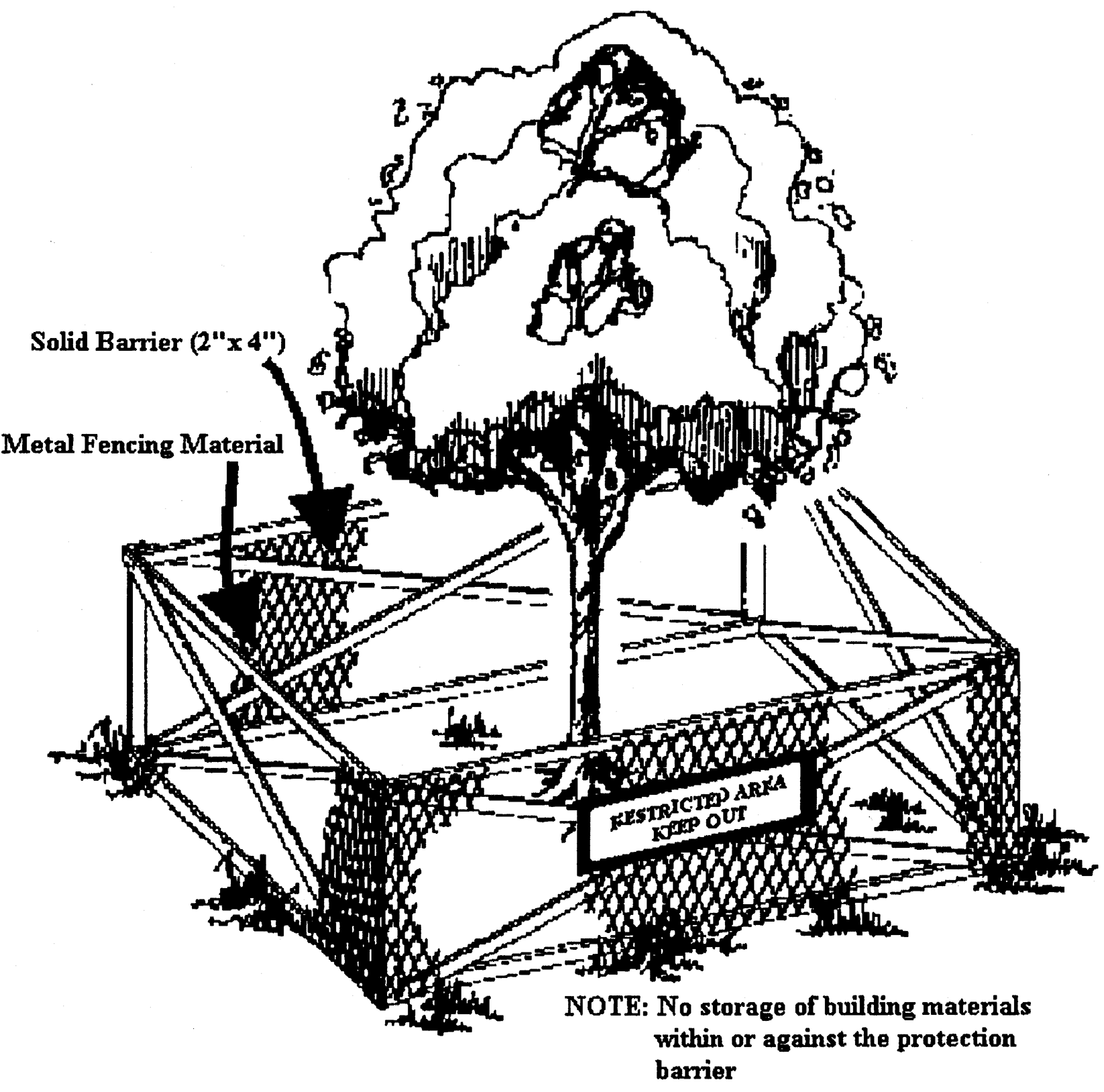
Tree protection detail

