
Brisbane City Zoning Code
CHAPTER 17
02 - DEFINITIONS
17.02.005 - Application of definitions.
The definitions set forth in this chapter shall be applied throughout this title, unless the context or the provision clearly requires otherwise.
(Ord. 422 § 4(part), 1998).
17.02.010 - Abandon.
"Abandon" means to cease or discontinue a use or activity without intent to resume, but excluding a temporary discontinuance in connection with a pending sale or other transfer of ownership or management of a use or structure.
(Ord. 422 § 4(part), 1998).
17.02.015 - Abutting.
"Abutting" means to physically touch or border upon but not overlap; to share all or a part of a common boundary or a common lot line with another lot or parcel of land.
(Ord. 422 § 4(part), 1998).
17.02.017 - Active records management services.
"Active records management services" means an establishment used as a depository for records which are retrieved and delivered on a daily basis. This service may include providing filing, indexing, bar-coding, and cataloging of records.
(Ord. 440 § 1, 1999).
17.02.020 - Addition.
"Addition" means any construction added to the original structure at some time after the completion of the original which increases the size of the structure in terms of lot coverage, height or floor area.
(Ord. 422 § 4(part), 1998).
17.02.025 - Adjacent.
"Adjacent" means physically close to, such as to the side or rear of or located directly across the street from.
(Ord. 422 § 4(part), 1998).
(Ord. No. 558, § 1, 4-4-11)
17.02.030 - Adult entertainment facility.
"Adult entertainment facility" means an establishment consisting of, including, or having the characteristics of any or all of the following:
A.
"Adult bookstore," which means an establishment having as a substantial or significant portion of its stock-in-trade books, magazines, publications, tapes or films that are distinguished or characterized by their emphasis on matter depicting, describing, or relating to sexual activities or anatomical genital areas;
B.
"Adult cabaret," which means an establishment devoted to adult entertainment, either with or without a liquor license, presenting material distinguished or characterized by an emphasis on matter depicting, describing or relating to sexual activities or anatomical genital areas, including an establishment that features topless dancers, strippers, or similar entertainers for observation by patrons;
C.
"Adult motion picture theater," which means an enclosed building or video booth used for the showing of motion pictures distinguished or characterized by an emphasis on matter depicting, describing or relating to sexual activities or anatomical genital areas.
(Ord. 422 § 4(part), 1998).
17.02.040 - Alley.
"Alley" means a narrow service way, either public or private, permanently reserved as a secondary means of access to abutting property but not intended for general traffic circulation.
(Ord. 422 § 4(part), 1998).
17.02.045 - Approving authority.
"Approving authority" means the decision making body, commission or official of the city designated under the provisions of this title as having the authority to initially approve or deny a particular type of application.
(Ord. 422 § 4(part), 1998).
17.02.050 - Articulation.
"Articulation" means changes of plane on the outside wall of a building such as provided by decks, bays, and other projections or recesses. Articulation also includes voids resulting from a change in the shape of the outside wall. The minimum offset requirement by permit type is as follows:
A.
Housing Development Permits: a minimum of one foot of offset in plane.
B.
Design Permits: a minimum of two (2) feet of offset in a plane.
(Ord. 463 § 1, 2002: Ord. 422 § 4(part), 1998).
(Ord. No. 669, § 1, 5-19-22)
17.02.060 - Attached.
"Attached" means anything physically connected to a building or structure so as to become an integral part thereof. The term includes components of a structure joined together by a common wall, floor, or ceiling or fully enclosed hallway.
(Ord. 422 § 4(part), 1998).
17.02.065 - Outside wall.
"Outside wall" means any wall that defines the exterior boundaries of a structure.
A.
"Front outside wall," "rear outside wall" and "side outside wall" respectively mean the outside wall that is generally parallel to the front, rear or side lot line of the site.
B.
"Exterior side outside wall" means a side outside wall generally parallel to a street. "Interior side outside wall" means any side outside wall other than an exterior side outside wall.
(Ord. 463 § 4, 2002).
17.02.070 - Automotive repair shop.
"Automotive repair shop" means an establishment where motor vehicles, or any parts, components or systems thereof, are serviced, repaired, overhauled or replaced. Automotive repair shops generally fall into either of the following categories, as determined in each case by the planning director:
A.
"Automotive light repair" means an automotive repair shop primarily engaged in the cleaning, waxing, detailing, incidental touch-up painting, and minor servicing of automobiles. Automotive light repair frequently constitutes a part of a gasoline service station, as defined in this chapter.
B.
"Automotive heavy repair" means an automotive repair shop primarily engaged in collision repair, reconstruction, overhaul and painting of automobiles, or other major mechanical or body work.
(Ord. 422 § 4(part), 1998).
17.02.080 - Bar.
"Bar" means an establishment engaged primarily in the sale or dispensing of alcoholic beverages by the drink for on-site consumption and where food may be available for consumption on the premises as an accessory use.
(Ord. 422 § 4(part), 1998).
17.02.085 - Bay.
"Bay" or "bay window" means a projection from a building that forms a recess in the interior.
(Ord. 422 § 4(part), 1998).
17.02.090 - Block.
"Block" means any lot or group of contiguous lots on one side of a street and either: (i) lying between intersecting streets, or (ii) lying within the same street address hundred range, whichever may be the shortest distance.
(Ord. 422 § 4(part), 1998).
17.02.100 - Building.
"Building" means any structure having a roof supported by columns or walls and intended for the shelter, housing or enclosure of any person, animal, property or use.
(Ord. 422 § 4(part), 1998).
17.02.107 - Cannabis.
"Cannabis" means all parts of the plant cannabis sativa linnaeus, cannabis indica, or cannabis ruderalis, whether growing or not; the seeds thereof; the resin, whether crude or purified, extracted from any part of the plant; and every compound, manufacture, salt, derivative, mixture, or preparation of the plant, its seeds, or resin. "Cannabis" also means the separated resin, whether crude or purified, obtained from cannabis. "Marijuana" shall have the same meaning as cannabis for the purposes of this title.
"Cannabis" does not include the mature stalks of the plant, fiber produced from the stalks, oil or cake made from the seeds of the plant, any other compound, manufacture, salt, derivative, mixture, or preparation of the mature stalks (except the resin extracted therefrom), fiber, oil, or cake, or the sterilized seed of the plant which is incapable of germination.
A.
"Medicinal cannabis" means cannabis intended for use by qualified patients pursuant to Section 11362.7 of the California Health and Safety Code.
B.
"Cannabis product" means a product containing cannabis, including, but not limited to, concentrates, extractions, topical treatments, or edible products intended to be sold for medicinal or adult use pursuant to Section 11018.1 of the California Health and Safety Code.
(Ord. No. 617, § 2, 9-7-17)
17.02.109 - Cannabis business.
"Cannabis business" means a business engaged in distribution, manufacture, retail delivery, or warehousing of cannabis or cannabis products.
A.
"Cannabis distribution" means the procurement, sale, and transport of cannabis and cannabis products between commercial entities licensed by the State of California. Distribution does not include delivery of cannabis or cannabis products to a customer.
B.
"Cannabis manufacturing" means the production, preparation, propagation, or compounding of cannabis or cannabis products either directly or indirectly or by extraction methods, or independently by means of chemical synthesis or by a combination of extraction and chemical synthesis at a fixed location that packages or repackages cannabis or cannabis products or labels or relabels its container.
C.
"Cannabis retail delivery" means the retail sale of cannabis or cannabis products to customers exclusively by delivery to the customer. "Cannabis retail" does not include any storefront component whereby customers purchase the products at the physical premises of the retail establishment.
D.
"Cannabis warehousing" means the storage, wholesale, and distribution of cannabis products. Cannabis warehousing does not include storage, wholesale, or distribution of cannabis.
(Ord. No. 617, § 3, 9-7-17)
17.02.110 - Canopy.
"Canopy" means a rooflike cover that projects from the wall of a building for the purpose of shielding a doorway or window from the elements.
(Ord. 422 § 4(part), 1998).
17.02.115 - Cantilever.
"Cantilever" means a structural projection from a building which is vertically supported at only one end.
(Ord. 422 § 4(part), 1998).
17.02.120 - Carport.
"Carport" means an accessory structure or a portion of a main structure designed for the storage of motor vehicles having a roof or other solid covering and enclosed on no more than two (2) sides.
(Ord. 422 § 4(part), 1998).
(Ord. No. 693, § 4, 12-5-24)
17.02.130 - CEQA.
"CEQA" means the California Environmental Quality Act, as set forth in Division 13 (commencing with Section 21000 et seq.) of the California Public Resources Code, and any amendments or replacements thereof, and including any guidelines adopted from time to time pursuant thereto.
(Ord. 422 § 4(part), 1998).
17.02.140 - Chimney—Chimney box.
A.
"Chimney" means a portion of a structure containing one or more flues for drawing off emissions from stationary sources of combustion.
B.
"Chimney box" means a portion of a structure built for the purpose of enclosing a chimney.
(Ord. 422 § 4(part), 1998).
17.02.142 - Commercial parking lot.
"Commercial parking lot" means an establishment providing off-street parking facilities available to the general public for which a parking fee is charged as consideration for such use and where such establishment constitutes the principal use on the site or a separate use unrelated to the principal use on the same site. The term does not include a parking facility operated as an accessory use, regardless of whether compensation is charged for use of such facility.
(Ord. 428 § 1, 1998).
17.02.145 - Commercial recreation—Commercial gym and health facilities.
A.
"Commercial recreation" means a use designed and equipped for the conduct of sports and leisure-time activities operated as a business.
B.
"Commercial gym and health facilities" means a commercial recreation use conducted entirely within an enclosed structure containing facilities such as exercise equipment, game courts, swimming pool or spa, and shower and/or changing room facilities.
(Ord. 422 § 4(part), 1998).
17.02.150 - Condominium.
"Condominium" means a building, or group of buildings, in which dwelling units, commercial/retail/office/warehouse spaces, floor areas, or other portions of the property are owned individually or restricted for the exclusive use of a single owner, and the structure, common areas, and common facilities are owned by all the owners on a proportional, undivided basis. The individual ownership interest may include a fee, a life estate, a leasehold, or a right of use during a specific period of time. As used in this title, the term includes "community apartment project" and "stock cooperative" as defined by State Civil Code Sections 4105 and 4190.
(Ord. 422 § 4(part), 1998).
(Ord. No. 566, § 11, 10-7-13; Ord. No. 612, § 9, 12-8-16)
17.02.155 - Contiguous.
"Contiguous" means abutting, as such term is defined in this chapter.
(Ord. 422 § 4(part), 1998).
17.02.160 - Contractor's yard.
"Contractor's yard" means an area, not enclosed within a structure, that is used for parking and keeping of vehicles, trailers, equipment, materials and supplies utilized by a building or trade contractor in connection with the conduct of such contractor's business, but not including long term storage of any items of personal property.
(Ord. 422 § 4(part), 1998).
17.02.165 - Convalescent home.
Convalescent home" means an establishment licensed by the state providing residential and health care services, for compensation, for persons recovering from illness or injury, or for persons with chronic illness or disability, such as the elderly who require assistance with basic daily activities.
(Ord. 422 § 4(part), 1998).
(Ord. No. 564, § 1, 10-3-11)
17.02.170 - Cornice.
"Cornice" means the portion of a building where the roof and side walls meet or the top course of a wall when treated as a crowning member of the building.
(Ord. 422 § 4(part), 1998).
17.02.175 - Covered parking.
"Covered parking" means a garage or carport that provides full overhead protection from the elements with ordinary roof coverings. Canvas, lath, fiberglass, plastic and vegetation are not ordinary roof coverings and shall not be considered a covered parking space.
(Ord. 422 § 4(part), 1998).
17.02.180 - Cultural facility.
"Cultural facility" means a place, structure, area, or other facility in which cultural programs, displays or activities generally open to the public are conducted. The term includes, but is not limited to, museums and performance halls.
(Ord. 422 § 4(part), 1998).
17.02.185 - Cupola.
"Cupola" means a small rounded and domed portion of a structure that typically extends above the roof.
(Ord. 422 § 4(part), 1998).
17.02.187 - Data Center.
"Data center" means a business providing for the storage of computer systems and associated components.
(Ord. No. 599, § 1, 11-19-15)
17.02.190 - Day care center.
"Day care center," "child care center," and "child day care facility" mean a facility licensed pursuant to Health and Safety Code Section 1596.951, other than a family day care home as defined in this chapter, that provides nonmedical care to children under eighteen (18) years of age in need of personal services, supervision, or assistance essential for sustaining the activities of daily living or for the protection of the individual on less than a twenty-four-hour basis. Day care center includes:
A.
Employer-sponsored day care centers;
B.
Infant centers;
C.
Preschools;
D.
Extended day care centers;
E.
School-age day care centers; and
F.
Day care centers.
(Ord. No. 534, § 1, 2-17-09; Ord. No. 665, § 1, 11-4-21)
17.02.195 - Day care home.
"Day care home" means a family day care home, as such term is defined in this chapter.
(Ord. 422 § 4(part), 1998; Ord. No. 665, § 1, 11-4-21)
17.02.200 - Deck—Parking deck.
A.
"Deck" means a floored area which is not located on grade and is not covered by a roof other than an eave or overhang, and which is wider than a minimum required landing.
B.
"Parking deck" means a deck designed for the parking and storage of motor vehicles.
(Ord. 422 § 4(part), 1998).
17.02.205 - Detached.
"Detached" means a building or structure which is not attached (as such term is defined in this chapter) to any other building or structure.
(Ord. 422 § 4(part), 1998).
17.02.210 - District.
A.
"District" means a zoning district established under the provisions of this title.
B.
"Overlay district" means a zoning district that may be applied in combination with another district to provide for different uses and development standards than those permitted in the underlying district.
(Ord. 422 § 4(part), 1998).
(Ord. No. 624, § 1, 2-1-18)
17.02.220 - Driveway.
"Driveway" means a private roadway which provides access to off-street parking or loading spaces, and the use of which is limited to persons residing on the site, their invitees, or persons working on the site. A driveway may be shared, to serve two or more lots, by access easement across one or more of the affected lots. This does not include private streets as defined in Section 17.02.750.
(Ord. 422 § 4(part), 1998).
(Ord. No. 693, § 5, 12-5-24)
17.02.230 - Reserved.
Editor's note— Ord. No. 693, § 2, adopted Dec. 5, 2024, repealed § 17.02.230, which pertained to duplex and derived from Ord. 422 § 4(part), adopted in 1998; and Ord. No. 615, § 1, adopted Feb. 2, 2017.
17.02.235 - Dwelling.
"Dwelling" means a place that is used as the personal residence of the occupants thereof, including transitional housing as defined in California Health and Safety Code Section 50675.2(h) and supportive housing as defined in California Health and Safety Code Sections 50675.14(b)(2) and (3). The term includes factory-built or manufactured housing, such as mobile homes, but excludes trailers, campers, tents, recreational vehicles, hotels, motels, boarding houses and temporary structures.
A.
"Duplex dwelling" means a building containing two (2) dwelling units totally separated from each other by a wall, floor or ceiling; provided, however, that a building containing a single-family dwelling and a lawful accessory dwelling unit or junior accessory dwelling unit shall not be deemed a duplex.
B.
"Dwelling group" means a group of two (2) or more detached buildings located upon the same site, each of which contains one or more dwelling units.
C.
"Dwelling unit" means a room or group of rooms including living, sleeping, eating, cooking and sanitation facilities, constituting a separate and independent housekeeping unit, designed, occupied, or intended for occupancy by one family on a permanent basis. Permanent residency shall mean continuous occupancy of the dwelling unit for a period of thirty (30) days or more.
D.
"Multiple-family dwelling" means a building or site containing three (3) or more dwelling units (also see "duplex"). The term includes single-room-occupancy dwelling units, typically comprised of one or two (2) rooms (which may include a kitchen and/or a bathroom, in addition to a bed), that are restricted to occupancy by no more than two (2) persons.
E.
"Accessory dwelling unit" means a separate dwelling unit created upon a site that contains a single-family dwelling, duplex, or multiple-family dwelling. Subject to the restrictions of this title, the accessory dwelling unit may be within, attached to, or detached from the single-family dwelling, duplex, or multiple-family dwelling. An accessory dwelling unit shall include permanent provisions for living, sleeping, eating, cooking, and sanitation. The term "secondary dwelling unit" shall have the same meaning throughout this title. An accessory dwelling unit also includes the following:
1.
An efficiency unit, as defined in Section 17958.1 of the Health and Safety Code.
2.
A manufactured home, as defined in Section 18007 of the Health and Safety Code.
F.
"Junior accessory dwelling unit" means a dwelling unit that is no more than five hundred (500) square feet in size and contained entirely within a single-family dwelling. A junior accessory dwelling unit may include separate sanitation facilities, or may share sanitation facilities with the single-family dwelling. Junior accessory dwelling units are distinguished from accessory dwelling units in that they: (1) must include the conversion of existing, legally permitted floor area within an existing single-family dwelling; (2) must be owner occupied, or the main dwelling be owner occupied; and (3) are subject to unique standards that are not applicable to accessory dwelling units, as specified in Chapter 17.43 of this title.
G.
"Primary dwelling unit" or "main dwelling" means a dwelling unit that is not an accessory dwelling unit or a junior accessory dwelling unit.
H.
"Single-family dwelling" means a dwelling unit constituting the only principal structure upon a single site (excluding any lawfully established accessory dwelling unit that may be located within the same structure on upon the same site). The term includes employee housing for six (6) or fewer persons, residential care facilities, licensed by the state to provide twenty-four-hour nonmedical care, serving six (6) or fewer persons (not including the operator, the operator's family or persons employed as staff) in need of supervision, personal services, or assistance essential for sustaining the activities of daily living or for the protection of the individual. Also see "group care home" for seven (7) or more persons.
(Ord. 479 § 1, 2003; Ord. 422 § 4(part), 1998).
(Ord. No. 564, § 1, 10-3-11; Ord. No. 606, § 1, 4-21-16; Ord. No. 615, § 1, 2-2-17; Ord. No. 626, § 1, 5-17-18; Ord. No. 656, § 1, 6-18-2020; Ord. No. 653, § 7, 10-15-20; Ord. No. 655, § 1, 9-3-20; Ord. No. 658, 12-10-20; Ord. No. 693, § 3, 12-5-24; Ord. No. 700, § 3, 10-2-25)
17.02.240 - Reserved.
Editor's note— Ord. No. 564, § 1, adopted October 3, 2011, repealed § 17.02.240, which pertained to dwelling group and derived from Ord. No. 422, 1998.
17.02.250 - Eave.
"Eave" means the projecting lower edges of a roof overhanging the exterior wall of a building.
(Ord. 422 § 4(part), 1998).
17.02.255 - Educational facility.
"Educational facility" means a public or private use devoted to instruction, including, but not limited to, primary, middle and high schools, business and technical schools, colleges and universities.
(Ord. 422 § 4(part), 1998).
17.02.260 - Emergency access.
"Emergency access" means a street or easement which is gated or otherwise closed to regular use by vehicular traffic and intended for use by vehicular traffic only in the event of emergency.
(Ord. 422 § 4(part), 1998).
17.02.265 - Emergency shelter.
"Emergency shelter" is the same defined in subdivision (e) of Section 50801 of the California Health and Safety Code, and means housing with minimal supportive services that is limited to occupancy of up to six months by persons who are homeless, victims of domestic violence, individuals and households made temporarily homeless due to natural disasters (e.g., fires, earthquakes, etc.), or other persons requiring temporary housing, and no individual or household shall be denied emergency shelter because of inability to pay.
(Ord. No. 564, § 1, 10-3-11)
17.02.270 - Establishment.
"Establishment" means an economic unit, generally at a single physical location, where business is conducted or services or commercial activities are performed.
(Ord. 422 § 4(part), 1998).
17.02.285 - Family.
"Family" means one or more persons, related or unrelated, occupying a dwelling unit and living together as a single housekeeping unit. The term shall not include a group of persons occupying a fraternity or sorority house, club, hotel, motel, convalescent home, group care home or institution of any kind.
(Ord. 422 § 4(part), 1998).
(Ord. No. 564, § 1, 10-3-11)
17.02.290 - Family day care home.
"Family day care home" means a facility licensed pursuant to Health and Safety Code Section 1597.54, that regularly provides care, protection, and supervision for fourteen (14) or fewer children, in the licensee's own home, for periods of less than 24 hours per day, while the parents or guardians are not present. A licensee's residence includes property in which the licensee is a tenant, and includes the following:
A.
"Small family day care home" means a family day care home that provides care, protection, and supervision for more than six (6) children and up to eight (8) children, as set forth in Health and Safety Code Section 1597.44 and as defined in applicable state regulations;
B.
"Large family day care home" means a family day care home that provides care, protection, and supervision for more than twelve (12) children and up to and including fourteen (14) children, as set forth in Health and Safety Code Section 1597.465 and as defined in applicable state regulations.
(Ord. 422 § 4(part), 1998; Ord. No. 564, § 1, 10-3-11; Ord. No. 665, § 1, 11-4-21)
17.02.300 - Fence.
"Fence" means an artificially constructed barrier of any material or combination of materials erected to enclose, screen or separate areas.
(Ord. 422 § 4(part), 1998).
17.02.310 - Financial institution.
"Financial institution" means a bank, savings and loan association, credit union, thrift association, or similar organization.
(Ord. 422 § 4(part), 1998).
17.02.315 - Floor area—Floor area ratio.
A.
"Floor area" means the sum of the gross horizontal areas of all floors of a building measured from the interior face of the exterior walls or columns, but excluding any area where the floor to ceiling height is less than six (6′) feet. The Planning Director shall have authority, on a case by case basis, to determine that a particular area, by reason of its location or features, should properly be excluded from the calculation of floor area for the purposes of this title.
B.
"Floor area ratio" means the floor area of all buildings on a lot divided by the total lot area.
(Ord. 463 § 3, 2002: Ord. 422 § 4(part), 1998).
17.02.320 - Food production.
"Food production" means an establishment engaged in the preparation of food products for wholesale or retail distribution and eventual human consumption but not consumption on the premises. The term does not include any form of slaughterhouse of live animals.
(Ord. 422 § 4(part), 1998).
17.02.330 - Freight forwarder.
"Freight forwarder" means an establishment engaged in the receipt and distribution of goods, products, mail, packages, cargo, or materials, or any combination thereof, belonging to others, including transshipment by boat, rail, air or motor vehicle. The distribution function may include the breakdown of large orders from a single source into smaller orders for distribution to several recipients and consolidation of several orders into one large one for distribution to a single recipient. The term does not include any establishment engaged in the receipt and/or distribution of its own products, inventory or merchandise.
(Ord. 422 § 4(part), 1998).
17.02.340 - Garage.
"Garage" means an accessory structure or a portion of a main structure designed for the parking and storage of motor vehicles, having and permanent roof and enclosed on three (3) or more sides.
(Ord. 422 § 4(part), 1998).
17.02.345 - Gasoline service station.
"Gasoline service station" means an establishment primarily engaged in the retail sale of gasoline to the public, with incidental sale of lubricants, tires, batteries, small parts and accessories for the operation of automobiles, and may include a light automotive repair shop (as defined in this chapter) for the incidental performance of routine maintenance and repair services. Establishments such as, but not limited to, automotive collision and body shops, automotive painting facilities, automobile dismantlers, and heavy automotive repair shops, shall not be classified as gasoline service stations.
(Ord. 422 § 4(part), 1998).
17.02.350 - General plan.
"General plan" means the current general plan as adopted by the city pursuant to the requirements of the government code, and any amendments thereto, and any specific plan applicable to the site.
(Ord. 422 § 4(part), 1998).
17.02.360 - Grade.
"Grade" means the elevation of land, as measured in feet above sea level.
A.
"Finish grade" means the final elevation of the ground surface after completion of all site preparation and development.
B.
"Natural grade" means the elevation of the ground surface in its natural state, before construction, grading, filling or excavation.
(Ord. 422 § 4(part), 1998).
17.02.370 - Group care home.
"Group care home" means an establishment licensed by the state to provide twenty-four (24) hour nonmedical care for seven (7) or more persons (not including the operator, the operator's family or persons employed as staff) in need of supervision, personal services, or assistance essential for sustaining the activities of daily living or for the protection of the individual. Also see "dwelling, single-family" for six (6) or fewer persons.
(Ord. 422 § 4(part), 1998).
(Ord. No. 564, § 1, 10-3-11)
17.02.380 - Habitat Conservation Plan (HCP).
"Habitat Conservation Plan" also referred to as the "HCP" means the San Bruno Mountain Area Habitat Conservation Plan, dated November, 1982, as amended September, 1986, and any further amendments or revisions thereof, and including also the agreement with respect to the San Bruno Mountain Area Habitat Conservation Plan, commonly referred to as the "HCP Agreement" dated November, 1982, and any amendments or revisions thereof.
(Ord. 422 § 4(part), 1998).
17.02.385 - Heavy equipment repair.
"Heavy equipment repair" means an establishment engaged in the on-site repair or maintenance of heavy-duty machinery, equipment or vehicles, including, but not limited to, dump trucks, semi-tractors, bulldozers and forklifts.
(Ord. 422 § 4(part), 1998).
17.02.390 - Hedge.
"Hedge" means a dense row of shrubs or trees.
(Ord. 422 § 4(part), 1998).
17.02.400 - Height.
A.
Structures. As applied to structures, height means the vertical distance above a reference datum measured to the highest point of the coping of a flat roof or to the deck line of a mansard roof or to the average height of the highest gable of a pitched or hipped or vaulted roof. The reference datum shall be the lowest point of elevation of the finished grade between the building and the property line when the property line is five (5) feet or less from the building. When the property line is more than five (5) feet from the building, the reference datum shall be the lowest point of elevation of the finished grade between the building and a line five (5) feet from the building. When the finished grade results from fill, the reference datum shall be the lowest point of elevation of the natural grade prior to the placement of the fill. In the case of a stepped or terraced building, each segment of the building shall be separately measured and the height of the building shall be the maximum height of the highest segment.
1.
Rooftop solar energy systems shall be measured from the midpoint of the solar panel to the grade reference datum, as described in BMC Section 17.02.400(A).
B.
Signs. As applied to signs, height means the vertical distance measured from the lowest finished grade directly beneath the sign to the highest point at the top of the sign.
C.
Fences and Walls. As applied to fences and walls, height means that side having the greatest distance as measured by a vertical line from the highest point of the fence or wall to a point directly below at finish grade. Where a fence is constructed upon or approximately parallel to and less than two (2) feet from a retaining wall, the fence shall be considered as part of the wall in measuring its height, which shall be the combined vertical distance of both the fence and the retaining wall.
(Ord. 483B § 1, 2003; Ord. 422 § 4(part), 1998).
(Ord. No. 622, § 1, 11-16-17)
17.02.410 - Home occupation.
"Home occupation" means the conduct of a trade or profession, the offering of a service, the conduct of a business, or the handcraft manufacture or products, in a dwelling unit by the occupants thereof as an accessory use incidental to residential occupancy, and in accord with the regulations prescribed in this title. Home occupation does not include cultivation of cannabis.
(Ord. 422 § 4(part), 1998).
(Ord. No. 617, § 4, 9-7-17)
17.02.420 - Hotel.
"Hotel" means a building or group of buildings containing guest rooms or suites offered, for compensation, to the general public as transient lodging accommodations. The term includes motel, inn, motor court, bed and breakfast establishment or similar use, but excludes single-room-occupancy dwelling units operated as supportive housing.
(Ord. 422 § 4(part), 1998).
(Ord. No. 564, § 1, 10-3-11)
17.02.425 - Housing development project.
"Housing development project" means a use consisting of any of the following: two (2) or more residential units only; a mixed-use development consisting of two (2) or more residential units and one or more nonresidential uses with at least two-thirds (⅔) of the square footage designated for residential use; or transitional housing or supportive housing, as defined by California Government Code § 50801, subdivision (i) or successor provisions. A housing development project may consist of attached or detached residential units and may occupy more than one parcel, so long as the housing development project is included in the same development application. This definition shall be superseded by changes to California Government Code § 65589.5, subdivision (h)(2), or successor provisions. Projects located in the NCRO-2 District shall not be defined as housing development projects.
(Ord. No. 669, § 1, 5-19-22)
17.02.430 - Infrastructure.
"Infrastructure" means all on-site and off-site improvements, facilities and services, whether public or private or any combination thereof, required for development and human occupancy of a site, and constructed, or to be constructed, in accordance with standards applicable thereto as adopted by the governmental agency, utility, or other provider which owns and operates the improvement, facility or service. The term includes, but is not limited to, a means of access from a public street; storm drainage and sanitary sewer facilities; water, electricity, gas, telephone and other utility services.
(Ord. 422 § 4(part), 1998).
17.02.440 - Invasive.
"Invasive," as applied to plants, means vegetation having a natural tendency to spread into adjacent areas and adversely affect the native growth in the adjacent area.
(Ord. 422 § 4(part), 1998).
17.02.450 - Kennel.
A.
"Boarding kennel" means an establishment in which dogs or other household domesticated animals are boarded, housed, groomed, trained or cared for, either on a day use basis or including overnight occupancy.
B.
Breeding kennel means an establishment in which dogs or other household domesticated animals are bred, raised and sold.
(Ord. 422 § 4(part), 1998).
17.02.460 - Kitchen.
"Kitchen" means a room designed, intended or used for the cooking and preparation of food.
(Ord. 422 § 4(part), 1998).
17.02.470 - Landing.
"Landing" means a platform at the top or bottom or between the top and bottom of a flight of stairs which is no wider than the stairway, or a platform outside a door which is not more than twice the width of the door.
(Ord. 422 § 4(part), 1998).
17.02.475 - Landscaping.
"Landscaping" means plants and incidental ornamental materials, including wood chips, rocks and statuary.
(Ord. 422 § 4(part), 1998).
17.02.480 - Light fabrication.
"Light fabrication" means a use engaged in the fabrication, predominantly from previously prepared materials, of finished products or parts, including processing, assembling, treating and packaging. The term also includes the storage, sales and distribution of the finished products when conducted as an incidental and accessory use.
(Ord. 422 § 4(part), 1998).
17.02.485 - Live/work development.
"Live/work development" means a development which primarily consists of nonresidential structures and uses but includes facilities for residential occupancy which contain all of the required elements of a dwelling unit.
(Ord. 422 § 4(part), 1998).
17.02.490 - Lot.
A.
"Lot" means a parcel of land consisting of a single lot of record.
B.
"Lot of record" means any of the following:
1.
A lot which is part of a subdivision and shown on a map thereof as recorded in the office of the county recorder; or
2.
A legally created parcel of land described by metes and bounds or shown on a parcel map which has been recorded in the office of the county recorder; or
3.
A parcel of land for which a certificate of compliance has been issued by the city or the county pursuant to the map act and such certificate has been so recorded in the office of the county recorder.
C.
"Corner lot" means a lot abutting the intersection of two or more streets.
D.
"Double frontage or through lot" means a lot that fronts upon two (2) parallel streets.
E.
"Downslope lot" means a lot having a slope of twenty percent (20%) or more, with the slope descending downhill from the front lot line.
F.
"Hillside lot" means any lot having a slope of twenty percent (20%) or more.
G.
"Interior lot" means a lot other than a corner lot.
H.
"Substandard or nonconforming lot" means a lot having any lot dimensions that do not comply with the minimum standards applicable to such lot as prescribed by the regulations for the district in which the lot is located. A substandard lot includes a lot that was legally created in compliance with all zoning and subdivision regulations then applicable to the property, but which, by virtue of subsequent rezoning, reclassification, or the adoption of or change in zoning regulations, no longer conforms with any of the standards for the district in which the lot is located.
I.
"Upslope lot" means a lot having a slope of twenty percent (20%) or more, with the slope ascending uphill from the front lot line.
(Ord. 422 § 4(part), 1998).
17.02.495 - Lot coverage.
"Lot coverage" means that percentage of a lot that is covered or occupied by structures. Lot coverage includes any finished surface, such as a slab or deck, which is covered by a roof or other solid covering with at least seven (7) feet of clearance, other than an eave or overhang, and includes also cantilevered bays and other enclosed architectural projections which contain floor or seating area.
(Ord. 422 § 4(part), 1998).
17.02.500 - Lot dimensions.
"Lot dimensions" means the size and configuration of a lot, as determined by the area, width and depth of the lot, defined as follows:
A.
"Lot area" means the total horizontal area located within the property lines of a lot, including any area within the original property lines that is dedicated to the public for street purposes as a requirement for approval of a development on the lot which created the need for such dedication.
B.
"Lot depth" means the horizontal distance from the midpoint of the front lot line to the midpoint of the rear lot line, or to the most distant point on any other lot line where there is no rear lot line.
C.
"Lot width" means the horizontal distance between the side lot lines, measured at right angles to the lot depth at a point midway between the front and rear lot lines, or if there is no rear lot line, at the midway points of the intersecting side lot lines.
(Ord. 422 § 4(part), 1998).
17.02.505 - Lot line.
"Lot line" means any boundary of a lot.
A.
"Front lot line" means the lot line abutting upon or adjacent to a street or public right-of-way. In the case of corner lots, double frontage lots, lots which are not abutting or adjacent to a street or public right-of-way, or lots having irregular shape, the front lot line shall be determined by the planning director, based upon the means of access to the lot, the pattern of development in the immediately surrounding area, and such other factors as the planning director may deem appropriate.
B.
"Rear lot line" means the lot line not intersecting a front lot line which is most distant from and most closely parallel to the front lot line. A lot bounded by only three (3) lot lines will not have a rear lot line.
C.
"Side lot line" means any lot line which is not a front or rear lot line.
(Ord. 422 § 4(part), 1998).
17.02.510 - Map Act.
"Map Act" means the State Subdivision Map Act as contained in Title 7, Division 2 (commencing with Section 66410) of the Government Code.
(Ord. 422 § 4(part), 1998).
17.02.515 - Marina.
"Marina" means a facility for the berthing and securing of boats, that may include boat servicing uses.
(Ord. 481 § 1, 2003).
17.02.520 - Means of access.
"Means of access" means a street, right-of-way or easement providing ingress to and egress from any lot to a street.
(Ord. 422 § 4(part), 1998).
17.02.525 - Media studio.
"Media studio" means an establishment engaged in the production and/or transmission of media, including, but not limited to, radio, television, film, video, graphic arts and multi-media.
(Ord. 422 § 4(part), 1998).
17.02.530 - Medical facility.
"Medical facility" means an establishment where licensed practitioners provide medical or dental services, including, but not limited to, single or multipractitioner clinics, physical therapy, diagnostic services and outpatient surgery.
(Ord. 422 § 4(part), 1998).
17.02.535 - Meeting hall.
"Meeting hall" means a facility intended for group gatherings which constitutes the principal use on the site.
(Ord. 422 § 4(part), 1998).
17.02.540 - Mixed use.
"Mixed use" means a combination of residential and nonresidential uses that are located within the same structure or upon the same site.
(Ord. 422 § 4(part), 1998).
17.02.545 - Mobilehome—Mobilehome park.
A.
"Mobilehome" means a structure, transportable in one or more sections, which is built on a permanent chassis and designed to be used as a dwelling unit with or without a permanent foundation when connected to the required utilities, and includes the plumbing, heating, air conditioning and electrical systems contained therein. Campers, motor homes, and similar recreational vehicles are not considered to be mobilehomes.
B.
"Mobilehome park" means a site containing spaces with required improvements and utilities that are leased for the long-term placement of two (2) or more mobilehomes and may include services and common facilities for the residents.
(Ord. 422 § 4(part), 1998).
17.02.550 - Motel.
"Motel" means hotel, as defined in this chapter.
(Ord. 422 § 4(part), 1998).
17.02.560 - Nonconforming.
A.
"Nonconforming use" means a use of a structure or site, or both, which was lawfully established or maintained in compliance with all zoning regulations then applicable to such use, but which, by virtue of a subsequent rezoning, reclassification, or the adoption of or change in use regulations, no longer conforms with the use regulations of the district in which it is located. Structures that are nonconforming with regard to density of development shall be treated as nonconforming uses and such nonconformity shall apply to all structures included in the density calculation.
B.
"Nonconforming structure" means a structure which was lawfully constructed in compliance with all zoning regulations then applicable to the site, but which, by virtue of a subsequent rezoning, reclassification, or the adoption of or change in zoning regulations, no longer conforms with one or more of the development standards, including parking and landscaping requirements, for the district in which the structure is located.
C.
"Nonconforming facility" means a structure or site which conforms with the regulations of this title but is used or occupied by one or more nonconforming uses.
(Ord. 478 § 1, 2003: Ord. 422 § 4(part), 1998).
17.02.565 - Objective design standard.
"Objective design standard," also referred to "objective zoning standard" or "objective subdivision standard," shall have the same meaning as established in California Government Code § 65913.4, subdivision (a)(5), or successor provisions.
(Ord. No. 669, § 1, 5-19-22)
17.02.570 - Occupant.
"Occupant," as applied to a building or land, means the person in actual possession of the whole or a part of such building or land, either alone or with others.
(Ord. 422 § 4(part), 1998).
17.02.575 - Office.
"Office" means a room or group of rooms and associated facilities used for conducting the management and administrative affairs of a business, profession, service, industry or government and generally furnished with desks, tables, files and communication equipment. The term does not include medical facilities or veterinary clinics.
(Ord. 422 § 4(part), 1998).
17.02.580 - Off-street parking facility.
"Off-street parking facility" means an area used or intended for use for parking one or more motor vehicles, including aisles, access driveways, turning and maneuvering areas, clearances, and similar features and related landscaped areas, meeting the requirements established by this title. The term includes garages, carports, parking decks, parking lots and parking structures.
(Ord. 422 § 4(part), 1998).
17.02.590 - Open area.
"Open area" means parcels of land or portions thereof, primarily in private ownership, that provide "openness" to a development pattern. Open area includes, but is not limited to, setbacks and landscaped easements, gardens, parks and recreation areas within private developments, plazas, courtyards and similar gathering places. Streets, sidewalks, parking lots and similar improvements do not constitute open areas.
(Ord. 422 § 4(part), 1998).
17.02.595 - Open space.
"Open space" means any parcel or area of land or water that is essentially unimproved and dedicated or proposed to be dedicated to the public for outdoor recreation or preservation of biotic communities. Open space may consist of either land kept in its natural state or land containing recreational facilities such as picnic tables, play equipment and playing fields, court games, and swimming pools.
(Ord. 422 § 4(part), 1998).
17.02.598 - Organics reload operations.
"Organics reload operations" means a facility in which organic waste materials, such as lawn trimmings and food scraps, are reloaded from collection trucks into long-haul trucks to be sent to a composting facility elsewhere within forty-eight (48) hours.
(Ord. 502 § 1, 2005).
17.02.600 - Outdoor sales and rental.
"Outdoor sales and rental" means a retail sales and rental use that is not conducted within an enclosed structure, and includes automobile car sales lots and plant nurseries, but excluding outdoor cafes.
(Ord. 422 § 4(part), 1998).
17.02.602 - Personal cultivation of cannabis.
"Personal cultivation of cannabis" means the planting, growing, harvesting, drying, curing, grading, or trimming of cannabis for medicinal use by a qualified patient or for personal use by an adult twenty-one (21) years of age or older, consistent with the standards established by Chapter 8.12, Section 8.12.030 of the Brisbane Municipal Code.
(Ord. No. 617, § 5, 9-7-17)
17.02.610 - Personal services.
"Personal services" means services of a personal convenience nature involving the care of an individual or his or her personal goods or apparel, including, but not limited to, barber and beauty shops, shoe, luggage and small appliance repair, photographers, laundry and drop-off cleaning services, copying, repair and alteration of clothes and similar services. The term also includes personal services rendered by a tradesperson or contractor, such as a plumber, electrician or heating and cooling equipment contractor, including the incidental storage of materials, supplies, products, parts and other items of personal property related to the furnishing of such services. Services provided to a commercial establishment would not usually be classified as personal services.
(Ord. 422 § 4(part), 1998).
17.02.620 - Place of worship.
"Place of worship" means a structure intended as a meeting hall for religious worship and related activities.
(Ord. 422 § 4(part), 1998).
17.02.625 - Planning commission.
"Planning commission" means the planning commission of the City of Brisbane.
(Ord. 422 § 4(part), 1998).
17.02.627 - Plastic pipe sales.
"Plastic pipe sales" means an establishment engaged in the sale of plumbing, irrigation and related types of plastic pipe and ancillary materials and may include the rendering of services incidental to such sale of goods; plastic pipe sales uses are classified as a subcategory of retail sales and rental uses as defined in this title.
(Ord. 503 § 1, 2005).
17.02.630 - Principal place of residence.
"Principal place of residence" means a dwelling unit occupied by a person as his or her permanent residence.
(Ord. 422 § 4(part), 1998).
17.02.635 - Printing.
"Printing" means an establishment primarily engaged in producing copies of text or illustration using a variety of technologies including, but not limited to, lithography, offset, silk-screen and photography.
(Ord. 422 § 4(part), 1998).
17.02.640 - Product showroom.
"Product showroom" means a display area where members of a trade may view products on display and where orders for such products are taken for off-site delivery only.
(Ord. 422 § 4(part), 1998).
17.02.645 - Property line.
"Property line" means a lot line, as such term is defined in this chapter.
(Ord. 422 § 4(part), 1998).
17.02.650 - Protected tree.
"Protected tree" shall have the same meaning as such term is defined in chapter 12.12 of the Brisbane Municipal Code, as amended from time to time.
(Ord. 422 § 4(part), 1998).
17.02.654 - Public transit.
"Public transit" means a location, including, but not limited to, a bus stop or train station, where the public may access buses, trains, subways, and other forms of transportation that charge a set fare, run on fixed routes, and are available to the public.
(Ord. No. 669, § 1, 5-19-22)
Editor's note— Ord. No. 669, § 1, adopted May 19, 2022, set out provisions intended for use as 17.02.655. For purposes of alphabetization, and at the editor's discretion, these provisions have been included as 17.02.655.
17.02.655 - Public utility facilities.
"Public utility facilities" means structures and facilities, including generating and switching stations, poles, lines, pipes, pumping stations, repeaters, antennas, transmitters and receivers, valves, and other improvements relating to the furnishing of utility services to the public, such as electric, gas, water, sanitary sewer, storm sewer, telephone, telecommunications, and public transit, but not including offices, warehousing, retail sales or rental.
(Ord. 481 § 2, 2003).
17.02.660 - Rare plants.
"Rare plants" means any species of plants which is likely to become endangered within the foreseeable future throughout all or a significant portion of its range, as identified by the California Department of Fish and Game, or any successor state agency given the responsibility for making such identifications.
(Ord. 422 § 4(part), 1998).
17.02.665 - Record owner.
"Record owner" means the owner of a parcel of real property as shown on the most recent available assessment roll published by the county assessor; provided, however, that upon presentation to the city of deeds or other instruments of conveyance which have been duly recorded in the office of the county recorder, together with such other evidence of ownership as the city may require (including, but not limited to, a title report prepared by a title insurance company), the city may determine that a person or persons other than as shown on the county assessment roll is the record owner of the property.
(Ord. 422 § 4(part), 1998).
17.02.670 - Recycling facility.
"Recycling facility" means a site upon which used, nonhazardous materials are received, separated and recovered for reuse in a nonhazardous manner.
(Ord. 422 § 4(part), 1998).
17.02.675 - Research and development.
"Research and development" means a use engaged in studying, testing, designing, analyzing and experimenting with potential or existing products, processes or services, including cannabis and cannabis products.
(Ord. 422 § 4(part), 1998).
(Ord. No. 617, § 6, 9-7-17)
17.02.680 - Restaurant.
"Restaurant" means an establishment having seating capacity where food and drink are prepared and served for human consumption on the premises.
(Ord. 422 § 4(part), 1998).
17.02.685 - Retail sales and rental.
"Retail sales and rental" means an establishment engaged in the sale or rental of goods directly to the consumer and may include the rendering of services incidental to such sale or rental of goods, but does not include sale of cannabis or cannabis products. See Section 17.02.109(C), Cannabis retail delivery.
(Ord. 422 § 4(part), 1998).
(Ord. No. 617, § 7, 9-7-17)
17.02.690 - Retaining wall.
"Retaining wall" means a wall providing lateral subsurface support to earth or fill material on the uphill side and having an exposed face on the opposite side.
(Ord. 422 § 4(part), 1998).
17.02.695 - Ridgeline.
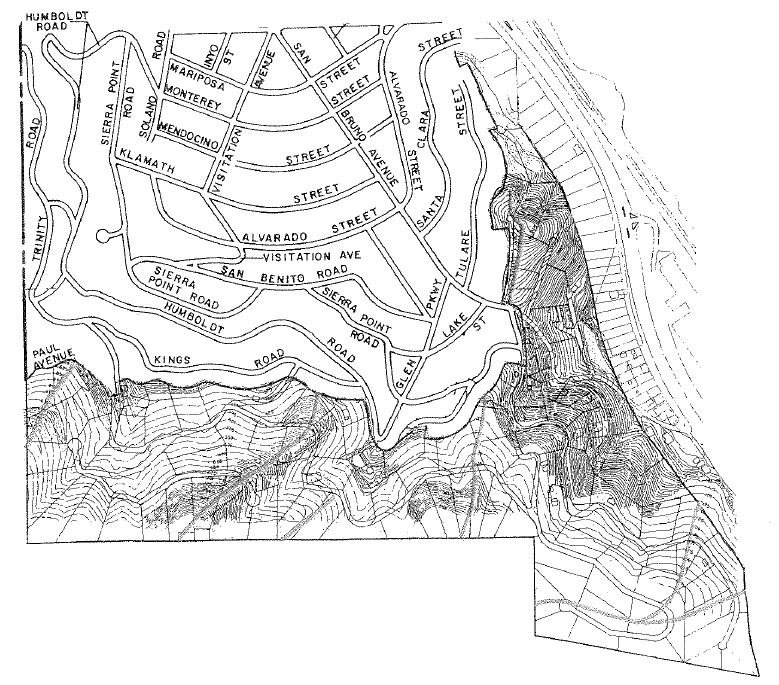
"Ridgeline" means a line connecting the points of highest elevation of the hills comprising San Bruno Mountain as identified on Figure 17.02.695.
Figure 17.02.695
(Ord. 422 § 4(part), 1998).
(Ord. No. 562, § 1, 10-3-11)
17.02.700 - Right-of-way.
A.
"Public right-of-way" means a strip or area of land owned by the city or any other public entity or public utility which is used, or reserved or intended for use, as a street, road, alley, driveway or pedestrian walkway, or to provide public utility service, or any combination thereof, and includes all and any part of the entire width or other area of a designated right-of-way, whether or not such entire width or area is actually used for any of such purposes.
B.
"Railroad right-of-way" means a strip of land on which railroad tracks, spur tracks, sidings, switching equipment and signals are located, and includes the entire width or other area of the designated right-of-way, whether or not the entire width or area is actually used for such railroad facilities.
(Ord. 422 § 4(part), 1998).
17.02.710 - Scale.
"Scale" means the relationship of a particular structure, project or development to its surroundings in terms of size, height and bulk.
(Ord. 422 § 4(part), 1998).
17.02.715 - Setback—Setback area.
A.
"Setback" means the horizontal distance measured perpendicularly from a lot line to a corresponding parallel line within a lot, which is the boundary of any specified front, side or rear setback. The front and rear setback shall extend to the side property lines.
B.
"Setback area" means the area between a lot line and the corresponding setback in which no structures shall be allowed except as permitted by this title.
(Ord. 422 § 4(part), 1998).
17.02.720 - Sign.
See Chapter 17.36 for definitions relating to advertising signs and types of signs.
(Ord. 422 § 4(part), 1998).
17.02.723 - Single-room occupancy unit.
Refer to "multiple-family dwelling," Section 17.02.235(C).
(Ord. No. 622, § 2, 11-16-17)
17.02.725 - Site.
"Site" means a lot, as such term is defined in this chapter.
(Ord. 422 § 4(part), 1998).
17.02.730 - Slope.
"Slope" means the ratio, calculated as a percentage, of the vertical distance between the midpoints of the front and rear lot lines to the horizontal distance between the midpoints of the front and rear lot lines. For a lot having no rear lot line, the intersection of the side lot lines shall be substituted for the midpoint of the rear lot line in calculating slope.
(Ord. 422 § 4(part), 1998).
17.02.740 - Stock-in-trade.
"Stock-in-trade" means tangible goods or merchandise owned by an establishment and offered or available for sale or rental to the customers of such establishment.
(Ord. 422 § 4(part), 1998).
17.02.745 - Storage.
"Storage" means a facility, either indoors or outdoors or a combination thereof, for the keeping of any items of personal property which are not being held for immediate use, sale, rental or distribution. The term includes establishments providing self-storage lockers, records archiving services, and outdoor storage of boats, trailers, and recreational vehicles.
(Ord. 422 § 4(part), 1998).
17.02.746 - Storefront.
"Storefront" means a use that provides goods and services at street level, encourages pedestrian access from the street, and typically, through plate glass windows or displays, provides visual access from the street to the goods or services offered within.
(Ord. 462 § 1, 2002).
17.02.748 - Streamlined housing development project.
"Streamlined housing development project" shall mean a housing development project subject to a streamlined ministerial approval process pursuant to California Government Code § 65913.4, or successor provisions.
(Ord. No. 669, § 1, 5-19-22)
17.02.750 - Street.
"Street" means a right-of-way for motor vehicles providing a means of access to two (2) or more sites.
A.
"Public street" means a street owned and maintained by the city, the county, the state, or any other governmental agency, including streets which have been regularly maintained or improved by the city.
B.
"Private street" means a street in private ownership approved by the city for motor vehicle travel by the owners of the street and persons having express or implied permission from the owners to use such street.
(Ord. 422 § 4(part), 1998).
17.02.755 - Structure.
"Structure" means anything that is built or constructed and requires a location on the ground, including a building or edifice of any kind, or any piece of work artificially built up or composed of parts joined together in some definite manner. The term includes retaining walls, decks and swimming pools, but does not include a fence or a wall used as a fence not exceeding six (6) feet in height and does not include driveways, sidewalks and patios constructed on grade.
A.
"Principal or primary structure" means a structure housing the principal use of a site or functioning as the principal use.
B.
"Accessory structure" means a structure detached from the principal structure located on the same site, the use of which is subordinate and incidental to, and customarily associated with, the principal structure or the principal use of the site and which does not contain sleeping quarters.
(Ord. 422 § 4(part), 1998).
17.02.760 - Subdivision ordinance.
"Subdivision ordinance" means the Subdivision ordinance of the City of Brisbane, as set forth in Title 16 of the Brisbane Municipal Code.
(Ord. 422 § 4(part), 1998).
17.02.770 - Use.
"Use" means the purpose or activity for which land or buildings are designed, arranged, or intended or for which land or buildings are occupied or maintained.
A.
"Principal or primary use" means a use which fulfills the primary or predominant function of a site or structure.
B.
"Accessory use" means a use which is subordinate and incidental to, and customarily associated with, a specified principal use, and which is conducted on the same site as the principal use.
C.
"Permitted use" means a use listed by the regulations of the particular district as a permitted use within that district, and generally permitted therein as a matter of right when conducted in accord with the regulations established by this title.
D.
"Conditional use" means a use listed by the regulations of the particular district as a conditional use within that district, and allowable therein solely on a discretionary and conditional basis, subject to the issuance of a conditional use permit and compliance with the regulations established by this title.
E.
"Temporary use" means a use established for a limited duration with the intent to discontinue such use upon the expiration of the time period.
(Ord. 422 § 4(part), 1998).
17.02.780 - Veterinary clinic.
"Veterinary clinic" means an establishment where medical care is provided for domestic animals, including, but not limited to, dogs, cats, birds and rabbits. The use may include limited overnight accommodations within the building for sick animals.
(Ord. 422 § 4(part), 1998).
17.02.790 - Warehousing.
"Warehousing" means an establishment engaged in the storage, wholesale and distribution of manufactured products, supplies or equipment. Warehousing does not include warehousing of cannabis or cannabis products. See Section 17.02.109(C), Cannabis warehousing.
(Ord. 422 § 4(part), 1998).
(Ord. No. 617, § 8, 9-7-17)
17.02.800 - Wholesale.
"Wholesale" means the sale and distribution of goods to resellers.
(Ord. 422 § 4(part), 1998).
17.02.810 - Wildland interface.
"Wildland interface" means an area between developed and substantially undeveloped land where fire utilizing natural vegetation as fuel begins to consume the adjacent structures or buildings, or where fire fueled by structures or buildings begins to consume the adjacent natural vegetation.
(Ord. 422 § 4(part), 1998).

