
Brisbane City Zoning Code
CHAPTER 17
34 - OFF-STREET PARKING8
Editor's note— Ord. No. 576, § 6, adopted May 19, 2016, amended Chapter 17.34 in its entirety to read as herein set out. Former Chapter 17.34, §§ 17.34.010—17.34.130, pertained to similar material, and derived from Ord. No. 298, 1984; Ord. No. 324, 1987; Ord. No. 416, 1997; Ord. No. 417, 1997; Ord. No. 534, adopted February 17, 2009 and Ord. No. 556, adopted February 22, 2011.
17.34.010 - Purposes of chapter.
In addition to the objectives set forth in Section 17.01.030, the off-street parking requirements are included in the zoning ordinance to achieve the following purposes:
A.
To provide for adequate off-street parking facilities by establishing clear relationships between building size and the parking required, so as to minimize the parking impacts of development upon surrounding properties.
B.
To encourage housing designed for residents with special needs, including persons with disabilities.
C.
To facilitate the maintenance and improvement of the existing building stock.
D.
To provide for parking lot landscaping and permeable paving alternatives to reduce air and stormwater pollution.
E.
To minimize dependence on automobile travel by encouraging transportation alternatives in project design where appropriate.
F.
To implement and promote the goals and policies of the general plan so as to guide and manage development in the city in accordance with such plan.
(Ord. No. 576, § 6, 5-19-16)
17.34.020 - Minimum requirements.
A.
The following minimum parking requirements shall apply to all buildings erected, new uses commenced, and to the area of extended uses commenced after the effective date of this chapter. For any use not specifically mentioned in this chapter, the planning commission shall determine the amount of parking required. All required off-street parking facilities shall be on-site unless specified differently in this chapter or as permitted under Title 12 of this code. Required off-street parking facilities need not be provided as covered parking unless specified differently in this chapter:
B.
The minimum parking requirements shall be calculated according to the following:
1.
All references to square feet shall be in regards to floor area as defined in Chapter 17.02. The floor area of garages and carports shall not be included in measuring floor area to calculate the parking requirements, except for any floor area exceeding four hundred (400) square feet within a garage or carport exclusively for the use of a single residential unit.
2.
When more than one use subject to the parking requirements occupies a site, the requirements for each use shall be calculated separately. The floor area occupied by accessory uses, such as hallways, bathrooms, breakrooms, utility rooms and storage closets, shall be included in the calculation of the parking requirements for the associated primary use.
3.
No parking shall be required for accessory structures two hundred (200) square feet or less in floor area.
4.
When application of the parking requirements results in a fractional number, all fractions shall be rounded up from one-half (0.5) to the next whole number, except when specified otherwise. No parking shall be required for uses for which the requirement is less than one-half (0.5) space.
(Ord. No. 576, § 6, 5-19-16; Ord. No. 615, § 4, 2-2-17; Ord. No. 653, § 25, 10-15-20; Ord. No. 700, § 6, 10-2-25)
17.34.030 - Use restrictions.
A.
Required parking spaces, whether in a garage, carport or open area, shall not be used or converted for any other use that would impair their basic use as storage for motor vehicles.
B.
All off-street parking spaces, whether in a garage, carport or open area, shall be so located as to be accessible to the use which they are intended to serve and to be usable for the parking of motor vehicles.
C.
The required parking for each unit of a residential use shall be independently accessible from that required for any other unit. The property owner shall assign each unit the exclusive use of at least one standard-size parking space, which shall be a covered parking space, if such is required for the unit. If tandem parking is provided, the two (2) spaces in tandem shall be assigned together.
D.
Guest parking spaces required for multiple family developments shall be posted by the property owner as available for seventy-two (72) hour maximum use by the guests only of all residential units for which they are required.
(Ord. No. 576, § 6, 5-19-16)
17.34.040 - Design standards.
A.
Tables. Off-street parking facilities shall comply with the design standards as set forth in Table 1, applicable to standard-size vehicles, and Table 2, applicable to compact vehicles, which appear immediately following this section. Variations to these tables may be approved by the city engineer, consistent with professionally accepted standards, where no more than two (2) forward turning movements would be necessary to enter or exit any parking space.
B.
Surfacing and Striping.
1.
Any off-street parking area shall be surfaced with a minimum of five (5) inches of imported base material and a double application of asphalt and gravel to the city engineer's approval, so as to provide a durable and dustless surface and shall be so graded and drained as to dispose of all surface water accumulated within the area and shall be so arranged and marked as to provide for safe loading and unloading and parking of vehicles.
2.
Parking spaces shall be striped in compliance with the design standards in this chapter, except that parking spaces for residential uses of no more than two (2) units need not be striped. Plans for striping or restriping of required parking spaces shall be submitted for approval by the community development department in compliance with these standards prior to any work done.
3.
Permeable paving alternatives for parking spaces and low-traffic driveways may be approved by the city engineer to reduce the discharge of pollutants into storm sewers, in which case the means of delineating the parking spaces shall be subject to the approval of the community development department.
C.
Compact Cars. Up to fifty percent (50%) of the required parking spaces may be compact. For sites with two (2) or more residential dwelling units, at least one standard-size parking space shall be provided for each unit. Compact parking spaces shall be labeled as such on the pavement, except for residential uses of not more than two (2) units.
D.
Handicapped Parking. Parking designated as accessible by persons with disabilities shall be provided as required by state law.
E.
Parallel Parking. Parallel parking spaces shall be subject to the following standards: Spaces that are accessible from at least one end shall be eight (8) feet wide by twenty (20) feet long. Spaces located between other spaces or any obstruction shall be eight (8) feet wide by twenty-four (24) feet long. An additional one foot width shall be provided where the parking space would be located next to any obstruction more than six (6) inches tall.
F.
Tandem Parking. Tandem parking where no more than one parking space need be vacant to access another parking space shall be recognized as meeting the parking requirements for residential uses, as long as the parking spaces for each unit are accessible independently from those for any other unit.
G.
Garage Design.
1.
Garages constructed after June 18, 2016 [the date this section takes effect], excluding those rebuilt subject to Section 17.38.080 or 17.38.090, shall comply with the following:
No washing machines, driers, water heaters, work benches, support posts and similar obstructions shall be located within the area of minimum width by minimum depth.
2.
For garages constructed after June 18, 2016 [the date this section takes effect], excluding those rebuilt subject to Section 17.38.080 or 17.38.090, garage doors shall be of a roll-up sectional design and shall be equipped with automatic garage door openers.
3.
Garages existing as of June 18, 2016 [the date this section takes effect], constructed in compliance with applicable standards that were in effect at the time the garage was issued a building permit, shall be considered conforming until such time as they are substantially modified or replaced, except that Section 17.38.090 shall apply in the event that they are damaged or destroyed by fire, flood, wind, earthquake, or other calamity.
H.
Driveway Grades. Driveway grades shall not exceed twenty percent (20%) unless approved by the city engineer. The grade of driveways required as fire apparatus access roads shall be as approved by the fire chief.
I.
On-site Turnaround.
1.
Off-street parking facilities shall be designed to provide on-site turnaround capability for a single-family residence, secondary dwelling unit or duplex with driveway access on any arterial street, including but not limited to Bayshore Boulevard or Guadalupe Canyon Parkway.
2.
Off-street parking facilities shall be designed to provide on-site turnaround capacity for a complex of three (3) or more units with driveway access on any arterial or collector street, including, but not limited to, Bayshore Boulevard, Guadalupe Canyon Parkway, Old County Road, San Bruno Avenue or that portion of Visitacion Avenue within the NCRO-2 District.
3.
On-site turnaround capability shall be designed so as not to conflict with required parking spaces, including any recognized tandem spaces.
4.
Dwelling units existing as of June 18, 2016 [the date this section takes effect] shall be exempt from this requirement per Section 17.34.050(A).
J.
Parking Lot Landscaping.
1.
For any open parking area containing ten (10) or more parking spaces subject to design permit approval, landscape plans shall be submitted to provide trees, shrubs and ground cover, as appropriate. The landscape plans shall provide at least one tree for every ten (10) parking spaces, which may be planted in diamond-shaped tree-wells or parkway strips, located so as to break up expanses of paved area.
2.
The landscape plans shall use water conserving plants, plants that are not invasive, and plants and other landscape features that are appropriate to the context. New and rehabilitated, irrigated landscapes are subject to the provisions of the water conservation in landscaping ordinance (refer to Chapter 15.70) or the latest state provisions, whichever is more effective in conserving water.
3.
The landscape plans shall comply with the requirements of the federal Clean Water Act and acts amendatory thereof or supplementary thereto, applicable implementing regulations, and NPDES Permit No. CAS612008 and any amendment, revision or reissuance thereof.
K.
Bumper Overhangs. Off-street parking facilities may be designed to accommodate bumper overhangs of not more than two and one-half (2½) feet length for standard size parking spaces and two (2) feet for compact parking spaces. Bumper overhangs shall not block any required pedestrian accessway. Wheelstops, curbs and landscaping within the area of any bumper overhang shall not exceed five (5) inches in height above the pavement.
Table 1.
Design Requirements for Standard-Size Vehicles
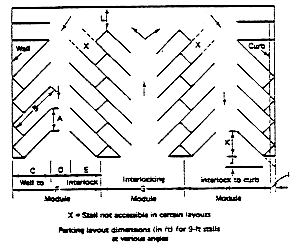
Table 2.
Design Requirements for Compact Vehicles
(Ord. No. 576, § 6, 5-19-16)
17.34.050 - Exemptions, exceptions and modifications.
A.
Dwelling units existing as of June 18, 2016 [the date this section takes effect], constructed in compliance with applicable standards that were in effect at the time the dwelling unit was issued a building permit, shall be considered conforming in terms of the parking required by this chapter until such time as they are expanded, except as permitted in subsection B of this section, or replaced, except that Section 17.38.090 shall apply in the event that they are damaged or destroyed by fire, flood, wind, earthquake, or other calamity.
B.
A single-family dwelling or mobile home existing as of June 18, 2016 [the date this section takes effect] which does not have off-street parking facilities that conform with the requirements of this chapter may be expanded by a cumulative total of not more than four hundred (400) square feet of floor area without the need to bring the parking facilities into conformance or to obtain a use permit under Section 17.34.050(I) of this chapter; furthermore, such a single-family dwelling or mobile home may be expanded to a total floor area of not more than one thousand two hundred (1,200) square feet, if the total number of bedrooms does not exceed two (2). The following restrictions and requirements shall apply:
1.
The structure to be expanded shall constitute the principal structure and the only dwelling unit located on the site or mobile home park space.
2.
The square footage permitted by this section shall be reduced by the square footage of any prior expansion of the same structure that was made since January 1, 1986, regardless of whether an exception, use permit, variance, or other approval was granted for such prior expansion.
3.
The square footage permitted by this section shall be reduced by the square footage of any prior permitted expansion of the same structure which resulted in the loss of required parking spaces, such as the conversion of a garage to living area.
4.
The expansion shall not result in the loss of any existing required off-street parking spaces that would increase the nonconformity of the existing off-street parking facilities.
5.
The proposed development shall comply with the requirements of Section 17.01.060 of this title, unless: (a) the structure to be expanded is located upon a lot of record, and (b) a public street abutting such lot of record provides the principal means of access to that lot.
6.
The total floor area shall not exceed the maximum permitted under the floor area ratio regulations for the applicable district, including or excluding covered parking as provided under those regulations.
7.
See Section 17.34.020(B)(1) regarding garage and carport exclusions from the floor area calculation.
C.
Storefront uses in the NCRO-2 District shall be exempt from the requirements of this chapter.
D.
For residential units designed and dedicated for use by persons with disabilities, subject to restrictions approved by the city and recorded with the County of San Mateo, the parking requirement shall be one assigned van-accessible parking space (either covered or uncovered at the discretion of the applicant) per dedicated unit. Such spaces shall be conveniently located along an accessible path of travel to the dedicated unit, but shall not count as or conflict with the parking required to be reserved for persons with disabilities per Title 17 (Section 17.34.040(D)).
E.
For a residential unit occupied by a person with a disability, the zoning administrator shall have authority to grant an accessibility improvement permit authorizing a modification to any of the parking requirements prescribed by this chapter, following the conduct of a hearing with ten (10) days' notice thereof being given to the owners of all adjacent properties. The zoning administrator may issue the accessibility improvement permit if he or she finds and determines that:
1.
The modification is necessary to meet special needs for a person having a disability;
2.
The modification will not create any significant adverse impacts upon adjacent properties;
3.
Any construction resulting from the modification will be done in a sound and workmanlike manner, in compliance with all applicable provisions of the building and fire codes;
4.
Strict enforcement of the specified regulation is not required by either present or anticipated future traffic volume or traffic circulation on the site; and
5.
The granting of the modification will not create or intensify a shortage of on-street parking spaces.
F.
For residential units designed and dedicated for use by households with one or more members who are sixty-two (62) years of age or older, subject to restrictions approved by the city and recorded with the County of San Mateo, the minimum parking requirement shall be two-thirds (sixty-seven percent (67%)) of the standard requirement based upon unit size as set forth in Section 17.34.020. This minimum parking requirement may be further reduced as an "additional incentive" required for projects that comply with the California "density bonus" law (California Government Code Sections 65915 and 65915.5).
G.
For residential units dedicated to be affordable to households with very-low, low, or moderate incomes, subject to restrictions approved by the city and recorded with the County of San Mateo, the minimum parking requirement may be reduced as an "additional incentive" required for projects that comply with the California "density bonus" law (California Government Code Sections 65915 and 65915.5). This reduction shall be in addition to any exception that may be applicable under Sections 17.34.050(D) or 17.34.050(E). Affordable housing projects that do not qualify for a density bonus and additional incentives may obtain a reduction in the minimum parking requirement through application for a modification under Section 17.34.050(I).
H.
Parking within the public right-of-way at the property's frontage may be recognized administratively only for single-family residences, secondary dwelling units and duplexes, subject to the approval of the city engineer.
1.
Off-street parking facilities which partially encroach within the public right-of-way may be recognized administratively, subject to the following requirements:
a.
The parking space shall not be located within a portion of the right-of-way that could be required for lanes of traffic per Section 12.24.010(B)(1).
b.
The parking space shall not block any portion of a required sidewalk.
c.
The parking space shall be located so as to minimize its impact upon any existing on-street parking, so as to produce a net increase in the number of on- and off-street parking spaces.
d.
The parking space shall comply with Sections 12.05.020 and 12.24.015, as applicable.
e.
If the parking space is at an angle to the street, clearance behind the space shall be provided equivalent to the minimum aisle width in Table 1 (for standard-size spaces) or Table 2 (or compact spaces).
f.
If the parking space is parallel to the street, it shall comply with Section 17.34.040(E); such parallel parking may be provided within a driveway to a garage or carport.
2.
On-street parking spaces located entirely within the public right-of-way in compliance with Section 12.24.010(B)(1) may be recognized administratively only for sites with more than 37.5 feet of frontage. On-street parking spaces may also be recognized as the guest parking required for a residential subdivision of five (5) or more single-family residences per Section 17.34.020(A).
I.
The planning commission shall have authority to grant a use permit authorizing a modification to any of the parking regulations prescribed by this chapter. The provisions of Chapter 17.40 of this title shall govern the filing and processing of the application for a use permit pursuant to this section; provided, however, that in addition to the findings required for the granting of a use permit, as set forth in Section 17.40.060, no use permit shall be granted for a modification to a parking regulation unless the planning commission also finds and determines that:
1.
Strict enforcement of the specified regulation is not required by either present or anticipated future traffic volume or traffic circulation on the site; and
2.
The granting of the use permit will not create or intensify a shortage of on-street parking spaces, given, for example, the availability of existing or improved on/off-street parking which may not fully meet the requirements of this chapter.
3.
Full compliance with the parking requirements is not reasonably feasible due to existing structural or site constraints. This finding shall not be required for residential units dedicated to be affordable to households with very-low, low, or moderate incomes or designed and dedicated for use by households with one or more members who are sixty-two (62) years of age or older, subject to restrictions approved by the city and recorded with the County of San Mateo.
J.
The planning commission shall have authority to grant a parking variance for nonresidential development to allow required parking to be located off-site. The provisions of Chapter 17.46 of this title shall govern the filing and processing of the application for a variance pursuant to this section; provided, however, that instead of the findings required for the granting of a variance, as set forth in Section 17.46.010, no such parking variance shall be granted unless the planning commission finds and determines that:
1.
The variance would be an incentive to, and a benefit for, the nonresidential development; and
2.
The variance will facilitate access to the nonresidential development by patrons of public transit facilities.
(Ord. No. 576, § 6, 5-19-16)
17.34.060 - Parking designated for clean air vehicles.
Parking spaces designated for low-emitting, fuel-efficient and carpool/van pool vehicles, as defined in Section 5.102 of the California Green Building Standards Code, shall be provided for newly constructed non-residential buildings according to the following schedule:
The designated spaces shall be marked "CLEAN AIR VEHICLE" with stall-striping paint, such that the lower edge of the last word aligns with the end of the stall striping so it will be visible beneath a parked vehicle.
(Ord. No. 576, § 6, 5-19-16)
17.34.070 - Bicycle parking.
Short-term and long-term parking for bicycles shall be provided for newly-constructed nonresidential buildings as follows:
A.
Short Term Parking. One or more permanently anchored bicycle racks shall be provided within two hundred (200) feet of the visitors' entrance and readily visible to passers-by. The required bicycle parking capacity shall be set as follows:
1.
One bike rack space per ten thousand (10,000) square feet of retail floor area;
2.
One bike rack space per one hundred fifty thousand (150,000) square feet of office floor area;
3.
Other nonresidential uses: Five percent (5%) of visitor motorized vehicle parking capacity.
4.
Any fractional result shall be rounded up.
5.
For all nonresidential buildings, the minimum capacity shall be for two (2) bicycles.
B.
Long-Term Parking. Permanently anchored bike racks inside covered, lockable enclosures or bicycle rooms or permanently anchored bicycle lockers shall be provided at convenient locations from the street. The required bicycle parking capacity shall be set as follows:
1.
One space per twenty thousand (20,000) square feet of warehouse floor area;
2.
One space per six thousand (6,000) square feet of retail floor area;
3.
One space per six thousand (6,000) square feet of office floor area;
4.
Other nonresidential uses: Five percent (5%) of motorized vehicle parking capacity.
5.
Any fractional result shall be rounded up.
6.
For all nonresidential buildings, the minimum capacity shall be for one bicycle.
(Ord. No. 576, § 6, 5-19-16)

