
Brownsville City Zoning Code
4.4
Land uses.
4.4.1 - Uses Permitted by District.
A.
Purpose.4.4.3 Permitted Use Chart lists the uses allowed within all zoning districts. Approval of a use listed in this article, and compliance with the applicable use-specific standards for that use, authorize that use only.
B.
Explanation of Use Table Abbreviations.
1.
Permitted Uses: "P" in a cell indicates that the use is permitted by right in the respective zoning district. Permitted uses are subject to all other applicable regulations of this Ordinance, including 4.4.4 Additional Use Standards in this article and the requirements of 4.5 Building Types, 4.6 Zoning Development Standards, and Article 5 Supplemental Regulations.
2.
Specific Use Permit Required: "S" in a cell indicates that, in the respective zoning district, the use is allowed only if issued a Specific Use Permit, in accordance with the procedures of 4.2.7 Specific Use Permit. Uses requiring a Specific Use Permit are subject to all other applicable regulations of this Ordinance, including 4.4.4. Additional Use Standards in this article and the requirements of 4.5 Building Types, 4.6 Zoning Development Standards, and Article 5 Supplemental Regulations.
3.
Prohibited Uses: A blank cell indicates that the use is prohibited in the respective zoning district.
4.
Additional Use Standards: Regardless of whether a use is allowed by right, or permitted with a Specific Use Permit, there may be supplemental standards that are applicable to the use. The applicability of these standards is noted through a cross-reference in the last column of the table. A number [#] in a cell indicates that the use, whether permitted by right or as a special use, is permitted subject to additional use standards in that district.
C.
Use Table Organization. In 4.4.3 Permitted Use Chart, land uses and activities are classified into general "use categories," "subcategories" and specific "use types" based on common functional, product, or physical characteristics, such as the type and amount of activity, the type of customers or residents, how goods or services are sold or delivered, and site conditions. This classification provides a systematic basis for assigning present and future land uses into appropriate zoning districts. This classification does not list every use or activity that may appropriately exist within these use categories, and specific uses may be listed in one category when they may reasonably have been listed in one or more other categories. The use categories are intended merely as an indexing tool and are not regulatory.
4.4.2 - Classification of New and Unlisted Uses.
The City recognizes that new types of land uses will arise, and forms of land use not anticipated in this UDC may seek to locate in the City. When application is made for a use category or use type that is not specifically listed in the appropriate use table, the Planning Director shall make a determination as to the appropriate classification of any new or unlisted form of land use in the following manner:
A.
The Planning Director shall provide an interpretation as to the zoning classification into which such use should be placed. In making such interpretation, the Planning Director shall consider all relevant characteristics of the proposed use, including but not limited to the following:
1.
The actual or projected characteristics of the proposed use;
2.
The volume and type of sales, retail, wholesale, etc. for commercial uses;
3.
The size and type of items sold and nature of inventory on the premises;
4.
The type and number of customers and employees;
5.
The hours of operation;
6.
The size and arrangement of buildings and parking on the site;
7.
The amount of parking needed and estimate of trips generated by the proposed use;
8.
Any processing done on the premises, including assembly, manufacturing, warehousing, shipping, distribution;
9.
Any dangerous, hazardous, toxic, or explosive materials used in the processing;
10.
The nature and location of storage and outdoor display of merchandise, whether enclosed, open, inside or outside the principal building; predominant types of items stored (such as business vehicles, work-in-process inventory and merchandise, construction materials, scrap and junk, and raw materials including liquids and powders);
11.
The amount and nature of any Nuisances generated on the premises, including but not limited to noise, smoke, odor, Glare, vibration, radiation, and fumes;
12.
Any special public utility requirements for serving the proposed use type, including but not limited to water supply, wastewater output, pre-treatment of wastes and emissions required or recommended, and any significant power structures and communications towers or facilities; and
13.
The effect on adjacent properties created by the proposed use type, which should not be greater than that of other use types in the zoning district.
B.
Standards for new and unlisted uses may be interpreted as those of a similar use.
C.
Appeal of the Planning Director's decision shall be made to the Zoning Board of Adjustment following procedures of 4.2.11 Zoning Relief.
D.
The Planning Director may periodically request amendments to this Ordinance to incorporate newly listed uses.
4.4.3 - Permitted Use chart.
A.
Chart Organization.
The Permitted Use Chart is grouped by use category:
1.
Residential Uses
2.
Public, Civic, and Institutional Uses
3.
Commercial Uses,
4.
Industrial Uses, and
5.
Accessory Uses.
B.
Residential Uses.
This category includes uses that provide living accommodations for one or more persons. The residential subcategories and uses are as follows:
1.
Household Living
2.
Group Living
C.
Public, Civic, and Institutional Uses.
This category includes public, quasi-public and private uses that provide unique services that are of benefit to the public at-large. The public, civic, and institutional subcategories are as follows:
1.
Civic and Cultural Facilities.
2.
Educational Service Establishments (Public And Private).
3.
Health and Human Services.
4.
Parks and Recreation Facilities.
5.
Public and Other Government Functions.
D.
Commercial Uses.
The commercial use category includes uses that provide a business service or involve the selling, leasing or renting of merchandise to the general public. Commercial subcategories and uses are as follows:
1.
Agricultural Uses.
2.
Animal Production and Ranching.
3.
Animal-Related Services.
4.
Auto-Related Sales and Service.
5.
Business, Professional and Technical Services.
6.
Financial and Real Estate Services.
7.
Food And Beverage Services.
8.
Lodging Facilities.
9.
Other Commercial Uses.
10.
Recreation and Entertainment Uses (Indoor).
11.
Recreation and Entertainment Uses (Outdoor).
12.
Rental and Leasing.
13.
Retail Sales.
E.
Industrial Uses.
This category includes uses that produce goods from extracted and raw materials or from recyclable or previously prepared materials, including the design, storage and handling of these products and the materials from which they are produced. Industrial subcategories and uses are as follows:
1.
Construction-Related Businesses.
2.
Manufacturing.
3.
Transportation-Related Businesses.
4.
Utilities and Utility Services.
5.
Warehouse and Storage.
6.
Wholesale Trade (Not Resale).
F.
Accessory Uses.
1.
Accessory Uses Allowed.
a.
Accessory uses are permitted only in relation to lawfully established principle uses.
b.
Accessory uses are limited to those stated in this chapter, as well as those which are determined by the Planning Director to satisfy all of the following criteria:
(i)
They are customarily found in conjunction with the subject principle use;
(ii)
They are subordinate and clearly incidental to the principle use of the property; and
(iii)
They serve a necessary function for or contribute to the comfort, safety or convenience of occupants of the principle use.
2.
Time of Construction and Establishment.
a.
Accessory uses may be established only after the principle use of the property is in place.
b.
Accessory structures may be established in conjunction with or after the principle building or use. They may not be established before the principle building or use is in place.
3.
Location. Accessory uses must be located on the same lot as the principle use to which they are accessory.
4.
Compliance with Zoning District Requirements. Unless otherwise expressly stated, accessory uses are subject to the same zoning district requirements that apply to principle uses.
(Ord. No. 2024-235.105, 4-2-2024 Ord. No. 2025-235.110, § 2, 3-4-2025; Ord. No. 2024-235.111, § 1, 3-4-2025; Ord. No. 2025-235.116, § I, 6-3-2025; Ord. No. 2025-235.118, §§ 2, 5, 6 (Exhs. B, E, F), 6-3-2025)
4.4.4 - Additional Use Standards.
A.
Applicability—Permitted Uses.
The following additional use standards shall apply, as indicated in the Permitted Use Chart:
Residential Uses
1.
Dwelling, Live/Work. A live/work dwelling includes both live and work uses within a single dwelling unit.
a.
The 'live' component:
(i)
Shall be occupied by the business operator; and
(ii)
May be located on the street level behind the 'work' component or any other level of the building.
b.
The 'work' component:
(i)
Is limited to the uses of professional offices, artists' workshops, studios, or other similar uses and is located on the street level; and
(ii)
May be constructed either as separate units or as a single unit.
c.
Live/work is distinguished from a home occupation otherwise defined herein in that the work use is not required to be incidental to the dwelling unit and customers may be served on site.
d.
Each portion of a live/work dwelling shall comply individually with applicable building codes.
2.
Dwelling, Townhouse (Single-family attached or multi-family).
a.
Townhouse dwellings shall be constructed on individual lots that are platted in accordance with Article 3 Subdivision Regulations.
3.
Community Group Home for People with Disabilities.
a.
Applications for a Community Home for Persons with Disabilities shall include, but not limited to, the following information:
(i)
Current State license information, and
(ii)
On-site responsible party and contact information.
b.
In accordance with Section 123.008 of the Human Resources Code, no Community Home for Persons with Disabilities shall locate within one-half mile of another Community Home for Persons with Disabilities.
c.
The amount of on-site parking shall not exceed the required number of parking spaces by more than three (3) spaces.
d.
All Community Homes shall require an interior and exterior inspection of the property prior to the issuance of a Certificate of Occupancy and annually thereafter by the Building Official, Building Inspector, and Code Enforcement Officials.
4.
Halfway House.
a.
A halfway house must be at least 2,000 feet from other halfway house or inpatient substance abuse treatment facility, measured property line to property line.
b.
A halfway house must be at least 750 feet from any community home or group home, notwithstanding any additional distance restrictions of Federal, State or local law for moderate and high risk (level 2 and 3) and civil commitment sex offenders, measured property line to property line.
c.
The appearance and residential character of the structure cannot be altered, either through use of colors, materials, construction (excepting provisions for the physically handicapped) and Lighting; the emission of sound, noise, vibration and electromagnetic interference; or outdoor storage of any kind.
d.
Signs identifying the property as a halfway house are prohibited in residential zoning districts.
e.
Vehicles used primarily for the halfway house (for instance, vans displaying an institution name) must be stored where they cannot be seen from the public right-of-way or adjacent properties when located in a residential zoning district.
f.
Any single-family dwelling unit to be utilized for a halfway house shall provide as a minimum, the following square footage in each bedroom:
(i)
To house one person per bedroom, the dwelling unit must provide one hundred (100) square feet of space per bedroom utilized for this purpose.
(ii)
To house two or more persons per bedroom, the dwelling unit must provide at least eighty (80) square feet of space per person housed in the bedroom utilized for this purpose. For example, two persons would require a one hundred sixty (160) square foot room.
5.
Manufactured Homes and Manufactured Home Park/Subdivision.
a.
A Manufactured Home Lot, Manufactured Home Park, or Manufactured Home Subdivision shall comply with the development standards in 4.6.10 Manufactured Home Development.
b.
The minimum lot area for a Manufactured Home Park or Manufactured Home Subdivision shall be a minimum of two (2) acres as required in 4.6.10C.1.a Minimum Lot Area.
c.
Both manufactured home parks and subdivisions shall comply with the Minimum Requirements for all Manufactured Home Development in 4.6.10C.1, however additional development standards apply to both manufactured parks and subdivisions.
(i)
Refer to 4.6.10C.2 for Additional Requirements for Manufactured Home.
(ii)
Refer to 4.6.10C.3 for Additional Requirements for Manufactured Home Subdivisions.
Public, Civic and Institutional Uses
6.
Child Care Home.
a.
Child care homes must be an accessory use to an allowed household living use and be licensed by the State of Texas.
b.
Applicants for family child care homes must obtain a zoning clearance permit and a certificate of occupancy before commencing operation.
c.
Child care homes may provide supervision for no more than 6 children.
d.
No person may be employed other than a member of the household residing on the premises or a non-resident, substitute caregiver, as may be required for family child care homes by the State of Texas.
e.
Signs advertising a family child care home are prohibited.
f.
No exterior building alterations or site modifications may be made that would change the residential character of the premises.
g.
A family child care home may not be established on any lot located within 300 feet of another lot occupied by a family child care home if any boundary of the subject lot abuts the same street.
7.
Correctional Institution.
a.
To avoid over-concentration, all detention and correctional facilities must be separated from one another by a minimum distance of 2,640 feet, as measured in a straight line from the nearest point on the lot line of the property occupied by one of these uses to the nearest point on a lot line of the other property occupied by one of the subject uses.
b.
The separation distance requirements of this subsection may be reduced if approved through the special exception approval process.
8.
Recreation Center.
a.
Recreation Centers located in the RE, R-1, and R-2 zoning districts shall be set back from residential dwellings at least fifty (50) feet.
Commercial Uses
9.
Alcoholic Beverage Sales
a.
The premises shall nowhere be within a radius of 200 feet from public school property.
10.
Alternative Financial Institution and Bail Bond Service
a.
These uses shall not be located within one-half (1/2) mile of another existing Alternative Financial Institution or Bail Bond Service measured from property line to property line.
b.
Any Alternative Financial Institution shall be considered a principal use and may not be considered as an accessory use.
11.
Animal Production and Ranching, and Animal Related Service Uses
a.
Animal Production and Ranching, and Animal Related Service Uses shall comply with Chapter 10 - Animal Regulation and Care of the Brownsville Code of Ordinances.
b.
Whenever an Animal Production and Ranching or Animal Related Service Use is located on a lot abutting an R or AG zoned lot, a screening fence or wall must be provided along the common property line.
12.
Motor Vehicle Sales, Used
a.
Only those properties fronting Southmost Boulevard and Padre Island Highway which do not directly abut a property zoned to a residential district (RE, R1, R2, & R3) or a property used for single-family, duplex, or multifamily purposes, shall qualify to apply for a Specific Use Permit to allow the sale of used motor vehicles.
b.
An existing used motor vehicle sales establishment holding a certificate of occupancy issued prior to the adoption of the Unified Development Code shall be considered legally non-conforming and may continue to operate as such until the use ceases operations for more than six consecutive months.
13.
Bar or Drinking Establishment or On-Premise Consumption of Alcohol or Alcoholic Beverage Sales
a.
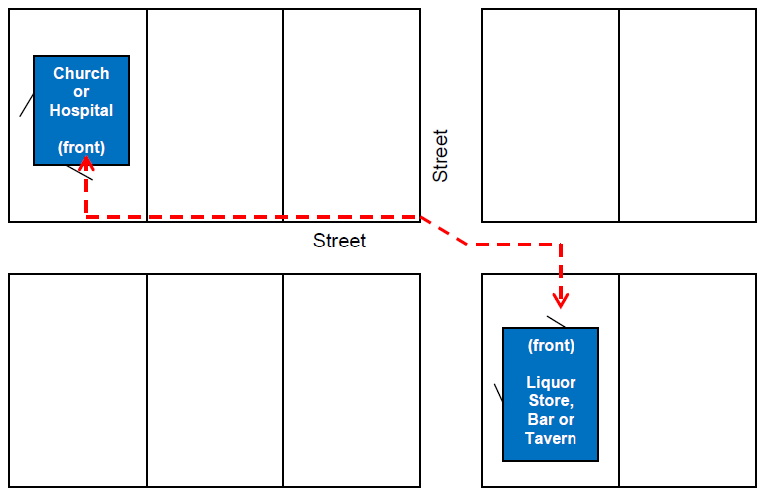
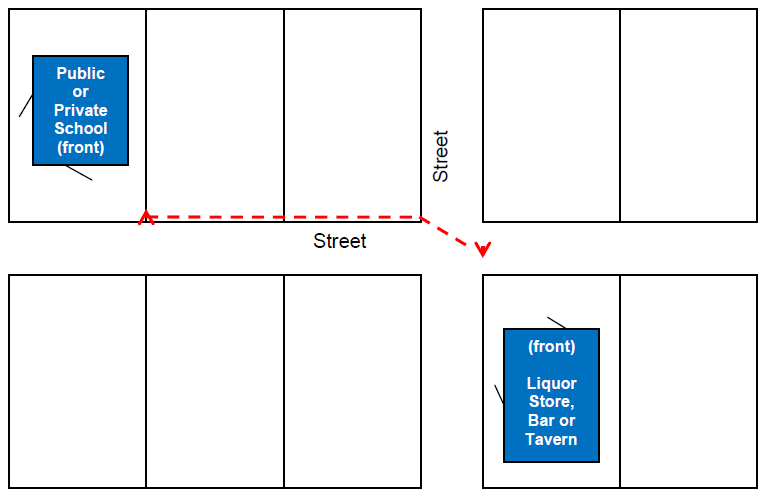
Alcoholic beverage sales, bars, and on-premise consumption of alcohol shall be prohibited within 300 feet of a religious assembly and institution use, an educational service establishment, or a hospital. Alcoholic beverage sales are also prohibited within 1,000 feet of a private school if the Error! Reference source not found, approves by resolution a request for the 1,000 foot separation f rom the governing body of a private school.
b.
Method of Measurement
(i)
Religious Assembly and Institution Use or Hospital. The measurement of this distance shall be along the property lines of the street fronts and from front door to front door, and in direct line across intersections.
(ii)
Educational Service Establishment. The measurement of the distance between the premises and an educational service establishment shall be from the property line of the educational service establishment to the property line of the place of business, and in a direct line across intersections.
c.
This section does not apply to any establishment that is licensed for the sale or consumption of alcoholic beverages at the time a church, public school or hospital begins construction or occupancy of a building within 300 feet of the licensed establishment. Nor shall it apply to churches, public schools or hospitals that are themselves licensed for the sale or consumption of alcoholic beverages.
d.
This section does not apply to on-premises consumption if less than 50 percent of the gross receipts for the premises is from the sale or service of alcoholic beverages; off-premise consumption if less than 50 percent of the gross receipts for the premises, excluding the sale of items subject to the motor fuels tax, is from the sale or service of alcoholic beverages; or a wholesaler, distributor, brewer, distiller, rectifier, winery, wine bottler or manufacturer as those words are ordinarily used and understood in Chapter 102 of the Texas Alcoholic Beverage Code.
e.
A Bar or Drinking Establishment that shares a common property line with property in the AG, RE, R-1, R-2 or R-3 zoning districts or that contains a single family residence shall also comply with the following:
(i)
Outdoor amplification of sound is prohibited unless a Specific Use Permit is granted by the City Commission.
(ii)
Interior finish-out materials such as acoustic tiles or other approved sound-dampening materials shall be installed to maintain a noise level no greater than sixty (60) decibels when measured at the common property line shared by the Bar or Drinking Establishment and an adjacent single family residence or residential zoning district.
13.
Bed and Breakfast Establishment.
a.
Number of guest rooms is limited to five (5).
b.
Parking shall meet standards in 4.6.2 Parking.
c.
Cooking facilities in guest rooms are not allowed.
d.
Individual guest occupancy is limited to no more than fourteen (14) consecutive days within any thirty (30) day period.
e.
Signs shall comply with 5.3 Signs.
f.
Health and Safety Considerations: Shall meet all adopted City, county, and state regulations regarding applicable fire code, health safety including food handling permit requirements.
14.
Bulk Apparel Sales.
a.
Bulk Apparel Sales uses must ensure adequate, enclosed, dumpsters are available on site to accommodate disposal of discarded items.
b.
Trash pick up service must be conducted regularly and frequently enough to ensure dumpsters do not overflow and that dumpster lids are closed at all times they are not being loaded or emptied.
15.
Food Truck Park.
a.
All mobile vendors must have valid required health inspection permits from the City.
b.
Applications for a Food Truck Park shall include the following:
(i)
A detailed site plan showing the location and dimensions of the park area, locations of all proposed mobile vendors, landscaping, building setbacks, vehicle parking, areas for sitting and/or dining, barriers, utility connection locations, and restroom locations;
(ii)
Written permission from the land owner to use the site (unless the applicant is the land owner);
(iii)
A copy of all required health inspection permits;
(iv)
Proposed hours of operation;
(v)
Shared use agreement for restroom facilities (if applicable), as noted by d. below.
c.
Food Truck Park sites are considered a parking lot; therefore, all surfaces must be paved and include the required landscaping outlined in Section 4.6.3 Landscaping.
d.
Adequate restroom facilities shall be provided either on-site or through a shared use agreement with a neighboring business. Portable toilets, if used, must be screened from view of the public.
e.
Electrical, water, and wastewater connections shall be provided.
f.
Above ground utility connections shall not interfere with pedestrian or vehicular safety and shall not be located in customer service areas or customer parking lots.
g.
Food Truck Park sites shall be defined by curbs (i.e., continuous curb cuts are prohibited) to confine ingress and egress to defined access points to ensure the safety of pedestrians within the park.
h.
A barrier shall be located between any vehicular areas and the customer service areas. The barrier may be implied or physical and constructed with landscaping elements; gated fencing; changes in ground surface texture, material or color; or similar treatments.
i.
Drive-thrus are not permitted in conjunction with a Food Truck Park.
j.
Signage is allowed on the mobile vendor vehicle itself but no detached signage is allowed.
k.
A waste receptacle is required for every mobile vendor and waste shall be removed daily.
16.
Pawn Shops. Pawn shops shall not be located within one-half (1/2) mile of another existing pawn shop.
17.
Plasma Center. Plasma centers shall not be located within one (1) mile of an existing plasma center.
18.
Sexually Oriented Business. All Sexually Oriented Businesses shall comply with Chapter 22, Article XII. Sexually-Oriented Businesses of the Brownsville Code of Ordinances.
19.
E-cigarette retailer.
a.
E-cigarette retailers shall be prohibited within 1,000 feet of a church, hospital, daycare, or public or private primary or secondary school campuses.
b.
Method of Measurement.
(i)
Religious Assembly and Institution Use or Hospital. The measurement of the distance between the premises and a religious assembly and institution use or hospital, such as a church or hospital, shall be a direct line from front door to front door.
(ii)
Educational Service Establishment. The measurement of the distance between the premises and an educational service establishment, such as a daycare, primary or secondary private or public school shall be a direct line from the closest corner of the property line of the educational service establishment to the closest property line of the place of business.
c.
This section does not apply to any establishment that is licensed for an E-Cigarette Retailer Permit by the Texas Comptroller at the time a church, public or private school, daycare, or hospital begins construction or occupancy of a building within 1,000 feet of the licensed establishment.
d.
This section does not apply to an e-cigarette retailer whose gross receipts from the sale of e-cigarettes are less than 50 percent of the retailer's total gross receipts at the retailer's premises within an area described by subsection (a). For purposes of the calculation of gross receipts, the gross receipts from the sale of e-cigarettes shall also include the sale of consumable hemp products, Cannabidiol (CBD), tetrahydrocannabinol (THC), Delta-8 tetrahydrocannabinol (also called Delta-8 THC or Delta-8), Delta-9 tetrahydrocannabinol (Delta-9 or Delta 9 THC), Delta-10 tetrahydrocannabinol (Delta-10 or Delta 10 THC), or Tetrahydrocannabinolic acid (THCA) products whether consumable or inhalable.
Industrial Uses
20.
Self-storage or Mini storage.
a.
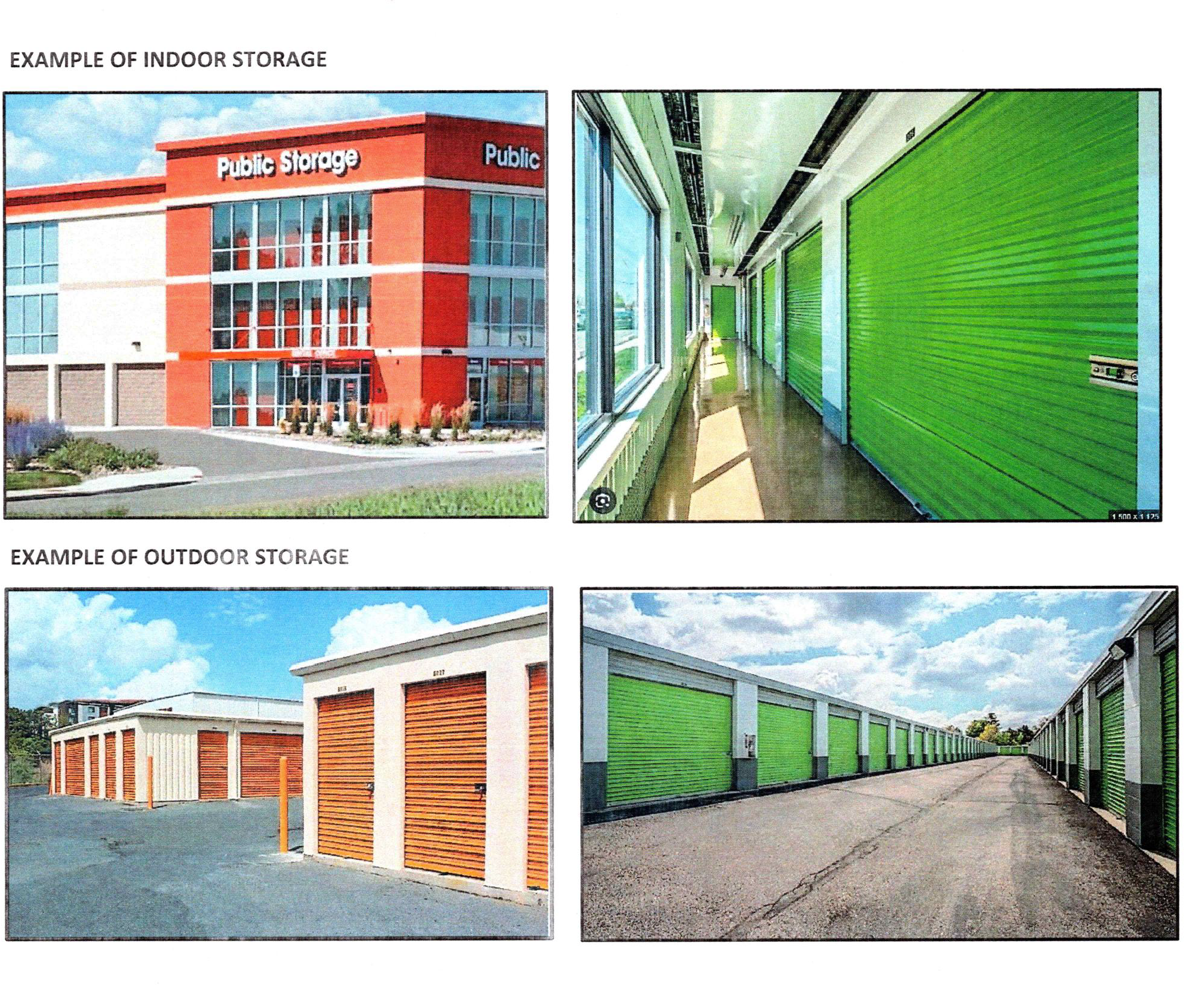
Self-storage or mini storage facilities shall be limited to indoor storage where access is made through a common corridor/entryway within an enclosed structure and is permitted only in the Commercial Corridor (CC) and Traditional Neighborhood-Commercial (TN-C) zoning district. All other districts that permit this use as shown in the permitted use chart may allow outdoor storage facilities.
21.
Specialty Trade Contractors. Specialty Trade Contractor uses in the CC, Corridor Commercial and TN-C, Traditional Neighborhood Corridor zoning districts are limited to office uses unless a Specific Use Permit is approved.
22.
Telecommunications Equipment and Facilities and Towers. All Telecommunications Equipment and Facilities and Towers shall comply with 4.6.9 Wireless Transmission.
Accessory Uses
23.
Carports. Any carport that occupies all or a portion of the street setback or street yard area must be approved in accordance with the special exception procedures of 4.2.11 Zoning Relief.
24.
Drive Thru. Any use with drive-thru facilities (e.g. retail sales, pharmacy, banks, and restaurants.
a.
A Drive-Thru window is only allowed as an accessory to a permitted principal use.
b.
A Drive-Thru window is not automatically included with any use. A Drive-Thru must be allowed as an accessory use to utilize a Drive-Thru window.
c.
See Section4.6.2.F for applicable stacking and queuing requirements.
d.
Within the Medical Overlay District, drive-thru windows are prohibited except for banks and pharmacies.
25.
Dwelling, Accessory.
a.
No more than one (1) Accessory Dwelling Unit for the purpose of a living quarters shall be permitted on a lot.
b.
No more than one (1) household family unit shall occupy an Accessory Dwelling Unit at a time.
c.
Accessory Dwelling Units may be rented or occupied by a guest.
d.
Accessory Dwelling Units must meet the setbacks established for the principal dwelling.
e.
An Accessory Dwelling Unit shall be limited in size to not more than 50% of the total floor area of the principal dwelling's living space.
f.
Accessory Dwelling Units may have a separate utility meter from the principal dwelling.
26.
Food Truck.
a.
One (1) Food Truck may be established as an accessory use on private property where Full-Service Restaurants are permitted by right.
b.
Parking and other site development requirements shall be met for the Food Truck in addition to the principal use on the lot.
c.
Food Trucks may operate on public property (including within the right-of-way of City streets) only in compliance with Chapter 22. Businesses; Article VII. Itinerant Merchants and Transient Dealers.
27.
Fuel Pumps
a.
Fuel Pumps are allowed only as an accessory to a permitted Retail or Grocery principal use.
b.
See 4.6.2 Parking for applicable stacking and queuing requirements.
c.
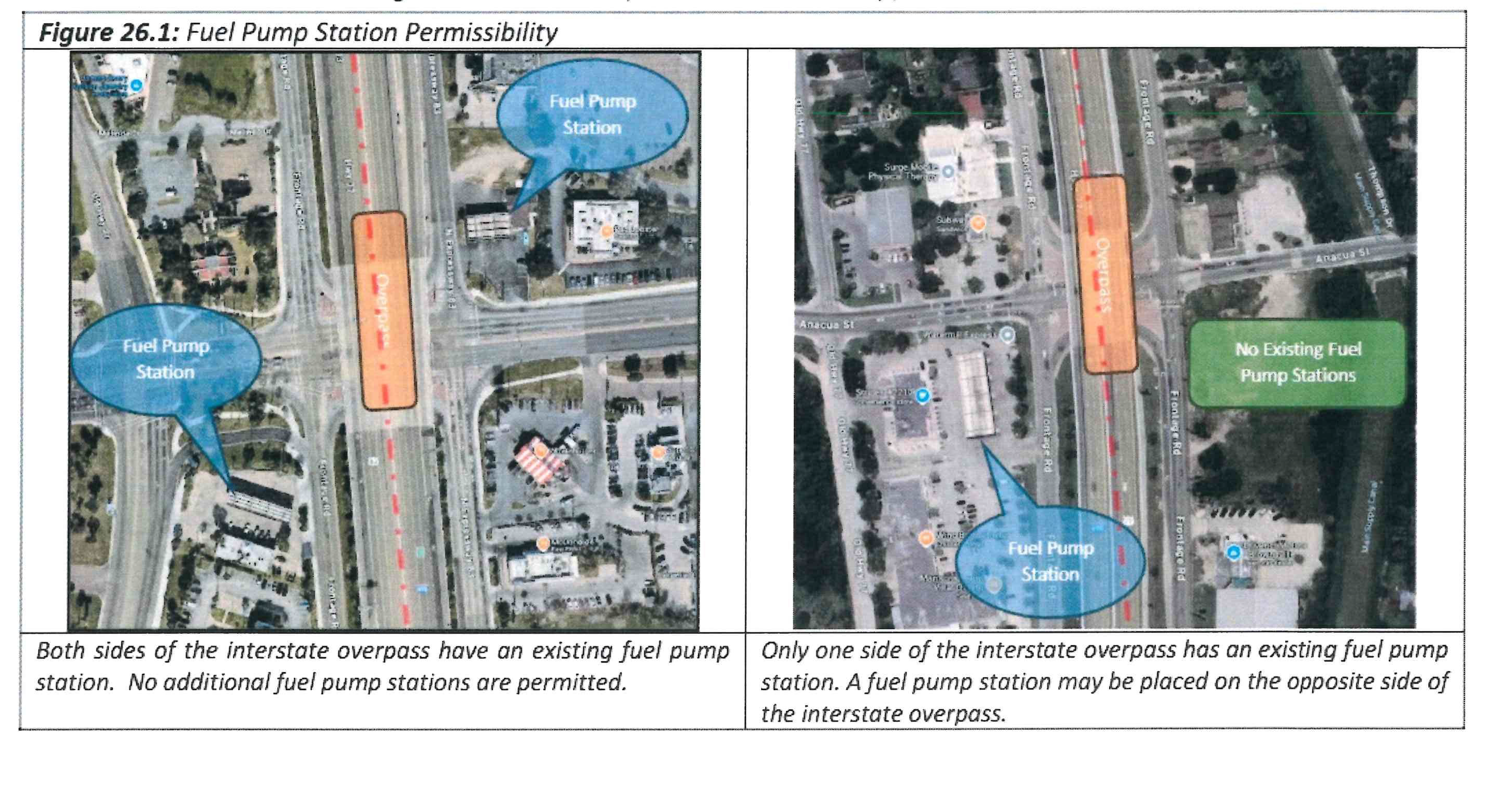
No more than 1 (one) fuel pump station shall be permitted per intersection.
(i)
This requirement shall only apply independently to each side of an interstate overpass (See Figure 26.1: Fuel Pump Station Permissibility)
28.
Home Occupation.
a.
Home occupations must be accessory and subordinate to the principal residential use of the property.
b.
Home occupations that change the character of the residential building they occupy or that adversely affect the character of the surrounding neighborhood are prohibited. Home occupations may not, for example, produce light, noise, vibration, odor, parking demand, or traffic impacts that are not typical of a residential neighborhood. Home occupations must be operated so as not to create or cause a Nuisance.
c.
Any tools or equipment used as part of a home occupation must be operated in a manner or sound-proofed so as not to be audible beyond the lot lines of the subject property.
d.
External structural alterations or site improvements that change the residential character of the lot upon which a home occupation is located are prohibited. Examples of such prohibited alterations include construction of parking lots, the addition of commercial-like exterior Lighting, the addition of a separate building entrance that is visible from abutting streets or the display of an internally illuminated sign.
e.
No display of any material or merchandise is allowed.
f.
No vehicle required to be registered as a "commercial truck" may be parked or stored on a lot within a residential zoning district. This provision is not intended to prohibit deliveries and pickups by common carrier delivery vehicles (e.g., postal service, united parcel service, FedEx, et al.) of the type typically used in residential neighborhoods.
g.
Prohibited Uses. The following uses are expressly prohibited as home occupations:
(i)
Any type of assembly, cleaning, maintenance, painting or repair of vehicles or equipment with internal combustion engines or of large appliances (such as washing machines, clothes dryers or refrigerators);
(ii)
Dispatch centers or other businesses where employees come to the site and are dispatched to other locations;
(iii)
Equipment or supply rental businesses;
(iv)
Taxi, limo, van or bus services;
(v)
Tow truck services;
(vi)
Taxidermists;
(vii)
Restaurants;
(viii)
Funeral or interment services;
(ix)
Animal care, grooming or boarding businesses; and
(x)
Any use involving the use or storage of vehicles, products, parts, machinery or similar materials or equipment outside of a completely enclosed building; and
(xi)
Any use that does not comply with regulations of this section.
29.
Outdoor Display.
a.
Outdoor Display areas shall not be placed or located more than thirty (30) feet from the main building and shall not exceed fifty (50) percent of the linear frontage of the building.
b.
Outdoor Display areas shall be permitted year round.
c.
Outdoor Display areas shall be additionally restricted in regard to occupying required parking spaces.
d.
Outdoor Display areas shall not occupy any of the parking spaces that are required by this UDC for the primary use(s) of the property.
e.
Outdoor Display areas shall not pose a safety or visibility hazard, nor impede public vehicular or pedestrian circulation, either on-site or off-site, in any way. At least sixty (60) inches of pedestrian clear zone shall be provided to allow for circulation.
f.
Outdoor Display items shall be displayed in a neat, orderly manner, and the display area shall be maintained in a clean, litter-free manner.
g.
Outdoor Display is permitted only as an accessory use.
30.
Outdoor Storage.
a.
Outdoor Storage is limited to a maximum of ten (10) percent of the total lot area.
b.
Outdoor Storage shall not be located in front of or on top of the building.
c.
See 4.6.4 Fencing and Screening for screening requirements.
31.
Electric Vehicle Charging Stations.
a.
Purpose. The purpose of this section is to provide design criteria and placement standards to encourage and promote safe and efficient electric vehicle charging opportunities in a full range of zones and settings for convenience of service to those that use electric vehicles
b.
Permitted locations.
(i)
Level-1 and Level-2 electric vehicle charging stations are permitted in all zoning districts when accessory to the primary permitted use. Installation shall be subject to building permit approval.
(ii)
Electric vehicle charging stations installed for non-residential uses shall be a Level-2 or higher.
(iii)
Level-3 electric vehicle charging stations are permitted in CC, RC, LI, HI, TN, TN-MU, TN-C, DE, DG, DC and MOD when accessory to the primary permitted use. Installation shall be subject to site and building permit approval.
(iv)
Electric vehicle charging stations are not permitted within the city right-of-way.
c.
Location and layout.
(i)
Electric vehicle charging stations may be placed in existing off-street parking areas but shall not reduce any landscaping within the vehicular use area required pursuant to Section 4.6.3.
(ii)
Electric vehicle charging stations shall meet the landscaping requirements of Section 4.6.3., as applicable.
(iii)
Electric vehicle charging stations shall not impede pedestrian amenities and circulation.
(iv)
Any electric vehicle infrastructure shall be screened from view from the street in accordance with Section 4.6.4.
d.
Design criteria and guidelines.
(i)
Charging station outlets and connector devices shall be no less than 36 inches and no higher than 48 inches from the top of surface where mounted and shall contain a retraction device and/or a place to hang permanent cords and connectors sufficiently above the ground or paved surface.
(ii)
Charging station equipment shall be maintained in all respects, including the functioning of the charging equipment. Maintenance shall be the responsibility of the property owner.
(iii)
The minimum size of an electric vehicle charging space is the same as a regular parking space and shall comply with Section 4.6.2. Charging devices may be located adjacent to designated parking spaces but shall not be placed within the minimum dimensions of a parking space.
e.
Lighting. Adequate site lighting shall exist or be installed in compliance with Section 4.6.7.
f.
Signage.
(i)
For each electric vehicle charging space one (1) non-illuminated parking sign fastened to a steel pole is permitted. The surface area of the sign shall not exceed two (2) square feet and the pole shall not exceed six (6) feet in height.
(ii)
For each electric vehicle charging station:
(1)
Information shall be posted identifying the charge level, time available for use, and safety information related to the electric vehicle charging station.
(2)
A phone number or other contact information shall be posted for reporting when the equipment is not functioning, or other problems are encountered.
(3)
One (1) small scale, pedestrian level, adhesive identification graphic is allowed on the charging station and shall not exceed 144 square inches in total area.
(iii)
Signage shall comply with current Manual on Uniform Traffic Control Devices (MUTCD) standards.
g.
Parking requirements.
(i)
Any electric vehicle charging space that is exclusive to a specific make or model of electric vehicle shall not count towards the required minimum parking spaces for the permitted primary use.
(Ord. No. 2025-235.110, § 2, 3-4-2025; Ord. No. 2025-235.111, § 2, 3-4-2025; Ord. No. 2025-234.116, § II, 6-3-2025; Ord. No. 2025-235.118, § 9 (Exh. I), 3-6-2025)
4.4.5 Temporary - Uses
1.
Festivals, Civic Events, Circus, Carnival, and Amusement Rides
a.
Civic events and special events may be conducted within an existing use and ancillary to that use provided it meets the following criteria.
(i)
The event is carried on for a period of time not exceeding seven (7) consecutive days. Applications for alternative zoning districts or extended periods of time are subject to Planning Director approval.
(ii)
Retail sales may be conducted with the primary activity including arts, crafts, food, and other items.
(iii)
Charitable and Nonprofit Organizations may conduct retail sales for fund-raising purposes in any zoning district.
(iv)
Assemblies are carried on out-of-doors, in temporary shelters, or tents.
(v)
A permit is obtained in accordance with the provisions provide herein.
2.
Garage Sale.
a.
Private citizens may conduct garage sales on their own property, provided that no more than one garage sale is held during a three-month period and that the garage sale does not exceed five consecutive days.
3.
Temporary Storage Containers.
a.
Temporary storage containers may be allowed for residential and commercial moving or remodeling.
b.
Temporary storage containers shall be placed on the driveway or parking lot at the furthest point from the street.
c.
Temporary storage containers cannot be placed on any public right-of-way or in grassy areas in the front yard.
d.
Each residential lot shall be limited to two (2) temporary storage containers at a time; no more than twice per calendar year to be placed no longer than ten (10) consecutive days each time unless otherwise approved by the Administrator.
e.
Each nonresidential lot shall be limited to two (2) temporary storage containers at a time; no more than twice per calendar year to be placed no longer than twenty (20) consecutive days each time unless otherwise approved by the Administrator.
f.
If used during remodeling, then the temporary storage container shall be removed within 10 days of final inspection or Certificate of Occupancy issuance.
4.
Seasonal Sales.
a.
Outdoor seasonal sales are temporary uses which include but are not limited to snow cones, Christmas tree sales, pumpkin sales, plant sales, fresh produce sales and similar uses. Outdoor seasonal sales are not intended to include the sale of manufactured items such as furniture, bedding, automobile parts or household goods. It shall also not include fireworks. The following standards shall apply:
b.
The maximum duration of a single seasonal sales permit is fifteen (15) days. Only one sale is permitted per season on any single lot. Such a limitation shall not apply to farmers' markets and similar uses.
c.
On a developed lot, the maximum area for seasonal sales shall be no greater than 30 percent of any surface parking area. Such a limitation shall not apply to farmers' markets and similar uses.
d.
Outside display shall not block any sight triangles or fire lanes.
e.
On undeveloped lots, pre-existing access and parking may be gravel so long as it is maintained in good condition. New access or parking must be located on approved surfaces.

