
Brownsville City Zoning Code
4.6
Zoning
Development Standards
4.6.1 - Building Design.
A.
Purpose and applicability.
1.
Purpose. The purpose of this Section is to encourage high quality design supportive of the Comprehensive Plan vision, goals, objectives and recommendations by establishing a system by which an Applicant can achieve greater regulatory flexibility for development through provision of certain desirable design and performance characteristics.
2.
Voluntary Nature and Agreement. It is hereby established that an Applicant utilizing the provisions of this Section for regulatory flexibility does so voluntarily and in a binding manner. The City may require execution of agreements to document use of these provisions and recording in the public records of the County.
3.
Applicability. This Section applies to new construction in AG, RE, R-1, R-2, R-3, CC, RC, LI, HI.
B.
Single-family and duplex design.
1.
Applicability. This subsection B applies only to single-family and duplex dwellings in the AG, RE, R-1, R-2, R-3, TN, TN-MU, TN-C, DE and DG districts.
2.
Establishment of Scoring System and Associated Regulatory Incentives
a.
Level 1 High-Quality Design. A cumulative score of sixty (60) points, as described below, shall result in the following changes to development regulations applicable to the subject property:
(i)
The granting of an additional ten (10) feet of maximum height.
(ii)
The granting of an additional ten (10) percent of building coverage.
(iii)
The granting of an additional ten (10) percent of impervious cover.
(iv)
The granting of a ten (10) percent reduction in minimum lot size and a ten (10) percent increase in maximum dwelling units per acre.
b.
Level 2 High-Quality Design. A cumulative score of eighty (80) points, as described below, shall result in the following bonuses applicable to the subject property:
(i)
The granting of an additional twenty (20) feet of maximum height.
(ii)
The granting of an additional twenty (20) percent of building coverage.
(iii)
The granting of an additional twenty (20) percent of impervious cover.
(iv)
The granting of a twenty-five (25) percent reduction in minimum lot size and a twenty-five (25) percent increase in maximum dwelling units per acre.
3.
High-Quality Design Actions and Associated Scoring Values. The following characteristics are determined to constitute evidence of high-quality design. The presence of each characteristic shall have an associated scoring value for the purposes of establishing whether a project achieves Level 1 or Level 2 High-Quality Design.
a.
Use of Building Materials Reflective of the City's Geographic Context. A project may receive a maximum of 20 points for the use of building materials reflective of the City's geographic context, as follows:
(i)
Use of Class 1 Building Materials and Class 2 Building Materialson one hundred percent (100%) of the exterior facade: 15 points
(ii)
Use of Class 1 Building Materials on one hundred percent (100%) of the exterior facade: 20 points
b.
Maintaining and Enhancing the Natural Environment. A project may receive a maximum of 30 points for maintaining and enhancing the natural environment, as follows:
(i)
Altering the topography and elevation by no more than four (4) feet for at least eighty (80) percent of the subject property: 10 points
(ii)
Preserving at least thirty-five (35) percent of the subject property unaltered in its natural state: 10 points
(iii)
Certification of at least fifty (50) percent of the subject property as a certified Texas Wildscape, Monarch Waystation or similar third-party designation approved by the Planning Director as indicating consistency with City goals to encourage native and adaptive plants, discourage invasive and disease-prone plants, and support wildlife habitat: 10 points
c.
Promotion of Conservation and Low-Impact Development Best Practices. A project may receive a maximum of 30 points for development characteristics promoting conservation and low-impact development best practices, as follows:
(i)
Incorporation of a rainwater harvesting system capable of capturing a one (1) inch rainfall event for twenty-five (25) percent of the roof area, with a minimum of one-thousand (1,000) gallons: 15 points
(ii)
Incorporation of Low Impact Development (LID) stormwater management practices consistent with Section 5.6.5, subject to the approval of the Planning Director and City Engineer: 15 points
(iii)
Use of improved permeable surface for at least fifty (50) percent of paved areas of driveways, parking and sidewalks (excluding the building footprint) with performance characteristics indicating at least fifty (50) percent of water infiltrates through the surface and requiring minimal maintenance intervention, subject to Planning Director and City Engineer approval: 15 points
d.
Enhanced Building and Site Design Characteristics. A project may receive a maximum of 30 points for certain building design characteristics, as follows:
(i)
Use of clay tile, slate or metal roof materials for the entire roof surface: 10 points
(ii)
Use of a vegetative "green" roof for at least fifty (50) percent of the entire roof surface (this may also count toward credit for the roof materials listed in i, above, if project is seeking points for both): 20 points
(iii)
Use of enhanced paving for all driveways, sidewalks and other paved surfaces, including but not limited to earth-tone colored concrete (stain integral; not applied afterward), stamped or patterned concrete, brick or paver units, exposed aggregate or improved permeable surface (excluding dirt, grass or gravel): 10 points
(iv)
Use of at least two (2) of the following element options: 10 points
(1)
Front wall articulation to offset the floorplate every fifteen (15) feet along any front facade of the dwelling unit.
(2)
The garage be placed behind the rear building face.
(3)
A covered front porch or portico along at least fifty (50) percent of the front facade, with a minimum depth of eight (8) feet.
(4)
The use of window and door enhancements on all facades visible from the street, including but not limited to transoms, bay windows, raised muntins on windows, shutters, or other similar enhancements.
C.
Multi-family, mixed-use, and nonresidential design.
1.
Applicability. This subsection C. applies to multi-family residential, mixed-use, and nonresidential buildings in the R-3, CC, RC, LI, and HI districts.
2.
Purpose. This section is intended to ensure that all buildings are be compatible with the architectural character and design as described within the Comprehensive Plan in terms of style, mass, material, height, roof design, and other exterior elements.
3.
Building Design and Orientation.
a.
All buildings shall be finished on all four sides with the same materials, detailing, and features and with a higher level of finish on the front facades (as set forth in the requirements below). The intent is not to limit materials but rather to ensure consistency in their use.
b.
Any building visible from a public Right-of-Way shall either face such Right-of-Way or shall have a facade facing such Right-of-Way consistent with the character of the front facade.
4.
Required Design Element Options. The following is a list of design elements that, based upon the size of a building (see 5 below), must be incorporated into a building's design:
a.
Canopies, awnings or porticos;
b.
Overhangs;
c.
Recesses or projections;
d.
Arcades;
e.
Peaked roof forms;
f.
Arches;
g.
Outdoor patios;
h.
Display windows;
i.
Architectural details (e.g. tile work or moldings integrated into the building facade);
j.
Integrated planters or wing walls that incorporate landscape and sitting areas;
k.
Offsets, reveals, or projecting ribs used to express architectural or structural bays.
5.
Minimum Use of Design Elements. A building's floor area shall determine the minimum number of required design elements implemented in its construction as set forth below:
a.
A building square footage between 0 and 20,000 square feet shall have at least three (3) design elements listed in 4 above.
b.
A building square footage between 20,001 and 50,000 square feet shall have at least five (5) design elements listed in 4 above, and shall be designed to appear as separate but attached buildings through the use of building material changes, wall plane/horizontal articulation, and roofline/vertical articulation.
c.
A building square footage exceeding 50,000 square feet shall have at least seven (7) design elements listed in 1 above, and shall be designed to appear as separate but attached buildings through the use of building material changes, wall plane/horizontal articulation, and roofline/vertical articulation.
6.
Front Facade Entry Requirements.
a.
A front facade shall be articulated and designed to present a distinctive entry presence, emphasizing the building's entry point along the facade.
b.
Entry design shall consist of at least three of the following design elements at the primary entrance, so that the primary entrance is architecturally prominent and clearly visible from the abutting street and parking:
(i)
Architectural details such as arches, friezes, tile work, murals or moldings.
(ii)
Integral planters or wing walls that incorporate landscape or seating.
(iii)
Enhanced exterior light fixtures such as wall sconces, light coves with concealed light sources, ground-mounted accent lights, or decorative pedestal lights.
(iv)
Prominent three-dimensional features, such as belfries, chimneys, clock towers, domes, spires, steeples, towers or turrets.
(v)
A repeating pattern of pilasters projecting from the facade wall by a minimum of eight inches or architectural or decorative columns.
7.
Pedestrian Shelter. Facades shall provide shelter integrated into building form alongside at least twenty-five (25) percent of all building frontages adjacent to or facing the principal street or adjacent parking with a maximum shelter height of 15 feet.
8.
Building Articulation. Facade depth and height articulation shall be required on the front facade of a building, per the following:
a.
Depth articulation of at least three (3) feet shall be required for every thirty (30) feet of building facade length. Depth articulation applies only below the roofline.
b.
Height articulation for flat roofs of at least five (5) feet shall be required for every fifty (50) feet of building facade length. Pitched roofs do not require height articulation.
9.
Roof Design Standards. All structures shall be constructed with a pitched roof, flat roof (pitch less than or equal to 2:12) with a parapet, true mansard roof, or any combination thereof.
a.
All flat roof surfaces shall be screened from ground level views so that such roof surfaces are not visible.
b.
Roofs of stairwells and elevator machine rooms and other similar spaces shall be exempt from roofing design standards so long as they are not visible from ground level. For the purpose of this paragraph, visible shall be defined as capable of being seen at a height of six (6) feet while standing at the highest grade on the property line.
10.
Windows.
a.
Reflective glass shall not be permitted; glass shall not have solar reflectance that exceeds twenty (20) percent.
b.
Glass shall have a character of transparency. Tinted glass may be used, however, the tinting shall not reduce the light transmission to less than thirty-five (35) percent.
c.
Buildings shall provide glazing on a minimum of 35 percent of the ground floor front facade.
d.
Side elevations shall contain a minimum of 10 percent glazing of the ground floor side facade.
e.
Windows shall be individually defined with detail elements such as frames, sills and lintels, and be placed to visually define the building stories.
11.
High-Quality Design Incentive.
a.
Purpose. The purpose of this Section is to encourage high quality design supportive of the Comprehensive Plan vision, goals, objectives and recommendations by establishing a system by which an Applicant can achieve greater regulatory flexibility for development through provision of certain desirable design and performance characteristics.
b.
Voluntary Nature and Agreement. It is hereby established that an Applicant utilizing the provisions of this Section for regulatory flexibility does so voluntarily and in a binding manner. The City may require execution of agreements to document use of these provisions and recording in the public records of the County.
c.
Establishment of Scoring System and Associated Regulatory Incentives.
(i)
Level 1 High-Quality Design. A cumulative score of sixty (60) points, as described below, shall result in the following changes to development regulations in 4.3 applicable to the subject property:
(1)
The granting of an additional ten (10) feet of maximum height.
(2)
The granting of an additional ten (10) percent of impervious cover.
(3)
The granting of an additional ten (10) percent of dwelling units per acre.
(ii)
Level 2 High-Quality Design. A cumulative score of eighty (80) points, as described below, shall result in the following changes to development regulations in Section 2.05.07. applicable to the subject property:
(1)
The granting of an additional twenty (20) feet of maximum height.
(2)
The granting of an additional twenty (20) percent of impervious cover.
(3)
The granting of an additional twenty (20) percent of dwelling units per acre.
d.
High-Quality Design Actions and Associated Scoring Values. The following characteristics are determined to constitute evidence of high-quality design. The presence of each characteristic shall have an associated scoring value for the purposes of establishing whether a project achieves Level 1 or Level 2 High-Quality Design.
(i)
Use of Building Materials Reflective of the City's Geographic Context. A project may receive a maximum of 20 points for the use of building materials reflective of the City's geographic context, as follows:
(1)
Use of context materials on eight-five percent (85%) percent of the exterior facade: 15 points
(2)
Use of context materials on one hundred percent (100%) of the exterior facade: 20 points
(ii)
Maintaining and Enhancing the Natural Environment. A project may receive a maximum of 30 points for maintaining and enhancing the natural environment, as follows:
(1)
Altering the topography and elevation by no more than four (4) feet for at least eighty (80) percent of the subject property: 10 points
(2)
Preserving at least thirty-five percent (35%) of the subject property unaltered in its natural state: 10 points
(3)
Certification of at least fifty percent (50%) of the subject property as a certified Texas Wildscape, Monarch Waystation or similar third-party designation approved by the Director of Planning as indicating consistency with City goals to encourage native and adaptive plants, discourage invasive and disease-prone plants, and support wildlife habitat: 10 points
e.
Promotion of Conservation and Low-Impact Development Best Practices. A project may receive a maximum of 30 points for development characteristics promoting conservation and low-impact development best practices, as follows:
(i)
Incorporation of a rainwater harvesting system capable of capturing a one (1) inch rainfall event for twenty-five percent (25%) of the roof area: 15 points
(ii)
Incorporation of Low Impact Development (LID) stormwater management practices consistent with Section 5.6.5, subject to the approval of the Planning Director and City Engineer: 15 points
(iii)
Use of improved permeable surface for at least fifty (50) percent of paved areas of driveways, parking and sidewalks (excluding the building footprint) with performance characteristics indicating at least fifty percent (50%) of water infiltrates through the surface and requiring minimal maintenance intervention, subject to Planning Director and City Engineer approval: 15 points
f.
Enhanced Building and Site Design Characteristics. A project may receive a maximum of 30 points for certain building design characteristics, as follows:
(i)
Use of high-albedo roof materials to reduce heat island effects, defined as use of roof products for at least seventy-five percent (75%) of the entire roof surface that reflect at least seventy-eight percent (78%) of sunlight (solar reflectivity index of 78) for roofs with a pitch less than or equal to 2:12 or twenty-nine (29) percent of sunlight (solar reflectivity index of 29) for roofs with a pitch greater than 2:12: 10 points
(ii)
Use of a vegetative "green" roof to reduce heat island effects for at least fifty percent (50%) of the entire roof surface (this may also count toward credit for high-albedo roof materials if project is seeking points for both): 20 points
(iii)
Placement of at least fifty percent (50%) of the parking to the side or rear of the main building: 10 points
(iv)
Increasing the glazing requirement for each facade by an additional twenty (20) percent: 10 points
(v)
Use of at least five (5) of the following element options on the front and side facade: 15 points for forty percent (40%) of the front and side facade, or 20 points for sixty percent (60%) of the front and side facade
(1)
Canopies, awnings or porticos.
(2)
Overhangs.
(3)
Recesses or projections.
(4)
Arcades.
(5)
Peaked roof forms.
(6)
Arches.
(7)
Outdoor patios.
(8)
Display windows.
(9)
Architectural details (e.g., tile work or moldings integrated into the facade).
(10)
Integrated planters or wing walls that incorporate landscape and sitting areas.
(11)
Offsets, reveals or projecting ribs used to express architectural or structural bays.
(12)
Use of classic tripartite building design (e.g., a building design with a distinct base, middle and top, similar to historic buildings found in small downtowns throughout Texas).
12.
Alternative Compliance Option. The Planning Director may approve elements not listed in this Section if they provide an equal or greater level of design and quality.
a.
Design Element Options.
(i)
Alternatives to the design elements listed in 4.6.1C.4 above.
(ii)
Alternatives shall produce a similar or greater level of architectural design than the elements listed in 4.6.1C.4 above.
b.
Building Articulation. Alternative articulation standards which differ from the requirement found in 4.6.1C.8 above may be approved.
c.
Glazing Alternatives. Walls that must be blank for security or other requirements shall be enhanced by the use of plant materials, artwork, canopies, special Lighting, or a combination of facade articulation and material changes.
4.6.2 - Parking.
A.
Applicability.
1.
Except as hereinafter provided, no building or structure or part thereof shall be erected, altered, or converted for any permitted use unless vehicle parking is provided according to the following standards.
2.
Vehicle parking shall be provided on the lot or tract, on an immediately contiguous lot or tract, or as part of a shared parking agreement.
B.
General Requirements.
1.
Number of Spaces.
a.
The rate at which a minimum number of spaces shall be provided for each use is indicated in Section 4.4.3.
b.
The total parking requirement shall be the sum of the specific parking space requirements for each use classification included in the building or development.
c.
Floor Area of parking garages shall be excluded in computing the parking requirements of any use.
d.
Properties located in the "DT" zoning districts are not subject to minimum parking rate requirements described in Section 4.4.3. Parking that is voluntarily provided above fifty percent (50 percent) is subject to all other requirements and specifications for parking, except where specified in this section or in the UDC.
e.
Properties located in the "TN" zoning districts are subject to fifty percent (50 percent) of the minimum parking rate requirements described in Section 4.4.3. Parking that is voluntarily provided above fifty percent (50 percent) is subject to all other requirements and specifications for parking, except where specified in this section or in the UDC.
2.
Parking Areas and Driveways.
a.
Maintenance. All parking areas and driveways shall be maintained to the City's specifications.
b.
Nonresidential Parking Areas and Driveways. Unless otherwise specified in Article 4, all parking areas and driveways for nonresidential uses shall be paved with asphalt or concrete (see 5.6.5. for allowances related to porous and permeable materials). No person shall park or store a vehicle, or allow another to park or store a vehicle, upon any surface other than an improved parking surface. Improved parking surfaces shall be maintained in good condition, free of defects that affect safety, use, or drainage.
c.
Residential Parking Areas and Driveways. Unless otherwise provided in this Article 4, parking areas and driveways for residential uses shall be concrete, and be maintained free of grass, weeds, and other vegetation (see 4.2.5. for driveways in the HP Overlay).
3.
Parking Space Dimensions. All parking spaces must be at least nine (9) feet wide by eighteen (18) feet deep measured from the wheel stop.
C.
Shared parking calculations.
1.
The intent of this provision is to maintain the number of spaces needed to support use while considering that many uses have differing parking peak times. Shared parking allows uses with varying peak times to share parking spaces, thereby encouraging more compact development and reducing stormwater runoff and the urban heat island effect.
2.
The Director of Planning, may approve a request for shared parking facilities if the following findings are made:
a.
The shared spaces to be provided will be available as long as the uses requiring the spaces are in operation;
b.
The peak hours of parking demand from all uses do not coincide so that peak demand is greater than the parking provided, as determined by the City's shared parking calculator formulas;
c.
A written agreement between the property owner(s) and the City, in a form satisfactory to the City Attorney that includes:
(i)
A guarantee among the property owner(s) for access to and use of the shared parking facilities;
(ii)
A provision that the City may require parking facilities in addition to those originally approved upon finding by the Planning Director that adequate parking has not been provided; and
(iii)
A provision stating that the Planning Director, may, for due cause and upon notice and hearing, unilaterally modify, amend, or terminate the shared parking agreement at any time.
3.
Applicants for shared parking must submit a description of the uses, hours of operation, parking requirements, allocation of parking spaces, hours of peak parking demand, and an explanation to show that required parking will be available during the hours of operation shown for each use.
4.
Applicants may be required to submit survey data substantiating a request for reduced parking requirements.
5.
Shared Parking Modifications.
a.
If the development is located entirely on a single lot, the development is eligible for a reduction up to twenty percent (20%) in the required parking.
b.
If the development is located across more than one (1) lot but is a cohesive development (e.g., a shopping center), the development is eligible for a reduction of up to twenty percent (20%) in the required parking.
6.
Any future changes to the uses must be reviewed to assess the parking supply. If the new use would require less parking, then no technical review is necessary. If the new use would require more parking, a parking study shall be required. If the parking study determines that the current amount of parking is insufficient, the proposed use must provide the additional parking.
D.
Parking requirements for new or unlisted use. Where questions arise concerning the minimum off-street parking requirements for any use not specifically listed, the requirements may be determined by the Planning Director as those of a similar use.
E.
Circulation and parking requirements.
1.
Applicability. The regulations provided in this section shall apply to all nonresidential, multi-family, and mixed use development as well as any development with communal parking.
2.
Wheel Stops or Bollards. One or more of the following must be installed between each parking space and a building, sidewalk, or landscaped area:
a.
A monolithic concrete curb at least three (3) inches in height; or
b.
Wheel stops or bollards that are anchored firmly in concrete at a distance of no more than twelve (12) inches between the nearest edge of the wheel stop or bollard and the deepest edge of the space, If the parking space abuts a curb less than three (3) inches in height, a roll-back curb, or a flush or curbless transition.
3.
Area Layout.
a.
Parking lots shall be laid out to continue the street and block pattern of the area so that the area of the lot can redevelop with buildings that are consistent with the pattern of the surrounding development and with minimal reconfiguration of access drives, utilities, and stormwater management facilities.
b.
No more than fifty percent (50%) of parking may be located between the front facade and a public street unless one (1) or more outlots are present between the parking lot and the street.
4.
Parking Sub-Lots.
a.
Large surface parking lots shall be visually and functionally segmented into several smaller sub-lots by landscaped areas. Each sub-lot shall contain a maximum of fifty (50) parking spaces.
b.
For every parking area, a landscaped median/divider at least fifteen (15) feet wide shall be installed to help break up sub-lots of large parking fields. These medians shall contain pedestrian walkways to offer safe, marked routes between parking spaces and building entries.
5.
Pedestrian Circulation.
a.
Circulation patterns must be as simple as possible.
b.
All likely pedestrian routes must be considered in the design phase of a development to prevent shortcuts through parking and landscape areas.
c.
An internal pedestrian walkway, ADA accessible, at least six (6) feet wide must be provided from the perimeter public sidewalk to the primary public entrance.
d.
Internal pedestrian walkways must be distinguished from driving surfaces by textured pavement or painted pavement and Lighting.
e.
Should "demand path" wear patterns emerge, the City may require the property owner to improve the pedestrian path.
6.
Fire Lanes and Emergency Response.
a.
In addition to meeting the specifications of subsection I below, drive aisles must meet fire lane requirements where applicable.
b.
Where a conflict exists between the requirements of this Section 4.6.2 and an equivalent requirement imposed by the Fire Code, the Planning Director shall determine the applicable requirement with due consideration given to life safety and emergency response concerns.
F.
Stacking/queuing requirements.
1.
Purpose. Stacking spaces provide the ability for vehicles to queue on-site prior to receiving a service.
2.
Stacking Space Size and Location. All stacking spaces shall be a minimum of ten (10) feet in width and twenty (20) feet in length and shall not be located within or interfere with any other circulation driveway, parking space, fire lane, or maneuvering area.
3.
Number of Required Queuing Spaces. In all Districts, at the time any building or structure is erected or altered, queuing spaces shall be provided in the number and manner set forth in the following list of property uses:
G.
Bicycle parking.
1.
The purpose of this section is to provide sufficient safe and convenient bicycle parking, encourage bicycling as a form of transportation, reducing traffic congestion, air pollution, wear and tear on roads, and use of fossil fuels, while fostering healthy physical activity.
2.
With the exception of the area bounded by and on both sides of Fronton Street, Jackson Street, International Boulevard and Palm Boulevard, off-street parking and facilities for bicycles shall be provided for each land use as follows:
3.
Major Renovation of Existing Developments.
a.
Any physical improvement of an existing building or structure, excluding Residential Uses with fewer than four (4) units, that requires a building permit and has an estimated construction cost equal to or exceeding $75,000.00 must provide bicycle facilities that meet the requirements of this section.
b.
For the purpose of calculating construction costs under a. above, the following may be excluded:
(i)
Compliance with accessibility requirements for individuals with disabilities under governing federal, state, or local law, and
(ii)
Seismic or other structural safety retrofit.
4.
Bicycle Facilities—Minimum Requirements.
a.
Bicycle parking facilities shall consist of racks or lockers anchored in concrete or anchored to a building or structure to prevent movement or theft and withstand the effects of severe weather and exposure.
b.
Each space designated for bicycle parking shall be designed to accommodate at least the minimum number of bicycles identified by Table 4.6-2. Required Number of Bicycle Spaces by Use.
c.
Each bicycle parking facility shall, at minimum, consist of a bike rack with a height of thirty-six (36) inches and provide a user the ability to lock one wheel and the frame to the rack, with the user providing the lock and chain, and be of a character and color that complements the aesthetics of its environment.
5.
Location Requirements.
a.
All required bicycle parking spaces and facilities shall be placed according to the following criteria:
(i)
On the ground floor of the building or facility associated with the use, unless site factors, access, or licensing restrictions prohibit locating bicycle parking on the ground floor;
(ii)
In a location that is conveniently and safely accessed by bicycle and by foot and in a way that minimizes conflicts with motor vehicles and pedestrians;
(iii)
Is well-lit, maximizes visibility to users and the public, and is not isolated or remote from building entrances, sidewalks, and vehicular parking facilities.
b.
If a parking facility has multiple entrances, the required bicycle parking spaces may be spread out among the multiple entrances.
c.
Bicycle parking spaces shall be accessible without climbing more than one step or going up or down a slope in excess of twelve percent (12%).
6.
Required Markings and Visibility.
a.
The following requirements apply to all bicycle parking that is constructed in a right-of-way or sidewalk, and to bicycle parking spaces located in a vehicular parking lot:
(i)
All spaces shall be clearly marked; and
(ii)
Separated from motor vehicles by some form of physical barrier (such as bollards, concrete or rubber curing or pads, reflective wants, a wall or a combination thereof) designed to adequately protect the safety of bicyclists and bicycles.
b.
All bike racks shall be located at least forty-eight (48) inches in all directions from any obstruction including but not limited to other bike racks, walls, doors, posts, columns, or exterior or interior landscaping
c.
If bicycle parking spaces are not clearly visible at the building or facility entrance, a sign no smaller than 12 x 18 inches and utilizing a type size of at least two (2) inches indicating their location shall be prominently displayed outside the main entrance to the building or facility. Additional signs must be provided as needed to ensure ease of locating the bicycle parking.
7.
Removal of Abandoned Bicycles. At least once every three (3) months, each owner of property (or a designee) subject to this Subsection G Bicycle Parking must remove all abandoned bicycles.
a.
The requirement for removal includes all bicycle parking spaces located on private property or the public right-of-way adjacent to a private property.
b.
A bicycle is considered abandoned if it has not been removed after having been tagged with a notice of removal for two (2) weeks.
c.
A bicycle is not abandoned if the bicycle owner and the property owner (or designees) enter into a written agreement regarding provision of long term storage covering the time period in question.
(i)
The City reserves the right to remove a bicycle from the right-of-way even if an agreement exists under this subsection.
8.
Contractual Limits on Liability. This Subsection G. Bicycle Parking shall not interfere with the rights of a parking facility owner (or designee) to enter into agreements with facility users or take other lawful measures to limit the parking facility's liability to users, including bicycle users, with respect to parking in the parking facility, provided that such agreements or measures are otherwise in accordance with the requirements of this article and the law.
H.
Alternative compliance option. A request for the following Alternative Compliance options may be submitted and acted upon in accordance with 4.2.11C:
1.
Reduction in the number of required parking spaces by up to thirty percent (30%) if the use is served by public parking or sufficient transit or bicycle/pedestrian access.
2.
Reduction in the number of required parking spaces according to a Best Practices Parking Ratio.
a.
The Applicant is responsible for proposing an alternate parking ratio and shall cite the sources used, such as the Institute of Transportation Engineers (ITE) or the American Planning Association (APA).
b.
The Planning Director shall review the proposed alternate parking ratio and approve, deny, or modify the proposed alternative to conform to a ratio published by another authoritative professional source or a ratio currently in use by at least three (3) other cities within the Brownsville-Harlingen (Cameron County) or McAllen-Edinburgh-Mission (Hidalgo County) Metropolitan Statistical Areas.
I.
Parking space design details.
1.
Each standard off-street surface parking space size shall be in accordance with the design standards as shown in Figure 4.6-1. Parking Lot Configuration and Table 4.6-3.
2.
Drive aisles functioning as fire lanes may require greater widths and radii than those shown below (see 4.6.2E.6.b above).
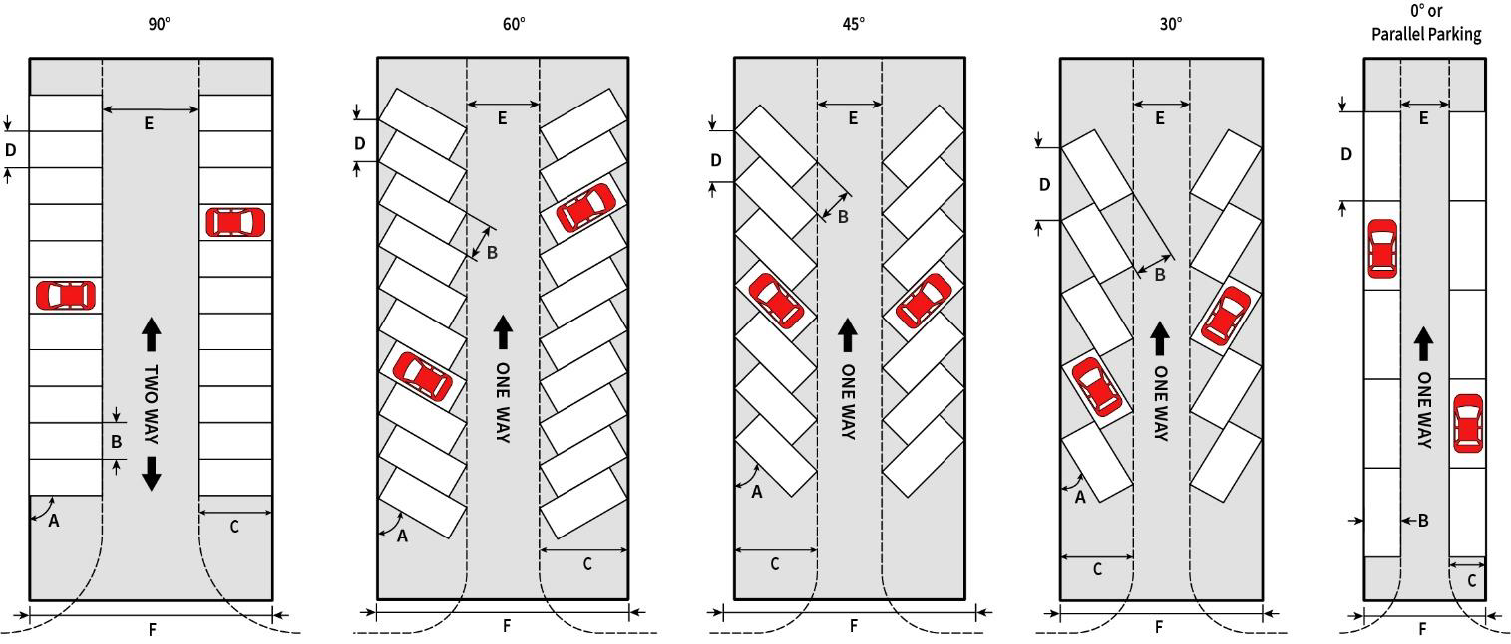
(Ord. No. 2025-235.114, § 1, 2-2-2025)
4.6.3 - Landscaping.
A.
Purpose. The purpose of the City's landscaping standards is to:
1.
Promote attractive development and preserve or enhance the appearance and character of the surrounding area using landscaping and land use transitional provisions.
2.
Promote native and adaptable, drought-tolerant species to conserve water and promote local biodiversity.
3.
Prescribe standards for the installation and maintenance of plantings, fences, and walls that are aligned with best industry practices.
4.
Encourage the preservation and replacement of existing trees and landscaping;
5.
Increase pedestrian and cyclist comfort through the incorporation of street streets and shading in public spaces.
6.
Eliminate or minimize conflicts between higher intensity uses abutting lower intensity uses using screening, setbacks and landscape buffers.
B.
Applicability.
1.
The minimum landscaping standards will vary by land use, as listed below.
2.
Special or form-based code district may deviate from typical landscaping requirements and can be found in the following sections of the UDC.
3.
An existing site must comply with the minimum landscaping requirements of the UDC in the following circumstances:
a.
Construction of any principal building or parking lot with more than ten (10) spaces;
b.
An addition to an existing parking lot if the addition will increase total parking to more than ten (10) space;
c.
An addition to or enlargement of an existing principal building if the addition or enlargement will increase the total building footprint by more than twenty percent (20%); and
d.
Any increase in impervious coverage on a lot if the addition will increase total impervious coverage by more that exceeds twenty percent (20%).
e.
If the same building or site is expanded under 3.c. or 3.d. more than once within a seven (7) year period, the site must be brought into compliance with this section if the total of all expansions exceeds twenty percent (20%) of the pre-existing footprint or impervious area.
4.
This Section does not apply to building or accessory parking construction in areas zoned DC. Primary use parking areas must comply with this Section.
5.
In the event that the City of Brownsville enters Drought Response Stage 3, or higher, the following requirements shall come into effect:
a.
The Building Official, or their designee, shall have the authority to suspend the installation of landscaping for all development, this includes the installation of automatic irrigation systems.
b.
The use of a xeriscape plan, as approved by the City Forester/Arborist, or their designee, shall be allowed in lieu of the required landscaping requirements outlined in Section 4.6.3 - Landscaping, of the Unified Development Code.
c.
In the event of a water related emergency, reference the City of Brownsville Drought Contingency Plan (Chapter 102, Article 5)
C.
Administrative review of a landscape plan.
1.
A landscape plan is required for all applicable development as described in 4.6.3B Applicability.
2.
A landscape plan will be prepared by a licensed landscape architect registered to practice in the state of Texas and will be accompanied with an irrigation plan designed by a licensed irrigator.
3.
If a protected tree (see 5.1) exist on-site or the applicant intends to preserve existing trees, a tree preservation plan must also be submitted at the time a landscape plan is submitted for formal review to the City.
4.
A landscape and irrigation plan shall be submitted by the applicant with the submittal of a building permit, which is submitted to the building division of the planning and redevelopment department.
5.
The minimum landscaping requirements shall be fulfilled utilizing the approved plant materials listed in 4.6.3D Approved Plant Materials.
6.
A landscape plan shall identify the location of existing and proposed:
a.
Trees;
b.
Ground cover;
c.
Underground utility lines and utility poles;
d.
Roadways;
e.
Sidewalks;
f.
Streetlights;
g.
Natural site features, such as creeks and rivers; and
h.
Any information deemed necessary by the City forester to verify compliance with the UDC.
7.
No Building Permit shall be issued unless the applicant has received approval of landscape plan.
8.
A Certificate of Occupancy will not be issued until the applicant has complied with landscape improvements approved in a landscape, irrigation, or tree preservations plan, as applicable.
9.
The City Forester shall inspect the site prior to the issuance of a certificate of occupancy to ensure compliance with the landscape requirements of the UDC.
D.
Approved plant materials.
1.
Minimum Sizes for Trees. All trees required or provided under this Section shall, at time of planting, be a minimum caliper size of three (3) inches as measured at a distance of six (6) feet above ground.
2.
Minimum Sizes for Shrubs. All shrubs required or provided under this Section shall, at time of planting, be a minimum size of one (1) gallon.
3.
Required Variety. If more than five (5) trees are required, at least two (2) different species shall be planted.
4.
Alternatives to Approved Plant List.
a.
A registered Landscape Architect may submit a list of alternative plants, along with their water demand performance measures and detailed descriptions, to the City Forester for consideration on a case-by-case basis.
b.
Existing developments may restore or replace existing turf grass. Turf damage or replacement exceeding fifty percent (50%) of the lawn area shall be replaced with a species and variety shown on the Approved Plant List below.

