
Buckeye City Zoning Code
ARTICLE 10
- DEFINITIONS
10.1. - GENERAL RULES OF CONSTRUCTION
The following rules shall apply for construing or interpreting the terms and provisions of this Development Code.
10.1.1.
Meanings and Intent. All provisions, terms, phrases, and expressions contained in this Development Code shall be construed according to the general purposes set forth in Section 1.3, Purpose of this Development Code, and the specific purpose statements set forth throughout this Development Code. When, in a specific section of this Development Code, a different meaning is given for a term defined for general purposes in this Article 10, the specific section's meaning and application of the term shall control.
10.1.2.
Headings, Illustrations, and Text. In the event of a conflict or inconsistency between the text of this Development Code and any heading, caption, figure, illustration, table, or map, the text shall control.
10.1.3.
Lists and Examples. Unless otherwise specifically indicated, lists of items or examples that use terms such as "for example," "including," and "such as," or similar language are intended to provide examples and are not exhaustive lists of all possibilities.
10.1.4.
Computation of Time. The time in which an act is to be done shall be computed by excluding the first day and including the last day. If a deadline or required date of action falls on a Saturday, Sunday, or holiday observed by the city, the deadline or required date of action shall be the next day that is not a Saturday, Sunday, or holiday observed by the city. References to days are calendar days unless otherwise stated.
10.1.5.
References to Other Regulations/Publications. Whenever reference is made to a resolution, ordinance, statute, regulation, or document, it shall be construed as a reference to the most recent edition of such regulation, resolution, ordinance, statute, regulation, or document, unless otherwise specifically stated.
10.1.6.
Delegation of Authority. Any act authorized by this Development Code to be carried out by a specific official of the city may be carried out by a designee of such official.
10.1.7.
Technical and Non-Technical Terms. Words and phrases shall be construed according to the common and approved usage of the language, but technical words and phrases that may have acquired a peculiar and appropriate meaning in law shall be construed and understood according to such meaning.
10.1.8.
Public Officials and Agencies. All public officials, bodies, and agencies to which references are made are those of the City of Buckeye, Arizona, unless otherwise indicated.
10.1.9.
Mandatory and Discretionary Terms. The words "shall," "must," and "will" are mandatory in nature, establishing an obligation or duty to comply with the particular provision. The words "may" and "should" are permissive in nature.
10.1.10.
Conjunctions. Unless the context clearly suggests the contrary, conjunctions shall be interpreted as follows:
"And" indicates that all connected items, conditions, provisions, or events apply; and
"Or" indicates that one or more of the connected items, conditions, provisions, or events apply.
10.1.11.
Tenses, Plurals, and Gender. Words used in the present tense include the future tense. Words used in the singular number include the plural number and the plural number includes the singular number, unless the context of the particular usage clearly indicates otherwise. Words used in the masculine gender include the feminine gender, and vice versa.
(Ord. No. 37-09, § 1, 12-16-2009; Ord. No. 01-24, § 3(Exh. A, B), 2-20-2024)
10.2. - INTERPRETATIONS
The Director has final authority to determine the interpretation or usage of terms used in this Development Code. Any person may request an interpretation of any term by submitting a written request to the Director, who shall respond in writing within 30 days. The Development Services Department shall keep a public record of all interpretations and determinations on usage of terms rendered by the Director.
(Ord. No. 37-09, § 1, 12-16-2009; Ord. No. 07-22, § 3 (PLZM-21-0060), 4-19-2022; Ord. No. 01-24, § 3(Exh. A, B), 2-20-2024)
10.3. - OTHER TERMS DEFINED
Abutting. The condition of two adjoining properties having a common property line or boundary including cases where two or more lots adjoin a corner, but not including cases where adjoining lots are separated by a street or alley.
Accent Material. Material covering 25 percent or less of a wall elevation.
Access/Accessway. The place, means, or way by which pedestrians and vehicles shall have safe, adequate, and usable ingress and egress to a property or use as required by this Development Code.
Accessible Parking Space. A parking space that meets the requirements of applicable state and federal disabilities acts.
Adjacent. The condition of being near to or close to, but not necessarily sharing a common dividing line (e.g. two properties that are separated only by a street or alley shall be considered as adjacent to one another).
Affordable Housing. Affordable housing is property, whether owned or rented, that costs no more than 28 to 30 percent of gross household income.
Alley. A minor way that is used primarily for vehicular access to the back or side of properties otherwise abutting on a street.
Annexation. Annexation is the incorporation of a land area into an existing district or municipality, with a resulting change in the boundaries of the annexing jurisdiction.
Antenna Co-location on Existing Tower. Any structure or device used to collect, receive, transmit, or radiate electromagnetic waves, including both directional antennas (such as panels, microwave dishes, satellite earth station antennas over two meters in diameter) and omni-directional antennas (such as whips) that is placed upon an existing telecommunications tower or projection. This term does not include antennas two meters or less in diameter.
Area, Gross. The area of a lot or parcel including all dedicated streets, alleys, private accessways roadway and/or alley easements, and canal rights-of-way. Such boundaries shall extend to the center of existing abutting street or alley right-of-way. In the case of an existing partial dedication or easement, the gross area shall not extend beyond what would be the centerline of the full dedication.
Area, Net. The area of a lot or parcel excluding all dedicated streets or alleys and roadway or alley easements.
Articulation. The manner in which various features are arranged on a building elevation.
Attainable Housing. Attainable housing is housing that is affordable to people earning around the area median income (AMI). Households living in attainable housing and earning between 80 percent and 120 percent of the AMI should not need to spend more than 30 percent of their income on housing costs.
Awning. A structure attached to a building or other permanent structure in a fixed position with a flexible or rigid covering, including such structures that are internally illuminated by fluorescent or other light sources.
Balcony. That portion of a building that projects into the required yard and where the floor height of such projection is not less than four feet above grade.
Banner. A flexible piece of material used as a symbol, decoration, or to provide a message that is attached on at least two of its sides to a building, poles, or other outdoor structure.
Basement. That portion of a building underground and having at least one-half of its height measured from its floor to its ceiling below grade. A basement shall be counted as a story if the vertical distance from grade to its ceiling is more than two feet.
Berm. An earthen mound designed to: screen undesirable views, decrease noise, and/or control or manage surface drainage.
Bicycle Parking Space. An area designated within a facility for the use of an individual bicycle.
Block. A piece or parcel of land or group of lots entirely surrounded by public streets, streams, railroads or parks or a combination thereof.
Borrow. Earth material acquired from an off-site location for use in grading a site.
Box Transplanting. A method of transplanting a tree in which the root ball is placed in a box.
Brushing. The selective removal of vegetation.
Buckeye Water Conservation and Drainage District (BWCDD). BWCDD is an irrigation district, supplying irrigation water and power. The district also provides flooding irrigation to homes and water to contractors for construction.
Buffer. Landscaped areas, fences, berms, or any combination thereof, used to physically screen or block noise, lights, buildings, or nuisances.
Buffer, Open Space. A buffer is an area alongside protected or conserved natural open spaces in which human activity is restricted to research and maintenance of the protected or conserved open space in order to mitigate negative impacts of human activity on the land or wildlife.
Building. Any substantial structure that by nature of its size, scale, bulk, dimension, or use constitutes a visual obstruction or generates activity similar to that usually associated with a building. For purposes of determining required setbacks, the term includes (i) gas pumps and overhead canopies or roofs; and (ii) fences running along lot boundaries adjacent to public rights-of-way that exceed six feet in height and are substantially opaque.
Building Facade Line. A line that is parallel to a lot line or public or private street curb line, as applicable, and the average distance from the lot line or curb line as the closest portion of a building.
Building Height. The vertical distance of a building as measured from the average elevation of the finished grade within 20 feet of the structure to the highest point of the coping or parapet of a flat roof, or to the mean height level between eaves and ridges for gable and hip or gambrel roofs.
Building Mass. The three-dimensional bulk of a building—height, width, and depth.
Building Scale. The size and proportion of a building relative to human scale, streets, surrounding buildings, and environs.
Build-out. Build-out is an estimate of the amount of potential development for an area. A built-out community is typically one that has five percent or less vacant property available for development.
Bulk Waste. Bulk waste is a waste type that are too large to be accepted by the regular waste collection.
Capital Improvement Program (CIP). The CIP is a financial plan to identify needed infrastructure enhancements throughout the city.
Carport. A structure open on a minimum of three sides designed or used to shelter not more than three vehicles and not to exceed 24 feet on its longest dimension.
Central Arizona Project (CAP). CAP is a water resource development and management project that provides water from the Colorado River to central and southern Arizona.
Clearing. The removal of vegetation by manual or mechanical means.
CMU. Concrete masonry units.
Commercial Center. A development containing two or more retail stores, offices, restaurants, hotels, motels, and similar businesses.
Commercial Development. For purposes of this Development Code, development of any use meeting the definition of "commercial use," "offices," "places of public assembly," or "service establishment" in the Buckeye Development Code, as well as any mixed-use development that combines commercial development and development of any residential use.
Commercial Use. A retail use operated for profit or compensation, where the general public is invited to purchase goods or services and the compensation is substantial and regular.
Common Area. Land in a residential development held in common and/or single ownership and not reserved for the exclusive use or benefit of an individual tenant or owner.
Community Facilities District (CFD). A CFD is a financing mechanism for the acquisition, construction, operation, and maintenance of public infrastructure.
Community Green Space. Community Green Space is land within a community that has not buildings or other built structures and is accessible to the public, such as parks and community gardens. Community Green Space may include grassy lawns and landscaped areas as opposed to natural open space, which retains its native landscape.
Community Master Plan. The Community Master Plan district is a zoning designation intended to create a built environment superior to that which is accomplished through conventional zoning districts and design guidelines. The area must include a minimum of 640 acres of integrated development with defined allowable land uses, intensities and densities, and design standards.
Compatibility. Compatibility occurs when the characteristics of different uses or activities are harmonious or capable of existing or working together without conflict.
Complete Application. An application that is submitted in the required form, includes all mandatory information and supporting materials specified in the application packet, and is accompanied by the applicable fee. A pre-application conference shall have been held, if required by this Development Code.
Concealed Antennae and Towers. Any man-made trees, clock towers, bell steeples, light poles, water towers and similar alternative design mounting structures that camouflage or conceal the presence of antennas or towers.
Concrete Panel Construction. A monolithic masonry wall unit, either poured in place, poured on site (commonly referred to as "tilt-wall construction"), or precast for assembly on site.
Condominium. An estate in real property consisting of an undivided interest in common in a portion of such real property, together with the right of exclusive occupancy of a unit located thereon.
Corral Fence. A fence-type structure consisting of vertical posts and horizontal members and so constructed that 75 percent or more of the vertical surface is open. Chain link or other similar types of wire fences are not intended to be included in this definition and shall be classified as a fence or wall.
Court. An open, unobstructed space, bounded on more than two sides by the walls of a building. An inner court is entirely surrounded by the exterior walls of a building. An outer court has one side open to a street, alley, yard, or other permanent open space.
Crime Prevention Through Environmental Design (CPTED). CPTED is an approach to deterring criminal behavior through environmental design.
Cul-de-Sac. A street with no outlet, which terminates in a circular right-of-way.
Culvert. A drain, ditch, or conduit, not incorporated in a closed system, which carries drainage water under a driveway, roadway, railroad, pedestrian walk, or public way, or other type of overhead structure.
Curb. A stone, concrete, or other improved boundary marking the edge of the roadway or paved area.
Cut. Vertical removal of earthen material.
Cutoff Angle. The angle formed by a line drawn from the direction of light rays at the light source and a line perpendicular to the ground from the light source above from which no light is emitted.
Cut-off Light Fixture. A lighting fixture with a light distribution pattern that results in less than 2.5 percent of the rated lumens being projected at or above a horizontal plane located at the bottom of the fixture, and less than ten percent of the rated lumens projected between that horizontal plane and a plane emanating at an 80-degree angle below the bottom of the fixture.
Decorative Paving. Paving that is made up of solid, pre-cast, decorative paving, flagstone, modular units, stamped concrete, seeded concrete, colored concrete, or any combination of the same.
Dedication. A conveyance of fee simple or property rights at no cost to the city or another public agency.
Demographics. Statistical data relating to the characteristics of the population and subgroups within a population.
Demolition or Demolish. An act or process that removes one or more of the following from an existing building or buildings:
A.
Fifty percent or more of the roof area as measured in plan view.
B.
Fifty percent or more of the exterior walls of a building.
C.
A street-facing façade.
Density. A ratio of the number of dwelling units to the gross land area unless otherwise stated.
Destroy. For purposes of the native plant preservation requirements of this Development Code, means to kill, or cause the death of any protected native plant by any means.
Development. Any activity that changes the use of land or makes a material change to the appearance of a structure or property. In addition, the following constitute development:
A.
Clearing of land as an adjunct of construction, including clearing or removal of vegetation or soil manipulation;
B.
Deposit of refuse, solid, or liquid waste or fill on a parcel of land;
C.
Placement of a sign;
D.
Changes or alteration of a watercourse, drainage way, or other waterway; or
E.
Paving, filling, grading, or covering of land.
Development Code. The City of Buckeye Development Code.
Direct Lighting. A source of external illumination located a distance away from the sign which lights the sign, but which is, itself, not visible from any normal position of view.
Director. The Development Services Director, or his or her designee.
Disability. A physical or mental impairment that substantially limits one or more of a person's major life activities, impairs their ability to live independently or a record of having such an impairment, but such term does not include current use of, nor addiction to, alcohol or a controlled substance.
Distribution Lines. Those electric lines used to distribute power from a feeder line to an end user. These electric lines are normally connected to a feeder line through a sectionalizing device such as a fuse.
Driveway. The principal access route from the roadway adjacent to a lot, to the lots primary off-street parking area.
Easement. A right to use another person's real property for certain limited purposes.
Ecological Connectivity. Ecological connectivity or landscape connectivity is the degree to which the landscape facilitates or impedes species movement between habitat blocks.
Ecosystem. An ecosystem is a community of living organisms dynamically interacting with each other and with the nonliving components of the community such as weather, sun, climate and atmosphere. Ecosystems perform functions such as nutrient cycling, energy regulation, niche construction and food production. Ecosystems are sustained by organisms with specific traits and behaviors adapted to perform within their ecosystems. Ecosystems are indefinite sizes and have no defined boundaries as they blend into other ecosystems and may have micro ecosystems within them.
Electrical Sign. A sign in which electrical wiring and connections are used.
Elevation.
A.
A vertical distance above or below a fixed reference level; or
B.
A fully dimensioned drawing of the front, rear, or side of a building showing features such as windows, doors, and relationship of grade to floor level.
Engineering Plan. Plans, profiles, cross sections, reports, and other required details for the construction of public improvements prepared by a registered engineer.
Envelope, Building.
A.
A dwelling unit and all attached roofed structures, including carports or patio ramadas;
B.
For nonresidential development, the building envelope shall be the main building and all attached roofed structures.
Envelope, Development. The sum of the areas of the permit holder's land to be graded, including the building envelope, accessory buildings, and areas of related parking, driveways, swimming pools, walls, and other accessory structures, but excluding individual sewage disposal systems.
Environmentally Sensitive Area. A definable area that is characterized by the presence of indigenous plants as referenced herein that has not been significantly or noticeably altered or modified through development, agriculture, or other activities associated with growth or expansion.
Equipment Building or Structure. An accessory building or structure used to house necessary equipment used by communication providers at a facility.
Erosion. The wearing away of the ground surface as a result of the movement of wind, water or ice.
Excavation. The mechanical, manual, blasting, or other such means for removal of earth material.
Exterior Trademarked Design Feature. An exterior design feature, including colors, shapes, and materials, of a building that is trademarked by a building occupant.
Facade. The exterior walls of a building exposed to public view, or that wall viewed by persons not within the building.
Fascia. Any broad, flat, horizontal surface, as the outer edge of a cornice or roof. Fascia board is a wide board set vertically to cover the lower ends of rafters or the joint between the top of a wall and the projecting eaves.
Federal Emergency Management Agency (FEMA). FEMA's duties include the development and administration of the Nation's Flood Insurance Program (NFIP). The NFIP develops and adopts flood maps, which illustrate flood zones that are used by participating communities in regulating the location and design of buildings, utilities and other man-made improvements.
Feeder line. High voltage supply electric lines that emanate from substations used to distribute power through an area. This term is synonymous with "transmission lines."
Fencing, Protective. Fencing with a four-foot approximate height intended to provide the boundaries of something being protected.
Fencing, Temporary. A temporary barrier, approved by the city, which clearly and conspicuously delineates areas designated to remain undisturbed or that are to be protected during construction.
Fill. Vertical addition of earthen material.
Final Inspection. Field inspection conducted by the city prior to project acceptance.
Flag. A piece of material used as a symbol, decoration, or message that is attached on only one of its sides to a building, pole, or other outdoor structure.
Floor Area. The total square feet of floor space within the outside dimensions of a building including each floor level, but excluding carports, residential garages, and breezeways.
Freestanding. Any structure that is not attached to any other structure or portion of a structure. Structures that are linked by pedestrian walkways are deemed to be freestanding. Freestanding shall also apply to sole uses on an individual parcel.
Frontage. All property on one side of a street between two intersecting streets (crossing or terminating) measured along the line of the street, or, if the street is a dead end, then all of the property abutting on one side between an intersecting street and the dead end of the street, including property fronting on a cul-de-sac.
Full Cut-off Light Fixture. A lighting fixture with a light distribution pattern that results in no light being projected at or above a horizontal plane located at the bottom of the fixture, and less than ten percent of the rated lumens projected between that horizontal plane and a plane emanating at an 80 degree angle below the bottom of the fixture.
Fully-Shielded Light Fixture. A lighting fixture constructed in such a manner that the light source is not visible when viewed from the side and all light emitted by the fixture, either directly from the lamp or a diffusing element, or indirectly by reflection or refraction from any part of the luminaire, is projected below the horizontal as determined by photometric test or certified by the manufacturer. Any structural part of the light fixture providing this shielding must be permanently affixed.
Future Land Use Map (FLUM). A FLUM is a diagram that designates the type, distribution, and intensity/density of land uses allowed in the MPA.
Garage, Detached. An enclosed (on at least three sides) accessory building not attached to a main building, used for storage of automobiles, and used solely by the occupants and their guests.
Garage, Parking. See "parking structure."
Glazing. The panes or sheets of glass or other material made to be set in frames, as in windows or doors.
Grade. The elevation of the ground surface, paving, or sidewalk.
Grading. The initial clearing, brushing, or grubbing, and subsequent excavating, or filling of a site.
Grading Permit. An official document issued by the city authorizing the grading activity specified by the grading permit conditions.
Gross Floor Area. The sum of the gross areas of the several floors of a building or buildings, measured from the exterior faces of exterior walls or from the centerlines of walls separating two buildings. Gross floor area shall not include:
A.
Underground parking space.
B.
Uncovered steps.
C.
Exterior balconies.
Gross Land Area. The area of a parcel of land excluding all streets and alleyways in existence at the time the Development Plan is submitted. Those portions of such parcels that subsequently may be designated as streets or alleyways, whether dedicated or not, shall be included in the determination of gross land area.
Ground Cover. A low growing, woody, or herbaceous vine or grass like material primarily used to cover large areas of ground. The term "ground cover" also means a plant species that normally reaches a height of less than three feet upon maturity, installed in such a manner so as to form a continuous cover over the ground.
Grubbing. The removal of trees and other large plants including their roots.
Guideline. An indication of policy or preferences; compliance is not mandatory like a standard, but rather compliance is encouraged to further the city's land-use goals and policies.
Gutter. A shallow channel, usually set along a curb or the pavement edge of a road or the edge of a building roof, for purposes of catching and carrying off water.
Habitat. The place or type of site where a plant or animal naturally or normally grows and lives.
Halo Lighting. Illumination produced by recessing a light source inside a hollow character with an open back or within the surface to which sign letters are mounted. An outline glow around the characters is created by this light reflecting off the background to which the characters are attached.
Homeowners Association (HOA). An organization established for the ownership, care, and maintenance of private common areas, private streets, and other private facilities. HOAs are organizations in a subdivision or planned community that create and enforce rules for the properties within the community.
Hydrological Study. A report designed to show the effects of surface water on a specific area.
Illuminance. A measure of the amount of light intercepting an object at a given distance from a light source measured in footcandles.
Impervious Cover. Any surface lacking the ability for air and water to pass through to natural ground.
Impervious Surface. An impervious surface is a surface through which water cannot penetrate, such as a road, sidewalk, or paved parking lot. The amount of impervious surface increases with development and establishes the need for drainage facilities to carry the increased runoff.
Improvement District (ID). An improvement district is a district comprised of property owners who desire improvement to their properties, such as water, sewer, or roadway infrastructure, which are financed through bonds, ad valorem, or equally apportioned secondary taxes pursuant to A.R.S. Title 48.
Incorporated Area. An incorporated area is a geographic area that has legally defined municipal boundaries.
Industrial Development. Development of any use primarily associated with heavy equipment, tractor trailers, material storage or processing, warehousing, manufacturing, or chemical processing, where the general public is not invited to be part of the on-site activities.
Infill Development. Infill development is development of vacant or underutilized land (usually individual lots or leftover properties) within areas that are already largely developed.
Information and Communication Technology (ICT). ICT refers to technologies that are used for telecommunications.
Infrastructure. Facilities and services needed to sustain manufacturing, residential, commercial and all other land use activities. Infrastructure includes water lines, sewer lines, and other utilities, streets and roads, communications, and public facilities, such as fire stations, parks, schools, and other similar type uses.
"Infrastructure" is all types of nonbuilding, manmade structures and systems, such as, utility pipes, electrical power generation and transmission systems, roads, bridges, water and sewer treatment facilities and other similar systems and structures. Infrastructure is essential to the safe operation of any community and is in many cases exposed to risks associated with natural hazards. Infrastructure is generally categorized as green or grey. Green infrastructure draws on nature to achieve desired results. Examples include utilization of natural washes for flood control, stream buffer restoration, and rain gardens. Grey infrastructure utilizes human construction to achieve desired results. Examples include pipes, pumps, ditches and detention ponds often constructed of non-permeable materials such as concrete.
In-line Commercial Center. Multiple retail stores laid out in an in-line arrangement. Individual stores share one or more side walls but have separate entrances. In-line centers typically share a single parking area.
Inspector. A person authorized by the city to perform inspection on work performed where the city is required to inspect.
Intergovernmental Agreement. An intergovernmental agreement is an agreement between units of government to combine their resources to provide governmental services and perform activities for the benefit of their constituents.
Interior Lot. A lot other than a corner lot.
Internal Lighting. A source of illumination entirely within the sign that makes the contents of the sign visible at night by the light being transmitted through a translucent material but wherein the source of the illumination is not visible.
Invasive Species. Invasive species are plant species that are not native to the ecosystem under consideration and who introduction is likely to cause environmental damage to native plant species through competing with and/or crowding out native plant species, or otherwise negatively impacting native landscapes.
Irrigation System. An underground automatic watering system, which consists of heads, valves, pipes, etc., used for the sole purpose of sustaining and promoting plant life. This definition shall also apply to drip and soaker hose irrigation.
Kiosk. A small, freestanding one-story structure having a maximum floor area of 100 square feet and used for purposes of the posting of temporary information and/or posters, notices, and announcements, an ATM, postal supplies, or similar uses where no attendant is required.
Landscape Buffer. A combination of physical space and vertical elements such as plants, berms, fences, or walls, the purpose of which is to separate and/or screen incompatible land uses from each other.
Landscape Screening. An area of landscaping a minimum of three feet in height. It shall consist of trees, shrubs, and groundcover and may contain natural topping material such as boulders, rock, stone, granite or other approved material. The purpose of the landscape screen is to screen adjacent areas.
Land Use. Land use is the occupation or use of a land or water area for any human activity or any purpose defined in the General Plan.
Leadership in Energy and Environmental Design (LEED). LEED is a rating system devised by the United State Green Building Council (USGBC) to evaluate and guide the design, construction, operation, and maintenance of buildings.
Light-Emitting Diode Display (LED) and Liquid Crystal Display (LCD). Flat, electronic display devices that channel light through tubes or modulate liquid crystals to create patterns that can produce changing video displays.
Light Fixture. The complete lighting assembly (including the lamp, housing, reflectors, lenses and shields), less the support assembly (pole or mounting bracket).
Loading Space. An off-street space or berth used for the delivery and loading or unloading of vehicles.
Logo. A graphic image or words representing an organization. This image shall be in the form of symbols (logo symbol) and/or words.
Lot Area. The total area, measured on a horizontal plane, included within lot lines.
Lot Coverage. The total structural coverage provided on a lot or site inclusive of all roofed areas, including roof overhangs or projections, or structures capable of supporting a roof divided by the net area of the lot or size.
Lot Width. The width of the lot shall be:
A.
If the side lot lines are parallel, the shortest distance between these sidelines.
B.
If the side lot lines are not parallel, the width of the lot shall be the length of a line at right angles to the axis of the lot at a distance equal to the front setback required for the district in which the lot is located. The axis of a lot shall be a line joining the midpoints of the front and rear lot lines.
Lot Depth. The average horizontal distance between the front and rear lot lines.
Lot Frontage. That dimension of a lot or portion of a lot abutting on a street, excluding the site dimension of a corner lot.
Lot Line. The lines bounding lots defined as follows:
A.
Front Lot Line. The owner shall designate, and the city approve which lot line shall be the lot frontage.
B.
Rear Lot Line. The lot line most parallel to the front lot line. For triangular lots, the point opposite the front lot line shall be considered the rear lot line.
C.
Side Lot Line. Any lot lines not the front or rear lot line.
Lot Types.
A.
Corner Lot. A lot that has at least two adjacent sides abutting on a street, provided that the interior angle at the intersection of such two sides is less than 135 degrees.
B.
Double Frontage Lot. A lot having a frontage on two nonintersecting streets, as distinguished from a corner lot.
C.
Flag (Panhandle) Lot. A lot having access to a street or alley by means of a width less than the minimum required lot width, but not less than 12 feet.
D.
Interior Lot. A lot other than a corner lot.
E.
Key Lot. A corner lot that is so designated that the lots located directly behind it face the side street of the corner lot and are not separated by an alley.
F.
Reversed Frontage. A key lot, or the first lot to the rear of a corner lot, the front lot line of which is a continuation of the side lot line of the corner lot and fronting on the street that intersects the street upon which the corner lot fronts and/or that faces the street upon which the side of a corner lot abuts.
Luminance. An objective measurement of the brightness of illumination, measured in candelas per square foot (cd/ft 2 ) or nits.
Maintenance Improvement District (MID). A MID is a district where residents are charged through property taxes to cover maintenance costs for landscaping, irrigation, and drainage should an HOA be disbanded.
Maricopa Association of Governments (MAG). MAG is a council of governments, serving as the regional agency for the Phoenix Metropolitan Area. MAG is also the metropolitan planning organization for the Phoenix Metropolitan Area, tasked with transportation and air quality planning for the region.
Mansard Roof. A roof having on each side a shallower upper part and a steeper lower part.
Masonry Construction Materials. Materials that include, but are not limited to, brick, stone, concrete masonry units, stucco, and concrete-panel construction.
Maximum Extent Feasible. Under the circumstances, no feasible and prudent alternative exists, and all possible efforts to comply with the regulation or minimize potential harm or adverse impacts have been undertaken.
Maximum Extent Practicable. Under the circumstances, reasonable efforts have been undertaken to comply with the regulation or requirement, the costs of compliance clearly outweigh the potential benefits to the public or would unreasonably burden the proposed project, and reasonable steps have been undertaken to minimize any potential harm or adverse impacts.
Mechanical Equipment. All devices, appliances, and apparatus involved in the maintenance of environmental conditions within a building or recreational structure, such as a swimming pool or spa. Mechanical equipment shall include, but is not limited to HVAC units, air conditioners, pool heaters, pool filters, and pool circulation pumps.
Median Household Income. Median household income is a figure representative of the midpoint of gross household income. The median income for individuals is based on individuals 16 years old and over with income.
Monument Base. A freestanding base of masonry construction to match the site building that supports the business establishment's signage.
Municipal Planning Area (MPA). An MPA is the area of planning influence, which includes both incorporated and unincorporated areas.
Mutilate. For purposes of the native plant preservation requirements of this Development Code, means to deface, maim, damage, or disfigure any protected native plant by shooting, chopping, pushing over, burning, cutting or any other means.
National Register of Historic Places (NRHP). NRHP is the U.S. government's official list of districts, sites, buildings, structures, and objects deemed worthy of preservation.
Native. Indigenous to the specific site or to areas contiguous to a parcel being developed.
Natural Cross Slope. The slope of the topographic configuration of land, graphically represented by contour lines, prior to any grading or other disturbance of the site.
Natural Resources. Natural resources are environmental and ecological assets; the land, water, plants, and animals that sustain us and enhance our quality of life. Planning for natural resources means planning for natural resource protection, including conservation, quality protection measures, and improved development practices.
Natural Grade. The topographic configuration of land prior to any grading or other human disturbance of the site.
Net Floor Area. For the purpose of determining parking requirements, the total floor area of a building measured from the interior faces of load-bearing walls, excluding air shafts, stairwells, elevator shafts, restrooms, mechanical equipment rooms, atriums, and other such features as determined by the Director.
Neighborhood. A neighborhood is a localized geographic area used to describe a subarea of a community that has common character such as natural or historic character or is tied to a common local landmark, such as a church, school, or other asset.
Non-Concealed Freestanding Tower. Any structure that is designed and constructed primarily for the purpose of supporting one or more antennae, including guy towers, or monopole towers. The term includes radio and television transmission towers, microwave towers, common carrier towers, cellular telephone towers, alternative tower structures, and the like.
Outdoor Gathering Space. Open air or semi-enclosed public spaces for the benefit of residents, employees, or visitors to a site. In calculating the size of an outdoor gathering space in order to meet the requirements of this Development Code, the following must not be included: private yards, public or private streets or rights-of-way, parking areas and driveways, and water quality and stormwater detention ponds.
Pad-Site Building. A building that is intended for a single commercial use and that is physically separate from the principal or primary building on the site. The term is typically used in the context of retail shopping center development.
Parapet Wall. A wall extending above the plate line of a building.
Parking Aisle. The aisles on which vehicles are allowed access to the individual parking stalls and are characterized by slow speeds and high turning movements.
Parking Space. A permanently surfaced area enclosed or unenclosed, and a permanently surfaced driveway connecting with a street or alley, permitting ingress or egress of an automobile.
Parking Structure. A structure or portion thereof that is fully or partially enclosed, composed of one or more levels or floors, and used exclusively for the parking or storage of motor vehicles.
Pedestrian Way. A public walk dedicated entirely through a block, from street to street, or providing access to a school, park, recreation area, or shopping center.
Pennant. A piece of material that tapers to a point and is used as a symbol, decoration, or to provide a message and that is attached on only one if its sides to a building, pole, or any other item used to display the pennant.
Perimeter Roads. The roads along the perimeter of buildings and at the ends of parking aisles where they abut property lines and provide customer drop-off and pickup as well as emergency access to the building.
Person. A natural person, a corporation, a partnership, an association, a trust, or any other entity or any combination thereof.
Planned Area Development (PAD). The Planned Area Development district is a zoning designation intended to create a built environment superior to that which is accomplished through conventional zoning districts and design guidelines. The area must include a minimum of five acres of integrated development with defined allowable land uses, intensities and densities, and design standards.
Planning and Zoning Commission. A Planning and Zoning Commission is a recommending body to City Council for development proposals and longrange planning projects. In Buckeye, there are six district commissioners and one at large commissioner.
Population Density. Population density is the number of people living per unit of area, which in the General Plan, is per square mile.
Primary or Principal Building. The building or structure on a commercial development site used to accommodate the majority of the principal permitted use(s). When there are multiple buildings on a commercial development site, such as in a shopping center, the primary or principal building shall be the one containing the greatest amount of gross floor area. Buildings sited on pad sites or free-standing kiosk/ATM machines cannot be "primary" or "principal" buildings.
Principal or Primary Entrance. The place of ingress and egress most frequently used by the public, and which is most visible and most easily identifiable from the principal street.
Pristine. For purposes of the native plant protection requirements of this Development Code, means unaltered from its naturally occurring state, not spoiled, corrupted, or polluted.
Private Street Lot. A separate lot owned by the property owner's association whereupon a private street is constructed.
Public Art. Sculptures, paintings, murals, and other forms of artwork are placed in public spaces or in public view to enrich and add visual interest to the built environment.
Quality of Life. Quality of life is the degree to which individuals perceive themselves as able to function physically, emotionally, and socially. Quality of life includes all aspects of community life that have a direct influence on the physical and mental health of its members.
Redevelopment. Redevelopment is the process of building new construction on a site that has pre-existing uses or renovating existing uses on a site. Redevelopment generally is a strategy to rehabilitate blighted urban areas through renovation.
Relocate. To transplant a protected native plant to another location on the premises.
Remove. To transport a protected native plant from the premises on which it has been growing.
Residential Thoroughfare. A thoroughfare indicated on the city master thoroughfare plan, and as the same may be from time to time amended.
Retaining Wall. A wall designed to withstand lateral and hydrostatic pressures and built to keep earth from sliding.
Revegetation. Placement of living plant materials including, but not limited to, seed, on sites or cut and fill slopes where the natural vegetation has been removed.
Right-of-Way. A strip of land dedicated to the public and occupied or intended to be occupied by a street, crosswalk, railroad, electric transmission line, oil or gas pipeline, water main, sanitary or storm sewer main, or for another public use. The usage of the term "right-of-way" for land platting purposes means that every right-of-way hereafter established and shown on a final plat is to be separate and distinct from the lots or parcels adjoining such right-of-way, and are not included within the dimensions or areas of such lots or parcels. "Rights-of-way" intended for streets, crosswalks, water mains, sanitary sewers, storm drains, or any other use involving maintenance by a public agency shall be dedicated to public use by the maker of the plat on which such right-of-way is established.
Run-off. Runoff is stormwater that is held up on the land surface instead of seeping into the ground. This water either evaporates or "runs off" across the land to nearby rivers, streams or human made diversion structures.
RV Garage. A garage that has a ten-foot or taller bay door and designed to accommodate the size and mass of an RV, motorhome, travel trailer or camper on a 68-foot-wide lot or greater where the architecture matches the primary structure in color, wall material, lighting, and roof.
Screen. An opaque barrier designed and installed to conceal areas used for storage, refuse, mechanical equipment, parking, or delivery service loading bays from street and public view, or to buffer adjacent uses.
Screening Wall. An approved structure or fence at least six feet in height intended to minimize adverse impacts associated with contiguous or adjacent land uses, or effects of site operations such as dumpsters.
Semi-Cutoff Light Fixture. A lighting fixture with a light distribution pattern that results in less than five percent of the rated lumens being projected at or above a horizontal plane located at the bottom of the fixture, and less than 20 percent of the rated lumens projected between that horizontal plane and a plane emanating at an 80-degree angle below the bottom of the fixture.
Setback. The required minimum distance between the building line and the related front, side, or rear lot line and over which no part of any building may extend, except as otherwise provided. When the property abuts a dedicated right-of-way, the distance shall be measured from the dedicated right-of-way line or future right-of-way line. When the property abuts a private street, the distance shall be measured from the back of the tract or easement used for the private accessway.
Sewer. Any pipe or conduit used to collect and carry away sewage or stormwater runoff from the generating source to treatment plants or receiving streams.
Sewer System, Community. Any sewer system, whether treatment plant, septic tank or lagoon, designed with a sewer collection system to be used by a legally constituted association of property owners. The system may or may not be a public system.
Shaded Sidewalk. For purposes of this Development Code, a shaded sidewalk shall be any one of the following:
• A sidewalk at least ten feet wide made of pervious concrete with shade trees at 30-foot intervals or of standard concrete with the trees planted in grates at the same distance.
• A five-foot sidewalk adjacent to a landscape strip at least ten feet wide planted with shade trees at 30-foot intervals.
• A sidewalk at least six feet wide covered with weather-protection materials (such as awnings, an arcade, or other structure).
Sidewalk. A paved surface separated from the street and used as a pedestrian walkway.
Sign. Any device, name, number, identification, description, announcement, declaration, demonstration, flag, banner, pennant, illustration, light, or insignia, and the supporting structure of any of the same, placed upon or affixed directly or indirectly to or upon any building or outdoor structure, or erected or maintained upon a piece of land which directs attention to any object, product, service, place, activity, person, institution, organization, or business. Any interior illuminated or moving sign or light that is visible from the exterior may be determined as being erected on the exterior of the building or structure. Signs may contain commercial and/or noncommercial speech.
Sign Area. The total square footage of all lettering and logos placed on the sign face. Each side of the sign shall be calculated individually.
Sign Height. The vertical distance of a sign as measured from the average elevation of the finished grade within 20 feet of the sign base to the highest point on the sign. With respect to digital billboards, height shall be determined in accordance with Section 5.11.8 B.3.a.
Sign Permit. A written authorization to erect a sign, obtained pursuant to Section 5.11.2, Permit Required, of this Development Code.
Sign Types.
A.
Advertising. A sign relating to a business activity, use, or service not conducted on the premises upon which the sign is placed; or a product not sold, handled, produced, or fabricated on the same premises upon which the sign is placed.
B.
Billboard. Any large, standardized off-site sign relating to a business, activity, use, or service conducted off the site, or to a product not sold on the site, and intended for viewing from extended distances, generally more than 50-feet.
C.
Business Sign. A sign relating to a business, use, or service conducted on the premises upon which the sign is placed; or a product sold, handled, produced, or fabricated on the premises upon which the sign is placed.
D.
Freeway-Oriented Identification Sign. An on-site freestanding sign that is placed on property adjacent to, but not closer than a distance equal to the height of the sign from the freeway right-of-way or an attached sign with exposure to a freeway. Separation distance of not less than 500 feet shall be observed between any such on-site sign located on the same side of the freeway.
E.
Garage Sale, Estate Sale, Yard Sale, or Similar Sign. A sign for the occasional sale of tangible personal property.
F.
Identification Sign. A sign used to identify the manufacturer, builder, or seller of a structure that does not exceed 70 square inches in size.
G.
Illuminated Sign. A sign lighted by or exposed to artificial lighting either by lights directed toward the sign or within the sign, behind the face of the sign.
H.
Monument Sign. Signage constructed on a monument base identifying the name of the business or retail center on the premises upon which the sign is placed. A sign face manufactured and constructed clearly to be a portable sign shall not be used in any form to be made into a permanent sign.
I.
Political Sign. A sign relating to the election of a person to public office; relating to a political party; or relating to a matter to be voted upon at an election called by a public body.
J.
Portable Sign. Any sign, which is specifically manufactured so that it can easily be relocated from one location to another. A sign that could have wheels or four legs for easy mobility that is supported by the ground or other object (not allowed). A sign face manufactured and constructed clearly to be a portable sign shall not be used in any form to be made into a permanent sign.
K.
Real Estate Sign. A sign giving off-site direction to property for sale or for lease; or placed upon a property (on-site) advertising that particular property for sale or for lease; or placed on the on-site premises of the area outlined in an approved plat of a subdivision, advertising the sale of lots within such subdivision. A real estate sign shall not exceed 32 square feet.
L.
Residential Information Sign. Any informational sign located in a district zoned for residential uses that contains no commercial message.
M.
Temporary sign. An approved sign erected or maintained on a premises for a short duration of time. Temporary signs may supplement any permanent signs on the premise. Temporary signs include, but are not limited to, garage, estate, yard or similar sale; lost pet; political campaign; real estate; development and residential information signs; banners and pennants.
N.
Temporary Event Sign. Signs for the advertisement of temporary events limited to religious, public gatherings, Christmas tree sales and other temporary uses that may be approved under this Development Code.
O.
Transportation Sign. A sign specifically for the conveyance of information concerning transportation systems or vehicular movement.
P.
Vehicular Sign. Any sign that is affixed or attached to a moving vehicle.
Q.
Wall Sign. Signage that is erected against, attached to, or supported by the main building on any given property.
R.
Off-Site Sign. A sign directing attention to a specific business, product, service, entertainment event or activity, or other commercial activity that is not sold, produced, manufactured, furnished, or conducted at the property upon which the sign is located.
S.
On-Site Sign. A sign whose message and design relates to a business, profession, product, service, event, or other commercial activity sold, offered, or conducted on the same property or unified development where the sign is located.
T.
Digital Billboard (Digital Off-Site Sign). A variable-message sign directing attention to a specific business, product, service, entertainment event or other activity, or other commercial activity that is not sold, produced, manufactured, furnished, or conducted at the property upon which the sign is located, and that utilizes computer-generated messages or some other electronic means of changing copy. These signs include displays and devices with sign faces that are comprise of matrices of light using LEDs, LCDs, light-emitting devices, or other electronic messaging technology.
U.
Digital Reader Panel. A variable-message sign directing attention to a specific business, product, service, entertainment event or other activity, or other commercial activity that is sold, produced, manufactured, furnished, or conducted at the property upon which the sign is located, and that utilizes computer-generated messages or some other electronic means of changing copy. These signs include displays using LEDs, LCDs, a flipper matrix, or other electronic messaging technology.
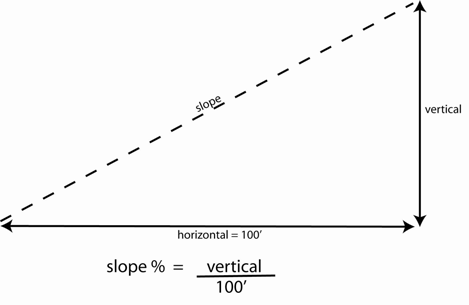
Slope. The vertical rise in feet measured over a horizontal distance of 100 feet, expressed as a percentage, measured generally at right angles to natural contour lines, and extending across property lines if necessary to obtain the 100-foot measurement, but not extending across significant changes in grade. See illustration.
Solid Waste. Solid waste is any discarded material that is non-liquid, non-soluble, including garbage or refuse, organic or inorganic, whether recyclable or non-recyclable.
Spade Transplanting. A method of transplanting a tree by use of a mechanical spade.
Stand. A cluster or grouping of two or more mature plants.
Standard. A definite rule, principle, or measure with which compliance is mandatory. A development application may be denied for failure to meet one or more standards established by this Development Code.
Stormwater. Stormwater is water that originates during precipitation events and snow/ice melt.
Stormwater Management Program (SWMP). An SWMP is a plan that identifies the programs, best management practices, and policies implemented by the owner of the plan to reduce impacts on stormwater quality.
Street. A right-of-way other than an alley, dedicated or otherwise legally established for public use, usually affording the principal means of access to abutting property.
Street, Arterial. A major street in the city's street system that serves as an avenue for the circulation of traffic onto, out, or around the city and carries high volumes of traffic.
Street, Collector. A street whose principal function is to carry traffic between minor, local, and subcollector streets and arterial streets but that may also provide direct access to abutting properties.
Street Light Improvement District (SLID). A SLID is a district for the purpose of purchasing electrical power for the use of public lighting facilities within city rights-of-way and are assessed through property taxes.
Street, Local. A street whose sole function is to provide access to abutting properties.
Street, Principal. The street adjacent to a lot or site with the highest priority. Street priorities are as follows, from highest to lowest:
• Freeway.
• Parkway.
• Major arterial.
• Arterial.
• Major collector.
• Collector.
• Major local.
• Local.
If a lot is adjacent to more than one street of equally high priority, the principal street is: the street with the highest level of transit service, as determined by the Director; or, if the streets do not have transit service or the level of transit service is equal, the street designated by the lot owner.
Street, Private. A platted street providing limited local traffic circulation among adjacent lots which is privately owned and maintained, contained within a private street tract, and constructed in accordance with the requirements of this Development Code.
Street, Sub-Collector. A street whose principal function is to provide access to abutting properties but is also designed to be used or is used to connect minor and local streets with collector or arterial streets.
Street-Facing Facade. A wall of a building that is within 60 degrees of parallel to a street lot line; and is not behind another wall, as determined by measuring perpendicular to the street lot line.
Street Furniture. Those features associated with a street that are intended to enhance the street's physical character and be used by pedestrians, such as benches, trash receptacles, and kiosks.
Sustainability. Sustainability is the property of biological systems to remain diverse and productive indefinitely. Sustainability encompasses human systems, including economy, development and biological systems. Sustainability manifests in policies, programs, and initiatives that support sustaining biodiversity and long-term ecological health necessary to the indefinite survival of humans and other organisms.
Sustainable Development. Sustainable development is development acknowledging sustainability in four interconnected domains: ecology, economics, politics and culture. Sustainable development can be viewed as a holistic approach and process to achieve sustainability.
Sustainable Roof. A "cool roof" that has a solar reflectance index of 78 for flat roofs, or 29 for roofs with a slope greater than 2:12; or a vegetated roof that includes vegetation on at least 50 percent of the roof area of all buildings in the project, and that uses only drought-tolerant landscaping.
Traffic Calming. Measures that make permanent, physical changes to streets to slow traffic and/or reduce volumes; also can include education and enforcement measures to promote changes in driver behavior.
Transit. Transit is a system of regularly scheduled buses and/or rail available to the public on a fee per-ride basis.
Transportation Master Plan (TMP). A TMP is a planning document that provides long-term guidance for the planning of roadway, transit, and non-motorized transportation projects.
Under-Story. An underlying layer of vegetation, especially the plants that grow beneath a tree's canopy.
Unified Development. A large development with a comprehensive and consistent development theme typically composed of retail, office, and other commercial businesses. Such developments share access, parking and circulation and are typically designed as regional entertainment, employment or commercial destinations and are often collectively marketed and identified. This definition includes shopping centers areas of over 100,000 square-feet GFA, auto malls, business parks, and industrial parks.
Unincorporated Area. An unincorporated area is a geographic area does not have legally defined municipal boundaries.
Unsalvageable Plant. A protected native plant that cannot be successfully relocated due to any of the following:
• Deteriorated health from disease, infestation, or natural causes, or
• Physical constraints related to plant location, orientation, or general condition which obstruct and/or prevent the application of approved relocation techniques.
Wash. A watercourse that flows during flood events or intermittently. Washes are important environmental areas that serve as wildlife corridors and habitat.
Wastewater. Wastewater is spent or used water with dissolved or suspended solids, discharged from homes, commercial establishments, farms, and industries.
Watershed. A watershed is an area of land that drains rainfall and snow melts to a common outlet, such as a reservoir or stream channel. The watershed consists of surface waters as well as groundwater.
Wildlife Corridor. A wildlife corridor (or wildlife linkage) is an area of undeveloped habitat used by wildlife to move between or within habitat blocks to complete activities necessary for survival and reproduction. Corridors are preserved or may be constructed to allow passage for wildlife through developed areas.
Xeriscape. The practice of conserving water and energy through landscaping design that limits lawn areas, irrigates efficiently, improves soils, uses mulches, chooses low water use plants, and employs other good maintenance practices.
Yard. An open space on the same lot with a building, unoccupied and unobstructed by any portion of a structure from the ground upward, except as otherwise provided herein. In measuring a yard for the purpose of determining the width of side yard, the depth of a front yard or the depth of a rear yard, the minimum horizontal distance between the lot line and the main building shall be used.
Yard, Front. A yard extending across the front lot line between the side lot lines, and being the minimum horizontal distance between the front lot line and the front wall of any building.
Yard, Rear. A yard extending across the rear lot line between the side lot lines, and being the minimum horizontal distance between the rear lot line and the rear of the main building. The rear yard shall in all cases be at the opposite end of the lot from the front yard.
Yard, Side. A yard between the main building and the side-line of the lot, and being the minimum horizontal distance between the building and the side lot line and extending from the front lot line to the rear lot line.
Zoning. Zoning describes the regulatory control of the use of land, and buildings within a jurisdictional boundary. Areas of land are divided by appropriate authorities into zones within which various uses are permitted and regulated.
(Ord. No. 01-24, § 3(Exh. A, B), 2-20-2024)
Editor's note— Ord. No. 01-24, § 3(Exh. B), adopted Feb. 20, 2020, repealed former 10-3 in its entirety, and amended and renumbered § 10.4 as § 10.3. Formerly § 10.3 pertained to definitions of general use categories and specific use types, and derived from Ord. No. 37-09, § 1, adopted Dec. 16, 2009; Ord. No. 04-11, § 5, adopted Feb. 15, 2011; Ord. No. 14-15, § 2, adopted July 7, 2015; Ord. No. 18-17, §§ 8, 9, adopted July 5, 2017; Ord. No. 11-20, § 3, adopted Aug. 18, 2020; Ord. No. 07-22, § 3 (PLZM-21-0060), adopted April 19, 2022; and Ord. No. 37-23, § 3(Att.), adopted Aug. 1, 2023.
10.4. - RESERVED
Editor's note— Former § 10-4 was renumbered as § 10-3. See editor's note, § 10-3.

