
Buckeye City Zoning Code
ARTICLE 5
- DEVELOPMENT AND DESIGN STANDARDS AND GUIDELINES
5.1. - GENERAL PROVISIONS
5.1.1.
General Intent. This article includes standards and guidelines for developing property or establishing new uses of property within Buckeye, to ensure the protection of the health, welfare, safety, and quality of life for local citizens, visitors, and business owners. These provisions address the physical relationship between development and adjacent properties, public streets, neighborhoods, and the natural environment, in order to implement the General Plan vision for a more attractive, efficient, and livable community.
5.1.2.
Applicability.
A.
General Applicability. Unless exempted under Subsection 5.1.2 B., Exemptions, or unless otherwise provided in this article, this article shall apply to the following types of development:
1.
New construction or development;
2.
Any project that involves demolition of an existing primary building and the construction of a new primary building;
3.
Any renovation, rehabilitation, restoration, or repair work that includes an addition of floor area equal to 50 percent or more of the existing floor area; or the addition of new floors (collectively "substantial renovation"). The calculation shall include attached garages, but not include detached garages. For the purposes of calculation, the increase in floor area shall be aggregated over a three-year period.
B.
Exemptions. The following are exempt from this article:
1.
Projects for which a complete Site Plan application has been submitted or approved prior to the effective date of this Development Code, provided that full Improvement Plans are submitted within one year from the approval date of the Site Plan;
2.
Single-family residential development on lots recorded prior to the effective date of this Development Code, with the exception of sections 5.7, Residential Building Standards and Guidelines,5.10, Exterior Lighting,5.11, Signs, and 5.12, District-Specific Development Standards, of this Development Code; and
3.
Development within an approved Community Master Plan and/or a Planned Area Development (PAD) area is subject to the standards of Article 5, Development and Design Standards and Guidelines; however, the application of such standards and guidelines shall not limit the uses, densities, or intensities approved in the CMP or PAD. If a new CMP or PAD is submitted for initial review for a particular property following the effective date of this Development Code, this article shall serve as the "baseline" for the development of any development or design standards to be incorporated into the plan. All CMPs and PADs are subject to vesting rights as defined in state statutes, and the City Code, and Development Agreements (if applicable).
5.1.3.
Standards and Guidelines. This article contains both standards and guidelines.
A.
Standards are rules, principles, or measures with which compliance is mandatory unless expressly modified through the Variance or Minor Modification procedures in sections 8.11, Variances, or 8.12, Minor Modifications, of this Development Code. A development application may be denied for failure to meet the standards established by this Development Code. All requirements in this article are standards unless explicitly labeled as guidelines.
B.
Guidelines are policy preferences for which no specific measures exist. Guidelines further the city's land-use goals and policies. A development may not be denied solely for failure to comply with a guideline if the underlying policy preferences are addressed.
5.1.4.
Alternative Equivalent Compliance.
A.
Purpose and Scope. To encourage creative and unique design, "alternative equivalent compliance" allows development to occur in a manner that meets the intent of this article, yet through an alternative design that does not strictly adhere to the article's standards. This is not a general waiver of regulations. Rather, this authorizes a site-specific plan that is equal to or better than the strict application of the standard.
B.
Applicability. The alternative equivalent compliance procedure is available only for the following sections of this article:
1.
Section 5.5: Transportation and Connectivity;
2.
Section 5.6: Off-Street Parking;
3.
Section 5.7: Residential Building Standards and Guidelines;
4.
Section 5.8: Commercial Building Standards and Guidelines;
5.
Section 5.9: Industrial Building Standards and Guidelines;
6.
Section 5.10: Exterior Lighting; and
7.
Section 5.11: Signs.
C.
Alternative Equivalent Compliance Meeting Required. An applicant proposing alternative equivalent compliance shall request and attend an alternative equivalent compliance meeting prior to submitting application materials for the applicable permit(s), to determine the preliminary response from the Director. Based on the response, the application should include sufficient explanation and justification, in both written and graphic form, for the requested alternative compliance.
D.
Decision-Making Responsibility. Final approval of any proposed alternative compliance shall be the responsibility of the decision-making body responsible for deciding upon the application. Administratively approved projects proposing alternative compliance shall receive written approval of the alternative compliance from the Director.
E.
Criteria. Alternative equivalent compliance may be approved if the applicant demonstrates that following criteria have been met by the proposed alternative:
1.
Achieves the intent of the subject standard to the same or better degree than the subject standard;
2.
Advances the goals and policies of the General Plan and this Development Code to the same or better degree than the subject standard;
3.
Results in benefits to the community that are equivalent to or exceed benefits associated with the subject standard; and
4.
Imposes no greater impacts on adjacent properties than would occur through compliance with the specific requirements of this Development Code.
F.
Effect of Approval. Alternative equivalent compliance shall apply only to the specific site for which it is requested and shall not establish a precedent for approval of other requests.
5.1.5.
Authority of CMP and PAD to Establish Modified Provisions.
A.
Purpose and Scope of CMPs and PADs.
1.
CMPs and PADs are specialized zoning and development tools that enable the establishment of unique development standards and guidelines, distinct from City Development Code.
2.
The purpose of these tools is to provide flexibility in design and land use to achieve the intended vision of large-scale and complex developments, ensuring alignment with the vision and intent of the City's General Plan and other applicable long-range planning documents.
3.
This Section grants the authority for CMPs and PADs to modify provisions of the City Development Code, including but not limited to, Article 3: Use Regulations, Article 4: Dimensional Standards, Article 5: Development and Design Standards and Guidelines, and Article 6: Land Subdivision.
a.
Where a CMP comprises 2,500 gross acres or more and includes significant customized standards which provide sufficient design predictability as determined by the Zoning Administrator, the processes of Article 8: Review and Approval Procedures may be modified to project specific requirements.
4.
All provisions within a CMP or PAD shall comply with applicable provisions of state law.
B.
Modified Provisions within CMPs and PADs.
1.
Within the boundaries of an approved CMP or PAD, specific development standards, land use regulations, and design guidelines may be established that modify the City Development Code, the "Modified Provisions," provided the Modified Provisions meets the following:
a.
Clearly articulated and defined within the CMP or PAD.
b.
Formally approved by the City Council as part of the CMP or PAD approval or amendment process as described in Section 5.1.5.E.
2.
The Modified Provisions shall align with the provisions set forth in Section 5.1.5.A.3 and support the vision and intent of the City's General Plan.
C.
CMP and PAD Areas of Control. The CMP and PAD may establish Modified Provisions controlling the following aspects of development pursuant to Section 5.1.5.A.3:
1.
Land use and zoning regulations including permitted and conditional uses, development standards, density, and intensity of development.
2.
Design standards including architectural guidelines, natural features, landscape design, lighting, and signage.
3.
Transportation and circulation including street connectivity, pedestrian pathways, and parking standards.
4.
Open space and recreation areas including parks, trails, and recreational facilities.
D.
CMP and PAD Adherence to City Development Code.
1.
Minimum Compliance with City Development Code.
a.
While the CMP and PAD can establish Modified Provisions, all developments within these areas must, at a minimum, comply with the baseline requirements of the City Development Code unless specific deviations are explicitly approved as part of the CMP or PAD, or as otherwise approved by the City.
2.
Modifications.
a.
Any modifications of the City Development Code within a CMP or PAD must be determined to be necessary to achieve the unique goals of the development and must not compromise public health, safety, or welfare.
E.
CMP and PAD Approval and Amendments.
1.
Approval Process.
a.
The establishment of Modified Provisions within a CMP or PAD requires approval by the City Council following a recommendation by the Planning and Zoning Commission. Public hearings must be conducted as part of this process as described in Section 8.6.5: Procedure.
2.
Amendments to CMP or PAD.
a.
Major or Minor amendments to an approved CMP or PAD shall not require updates to any Modified Provisions specified within the CMP or PAD which are not requested by the applicant, unless necessary due to the nature of the amendments.
b.
Major or Minor amendments to the Modified Provisions within an approved CMP may follow a process defined within the CMP, so long as such process complies with applicable state and local laws, as amended.
i.
Where a CMP is comprised of 2,500 gross acres or more, the amendment procedure, including the criteria for distinguishing between Major and Minor amendments as well as any Administrative Review and Approval processes, may be modified to address the scale and complexity of the development, provided such procedures are explicitly defined within the CMP, pursuant to Section 5.1.5.A.3.a.
(Ord. No. 37-09, § 1, 12-16-2009; Ord. No. 01-24, § 3(Exh. A, B), 2-20-2024; Ord. No. 04-25, § 3, 4-1-2025)
5.2. - TOPOGRAPHY AND NATURAL FEATURES PRESERVATION
5.2.1.
Purpose. The purpose of this section is to protect and enhance the natural and man-made features that contribute significantly to Buckeye's quality and character, including but not limited to the: varying topography and hillsides, washes, floodplains, wetlands, native vegetation, view corridors to the mountains, historic or cultural sites, and other significant features.
5.2.2.
Protection of Natural Features. Existing natural features and historic views of landmarks or mountainous horizons which add value and enhance the attractiveness and vitality of the community (such as native trees, watercourses, riparian areas, historic monuments, and similar irreplaceable assets) should be protected and addressed as part of development proposals. The adopted master plans and policy documents as well as the General Plan goals and policies should be implemented.
A.
All projects within currently undisturbed areas should provide a summary of how the project will protect and enhance natural features within the project site and visible from the site.
B.
The development pattern should preserve and utilize natural topography and geologic features, scenic vistas, native trees, and vegetation, and prevent the disruption of natural drainage patterns.
C.
Sustainable development should be designed to respond to the region's unique environmental and urban challenges.
5.2.3.
Hillside. Hillside Development Standards apply to all land wherever the natural terrain of the proposed disturbance areas within any lot or parcel has a slope of 15 percent or greater as determined by a registered professional engineer who is licensed to practice in the State of Arizona ("Hillside Area").
A.
General Provisions for Construction in Hillside Areas. In addition to drawings, plans, specifications and details necessary to obtain a Building Permit, the following documentary requirements and certifications shall be provided for review by the City Engineer and City Building Inspector.
1.
An existing conditions report that includes a map at an appropriate scale presenting the total lot and a 20-foot area beyond the property line.
2.
Detailed Site Plans and Landscape Plans at an appropriate scale that show the following: grade and slope in percent of all disturbed areas; dimensions and calculations of all cut and fill for the building site, roads, drives, swimming pools, and the method of concealment for each fill or exposed cut; dimensions of length and height of retaining walls, fences and other attachments; the location and grade of all drainage channels, swales, drain pipes, etc.; and the amount and degree of surface disturbance, destruction, or removal of natural vegetation.
3.
Cross-sections at two or more locations perpendicular to the contours through the building site. Locations of the cross-sections shall be clearly shown on the existing conditions map. Properties impacting ridge lines shall provide additional cross-sections indicating their relation and impact on such ridge lines.
4.
An overall excavation, grading, and drainage plan prepared and certified by a registered professional engineer who is licensed to practice in the State of Arizona.
5.
Where possible and appropriate, the combining of the above maps into one drawing may be acceptable.
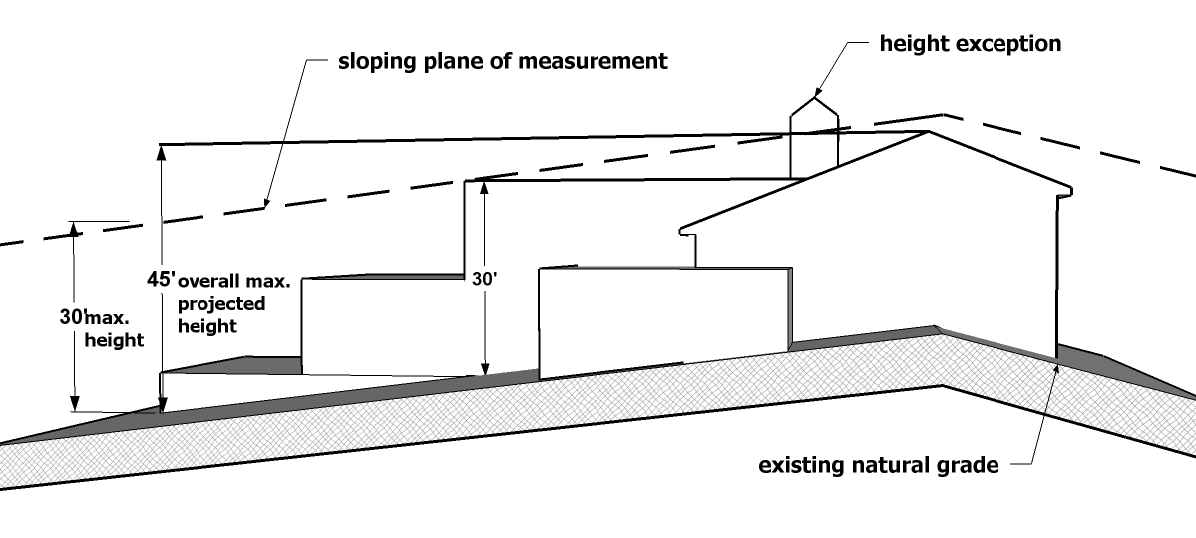
Figure 5.2-A Hillside Height Measurement
B.
Heights and Appearances.
1.
For development within the Hillside Areas, the height of structures shall be determined by the following and not by the definition of "building height" as described in Article 10, Definitions:
No part of any structure shall penetrate an imaginary plane (the "sloping plane of measurement"), the height of which is 30 feet measured vertically from the highest ridge or parapet of the building to the existing natural grade directly beneath that point. Minor topographic variations may be excluded from those measurements if those areas are less than 25 feet in width. Exposed building walls measured in a vertical plane shall not exceed a height of 30 feet measured from the lowest point of the wall to the top of the wall. In addition, the overall projected height will be measured from the lowest wall improvement attached to the main structure to the highest ridge or parapet, and be limited to 45 feet. Exceptions to the maximum height requirements are allowed for architectural features that are less than ten percent of the entire roof area. The height measurements in Hillside Areas are depicted in Figure 5.2-A above.
2.
Materials used for exterior surfaces of all structures shall blend in color, hue, and tone with the surrounding natural setting to avoid high contrasts. The overall intent is to create a material and color palette that when utilized is deemed complimentary and compatible to the desert setting.
a.
Structures, walls, roofs, and fences shall blend with the surrounding terrain and there shall be no material or colors used which have a light reflecting value (LRV) greater than 35 percent.
b.
Mirror surfaces, or any treatment which changes ordinary glass into a mirror surface, is prohibited. Bright, untarnished copper or other metallic surfaces shall be treated so they are non-reflective.
c.
All electrical service equipment and sub panels and all mechanical equipment including, but not limited to, air conditioning and pool equipment, solar panels, and antennas shall not be visible from the outside the property when viewed from the same or a lower elevation. Restrictions of solar panels and mechanical equipment may be modified if they are integrated into the roof design.
3.
Fences on lots within a Hillside Area, excluding retaining walls, shall be restricted to privacy fences attached to or directly screening a portion of the main residence.
C.
Disturbed Areas. Lots in Hillside Areas shall be developed to provide for the minimum amount of ground disturbance during the time of construction so as to prevent rockslides and falls, erosion, and seepage at final construction, disturbed areas shall be hidden or supported by retaining walls, buildings, finished surfaces, or shall be landscaped.
1.
All buildings, structures, and roads shall, to the fullest extent practicable, utilize the natural contours of the land so as to minimize the disturbed area.
2.
The maximum height of any cut or fill used to establish a building site or a driveway shall not exceed 15 feet. The maximum height of any cut or fill used to establish a road or roadway shall not exceed 30 feet.
3.
The limits of construction and proposed disturbed areas shall be clearly designate on the property prior to and during construction with flags or visible roping. No disturbance outside the designated area shall take place.
4.
All surplus excavated material shall be removed from the lot.
D.
Roadways and Driveways.
1.
If any portion of a driveway grade is more than 20 percent, the entire residence and all necessary building over 120 square feet of roof area shall be protected with an approved fire sprinkling system.
2.
Residential driveways with turning radii of less than 35 feet may be used provided all structures are protected with an approved fire sprinkling system.
3.
Any driveway cut greater than 12 feet in depth shall not have a length greater than 200 feet.
E.
Retaining Walls and Erosion Control Measures.
1.
The design of all retaining walls and erosion control measures shall be prepared by a registered professional engineer or architect who is licensed to practice in the State of Arizona.
2.
Raw spill slopes are prohibited.
3.
The slope from retaining walls shall be no more than 4:1.
4.
When multiple retaining walls are utilized, the top of the footing of the upper retaining wall will be at least one foot below the top of the lower retaining wall. The slope between the walls will terminate four inches below the top of the top of the lower retaining wall.
5.
All exposed disturbed area fill shall be contained behind retaining walls or landscaped.
6.
Retaining walls shall not exceed 20 feet in height. If additional height is needed, the wall shall be offset at a minimum of four feet or one foot per one foot of height. Privacy fences may be erected on a retaining wall so long as the total height does not exceed 20 feet.
5.2.4.
Protection of Native Plant Species within Pristine or Environmentally Sensitive Areas. Development should minimize the removal of existing healthy Sonoran Desert vegetation (trees over four-inch caliper in diameter and cactus over three feet in height). If removal is necessary, mature trees and cacti should be salvaged and utilized on site.
A.
Natural washes and vegetation should be maintained in a natural state to avoid impeding drainage flows to the extent practicable for public safety and preservation of natural resources.
(Ord. No. 37-09, § 1, 12-16-2009; Ord. No. 07-22, § 3 (PLZM-21-0060), 4-19-2022; Ord. No. 01-24, § 3(Exh. A, B), 2-20-2024)
5.3. - OPEN SPACE
A.
Open space development is encouraged to utilize the guidelines adopted in the most current city plans, including the City's Parks and Recreation Master Plan, the El Rio Design Guidelines and Planning Standards, the "Wildlife Corridors Best Management Practice Guide," and the El Rio District Plan.
B.
Mountain ridge lines should be protected from development to maintain the visual identify of Buckeye.
C.
Maximize land use compatibility around open space tracts to enhance community/recreational opportunities.
D.
Open spaces should be connected together to provide continuity.
(Ord. No. 07-22, § 3 (PLZM-21-0060), 4-19-2022; Ord. No. 01-24, § 3(Exh. A, B), 2-20-2024)
5.4. - LANDSCAPING
5.4.1.
Intent. The standards and guidelines of this section are intended to:
A.
Visually unify the appearance of developments;
B.
Define major entryways, circulation (both vehicular and pedestrian), and parking patterns to help buffer less intensive adjacent uses;
C.
Integrate the native and colorful landscape character of the Sonoran Desert into the city's developments;
D.
Provide relief from the desert climate by providing shade and mitigating the heat island effect;
E.
Preserve, protect, promote, and integrate the existing desert landscape, including riparian areas, organic and inorganic materials, and associated vegetation;
F.
Preserve native vegetation, which stabilizes desert soils and is an important habitat component by providing food, cover, and nesting sites for desert wildlife species; and
G.
Preserve vegetation that contributes to the high quality of life, and unique desert lifestyle that the community of Buckeye enjoys;
5.4.2.
General Description of Landscaping Requirements.
A.
All development shall meet the requirements of Section 5.2.4, Protection of Native Plant Species within Pristine or Environmentally Sensitive Areas.
B.
In addition, one or more of the five types of landscaping in Section 5.4.3, Landscaping Required, may be required for a development, depending on the use and zoning district of the property and adjacent properties and the portion of the property involved. These types of landscaping are: (1) site enhancement landscaping, (2) site perimeter landscaping, (3) parking lot landscaping, (4) building foundation landscaping, and (5) entryways.
C.
Each type of required landscaping shall meet the minimum standards of Section 5.4.4, General Requirements for all Landscaping, and shall be shown on a Landscaping Plan that meets the requirements of this Code.
D.
No unapproved landscaping, object, structure, or sign shall be placed within a sight visibility easement.
5.4.3.
Landscaping Required.
A.
Site Enhancement Landscaping1.
1.
All portions of new development, not comprised of building or residential lot or unit footprint, vehicular access, and required hardscape shall include planting requirements as prescribed in Table 5.4-1, Landscaping Requirements.
a.
Site enhancement minimum percentages includes all buffer requirements (if applicable).
2.
Residential zoning districts shall have a minimum percentage of the gross land area as landscaped area that increases based on density (du/ac). Private yards enclosed for serving one residential lot or one dwelling unit shall not count towards minimum requirements.
a.
Zero percent—1.0 du/ac or less.
b.
Five percent—More than 1.0 du/ac up to 2.0 du/ac.
c.
Fifteen percent—More than 2.0 du/ac up to 3.0 du/ac.
d.
Twenty percent—More than 3.0 du/ac up to 5.0 du/ac.
e.
Twenty-five percent—More than 5.0 du/ac up to 10.0 du/ac.
f.
Thirty percent—More than 10.0 du/ac up to 15.0 du/ac.
g.
Ten percent—More than 15.0 du/ac.
3.
Non-Residential Zoning Districts shall have a minimum percentage of the gross land area as landscaped area that is based on intensity of the use.
a.
Mixed-use development shall calculate residential and non-residential minimum standards independently unless otherwise approved through the Site Plan process.
4.
Minimum planting requirements shall vary by zoning district. Tree sizes shall meet or exceed the minimum standards of Section 5.4.4 b., Minimum Plant Specifications.
B.
Site Perimeter Landscaping. Except in the Downtown, site perimeter landscaping shall be required for all development along roadways if a setback is provided and shall include planting requirements as prescribed in Table 5.4-1, Landscaping Requirements.
1.
A minimum landscape setback of 25 feet shall be provided along all arterial and higher classification streets from the edge of the right-of-way, and a minimum landscape buffer of 15 feet shall be provided along all collector and lower classification streets from the edge of the right-of-way. Developments utilizing a setback of zero feet shall not be required to provide site perimeter landscaping on that side.
a.
This setback does not count toward the interior parking lot landscaping requirement or the site enhancement landscaping requirement.
b.
This setback is exclusive of any right-of-way (ROW) area as required.
c.
Trees are not permitted within public utility easement areas, unless approved by the appropriate utility interest(s) and the city.
d.
In areas where an existing pattern of sidewalks, street trees, or other landscaping has been established, the standard may be modified through the Site Plan approval process to allow for consistency with the established pattern.
e.
Additional landscaping within the public right-of-way may be required where practical along with the required site perimeter landscaping at the same minimum planting requirements as prescribed in Table 5.4-1, Landscaping Requirements.
f.
A five-foot reduction for the required setback width is permitted for locations without a public utility easement (PUE) present.
2.
Along all roadways, the perimeter of parking areas shall be screened as required in subsection 1., with of the following:
a.
A masonry wall no less than three and one-half feet in height using materials compatible with the principal building; or
b.
A landscaped berm no less than three and one-half feet in height at a maximum slope of four to one (4:1), including a mesa for planting.
c.
No screening shall be required for the perimeter of any parking area greater than 300 feet from the adjacent roadway.
d.
Screening walls and landscaping must not block sight lines for vehicular movement.
3.
Along all freeways, new development shall provide a minimum landscape buffer of 20 feet.
4.
A minimum landscape buffer of 30 feet shall be provided for new commercial or industrial development and a minimum of 20 feet for new multi-family development located adjacent to Single-Family Residential Zoning Districts and shall include planting requirements as prescribed in Table 5.4-1 for site perimeter.
a.
No development improvements, except for signage, or as required for civil or safety requirements shall be constructed within the required buffer.
b.
A minimum landscape buffer shall be used for new mixed-use development located adjacent to Single-Family Residential Zoning District determined through the Site Plan approval process.
c.
The minimum width may be reduced within zoning districts with a building setback less than the width prescribed within this subsection.
C.
Landscaping Inside Parking Areas.
1.
Landscape Islands.
a.
Landscape islands shall be a minimum of eight feet wide by the length of the parking stall at a ratio of one island per ten parking spaces and shall include planting requirements as prescribed in Table 5.4-1.
(i)
Covered parking lots shall only require landscape islands per Subsection 5.4.3 C.1.c. below.
b.
For maintenance and water conservation, turf grasses are not permitted within landscape islands.
c.
Landscape islands will be located at the end of each parking row.
The corners may be chamfered to allow full WB-50 turn templates. Truck aprons may also be used, but shall not reduce the number of required plantings.
d.
The standards in this subsection shall not apply to truck loading and service areas or truck-only parking areas located on industrial development sites.
2.
Landscape Medians.
a.
Parking lots containing more than 125 parking spaces shall include an additional landscaped area no less than 15 feet wide to promote shaded pedestrian connectivity to the building entrance and additional site enhancement planting opportunities per Table 5.4-1, Landscaping Requirements.
b.
One tree shall be provided every 30 linear feet.
c.
The standards in this subsection shall not apply to truck loading and service areas or truck-only parking areas located on industrial development sites.
D.
Building Foundation Plantings.
1.
In all Multi-Family, Commercial, Mixed-Use, and Industrial Zoning Districts, new development shall provide minimum landscaping as prescribed in Table 5.4-1, Landscaping Requirements, along all sides that are adjacent to public streets or parking areas, unless the building has no setback from the property line.
a.
Shrubs shall be placed in-ground with a minimum landscaped area of five feet and located within 15 feet of the building façade.
b.
Raised planters or pots may alternatively be used and located within 15 feet of the building façade.
c.
Buildings above 30 feet tall shall provide one tree per 30 linear feet, in addition to the Table 5.4-1, Landscaping Requirements standard.
E.
Entryways. In all zoning districts, any development that is 15 acres or more in size shall incorporate prominent focal points at major entrances. Such focal points shall be created through a minimum of two of the following:
1.
Gateway monuments;
2.
Decorative pavement treatments at driveway entrances outside of right-of-way;
3.
Sculpture or public art;
4.
Concentrations of vertical landscape forms; or
5.
Other features, as approved, to define entrances as visual gateways to the development.
5.4.4.
General Requirements for All Landscaping.
A.
Landscape Materials List.
1.
Low-water, drought-tolerant, plants shall be used for all new landscaping. Plant materials shall be selected from the plant list of the Arizona Department of Water Resources.
2.
The male mulberry (Morus alba) and the olive tree (Olea europea) are prohibited within city limits.
3.
Sissoo trees are prohibited from city ROWs and will be located a minimum of 20 feet from public sidewalks, public roads, and public structures.
B.
Minimum Plant Specifications. Landscaping mixture shall be in conformance with Section 5.4.4.A, Landscape Materials List. All shrubs shall be a minimum of five gallons, and all groundcover shall be a minimum of one gallon. All trees shall be required to meet the following box sizes and conform to the Arizona Nursery Association standards for tree species container size, height, width and caliper:
1.
Sixty percent shall be 24-inch box or larger.
2.
Thirty-five percent shall be 36-inch box or larger.
3.
Five percent shall be 48-inch box or larger. A 15-foot tall or larger saguaro can take the place of a 48-inch box tree.
C.
Maintenance. Every property owner and any tenants shall keep their landscaped areas in a well-maintained, safe, clean, and attractive condition at all times. Such maintenance shall include, but is not limited to, the following:
1.
Landscaped areas shall be kept free of trash, litter, weeds, and other such materials or plants not a part of the landscape.
2.
All plant material shall be maintained in a healthy and growing condition, and must be replaced with plant material of similar variety and size not to be smaller than the minimum required by this Development Code at the time of replacement if diseased, damaged, destroyed, or removed in perpetuity.
3.
Proper pruning, including maintaining a clear zone of 13.5 feet minimum for all trees located adjacent to roadways.
4.
Watering on a regular basis.
5.
Maintenance of landscape lighting in working order.
6.
Maintenance of irrigation systems in working order.
7.
Cleaning of abutting waterways and landscaped areas lying between public right-of-way lines and the property, unless such streets, waterways, or landscaped areas are expressly designated to be maintained by a designated governmental authority.
8.
It is the responsibility of the adjacent property owner or the property association formed by the adjacent property owner to trim trees to allow for an 18-foot high clearance above the pavement.
D.
Irrigation.
1.
All landscaping improvements shall include a suitable method for irrigation. Failure to maintain landscaping shall be a cause for permit revocation or other enforcement action.
2.
Use an underground drip irrigation system for all landscaped areas (except for turf). For turf, irrigate from a secondary, non-potable water source if available.
E.
Right-of-Way.
1.
To the maximum extent practicable, Landscaping Plans shall be coordinated with the placement of utilities to avoid conflicts with above- and below-ground utilities and overhead light fixtures, and within the city to avoid right-of-way obstruction issues.
2.
Any object, wall, structure, mound, or landscape (mature) over 24 inches in height is prohibited within the sight visibility easement.
3.
Tree canopies hanging over the sight visibility lines will be trimmed to seven feet above street surface.
4.
Boulders are prohibited within the public utility easement (PUE), rights-of-way (ROW), or within six feet from the back of curb.
5.
Trees are prohibited within the sight visibility easement (SVE) or sight distance line (SDL) including median trees.
6.
Trees will not be located closer than 20 feet of a street light pole.
7.
Trees will be located no closer than six feet of a fire hydrant.
8.
Landscape planting will not be located between the fire hydrant and the curb.
9.
Cactus species will not be located within ten feet of a fire hydrant.
10.
Trees will be located within the outer five feet of a minimum 25-foot water easement maintaining a ten-foot minimum separation from the running line of a wet utility.
11.
Deep root barriers are required for all trees located within the ROW.
5.4.5.
Roadway Design. The natural desert environment and established streetscapes throughout Buckeye provide opportunity to preserve and enhance specific key corridors. Additional standards along these roadways define the characteristics and nuances giving a sense of place and arrival.
A.
Sun Valley Parkway Scenic Corridor. Recognizing the need for preservation efforts of the Sonoran Desert, the Sun Valley Parkway, from the eastern city limits in northern Buckeye to Interstate 10 in central Buckeye, has been reserved for careful consideration of future development impacts by the below additional standards.
1.
All new development shall provide a supplemental landscape setback of 25 feet along Sun Valley Parkway, in additional to the minimum requirements outlined in 5.4.3.C.1, Site Perimeter Landscaping.
2.
Retention basins shall not be permitted within the combined total landscape setback along Sun Valley Parkway. Drainage facilities shall be limited to regional flows.
3.
No development improvements, except for signage, or as required for civil or safety, shall be constructed within the combined total landscape setback.
4.
Areas of natural open space and preservation of protected plant species should be incorporated.
5.
Succulents and native seed mixes shall be incorporated into the proposed design.
6.
Walls and fencing adjacent to the required combined total landscape setback shall be thematic in materials and colors to compliment with the natural environment.
7.
Natural and artificial turf shall not be permitted.
8.
All varieties of Palm Tree species shall not be permitted.
B.
Thematic Streetscape. Integration with existing built environments gives a sense of cohesion through complimentary planting palettes, decorative rock, and hardscapes.
1.
All new developments along the following roadways shall provide materials that are consistent to established landscape designs through the site plan or preliminary plat approval process.
a.
Verrado Way.
b.
Watson Road.
c.
Miller Road.
d.
Palo Verde Road (south of Interstate 10).
2.
Walls and fencing shall be complimentary in materials and colors to blend in with the existing development.
5.4.6.
Fences and Screening.
A.
Purpose. The purpose of these standards is to ensure the design of fences contributes to the character of development, and to avoid long expanses of blank fences that can lead to a "canyon" effect on the streetscape. This section also ensures that fences are constructed of high-quality and durable materials.
B.
Fences.
1.
Height.
a.
Front. No fence located between the principal structure on a lot and the front property line shall exceed six feet in height.
b.
Side and Rear. No fence located between the principal structure and the rear or side property line shall exceed six feet in height; additional height may be granted for retaining walls or sites with elevated foundations. For commercial and industrial development adjacent to residential uses, no fence located between the principal structure and the rear or side property line shall exceed eight feet in height.
2.
Articulation. Fences shall be articulated to avoid continuous, unbroken expanses. No fence facing an arterial or highway may extend continuously, without articulation, for more than 200 feet, or 100 feet for fences facing any other type of public street. Fences may be articulated using any combination of the following:
a.
Changes in material or texture, including the use of view fence that allows for views into the site;
b.
Offsets (projections or recessions);
c.
Landscape pockets; or
d.
Similar features as approved.
3.
Wall and Fence Materials.
a.
Fences shall be constructed with any combination of the following materials:
i.
Integrally colored, split-face, or ground-face concrete masonry units (CMU);
ii.
Concrete masonry units that have been painted, stuccoed, or faced with another permitted material;
iii.
Stone (natural or simulated);
iv.
Brick;
v.
Wrought-iron or other decorative metal;
vi.
Plastic or vinyl; or
vii.
Wood (painted or stained) or other materials as approved by the Planning Commission.
b.
Chain link fencing is prohibited on commercial and residential development sites, except as necessary to ensure public safety during approved construction activities on the site. Chain link fencing is permitted in Industrial Districts but shall not be viewable from public rights-of-way (ROW).
c.
A higher level of design detail shall be utilized for highly visible fences along major arterial roadways and interstates, including but not limited to, the incorporation of mosaic designs, relief panels, or similar public art.
4.
Wall and Fence Placement. No fences may be placed within the public right-of-way.
5.
Freeway Sound Walls. A sound study shall be required for all development within 150 feet of an existing freeway. The city may determine that a sound wall is required to mitigate sound impacts on the new development. Sound walls shall be constructed by the developer consistent with all applicable standards of the Arizona Department of Transportation.
6.
Fence Guideline. Use colors, materials, and forms for fences that complement the architectural character of the primary building or overall development.
C.
Screening of Services, Refuse Collection, and Utilities.
1.
Screening Required.
a.
Solid waste collection areas and mechanical equipment, including equipment located on a rooftop, shall be screened from the view of a six-foot tall person standing on the property line on the far side of an adjacent public street (see Figure 5.4-E). Individual screening of rooftop mechanical equipment is prohibited. Units shall either be grouped together "penthouse style" or screened with a parapet wall the entire length of the building. Such a parapet wall shall be designed to be integral to the overall architecture of the building.
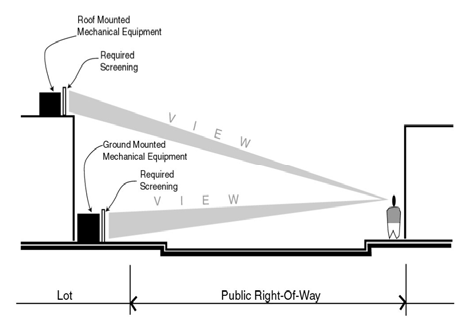
Figure 5.4-E: Screening of Equipment, Etc.
b.
Except in the Downtown and Mixed-Use Districts, storage, solid waste collection, and loading areas shall be located at least 20 feet from any public street, public sidewalk, or building with a residential use. Placement of storage, solid waste collection, and loading areas shall be sited so as not to interfere with vehicular visibility or circulation.
c.
Loading docks, truck parking, outdoor storage, trash collection, trash compaction, and other service functions shall be incorporated into the overall design of the building and landscaping so that the acoustic impacts of these functions are contained to the maximum extent feasible, and so that such features are fully screened and out of view from public streets. Use screening materials for solid waste collection and loading areas that are the same and of equal quality to the materials used for the primary building and landscaping.
2.
Shopping Cart Storage. The following standards apply to any commercial development that provides shopping carts: (refer also to Chapter 10, Section 10-3-16)
a.
Provide long-term (overnight) shopping cart storage areas inside of the primary building or adjacent to the building and behind a decorative screening fence constructed of masonry, metal, or finished wood that is consistent with the design of the adjacent building. The fence shall not exceed the height of the shopping carts.
b.
Design short-term shopping cart corrals (located within parking areas for day use and where carts are generally not left overnight) with durable materials and design features that complement the architectural character of the development.
c.
Locate short-term shopping cart corrals so as not to encroach upon vehicular or pedestrian circulation paths.
3.
Guidelines for Service and Refuse Areas.
a.
Cluster service and refuse areas for nearby buildings and uses.
b.
Where feasible, locate above-ground utility facilities, such as utility cabinets and meters, in areas that do not conflict with featured views, outdoor dining areas, outdoor gathering areas, or site circulation. Screen these facilities with dense landscaping or decorative fences.
(Ord. No. 37-09, § 1, 12-16-2009; Ord. No. 06-13, § 1, 5-21-2013; Ord. No. 18-17, § 5, 7-5-2017; Ord. No. 23-17, § 1, 12-19-2017; Ord. No. 25-17, § 1(Att. § 5), 12-19-2017; Ord. No. 07-22, § 3 (PLZM-21-0060), 4-19-2022; Ord. No. 37-22, § 3(Att.), 12-20-2022; Ord. No. 01-24, § 3(Exh. A, B), 2-20-2024)
5.5. - TRANSPORTATION AND CONNECTIVITY
5.5.1.
Purpose. The purpose of this section is to support the creation of a highly connected transportation system within the city in order to provide choices for drivers, bicyclists, and pedestrians; increase effectiveness of local service delivery; promote walking and bicycling; connect neighborhoods to each other and to local destinations such as employment, schools, parks, and shopping centers; reduce vehicle miles of travel and travel times; improve air quality; reduce emergency response times; mitigate the traffic impacts of new development; and free up arterial capacity to better serve regional long-distance travel needs. These standards attempt to avoid the creation of large, isolated tracts without routes for through traffic or pedestrian and bicycle connections.
This section will be in compliance with the current Transportation Plan and the Bike and Pedestrian Master Plan.
5.5.2.
Traffic Impact Mitigation.
A.
Applicability of Traffic Impact Analysis Requirement. The transportation system for new development shall be capable of supporting the proposed development in addition to the existing and future uses in the area. Evaluation of system capacity shall be undertaken through a Traffic Impact Analysis (TIA), which shall meet the standards of the Maricopa County Department of Transportation and shall consider the following factors at a minimum: street capacity and level of service; vehicle access and loading; on-street parking impacts; the availability of transit service and connections to transit; impacts on adjacent neighborhoods; and traffic safety including pedestrian safety. A TIA shall be required with applications for development review and approval when:
1.
Trip generation during any peak hour is expected to exceed 100 trips per day or more than 50 during any one-hour peak period, based on traffic generation estimates of the "Institute of Transportation Engineers' Trip Generation Manual" (latest version); or
2.
A TIA is required by the Planning Commission or City Council as a condition of any land use application approved pursuant to the requirements of this Development Code; or
3.
The Director, in his or her sole discretion, requires a TIA for:
a.
Any project that proposes access to an existing street with level of service "D" or below;
b.
Any application for a rezoning or specific plan review;
c.
Any case where the previous TIA for the property is more than two years old;
d.
Any case where increased land use intensity will result in increased traffic generation when compared to the existing use of the property;
e.
Any case where development is near an existing or proposed school; or
f.
Any case in which the Director or City Engineer determines that a TIA should be required because of other traffic or connectivity concerns that may be affected by the proposed development.
B.
Traffic Impact Analysis and Development Review Process.
1.
A scoping meeting between the developer and the Director and City Engineer shall be required prior to the start of the TIA in order to determine its parameters. This may be conducted as part of a preapplication meeting.
2.
If required, the TIA shall be submitted with the applicable development application.
3.
When access points are not defined or a Site Plan is not available at the time the TIA is prepared, additional studies may be required when a Site Plan becomes available or the access points are defined.
Note— Refer also to Section 6-1, Engineering Design Standards.
C.
Applicability of Traffic Impact Analysis Requirement. The transportation system for new development shall be capable of supporting the proposed development in addition to the existing and future uses in the area. Evaluation of system capacity shall be undertaken through a Traffic Impact Analysis (TIA), which shall meet the standards of the Maricopa County Department of Transportation and shall consider the following factors at a minimum: street capacity and level of service; vehicle access and loading; on-street parking impacts; the availability of transit service and connections to transit; impacts on adjacent neighborhoods; and traffic safety including pedestrian safety. A TIA shall be required with applications for development review and approval when:
1.
Trip generation during any peak hour is expected to exceed 100 trips per day or more than 50 during any one-hour peak period, based on traffic generation estimates of the "Institute of Transportation Engineers' Trip Generation Manual" (latest version); or
2.
A TIA is required by the Planning Commission or City Council as a condition of any land use application approved pursuant to the requirements of this Development Code; or
3.
The Director, in his or her sole discretion, requires a TIA for:
a.
Any project that proposes access to an existing street with level of service "D" or below;
b.
Any application for a rezoning or specific plan review;
c.
Any case where the previous TIA for the property is more than two years old;
d.
Any case where increased land use intensity will result in increased traffic generation when compared to the existing use of the property;
e.
Any case where development is near an existing or proposed school; or
f.
Any case in which the Director or City Engineer determines that a TIA should be required because of other traffic or connectivity concerns that may be affected by the proposed development.
D.
Traffic Impact Analysis and Development Review Process.
1.
A scoping meeting between the developer and the Director and City Engineer shall be required prior to the start of the TIA in order to determine its parameters. This may be conducted as part of a pre-application meeting.
2.
If required, the TIA shall be submitted with the applicable development application.
3.
When access points are not defined or a Site Plan is not available at the time the TIA is prepared, additional studies may be required when a Site Plan becomes available or the access points are defined.
E.
Traffic Mitigation Measures. The applicant shall, as part of the TIA, recommend measures to minimize and mitigate the anticipated impacts and determine the adequacy of the development's planned access points. Mitigation measures shall be acceptable to the Director and City Engineer and may include, without limitation: an Access Management/Access Control Plan; transportation demand management measures; street improvements on or off the site; placement of pedestrian, bicycle, or transit facilities on or off the site; or other capital improvement projects such as traffic calming infrastructure or capacity improvements. Intersection analysis and traffic signal requirements shall also be provided, as applicable.
5.5.3.
Streets and Vehicular Circulation.
Note— (Refer also to Section 6-3, EDS.)
A.
Street Standards. All streets shall meet the standards in Article 6, Land Subdivision, and shall be consistent with the circulation element of the General Plan.
B.
Street Connectivity.
1.
Purpose. Street and block patterns should include a clear hierarchy of well-connected streets that distribute traffic over multiple streets and avoids traffic congestion on principal routes. Within each development, the access and circulation system should accommodate the safe, efficient, and convenient movement of vehicles, bicycles, and pedestrians through the development, and provide ample opportunities for linking adjacent neighborhoods, properties, and land uses. Local neighborhood street systems are intended to provide multiple direct connections to and between local destinations such as parks, schools, and shopping. These connections should knit separate developments together, rather than forming barriers between them.
2.
Residential Streets.
a.
Residential streets shall be laid out so that use by through-traffic will be discouraged. Traffic-calming techniques such as diverters, neck-downs, street gardens, and curvilinear alignments are encouraged to reduce speeds and cut-through traffic.
b.
Should topography or other constraints require the use of straight local streets that extend more than 660 feet without interruption, a traffic-calming device, or similar feature shall be used to slow traffic and break-up the "runway" appearance. In addition, traffic-calming devices may be required to address public safety concerns.
c.
To the maximum extent practicable, streets shall be arranged to follow the natural contours of the site.
3.
Vehicular Access to Public Streets and Adjacent Land.
a.
All development shall provide public street connections to all existing, adjacent public streets.
b.
If there are no adjacent public streets, subdivisions and/or Site Plans shall provide for connections along each boundary abutting adjacent vacant land for future connections spaced at intervals not to exceed 1,000 feet for arterials, or 660 feet for other street types, or as otherwise approved.
c.
When connections to surrounding streets are proposed or required by the city, public right-of-way shall be dedicated and streets developed to existing paved rights-of-way. The city may also require temporary turnarounds to be constructed for temporary cul-de-sacs between development phases.
4.
Cul-de-Sacs and Dead-End Streets Discouraged.
a.
Permanent cul-de-sacs and dead-end streets shall generally be used when topography, the presence of natural features, and/or vehicular safety factors make a vehicular connection impractical.
b.
All permanent dead-end streets shall be developed as cul-de-sacs and extend no further than 660 feet.
c.
Design standards for cul-de-sacs are located in Section 6-3.1000 D, Engineering Design Standards.
5.
Driveways and Access.
a.
General.
i.
Every lot shall have access that is sufficient to afford a reasonable means of ingress and egress for emergency vehicles with a turning radius appropriate for wheel base 50 (WB-50) access, as well as for those needing access to the property in its intended use.
ii.
All driveway entrances and other openings onto streets shall be constructed so that:
(1)
Vehicles may safely enter and exit from the lot in question;
(2)
Interference with the free and convenient flow of traffic in abutting or surrounding streets is minimized; and
(3)
Joint driveways are desirable whenever possible in order to minimize the number of access points to streets and access easements.
b.
Residential. In addition to the above general requirements, all residential development shall be subject to the following:
i.
Alleys adjacent to a single-family use may not be used for loading or parking.
ii.
There shall be no direct driveway access (ingress or egress) from any single-family residential lots to any collector street, arterial street, or highway unless no other legal access alternative is available. Single-Family Flex (SFF) developments are exempt from this requirement.
iii.
Multi-family development sites greater than five acres shall include a minimum of two through-access drives. An exception may be made where a site is landlocked by existing development or other physical constraints, or where existing natural features on the site require the use of protective measures that would otherwise make a second access drive infeasible.
iv.
The driveway is not less than 20 feet in length from the face of the garage to the near edge of the sidewalk. Single-Family Flex (SFF) development are exempt from this requirement. They must provide a minimum of 20 feet of clear space behind each garage door.
v.
Each driveway as measured ten feet from the front property line shall not measure more than ten feet in width for one-stall garages/carports and tandem garages, 20 feet in width for two-stall garages/carports, and 30 feet in width for three-stall and greater garages/carports, measured at right angles to the center line of the driveway, except as that distance may be increased by permissible curb return radii.
vi.
All driveways shall be setback at least one foot from side yard property lines.
vii.
Lots utilizing an RV garage can have an increased total aggregate driveway width of up to 35 feet as long as landscape strips, decorative pavers, grass-crete pavers or similar shall be used to reduce the extent of an minimize the visual appearance of the parking surface in the front yard. The driveway utilizing an RV garage shall have a continuous driveway apron or rolled curb that connects the RV garage driveway to the standard garage driveway. In no case shall the RV garage driveway have a separate curb cut than the standard garage driveway.
viii.
Driveways for single-family residential lots shall be paved with asphalt, bituminous, brick, concrete, or other surfaces of comparable durability to minimize nuisance from dust. Three inches of crushed rock can be used but must be compacted and contained within a permanent border.
c.
Residential Driveway Extensions. A "residential driveway extension" means a hard surface that extends from the driveway and which is primarily used for the parking of vehicles and not for traveling between two places.
i.
A residential driveway extension shall be constructed of concrete, asphalt, pavers, or three inches of crushed rock that is compacted and contained within a permanent border. Residential driveway extensions must adhere to the following conditions:
(1)
Driveway extensions shall only be located in the side yard of property. Single-Family Flex (SFF) developments are exempt from this requirement.
(2)
The total width (existing plus extension) shall not exceed 50 percent of the lot width. Irregular shaped lots widths are measured from the front setback line. Single-Family Flex (SFF) developments are exempt from this requirement.
d.
Non-Residential. In addition to the above general requirements, all non-residential development shall be subject to the following:
i.
All non-residential buildings, structures, and parking and loading areas shall be physically separated from all non-arterial or collector streets by vertical curbs and other suitable barriers and landscaping to prevent unchanneled motor vehicle access. Each property shall not have more than two access ways to any one street unless unusual circumstances demonstrate the need for additional access points. In addition, each access way shall comply with the following:
(1)
The width of any access way leading to the full access of an arterial street shall be median-divided to provide separation from incoming and outgoing traffic. (See Figure 5.5-B.) Construction and maintenance of such on-site medians shall be the responsibility of the property owner/developer.
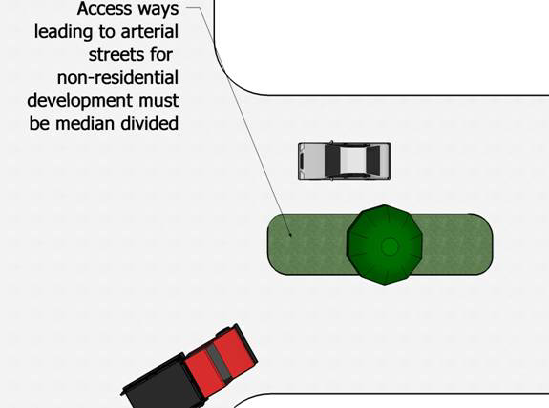
Figure 5.5-B: The width of access ways from arterial streets
6.
Visibility at Intersections. On all lots or parcels of land on which a front setback is required, no obstruction that will obscure the view of motor vehicle drivers shall be placed within the triangular area formed by the adjoining street property lines as specified in the City Engineering Manual, except that trees may be permitted within said triangular area provided that those trees are placed in the street planter strip and the limbs are pruned to at least seven feet above the grade level of the adjacent street.
5.5.4.
Pedestrian Circulation.
A.
Sidewalks Required. Sidewalks shall be installed on both sides of all arterials, collector streets, and local streets (including loop streets and cul-de-sacs), and within and along the frontage of all new development or redevelopment. This requirement shall not apply to local streets in districts in which the minimum lot size is one acre or greater or in steep-slope areas where sidewalks on one side of the street may be approved to reduce excessive slope disturbance, adverse impacts on natural resources, and potential soil erosion and drainage problems. Alternative paving materials within residential developments may be approved by the Director.
Ten-foot wide sidewalks will be provided along all public street frontages of all public, private, and charter schools. Existing schools and schools that locate as a tenant within an existing commercial center would be exempt from this requirement.
B.
Non Single-Family Residential On-Site Pedestrian Connections.
1.
All commercial, industrial, and multi-family development shall provide a network of on-site pedestrian walkways with a minimum width of five feet to and between the following areas:
a.
Entrances to each commercial building on the site, including pad site buildings;
b.
Public sidewalks or walkways on adjacent properties that extend to the boundaries shared with the subject development; and
c.
Adjacent public transit station areas, transit stops, park and ride facilities, or other transit facilities.
2.
Identify on-site pedestrian walkways and crosswalks to motorists and pedestrians through the use of one or more of the following methods: (See Figure 5.5-C.)
a.
Changing paving material, patterns, or paving color (does not include the painting of the paving material);
b.
Changing paving height;
c.
Decorative bollards;
d.
Raised median walkways with landscaped buffers; or
e.
Stamped or stained concrete.
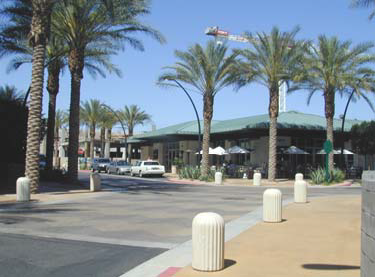
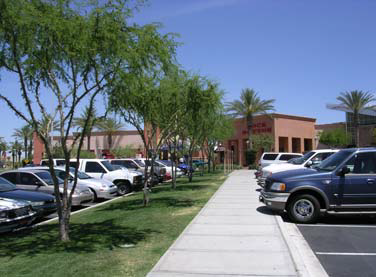
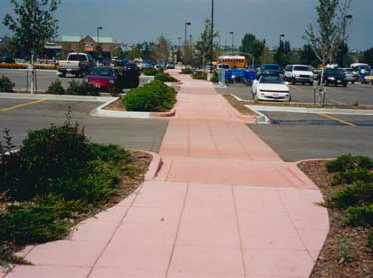
Figure 5.5-C: Examples of Pedestrian Connections
3.
Emphasize pedestrian circulation routes with special design features that establish them as areas where pedestrians are physically separated from the flow of vehicular traffic and/or are protected from the desert elements. Techniques shall include at least one shade feature and one or more of the following:
a.
Pedestrian light features;
b.
Bollards;
c.
Seat walls or benches;
d.
Drinking water fountains; and
e.
Landscape planters.
4.
Guidelines.
a.
Break up sites larger than five acres into smaller units through the use of on-site pedestrian walkways, private drives, and other vehicular circulation routes. Breaking up such sites need not require any subdivision of the site or creation of a separate legal description(s).
b.
To the extent practicable, integrate drainage and stormwater retention facilities on adjacent sites.
c.
Minimize access points to arterial roads through shared drives and internal connections. (See Figure 5.5-D.)
d.
Provide sidewalks to:
i.
Any preexisting adjacent public park, greenway, open space, trails, or other civic use such as schools, places of worship, public recreational facilities, or government offices.
ii.
Adjacent land uses and developments, including but not limited to adjacent residential developments, retail shopping centers, office buildings, or restaurants.
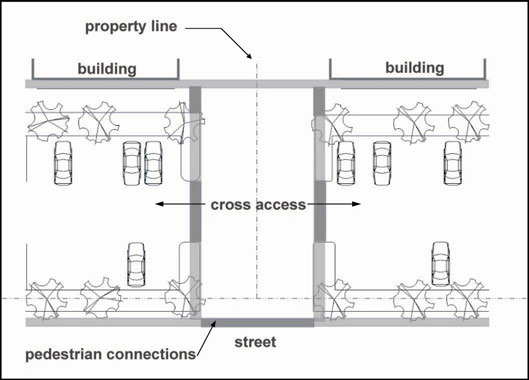
Figure 5.5-D: Shared Drives and Internal Connections
C.
Trails. Construct on-site portions of trails and multi-use paths that are identified in the trails master plan and the parks, trails, and open space master plan, or connect to the Maricopa County's trails system, or connect to adjacent municipalities' pedestrian and bicycle circulation systems, provided that any such improvements are directly related to the impacts of the proposed use or development and are roughly proportional in both extent and amount to the anticipated impacts of the proposed use or development.
5.5.5.
Bicycle Circulation. Bicycle lanes are required in the design of all arterial and collector streets where low traffic speeds and volumes allow bicyclists and motorists to share the road safely.
(Ord. No. 37-09, § 1, 12-16-2009; Ord. No. 25-17, § 1(Att. § 6), 12-19-2017; Ord. No. 09-18, § 2(Att. § 5), 3-6-2018; Ord. No. 15-20, § 3, 9-15-2020; Ord. No. 07-22, § 3 (PLZM-21-0060), 4-19-2022; Ord. No. 37-22, § 3(Att.), 12-20-2022; Ord. No. 01-24, § 3(Exh. A, B), 2-20-2024)
5.6. - OFF-STREET PARKING
5.6.1.
Purpose. The regulations of this section are intended to ensure provision of off-street parking and loading facilities in rough proportion to the generalized parking, loading, and transportation demands of different land uses. By requiring such facilities, it is the intent of this section to help avoid the negative impacts associated with spillover parking into adjacent neighborhoods, while at the same time avoiding the negative environmental and urban design impacts that can result from parking lots and other vehicular use areas. The provisions of this section are also intended to help protect the public health, safety, and general welfare by:
A.
Helping avoid and mitigate traffic congestion;
B.
Encouraging multi-modal transportation options and enhanced pedestrian safety;
C.
Providing methods to help reduce stormwater runoff and the heat island effect of large paved parking areas; and
D.
Providing flexible methods of responding to the transportation and access demands of various land uses in different areas of the city.
5.6.2.
Applicability.
A.
Generally. The off-street parking and loading standards of this section shall apply to all parking lots and parking structures accessory to any building constructed and to any use established in every district. Except when specifically exempted, the requirements of this section shall apply to all temporary parking lots and parking lots that are the principal use on a site.
B.
Expansions and Enlargements. The off-street parking and loading standards of this section shall apply when an existing structure or use is expanded or enlarged. Additional off-street parking and loading spaces shall be required to serve the enlarged or expanded area, provided that in all cases the number of off-street parking and loading spaces provided for the entire use (pre-existing plus expansion) must equal 100 percent of the minimum ratio established in this section and shall not exceed any maximum standards established in this section.
C.
Regulation of Parking Space. The providers of required off-street parking spaces and the City of Buckeye may reasonably control the users thereof by means that may include, but are not limited to, restricting all parking to the users of the facility; parking lot attendants; control gates; tow-away areas; areas for exclusive use by employees, tenants or staff; areas restricted for use by customers or visitors; and imposing reasonable time limitations on users other than tenants, employees, or staff. Direct charges may be made to users who exceed maximum time limits. City staff may review all methods of control and may disapprove of any restriction that adversely affects the purpose of this section. The city may enforce any approved restrictions through any of the code enforcement provisions in Article 9, Enforcement.
5.6.3.
Off-Street Parking Requirements.
A.
Schedule A. Unless otherwise expressly stated in this Code, off-street parking spaces shall be provided in accordance with Table 5.6-1, Off-Street Parking Schedule A.
B.
Schedule B. Uses that reference Schedule B in off-street parking Schedule A shall provide the minimum number of off-street parking spaces listed in Table 4.3-2. Unless otherwise approved, lots containing more than one activity shall provide parking and loading in an amount equal to the total of the requirements for all activities.
C.
Schedule C. Uses that reference "Schedule C" in off-street parking Schedule A have widely varying parking and loading demand characteristics, making it impossible to specify a single off-street parking or loading standard. Upon receiving a development application for a use subject to Schedule C standards, the Director or their designee shall apply the off-street parking and loading standard specified for the listed use that is deemed most similar to the proposed use or establish minimum off-street parking requirements on the basis of a parking and loading study prepared by the applicant. Such a study shall include estimates of parking demand based on recommendations of the Institute of Transportation Engineers (ITE), or other acceptable estimates as approved by the Director, and should include other reliable data collected from uses or combinations of uses that are the same as or comparable with the proposed use. Comparability will be determined by density, scale, bulk, area, type of activity, and location. The study shall document the source of data used to develop the recommendations.
D.
Parking Demand Study. In order to evaluate a proposed project's compliance with the above criteria, the Zoning Administrator or City Engineer may require submittal of a parking demand study that substantiates the basis for granting a specific number of spaces.
5.6.4.
Computation of Parking and Loading Requirements.
A.
Fractions. When measurements of the number of required spaces result in a fractional number, any fraction exceeding 0.5 shall be rounded up to the next higher whole number.
B.
Multiple Uses. Lots containing more than one use shall provide parking and loading in an amount equal to the total of the requirements for all uses.
C.
Area Measurements. Unless otherwise specified, all square footage-based parking and loading standards shall be computed on the basis of gross floor area of the use in question. Structured parking within a building shall not be counted in such measurement.
D.
Computation of Off-Street Parking. Required off-street loading space shall not be included as off-street parking space in computation of required off-street parking space.
E.
Parking for Unlisted Uses. Parking requirements for uses not specifically listed in Table 5-6.1 shall be determined by the Director or their designee based on the requirements for the closest comparable use, as well as on the particular parking demand and trip generation characteristics of the proposed use. The Director or their designee may alternately require the submittal of a parking demand study that justifies estimates of parking demand based on the recommendations of the Institute of Transportation Engineers, and includes relevant data collected from uses or combinations of uses that are the same or comparable to the proposed use in terms of density, scale, bulk, area, type of activity, and location.
5.6.5.
Dedicated Spaces for Alternative Energy Vehicles and Carpooling. All development required to provide 20 or more off-street parking spaces pursuant to Table 5.6-1 shall reserve a minimum of five percent of its required parking spaces per the following:
A.
In Commercial Districts, half of the reserved spaces shall be for the exclusive use of hybrid or alternative energy vehicles, and half of the reserved spaces shall be for the exclusive use of carpool vehicles;
B.
In Industrial or Office Districts, the reserved spaces shall be for the exclusive use of hybrid or alternative energy vehicles, compact cars, or carpool vehicles;
C.
In multi-family projects, the reserved spaces shall be for the exclusive use of hybrid or alternative energy vehicles, compact cars, or carpool vehicles; and
D.
Electric vehicle charging stations are highly encouraged in multi-family, commercial, and industrial developments.
5.6.6.
Off-Street Loading Requirements.
A.
Spaces Required. Off-street loading spaces must be provided in accordance with the following table of minimum requirements:
B.
Design.
1.
Space Size. Off-street loading spaces, excluding maneuvering areas, must be at least ten feet in width and 25 feet in length unless off-street loading will involve the use of semi-tractor trailer combinations or other vehicles in excess of 25 feet in length, in which case loading spaces must be at least 12 feet in width and 65 feet in length. A minimum vertical clearance of 14 feet must be maintained. The Director may allow an equivalent amount of loading zone or dock space to fulfill the off-street loading requirement.
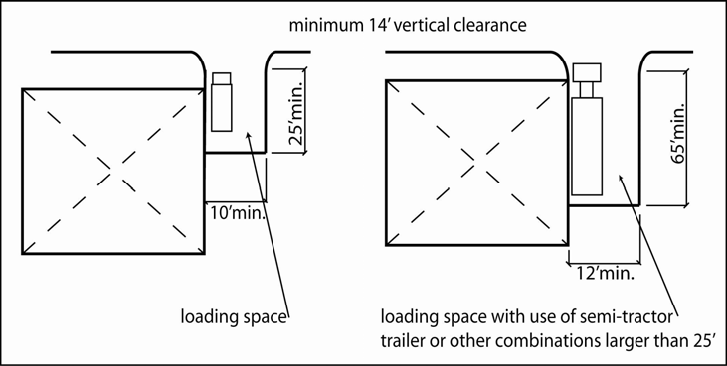
Figure 5.6-A: Off-Street Loading Spaces
2.
Surfacing and Maintenance. Loading areas and access drives must be paved and maintained with concrete, asphalt, or similar material of sufficient thickness and consistency to support anticipated traffic volumes and weights.
C.
Location.
1.
Off-street loading facilities required under this Development Code shall be in all cases on the same lot or parcel of land as the structure they are intended to serve. The required off-street loading space shall not be part of the area used to satisfy the off-street parking requirements.
2.
At no time may goods be loaded or unloaded from the right-of-way of a collector or arterial street.
3.
No part of any vehicle may extend into the right-of-way of a collector or arterial street while being loaded or unloaded.
4.
On a site adjoining an alley, a required loading space should be accessible from the alley.
5.
A required loading space must be accessible without backing a truck across a collector or arterial street property line unless the provision of turnaround space is infeasible.
6.
A loading space must not intrude into any portion of a required aisle or access dimension.
7.
An occupied loading space must not prevent access to a required parking space.
8.
To the maximum extent feasible, loading areas shall be located to the rear of a site and/or away from adjacent residential areas.
D.
Setbacks and Screening. Loading areas may not be located in a required setback.
E.
Signs. The owners of the property may provide, locate, and maintain loading signs as approved by the Director or their designee. Such signs shall not be counted against allowed advertising sign area.
5.6.7.
Parking Alternatives. The Director or their designee may approve alternatives to providing the number of off-street parking spaces required by Table 5.6-1, in accordance with the following standards.
A.
Shared Parking. The Director or their designee may approve shared parking facilities for developments or uses with different operating hours or different peak business periods if the shared parking complies with all of the following standards:
1.
Location. Shared parking spaces shall not be located farther than 600 feet from the primary building entrance.
2.
Zoning Classification. Shared parking areas shall be located on a site with the same or a more intensive zoning classification than required for the primary uses served.
3.
Shared Parking Study. Those proposing to use shared parking as a means of satisfying off-street parking requirements shall submit a shared parking analysis to staff that clearly demonstrates the feasibility of shared parking. The applicant shall also demonstrate that any parking reduction requested as part of the shared parking study will not result in the spillover of parking onto other properties.
4.
Agreement for Shared Parking. The parties involved in the joint use of off-street parking facilities shall submit a written agreement in a form to be recorded for such joint use, approved by the Director or their designee as to form and content. The Director or their designee may impose such conditions of approval as may be necessary to ensure the adequacy of parking in areas affected by such an agreement. Recordation of the agreement shall take place before issuance of a Building Permit for any use to be served by the shared parking area. A shared parking agreement may be revoked only if all required off-street parking spaces will be provided in accordance with the requirements of Table 5.6-1, Off-Street Parking.
B.
Off-Site Parking. The Director or their designee may approve the location of required off-site parking spaces on a separate lot from the lot on which the principal use is located if the off-site parking complies with all of the following standards:
1.
Location.
a.
Off-site parking may be allowed only in the Downtown, or outside the Downtown upon issuance of a Conditional Use Permit or a Temporary Use Permit for special events.
b.
No off-site parking space may be located more than 600 feet from an entrance to a principal use (measured along the shortest legal pedestrian route). Off-site parking spaces shall be connected to the use by acceptable pedestrian facilities, as defined in Section 5.5.4, Pedestrian Circulation, of this Development Code. Off-site parking spaces may not be separated from the use served by a street right-of-way with a width of more than 80 feet, unless a grade-separated pedestrian walkway, a traffic signal, a shuttle bus, or other traffic control is provided or other traffic control or remote parking shuttle bus service is provided.
2.
Zoning Classification. Off-site parking areas shall have the same or a more intensive zoning classification applicable to the primary use served.
3.
Control of Site. Required parking spaces for residential uses must be located on the site of the use or within a tract owned in common by all the owners of the properties that will use the tract.
4.
Ineligible Activities. Required parking spaces for persons with disabilities may not be located off-site.
5.
Agreement for Off-Site Parking. In the event that an off-site parking area is not under the same ownership as the principal use served, a written agreement between the record owners shall be required. An attested copy of the agreement between the owners of record shall be submitted to the city for recordation in a form acceptable to the City Attorney. Recordation of the agreement shall take place before issuance of a Building Permit or Certificate of Occupancy for any use to be served by the off-site parking area. In the event that an off-site parking agreement is terminated, all required off-street parking spaces shall be provided in accordance with the requirements of this chapter. No use shall be continued if the parking is removed unless substitute parking facilities are provided, and the Director shall be notified at least 60 days prior to the termination of a lease or agreement for off-site parking.
C.
Structured Parking.
1.
Maximum Parking Waiver. Where 75 percent or more of the parking accessory to a use is in structured parking, there shall be no maximum cap on the number of parking spaces in that structure.
2.
Credit for Nearby Public Structured Parking. Spaces available in public parking structures located within 1,000 feet of the subject use may be counted toward the total amount of required off-street parking.
3.
Floor Area Bonus for Underground Parking in the Commercial and Mixed-Use Districts. A floor area bonus shall be granted for underground parking structures in the Commercial and Mixed-Use Districts. The bonus shall be granted at a ratio of three square feet of additional bonus area for each square foot of structured parking that is underground.
4.
Height of Parking Structure. The height of a parking structure may not exceed the height of the principal building it is intended to serve. Where no principal building exists, the maximum height of the parking structure shall be limited to the maximum building height allows in the zoning district in which the structure is located.
D.
Sites in Mixed-Use Districts. In the Mixed-Use Districts, the total requirement for off-street parking facilities shall be the sum of the requirements for the various uses computed separately, subject to the modifications set forth below.
1.
All uses within Mixed-Use Districts shall be eligible for a 15 percent parking reduction to reflect the reduced automobile use associated with mixed-use developments.
2.
A 15 percent parking reduction for multifamily residential dwellings may be allowed if the proposed use is located within 300 feet of a transit stop.
3.
For non-residential uses, the minimum parking requirement may be reduced 20 percent if the use incorporates a transit stop that meets minimum design standards established by the city.
4.
The total number of parking spaces required of a use or uses in a Mixed-Use District may be further reduced by the Director if the applicant prepares a parking evaluation that demonstrates a reduction is appropriate based on the expected parking needs of the development, availability of mass transit, and similar factors. The parking evaluation shall be prepared in a form and manner prescribed by the Director.
E.
On-Street Parking. On-street parking spaces in the right-of-way along the property line, between the lot lines of the site, may be counted to satisfy the minimum off-street parking requirements.
F.
District Parking. Minimum required off-street parking spaces may be waived or reduced for properties within the boundaries of a public parking or local improvement district that provides district-wide parking facilities, based on the projected parking demand to be addressed by the district-wide facility.
G.
Stacked, Tandem, and Valet Parking. Stacked, tandem, or valet parking for nonresidential uses is allowed if an attendant is present to move vehicles. In addition, a guarantee acceptable to the city shall be filed with the city ensuring that a valet parking attendant shall always be on duty when the parking lot is in operation.
5.6.8.
Dimensions of Parking Spaces.
A.
Parking Angle Dimensions. The parking configuration stated in the following table shall apply to all required off-street parking.
B.
Calculation of Parking Space Dimensions. The spatial relationships described in Table 5.6-4 shall be calculated in the manner depicted in the following diagram:
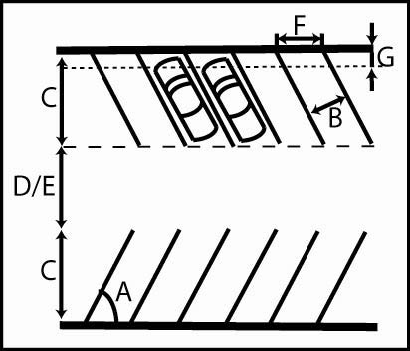
Figure 5.6-B Spatial Relationships of Parking
C.
Recreational Vehicle Spaces. Parking spaces for recreational vehicles, if provided, shall be a maximum of ten feet by 60 feet.
D.
Truck Parking Spaces for Truck Stops. [Reserved]
5.6.9.
Parking Lot Design Standards.
A.
Surface. All parking and driveway areas and primary access to parking facilities shall be surfaced with asphalt, concrete, or other similar materials, unless otherwise approved. Accent paving is recommended to indicate pedestrian linkages. Pedestrian linkages shall comply with Section 5.5.4, Pedestrian Circulation.
B.
Design and Maintenance.
1.
All parking areas shall be designed, constructed, and drained in accordance with all applicable city ordinances and regulations.
2.
To control dust and drainage, parking areas shall be constructed with dust-free materials in accordance with city ordinances and regulations.
3.
All parking spaces shall be permanently marked.
4.
Parking facilities shall be continually maintained in compliance with the approved site and/or subdivision plan and shall be free of litter and debris at all times.
C.
Circulation Area Design. Circulation areas shall be designed to facilitate the safe movement of vehicles without posing a danger to pedestrians or impeding the function of the parking area. Parking lots that accommodate ten or more vehicles must maintain continuous circulation patterns, with no dead-ends, and safe access to public streets.
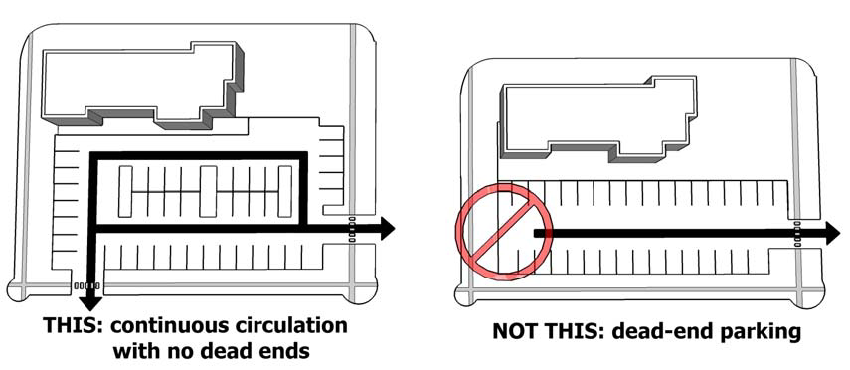
Figure 5.6-C: Example Circulation Area Design
D.
Buffering and Screening; Location of Lot.
1.
Outside Downtown, all parking areas shall be separated at least ten feet from buildings, in order to allow room for sidewalks, landscaping, and other plantings between the building and the parking area. For industrial and warehouse buildings, this separation may be eliminated in the rear of buildings in areas designed for unloading and loading of materials.
2.
Outside Downtown, the visibility of all parking areas shall be reduced by placing 50 percent of the parking to the rear or side of buildings facing public streets. (See Figure 5.6-D.) No more than one two-sided bay of nose-in parking should be placed between the building(s) and the street.
3.
In the Downtown, the visual impact and presence of vehicles shall be minimized by siting parking areas to the rear or interior of the property rather than along street frontage, providing underground and structured parking, and screening parking areas from views both interior and exterior to the site.
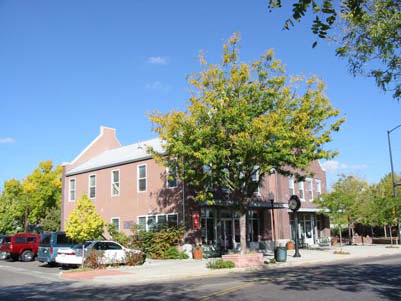
Figure 5.6-D: Example of Parking Located to Side
E.
Parking Area Layout. Surface parking areas shall be divided into sub-areas, each accommodating no more than 250 vehicles. Each parking sub-area shall be separated by a minimum 15-foot wide landscaped feature, which shall include pedestrian walkways and shade features. This technique shall be used to minimize the "sea of parking" between the building and the principle street and to require that the majority of off-street parking be located to the side or rear of the buildings served.
F.
Parking Lot Landscaping. The perimeter and interior of parking lots shall be landscaped pursuant to the requirements in Section 5.4.3 C, Landscaping Inside Parking Areas.
G.
Parking for Single-Family Residential Dwelling Units. This Development Code requires two parking spaces per single-family residential dwelling unit. The on-street parking lane at each lot's street frontage may fulfill the requirement for one parking space, with driveway and garage/carport meeting the additional requirement. Driveways and garage/carport entrances from interior block alleys are preferred. Single-Family Flex development must provide a minimum of 1.5 spaces per unit and one guest parking space for every four units. All parking spaces must be on-site and each unit must have at least one space in a garage. No parking is allowed in the required setbacks of SFF developments.
H.
Shared Access. Parking lots shall share access drives with adjacent property with similar land uses and, when requested by the city, a cross-access easement shall be provided.
I.
Lighting and Maintenance. All parking area lighting shall comply with the city's lighting requirements and provide adequate lighting for safety if night use is intended. Parking lots should provide adequate security and should limit visual clutter, parking lot signs, and equipment.
J.
Parking Structures.
1.
Parking structures located along a public street or public pedestrian thoroughfare shall provide for active uses (other than parking) such as retail storefronts at street level.
2.
Internal circulation and parking levels shall be oriented so that a horizontal, rather than sloped, plane faces public streets. (See Figure 5.6-E.)
3.
Design parking structures to incorporate a comparable level of architectural detailing and quality materials as the primary building.
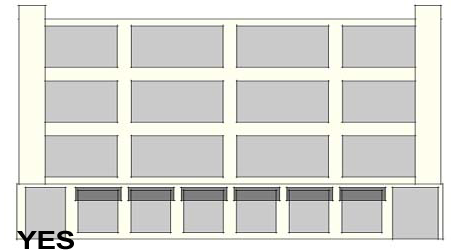
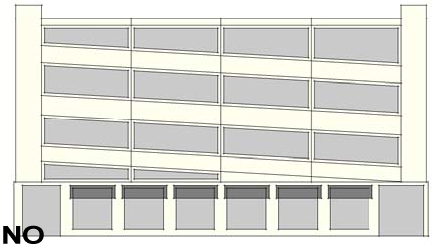
Figure 5.6-E: Parking Garage Design. A sloping approach may be used, but a horizontal plane should face public streets.
5.6.10.
Stacking Spaces for Drive-Through Uses. In addition to meeting the off-street parking requirements of this section, drive-through facilities specified in Table 5.6-6 shall comply with the following minimum stacking space standards unless a separate analysis is submitted confirming the stacking demand will be met with less spaces and approved by the Director or their designee.
(Ord. No. 37-09, § 1, 12-16-2009; Ord. No. 07-22, § 3 (PLZM-21-0060), 4-19-2022; Ord. No. 37-22, § 3(Att.), 12-20-2022; Ord. No. 01-24, § 3(Exh. A, B), 2-20-2024)
5.7. - RESIDENTIAL BUILDING STANDARDS AND GUIDELINES
5.7.1.
Purpose. The standards of this section are intended to promote high-quality residential development and construction; protect property values; encourage visual variety and architectural compatibility; and promote an integrated character for Buckeye's neighborhoods. Specifically, the standards:
A.
Promote new residential developments that are distinctive, have character, and relate and connect to established neighborhoods;
B.
Provide variety and visual interest in the exterior design of residential buildings;
C.
Enhance the residential streetscape and diminish the prominence of garages and parking areas;
D.
Enhance public safety by preventing garages from obscuring main entrances or blocking views of the street from inside residences; and
E.
Improve the compatibility of attached and multi-family residential development with the residential character of surrounding neighborhoods.
5.7.2.
General Standards for All Residential Development.
A.
Mix of Housing Types.
1.
Intent.
a.
To promote a more diverse community through the provision of a variety of housing types.
b.
To encourage developments that are not dominated by a single type of home or dwelling unit, within a narrow range of price points and densities.
c.
To encourage "neighborhood-oriented" multi-family developments that incorporate a variety of housing types, such as a combination of duplex, stacked tri-plex/quad-plex, live-work units, townhomes, apartments, and single-family units in a range of sizes.
2.
Standard. Developers of 20 acres or more shall provide a minimum housing mix of at least three models, with three elevations per model.
B.
Infill Residential Compatibility Standards.
1.
Applicability. These residential infill compatibility standards shall apply to development of a new residential use, or renovation of an existing residential use, either of which is not part of a planned/phased development, on a site that is adjacent to or across a street from two or more lots with existing structures. Manufactured homes which are located outside of manufactured home parks or subdivisions shall comply with the design standards within this section.
2.
Contextual Front Building Setbacks. Notwithstanding the minimum front setback requirements required in Article 4, Dimensional Standards, for the zoning district in which the property is located, the applicant shall use a contextual front setback when existing front setbacks on the same block are less than that required by the underlying zoning. In such circumstance, the front setback for the proposed development shall equal the average of the existing front setbacks on the same and facing block faces. Only lots with similar uses to that proposed shall be included in the average, and vacant lots shall be included using the underlying district standard.
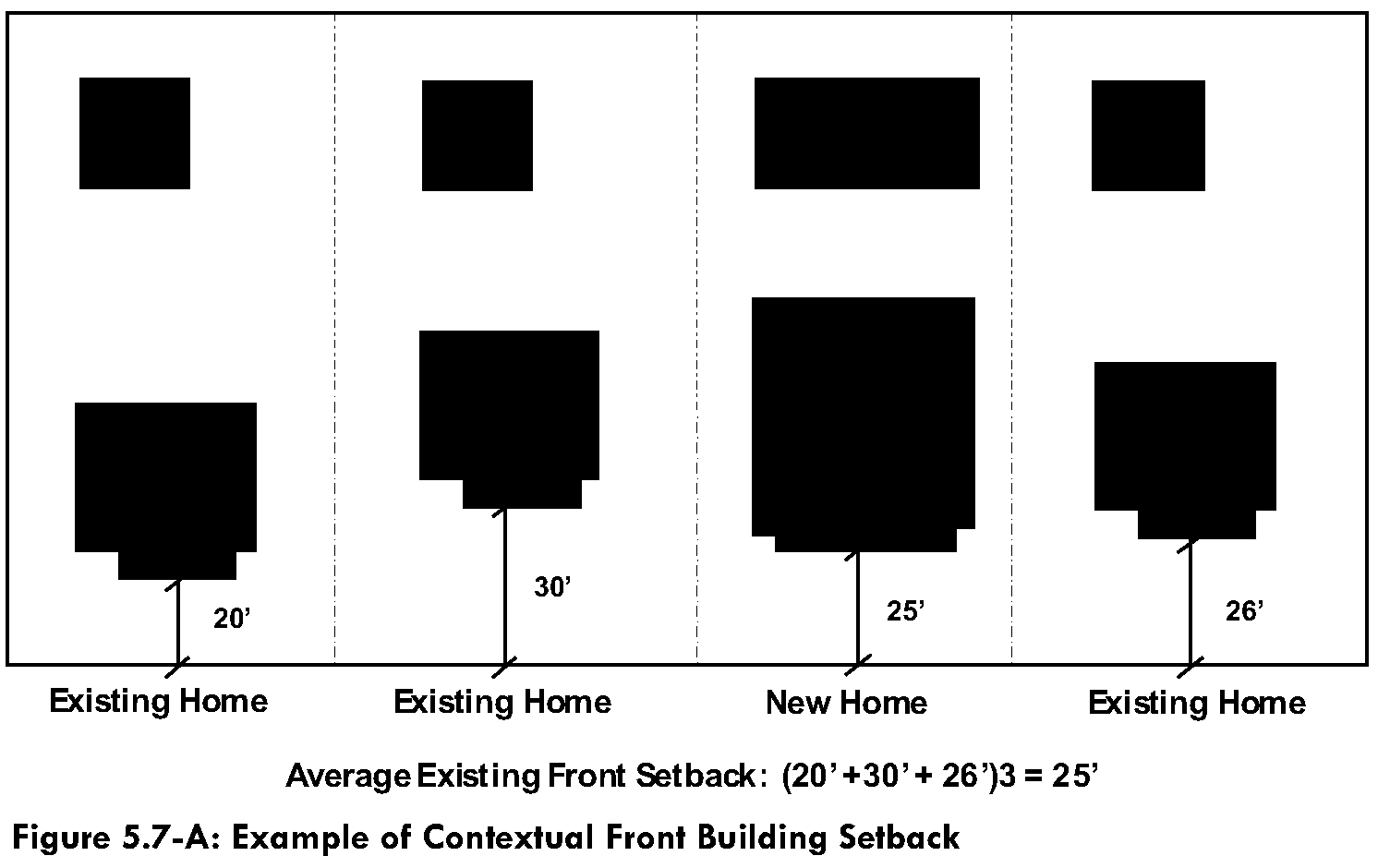
3.
Appearance. New development shall be constructed to be generally compatible in appearance with other existing structures on the block that comply with this Development Code. This provision shall be satisfied by constructing the proposed building so that at least three of the following features are substantially similar to the majority of other buildings on the same and facing block:
a.
Roof material;
b.
Roof overhang;
c.
Exterior building material;
d.
Shape, size, and alignment of windows and doors;
e.
Front porches or porticos;
f.
Exterior building color; or
g.
Location and style of garage/carport.
4.
Accessory Structures. Accessory structures shall be compatible with the associated principal structure in terms of building materials and architectural style.
C.
Maximum Garage Width.
1.
The maximum width of front-loaded garages, including the garage door and architectural elements on each side of the garage door, shall not exceed 30 percent of the overall building façade width on lots of 10,000 square feet or greater; 40 percent of the façade width on lots of between 6,000 and 10,000 square feet; and 50 percent of the façade width on lots of less than 6,000 square feet.
2.
On homes that incorporate an RV garage, the maximum aggregate width of the garage doors attached to the primary residence and facing the front of the lot shall not exceed 45 percent of the overall building façade. Unless the individual doors are separated by four feet, and one of the garage doors is setback at least six feet, in which case the maximum aggregate width shall not exceed 51 percent of the overall building façade.
3.
The maximum number of homes that incorporate an RV garage within a subdivision shall not exceed 45 percent.
5.7.3.
Standards for Single-Family and Two-Family Detached Residential Dwellings.
A.
Purpose. This subsection is intended to promote building design that contributes to a sense of neighborhood and to the overall streetscape by carefully relating buildings, yards, and garages in relation to public streets and adjacent properties. The standards support visual variety, avoid monotony in home designs and layouts, and protect property values of both the subject property and surrounding development. Single-Family Flex Districts are exempt from these requirements but must provide plans and details that are comparable and approved through the Planning and Zoning Commission.
B.
Design Standards.
1.
Orientation of Dwellings to the Street. Each residence shall have at least one primary pedestrian doorway for access to the dwelling located on the elevation of the dwelling facing the front lot line of the property, and clearly visible from the street or public area adjacent to the front lot line. On corner lots, such pedestrian doorway may be located facing any adjacent street.
2.
Architectural Variety.
a.
Design Standards.
i.
No home model elevation, including garage elevation, shall be located adjacent to the same home model elevation or garage elevation.
ii.
All home model designs shall provide a similar level of architectural detailing on all sides.
iii.
All home model elevations shall provide a minimum of three color schemes, consisting of at least three colors each.
b.
Tracking. It shall be the responsibility of the developer to disclose these architectural variety standards to potential home buyers. Failure on the part of the developer to disclose these requirements shall not be grounds for relief from these architectural variety standards as applied to any individual home.
3.
Garages.
a.
Diversity of Garage Location. In all zoning districts except for SF-43, a diversity of garage styles is required. Diversity shall be achieved by providing a variety of the following garage locations:
i.
Alley-loaded garage;
ii.
Side-loaded garage;
iii.
Garage recessed a minimum of four feet behind the front façade of the dwelling portion of the structure;
iv.
Garage that protrudes no more than five feet in front of the dwelling portion of the structure, if accompanied by a porch that extends to the same plane or further;
v.
Garage that is recessed a minimum of two feet beneath a second-floor bay; and
vi.
Garage flush with the dwelling portion of the building.
b.
Three-Car Garage Orientation. The third bay of any three-car garage, except a side-loaded garage, shall not have the same orientation as the first two or shall be offset by two feet when having the same orientation.
c.
Side-Loading Garages. Side-loaded garages shall provide windows or other architectural details that mimic the features of the living portion of the dwelling on the side of the garage facing the front street.
d.
RV Garages. Driveways leading to an RV garage shall include a paver driveway or stained concrete. Additionally, RV garages shall be required to have an exact match to the architecture of the principal structure and be set back a minimum of four feet from the front plane of any livable portion of the principal structure. If the RV garage is not setback from the front plane of the livable portion of the principal structure, the façade shall be articulated such that the façade is made up of at least four distinct sections, all of which must be set back or forward of the adjacent façade by at least three feet.
4.
Alleys.
a.
If a residential unit has alley access to a garage, the front setback of the living portion of the house (but not the garage) may be reduced by ten feet.
b.
If a residential unit is served by an alley, no driveways in the front yard shall be permitted. All vehicular access, including to garages, shall be through the alley.
5.7.4.
Standards for Single-Family Attached Residential.
A.
Purpose. The purpose of these standards is to provide a distinctive architectural character in new single-family attached residential development that avoids featureless design and repetition of façades.
B.
Building Articulation and Architectural Variety.
1.
No more than eight units may be attached in a single row or building cluster.
2.
The building which is the aggregation of up to eight townhouse units shall be given architectural and visual interest through two or more of the following methods:
a.
Providing a projection, recess, or reveal at least every 20 feet, with a minimum change of plane of two feet;
b.
Use of two or more distinct materials on each façade;
c.
Use of distinct features, such as a balcony or similar feature, between individual units;
d.
Use of distinct variations in roof form.
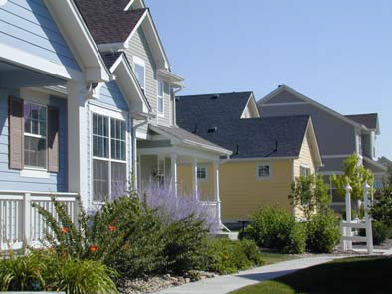
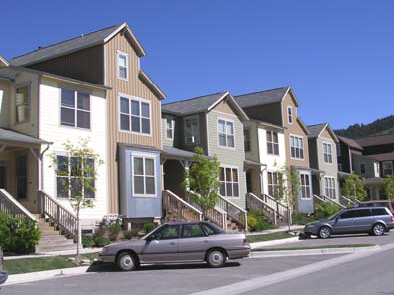
Figure 5.7-B: Examples of Building Articulation and Architectural Variety
C.
Entryway Treatment.
1.
Entrances should be prominent and visible from the street and from parking areas.
2.
The main entry of each unit shall be emphasized by the use of at least two of the following:
a.
A porch or landing;
b.
Double doors;
c.
A roofed structure such as a portico or awning; or
d.
The inclusion of side-lights (glazed openings to the side of the door), and transom-lights (glazed opening above the door) in the entry design.
D.
Garages.
1.
If a development includes alleys, the garages shall be accessed from the alleys, and the front setback may be reduced by ten feet.
2.
If the development does not include alleys, garages on the street-facing side of the building shall occupy no more of the front façade width than as indicated on Table 4.1-1.
5.7.5.
Single-Family Flex.
A.
Purpose. The purpose of these standards is to ensure that Single-Family Flex projects provide quality housing that meets the needs of current and future residents. Residences can be attached townhouses or detached individual buildings/cottages. Maximum of ten attached units allowed before a minimum 20 foot space must be provided.
1.
Units fronting (primary entrance facing) street right-of-way shall landscape the front setback and enter their garage from the rear or side.
2.
A sidewalk should be provided that connects each unit and the public sidewalk.
3.
Units that side on a right-of-way are allowed if unable fit a front facing unit. Landscaping must be provided between the building and the right-of-way.
4.
No garages should face the right-of-way. Entrance to garages should be from an internal road, alley, or driveway.
5.
Access for ingress and egress to an adjacent public right-of-way shall be limited to two locations unless additional access points are required by the Fire Department.
6.
Front, side and rear perimeter setbacks must be landscaped. The setbacks are taken from the perimeter of the project, not individual lots. The minimum number of trees within the landscape areas must be 20 feet on-center or equivalent groupings. Trees must be a minimum of two-inch caliper at time of planting. Five shrubs or groundcover must be provided for each tree (minimum five gallon size).
7.
Solid waste trach collection must not block the accessible routes, including the public sidewalk along the right-of-way. Trash cans shall not be visible from offsite except for trash collection days.
8.
Community open space for the residents must be provided for and shown on the approved Site and Landscape Plans. For every ten units, a space must be provided that is a minimum of 200 square feet in area, accessible to all residents and includes amenities such as a ramada, picnic table, bar-b-que and landscaping. The required setbacks cannot be included in the open space calculation. If less than ten units (or increment), a minimum of 120 square foot community open space must be provided.
5.7.6.
Standards for Multi-Family Residential (Four or Fewer Stories).
A.
Purpose. The purpose of these standards is to improve the appearance of design and functionality of multi-family development, recognizing the importance of design in the economic success of urban areas, the need to be more efficient in the use of land, and the need to ensure the adequate protection of the surrounding area. More specifically, these standards are intended to:
1.
Provide a distinctive architectural character in new multi-family residential developments that avoids featureless design, large building masses, and repetition of façades within a single development;
2.
Promote sensitive design and planning of multi-family housing units that preserves or improves the characteristics of surrounding development; and
3.
Promote building design, placement, and orientation that contributes to a sense of neighborhood and community.
4.
Improve the quality of life of residents of multi-family residential dwellings.
E.
Applicability. All development or substantial renovation of multi-family residential structures of four stories or less shall comply with the standards in this section. In the case of mixed-use buildings, these standards and the standards of Section 5.8, Commercial Building Standards and Guidelines shall both apply.
F.
Building and Parking Location, Layout, and Orientation.
1.
In multi-building developments, the buildings are encouraged to be arranged to enclose and frame common areas. Common areas and courtyards should be convenient to a majority of units.
2.
When more than one multi-family structure is constructed, no multi-family structure shall be located within ten feet of any other multi-family structure.
3.
For purposes of measurement in this subsection, projections such as decks and bay windows shall not be counted.
G.
Parking. In addition to the parking lot landscaping requirements set forth in Section 5.4.3 C, Landscaping Inside Parking Areas, all surface parking shall be:
1.
Separated from any building by a landscaped strip of at least ten feet in width; and
2.
No more than one double-loaded or two single-loaded rows of parking between any building on the site and an adjacent public street.
H.
Building Mass and Articulation.
1.
Each façade greater than 50 feet in length, measured horizontally, shall incorporate wall plane projections or recesses having a depth of at least ten percent of the length of the façade, and extending at least 20 percent of the length of the façade.
2.
The façades of all multi-family buildings shall be articulated through the incorporation of at least three or more of the following:
a.
Balconies;
b.
Bay or box windows;
c.
Porches or covered entries;
d.
Dormers;
e.
Variations in materials;
f.
Variations in roof forms;
g.
Variation in window sizes and shapes; or
h.
Vertical elements that demarcate building modules.
3.
The height of each multi-family building taller than 35 feet shall be stepped down from its highest roofline at least one full story on any end of the building located within 50 feet of a street right-of-way or an adjacent area zoned or used for single-family residential.
I.
Roof Form.
1.
The incorporation of a variety of roof forms is strongly encouraged. Upper-level residential floors may be incorporated into the roof form to reduce the apparent height and mass of buildings.
2.
Multi-family residential buildings shall be designed to avoid any continuous roofline longer than 50 feet. Rooflines longer than 50 feet shall include at least one vertical elevation change of at least two feet.
J.
Façades and Detail Elements.
1.
Highly reflective materials shall not be used in areas where the location of the building will create undue solar, reflective glare on surrounding properties.
2.
Natural, smooth-face CMU shall not be used as a primary exterior finish.
3.
Siding material shall be continued down to finished grade with the following exceptions:
a.
If a secondary wainscot finish precludes this condition; or
b.
If grade dictates a siding transition. If this occurs then the area in question must not exceed 18 inches above grade and must be screened by approved landscaping.
4.
In multi-building complexes, individual building elements shall incorporate various architectural details, color palettes, or building materials different from the adjacent buildings.
K.
Entrances and Porches. Building/development entries shall comply with at least two of the following requirements:
1.
At least one main building entry shall face the primary adjacent public street;
2.
Building entrances face a courtyard that has a direct and visible connection to an adjacent public street;
3.
Building entries are connected to a public sidewalk by walkways that are not routed through a parking lot;
4.
The pedestrian entry to the site from the public right-of-way is emphasized with landscaping, special paving, gateways, arbors, or similar features;
5.
No more than one curb cut per 100 feet of frontage. Shared driveways are encouraged; or
6.
The front entry of any structure shall be emphasized by the use of at least two of the following:
a.
A porch or landing;
b.
Double doors;
c.
A roofed structure such as a portico, awning, or marquee;
d.
The inclusion of side-lights (glazed openings to the side of the door), and transom-lights (glazed opening above the door) in the entry design;
e.
Decorative lighting; or
f.
Enhanced landscaping.
L.
Accessory Elements.
1.
Storage. A multi-family project shall provide covered, enclosed, and secure storage areas for bicycles and other belongings that typically cannot be accommodated within individual dwelling units. Storage and other accessory buildings shall be designed with materials and/or architectural elements that are related to the principal building(s).
2.
Trash Receptacles/Dumpsters. Dumpsters shall not be allowed in developments or sites with six or fewer dwelling units. Developments or sites with six or fewer units shall provide covered storage for trash receptacles. Such storage shall not be located between any building and the primary adjacent street frontage.
M.
Garages.
1.
Attached or Detached Garages. Garage entries and carports shall not be located between a principal multi-family building and a required street frontage, but shall instead be internalized in building groups so that they are not visible from adjacent streets.
2.
Size. Garage and carport structures shall be limited to eight spaces per structure to avoid a continuous row of garages. No more than eight garage doors may appear on any multi-family building elevation containing front doors, and the plane of each garage door shall be offset at least two feet from the plane of the garage door adjacent to it.
3.
Design. Detached garages and carports shall be integrated in design with the principal building architecture, and shall incorporate similar and compatible forms, scale, materials, color, and details.
4.
Parking Structures. Underground parking, structured parking, and parking within, above, or beneath the building it serves are all strongly encouraged for multi-family developments.
5.7.7.
Standards for Multi-Family Residential (More Than Five Stories). All multi-family residential dwellings that are five stories or greater in height shall comply with the Development Standards for commercial buildings set forth in Section 5.8, Commercial Building Standards and Guidelines.
(Ord. No. 37-09, § 1, 12-16-2009; Ord. No. 18-17, § 6, 7-5-2017; Ord. No. 09-18, § 2(Att. § 5), 3-6-2018; Ord. No. 15-20, § 3, 9-15-2020; Ord. No. 07-22, § 3 (PLZM-21-0060), 4-19-2022; Ord. No. 01-24, § 3(Exh. A, B), 2-20-2024)
5.8. - COMMERCIAL BUILDING STANDARDS AND GUIDELINES
5.8.1.
General Intent. The intent of this section is to establish design and development standards that foster high-quality, attractive, and sustainable development that is compatible with the City's General Plan principles and policies. The standards are intended to:
A.
Protect and enhance the character and quality of residential, commercial, and industrial areas in Buckeye;
B.
Protect and enhance the long-term market value of property within Buckeye;
C.
Enhance the human and pedestrian scale of commercial and industrial developments and ensure compatibility between residential neighborhoods and adjacent commercial and industrial uses;
D.
Mitigate negative visual impacts arising from the scale, bulk, and mass of large buildings and centers;
E.
Promote building designs and construction practices that are sustainable and adaptable to multiple uses for extended building lifecycles;
F.
Minimize negative impacts of on-site activities to adjacent uses; and
G.
Balance the community's economic and aesthetic concerns.
5.8.2.
Site Design.
A.
Purpose. Site design standards and guidelines address a development's relationship to its surrounding natural features and development patterns. They also address the relationship between key elements within the site. Careful site design is critical to the success of commercial projects and the standards and guidelines of this section should be considered at the outset, and throughout, the design process. The standards and guidelines of this section are intended to:
1.
Ensure development relates to the physical characteristics of the site;
2.
Ensure building scale, orientation, and design relates to the surrounding uses and streets, and creates a cohesive visual identity and an attractive street scene;
3.
Ensure site design for efficient pedestrian, bicycle, transit, and vehicular circulation patterns, and create a high-quality pedestrian environment;
4.
Promote design environments built to human scale;
5.
Ensure delivery, trash, and loading facilities are located so as not to impede regular vehicular and pedestrian circulation and access routes; and
6.
Ensure safe and efficient access between buildings and parking areas.
B.
Building Orientation.
1.
Intent. To ensure that buildings are orientated to emphasize public spaces, with entryways clearly visible from key locations, because the location and orientation of individual buildings within the network of streets, pedestrian connections, and open spaces on a site largely establishes the character of a development.
2.
Primary Entrance. Orient buildings so that the principal building entrance faces the principal street or the street providing main access to the site. In cases where the principal entrance does not face the principal street, connect the entrance to the street and adjacent parking areas with sidewalks that meet the shading requirements of Section 5.2, Topography and Natural Features Preservation.
3.
Building Locations (Multi-Building Developments). Arrange and group buildings within developments that have three or more buildings using one or more of the following techniques:
a.
Frame the corner of an adjacent street intersection or entry point to the development; or
b.
On sites of 15 acres or more, frame and enclose a "main street" pedestrian and/or vehicle access corridor within the development; or
c.
Frame and enclose parking areas on at least two sides; or
d.
Frame and enclose outdoor dining and/or outdoor gathering spaces between buildings. (See Figure 5.8-A for examples.)
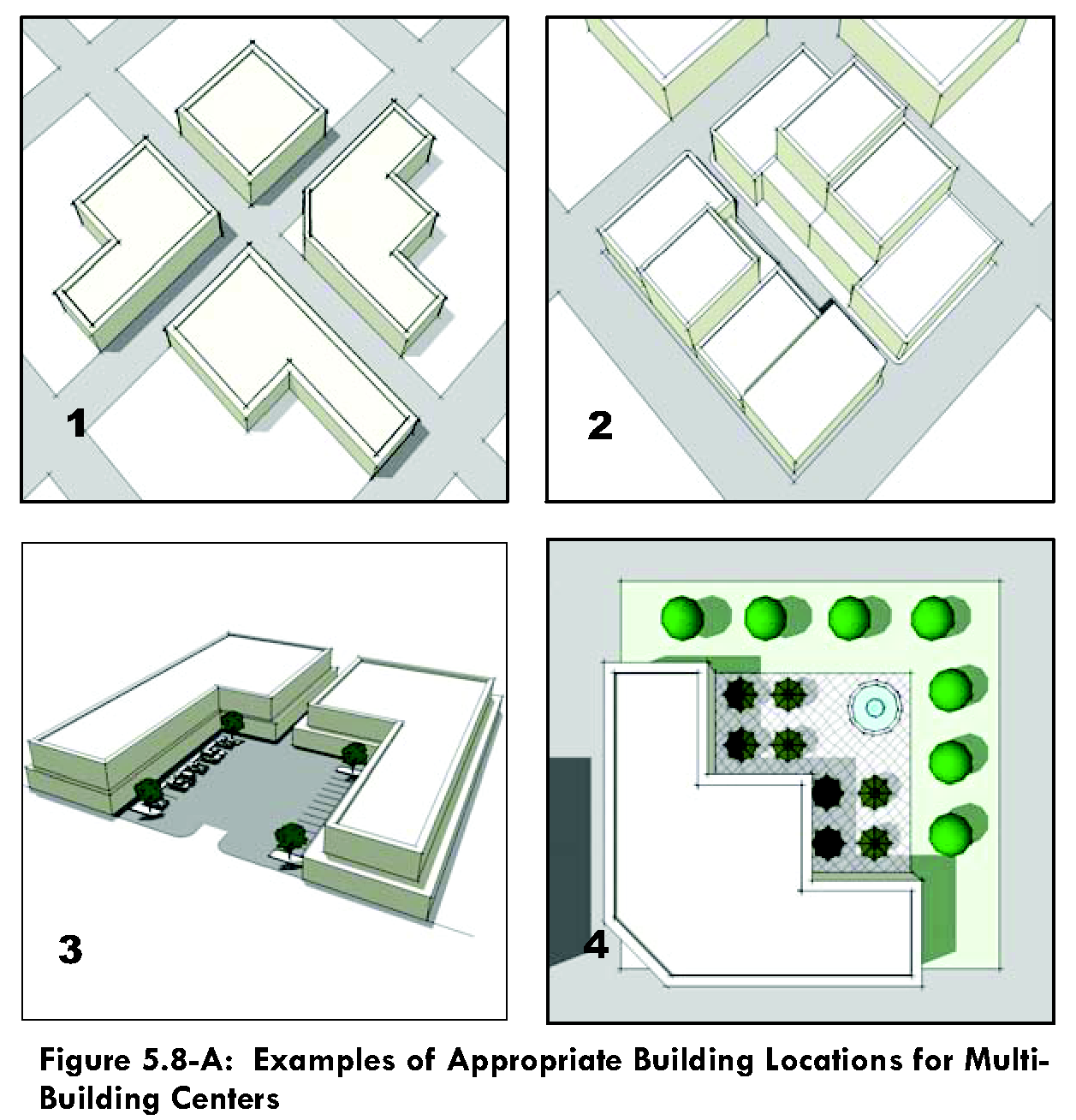
(1) Framing street intersections or entryways; (2) framing an interior "Main Street"; (3) framing a parking area on at least two sides; and (4) framing an outdoor dining area or gathering space.
4.
Guideline. Buckeye's desert setting requires careful siting of buildings in order to mitigate the summer heat. Buildings should be oriented and grouped to provide shading for outdoor spaces — for example, by locating outdoor gathering spaces on the north and east sides of buildings under shade devices such as awnings.
C.
Outdoor Gathering Spaces.
1.
Intent. To ensure open air or semi-enclosed public gathering spaces connecting different land uses and providing focal points and anchors emphasizing pedestrian scale and focus. (See Figure 5.8-B.)
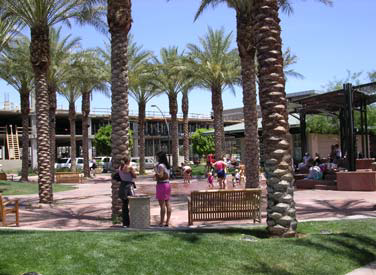
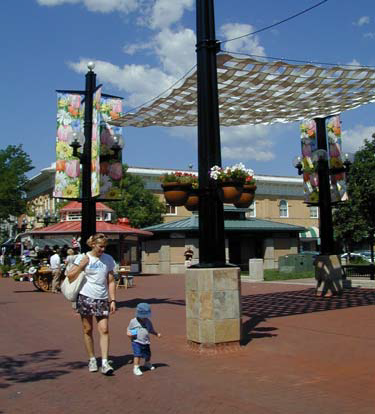
Figure 5.8-B: Examples of Outdoor Gathering Spaces
2.
Definition. For purposes of this section, an outdoor gathering space is an open or partially open area intended for the benefit of residents, employees, or visitors to a site. An outdoor gathering space required by this section shall be credited toward any applicable open space requirements, provided such gathering space meets applicable open space standards. The following shall not be counted toward any requirement of this section:
a.
Private yards;
b.
Public or private streets or rights-of-way;
c.
Parking areas and driveways.
3.
Standards. Developments on sites of 15 acres or larger shall devote a minimum of two percent of the net site area to an outdoor gathering place that:
a.
Is integrated as part of the overall design of the site and located in an area that provides benefit to a large number of users, and helps establish or improve functional relationships and linkages within a site or between adjacent sites. Potential locations include near anchor tenants, transit stops (if applicable), as a centralized site feature, or as a continuation of an adjacent natural area, trail, or riparian corridor;
b.
Is designed as a single, contiguous space, rather than multiple smaller spaces;
c.
Incorporates a minimum of five of the following pedestrian-scaled features:
i.
Lighted bollards;
ii.
Movable tables and chairs;
iii.
Benches;
iv.
Seat walls and/or raised Landscape Planters;
v.
Shade trees;
vi.
Pots or hanging baskets filled with seasonal plant material;
vii.
Information kiosks;
viii.
Stage, amphitheater, or other performance space; and
ix.
Sculptures or other public art features;
d.
Integrates landscaping and/or structures to provide shading for outdoor gathering spaces, particularly those with a southern or western exposure. The shading may be freestanding or integrated with the adjacent building;
e.
Provides direct access to sidewalks and pedestrian walkways; and
f.
Is maintained by the owners of the development, unless otherwise agreed to as part of the development approval process.
4.
Guidelines.
a.
For sites smaller than 15 acres, provide outdoor gathering spaces by expanding pedestrian walkways along the front or side of the building with awnings, arcades, trees, or other types of shade structures.
b.
Provide outdoor dining areas within plazas and along the perimeter of open spaces, building frontages, and street frontages. Outdoor dining areas should be oriented away from off-site uses affected by noise.
D.
Drive-Through Facilities.
1.
Intent. To ensure drive-through facilities are located, designed, and screened to minimize visibility from public streets and impacts on the site and adjacent properties.
2.
Standards.
a.
For restaurants with drive-through facilities, provide a minimum of eight stacking spaces (measuring a minimum of nine feet by 20 feet for each stacking space), with no less than four spaces located between the street and the order box and four spaces located between the order box and the pick-up window. (See Figure 5.8-C.)
In order to evaluate a proposed project's compliance with the design criteria, the Zoning Administrator or City Engineer may require submittal of a drive through cueing study that substantiates the basis for granting a specific number of drive through spaces.
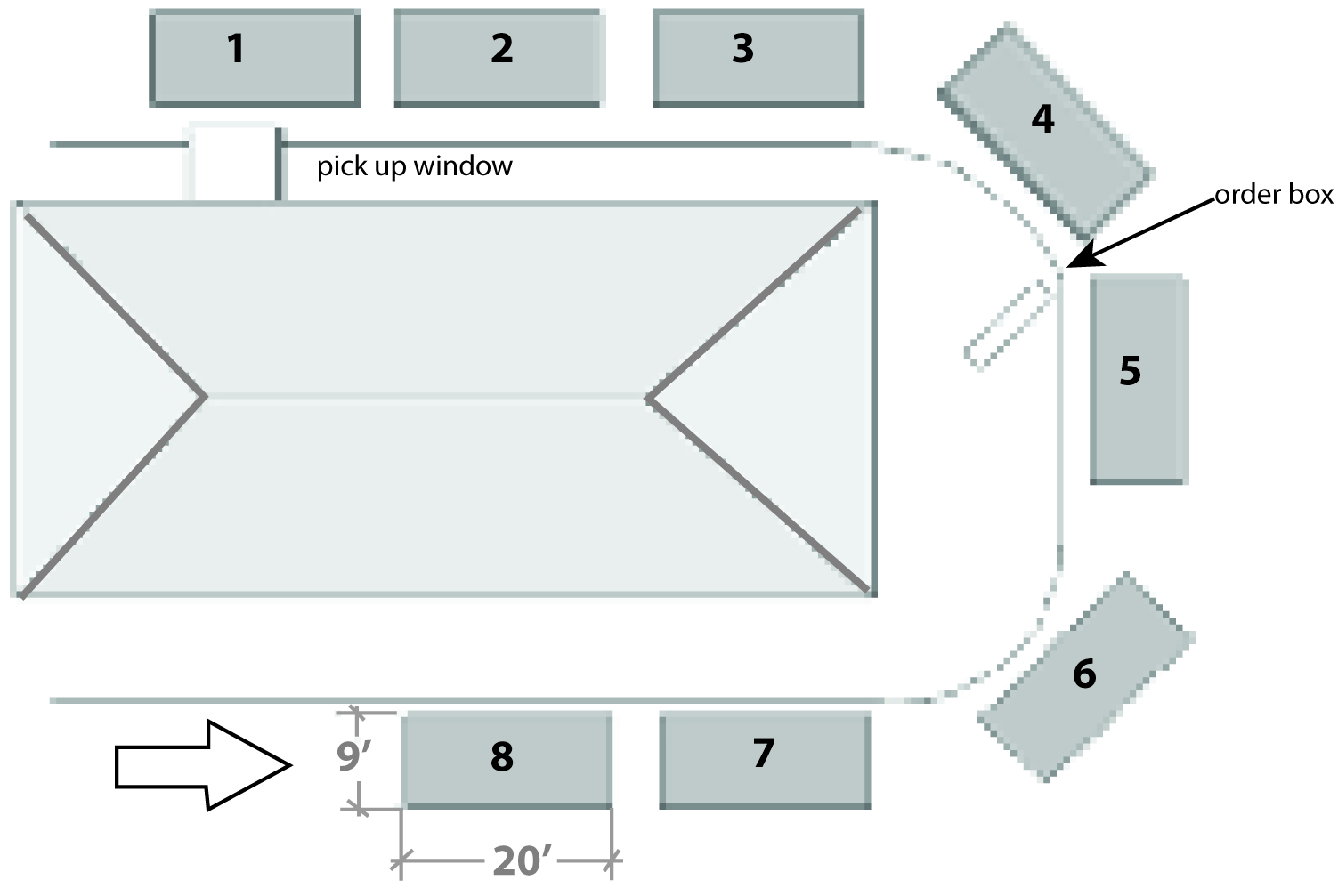
Figure 5.8-C: Stacking Spaces
b.
For other uses with drive-through facilities, provide a minimum of two stacking spaces (measuring a minimum of nine feet by 20 feet for each stacking space) located between the service window and the street.
c.
Locate stacking spaces for drive-through facilities so that waiting vehicles do not block parking stalls or interfere with the movement of traffic (on- or off-site) or pedestrians.
d.
Use landscaping to screen drive-through windows and order boxes on building façades facing the principal street.
3.
Guidelines.
a.
Design drive-through windows to incorporate architectural coverings consistent with the design of the buildings in order to break up the building mass.
b.
Design architectural coverings for drive-through windows to provide shade and shelter for drive-through customers; examples include canopies, trellises, porte cocheres, or other similar devices.
E.
Refuse Service. All commercial or industrial development shall provide one or more sites for solid waste collection. Such sites shall be:
1.
Located so as to facilitate collection and minimize any negative impact on persons occupying the development site, neighboring properties, or public rights-of-way; and
2.
Constructed according to specifications established by the Public Works Director to allow for collection without damage to the development site or collection vehicle.
5.8.3.
Building Design.
A.
Purpose. Building design directly impacts the character and function of commercial development. The standards and guidelines of this section are intended to:
1.
Ensure that multi-building or phased commercial developments use compatible schemes of materials, colors, and architectural vocabulary to ensure consistency;
2.
Ensure building materials are durable and have low maintenance requirements in the desert environment;
3.
Ensure buildings are designed to a human scale;
4.
Ensure design that is sensitive to the desert climate;
5.
Encourage sustainable development by limiting the amount of resources necessary to construct and operate buildings and by designing buildings to be adaptable for multiple uses; and
6.
Require buildings that incorporate standardized formulas or market prototypes to meet a higher level of building design.
B.
Architectural Character.
1.
Intent. To ensure architectural compatibility in keeping with Buckeye's heritage, the city's location in the desert, and discouraging standardized prototypes.
2.
Standards.
a.
Four-Sided Design. Incorporate architectural detailing on all sides of a building that reflects the front façade. Blank walls void of architectural details or other variation are prohibited.
b.
Exterior Trademarked Design Features. For each building with exterior trademarked architectural design features located 12 feet or more above finished grade, including trademarked roof and parapet design features but not including signs, provide a higher level of building design by meeting the following additional requirements:
i.
Section 5.8.3.D.2.a, Horizontal Articulation: meet four or more of the listed standards; and
ii.
Section 5.8.3.E.2.a, Primary Building Entrance: meet four or more of the listed standards.
3.
Guideline: Theming. Organize the architectural design of buildings within a commercial center, including freestanding pad buildings, around a consistent architectural theme. Precise replication is not required or desirable. Instead, use similar materials, textures, and colors, along with repeating patterns and compatible proportions and scale, to reinforce the connections between the various buildings.
C.
Response to the Sonoran Desert Environment.
1.
Intent. To ensure that the building designs are compatible with the desert environment.
2.
Standards.
a.
Provide shaded sidewalks, as defined in this ordinance, along at least 50 percent of all building façades adjacent to or facing streets, outdoor gathering spaces, or parking areas. (See Figure 5.8-D.)
b.
Shaded sidewalks shall constitute a minimum of 30 percent of the sidewalks within the site.
c.
Orient building to minimize direct solar exposure on primary building façade and areas of high pedestrian activity.
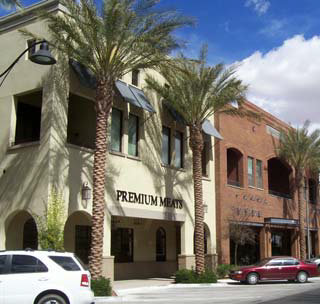
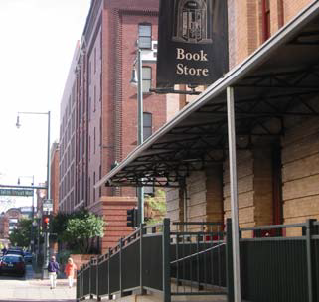
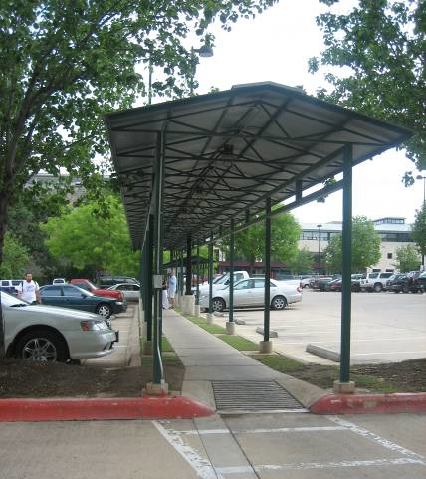
Figure 5.8-D: Examples of Shaded Sidewalks
3.
Guidelines.
a.
Contextual References. Include features typical of Buckeye's farming and ranching heritage and the desert environment in the building design, such as, but not limited to:
i.
Architectural shade devices;
ii.
Low-slung buildings with a strong, horizontal orientation;
iii.
Deeply recessed windows;
iv.
Covered porches or arcades; and
v.
Shed roof forms.
b.
Sustainable Design. To the maximum extent practicable, new buildings are encouraged to incorporate one or more of the following features:
i.
Opportunities for the integration of renewable power in the design of buildings or sites. Renewable power may be derived from solar, wind, geothermal, biomass, or low impact hydro sources.
ii.
Energy-efficient materials, including recycled materials that meet the standards of Section 5.8.3.f, Architectural Details, Materials, and Colors, in the building design.
iii.
A sustainable roof.
iv.
Generally accepted sustainable design features and practices.
D.
Building Mass.
1.
Intent. To ensure that buildings are designed to avoid long, unbroken walls and roof lines, and incorporate sufficient architectural detail to create a human-scaled environment.
2.
Standards.
a.
Horizontal Articulation. Design buildings to reduce apparent mass by dividing façades into a series of smaller components. (See Figure 5.8-E.) No individual component shall have a length of more than 60 feet. Distinguish components from one another through two or more of the following:
i.
Variations in roof form or variations in roof height of two feet or more;
ii.
Changes in wall plane of 12 inches or more;
iii.
Variations in the arrangement and recessing of windows;
iv.
Recognizable changes in texture, material, or surface colors;
v.
Engaged columns; or
vi.
Minimum two-foot parapet return.
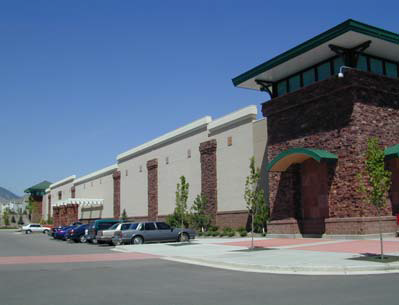
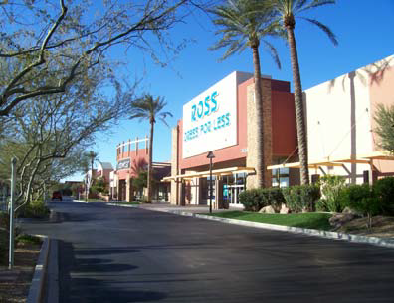
Figure 5.8-E: Examples of Horizontal Articulation
b.
Vertical Articulation. Design buildings to reduce apparent mass by including a clearly identifiable base, body, and top, with horizontal elements separating these components. The component described as the body must constitute a minimum of 50 percent of the total building height. (See Figure 5.8-F.)
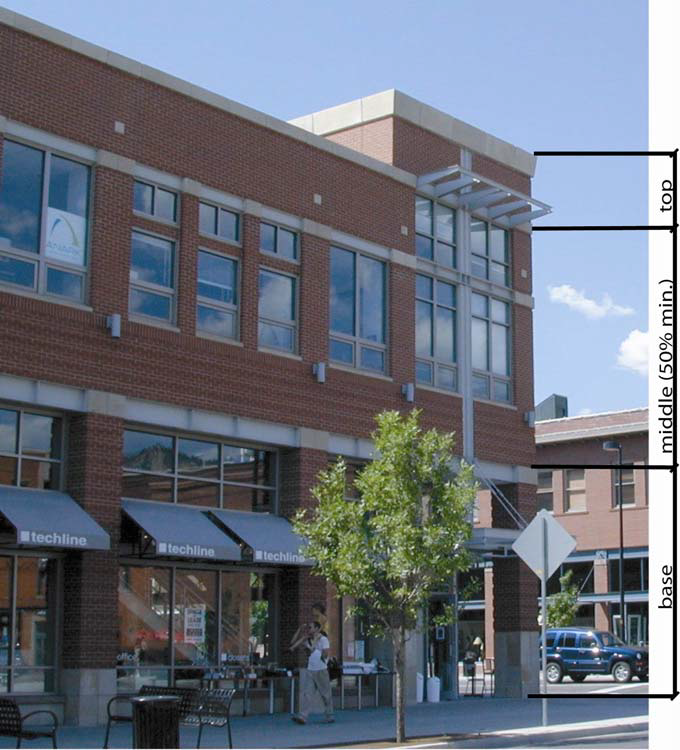
Figure 5.8-F: Example of Vertical Articulation
3.
Guidelines. Incorporate other techniques to further divide large building façades, including:
a.
In large stores with internal functions (e.g., coffee shop, deli, florist), provide a minor storefront with a separate entrance.
b.
Provide multiple entrances for large uses (e.g., groceries, department stores, warehouse stores).
E.
Design for Pedestrians.
1.
Intent. To ensure that buildings are designed for pedestrian scale and pedestrian-oriented accesses.
2.
Standards.
a.
Primary Building Entrance. Design visually prominent primary building entrances. Provide shade for pedestrians. Unless otherwise provided in this ordinance, use a combination of two or more of the following techniques:
i.
Canopy, portico, archway, arcade, or similar projection that provides architectural interest and protection for pedestrians;
ii.
Prominent tower, dome, or spire;
iii.
Peaked roof;
iv.
Projecting or recessed entry;
v.
Outdoor features, such as seat walls, landscaping with seasonal color, or permanent Landscape Planters with integrated benches; or
vi.
Other comparable techniques.
b.
Transparency.
i.
In Downtown Buckeye, on the façade facing the principal street:
(1)
At least 30 percent of the ground floor wall area between two and ten feet above grade shall consist of transparent glazing;
(2)
At least 20 percent of each upper floor wall area shall consist of transparent or nontransparent glazing.
(3)
If a single-story building has a façade taller than 20 feet, the façade area above 15 feet is subject to the same window requirement as the second-floor requirement in paragraph b.
ii.
For all commercial buildings with 70,000 square feet or more of gross floor area, at least 15 percent of the façade facing the principal street shall consist of transparent or nontransparent glazing. For all other commercial buildings, at least 30 percent of the façade facing the principal street shall consist of transparent or nontransparent glazing.
iii.
Glazing required by this ordinance should be concentrated in areas of high pedestrian activity and, to maximize energy efficiency, should be used in conjunction with shade features required and encouraged by Section 5.8.3.C, including awnings, shaded sidewalks, deeply recessed windows, and covered porches or arcades.
iv.
Except as otherwise permitted in this section and in Section 5.11, Signs, transparent glazing required by this ordinance must be maintained without interior or exterior obstructions that substantially limit visibility, including, but not limited to, window signs, interior shelving, or window coverings (except window blinds) during hours of business operation. This section shall not apply to signage, shelving, displays, or the like, set back at least three feet from the glazing surface.
c.
Pedestrian Amenities. Ground-floor façades that face public streets or other public areas (e.g., outdoor gathering spaces, parks or open space, parking areas) shall incorporate pedestrian-oriented design features along no less than 60 percent of their horizontal length. Pedestrian-oriented design features may include arcades, display windows, entryways, awnings, or other features. Shaded sidewalks required by Section 5.8.3.C that are part of the building design may be credited toward this standard, as well.
F.
Architectural Details, Materials, and Colors.
1.
Intent. To ensure that developments utilize materials of high quality and durability appropriate to the desert climate.
2.
Standards.
a.
Permitted Wall Materials. The following materials are permitted for use on exterior building walls, individually or in combination:
i.
Brick;
ii.
Stone (natural or simulated);
iii.
Painted, stained, or integrally-colored concrete masonry units (CMU), split face or ground face;
iv.
Textured tilt-up concrete panels, with or without reveals;
v.
Stucco;
vi.
Exterior insulation and finish systems (EIFS);
vii.
Clear and tinted glass;
viii.
Tile;
ix.
Wood; and
x.
Architectural metal.
Other materials may be used provided they are of comparable quality, durability, and character, as determined by the Director.
b.
Accent Wall Materials. A minimum of ten percent and a maximum of 25 percent of the exterior building wall facing the principal street (not including windows and doorways) shall consist of an accent material from the list in subsection a. that is different than the remainder of the building façade material.
c.
Prohibited Wall Materials. The following materials are prohibited:
i.
Un-textured tilt-up concrete panels (acceptable for industrial buildings);
ii.
Prefabricated steel panels (acceptable as an accent element);
iii.
Corrugated metal (Corten or rust finish acceptable as an accent element);
iv.
Mirrored or otherwise highly reflective glass.
d.
Roof Materials. Flat roofs, standing seam metal roofs, and concrete and clay tile roofs are permitted. Asphalt shingle roofs are not permitted.
e.
Exterior Building and Roof Colors. Select materials and colors that are abundant in the Sonoran Desert environment.
f.
Metal Finishes.
i.
Paint metal within the color range described in paragraph E. or leave it in a natural state to derive its character from weathering and oxidation.
ii.
Bright or highly reflective metal finishes are prohibited.
(Ord. No. 37-09, § 1, 12-16-2009; Ord. No. 07-22, § 3 (PLZM-21-0060), 4-19-2022)
5.9. - INDUSTRIAL BUILDING STANDARDS AND GUIDELINES
5.9.1.
General Intent. To encourage high-quality design appropriate for industrial uses while promoting economic development, protecting adjacent uses, and fostering a positive image for the community.
5.9.2.
Standards.
A.
Site Design. The standards and guidelines in Section 5.8.2 B, Building Orientation, of this Development Code shall apply to development of any industrial use.
B.
Building Design. The standards and guidelines of the following sections shall apply to development of any industrial use.
1.
Section 5.8.3.B: Architectural Character;
2.
Section 5.8.3.D: Building Mass;
3.
Section 5.8.3.E.2.a: Primary Building Entrance; and
4.
Section 5.8.3.F: Architectural Details, Materials, and Colors.
(Ord. No. 37-09, § 1, 12-16-2009; Ord. No. 07-22, § 3 (PLZM-21-0060), 4-19-2022)
5.10. - EXTERIOR LIGHTING
5.10.1.
General Intent. To establish outdoor lighting standards and guidelines that balance safety and aesthetics while encouraging nighttime illumination that minimizes impacts on surrounding neighborhoods and the night sky. Lighting should be designed to minimize energy usage.
5.10.2.
Standards.
A.
Conformance with State and Local Requirements. All lighting shall be designed to conform to the standards of the state "dark skies" requirements as set forth in A.R.S. § 49-1101 et seq., and the requirements set forth in this section.
B.
Submission of Plans and Evidence of Compliance. A description of all lighting fixtures, both proposed and those that will remain on the site, as well as any existing or proposed fixtures to be located in adjacent rights-of-way after completion of the project, shall be provided with the development application. The description may include, but is not limited to, catalog cuts and illustrations by manufacturers that demonstrate compliance with the standards of this section. The description shall address lighting to be used during regular business hours, as well as security lighting during nonoperating hours.
C.
Design Standards. Exterior lighting is required for the purposes of public safety. All exterior lighting shall meet the following design standards:
1.
Light sources shall be concealed or shielded with full cut-off luminaries to minimize the potential for glare and unnecessary diffusion on adjacent property.
2.
Parking lots and other background spaces shall be illuminated as unobtrusively as possible while meeting the functional needs of safe circulation and protection of people and property. Foreground spaces, such as building entrances and outside seating areas, shall utilize local lighting that defines the space without glare. Up-lighting (including floodlighting) shall not be utilized to illuminate all or any portion of a building façade; down-lighting is acceptable.
a.
All outdoor light not necessary for security purposes shall be reduced, activated by motion sensor detectors, or turned off during nonoperating hours.
b.
Light fixtures used to illuminate flags, statues, or any other objects mounted on a pole, pedestal, or platform shall use a narrow cone beam of light that will not extend beyond the illuminated object.
3.
The style of light standards and fixtures shall be consistent with the style and character of architecture proposed on the site.
4.
Unless otherwise provided in this ordinance, exterior lighting shall not add more than one footcandle to illumination levels at any point off-site.
5.
For upward-directed landscape and decorative lighting, direct light emissions shall not be visible above the building roof line.
6.
No flickering or flashing lights shall be permitted, except for temporary decorative seasonal lighting.
D.
Exempt Lighting. The following types of lighting are exempt from the requirements of this section.
1.
Soffit or wall-mounted luminaires that are permanently attached to single-family residential dwellings, not to exceed the height of the eave.
2.
Public street and right-of-way lighting.
3.
Temporary decorative seasonal lighting provided that individual lamps have a light output of 200 lumens or less.
4.
Temporary lighting for emergency or nighttime work and construction.
5.
Temporary lighting for theatrical, television, and performance areas or for special events authorized through a permit.
6.
Lighting for a special district, street, or building that, according to an adopted municipal plan or ordinance, is determined to require special lighting aesthetics as part of its physical character.
7.
Lighting required and regulated by the Federal Aviation Administration.
8.
Lighting for outdoor recreational uses such as ball diamonds, playing fields, tennis courts, and similar uses, provided that such uses comply with the following standards:
a.
Maximum permitted light post height: 80 feet.
b.
Maximum permitted illumination at the property line: two footcandles.
c.
Limits on hours of illumination: exterior lighting shall be extinguished no later than 11:00 p.m. An exception may be granted by the City Council, without recommendation from the Planning and Zoning Commission, for tournament activities.
E.
Prohibited Lighting. Mercury vapor light sources, searchlights, and strobe/flashing lights are prohibited.
(Ord. No. 37-09, § 1, 12-16-2009)
5.11. - SIGNS
5.11.1.
Title and Authority.
A.
This section of the Buckeye Municipal Code may hereafter be referred to as the "City of Buckeye Sign Code" or "Sign Code."
B.
This section is adopted pursuant to the police power of the city and state law (A.R.S. § 9-462.01.A.2), and the Development Services Director, or their designee is authorized and directed to administer and enforce this section.
5.11.2.
Purpose and Intent.
A.
The purpose of this section is to provide standards for signs that encourage the development of private property in harmony with the desired character of the city as well as enhance the safety and enjoyment of travel, by the appropriate sizing and placement of signs along public streets.
B.
The city intends to allow adequate communication through signage while encouraging aesthetic quality in the design, location, and size of all signs by:
1.
Allowing adequate signage for business identification while meeting public and private objectives by establishing limitations on signs in order to ensure they are appropriate to the land, building, or use that is applicable.
2.
Promoting the free flow of traffic, while protecting pedestrians and motorists from injury and property damage that may be caused by cluttered or distracting signage;
3.
Promoting the use of signs that are well designed, of appropriate scale, structurally sound, and integrated with surrounding buildings and landscape in order to meet the community's desire for quality development;
4.
Protecting property values, the local economy, and the quality of life through regulations that are intended to preserve and enhance the appearance of the streetscape that affects the image of the city;
5.
Providing for adequate wayfinding through and within the city through regulations that are intended to aid motorists and pedestrians in navigating to local businesses and other points of interest safely; and
6.
Promoting the health, safety, and general welfare of the citizens of the city.
5.11.3.
Applicability. The provisions of this section apply to all incorporated areas within the city and shall supersede all previous sign codes and references thereto adopted by the Buckeye City Council as of the effective date of the ordinance from which this section derived, except that where such land is subject to an approved Comprehensive Sign Program (CSP) existing at the time of the adoption of this chapter, the time, place, and manner provisions of said CSP shall apply. Whenever an approved CSP is silent on a matter relating to signage, the provisions of this chapter shall to the extent that such provisions are not in conflict with the provisions of the approved CSP.
The provisions of this section will not apply to regulatory signage in the rights-of-way.
5.11.4.
First Amendment Interpretation and Severability. This chapter must be interpreted in a manner consistent with the First Amendment guarantee of free speech. If any provision of this chapter is found by a court of competent jurisdiction to be invalid, such finding shall not affect the validity of other provisions of this chapter which can be given effect without the invalid provision.
5.11.5.
Viewpoint Neutrality.
A.
Notwithstanding anything in this section to the contrary, no sign or sign structure shall be subject to any limitations based upon the viewpoint of the message contained on such sign or displayed on such sign structure.
B.
Notwithstanding anything in this section to the contrary, the city shall regulate signs in a manner that does not favor commercial speech over noncommercial speech and does not regulate protected noncommercial speech by message content.
5.11.6.
Exempt Signs. The placement of signs, except as listed below, shall require a Sign Permit issued by the city. The following types of signs are exempt from the planning process and from obtaining a permit unless otherwise noted. All temporary standalone signs will be reviewed by the building safety department to determine if a Building Permit is required.
A.
Signs protected by state statute;
B.
Governmental signs, including signs erected by the city, for governmental purposes;
C.
Directional and traffic signs in accordance with the Public Works Director's authority in Chapter 19, Section 19-1;
D.
Window signs not exceeding 20 percent of the window area;
E.
Signs not visible from off property or business;
F.
Signs pertaining to the lease, sale, or rental of land or buildings, the size of which are six square feet or less for parcels up to five acres and 24 square feet or less for parcels more than five acres;
G.
Temporary signs approved as part of an approved Temporary Use Permit; and
H.
Lawful temporary event signage:
1.
Defined. A lawful temporary event is defined as a use of land that is permitted by and in accordance with Section 3.4 of the Buckeye Municipal Code. For purposes of this section, the following uses are also considered lawful temporary events:
a.
Real estate open houses occurring within lands zoned for residential uses.
b.
Assembly uses where events are held on lands zoned for residential uses, but where the primary use established for said land is that of a public school, private school, or charter school, or other community facility, or public meeting hall.
2.
Size. A temporary, portable sign generally in the shape of the letter "A" in which the overall height of the sign structure does not exceed 30 inches, the overall width of the sign structure does not exceed 30 inches and which does not exceed eight square feet of aggregate sign area. Riders not exceeding six inches in height and 24 inches in length which are attached to the top of the A-frame shall not be included in the overall height measurement or sign area measurement.
3.
Placement.
a.
Lawful temporary event signage may be placed in the following locations when in association with a lawful temporary event occurring on land zoned for single-family residential uses:
i.
One sign at the site of the lawful temporary event.
ii.
One sign at each local or collector street intersection leading from the site of the lawful temporary event to the adjacent arterial street grid.
iii.
Two signs at the point where the local or collector street intersects with the arterial street. One sign may be located at the corner of the intersection on the side of the arterial street closest to the lawful temporary event. A second sign may be located on the opposite side of the arterial street.
b.
When allowed, lawful temporary event signage may be located within the street right-of-way, but not within any median, vehicle or bicycle travel lane, or sidewalk, nor within any sight visibility triangle. Signage located within the right-of-way is subject to an encroachment permit as described in Chapter 19, Article 19-2.
c.
The sign may be weighted or ballasted; however, no such sign may be affixed to the ground or to any permanent structure.
5.11.7.
Prohibited Signs. With the exception of temporary signs as described in Section 5.11.9 and sign walkers as regulated by A.R.S. § 9-499.13, the following types of signs are prohibited:
A.
Flashing, moving, animated, coursing, blinker, racer-type, intermittent, rotating, moving or revolving signs and/or devices, whirligig devices, inflatable signs and tethered balloons, pennants, ribbons, streamers, spinners, and other types of attention-getting devices, except for changeable copy signs when in compliance with the applicable regulations in this section.
B.
Pylon or pole-mounted signs, except as provided in Section 5.11.8, Dimensional Standards.
C.
Sandwich board signs, portable signs, and outdoor banners.
D.
Roof-mounted signs or signs projecting above the roof line of a building.
E.
Signs placed within the public right-of-way.
F.
All signs mounted on, or applied to trees, utility poles, or public structures, except as otherwise provided.
G.
Any sign determined to be a safety hazard to the flow of traffic.
H.
Billboard or off-site advertising signs, except for those signs set forth in Section 5.11.10 and Section 5.11.12.
I.
Commercial signs remaining at an abandoned or vacant building for a period exceeding 180 days.
J.
Vehicle signs or signs mounted, attached, or painted on trailers, boats, or motor vehicles primarily or consistently parked, stored, or displayed in a manner intended to attract the attention of the public for advertising purposes.
5.11.8.
Dimensional Standards.
A.
Freestanding Sign Dimensions. Signs shall not exceed the dimensions set forth in Table 5.11-1:
B.
Attached Wall Sign Dimensions. Attached signs shall not exceed the dimensions set forth in Table 5.11-2:
C.
Sign Number and Location.
1.
Only one free-standing sign per parcel or one free-standing sign for every ten acres of development, whichever is less, is allowed. Partial acreage shall be rounded down to the nearest factor of ten acres.
2.
Unless no other practicable alternative is available, all signs with the exception of directional signs, shall be located a minimum of five feet from the front or side property line.
3.
Signs shall be located on the same parcel as the use for which they advertise unless they are part of a comprehensive sign plan which incorporates off premises signage.
4.
Residential neighborhood identification signs are limited to two per community entrance.
D.
Illumination. Illuminated signs may be internally lighted in Commercial and Industrial Districts. The source of illumination of any sign is to be shielded so that it is not visible from or causes glare or reflection onto adjacent properties and streets. All illuminated signs shall meet the standards of Section 5.10, Exterior Lighting, and shall be 100 percent cut-off.
E.
Design.
1.
In order to reinforce visual continuity, all on-site signs shall incorporate design elements that are consistent with each other and with the overall architectural character of the development in terms of their materials, height, colors, and lettering style.
2.
Electrical service to signs, including raceways and transformers, shall be located to minimize their visibility. When such services are visible on street-facing façades, they shall be painted to match the color of the wall on which they are located.
F.
Signs Along Freeway Frontage. Freeway-oriented identification signs shall be limited along freeway frontages to one identification sign per property or unified development, except that two signs shall be allowed for properties or unified developments which are 30 acres or larger.
G.
Comprehensive Sign Plan (CSP).
1.
All multi-tenant commercial and mixed-use developments shall submit a Comprehensive Sign Plan (CSP) illustrating a coordinated approach to site signage. CMPs shall provide specifications regarding sign:
a.
Type;
b.
Materials;
c.
Illumination;
d.
Colors;
e.
Dimensions; and
f.
Location and Legal description.
2.
Developments utilizing a CSP may propose variations from city signage standards that address sign size and the number of signs allowed. Variations of up to ten percent from the general requirement may be approved administratively. Variations above ten percent must be approved by the Planning Commission.
H.
Reserved.
5.11.9.
Temporary Signs. Temporary signs are intended to be utilized by businesses as a short-term advertisement of special events (e.g., grand opening, going out of business), sales, and new products or services.
A.
General Standards. Unless otherwise modified by this section, or as a condition of approval, the following standards apply to all temporary signs:
1.
Temporary signs in use prior to the adoption of this section shall be deemed nonconforming and shall not be grandfathered unless said sign was approved with the issuance of a valid Sign Permit.
2.
Temporary signs shall obtain a Temporary Sign Permit (TSP) from the Development Services Director.
3.
Temporary signs located within the rights-of-way are subject to an encroachment permit as described in Chapter 19, Article 19-2.
4.
Temporary signs shall display a TSP sticker at all times.
5.
With the exception of buildings allowed a zero-foot front setback, temporary signs shall be located on private property outside of city and county right-of-way.
6.
Temporary signs shall be spaced at least ten feet apart.
7.
Temporary signs will not interfere with sight distance requirements.
8.
Except as otherwise provided in this section, temporary signs shall not be located off-site.
9.
Except as otherwise provided in this section, temporary signs shall be limited to use for up to 30 consecutive days with at least 15 days between each use and a maximum cumulative display time of 180 days per calendar year.
10.
Temporary signs shall be maintained in good condition throughout the duration of use. Failure to maintain a temporary sign in good condition, as determined by the city, shall be grounds for the revocation of any TSP.
B.
Grand Openings. Grand opening events must comply with all temporary sign standards and a TSP must be issued for each event. In addition to the temporary signage allowed under this section, a special grand opening TSP may be approved by the Development Services Director allowing for the use of alternative forms of temporary signage otherwise prohibited under the Development Code, subject to any conditions of approval imposed upon the TSP for such signs, for a period not to exceed two weeks. If a special grand opening TSP is approved, the remaining two weeks of the event must comply with the temporary sign standards without the need for issuance of a new TSP. A grand opening TSP may be issued only once per business opening or ownership change.
C.
Special Events and Temporary Uses. Special events that are approved through the issuance of a City of Buckeye Special Event Permit and temporary uses which are approved through the issuance of a Temporary Use Permit may have alternative temporary sign standards approved as a part of the special event permit or Temporary Use Permit process. If no alternative temporary sign standards are approved, the standards in this section shall apply.
D.
Model Home Complex. In addition to other signs that are permitted in association with a single-family residence, a model home complex may employ the following:
1.
One temporary sign measuring no more than 30 inches wide and 72 inches tall for each lot within the boundaries of the model home complex. Such signs shall not be illuminated except by ambient lighting.
2.
Two temporary signs measuring no more than 96 inches wide and 96 inches tall with the aggregate sign area not to exceed 32 square feet. Such signs shall not be illuminated except by ambient lighting. One temporary sign is allowed per street frontage.
3.
One banner sign not exceeding three feet in height and five feet in length may be attached to the trap fence. Said banner sign shall be equipped with ventilation flaps. Banner signs permitted under this paragraph shall not be illuminated except by ambient lighting.
4.
One awning sign or canopy sign provided the awning or canopy is limited to the customer entrance to the sales office associated with the approved model home complex. Awning signs or canopy signs permitted under this paragraph shall not be illuminated except by ambient lighting.
5.
One building wall sign not exceeding four square feet may be affixed to the front elevation of the model home sales office facing the street from which the model home complex takes access. Said sign may be externally illuminated or back-lit.
6.
Model home signs shall be included with the Site Plan application packet to be reviewed and approved for the model home complex.
7.
All model home signs permitted under this section shall be removed upon the conversion of the model homes to a residential use.
E.
Permitted Signage. The following types of signage shall be permitted pursuant to the issuance of a TSP and compliance with the established standards:
1.
On-Site A-Frame Signs.
a.
Placement must allow for a minimum three-foot pedestrian pathway to/from all building entrances and exists.
b.
Shall not exceed four feet in height and three feet in width.
c.
Shall be constructed of durable materials with a stable, weighted base.
d.
Shall be limited to one per business or tenant per public street frontage.
e.
Shall not be illuminated or animated in any way.
f.
Except as otherwise specified in this section, A-frame signs shall only be displayed during normal business hours of operation.
g.
Shall not be placed upon, affixed or attached to any object, including, but not limited to, light poles, trees, traffic signals, benches, tables, street signs, fencing, or bike racks.
h.
Use of such signs are not subject to the time limitation provided in Section 5.11.10 A.7.
i.
Shall obtain an annual TSP.
j.
A-frame signs, including off-site A-frame signs, may be used for the duration of this section with no lapse between each use.
2.
Off-Site A-Frame Signs. A-frame signs may be placed off-site if all of the following standards are met, in addition to meeting the standards of Section 5.11.10 D.1:
a.
Shall only be displayed between the hours of 12:00 p.m. Friday through 7:00 a.m. Monday. Any sign being display[ed] off-site between the hours of 7:00 a.m. Monday and 12:00 p.m. Friday may be eligible for removal by the city at the owner's expense.
b.
Must not be located within the right-of-way unless otherwise noted in this section.
c.
Off-site A-frame signs located within the rights-of-way are subject to an encroachment permit as described in Chapter 19, Article 19-2.
d.
Must obtain written approval of the property owner of record for the property where the sign is to be located.
e.
At the time of TSP submittal, a letter stating such approval, along with a Site Plan depicting the location of the off-site A-frame sign, must be submitted and approved by the city prior to the placement of the sign.
3.
Balloons.
a.
Shall not exceed the allowed building height for the zoning district in which the business is located.
b.
Shall not occupy any required parking spaces.
c.
Shall be securely tethered or anchored and shall not be affixed or attached to any light poles, traffic signals, street signs, or other public safety device.
d.
Shall not be located on the roof of the building.
4.
Banners.
a.
Shall have a maximum area of 32 square feet and a maximum height of six feet.
b.
Shall not be located on the roof of the building or above the building roofline.
c.
Shall be securely attached to the building in which the business is located.
d.
Shall be limited to one banner per street frontage, per business.
5.
Inflatables.
a.
Shall have a maximum height of the building in which the business is located or 30 feet above the adjoining ground, whichever is less.
b.
Shall be securely tethered or anchored and shall not be affixed or attached to any light poles, traffic signals, street signs, or other public safety device.
c.
Shall be located so as to not interfere with pedestrian and vehicular circulation patterns as approved by the city.
d.
Shall not be located on the roof of the building.
6.
Freestanding Pennants.
a.
Shall have a maximum area of 16 square feet and a maximum height of 12 feet.
b.
Shall be constructed of durable materials with a stable, weighted base.
c.
Shall be located on-site and in an area free of pedestrian or vehicular traffic.
d.
Unless no other practical alternative is available, pennants shall not be located adjacent to public right-of-way.
e.
Shall not occupy any required parking spaces.
f.
Shall be limited to two pennants per business.
5.11.10.
Special Purpose Signs.
A.
Kiosk Signs.
1.
Community Kiosk Signs.
a.
Sign panels on city-approved community kiosk signs may be permitted for the purpose of providing directional information to community facilities and attractions and residential development, including mobile home parks and apartment developments.
b.
Community kiosk signs shall not exceed 12 feet in height and five feet six inches in width.
c.
Community kiosk signs shall be located outside of the public right-of-way of a minor arterial or higher street classification. The locations are subject to the approval of the Development Services Department.
d.
A Community Kiosk Sign Plan shall be prepared showing the design and location of each kiosk sign and shall be submitted to and approved by the Development Services Department prior the issuance of a Sign Permit.
e.
A Community Kiosk Sign Permit shall be effective for one year from the date of approval. Applicant must submit a Community Kiosk Sign Plan to the Development Services Department at least 30 days prior to the expiration of the current permit for review and re-approval of the Development Services Department.
f.
A minimum of 30 inches at the top of each community kiosk sign shall be reserved for the placement of an approved city logo and a 24-inch clearance shall be provided on the bottom of each community kiosk sign.
g.
Sign panels in community kiosk signs shall not exceed 18 inches in height.
h.
Community kiosk signs will not be located within a sight visibility triangle.
2.
Neighborhood kiosk signs.
a.
Sign panels on city-approved neighborhood kiosk signs may be permitted for the purpose of providing directional information to community facilities and attractions.
b.
Neighborhood kiosk signs shall not exceed six feet in height and five feet six inches in width.
c.
Neighborhood kiosk signs shall be located outside of the public right-of-way of a collector or lower street classification, the locations subject to the approval of the Development Services Department.
d.
A Neighborhood Kiosk Sign Plan shall be prepared showing the design and location of each kiosk sign and shall be submitted to and approved by the Development Services Department prior to issuance of a Sign Permit.
e.
A Neighborhood Kiosk Sign Permit shall be effective for one year from the date of approval. Applicants must submit a Neighborhood Sign Plan to the Development Services Department at least 30 days prior to the expiration [of] the current permit for review and re-approval by the Development Services Department.
f.
A minimum of 24 inches at the top of each neighborhood kiosk sign shall be reserved for the placement of an approved city logo and a 12-inch clearance shall be provided on the bottom of each neighborhood kiosk.
g.
Sign panels in neighborhood kiosk signs shall not exceed 12 inches in height.
3.
No kiosk signs shall be placed within 300 feet of another kiosk sign on the same side of the street.
B.
Street Banner Program.
1.
Purpose. The purpose of this section is to designate the use of certain locations for the display of street banners to benefit the community and the city as a whole by allowing street banners, other than the banners the city displays on its light poles, for the limited purpose of encouraging and promoting community identity, community organizations, and community activities and events. In allowing this limited signage in certain designated locations, the city does not intend to create an open public forum, but rather intends to create a limited forum for the purposes set forth herein.
2.
Definitions.
a.
"Applicant" means any person or community organization that applies for a street banner permit as described herein.
b.
"Street banner" means a temporary secured banner to be located at the areas designated for such use as provided herein.
c.
"Community organization" means a city recognized, community-based organization, government entity and/or a local non-profit 501(c)(3) tax exempt status organization.
d.
"Sign" means a sign as defined in Chapter 7, Development Code,Article 10, Definitions, Section 10.4.
e.
"Logo" means a logo as defined in Chapter 7, Development Code,Article 10, Definitions, Section 10.4.
3.
Eligible Participants.
a.
Only non-commercial banners promoting community events open to the general public and hosted or sponsored by a community organization are permitted.
b.
No requests shall be approved for banners advertising for the following types of events:
• Political messages, fundraisers and/or events;
• Commercial business product sales, logos or brand messages and/or events unless sponsors of the community organization's event. In a sponsorship circumstance, only the logo and name of the sponsor may be shown; and
• Events not held in the City of Buckeye's Municipal Planning Area.
4.
Prioritization. Applications for street banner use shall be handled in a first come, first serve basis. However, requests for the use of street banners are subject to the following criteria in order of priority for banner space:
a.
Events organized and sponsored by the City of Buckeye.
b.
Events organized and sponsored by community organizations in the City of Buckeye.
c.
Events organized and sponsored by other community organizations not in the City of Buckeye.
5.
Street Banner Location(s). There are two street banner designated locations: (1) 6th Street and East Monroe Avenue facing east and west, and (2) 6th Street Plaza Main Entry south side of 6th Street and East Monroe Avenue facing south. Only events with activities occurring at the 6th Street Plaza will be authorized to have a banner located at the main entry banner location.
6.
Application for Permit.
a.
Any person or entity who desires to participate in the street banner program shall submit an application to the city. Application forms are available from and must be submitted not more than six months before the date the street banners are proposed to be displayed and must contain the following:
i.
The name, address and telephone number of the applicant, or if an organization, the name, address and telephone number of a contact person;
ii.
A photograph, drawing, or other visual representation of the proposed street banners;
iii.
The proposed number of street banners and the proposed locations requested;
iv.
The proposed dates for placement;
v.
An application fee in an amount as adopted by the City Council; and
vi.
Signed indemnity and insurance letter as required by Public Works Department and City Attorney.
7.
Scheduling.
a.
Applications must be received at least two months in advance of the proposed installation date; however, the banner itself must be delivered to the City of Buckeye a minimum of five working days prior to the preferred installation date. This will ensure adequate lead time to schedule city staff to install the banner.
b.
If multiple applications are received to have banners installed during the same timeframe, city staff will use the prioritization criteria to determine the organization able to advertise. The city may also contact the higher priority applicant to determine if they are willing to share in the cost of the banner installation by having one side be used for their organization and the other side used for another organization. Additionally, two organizations may opt to share in the cost of the banner production by having their two different events advertised on one side of a banner by splitting the ad down the center.
c.
The organization with higher priority may or may not allow the second organization to share either in the installation costs (two-sided banner with one different event advertised on each side) and/or banner production costs (two-sided banner with two events advertised on each side) for the single banner installed:
i.
City staff will schedule the banner for the requested time, provided there has not been prior submission of written application for the same date;
ii.
If prior application has been made, staff will notify the new applicant of the prior approval, no later than ten working days of receipt of their request; and
iii.
Applications of street banners are accepted up to six months in advance.
8.
Installation. Banners shall be up for a maximum time of three weeks and a minimum of one week in advance to the date of the event. Installation and removal of the banners shall be the sole responsibility of the City of Buckeye. Arrangements will be made for the installation and removal of the banner by city staff through the application review. City of Buckeye staff has the absolute authority to remove the banner if repair is needed or if a banner becomes a danger to public safety, due to banner deterioration, storms, high winds, etc. The city is not responsible for any consequences resulting from any early banner removal.
9.
Banner Specifications. The following banner specifications must be followed, or the banner will be rejected and not displayed:
a.
Material. Nylon filament core; a minimum of 18 ounces in thickness (thicker if possible), double-sided material. Grommets must be every two feet across the top and bottom of the banner with metal connectors that will snap onto the street banner wire on the top and bottom of the banner. The metal connectors shall be permanently attached to the banner grommet, with an easy snap connector that will affix itself to the banner wire. The connectors shall be not less than four inches long and made of stainless steel. The minimum grommet size shall be one-half inch (inside measurement). For added strength, webbing (usually one inch wide) shall be stitched into the banner on all four edges. D-rings shall be stitched into all four corners with reinforced nylon or heavier material stitching as shown to the right. Approximately 20 large U shaped wind breaks shall be cut into the banner. The minimum size of these wind breaks should be comparable to the diameter of a three-pound coffee can (or six inches in diameter). Mesh banners are permissible. Please have your banner maker contact us should you have any questions or alternative suggestions.
b.
Banner Size. Banners are only permitted in one size and shall be 30 feet in width and three feet, four inches in height, so as to fit between the four feet spacing between the upper and lower banner wires.
5.11.11.
Digital Reader Panels. The following standards shall apply to all digital reader panels:
A.
Location. Digital reader panels shall only be permitted in Commercial and Industrial Zoning Districts, Commercial or Industrial Mixed-Use Zoning Districts, and within Commercial or Industrial Land Use Areas or zones identified on an approved Community Master Plan (CMP) or Planned Area Development (PAD) Land Use Plan.
B.
Development Standards.
1.
Shall have a maximum height equal to the maximum height for signs established in Table 5.11-1.
2.
Shall not exceed 75 percent of the overall maximum signs area established in Table 5.11-1.
C.
Design Standards.
1.
Luminance and Illumination.
a.
May be illuminated internally or with full cut-off down-lighting. In no instance shall up-lighting be permitted.
b.
The luminance of a digital reader panel shall be no more than 300 nits in full-white mode from sunset through sunrise.
c.
The illuminance of a digital reader panel shall be measured with an illuminance meter set to measure foot-candles accurate to at least two decimals. Illuminance shall be measured with the digital reader panel off, and again with the digital reader panel displaying a white image for a full color capable digital reader panel, or a solid message for a single-color digital reader panel. All measurements shall be taken perpendicular to the face of the digital reader panel at a distance determined by the following formula:
Measurement Distance = √ (Area of Digital Reader Panel in sq. ft. × 100)
d.
The difference between the off and solid-message measurement shall not exceed 0.3 foot-candles.
e.
All digital reader panels shall be equipped with a sensor or other device that automatically determines the ambient illumination and programmed to automatically dim according to ambient light conditions, and that can be adjusted to comply with the 0.3 foot-candle measurements.
f.
In the event of a conflict between luminance and illuminance as defined above, the most restrictive standard shall prevail.
g.
All freeway-oriented identification sign digital reader panel light sources shall be extinguished from 11:00 p.m. until sunrise.
h.
Measures must be taken to ensure that the most efficient and modern technology is utilized in order to increase operation efficiency and reduce power consumption.
2.
Messaging.
a.
Sign shall be programmed so that one static message or image is displayed at all times or that multiple static messages or images may be displayed provided the message or image changes no more than once every eight seconds.
b.
There shall be no video, effects of movement, no intermittent or moving light or lights, blinking, animation, scrolling, flashing, or similar effects in the individual static digital message or in the transition between messages, and the transition time shall be instantaneous.
c.
Sign shall contain a default design that will freeze the device on a single message or shut down if a malfunction occurs. If the ambient light meter fails, the digital reader panel shall immediately extinguish the display and shut down.
D.
Approval. All digital reader panels, both new and conversions from existing static signs, require approval of a Sign Permit as required under the 2010 City of Buckeye Development Code.
5.11.12.
Digital Off-Site Signs (Digital Billboards).
A.
Purpose. [To] promote the creation of an attractive visual environment that promotes a healthy local economy by:
1.
Permitting businesses to inform, identify, and communicate effectively.
2.
Directing the general public through the use of signs while maintaining attractive and harmonious application of signs on-site.
3.
Protecting and enhancing the physical appearance of the city in a lawful manner than recognizes the rights of property owners by:
a.
Encouraging the appropriate design, scale, and placement of signs.
b.
Assuring that the information displayed on a sign is clearly visible, conspicuous, legible and reasonable so that the sign achieves the intended purpose.
4.
Fostering public safety along public streets within the city by assuring that all signs are in safe and appropriate locations outside of the right-of-way.
B.
Digital Billboard Standards. The following standards apply to all digital billboards:
1.
Location.
a.
No more than a total of eight new digital billboard or static billboard to digital billboard conversions shall be approved by the city. Such approvals shall be on a first-come, first-served basis. No new non-digital billboards will be approved by the city; and
b.
Shall only be permitted in Commercial and Industrial Zoning Districts, including Commercial and Industrial Mixed-Use Zoning Districts, and within Commercial or Industrial Land Uses identified on an approved Community Master Plan (CMP) or Planned Area Development (PAD) Land Use Plan; and
c.
Must be adjacent to Interstate 10 (I-10) or State Route 85 (SR-85). Placement of the digital billboard shall be within 175 feet of the nearest freeway travel lane or freeway interchange travel lane but no closer than ten feet from the edge of the freeway right-of-way.
2.
Separation.
a.
All separation requirements shall be irrespective of Buckeye's corporate boundary.
b.
One thousand three hundred twenty feet from all residential structures constructed prior to the approval of the digital billboard and as measured from the base of the digital billboard to the nearest portion of the nearest residential structure.
c.
Five hundred feet from all Residential (Single-Family or Multi-Family) Zoning Districts established prior to the approval of the digital billboard and as measured from the base of the digital billboard to the property line of the nearest Residential Zoning District.
d.
In the case of Community Master Plans (CMPs) and Planned Area Developments (PADs), the separation shall be 500 feet from any land use area or zone in which residential (single-family or multi-family) uses are permitted uses and as measured from the base of the digital billboard to the nearest property line of the nearest land use area or zone in which residential is a permitted use.
e.
One thousand three hundred twenty feet from any other digital billboard or existing static billboard on the same side of the freeway.
f.
Five hundred feet from any new or existing freeway-oriented identification sign on the same side of the freeway.
3.
Development Standards.
a.
Sign shall have a maximum height of 45 feet as measured from the adjacent grade of the freeway roadway to the top of the sign. In no case shall the maximum height exceed 65 feet as measured from the base of the billboard pylon to the top of the sign.
b.
Shall not exceed 672 square feet in area, excluding detailing and embellishments around the sign face, with a maximum vertical facing dimension of 14 feet and a maximum horizontal facing dimension of 48 feet.
c.
Shall include no more than two faces, which are not permitted to be vertically or horizontally stacked. Digital billboards that are parallel double-sided or "V"-shaped (45-degree maximum angle) shall be considered one structure with each facing subject to the size requirements established above.
4.
Design Standards.
a.
Luminance and Illumination.
i.
With the exception of amber alerts and emergency messaging, all digital billboard light sources shall be extinguished from 11:00 p.m. until sunrise.
ii.
May be illuminated internally. In no instance shall external lighting be permitted.
iii.
From sunset to 11:00 p.m., the following illumination standards apply to all digital billboards:
1)
Luminance. The luminance of all digital billboards shall not exceed 300 nits in full white mode.
2)
Illuminance.
a)
The illuminance of a digital billboard shall be measured with an illuminance meter set to measure foot-candles accurate to at least two decimals. Illuminance shall be measured with the digital billboard off, and again with the digital billboard displaying a white image for a full color capable digital billboard, or a solid message for a single-color digital billboard. All measurements shall be taken perpendicular to the face of the digital billboard at a distance determined by the following formula:
Measurement Distance = √ (Area of Digital Billboard in sq. ft. × 100)
b)
The difference between the off and solid-message measurement shall not exceed 0.3 foot-candles.
c)
Shall be equipped with a sensor or other device that automatically determines the ambient illumination and programmed to automatically dim according to ambient light conditions, or that can be adjusted to comply with the 0.3 foot-candle measurements.
3)
Conflict Resolution. In the event of a conflict between subsections (1) and (2) above, the most restrictive standard shall prevail.
b.
Messaging.
i.
Shall be programmed so that one static message or image is displayed at all times or that multiple static messages or images may be displayed provided the sign changes no more than once every eight seconds.
ii.
There shall be no video, effects of movement, blinking, animation, scrolling, flashing, or similar effects in the individual static digital message or in the transition between messages, and the transition time shall be instantaneous between messages.
iii.
Shall contain a default design that will freeze the device on a single message or shut down if a malfunction occurs. If the ambient light meter fails, the digital billboard shall immediately shut down.
iv.
Shall not simulate or imitate a directional, warning, danger or informational sign if it is likely, at the discretion of the City Engineer, to be mistaken for any such permitted sign or it is intended or likely to be construed as giving warning to traffic, such as by the use of the words "stop" or "slow down."
c.
Architecture.
i.
The billboard pylon shall be clad in high-quality masonry or other durable, quality materials. The pylon shall be designed to a high architectural standard and if located within an existing development, the pylon shall be designed to meet or exceed the architectural standards within the development.
ii.
"Buckeye," "Buckeye, AZ" or the City of Buckeye logo shall be integrated into the pylon design. The text/logo shall be constructed of dark-colored metal or other durable, fade-resistant material and halo lit.
5.
Approval. In addition to the issuance of a Sign Permit, all digital billboards require Site Plan approval in accordance with the Planning and Zoning Commission Site Plan review requirements as outlined in Section 8.9 of the 2010 City of Buckeye Development Code.
6.
Integration into new development. If the digital billboard is located on an undeveloped parcel, upon issuance of a Building Permit on that parcel, the digital billboard must be removed or integrated into the overall signage plan for the development. If the digital billboard is integrated into the overall signage plan for the development, the digital billboard sign area shall count against the overall freestanding signage allowed.
7.
Conversion of existing billboard to digital billboards. Billboards in existence prior to the adoption of the ordinance from which this section derived shall be permitted to continue in use and may be eligible for conversion to a digital billboard subject to the standards outlined in this section. If an existing billboard is converted to a digital billboard, Arizona Department of Transportation must be notified of the conversion.
(Ord. No. 37-09, § 1, 12-16-2009; Ord. No. 26-11, § 3, 9-20-2011; Ord. No. 10-13, § 2, 6-18-2013; Ord. No. 16-13, § 1, 11-5-2013; Ord. No. 03-14, § 1, 5-20-2014; Ord. No. 19-14, §§ 1, 2, 12-16-2014; Ord. No. 11-20, § 3, 8-18-2020; Ord. No. 17-21, § 3, 11-16-2021; Ord. No. 07-22, § 3 (PLZM-21-0060), 4-19-2022)
5.12. - DISTRICT-SPECIFIC DEVELOPMENT STANDARDS
5.12.1.
Single-Family Residential 43 (SF-43).
A.
Sidewalks. Sidewalks are not required, but if public sidewalks are provided sidewalks, they must meet ADA requirements. Bridle paths, trails, and similar types of improvements are encouraged where appropriate.
B.
Lighting. Street lighting is not required. For safety reasons, lighting may be required at all major intersections. Lighting on private property shall be in accordance with Section 5.10, Exterior Lighting.
C.
Fencing. Project perimeter fencing shall be required. An open design is encouraged. The design of project perimeter fencing shall be consistent and compatible with all other types of fencing allowed. Perimeter fencing for each lot is optional. Notwithstanding Section 5.4.6, Fences and Screening, higher fencing in front setback areas may also be allowed if deemed appropriate.
D.
Natural Vegetation. All lots containing natural (undisturbed) desert vegetation are not to be graded, disturbed, or cleared beyond the identified building envelope in the initial construction of a subdivision.
E.
Drainage. Natural drainage areas outside of designated building envelopes must be preserved. Care is to be taken when establishing the building envelope to locate outside existing drainage areas. A natural drainage area is within 25 feet of where water collects or drains in the course of a storm event.
5.12.2.
Mixed-Use Districts.
A.
General Standards for All Mixed-Use Districts.
1.
Street Design and Character.
a.
Street Tree/Furniture Area. The street tree/furniture area shall have a minimum width of six feet (from back-of-curb) and shall be continuous and located adjacent to the curb. The area shall be planted with street trees with a spacing based on the mature canopy width of the tree species selected. The area also is intended for the placement of street furniture including seating, streetlights, waste receptacles, fire hydrants, traffic signs, newspaper vending boxes, bus shelters, bicycle racks, public utility equipment such as electric transformers and water meters, and similar elements in a manner that does not obstruct pedestrian access or motorist visibility, and subject to applicable requirements of this Code.
b.
Clear Area. The clear area shall be a minimum width of six feet, shall be hardscaped, and shall be located adjacent to the street tree/furniture area. The clear area shall be unobstructed by any permanent or nonpermanent element for a minimum width of six feet and a minimum height of eight feet. Additional sidewalk width located between the clear area and the building may be used for outdoor dining or seating areas.
c.
Supplemental Zone. A supplemental zone may be provided at the option of the applicant between the street-facing façade and the required clear area, to provide additional areas for outdoor dining, porches, terraces, landscape and water features, and plazas. A supplemental zone, if provided, may be a maximum of 20 feet deep and may extend up to 30 percent of the linear frontage of the development. The supplemental zone shall not provide any parking or vehicle circulation areas.
d.
Building Placement. At least 75 percent of the building façade facing a public street shall be brought up to the clear area, or supplemental zone if provided.
e.
Sidewalk Entries. Sidewalk entries to buildings shall occur at a maximum of every three ground level units or 75 feet for retail/commercial frontages.
f.
Utilities. Transformers, switchgear, and related utility service equipment shall not be located above-ground in pedestrian access easements. Building service panels are to be located on the inside of all buildings.
g.
Paving. Paving is intended to highlight or accentuate special areas along the ground plane while at the same time complementing the design of adjacent building and streetscape elements.
i.
Sidewalk Paving. Sidewalk paving along the mixed-use development primary streets and secondary streets shall include accents areas of pavers or stamped concrete comprising a minimum of 30 percent of the paved walkway surface. All sidewalk paving shall be installed over a subgrade approved by the Public Works Department and shall be maintained by the adjacent property owner.
2.
Pedestrian Amenities. In all Mixed-Use Districts, ground-floor façades that face public streets or other public areas (e.g., outdoor gathering spaces, parks or open space, parking areas) shall incorporate pedestrian-oriented design features along no less than 60 percent of their horizontal length. Pedestrian-oriented design features may include arcades, display windows, entryways, awnings, or other features approved by the Director. Shaded sidewalks required by this Code that are part of the building design may be credited toward this standard, as well.
3.
Ground-Floor Uses.
a.
Intent. The incorporation of commercial uses such as retail shops and restaurants at the street level is strongly desired within the Mixed-Use Districts to promote a more active environment for pedestrians and support residential and office uses located within the same building (on upper floors) or nearby.
b.
Standards.
i.
Location. Commercial uses shall be concentrated adjacent to transit stops, major public spaces, and in other areas where a high level of pedestrian activity and visibility is desirable. If a limited portion of a structure's ground level will be devoted to commercial space, such space shall be located along those façades adjacent to or most visible from transit corridors, primary street frontages, or major pedestrian walkways.
4.
Residential Uses. Residential uses shall be incorporated within a mixed-use development to be visually and/or physically integrated with nonresidential uses. This shall be achieved by ensuring that residential uses meet at least two of the following:
a.
Residential uses are vertically located above street-level commercial uses;
b.
Residential uses are horizontally integrated into site development to provide a transition between the highest intensity uses within the center or development and the adjacent neighborhood;
c.
No internal block walls are used that separate residential and nonresidential uses from each other; and
d.
A pedestrian circulation system (i.e., sidewalks, crosswalks, trails, etc.) is provided that reduces conflict between pedestrian and vehicular movements and increases pedestrian activity between residential and nonresidential uses.
5.
Parking Standards for Mixed-Use Districts. The purpose of parking area requirements is to ensure that the parking areas themselves are not the dominant feature of the mixed-use development. These requirements severely restrict on-site surface parking (other than incidental parking in association with residential development leasing offices, or head-in or parallel spaces to support retail uses) and encourage physical consistency throughout the development, including the appearance of parking garages. In all Mixed-Use Districts, the following standards apply:
a.
Allowable Parking. Parking areas shall be limited to structure or below-grade with the exception of on-street parking and minimal surface parking areas to support retail uses or stand-alone restaurants. On-street parking shall not be designated per individual business or occupancy but may count toward the minimum parking requirements for the entire structure along the adjacent frontage. Parallel parking, head-in parking along streets, and/or minimal surface parking is permitted subject to approval through the Site Plan or Development Plan process.
b.
Parking Location. Off-street parking is prohibited between the principal street and the corresponding street-facing façade line.
c.
Parking Lot Screening. In all Mixed-Use Districts, all surface parking lots adjacent to a public street shall be screened using one of the following methods below:
i.
An perennial hedge at least three feet in height at maturity consisting of a double row of evergreen shrubs planted three feet on-center in a triangular pattern;
ii.
Berming of the grade to at least two and one-half feet in height above the finish grade of the parking lot, and with slopes no greater than 2:1. Slopes shall be covered with shrubs spaced a maximum of three feet on center; or
iii.
A masonry wall no less than three and one-half feet in height.
6.
Driveways. Like parking garages, driveways are not intended to dominate the streetscape of a development. These requirements are intended to promote pedestrian-oriented design that minimizes conflict with vehicular uses. Curb cuts shall be limited as per the Engineering Design Standards (EDS). Requests for additional curb cuts beyond this amount will be reviewed and determined based on demonstrated need and safety considerations.
7.
Material and delivery loading areas. Material and delivery service areas, while necessary, are to be screened as completely as possible from the adjacent streets. Placement: the placement of loading or service areas shall be subject to approval as part of the Site Plan or Development Plan. Refer to Section 5.6.
B.
Additional District-Specific Standards for the NMU Neighborhood Mixed-Use District. The following district-specific standards apply to all development in the NM District.
1.
Building Footprint. Establishment of single-tenant nonresidential buildings exceeding 5,000 square feet and multiple nonresidential tenant buildings exceeding 15,000 square feet shall require a Conditional Use Permit.
2.
No Park/Drive Zone. Parking, drive aisles, and/or drive throughs shall not be permitted between the building and front/corner yard landscape buffer on the side.
C.
Additional District-Specific Standards for the CMU, RMU, and IMU Mixed-Use Districts. The following district-specific standards apply to all development.
1.
Outdoor Gathering Areas and Pedestrian Amenities.
a.
All Site Plans five acres in size or larger shall devote a minimum of two percent of the net site area to one of the following types of outdoor gathering spaces or pedestrian amenities:
i.
A landscaped private common open space for use of the residents, employees, and visitors to the development;
ii.
A playground, patio, or plaza with outdoor seating areas, provided such feature has a minimum depth and width of ten feet and a minimum total area of 300 square feet. The area shall include pedestrian amenities to support these places as gathering areas; or
iii.
A combination of the above-listed amenities.
b.
To the maximum extent feasible, where significant natural and scenic resources exist on a site, the developer shall give priority to their preservation as an outdoor gathering area to fulfill the requirements of this section.
c.
The following shall not be counted towards the requirements of this section:
i.
Private yards;
ii.
Public or private streets or rights-of-way;
iii.
Parking areas and driveways for dwellings; and
iv.
Outdoor gathering areas shall be located so as to be readily accessible and useable by residents of or visitors to the development.
5.12.3.
Office. Any retail use may be located in the PO District only within a building that also contains permitted and related non-retail uses. Such retail uses shall be limited to 30 percent of the gross floor area of the building. No outdoor storage or merchandise display is allowed.
5.12.4.
Downtown. The purpose of the Downtown Overlay is to preserve and enhance Buckeye's unique rural Downtown historic character. The overlay also protects the identity of a Downtown main street, by developing standards and creating allowances that promote a Downtown to be an economically viable part of the city by encouraging revitalization with new commercial and residential infill development. Downtown Buckeye reflects a pedestrian and Mixed-Use Area that is supported by a governmental center.
A.
Downtown Boundary. The Downtown Area is shown on the "City of Buckeye Downtown Boundary Map." The boundaries of the Downtown Area are generally bounded by Miller Road on the west, Maricopa Road on the north, 239 th Avenue on the east and Irwin Avenue/Beloat Road on the south.
The Downtown boundaries are designated in two areas, Area I and Area II. Area I is intended to be the core area where most of the new standards and allowances in this section occur. Area I is centralized around the "Monroe Avenue Corridor" (located between Miller Road and 9th Street on Monroe Avenue) and many of its directly adjacent commercial and residential uses. Area II was also considered to be part of the original core area or a gateway into the core area of the city. Since Area II is located on the outskirts of the "Monroe Avenue" core it was not given as many allowances.
B.
Signage. Signs are an essential element that defines the character of a Downtown Area. They are the initial communication between a business and a customer. As such, they must be attractive, easy to read and complement the architecture of the building, while providing adequate identification of the business. The city's desire is to encourage unique and distinctive signage Downtown which may not be found or allowed in other areas.
1.
Standards and Guidelines—General. The following types of signage shall be permitted pursuant to the issuance of a Sign Permit and compliance with the established standards and guidelines.
a.
General.
i.
Encourage the use of signs that reflect the pedestrian scale of Downtown.
ii.
Signage should have the capability of being illuminated in the evening, although the source of light must be hidden or shielded from the direct view of motorists or pedestrians. However, neon, LED and digital signs are allowed.
iii.
A sign's letters should not appear to occupy more than 75 percent of the sign panel area.
iv.
Building numbering is required and the location and size shall be approved by the Fire Department.
v.
Each business area shall be permitted a sign area of 32 square feet.
vi.
Signage will not be located in any sight lines.
b.
Freestanding/Monument Signs. (See Table 5.12-1: Maximum Size Allowed for Freestanding Signs in Downtown.)
i.
Must be located within the front setback and must be at least five feet from the building.
ii.
Must be at least five feet from the property line and not blocking any site visibility lines.
iii.
The height must not exceed the height of the principal structure.
iv.
An architectural enhanced base is required for monument signs.
v.
Sign area is calculated by sign panel or copy area, architectural embellishments will not be calculated as part of the sign area.
c.
Wall Signs.
i.
Rectilinear box wall cabinet signage is prohibited. Individual pan-channel letter signs, metal, wood, etc. signs are allowed.
ii.
Wall signs shall fit proportionally with building massing and architectural features of the elevation.
iii.
Wall Signs Facing Residential Uses. Wall signs on building elevations abutting property designated for residential use in the General Plan shall:
(1)
Not be illuminated.
(2)
Not exceed six square feet in area.
d.
Awning Signs.
i.
Locate signage text on the valance of the awning or the edge of the canopy.
ii.
Shall not obstruct sidewalks, required accessible paths of travel, or the visibility of other signs.
e.
Window Signs.
i.
Web addresses and telephone numbers are encouraged on windows.
ii.
Paint on windows shall be prohibited except during the promotion of temporary holiday events/sales.
The painted signs are limited to 30 days at a time with 15 days between promotions and shall not be painted more than 180 days a year.
iii.
Letter height on window signage is recommended to be a minimum of six inches tall.
iv.
Window signage is allowed to cover up to 25 percent of the total window area on the building.
v.
Select a letter color that is in high contrast from shadows created by the store display.
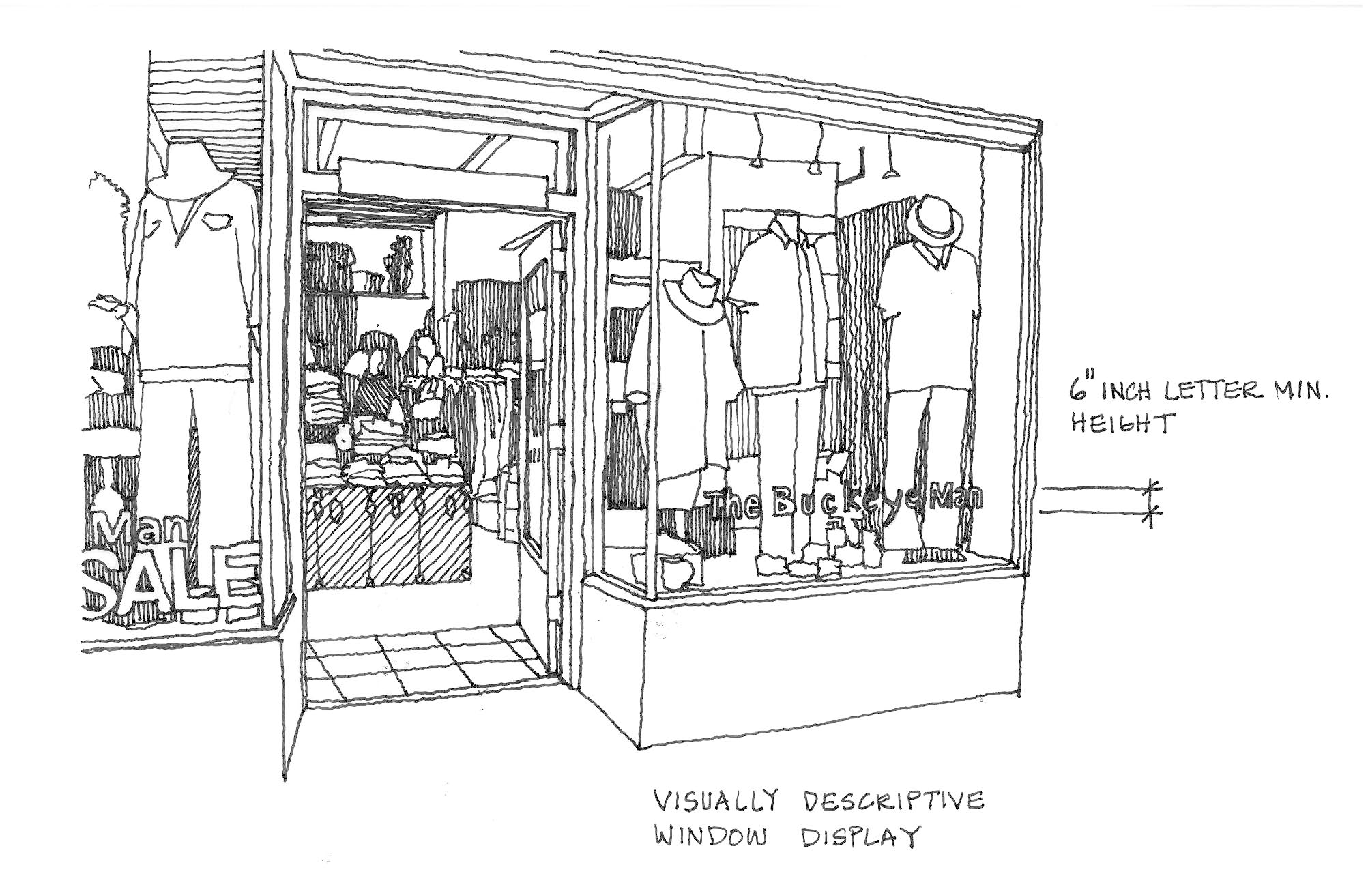
Figure 5.12-A: Window Signage
f.
Home Occupation Signs. (See Table 5.12-2: Extended Table of Home Occupations Downtown) in conjunction with Section 10.3.4, shall allow for a non-illuminated sign not to exceed three square feet.
i.
The design and placement shall be approved by the Development Services Department;
ii.
A three square foot sign can be attached to the primary residence; or
iii.
A three square foot monument sign can be placed on the property perpendicular to the ROW, as long as the sign including the base is not taller than three feet.
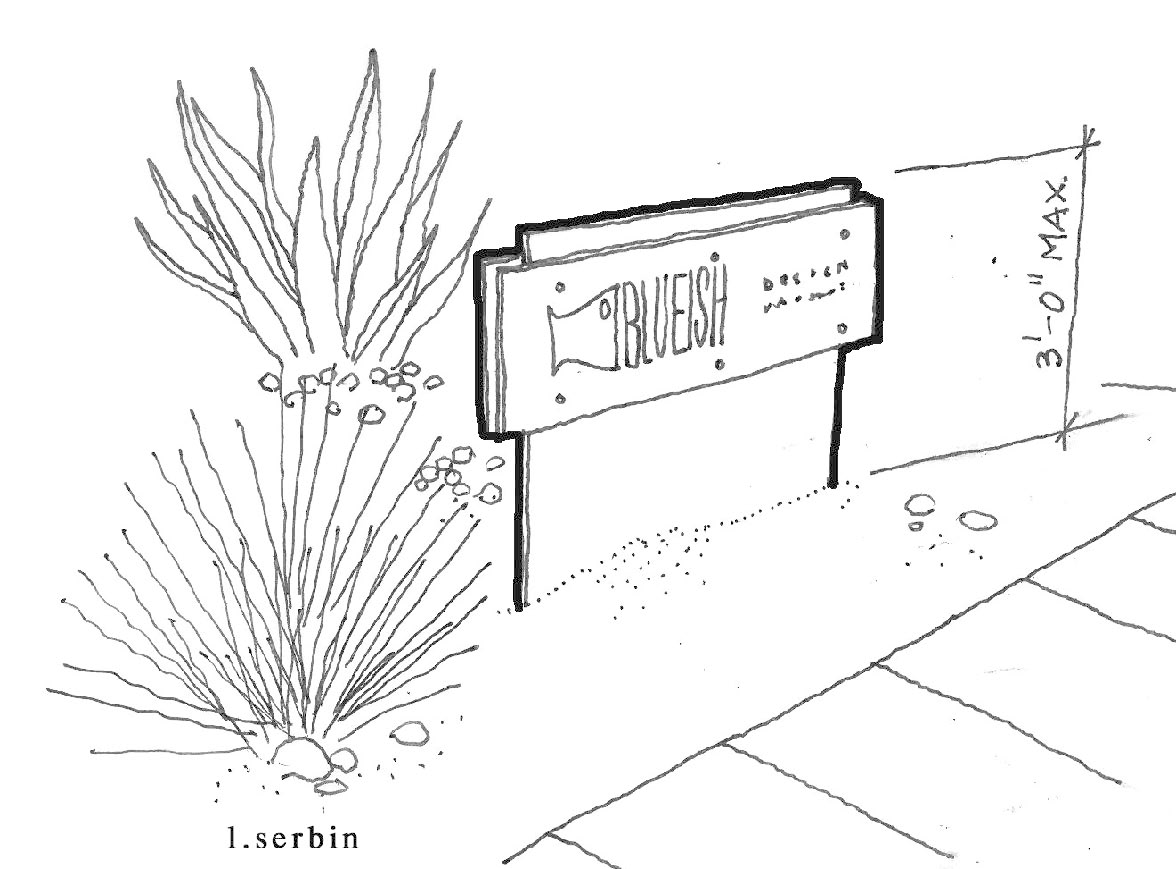
Figure 5.12-B: Home Occupation Sign
2.
Signage—Area I.
a.
Roof Mounted Signage.
i.
Permitted along Monroe Avenue.
ii.
Cannot extend more than six feet above the roofline.
iii.
A height greater than six feet can be approved by the Director taking in consideration the height of the pre-existing historic sign.
b.
Monument signs can be located on the property line with the Director's approval.
c.
Temporary signs.
d.
Allow use of sandwich or "A-frame" signs during regular business hours without a Temporary Sign Permit.
i.
On-Site A-Frame Signs.
(1)
Placement must allow for a minimum three-foot pedestrian pathway to/from all building entrances and exits.
(2)
Shall not exceed four feet in height and three feet in width.
(3)
Shall be constructed of durable materials with a stable, weighted base.
(4)
Shall be limited to one per business or tenant per public street frontage.
(5)
Shall not be illuminated or animated in any way.
(6)
Except as otherwise specified in this section, A-frame signs shall only be displayed during normal business hours of operation.
(7)
Shall not be placed upon, affixed or attached to any object, including, but not limited to, light poles, trees, traffic signals, benches, tables, street signs, fencing, or bike racks.
ii.
Off-Site A-Frame Signs. A-frame signs may be placed off-site if all of the following standards are met:
(1)
Must obtain written approval of the property owner of record for the property where the sign is to be located.
(2)
A Site Plan or illustration depicting the location of the off-site A-frame sign must be submitted and approved by the city prior to the placement of the sign.
e.
Suspended Signs.
i.
Buildings with a front setback of zero to ten feet are encouraged to have double-sided attached perpendicular signs.
ii.
The bottom of the sign must have seven feet of clearance.
iii.
Symbolic and historic three-dimensional signs such as barber shop poles and appropriately-sized projecting signs are allowed.
iv.
Creatively shaped signs are encouraged.
v.
Suspended signs are not included in the total allowable business sign area.
C.
Lighting. Lighting in the Downtown should serve to illuminate façades, entrances and signage and provide an adequate level of personal safety while enhancing the aesthetic appeal of the buildings. The following lighting is allowed in the Downtown Area:
1.
Standards and Guidelines—General.
a.
Shielded security lighting is required along service entrances and along alleys for all commercial buildings.
b.
Ornate or accent lighting that enhances the building or property is encouraged.
c.
Roof mounted sign may only be illuminated internally or with down lighting.
d.
"Shoebox" site lighting is prohibited. Site lights need to be architecturally sensitive to the building architecture.
e.
Lights may not be exposed beyond the lighting array.
f.
Buildings on a zero-foot setback will be allowed to have down lighting spillover the property.
g.
Lighting under covered awnings or arcades is required.
h.
All lighting must be in accordance with A.R.S. § 49-1101 et seq.
D.
Building Materials. Building materials and color should help establish a human scale and provide visual interest. The predominant color should be respectful to the architectural style of the building and compatible with buildings in the Downtown District. These materials are listed in addition to Section 5.8.3 F.
1.
Standards and Guidelines—General. General materials should appear similar to those used historically. Appropriate building materials include, but are not limited to:
a.
Primary Building Materials.
i.
Smooth stucco.
ii.
Brick.
iii.
Striated brick (raked or directional grain brick).
iv.
Adobe block.
v.
Integral colored concrete masonry unit (CMU).
vi.
Terra cotta.
vii.
Architectural cast concrete.
b.
Secondary or Accent Materials. (Not to be used for more than 20 percent of the building façades.)
i.
Steel.
ii.
Standing seam metal.
iii.
Stamped metal.
c.
Transparency.
i.
On properties with direct frontage on either Monroe Avenue and/or 4th Street or separated from either street by undeveloped strips of land with a depth of 20 feet or less, On all properties within the Downtown Core, as illustrated on Figure 3.1 (Long-Term Future Land Use Framework Plan) of the Buckeye Downtown Specific Area Plan, building façades facing either street must consist of transparent glazing for at least 50 percent of the ground floor wall area between two and ten feet above grade, and for at least 35 percent of the wall area of upper floors. If a single-story building has a façade taller than 20 feet, the façade area above 15 feet shall consist of transparent glazing for at least 35 percent of the wall area of the portion greater than 15 feet.
ii.
Excluding those properties covered in item i. above, for all other properties in the Downtown Activity Center, building façades facing a public street must consist of transparent glazing for at least 30 percent of the ground floor wall area between two and ten feet above grade, and for at least 20 percent of the wall area of upper floors. If a single-story building has a façade taller than 20 feet, the façade area above 15 feet shall consist of transparent glazing for at least 20 percent of the wall area of the portion greater than 15 feet.
2.
Building Colors.
a.
Primary colors or other brilliant colors are to be only used as an accent on the building or for corporate logo colors.
b.
No more than ten percent of any commercial building façade shall use primary (red, yellow or blue) or other brilliant non-earth tone paint color.
c.
No commercial building may use paint colors with a light reflective value (LRV) greater than 60 percent.
d.
Fluorescent colors are prohibited.
E.
Building Orientation. On all properties within the Downtown Core, as illustrated on Figure 3.1 (Long-Term Future Land Use Framework Plan) of the Buckeye Downtown Specific Area Plan, shall be designed to accommodate primary customer access from the adjacent public sidewalks. Buildings which feature a dual orientation where customers can access the building/business from the public sidewalk as well as on-site parking, behind, are also supported.
F.
Landscape/Shading. Plants serve multiple purposes and improve the aesthetics of an area by providing color, texture, and visual interest. Plants also assist in defining spaces and compliment building architecture. Landscaping/shading treatments should be used to enhance the pedestrian experience and compliment architectural features.
1.
Buildings with a zero-foot front setback have no minimum landscape requirement.
2.
Unless existing site conditions limit on-site landscaping, all property must meet the standards provided in Section 5.4.3, Landscaping Required, of this Code.
3.
On all properties within the Downtown Core, as illustrated on Figure 3.1 (Long-Term Future Land Use Framework Plan) of the Buckeye Downtown Specific Area Plan. Awnings, canopies and/or covered arcades are required on street-adjacent sides of a building, to extend at least 50 percent of the length of the building. For all other locations within the Downtown, awnings, canopies, and/or covered arcades are encouraged. An awning or covered arcade may be allowed in public right-of-way with an encroachment permit.
a.
Awnings and canopies must have a minimum five-foot projection from the building and a maximum of ten feet unless additional projection is required to cover the adjacent public sidewalk.
b.
Covered arcades and covered walkways must extend to the edge of sidewalk on buildings with a zero-foot setback.
G.
Screening. Screening of mechanical equipment is used to keep an area aesthetically appealing to residents and visitors of domiciles and businesses. The Downtown Area has a mix of uses with no traditional suburban-style development buffering. This unique situation makes the need for screening mechanical equipment from the public view essential to this area.
1.
Utility areas and mechanical equipment should be located so that they do not detract from the aesthetic appeal of the district.
2.
Whenever practicable, relocate or screen outdoor utilities and mechanical equipment from public view from adjacent streets. If the screening detracts from the architecture of the building or aesthetics of the area, a waiver of this requirement may be issued by the Development Services Director.
3.
Landscape screening is acceptable.
4.
Consider the impact of fencing and walls on adjacent commercial to residential properties.
H.
Setbacks. The Downtown Area is comprised of many different plats and lots. Some of the plats had implied setbacks and others had recorded standards. Some of the commercial buildings were developed by standards of the time. Due to pre-existing conditions, there is no uniform standard for commercial or residential setbacks.
I.
Commercial. Traditional commercial setbacks in a Downtown Area range from zero to 15 feet encompassing an entry treatment for the business establishment. The current Development Code primarily addresses only strip-center or pad type of development with setbacks large enough to allow parking along street frontages. This approach is counter-productive in a Downtown setting.
1.
On all properties within the Downtown Core, as illustrated on Figure 3.1 (Long-Term Future Land Use Framework Plan) of the Buckeye Downtown Specific Area Plan, the maximum building setback shall be eight feet, except that restaurants and similar uses that provide integrated space for outdoor dining may be set back up to 30 feet if the outdoor dining area extends from the front face of the building to within eight feet or nearer of the street adjacent property line. In instances where a public utility easement (PUE) is provided directly adjacent to street, the maximum building setback can be increased to 12 feet to allow for provision of landscaping by the Development Services Director or their designee.
2.
For all other commercial properties within the Downtown Activity Center, the maximum building front setback for commercial buildings is calculated using the average of the two adjacent building front setbacks.
J.
Residential. Design setbacks to reflect the existing streetscape including the location of other buildings on the block. An appropriate setback can be determined by drawing an imaginary line along the front façades of the buildings on a block. Unlike a more suburban setting, the primary building façades should be located parallel to the street. Please refer to Figure 5.7-A Residential Infill.
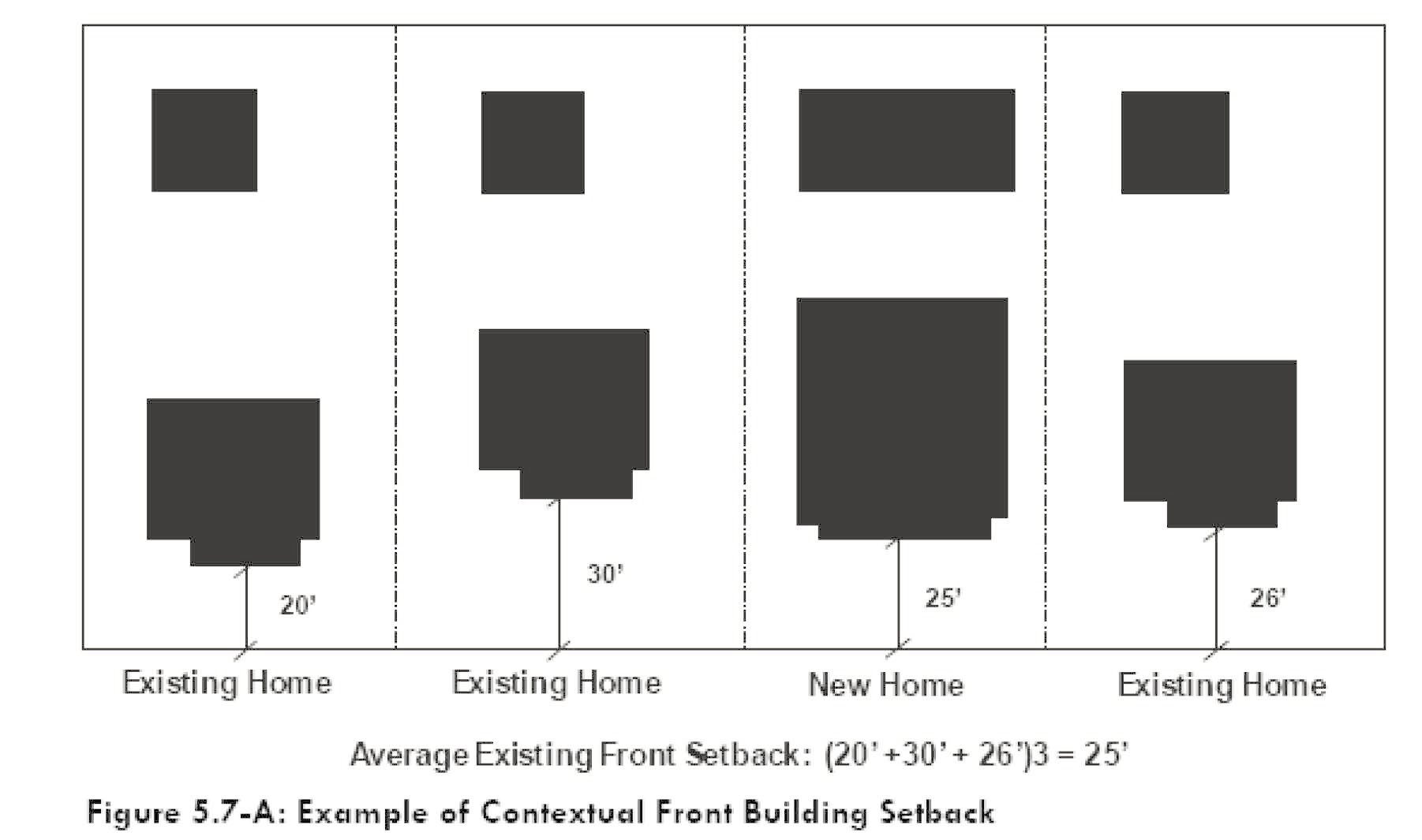
K.
Parking. The Downtown Area does not have contemporary suburban commercial and residential development. In an area that has established uses, not every commercial building has available space for parking. What makes Downtown unique is the availability of on-street and common off-street public parking and pedestrian activity.
1.
If on-site parking is utilized, the parking shall be designed to the rear or sides of the building. Parking within a front setback area shall be prohibited.
2.
If traditional parking is not feasible, please refer to Section 5.6.7 B, Parking Alternatives, of this Code.
3.
Sole on-street parking may be utilized.
L.
Use-Specific Requirements.
1.
Multi-Family Dwellings.
a.
On all properties within the Downtown Core, as illustrated on Figure 3.1 (Long-Term Future Land Use Framework Plan) of the Buckeye Downtown Specific Area Plan, multi-family residential uses (including leasing offices and ancillary resident spaces such as fitness centers), where permitted, may not occupy more than 40 percent of the linear frontage of any building façade directly adjacent to 4th Street or Monroe Avenue, if applicable.
b.
There shall be no restriction on ground floor multi-family use of any building façades not facing 4th Street or Monroe, or any limitation on use of upper floors for multi-family residential use.
2.
Drive-through uses.
a.
Where permitted, any proposed/new drive-through use must be located a minimum of 1,320 feet of the nearest existing drive-through on the same side of the street, measured from nearest building wall to nearest building wall.
b.
No parcel to be developed with a drive-through use shall share a property line with a parcel developed with a single-family residence.
c.
A business' drive-through is to be visually minimized. The design focus of any business with a drive-through must first be on accommodating pedestrians utilizing the adjacent public sidewalk. From the perspective of the adjacent street, it should not be readily apparent that the business features a drive-through component.
d.
No drive-through lane or drive aisle may be located between the building's front, street-facing façade and the public sidewalk.
e.
All drive-through menu boards, speaker boxes, or other features inherent to drive-through uses must be fully screened from adjacent streets.
3.
Mini-Storage and Gas Station Uses.
a.
Where permitted, any proposed/new mini-storage facility or gas station within the Downtown Overlay must be separated from the nearest existing storage facility or gas station by a minimum of 2,640 feet, measured from nearest property line of the proposed use to the nearest property line of the closest existing use.
b.
The 2,640-foot separation requirement is inclusive and applies to gas stations from other gas stations, gas stations from mini-storage facilities, and mini-storage facilities from other mini-storage facilities.
c.
The required separation applies to any proposed/new gas station or mini-storage facility within the Downtown Overlay from any other existing mini-storage facility or gas station, whether located within or outside of the Downtown Overlay. Conversely, proposed/new gas stations or mini-storage facilities located outside of the Downtown Overlay are not required to meet this minimum separation requirement.
4.
Outdoor Dining.
a.
Any building constructed prior to January 1, 2024, shall maintain a minimum six-foot-wide continuous sidewalk free from any seating, furnishings, or other obstructions adjacent to any street frontage.
b.
Any building constructed after January 1, 2024, shall maintain a minimum ten-foot-wide continuous sidewalk free from any seating, furnishings, or other obstructions adjacent to any street frontage.
c.
Required sidewalk width may be located within the public right-of-way, on private property within a dedicated sidewalk easement, or a combination of both.
M.
Conversion from Single-Family Dwelling to a Commercial Use. The Downtown Area has residential homes that currently have commercial zoning. The Downtown Area also encourages adaptive reuse. This means that the need for converting residential uses to commercial uses is present and will need guidelines and regulations.
1.
Locate parking off-site. If parking is necessary on-site, it must be located in the rear or sides only.
2.
On-site parking should be screened from adjacent residential properties.
3.
Landscape area in the interior of the lot as well as the street frontage shall be in conformance to Section 5.4.3, Landscaping Required.
4.
Create a pedestrian walkway or corridor from the parking area to the building entrance using a change in material.
(Ord. No. 37-09, § 1, 12-16-2009; Ord. No. 19-12, § 3, 10-16-2012; Ord. No. 18-17, § 7, 7-5-2017; Ord. No. 07-22, § 3 (PLZM-21-0060), 4-19-2022; Ord. No. 37-22, § 3(Att.), 12-20-2022; Ord. No. 37-23, § 3(Att.), 8-1-2023; Ord. No. 01-24, § 3(Exh. A, B), 2-20-2024)

