
Canon City City Zoning Code
CHAPTER 17
10 - ZONING STANDARDS AND PROCEDURES
Sec. 17.10.010.- Administrative approvals.
A.
Zoning Administrator authority. The Zoning Administrator shall have the authority to receive applications and make determinations for the following administrative procedures.
1.
Site plan review;
2.
Conditional use permit;
3.
Administrative exception;
4.
Sign permit;
5.
Comprehensive sign plan;
6.
Temporary use permit;
7.
Rebuild letter; and
8.
Administrative interpretations.
B.
Appeals of administrative determinations.
1.
Any person aggrieved by a decision of the Zoning Administrator may, within thirty (30) days after receipt of notice of such decision, appeal such decision to the Board of Adjustment by filing a written notice of appeal with the Zoning Administrator with an explanation as to why said decision was not warranted by this UDC according to the applicant. Such application shall be accompanied by the application fee.
2.
An appeal stays the action appealed from, unless the Zoning Administrator from whom the appeal is taken certifies to the Board after the notice of appeal has been filed that, by reason of facts stated in the certification, a stay would, in their opinion, cause imminent peril to life or property.
3.
The Board shall conduct a hearing, but not a public hearing, on all appeals upon notice as provided in this section.
4.
No less than ten (10) days prior to the hearing, notice shall be provided to the applicant of the hearing date and time.
5.
The applicant or applicant's representative shall be present at the hearing. Failure to appear shall result in the appeal or application being denied.
6.
The Board may affirm, reverse or modify the decision appealed. A concurring vote of four (4) members of the Board shall be necessary to reverse decision, or part thereof, of the Zoning Administrator.
7.
All decisions of the Board shall be made no later than thirty (30) days after the conclusion of the hearing and shall be made by written resolution.
C.
Site plan review.
1.
Purpose. Site plan review is required prior to the issuance of an application for a building permit to certify compliance with all applicable provisions of this UDC. Site plan review shall be required for any development that meets one of the following criteria:
a.
New development, including the construction or placement of any new building(s) or expansion of any existing building, or
b.
Any development subject to off-street parking and loading requirements. Single-family and two-family dwellings shall not be subject to site plan review.
2.
Site plan submittal.
a.
The site plan, including all information required in the UDC application requirements, shall be submitted to the Zoning Administrator.
b.
Within fifteen (15) days of receipt of the application, the Zoning Administrator shall review the application to determine that all required information has been submitted and notify the application of completeness or deficiencies.
c.
Failure to cure the deficiencies within six (6) months from notification of such deficiencies shall be deemed abandonment of the application without further notice from the City.
3.
Sites on or in designated historic resources. Prior to the approval of a site plan for a proposed development located on or in a designated historic resource, the applicant shall be required to comply with the City's historic preservation regulations in Chapter 12.30 of the Cañon City Municipal Code.
4.
Zoning Administrator action.
a.
Within ten (10) days of the determination of completeness, the application shall be reviewed by the Zoning Administrator to ensure the application conforms to the requirements of this UDC. Based upon their review, the Zoning Administrator shall approve or deny the site plan.
b.
If denied, the Zoning Administrator shall report the deficiencies to the applicant. The applicant shall have six (6) months from the date of notification of the deficiencies to correct the deficiencies; otherwise, the site plan will be considered abandoned without further notice from the City.
5.
Concurrent applications. A conditional use permit, special review use permit, or variance application may be processed concurrently with the site plan.
6.
Expiration and lapse of approval. The applicant shall have twelve (12) months from the date of a site plan approval to secure a building permit to carry out the proposed improvements. If a building permit has not been obtained within twelve (12) months of the date of approval, the approval shall be void. An extension of the time requirements may be requested in writing and granted by the Zoning Administrator for good cause shown by the applicant, provided a written request is filed with the City at least four (4) weeks prior to the respective deadline.
D.
Conditional use permit.
1.
Purpose.
a.
In order to provide flexibility and to help diversify uses within a district, specified uses are permitted in certain districts subject to the granting of a conditional use permit. Because of their unusual or special characteristics, conditional uses require review and evaluation so that they may be located properly with respect to their effects on surrounding properties. The review process set forth in this section is intended to assure compatibility and harmonious development between conditional uses, surrounding properties, and the City at large.
b.
Conditional uses are permitted within the district where designated when they comply with specific conditions and limitations as set forth in this UDC to ensure that the location and operation of the conditional uses will be in accordance with the conditional use criteria. The scope and elements of any conditional use may be limited or qualified by the conditions applicable to the specific property. A listed conditional use that cannot meet the specific conditions and limitations set forth in this UDC shall not be allowed under a conditional use permit.
2.
Pre-application conference. The applicant for a conditional use permit is advised to meet with the Zoning Administrator prior to submitting an application to discuss the submittal requirements, review criteria, and review process.
3.
Conditional use permit review criteria.
a.
General criteria. The conditional use permit shall be approved upon a finding by the Zoning Administrator that the following general criteria have been met, to the extent they may be applicable:
I.
The site, building(s), and use meet all criteria specified for the use and all applicable regulations and development standards as specified in this UDC and for the district in which the use is located; however, nonconforming sites and/or buildings must be brought into conformance if required to do so pursuant to Chapter 11, Nonconformities, of this UDC,
II.
The proposed use will not substantially alter the basic character of the district in which it is located, or jeopardize the development or redevelopment potential of property within the district,
III.
The proposed use will not have a significant adverse impact on the adjacent uses or properties, or result in hazardous conditions for pedestrians or vehicles within or in close proximity to the site,
IV.
The proposed use will conform with or further the goals, objectives and strategies of the City's comprehensive plan,
V.
The proposed use will be adequately served with public utilities, services, and facilities and not impose an undue burden above and beyond those of the permitted uses of the district in which it is located,
VI.
Potential negative impacts of the conditional use on the surrounding properties have been or may be mitigated through specific setbacks, architecture, screen walls, landscaping, site arrangement or other methods required in the permit as conditions and/or limitations of permit approval. The applicant shall satisfactorily address each of the following impacts:
i.
Traffic,
ii.
Activity levels,
iii.
Light,
iv.
Noise,
v.
Odor,
vi.
Building type, style, and scale,
vii.
Hours of operation,
viii.
Dust, and
ix.
Stormwater management, drainage, and erosion control.
VII.
Use-specific criteria. In addition to the general criteria for review of a conditional use permit listed above, certain uses, due to their unique characteristics, must also comply with the special provisions specific to those uses contained in Chapter 17.06, Development Standards of this UDC. Use-specific criteria shall control if a conflict exists with the general criteria of this section.
4.
Conditional use permit application submittal.
a.
The conditional use permit application, including all information required in UDC application requirements, shall be submitted to the Zoning Administrator.
b.
Within fifteen (15) days of receipt of the application, the Zoning Administrator shall review the application to determine that all required information has been submitted and notify the application of completeness or deficiencies.
c.
Failure to cure the deficiencies within six (6) months from notification of such deficiencies shall be deemed abandonment of the application without further notice from the City.
5.
Zoning Administrator action.
a.
Within ten (10) days of the determination of completeness, the application shall be reviewed by the Zoning Administrator to ensure the application conforms to the criteria in Subsection 3 above. Based upon their review, the Zoning Administrator shall approve or deny the application in writing.
b.
If denied, the Zoning Administrator shall report the deficiencies to the applicant. The applicant shall have six (6) months from the date of notification of the deficiencies to revise the application and correct the deficiencies; otherwise, the conditional use permit application will be considered abandoned without further notice from the City.
6.
Permit transferability. A conditional use permit may be transferred to any other person to operate the same use on the same property and/or within the same building according to the same terms of the permit. A conditional use permit may not be transferred to any other property or other building. The transfer of a conditional use permit shall be in writing to the new owner or operator of the use, using a form provided by the City. Such transfer shall not be complete until a counterpart of the transfer document has been filed with the Zoning Administrator and recorded with the Clerk.
7.
Revocation of permit.
a.
The Zoning Administrator may revoke a conditional use permit upon finding that:
I.
The use, building, or site for which the permit was issued violates any of the approval criteria,
II.
The use, building, or site for which the permit was issued violates any condition of approval set forth in the permit, or violates any provision of this UDC, or
III.
The use established is materially different from that which was represented in the application and approved by the Zoning Administrator.
b.
Prior to revoking any conditional use permit the Zoning Administrator shall issue a notice of pending revocation to the permit holder. The notice shall:
I.
State the grounds upon which the permit could be revoked,
II.
Direct the permit holder to appear at a hearing before the Zoning Administrator to show cause why the permit should not be revoked,
III.
State the date, time, and place for the show cause hearing, which date shall be not sooner than ten (10) days from the date the notice is mailed to or otherwise served upon the permit holder in any manner permitted under this UDC,
IV.
Advise the permit holder that the permit will be revoked if the permit holder fails to appear for the hearing or if the permit holder appears for the hearing but fails to show cause why the permit should not be revoked.
c.
Following the conclusion of any hearing set pursuant to the provisions of this Section 17.10.020(D)(7)(b), the Zoning Administrator shall issue the Zoning Administrator's written findings and decision and mail to or otherwise serve a copy of such findings and decision upon the permit holder.
d.
The permit holder will have fifteen (15) days from the date of mailing or other service of such written findings and decision to appeal a decision revoking the permit to the Board of Adjustment.
8.
Termination. A Conditional use permit shall automatically terminate without any further action by the City under any of the following circumstances:
a.
The use for which the permit was granted has not been established at the approved location within a period of one (1) year from the date the permit was issued.
b.
The use for which the permit was issued has been discontinued for a period of one (1) year or longer.
E.
Administrative exception.
1.
Purpose. Administrative Exception is an administrative process through which certain minor variances may be approved by the Zoning Administrator. Administrative Exceptions are intended to allow a limited amount of flexibility in the siting and height of certain buildings and/or structures. The Zoning Administrator shall have the authority to grant or deny applications for Administrative Exceptions for such circumstances as this UDC allows subject to the requirements of this section. No site plan shall be approved or building permit issued for a proposal requiring an exception to a zoning standard listed in Subsection (2) below, unless an administrative exception is approved.
2.
Administrative exceptions considered.
a.
An administrative exception to certain requirements of this UDC may be granted for the following exceptions:
I.
A maximum ten (10) percent reduction of the interior side and/or rear setback standard for a new principal or accessory building/structure, or an addition to an existing principal or accessory building/structure in any district, and/or
II.
A maximum ten (10) percent increase of the height standard for a new principal or accessory building/structure in any district except the RL, MH-2, or GC.
b.
An administrative exception shall not be granted for the approval of any use not otherwise allowed as a permitted, conditional, or special review use within the subject district.
c.
No administrative exception shall be considered where the setback is five (5) feet or less.
d.
In the case of a requested addition to a structure, no exception shall be considered where the existing structure does not meet the minimum setback.
e.
No exception shall be considered for a reduction of a setback for livestock housing in the RL District.
f.
No exception for reduction of a setback shall be considered for the MH-1 District.
3.
Administrative exception review criteria. The Administrative Exception shall be approved if the Zoning Administrator finds that the proposed exception meets the following criteria:
a.
Is consistent with the comprehensive plan,
b.
Is consistent with the purpose of the underlying district,
c.
Is consistent with adopted building and fire codes,
d.
Will not result in incompatible development,
e.
Will not result in adverse impacts unless adequately mitigated, and
f.
Is of a technical nature and is required to:
I.
Compensate for an unusual condition,
II.
Eliminate a minor inadvertent failure to comply with this UDC, or
III.
To protect a sensitive resource or natural feature.
4.
Pre-application conference. The applicant for an Administrative Exception is required to meet with the Zoning Administrator prior to submitting an application to discuss the submittal requirements, review criteria, and review process.
5.
Administrative exception application submittal.
a.
The administrative exception application, including all information required in the UDC application requirements, shall be submitted to the Zoning Administrator.
b.
Within fifteen (15) days of receipt of the application, the Zoning Administrator shall review the application to determine that all required information has been submitted and notify the application of completeness or deficiencies.
c.
Failure to cure the deficiencies within six (6) months from notification of such deficiencies shall be deemed abandonment of the application without further notice from the City.
6.
Zoning Administrator action. Within ten (10) days of the determination of completeness, the application shall be reviewed by the Zoning Administrator to ensure the application conforms to the criteria in Subsection 3. above. Based upon their review, the Zoning Administrator shall approve or deny the application in writing.
7.
Expiration. If a building permit is not issued or a site plan is not approved within six (6) months of the approval of the administrative exception, the administrative exception approval shall be void.
F.
Sign permit.
1.
Purpose. A Sign permit shall be required prior to the display, construction, erection, or alteration of a sign, and its structural components, on any property. All signs must comply with Chapter 17.07, and the applicable sections of the building code as adopted by the City. All electrical installations associated with the erection and installation of a sign must be done in accordance with the adopted Building and Electrical Codes.
2.
Exemptions. Signs exempt from a permit are listed in Section 17.07.040 of this UDC.
3.
Signs on or in designated historic resources. Prior to the approval of a sign permit for a proposed permanent sign located on or in a designated historic resource, the applicant shall be required to comply with the City's historic preservation regulations in Chapter 12.30 of the Cañon City Municipal Code.
4.
Sign permit review criteria. To approve the issuance of a sign permit, the Zoning Administrator shall make an affirmative finding that all applicable provisions of this UDC, the applicable building code, and all other City ordinances are met.
5.
Sign permit application submittal.
a.
The sign permit application, including all information required in the UDC application requirements, shall be submitted to the Zoning Administrator.
b.
Within five (5) days of receipt of the application, the Zoning Administrator shall review the application to determine that all required information has been submitted and notify the application of completeness or deficiencies.
c.
Failure to cure the deficiencies within six (6) months from notification of such deficiencies shall be deemed abandonment of the application without further notice from the City.
6.
Zoning Administrator action. Within five (5) days of the determination of completeness, the application shall be reviewed by the Zoning Administrator to ensure the application conforms to the criteria in Subsection 4. above. Based upon their review, the Zoning Administrator shall approve or deny the application in writing.
7.
Expiration and lapse of approval. A sign permit shall become void, if work authorized under the permit has not been completed within six (6) months of the date of issuance.
G.
Comprehensive sign plan.
1.
Intent. The intent of the comprehensive sign program is to set forth a theme as to the placement, lettering style, color, materials, mounting method, and other related design considerations of signs.
2.
Applicability. Any building or development on an irregularly shaped lot may elect to submit a comprehensive sign plan to receive additional aggregate sign area beyond the maximum established in Section 17.07.020. After the approval of a comprehensive sign plan, no permanent sign shall be erected, placed, or maintained except in conformance with the comprehensive sign plan.
3.
Conditions. The Zoning Administrator may attach conditions, requirements, or standards necessary to assure that the signs covered by the comprehensive sign plan will not be materially detrimental to persons or property in the vicinity. In making its determination, the Zoning Administrator shall not base any condition on the content of a sign.
4.
Evaluation criteria.
a.
Placement. All signs shall be placed where they are visible and legible. Factors to be considered include the location of a sign relative to traffic movement and access points, site features, other structures, and orientation relative to viewing distances and viewing angles. Wall signs may be approved on building walls other than the wall of a unit of a multi-tenant building in which some units have little or no visibility from the street.
b.
Quantity. The number of signs that may be approved within any development shall be sufficient to provide necessary facilitation of internal circulation of vehicular and pedestrian traffic and wayfinding for safety of the occupants of vehicles and pedestrians. Factors to be considered shall be those that impact safety considerations such as the size of the development and the number of development sub-areas.
c.
Size. All signs shall be no larger than necessary for visibility and legibility but in no instance shall the sign area or sign height exceed the maximum established per sign type per district. Factors to be considered in determining appropriate size include topography, volume, and speed of traffic, viewing distances and angles, proximity to adjacent uses, and placement of display.
5.
Review and action. The Zoning Administrator shall review the comprehensive sign plan application and approve, approve with conditions, or deny the application based on the evaluation criteria. A written decision including the findings on the evaluation criteria shall be rendered to the applicant.
H.
Temporary use permit.
1.
Purpose. A temporary use permit shall be required prior to the commencement of a temporary use identified in Table 17.03.040(B) and Table 17.03.040(C). Temporary uses shall take place on private property only unless specifically allowed on public property or right of ways by this UDC.
2.
Temporary use permit review criteria. To approve the issuance of temporary use permit, the Zoning Administrator shall make an affirmative finding that the following criteria are met as applicable:
a.
Land use compatibility. The temporary use must be compatible with the purpose and intent of this UDC and the district in which it will be located. The temporary use shall not impair the normal, safe, and effective operation of a permanent use on the same site. The temporary use shall not endanger or be materially detrimental to the public health, safety, or welfare, or injurious to property or improvements in the immediate vicinity of the temporary use, given the nature of the activity, its location on the site, and its relationship to parking and access points.
b.
Compliance with other regulations. A building permit or temporary certificate of occupancy may be required before any structure used in conjunction with the temporary use is constructed or modified. All structures and the site shall meet all applicable building code, UDC, and fire code standards and shall be promptly removed upon the cessation of the use or event. Upon cessation of the use or event, the site shall be returned to its previous condition (including the removal of all trash, debris, signage, attention attracting devices, or other evidence of the special event or use).
c.
Hours of operation and duration. The duration and hours of operation of the temporary use shall be consistent with the intent of the event or use, and compatible with the surrounding land uses. The duration and hours of operation shall be established by the Zoning Administrator at the time of approval of the temporary use permit.
d.
Traffic circulation. The temporary use, as determined by the Public Works Director, shall not cause undue traffic congestion or accident potential given anticipated attendance and the design of adjacent streets, intersections and traffic controls.
e.
Off-street parking. Adequate off-street parking shall be provided for the temporary use, as determined by the Zoning Administrator, and it shall not create a parking shortage for any of the other existing uses on the site.
f.
Public conveniences and litter control. Adequate on-site restroom facilities and on-site solid waste containers may be required. The applicant shall provide a written guarantee that all litter generated by the event or use shall be removed at no expense to the City.
g.
Appearance and nuisances. The temporary use shall be compatible in intensity, appearance, and operation with surrounding land uses in the area, and shall not impair the usefulness, enjoyment, or value of adjacent property due to the generation of excessive noise, dust, smoke, glare, spillover lighting, or other forms of environmental or visual pollution.
h.
Signs and attention-getting devices. The Zoning Administrator shall review all signage in conjunction with the issuance of the permit, although a sign permit is not required. The Zoning Administrator may approve the temporary use of attention-getting devices. The number and types of signs and attention-getting devices allowed shall be evaluated on the following criteria:
I.
Type and size of the proposed event or use,
II.
Safety considerations (sight distance setbacks, sidewalks in area, etc.),
III.
Lighting considerations (disturbance of nearby residents or adverse effects to traffic on adjacent streets),
IV.
Aesthetic concerns (appearance, illumination, number, and size of signs and attention-getting devices proposed).
i.
Use-specific criteria. In addition to the general criteria for review of a temporary use permit listed above, certain uses, due to their unique characteristics, must also comply with the special provisions specific to those uses contained in Chapter 17.06, Development Standards of this UDC. Use-specific criteria shall control if a conflict exists with the general criteria of this section.
j.
Other conditions. The Zoning Administrator may establish any additional conditions deemed necessary to ensure land use compatibility and to minimize potential adverse impacts on nearby uses, including, but not limited to, time and frequency of operation, temporary arrangements for parking and traffic circulation, requirements for screening/buffering, and guarantees for site restoration and cleanup following the temporary use. Conditions may include, but shall not be limited to:
I.
Modifications or restrictions to the hours of operation, duration of the event, size of the activity or other operational characteristics.
II.
If the permit applicant requests the City to provide extraordinary services or equipment or if the Zoning Administrator otherwise determines that extraordinary services (e.g., traffic control or security personnel) or equipment should be provided to protect the public health or safety, the applicant shall be required to pay to the City a fee sufficient to reimburse the City for the costs of these services if not provided by the applicant. This requirement shall not apply if the event or use has been anticipated in the budget process and sufficient funds have been included in the budget to cover the costs incurred.
3.
Temporary use permit application submittal.
a.
The temporary use permit application, including all information required in the UDC application requirements, shall be submitted to the Zoning Administrator.
b.
Within fifteen (15) days of receipt of the application, the Zoning Administrator shall review the application to determine that all required information has been submitted and notify the application of completeness or deficiencies.
c.
Failure to cure the deficiencies within six (6) months from notification of such deficiencies shall be deemed abandonment of the application without further notice from the City.
4.
Zoning Administrator action. Within ten (10) days of the determination of completeness, the application shall be reviewed by the Zoning Administrator to ensure the application conforms to the criteria in Subsection 2. above. Based upon their review, the Zoning Administrator shall approve or deny the application in writing.
I.
Re-build letter.
1.
Purpose. The Zoning Administrator is authorized to issue re-build letters with respect to transactions involving single-family dwellings that will qualify for reconstruction pursuant to the provisions and limitations of Section 17.11.060 of this UDC.
2.
Re-build letter review criteria. To approve the issuance of a re-build letter, the Zoning Administrator shall make an affirmative finding that all applicable provisions of Section 17.11.060(B) have been met.
3.
Re-build letter application submittal.
a.
The re-build letter application, including all information required in the UDC application requirements document, shall be submitted to the Zoning Administrator.
b.
Within fifteen (15) days of receipt of the application, the Zoning Administrator shall review the application to determine that all required information has been submitted and notify the application of completeness or deficiencies.
c.
Failure to cure the deficiencies within six (6) months from notification of such deficiencies shall be deemed abandonment of the application without further notice from the City.
4.
Zoning Administrator action. Within ten (10) days of the determination of completeness, the application shall be reviewed by the Zoning Administrator to ensure the application conforms to the criteria in Subsection 2 above. Based upon their review, the Zoning Administrator shall issue the re-build letter or deny the application in writing.
J.
Administrative interpretations.
1.
Purpose. The administrative interpretation procedure is intended to provide a uniform mechanism for the Zoning Administrator to render formal written interpretations of this UDC.
2.
Request for interpretation. A request for administrative interpretation may be filed by any person having a legal or equitable interest in property that gives rise to the need for an interpretation.
3.
Review decision. The Zoning Administrator shall review the request for interpretation, shall consult with the City Attorney and affected City staff, and shall render a decision based on the following specific approval criteria:
a.
General interpretation. The interpretation shall be consistent with:
i.
The purposes of this UDC including Section 17.01.030 and 17.13.010;
ii.
The purposes of the zoning district (and overlay district(s), if applicable) in which the property is located;
iii.
Common use of words in the English language; and
iv.
Prior interpretations of the UDC on similar or related topics, to the maximum extent practicable, unless a modification or replacement of a prior interpretation would be more consistent with criteria i through iii above.
b.
Use interpretation. The Zoning Administrator shall determine if the proposed use is included in the definition of a listed use or is so similar to a listed use that it should be treated as the same use subject to the following criteria.
i.
When determining the level of permission or associated use-specific standards, the size, scale, operating characteristics, multi-modal traffic impacts, storm drainage impacts, utility impacts, and neighborhood impacts of the proposed use shall be considered.
ii.
The Zoning Administrator shall consult with the City Attorney and affected City officials before rendering the interpretation.
(Ord. No. 21-2022, § 7, 12-19-22)
Sec. 17.10.020. - Board and council review and action procedures.
A.
Summary of Board/Commission review and action procedures. Table 17.10.030(A) summarizes the Board/Commission review and action procedures and identifies the appropriate boards or commissions that serve as recommending or decision-making bodies.
Table 17.10.030(A) Summary of Board/Commission Review and Action Procedures
B.
Notice requirements.
1.
Cost of notice. All costs associated with published and written notice, as required by this UDC, shall be the responsibility of the applicant.
2.
Notice content. All notices required under this UDC shall include the following content:
a.
The date, time, and place of the scheduled public hearing,
b.
A description of the property involved in the application by street address if one exists,
c.
A description of the nature, scope, and purpose of the application,
d.
The location and source of additional information on the application, and
e.
Other information as deemed necessary by the Zoning Administrator.
3.
Notice methods.
a.
Published notice. When published notice is required, as detailed in Table 17.10.030(C)(3)(d), the Zoning Administrator shall ensure that notice is published on the City's website at least fifteen (15) days and no more than thirty (30) days before the date of the scheduled public hearing.
b.
Written notice. When written notice is required, as detailed in Table 17.10.030(C)(3)(d), the Zoning Administrator shall provide notice by first class mail to all owners of record of the subject property and all owners of record within three hundred (300) feet of the boundaries of the subject property. The notice shall be deposited in the U.S. mail by the Zoning Administrator at least fifteen (15) days and no more than thirty (30) days before the scheduled public hearing. Ownership information shall be obtained from the records of the Fremont County Assessor.
c.
Posted notice. When posted notice is required, as detailed in Table 17.10.030(C)(3)(d), the Zoning Administrator shall post a sign on the subject property along the fronting street. If the subject property fronts two (2) or more streets, signs shall be posted along each frontage. The notice shall be posted by the Zoning Administrator at least fifteen (15) days and no more than thirty (30) days before the scheduled public hearing.
d.
Notice methods by Board/Commission review procedure.
Table 17.10.030(C)(3)(d) Notice Methods by Board/Commission Review and Action Procedure
4.
Notice issues. Minor technical deviations from specified notice requirements shall not be deemed to impair notice where there is actual notice. When required written notices have been properly addressed and deposited in the mail, failure of a party to receive such notice shall not invalidate any subsequent action. In all cases, however, the requirements for the timing of the notice and for specifying the time, date, and place of a hearing and the general location of the subject property shall be strictly construed. If questions arise at the hearing regarding the adequacy of notice, the body hearing the matter shall make a finding regarding whether there was compliance with the notice requirements of this chapter.
C.
General application requirements.
1.
Pre-application conference.
a.
A prospective applicant, prior to submitting an application, shall meet for a pre-application conference with the Zoning Administrator. The purpose of the conference is to help the applicant understand the comprehensive plan, UDC, standards by which the application will be evaluated, and the application requirements.
b.
After reviewing the review and approval process, the applicant may request a waiver of any application requirement which in the applicant's judgment should not apply to the proposed application. Such request shall be made in writing prior to the submission of the formal application documents.
c.
All requests for waiver shall be reviewed by the Zoning Administrator. A final determination regarding the waiver shall be given to the prospective applicant following the decision. Denied requests may be appealed to the City Council.
2.
Application submittal.
a.
Applications shall be submitted to the Zoning Administrator.
b.
Within fifteen (15) days of receipt of the application, the Zoning Administrator shall review the application to determine that all required information has been submitted and notify the applicant of completeness or deficiencies.
c.
Failure to cure the deficiencies within six (6) months from notification of such deficiencies shall be deemed abandonment of the application without further notice from the City.
3.
Zoning administrator report.
a.
Within ten (10) days of the determination of completeness, the application shall be reviewed by the Zoning Administrator pursuant to the criteria set forth in this chapter per application type.
b.
The Zoning Administrator shall prepare and issue a report to the applicant identifying issues of concern to be addressed as well as a recommendation for approval, approval with conditions, or denial.
c.
The Zoning Administrator shall forward their report to the applicant.
4.
Revised application.
a.
The applicant shall revise the application as necessary based on the issues of concern identified by the Zoning Administrator in their report.
b.
The revised application shall be accompanied by a letter explaining how all of the issues of concern have been addressed and detailing any other changes that have been made to the application.
c.
The applicant shall submit the revised application to the Zoning Administrator who shall review the revised application for the purpose of ensuring that all required information has been provided and that all issues of concern have been addressed. Once it is determined that all required information has been submitted and all issues of concern addressed, the application shall be referred to the next step in the process. If the Zoning Administrator determines that the required information and/or issues of concern have not been addressed, the Zoning Administrator shall notify the applicant of such deficiencies.
d.
Failure to cure the deficiencies within six (6) months from notification of such deficiencies shall be deemed abandonment of the application without further notice from the City.
Sec. 17.10.030. - Special review use permit.
A.
Applicability. Although each district is primarily intended for a predominant type of use (such as dwellings in residential districts), there are a number of uses which may or may not be appropriate in a particular district depending upon, for example, the location, nature of the proposed use, character of surrounding development, traffic capacities of adjacent streets, and potential environmental impacts. These factors dictate that the circumstances of development should be individually reviewed. It is the purpose of the special review use permit process to provide review of such uses so that the community is assured that they are compatible with their locations and surrounding land uses and will further the purposes of this UDC.
B.
Special review use permit review criteria.
1.
No special review use permit shall be issued unless the City Council finds that the application:
a.
Complies with all requirements imposed by this chapter,
b.
Is consistent with the purposes of this UDC, and
c.
Is designed to be compatible with surrounding land uses and the area where it will be located.
2.
In considering an application for a special review use permit, the City Council shall consider and may impose modifications or conditions it deems necessary.
3.
No special review use permit shall be issued unless the use-specific standards, established in Chapter 17.05 of this UDC, have also been complied with in addition to the findings required in Subsection B of this section.
C.
Review criteria for rafting takeouts. In addition to the special review use permit review criteria, City Council shall also consider the following criteria for the issuance of a special review use permit for a rafting takeout.
1.
The wishes of neighbors and the reasonable needs of the neighborhood within which the facility will be located and operated,
2.
The length of time the applicant has operated as a river outfitter having significant activities within the City related to commercial river rafting,
3.
The length of time the applicant has operated as a river outfitter having significant activities within the geographical area known as the Arkansas Headwaters Recreation Area,
4.
The degree to which impacts (adverse or otherwise) upon the neighborhood in which the facility would be used and operated are known or capable of reasonable prediction,
5.
The degree to which impacts (adverse or otherwise) upon the street system in the vicinity of the facility or proposed facility are known or capable of reasonable prediction.
D.
Recommendation by the Planning Commission.
1.
The Planning Commission, within thirty (30) days of conducting a public hearing, considering the recommendation of the Zoning Administrator, and reviewing the application, shall make a recommendation for approval, approval with conditions, or denial of the application to the City Council, based upon the criteria in Section 17.10.040(B) and/or Section 17.10.040(C) as appropriate.
E.
Hearing and action by the City Council.
1.
Following the recommendation of the Planning Commission, the application shall be scheduled for a public hearing before the City Council and noticed pursuant to Section 17.10.030(C). Public notice for the public hearing before the Planning Commission and City Council may run concurrently.
2.
The City Council, after conducting a public hearing, considering the recommendation of the Planning Commission, and Zoning Administrator, and reviewing the application, shall decide, by resolution, to approve, approve with conditions, or deny the application based upon the criteria in Section 17.10.040(B) and/or Section 17.10.040(C) as appropriate.
3.
If the City Council denies the application, the applicant shall be required to restart the process at the Pre-Application Conference stage.
Figure 10.1: Special Review Use Permit Process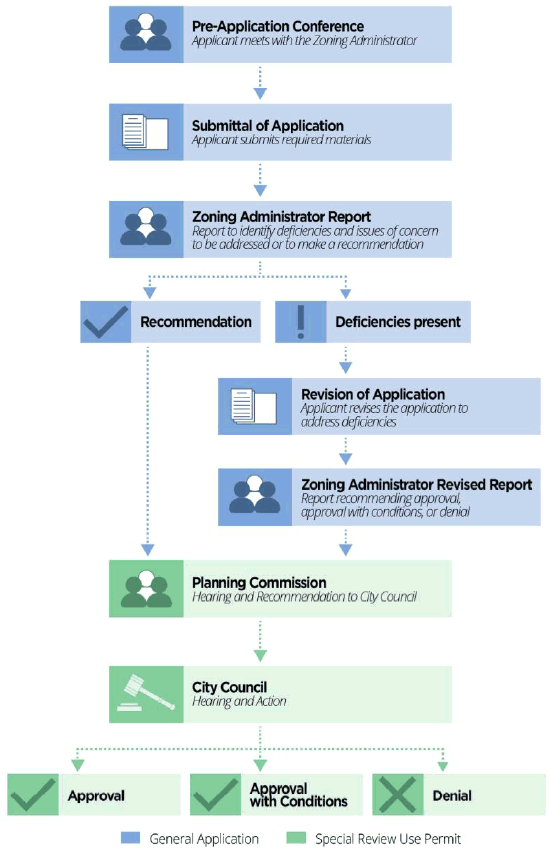
F.
Revocation of permit.
1.
At a public hearing, the City Council may revoke a special review use permit upon finding that:
a.
The use, building, or site for which the permit was issued violates any of the approval criteria;
b.
The use, building, or site for which the permit was issued violates any condition of approval set forth in the permit, or violates any provision of this UDC; or
c.
The use established is materially different from that which was represented in the application and approved by the City Council.
2.
The City shall send a mailed notice to the property owner at least fourteen (14) days prior to the scheduled hearing date. The notice shall:
a.
State the grounds upon which the permit may be revoked;
b.
Direct the permit holder to appear at a public hearing before the City Council to show cause why the permit should not be revoked;
c.
State the date, time, and place for the public hearing;
d.
Advise the permit holder that the permit will be revoked if the permit holder fails to appear for the public hearing or if the permit holder appears for the hearing but fails to show cause why the permit should not be revoked.
3.
Following the conclusion of any hearing set pursuant to this Section, the Zoning Administrator shall issue the City Council's written findings and decision and serve a copy of such findings and decision upon the permit holder.
4.
The permit holder will have fifteen (15) days from the date of mailing or other service of such written findings and decision to appeal a decision revoking the permit to the City Council.
G.
Termination. A special review use permit shall automatically terminate without any further action by the City under any of the following circumstances:
1.
The use for which the permit was granted has not been established at the approved location within a period of one (1) year from the date the permit was issued.
2.
The use for which the permit was issued has been discontinued for a period of one (1) year or longer.
(Ord. No. 8-2025, § 6, 8-18-25)
Sec. 17.10.040. - Text/map amendment.
A.
Initiation of amendments. Amendments to this UDC and the City's zoning map may be initiated by the City Council, by the Planning Commission, or the owner or owner's authorized agent.
B.
Exceptions for general revisions. General and broad revisions to the zoning map shall be treated as text amendment pursuant to this section.
C.
Text amendment review criteria. Text amendments shall satisfy the following criteria:
1.
The amendment is consistent with the purpose of this UDC and the City's comprehensive plan.
2.
The amendment will not adversely affect the public health, safety, or general welfare.
D.
Map amendment review criteria. For the purpose of establishing and maintaining sound, stable and desirable development within the City, the rezoning of land is to be discouraged. Rezonings should only be considered if at least one (1) of the following review criteria has been satisfied:
a.
The proposed rezoning is consistent with the comprehensive plan and the purposes of this UDC,
b.
There have been significant changes in the area to warrant a zoning change,
c.
The rezoning is consistent with the purpose statement of the proposed zoning district, or
d.
There was an error in establishing the current zoning.
E.
Map amendment conditions.
1.
No map amendment shall be adopted unless such lot, parcel, or tract can meet the minimum frontage and lot area requirements for the requested district, or unless it abuts on a lot, parcel, or tract of land that has the same zoning classification as that which is proposed for the property which is subject to the proposed amendment.
2.
In granting a map amendment the City Council may require the dedication of additional street right-of-way where an officially adopted street plan indicates a need for increased width or where the nature of the proposed development warrants increased street width, and the Council may require permanent screen strips or other devices to minimize conflict with residential land use.
F.
Hearing and recommendation by the Planning Commission. The Planning Commission, within thirty (30) days of conducting a public hearing, considering the recommendation of the Zoning Administrator, and reviewing the application, shall make a recommendation to the City Council to approve, approve with modifications, or deny the amendment based on the applicable review criteria.
G.
Hearing and action by the City Council. The City Council shall hold a public hearing on the text/map amendment, and, at the close of the public hearing and after consideration of public comment, the report of the Planning Commission, and the applicable review criteria, may grant or deny the amendment. The City Council may also refer the text/map amendment application back to the Planning Commission for further consideration.
Figure 10.2: Text/Map Amendment Process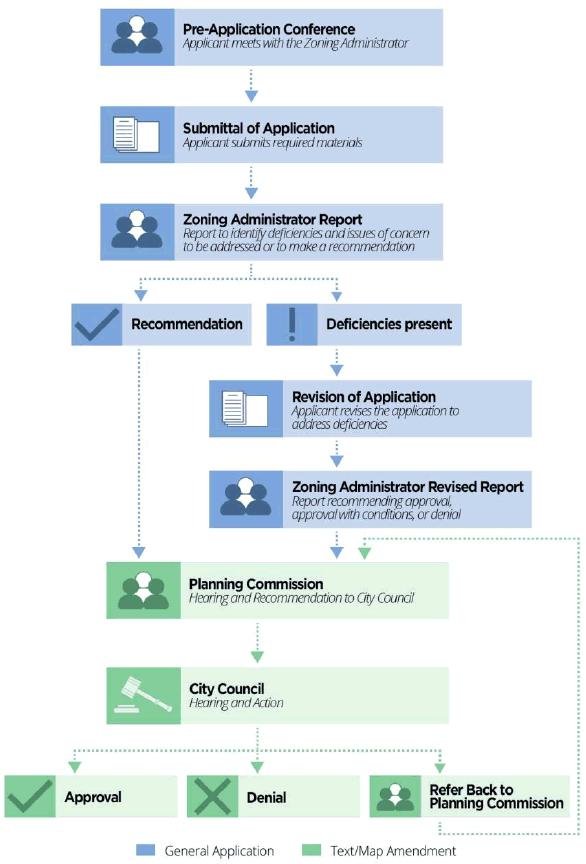
Sec. 17.10.050. - Variance.
A.
Purpose. The variance procedure provides a process to grant limited relief from the requirements of this UDC for property where strict application of the UDC would result in an exceptional practical difficulty or undue hardship preventing the use of the land in a manner otherwise allowed by the UDC. The variance procedure is not intended to allow a use in a district where it is not permitted, or to mitigate inconveniences or financial burdens that this UDC may impose on owners.
B.
Variance review criteria. In determining whether a variance should be granted, the Board of Adjustment must consider whether the practical difficulty or unnecessary hardship claimed by the applicant was created by the applicant and take into account the nature of the hardship. No variance shall be granted unless the Board of Adjustment makes all of the following findings:
1.
That the strict application of this UDC would result in exceptional practical difficulty or undue hardship, unique to the applicant's property, inconsistent with the objectives of this UDC,
2.
That:
a.
There are unique or unusual circumstances or conditions applicable to the site of the variance, such as unusual lot size or shape, topography, or other physical conditions peculiar to the affected property, that do not exist throughout the neighborhood or district in which the property is located, or
b.
There is a physical disability affecting an owner of the property or any member of the family of an owner who resides on the property, which impairs the ability of the disabled person to utilize or access the property,
3.
That the unique or unusual circumstances or conditions of the property will not allow a reasonable use of the property, comparable with other property in the general neighborhood of the site, in the absence of relief,
4.
That the variance to be granted is the minimum variance needed to allow for a reasonable use of the land, building, buildings and/or other structure or structures involved,
5.
That the variance, if granted, will not alter the essential character of the neighborhood or district in which the property is located, nor substantially or permanently impair the appropriate use or development of adjacent property, and
6.
That the granting of the variance will not constitute a grant of special privilege inconsistent with the limitations on other properties classified in the same district.
C.
Sign variance review criteria. Application for variance from the requirements of Chapter 17 of this UDC may be considered providing the determination for granting such Variance is based upon certain specific criteria. No variance from the requirements or limitations set forth in Chapter 17 shall be granted unless the Board of Adjustment makes the following findings:
1.
That there exists practical difficulties and unnecessary hardships which were not self-created by the applicant. Mere financial hardship claimed by the applicant will not be sufficient grounds to support the granting of a variance.
2.
That the strict application of the provisions of Chapter 17 would result in undue hardship or practical difficulty inconsistent with the objectives of this UDC.
3.
That there are unusual circumstances or conditions applicable to the site of the variance that do not exist throughout the district in which the property is located.
4.
That the variance, if granted, will not substantially or permanently impair the appropriate use or development of adjacent property.
5.
That no variance may be granted which will authorize the construction or maintenance of a sign which would endanger the safety of the public in contravention of applicable construction standards or vision clearance setbacks established in this UDC.
6.
That in any instance where a variance may be granted, such variance shall in all cases be granted only to the extent necessary to afford reasonable relief of hardship and any increase to the height of a sign shall be granted only where no other relief can be found. Notwithstanding the foregoing, no variance shall be granted which results in a deviation of more than ten (10) percent from any standard set forth in Chapter 17.
D.
Variance conditions. In granting a Variance, the board may impose such reasonable conditions and safeguards as it may deem necessary to implement the purposes of this UDC. The applicant shall be bound by any such conditions and safeguards imposed by the board.
E.
Variances on or in designated historic resources. Prior to the approval of a variance for a building or structure located on or in a designated historic resource, the applicant shall be required to comply with the City's historic preservation regulations in Chapter 12.30 of the Cañon City Municipal Code.
F.
Hearing and action by the Board of Adjustment.
1.
The Board shall conduct a public hearing on applications for variances upon notice as provided in this section.
2.
No less than ten (10) days prior to the hearing, notice of the public hearing date and time shall be provided to the applicant of the public hearing date and time, posted on the City's website and mailed to owners of property abutting the property that is the subject of the variance application.
3.
The applicant or applicant's representative shall be present at the public hearing. Failure to appear shall result in the appeal or application being denied.
4.
A concurring vote of four members of the Board shall be necessary to grant any application for variance.
5.
All decisions of the Board shall be made no later than thirty (30) days after the conclusion of the public hearing and shall be made by written resolution.
Figure 10.3: Variance Process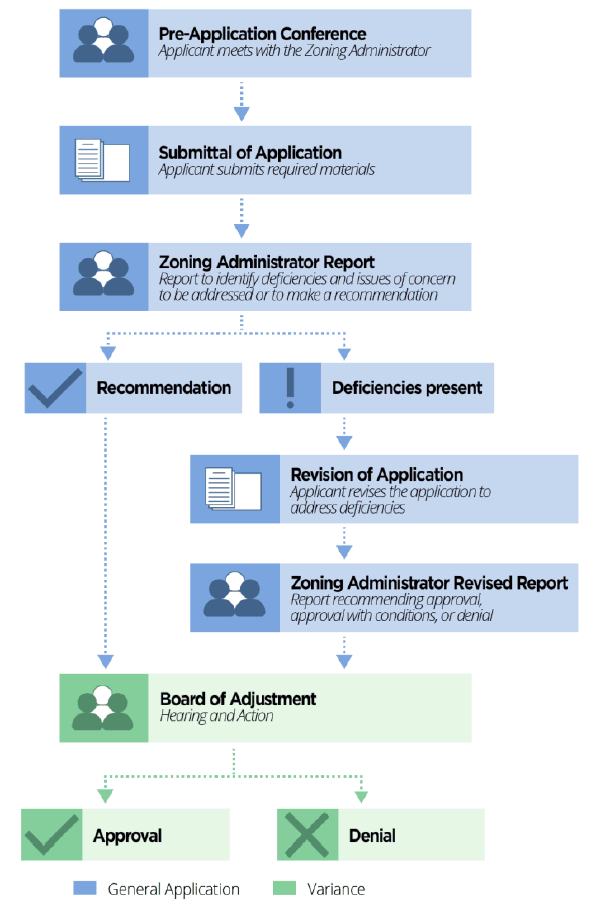
Sec. 17.10.060. - Development agreements.
A.
Applicability.
1.
Owners. All owners granted special review use approval, shall construct or install all public and other required improvements and infrastructure as called for in this UDC and and/or as may have been specified as a condition of approval in a timely, complete, and satisfactory manner. All improvements and infrastructure intended for public use shall be dedicated and/or transferred to the City or other public entities free of all liens and encumbrances.
2.
Governmental units. Governmental units to which these contract and security provisions apply may file, in lieu of the contract and security, a certified resolution or ordinance from officers or agencies authorized to act on their behalf, agreeing to comply with the provisions of this UDC.
B.
Development agreement and guarantee requirement. No building permits shall be processed or issued for any development requiring a special review use permit involving or requiring the installation of public or other improvements absent the preparation and execution of a written development agreement which shall be recorded simultaneously with the special review use permit approval.
C.
Contents of agreement. Such agreement shall, at a minimum, set forth:
1.
Construction specifications for required public improvements,
2.
A construction and completion schedule,
3.
Provisions for security and guarantees concerning the timely and satisfactory completion of the improvements, and
4.
The terms and conditions for the acceptance of the improvements by the City.
D.
Warranty and guarantee. The development agreement shall also include a requirement that all improvements be warranted and maintained by the owner at the cost of the owner until such improvements have been fully accepted by the City.
E.
Agreement to run with the land. A development agreement shall run with the land and bind all successors, heirs, and assignees of the owner.
F.
Security. Development agreements shall include a requirement for the posting of adequate financial security to ensure the timely, complete, and satisfactory construction or installation of all public improvements and infrastructure as called for in the agreement.
1.
Amount of security. Security shall be in an amount not less than one hundred fifteen (115) percent of the estimated cost of completion of all improvements or infrastructure and may be provided by letter of credit, cash escrow, or other financial instrument as approved by the City within its sole discretion.
2.
Letter of credit. If an owner posts a letter of credit as security, it shall:
a.
Be irrevocable,
b.
Be for a term, inclusive of renewals, sufficient to cover the completion, maintenance and warranty periods as required below, and
c.
Require only that the City present the letter of credit with a demand and an affidavit signed by the City Administrator attesting to the City's right to draw funds under the letter of credit.
3.
Cash escrow. If an owner posts a cash escrow, the escrow instructions shall provide:
a.
That the owner shall have no right to a return of any of the funds except as provided below, and
b.
That the escrow agent shall have a legal duty to deliver the funds to the City whenever the City Administrator presents an affidavit to the agent attesting to the City's right to receive funds, whether or not the owner protests that right.
4.
Reduction of security.
a.
Upon preliminary acceptance of a public improvement or public infrastructure, the City shall release all but fifteen (15) percent of total actual costs of construction and installation of all improvements, so long as the applicant is not in default of any provision of the development agreement.
b.
The residual fifteen (15) percent retained by the City shall act as security for the owner's guarantee that the public improvements and infrastructure remain free of defect during the applicable warranty period. The owner may at any time during the preliminary acceptance or warranty period offer to provide a substitute or supplemental form of financial security to that security as originally posted with and/or retained by the City. The City may accept substitute or supplemental forms of security in its sole discretion.
c.
The fifteen (15) percent retained by the City shall be released upon the conclusion of the warrantee period and approval of the public improvements by the Public Works Director.

