
Canon City City Zoning Code
CHAPTER 17
04 - RIVERFRONT DISTRICTS SPECIFIC STANDARDS
Sec. 17.04.010.- Applicability.
A.
General location within city limits. The Riverfront Districts are intended to be utilized generally as follows:
1.
Riverfront mixed-use (RF-MU): between 1st and 11th streets on the north side of the Arkansas River and south of the railroad tracks.
2.
Riverfront Residential (RF-R): between 1st and 11th streets on the south side of the Arkansas River, within five hundred (500) feet of the edge of floodway and excluding existing in-use commercial or industrial property near 9th Street.
B.
Framework plan. The Framework Plan provides guidance on general areas for application of the RF-MU and RF-R Districts. The Framework Plan also identifies key frontages for parcels and where sub-areas, depending on context and as established in Section 17.04.020, are accommodated.
C.
Applicability of other provisions of Title 17. Unless otherwise expressly stated in this chapter, for matters not addressed in this chapter, applicable provisions of Title 17 shall apply. In the event of a conflict between this chapter and other provisions of Title 17, the provisions of this chapter shall control.
RIVERFRONT ZONE DISTRICT REGULATING PLAN - City of Cañon City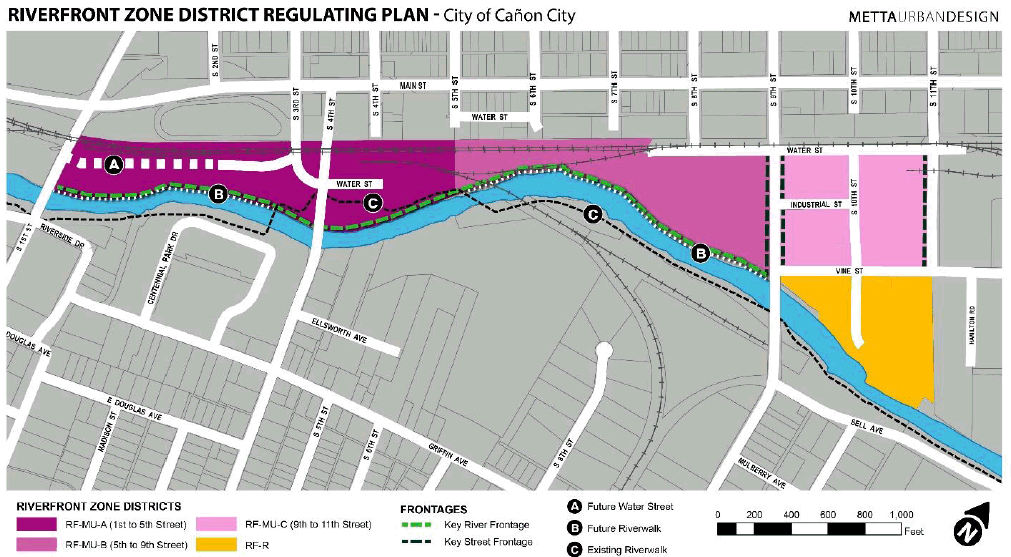
RIVERFRONT ZONE DISTRICT FRAMEWORK PLAN FOR RESIDENTIAL - City of Cañon City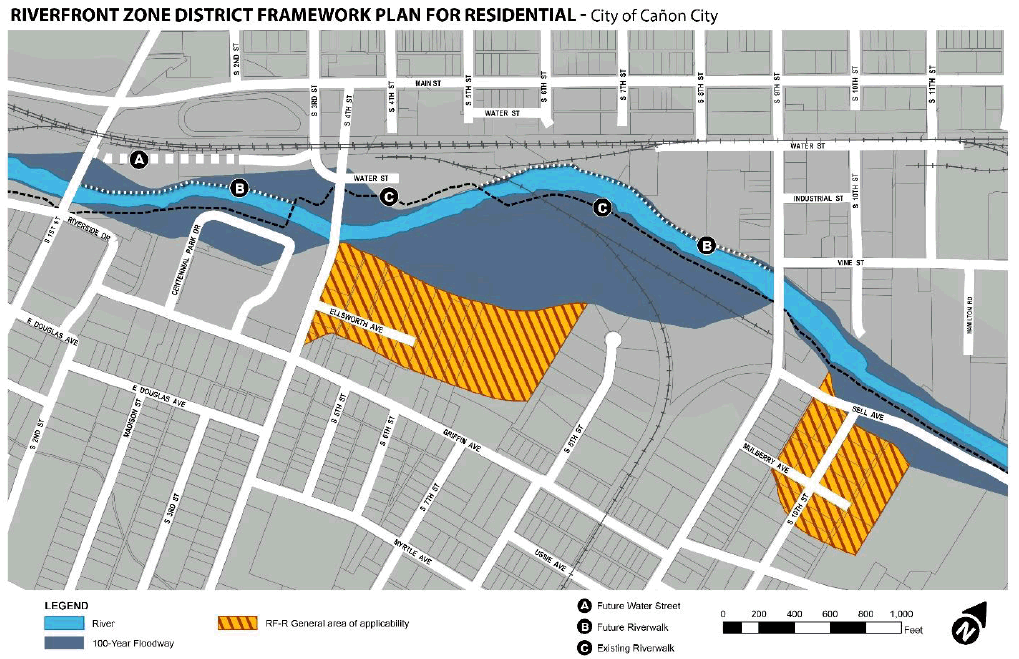
Sec. 17.04.020. - General riverfront district standards.
A.
Application submittal requirements. In addition to the elements required as part of a building permit application, the following shall be submitted.
1.
A full product sample board of all site and building materials shall be submitted as part of site/building permit applications.
2.
A building mock-up is required as part of the building permit process.
B.
Design guidelines. The following design guidelines are encouraged to be employed in any Riverfront District.
1.
A strong sense of three hundred sixty (360) degree architecture should be employed.
2.
Human scale design, particularly at the ground floor levels of buildings should be employed.
3.
Regional materials and colors such as buff sandstone and ashlar patterns should be utilized.
4.
Buildings and sites should be designed to LEED or other energy efficient/sustainable design parameters.
5.
Large blank expanses of façade without fenestration / variation / articulation should be avoided. Similarly, over articulation should be avoided.
6.
A high saturation level in exterior material colors should be utilized to exude richness and counter the "washing out" impact that can occur with the Colorado sun.
C.
Parking. This section shall only apply to the Riverfront Districts. If a parking requirement is not otherwise addressed in this section, the standards in Section 17.06.010 shall apply. If there is conflict between this section and Section 17.06.010, the standards in this section shall govern.
1.
Purpose.
a.
To allow for efficient parking ratios, offsite parking, shared parking, and other creative parking solutions within the riverfront area.
b.
To minimize the visual impact of off-street parking areas.
2.
General regulations.
a.
The long-term parking or storage of boats, recreational vehicles, semi-tractors, semi-trailers, and/or construction vehicles and equipment is prohibited, except during periods of permitted construction activity and/or deliveries.
b.
Circulation within a parking lot shall be designed to be as efficient as possible. The number of curb cuts/access points to a street shall be limited.
c.
Drive aisles with only one (1) inlet/outlet shall provide "back outs" for end spaces.
d.
A stacked or tandem parking arrangement, where one (1) vehicle is parked directly behind another, shall be allowed only for a structure containing two (2) or more dwelling units and the tandem spaces shall be allocated to one (1) unit.
e.
All required parking spaces, excluding those for single-family units, duplexes and rowhomes, shall be paved with concrete or asphalt unless an alternative surface is approved by the Public Works Director and shall be outlined by white or yellow stripes not less than four (4) inches wide and painted on the surface area. When an acceptable alternative surface is used, parking spaces shall be delineated by an alternative material or bumper guards/wheel stops, as approved by the Public Works Director.
3.
Minimum off-street parking spaces required by use. The minimum number of required parking spaces per use shall be as established in Table 17.04.020.C.3.
Table 17.04.020.C.3: Minimum Off-Street Parking Requirements by Use
4.
Parking credits.
a.
On-street parking credit. On-street parking may be counted towards the total parking spaces required pursuant to Section 17.06.010(E).
b.
Off-site parking credit. The following off-site parking credits are permitted in the RF-MU District:
i.
Amount. This off-site parking credit shall account for no greater than the following percentage of total required spaces.
a)
RF-MU-A: Up to seventy-five (75) percent.
b)
RF-MU-B and -C: Up to fifty (50) percent.
c)
Distance. Off-site parking ownership or current lease of parking spaces within a one thousand (1,000) foot radius of the site dedicated to the use during its hours of operation shall be considered towards parking requirement.
ii.
Off-site dedicated parking spaces shall be established through a lease/shared parking agreement, if not owned by the same owner. An off-site shared parking agreement shall not be transferrable from one owner/use to another without the City's approval. The shared parking agreement shall be for a minimum of five (5) years.
5.
Parking reductions.
a.
Shared parking. Shared parking shall comply with Section 17.06.010(E)(2).
b.
Affordable multifamily provided. A fifty (50) percent reduction in required parking is permitted for deed restricted multi- family affordable units for households that make less than or equal to eighty (80) percent of the area median income within the RF-MU-B and C sub-areas. The reduction is to be calculated only for the required parking of the deed restricted affordable units.
c.
Bike racks provided. For every eight (8) bike racks provided for mixed-use or multifamily development over the minimum bike racks required, one (1) parking space may be reduced.
d.
Car share provided. For every one (1) car share vehicle provided per parcel, a reduction of three (3) parking spaces may occur. The car share parking shall be available twenty-four (24) hours a day/seven (7) days a week to the designated tenants within the parcel. A parking spot shall be reserved and clearly signed for such use. Car share can provide for a reduction up to thirty-five (35) percent of the required parking.
6.
Internal landscaping.
a.
All off-street parking areas which serve twenty (20) vehicles or more shall be provided with landscape islands within the parking lot totaling not less than five (5) percent of the surfaced area.
b.
The minimum size of each landscape island shall be one hundred seventy (170) square feet.
c.
Landscape islands shall consist of trees, shrubs and other low water plantings.
d.
Any landscape island less than one hundred seventy (170) square feet shall not count towards the requirement.
e.
One (1) deciduous canopy tree shall be provided for every twelve (12) parking spaces.
f.
Deciduous canopy trees shall be evenly distributed throughout the parking lot. Structurally covered or underground motor vehicle parking spaces are not included in calculating the required number and location of canopy trees.
7.
Bicycle parking.
a.
Multifamily dwellings shall be required to provide one (1) bicycle rack per every three (3) units.
b.
Nonresidential uses shall be required to provide one (1) bicycle rack per every eight (8) vehicular parking spaces.
D.
Signs.
1.
Purpose.
a.
The purpose of this section is to promote public health, safety, and welfare by:
i.
Providing sign regulations in the riverfront area that support the creation of a unique sense of place and character within the City;
ii.
Regulating the number, location, size, type, illumination, and other physical characteristics of signs within the riverfront area; and
iii.
Supporting the City's strategic priorities of economic development and improving the built environment while providing for effective means of communication consistent with constitutional guarantees.
b.
It is not the purpose or intent of this section to regulate the message displayed on any sign. The content of the message or speech displayed on the sign shall not be reviewed or considered in determining whether to approve or deny a sign.
2.
Applicability. This subsection shall only apply to the Riverfront Districts. Except as expressly stated in this section, the regulations in Section 17.06.010(C)(1) shall not apply to the Riverfront Districts governed by this chapter.
3.
Rules of measurement. The area of a sign shall be measured in conformance with the regulations identified in this section.
a.
Determination of sign area. The following methods shall be used to determine the sign area of a sign:
i.
Wall sign, projecting sign, and directional signs. Structural elements used to attach the sign that do not contribute to the display will not be counted towards the calculation of sign area.
ii.
Monument sign. The portion of the base of a monument sign that is eighteen (18) inches or less shall not be counted towards the calculation of sign area. The base shall be included in overall height of the monument sign.
Figure 4.1: Determination of Sign Area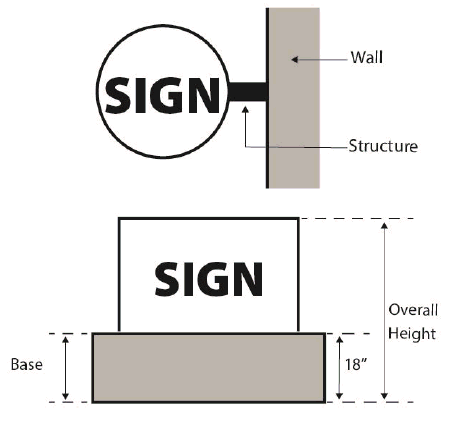
b.
Calculation of sign area. The following methods shall be used to determine what constitutes one (1) sign and to calculate the total square footage of any sign:
i.
Each area of a sign that can be enclosed by a line or an imaginary line shall be considered one (1) sign. Each side of a two-sided sign shall be used to calculate the maximum allowed sign area.
ii.
The area of measurement of a sign contained within a cabinet or frame shall include the total area of the cabinet or frame.
iii.
The area of measurement of a sign that displays individual letters on a wall, awning, or canopy or as pan channel letters shall be determined by encompassing all the letters in a geometric form of no more than eight (8) rectilinear lines at right angles to each other.
iv.
The total surface area of multiple unit signs includes the vertical and horizontal spacing between signs.
v.
The sign area of each sign face of monument, directional, projecting, and yard signs that have two (2) faces shall be measured to calculate the maximum allowed sign area.
Figure 4.2: Calculation of Sign Area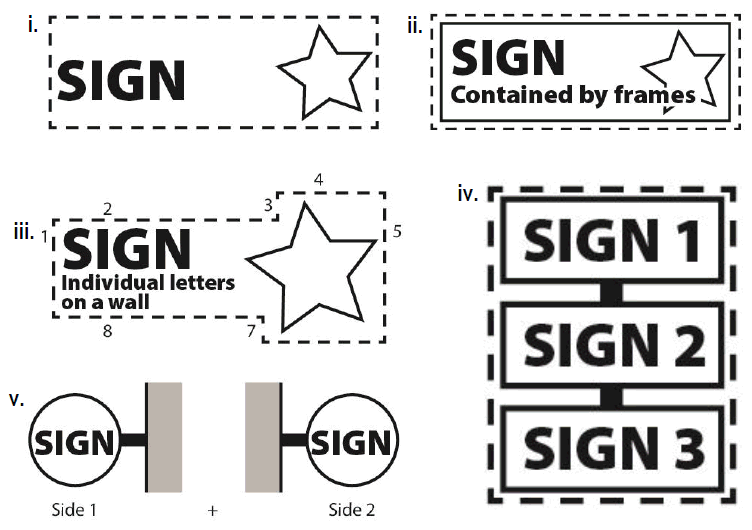
c.
Calculation of total number of signs. The following should be used to determine the number of permanent signs being proposed on a lot:
i.
Monument and projecting signs shall be counted as one (1) sign.
ii.
Directional signs shall not be included in the total number of signs.
iii.
Any sign within twelve (12) inches of the interior of a window shall be considered a sign and counted towards the total allowed number of signs and towards the maximum area of sign allowed.
4.
Permanent sign standards.
a.
Awning sign.
i.
Maximum area and/or dimensions. Signs shall not exceed six (6) square feet per awning.
ii.
Maximum number. Up to two (2) awning signs shall be allowed per business.
iii.
Maximum height. Sign bands on the vertical valance shall be no greater than eight (8) inches in height.
iv.
Other conditions.
a)
Graphics and/or letters on both the vertical valance and a sloped part of an awning shall count as one (1) sign.
b)
No polyester awnings are allowed.
c)
Signs shall be professionally applied to awnings.
d)
Signs shall not be illuminated.
b.
Directional sign.
i.
Maximum area and/or dimensions. No greater than three (3) square feet per side.
ii.
Maximum number.
a)
No more than one (1) directional sign per driveway entrance to a lot.
b)
No more than three (3) per lot.
iii.
Maximum height. No more than three (3) feet above grade.
iv.
Other conditions.
a)
Shall not impede the vision triangle.
b)
Shall be internally illuminated only.
c.
Monument sign.
i.
Maximum area and/or dimensions.
a)
Commercial use or mixed-use: Twenty (20) square feet.
b)
Residential use: Four (4) square feet.
ii.
Maximum number. One (1) per lot.
iii.
Maximum height. Six (6) feet.
iv.
Other conditions.
a)
Only allowed in the RF-MU-C area
b)
Only two (2) sided monument signs are allowed.
c)
Shall be externally illuminated only.
d.
Projecting sign.
i.
Maximum area and/or dimensions.
a)
Shall not exceed four (4) feet in width.
b)
Shall not exceed four (4) feet in height.
c)
Notwithstanding the maximum width or height allowed above, the sign shall not exceed six (6) square feet in area per side.
ii.
Maximum number. One (1) per building entry on the primary frontage.
iii.
Height.
a)
Minimum height above grade (clearance) is seven (7) feet six (6) inches. The minimum height shall be measured to the bottom of the projecting sign.
b)
Maximum height above grade is twelve (12) feet. The height shall be measured to the top of the projecting sign.
iv.
Other conditions.
a)
Shall comply with other applicable regulations if projecting into a right-of-way.
b)
Only two-sided projecting signs allowed.
c)
For multi-tenant buildings projecting signs shall be no less than twenty-five (25) feet apart and be placed consistently at each entrance on a primary façade.
d)
Shall be externally illuminated only.
e.
Wall sign.
i.
Maximum area and/or dimensions.
a)
Upper level: The maximum wall sign area for each lot shall not exceed one-half (0.5) square foot of sign area for each linear foot of primary street frontage of the building.
b)
Ground level: The maximum wall sign area shall be one-third (0.3) square foot of sign area for each linear foot of storefront.
ii.
Maximum number.
a)
Upper level: No more than two (2) wall signs per building.
b)
Ground level: One (1) per storefront.
iii.
Maximum height.
a)
Upper level: No taller than the roof plane of the building. (i.e. does not include parapet, nor the roof plane of any rooftop access)
b)
Ground level: No taller than the ground level of the building.
iv.
Other conditions. Shall be externally illuminated only.
f.
Window sign.
i.
Maximum area and/or dimensions. Shall not exceed fifteen (15) percent of the storefront glazing in which the sign is placed.
ii.
Maximum number. Up to three (3) per storefront glazing.
iii.
Maximum height. Anywhere within the storefront glazing.
iv.
Other conditions.
a)
Only vinyl professionally manufactured window signs are permitted and shall be applied solely to the storefront glazing.
b)
No painted on window signs are allowed.
c)
Shall not be illuminated.
g.
Mural.
i.
Maximum area and/or dimensions. Forty (40) percent of wall may be covered.
ii.
Maximum number. One (1) per lot.
iii.
Maximum height. The height of the wall.
iv.
Other conditions.
a)
Not allowed on key frontage, primary frontage, or a street front, if the street is opposite a key frontage.
b)
Shall not be illuminated.
c)
If proposed to be on a designed historic structure, shall be approved by the Historic Preservation Commission.
d)
Permits may only be issued to an arts district, a governmental entity involved in a public art project, a special district, or other registered neighborhood organization.
Table 17.04.020.D.4: Permanent Sign Standards
5.
Portable sign standards.
a.
Flag.
i.
Maximum area and/or dimensions.
a)
When hung from a building: Three (3) feet by five (5) feet.
b)
When hung from a pole mounted to the ground: Five (5) feet by seven (7) feet.
ii.
Maximum number.
a)
In single use lots: Up to two (2) flags allowed per lot.
b)
In multi-tenant buildings on a lot: One (1) flag allowed per storefront.
iii.
Maximum height.
a)
When hung from a building: at or below the tallest point on a building.
b)
When hung from a pole mounted to the ground in
(I)
RF-MU District no taller than the tallest point on the building, or no more than thirty-five (35) feet, whichever is lower.
(II)
In the RF-R District, no taller than fifteen (15) feet.
iv.
Other conditions.
a)
Flags shall be affixed to permanent flagpoles, whether or not such flagpole is freestanding or attached to a building.
b)
A minimum pedestrian clearance of seven (7) feet six (6) inches shall be maintained for any flag hanging above a sidewalk or walkway.
c)
Shall be externally illuminated only.
b.
Sandwich board.
i.
Maximum area and/or dimensions. Six (6) square feet per frame.
ii.
Maximum number. One (1) per business.
iii.
Maximum height. Four (4) feet.
iv.
Other conditions.
a)
If in the public right- of-way, shall be placed within an amenity zone or placed to maintain a minimum forty-eight (48) inches pedestrian clear zone.
b)
Sandwich boards shall not be within two (2) feet of the face of a curb of a street.
c)
Sandwich boards shall be placed within the storefront width of the business in a multi-tenant building, or within fifteen (15) feet of the front door of a business, whichever is more restrictive.
d)
Shall only be displayed during hours of operation.
e)
Shall be constructed and placed to withstand normal weather conditions.
f)
Shall not be illuminated.
Table 17.04.020.D.5: Portable Sign Standards
6.
Temporary sign standards.
a.
Feather flag sign.
i.
Maximum area and/or dimensions. Eight (8) feet by two (2) feet
ii.
Maximum number.
a)
On lots with a single use, one (1) per lot.
b)
On lots with multi-tenant buildings, one per (1) ground level storefront.
iii.
Maximum height. Eight (8) feet in height.
iv.
Other conditions.
a)
Are only allowed to be displayed during hours of operation.
b)
Shall be located within fifteen (15) feet of the entrance to the storefront located on the same lot.
c)
If in the public right-of-way shall be placed within an amenity zone or placed to maintain a minimum pedestrian clear zone of forty-eight (48) inches.
d)
Are allowed for no more than fourteen (14) consecutive days and no more than five (5) times in a calendar year.
e)
Shall not be placed within two (2) feet from face of curb.
f)
Shall not impede vision triangle.
g)
Shall not be illuminated.
b.
Flagging, streamers, and pennants.
i.
Maximum area and/or dimensions.
a)
On lots with a single use, no more than two (2) times the linear feet of the primary building.
b)
On lots with multi-tenant buildings, no more than two (2) times the linear feet of the storefront.
ii.
Maximum number. None
iii.
Maximum height. No taller than the storefront.
iv.
Other conditions.
a)
Allowed for no more than fourteen (14) consecutive days and no more than five (5) times in a calendar year.
b)
Shall be located within ten (10) feet of the storefront.
c)
Shall be confined to the storefront width of the applicable store in a multi-tenant building.
d)
Shall not be illuminated.
c.
Flexible banner sign.
i.
Maximum area and/or dimensions. Twenty (20) square feet total for all signs.
ii.
Maximum number. One (1) per business.
iii.
Maximum height.
a)
Fence mounted: No taller than fence.
b)
Ground mounted: Four (4) feet.
c)
Wall mounted: Eight (8) feet.
iv.
Other conditions.
a)
Allowed for no more than fourteen (14) consecutive days and no more than five (5) times in a calendar year.
b)
Flexible banner signs may be approved to be utilized continuously for more than fourteen (14) days if approved as part of a floodplain, grading, or building permit. The sign shall be removed within fourteen (14) days of the issuance of a Certificate of Occupancy.
c)
Shall not be illuminated.
d)
Shall be securely anchored into the ground or secured in a portable base designed for such function.
d.
Inflatable sign. Inflatable signs, as detailed below, shall not be erected or otherwise displayed, without the issuance of a permit as detailed in Section 17.10.020(F).
i.
Maximum area and/or dimensions. No more than one hundred forty-four (144) cubic feet.
ii.
Maximum number. One (1) per lot or storefront.
iii.
Maximum height. Twelve (12) feet in height.
iv.
Other conditions.
a)
Allowed only during hours of operation.
b)
No electrical cords shall cross a pedestrian passageway.
c)
Allowed for no more than fourteen (14) consecutive days and no more than five (5) times in a calendar year.
d)
The location be approved as part of the sign permit.
e)
Shall not be illuminated.
e.
Rigid banner sign. Rigid banner signs, as detailed below, shall not be erected or otherwise displayed, without the issuance of a permit as detailed in Section 17.10.020(F).
i.
Maximum area and/or dimensions. twenty-four (24) square feet total for all signs.
ii.
Maximum number. One (1) per street front.
iii.
Maximum height.
a)
Freestanding eight (8) feet in height.
b)
Fence mounted no taller than the fence.
c)
Wall mounted within the ground level.
iv.
Other conditions.
a)
If freestanding, sign posts shall have a structure made from wood, PVC, or metal that is durable.
b)
If not freestanding, shall be properly secured to a fence or wall.
c)
Allowed for no more than fourteen (14) consecutive days and no more than five (5) times in a calendar year.
d)
Rigid banner signs may be approved to be utilized continuously for more than fourteen (14) days if approved as part of a floodplain, grading or building permit. The sign shall be removed within fourteen (14) days of the issuance of a Certificate of Occupancy.
f.
Yard sign.
i.
Maximum area and/or dimensions.
a)
Commercial uses or mixed-uses: Thirty-two (32) square feet.
b)
Residential uses: Twenty-four (24) square feet.
ii.
Maximum number.
a)
Commercial uses or mixed uses: One (1) yard sign per lot or storefront of a multi-tenant building.
b)
Residential uses: No maximum provided the total area is not exceeded.
iii.
Maximum height.
a)
Commercial uses or mixed-uses: Eight (8) feet.
b)
Residential uses: Four (4) feet in height.
iv.
Other conditions.
a)
Prohibited in the public right-of-way.
b)
Shall be placed at least eighteen (18) inches from the lot side of a sidewalk if freestanding.
c)
Shall not impede vision triangle.
d)
Allowed for no more than sixty (60) consecutive days prior to an election but shall be removed ten (10) days after the conclusion of an election.
e)
Allowed during the period of time when a property is for sale or lease but shall be removed three (3) days after the sale or lease of property.
Table 17.04.020.D.6: Temporary Sign Standards
7.
Sign standards by district.
a.
Permitted signs by district. The sign types permitted in each Riverfront District shall be as detailed in Table 17.04.020.D.7.
Table 17.04.020.D.7: Permitted Signs by District
b.
RF-MU District permanent signs standards.
i.
Maximum area.
a)
The maximum sign area in square feet allowed for a lot shall not exceed one and one quarter (1.25) times the linear square footage of the primary frontage of the building.
b)
In buildings with multi-tenant ground level storefronts, the maximum sign area in square feet allowed shall not be more than one and one quarter (1.25) linear feet per storefront. The total signage for the building shall not exceed one and one half (1.5) linear feet.
c)
If a business has no street footage on the ground level in a multi-tenant building, the maximum sign area of the lot may be increased by one quarter (0.25) times the linear footage of that businesses' storefront.
ii.
Maximum number.
a)
Each lot may have up to six (6) signs.
b)
Each lot with a multi-tenant building is allowed three (3) upper-level wall and/or monument signs (complying with other regulations) plus four (4) signs per tenant storefront, of which one shall not be larger than three (3) square feet. Tenant inclusion in a monument sign shall not be counted towards the maximum number of signs or maximum sign area for a tenant.
iii.
Illumination.
a)
Of those sign types allowed to be illuminated, the sign shall not flash, blink, or fluctuate.
b)
Only external indirect illumination is allowed, except for directional signs.
c)
Signs which are externally illuminated shall be downlit only.
d)
Illumination shall not go beyond the property limits of the property.
iv.
General conditions.
a)
All permanent signs require a permit.
b)
Permanent signs shall not be on more than three (3) elevations of a building.
c.
RF-R District permanent sign standards.
i.
Maximum area. Shall not exceed four (4) square feet in size per lot.
ii.
Maximum number. Each lot may have one (1) sign.
iii.
Illumination. Illumination shall not be allowed.
iv.
General conditions.
a)
Signs shall be placed no closer than two (2) feet from the back side of a sidewalk.
b)
Signs shall not to impede any vision triangle.
d.
Prohibited signs.
i.
RF-MU District prohibited signs.
a)
Roof signs
b)
Off premises signs
c)
Signs painted on a fence
d)
Flashing, blinking, or fluctuating signs
e)
Electronic message signs on vehicles
f)
Any other signs not explicitly allowed
ii.
RF-R District prohibited signs.
a)
Awning signs
b)
Directional signs
c)
Projecting signs
d)
Sandwich board signs
e)
Flexible banner signs
f)
Inflatable signs
g)
Rigid banner signs
h)
Roof signs
i)
Off premises signs
j)
Signs painted on a building or fence
k)
Murals
l)
Flashing, blinking, or fluctuating signs
m)
Electronic message signs on vehicles
n)
Any other signs not explicitly allowed
8.
General sign regulations for all Riverfront Districts.
a.
Maintenance.
i.
Every sign shall be maintained in good condition at all times. A sign in good condition shall meet the following criteria:
a)
Signs shall be rust free.
b)
Plastic, acrylic, and other similar materials shall not be broken, cracked, torn or faded.
c)
Banners, awnings, flags, and feather flags shall not be torn, faded or in disrepair.
d)
All lighting, where permitted, shall be functional and no exposed light sources are permitted unless approved with the permit.
ii.
The City shall have the authority to inspect signs to ensure adequate maintenance and compliance with this section.
iii.
If upon inspection, staff determines a sign to be in violation of this section or a safety hazard, the staff may order the sign to be maintained or removed by the owner.
b.
Nonconforming signs.
i.
Continuance. Subject to the termination hereinafter provided, any nonconforming sign may be continued in operation and be maintained after the effective date of this UDC or any amendment thereto; provided, however, that no such sign shall be modified in any manner that increases the nonconformity of such sign.
ii.
Termination. Termination of a nonconforming sign shall take place upon:
a)
Structural change to any nonconforming sign.
b)
Structural alteration to prolong the life of the sign, except to meet safety requirements.
c)
Alteration or expansion in any manner which increases the degree of nonconformity.
d)
Damage or destruction if the estimated cost of reconstruction exceeds fifty (50) percent of the value of the sign structure prior to being damaged.
e)
Any violation of this section shall terminate immediately the right to maintain such sign.
c.
Official signs, danger signs, emergency signs and legal notices may be placed by responsible persons upon approval of the City Administrator.
d.
No sign shall be erected, constructed, maintained, or altered within the City in violation of the Code of Cañon City, including but not limited to this section.
e.
Proper vision clearance shall be provided at all times.
f.
No sign of any type shall be erected or placed so as to obstruct any necessary egress in case of fire.
g.
All exterior signs shall be designed and constructed to resist the wind effects determined in accordance with applicable requirements of the duly adopted International Building Code.
9.
Applicability of Chapter 17. The following sections of Chapter 17 are applicable to the signs within the RF-MU and RF-R Districts to the extent no conflict exists between this section and the following sections:
a.
17.07.040
b.
17.07.100(E)
Sec. 17.04.030. - RF-MU Riverfront Mixed Use District specific standards.
A.
Bulk and dimensional standards.
1.
Lot standards. Required lot standards shall be as established Table 17.04.030.A.1 and illustrated in Figure 4.3.
Table 17.04.030.A.1: RF-MU Lot Standards
Figure 4.3: RF-MU Lot Coverage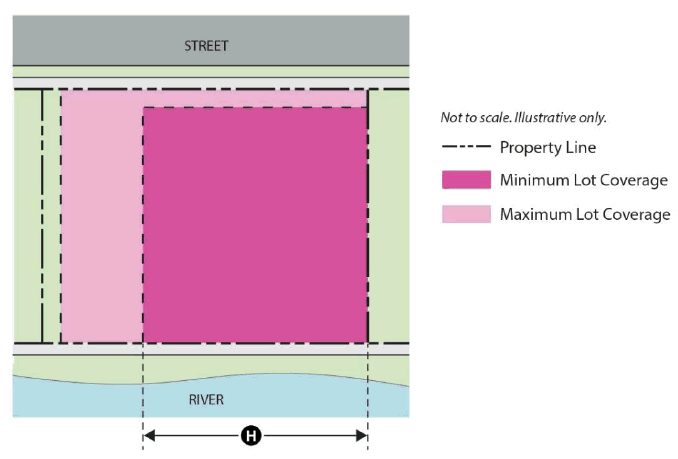
2.
Setbacks. Required setbacks shall be as established in Table 17.04.030.A.2 and illustrated in Figure 4.4.
Table 17.04.030.A.2: RF-MU Setback Requirements
Figure 4.4: RF-MU General Setback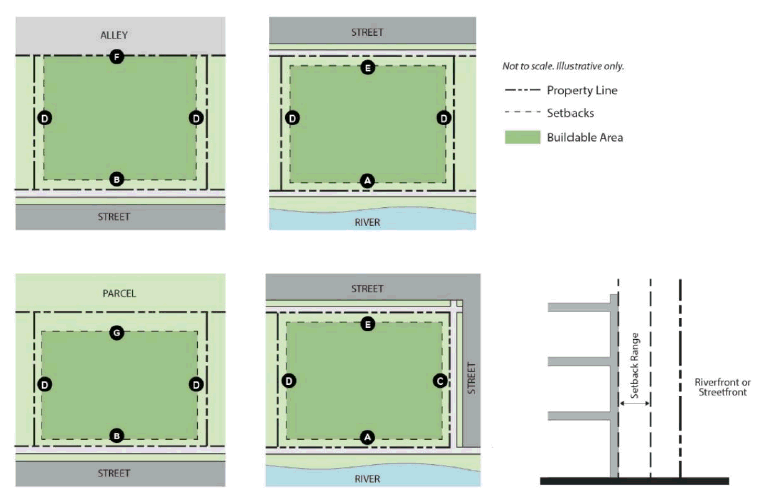
3.
Building height. Required building heights shall be as established in Table 17.04.030.A.3 and illustrated in Figure 4.5.
a.
Calculating building height. As illustrated in Figure 4.6, the maximum height shall be determined by measuring the average ground elevation of the river front (or other street or alley frontage) and opposite street edge of property, or at street front edge of property if no river frontage.
Table 17.04.030.A.3: RF-MU Building Height
Figure 4.5: RF-MU Building Heights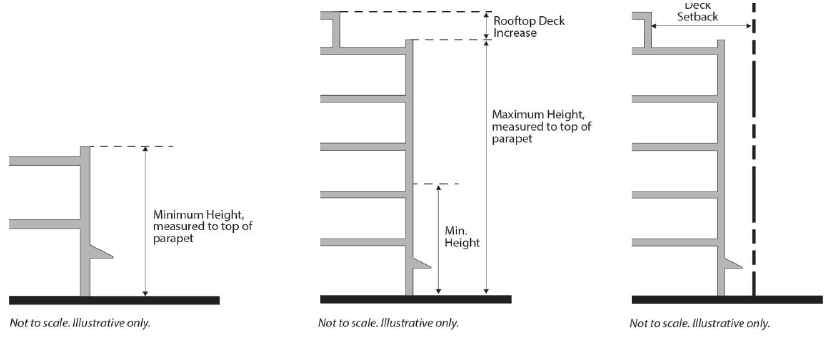
Figure 4.6: RF-MU Calculating Building Height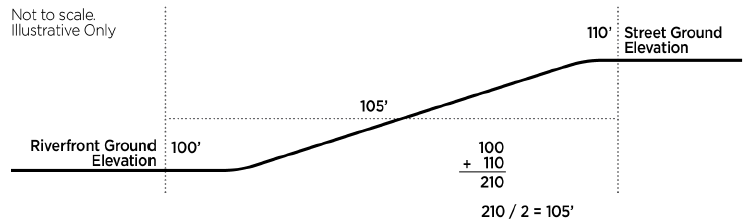
4.
Building footprint. Required building footprints shall be as established in Figure 4.7 and Figure 4.8.
Figure 4.7: RF-MU Minimum Building Footprint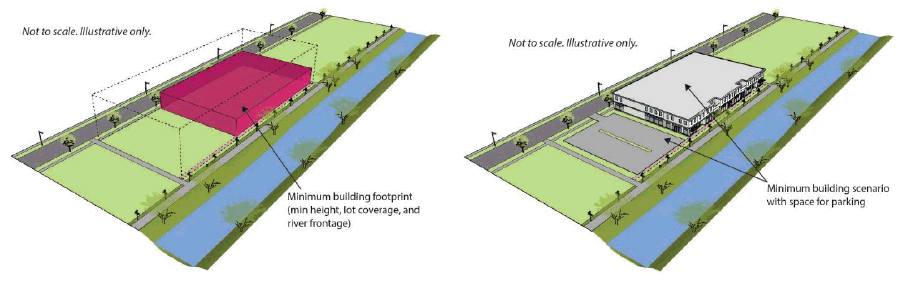
Figure 4.8: RF-MU Maximum Building Footprint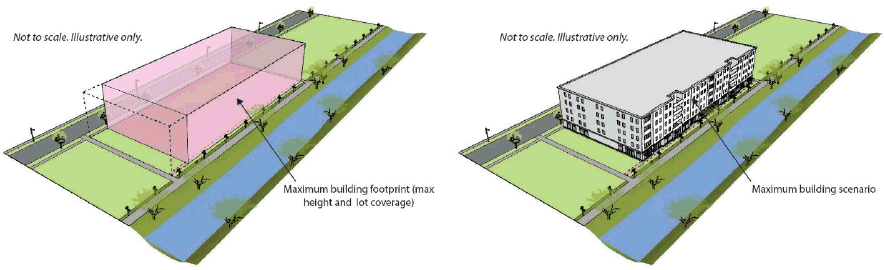
B.
Uses. Table 17.04.030.B details the uses that are allowed in the RF-MU District per subarea. The following key shall be used in the interpretation of Table 17.04.030.B.
1.
Permitted uses. Uses which are marked as "P" in the table shall be allowed subject to all applicable regulations of this UDC.
2.
Conditional uses. Uses which are marked as "C" in the table shall be allowed only after the issuance of a conditional use permit as detailed in Section 17.10.020(D) of this UDC.
3.
Special review uses. Uses which are marked as "S" in the table shall be allowed only after the issuance of a special review use permit as detailed in Section 17.10.040 of this UDC.
4.
Prohibited uses. A blank space in the table indicates that a use type is not allowed in the respective subarea.
5.
Uses not listed. If a proposed use is not listed in the table, the Zoning Administrator shall determine if the use is substantially similar to a use listed in the table. If it is, they shall treat the use in the same manner as the "similar" use. If not, the use shall be regarded as prohibited.
6.
Additional regulation. If a use has use specific standards, as detailed in Chapter 17.05 of this UDC, they are referenced in this column. Use specific standards shall apply to permitted, conditional, and special review uses.
Table 17.04.030.B: Permitted, Conditional, and Special Review Uses
in RF-MU Subareas
C.
Easements.
1.
River front easement. For every property that abuts the Arkansas River, the owner, at the time of rezoning to the RF-MU District, shall grant an easement to the City of a width that is adequate and necessary for the purposes of public access to the river, the construction and maintenance of a public river walk path, and the maintenance and repair, and associated activities, of the riparian areas adjacent to the river.
2.
Side setback easement. As illustrated in Figure 9, every property that exceeds three-hundred fifty (350) feet of river frontage, the owner, at the time of rezoning to a Riverfront District, shall grant to the City a side setback easement on each side of the property of a width that is adequate and necessary for the purpose of providing public access between the river front and streets, as well as for access to the river walk for maintenance and repair of the river walk path along the river and other areas adjacent to the river.
Figure 9: RF-MU Side Setback Easement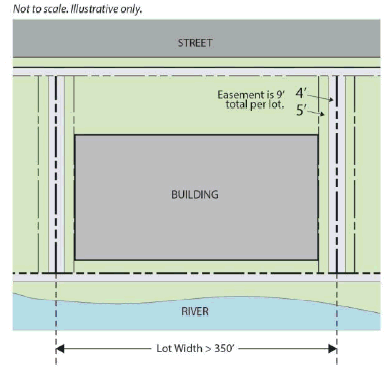
D.
Design standards.
1.
Ground floor transparency.
a.
As illustrated in Figure 4.10, a minimum of seventy-five (75) percent of the ground floor of key frontages, shall be transparent. If a building has less than eighty (80) percent lot frontage build out, then transparency may be lowered to sixty-five (65) percent.
b.
A minimum of sixty-five (65) percent of the ground floor of building frontages, not identified as key frontages shall be transparent.
Figure 4.10: RF-MU Ground Floor Transparency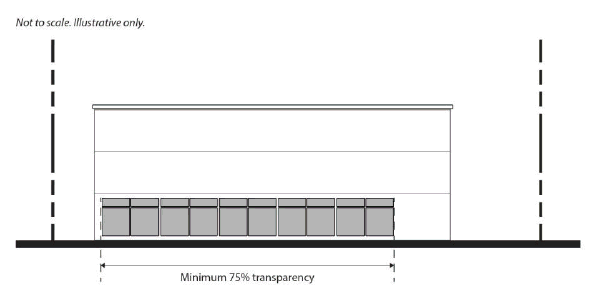
2.
Materials.
a.
Key frontage building materials.
i.
Ground floor elevations shall include the primary building material, integrally colored concrete masonry units (CMU), only.
ii.
Upper floor elevations may include secondary building materials such as exterior insulation finishing systems (EIFS) or stucco.
iii.
Storefront glazing systems shall be clear low-e glass with black, bronze, grey, or clear anodized frames.
iv.
Frames of awnings shall match storefront glazing.
b.
Other frontage materials.
i.
Shall include the primary building material, integrally colored concrete masonry units (CMU), for a minimum of thirty-six (36) inches from ground level.
ii.
May include secondary building materials such as exterior insulation finishing systems (EIFS) or stucco, above thirty-six (36) inches from ground level.
iii.
Shall utilize the same frame color utilized on key frontages.
iv.
Frames of awnings shall match storefront glazing.
c.
Prohibited materials. The following building materials are prohibited on any exposed surface:
i.
Smooth-faced CMU.
ii.
Faux wood finish on CMU or on poured concrete.
d.
Roof materials. As illustrated in Figure 4.11, any roof materials visible from the adjacent river walk, street, or alley level view of a pedestrian (e.g. a shed roof that is on a shorter portion of a taller building with flat roof and parapet wall) shall be shingled or of metal roofing, no rolled roofing permitted.
Figure 4.11: Roofing Visible from Adjacent View of a Pedestrian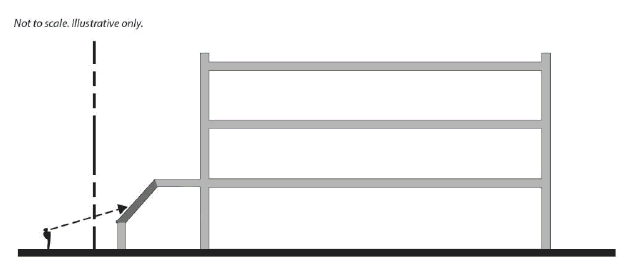
3.
Service entrances.
a.
No service entrance shall be located on a key frontage.
b.
A service entrance may be located on a non-key frontage but shall be architecturally integrated into the design of the building, enclosed to the fullest extent possible, and designed to minimize impact to pedestrians.
4.
Structured parking.
a.
Ground floor.
i.
Key frontage: Ground floor structured parking shall comprise of no more than thirty-five (35) percent of the minimum frontage.
ii.
Street frontage (other than key frontage): No more than sixty-five (65) percent of the building frontage on the street.
iii.
The ground-floor elevation facing any frontage shall be between twenty-five (25) percent to fifty (50) percent transparent to eliminate both blank walls from the riverwalk/street and fully exposed parking.
b.
Upper floors. Upper floor elevation(s) of structured parking facing any frontage shall be designed to be a maximum of fifty (50) percent transparent.
5.
Projections.
a.
Upper floor balconies facing any frontage may project onto a street, lane, or side setback easement as long as the projection does not extend beyond the property line. Projections into a river front easement are prohibited.
b.
Internal roof drains shall be required.
c.
All rooftop appurtenances shall be screened from pedestrian view from an adjacent riverwalk, street, or alley. As illustrated in Figure 4.12, rooftop appurtenances shall also be screened from view from any riverwalk on the opposite bank of the river directly across from the site.
Figure 4.12: Rooftop Appurtenance Screening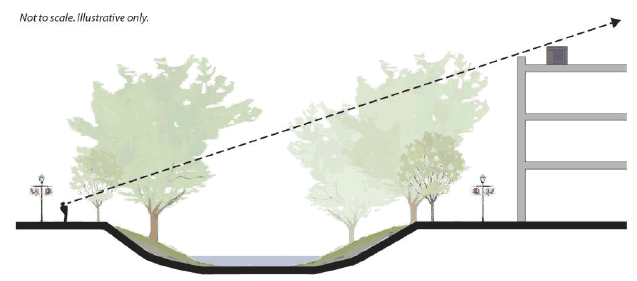
E.
General site standards.
1.
Shared curb cuts shall be utilized between properties wherever feasible.
2.
Drop-off bays shall be permitted for hotels only and shall be designed to have minimal impact to the public realm.
3.
As illustrated in Figure 4.13, ground level or above grade structured parking shall be a minimum of five (5) feet from a street or river front façade.
Figure 4.13: Ground Level Structured Parking Setback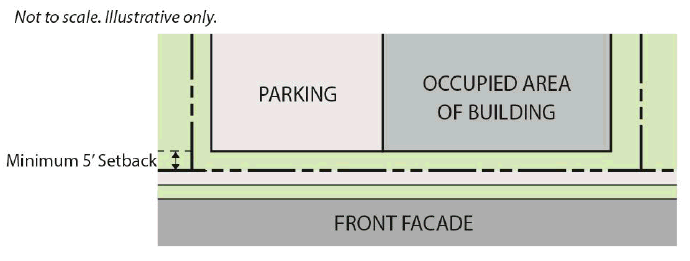
4.
As illustrated in Figure 4.14, ground level structured parking shall not extend beyond the front façade of the occupied portion of a building on a street front.
Figure 4.14: Ground Level Structured Parking Alignment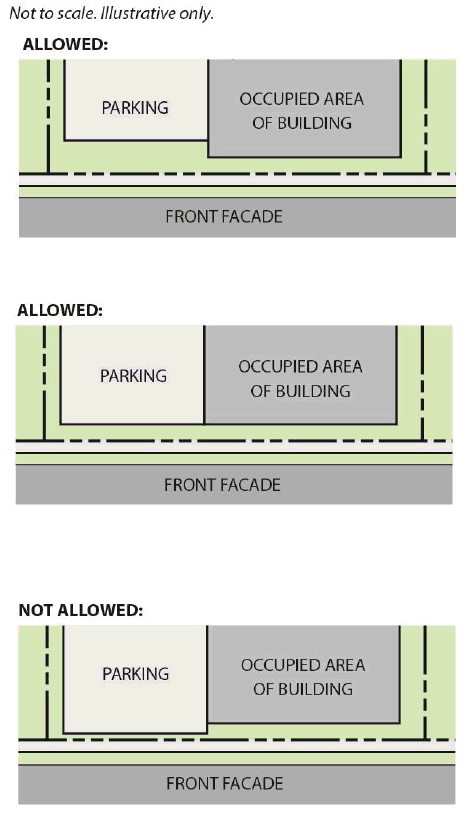
5.
Access/loading shall not be from a key frontage per the Framework Plan.
6.
Storage units shall be prohibited except during construction.
7.
Outdoor cafés.
a.
Only durable metal or composite exterior furnishings and fencing/railings are permitted in colors to match the building storefront or in black.
b.
No plastic or fiberglass materials are prohibited.
c.
Outdoor café furnishings shall be designed/secured in a manner able to withstand strong winds.
d.
Umbrellas as part of outside cafés shall not obstruct any pedestrian way and shall not contain any signage.
e.
Outdoor gas line fed fire pits shall be contained on the private property.
f.
Outdoor café encroachments, as illustrated in Figure 4.15, shall comply with Table 17.04.030.E.7.
Table 17.04.030.E.7: RF-MU Outdoor Café Encroachments
Figure 4.15: Outdoor Cafe Encroachments - Riverwalk Context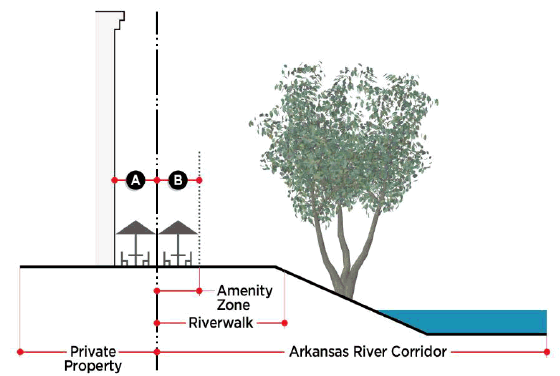
F.
Landscaping, fencing, and screening.
1.
Trees.
a.
Street trees. One (1) deciduous tree with a minimum caliper of two (2) inches at the time of planting shall be planted per every thirty-five (35) feet of street frontage.
b.
Side setback easement trees. One (1) deciduous tree with a minimum caliper of two (2) inches at the time of planting shall be planted per every thirty-five (35) feet of side setback easement.
c.
Parking areas. Trees shall be planted in parking areas per Section 17.04.020(C)(6).
2.
Pervious surfaces.
a.
Any area that is not within the building footprint, parking lot footprint, walkways, or paved support areas such as trash enclosure or detention facilities shall be surfaced with a pervious material, such as but not limited to pervious concrete, porous asphalt, brick/stone pavers, engineered turf pavers, or live plant material.
b.
A minimum of fifty (50) percent of the pervious surface of a site shall be planted and maintained with live plant material.
c.
Irrigation shall be installed to ensure longevity of turf/live plant material.
d.
A variety of plant materials shall be employed to provide year-round interest.
e.
Drought tolerant and native plant material shall be used to the greatest extent possible.
3.
Fencing.
a.
Fence materials.
i.
Solid masonry or metal fence materials which match the building storefront are permitted.
ii.
Wood or plain faced CMU fence materials are prohibited.
b.
Fences may be no more than forty-two (42) inches high, excluding fences utilized for trash enclosure screening.
4.
Screening.
a.
Trash enclosure screening. Solid masonry or metal trash enclosures with metal gates are required to fully screen trash receptacles. Enclosures shall include metal gates for screening and to secure the area. Enclosures shall be designed in the color/material palette of the principal structure. Trash enclosure screening shall not include smooth faced CMU, EIFS, or stucco.
b.
Parking areas.
I.
Surface parking lots.
i.
Shall be screened from rights-of-way, riverwalk, or adjacent properties by use of evergreen shrubs or low walls with seventy-five (75) percent opacity.
ii.
Low screen walls shall be forty-two (42) inches tall and shall not be of wood, plastic/plastic composite, or smooth-faced CMU.
iii.
Shrubs shall be a minimum five (5) gallon container at time of planting.
iv.
Parking lot screening shall not impede vision triangles created at egress points from lots.
II.
Ground level parking structures.
i.
Shall be screened by use of evergreen shrubs. One (1) evergreen shrub shall be planted every three (3) feet on center, spaced linearly to create a hedge row.
ii.
Shrubs shall be a minimum five (5) gallon container at time of planting.
iii.
Dead plant material shall be replaced in a timely manner.
5.
Lighting.
a.
Site and building lighting shall be minimized to the extent necessary to meet safety purposes.
b.
Lighting shall not be aimed nor spill onto adjacent properties.
c.
Automatic switching controls that automatically extinguish all outdoor lighting when sufficient daylight is available using a control device shall be provided.
d.
Full cut-off fixtures are required.
e.
The following are prohibited:
I.
Low pressure sodium and mercury vapor light sources.
II.
Neon.
III.
Exposed light source.
IV.
Uplighting.
f.
Freestanding outdoor lighting fixtures shall:
I.
Only be permitted for parking lots or drop off areas.
II.
Not be taller than twenty-four (24) feet, or not be taller than sixteen (16) feet within fifty (50) feet of a residential district or on the rooftop of a parking structure.
Sec. 17.04.040. - RF-R Riverfront Residential District specific standards.
The following lot standards, building placement, building height, easements, and related information for the RF-R District is primarily relayed in tables and figures. Utilize the reference to the left of a table as a guide to the visual representation of the regulations via figures. All figures are for illustrative purposes only.
A.
Bulk and dimensional standards.
1.
Lot standards. Required lot standards shall be as established Table 17.04.040.A.1 and illustrated in Figure 4.16.
Table 17.04.040.A.1: RF-R Lot Standards
Figure 4.16: RF-R Building Placement Configurations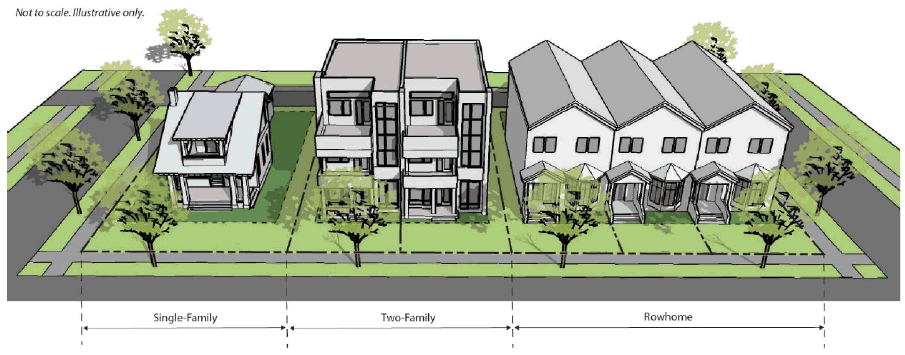
2.
Setbacks. Required setbacks shall be as established in Table 17.04.040.A.2 and illustrated in Figure 4.17, and Figure 4.18.
Table 17.04.040.A.2: RF-R Setback Requirements
Figure 4.17: RF-R General Setbacks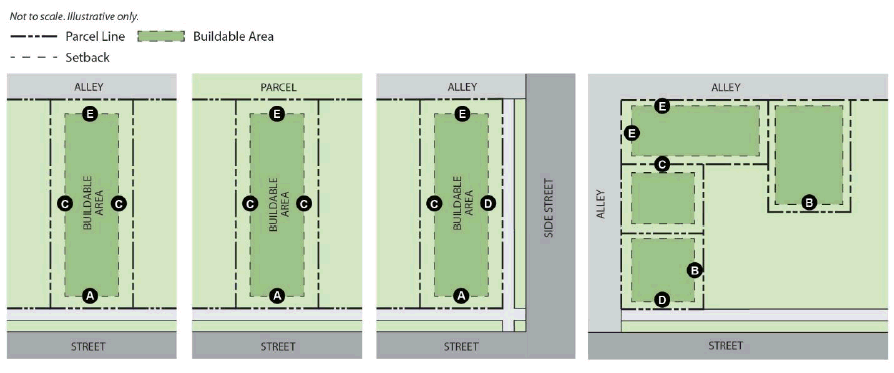
Figure 18: RF-R Floodway Setbacks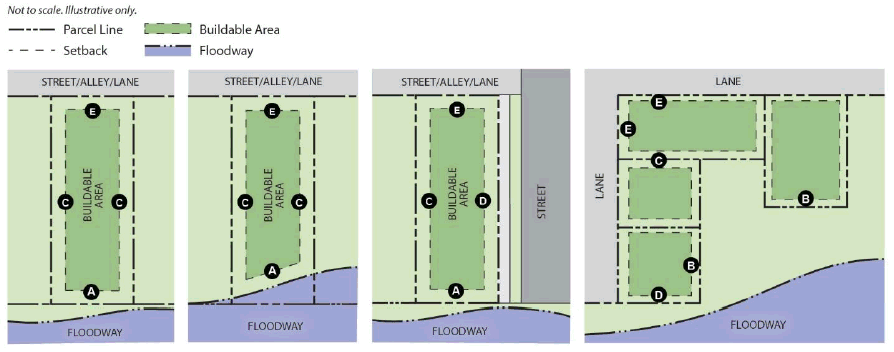
3.
Setback encroachment. As illustrated in Figure 4.19, porches, patios, and stoops are permitted to encroach into required setbacks a maximum of four (4) feet.
Figure 4.19: RF-R Setback Encroachment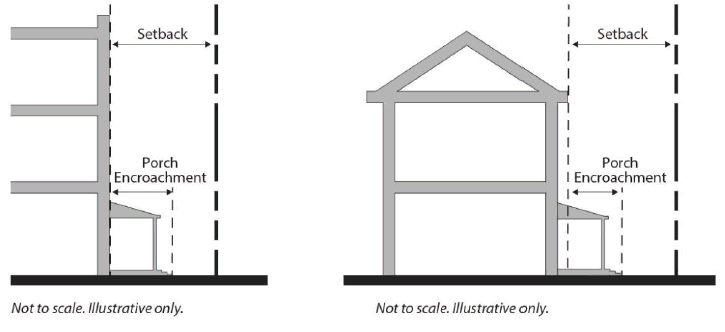
4.
Building height. Required building heights shall be as established in Table 17.04.040.A.3 and illustrated in Figure 4.20.
Table 17.04.040.A.3: RF-R Building Height
Figure 4.20: RF-R Building Height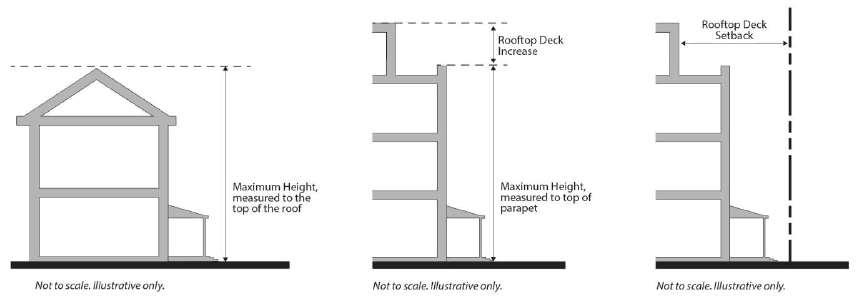
B.
Uses. Table 17.04.040.B details the uses that are allowed in the RF-R District. The following key shall be used in the interpretation of Table 17.04.040.B.
1.
Permitted uses. Uses which are marked as "P" in the table shall be allowed subject to all applicable regulations of this UDC.
2.
Conditional uses. Uses which are marked as "C" in the table shall be allowed only after the issuance of a conditional use permit pursuant to Section 17.10.020 of this UDC.
3.
Special review uses. Uses which are marked as "S" in the table shall be allowed only after the issuance of a special review use permit pursuant to Section 17.10.040 of this UDC.
4.
Prohibited uses. A blank space in the table indicates that a use type is not allowed in the respective subarea.
5.
Uses not listed. If a proposed use is not listed in the table, the Zoning Administrator shall determine if the use is substantially similar to a use listed in the table. If it is, they shall treat the use in the same manner as the "similar" use. If not, the use shall be regarded as prohibited.
6.
Additional regulation. If a use has use specific standards, as detailed in Chapter 17.05 of this UDC, they are referenced in this column. Use specific standards shall apply to permitted, conditional, and special review uses.
Table 17.04.040.B: Permitted, Conditional, and Special Review Uses in RF-R
C.
Design standards.
1.
No outside storage shall be visible from the riverwalk or a street.
2.
Ground floor living spaces shall be raised a minimum of eighteen (18) inches above grade to provide a transition from the public realm to the private realm.
D.
General site standards.
1.
As illustrated in Figure 4.21, a lot which provides access to a garage or other parking in the front setback shall provide a clear indication from a street or lane where the front door to a housing unit is located.
Figure 4.21: Residential Front Door Visibility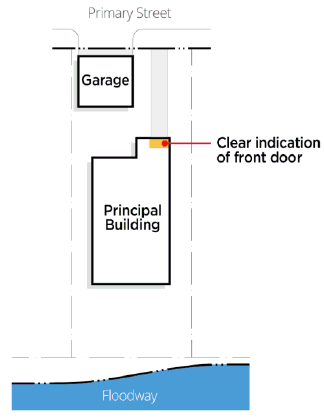
E.
Landscaping, fencing, and screening.
1.
Trees.
a.
Street trees. One (1) deciduous tree shall be planted per every thirty-five (35) feet of street frontage.
b.
Per lot.
I.
Dwelling, single-family, two-family, townhome: One (1) deciduous tree shall be planted per lot.
II.
Dwelling, multifamily: One (1) deciduous tree shall be planted per five (5) units.
2.
Pervious surfaces.
a.
A minimum of sixty (60) percent of the front setback shall be planted and maintained with live plant material.
b.
A variety of plant materials shall be employed to provide year-round interest.
c.
Drought tolerant and native plant material shall be used to the greatest extent possible.
3.
Fencing.
a.
As illustrated in Figure 4.22, fences with a maximum height of seventy-two (72) inches shall be permitted in a front setback along a street or a lane if the opposite side of the property is abutting the floodway with no vehicular access, and vehicular access is from the street or lane.
b.
As illustrated in Figure 4.22, the top twelve (12) inches of a fence shall be fifty (50) percent transparent.
c.
Fences shall be set back eighteen (18) inches from the property line.
d.
Fencing and landscaping shall meet vision triangle requirements.
Figure 4.22: RF-R Fences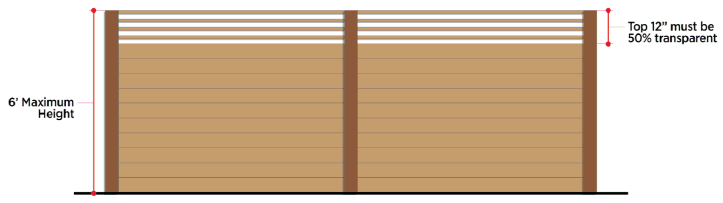
4.
Screening. Multifamily shall meet the screening requirements for structured parking as detailed in Section 17.04.030(F)(4)(b)(II).
F.
Lighting.
1.
Site and building lighting shall be minimized to the extent necessary to meet safety purposes.
2.
Lighting shall not be aimed nor spill onto adjacent properties.
3.
Automatic switching controls that automatically extinguish all outdoor lighting when sufficient daylight is available using a control device shall be provided.
4.
Full cut-off fixtures are required.
5.
The following light sources are permitted:
a.
Incandescent.
b.
LED.
c.
Lighting sources permitted in the RF-MU District may be approved by the Zoning Administrator at the time of site plan review for multifamily buildings over twelve (12) units in size.
6.
The following are prohibited:
a.
Neon.
b.
Pole mounted lighting over eight (8) feet in height.

