
Canon City City Zoning Code
CHAPTER 17
05 - USE SPECIFIC STANDARDS
Sec. 17.05.010.- Agricultural use specific standards.
A.
Community garden.
1.
The name and contact information of the responsible person or organization shall be clearly posted and maintained for the duration of the existence of the community garden.
2.
Accessory structures shall be limited in gross floor area to ten (10) percent of the of the lot used for the community garden, shall have a maximum height of twelve (12) feet including any pitched roof, and shall be limited to the following accessory structure types:
a.
Storage sheds,
b.
Hoop houses,
c.
Cold frames.
3.
All compost and/or organic matter on the site shall:
a.
Not cover more than ten (10) percent of the total area of the property,
b.
Be screened from view from adjacent property and the public right-of-way,
c.
Be managed to prevent the harborage or habitation of rodents and pests,
d.
Be maintained to prevent odors, and
e.
Be located to prevent leachate from flowing onto adjacent property or into natural or human-made storm channels.
4.
The site shall be designed and maintained to prevent water from irrigation and/or other activities and/or fertilizer from draining onto adjacent property.
5.
Trash areas shall be provided and screened from view from adjacent property and the public right-of-way.
B.
Livestock.
1.
Livestock may be kept in the R-1, R-2, and R-3 Districts only on a contiguous tract of land which is in excess of one (1) acre in area. Livestock may be kept in the R-L District only on a contiguous tract of land which is in excess of fifteen thousand (15,000) square feet. Such area shall be controlled by the owner of such livestock through ownership or by lease or similar agreement.
2.
No more than one (1) hoofed animal shall be kept per half (0.5) acre of land provided in the R-1, R-2 and R-3 Districts. No more than one (1) hoofed animal shall be kept per every fifteen-thousand (15,000) square feet of land provided in the R-L District, and, thereafter, every portion of land that calculates into more than one-half (0.5) animal unit allowed on the property will be considered as one (1) for determining the total number of animals permitted in the R-L District only.
3.
All manure, bedding, spillage, and leftovers from feedings shall be removed and disposed of to prevent fly and rodent propagation or odor.
4.
Fencing of the lot where livestock is kept must be constructed and maintained so that the animals are kept twenty-five (25) feet from a residence on an adjoining lot. Where animals and livestock are restricted to a smaller portion of the total lot area by the corral, pen, sty, or any other type of enclosure, said enclosure shall be located the furthest reasonable distance possible from any residence on any adjoining lot taking into account the surrounding adjacent uses and the size and shape of the lot on which the enclosure is situated. All fencing must be constructed and maintained in a manner that prevents the enclosed animals from damaging crops, structures or objects on any adjoining lot.
5.
The keeping or sheltering of livestock shall be conducted in a manner that does not constitute a nuisance or health hazard under any ordinance of the City or applicable law of the state.
Sec. 17.05.020. - Residential use specific standards.
A.
Group home.
1.
Group homes shall be for the exclusive use of citizens protected by the federal Fair Housing Act Amendments of 1988 (FHAA), as defined in the FHAA and interpreted by the courts, and by any similar legislation of the State of Colorado.
2.
Group homes for the aged, developmentally disabled, and behavioral or mental health disorders shall comply with all state licensing requirements and show proof of state licensure prior to issuance of a final certificate of occupancy.
3.
No group home shall be located within one thousand (1,000) feet of any other group home.
4.
No group home shall require a level of community facilities and services greater than that which are available to single-family residential uses such as commercial-sized waste receptacles and more frequent waste disposal services.
5.
No group home shall cause undue traffic congestion, parking congestion, or traffic hazards, including frequent commercial deliveries or other frequent traffic impacts distinct from those impacts otherwise caused by single-family residential uses.
6.
Group homes shall comply with all City-adopted building, health, safety, and fire codes including occupancy restrictions.
7.
A request for a reasonable accommodation under the FHAA shall be reviewed by the Zoning Administrator and only approved upon a showing that the request does not: (1) impose an undue burden or expense on the City; or (2) create a fundamental alteration of the zoning scheme.
B.
Manufactured home.
1.
Minimum dimensions. All manufactured homes shall not be less than twenty-four (24) feet wide and thirty-six (36) feet long.
2.
Required foundation. Manufactured homes shall be installed on an engineered permanent foundation.
3.
Materials and design. Manufactured homes shall feature brick, wood, or cosmetically equivalent exterior siding and a pitched roof.
4.
External standards. All manufactured homes shall be certified pursuant to the National Manufactured Housing Construction and Safety Standards Act of 1974, 42 U.S.C. 5401, et seq., shall meet any applicable standards of the Cañon City Building Code, and shall be built for the Colorado climate and snow loads according to the Department of Housing and Urban Development standards established under the provisions of 42 U.S.C. 5401, et seq.
C.
Marijuana cultivation for personal use.
1.
Intent, authority, applicability, and interpretation.
a.
Intent. This section is intended to apply to the growing of medical and recreational marijuana in residential structures.
b.
Authority. The City's authority to adopt this section is found in Articles XVIII, Sections 14 and 16 of the Colorado Constitution, the Local Government Land Use Control Enabling Act, Section 29-20-101, C.R.S.; Section 31-23-101, C.R.S. (municipal zoning powers); Sections 31-15-103, 31-15-401, C.R.S. (municipal police powers); Section 31-15-501, C.R.S. (municipal authority to regulate businesses); and the Home Rule Charter of the City of Cañon City.
c.
Applicability. This section shall apply to all property within the City.
d.
Interpretation. Nothing in this section shall be interpreted to permit the establishment or operation of any retail marijuana or medical marijuana businesses, as defined under the Colorado Marijuana Code (Title 44, Article 10 of the Colorado Revised Statutes), as may be amended, unless such businesses are expressly permitted by the City of Cañon City Municipal Code.
2.
Prohibitions with respect to cultivation of marijuana.
a.
Any person who is twenty-one (21) years of age or older may possess, cultivate, or process no more than six (6) marijuana plants for personal use, with no more than three (3) plants being mature, in a residential structure subject to the limitations in this section.
b.
Any person who is eighteen (18) years of age and a patient or caregiver may cultivate, or possess, no more than twelve (12) marijuana plants for medical use, with no more than six (6) plants being mature, in a residential structure subject to the requirements in this section.
c.
Any cultivation allowed under this section may only occur in a secured area, located in a residential structure that is the person's primary residence, or associated with the person's primary residence in the case of allowed accessory structures, or a residential structure that is the primary residence of another person, or associated with that other person's primary residence, and used with the written permission of that owner.
d.
The secured area in a detached single-family dwelling shall not exceed one hundred (100) square feet and a height of ten (10) feet.
e.
A detached accessory structure with a secured area used for marijuana cultivation shall be located at least twenty (20) feet from any neighboring residential dwelling unit. The area used for marijuana cultivation shall not exceed one hundred (100) square feet or be more than ten (10) feet in height.
f.
The secured area within an attached or detached garage shall not be greater than one hundred (100) square feet.
g.
No kitchen, bathroom, or primary bedrooms within a detached single-family dwelling may be used for cultivation.
h.
No marijuana cultivation shall be conducted openly or publicly.
i.
No marijuana produced under this section shall be made available for sale.
j.
Any secured area within a garage or accessory structure, including all walls, doors, and the roof, shall be constructed with a firewall assembly of green board meeting the minimum building code requirements for residential structures and include material strong enough to prevent entry except through an open door.
k.
All high-intensity discharge (HID) lighting, including, but not limited to, Mercury-vapor lamps, Metal-halide (MH) lamps, Ceramic MH lamps, Sodium-vapor lamps, high-pressure Sodium (HPS) lamps and Xenon short-arc lamps, are prohibited with respect to the indoor cultivation of marijuana unless the electrical system to which such lamps are connected has been inspected and approved by a qualified State electrical inspector. Thereafter, as a condition to the continued use of HID lighting, the Cañon City Area Fire Protection District shall be invited by the person, no less often than once annually, to inspect such electrical system and associated HID lighting to determine whether such system and lighting are set up and operated in a manner that takes into account the reasonable safety needs of first responders in the event of a fire. The dates and outcomes of such inspections shall be documented in writing by the Cañon City Area Fire Protection District and made available to the person and the City.
l.
No marijuana cultivation activity shall result in the emission of any gas, vapors, odors, smoke, dust, heat or glare that is noticeable at or beyond the property line of the structure at which the cultivation occurs. Sufficient measures and means of preventing the escape of such substances from a structure must be provided at all times. In the event that any gas, vapors, odors, smoke, dust, heat or glare or other substances exit a structure, the owner of the subject premises shall be liable for such conditions and shall be responsible for immediate, full clean-up and correction of such condition.
m.
The owner shall properly dispose of all such materials, items and other substances in a safe, sanitary and secure manner and in accordance with all applicable federal, state, and local laws and regulations. In the event there is a lessee of the subject premises, the owner and the lessee shall be jointly and severally liable for such conditions.
n.
Other provisions of this chapter notwithstanding, a permit issued by the City (for which no fee shall be charged) is required for an accessory structure used for growing marijuana.
o.
It is unlawful for any person to use compressed, flammable gas as a solvent in the extraction of THC or other cannabinoid in any structure used or intended for use as a residence or any accessory structure associated with a structured used or intended for use as a residence.
p.
It is unlawful to cultivate marijuana in any structure without complying with applicable building and fire codes, applicable plumbing and electrical codes, and all applicable setbacks, bulk and other zoning requirements for the district within which the cultivation occurs, including, but not limited to, those specifying maximum lot coverage and height requirements.
q.
It is unlawful for any person to store chemicals used for cultivation inside of the habitable areas of a residence.
r.
It is unlawful for any person to conduct or permit the conduct of any marijuana cultivation activity that adversely affects the health or safety of the nearby residents by creating dust, glare, heat, noise, noxious gasses, noxious odors, traffic, vibration, or other similar impacts.
s.
It is unlawful for any person to conduct any marijuana cultivation or processing activity in a manner that involves the use or storage of chemicals, products, wastes or processes in a manner that is hazardous to the health or safety of nearby residents or to the health and safety of the occupants of the place where such marijuana is cultivated or processed.
3.
Penalties.
a.
Any person who violates any provision of this section is guilty of a misdemeanor and upon conviction thereof shall be punished by a mandatory minimum fine that shall not be less than five hundred (500) dollars nor more than the maximum fine provided for at Section 1.28.010 of the City of Cañon City Municipal Code.
b.
Every day, or portion thereof, any nuisance exists or continues, shall constitute a separate offense. In determining whether to impose a fine in an amount greater than the mandatory minimum provided for in Subsection a, the court shall take into account, whenever applicable, the number of marijuana plants being grown that are in excess of the number of plants, if any, that the convicted violator is authorized to cultivate under the provisions of this section and/or the area within which such plants are grown is in excess of one hundred (100) square feet. Fines in excess of the mandatory minimum are recommended when such violations involve plant counts and grow areas that exceed the maximum number of plants and maximum grow areas permitted under this section
D.
Mobile home.
1.
Minimum dimensions. Mobile homes shall be eight (8) body feet or more in width and is thirty-two (32) body feet or more in length.
2.
Required chassis and services. Mobile homes shall be built on a permanent chassis without a permanent foundation when connected to required utilities and including the plumbing, heating, air-conditioning and electrical systems contained therein.
E.
Mobile home park.
1.
Design standards for mobile home parks.
a.
Mobile home rental spaces. Rental spaces within a mobile home park shall be clearly delineated and shall include a rental pad for the placement of a single-wide or double-wide mobile home or a tiny home, and areas for required parking spaces, walkways, patios and open yard area. Rental spaces shall be designed as single-wide or double-wide spaces. All mobile home rental spaces shall be equipped with hookups for utilities to include domestic water, sanitary sewer, electricity, natural gas, telephone, broadband, and cable television (optional). At least one (1) outside water spigot shall be provided on each rental space.
b.
Mobile home rental pads. A rental pad shall be provided on each mobile home rental space. Rental pads shall be of sufficient size to accommodate the maximum length and width of the mobile home or tiny home to be placed upon it and shall be so located within the rental space to allow compliance with all setback requirements, especially in relation to the placement of porches, decks, carports, garages or other additions. Surfacing of the rental pad shall be a minimum of either:
I.
Twelve (12) inches of gravel compacted to ninety-five (95) percent standard proctor density,
II.
Eight (8) inches of compacted gravel under two (2) inches of asphalt mat, or
III.
Five (5) inches of concrete on compacted native material.
The use of asphalt or concrete as the surfacing material shall require the approval of the Public Works Director. The cost of providing compaction tests shall be payable by the applicant. The rental pad shall be constructed in conformance with the approved grading plan. The hookups for utilities (domestic water, sanitary sewer, electricity, natural gas shall be permanently installed within the rental pad area to facilitate an orderly connect/disconnect of the utilities to/from the mobile home unit.
c.
Bulk and dimensional standards. The bulk and dimensional standards for mobile home parks shall be as detailed in Table 17.05.020.B.1.c.
Table 17.05.020.B.1.c: Mobile Home Park Bulk and Dimensional Standards
d.
Streets, roadways and parking areas.
I.
Improvements to abutting public rights-of-way and neighboring off-site rights-of-way shall be as required during the review process for the mobile home park. These improvements may include, but not be limited to, street surfacing, sidewalks, curb and gutter, water mains, sewer mains, and drainage structures. Interior streets within the mobile home park shall be considered private streets and shall have at least two (2) direct access points to an abutting public right-of-way. Parks with more than fifty (50) rental spaces shall have one (1) or more additional access points to an abutting public right-of-way. The following street widths and associated off-street parking space requirements shall be provided for any interior street:
i.
Parking both sides: Thirty-six (36) feet (one [1] off-street parking space per rental space),
ii.
Parking one (1) side: Thirty (30) feet (two [2] off-street parking spaces per rental space),
iii.
No on-street parking: Twenty-four (24) feet (two [2] off-street parking spaces per rental space, plus one [1] space per two [2] rental spaces for visitors).
II.
Parking spaces within a mobile home park shall meet the standards as set forth in Section 17.06.010(C), Dimensional standards, of this UDC. The surface of interior streets and parking spaces shall comply with the surfacing requirements as set forth in Subsection 17.06.010(C)(2) of this UDC.
e.
Storage areas. Recreational vehicle and equipment storage space shall be provided at the rate of one hundred (100) square feet per mobile home rental space and in such a manner as to not distract from the orderly appearance of the residential atmosphere.
f.
Sidewalks. Sidewalks, a minimum width of five (5) feet, shall be provided adjacent to all interior streets. The sidewalk may be so constructed as to provide a curb alongside the street surfacing or may be placed adjacent to a standard curb and gutter. Sidewalks shall be constructed of concrete, four (4) inches minimum thickness, over a four (4) inch thick compacted granular material base.
g.
Water system. Water main improvements in abutting public rights-of-way shall be as required during the review process for the mobile home park and shall be installed in compliance with applicable City specifications. A master meter generally located in the public right-of-way at the property line shall serve the water system inside the mobile home park. In situations where a six (6) inch water main is installed to serve fire hydrants located within the park, a smaller private water main may be connected to the six (6) inch fire main to provide the domestic water to the mobile home rental spaces. A master meter shall be installed where the smaller main is connected to the larger main. Private meters for the individual services are optional but may be used only after obtaining City Council approval.
h.
Sanitary sewer system. Sanitary sewer service must be connected to a Sanitation District public sewer main. The interior sewer system to serve each mobile home rental space shall be approved by the Sanitation District.
i.
Stormwater management. A stormwater management plan shall be prepared by a registered professional engineer to address the stormwater runoff from the mobile home park. In most cases, an on-site stormwater detention facility will be required. An overlot grading plan must be submitted to show that each rental pad will be adequately drained.
j.
Floodplain. For purposes of applying applicable floodplain development regulations the Public Works Director shall review and approve all applications for new or modified mobile home parks.
k.
Area lighting. Lighting shall be provided with a minimum of 0.3 footcandles on all driveways and walks. Streetlights shall be provided as required during the review process.
l.
Addressing. Each mobile home park shall have a designated street address, which shall appear on the sign identifying the park (see Section 17.07.050, Permanent Sign Types). Within the park, each mobile home rental space shall be clearly identified with space numbers placed on or adjacent to the manufactured home. Such numbers shall be not less than two and one-half (2.5) inches in height and shall be so marked as to be distinctly and easily read from the abutting street.
m.
Refuse disposal. The storage, collection, and disposal of refuse in a mobile home park shall be so conducted as to control odors, rodents, insects, accidents, fire hazards, air pollution, or other nuisance conditions.
I.
Durable, washable, and nonabsorbent metal or plastic containers with tight-fitting lids shall be provided at each mobile home rental space or at a central storage area conveniently located not more than two hundred (200) feet from any mobile home rental space. Refuse containers shall be provided at a rate of at least one (1) thirty (30) gallon (four (4) cubic feet) container for each mobile home rental space or an equivalent storage capacity in centralized storage facilities. Any such centralized facility shall be screened from the public view in accordance with the standards set forth in Section 17.06.040.
II.
The number of containers used and the frequency of collection shall be sufficient to prevent overfilled containers. Refuse shall be routinely collected and removed from the premises not less than once weekly. Refuse shall be disposed of at a lawful disposal site in accordance with the requirements of the Colorado Solid Waste Disposal Sites and Facilities Act.
2.
Extensions, additions or modifications to existing parks. Existing parks shall meet all current standards prior to any extension of, additions to and/or modifications to the park except for any modification which does not result in a violation of this UDC.
3.
Licensing, management, and operation.
a.
Licensing requirements. No person shall operate or maintain within the City any mobile home park without first securing from the City Clerk a license for the same according to the provisions set forth in Chapter 5.34, Mobile Home Parks, of the City of Cañon City Municipal Code.
b.
Management and operation.
I.
Each mobile home park shall be under the direct management of the owner or lessee, or their agent or representative. Such person shall operate the park from an office located on the grounds, in which office shall be maintained all registration records and in which there shall be displayed the license for such mobile home park.
II.
It shall be the duty of the manager of each mobile home park:
i.
To prohibit the placing or storage of unsightly materials or vehicles of any kind on the premises,
ii.
To provide a registration book and keep a complete record of the names and addresses of the occupants of each mobile home admitted to the park and the mobile home serial number, and shall furnish copies thereof to the Chief of Police upon demand, and the same shall be subject to inspection by any State, County, City Police or Code Enforcement Officer,
iii.
To take such other measures as may be deemed necessary by the City Council to preserve the health, comfort, and safety of all persons in the park and of the general public.
c.
Inspection authority—License revocation. All officers of the City shall have access to each mobile home park at all reasonable times to inspect the same and ascertain whether the standards of this UDC are being complied with. If any person operating a mobile home park shall fail to maintain the same in a safe and sanitary condition, or maintains and operates it contrary to the requirements and regulations set forth in the ordinances of the City, or contrary to the requirements and regulations herein set forth, it shall be the duty of the City Administrator, with approval of the City Council, to revoke such mobile home park license.
4.
Standards for mobile home installation and placement.
a.
Mobile home park owners and managers shall notify the City prior to any mobile home placement within their park. A Mobile Home Skirting Permit shall be obtained prior to, or upon delivery of, any mobile home.
b.
The owner of a mobile home shall request a placement inspection at the time of the installation of the mobile home, and a skirting inspection within sixty (60) days of the placement of the unit and shall be responsible for compliance with all other applicable City, state and county laws, codes and regulations.
c.
All mobile homes shall be installed and anchored in accordance with applicable state law.
d.
The frame, axles, wheels, crawl space, under-home storage area, and utility connections of all mobile homes shall be concealed from view by skirting. Skirting shall be of durable all-weather construction as manufactured specifically for the purpose of covering the under-carriage area of the mobile home; or as required by the FHA-VA agencies when that type of financing is in place; or as approved by the Code Enforcement Officer as equal to or better than the above. All skirting shall provide adequate ventilation.
e.
All applications for new or modified mobile homes shall comply with the City's floodplain regulations, as applicable.
5.
Replacement mobile homes.
a.
Except as provided in Subsection b below, no replacement mobile home shall be moved onto any space within a mobile home park unless such mobile home is certified pursuant to the "National Manufactured Housing Construction and Safety Standards Act of 1974," 42 U.S.C. Section 5401 et seq and rules promulgated thereunder.
b.
A mobile home that was lawfully established as a dwelling unit within the City on or before July 15, 1998, and which has remained in the City and continuously been used as a dwelling unit at all times thereafter shall be exempt from the requirements of Subsection (a) and may be relocated to a lot within a mobile home park if such relocation can be accomplished in compliance with all other applicable laws, rules and regulations.
c.
All applications for replacement mobile homes shall comply with the City's floodplain regulations, as applicable.
F.
Multifamily dwelling, complex.
1.
The façades of buildings in multifamily dwelling complexes shall be improved as detailed below.
a.
Primary façade.
I.
The primary façade shall include the primary building entrance and shall be oriented towards the following (listed in priority order). Primary façades shall not be oriented towards off-street parking lots, garages, or carports.
i.
Perimeter streets,
ii.
Primary internal streets,
iii.
Parks or other common open space, or
iv.
Secondary internal streets.
II.
Building materials of primary façades shall be masonry, stone veneer systems, or stucco on the first level. Precast panels with stamped or inlaid brick texture, EIFS acrylic finishes, or quik-brik concrete masonry units may be utilized above the first level. However, in no instance shall the finish of the non-natural materials utilized mimic or match the texture of the natural materials utilized. A maximum of three (3) building materials may be used on a primary façade. When two (2) or more building materials are used on a façade, the material used on the first level shall be visually heavier than the material used above the first level to give a sense of support and grounding. For example, masonry on the first level and EIFS acrylic stucco above.
III.
In order to provide for primary façade articulation, primary façades shall step back a maximum of two (2) feet and shall step forward a maximum of one (1) foot from the build-to-line for a minimum of forty (40) percent and maximum of seventy (70) percent of the primary façade.
b.
Secondary façade.
I.
The secondary façade shall be any façade not including the primary building entrance that is oriented towards the following:
i.
Perimeter streets,
ii.
Primary internal streets,
iii.
Parks or other common open space, or
iv.
Secondary internal streets.
II.
Building materials of secondary facades shall be a combination of masonry, stone veneer systems, stucco, precast panels with stamped or inlaid brick texture, EIFS acrylic finishes, or quik-brik concrete masonry units. Natural materials shall consist of a minimum of forty (40) percent of the façade. In no instance shall the finish of the non-natural materials utilized mimic or match the texture of the natural materials utilized. The type and design of materials utilized on the secondary façade shall complement those utilized on the primary façade.
III.
In order to provide for secondary façade articulation, secondary façades shall step back a maximum of two (2) feet and shall step forward a maximum of one (1) foot from the build-to-line for a minimum of thirty (30) percent and maximum of seventy (70) percent of the secondary façade. Articulation of the secondary façade shall be complementary to the articulation of the primary façade.
c.
Tertiary façade.
I.
The tertiary façade shall be any façade not considered a primary or secondary façade.
II.
Building materials of tertiary façades may consist wholly of precast panels with stamped or inlaid brick texture, EIFS acrylic finishes, or quik-brik concrete masonry units, however, a combination of non-natural and natural materials is encouraged. The type and design of materials utilized on the tertiary façade shall complement those utilized on the primary and secondary façades.
Figure 5.1: Multifamily Complex Facade Locations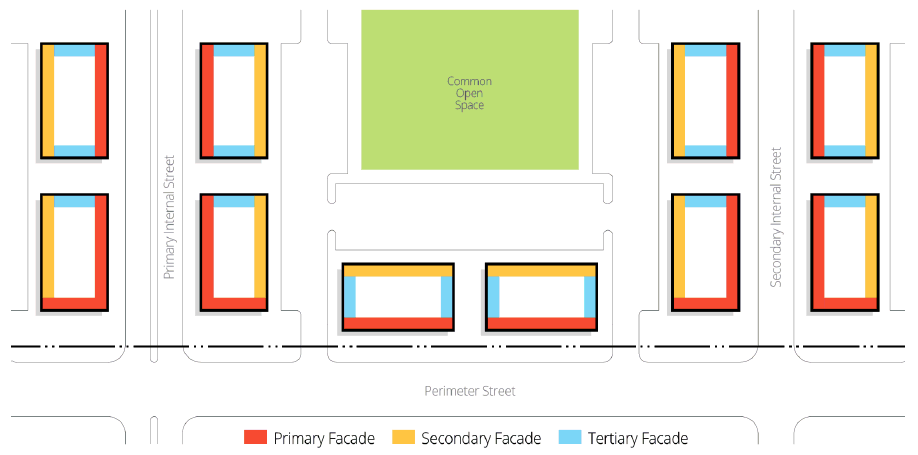
2.
Parking shall be integrated into the overall site design to minimize visual impact, reduce the loss of trees, and be visually concealed from public rights-of-way.
3.
Buildings shall be arranged and site circulation shall be designed to create a sense of a public realm by framing and defining open spaces, street frontages, and amenities.
4.
Buildings and other site improvements shall be clustered to maximize contiguous areas that can be dedicated to stormwater management.
5.
Building orientation shall reinforce site circulation patterns, open space patterns, and connections to other buildings on site.
6.
Pedestrian walkways shall be provided to all building entries and parking areas and shall connect to the sidewalk at the street frontage.
(Ord. No. 14-2022, § 3, 8-1-22; Ord. No. 8-2025, § 2, 8-18-25)
Sec. 17.05.030. - Commercial retail use specific standards.
A.
General retail, less than 10,000 square feet.
1.
The main entrance shall be oriented towards the primary street.
2.
All off-street parking, as required in Section 17.06.010 of this UDC, shall be located in the rear and/or interior side setback. Off-street parking located in the interior side setback shall be set back a minimum of one (1) foot from the front elevation of the primary building.
3.
A maximum of one (1) curb cut shall be permitted per street frontage unless otherwise approved by the Public Works Director due to site-specific constraints.
4.
Pedestrian walkways shall be provided to all building entries and parking areas and shall connect to the sidewalk at the street frontage.
5.
Exterior building materials shall be time- and weather-tested materials and techniques such as but not limited to masonry, stone veneer systems, stucco, or precast panels with inlaid or stamped brick texture.
6.
Buildings shall be similar in mass and character to abutting residential properties including roof pitch, eaves, building materials, windows, and colors, when applicable.
B.
General retail, 10,000 square feet or greater.
1.
All off-street parking, as required in Section 17.06.010 of this UDC, is encouraged to be located in the rear and/or interior side setback. Any portion of an off-street parking area located in the front or street side setback shall meet the requirements for Type B interior and perimeter parking lot landscaping.
2.
Façades greater than one hundred (100) feet in length, measured horizontally, shall incorporate surface articulation every twenty-five (25) feet.
3.
Ground floor facades that face public streets shall have arcades, clear glass display windows, entry areas, awnings, or other such features along no less than sixty (60) percent of their horizontal length.
4.
Curb cuts and site vehicular access shall be minimized in frequency, allowed movement, and width. Curb cuts shall not dominate the site plan or property and street frontage subject to the approval of the Public Works Director.
5.
Pedestrian walkways shall be provided to all building entries and parking areas and shall connect to the sidewalk at the street frontage.
6.
Exterior building materials shall be time- and weather-tested materials and techniques such as but not limited to masonry, stone veneer systems, stucco, or precast panels with inlaid or stamped brick texture.
Sec. 17.05.040. - Commercial service use specific standards.
A.
Amusement and entertainment facility, less than 10,000 square feet.
1.
The main entrance shall be oriented towards the primary street.
2.
All off-street parking, as required in Section 17.06.010 of this UDC, shall be located in the rear and/or interior side setback. Off-street parking located in the interior side setback shall be set back a minimum of one (1) foot from the front elevation of the primary building.
3.
A maximum of one (1) curb cut shall be permitted per street frontage unless otherwise approved by the Public Works Director due to site specific constraints.
4.
Pedestrian walkways shall be provided to all building entries and parking areas and shall connect to the sidewalk at the street frontage.
5.
Exterior building materials shall be time- and weather-tested materials and techniques such as but not limited to masonry, stone veneer systems, stucco, precast panels with inlaid or stamped brick texture.
6.
Buildings shall be similar in mass and character to abutting properties including roof pitch, eaves, building materials, windows, and colors.
B.
Amusement and entertainment facility, 10,000 square feet or greater.
1.
All off-street parking, as required in Section 17.06.010 of this UDC, is encouraged to be located in the rear and/or interior side setback. Any portion of an off-street parking area located in the front or street side setback shall meet the requirements for Type B interior and perimeter parking lot landscaping.
2.
Façades greater than one-hundred (100) feet in length, measured horizontally, shall incorporate surface articulation every twenty-five (25) feet.
3.
Ground floor facades that face public streets shall have arcades, clear glass display windows, entry areas, awnings, or other such features along no less than sixty (60) percent of their horizontal length.
4.
Curb cuts and site vehicular access shall be minimized in frequency, allowed movement, and width. Curb cuts shall not dominate the site plan or property and street frontage subject to the approval of the Public Works Director.
5.
Pedestrian walkways shall be provided to all building entries and parking areas and shall connect to the sidewalk at the street frontage.
6.
Exterior building materials shall be time- and weather- tested materials and techniques such as but not limited to masonry, stone veneer systems, stucco, or precast panels with inlaid or stamped brick texture.
C.
Animal boarding.
1.
Every animal boarding facility shall, at all times, be licensed in accordance with state law.
2.
Such facilities shall be maintained with regular and frequent cleaning to minimize the possibility of unhealthy or unsafe conditions. All manure, bedding, spillage and leftovers from feedings shall be removed and disposed of to prevent fly and rodent propagation or odor.
3.
Any structure used for the boarding of animals shall be located at least twenty (20) feet from any side or rear property line.
4.
Outdoor exercise areas shall not be located within three hundred (300) feet of a residential property.
5.
Outdoor exercise areas shall be fully enclosed with a fence or wall with a minimum height of six (6) feet.
6.
The hours of operation for outdoor areas shall be limited daily from 7:00 a.m. to 7:00 p.m.
7.
The boarding of animals shall, to the extent applicable, comply with the terms, conditions and limitations that apply to the keeping of livestock, as set forth in Section 17.05.010 (B) of this UDC.
8.
The boarding of animals shall be conducted in a manner that does not constitute a nuisance or health hazard under any ordinance of the City or applicable law of the state.
D.
General service, less than 10,000 square feet.
1.
The main entrance shall be oriented towards the primary street.
2.
All off-street parking, as required in Section 17.06.010 of this UDC, shall be located in the rear and/or interior side setback. Off-street parking located in the interior side setback shall be set back a minimum of one (1) foot from the front elevation of the primary building.
3.
A maximum of one (1) curb cut shall be permitted per street frontage unless otherwise approved by the Public Works Director due to site-specific constraints.
4.
Pedestrian walkways shall be provided to all building entries and parking areas and shall connect to the sidewalk at the street frontage.
5.
Exterior building materials shall be time- and weather- tested materials and techniques such as but not limited to masonry, stone veneer systems, stucco, or precast panels with inlaid or stamped brick texture.
6.
Buildings shall be similar in mass and character to abutting properties including roof pitch, eaves, building materials, windows, and colors.
E.
General service, 10,000 square feet or greater.
1.
All off-street parking, as required in Section 17.06.010 of this UDC, is encouraged to be located in the rear and/or interior side setback. Any portion of an off-street parking area located in the front or street side setback shall meet the requirements for Type B interior and perimeter parking lot landscaping.
2.
Façades greater than one hundred (100) feet in length, measured horizontally, shall incorporate surface articulation every twenty-five (25) feet.
3.
Ground floor facades that face public streets shall have arcades, clear glass display windows, entry areas, awnings, or other such features along no less than sixty (60) percent of their horizontal length.
4.
Curb cuts and site vehicular access shall be minimized in frequency, allowed movement, and width. Curb cuts shall not dominate the site plan or property and street frontage subject to the approval of the Public Works Director.
5.
Pedestrian walkways shall be provided to all building entries and parking areas and shall connect to the sidewalk at the street frontage.
6.
Exterior building materials shall be time- and weather-tested materials and techniques such as but not limited to masonry, stone veneer systems, stucco, precast panels with inlaid or stamped brick texture.
F.
Kennels.
1.
Every kennel shall, at all times, be licensed in accordance with state law.
2.
Any kennel established within the City limits shall also be licensed pursuant to the requirements and provisions of Section 6.08.040 of the City of Cañon City Municipal Code.
3.
All structures used to house animals, including dog runs and outdoor exercise areas, shall meet a minimum twenty-five (25) foot setback from all property lines.
4.
Any outdoor area where animals are confined shall be fenced to prevent the animals from escaping.
5.
Any outdoor area where animals are confined shall be graded and surfaced to provide proper drainage of stormwater and to prevent runoff from entering nearby ditches or other watercourses or neighboring property.
6.
All animal waste shall be properly disposed of on at least a daily basis to prevent offensive odors, minimize disease hazards, and prevent vermin infestation.
7.
The hours of operation for outdoor areas shall be limited daily from 7:00 a.m. to 7:00 p.m.
G.
Sexually oriented business. All sexually oriented businesses shall be subject to the requirements and restrictions set forth in Chapter 5.42 of the City of Cañon City Municipal Code, and applicable provisions of Colorado law.
Sec. 17.05.050. - Eating and drinking use specific standards.
RESERVED
Sec. 17.05.060. - Industrial use specific standards.
A.
Artisan manufacturing.
1.
Gross floor area shall not exceed ten thousand (10,000) square feet.
2.
Outdoor storage and/or outdoor operations or activities shall be prohibited.
3.
Retail sales of goods manufactured on-site shall be permitted in nonresidential districts but shall be limited to twenty-five (25) percent of the total area of the building.
4.
A maximum of one (1) residential unit shall be permitted but shall be limited to twenty-five (25) percent of the total area of the building.
B.
Materials recovery facility: Type 1.
1.
All recyclable commodities shall be of the clean, single- or dual-stream type so long as the commodities are not processed as part of a mixed waste stream.
2.
Clean commodities shall have been separated from municipal solid waste before arriving at the recovery facility.
3.
All recyclable commodities, pre- and post-processing, shall be stored within an enclosed building.
C.
Materials recovery facility: Type 2. Any type of materials recovery that is not Type 1 shall be considered Type 2 and shall be required to be reviewed and approved through the special review use process.
Sec. 17.05.070. - Lodging use specific standards.
A.
Bed and breakfast.
1.
Off-street parking shall be provided at the rate of one (1) parking space for the dwelling owner and/or operator and one (1) parking space for each lodging room.
2.
Off-street parking areas shall be designed to provide safe ingress and egress.
3.
Off-street parking areas shall not be located in the front setback or closer to the front property line than the front elevation of the primary building.
4.
In residential districts, landscaping and screening shall be provided to maintain the residential character of the building and preserve the right of neighboring residents to enjoy a peaceful occupancy of their homes.
5.
Any outdoor lighting shall be full cut-off fixtures to minimize light shining onto adjacent properties.
6.
All signage shall comply with applicable provisions of Chapter 17.07, Signs, of this UDC.
7.
The property used for a bed and breakfast facility shall also serve as the primary residence of the owner or manager. The owner or manager may reside in either the principal or accessory dwelling.
8.
Bed and breakfast facilities in residential districts may have no more than two (2) on-duty employees at any given time who do not reside in the bed and breakfast residence.
9.
One (1) individual or group of guests shall not reside in a bed and breakfast for more than thirty (30) days in any calendar year.
B.
Boarding or rooming house.
1.
Off-street parking shall be provided at the rate of one (1) parking space for each lodging room, plus one (1) parking space for each on-duty employee.
2.
Meals shall be prepared and served only to residents in a common eating area.
3.
No individual kitchen facilities shall be provided in the lodging rooms.
4.
One (1) individual or group of guests may reside in the boarding or rooming house for more than thirty (30) days.
(Ord. No. 5-2022, § 4, 2-21-22)
Sec. 17.05.080. - Medical use specific standards.
A.
Medical marijuana facility, licensed.
1.
A licensed medical marijuana facility, in addition to being subject to the general requirements and restrictions applicable within such district, shall be subject to the requirements and restrictions set forth in Chapter 5.56 of the City of Cañon City Municipal Code, and applicable provisions of Colorado law.
2.
Nothing in this section shall permit or be construed to permit any act, activity, or omission that is illegal under Colorado law.
B.
Medical and dental clinic.
1.
In the central business district, medical and dental clinics that are located above the ground floor shall be permitted by right without obtaining a conditional use permit.
(Ord. No. 21-2022, § 3, 12-19-22)
Sec. 17.05.090. - Office use specific standards.
A.
Business park.
1.
The façades of buildings in business parks shall be improved as detailed below.
a.
Primary façade.
I.
The primary façade shall include the primary building entrance and shall be oriented towards the following (listed in priority order). Primary façades shall not be oriented towards off-street parking lots, garages, or carports.
i.
Perimeter streets,
ii.
Primary internal streets,
iii.
Parks or other common open space, or
iv.
Secondary internal streets.
II.
Building materials of primary façades shall be masonry, stone veneer systems, or stucco on the first level. Precast panels with stamped or inlaid brick texture, EIFS acrylic finishes, or quik-brik concrete masonry units may be utilized above the first level. However, in no instance shall the finish of the non-natural materials utilized mimic or match the texture of the natural materials utilized. A maximum of three building materials may be used on a primary façade.
i.
When two (2) or more building materials are used on a façade, the material used on the first level shall be visually heavier than the material used above the first level to give a sense of support and grounding. For example, masonry on the first level and EIFS acrylic stucco above.
III.
In order to provide for primary façade articulation, primary façades shall step back a maximum of two (2) feet and shall step forward a maximum of one (1) foot from the build-to-line for a minimum of forty (40) percent and maximum of seventy (70) percent of the primary façade.
b.
Secondary façade.
I.
The secondary façade shall be any façade not including the primary building entrance that is oriented towards the following:
i.
Perimeter streets,
ii.
Primary internal streets,
iii.
Parks or other common open space, or
iv.
Secondary internal streets.
II.
Building materials of secondary facades shall be a combination of masonry, stone veneer systems, stucco, precast panels with stamped or inlaid brick texture, EIFS acrylic finishes, or quik-brik concrete masonry units. Natural materials shall consist of a minimum of forty (40) percent of the façade. In no instance shall the finish of the non-natural materials utilized mimic or match the texture of the natural materials utilized. The type and design of materials utilized on the secondary façade shall complement those utilized on the primary façade.
III.
In order to provide for secondary façade articulation, secondary façades shall step back a maximum of two (2) feet and shall step forward a maximum of one (1) foot from the build-to-line for a minimum of thirty (30) percent and maximum of seventy (70) percent of the secondary façade. Articulation of the secondary façade shall be complementary to the articulation of the primary façade.
c.
Tertiary façade.
I.
The tertiary façade shall be any façade not considered a primary or secondary façade.
II.
Building materials of tertiary façades may consist wholly of precast panels with stamped or inlaid brick texture, EIFS acrylic finishes, or quik-brik concrete masonry units, however, a combination of non-natural and natural materials is encouraged. The type and design of materials utilized on the tertiary façade shall complement those utilized on the primary and secondary façades.
Figure 5.2: Business Park Facade Locations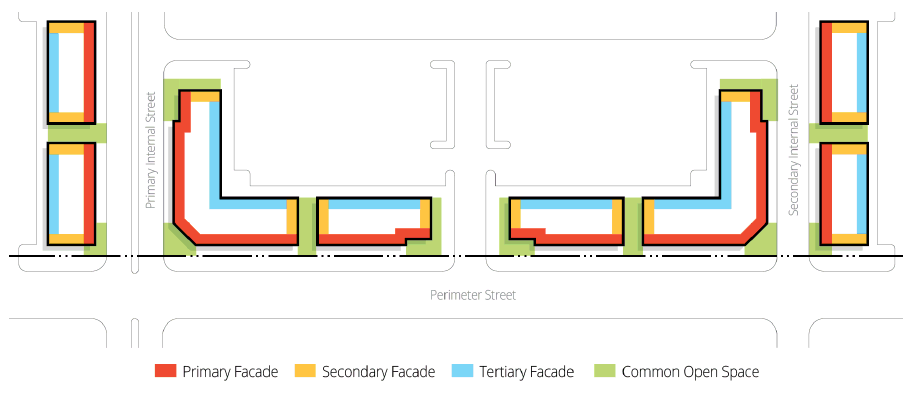
2.
Parking shall be integrated into the overall site design to minimize visual impact, reduce the loss of trees, and be visually concealed from public rights-of-way.
3.
Buildings shall be arranged, and site circulation shall be designed to create a sense of a public realm by framing and defining open spaces, street frontages, and amenities.
4.
Buildings and other site improvements shall be clustered to maximize contiguous areas that may be dedicated to stormwater management.
5.
Building orientation shall reinforce site circulation patterns, open space patterns, and connections to other buildings on site.
6.
Curb cuts and site vehicular access shall be minimized in frequency, allowed movement, and width. Curb cuts shall not dominate the site plan or property and street frontage subject to the approval of the Public Works Director.
7.
Pedestrian walkways shall be provided to all building entries and parking areas and shall connect to the sidewalk at the street frontage.
B.
Mobile home sales office.
1.
Time limits.
a.
No mobile home sales office shall be operated for a period that is longer than two (2) years, beginning on the date the mobile home sales office is approved as a special review use.
b.
Notwithstanding the foregoing, any mobile home sales office use authorized hereunder will terminate earlier than the expiration date of the two (2) year period if the mobile home park or mobile home subdivision in which such use was authorized is a minimum of ninety (90) percent occupied on a date that is earlier than the expiration date. In the case of a mobile home park, ninety (90) percent occupancy will be achieved when at least ninety (90) percent of the available spaces in the park are occupied by mobile homes which are occupied by residents. In the case of a mobile home subdivision, ninety (90) percent occupancy will be achieved when at least ninety (90) percent of the lots platted in the subdivision are occupied by mobile homes which are occupied by residents.
2.
Number of model homes. The owner of a mobile home park or subdivision may establish, maintain, offer for sale or permit others to establish, maintain and offer for sale model mobile homes within such owner's park or subdivision. The number of model homes within a mobile home park or subdivision, including any mobile home used as a sales office, shall not exceed ten (10) percent of the total number of spaces or lots in the park or subdivision. Model homes are mobile homes set up in the park or subdivision which are offered for sale and location only in the park or subdivision.
3.
Location of sales office. A mobile home sales office may be established either in a model mobile home or in a permitted accessory building located within the park or subdivision.
4.
Compliance with all applicable codes and regulations. Any mobile home used as either a mobile home sales office or a model home shall be installed in complete accordance with the requirements of Section 17.05.020(D)(4), Standards for Mobile Home Installation and Placement, and shall be connected to all utilities before it may be used for such purpose. A mobile home skirting permit shall be obtained prior to, or upon establishment of any mobile home. Any applicable setbacks or separation standards established for the mobile home park or subdivision shall be met when placing any mobile home. The owner shall also be responsible for compliance with all other applicable City, County and State laws, codes and regulations. No model home shall be established in any mobile home park or subdivision, and no mobile home sales office shall be open for business of any sort, until all infrastructure improvements required to be established within such mobile home park or subdivision have first been constructed and approved by the Public Works Director and, where appropriate, dedicated to and accepted by the City.
5.
Accessibility. Any structure used as a mobile home sales office, whether it is an accessory building or a model mobile home, shall meet the standards for accessibility, as set forth in the most current version of the International Building Code adopted by the City.
6.
Hours of operation. In order to protect the peaceable enjoyment of the residents of the park or subdivision, the hours of operation of any mobile home sales office within any park or subdivision shall be limited to 8:00 a.m. to 8:00 p.m.
7.
Limitation on location of mobile homes after sale. Any approval of a mobile home sales office within a mobile home park or mobile home subdivision shall be for the limited purpose of permitting a means for the owner to fill available spaces or lots within a new park or new subdivision where the sales office is located. It is unlawful for any person, who occupies, uses, or conducts business in a mobile home sales office, or who is authorized to occupy, use, or conduct business in a mobile home sales office, to sell, offer for sale, or to take or receive orders for the sale or purchase of any mobile home, including but not limited to model mobile homes, that will be delivered or placed anywhere other than in the mobile home park or mobile home subdivision where the mobile home sales office is located. For purposes of this section, "person" means and includes, but is not limited to, owners of mobile home parks and subdivisions and their employees, agents, licensees, and invitees.
8.
The Zoning Administrator is authorized to issue orders for the immediate closure of any mobile home sales office that is or was used or otherwise operated in violation of this section or that is being used by any person who has violated this section. It is unlawful for any person to continue operating or to allow the continued operation of a mobile home sales office following the Zoning Administrator's issuance of an order pursuant to this section. The owner of any mobile home park or mobile home subdivision who is affected by any such order shall have the right to a hearing before the Board of Adjustment, if such hearing is requested in writing within ten (10) days following the date the Zoning Administrator's order was served upon such owner. Service shall be in any manner permitted by the Colorado Rules of Civil Procedure. Any hearing requested pursuant to this section shall be conducted at a regular or special meeting of the Board of Adjustment. The sole issue at any hearing conducted pursuant to this subsection shall be whether the restrictions of this section were violated. It shall not be a defense that the owner of the mobile home park or mobile home subdivision did not know or was otherwise unaware that the requirements of this section had been or was being violated. Following any such hearing, the Board of Adjustment may direct the Zoning Administrator to rescind the closure order only if the applicant has proven by a preponderance of the evidence presented at the hearing that a violation of this section did not occur or is satisfied that a subsequent violation is not likely to occur.
9.
Signs. The following signs shall be permitted in conjunction with the lawful operation of a mobile homes sales office within a mobile home park or subdivision:
a.
Mobile home sales office. One (1) sign, not exceeding ten (10) square feet in area and five (5) feet in height and mounted on the wall of the structure or within ten (10) feet of the structure and at least five (5) feet from any interior roadway.
b.
Model mobile homes. One (1) sign per model unit, not exceeding five (5) square feet in area and five (5) feet in height and mounted on the wall of the structure or within ten (10) feet of the structure and at least five (5) feet from any interior roadway.
c.
No sign shall be permitted in any mobile home park or mobile home subdivision which is found to create a vision clearance obstruction in violation of Section 17.06.060, Vision clearance.
10.
No owner of a new mobile home park or mobile home subdivision shall have a right to open, use, authorize the use of, or otherwise operate a mobile home sales office within that owner's park or subdivision unless and until such owner has been permitted to do so pursuant to this section.
11.
Nothing in this section shall be construed to authorize any owner of any mobile home park to establish a mobile home sales office or place mobile homes within a new mobile home park until such mobile home park is authorized to open by the Zoning Administrator in accordance with all other applicable requirements of this UDC.
C.
Professional offices.
1.
In the central business district, professional offices that are located above the ground floor shall be permitted by right without obtaining a conditional use permit.
(Ord. No. 21-2022, § 4, 12-19-22)
Sec. 17.05.100. - Public/institutional use specific standards.
A.
Cemetery. Cemeteries shall be owned by a public or nonprofit organization. Private cemeteries shall be prohibited.
(Ord. No. 8-2025, § 5, 8-18-25)
Sec. 17.05.110. - Recreational use specific standards.
A.
Rafting takeout facility. Rafting takeout facilities may be approved as a special review use only as detailed in Section 17.10.040 of this UDC.
B.
Recreational vehicle park.
1.
Design standards for recreational vehicle (RV) parks.
a.
Minimum park area. The minimum size of an RV park shall be three (3) acres.
b.
Rental space size. Minimum rental space size for those spaces having utility hookups shall be one thousand five hundred (1,500) square feet. Minimum rental space size for those spaces not having hookups shall be nine hundred (900) square feet. Minimum rental space size shall not include any area required for access roads, off-street parking, service buildings, recreation areas, office and similar RV park needs.
c.
Rental pads. A minimum of eighty percent (80%) of all spaces shall be equipped with a surfaced area of not less than ten (10) feet by forty (40) feet, containing hookups for water, sewer and electricity. Surfacing shall consist of gravel, asphalt or concrete. Where gravel surfacing is used, the design of the gravel pad shall be approved by the City Engineer to maintain proper drainage and minimize dust. Where provided, each RV unit shall be parked entirely on the surfaced area so that no part thereof obstructs any roadway or walkway within the RV park. Those spaces not equipped with such a surfaced area, intended for occupancy by recreational vehicles not having a self-contained toilet, lavatory or bathing facilities, shall be equipped with a gravel pad, the design of which shall be approved by the City Engineer, of not less than ten (10) feet by twenty-five (25) feet for RV unit parking and a hookup for water. Spaces equipped with such a gravel pad shall not exceed twenty percent (20%) of the total number of spaces in the RV park.
d.
Setback requirements. Each rental space shall meet the following setback requirements:
i.
Fifty (50) feet when abutting a State or Federal highway or designated major arterial;
ii.
Twenty-five (25) feet when abutting a public right of way other than a above;
iii.
Fifteen (15) feet when abutting any property line other than a or b above;
iv.
There shall be a minimum distance of ten (10) feet provided between RV units parked side by side;
v.
There shall be a minimum distance of ten (10) feet between RV units parked end to end;
vi.
There shall be a minimum distance of twenty (20) feet between any RV space and any building.
e.
Streets.
i.
Streets or roadways and parking areas within the RV park shall be designed to provide safe and convenient access to all spaces and to facilities for common use by park occupants, and shall be constructed and maintained to allow free movement of emergency and service vehicles at all times, and shall be graded to sufficiently drain and surfaced with gravel, asphalt or concrete, the design of which shall be approved by the City Engineer, to maintain proper drainage and minimize dust all interior roadways shall be at least thirty-two (32) feet in width for two-way traffic, and at least eighteen (18) feet in width for one-way traffic.
ii.
A forty-five (45) foot turning radius shall be required on all curves, to allow access by emergency vehicles.
iii.
Any bridges within the development shall have a capacity of at least sixteen (16) tons, to allow access by emergency vehicles.
iv.
Road grades shall not exceed six (6) percent.
v.
Access into the park from a public street shall meet the same design standards as those of the public street for a distance of forty (40) feet from the property line into the development.
vi.
All roadways and walkways within the park shall be adequately lighted at night, to provide safe access.
vii.
Frontage. All spaces shall have a minimum frontage of twenty (20) feet along an interior roadway.
f.
Sanitary facilities.
i.
Every RV park shall be provided with one (1) or more service buildings equipped with flush toilets, lavatories, showers and laundry facilities meeting minimum state health department standards.
ii.
Such facilities shall be conveniently located at a distance of not more than three hundred (300) feet from any RV served.
iii.
Such facilities shall be kept in a clean and sanitary condition, and plumbing fixtures shall be maintained in good working order.
iv.
All such facilities shall be adequately lighted at all times of the day and night and shall be well ventilated.
v.
Portable fire extinguishers of a type approved by the Canon City Fire Protection District shall be kept in the service buildings and at all locations designed by the fire district and shall be maintained in operating condition.
g.
Sanitary disposal stations. Every RV park shall contain at least one (1) sanitary disposal station for the sole purpose of removing and disposing of wastes from holding tanks in a clean, efficient and convenient manner.
i.
Each sanitary station shall consist of a drainage basin constructed of impervious material, containing a disposal hatch and self-closing cover, and related washing facilities.
ii.
The disposal hatch of sanitary station units shall be connected to the sewage disposal system. Related facilities required to wash holding tanks and the general area of the sanitary station shall be connected to the RV park water supply system.
iii.
Open space shall not include any area designated as a roadway, RV rental space, storage area, swimming pool, yard area surrounding the caretakers or manager's residence, or any area required for setbacks as set forth in Subsection (1)(d) of these regulations.
h.
Fire protection.
i.
Fire hydrants shall be installed throughout all RV parks in accordance with the specifications of the Canon City Fire Protection District.
ii.
There shall be one (1) hydrant at the entrance to the development, and additional hydrants at a distance not to exceed three hundred (300) feet between hydrants.
iii.
All buildings within the RV park shall be equipped with fire extinguishing equipment in good working order of such type, size and number as prescribed by the fire district.
i.
Structural additions.
i.
Temporary structures such as canvas awnings, screened enclosures, or platforms, which are normal camping equipment, may be erected but must be removed when the rental space is vacated.
ii.
No other structural additions shall be built onto or become a part of any RV.
j.
Storage sheds. No storage sheds shall be allowed within an RV rental space.
k.
Fires. Fires shall be made only in stoves and other equipment intended for such purposes and placed in safe and convenient locations, where they will not constitute fire hazards to vegetation, undergrowth, trees and RVs. No open fires are allowed.
l.
Tents. Tents shall be permitted, and their number shall be limited to one (1) tent per rental space. Areas for group tent camping may be established, with the following provisions:
i.
The area set aside for such group use is not a part of any designated open space;
ii.
An adequate number of parking spaces is provided;
iii.
The area is served by one (1) or more water outlets; and
iv.
The area is located no further than three hundred (300) feet from a service building.
m.
Registration of occupants.
i.
It shall be the responsibility of the owner or manager of the RV park to keep a current record of the names and addresses of the owners and/or occupants of each RV space, the make, model, year and license number of each RV and motor vehicle by which it is towed, the state, territory or country issuing such licenses, and the arrival and departure dates of each occupant.
ii.
This record must be made available for inspection to all appropriate agencies whose duties necessitate acquisition.
n.
Swimming pools. Swimming pools and natural swimming areas shall be operated, maintained and used in compliance with recommendations and requirements of the Colorado Department of Health's Regulations and Standards Governing Swimming Pools and Swimming Areas.
2.
Where established. A RV park may be established on any tract of land held in single ownership or unified control provided that the applicant shall show, and the Planning Commission and the City Council shall find:
a.
That the site is in conformance with sound planning principles and the land use plan for that area, as set forth in the comprehensive plan;
b.
That the site has an acceptable relationship to the major thoroughfare plan of the City, and is accessible to recreational vehicles without causing disruption to residential areas; and
c.
That the proposed RV park will not overload utility and drainage facilities.
3.
Application requirements and procedures. The proponent of a recreational vehicle park, or an expansion thereof, shall make written application for special review for a RV park, pursuant to the provisions of Chapter 17.10.030, Special Review Use Permit, and the following shall also be submitted with such application to the Planning Commission and City Council:
a.
A complete and comprehensive development plan, including the following:
i.
Detailed land use plan, drawn to a scale of l"=100', unless larger scale is necessary, including the dimensions and location of each RV rental space, service buildings, common and recreation areas, surrounding land uses and zoning districts;
ii.
Typical street cross sections;
iii.
Location and widths of roadways, sidewalks and pedestrian ways;
iv.
Topography of site at two (2) foot contours;
v.
Grading and drainage plans;
vi.
Utility plans;
vii.
Legal description of property, including acreage;
viii.
Copy of title commitment;
ix.
Landscaping, screening and fencing plans;
x.
Fire protection plan;
xi.
Location and description of all permanent structures and common facilities;
xii.
Acreage and percentage of land to be set aside as open space;
xiii.
Density of RV rental spaces per acre;
xiv.
Vicinity map drawn to a scale of l"= l,000' or 1"= 5,000';
xv.
Location of all areas subject to inundation or storm water overflow and the location, area and direction of flow of all water courses, including the 100-year floodplain boundaries;
xvi.
Location and principal dimensions of all existing or proposed easements, water course boundaries, public utilities, monuments, pins, benchmarks and other significant features;
xvii.
Proposed surface treatment and design of all interior roadways and rental pads.
b.
A listing of all names and addresses of all owners of property located, in whole or in part, within three hundred (300) feet of the property line;
c.
A time schedule for development;
d.
Information regarding abutting properties and land uses;
e.
An application fee for special review, as set forth in Chapter 17.10.030, Special Review Use Permit;
f.
A fee for establishing or expanding a recreational vehicle park, which shall be the same as that for expanding or establishing a mobile home park, as set forth in the City's fee schedule.
4.
Worker housing. Housing for a worker employed by the RV park for the management of the RV park is permitted in the RV park when:
a.
No more than one RV is used for worker housing;
b.
This housing may only be occupied when the RV park is open for public use; and
c.
All applicable standards of this Section 17.05.110.B are met.
(Ord. No. 5-2022, § 5, 2-21-22)
Sec. 17.05.120. - Vehicle-related use specific standards.
A.
Gasoline station.
1.
All fuel pumps shall be set back a minimum of twenty-five (25) feet from the street right-of-way and side or rear lot lines.
2.
All fuel pump canopies shall be located a minimum of twenty (20) feet from the street right-of-way and side or rear lot lines.
3.
All fuel pumps and fuel pump canopies shall be located a minimum of fifty (50) feet from any residential district boundary line.
4.
Fuel pump canopies shall maintain a uniform and consistent roofline with the building to which the fuel pump canopy is associated. The Zoning Administrator may approve additional fuel pump canopy height to accommodate fuel pump canopies that serve commercial vehicles; however, in no instance shall a fuel pump canopy exceed seventeen (17) feet in height.
5.
Fuel pump canopies shall be lit with only fully recessed lighting.
6.
Curb cuts and site vehicular access shall be minimized in frequency, allowed movement, and width. Curb cuts shall not dominate the site plan or property and street frontage subject to the approval of the Public Works Director.
B.
Retail sales of small recreational equipment and vehicles.
1.
Vehicles shall be stored within an enclosed building or locked area.
2.
Outdoor display of vehicles or related equipment shall be prohibited.
3.
Servicing or repairing vehicles shall be prohibited.
4.
Deliveries of motorized inventory shall occur from the alley to the maximum extent possible.
(Ord. No. 7-2026, § 2)
Sec. 17.05.130. - Utility, infrastructure, and related use specific standards.
A.
Solar energy collection system, ground-mounted.
1.
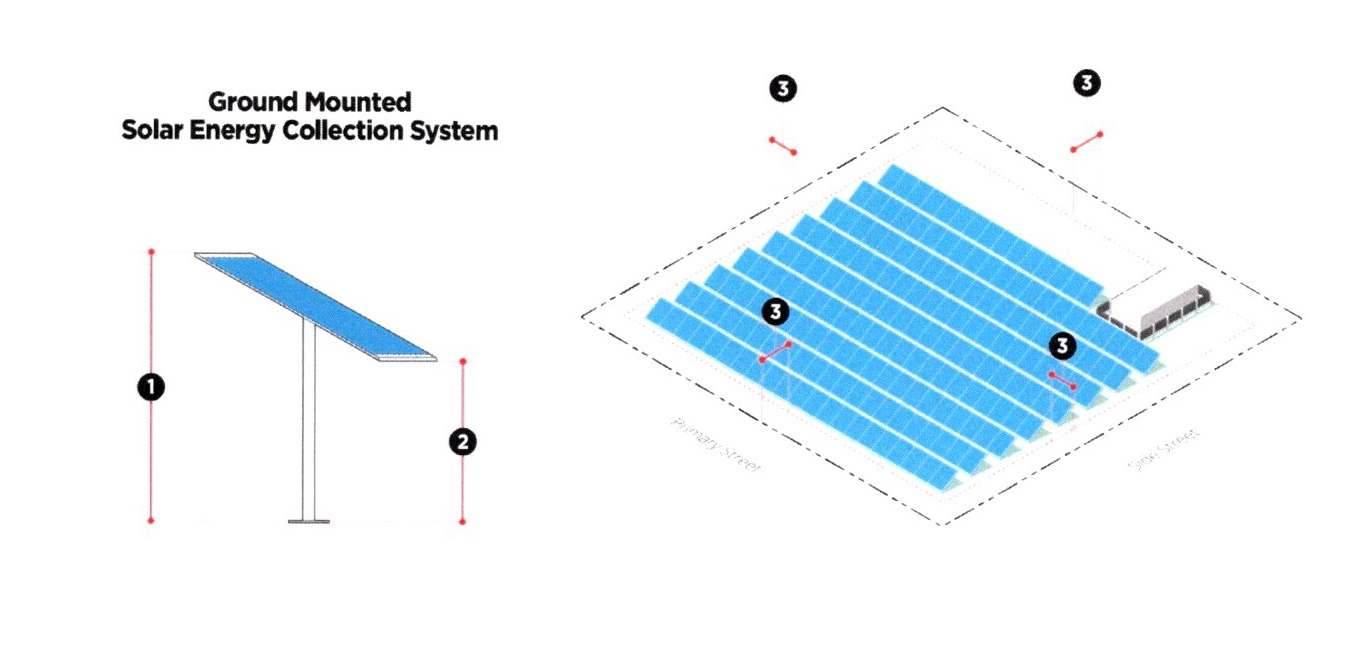
The maximum height of ground-mounted solar energy collection systems shall be six-and-a-half (6.5) feet in height, measured from the grade at the base of the pole to the highest edge of the system. Heights greater than six-and-a-half (6.5) feet shall be considered as a Special Review Use.
2.
Minimum clearance between the lowest point of the system and the surface on which the system is mounted shall be twelve (12) inches.
3.
All parts of the freestanding system shall be set back ten (10) feet from the front, side and rear lot lines and shall not be located in a public utility easement.
Figure 5.11: Ground-Mounted Solar Energy Collection System
B.
Wireless service facilities.
1.
Purpose. The purposes of this section are to allow the location of wireless service facilities ("WSF") in the City while protecting the public health, safety, and general welfare of the community; to act on applications for the location of WSFs within a reasonable period of time; to encourage co-location of WSFs; and to prevent unreasonable discrimination among providers of functionally equivalent services.
2.
Standards for all wireless service facilities (WSF).
a.
Applicability. The standards contained in this section apply to all applications for WSFs. Applicants shall also comply with any other applicable provisions of the City of Cañon City Municipal Code as determined by the City.
b.
Co-location. The City encourages co-location of WSFs when feasible to minimize the number of WSF sites. To further the goal of co-location:
I.
No WSF owner or operator shall unreasonably exclude a telecommunications competitor from using the same facility or location. Upon request by the City, the owner or operator shall provide evidence explaining why co-location is not possible at a particular facility or site; and
II.
If a telecommunications competitor attempts to co-locate a WSF on an existing or approved WSF or location, and the parties cannot reach an agreement, the City may require a third-party technical study to be completed at the expense of either or both parties to determine the feasibility of co-location.
c.
Consent given to a telecommunications provider or broadband provider to erect or construct any poles, or to locate or collocate communications and WSF on vertical structures in a right-of-way, does not extend to the collocation of new facilities or to the erection or construction of new poles in a right-of-way not specifically referenced in the grant of consent.
d.
Permitted zoning districts. WSFs shall be considered a permitted use in all zoning districts subject to administrative review and determination as provided in Section 17.10.020.
e.
Compliance with FCC standards. All WSFs shall meet the current standards and regulations of the FCC and any other agency of the federal government with the authority to regulate WSFs. Upon a request by the City at any time, WSF owners and operators shall verify that:
I.
The WSF complies with the current FCC regulations prohibiting localized interference with reception of television and radio broadcasts; and
II.
The WSF complies with the current FCC standards for cumulative field measurements of radio frequency power densities and electromagnetic fields.
III.
By adopting this section, the City is not attempting to regulate radio frequency power densities or electromagnetic fields, which are controlled by the FCC.
f.
Abandonment. If the WSF ceases operation for any reason for one hundred eighty (180) consecutive days:
I.
The owner or operator shall remove the WSF; and
II.
Any permit issued for operation of a WSF shall expire.
g.
Height limit. Notwithstanding any other height limitations in this section, in no case shall a WSF located on property owned by the City or in any public right-of-way exceed forty (40) feet in height.
3.
Freestanding WSFs.
a.
Minimum setbacks for freestanding WSFs. A freestanding WSF shall meet the minimum setback requirements for buildings and structures of the underlying district. A freestanding WSF shall be set back either subject to the minimum setback requirements of the underlying district or by one (1) foot of distance for each foot of height of the WSF, whichever is greater. A freestanding WSF may not be located within two hundred (200) feet of any existing principal residential structure or the banks of the Arkansas River.
b.
Maximum height for freestanding WSFs. A freestanding WSF, including antennae, shall not exceed the maximum structure height limit in the district in which the facility is located. In no case shall a freestanding WSF, including its appurtenances, exceed one hundred (100) feet in height.
c.
Design standards for freestanding WSFs. A freestanding WSF shall meet the following design standards to minimize impacts:
I.
The facility shall be designed to be compatible with surrounding buildings and structures and existing or planned uses in the area.
II.
Existing land forms, vegetation, and structures shall be used to screen the facility from view and blend in the facility with the surrounding environment.
III.
Existing vegetation shall be preserved or enhanced.
IV.
The total area of any equipment storage shelters shall not exceed four hundred (400) square feet for each WSF.
V.
Equipment storage shelters shall be grouped as closely together as technically possible.
VI.
No equipment storage shelter shall exceed fifteen (15) feet in height.
VII.
All freestanding WSFs shall accommodate co-location of facilities unless co-location is technically unfeasible as set forth in Section 17.45.030(B).
VIII.
All applicable landscape regulations shall be observed. A landscape plan prepared by a professional landscape architect may be required by the Zoning Administrator to demonstrate that such landscape appropriately shields the base and security fencing from view if the base of the facility is otherwise visible from adjacent rights-of-way.
IX.
Any equipment that could be dangerous to persons or wildlife shall be adequately covered or fenced.
X.
The applicant shall provide evidence that the facility is being constructed by a licensed wireless carrier.
XI.
No lighting of a facility or accessory facility shall be permitted.
4.
Building roof- or wall-mounted WSFs.
a.
A building wall-mounted WSF shall adhere to the following design standards to minimize impacts:
I.
The facility shall be screened from view and/or colored to match the building or structure to which it is attached.
II.
The mounting of antennae shall be as flush to the building wall as possible, and in no case shall the antennae extend more than three (3) feet out from the building wall.
III.
The facility shall not extend above the highest point of the roof of the building.
b.
A building roof-mounted WSF shall adhere to the following design standards to minimize impacts:
I.
A building roof-mounted WSF, including antennae, shall be the shorter of:
i.
Twenty (20) feet taller than the building to which it is attached or
ii.
One-hundred (100) feet.
II.
The facility shall be screened from view and/or colored to match the building or structure to which it is attached.
III.
The facility shall be set back such that it is not visible from ground level on adjacent rights-of-way or residential uses or districts at a distance of one hundred (100) feet or less.
IV.
The diameter of a microwave dish antenna shall not exceed four (4) feet.
c.
Accessory equipment for a building roof or wall-mounted WSF shall be placed inside the building if feasible. All equipment storage shelters shall be grouped as closely as technically possible, and the total area of all accessory equipment, including storage shelters, shall not exceed four hundred (400) square feet per WSF.
5.
Small cell facilities.
a.
A telecommunications provider or broadband provider may locate or collocate small cell facilities or small cell networks on light poles, light standards, traffic signals, or utility poles in the right-of-way owned by the City, subject to the following:
I.
A small cell facility or a small cell network shall not be located or mounted on an apparatus, pole, or signal with tolling collection or enforcement equipment attached.
II.
The construction, installation, operation, and maintenance of a small cell facility shall comply with applicable federal and state law and the provisions of this chapter. If upon inspection, the City concludes that a wireless service facility fails to comply with such laws and constitutes a danger to persons or property, then, upon written notice being provided to the owner of the small cell facility, the owner shall have thirty (30) days from the date of the notice to bring such facility into compliance. Upon good cause shown by the owner, the City may extend such compliance period not to exceed ninety (90) days from the date of said notice. If the owner fails to bring such facility into compliance within said time period, the City may remove such facility at owner's expense or prohibit future, noncompliant use of the light pole, light standard, traffic signal or utility.
b.
Micro wireless facilities. No application or permit shall be required for the installation, placement, operation, maintenance, or replacement of micro wireless facilities that are suspended on cable operator-owned cables or lines that are strung between existing utility poles in compliance with the national safety code, subject to the following:
I.
The City may require a permit for installation, placement, operation, maintenance, or replacement of micro wireless facilities where the installation, placement, operation, maintenance, or replacement of micro wireless facilities does any of the following, upon determination of the City:
i.
Involves working within a highway travel lane or requires the closure of a highway travel lane,
ii.
Disturbs the pavement or a shoulder, roadway, or ditch line,
iii.
Includes placement on limited access rights-of-way, or
iv.
Requires any specific precautions to ensure the safety of the traveling public; the protection of public infrastructure; or the operation of public infrastructure; and such activities either were not authorized in, or will be conducted in a time, place, or manner that is inconsistent with, the approval terms of the existing permit for the facility or structure upon which the micro wireless facility is attached.
(Ord. No. 3-2024, § 4, 8-5-24)
Sec. 17.05.140. - Accessory use specific standards.
A.
Accessory building.
1.
One (1) accessory building shall be permitted per lot.
2.
Subject to the other limitations in this subsection, on lots ten-thousand (10,000) square feet or less, an accessory building shall be no more than seven-hundred (700) square feet or seventy-five (75) percent of the gross floor area of the principal building, whichever is less.
3.
Subject to the limitations in this subsection, on lots greater than ten-thousand (10,000) square feet, an accessory building shall be a maximum of two thousand (2,000) square feet or seventy-five (75) percent of the gross floor area of the primary building, whichever is less.
4.
An accessory building shall be located either:
a.
Completely within the required rear setback and a minimum of five (5) feet from lot lines, except for detached Accessory Dwelling Units as regulated in 17.05.140 (B)(2) or
b.
Completely within the buildable area of the lot and to the interior side or rear of the principal building.
5.
An accessory building shall be located a minimum of three (3) feet from the primary building, measured from eave to eave.
Figure 5.3: Accessory Building Permitted Locations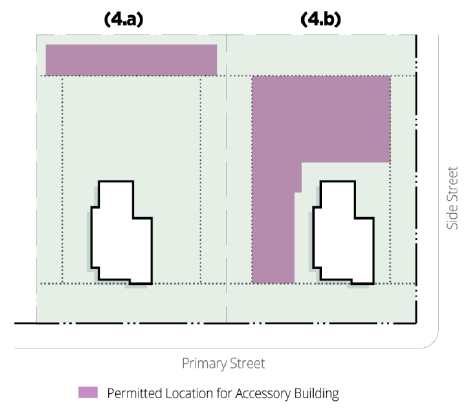
B.
Accessory dwelling unit.
1.
Compliance with district regulations. Except as set forth in Subsection 3 below, the accessory dwelling unit (ADU) shall comply with all bulk and design requirements set forth in Section 17.03.010 for the district in which the ADU will be located.
2.
Setbacks. An ADU shall comply with the setback requirements for the principal dwelling unit, with the exception that when the subject lot is adjacent to an alley, a detached ADU is not subject to the rear setback.
3.
Minimum lot size. The minimum size of a lot on which an ADU may be established shall be the minimum lot size for the district in which the ADU will be located.
4.
Unit size requirements. Each ADU shall be at least three hundred fifty (350) square feet. The maximum size of an ADU shall be ten (10) percent of the lot area, to a maximum of one thousand (1,000) square feet, unless the ADU is a detached ADU, in which case the provisions of 17.05.140 (A)(2) and (3) may further limit the size of the ADU. All areas within a structure, including interior storage areas, closets, living areas, bathrooms, and interior and exterior walls shall be included in the calculation of floor area of a structure.
5.
Occupancy. The owner of property within an R-L and R-1 District containing an ADU shall reside in either the ADU or the principal dwelling unit on the lot for a minimum of six (6) months each calendar year.
6.
Parking requirement. Each ADU shall be provided at least one (1) off-street parking space, in addition to those parking spaces required for the principal dwelling unit.
7.
Number of pets. The occupants of an ADU may keep up to two (2) household pets that are commonly let outdoors for exercise or elimination. The total number of household pets commonly let outdoors for exercise or elimination kept on any property containing a principal dwelling unit and an ADU may number no more than four (4).
8.
Special building and design standards. An ADU shall comply with the following building and design standards:
a.
An ADU shall be designed to architecturally complement the principal dwelling unit in terms of quality of building materials, roof forms, the design and placement of windows, and other architectural features.
b.
A recreational vehicle or travel trailer may not be used as an ADU in any configuration.
c.
Only one (1) entrance shall be located on the front façade of the principal dwelling unit. Entrances to accessory dwelling units shall be located on the interior side or rear façade.
d.
Both the principal dwelling unit and the accessory dwelling unit shall be served by either one (1) common driveway connecting the accessory dwelling unit to a public or private road or one (1) non-common driveway, provided the ADU may be accessed from the rear via an adjacent alleyway.
e.
The ADU shall be sited, to the maximum extent possible, to maintain the privacy of residents in the principal dwelling unit and dwelling units on adjoining lots by the use of landscape screening, fencing, window placement, and orientation of access.
9.
Public health.
a.
New ADUs shall comply with all applicable Code provisions; including but not limited to all building, occupancy and other secondary codes adopted by the City for the protection of public health, safety and welfare, and all applicable electrical and plumbing code requirements adopted by the State of Colorado.
b.
Existing ADUs shall comply with current code requirements for:
I.
Dwelling unit separation,
II.
Smoke alarm and carbon monoxide detector requirements, and
III.
Electrical and plumbing.
c.
Every ADU shall have an exterior entrance separate from the principal dwelling unit.
d.
Every ADU shall contain a cooking appliance, sink and refrigerator/freezer, sleeping area and sanitary facility separate from the principal dwelling unit.
e.
Prior to issuance of a building permit or certificate of occupancy for an ADU, the owner shall provide proof that the water and sanitary sewer facilities are adequate for the size of the unit and the projected number of residents.
f.
Only one (1) water tap/meter and one (1) sewer tap shall be allowed to serve the combined principal dwelling unit and ADU. Evidence of payment of all outstanding water and sewer tap fees shall be required.
10.
Ownership. The ownership of the ADU may not be legally severed from the ownership of the associated lot and any other structures on such lot. Any attempt to create a separate ownership of the ADU shall be invalid.
C.
Accessory structure.
1.
An accessory structure shall not exceed two hundred (200) square feet.
2.
An accessory structure shall not have a permanent foundation.
3.
An accessory structure shall have a maximum height of twelve (12) feet.
4.
An accessory structure shall be located either:
a.
Completely within the required rear setback and a minimum of five (5) feet from rear lot lines, or
b.
Completely within the buildable area of the lot and to the interior side or rear of the principal building.
Figure 5.4: Accessory Structure Permitted Locations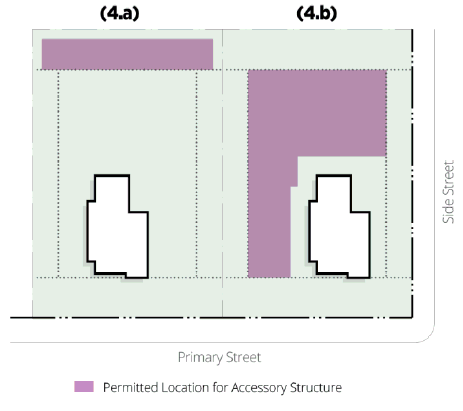
D.
Backyard chickens and ducks.
1.
No more than eight (8) backyard chickens and/or ducks shall be allowed on any property, unless the property meets the minimum area requirement for livestock, according to Section 17.05.010(B) of this UDC.
2.
The ownership and keeping of roosters over six (6) months old are prohibited.
3.
Chickens and ducks shall be provided with a covered enclosure that is predator-resistant, properly ventilated, and easily accessed for cleaning and maintenance, and that provides not less than four (4) square feet per chicken and/or duck.
4.
During daylight hours, chickens and ducks shall be provided access to an outside enclosure that is adequately fenced to prevent the escape of the chickens and ducks and to provide protection from predators. The outside enclosure shall provide a minimum of ten (10) square feet of permeable space per chicken and/or duck and may be either attached to the covered enclosure or portable. A fully fenced backyard may be deemed to meet this requirement.
5.
All chickens and ducks shall be placed in the covered enclosure between the hours of dusk and dawn to provide protection from predators and to minimize noise.
6.
Setbacks.
a.
Any enclosure for backyard chickens and ducks shall be located in the backyard of the property, measured from the rear wall of the residential dwelling. The Zoning Administrator may allow exceptions to this requirement in cases of lots having unusual site dimensions, terrain limitations, or other unique characteristics.
b.
A covered enclosure shall be located a minimum of eight (8) feet from any abutting property line and shall be a minimum of thirty (30) feet from any residential dwelling on any adjoining lot.
7.
The covered enclosure shall be cleaned so that odors due to excessive dirt, waste, excrement, or old feed do not become a nuisance, safety hazard, or health problem to adjoining property or uses.
8.
The on-site slaughtering of backyard chickens and/or ducks is prohibited.
Figure 5.5: Backyard Chicken Enclosure Permitted Location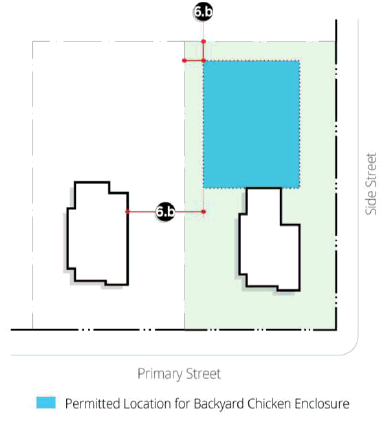
E.
Beekeeping.
1.
Hives. All bee colonies shall be kept in hives with removable combs, which shall be kept in sound and usable condition.
2.
Setbacks. All hives shall be located in a side or rear setback only, and at least five (5) feet from any adjoining property, with the back of the hive facing the nearest adjoining property. Hives are prohibited in front and street side yards.
3.
Colony densities.
a.
It is unlawful to keep more than the following number of colonies on any tract within the City, based upon the size or configuration of the tract on which the apiary is situated:
I.
One-quarter (¼) acre or less tract size: Two (2) colonies.
II.
More than one-quarter (¼) acre but less than one-half (1/2) acre tract size: Four (4) colonies.
III.
More than one-half (½) acre but less than one (1) acre tract size: Six (6) colonies.
IV.
One (1) acre or larger tract size: Eight (8) colonies.
V.
Regardless of tract size, where all hives are situated at least two hundred (200) feet in any direction from all property lines of the tract on which the apiary is situated, there shall be no limit to the number of colonies that may be permitted.
b.
For each two (2) colonies authorized under colony densities, there may be maintained upon the same tract one nucleus colony in a hive structure not exceeding one (1) standard nine and five-eighths (9.625) inch depth ten (10) frame hive body with no supers attached as required from time to time for management of swarms. Each such nucleus colony shall be disposed of or combined with an authorized colony within thirty (30) days after the date it is acquired.
4.
Fencing of flyways. In each instance in which any colony is situated within twenty-five (25) feet of a property line of a developed public or private tract, as measured from the nearest point on the hive to the property line, the beekeeper shall establish and maintain a flyway barrier at least six (6) feet in height consisting of a hedge, solid wall, or fence parallel to the property line and extending ten (10) feet beyond the colony in each direction so that all bees are forced to fly at an elevation of at least six (6) feet above ground level over the property lines in the vicinity of the apiary.
5.
Water. Each owner or beekeeper shall ensure that a convenient source of water is available at all times to the bees so that the bees will not congregate at swimming pools, water spigots, pet water bowls, birdbaths or other water sources where they may cause human, bird, or domestic pet contact. The water shall be maintained so as not to become stagnant.
6.
Maintenance. Each owner or beekeeper shall ensure that no bee comb or other materials that might encourage robbing are left upon the grounds of the apiary site. Upon their removal from the hive, all such materials shall promptly be disposed of in a sealed container or placed within a building or other bee-proof enclosure.
7.
Queens. In any instance in which a colony exhibits unusually aggressive characteristics by stinging or attempting to sting without due provocation or exhibits an unusual disposition towards swarming, it shall be the duty of the beekeeper to re-queen the colony. Queens shall be selected from stock bred for gentleness and non-swarming characteristics.
8.
Prohibited. The keeping by any person of bee colonies in the City not in strict compliance with this section is prohibited. Any bee colony not residing in a hive structure intended for beekeeping, or any swarm of bees, or any colony residing in a standard or homemade hive which, by virtue of its condition, has obviously been abandoned by the beekeeper, is unlawful and may be summarily destroyed or removed from the City by the Code Enforcement Officer or Animal Control Officer.
Figure 5.6: Hive Permitted Location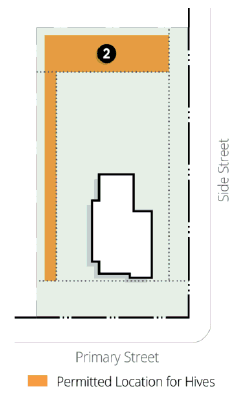
F.
Drive through.
1.
Curb cuts and site vehicular access shall be minimized in frequency, allowed movement, and width. Curb cuts shall not dominate the site plan or property and street frontage subject to the approval of the Public Works Director.
2.
Drive throughs shall be permitted a maximum of four (4) accessory signs with a combined maximum area of one hundred (100) square feet. Each accessory sign shall not exceed sixty (60) square feet in area and ten (10) feet in height. Accessory signs may utilize electronic message boards for one hundred (100) percent of the permitted accessory sign area and shall follow all regulations of Section 17.07.070(B) of this UDC.
3.
Any speaker or intercom associated with a drive-through shall not be audible beyond the boundaries of the property.
4.
Drive-through canopies shall maintain a uniform and consistent roofline with the building to which the drive-through is associated.
5.
Stacking spaces and lanes for drive through stations shall not impede on- and off-street traffic movement, are not to cross or pass through off-street parking areas or drive aisles, and are not to impede pedestrian access to a public entrance of a building.
6.
Drive-through lanes are to be separated from off-street parking areas. Individual lanes are to be striped, marked, or otherwise distinctly delineated.
7.
Drive-through facilities shall be provided with a bypass lane with a minimum width of ten (10) feet.
8.
Stacking lanes shall have a minimum depth of twenty (20) feet per stacking space and the following minimum lane widths:
a.
One (1) lane: Twelve (12) feet,
b.
Two (2) or more lanes: Ten (10) feet per lane.
9.
Drive-through facilities shall be required to provide a minimum number of stacking spaces as detailed in Table 17.05.140.F.8.
Table 17.05.140.F.8: Drive Through Stacking Requirements
Figure 5.7: Drive Through Requirements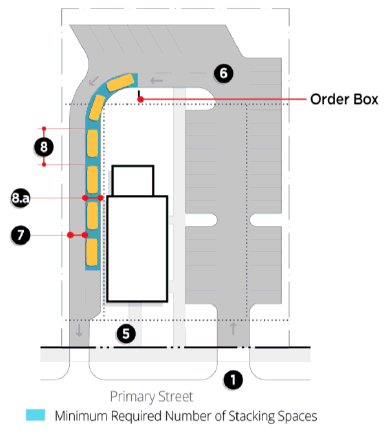
G.
Exotic animal keeping.
1.
The keeping or sheltering of exotic animals shall not constitute a nuisance or health hazard under any ordinance of the City, or under any statute or case law of the state.
2.
A conditional use permit for an exotic animal may be denied or revoked by the Zoning Administrator or designee if:
a.
The permit holder is convicted of a violation of Subsection II of this section.
b.
The applicant or permit holder fails to first obtain, and to keep in effect at all times during which the exotic animal is being kept, all applicable state and federal licenses or permits that may be required to keep the animal.
c.
The applicant is found to have made any materially false or misleading statement in the application or has concealed relevant information.
d.
The applicant has obtained the exotic animal through illegal means.
e.
The applicant is not qualified to possess an exotic animal, does not have adequate facilities to keep the animal, or proposes to keep the animal in an unsuitable location.
3.
No use of the property or structure(s) thereon resulting from the issuing of this conditional use permit shall convey any right to future permits.
4.
It shall be unlawful for any person to own, have custody of, sell, or traffic in any poisonous or dangerous animal.
5.
It shall be unlawful for any person to keep any wildlife as a pet.
6.
Nothing herein shall prohibit the keeping of wildlife by any person or organization holding a valid license for educational live possession, falconry, scientific collection, or wildlife rehabilitation from the Colorado Division of Wildlife, so long as such licensee also complies with all applicable City of Cañon City Municipal Code requirements.
H.
Home based business.
1.
Home based businesses shall be clearly secondary to the use of the dwelling and shall not occupy more than twenty (20) percent of the total floor area of the main building or, if located in an accessory building, shall not occupy more than ten (10) percent of the total lot area.
2.
Home based businesses shall be operated entirely from an enclosed structure with no exterior storage or display of materials, equipment, or products.
3.
No additional sign area, beyond what is permitted in Section 17.07.020 of this UDC shall be granted to home based businesses.
4.
No mechanical equipment shall be utilized except that which is necessarily, customarily, or ordinarily used for household or leisure purposes.
5.
No toxic, explosive, flammable, combustible, corrosive, etiologic, licensable or technologically enhanced radioactive materials, or other restricted materials shall be used or stored on the site except those which are necessarily, customarily, or ordinarily used for household or leisure purposes.
6.
No alteration of the residential appearance of the premises shall occur, including the creation of a separate entrance for the home based business.
7.
No process shall be used which is hazardous to public health, safety, morals, or welfare.
8.
Visitors, customers, or deliveries shall not exceed that normally and reasonably occurring for a residence.
9.
The home based business shall not displace or impede use of required parking spaces.
10.
The home based business shall not be conducted in a manner that constitutes a nuisance or health hazard under any ordinance of the City, or under any statute or case law of the state.
I.
Outdoor activity/operation, permanent.
1.
Any property with permanent outdoor activity or operations shall have a minimum lot size of five (5) acres.
2.
Outdoor activities and operations shall be conducted between the hours of 7:00 a.m. and 9:00 p.m.
3.
Outdoor activities and operations shall be located to the rear or interior side of the principal building on the lot.
4.
Outdoor activities and operations shall be prohibited in front or street side setbacks.
5.
Outdoor activities and operations shall be setback a minimum of fifty (50) feet from all property lines when adjacent properties are in the NC or BP Districts.
6.
Outdoor activities and operations shall be setback a minimum of one hundred (100) feet from all property lines when adjacent properties are in the R-L, R-1, R-1A, R-2, R-3, MH-1, MH-2, RF-MU, RF-R, or CB Districts.
7.
A solid wall constructed from materials identical to those used on the exterior of the principal building and not less than six (6) feet and not more than eight (8) feet in height shall be erected to screen those portions of permanent outdoor activity and operations areas visible from an existing or proposed arterial or collector roadway or a property in the R-L, R-1, R-1A, R-2, R-3, MH-1, MH-2, RF-MU, RF-R, CB, NC, or BP Districts.
8.
Curb cuts and site vehicular access shall be minimized in frequency, allowed movement, and width. Curb cuts shall not dominate the site plan or property and street frontage subject to the approval of the Public Works Director.
J.
Outdoor dining.
1.
Outdoor dining areas shall be located on an approved hard paved surface.
2.
Outdoor dining areas shall not be located in a required parking space. However, parking spaces in excess of the minimum requirement for the use may be permanently converted for outdoor dining.
3.
Outdoor dining areas shall not block a pedestrian walkway or public sidewalk in a manner which reduces the width of that walkway or sidewalk to less than five (5) feet.
4.
A fence, landscape hedge, or wall with a height of four (4) feet shall be utilized to segregate the outdoor dining area.
5.
Use of outdoor dining areas shall be limited to the posted operational hours of the associated eating and drinking use.
K.
Outdoor retail sales, permanent.
1.
Only those goods and materials associated with the existing on-site use may be displayed or sold.
2.
Permanent outdoor retail sales areas shall not be located within any required setback or parking area.
3.
Permanent outdoor retail sales areas shall be surfaced with an approved hard surface material. Partially paved or unpaved outdoor retail sales areas shall be prohibited.
4.
Permanent outdoor display or sales areas shall not exceed ten (10) percent of the gross floor area of the principal building on the property unless approved as a specific use.
5.
Curb cuts and site vehicular access shall be minimized in frequency, allowed movement, and width. Curb cuts shall not dominate the site plan or property and street frontage subject to the approval of the Public Works Director.
L.
Outdoor storage, permanent.
1.
Permanent outdoor storage areas shall be surfaced with an approved hard surface material. Partially paved or unpaved outdoor storage areas shall be prohibited.
2.
A solid wall constructed from materials identical to those used on the exterior of the principal building and not less than six (6) feet and not more than eight (8) feet in height shall be erected to screen those portions of permanent outdoor storage areas visible from an existing or proposed arterial or collector roadway or a property in the R-L, R-1, R-1A, R-2, R-3, MH-1, MH-2, RF-MU, RF-R, CB, NC, or BP Districts.
M.
Solar energy collection system, canopy.
1.
Canopy solar energy collection systems are permitted over any parking area.
2.
The height of canopy solar energy collection systems shall not exceed the height of the primary building that the parking area serves.
3.
The minimum height of solar energy collection systems shall allow clearance for emergency and service vehicles.
Figure 5.8: Canopy Solar Energy Collection System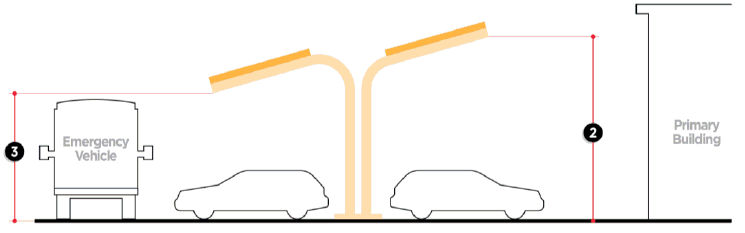
N.
Solar energy collection system, ground-mounted.
1.
Ground-mounted solar energy collection systems shall be permitted in the rear setback only.
2.
The maximum height of ground-mounted solar energy collection systems shall be five (5) feet in height, measured from the grade at the base of the pole to the highest edge of the system.
3.
Minimum clearance between the lowest point of the system and the surface on which the system is mounted shall be twelve (12) inches.
4.
All parts of the freestanding system shall be set back ten (10) feet from the side and rear lot lines and shall not be located in a public utility easement.
Figure 5.9: Ground Mounted Solar Energy Collection System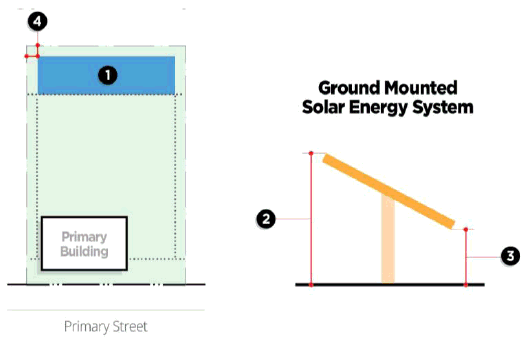
O.
Solar energy collection system, roof-mounted.
1.
Roof-mounted solar energy collection systems may be located on any roof face of principal or accessory buildings. Systems should be flush mounted when possible.
2.
Systems on residential structures shall not extend beyond twelve (12) inches parallel to the roof surface of a pitched roof or flat roof. Systems on nonresidential structures shall not extend beyond thirty-six (36) inches parallel to the roof surface of a pitched roof or flat roof. Systems on all structures shall not extend above the highest peak of a pitched roof. Height is measured from the roof surface on which the system is mounted to the highest edge of the system.
3.
All materials used for racking, mounts, mounting clamps, and flashings shall be of a color consistent with the color of the roof surface to minimize visibility.
Figure 5.10: Roof Mounted Solar Energy Collection System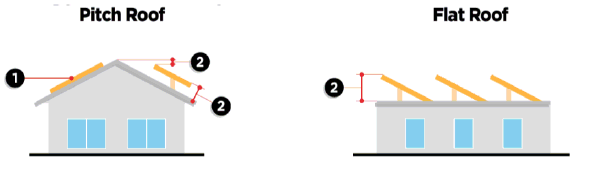
(Ord. No. 5-2022, § 2, 2-21-22; Ord. No. 6-2023, § 2, 8-7-23)
Sec. 17.05.150. - Temporary use specific standards.
A.
Farm stand.
1.
Agricultural products sold shall have been raised on the land on which the stand is located.
2.
The farm stand shall not exceed three hundred (300) square feet in area or ten (10) feet in height.
3.
The farm stand shall be setback a minimum of ten (10) feet from any public right-of-way.
4.
Signs on farm stands shall be limited to two (2) unlit signs, which may be wall-mounted or freestanding. No sign shall exceed thirty-two (32) square feet in area and eight (8) feet in height. Signs shall be located a minimum of ten (10) feet from any public right-of-way and at least five (5) feet from any interior lot line.
5.
The area of the farm stand shall be kept clear of litter, debris, spoiled fruits or vegetables, garden waste, and material from cider operations at all times.
6.
Any lighting used shall be indirect and shielded to avoid light intrusion onto adjacent residential properties.
B.
Farmers' market and flea market.
1.
Off-street parking shall be provided at the rate of one and one-half (1.5) spaces per vendor stall unless the farmers' market is located in an area adjacent to public parking that is adequate to accommodate the needs of the farmers' market in addition to the needs of the general public.
2.
A plan shall be in place for the disposal of trash and other debris.
3.
The owner/operator of a farmers' market shall obtain and maintain all required City, county, and state sales tax or other business licenses at all times.
C.
Food carts or trucks.
1.
A stand-alone food cart or truck whether motorized or non-motorized may be set up on a regular, semi-regular, or one-time basis in the NC, GC, CB, BP, and I Districts and in the R-L, R-1, R-1A, R-2, and R-3 Districts through the issuance of a temporary use permit subject to the following criteria:
a.
The owner or operator of the food cart or truck shall obtain and maintain all required licenses at all times, including but not limited to, any license required by the Colorado Department of Public Health and Environment.
b.
The temporary use permit shall be displayed to the public in a visible location on the food cart or truck.
c.
Operations shall not be located in a driveway or drive aisle.
d.
Operations shall not obstruct parking lot circulation or block access to a public street, alley, or sidewalk.
e.
The operation of the food cart or truck shall not block a pedestrian walkway or public sidewalk in a manner which reduces the width of that walkway or sidewalk to less than five (5) feet or causes damage to any improvements within the public right-of-way.
f.
Operations of any food cart or truck shall be at least one hundred (100) feet from any eating and drinking establishment lawfully existing at the time the permit or renewal permit was issued and is open for business unless written permission is granted by the eating or drinking establishment located within that distance.
g.
No food cart or truck shall be set up on any privately owned lot or parcel without written permission of theowner.
h.
Trash receptacles shall be provided, and the owner/operator shall be responsible for keeping the area surrounding the food cart or truck clear of any litter and properly cleaned.
i.
Signs, except for a-frame/sandwich board signs shall be permanently affixed to or painted on the food cart or truck. Each food cart or truck may have one (1) sandwich board sign which may not be located in any right-of-way or impede pedestrian or vehicular traffic and shall be within twenty-five (25) feet of the food cart or truck.
j.
Canopies, umbrellas, and outdoor tables and chairs shall not block a pedestrian walkway or public sidewalk in a manner which reduces the width of that walkway or sidewalk to less than five (5) feet or creates a visual obstruction to traffic.
k.
Food carts or trucks may locate on the same lot or parcel so long as each vendor has the property owner's written permission and all other provisions contained herein may be met.
l.
No food cart or truck shall be located within fifty (50) feet of the established outer boundary of any City-permitted or licensed event where the sale of merchandise and food has been allowed, unless it is part of the event.
m.
When not in operation, a food cart or truck shall be stored on private property.
n.
If located in a City right-of-way:
i.
No merchandise shall be offered, displayed or sold and no customers served except from the sidewalk,
ii.
Only non-motorized carts may be located on sidewalks,
iii.
Carts or trucks shall be located at least twenty-five (25) feet from any intersection (measured from the edge of sidewalk to the cart or truck) and fifteen (15) feet from any driveway,
iv.
In the CB District, food carts or trucks may locate on side numbered streets as long as all other requirements are satisfied,
v.
In the CB District, food carts or trucks may locate on Main Street between 2 nd and 8 th Streets if:
a)
Invited to by a Main Street merchant,
b)
Written consent from adjacent restaurants and/or bars is received and provided to the City,
c)
Restricted to three (3) days per block, per week, and
d)
Located in no more than three (3) on-street parking spaces. Said parking spaces may be reserved the morning of the arrival of the food cart or truck but shall not be reserved or occupied for more than twenty-four (24) hours.
vi.
Food carts or trucks shall comply with all traffic and parking ordinances of the City, as they may be amended,
o.
Any location in a City right-of-way, including sidewalks, may be subject to temporary suspension or revocation without cause, but for reasons that may include construction, repairs, maintenance or emergencies as determined by the City.
p.
In residential districts, a food cart or truck may locate on Fremont RE-1 School District property and Cañon City Area Recreation and Park District property with written permission from the owner. Food carts or trucks may also locate in the right-of-way adjacent to Fremont RE-1 School District property, Cañon City Area Recreation and Park District property and City park property.
2.
These permit requirements do not apply to food carts or trucks that are:
a.
Part of a City-permitted event, or
b.
For a private, catered event occurring on private property (private parties, reunions, weddings and the like) in any district.
3.
A street closure permit may be required in order to locate on any city street or right-of-way where the provisions contained herein cannot be met. Food carts or trucks may not cater private events from either the sidewalk or road right-of-way without an approved street closure permit.
4.
The provisions of this section shall not apply to any minor-operated business.
D.
Mobile home and recreational vehicle, temporary use.
1.
The use shall only be approved if an active building permit exists on the site.
E.
Outdoor retail sales, temporary.
1.
Only those goods and materials associated with the existing on-site use may be displayed or sold.
2.
Temporary outdoor retail sales shall be permitted for a period not to exceed ninety (90) days per calendar year.
3.
Temporary outdoor retail sales areas shall occur:
a.
On the sidewalk area at the foundation of the principal building, not including a five (5) foot wide pedestrian walkway.
b.
In a portion of the parking lot, which shall not exceed twenty (20) percent of the parking spaces required for the operation of the primary use, or two thousand (2,000) square feet, whichever is less.
F.
Portable outdoor storage device.
1.
One (1) portable outdoor storage device shall be permitted per lot.
2.
A site drawing shall be submitted showing the location on the property where the unit will be placed, the size of the unit, and the distance to all applicable property lines and all other buildings and structures.
3.
No portable outdoor storage device shall be greater than twenty (20) feet in length, eight (8) feet in width, or eight (8) feet in height.
4.
The portable outdoor storage device shall not encroach on City property, City right-of-way, neighboring property, or sidewalk. The unit shall be sited on an approved hard paved surface between the front property line and the rear building line of the principal building. The visual distance between the portable outdoor storage device and the interior side setback property line is four (4) feet or upon the approval by the Zoning Administrator and as agreed upon by written consent by the neighboring property owner.
5.
Temporary portable outdoor storage units may be placed for no more than thirty (30) days in any consecutive twelve (12) month period. Extensions beyond the thirty (30) day limit may be granted by the Zoning Administrator.
G.
Seasonal sales.
1.
Seasonal sales shall include the outdoor display or sale of seasonal merchandise not otherwise associated with the principal use of the lot such as holiday tree, firework, or pumpkin sales.
2.
Seasonal sales shall be permitted for a period not to exceed forty-two (42) days per calendar year.
3.
Seasonal sales areas may utilize a maximum of twenty (20) percent of the parking spaces required for the operation of the principal use or two thousand (2,000) square feet, whichever is less.
4.
Seasonal sales areas shall not block pedestrian walkways in a manner which reduces the width of that walkway to less than five (5) feet.
H.
Yard sales.
1.
Individuals shall only be allowed to conduct a yard sale from their primary place of residence.
2.
Private or public organizations shall only be allowed to conduct a yard sale from or on a residential premise if prior written permission to conduct such yard sale has been granted from the owner of the residential premise.
3.
A maximum of three (3) yard sales shall be allowed per residential premises in any calendar year.
4.
The maximum allowed duration of any yard sale shall not exceed two (2) consecutive days.
5.
Yard sale hours of operation shall be limited to between 7:00 a.m. and 6:00 p.m.
6.
No goods offered for sale or items used to display goods offered for sales shall be placed or stored within a public right-of-way or upon the real property of any person who is not conducting the yard sale without such person's prior written consent.
7.
Persons selling goods pursuant to an order or process of a court of competent jurisdiction shall not be held to the provisions of this section.
8.
Persons acting in accordance with their powers and duties as public officials shall not be held to the provisions of this section.
9.
Any person selling or advertising for sale an item or items of personal property which are specifically named or described in the advertisement and which separate items do not exceed five (5) in number shall not be held to the provisions of this section.

