
Canon City City Zoning Code
CHAPTER 17
06 - DEVELOPMENT STANDARDS
Sec. 17.06.010.- Off-street parking and loading.
A.
General requirements.
1.
Off-street parking shall be provided and maintained according to the requirements of this chapter. The number, size, location, and layout of required off-street parking shall be brought into compliance with this chapter when:
a.
A new structure is erected, or
b.
An existing structure is enlarged.
2.
It is the responsibility of the owner of a use or property to obtain an access permit from the Colorado Department of Transportation whenever a parking lot has direct access to/from a state highway or as otherwise required by the State Highway Access Code before a building permit is issued by the City.
3.
No building permit shall be issued by the City until plans are presented that show an area within the property that is for exclusive use as off-street parking and loading space when required per this section.
4.
Parking spaces required under this chapter shall be improved as required and made available for the use occupying the structure or property before a certificate of occupancy will be issued by the Building Official.
5.
Once a parking space has been constructed according to the requirements of this chapter said parking space can be eliminated only if its removal will not result in fewer parking spaces than required by this chapter for the existing use of the structure or property.
B.
Exemptions from off-street parking requirements.
1.
All nonresidential uses in the Central Business (CB) District shall be exempt from the parking requirements in this Section 17.06.010.
2.
Locally designated historic structures shall be exempt from the requirements of this chapter except if a locally designated historic structure is expanded, parking for the structure shall be in compliance with this Section 17.06.010.
C.
Parking lot layout standards.
1.
Dimensional requirements of parking spaces and maneuvering lanes.
a.
Standard parking spaces. Standard parking spaces, including interlocking standard parking spaces, shall comply with the minimum dimensional and layout requirements specified in Table 17.06.010(C)(1) and as generally illustrated in Figure 6.1. Parking arrangements may include any aisle configuration however, the City encourages the use of ninety (90) degree parking spaces within parking lots to reduce the unused surface area that otherwise occurs in seventy-five (75) degree, sixty (60) degree, or forty-five (45) degree parking spaces. Forty-five (45) degree parking spaces are the least efficient spaces.
Table 17.06.010(C)(1) Standard Parking Space Dimensional Requirements
Figure 6.1: Dimensional Requirements of Parking Spaces and Maneuvering Lanes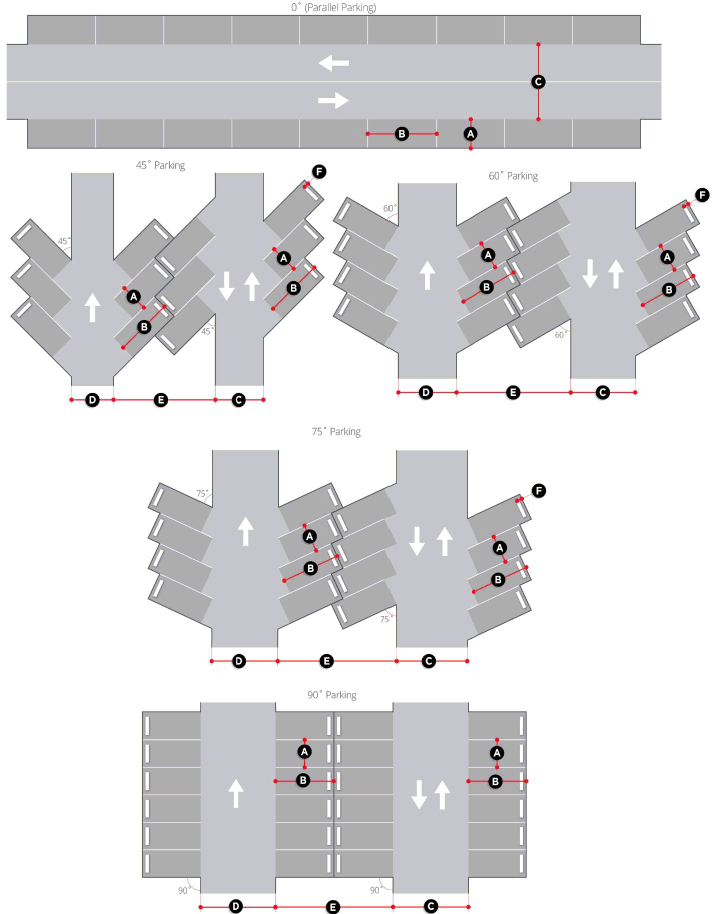
b.
Compact vehicle spaces.
I.
Compact parking spaces shall comply with the minimum dimensional requirements specified in Table 17.06.010(C)(2).
II.
In parking areas containing more than ten (10) spaces, up to twenty (20) percent of the spaces exceeding the first ten (10) spaces may be designed for compact vehicles.
III.
Compact parking spaces shall be labeled for such purposes.
Table 17.06.010(C)(2) Compact Parking Space Dimensional Requirements
c.
ADA compliant spaces. ADA Compliant parking spaces shall comply with the dimensional requirements established in the Americans with Disabilities Act as amended.
2.
Except as otherwise set forth herein, or as otherwise approved by the City Council, the surface of all parking lots, parking spaces, drive aisles and maneuvering areas shall be paved with asphalt or concrete. Alternative surfaces that create a porous parking lot surface and reduce the total impervious ground cover and/or on-site natural containment, filtering and infiltration may be approved by the Public Works Director upon the applicant providing evidence that the alternative surface will be durable, dustless and/or environmentally appropriate for the size and scale of the area in which it is used. The Public Works Director may grant credit toward the property owner/use's requirement for stormwater best management practices (BMPs) or stormwater utility fees when such alternative reduces or eliminates stormwater runoff.
3.
Where public access to a required parking lot/space is not paved at the time of parking construction the lot/space may remain gravel; however, it must be paved within six (6) months of the time that any point of public access is paved, unless an alternative surface treatment has been approved by the Public Works Director or an alternative time frame for paving has been approved by the City Council, as part of the overall parking lot plan.
4.
All required parking spaces (excluding those for single-family and duplex units) shall be outlined by white or yellow stripes not less than four (4) inches wide and painted on the surface area. Where existing parking spaces are not paved, or an acceptable alternative surface is used an alternative material or bumper guards/wheel stops approved by the Public Works Director shall be used to delineate the parking spaces.
5.
Except for parking to serve residential uses or wherever vision clearance is required, all parking and loading areas adjacent to or within residential districts or uses shall provide a sight-obscuring fence six (6) feet tall along the property boundary with such residential use or district.
6.
Where parking lot lighting atop a pole within or at the edge of a parking lot is provided the type of light fixture and its orientation shall not allow light to shine, create glare, or trespass into a residential district or onto any adjacent residential property.
7.
Except for residential dwelling units, parking spaces shall be located and served by a driveway so that their use does not require backing movements into or other maneuvering within a street right-of-way other than an alley.
8.
Service drives to off-street parking areas shall be designed and constructed to facilitate the flow of traffic and provide maximum safety for pedestrians and vehicular traffic within the property. The traffic pattern, ingress and egress shall be reviewed and approved by the Public Works Director.
D.
Number of off-street parking spaces required per use.
1.
All uses shall provide at least the minimum number of off-street parking spaces as detailed in Table 17.06.010(D).
2.
When square feet are specified in Table 17.06.010(D) the area measured shall be the primary interior floor area of the structure(s) on the property within which the use operates, which shall exclude stairwells, restrooms, elevator shafts, hallways, ornamental balconies, space occupied by heating, air conditioning or other utility equipment, and interior area devoted to parking or loading.
3.
The number of employees of a new or expanding business shall be estimated in a manner reflecting realistic needs, considering factors such as number of shifts, employees per shift, and parking space turnover rates of the existing or comparable business. The Zoning Administrator shall determine number of employees from an examination of employment information presented by the use or owner of the property.
4.
In the event several uses occupy a structure or property simultaneously, the total requirements for off-street parking shall be the sum of the requirements of the several uses computed separately based on the proportional area devoted to each separate use.
5.
A stacked or tandem parking arrangement, where one (1) vehicle is parked directly behind another vehicle which must be removed before the front vehicle can exit its space, shall be allowed only for a structure containing one (1), two (2), or three (3) residential dwelling units.
6.
The Zoning Administrator shall determine the number of off-street parking spaces required for uses not specifically listed including in Table 17.06.010(D) following an assessment of comparable uses and associated parking requirements.
Table 17.06.010(D) Minimum Number of Off-Street Parking Spaces Required per Use
E.
Alternative parking arrangements, credits, and reductions to requirements.
1.
On-street parking allowance and credit. On-street parking spaces located immediately abutting a property, entirely within the extension of the side lot lines into the roadway and not within any required vision clearance triangle at any intersection or access drive, may be counted on a one-for-one basis toward meeting the off-street parking requirement of this chapter; provided however, that the owner of the use or property requiring the off-street parking shall construct the parking space to the dimensions and surface required for off-street parking in this chapter along with curb and gutter and a sidewalk where they do not exist, unless exempted by the Public Works Director, to provide pedestrian access to the use. Where streets have been designated as "No Parking" by the City, no credit for on-street parking shall be available.
2.
Shared parking arrangements and reduction of requirement. In all districts, where shared parking can be provided among a mix of land uses located in the same structure or in adjacent structures, or on the same property or on adjacent properties, and the multiple uses or activities are not conducted during the same hours, or the hours of peak parking demand vary among the uses, approval for such joint use of parking spaces shall be granted as follows:
a.
Subject to the conditions in Subsection(2)(c), up to fifty (50) percent of the parking spaces required for the predominant use in the structure or on the property may be shared with other uses of the structure or property. The specific percentage shall depend on the capacity of the available parking to meet the actual needs of the various uses. The predominant use shall be the use that requires the most parking spaces at any time. The Zoning Administrator shall approve the amount of parking to be reduced when the uses involved are permitted or conditional uses as detailed in Section 17.03.040. City Council shall approve the amount of parking to be reduced when the uses involved are special review uses as detailed in Section 17.03.040.
b.
The Zoning Administrator, subject to the condition in Subsection(2)(c), may allow up to seventy-five (75) percent of the parking spaces required for uses such as theaters, auditoriums, gymnasiums, bowling alleys, nightclubs, movie theaters, and other predominantly evening uses, and places of worship and other uses operating predominately on the weekend to be shared with uses such as banks, offices, restaurants, schools, professional and commercial services and similar predominantly daytime uses. The specific percentage shall depend on the capacity of the available parking to meet the actual needs of the various uses.
c.
The owners of the multiple uses or properties shall provide prior to approval:
I.
Adequate provisions ensuring that the existing uses will not require parking during the same hours, and
II.
An agreement in a form approved by the City Attorney.
3.
Unique conditions and reduction of requirement. A reduction in the off-street parking requirement for a particular use or grouping of uses may be approved when, through proper study and analysis provided by the owner of the use(s) or property, it is determined that travel demand management practices (i.e., carpooling, installation of bike racks, adjusting hours of operation) or other unique operating characteristics of the business do not require the minimum number of parking spaces otherwise required under this chapter. The Planning Commission shall be responsible for approving the parking reduction for any permitted or conditional use as specified in Section 17.03.040. City Council shall be responsible for approving the parking reduction for any special review use as specified in Section 17.03.040.
4.
Bicycle parking and credit.
a.
Any use which provides bicycle parking beyond the minimum requirement as detailed in Section 17.06.010(G) may be granted a credit toward one (1) required parking space for every four (4) additional bicycle parking spaces.
5.
Motorcycle and scooter parking and credit.
a.
Any use that provides parking for motorcycles and scooters, facilitating at least four (4) motorcycle/scooter parking spaces, shall be granted credit toward two (2) parking spaces for every four (4) motorcycle/scooter parking spaces provided.
b.
Motorcycle and scooter parking spaces shall measure at least four (4) feet in width by eight (8) feet in length and shall be signed appropriately for such use.
F.
Pedestrian circulation standards.
1.
Off-street parking areas shall include on-site pedestrian circulation systems to ensure the safety of pedestrians, bicyclists, and motorists.
2.
The on-site pedestrian circulation system shall comply with all ADA standards.
3.
The on-site pedestrian circulation system shall be marked and must connect all buildings on the site to one another and provide connections to the required vehicle and bicycle parking spaces.
4.
The on-site pedestrian circulation system must connect building entrances to adjacent public rights-of-way along direct routes that do not require significant out-of-direction travel.
5.
The on-site pedestrian circulation system shall provide at least one (1) connection to adjacent properties along a shared street frontage. Connections must provide access to existing walkways on adjacent properties, or to the likely future location of walkways on those properties. The Zoning Administrator may waive this requirement for any permitted or conditional use or City Council may waive the requirement for any special review use upon determining that no walkway exists, a future walkway is unlikely to exist, or such connection would create a safety hazard.
G.
Bicycle parking.
1.
Location.
a.
Required bicycle parking shall be provided on the same lot as the use for which it is intended to serve.
b.
Bicycle racks shall be adequately lit and located such that they are highly visible from the street and/or building entrance(s) from where bicyclists approach.
c.
The location of bicycle parking shall not conflict with pedestrian and/or vehicle circulation.
d.
Bicycle parking shall be sited within fifty (50) feet of a building's main entrance. If provided indoors, bicycle parking shall be located within a common area designated for secure bicycle storage.
e.
Bicycle parking adjacent to a pedestrian walkway shall be sited to ensure that a minimum five (5) foot walkway clearance is maintained.
f.
The Zoning Administrator is authorized to enter into a license agreement with owners and tenants to allow bicycle parking to be established in the public right-of-way at locations deemed safe and appropriate for such purposes by the City Administrator or designee.
2.
Design criteria. All bicycle parking facilities shall be designed in accordance with standards established by the National Association of City Transportation Officials.
3.
Dimensional standards.
a.
Each bicycle parking space shall be a minimum of six (6) feet in length.
b.
Bicycle racks shall be located at least three (3) feet in all directions from any obstruction, including but not limited to other bicycle racks, walls, doors, posts, columns, or landscaping.
c.
A minimum vertical clearance of seven (7) feet shall be maintained above all bicycle parking facilities.
4.
Off-street bicycle parking requirements.
a.
Exemption. The bicycle parking requirements of this section shall apply to all uses other than the following:
I.
All vehicle-related uses,
II.
Single-family and two-family uses,
b.
When the required amount of bicycle parking is two (2) spaces or less, the use shall provide a minimum of two (2) spaces in a bicycle parking area.
c.
Unless otherwise specified herein, the number of required bicycle parking spaces shall be equal to five (5) percent of required vehicle parking spaces, up to ten (10) bicycle parking spaces.
Figure 6.2: Bicycle Parking Location and Dimensional Standards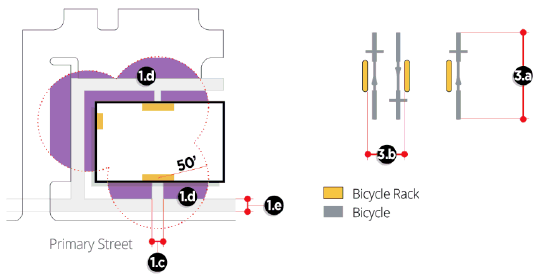
H.
Off-street loading requirements.
1.
Purpose. The purpose of this section is to prevent congestion of public rights-of-way and private lots to promote the safety and general welfare of the public by establishing minimum requirements for the provision of loading facilities on various sites.
2.
Applicability. With the exception of the CB District, buildings or structures to be built or substantially altered to increase its fair market value by more than fifty (50) percent that receive and distribute material or merchandise by truck shall provide and maintain at all times off-street loading berths in sufficient number and size for merchandise, materials, or supplies. Discontinuance of loading berths by a previous use shall not relieve the owner or new use of providing one or more berths if required by a new use.
3.
Location. All loading berths shall be located twenty-five (25) feet or more from the intersection of two (2) street right-of-way lines. Loading berths shall not be located within any required front yard or corner yard setback area and shall be oriented away from the primary road. All loading areas shall be located on the private lot and shall not be located within, or so as to interfere with, any public right-of-way, off-street parking area, or pedestrian circulation area.
4.
Size of off-street loading area. Adequate space for standing, turning, loading, and unloading services shall be provided in a manner that does not interfere with required off-street parking areas, pedestrian circulation areas, and the public use of streets or alleys.
5.
Access to off-street loading area. Each loading berth shall be located to facilitate access to a public street or alley and shall not interfere with other vehicular or pedestrian traffic and shall not interfere with the function of parking areas. In no instance shall loading areas rely on backing movements into public rights-of-way. Users of shared loading areas are encouraged to coordinate loading activities to minimize off-site impacts.
6.
Surfacing and marking. All required loading areas shall be paved and maintained in a dust-free condition at all times. Said surface shall be marked in a manner that indicates the loading areas.
7.
Use of off-street loading areas. The use of all off-street loading areas shall be limited to the loading and unloading of vehicles. Said area shall not be used to provide minimum required parking spaces.
8.
Lighting. Lighting used to illuminate an off-street loading area, if any, shall meet all requirements for outdoor lighting as detailed in Section 17.06.070.
9.
Required loading spaces. The number of loading spaces provided shall be determined by the applicant and shall provide for adequate space for standing, turning, loading, and unloading services. These spaces shall be provided in a manner that does not interfere with required off-street parking areas, pedestrian circulation areas, and the public use of streets or alleys.
I.
Outdoor parking and storage of goods, recreational vehicles, recreational equipment, and utility trailers.
1.
Except as otherwise allowed in this UDC, required parking spaces shall not be used for storage of vehicles or materials or for the parking of trucks used in conducting the business or use.
2.
Recreational vehicles, recreational equipment, and/or utility trailers shall be parked or stored:
a.
On private property,
b.
On a hard paved surface,
c.
In interior side or rear yards only, and
d.
Outside of vision clearance areas.
3.
Recreational vehicles shall not be used for dwelling or sleeping purposes unless such vehicle is parked within a commercial RV park or trailer park, except for short periods of time, such as during the visit of friends or relatives. In that case, such use shall not extend longer than two (2) weeks, and only then when proper health and safety precautions are taken.
J.
Parking in-lieu fees.
1.
Where it can be demonstrated that the reasonable and practical development of property in the central business district precludes the provision of required off-street parking, the Zoning Administrator may permit the applicant to satisfy parking requirements by payment of an in-lieu parking fee.
2.
Fees accepted under this provision will be used by the City to provide the additional required parking at another location in lieu of the applicant providing the required off-street parking. Such parking shall be provided within a reasonable distance from the contributing project or within close proximity to public transit providing access to the use. All such fees collected shall be used by the City for the planning, design, acquisition or lease of land, and development, redevelopment and maintenance of public parking facilities.
3.
Any subsequent change of use that requires more parking shall require subsequent action to satisfy the additional parking requirement. No refund of such payment shall be made when there is a change to a use requiring less parking.
4.
The number of parking spaces required and used to calculate the in-lieu fee shall be determined according to the provisions of this UDC.
5.
A change of ownership or the dividing or merging of properties shall not affect an obligation for parking in-lieu fees or a determination that parking requirements have been met according to fees paid for a particular use.
6.
The fee to be charged for each parking space required shall be set by resolution by the City Council. In setting such fees, the City Council shall consider all costs associated with the provision of the necessary parking including planning, design, land acquisition or lease costs and construction and maintenance of improvements.
7.
The per space fee for new construction, additions or changes in use shall be paid in full within ten (10) business days of the Zoning Administrator's approval.
8.
All fees collected and all interest earned thereon shall be placed in the parking facilities fund established by the City Council and shall be used only for the purposes set forth in this section and for the benefit of the contributing project.
K.
Electric vehicle parking. Parking areas shall provide electric vehicle charging stations in accordance with the City's adopted building codes, and when provided shall comply with the following standards:
1.
Electric vehicle parking spaces shall be incorporated into the same lot and count toward the minimum required parking spaces for the associated use.
2.
Electric vehicle parking spaces shall include signs stating that the spaces are reserved exclusively for electric vehicles.
3.
Electric vehicle charging stations shall be treated as a general accessory use and structure and be designed to be compatible with the landscape and structures on the site.
4.
The City opts out of any further electric vehicle charging requirements pursuant to C.R.S. § 31-23-316(2)(a)(II).
(Ord. No. 21-2022, § 6, 12-19-22; Ord. No. 15-2025, § 2, 11-3-25)
Sec. 17.06.020. - Driveways.
A.
Single-family and two-family driveway standards. A single slab or ribbon driveway from the property line to legal, on-site parking shall be provided and shall be in conformance with the following criteria.
1.
Limit of one. One (1) single slab or ribbon driveway and one (1) curb cut shall be permitted per every seventy-five (75) feet of frontage of a single-family or two-family residential lot. A maximum of two (2) curb cuts may be allowed per parcel. New residential parcels taking access from collector or arterial streets shall share driveways in order to protect public safety by limiting curb cuts.
2.
Single-slab driveway design standards.
a.
Single-slab driveways shall not exceed twenty (20) feet in width at the property line. Single-slab driveways shall be surfaced with concrete including decorative concrete, patterned concrete, and exposed aggregate concrete; porous asphalt; concrete pavers paving blocks; gravel; or other materials approved by the Public Works Director.
Figure 6.3: Single-Slab Driveway Design Standards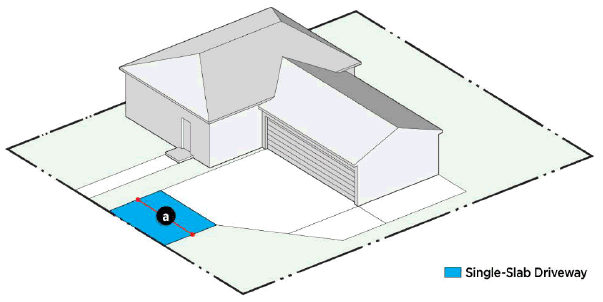
3.
Ribbon driveway design standards.
a.
Ribbons shall be a minimum of two (2) feet wide and a maximum of three (3) feet wide.
b.
Ribbons shall be a minimum of three (3) feet apart measured from their nearest edges. The space between ribbons shall be planted in turf grass or other ground cover used in the front yard.
c.
Ribbons shall be surfaced with concrete including decorative concrete, patterned concrete, and exposed aggregate concrete; porous asphalt; concrete pavers paving blocks; gravel; or other materials approved by the Public Works Director.
Figure 6.4: Ribbon Driveway Design Standards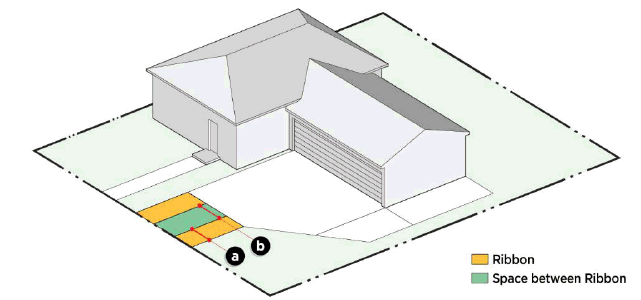
4.
Garage access drive. A garage access drive, the width of the garage, as measured from the garage door(s) plus an additional three (3) feet on either side of the garage door(s), is permitted to extend for a distance of twenty (20) feet from the garage doors before tapering, within ten (10) feet, back to the maximum driveway width.
Figure 6.5: Garage Access Drive Design Standards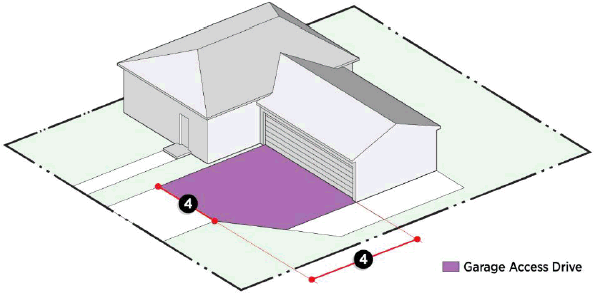
5.
Parking pad.
a.
Limit of One. A single-family or two-family driveway may be extended to include one (1) parking pad.
b.
Configuration.
I.
A parking pad shall be a maximum of ten (10) feet in width.
II.
The portion of the parking pad adjacent to the driveway shall have a maximum length of twenty (20) feet, as measured from the front façade line of the garage. A minimum seven (7) foot taper shall be included in the twenty (20) foot maximum.
III.
The portion of the parking pad adjacent to the garage shall have a maximum length equal to the depth of the garage, as measured from the front façade line of the garage.
c.
Location. The parking pad shall be set back a minimum of five (5) feet from any side property line.
Figure 6.6: Parking Pad Design Standards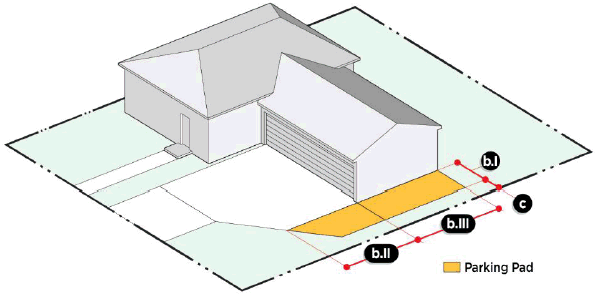
B.
Multifamily and nonresidential driveway standards.
1.
Location.
a.
Where an off-street parking area of a lot abuts an alley or a corner side street, access to the off-street parking area shall be obtained from a driveway off the alley or corner side street.
b.
No lot can have multiple driveways for purposes of vehicular ingress and egress without a minimum of three hundred (300) foot separation between such curb cuts along a street.
2.
Driveway design standards.
a.
Two-way driveways for multifamily and nonresidential uses shall be a minimum of twenty (20) feet and a maximum of thirty-six (36) feet at the property line.
b.
One-way driveways for multifamily and nonresidential uses shall be a minimum of sixteen (16) feet and a maximum of twenty (20) feet at the property line.
c.
Driveways for multifamily and nonresidential uses shall be surfaced with an asphaltic concrete or portland cement pavement.
Figure 6.7: Multifamily and Nonresidential Driveway Standards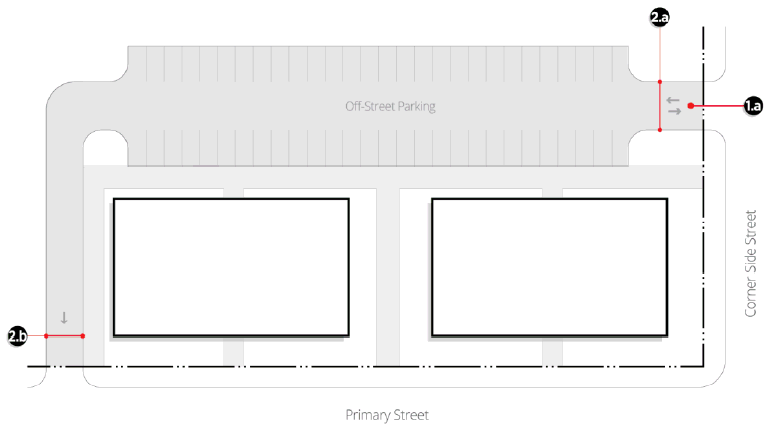
Sec. 17.06.030. - Landscape.
Landscape improvements required by this section shall apply to all nonresidential, mixed use, and multifamily development and consist of living plants in a combination of trees, shrubs, native grasses and/or groundcover. Unless otherwise stated in this section, all size specifications for plant materials shall be based upon the time of planting. When caliper is specified for tree planting, the caliper of the tree trunk shall be measured at six (6) inches above the soil level. Any plant materials used to meet the requirements of this section shall not include any plant material identified as a List A, List B, or List C Noxious Weed Species by the Colorado Department of Agriculture.
A.
Planting types.
1.
Canopy trees. A woody plant (deciduous or evergreen) having not less than a two and one-half (2.5) inch caliper with single central axis which typically reaches a mature height of not less than forty (40) feet and a mature spread of not less than fifteen (15) feet.
2.
Understory trees. A woody plant having not less than a one and one-half (1.5) inch caliper, or six (6) feet tall for multiple stem species, that normally attains a mature height of at least fifteen (15) feet.
3.
Evergreen trees. A tree having foliage that persists and remains green throughout the year and has a height of not less than six (6) feet at installation and maturing to a height of not less than twenty (20) feet.
4.
Shrub. A woody plant (deciduous or evergreen) of low to medium height characterized by multiple stems continuous from its base and having a height of not less than two (2) feet.
5.
Native grasses. Grasses that are native to, or adapted to, the State of Colorado, not including noxious weeds.
6.
Herbaceous perennials. Plants with non-woody stems whose above-ground growth largely or totally dies back during winter months but whose underground plant parts (roots, bulbs, etc.) survive.
7.
Groundcover. Herbaceous plants, other than turf grass, or prostrate shrubs normally reaching an average maximum height of eighteen (18) inches at maturity.
Figure 6.8: Planting Types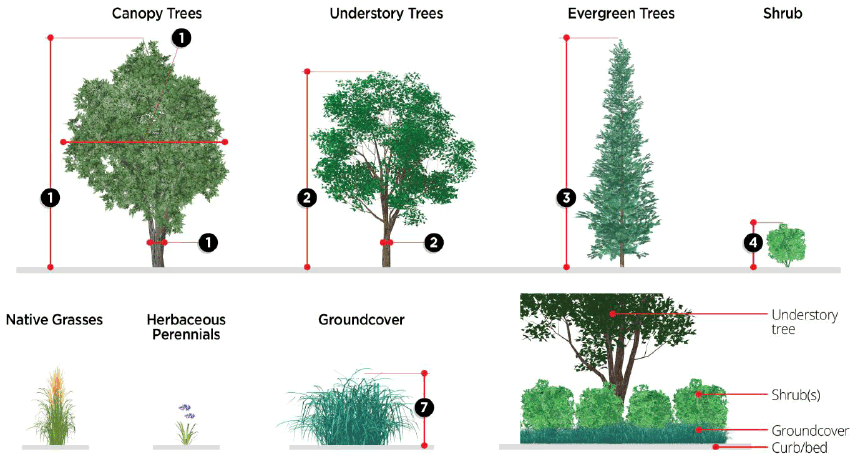
B.
Required landscape zones. Figure 6.9 illustrates the location of the required landscape zones as detailed in the following sections. The Zoning Administrator may approve up to a twenty-five (25) percent reduction in the overall required amount of landscape material for properties in the I District which are not visible from properties in commercial or residential districts or from major thoroughfares.
Figure 6.9: Required Landscape Zones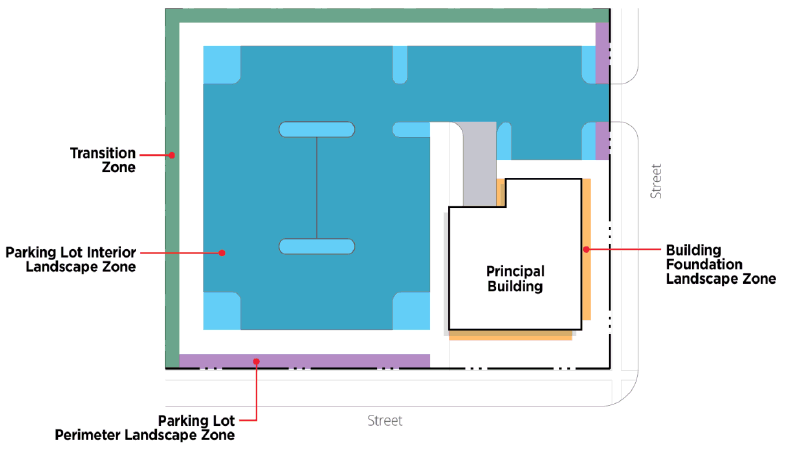
C.
Building foundation landscape zone. All nonresidential, mixed use, and multifamily development where a front yard setback is required, with the exception of food processing facilities regulated by the FDA, shall include landscape located at the building foundation as required by this section. Landscape required by this section shall be in addition to landscape required under other sections of this UDC. It is the objective of this section to provide a softening effect at the base of buildings.
1.
Applicable development is required to maintain a building foundation area at front and exterior side yards of seven (7) feet at a minimum.
2.
Foundation plantings shall be designed to supplement buffer yard plantings to frame important views, while visually softening long expanses of walls.
3.
Foundation plantings shall be installed across eighty (80) percent of the length of the façade of the building, except where walkways and driveways are located.
4.
Foundation plantings may include trees, shrubs, native grasses, and groundcover.
5.
Where the area between the building and parking lot or street curb is entirely paved for pedestrian use, landscaping may consist of canopy trees planted in structural soils beneath tree grates or permeable pavement, at the rate of one (1) tree per fifty (50) linear feet of building facade. Minimum structural soil volume shall be six-hundred (600) cubic feet.
6.
Above-ground stormwater planter boxes along building facades may be substituted for foundation plantings.
Figure 6.10: Building Foundation Landscape Zone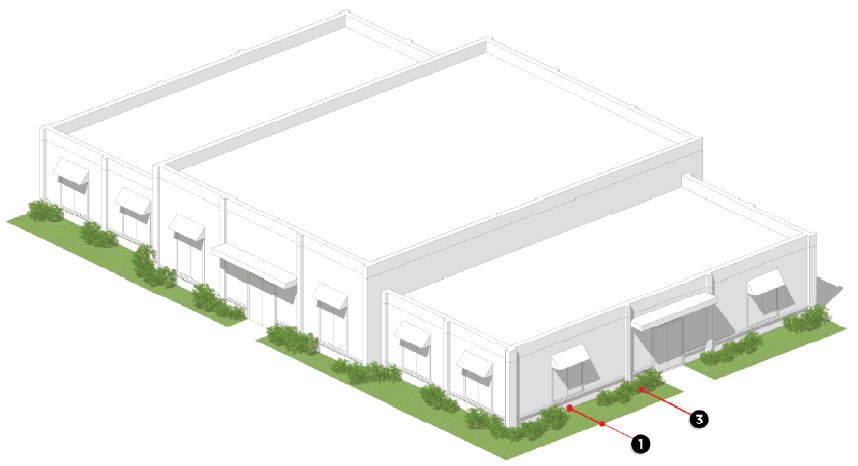
D.
Parking area perimeter landscape zone. Landscape required by this section shall be in addition to landscape required under other sections of this UDC. It is the objective of this section to provide screening between off-street parking areas and rights-of-way, and to provide for the integration of stormwater management with required landscaping.
1.
Location. All off-street parking areas which abut a public or private right-of-way, excluding alleys, shall include landscape and trees as required by this section located between the back of curb of the off-street parking area and the right-of-way.
2.
Applicability. The parking lot perimeter landscape regulations of this section apply to the following:
a.
The construction or installation of any new off-street parking area; and
b.
The expansion of any existing off-street parking area, in which case the requirements of this section apply only to the expanded area.
3.
Requirements. Perimeter landscape shall be established along the edge of the off-street parking area and have a minimum width of seven (7) feet as measured from the back of curb of the off-street parking area, to accommodate vehicle bumper overhang and ensure planting areas that are adequate in size.
a.
One (1) shrub or native grasses the height of which shall not be less than three (3) feet nor greater than five (5) feet, shall be planted for every three (3) feet of landscape area length.
b.
Landscaped areas outside of shrubs/native grasses and tree masses shall be planted in live groundcover.
c.
A low masonry wall or fence the height of which provides effective screening to a maximum height of three (3) feet may be used in conjunction with required landscaping as detailed above. Plant materials shall be installed between the sidewalk and the fence or wall to provide a softening effect.
Figure 6.11: Parking Area Perimeter Landscape Zone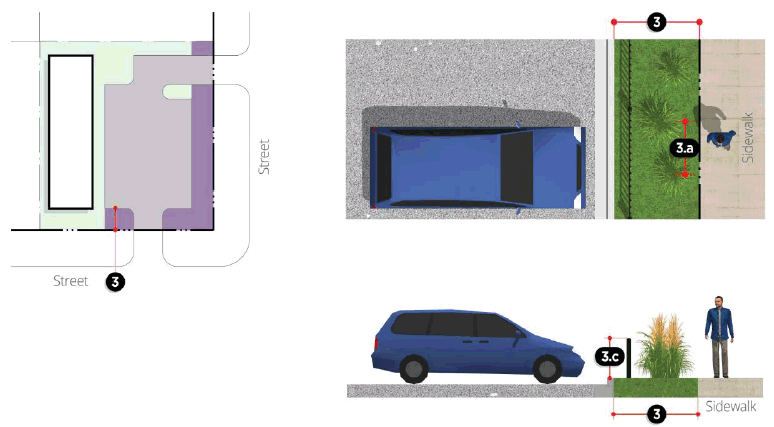
E.
Parking area interior landscape zone. All off-street parking areas shall include landscape and trees located within the off-street parking area as required by this section. Trees and landscape required by this section shall be in addition to trees and landscape required under other sections of this UDC. It is the objective of this section to provide shade within parking areas, break up large expanses of parking area pavement, support stormwater management where appropriate, improve the appearance of parking lots as viewed from rights-of-way, and provide a safe pedestrian environment.
1.
Applicability. The parking area interior landscape zone regulations of this section apply to the following:
a.
The construction or installation of any new off-street parking lot containing fifteen (15) or more parking spaces; and
b.
The expansion of any existing off-street parking area if the expansion would result in fifteen (15) or more new parking spaces, in which case the requirements of this section apply only to the expanded area.
2.
Requirements. For off-street parking areas consisting of fifteen (15) or more continuous spaces, interior parking area landscape as described in this section shall be required. Off-street parking areas consisting of fewer than fifteen (15) continuous spaces that are located in front, exterior side, or interior side yards shall be required to terminate all rows of parking with a landscape area, as approved by the Zoning Administrator. Off-street parking areas consisting of fewer than fifteen (15) continuous spaces that are located in rear yards shall be exempt from parking area interior landscape zone requirements.
3.
Amount. The amount of required parking area interior landscape shall be determined by the yard in which the off-street parking area is located as detailed below.
a.
Off-street parking areas in front or side of primary building.
I.
Parking area end caps. A parking area end cap shall be located at the end of any bay of parking bordered by a drive aisle, public or private street, or pedestrian circulation system.
II.
Parking area median amount requirement. Parking area medians shall be placed between every third bay of parking.
III.
Parking area island amount requirement. Parking area islands shall be located on parking bays which are not required to have parking area medians. Parking area islands shall be spaced not more than one-hundred thirty-five (135) feet or more than fifteen (15) continuous spaces apart.
Figure 6.12: Interior Parking Lot Landscape Zone Requirements for Parking Areas Located
in Front or Side of Primary Building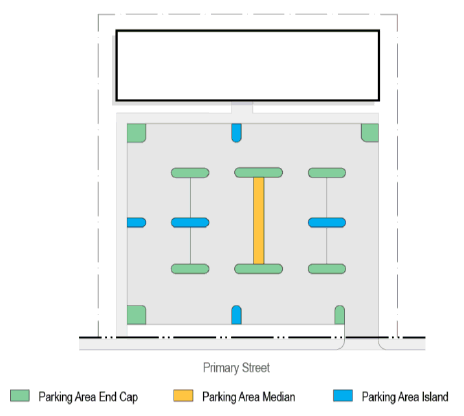
b.
Off-street parking areas in rear of primary building.
I.
Parking area end caps. A parking area end cap shall be located at the end of any bay of parking bordered by a drive aisle, public or private street, or pedestrian circulation system.
II.
Parking area median or parking area island amount requirement. The developer may choose to install either parking area medians or parking area islands. If the developer chooses to install parking area medians, they shall be placed between every third bay of parking. If the developer chooses to install parking area islands, they shall be located on parking bays which are not required to have parking area medians. Parking area islands shall be spaced not more than one-hundred thirty-five (135) feet or more than fifteen (15) continuous spaces apart.
Figure 6.13: Interior Parking Lot Landscape Zone Requirements for Parking Areas Located
in Rear of Primary Buildings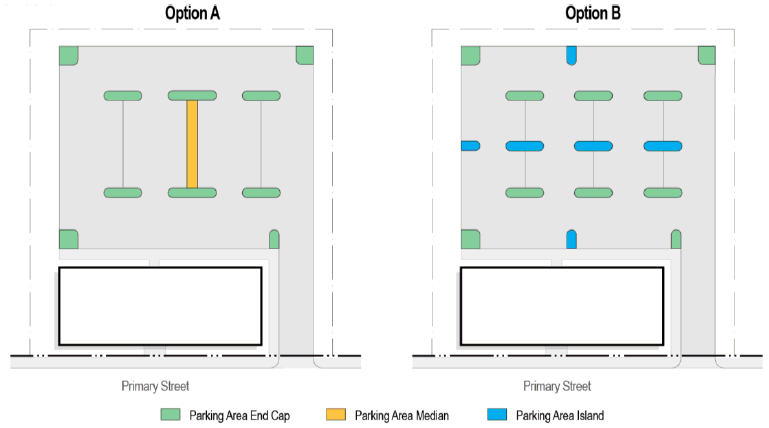
4.
Parking area end cap standards.
a.
Size. Parking area end caps shall be a minimum nine (9) feet wide by eighteen (18) feet long and shall have a minimum soil depth of thirty-six (36) inches. Double rows of parking shall provide parking area end caps opposite one another to form continuous single end cap.
b.
Planting. A minimum of one (1) canopy tree and three (3) shrubs or native grasses shall be provided for every parking area end cap. If the end cap extends the width of a double bay, then two (2) canopy trees shall be provided.
c.
Design. Parking area end caps shall be protected with concrete curbing or other suitable barriers approved by the Zoning Administrator. Such end caps shall be properly drained or irrigated as appropriate to the site conditions to ensure survivability of plant materials or proper stormwater management function.
Figure 6.14: Parking Area End Cap Standards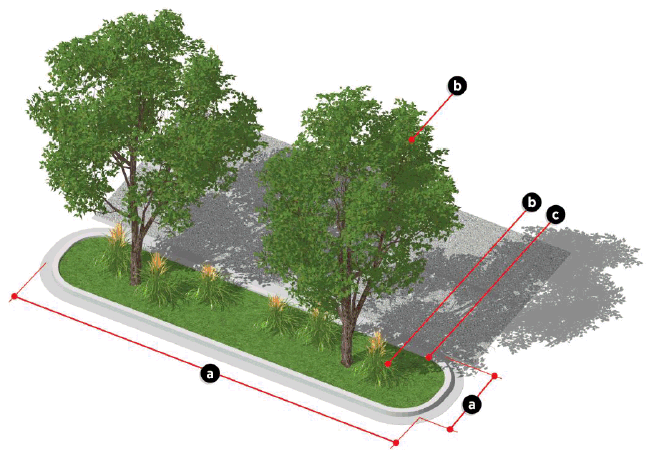
5.
Parking area median standards.
a.
Size. Parking area medians shall have a minimum width of nine (9) feet and minimum soil depth of thirty-six (36) inches.
b.
Planting. A minimum of one (1) canopy tree and fifteen (15) shrubs or native grasses shall be planted for each fifty (50) linear feet of parking area median.
c.
Design. Parking area medians shall be protected with concrete curbing unless the parking area median is designed to be utilized for stormwater management in which case the perimeter shall be protect by wheel stops, or other suitable barriers approved by the Zoning Administrator. Such medians shall be properly drained or irrigated as appropriate to the site conditions to ensure survivability of plant materials and proper stormwater management function.
Figure 6.15: Parking Area Median Standards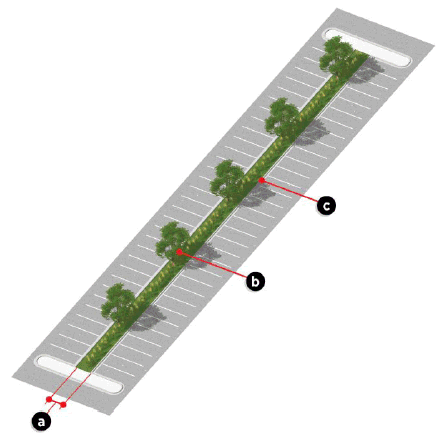
6.
Parking area island standards.
a.
Size. Parking area islands shall be a minimum nine (9) feet wide by eighteen (18) feet long and shall have a minimum soil depth of thirty-six (36) inches. Double rows of parking shall provide parking area islands opposite one another to form continuous single islands.
b.
Planting. A minimum of one (1) canopy tree shall be provided for every parking area island. If the island extends the width of a double bay, then two (2) canopy trees shall be provided.
c.
Design. Parking area islands shall be protected with concrete curbing or other suitable barriers approved by the Zoning Administrator. Such islands shall be properly drained or irrigated as appropriate to the site conditions to ensure survivability of plant materials or proper stormwater management function.
Figure 6.16: Parking Area Island Standards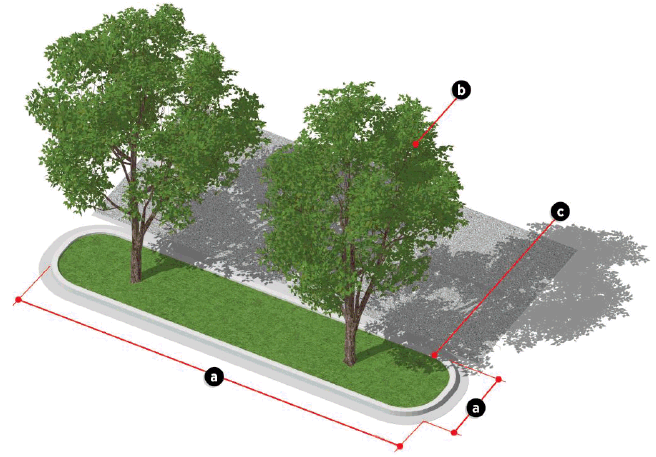
7.
Pedestrian circulation systems. Pedestrian circulation systems, as required in the interior of off-street parking areas in Section 17.06.010(F) shall be located along parking area medians. The Zoning Administrator may waive or modify this requirement on determining that locating pedestrian circulation systems along parking area medians is impractical due to site conditions or undesirable because it would create unsafe conditions.
8.
Type of landscape material. Except where areas are designed as vegetated stormwater management areas, canopy trees shall be the primary plant materials used in parking area islands and canopy trees and shrubs or native grasses shall be the primary plant materials used in parking area medians. Understory trees, evergreen trees, shrubs, native grasses, groundcover, and other plant materials may be used to supplement the required plantings but shall not create visibility concerns for automobiles and pedestrians. If medians or islands are designed as stormwater management areas, deviations from required plantings may be approved by the Zoning Administrator.
9.
Groundcover. A minimum of seventy-five (75) percent of the surface area of every parking area island and median shall be planted with living groundcover.
F.
Transition zone landscape requirements. Transition zone landscape shall be required along interior property lines of all nonresidential, mixed use, and multifamily development. It is not expected that the transition area will totally screen such uses but rather will minimize land use conflicts and enhance aesthetics. Landscape required by this section shall be in addition to landscape required under other sections of this UDC.
1.
Applicability. Transition zone landscaping is required as follows:
a.
The construction or installation of any new primary building or primary use; and
b.
The expansion of any existing primary building or primary use that results in an increase in gross floor area by more than five (5) percent or one thousand (1,000) square feet, whichever is greater. In the case of expansions that trigger compliance with transition zone requirements, transition zone landscaping is required only in proportion to the degree of expansion. The Zoning Administrator is authorized to allow the transition zone to be established adjacent to the area of expansion or to disperse transition zone landscaping along the entire site transition zone.
2.
Transition zone types. Four (4) transition zone types are established in recognition of the different contexts that may exist, as shown in Table 17.06.030(F)(2). Transition zones may include a combination of elements including setback distances for separation, planting types, solid fencing, green walls, vegetated stormwater management areas, living groundcover, or turf.
Table 17.06.030(F)(2) Transition Zone Types
Figure 6.19: Transition Zone Type A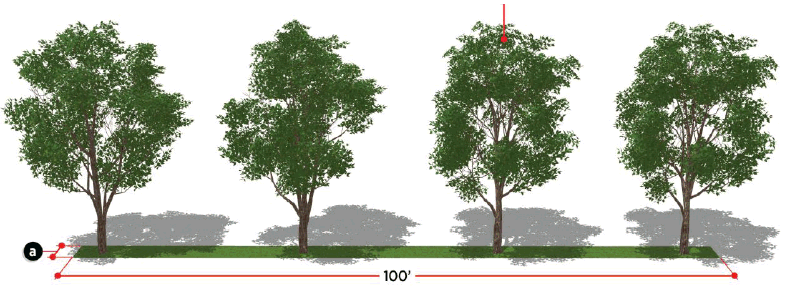
Figure 6.18: Transition Zone Type B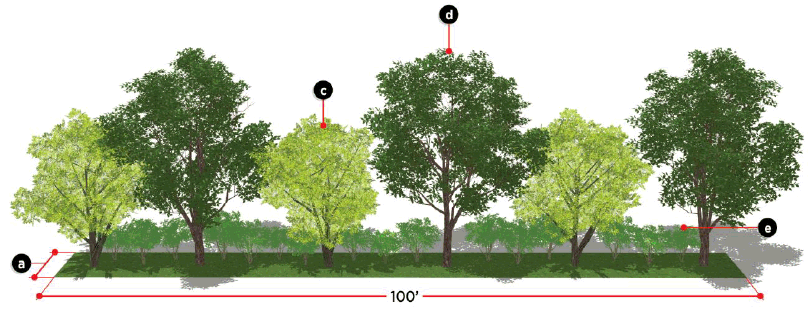
Figure 6.17: Transition Zone Type C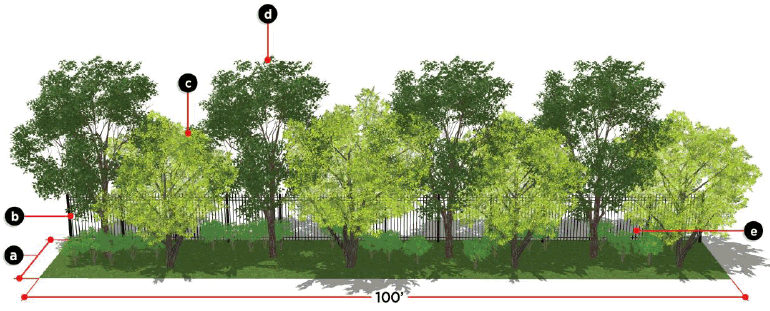
Figure 6.20: Transition Zone Type D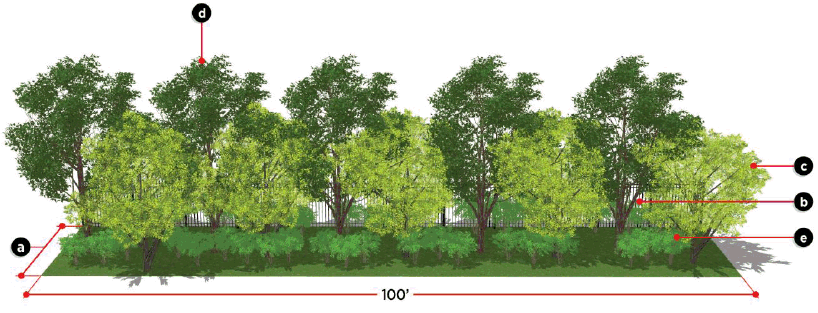
3.
Application of transition zone types. Transition zones shall be provided based on Table 17.06.030(F)(3), except where adjacent uses are of a similar nature, scale, and intensity as determined by the Zoning Administrator. As per Table 17.06.030(F)(3), the type of required transition zone is dependent upon the land use type of the subject lot and the land use type of the adjacent lot(s).
Table 16-6-3(F)(3) Application of Transition Zone Types
G.
Species diversity requirements. The following species diversity requirements shall be required for all developments, unless otherwise approved by the Zoning Administrator in conjunction with approval of vegetated stormwater management areas.
1.
A minimum of fifty (50) percent of the landscape elements utilized on a parcel that is less than one-half (0.5) acre shall be drought tolerant native species.
2.
A minimum of sixty (60) percent of the landscape elements utilized on a parcel that is between one-half (0.5) and five (5) acres shall be drought tolerant native species. Total landscape elements, excluding turf, shall not be comprised of more than thirty (30) percent of any single species or fifty (50) percent of any genus.
3.
A minimum of seventy-five (75) percent of the landscape elements utilized on a parcel that is greater than five (5) acres shall be drought tolerant native species. Total landscape elements, excluding turf, shall not be comprised of more than twenty (20) percent of any single species or twenty-five (25) percent of any genus.
H.
Tree preservation. Preservation of existing high-quality trees within a new development or redevelopment site is highly encouraged. Preserved trees may fulfill a portion of the landscape requirements established in this section. Should the applicant propose to maintain existing high-quality trees to count toward satisfying certain landscape requirements of this UDC, the Zoning Administrator may, upon receipt of a tree preservation plan, waive certain landscape requirements if mature, high-quality trees on a lot are proposed to be preserved. If, upon inspection at the conclusion of the project, trees identified for preservation have been removed, damaged, or are otherwise in declining condition, all waived required landscape shall be installed.
I.
Installation and maintenance of landscape areas.
1.
Immediately upon planting, all landscape shall conform to the American Standard for Nurserymen, published by the American Association of Nurserymen, Inc., as revised from time to time.
2.
A landscape improvement agreement with a security, in the form of a letter of credit, or cash, in a form approved by the City Attorney and Zoning Administrator in an amount equal to twenty (20) percent of the total cost estimate of landscaping for the construction in January 1 dollars for the current year, shall be executed by the applicant for all required landscape improvements. Such agreement shall be executed prior to the issuance of any building permit. The security for landscaping improvements shall remain in place or be held by the City for a period of eighteen (18) months from the date of the last planting of the landscaping. At end of the eighteen (18) months, a letter of credit shall terminate or any cash held in escrow shall be returned to the applicant.
3.
Dead plant materials shall be replaced within sixty (60) days upon notification from the City, taking into consideration the season of the year, and shall have at least the same quantity and quality of landscape elements as initially approved. If the particular project is constructed in more than one (1) phase, the sixty (60) day timeframe shall apply to each individual phase.
4.
All landscape shall be maintained in a healthy, clean, and weed-free condition. The ground surface of landscape areas shall be covered with either turf and/or other types of pervious groundcover or mulch.
Sec. 17.06.040. - Screening.
A.
Trash and recycling receptacles. The following requirements shall apply to all nonresidential, mixed use, and multifamily development.
1.
Trash and recycling receptacles shall be screened on three (3) sides with a solid, opaque material with a minimum height of six (6) feet and a maximum height of eight (8) feet. The use of materials that are not solid, such as slats in chain-link, shall only be used to meet this requirement in the Industrial District.
2.
Materials used for screening shall complement the architecture of the primary building.
3.
Materials and elevations for enclosures that are attached to buildings shall be designed to be integrated into the primary building.
4.
If enclosures are to be attached to buildings, they shall comply with applicable fire and building codes.
5.
Enclosure openings shall be gated with an opaque material and shall not be directly visible from a public right-of-way and/or adjoining residential areas.
6.
Enclosure openings shall be kept closed at all times except for when the receptacle is being accessed by a service truck or person authorized to place refuse in the enclosure
7.
Owners shall be responsible for ensuring that trash and recycling receptacles be placed in the enclosure at all times other than when it is being emptied by a service truck.
8.
Access drives shall be constructed of material and thickness to accommodate truck loading. Year-round accessibility to the enclosure area for service trucks shall be maintained by the owner or tenant.
9.
Enclosures shall be of an adequate size to accommodate expected containers. It is recommended that the enclosure be designed to be expandable to accommodate future additional containers.
10.
Enclosure structures shall be designed to protect the walls from damage by containers. Such protection may be provided by use of barrier curbing, reinforced masonry walls, bollards, or other similar means.
11.
Trash and recycling receptacle enclosures shall not occupy area used for required parking spaces.
Figure 6.21: Trash and Recycling Receptacle Screening Standards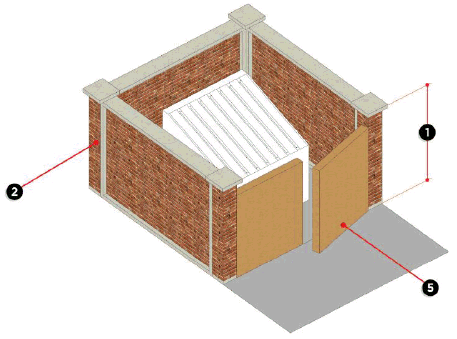
B.
Loading docks and truck-parking areas. The following requirements shall apply to all nonresidential, mixed use, and multifamily development and shall be equally effective throughout the year.
1.
Loading docks and truck-parking areas that are visible from any public right of property in a residential district shall be completely screened from public view.
2.
Materials used for screening shall be opaque masonry walls, wood fence, landscape hedging, berming, or a combination thereof.
3.
The height of screening materials shall not exceed eight (8) feet.
Figure 6.22: Loading Dock and Truck-Parking Area Screening Standards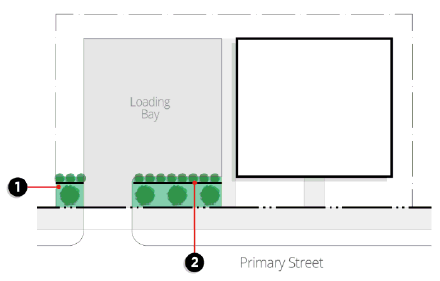
C.
Ground/wall mounted mechanical units. The following requirements shall apply to all ground-mounted and wall-mounted mechanical units, including but not limited to generators, air-conditioning condensers, heat pumps, ventilation units, computer cooling equipment, storage silos, tanks etc., and any related utility structures and equipment.
1.
Locating mechanical units within the principal building is strongly encouraged in order to minimize exterior visual impacts. Ground/wall mounted mechanical units are prohibited within the front or exterior side yard, regardless of whether screening is provided, unless operationally necessary and approved by the Zoning Administrator.
2.
Ground/wall mounted mechanical units that are visible from any public right-of-way or adjacent property in a residential district shall be screened from public view.
3.
Materials used for screening shall be designed to be architecturally integrated with the building and established so that the area or element being screened is no more than twenty (20) percent visible through the screen.
4.
Chain-link fence or slats in chain-link fence shall not be used to meet this requirement.
Figure 6.23: Ground/Wall Mounted Mechanical Unit Screening Standards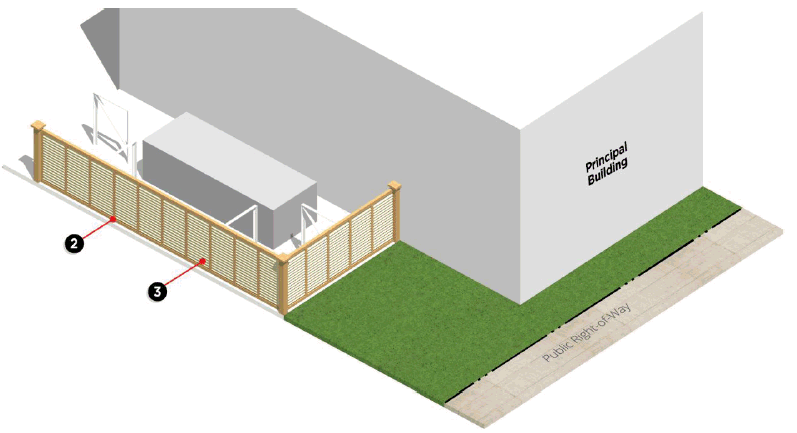
D.
Roof mounted mechanical units. The following requirements shall apply to all roof mounted mechanical units, including but not limited to air-conditioning condensers, heat pumps, ventilation units, computer cooling equipment, etc., and any related utility structures and equipment which service nonresidential, mixed use, or multifamily developments.
1.
Locating mechanical units within the principal building is strongly encouraged in order to minimize exterior visual impacts.
2.
Roof mounted mechanical units that are visible from any public right-of-way or adjacent property in a residential district shall be completely screened from public view.
3.
Materials used for screening shall be architecturally integrated with the building in the form of a parapet wall and shall be continuous, permanent, and sound attenuating.
4.
Screening shall be required when new equipment is installed and shall be provided around both new and existing roof mounted mechanical units in order to provide visual continuity. Normal maintenance of roof mounted mechanical units shall not trigger the screening requirements.
5.
Additional screening may be required due to topographic differences in the adjoining properties.
Figure 6.24: Roof Mounted Mechanical Unit Screening Standards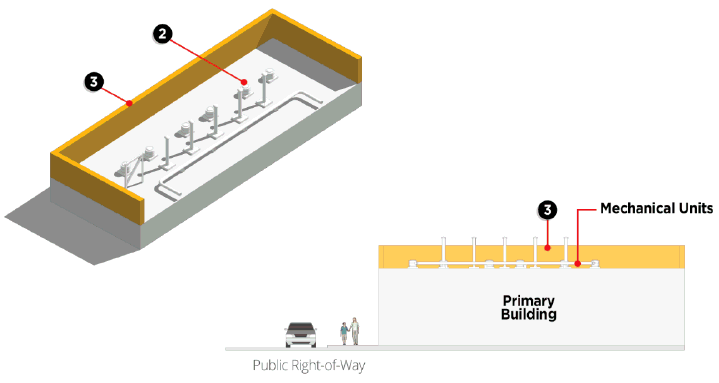
E.
Drive throughs. The following requirements shall apply to all drive throughs regardless of the use to which it is accessory.
1.
Drive aisles of drive throughs must be effectively screened from view at the edges of sites adjacent to property in a residential district to minimize the impact of exterior site lighting, headlight glare and any menu boards and intercom systems.
2.
Screening must be approved during the specific use permitting process.
3.
The screening area shall be a minimum of six (6) feet in width and must consist of:
a.
An opaque masonry wall or wood fence with a minimum height of four (4) feet and a maximum height of six (6) feet; and
b.
Shrubs or native grasses installed every three (3) feet along the exterior of the wall or fence to provide a softening effect.
Figure 6.25: Drive Through Screening Standards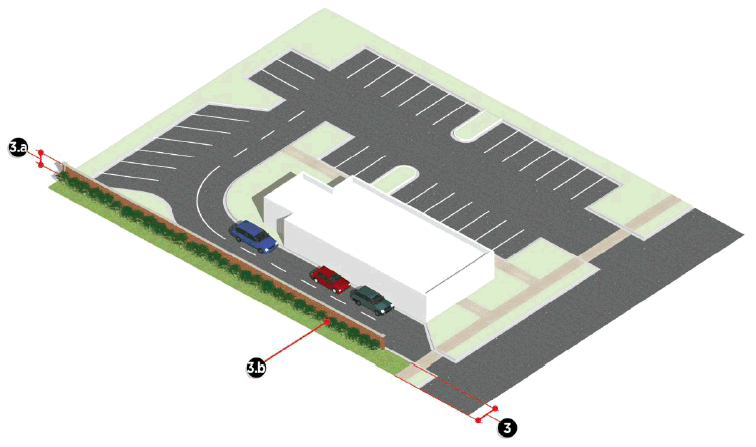
Sec. 17.06.050. - Fences, walls, and hedges.
A.
General provisions.
1.
Location. All fences allowed in this section shall be located:
a.
Wholly within property lines,
b.
A minimum of one (1) foot from any right-of-way,
c.
Outside of a vision clearance area as detailed in Section 17.06.060,
d.
A minimum of eighteen (18) inches from an underground utility access structure; drainage structure; telephone, electric, cable television or gas pedestal or in any manner that would interfere with the maintenance for these utilities,
e.
In a manner which does not block access to underground utility access structures or fire hydrants,
f.
A minimum of two (2) inches above finished grade if located in a drainage swale or a drainage easement, and
g.
In a manner which does not inhibit the function of stormwater drainage structures.
Figure 6.26: General Fence Location Standards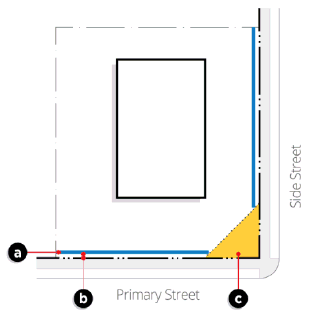
2.
Construction standards. Fences shall be designed and constructed to resist a horizontal wind pressure of not less than thirty-five (35) pounds per square foot, in addition to all other forces to which they may be subjected. Fences that are leaning at an angle of fifteen (15) degrees or greater are considered dangerous and shall be in violation of this UDC.
3.
Barbed wire. Notwithstanding any other provision of this UDC, barbed wire shall be permitted as follows:
a.
In the I District, barbed wire fences shall be permitted in interior side and rear yards. The barbed wire shall be limited to a maximum height of one (1) foot and a maximum of three (3) strands of wire. The barbed wire shall not be included in the determination of fence height.
b.
On lots of one (1) acre or greater in the R-L or R-1 Districts, or in any district on a lot with a primary agricultural use, barbed wire shall be permitted up to a maximum height of five (5) feet on the front, interior side, exterior side, and rear yard.
B.
Fences on lots with single-family or two-family uses. Fences on lots with single-family or two-family uses shall meet the requirements established below. Razor wire, or makeshift materials such as plywood or tarpaulin shall be prohibited on lots with single-family or two-family uses. All fences shall be erected so that the posts and all other supporting members face inward toward the owner's property.
1.
Fences in front and/or street side yards.
a.
Height. Fences in front and street side yards shall not exceed four (4) feet in height. Fences in street side yards may have a maximum height of six (6) feet when located behind the front facade of the primary structure or twenty-five (25) feet from the front lot line.
b.
Materials. Fences in front yards and/or street side yards shall be of non-sight barrier construction and have a maximum opacity of fifty (50) percent. Fence materials utilized in front yards and/or street side yards shall complement fence materials utilized in other yards. Permitted fence materials in front yards and/or street side yards shall be only those materials which are designed and intended for use in fence installations and shall be limited to:
I.
Vegetation,
II.
Wood, chemically treated or naturally resistant to decay,
III.
Wood composites,
IV.
Aluminum,
V.
Vinyl/PVC, and
VI.
Wrought iron.
Figure 6.27: Fences on Lots with Single-Family or Two-Family Uses in Front and/or
Street Side Yard Standards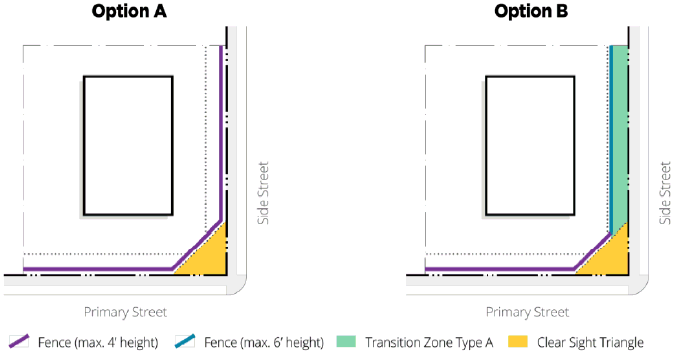
2.
Fences in interior side and rear yards.
a.
Height. The maximum height of a fence in interior side yards and rear yards shall be six (6) feet.
b.
Materials. Fence materials utilized in interior side yards and rear yards shall complement fence materials utilized in other yards. Permitted fence materials in interior side yards and rear yards shall be only those materials which are designed and intended for use in fence installations and shall be limited to:
I.
Masonry,
II.
Wood, chemically treated or naturally resistant to decay,
III.
Wood composites,
IV.
Aluminum,
V.
Vinyl/PVC,
VI.
Wrought iron,
VII.
Coated chain link without inserts, and
VIII.
As approved by the Zoning Administrator.
c.
Location. Fences in interior side yards and rear yards shall be located no closer to the front yard than the established front face of the principal building on the lot or the principal building on the adjacent lot.
C.
Fences for all other uses. Fences and walls for all uses not regulated by 17.06.050(B) shall be approved by the Public Works Director upon a determination that all the following standards are met.
1.
Vision clearance. The fence or wall shall not create a visual clearance or traffic hazard.
2.
Height. The maximum height shall be eight (8) feet.
3.
Location. Fences shall not be located in front yards except in the GC and CB districts on lots with a minimum of a five (5) foot front yard and when constructed of solid masonry or metal and at a maximum height of forty-two (42) inches.
4.
Materials. In all districts except the I district and for all uses except agricultural uses, fences shall be at least fifty (50) percent transparent and constructed of one (1) of the following materials:
a.
Masonry,
b.
Wood, chemically treated or naturally resistant to decay,
c.
Wood composites,
d.
Aluminum,
e.
Vinyl/PVC,
f.
Wrought iron,
g.
Coated chain link without inserts, or
h.
As approved by the Zoning Administrator.
(Ord. No. 14-2022, § 4, 8-1-22; Ord. No. 3-2024, § 5, 8-5-24; Ord. No. 8-2025, § 3, 8-18-25)
Sec. 17.06.060. - Vision clearance.
A.
Applicability.
1.
A vision clearance triangle shall be maintained at every street intersection, driveway, and alley junction.
2.
Vision clearance areas may be reduced upon a determination by the Public Works Director that such a reduction is not expected to have a significant impact on vehicle, bicycle, or pedestrian safety at the intersection, driveway, or alley junction.
B.
Vision clearance required.
1.
For all street intersections and alley junctions, vision clearance shall be required for the area extending fifteen (15) horizontal feet along the edge of each street flowline and fifteen (15) horizontal feet along the intersecting street's flowline to a diagonal line from each fifteen (15) foot extension to create a vision triangle.
2.
For all driveways, vision clearance shall be required for the area extending ten (10) horizontal feet along the edge of each street flowline and ten (10) horizontal feet along the intersecting driveway to a diagonal line from each five (5) foot extension to create a vision triangle.
3.
For all street intersections, driveways, and alley junctions, no obstruction shall be placed in a vision clearance triangle that is wider than eighteen (18) inches and between thirty (30) inches and nine (9) feet in height except allowable traffic control devices and equipment.
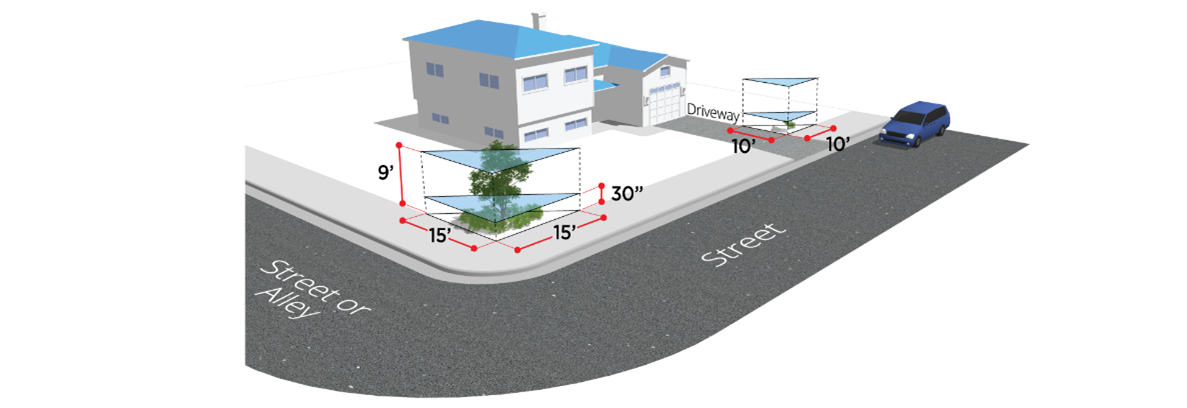
(Ord. No. 8-2025, § 4, 8-18-25)
Sec. 17.06.070. - Outdoor lighting.
A.
Fixture classification. All outdoor lighting fixtures shall either have a fixture cutoff classification of "Full Cutoff" or be fully shielded, unless otherwise expressly permitted in this UDC.
B.
LED fixtures. All outdoor lighting utilizing a light-emitting diode (LED) fixture shall meet the following standards:
1.
Color rendering. Outdoor LED fixtures shall be rated a minimum Color Rendering Index (CRI) value of seventy (70) or higher.
2.
Color temperature. Outdoor LED fixtures shall have a correlated color temperature between four thousand (4,000) and five thousand (5,000) degrees Kelvin.
C.
Pole mounted outdoor lighting.
1.
Pole placement. Pole-mounted outdoor lighting shall be located outside of utility easements, designed in coordination with required landscape zones (Section 17.06.030), and located outside of parking area medians and islands.
2.
Maximum pole height. Pole-mounted fixtures shall be mounted at heights no greater than the height of the primary building on the lot.
D.
Maximum light level at property line. All outdoor lighting fixtures shall be designed and located so that the maximum light level shall be one-half (0.5) maintained foot candles at any property line.
E.
Light level measurement.
1.
Location. Light level measurements shall be made at the property line of the property upon which the light to be measured is being generated. If measurement on private property is not possible or practical, light level measurements may be made at the boundary of the public street right-of-way that adjoins the property of the complainant or at any other location on the property of the complainant. Measurements shall be made at finished grade (ground level), with the sensor in the horizontal position and not mounted more than six (6) inches above ground level, and with the light-registering portion of the meter held parallel to the ground and pointing upward.
2.
Light meter specifications. Light levels shall be measured in foot candles with a direct-reading portable light meter. The meter shall:
a.
Have cosine and color correction,
b.
Have an accuracy tolerance of no greater than plus or minus five (5) percent, and
c.
Have been calibrated within the last two (2) years.
Sec. 17.06.080. - Stormwater and drainage easements.
When a building, subject to the adopted building code, is located on property traversed by a drainage way including, but not limited to, a watercourse, swale, channel, irrigation ditch, or stream, the owner, prior to obtaining a certificate of occupancy, shall execute an easement agreement for stormwater and/or drainage purpose(s) for the benefit of the City. The easement shall conform substantially to the banks of the drainage way with such width as will be necessary to fulfill the purpose(s) of the easement, as determined by the City, and the agreement shall grant the City the right to access adjacent property to perform any necessary acts related to the easement. If necessary, the City may require a survey of the easement and the costs of such survey shall be paid by the applicant. Wherever possible, it is desirable that the drainage be maintained by an open channel with stabilized banks and adequate width for the one percent annual chance historic flow.
(Ord. No. 5-2022, § 7, 2-21-22)

