
Canton City Zoning Code
ARTICLE 2
00.- GENERAL PROVISIONS
2.01.- Administrative regulations.
A.
Scope of regulations. No structure or tract of land shall hereafter be used or occupied, and no structure, or part thereof, shall be erected, altered, or moved, except in conformity with the regulations specified herein for the zoning district in which the structure or land is located.
However, where a building permit for a building or structure has been issued in accordance with law prior to the effective date of this ordinance and provided construction is begun within six months of the effective date, said building or structure may be completed in accordance with the approved plans. Furthermore, upon completion of construction said building may be occupied under a certificate of occupancy for the use for which the building was originally designated, subject thereafter to the provisions of article 3.00 concerning nonconformities. Any subsequent text or map amendments shall not affect previously issued valid permits.
B.
Minimum requirements. The provisions of this ordinance shall be held to be the minimum requirements for the promotion of public health, safety, convenience, comfort, morals, prosperity, and general welfare.
C.
Relationship to other ordinances or agreements. This ordinance is not intended to abrogate or annul any ordinance, rule, regulation, permit, easement, covenant, or other private agreement previously adopted, issued, or entered into and not in conflict with the provisions of this ordinance.
However, where the regulations of this ordinance are more restrictive or impose higher standards or requirements than other such ordinances, rules, regulations, permits, easements, covenants, or other private agreements, the requirements of this ordinance shall govern.
D.
Vested right. Nothing in this ordinance should be interpreted or construed to give rise to any permanent vested rights in the continuation of any particular use, district, zoning classification, or permissible activities therein. Furthermore, such rights as may exist through enforcement of this ordinance are hereby declared to be subject to subsequent amendment, change or modification as may be necessary for the preservation or protection of public health, safety, and welfare.
E.
Continued conformity with yard and bulk regulations. The maintenance of yards and other open space and minimum lot area legally required for a building shall be a continuing obligation of the owner of such building or of the property on which it is located, for as long as the building is in existence.
No portion of a lot used in complying with the provisions of this ordinance for yards, courts, lot area, lot coverage, in connection with an existing or planned building or structure, shall again be used to qualify or justify any other building or structure existing or intended to exist at the same time.
F.
Division and consolidation of land. The division and consolidation of land shall be in accordance with the subdivision control ordinance of the Charter Township of Canton [chapter 110 of the Township Code]. No zoning lot shall hereafter be divided into two or more zoning lots and no portion of any zoning lot shall be sold, unless all zoning lots resulting from each such division or sale conform with all applicable regulations of the zoning district in which the property is located.
G.
Unlawful buildings, structures, site designs, and uses. A building, structure, or use which was not lawfully existing at the time of adoption of this ordinance shall not become or be made lawful solely by reason of the adoption of this ordinance. In case any building, or part thereof, is used, erected, occupied or altered contrary to law or the provisions of this ordinance, such building shall be deemed an unlawful structure and a nuisance and may be required to be vacated, torn down or abated by any legal means, and shall not be used or occupied until it has been made to conform to the provisions of this ordinance. Public expenditures toward abating any such nuisance shall become a lien upon the land.
H.
Voting place. The provisions of this ordinance shall not be so construed as to interfere with the temporary use of any property as a voting place in connection with a public election.
2.02. - Permitted uses.
Permitted uses are recognized as uses of land and buildings in certain districts which are harmonious with other such uses which may lawfully exist with (within) the same district. A permitted use is subject to the schedule of regulations, permit and site plan requirements found elsewhere in this ordinance, but otherwise is considered to be a lawful use not requiring special or extraordinary controls or conditions. Uses and activities that are contrary to state, federal, or other local laws and ordinances are prohibited.
(Ord. of 5-25-2010)
2.03. - Accessory structures and uses.
Accessory structures and uses shall comply with the following regulations:
A.
General requirements.
1.
Timing of construction. No accessory structure or use shall be constructed or established on a parcel unless there is a principal building, structure, or use being constructed or already established on the same parcel of land.
2.
Site plan approval. If submission of a site plan for review and approval is required, then said plan shall indicate the location of proposed accessory structures and uses.
3.
Nuisances. Accessory uses such as household animal enclosures, dog runs, central air conditioning units, heat pumps, and other mechanical equipment that could produce noise, odors, or other nuisances shall not be located adjacent to an adjoining property owner's living or sleeping area where windows and/or doors would be exposed to the nuisance.
4.
Conformance with lot coverage standards. Accessory buildings and structures shall be included in computations to determine compliance with maximum lot coverage standards, where required.
B.
General requirements for detached accessory structures and uses.
1.
Setbacks. Accessory structures or uses (including garages) which are not structurally attached as defined herein, shall meet the same setback and coverage requirements as set forth for the principal structure, except as otherwise specified for accessory structures in residential districts. Accessory structures or uses on double frontage lots shall be restricted to the central one-third of such lots.
2.
Height. Detached accessory, buildings and structures shall conform to the height requirement for the principal structure in the district in which it is located, except as may otherwise be specified for accessory buildings and structures in residential districts.
C.
Attached accessory structures or uses. Unless otherwise specified in this section, accessory structures or uses (including garages) which are attached to the principal building or structure shall be considered a part of the principal building for the purposes of determining conformance with area, setback and bulk requirements. For the purposes of this section, buildings or structures that are within ten feet of the principal building or structure shall be considered "attached."
D.
Specific requirements for accessory structures and uses in residential and agricultural districts.
1.
Size and number. The maximum floor area for the total of all accessory structures on a lot in residential or agricultural district shall be equal to 33 percent of the floor area of the house, plus one percent of the total lot area, provided that the total floor area of all accessory structures shall not exceed 25 percent of the rear and side yards, and provided further that no more than two accessory structures shall be permitted on each lot in platted subdivisions. The area of an attached garage which is designed as an integral part of the house (rather than as add-on) shall not be included in the computations to determine conformance with maximum floor area standards of accessory structures.
2.
Height. Accessory structures in residential and agricultural districts shall not exceed the smaller of the following: the height of the principal structure, or, the maximum height requirement for dwelling units in the district where the lot is located. However, height requirements may be modified as follows:
-
The height of a detached accessory structure in a residential or agricultural district may exceed the limits cited above if any such accessory structure is located at least 100 feet to the rear of the principal structure and at least 100 feet from principal structures on adjoining property, and provided further that any such accessory structure does not exceed 45 feet in height (except as specified below for farm buildings).
-
The maximum height of accessory farm buildings which are essential and customarily used in the agricultural operations conducted on a bona fide farm (as defined in article 1.00) shall be 45 feet, except that the maximum height of silos shall be 100 feet, provided that all such accessory farm buildings shall be located at least 100 feet from any residential dwelling other than the dwelling on the lot where the accessory farm buildings are located.
3.
Setbacks. Detached accessory structures and uses shall conform to the front and side yard setback requirements for the district in which they are located. Detached accessory structures shall maintain a minimum six-foot rear yard setback in all zoning districts. All detached accessory structures shall be located behind the front building line of the principal structure on the lot or parcel of land.
4.
Use of accessory structures. Attached and detached accessory structures in residential and agricultural districts shall not be used as a dwelling unit or for any business, profession, trade, or occupation.
5.
Garages. One private garage (as defined in article 1.00) shall be permitted per residential lot. Any such garage shall be used for the storage of only vehicles owned and used by occupants of the residence to which it is accessory.
6.
Doors. In any residential district, an accessory structure shall not have a door exceeding nine feet in height.
E.
Locational requirements for pools. The location and enclosure of any pool shall be such that no hazard exists for the pool users or the public. The minimum distance from the nearest part of the pool structure shall be as follows:
1.
Five feet horizontally to any property line except that no pool shall be located within the front yard and in the case of a corner lot, the pool shall not be located within the required yard space as measured from the lot line which abuts the side street.
2.
Four feet to any building wall or nonproperty line fence.
3.
Twenty-five feet horizontally to any private water well or as approved by the county health department.
4.
Three feet horizontally to any sewer, for an in ground pool. There shall be ten feet horizontally to a septic tank and tile field or other similar treatment facility.
5.
No pool, parts of the pools, or related equipment shall be located in any easement of record.
6.
In a residential subdivision, pool water filtering and heating equipment shall not be located in the side yard, or in the case of a corner lot, within the required yard space which abuts the side street. Pool equipment shall not be located within the front yard.
F.
Locational requirements for air conditioning units. Air conditioning units, regardless of size, shall not be placed in the front yard and shall be set back from the side or rear yard lot lines a minimum of six feet. Further, air conditioning units must be located at least 12 feet from any single family home on an adjacent lot.
G.
Residential wind energy turbines (on-site). Wind energy turbines may be erected on an occupied lot or parcel as an accessory use to an existing permitted principal building, structure, or use, in accordance with the following guidelines:
1.
Minimum lot size - Two acres.
2.
Setback from all property lines - One foot for every foot of height, measured to highest vertical position of the turbine blade.
3.
Location - The turbine and any support structure shall be located behind the rear building line of the principal building or structure on lot or parcel.
4.
Maximum height - 30 meters (100 feet)
5.
Maximum sound threshold - on site wind energy systems shall not exceed 55 dB(A) at the property line closest to the wind energy system. If the ambient sound pressure level exceeds 55 dB(A), the maximum standard shall be the ambient dB(A) plus 5 dB(A).
6.
Shadow flicker mitigation - The applicant shall conduct an analysis of potential shadow flicker at occupied structures over the course of a year, and describe measures that will be taken to eliminate or mitigate the problem.
7.
Safety - the on-site wind energy system shall have an automatic braking, governing, or feathering system to prevent uncontrolled rotation or over speeding and shall be provided with lightning protection. The minimum vertical blade tip clearance shall be 20 feet for a wind energy system employing a horizontal axis rotor.
H.
Wind energy turbines (building-mounted). Wind energy turbines may be installed on the roof or attached to the walls of any existing structure in accordance with the following guidelines:
1.
No portion of the turbine may exceed the height requirements of the zoning district in which it is located.
2.
The turbine blades may not exceed a diameter of three feet on residential structures and a diameter of seven feet on nonresidential structures.
3.
A maximum of one wind turbine unit may be installed on a single-family residential structure. The number of units proposed for attached residential structures and non-residential buildings are subject to site plan approval.
4.
All wind turbines shall be located to reduce, as much as possible, the visual impact it has on surrounding properties and from public or private streets. In no case shall wind turbines, or their support structures be mounted to the front or side walls of single-family detached residential structures.
I.
Solar energy systems.
1.
Purpose: It is the purpose of this sub-section to promote the safe, effective, and efficient use of solar energy systems (SES) to generate electricity and heat. Further, it is the purpose of this sub-section to standardize and streamline the review and permitting process for solar energy systems.
2.
Findings: The township has found that solar energy is an abundant, renewable, and nonpolluting energy resource of which some residents and utility companies would like to make use. Generation of electricity and heat by these facilities will reduce dependence on nonrenewable energy resources and decrease air and water pollution that results from the use of conventional fossil fuels. Solar energy systems will also enhance the reliability and power quality of the power grid, reduce peak power demands, and help diversify the Township's energy supply.
3.
Definitions. The following definitions apply to solar energy systems:
a.
Accessory ground-mounted solar energy system: A ground-mounted solar energy system with the purpose primarily of generating electricity for the principal use on the site.
b.
Ground-mounted solar energy system: A solar energy system mounted on support posts, like a rack or pole, that are attached to or rest on the ground.
c.
Maximum tilt: The maximum angle of a solar array (i.e., most vertical position) for capturing solar radiation as compared to the horizon line.
d.
Minimum tilt: The minimal angle of a solar array (i.e., most horizontal position) for capturing solar radiation as compared to the horizon line.
e.
Photovoltaic (PV) system: A semiconductor material that generates electricity from sunlight.
f.
Roof-mounted solar energy system: A solar energy system mounted on racking that is attached to or ballasted on the roof of a building or structure.
g.
Solar array: A photovoltaic panel, solar thermal collector, or collection of panels or collectors in a solar energy system that collects solar radiation.
h.
Solar energy system (SES): A photovoltaic system or solar thermal system for generating and/or storing electricity or heat, including all above and below ground equipment or components required for the system to operate properly and to be secured to a roof surface or the ground.
i.
Solar thermal system: A system of equipment that converts sunlight into heat.
j.
Wall-mounted solar energy system: A solar energy system that is attached to the wall of the principal or accessory building.
4.
Roof-mounted and wall-mounted solar energy systems: Roof—mounted solar energy systems are permitted accessory structures in all zoning districts, subject to the following regulations:
a.
Height: Roof-mounted systems shall not extend more than one foot above the roofline and shall not exceed the maximum permitted height of the structure to which it is attached. However, where roof-mounted systems are fully screened from public view by parapet walls, the systems may extent up to four feet above the surface to which it is affixed. Wall-mounted systems shall not exceed the height of the wall to which it is attached.
b.
Location: Roof-mounted solar energy systems may be located anywhere on the roof of a principal or accessory structure, but shall not protrude beyond the edge of the roof and shall not be located within a required setback area. Wall-mounted solar energy systems may be located anywhere on the wall of a principal or accessory structure, but shall not be located within a required setback area.
c.
Nonconformities: Roof- or wall-mounted systems installed on a nonconforming building, structure, or use shall not be considered and expansion of the nonconformity provided the roof- or wall-mounted system is located in a conforming area of the building or structure.
5.
Accessory ground-mounted solar energy systems (10 kW or less): Ground-mounted and freestanding solar energy systems of 10 kW or less for on-site use are permitted accessory structures in all zoning districts, subject to the following regulations:
a.
Location and setbacks: Ground-mounted solar energy systems shall be located in a rear yard only. Ground-mounted solar energy systems shall also meet the minimum setbacks of the zoning district. Setback distance is measured from the property line to the closest point of the SES, including at minimum tilt or maximum tilt.
b.
Height: The height of a ground-mounted solar energy system and any mounts shall not exceed ten feet when oriented at maximum tilt.
c.
Area: The total area of the ground-mounted solar array at minimum tilt shall not exceed 25 percent of the ground floor area of the principal building or 25 percent of the rear yard area, whichever is less.
d.
Power lines: All power lines between solar panels and inverters must be placed underground.
6.
General standards: The following requirements are applicable to all roof-mounted, wall-mounted, or ground-mounted solar energy systems.
a.
Application and permit: A building permit shall be required for the installation of solar energy systems. All solar energy system applications must include a plot plan to the satisfaction of the building official. Applications for ground-mounted solar energy systems must include drawings that show the location of the system on the property, height, tilt features (if applicable), the primary structure, accessory structures, and setbacks to property lines.
b.
Batteries: When solar storage batteries are included as part of the solar energy system, they must be placed in a secure container or enclosure when in use, and when no longer used shall be disposed of in accordance with applicable laws and regulations.
c.
Removal provisions: If a solar energy system ceases to perform its intended function (generating electricity and/or heat) for more than 12 consecutive months, the property owner shall remove the collectors, mounts, and associated equipment and facilities no later than 90 days after the end of the 12-month period. Where the removal has not been lawfully completed as required above, and after at least 30 days' written notice, the Township may remove or secure the removal of the solar energy system or portion thereof, with the Township's actual cost and reasonable administrative charges to be placed as a lien on the property. A lien on the property shall be superior to all other liens except taxes.
J.
Flagpoles. Flagpoles are permitted as accessory structures subject to the standards below:
1.
Setbacks. The minimum setback between a flagpole and any lot line shall be the height of the flagpole.
2.
Height. Flagpoles shall conform to the height requirement for the principal structure in the zoning district in which it is located, except flagpoles in residential and agricultural zoning districts shall not exceed the smaller of the height of the principal structure or the maximum height requirement for dwelling units in the district.
3.
Design. Flagpoles shall be designed for the flying of a flag or flags. Light poles shall not be used as a flagpole.
(Ord. of 1-23-2003; Amend. of 10-20-2009; Ord. of 2-14-2023(2); Ord. of 01-13-2026(1) )
2.04. - Lawful use of a structure as a dwelling unit.
Any incompletely constructed structure which does not meet the requirements of the building code or this ordinance shall not be issued a certificate of occupancy and shall not be used as a dwelling. For the purposes of this section, a basement which does not have a residential structure constructed above it shall be considered an incompletely constructed structure.
No dwelling shall be erected in a commercial or industrial district, except for the living quarters of a watchman or caretaker. Any such living quarters shall consist of a structure which is permanently affixed to the ground, constructed in accordance with the adopted building code, and provided with plumbing, heating, bathroom, and kitchen facilities. In no case shall such living quarters be used as a permanent single-family residence by anyone other than a watchman or caretaker.
2.05. - Residential design standards.
Any residential structure, including manufactured dwellings and mobile homes not located in mobile home parks, shall be erected or constructed only if in compliance with the following residential design standards.
A.
General requirements.
1.
Area and bulk regulations. Any residential structure, including any mobile home dwelling unit, shall comply with the minimum floor area requirements specified for the zoning district where such structure is located. Furthermore, mobile homes shall comply with all other regulations normally required for site-built housing in the zoning district in which it is located, unless specifically indicated otherwise herein.
2.
Foundation. Any residential structure, including a mobile home, shall be placed on a permanent foundation to form a complete enclosure under the exterior walls. The foundation shall be constructed in accordance with the adopted building code of the township. A mobile home shall be securely anchored to its foundation in order to prevent displacement during windstorms. The wheels, tongue and hitch assembly, and other towing appurtenance, shall be removed before attaching a mobile home to its permanent foundation.
3.
Other regulations. Residential structures shall be constructed in compliance with applicable state, federal, or local laws or ordinances. Mobile homes shall comply with the most recent regulations specified by the United States Department of Housing and Urban Development, Mobile Home Construction and Safety Standards (24cFR3280).
4.
Floodplain. No dwelling unit, including mobile homes, shall be located within a 100-year floodplain.
5.
Use. Mobile homes and other structures shall be used only for the purposes permitted in the zoning district in which they are located.
6.
Attachments. Any exterior attachments or extensions onto a dwelling unit, such as entry steps and storage buildings, shall comply with the adopted building code of the township.
B.
Requirements applicable to class A mobile homes. Mobile homes erected outside of mobile home parks after the effective date of this ordinance shall comply with the general requirements set forth previously in section 2.05.A and with the following regulations for class A mobile homes. Any mobile home which does not comply with the following regulations shall be designated a class B mobile home.
1.
Design features. The fenestration and other features of class A mobile homes, including exterior wall colors and color combinations, shall be similar to site-built homes within 300 feet of the proposed mobile home property boundaries. If no more than one site-built dwelling is presently located within 300 feet of the proposed location, then the mobile home shall be compared to all site-built homes within the township.
2.
Roof pitch. The pitch of the main roof shall have a minimum vertical rise of one foot for each four feet of horizontal run, and the minimum distance from the eaves to the ridge shall be ten feet, except where the specific housing design dictates otherwise (i.e., French provincial, Italianate, etc.). The roof shall be finished with a type of shingle or other material that is commonly used in standard on-site residential construction.
3.
Exterior materials. The exterior siding of a class A mobile home shall consist of materials that are generally acceptable for site-built housing, provided that the reflection from such exterior surface shall be no greater than from white semi-gloss exterior enamel, and provided further that any such exterior is comparable in composition, appearance, and durability to the exterior siding commonly used in standard residential construction.
4.
Dimensions. The dimensions and placement of class A mobile homes shall be comparable to typical dimensions and placement of site-built housing in the vicinity. Therefore, a class A mobile home shall be so located on the lot so that the minimum width of the front elevation shall be no less than 34 feet and the minimum dimension along any side or rear elevation shall be no less than 20 feet. If there are any extensions or additions off of the front of the mobile home, the minimum width of any such secondary front elevation shall be 20 feet. Such dimensions shall be measured from the outer extremities and shall include additions to the main body of the mobile home, such as living or recreation rooms, garages, carports, utility rooms, and the like, the front portions of which are within ten feet of the front of the main body of the mobile home.
5.
Roof overhang. Class A mobile homes shall be designed with either a roof overhang of not less than six inches on all sides or with windowsills and roof drainage systems to concentrate roof drainage at collection points along the sides of the dwelling.
6.
Exterior doors. Class A mobile homes shall have not less than two exterior doors which shall not be located on the same side of the building.
2.06. - Home occupations.
A.
General requirements. Home occupations shall be subject to the requirements of the zoning district in which they are located, as well as the following standards, unless otherwise specified elsewhere in this ordinance:
1.
Home occupations must be customarily incident to the use of the dwelling as a residence.
2.
No outdoor display or storage of materials, goods, supplies, or equipment used in the home occupation shall be permitted on the premises.
3.
The appearance of the principal structure shall not be altered, nor shall the home occupation be conducted in a manner which would cause the premises to differ from its residential character by the use of colors; materials; construction; lighting; or the emission of sounds, noises, or vibrations.
4.
Only the residents of the dwelling unit may be engaged in the home occupation.
5.
The home occupation may increase vehicular traffic flow and parking by no more than one additional vehicle at a time. No more than ten customers or clients shall come to the dwelling unit for services or products during any one day. Any need for parking generated by the conduct of such home occupation shall be met off the street and other than in the required front yard.
6.
No home occupation shall require internal or external alterations or involve construction features or the use of electrical or mechanical equipment that would change the fire rating of the structure.
7.
One non-illuminated nameplate sign accessory to a home occupation, not more than one square foot in area, shall be permitted. Said sign shall be attached flat to the building wall, and shall display only the name and occupation of the residences on the premises.
8.
A home occupation shall not create noise, dust, vibration, smell, smoke, glare, electrical interference, fire hazard, or any other hazard or nuisance to any greater or more frequent extent than would normally be generated in a similarly zoned residential district.
9.
The following uses, by the nature of their operation, have a pronounced tendency to increase in intensity beyond the limits permitted for home occupations, thereby impairing the reasonable use and value of surrounding residential properties. Therefore, the following uses shall not be permitted as home occupations:
-
Medical clinics and hospitals.
-
Offices maintained for the general practice of a veterinarian, doctor, lawyer, accountant, insurance agent, or real estate agent.
-
Millinery shops.
-
Animal hospitals, veterinarian and commercial kennels.
-
Vehicle and engine repair businesses.
-
Antique shops.
-
Barbershops and beauty parlors.
-
Club or fraternal organization (as defined in article 1.00).
-
Landscape installation and maintenance businesses, including lawn mowing businesses.
-
Snow plowing and/or removal businesses.
-
Concrete, excavation, and similar contractors.
-
Trailer rental.
-
Restaurants and tearooms.
-
Bed and breakfast establishments.
-
Repair shops and service establishments.
This list does not include every use that is prohibited as a home occupation.
Cross reference— Businesses, ch. 18.
(Ord. of 01-13-2026(1))
2.07. - Temporary structures and special events.
A.
General requirements. Temporary buildings and structures shall comply with the following requirements:
1.
Temporary structures used for residential purposes. A building or structure may be approved for temporary residential use only while damage to the principal dwelling due to fire, flood, ice, wind, or other natural disaster is being repaired. A temporary building or structure which could be used on a temporary basis, such as a house trailer, basement, tent, shack, garage, barn, or other outbuilding, shall not be used as a residence on any parcel without prior review and approval by the public safety and building officials.
2.
Temporary structures used for nonresidential purposes. Temporary buildings for nonresidential use, including semi-trucks/[semi-]trailers and concrete batch plants, shall be permitted only when the intended use is by a contractor or builder in conjunction with a construction project, and only after review and approval by the building official. Such temporary structures shall be removed immediately upon completion of the construction project and prior to a request for a certificate of occupancy for the project.
3.
Temporary structures used as sales offices for single-family or multiple-family residential developments. Temporary buildings intended for use as a sales office for residential housing units shall be permitted only when the intended use is by a builder, developer, or their authorized representative.
Only one such structure shall be permitted per multiple-family site and up to three for a single-family subdivision or site condominium, but in no case shall there be more than one temporary sales trailer per builder on the proposed development site, regardless of the number of phases.
Such structures shall comply with all applicable regulations for the zoning district and shall be required to obtain site plan approval, and be equipped with an approved sanitation system. If the sales office is needed for 180 days or less, the site plan may be administratively approved with the concurrence of the planning, engineering, and building officials. There shall be no extensions to administrative approvals. If the sales office is needed for more than 180 days, the site plan will require review and approval by the planning commission. The planning commission shall have the right to limit the time period based on the nature of the development. In no case shall the temporary sales office be permitted after completion of a model unit.
4.
Temporary structures used as sales offices for commercial developments. Temporary buildings intended for use as an office for commercial purposes shall be limited to use by the proprietor or operator of the development for the purpose of securing pre-sales of subscriptions or memberships for the business under construction or employment application purposes.
Only one such structure shall be permitted per development site, shall meet all applicable regulations of the zoning district, and shall be required to obtain site plan approval, and be equipped with an approved sanitation system. If the office is needed for 180 days or less, the site plan may be administratively approved with the concurrence of the planning, engineering, and building officials. There shall be no extensions to administrative approvals. If the sales office is needed for more than 180 days, the site plan will require review and approval by the planning commission. The planning commission shall have the right to limit the time period based on site conditions and the specific nature of the development. In no case shall the temporary sales office be permitted after any portion of the development has received a certificate of occupancy.
5.
Use as an accessory structure. A temporary building or structure shall not be used as an accessory building or structure, except as permitted in section 2.07.A.1, above.
6.
Special events. The township board, in accord with policy guidelines it establishes, may grant temporary use of land and structures for special events, as defined in article 1.00 of this ordinance.
B.
Special events. Special events are subject to the following requirements:
1.
Permit required. No person, entity, corporation or organization shall hold and/or conduct a special event, as defined in this appendix, within the township without first obtaining a special event permit from the township.
2.
A permit application shall be submitted to the building and inspection services division, along with an application fee, as approved by the township board.
3.
The requirements for a special event application and requisite fee shall be set forth in a policy approved by the township board.
4.
A public or private event in a building, or on a property, that is contrary to that building or property's township approved use shall require a special event compliance permit. Special events that have negative impacts to occupant loads, crowd control, traffic flow, or public safety in general, shall require approval by the township board based on a joint recommendation of the municipal services director and public safety director.
5.
All costs incurred by the township relative to a special event, including but not limited to staff costs and equipment costs, shall be the responsibility of the permit holder. An estimate of the total costs shall be computed by the township and be provided to the permit holder. Payment of the estimated costs is due prior to the special event, with any balance due within ten calendar days after the conclusion of the special event.
(Amend. of 10-20-2009; Ord. of 4-12-2016, § 1)
2.08. - Uses not otherwise included within a district.
A.
General requirements. A land use which is not cited by name as a permitted use in a zoning district may be permitted upon determination by the planning official that such use is clearly similar in nature and compatible with the listed or existing uses in that district. In making such a determination, the planning official shall consider the following:
1.
Determination of compatibility. In making the determination of compatibility, the planning official shall consider specific characteristics of the use in question and compare such characteristics with those of the uses which are expressly permitted in the district. Such characteristics shall include, but are not limited to, traffic generation, types of service offered, types of goods produced, methods of operation, and building characteristics.
2.
Conditions by which use may be permitted. If the planning official determines that the proposed use is compatible with permitted and existing uses in the district, the planning official shall decide whether the proposed use shall be permitted by right, as a special land use, or as a permitted accessory use. The proposed use shall be subject to the review and approval requirements for the district in which it is located. The planning official shall have the authority to establish additional standards and conditions under which a use may be permitted in a district.
No use shall be permitted in a district under the terms of this section if said use is specifically listed as a use permitted by right or as a special land use in any other district.
Optional review by planning commission. At his/her discretion, the planning official may request that the planning commission make the determination whether a particular land use not cited by name should be permitted in a zoning district, in accordance with the criteria cited above.
2.09. - Yard and bulk regulations.
A.
General regulations. All lots, buildings, and structures shall comply with the following general yard and bulk regulations unless specifically stated otherwise in this ordinance:
1.
Minimum lot size. Every building hereafter erected on a lot or parcel of land created subsequent to the effective date of this ordinance shall comply with the lot size, lot coverage, and setback requirements for the district in which it is located.
No yards in existence on the effective date of this ordinance, shall subsequently be reduced below, or further reduced if already less than, the minimum yard requirements of this ordinance.
2.
Number of principal uses per lot. Only one principal building shall be placed on a lot of record in single-family residential districts.
3.
Projections into required yards. Outside stairways, fire escapes, fire towers, chimneys, platforms, balconies (except on walkout units), boiler flues, and other projections shall be considered part of the building, subject to the setback requirements for the district in which the building is located. The following projections shall be permitted when located in the required yards as specified:
a.
In all yards:
Awnings.
Freestanding signs.
Pergolas, arbors, and trellises.
Flagpoles.
Window air conditioning units.
Fences and walls, subject to applicable restrictions set forth herein.
Bay windows, windowsills, belt courses, cornices, eaves, overhanging eaves, chimneys, and other architectural features may project into a required side yard not more than two inches for each one foot of width of such side yard, and may extend into any front or rear yard not more than 24 inches.
b.
In rear yards: Open paved terraces, open porches, and decks may occupy a required rear yard provided that the unoccupied portion of the rear yard furnishes a depth of not less than 25 feet. Elevated decks, terraces and patios shall not be any higher than four feet above the finished grade of the lot as measured to the top of the finished floor of the deck, patio or terrace. Any portion of the deck, patio or terrace or any roofed structure (such as a gazebo of roofed patio) which is built as an integral part of said deck, patio or terrace which exceeds four feet in height shall be considered an attached accessory structure pursuant to section 2.03.C and is subject to the setback requirements for the district in which the structure is located. Garden structures such as pergolas or trellises which have open wood-framed roofs which may or may not be latticed shall not be subject to the above height limitations for deck extensions into the rear yard. The above height limitations shall not apply to decks for walkout units where the deck extends off the finished first-floor elevation of the home.
4.
Unobstructed sight distance. No fence, wall, structure, or planting shall be erected, established, or maintained on any lot which will obstruct the view of drivers in vehicles approaching an intersection of two roads or the intersection of a road and a driveway. Fences, walls, structures, or plantings located in the triangular area described below shall not be permitted to obstruct cross-visibility between a height of 30 inches and six feet above the lowest point of the intersecting road(s).
Trees shall be permitted in the triangular area provided that limbs and foliage are trimmed so that they do not extend into the cross-visibility area or otherwise create a traffic hazard. Landscaping, except required grass or ground cover, shall not be located closer than three feet from the edge of any driveway or road pavement within the triangular area.
Unobstructed sight area. The unobstructed triangular area is described as follows:
-
The area formed at the corner intersection of two public right-of-way lines, the two sides of the triangular area being 25 feet in length measured along abutting public right-of-way lines, and third side being a line connecting these two sides, or
-
The area formed at the corner intersection of a public right-of-way and a driveway, the two sides of the triangular area being ten feet in length measured along the right-of-way line and edge of the driveway, and the third side being a line connecting these two sides.
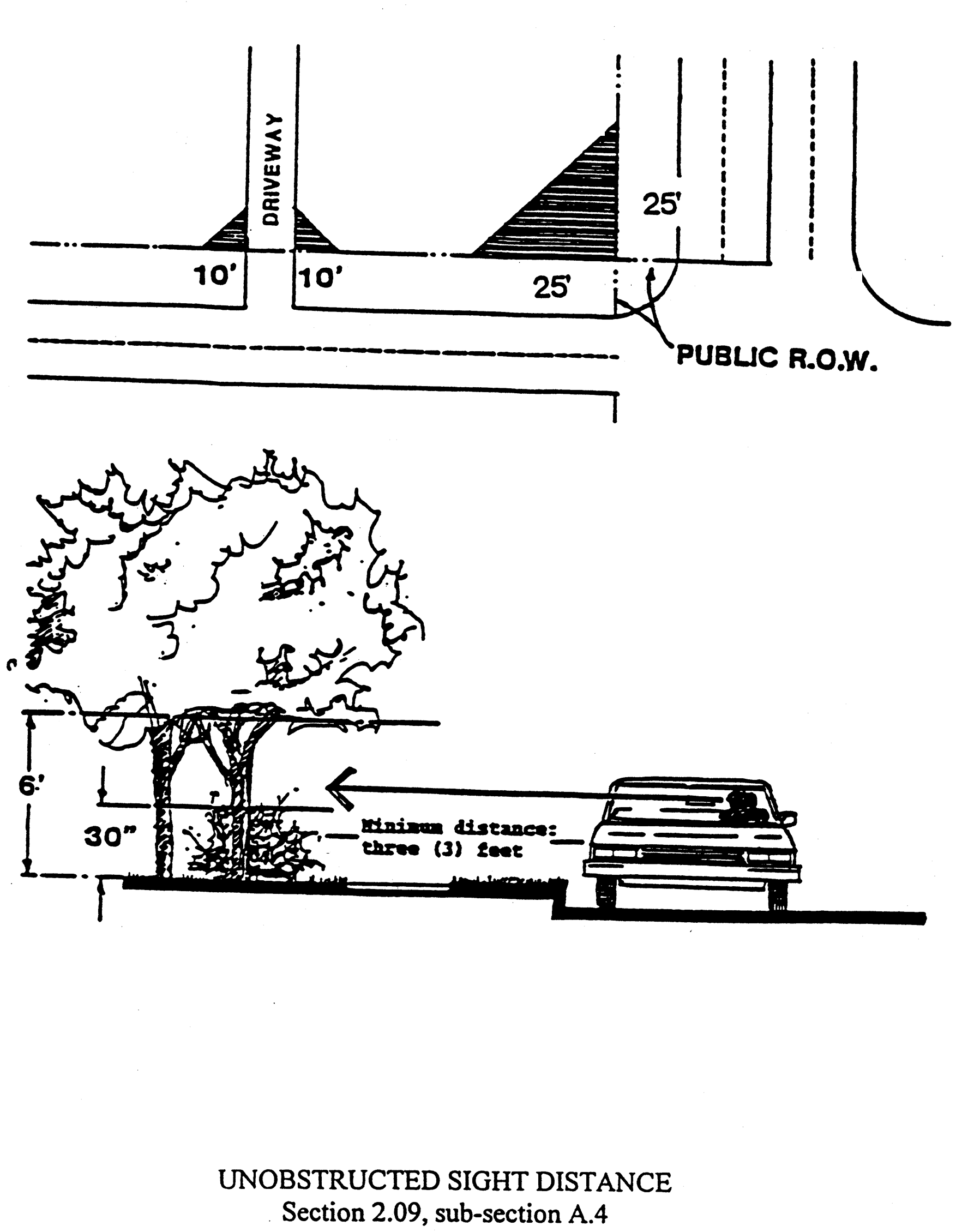
UNOBSTRUCTED SIGHT DISTANCE
(Ord. of 01-13-2026(1))
2.10. - Streets, roads, and other means of access.
A.
Intent. Unimpeded, safe access to parcels of land throughout the township is necessary to provide adequate police and fire protection, ambulance services, and other public services, and to otherwise promote and protect the health, safety, and welfare of the public.
Accordingly, minimum standards and specifications are required for private roads to assure safe and quick access to private property, and to permit the eventual upgrading and dedication of such access rights-of-way to the Wayne County Board of Commissioners or other appropriate municipal corporation if public dedication is deemed necessary or desirable. The standards and specifications set forth herein are determined to be the minimum standards and specifications necessary to meet the above stated intentions.
B.
Public access required. The front lot line of all lots shall abut onto a publicly dedicated road right-of-way or onto an approved private road or drive which complies with the requirements set forth herein. Furthermore, no person shall construct, alter, or extend a private road unless in compliance with these requirements.
C.
Access across residential district land. No land which is located in a residential district shall be used for a driveway, walkway, or access purposes to any land which is located in a nonresidential district, unless such access is by way of a public road.
D.
Private roads or streets. The following standards shall be complied with whenever a private internal or on-site road or street or street within a condominium is proposed:
1.
Applicability. Lots or building sites may be created with frontage on private roads or streets provided that such lots or building sites conform to all requirements of the district in which the land is located, and provided further, that the lots or building sites shall not be created until an easement agreement for the private road or street or condominium document has been executed and recorded in accordance with the standards set forth herein or within the condominium ordinance, and either the private road or street has been constructed in accordance with the standards set forth herein or financial guarantees in the amount of 110 percent of the amount of construction have been placed with the township. The form of the financial guarantee may include irrevocable bank letter of credit, cashier's check or certified check. No construction shall be permitted on lots or building sites which have frontage only onto undeveloped private road easements. Construction may be permitted on such lots or building sites subsequent to development of the private road in full compliance with the regulations set forth herein.
2.
Site plan requirements. Submission of a site plan for review and approval shall be required, in accordance with the provisions set forth in article [section] 27.02, prior to issuance of any permits to construct a private road. The site plan shall also include information specified in the subdivision control ordinance [chapter 110 of the township code] or condominium ordinance [chapter 82 of the Township Code].
3.
Minimum easement requirements. A 60-foot-wide road easement or right-of-way for ingress, egress, and parking shall be established contiguous to all lots to be serviced by a private road. Such easement shall be established for the joint non-exclusive use of all owners of property abutting the easement. The private road shall be established within the easement or right-of-way and shall provide access to all abutting property. Public utilities and drainage ditches shall also be permitted to occupy the easement.
4.
Design requirements. Private roads shall be designed and constructed in accordance with standards and specifications indicated herein and with such other proper engineering standards as may be applicable to assure a safe, maintainable roadway. Class I private road cross sections shall meet the gravel road cross section with open ditches design standard, as illustrated herein. Class II and III private road cross sections shall meet one of the appropriate pavement cross sections, as illustrated herein. For the purpose of enforcing said standards and specifications, private roads shall be classified as follows:
-
Class I private roads. Class I private roads serve not more than three single-family residential lots, not including farm uses and buildings.
-
Class II private roads. Class II private roads meet one or more of the following criteria:
a.
The road serves, is intended to serve, or has the reasonable potential of serving, four or more single-family residential lots or is located within a condominium.
b.
The road connects with, is intended to eventually connect with, or has the reasonable potential of connecting with paved public or private road.
c.
The road has reasonable probability of eventually being dedicated as a public road.
d.
The road is being developed in an area with soil or topographic conditions which warrant special engineering or construction considerations, in the opinion of the township engineer.
-
Class III private roads. Class III private roads serve, or are intended to serve commercial, office or industrial uses. Class III private roads are all other private roads not classified as class I or class II.
5.
Construction standards. All private roads shall be constructed in strict accordance with the same standard procedures for public roads set forth by the county department of public services. Testing, reporting and inspection services shall be performed by the township's engineering consultant in accordance with the same requirements set forth by the county for public roads. The developer of the private roads shall be responsible for the costs associated with the required inspection, testing, and reporting for completion of the road improvement.
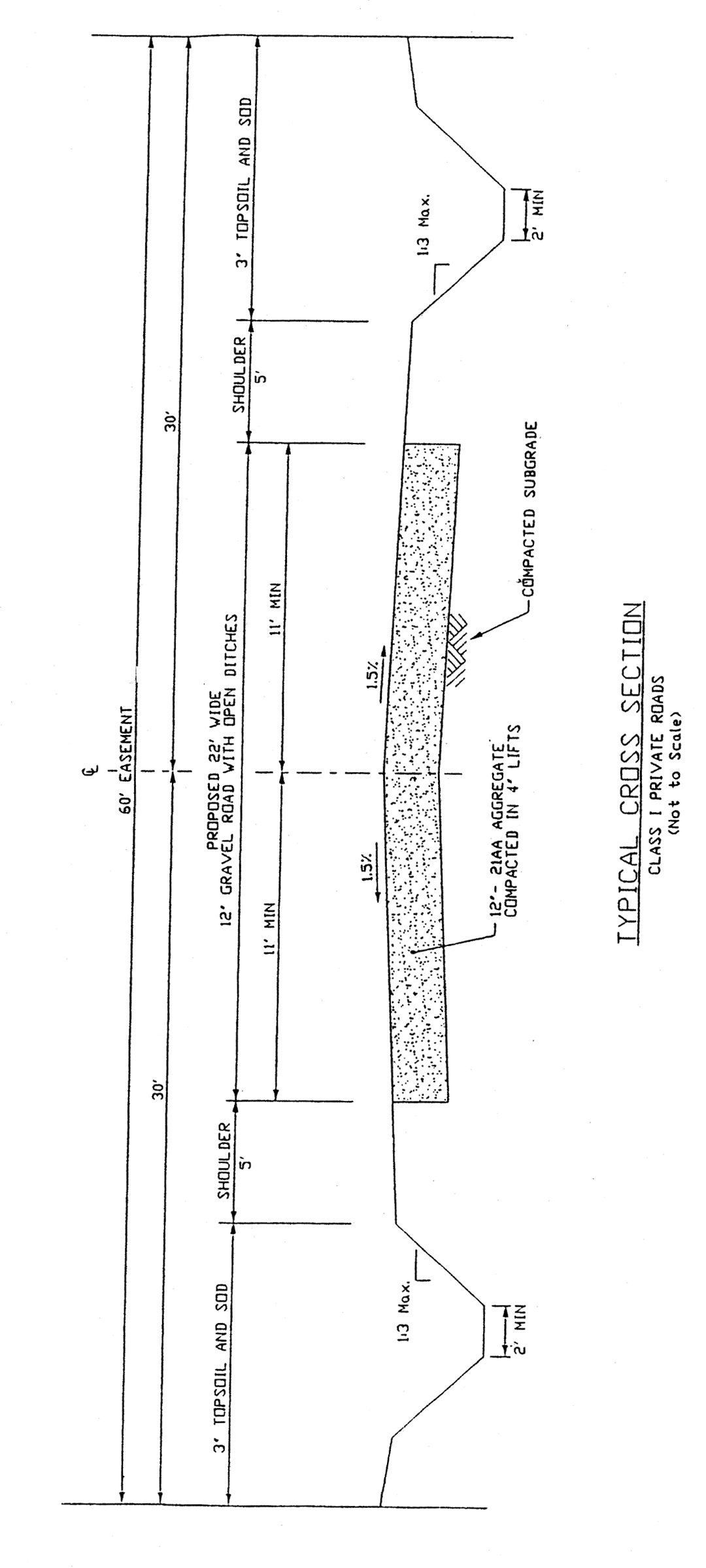
Class I - Private Roads
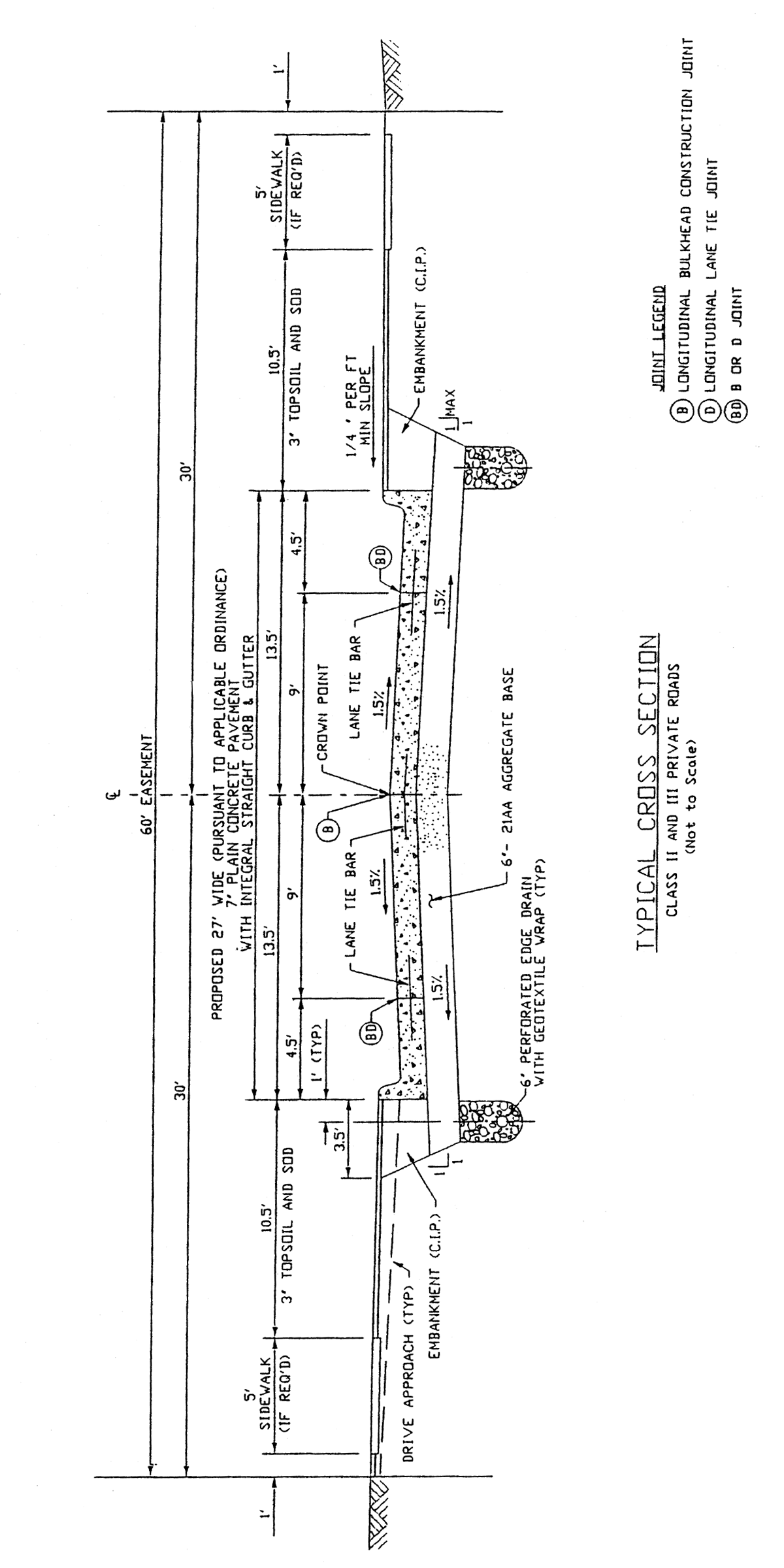
Class II and III - Private Roads
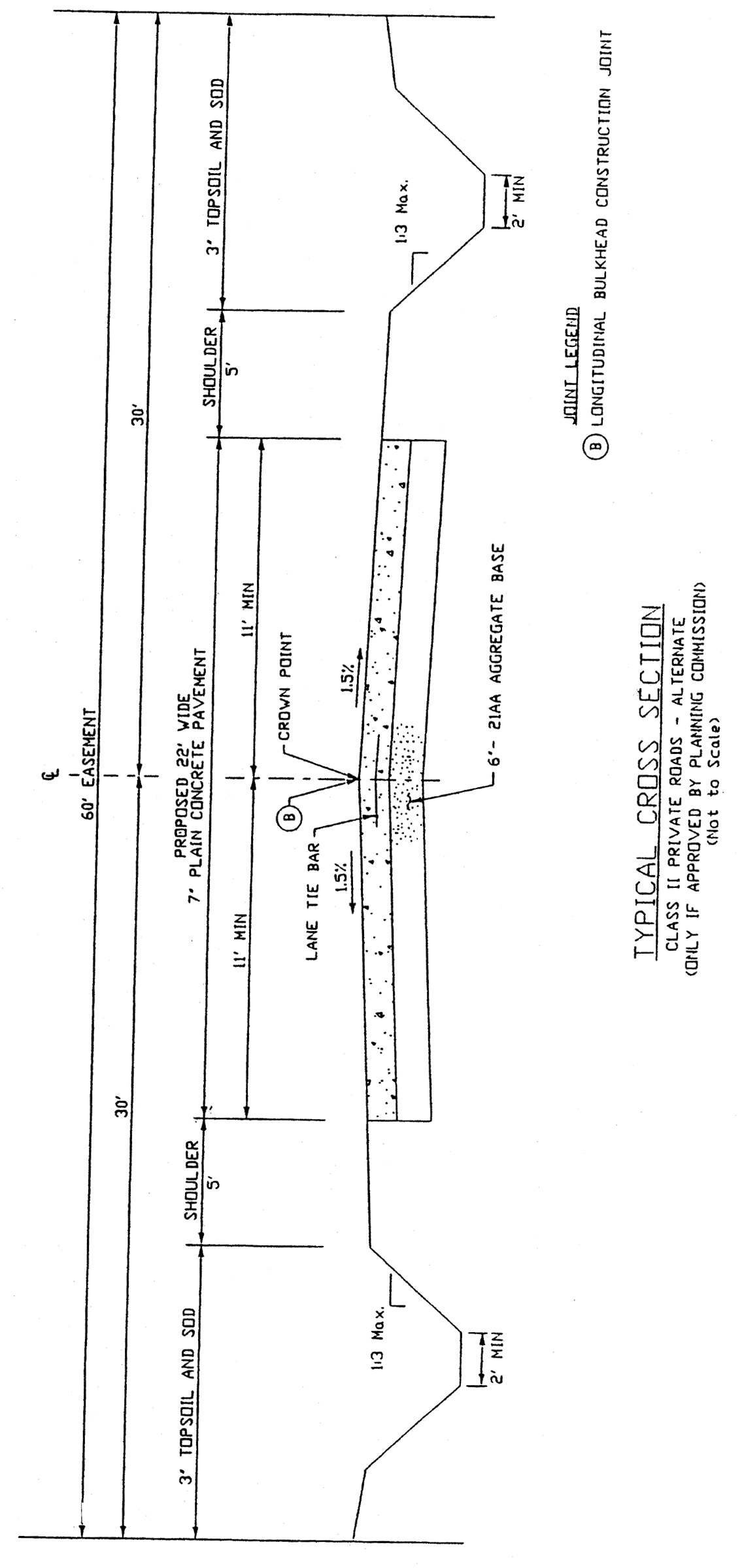
Class II - Private Roads - Alternate
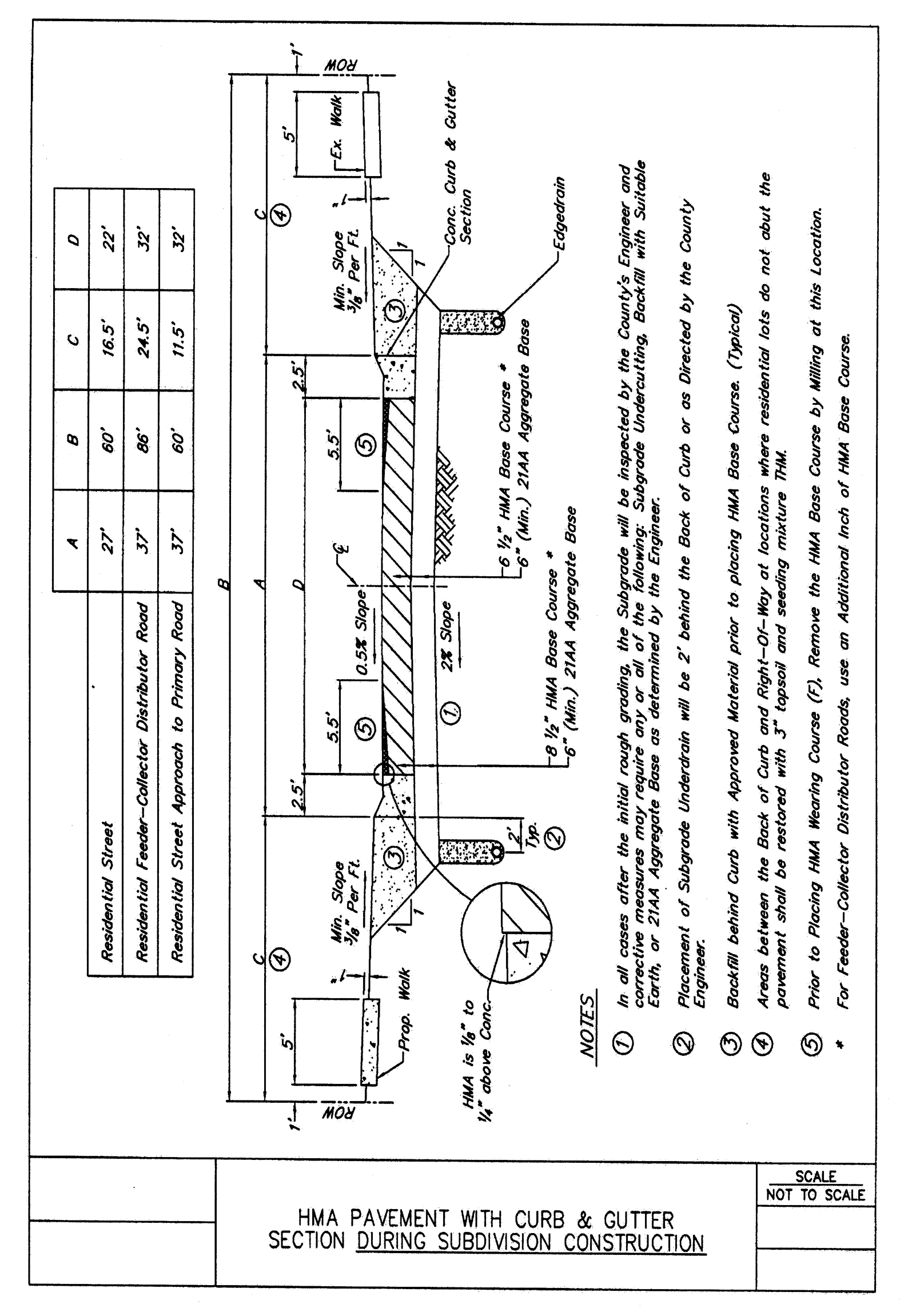
Section during subdivision construction
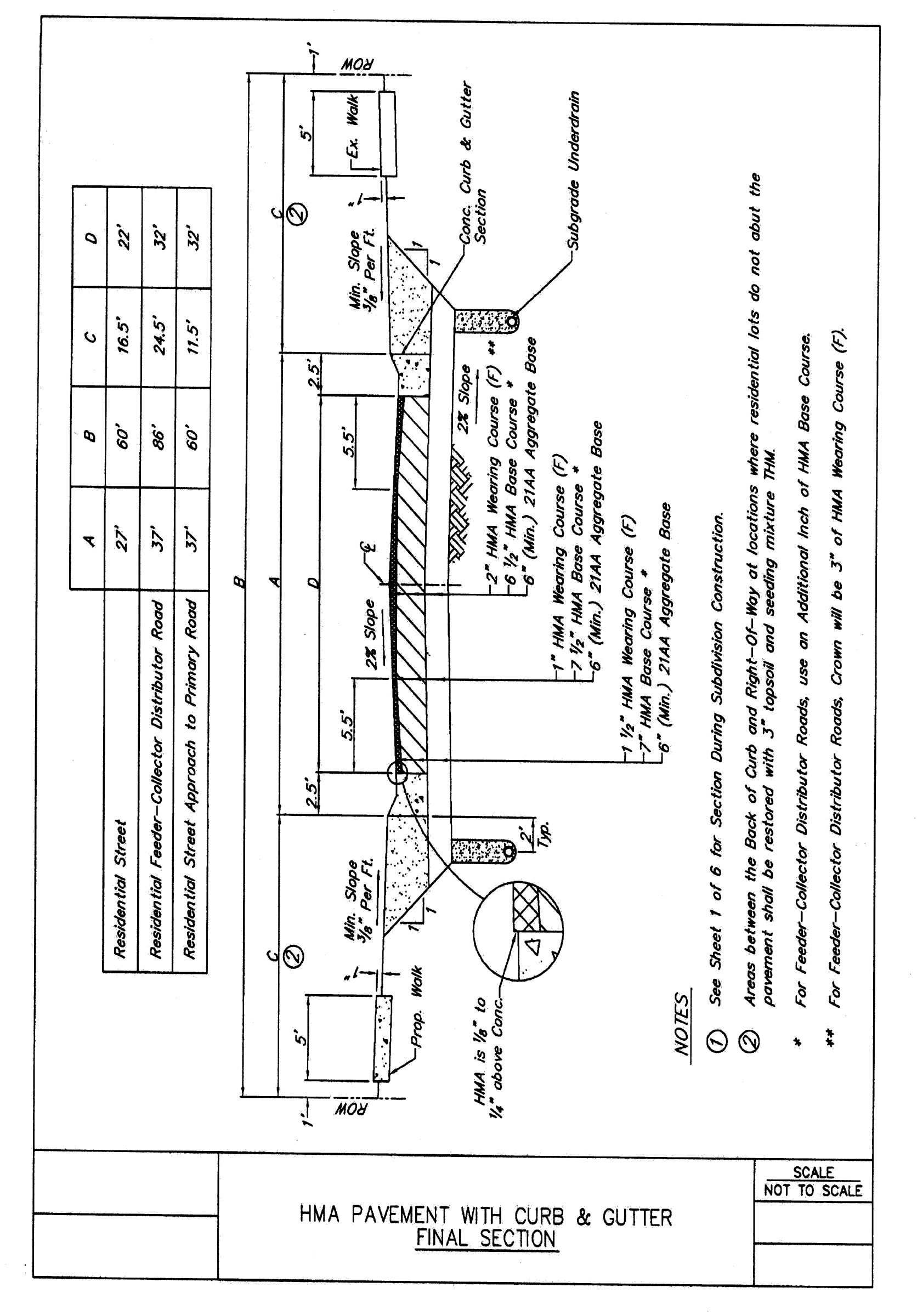
Final section
E.
Secondary access drive. If the planning commission determines that proposed or anticipated development will result in an excessive number of entrance or exit drives onto a public road, thereby creating potentially hazardous traffic conditions and diminishing the carrying capacity of the road, the commission may permit or require construction of secondary access drives across abutting parcels and generally parallel to the arterial street to allow traffic to circulate from one parcel to another without re-entering the public road. The front edge of any such secondary access drive shall be located no closer to the road than the future right-of-way line. Such secondary access drive shall conform to the minimum specifications for private roads as set forth previously.
F.
Performance guarantee. To assure completion of a private road or service drive in conformance with the requirements set forth herein, the building or engineering official may require the applicant or owner to provide a performance guarantee, in accordance with section 2.17, herein.
G.
Maintenance. Continued maintenance of private roads and service drives shall be the responsibility of the property owner(s) served by the road or drive. Prior to issuance of construction permits, said property owner(s) shall prepare a legally binding easement maintenance agreement, to be entered into with the township following satisfactory review of the agreement by the planning commission, township board, and township attorney. Upon execution, the easement maintenance agreement shall be recorded. Under the terms of the easement maintenance agreement, the property owner(s) shall agree with the township concerning the following provisions and responsibilities:
1.
Maintenance costs. The easement maintenance agreement shall acknowledge that the road or service drive surface and easement area are privately owned, and therefore all construction and improvements within the easement will be contracted and paid for by the signatories to the easement maintenance agreement.
2.
Maintenance needs. The easement maintenance agreement shall indicate that the road or service drive surface and easement area shall be solely maintained by the signatories to the agreement. Such maintenance shall include, but not necessarily be limited to: surface grading and resurfacing at regular intervals; snow and ice removal from the roadway surface; repair of potholes and ruts; maintenance of roadside drainage ditches to assure the free flow of runoff water to prevent flooding and prevent collection of stagnant pools of water; and, regular cutting of weeds and grass within the easement no less than three times each year in order to assure good visibility for traffic and to impede the growth of plants commonly causing allergic reactions in human beings.
3.
Required traffic control devices. The easement maintenance agreement shall acknowledge the responsibility of the signatories to the agreement for installation and maintenance of appropriate traffic control devices, such as signs, signals, and pavement markings that are consistent with the Michigan Manual on Uniform Traffic Control Devices.
4.
Emergency access. The easement maintenance agreement shall acknowledge the responsibility of the signatories to the agreement for maintenance in order that police, fire, and other public safety vehicles may safely travel on the road or service drive for emergency purposes. The township may request that the easement maintenance agreement signatories repair the road or service drive surface or perform other maintenance of the easement if it is determined that such repair or maintenance is necessary to provide for the public health, safety, or welfare. If such necessary repair or maintenance is not accomplished in a timely manner, the township may make arrangements for the work to be performed and charge the easement maintenance agreement signatories for the actual cost plus all other administrative, contractual, and legal fees incurred in the performance of such work. Such charges shall be a lien upon the land served and owned by the easement maintenance agreement signatories, in proportion to the frontage of each property along the private road or service drive.
5.
Enforcement of traffic laws. The developer of any proposed private road or street shall prepare and subsequently record an irrevocable agreement granting law enforcement authorities the right to enforce all traffic safety laws in force now or which may be enacted in the future, upon said private road or street.
6.
Township not responsible. The provisions set forth herein or in the easement maintenance agreement shall in no way be construed to obligate the township to perform regular inspections of the easement area or to provide necessary repairs or maintenance. The township shall intercede only if a potential health or safety hazard is brought to the attention of township officials.
7.
Continuing obligation. The easement maintenance agreement shall specify that the obligation to maintain the easement shall be an obligation running with the land to be served by the road or service drive, and shall be binding upon the owner(s) of such land and their heirs, successors, and assigns.
8.
Recording of agreement. The easement maintenance agreement shall be recorded prior to the platting of any lots or the sale or conveyance of any of the property to be charged with the maintenance of the easement area.
(Ord. of 1-23-2003; Ord. of 8-23-2005; Ord. of 01-13-2026(1))
2.11. - Grading regulations.
In all instances where grading, excavating, filling, or other "earth changes" are proposed, such action shall be subject to the provisions of the township's soil erosion and sedimentation control ordinance, Ordinance No. 56 [now repealed], as amended, as well as all other applicable laws and ordinances. As defined in said Ordinance No. 56, "earth change" means a manmade change in the natural cover or topography of land, including stripping, cutting, and filling activities, which may result in or contribute to soil erosion or sedimentation of the waters of the state. As used in Ordinance No. 56, earth change does not apply to the practice of plowing and tilling soil for the purpose of crop production.
2.12. - Dumping, filling, and excavation.
The dumping of waste or other materials shall be subject to the provisions of the ordinance for the control of debris—construction sites, Ordinance No. 71A, as amended [chapter 58, article II, division 3 of the Township Code], and other applicable laws and ordinances. In addition, the following regulations shall apply to dumping and excavation in Canton Township:
A.
Dumping of waste, junk, or similar materials. The use of land for the storage, collection or accumulation of used construction materials, or for the dumping or disposal of refuse, ash, garbage, rubbish, waste material or industrial byproducts shall not be permitted in any district, except in conformity with the Canton Township landfill ordinance, Ordinance No. 61, as amended [chapter 58, article V of the Township Code].
B.
Excavation. The excavation or continued existence of unprotected holes, pits, or wells which constitute or are reasonably likely to constitute a danger or menace to the public health, safety, and welfare is prohibited; provided, however, that this restriction shall not apply to excavations for which a permit has been acquired, provided such excavations are properly protected with fencing, guard rails, and warning signs. Excavations which may be permitted if proper permits are acquired include excavation related to construction of a driveway, walk, a permitted wall, or building or part thereof, or movement of soil within the boundaries of a parcel for the purposes of preparing a site for building construction or another permitted use.
C.
Dumping of soil, sand, clay, gravel or similar material. The dumping or filling with soil, sand, clay, gravel or similar material on any lot or parcel of land shall not occur unless the plans for such dumping or filling have first been reviewed and appropriate permits issued by the building official.
2.13. - Lighting.
Subject to the provisions set forth herein, all parking areas, walkways, driveways, building entryways, off-street parking and loading areas, and building complexes with common areas shall be sufficiently illuminated to ensure the security of property and the safety of persons using such public or common areas. One lighting structure shall be provided on each side of an entrance or exit drive or street at its intersection with the public road, except where a boulevard or divided entrance/exit drive is proposed, one lighting structure may be located in the boulevard or island area for the purpose of illuminating the intersection.
A.
Time period. Required lighting shall be turned on daily from one-half hour after sunset to one-half hour before sunrise.
B.
Permitted lighting. Only non-glare, color-corrected lighting shall be permitted. For all nonresidential uses, full cutoff shades are required for light sources so as to direct the light onto the site and away from adjoining properties. The lighting source shall not be directly visible from adjoining properties. Lighting shall be directed so that it does not cause glare for motorists.
C.
Intensity. Site lighting: Lighting for uses adjacent to residentially zoned or used property shall be designed and maintained such that illumination levels do not exceed 0.1 footcandle along property lines. Lighting for uses adjacent to nonresidential properties shall be designed and maintained such that illumination levels do not exceed 0.3 footcandle along property lines. The light intensity provided at ground level shall be a minimum of 0.3 footcandle anywhere in the area to be illuminated. Light intensity shall average a minimum of 0.5 footcandle over the entire area, measured five feet above the surface, not to exceed a maximum of 20 footcandles in any given area. The planning commission, at its sole discretion may allow for an increased level of lighting above maximum permissible levels when it can be demonstrated that such lighting is necessary for safety and security purposes.
D.
Height. Except as noted below, lighting fixtures shall not exceed a height of 25 feet or the height of the building, whichever is less, measured from the ground level to the centerline of the light source. Fixtures should provide an overlapping pattern of light at a height of approximately seven feet above ground level.
The planning commission may modify these height standards in the commercial and industrial districts, based on consideration of the following: the position and height of buildings, other structures, and trees on the site; the potential off-site impact of the lighting; the character of the proposed use; and, the character of surrounding land use. In no case shall the lighting exceed the maximum building height in the district in which it is located. More specifically, in industrial districts the height of lighting fixtures may be equal to the height of the principal building on the site on which the lighting is located, provided that such lighting does not exceed 40 feet and is located at least 500 feet from any residential district.
E.
Sign lighting. Signs shall be illuminated in accordance with article 6A of this ordinance.
F.
Site plan requirements. All lighting, including ornamental lighting, shall be shown on site plans in sufficient detail with appropriate photometric studies to allow determination of compliance with the requirements of this ordinance.
Building- or roof-mounted lighting intended to attract attention to the building and/or use and not strictly designed for security purposes shall not be permitted. Temporary holiday lighting and decorations are exempt from the aforementioned provisions.
G.
All sites proposed for development or redevelopment within the downtown development district shall install street lighting as specified in article 6.07 (site development standards for the downtown development district).
_____
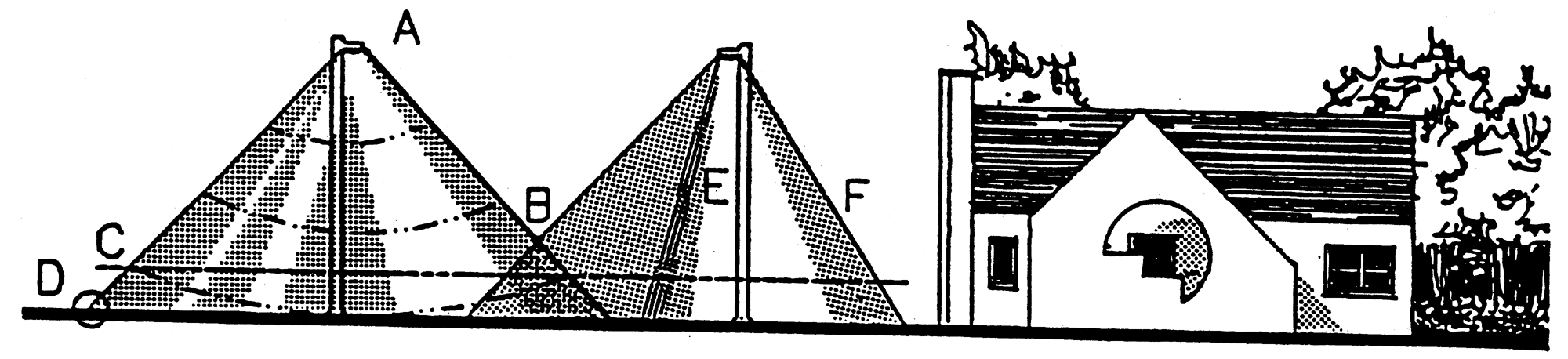
LIGHTING
DIAGRAM NOTES:
A.
Non-glare, color-corrected lighting with full cutoff shades for commercial and industrial sites, on daily from one-half hour after sunset to one-half hour before sunrise.
B.
Overlapping light pattern at approximately seven feet.
C.
Average minimum light intensity: 0.5 footcandle, not to exceed a maximum of 20 footcandles.
D.
Minimum light intensity at ground level, anywhere on site: 0.3 footcandle.
E.
Maximum height: 25 feet or height of building, whichever is less, unless modified by planning commission.
F.
Light directed away from adjoining properties. Uses adjacent to residential properties must maintain illumination levels not to exceed 0.1 footcandle at the property line, and uses adjacent to nonresidential properties must maintain illumination levels not to exceed 0.3 footcandle at the property line.
_____
(Ord. of 01-13-2026(1))
2.14. - Trash removal and collection.
A. Standards for siting and screening of refuse containment areas, including trash dumpsters, compactors, grease traps and other refuse receptacles.
For purposes of this provision, the term "dumpster" shall include trash dumpsters, compactors, grease traps or other refuse receptacles.
All commercial, office, industrial, religious and institutional developments shall have a designated refuse containment area. All attached housing developments shall have designated refuse containment areas unless the site plan indicates that refuse shall be collected on an individual-unit, curbside basis. All containment devices, including but not limited to dumpsters, garbage cans, trash containers, recycling bins, compactors, oil receptacles and grease traps, shall be enclosed as described in this article.
Dumpsters shall not be permitted for single-family residential uses in the rural agricultural, rural residential, rural estate and the R-1 through R-5 districts, except as a temporary use in conjunction with renovation or new construction projects. Any such dumpsters must be removed immediately upon completion of the project.
1.
Location.
a.
Dumpsters shall be located on a concrete pad in a rear or side yard provided any such dumpster shall not encroach on a required parking area or fire lane, is clearly accessible to servicing vehicles, and is located at least ten feet from any building.
b.
Dumpsters shall be located as far as practicable from any adjoining residential district or use but shall in no instance be located within ten feet of any residential property line or district.
c.
The vehicle approach to the dumpster shall be on the same slope as the dumpster pad.
d.
The dumpster pad shall have a minimum dimension of twelve feet by 20 feet.
e.
The dumpster pad shall be large enough to support the dumpster and the front wheels of the dumpster collection vehicle.
2.
Driveway geometry guidelines: The following guidelines, as illustrated herein, should be considered when siting dumpster enclosures:
a.
A minimum of 40 feet of clear space in front of the enclosure shall be provided to allow the truck to readily access the dumpster and to place it back inside the enclosure.
b.
Whenever possible dumpsters should be located perpendicular to access drives.
c.
The angle between the line of direction to the container and the line of travel on the abutting access drive should not exceed 30 degrees.
d.
The minimum inside curve radius should be 35 feet; the minimum outside curve radius should be 57 feet.
3.
Screening. (See Illustrations)
a.
Dumpsters shall be screened from view from adjoining property and public streets and thoroughfares.
b.
Dumpsters shall be screened on three sides with a permanent building, or wall, which matches the masonry of the primary structure on the site, shall not be less than eight feet in height and be at least one foot above the height of the enclosed dumpster, whichever is taller. If constructed primarily of brick, the enclosure walls shall be topped with a limestone or similar-looking material cap to provide a finished appearance.
c.
The walls of the dumpster enclosure shall not be constructed of poured or precast concrete panels.
d.
The fourth side of the dumpster screen shall be equipped with an opaque, lockable gate that is the same height as the enclosure around the other three sides. Chain link or similar type gates with inserted opaque slats are unacceptable.
e.
The minimum inside dimensions of the enclosure shall be ten feet deep by 11 feet wide. The gates shall not protrude into the required inside minimum dimensions.
f.
A minimum of three concrete-filled pipe bollards, with a minimum diameter of six inches shall be installed along the inside rear wall of the dumpster enclosure. Bollards shall be set in concrete three feet below grade and shall extend four feet above grade. Such bollards shall be located at least two feet from the inside rear wall of the enclosure. If the enclosure is greater than 12 feet in width, an additional bollard shall be installed for every four feet or portion thereof of additional width.
4.
Expansion of existing screen enclosures. If dumpsters are needed on-site in excess of the quantity anticipated by the original, approved site plan, the existing enclosure may be expanded, using matching materials. If however, additional enclosures are required to be constructed, they shall be constructed of masonry material as described elsewhere in this article.
5.
Maintenance. All dumpster screens, pads and gates shall be perpetually maintained in good condition by the owner of the property on which it is located. Further, it shall be the responsibility of each property owner, business, commercial, industrial or institutional establishment to:
a.
Locate or place the dumpster or refuse container in such a location that it can be lifted by appropriate mechanical equipment.
b.
Maintain each dumpster or refuse container in a safe, clean and sanitary condition.
c.
Insure that the dumpster is kept within the walls of the screen enclosure at all times, except when being emptied.
d.
Keep the area around the dumpster clear and free of all litter and debris.
e.
Insure that all waste is deposited in such a manner as to prevent spilling or blowing out of the dumpster container.
f.
Keep the dumpsters and screen enclosure gates closed at all times except when loading garbage or refuse.
g.
Insure that the access to the container is maintained at all times.
6.
Site plan requirements. The location and method of screening of dumpsters shall be shown on all site plans and shall be subject to the approval of the planning commission.
(Ord. of 1-23-2003)
Cross reference— Solid waste, ch. 58.
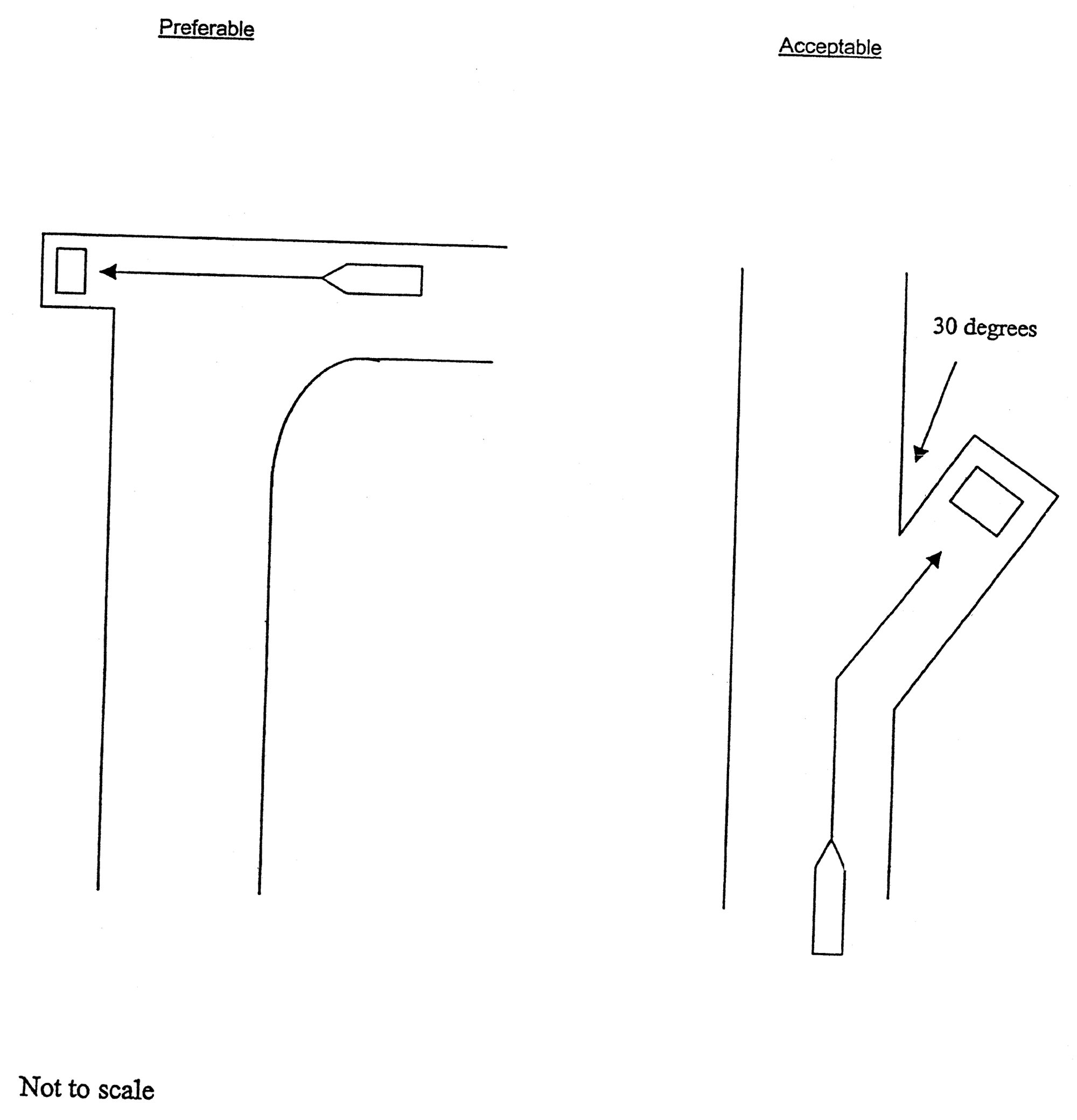
Illustration
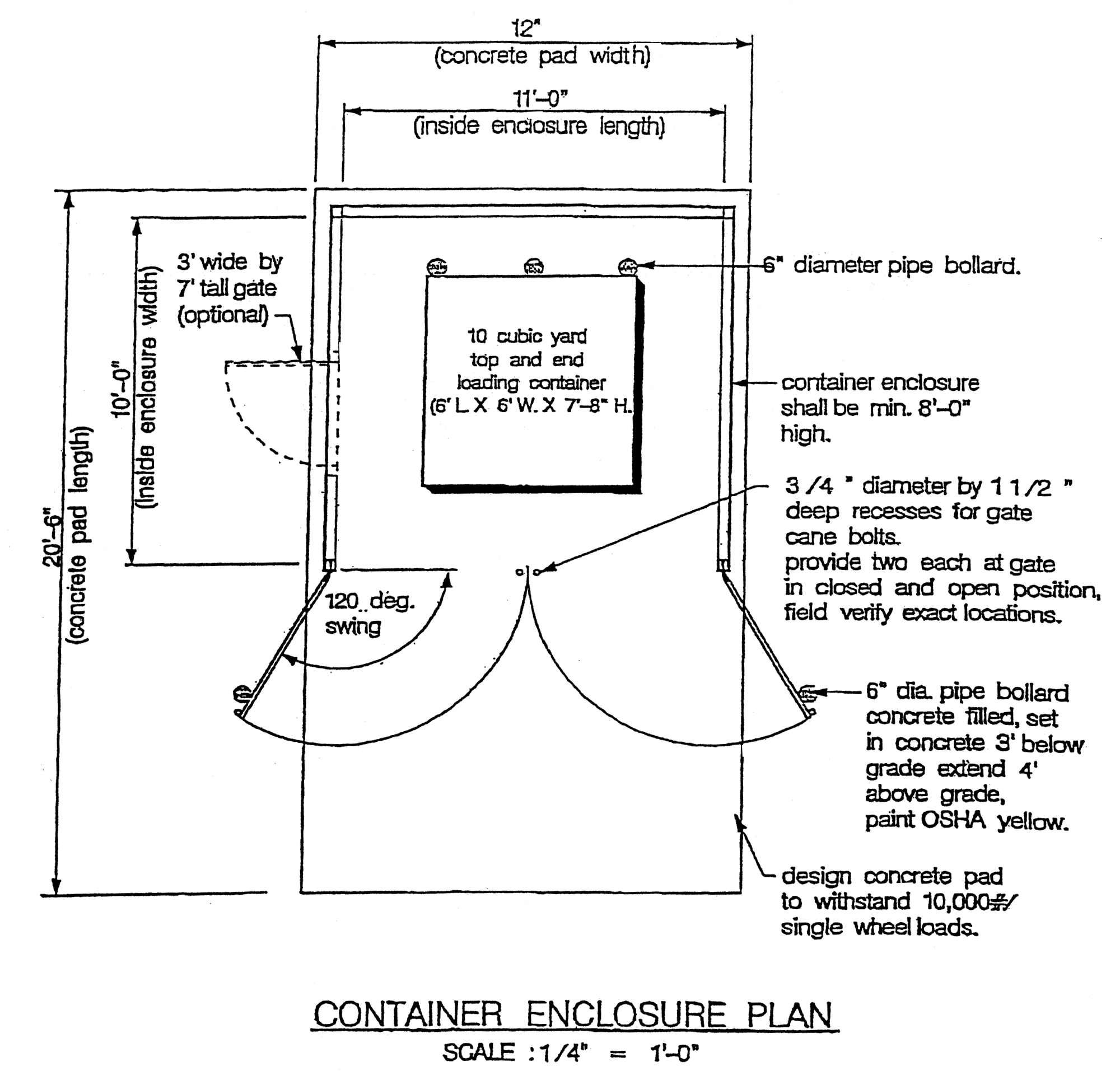
Container enclosed plan
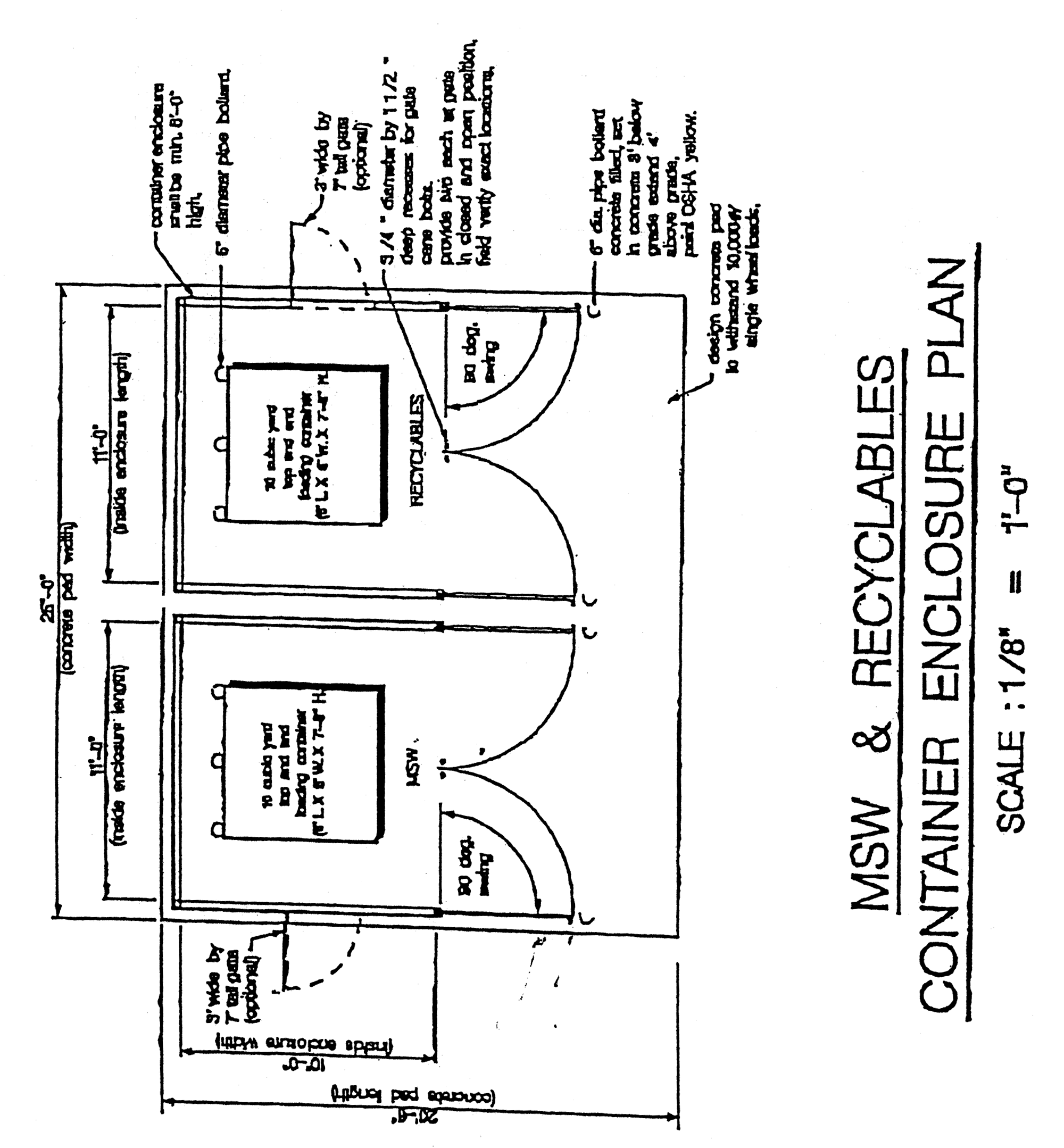
MSW & recyclables container enclosure plan
2.15. - Safety provisions.
A.
Public service access. All structures shall be provided with adequate access for fire, police, sanitation, and public works vehicles.
B.
Fire protection. All structures shall be provided with adequate fire protection, including adequate water supply for firefighting purposes, adequate internal fire suppression system, use of firewalls and fireproof materials, and other fire protection measures deemed necessary by the public safety official.
1.
Fire protection systems. The public safety official shall have the authority to require fire protection systems installed in any zoning district, subject to the following:
a.
In all districts, except for single-family residential uses in the rural agricultural, rural residential, and the R-1 through R-5 and RMH districts, fire protection systems shall have outside flashing lights and audible interior alarms.
b.
All interlocked systems shall be subject to approval of the public safety official.
2.
Site development standards. To facilitate fire protection during site preparation and construction of buildings, consideration shall be given to the following:
a.
Water mains and fire hydrants shall be installed prior to construction above the foundation. Hydrants shall be spaced to provide adequate firefighting protection for all buildings and uses, subject to applicable codes and review by the public safety official.
b.
Prior to construction of buildings and other large structures, a hard and sufficient roadbed shall be provided to accommodate access of heavy firefighting equipment to the immediate job site at the start of construction. The roadbed shall be maintained until all construction is completed or until another means of access is constructed.
c.
Free access from the street to fire hydrants and to outside connections for standpipes, sprinklers, or other fire extinguishing equipment, whether permanent or temporary, shall be provided and maintained at all times.
d.
The building permit holder shall provide scheduled daily cleanup of scrap lumber, paper products, corrugated cardboard and other debris. Construction debris shall be disposed of in accordance with methods approved by the building official.
C.
Excavations and holes. Excavations and holes created in conjunction with a construction project shall be adequately barricaded and illuminated if not filled in at the end of the working day. Where such excavations or holes are located in a public right-of-way, it shall be the responsibility of the contractor to notify the public safety official of their existence. (See also section 2.12.)
D.
Building demolition. Before a building or structure is demolished, the owner, wrecking company, or person who requests the demolition permit shall notify all utilities providing service to the building. A demolition permit shall not be issued until all utilities have provided notification that service has been properly terminated.
2.16. - Exceptions.
A.
Essential services. Essential services shall be permitted as authorized and regulated by state, federal, and local ordinances and laws, it being the intention hereof to exempt such essential services from those regulations governing area, height, placement, and use of land in the township which would not be practical or feasible to comply with. Essential services, as defined in section 1.03, shall include: the erection, construction, alteration or maintenance by public or quasipublic utilities or municipal departments or township-certified cable television companies of underground, surface or overhead gas, steam, electrical, fuel or water systems for the purposes of transmission, distribution, collection, communication, supply, or disposal; including towers, poles, wires, mains, drains, sewers, pipes, conduits, cables, fire alarm and police call boxes, traffic signals, hydrants and similar equipment, which are necessary for the furnishing of adequate service by such utilities or municipal departments for the general health, safety, and welfare of the public. Essential services shall not include storage yards, sales or business offices, or commercial buildings or activities. For the purpose of this regulation, radio, television and cellular telephone transmitting and receiving towers are not considered essential services.
Although exempt from certain regulations, proposals for construction of essential services shall still be subject to site plan review, it being the intention of the township to achieve efficient use of the land and alleviate adverse impact on nearby uses or lands. Essential services shall comply with all applicable regulations that do not affect the basic design or nature of operation of said services.
B.
Township-sponsored public projects. The regulations set forth in this ordinance shall be applicable to lands owned by the township, except where the regulatory provisions would hinder the township's ability to provide for necessary and desirable public services. The township board of trustees, upon recommendation of the planning commission, shall determine the applicability of specific regulatory provisions to public projects sponsored by the township.
C.
Exceptions to height standards. The height limitations of this ordinance are increased as follows for chimneys, decorative architectural design elements on the roofs of religious institution buildings, clocks, bell towers, or other similar architectural design elements, public monuments, wireless transmission towers, wind energy turbines, and architectural features which include building and roofline elements which are intended to add architectural interest, subject to all of the following requirements:
1.
Maximum height. Except as permitted below, an increase in the height limitation of this ordinance shall not exceed 20 feet above the maximum height of the zoning district, except that the height of decorative architectural design elements on the roof of a religious institution building may be 65 feet or 20 feet above the maximum height of the zoning district, whichever is greater.
2.
Signage. Architectural features which include building and roofline elements which are intended to add architectural interest may not include signage on the building areas that exceed the maximum height of the district.
3.
Maximum building area. The building area encompassed by the proposed building and/or roofline element described above shall not exceed 25 percent of the footprint of the total structure.
4.
Additional setbacks. Any portion of a building which exceeds the maximum height limitation of the district shall also be subject to an additional three feet of side and rear yard setback for every additional one foot of height above the maximum height limitation of the district.
5.
Heights for special land uses. The Planning Commission may specify a lower height limit for any structure that requires approval as a special land use. In determining the appropriate height, the Planning Commission shall consider the character of the surrounding uses, the height of surrounding structures, the potential to obscure light or view to or from existing buildings and surrounding properties, and potential detriment to the use or value of surrounding properties.
6.
Wind turbines. See section 2.03(G).
7.
Wireless communication towers. See section 6.02(S).
(Amend. of 10-20-2009; Ord. of 02-10-2026(1), Pt. I)
2.17. - Performance guarantee.
A.
Intent. To insure compliance with the provisions of this ordinance and any conditions imposed thereunder, the planning commission or township board may require that a performance guarantee be deposited with the township to insure faithful completion of improvements, in accordance with section 25 of the Township Rural Zoning Act, Public Act No. 184 of 1943 [MCL 125.295], as amended.
B.
General requirements. The performance guarantee shall meet the following requirements:
1.
The performance guarantee shall be in the form of a cash bond, irrevocable letter of credit, certified check, or similar instrument acceptable to the building official, which names the property owner as the obligor and the township as the obligee.
2.
The performance guarantee shall be submitted at the time of issuance of the permit authorizing the activity or project. If appropriate based on the type of performance guarantee submitted, the township shall deposit the funds in an interest-bearing account in a financial institution with which the township regularly conducts business.
3.
The amount of the performance guarantee shall be sufficient to cover the estimated cost of the improvements or portion thereof associated with a project for which site plan approval is being sought or has been obtained. In accordance with these guidelines, the exact amount of the performance guarantee shall be determined by the building official.
4.
The entire performance guarantee, including interest accrued, shall be returned to the applicant upon satisfactory completion of the required improvements.
5.
An amount not less than ten percent of the total performance guarantee may be retained for a period of at least one year after installation of landscape materials to insure proper maintenance and replacement, if necessary. This amount shall be released to the applicant upon certification by the building official that all landscape materials are being maintained in good condition.
C.
Unsatisfactory completion of improvements. Whenever required improvements are not installed or maintained within the time stipulated or in accordance with the standards set forth in this ordinance, the township may complete the necessary improvements itself or by contract to an independent developer, and assess all costs of completing said improvements against the performance bond or other surety, including any interest accrued on said bond or surety. Prior to completing said improvements, the township shall notify the owner, site plan review applicant, or other firm or individual responsible for completion of the required improvements.
2.18. - Reserved.
Reserved for future use.
Editor's note— An ordinance adopted March 18, 2024, repealed § 2.18, which pertained to signs and derived from the zoning ordinance as adopted on December 14, 1989.
2.19. - Sidewalks.
A.
General requirements. Where required or permitted, sidewalks for pedestrian use shall be constructed in conformance with the following specifications:
1.
Location and width. Required sidewalks shall be five feet in width and shall be located in the road right-of-way, with a setback of one foot from the property line. The board of trustees may modify this requirement in consideration of the location of utilities, existing landscaping, or other site improvements.
2.
Design standards. Sidewalks shall be constructed of concrete in accordance with established engineering standards for the township.
3.
Alignment with adjacent sidewalks. Sidewalks shall be aligned horizontally and vertically with existing sidewalks on adjacent properties. The board of trustees may waive this requirement if existing adjacent sidewalks are not constructed in conformance with the standards set forth herein.
4.
Signage. The planning commission may require installation of traffic control devices, such as signs or markings consistent with the Michigan Manual of Traffic Control Devices, for the purposes of safety where it is necessary to separate vehicular traffic from pedestrian and bicycle traffic, or where it is necessary to alert vehicular traffic of the presence of the sidewalks.
5.
Permits. It shall be the responsibility of the owner or developer to secure any required permits from county or State of Michigan agencies to allow sidewalk construction in the road right-of-way.
(Ord. of 01-13-2026(1))
Cross reference— Streets, sidewalks and other public places, ch. 62.
2.20. - Fences, Walls, and Borders.
A.
Exemptions. No permit shall be required for a temporary fence used in conjunction with a special event approved by the township board or for the installation of a snow fence during the winter season. The requirements and limitations of this section shall not apply to public property owned or under the control of the Charter Township of Canton.
B.
Nonconforming Fences. Nonconforming fences shall not be modified, unless any proposed modification brings the fence into compliance with this section. See article 3.00.
C.
Permit.
1.
Required. It shall be unlawful to construct or install, or cause to be constructed or installed, any fence or wall upon any property within the township without first obtaining a fence permit.
2.
Application. Applications for fence or wall permits shall be filed with the building and inspection services division prior to the construction or installation of the proposed fence or wall. Such applications shall state:
a.
The name and address of the applicant.
b.
The property address of the proposed fence or wall location and the name of the owner of the property.
c.
A survey showing the proposed location of the fence or wall in reference to all lot lines, drives, walkways, other fences, streets, and buildings located on the subject property and properties adjacent thereto.
d.
The nature and type of fence or wall to be constructed or installed, including the detailed designs of panels, posts, and supporting members.
e.
The proposed height of the fence or wall.
f.
Such other and further information deemed necessary by the building and inspection services division to meet the requirements of this section.
3.
Standards for issuance. The building official or their agent shall grant and issue the fence permit if:
a.
The proposed fence or wall conforms with the requirements of this section, remainder of this Zoning Ordinance, and all other township ordinances.
b.
The proposed fence or wall will not unreasonably interfere with or detract from the public health, welfare, and safety.
c.
The subject lot or parcel has a grade approved by the building and inspection services division and the engineering services division.
d.
The applicant tenders a fee in the amount prescribed by the township board prior to the consideration of the application.
4.
Deed restrictions or other covenants. The issuance of a fence permit under this section does not, nor should it be construed to, supersede or abrogate the requirements of any restrictions applicable to applicant's property through a declaration of covenants and restrictions, master deed and bylaws, or other similar document. The township shall not be liable for issuing a fence permit that would be prohibited by such a document or by the applicant's homeowners' association.
D.
General construction standards; prohibited fences; maintenance.
1.
Posts or foundation. All borders or fences constructed or reconstructed within the township shall be installed on posts sunk below grade in accordance with the building code. Walls shall be erected on continuous foundations no less than 42 inches below grade.
2.
Materials. All borders, fences, or walls shall be constructed of materials in compliance with the state construction code and shall be of sufficient quality with proper maintenance to withstand rusting, rotting, and other weather-related deterioration for a period of not less than ten years. Mesh, vinyl slats, or other similar material attached to a fence is prohibited.
3.
Hazardous conditions. No border, fence, or wall shall have any sharp protrusion or other conditions which would be likely to cause damage to persons or property, except as provided in this section.
4.
Electrically charged above-ground fences. No person shall install, construct, maintain, or permit the installation, construction, or maintenance upon property owned, occupied, or controlled by such person of any above-ground fence electrically charged or connected to an electrical current in such a manner as to transmit such current to the form of a shock to person or animals which may come in contact with such fence; provided, however, that an above-ground fence which is electrically charged or connected to an electrical current may be used in an agricultural zoned district (RA, RR, RE) or the R-1 district where horses or livestock are allowed in accordance with the zoning ordinance, when in conformance with the following:
a.
Such fence must be used to enclose or restrain the movement of horses or livestock;
b.
Such fence charger shall be approved by Underwriters' Laboratories, Inc.;
c.
Such charger must be installed according to the manufacturer's recommendations; and
d.
Such charger shall not exceed six volts.
5.
Barbed wire. No person shall install, construct, maintain, or permit the installation, construction, or maintenance of a barbed wire fence partially or wholly upon property owned, occupied, or controlled by such person; provided, however, barbed wire cradles may be placed on top of fences in the following cases:
a.
In public utility installations in any zoning district provided the barbed wire cradles are placed no less than eight feet above grade level.
b.
In agricultural zoned districts (RA, RR, RE) or the R-1 district only when used to enclose horses or livestock where horses or livestock are allowed in accordance with Zoning Ordinance or in the case of a nonconforming use, when used to enclose horses or livestock.
c.
In industrially zoned districts (LI-R, LI, and GI) provided the barbed wire cradles are placed no less than eight feet above grade level.
d.
In commercial zoned districts (C-1, C-2, C-3, C-4, O-1, MRD, and HRD) where outdoor storage is allowed if approved by the township planning commission when there are unique and exceptional circumstances, provided the barbed wire cradles are no less than eight feet above grade level.
6.
Maintenance and repair. All borders, fences, and walls shall be maintained in good structural condition at all times. Rotten or broken components shall be replaced, repaired, or removed. Pursuant to section 2.20.B., where such replacement, repair, or removal takes place to a nonconforming fence, the nonconforming fence shall not be modified unless any proposed modification brings the fence into compliance with this ordinance (see also article 3.00). All fences and walls shall be kept neatly painted, stained, or similar treatment, and any paint, stain, or treatment shall be uniform in color for the entire fence.
7.
Location generally. All borders, fences, or walls, including footings and posts, shall be constructed on the subject owner's property, which must be verified on a survey. An owner may construct a fence on a property line provided that the applicant must obtain the written consent of the adjacent property owner to construct the fence on the property line. The area between the fence and the lot line must be maintained by the owner in accordance with all Township ordinances.
8.
Location in front yard setback. No fence or wall shall be constructed in a required front yard setback area except as permitted in section 2.20.F.
9.
Location in floodplain, wetland, greenbelt, creek, drain, or planting easement. No border, fence or wall shall be constructed or maintained on or in any floodplain, wetland, greenbelt, creek, drain, or planting easement unless explicitly permitted elsewhere in this ordinance. The planning commission may approve a border, fence, or wall in a greenbelt or planting easement, provided that the border, fence, or wall meets all other requirements of this ordinance.
10.
Orientation. All fences shall be constructed so as to have a finished appearance when viewed from either side. If, because of the design or construction, one side of the fence has a more finished appearance than the other, the side of the fence with the more finished appearance shall face the exterior of the lot.
11.
Grade and height. The height of a fence shall be determined based on the grade directly beneath the fence. A grade may not be changed in the area beneath the fence unless expressly permitted by the building and inspection services division and the engineering services division. If grade changes are proposed on an adjacent lot or near an adjacent lot in a manner that will impact drainage or soil erosion on the adjacent lot, the applicant must obtain the written consent of the adjacent property owner prior to review by the building and inspection services division and the engineering services division.
12.
Unobstructed sight distance. All fences, walls, and borders shall comply with the unobstructed sight distance requirements of section 2.09(A)(4).
E.
Borders. All borders shall conform to the following requirements:
1.
No border shall be erected or maintained that exceeds the height of 36 inches.
2.
All borders shall not exceed a total length of 25 feet.
3.
All borders shall be located in the front yard and not less than one foot away from any public walkway.
4.
Borders shall be decorative in nature and shall not be constructed of a chain link, wire, cable, or similar material.
5.
In addition to meeting the unobstructed sight distance requirements of section 2.09(A)(4), at no time shall a border be erected, established, or maintained on any lot which will obstruct the view of drivers in vehicles approaching an intersection of two roads or the intersection of a road and a driveway.
6.
No permit shall be required for the installation of a border, but the border shall comply with all standards of this ordinance.
F.
Zoning district restrictions. All fences and walls shall conform to the following location and height requirements:
1.
Industrial zoning districts (LI-R, LI, GI). In the LI-R, LI, and GI zoning districts, fences and walls may be constructed up to eight feet in height. Such fences or walls shall not be constructed in a required front yard setback area. Barbed wire cradles may be placed on top of fences in this zoning district in accordance with section 2.20.D.5.
2.
Rural agricultural district (RA). In the RA zoning district, fences and walls may be constructed up to six feet in height. Where single-family residential use is the principal use of the site, fences and walls must comply with section 2.20.F.3.
3.
Rural residential district (RR), rural estate district (RE), R-1 district, and all commercial zoning districts (C-1, C-2, C-3, C-4, O-1, MRD, and HRD). In the RR, RE, R-1, C-1, C-2, C-3, C-4, O-1, MRD, and HRD zoning districts, fences and walls may be constructed up to six feet in height. Such fences or walls shall not be constructed in a required front yard setback area. Barbed wire cradles may only be approved in accordance with section 2.20.D.5. The planning commission shall review all applications for barbed wire cradles and shall only approve them if appropriate for the use and the surrounding area.
4.
All other zoning districts.
a.
Fences and walls.
1.
Rear yard fences. Fences and walls constructed or installed in a rear yard shall not exceed a height of six feet.
2.
Side yard fences. Fences and walls constructed or installed in a side yard shall not exceed a height of four feet except the fence or wall may be built to a height of not more than six feet if it does not extend closer to the front lot line than 15 feet behind the front corner of the principal building on that side.
3.
Front yard fences. Fences or walls constructed or installed in a front yard may be extended up to, but not into, the required front yard setback area provided they do not exceed a height of four feet, except as provided in section 2.20.F.4.b. below for certain non-primary front yards on corner lots and cul-de-sac lots in residential subdivisions and condominiums.
b.
Non-primary front yard fences on corner lots and cul-de-sac lots in residential subdivisions and condominiums. Fences or walls constructed or installed in a non-primary front yard on corner lots and cul-de-sac lots in a residential subdivision or condominium shall not extend into the required front yard setback area, except as follows.
1.
Side street line adjacent to a major thoroughfare. Where a corner lot or cul-de-sac lot in a residential subdivision or condominium has a non-primary front lot line adjacent to a major thoroughfare and is not accessed by this major thoroughfare, a fence may be constructed up to a height of six feet in the non-primary required front yard setback area only between the rear lot line and 15 feet behind the front corner of the home on that side, provided the lot does not have its address from the major thoroughfare and that the rear lot line does not abut a road easement or right-of-way. (See Figure 1, below)
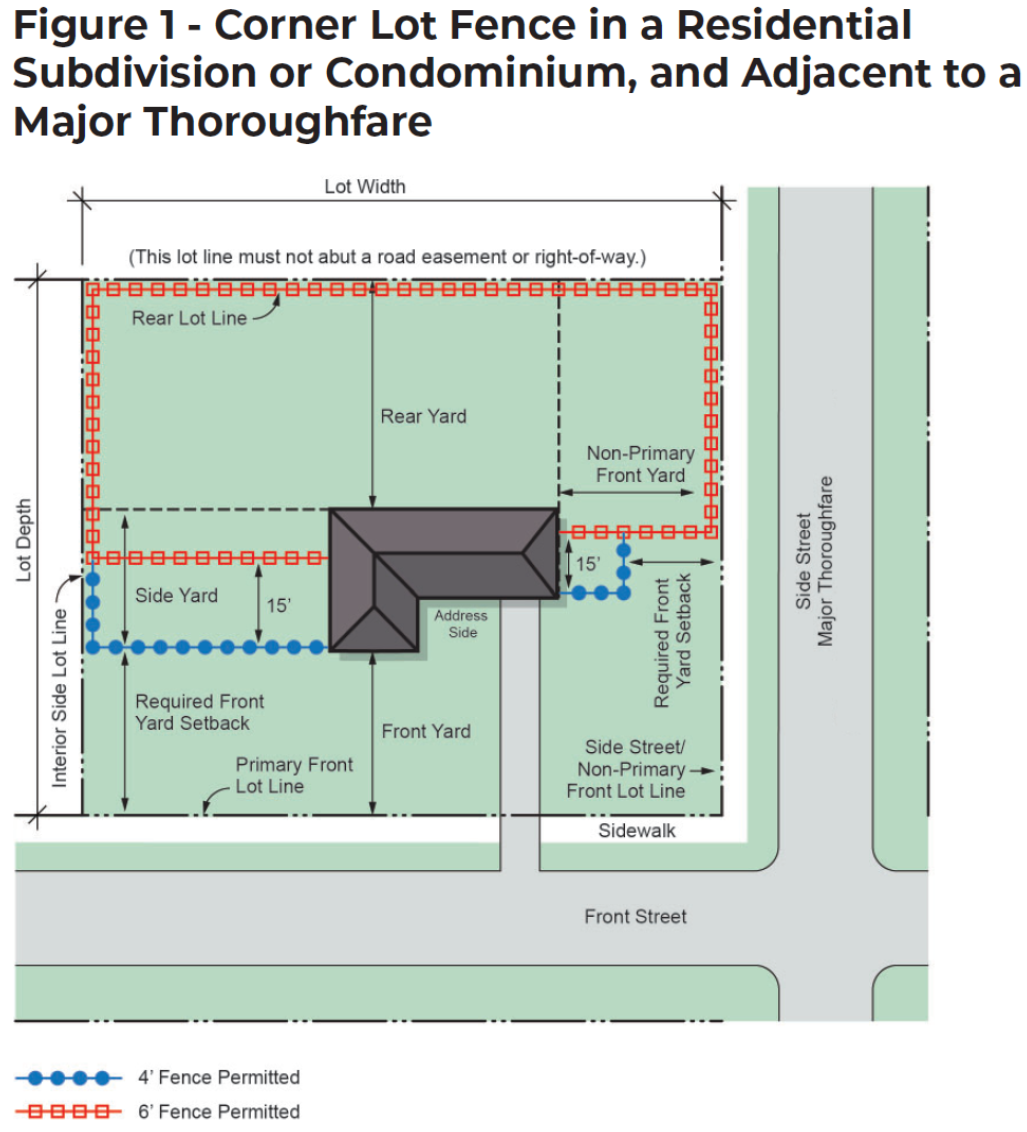
2.
Other side street lines. Where a corner lot or cul-de-sac lot in a residential subdivision or condominium has both front lot lines adjacent to streets that are not classified as major thoroughfares and its non-primary front yard is not accessed by the adjacent side street, a fence may be constructed up to a height of four feet in the non-primary required front yard setback area only between the rear lot line and the rear corner of the home, provided the fence is a decorative fence as defined in this ordinance and the rear lot line does not abut a road easement or right-of-way. (See Figure 2, below)
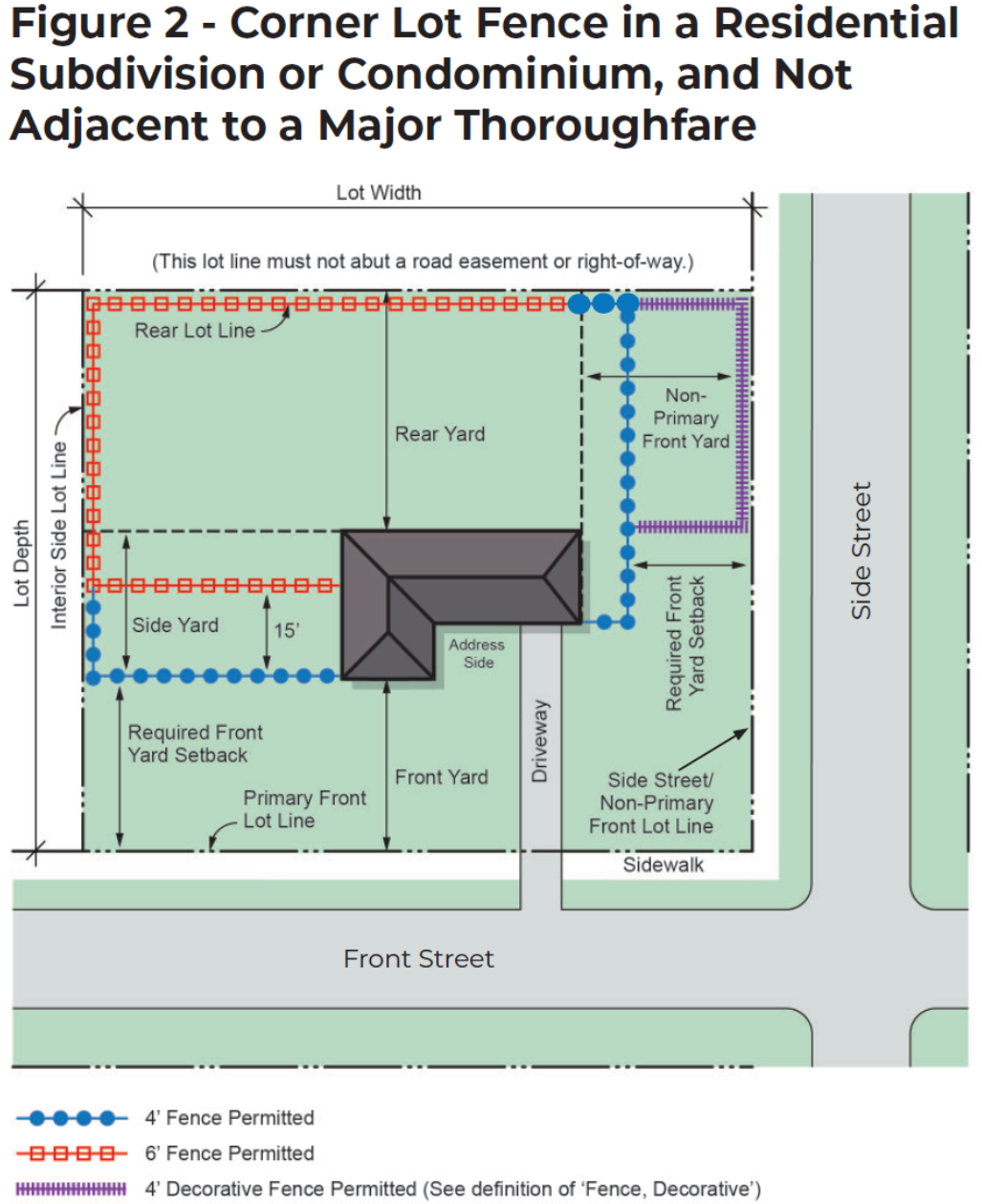
5.
All residential zoning districts. Along Township-approved passageways to private parks, a vinyl-coated chain-link fence or decorative fence with a maximum height of four feet may be erected along a front yard area up to one foot from the public sidewalk. Permits for such a fence must be applied for by the representative of the homeowners' association or a designated agent of the subdivision.
(Ord. of 6-11-2024(1))
2.21. - Consent judgments and planned unit development agreements.
Consent judgments handed down by the courts or planned unit development (PUD) agreements entered into previous to the adoption date of this ordinance may contain additional regulations or provisions which supersede the regulations and standards set forth in this ordinance. Records maintained by township officials indicate the properties affected and standards imposed by such consent judgments and PUD agreements. Planned unit development agreements may be revised in accordance with the procedures and standards set forth in section 27.04, subsection I.
2.22. - Historic commission ordinance.
Property located within designated historic districts shall be subject to the provisions of the adopted historic district commission ordinance, Ordinance No. 117, as amended [chapter 90 of the Township Code].
Cross reference— Historic preservation, ch. 90.
2.23. - Private antenna structures.
Satellite dish and television antennas shall comply with the township's satellite dish and antennas ordinance, Ordinance No. 13 [section 78-4 of the Township Code]. Antennas shall comply with the setback standards for the district in which they are located.
2.24. - Setbacks from wetland areas and watercourses.
A.
Wetlands protection. No structure, septic tank field, drainfield, earth berm, earth structure, earth obstruction, or like thing will be placed within 25 feet of any wetland as defined by the Goemaere-Anderson Wetlands Protection Act (MCA 18.595(51) et seq., MCLA 281.701 et seq.) [repealed—see now part 303 of Public Act No. 451 of 1994 (MCL 324.30301 et seq.)].
In addition, no earth movement, excavation, land balancing or earth disruption of any kind shall take place within 25 feet of any wetlands described in the above paragraph. This section shall not be construed so as to prevent normal lawn care, landscaping, and maintenance within the prohibited setback area.
B.
Drainage and surface water obstruction. No person shall erect any dike, structure, building, earth berm, dam or other blockage which restricts or otherwise impairs the flow of water in any drainage ditch or along any normal surface course, nor shall any person remove any dam, dike, or pre-existing structure, which said structure precedes the passage of this ordinance, so as to cause flooding, substantial diminution in water level, or like effects, without a permit from the engineering services division.
1.
In the event an obstruction as defined above should be constructed or maintained which said obstruction, in the opinion of the township engineer, causes or will cause flooding or damage, the township engineer shall order said obstruction removed by the owner of the land to provide free water flow therein. If the owner of the land on which the obstruction is located refuses to remove said obstruction, the township engineer may cause such obstruction to be removed.
2.
In the event any person should remove an existing dam or structure thereby allowing flooding or the diminution of water levels, the township engineer shall order the dam or structure restored. If the owner of the land on from [sic] which the dam or structure was removed refuses such restoration, the township engineer may cause the dam or structure to be restored.
3.
This section shall not apply to the construction of platted subdivisions, site condominiums, commercial or industrial construction where there have been site plan, plat or other similar approvals rendered by the township, which said approvals include plans for grading and contouring the soil.
4.
An application for permit pursuant to this section shall be on a form prepared by the engineering services division, and shall include the name of the owner, names of any persons holding any other interest in the real property, names of the persons in possession of the real property, and identification of the site and the planned construction, alteration or repair, the anticipated effect of the construction, alteration or repair, as well as the reason therefor, construction plans, and, where required by the township engineer, a site plan and topographical survey of the property. The fee shall be in an amount as determined from time to time by the township board.
C.
A natural, undisturbed stormwater protection buffer shall be maintained along any creek, drain, or watercourse, whether under jurisdiction of Wayne County, MDEQ, or other permitting agency. Such buffer shall have a minimum width of 25 feet, measured from either the edge of the easement of a drain or the top of bank of other natural watercourses (except for the Rouge River), whichever is greater. The buffer shall be a minimum of 75 feet, measured from the top of bank of the Rouge River. A buffer shall not be required for work associated with an approved permit from the appropriate permitting agency or for required maintenance of a county drain. The buffer requirement shall also not apply for installation of a bio-retention system or stream bank stabilization plan which is designed for a proposed development and depicted on the landscape plans of the approved site plan or subdivision plan for the proposed development.
(Amend. of 10-20-2009)
2.25. - Underground utilities.
All public and private utilities distributed by wire or cable located on property proposed for development or redevelopment shall be placed underground. This provision applies to distribution lines as well as on-site leads and service lines. The conduits and cables for such lines shall be placed within private easements provided to the service provider by the developer, or placed within dedicated public rights-of-way. All facilities placed in dedicated public easements shall be planned so they do not conflict with other underground utilities. All such facilities shall be constructed in accordance with standards of construction approved by the Michigan Public Service Commission. Underground utility installations which traverse privately owned property shall be protected by easements granted by the proprietor.
2.26. - Screening of roof-mounted mechanical units.
All roof-mounted mechanical units shall be screened from view from adjacent property and/or public rights-of-way. Screening shall be designed as an integral part of the architecture of the building (such as parapet extensions) or compatible with the design and building materials of the building.
2.27. - Access to detention ponds and storm water facilities.
Reasonable and practical access shall be provided to detention ponds and storm water facilities to allow for periodic sedimentation removal and proper maintenance of related structures, pumps, mechanical filtration systems, and related ancillary equipment. The access shall be shall be a minimum of 15 feet wide, be unpaved, and provide a grass paver type of subsurface stabilization to support heavy equipment. The location shall be indicated clearly on the proposed site plan. Access shall be located adjacent to a street, drive aisle or paved parking area where practical. The location of a pond access between two residential buildings is discouraged and will be allowed only when no other feasible alternative exists.
(Ord. of 7-18-2002)
2.28. - Maintenance of site improvements.
All site improvements on an approved site plan shall be maintained in good condition. Site improvements include items such as: lighting, landscaping, sidewalks, curbing, benches, fountains, public art, raised planters, retaining walls, obscuring walls or fences, clock towers, boardwalks, or gazebos. Any element within the site shall be repaired or replaced immediately upon notice from the community planner or building official.
(Ord. of 1-23-2003)
2.29 - Temporary portable storage containers and trash receptacles.
Temporary storage containers and trash receptacles used on site for the purpose of moving, renovation, and other temporary activities, shall be subject to the following requirements:
A.
General requirements.
1.
In all zoning districts, any temporary storage container or construction refuse container shall be located in an approved area of a single-family residential driveway. In the case of a multiple-family, attached condominium, or non-residential development, any temporary storage container shall be located in an approved area of the site or parking lot as shown on a site layout plan submitted with the building permit plans for the proposed work.
2.
In no case shall the temporary storage container be located in a public right-of-way and shall not obstruct public sidewalks. The container shall not obstruct, impair, or impede the use and enjoyment of adjoining property.
3.
The temporary storage container shall be clearly identified with the container owner's name and phone number on the container.
B.
Time limit.
1.
On single-family residential lots or parcels, use of a temporary portable storage or refuse container is limited to seven days. A permit from the building division is required for a time limit more than seven days, The permit may be issued for a period not to exceed 30 days and said permit must state an expiration date.
2.
For multiple-family, condominium, and non-residential developments, portable storage or refuse containers shall be issued in conjunction with the permit for the proposed construction and shall be removed prior to issuance of an occupancy permit or completion of the permitted construction or renovation.
(Res. of 6-12-2008; Amend. of 10-20-2009)

