
Canton City Zoning Code
ARTICLE 6
00.- SITE DEVELOPMENT STANDARDS APPLICABLE TO SPECIFIC USES
6.01.- Intent and scope of application.
Each use listed in this article, whether permitted by right or subject to approval as a special land use, shall be subject to the site development standards specified, in addition to applicable standards and requirements for the district in which the use is located. These minimum standards are intended to alleviate the impact from a use which is of a size or type, or which possesses characteristics which are unique or atypical in the district in which the use is located, so that the use requires special consideration to assure that such use will be compatible with surrounding uses and the orderly development of the district. Conformance with these standards shall be subject to site plan review.
Unless otherwise specified, each use listed in this article shall be subject to all applicable yard, bulk and other standards for the district in which the use is located.
6.02. - Site development standards for nonresidential uses.
A.
Adult book or supply stores, adult motion picture theaters, adult live stage performing theaters, adult outdoor motion picture theaters, and group A cabarets. In the development and execution of this ordinance and this section, it is recognized that there are certain uses which, because of their very nature, have serious objectionable characteristics, particularly when several of them are concentrated under certain circumstances, thereby having a deleterious effect upon the adjacent areas. Special regulation of these uses is necessary to insure that these adverse impacts will not contribute to the blighting or downgrading of the surrounding neighborhood. These special regulations are itemized in this section. The primary control or regulation is for the purpose of preventing a concentration of these uses in any one area, so as to prevent the blighting, deterioration, or downgrading of an area. The following requirements are intended to accomplish these purposes:
1.
The establishment of the types of adult regulated uses listed below shall be prohibited if the establishment of such use will constitute the second such use within a 1,000-foot radius (i.e., not more than one such use within 1,000 feet of each). The distance between uses shall be measured horizontally between the nearest property lines.
-
Adult book or supply stores.
-
Adult motion picture theaters.
-
Adult live stage performing theaters.
-
Adult outdoor motion picture theaters.
-
Group "A" cabarets.
2.
It shall be unlawful to hereafter establish any adult regulated use if the proposed regulated use will be within a 1,000-foot radius of the following:
-
Any public, private or parochial nursery, primary, or secondary school; day care center; library; park, playground, or other recreational facility; or church, convent, monastery, synagogue, or similar religious institution.
-
Any residentially used or residentially zoned land.
The distance between uses shall be measured horizontally between the nearest property lines.
3.
The building and premises shall be designed and constructed so that material depicting, describing, or relating to specified sexual activities or specified anatomical areas (as defined in this ordinance) cannot be observed by pedestrians or from vehicles on any public right-of-way. This provision shall apply to any display, decoration, sign, show window, or other opening.
B.
Adult day care center. The following regulations shall apply to adult day care centers:
1.
Professional association. Adult day care centers shall be certified by the Michigan Association of Day Care Providers to ensure the safety and quality of care provided by them.
Each center shall meet the operating standards outlined by the Michigan Office of Services to the Aging or the Michigan Association of Day Care Providers. In the event that each organization has different standards or requirements, the more stringent shall apply. In addition, each adult day care center shall demonstrate a working relationship with a hospital and/or other health care facility to assist participants in obtaining planned or emergency health care services as needed.
2.
Services. Each adult day care facility shall have kitchen facilities adequate to serve hot meals on a daily basis. In addition, each facility shall have adequate recreational facilities including a minimum of 3,000 square feet of usable outdoor recreation area which shall be provided, equipped and maintained on the premises of an adult day care center. The outdoor recreation area shall be suitably fenced and screened from abutting residentially zoned or used land by a greenbelt, which shall be landscaped in accordance with section 5.02.D.
3.
Frontage. Adult day care centers shall front onto a paved county primary or secondary road. Adult day care centers may be permitted on unpaved roads, subject to special land use approval.
4.
Setbacks. Adult day care centers shall have a minimum side yard setback of at least 25 feet.
B1.
Airport-related businesses, including: Associated aircraft, hangars, warehouse space and office use for business directly affiliated and which have license and/or agreements to operate at Mettetal Airport.
Airport-related business shall be subject to the following regulations in addition to the standard requirements for development in the LI, Light Industrial District:
1.
Location. The proposed business shall be located directly adjacent to Mettetal Airport property and shall be located and have direct frontage on either Ronda Drive or Lilley Road.
2.
Agreement. The user shall provide a written agreement which grants access and approval to operate from the airport.
3.
Other.
a.
The proposed development shall also comply with the setbacks and height restrictions set forth in the Airport Zoning Plan for Mettetal Airport.
b.
No aircraft may be permanently stored outside of the hangar.
C.
Automobile filling stations, automobile filling/multiuse stations, automobile service stations, automobile repair garages. The following regulations shall apply to automobile filling stations, automobile filling/multiuse stations, automobile service stations, and automobile repair garages:
1.
Minimum lot area: The minimum lot area shall be one acre. All buildings, including principal and accessory buildings and canopy areas, shall not exceed ten percent of the net lot area.
2.
Minimum lot width. The minimum lot width required for such uses shall be 150 feet.
3.
Minimum setbacks. Minimum setbacks required for such uses shall be as follows:
(a)
Front setback measured from any right-of-way line:
(1)
Canopy: 40 feet.
(2)
Pump and/or pump island: 50 feet.
(3)
Building: 85 feet.
(b)
Side or rear yard setback:
(1)
Canopy: 30 feet.
(2)
Pump and/or pump island: 40 feet.
(3)
Building: 30 feet.
(c)
Side or rear yard setback abutting residential zoned property:
(1)
Canopy: 40 feet.
(2)
Pump and/or pump island: 50 feet.
(3)
Building: 40 feet.
4.
Ingress and egress. Ingress and egress drives shall be a minimum of 30 feet and a maximum of 36 feet in width. Curb radii shall be adequate to accommodate the turning radii of delivery trucks. There shall be a clear unobstructed driveway area provided to the loading area which is not in conflict with other vehicular patterns on the site. No more than one such drive or curb opening shall be permitted for every 75 feet of frontage (or fraction thereof) along any street. The nearest edge of any such drive shall be located at least 25 feet from the nearest point of any property zoned or used for residential purposes.
Curb openings for drives shall not be permitted where the drive would create a safety hazard or traffic nuisance because of its location in relation to other ingress and egress drives, its location in relation to the traffic generated by other buildings or uses, its location near a vehicular or pedestrian entrances or crossings, or similar concerns as provided more specifically below:
(a)
Driveway spacing. Driveway spacing will be determined as a function of operating speeds of the adjacent public road. Spacing will be determined according to the following minimum standards or to standards adopted by the appropriate governing road jurisdiction, whichever is more stringent:
Spacing is based on average vehicle acceleration and deceleration rates and is considered necessary to maintain safe traffic operation. Spacing will be measured from the midpoint of each driveway. In the event that a particular parcel or parcels lack sufficient road frontage to maintain adequate spacing, the applicant shall have one of two options:
(1)
A modification from minimum spacing can be sought from the planning commission, but in no case can the modification be greater than that which is necessary to provide safe and efficient access to the site.
(2)
The adjacent landowners may agree to establish a common driveway. In such cases, the driveway midpoint shall be the property line between the two parcels and shall meet standard specifications. The township may require maintenance agreements between owners of a common driveway to cover such issues as snow plowing, resurfacing liability, etc.
(b)
Number of driveways per parcel.
(1)
A maximum of one two-way driveway opening or a pair of one-way driveway openings shall be permitted to a particular site from each adjacent public road.
(2)
Based on the recommendation of the appropriate governing road jurisdiction and/or the township engineer, that an additional driveway is in the interest of good traffic operation, the planning commission may permit one additional driveway entrance along a continuous site with frontage in excess of 300 feet or two additional driveway entrances along a continuous site with frontage in excess of 600 feet.
(3)
Common driveways, as set forth in Section 6.08.F.2.b.2 shall be considered to be one driveway.
(c)
Ingress and egress for drives shall be designated and located in a manner that does not create a safety hazard or traffic nuisance because of its location in relation to other ingress and egress drives, its location in relation to the traffic generated by other buildings or uses, its location near a vehicular or pedestrian entrances or crossings, or similar concerns:
(1)
Driveway design and placement must be in harmony with internal circulation and parking design such that the entrance can absorb the maximum rate of inbound traffic during a normal peak traffic period.
(2)
There must be sufficient on-site storage to accommodate at least two queued vehicles waiting to enter or exit without using a portion of the public right-of-way obstructing existing vehicle sight distance, or otherwise interfering with street traffic.
(3)
Provisions for circulation between adjacent parcels are required when possible through coordinated or joint parking systems.
(4)
Driveways shall be designed to accommodate all vehicle types having occasion to enter and exit the site, including delivery and refueling vehicles. There shall be clear delineation and/or separation, where appropriate, of entry and exit lanes within driveways.
(5)
Loading and unloading and refueling activities shall not hinder vehicle ingress or egress.
(d)
All gasoline pumps shall be arranged so that motor vehicles do not park on or extend over abutting landscaped areas, sidewalks, streets, buildings, or adjoining property while being served.
5.
Curbs. A concrete curb of at least six inches in height shall be installed to prevent vehicles from being driven onto or parked with any part of the vehicle extending within two feet of abutting landscaped areas, sidewalks, streets, buildings, or adjoining property.
6.
Surfacing. The entire lot, excluding areas occupied by landscaping and building, shall be hard-surfaced with concrete or plant-mixed bituminous material. The site shall be graded and drained so as to dispose of surface waters.
7.
Layout. All lubrication equipment, automobile wash equipment, hoists, and pits shall be enclosed entirely within a building. All buildings must be oriented so that service bay doors face away from any abutting residentially-zoned or used property and shall be oriented and/or screened to eliminate and/or minimize views of the doors from adjacent public roads.
8.
Outside storage. Where outside storage is permitted, used tires, auto parts, and other material shall be enclosed with a masonry wall, not less than six feet in height. The enclosure shall be equipped with an opaque lockable gate that is the same height as the enclosure itself. Inoperable, wrecked or partially dismantled vehicles shall not be stored or parked outside for a period exceeding two days.
9.
Vehicle sales and storage. The storage, sale, or rental of new or used cars, trucks, trailers, and any other vehicles on the premises is prohibited.
10.
Off-street parking and loading. Required off-street parking for automobile filling multiuse stations offering additional services shall be provided in accordance with the standards set forth in section 4.01 and shall be computed on the basis of each separate use as set forth in the schedule of off-street parking.
Off-street loading shall be provided in accordance with the standards set forth in section 4.02 and the schedule of loading space requirements.
11.
Canopy structure. Canopy structures shall be designed and constructed in a manner which is architecturally compatible with the principal building. The canopy structure shall be attached to and made an integral part of the principal building. The planning commission may approve an alternative design where it can be demonstrated that the design of the building and canopy in combination would be more functional and aesthetically pleasing if the canopy was not physically attached to the principal building.
Support columns of any proposed canopy structure shall be covered with brick to match the principal building.
Required fire protection devices under the canopy shall be architecturally screened so that the tanks are not directly visible from the street. The screens shall be compatible with the design and color of the canopy.
12.
[Fueling operations.] Fueling operations designed to accommodate tractor trailer trucks shall be prohibited except on sites adjacent to property zoned LI-1, LI-2 or GI.
13.
Pedestrian circulation.
(a)
Automobile filling/mixed use stations shall be designed in a manner which promotes pedestrian and vehicular safety.
(b)
The parking and circulation system within each development shall accommodate the safe movement of vehicles, bicycles, pedestrians and refueling activities throughout the proposed development and to and from surrounding areas in a safe and convenient manner.
(c)
Pedestrian walkway patterns shall be considered as an integral component of site design and shall be located to connect areas or points of pedestrian origin and destination. Where it is necessary for pedestrian access to cross drive aisles, crossings shall emphasize and place priority on pedestrian access and safety. Pedestrian crossings must be well-marked and clearly visible, using pavement treatments, signs, striping, and signals consistent with the Michigan Manual on Uniform Traffic Control Devices and lighting.
(d)
Clear identification and delineation between the drive-thru facility and parking lot shall be provided. Drive-thru facilities shall be designed in a manner which promotes pedestrian and vehicular safety, and do not interfere with access to parking and maneuvering lanes.
14.
Electronic message center signs. Because drivers often make a very quick decision whether to enter a gas station based on the price of fuel and because the Michigan Weights and Measures Act (P.A. 283 of 1965, as amended) includes requirements for roadside advertising of fuel prices, automobile filling stations/multi-use stations may have electronic message center signs for display of fuel prices, subject to the standards below.
(a)
Location. Electronic message center signs may only be located on a conforming ground sign.
(b)
Integration. The display area shall be part of the same sign face as a permanent ground sign face that does not include light emitting diodes and shall be integrated into the sign face by use of a border or similar design treatment that provides a visual linkage to the remainder of the sign.
(c)
Area. Electronic message center signs shall have a maximum area of 50 percent of the area of the sign they are attached to or 12 square feet, whichever is less.
(d)
Movement. Animation, flashing, scrolling, osculating, video, or any simulated movement is prohibited. The display of the electronic message sign may not change more than once per hour.
(e)
Background. The background of the display area shall be black.
D.
Automobile wash or carwash establishment. The following regulations shall apply to automobile wash or carwash establishments:
1.
Minimum lot size. The minimum lot size required for automobile or carwash establishments shall be 15,000 square feet.
2.
Layout. All washing activities shall be carried on within a building. Vacuuming activities shall be permitted in the rear yard only, provided such activities are located at least 50 feet from adjacent residentially zoned or used property.
Self-service vacuum operations shall be located in an area to encourage use after the vehicle is washed to provide more drip time before the vehicle exits the site.
3.
Entrances and exits. Sufficient space shall be provided on the lot so that vehicles do not enter or exit the wash building directly from an adjacent street or alley. All maneuvering areas, stacking lanes, and exit aprons shall be located on the carwash parcel itself. Streets and alleys shall not be used for maneuvering or parking by vehicles to be serviced by the automobile wash. A minimum distance of 125 feet shall be maintained between the exit door of the wash structure to the nearest exit driveway to permit adequate time for excess water to drip off of the vehicle.
4.
Drying facilities. Automatic carwash facilities shall have a mechanical dryer operation at the end of the wash cycle. The use of such dryers shall be mandatory during sub-freezing weather. In the case of a self-service or manual carwash, sufficient space shall be provided for drying of the vehicle undercarriage during subfreezing weather prior to exiting onto the public thoroughfare.
5.
Orientation of open bays. Buildings should be oriented so that open bays, particularly for self-serve automobile washes, do not face onto adjacent thoroughfares unless screened by an adjoining lot or building.
6.
Heated exit ramp. All automatic carwash facilities must provide a heated concrete exit ramp for each wash bay at least 20 feet in length and of a width equal to that of the exit drive.
7.
Water runoff system. All carwash facilities shall provide a drainage system installed midway from the exit door of the wash structure to the nearest exit drive at a low point to limit water runoff. A series of rumble strips (one-half inch to 1½ inches high or deep, three inches to four inches wide and 90 degrees cross-way to traffic) must be located between the carwash building exit and the drainage system collection point.
8.
Video monitors. All automatic carwash facilities must be equipped with at least one video monitor system, with cameras located in such a manner as to provide a complete and unobstructed view of the vehicle at all times within the wash facility. The monitors must be located in an area easily viewed by the facility employees.
D.1.
Bed and breakfast establishments. Bed and breakfast establishments are private, owner-occupied residences providing guest accommodations which are subordinate and incidental to the principal residential use of the property. Bed and breakfast establishments may be considered a special land uses in the RA, RE, RR, R-1, R-2, R-3, R-4, R-5 and MR zoning districts subject to the following minimum requirements:
1.
Minimum lot size: One acre, not located in a platted subdivision.
2.
Maximum number of guestrooms: Five.
3.
Maximum length of stay: 30 days.
4.
Parking: One space per guestroom plus two spaces for the owners of the property. All parking shall be located to the rear of the principal structure and screened from view from the road and adjacent property. The planning commission may modify the locational requirements upon demonstration by the owner that an alternate location for parking is more appropriate based on the particular conditions of the site.
5.
Spacing: One-fourth mile from any previously approved and established bed and breakfast establishment.
6.
Preparation of food. A common dining area shall be provided with meals provided only for guests taking lodging in the establishment. No cooking facilities shall be permitted within any guestroom, except that a portable refrigerator not exceeding 2.5 cubic feet may be located in each guestroom for convenience of the guests.
7.
Exterior alterations. The exterior appearance to the structure shall not be altered from its single-family character or character of the neighborhood. If located within an established historic district or designated as an historic structure, any exterior modifications to the structure or grounds shall be reviewed and approved by the historic district commission prior to issuance of permits by the township.
E.
Family day care home, child care center. The following regulations shall apply to family day care homes and child care centers:
1.
Licensing. In accordance with applicable state laws, all child care facilities shall be registered with or licensed by the department of social services and shall comply with the minimum standards outlined for such facilities.
2.
Outdoor play area. A minimum of 3,000 square feet of usable outdoor play area shall be provided, equipped, and maintained on the premises of a child care center. The outdoor play area shall be suitably fenced and screened from abutting residentially zoned or used land by a greenbelt, which shall be landscaped in accordance with section 5.02.D.
In addition, the outdoor play area must maintain a minimum setback of 25 feet from the side and/or rear property lines and maintain a minimum separation of 75 feet from any existing residence on an adjacent lot or parcel. In order to control noise levels from the outdoor play area, the play area shall be oriented and buffered in a manner to minimize transmission of sound to adjacent residential uses. Noise generated by activity in the outdoor play areas shall be subject to the performance standards for noise set forth in section 7.02, subsection A.
3.
Frontage. Child care centers shall front onto a paved county primary or secondary road. Child care centers and family day care homes may be permitted on unpaved roads, subject to special land use approval.
4.
Setbacks. Child care centers shall have a minimum side yard setback of at least 25 feet.
5.
Child care centers or family day care homes which care for more than six children may be operated in combination with a single-family home on the same premises as a special land use in the R-1, R-2, R-3, R-4, and R-5 zoning districts, subject to the following additional conditions:
a.
Minimum lot size: One acre, not located in a platted subdivision or site condominium.
b.
If located within the same structure, the day care operation shall be completely separated from the residential portion of the structure, and the structure shall meet all applicable building codes for a day care center.
c.
A combined-use facility shall not provide care for more than 30 children at any one time.
F.
Coal, coke and fuel yards. Prior to establishment of a coal, coke or fuel yard, an environmental impact statement shall be prepared in accordance with section 7.04, and submitted to the township board for review.
G.
Composting or conversion of sewage or sludge into usable or saleable products. The following regulations shall apply to operations designed for composting or conversion of sewage or sludge into usable or saleable products:
1.
Design and operation standards. Any such use shall conform to current standards established by the U.S. Environmental Protection Agency, the U.S. Department of Agriculture, the Michigan Department of Natural Resources, and other regulatory agencies.
2.
Environmental impact statement. An environmental impact statement shall be prepared in accordance with section 7.04, and submitted to the township board for review.
H.
Drive-in theaters. The following regulations shall apply to drive-in theaters:
1.
Lot size. The minimum lot size for a drive-in theater shall be 20 acres.
2.
Setbacks. The face of the theater screen shall not be closer than 500 feet to any public road or highway right-of-way, and shall be constructed so it is not visible from any road, highway, or residentially zoned district.
3.
Frontage and road access. Such uses shall front onto a paved county primary road or state trunk line, and the main means of access to the theater shall be via the primary road or state trunk line. In no case shall access to a drive-in theater be off of a residential street. The nearest edge of any entrance or exit drive shall be located no closer than 250 feet from any street or road intersection (as measured from the nearest intersection right-of-way line).
4.
Access drive design. The access drive shall be designed with separate entrance and exit lanes which shall be separated by a landscaped median strip at least 20 feet in width. There shall be a minimum of four entrance and four exit lanes, and each lane shall be at least ten feet in width.
5.
Stacking space. A minimum of 50 stacking spaces shall be provided on the premises for vehicles waiting to enter the theater.
6.
Fencing. The entire drive-in theater site shall be screened with an eight-foot-high fence, constructed according to the specifications in section 5.08, subsection A.6.
I.
Golf courses and country clubs, par-3 golf courses. The following regulations shall apply to golf courses, country clubs, and par-3 golf courses:
1.
Lot size. Regulation length 18-hole golf courses shall have a minimum lot size of 110 acres. Nine-hole courses with regulation length fairways shall have a minimum lot size of 50 acres. Eighteen-hole par-3 courses shall have a minimum lot size of 50 acres.
2.
Setbacks. The principal and accessory buildings shall be set back at least 75 feet from all property lines. Fairways and driving ranges shall be oriented in such a manner and set back a sufficient distance to prevent golf balls from being hit outside the perimeter of the golf course.
3.
Access. Golf courses and country clubs shall have direct access onto a paved county primary or secondary road.
4.
Shelter buildings. At least one shelter building with toilet facilities shall be provided. The shelter shall meet all requirements of the Wayne County Health Department and the township building code.
5.
Impact on water supply. Engineering data shall be submitted to document the impact of the golf course watering system on groundwater supply.
J.
Junkyards. The following regulations shall apply to junkyards:
1.
Lot size. The minimum lot size for junkyards shall be ten acres.
2.
Setbacks. A minimum setback of 250 feet shall be maintained between the front property line and the portion of the lot on which junk materials are placed or stored. All buildings, fencing, and junk materials shall be set back at least 250 feet from any road or highway right-of-way line.
3.
Screening. The entire junkyard site shall be screened with an obscuring masonry wall, constructed in accordance with the section 5.08. The wall shall be uniformly painted and maintained in neat appearance, and shall not have any signs or symbols painted on it.
4.
Surfacing. All roads, driveways, parking lots, and loading and unloading areas shall be paved or treated in a manner approved by the building official so as to confine any windborne dust within the boundaries of the site.
K.
Kennels. The following regulations shall apply to kennels and indoor pet boarding facilities:
1.
Private kennels. Private kennels to house only the animals owned by the occupant of the dwelling unit shall be permitted subject to the following:
-
Lot size. The lot on which any such kennel is located shall be a minimum of two acres in size.
-
Number of animals. More than five, but not more than eight animals over the age of six months shall be permitted to be housed in a private kennel, subject to the requirements in chapter 14.
-
Breeding. Breeding of animals shall be restricted to no more than two litters per year.
-
Setbacks. Buildings in which animals are kept, animal runs, and exercise areas shall not be located in any required front, side, or rear yard setback area, and shall be located at least 100 feet from any dwellings or buildings used by the public on adjacent property.
2.
Commercial kennels. Commercial kennels shall be permitted subject to the following:
-
Operation. Any such kennel shall be subject to all permit and operational requirements established in chapter 14 and by county and state regulatory agencies.
-
Lot size. The lot on which any such kennel is located shall be a minimum of two acres in size, except in the LI, Light Industrial and GI, General Industrial districts, where there is no minimum lot size.
-
Number of animals. The maximum number of animals permitted in a commercial kennel shall be related to lot size as follows: In no case shall a commercial kennel exceed 100 animals, inclusive of pet day care.
-
Outdoor runs.The minimum size of any outdoor run shall be 3,000 square feet and there shall be no more than 25 dogs in the run at any given time. The outdoor runs must be screened with an opaque fence or wall at least six feet in height and shall be located in a side or rear yard. In the LI, Light Industrial District, the screening must meet the guidelines of section 22.03, subsection 3.
-
Setbacks. Buildings in which animals are kept, outdoor animal runs, and exercise areas shall not be located in any required front, side, or rear yard setback area, and shall be located at least 60 feet from any residential dwellings on adjacent property.
3.
Pet boarding facility (indoor). Indoor pet boarding facilities shall be considered pursuant to the provisions of chapter 14 and subject to the following requirements:
-
[Outdoor runs/exercise areas.] Outdoor runs and/or exercise areas are not permitted in conjunction with these facilities.
-
Parking. The applicant shall demonstrate that parking is adequate for the employees and patrons of the facility based on the size and scope of the business.
-
Number of animals. The applicant shall specify the maximum number of dogs and cats proposed to be boarded and shall utilize the provisions of chapter 14 relative to size of stalls for the size of animals. In no case shall the facility house more than 50 dogs and/or cats.
-
Floor plan. The applicant shall provide a conceptual floor plan showing the layout of the proposed facility including the exercise area for dogs, if applicable.
-
Setbacks. The building proposed to house the pet boarding facility shall be located at least 60 feet from any residential dwelling on adjacent property.
L.
Hospitals. The following regulations shall apply to hospitals:
1.
Lot area. The minimum lot size for hospitals shall be five acres.
2.
Frontage and access. Such uses shall front onto a paved county primary road or state trunk line, and the main means of access to the hospital for patients, visitors, and employees shall be via the primary road or trunk line. In no case shall access to a hospital be off of a residential street.
3.
Setbacks. The principal building and all accessory buildings shall be set back a minimum distance of 100 feet from all property lines.
4.
Screening. Ambulance and emergency entrance areas shall be screened from view from adjacent residences by the building design or by a masonry wall constructed in accordance with section 5.08.
5.
State and federal regulations. Hospitals shall be constructed, maintained, and operated in conformance with applicable state and federal laws, including provisions of the Michigan Hospital Survey and Construction Act, Public Act No. 299 of 1947 (MCL 333.501 et seq.), as amended.
M.
Mini-warehouses. The following regulations shall apply to mini-warehouses:
1.
Lot area. The minimum lot size for mini-warehouses shall be three acres.
2.
Permitted use. Mini-warehouse establishments shall provide for storage only, which must be contained within an enclosed building.
3.
Site enclosure. The entire site, exclusive of access drives, shall be enclosed with a six foot high chain link fence or masonry wall in accordance with section 5.08.
4.
Exterior appearance. The exterior of any mini-warehouse shall be of finished quality and design pursuant to section 26.06, and compatible with the design of structures on surrounding properties.
[5.]
Mini-warehouse facilities may not include vehicle sales and/or rental, unless applied for approved separately and said rental facility meets all the requirements of section 6.02.Q.4.
6.
On-site circulation and parking.
a.
All one-way driveways shall be designed with one 10-foot-wide loading/unloading lane and one 15-foot travel lane.
b.
All two-way driveways shall be designed with one 10-foot-wide loading/unloading lane and two 12-foot travel lanes.
c.
The parking lanes may be eliminated if the driveway does not serve storage units. Traffic control devices, including signs and painted markings consistent with the Michigan Manual on Uniform Traffic Control Devices shall be used to indicate parking and traffic direction throughout the site.
N.
Motel or hotel. The following regulations shall apply to motels or hotels:
1.
Accessory facilities. A motel or hotel must include at least one conference room or banquet facility capable of providing meeting accommodations for at least 50 occupants in a single room. The conference facility may be attached or unattached to the lodging facility but must be developed simultaneously with the guestroom accommodations. In addition, every motel shall include at least one of the following amenities:
-
An attached dining room with seating capacity for at least 20 occupants at the same time, serviced by a full-service kitchen, or
-
An unattached standard restaurant, as defined in this ordinance, with seating capacity for not less than 50 occupants, located on the same site as the motel or hotel [or] on a site contiguous with or directly across a paved street having a right-of-way of 120 feet or less which has adequate sidewalks and crosswalks for the motel or hotel and developed simultaneously or in advance of the motel or hotel site.
2.
Design. Each unit shall contain at least a bedroom and bath and a minimum gross floor area of 250 square feet.
3.
Services. Motels or hotels shall provide customary services associated with temporary lodging, such as maid service, linen service, telephone and/or desk service, and the use of furniture.
4.
Kitchen facilities. Kitchen facilities may be provided in new motels or hotels upon demonstration by the applicant that the provisions of all applicable fire prevention and building codes have been met. No existing motel units shall be converted for use of cooking and/or kitchen facilities unless the applicant can demonstrate compliance with all applicable fire prevention and building codes and obtains a certificate of occupancy for each unit being converted.
O.
Motion picture theater. The following regulations shall apply to all theaters which are enclosed in a building (not including drive-in theaters):
1.
Lot size. Enclosed theaters shall have a minimum lot size of five acres.
2.
Seating capacity and building design. Enclosed theaters shall be permitted only if contained in a building designed and suitable for theater use. Seating capacity of the building shall be in accordance with the following schedule:
Minimum seating capacity for any one screen in a multiple screen facility shall be 50 seats.
3.
Access. Enclosed theaters shall have at least two separate entrances/exits providing direct access to (a) primary county or state thoroughfare(s). One of the primary county or state thoroughfares shall have a right-of-way width of 120 feet, the second shall have a right-of-way of not less than 86 feet.
P.
Nursing homes, convalescent homes, or rest homes. The following regulations shall apply to nursing homes, convalescent homes, and rest homes:
1.
Lot area. The minimum lot size for such facilities shall be three acres.
2.
Frontage and access. Such uses shall front onto a paved county primary road or state trunk line, and the main means of access to the hospital for residents or patients, visitors, and employees shall be via the primary road or trunk line. In no case shall access to a nursing home, convalescent home, or rest home be off of a residential street.
3.
Setbacks. The principal building and all accessory buildings shall be set back a minimum distance of 75 feet from all property lines.
4.
Open space. Any such facility shall provide a minimum of 1,500 square feet of outdoor open space for every bed used or intended to be used. The open space shall be landscaped and shall include places for walking and sitting. Off-street parking areas, driveways, and accessory uses or areas shall not be counted as required open space.
5.
State and federal regulations. Nursing homes, convalescent homes, and rest homes shall be constructed, maintained, and operated in conformance with applicable state and federal laws.
Q.
Open air businesses. The following regulations shall apply to open air businesses:
1.
Lot area. The minimum lot size for open air businesses shall be 10,000 square feet.
2.
Lot width. The minimum lot width for open air businesses shall be 100 feet.
3.
Loading and parking. All loading and parking areas for open air businesses shall be confined within the boundaries of the site, and shall not be permitted to spill over onto adjacent roads.
4.
Outdoor display of vehicles. The outdoor display of new or used automobiles, boats, mobile homes, recreational vehicles, trailers, trucks, or tractors which are for sale, rent, or lease shall comply with the following:
-
The business shall be located on a lot or parcel which has all of its frontage on a State of Michigan divided thoroughfare having a right-of-way width of 204 feet. The lot shall have a minimum frontage of 200 feet along the state thoroughfare.
-
All areas subject to vehicular use shall be paved in accordance with section 4.01.D.5 (surfacing and drainage), section 4.01.D.6 (curbs and wheel chocks), and section 4.01.D.7 (lighting).
-
No repair or refinishing work shall be done on the lot, unless such work is performed within a building in accordance with an approved site plan.
-
The portion of any parcel used for an open air business shall be located no closer than 250 feet from any other parcel that is zoned or used for residential purposes.
-
Devices for the transmission or broadcasting of voice or music shall be prohibited outside of any building.
-
No vehicle shall be parked or displayed within 22 feet of a public right-of-way.
-
Where permitted, all outside storage of used tires, auto parts, and other material shall be enclosed with a masonry wall, not less than six feet in height or at least one foot above the height of the screened material, whichever is taller. The enclosure shall be equipped with an opaque lockable gate that is the same height as the enclosure itself. Inoperable, wrecked or partially dismantled vehicles shall not be stored or parked outside for a period exceeding two days.
-
Berms shall not be required in the landscape buffer area as required in section 5.03.
5.
Plant material nursery. Nurseries which deal with plant materials shall comply with the following:
-
Plant storage and display areas shall comply with the minimum setback requirements for the district in which the nursery is located.
-
The storage of soil, fertilizer, and similar loosely packaged materials shall be contained and covered to prevent it from blowing onto adjacent properties.
-
Garden centers with outdoor storage areas shall be enclosed in accordance with the following standards: 1) The enclosure shall be constructed of a masonry wall of three feet in height, masonry support columns, and decorator metal fencing between the columns; 2) Where the storage area abuts residentially zoned or used properties, screening shall be provided with a masonry wall; and, 3) No storage or display of material shall be permitted to be stacked above or outside of the enclosure.
6.
Seasonal sales permit. Seasonal sales of merchandise, including but not limited to Christmas trees, pumpkins, flowers, produce, and fireworks, may be permitted upon issuance of a temporary zoning compliance certificate by the planning official and required approvals from the building and fire prevention divisions, after review and approval by the planning commission, subject to the following requirements:
a.
The business shall be located on an improved lot or parcel which is zoned C-1, C-2, C-3, or C-4 which has access via an existing paved driveway from a county primary road or State of Michigan thoroughfare.
b.
All areas subject to vehicular use shall be paved in accordance with sections 4.01.D.5 (surface and drainage), 4.01.D.6 (curbs), and 4.01.D.7 (lighting).
c.
The portion of any parcels used for seasonal sales shall be located no closer than 250 feet from any parcel that is zoned for residential purposes.
d.
Any area used for sales and/or display shall meet a minimum front setback of 85 feet from the right-of-way line and be set back a minimum of 20 feet from any adjacent property line.
e.
The proposed use may not reduce required parking on an improved site by more than ten percent.
f.
The applicant shall submit a scale drawing (plot plan) with the application which contains the following information:
(i)
The seasonal items proposed for sale on the site;
(ii)
The location and specifications of any proposed temporary structure or covered areas to be used for sales and display of items for sale;
(iii)
Any other areas outside of the temporary structure or covered areas used by employees or patrons and method of controlling ingress and egress from the sales site;
(vi)
The proposed setbacks from all property lines and distance to any parcels zoned for residential use;
(v)
The location of existing structures on the site and location of any structures within 100 feet of the property lines;
(vi)
All fire lanes and general traffic flow through the site and from the adjacent public street;
(vii)
Number of parking spaces lost based due to the proposed sales site;
(viii)
Method of trash containment and disposal;
(ix)
A maximum of two permits may be granted on any one particular site during any calendar year.
g.
The maximum duration of a single seasonal sales permit is 30 days. The application must specify the seasonal sales time period requested. The planning commission shall have the right to place reasonable conditions, including timeframe, on the permit based on compatibility of the proposed use with the existing use, and public health, safety and the general welfare of the community. The final zoning compliance permit shall specify the permitted seasonal sales time period.
h.
Whenever a temporary structure, tent or other enclosure is proposed, the applicant shall be required to submit the plans for such structure, covering, or enclosure to the building division for review, permits and inspection prior to commencement of sales activity under the seasonal sales permit. All proposals for temporary structures will be reviewed by the fire prevention division, and must comply with all requirements of the state construction code, International Fire Code, NFPA regulations, and all other applicable codes, ordinances, and regulations.
i.
Whenever an applicant for a seasonal sales permit intends to utilize a site for fireworks sales, a copy of the state permit and site plan shall be provided with the application in accordance with the requirements of Public Act 256 of 2011.
7.
Building material sales establishments. Businesses which sell general building materials, which may also include outdoor garden centers, and stores or displays materials for sale outdoors or in open or partially open structures shall meet the additional following requirements:
-
The business shall be located on a lot or parcel which has frontage on a State of Michigan divided thoroughfare having a right-of-way of at least 204 feet. The lot or parcel shall have a minimum frontage of 500 feet on the state thoroughfare and also have frontage on a paved County road having at least 86 feet of right-of-way.
-
Any portion of the site dedicated for storage in an open yard shall not exceed the square footage of the total of the primary building, including and partially enclosed structures connected directly to the primary building on the site.
-
Where an area dedicated for and identified as open storage or storage in open or partially open structures faces a public street or is directly adjacent to parcels zoned or used for residential purposes, the storage areas shall be screened with a 14-foot tall masonry wall that matches the same masonry used for the primary building.
-
Where the storage yard does not face a street or parcel used or zoned for residential purposes, this portion of the storage yard may be screened with a 14-foot tall screen which is comprised of a solid and opaque material.
-
The portion of any parcel used for outside storage and/or display shall be located no closer than 250 feet from any other parcel zoned or used for residential purposes.
-
The only exception to the requirements relating to residentially zoned parcels is when the parcel is owned and permanently dedicated for use by a public utility for power transmission.
-
No merchandise or equipment may be stored or displayed outside of the approved storage yard or primary building.
-
Devices for the transmission of broadcasting of voice or music shall be prohibited outside of any building or structure.
R.
Outdoor recreation facilities. The following regulations shall apply to outdoor recreation facilities:
1.
Accessory retail facilities. Accessory retail or commercial facilities, such as food and beverage facilities or equipment shops, shall be designed to serve only the patrons of the outdoor recreation facility, unless otherwise listed as a permitted use in the district in which the facility is located.
2.
Screening. Protective screening shall be required wherever an outdoor recreation facility abuts directly upon land zoned for residential or agricultural use, in accordance with section 5.03.A.2.
3.
Lighting. Lighting shall be located, focused, and/or screened to minimize impact off of the site. Accordingly, the light intensity shall be no greater than one candlepower at the property line.
S.
Radio, television and cellular telephone towers (commercial and public). The following regulations shall apply to commercial and public radio and television towers:
1.
Setbacks. Each tower shall be set back from all property lines a minimum distance equal to the height of the tower.
2.
Fencing. An open weave, six-foot-high chainlink fence shall be constructed around the entire perimeter, in accordance with the township fence ordinance [chapter 78, article V of the Township Code].
3.
State and federal regulations. Radio and television towers shall be constructed, maintained, and operated in conformance with applicable state and federal laws.
T.
Regional shopping centers. The intent of the following regulations is to accommodate large scale regional shopping centers that provide a full range of goods and services for a market which extends well beyond the boundaries of the township. Regional shopping centers typically have one or more full-line department stores as anchor tenants, along with 50 to 100 additional stores. Regional shopping centers generally require a support population of at least 150,000 people, and may serve up to 500,000 people. The protective standards which follow are intended to minimize any adverse effect of the shopping center on nearby property and to provide for safe and efficient use of the shopping center site itself.
1.
Design characteristics. Regional shopping centers shall be planned, designed, developed, owned, and operated as a single unit, and shall conform with the following design standards:
-
Minimum site size: 35 acres.
-
Principal tenant: Full-line department store offering general merchandise, apparel, furniture, and home furnishings, with at least 100,000 square feet of gross leasable floor area.
-
Minimum number of retail tenants: 20.
-
All requirements set forth in section 6.06 shall be met.
2.
Site plan review submission requirements. In addition to information normally required for site plan review, proposals for regional shopping centers shall also include the following:
-
Market analysis. The applicant shall submit a market analysis in a form that is acceptable to the planning commission, prepared by a recognized and independent market analyst, demonstrating the need for a regional shopping center of the size and at the location proposed. At minimum, the market analysis shall contain the following:
*
Trade area of the proposed regional center.
*
Trade area population, both present and future.
*
Effective buying power in the trade area.
*
Net potential customer buying power for stores in the proposed shopping center.
*
Square feet of floorspace required to support potential expenditures.
*
Residual buying power to be expended in existing or future commercial areas outside of the proposed regional shopping center.
-
Financial statement. The applicant shall submit a financial statement to demonstrate ability to complete the project, including ability to finance public improvements and facilities required to serve the new shopping center.
-
Compatibility with adjacent uses. The site plan shall include measures to assure compatibility of the regional shopping center with surrounding land uses. Such measures may include sidewalks, landscaping, screening, buffering, lighting, drainage and traffic control devices. A performance guarantee shall be required to assure that all such improvements are completed, in accordance with section 2.17.
-
Frontage and access. Any such use shall front onto a paved county primary road or state trunk line. The nearest edge of any entrance or exit drive shall be located no closer than 400 feet to any street or road intersection (as measured from the nearest intersection right-of-way line).
U.
Reserved.
V.
Roadside stands. The following regulations shall apply to all roadside stands:
1.
Building size. Any building containing a roadside stand shall be at least 50 square feet but not greater than 250 square feet in size.
2.
Trash containers. Suitable trash containers shall be placed on the premises for public use.
3.
Building setbacks. Any building containing a roadside stand shall be located no closer than 25 feet to the nearest edge of the paved surface of any paved public road, and no closer than 25 feet to the improved gravel surface of any unpaved public road.
4.
Parking. Off-street parking may be provided in the required front yard setback area. Parking shall conform to the regulations in article 4.00, except that hard-surfacing shall not be required.
W.
Sewage disposal plants and landfills. The following regulations shall apply to sewage disposal plants and landfills:
1.
Design and operation standards. Any such use shall conform to current standards established by the U.S. Environmental Protection Agency, the U.S. Department of Agriculture, the Michigan Department of Natural Resources, and other regulatory agencies, as well as requirements set forth in the Township of Canton landfill ordinance, Ordinance No. 61 [chapter 58, article V of the Township Code], as amended.
2.
Environmental impact statement. An environmental impact statement shall be prepared in accordance with section 7.04, and submitted to the township board for review.
X.
Stables, public and private. The following regulations shall apply to all stables:
1.
General requirements. Animals shall be provided with a covered and enclosed shelter and outdoor fenced area of adequate size to accommodate all animals kept on the premises. All stables, public and private, shall be constructed and maintained so that odor, dust, noise and drainage shall not create a nuisance or hazard to adjoining properties. All manure shall be stored at least 70 feet from any property line and shall be removed from the premises at least once per week.
2.
Private stables. Private stables, as defined in section 1.03 of this ordinance, are intended for the keeping of horses or other large domestic animals for the noncommercial use of the residents of the principal residential use on the site. Private stables shall comply with the following:
-
Setback. All buildings in which animals are kept shall be located a minimum of 60 feet from any occupied dwelling and any other building used by the public.
-
Maximum number of animals. The maximum number of animals permitted shall be related to lot size as follows:
3.
Public stables. Public stables, as defined in this ordinance, and riding academies shall comply with the following:
-
Lot size. Public stables and riding academies shall have a minimum of two acres per animal, but in no event shall there be less than ten acres.
-
Setback. All buildings in which animals are kept shall be located a minimum of 60 feet from any occupied dwelling and any other building used by the public.
X1.
Superstores. The following regulations shall apply to large scale single-use retail buildings (also known as "big box" users) over 40,000 square feet operated under one corporate entity:
1.
Design characteristics.
Access: Coordinated access with adjoining sites or the use of secondary access drives in accordance with section 2.10 is required.
Exterior materials: Subject to section 26.06.
All requirements set forth in section 6.06 shall be met.
2.
Site plan review submission requirements. In addition to information normally required for site plan review, proposals for superstores shall also include the following:
-
Market analysis. The applicant shall submit a market analysis in a form that is acceptable to the planning commission, prepared by a recognized and independent market analyst, demonstrating the impact on the existing retail users in the market area based on the size and at the location proposed. At a minimum, the market analysis shall contain the following:
*
Trade area of the proposed regional center.
*
Trade area population, both present and future.
*
Effective buying power in the trade area.
*
Net potential customer buying power for stores in the proposed shopping center.
*
Square feet of floorspace required to support potential expenditures.
*
Residual buying power to be expended in existing or future commercial areas outside of the proposed regional shopping center.
-
Traffic impact study. The applicant shall submit a detailed traffic study in a form that is acceptable to the engineering services division, prepared by a recognized and independent traffic engineer, demonstrating the impact of the superstore on the transportation network. Based on the results of the traffic impact study, the applicant shall propose methods of mitigating any adverse impacts to the transportation network and show to what degree the proposed methods maintain or improve the operating levels of the impacted streets and intersections.
-
Compatibility with adjacent uses. The site plan shall include measures to assure compatibility of the superstore with surrounding land uses. Such measures may include sidewalks, landscaping, screening, buffering, lighting, drainage and traffic control devices. A performance guarantee shall be required to assure that all such improvements are completed, in accordance with section 2.17.
-
Frontage and access. Any such use shall front onto a paved county primary road or state trunk line. The nearest edge of any entrance or exit drive shall be located no closer than 400 feet to any street or road intersection (as measured from the nearest intersection right-of-way line).
Y.
Warehouse retail outlet.
1.
Warehouse outlets may not front on roads with less than 200 feet ultimate right-of-way.
Z.
Wholesale auto auction.
1.
No vehicles or equipment may be stored within 40 feet of public right-of-way.
2.
A four-foot berm in accordance with section 5.02 shall be developed adjacent to any street rights-of-way.
3.
The use may only be established with frontage on rights-of-way of 204 feet or more.
AA.
Outdoor dining accessory to a restaurant. Outdoor dining may be permitted as an accessory use to standard restaurants, carryout restaurants, drive-in restaurants, drive-through restaurants, fast food restaurants, bars, and lounges, excluding smoking lounges, subject to the standards below.
1.
General standards applicable to all outdoor dining. The standards below shall apply to all outdoor dining accessory to a restaurant:
A.
Locations. Outdoor dining shall be permitted on private property on the same property as the principal establishment. Outdoor dining shall also be permitted within the public right-of-way adjacent to the principal establishment, with the permission of the right-of-way jurisdiction, only within the Cherry Hill Village Overlay District. Outdoor dining areas shall be located at least fifty (50) feet from the RA, Rural Agricultural; RR, Rural Residential; RE, Rural Estate; R-1—R-5, Single-Family Residential; R-6, Single-Family Attached Residential; MR, Multiple-Family Residential; and RMH, Mobile Home Park Districts, except where adjacent to the principal establishment within the Cherry Hill Village Overlay District.
B.
Setbacks. Outdoor dining areas shall meet the required setbacks for the zoning district in which they are located, except that such setbacks shall not apply where outdoor dining is to be permitted within the public right-of-way. The planning commission may permit outdoor dining within a required front yard setback if the reduced front yard setback will meet a specific and desirable site design objective.
C.
Permitted operations. Outdoor dining shall provide food and beverage service. Outdoor dining shall not be the primary seating of the establishment.
D.
Hours of operation. The hours of operation for outdoor dining shall be consistent with those of the principal establishment.
E.
Alcoholic beverage service. Outdoor dining areas offering alcoholic beverage service shall be subject to the additional standards below.
1.
State Approval. Approval to serve alcohol in the outdoor area must be granted by the Michigan Liquor Control Commission (MLCC).
2.
Patrons. Alcohol shall only be served to seated patrons engaging in outdoor dining at the principal establishment.
3.
Preparation. Alcoholic beverages must be prepared inside the principal establishment.
4.
Supervision. Outdoor dining areas in which alcohol is being served or consumed must be supervised by employees at all times.
F.
Accessibility. Outdoor dining areas shall be subject to the accessibility standards below.
1.
Motor vehicles and pedestrians. Outdoor dining areas shall not interfere with vehicular or pedestrian mobility, access, or visibility..
2.
Barrier-free. Outdoor dining areas shall provide barrier-free access and shall meet Michigan barrier-free requirements. Barrier-free ramps and access aisles shall not be obstructed in any manner.
3.
Building entrances. Outdoor dining areas shall not obstruct any building entrance.
4.
Sidewalks. Sidewalks shall provide an unobstructed pathway of at least forty-six (46)-inches wide. Outdoor dining areas shall be located and designed to preserve this area.
5.
Public Services. Outdoor dining areas shall not interfere with or block access to a public service facility, including but not limited to, fire hydrants, fire sprinkler access, or electrical transformers.
6.
Furniture. All furniture and fixtures, including but not limited to, chairs, tables, umbrellas, barriers, planters, and waste receptacles, shall remain within the defined outdoor dining area.
G.
Parking. Outdoor dining areas with capacity for greater than twenty (20) occupants shall meet the parking requirements for the principal establishment's use as set forth in this ordinance.
H.
Sanitation. Outdoor dining shall be maintained in a clean and sanitary condition, as described below.
1.
Litter and Food. Outdoor dining areas must remain clear of litter, food scraps, and soiled dishes at all times. Busing stations with food scrap collection must be within the principal establishment.
2.
Preparation. All food and beverages must be prepared inside the principal establishment.
3.
Waste Receptacles. Any waste receptacles used for the outdoor dining area shall be stored inside the principal establishment when outdoor dining is not open for service.
I.
Storage. All furniture and fixtures, including but not limited to, chairs, tables, umbrellas, temporary barriers, temporary planters, signs, and waste receptacles, shall be removed from the outdoor dining area when the use is discontinued for the season or between November 30th and March 1st, whichever applies. Furniture and fixtures must be stored inside or off the premises. It shall be the responsibility of the principal establishment to secure adequate storage of these items in an area other than the principal establishment's dining area.
J.
Lighting. Lighting associated with outdoor dining shall be subject to the lighting standards in this ordinance. String lights shall be permitted provided that they shall not create a nuisance or safety hazard for adjoining properties, motorists, or pedestrians, as determined by the community planner or designee.
K.
Noise. Outdoor dining shall be subject to standards of this ordinance and other applicable Canton ordinances for noise.
L.
Signage. One (1) temporary or portable sign associated with the outdoor dining shall be permitted. All other signage shall be subject to the sign standards of this ordinance. The one (1) permitted temporary or portable sign shall meet the standards below.
1.
Size. The temporary or portable sign shall have a maximum area of six (6) square feet in area, a maximum height of four (4) feet, and a maximum width of two (2) feet.
2.
Accessibility. The temporary or portable sign shall not disrupt or create a safety hazard for pedestrian, bicycle, or vehicular movement or access.
3.
Location. The temporary or portable sign shall be located within five (5) feet of the outdoor dining area.
4.
Right-of-way. The temporary or portable sign shall be at least three (3) feet from any road right-of-way, except in the Cherry Hill Village Overlay District where outdoor dining areas may be permitted in the public right-of-way.
5.
Other standards. The temporary or portable sign shall meet the other applicable standards for temporary signs in this Ordinance.
M.
Furniture. Tables, chairs, and waste receptacles shall be made from quality, durable materials, such as metal, wood, or another suitable material approved by the Community Planner or their designee.
N.
Sun shades. Umbrellas and other sun shades shall be made from quality, durable materials, be secured, and be made from non-flammable or fire-resistant materials.
O.
Code compliance. Outdoor dining areas shall comply with all applicable building and fire codes and all applicable Canton codes and ordinances.
2.
Standards applicable to non-temporary outdoor dining. In addition to the general standards of section 6.02(AA)1, General Standards Applicable to All Outdoor Dining, non-temporary outdoor dining shall meet additional standards outlined below.
A.
Review. Non-temporary outdoor dining shall be subject to the following standards:
1.
Existing establishment. For an application proposing to add outdoor dining to an existing establishment, an application for site plan review shall be submitted in accordance with the requirements set forth in this ordinance for administrative review by the development review committee. The community planner or designee shall be the final approval authority.
2.
New establishment. For an application proposing outdoor dining as part of a new development, an application for site plan review that includes the proposed outdoor dining area shall be submitted in accordance with the requirements set forth in this ordinance for review by the development review committee, planning commission, and township board, as applicable. The planning commission and/or township board shall be the final approval authority, as applicable.
B.
Submittal requirements. In addition to all applicable information required under section 27.02.F (Application Data Requirements) of this Ordinance, the following shall be submitted with the application for site plan review:
1.
Proof of MLCC approval, if applicable.
C.
Design standards. Non-temporary outdoor dining areas shall be subject to the design standards below.
1.
Perimeter barrier. Outdoor dining areas shall be enclosed by a masonry wall, permanent landscape planter barrier comprised of masonry, wrought iron fence, or other suitable means of enclosure approved by the community planner or designee. Openings are permitted for ingress and egress.
2.
Separation. Outdoor dining areas shall be separated from roadways, drive aisles, and parking areas by a sidewalk or landscaped area at least five (5) feet wide. The approving authority may approve a narrower separation distance if the outdoor dining area is raised or there is a continuous barrier between the outdoor dining area and the roadway, drive aisle, or parking area.
3.
Firepits. Firepits are allowed within the outdoor dining area shall be permitted so long as they meet all applicable building and fire codes. Fires must be regularly monitored by staff and extinguished at the end of operations every day.
3.
Standards applicable to temporary or seasonal outdoor dining. In addition to the requirements of section 6.02(AA)1, temporary or seasonal outdoor dining accessory to a restaurant shall meet additional standards below.
A.
Temporary outdoor dining permit required. A temporary outdoor dining permit shall be required for temporary or seasonal outdoor dining.
B.
Submittal requirements. The additional information below shall be submitted with the temporary outdoor dining permit application:
1.
Plan. A detailed drawing or sketch of the proposed outdoor dining area, drawn to scale, that provides sufficient detail to illustrate the layout and location on the site, the size of the dining area, and the maximum number of occupants to be served;
2.
Perimeter barrier. Specifications for or a detailed description of the barrier to be maintained around the perimeter of the outdoor dining area;
3.
Outdoor enclosure. Specifications for any outdoor enclosures proposed, if applicable;
4.
Parking spaces. The number and location of parking spaces to be occupied by the outdoor dining area, if applicable;
5.
Parking permission. The written permission of all owners of a shared parking area, if applicable;
6.
Liability insurance. Proof of valid comprehensive general liability insurance meeting all Canton insurance requirements;
7.
Liquor license. Proof of MLCC approval, if applicable;
8.
Right-of-way. Proof of right-of-way jurisdiction approval, if applicable.
C.
Authority. The development review committee shall administratively review temporary outdoor dining permit application submittals for compliance with this section and all applicable Canton codes and ordinances. The community planner or designee shall be the final approval authority for the temporary outdoor dining permit and the building official or designee shall be the final approving authority on any related building permits.
D.
Design standards. Temporary or seasonal outdoor dining areas shall be subject to the additional design standards below.
1.
Barriers. The outdoor dining area shall be enclosed by high-quality, aesthetically appropriate barriers consisting of metal or wood railings, planters, masonry walls, or other suitable materials approved by the community planner or designee. Openings are permitted for pedestrian ingress and egress. The use of bicycle racks, plastic event-style barriers, or soft material strung across posts is specifically prohibited.
E.
Outdoor enclosures or shelters. Temporary outdoor enclosures or shelters for outdoor dining by patrons of the principal establishment shall be permitted in accordance with the requirements of this ordinance and shall meet all applicable building and fire codes.
F.
Maximum duration. Temporary or seasonal outdoor dining shall be permitted between March 1st and November 30th. The planning commission may allow an extended duration if an outdoor enclosure/shelter is approved pursuant to section 6.02.AA.3.E above. The temporary outdoor dining permit shall be renewed annually.
G.
Inspection. Temporary or seasonal outdoor dining areas must be inspected by the building official and fire marshal, or designees, to ensure compliance with this section, applicable building and fire codes, and all other applicable Canton codes and ordinances. It shall be the applicant's responsibility to schedule such inspections before commencing operation of the outdoor dining.
(Ord. of 9-19-2002; Ord. of 9-4-2003; Ord. of 5-25-2004; Res. of 6-12-2008; Zoning Ord. Amd. 2011-2, 6-28-2011; Ord. of 4-9-2013, § 1; Ord. of 7-11-2017(1), § 1; Ord. of 7-9-2019, § 1; Ord. of 4-27-2021, § 1; Ord. of 3-18-2024(1); Ord. of 06-24-2025(1); Ord. of 01-13-2026(1); Ord. of 02-10-2026(1), Pt. I)
6.03. - Site development standards for residential uses.
A.
Multiple-family and single-family attached residential requirements. Multiple-family and single-family attached residential development standards shall vary, dependent upon whether or not the units have attached, private garages. The following site development standards shall apply to attached housing developments, including development in the single-family attached residential and multiple-family districts:
_____
1.
Building length. Multiple-family buildings shall not exceed 150 feet in overall length, measured along the front line of connecting units, inclusive of any architectural features which are attached to or connect the parts of the building together (see illustration).
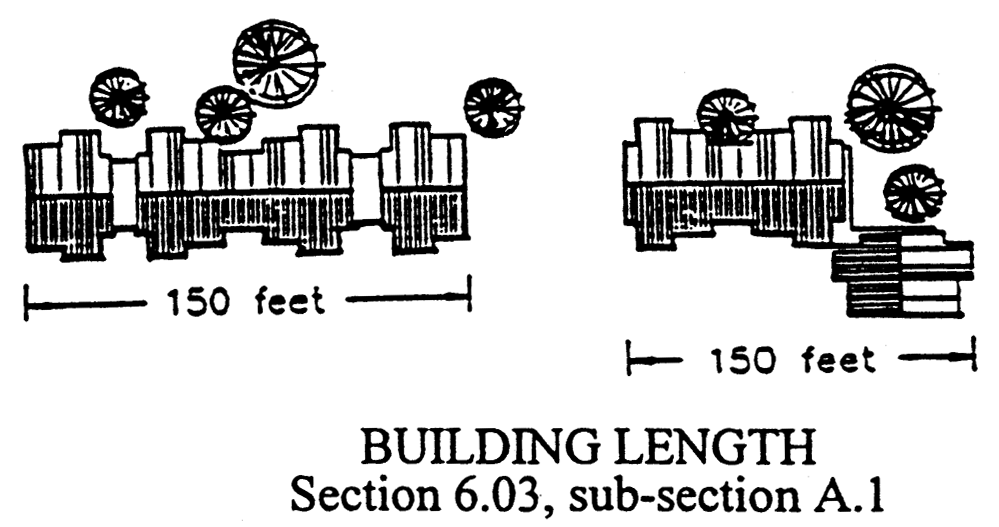
BUILDING LENGTH
2.
Building spacing. The minimum distance between any two buildings shall be based on the length and height of the buildings, in accordance with the following:
_____
The minimum distance between any two adjacent building planes shall be measured at the closest (most narrow) points between the two buildings. If there is a combination of one-, two- and/or three-story buildings in the same development, the minimum distance requirements shall be based on the higher of the two buildings. In no instance, shall there be less than 30 feet between any two adjacent buildings. The 30-foot minimum separation also applies to buildings with corner-to-corner relationships.
3.
Street address. The address of each dwelling unit must be clearly posted so that the unit can be readily identified from the roadway or adjacent parking area.
4.
Access and circulation. Multiple-family developments shall comply with the following requirements for access and circulation (see illustration):
_____
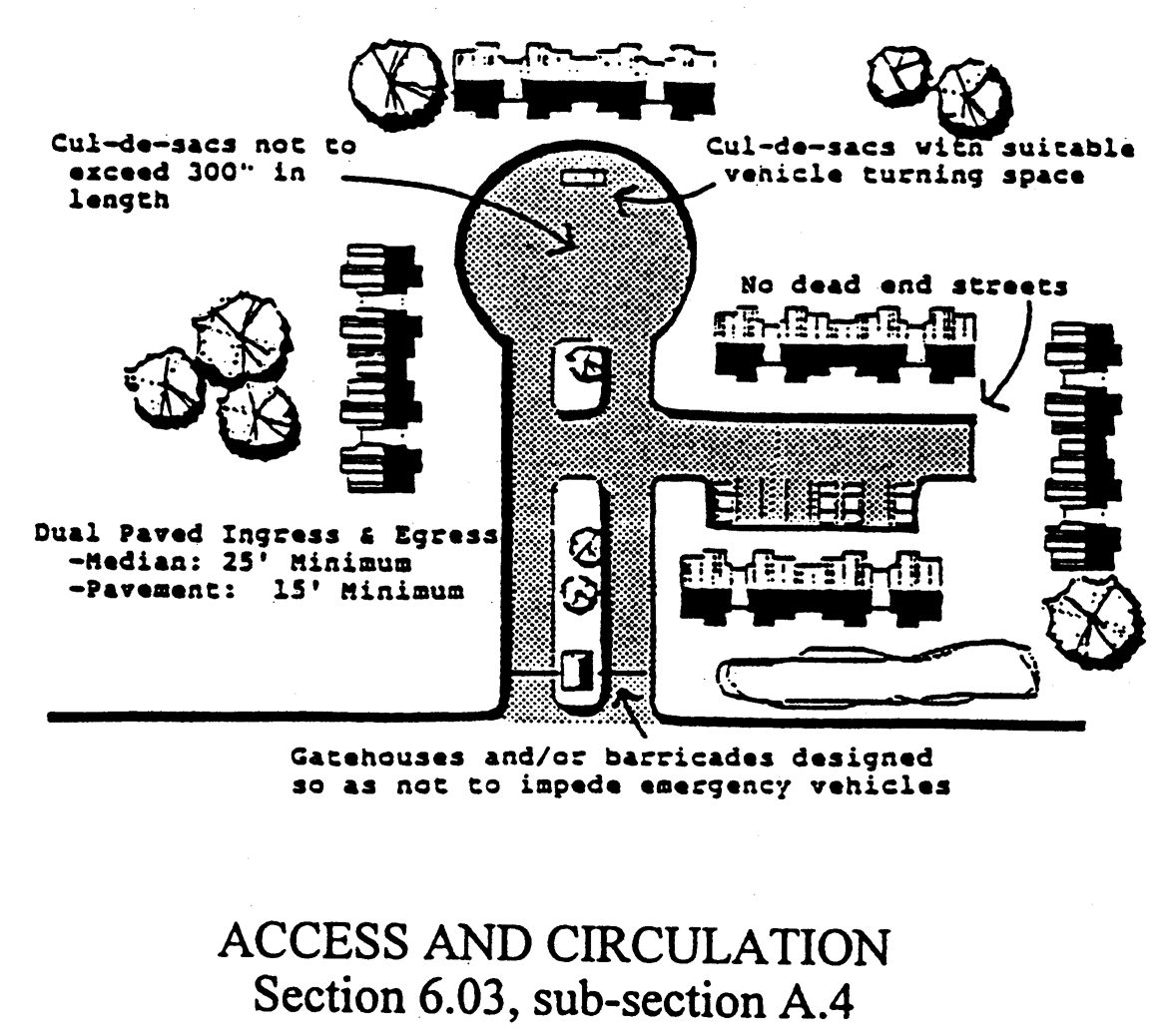
ACCESS AND CIRCULATION
_____
-
Access to roads. Multiple-family developments shall only have access to an existing or planned road with a right-of-way greater than 60 feet; however, alternate means of access may be permitted by the planning commission upon finding that, due to special circumstances, substantial improvements in traffic safety could be achieved by reducing the number of driveways. Furthermore, an alternate means of access shall be permitted only if one or more of the following conditions exists:
*
The property directly across the street from the development under consideration is zoned for multiple-family or nonresidential use, or
*
The property directly across the street is developed with permanent uses other than single-family residences, or
*
The proposed development is in an area which, based on study by the planning commission, will eventually be used for purposes other than single-family use.
-
Emergency access. All dwelling units, including those under construction, shall be readily accessible by fire and emergency vehicles from a paved public street, paved private access road, or other approved paved area. Fire lanes shall be posted with "Fire Lane, No Parking" signs consistent with the Michigan Manual on Uniform Traffic Control Devices. To facilitate emergency vehicle access, the following guidelines shall be complied with:
*
All roadways shall be paved and bi-directional, allowing for both ingress and egress. A boulevard may be utilized to provide bi-directional traffic movement, provided that the median strip is a minimum of 25 feet in width.
*
Streets with no outlet shall be terminated with a cul-de-sac, designed in accordance with standards established and periodically updated by the township engineer and kept on file in the Engineering Services Division. Such streets with no outlet shall not exceed 700 feet in length or 1,000 feet in length for developments having a minimum lot size of one acre or density of one dwelling unit/acre or less.
*
Gatehouses and/or barricades at entrances to private roadways shall be designed so as not to impede fire and emergency vehicle access.
-
Street dimensions. On-site streets and drives shall have a minimum width as follows:
a.
For units without garages, providing parking in lots:
*
Boulevard with median: 15-foot moving lane in each direction (measured back of curb).
*
Undivided two-way street or drive, without parking: 24 feet (measured back of curb).
*
Undivided two-way street or drive with parking: See section 4.01.D.2, requirements for parallel parking (measured back of curb).
b.
For units with private, attached garages:
*
Boulevard with median: 20-foot moving lane in each direction (measured back of curb).
*
Undivided two-way street or drive, with or without parking: 27 feet (measured back of curb).
5.
Sidewalks.
a.
Sidewalks shall be provided within developments where units do not have private, attached garages. Sidewalks within the development shall be located no less than five feet from and parallel to access drives. Such sidewalks shall provide convenient access to community buildings and between parking areas and dwelling units. The sidewalks shall be designed and constructed in accordance with section 2.19.
b.
Developments with private, attached garages shall provide an internal pedestrian path system instead of sidewalks parallel to the internal streets to minimize conflicts with driveway crossings and vehicular traffic. The internal path system shall be a minimum of five feet in width and constructed of asphalt or concrete, with an appropriate base. The path cross section shall be approved by the engineering official. Where the pedestrian path passes through wooded or wetland areas, it may be constructed of gravel or wood chip mulch.
6.
Parking/garages/driveways. In addition to the requirements set forth in article 4.00, multiple-family developments shall comply with the following requirements:
-
Location. Required parking shall be located in parking lots or individual driveways, and not in streets or access drives. Parking may be permitted in required side and rear yard setback areas provided that parking lots and access drives shall be located a minimum of ten feet from any property line or public right-of-way. Parking lots and parking lot access drives shall not be located closer than 25 feet to a wall of any residential structure which contains windows or doors, nor closer than seven feet to a wall of any residential structure which does not contain openings.
-
Distance from dwelling units. Parking shall be located within 150 feet of the dwelling units the parking is intended to serve, measured along the sidewalk leading to the parking lot.
-
Driveways providing access to private, attached garages shall be a minimum of 22 feet in length, as measured from the edge of road pavement.
-
Guest parking shall be provided for all multiple-family and single-family attached residential units, as set forth in article 4.00.
-
Parking for community buildings. Parking shall be provided for community buildings, in accordance with section 4.01.C.6.
7.
Lighting. All parking areas, building entrances, sidewalks, and ramps shall be illuminated to ensure the security of property and the safety of persons using such areas, in accordance with the requirements set forth in section 2.13.
8.
Landscaping. Multiple-family developments shall be landscaped in accordance with section 5.03.C.
9.
Open space. Open space shall be provided in any multiple-family development containing eight or more units. The open space shall comply with the following requirements:
-
Size. Total open space required shall be based on the number and size of units, as indicated in the following chart, provided that each development shall contain a minimum of 10,000 square feet of open space.
-
Location. Open space shall be located conveniently in relation to the majority of dwelling units intended to be served. Swamp areas, marshy areas, and similar limited-use areas shall not be included in the required open space.
-
Use of open space. Uses permitted within the required open space include picnic and sitting areas, playground and park space, play equipment, tennis courts, shuffleboard courts, and similar outdoor recreation facilities.
-
Phasing. Open space improvements shall be completed in proportion to the number of units constructed in each phase.
10.
Antennas. Each multiple-family building shall be permitted to erect one antenna.
B.
Cluster family development. The following site development standards shall apply to cluster family developments, subject to special land use approval in the multiple-family (RM-1) [MR] district:
1.
Intent. The intent of the cluster family regulations is to provide flexibility in the regulation of multiple-family development; encourage innovation in land use and variety in the design, layout and type of structures constructed; achieve efficiency in the use of land, natural resources, energy, and the provision of public services and utilities; encourage the provision of useful open space; and generally provide a better living environment. Accordingly, the cluster family regulations provide for flexibility in the placement, bulk, and interrelationship of the buildings and uses, provided that the overall intensity of land use, density of population, amount of light, air, and open space, and requirements for access as specified elsewhere in this ordinance shall be maintained.
2.
Permitted modifications. Subject to review and approval procedures and standards which follow, modification of the requirements related to building setbacks, building spacing, and site layout may be granted, but only upon determination that such modification will:
-
Result in a more efficient use of the land,
-
Will not be injurious to surrounding land and to the public as a whole, and
-
Will not result in a higher overall dwelling unit density than specified for the district in which the development is located.
3.
Procedures. The overall site plan and all regulatory modifications shall be subject to the special land use review procedures and standards set forth in section 27.03. The application and data requirements shall be the same as specified in section 27.02 for site plan review, plus any other data which may be required by the planning commission, planning, building, or engineering officials, or township board to make the determination required herein.
4.
Standards for granting approval. Approval of a proposal for cluster family development may be granted upon determination that the proposal will comply with all applicable requirements of this ordinance, as well as the following standards:
-
Screening between single-family districts and cluster developments. Protective screening shall be required in accordance with section 5.03.C wherever a proposed multiple-family cluster project abuts land which is zoned for single-family development.
-
Maintenance of open space. Continued maintenance of all open space and recreational areas shall be the responsibility of all property owners of the cluster development. The applicant shall provide evidence of a maintenance plan and agreement, specifying maintenance schedules, work items, and financing.
-
Building permit. Approval of a cluster family special land use application by the township board shall automatically expire if the applicant fails to file an application for a building permit within 24 months after said approval. Upon showing of good cause, the township board may extend the period of validity up to one year, during which time the building permit may be sought.
C.
Mobile home park requirements. All mobile home parks shall comply with the requirements of Michigan Public Act No. 419 of 1976 [repealed—see Public Act No. 96 of 1987 (MCL 125.2301 et seq.)], as amended. Further, all mobile home parks shall comply with the provisions of this ordinance, the Michigan Mobile Home Commission Rules, and any other lawfully adopted ordinance of Canton Township. Should any conflict in legally approved regulatory provisions occur, whichever provision imposes the more restrictive or higher standard shall prevail.
1.
Location. Mobile homes shall be located only in those zoning districts in which mobile home land use is permitted by right or subject to special approval. All mobile homes in an RMH mobile home park district shall be located on an approved site in an approved mobile home park. Emergency or temporary parking of a mobile home on any street, alley, or highway may be permitted for a period not exceeding two hours, subject to any other limitations imposed by traffic or parking regulations or ordinances for that street, alley or highway.
2.
Mobile home standards. Each mobile home shall be of contemporary design and shall contain sanitary waste disposal facilities, sleeping accommodations, a tub or shower bath, kitchen facilities, and plumbing and electrical connections designed for attachment to appropriate external systems as commonly found in modern mobile homes, and as specified in section 2.05.A.3. Each mobile home shall comply with the regulations for the district in which it is located, the requirements applicable to class A mobile homes specified in section 2.05.B, the regulations of the U.S. Department of Housing and Urban Development as adopted on June 15, 1976, and all subsequent amendments to such standards and regulations. Mobile homes constructed prior to June 15, 1976, shall be in full compliance with NFPA 501B-1974/ANSI 119.1-1975 standards.
3.
Setbacks in the RMH district. Mobile homes shall comply with the minimum distances specified in R125.1941, Rule 941 of the Michigan Administrative Code.
No mobile home unit shall be located within 50 feet of the right-of-way of a public thoroughfare, or within 20 feet of a mobile home park property line.
No mobile home unit exterior wall surface shall be located with [within] 20 feet of any other mobile home unit's exterior wall surface.
4.
Permit. It shall be unlawful for any person to operate a mobile home park unless that individual obtains a license for such operation in compliance with the requirements of Michigan Public Act No. 419 of 1976 [repealed—see Public Act No. 96 of 1987 (MCL 125.2301 et seq.)], as amended. The building official shall communicate his recommendations regarding the issuance of such licenses to the Director of the Mobile Home Division, Corporation and Securities Bureau, Michigan Department of Commerce.
5.
Violations. Whenever, upon inspection of any mobile home park, the building official finds that conditions or practices exist which violate provisions of this ordinance or other regulations referenced herein, the building official shall give notice in writing by certified mail to the director of the Michigan Mobile Home Commission, including the specific nature of the alleged violations and a description of possible remedial action necessary to effect compliance with the ordinance or other regulations. The notification shall include such other information as is appropriate in order to fully describe the violations and potential hazards to the public health, safety and welfare resulting from the violation. A copy of such notification shall be sent by certified mail to the last known address of the park owner or agent.
6.
Inspections. The building official or other authorized township agent is granted the authority, as specified in Michigan Public Act No. 419 of 1976 [repealed—see Public Act No. 96 of 1987 (MCL 125.2301 et seq.)], as amended, to enter upon the premises of any mobile home park for the purpose of determining compliance with the provisions of this ordinance or other regulations referenced herein or other applicable township ordinances.
7.
Park site development standards.
-
Park size. Mobile home parks shall be at least 20 acres in size.
-
Access. All mobile home parks shall have paved access to a paved county primary road or state trunk line.
-
Interior roadways. All interior roadways and driveways shall be hard-surfaced and provided with curbs and gutters. Roadway drainage shall be appropriately designed such that stormwater from the roadway will not drain onto the mobile home lots. Main access drives shall be no less than 24 feet wide. Parking shall not be permitted on main access drives. Secondary access drives shall be no less than 22 feet in width. Parking shall not be permitted on 22-foot-wide drives.
-
Sidewalks. Concrete sidewalks shall be constructed on the street side of each mobile home lot in accordance with established engineering standards for the township. Required sidewalks shall be no less than three feet in width. Sidewalks shall be placed not less than three feet from the edge of the curb of a main access drive, but may be placed contiguous to the curb of a secondary access drive. The areas between the sidewalk and curb shall be seeded or sodded with grass, and shade trees may be planted in the area.
-
Water and sewer service. All mobile home parks shall be served by approved central water and sewage systems, which shall meet the requirements of the Wayne County Health Department and the Michigan Department of Health. Running water shall be piped to each mobile home lot with a minimum available pressure of 20 pounds per square inch for each lot. The plumbing connections to each mobile home site shall be constructed so that all lines are protected from freezing, accidental bumping, or from creating any nuisance or health hazard.
-
Storm drainage. All developed portions of the mobile home park shall be served by adequate storm drainage facilities, designed and constructed in accordance with applicable local, county, and state regulations.
-
Telephone and electric service. All electric, telephone, and other lines within the park shall be underground. Electric service shall be three-wire, balanced 115 to 120 volt supply.
-
Fuel oil and gas. Any fuel oil and gas storage shall be centrally located in underground tanks, at a safe distance from all mobile home sites. All fuel lines leading to mobile home sites shall be underground and designed in conformance with the Michigan Administrative Code and other applicable local, county and state regulations.
-
Television antennas. Individual exterior television antennas shall not be placed on any mobile home unit or lot. The mobile home park may provide (a) master exterior television antenna(s) for connection to individual mobile home units, or an underground cable television system may be installed.
8.
Skirting. Each mobile home must be skirted within 90 days after establishment in a mobile home park. In the event that skirting cannot be installed in a timely manner due to inclement weather, the building official may permit extension of the time period. All skirting shall conform to the installation and materials standards specified in the Michigan Administrative Code, R125.1604, Rule 604.
9.
Canopies and awnings. Canopies and awnings may be attached to any mobile home, provided they are in compliance with the Michigan Administrative Code, R125.1941, Rule 941(1)(b)(ii), and provided further that they shall not exceed 12 feet in width or exceed twelve [sic] the length or the height of the mobile home. A building permit shall be required for construction or erection of canopies or awnings, or for construction of any area enclosed by glass, screens, or other material, such that the enclosed area will be used for more than casual warm weather leisure.
10.
Landscaping. Mobile home parks shall be landscaped in accordance with section 5.03.B.
11.
Patio. An outdoor patio area of not less than 48 square feet shall be conveniently located near the entrance of each mobile home, in proximity to open areas of the lot and other facilities. The patio shall consist of four-inch-thick concrete, so as to provide a solid foundation for access to the dwelling's exterior access door. The building official may waive the requirement for a patio if the proposed mobile home dwelling is of such a size or shape that the patio would be covered by the dwelling. The building official may allow the patio to be constructed of materials other than concrete if such materials are of equal or superior quality.
12.
Open space. Any mobile home park that contains 50 or more mobile home sites shall have at least one conveniently located open space area. A minimum of two percent of the mobile home park's gross acreage shall be dedicated for open space use, provided that the park shall have not less than 25,000 square feet of open space area.
13.
Garbage and refuse collection. Garbage and refuse collection areas shall be screened in accordance with section 2.14.
D.
Cluster development criteria. The following site development standards shall apply to single-family detached development, subject to special land use approval:
1.
Purpose and intent. It is the purpose of this section to provide an option to utilize cluster development as an alternative to conventional design for single-family detached subdivisions and site condominiums under certain conditions and to provide application criteria and design standards for this special land use. It is the intent of this section to allow the township to consider flexible design concepts under cluster development where the site proposed for development has significant natural and/or environmental features, or scenic vistas along existing roadways which the township has determined should be preserved to maintain the semi-rural character of the community. Where the site is void of any natural amenities, the township may elect to consider utilization of a cluster development upon demonstration from the applicant that open space amenities will be created to enhance the character of the area and provide recreational opportunities for the residents of the development.
2.
Eligibility and application criteria. The burden of proof of showing that a specific cluster application is the best development alternative for the site shall be that of the applicant for special land use approval. The applicant shall demonstrate that the following thresholds and eligibility criteria are met.
a.
Minimum site size/applicable zoning districts - RE, RR: 40 acres.
b.
Minimum site size/applicable zoning districts - R-1, R-2, R-3: 20 acres.
c.
Description of surrounding uses and character of the area.
d.
Maximum density: Provide a conceptual plan utilizing the base zoning criteria with a conventional layout to determine maximum number of units.
e.
Site analysis: Indicate existing types and amount of vegetation, topography, wetlands, floodplains and any other significant natural or environmental feature which would pose a constraint to development or provide an opportunity for creative design alternatives.
f.
Preliminary concept cluster plan: Illustrate methods by which the natural and environmentally sensitive areas would be preserved, how common usable open space would be configured and what, if any, amenities would be created or provided.
g.
Benefits, appropriateness and compatibility: Provide a written explanation of how the proposed cluster development is appropriate at the proposed location; describe how the development will maintain compatibility with the existing uses adjacent to and/or a certain distance from the site; and provide a comparison of the benefits of the proposed cluster design compared to a conventional subdivision.
3.
Open space and buffer requirements.
a.
Minimum open space requirements. Open space shall be determined by the minimum cluster lot size for the particular zoning district in which the cluster development is proposed. The applicant is encouraged to utilize the minimum lot size to maximize open space. Open space should be arranged in a manner that would provide the most residential lots direct access physically adjacent to the lot. Where it is not feasible to locate the open space adjacent to a lot or grouping of lots, visual access to the open space should be maintained.
b.
Minimum roadway buffer. In order to maintain the integrity of scenic rural roadways, provision of landscape buffers and/or preservation of vegetative communities may be necessary to protect the rural and semi-rural qualities of the township's scenic corridors. The amount of landscape buffer required along existing roadways shall not be less than 50 feet but additional buffer areas shall be preserved or provided where warranted by the existing site conditions and character of the specific area.
c.
Linkage of open space. Common open space areas within a cluster development shall be connected physically and visually within the project and provide connections to open space or preservation areas on adjacent properties, where practical and feasible.
d.
Dedication of open space. The common open space within a cluster development shall be set aside by the developer through an irrevocable conveyance which will assure that the open space will be permanently reserved and maintained as a conservation area, landscaped park or recreation space for the benefit of the residents of the development. Such conveyance shall specify ownership of the common open space; provide for the open space to be maintained by the private property owners having an interest in the open space; provide maintenance standards and a maintenance schedule; provide for maintenance insurance; and include any other specifications deemed necessary by the planning commission or township board.
_____
4.
Lot coverage and building separation—Lot area and setbacks.
Notes:
a.
Except in R-3, the front setback shall be required to be offset at least five feet from the setback designated or established on the adjacent lot(s). In no case shall the offset be greater than 15 feet from one lot to the next.
b.
Except in R-3, all homes in a cluster subdivision shall utilize side entry garages. The subdivision covenants and restrictions (or, in the case of a site condominium, the master deed) must specifically prohibit construction of homes with garage entrances that face the street upon which the house fronts. In the R-3 district, the garage portion of the structure shall be set back ten feet from the front face of the main part of the house. If the applicant submits architectural guidelines for the homes which effectively integrate the garage with the overall design of the house, the garage location can be modified from the above with the approval of the planning commission.
c.
In the R-2 district, the five-foot side yard on one lot shall not abut a five-foot side yard on any adjacent lot. A minimum separation between adjacent homes of 30 feet is required, except in R-3, where a minimum separation of 20 feet is required.
d.
The side yard reductions specified in section 26.02, footnote "m," are not applicable to lots within cluster subdivisions approved according to the above provisions.
e.
The lot size may exceed the maximum lot size in unusual circumstances that would be impractical or undesirable, such as corner lots, lots located at the end of a cul-de-sac, unusual property boundaries, location and configuration of natural features, and similar circumstances.
_____
5.
Review and approval process. Proposals for utilizing the cluster development alternative shall be reviewed in accordance with applicable procedures for special land uses, section 27.03, subsection B.
E.
Housing for the elderly. The following site development standards shall apply to housing for the elderly.
1.
Building length. Building shall not exceed 350 feet in overall length, measured along the front line of connecting units, inclusive of any architectural features which are attached to or connect the parts of the building together.
2.
Building spacing. The minimum distance between buildings shall meet the requirements set forth in section 6.03.A.2.
3.
Building setbacks. The minimum yard setbacks from perimeter property boundaries shall be in accordance with the following schedule:
4.
Minimum site area. The minimum site area requirements shall be as follows:
5.
Minimum floor area per dwelling unit. Each dwelling unit shall comply with the following minimum floor area requirements, excluding basements:
6.
Building height. No building shall exceed 35 feet in height or three stories except in MRD and HRD districts.
7.
Street address. The name and address of the development and the address of the individual unit shall be clearly posted so that they can be readily identified from the roadway or adjacent parking area. Where access to units is provided from internal corridors, clear direction to individual units from the central lobby must be provided.
8.
Access and circulation. Elderly housing development shall comply with the requirements set forth in section 6.03.A.4.
9.
Sidewalks. Elderly housing development shall comply with the requirements set forth in section 6.03.A.5. In addition, sidewalks shall be provided connecting elderly housing developments to neighborhood facilities and services, where the planning commission deems appropriate.
10.
Parking/garages/driveways. Elderly housing developments shall comply with the requirements of article 4.00 and section 6.03.A.6, provided the number of parking spaces shall be determined by the specific requirement for elderly housing set forth in article 4.00.
11.
Lighting. All parking areas, building entrances, sidewalks, and ramps shall be illuminated to ensure the security of property and the safety of persons using such areas, in accordance with the requirements set forth in section 2.13.
12.
Landscaping. Elderly housing development shall be landscaped in accordance with section 5.03.C.
13.
Open space. Open space shall be provided in accordance with the following requirements:
-
Size. Total open space required shall be based on 250 square feet per unit, provided that each development shall contain a minimum of 10,000 square feet of open space.
-
Location. Open space shall be located conveniently in relation to the majority of dwelling units intended to be served. Wetlands and similar limited-use areas shall not be included in the required open space.
-
Use of open space. Uses permitted within the required open space shall be appropriate and designed for the resident population.
-
Phasing. Open space improvements shall be completed in proportion to the number of units constructed in each phase.
14.
Ancillary facilities. Elderly housing developments may include meeting and activity facilities, central dining facilities, laundry rooms, and other convenience facilities for occupants and their guests.
F.
Single-family attached residential requirements in R-2, R-3, R-4 and R-5. Single-family attached residential uses may be considered as special land uses in the R-2, R-3, R-4 and R-5 zoning districts under the following conditions:
1.
Minimum site size: Five acres, and not be located in a platted subdivision.
2.
Buildings shall be limited to two units each.
3.
Density shall not exceed the underlying density of the base zoning district.
4.
All units shall have attached, two-car garages.
5.
Minimum unit size: See schedule of regulations for two-unit condominiums.
6.
Building length: Two-unit single-family attached buildings shall not exceed 100 feet in length, measured along the front line of the structure and inclusive of any architectural features as illustrated in section 6.03, subsection A, subparagraph 1. Each building shall provide a minimum five-foot horizontal offset between units.
7.
Building spacing: The minimum distance between any two adjacent building planes as measured at the closest point between the two buildings shall be as follows:
a.
Side to side separation: See schedule of regulations.
b.
Rear to rear separation: 30 feet.
c.
Side to rear separation: 20 feet.
8.
Setbacks: All buildings must be set back a minimum of 50 feet from any adjacent public rights-of-way. See schedule of regulations for setbacks.
9.
Landscaping on the site shall comply with the applicable parts of section 5.03, subsection C. One street tree for every 40 lineal feet along the internal road shall also be provided adjacent to the sidewalk.
10.
The minimum width of the internal roads shall be 27 feet.
11.
A four-foot wide concrete sidewalk shall be provided adjacent to the curb along all internal streets.
12.
Exterior maintenance of all structures and grounds shall be the responsibility of a condominium association.
13.
Covenants and restrictions shall be submitted with the site plan application.
G.
Active adult community (AAC) requirements. Active adult communities may be considered as a special land use in the R-1 through R-5, single-family residential districts and in the R-6, single-family attached district and the MR, multiple-family residential districts. Active adult communities are defined as residential developments which are age restricted to residents aged 55 years and older. At least 80 percent of the units are required to be occupied by at least one person who is 55 years of age or older. AACs are designed for the needs of independent, active adults and generally provide a variety of housing options and amenities suited to the older adult. AACs may be considered pursuant to the following requirements and site design guidelines:
1.
Minimum site size: 100 acres.
2.
Minimum common open space: The minimum common open space dedicated within the general common element, exclusive of any area designated for roads, shall be 25 percent of the net parcel size.
3.
Maximum density: The maximum number of AAC units which may be considered, based upon the base zoning district, shall be as follows:
a.
R-1: 2 AAC units/acre.
b.
R-2 and R-3: 4 AAC units/acre.
c.
R-4/R-5 and R-6: 8 AAC units/acre.
d.
MR: 10 AAC units/acre.
e.
Assisted living facilities shall not be included in the density calculation in a-d above. Assisted living units shall provide a minimum site area of 2,500 square feet per efficiency or one-bedroom unit and 3,000 square feet of site area per two bedroom unit. An additional 500 square feet of site area shall be provided for each additional bedroom.
This density increase over the base density allowed by the underlying zoning and future land use maps is based upon the lower water and sewer demands of AACs. Any increase in density over the base allowed by the base zoning district shall be conditioned upon available sewer capacity.
4.
Permitted residential uses and dwelling types: AACs shall permit all forms of residential condominium dwellings, including one- and two-story detached and attached single-family, townhouse and stacked attached condominium buildings, multiple-story elevator-style buildings, and assisted and independent living facilities. The area, bulk, and dimensional requirements for these buildings shall be subject to the schedule of regulations in this subsection.
5.
Schedule of regulations:
a.
Setbacks from site boundaries:
-
1-story (attached or detached): 35 feet.
-
2-story (attached or detached): 45 feet.
-
3-story: 55 feet.
-
4-story: 60 feet.
b.
Minimum distances between buildings:
-
1- and 2-story detached side to side: 10 feet.
-
1- and 2-story attached side to side: 15 feet.
-
3- and 4-story side to side: 20 feet.
-
Side to front or side to rear: 20 feet.
-
Front to front or rear to rear: 30 feet.
c.
Minimum setback to edge of pavement:
-
20 feet if parking is provided in the driveway.
-
15 feet if parking is provided in a nearby lot.
d.
Maximum building height:
-
1-story (attached or detached): 25 feet.
-
2-story (attached or detached): 35 feet.
-
3-story: 50 feet.
-
4-story: 60 feet.
e.
Minimum dwelling sizes:
-
1 bedroom unit: 1200 square feet (1000 square feet for 3- and 4-story elevator buildings).
-
2 bedroom unit: 1400 square feet (1200 square feet for 3- and 4-story elevator buildings).
-
3 bedroom unit: 1600 square feet.
-
Assisted/independent living: 600 s.f. for 1 bedroom unit, 750 s.f. for 2 bedroom unit.
6.
Building design standards: The buildings shall meet the requirements of Section 26.06, the Schedule of Exterior Building Materials and meet the following additional design requirements:
a.
Brick and/or stone shall constitute the primary material on the front facade, with accents of cement composite siding, shakes or shingles.
b.
The remaining elevations may utilize cement composite siding, shakes or shingle as primary material with brick or stone accents.
c.
On buildings with more than one elevation facing a street, each elevation shall be considered a primary facade and shall use brick and or stone as the primary material.
d.
All dwelling units shall contain at least a two-car attached garage. One car garages may be permitted for one-bedroom units if the unit has adequate interior storage. Multiple-story buildings should place parking underground wherever possible, except in the case of independent and assisted living buildings, which will have adequate surface parking. Parking to accommodate visitors shall be provided over the base parking required and be distributed reasonably across the site. The amount of visitor parking shall be sufficient to support the mix of unit types in order to meet the needs of the overall development.
e.
All garages shall have details which provide shadow lines and include design elements including recessed doors, pergolas or roof elements over the doors, decorative doors which match the architectural style of the building, and window inserts in the doors which are architecturally compatible.
f.
Ten percent of the dwelling units shall be barrier free and incorporate a step free feature to at least one entrance of the dwelling unit; 32 inch wide, clear passage doorways throughout the unit; and, wheelchair, step-free access to the kitchen, dining area, living/or family room, at least one bedroom, at least one bathroom, and the laundry room.
7.
Recreational amenities: At a minimum, the AAC shall include a club house or community building which includes a swimming pool, offices for the association, and a meeting room. The AAC shall provide both active and passive recreational amenities which may include tennis or other similar facilities and pedestrian and bike paths throughout the community. These facilities shall be specified on the site plan.
8.
Ancillary facilities: An AAC may include certain ancillary facilities within or adjacent to the community building for the use of the residents. These uses may include a commissary, pharmacy and home health care supplies, and sundry shop. These uses shall be clearly specified in the application and their location identified on the plans for special land use consideration.
9.
Site design standards: the normal site design standards pursuant to the zoning and condominium ordinance for attached condominiums shall apply, except as otherwise provided in this section:
a.
A paved pedestrian pathway or sidewalk shall be provided which connects the common open space areas, outdoor amenities, clubhouse or other recreational community and the dwelling units.
b.
A four-foot wide concrete or decorative paved walkway shall be provided between the front door of the dwelling unit to the common sidewalk or pathway along the street.
c.
A screened trash storage and/or removal area shall be provided for each elevator-style building or buildings which do not have independent at-grade garages.
d.
Appropriate architectural or landscaped screening for utility meters and closets on each building.
10.
Submission requirements: In addition to the standard application requirements for special land use, the conceptual plan shall include the following information:
a.
Location map, indicating existing zoning on the parcels and on all adjacent property;
b.
Existing topography and natural features, including wetlands, woodlands, stream course and other water features, and floodplains;
c.
General layout of all buildings recreational facilities, and other amenities. The layout shall include setbacks from the site boundaries, separation distances between buildings, location of proposed storm water facilities, and, location of streets and parking areas;
d.
Delineation and calculation of common open space area, and calculation of net acreage and proposed overall density;
e.
Phasing plan, including identification of which phase each facility and/or amenity will be constructed;
f.
Colored elevations and renderings of each building type, including any recreational facility or clubhouse building;
g.
Conceptual landscape plan;
h.
List of and/or description of all of the proposed services and amenities which will be provided for the residents of the development; and
i.
Draft master deed and by-laws.
(Ord. of 12-20-2007; Ord. of 01-13-2026(1))
6.04. - Site development standards for mixed uses.
A.
Mid-rise and high-rise developments. The following site development standards shall apply to mid- and high-rise developments where the principal buildings are four or more stories in height:
1.
Frontage and access. Wherever the total floor area of the principal structure(s) is 70,000 square feet or greater, the development shall front onto a paved county primary road or state trunk line, and the main means of access to the development shall be via the primary road or state trunk line. The nearest edge of any entrance or exit drive shall be located no closer than 400 feet from any street or road intersection (as measured from the nearest intersection right-of-way line).
Wherever the total floor area of the principal structure(s) is 30,000 square feet or greater, but less than 70,000 square feet, the development shall front onto a paved thoroughfare with at least two lanes of traffic in each direction, and with full passing and deceleration lanes.
Access drives and parking areas shall be adequately lighted in accordance with section 4.01.D.
2.
Landscaping and screening. Mid- and high-rise developments shall comply with the landscaping requirements for multiple-family districts (section 5.03.C), except for the following:
-
Protective screening requirements. In addition to the requirements in section 5.03.C, protective screening shall be provided along all sides of any off-street parking or vehicle use area, where said parking or vehicle use area is located within 25 feet of any side or rear property line.
-
Landscaping adjacent to a freeway. Where mid- and high-rise development abuts a limited access freeway, a landscaped buffer shall be provided. In mid- and high-rise developments the buffer shall consist of the following landscaping: A minimum of one deciduous and one evergreen tree shall be planted for every 40 lineal feet or portion thereof of freeway frontage, plus, a minimum of one ornamental tree shall be planted for each 80 lineal feet or portion thereof of freeway frontage, plus, a minimum of one shrub shall be planted for each ten lineal feet or portion thereof of freeway frontage. Shrubs must be planted in masses of at least five. Dwarf species of shrubs may be utilized at a rate of 1.5 times the base shrub requirement. Trees may be planted at uniform intervals, at random, or in groupings.
-
Blockage of sunlight. The types and location of trees and shrubs should not unreasonably or totally block access to sunlight on adjoining property zoned for residential purposes.
3.
Open space. Open space shall be provided for residential uses in accordance with the requirements for multiple-family and attached housing, section 6.03.A, except that private patios and balconies may be used to reduce the amount of required open space by up to 40 percent.
4.
Protection of solar access. Building placement should provide maximum solar access to adjoining residentially zoned property, so as to conserve energy resources and provide adjacent property owners with the opportunity to use existing and future technology in the use of solar energy for heating, cooling, and ventilation. Accordingly, the following standards shall apply:
-
Orientation. The lengthwise axis of buildings shall be oriented southerly, southeasterly, or southwesterly to maximize solar gain.
-
Setback. The planning commission may require mid- and high-rise buildings to be set back a greater distance than specified for the district in which the building is located to prevent the shadows cast by the building from obstructing the solar access of adjoining residentially zoned properties. In determining appropriate setbacks so as to minimize shadow obstruction, the following formula shall be used:
Required Setback = (Building height (in feet) × 2.2) minus (Required yard setback of adjacent residential zone)
Note: The 2.2 factor is based on the solar azimuth on December 21, and the latitude of Canton Township, 42°20′.
B.
Condominium requirements. The following regulations shall apply to all condominium projects within the township:
1.
Initial information required. The following information shall be provided to the planning official by any persons intending to develop a condominium project concurrently with the notice required to be given to the township pursuant to section 71 of Public Act No. 59 of 1978 (MCL 559.171), as amended:
-
The name, address and telephone number of all persons with an ownership interest in the land on which the condominium project will be located, together with a description of the nature of each entity's interest (for example, fee owner, optionee, lessee, or land contract vendee).
-
The name, address and telephone number of all engineers, attorneys, architects or registered land surveyors associated with the project.
-
The developer or proprietor of the condominium project.
-
The legal description of the land on which the condominium project will be developed together with appropriate tax identification numbers.
-
The acreage area of the land on which the condominium project will be developed.
-
The purpose of the project (for example, residential, commercial, industrial, etc.).
-
Approximate number of condominium units to be developed on the subject parcel.
-
Anticipated method of providing the project with water and sanitary sewer service.
2.
Updating of information. All information required to be furnished under this section shall be kept updated until a certificate of occupancy has been issued.
3.
Site plan review. Prior to recording of the master deed required by section 72 of Michigan Public Act No. 59 of 1978 (MCL 559.172), as amended, the condominium project shall undergo site plan review and approval pursuant to section 27.02 of this ordinance. Expansion of a project to include additional land in a new phase shall also require site plan review.
4.
Master deed, restrictive covenants and "as built survey." The condominium project developer or proprietor shall furnish the planning official with the following: one copy of the recorded master deed, one copy of all restrictive covenants, and two copies of an "as-built survey." The "as-built survey" shall be reviewed by the township engineer and building official to determine compliance with township ordinances.
5.
Site condominium projects, including single-family detached or single-family site condominiums are subject to the requirements of the township condominium ordinance [chapter 82 of the Township Code].
6.
Final site plan. After submittal of the condominium plan and bylaws as part of the master deed, the proprietor shall furnish the township a copy of the site plan on a mylar sheet of at least 13 by 16 inches with an image not to exceed 10½ by 14 inches.
6.05. - Site development standards for village shopping districts.
The following development standards shall apply to all land zoned as village shopping districts and are in addition to any other applicable requirements of this ordinance:
A.
Architectural elements. All structures within a village shopping district shall utilize residential type exterior materials and design features. Exterior building wall materials shall meet or exceed the minimum requirements for residential structures specified in section 26.06. Rooflines shall provide a minimum pitch of 5:12 on all visible portions of each building. Covered walkways, canopies, pavilions or awnings shall be utilized in all primary pedestrian areas which are directly adjacent to principal structures.
Wherever possible, primary entrances into the buildings shall be recessed or protruded from the facade. The facade shall also be designed to provide three-dimensionality to the building.
Pedestrian-level lighting shall be provided and shall complement the architecture of the proposed buildings. Decorative lighting shall be provided at the entrance to the development and shall be consistent with the style chosen for the pedestrian-level lighting.
B.
Building dimensions.
1.
No individual building may exceed a gross area of 7,500 square feet on the first floor and shall not exceed 120 feet in length (except as approved as a special land use).
2.
There shall not be more than one individual business which utilizes more than 5,000 square feet (except as approved as a special land use).
3.
There shall be a minimum of two primary structures within any village shopping project.
C.
Site orientation and parking.
1.
All structures shall be oriented around a courtyard, square or village green.
2.
All parking shall be located in the side or rear yards. In no case shall parking be located in the front yard area, except on corner lots, where parking may be permitted in the front yard of the street which has the higher functional classification.
D.
Site amenities.
1.
The proposed village shopping development project shall include sidewalk and/or bikepath connections to existing and future developments.
2.
One or more of the following features, or similar amenity, shall be provided within the village shopping district: bell or clock tower, sculpture, fountain, gazebo or other form of public art, etc. These features shall not be used to display commercial advertising.
E.
Reserved.
(Ord. of 01-13-2026(1)
6.06. - Site development standards for planned shopping centers.
The following development standards shall apply to all sites developed as planned shopping centers and are in addition to any of the applicable requirements of this ordinance:
A.
Architectural elements.
1.
Building facades greater than 100 feet in length shall incorporate recesses and projections along at least 20 percent of the length of the facade. Windows, awnings, and arcades must total at least 60 percent of a facade length abutting a public street.
2.
Architectural interest shall be provided through the use of repeating patterns of changes in color, texture and material modules. At least one of these elements shall repeat horizontally. All elements should repeat at intervals of no more than 50 feet, either horizontally or vertically.
3.
There shall be variations in rooflines to reduce the massive scale of the structure and add visual interest. Roofs shall have at least two of the following features: parapets concealing flat roofs and rooftop equipment, overhanging eaves, sloped roofs, and three or more roof surfaces.
4.
Each principal building with an anchor tenant shall have a clearly defined, highly visible customer entrance with features such as canopies or porticos, arcades, arches, wing walls, and integral planters.
B.
Color and material.
1.
Facade colors shall be of a low reflectance, subtle, neutral of [or] earth tone colors. The use of high intensity colors, metallic colors, black or fluorescent colors is prohibited.
2.
Building trim may consist of brighter colors, but neon tubing as a building accent is prohibited.
C.
Miscellaneous design elements.
1.
Loading docks, trash collection, outdoor storage and similar facilities and functions shall be incorporated into the overall design of the building and the landscaping so that the visual and acoustic impacts of these functions are fully contained and out of view from adjacent properties and public streets. Use of screening materials that are different from or inferior to the principal materials of the building and landscape is prohibited. No delivery, loading, trash removal, exterior property maintenance, or similar operations are permitted between the hours of 9:00 p.m. and 7:00 a.m., except in special circumstances and where steps are taken to reduce noise impacts.
2.
Each retail establishment must contribute to the establishment or enhancement of the community and public spaces by providing at least two community amenities such as a patio/seating area, water feature, clock tower, pedestrian plaza with benches, public art, etc.
6.07. - Site development standards for the downtown development district (DDA).
In addition to all other applicable requirements set forth in the ordinance, the following development standards shall apply to all sites which are proposed for development or redevelopment and located within the downtown development district of the Charter Township of Canton.
The district is generally described as "parcels of land located north and south of Ford Road, beginning approximately 589 feet west of Canton Center Road and proceeding east to the Canton Township/Westland border. Parcels may not be contiguous to Ford Road, extending north and/or south along Canton Center Road, Sheldon Road, Morton Taylor Road, Lilley Road, Haggerty Road, and Lotz Road," and more particularly described in Ordinance 115A, as amended, establishing the downtown development district.
The township will use these guidelines to review site plans that are located within the DDA district. These guidelines will be used to create an aesthetic consistency along the street frontages, but will allow designs to be site specific, based on existing conditions and other ordinance requirements. Accompanying these standards is a "wall location plan," "detail sheet," and "specifications" that provide additional information regarding the elements discussed here.
A.
Landscaping/streetscape elements. Wherever front, side or rear yards are adjacent to road rights-of-way, the following shall apply:
1.
A garden wall shall be incorporated into the required landscape area to better define entry points into the development and help screen parking areas from the adjoining road. Required walls shall be constructed of brick to match the existing garden wall and include a limestone cap as indicated in the specifications. The garden wall also requires inclusion of a "Canton Community Sign" or a "Canton Logo Sign" depending on the location of the property. Location of the garden wall on individual properties shall be reviewed by the township using the wall location plan and the following guidelines:
a.
Angled garden walls are to be used to define the entryway(s) into commercial or office developments.
b.
Garden walls (in addition to the angled walls described above) are required for all areas where parking, vehicular use areas, and/or the building rear faces and/or abuts any road right-of-way within the DDA district, regardless of the type of development (residential, commercial, office, etc.). Note that this requirement does not apply to individual lots with single-family homes. Locations for required garden walls are shown on the accompanying wall location plan.
c.
Garden walls are recommended where the front of the building abuts the road right-of-way and where the land between the building and road contains only landscaping, signs, flagpoles, or other such site furnishings.
2.
Several areas within the DDA district have been designated as locations for "Canton Community Signs" and "Canton Logo Signs" by the DDA board. Developments at these locations will be required to include the appropriate sign panel(s) within their garden wall. Placement of sign panel in garden wall, artwork for lettering, and the logo for the sign panels are on the detail sheet and can be obtained from the Charter Township of Canton. The sign locations are as follows:
a.
Signs with the township "Tree Logo" and the words "Canton Community" (or Canton Community Signs) are to be located as indicated on the wall location plan. These signs are to be ground-lit with the "Type C" fixture, as specified on the detail sheet (available from the township).
b.
Signs with only the township "Tree Logo" (or Canton Logo Signs) shall be located as indicated on the wall location plan.
3.
Required plantings shall be made up of the species listed in table A or comparable as recommended by the DDA. Plant materials shall meet all ordinance requirements as stated in section 5.04 (standards for landscape materials).
4.
In areas where the sidewalk meets an entry drive, colored stamped concrete shall be used to build six lineal feet of sidewalk from each edge of the driveway. The stamping pattern shall be "Running Bond." The color of the concrete shall be an antique red, or similar color that matches the existing brick wall sections throughout the DDA district. This is illustrated on the detail sheet.
B.
Lighting. Wherever front, side or rear yards are adjacent to the Ford Road right-of-way, or the right-of-way of any major street within the DDA district (Canton Center Road, Sheldon Road, Morton Taylor Road, Lilley Road, Haggerty Road, and Lotz Road), street lighting shall be installed in front of commercial or office developments. Light locations are specifically identified on the accompanying wall location map.
Lights are also required on major internal roads of developments that have a common access drive serving more than one property or the primary driveway of a single site greater than five acres. The type of light used on the internal drive depends on where the development is located within the DDA district, as described below.
The type of light pole, mounting bracket, adapters and luminaries shall be the materials specified in this ordinance. Note that there are two light fixtures required within the DDA district: the Sterner light fixture (see detail sheet) is located within the district between Canton Center Road east to I-275, the Lumec light fixture (see detail sheet) is located in the corporate park overlay district from I-275 east to Hannan Road (eastern township boundary).
Lights shall be installed between the sidewalk and the street the same distance adjacent to the sidewalk as the existing decorative light fixtures throughout the DDA district (less than one foot). Lights shall be spaced a maximum of 80 to 100 feet on center. Lights at major intersections (as named above) and all entrances to the DDA district shall have two luminaries, as specified on the wall location plan. Lights between street intersections shall have a single luminarie. If the single Sterner luminarie is the required light, the luminarie shall be positioned over the sidewalk. All lights shall be lit from dusk to dawn and be on a sensor system, not timers.
TABLE A. PLANT SPECIES LIST
SITE DEVELOPMENT STANDARDS - DDA
Section 6.07.A.2
Deciduous trees:
Acer platanoides "Deborah" ("Deborah" Norway Maple)
Acer rubrum "Red Sunset" (Red Sunset Maple)
Fraxinus pennsylvanica "Summit" (Summit Ash)
Platanus acerifolia "Bloodgood" (Bloodgood London Plane Tree)
Quercus palustris (Pin Oak)
Evergreen trees:
Picea glauca (White Spruce)
Abies concolor (White Fir)
Ornamental trees:
Acer ginnala (Amur Maple)
Amelanchier canadensis (Serviceberry)
Flowering crabs:
Malus "Coralburst"
Malus "Indian Magic"
Malus zumi "Calocarpa"
Malus "White Candle"
Shrubs:
Spiraea bumalda "Anthony Waterer"
Spiraea japonica "Little Princess"
Potentilla fruticosa "Abbotswood"
Juniperus chinensis "Sea Green"
Aronia melanocarpa (Black chokeberry)
Perennials:
Hemerocallis "Stella D'Oro" (Stella D'Oro Daylily)
Hemerocallis "Eenie Fanfare" (Eenie Fanfare Daylily)
Hosta fortunei "Albo Marginata"
Iris pallida "Aureo-Variegata"
Phlox subulata "Merald Pink"
Lavandula augustifolia "Munstead" (Munstead Lavender)
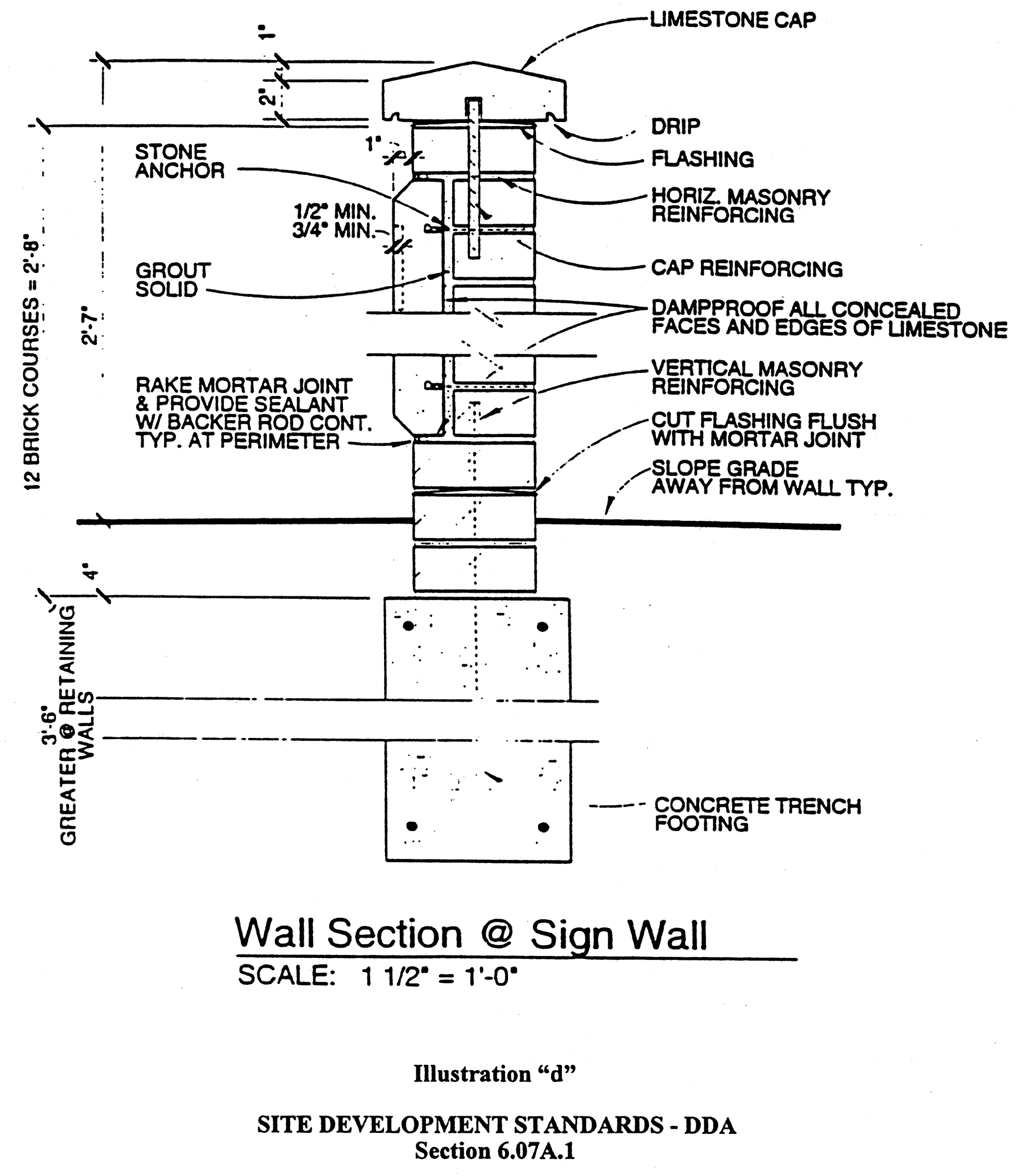
ILLUSTRATION D. SITE DEVELOPMENT STANDARDS - DDA
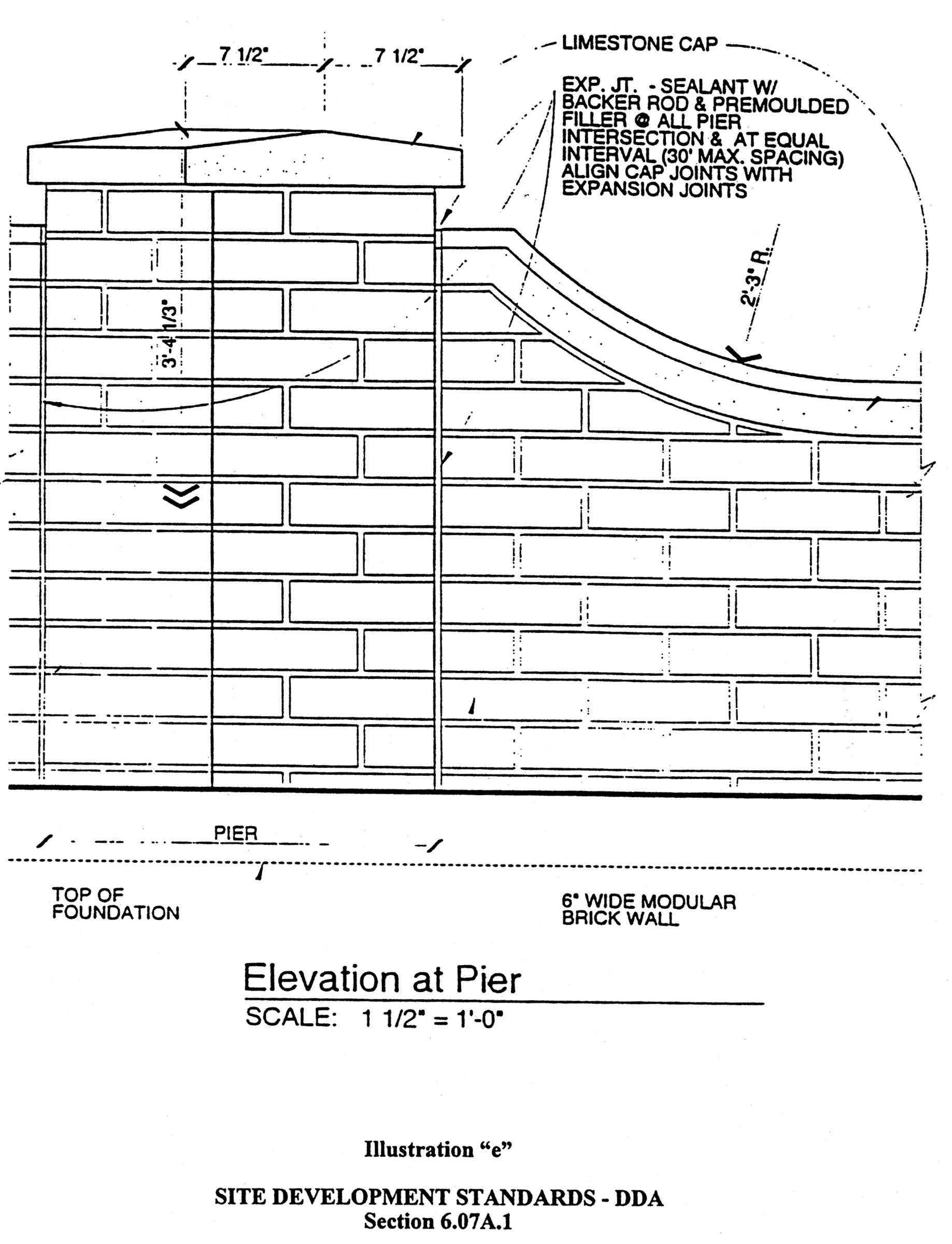
ILLUSTRATION E. SITE DEVELOPMENT STANDARDS - DDA
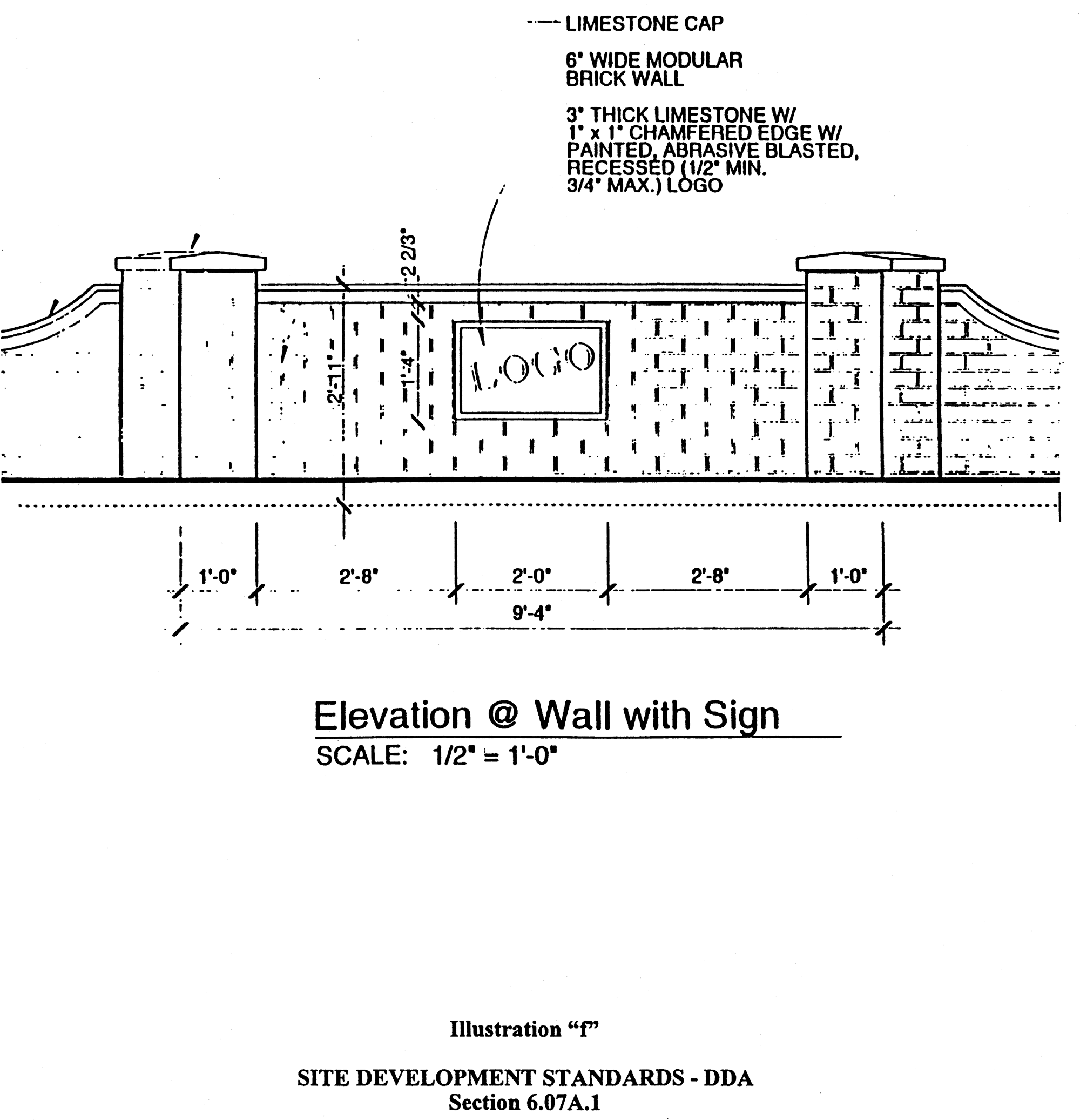
ILLUSTRATION F. SITE DEVELOPMENT STANDARDS - DDA
6.08. - Site development standards for the corporate park overlay district.
Implementation of the Lotz Road corridor development plan will take place through the use of the corporate park overlay district zoning regulations. All uses to be located within the corporate park overlay district shall be treated as special land uses.
All uses located within the corporate park overlay district are subject to the specific standards of the overlay zone. Design standards are tailored to the specific context of the Lotz Road corridor area, and include some areas located within the downtown development district (see also section 6.07).
A.
Purpose and intent. The purpose of the corporate park overlay district shall be to promote the development of the area surrounding the greater Lotz Road area in accordance with the Lotz Road corridor development plan, and in such a manner that will: promote excellence in the use of land and the design of buildings and sites, ensure compatible land use through a mixture of uses; minimize interference with the operation of the Ford Road/I-275 interchange; be compatible with the surrounding environment and characteristics of the site; ensure that the infrastructure will be adequate to accommodate the needs of the development; and provide for the needs of commuters and pedestrians including safe and efficient transportation corridors and recreational opportunities. In accordance with the community's goals, objectives and strategies, a mixed use high-tech industrial/commercial office park with hotel, entertainment and retail commercial use is proposed for the subject area.
B.
Applicable area. The proposed Canton Corporate Park overlay district encompasses the area east of I-275, west of the township line, south of the industrial zoning south of Warren Road, and north of the ITC power lines, just north of Cherry Hill Road, as illustrated in figure 6.08.B.1.
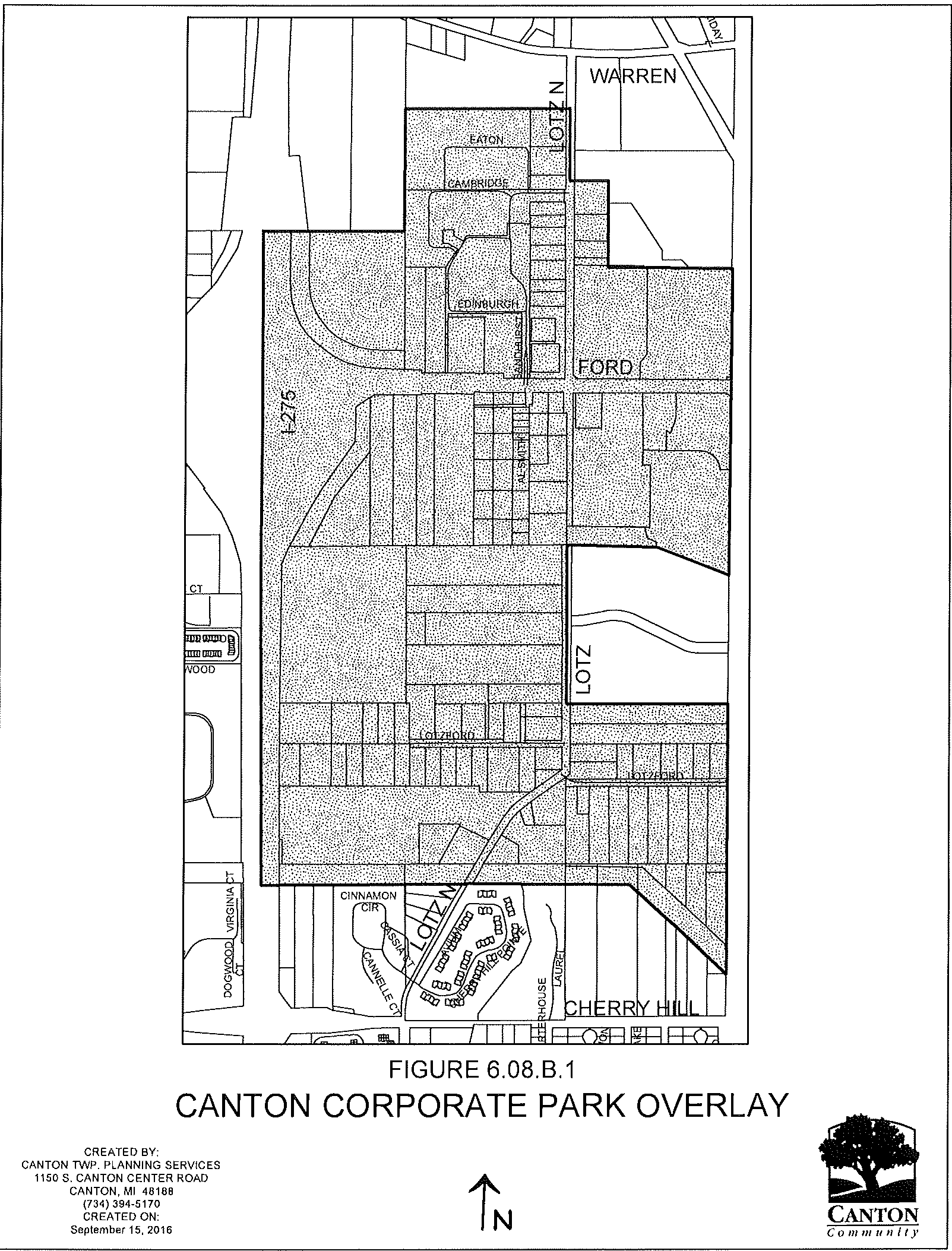
Certain properties located within the corporate park overlay district are also located within the Canton Township downtown development district. Said properties are subject to the following regulations in this section, in addition to the regulations found in section 6.07, and other applicable regulations as stated in the Charter Township of Canton zoning ordinance.
C.
Permitted uses and structures. Single-family residences, existing at the time of adoption of this ordinance shall be considered principal permitted uses and structures as of right. All other principal uses and structures shall be considered as special uses, subject to the regulations set forth herein, and the zoning ordinance of the Charter Township of Canton.
Exceptions: Any property which has an approved site plan which has not expired shall not be subject to the overlay requirements unless major modifications are made to the approved site plan. The underlying zoning regulations shall apply in this instance.
General location of any proposed use or combination of uses shall be consistent with Map 9, entitled "The Lotz Road Corridor Development Plan," within the Canton Township comprehensive plan.
D.
Special land uses. All uses specifically listed as a special land use in section 6.08.D.1 [6.08.D] may be permitted by the township board, subject to the following conditions; the conditions specified for each use; review and approval of an application and site plan by the planning commission and township board; the imposition of special conditions which, in the opinion of the planning commission or township board, are necessary to fulfill the purposes of this ordinance; the procedures, requirements and standards set forth in section 27.03; and, compliance with the development regulations set forth in section 6.08.F.
The following special land uses may be permitted by the township board, if all of the above conditions are met:
1.
Office buildings for any of the following occupations: administrative services, accounting, clerical, drafting, executive, professional, research, sales agent, technical training, stenographic or writing.
2.
Medical and dental clinics, office or laboratories.
3.
Financial institutions, including banks, credit unions, and savings and loan associations.
4.
Offices of a municipality or other public entity, including public utility buildings, provided there is no outside storage of materials or vehicles.
5.
Indoor assembly halls, concert halls, or similar places of public assembly.
6.
Research and design centers where said centers are intended for the development of pilot or experimental products, together with related office buildings for such research facilities where said offices are designed to accommodate executive, administrative, professional, accounting, engineering, architectural, and support personnel.
7.
Light manufacturing, research, assembly, testing and repair of components, devices, equipment and systems of professional scientific and controlling instruments, photographic and optical goods, including the following:
a.
Communication, transmission and reception equipment such as coils, tubes, semi-conductors, navigation control equipment and systems guidance equipment.
b.
Data processing equipment and systems.
c.
Graphics and art equipment.
d.
Metering instruments.
e.
Optical devices, equipment and systems.
f.
Audio units, radio equipment and television equipment.
g.
Photographic equipment.
h.
Radar, infrared and ultraviolet equipment and systems.
i.
Scientific and mechanical instruments such as calipers and transits.
j.
Testing equipment.
8.
Light manufacturing, processing or assembling of the following:
a.
Biological products, drugs, medicinal chemicals, and pharmaceutical preparation.
b.
Electrical machinery, equipment and supplies, electronic components and accessories.
c.
Office, computing and accounting machines.
9.
Flex industrial space, which may include a single- or multiple-use building where storage and distribution is accessory to the primary use.
10.
Data processing and computer centers including the servicing and maintenance of electronic data processing equipment.
11.
Training and/or educational centers where such centers are designed and intended to provide training at the business, technical, and/or professional level.
12.
Business service establishments such as printing and photocopying services, mail and packaging services, and typing and secretarial services.
13.
Computer and business machine sales when conducted in conjunction with and accessory to an approved principal use.
14.
Child care centers, subject to the provisions in section 6.02, subsection E, and provided that the following conditions are met: The child care center shall be located at the intersection of a major thoroughfare and an internal road serving the corporate park and/or must be part of a multiple-tenant building or multiple-building project site.
15.
Motion picture theaters, subject to the provisions in section 6.02, subsection O.
16.
Hotels and motels, subject to the provisions in section 6.02, subsection N.
17.
Standard restaurants, bars and lounges, provided that at least one of the following requirements are met: The restaurant, bar or lounge shall be located at the intersection of a major thoroughfare and an internal road serving the corporate park and/or must be part of a multiple-tenant building or multiple-building project site.
18.
Multiple-family or attached single-family residences when included as part of a mixed use building(s) or development and located south of the Willow Creek.
19.
Specialty retail business, service, and personal service establishments, when located within a multiple-tenant building or multiple-building project site:
a.
Carryout restaurants.
b.
Apparel.
c.
Bakery.
d.
Bookstore/stationery shop/periodicals.
e.
Convenience grocery.
f.
Delicatessen.
g.
Drugstore.
h.
Flower/gift shop.
i.
Toy and hobby shop.
j.
Videocassette rental.
k.
Barbershop/hair styling salon.
l.
Clothing alteration/shoe repair.
m.
Dry cleaning outlet.
n.
Photo processing.
o.
Photographic studios.
p.
Personal fitness/health centers.
20.
General retail and planned shopping centers, when located within a multiple-tenant building or multiple-building project site, subject to the provisions in section 6.06. This includes uses meeting the criteria for superstores in section 6.02.X1, when located within a multiple-building project site.
21.
Warehouse and distribution, when located north of the Tonquish Creek between Koppernick Commerce Drive and the railroad right-of-way.
22.
Uses and structures accessory to the above, subject to the provisions in section 2.03.
23.
Essential services, subject to the provisions in section 2.16.A.
Uses requiring any type of outside storage or display are strictly prohibited within this overlay district. Uses not permitted or otherwise included within this district may be permitted as a special land use in accordance with the provisions of section 2.08.
E.
Area and placement requirements. All buildings, uses, and parcels of land located within the corporate park overlay district shall be subject to the following schedule of regulations and footnotes:
_____
SCHEDULE OF REGULATIONS
CORPORATE PARK OVERLAY DISTRICT
Footnotes to schedule of regulations:
a.
Exceptions to height standards. The height standards shall not apply to certain structures listed in section 2.16.C.
b.
Setback on side yard facing a street. On corner lots, there shall be maintained a front yard along each street frontage.
c.
Use of front setback. Off-street parking shall not be permitted in the required front yard, except as stated in section 6.08.F.3. Loading areas shall be located in accordance with the requirements set forth in sections 4.02 and 21.03.
d.
Setbacks adjacent to residential districts. A minimum setback of 100 feet shall be required where the adjacent land is zoned for agricultural or residential use, except where a public street or railroad right-of-way provides a separation. Located within the 100-foot setback shall be a 50-foot-wide transition strip landscaped in accordance with section 5.03.A.2. No parking shall be permitted in this setback area.
e.
Setbacks adjacent to any internal street may be reduced upon a recommendation by the planning commission that the reduced setbacks will meet a specific and desirable site design objective.
f.
Single-family structures within the underlying R-2 district shall be subject to the standard schedule of regulations found in section 26.02.
_____
F.
Development regulations (for all areas within the corporate overlay district located south of the Tonquish Creek). Uses located within the corporate park overlay district are subject to the following development regulations, in addition to standards set forth in section 6.07, and [such regulations] shall be applicable to all uses within the corporate park overlay district.
1.
Open space requirement and computation. All uses within the corporate park overlay district shall exhibit and maintain a total open space requirement equal to at least 25 percent of the gross area of the site. Land areas within required boundary setbacks which are not paved may be included in the open space computation. The area contained in public or private street right-of-way and parking lots may not be included in the open space computation. Open space shall be arranged in a manner which will provide connections to other open space and preservation areas on the same and/or contiguous sites, wherever practical. Preservation of natural features shall receive the highest priority in meeting the open space requirement.
2.
Site access. Access to public roads shall be controlled in the interest of public safety. Each building or group of buildings and its parking or service area shall be subject to the following restrictions in order to: prevent unchannelled motor vehicle access or egress; ensure that driveway design and placement is in harmony with internal circulation and parking design; provide for sufficient on-site storage to accommodate queued vehicles waiting to park or exit; and require combined driveways wherever feasible.
a.
General standards.
1.
There must be sufficient on-site storage to accommodate queued vehicles waiting to park or exit without using a portion of the public right-of-way obstructing existing vehicles' sight distance, or otherwise interfering with street traffic.
2.
Provisions for circulation between adjacent parcels are required through coordinated or joint parking systems, except in the instance of industrial uses which the planning commission finds will cause undesirable traffic patterns and conflicts. In the instance that the planning commission determines that physical connection between one or more sites is not necessary, reciprocal easements will be required to ensure the ability to connect sites in the future as conditions change.
3.
Driveways shall be designed to accommodate all vehicle types having occasion to enter and exit the site, including delivery vehicles. There shall be clear delineation and/or separation, where appropriate, of entry and exit lanes within driveways.
4.
Driveway placement must be such that loading and unloading activities will not hinder vehicle ingress or egress.
5.
Shared or common driveway entrances shall be encouraged wherever possible to reduce unnecessary curb cuts and minimize turning conflicts.
b.
Driveway spacing. Driveway spacing will be determined as a function of operating speeds of the adjacent public road. Spacing will be determined according to the following minimum standards or to standards adopted by the appropriate governing road jurisdiction, whichever is more stringent:
In the area along Ford Road between I-275 and Lotz Road, separate sites fronting Ford Road shall provide a frontage road which parallels Ford Road and traffic shall be directed to a single point of access, which shall be in a location coordinated with both the north and south sides of Ford Road.
Spacing is based on average vehicle acceleration and deceleration rates and is considered necessary to maintain safe traffic operation. Spacing will be measured from the midpoint of each driveway. In the event that a particular parcel or parcels lack sufficient road frontage to maintain adequate spacing, the applicant shall have one of two options:
1.
A modification from minimum spacing can be sought from the planning commission, but in no case can the modification be greater than that which is necessary to provide safe and efficient access to the site.
2.
The adjacent landowners may agree to establish a common driveway. In such cases, the driveway midpoint shall be the property line between the two parcels and shall meet standard specifications. The township may require maintenance agreements between owners of a common driveway to cover such issues as snowplowing, resurfacing liability, etc.
c.
Number of driveways per parcel.
1.
A maximum of one two-way driveway opening or a pair of one-way driveway openings shall be permitted to a particular site from each adjacent public road.
2.
Based on the recommendation of the appropriate governing road jurisdiction and/or the township engineer, that an additional driveway is in the interest of good traffic operation, the planning commission may permit one additional driveway entrance along a continuous site with frontage in excess of 300 feet or two additional driveway entrances along a continuous site with frontage in excess of 600 feet.
3.
Common driveways, as set forth in section 6.08.F.2.b.2 shall be considered to be one driveway.
d.
Traffic impact analysis. The township may require a traffic impact analysis in order to analyze the effect of development upon existing street traffic. The traffic impact analysis shall examine existing and proposed traffic flows, trip generation studies, impacts on major intersections, turning movement analysis, roadway capacity, parking generation and site ingress/egress. The traffic impact analysis shall be prepared by a recognized traffic engineer or recognized traffic expert.
3.
Parking. Off-street parking shall conform to article 4. Parking shall be located solely in side or rear yard areas and excluded from the area between the public right-of-way and the front face of the building. The planning commission may permit parking between the public right-of-way line and the front face of buildings when it can be demonstrated that no other reasonable alternative exists. Provisions for circulation between adjacent parcels are encouraged through coordinated or joint parking systems, and internal access.
4.
Pedestrian pathways and sidewalks. Pedestrian pathways shall be provided, in accordance with applicable Canton Township design standards, to meet the circulation needs of on-site users. Such systems shall provide safe, all-weather, efficient, and aesthetically pleasing means of on-site movement and shall be an integral part of the overall site design concept. Pedestrian pathway connections to parking areas, buildings, other amenities, and between on-site and perimeter pedestrian systems shall be planned and installed wherever feasible. Sidewalks are required along all roadways.
Pathways and sidewalks shall be a minimum of five feet in width, and paved, except where the pathway enters designated woodlands, wetlands and other natural areas. Where pathways enter these sensitive natural areas, said pathways shall be a minimum of five feet in width, and may be surfaced with wood chips, stone, or other crushed aggregate, suitable for pedestrian traffic and harmonious with the natural environment.
5.
Lighting. Lighting shall provide for the safe and efficient illumination of a development site in order to maintain vehicle and pedestrian safety, site security, and accentuate architectural details. In addition to the standards set forth in section 2.13 (site lighting), shall be reviewed for consistency with recommended lighting by the Canton Township downtown development plan, and section 6.07.
a.
All street lighting to be installed between the sidewalk and street along Ford Road, Lotz Road, or other internal streets located within the Canton Corporate Park overlay district which also are within the downtown development district, shall match the existing fixtures located within the downtown development district, and conform to the locations and specifications set forth by the Canton Township downtown development authority (DDA), in accordance with section 6.07 of the zoning ordinance. In areas outside of the DDA district, lighting plans shall be internally consistent within multiple-building or multiple-site projects and be compatible with the DDA.
b.
All lighting potentially visible from an adjacent street, except pedestrian-oriented bollard lighting less than 42 inches high, shall be indirect or shall incorporate a full cut-off shield-type fixture.
c.
Service-area lighting shall be contained within the service yard's boundaries and enclosure walls. No light spillover shall occur outside the service area. The light source shall not be visible from the street.
d.
Building illumination and architectural lighting shall be indirect in character, with no light source visible. Architectural lighting, where used, shall articulate and animate the particular building design, as well as provide the required functional lighting for safety of pedestrian movement.
e.
Pedestrian walk lighting shall clearly identify the pedestrian walkway and direction of travel.
6.
Landscaping/streetscape elements. It is the intent of this section to ensure that the image of the corporate park overlay district is promoted by the organization, unification and character of the landscaping used throughout the overlay district.
In an attempt to unify the building sites and their architecture in the corporate park overlay district, landscaping as a design element will play the key role in creating and conveying the park-like environment. The extent [intent] of these design criteria are to fulfill aesthetic considerations, help insure an image that is distinctive and provide unification of the entire district. In addition to the standards set forth in article 5, the following requirements shall be met:
a.
Streetscape zone. The streetscape zone is the primary image setting zone and includes all frontage along Ford, Lotz and Warren Roads, as well as internal streets. Landscaping within this area shall be regulated as follows:
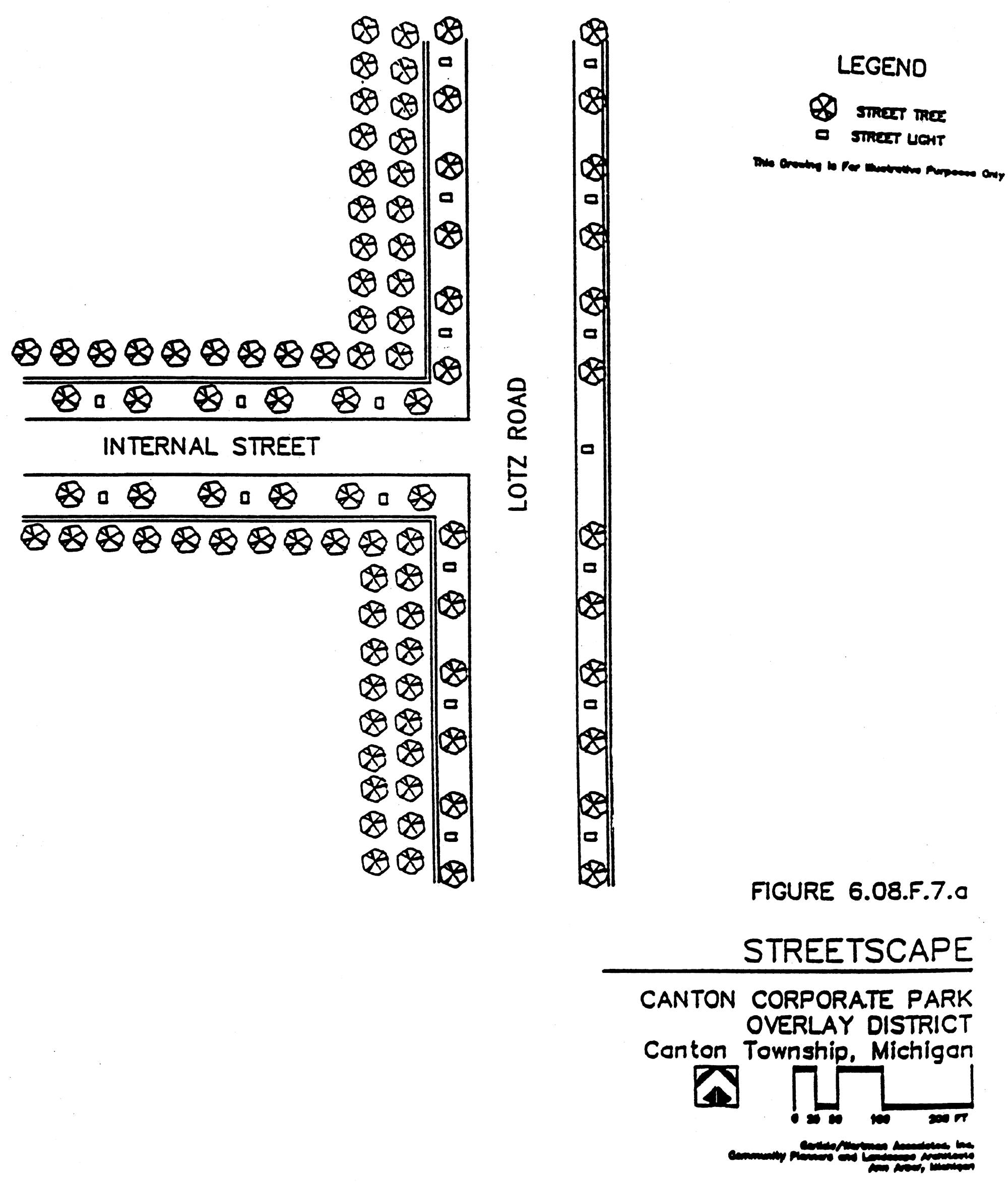
STREETSCAPE
1.
Setback zone. The area between the public rights-of-way to the edge of parking or buildings shall be regulated as follows:
(a) Ford, Lotz and Warren Roads. A double row of deciduous trees will line Ford, Lotz and Warren Roads, with occasional triple rows where setbacks allow. A single row, planted 80 feet on center, should be planted between the curb and sidewalk, with a double row, planted 40 feet on center, between the sidewalk and parking area or setback line. Plant species will be selected by the applicant from table A of section 6.07, and approved by the planning commission.
(b) Internal streets. A double row of deciduous trees will line internal streets. A single row, planted 80 feet on center, between the curb and sidewalk, with a single row, planted 40 feet on center, between the sidewalk and parking area or setback line. Plant species will be selected by the applicant from table A of section 6.07, and approved by the planning commission.
(c) Wherever front, side or rear yards are adjacent to public road rights-of-way, garden wall elements shall be incorporated into the required landscape area. The required wall shall be constructed of brick to match the existing garden wall in the downtown development district, and shall include a limestone cap as indicated in the accompanying illustrations and specifications located within section 6.07 of the zoning ordinance. Location of the garden wall shall be reviewed simultaneously with the site plan, by the planning commission.
b.
Street intersections. The streetscape at intersections is to be treated with elements of pavers, lighting in accordance with sections 6.07.8 and 6.08.F.6, and accent planting of shrubs and other low perennials. Plant species will be selected by the applicant from table A of section 6.07, and approved by the planning commission. The unobstructed sight distance requirement as stated in section 2.09.A.4 of the zoning ordinance must be maintained.
c.
Interior landscape zone. The interior zone encompasses all site features from the setback line to the property lines of each parcel. This zone is subject to the needs of each individual tenant and thus is meant to have a greater degree of flexibility than the streetscape zone. Such landscaping shall comply with the standards set forth in article 5 of the zoning ordinance.
d.
Preservation of natural features. Special emphasis shall be placed on the preservation of existing wetlands, woodlands and surface water and the incorporation of such features on the overall site design.
e.
Stormwater facilities. Stormwater forebays and detention or retention ponds shall be designed to be natural systems and integrated into the site as landscape or natural features.
7.
General site design/architectural guidelines. It is the intent of the corporate park overlay district to provide an environment of high quality and complementary building architecture and site design. Special emphasis shall be placed upon methods that tend to reduce the large scale visual impact of buildings, to encourage tasteful, imaginative design for individual buildings, and to create a complex of buildings compatible with the streetscape.
a.
Site planning design criteria.
1.
Facility entrance/exit drive(s) shall be readily observable to the first-time visitor.
2.
Minimum conflict shall exist between service vehicles, private automobiles, and pedestrians within the site.
3.
Building entries for visitors shall be readily identifiable and accessible to the first-time visitor. Each principal building shall have a clearly defined, highly visible customer (visitor) entrance with features such as canopies or porticos, arcades, arches, plazas, wing walls, benches, water features and integral planters.
4.
Architecture will be evaluated based on its compatibility and relationships to the landscape, and vice versa.
b.
Building massing and form.
1.
All buildings shall have a horizontal appearance brought about by the use of horizontal bands and fascia to minimize the verticality of the structure.
2.
Architectural interest shall be provided through the use of repeating patterns of changes in color, texture and material modules. At least one of these elements shall repeat horizontally. All elements should repeat at intervals of no more than 50 feet, either horizontally or vertically.
3.
Radical theme structures or signage, building, and roof forms which draw unnecessary attention from public thoroughfare to the building shall not be acceptable.
4.
Building facades greater than 100 feet in length shall incorporate recesses, projections, or spandrel windows along at least 20 percent of the length of the facade. Windows, awnings, and arcades must total at least 60 percent of a facade length abutting a public street.
c.
Materials.
1.
Building exterior wall materials.
(a) One dominant material shall be selected and expressed within its own natural integrity. Materials such as masonry and stone, etc., which convey permanence, substance, timelessness, and restraint are required.
(b) Low maintenance shall be a major consideration.
(c) Materials shall blend with those existing in the adjacent area of the center.
(d) Pre-engineered metal buildings, corrugated metal-sided "Butler" type buildings, and metal siding are prohibited.
d.
Building roofs.
1.
In instances where flat roof areas can be viewed from above, care should be taken that all roof vents, roof-mounted mechanical equipment, pipes, etc., are grouped together and painted to match roof color to reduce their appearance.
2.
Sloped roof treatments are preferred. Sloped roofs may be of any traditional roof material.
3.
There shall be variations in rooflines to reduce the massive scale of the structure and add visual interest. Roofs shall have at least two of the following features: parapets concealing flat roofs and rooftop equipment, overhanging eaves, sloped roofs, and three or more roof surfaces.
e.
Color and texture.
1.
Simple and uniform texture patterns are encouraged.
2.
Variations in color shall be kept to a minimum.
3.
Colors shall be subdued in tone, of a low reflectance and of neutral or earth tone colors. The use of high intensity colors, metallic colors, black or fluorescent colors is prohibited.
4.
Accent colors may [be] considered as part of the overall architectural proposal for the project.
8.
Loading docks, outdoor storage and refuse collection areas.
a.
All outdoor refuse containers shall be visually screened within a durable eight-foot or higher noncombustible enclosure, constructed of the same material as the primary structure, pursuant to section 2.14. The refuse container shall not be visible from adjacent lots or sites, neighboring properties or streets. No refuse collection areas shall be permitted between a street and the front of a building.
b.
Refuse collection areas should be effectively designed to contain all refuse generated on-site and deposited between collections. Deposited refuse shall not be visible from outside the refuse enclosure.
c.
Loading docks, outdoor storage areas, and refuse collection enclosures shall be incorporated into the overall design of the building and the landscaping so that the visual and acoustic impacts of these functions are fully contained and out of view from adjacent properties and public streets. The use of screening materials that are different from or inferior to the principal materials of the building and landscape is prohibited.
d.
Refuse collection areas should be so located upon the lot as to provide clear and convenient access to refuse collection vehicles and thereby minimize wear and tear on-site and off-site developments.
e.
Refuse collection areas should be designed and located upon the lot as to be convenient for the deposition of refuse generated on-site.
9.
Screening of exterior mechanical equipment.
a.
In the case of roof-mounted mechanical equipment, building parapets and roofline designs shall be of such a height that roof-mounted screening devices are not required. If building parapets do not provide the required screening, mechanical equipment shall be screened by an unobtrusive screening device that will appear as an integrated part of the overall architectural design.
b.
Any devices employed to screen exterior components of plumbing, processing, heating, cooling, and ventilating systems from direct view shall appear as integrated parts of the architectural design and, as such, shall be constructed of complementary and durable materials and finished in a texture and color scheme complementary to the overall architectural design.
c.
Any exterior components of plumbing, processing, heating, cooling and ventilating systems and their screening devices which will be visible from upper floors of adjacent buildings shall be kept to a visible minimum, shall be installed in a neat and compact fashion, and shall be painted such a color as to allow their blending with their visual backgrounds.
d.
No exterior components of plumbing, processing, heating, cooling, and ventilating systems shall be mounted on any building wall unless they are integrated architectural design features, and in any case shall be permitted only with the approval of the planning commission.
10.
Screening of exterior electrical equipment and transformers.
a.
Transformers that may be visible from any primary visual exposure area shall be screened with either plantings or a durable noncombustible enclosure, preferably constructed of the same material as the primary structure, so as not to be visible from adjacent lots or sites, neighboring properties or streets.
b.
Transformer enclosures shall be designed of durable materials, preferably constructed of the same material as the primary building, with finishes and colors which are unified and harmonious with the overall architectural theme.
c.
Exterior-mounted electrical equipment shall be mounted on the interior of a building wherever possible. When interior mounting is not practical, electrical equipment shall be mounted in a location where it is substantially screened from public view. In no case shall exterior electrical equipment be mounted on the street side or primary exposure side of any building.
d.
Exterior-mounted electrical equipment and conduits shall be kept to a visible minimum, where visible shall be installed in a neat and orderly fashion, and shall be painted to blend with their mounting backgrounds.
11.
Utilities and communication devices.
a.
All exterior on-site utilities, including but not limited to drainage systems, sewers, gas lines, water lines, and electrical, telephone, and communications wires and equipment, shall be installed and maintained underground.
b.
On-site underground utilities shall be designed and installed to minimize any disruption of off-site utilities, paving, and landscape during construction and maintenance, and shall be of such a design as not to place excessive burdens upon off-site utility systems during the course of use.
c.
Satellite dish[es] and antennas shall comply with the Canton Township satellite dish and antenna ordinance, Ordinance No. 13 [section 78-4 of the Township Code]. Antennas shall comply with the setback standards for the district in which they are located.
G.
Development regulations (for the area within the corporate overlay district located north of the Tonquish Creek). Uses located within the corporate overlay district located north of the Tonquish Creek shall be subject to all applicable requirements of the overlay district except subsection F, paragraphs 4, 7.a, and 7.b, relative to pedestrian pathways and streetscape zone. Landscaping adjacent to the roads shall be subject to the requirements of section 5.03 of the zoning ordinance.
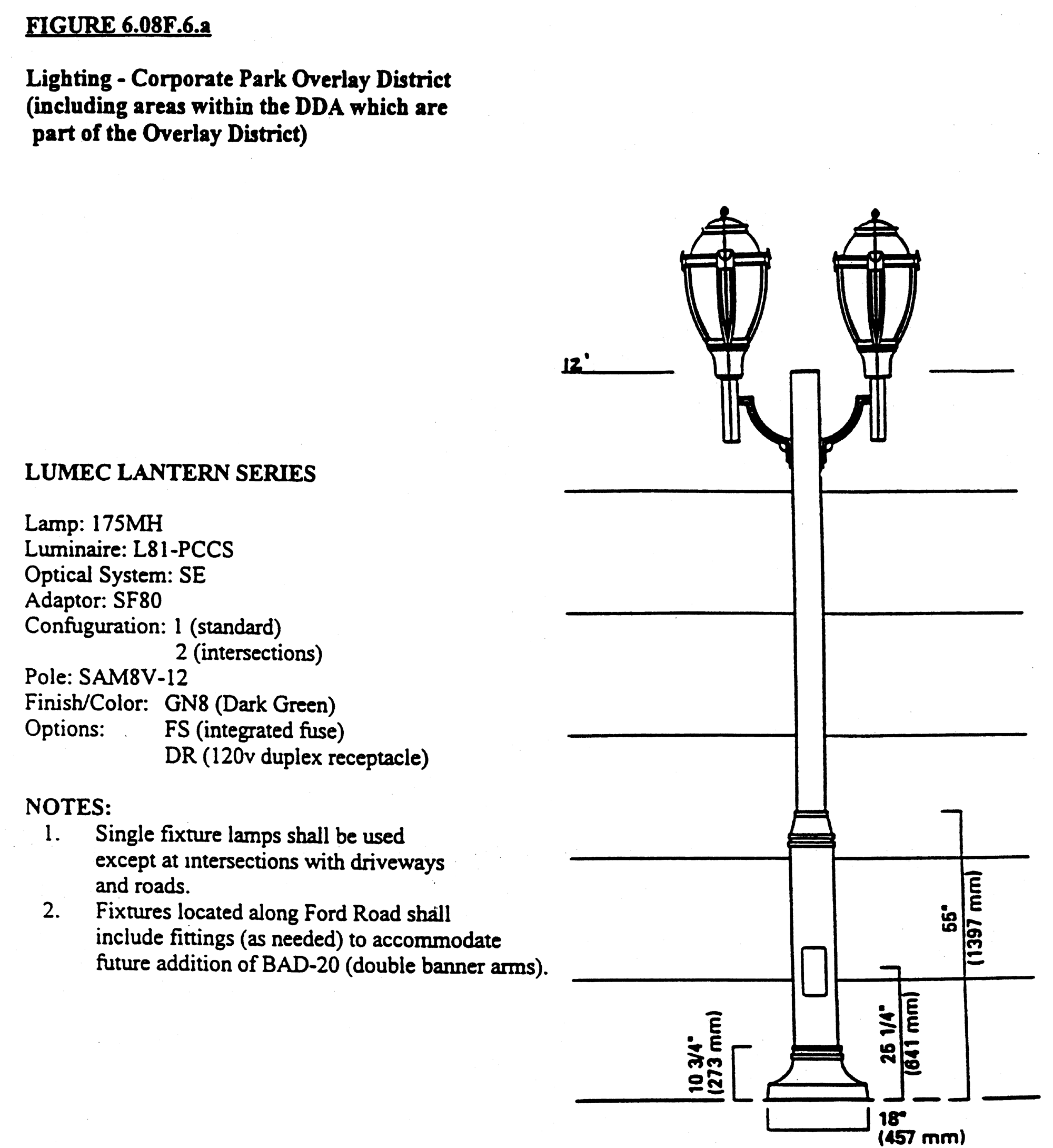
(Ord. of 12-10-2013, pt. I; Ord. of 11-22-2016, pt. I; Ord. of 3-18-2024(1); Ord. of 01-13-2026(1))
6.09. - Site development standards for the Cherry Hill overlay district.
Implementation of the Cherry Hill Area development plan will take place through the use of Cherry Hill area overlay district regulations. All uses located within the Cherry Hill area overlay district, unless otherwise noted, shall be subject to the specific standards of the overlay zone.
A.
Purpose and intent. The purpose of the Cherry Hill area district shall be to promote the development of the area in accordance with the Cherry Hill area development plan, which is part of the Canton Township comprehensive plan, and in such a manner that will: maintain, preserve and enhance historic resources; allow for a mixed use concept of new development that advances the creation of a "hamlet" focusing on the historic resources; arrive at a residential pattern which addresses both style and architecture appropriate for the area; and, develop a vehicular and pedestrian circulation pattern appropriate for a "hamlet" style development while recognizing current community and lifestyle issues.
In an effort to create a unique and identifiable community in the Cherry Hill area, it is further required that these objectives will be implemented through the use of the planned development regulations, unless otherwise noted herein, and the Cherry Hill area design guidelines which are adopted as part of this ordinance.
B.
Applicable area and requirements.
1.
The Cherry Hill area district encompasses the area as illustrated in figure 6.09.B.1 [see the figures at the end of this section].
2.
All projects, with the exceptions noted herein, shall be treated as a planned development in accordance with the standards and procedures set forth in section 27.04, subject further to the Cherry Hill area design guidelines goals and objectives of the Cherry Hill area development plan which is part of the Canton Township comprehensive plan; the Cherry Hill village design guidelines, which are attached to and made part of this ordinance; and the standards contained herein. The minimum size of a planned development of ten acres shall not be applicable for projects within the Cherry Hill area overlay district.
3.
The following uses shall not be required to be treated as a planned development but shall be subject to site plan review and the Cherry Hill village design guidelines.
a.
Individual properties which are designated as historically significant or contributing as identified in the Cherry Hill Historic District Ordinance No. 117-3 [section 90-93 of the Township Code], and are proposed for rehabilitation and restoration shall not be subject to the requirements of a planned development but shall be subject to site plan review in accordance with the design guidelines. Said properties shall be subject to the Charter Township of Canton Historic District Ordinance No. 117A [chapter 90 of the Township Code] and the Cherry Hill Historic District Ordinance No. 117-3.
b.
The construction and/or rehabilitation of individual buildings not part of an overall development project otherwise subject to the requirements of section 6.09.B.2.
C.
Principal permitted uses and structures.
1.
Single-family residences existing at the time of adoption of this ordinance shall be considered principal permitted uses and structures as of right and lots shall be a minimum of 120 feet in width and 30,000 square feet in area, subject to the setback and height requirements of the R-2 single-family residential district.
2.
Single-family detached dwelling.
3.
Single-family attached dwelling, including two-family dwellings and townhouses.
4.
Publicly and privately owned parks, parkway, and recreation facilities.
5.
Family day care homes.
6.
Housing for the elderly including assisted living and congregate care facilities.
7.
Religious institutions.
8.
Public, parochial, and other private elementary, intermediate, or high schools.
9.
Public or private colleges and universities.
10.
Child and adult day care facilities.
11.
Municipal buildings.
12.
Private kennels, subject to the provisions in section 6.02, subsection K.
13.
Private stables, subject to the provisions in section 6.02, subsection X.
14.
Public and private golf courses.
15.
Bed and breakfast establishments.
16.
Essential services.
17.
Grocery stores and specialty retail businesses, including, but not limited to: apparel, jewelry, bakery, books, stationery and office supplies, periodicals, gifts and home decorating, convenience grocery or general store, delicatessen, ice cream parlor, drugstore, hardware store, flowers, toys, hobby and crafts, music, and videocassette rental.
18.
Personal service establishments, including but not limited to: barbershop, beauty salon, clothing alteration, shoe repair, dry cleaning outlet, photo processing, suntan salon, photographic studio.
19.
Professional offices.
20.
Medical/dental clinics or offices.
21.
Financial institutions.
22.
Standard and carryout restaurants, with liquor sales on premises accessory to standard restaurant only.
23.
Personal fitness centers, martial arts studios, dance, music and voice schools.
24.
Art gallery and studios.
25.
Post office.
26.
Multiple-family dwellings, including apartment buildings and apartments or lofts located on the upper floors of nonresidential buildings.
27.
Banquet and meeting halls.
28.
Performing and cultural arts facilities, museums, and similar uses.
29.
Cider mill, farmers' market, and similar uses.
30.
Automobile filling stations.
31.
Uses and structures accessory to the above, subject to the provisions in section 2.03.
The above uses shall be reviewed in accordance with the standards set forth in section 27.04.C and can be subject to the regulations and procedures as set forth herein in section 6.09.B and the zoning ordinance of the Charter Township of Canton.
D.
General design principles.
1.
Density shall be determined in accordance with the requirements set forth in section 27.04D.5. Such requirements are to be applied keeping in mind the objectives of the Cherry Hill Area Development Plan, as follows: Density within the Village Edge shall not exceed four dwelling units/acre. If it is determined that unallocated sewer capacity is available to serve the land area within the village boundary, density for the Village Edge may be increased to a maximum of six dwelling units/acre. Density within the mixed use Village Core area shall not exceed 12 dwelling units/acre. Boundaries of the Village Edge and Village Core areas are defined on Figure 1 of the design guidelines.
2.
Proposed development shall promote the creation of new neighborhoods that exhibit the characteristics and design features of traditional neighborhoods and are compatible with the scale and architecture of existing buildings in the Cherry Hill area. New developments shall reflect diversity in regard to the mixture of housing types, a mixture of housing styles, and a mixture of lot sizes and shapes.
3.
A strong, central focus shall be provided at Cherry Hill and Ridge Road which functions as the Village Core, contributing to establishing community identity and provides an essential area for social interaction. The general concept and land use arrangement for the Village Core is set forth in the Cherry Hill Village design guidelines.
4.
Overall street design and layout shall be an integral component of site design. The street layout shall be a modified grid street pattern adapted to the topography, unique natural features and environmental constraints of the tract, as well as peripheral open space areas. The street layout shall take into consideration the location of the Village Core, open space areas, and significant vistas. A minimum of two interconnections with the existing public street system shall be provided where possible. Street widths and alignments shall be scaled to neighborhood size and be patterned after the character of existing residential streets.
5.
Buildings with two or more facades visibly exposed to a street or common open space shall be specially designed to respond to these more prominent locations. Such buildings shall have special massing and/or other treatments on all exposed facades. All exposed facades shall be treated with the same architectural quality and detail. Buildings that are located at the termination of a view, vista, or axis shall be considered more significant structures requiring special architectural responses.
6.
Emphasis shall be placed on providing a pedestrian circulation system which promotes safety and social interaction and connects neighborhoods with open space, recreational and community facilities and commercial areas. Linkages to adjacent developments and neighborhoods with pedestrian and bicycle paths are recommended where possible.
7.
All open space shall serve a functional purpose as visual enhancement and/or providing for both passive and active recreational needs of the area. Open space shall be an integral component of the overall site design and concept and not be considered an afterthought of site planning.
8.
Utilities shall be installed underground in accordance with the standards set forth in section 2.25.
9.
The removal or disruption of historic, traditional or significant uses, structures, or architectural elements shall be minimized insofar as practicable.
E.
Design guidelines. The Cherry Hill Village design guidelines which include site and architectural design standards, are hereby incorporated and made part of the overlay district by reference.
(Ord. of 1-23-2003; Ord. of 2-13-2018(1), § 1)
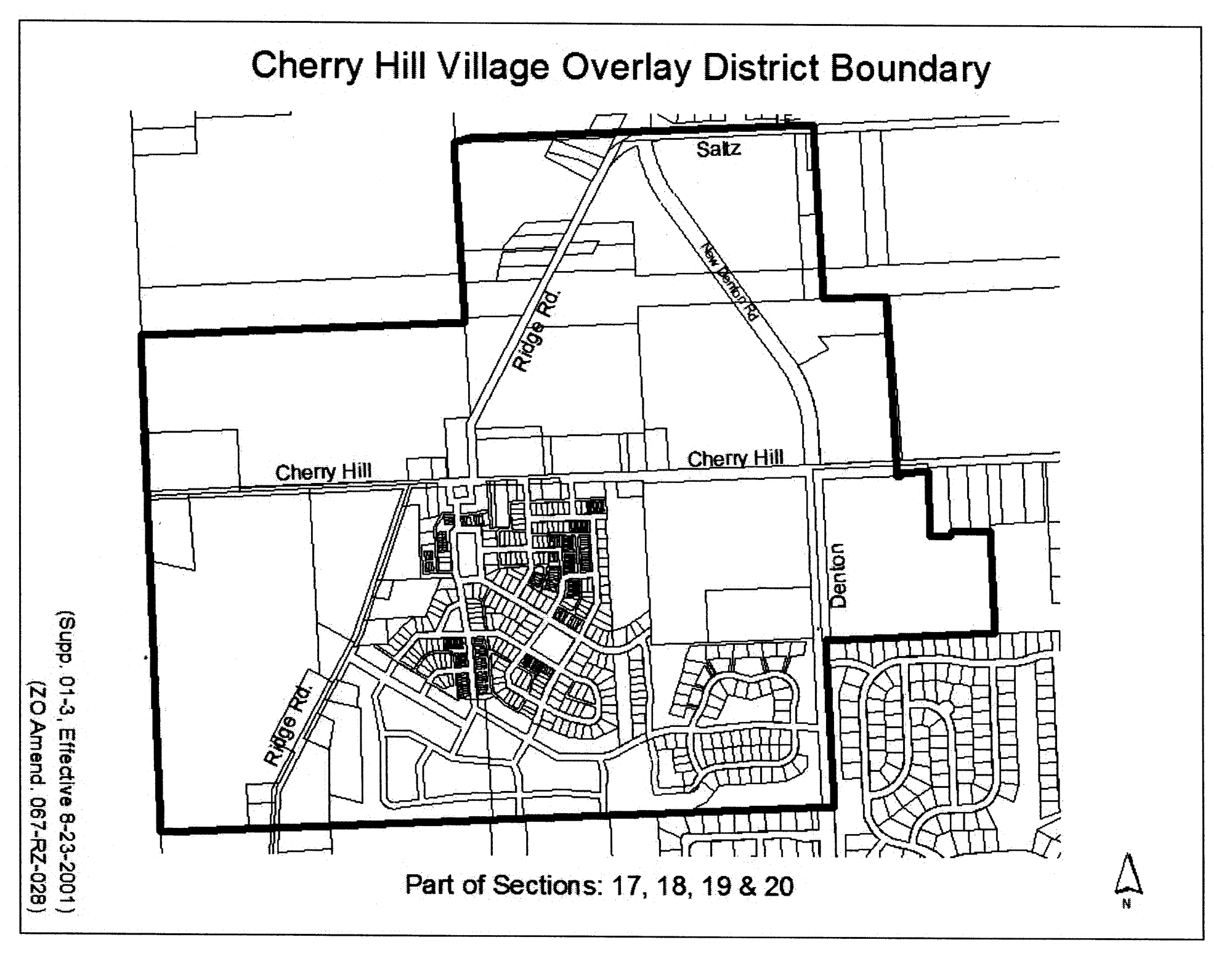
Figure 6.09B.1
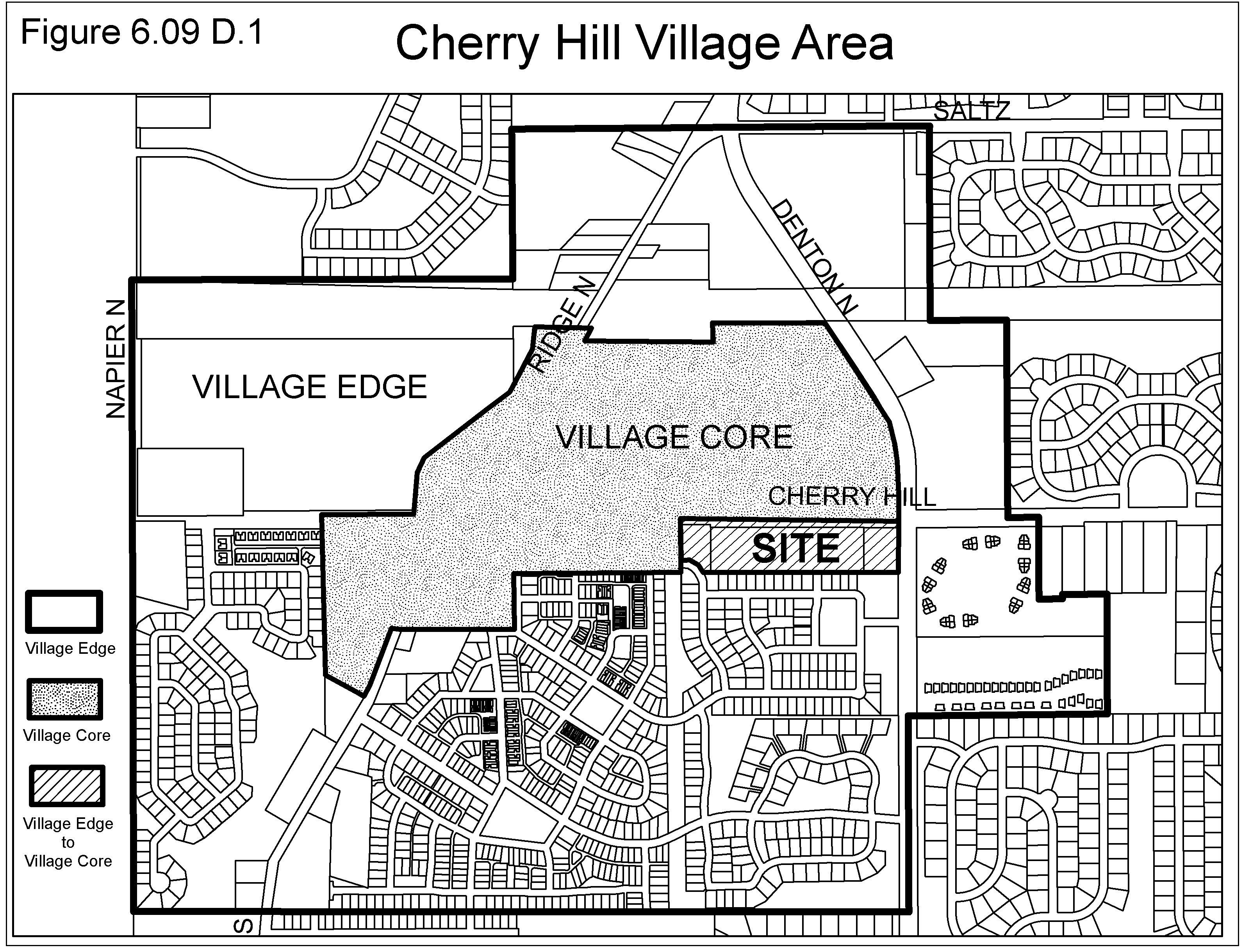
6.10. - Site development standards for the central business district overlay.
Implementation of the downtown development authority master plan will take place through the use of the central business district overlay regulations. The underlying zoning district will be used to determine permitted and special land uses.
A.
Purpose and intent. The purpose of the central business district overlay shall be to promote the development and redevelopment of the Ford Road corridor west of I-275, and in such a manner that will: promote excellence in the use of land and the design of buildings and sites; ensure compatible land use through a mixture of uses; minimize interference with the operation of the Ford Road/I-275 Interchange; be compatible with the surrounding environment and characteristics of the site; ensure that the infrastructure will be adequate to accommodate the needs of the development; and provide for the needs of commuters and pedestrians including safe and efficient transportation corridors and recreational opportunities.
B.
Applicable area. The proposed central business district overlay encompasses the area west of I-275, as illustrated in Figure 6.10.B.1. All parcels located within the central business district overlay are also located within the Canton Township Downtown Development District. Said properties are subject to the following regulations in this section, in addition to the regulations found in section 6.07, and other applicable regulations as stated in the Charter Township of Canton Zoning Ordinance.
C.
Permitted uses and structures. Any property which has an approved site plan which has not expired shall not be subject to the overlay requirements unless major modifications are made to the approved site plan. The underlying zoning regulations shall apply in this instance.
Permitted and special land uses.
1.
Permitted and special land uses shall be determined by the permitted and special land uses in the underlying zoning district in which the parcel is located and the uses shall be subject to all of the specific development guidelines applicable to the proposed use.
2.
Any use listed in the C-3 district shall also be considered as a permitted or special land use in the C-2 district. Planned shopping centers located in the C-2 district shall be subject to the size thresholds and criteria in the C-3 district with respect to determination of whether it is a permitted or special land use.
3.
In the commercial and single-family zoning districts, single-family attached residential development may be considered as a special land use, subject to the requirements of section 6.03 and the schedule of regulations for the commercial districts specified in this section.
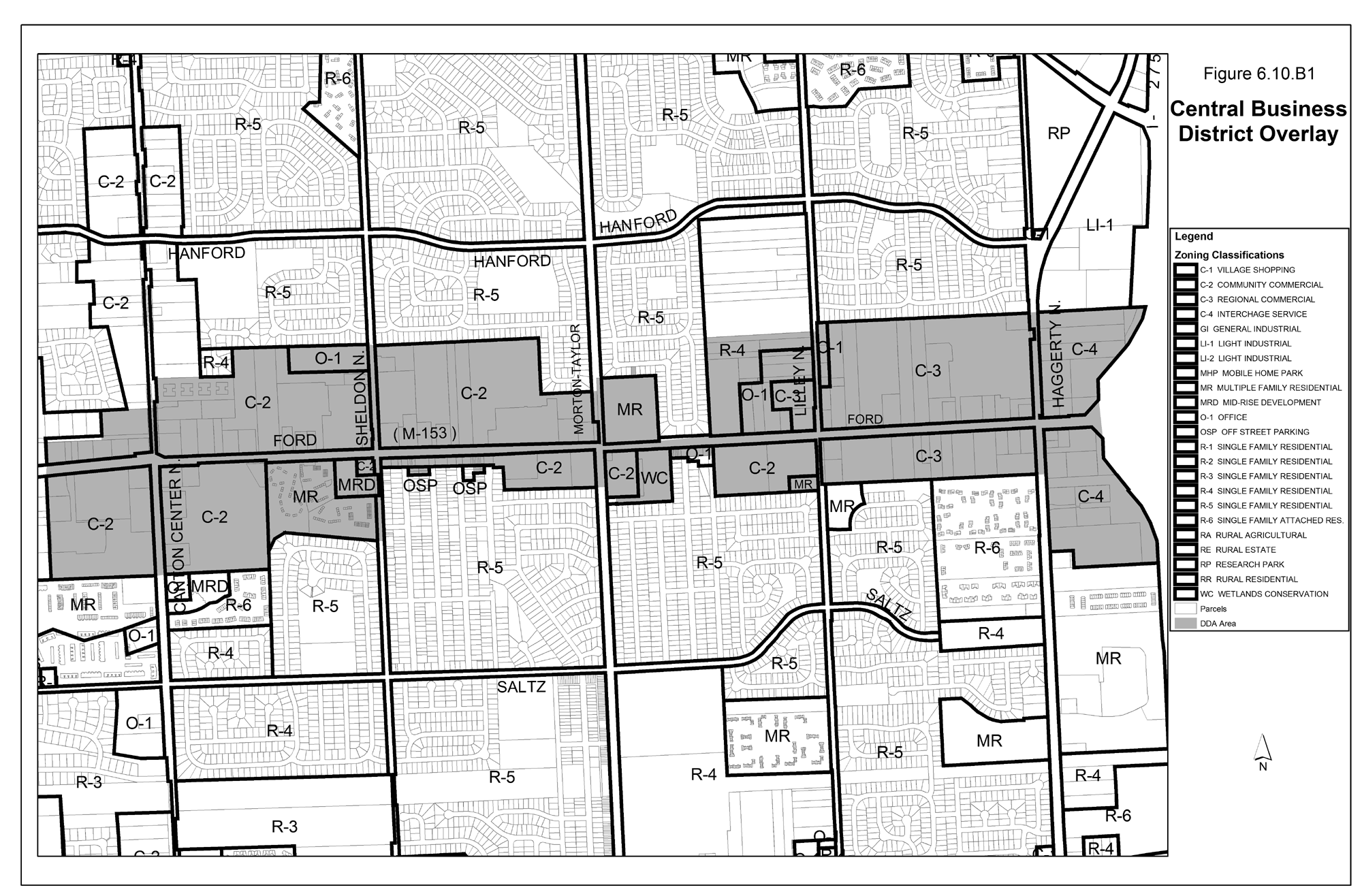
Map of Central Business District Overlay Boundaries
D.
Area and placement requirements. All buildings, uses, and parcels of land located within the central business district overlay shall be subject to the following schedule of regulations and footnotes:
_____
SCHEDULE OF REGULATIONS
CENTRAL BUSINESS DISTRICT OVERLAY
_____
Footnotes to schedule of regulations:
a.
Exceptions to height standards. The height standards shall not apply to certain structures listed in section 2.16.C.
b.
Setback on side yard facing a street. On corner lots, there shall be maintained a front yard along each street frontage.
c.
Use of front setback. Off-street parking shall not be permitted in the required front yard, except as stated in section 6.10.E.3. Loading areas shall be located in accordance with the requirements set forth in sections 4.02 and 21.03.
d.
Setbacks adjacent to residential districts. A minimum setback of 100 feet shall be required where the adjacent land is zoned for agricultural or residential use, except where a public street or railroad right-of-way provides a separation. Located within the 100-foot setback shall be a 50-foot wide transition strip landscaped in accordance with section 5.03.A.2. No parking shall be permitted in this setback area.
e.
Setbacks adjacent to any street may be reduced upon a recommendation by the planning commission that the reduced setbacks will meet a specific and desirable site design objective. Criteria which will be evaluated include setbacks of buildings on adjacent sites, length of building along the street, overall size and massing of the building, and how effectively the street facade creates an urban scale and context appropriate streetscape in order to enhance sense of place.
E.
Development regulations. Development within the central business district overlay is subject to the following regulations, in addition to standards set forth in §6.07 Site Development Standards for the Downtown Development District and other applicable requirements for specific uses in this ordinance, as appropriate.
1.
Open space requirement and computation. All uses within the central business district overlay shall exhibit and maintain a total open space requirement equal to at least 25 percent of the gross area of the site. Land areas within required boundary setbacks which are not paved may be included in the open space computation. The area contained in public or private street right-of-way and parking lots may not be included in the open space computation. Open space shall be arranged in a manner which will provide connections to other open space and preservation areas on the same and/or contiguous sites, wherever practical. Preservation of natural features shall receive the highest priority in meeting the open space requirement.
2.
Site access. Access to public roads shall be controlled in the interest of public safety. Each building or group of buildings and its parking or service area shall be subject to the following restrictions in order to: prevent unchannelled motor vehicle access or egress; ensure that driveway design and placement is in harmony with internal circulation and parking design; provide for sufficient on-site storage to accommodate queued vehicles waiting to park or exit; and require combined driveways wherever feasible.
a.
General standards.
1.
There must be sufficient on-site storage to accommodate queued vehicles waiting to park or exit without using a portion of the public right-of-way obstructing existing vehicles sight distance, or otherwise interfering with street traffic.
2.
Provisions for circulation between adjacent parcels are required through coordinated or joint parking systems, except in the instance of industrial uses which the planning commission finds will cause undesirable traffic patterns and conflicts. In the instance that the planning commission determines that physical connections between one or more sites is not necessary, reciprocal easements will be required to ensure the ability to connect sites in the future as conditions change.
3.
Driveways shall be designed to accommodate all vehicle types having occasion to enter and exit the site, including delivery vehicles. There shall be clear delineation and/or separation, where appropriate, of entry and exit lanes within driveways. Delivery drives shall be marked appropriately and designed to accommodate the turning radii of delivery vehicles.
4.
Driveway placement must be such that loading and unloading activities will not hinder vehicle ingress or egress.
5.
Shared or common driveway entrances shall be encouraged wherever possible to reduce unnecessary curb cuts and minimize turning conflicts.
b.
Driveway spacing. Driveway spacing will be determined as a function of operating speeds of the adjacent public road. Spacing will be determined according to the following minimum standards or to standards adopted by the appropriate governing road jurisdiction, whichever is more stringent:
Spacing is based on average vehicle acceleration and deceleration rates and is considered necessary to maintain safe traffic operation. Spacing will be measured from the midpoint of each driveway. In the event that a particular parcel or parcels lack sufficient road frontage to maintain adequate spacing, the applicant shall have one of two options:
1.
A modification from minimum spacing can be sought from the planning commission, but in no case can the modification be greater than that which is necessary to provide safe and efficient access to the site.
2.
The adjacent landowners may agree to establish a common driveway. In such cases, the driveway midpoint shall be the property line between the two parcels and shall meet standard specifications. The township may require maintenance agreements between owners of a common driveway to cover such issues as snow plowing, resurfacing liability, etc.
c.
Number of driveways per parcel.
1.
A maximum of one two-way driveway opening or a pair of one-way driveway openings shall be permitted to a particular site from each adjacent public road.
2.
Based on the recommendation of the appropriate governing road jurisdiction and/or the township engineer, that an additional driveway is in the interest of good traffic operation, the planning commission may permit one additional driveway entrance along a continuous site with frontage in excess of 300 feet or two additional driveway entrances along a continuous site with frontage in excess of 600 feet.
3.
Common driveways, as set forth in section 6.08.F.2.b.2 shall be considered to be one driveway.
d.
Traffic impact analysis. The township may require a traffic impact analysis in order to analyze the effect of development upon existing street traffic. The traffic impact analysis shall examine existing and proposed traffic flows, trip generation studies, impacts on major intersections, turning movement analysis, roadway capacity, parking generation and site ingress/egress. The traffic impact analysis shall be prepared by a recognized traffic engineer or recognized traffic expert.
3.
Parking and joint access.
a.
Off-street parking shall conform to article 4, except as provided in paragraph b below. Parking shall be located in side or rear yard areas and excluded from the area between the public right-of-way and the front face of the building wherever possible. The planning commission may permit parking between the public right-of-way line and the front face of buildings when it can be demonstrated that elimination of parking in the front is not practical.
b.
A stepped parking ratio for multitenant shopping centers and superstores is provided as follows: the standard parking ratio pursuant to section 4.01 for these uses shall be used for the first 100,000 square feet of gross floor area. For all gross floor area over 100,000 square feet, the parking ratio shall be decreased to 1 parking space per 350 square feet.
c.
Parking lots shall be broken into smaller areas through the use of landscaping island and boulevard strips of at least 10 feet in width. Each parking lot pod should not exceed 200 spaces and each parking lot aisle should not exceed 20 spaces deep. Pedestrian access through or across parking lots island or boulevards shall be provided as needed. Planting of parking lot islands shall comply with the provisions of article 5.
d.
All sites shall provide joint access through the use of reciprocal easement agreements in order to provide primary connections between driveways and parking areas and shall adhere to the Michigan Department of Transportation's access management guidelines and the approved access management plan for Ford Road.
4.
Pedestrian pathways and sidewalks. Pedestrian pathways shall be provided, in accordance with applicable Canton Township Design Standards, to meet the circulation needs of on-site users. Such systems shall provide safe, all-weather, efficient, and aesthetically pleasing means of on-site movement and shall be an integral part of the overall site design concept. Pedestrian pathway connections to parking areas, buildings, other amenities, and between on-site and perimeter pedestrian systems shall be planned and installed wherever feasible. Sidewalks are required along all roadways.
Pathways and sidewalks shall be a minimum of five feet in width, and paved, except where the pathway enters designated woodlands, wetlands and other natural areas. Where pathways enter these sensitive natural areas, said pathways shall be a minimum of five feet in width, and may be surfaced with wood chips, stone, or other crushed aggregate, suitable for pedestrian traffic and harmonious with the natural environment.
5.
Lighting. Lighting shall provide for the safe and efficient illumination of a development site in order to maintain vehicle and pedestrian safety, site security, and accentuate architectural details. In addition to the standards set forth in section 2.13, site lighting, shall be reviewed for consistency with recommended lighting by the Canton Township Downtown Development Plan, and section 6.07.
a.
All street lighting to be installed between the sidewalk and street along Ford Road, Wayne County roads, or other internal streets located within the central business district overlay shall match the existing fixtures located within the downtown development district, and conform to the locations and specifications set forth by the Canton Township Downtown Development Authority (DDA), in accordance with section 6.07 of the zoning ordinance.
b.
All lighting potentially visible from an adjacent street, except pedestrian oriented bollard lighting less than 42 inches high, shall be indirect or shall incorporate a full cut-off shield-type fixture.
[c.]
Parking lot lighting shall utilize poles and fixtures which have a maintenance free finish in a dark bronze or other dark color which coordinates with other proposed site lighting.
d.
Service area lighting shall be contained within the service yards boundaries and enclosure walls. No light spillover shall occur outside the service area. The light source shall not be visible from the street.
e.
Building illumination and architectural lighting shall be indirect in character, with no light source visible. Architectural lighting, where used shall articulate and enhance the particular building design, as well as provide the required functional lighting for safety of pedestrian movement. Strip lighting including but not limited to, neon tube on LED strips, used for the purpose of outlining building features shall not be permitted. All proposed architectural lighting shall be fully detailed on the building elevations and shall be subject to review and approval of the planning commission and township board in conjunction with review and approval of the site plan.
f.
Pedestrian walk lighting shall clearly identify the pedestrian walkway and direction of travel.
6.
Landscaping/streetscape elements.
a.
Setback zone. The area between the public rights-of-way to the edge of parking or buildings shall be regulated as follows: wherever front, side or rear yards are adjacent to public road rights-of-way, the dda garden wall elements shall be incorporated into the required landscape area pursuant to the specifications and illustrations located within section 6.07 of the zoning ordinance. Location of the garden wall shall be reviewed simultaneously with the site plan, by the planning commission.
b.
The minimum width of the landscape buffer adjacent to the road shall be 25 feet and be planted in accordance with sections 5.03.a.3 and 6.07.a.2. Where the building is placed at the minimum setback (or reduced setback as approved by the planning commission) and no parking area or driveway is located between the building and the landscape buffer (setback zone), the required foundation landscaping shall be located adjacent to the parking lot sides of the building.
c.
Street intersections. The streetscape at intersections is to be treated with colored and stamped concrete ramps, lighting in accordance with sections 6.07.b and 6.08.f.6, and accent planting of shrubs and other low perennials. Plant species will be selected by the applicant from table a of section 6.07, and approved by the planning commission. The unobstructed sight distance requirement as stated in section 2.09.a.4 of the zoning ordinance must be maintained.
d.
Interior landscape zone. The interior zone encompasses all site features from the setback line to the property lines of each parcel. This zone is subject to the needs of each individual tenant and thus is meant to have a greater degree of flexibility than the streetscape zone. This area shall incorporate stamped concrete or individual pavers to delineate pedestrian crossings and entry details at main building and/or tenant entrances. Such landscaping shall comply with the standards set forth in article 5 of the zoning ordinance.
e.
Preservation of natural features. Special emphasis shall be placed on the preservation of existing wetlands, woodlands and surface water and the incorporation of such features on the overall site design.
f.
Stormwater facilities. Stormwater forebays and detention or retention ponds shall be designed to be natural systems and integrated into the site as landscape or natural features.
7.
General site design/architectural guidelines. It is the intent of the central business overlay district to provide an environment of high quality and complementary building architecture and site design. Special emphasis shall be placed upon methods that tend to reduce the large-scale visual impact of buildings, to encourage tasteful, imaginative design for individual buildings, and to create a complex of buildings compatible with the streetscape.
a.
Site planning design criteria.
1.
Facility entrance/exit drive(s) shall be readily observable to the first-time visitor.
2.
Minimum conflict shall exist between service vehicles, private automobiles, and pedestrians within the site.
3.
Building entries for visitors shall be readily identifiable and accessible to the first-time visitor. Each principal building shall have a clearly defined, highly visible customer (visitor) entrance with features such as canopies or porticos, arcades, arches, plazas, wing walls, benches, water features and integral planters.
4.
Architecture will be evaluated based on its compatibility and relationships to the landscape, and vice versa.
b.
Building massing and form.
1.
Buildings shall be required to incorporate variations in height and provide vertical architectural elements as a feature of the overall design. It is recommended that main entrances be emphasized through use of vertical elements and that long expanses of wall be broken up by appropriate use of window features, masonry insets, canopies and other architectural details to create rhythm and interest in the building facades. Secondary walls shall also include appropriate architectural treatment which complements the design of the primary facade.
2.
Architectural interest shall be provided through the use of repeating patterns of changes in color, texture and material modules. At least one of these elements shall repeat horizontally. All elements should repeat at intervals of no more than 50 feet, either horizontally or vertically. Use of columns with capitals and/or engaged pilasters are encouraged to break up the horizontal features of walls.
3.
Radical theme structures or signage, building, and roof forms which draw unnecessary attention from public thoroughfare to the building shall not be acceptable.
4.
Building facades greater than 100 feet in length shall incorporate recesses, projections, or spandrel glass or bricked-in windows along at least 20 percent of the length of the facade. Windows, awnings, and arcades must total at least 60 percent of a facade length abutting a public street.
c.
Materials.
1.
Building exterior wall materials.
(a)
One dominant material shall be selected and expressed within its own natural integrity. Materials such as masonry and stone, etc., which convey permanence, substance, timelessness, and restraint are required. Use of limestone or similar materials are encouraged.
(b)
Low maintenance shall be a major consideration.
(c)
Materials shall blend with those existing in the adjacent area of the center.
(d)
Pre-engineered metal buildings, corrugated metal-sided Butler type buildings, and metal siding are prohibited.
d.
Building roofs.
1.
In instances where flat roof areas can be viewed from above, care should be taken that all roof vents, roof-mounted mechanical equipment, pipes, etc., are grouped together and painted to match roof color to reduce their appearance.
2.
There shall be variations in roof lines to reduce the massive scale of the structure and add visual interest. Roofs shall have at least two of the following features: parapets concealing flat roofs and rooftop equipment, overhanging eaves, sloped roofs, and three or more roof surfaces.
e.
Color and texture.
1.
Simple and uniform texture patterns are encouraged.
2.
Variations in color shall be kept to a minimum.
3.
Colors shall be subdued in tone, of a low reflectance and of neutral or earth tone colors. The use of high intensity colors, metallic colors, black or fluorescent colors is prohibited.
4.
Accent colors may be considered as part of the overall architectural proposal for the project.
Building interest is encouraged by the use of unique brick patterns, three dimensional patterns in use of synthetic plaster features, and variation of materials.
Architectural lighting is encouraged to accent landscaping and along long sections of walls
6.[f.]
Site amenities. Provision of landscaped plaza areas to accommodate the display of public art are required in appropriate areas within the site and/or along a primary thoroughfare is required. Provision of art within these areas is also encouraged.
8.
Loading docks, outdoor storage and refuse collection areas.
a.
All outdoor refuse containers shall be visually screened within a durable eight feet or higher noncombustible enclosure, constructed of the same material as the primary structure pursuant to section 2.14.
b.
Refuse collection areas should be effectively designed to contain all refuse generated on site and deposited between collections. Deposited refuse shall not be visible from outside the refuse enclosure. Use of compactors for larger sites and internal compactors for larger uses is encouraged.
c.
Loading docks, outdoor storage areas, and refuse collection enclosures shall be incorporated into the overall design of the building and the landscaping so that the visual and acoustic impacts of these functions are fully contained and out of view from adjacent properties and public streets. The use of screening materials that are different from or inferior to the principal materials of the building and landscape is prohibited.
d.
Refuse collection areas should be so located upon the lot as to provide clear and convenient access to refuse collection vehicles and should be designed and located upon the lot as to be convenient for the deposition of refuse generated on site.
9.
Screening of exterior mechanical equipment.
a.
In the case of roof-mounted mechanical equipment, building parapets and roof line designs shall be of such a height that roof-mounted screening devices are not required. If building parapets do not provide the required screening, mechanical equipment shall be screened by an unobtrusive screening device that will appear as an integrated part of the overall architectural design.
b.
Any devices employed to screen exterior components of plumbing, processing, heating, cooling, and ventilating systems from direct view shall appear as integrated parts of the architectural design and, as such, shall be constructed of complementary and durable materials and finished in a texture and color scheme complementary to the overall architectural design.
c.
Any exterior components of plumbing, processing, heating, cooling and ventilating systems and their screening devices which will be visible from upper floors of adjacent buildings shall be kept to a visible minimum, shall be installed in a neat and compact fashion, and shall be painted such a color as to allow their blending with their visual backgrounds.
d.
No exterior components of plumbing, processing, heating, cooling, and ventilating systems shall be mounted on any building wall unless they are integrated architectural design features, and in any case shall be permitted only with the approval of the planning commission.
10.
Screening of exterior electrical equipment and transformers.
a.
Transformers that may be visible from any primary visual exposure area shall be screened with either plantings or a durable noncombustible enclosure, preferably constructed of the same material as the primary structure, so as not to be visible from adjacent lots or sites, neighboring properties or streets.
b.
Transformer enclosures shall be designed of durable materials, preferably constructed of the same material as the primary building, with finishes and colors which are unified and harmonious with the overall architectural theme.
c.
Exterior-mounted electrical equipment shall be mounted on the interior of a building wherever possible. When interior mounting is not practical, electrical equipment shall be mounted in a location where it is substantially screened from public view. In no case shall exterior electrical equipment be mounted on the street side or primary exposure side of any building.
d.
Exterior-mounted electrical equipment and conduits shall be kept to a visible minimum, where visible shall be installed in a neat and orderly fashion, and shall be painted to blend with their mounting backgrounds.
11.
Utilities and communication devices.
a.
All exterior on-site utilities, including but not limited to drainage systems, sewers, gas lines, water lines, and electrical, telephone, and communications wires and equipment, shall be installed and maintained underground.
b.
On-site underground utilities shall be designed and installed to minimize any disruption of off-site utilities, paving, and landscape during construction and maintenance, and shall be of such a design as not to place excessive burdens upon off-site utility systems during the course of use.
c.
Satellite dish and antennas shall comply with the Canton Township Satellite Dish and Antennae Ordinance, Ordinance No. 13 [section 78-4 of the Code of Ordinances]. Antennas shall comply with the setback standards for the district in which they are located.
(Ord. of 5-25-2004; Res. of 5-31-2007; Ord. of 12-20-2007; Ord. of 3-18-2024(1); Ord. of 01-13-2026(1))

