
Canton City Zoning Code
ARTICLE 5
00.- LANDSCAPING, SCREENING, AND WALLS
5.01.- Intent and scope of requirements.
A.
Intent. Landscaping, greenbelts, and screening are necessary for the continued protection and enhancement of all land uses. Landscaping and greenbelts are capable of enhancing the visual image of the township, preserving natural features, improving property values, and alleviating the impact of noise, traffic, and visual distraction associated with certain uses. Screening is important to protect less-intensive uses from the noise, light, traffic, litter and other impacts of more intensive, nonresidential uses. Accordingly, these provisions are intended to set minimum standards for the design and use of landscaping, greenbelts, and screening, and for the protection and enhancement of the township's environment. More specifically, the intent of these provisions is to:
1.
Improve the appearance of off-street parking areas, vehicular use areas, and property abutting public rights-of-way,
2.
Protect and preserve the appearance, character, and value of the neighborhoods which abut nonresidential areas, parking areas, and other intensive use areas, thereby protecting the public health, safety and welfare,
3.
Reduce soil erosion and depletion, and
4.
Increase soil water retention, thereby helping to prevent flooding.
B.
Scope of application. These requirements shall apply to all uses which are developed, expanded, or changed and to all lots, sites, and parcels which are developed or expanded upon following the effective date of this ordinance. No site plan shall be approved unless it shows landscaping consistent with the requirements of this section. Where landscaping is required, a building permit shall not be issued until the required landscape plan is submitted and approved, and a certificate of occupancy shall not be issued unless provisions set forth in this section have been met or a performance guarantee has been posted in accordance with the provisions set forth in section 2.17.
C.
Minimum requirements. The requirements in this article are minimum requirements, and under no circumstances shall they preclude the developer and the township from agreeing to more extensive landscaping.
D.
Design creativity. Creativity in landscape design is encouraged. Accordingly, required trees and shrubs may be planted at uniform intervals, at random, or in groupings, depending on the designer's desired visual effect and, equally important, the intent of the township to coordinate landscaping on adjoining properties. Generally, the most successful landscape design plans have involved clustering of trees and shrubs, rather than "formal" designs involving placement of trees and shrubs at uniform intervals.
5.02. - General landscaping requirements.
A.
General site requirements. All developed portions of the site shall conform to the following general landscaping standards, except where specific landscape elements, such as a greenbelt, berms, or screening are required:
1.
All unpaved portions of the site shall be planted with grass, ground cover, shrubbery, or other suitable live plant material, which shall extend to any abutting street pavement edge. Grass areas in the front yard of all nonresidential uses shall be planted with sod.
2.
A mixture of evergreen and deciduous trees shall be planted on nonresidential parcels at the rate of one tree per 3,000 square feet or portion thereof of any unpaved open area for which specific landscaping requirements do not appear later in this article. Required trees may be planted at uniform intervals, at random, or in groupings.
3.
All lawn and landscaped areas shall be provided with four inches of topsoil or compost on untilled surfaces or two inches of topsoil or compost on tilled surfaces.
B.
Berms. Where required, berms shall conform to the following standards:
1.
Dimensions. Unless otherwise indicated or appropriate, required berms shall be measured from the grade of the adjacent road right-of-way or parking lot adjacent to the berm, whichever is higher, and shall be constructed with slopes no steeper than one foot vertical for each three feet horizontal (33 percent slope), with at least a two-foot flat area on top. Berms shall undulate both vertically and horizontally and the landscape plan shall show the proposed contours of the berm, subject to review and approval of berm design as shown on the site plan.
2.
Protection from erosion. Any required berm shall be planted with sod, ground cover, or other suitable live plant material to protect it from erosion so that it retains its height and shape. The use of railroad ties, cement blocks, and other types of construction materials to retain the shape and height of a berm shall be prohibited unless specifically reviewed and approved by the planning commission.
3.
Required plantings.
a.
Berms located in the front yard of nonresidential parcels. Berms located in the front yard of nonresidential parcels shall be landscaped in accordance with the requirements for landscaping adjacent to roads, section 5.03.A.3.
b.
Berms used for screening other than in the front yard. A minimum of one deciduous shade tree shall be planted for each 30 lineal feet or portion thereof, plus, a minimum of one ornamental tree shall be planted for each 50 lineal feet or portion thereof of required berm, plus, evergreen trees or hedges that are at least eight feet high as measured from the top of the root ball, which, upon being planted in two rows with staggered offset planted 15-foot on center of both rows, will create a visual barrier for at least 75 percent of the berm length.
4.
Measurement of berm length. For the purposes of calculating required plant material, berm length shall be measured along the exterior edge of the berm.
C.
Parking lot landscaping. In addition to required screening, all off-street parking areas shall also provide landscaping as follows:
1.
Landscaping ratio. Off-street parking areas containing greater than 15 spaces shall be provided with at least 25 square feet of interior landscaping per parking space, except that only ten square feet of interior landscaping shall be required per parking space located in a parking structure in the mid- and high-rise development districts, and in mobile home park, R-6, MR, and RMH districts. Whenever possible, parking lot landscaping shall be designed to improve the safety of pedestrian and vehicular traffic, guide traffic movement, and improve the appearance of the parking area.
2.
Minimum area. Landscaped areas located in parking lots and adjacent to any building wall shall be no less than 12 feet in any single dimension and no less than 150 square feet in area, except that interior landscaped areas shall measure no less than 300 square feet in area in the mid- and high-rise development districts. In the C-1 and C-2 zoning districts, any planting island located within a parking lot or located adjacent to a perimeter driveway shall be a minimum of 20 feet in any single dimension and no less than 400 square feet in area. Wherever possible, the parking areas and driveways shall be separated from the buildings by a landscaped island. Landscaped areas in or adjacent to parking lots shall be protected with curbing or other means to prevent encroachment of vehicles.
3.
Other landscaping. Required landscaping elsewhere on the parcel shall not be counted in meeting the parking lot landscaping requirements.
4.
Required plantings. Requirements for plant material shall be based on the location, size, and shape of the parking lot landscaped area. A minimum of one evergreen or deciduous shade tree shall be planted per 300 square feet or fraction thereof of interior landscaped area. At least 50 percent of each interior landscaped area shall be covered by living plant material, such as sod, shrubs, ground cover, or trees. Plantings within parking lots shall comply with the requirements for unobstructed site [sight] distance set forth in section 5.02.F, herein. The landscape plan shall indicate the types, sizes, and quantities of plant material proposed for such area.
D.
Screening.
1.
General screening requirements. Unless otherwise specified, wherever an evergreen or landscaped screen is required, evergreen screening shall consist of closely spaced plantings which can be reasonably expected to form a complete visual barrier that is at least eight feet above ground level within five years of planting. Wherever screening is required adjacent to residentially zoned or used property, the screening must be installed prior to the beginning of site grading and general construction, except where such activity would result in damage to the screening.
2.
Screening of utility substation and mechanical equipment. Mechanical equipment, such as air compressors, pool pumps, transformers, air conditioning units, sprinkler pumps, satellite dish antennas, utility substations and similar equipment shall be screened by evergreens on at least three sides. Insofar as practical, said screening shall exceed the vertical height of the equipment being screened by at least six inches within two years of planting. Specific screening requirements for utility substations will be determined on a case-by-case basis by the township depending on the particular character of the area where the substation is proposed to be located.
E.
Landscaping of rights-of-way. Public rights-of-way located adjacent to required landscaped areas and greenbelts shall be planted with sod or other suitable live ground cover, and shall be maintained by the owner or occupant of the adjacent property as if the rights-of-way were part of the required landscaped areas or greenbelts. No plantings except grass or ground cover shall be permitted closer than three feet from the edge of the road pavement.
F.
Maintenance of unobstructed visibility for drivers. No landscaping shall be erected, established, or maintained on any parcel or in any parking lot which will obstruct the view of drivers. Accordingly, all landscaping shall comply with the provisions concerning unobstructed sight distance set forth in section 2.09.A.4, herein. Furthermore, interior landscaping in parking lots shall not be permitted to obstruct cross-visibility between a height of 30 inches and six feet above the grade level of the parking lot.
G.
Potential damage to utilities. In no case shall landscaping material be planted in a way which will interfere with or cause damage to underground utility lines, public roads, or other public facilities. Species of trees whose roots are known to cause damage to public roadways, sewers, or other utilities shall not be planted closer than 15 feet from any such roadways, sewers, or utilities. A list of such tree species shall be kept on file with the planning official, and shall be made available to all interested persons upon request.
H.
Landscaping of divider medians. Where traffic on driveways, maneuvering lanes, private roads, or similar vehicle accessways is separated by a divider median, the median shall be curbed and have a minimum width of 12 feet as measured from the back of curb. A minimum of one deciduous or evergreen tree shall be planted for each 30 lineal feet or portion thereof of median. Trees may be planted at uniform intervals, at random, or in groupings, but in no instance shall the center-to-center distance between trees exceed 60 feet.
I.
Stormwater detention basins. Detention basins (ponds) shall be designed as an integral part of the overall site plan and shall be considered a natural landscape feature having an irregular shape. Planting Guidelines are available from Canton Township Planning Services upon request.
The following standards shall be considered minimum requirements for the landscaping of detention ponds/basins:
1.
Detention basin vegetation requirements. The landscape treatment for detention basins shall include a variety of native wetland and wildflower species. Native vegetation provides a number of benefits in detention basins including enhanced stormwater quality, increased habitat, passive recreational opportunities and reduced algae growth. The combination of wetland plugs and native seed mixes will provide the optimum opportunities to achieve the benefits described above. The side slopes and the bottom of the pond shall be planted with a combination of a native seed mix and wetland plugs/bare-root stock. Refer to Planting Guidelines for definitions of various native plant types in accordance with the standards outlined in this section.
a.
Planting zone definitions. Planting zones and proposed native plants, including all seed mixes, shrubs, trees, plugs and bare-root stock shall be identified on the landscape plan and referenced on the engineering site plan based on the proposed stormwater elevations in the detention basin(s). See illustration.
1.
Pond zone (depths from 0 feet to 3 feet deep). Plants in the pond zone are entirely or partially submerged, utilize nutrients from stormwater runoff and provide habitat for wildlife such as waterfowl and aquatic insects. Recommended plants in this zone must be planted according to industry standards. Minimum requirements are specified in section I.1.d, plantings and vegetation standards according to planting zone. Approved native plant species are listed in planting guidelines.
2.
Edge zone (permanent water elevation to bankfull elevation). Plants in the Edge Zone can withstand periods of inundation and drought and function to stabilize side slopes of the basin, utilize nutrients, provide habitat for waterfowl, reduce water temperatures and conceal drawdown in typical mowed ponds. Recommended plants in this zone must be planted according to industry standards. Minimum requirements are specified in section I.1.d, plantings and vegetation standards according to planting zone. Approved native plant species are listed in planting guidelines.
3.
Upland zone (bankfull elevation to 100-year flood elevation and beyond). Plants in the upland zone can withstand periods of inundation and drought and function to stabilize side slopes, provide habitat for waterfowl, songbirds and other wildlife, consist of low maintenance species as frequency of mowing will be limited, and be selected based on soil condition, light and function as little or no inundation by stormwater may occur. Recommended plants in this zone must be planted according to industry standards. Minimum requirements are specified in section I.1.d, plantings and vegetation standards according to planting zone. Approved native plant species are listed in planting guidelines.
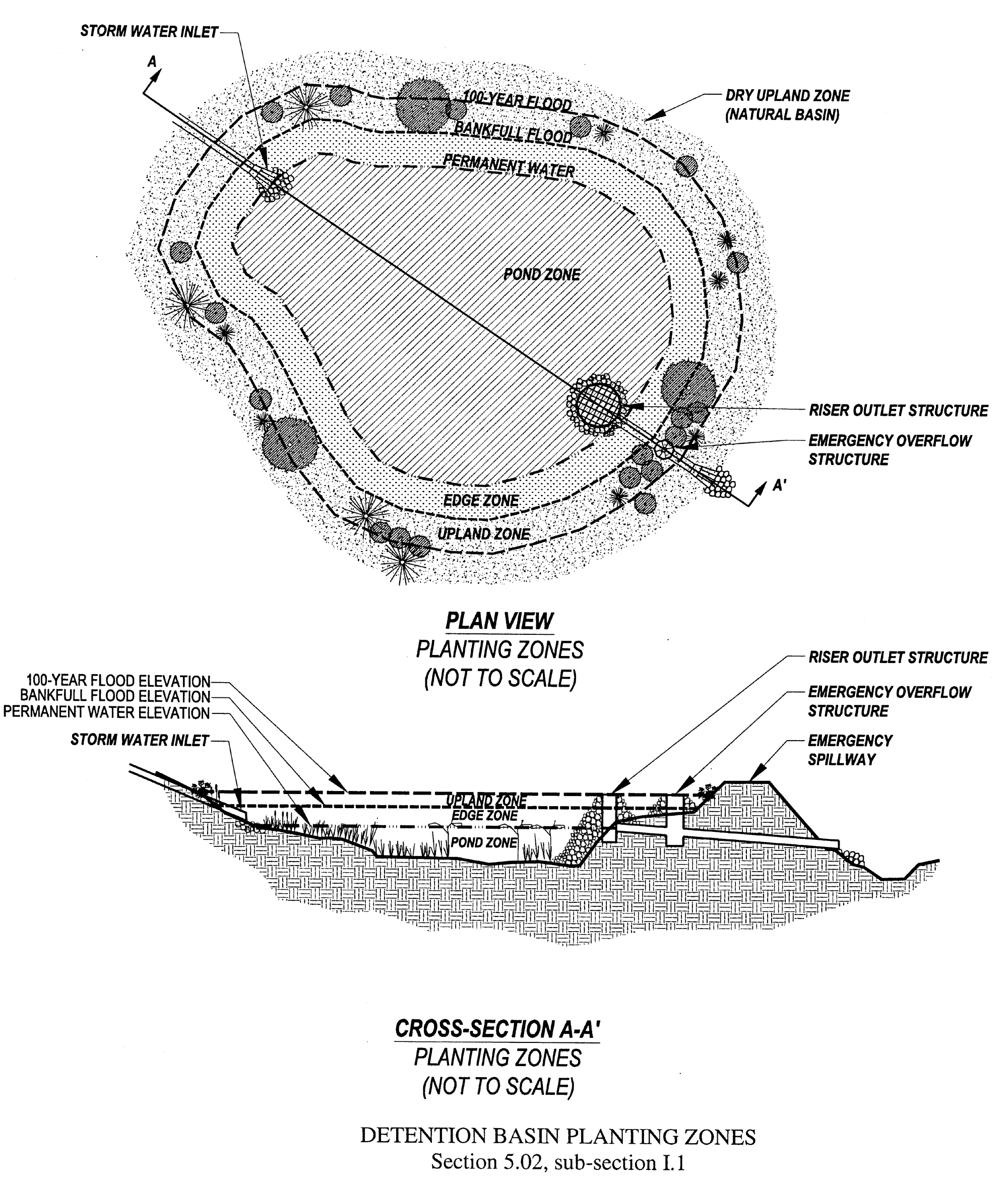
CROSS-SECTION A-A
DETENTION BASIN PLANTING ZONES
Section 5.02, subsection I.1
b.
Detention basin categories. Depending on the location and function of a detention basin within a development, a basin will be designated into one of two possible categories. In addition, vegetation requirements within the upland zone will vary between the two categories. Furthermore, detention basins located directly behind proposed residential dwellings may be designated into either category depending on the ultimate use and intended function of the basin. The two detention basin categories are defined as follows:
1.
Highly-visible basins. Highly-visible basins include basins located at development entrances, adjacent to primary or secondary roads, adjacent to or directly behind proposed homes or are located within more formally landscaped areas in the proposed development. Seed mix for upland zone will extend from the upper boundary of the edge zone to the top of bank or slope. The area beyond the top of bank or slope of the basin shall be sodded with an approved sod material as per section 5.04, Standards for landscape materials, of the Canton Township Ordinance.
2.
Natural basins. Natural Basins include basins located adjacent to natural areas (forested areas, creeks/streams, wetlands), in remote areas, within interior areas of the development, adjacent to or directly behind proposed homes and terraced systems. Seed mix appropriate for the areas extending beyond the 100-year flood elevation and top of bank or slope and functioning as a buffer for the pond shall be a mesic-to-dry prairie mix. This mix will consist of a broad-spectrum of prairie grasses and wildflowers with species that vary in height profile and also offer a variety of cover and food options for wildlife. The natural area seeded with prairie mix must be a minimum of 15 feet wide.
c.
Site plan and landscape plan submittal. The site plan submittal shall include a plan sheet for the detention basin(s) that identifies the following items:
•
Plan view of the detention basin, including one-foot grading contours.
•
Elevations in the detention basin including pond bottom elevation, permanent water elevation, bankfull storm elevation, 100-year storm elevation and freeboard elevation.
•
Area in square feet of the pond zone, edge zone and upland zone.
•
Required seed mixes and wetland plugs/bare root stock in the three planting zones as per section I.1.d, Plantings and vegetation standards according to planting zone. The required seed mixes, wetland plugs/bare-root stock shall be subject to approval by the planning services division.
•
Plant spacing and applicable depths shall be specified based on recommended industry standards.
d.
Plantings and vegetation standards according to planting zone. Landscape plans shall identify the proposed native plants for each of the planting zones defined in I.1.a., Planting zone definitions. Minimum landscape requirements are defined as follows:
1.
Pond zone. A combination of native plant plugs and bare-root stock (submerged, emergent and wetland edge plugs) shall be planted within the pond zone. This zone ranges in depth from zero feet to three feet deep. Proposed plant species:
a.
A minimum of four plant species must be specified for the pond zone. The proposed plants shall be planted in equal numbers of species, scattered in groupings of similar species throughout the entire zone. Initial plantings shall cover a minimum of 25 percent of the outer 15-foot perimeter of the pond zone, with specific species and their appropriate water depths listed. Refer to planting guidelines for approved native plant species by planting zone.
b.
As an alternate, the pond zone may be seeded with a suitable mix if it is demonstrated that the pond hydrology will be controlled for the establishment of the proposed seed mix. Successful establishment of the seed mix will be the responsibility of the contractor. In addition, a proposed hydrologic (water-level) control plan must be reviewed by Canton's Public Works Division to ensure stormwater is properly managed on-site.
c.
No plugs will be required in the pond zone of the forebay.
2.
Edge zone. A native wetland edge or native sedge meadow seed mix shall be planted in this zone. Refer to planting guidelines for approved native seed mixes by planting zone.
3.
Upland zone. A native sedge meadow seed mix or prairie (basic, dry-to-mesic or wet-to-mesic) seed mix shall be planted in this zone. Refer to planting guidelines for approved native plant species by planting zone. The selection of seed mix and extent of installation is determined by the defined detention basin category in section I.1.b.
4.
Seed mixes, general. All seed mixes must include at least five to six native permanent grass/sedge/rush species and nine to ten native forb species. Seed mixes shall also contain a minimum of 100 ounces per acre annual rye and 360 ounces per acre seed oats as a temporary cover crop in order to provide cover and establish soil stability for the first winter. This nurse crop will minimize weed growth in the first year.
2.
Trees and shrubs, general.
a.
Highly-visible basins. One deciduous shade or evergreen tree and ten shrubs shall be planted for every 50 lineal feet of pond perimeter as measured along the top of bank elevation. The required trees and shrubs shall be planted in a random pattern or in groupings and placement of required landscaping is not limited to the top of the pond bank. Refer to planting guidelines for approved native plant species.
b.
Natural basins. One deciduous shade or evergreen tree shall be planted for every 50 lineal feet of pond perimeter as measured along the top of bank elevation. The required trees shall be planted in a random pattern or in groupings and placement of required landscaping is not limited to the top of the pond bank. Refer to planting guidelines for approved native plant species.
c.
Screening of mechanical structures. Any above ground mechanical structures necessary for pond operation shall be identified on the landscape plan and shall be fully screened with evergreen trees or trees/shrubs recommended for the appropriate pond zone refer to planting guidelines for approved shrub and tree species for detention basins.
3.
[Maintenance access.] The landscape plan shall include a required 15-foot wide maintenance access to all proposed stormwater facilities and the planting plan shall be designed to prevent obstruction of the access by trees and shrubs, pursuant to section 2.27.
4.
[Screening.] The area around the detention basin riser outlet structure(s) (outlet between forebay and basin and primary outlet to creek/storm sewer) shall be appropriately screened with vegetation appropriate for the applicable pond zone. The screening vegetation shall not inhibit future maintenance access to the structure. Refer to planting guidelines for approved shrub and tree species for detention basins.
5.
Native plant installation: Seeding vs. planting of plugs/bare-root stock.
a.
Native seed mixes shall include an annual cover crop consisting of ten pounds/acre of annual rye and 30 pounds/acres of seed oats in accordance with industry standards in order to provide cover and establish soil stability for the first winter. The planting zone shall be roto-tilled to a depth of six inches and supplemented with an additional four inches of topsoil or compost. All areas seeded in accordance with this ordinance requirement shall be properly stabilized with a mulch blanket pegged-in-place. A barrier/wildlife-deterrent fence is required for a period of one year to protect the planting and prevent regular mowing.
b.
If emergent plant stock is proposed in the pond zone, the supplied plug material must have sufficient vegetative growth extending out of the water once planted.
c.
Native seed shall be planted above the permanent water elevation.
d.
Signs must be posted around the detention basin stating it is a no mow zone.
6.
Establishment and maintenance of native plants.
a.
A maintenance bond will be held by Canton's Planning Services Division for a two-year period following initial approval of the installation of the detention basin plantings. This shall be equivalent to 25 percent of the vegetation and installation cost and will be collected to ensure sufficient establishment of the native plants. The project sponsor shall provide a written cost estimate or actual contract amount as a basis for the bond amount. A pre-installation meeting between the landscaping contractor and Canton's Planning Services and Public Works Division shall be held prior to commencement of pond landscape work.
b.
The homeowner association covenants and restrictions or master deed must include language for detention basin maintenance per the approved plans.
c.
During the first two growing seasons, all areas planted with native prairie seed mix should be mowed three times at a height of six to eight inches in order to control weeds. Beginning in the third year, a burning or mowing regimen should be instituted, either burning or mowing once in spring, or once in the fall.
d.
Use of fertilizers along the side slopes or within the detention basin is prohibited.
J.
Specific requirements for bio-retention areas, swales, and rain gardens.
1.
Bio-retention areas and swales shall be construction in the following manner:
a.
After forming bio-retention area lay permeable geo-textile fabric over grade.
b.
Install six-inch perforated under drain with geo-textile wrap in 12 inches of one and one-half to three inches of washed gravel base.
c.
Cover gravel with another layer of geo-textile fabric.
d.
Install six-inch layer of washed ¼—½-inch pea stone.
e.
Cover with 12—18 inches of planting mix composed of 70 percent compost and 30 percent sharp sand.
f.
Install perennials/grasses/shrubs or native seed mix that tolerate moist conditions and salt. Native plants are recommended.
g.
Install two to three inches of organic mulch if using plants.
h.
Install erosion control fabric over seeded areas.
i.
Allow at least six inches of storage depth above the planting mix.
2.
Rain gardens shall be constructed in the following manner:
a.
Excavate to a depth of two to three feet.
b.
Install a planting mix of 70% compost and 30% sharp sand.
c.
Install perennials/grasses/shrubs that tolerate moist conditions and salt. Native plants are recommended.
d.
Install two to three inches of organic mulch.
e.
In heavy clay soils, a perforated under drain may be desirable if feasible.
f.
Allow the storm water to overflow during heavy rain events.
(Ord. of 7-18-2002; Amend. of 7-11-2006(1); Amend. of 10-20-2009)
5.03. - Specific landscaping requirements for zoning districts.
A.
Requirements for commercial and industrial districts. In addition to the general landscaping requirements set forth in Section 5.02, all lost or parcels of land located in C-1, C-2, C-3, C-4, O-1, MRD, HRD, LI-R, LI- 1, LI-2, and GI zoning districts shall comply with the following landscape requirements:
1.
Front yard berm requirements. Wherever front, side, or rear yards adjacent to public rights-of-way are used for parking, a berm shall be required to screen the parking from view of the road. The berm shall be located totally on private property, adjacent to the road right-of-way line. The township encourages undulation in the height of the berm, subject to review and approval of the berm design as shown on the site plan. Required berm height and width shall be related to building setback as indicated in the following schedule (see illustration):
_____
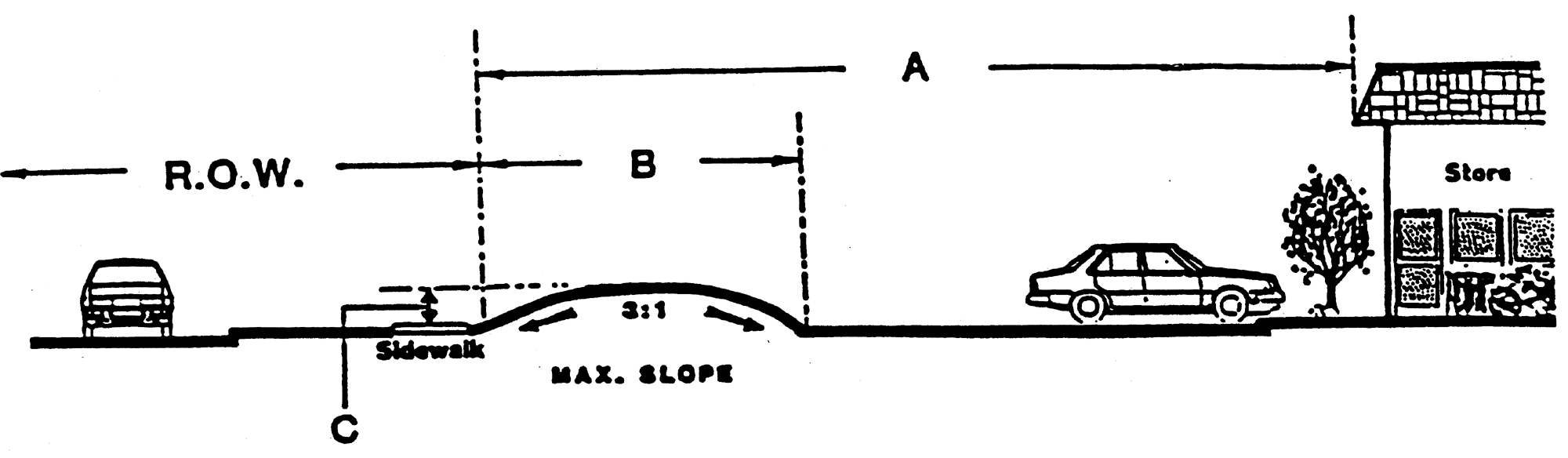
FRONT YARD BERM REQUIREMENTS
_____
2.
Protective screening requirements. Protective screening in the form of a berm shall be required wherever a nonresidential use in a commercial, office, or industrial district abuts directly upon land zoned for residential or agricultural purposes. Berms shall be a minimum of four feet in height, and shall be planted in accordance with section 5.02, subsection B. An alternate method of screening may be considered by the planning commission based on specific site characteristics and compatibility with the character of the surrounding area.
3.
Landscaping adjacent to roads. All front, side, or rear yards adjacent to roads, including berm areas, shall be landscaped in accordance with the following standards (see illustration): A minimum of two deciduous trees, one evergreen tree, and one ornamental tree shall be planted for each 100 lineal feet or portion thereof of road frontage. A minimum of one shrub shall be planted for each ten lineal feet or portion thereof of road frontage, with a minimum or five shrubs required. Dwarf species of shrubs may be utilized at a rate of 1.5 times the base shrub requirement. For purposes of computing road frontage, openings for driveways and sidewalks shall not be counted. Trees may be planted at uniform intervals, at random, or in groupings, and shall be located to provide clear vision to any proposed ground sign. Shrubs must be planted in masses of at least five.
_____
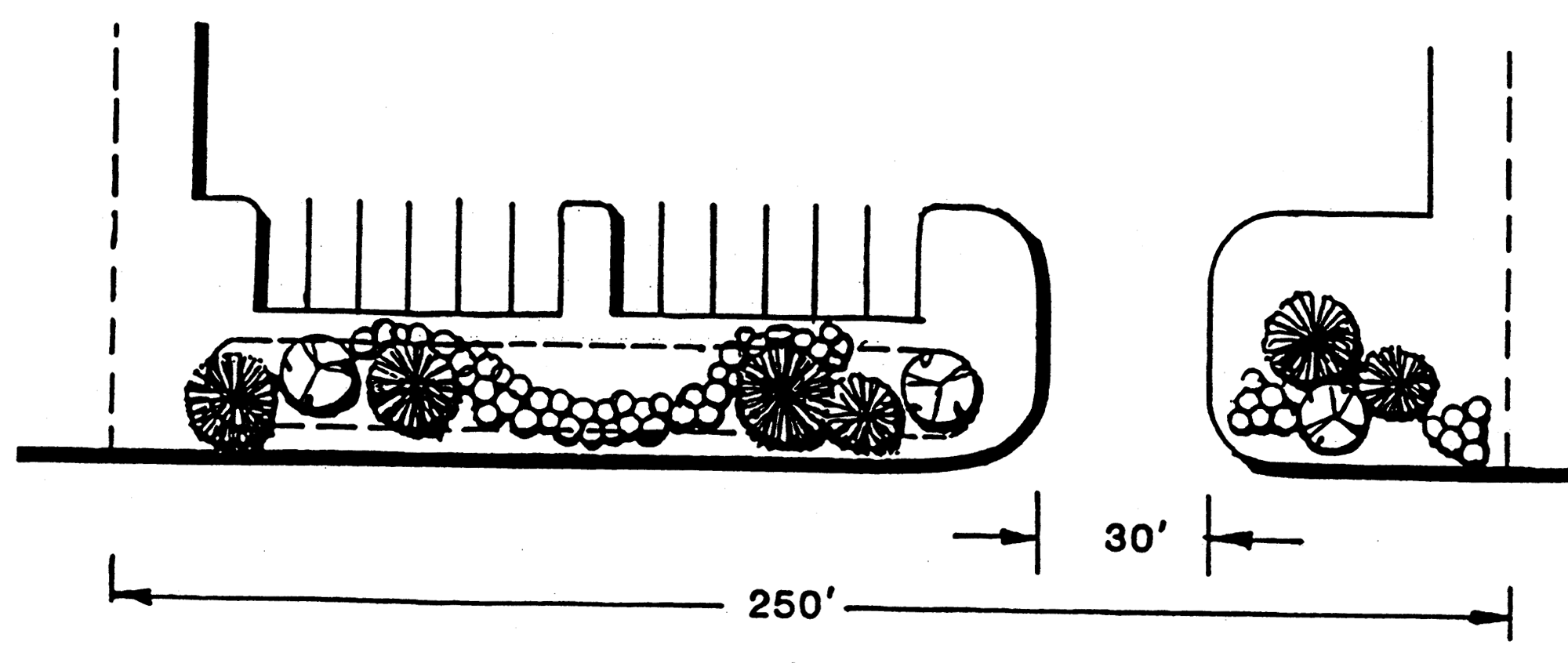
LANDSCAPING ADJACENT TO ROADS
Note: Illustration only. Trees and shrubs are calculated based on the formula indicated below.
Length of Road Frontage: 250 feet minus 30-foot driveway = 220 feet
Number of Deciduous Trees: 220 ft./100 ft. × 2.2 × 2 = 4.4 (5 deciduous trees)
Number of Evergreen Trees: 220 ft./100 ft. = 2.2 (3 evergreen trees)
Number of Ornamental Trees: 220 ft./100 ft. = 2.2 (3 ornamental trees)
Number of Shrubs: 220 ft./10 ft. = 22 shrubs
_____
4.
Foundation landscaping. Foundation plantings shall be provided along the front or sides of any building(s) which faces a public road, [or] is adjacent to a parking lot or other area which provides access to the building(s) by the general public. Foundation planting areas shall be integrated into the sidewalk system (between the front or sides of the building and the parking area and/or associated driveways) adjacent to the building. Foundation planting areas shall contain at a minimum, one ornamental tree and five shrubs per 35 lineal feet of applicable building frontage. Individual planting areas shall be at least eight feet in any single dimension and no less than 150 square feet in area. Planting areas located directly adjacent to a building wall shall be at least ten feet in any single dimension.
5.
In addition to all applicable requirements of this article, sites proposed for development or redevelopment within the downtown development district shall meet landscaping design standards as set forth in article 6.07 (site development standards for the downtown development district).
B.
Requirements for mobile home park districts. All lots or parcels of land located in a district zoned for mobile home uses shall comply with the following landscaping requirements:
1.
General site landscaping. A minimum of one deciduous or evergreen tree shall be planted for each mobile home lot. Deciduous trees may be planted between the curb and sidewalk, or in any other unpaved open area. Unless otherwise specified, required landscaping elsewhere in the mobile home park shall not be counted in meeting these requirements for trees.
2.
Landscaping adjacent to roads. All front, side, or rear yards adjacent to roads, including berm areas, shall be landscaped in accordance with the following standards: A minimum of one deciduous and one evergreen tree shall be planted for each 40 lineal feet or portion thereof of road frontage, plus, a minimum of one ornamental tree shall be planted for each 80 lineal feet or portion thereof of road frontage, plus, a minimum of one shrub shall be planted for each ten lineal feet or portion thereof of road frontage. Dwarf species of shrubs may be utilized at a rate of 1.5 times the base shrub requirement. For the purposes of computing length of road frontage, openings for driveways and sidewalks shall not be counted. Trees may be planted at uniform intervals, at random, or in groupings. Shrubs must be planted in masses of at least five.
3.
Landscaping around mobile homes. Areas between or surrounding mobile homes, as well as other open areas, shall be covered with grass and landscaped with trees and shrubs. Any landscaping material used to satisfy the requirements of this subsection may also be counted toward meeting the requirements for general site landscaping specified above.
4.
Protective screening requirements. Protective screening in the form of a berm or an obscuring wall shall be required wherever development in RMH district abuts directly upon land zoned for single-family residential or agricultural purposes. Berms shall be a minimum of four feet in height, and shall be planted in accordance with section 5.02.B. If a wall is used instead of a berm, the requirements of section 5.08 shall be complied with.
5.
Parking lot landscaping. Off-street parking areas containing greater than 15 spaces shall be provided with at least 15 square feet of interior landscaping per parking space, excluding those parking spaces abutting a public right-of-way or buffer zone for which landscaping is required by the various provisions of this ordinance, and also excluding all parking spaces which are directly served by a driveway abutting and running parallel to a public right-of-way or buffer zone. Whenever possible, parking lot landscaping shall be designed to improve the safety of pedestrian and vehicular traffic, guide traffic movement, and improve the appearance of the parking area. Interior landscaping shall comply with all applicable requirements set forth in section 5.02.C.
6.
Vehicle encroachment. A vehicle may encroach up to two feet upon any interior landscaped area that is at least ten feet in depth and is protected by wheel stops or curbs. Accordingly, two feet of said landscaped area may be included to satisfy the required depth of each abutting parking space.
C.
Requirements for multiple-family districts. In addition to the general landscaping requirements set forth in section 5.02, above, all lots or parcels of land located in R-6 or RM-1 [MR] zoning districts shall comply with the following landscaping requirements:
1.
General site landscaping. A minimum of two deciduous or evergreen trees, one ornamental tree, plus, four shrubs shall be planted per dwelling unit. Unless otherwise specified, required landscaping elsewhere in the multiple-family development shall not be counted in meeting these requirements for trees.
2.
Landscaping variety. In order to encourage creativity in landscaping and to minimize tree loss caused by species-specific disease, a variety of tree species shall be required, as specified in the following schedule:
LANDSCAPE VARIETY SCHEDULE
3.
Parking lot landscaping. Multiple-family uses requiring off-street parking areas containing greater than 15 spaces shall be provided with at least 15 square feet of interior landscaping per parking space, excluding those parking spaces abutting a public right-of-way or buffer zone for which landscaping is required by the various provisions of this ordinance, and also excluding all parking spaces which are directly served by a driveway abutting and running parallel to a public right-of-way or buffer zone. Whenever possible, parking lot landscaping shall be designed to improve the safety of pedestrian and vehicular traffic, guide traffic movement, and improve the appearance of the parking area. Interior landscaping shall comply with all applicable requirements set forth in section 5.02.C.
4.
Protective screening requirements. Protective screening in the form of a berm or an obscuring wall shall be required wherever development in a R-6 or MR district abuts directly upon land zoned for residential or agricultural purposes. Berms shall be a minimum of four feet in height, and shall be planted in accordance with section 5.02.B. If a wall is used instead of a berm, the requirements of section 5.08 shall be complied with.
5.
Privacy screen. Where multiple-family dwellings are designed so that rear open areas or patio areas front onto a public street, a landscaped privacy screen shall be provided (see illustration). Such screen may consist of a combination of trees, shrubs, and berming, subject to review by the planning commission.
_____
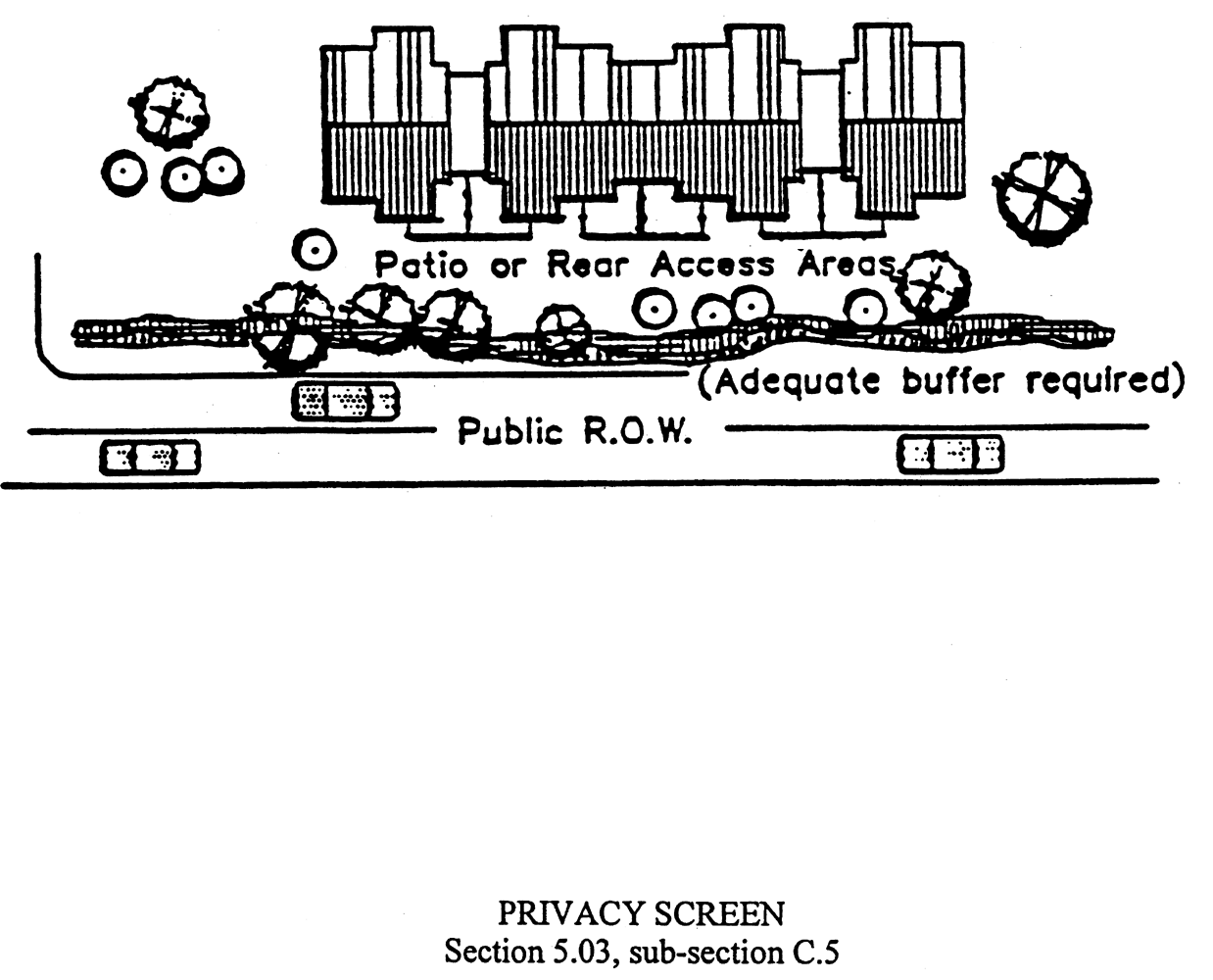
PRIVACY SCREEN
_____
6.
Landscaping adjacent to a freeway. Where multiple-family dwellings abut a limited access freeway, a landscaped buffer shall be provided to screen freeway noise and views. The buffer shall consist of a combination of closely spaced evergreens and earth mounding, providing a total minimum design height of 11 feet. The size and placement of plantings should provide for a complete visual barrier at the desired height within five years of planting. The planning commission may modify these requirements where noise mitigation measures, such as walls, have been constructed in the freeway right-of-way.
7.
Landscaping adjacent to roads. The front, side, or rear yards adjacent to roads shall be landscaped in accordance with the following standards: A minimum of one deciduous and one evergreen tree shall be planted for each 40 lineal feet or portion thereof of road frontage, plus, a minimum of one ornamental tree shall be planted for each 80 lineal feet or portion thereof of road frontage, plus, a minimum of one shrub shall be planted for each ten lineal feet or portion thereof of road frontage. Dwarf species of shrubs may be utilized at a rate of 1.5 times the base shrub requirement. For the purposes of computing length of road frontage, openings for driveways and sidewalks shall not be counted. Trees may be planted at uniform intervals, at random, or in groupings. Shrubs must be planted in masses of at least five.
D.
Requirements for nonresidential uses in residential districts. In addition to the general landscaping requirements set forth in section 5.02, above, all nonresidential uses developed in residential districts shall comply with the following landscaping requirements:
1.
Protective screening requirements. Protective screening in the form of a berm or an obscuring wall shall be required wherever a nonresidential use in a residential district abuts directly upon land zoned for residential or agricultural purposes. Berms shall be a minimum of four feet in height, and shall be planted in accordance with section 5.02.B, above. If a wall is used instead of a berm, the requirements of section 5.08 shall be complied with.
2.
Screening of off-street parking. A four-foot-high obscuring wall shall be required along all sides of any off-street parking or vehicle use area constructed to serve a nonresidential use in a residential district, where said off-street parking or vehicle use area is located within 25 feet of any land zoned for residential or agricultural use.
3.
Landscaping adjacent to roads. The front, side, or rear yards adjacent to roads shall be landscaped in accordance with the following standards: A minimum of one deciduous and one evergreen tree shall be planted for each 40 lineal feet or portion thereof of road frontage, plus, a minimum of one ornamental tree shall be planted for each 80 lineal feet or portion thereof of road frontage, plus, a minimum of one shrub shall be planted for each ten lineal feet or portion thereof of road frontage. Dwarf species of shrubs may be utilized at a rate of 1.5 times the base shrub requirement. For the purposes of computing length of road frontage, openings for driveways and sidewalks shall not be counted. Trees may be planted at uniform intervals, at random, or in groupings. Shrubs must be planted in masses of at least five.
(Amend. of 10-20-2009)
5.04. - Standards for landscape materials.
Unless otherwise specified, all landscape materials shall comply with the following standards:
A.
Plant quality. Plant materials used in compliance with the provisions of the ordinance shall be nursery grown, free of pests and diseases, hardy in western Wayne County, in conformance with the standards of the American Association of Nurserymen, and shall have passed inspection required under state regulations. All trees shall be number one grade, with full uniform branching and no visible damage or scars.
B.
Nonliving plant material. Plastic and other nonliving plant materials shall not be considered acceptable to meet the landscaping requirements of this ordinance.
C.
Plant material specifications. The following specifications shall apply to all plant material proposed in accordance with the landscaping requirements of this ordinance:
1.
Deciduous shade trees. Deciduous shade trees shall be a minimum of three inches in caliper measured six inches above grade with the first branch a minimum of four feet above grade when planted.
2.
Deciduous ornamental trees. Deciduous ornamental trees shall be a minimum of two inches in caliper measured six inches above grade with a minimum height of four feet above grade when planted.
3.
Evergreen trees. Evergreen trees shall be a minimum of eight feet in height when planted. Furthermore, evergreen trees shall have a minimum spread of five feet, and the size of the burlapped root ball shall be at least ten times the caliper measured six inches above grade. For the purposes of this ordinance, arborvitae and cedars shall not be considered evergreen trees.
4.
Shrubs. Shrubs shall be a minimum of two feet in height when planted; except upright yew, juniper and arborvitae shall be a minimum of three feet in height. Low-growing shrubs shall have a minimum spread of 24 inches when planted. Dwarf shrub species may be used in landscaping adjacent to roads to achieve a specific design goal and shall have a minimum 18 inches height or spread.
5.
Hedges. Hedges shall be planted and maintained so as to form a continuous, unbroken, visual screen within two years after planting, barring unusual growing conditions, such as drought or disease. Hedges shall be a minimum of two feet in height when planted.
6.
Vines. Vines shall be a minimum of 30 inches in length after one growing season.
7.
Ground cover. Ground cover used in lieu of turf grasses in whole or in part shall be planted in such a manner as to present a finished appearance and reasonably complete coverage after one complete growing season.
8.
Grass. Grass area shall be planted using species normally grown as permanent lawns in western Wayne County. Grass, sod, and seed shall be clean and free of weeds, pests, and diseases. Grass may be sodded, plugged, sprigged or seeded, except that sod shall be installed in swales or other areas that are subject to erosion, and in the front yard areas of all nonresidential uses. When grass is to be established by a method other than complete sodding or seeding, nurse grass seed shall be sown for immediate effect and protection until complete coverage is otherwise achieved. Straw or other mulch shall be used to protect newly seeded areas.
9.
Mulch. Mulch used around trees, shrubs, and vines shall be applied at a minimum depth of four inches, composed of shredded materials (not recycled construction materials or pallets), treated with a pre-emergent herbicide, and installed in a manner as to present a finished appearance.
10.
Sod. Grass areas in the front yard of all nonresidential uses shall be planted with sod. Types of sod are defined as follows:
-
Mineral sod: A piece from the surface of grassland containing grass, support soil, and the healthy roots, extracted with the intention of replanting in another area for the purpose of establishing lawn areas. The sod is grown on mineral soil, commonly referred to as "topsoil," and must be a minimum of two years old. The grasses permitted for use in sod for landscaped lawns should be a blend that reflects the current standards in the industry and has been demonstrated to prosper under local conditions.
-
Peat sod: A piece from the surface of grassland containing the grass, support soil, and the healthy roots, extracted with the intention of replanting in another area for the purpose of establishing lawn areas. The sod is grown on peat and must be a minimum of two years old. The grasses permitted for use in sod for landscaped lawns should be a blend that reflects the current standards in the industry and has been demonstrated to prosper under local conditions.
(Amend. of 7-11-2006(1))
5.05. - Installation and maintenance.
The following standards shall be observed where installation and maintenance of landscape materials are required:
A.
Installation. Landscaping shall be installed in a sound, workmanlike manner to ensure the continued growth of healthy plant material. Trees, shrubs, hedges, and vines shall be generously mulched at the time of planting.
B.
Protection from vehicles. Landscaping shall be protected from vehicles through use of curbs. Landscape areas shall be elevated above the pavement to a height adequate to protect the plants for snow removal, salt, and other hazards.
C.
Off-season planting requirements. If development is completed during the off-season when plants cannot be installed, the owner shall provide a performance guarantee to ensure installation of required landscaping in the next planting season, in accordance with section 2.17.
D.
Maintenance. Landscaping required by this ordinance shall be warranted by the developer for one year from the date of acceptance by the township. Landscaping shall be continually maintained in a healthy, neat, and orderly appearance, free from weeds, refuse and debris by the owners of the property after the developer has completed all of the warranty replacements required by the township. All unhealthy and dead plant material shall be replaced immediately upon notice from the building and/or planning official, unless the season is not appropriate for planting, in which case such plant material shall be replaced at the beginning of the next planting season. An automatic irrigation system is required of all proposed developments for all landscaped and/or lawn areas. This requirement may be waived by the planning commission if it is determined that the scope of the project is minimal and that the cost of installation of such equipment would be prohibitive to the development of the site. Trees, shrubs, and other plantings and lawn areas shall be watered regularly throughout the growing season. All constructed or manufactured landscape elements, such as but not limited to benches, retaining walls, edging, the irrigation system, mulch, decorative lighting, landscape monuments, garden walls, or fencing, and so forth, shall be maintained in good condition and neat appearance. Rotted, deteriorated, or damaged landscape elements shall be repaired or replaced.
(Ord. of 1-23-2003)
5.06. - Treatment of existing plant material.
The following regulations shall apply to existing plant material:
A.
Consideration of existing elements in the landscape design. In instances where healthy plant material exists on a site prior to its development, the planning commission may permit substitution of such plant material in place of the requirements set forth previously in this section, provided such substitution is in keeping with the spirit and intent of this section and the ordinance in general.
Existing hedges, berms, walls, or other landscape elements may be used to satisfy the requirements set forth previously, provided that such existing elements are in conformance with the requirements of this section.
B.
Preservation of existing plant material. Site plans shall show all existing trees which are located on the site which are six inches or greater in diameter, measured at 4½ feet above grade.
Existing trees shall be labelled "To Be Removed" or "To Be Saved" on the site plan. If existing plant material is labelled "To Be Saved" on the site plan, protective measures should be implemented, such as the placement of fencing or stakes at the dripline around each tree. No vehicle or other construction equipment shall be parked or stored within the dripline of any tree or other plant material intended to be saved. All preservation measures shall be subject to the provisions of the forest preservation ordinance [chapter 94, article II of the Township Code].
In the event that healthy existing plant materials which have been approved to meet the requirements of the ordinance are damaged or destroyed during construction or die within one year of completion of the project, said plant material shall be replaced with the same species as the damaged or removed tree, in accordance with the following schedule, unless otherwise approved by the planning official based on consideration of the site and building configuration, available planting space, and similar considerations:
_____
DIAMETER MEASURED 4½ FEET ABOVE GRADE
_____
5.07. - Modifications to landscape requirements.
In consideration of the overall design and impact of a specific landscape plan, and in consideration of the amount of existing plant material to be retained on the site, the planning commission may modify the specific requirements outlined herein, provided that any such adjustment is in keeping with the intent of this section and ordinance in general. In determining whether a modification is appropriate, the planning commission shall consider whether the following conditions exist:
-
Topographic features or other unique features of the site create conditions such that strict application of the landscape regulations would result in a less effective screen than an alternative landscape design.
-
Parking, vehicular circulation, or land use are such that required landscaping would not enhance the site or result in the desired screening effect.
-
The public benefit intended by the landscape regulations could be better achieved with a plan that varies from the strict requirements of the ordinance.
5.08. - Obscuring walls and fences.
A.
Obscuring wall and fence standards. Where permitted or required by this ordinance, obscuring walls shall be subject to the following regulations:
1.
Location. Required obscuring walls and fences shall be placed inside the lot line except in the following instances:
-
Where underground utilities interfere with placement of the wall or fence on the property line, the wall shall be placed on the utility easement line located nearest the property line.
-
Walls and fences shall conform to the setback and location requirements set forth in the township fence ordinance [chapter 78, article V of the Township Code].
2.
Time of construction. Wherever construction of an obscuring wall or fence is required adjacent to residentially zoned or used property, the wall or fence must be installed prior to the beginning of site grading and general construction, except where such activity would result in damage to the wall or fence.
3.
Corner clearance. Obscuring walls and fences shall comply with the specifications for maintenance of unobstructed sight distance for drivers as set forth in section 2.09.
4.
Substitution. As a substitute for a required obscuring wall or fence, the planning commission may, in its review of the site plan, approve the use of other existing and/or proposed natural or manmade landscape features (such as closely spaced evergreens) that would produce substantially the same results in terms of screening, durability, and permanence. The character of adjoining uses and the preferences of adjoining residents or businesses shall be taken into consideration in determining whether any such substitution is appropriate.
5.
Wall specifications. Required obscuring walls shall comply with the following height requirements, unless otherwise specified in this ordinance:
Required walls shall be constructed of masonry material which matches the primary masonry of the principal structure on the site. Standard concrete block walls and poured or precast concrete walls are not permitted. Required walls shall be similarly finished on all sides.
6.
Fence specifications. Fences erected for screening purposes shall be six feet in height unless otherwise specified in this ordinance, and shall be constructed of redwood, cedar, or no. 1 pressure-treated wood. Chain link fences shall not be permitted for screening purposes. All fences shall be constructed in compliance with the township fence ordinance [chapter 78, article V of the Township Code].
(Ord. of 1-23-2003)
5.09. - Residential fences and walls.
A.
General standards. Fences or walls in residential districts, whether for the purposes of screening or decorative landscaping, shall be subject to the regulations set forth in the township fence ordinance [chapter 78, article V of the Township Code].
B.
Entranceway structures. Residential subdivision entranceway structures shall be permitted, subject to the site plan review as landscape features. These structures shall not be considered fences or borders as defined in the township fence ordinance [chapter 78, article V of the Township Code].

