
Canton City Zoning Code
ARTICLE 5A
00.- TREE AND WOODLAND PRESERVATION4
Editor's note— An ordinance adopted June 24, 2025, amended Article 5A.00 in its entirety to read as set out herein. Former Article 5A.00, §§ 5A.01—5A.08 pertained to similar subject matter and derived from Amendment of July 11, 2006; and Amendment of Oct. 20, 2009.
5A.01.- Findings.
Development and increasing demands on natural resources encroach upon, despoil, or eliminate trees, other forms of vegetation, and other natural resources that constitute important environmental, health, physical, aesthetic, recreational, social, and economic assets to current and future residents, property owners, and visitors of Canton Township. Canton finds that trees and woodlands provide the benefits documented below to individual sites and the community at large that protect and promote the public health, public safety, and general welfare of the township.
(A)
Pollutant, gas, and odor absorption. Trees absorb pollutant gases, such as nitrogen oxides, ammonia, sulfur dioxide, and ozone, that would otherwise contribute to acid rain, soil and water acidification, and damage to life, public health, or infrastructure. Some of these gases are also foul-smelling, and trees can absorb these gases to mitigate odor nuisances.
(B)
Particulate matter absorption. Trees absorb and filter fine particulates out of the air, such as dust, pollen, ash, and smoke, which would otherwise increase the risk of health problems, such as heart disease, asthma, or low birth weight, by trapping them in their leaves, needles, and bark.
(C)
Pollution mitigation. Trees mitigate pollution in the air, soil, and water through biological processes, improving environmental and public health. In fact, biological remediation using trees can be less expensive and more effective than remediation through mechanical or chemical processes.
(D)
Stormwater absorption and runoff reduction. Trees absorb and reduce stormwater volume by capturing rainfall on leaves, branches, and trunk throughout the tree canopy, reducing the volume and velocity of stormwater during rain events. This reduces flooding from storm events and reduces demands to make improvements to stormwater systems. Studies from the Great Lakes Integrated Sciences and Assessments (GLISA), supported by the National Oceanic and Atmospheric Administration (NOAA), indicate that the frequency and volume of rain events in southeast Michigan will continue to exceed the existing infrastructure's capacity to retain or detain stormwater to prevent flooding damage to property and life. The absorption and filtration of rainwater continues to be more important as both the frequency and volume of rain events have increased in the late 20th and early 21st centuries. The resulting reduction in stormwater runoff reduces erosion of watercourses and delays onset of peak flows, which allows our stormwater systems to better handle rain events.
(E)
Flooding and flood damage reduction. Trees reduce flooding and flood damage by reducing the volume of stormwater runoff, which reduces both peak flow and total flow, and by reducing the impact of erosion from flood waters.
(F)
Water quality improvement. Trees improve water quality by filtering groundwater and reducing the volume and velocity of stormwater runoff. This keeps pollutants from migrating into rivers, lakes, or other bodies of water by overland or underground flow.
(G)
Groundwater recharge. Trees improve groundwater recharge for aquifers that supply drinking water by slowing the flow of rainwater, increasing infiltration, and by reducing evaporation of moisture in soils by shade from their canopy.
(H)
Soil erosion and sedimentation control. Trees reduce soil erosion and provide sedimentation control with their roots and canopies by reducing the peak flow and quantity of stormwater runoff, reducing the impacts of weathering from rain and wind and rain on ground surfaces, and binding soils with their roots. This protection is especially important in Canton because most areas in the community have a thin layer of topsoil above clay subsoils and for artificial slopes that are increasingly prevalent in Canton with continued development. Trees are a sustainable and inexpensive solution for soil instability, soil loss, and soil containment.
(I)
Noise reduction. Noise pollution is a nuisance to human beings that can negatively impact human and animal health. Trees and woodlands can provide noise abatement through absorption of high frequencies, refraction, and masking by creating sounds that are considered more pleasant and natural. Canton Township has an interest in ensuring residents' quiet enjoyment of their property, undisrupted by noise pollution, which trees can aid.
(J)
Shade and temperature reduction. Heat islands are areas that are significantly warmer due to heat retention in human-made structures, such as rooftops or asphalt or concrete surfaces that can cause people and animals to suffer from dehydration, heat exhaustion, or heat stroke. Tree canopies lower surface and air temperatures by providing shade, releasing moisture into the air, and deflecting the sun's radiation. This improves the public health of Canton's residents.
(K)
Wind breakage. Trees slow and absorb winds, protecting property and structures, improving conditions for soil, other vegetation, wildlife, and people, and reducing heating load.
(L)
Carbon storage and sequestration and energy conservation. As the quantity of greenhouse gases in the atmosphere increases, the effects of climate change worsen. Trees reduce the amount of carbon dioxide, the most common greenhouse gas, in two ways: first, trees sequester carbon dioxide as biomass when they grow, and a tree typically sequesters more carbon as it grows older; and second, trees can reduce the demand for heating and cooling of buildings when strategically placed, such as evergreen trees blocking wind in the winter or deciduous trees blocking sun in the summer, thereby reducing carbon emitted to heat and cool buildings.
(M)
Oxygen generation. Trees absorb carbon dioxide and water and use the energy the sun provides to produce sugars that feed the tree or other vegetation, creating oxygen, which is necessary to sustain life on Earth.
(N)
Wildlife habitat and biodiversity. Trees provide shelter and food for a variety of birds, insects, and other animals, such as squirrels, opossums, beavers, raccoons, deer, chipmunks, bats, and species classified as threatened or endangered by the U.S. Fish and Wildlife Service. Trees are a common nesting spot, breeding ground, and resource for materials commonly used by wildlife, such as flowers, fruits, buds, acorns, leaves, and woody parts of trees. Even a single tree can provide a habitat for nesting birds and other small wildlife. Trees are also significant in the lifecycle of many pollinator species that pollinate food crops. Wildlife conservation is a matter of public interest for Canton Township.
(O)
Natural resource preservation. Preservation of trees, tree canopies, and woodlands are matters of paramount public concern that are supported by public policy and law, as provided by Article IV, Section 52 of the Constitution of the State of Michigan of 1963, the Natural Resources and Environmental Protection Act, Public Act 451 of 1994 (MCL 324.101 et seq.), and the Zoning Enabling Act, Public Act 110 of 2006 (MCL 125.3101 et seq.).
(P)
Public health improvements. Trees improve public health by absorbing pollutants from the air, soil, and water, absorbing fine particulate matter that causes chronic diseases, reducing ground and air temperatures, reducing noise, and producing oxygen.
(Q)
Public safety. Trees improve public safety by reducing motor vehicle travel speeds by reducing the perceived width of roadways, reducing the severity of and damages from motor vehicle collisions, and by providing refuge for pedestrians and bicyclists from motor vehicles.
(R)
Aesthetic appeal and natural beauty. Trees, tree canopies, and woodlands provide visual appeal to their surroundings by adding green space to humanmade structures and sites that are consistent with the desired character of the community. They provide positive aesthetic characteristics, contribute to a relaxing environment, create a sense of place, and sustain and improve quality of life and physical and mental health. Trees are frequently planted by residents, businesses, and institutional entities in Canton that exceed the requirements of this ordinance because of their aesthetic appeal, natural beauty, and other site-enhancing features.
(S)
Visual screening, privacy, and security. Trees can be placed to obscure unsightly objects or operations, such as mechanical equipment, staging locations, industrial operations, lighting, transformers, dust-generating activities, loading and unloading areas, traffic areas, parking lots, outdoor storage, and machinery, thereby lessening the visual impact on adjacent properties and the public right-of-way. Likewise, trees can create privacy for residents and businesses. Trees can also provide superior screening to fences in many ways, coinciding with the Township ordinance standards for maximum fence height, and trees frequently survive longer than the life of a fence. As a result, screening provided by trees provides security benefits.
(T)
Recreational and educational opportunities. Trees and woodlands provide a variety of recreational and educational opportunities for people of different ages and abilities, such as wildlife and outdoor education, outdoor lab activities, birdwatching and other wildlife observation, walking or hiking, hunting, fishing, camping, treehouses, and hammocks.
(U)
Economic benefits. Trees can contribute to property values in several ways. Economic benefits include reduced building energy costs; reduced stormwater impacts and costs; improved air quality; and, consequently, lower health care costs. For example, a tree in front of a house or a part of a well-kept landscape such as a tree-lined street can increase and/or sustain a site's property value. Additionally, trees can add monetary value to development projects by making the site more aesthetically pleasing for consumers, owners, tenants, employees, residents, and patrons. Canton Township has an interest in continuing to grow the economy of the township and the economic welfare of its residents.
(V)
Canton Township Tree Program. Canton Township is committed to the health and sustainability of trees and woodlands throughout the community both in policy and in funding by actively maintaining thousands of trees along major public rights-of-way, in municipal parks, and on other municipal property. This continual monitoring and maintenance by Canton Township include significant investment of staff and public funds to prune living trees, remove dead trees, plant new trees, and mulch and water trees where appropriate.
(Ord. of 6-24-2025(2))
5A.02. - Intent and purpose.
The intent and purpose of this article is to:
(A)
Tree and woodland preservation. Protect the integrity of trees, tree canopies, and woodlands as a whole, recognizing that trees and woodlands serve as a part of an ecosystem and place priority on preservation of trees, tree canopies, and to the greatest extent reasonably possible;
(B)
Canopy cover. Maintain maximum feasible canopy cover within Canton;
(C)
Tree and woodland health. Protect the reproductive and regenerative capabilities of trees and woodlands in order to: maintain plant and tree diversity; protect groundwater recharge areas; and maintain visual screening, windbreak, dust collection and noise barrier characteristics exhibited by woodlands;
(D)
Wildlife. Protect trees and woodlands to preserve wildlife habitat, maximize the quality and quantity of woodland corridors, and encourage habitats suitable for wildlife communities;
(E)
Recreation, health, and education. Protect the natural environment of wooded areas to provide for resident and visitor recreation, health, and education;
(F)
Economic benefits. Protect trees and woodlands in Canton to support local property values on the subject site and on adjacent sites;
(G)
Aesthetic value. Protect Canton Township's trees and woodland systems to maintain and improve their current and future visual character, not only for development areas and building sites, but also as natural settings for development in all zoning districts, consistent with land use planning goals in the Canton Township Master Plan and Urban Forestry Master Plan and acknowledging that the role of urban forest may vary between zoning districts;
(H)
Landmark and historical trees. Protect individual trees that are known to be rare in southeastern Michigan, have reached a certain age of maturity to be considered a landmark specimen, or are known to represent historical value to the community;
(I)
Natural processes. Provide for the protection, preservation, and proper maintenance and use of trees and woodland systems to maintain and support ongoing natural processes such as water cycling, nutrient cycling, and photosynthesis/transpiration;
(J)
Health benefits. Ensure Canton residents and visitors are able to experience the health benefits provided by healthy trees, tree canopy, and woodlands;
(K)
Tree mitigation and replacement standards. Delineate standards for the mitigation of impacts of tree removal activities to the extent reasonably feasible, including the replacement of protected trees and landmark trees removed, where no feasible alternative to tree removal is available;
(L)
Prevent and minimize environmental damage. Prevent and minimize damage to trees and woodlands from erosion, siltation, windthrow, and disease, and prevent and minimize disturbance and structural changes to vegetative cover provided by trees and woodlands;
(M)
Permit process. Prohibit the unregulated cutting of trees or harvesting of forest products, regardless of whether development is anticipated, and to establish a permit process which will regulate the cutting of trees and harvesting of forest products as well as prescribe the site-specific individualized review process for the issuance of tree cutting and harvesting permits;
(N)
Advance public interest. Respond to the public concern for the preservation of trees and woodlands in the interest of public health, safety, and general welfare of the residents of Canton;
(O)
Preserve landscape. Preserve the landscape in its natural state as much as possible by minimizing tree and soil removal; alteration to natural drainage patterns; and the amount of cutting, filling, and grading when a site plan is reviewed in accordance with § 27.02(G)(5) of this ordinance;
(P)
Canton plans. Establish consistent standards that advance public health, safety, and general welfare goals associated with tree and woodland preservation in adopted Canton plans and policies;
(Q)
Establish standards. Establish clear standards that are the least-restrictive necessary to achieve the governmental interests; and
(R)
Administration and procedures. Establish administration standards and processes to facilitate the administration and enforcement of this Article, and provide guidance for residents, businesses, and property owners.
(Ord. of 6-24-2025(2))
5A.03. - No township demand for easements or other title interests.
Nothing in this article shall be intended, interpreted, administered, or enforced in any manner in which an easement or other title interest in a property is necessary in exchange for a permit from Canton Township.
(Ord. of 6-24-2025(2))
5A.04. - Scope of application.
(A)
General applicability. Removal of trees and clearing or grubbing within woodlands shall only be done in compliance with this article.
(B)
Approved site plans. Landscaping required as part of a site plan approved by Canton or otherwise required in article 5 Landscaping, Screening, and Walls of this ordinance remains in effect regardless of any requirements or exemptions in this Article. Any tree or other landscaping removed that is part of an approved site plan or otherwise required in article 5 of this ordinance must be replaced in accordance with the approved site plan(s) and mitigation plan or article 5, as applicable.
(Ord. of 6-24-2025(2))
5A.05. - Definitions.
(A)
The following words, terms, and phrases shall have the meanings ascribed to them in this section, and any words or terms not defined herein shall have the meaning customarily ascribed to them by section 1.03 of this ordinance or a dictionary:
(1)
Arborist. A professional person skilled and trained in the art and science of municipal arboriculture, horticulture, forestry, landscape architecture or other closely-related field. An example of an arborist includes a Certified Arborist by the International Society of Arboriculture.
(2)
Caliper. The diameter of a tree trunk measured six (6) inches above ground level for trees up to four (4) inches in diameter at that height and twelve (12) inches above the ground for larger sizes. See Figure 5A-1.
Figure 5A-1. Caliper, Critical Root Zone, Diameter at Breast Height, and Dripline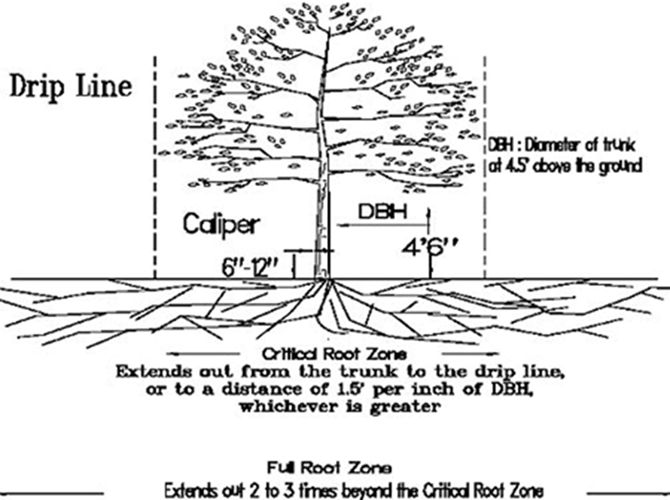
(3)
Canton tree fund. A monetary fund established by the Charter Township of Canton to fund the Canton's Tree Program, which includes planting, maintenance, pruning, and removal of trees.
(4)
Clear cutting. The complete clearing, cutting, or removal of trees.
(5)
Critical root zone. An area on and below the ground that is the greater of the following two (2) areas: (a) The area directly under the dripline of the tree, or (b) the area extending out from the trunk of the tree to a distance of one and one-half (1½) feet per inch of DBH. For example, a tree with a DBH of twelve (12) inches will have a critical root zone of either eighteen (18) feet from the trunk (12 feet x 1.5 feet = 18 feet), or the boundary of the dripline, whichever is greater. See Figure 5A-1. The community planning manager may require a larger critical root zone if, based on the recommendations of the township arborist and the decision criteria of section 5A.07(D)(2), a larger critical root zone is necessary to adequately protect a tree.
(6)
Developed parcel. Any parcel that is either: (a) currently used for residential, commercial, industrial, institutional, office, or agricultural purposes; (b) under construction of a new building, reconstruction of an existing building, or improvement of a structure on a parcel or lot; (c) involved with the relocation of an existing building to another lot; or (d) the improvement of open land for a new use.
(7)
Diameter at breast height (DBH). The diameter in inches of a tree measured at four and one-half (4½) feet above the existing grade adjacent to the tree. On multi-stem trees, the largest diameter stem shall determine the DBH. See Figure 5A-1.
(8)
Diseased tree. A tree that is in poor condition, damaged, diseased, or an infested tree that is likely to die as determined by an arborist.
(9)
Dripline. An imaginary vertical line that extends downward from the outermost tips of the tree branches to the ground. See Figure 5A-1.
(10)
Grubbing. The effective removal or cutting of understory and groundcover vegetation from a woodland that does not include the removal of any trees with a DBH of three (3) inches or greater.
(11)
Invasive species. Non-native or non-indigenous plant species that adversely affects the habitat it invades economically, environmentally, or ecologically.
(12)
Landmark tree. A healthy tree of the species listed below with the minimum DBH listed or any other healthy tree with a DBH twenty-four (24) inches or greater (except a nonprotected tree):
(13)
Nonprotected tree. Any tree that meets either of the following criteria:
(a)
Fruit trees in an abandoned orchard; or
(b)
Any tree species contained in the following list of nonprotected trees, including cultivars, which are considered invasive or undesirable species in southeastern Michigan:
(c)
Any species that are, in the opinion of the township arborist, invasive or destructive and have similar characteristics to the species noted in section 5A.05(A)(13)(b) above.
(14)
Protected tree. Any tree species having a DBH of six (6) inches or greater and that is not included in the definition of nonprotected tree or landmark tree.
(15)
Township arborist. An arborist hired or employed by the Charter Township of Canton to provide arborist services who may be an employee or consultant.
(16)
Transplant. The relocation of a tree from one place to another by digging it up and planting it in a different location in accordance with appropriate practices to ensure survival of the tree.
(17)
Tree canopy. The total ground area covered by a tree or group of trees, including the leaves, branches, and stems.
(18)
Tree damage. Action or inaction which does not follow good arboricultural practices as established by the International Society of Arboriculture. Abuse also includes damage inflicted upon roots by machinery, changing the natural grade above the root system or around the trunk, destruction of the natural shape, or any action which causes infection, infestation, or decay.
(19)
Tree harvesting. The removal of trees from land in accordance with an approved woodlands management plan, for purposes of woodlot improvement, lumber production, or similar purposes.
(20)
Tree removal. The act of extracting or clearing a tree by digging up or cutting down (including the extraction of the tree stump), or actions that cause the effective decline of the tree through damage to the tree, its root system, or the tree's ability to uptake water or oxygen.
(21)
Tree survey. A drawing, prepared by an arborist or professional determined by Canton Township to be qualified to prepare such drawing, that shows the location of all trees with a DBH of six (6) inches or greater plotted by accurate and acceptable techniques, including DBH, common and botanical name, and health/condition of the trees.
(22)
Understory vegetation. The vegetative layer, including trees and shrubs, between the forest canopy and the ground.
(23)
Undeveloped parcel. Any parcel in its natural state that is neither being used for residential, commercial, industrial, institutional, office, or agricultural purposes nor under construction or subject to the development activities listed in the definition of "Developed Parcel."
(24)
Woodland. Any forested area of one-half (½) acre or more, containing at least twenty-eight (28) trees with a DBH of six (6) inches or more per one-half (½) acre.
(Ord. of 6-24-2025(2))
5A.06. - Tree activities and approvals.
(A)
Activities that require a tree removal permit. A tree removal permit is required for the following activities, except as otherwise specified in this ordinance:
(1)
Protected or landmark trees. Removal, damage, destruction, or relocation of any protected or landmark tree;
(2)
Grubbing. Grubbing within the dripline of a woodland.
(B)
Activities that require written notice and approval. Although the following tree activities do not require a tree removal permit, these activities require written notice and approval by the community planning manager, except as otherwise specified in this ordinance. Depending on the scope of removal and potential impacts, the community planning manager may require a tree survey that includes some or all of the information required in section 5A.07(C)(5)(a). If the removed tree is part of an approved site plan or otherwise required by article 5, the tree must be replaced in accordance with the approved site plan(s) and article 5, as applicable. If the removed tree is not part of an approved site plan or otherwise required by article 5, no mitigation is required for these removed trees.
(1)
Dead trees or trees in poor condition. Removal of any dead tree or tree that has been determined by an arborist to be in poor or very poor condition using the current International Society of Arboriculture rating system or a similar rating system approved by the township arborist;
(2)
Damaged, diseased, and infested trees. Removal of any damaged, diseased, or infested tree that is likely to die as a result of the damage, disease, or infestation as determined by an arborist;
(3)
Hazards. Removal of any tree that is a hazard or danger to human life or property due to its condition where such removal will prevent injury or damage to persons or property, as determined by the community planning manager and community arborist, with the removal using accepted standard forestry practices;
(4)
Public utilities. Removal or trimming of any tree associated with the installation, repair, or maintenance work performed by public utilities lawfully operating in Canton;
(5)
Government agencies. Removal, transplanting, or trimming of trees by or on behalf of government entities or agencies for public interest purposes when the community planning manager and township arborist determine the activities serve a bona fide public interest;
(6)
Public road right-of-way and private road easement. Removal, transplanting, or trimming of trees in an existing public road right-of-way or an existing private road easement but only to the extent necessary for safe access and proper drainage along such right-of-way or private road easement and to protect the public health, safety, and welfare;
(7)
Wayne County drain easement. Removal, transplanting, or trimming of trees in a Wayne County drain easement when such removal, transplanting, or trimming is authorized by Wayne County in accordance with Wayne County requirements;
(8)
Trees on an approved site plan, with replacement. Trees required on an approved site plan may be removed, provided the trees are replaced pursuant to the approved site plan and article 5 (Landscaping, Screening, and Walls), as applicable. If the proposed species or planting location is different from the approved site plan, then the applicant for the site plan, or his/her representative, must obtain written approval from the community planning manager prior to removal and planting. The community planning manager may require a revised landscape plan;
(9)
Development of a site with no protected trees or landmark trees. Where development activity is located on a site with no protected or landmark trees, the applicant shall indicate such absence of protected and landmark trees in the application and, if applicable, on the tree survey. The township arborist, in consultation with the community planning manager, shall inspect the site and if the inspection verifies the applicant's claim, then a tree removal permit shall not be required. Canton may collect a fee for this review even if a permit is not required;
(10)
Nonprotected trees. Removal of any nonprotected tree, as defined herein; and
(11)
Limited tree removal on any parcel greater than one-half (½) acre in size and on an undeveloped parcel one-half (½) acre or less in size. Removal of up to four (4) protected trees, landmark trees, or any combination thereof each calendar year on any parcel greater than one-half (½) acre in size and on an undeveloped parcel one-half (½) acre or less in size. See section 5A.06(C)(6) for provisions applicable to tree removal on developed parcels one-half (½) acre or less in size.
(C)
Activities that do not require a tree removal permit or written approval. The following activities do not require a tree removal permit or prior notice and approval, except as otherwise specified in this ordinance. If the removed tree is part of an approved site plan or otherwise required by Article 5, the tree must be replaced in accordance with the approved site plan(s) and article 5, as applicable. If the removed tree is not part of an approved site plan or otherwise required by article 5, no mitigation is required for these removed trees.
(1)
Agricultural activities on a farm. Removal or transplanting of trees to facilitate agricultural activities on a farm, provided agricultural activities are permitted in the zoning district and are in compliance with all applicable Generally Accepted Agricultural Management Practices (GAAMPs) adopted by the Michigan Department of Agriculture and Rural Development (MDARD);
(2)
Licensed commercial nursery or tree farm. Removal or transplanting of trees for operation of a commercial nursery or tree farm, provided the commercial nursery or tree farm is a permitted use in the zoning district and such a facility has been licensed by the State of Michigan;
(3)
Emergencies. Removal or trimming of trees is necessary because of an emergency, such as tornado, heavy rain or wind storm, flood, freeze, dangerous and infectious insect infestation or disease, or other disaster, to prevent injury or damage to persons or property or restore order, and where it would be contrary to the interest of the public health or safety to defer cutting pending submission and processing of a permit application or obtaining written notice and approval of the community planning manager;
(4)
Customary trimming and pruning. Customary trimming and pruning of trees in a manner that will not harm the health of the tree. Trimming and pruning in accordance with the American National Standards Institute (ANSI) or other similar acceptable standard is recommended;
(5)
Activities permitted by a forest stewardship plan. Tree activities that are consistent with a forest stewardship plan approved by the Township in accordance with section 5A.09; and
(6)
Limited tree removal on developed parcels one-half (½) acre or less in size. Removal of up to four (4) protected trees, landmark trees, or any combination thereof each calendar year on a developed parcel one-half (½) acres or less in size.
(Ord. of 6-24-2025(2))
5A.07. - Findings tree removal permit procedures.
Unless an activity is not required to obtain a tree removal permit by section 5A.06(B) or section 5A.06(C), tree removal permits must meet the following application requirements, procedures, and review standards:
(A)
Intent. The intent and purpose of this section is to:
(1)
Provide a consistent and uniform method of review of tree removal permits;
(2)
Ensure full compliance with the standards in this ordinance, other applicable local ordinances, and state and federal law; and
(3)
Provide flexibility where appropriate.
(B)
Time of application. Approval of an application for a tree removal permit shall be obtained before removing, cutting, or transplanting any trees. Where the site is proposed for development that requires a site plan or plat review pursuant to section 27.02 of this ordinance, the tree removal permit application shall be submitted at the same time as the application for site plan review or plat review. The tree removal permit application shall not be approved unless and until after the site plan or plat has been approved.
(C)
Tree removal permit application requirements. Tree removal permits applications shall meet the following requirements.
(1)
Applicant. The application shall be submitted by the owner of an interest in the land for which the tree removal permit approval is sought or by the owner's designated agent.
(2)
Application forms and documentation. The application for a tree removal permit shall be made on the forms and according to the guidelines provided by the community planning manager.
(3)
Right to enter property. Filing an application for a tree removal permit constitutes permission for Canton Township to access the property to complete onsite investigations for the purpose of administering this ordinance.
(4)
Plan preparation. The tree survey shall be prepared by an arborist. The mitigation plan shall be prepared by a landscape architect.
(5)
Application and plan data requirements. The tree survey and mitigation plan shall be prepared by an arborist.
(a)
Tree survey. The application must include a scaled tree survey conducted not more than three (3) years before the application date, and must include the following information:
(i)
Property dimensions. The legal description of the site, including lot boundaries and dimensions;
(ii)
Structures. The location of any existing and proposed structures or improvements, with labels identifying the types of structures or improvements;
(iii)
Easements and setbacks. The location and dimensions of existing and proposed easements and all setbacks required by this ordinance;
(iv)
Buildable area. To the extent that information is available, the buildable area shall be designated on each lot for proposed single-family development. In commercial, office, industrial, and other non-single-family developments, the site plan shall illustrate the exact location of proposed improvements to the extent that such information is available. If the exact locations of certain site improvements are not known at the time the permit application is filed, then the applicant may specify the maximum amount of area needed and the approximate locations for such facilities;
(v)
Tree survey and plan. The location of all existing trees with a DBH six (6) inches or greater, including identification by common and botanical name, DBH; health/condition of each tree in accordance with the current International Society of Arboriculture rating system or a similar rating system approved by the township arborist; and an indication as to whether each tree is to remain, be transplanted, or be removed;
(vi)
Tree protection. A statement that complies with section 5A.10, describing how trees intended to remain will be protected during development;
(vii)
Tree canopy. The extent and area of the existing and remaining tree canopy, including depiction and area of the canopy area to be removed;
(viii)
Soil conditions and other environmental factors. Soil conditions and other relevant environmental factors that impact tree health;
(ix)
Natural resources. Natural resources on the site, such as wetlands, waterbodies, watercourses, floodplains, floodways, and groundwater recharge areas; and
(x)
Topography and grade changes. Existing and proposed topography at one (1) foot contour intervals referenced to a United States Geological Survey (USGS) benchmark, including the extent of disturbed area, if any excavation, land balancing, or other grade changes are proposed or if the community planning manager determines proposed tree removal may cause soil erosion and sedimentation impacts on slopes.
(b)
Mitigation calculations. The application must include mitigation calculations for protected trees and landmark trees to be removed, including the following information:
(i)
Protected and landmark trees. The total number and DBH of each protected tree and landmark tree in fair or better condition to be removed;
(ii)
Narrative and calculations. A narrative describing the mitigation pursuant to section 5A.08; and
(iii)
Individualized mitigation calculations. Information showing how the individualized mitigation calculations meet the impact mitigation of section 5A.08(E)(5), if an individualized mitigation calculation is proposed.
(c)
Mitigation plan. The application must include a mitigation plan prepared by a landscape architect, including the following:
(i)
Narrative. A narrative describing the mitigation plan option or options proposed that will offset the removal and replacement of trees at the designated location, including, but not limited to, the removal of damaged, diseased, or infested trees; the removal of trees considered to be a hazard or danger to human life or property; and the protection and conservation of other natural resources available at the designated location (e.g., insect control; removal of invasive species; use of landscaping, screening, buffers, and greenbelts; and planting new trees in the removal areas where feasible). The narrative should provide enough details to support the applicant's selected mitigation option(s) as detailed in section 5A.08(E);
(ii)
Replacement trees. The location, species, and caliper of all proposed replacement trees;
(iii)
Tree protection. A statement that complies with section 5A.10, describing how trees intended to remain will be protected; and
(iv)
Tree replacement. A statement that any replacement trees must be replaced if they die or become damaged, diseased, and infested.
(D)
Tree removal permit application review procedures. Tree removal permit applications must be reviewed as described below:
(1)
Community planning manager review. The community planning manager, in consultation with the township arborist, shall review applications for tree removal permits. The community planning manager shall act on the application in accordance with the standards of this ordinance or shall refer the application to the planning commission. Actions on the application are as follows:
(a)
Approval. The application shall be approved upon finding that the Tree Removal Permit application is complete and in compliance with the standards and provisions of this Ordinance and other applicable laws.
(b)
Approval with conditions. The application shall be approved with conditions upon finding that the conditions of the tree removal permit application approval would be in compliance with the standards and provisions of this ordinance and other applicable laws. The community planning manager or planning commission, as applicable, may impose such conditions on the manner and extent of the proposed activity as are necessary to ensure that the activity or use will be conducted in such a manner as will cause the least possible damage, encroachment, or interference with natural resources and natural processes within the affected area. The conditions may be based upon recommendations of the township arborist and in accordance with the review standards of section 5A.07(D)(2).
(c)
Denial. The application shall be denied upon finding that the tree removal permit application does not comply with the standards and provisions of this Ordinance or other applicable laws. Prior to denial of the application, the community planning manager will notify the applicant of deficiencies with the application and provide the applicant an opportunity to correct the deficiencies prior to denial.
(2)
Decision criteria. The approving authority shall review the application materials and apply the following criteria in their review:
(a)
Emphasis on preservation. The protection and conservation of natural resources from pollution, impairment, or destruction is of paramount concern. The preservation of protected and landmark trees, woodland trees, similar woody vegetation, and related natural resources shall have priority over development when there are other viable on-site location alternatives based on the project scope.
(b)
Evaluation of trees and surrounding area. The trees and their surrounding area shall be evaluated by the township arborist and the community planning manager for the quality of the area involved by considering the following:
(i)
Soil quality as it relates to potential tree disruption, including soil type and potential erosion impact;
(ii)
Habitat quality and impact on ecological systems;
(iii)
Tree species, including diversity of tree species and tree canopy coverage;
(iv)
Tree size, age, and density;
(v)
Health and vigor of tree stand;
(vi)
Understory species and quality;
(vii)
Floodplains, wetlands, creeks, drains, and other water features;
(viii)
Topography, steep slopes, and soil erosion and sedimentation control; and
(ix)
Other factors such as value of the continuity between natural features and trees as an environmental asset (e.g., cooling effect, canopy coverage, wind block, noise buffer, visual screening, air purification, absorption and retention of carbon dioxide and other pollutants, storm water absorption, and replacement value, etc.).
(c)
Permitted removal or relocation.
(i)
Buildings and site improvements. The removal or relocation of trees within the affected areas shall be permitted if the applicant has demonstrated that there are not any reasonable or prudent alternative locations or configurations for structures or site improvements that would result in less impact on protected trees, landmark trees, or woodlands or tree canopy. The burden of demonstrating that no feasible or prudent alternative location or improvement without undue hardship shall be upon the applicant. However, it is not the intent of this article to deny an application to develop property solely because of the presence of trees on the site; rather, the intent of this Article is to not permit more tree removal than is reasonably necessary for a permitted use and site development. Where the proposed activity consists of land clearing, permitted tree removal shall be limited to designated street rights-of-way, drainage and utility areas, and areas necessary for the construction of buildings, structures, and other site improvements. Where the proposed activity consists of grubbing, all trees with a DBH of three (3) inches or greater shall be left undisturbed with the drip line understory left intact. Where the land clearing and/or grubbing is not proposed as part of a development proposal for which a site plan has been submitted, the applicant shall demonstrate to the reasonable satisfaction of the community planning manager and the township arborist the reasons that the land clearing and/or grubbing cannot be delayed until a site plan is submitted and approved, if applicable.
(ii)
Exemptions. Where a tree removal permit is not required pursuant to section 5A.06(B) or section 5A.06(C), if a tree interferes with safe vision clearances (See section 2.09(A)(4)), or if a tree conflicts with other ordinances or regulations, the removal, relocation, pruning, or trimming of trees within the affected areas shall be permitted.
(iii)
Good forestry practices or tree health. The proposed removal or relocation is consistent with good forestry practices or will enhance the health of the remaining trees.
(d)
Preservation through site development techniques. Protected trees, landmark trees, and woodlands shall be preserved to the greatest extent practicable through the use of site development techniques including, but not limited to, the following:
(i)
Site design should consider any landmark tree on a site as an important design element. Removal of landmark trees should occur rarely and should be considered only after alternatives are studied and determined not to be feasible.
(ii)
Locate development in areas of the site that are already disturbed or cleared of trees and woody vegetation.
(iii)
Minimize clearing and grading of the site by working with the site's existing topography. Grading, roads, walkways, utility lines, and all other aspects of soil disturbance shall be minimized to the extent possible considering standards of sound design and public safety. Clearing for buildings should be limited to the smallest area needed for safe and effective building, structure, and utility work. Excavated soil and materials from basements and grading shall not be spread in the woodland area. Careful handling of trees and use of adequate tree protection measures shall be undertaken, especially for trees near the building envelope.
(e)
Grade changes. Grade changes that could impact remaining trees are minimized through the use of retaining walls, tree wells, or other techniques or by locating grade changes away from critical root zones.
(i)
Provide tree and understory/ground layer protection during all construction phases of the project. Woodland areas, protected trees, and landmark trees excluded from development must be protected from all intrusions during development by well-maintained protective barrier (See section 5A.10). If construction or grading is to occur within a portion of woodlands, those woodland areas excluded from development should be clearly marked and/or fenced off during development and construction in accordance with section 5A.10.
(ii)
Minimize the building/construction footprint on individual lots to preserve trees within lot boundaries.
(iii)
Maintain grades and moisture conditions within the critical root zone of trees in accordance with section 5A.10.
(iv)
If necessary, conduct any necessary excavation around trees by hand.
(f)
Utilities. Existing and proposed utilities are located in a manner that they will not interfere with trees to remain or utilities to be installed using bored tunnels instead of trenches.
(g)
Mitigation plan review and determination by community planning manager and township arborist. The township arborist and community planning manager must make a written determination whether the mitigation means selected and approved are reasonably related and roughly proportionate to mitigate the impacts of tree removal on a site-specific basis pursuant to section 5A.08. This must occur prior to site activity taking place.
(3)
Amendment to tree removal permit. Any amendment to a tree/woodland removal permit shall be processed in the same manner as the initial permit, and the amendment request and the amended plan submittals shall highlight the proposed changes, including any additional tree removal proposed, the reasons for such changes, and any additional mitigation proposed, unless otherwise required by the township arborist in consultation with the community planning manager due to the nature of the proposed amendment.
(E)
Site plan or plat review. Where the tree removal permit is proposed as part of a site plan or plat, tree removal shall not begin before final approval of the site plan or plat.
(F)
Expiration of permit. Permits issued pursuant to this article shall remain valid for a period of twenty-four (24) months. Any work not completed within this period shall require a new tree removal permit.
(G)
Performance guarantee. If tree relocation, tree replacement, or other approved mitigation is required, a performance guarantee shall be required, which shall be in the form described in this ordinance. The performance guarantee shall be in an amount which is sufficient to cover the full cost of such relocation, replacement (tree cost plus installation), or other approved mitigation.
(Ord. of 6-24-2025(2))
5A.08. - Tree removal mitigation standards.
Activities that require a tree removal permit pursuant to section 5A.06 shall require mitigation and a mitigation plan as described below.
(A)
Proportionality. Mitigation is intended to ensure rough proportionality between the negative impacts caused by tree removal and the offsetting mitigation to replace the benefits provided by trees. Trees and tree canopies provide benefits that may be difficult to quantify but for which individualized assessment may provide rough proportionality. As such, an applicant may choose one (1) or multiple replacement calculation or planting options noted in this section.
(B)
Life cycle. All replacement trees shall exhibit a normal live growth cycle for a minimum of two (2) years from the confirmed date of planting. Trees that fail to support a normal life cycle shall be replaced, and the replacements must sustain the same two (2) year growth cycle or they also shall be replaced. Replacement trees planted as part of a landscape plan in accordance with article 5 of this ordinance are subject to the maintenance and replacement standards of that article.
(C)
Replacement tree species selection. Replacement trees shall be the same species or plant community as the removed trees to the extent practicable, except as specified below:
(1)
Undesirable trees. Replacement trees for species defined as being undesirable by Canton may be substituted with any appropriate species acceptable to the community planning manager and township arborist. Utilizing the practices and criteria established herein, the community planning manager and township arborist are authorized to approve such replacement so long as such approval is not contrary to the intent of this article or the public interest.
(2)
Not available. Replacement trees for species not readily available from qualified nurseries may be substituted with an appropriate species acceptable to the community planning manager and township arborist. Utilizing the practices and criteria established herein, the community planning manager and township arborist are authorized to approve such replacement so long as such approval is not contrary to the intent of this article or the public interest.
(3)
More appropriate. Different species that are more appropriate for local conditions or that provide greater benefits than the removed trees may be approved by the community planning manager and township arborist. Utilizing the practices and criteria established herein, the community planning manager and township arborist are authorized to approve different tree species so long as such approval is not contrary to the intent of this article or the public interest.
(4)
Variety. A maximum of twenty-five (25) percent of replacement trees may be of a single species in order to preserve genetic diversity and resilience, unless otherwise approved by the community planning manager and township arborist.
(D)
Replacement tree quality. All replacement trees shall meet the minimum quality requirements stated in article 5.
(E)
Mitigation calculations. Mitigation is required when protected trees and landmark trees are removed unless such removal is explicitly permitted by this ordinance. The mitigation options below are based on the impacts of the tree removal and the offsetting mitigation to replace the benefits provided by trees. An applicant may select one (1) or more of the mitigation calculation options below:
(1)
Option 1. On-site planting to mitigate the removal of protected trees and landmark trees. Replacement trees shall be planted on the same site from which protected and landmark trees are removed to mitigate the harm and negative impacts caused by tree removal as described below.
(a)
Replacement ratio for protected trees removed. One (1) replacement tree with a caliper of at least two (2) inches is required for each protected tree removed, with the rationale being that the benefits provided by one (1) protected tree removed can be adequately mitigated by one (1) replacement tree when it has grown to maturity.
(b)
Replacement ratio for landmark trees removed. Three (3) replacement trees with a caliper of at least two (2) inches is required for each landmark tree removed, with the rationale being that the benefits provided by a replacement tree can take several decades to reach the size of the landmark tree removed and that three (3) replacement trees will attain the benefits provided by the removed landmark tree in a timelier manner.
(c)
Reduction of replacement trees based on new trees in landscape plan. When new trees are proposed on a landscape plan in accordance with article 5 of this ordinance (e.g., frontage trees, street trees, parking lot trees, general site landscape trees, screening trees, median trees, stormwater pond trees, protective screening trees, and building foundation trees), the total number of trees required by (a) and (b) above shall be reduced by the number of trees proposed on a landscape plan in accordance with article 5. For example purposes only, if a site development proposal requires one hundred (100) replacement trees pursuant to (a) and (b) above and seventy-five (75) trees are proposed on the landscape plan in accordance with Article 5, then the number of required replacement trees will be reduced to twenty-five (25) (i.e., one hundred (100) replacement trees required minus seventy-five (75) trees proposed in accordance with article 5 equals twenty-five (25) net replacement trees required).
(d)
Location of existing and proposed trees. The location of replacement trees shall be based on the remaining trees on the site as well as the trees proposed in accordance with the landscaping requirements of article 5. Where tree replacement is required, the landscape areas of the site required shall be supplemented with replacement trees in the available landscaping areas, such as setback areas, parking lot landscape areas, building foundation landscape areas, stormwater pond landscape areas, and open areas of the site suitable for tree planting.
(2)
Option 2. Off-site planting on Canton Township property to mitigate the removal of protected trees and landmark trees. In lieu of Option 1, the applicant may choose to plant the replacement trees required in section 5A.08(E)(1) off-site on township property as outlined below.
(a)
Permission. An authorized Canton Township representative must provide written permission to plant the replacement trees on Canton property.
(b)
Planting plan. A planting plan, prepared by a landscape architect or certified arborist, shall be provided by the applicant that indicates the species, sizes, and locations of replacement trees. An authorized Canton Township representative must provide written approval of the planting plan.
(c)
Maintenance. The applicant shall be responsible for inspection, maintenance, and replanting of replacement trees. Canton may assume responsibility, including collection of funds for initial maintenance and replanting. A written agreement between the applicant and Canton is required.
(3)
Option 3. Off-site planting on common homeowners association property to mitigate the removal of protected trees and landmark trees. In lieu of Options 1 and 2, the applicant may choose to plant the replacement trees required in section 5A.08(E)(1) off-site on common property owned by a homeowners association as outlined below.
(a)
Permission. An authorized homeowners association governing body must provide written permission to plant the replacement trees on common area property of the homeowners association.
(b)
Planting plan. A planting plan, prepared by a landscape architect or certified arborist, shall be provided by the applicant or the homeowners association that indicates the species, sizes, and locations of replacement trees. The authorized homeowners association governing body must provide written approval of the planting plan. The planting plan is subject to review and approval by the community planning manager and township arborist in accordance with the standards of this ordinance.
(c)
Maintenance. The applicant or homeowners association, as applicable in a written agreement, shall be responsible for the planting of replacement trees. The homeowners association shall be responsible for inspection, maintenance, and replanting of replacement trees. A written agreement between the applicant and the homeowners association is required.
(4)
Option 4. Mitigation by proportionate payment into the Canton Tree Fund. In lieu of Options 1—3, above, an applicant may pay proportionate monies into the Canton Tree Fund, based on the number and assessed replanting value of required replacement trees for removed protected trees and landmark trees.
(a)
Tree value. The value for replacement trees shall be equal to the cost for Canton to plant and provide initial maintenance for trees consistent with any current contracts for that work or may be set by an annual resolution adopted by the township board. Replanting value shall be based on size, species, and other relevant factors.
(b)
Payment. The proportionate payment option is based on the number or replacement trees per section 5A.08(E)(1) that are not otherwise planted.
(i)
Maximum payment. The payment shall not exceed fifty (50) percent of the land value of the parcel from which the protected trees and landmark trees are removed, based on the most recent land value assessment from the Canton Township Assessor.
(ii)
Payment receipt. The payment must be received by Canton before tree removal or clearing activities can begin.
(c)
Use of monies. Monies paid into the Canton Tree Fund shall be used for tree planting and maintenance of public trees in Canton, maintaining a rational nexus that these activities will offset harms and negative impacts created by the applicant's tree removal activities.
(5)
Option 5. Individualized mitigation calculation to mitigate the removal of protected trees and landmark trees. An applicant may propose an alternative, individualized replacement calculation, prepared by a certified arborist or landscape architect that meets the criteria below.
(a)
Mitigation of impacts. The individualized mitigation calculation plan must demonstrate that the following impacts of removal of protected trees and landmark trees are likely to be fully mitigated in the time period described below based on the size, species, and location of the tree(s) being removed:
(b)
Individualized mitigation benefits. The individualized mitigation calculation plan must be found to provide equal or better benefits than other mitigation calculation options.
(c)
Approval. The individualized mitigation calculation plan shall be approved by the community planning manager and township arborist.
(Ord. of 6-24-2025(2))
5A.09. - Forest stewardship plans.
(A)
Purpose. Forest stewardship plans identify current forest conditions, define forestry goals, and identify management activities for long-term management and regrowth of the woodlands. They are not intended to facilitate development or be prepared in the anticipation of land development.
(B)
Forest stewardship plan requirements. When a forest stewardship plan is proposed, an application must be filed with the planning services division on a form provided by the township and include the required fee. The fee for the forest stewardship plan review shall be set by resolution of the township board of trustees. The plan shall meet the following requirements:
(1)
Plan contents. The contents of a forest stewardship plan must comply with the requirements established by the State of Michigan's Forest Stewardship Program (FSP) which include, but may not be limited to, property identification and overview; property maps and location information; resource descriptions; recommendations and activities; and monitoring.
(2)
Professional qualifications. All forest stewardship plans must be prepared by a certified forester. Certified foresters are foresters registered with the State of Michigan or conservation district forester.
(3)
Review and approval by the State of Michigan Forest Stewardship Program (FSP). Prior to filing the forest stewardship plan with Canton Township, the applicant shall obtain and provide evidence of approval of the plan pursuant to the State of Michigan Forest Stewardship Program or its successor.
(4)
Compliance with generally accepted forest management practices (GAFMP). The forest stewardship plan shall comply with GAFMP adopted by the Michigan Department of Natural Resources.
(5)
Permitted tree removal. The forest stewardship plan shall include permitted removal activities. In general, tree removal activity shall be for the purpose of reducing the density of trees to promote and maintain the health and viability of the remaining trees in the woodland. Limited removal of trees for use by a property owner (e.g., for firewood) may be permitted if outlined in the forest stewardship plan. The forest stewardship plan shall specify the means by which cut trees will be removed from the property without damaging remaining trees.
(C)
Reviewing body. The community planning manager, in consultation with the township arborist, shall review the applications for forest stewardship plans prior to the start of any forestry management practices or operations. The community planning manager shall act on the application or refer the application to the planning commission.
(Ord. of 6-24-2025(2))
5A.10. - Tree protection during construction.
Trees to remain, protected trees, landmark trees, and woodlands shall be protected during construction as defined below. Tree protection measures shall be in place before development, clearing, filling, or commencement of any site construction, maintenance, or tree removal activity and shall remain in place during construction.
(A)
Root zone protection. The critical root zone of trees to remain shall be protected from construction and disturbance, including, but not limited to, placing solvents, storing building materials, parking construction equipment, stockpiling soils, or grading. The community planning manager may require a larger critical root zone protection area if, based on the recommendations of the township arborist and the decision criteria of section 5A.07(D)(2), a larger critical root zone is necessary to adequately protect a tree.
(B)
Protective barrier. A continuous protective barrier or barriers shall be installed to protect trees to remain as defined below:
(1)
Character of barrier. Protective barriers shall be wood, metal, or other suitable material. Stakes with rope, ribbon, or plastic tape may be used for trees to remain within rights-of-way and in areas separated from the construction area upon approval of the community planning manager.
(2)
Location. Protective barriers shall be placed at the outer limits of the critical root zone. A wider barrier may be required by the community planning manager to provide greater protection for all or a part of the full root zone based on the recommendation of the township arborist.
(3)
Time period. Protective barriers shall be installed before any site work begins and shall remain in place until the community planning manager authorizes removal based on tree protection factors or recommends approval of the final certificate of occupancy, whichever occurs first.
(4)
Unpermitted intrusions in the protective barrier. Unpermitted intrusions include any activity that could adversely affect the plants (trees, shrubs, and herbaceous/ground layer plants) within the fenced-off woodland including, but not limited to, the following: driving vehicles and/or heavy equipment; stockpiling, storage or parking of any soils, materials, equipment or vehicles; spreading excess fill/soil; dumping of construction or landscaping wastes; and clearing/removal of the understory or ground layer of vegetation within the woodland.
(5)
Maintenance of grades and moisture conditions in the critical root zone. The grades and moisture conditions within the critical root zone of trees shall be maintained. Many of the native hardwood trees (e.g., oaks, hickories, maples, and beeches) and many old trees do not adapt to environmental changes brought about by construction. Grading changes should not occur within the critical root zone of a tree and, in some cases as determined by the township arborist, within the full root zone of a tree because the area of concern around a tree may be significantly larger than the critical root zone. In addition, grading on a site should neither increase nor decrease moisture conditions within a tree's critical root zone.
(C)
Attachments to trees. Materials, ropes, chains, or other devices shall not be attached to trees to remain except for protection of the tree in compliance with proper forestry practices.
(D)
Inspections. Submission of an application requiring tree protection measures constitutes permission for the township to access the property to conduct on-site inspections for the purpose of administering this article.
(E)
Construction damage. Any woodland, protected tree, or landmark tree that is determined to be dead, dying, or severely damaged due to construction activity within three (3) years after the later of issuance of a certificate of occupancy or final permit approval for development authorized by an approved site plan, subdivision plat, or tree removal permit shall be replaced by the applicant in the amount specified in section 5A.08. Plans showing the location, size, species, and other relevant information regarding tree mitigation shall be submitted to the community planning manager for review and approval, in consultation with the township arborist.
(Ord. of 6-24-2025(2))

