
Carpinteria City Zoning Code
CHAPTER 14
54 - PARKING REGULATIONS
14.54.010 - Purpose and intent.
The purpose of this chapter is to assure the provision of safe, adequate, well-designed off-street parking facilities in conjunction with any use or development. The intent is to reduce street congestion and traffic hazards and to promote an attractive environment through design and landscaping standards for parking areas.
(Ord. 315 § 1 (part), 1981)
14.54.020 - Applicability.
Unless otherwise designated in the specific zoning districts, the provisions of this chapter shall apply to all uses and development as appropriate.
(Ord. 315 § 1 (part), 1981)
14.54.030 - General regulations.
1.
The minimum number of parking spaces as required in the individual zoning districts or specified in the following shall be provided and continuously maintained in conjunction with any use, except that if the planning commission determines that the required parking spaces for a particular use are not needed on an interim basis, the planning commission may not require development of a specified number of the required parking spaces at the time of project approval as long as the land area necessary to provide the total number of required parking spaces is maintained in landscaped open space for development at a future time. The planning commission may require the posting of a bond as a condition of granting such an exception.
2.
For all development other than single-family residential and subject to the requirements of a development plan, the planning commission shall determine if there is a need to provide for bicycle parking. If such a need exists, the planning commission shall then determine the required number of parking spaces, bike racks, and locking devices that shall be provided.
3.
Parking spaces for the exclusive use of vehicles driven by handicapped persons shall be provided in all parking areas containing fifty or more spaces at a ratio of one space for the handicapped for every fifty spaces. The planning commission may require the provision of additional spaces for the handicapped above this ratio or in parking areas of less than fifty spaces, if it determines that the type or location of the proposed development warrants such additional provision. Such parking spaces should be located as close as possible to the appropriate access points and shall be consistent with Sections 10.32.100 to 10.32.140.
4.
For additions to existing developments or changes in the intensity of use, the increased parking requirement shall be based on the aggregate total of the floor area and/or number of employees of all existing and proposed buildings or structures on the property. The number of parking spaces to be provided shall be calculated according to the requirements of this chapter for the new use. Any previous parking modifications granted by the planning commission should be reconsidered.
5.
Where the standards result in a fraction, the next larger whole number shall be the total of spaces required. The total requirement for mixed occupancies shall be the sum of the number of spaces required for the individual uses computed separately.
(Ord. 315 § 1 (part), 1981)
14.54.040 - Parking spaces required.
Unless otherwise provided in this title, the following minimum parking requirements are set for specific types of uses and are not necessarily listed by zoning district:
1.
Residential Uses. Parking spaces are to be permanently maintained on the same building site on which the dwelling(s) is located. In addition, no garage located at the front of a residential unit and/or located at the front yard setback shall be converted to habitable floor area.
a.
Single-family detached dwellings: two covered parking spaces per dwelling within a garage.
b.
Multiple-family dwellings (including two-family duplexes):
(1)
For each single bedroom or efficiency dwelling unit designed and intended to accommodate not more than two persons: one covered space per unit, either a carport or a garage;
(2)
Two or more bedroom dwellings: a minimum of one covered parking space per unit plus one parking space per unit in a paved parking area;
(3)
Visitor parking: one parking space per three dwelling units;
(4)
Parking spaces shall not be located more than two hundred feet from the building served by such spaces, except as hereinafter provided.
c.
Mobile homes (located in mobile home parks): two spaces on each mobile home site (may be tandem); one space for every three sites for guest parking.
d.
Clubs, fraternities, sororities, dormitories, boardinghouses and lodginghouses: one space per four bed spaces and one space per two employees.
e.
Rest homes, family care and special care homes, and other group care or congregate care facilities: one space for each three beds plus one space for each employee.
2.
Nonresidential Uses.
a.
Community Facilities.
(1)
Churches, school auditoriums, college auditoriums, theaters, general auditoriums, stadiums, mortuaries, lodges, halls, and other places of general assembly: one space for every four fixed seats or one space per twenty-eight square feet where there are no fixed seats.
Every twenty-four inches on a bench shall be considered as one seat for parking purposes.
(2)
Places of amusement without fixed seats such as dancehalls, skating rinks, etc.: one space per three hundred square feet of assembly area.
(3)
Schools:
(a)
Elementary and junior high schools: one for each classroom and one for every thirty-five sq. ft. gross of nonfixed seating area in the auditorium.
(b)
High schools: five for each classroom and one for every five fixed seats, or for thirty-five sq. ft. gross of nonfixed seating area in the auditorium, plus the standard for public assembly areas and dormitories.
(4)
Day nurseries/nonprofit use: one space for every five children and one space per staff member.
b.
Commercial Uses.
(1)
Hotel/motel: one space per guest room and one space per employee.
(2)
Restaurant, cafe, tavern:
(a)
one space for each four fixed seats; or
(b)
one space per fifty square feet of seating area, and
(i)
one space per two hundred fifty square feet of gross floor area—CPD zone,
(ii)
one space per five hundred square feet of gross floor area—CB zone.
(3)
Administrative/professional offices such as banks, lawyer's office, etc.:
(a)
one space per two hundred fifty square feet of gross floor area—CPD zone.
(b)
one space per five hundred square feet of gross floor area—CB zone.
(4)
Medical clinics, medical and dental offices, animal hospital: one space for each doctor, one space per employee, and two spaces per examining room.
(5)
Hospital, medical and welfare institutions: one space for every two beds, one space per employee, one space per resident, two spaces for ambulances.
(6)
Open-air commercial sales: one space per employee plus one space per one thousand square feet of display area.
(7)
General commercial uses not specified—CPD zone: one space per two hundred fifty square feet of gross floor area and adequate parking for vehicles owned or operated by the business shall be provided.
(8)
General commercial uses not specified—CB zone: one space per five hundred square feet of gross floor area.
(9)
Adult-oriented motion picture theater and adult-oriented live entertainment theater: one space for every four fixed seats or one space per twenty-eight square feet where there are not fixed seats.
(10)
Adult-oriented arcades: one space for every viewing booth.
(11)
Adult-oriented bookstore: one space per two hundred fifty square feet of gross floor area and adequate parking for vehicles owned or operated by the business shall be provided.
(12)
Adult-oriented cabaret:
(a)
one space for each four fixed seats; or
(b)
one space per fifty square feet of seating area, and one space per two hundred fifty square feet of gross floor area.
(13)
Adult-oriented hotel or motel: one space per guest room and one space per employee.
c.
Industrial Uses.
(1)
Light manufacturing, wholesale distributing, warehouse, research and development: one space per five hundred square feet of gross floor area.
d.
Recreational Facilities.
(1)
Tennis court: three spaces per court.
(2)
Racquetball facility: one and one-half spaces per court.
(3)
Spectator seating: one space per five seats or one space per thirty-five square feet of seating area.
(4)
Facilities such as spa, health facilities, gym: one space per three hundred square feet, or fraction thereof, of gross floor area.
(5)
Swimming pool: one space per two hundred square feet of pool area and one space for each five hundred square feet of gross area related to the pool and facilities.
e.
Agricultural Uses.
(1)
Commercial greenhouse, hothouse, or other plant protection structure: two spaces per acre of land in such use.
Where the parking requirement for a use is not specifically defined, the parking requirements shall be determined by community development department staff; and such determination shall be based upon the requirement for the most comparable use specified in this section.
(Ord. 547 § 1, 1998; Ord. 533 § 1 (part), 1997; Ord. 516 § 3, 1995; Ord. 437 § 1, 1988; Ord. 409 §§ 1, 2, 1987; Ord. 351 § 2 (2—5), 1983; Ord. 315 § 1 (part), 1981)
14.54.050 - General parking and street requirements.
1.
No parking area or parking space provided for the purpose of complying with the provisions of this chapter shall hereafter be eliminated, reduced or converted in any manner unless equivalent facilities approved by the city are provided elsewhere in conformity with this chapter. The permit for the use for which the parking was provided shall immediately be revoked upon failure to comply with the requirements of this chapter.
2.
For uses which generate high traffic volumes such as restaurants, motels, medical clinics and labor intensive industries, etc., a traffic design plan shall be required. Such plan shall be prepared by a licensed traffic engineer and shall include an analysis of circulation patterns, existing and potential traffic flows, provision of safe and adequate ingress and egress, and parking.
3.
Where development fronts on a public street, sufficient right-of-way for street widening purposes shall be dedicated to the city and standard street improvements (curb, gutter, sidewalk, paving) shall be constructed. Existing curbs, gutters and sidewalks shall be used if in conformance with city standards.
(Ord. 315 § 1 (part), 1981)
14.54.060 - Conjunctive use of parking spaces.
For the purposes of this section, conjunctive use shall be defined as the joint use of parking spaces for two or more land uses where the hours of operation and demand for parking are such that the parking spaces can be used by the individual uses at different times of the day or week and, therefore, can serve more than one use. The intent is to provide a special provision of possible reduction in the number of parking spaces ordinarily required for two or more land uses and the sharing of parking spaces under a set of unique circumstances including the compatibility of the land uses, adjacency of properties, and lack of need for separate parking facilities.
A conditional use permit shall be required for the conjunctive use of parking spaces, as provided in Chapter 14.62. The conditional use permit shall be subject to the following requirements:
1.
The applicant(s) shall demonstrate a need for such conjunctive use and reasons for a reduction in the number of parking spaces required of the individual uses according to the parking regulations of this title. The applicant(s) shall state the type of use(s) proposed, time periods of operation, and any other necessary information to demonstrate that the conjunctive use of parking spaces will not create traffic congestion or be detrimental to surrounding uses.
2.
In cases where the required number of parking spaces for individual uses differ, the parking requirement which is greater shall become effective.
3.
The applicant(s) shall submit a title report for the parcel proposed for conjunctive parking use and an agreement between the owners of record of the parcel and prospective users. Said agreement shall obligate the parcel for conjunctive parking use, clearly define the obligation of each party to the agreement, and be recorded in the county recorder's office. The agreement shall provide that any modification to the terms of the agreement shall be subject to the city's approval.
4.
The planning commission may modify the terms of the agreement and/or recording requirements of this section when the conjunctive use parking is to be located on public property.
5.
Violation of the conditional use permit shall be grounds for revocation of the conjunctive parking use.
(Ord. 354 § 1, 1983: Ord. 315 § 1 (part), 1981)
14.54.070 - Size, location, and design of parking spaces.
1.
Size.
a.
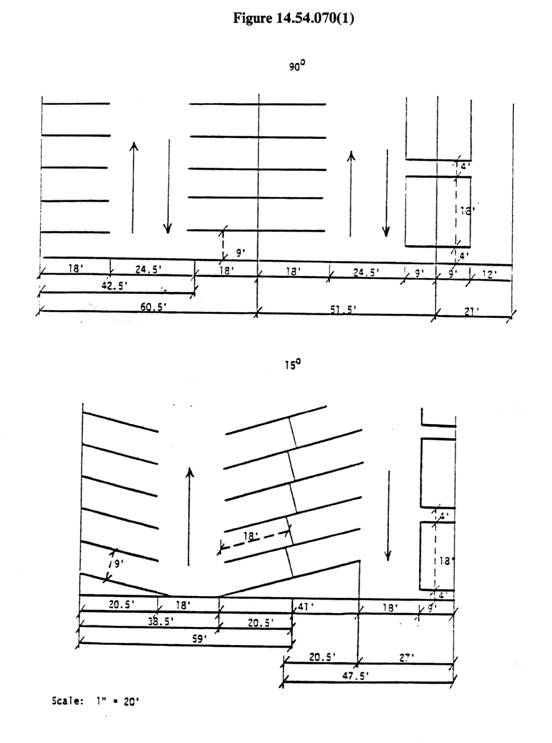
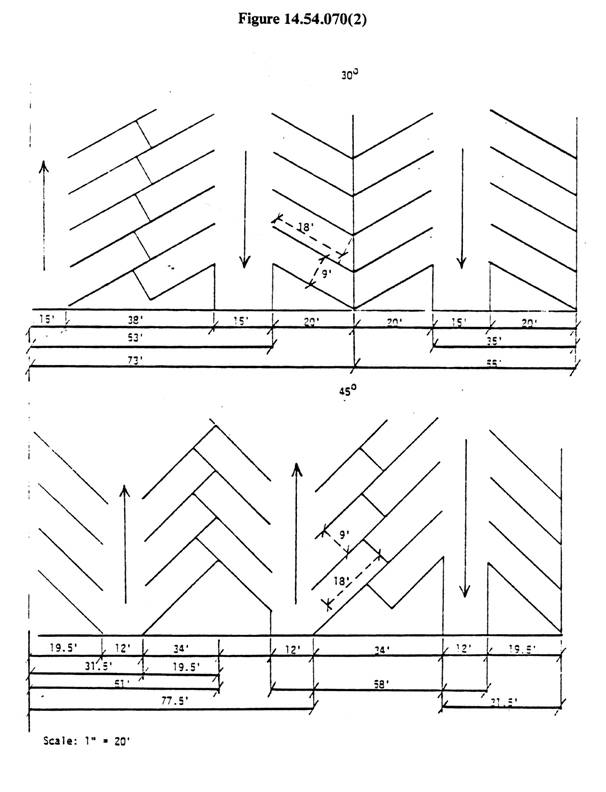
Parking spaces shall be nine feet wide by eighteen feet long. The minimum width for parking spaces for handicapped persons shall be twelve feet.
b.
Bicycle parking spaces shall be eight feet by two feet in size; bicycle racks and locking devices shall also be provided.
2.
Location.
a.
Off-street parking spaces shall not be located in the required front or side yard setback area unless specifically so provided in the district regulations. Provisions shall be made for direct access from the street to each parking space. Such access shall be adequate for standard size automobiles unless specifically otherwise provided in the district regulations.
b.
For all types of dwellings, the parking spaces shall be provided on the same site on which the dwelling(s) is located.
c.
For nonresidential structures or uses, the required parking spaces shall be provided within five hundred feet of the main building or site if there is no main building.
3.
Construction and Design.
a.
All parking areas shall be graded and drained so as to dispose of all surface water without erosion, flooding, and other inconveniences or hazards.
b.
Uncovered parking areas and driveways shall be paved with a minimum of two inches of asphalt, concrete, or equivalent on a suitable base.
c.
Parking spaces shall be marked and access lanes clearly defined. Bumpers and wheel stops shall be installed as necessary.
d.
In all multiple residential, commercial, and industrial developments, parking areas shall be so designed that no vehicle shall be required to encroach into a street or sidewalk in backing out of a parking space.
e.
The design of parking areas shall not require the moving of any car to gain access to a required parking space.
f.
The design of parking spaces and the maneuvering space in connection therewith shall be in accordance with the requirements illustrated in Figures 14.54.070(1) and (2).
g.
All parking areas shall be adequately lighted. Such lighting shall be so arranged as to direct the light away from adjoining residences.
(Ord. 315 § 1 (part), 1981)
14.54.080 - Landscaping/screening of parking areas.
"Parking area" shall include the parking spaces and the maneuvering space necessary for use of such spaces.
1.
Where nonresidential parking areas abut residential property, a wall of not less than five feet in height shall be erected and maintained between the parking lot and the adjoining residential property.
2.
Where trees already exist on the property, the design of the parking area should make the best use of this growth and shade.
3.
When the total uncovered parking area on the property (including adjoining parcels over which the property has parking privileges) exceeds three thousand six hundred square feet, the following shall be required, in addition to other provisions of this title, as part of the landscape plan:
a.
Trees, shrubbery, and ground cover shall be provided at suitable intervals in order to break up the continuity of the parking area. Planting islands for such trees and shrubs shall be protected from automobile traffic by either asphalt or concrete curbs.
b.
Screening shall be provided along each property line consisting of a five-foot wide strip, planted with sufficient shrubbery to effectively screen the parking area, or a solid fence or wall not less than four (4) feet in height. Such fences or walls abutting streets shall be ornamental in texture, pattern, or shadow relief. Planting, fences, or walls abutting streets shall not exceed thirty (30) inches in height for a distance of twenty-five (25) feet on either side of entrances or exits to the property.
c.
The requirements for screening may be waived or modified by the planning commission if adjacent property already has provided a solid wall not less than four (4) feet high.
d.
Prior to the issuance of any permits, a bond or bonds or cash deposit, in amounts to be determined by the community development department, to guarantee the installation of plantings, walls, and fences in accordance with the approved plan, and adequate maintenance of the planting for three (3) years shall be filed with the city. Bonds or cash deposits for installation will be released at the time of the approval by the community development department of the installation. The remaining maintenance bond or cash deposit shall be released at the end of the three (3) year period provided the planting has been adequately maintained.
(Ord. 315 § 1 (part), 1981)
14.54.090 - Off-street loading facilities.
1.
For every building hereafter erected, which is to be occupied by manufacturing, storage, warehouse, retail store, wholesale store, market, hotel, hospital, mortuary, laundry, dry cleaning, or other uses similarly requiring the receipt or distribution by vehicles of materials and merchandise, off-street loading areas shall be provided as follows:
a.
Commercial Uses. The number of loading spaces shall be determined by the planning commission.
b.
Industrial Uses.
2.
Each loading space shall be not less than ten (10) feet in width, thirty (30) feet in length, and with an overhead clearance of fourteen (14) feet.
3.
Such space may not be located in any part of any required front or side yard.
(Ord. 315 § 1 (part), 1981)
14.54.100 - Driveways
1.
The maximum width of any driveway at any property boundary which is also a street right-of-way line, shall be as follows:
a.
Residential. Each residential parcel shall be permitted one (1) driveway for each sixty-five (65) feet of frontage of the parcel, which driveway shall not exceed sixteen (16) feet of width measured at the property line. A corner lot or through lot shall be entitled to one (1) such driveway for each street. No more than two (2) driveways shall be permitted for any parcel unless, for good cause shown, the planning commission finds an additional driveway is necessary.
b.
Commercial and Industrial. Each parcel developed for commercial or industrial use shall be permitted one (1) driveway for each street frontage, except that two (2) driveways shall be permitted for each street frontage for gasoline service stations, shopping centers, and parking lots serving more than one (1) business establishment. No such driveway shall exceed thirty (30) feet in width.
2.
Location. No driveway in any district shall be permitted within five (5) feet of the point tangency of the curb return at a street intersection. When more than one (1) driveway is permitted on any parcel, the driveway shall be separated by sufficient distance to assure twenty (20) feet or curb space for on-street parking purposes.
3.
Width of Driveways. The width of the space on the parcel reserved for a driveway, when such driveway is used for access to a covered or uncovered parking in the rear of the building, shall be at least ten (10) feet. Such driveway width shall be in clear distance between any obstacles to vehicular traffic.
4.
Permit. All residential driveways constructed on lots in the R-1 zone district shall require the issuance of a permit by the building official and shall be constructed to the specifications/standards adopted by the building division.
(Ord. 536 § 1 (part), 1997; Ord. 315 § 1 (part), 1981)

