
Cary City Zoning Code
CHAPTER 3
- USE PROVISIONS
Sec. 14.3.1. - Solar energy collection systems.
Solar energy collection systems are permitted as an accessory use within all zoning districts with the following conditions.
14.3.1.1. Building-mounted systems.
1)
Location. Building mounted systems may be located on any roof face of principal or accessory structures. Systems should be flush mounted when possible.
2)
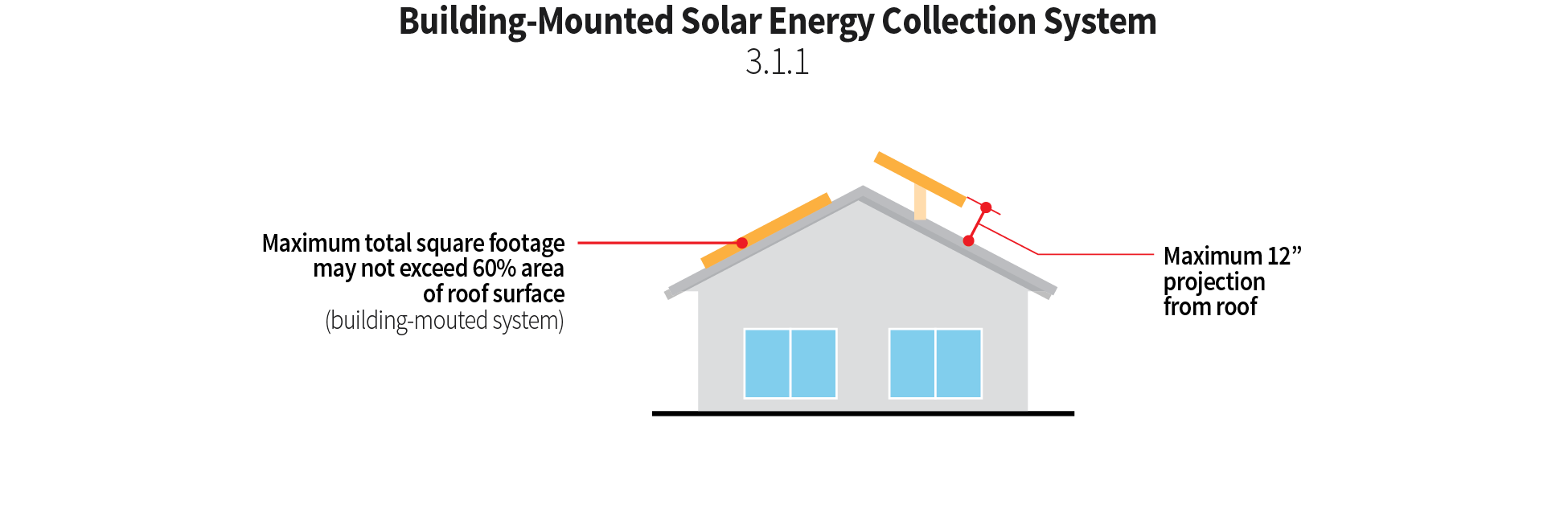
Quantity. The total square footage of the system panels may not exceed sixty (60) percent of the total area of roof surface of the structure to which the system is attached.
3)
Measuring height. Height is measured from the roof surface on which the system is mounted to the highest edge of the system.
4)
Maximum height. Systems shall not extend beyond twelve (12) inches parallel to the roof surface of a pitched roof. Systems shall not extend beyond the roof surface of a flat roof. Systems shall not extend above the highest peak of a pitched roof.
5)
Architectural integration. All materials used for racking, mounts, mounting clamps, and flashings shall be of a color consistent with the color of the roof surface to minimize visibility.
14.3.1.2. Free-standing systems.
1)
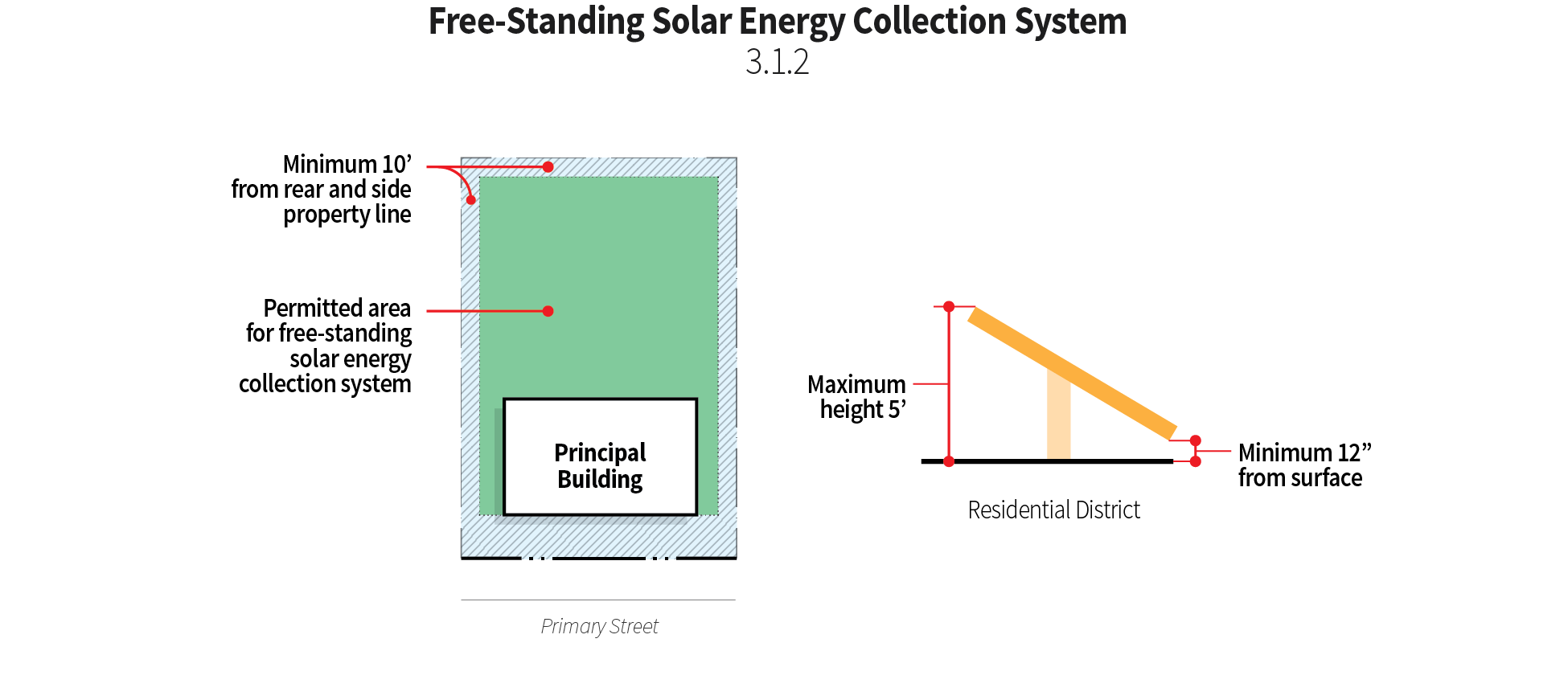
Location. Systems are permitted in the rear and side yards only.
2)
Quantity. An unlimited quantity of panels is allowed on all zoning lots with the exception of any residential zoning lot thirty thousand (30,000) square feet or less in size, which are limited to a total of one hundred (100) square feet in area of panels.
3)
Maximum height. Maximum height shall be five (5) feet in height, measured from the grade at the base of the pole to the highest edge of the system.
4)
Clearance. Minimum clearance between the lowest point of the system and the surface on which the system is mounted is twelve (12) inches.
5)
Setbacks. All parts of the freestanding system shall be set back ten (10) feet from the side and rear lot lines and shall not be located in a public utility easement.
(Ord. No. O19-05-06, § 3, 5-21-2019)
Sec. 14.3.2. - Wind energy collection systems.
14.3.2.1. Small structure wind energy turbine performance standards.
1)
Height. The maximum height of the system shall be fifteen (15) feet above the highest point of the roofline of the structure it is mounted upon. The height shall be measured from the highest point of the roofline to the top of the tower or tip of the blade in its vertical position, whichever is higher.
2)
Diameter. The maximum diameter of the blades or rotor shall be ten (10) feet.
3)
Visual appearance. Finished in a single non-reflective, unobtrusive color, such as off-white, light gray, or other neutral color, or match the color of the building on which it is mounted. The appearance shall be maintained throughout the life of the unit.
4)
Lighting. The wind system shall not be artificially lighted with accent lighting unless required by the FAA, or other agency with jurisdictional authority.
14.3.2.2. Small tower mounted wind energy turbine performance standards.
1)
Setback. The wind tower system shall be set back a distance equal to one hundred ten (110) percent of the combined height of the tower plus the length to the tip of the blade from all adjacent property lines. Additionally, no portion of the small wind energy system may be located within any required setback.
2)
Clear zone. The wind tower system shall maintain a circular clear zone that has a radius which is equivalent to one hundred ten (110) percent of the combined distance of the tower height plus the length to the tip of the blade. This clear zone shall be maintained free of any occupied structures, tanks containing combustible/flammable liquids, and above-ground utility/electrical lines.
3)
Height. The height shall not exceed thirty-five (35) feet. The height shall be measured from the finished grade at the base of the small wind energy system to the top of the tower or tip of the blade in its vertical position, whichever is higher.
4)
Visual appearance. Finished in a single non-reflective, unobtrusive color, such as off-white, light gray, or other neutral color. The appearance shall be maintained throughout the life of the unit. Only monopole towers shall be permitted.
5)
Electrical. All electrical wires other than wires necessary to connect the wind generator to the tower wiring, the tower wiring to the disconnect junction box, and the grounding wires shall be located underground.
6)
Lighting. The wind tower system shall not be artificially lighted with accent lighting unless required by the FAA, or other agency with jurisdictional authority.
7)
Security. Any climbing apparatus must be located at least twelve (12) feet above the ground, and the tower must be designed to prevent climbing within the first twelve (12) feet. The climbing apparatus can be reduced to eight (8) feet above ground if the tower is surrounded by a five-foot fence.
8)
Signage. No tower should have any sign, writing, or picture that may be construed as advertising.
14.3.2.3. General standards applicable to all wind energy systems.
1)
Sound. The wind system shall not exceed sixty (60) dBA, as measured at the closest neighboring inhabited dwelling. The level, however, may be exceeded during short-term events such as utility outages and/or severe wind storms as determined by the Director of Community Development.
2)
Shadow flicker. The wind system shall be installed and operated so as not to cause a shadow flicker to fall on or in any existing residential structure.
3)
Performance and safety standards. At the time of application, the applicant must present a certification from the manufacturer that the system's turbine and other components equal or exceed the standards of one (1) of the following national certification programs such as the: National Electrical Code (NEC), American National Standards Institute (ANSI), Underwriters Laboratories (UL), or any other small wind certification program recognized by the American Wind Energy Association.
4)
Electromagnetic interference. System shall be designed and constructed so as not to cause radio and television interference. Wind tower systems shall be compliant with all life safety and building codes.
5)
Removal. If the system remains nonfunctional or inoperative for a continuous period of six (6) months, the system shall be deemed to be abandoned. The system owner/operator shall remove the abandoned system at their expense. Removal of the system includes the entire structure, transmission equipment and fencing from the property excluding foundations.
(Ord. No. O19-05-06, § 3, 5-21-2019)
Sec. 14.3.3. - Home occupations.
A home occupation is a commercial activity which is accessory, incidental and customary to a residential use. Provided, however, any use identified in the Table of Permitted Uses in Chapter 2, as a conditional use "C" in the manufacturing (M) zoning district shall not be considered to be a home occupation and shall be prohibited in a residential use. For the purpose of this definition, "neighborhood" shall be defined as an area within one thousand (1,000) feet of the subject property and on the same street or a street which crosses that street.
14.3.3.1. Home occupation, Type A.
1)
Location. The commercial activity is conducted on the lot and within the principal building in residential use.
2)
Ownership. At least one (1) of the persons engaged in the commercial activity is an owner or occupant of the residence.
3)
Outside employment. Only one (1) person not residing on the property shall be employed in the commercial activity.
4)
Nature of commercial activity. The uses shall not involve any manufacturing. All aspects of the business will be conducted within the building in principal use. There will be no outside display or sales of goods connected with the commercial activity.
5)
Size of the use. The area regularly or normally used for the home occupation shall not exceed twenty-five (25) percent of the gross floor area of the building in principal use, or five hundred (500) square feet, whichever is less.
6)
Parking. Parking accessory to the use shall not exceed two (2) spaces.
7)
Traffic. The home occupation will not create more than twenty-five (25) trips per day.
8)
Deliveries. The home occupation will not result in the delivery of goods by tractor trailers to the residence.
9)
Appearance. Residential structures with a home occupation shall maintain the residential character of the structure and be consistent architecturally with other residential structures in the neighborhood.
10)
Signs. Commercial signs for a home occupation shall be prohibited.
11)
Impact on neighborhood. The commercial activity shall not create any noise, vibration, heat, glare, fumes, odor, dust, radiation, or electrical interference which is discernible at the property line.
14.3.3.2. Home occupation, Type B.
1)
Location. The commercial activity is conducted on the lot.
2)
Ownership. At least one (1) of the persons engaged in the commercial activity is an owner or occupant of the residence.
3)
Outside employment. No more than two (2) persons not residing on the property shall be employed in the commercial activity.
4)
Nature of commercial activity. All aspects of the business will be conducted within a structure. There will be no outside display or sale of goods connected with the commercial activity.
5)
Size of the use. The area regularly or normally used for the home occupation shall not exceed fifty (50) percent of the gross floor area of the building in principal use or one thousand (1,000) square feet, whichever is less.
6)
Parking. Parking accessory to the use shall not exceed four (4) spaces.
7)
Traffic. The home occupation will not create more than one hundred (100) trips per day.
8)
Deliveries. The home occupation will not result in the delivery of goods by tractor trailers to the residence.
9)
Appearance. Residential structures with a home occupation shall maintain the residential character of the structure and be consistent architecturally with other residential structures in the neighborhood. Parking areas shall be surfaced in a manner consistent with requirements applicable for parking areas other than single-family residences and fully landscaped to screen the areas from the street and adjacent properties.
10)
Signs. Commercial signs for a home occupation shall be prohibited.
11)
Impact on neighborhood. The commercial activity shall not create any noise, vibration, heat, glare, fumes, odor, dust, radiation, or electrical interference which is discernible at the property line.
(Ord. No. O19-05-06, § 3, 5-21-2019)
Sec. 14.3.4. - Integrated shopping center.
1)
An integrated shopping center is a unified commercial development. It is a combination of underlying uses. The advantages in obtaining a permit for this use as opposed to the individual uses is that when the underlying use (e.g., a Class 1 retail establishment) changes to another underlying use (e.g., a laundry), a new zoning or conditional use permit is not required.
2)
An integrated shopping center requires conditional use approval and at least fifteen (15) acres of land in one (1) ownership. All structures on the lot shall be architecturally integrated and coordinated with each other.
3)
The underlying uses are limited to only those allowed in the district as detailed in the Table of Permitted Uses in Chapter 2 of this title.
(Ord. No. O19-05-06, § 3, 5-21-2019)
Sec. 14.3.5. - Outdoor seating.
14.3.5.1. General provisions.
The purpose of this section is to permit and encourage outdoor seating at food and drink establishments and restaurants in the Village. This section seeks to provide guidelines and requirements that result in the safe use of sidewalks and rights-of-way, while maintaining a visually attractive atmosphere and streetscape. Permits for outdoor seating areas granted under this section may be revoked by the Village Administrator at any time provided a three (3) day notice is given to the operator.
14.3.5.2. Outdoor seating on private property.
Outdoor seating areas at restaurants shall be permitted on the same zoning lot as and in conjunction with an established restaurant subject to the following requirements:
1)
All chairs and furnishings shall be constructed in such a manner that they can be easily removed during winter months or as otherwise required by the Village. No chairs or furnishings shall be stored outside the restaurant.
2)
Colors of materials of outdoor furniture and appurtenances shall be harmonious with the principal and adjacent structures and shall be designed to withstand a minimum wind pressure of not less than thirty (30) pounds per square inch. No plastic seating or fencing will be allowed.
3)
All outdoor seating areas shall comply with all requirements as set forth by the McHenry County Health Department.
4)
The sale and consumption of alcoholic beverages in the outdoor seating area shall comply with the liquor license held by the establishment.
5)
The outdoor seating area shall not be detrimental to the health, safety, morals or general welfare of the patrons or those within view or hearing distance within the establishment.
6)
Outdoor seating areas shall be exempt from applicable parking requirements and shall not consume any required or existing parking spaces unless approved by the Village. In the event that the outdoor seating area creates an overflow parking problem onto adjacent public streets, the operator shall make provisions for off-site parking on nearby nonresidential properties.
7)
In no event shall the outdoor dining area operate earlier than 6:00 a.m. or later than 11:00 p.m. Any other type of outdoor activity associated with the restaurant, including but not limited to volleyball or basketball, shall not be permitted after 10:00 p.m. if located on an adjacent lot to a residentially zoned property.
8)
Adequate facilities for refuse disposal shall be provided as required by the Village.
9)
Advertising or promotional features in a permitted outdoor seating area shall be limited to umbrellas or canopies and shall be limited to no more than twenty-five (25) percent of the surface area of the umbrella or canopy.
10)
Amplified music or other noises shall be limited in volume in the outdoor seating area so as not to create a nuisance for adjoining property.
11)
Illumination shall be such that lighting levels shall not exceed 0.5 footcandles at the property line and shall be shielded from surrounding properties.
14.3.5.3. Outdoor seating on public property.
Outdoor seating areas shall be permitted on public property, subject to the following requirements:
1)
All regulations set forth in Section 14.3.4.2 shall apply.
2)
An application for the outdoor seating area shall be submitted to the Community Development Department which includes a site plan showing the location of the seating area, plans and cut sheets of any furniture and appurtenances, provisions for refuse disposal, and any other information as may be required by the Department.
3)
The applicant shall furnish the Village with evidence of general liability insurance and dram shop insurance where applicable. Coverages shall name the Village as an additional insured, protecting the Village against any liability resulting from the uses permitted in this chapter. Minimum coverage for general liability and dramshop insurance shall be as set forth in Appendix A of this code.
4)
In no instance shall the operation of the outdoor seating area reduce the open space of the public sidewalk to less than four (4) feet clear of all obstructions. The usability of the public sidewalk shall be designed and maintained in accordance with the Illinois Accessibility Code.
5)
All maintenance and upkeep of the public right of way associated with the operation of the outdoor seating area shall be the responsibility of the operator. The operator shall be responsible for any damage to public property and shall restore the public sidewalk to its original condition when the operation of the outdoor seating area ceases.
(Ord. No. O19-05-06, § 3, 5-21-2019)
Sec. 14.3.6. - Parks and open spaces.
Any use in a park with hours of operation extending beyond 11:00 p.m. shall require conditional use approval. Restroom facilities and sheds within the PO district are limited to one (1) per lot. Additional restroom facilities or sheds above this limit may be permitted for larger park sites subject to the approval of the Community Development Director.
(Ord. No. O19-05-06, § 3, 5-21-2019)
Sec. 14.3.7. - Recreational vehicles or equipment.
Recreational vehicles or equipment include travel trailers, campers, trucks with slide-in campers, watercraft, snowmobiles, jet skis, all-terrain vehicles and any trailers used to transport recreational vehicles or equipment. Recreational vehicles and equipment are divided into two (2) classes:
a)
Class I includes travel trailers, campers, trucks with slide-in campers, watercraft, jet skis, all-terrain vehicles and such other recreational vehicles and equipment that are associated primarily with summer use;
b)
Class II includes snowmobiles and such other recreational vehicles and equipment that are associated primarily with winter use.
1)
Accessory uses. The storage of recreational vehicles or equipment is allowed as an accessory use to a residential dwelling unit under the standards set out in this section.
2)
Temporary storage. Class I recreational vehicles or equipment are in temporary storage when they are placed or situated on a lot for any period of time between April 1 and October 31 of the same year, or when they are placed or situated on a lot outside of that time period and pursuant to an RV parking permit issued by the Village. Class II recreational vehicles or equipment are in temporary storage when they are placed or situated on a lot for any period of time between November 1 of one (1) year and March 31 of the following year, or when they are placed or situated on a lot outside of that time period and pursuant to an RV parking permit issued by the Village. Any vehicle in temporary storage shall be placed:
a)
In a vehicle accommodation area:
i.
Within the area between the principal building and front lot line; or
ii.
Between the principal building and lot line for a side yard facing a street; or
b)
Within an area that meets the permanent storage requirements.
3)
Permanent storage. Recreational vehicles or equipment that are placed or situated on a lot for any period of time outside of that allowed for temporary storage, or which are placed in an area that does not meet the requirements for temporary storage, shall be deemed in permanent storage. Recreational vehicles or equipment in permanent storage must be placed in one (1) of the following locations:
a)
Within a fully enclosed structure;
b)
Within an area between the principal building and the lot line of a side yard not facing a street;
c)
Or between the rear of the principal building and lot line of the rear yard;
d)
In order for a vehicle to be placed in a side or rear yard not facing a street, the distance between the principal building and the appropriate side or rear lot line shall meet or exceed the following:
e)
The permanent storage of recreational vehicles and equipment is limited to one (1) yard;
f)
Recreational vehicles or equipment that are placed to the side or rear of the principal building and which are less than five (5) feet in height shall be screened from adjacent uses through the use of shrubs, solid fences, screening trees, or a combination thereof to a height of five (5) feet. Those recreational vehicles that are similarly situated and are five (5) feet or higher in height shall be screened from adjacent structures by a Type A Transition Area.
4)
RV parking permit. The Director of Community Development may issue a permit to any property owner to allow him or her to place or have placed on his or her lot a recreational vehicle or equipment for a period of seven (7) days in order that the vehicle or equipment may be cleaned, repaired or made ready for use, or to accommodate a driver, passenger or user of the vehicle who is from out-of-town and who is visiting the residents of the property.
(Ord. No. O19-05-06, § 3, 5-21-2019)
Sec. 14.3.8. - Sexually-oriented businesses.
Any sexually oriented business including, but not limited to, adult entertainment establishments, adult cabarets, adult stores, adult book and video stores, adult theaters, adult massage parlors and/or adult saunas shall meet the following requirements:
1)
The building must be sited a minimum of five hundred (500) feet from any lot in a detached single-family residential use or in the E1, R1, R2, or R2A residential zoning districts.
2)
The establishment will not be open for business between the hours of 12:00 midnight and 4:00 p.m.
3)
No person under the age of eighteen (18) will be employed or allowed on the premises; furthermore, if the establishment serves alcoholic beverages, no one under the age of twenty-one (21) will be employed or allowed on the premises.
4)
The establishment will be operated in such a manner that no person from any location outside the premises will be able to view any specified anatomical areas of any person or any specified sexual activity occurring within the premises.
5)
The establishment shall employ a full-time manager who shall take appropriate actions to prevent any illegal sexual activity, including, but not limited to, sexual intercourse, oral copulation, masturbation or sodomy, from occurring on the premises.
6)
The use shall comply with the industrial performance standards for Chapter 4 uses for noise, and odor.
(Ord. No. O19-05-06, § 3, 5-21-2019)
Sec. 14.3.9. - Wireless service facilities.
All wireless telecommunication facilities shall be subject to the requirements of this section, as well as any other applicable provisions of this article and the Village of Cary Unified Development Ordinance.
1)
Zoning district requirements. Wireless telecommunication facilities shall be permitted with the following conditions:
a)
No new wireless telecommunication towers shall be permitted in any district other than the M district. Wireless telecommunication towers shall not exceed a maximum height of one hundred (100) feet. Co-locations on existing wireless telecommunication facilities or existing structures that do not require any additional height shall be a permitted use. Wireless telecommunication towers shall not be permitted in required front or exterior side yards.
b)
Wireless telecommunication facilities installed on buildings, structures, or water towers shall be permitted in all districts, shall not extend more than ten (10) feet beyond the height of the structure to which they are affixed, and shall be painted to match the color of the structure.
2)
Compliance with federal regulations.
a)
All telecommunication facilities shall comply with current regulations of the Federal Aviation Administration (FAA) and the Federal Communications Commission (FCC) or any other federal or state agency with authority to regulate telecommunication facilities, including towers and/or antennas.
b)
In the event of a change in Federal or State regulation, the owner of the telecommunication facility shall bring it into compliance with the revised regulations within six (6) months of the effective date of such regulations, unless a different compliance schedule is mandated by the State or Federal agency.
3)
Compliance with building codes. All wireless telecommunication shall be constructed in compliance with all applicable building codes, including the Electronic Industries Association/Telecommunication Industry (EIA/TIA) standards for the construction of facilities including towers, antennas, and support structures.
4)
General site location requirements. No new wireless telecommunication towers shall be permitted within a radius of one thousand five hundred (1,500) feet of an existing wireless telecommunication tower unless the applicant can demonstrate that the existing telecommunication tower is unsuitable for technical or structural reasons.
5)
Setback requirements.
a)
Wireless telecommunication towers shall be setback at least fifty (50) percent of the tower height from any adjoining property zoned for nonresidential use.
b)
Wireless telecommunication towers shall be setback at least one hundred (100) percent of the tower height from all adjoining property zoned for residential use.
c)
Other structures associated with the wireless telecommunication tower (such as equipment shelters, guy wire anchors) shall comply with the setback requirements of the district in which the tower is located.
d)
The setback requirements of this section are minimums. The Board of Zoning, Planning and Appeals may require additional setback distance as part of a special land use approval.
6)
Co-location requirements. New wireless telecommunication towers shall be designed to permit co-location by at least two (2) additional entities and proposed locations for wireless telecommunication facilities shall be adequately sized and configured to allow the placement of at least two (2) additional telecommunication equipment shelters.
7)
Tower design. Wireless telecommunication towers shall be constructed as freestanding structures and shall have a neutral surface finish color to reduce visual obtrusiveness, except as otherwise required by a State or Federal agency.
8)
Signs. Wireless telecommunication facilities shall not be used for advertising purposes. Wireless telecommunication facilities shall display one (1) sign, not to exceed two (2) square feet, which identifies the service provider and an emergency telephone number. These restrictions shall not apply to any safety signs placed on the security fence or tower.
9)
Fencing. Wireless telecommunication facilities shall be enclosed by a solid screening fence not less than six (6) feet in height.
10)
Screening. Wireless telecommunication facilities shall be effectively screened with a landscape buffer to obscure views of the tower base, equipment shelter, security fencing, or guy wire anchors from adjacent uses and public rights-of-way. Locations where the visual impact of the tower will be minimal or where existing vegetation provide an effective natural screen or where the security requirements of the principal use prevent screening (utility substations), the Board of Zoning, Planning and Appeals may modify this requirement.
11)
Lighting. Wireless telecommunication towers shall not be artificially lit unless required by the FAA, FCC, or other agency with jurisdictional authority. If lighting is required by federal regulation, the applicant shall use the least intrusive form of lighting acceptable under the controlling regulation.
12)
Equipment shelter design. The design and materials used in the construction of the equipment shelter shall, to the extent possible, blend the structure with the surrounding built or natural environment. The equipment shelter shall not exceed fifteen (15) feet in height.
13)
Off-street parking. New wireless telecommunication facilities shall provide one (1) off-street parking space to accommodate maintenance vehicles, if practicable. Driveways and parking spaces serving such facilities may have a gravel surface, provided the surface is maintained in a dust-free condition and graded to maintain proper drainage.
14)
Permitted additional antenna. Wireless telecommunication antennas shall be considered a permitted accessory use when placed on or attached to any existing wireless telecommunication structure, provided that all other applicable ordinance requirements are complied with. Any initial wireless telecommunication antenna placed on an alternative tower structure shall be subject to the same review and approval procedures as a new wireless telecommunications facility. Subsequent antennas on alternative tower structures shall be considered permitted accessory uses in all districts.
15)
Permitted tower placement. An existing wireless telecommunication tower may be replaced for the purposes of accommodating the co-location of additional wireless telecommunication antennas subject to the following review and approval process:
a)
Tower replacements that result in the addition of fifty (50) or fewer feet of additional tower height shall require site plan view and approval by the Board of Zoning, Planning and Appeals;
b)
Tower replacements that result in the addition of more than fifty (50) feet in height shall require special land use review and approval by the Board of Zoning, Planning and Appeals;
c)
Tower replacements that require the installation of tower lights shall require special land use review and approval by the Board of Zoning, Planning and Appeals.
16)
Application requirements. In addition to any other applicable requirements detailed in this title, the following information shall be provided in support of an application to initially construct a wireless telecommunication tower:
a)
Certification from an Illinois licensed professional engineer as to the manner in which the proposed wireless telecommunication tower is designed to collapse;
b)
A report that addresses the review criteria contained in this chapter. This report shall include a map depicting the existing and known proposed location of telecommunication, including telecommunication wireless towers and wireless telecommunication antennas attached to alternative tower structures, within a one-mile radius of the proposed site. This includes wireless telecommunication towers located within adjacent jurisdictions within the one-mile radius;
c)
A statement attesting that the applicant has investigated the opportunity for collocation on existing structures or base stations and explain why collocation is not feasible for technical reasons.
d)
Provide data from a qualified engineer that alternative locations are unavailable or impracticable and that the equipment cannot be installed on an existing tower or base station.
e)
The name, address, and telephone number of the person to contact regarding site maintenance or other notification purposes. The tower owner shall periodically update this information;
f)
A statement that indicates the applicant's intent to allow the co-location of other antennas, provided that the cost of modifying the existing tower is borne by the co-locating entity and reasonable compensation is paid by the co-locating entity.
17)
Review criteria. A wireless telecommunication tower shall not be approved unless it can be demonstrated by the applicant that there is a need for the tower which cannot be met by placing wireless telecommunication antennas on an existing tower or other suitable structure, or placement of an existing tower:
a)
No existing towers or alternative tower structures have the structural capacity to support the proposed antenna nor can existing towers or alternative tower structures be reinforced to support the proposed antenna;
b)
No existing towers or alternative tower structures are located within the geographic area that meets the system's engineering requirements;
c)
The cost of using an existing tower or other suitable structure or replacing an existing tower exceeds the cost of constructing a new wireless telecommunication tower; or
d)
The installation or use of an alternative communication technology is unsuitable or infeasible.
18)
Removal of abandoned facilities. Any wireless telecommunication tower or antenna that is not operated for a continuous period of twelve (12) months shall be considered abandoned and the owner of such tower or antenna shall remove the same within ninety (90) days of receiving an abandonment notification from the Village. Failure to remove an abandoned tower or antenna within ninety (90) days shall be grounds for the removal of the tower or antenna at the owner's sole expense.
19)
Bond. Applicant shall provide the Village with proof of an annual performance bond in the amount specified in Appendix A to ensure that the applicant will comply with the provisions set forth in Subsection 18 of Section 14.3.8 of this chapter regarding the removal of an abandoned tower and/or antenna.
20)
Inspection. An inspection of the wireless telecommunication facility shall be required every two (2) years after the completion of improvements. The inspection shall be carried out by the owner of the facility and shall certify the structural integrity of the wireless telecommunication facility. The inspection certification shall be submitted to the Department of Community Development and filed with the site permit documents. If the Department of Community Development determine that an inspection has not been completed within the two-year period, a notice will be sent to the owner. The owner shall have thirty (30) days in which to comply with this requirement. If the inspection is not completed within the thirty (30) days, the permit for the wireless telecommunication facility will be revoked.
(Ord. No. O19-05-06, § 3, 5-21-2019)
Sec. 14.3.10. - Mining and mineral extraction.
14.3.10.1. General provisions.
1)
Purpose. The purpose of this section is to recognize that mining operations in urban areas are land uses with unique environmental effects calling for special regulatory controls to ensure that:
a)
Extraction and processing areas operate in a manner that is compatible with the natural and manmade environment;
b)
Impacts on nearby residential and institutional areas and on property values are minimized; and
c)
Mined areas shall be restored consistent with an approved reclamation plan and site development plan.
2)
Applicability. Any extraction or processing of earth materials shall be submitted only as a conditional use and only in those districts that so provide. Earth materials shall include topsoil, earth, clay, gravel, sand, stone, and other minerals. Provisions of this section applicable to conditional uses, such as required public hearing, shall apply only to mining and mineral extraction operations except as otherwise provided for in this article.
3)
Contents of conditional use application. Any application for a mining and mineral extraction use shall comply with the following requirements which shall be considered as satisfying the site plan requirements set forth in Chapter 8:
a)
A map or maps at a scale of one (1) inch to one hundred (100) feet showing:
i.
Existing topography at two (2) foot contour intervals;
ii.
Locations of existing watercourses and drainage systems, details of drainage into subject property from upstream watersheds and expected water runoff data;
iii.
Boundaries of the area to be excavated and of each phase if excavation is to proceed in phases;
iv.
Location, orientation, and dimensions of proposed berming, and fencing;
v.
Typical cross sections showing extent of overburden, extent of deposits of materials to be extracted, and water table;
vi.
North arrow, scale, date of preparation, and name of a certified professional engineer, landscape architect, or surveyor that prepared the map;
vii.
Two (2) copies of detailed engineering drawings and topographical surveys should be presented at a minimum scale of one (1) inch equals fifty (50) feet;
viii.
Topographical surveys should extend one hundred (100) feet beyond the limits of the subject property;
ix.
Locations of wetlands and required buffers, wooded areas, water impoundments, FEMA/FIRM flood zone boundaries, and floodways, easements and rights of way and other significant physical features or regulatory areas shall be depicted on the site plan, if any;
x.
Locations of any temporary or permanent buildings or structures and any proposed lighting (and the strength of said light) and a general description of the locations of all fixed and portable machinery to be utilized on the site;
xi.
Detailed grading plans depicting anticipated conditions at the completion of the extraction operation including anticipated ground surface (at two (2) foot contour intervals), water impoundments, drainage facilities, roads, and remaining structures;
xii.
Cross sections at one hundred (100) foot intervals showing existing and proposed final conditions;
xiii.
Such additional information as required by the Director of Community Development to determine if the site plan complies with this title.
b)
Descriptions of:
i.
Types of earth products to be mined;
ii.
Character and composition of vegetation and wildlife on land to be impacted;
iii.
Nature, depth, and proposed disposition of overburden;
iv.
Estimated depth to which mining will occur;
v.
Techniques of extracting and processing to be used;
vi.
Estimated type and volume of excavation;
vii.
Equipment to be used;
viii.
Practices to be used to minimize environmental impacts;
ix.
Proposed days and hours of excavation and processing;
x.
Estimated dates of beginning and completion of all operations on the site;
xi.
Projected volumes and nature of vehicular traffic, including site access location, vehicle circulation and site distance studies.
xii.
Site development report including a narrative of existing conditions; a phased operation plan; a reclamation plan and a site development plan.
c)
Contents of reclamation plan and site development plan. The reclamation plan:
i.
Shall include a mine report describing the schedule of reclamation actions by area, detailing reclamation methods and materials;
ii.
Shall include a map at a scale of one (1) inch to one hundred (100) feet showing the final condition of the site after extraction and processing activities have been completed showing how the finished slopes shall be constructed.
d)
Site development plan shall include a map at a scale of one (1) inch to one hundred (100) feet showing:
i.
The location of proposed watercourses, water features, drainage systems, access points, proposed structures, including, but not limited to, any walking paths, parking lots, streets, driveways, buildings, stormwater, sewer and water lines and related infrastructure, if any;
ii.
Future land uses for the entire site, and proposed intensities or densities for the uses;
iii.
Future landscaping and ground cover including species and sizes at time of planting;
iv.
Such other information as required by the permit issuing authority to illustrate compliance with this title;
v.
Compliance with State and Federal regulations.
e)
In addition to the requirements detailed in this section, all operations shall comply with State and Federal laws and regulations including obtaining all permits required by State and Federal agencies.
4)
For purposes of this Subsection 14.3.4, construction and removal of berms and seeding and maintenance of those, tree and shrub removal, landscaping material installation, maintenance and removal, slope construction, fence construction and maintenance surrounding the gravel mine, and the stripping and replacement of the overburden are construction activities which are not included within the definition of mining and mineral extraction.
(Ord. No. O19-05-06, § 3, 5-21-2019)
Sec. 14.3.11. - Cannabis business uses.
Any business in the act of selling, cultivating, growing, or infusing cannabis products shall meet the following requirements:
1.
Fixed Location Required. It shall be unlawful to operate a medical or recreational dispensary, or to grow or infuse cannabis outside of a locked enclosed space within a building. All dispensaries, cultivation centers, infusers or craft growers must have all required State of Illinois and Village of Cary licenses or certificates necessary for the operation of the business within an enclosed building and comply with the appropriate standards.
2.
Location.
a.
A cannabis business use may be located only within a zoning district in accordance with the provisions of Chapter 2 of this Title.
b.
A dispensary, craft grower, or infuser shall not be located within one thousand (1,000) feet of a property line of a public or private elementary, vocational, or secondary school, college or university, a state licensed day care not within a residence, a library, or place of worship.
c.
A dispensary shall not be located within one-thousand five hundred (1,500) feet of the property line of a pre-existing dispensary.
d.
A craft grower shall not be located within one-thousand five hundred (1,500) feet of another craft grower or a cultivation center.
e.
A cultivation center may not be located within two-thousand five hundred (2,500) feet of a property line of a public or private elementary, vocational, or secondary school, daycare center or day care home, or an area zoned for residential use.
f.
For purposes of this section, school, college, or university shall include properties owned by such entities only if they are used to provide services, teaching facilities, or living facilities to students. No distance is required between a cannabis business use and properties owned by a school, college, or university that are not used to provide teaching facilities, or services to students.
g.
Distances shall be measured by the Village on official maps as the radius from the closest points on the perimeter of the school or named facility's property line to the building or space occupied by the cannabis business use.
h.
If the State of Illinois requires a different location restriction for a cannabis business use compared to the Village of Cary's requirements, the more restrictive standard shall be adhered to.
3.
Residential Restriction. It shall be unlawful to operate a cannabis business use within a residential zoned district, in a building which contains a residence, or within a mixed-use development that includes a residence.
4.
Lighting. All site lighting and interior lighting must be provided and kept in good working order and of sufficient wattage for security cameras to monitor the property and provide for the safety of customers and employees.
5.
Screening.
a.
A cannabis business use shall be effectively screened from an adjacent lot with a building containing a residence by providing a landscape buffer in accordance with the requirements of Chapter 4 of this Title to obscure view of the use. The landscape buffer shall also include a minimum six (6) foot solid fence along the shared property line.
b.
For cannabis business uses which are adjacent to a lot with a building containing a residence but are separated by an alley or dedicated right-of-way, or are located within a commercial shopping center or other multi-tenant building and not directly adjacent to a property line, the Director of Community Development shall determine if additional screening, consisting of fencing and/or landscaping, shall be required based on the existing site conditions.
6.
Access and Visibility. The parking facility must be accessed directly from a public street and visible from a public street. No screen, blind, curtain, partition, article or other things shall be permitted in the windows or upon the doors of the cannabis business use which shall prevent a clear view into the interior of the premises available for public access.
7.
Signage. Any exterior or window signs proposed for the cannabis business ues shall comply with State of Illinois requirements and Chapter 5 of this Title. Signage shall not depict the actual consumption of cannabis, include an image of a cannabis leaf or bud, or include any image designed to likely to appeal to minors.
8.
Hours of Operation. A dispensary shall be closed to the public and no sale or other distribution of cannabis shall occur upon the premises or via delivery from the premises, between the hours of 10:00 PM and 8:00 AM. Provided however in the event that a planned delivery of cannabis cannot be completed on the day scheduled, the cannabis may be returned to the center.
9.
Staffing. A minimum of two (2) employees must be working at a dispensary when it is open.
10.
Location of Sales. All product storage, display, and sales must be conducted within an enclosed building. Drive-through facilities are prohibited.
11.
Sales, Production and Consumption. Cannabis products shall only be sold at retail at an approved dispensary and shall not be consumed on the premises. Cultivation, infusing, manufacturing, or growing of cannabis products shall only be permitted in a craft grower, infuser, or cultivation center.
12.
Definitions. For purposes of this section the following general definitions shall apply in accordance with the State of Illinois requirements:
a.
Cannabis business is a facility or business that is involved in the growing, cultivation, processing, transporting or sale of cannabis related products.
b.
Dispensary is a facility or business that is permitted to acquire cannabis from a cultivation center, craft grower, processing organization, or another dispensary for the purpose of selling or dispensing cannabis and related products, for medical or recreational purposes.
c.
Craft Grower is a facility or business that is permitted to cultivate, dry, cure, and package cannabis and perform other necessary activities to make cannabis available for sale at a dispensary.
d.
Infuser is a facility or business that is permitted to directly incorporate cannabis or cannabis concentrate into a product formulation to produce a cannabis-infused product.
e.
Cultivation Center is a facility or business that is permitted to cultivate, process, transport, and perform other activities to provide cannabis and cannabis-infused products to other cannabis business uses.
(Ord. No. O19-11-02, § 5, 11-19-2019)
Sec. 14.3.12. - Massage establishments.
Any establishment having a fixed place of business in the Village of Cary where any person, firm, association, or corporation engages in, or carries on, or permits to be engaged in or carried on any of the activities of the practice of massage shall meet the following requirements:
1)
Fixed Location Required: It shall be unlawful to operate a massage establishment outside of an enclosed space within a building. All massage establishments must have all required State of Illinois and Village of Cary licenses or certificates necessary for the operation of the business and comply with the appropriate standards.
2)
Licensing Requirements: All massage establishments shall comply with the applicable licensing requirements of Section 5.36 of the Village of Cary Municipal Code and obtain a certificate of occupancy from the Village prior to the operation of any business operations on the premises. Specifically, the provisions for both Facility (5.36.150) and General (5.36.160) licensing requirements shall be considered as part of a conditional use permit application for compliance.
3)
Location:
a.
A massage establishment may be located only within a zoning district in accordance with the provisions of Chapter 2 of this Title.
b.
No massage establishment shall be located within one thousand (1,000) feet of a preexisting massage establishment.
c.
No massage establishment shall be located within one thousand (1,000) feet of a property line of a public or private elementary, vocational, or secondary school, college or university, a state licensed day care not within a residence, a library, or a place of worship.
d.
Establishments which provide massage as an accessory or secondary use within their primary business operation shall also be subject to the location requirements identified in this Chapter regardless of whether the primary business operation is a conforming permitted use, or a conditional use for which a conditional use permit has been granted, under the Village Unified Development Ordinance.
4)
Signage: Any exterior or window signs proposed for the massage establishment shall comply with the requirements of Chapter 5 of this title.
(Ord. No. O21-12-09, § 4, 12-7-2021)

