
Cary City Zoning Code
CHAPTER 4
- DEVELOPMENT STANDARDS
Sec. 14.4.1. - Basic requirements for all districts.
14.4.1.1. Intent.
It is the intent of this article not to restrict imagination, innovation, or variety, but rather to assist in focusing on design principles which can result in creative solutions that will develop an attractive appearance within the Village, preserve taxable values, and promote the public health, safety, and welfare. In general, the standards in this article seek to foster greater harmony between intensive development and the single-family residential community. However, the standards are not solely directed at nonresidential or multifamily residential uses. Some of the standards seek to foster harmony between any development and existing residential structures in the B3R district—a district characterized by some of the oldest housing in the Village. Furthermore, they seek to ensure that the character of that district will be retained.
14.4.1.2. General standards—Nonresidential developments.
Any new structure or any substantial change to the front facade of a building in nonresidential use or in a residential use, other than a detached single-family or two (2) family residential dwelling unit, or an accessory structure to those uses, shall demonstrate that the structure or proposed change to it will be attractive and compatible with the style and design of other structures on the lot, as well as structures and open spaces on adjacent properties and those across the street from it.
14.4.1.3. General standards—Any development in the B3R district.
Any new structures, and any substantial new addition to an existing structure in the B3R district shall be constructed or reconstructed in a manner consistent with single-family houses built in Cary between 1890 and 1940. Any new construction or reconstruction will meet the standards set out in this chapter. In addition, if any new construction or reconstruction is made to the front facade, the entire front facade and not just that which is being reconstructed or renovated shall meet those same standards.
14.4.1.4. Criteria.
In implementing the standards set out in this chapter, the permit issuing authority shall consider the following criteria:
1)
Buildings and structures should be designed with an appropriate scale and exhibit a multiplicity of details, lines, and shapes.
2)
Buildings and structures should be in harmony in texture and materials with uses on adjacent lots and themselves. Adjacent buildings of different architectural styles should be made compatible by such means as screens, sight breaks, and materials.
3)
The site should be planned to accomplish an attractive transition to the streetscape and to provide for adequate planning, safe pedestrian movement, and parking areas.
4)
Parking should be treated with decorative elements, such as wall extensions, plantings, berms, or other innovative means, so as to screen parking areas from streets.
5)
Utility services should be underground.
6)
Trash receptacle areas should be fully screened with a combination of evergreen shrubs and opaque materials.
14.4.1.5. Building materials.
Consistent with the above, except in the M districts, any facade facing a street should be made of masonry, stone, glass, or architecturally precast concrete panels. The side exterior walls may be of metal except that the lower third or lower seven (7) feet, whichever is less, of the wall should be of masonry, stone, glass, or architecturally precast concrete panels.
14.4.1.6. Style, texture, and materials in the B3R district.
Any development in the B3R district shall meet the following standards related to style, texture, and materials. (Developments that meet the specific standards in this section should be deemed to meet the more general standards relating to style, texture and materials set out in this chapter.
1)
Exterior style and materials. The exterior design of buildings shall emphasize traditional architectural themes, consistent with the character of the district. Modern or international styles are not permitted. The materials used on exterior elevations, excluding doors, windows, and roofs shall be limited to the following materials:
a)
Unglazed clay brick.
b)
Natural stone.
c)
Wood.
d)
Cementitious lap siding.
e)
Stucco (cementitious material only, no exterior insulation finish systems).
2)
Door and wood design and materials. All doors and windows shall be residential in character. Doors shall be compatible with the design of the building. All windows shall be wood, or wood clad with aluminum or vinyl.
3)
Exterior trim and materials. On buildings other than masonry ones, trim is required for all doors and windows. On masonry buildings, cut stone or pre-cast sills are required for windows; cut stone, precast, or brick lintels are required for doors and windows; other trim is not required. Trim materials shall be limited to wood, stone, cast stone, molded fiberglass, or molded high density polymer.
4)
Accent features. Decorative accent features on exterior walls which are subordinate and incidental to the design of the facade shall be limited to wood, stone, cast stone, molded fiberglass, or molded high density polymer.
5)
Mixing of materials. Materials may be mixed, provided the placement of materials reflects traditional mixing of materials as exemplified below:
a)
A wood porch or balcony may be used in combination with stone or brick walls.
b)
An extended brick or stone foundation wall may be used with wood walls.
c)
A front facade of finished brick or stone may be used with common brick on side and rear walls.
d)
A one-story room of wood may project from the main two-story portion of the building made of brick or stone.
e)
A fireplace or column of one (1) material may be combined with walls of another.
6)
Roof design and materials. A hip, gable, or other sloping roof is required. Flat or mansard roofs are not permitted. Only copper pan or shingle roofs of asphalt, fiberglass, fire-resistant wood, or slate are permitted.
7)
Glazed surfaces. At least twenty (20) percent of the front elevation shall be glazed surface.
8)
Color. Color schemes shall be limited to those traditionally found on single-family residences existing in Cary between 1890 and 1940.
9)
Utility structures and service. Whenever possible, on-site electric, telephone and cable lines shall be placed underground. Transformers and other similar equipment shall be visually screened from the road by landscaping. Utility meters shall not be installed on the front or corner side facades of a building. Wall-mounted utility meters shall be painted to match the building. Meters shall be visually screened from the road by landscaping.
10)
Other accessory structures. All accessory structures shall complement and coordinate with the principal structure on the lot, both in architectural style and material selection.
(Ord. No. O19-05-06, § 3, 5-21-2019)
Sec. 14.4.2. - Access to public streets.
14.4.2.1. Standards for driveways not accessing State highways.
1)
Standards related to location. Intensive uses, including, but not limited to, grocery stores with gas sales (convenience stores), restaurants with drive-in windows, automobile service stations, theaters, and shopping centers, are required:
a)
To have direct access to a street designated as an arterial or collector in the comprehensive plan, or designed to arterial or collector standards; or
b)
To have indirect access to the above by way of a local street without traffic generated from the site having to pass in front of lots in residential use.
2)
Standards related to turning movements. Any new development, any substantial addition to an existing use or any substantial change in use shall provide turn lanes and other safety measures that are necessary to ensure the safe movement of vehicles and pedestrians on and near the site, including adjacent streets.
3)
Standards related to ingress and egress. Any new development, any substantial addition to an existing use or any substantial change in use shall meet the following standards:
a)
Points of ingress and egress shall be limited in width to thirty-five (35) feet except that a width not to exceed fifty (50) feet may be permitted where the permit issuing authority determines that additional width is desirable because of the size, shape, topography of the lot, or the location of the structures on the lot, or where a substantial number of tractor trailer trips are anticipated.
b)
Vehicle movement to and from the site shall be clearly channeled through points of ingress and egress by way of curbing, pavement painting, and other techniques and devices. In general, barriers shall be preferred over painting.
c)
Internal site cross connections to adjacent properties shall be installed at the direction of the Community Development Director if it is determined that such cross connection improves circulation and safety while providing sufficient ingress and egress to the site.
d)
Shared access driveways and necessary easements may be permitted and/or required if determined by the Community Development Director to be necessary and/or advantageous in terms of overall circulation, ingress, egress, and safety of the subject property and/or surrounding area.
e)
Points of ingress and egress shall be limited to two (2) per site and one (1) per street, except that the permit issuing authority may allow an additional point of ingress and egress if it will not pose a safety hazard; provided that:
a)
The lot has a lot width of greater than two hundred (200) feet; or
b)
The site borders two (2) or more streets, and each street will have at least one (1) point of ingress or egress. In determining if a point of ingress or egress will not pose a safety hazard, the authority will consider the number of trips generated by the use, the number of trips on the street, the number of conflicting turning movements, the number of lanes and configuration of the street, the location of points of ingress and egress, and any safety measures proposed by the developer.
f)
Except where the entire proposed or existing point of ingress or egress is located or proposed to be located more than one hundred (100) feet from the intersection, any point of ingress and egress shall be located as far as practical from the end of radius of any street intersection. Every point of ingress or egress shall be separated from any other point of ingress or egress by at least one hundred (100) feet, as measured from the center of each.
14.4.2.2. Standards for driveways accessing State highways.
Any new development, any substantial addition to an existing use, or any substantial change in use which proposes to add a new point of access, ingress, or egress, or substantially modify an existing point of access, ingress or egress to a State or Federally maintained street or highway is required to comply with the standards in "Access to State Highways" published by the Illinois Department of Transportation (May 1990) as amended.
(Ord. No. O19-05-06, § 3, 5-21-2019)
Sec. 14.4.3. - Accessory uses and structures.
14.4.3.1. Intent and standards.
Accessory uses, and structures specified in the Table of Structures Permitted in Yards below, are uses of land found on the same parcel as the principal use but are subordinate and incidental in terms of area, extent, and purpose. No such use or structure shall be permitted until the accompanying principal structure is established. The use or structure must contribute to the comfort, convenience, or necessity of occupants of the principal building or principal use served.
14.4.3.2. Location of uses and structures.
1)
All accessory uses, and structures shall be placed in rear yards and no closer than five (5) feet to any property line.
2)
No accessory use or structure shall be placed in front or side yards except for flag poles, fences, walls, and unenclosed porches encroaching up to five (5) feet in a required front yard.
3)
No accessory use or structure shall have a height greater than that of the primary structure. In residential districts the maximum height of an accessory structure shall not exceed fifteen (15) feet.
4)
Accessory uses or structures in industrial and commercial districts which abut a residential district shall be located a minimum of fifty (50) feet from such residential district line.
5)
No accessory use or structure shall be placed within the limits of a recorded easement, alley, or required fire lane.
6)
No accessory use or structure shall exceed the height regulations of the district.
7)
No accessory use or structure shall be located closer than ten (10) feet from any other building or structure.
8)
Satellite dish antennas, satellite receiving dishes, satellite earth stations, and similar antenna structures are deemed accessory structures. These structures shall be permitted in any zoning district under the following conditions:
a)
No satellite dish antenna, satellite receiving dish, satellite earth station, or similar structure shall be located in an area that will allow it to be seen from the public right of way.
b)
No satellite dish antenna, satellite receiving dish, satellite earth station, or similar structure shall be located within ten (10) feet from any property line.
c)
In any residential district, no satellite dish antenna, satellite receiving dish, satellite earth station, or similar structure shall exceed ten (10) feet in height at ground grade, nor shall they exceed the height restrictions of the district if attached to a building.
d)
No satellite dish antenna, satellite receiving dish, satellite earth station, or similar structure shall extend more than ten (10) feet in diameter.
e)
All satellite dish antenna, satellite receiving dish, satellite earth station, or similar structure shall be of a neutral color (black, grey, or white) and shall not be repainted to anything other than a neutral color.
f)
Where in the opinion of the Director of Community Development the installation and location of any satellite dish antenna, satellite receiving dish, satellite earth station, or similar structure may adversely impact the health, safety, community character, or welfare of adjacent properties, a Special Exception shall be required for the installation and location of such structure.
9)
Each residential unit shall be allowed no more than one (1) of any kind of accessory building or structure on a lot in a residential district. Sidewalks, patios, or decks constructed at grade or not exceeding one (1) foot in height from grade shall not be counted against the accessory structure limit.
10)
Detached garages shall not exceed a maximum ground floor area of six hundred (600) square feet.
11)
Storage sheds shall not exceed twelve (12) feet in height and a maximum ground floor area of one hundred twenty (120) square feet.
12)
Fire pits shall be setback a minimum of twenty-five (25) feet from any structure and a minimum of twenty (20) feet from any property line.
(Ord. No. O19-05-06, § 3, 5-21-2019; Ord. No. O21-06-02, §§ 2, 3, 13, 6-1-2021)
Sec. 14.4.4. - Landscape.
14.4.4.1. Intent and standards.
It is the intent of this article to establish minimum requirements for landscape. The regulations are intended to advance the general purposes of this ordinance and specifically to:
1)
Create shaded vehicle accommodation areas;
2)
Screen more intensive uses from less intensive uses; and
3)
Retain existing trees to the greatest extent possible.
14.4.4.2. Applicability.
The landscape regulations of this chapter apply as set forth in the individual sections of these regulations.
14.4.4.3. General.
1)
Unless otherwise specified below, the landscape provisions of this section shall apply to all new multi-family and nonresidential development, including principal and accessory structures.
2)
Buildings and structures lawfully existing as of the effective date of this ordinance may be redeveloped, renovated, or repaired without providing or modifying landscape in conformance with this section.
3)
Where a building or structure existed as of the effective date of this ordinance, and such building or structure is enlarged in gross floor area or impervious area by twenty (20) percent or five thousand (5,000) square feet, whichever is less, landscape as specified in this section shall be provided.
4)
The requirements of this section are not intended to be cumulative.
14.4.4.4. Landscape and tree preservation plan submittal requirements.
Landscape and tree preservation plans must be provided for each phase of the development review and building permit processes. At a minimum the final landscape plan shall require, but not necessarily be limited to, the following:
1)
The applicant's name, address, and interest in the property;
2)
The owner's name and address, if different from the applicant, and the owner's signed consent to the filing of the plan;
3)
The street address and legal description of the property;
4)
Title, scale, north marker, and date;
5)
Zoning of site and all adjoining property(s);
6)
All lot lines, easements, and rights-of-way;
7)
All surrounding roads including names;
8)
The total square footage of the site area dedicated for vehicle use, including parking, loading, circulation, drop-off/pick-up, etc.;
9)
Identification of the location, species, size, and overall health of all existing trees on the property whose width is six (6) inches or greater, measured four and one-half (4.5) feet above the ground;
10)
Methods and details for protecting existing vegetation during construction;
11)
Proposed new landscape plantings by location, scientific and common name, planting size, and planting details. A plant list should be provided listing this information and keyed to plant location on the plan;
12)
All existing and proposed drainage and detention areas;
13)
Location, size, spacing, and species of proposed plant material, including plant lists showing the required and proposed quantities;
14)
Size and location of berms, fences, and other screening or screening devices;
15)
Calculations verifying the minimum landscape required for the site under this chapter and calculations verifying the minimum percentage of required landscape area(s);
16)
Description of irrigation methods for landscape areas;
17)
Delineation of floodplains, wetlands, streams, and other water bodies;
18)
Designation of area(s) to be used for snow storage;
19)
Description of landscape maintenance program, including statement that all diseased, damaged, or dead materials shall be replaced in accordance with the requirements of this chapter; and
20)
Other information or documentation as the Community Development Director may deem necessary to allow a full and proper consideration and disposition of the particular plan, including but not limited to special features, sign locations, lighting, decks, paving, gazebos, etc.
14.4.4.5. General landscape requirements.
1)
Previously approved site plans. Any site plan or landscape plan approved by the Community Development Director prior to the effective date of the ordinance codified in this section shall remain enforceable and in force.
2)
Required vegetation. All areas not covered by buildings, parking areas, driveways, walkways, pedestrian plazas, or other pedestrian-oriented impervious surfaces or water surfaces shall be planted with living vegetation including, trees, shrubs, grasses, and groundcovers.
3)
Timing of planting. All required plant material shall be planted prior to issuing a Building Certificate of Occupancy. If the project is completed during a time of year when planting is impractical, a performance guarantee or surety acceptable to the City in the amount of the remaining improvements shall be provided.
4)
Completion of improvements. Tree stakes, guy wires, and tree wrap shall be removed after completion of the initial growing season.
14.4.4.6. Maintenance.
1)
The property owner shall be responsible for the maintenance of all landscape areas, including ground cover vegetation in the public right-of-way, but shall not be responsible for the maintenance of trees in the public right-of-way.
2)
All landscape areas and plant materials shall be maintained in good condition, shall present a healthy, neat, and orderly appearance, and shall be kept free of refuse and debris in accordance with the approved site plan.
3)
Pruning, trimming, or other suitable methods shall control plants so that they do not interfere with public utilities, restrict pedestrian or vehicular access, or constitute a traffic hazard.
4)
Unhealthy, withered, severely pruned, diseased, or dead plants shall be replaced within one (1) year or the next appropriate planting period, whichever comes first.
5)
Fences, steps, retaining walls, and similar landscape elements shall be maintained in good repair. The owner of the premises shall be responsible for the maintenance, repair, and replacement of all landscape materials, fences, steps, retaining walls and similar landscape elements, and refuse disposal areas.
6)
Irrigation systems, when provided, shall be maintained in good operating condition to promote the health of the plant material and the conservation of water.
14.4.4.7. Trees dangerous to traffic or pedestrians.
Any plant material on private property which overhangs any public way in such a manner as to impede or interfere with traffic or travel on said public way or which obstructs the view of motorists at the intersection of streets shall be trimmed by the owner of the property so that the interference or obstruction is removed.
Any tree or limb of a tree which has become dead, decayed, or broken and is likely to fall on or across any public way shall be removed by the owner of the property.
Any trimming or removal shall be completed within thirty (30) days after written notice requiring said trimming or removal. Said notice shall be served upon the owner of the property and will be delivered by personal delivery or regular mail. It shall be the duty of the owner of such property to trim or remove the tree, shrub, bush, or plant under the direction of the Community Development Director.
14.4.4.8. Plant material requirements.
1)
Plant material selection. The scale and nature of landscape materials shall be appropriate to the size of the site and related structures. All planting materials used shall be of good quality, be capable to withstand the seasonal temperature variations of north eastern Illinois, as well as the individual site microclimates, be free of disease and insects, and meet the Table of Recommended Plant Materials, on file with the Community Development Director and updated from time to time as appropriate. The use of species native to north eastern Illinois shall be encouraged. Size and density of plant material, both at the time of planting and at maturity, are additional criteria that shall be considered when selecting plant material. Where appropriate, the use of drought and salt tolerant plant material is preferred. Because some of the plant materials on this list may be susceptible to minor disease or storm damage, the developer should consult the list to ensure that not more than thirty-three (33) percent of the trees and shrubs are known to be susceptible to these problems. In any event, the developer shall plant a variety of trees and shrubs. Not more than thirty-three (33) percent of the proposed trees shall be of the same species. The overall number of trees required for a property shall be comprised of a mix of screening trees, ornamental trees, and shade trees. At a minimum at least twenty-five (25) percent of required plant materials will be evergreen trees and shrubs.
2)
Ornamental trees. A deciduous tree generally having a mature height of less than twenty-five (25) feet valued for one (1)or more aesthetic characteristics such as overall form, quality of bark, flowers, color of foliage, fall color, or berries. Ornamental trees shall be at least six (6) feet in height (clump form) and two and one-half (2.5) inches in diameter (measured at 0.5 feet above the ground) at time of planting.
3)
Types of plant materials.
1)
Shade trees. A large shade tree is a deciduous tree that at maturity is expected to reach at least forty (40) feet in height. Large shade trees shall be at least twelve (12) feet in height and two and one-half (2.5) inches in diameter (measured at 0.5 feet above the ground) at time of planting.
2)
Screening trees. A large screening tree is a coniferous tree that at maturity is expected to reach at least thirty (30) feet in height. A large coniferous tree shall be at least eight (8) feet in height at time of planting.
3)
Shrubs. Unless otherwise specified, all large deciduous and evergreen shrubs shall have a minimum height of three (3) feet at installation, and all small deciduous and evergreen shrubs shall have a minimum height of eighteen (18) inches at installation. Large shrubs shall be those shrubs that reach five (5) or more feet in height at maturity. Small shrubs shall be those shrubs that can grow up to five (5) feet in height if left unmaintained but are generally kept at heights of eighteen (18) to thirty (30) inches.
4)
Turf and/or lawn grasses. Lawn grasses shall be planted in species normally grown as permanent lawns in the Cary area. Generally, grasses may be plugged, sprigged, seeded, or sodded. When complete sodding or seeding is not used, nursery grass seed shall be sown and mulched for immediate protection until permanent coverage is achieved. Grass sod and seed shall be free of weeds, noxious pests, or disease. In swales and other areas susceptible to erosion, rolled sod, erosion reducing net, or suitable mulch shall be used, and shall be staked where necessary for stabilization.
5)
Topsoil. Topsoil shall be a minimum of six (6) inches in depth. Any mulched areas will have a minimum depth of three (3) inches.
14.4.4.9. Minimum sizes and spacing.
Minimum plant sizes and spacing shall be provided in accordance with the table below.
14.4.4.10. Required landscape and screening elements.
The image below illustrates the location of the landscape and screening requirements discussed in this section.
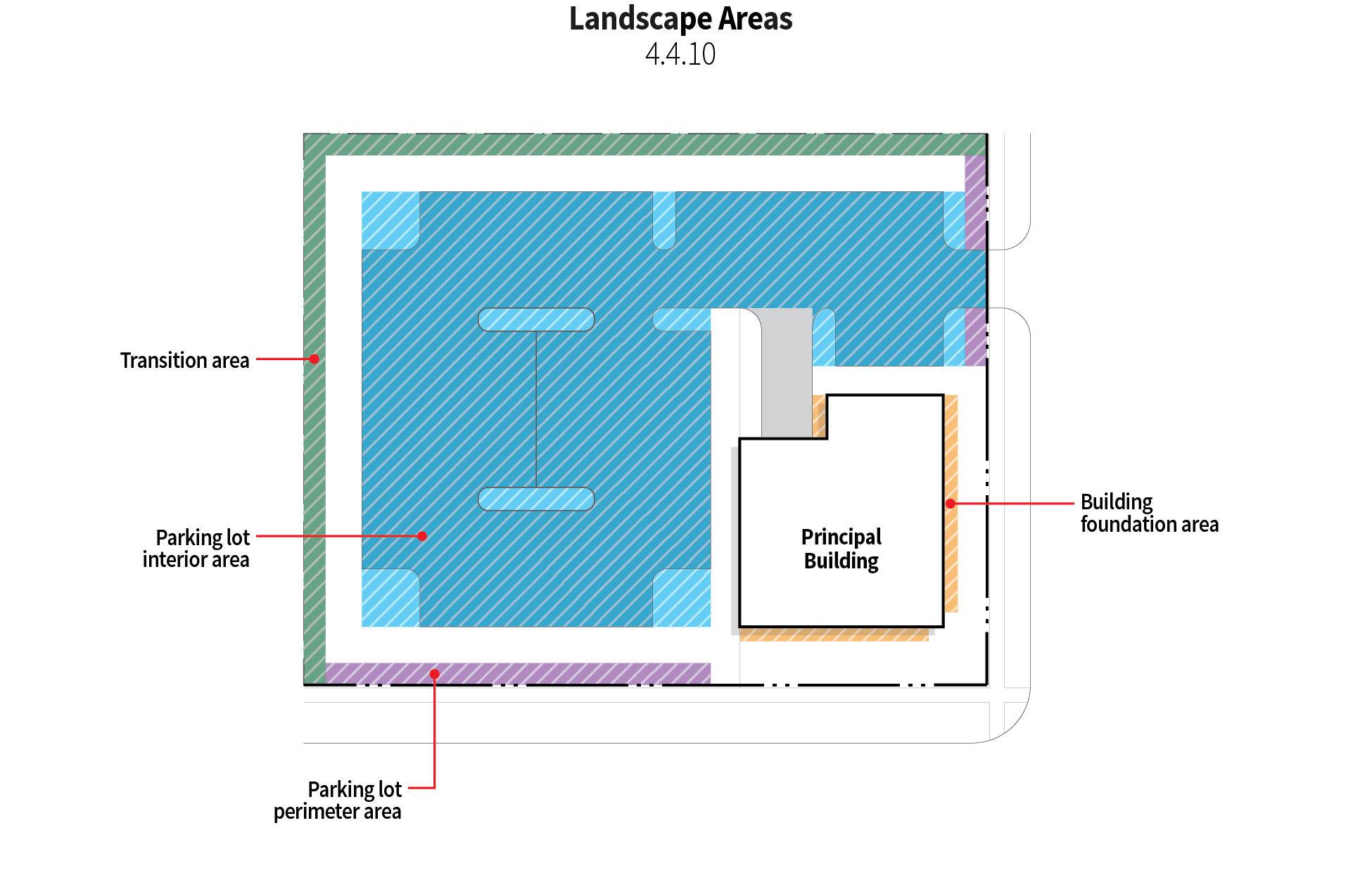
1)
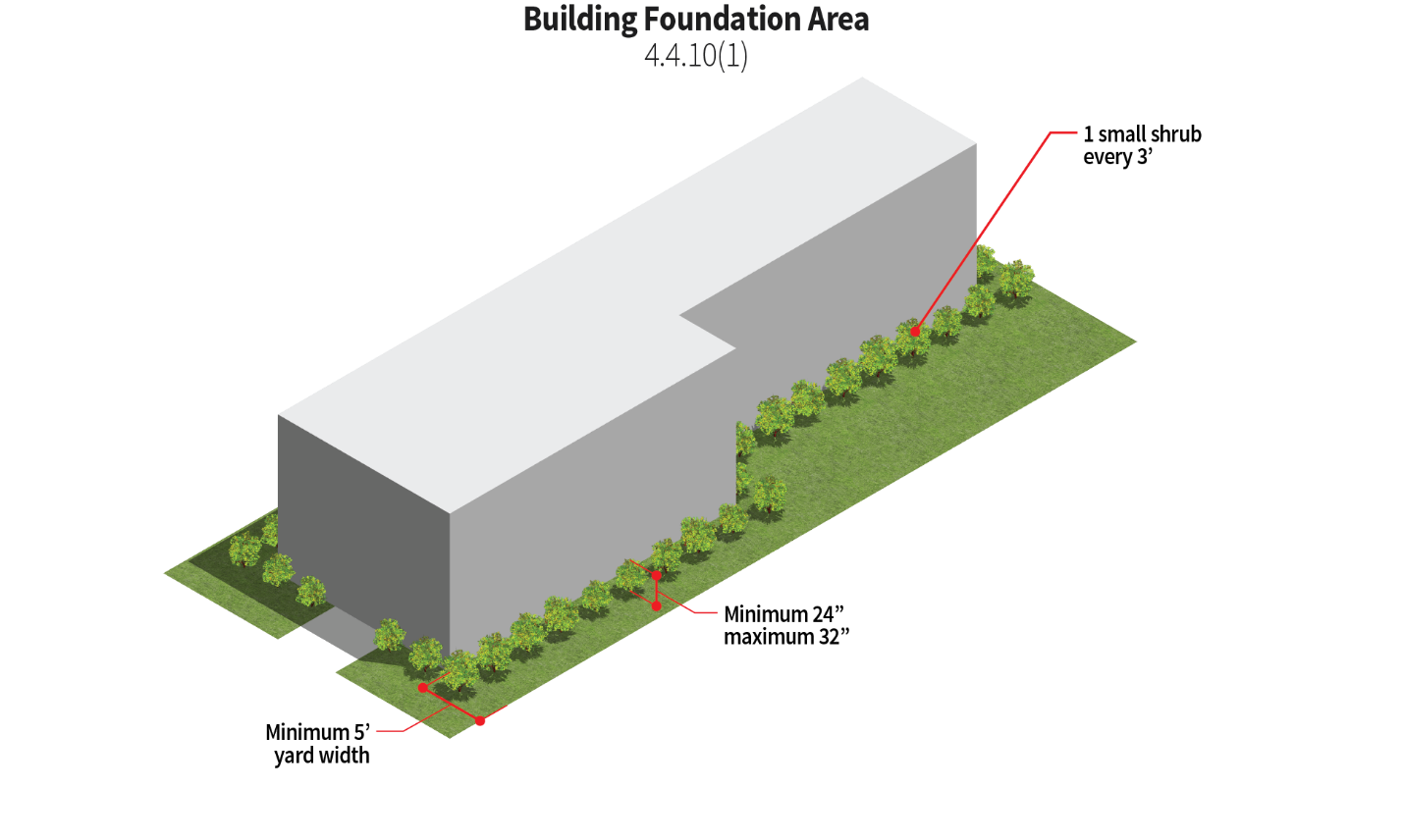
Building foundation area.
A multi-family residential, non-residential, or mixed-use development is required to maintain a building foundation area at front and corner side yards of five (5) feet at a minimum. Trees and landscaping required by this section shall be in addition to trees and landscaping required under other sections of this ordinance. It is the objective of this section to soften the appearance of buildings.
a)
Foundation plantings shall be designed to supplement buffer yard plantings to frame important views, while visually softening long expanses of walls. Foundation plantings shall respond to the windows and materials of the building.
b)
Foundation plantings shall be installed across sixty (60) percent of the length of the façade of the building, except where walkways and driveways are located.
c)
A minimum four-foot-wide hedge row shall be planted with one (1) small shrub every three (3) feet on center, spaced linearly. Such small shrubs shall measure a minimum of eighteen (18) inches at planting and shall be a minimum of twenty-four (24) inches to a maximum of thirty-two (32) inches in height at maturity. Foundation plantings may also include trees, additional shrubs, grasses, perennials, and groundcover.
2)
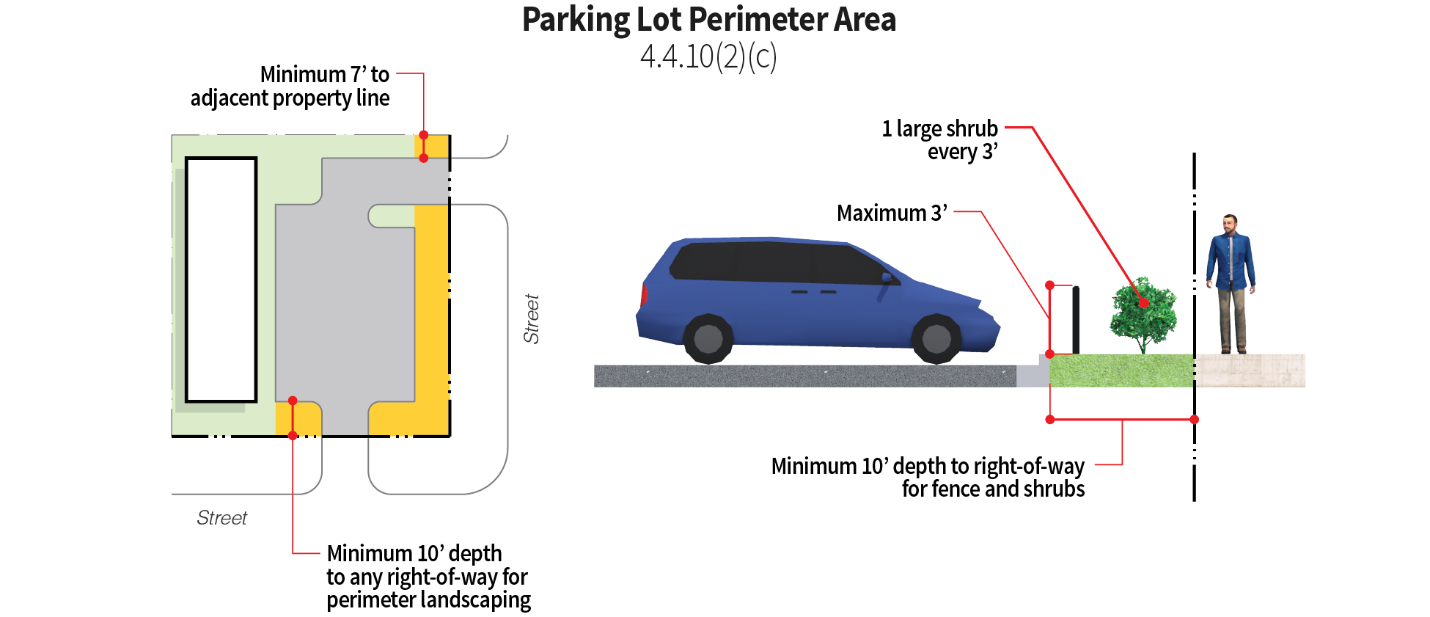
Parking lot perimeter area.
All parking lots shall include landscaping and trees located on the perimeter of parking areas as required by this section. Trees and landscaping required by this section shall be in addition to trees and landscaping required under other sections of this ordinance. It is the objective of this section to provide screening between parking areas and street right-of-way.
a)
Applicability. The parking lot perimeter landscaping regulations of this section apply to all of the following:
i.
The construction or installation of any new surface parking lot or vehicular use area that is adjacent to street right-of-way; and
ii.
The expansion of any existing surface parking lot or vehicular use area that is adjacent to street right-of-way, in which case the requirements of this section apply only to the expanded area.
b)
Exemptions. Installation of parking lot perimeter landscaping is not required when the parking lot or vehicular use area is not visible from adjacent street right-of-way.
c)
Requirements. Perimeter landscaping is required for all parking lots and shall be established along the edge of the parking lot with a minimum depth of seven (7) feet to an adjacent property line or ten (10) feet to any right-of-way as measured from the back of curb, to accommodate vehicle bumper overhang and ensure planting areas that are adequate in size.
i.
The landscape treatment shall run the full length of the parking lot and shall be located between the property line and the edge of the parking lot. All perimeter parking lot screening areas shall be protected with raised concrete curbs. Landscaped areas outside of shrub and tree masses shall be planted in live groundcover. The landscaped area shall be improved as follows:
1.
One (1) large shrub, shall be planted for every three (3) feet of landscaped area length, spaced linearly to adequately screen vehicle bumpers (ideally creating a solid hedge row).
2.
Alternatively, a low pedestrian wall the height of which provides effective screening to a maximum height of three (3) feet may be used instead of shrubs. Where feasible, plant materials shall be installed between the sidewalk and the wall to provide a softening effect on the fence or wall.
3)
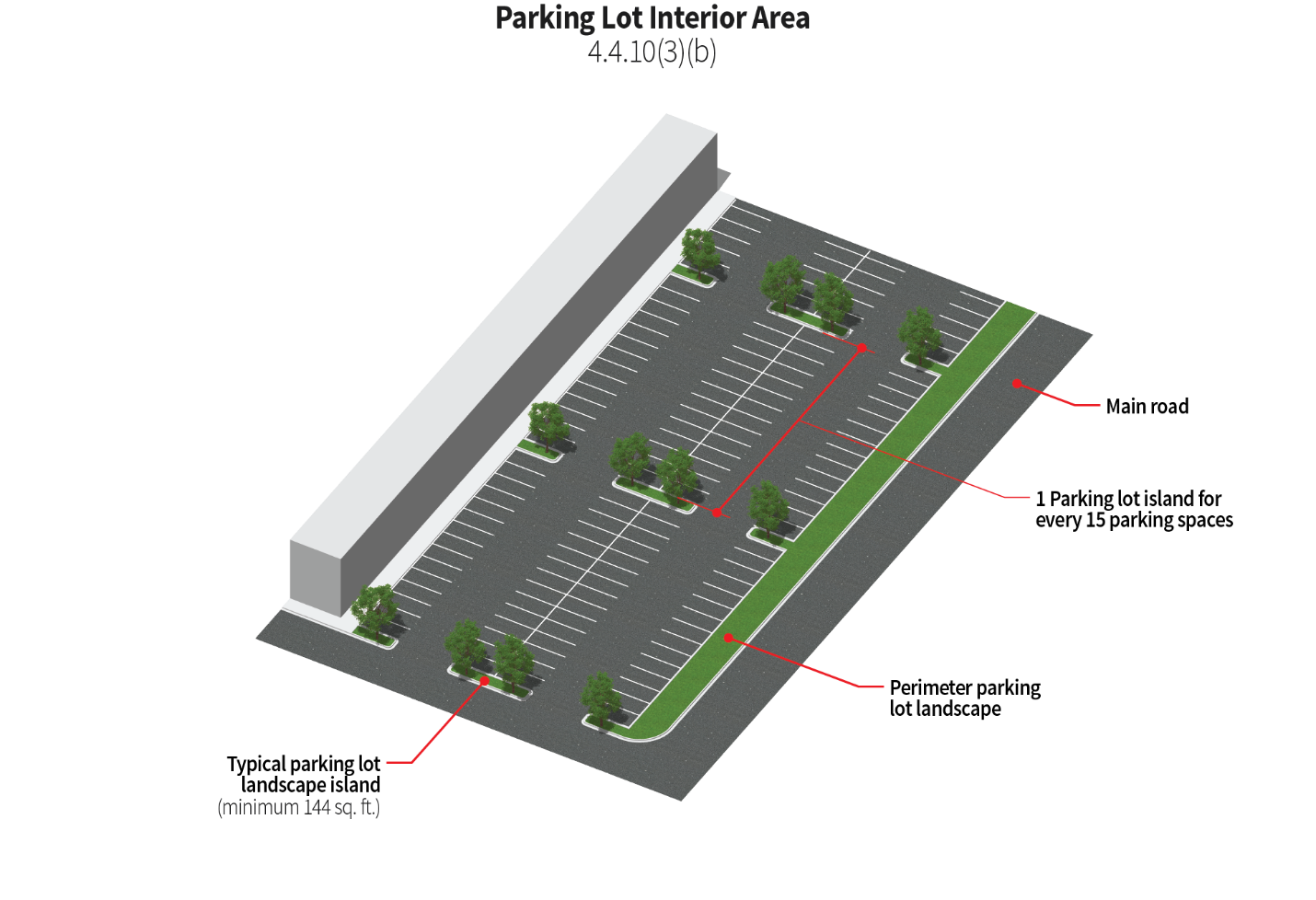
Parking lot interior area.
All parking lots shall include landscaping and trees located within the parking area as required by this section. Trees required by this section shall be in addition to trees and landscaping required under other sections of this ordinance. It is the objective of this section to provide shade within parking areas, break up large expanses of parking lot pavement, and provide a safe pedestrian environment.
a)
Applicability. The parking lot interior landscape regulations of this section apply to all the following:
i.
The construction or installation of any new surface parking lot containing eight (8) or more parking spaces; and
ii.
The expansion of any existing surface parking lot if the expansion would result in eight (8) or more new parking spaces, in which case the requirements of this section apply only to the expanded area.
b)
Requirements. For parking lots consisting of ten (10) or more spaces, interior parking lot landscaping shall be required.
i.
Amount. One (1) parking lot island shall be provided between every fifteen (15) parking spaces. As part of the landscape plan approval, parking lot island locations may be varied based on specific site requirements or design scheme, but the total number of islands shall be no less than the amount required one (1) island for every fifteen (15) spaces. However, all rows of parking spaces shall be terminated by a parking lot island or landscaped area.
ii.
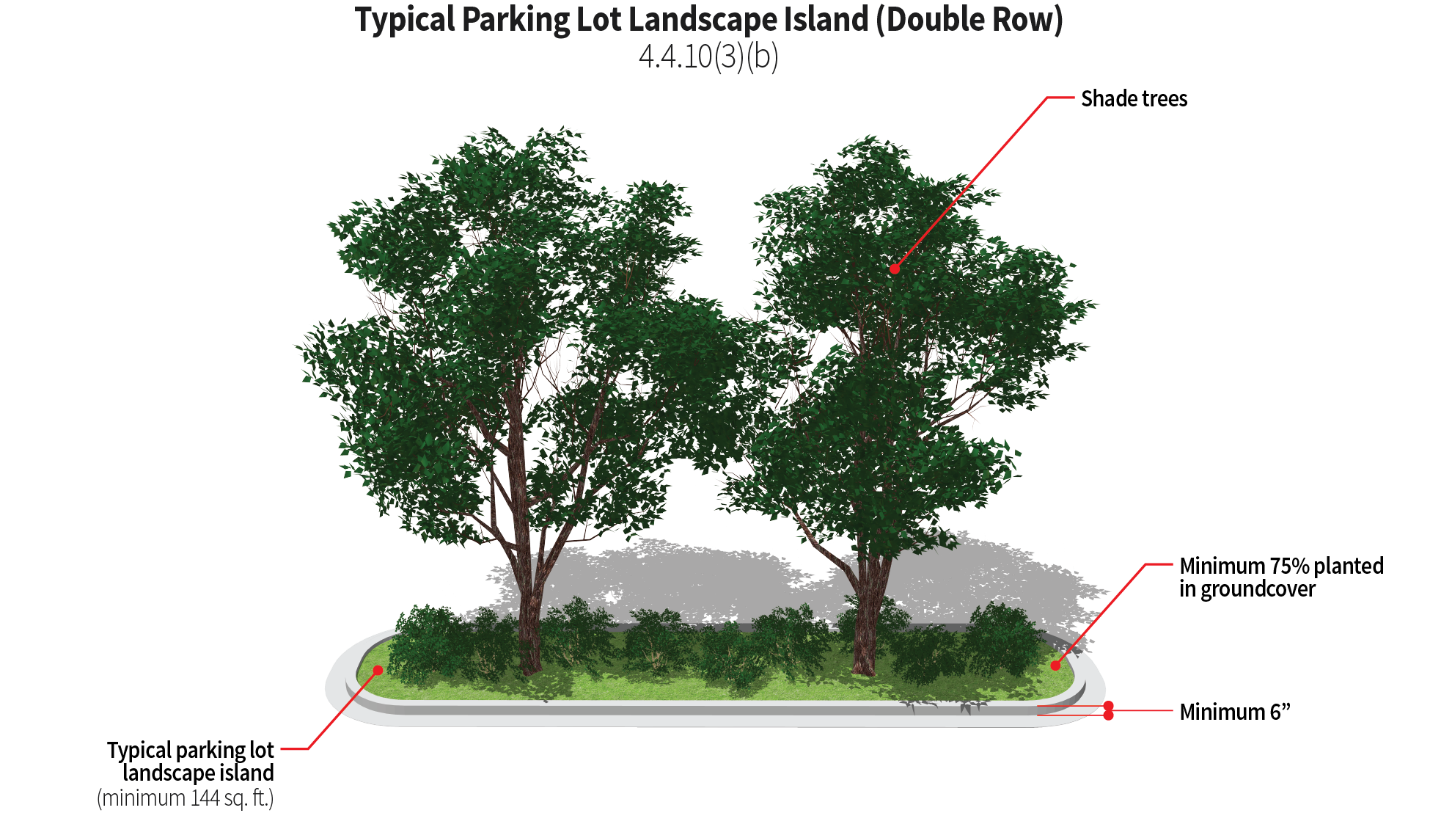
Size and planting of parking lot islands. Parking lot islands shall be the same dimension as the parking stall. Double rows of parking shall provide parking lot islands that are the same dimension as the double row. A minimum of one (1) shade tree shall be provided for every parking lot island or landscaped area. If the island extends the width of a double row, then two (2) shade trees shall be provided.
iii.
Design of planting areas. Parking lot islands or landscaped areas shall be at least one hundred forty-four (144) square feet in area and at least six (6) inches above the surface of the parking lot and protected with concrete curbing, except where designed specifically for the absorption of stormwater. Such islands and landscaped areas shall be properly drained and irrigated as appropriate to the site conditions to ensure survivability.
iv.
Type of landscape material. Shade trees shall be the primary plant materials used in parking lot islands and landscaped areas. Ornamental trees, shrubs, hedges, and other plant materials may be used to supplement the shade tree plantings but shall not create visibility concerns for automobiles and pedestrians.
v.
Groundcover. A minimum of seventy-five (75) percent of every parking lot island shall be planted in turf or other live groundcover, perennials, or ornamental grasses.
c)
Existing parking lot landscape. For existing parking lots that currently do not comply with the required parking lot landscaping, such landscaping shall be provided when:
i.
A new principal building or building addition is constructed, or exterior remodeling of the principal building occurs.
ii.
Over fifty (50) percent of the total area of an existing parking lot is reconstructed. Resealing or re-striping of an existing parking lot, which does not entail paving or resurfacing by replacement of the asphalt or concrete, shall not be subject to this requirement.
iii.
When an existing parking lot under ten thousand (10,000) square feet in area is expanded by fifty (50) percent or more in total surface area.
iv.
When an existing parking lot over ten thousand (10,000) square feet in area is expanded by twenty-five (25) percent or more in total surface area.
4)
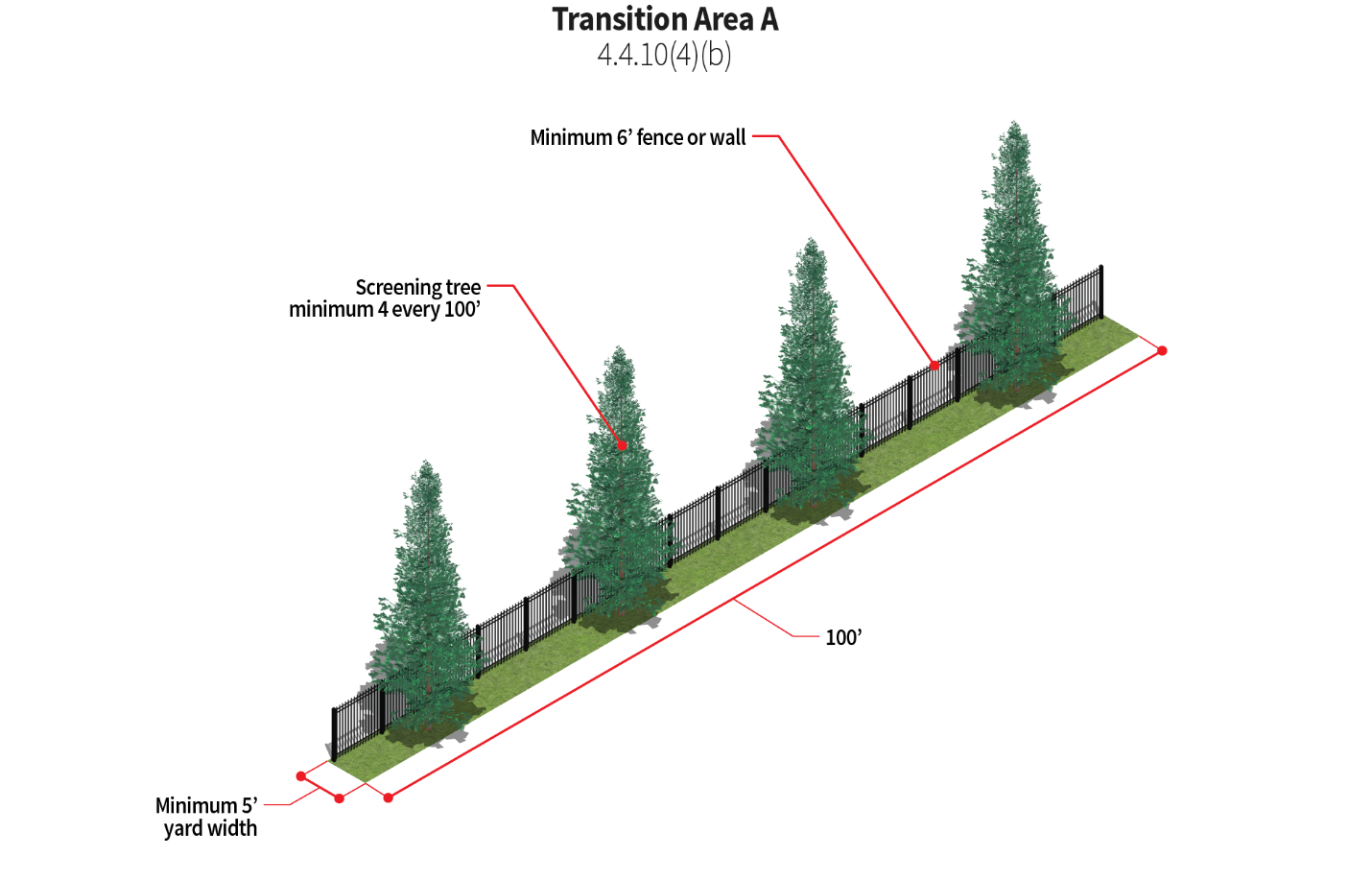
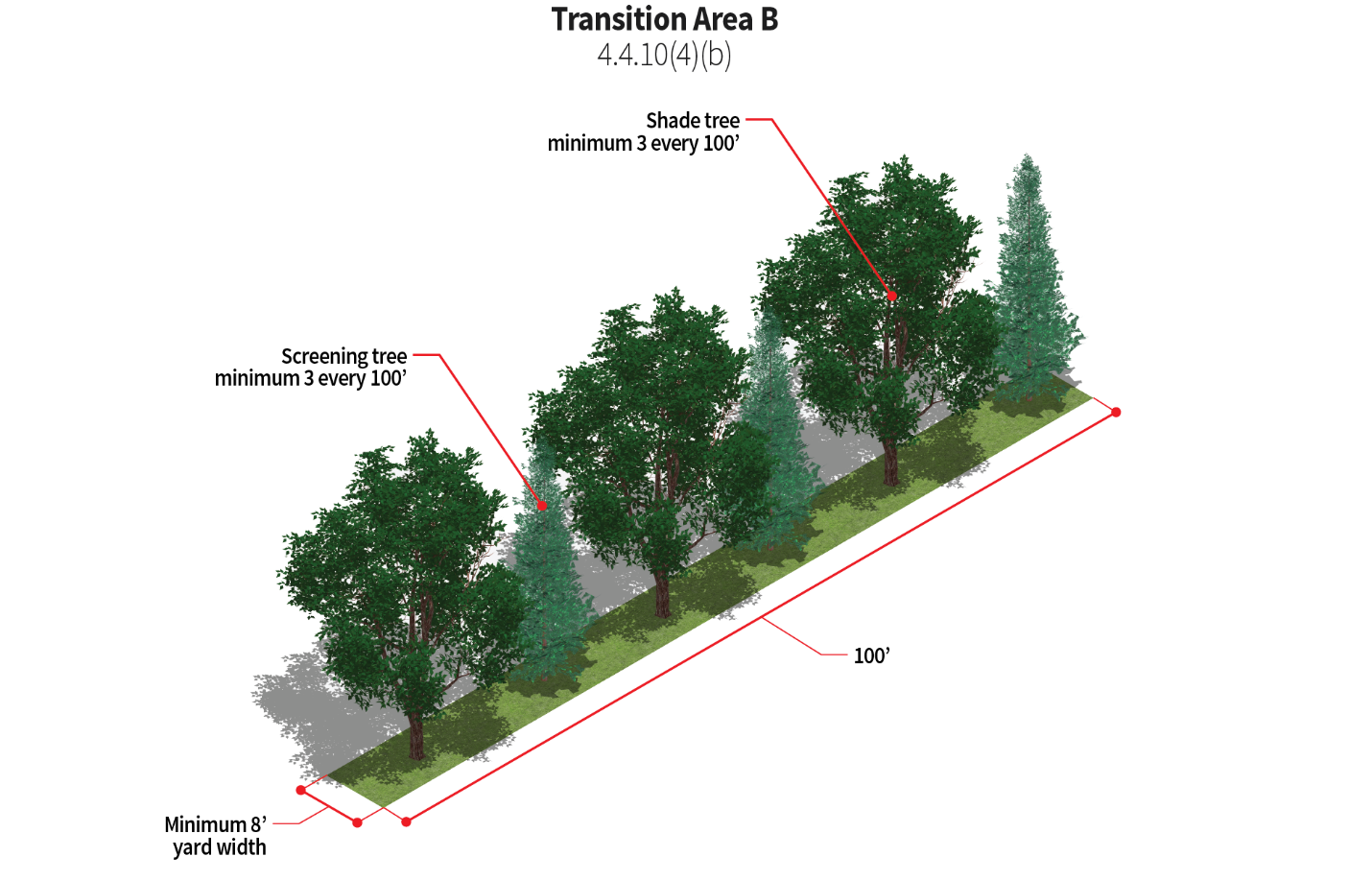
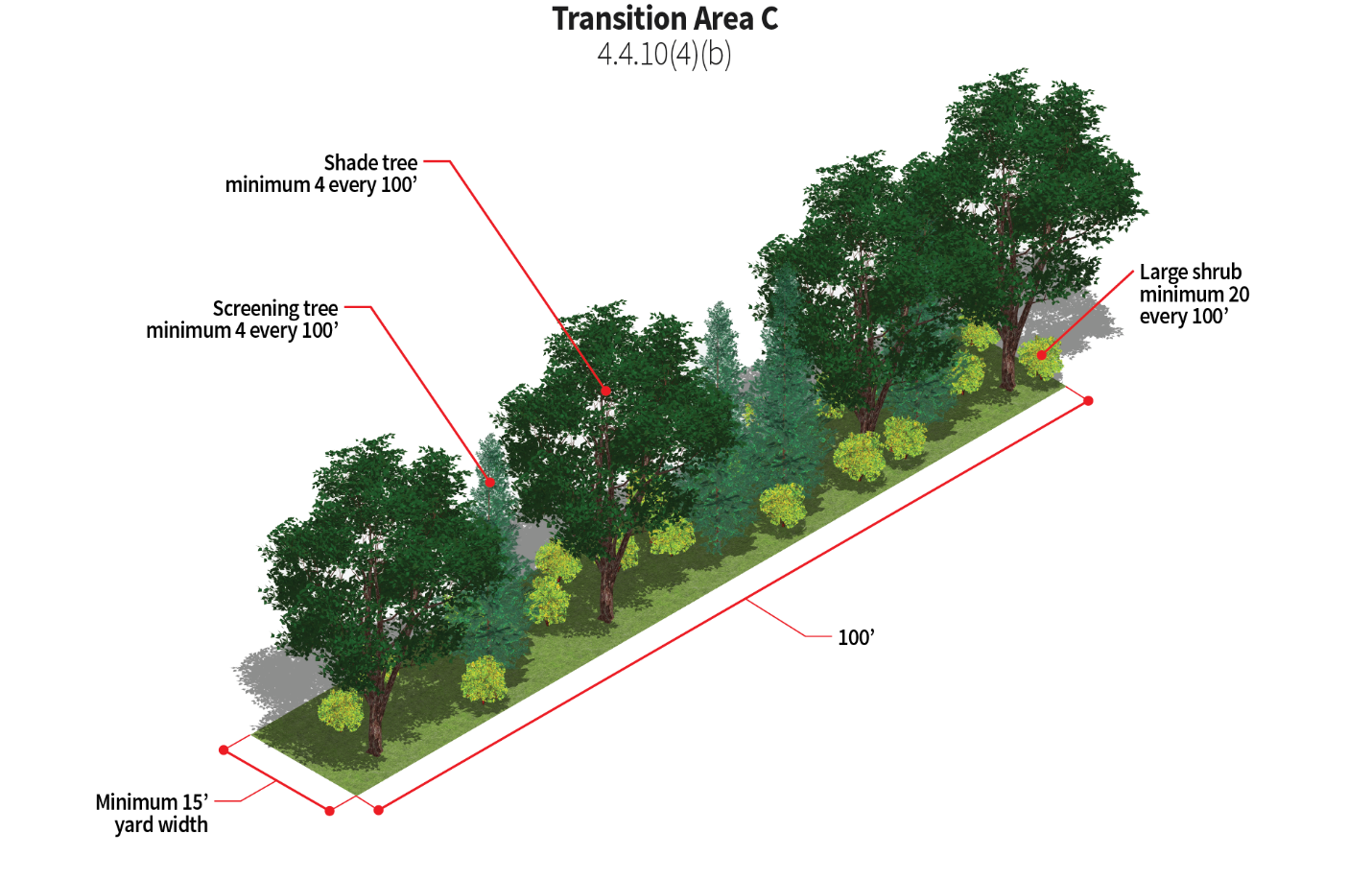
Transition area. It is the objective of the transition area to minimize the land use conflicts between incompatible uses. It is not expected that the transition area will totally screen such uses. It is expected that the transition area design elements identified below will minimize land use conflicts and will enhance over time as landscaping matures.
a)
The transition area landscape regulations of this section apply along interior property lines in those instances expressly identified in this chapter and only to the following activities:
i.
The construction or installation of any new principal building or principal use; and
ii.
The expansion of any existing principal building or principal use that results in an increase in gross floor area or site area improvements by more than five (5) percent or one thousand (1,000) square feet, whichever is greater. In the case of expansions that trigger compliance with transition area requirements, transition area landscaping is required only in proportion to the degree of expansion. The Director of Community Development is authorized to allow the transition area to be established adjacent to the area of expansion or to disperse transition area landscaping along the entire site transition area.
b)
Transition area types. Four transition yard types are established in recognition of the different contexts that may exist, as shown in the table below. Transition yards may include a combination of elements including setback distances for separation, trees and shrubs, solid fencing, live groundcover, and turf. When an alley exists between two (2) lots that would typically require a transition yard, the width of the alley can be used toward the required transition yard, provided that all required landscaping is provided for at least the first five (5) feet of the yard, or the remainder of the required transition yard, whichever is greater.
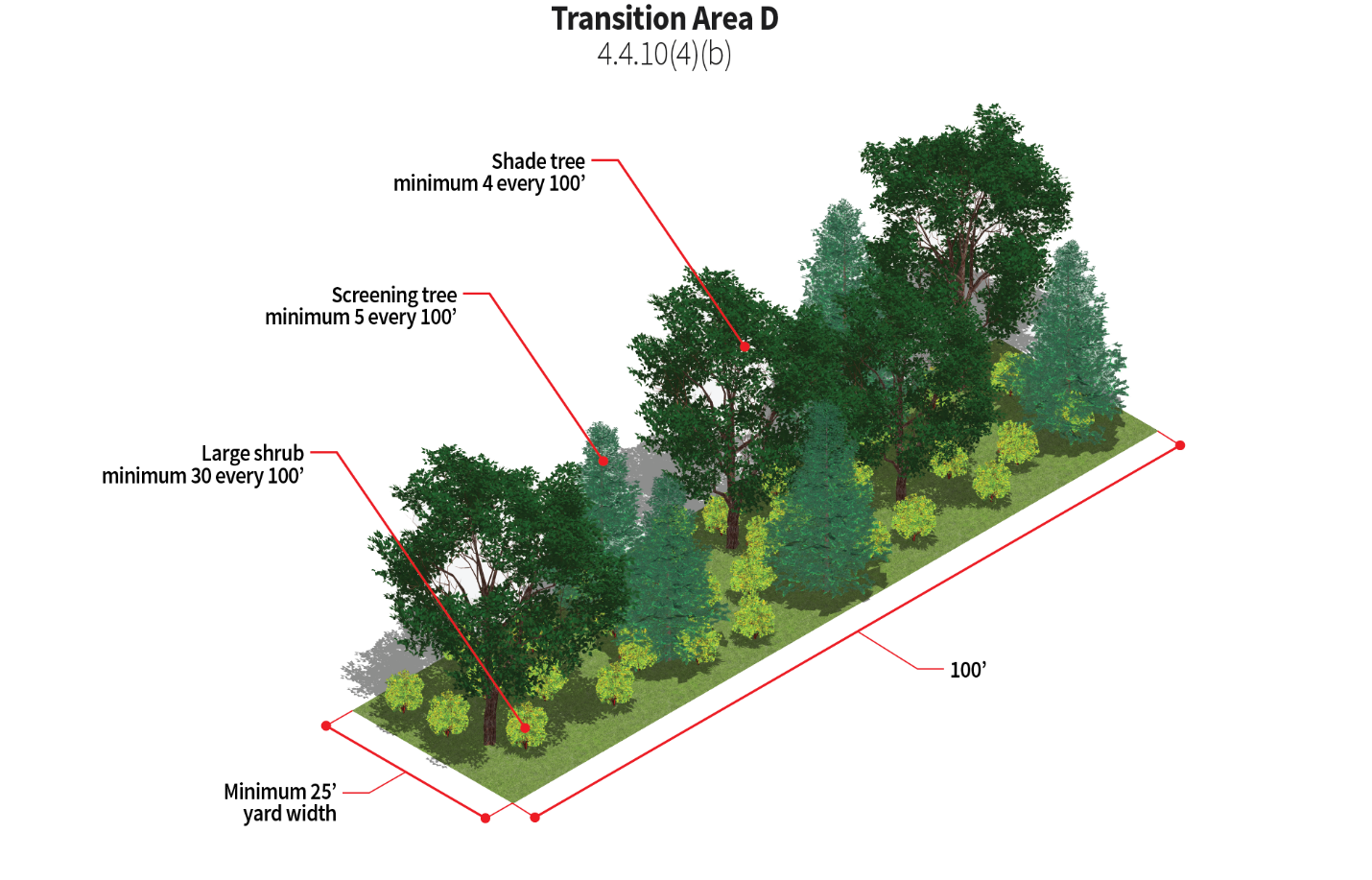
c)
Application of transition area types. Transition yards shall be provided based on the table below, except where adjacent uses are of a similar nature, scale, and intensity. As per the table, the type of required transition yard is dependent upon the land use type of the subject lot and the land use type of the adjacent lot(s). When the approved use of a lot would typically require a transition area of a certain type based on the table below, the Director of Community Development may grant an Administrative Departure when a use is deemed not of a similar nature, scale, or intensity, but as a use with nominal impact on the character of uses in the adjacent zoning district. In this instance, the departure may be granted for one (1) less intense type of area.
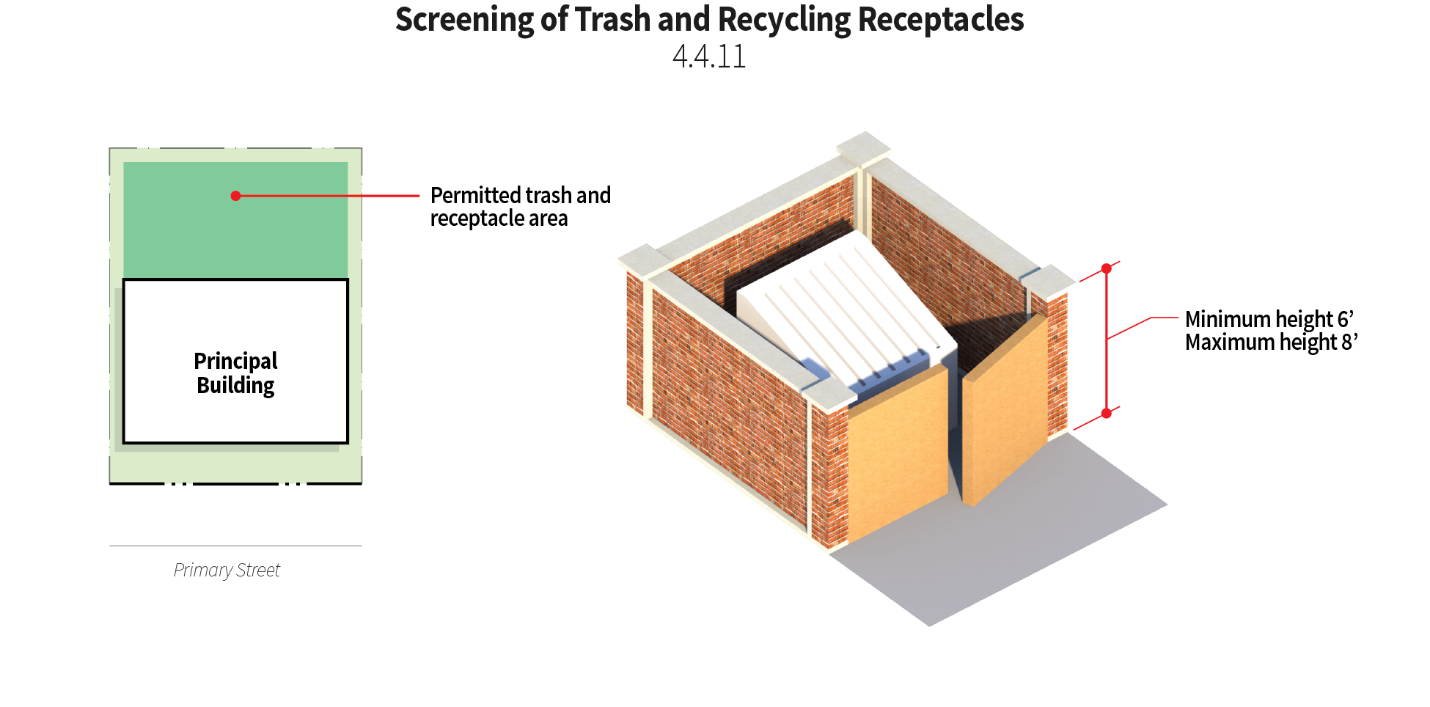
14.4.4.11. Screening of Trash and Recycling Receptacles.
For all uses, except any individual lot occupied by a single-family or two-family dwelling, using a common trash receptacle and all nonresidential uses:
1)
Solid material screening or full screening landscape on three (3) sides to a height that screens the containers, having a minimum height of six (6) feet, and a maximum height of eight (8) feet.
2)
Materials used for screening shall complement the architecture of the principal structure. The use of materials that are not solid, such as slats in chain-link, shall not be used to meet this requirement.
3)
Materials and elevations for enclosures that are attached to buildings shall be designed to be compatible with the main structure.
4)
If enclosures are to be attached to buildings, they shall comply with applicable fire and building codes.
5)
Enclosure openings directly visible from a public right-of-way and/or adjoining residential areas shall have a solid material gate. For larger enclosure areas, a separate gate access is encouraged.
6)
Access drives shall be constructed of material and thickness to accommodate truck loading. Year-round accessibility to the enclosure area for service trucks shall be maintained by the property owner or tenant.
7)
Enclosures shall be of an adequate size to accommodate expected containers. It is encouraged to design the enclosure area to be expandable to accommodate future additional containers.
8)
Enclosure structures shall be designed to protect the walls from damage by containers. Such protection may be provided by use of barrier curbing, reinforced masonry walls, or other similar means.
9)
Trash enclosures shall not be located within a required street front or street side setbacks or occupy area used for required parking spaces.
14.4.4.12. Outdoor Storage and Display Areas.
1)
All outdoor storage areas must be completely screened by an opaque masonry wall (stone, stucco, or brick) or a solid wood screen fence no less than five (5) feet and no more than seven (7) feet in height unless otherwise approved by the Director of Community Development or his/her designee. Where feasible, plant materials should be installed along the fence or wall located along the public right-of-way to provide a softening effect.
2)
When the rear or interior side yard of an outdoor display area abuts a residential district, or the rear yard is separated from a residential district by an alley, the outdoor display area must be effectively screened from view by an opaque masonry wall (stone, stucco, or brick), a solid wood or simulated wood screen fence or dense evergreen hedge no less than five (5) feet and no more than seven (7) feet in height unless otherwise approved by the Director of Community Development or his/her designee.
3)
Growing areas for nursery stock located in the front or corner side yard are considered to meet screening requirements.
14.4.4.13. Screening of ground mounted mechanical units.
For all uses, except any individual lot occupied by a single-family, two-family, or three-family dwelling, all ground-mounted mechanical units, including but not limited to: air-conditioning condensers, heat pumps, ventilation units, computer cooling equipment, etc., and any related utility structures and equipment, that are visible from any adjacent public thoroughfare shall be visibly screened from public view. The screen shall be designed and established so that the area or element being screened is no more than twenty (20) percent visible through the screen.
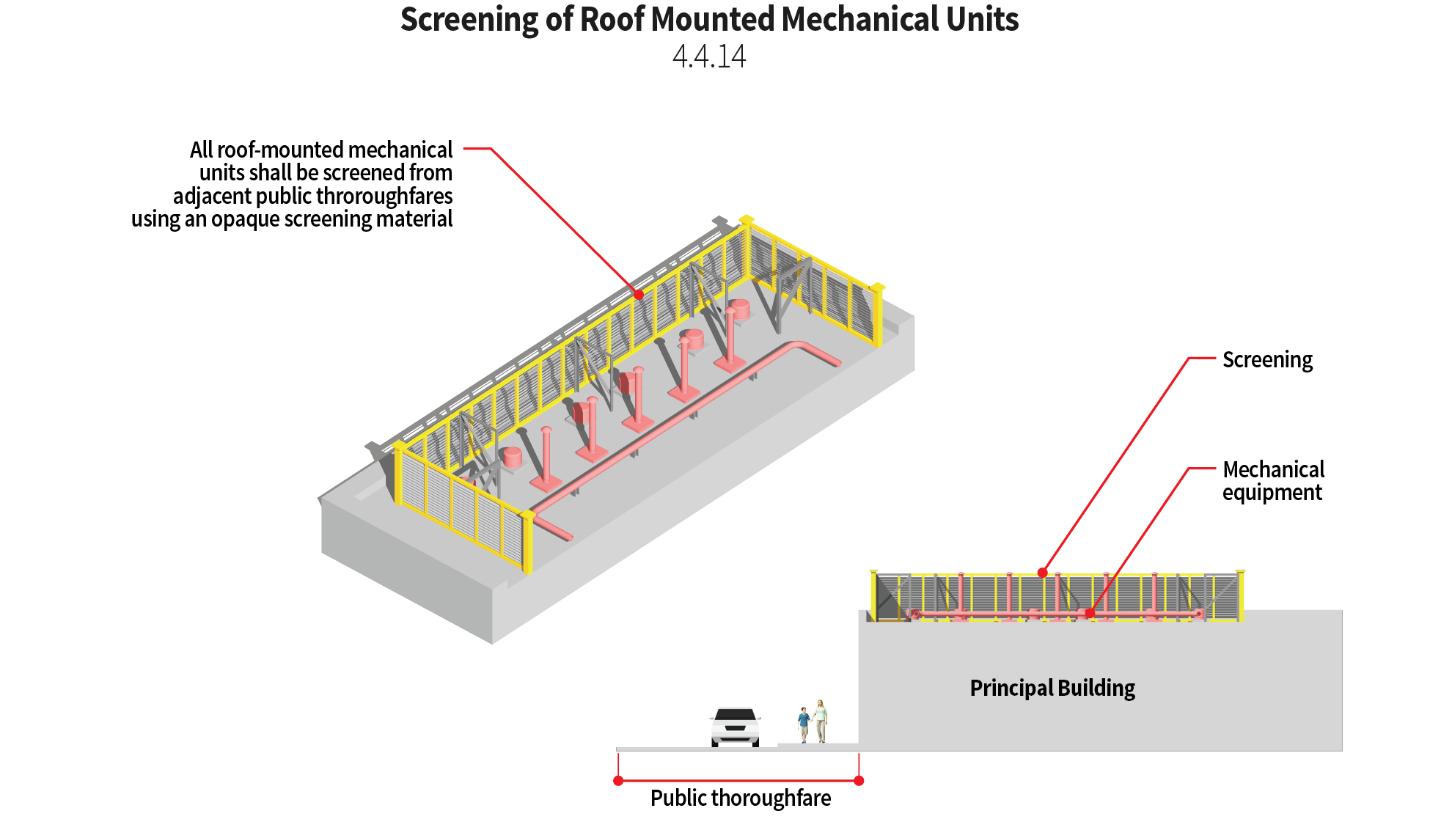
14.4.4.14. Screening of roof mounted mechanical units.
All roof-mounted mechanical units shall be screened from adjacent public thoroughfares using an opaque screening material compatible with the architecture of the building or architecturally designed screening such as a parapet wall. The screening of the roof-mounted units shall be designed to blend with the building and roof materials. Additional screening may be required due to topographic differences in the adjoining properties.
14.4.4.15. Loading docks, service yards, and exterior work or storage areas.
Service yards, loading docks and exterior work or storage areas shall be screened from view from public rights-of-way or adjacent lots. The screening shall consist of either of the following:
1)
Opaque masonry (stone or brick), solid wood or simulated wood fence having a minimum height of six (6) feet.
2)
Shade trees, screening trees, large shrubs, or some combination thereof, planted at a minimum ratio of fifty (50) plant units for each one hundred (100) linear feet of perimeter to be screened.
If outdoor storage is allowed, said storage areas shall be screened in a manner such that the materials being stored are completely screened from view. If storage materials exceed the allowable maximum fence height of eight (8) feet, then a combination of berming, fencing, and landscaping shall be used to accomplish appropriate screening. In no case shall stored materials exceed the height of the proposed screening method.
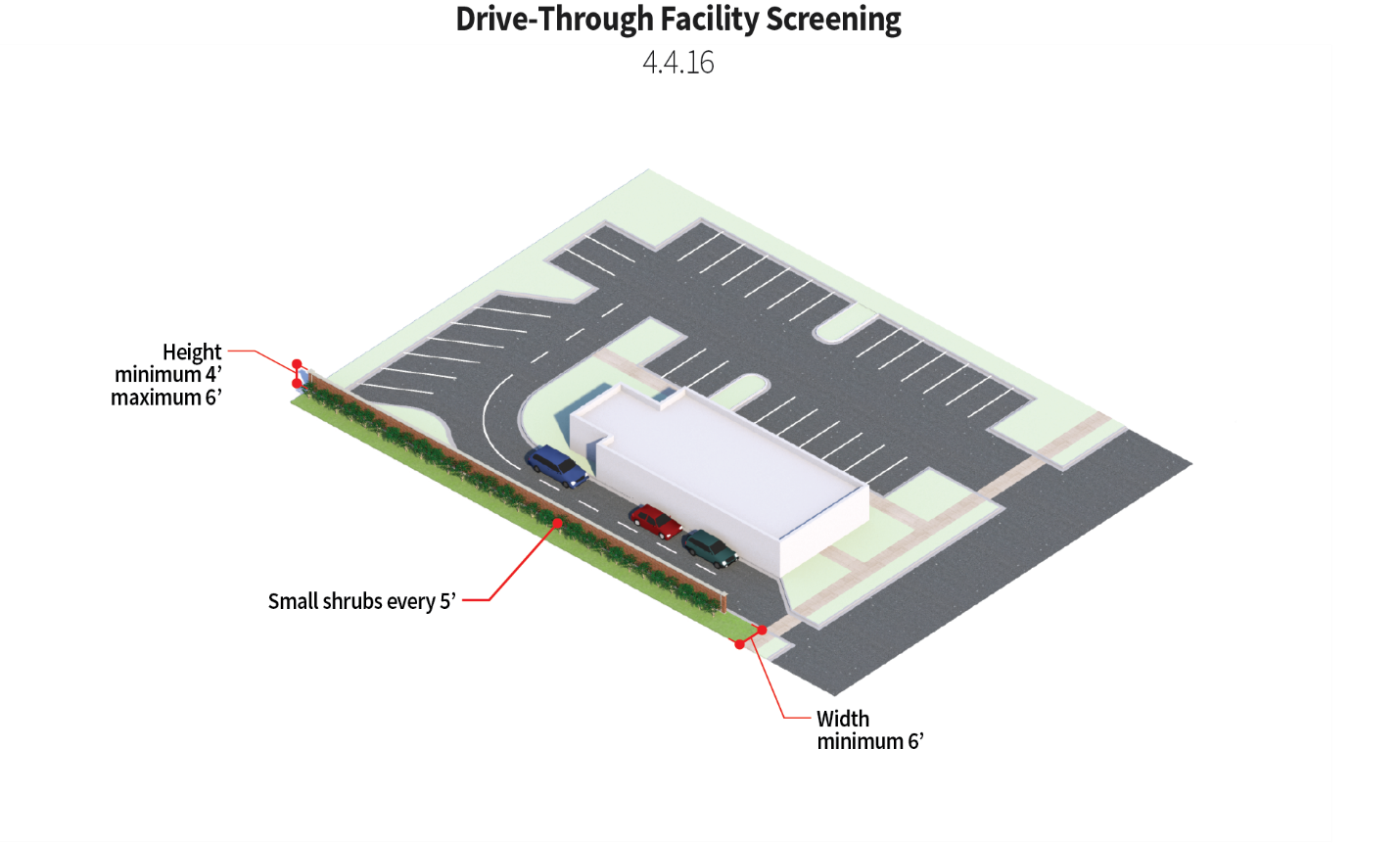
14.4.4.16. Drive-through facility.
Drive aisles of drive-through facilities must be effectively screened from view along the public right-of-way and at the edges of sites adjacent to residential properties to minimize the impact of exterior site lighting, headlight glare and any menu intercom displays. Such screening must be approved during the site plan review process, be a minimum of six (6) feet in width, and if adjacent to a residential property must consist of an opaque masonry wall (stone, stucco, or brick), a solid wood or simulated wood screen fence with a minimum height of four (4) feet and a maximum height of six (6) feet. Small shrubs must be installed every five (5) feet along the exterior of the drive-through facility to provide a softening effect.
(Ord. No. O19-05-06, § 3, 5-21-2019; Ord. No. O21-06-02, §§ 5—8, 6-1-2021)
Sec. 14.4.5. - Number of buildings on a zoning lot.
14.4.5.1. One (1) dwelling per lot.
In residential districts, no more than one (1) single-family detached residential dwelling unit shall be allowed on a lot.
14.4.5.2. Many uses on one (1) lot.
When two (2) or more principal uses occupy the same lot, the dimensional requirements (lot area, lot width, setback, yards, and coverage requirements) of the more (or most) restrictive use shall apply.
14.4.5.3. Structures to be located on lots; limit of number of principal buildings.
In all zoning districts, every structure erected or structurally altered after the adoption of this title shall be located on a single lot or zoning lot, except as authorized by the Village Board in the PO District.
(Ord. No. O19-05-06, § 3, 5-21-2019)
Sec. 14.4.6. - Off-street parking and loading.
14.4.6.1. Intent and standards.
The off-street parking and loading regulations of this section are intended to provide accessible, attractive, secure, and well-maintained off-street parking and loading areas with the appropriate number of spaces in proportion to the needs of the proposed use, increase public safety by reducing congestion of public streets, and encourage the use of alternative modes of transportation where appropriate.
14.4.6.2. General provisions.
The provisions of this section shall apply as follow:
1)
Existing facilities.
a)
The existing number of off-street parking and loading spaces shall not be reduced below the requirements of this section. If the number of such existing spaces is already less than the requirements of this section, it shall not be further reduced.
b)
Existing off-street parking and loading areas which do not conform to the requirements of this section but were in conformance with the requirements of this Code at the time the parking or loading facilities were established, are permitted to continue as a legal nonconforming structure.
c)
If a building permit for a building or structure was lawfully issued prior to the effective date of this Code, and if construction has begun within one hundred eighty (180) days of the issuance of a permit, the number of off-street parking and loading spaces shall be provided in the amount required for the issuance of said building permit, regardless of what may be required by this section.
2)
Damage or destruction.
When a building is reconstructed or repaired after being damaged or destroyed, off-street parking and loading facilities shall be restored or maintained in an amount equivalent to that at the time of such damage or destruction. However, it shall not be necessary to restore or maintain parking and loading facilities in excess of the applicable requirements of this section.
3)
Change in land use.
When the existing use of a structure or land is changed to a new use, parking and loading spaces shall be provided as required for the new use. Additional parking or loading spaces shall be required in the amount by which the requirements for the new use exceed the requirements for the existing use.
4)
Change in intensity of use.
a)
When the intensity of use of any structure or land is increased, additional parking and loading spaces shall be provided as required by this section. The number of additional parking and loading spaces shall be based on the increase in the number of dwelling units, gross floor area, seating capacity, or other unit of measurement used to calculate the number of required parking or loading spaces.
b)
When the intensity of use of any structure or land is decreased, the number of parking and loading spaces may be reduced so long as the parking requirements of this section are met for the entire structure or land as modified.
5)
Provision of additional spaces.
A maximum twenty (20) percent increase of the required parking or loading facilities shall be permitted, provided that all regulations governing the location, design, and control of such facilities are in accordance with this section.
14.4.6.3. Parking spaces required.
The total number of required parking and loading spaces shall be based upon the requirements for the principal use of the lot. However, when more than one (1) use occupies the same lot, the number of required spaces shall be the sum of the separate requirements for each use, except as otherwise provided for in this section. All off-street parking facilities shall be completed before occupancy of the structure. In computing the number of off-street parking or loading spaces required by this section, the following standards for computation shall apply:
1)
Space allocated to any off-street loading space shall not be used to satisfy the requirement for any off-street parking space or access aisle, or portion of any off-street parking space or access aisle. Conversely, the area allocated to any off-street parking space shall not be used to satisfy the requirement for any off-street loading space or portion of any off-street loading space.
2)
A fraction of less than 0.5 may be disregarded, and a fraction of 0.5 or more shall be counted as one (1) parking or loading space.
3)
In places of assembly in which patrons or spectators occupy benches, pews, or similar seating facilities, each twenty-four (24) inches of such seating facility shall be counted as one (1) seat for the purpose of determining the requirement for off-street parking facilities.
14.4.6.4. Location of off-street parking spaces.
1)
Residential uses.
a)
All required parking spaces for residential uses shall be located on the same lot as the building or use served.
b)
For single-family, two-family, and townhouse dwellings, parking shall be permitted in private driveways, but no such parking may encroach onto the public right-of-way. However, such driveway parking shall not be considered as satisfying the off-street parking requirements for such single-family, two-family, and townhouse dwellings.
c)
Tandem parking is permitted for townhouse or multi-family dwellings but both spaces must be allotted to the same dwelling unit and located on the same lot as the dwelling.
2)
Non-Residential Uses.
a)
All required off-street parking areas for non-residential uses shall be located on the same lot as, or within three hundred (300) feet of, the building or use served. However, off-street parking accessory to a non-residential use shall not be in any residential district.
b)
Off-street parking spaces are permitted within the rear, interior side, or corner side yard and setback, subject to transition area standards of this chapter. No parking is permitted in the front yard of the B1 District and is strongly discouraged in all other commercial and industrial districts. No required off-street parking spaces are permitted within a required front setback and shall be setback a minimum of fifteen (15) feet from any street right-of-way.
14.4.6.5. Design standards.
1)
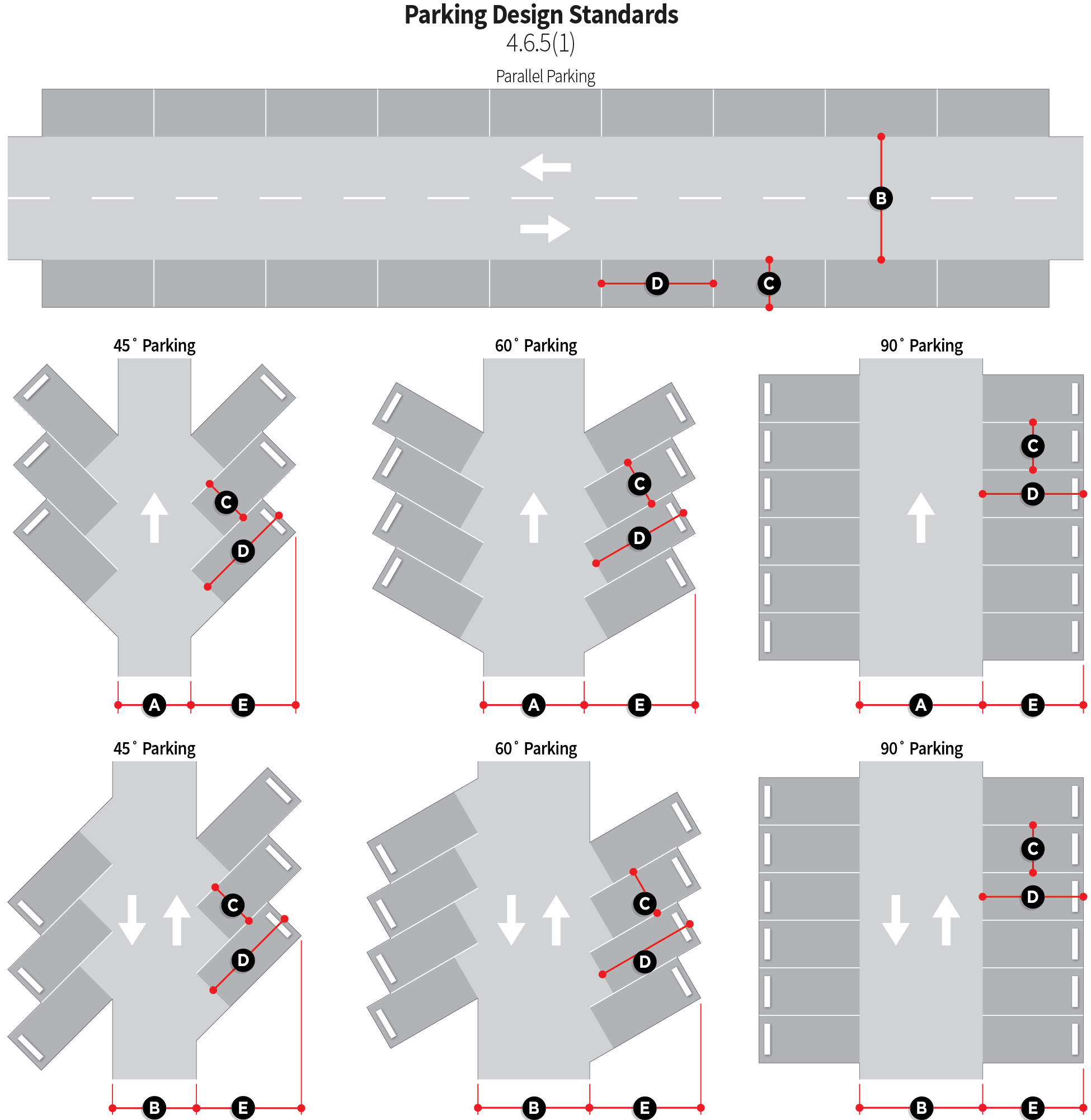
Dimensions. Each required off-street parking space shall conform to the standards detailed in the table below. All parking spaces shall have a minimum vertical clearance of seven (7) feet six (6) inches.
2)
Access.
a)
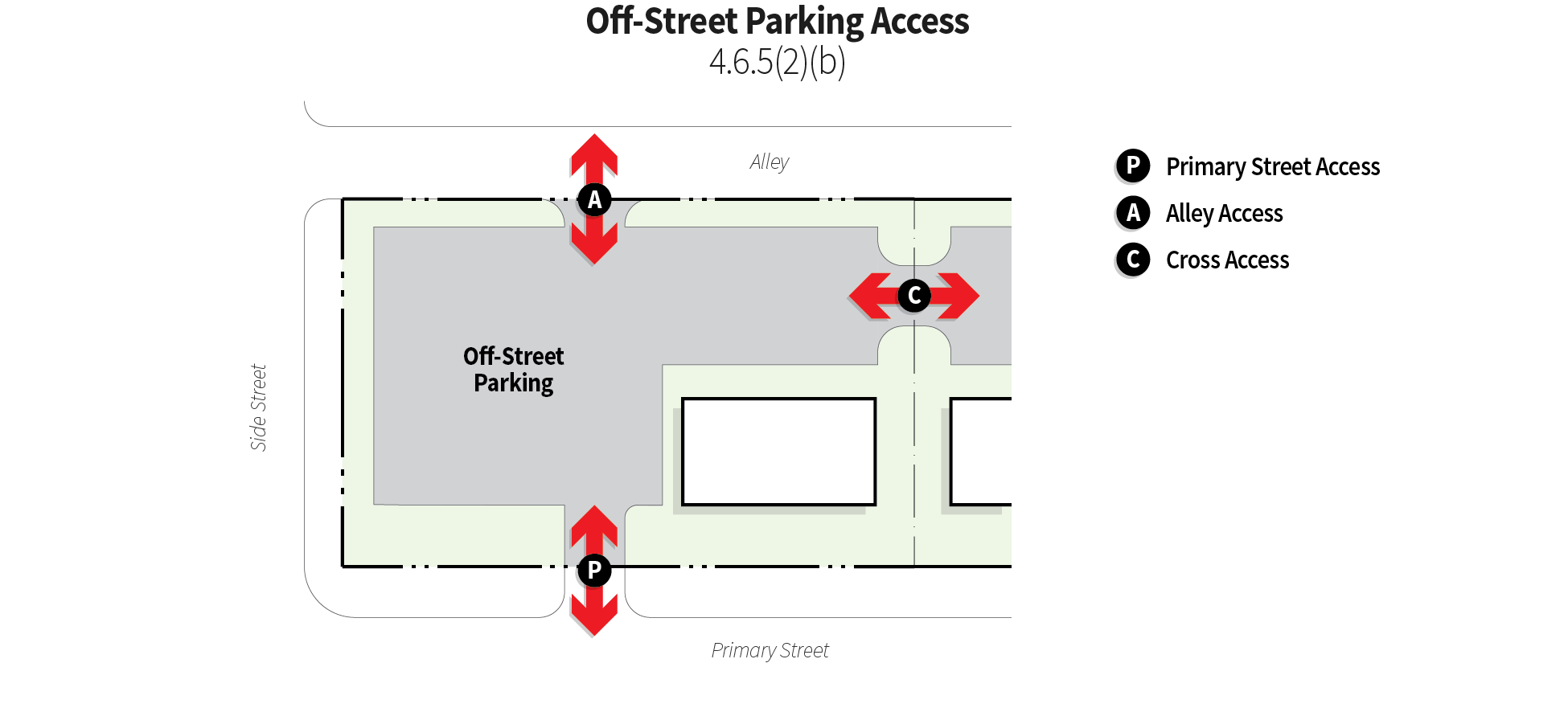
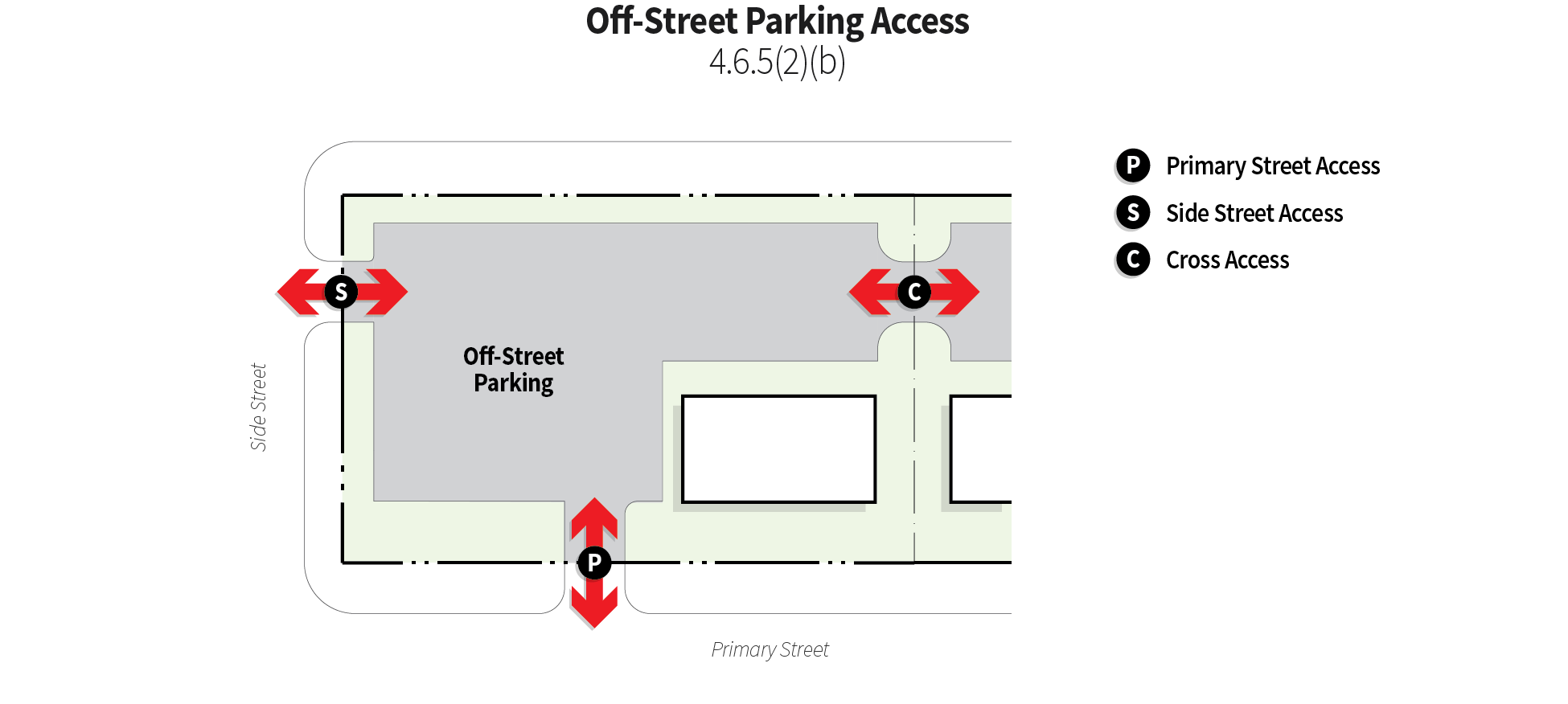
Each off-street space shall open directly upon an aisle or driveway with a minimum width of twenty-four (24) feet and a maximum width of twenty-six (26) feet. All off-street parking facilities shall be provided with appropriate means of vehicular access in a manner that least interferes with traffic movement and allows the driver of the vehicle to proceed forward into traffic rather than back out.
b)
All required off-street parking facilities shall have vehicular access from a street, alley, driveway, or cross-access connection.
3)
Driveways.
a)
Residential driveways, excluding multi-family and townhouse dwellings.
i.
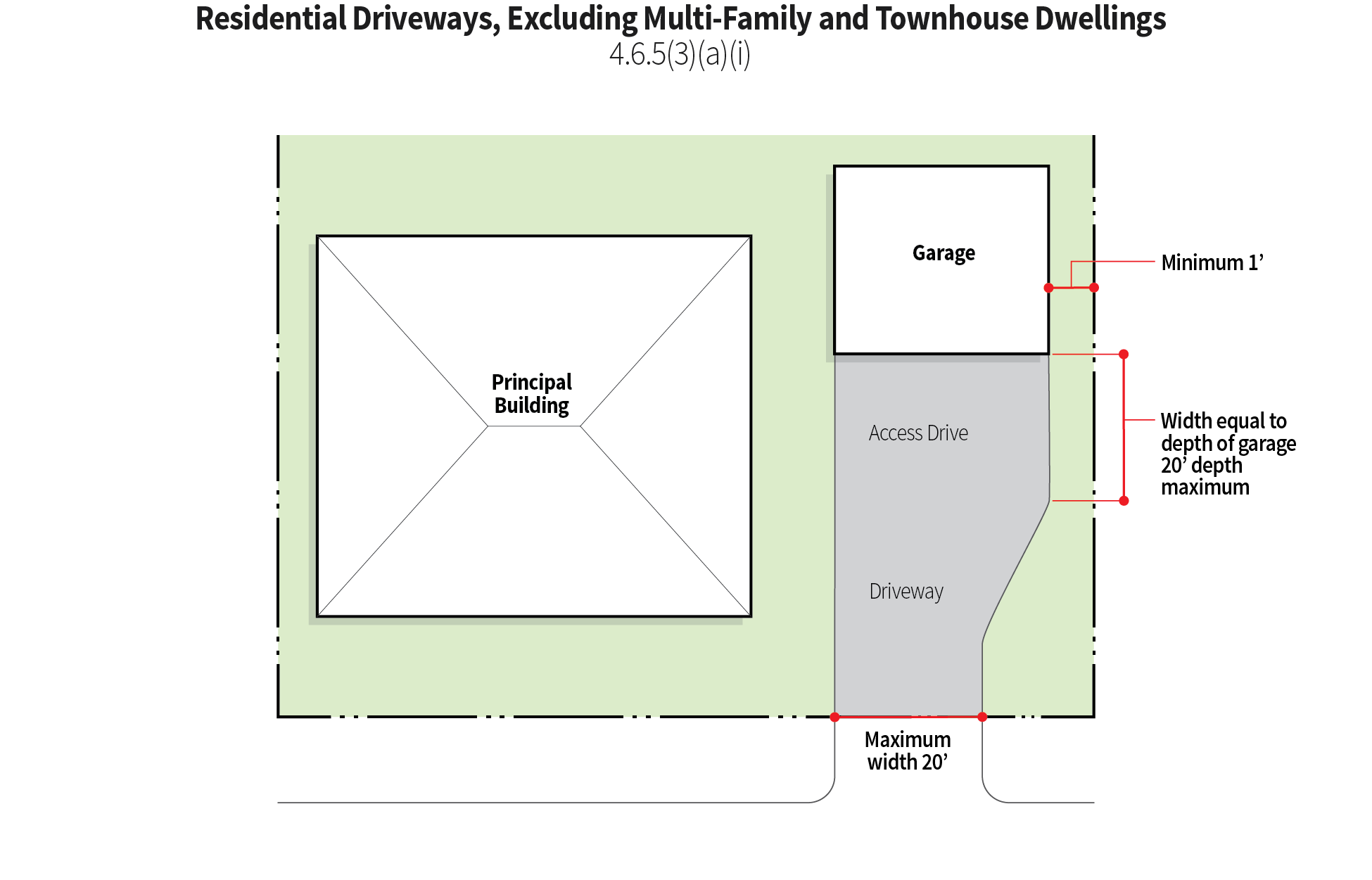
A residential driveway that provides access to a garage shall be no more than twenty (20) feet in width at the property line.
ii.
A residential driveway that provides access to an attached garage shall be no wider than the width of the garage or twenty-six (26) feet, whichever is greater. A residential driveway that provides access to a detached garage shall be no wider that the width of the garage or twenty (20) feet, whichever is greater. A garage access drive, the width of the garage as measured from the garage walls, is permitted to extend for a distance (depth) of twenty (20) feet from the garage doors before tapering back to the required driveway width to allow access to the additional spaces.
iii.
Driveways shall be located a minimum of one (1) foot from the side lot line. However, a residential driveway may be located on the lot line if it physically abuts a driveway on the adjacent lot. This location shall only be allowed if agreed to by the owners of each lot, and such approval is recorded as a shared driveway easement on each plat of survey.
iv.
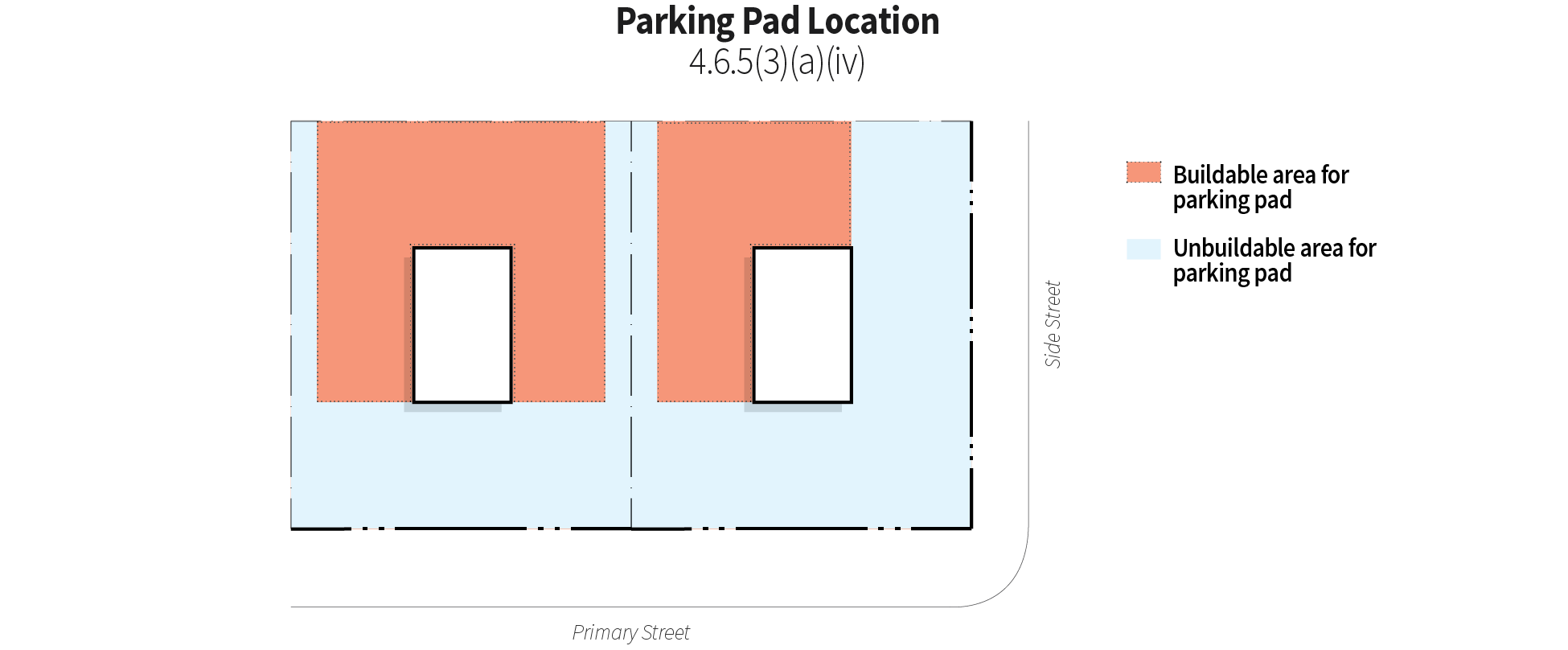
Single-family and two-family dwellings are permitted an additional paved parking pad. Such parking pads shall not be located in the front or exterior side yard or setback, or within the required interior side setback. Any driveways must comply with the requirements of paragraph ii above. The minimum impervious surface requirement for the lot may not be exceeded to accommodate a parking pad. The figure below illustrates where a parking pad may be located.
v. Driveways located in front of houses shall not encroach more than three (3) feet beyond the garage towards the front plane of the primary structure.
vi. Driveway width shall be calculated by including all abutting parallel sidewalks and patios to driveways located within a required front or required exterior side yard.
b)
Multi-family and townhouse dwellings, and non-residential driveways.
i.
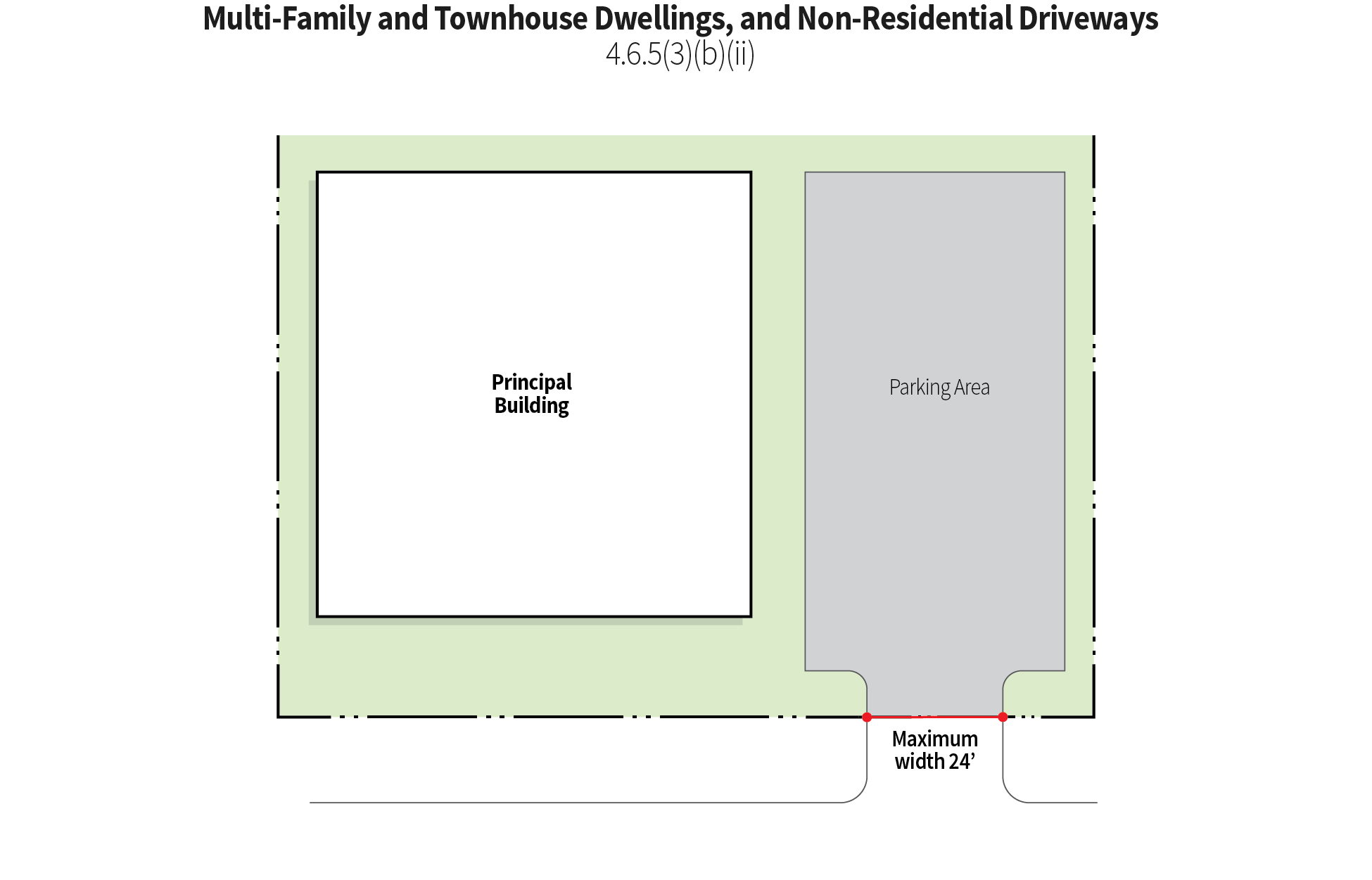
Except for access to loading berths, no driveway shall have a width exceeding twenty-four (24) feet. Driveways shall be a minimum of twenty (20) feet for one-way drives, and a minimum of twenty-four (24) feet for two-way drives.
ii.
Driveways, off-street parking areas, and access aisles for multi-family residential and non-residential parking lots shall be designed in accordance with the figure below.
c)
Single-family and two-family dwelling driveway curb cuts.
i.
Only one (1) driveway curb cut shall be permitted on a zoning lot for a new single-family or two-family dwelling, unless the lot has a lot width of fifty-five (55) feet or more. In which case, two (2) curb cuts are permitted to construct a circular drive. In no case, shall the impervious surface requirement be exceeded.
ii.
Existing lots with more than one (1) curb cut and/or a circular driveway that exists at the time of adoption of this Code, may replace and repair the existing driveway, provided that the driveway is not enlarged and that the minimum impervious surface requirement for the lot is not exceeded at the time of replacement or repair.
4)
Surfacing. All open off-street parking areas shall be improved with a hard surfaced, all-weather dustless material as approved by the Village Engineer. Semi-pervious materials and pervious pavers may also be used, subject to the approval of the Village Engineer.
5)
Striping. Off-street parking areas of four (4) or more spaces shall delineate parking spaces with paint or other permanent materials, which shall be maintained in clearly visible condition. Americans with Disabilities Act compliant parking spaces shall be identified with the appropriate sign and shall be visible at all times of the year, regardless of snow cover, plant growth, or similar conditions.
6)
Curbing and bumper stops. Bumper stops, wheel stops, or curbing shall be provided to prevent vehicles from damaging or encroaching upon any adjacent parking or loading space, sidewalk, landscaped area, or parking lot island, fence, wall, or building. Curbing shall be at least six (6) inches in height. The length of the parking stall shall be as indicated in this chapter.
7)
Drainage and grading. No vehicle accommodation area shall be constructed in such a manner so as to increase the volume or rate of the runoff to adjacent lots. No vehicle accommodation area shall have a slope of more than five (5) percent. No access ramp shall have a slope of more than twelve (12) percent. Finished grade and drainage shall be designed by an Illinois Registered Engineer and approved by the Village Engineer. Exceptions can be made where the Village Engineer determines that adequate capacity exists in the storm drainage system to which the site is draining and is willing to accept the increased volume in runoff. No vehicle accommodation area shall be constructed in such a manner that a significant volume of surface water from the lot will be drained onto the public streets. Where the vehicle accommodation area will be used to detain stormwater runoff, the depth of water shall not exceed six (6) inches.
8)
Lighting. Adequate lighting shall be provided for vehicle accommodation areas that are used at night. Poles on which light is mounted should not exceed eighteen (18) feet in height in the B1 district or thirty (30) feet in height in any other district. Illumination shall be arranged to deflect light away from adjacent properties and streets. Full cutoff luminares with angles of not more than ninety (90) degrees shall be utilized. Flat lenses are required for all lighting fixtures. Illumination shall not exceed one-half foot-candle at the property line.
9)
Landscaping and screening. All vehicle accommodation areas shall be landscaped in accordance with the requirements of this chapter.
10)
Accessibility requirements. All uses shall comply with the applicable provisions of the Illinois Accessibility Code, adopted May 1, 1988, as amended, and the Americans with Disabilities Act.
14.4.6.6. Stacking spaces for drive-through facilities.
1)
General requirements.
Every use having a drive-through facility shall provide stacking spaces. The following general standards apply to all stacking spaces and drive-through facilities:
a)
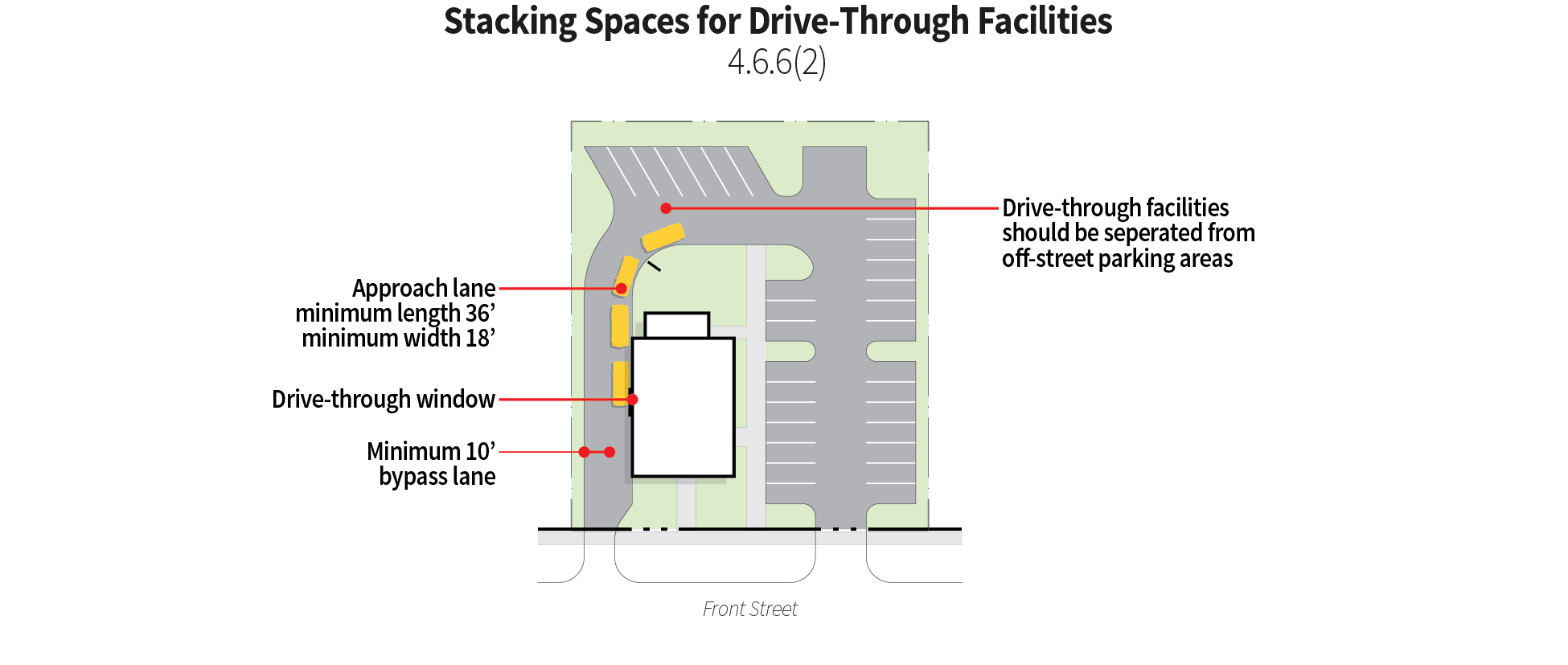
Stacking spaces and lanes for drive-through stations are not to impede on- and off-street traffic movement, are not to cross or pass through off-street parking areas and are not to impede pedestrian access to a public entrance of a building.
b)
Drive-through lanes are to be separated from off-street parking areas. Individual lanes are to be striped, marked, or otherwise distinctly delineated.
c)
Approach lanes for drive-through facilities are to have the following minimum dimensions:
1.
18 feet in width
2.
36 feet in length
d)
All drive-through facilities are to be provided with a bypass lane with a minimum width of ten (10) feet.
2)
Requirements by Use.
14.4.6.7. Required off-street parking spaces.
The minimum number of off-street parking spaces to be provided for the designated uses shall be as follows in the Table of Off-Street Parking Space Requirements, below. The table lists parking requirements for the generic uses listed within the districts. In some cases, uses which are considered part of a generic use category are listed with specified parking requirements. These specific uses are listed only for the purposes of this section and do not indicate whether such uses are permitted or special uses within any district.
The requirements in the Table of Off-Street Parking Space Requirements above do not apply to first floor uses in the B-1 district. Required parking for first-floor uses in B-1 district is at the discretion of the Director of Community Development. Uses in District B-1 located on the second-floor or above must comply with the requirements in the table above as per use.
(Ord. No. O19-05-06, § 3, 5-21-2019; Ord. No. O21-06-02, §§ 9—11, 6-1-2021)
Sec. 14.4.7. - Performance standards.
14.4.7.1. Smoke.
For the purpose of determining the density or equivalent opacity of smoke, the Ringlemann Chart, as adopted and published by the United States Department of Interior, Bureau of Mines Info. Circular 8333, May 1967, as amended from time to time, shall be used. The Ringlemann number referred to in this section refers to the number of the area on the Ringlemann Chart that coincides most nearly with the visual density or equivalent opacity of the emission of the smoke observed. For example, a reading of Ringlemann No. 1 indicates a twenty (20) percent density of the smoke observed. All measurements shall be taken at the point of emission of the smoke.
1)
All manufacturing or industrial uses in all districts other than the M district, shall emit from a vent, stack, chimney, or combustible process any smoke that is visible to the naked eye.
2)
In the M district, no use shall emit from a vent, stack, chimney, or combustible process any smoke that exceeds a density or equivalent capacity of Ringlemann No. 1, except that an emission of Ringlemann No. 2 is permissible for a duration of not more than four (4) minutes during any eight-hour period if the source of the emission is not located within 250 feet of a residential district.
14.4.7.2. Noise.
A decibel is a measure of unit of sound pressure. Since sound waves which have the same decibel level seem louder or softer to the human ear depending upon the frequency of the sound wave in cycles per second (i.e., whether the pitch of the sound is high or low), an A-weighted filter constructed in accordance with the specifications of the American National Standards Institute, which automatically takes account of the varying effect on the human ear of different pitches, shall be used on any sound level meter taking measurements required by this section. Accordingly, all measurements expressed in this section are expressed in dB(A) to reflect the use of this A-weighted filter. The standards established in the table set out below are expressed in terms of the equivalent sound level (Leq), which must be calculated by taking one hundred (100) instantaneous A-weighted sound levels at ten (10) second intervals (see Appendix A-1) and computing the Leq in accordance with the table set forth in Appendix A-2.
1)
No activity or use shall be conducted in a manner that generates a level of sound as measured on another property greater than that allowed in Table of Maximum Permitted Sound Levels below. Except as provided in this section, the table below establishes the maximum permitted noise level for a use in an M district. Measurements shall be taken at the boundary of the lot where the use is located.
2)
Impact noises are sounds that occur intermittently rather than continuously. Impact noises generated by sources that do not operate more than one (1) minute in any one-hour period are permissible up to a level of ten (10) dB(A) in excess of the figures listed in this section, except that this higher level of permissible noise shall not apply from 7:00 p.m. to 7:00 a.m. when the adjacent lot is zoned residentially. The impact noise shall be measured using the fast response of the sound level meter.
3)
Noise resulting from temporary construction activity, excluding demolition activity, that occurs between 7:00 a.m. and 7:00 p.m. shall be exempt from the requirements of this section. Noise resulting from demolition activity that occurs during the following hours shall be exempt from the requirements of this section: Monday to Friday, 9:00 a.m. and 5:00 p.m. All demolition permits must be approved by the Village Board. The Village Board and Village staff may place additional operating conditions on the permit, including, but not limited to, hours and days of operation and dust control regulations.
14.4.7.3. Vibration.
The instrument used to measure vibrations shall be a three-component measuring system capable of simultaneous measurement of vibration in three (3) mutually perpendicular directions. The vibration maximums set forth in this section are stated in terms of particle velocity, which may be measured directly with suitable instrumentation or computed on the basis of displacement and frequency. When computed, the following formula shall be used:
1)
No use shall generate any ground transmitted vibration in a district other than an M district that is perceptible to the human sense of touch measured at the lot line, or where the enterprise is not the only one located on the lot, at the outside boundary of the immediate space occupied by the enterprise generating the vibration.
2)
No use shall generate any ground transmitted vibration in an M district that exceeds the limits set out in the following table. The values in the table shall be multiplied by two (2) for impact vibrations (i.e., discrete vibration pulsations not exceeding one (1) second between pulses).
3)
Vibrations resulting from temporary construction activity, excluding demolition activity, that occurs between 7:00 a.m. and 7:00 p.m. shall be exempt from the requirements of this section. Vibrations resulting from demolition activity that occurs during the following hours shall be exempt from the requirements of this section: Monday to Friday, 9:00 a.m. and 5:00 p.m. All demolition permits must be approved by the Village Board. The Village Board and Village staff may place additional operating conditions on the permit, including, but not limited to, hours and days of operation and dust control regulations.
14.4.7.4. Odors.
For purposes of this section, the "odor threshold" is defined as the minimum concentration in air of a gas, vapor, or particulate matter that can be detected by the olfactory systems of a panel of healthy observers. No use in any district may generate any odor that reaches the odor threshold, measured at the lot line, or in where the enterprise is not the only one (1) located on the lot, at the outside boundary of the immediate space occupied by the enterprise generating the odor.
14.4.7.5. Air or water pollution.
Any use that emits an air contaminant or water pollutant regulated by the Illinois Environmental Protection Agency shall comply with applicable State and local standards concerning air and water pollution. No zoning or conditional use permit shall be issued with respect to any development subject to such a permit until the agency has certified to the permit issuing authority that the appropriate permit applications have been received, that the developer is eligible to receive such permits, and that the development is otherwise in compliance with applicable pollution control laws. Any discharge into the Village's wastewater treatment plant shall require the Village's consent and unless specifically agreed to shall not contain waste that cannot be adequately treated by biological means.
14.4.7.6. Electrical disturbance or interference.
No use may create any electrical disturbance that adversely impacts any operations or equipment other than those of the creator of such disturbance, or otherwise causes, creates, or contributes to the interference with electronic signals to the extent that the operation of any equipment not owned by the creator of such disturbance is adversely impacted.
(Ord. No. O19-05-06, § 3, 5-21-2019)
Sec. 14.4.8. - Erection of fences and walls.
14.4.8.1. Permit to erect; Compliance with chapter.
No fence shall be erected in the Village unless a permit is obtained in advance and unless such fence is erected in compliance with the provisions of this chapter within 90 days after such permit is issued. An accurate sketch showing the proposed location of the fence on the premises shall be furnished to the Director of Community Development at the time application is made for the permit to erect a fence.
14.4.8.2. General standards.
In addition to the standards prescribed in the following sections of this chapter, the following standards shall be followed in connection with all fences:
1)
All fence posts and supporting fence members shall be erected so that after the fence is constructed they will face to the interior of the premises for which the fence permit is issued.
2)
All chain-link fencing must be installed knuckle side up. The use of spikes, broken glass, or other sharp or pointed instruments or materials intended or likely to cause injury to any person coming into contact therewith is prohibited.
3)
Electrified fences, permanent snow fences, chicken wire, hog and farm-type fences are prohibited.
4)
No stone, masonry or concrete fence shall be constructed unless it is supported by a foundation and footing which shall extend at least forty-two (42) inches below the finished grade of the ground on both sides of the fence.
5)
No fence may be erected in a front yard as defined by the Village zoning ordinance for the subject premises.
14.4.8.3. Height and location.
The following standards shall be followed in connection with the height and placement of fences:
1)
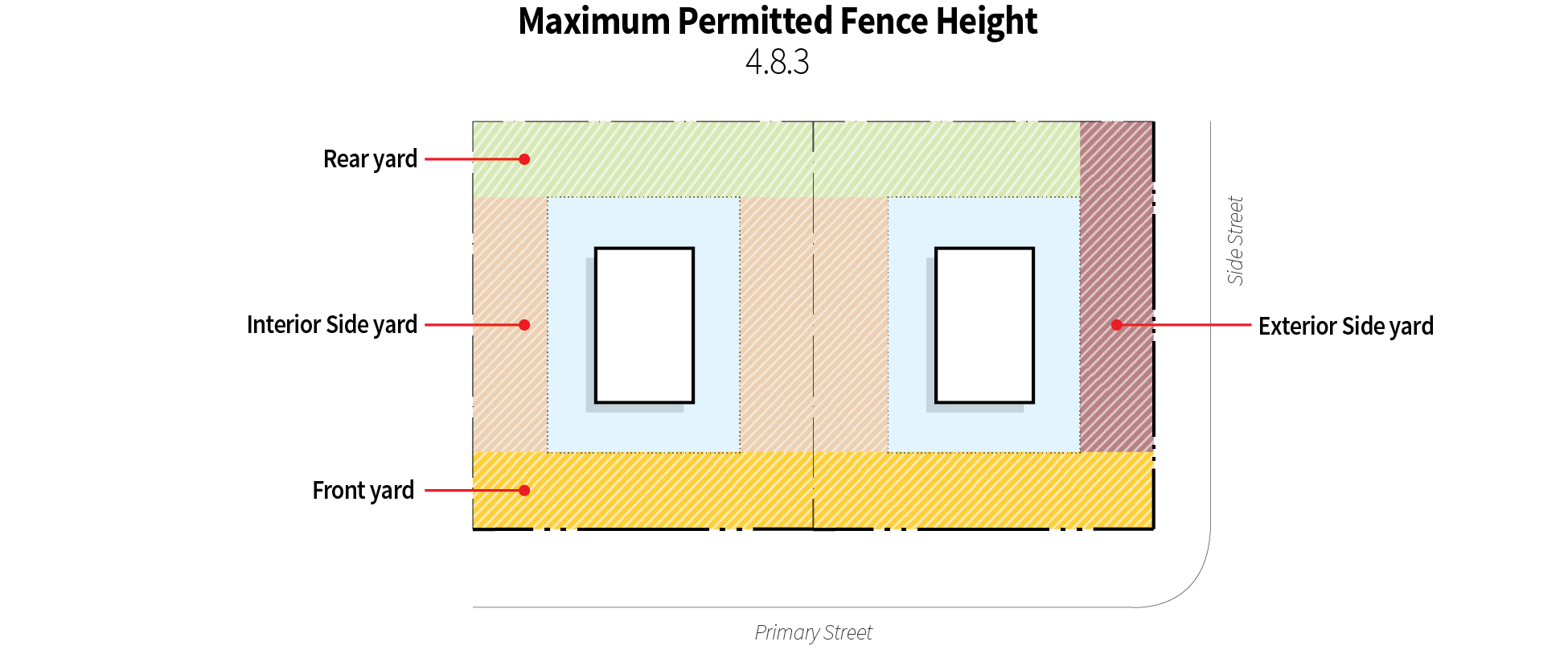
Fences up to six (6) feet in height may be installed in rear and interior side yards provided any fence is located behind the front line of the principal building structure.
2)
Fences up to six (6) feet in height may be installed in an exterior side yard provided that the fence is placed behind the front line of the principal building and setback one (1) foot from the property line. If the exterior side yard abuts the front yard of an adjacent lot, or an arterial or collector roadway as defined in the comprehensive plan, a 10-foot setback shall be maintained from the property line along the exterior side yard. If the rear yard abuts a roadway, a gate must be provided in order to provide access to maintain the adjacent right-of-way.
3)
Fences up to seven (7) feet in height may be installed within manufacturing districts when used for screening building materials, equipment, or outdoor storage areas. Fences up to seven (7) feet in height may be installed within residential zoning districts along rear or side property lines which are directly contiguous to manufacturing districts or railroad rights-of-way.
4)
Split rail fences up to forty-two (42) inches in height may be erected in any front yard or exterior side yard.
5)
No fence may be constructed on a corner lot which obstructs the clear view of motor vehicular traffic using the abutting streets.
6)
The use of barbed wire in residential fencing is prohibited.
7)
Nothing contained in this chapter shall be construed to restrict or limit the height of chain-link fencing or safety netting surrounding recreational facilities such as tennis courts, athletic fields, or similar uses subject to the approval of the Community Development Director.
14.4.8.4. Dangerous or encroaching fences.
It is unlawful for the owner, occupant or person in custody of any premises in the Village, having a fence thereon, to permit such fence to exist in a state or condition which is liable to cause injury to any person or to property, or which is liable to collapse, or which encroaches upon or leans upon the premises of another.
(Ord. No. O19-05-06, § 3, 5-21-2019)
Sec. 14.4.9. - Multifamily and single-family attached dwellings.
14.4.9.1. Density.
1)
The maximum allowable density in dwelling units per acre for multifamily and single-family attached residential dwellings as measured on the predevelopment tract is as follows:
2)
The maximum allowable density may be increased above the standards set forth in 4.9.1(1) for developments which are approved as part of a planned unit development or which incorporate senior housing, assisted living, or other institutional uses when approved as part of a conditional use permit.
14.4.9.2. Minimum lot size and lot width.
Any lot subdivided for a single-family attached residential dwelling unit shall have a minimum lot area of four thousand (4,000) square feet and a minimum lot width of thirty (30) feet. End lots shall have a minimum lot width of forty (40) feet.
14.4.9.3. Buildings.
1)
No more than six (6) attached single-family dwellings shall be connected together in a single building.
2)
Two (2) or more multifamily buildings may be located on the same zoning lot only as part of an approved planned unit development.
3)
Separations between groups of attached single-family dwellings or multifamily buildings shall not be less than thirty (30) feet plus area for patios. This requirement may be reduced by up to fifty (50) percent where the interior side of two (2) attached single-family dwellings face each other.
4)
Each attached single-family or multifamily dwelling shall be provided with at least one hundred (100) square feet of area reserved for the construction of a patio or deck.
(Ord. No. O19-05-06, § 3, 5-21-2019)

