
Cary City Zoning Code
CHAPTER 5
- SIGNS
Sec. 14.5.0. - How to use this chapter.
This chapter is divided into three (3) main sections, types of signs, sign permissions, and sign standards. To use this chapter, first identify the type of sign proposed. Then, find that sign type in either the Table of Permitted Permanent Signs or the Table of Permitted Temporary Signs. Next, determine which zoning district your proposed sign will be located in. Then use the table to determine whether the proposed sign is permitted as of right, conditionally, or is prohibited. If the proposed sign is permitted as-of-right or conditionally, proceed to Chapter Eight, Administration and Enforcement, for instruction on the sign permitting process.
(Ord. No. O19-05-06, § 3, 5-21-2019)
Sec. 14.5.1. - General provisions.
14.5.1.1. Scope.
The provisions of this chapter shall govern the display, construction, erection, alteration, use, location, repair, and maintenance of all signs together with their appurtenant and auxiliary devices in respect to structural and fire safety. It shall be unlawful after the adoption of this chapter to display, construct, erect, alter, use, or maintain any sign except in conformance with the provisions of this chapter.
14.5.1.2. Approved rules.
In the absence of approved rules governing details of construction, the provisions of ANSI A60.1 (American National Standards Institute, Inc.; Building Code Requirements for Load, Minimum Design in Buildings and Other Structures) as amended from time to time shall be deemed to conform to the requirements of this Code unless otherwise specified in this chapter.
14.5.1.3. Statement of purpose.
The purpose of this chapter is to:
1)
Regulate signs and signage lighting to preserve and enhance the appearance of the Village, and to protect the value of properties in the Village;
2)
Insure that all signs within the Village are compatible with existing land uses and/or buildings regarding size, location, construction, and materials, and to discourage an unsightly, disproportionate, inappropriate, and excessive number of signs;
3)
Insure that signs do not confuse, mislead, or otherwise endanger the public health, safety, or general welfare; and
4)
Restrict signs and sign lighting which increase the probability of accidents by distracting the attention of or obstructing the vision of drivers in the vicinity.
(Ord. No. O19-05-06, § 3, 5-21-2019)
Sec. 14.5.2. - Sign measurement.
1)
Area to be included. The supporting structure or bracing of a sign shall be omitted in measuring the area of the sign unless such structure or bracing is made part of the message or face of the sign. Where a sign has more than one (1) display face, the area of the sign shall be measured by the largest if the display faces.
2)
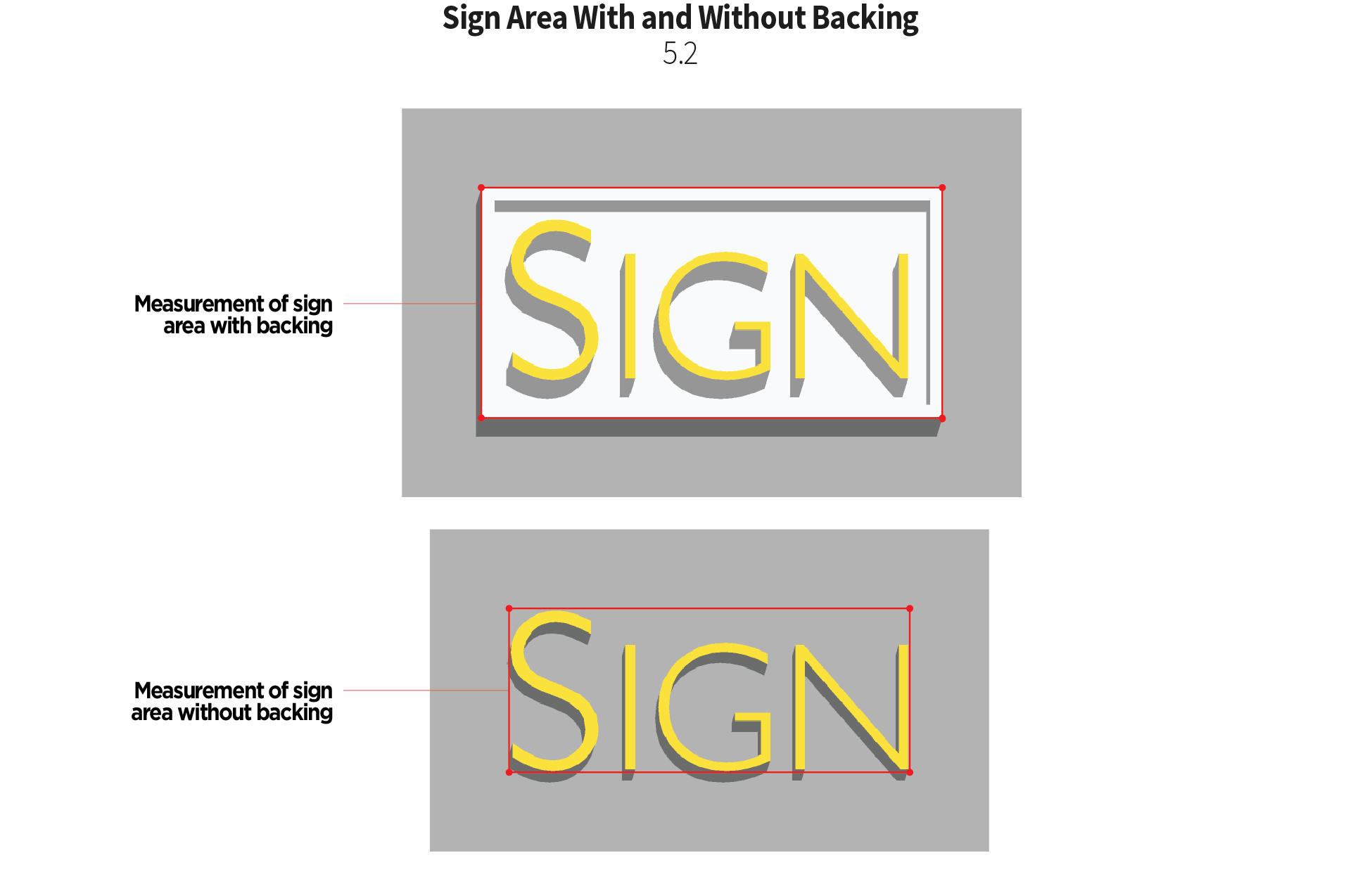
Area of sign with backing. The area of all signs with backing shall be measured by computing the area of the sign backing.
3)
Area of signs without backing. The area of all signs without backing shall be measured by computing the area of the smallest regular geometric figure that can encompass all words, letters, figures, emblems, and other elements of the sign copy.
4)
Area of signs with and without backing. The area of all signs formed by a combination of materials with and without backing shall be measured by counting the area of such elements in accordance with the foregoing subparagraphs:
a)
Signs on lots with multiple users. Where more than one (1) user occupies a zoning lot, the owner of the lot shall be responsible for allocating permitted signage among such users.
b)
General safety. Notwithstanding any other provision of this section, no sign shall be located in any area or in any manner so as to create a nuisance or a threat to public health, safety, or welfare.
(Ord. No. O19-05-06, § 3, 5-21-2019)
Sec. 14.5.3. - Dimensional standards of permanent and temporary signs.
The maximum size of aggregate sign(s), regardless of sign type, shall not be greater than one (1) square foot of sign area per lineal foot of building frontage.
14.5.3.1. Wall signs.
The following dimensional standards shall apply to wall signs.
1)
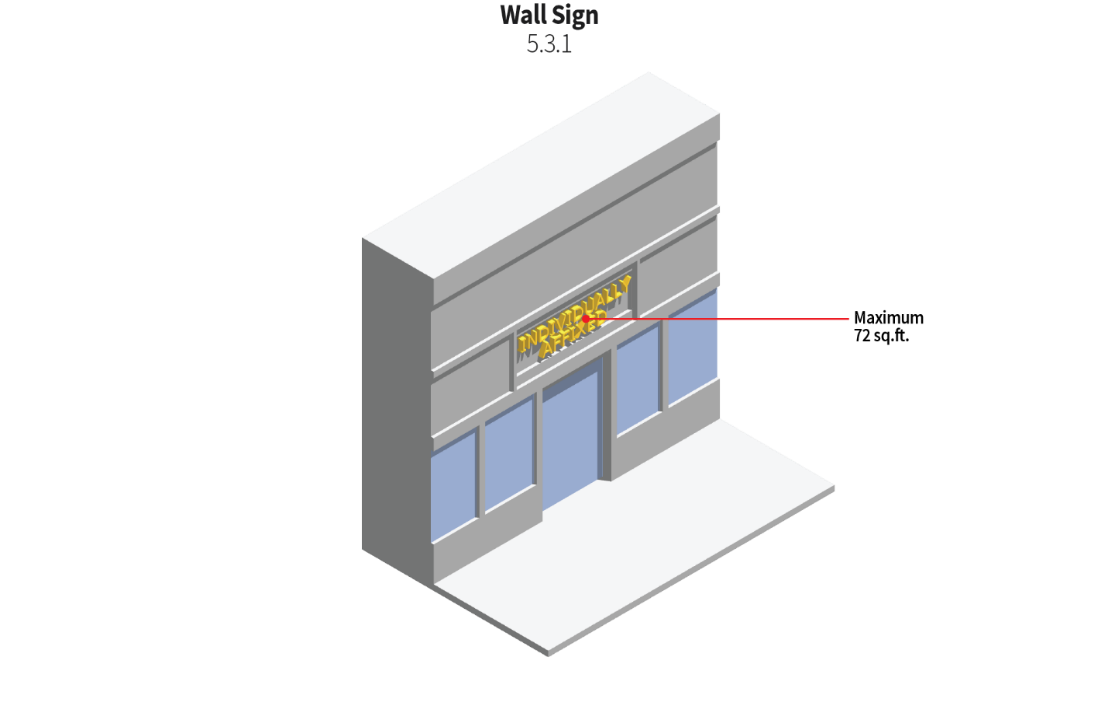
Size. Wall signs may be a maximum of seventy-two (72) square feet in area or may cover five (5) percent of the building frontage on which the sign shall be located, whichever is less. Wall signs are not required to be less than thirty-two (32) square feet in area.
2)
Height. No wall sign shall protrude above the highest roof line or above the top of the parapet wall or mansard roof.
3)
Projection. Such signs shall not horizontally project more than twelve (12) inches from the wall of the building or structure to which it is attached.
4)
Number of signs. Only one (1) wall sign per building frontage of the building or unit of a building.
5)
Provisions.
a)
Building frontage for the purpose of this section shall be defined as the established main public entrance for each unit.
b)
On multiple-tenant buildings with multiple wall signs, all signs shall be of the same style, proportions, base colors, and constructed of the same materials.
c)
Up to two (2) times of the sign area permitted by 14.5.2.1(1) of this chapter may be granted to those buildings with a setback in excess of two hundred (200) feet at the discretion of the Director of Community Development or his/her designee, corner lots may display a second sign for the secondary frontage.
d)
No wall sign shall cover any architectural features (architectural features shall include, but not be limited to: pediment, cornice, belt course, pier, windows, pilaster, roof, decorative stone or tile inlay, kick plate/bulkhead, raised or colored brick pattern, and corbel) of the building to which it is affixed.
e)
No wall sign shall be affixed to HVAC screening, elevator overrun, or other features protruding from the roof of the structure, with the exception of building parapets which have been designed and integrated into the architecture of the building and which are in line with and not set back from the perimeter façade of the building.
f)
Buildings located on outlots of shopping centers may display an additional wall sign towards a main parking area of the development and not oriented towards a street.
14.5.3.2. Monument signs non-residential.
The following dimensional standards shall apply to non-residential monument signs.
1)
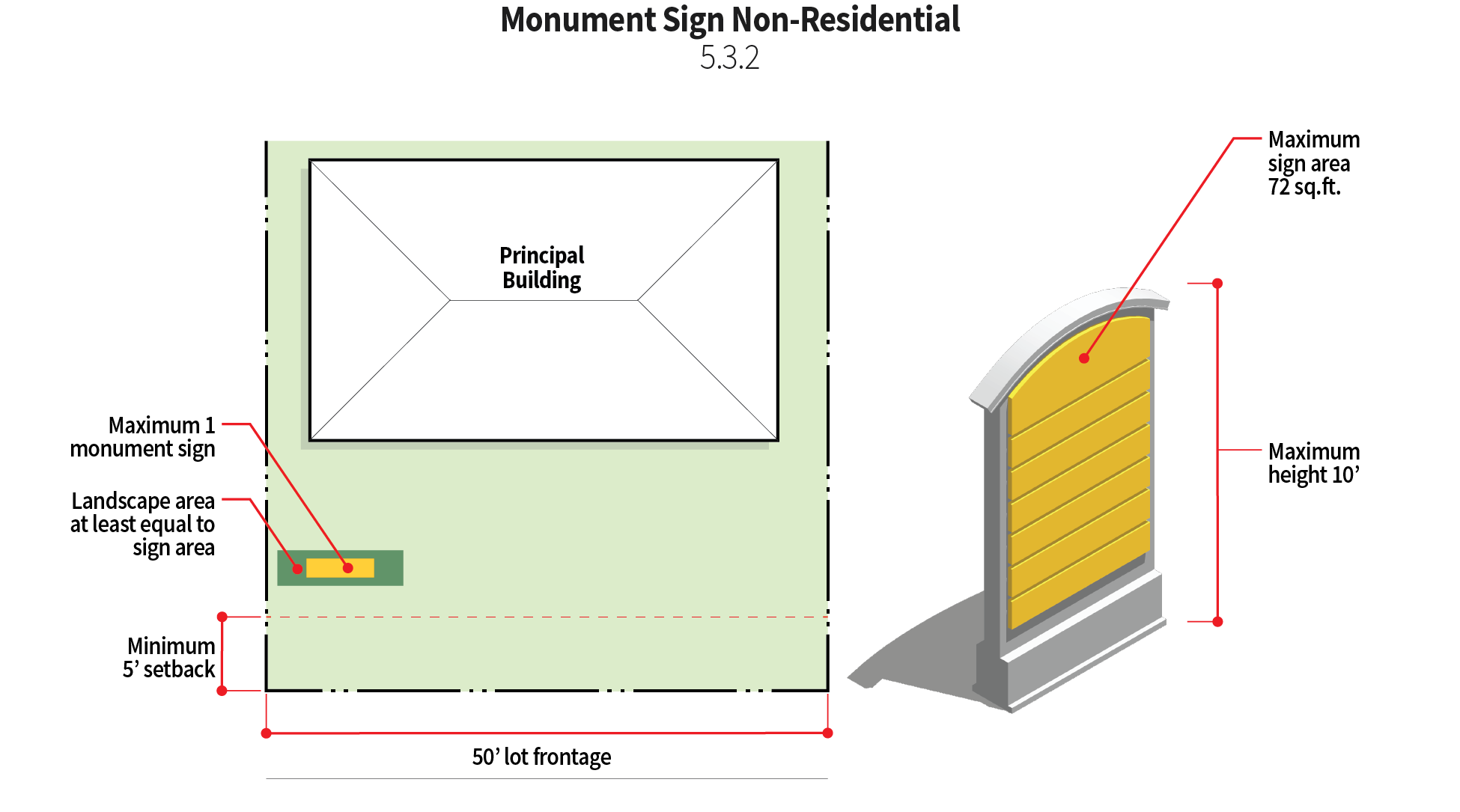
Size. The maximum size of a monument sign shall be based upon lot frontage per the following table:
2)
Height. The maximum height of any monument sign shall be no greater than ten (10) feet above the center line datum elevation of the street immediately adjacent to the sign location.
3)
Number of signs. Each lot or parcel of land under one (1) ownership or use may not have more than one (1) monument sign, with a maximum of two (2) display surfaces, except that any lot or parcel with a frontage of three hundred fifty (350) feet or more may have two (2) monument signs located not less than two hundred fifty (250) feet apart. PO zoned parcels may have more than two (2) monument signs for larger park sites provided that all monument signs on the park property comply with these spacing requirements.
4)
Setbacks. No part of any monument sign may be closer than five (5) feet from any street right-of-way or property line.
5)
Landscape requirements. A landscape planting area is required at the base of the sign. The landscape area should be at least equal to the square footage of the sign in question.
6)
Provisions.
a)
No monument sign shall be located within eight (8) feet of any electric power line, service drops or line conductors, or in any location where the Director of Community Development or his/her designee finds a reasonable danger that any electric power line would come in contact with the sign.
b)
No monument sign shall be located within or over any public utility easement.
14.5.3.3. Monument signs residential.
The following dimensional standards shall apply to residential monument signs.
1)
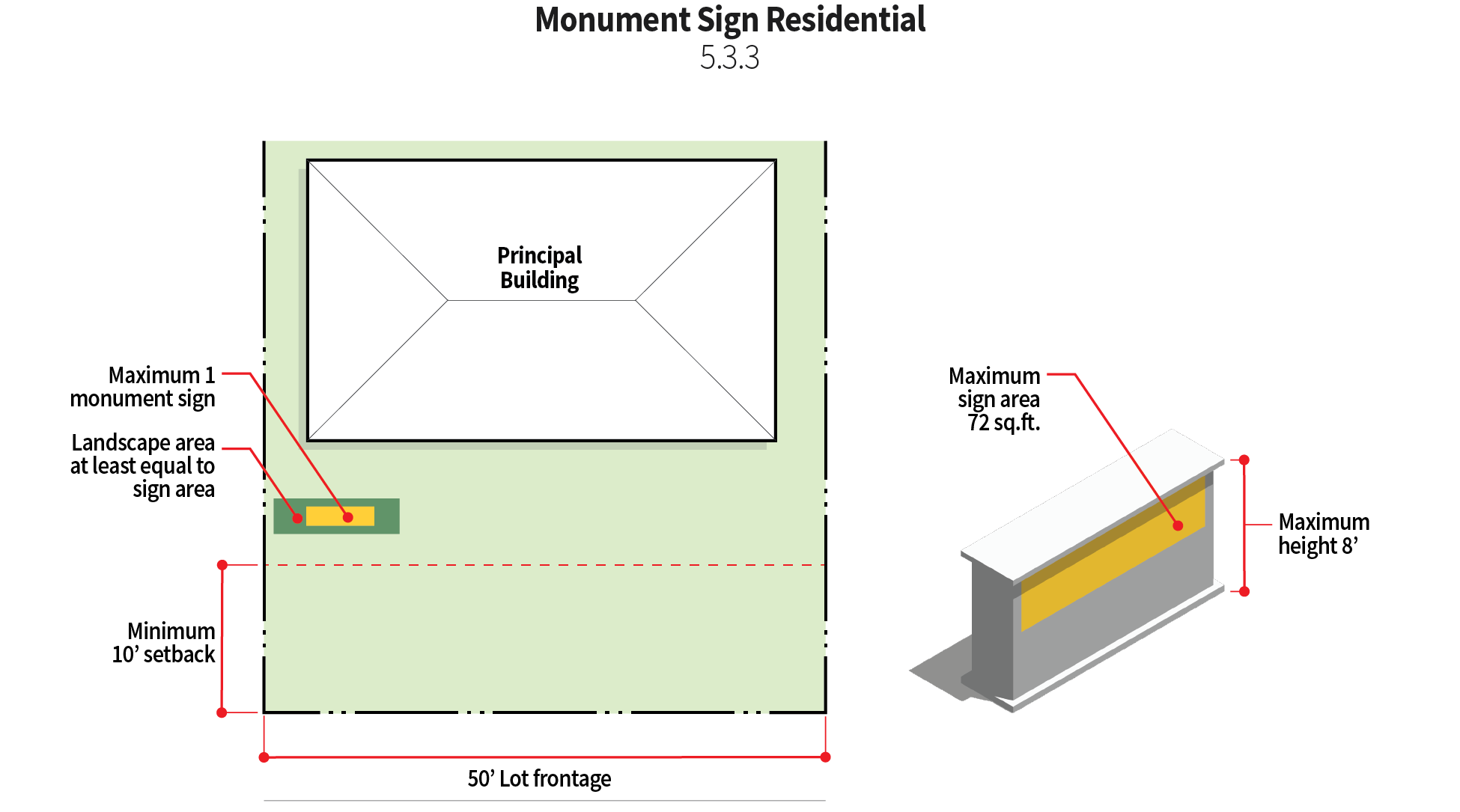
Size. The maximum size of a monument sign for a residential use shall be twenty-four (24) square feet. The maximum size of a monument sign for a non-residential use in a residential zoned district shall be based upon lot frontage per the followingtable:
2)
Height. The maximum height of any monument sign shall be no greater than eight (8) feet above the center line datum elevation of the street immediately adjacent to the sign location.
3)
Number of signs. Each lot or parcel of land under one (1) ownership or use may not have more than one (1) monument sign, with a maximum of two (2) display surfaces.
4)
Setbacks. No part of any monument sign may be closer than ten (10) feet from any street right-of-way or property line. Signs for non-residential uses shall be setback at least one (1) foot for each one (1) square foot in sign area from the nearest residential property line.
5)
Landscape requirements. A landscape planting area is required at the base of the sign. The landscape area should be at least equal to the square footage of the sign in question.
6)
Provisions.
a)
No monument sign shall be located within eight (8) feet of any electric power line, service drops or line conductors, or in any location where the Director of Community Development or his/her designee finds a reasonable danger that any electric power line would come in contact with the sign.
b)
No monument sign shall be located within or over any public utility easement.
c)
Monument signs shall be permitted only at each principal entrance to a residential subdivision with the exclusion of those signs which are associated with nonresidential uses.
d)
Only external illumination of monument signs in accordance with the general standards is permitted.
e)
The sign(s) shall be aesthetically in keeping with the character of the neighborhood.
14.5.3.4. Projecting signs.
The following dimensional standards shall apply to projecting signs.
1)
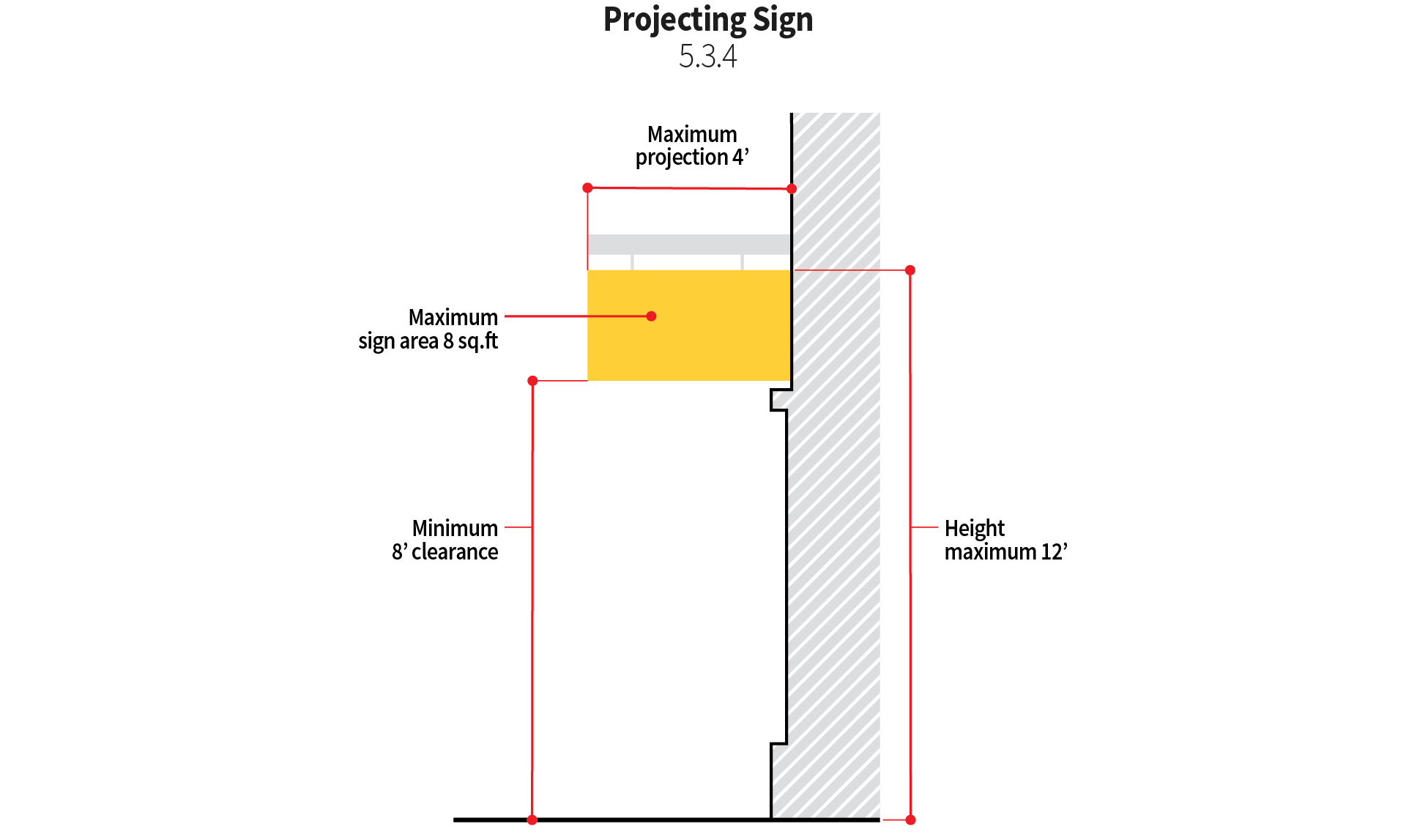
Size. The maximum size of a projecting sign shall not exceed eight (8) square feet per sign face with a maximum of two (2) sides per sign.
2)
Height. Projecting signs shall no extend above the roofline of the building to which it is attached, or twelve (12) feet as measured from the existing ground or grade level directly below the sign. A minimum of eight (8) feet clearance shall be maintained from the lower edge of the sign face to grade.
3)
Number of Signs. One (1) projecting sign shall be permitted per business establishment. A projecting sign and wall sign may be placed on the same wall provided the wall sign does not exceed twenty-five (25) percent of the maximum size permitted by this code.
4)
Projection. Projecting signs shall not horizontally project more than four (4) feet beyond that portion of the building or structure to which it is attached.
5)
Provisions.
a)
Such signs shall have no internal illumination.
b)
Projecting signs may encroach upon or extend or project over any public right-of-way including, but not limited to, streets, alleys, and sidewalks.
c)
All projecting signs shall be no closer than eighteen (18) inches to the curb of any adjacent street.
14.5.3.5. Canopy/Awning signs.
The following dimensional standards shall apply to canopy or awning signs.
1)
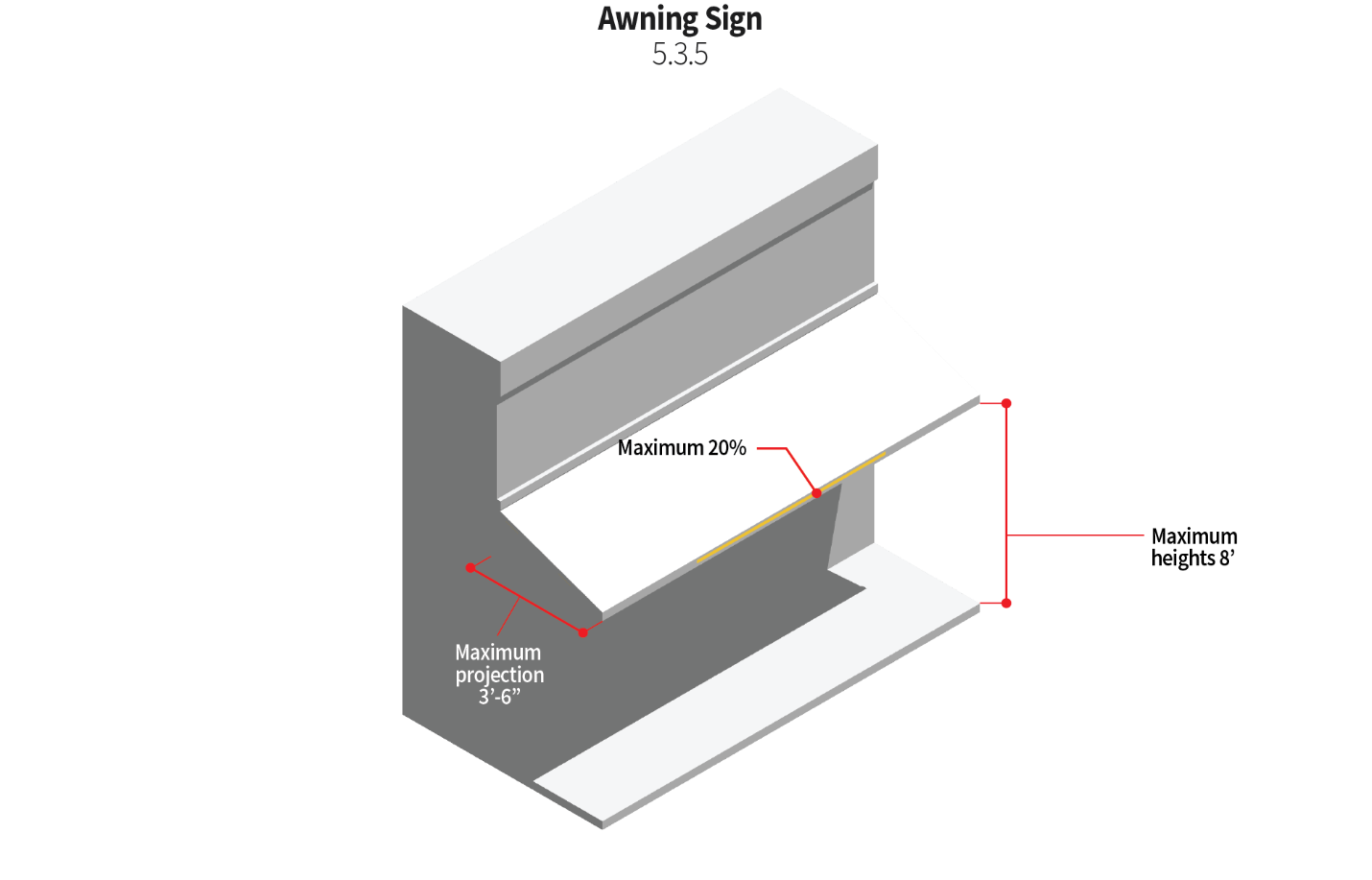
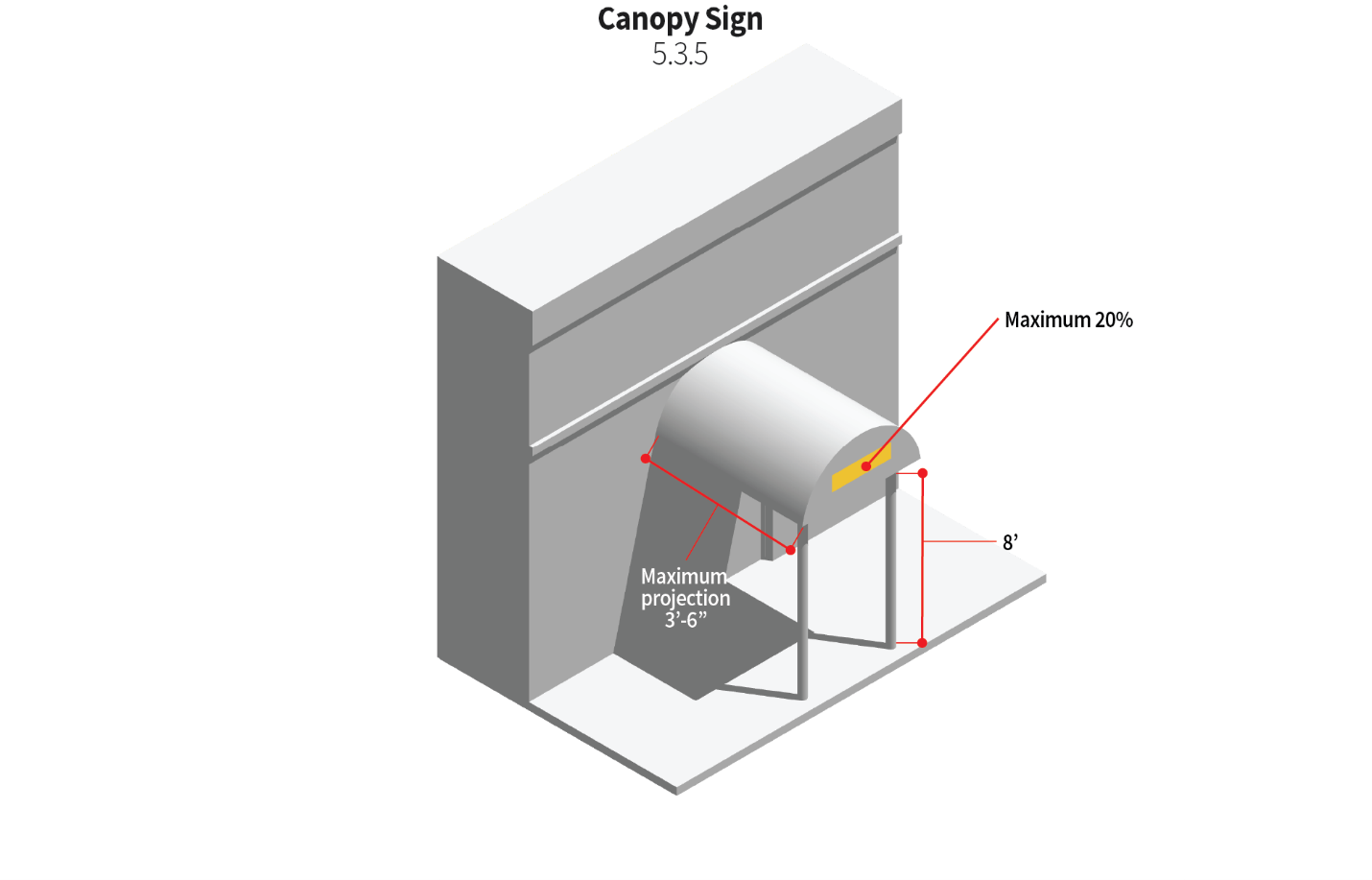
Size. No sign copy shall cover more than twenty (20) percent, or seventy-two (72) square feet whichever is less, of the canopy or awning surface area
2)
Height. All canopies and awnings shall be constructed and erected so that the lowest portion of the projecting frame shall be not less than eight (8) feet above the existing monument or grade level, and the lowest portion of the extending skirt shall be not less than seven (7) feet six (6) inches above the existing monument or grade level.
3)
Projection. Such signs shall not horizontally project more than three (3) feet six (6) inches beyond the line of the building or structure nor more than three (3) feet six (6) inches beyond that portion of the building or structure to which it is attached.
4)
Provisions.
a.
Such signs shall have no internal illumination.
b.
Such signs shall be erected as permitted by this chapter but must be part of the total wall sign area, not in addition to the wall sign area as permitted by this chapter.
c.
Such signs may not encroach upon or extend or project over any public right-of-way, including, but not limited to, streets, alleys, and sidewalks.
d.
All projecting signs shall be no closer than eighteen (18) inches to the curb of any adjacent street.
14.5.3.6. Banner signs.
The following dimensional standards shall apply to banner signs.
1)
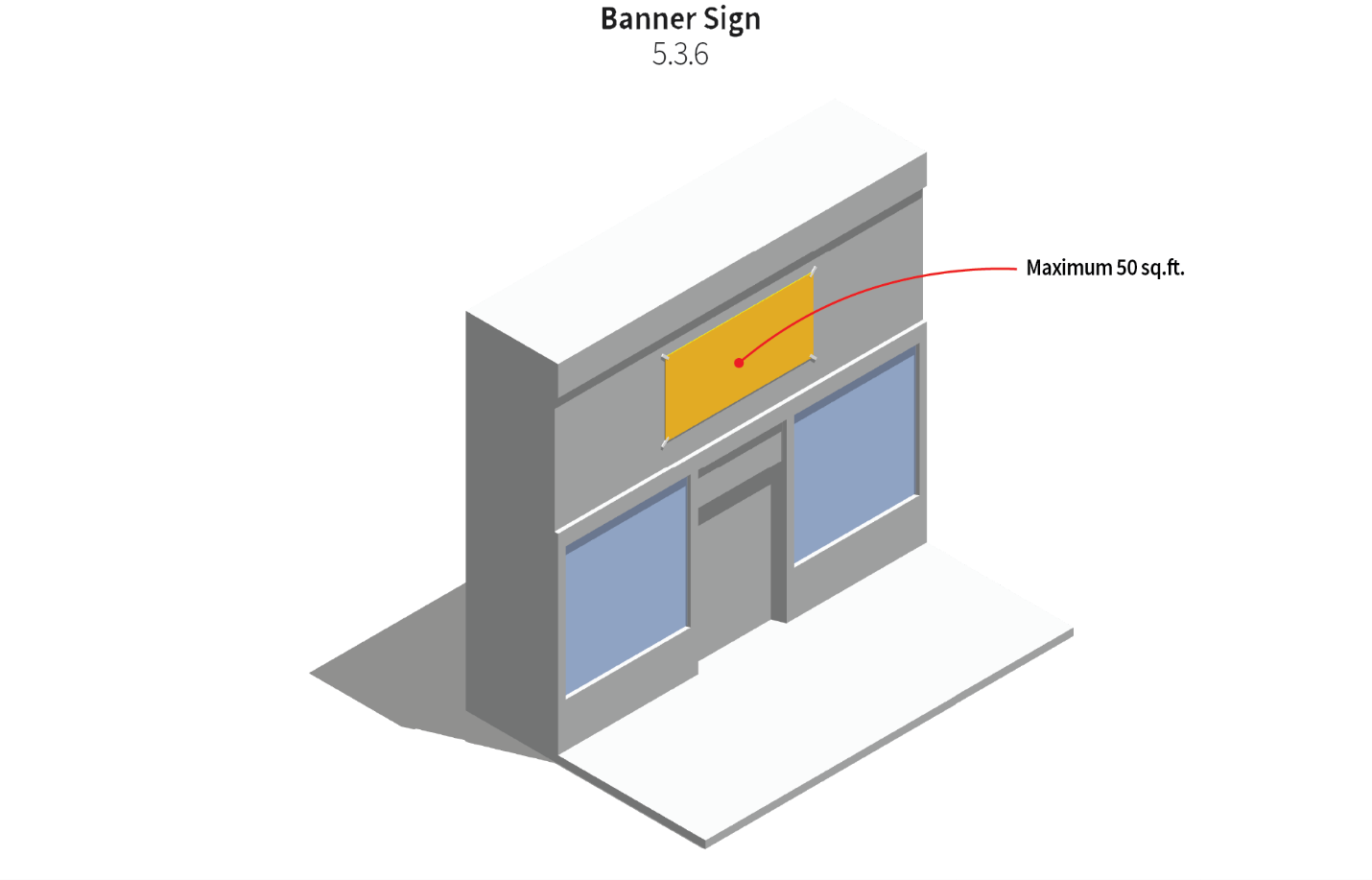
Size. The maximum size of a banner sign shall not be greater than 0.5 square feet of sign area per lineal foot of building frontage. Maximum of fifty (50) square feet per banner sign is permitted.
2)
Height. No wall mounted banner sign shall protrude above the highest roof line or above the top of the parapet wall or mansard roof. Ground mounted banner signs shall not exceed a maximum height of ten (10) feet.
3)
Number of signs. A maximum of two (2) banner signs, consisting of one wall mounted and/or one (1) ground mounted sign, per building frontage of the building or unit of a building is permitted.
4)
Setback. No part of any banner sign shall be located within five (5) feet from any street right-of-way or property line.
5)
Provisions.
a.
Building frontage for the purpose of this section shall be defined as the established main public entrance for each unit.
b.
Wall mounted banner signs shall be affixed flat against the building to which they are mounted.
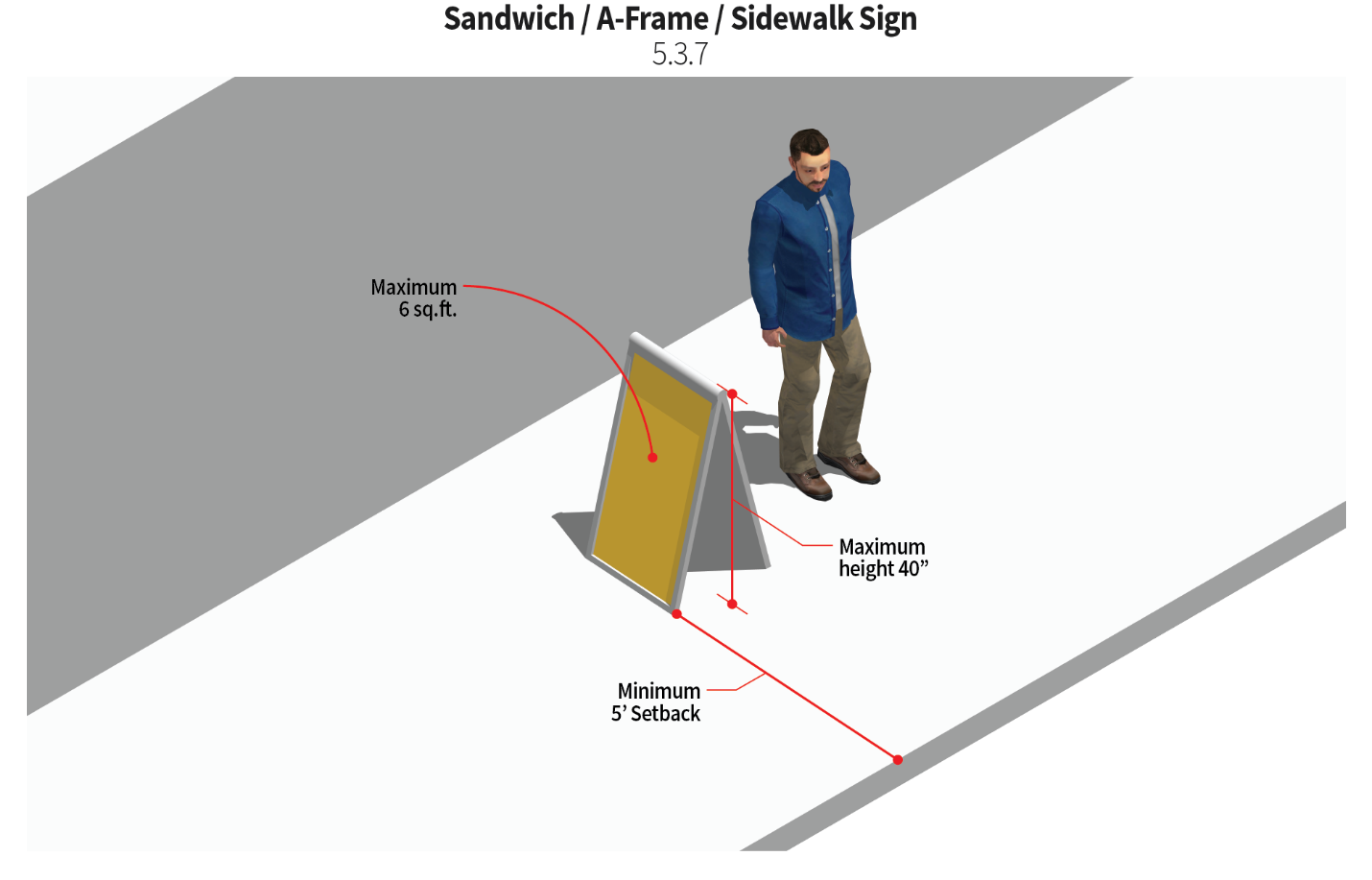
14.5.3.7. Sandwich board (A-Frame/Sidewalk Signs).
The following dimensional standards shall apply to sandwich board signs.
1)
Size. The maximum size of any sandwich board sign shall not be greater than six (6) square feet.
2)
Height. The maximum height of any sandwich board sign shall not be greater than forty (40) inches above the existing ground or grade level.
3)
Number of signs. Only one (1) sandwich board sign per building frontage of the building or unit of a building is permitted.
4)
Setback. No part of any sandwich board sign may be closer than five (5) feet from any street right-of-way or property line.
5)
Provisions.
a.
No part of any sandwich board sign shall either impede the flow of pedestrian traffic along any adjacent sidewalks or block any points of ingress or egress.
b.
Sandwich board signs on public right-of-way shall only be allowed in the B1 zoning district.
c.
The sandwich board sign shall be placed no more than one (1) foot from the wall of the building for which the sign is advertising unless the Director of Community Development or his/her designee approves in writing another location due to other obstructions on the property or in the right-of-way.
14.5.3.8. Drive-Through Lane Signs.
1)
Size. The maximum size of any drive-through lane sign shall not be greater than fifty (50) square feet.
2)
Height. The maximum height of any drive-through lane sign shall not be greater than eight (8) feet above the existing ground or grade level.
3)
Number of signs. No more than two (2) drive-through lane signs area allowed for each drive-through lane serving a business establishment.
4)
Setback. Drive-through lane signs may only be located along a drive-through lane and shall be setback at least five (5) feet from any street right-of-way or property line.
5)
Provisions.
a.
Any light from the drive-through lane sign shall be contained within the drive-through lane only.
b.
Each primary drive-through lane sign may also be equipped with a separate accessory sign, up to twelve (12) square feet in size, to assist with the operation of the drive-through lane for the purpose of taking orders from vehicle operators.
c.
Canopies or vehicle clearance bar signs which alert vehicle operators of any height restrictions they may encounter on a given site shall be exempt from these provisions but shall not exceed an aggregate gross surface area of four (4) square feet.
(Ord. No. O19-05-06, § 3, 5-21-2019; Ord. No. O20-04-02, §§ 2—5, 4-14-2020)
Sec. 14.5.4. - Permitted permanent signs.
The following Table identifies the permanent signs that are permitted as of right or conditionally in the indicated districts. Before any permanent sign may be erected or constructed, with the exception of window signs, a permanent sign permit must first be issued by the Director of Community Development or his/her designee.
1)
P: Signs permitted as of right.
2)
C: Signs permitted conditionally.
3)
X: Prohibited signs.
(Ord. No. O19-05-06, § 3, 5-21-2019; Ord. No. O20-04-02, § 6, 4-14-2020)
Sec. 14.5.5. - Permitted temporary signs.
The following Table identifies the temporary signs that are permitted as of right or conditionally in the indicated districts. Permitted temporary signs shall be displayed for a period not to exceed thirty (30) days per calendar year. Before any temporary sign may be erected or constructed, a temporary sign permit must first be issued by the Director of Community Development or his/her designee.
1)
P: Signs permitted as of right.
2)
C: Signs permitted conditionally.
3)
X: Prohibited signs.
(Ord. No. O19-05-06, § 3, 5-21-2019)
Sec. 14.5.6. - Exempt signs in residential districts.
In the E1, R1, R2, R2A, and R3 districts no permanent or temporary sign permit is required for the erection or construction of a sign that is less than or meets the following dimensional standards.
1)
Size. The maximum size of an exempt sign shall not be greater than six (6) square feet of sign area.
2)
Height. The maximum height of any exempt sign shall be no greater than three (3) feet above the existing ground or grade level.
3)
Setback. No part of any exempt sign may be closer than five (5) feet from any street right-of-way or property line.
4)
Provisions.
a)
A maximum of two (2) exempt signs may be displayed concurrently.
b)
An exempt sign shall be displayed for a period not to exceed sixty (60) days per calendar year, the Director of Community Development or his/her designee may permit extensions to this time limit.
c)
No exempt sign shall be located within two (2) feet of any electric power line, service drops or line conductors, or in any location where the Director of Community Development or his/her designee finds a reasonable danger that any electric power line would come in contact with the sign.
d)
No exempt sign shall be located within or over any public utility easement.
(Ord. No. O19-05-06, § 3, 5-21-2019)
Sec. 14.5.7. - Exempt signs in commercial districts.
In the B1, B2, B3, M, and PO districts no permanent or temporary sign permit is required for the erection or construction of the following sign types subject to the adherence to the dimensional standards detailed below.
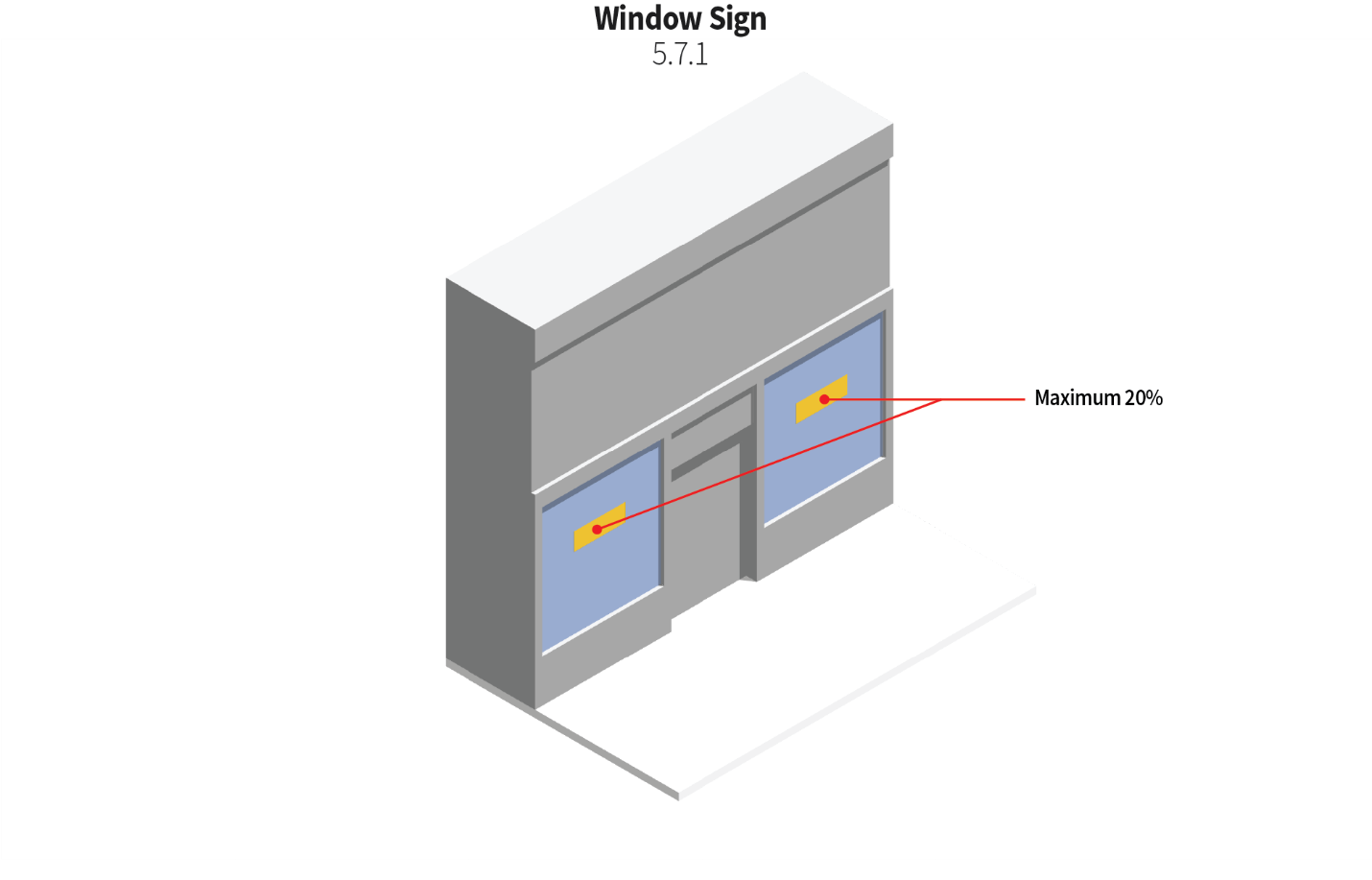
14.5.7.1. Window signs.
1)
Coverage. Window signs may cover 20 percent of the window on which the sign shall be located.
2)
Area. The area of a window sign shall be computed by calculating each window pane or panel. A group of window panes or panels may be considered one window if they are adjoining and not separated by more than six inches. The window coverage for doors shall also include the area above the door. The area shall be separate for each building face, and for each window.
3)
Provisions.
a.
All window signage including illuminated and non-illuminated shall not exceed the maximum coverage.
b.
Signs shall be static in nature and not provide any blinking, flashing, movement, or the appearance of movement. The use of electronic message centers as window signs is prohibited.
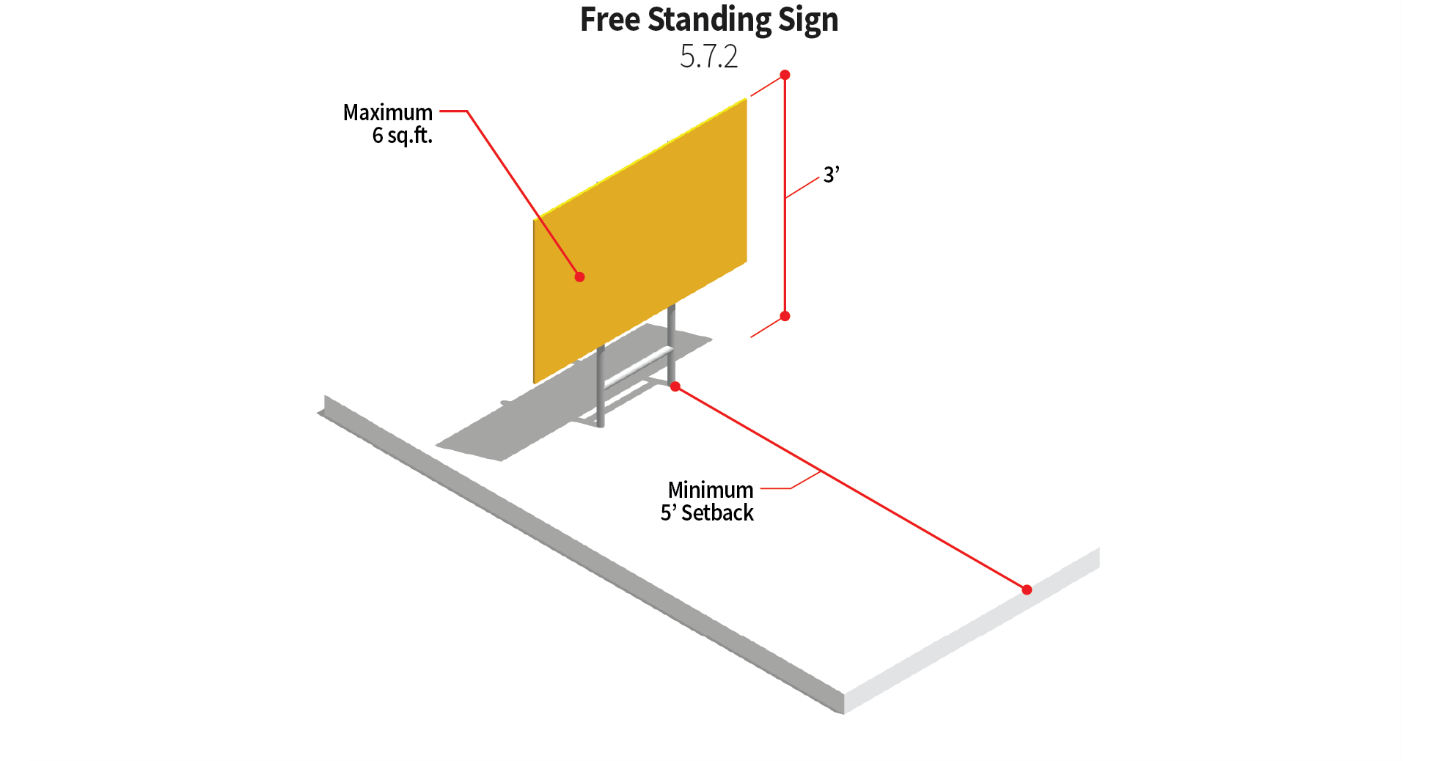
14.5.7.2. Free-standing signs.
1)
Size. The maximum size of an exempt free-standing sign shall not be greater than six (6) square feet.
2)
Height. The maximum height of any exempt free-standing sign shall be no greater than three (3) feet above the center line datum elevation of the street immediately adjacent to the sign location.
3)
Setback. No part of any exempt free-standing sign may be closer than five (5) feet from any street right-of-way or property line.
4)
Provisions.
a)
A maximum of two (2) exempt free-standing signs shall be displayed concurrently.
b)
An exempt sign shall be displayed for a period not to exceed sixty (60) days per calendar year, the Director of Community Development or his/her designee may permit extensions to this time limit.
c)
No exempt free-standing sign nor any portion of an exempt free-standing sign shall be affixed to any building, sign, or structure.
d)
No exempt free-standing sign shall be located within two (2) feet of any electric power line, service drops or line conductors, or in any location where the Director of Community Development or his/her designee finds a reasonable danger that any electric power line would come in contact with the sign.
e)
No exempt free-standing sign shall be located within or over any public utility easement.
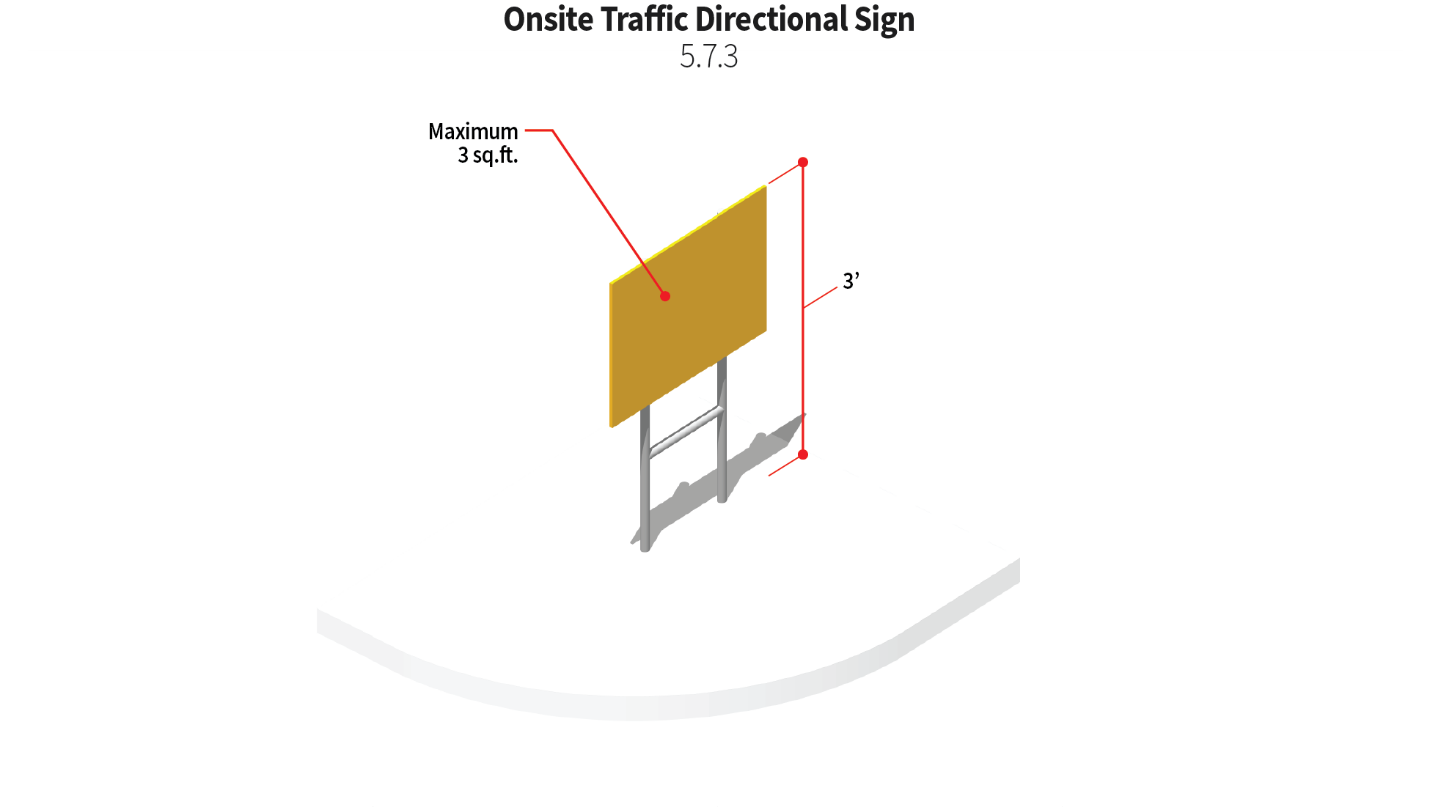
14.5.7.3. Onsite traffic directional signs.
Onsite traffic directional signs are permitted as necessary to assist in the movement of vehicular traffic on a property for the purpose of the safety of both pedestrian and vehicular traffic.
1)
Size. The maximum size of any onsite traffic directional sign shall not be greater than three (3) square feet.
2)
Height. The maximum height of any onsite traffic directional sign shall not be greater than three (3) feet.
3)
Setback. No part of any onsite traffic directional sign may be closer than five (5) feet from any street right-of-way or property line.
4)
Provisions.
a)
No part of any onsite traffic directional sign may be located within any required landscape areas.
(Ord. No. O19-05-06, § 3, 5-21-2019; Ord. No. O20-04-02, §§ 7, 8, 4-14-2020)
Sec. 14.5.8. - Exempt signs for local, state, and regional government uses.
Any sign constructed, erected, and maintained by the Village of Cary, Cook County, State of Illinois, or other regional authority is exempt from the regulations set forth in Sections 14.5.2—14.5.6 of this chapter.
(Ord. No. O19-05-06, § 3, 5-21-2019)
Sec. 14.5.9. - Prohibited signs.
The following sign categories and types are prohibited in all zoning districts.
1)
Flashing signs.
2)
Marquee signs.
3)
Animated signs.
4)
Obstructive signs.
5)
Off-premises signs/billboards.
6)
Signs painted directly on a building wall or fence.
7)
Portable signs.
8)
Vehicle signs.
9)
Roof signs.
10)
Signs affixed to utility poles or trees.
11)
Signs affixed to fire escapes or fire suppression systems.
12)
Signs creating traffic hazards.
13)
Signs erected without proper permits.
14)
Signs in the public right-of-way.
15)
Signs related to abandoned uses or activities.
16)
Unsafe signs.
17)
Outline lighting.
18)
Pole signs.
19)
Attention getting devices.
20)
Box signs.
(Ord. No. O19-05-06, § 3, 5-21-2019)
Sec. 14.5.10. - Illegal signs.
14.5.10.1. Illegal permanent signs.
If any permanent sign has been constructed or erected or is being maintained in violation of the provisions of this chapter, written notice shall be given to the occupant or property owner of the property on which the sign is located. If the occupant or property owner fails to remove or alter the permanent sign so as to comply with the standards set forth in this chapter within thirty (30) days after receipt of such notice, such sign may be removed or altered by the Village and a lien placed on the property for the full cost of such action, including administration, legal and overhead costs.
14.5.10.2. Illegal temporary signs.
If any temporary sign has been constructed or erected or is being maintained in violation of the provisions of this section, written notice shall be given to the occupant or property owner of the property on which the sign is located. If the occupant or property owner fails to remove or alter the temporary sign so as to comply with the standards set forth in this chapter within twenty-four (24) hours after receipt of such notice, such sign may be removed or altered by the Village and a lien placed on the property for the full cost of such action, including administration, legal and overhead costs.
14.5.10.3. Illegal signs on public property.
If any illegal sign has been placed upon public property for any purpose, it shall be removed by the Director of Community Development or his designee, without notice.
(Ord. No. O19-05-06, § 3, 5-21-2019)
Sec. 14.5.11. - Existing signs.
14.5.11.1. Removal or reconstruction.
Any sign previously approved and erected shall not be altered or moved, nor shall any sign or substantial part of the sign, which is blown down, destroyed, or removed, be re-erected, reconstructed, rebuilt, or relocated unless it is made to comply with all applicable requirements of this chapter.
14.5.11.2. Repair.
This chapter shall not be construed to prevent the repair or restoration to a safe condition of any part of an existing sign when damaged by storm, accident, or other cause, as directed by the Director of Community Development or his/her designee.
14.5.11.3. Relocating.
Any sign that is moved to another location on the same premises shall be considered a new sign, and a permit shall be secured for any work performed in connection with securing that permit in conformance with this chapter.
14.5.11.4. Nonconforming signs.
Signs which do not conform to the provisions of this chapter, but which complied with all applicable ordinances, rules, and regulations in effect at the time of their erection, may remain so long as the use which they advertise or identify remains; but in no case may said nonconforming signs remain after June 1, 2030. A list of all nonconforming signs will be attached to the approved ordinance. No nonconforming sign shall be enlarged, reconstructed, or structurally altered or changed in any manner nor shall it be altered so as to advertise or identify any use other than the use in effect at the time it became a nonconforming sign. At any time that such nonconforming sign shall cease to advertise or identify its original use, it shall lose its nonconforming status and must be removed in accordance with the provisions of this section.
(Ord. No. O19-05-06, § 3, 5-21-2019)
Sec. 14.5.12. - General standards.
14.5.12.1. Illumination.
Any signs that are illuminated shall be done so only in accordance with all applicable Village codes, ordinances, and regulations and with the standards as listed below.
1)
Except as otherwise specified in this chapter, a sign may be illuminated with internal or external lighting sources as follows:
a)
Internal illumination. Signs may be illuminated internally, but only through a translucent surface from a light source from within a sign.
b)
External illumination. Whenever an external artificial light source is used for illumination of a sign, the light source shall be located, shielded, and directed so as to not be directly visible from any public street or any adjacent property.
2)
The illumination of a sign shall be constant in intensity and color and shall not consist of blinking, flashing, fluttering, or other illumination conveying the sense of movement.
3)
The illumination of a sign within three hundred (300) feet of and visible from any property zoned in a residential district shall be turned off between the hours of 11:00 p.m. and 6:00 a.m. every day. However, if the business to which the sign relates is in operation during said hours, then the sign may be illuminated during actual business hours only if such illumination does not create a public or private nuisance, as determined by the Director of Community Development or his/her designee.
4)
The maximum lighting shall be one thousand two hundred (1,200) lumens reflecting from a white background, as measured at the surface of the sign.
14.5.12.2. Changeable copy.
Changeable copy displays shall be permitted only on signs owned by businesses and governmental entities subject to the following conditions:
1)
The area devoted to changeable copy shall not exceed forty (40) percent of the maximum allowed sign area.
2)
The area of a sign devoted to changeable copy shall be part of, not in addition to, the maximum area of sign permitted.
3)
The area of the changeable copy sign shall be enclosed within a tamperproof case.
4)
The Director of Community Development or his/her designee shall have the right to remove any changeable copy sign that falls into disrepair or the letters of which are not changed out at least once every six (6) months.
14.5.12.3. Electronic message signs.
Electronic message signs shall be permitted only on monument signs subject to the conditions listed below:
1)
The area devoted to the actual electronic message portion of the sign shall not exceed forty (40) percent of the maximum allowed sign area.
2)
The area of the sign devoted to electronic message shall be part of, not in addition to, the maximum area of a sign permitted.
3)
Any electronic message sign will require a conditional use permit unless otherwise specified by this chapter.
4)
The electronic message format shall conform to the following requirements:
a.
The message will contain a static message only and not have movement, or the appearance of movement, during the static display period.
b.
The transition to change from one message to another shall be instant and not dissolve, fade, scroll, travel, or have similar transitions.
c.
The message shall not change more frequently than once every three (3) seconds.
5)
Electronic message signs must be equipped with a default mechanism that will stop the messaging or freeze the image in one position when a malfunction in electronic programming occurs.
6)
Electronic message signs shall be equipped with a sensor or other device that automatically determines the ambient illumination and programmed to automatically dim according to light conditions.
7)
Illumination of electronic message signs shall not exceed 0.3 foot-candles over the ambient lighting conditions when measured at a distance equal to the square footage of the sign area.
8)
An electronic message sign shall not be combined with multi-tenant signs.
(Ord. No. O19-05-06, § 3, 5-21-2019; Ord. No. O20-04-02, § 9, 4-14-2020)
Sec. 14.5.13. - Construction specifications.
14.5.13.1. Design loads.
All signs shall be designed in compliance with the following minimum load requirements:
1)
Wind loads. All signs shall be designed and constructed to withstand wind pressures as provided in the edition of the International Building Code that has been adopted by the Village.
2)
Earthquake loads. All signs shall be designed and constructed to withstand earthquake loads as provided in the edition of International Building Code that has been adopted by the Village.
3)
Electrical loads. All sign illumination shall be designed and erected in accordance with the requirements of the International Electrical Code. No open spark or flame may be used for display purposes.
4)
Additional loads. All signs shall be designed and constructed to support all additional loads per the currently adopted International Building Code.
14.5.13.2. Use of combustibles—Ornamental features.
Wood or approved plastics as provided in the most currently adopted International Building Code, or other materials of combustible characteristics similar to wood may be used for moldings, capping, nailing blocks, letters, and lattice work, and for other purely ornamental features of signs.
14.5.13.3. Use of combustibles—Sign facings.
Except in covered malls, sign facings may be made of the aforesaid approved combustible plastic providing the area of such facing section is not more than one hundred twenty (120) square feet and the wiring for the electric lighting is entirely enclosed in the sign cabinet with a clearance of not less than two (2) inches from the facing material.
14.5.13.4. Materials.
1)
Monument signs. A monument sign shall not be constructed of combustible materials, except as otherwise provided in Subsections 14.5.10.2 and 14.5.10.3 of this chapter. The structural frame of monument signs and posts shall not be erected of combustible materials except as provided in the currently adopted International Building Code.
2)
Wall signs. Wall signs, which have an area exceeding forty (40) square feet, shall be constructed of metal or other approved non-combustible materials, except for nailing rails and as provided in the currently adopted International Building Code.
3)
Projecting signs. Projecting signs shall be constructed entirely of metal or other approved non-combustible materials except as provided in Subsections 14.5.10.2 and 14.5.10.3 of this chapter. All projecting signs, with less than eight (8) square feet of area per side, are exempt from the provisions of this section.
14.5.13.5. Illuminated signs—Certificates.
All electrically illuminated signs shall be certified as to electric wiring and devices by the Director of Community Development or his/her designee, and all wiring and accessory electrical equipment shall conform to the requirements of the currently adopted National Electrical Code.
14.5.13.6. Illuminated signs—Re-lettering signs.
The requirements of this chapter shall not apply to the re-lettering of illuminated signs, unless such re-lettering requires a change of wiring or piping of the sign.
(Ord. No. O19-05-06, § 3, 5-21-2019)
Sec. 14.5.14. - Maintenance and inspection.
14.5.14.1. Maintenance.
All signs, for which a permit is required, together with all supports, braces, guys, and anchors shall be kept in repair in accordance with the provisions of this chapter. When not galvanized or constructed of approved corrosion resistive, noncombustible materials, signs shall be painted when necessary to prevent corrosion, rust, peeling paint, and excessive fading. Failure of owners to keep signs maintained in good mechanical and visual repair shall be deemed a violation of this chapter.
14.5.14.2. Housekeeping.
It shall be the duty and responsibility of the owner or lessee of every sign to maintain the immediate premises occupied by the sign in a clean condition, free of rubbish. Any landscaping surrounding the sign shall be kept trimmed and in good repair. If the landscaping installed at the time of sign approval dies, said landscaping shall be replaced immediately.
14.5.14.3. Inspections.
Every existing sign shall be subject to an inspection whenever the Director of Community Development or his/her designee deems it necessary. In the event an inspection demonstrates that repairs, and/or maintenance is necessary, the sign owner shall be notified and required to complete said repairs and/or maintenance within thirty (30) days of notification. The Director of Community Development or his/her designee is authorized to grant one (1) 30-day extension, if, upon written request, it is deemed necessary due to extenuating circumstances.
14.5.14.4. Notice of violation.
If the Director of Community Development or his/her designee shall find that any sign or other advertising structure is unsafe or insecure, or is a menace to the public safety, or was, after the adoption of this chapter constructed, erected, or maintained in violation of the provisions of this chapter, he or she shall give written notice per the provisions of this title. Such notice shall specify the manner of which the sign is unsafe or in violation of this chapter.
14.5.14.5. Unsafe signs.
If the Director of Community Development or his/her designee finds a sign that is unsafe which is an immediate peril to persons or property, he or she shall act to have the sign removed or altered summarily and without notice at the owner's expense. Such sign may be removed or altered by the Village and a lien placed on the property for the full cost of such action, including administration, legal, and overhead costs.
(Ord. No. O19-05-06, § 3, 5-21-2019)

