
Cave Junction City Zoning Code
CHAPTER 17
32 - GENERAL DEVELOPMENT STANDARDS AND REQUIREMENTS
Sections:
17.32.010 - Building and lot requirements.
Land shall be divided and developed and buildings shall be erected, altered, moved or maintained in compliance with this chapter.
A.
(Reserved for future use).
B.
Additional Setback Requirements.
1.
The following building features may project into the required front yard no more than five feet and into the required interior yards no more than two feet, provided that such projections are not closer than three feet to any interior lot line.
a.
Eaves, cornices, belt courses, sills, awnings, buttresses, air conditioners or other similar features,
b.
Chimneys and fireplaces, provided they do not exceed eight feet in width,
c.
Porches, platforms or landings which do not extend above the level of the first floor of the building,
d.
Signs conforming to all other applicable ordinances;
2.
Where a utility easement is recorded, the setback shall not be less than the width of the easement.
3.
Fences and Walls.
a.
Any construction, replacement of twenty-five percent or more of an existing fence or wall, or extending an existing fence line requires a fence permit and final approval by the city. The permit process will confirm that the location of the fence is within located property lines and that the height of the fence or wall installed or replaced is in compliance with city code.
b.
In a residential district (SR, MR), a fence or wall, hedge or screen planting, not to exceed six feet in height as measured from ground level may be located or maintained within the required interior yards and the front yard (twenty-foot setback) at or beyond the front setback line, except where the requirements of vision clearance apply. A four-foot high fence, wall, hedge or screen planting may be placed between the front property line and the setback line (zero to ten-foot setback), except where the requirements of vision clearance apply. A five-foot high fence, wall, hedge or screen planting may be placed between the front property line and the setback line (ten to twenty-foot setback), except where the requirements of vision clearance apply;
c.
In the commercial (C) district, fences or walls not to exceed eight feet in height may be located or maintained in any yard except where the requirements of vision clearance apply.
C.
Additional Height Requirements.
1.
Height limits established for the respective districts refer to the height of the building proper. Roof structures for the housing of elevators, stairways, tanks, ventilating fans and similar equipment required to operate and maintain the building, fire or parapet walls, skylights, towers, flagpoles, chimneys, smokestacks, wireless masts, T.V. antennas, steeples and similar structures may be erected above the height limits pre scribed in this chapter, provided that no roof structure, feature or any other device above the prescribed height limit shall be allowed or used for the purpose of providing additional floor space;
2.
The maximum height of building permitted conditionally shall be the same as the requirements of the district in which it is located unless otherwise specified.
D.
Additional Lot Area Requirements. The minimum area requirements of this chapter shall not be construed to govern in situations where greater minimum area requirements are imposed or required by state law, state rules and regulations, or the provisions of this title.
(Ord. 447 §1(part), 2004: Ord. 438 §3 Exh. C (part), 2003)
(Ord. No. 549, § 1, 5-9-16; Ord. No. 582, 5-13-19)
17.32.020 - Parking requirements.
Buildings erected or enlarged or uses established or changed after the effective date of the ordinance codified in this title shall comply with the following requirements and Section 17.32.025 for disabled person parking (in addition to state and federal regulations).
A.
Required Parking Spaces.
B.
Parking Requirements for Uses not Specified. The parking space requirements for buildings and uses not set forth herein shall be determined by the planning commission and such determination shall be based upon the requirements for the most comparable building or use specified herein. The decision of the planning commission may be appealed to the city council in the manner allowed for appeals as specified in Chapter 17.14.
C.
Common Facilities for Mixed Uses.
1.
In the case of mixed uses, the total requirements for off-street parking spaces shall be the sum of the requirements for the various uses or five and one-half spaces per one thousand feet of gross floor area, whichever provides the greatest amount of parking. Off-street parking facilities for one use shall not be considered as providing parking facilities for any other use except as provided in subsection (C)(2) of this section;
2.
Joint use of parking facilities: the planning commission may authorize the joint use of parking facilities required by said uses and any other parking facility, provided that:
a.
The applicant shows that there is no substantial conflict in the principal operating hours of the building or use for which the joint use of parking facilities is proposed,
b.
The parking facility for which joint use is proposed is no further than four hundred feet from the building or use required to have provided parking, and
c.
The parties concerned in the joint use of off-street parking facilities shall evidence agreement for such joint use by a legal instrument approved by the city attorney as to form and content. Such instrument, when approved as conforming to the provisions of this chapter, shall be recorded in the office of the city recorder.
D.
Parking Area Design and Improvement Requirement. All public or private parking areas which contain three or more parking spaces and outdoor vehicle sales areas shall be designed and improved according to the following:
1.
Groups of five or more parking spaces, except those in conjunction with single-family dwellings on a single lot, shall be served by a service drive so that no backward movement or other maneuvering of a vehicle within a street, other than an alley, will be required. Service drives shall be designed and constructed to facilitate the flow of traffic, provide maximum safety in traffic access and egress and maximum safety of pedestrians and vehicular traffic on the site. The number of service drives shall be limited to the minimum which will allow the property to accommodate and service anticipated traffic;
2.
On parking lots having five or more parking spaces, such spaces shall be clearly marked in a permanent manner;
3.
All new parking areas shall have a durable, dust-free surfacing of asphaltic concrete, gravel, Portland cement concrete or other approved materials. All parking areas, except those in conjunction with a residential use shall be graded so as not to drain storm water onto any abutting public or private property;
4.
All parking areas, except those required in conjunction with a residential use, shall provide a substantial bumper which will prevent cars from encroachment on abutting private and public property;
5.
All parking areas, including service drives in the commercial district except those required in conjunction with a residential use, which abut a residential district, and which require an interior yard setback, shall be enclosed along and immediately adjacent to, any interior property which abuts any residential district, with opaque, sight-obscuring fence, wall or hedge not less than three feet nor more than eight feet in height, but adhering to the visual clearance and front and interior yard requirements established for the commercial district. If the fence, wall or hedge is not located on the property line, said area between the fence, wall or hedge and the property line shall be landscaped with lawn or low-growing evergreen ground cover, or vegetable or rock mulch. All plant vegetation in this area shall be adequately maintained, and said fence, wall or hedge shall be maintained in good condition. Screening or planting shall be of such size as to provide the required degree of screening within twelve months after installation. Adequate provisions shall be maintained to protect walls, fences or plant materials from being damaged by vehicles using said parking area;
6.
Any lights provided to illuminate any public or private parking area shall be so arranged as to reflect the light away from any abutting or adjacent residential district.
E.
Parking Table and Diagram. The following table provides the minimum dimensions of public or private parking areas, based on the diagram where "A" equals the parking angle, "B" equals the stall width, "C" equals the minimum stall depth, "D" equals the minimum clear aisle width, "E" equals the staff distance at bay side, "F" equals the minimum clear bay width, and "G" is the maximum permitted decrease in clear aisle width for private parking areas.
F.
Off-street Loading. Commercial or other non-residential buildings erected or established which abut upon an alley or street shall have one permanently maintained loading space for commercial vehicles of not less than ten feet in width and twenty-two feet in length for each thousand square feet of lot area or fraction thereof upon which the building is located, provided that not more than two such loading spaces shall be required.
PARKING TABLE DIAGRAM
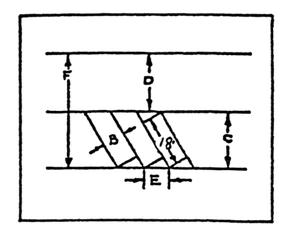
PARKING DIAGRAM
The above diagram is explanatory to Parking Table
G.
Bicycle Parking Requirements. All uses which are subject to site plan review are required to provide bicycle parking, in conformance with the following guidelines standards, which are evaluated during site plan review:
1.
Number of Bicycle Parking Spaces. A minimum of two bicycle parking spaces per use is recommended required for all uses with greater than ten vehicle parking spaces. The following additional standards are recommended for specific types of development:
a.
Multi-Family Residences. Every residential use of four or more dwelling units provides at least one sheltered bicycle parking space for each dwelling unit. Sheltered bicycle parking spaces may be located within a garage, storage shed, basement, utility room or similar area. In those instances in which the residential complex has no garage or other easily accessible storage unit, the bicycle parking spaces may be sheltered from sun and precipitation under an eave, overhang, an independent structure, or similar cover,
b.
Parking Lots. All public and commercial parking lots and parking structures provide a minimum of one bicycle parking space for every ten motor vehicle parking spaces,
c.
Schools. Elementary and middle schools, both private and public, provide one bicycle parking space for every ten students and employees. High schools provide one bicycle parking space for every five students and employees. All spaces should be sheltered under an eave, overhang, independent structure, or similar cover,
d.
Colleges and trade schools provide one bicycle parking space for every ten motor vehicle spaces plus one space for every dormitory unit. Fifty percent of the bicycle parking spaces should be sheltered under an eave, overhang, independent structure, or similar cover,
e.
Commercial District. Within the commercial district, bicycle parking for customers should be provided along the street at a rate of at least one space per use. Individual uses may provide their own parking, or spaces may be clustered to serve up to six bicycles. Bicycle parking spaces should be located in front of the stores along the street, either on the sidewalks or in specially constructed areas such as pedestrian curb extensions. Inverted "U" style racks are recommended. Bicycle parking shall not interfere with pedestrian passage, leaving a clear area of at least thirty-six inches between bicycles and other existing and potential obstructions. Customer spaces may or may not be sheltered. When provided, sheltered parking (within a building or under an eave, overhang, or similar structure) should be provided at a rate of one space per ten employees, with a minimum of one space per store,
f.
Multiple Uses. For buildings with multiple uses (such as a commercial or mixed use center), bicycle parking standards should be calculated by using the total number of motor vehicle parking spaces required for the entire development. A minimum of one bicycle parking space for every ten motor vehicle parking spaces is recommended;
2.
Exemptions. This section does not apply to single-family, two-family, and three-family housing (attached, detached, or manufactured housing), home occupations, agriculture, and livestock uses, or other developments with fewer than ten vehicle parking spaces;
3.
Location and Design. Bicycle parking should be conveniently located with respect to both the street right-of-way and at least one building entrance (e.g., no farther away than the closest parking space). It should be incorporated whenever possible into building design and coordinated with the design of street furniture when it is provided. Street furniture includes benches, streetlights, planters, and other pedestrian amenities.
4.
Visibility and Security. Bicycle parking should be visible to cyclists from street sidewalks or building entrances, so that it provides sufficient security from theft and damage;
5.
Options for Storage. Bicycle parking requirements for long term and employee parking can be met by providing a bicycle storage room, bicycle lockers, racks, or other secure storage space inside or outside of the building;
6.
Lighting. Bicycle parking should be least as well lit as vehicle parking for security;
7.
Reserved Areas. Areas set aside for bicycle parking should be clearly marked and reserved for bicycle parking only;
8.
Hazards. Bicycle parking shall not impede or create a hazard to pedestrians. Parking areas shall be located so as to not conflict with vision clearance standards.
(Ord. 438 § 3 Exh. C (part), 2003; Ord. 447 § 1(part), 2004; Ord. No. 536, §§ 8, 9, 8-24-10; Ord. No. 617, § 1, 5-27-25)
17.32.025 - Disabled person parking.
Disabled person parking spaces shall be provided at the following rate:
The disabled-person parking symbol shall be painted on the parking space and a disabled person parking sign shall be placed in front of each space. Disabled person parking spaces shall be a minimum of nine feet wide and shall have an adjacent access aisle a minimum of eight feet in width located on the passenger side of the parking space. See Oregon Transportation Commission Standards for Accessible Parking Places for requirements.
(Ord. No. 536, § 10, 8-24-10)
17.32.030 - Vision clearance area.
A vision clearance area shall be required on a corner lot at the intersection of two streets, a driveway and a street, or a street and an alley. The vision clearance area is a triangular area determined by two measurements taken along the property line from the point of intersection of the two streets (or street/alley) rights-of-way. In the case of two streets, the distances on either side from the point of intersection shall be twenty-five feet. In the case of a driveway and a street or a street/alley intersection, the distances shall be ten feet.
(Ord. 447 §1(part), 2004: Ord. 438 §3 Exh. C (part), 2003)
17.32.040 - Sign requirements.
Hereafter, before any sign (temporary or permanent) is placed within the city limits, a sign permit shall be required to be applied for from the city. The proposed sign shall be in conformance with the provisions of this section. See subsection A of this section for what constitutes a sign under this section. Signs are intended to provide identification of the site or building on which they are placed.
A.
Definitions. Unless the context clearly requires otherwise, the singular shall include the plural and the following words and phrases shall mean:
"Building line" means a line established by ordinance beyond which no building may extend. A building line may be a property line.
"Major sign" means a sign which requires approval through the variance procedure.
"Marquee" means a permanent roofed structure attached to and supported by the building and projecting over public property or beyond a building line.
"Projection" means the distance by which a sign extends over public property or beyond a building line.
"Sign" means any notice or advertisement, pictorial or otherwise, used as an outdoor display for the purpose of advertising the property or the establishment or enterprise, including goods and services, upon which the sign is exhibited. Sign shall also mean an advertisement for a political candidate or ballot measure. This definition shall not include official notices issued by a court or public body or officer, or directional, warning or information signs, or structures required by or authorized by law, or by federal, state, county or city authority.
"Sign, area of." In determining whether a sign is within the area limitations of this section, the area of the total exterior surface shall be measured and computed in square feet. If the interior angle between the planes of two faces of a sign exceeds one hundred thirty-five degrees, they shall be deemed a single face for the purposes hereof. Measurements shall be made at the extreme horizontal and vertical limits of a sign.
"Sign, combination." Combination sign means any sign incorporating any combination of the features of ground, projecting and roof signs.
"Sign, electric." Electric sign means any sign that contains electrical wiring, but not including signs illuminated by an external light source.
"Sign, ground." Ground sign means any sign which is supported by one or more uprights, poles or braces in or upon the ground other than a combination sign as defined in this section.
"Sign, portable". A permitted sign not permanently attached to the ground or other permanent structure including sandwich boards, pedestal signs, "A" frame signs, flags, and wind signs (not including flags of national, state, or city governments).
"Sign, projecting." Projecting sign means a sign other than a wall sign, which projects from and is supported by a wall or roof of a building or structure.
"Sign, roof." Roof sign means a sign erected upon or above a roof or parapet of a building or structure.
"Sign, temporary." Temporary sign means and includes any sign, banner, pennant or advertising display constructed of cloth, canvas, light fabric, cardboard, wallboard or other light materials, with or without frames, intended to be displayed for a limited period of time.
"Sign, wall." Wall sign means any sign attached to or erected against a wall of a building or a structure with the exposed face of the sign in a plane parallel to the plane of said wall. Signs painted directly on the building exterior surfaces are also considered wall signs under this section.
B.
Sign Permits.
1.
A sign permit and fee will be required in the following instances:
a.
Prior to erection of any new sign, permanent or temporary,
b.
Prior to any alteration of an existing sign, not including change of sign copy,
c.
Prior to the change of location of an existing sign;
2.
For purposes of review by the city, the following information will be required:
a.
A scaled drawing, photographs or other documents which indicate the location of proposed sign and any existing signs,
b.
A detailed list of materials, dimensions, size, shape, height, method of attachment, and structural elements of the proposed sign,
c.
A completed sign permit application form,
d.
No permit shall be required for minor maintenance and repairs on existing signs unless these repairs or maintenance are structural or electrical in nature;
3.
Before a sign permit is issued, a permit fee shall be paid as set by the council by resolution, except:
a.
No fee is required for temporary signs for new businesses,
b.
No fee is required for approved signs requested by governmental and certain public service entities. The city shall determine entities that are considered to be public service or nonprofit,
c.
A double fee is required for signs that are erected in violation of this section or without first obtaining a permit;
4.
Applicants for signs will be provided with a city sign permit application form:
a.
Applicant will be advised that no sign will be erected, altered, or replaced until approval of the permit by the city,
b.
Upon approval of permit and receipt of the fee, the city shall issue a permit,
c.
The city will keep a copy and permanent record of each permit issued.
C.
Temporary Signs. Temporary signs are permitted as follows:
1.
A temporary sign pertaining to the lease or sale of a building or property, providing such sign does not exceed six square feet in area;
2.
A temporary sign, for one year, advertising a new subdivision, provided such sign does not exceed thirty square feet, advertises only the subdivision in which it is located, is not illuminated, and is erected only at a dedicated street entrance and within the building setback lines. Such signs shall be removed if construction on the subdivision is not in progress within sixty days following the date of the sign permit;
3.
Nonilluminated temporary signs advertising a candidate or ballot measure, provided said signs do not exceed six square feet in area for each candidate or ballot measure. Not more than one sign for each candidate or ballot measure shall be placed on any single parcel of land. Such signs shall not be placed less than fifteen feet from the front curb line or edge of pavement and shall be removed within a period of ten days following the election to which the sign pertains;
4.
No temporary signs shall exceed one hundred square feet in area. Temporary signs or rigid material shall not exceed thirty square feet in area or six feet in height. No temporary sign shall be fastened to the ground except in residential areas;
5.
Cloth, canvas or fabric signs may extend across a public street only by permission from the city council and the State Highway Department if over a state-controlled highway.
D.
Design and Construction.
1.
All signs and their supporting members may be constructed of any suitable material, subject to the provisions of this section and meeting building code requirements, including but not limited to the following:
a.
All glass used in the sign shall be shatter-resistant, or if plastic, approved by the building code,
b.
All signs and their attachment to the ground or building shall be designed and constructed to safely resist the applicable wind and seismic loads set forth in the Oregon Structural Specialty Code,
c.
All signs shall be maintained at all times in a state of good repair, by either business or property owner;
2.
The following general provisions shall govern all signs in addition to all other applicable provisions of this section:
a.
No sign shall be placed so that it obstructs any fire escape, stairway, door or exit from any building,
b.
No sign shall be erected in manner that would confuse or obstruct the view or interpretation of any official traffic sign, signal or device,
c.
No sign shall obstruct vehicular or pedestrian traffic flow or obstruct the view of vehicular or pedestrian traffic flow;
3.
Placement and erection of signs shall be as follows:
a.
No ground sign shall be erected where the sign projects into a pedestrian walkway,
b.
No sign or portion thereof shall extend beyond any property line of the premises on which such sign is located except for projections over public property,
c.
The installation or erection of any sign, or the operation of any crane or other equipment used in the erection of any sign must be conducted in a manner as to maintain a minimum clearance of eight feet from any high voltage electric power lines,
d.
Location of projecting signs shall be as follows:
i.
If property width is over one hundred feet, signs shall be located within twenty feet of the property center line,
ii.
If property width is seventy-five to one hundred feet, signs shall be located within fifteen feet of the property center line,
iii.
If property width is fifty to seventy-five feet, signs shall be located within ten feet of the property center line,
iv.
If property width is under fifty feet, signs shall be located within five feet of the property center line,
e.
Signs can be painted on the window, and if this is the only advertisement for the business it shall be exempt from the permit application and fee;
4.
Sign height restrictions for all sign types:
a.
A free-standing sign shall not exceed an overall height of forty feet,
b.
Signs shall not be less than eight feet above grade at the lowest point in an area where pedestrian traffic occurs, and not less than fourteen feet above grade in an area where vehicular traffic occurs.
E.
Residential Sign Regulations.
1.
No sign shall be placed in or extend over a required setback or be placed in or extend over a street except as specifically provided in this section. No signs shall be permitted except the following:
a.
One sign identifying the name of the owner or occupant of the building and the address, provided such sign does not exceed two square feet in size,
b.
For subdivisions and multi-family complexes, only one identification/address directory sign per complex, located at each entry point to the complex, provided the sign does not exceed twenty-four square feet in area, is located not less than twenty feet from the front lot line, is constructed with similar material as the building(s), the maximum height of any ground sign is to be eight feet above grade. This type sign may be externally illuminated;
2.
Home occupation signs: one sign identifying the name of the occupation and the address, provided such sign does not exceed two square feet in size;
3.
Bed and breakfast inn signs: one sign identifying the name of the inn and the address, provided such sign does not exceed two square feet in size.
F.
Commercial Sign Regulations.
1.
Special Provisions. No business shall be allowed more than two wall signs for each business frontage except by application and approval of the city. The aggregate area of all signs shall not exceed an area equal to two square feet for each lineal foot of building street frontage not to exceed sixty square feet. Aggregate area shall not include nameplates, business hours, real estate and/or construction signs, product merchandise or reader type signs;
2.
Ground Signs. Ground signs shall be limited to one per business, and shall not exceed seventy-five square feet in area;
3.
Marquee or Awning Signs.
a.
Marquee or awning signs shall be limited to two signs and shall be permitted for each business frontage in lieu of wall signs. These type signs shall not exceed the permitted aggregate sign area listed above,
b.
These signs may not project beyond the face of the marquee if suspended, or above the face of the marquee if attached to and parallel to the face of the marquee;
4.
Portable Signs.
a.
Two portable business signs, limited to sandwich boards, pedestal signs, "A" frame signs, flags, or wind signs shall be allowed on each lot. Shopping centers and business complexes are allowed one portable sign per business within the shopping center and business complex.
b.
Businesses located within Cave Junction city limits, off Highway 199, on the downtown Cave Junction main corridor are allowed to place portable signs on a property located on Highway 199, on the downtown Cave Junction corridor with written property owner permission. Said property owners who have provided said permissions must remain within the maximum of two portable signs, regardless of these permissions.
c.
Sign area shall not exceed an area of six square feet per face including any border or trim, and there shall be no more than two faces.
d.
Sandwich board signs and "A" frame signs shall not extend more than forty-three inches above the ground on which it is placed. Pedestal signs shall not extend more than four feet above the ground on which it is placed. A freestanding wind sign shall not extend more than twelve feet above the ground on which it is placed.
e.
Signs shall be placed so that no sign or portion thereof shall extend beyond any property line of the premises on which such sign is located. No signage will be allowed within a public right-of-way. No portable business sign shall be constructed and placed as to interfere with pedestrian ingress and egress as regulated within Cave Junction Municipal Code Title 9. No sign shall be placed so as to interfere with vision clearance, either pedestrian or vehicular.
f.
Signs shall be anchored, supported, or designed to prevent tipping over, which reasonably prevents the possibility of signs becoming hazards to public health and safety. Signs shall not be illuminated or contain any electrical component. No objects shall be attached to a portable sign such as but not limited to balloons, banners, merchandise, and electrical devices. Portable business signs shall be removed at the daily close of business. These signs are prohibited while the business is closed.
5.
Projecting Signs.
a.
One sign shall be permitted for each business or group of businesses occupying a single common space or suite in lieu of a wall sign,
b.
Sign area shall not exceed one square foot for each two feet of lineal business frontage that is not already utilized by a wall sign, with a maximum area of any projecting sign of twenty square feet,
c.
Signs may project from the face of the building to which they are attached a maximum of two feet if located eight feet above grade, or four feet if located ten feet above grade where pedestrian traffic will occur;
6.
Shopping Center or Mall Signs.
a.
One sign identifying the name of the center or mall is permitted, with a total area not to exceed sixty square feet. This sign may include the names of individual businesses within the center or mall if the requirements of this subsection are met,
b.
Individual business signs may be sized as follows:
i.
Major tenant: one hundred square feet,
ii.
Minor tenant: twenty square feet,
c.
Total sign area for the center or mall shall not exceed four hundred square feet.
G.
Public Use Signs. The aggregate area of all signs shall not exceed an area equal to two square feet for each lineal foot of building street frontage not to exceed sixty square feet. If a ground sign is included, the sign shall not be located within fifteen feet of any property line, and be no more than eight feet in height. Signs within public parks, schools, or stadiums, which are generally placed and located so as not to be viewed from a street, are exempt from this provision.
H.
Religious Institution Signs. Each lot occupied by a church (religious institution) is allowed a maximum of thirty-two square feet of sign area per street frontage. The maximum area may include a combination of wall and ground signs. If a ground sign is included, the sign shall not be located within fifteen feet of any property line, and be no more than eight feet in height.
I.
Electrical Signs. Electrical equipment used in connection with signs shall be installed in accordance with city, state and federal regulations for electrical installations. Electric signs require a permit from the county building and safety department prior to installation.
J.
Prohibited Signs. Signs that may create a hazard, may cause a public nuisance, or may be offensive or unsightly; the following sign conditions are prohibited:
1.
Any part of a sign consisting of moving, rotating, flashing or otherwise animated part or parts;
2.
A sign having a public address system or sound devices in conjunction with any sign or advertising device;
3.
Any unofficial sign which purports to be, is an imitation of, or resembles an official traffic sign or signal, or which attempts to direct the movement of traffic, or which hides from view any official traffic sign or signal, shall not be permitted;
4.
Advertises or publicizes an activity, business, product or service no longer conducted on the premises upon which such signs are maintained;
5.
Uses banners, flags, posters, pennants, ribbons, streamers, strings of light bulbs, spinners, oral or olfactory devices;
6.
Roof signs.
7.
Temporary, movable, or portable signs located on the publicly owned rights-of-way.
K.
All signs shall be constructed and maintained only as provided by this chapter, except for any of the following:
1.
Signs not visible from either a rights-of-way or property under different ownership, provided such signs are constructed and maintained in accordance with applicable law;
2.
Signs attached to, or carried by a person;
3.
Signs required by law or legal action;
4.
Government owned signs within the rights-of-way, government designated parks, city-designated open spaces and at stormwater, collection, and distribution facilities;
5.
City owned signs;
6.
Public murals identified on the City of Cave Junction Existing Mural List; and
7.
Traffic control signs and devices.
L.
Nonconforming Signs. All signs that do not conform with the provisions of the ordinance codified in this section prior to adoption must be brought into conformance under the following circumstances:
1.
When any physical alteration of the sign or change of location of the sign occurs;
2.
When damaged beyond repair by circumstances beyond the control of the owner. Minor damage where repairs can be made without replacing the entire sign is exempt;
3.
When a business ceases operations for a period of six months or more, all signs shall be considered abandoned and must be blanked out by the property owner;
4.
When ownership or type of business changes, nonconforming sign(s) shall be brought into conformance within sixty days.
M.
Variance Procedure. A major sign is any sign requiring approval via a variance. The variance procedure is necessary when the applicant's sign request does not meet the standards as set forth in this section. The property owner shall submit a variance application along with the required fee to the city. The planning commission shall review the request and make a recommendation to the city council which may hold public hearings on the matter if they see fit. The city council shall have the final determination on granting or denying a variance.
N.
Violations. In the event a portable sign is found to be located outside of a property or is in violation of any regulation sited in this chapter, the violation shall be abated as follows:
1.
The violation shall be documented using a photograph that demonstrates the violation.
2.
The portable sign in violation shall be removed by city staff.
3.
Notice of any removal of a portable sign shall be posted on the property owner's business door.
4.
Business owners will be provided thirty days from the date of notice to request to pick up their portable signage from City Hall.
5.
Signs that remain in storage for thirty-one days or more will be destroyed without financial compensation to the portable sign's owner.
(Ord. 438 § 3 Exh. C (part), 2003; Ord. 447 § 1(part), 2004; Ord. No. 536, §§ 11—13, 8-24-10; Ord. No. 602, §§ 1—5, 1-8-24)

