
Cave Junction City Zoning Code
CHAPTER 17
24 - MR MULTIPLE RESIDENTIAL DISTRICT
Sections:
17.24.010 - Purpose.
The multiple family residential district is intended to provide a quality environment for medium and high density, urban residential uses, together with other compatible uses.
(Ord. 447 §1(part), 2004: Ord. 438 §3 Exh. C (part), 2003)
17.24.020 - Permitted buildings and uses.
A.
Multiple family dwellings.
B.
Single-family dwellings.
(Ord. 447 §1(part), 2004: Ord. 438 §3 Exh. C (part), 2003)
17.24.030 - Buildings and uses permitted conditionally.
The planning commission or city council, subject to the procedures and conditions set forth in Chapter 17.14, may grant a conditional use permit for any use permitted outright or conditionally in the multiple family district (MR) only if the property or use meets the requirements set forth relating to the single-family residential district.
(Ord. 438 § 3 Exh. C (part), 2003; Ord. 447 § 1(part), 2004; Ord. No. 616, § 1a, 5-27-25)
17.24.040 - Lot area requirements.
A.
For a two-family dwelling, at least nine thousand square feet shall be required.
B.
For each additional dwelling unit an additional one thousand square feet shall be required.
C.
Minimum average lot width shall be sixty feet.
(Ord. 447 §1(part), 2004: Ord. 438 §3 Exh. C (part), 2003)
17.24.050 - Lot coverage requirements.
Maximum lot coverage by all structures shall not exceed fifty percent of the lot area. The maximum coverage by all structures, storage, driveways, parking spaces and surfaced area shall not exceed seventy-five percent of the lot area. At least ten percent of the total lot area shall consist of live plant material.
(Ord. 447 §1(part), 2004: Ord. 438 §3 Exh. C (part), 2003)
17.24.060 - Yard regulations.
A.
The side and rear yard setback shall be five feet unless the building is above two stories. When a building is taller than two stories, it shall be set back from all lot lines one additional foot for each foot of height over twenty-eight feet, except that the required setback shall not exceed twenty feet from any lot line. The front yard setback shall be twenty feet.
B.
The required front and side yards shall not be used for clothes lines, incinerators, storage of trailers, boats, recreational vehicles or of any materials, nor shall said yards be used for the regular and constant parking of automobiles or other vehicles.
(Ord. 447 §1(part), 2004: Ord. 438 §3 Exh. C (part), 2003)
17.24.070 - Height limit.
The maximum building height shall be thirty-five feet; structures such as antennas and chimneys are excepted.
(Ord. 447 §1(part), 2004: Ord. 438 §3 Exh. C (part), 2003)
17.24.080 - Vision clearance.
A.
The minimum clearance area of a highway or street corner of a corner lot is twenty-five feet.
B.
The minimum clearance area on a driveway, an alley or street intersection shall be ten feet.
(Ord. 447 §1(part), 2004: Ord. 438 §3 Exh. C (part), 2003)
17.24.090 - Residential density standard.
The following density standards apply to all new development. The standards are intended to ensure efficient use of buildable lands and provide for a range of needed housing, in conformance with the comprehensive plan.
A.
New land divisions and site developments shall provide for housing at densities between eight dwelling units per net acre minimum and thirty-six units per net acre maximum.
B.
The density standards may be averaged over more than one development phase (i.e., as in a master planned development). Duplex and triplex lots used to comply with the density standard shall be so designated on the final subdivision plat.
C.
Residential care homes/facilities are exempt from the density standards.
(Ord. 447 §1(part), 2004: Ord. 438 §3 Exh. C (part), 2003)
17.24.100 - Architectural standards.
A.
Purpose. The architectural standards are intended to provide detailed, human-scale design, while affording flexibility to use a variety of building styles.
B.
Applicability. This section applies to all of the following types of buildings, and shall be applied during site plan review:
1.
Single-family attached townhomes which are subject to site plan review (three or more attached units);
2.
Multi-family housing;
3.
Public and institutional buildings;
4.
Neighborhood commercial and mixed-use buildings; and
5.
Duplexes and triplexes.
C.
Standards. All buildings which are subject to this section shall comply with all of the following standards. The graphics provided with each standard are intended to show examples of how to comply. Other building styles and designs can be used to comply, so long as they are consistent with the text of this section. An architectural feature (i.e., as shown in the graphics) may be used to comply with more than one standard.
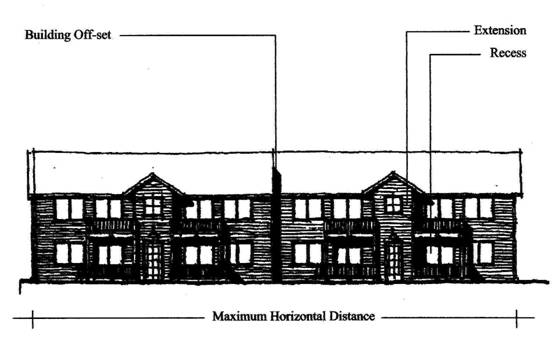
Figure 2.1.190C(1) - Building Form (Multi-family Housing Example)
1.
Building Form. The continuous horizontal distance (i.e., as measured from end-wall to end-wall) of individual buildings shall not exceed one hundred sixty feet. All buildings shall incorporate design features such as offsets, balconies, projections, window reveals, or similar elements to preclude large expanses of uninterrupted building surfaces, as shown in the above figure;
2.
Eyes on the Street. All building elevations visible from a street right-of-way shall provide doors, porches, balconies, and/or windows. A minimum of fifty percent of front (i.e., street-facing) elevations, and a minimum of thirty percent of side and rear building elevations, as applicable, shall meet this standard. "Percent of elevation" is measured as the horizontal plane (lineal feet) containing doors, porches, balconies, terraces and/or windows. The standard applies to each full and partial building story;
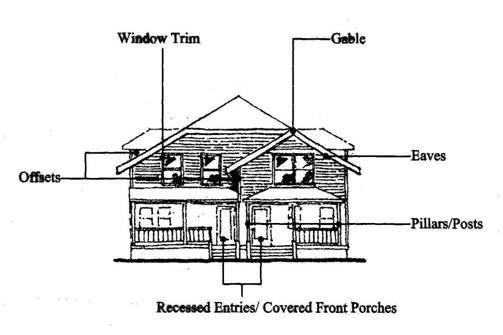
Figure 2.1.190C(2) - Examples of Architectural Details
3.
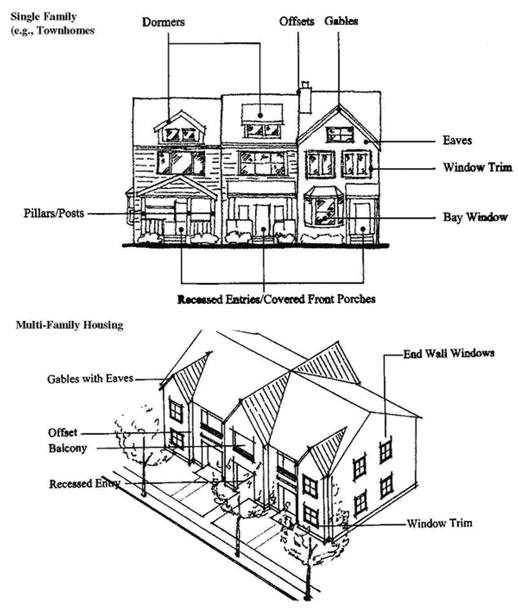
Detailed Design. All buildings shall provide detailed design along all elevations (i.e., front, rear and sides). Detailed design shall be provided by using at least three of the following architectural features on all elevations, as appropriate for the proposed building type and style (may vary features on rear/side/front elevations):
a.
Dormers,
b.
Gables,
c.
Recessed entries,
d.
Covered porch entries,
e.
Cupolas or towers,
f.
Pillars or posts,
g.
Eaves (minimum six-inch projection),
h.
Off-sets in building face or roof (minimum sixteen inches),
i.
Window trim (minimum four inches wide),
j.
Bay windows,
k.
Balconies,
l.
Decorative patterns on exterior finish (e.g., scales/shingles, wainscoting, ornamentation, and similar features),
m.
Decorative cornices and roof lines (e.g., for flat roofs),
n.
An alternative feature providing visual relief, similar to subsections (C)(3)(a) through (C)(3)(m) of this section.
Figure 2.1.190C(3) - Examples of Architectural Details
(Ord. 447 §1(part), 2004: Ord. 438 §3 Exh. C (part), 2003)

