
Cave Junction City Zoning Code
CHAPTER 17
20 - SR SINGLE-FAMILY RESIDENTIAL DISTRICT
Sections:
17.20.010 - Purpose.
The single-family residential district is intended to provide a quality environment for urban, single-family residences and other compatible uses.
(Ord. 447 §1(part), 2004: Ord. 438 §3 Exh. C (part), 2003)
17.20.020 - Permitted buildings and uses.
A.
Single-family dwelling;
B.
Manufactured homes, subject to Section 17.20.080(C);
C.
Accessory buildings and uses customarily provided in conjunction with a single-family dwelling.
D.
Residential care homes and facilities, subject to the standards in Section 17.20.080, Special standards for certain uses.
E.
Family day care provider (fewer than thirteen).
F.
Recreational vehicle or travel trailer occupancy associated with the construction of a new dwelling or remodel of an existing dwelling, subject to Section 17.20.080(D).
(Ord. 447 §1(part), 2004: Ord. 438 §3 Exh. C (part), 2003)
(Ord. No. 567, 3-15-18)
17.20.030 - Buildings and uses permitted conditionally.
The planning commission, subject to the procedures and conditions set forth in Chapter 17.14, may grant a conditional use permit for the following:
A.
Two-family dwelling, provided at least thirteen thousand square feet of lot area is maintained;
B.
Church;
C.
School;
D.
Public or a noncommercial park or playground;
E.
Community building or grange hall;
F.
Government structure;
G.
Hospital, sanitarium or rest home (sixteen or more individuals);
H.
Utility facility necessary for public service;
I.
Agriculture, including the growing and raising of trees, vines, shrubs, berries, vegetables, nursery stock, hay, grains and similar food and fiber products;
J.
Mobile home parks;
K.
Neighborhood Commercial. Each of the following uses is "size limited" and subject to provisions in Section 17.20.080, Special Standards for Certain Uses:
1.
Child care center (care for more than twelve children),
2.
Food services, excluding automobile-oriented uses,
3.
Laundromats and dry cleaners,
4.
Light manufacture, conducted entirely within building,
5.
Retail goods and services,
6.
Medical and dental offices, clinics and laboratories,
7.
Personal services (e.g., barber shops, salons, similar uses),
8.
Professional and administrative offices,
9.
Repair services, conducted entirely within building; auto-repair, similar services excluded.
(Ord. 447 §1(part), 2004: Ord. 438 §3 Exh. C (part), 2003)
17.20.040 - Lot and yard requirements.
A.
Minimum lot size shall be seven thousand square feet.
B.
Minimum average lot width shall be sixty feet excluding flag.
C.
Front yard building setbacks shall be a minimum of twenty feet.
D.
Side yard building setbacks shall be a minimum of five feet.
E.
Rear yard building setbacks shall be a minimum of ten feet.
F.
Neighborhood Commercial Building Setbacks.
1.
A minimum front setback is not required, except as necessary to comply with the vision clearance standards in Section 17.20.070;
2.
A maximum setback of ten feet is required. This standard is met when a minimum of fifty percent of the front building elevation is placed ten feet or closer to the front property line. On parcels with more than one building, this standard applies to the largest building. Exception: the setback may be increased when an expanded sidewalk, outdoor seating area, plaza, pocket park, or town square is provided between the building and front property line.
(Ord. 447 §1(part), 2004: Ord. 438 §3 Exh. C (part), 2003)
17.20.050 - Height limit.
The maximum building height shall be thirty-five feet; structures such as antennas and chimneys are excepted.
(Ord. 447 §1(part), 2004: Ord. 438 §3 Exh. C (part), 2003)
17.20.060 - Maximum lot coverage.
The maximum lot coverage by all structures, except for porches and decks, shall not exceed fifty percent of the lot area.
(Ord. 447 §1(part), 2004: Ord. 438 §3 Exh. C (part), 2003)
17.20.070 - Vision clearance.
A.
The minimum clearance area of a highway or street corner of a corner lot is twenty-five feet.
B.
The minimum clearance of an alley or street intersection shall be ten feet.
(Ord. 447 §1(part), 2004: Ord. 438 §3 Exh. C (part), 2003)
17.20.080 - Special standards for certain uses.
This section supplements the standards contained Sections 17.20.040 through 17.20.070. It provides standards for the following land uses in order to control the scale and compatibility of those uses within the residential district:
A.
Residential Care Homes and Facilities. Residential care homes are residential treatment or training homes or adult foster homes licensed by the state of Oregon. They may provide residential care alone, or in conjunction with treatment and/or training, for five or fewer individuals ("homes") or six to fifteen individuals ("facilities") who need not be related. Staff persons required to meet state licensing requirements shall not be counted in the number of facility residents and need not be related to each other or the residents. Residential care homes and facilities shall comply with the following standards, consistent with ORS 197.660-670:
1.
Licensing. All residential care homes shall be duly licensed by the state of Oregon;
2.
Parking. A minimum of one parking space shall be provided for each employee and one visitor space per four beds, in accordance with Section 17.32.020, Parking Requirements;
3.
Development Review. Development review shall be required for new structures to be used as residential care homes or facilities, and for conversion of an existing residence to be used as a residential care home, to ensure compliance with the licensing, parking, and other requirements of this code.
B.
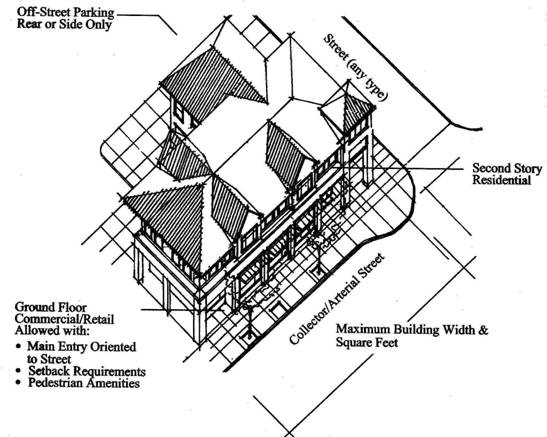
Neighborhood Commercial Land Use. Small-scale neighborhood commercial uses are allowed within the residential district. All neighborhood commercial uses shall comply with the following standards, which are intended to promote land use compatibility and transition between neighborhood commercial and residential uses:
Figure 17-4 - Neighborhood Commercial (Typical Site Layout)
1.
Permitted Uses. Only those neighborhood commercial uses specifically listed in Section 17.20.030(K) may be permitted. Residential and neighborhood commercial uses may be mixed "vertically"—meaning that a residential use is developed above the commercial use (i.e., ground floor retail/office with upper-story apartments, townhomes, or condominiums), or may be mixed "horizontally"—meaning commercial and residential uses both occupy ground floor space. Automobile-oriented uses, as defined in Section 17.08.090, are expressly prohibited;
2.
Dispersion of Neighborhood Commercial Development. A neighborhood commercial site shall be located no closer than one-half mile from another neighborhood commercial site within the urban growth boundary. A "neighborhood commercial site" means a lot or parcel (or combination of adjacent lots or parcels), zoned residential and containing commercial uses;
3.
Location and Access. Neighborhood commercial developments shall have frontage onto a collector or arterial street;
4.
Building Mass Supplemental Standard. The maximum width or length of a neighborhood commercial or mixed-use (residential and commercial) building shall not exceed one hundred sixty feet (from end-wall to end-wall);
5.
Floor Area Supplemental Standards. The maximum commercial floor area shall not exceed five thousand square feet total per neighborhood commercial site within the residential district. An individual commercial use (or leasable business space) shall not exceed two thousand square feet of floor area. Floor area is measured by totaling the interior floor area of all building stories, except crawl spaces (i.e., with less than seven and one-half feet of vertical clearance);
6.
Hours of Operation. Neighborhood commercial land uses are targeted to the following hours of operation seven a.m. to eight p.m. Actual hours will be set at the conditional use hearing.
C.
Manufactured Homes on Individual Lots. Manufactured homes are permitted on individual lots, subject to all of the following design standards, consistent with ORS 197.307(5). Exception: The following standards do not apply to units which existed within the city prior to the effective date of the ordinance codified in this chapter:
1.
Floor Plan. The manufactured home shall be multi-sectional and have an enclosed floor area of not less than one thousand square feet;
2.
Roof. The manufactured home shall have a pitched roof with a slope not less than three feet in height for each twelve feet in width (fourteen degrees);
3.
Residential Building Materials. The manufactured home shall have exterior siding and roofing which in color, material and appearance are similar or superior to the exterior siding and roof material used on nearby residences (e.g., horizontal wood or wood-appearance siding is considered "superior" to metal siding and roofing);
4.
Garages and Carports. The manufactured home shall have a garage or carport constructed of like materials when nearby residences have carports or garages. The city may require an attached or detached garage where that would be consistent with the predominant construction of immediately surrounding residences;
5.
Thermal Envelope. The manufactured home shall be certified by the manufacturer to meet the thermal envelope requirements equivalent to those for a single-family dwelling constructed under the State Building Code. Evidence demonstrating that the manufactured home meets "Super Good Cents" energy efficiency standards is deemed to satisfy the exterior thermal envelope certification requirement. Additional manufacturer's certification shall not be required;
6.
Placement. The manufactured home shall be placed on an excavated and back-filled foundation and enclosed at the perimeter such that the manufactured home is located not more than sixteen inches above grade, and complying with the minimum set-up standards of the adopted state Administrative Rules for Manufactured Dwellings, Chapter 918. Where the building site has a sloped grade, no more than sixteen inches of the enclosing material shall be exposed on the uphill side of the home;
7.
Foundation Skirt. The foundation area of the manufactured home shall be fully skirted; and
8.
Prohibited. The manufactured home shall not be located in a designated historic district.
D.
Recreational vehicle or travel trailer occupancy associated with the construction of a new dwelling on a vacant or redevelopment lot or the remodeling of an existing dwelling, or the construction of a multiple dwelling development, may be permitted subject to obtaining a temporary use permit as provided for in Section 17.14.570, and subject to the following conditions:
1.
Only one recreational vehicle or travel trailer may be permitted and shall be occupied by the licensed general contractor, designated employee, the developer of the subdivision or the owner of the property.
2.
The recreational vehicle or travel trailer shall be located within the boundaries of the parcel of land on which the associated single-family residence is being constructed, or in an appointed site within the active development area upon review and approval by the city staff.
3.
A temporary use permit shall only be considered following the property owner obtaining the required building permits for the construction of the new dwelling or remodel of the existing dwelling.
4.
The temporary use permit shall be effective for six months, with provision of a six-month extension, provided the required building permit(s) remain valid in the designated construction area. The temporary use permit shall be limited to a maximum period of one year for a single site development.
5.
The recreational vehicle or travel trailer shall be removed or properly stored and disconnected from water and sewer systems no more than thirty days after completion of construction, expiration of the temporary use permit, or expiration of the associated building permit(s), whichever occurs first.
6.
Connection to water and/or sewer systems shall constitute prima facie evidence of occupancy of the recreational vehicle or travel trailer.
7.
Occupancy of a recreational vehicle or travel trailer not permitted under this or any other section of the Cave Junction Municipal Code shall constitute a municipal offense and be subject to a fine. The fine shall be set by resolution of the council.
8.
Recreational vehicle or travel trailer occupancy associated with the construction of an accessory structure shall not be allowed.
9.
The fee for the temporary use permit allowing the occupancy of a recreational vehicle or travel trailer during construction or remodel of a single-family or multi family residence shall be set by resolution of the city council.
(Ord. 447 §1(part), 2004: Ord. 438 §3 Exh. C (part), 2003)
(Ord. No. 567, 3-15-18)

