
Center Line City Zoning Code
ARTICLE VIII
GENERAL PROVISIONS
Sec. 800.- Purpose.
(A)
Whenever any provision of this ordinance imposes more stringent requirements, regulations, restrictions or limitations than are imposed or required by the provisions of any other law or ordinance, then the provisions of this ordinance shall govern. Whenever the provisions of any other law or ordinance impose more stringent requirements than are imposed or required by this ordinance, then the provisions of such (other) ordinance shall govern.
(B)
No building or structure, or part thereof, shall hereafter be erected, constructed or altered and maintained, and no new use or change shall be made or maintained of any building, structure or land, or part thereof, except in conformity with the provisions of this ordinance.
(Ord. of 10-12-18(1))
Sec. 801. - Nonconforming uses, structures, and lots.
(A)
Within the districts established by this ordinance or amendments that may later be adopted, there exist lots, structures, uses of land and structures, and characteristics of use which were lawful before this ordinance was passed or amended, but which would be prohibited, regulated, or restricted under the terms of this ordinance or future amendment. It is the intent of this ordinance to permit some nonconformities to continue until they are removed, but not to encourage their survival. Those alleged nonconforming uses which cannot be proved conclusively to have been existing prior to the enactment or amendment of this ordinance shall be declared illegal uses and shall be discontinued. Provisions of this ordinance regulating the hours a business may operate or otherwise regulating the operation of a business shall not be subject to nonconforming use status. Amendments to this ordinance regulating hours of operation for any business shall be immediately complied with.
Generally, nonconforming uses and structures are declared by this ordinance to be incompatible with permitted uses in the district involved but increasing awareness that some nonconforming uses, buildings or structures will not disappear make it necessary and desirable in pursuit of the public interest to distinguish between nonconforming uses, buildings or structures which should be eliminated as rapidly as possible and nonconforming uses, buildings or structures which ought to be given separate treatment.
To this end, there are established two classes of nonconforming uses and structures: (1) Class A, those that should be restored, reconstructed or have substituted nonconforming uses and, (2) Class B, those that are not desirable and useful and will only be allowed to be continued until they are removed or voluntarily discontinued.
(B)
Definition and classification. All nonconforming uses, buildings or structures shall be classified as class B nonconforming uses at adoption of this ordinance. Class A nonconforming uses, buildings, or structures are those which have been so designated by the zoning board of appeals upon findings that (1) continuance thereof would not be contrary to the public health, safety or welfare, or the spirit and intent of this ordinance, (2) that the use, building or structure does not and is not likely to significantly depress the value of nearby properties, (3) that the use, building or structure was lawful at the time of its inception, and (4) that no useful purpose would be served by strict application of the provisions or requirements of this ordinance with which the use, building or structure does not conform.
(C)
Procedure for obtaining class A designation. A written application shall be filed with the building inspector and the zoning board of appeals setting forth the name and address of the applicant, giving a legal description of the property to which the application pertains and including such other information as may be necessary to enable the zoning board of appeals to make determination of the matter. The zoning board of appeals may require the furnishing of such additional information as it considers necessary. The notice and hearing procedure before the zoning board of appeals shall be the same as in the case of an application for a variance. The decision shall be in writing and shall set forth the findings and reasons on which it is based.
The zoning board of appeals may attach conditions, including any time limit, where necessary, to assure that the use, building or structure does not become contrary to the public health, safety or welfare or the spirit and purpose of this section.
(D)
Revocation of class A designation. Any class A designation shall be revoked, following the same procedure required for designation, upon a finding that as a result of any change of conditions or circumstances, the use or structure no longer qualifies for class A designation.
(E)
Regulations pertaining to class (A). A class A nonconforming use of land, building or structure shall not be resumed if it has been for any reason discontinued for a continuous period of at least 12 months or if it has been changed to another nonconforming use for any period.
A class A use or structure may be used, altered or enlarged provided that it does not violate any condition imposed by the zoning board of appeals at the time of its designation.
Nothing in this section shall prevent the restoration of a class A nonconforming building or structure destroyed by fire, explosion, act of God or act of the public enemy, subsequent to the effective date of its class designation, or shall prevent the continuance of the use of such building or structure or part thereof as such use existed at the time of such impairment of such building or structure or part thereof provided that said restoration is completed within 12 months from the time of destruction and that the same use is made of the premises; except that for reasonable cause, the building official may grant one extension of time for an additional period specified by the zoning board of appeals or the building inspector, but not exceeding 90 days.
Nothing in this ordinance shall be deemed to prevent the strengthening or restoring to a safe condition any class A nonconforming building or structure or part thereof declared to be unsafe by any official charged with protecting the public safety, upon order of such official.
Should a class A nonconforming building or structure be moved for any reason, it shall thereafter conform to the regulations for the district (zone) in which it is located after it is moved.
Where class A nonconforming use status applies to a building and/or structure and premises in combination, removal of the building or structure shall eliminate the nonconforming status of the land.
Any class A nonconforming use of a building or structure or land may be changed to another nonconforming use upon written findings of the zoning board of appeals that the proposed use is:
(1)
Similar in operational characteristics as the former nonconforming use.
(2)
There is no increase in the intensity of the use of the land, building or structure involved.
(3)
Such change in use will have a less detrimental effect or negative impact on neighboring property than the existing nonconforming use it is replacing, and
(4)
The proposed use, although inappropriate to a uniform zoning pattern, is desirable and useful in pursuit of the public interest or is more appropriate to the zoning district than the existing nonconforming use.
In permitting such a change in use, the zoning board of appeals may require appropriate conditions and safeguards in accord with the purpose and intent of this ordinance inclusive of upgrading the premises to comply as nearly as is practicable with requirements of this ordinance.
Prior to action by the zoning board of appeals, all required documentation for a change from one nonconforming use to another shall be submitted to the planning commission for their review and written recommendation.
(F)
Regulations pertaining to class (B) No class B nonconforming use shall be resumed if it has been discontinued for a continuous period of at least 12 months or if it has been changed to a conforming use for any period or if the structure in which such use is conducted is damaged by fire or other casualty to the extent that the cost of reconstruction or repairs exceeds 50 percent of the state equalized value.
Nothing in this ordinance shall be deemed to prevent routine repairs and maintenance of a class B nonconforming building or structure so long as such repairs and maintenance do not add to its nonconformity or exceed 50 percent of the state equalized value for the property.
No class B nonconforming structure shall be enlarged or structurally altered, nor shall it be repaired or reconstructed if damaged by fire or other casualty to the extent that the cost of reconstruction or repair exceeds 50 percent of the state equalized value of such structure.
No class B nonconforming use shall be changed to a substantially different nonconforming use, nor enlarged so as to make use of more land area than used at the time of becoming nonconforming.
No class B nonconforming use shall be moved in whole or in part to any other portion of the lot or parcel occupied by such use at the effective date of adoption or amendment of this ordinance.
Change in ownership of a class B nonconforming use shall not affect its continuation as a nonconforming use if it meets all of the other criteria of this section.
(G)
Nonconforming lots. With respect to construction of one-family dwellings and customary accessory buildings on residentially-zoned lots which fail to meet area and width requirements, the zoning board of appeals shall determine in each case whether the lot may be developed based on the size of lot in relation to the proposed residential structure, the lot coverage and density of development, adequacy of access, the proposed setbacks, and the conformity of the proposed structure to the adjoining properties and the surrounding neighborhood. If the proposed development does not satisfactorily meet the above criteria, it shall be denied.
(H)
Nonconforming buildings and nonconforming structures. Nonconforming buildings and nonconforming structures may continue to be utilized so long as they remain otherwise lawful, subject to the following provisions:
(1)
No such building or structure shall be allowed to expand and/or undergo substantial improvement. Such buildings and structures may be altered in a way which either decreases its nonconformity upon its existing foundation to bring it in closer conformity with the provisions of this Zoning Ordinance, or does not expand the nonconforming portion of a building or structure. It is recognized that in some instances a strict prohibition against expansion of a nonconforming building or structure may create an undue hardship on the property owner. In such instances, non-substantial improvements of such buildings and structures may be reasonable and necessary to preserve or improve the quality of the neighborhood or business district; provided such modifications do not threaten public health, safety or welfare nor prevent the reasonable use of neighboring property. The following improvements to nonconforming buildings and structures shall not be considered expansions or substantial improvements under this Section:
(a)
Maintenance repairs, and modifications required by the Building Official to eliminate unsafe conditions.
(b)
Improvements to existing parking, loading, and landscaping areas that result in a more conforming site, provided that such improvements shall comply with the requirements of this Zoning Ordinance.
(c)
Construction of a vertical addition to an existing building or structure that will comply with all height and story restrictions of the zoning district, provided the exterior walls and overhangs of the vertical addition shall extend no closer to any property line than the existing building/structure footprint.
(2)
Should any portion of a nonconforming building or structure, including those improvements allowed under subsection (H) above, be abandoned in accordance with Section 803, building permits for reconstruction shall not be issued by the Building Official until site plan approval is received in accordance with Article X, Review Procedures and Requirements.
(3)
Should such building or structure sustain substantial structural damage, it shall thereafter be reconstructed in conformance to all regulations for the district in which it is located.
(4)
Should such building or structure be moved for any reason, for any distance whatever, it shall thereafter conform to the regulations for the district in which it is located after it is moved.
(Ord. of 10-12-18(1))
Sec. 802. - Accessory buildings.
(A)
Accessory buildings, except as otherwise permitted in this ordinance, shall be subject to the following regulations:
(1)
Where the accessory building is structurally attached to a main building, it shall be subject to, and must conform to, all regulations of this ordinance applicable to main buildings.
(2)
In residential districts accessory buildings shall not be erected in any yard, except a rear yard.
(3)
25 percent of a rear yard or 720 square feet, whichever is least. An accessory building shall not be greater than 30 feet in width and hold not more than three private motor vehicles.
The area of all impervious-surfaced drives and approaches to an accessory building shall be approved by the building inspector.
(4)
An accessory building in all other districts may occupy not more than 25 percent of a required rear yard, plus 40 percent of any nonrequired rear yard.
(5)
No detached accessory building shall be located closer than ten feet to any main building nor shall it be located closer than two feet to any side or rear lot line with eaves no closer than one foot to any lot line.
In those instances where the rear lot line is coterminous with an alley right-of-way, the accessory building shall not be closer than two feet to such rear lot line. In no instance shall an accessory building be located within a dedicated easement right-of-way.
(6)
No detached accessory building in (an) R-1, R-2, R-M, B-1A, B-1B, B-2, or NT district shall exceed one story or 14 feet in height.
Accessory buildings in all other districts may be constructed to equal the permitted maximum height of structures in said districts, subject to zoning board of appeals review and approval.
(7)
When an accessory building is located on a corner lot, the side lot line of which is substantially a continuation of the front lot line of the lot to its rear, said building shall not project beyond the front yard line required on the lot in rear of such corner lot. No accessory building shall be located closer than ten feet to a street right-of-way.
(8)
When an accessory building in any residence, business or office district is intended for other than the storage of private motor vehicles, the accessory use shall be subject to the approval of the zoning board of appeals.
(Ord. of 10-12-18(1))
Sec. 803. - Wireless communication facilities.
(A)
Purpose and intent. It is the general purpose and intent of the City to carry out the will of the United States Congress by authorizing communication facilities needed to operate wireless communication systems. However, it is the further purpose and intent of the City to provide for such authorization in a manner which will protect the public health, safety and welfare and retain the integrity of neighborhoods and the character, property values and aesthetic quality of the community at large. In fashioning and administering the provisions of this section, attempt has been made to balance these potentially competing interests.
Recognizing the number of providers authorized to establish and operate wireless communication services and coverage, and changes in State and Federal legislation, it is the further purpose and intent of this section to:
(1)
Facilitate adequate and efficient provision of sites for wireless communication facilities and ensure that wireless communication facilities are situated in appropriate locations and relationships to other land uses, structures and buildings.
(2)
Establish predetermined districts in the location considered best for the establishment of wireless communication facilities, subject to applicable standards and conditions.
(3)
Recognize that operation of a wireless communication system may require the establishment of facilities in locations not within the predetermined districts. In such cases, it has been determined that it is likely that there will be greater adverse impact upon neighborhoods and areas within the community. Consequently, more stringent standards and conditions should apply to the review, approval, and use of such facilities.
(4)
Limit inappropriate physical and aesthetic overcrowding of land use activities and avoid adverse impact upon existing population, transportation systems, and other public services and facility needs.
(5)
Provide for adequate information about plans for wireless communication facilities in order to permit the community to effectively plan for the location of such facilities.
(6)
Minimize the adverse impacts of technological obsolescence of such facilities, including a requirement to remove unused and/or unnecessary facilities in a timely manner.
(7)
Minimize the negative visual impact of wireless communication facilities on neighborhoods, community land marks, historic sites and buildings, natural beauty areas and public rights-of-way. This contemplates the establishment of as few structures as reasonably feasible, the use of structures which are designed for compatibility, and the use of existing structures.
(8)
Implement and provide for compliance with State and Federal legislation through new and amended application, review, and decision standards, requirements and procedures for wireless communication facilities requests.
(B)
Authorization.
(1)
As a Permitted Use Subject to Site Plan Approval. In all Zoning Districts, a wireless communication facility described in this Section shall be a permitted use subject to the standards and conditions set forth, the application requirements, the collocation requirements, the procedures, and any prior special land use or site plan approval conditions.
(a)
Wireless communications equipment attached to an existing structure not previously approved and used as a wireless communications support structure and located within a nonresidential zoning district, where there will be no substantial change in physical dimensions of the existing structure.
(b)
A proposed collocation upon a wireless communication support structure which has been approved by the City for such collocation but which is not permitted by administrative review.
(c)
Wireless communication equipment on an existing utility pole structure located within a right-of-way and not previously approved and used as a wireless communications support structure, where there will be no substantial change in physical dimensions of the existing pole.
(d)
Attached wireless communication facilities that are not permitted by administrative review.
(C)
As a Special Land Use. Unless permitted, wireless communication facilities require approval as a special land use, which shall be subject to the standards and conditions, the application requirements in, the collocation requirements, the procedures, and a demonstration of the need for the proposed facility based on one or more of the following factors:
(1)
Proximity to an interstate or major thoroughfare.
(2)
Areas of population concentration.
(3)
Concentration of commercial, industrial, and/or other business centers.
(4)
Areas where signal interference has occurred due to tall buildings, masses of trees, or other obstructions.
(5)
Topography of the proposed facility location in relation to other facilities with which the proposed facility is to operate.
(6)
Other specifically identified reason creating facility need.
(7)
If it is demonstrated by an applicant that a wireless communication facility necessary to providing services cannot be established as permitted, such wireless communication facility may be considered and permitted elsewhere in the City as a special land use, subject to the following:
(a)
In the application, the applicant shall demonstrate that no existing structure identified above can reasonably meet the specifically disclosed service, coverage and/or capacity needs of the applicant. Such demonstration requires identification of all structures and properties considered and a factual explanation of why they are not feasible in terms of availability, suitability, or otherwise.
(b)
Wireless communication facilities shall be of a "stealth" design such as, without limitation, a steeple, bell tower, tree, or other monopole structure which is located and compatible with the existing character of the proposed site, neighborhood and general area, as approved by the City taking into account any alternative designs submitted by the Applicant or identified during the review and decision process.
(8)
Locations outside the zoning districts identified shall be limited to the following sites:
(a)
Municipally-owned sites.
(b)
Other governmentally owned sites.
(c)
Religious or other institutional sites.
(d)
Public or private school sites.
(e)
Other sites if they are available and suitable, as demonstrated in the application and determined by the Planning Commission and City Council.
(9)
The applicant's demonstration of good faith efforts to identify and evaluate alternate sites, locations, designs, placements, or features for the proposed facility that would or could be more consistent with the ordinance purposes stated.
(10)
For each alternate site, location, design, placement, or feature for the proposed facility identified by the applicant or otherwise, the applicant's demonstration that the proposed facility is more consistent with the ordinance purposes stated, and/or that such alternate is not feasible.
(D)
Wireless Communication Equipment as a Permitted Use Subject to Administrative Review.
A proposal for attached wireless communication facilities that satisfies the following criteria does not require special land use or site plan approval. Confirmation that these criteria are satisfied shall be determined by an administrative review and written certification by the Zoning Administrator to the construction code building official prior to issuance of any construction code permits. Such proposals shall also be reviewed for compliance with the standards and conditions, with the certification to identify any items of noncompliance.
(1)
The existing wireless communications support structure and/or wireless communications equipment compound are in compliance with this ordinance, and if not, are in compliance with a prior approval under this ordinance.
(2)
The proposal complies with the terms and conditions of any prior final approval under this ordinance of the wireless communications support structure and/or wireless communications compound.
(3)
The proposal will not increase the height of the wireless communications support structure by more than 20 feet or ten percent of its original height (as first erected without any later additions), whichever is greater.
(4)
The proposal will not increase the width of the wireless communications support structure by more than necessary to the stated and documented purpose of the increase.
(5)
The proposal will not increase the area of the existing wireless communications equipment compound to more than 2,500 square feet.
(E)
Review Standards and Conditions. All applications for wireless communication facilities shall be reviewed in accordance with the following standards and conditions, and, if approved, shall be constructed and maintained in accordance with such standards and conditions.
(1)
Facilities shall not be demonstrably injurious to neighborhoods or otherwise detrimental to the public safety and welfare.
(2)
Facilities shall be located and designed to be compatible with the existing character of the proposed site and harmonious with surrounding areas.
(3)
Facilities shall comply with applicable federal and state standards relative to the environmental effects of radio frequency emissions.
(4)
Applicants shall demonstrate an engineering justification for the proposed height of the support structure, and an evaluation of alternative designs and locations which might result in lower heights. Support structures shall not exceed the minimum height necessary for collocation by at least two providers, or by a larger number of providers identified and disclosed in the application as contracted or otherwise committed to use of the structure. Except as needed for essential services, and regardless of the number of collocutors, wireless communication support structures shall not exceed a height of 140 feet in height. The accessory building contemplated to enclose such things as switching equipment shall be limited to the maximum height for accessory structures within the respective district.
(5)
The minimum setback of the support structure and equipment compound from an adjacent boundary of any property shall be equal to 125 percent of the height of the support structure.
(6)
There shall be unobstructed access to the support structure and equipment compound, for police, fire and emergency vehicles, and for operation, maintenance, repair and inspection purposes, which may be provided through or over an easement.
(7)
The division of property for the purpose of locating a wireless communication facility is prohibited unless all zoning requirements and conditions are met.
(8)
The equipment enclosure may be located within the principal building, an accessory building, or in an equipment compound upon a demonstration by the applicant, and approval by the City, that placement of the equipment inside a building is not practical due to site or equipment conditions or constraints. Equipment compounds shall include landscaping and screening approved by the City along the perimeter of the compound, exclusive of a singular entry point, that at time of initial installation shall have a minimum height equal to the height of the tallest building or piece of equipment located within the equipment compound, but in no case less than eight (8) feet in height, exclusive of the support structure. If proposed as an accessory building or equipment compound, it shall conform to all district requirements for principal buildings, including yard setbacks. Where a wireless communication facility is proposed on the roof of a building, any equipment enclosure proposed as a roof appliance or penthouse on the building, shall be designed, constructed and maintained to be architecturally compatible with the principal building. Wireless communication facilities mounted upon the side of a building shall be attached flush against the building surface, and shall not be allowed to protrude more than the depth of the antenna. Such facilities shall blend into the design; contour and color scheme of the building.
(9)
The City shall review and approve the architecture and color of the support structure and all accessory buildings and structures so as to minimize distraction, reduce visibility, maximize aesthetic appearance, and ensure compatibility with surroundings. It shall be the responsibility of the applicant to maintain the wireless communication facility in a neat and orderly condition. Lighting is only allowed if required by, and in compliance with the standards of, the Federal Aviation Administration, Federal Communications Commission, Michigan Aeronautics Commission, other governmental agencies, or the City as a special land use approval condition. Any such requirements and standards shall be documented by the Applicant.
(10)
The support structure and system shall be designed to support, or capable of supporting the proposed wireless communication equipment, which shall be demonstrated by a structural analysis and certification from a registered professional engineer that identifies any modifications to an existing structure necessary to such capability.
(11)
Support structures shall be constructed, and maintained in accordance with all applicable building codes. Any approval or certification under this ordinance shall be subject to and conditioned on the construction code building official's authority to require and be provided with a soils report from a geotechnical engineer, licensed in the State of Michigan, based on actual soil borings and certifying the suitability of soil conditions for the proposed use, and a written engineering certification from the manufacturer or designer of the support system that the support system can safely accommodate attached antennas under expected weather conditions.
(12)
A maintenance plan, and any applicable maintenance agreement, shall be presented and approved as part of the site plan for the proposed facility. Such plan shall be designed to ensure the long term, continuous maintenance to a reasonably prudent standard. Such plans shall include the names, pager number and email addresses, if any, business and home telephone numbers, mobile telephone numbers, if any, and identity of no fewer than two persons who can be contacted at any hour of the day or night that have full authority to act on behalf of the applicant in the event of a malfunction or emergency. Such list of persons shall be kept current by immediate written notice to the City of any changes.
(F)
Application Requirements. All of the following information and documents shall be required for a special land use, site plan, or administrative review application to be considered complete:
(1)
A site plan prepared in accordance with Section 1000 shall be submitted, showing the location, size, screening, lighting and design of all buildings and structures.
(2)
The site plan shall also include a detailed landscape plan. The purpose of landscaping is to provide screening and aesthetic enhancement for the structure base, accessory building(s) or enclosure. In all cases, fencing of a minimum height equal to the tallest building or piece of equipment located within the equipment compound, but in no case less than eight (8) feet in height exclusive of the support structure, shall be required for protection of the support structure and security from children and other persons who may otherwise access the facilities.
(3)
The application shall include a description of security to be posted at the- time of receiving a building permit to ensure removal of the facility when it has been abandoned or is no longer needed. In this regard, the security shall be posted and maintained in the form of: (1) cash; (2) irrevocable letter of credit; or, (3) other security arrangement accepted by the City Council.
(4)
A map or plan showing the locations and heights of existing wireless communications support structures in the City and communities adjoining the City, and which identifies structures the Applicant is using or has the right to use and the heights at which its antennas are or may be installed.
(5)
The name, address identity, home and business telephone numbers, pager number and email addresses, if any, and mobile phone number, if any, of the person to contact for engineering, maintenance and other notice purposes . This information shall be kept current by immediate written notice of the City of any changes.
(6)
An application fee in an amount established by Resolution of the City Council.
(7)
Identification of the dates, nature and conditions of any prior zoning approvals or permits for the property.
(8)
If the application is for a new wireless communication support structure or to place or install additional wireless communications equipment on an existing support structure, a structural analysis and certification to the City by a registered professional engineer that the structure is designed to support, or capable of supporting the proposed wireless communications equipment. Any modifications necessary to a structure being capable of supporting the proposed equipment shall be specifically identified in the analysis and certification.
(9)
If modifications to a wireless communications support structure are identified in a structural analysis under subsection (8) above, a written determination by the City construction code building official that, subject to review of an actual building permit application and plans, the identified modifications would be allowed and that with the modifications, the structure would meet construction code requirements.
(10)
If the application is for a new wireless communications support structure or to increase the height of an existing structure, a written analysis and justification by a registered engineer that the proposed height is the minimum necessary for the provision of personal wireless services and one colocation.
(11)
If the application is for a new wireless communications support structure, identification of all other structures and properties considered for the proposed use and a factual explanation of why they are not feasible in terms of availability, suitability, or otherwise.
(12)
If the application is for a new wireless communications support structure, identification of possible alternative locations, designs, or features, whether those alternatives were considered, and if so, a factual explanation of why those alternatives are not proposed.
(13)
If the application is for a new wireless communications support structure, identification and submission in written form of the evidence and arguments the Applicant will rely on in claiming that those restrictions prohibit or have the effect of prohibiting it from providing personal wireless services and that its proposal is more consistent with the ordinance purposes, than alternate sites, locations, designs, placements and features.
(14)
Disclosure and copies of all other required governmental permits or approvals and the status and copies of pending applications for those permits or approvals.
(15)
If the application is for a special land use approval, the name, expertise, and relationship to applicant of each licensed or registered professional that has or will provide evidence to support the application, with a summary of that evidence that includes any opinions expressed and the bases for such opinions.
(16)
For each professional opinion disclosed by the applicant as supporting the application, a statement of whether the applicant agrees that it should be subject to separate review by or for the City, and if so, the type, scope, time, and cost of such a separate review that applicant believes would be reasonable.
(17)
The Applicant's email address, fax number or address to which the City should direct notices regarding the Application.
(G)
Collocation.
(1)
Statement of Policy. It is the policy of the City to minimize the overall number of newly established locations for wireless communication facilities and Wireless Communication Support Structures within the community, and encourage the use of existing structures for Attached Wireless Communication Facility purposes, consistent with the statement of purpose and intent, set forth in subsection (A) above. Each licensed provider of a wireless communication facility must, by law, be permitted to locate sufficient facilities in order to achieve the objectives promulgated by the United States Congress. However, particularly in light of the dramatic increase in the number of wireless communication facilities reasonably anticipated to occur as a result of the change of federal law and policy in and relating to the Federal Telecommunications Act of 1996, it is the policy of the City that all users should collocate on Attached Wireless Communication Facilities and Wireless Communication Support Structures in the interest of achieving the purposes and intent of this section, as stated above, and as stated in subsection (A). If a provider fails or refuses to permit collocation on a facility owned or otherwise controlled by it, where collocation is feasible, the result will be that a new and unnecessary additional structure will be compelled, in direct violation of and in direct contradiction to the basic policy, intent and purpose of the City. The provisions of this subsection are designed to carry out and encourage conformity with the policy of the City.
(2)
Feasibility of collocation. Collocation shall be deemed to be "feasible" for purposes of this section where all of the following are met:
(a)
The wireless communication provider entity under consideration for collocation will undertake to pay market rent or other market compensation for collocation.
(b)
The site on which collocation is being considered, taking into consideration reasonable modification or replacement of a facility, is able to provide structural support.
(c)
The collocation being considered is technologically reasonable, e.g., the collocation will not result in unreasonable interference, given appropriate physical and other adjustment in relation to the structure, antennas, and the like.
(d)
The height of the structure necessary for collocation will not be increased beyond a point deemed to be permissible by the City, taking into consideration the several standards contained in subsections (b) and (c), above.
(3)
Requirements for Collocation.
(a)
The construction and use of a new wireless communication facility shall not be granted unless' and until the applicant demonstrates that a feasible collocation is not available for the coverage area and capacity needs.
(b)
All new and modified wireless communication facilities shall be designed and constructed so as to accommodate collocation.
(c)
The policy of the community is for collocation. Thus, if a party who owns or otherwise controls a facility shall fail or refuse to alter a structure so as to accommodate a proposed and otherwise feasible collocation, such facility shall thereupon and thereafter be deemed to be a non-conforming structure and use, and shall not be altered, expanded or extended in any respect.
(d)
If a party who owns or otherwise controls a facility shall fail or refuse to permit a feasible collocation, and this requires the construction and/or use of a new facility, the party failing or refusing to permit a feasible collocation shall be deemed to be in direct violation and contradiction of the policy, intent and purpose of the City, and, consequently such party shall take responsibility for the violation, and shall be prohibited from receiving approval for a new wireless communication support structure within the City for a period of five years from the date of the failure or refusal to permit the collocation. Such a party may seek and obtain a variance from the Zoning Board of Appeals if and to the limited extent the applicant demonstrates entitlement to variance relief which, in this context, shall mean a demonstration that enforcement of the five year prohibition would unreasonably discriminate among providers of functionally equivalent wireless communication services, or that such enforcement would have the effect of prohibiting the provision of personal wireless communication services.
(H)
Removal.
(1)
A wireless communication facility must furnish reasonable evidence of ongoing operation at any time after construction.
(2)
A condition of every approval of a wireless communication facility shall be removal of all or part of the facility by users and owners when the facility has not been used for 180 days or more. For purposes of this section, the removal of antennas or other equipment from the facility, or the cessation of operations (transmission and/or reception of radio signals) shall be considered as the beginning of a period of nonuse.
(3)
The situations in which removal of a facility is required, as set forth in paragraph (2) above, may be applied and limited to portions of a facility no longer being used, by written application to and approval of the Zoning Administrator.
(4)
If removal of all or part of a facility is required, the property owner or persons who had used the facility shall immediately apply or secure the application for any required demolition or removal permits, and immediately proceed with and complete the demolition/removal, restoring the premises to an acceptable condition as reasonably determined by the Zoning Administrator.
(5)
The required removal of a facility or a portion thereof shall be lawfully completed within 60 days of the period of nonuse under paragraph (2) above. If removal is not completed within that time, after at least 30 days written notice, the City may remove or secure the removal of the facility or required portions thereof, with its actual cost and reasonable administrative charge to be drawn or collected from the security posted at the time application was made for establishing the facility.
(I)
Procedures.
(1)
Review and administrative actions on special land use and site plan approval applications.
(a)
The Zoning Administrator shall promptly review special land use and site plan approval applications to determine if they are administratively complete by inclusion of all information required in subsection (d). If the application is not complete, no later than 14 business days after receiving it, the Zoning Administrator shall provide a written or electronic notice to the Applicant specifying the information necessary to complete the application. Such initial review for completeness by the Zoning Administrator shall be on behalf of the Planning Commission for special land use and site plan approvals.
(b)
The Zoning Administrator shall review supplemental information submitted in response to an incomplete application notice and notify the Applicant of any remaining deficiencies.
(c)
An application shall be administratively complete upon the Zoning Administrator's determination or the expiration of 14 business days from receipt of the application without a notice to the Applicant of deficiencies.
(d)
Upon a special land use or site plan approval application being administratively complete, the Zoning Administrator shall promptly schedule it for a Planning Commission meeting that will allow for a Planning Commission site plan decision or special land use decision after the required public hearing within the time periods in subsection (2) below.
(e)
If the application has disclosed professional opinions supporting the application and the Zoning Administrator or Planning Commission has determined that independent professional review for the City of any such opinion should be performed, the reasonable costs of such review may be assessed to the Applicant by a written notice from the Zoning Administrator, as a professional review cost to be paid in accordance with the notice.
(2)
Decisions on special land use and site plan approval applications.
(a)
The Planning Commission shall approve or deny a special land use application for a new wireless communications support structure not more than 90 days after it is administratively complete.
(b)
For all special land use and site plan applications other than new wireless communications support structures, the Planning Commission shall approve or deny the application not more than 60 days after it is administratively complete.
(3)
Post-approval costs, fees and administrative actions. Zoning permits to implement and grant the authority allowed by a special land use or site plan approval for wireless communication facilities, and zoning certificates of use and occupancy for such facilities shall be issued subject to and conditioned on all of the following:
(a)
Any conditions of the special land use or site plan approval.
(b)
Payment of any outstanding professional review costs as described in subsection (G).
(c)
Payment of a permit fees in an amount established by or in accordance with a Resolution of the City Board.
(Ord. of 10-12-18(1))
Sec. 804. - Performance standards.
(A)
No use otherwise allowed shall be permitted within any district which does not conform to the following standards of use, occupancy, and operation, which standards are hereby established as the minimum requirements to be maintained within said area:
(B)
Smoke. It shall be unlawful for any person, firm or corporation to permit the emission of any smoke from any source whatever to a density greater than that density described as no. 1 of the Ringlemann chart; provided that the following exceptions shall be permitted: smoke, the shade or appearance of which is equal to but not darker than no. 2 of the Ringlemann chart for a period or periods, aggregating four minutes in any 30 minutes.
Method of Measurement: For the purpose of grading the density of smoke, the Ringlemann chart, as published by and used by the United States Bureau of Mines, which is hereby made a part of this ordinance, shall be the standard. However, Umbrascope readings of smoke densities may be used when correlated with Ringlemann's chart.
Emission from fireplaces used for non-commercial or purpose shall be exempt.
(C)
Dust, dirt and fly ash. No person, firm or corporation shall operate or cause to be operated, maintained or cause to be maintained, any process for any purpose, or furnace or combustion device for the burning of coal or other natural or synthetic fuels, without maintaining and operating, while using said process or furnace or combustion device, recognized and approved equipment, means, method, device or contrivance to reduce the quantity of gas borne or airborne solids of fumes emitted into the open air. This ordinance requires that the quantity of gas borne or airborne solids shall not exceed 0.20 grain per cubic foot of the carrying medium at the temperature of 500 degrees Fahrenheit or as regulated the Michigan Department of Environmental Quality MDEQ..
Method of Measurement: For the purpose of determining the adequacy of such devices, these conditions are to be conformed to when the percentage of excess air in the stack does not exceed 50 percent of full load. The foregoing requirement shall be measured by the A.S. (M) (E) Test Code for dust-separating apparatus. All other forms of dust, dirt and fly ash shall be completely eliminated insofar as escape or emission into the open air is concerned. The building official or inspector may require such additional data as is deemed necessary to show that adequate and approved provisions for the prevention and elimination of dust, dirt and fly ash have been made.
(D)
Odor emissions. No person, wherever located, shall cause or allow the emission of odorous air contaminants from any single source such as to result in detectable odors which are measured in excess of the following limits:
(1)
For areas used predominately for residential or commercial purposes, it is a violation if odors are detected after the odorous air has been diluted with seven or more volumes of odor-free air.
(2)
In all other land-use areas, it is a violation if odors are detected after the odorous air has been diluted with 15 or more volumes of odor-free air.
(3)
When the source is a manufacturing process, no violation of subsection (G), herein shall be cited by the city, provided that the best practical treatment, maintenance, and control currently available shall be utilized in order to maintain the lowest possible emission of odorous gases, and, where applicable, in determining the best practical control methods, the city shall not require any method which would result in an arbitrary and unreasonable taking of property or in the practical closing of any lawful business or activity if such would be without corresponding public benefit.
(4)
For all areas, it is a violation when odors are detected after the odorous air has been diluted with 127 or more volumes of odor-free air, in which case provisions of subsection (F) herein shall not be applicable.
(E)
Gases. SO2, as measured at the property line, shall not exceed an average of 0.3 p.p.m. over a 24-hour period; provided, however, that a maximum concentration of 0.5 p.p.m., will be allowed for a one-hour period out of a 24-hour period; H2S shall not exceed 0.1 p.p.m.; fluorine shall not exceed 0.1 p.p.m.; nitrous fumes shall not exceed 5 p.p.m.; CO shall not exceed 15 p.p.m.
(F)
Airborne matter, general. In addition to subsections (A) through (E) above, there shall not be discharged from any source whatsoever such quantities of air contaminants or other material which cause injury, detriment or nuisance to the public or which endanger the comfort, repose, health or safety of persons or which cause injury or damage to business or property.
(G)
Open storage. The open storage of any industrial equipment, vehicles and all materials including wastes, shall be screened from public view, from public street and from adjoining properties by an enclosure consisting of a wall not less than the height of the equipment, vehicles and all materials to be stored. Whenever such open storage is adjacent to a residential zone in either a front, side or rear lot line relationship, whether immediately abutting or across a right-of-way from such zone, there shall be provided an obscuring masonry wall six feet in height.
(H)
Glare and radioactive materials. Glare from any process (such as or similar to arc welding, or acetylene torch cutting) which emits harmful ultraviolet rays shall be performed in such a manner as not to be seen from any point beyond the property line, and as not to create a public nuisance or hazard along lot lines. Radioactive materials and wastes, and including electromagnetic radiation such as X-ray machine operation, shall not be emitted to exceed quantities established as safe by the U.S. Bureau of Standards, when measured at the property line.
(I)
Fire and explosive hazards.
(1)
In the M-1 and M-2 districts, the storage, utilization, or manufacture of materials or products ranging from incombustible to moderate burning, as determined by the fire marshal, is permitted, subject to compliance with other performance standards above mentioned.
(2)
The storage, utilization, or manufacture of materials, goods, or products ranging from free or active burning to intense burning, as determined by the fire marshal, is permitted subject to compliance with all other yard requirements and performance standards previously mentioned, and providing that the following conditions are met:
(a)
Said material or products shall be stored, utilized or produced within completely enclosed buildings and structures having incombustible exterior walls, which meet the requirements of the building code of the City of Center Line.
(b)
All such buildings or structures shall be setback at least 40 feet from lot lines; or in lieu thereof, all such buildings or structures shall be protected throughout by an automatic sprinkler system complying with installation standards prescribed by the National Fire Protection Association.
(c)
The storage and handling of flammable liquids, liquefied petroleum, gases, and explosives shall comply with the state rules and regulations as established by Act No. 207 of the Public Acts of Michigan of 1941, as amended.
(J)
Noise. The emission of measurable noises from the premises shall not exceed 65 decibels as measured at the boundary property lines, except that where normal street traffic noises exceed 65 decibels during such periods, the measurable noise emanating from premises may equal, but not exceed, such traffic noises. Within M-1 districts, sound levels not exceeding 70 decibels may be permitted; and within M-2 districts, sound levels not exceeding 75 decibels may be permitted.
In addition, objectionable sounds of an intermittent nature, or characterized by high frequencies, even if falling below the aforementioned decibel readings, shall be controlled so as not to become a nuisance to adjacent uses.
(K)
Vibration. Machines or operations which cause vibration shall be permitted in industrial districts, but no operation shall cause a displacement exceeding 0.003 of one inch as measured at the property line.
(L)
Sewage wastes.
(1)
Sewage wastes. No waste shall be discharged in the public sewer system which is dangerous to the public health and safety. The following standards shall apply at the point wastes are discharged into the public sewer.
(2)
Acidity or alkalinity shall be neutralized within an average pH range of 51/2 to 71/2 as a daily average on a volumetric basis, with a temporary variation of pH 4.50 to 10.0.
(3)
Wastes shall contain no cyanides. Wastes shall contain no chlorinated solvents in excess of 0.1 p.p.m.; no fluorides shall be in excess of 10 p.p.m.; and shall contain no more than 5 p.p.m. of hydrogen sulfide; and shall contain no more than 10 p.p.m. of sulfur dioxide and nitrates; and contain no more than 25 p.p.m. of chromates.
(4)
Wastes shall not contain any insoluble substance in excess of 10,000 p.p.m. or exceed a daily average of 500 p.p.m. or fail to pass a no. 8 standard sieve or have a dimension greater than one-half inch.
(5)
Wastes shall not have a chlorine demand greater than 15 p.p.m.
(6)
Wastes shall not contain phenols in excess of 0.05 p.p.m.
(7)
Wastes shall not contain any grease or oil or any oily substance in excess of 100 p.p.m. or exceed a daily average of 25 p.p.m.
(Ord. of 10-12-18(1))
Sec. 805. - Landscaping, greenbelts and buffers, and screening.
(A)
Intent. The intent of this section is to:
(1)
Protect and preserve the appearance, character, and value of the community.
(2)
Minimize noise, air, and visual pollution.
(3)
Improve the overall aesthetics and appearance, divide the expanse of pavement, and define parking areas and vehicular circulation within off-street parking lots and other vehicular use areas.
(4)
Require buffering of residential areas from more intense land uses and public road rights-of-way.
(5)
Prevent soil erosion and soil depletion and promote subsurface water retention.
(6)
Encourage an appropriate mixture of plant material, such as evergreen and deciduous trees and shrubs, to protect against insect and disease infestation and produce a more aesthetic and cohesive design.
(7)
Encourage the use of desirable native species of plants for all landscaping and to maximize the use of native plant species in landscaping all areas of a site, including but not limited to, foundation plantings, lawn areas, screening and greenbelt areas, and surface stormwater conveyance features.
Encouraging the use of native plants in this ordinance is based on the following:
(a)
Native plants are a necessary part of the proper functioning of natural ecosystems within the city and the county and perform tasks including, but not limited to, stormwater attenuation, uptake and purification, air purification, wildlife food and habitat, and community character and aesthetics; and
(b)
Landscaping with native plants encourages environmentally-sound maintenance practices by requiring little or no pesticide or fertilizer use, and minimal watering once plants are established, which, in turn, reduces the threat of environmental degradation.
(B)
Application of requirements. These requirements shall apply to all uses for which site plan review is required under Article X, Review Procedures and Requirements, of this ordinance and subdivision plat review as required under the subdivision control ordinance. No site plan, site condominium plan, or subdivision plat shall be approved unless a landscape plan is provided which meets the requirements set forth herein.
(C)
Landscape plan requirements. A separate detailed landscape plan shall be required to be submitted to the city as part of the site plan review or tentative preliminary plat review. The landscape plan shall demonstrate that all requirements of this section are met and shall include, but not necessarily be limited to, the following items:
(1)
Location, spacing, size, root type and descriptions for each plant type.
(2)
Typical straight cross section including slope, height, and width of berms.
(3)
Typical construction details to resolve specific site conditions, such as landscape walls and tree wells used to preserve existing trees or maintain natural grades.
(4)
Details in either text or drawing form to ensure proper installation and establishment of proposed plant materials.
(5)
Identification of existing trees and vegetative cover to be preserved.
(6)
Identification of grass and other ground cover and method of planting.
(7)
Identification of landscape maintenance program including statement that all diseased, damaged, or dead materials shall be replaced in accordance with standards of this ordinance.
(D)
Screening between land uses.
(1)
Upon any improvement for which a site plan is required, a landscape buffer shall be constructed to create a visual screen at least six feet in height along all adjoining boundaries between either a conflicting nonresidential or conflicting residential land use and residentially zoned or used property. A landscape buffer may consist of earthen berms and/or living materials so as to maintain a minimum opacity of at least 80 percent. Opacity shall be measured by observation of any two square yard area of landscape screen between one foot above the established grade of the area to be concealed and the top or the highest point of the required screen. The plantings must meet this standard based upon reasonably anticipated growth over a period of three years.
(2)
Where there is a need to provide a greater noise or dust barrier or to screen more intense development, a solid wall or fence shall be required by the city. Such wall or fence shall be a minimum of six feet in height as measured on the side of the proposed wall having the higher grade.
A required wall shall be located on the lot line except where underground utilities interfere and except in instances where this zoning ordinance requires conformity with front yard setback requirements. Upon review of the landscape plan, the city may approve an alternate location of a wall. The city shall approve the construction materials of the wall or fence which may include face brick, poured-in-place simulated face brick or precast brick face panels having simulated face brick, stone or wood. At the discretion of the planning commission, landscaping consisting of one tree and six shrubs per 20 linear feet may be required to break-up the blank expanse of the screening wall facing the adjacent land use.
(E)
Parking lot landscaping.
(1)
Required landscaping within parking lots. Separate landscape areas shall be provided within parking lots in accordance with the following requirements:
(a)
There shall be a minimum of one tree for every eight parking spaces.
(b)
A minimum distance of three feet from the backside of the curb and the proposed landscape plantings shall be provided. Where vehicles overhang a landscape island or strip, a minimum distance of five feet from the backside of the curb and the proposed landscape plantings shall be provided.
(c)
The city, at its discretion, may approve alternative landscape plantings at the perimeter of parking lots where landscaping within parking lots would be impractical due to the size of the parking lot or detrimental to safe and efficient traffic flow, or would create an unreasonable burden for maintenance and snowplowing.
(2)
Required landscaping at the perimeter of parking lots. Separate landscape areas shall be provided at the perimeter of parking lots in accordance with the following requirements:
(a)
Parking lots which are considered to be a conflicting land use as defined by this section shall meet the screening requirements set forth in Article VI, Off-Street Parking and Loading.
(b)
Parking lots shall be screened from view with a solid wall at least four feet in height along the perimeter of those sides which are visible from a public road. The city, at its discretion, may approve alternative landscape plantings in lieu of a wall.
(F)
Greenbelts. A greenbelt shall be provided which is an area established at a depth of the required front yard setback within a zoning district and landscaped in accordance with the following requirements:
(1)
The greenbelt shall be landscaped with a minimum of one tree for every 30 lineal feet, or fraction thereof, of frontage abutting a public road right-of-way. Non-ornamental deciduous trees within a greenbelt shall be a minimum caliper of 11/2 inches or greater. Evergreen trees within a greenbelt shall be a minimum height of four feet.
(2)
If ornamental deciduous trees are substituted for either non-ornamental deciduous trees or evergreen trees, they shall be provided at a minimum of one tree for every 20 lineal feet, or fraction thereof, of frontage abutting a public road right-of-way. Ornamental deciduous trees within a greenbelt shall be a minimum caliper of 11/2 inches or greater.
(3)
In addition to the required trees within the greenbelt, the remainder of the greenbelt shall be landscaped in grass, ground cover, shrubs and other natural landscape materials.
(4)
Access drives from public rights-of-way through required greenbelts shall be permitted, but such drives shall not be subtracted from the lineal dimension used to determine the minimum number of trees required.
(5)
The required greenbelt or planting screen shall be planted with permanent living plant materials within six months from the date of occupancy and shall thereafter be maintained in presentable condition, and shall be kept free from refuse and debris; provided further that all plant materials shall be continuously maintained in a sound, healthy, and vigorous growing condition, and shall be kept free of plant diseases and insect pests.
(G)
Site landscaping. In addition to any landscape greenbelt and/or parking lot landscaping required by this section, ten percent of the site area, excluding existing public rights-of-way, shall be landscaped. Such site area landscaping may include a combination of the preservation of existing tree cover, planting of new trees and plant material, landscape plazas and gardens and building foundation planting beds. Site area landscaping shall be provided to screen potentially objectionable site features such as, but not limited to, retention/detention ponds, transformer pads, air-conditioning units, and loading areas.
Landscape elements. The following minimum standards shall apply:
(1)
Quality. Plant materials shall be of generally acceptable varieties and species, free from insects and diseases, hardy to the county, conform to the current minimum standard of the American Association of Nurserymen, and shall have proof of any required governmental regulations and / or inspections.
(2)
Composition. A mixture of plant material, such as evergreen deciduous trees and shrubs, is recommended as a protective measure against insect and disease infestation. A limited mixture of hardy species is recommended rather than a large quantity of different species to produce a more aesthetic, cohesive design and avoid a disorderly appearing arrangement.
(3)
Berms. Berms shall be constructed with slopes not to exceed a 1:3 gradient. Berm slopes shall be protected with sod, seed, or other form of natural ground cover.
(4)
Existing trees. The preservation and incorporation of existing trees is encouraged. Where existing trees are used to satisfy the requirements of this section, the following requirements shall apply:
(a)
Paving, or other site improvements, shall not encroach upon the dripline of the existing tree(s) to be preserved.
(b)
If existing plant material is labeled "To Remain" on site plans by the applicant or required by the city, protective techniques, such as, but not limited to, fencing or barriers placed at the dripline around the perimeter of the plant material shall be installed during construction. No vehicle or other construction equipment shall be parked or stored within the dripline of any plant material intended to be saved. Other protective techniques may be used provided such techniques are approved by the city.
(c)
In the event that healthy trees which are used to meet the minimum requirements of this ordinance or those labeled to remain are cut down, destroyed, damaged, or excavated at the dripline, as determined by the city, the contractor shall replace them with trees which meet ordinance requirements.
(H)
Installation, maintenance, and completion.
(1)
All landscaping required by this ordinance shall be planted before obtaining a certificate of occupancy or the appropriate financial guarantee, as set forth in Section 805, shall be placed in escrow in the amount of the cost of landscaping to be released only after landscaping is completed.
(2)
All landscaping and landscape elements shall be planted, and earth moving or grading performed, in a sound work man like manner, according to accepted planting and grading procedures.
(3)
The owner of property required to be landscaped by this ordinance shall maintain such landscaping in a strong and healthy condition, free from refuse, debris and insects. All materials used to satisfy the requirements of this ordinance which become unhealthy or dead shall be replaced within one year of damage or death or the next appropriate planting period, whichever comes first. All landscaped areas shall be provided with a readily available and acceptable water supply.
(I)
Prohibited plant species. Installation of the following landscape material to satisfy landscape ordinance requirements shall be strictly prohibited. Installation and maintenance of the following landscape materials shall be prohibited in city rights of way. These plants are not native to the area, reproduce profusely and have potentially harmful effects on natural ecosystems.
* A native species, but tends to be invasive.
(J)
Minimum size and spacing requirements. Where landscaping is required the following schedule sets forth minimum size requirements;
(K)
Size and Spacing Requirements.
(1)
The following shrubs are representative Minimum Size Allowable.
(2)
The following trees are representative Minimum Size Allowable
(Ord. of 10-12-18(1))
Sec. 806. - Exterior lighting.
(A)
Residential lighting standards. All outdoor lighting in residential use districts used to light the general area of a site shall be shielded or directed in a manner which reduces glare and shall be so arranged as to reflect objectionable lights away from all adjacent residential districts or adjacent residences.
(B)
Non-residential lighting standards.
(1)
Time period. Required lighting shall be turned off daily from 1/2 hour before sunrise to 1/2 hour after sunset.
(2)
Permitted lighting. Only non-glare, color-corrected lighting shall be permitted. In commercial and industrial districts, full cutoff shades are required for light sources higher than 15 feet so as to direct the light onto the site and away from adjoining properties. The lighting source shall not be directly visible from adjoining properties. Lighting shall be shielded so that it does not cause glare for motorists.
(C)
Intensity.
(1)
Site lighting. Lighting for uses adjacent to residential properties shall be designed and maintained such that illumination levels do not exceed 0.1 foot-candles along property lines. Lighting for uses adjacent to non-residential properties shall be designed and maintained such that illumination levels do not exceed 0.3 foot-candles along property lines. The light intensity provided at ground level shall be a minimum of 0.3 foot-candle anywhere in the area to be illuminated. Light intensity shall average a minimum of 0.5 foot-candle over the entire area, measured five feet above the surface.
(2)
Parking lots. Parking lot illumination levels shall conform to the following standards:
(a)
For residential uses, churches, schools and child care facilities, all parking lots must be illuminated at levels of at least 0.4 but not exceed 0.6 foot-candles.
(b)
For non-residential uses, illumination levels shall be a function of the size of the parking lot:
(D)
Height. Except as noted below, lighting fixtures shall not exceed a height of 25 feet or the height of the building, whichever is less, measured from the ground level to the centerline of the light source. Fixtures should provide an overlapping pattern of light at a height of seven feet above ground level (See attached diagram). The planning commission may modify these height standards in the commercial and industrial districts, based on consideration of the following: the position and height of buildings, other structures, and trees on the site; the potential off-site impact of the lighting; the character of the proposed use; and, the character of the surrounding land use. In no case shall the lighting exceed the maximum building height in the district in which it is located. More specifically, in industrial districts the height of lighting fixtures may be equal to the height of the principal building on the site on which the lighting is located, provided that such lighting does not exceed 30 feet and is located at least 200 feet from any residential district.
(E)
Sign lighting. Signs shall be illuminated in accordance with the regulations set forth in the adopted sign ordinance, Article VII, Signs.
(F)
Site plan requirements. All lighting, including ornamental lighting, shall be shown on site plans in sufficient detail with appropriate photometric studies to allow determination of the effects of such lighting upon adjacent properties, traffic safety, and overhead sky glow. The objective of these specifications is to minimize undesirable off-site effects. Building or roof mounted lighting intended to attract attention to the building and/or use and not strictly designed for security purposes shall not be permitted. Temporary holiday lighting and decorations are exempt from the aforementioned provisions.
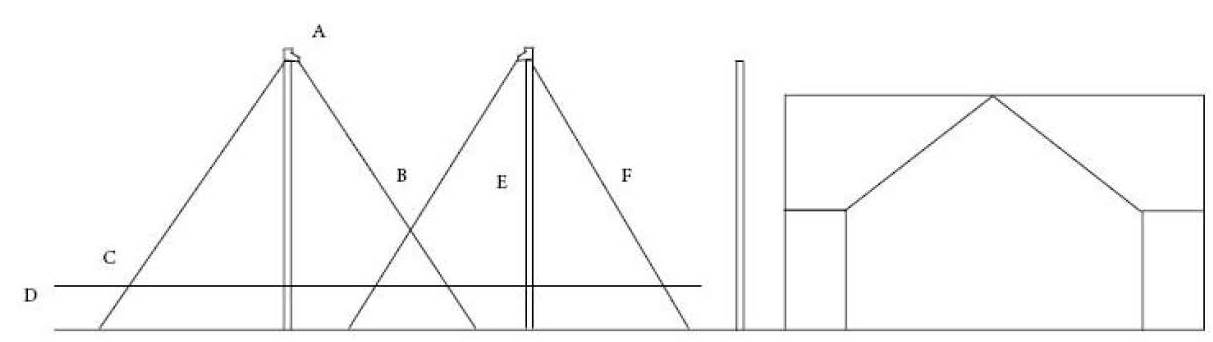
Diagram Notes:
(A)
Non-glare, color corrected lighting with full cutoff shades for commercial and industrial sites, on daily from a 1/2 hour after sunset to a 1/2 hour before sunrise.
(B)
Overlapping light pattern at approximately seven feet.
(C)
Average minimum light intensity: 0.5 foot-candle, not to exceed a maximum of 20 foot-candles, measured five feet above the surface.
(D)
Minimum light intensity at ground level, anywhere on site: 0.3 foot-candle.
(E)
Maximum height: Twenty-five feet or height of building, whichever is less, unless modified by planning commission.
(F)
Light directed away from adjoining properties. Uses adjacent to residential properties must maintain illumination levels not to exceed 0.1 foot-candles at the property line, and uses adjacent to non-residential properties must maintain levels not to exceed one foot-candle.
(G)
For residential uses, churches, schools, and child care facilities, all parking lots must maintain illumination levels of at least 0.4 but not exceed 0.6 foot-candles. For non-residential uses, illumination levels shall be a function of the size of the parking lot Article VI, Off-Street Parking and Loading.
(Ord. of 10-12-18(1))
Sec. 807. - Walls and berms.
(A)
For the use districts and uses listed below, there shall be provided and maintained, on those sides abutting or adjacent to a residential district, an obscuring wall or landscaped berm as required below. The height of the wall or berm shall be measured from the surface of the parking area or land on the nonresidential side of the wall:
(B)
In the case of variable wall or berm height requirements such as in subsections (a), (b), (c), (d), and (e) above, the extent of obscuring wall or berm shall be determined by the planning commission on the basis of land usage; provided further that no wall or berm shall be less than the above required minimum, nor greater than the above required maximum height.
(C)
Required walls shall be located on the lot line except where underground utilities interfere and except in instances where this ordinance requires conformance with yard setback lines. Required walls may, upon approval of the zoning board of appeals, be located on the opposite side of an alley right-of-way from a nonresidential zone that abuts a residential zone when mutually agreeable to affected property owners. The continuity of the required wall on a given block will be a major consideration of the zoning board of appeals in reviewing such request.
(D)
Required walls shall have no openings for vehicular traffic or other purposes, except as otherwise provided in this ordinance and except such openings as may be approved by the building inspector. All walls herein required shall be constructed of face brick or comparable nonporous facing materials on the exterior sides facing a residential district and shall be approved by the building inspector to be durable, weather-resistant, rustproof and easily maintainable; and wood or wood products shall be specifically excluded.
Masonry walls may be constructed with openings which do not in any square section (height and width) exceed 20 percent of the surface. Where walls are so pierced, the openings shall be so spaced as to maintain the obscuring character required, and shall not reduce the minimum height requirements. The arrangement of the openings shall be reviewed and approved by the building inspector.
(E)
Required berms shall be constructed as landscaped earth mounds with a crest area at least four feet in width. The exterior face of the berm shall be constructed as an earthen slope. The interior face of the berm may be constructed as an earthen slope, or retained by means of a wall, terrace, or other means acceptable to the building inspector. Whenever an earthen slope is provided, it shall be constructed with an incline not to exceed one foot of vertical rise to three feet of horizontal distance.
Berm slopes shall be protected from erosion by sodding or seeding. If slopes are seeded, they shall be protected with straw mulch held in place by jute netting until the seed germinates and a permanent lawn is established. The straw mulch is not required if the seeded slope is protected by a net that is specifically designed to control erosion. The berm area shall be kept free from refuse and debris and shall be planted with shrubs, trees or lawn and shall be maintained in a healthy, growing condition.
A planting plan and grading plan shall be prepared for the berm and shall be reviewed by the planning commission. Plant materials within the berm area shall be installed in accordance with the requirements for greenbelts and plant material contained herein.
(F)
The planning commission may waive or modify the foregoing requirements where cause can be shown that no good purpose would be served and that the waiver or modification would neither be injurious to the surrounding neighborhood or contrary to the spirit and purpose of this ordinance; provided that in no instance shall a required wall or berm be permitted to be less than four feet six inches in height.
In consideration of a request to waive wall or berm requirements between residential and nonresidential district, or as otherwise required herein, the planning commission shall consider:
(1)
Whether or not the residential district is considered to be an area in transition and will become nonresidential in the future based on the adopted master plan.
(2)
Whether or not the existing use of land adjacent thereto is such that the obscuring effect of a wall or berm would achieve no substantial screening function.
(3)
Whether or not the ground elevation of the site in question and the land adjacent thereto is such that a wall or berm would not be required to provide the required obscuring effect.
The planning commission may temporarily waive wall or berm requirements for an initial period not to exceed 12 months. Granting of subsequent waivers shall be permitted, provided that the planning commission shall make a determination as hereinbefore described for each subsequent waiver.
(Ord. of 10-12-18(1))
Sec. 808. - Fences residential.
(A)
Fences are permitted or required subject to the following:
(1)
Fences on all lots of record in all residential districts which enclose property or are within a required rear yard shall not exceed six feet in height and shall not extend toward the front of the lot nearer than the front building line of the house. For [The] foregoing restriction pertaining to the extension of fences into the front yard shall not apply to recorded lots having a lot area in excess of two acres and a frontage of at least 200 feet in all residential zoning districts not included within the boundaries of a recorded plat.
(2)
Fences, such as, but not limited to, split rail, picket, wrought iron that is constructed for landscape effect may be allowed in the front yard setback. Fences constructed under this section shall not be intended to enclose, nor be capable of enclosing, animals, chattels or human beings. In no instance shall the surface areas which are encompassed by the outermost limits of such fence obstruct vision by more than 25 percent nor have a height greater than 30 inches.
(3)
No fence may be constructed that will obstruct the view from a driveway with an existing or proposed sidewalk, alley, street, or public way. No fences, wall, shrubbery, signs, or obstructions to vision above a height of 30 inches shall be located upon a lot within the triangular area formed at the intersection of any driveway and sidewalk, by a straight line drawn between said features at a distance along each line of 15 feet from their point of intersection. Also see Section 814.
(4)
Fences on lots of record shall not contain barbed wire, electric current, or charges of electricity.
(5)
Fences which enclose public or institutional parks, playgrounds, or public landscaped areas, situated within an area developed with recorded lots, shall not exceed eight feet in height and shall not obstruct vision to an extent greater than 25 percent of their total area. A greater height may be permitted when related to sports or other activity areas which require a greater height to contain balls, etc.
(6)
The height of a fence shall be measured from the average grade of the lot.
(7)
All fences shall comply with the requirements of the city Code as it applies to fence installation and materials, and all other relevant laws and ordinances not in conflict with this section.
(Ord. of 10-12-18(1))
Sec. 809. - Fences nonresidential.
(A)
Fences or walls in all nonresidential districts are permitted or required subject to the following:
(1)
Fences and walls in all office, business, community center, and industrial districts which enclose property and are located within side or rear yards shall comply with the height and location requirements of Section 807 of this ordinance.
(2)
Fences or walls shall not be located in the required front yard except when required as screening to adjacent residential property. When the use has common frontage with an adjacent residential district, the fence or wall shall have a setback of at least 25 feet. Also Section 814. When the use does not have common frontage with an adjacent residential district, the planning commission may permit a wall or fence in the front yard considering the following:
(a)
Fences or walls in other nearby front yards.
(b)
Effect on the visibility of traffic at an intersection or driveway.
(c)
The planned and present use of adjacent property.
(d)
The fence or wall as it would relate to the general appearance of the front yards in the area.
(3)
Fences shall not contain barbed wire, electric current, or charges of electricity unless approved by the zoning board of appeals as being needed for security purposes.
(4)
All fences or walls shall comply with the requirements of the city Code as it applies to installation and materials, and all other relevant laws and ordinances not in conflict with this section.
(Ord. of 10-12-18(1))
Sec. 810. - Fence installation and maintenance.
(A)
Permit required; fee. It shall be unlawful hereafter for any person or lessee or agent to erect a fence in the city without first having secured a permit therefor from the building department under Section 1205 of this ordinance. The fee for a permit to erect a fence shall be determined from time to time by resolution of the city council.
(B)
Existing fences; alteration; permit required. Fences which are in existence as of the date of adoption of this ordinance shall not be enlarged, rebuilt or reconstructed without first having obtained a permit therefor from the building department under Section 1205 of this ordinance.
(C)
Private agreements, lot line; City responsibility. The city shall not be responsible in any manner for the enforcement of any agreement relative to mutual or separate payment for the cost of construction of fences. The city shall not be responsible for the determination of the location of any fence to be erected on lot lines.
(D)
Residential areas; specification. All fences in residential areas shall be of an ornamental type. Fences may be constructed of either ornamental wire, wood, masonry, plastic or other material approved by the building department. Hedges, ornamental shrubs, trees, bushes, and all kinds of plants shall be considered fences for the purpose of this ordinance when placed in a manner or position to designate property lines.
(E)
Fence posts; depth. All fence posts must be sunk in the soil to a depth of three feet unless otherwise specified.
(F)
Privacy fence posts; depth. All privacy fence posts must be sunk in the soil to a depth of forty-two (42) inches.
(G)
Parallel fences. Fences parallel to one another shall be prohibited unless special provision is made to specifically provide for proper maintenance of both fences; this shall include the provision for adequate distances between the fences and construction design details. Fencing panels and posts shall not be structurally attached to an existing fence.
(H)
Fences to be maintained. Any fence erected under this ordinance and all fences existing on the effective date hereof (April 3, 1986) shall be kept in good repair.
(Ord. of 10-12-18(1))
Sec. 811. - Frontage on a public street.
(A)
No lot shall be used for any purpose permitted by this ordinance unless said lot abuts a public street, unless otherwise provided for in this ordinance.
(Ord. of 10-12-18(1))
Sec. 812. - Access to major thoroughfare or collector street.
(A)
Whenever this ordinance requires ingress and egress only from a major or collector thoroughfare, access driveways may be permitted to other than a major thoroughfare, freeway service drive, or collector thoroughfare, where such access is provided to a street where the property directly across the street from such driveway and all property abutting such street between the driveway and the major thoroughfare, freeway service drive, or collector thoroughfare is zoned for multiple-family use or any nonresidential uses, is developed with permanent uses other than one-family residences or is an area which, in the opinion of the planning commission, will be used for other than one-family purposes in the future. This exception shall only apply if the planning commission finds that there are special circumstances which indicate that there will be a substantial improvement in traffic safety by reducing the number of driveways to a thoroughfare.
(Ord. of 10-12-18(1))
Sec. 813. - Storage of recreation equipment or trailers.
(A)
The parking or storage of any recreational equipment or trailers in any residential district shall be subject to the following:
(1)
No recreational equipment or trailers shall be parked or stored on any lot in a residential district except in a garage or carport or beyond the nearest portion of a building to a street; provided, however, that such equipment may be parked anywhere on residential premises for not to exceed 48 hours during loading or unloading; or for a period of one week for purposes of repair or similar activity provided that a permit is obtained from the building inspector. No such equipment shall be used for living, sleeping or housekeeping purposes when parked or stored on a residential lot, or any location not approved for such use.
(2)
No such equipment shall have fixed electrical, water, sewer or gas connections while the vehicle is stored on the premises.
(3)
Recreational equipment or trailers may be stored in an interior side yard providing such storage does not eliminate air circulation and light to adjoining properties.
(4)
Recreational equipment or trailers may be stored only in the rear yard subject to the conditions of Section 802 with respect to height, yard coverage, and setbacks.
(5)
All recreational vehicles must be currently licensed and kept in good repair.
(Ord. of 10-12-18(1))
Sec. 814. - Corner clearance.
(A)
No fence, wall, shrubbery or other obstruction to vision shall be permitted within the triangular area formed at the intersection of any street right-of-way lines by a straight line drawn between said right-of-way lines at a distance along each line of 25 feet from their point of intersection. Walls, fences, berms, shrubs or hedges in other plantings (excluding trees) in this area shall not exceed 30 inches in height above the average street grade adjacent to this area. Trees planted within this same area shall not have branches lower than eight feet above the average street grade.
(Ord. of 10-12-18(1))
Sec. 815. - Covered trash areas.
(A)
Covered trash receptacles, surrounded on three sides by masonry brick-type walls, one foot higher than the receptacle, shall be provided in the rear yard. The fourth side of the enclosed trash receptacle area shall be equipped with an opaque gate that is the same height as the masonry brick.
(B)
The planning commission may, at their discretion, waive the requirements for an enclosed trash receptacle as described herein, if, after considering the nature of the operation being proposed, the commission determines that the amount of trash generated can be adequately disposed of without the use of an outside trash receptacle.
(C)
This section shall apply to all districts, except R-1 and R-2, one-family residential districts.
(Ord. of 10-12-18(1))
Sec. 816. - Condominium.
(A)
Condominium ownership imposes, in any use district, problems which are separate and distinct from those under other established types of development, control and ownership. A single structure or a group of structures incorporates several different real estate and tax entities, thus creating new aspects of municipal responsibility and administration affecting the public health, safety and general welfare.
(B)
In order to adequately and properly protect the interests of the community, assure a desirable and stable environment in harmony with that of the surrounding area and provide the special amenities and safeguards considered essential to the characteristics of individual ownerships, condominiums shall be subject to the following:
(1)
No condominium shall be developed, nor shall any existing structure be converted to a condominium in any use district until after a permit has been issued. Such permit shall be issued only upon the approval of the planning commission. As a basis for issuance of a permit, the complete plans, specifications and master deed shall be submitted, and shall be reviewed as to compliance with the following objectives:
(a)
Parking provisions shall be adequate to fulfill expected requirements, which may exceed otherwise prescribed criteria and may necessitate enclosed or covered parking in closer proximity to units.
(b)
Complete pedestrian circulation shall be provided within the development via corridors or adequate sidewalks, which shall connect with public sidewalks at convenient intervals.
(c)
Outdoor open space shall be provided to meet the health and recreational needs of the owners and, where individual open spaces are considered necessary, privacy of each shall be assured by effective screening.
(d)
Privacy of individually owned units shall be assured by orientation or other means to assure visual privacy from casual pedestrian traffic and from nearby units. In addition, protection against noise infiltration shall be assured by special and adequate acoustic treatment of walls, floors, ceilings, window openings and of utility lines (water and sewer) to eliminate or reduce to an acceptable level sound transmission into, between or from individual units.
(e)
Security of individual units shall be provided by adequately fire-rated vertical and horizontal partitions separating units.
(2)
No condominium shall be permitted in any use district unless it complies fully with use, area, height, bulk and all other requirements of that district as provided by other sections of this chapter.
(3)
A site plan prepared in accord with Article X, Review Procedures and Requirements, shall be submitted for the entire site proposed to be developed for review by the planning commission.
(Ord. of 10-12-18(1))
Sec. 817. - Donation boxes.
(A)
No person or other legal entity shall cause or permit the installation or placement of a donation box upon any property within the City, whether public or private, except in accordance with this section.
(B)
Donation boxes are permitted within the City upon compliance with all of the following:
(1)
All proceeds are dedicated to the use of an entity which is qualified by the Internal Revenue Service as a 501(c) (3) charitable institution, or is a governmental entity.
(2)
The donation box is located upon the premises of an entity which is qualified by the Internal Revenue Service as a 501(c) (3) charitable institution, or is a governmental entity.
(3)
The donation box is no more than six (6) feet high, with a ground footprint of not more than twenty five (25) square feet.
(4)
No more than two (2) donation boxes shall be located on any parcel.
(5)
The donation box shall be located so as not to interfere with any sight triangles and on-site circulation. The donation box shall be located at least 15' from any building, 20' from the front property line, and 5' from the side and rear property lines. The donation box shall not be located so as to block the view of any business signage.
(6)
The donation box shall be placed upon a concrete or asphalt surface.
(7)
The donation box shall be emptied with such frequency and regularity as to ensure that it does not overflow, and materials do not accumulate outside the donation box.
(8)
The donation box shall not be used as a receptacle for any hazardous or potentially hazardous waste.
(9)
The issuance of a permit pursuant to subsection (c), below. The zoning administrator shall issue a permit, annually, for a compliant donation box upon receipt of an annual permit fee in an amount to be established from time to time by resolution of the City Council; and of an application containing all of the following:
(a)
Proof of the applicant's status as a charitable institution or as a governmental entity.
(b)
A site plan indicating the placement of the donation box, in compliance with all the above siting requirements.
(c)
The name, address, telephone number and e mail address of the applicant and of the owner of the donation box, if different than the applicant.
(d)
The name, address, telephone number and e mail address of the person who will be available during regular business hours and will be responsible for compliance.
(e)
A photograph of the donation box to be installed.
(f)
The signed and dated consent of the property owner, consenting to the location of the box.
(Ord. of 10-12-18(1))
Sec. 818. - Solar energy.
A.
Permitted. Active and passive solar energy devices, systems or structures shall be permitted in all zoning classifications by right, subject to administrative approval, except when such solar devices or architectural features project into required front or side yards, or are free-standing elements in a required front or side yard, in which case they are subject to site plan review in accordance with article.
B.
Maximum Height of Structures. Passive solar energy structures, such as flat plate collectors, photovoltaic cells, etc., which are roof-mounted or integrated otherwise into the roof structure shall not be included in the calculation of maximum height. Active solar energy structures, when mounted on either freestanding structural elements or integrated architecturally with a principal or accessory building shall not exceed a height of forty (40) feet.
C.
Easements. A landowner may enter into an easement, covenant, condition or other property interest in any deed or other instrument, to protect the solar sky space of an actual, proposed or designated solar energy structure at a described location by forbidding or limiting activities, land uses structures and/or trees that interfere with access to solar energy. The solar sky space must be described as the three (3) dimensional spaces in which obstruction is prohibited or limited. Any property owner may give or sell his right to access to sunlight. Such Solar Access Easements shall be recorded and copies shall be kept on file with the Building Department.
(Ord. of 10-12-18(1))
Sec. 819. - Wind energy.
Wind Turbine Facilities shall be allowed as a special land use in Industrial and Business zones under the purview of Article IV, Specific Land Use Provisions, after review and approval of the special land use permit and site plan by the Planning Commission, after Public Hearing, subject to applicable conditions and any other reasonable conditions imposed by the Planning Commission, including the following:
1.
Minimum parcel size for wind turbine facilities shall be ten (10) acres.
2.
The height limit of any wind turbine in the WTF may be 200 feet. Such total height shall be measured from the ground to the highest elevation of the wind turbine rotor.
3.
The developer shall maintain a current insurance policy which will cover installation and operation of the WTF, and the wind turbines shall be warranted against any system failures reasonably expected in climate conditions found in the City of Muskegon.
4.
A qualified avian study shall be conducted by the developer to ensure that wildlife is not endangered, or the developer may submit copies of any required State or Federal permits that have been obtained. This information shall be submitted to the Planning Department before any permits are issued for construction.
5.
A wind resource study describing the long term economic viability shall be submitted to the Planning Commission upon submission of the special land use permit application.
6.
If the WFT will provide electricity off-site to the grid, evidence that the utility company has been informed of the developer's intent to install an interconnected, customer-owned generator, and that such connection has been approved, shall be submitted to the Planning Commission upon submission of the special land use permit application.
7.
Separation between wind turbines shall be based on industry standards and manufacturer recommendations.
(Ord. of 10-12-18(1))
Sec. 820. - Stormwater management.
Compliance with the storm water management system criteria of this chapter is required for any form of construction or removal or disturbance of any natural features that requires approval under Section 805 of this Code for any site plan, final preliminary plat, or PUD site plan, but is not required for issuance of grading permits that do not require site plan, final preliminary plat, or PUD site plan approval. Administrative amendments to approved site plans or administrative amendments to approved PUD site plans, as described in Article V, PD Planned Development District, that do not increase the total impervious area of the site and are not within the jurisdiction of the Macomb County Drain Commissioner shall be exempt from the storm water management system requirements of this Section
(1)
For sites within the jurisdiction of the Macomb County Drain Commissioner; or sites with storm water management systems under multiple ownership or for multiple parcels, including but not limited to site condominiums; or residential developments containing greater than 4 units within 2 or more detached structures; or sites with storm water management systems serving more than 1 parcel; the storm water management system shall be reviewed and receive preliminary plan approval from the Macomb County Drain Commissioner's Office prior to site plan, final preliminary plat, or PUD site plan approval by the city. For sites that require review by the Macomb County Drain Commissioner's Office, a permit or letter of final plan approval from the Macomb County Drain Commissioner's Office shall be obtained prior to issuance of a grading permit by the City Code Official. Any exceptions to the Rules of the WCWRC listed in this chapter are not applicable to reviews performed by the Macomb County Drain Commissioner's Office.
(2)
For sites other than described in sub-section (1) that contain or are proposed to contain more than 5,000 square feet of impervious surface, on-site storm water management systems shall be required for any site which is the subject of a site plan, final preliminary plat, or PUD site plan. The storm water management system shall be reviewed and receive approval from the Public Services Area Administrator and meet the design criteria stated in the Rules of the WCWRC, with the following exceptions:
(a)
For sites that contain existing impervious surfaces, adding or removing and replacing impervious surfaces solely for the purpose of compliance with the Americans with Disabilities Act, or compliance with the State of Michigan Barrier Free Design Rules (Public Act 1 of 1966, as amended) shall be exempt from the storm water management system requirements of this chapter.
(b)
Sites proposed to contain:
(i)
Impervious surfaces greater than 5,000 square feet and less than 10,000 square feet require retention/infiltration only of the first flush storm events.
(ii)
Impervious surfaces equal to or greater than 10,000 square feet and less than 15,000 square feet require retention/infiltration only of the first flush and detention only of bankfull storm events.
(iii)
Impervious surfaces equal to or greater than 15,000 square feet require retention/infiltration of the first flush, and detention of bankfull, and 100-year storm event. Detention facilities designed for the 100-year storm event shall include a sediment forebay.
(c)
Public sidewalks are not required to be included in the storm water management calculations.
(d)
If the site is located in an historic district designated by the City of Ann Arbor, then the roof area of the historic building(s) is not required to be included in the storm water management calculations. This exemption does not apply to noncontributing structures within the historic district.
(3)
On a site that requires the installation of storm water management system the detention facility shall be installed and stabilized prior to the issuance of building permits. The Public Services Area Administrator may deem it necessary to modify the timing of installation of the detention facility when conditions, such as a detention facility that is integral to the structure of a new building, prevent installation prior to building permits. As-built verification from an architect or professional engineer shall be submitted to the Code Official for approval prior to issuance of any certificate of occupancy. The as-built verification shall include: elevations and volumes, outlet sizes and elevations, stabilization information, and signature and seal of an architect or professional engineer. A sample form may be provided by the Code Official upon request.
(4)
Existing wetlands shall not be modified for the purposes of storm water management systems. Where modifications to wetland areas are allowed, the existing storage shall be maintained and shall not count toward meeting the requirements of this section.
(5)
When residential lots or units are proposed to be created, the runoff coefficients shall take into account the future impervious surfaces of these building sites within the storm water management calculations.
(6)
Storm water management facilities shall be designed so that any discharge of storm water from the facility, which does not empty directly into a drain, shall be converted to sheet flow over the ground through the use of an energy dissipater, in a manner which will preclude erosion, or other approved method as determined by the Public Services Area Administrator.
(Ord. of 10-12-18(1))

