
Center Line City Zoning Code
ARTICLE VI
OFF-STREET PARKING AND LOADING
Sec. 600.- Purpose.
The purpose of this article is to alleviate or prevent congestion of the public streets, and to promote the safety and welfare of the public by establishing minimum requirements for the off-street parking and loading and unloading of motor vehicles and recreation vehicles in accordance with the use to which property is put.
(Ord. of 10-12-18(1))
Sec. 601. - Off-street parking requirements.
(A)
There shall be provided in all districts, at the time of erection, enlargement or change of use of any main building or structure, automobile off-street parking space with adequate access to all spaces. The number of off-street parking spaces, in conjunction with all land or building uses shall be provided, prior to the issuance of a building permit, certificate of occupancy, or both, as hereinafter prescribed.
(1)
Off-street parking spaces meeting the requirements of Article VI, Off-Street Parking and Loading, of this ordinance may be located within a rear yard, or within a side yard which is in excess of the minimum side yard setback requirements, unless otherwise provided by this ordinance. Off-street parking spaces may also be provided for on a parking strip or driveway located in that portion of a front yard that extends across the full width of one adjoining side yard; provided however that such parking strip or driveway shall not be more than 20 feet wide. In the event that the portion of a front yard which extends across the full width of an adjoining side yard is less than 20 feet wide, then a parking strip or driveway may be located within that portion of the front yard which is within 20 feet of the side lot line, provided it does not exceed 30 percent of lot frontage, and provided further that the space is not located within ten feet of an exterior side lot line. No off-street parking of automobiles or motor vehicles shall be permitted in any yard except on a parking space improvement permitted by this ordinance, and no such parking shall be permitted on any grass or lawn area not improved as required herein.
(2)
Off-street parking for other than residential use shall be either on the same lot or within 300 feet of the building it is intended to serve, measured from the nearest point of the off-street parking lot; provided, however, that the lot shall be located on the same side of a major or collector thoroughfare as the main building. Ownership shall be shown of all lots or parcels intended for use as parking by the applicant.
(3)
Required residential off-street parking spaces shall consist of a parking strip, parking bay, driveway, garage, or combination thereof and shall be located on the premises they are intended to serve, and subject to the provisions of Article VIII, General Provisions, of this ordinance.
(a)
Parking of vehicles in a front yard area is prohibited, except in a driveway.
(b)
There shall be no more than one driveway per residential dwelling. Said driveway shall constitute a contiguous area, and be surfaced as required by the city.
(c)
No horseshoe shape driveway shall be constructed on any lot having a width of less than 60 feet, a front yard depth of less than 35 feet, and a front yard area of less than 2,100 square feet. No driveway located in a front yard shall occupy more than 50 percent of the front yard area.
(4)
Minimum required off-street parking spaces shall not be replaced by any other use unless and until equal parking facilities are provided elsewhere.
(5)
Off-street parking existing at the effective date of this ordinance in connection with the operation of an existing building or use shall not be reduced to an amount less than hereinafter required for a similar new building or use.
(6)
Off-street parking requirements shall meet the required standards of this ordinance when a change in use of an existing building or structure requires additional off-street parking prior to the issuance of a certificate of occupancy.
(7)
Two or more buildings or uses may collectively provide the required off-street parking, in which case the required number of parking spaces shall not be less than the sum of the requirements for the several individual uses computed separately.
(8)
In the instance of dual function of off-street parking spaces where operation hours of buildings do not overlap, the zoning board of appeals may grant an exception.
(9)
The storage of merchandise, motor vehicles for sale, trucks, or the repair of vehicles is prohibited in the approved parking area.
(10)
For those uses not specifically mentioned, the requirements for off-street parking facilities shall be in accord with a use which the planning commission considers is similar in type.
(11)
When units or measurements determining the number of required parking spaces result in the requirement of a fractional space, any fraction up to and including one-half shall be disregarded and fractions over one-half shall require one parking space.
(12)
For the purpose of computing the number of parking spaces required, the definition of "Floor area, usable," in Article II, Definitions, shall govern.
(13)
The minimum number of off-street parking spaces by type of use shall be determined in accordance with the following schedule:
B.
Planning commission may alter off-street parking requirements in lieu of expanded stormwater management system under Section 819.
(Ord. of 10-12-18(1))
Sec. 602. - Off-street parking space layout, standards, construction, and maintenance.
(A)
Wherever the off-street parking requirements in Section 603 above require the building of an off-street parking facility, or where NT Neighborhood Transition districts are provided, such off-street parking lots shall be laid out, constructed and maintained in accordance with the following standards and regulations:
(1)
No parking lot shall be constructed unless and until a permit therefor is issued by the building inspector. Applications for a permit shall be submitted to the building department in such form as may be determined by the building inspector and shall be accompanied with two sets of plans for the development and construction of the parking lot showing the provisions of this section will be fully complied with.
(2)
Adequate ingress and egress to the parking lot shall be provided and approved by the city engineer and the chief of police, who shall have full power to regulate and determine the places of ingress and egress so that traffic on the streets and highways of the city shall be controlled, regulated and coordinated and to require the installation and maintenance of suitable barriers to ensure the safety of pedestrians passing any such parking lot, in order to provide for the greatest possible public safety and welfare. Such necessary directional signs and controls as are required by the chief of police shall be established and maintained by the owner or lessee of the parking lot.
All drives shall be surfaced in a manner equivalent to that which is provided for the parking areas under Section 315.
(3)
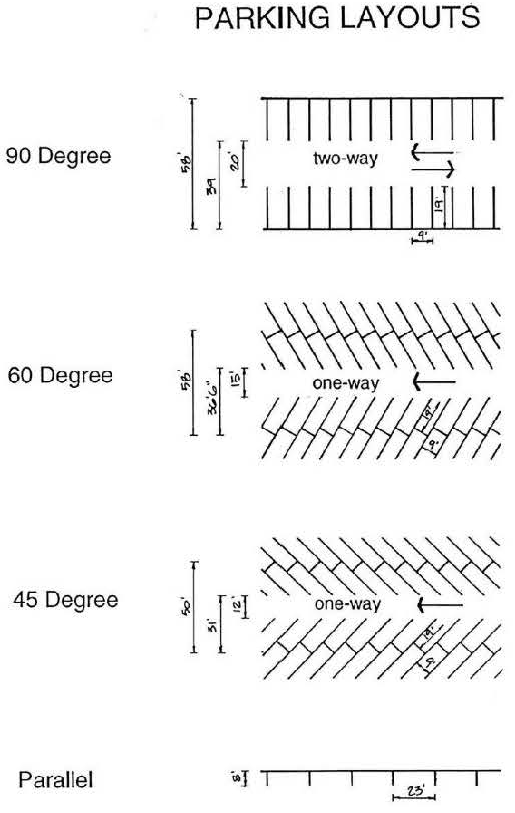
All spaces shall be provided adequate access by means of maneuvering lanes. (See the diagram.)
(4)
Plans for the layout of off-street parking facilities shall be in accord with the following minimum requirements:
(5)
All maneuvering lane widths shall permit one-way traffic movement, with the exception of the 90-degree pattern, where two-way movement may be permitted.
(6)
Off-street parking areas shall be provided with a continuous and completely obscuring wall in accordance with the specifications of Section 807, on all sides where the next zoning district is designated as a residential district.
(7)
Off-street parking facilities required for buildings or uses shall be identified by signs as being reserved for physically handicapped persons. Signs shall be located approximately six feet above grade. Each reserved parking space shall be not less than 12 feet wide. Where a curb exists between a parking lot surface and a sidewalk surface, an inclined approach or a curb cut with a gradient of not more than one foot in 12 feet and a width of not less than four feet shall be provided for wheelchair access. Parking spaces for the physically handicapped shall be located as close as possible to walkways and entrances. Signs shall be provided when necessary indicating the direction of travel to an accessible entrance.
(Ord. of 10-12-18(1))
Sec. 603. - Off-street loading and unloading.
(A)
On the same premises with every building, structure or part thereof, involving the receipt or distribution of vehicles or materials or merchandise, there shall be provided and maintained on the lot adequate space for standing, loading, and unloading in order to avoid undue interference with public use of dedicated streets or alleys. Such space shall be provided as follows:
(1)
All spaces in B-1A, B-1B, and B-2 districts shall be provided in the ratio required Article III, Zoning Districts and Regulations, under minimum rear yard.
(2)
All spaces in M-1 and M-2 districts shall be laid out in the dimension of at least ten by 50 feet, or 500 square feet in area, with a clearance of at least 14 feet in height. Loading dock approaches shall be provided with a pavement having an asphaltic or portland cement binder so as to provide a permanent, durable and dustless surface. All spaces in M-1 and M-2 districts shall be provided in the following ratio of spaces to floor area:
(3)
All loading and unloading in an M district shall be provided off-street in the rear yard or interior side yard and shall in no instance be permitted in a front yard. In those instances where exterior side yards have a common relationship with an industrial district across a public thoroughfare, which is not a major or collector thoroughfare, loading and unloading may take place in said exterior side yard when the setback is equal to at least 50 feet.
(4)
Loading space shall be provided in the rear yard in the ratio of at least ten square feet per front foot of building and shall be computed separately from the off-street parking requirements; except in the instance of B-1A, B-1B, or B-2 districts fronting on a major thoroughfare and using the public alley for a loading zone, loading space shall be provided in the ratio of nine square feet per front foot of building.
(5)
For O-1 districts, loading space shall be provided in the ratio of five square feet per front foot of building. Where an alley exists or is provided at the rear of buildings the rear building setback and loading requirements may be computed from the center of said alley.
(Ord. of 10-12-18(1))

