
Center Line City Zoning Code
ARTICLE II
DEFINITIONS
Sec. 200.- Purpose.
For the purposes of this ordinance, certain terms, or words used herein shall be interpreted as follows:
All words used in the present tense shall include the future; all words in the singular number include the plural number and all words in the plural number include the singular number; and the word "building" includes the word "structure," and "dwelling" includes "residence;" the word "person" includes "corporation," "co-partnership," "association," as well as "individual;" the word "shall" is mandatory and the word "may" is permissive; the word "lot" includes the words "plot" or "parcel;" the word "used" or "occupied" includes the words "intended," "designed," or "arranged to be used or occupied."
Terms not herein defined shall have the meaning customarily assigned to them.
(Ord. of 10-12-18(1))
Sec. 201. - Definitions.
Accessory building: A detached structure on the same property with, and of a nature customarily incidental and subordinate to the principal structure.
Accessory use: A use naturally and normally incidental and subordinate to, and devoted exclusively to the main use of the premises.
Adult Foster Care Facilities: A governmental or non-governmental establishment that provides foster care to adults. It includes facilities and foster care family homes for adults who are aged, mentally ill, developmentally disabled, or physically handicapped who require supervision or an ongoing basis but who do not require continuous nursing care. An adult foster care facility does not include nursing homes, homes for the aged, hospitals, alcohol or substance abuse rehabilitation center, residential centers for persons released from or assigned to a correctional facility, or any other facilities which have been exempted from the definition of adult foster care facility by the Adult Foster Care Facility Licensing Act, 218 of 1979, MCL 400.701, as amended. The types of licensed adult foster care facilities include the following:
Foster Care Small Group Home: A facility with the approved capacity to receive twelve (12) or fewer adults who are provided supervision, personal care, and protection in addition to room and board, for twenty-four (24) hours a day, five (5) or more days a week, and for two (2) or more consecutive weeks for compensation.
Foster Care Large Group Home: A facility with approved capacity to receive at least thirteen (13) but not more than twenty (20) adults to be provided supervision, personal care, and protection in addition to room and board, for twenty-four (24) hours a day, five (5) or more days a week, and for two (2) or more consecutive weeks for compensation.
Foster Care Family Home: A private residence with the approved capacity to receive six (6) or fewer adults to be provided with foster care for five (5) or more days a week and for two (2) or more consecutive weeks. The adult foster care family home licensee must be a member of the household and an occupant of the residence.
Foster Care Congregate Facility: An adult foster care facility with the approved capacity to receive more than twenty (20) adults to be provided with foster care.
Adult motion picture theater: An enclosed building, booth, or structure, used for presenting material distinguished or characterized by an emphasis on matter depicting, describing or relating to "specified sexual activities" or "specified anatomical areas" for observation by patrons therein.
Adult outdoor motion picture theaters: An open area used for presenting material distinguished or characterized by an emphasis on matter depicting, describing or relating to "specified sexual activities" or "specified anatomical areas," as defined in this section, for observation by patrons therein.
Adult supply store: An establishment whose primary economic activity consists of the distribution, sale, display or storage of books, magazines, periodicals, advertisements, devices, objects, toys, paraphernalia or similar materials which are distinguished or characterized by their emphasis on matter depicting, describing or relating to "specified sexual activities" or "specified anatomical areas."
For the purpose of this section, "specified sexual activities" is defined as:
Human genitals in a state of sexual stimulation or arousal;
Acts of human masturbation, sexual intercourse, or sodomy;
Fondling or other erotic touching of human genitals, pubic region, buttock, or female breast.
For the purpose of this section, "specified anatomical areas" is defined as:
Less than completely and opaquely covered: (a) human genitals, pubic region, (b) buttock, and (c) female breast below a point immediately above the top of the areola; and
Human male genitals in a discernibly turgid state, even if completely and opaquely covered.
For purposes of this section, "principal business purpose" means:
The devotion of a significant or substantial portion of its stock-in-trade or interior floor space; or
The receipt of a significant or substantial portion of its revenues from; or
The devotion of a significant or substantial portion of its advertising expenditures to the promotion of the sale, rental or viewing, of books, magazines, periodicals or other printed matter, or photographs, film, motion pictures, video cassettes, compact discs, slides or other visual representations, items, materials, gimmicks, or paraphernalia which are characterized by the depiction, description display, advertising or packaging of "specified sexual activities" or "specified anatomical areas".
For purposes of this section, "primary economic activity" means:
The devotion of a significant or substantial portion of its stock-in-trade or interior floor space; or
The receipt of a significant or substantial portion of its revenues from; or
The devotion of a significant or substantial portion of its advertising expenditures to the promotion of the sale, rental or viewing, of books, magazines, periodicals or other printed matter, or photographs, film, motion pictures, video cassettes, compact discs, slides or other visual representations, items, materials, gimmicks, or paraphernalia which are characterized by the depiction, description display, advertising or packaging of "specified sexual activities" or "specified anatomical areas".
An establishment may have other economic activates that do not involve the offering for sale, rental or viewing of materials depicting or describing "specified sexual activities" or "specified anatomical areas", and still be categorized as an adult bookstore, adult novelty or retail store or adult video store. Such other business purposes will not serve to exempt such establishment from being categorized as an adult bookstore, adult novelty store or adult video store, so long as the establishment falls within the definition of an adult bookstore, adult novelty store or adult video store as set forth above.
Alley: Any dedicated public way affording a secondary means of access to abutting property, and not intended for general traffic circulation.
Alterations: Any change, addition or modification to a structure or type of occupancy; any change in the structural members of a building, such as walls or partitions, columns, beams or girders, the consummated act of which may be referred to herein as "altered" or "reconstructed."
Ambient Noise: Regularly occurring background noise.
Apartment: The dwelling units in a multiple dwelling as defined herein.
Arcade: A place, premises or establishment or room set aside in a retail or commercial establishment in which are located three or more coin-operated amusement devices, defined herein as a machine or device operated by means of the insertion of a coin, token or similar object, for the purpose of amusement of (or) skill and for the playing of which a fee is charged. The term does not include vending machines in which are not incorporated gaming or amusement features, nor coin-operated mechanical music devices; nor mechanical motion picture devices. The definition shall not apply to coin-operated amusement devices owned or leased to establishments that are properly licensed for sale of beer or intoxicating liquor for consumption on the premises.
Automobile repair garage: A place where the following activities may be carried out: vehicle body repair, undercoating, painting, tire recapping, auto dismantling, upholstery work, and auto glass work.
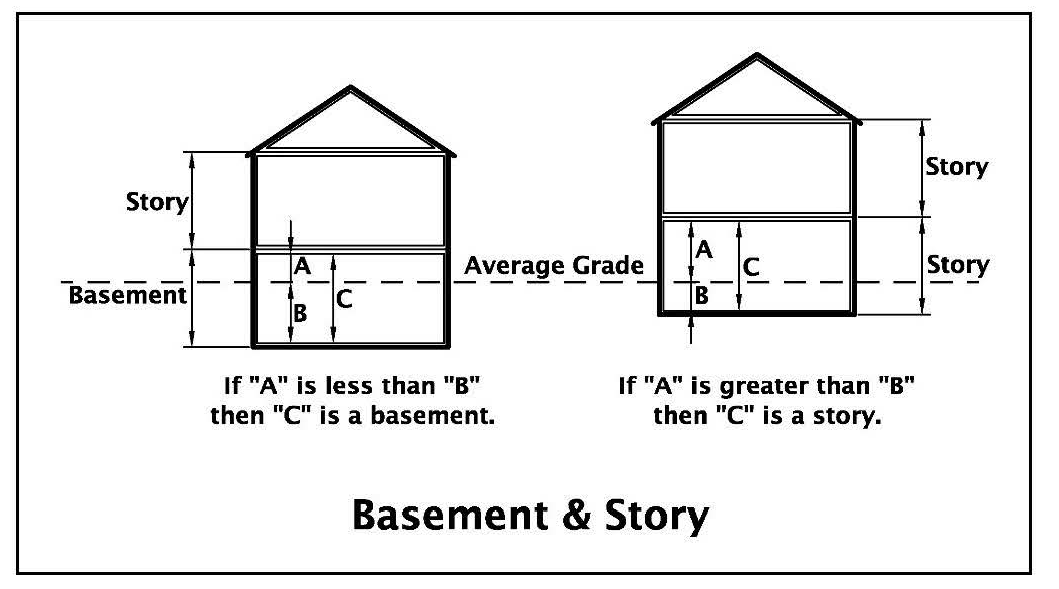
Basement (cellar): That portion of a building which is partly or wholly below grade but so located that the vertical distance from average grade to the floor is greater than the vertical distance from the average grade to the bottom of the joists supporting the ceiling. A basement shall not be counted as a story. (See the diagram.)
Billboard: Any structure or portion thereof upon which a sign or advertisement used as an outdoor display for the purpose of making anything known to the general public is affixed. This definition does not include any bulletin boards used to display official court, public office notice, or church bulletin boards.
Block: That property abutting one (1) side of a street and lying between the two (2) nearest intersecting streets, or between the nearest such street and railroad right-of-way, unsubdivided acreage; or between any of the foregoing and any other barrier to the continuity of development.
Building: Is any building, either temporary or permanent, having a roof supported by columns or walls, and intended for the shelter or enclosure of persons, animals, chattels, or property of any kind. (This shall include tents, awnings, or vehicles situated on private property and used for such purposes.) Also known as a "structure".
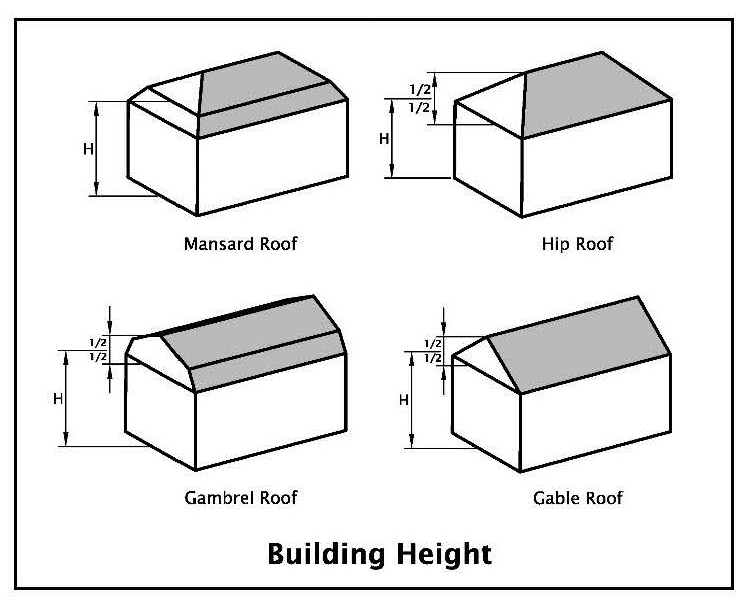
Building height: Is the vertical distance measured from the established grade to the highest point of the roof surface for flat roofs; to the deck line of mansard roofs; and to the average height between eaves and ridge for gable, hip, and gambrel roofs; and to the average height between the lowest point and the highest point on a shed roof. Where a building is located on sloping terrain, the height may be measured from the average ground level of the grade at the building wall. (See the diagram.)
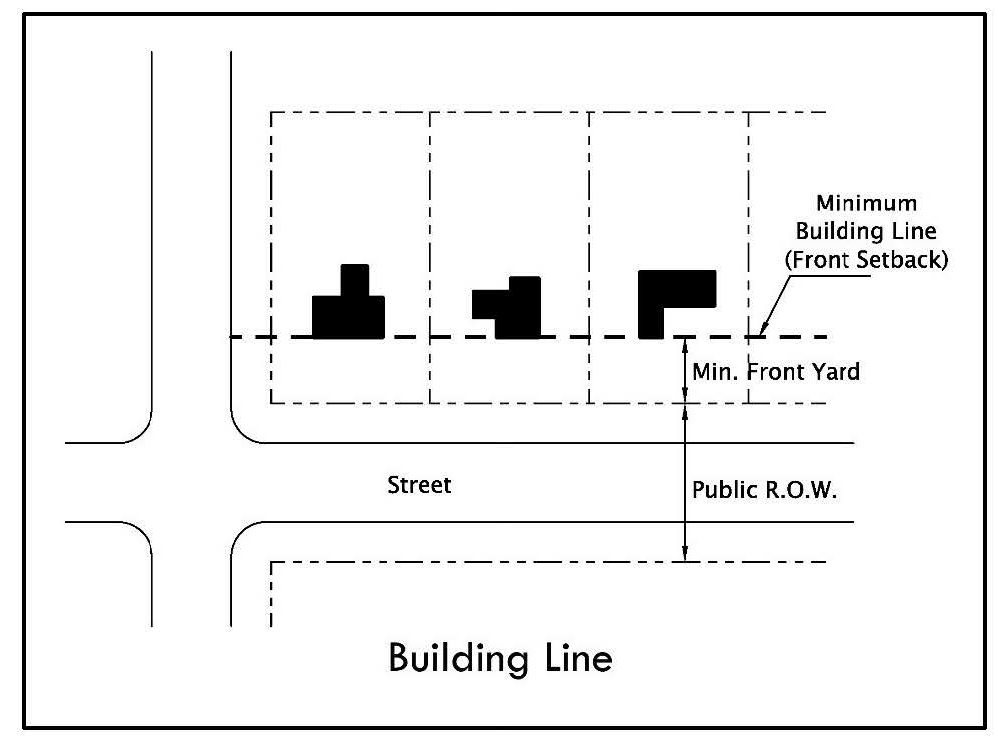
Building line: Is a line formed by the face of the building; and for the purposes of this ordinance, a building line is the same as a front setback line. (See the diagram.)
Build-to line: A line parallel to the property line along which a building shall be built.
Building, principal: Is a building in which is conducted the principal use of the lot on which it is situated.
Change of occupancy: The term "change of occupancy" shall mean a discontinuance of an existing use and the substitution or the addition thereto of a use of a different kind of class.
Child Care Facility: The following definitions shall apply in the application of this Ordinance:
Child day care center: A facility, other than a private residence, receiving more than one (1) or more children for care and supervision for periods less than twenty-four (24) hours, and where the parents or guardians are not immediately available to the child.
Child family day care home: A private home in which one but fewer than seven (7) minor children are received for care and supervision for periods of less than twenty-four (24) hours a day, unattended by a parent or legal guardian, except children related to an adult member of the family by blood, marriage, or adoption. The term "family day care home" includes a home in which care is given to an unrelated minor child for more than four (4) weeks during a calendar year.
Child group day care home: A private home in which more than six (6) but not more than twelve (12) minor children are given care and supervision for periods of less than twenty-four (24) hours a day unattended by a parent or legal guardian, except children related to an adult member of the family by blood, marriage, or adoption. The term "group day care home" includes a home in which care is given to an unrelated minor child for more than four (4) weeks during a calendar year.
Clinic: Is an institution providing diagnostic, therapeutic or preventative out-patient treatment by a group of doctors or veterinarians in the same building.
Club: An organization of persons for special purposes or for the promulgation of sports, arts, science, literature, politics or the like, but not for profit.
Condominium: A place or project consisting of not less than two (2) condominium units established in conformance with the condominium act, Public Act No. 59 of 1978 (MCL 559.101 et seq.), as amended, and this ordinance. The following additional definitions shall apply in the application of the regulations of this ordinance:
Condominium documents: The master deed recorded pursuant to the condominium act, and any other instrument referred to in the master deed or bylaws that affect the rights and obligations of a co-owner in the condominium.
Condominium unit: The portion of a condominium project designed and intended for separate ownership and use, as described in the master deed.
General common elements: The common elements other than the limited common elements.
Limited common elements: A portion of the common elements reserved in the master deed for the exclusive use of less than all of the co-owners.
Court: Is an open unoccupied space, other than a yard, and bounded on at least two sides by a building. A court extending to the front yard or front lot line or to the rear yard or rear lot line is an outer court. Any other court is an inner court.
District: Is a portion of the incorporated area of the city within which certain regulations and requirements or various combinations thereof apply under the provisions of this ordinance.
Drive-in: A business establishment so developed that its retail or service character is dependent on providing a driveway approach or parking spaces for motor vehicles so as to serve patrons while in the motor vehicle rather than within a building or structure, regardless of whether self-servicing is involved.
Drive-through: A principal use or accessory use of an establishment that by design permits customers to obtain goods or services while remaining in their motor vehicles.
Dwelling unit: A building or portion thereof, designed for the occupancy of one (1) family and having cooking and bathroom facilities.
Dwelling, multiple-family: A building or portion thereof, designed for occupancy by three (3) or more families living independently of each other. Multiple-family dwellings may consist of the following:
Efficiency unit: A dwelling unit containing not more than one (1) room in addition to kitchen, dining and sanitary facilities.
One (1) bedroom unit: A dwelling unit consisting of not more than two (2) rooms in addition to kitchen, dining and sanitary facilities.
Two (2) bedroom unit: A dwelling unit consisting of not more than three (3) rooms in addition to kitchen, dining and sanitary facilities.
Three (3) or more bedroom unit: A dwelling unit consisting of not more than four (4) rooms in addition to kitchen, dining and sanitary facilities.
Dwelling, one-family: A building consisting of not more than one (1) dwelling unit designed exclusively for the use of one (1) family.
Dwelling, one-family attached: A building containing not less than three (3) nor more than eight (8) one-family dwelling units erected side by side as a single building, each being separated from the adjoining unit or units by an uninterrupted wall extending from the basement floor to the roof. No more than one (1) dwelling unit may be served by a single stairway or by a single exterior door.
Dwelling, two-family: A building designed exclusively for occupancy by two (2) families, independent of each other such as a duplex dwelling unit.
Erected: Includes built, constructed, altered, reconstructed, moved upon, or any physical operations on the premises required for the construction. Excavation, fill, drainage, and the like shall be considered a part of erection.
Essential services: Means the erection, construction, alteration or maintenance by public utilities or municipal departments of underground, surface or overhead gas, electrical, steam, fuel, or water transmission or distribution systems, collection, communication, supply or disposal systems, including towers, poles, wires, mains, drains, sewers, pipes, conduits, cables, fire alarm and police call boxes, traffic signals, hydrants and similar accessories in connection therewith, but not including buildings which are necessary for the furnishing of adequate service by such utilities or municipal departments for the general public health, safety or welfare.
Family: Means either of the following:
A domestic family, that is, one (1) or more persons living together and related by the bonds of consanguinity, marriage, or adoption, together with servants of the principal occupants and not more than one (1) additional unrelated person, with all of such individuals being domiciled together as a single, domestic, housekeeping unit in a dwelling.
The functional equivalent of the domestic family, that is, persons living together in a dwelling unit whose relationship is of a permanent and distinct character and is the functional equivalent of a domestic family, with a demonstrable and recognizable bond which constitutes the functional equivalent of the bonds which render the domestic family a cohesive unit. This definition shall not include any society, club, fraternity, sorority, association, lodge, coterie organization or group whose association is temporary or seasonal in character or nature. For the purposes of enforcement, it is presumed that a functional equivalent of a domestic family is limited to six (6) or fewer persons.
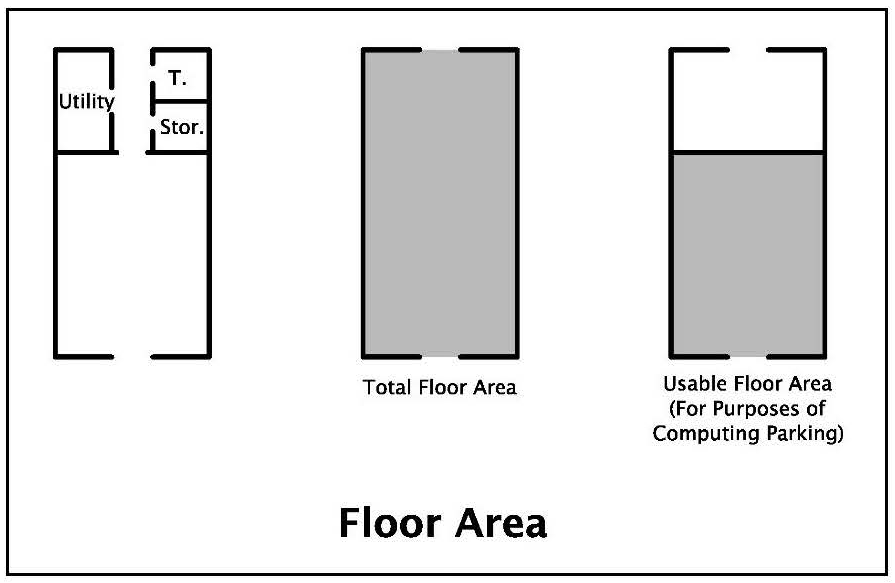
Floor area: The sum of the horizontal areas of each floor of a building, measured from the interior faces of the exterior walls, or from the centerline of common walls of adjoining buildings. For the purposes of this ordinance, the following definitions shall apply:
Floor area, gross: The floor area within the inside perimeter of the walls of a building under consideration, exclusive of vent shafts and courts, without deduction for corridors, stairways, closets, the thickness of interior walls, columns, or other features. The floor area of a building, or portion thereof, not provided with surrounding exterior walls shall be the useable area under the horizontal projection of the roof or floor above. The gross floor area shall not include shafts with no openings or interior courts.
Floor area, net: Measurement of the actual occupied area not including unoccupied accessory areas such as corridors, stairways, toilet rooms, mechanical rooms, and closets.
Residential floor area: For the purpose of computing the minimum allowable floor area in a residential dwelling unit, the sum of the horizontal areas of each story measured from the exterior faces of the exterior walls. The floor area measurement is exclusive of areas of basements, unfinished attics, attached garages, breezeways, and enclosed and/or unenclosed porches.
Nonresidential building floor area: Measurement of the gross floor area shall be the sum of all the horizontal areas of all floors of the building (including malls, basements, mezzanines, atriums and service areas), as measured from the exterior faces of the exterior walls.
Floor area ratio: The gross building square footage divided by the square footage of the lot.
Frontage: The portion of any parcel or lot which abuts a legally accessible road right-of-way. All lots or parcels shall have frontage on a public or private road.
Garage, private: An accessory building not over one story or 15 feet in height used for parking or storage of motor vehicles, but not for commercial servicing or repair.
Gasoline service station: Is a place for the dispensing, sale, or offering for sale of motor fuels directly to users of motor vehicles, together with the sale of minor accessories and the servicing of and minor repair of motor vehicles.
Grade: Is deemed to mean a ground elevation established for the purpose of regulating the number of stories and the height of the building. The building grade shall be the level of the ground adjacent to the walls of the building if the finished grade is level. If the ground is not entirely level, the grade shall be determined by determining the average elevation of the ground for each face of the building.
Greenbelt: A strip of land of definite width and location reserved for the planting of shrubs and/or trees to serve as an obscuring screen or buffer strip in carrying out the requirements of this ordinance.
Group "A" cabaret: A group "A" cabaret is an establishment where materials are provided or entertainment is presented or performed which is distinguished or characterized by an emphasis on, or related to, "specified sexual activities" or "specified anatomical areas," as defined in this section, for observation by persons or patrons therein.
Home occupation: Any use customarily conducted entirely within the dwelling and carried on by the inhabitants thereof, who use is clearly incidental and secondary to the use of the dwelling for dwelling purposes and does not change the character thereof. Provided, further, that no article or service is sold or offered for sale on the premises, except such as is produced by such occupation; that such occupation shall not require internal or external alterations or construction features, equipment, machinery, outdoor storage, or signs not customary in residential areas, except those customarily used by such home occupation.
Hospital, General: A state licensed medical establishment whose facilities provide in-patient accommodation; a wide range of medical and surgical care; and other in-patient health services for sick, ailing or injured persons, rather than a limited scope of services provided for through special purpose hospitals; and including such related facilities as laboratories, outpatient departments, training facilities, central services, and staff offices and residences which are integral with and accessory to the principal use of the establishment.
Impervious material: Any material that substantially reduces or prevents the infiltration of water.
Impervious Surface: A surface which does not allow water to be absorbed so it may percolate into deeper ground. Such surfaces are those constructed of Portland cement, bituminous asphalt, paving brick, composed stone or gravel, or any other surface that allows no water penetration.
Junk: Means the miscellaneous waste material resulting from housekeeping, mercantile enterprises, trades, manufacturing and offices, including ashes, tin cans, glass, scrap metals, rubber, paper and rags.
Junkyard: An open area where waste, used or secondhand materials are bought and sold, exchanged, stored, baled, packed, disassembled, or handled. Junk shall include, but not [be] limited to, rubbish, scrap iron and other metals, paper, rags, rubber tires and bottles. A "junkyard" includes automobile wrecking yards and includes any area of more than 200 square feet for storage, keeping or abandonment of junk, but does not include uses established entirely within enclosed buildings.
Kennel: Any lot or premises on which three or more dogs or cats are either permanently or temporarily boarded for the purpose of remuneration or sale.
Loading space: An off-street space on the same lot with a building, or group of buildings, for temporary parking of a commercial vehicle while loading and unloading merchandise or materials.
Lodging facility: A facility such as a motel or hotel, which provides living and sleeping accommodations for transient occupancy for a fee. The following additional definitions shall apply:
Hotel: A building or structure or part thereof, occupied as a temporary abiding place of individuals, in which the facility is accessed from a common entrance to a lobby and individual rooms are accessed internally. The word "hotel" shall not include "motel."
Motel: An establishment providing sleeping accommodations for a fee with a majority of all rooms having direct access to the outside without the necessity of passing through the main lobby of the building.
Public lodging facility: Any unit, group of units, dwelling, building or group of buildings within a single complex of buildings which is rented to guests or advertised as rented to guests as a transient or non-transient establishment.
Lot: Is a parcel of land occupied, or to be occupied, by a main building or a group of such buildings and accessory buildings, or utilized for the principal use and uses accessory thereto, together with such open spaces as are required under the provisions of this ordinance. A lot may or may not be specifically designated as such on public records.
Lot area: The total horizontal area within the lot lines of the lot.
Lot corner: A lot where the interior angle of two adjacent sides at the intersection of the two streets is less than 135 degrees. A lot abutting upon a curved street or streets shall be considered a corner lot for the purposes of this ordinance if the arc is of less radius than 150 feet and the tangents to the curve, at the two points where the lot lines meet the curve or the straight street line extended, form an interior angle of less than one hundred 135 degrees.
Lot coverage: The part or percent of the lot occupied by buildings, including accessory buildings.
Lot depth: The horizontal distance between the front and rear lot lines, measured along the median between side lot lines.
Lot, double frontage: Is any interior lot having frontages on two more or less parallel streets as distinguished from a corner lot. In the case of a row of double frontage lots, all sides of said lots adjacent to streets shall be considered frontage, and front yards shall be provided as required.
Lot, interior: Any lot other than a corner lot. (See the diagram.)
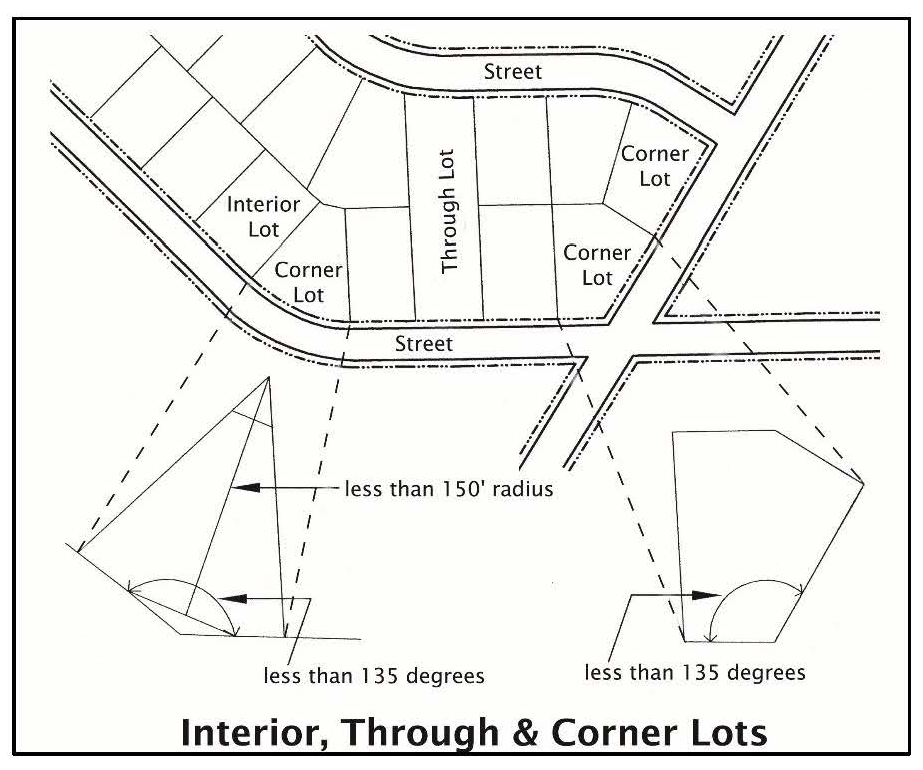
Lot lines: The lines bounding a lot as defined herein.
Lot line, front: In the case of an interior lot, the line separating said lot from the street. In the case of a corner lot, or double frontage lot, is that line separating said lot from that street which is designated as the front street in the plat and in the application for a building permit or zoning compliance permit.
Lot line, rear: The lot line opposite the front lot line. In the case of a lot pointed at the rear, the rear lot line shall be an imaginary line parallel to the front lot line not less than ten feet long lying farthest from the front lot line and wholly within the lot.
Lot line, side: Any lot lines other than the front lot line or rear lot line. A side lot line separating a lot from a street is a side street lot line. A side lot line separating a lot from another lot or lots is an interior side lot line.
Lot of record: Is a parcel of land, the dimensions of which are shown on a document or map on file with the county register of deeds or in common use by city or county officials, and which actually exists as so shown, or any part of such parcel held in record ownership separate from that of the remainder thereof.
Lot width: The horizontal distance between the side lot lines measured at the two points where the building line or setback intersects the side lot lines.
Major thoroughfare: An arterial street which is intended to serve as a large-volume traffic-way for both the immediate city area and the region beyond, and may be designated as a major thoroughfare, parkway, freeway, expressway, or equivalent term to identify those streets comprising the basic structure of the street plan. For the purposes of this ordinance, major thoroughfares shall be considered to be section line roads and roads of 120 feet right-of-way or more.
Manufacturing and processing: An enclosed establishment engaged in the mechanical or chemical transformation of materials or substances into new products, including the assembling of component parts, the creation of products, and the blending of materials, usually in a continuous and regular action or succession of actions.
Manufactured home: Any structure, transportable in one (1) or more sections, which is built on a chassis and designed to be sold as a dwelling with or without permanent foundation, when connected to the required utilities, and includes the plumbing, heating, air conditioning, and electrical systems contained in the structure. Manufactured housing does not include recreational vehicles or equipment.
Manufactured home park: A parcel or tract of land under the control of a person on which three (3) or more manufactured homes are located on a continual non-recreational basis and which is offered to the public for that purpose regardless of whether a charge is made therefore, together with any building, structure, enclosure, street, equipment or facility used or intended for use incident to the occupancy of a manufactured home and which is not intended for use as a temporary trailer park.
Master deed: The condominium document recording the condominium project to which are attached as exhibits and incorporated by reference the bylaws for the project and the condominium subdivision plan for the project and all other information require by Section 8 of the Condominium Act, Public Act No. 59 of 1978.
Master plan: Is the comprehensive plan including graphic and written proposals indicating the general location for streets, parks, schools, public buildings and all physical development of the City of Center Line, and includes any unit or part of such plan, and any amendment to such plan or parts thereof. Such plan may or may not be adopted by the planning commission and/or the city council.
Mezzanine: Is an intermediate floor in any story occupying an area not to exceed one-third of the floor area of such story.
Mixed use: A multi-story dwelling unit where the first floor is designed as a storefront for retail, service, office, or artisan studio and a dwelling unit on the upper floors.
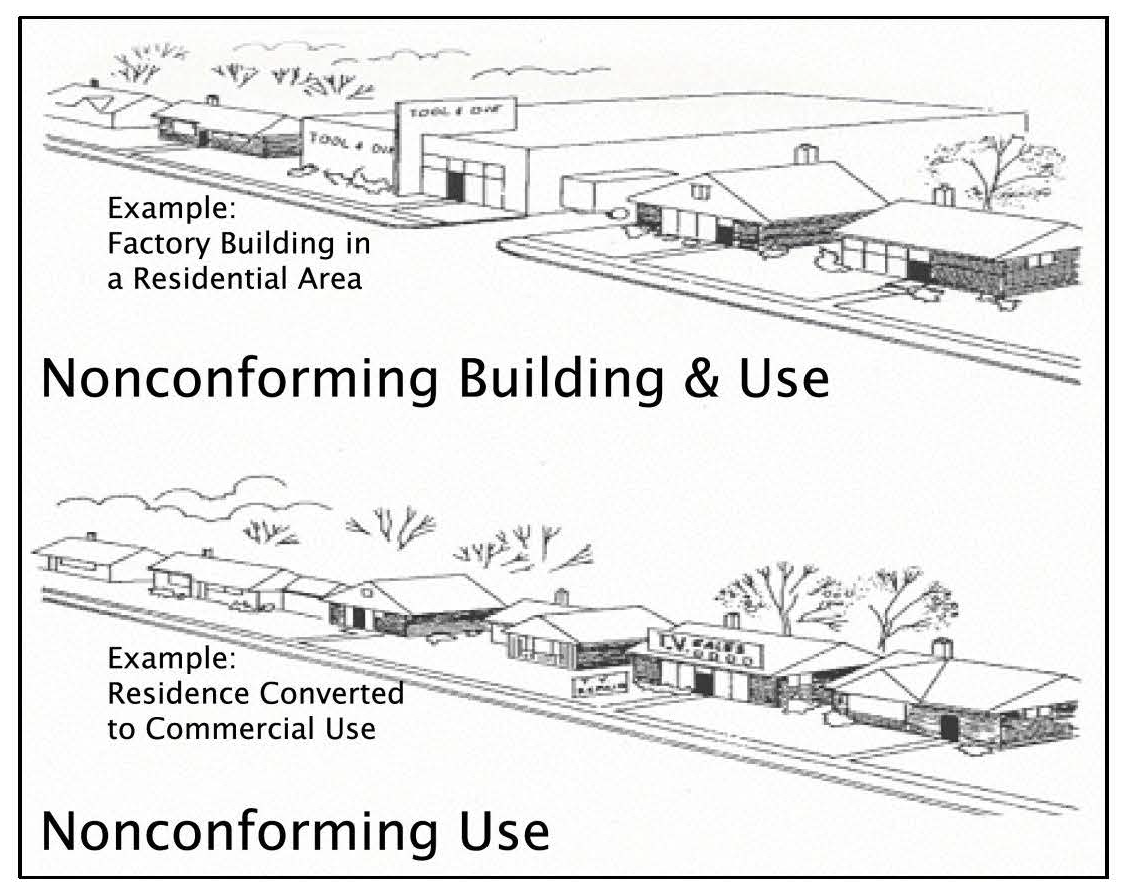
Nonconforming building or structure: Any building or structure lawfully established which does not comply with all the regulations of this Zoning Ordinance or of any amendment thereto governing bulk of the district in which such building or structure is located.
Nonconforming lot: Is one that, at the time of its establishment, met the minimum lots size requirements for the zone in which it is located but which, because of subsequent changes to the minimum lot size applicable to that zone, is now smaller than that minimum lot size.
Nonconforming use: Any use thereof or the use of land that does not conform with the regulations of this comprehensive amendment or any amendments thereto governing use of the district in which it is located but conformed with all of the codes, ordinances and other legal requirements applicable at the time such building or structure was erected, enlarged or altered, and the use thereof or the use of land was established.
Off-street parking lot: A facility other than for one-family dwellings providing vehicular parking spaces along with adequate drives and aisles, for maneuvering, so as to provide access for entrance and exit for the parking of more than three (3) vehicles.
Open front store: A business establishment, other than a drive-in gasoline service station, so developed that service to the patron may be extended beyond the walls of the building, not requiring the patron to enter said building.
Open Space: A parcel or area of land that is intended to provide light and air, and is designed for resource protection, aesthetic, or recreational purposes. Open space uses may include, but are not limited to lawns, decorative plantings, walkways, active and passive recreation areas, land use buffers, playgrounds, fountains, woodlands, wetlands and bio-retention facilities. Open space shall not include streets, driveways, parking lots, or other surfaces designed or intended for vehicular traffic.
Open space, common: Open space within or related to a development, not in individually owned lots, which is designed for and dedicated to the common use or enjoyment of the residents of the development or general public.
Parking space: Is hereby determined to be an area of definite length and width and shall be exclusive of drives, driveways, aisles or entrances giving access thereto and shall be fully accessible for the storage or parking of permitted vehicles.
Places of Assembly: Unless otherwise identified and defined by this ordinance, "places of assembly" means any building, structure, and/or grounds where groups of more than twenty (20) people meet or are assembled. Places of assembly shall include, but are not limited to auditoriums, lecture halls, stadiums, sports arenas, convention spaces, and other similar facilities.
Place of worship: A site used for or intended for the regular assembly of persons for the conducting of religious services and accessory uses therewith.
Planned Unit Development (PUD): A development consisting of a combination of land uses in which the specific development configuration and use allocation is based upon a comprehensive physical plan meeting the requirements of this ordinance.
Planning Commission: The Planning Commission of the City of Center Line.
Private home: A private residence in which the licensee or registrant permanently resides as a member of the household, which residency is not contingent upon caring for children or employment by a licensed or approved child placing agency.
Public utility: Is any person, firm or corporation, municipal department, board or commission duly authorized to furnish and furnishing under federal, state, or municipal regulations to the public: gas, steam, electricity, sewage disposal, communication, telegraph, transportation, or water.
Recreational equipment: Travel trailers, pickup campers or coaches, motorized dwellings, tent trailers, boats and boat trailers, snowmobiles, horse trailers, dune buggies and other similar equipment.
Restaurant: A public eating house where food or beverage is served on non-disposable containers.
Restaurant, carry-out: A business establishment for the selling of food or beverage which is served in disposable containers or wrappers for consumption exclusively off the premises.
Restaurant, drive-in/fast food: A business establishment for selling of food or beverage which is served in disposable containers or wrappers. Such food or beverage may be consumed inside or outside of the building in motor vehicles or carried out for consumption off of the premises.
Retail sales: An establishment engaged in selling goods or merchandise to the general public for personal or household consumption and rendering services incidental to the sale of such goods.
Right-of-way: A strip of land occupied or intended to be occupied by a street or related facilities, public path or trail, railroad, electric line, oil or gas pipeline, water main, sanitary or storm sewer, communication line, or for other special uses.
Senior housing: An institution other than a hospital or hotel, which provides housing or room and board to non-transient persons primarily sixty (60) years of age or older. Housing for seniors may include:
Independent living: A multiple-family housing form with full facilities for self-sufficiency in each individual dwelling unit.
Congregate care: A dependent elderly housing facility with cooking facilities within the unit, but with a central dining service option. Limited medical care is available.
Assisted living: A dependent elderly housing facility without cooking facilities and only central dining service. Limited medical care is available.
Convalescent home: A state licensed medical establishment providing accommodation and care for aged or infirmed persons, or for those who are bedfast or needing considerable nursing care, but not including facilities for the treatment of sickness or injuries or facilities for surgical care. Commonly referred to as "nursing home".
Setback: The distance required to obtain front, side or rear yard open space provisions of this ordinance.
Self-storage facility: A building or group of buildings containing fully enclosed, compartmentalized stalls or lockers which are rented or leased as individual units for the storage of personal property customarily related to residential, office, and/or local commercial activities.
Sign: Any structure or part thereof, or devise attached thereto or painted or represented thereon, or any material or thing, illuminate or otherwise, which displays or includes any numeral, letter, work, model, banner, emblem, insignia, device, code mark or other representation used as or in the nature of, an announcement, advertisement, direction or designation, of any person, firm, organization place, commodity, service, business, profession, or industry, or any backlit building area, which is located upon any land or in or on any building, in such a manner as to attract attention from outside the premises.
Solar energy collector: A panel or panels and/or other devices or equipment, or any combination thereof, that collect, store, distribute and/or transform solar, radiant energy into electrical, thermal or chemical energy for the purpose of generating electric power or other form of generated energy for use in or associated with a principal land use on the parcel of land on which the solar energy collector is located and, if permitted, for the sale and distribution of excess available electricity to an authorized public utility for distribution to other lands.
Building-mounted: A solar energy collector attached to the roof or wall of a building or which serves as the roof, wall or window or other element, in whole or in part, of a building.
Ground-mounted: A solar energy collector that is not attached to and is separate from any building on the parcel of land on which the solar energy collector is located.
Active Structure: A structure which utilizes mechanically-operated solar collectors to collect, transfer or store solar energy.
Passive Structure: A structure which uses natural and architectural components to collect and store solar energy without using external mechanical energy.
Special approval uses: A land use or an activity which, under certain circumstances, might be detrimental to other permitted uses and should not be permitted as a right in a given zoning district, but which use can be permitted under circumstances unique to the proposed location and subject to conditions acceptable to the city which provide protection to land uses. A land use which is permitted in a zoning district only after review and approval of the planning commission.
Story: Is that part of a building (except a mezzanine as defined herein) included between the surface of one floor and the surface of the next floor, or if there is no floor above, then the ceiling next above. A story thus defined shall not be counted as a story when more than 50 percent by cubic content is below the height level of the adjoining ground. (See the diagram.)
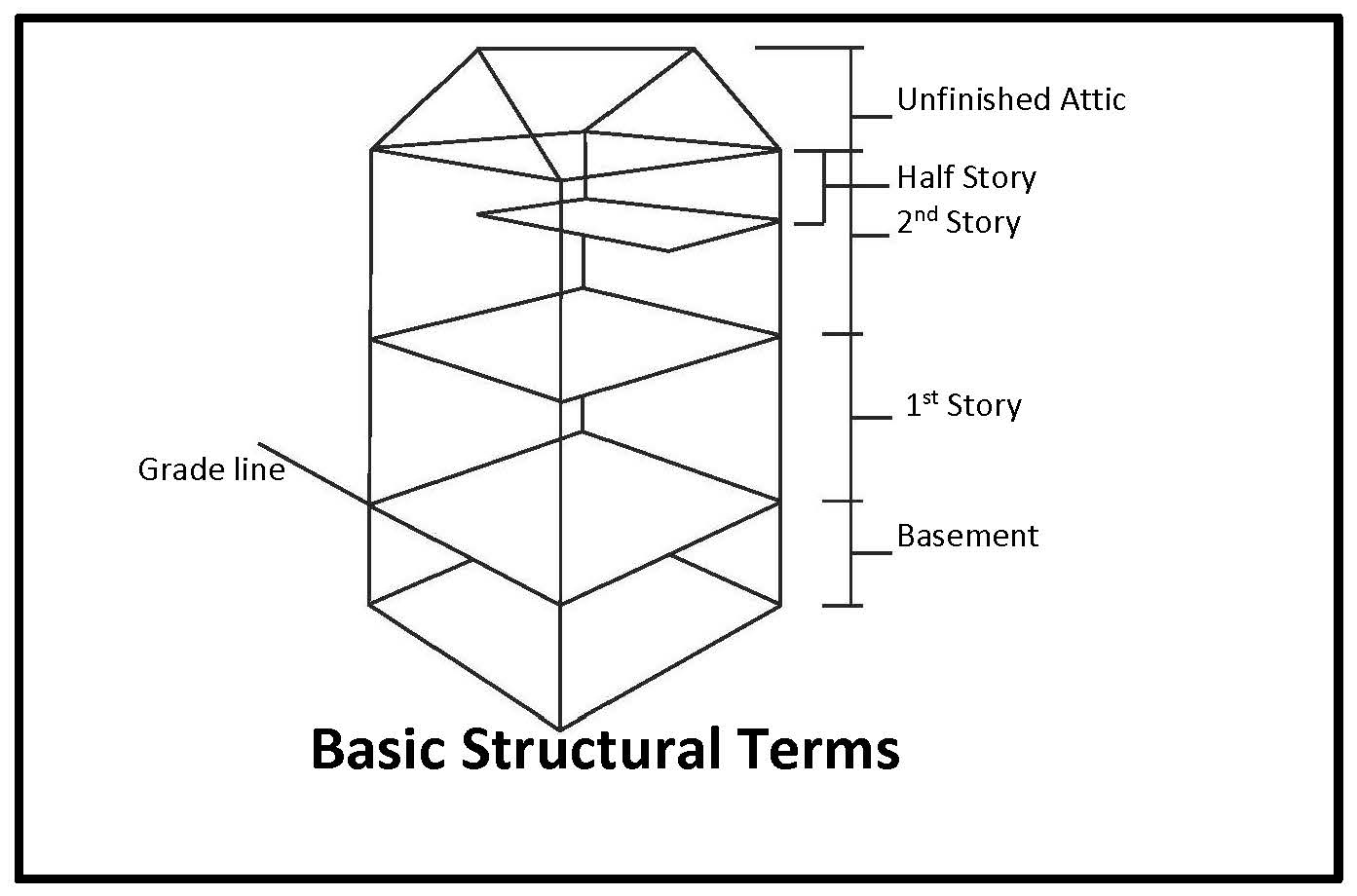
Story, half: Is an uppermost story lying under a sloping roof, the usable floor area of which, at a height of four feet above the floor, does not exceed two-thirds of the floor area in the story directly below, and the height above at least 200 square feet of floor space is seven feet six inches.
Street: Is a public or officially recognized private thoroughfare which affords the principal means of access to abutting property, but not including driveways to buildings. An alley shall not be considered a street.
Structure: Is anything constructed or erected, the use of which requires location on the ground or attachment to something having location on the ground.
Substance abuse clinic: A facility providing detoxification or treatment for persons suffering ill effects from alcohol or drugs.
Substantial improvement: Means any repair, reconstruction or improvement of a structure, the cost of which exceeds 50 percent of the market value of the structure either (1) before the improvement or repair is started, or (2) if the structure has been damaged and is being restored, as before the damage occurred. For the purpose of this definition, "substantial improvement" is considered to occur when the first alteration of any wall, ceiling, floor or other structural part of the building occurs, whether or not that alteration affects the external dimensions of the structure. The term does not, however, include (1) any project for improvement of a structure to comply with existing State or local health, sanitary or safety code specifications which are solely necessary to assure safe living conditions, or, (2) any alteration of a structure listed on the National Register of Historic Places or a State Inventory of Historic Places.
Temporary building or use: A use or building permitted by the building department or zoning board of appeals to exist during period of construction of the main building or use, or for special events.
Tents: Portable shelter of canvass, coarse cloth, etc., supported by one or more poles, but not including those used solely for children's recreational purposes.
Use: Is the purpose for which land or a building is designed, arranged, or intended, or for which land or a building is or may be occupied.
Use, accessory: Is a use subordinate to the main use of a lot and used for purposes clearly incidental to those of the main use.
Use, primary: Is the principal use to which the premises are devoted and the principal purpose for which the premises exist.
Wall (fence): A completely obscuring structure of definite height and location to serve as an obscuring screen in carrying out the requirements of this ordinance.
Variance: Is a modification of the literal provisions of the zoning ordinance granted when strict enforcement of the zoning ordinance would cause practical difficulties or unnecessary hardship owing to circumstances unique to the individual property for which the variance is granted. A variance is permanent regardless of change of ownership.
Area variance: An area variance is a request for a modification from the literal provisions of the zoning ordinance relating to height, size, or setback. An area variance may be granted upon a showing that there are practical difficulties associated with compliance with the strict terms of the ordinance.
Use variance: A use variance is a request for modification of the literal provisions of the zoning ordinance regulating the use of property. The granting of a use variance is disfavored. A use variance may be granted only upon a showing that unnecessary hardship will result from strict compliance with the terms of the zoning ordinance. An unnecessary hardship only results where it would be arbitrary and unreasonable or confiscatory to require that the property be put to a use in conformance with the zoning ordinance.
Wind Energy Conversion System (WECS): Any device such as a turbine, windmill or charger that converts wind energy to a usable form of energy. WECS shall fall within two (2) classifications: on-site or commercial, and shall typically be defined as horizontal-axis or vertical-axis:
Commercial wind energy conversion system: Any WECS that is exclusively designed and built to provide electricity to the electric utility's power grid as an ongoing commercial enterprise or for commercial profit.
On-site wind energy conversion system: A WECS, the energy from which is used only by the primary residence or residences in a cooperative effort, business or agricultural operation and not sold or transferred to the electrical grid for commercial profit. This does not exclude the sale of excess energy sold to a utility through net metering for on-site WECS when the WECS produces more energy than can be stored or used on-site.
Horizontal-axis wind energy conversion system: Conventionally designed systems that have a main rotor shaft that is parallel to the ground and a series of "blades" that are perpendicular to the ground, as in a traditional agricultural windmill. Horizontal-axis wind energy conversion systems are traditionally mounted on a tower or pole and must be pointed into the wind.
Vertical-axis wind energy conversion system: Systems that have a main rotor shaft that is perpendicular to the ground and the system does not need to be pointed into the wind. These systems are more common in areas where wind direction is variable. These systems often resemble a drum, cylinder, or helix.
Wireless communication facilities: All structures and accessory facilities relating to the use of the radio frequency spectrum for the purpose of transmitting or receiving radio signals. This may include, but shall not be limited to, radio towers, television towers, telephone devices and exchanges, micro-wave relay facilities, telephone transmission equipment building and commercial mobile radio service facilities. Not included within this definition are: citizen band radio facilities; short wave receiving facilities; amateur (ham) radio facilities; satellite dishes; and, governmental facilities which are subject to state or federal law or regulations which preempt municipal regulatory authority. For purposes of this ordinance, the following additional terms are defined:
Collocation: Shall mean the location by two (2) or more wireless communication providers of wireless communication facilities on a common structure, tower, or building, with the view toward reducing the overall number of structures required to support wireless communications antennas within the community.
Wireless communication antenna (WCA): Shall mean any antenna used for the transmission or reception of wireless communication signals excluding those used for dispatch communications by public emergency stations, ham radio antennas, and satellite antennas, those who receive video programming services via multi-point distribution services which are forty (40) inches or less in diameter and those which receive television broadcast signals. Antenna may be affixed to existing structures, such as existing buildings, towers, water tanks, utility poles, and the like. A wireless communication support structure proposed to be newly established shall not be included within this definition.
Wireless communication support structures: Shall mean structures erected or modified to support wireless communication antennas. Support structures within this definition include, but shall not be limited to, monopoles, lattice towers, light poles, wood poles and guyed towers, or other structures which appear to be something other than a mere support structure.
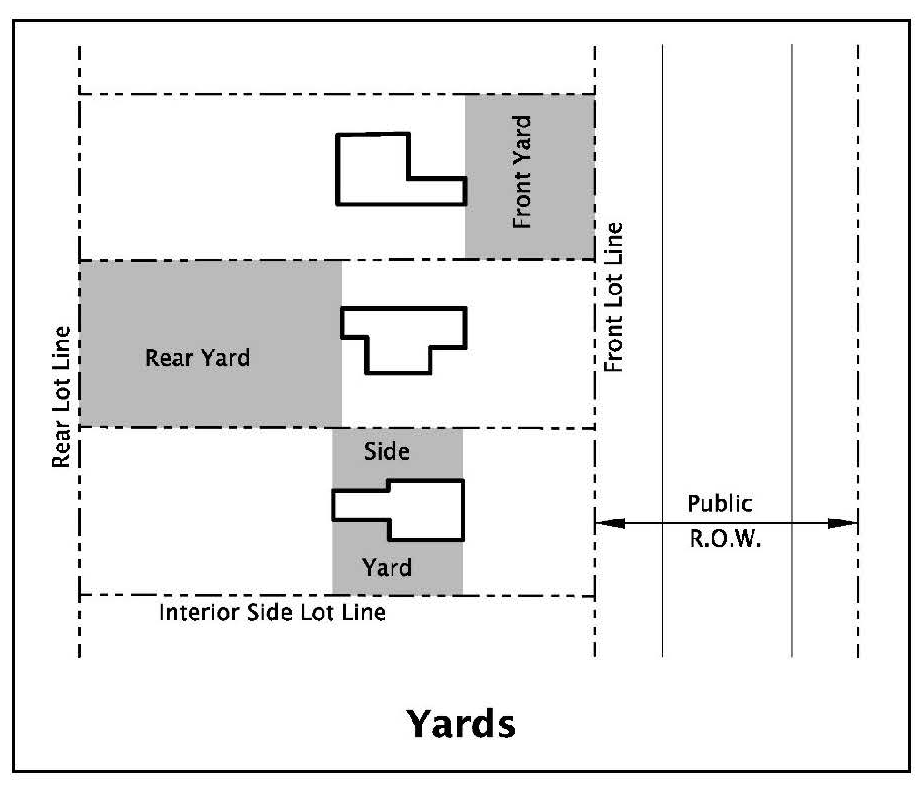
Yards: The open spaces on the same lot with a main building, unoccupied and unobstructed from the ground upward except as otherwise provided in this ordinance, and as defined herein:
Front yard: Is an open space extending the full width of the lot, the depth of which is the minimum horizontal distance between the front lot line and the nearest line of the main building.
Rear yard: Is an open space extending the full width of the lot, the depth of which is the minimum horizontal distance between the rear lot line and the nearest line of the main building.
Side yard: Is an open space between a main building and the side lot line, extending from the front yard to the rear yard, the width of which is the horizontal distance from the nearest point of the side lot line to the nearest point of the main building. (See the diagram.)
Zoning Enabling Act: The Michigan Zoning Enabling Act, as amended, MCL 125.3101 et.seq.as adopted by Public Act 110 of 2006.
(Ord. of 10-12-18(1))

