
Center Line City Zoning Code
ARTICLE IV
SPECIFIC LAND USE PROVISIONS
Sec. 400.- Purpose.
Each use listed in this article, whether permitted by right or subject to approval as a special land use, shall be subject to the site development standards specified, in addition to applicable standards and requirements for the district in which the use is located. These standards are intended to:
(A)
Alleviate any adverse impacts of a use that is of an area, intensity or type unique or atypical for the district in which the use is allowed.
(B)
Mitigate the impact of a use that possesses characteristics unique or atypical for the district in which the use is allowed.
(C)
Ensure that such uses will be compatible with surrounding land uses.
(D)
Promote the orderly development of the district and the City as a whole.
Conformance with these standards shall be subject to site plan review. Unless otherwise specified, each use listed in this article shall be subject to all applicable yard, bulk and other standards for the district in which the use is located.
For the purpose of this ordinance, this article is hereby divided into the following districts:
RESIDENTIAL USES
RECREATION USES
INSTITUTIONAL USES
RETAIL, ENTERTAINMENT, AND SERVICE USES
OFFICE USES
INDUSTRIAL USES
AUTOMOBILE/TRANSPORTATION USES
MISCELLANEOUS USES
(Ord. of 10-12-18(1))
Sec. 401. - Residential uses.
(A)
Dwelling, multiple-family. Multiple-family dwellings shall comply with the following:
(1)
Density. All Multiple-Family units shall meet the minimum lot width and maximum lot percentage specified for the zoning district in which the development is located.
(2)
Architectural Details.
(a)
Walls visible from a street or any other residential use shall include windows and architectural features similar to the front facade of the building, including, but not limited to awnings, cornice work, edge detailing or other decorative finish.
(b)
All buildings shall have pitched roofs that may include functional dormer windows and varying lines customary with gable or hip style roofing. Standing seam metal roofing is prohibited.
(c)
No more than four (4) dwelling units shall be attached in any construction group, or contained in any single structure, except that where the roof ridge line and building facades of any four (4) consecutive units are staggered or offset by at least ten (10) feet, then a maximum of eight (8) units may be permitted.
(d)
The dwelling units shall contain storage capability in a basement located under the dwelling, in an attic area, in closet areas, or in a separate structure of standard construction similar to or of better quality than the principal dwelling, which storage area shall be equal to a minimum of ten (10) percent of the square footage of the dwelling unit, or 100 square feet, whichever is greater.
(e)
Dwelling units shall be provided with an exterior building wall configuration that represents an average width to depth or depth to width ratio that does not exceed three to one (3:1), or is in reasonable conformity with the configuration of dwelling units on adjacent properties or in the surrounding residential neighborhood. Dwelling units shall be permanently attached to a perimeter foundation and shall have the same perimeter dimensions as the dwelling.
(3)
Frontage, Access and Vehicle Circulation. Multiple-Family developments shall have frontage on, and direct vehicle access to a public street classified as a collector, arterial or thoroughfare by the City's Master Plan, or county or state road authorities. Vehicle access to local streets shall be limited to secondary access where necessary for health and safety purposes.
(a)
All interior roads, drives, and parking areas within a multi-family development shall be hard surfaced and provided with curbs and gutters. Roadway drainage shall be appropriately designed such that storm water from the roadway will not drain onto the adjacent lots.
(b)
Ingress-egress to parking facilities shall be arranged to minimize curb cuts directly onto the major thoroughfares or collector streets.
(c)
All buildings, uses, open spaces, and any service roads, driveways and parking areas shall be arranged and designed to minimize any adverse effects upon adjacent property, including but not limited to:
(i)
Channeling excessive traffic onto local residential streets.
(ii)
Lack of adequate screening or buffering of parking or service areas.
(iii)
Building groupings or circulation route locations that interfere with police or fire equipment access.
(4)
Pedestrian Circulation. Public sidewalks shall be provided along collector and perimeter roads and streets in accordance with adopted City standards. Concrete sidewalks with a minimum width of five (5) feet shall be provided from all building entrances to adjacent parking areas, public sidewalks, and recreation areas.
(5)
Parking. The Planning Commission may give credit towards parking requirements where abutting on-street parking is available and parking use does not interfere with the needs of any other land uses. All off-street parking spaces must be screened from view of any public road, pedestrian path, or adjacent residential use in compliance with landscape and screening requirements of this ordinance.
(6)
Recreation Areas. Passive or active recreation areas (including but not limited to seating areas, playgrounds, swimming pools, walking paths and other recreational elements in accordance with the intended character of the neighborhood) shall be provided at a ratio of at least fifteen percent (15%) of the gross area of the development. The minimum size of each area shall be 5,000 contiguous square feet, and the length to width ratio of each area, as measured along the perimeter, shall not exceed four to one (4:1). Such areas shall be centrally and conveniently located to be physically and visibly accessible to residents, and shall not be located within any required yard setbacks or building separations.
(7)
Utilities. All multiple-family dwellings shall be connected to the public sewer and public water system.
(8)
Supplemental regulations.
(a)
Setbacks Adjacent to Residential for RM-1. Where a property is abutting a one-family or one-family attached district, all setbacks abutting said district shall be equal to the height of the building.
(b)
In R-M districts, no multiple-family building shall be erected on a lot or parcel of land which has an area of less than 9,600 square feet or has a width of less than 80 feet. The following minimum lot sizes and floor areas shall be met:
(i)
Four-bedroom unit: 4,500 square feet minimum lot size, and 1,000 square feet minimum floor area per unit.
(ii)
Three-bedroom unit: 3,000 square feet minimum lot size, and 750 square feet minimum floor area per unit.
(iii)
Two-bedroom unit: 2,500 square feet minimum lot size, and 600 square feet minimum floor area per unit.
(iv)
One-bedroom unit: 2,000 square feet minimum lot size, and 450 square feet minimum floor area per unit.
(v)
Efficiency apt.: 1,750 square feet minimum lot size, and from a minimum 300 square feet to a maximum 360 square feet floor area per unit.
Where a front yard of greater or lesser depth than above specified exists for dwellings on more than 50 percent of the lots of record on one side of a street in any single block, the depth of the front yard for buildings thereafter erected or enlarged in such block shall be not less, but need not be greater than, the average depth of the front yards of all existing dwellings within the block.
(9)
Other Requirements.
(a)
Adequate landscaping and screening shall be provided along all property lines that abut a residential district or use, and along all street frontages. Parking or storage of recreational vehicles, boats, utility trailers or similar items shall be prohibited, except in areas designated on an approved final site plan.
(b)
Any business uses on the site shall be developed as retail or service uses clearly accessory to the main use, within the walls of the main structure, and totally obscured from any exterior view. No identifying sign for any such business use shall be visible from any exterior view. Such business uses shall not exceed 25 percent of the floor area at grade level or 50 percent of the floor area of a subgrade level and shall be prohibited on all floors above the first floor, or grade level. Uses located in the B-3 Corridor District are exempted.
(c)
The entire area of the site shall be treated so as to service only the residents of the multiple-family development; and any accessory buildings, uses or services shall be developed solely for the use of residents of the main building. Uses considered herein as accessory uses include parking structures, swimming pools, recreation areas, pavilions, cabanas, and other similar uses.
(B)
Dwelling, one-family detached. Detached one-family dwellings, except manufactured housing units located in an approved and licensed manufactured housing parks, shall comply with the following standards:
(1)
Architectural Details.
(a)
Dwelling units shall be provided with an exterior building wall, foundation and roof configuration that are similar to the dwelling units on adjacent properties or in the surrounding residential neighborhood. The minimum width across any front, side or rear elevation shall be 24 feet, and the average width to depth or depth to width ratio shall not exceed three to one (3:1). The roof over-hang shall be a minimum of one (1) foot on all sides.
(b)
Dwelling units shall be provided with exterior finish materials similar to and aesthetically compatible with the dwelling units on adjacent properties or in the surrounding residential neighborhood. Such materials shall include siding or wall materials, windows, porches, shingles and other roofing materials. Standing seam metal roofing is prohibited.
(c)
Dwelling units shall be permanently attached to a perimeter foundation and shall have the same perimeter dimensions as the dwelling. All such dwellings shall be secured to the premises by an anchoring system or device that is in full compliance with all applicable codes and rules.
(2)
Utilities. All one-family dwellings shall be connected to the public sewer and public water system.
(3)
Storage. The dwelling units shall contain storage capability in a basement located under the dwelling, in an attic area, in closet areas, or in a separate structure of standard construction similar to or of better quality than the principal dwelling, which shall be equal to a minimum of ten percent (10%) of the square footage of the dwelling or 100 square feet, whichever is greater.
(4)
Front Porch. New dwellings shall be constructed with a primary entrance on the front facade and connected to the public sidewalk or right-of-way by a paved path, with a front porch or stoop that is at least six (6) feet in width and depth, and 70 square-feet in area.
(5)
Determinations. This Section is not intended to discourage architectural variation, but shall seek to promote the reasonable compatibility of the character of dwelling units, thereby protecting the economic welfare and property value of surrounding residential uses and the City at large.
(a)
The compatibility of design and appearance shall be determined by the Building Official, subject to appeal by an aggrieved party to the Zoning Board of Appeals.
(b)
The Building Official may require the applicant to furnish such plans, elevations and similar documentation as is deemed necessary to permit a complete review and evaluation of the proposal.
(c)
Any determination of compatibility shall be based upon these standards, with a comparison to the character, design and appearance of homes in the same neighborhood within 300 feet of the subject lot, outside of any manufactured housing parks. If the area within 300 feet does not contain any such homes, then the nearest 25 similar type dwellings shall be considered.
(6)
Supplemental regulations. In R-1 and R-2 districts, the side yard abutting upon a street shall not be less than ten feet when there is a common rear yard. In the case of a rear yard abutting a side yard of an adjacent lot, the side yard abutting a street shall not be less than the required front yard of that district.
(C)
Dwelling, two-family. The exterior of a two-family dwelling (or duplex) shall be designed, constructed and maintained in a manner that provides the appearance of a one-family dwelling as specified by Section 401. All other requirements of Section 317 shall apply.
(D)
Home Occupations. Home occupations shall be subject to the following:
(1)
Use Standards.
(a)
Intensity of use. Home occupations must be clearly incidental and secondary to the use of the dwelling as a residence. No more than twenty-five percent (25%) of the habitable floor area of the residence and twenty-five percent (25%) of the floor area of any accessory structure may be used for the home occupation.
(b)
Employment. No persons shall be employed in the home occupation, other than the dwelling occupants.
(c)
Customer or client visits. A home occupation shall not generate more than five (5) customer or client visits per day, nor more than 20 customer or client visits per week. No more than two (2) customers or clients may be present at any given time.
(d)
Commercial vehicle parking and deliveries. Home occupations shall be limited to the parking or storage of one (1) commercial vehicle on the premises not exceeding a three-quarter (3/4) ton capacity, provided such vehicle is directly related to the home occupation. Delivery vehicles used to deliver goods to a home occupation are limited to automobiles, passenger vehicles, mail carriers and express package carriers.
(e)
The appearance of the structure shall not be altered nor shall the home occupation be conducted in a manner which would cause the premises to differ from its residential character, either by the use of colors, materials, construction, lighting, signs, or the emission of sounds, noises or vibrations.
(f)
No home occupation shall require internal or external alterations or involve construction features or the use of electrical or mechanical equipment that would change the fire rating of the structure.
(g)
No home occupation shall cause an unreasonable increase in the use of any one or more utilities (water, sewer, electricity, telephone, trash removal, etc.) so that the combined total use for the dwelling unit and home occupation exceeds that average for residences in the neighborhood.
(h)
The home occupation may increase vehicular traffic flow and parking by no more than one additional car at a time. Any need for parking generated by the conduct of such home occupation shall be met off the street and other than in the required front yard.
(i)
Hours of operation. Customer or client visits, and deliveries associated with the home occupation shall be limited to between the hours of 7:00 a.m. and 8:00 p.m.
(2)
Permitted Home Occupations. The following uses shall be permitted as home occupations.
(a)
Home offices for such professionals as architects, doctors, brokers, engineers, insurance agents, lawyers, realtors, accountants, writers, salespersons and similar occupations.
(b)
Personal services, including barber shops, beauty parlors, manicure and pedicure shops, grooming, catering, and chauffeuring services.
(c)
Home office for a massage therapist, shall be subject to the following conditions:
(i)
Hospitals, sanitariums, nursing homes, medical clinics or the offices of physicians, surgeons, chiropractors, osteopaths, psychologists, clinical social workers or family counselors who are licensed to practice in the state shall be permitted to provide massage therapy services as an accessory use within the principal building.
(ii)
All massage therapists shall be licensed (where such licenses are available), and shall be certified members of the American Massage and Therapy Association or International Myomassethics Federation. Proof of such licenses or certifications shall be provided to the City.
(iii)
All activities that meet the definition of an adult use or sexually-oriented business shall be prohibited.
(d)
Music, dance, art and craft classes, tutoring, and studios for artists, sculptors, musicians and photographers.
(e)
Workshops for tailors, dressmakers, milliners, and craft persons, including weaving, lapidary, jewelry making, cabinetry, and wood-working.
(f)
Repair services, limited to watches and clocks, small appliances, computers, electronic devices, and similar small devices.
(g)
Any home occupation not specifically listed may be permitted as a special land use by the Planning Commission, subject to the provisions of Section 401.
(3)
Prohibited Uses and Activities.
(a)
Prohibited Uses. Home occupations shall not include:
(i)
Automobile truck, recreation vehicle, boat, motorcycle or small engine repair, bump and paint shops, salvage or storage yards.
(ii)
Kennels or veterinary clinics.
(iii)
Medical or dental clinics.
(iv)
Retail sales of merchandise, or eating and/or drinking establishments.
(v)
Undertaking and funeral homes.
(vi)
Adult uses and sexually-oriented businesses.
(vii)
Uses similar to the above listed uses, or any use which would, in the determination of the City Manager, result in nuisance factors as defined by this ordinance.
(b)
Prohibited activities. Home occupations shall not include:
(i)
Outdoor display and/or storage of materials, goods, supplies, or equipment used in the home occupation.
(ii)
The use of machinery, equipment or facilities not commonly incidental or accessory to a residential dwelling.
(iii)
Changes or alterations to the character or appearance of the residence.
(iv)
Use of any signs or outside displays on the premises, except as permitted for residential dwellings in Article VII, Signs.
(v)
Parking that cannot be accommodated on the site, plus one (1) on-street parking space.
(vi)
A home occupation shall not create noise, dust, vibration, smell, smoke, glare, electrical interference, fire hazard, or any other hazard or nuisance to any greater or more frequent extent than normally occurs in a similarly zoned residential district.
(4)
Home Occupation Permits. A permit must be obtained to lawfully operate a home occupation. Applications for such a permit shall be submitted to the City for review by the City Manager and Building Official.
(a)
If, in the written opinion of the Building Official and the City Manager, the proposed home occupation conforms to the standards of this Section, a permit to lawfully operate a home occupation shall be issued by the City.
(b)
If the City Manager or Building Official determines that the proposed home occupation does not comply with the standards of this Section, the applicant may request the City Manager to refer the proposed home occupation to the Planning Commission for review as a special land use, subject to the provisions of Section 1001.
(c)
Should a lawfully established home occupation no longer meet the conditions outlined above or other conditions stipulated for approval, a violation shall be cited against the operator of the home occupation. The operator of the home occupation shall have ten (10) working days to correct the referenced violations. If the violations are not corrected within that time, the permit to operate the home occupation shall be revoked and all related activities must cease.
(d)
Permits to operate a home occupation shall be reviewed on an annual basis in conjunction with issuance of a business license through the City Clerk.
(e)
Home occupation permits shall be limited to the applicant who legally resides in the residence.
(E)
Manufactured Housing Parks. Manufactured housing parks shall be subject to all the rules and requirements of the Mobile Home Commission Act, the Manufactured Housing Commission General Rules, and the following minimum requirements:
Manufactured housing parks may be permitted in R-M multiple-family residential districts by the zoning board of appeals, after having received the recommendation of the planning commission, if it finds the use as not being contrary to the spirit and purpose of this ordinance. The manufactured housing park will be managed, organized, and regulated by the developer. Streets, utilities, open space, recreation, and amenities will be provided and regulated by the developer. As a result, the City of Center Line has recognized the need to locate manufactured housing parks along major transportation routes and in areas of adequate utilities and public services.
(1)
Principal uses permitted. Manufactured housing parks, subject to the requirements as established and regulated by Act No. 96 of the Public Acts of Michigan of 1987, as amended, and all applicable codes and ordinances referenced herein.
(a)
Clubhouse and recreation facilities for the use of the park residents.
(b)
Manager's office,
(c)
Off-street parking as required by the Michigan Mobile Home Commission Rules 925 and 926.
(2)
Plan Review. The preliminary plan for a manufactured housing park shall be submitted to the City and reviewed by the Planning Commission in accordance with the application requirements and procedures specified in Section 11 of the Mobile Home Commission Act. The Planning Commission shall take action to approve or deny the preliminary plan, or approve the preliminary plan subject to conditions, within 60 days after the City officially receives a complete and accurate application. The Planning Commission may table an application for further study, or to obtain additional information, provided that final action is taken within the 60 day review period. A copy of the state-approved final construction plan shall be submitted to the City prior to the start of construction on the site.
(3)
Minimum Area for a Manufactured Housing Park. The minimum parcel size for manufactured housing parks shall be five (5) acres, excluding adjacent parcels proposed for expansion.
(4)
Minimum Manufactured Housing Site Size. Manufactured housing parks shall be developed with a minimum manufactured housing site size of 5,500 square feet. Individual sites may be reduced to as small as 4,400 square feet, provided that for every square foot of land gained through such reduction, at least an equal amount of land shall be dedicated as open space for the collective use and enjoyment of all manufactured housing park residents. This open space shall be in addition to the minimum open space required under the Manufactured Housing General Rules.
(5)
Setbacks. Manufactured houses shall comply with the following minimum setbacks:
(a)
For a home not sited parallel to an internal road, 20 feet from an adjacent home, including an attached structure that may be used for living purposes for the entire year.
(b)
For a home sited parallel to an internal road, 15 feet from an adjacent home, including an attached structure that may be used for living purposes for the entire year if the adjacent home is sited next to the home on and parallel to the same internal road or an intersecting internal road.
(c)
Ten (10) feet from an attached or detached structure or accessory of an adjacent home that may not be used for living purposes for the entire year.
(d)
50 feet from any permanent building.
(e)
100 feet from any baseball, softball or similar recreational field.
(f)
Seven (7) feet from the back of curb or edge of pavement for an internal road.
(g)
Seven (7) feet from an adjacent home site's parking space or off-site parking bay.
(h)
Seven (7) feet from a common sidewalk.
(i)
All manufactured housing, accessory buildings and parking shall be setback not less than 20 feet from any manufactured housing park boundary line, except that a minimum setback of 50 feet shall be provided from the street rights-of-way of public streets abutting the park.
(j)
50 feet from the edge of any railroad right-of-way.
(6)
Maximum Height. The maximum height of any community or similar building in a manufactured housing park shall not exceed two (2) stories or 35 feet, whichever is less. Storage or service buildings shall not exceed one (1) story or 15 feet.
(7)
Minimum Floor Area. There shall be not less than 750 square feet of floor area within each manufactured house. The floor area of any porch, sundeck or other structure shall not be used to meet the 750 foot requirement.
(8)
Access. A Manufactured housing park must abut and be directly accessible to a major thoroughfare as defined in the city's master plan.
(9)
Roads. Roads shall satisfy the minimum dimensional, design, and construction requirements in the Manufactured Housing Commission Rules. The main entrance to the park shall have access to a public street by a permanent easement which shall be recorded by the developers. All roads shall be hard-surfaced.
(10)
Parking. Each manufactured housing site shall be provided with two (2) parking spaces per the Manufactured Housing Commission Rules.
(11)
Common Storage Areas. If boats, boat trailers and utility trailers are permitted to be parked within the manufactured housing park, adequate parking spaces for such vehicles shall be provided in a central or collective parking area. This area shall be in addition to the automobile parking requirements of this Section, and shall be adequately locked, fenced and permanently buffered.
(12)
Sidewalks. Concrete sidewalks having a minimum width of three (3) feet shall be provided on at least one side of internal manufactured housing park streets. In addition, a five (5) foot wide concrete sidewalk shall be constructed along any public street abutting the manufactured housing park.
(13)
Accessory Buildings and Facilities.
(a)
Accessory buildings and structures, including park management offices, storage buildings, laundry facilities or community facilities, shall be designed and operated for the exclusive use of park residents.
(b)
Site-built buildings and structures within a manufactured housing park, such as a management office or clubhouse, and any addition to a manufactured house that is not certified as meeting the standards of the U.S. Department of Housing and Urban Development (HUD) for manufactured houses, shall be constructed in compliance with applicable state building, electrical and fire codes and shall be subject to approval of appropriate permits and certificates of occupancy by the City.
(c)
Storage accessory to a manufactured home. Storage shed with a maximum area of 144 square feet may be placed upon any individual manufactured home site for the storage of personal property. Except as otherwise noted in this Section, no personal property (including tires) shall be stored outside or under any manufactured home, or within carports which are open on any side. Bicycles and motorcycles may be parked in carports. Seasonal outdoor storage of outdoor cooking grills is permitted, so long as they are kept on either a finished wooden deck, a concrete or asphalt patio, or equivalent type of surface associated with the home. Storage sheds may be used to store property, but need not be supplied by the owner of the manufactured home development. No storage of any kind permitted under a manufactured home. All manufactured homes shall be skirted. The skirting shall be installed upon the manufactured housing within 90 days after its placement upon a lot.
(14)
Open Space. Any manufactured housing park containing 50 or more manufactured housing sites shall provide a minimum of 25,000 square feet of dedicated and contiguous open space, which shall be shown on the preliminary plan. Any other open space areas or recreational improvements provided at the developer's option shall also be shown on the preliminary plan.
(15)
Perimeter Screening. Where a manufactured housing park abuts an existing residential development, screening shall be provided along the boundary abutting the residential development. If the manufactured housing park abuts non-residential development, screening shall not be required.
(16)
Screening along Public Rights-of-Way. A landscaped screen shall be provided along all public streets abutting the manufactured housing park. This screen shall consist of evergreen trees or shrubs at least three (3) feet in height, planted so as to provide a continuous screen at maturity.
(17)
Alternative Screening. Alternative screening devices may be utilized if they conceal the manufactured housing park as effectively as the required landscaping elements described above.
(18)
Parking Lot Landscaping. Landscaped planting strips and islands shall be dispersed throughout all parking lots to direct traffic flow, create shade and break-up large expanses of pavement. Parking lot landscaping shall be subject to the following standards:
(a)
All landscaped areas shall be designed to ensure proper protection of the plant materials. Where adjacent to streets, driveway aisles, or parking areas, shall be protected with concrete curbing. Plant materials used shall be hardy, salt-tolerant species characterized by low maintenance requirements.
(b)
The size and number of planting islands and proposed plantings shall be in scale with the overall site, and shall clearly define the egress/ingress points, interior circulation system and fire lanes. Landscaping shall not obscure traffic signs or lighting, access to fire hydrants or motorist sight-distance.
(c)
Planting islands shall have a minimum width of five (5) feet and a minimum area of 100 square feet. A minimum of one (1) deciduous shade tree shall be provided for each 100 square feet of planting area within the island. Ornamental trees, shrubs, mulch or groundcover shall be used to cover all unplanted areas of the island.
(19)
Trash Disposal. The proposed method(s) and location(s) of trash storage and disposal shall conform to the requirements of Part 5 of the Michigan Department of Environmental Quality (MDEQ) Manufactured Home Park Standards, and shall be identified on the preliminary plan.
(20)
Awnings. Awnings may be attached to any manufactured house. Awnings shall comply with the setback and distance requirements set forth in this Section, and shall require a permit.
(21)
Installation and Anchoring. All manufactured homes shall be installed and anchored in accordance with the standards established and regulated by adopted building and fire codes, as amended.
(22)
Sewer Service. Public sewer systems shall be required in a manufactured housing park, if available within 200 feet of the park boundaries at the time of preliminary plan approval. If a public sewer system is unavailable, the development shall connect to a state-approved sewage system.
(23)
Water Service and Storm Drainage Systems. Water supply and drainage systems shall conform to the requirements of Part 2 - 4 of the Michigan Department of Environmental Quality (MDEQ) Manufactured Home Park Standards.
(24)
Telephone and Electric Service. All electric, telephone, cable TV, and other lines within the park shall be underground per the Manufactured Housing Commission Rules.
(25)
Fuel Oil and Gas. Fuel oil and gas shall be located and stored in underground tanks, at a safe distance from all manufactured housing sites. All fuel lines leading to manufactured housing sites shall be underground and designed in conformance with the Manufactured Housing Commission Rules and other applicable local, county and state regulations.
(26)
Operational Requirements.
(a)
Permit. It shall be unlawful for any person to operate a manufactured housing park unless that individual obtains a license for such operation in compliance with the requirements of the Mobile Home Commission Act. The Zoning Administrator shall communicate recommendations regarding the issuance of such licenses to the Director of the Bureau of Construction Codes and Fire Safety, Michigan Department of Labor and Economic Growth.
(b)
Violations. Whenever, upon inspection of any manufactured housing park, the Building Official finds that conditions or practices exist which violate provisions of this Section, the Building Official shall give notice in writing by certified mail to the Director of the Bureau of Construction Codes and Fire Safety, Michigan Department of Labor and Economic Growth, including the specific nature of the alleged violations and a description of possible remedial action necessary to effect compliance. This process shall be governed by Sections 172 and 36 of the Mobile Home Commission Act.
The notification shall include such other information as is appropriate in order to fully describe the violations and potential hazards to the public health, safety and welfare resulting from the violation. A copy of such notification shall be sent by certified mail to the last known address of the park owner or agent.
(c)
Inspections. The Building Official or other authorized City agent is granted the authority, as specified in the Mobile Home Commission Act, to enter upon the premises of any manufactured housing park for the purpose of determining compliance with the provisions of this Section.
(d)
License. A manufactured housing park shall not be operated until a license has been issued by the Michigan Department of Consumer and Industry Services.
(27)
Sale of Manufactured Homes. The business of street selling new or pre-owned manufactured homes as a commercial operation in connection with the operation of a manufactured housing community shall be prohibited. The operator of a manufactured housing community, or designee, who is an authorized licensed manufactured home retailer or broker, is permitted to feature and sell in-park model homes to be located on a variety of sites within the manufactured housing community. New or pre-owned manufactured houses located on sites within the manufactured housing park, to be used and occupied on that site, may be sold by an authorized licensed manufactured home retailer or broker, or by a resident of the manufactured housing park, provided the park's regulations permit such sale.
(28)
Mailbox Clusters. The United States Postal Service may require that manufactured housing parks be served by clusters of mailboxes serving several sites rather than individual mailboxes serving individual sites. If mail box clusters are required, they shall be located at least 200 feet from any intersection of a manufactured housing park road with a public road.
(29)
Entry Signage. One sign, not larger than 32 square feet in area, for identification of the premises and use (without additional advertising) may be placed at the main entrance of the manufactured home park. One sign, not larger than ten square feet, limited to the same identification contained on the entrance sign, may be erected on any secondary entrance to the manufactured home park adjoining a public road. The identification sign shall be a part of a permanent decorative entranceway and shall be compatible with the surrounding area. In addition, individual homeowners or their agents may place "For Sale" signs no larger than two square feet in area upon their lots or on their homes. All identification signs shall observe the setback and height limitations cited in this ordinance.
(F)
Senior Assisted/Independent Living. The following site development standards shall apply to housing for the elderly:
(1)
Area and Lot Standards.
(a)
Minimum Floor Area. Dwelling units within a building shall average 350 square feet in floor area (not including kitchen and sanitary facilities).
(b)
Lot Coverage. Total coverage of the all buildings, including dwelling units and related service buildings, shall not exceed 35 percent of the total site, exclusive of any dedicated public right-of-way.
(2)
Frontage and Access. Senior housing developments shall have frontage on, and direct vehicle access to a public street classified as a collector, arterial or thoroughfare by the City's Master Plan, or county or state road authorities. Vehicle access to local streets shall be limited to secondary access where necessary for health and safety purposes.
(3)
Pedestrian Circulation. Public sidewalks shall be provided along collector and perimeter roads and streets in accordance with adopted City standards. Concrete sidewalks with a minimum width of five feet shall be provided from all building entrances to adjacent parking areas, public sidewalks and recreation areas, along with barrier-free access ramps.
(4)
Accessory uses. Accessory retail, restaurant, office and service uses may be permitted within the principal building(s) for the exclusive use of residents, employees and their guests. No exterior signs of any type are permitted for these accessory uses.
(Ord. of 10-12-18(1))
Sec. 402. - Recreation uses.
(A)
Commercially used outdoor recreational space. Subject to the following:
(1)
Children's amusement park must be fenced on all sides with a four-foot wall or fence.
(2)
Carnivals may be allowed for periods not to exceed two weeks, subject to renewal by the zoning board of appeals.
(B)
Private noncommercial recreational areas, institutional or community recreation centers, all subject to the following restrictions:
(1)
Any use permitted herein shall not be permitted on a lot or group of lots of records, except in those instances wherein 100 percent of the owners of property immediately abutting and 65 percent of the owners of property within 300 feet of any property line of the site herein proposed for development shall sign a petition indicating concurrence with said site. The petition shall be submitted to the planning commission for its review.
(2)
The proposed site for any of the community-serving uses permitted herein (i.e., those which would attract persons from beyond the immediate neighborhood) shall have one property line abutting a major thoroughfare, and the site shall be so planned as to provide ingress and egress directly onto said major thoroughfare.
(3)
Front, side and rear yards shall be at least 80 feet wide and shall be landscaped in trees, shrubs and grass. All such landscaping and planting shall be maintained in a healthy growing condition, neat and orderly in appearance.
(4)
Buildings erected on the premises shall not exceed one story in height.
(5)
Off-street parking shall be provided so as to accommodate at least half of the member families and/or individual members. Bylaws of the organization shall be provided in order to establish the membership involved for computing parking requirements.
(6)
Whenever a pool is involved, said pool area shall be provided with a protective fence six feet in height and entry shall be provided by means of a controlled gate or turnstile.
(7)
Where storm sewers are nonexistent or capacity is not ample, adequate on-site takeoff facilities shall be provided and shall be reviewed and approved by the city engineer as being adequate.
(Ord. of 10-12-18(1))
Sec. 403. - Institutional uses.
(A)
Business schools or private schools operated for profit. Subject to the following:
(1)
Height of Structure. The maximum height of the principal building shall be permitted to exceed the maximum height requirements of the district up to a maximum height of 45 feet, provided that the minimum required front, side and rear yard setbacks shall be increased to equal the height of the building wall abutting each yard.
The highest point of chimneys, stage towers of scenery lofts, church spires, cupolas, and domes may be erected to a height not exceeding twice the height of the building, provided that no such structure shall occupy a total area greater than twenty percent (20%) of the roof area of the building.
(2)
Frontage and Access. Institutional uses shall have frontage on, and direct vehicle access to a public street classified as a collector, arterial or thoroughfare by the City's Master Plan, or county or state road authorities. Vehicle access to local streets shall be limited to secondary access where necessary for health and safety purposes.
(3)
Landscaping. Institutional uses shall comply with the landscaping and screening requirements set forth in Section 805. For landscaping purposes, all institutions in residential districts shall be treated as non-residential land uses.
(B)
General hospitals. When the following conditions are met:
(1)
A site plan layout showing the building location, drives, service areas, parking areas, landscape screening areas, walls and other physical features shall be submitted for the review and approval of the planning commission. Approval shall be contingent upon a finding that:
(2)
The site plan does show that a proper relationship exists between the major thoroughfares and any proposed service roads, driveways and parking areas to encourage pedestrian and vehicular traffic safety; and
(3)
All the development features, including the principal building and any accessory buildings, open spaces, and any service roads, driveways and parking areas, are so located and related to minimize the possibility of any adverse effects upon adjacent property.
(4)
All such hospitals shall be developed on sites consisting of at least five acres in area for the first 100 beds or less plus one acre for each additional 25 beds.
(5)
The proposed site shall have at least one property line abutting a major thoroughfare or expressway service drive, and ingress and egress to the site shall be directly from said thoroughfare.
(6)
Minimum front, side and rear yards of 50 feet shall be provided. Where buildings of over three stories are allowed, all yards shall have a minimum dimension of 1 1/2 times the height of such building.
(7)
Ambulance and delivery areas shall be obscured from all residential view with an obscuring wall or fence six feet in height.
(C)
Nursery schools, day nurseries and child care centers. See Section 403.A
(D)
Nursing and Convalescent Homes, Adult Foster Care Large Group Homes. The following regulations shall apply to nursing homes, convalescent homes, and adult foster care large group homes:
(1)
Minimum Lot Area. The minimum lot area for such facilities shall be three (3) acres.
(2)
Frontage and Access. Nursing and convalescent homes, foster care large group homes, and assisted living facilities shall have frontage on, and direct vehicle access to a public street classified as a collector, arterial or thoroughfare by the City's Master Plan, or county or state road authorities. Vehicle access to local streets shall be limited to secondary access where necessary for health and safety purposes.
(3)
Setbacks. The principal building and all accessory buildings shall be setback a minimum distance of 40 feet from any property lines.
(4)
Open Space. Any such facility shall provide a minimum of 500 square feet of outdoor open space for every bed used or intended to be used. The open space shall be landscaped and shall include places for walking and sitting. Off-street parking areas, driveways, basins, ponds, and accessory uses or areas shall not be counted as required open space.
(5)
State and Federal Regulations. Nursing homes, convalescent homes, rest homes, orphanages and halfway houses shall be constructed, maintained, and operated in conformance with applicable local, state, and federal laws.
(6)
Accessory uses. Accessory retail, restaurant, office and service uses may be permitted within the principal building(s) for the exclusive use of residents, employees and their guests. No exterior signs of any type are permitted for these accessory uses.
(E)
Place of Worship. See Section 403.A
(F)
Public, parochial and private elementary, intermediate schools, and/or high schools offering courses in general education not operated for profit. See Section 403.A
(G)
Substance abuse clinic.
(1)
Facilities must be licensed and inspected by the State of Michigan and a copy of the state license shall be submitted to the Building and Safety Director.
(2)
Centers shall be residential facilities providing twenty-four (24) hour supervision, care and security on site.
(3)
The site shall have ingress and egress directly onto an arterial roadway having an existing or planned right-of-way width of at least one hundred twenty (120) feet.
(4)
Landscaping meeting the requirements of Section 805 for institutional uses shall be provided adjacent to any areas that abut a One-Family Residential District or use.
(5)
There shall be at least one (1) parking space on site for each employee.
(6)
The building shall be a minimum of five hundred (500) feet from any One Family Residential District.
(Ord. of 10-12-18(1))
Sec. 404. - Retail, entertainment, and service uses.
(A)
Adult Regulated Uses.
(1)
Uses Specified. Uses subject to these controls and regulations are herein defined as adult regulated uses of land, and the enterprises conducted within are classified as "adult only businesses." These uses and businesses are as follows:
In the development and execution of this ordinance, it is recognized that there are some uses which, because of their very nature, are recognized as having serious objectionable operational characteristics, particularly when several of them are concentrated under certain circumstances, thereby having a deleterious effect upon the adjacent areas. Special regulation of these uses is necessary to ensure that these adverse effects will not contribute to the blighting or downgrading of the surrounding neighborhood. Such negative or adverse effects could affect both commercial and residential uses in surrounding neighborhoods. These special regulations are itemized in this section. The primary control of regulation is for the purpose of preventing a concentration of these uses in any one area.
The establishment of the following kinds of uses is prohibited if the establishment of such use will constitute the second such use within a 1,000-foot radius (i.e. not more than one such use within 1,000 feet of each):
(a)
Adult related businesses.
(b)
Adult motion picture theaters/arcades or adult live stage performing theater.
(c)
Adult book or supply store and video stores.
(d)
Adult cabarets.
(e)
Adult model studio.
(f)
Adult motel.
(g)
Adult supply store.
(h)
Adult motion picture theater.
(i)
Adult outdoor motion picture theater.
(j)
Group "A" cabaret.
(k)
Massage establishments.
(l)
Pawnshops.
(m)
Public lodging house.
(2)
Uses Not Interpreted as Adult Regulated Uses. The following uses shall not be interpreted as adult regulated uses included within the definition of an adult only business:
(a)
Establishments that routinely provide such services by a licensed physician, a licensed chiropractor, a licensed physical therapist, a licensed nurse practitioner, or any other similarly licensed or certified medical professional.
(b)
Establishments that offer massages performed by certified massage therapists.
(c)
Gymnasiums, fitness centers, and health clubs.
(d)
Electrolysis treatment by a licensed operator of electrolysis equipment.
(e)
Continuing instruction in martial or performing arts, or in organized athletic activities.
(f)
Hospitals, nursing homes, medical clinics, or medical offices.
(g)
Barber shops, beauty parlors, hair stylists and salons which offer massages by certified massage therapists.
(h)
Adult photography studios whose business activity does not include the taking of photographs of "specified anatomical areas," as defined in Article II, Definitions.
(3)
Site Location.
(a)
An adult only business shall not be permitted within a 1,000 foot radius of an existing adult only business. Measurement shall be made from the outer most boundaries of the lot or parcel upon which the proposed adult only business will be situated.
(b)
It shall be unlawful to hereafter establish any regulated use if the proposed regulated use will be within a 300-foot radius of a residentially zoned district, or within a 1,000-foot radius of any church or primary, secondary, or nursery school. This prohibition relative to the establishment of a regulated use near residentially zoned districts may be waived upon the presentation to the board of a validated petition requesting such waiver, signed by 51 percent of those persons owning, residing, or doing business within 300 feet of the proposed location. No waiver shall be given to permit a regulated use to locate within 1,000-foot radius of any primary, secondary, or nursery school. The board shall adopt rules and regulations governing the procedure for securing any petition of consent which may be provided for in this section of the ordinance. The rules shall provide that the circulator of the petition requesting a waiver shall subscribe to an affidavit attesting to the fact that the petition was circulated in accordance with said rules, and that the circulator personally witnessed the signatures on the petition, and that the same were affixed to the petition by the person whose name appeared thereon.
The board shall not consider the waiver of locational requirement until the above-described petition, if required, shall have been filed and verified.
(4)
Site Development Requirements.
(a)
The site layout, setbacks, structures, function, and overall appearance shall be compatible with adjacent uses and structures.
(b)
Windows, displays, signs, and decorative structural elements of buildings shall not include or convey examples of a sexual nature. All such displays and signs shall be in conformance with this Ordinance.
(c)
All building entries, windows, and other such openings shall be located, covered, or screened in such a manner as to prevent viewing into the interior from any public or semi-public area as determined by the Planning Commission.
(d)
No loud speakers or sound equipment shall be permitted to project sound outside of the adult only business.
(e)
An adult only business shall clearly post notification at the entrance to the business, or any portion of the business utilized for adult only use, that minors are excluded.
(f)
An adult only business shall be located in a freestanding building. A shared or common wall structure or shopping center is not considered to be a freestanding building.
(g)
"Mainstream media outlets" carrying less than a "substantial portion" of "adult media" (all as defined herein) are not subject to the standards for adult only businesses. The conditions for mainstream media outlets include:
(i)
Adult media in a shop to which this section is applicable shall be kept in a separate room or section of the shop, which room or section shall:
(ii)
Restrict access to any person under the age of 18
(iii)
Shall be physically and visually separated from the rest of the store by an opaque wall of durable material, reaching at least eight (8) feet high or to the ceiling, whichever is less;
(iv)
Shall be located so that the main entrance is as far as reasonably practicable from media or other inventory in the store likely to be of particular interest to children;
(v)
Shall have access controlled by electronic or other means to ensure that persons under age 18 will not gain admission and that the general public will not accidentally enter such room or section or provide continuous video or window surveillance of the room by store personnel; and
(vi)
Shall provide notification at all entrances stipulating that persons under 18 are not permitted inside.
(h)
"Adult cabarets" (as defined herein) are required to include a stage raised at least three (3) feet from the viewing floor, with a barrier of at least two (2) feet at the edge of the stage. A person is in violation of the Ordinance if he or she permits an entertainer to leave the stage, or permits a customer on to the stage.
(i)
Because of their deleterious effect on adjoining areas, massage establishments shall be subject to the following requirements:
(i)
No massage establishment shall have an entrance or exit way providing a direct passageway to any type of business, residence or living quarters.
(ii)
All massage establishments subject to this article are declared to be public places, and shall not, during business hours, have the doors to the exits and entrances of such establishment locked or obstructed in any way so as to prevent free ingress and egress of persons; provided, however, that such doors may be closed.
(iii)
No massage establishment shall be kept open for any purpose between the hours of 9:00 p.m. and 11:00 a.m.
(iv)
This does not include licensed massage therapists.
(j)
Because of their deleterious effect on adjacent properties, tattoo establishments shall be subject to the following requirements:
(i)
No tattoo establishment shall have an entrance or exit way providing a direct passageway to any type of business, residence or living quarters.
(ii)
All tattoo establishments subject to this article are declared to be public places, and shall not, during business hours, have the doors to the exits and entrances of such establishment locked or obstructed in any way so as to prevent free ingress and egress of persons; provided, however, that such doors may be closed.
(iii)
No tattoo establishment shall be kept open for any purpose between the hours of 9:00 p.m. and 11:00 a.m.
(5)
Use Regulations.
(a)
No person shall reside in or permit a person to reside in the premises of an adult only business.
(b)
No person shall operate an adult only business unless there is conspicuously placed in any room where such business is carried on, a notice indicating the process for all services performed therein. No person operating or working at such a place of business shall solicit or accept any fees except those indicated on any posted notice.
(c)
The owners, operators, or persons in charge of an adult only business shall not allow entrance into such building or any portion of a building used for such use, to any minors as defined by MCL 722.51 et seq., as amended.
(d)
No adult only business shall possess, disseminate or permit persons therein to possess or disseminate on the premises any obscene materials as defined by MCL 752.361 et seq., as amended.
(e)
No person shall operate an adult personal service business without obtaining a current zoning and building occupancy permit. Such licenses shall be issued by the Building Official or duly appointed designee following an inspection to determine compliance with the relevant ordinances of the City of Center Line. Such license shall be subject to all regulations of federal, state, and local governments.
(f)
No person shall lease or sublease, nor shall anyone become the lessee or sublease of any property for the purpose of using said property for an adult only business without the express written permission of the owner of the property for such use and only upon having obtained the appropriate licenses and permits from the City of Center Line, Macomb County, and the State of Michigan.
(6)
Procedures, Conditions and Limitations.
Application to establish any of the above regulated uses shall be made to the board, which shall not approve any such request if there is already in existence one such regulated use within a 1,000-foot radius of the property line of the site of the proposed regulated use, excepting as provided for below.
Prior to the granting of any permit herein provided, the Planning Commission may impose any such conditions or limitations upon the location, construction, maintenance or operation of the establishment or adult only business, as may in its judgment, be necessary for the protection of the public interest. Failure to follow such limitation or condition will act to immediately terminate any permit or license issued.
(a)
The board may waive the locational restrictions set forth herein for enumerated regulated used (uses), except adult uses and bars, provided all of the following findings are made:
(i)
That the proposed use will not be contrary to the public interest or interfere with the use and enjoyment of nearby properties, and that the spirit and intent of this ordinance will be observed.
(ii)
That the proposed use will not enlarge or encourage the development of a "skid row" area.
(iii)
That the establishment of an additional regulated use in the area will not be contrary to any program of neighborhood conservation nor will it interfere with any program of urban renewal.
(iv)
That all applicable regulations of the (this) ordinance will be observed.
(b)
Prior to granting waiver of the locational restrictions set forth above, and not less than 15 days before the request for waivers is considered or a public hearing held pursuant to subparagraph (6) of this section, the board shall publish, in a newspaper of general circulation in the City of Center Line, a notice that a request for waivers to establish a regulated use has been received, and shall send by mail or personal delivery a copy of said notice to the owners of property for which waivers are being considered, and to all persons to whom any real property is assessed within 300 feet of the boundary of the premises in question and to the occupants of all structures within 300 feet. If the name of the occupant is not known, the term "occupant" may be used in making notification. Notification need not be given to more than one occupant of a structure; except that if a structure contains more than one dwelling or spatial area owned or leased by different individuals, partnerships, businesses, or organizations, one occupant of each unit or spatial area shall receive notice. In the case of a single structure containing more than four dwelling units or other distinct spatial areas owned or leased by different individuals, partnerships, businesses, or organizations, notice may be given to the manager or owner of the structure, who shall be requested to post the notice at the primary entrance to the structure.
(c)
The notice of application shall inform the recipient of the applicant's name; describe the nature and type of use proposed; indicate the local address, the lot number and subdivision name of the property in question; and provide the section of the zoning ordinance under which the proposal is being processed. Said notice shall also invite written comments, statements, or opinions, and indicate the place and date upon which written comments concerning the proposed use must be received.
(d)
Said notice of application shall further indicate that a public hearing on the proposed regulated use may be requested by a property owner or the occupant of a structure located within 300 feet of the boundary of the property being considered for the regulated use. If the applicant or the board requests a public hearing, only notification of the public hearing need be made by the board. Any person requesting a hearing under this section may be represented by any person, firm, organization, partnership, corporation, board or bureau.
(e)
Prior to the granting of approval for the establishment of any regulated use, the board may impose any such conditions or limitations upon the establishment, location, construction maintenance, or operation of the regulated use as may in its judgment be necessary for the protection of the public interest. Any evidence and guarantee may be required as proof that the conditions stipulated in connection therewith will be fulfilled.
(f)
Invalidation of variances, special land use, and regulated use permits.
(i)
In any case where a special land use permit has not been established within six months after granting thereof, and without further notice or action by the city planning commission or the zoning board of appeals, the special land use permit shall become null and void.
(ii)
A special land use permit shall be deemed to authorize only one specific special land use and shall expire if the special land use shall cease for more than six consecutive months for any reason.
(g)
Limit on Reapplication. No application for an adult only business that has been denied wholly or in part shall be resubmitted for a period of 365 calendar days from the date of the order of denial, except on the grounds of new evidence not previously considered or proof of a change in conditions from the original request.
(B)
Funeral Homes, Mortuaries and Crematoriums. The following regulations shall apply to funeral homes and mortuaries:
(1)
Assembly Area. An adequate assembly area shall be provided off-street for vehicles to be used in funeral processions. All maneuvering areas and exit aprons shall be located within the site. Streets and alleys shall not be used for maneuvering or parking of vehicles.
(2)
Screening. The service and loading area shall be obscured from adjacent residential areas in accordance with Section 805.
(3)
Caretaker's Residence. A caretaker's residence may be provided within the principal building as an accessory dwelling unit, or on the site as a detached one-family dwelling subject to the requirements of Section 306.
(C)
Motel. Subject to the following:
(1)
Demonstrated ability that ingress and egress do not conflict with the adjacent business uses or adversely affect traffic flow on a major thoroughfare.
(2)
No kitchen or cooking facilities are to be provided, with the exception of units for the use of the manager or caretaker, except that the zoning board of appeals may allow 25 percent or less of the total units to have kitchenettes for the convenience of the traveling public.
(3)
Each unit shall contain not less than 250 square feet of floor area.
(D)
Open air business. Uses when developed in planned relationship within the B-1B district as follows:
(1)
Retail sales of plant materials not grown on the site and sale of lawn furniture, playground equipment, and other home garden supplies, when not located at the intersection of major thoroughfares.
(2)
Recreational space providing children's amusement park, shuffleboard, miniature golf, and other similar recreation, when part of a planned development, and when located at the exterior end of the B-1B district but not at the intersection of two major thoroughfares. All such recreation space shall be adequately fenced on all sides with a four-foot fence.
(E)
Outdoor Sales or Display Area for Sales or Rentals of Motor Vehicles, Recreational Vehicles, Building Supplies, Equipment, Boats, Merchandise or Similar Items. Outdoor sales or display areas for sales or rentals of motor vehicles, recreational vehicles, building supplies, equipment, boats, merchandise or similar items shall be subject to the following:
(1)
Use Standards.
(a)
Servicing of Vehicles. Vehicle service and repair activities shall be subject to the standards of Section 407.
(b)
Broadcasting Devices Prohibited. Devices for the broadcasting of voice, telephone monitoring, music or any other amplified sound shall be prohibited outside of any building.
(c)
Location. The location of all sales activity and the display of all merchandise shall be maintained in the area specified on an approved plan. No sales activity or display of merchandise shall be permitted in the public right-of-way or any required setback.
(d)
Hours of Operation. Where the use abuts a residential district, the maximum hours of operation between 10:00 a.m. and 5:00 p.m. on Saturdays.
(e)
No work shall be performed on vehicles outside.
(2)
Site Standards.
(a)
Setbacks. Outdoor sales or display areas shall be setback a minimum of ten (10) feet from any parking area, driveway or access drive, and 20 feet from any street right-of-way. No outdoor sales area shall be located within 50 feet of any residential district or use.
(b)
Exterior lighting of outdoor sales or display area. The Planning Commission may permit a maximum intensity of 20.0 foot-candles for lighting within the outdoor sales or display area, provided that site lighting is otherwise in compliance with Section 806.
(c)
Signs. Additional signs shall not be permitted beyond those permitted for the principal use.
(d)
Sidewalk standards. The proposed activity shall be located so as to ensure safe vehicular and pedestrian circulation.
(e)
Grading, surfacing, and drainage. Outdoor sales lots, parking areas, and other vehicle maneuvering areas shall be hard-surfaced with concrete or bituminous material, and shall be graded and drained so as to effectively dispose of or retain surface waters. Grading, surfacing, and drainage plans shall be subject to review and approval by the City Engineer.
(f)
Landscaping and screening. Such sales or display area shall be screened from adjacent residential districts by a landscaped greenbelt in accordance with Section 805, or an obscuring wall in accordance with Section 807 and 809.
(g)
Driveway location. The nearest edge of any driveway shall be located at least 60 feet from any street or road intersection, as measured from the nearest intersection right-of-way line.
(F)
Restaurant, Drive-through. Drive-through facilities or establishments shall be subject to the following:
(1)
Frontage and Setback Standards.
(a)
Setbacks. Building or other structures proposing front yard parking for a drive-through establishment must meet the requirements for the zoning district in which it is located. A setback of at least 60 feet from the right-of-way line of any existing or proposed street must be maintained.
(b)
Minimum Frontage. The site shall have a minimum of 120 feet of frontage on a public street.
(2)
Driveways and Stacking Spaces.
(a)
Ingress and egress points shall be located no closer than 60 feet from the intersection of any two (2) streets (measured from the nearest right-of-way line).
(b)
The minimum distance between driveways providing off-site ingress or egress shall be at least 65 feet measured from the two closest driveway curbs.
(c)
Stacking spaces shall be provided for each drive-through window as required in Article VI, Off-Street Parking and Loading.
(3)
Screening. An obscuring wall shall be provided along all property lines abutting lots zoned for residential or office uses, subject to the requirements in Section 807 and 809.
(G)
Shopping center. Subject to the following:
(1)
All business establishments shall be retail or service establishments dealing directly with consumers. All goods produced on the premises shall be sold at retail on the premises where produced.
(2)
All business, servicing, or processing uses (except for off-street parking, loading, unloading, and those open-air uses indicated as being permissible on special approval in Section 801) shall be conducted within completely enclosed buildings.
(Ord. of 10-12-18(1))
Sec. 405. - Office uses.
See Article III, Zoning Districts and Regulations.
(Ord. of 10-12-18(1))
Sec. 406. - Industrial uses.
(A)
Hazardous Materials Storage. Such uses shall comply with Section 804, and shall conform to current standards established by the U.S. Environmental Protection Agency, the U.S. Department of Agriculture, the Michigan Department of Natural Resources, the Michigan Department of Environmental Quality, the Michigan State Police, the Fire Department, and the Macomb County Health Department. The applicant must supply the following documentation with any plan submitted for review:
(1)
Description of all planned or potential discharges of any type of wastewater to a storm sewer, drain, river, stream, wetland, and other surface water body or into the groundwater.
(2)
Description of storage area for any salt, oil or other potentially hazardous materials including common name, name of chemical components, location, maximum quantity expected on hand at any time, type of storage containers or base material, and anticipated procedure for use and handling.
(3)
Description of any transportation, on-site treatment, cleaning of equipment, and storage or disposal of hazardous waste or related containers.
(4)
Description of all secondary containment measures, including design, construction materials and specifications, and security measures
(5)
Description of the process for maintaining and recording of all shipping manifests.
(B)
Industrial Uses in Commercial Districts. Industrial, processing, and warehouse uses shall be deemed acceptable accessory uses in commercial districts if the following criteria are met:
(1)
Character of the "Industrial" Use. Assembly, fabrication, manufacturing, and warehouse activities shall be directly related to the specific products or services permitted as principal use on the site.
(2)
Limits of Industrial Activities. Any products manufactured or produced shall not be for general distribution to other retail stores or manufacturing facilities.
(3)
Types of Equipment. Heavy machinery typically found in manufacturing or industrial plants shall not be permitted. The machinery shall not create dust, noise, odor, vibration or fumes that would cause an adverse impact on neighboring properties.
(4)
Percent of Floor Area. All industrial activity shall occur within a defined area and shall occupy no more than thirty percent (30%) of total building floor area.
(5)
Compatibility of Traffic. The type and quantity of traffic generated by the industrial operation shall be compatible with the approved capacity serving the site and other permitted commercial uses in the district.
(6)
Outside Activity Prohibited. Industrial activity, if permitted, shall be located entirely within an enclosed building. All outside storage, except as specifically permitted in the district in which the use is located, shall be prohibited.
(C)
Outdoor Storage, Dismantling or Recycling of Automobiles, Trucks, Recreational Vehicles, Boats and other Motor Vehicles, Manufactured Houses and Similar Items. Junkyards, salvage yards and similar facilities shall be subject to the following:
(1)
Minimum Lot Size and Setbacks. Sites shall have a minimum lot area of ten (10) acres. The enclosed outdoor storage, dismantling or recycling area shall be setback a minimum of 100 feet from the front lot line, and 20 feet from the rear and side lot lines.
(2)
Location. Junkyards, salvage yards and similar facilities shall be located not less than 500 feet from any residential district.
(3)
Screening. A 20 foot wide buffer strip, and a masonry wall with a height of eight (8) feet, shall be required along all property lines in accordance with Section 807 and 809.
(4)
Use Standards. The applicant must demonstrate that all proposed activities will comply with all state and federal regulations, the requirements of this ordinance, and the following:
(a)
Stored materials shall not be stacked higher than the height of the screening wall. Materials shall not be stored, loaded, unloaded, or dismantled outside the wall enclosing the yard. No vehicle, vehicle bodies, or other materials shall be stored in a manner as to be visible from any residence, business, or street.
(b)
Materials shall be stored in rows with a minimum 20 foot wide continuous loop drive separating each row.
(c)
All batteries shall be removed and all radiator and fuel tanks drained prior to placing any vehicles in the storage yard. Salvaged batteries, oil and other such substances shall be immediately removed by a licensed disposal company.
(d)
The crushing of vehicles or any part thereof shall be limited to between 8:00 a.m. and 7:00 p.m., Monday through Saturday.
(e)
The use shall be subject to periodic inspection by the City to ensure continuing compliance with the above standards.
(D)
Outdoor Storage of Equipment, Products, Machinery, Landscaping or Building Supplies, or Similar Items.
(1)
General Requirements. All outdoor storage areas must comply with the following requirements:
(a)
No junk or junk vehicles shall be stored.
(b)
The storage of soil, fertilizer and similar loosely packaged materials shall be contained and covered to prevent them from blowing into adjacent properties.
(c)
Any outside storage area shall be paved or surfaced with hard surface material and shall include an approved storm water drainage system with containment.
(2)
Setbacks. Any storage area shall comply with the minimum setback requirements for the district in which the facility is located, and no storage shall be permitted in any required setback areas.
(3)
Landscaping and Screening. Sites shall be visually screened from all adjoining properties and street rights-of-way by a greenbelt or buffer strip in accordance with Section 805, and a solid decorative masonry wall or fence at least six (6) feet and no more than eight (8) feet in height, in accordance with Section 807 and 809. No materials shall be stored above the height of the required wall or fence. No trailer, manufactured home or truck trailer shall be stored or used for storage.
(E)
Recycling Collection Facilities and Composting Centers.
(1)
General Standards. Recycling facilities shall be limited to the collection of recyclable materials for processing at another site. All storage of recycled materials shall be within appropriate containers that have adequate and convenient access, with lockable lids and doors. Access shall be provided solely on major streets.
(2)
Setbacks. Commercial composting operations shall be at least 500 feet from any residential district or use. All composting operations shall be at least 200 feet from the boundary of any lake, stream, drain, wetland or other surface water body, and the applicant shall describe procedures for managing stormwater runoff and preventing pollution of surface water bodies or groundwater.
(3)
Pollution prevention. The applicant shall submit a Pollution Incidence Protection Plan (PIPP) describing the expected odors, aesthetics, environmental impacts, vehicular and truck traffic impacts associated with the use, and any mitigation measures to be employed.
(4)
Screening and Landscaping. Sites shall be visually screened from all adjoining properties and street rights-of-way by a greenbelt or buffer strip in accordance with Section 805, and a solid decorative masonry wall or fence at least six (6) feet and no more than eight (8) feet in height, in accordance with Section 807 and 809 No materials shall be stored above the height of the required wall or fence.
(F)
Self-Storage Facility. The following regulations shall apply to self-storage facilities:
(1)
Lot Area. The minimum lot area for mini-warehouses shall be two (2) acres.
(2)
Permitted Use. Self-storage-warehouse establishments shall be limited to storage of household goods and non-hazardous commercial goods. Storage of recreational vehicles and recreational equipment shall be subject to the following:
(a)
Such storage shall be incidental to the main use of enclosed storage.
(b)
Such storage shall be located to the rear of the lot and subject to any additional screening as determined by the Planning Commission at site plan review.
(c)
All such recreational vehicle and equipment storage must be operable and licensed to operate on the highways of the State of Michigan.
(3)
Site Enclosure. Sites shall be visually screened from all adjoining properties and street rights-of-way by a greenbelt or buffer strip in accordance with Section 805, and a decorative masonry wall or fence six (6) feet in height, in accordance with Section 807 and 809.
(4)
Exterior Appearance. The exterior of any self-storage-warehouse shall be of finished quality and design; storage buildings shall have pitched roofs and gables. Storage building shall be orientated so that doors to the units do not face toward the road, unless such doors are completely screened from view from the road.
(5)
Caretaker's Residence. A caretaker's residence may be provided within the principal building as an accessory dwelling unit, or on the site as a detached one-family dwelling subject to the following:
(a)
The requirements of Section 401.
(b)
The dimensional standards of the One-Family Residential District, as specified in Section 306.
(6)
On-Site Circulation and Parking. All internal circulation routes shall be at least 24 feet wide.
(G)
Warehousing and wholesale establishments, and trucking facilities.
(1)
Setbacks. Terminals shall be setback a minimum of 200 feet from any residential district or use.
(2)
Traffic. A traffic impact study may also be required by the Planning Commission.
(3)
Parking and Loading. All parking, loading and maneuvering space shall be contained within the site. Special consideration shall be given to any potential loading and unloading nuisances on surrounding properties.
(4)
Landscaping and Screening. Screening shall be required on those side or rear lot lines abutting a residential district or use in accordance with in accordance with Section 807 and 809.
(Ord. of 10-12-18(1))
Sec. 407. - Automotive/transportation uses.
(A)
Automobile repair garages. The following regulations shall apply to automobile repair garages:
(1)
Use Standards.
(a)
Repair and service use limitations. All equipment and service bays, hoists, pits, and other facilities shall be entirely within an enclosed building, and all repair work shall be conducted completely within an enclosed building. Repair stations and buildings shall not be permitted within 40 feet of any residential zoning district or use.
(b)
Noise and odors. There shall be no external evidence of service and repair operations, in the form of dust, odors, or noise, beyond the interior of the service building. Buildings containing service and repair activities shall have appropriate filtering systems to prevent emission of odors. Building walls facing any residential districts or uses shall be of masonry construction with sound proofing.
(c)
Traffic impacts and pollution prevention. The applicant shall submit a Pollution Incidence Protection Plan (PIPP) describing measures to prevent groundwater contamination caused by accidental gasoline spills or leakage, such as special check valves, drain back catch basins and automatic shut off valves. A traffic impact study may also be required by the Planning Commission.
(d)
Storage. The storage, sale, rental or display of new, used, inoperable, wrecked or partially dismantled automobiles, trucks, trailers, and any other vehicles, vehicle components and parts, materials, commodities, supplies or equipment on the premises is prohibited except in conformance with the requirements of this Section and Ordinance:
(i)
Outdoor storage shall be prohibited accessory to a fueling (gas) station, unless separate approval has been granted for a vehicle repair use.
(ii)
Suitable containers shall be provided and utilized for the disposal of used parts or materials, which shall be stored at least 18 inches above the ground and such containers shall be screened from public view.
(iii)
Inoperable vehicles shall not be stored or parked outside for a period exceeding ten (10) days for repair stations and 24 hours for service centers. Partially dismantled vehicles, damaged vehicles, new and used parts, and discarded parts shall be stored within a completely enclosed building.
(B)
Automobile wash. Automobile wash, subject to the following:
(1)
Use Standards.
(a)
All washing facilities shall be completely within an enclosed-building.
(b)
Vacuuming facilities may be outside the building, but shall not be in the front yard and shall not be closer than 100 feet from any residential district. Where such facilities are located in a side or rear yard abutting a street, such use shall be screened consistent with the requirements of Section 805.
(c)
Exit lanes shall be sloped to drain water back to the wash building or to drainage grates.
(d)
The use of steam in the cleaning process shall be permitted when confined within an enclosed building.
(e)
A traffic impact study may be required by the Planning Commission.
(f)
Commercial vehicle washes permitted in industrial districts only.
(2)
Lot and Setback Standards.
(a)
Minimum Setback. All buildings shall have a front yard setback of not less than 40 feet, and shall be setback a minimum of 50 foot setback from any residential district or use.
(b)
Lot size and frontage. A self-service car wash shall have a minimum lot area of 10,000 square feet, with a minimum of 100 feet of frontage along a major street. An automatic car wash shall have a minimum lot area of 20,000 square feet, with a minimum of 150 feet of frontage along a major street.
(3)
Ingress/Egress. Curb openings for drives shall not be permitted where the drive would create a safety hazard or traffic nuisance for other ingress and egress drives, traffic generated by other buildings or uses or adjacent or pedestrian crossings.
(a)
Streets and alleys shall not be used for maneuvering or parking by vehicles to be serviced by the automobile wash. Sufficient space shall be provided on the lot so that vehicles do not enter or exit the wash building directly from an adjacent street or alley.
(b)
All maneuvering areas, stacking lanes, and exit aprons shall be located within the car wash property.
(c)
Ingress and egress points shall be located at least 60 feet from the intersection of any two (2) streets. No more than one (1) such drive or curb opening shall be permitted per street.
(d)
Adequate stacking space shall be provided for all cars required to wait for access to the facilities, in accordance with the standards of Article VI, Off-Street Parking and Loading, so that waiting vehicles do not block the street right-of-way.
(4)
Screening.
(a)
Screening shall be provided on those side and rear lot lines abutting a residential district or use in accordance with Section 805.
(b)
An obscuring wall shall be provided on those side and rear lot lines abutting a residential district or use in accordance with Section 807 and 809.
(c)
The Planning Commission can modify screening requirements upon determining that an alternative design or method would provide adequate screening.
(C)
Gasoline service station. Subject to the following:
(1)
One hundred forty feet of street frontage on the lot proposed for the gasoline service station shall be provided on the principal street serving the station. The lot shall contain not less than 14,000 square feet of lot area.
(2)
The lot must be located on the edge of the district (where the abutting zoning district is nonresidential) so as not to disrupt pedestrian movement within the district.
(3)
All buildings shall be setback not less than 40 feet from all street right-of-way lines.
(4)
Gasoline pumps, air and water hose stands and other appurtenances shall be setback not less than 15 feet from all street right-of-way lines.
(5)
Driveway widths entering the filling station shall have a maximum width of 35 feet. Curb opening for such driveways shall not exceed 50 feet in length.
(6)
Curb cuts shall be no closer than ten feet to any adjoining property and shall be no closer than 20 feet to any corner of two intersecting street right-of-way lines. Any two driveways shall be separated by an island at least 20 feet long.
(7)
The angle of intersection of any driveway shall not be less than 60 degrees unless acceleration or deceleration lanes are provided.
(8)
Curbs in accord with standard city specifications shall be constructed on all streets adjacent to the gasoline service station site.
(9)
Prohibited activities include, but are not limited to, the following: vehicle body repair, undercoating, painting, tire recapping, engine rebuilding, auto dismantling, upholstery work, auto glass work, and such other activities whose external physical effects could adversely extend beyond the property line.
(D)
Pump Island Canopy.
(1)
The proposed clearance of any pump island canopy shall be noted on the site plan, along with any signs, logo or identifying paint schemes on the canopy.
(2)
All lighting fixtures under the canopy shall be fully recessed into the canopy structure. The Planning Commission may permit a maximum intensity of 20.0 footcandles for lighting under the canopy as part of site plan approval, provided that site lighting is otherwise in compliance with this ordinance, including the provisions of Section 806.
(3)
Lot and Setback Standards.
(a)
Minimum Lot Area. The minimum lot area required for such uses shall be 15,000 square feet.
(b)
Minimum Lot Width. The minimum lot width required for such uses shall be 150 feet.
(c)
Minimum Setbacks. Buildings shall comply with the setback requirements for the district in which the use is located. However, a minimum setback of 40 feet shall be maintained on all sides that abut property that is zoned or used for residential purposes.
(d)
Minimum Setback from Right-of-Way Line. Pump islands and canopies shall comply with the following requirements:
(i)
Nearest Edge of Pump Island: 25 feet
(ii)
Nearest Edge of Unenclosed Canopy: 20 feet
(4)
Ingress and Egress.
(a)
Ingress and egress drives shall be a minimum of 31 feet and a maximum of 40 feet in width.
(b)
No more than one (1) such drive or curb opening shall be permitted for every 150 feet of frontage (or fraction thereof) along any street.
(c)
Curb openings for drives shall not be permitted where the drive would create a safety hazard or traffic nuisance because of its location in relation to other ingress and egress drives, its location in relation to the traffic generated by other buildings or uses, or its location near vehicular or pedestrian entrances or crossings.
(d)
The nearest edge of any such drive shall be located at least 25 feet from a street intersection (measured from the road right-of-way), and from adjacent residential districts or uses.
(5)
Screening.
(a)
All wrecked or damaged vehicles shall be screened from public view, and shall not be parked or stored within any front yard area.
(b)
Open service bays and overhead doors shall not face on to adjacent residential districts or public or private roads unless screened by an adjoining lot, building, or obscuring wall in accordance with Section 807 and 809.
(c)
Outdoor storage of parts or materials shall be prohibited unless such storage is screened by an obscuring fence, in accordance with Section 807 and 809, which meets all setback requirements. An obscuring wall shall be provided on those side and rear lot lines abutting a residential district or use.
(d)
The Planning Commission can modify screening requirements upon determining that an alternative design or method would provide adequate screening.
(Ord. of 10-12-18(1))
Sec. 408. - B-1A city center redevelopment district design standards.
Proposed developments in the B-1A district shall comply with the design standards set forth herein:
(A)
Architecture and Design Standards: It is the intent of the B-1A district to improve the appearance of and add visual interest to the Van Dyke Avenue corridor. Emphasis shall be placed on attractive buildings that front on the adjacent right-of-way.
1.
Facade Variation: The maximum length of an uninterrupted building facade facing pubic streets and/or parks shall be thirty (30) feet. Building wall offsets, cornices, awnings, varying building materials or pilasters shall be used to break up the mass of a single building. Building facades, especially those more than 100 feet in length, shall be visually reduced in scale through visual articulation including multiple entries, the careful placement of windows and variations in massing and architectural detail to maintain character with the district as a whole.
2.
Building Transparency: The first floors of all buildings shall be designed to encourage pedestrian-scaled activity through the use of windows, doors and other features which enable a pedestrian to view the inside of a structure from the exterior. Ground floor facades that face public streets shall have arcades, display windows, entry areas, awnings, or other such features along no less than 50 percent of the length of the facade. Upper stories shall feature a facade transparency of at least 30 percent. Outdoor dining/seating located between the building and the right-of-way may count toward the transparency requirement. Such spaces must be permanently created by a wall or other permanent improvement defining the outdoor dining area.
3.
Building Entrance: Each principal building on site shall have clearly defined, highly visible entrances featuring sheltering elements such as awnings, arcades, porticos, recesses/projections, and decorative architectural details.
4.
Well-Defined Base: The first floor of commercial structures shall have a height of at least ten feet, measured from floor level to the underside of the ceiling.
5.
Garage Doors: Garage doors shall not be permitted on a front facade if the garage is utilized as a design amenity for uses such as outdoor dining patios or outdoors sales.
6.
Building Materials and Colors: The exterior of buildings shall be constructed of high quality materials, including, but not limited to, brick, stone, architectural steel and glass, and integrally tinted/textured concrete masonry units. All facade colors shall be reviewed and approved by the planning commission as part of the full site plan review process.
7.
Corner Building Standards: Corner buildings and structures shall incorporate distinctive features, materials, designs, height levels and colors that accentuate their prominent location. This can be accomplished through design features such as building peaks, towers, or similar accents with the highest point located at the intersecting corner.
(B)
Corner Clearance Areas: Corner clearance areas shall be maintained along all driveways and streets, pursuant to Section 814. Buildings at a corner of intersecting streets may include a pedestrian plaza in order to maintain sight visibility and provide a pedestrian amenity.
Figure 3. Corner Clearance Area
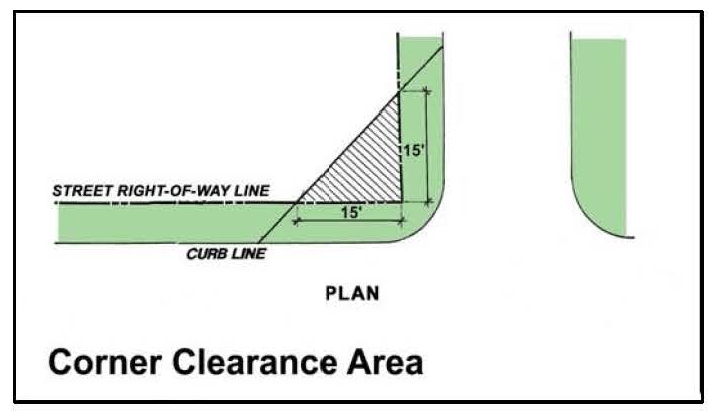
(C)
Pedestrian Access:
1.
The primary entrance for a building shall be clearly identifiable, useable and located facing Van Dyke Highway. A pedestrian connection shall provide a clear, publicly-accessible connection between the primary street upon which the building fronts and the building.
2.
A direct pedestrian walkway shall be provided from rear and side yard parking areas to the building that is of a level of materials, quality and design emphasis at least equal to that of the primary entrance.
(D)
Pedestrian and Non-Motorized Enhancements:
1.
Sidewalks shall be provided along all street frontages.
2.
The owner or developer shall be responsible for securing any required permits from the appropriate Macomb County Department or the Michigan Department of Transportation prior to constructing sidewalks within the right-of-way.
3.
Pedestrian plazas are encouraged at key corners.
(E)
Vehicular Parking:
1.
Parking lots shall be permitted only in side and rear yards.
2.
Off-street parking is required for all uses and shall comply with the numerical parking requirements pursuant to Section 601 of the zoning ordinance. Parking may be eligible for a parking reduction per Section 309.07.
3.
When located in an external side yard, no more than 50 percent of the total site's linear feet along the required building line shall be occupied by parking.
4.
For a corner lot, the building shall be located no greater than the permitted setback dimension on one right-of-way.
5.
The planning commission may permit a single row of parking or an access aisle within the front yard or external side setback in conjunction with an increased setback where it is determined that there are site constraints regarding the size of parcel, circulation, limited right-of-way, location of existing buildings or when necessary for promoting best practice access-management techniques. The parking and maneuvering lane shall meet the standards of Sections 602 and 603. A clearly marked pedestrian walkway through the parking area connecting the street sidewalk to the front entrance shall be provided.
6.
Alley networks shall be utilized to encourage the use of rear yard parking and minimize the amount of new curb cuts.
7.
All off-street parking areas shall be screened or buffered in a matter that separates the parking areas as seen from the public right-of-way or from residentially zoned or used property. Screening shall meet the requirements set forth in Sections 805 and 807.
F.
Access Management and Shared Parking.
1.
Each property shall provide reasonable access for traffic and emergency vehicles while preserving traffic operations and safety along Van Dyke Avenue. New development shall adhere to best practices for access management in order to reduce the number of traffic hazards, reduce the number of pedestrian and vehicular conflict points, and maintain clear and unobstructed emergency vehicle access and circulation.
2.
A means of direct or indirect access shall be provided for each separately owned parcel. Where possible, this access shall be via a shared driveway and cross-access connections. Where shared or cross-access is not possible, this access shall be met by a single driveway. Additional driveways may be permitted subject to site plan approval.
3.
Shared parking lots are encouraged for neighboring uses that operate at different times over a 24-hour period. The planning commission may permit a shared parking arrangement upon finding that there is not a substantial conflict in the peak parking demand of neighboring uses. The planning commission may require that the applicant submit parking studies, data and/or documentation to validate peak parking demand.
Figure 2. Shared Parking Area and Driveway
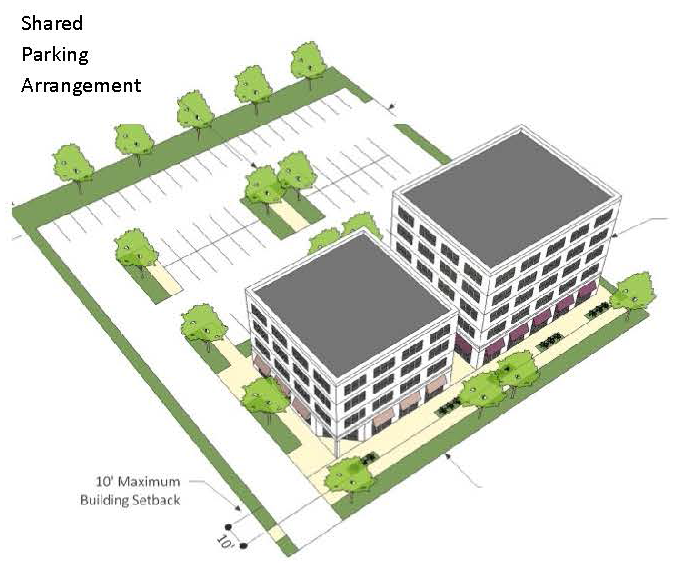
(G)
Landscape, Streetscape and Screening:
1.
Streetscape furnishings, including street trees, tree grates, special concrete finishing, decorative lighting, and street furniture shall be considered along all frontages to the satisfaction of the planning commission.
2.
Street trees shall be located in accordance with the standards of the governing entity.
3.
Street trees shall not be located within a corner clearance area.
4.
All off-street parking areas shall be screened or buffered in a matter that separates the parking areas as seen from the public right-of-way or from residentially-zoned or used property. The screen or buffer method shall include one (1) or combinations of the following:
a)
From a residentially-zoned or used property.
i)
Decorative masonry screen wall between 4'-6" and 6'-0" tall.
ii)
Decorative metal fence with an opaque landscape screen of trees and shrubs between 4'-6" and 6'-0" tall
b)
From a public right-of-way.
i)
Decorative masonry screen wall between 30" and 36" tall.
ii)
Decorative metal fence between 30" and 36" and eight shrubs for each 40 feet.
iii)
Landscape strip with one shade tree and eight shrubs for each 40 feet. Shrubs shall be maintained at less than 36" in height.
5.
Landscape areas shall be a minimum four feet in width with bark mulch and underground irrigation.
(Ord. of 10-12-18(1))
Sec. 409. - Miscellaneous uses.
(A)
Mixed-use commercial/office/residential buildings. Subject to the following:
(1)
Facade Transparency Adjacent to a Public Street: Ground level facades shall provide a minimum 33 percent wall transparency. Second level and above shall provide a minimum 25 percent wall transparency
(2)
Ground floor height: A minimum height of 10 feet as measured from finished floor to ceiling shall be maintained.
(3)
Exterior walls: Brick or decorative masonry in a dark earth-tone color.
(4)
Ground floor land use: A ground-floor level of a mixed-use building shall be occupied with commercial or office use.
(B)
Temporary structures and uses.
(1)
General Requirements. The Zoning Board of Appeals may permit temporary and structures. In granting permits for temporary structures, the ZBA shall consider the following:
(a)
The granting of the temporary permit shall not have a detrimental impact on the use or enjoyment of surrounding or nearby property due to the particular configuration of the property or conditions on or surrounding the parcel.
(b)
The granting of the temporary permit shall in no way constitute a change in the basic uses permitted in the district or on the property wherein the temporary use is permitted.
(c)
The granting of the temporary permit shall be granted in writing, stipulating all conditions as to time, nature of development permitted, and arrangements for removing the use at the termination of the permit.
(d)
Temporary structures shall comply with the setback standards for the district in which they are located. Additionally, off-street parking, lighting, and other requirements to be considered in protecting the public health, safety, welfare and morals of the community shall be considered in the granting of the permit.
(2)
Temporary Structures Used for Residential Purposes. A structure, including a manufactured home, may be permitted by the ZBA to be occupied for temporary residential use while major repairs or remodeling is taking place, or while damage to the principal dwelling due to fire, flood, ice, wind, or other natural disaster is being repaired. Temporary permits for structures used for residential purposes shall be subject to the following:
(a)
One (1) emergency temporary dwelling permit may be issued by the Building Official for up to 90 days while the applicant is in the process of applying to the ZBA for a temporary dwelling permit. If the ZBA does not approve a temporary dwelling permit, the structure must be removed at the end of the 90 day emergency permit period authorized by the Building Official.
(b)
The ZBA may issue temporary dwelling permits for up to six (6) months in duration and may be extended by application to the ZBA for two (2) additional periods of up to six (6) months each, provided that work is proceeding in an expeditious manner. The total duration of temporary dwelling permits given by the ZBA shall not exceed 18 months.
(c)
A request for a temporary dwelling permit or for an extension from the ZBA must be submitted in writing to the Building Official no less than 30 days prior to the expiration of the previously granted temporary or emergency dwelling permit.
(d)
An approved temporary dwelling may be moved onto a site 14 days prior to commencement of major repairs, and shall be removed within 14 days following issuance of a full or temporary certificate of occupancy for the permanent dwelling, or immediately following the expiration of the temporary dwelling permit.
(e)
The applicant may be required to furnish the City with a performance guarantee in an amount determined by the Building Official to ensure removal of the temporary dwelling, along with a notarized affidavit that the temporary dwelling will be removed before issuance of a certificate of occupancy on the repaired dwelling or before the expiration of the temporary dwelling permit.
(3)
Temporary Structures Used for Non-Residential Purposes. Temporary structures for non-residential use, including semi-trucks/trailers and concrete batch plants, may be permitted by the ZBA subject the following conditions:
(a)
The intended use of the temporary structure must be a contractor or builder in conjunction with a construction project.
(b)
No emergency permits for temporary structures for non-residential use may be granted by the Building Official.
(c)
The Zoning Board of Appeals shall seek the review and recommendation of the Planning Commission on a site plan prepared by the application, prior to the taking of any action.
(d)
The ZBA may issue a temporary structure permit for up to six (6) months in duration, which may be extended by application to the ZBA for up to six (6) additional months provided that work is proceeding in an expeditious manner.
(e)
A request for a temporary structure permit or for an extension from the ZBA must be submitted in writing to the Building Official no less than 30 days prior to the expiration of the previously granted temporary or emergency permit.
(f)
An approved temporary structure may be moved onto a site 14 days prior to commencement of major repairs.
(g)
An approved temporary structure shall be removed within 14 days following issuance of a full or temporary certificate of occupancy for the permanent dwelling, or immediately following the expiration of the temporary structure permit.
(h)
The applicant may be required to furnish the City with a performance guarantee in an amount determined by the building official to ensure the removal of the temporary structure.
(4)
Special Events and Other Temporary Uses. The Building Official may grant temporary use of land and structures for special events and other temporary uses as defined in Article II, Definitions, subject to the following conditions:
(a)
Adequate off-street parking shall be provided.
(b)
The applicant shall specify the exact duration of the temporary use.
(c)
Electrical and utility connections shall be approved by the Building Official.
(d)
A performance guarantee may be required to ensure proper clean-up.
(e)
A special event or other temporary use shall be permitted only if required public services, including police, fire, utility, sanitary and refuse services will be adequately provided without threat to public health, safety, and welfare. Costs for providing such services, to the extent they exceed the normal operating costs of the City, shall be the full responsibility of the owner or operator of the special event.
(C)
Utility and public service buildings and facilities (without outdoor storage yards).
(1)
Location. Where feasible, utility structures and public service buildings shall be located so as to not hinder the development of the area or detract from the value of adjoining development. Operating requirements necessitate the location of the facility within the district to serve the immediate vicinity.
(2)
Off Site Impacts. Such uses shall not create a health or safety hazard, a nuisance, or have deleterious impact on the surrounding area either due to appearance or operation.
(a)
Performance Standards. Public utility and essential service structures and uses shall conform to Section 804.
(b)
Solid Waste Transfer Stations. In no case shall access to a solid waste transfer station be provided within or directly abutting the boundary line of a residential district.
(3)
Site Development Standards.
(a)
Design. All such uses shall be contained in structures that are architecturally compatible with structures in the vicinity. The Planning Commission may require screening in accordance with Section 805.
(b)
Security Fencing. Security fencing is permitted, subject to the requirements of Section 807 and 809.
(c)
Outdoor Storage. No outdoor storage is permitted unless expressly permitted in the district where the facility is located.
(d)
Setbacks. A minimum setback of 50 feet is required from any lot line.
(D)
Utility and public service buildings and facilities (with outdoor storage yards). See subsection (C) above.
(E)
Wireless Communication Facilities. Subject to the standards and conditions in Section 803 and a demonstration of the need for the proposed facility based on one or more of the following factors:
(1)
Proximity to an interstate or major thoroughfare.
(2)
Areas of population concentration.
(3)
Concentration of commercial, industrial, and/or other business centers.
(4)
Areas where signal interference has occurred due to tall buildings, masses of trees, or other obstructions.
(5)
Topography of the proposed facility location in relation to other facilities with which the proposed facility is to operate.
(6)
Other specifically identified reason creating facility need.
(7)
If it is demonstrated by an applicant that a wireless communication facility necessary to providing services cannot be established as permitted under subsection (b)(1), such wireless communication facility may be considered and permitted elsewhere in the City as a special land use, subject to the following:
(a)
In the application, the applicant shall demonstrate that no existing structure identified in Section 803 can reasonably meet the specifically disclosed service, coverage and/or capacity needs of the applicant. Such demonstration requiresidentification of all structures and properties considered and a factual explanation of why they are not feasible in terms of availability, suitability, or otherwise.
(b)
Wireless communication facilities shall be of a "stealth" design such as, without limitation, a steeple, bell tower, tree, or other monopole structure which is located and compatible with the existing character of the proposed site, neighborhood and general area, as approved by the City taking into account any alternative designs submitted by the Applicant or identified during the review and decision process.
(8)
Locations outside the zoning districts identified in Section 803 shall be limited to the following sites:
(a)
Municipally-owned sites.
(b)
Other governmentally owned sites.
(c)
Religious or other institutional sites.
(d)
Public or private school sites.
(e)
Other sites if they are available and suitable, as demonstrated in the application and determined by the Planning Commission and City Council.
(9)
The applicant's demonstration of good faith efforts to identify and evaluate alternate sites, locations, designs, placements, or features for the proposed facility that would or could be more consistent with the ordinance purposes stated in Section 803.
(10)
For each alternate site, location, design, placement, or feature for the proposed facility identified by the applicant or otherwise, the applicant's demonstration that the proposed facility is more consistent with the ordinance purposes stated in Section 803, and/or that such alternate is not feasible.
(Ord. of 10-12-18(1))

