
Center Line City Zoning Code
ARTICLE III
ZONING DISTRICTS AND REGULATIONS
Sec. 300.- Purpose.
For the purpose of this ordinance, the City of Center Line is hereby divided into the following districts:
R-1 AND R-2 ONE-FAMILY RESIDENTIAL DISTRICTS
R-M MULTIPLE-FAMILY RESIDENTIAL DISTRICTS
RM-1 MULTIPLE-FAMILY RESIDENTIAL DISTRICTS
B-1A CITY CENTER REDEVELOPMENT DISTRICT
B-1B VAN DYKE CORRIDOR DISTRICT
B-2 TEN MILE CORRIDOR DISTRICT
CC COMMUNITY CENTER DISTRICT
M-1 LIGHT INDUSTRIAL DISTRICT
M-2 HEAVY INDUSTRIAL DISTRICT
NT NEIGHBORHOOD TRANSITION DISTRICT
(Ord. of 10-12-18(1))
Sec. 301. - Schedule of land use.
In all Districts, no building or land shall be used and no building shall be erected except for one (1) or more of the following specified uses, unless otherwise provided in this article.
The Schedule of Use Regulations identifies uses as follows:
"P" identifies uses permitted as of right.
"S" identifies uses requiring special approval.
"A" identifies accessory uses.
(Ord. of 10-12-18(1); Ord. of 3-7-2022(1))
Sec. 302. - Boundaries.
The boundaries of these districts are hereby established as shown on the zoning map, as amended, which accompanies this zoning ordinance and which map with all notations, references and other information shown thereon shall be as much a part of this ordinance as if fully described herein.
Unless shown otherwise, the boundaries of the districts are lot lines, the center lines of streets, alleys, roads or such lines extended, and the limits of the City of Center Line.
(Ord. of 10-12-18(1))
Sec. 303. - Interpretation.
The Zoning Board of Appeals is authorized to interpret boundaries of zoning districts as presented in the official zoning map. Upon request of the Planning Commission or any administrative or enforcement officer charged with enforcement of this Zoning Ordinance, the Zoning Board of Appeals may interpret and clarify the meaning or applicability of the Zoning Ordinance text. Interpretations of zoning district boundaries, as shown upon the official zoning map accompanying and made part of this Zoning Ordinance, shall be made in such a way as to carry out the intent and purpose of this Zoning Ordinance and the City's Strategic Plan.
A record shall be kept by the Zoning Board of Appeals of all decisions for interpretation of the Zoning Map, classifications of any property or Zoning Ordinance text.
(Ord. of 10-12-18(1))
Sec. 304. - Zoning of vacated areas.
Whenever any street, alley or other public way within the City of Center Line shall be vacated, such street, alley or other public way or portion thereof shall be classified by the city council.
(Ord. of 10-12-18(1))
Sec. 305. - District requirements.
All buildings and uses in any district shall be subject to the provisions of Article VIII, General Provisions and Article IX, General Exceptions.
R-1, R-2, R-M and RM-1 RESIDENTIAL DISTRICTS
Sec. 306. - R-1 and R-2 one-family residential districts.
(A)
Intent. The Master Plan recognizes that one-family residential neighborhoods are vital components of the City, and comprise the majority of the land area within the City. The intent of the R-1 and R-2 Districts is to provide areas for one-family dwellings with the primary distinction being a range of densities, implemented through varying lot sizes. The R-1 and R-2 Districts are further intended to preserve and improve upon the quality of residential neighborhoods while permitting a limited number of other compatible uses which support residential neighborhoods.
(B)
Area and Bulk Regulations.
R-1 One-Family:
Minimum area of lot per dwelling unit: 9,600 square feet
Minimum width of lot per dwelling unit: 80 feet
Maximum height structures: 2 stories or 25 feet
Minimum front setback: 25 feet
Minimum side setback: 5 feet
Minimum total of sides: 15 feet
Minimum rear setback: 35 feet
Minimum floor area per unit: 1,200 square feet
Maximum lot coverage (area of all building): 25 percent
R-2 One-Family:
Minimum area of lot per dwelling unit: 5,500 square feet
Minimum width of lot per dwelling unit: 50 feet
Maximum height: 2 stories or 25 feet
Minimum front setback: 25 feet
Minimum side setback: 3 feet
Minimum total of sides: 12 feet
Minimum rear setback: 35 feet
Minimum floor area per unit: 1,050 square feet
Maximum lot coverage (area of all building): 30 percent
(Ord. of 10-12-18(1))
Sec. 307. - R-M multiple-family residential district.
(A)
Intent. The R-M multiple-family residential district is designed to provide sites for multiple dwelling structures which will generally serve as zones for transition between the nonresidential districts and lower density one-family districts. The multiple dwelling is further provided to serve the limited needs for the apartment type of unit in an otherwise one-family residential community.
(B)
Area and Bulk Regulations.
Maximum height: 2 stories or 25 feet
Minimum front setback: 30 feet
Minimum side setback: 10 feet
Minimum total of sides: 20 feet
Minimum rear setback: 30 feet
Maximum lot coverage (area of all building): 35 percent
(Ord. of 10-12-18(1))
Sec. 308. - RM-1 multiple-family residential district.
(A)
Intent. The RM-1 multiple-family residential districts (high-rise) are designed to provide sites for high-density multiple-dwelling structures adjacent to high traffic areas commonly found in proximity to nonresidential development areas abutting major thoroughfares. This district is further provided to serve the residential needs of persons desiring the apartment type of accommodation as opposed to the residential patterns found in the one-family and R-M multiple-family residential districts.
(B)
Area and Bulk Regulations.
Minimum front setback: 40 feet
Minimum side setback: 40 feet
Minimum total of sides in feet: 80 feet
Minimum rear setback: 40 feet
Maximum lot coverage (area of all building): 25 percent
1 Refer to Section 316. Area and Bulk Regulations Applied to Multiple Districts for additional requirements.
2 Refer to ARTICLE IV. SPECIAL LAND USE PROVISIONS for additional requirements.
(Ord. of 10-12-18(1))
B-1A, B-1B, B-2 and CC BUSINESS and MIXED-USE DISTRICTS
Sec. 309. - B-1A City Center redevelopment district.
(A)
Intent. The B-1A City Center Redevelopment District is designed to foster a business friendly redevelopment climate; encourage pedestrian use; connect to the adjacent neighborhoods strengthen the public right-of-way space; and create an orderly and cohesive visual image. The district promotes broader limits on land usage with an emphasis on retail, office, higher-density residential, mixed-use developments, high-quality architecture, gateway features, and pedestrian-friendly design. Form-based provisions focus greater emphasis on physical development and building form to create a sense of place and contribute to the overall image of the city.
(B)
The B-1A district recognizes the importance of Van Dyke Avenue as both a gateway into and the main corridor through the city and is designed to implement the goals of City of Center Line Master Plan.
Specifically, the B-1A district will do the following:
1.
Create a sense of place and an identity for Center Line through unique streetscape elements, pedestrian-oriented design, attractive architecture and pedestrian spaces;
2.
Improve the economic development potential of the entire district by permitting mixed-use development and utilizing placemaking strategies;
3.
Limit the impact of off-street parking areas which interrupt the flow and consistency of the "street edge." Orient building entrances and storefronts to the street to add visual interest, increase pedestrian traffic, and create memorable outdoor spaces;
4.
Visually distinguish Van Dyke Avenue from the rest of Center Line;
5.
Encourage attractive higher-density multi-family residential development that promotes traditional urban form and walkability and support adjacent commercial and office uses;
6.
Improve public health, safety and welfare by reducing the number of traffic hazards, reducing the number of pedestrian and vehicular conflict points, and improving emergency vehicle access and circulation. Encourage collaboration between adjacent property owners in the form of shared access and lot combinations;
7.
Allow flexibility in adjusting strict dimensional requirements if such adjustments enhance the intent of the B-1A City Center Redevelopment District;
(Ord. of 10-12-18(1))
Sec. 309.02. - Van Dyke Avenue district boundaries.
The boundaries of the B-1A district are displayed on the official zoning map and illustrated in Figure 1:
Figure 1. B-1A City Center Redevelopment District and adjacent zoning districts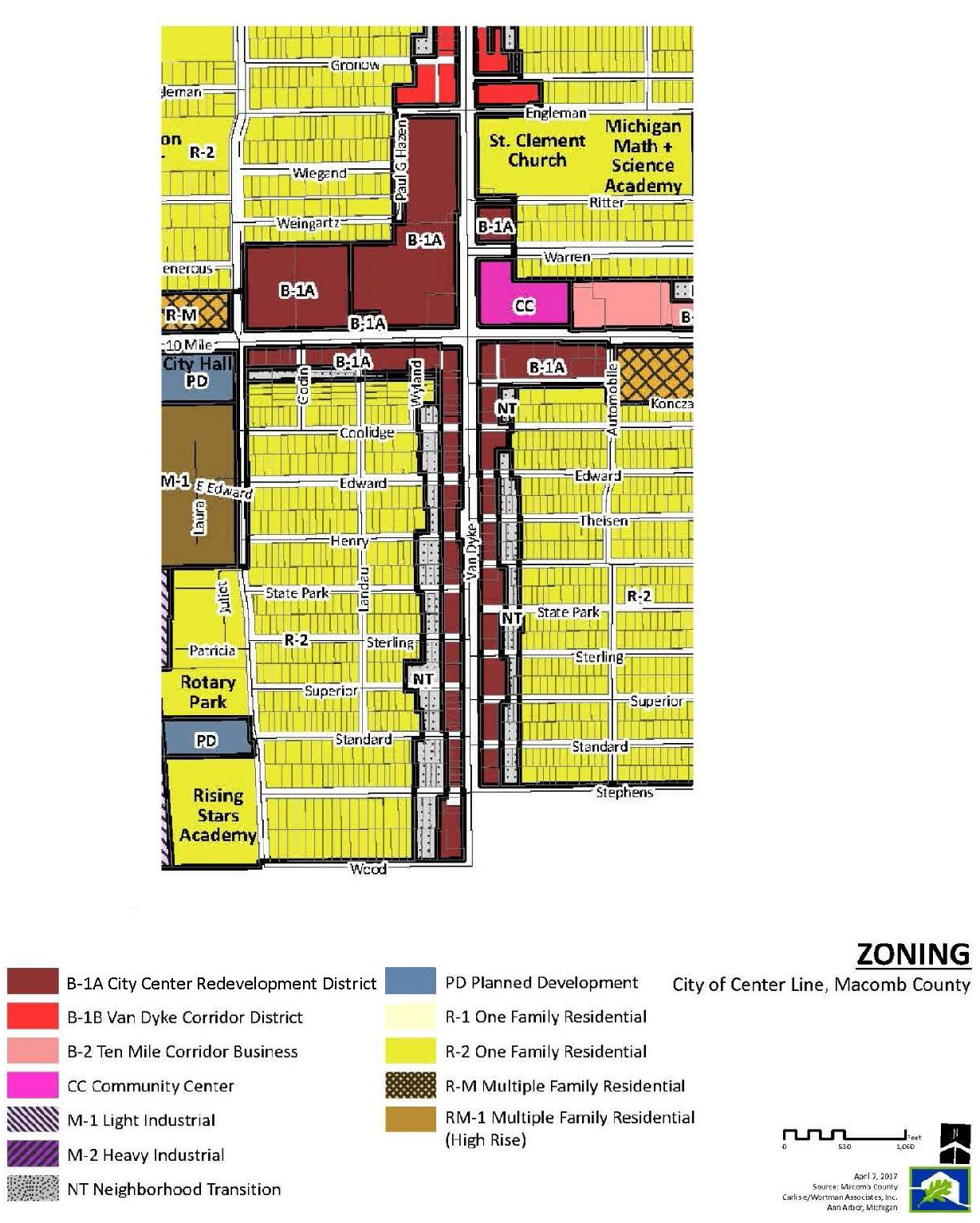
(Ord. of 10-12-18(1))
Sec. 309.03. - Applicability.
(A)
The requirements of the B-1A district shall apply to any new use, structure, or building addition that requires full site plan approval pursuant to Section 1000, with the following exceptions:
1.
Continuation of an existing use permitted at the date of adoption of this ordinance, which shall be granted conforming land-use status, pursuant to Section 801.
2.
Uses, structures, structural expansions or other site alterations that can be accommodated through the administrative site plan review process, pursuant to Section 1000.
(B)
The planning commission shall have the authority to adjust the standards of Sections 309 and 408 during the site plan review stage upon consideration of the following:
1.
The standards provided herein would prevent reasonable development of the site due to the size of the parcel, limited circulation or right-of-way, existing structures on-site or the location of utilities.
2.
Demonstration by the applicant that the site design will improve pedestrian features beyond the requirements of this article.
3.
Demonstration by the applicant that architectural or design elements not otherwise permitted in the B-1A district would enhance the overall economic potential of the district and meet the intent of the district.
(C)
Where the standards of this article conflict with other articles of the zoning ordinance, the standards of this article shall take precedence.
(Ord. of 10-12-18(1))
Sec. 309.04. - Uses permitted.
Permitted uses within the B-1A City Center Redevelopment District shall be restricted to those listed as either permitted principal, special approval, or accessory uses in the schedule of land use in Section 301.
(Ord. of 10-12-18(1))
Sec. 309.05. - B-1A use standards.
(A)
Uses are subject to the area and bulk regulations of Sections 310 and 316.
(B)
Uses are subject specific land use provisions of Section 408.
(C)
Public utility uses shall, to the extent practicable, be fully or partially enclosed and shall have an exterior appearance harmonious with the general character of the neighborhood, including architectural treatment, landscaping, screening and/or fencing.
(Ord. of 10-12-18(1))
Sec. 309.06. - Development regulations.
(A)
Buildings and sites within the Van Dyke Avenue District shall be developed in a manner which contributes to the character of the corridor by maximizing the value of property and creating a traditional "street wall."
(B)
Area and Bulk Regulations.
1.
Maximum height: 3 stories or 40 feet
2.
Front setback line: 0-10 feet. Planning commission may extend this dimension to 60 feet for parking and landscaping adjacent to sidewalk:
(a)
Minimum side setback: 0 feet
(b)
Minimum rear setback: 20 feet inclusive of half of the public alley where applicable.
(C)
In cases where minimum setbacks interfere or conflict with applicable building or fire codes, the building and fire codes shall take precedence.
(D)
The first floor of structures shall be at least ten (10) feet in height as measured from floor level to the underside of the ceiling.
(E)
Buildings may be permitted additional building height per the bonus provisions of Section 309.07.
(F)
The planning commission may permit a single row of parking or an access aisle within the front yard setback per Section 408.
(Ord. of 10-12-18(1))
Sec. 309.07. - Bonus provisions.
Situations may occur where it is in the best interest of the private landowner and the City of Center Line to exceed or fall short of the standards of this chapter. In such situations, the City's interests in upholding its vision can be met by the following standards and incentives.
(A)
Bonus Height Eligibility Standards:
Buildings are eligible for a height bonus of up to one (1) additional story and/or fifteen (15) feet where two (2) or more of the following standards criteria are met.
1.
The bonus story shall be stepped back to reduce the appearance of excessive height.
2.
A mixed-use building that provides residential dwelling units above first-floor commercial where a minimum of 50% of the building's floor area is residential.
3.
Dedication of an improved public plaza or open space including, but not limited to, decorative lighting, landscaping, pavement, arches and furnishings which ties into the district's main pedestrian circulation system.
4.
A covered bicycle rack comprising at least five (5) stalls located adjacent to a building's main pedestrian entrance. Bicycle racks shall not encroach into pedestrian walkways or vehicle areas.
5.
Installation of streetscape furnishings, including street trees, tree grates, decorative lighting, or street furniture. Street furniture shall include, but is not limited to:
(a)
A permanently mounted seating fixture constructed of decorative metal.
(b)
A permanently reserved planting bed with defined, durable edges.
6.
Through-block pedestrian connections providing a continuous walkway accessible to the public (covered or open);
7.
Other public amenities as deemed appropriate by the planning commission.
(B)
Parking Reduction Eligibility Standards: Off-street parking lots are eligible for up to a twenty percent (20%) reduction in numerical parking requirements where one (1) or more of the following criteria are met:
1.
A shared parking/shared site access arrangement with adjacent properties. Shared parking arrangements shall meet the standards of Section 408.
2.
Parking area is provided entirely within the rear yard, screened from the right-of-way.
Other site improvements as deemed appropriate by the planning commission.
(Ord. of 10-12-18(1))
Sec. 310. - B-1B Van Dyke corridor district.
(A)
Intent. The B-1B Van Dyke corridor district is designed to cater to the needs of a larger consumer population with a greater reliance on passerby traffic. This district also considers mixed use, mass transit, pedestrian accessibility, and connections to the adjacent neighborhoods important to long-term viability.
(B)
Area and Bulk Regulations.
Maximum height:
3 stories or 40 feet
4 stories or 60 feet for property 200 feet or greater in depth
Minimum front setback: 0 feet
Minimum side setback: 0 feet
Minimum rear setback: 20 feet inclusive of half of the public alley where applicable.
(Ord. of 10-12-18(1))
Sec. 311. - B-2 Ten Mile corridor district.
(A)
Intent. The B-2 Ten Mile corridor district is established to provide sites for more diversified business types incompatible with pedestrian traffic and is often located so as to serve the passerby traffic. This district is further intended to provide opportunities for automobile-related businesses, uses that generate large traffic volumes or require substantial off-street parking facilities, and other uses incompatible with the pedestrian-oriented character and scale.
(B)
Area and Bulk Regulations
Maximum height: 2 stories or 30 feet
Minimum side setback: 0 feet
Minimum front setback: 10 feet
Minimum rear setback: 20 feet
(Ord. of 10-12-18(1))
Sec. 312. - CC Community Center district.
(A)
Intent. The CC community center district is designed to provide sites for a variety of high-intensity office, multiple-residential, retail and service establishments which occupy prime frontages at the intersection of major thoroughfares.
The CC community center district is further intended to provide for combining high-rise office, high-rise multiple-dwelling, and retail uses in a planned development, and to encourage innovations and variety in type, design and arrangement of such uses. ;b01; The district is further designed to provide an intensive character of development through vertical building construction, which will tend to strengthen the city's economic base and to provide the city's tax revenue on which, to a great extent, the general welfare of the city depends.
(B)
Area and Bulk Regulations
Minimum front setback: 40 feet
Minimum side setback: 40 feet
Minimum total of sides: 80 feet
Minimum rear setback: 40 feet
Maximum lot coverage (area of all building): 25%
1 Refer to Section 316. Area and Bulk Regulations Applied to Multiple Districts for additional requirements.
2 Refer to ARTICLE IV. SPECIAL LAND USE PROVISIONS for additional requirements.
(Ord. of 10-12-18(1))
M-1 and M-2 INDUSTRIAL DISTRICTS
Sec. 313. - M-1 light industrial district.
(A)
Intent. The M-1 light industrial district is designed so as to primarily accommodate wholesale activities, warehouses, and industrial operations whose external, physical effects are restricted to the area of the district and in no manner affect in a detrimental way any of the surrounding districts.
(B)
Area and Bulk Regulations
Maximum height: 40 feet
Minimum front setback: 30 feet
Minimum side setback: 20 feet
(Ord. of 10-12-18(1))
Sec. 314. - M-2 heavy industrial district.
(A)
Intent. The M-2 heavy industrial district is designed primarily for manufacturing, assembling, and fabrication activities including large-scale or specialized industrial operations whose external, physical effects will be felt to some degree by surrounding districts.
B.
Area and Bulk Regulations.
Maximum height: 60 feet
Minimum front setback: 50 feet
Minimum side setback: 30 feet
1 Refer to Section 316. Area and Bulk Regulations Applied to Multiple Districts for additional requirements.
2 Refer to ARTICLE IV. SPECIAL LAND USE PROVISIONS for additional requirements.
(Ord. of 10-12-18(1))
NT TRANSITION DISTRICT
Sec. 315. - NT neighborhood transition district.
(A)
Intent. The NT Neighborhood Transition District is designed to merge the mix of low-density residential uses with parking expansion for business. Criteria established in this ordinance intends permit the co-existing of these two use types without creating negative effects on either. The district recognizes that nonresidential uses may not be able to provide adequate space within their own district boundaries but not at the detriment of current and future residents within and adjacent to the district.
(B)
Limitation of use.
(1)
Residential uses must follow dimensional, area and bulk requirements of the comparable zoning district in which the use is permitted.
(2)
The parking area shall be accessory to, and for use in connection with, one or more business or industrial establishments, or in connection with one or more existing professional or institutional office buildings or institutions.
(3)
Parking area shall be used solely for parking of private passenger vehicles, for periods of less than one day, and shall not be used as an off-street loading area.
(4)
No commercial repair work or service of any kind, or sale or display thereof, shall be conducted in such parking area.
(5)
No signs of any kind, other than signs designating entrances, exits, and conditions of use, shall be maintained on such parking area.
(6)
No building other than those for shelter of attendants shall be erected upon premises, and they shall not exceed 15 feet in height.
(7)
Such parking lots shall be contiguous to an R-M, B-1A, B-1B, B-2, M-1 or M-2 district, and in all cases shall be adjacent successive lots from the above-mentioned use districts or the adjacent successive lots from either end of a block where lots front on a street parallel to and at the rear of a business or industrial block. There may be a private driveway or public street or public alley between such NT district and such R-M, B-1A, B-1B, B-2, M-1 or M-2 district.
(C)
Entrance and exit.
(1)
Adequate entrance and exit for vehicles to premises used as a parking area shall be provided and shall be by means of streets or alleys adjacent to or extending through R-M, B-1A, B-1B, B-2, M-1 or M-2 districts, or by means of private roadways extending through such districts. All such roadways shall be surfaced in a manner at least equivalent with that which is hereinafter provided for the parking area.
(2)
Each entrance and exit to and from such parking lot shall be at least 20 feet distant from any adjacent property located in any residential district.
(D)
Minimum distances and setbacks.
(1)
Side and rear yards. Where a parking area in a NT district is contiguous to the side and/or rear lot lines of residential premises within a residentially or NT zoned district, the required wall shall be located along said lot line.
(2)
Front yards. Where a parking area in a NT district is contiguous to a residentially or NT zoned district which has a common frontage on the same block with residential structures, or wherein no residential structures have been yet erected, there shall be a minimum setback of ten feet. The required wall shall be located on this minimum setback line. The area contained within the ten-foot setback area shall be appropriately landscaped and maintained as determined by the planning commission.
(E)
Screening and landscaping.
(1)
The parking area shall be provided with a continuous and obscuring wall four feet in height measured from the surface of the parking area. This wall shall be provided on all sides where the next zoning district is a residential or NT district. Whenever such wall is required, any land between said wall and boundaries of the parking area shall be kept free from refuse and debris and shall be landscaped with deciduous shrubs, evergreen material and ornamental trees. Ornamental trees shall be planted at 30-foot intervals, six feet from wall. The ground area shall be planted and kept in lawn. All such landscaping and planting shall be maintained in a healthy, growing condition, neat and orderly in appearance. Variations from the above landscape standards may be negotiated between the applicant and the planning commission where appropriate.
(2)
All planting plans shall be submitted to the planning commission for approval as to suitability of planting material and arrangement thereof, in accordance with the provisions of paragraph (1) and in accordance with Section 805 of this ordinance.
(3)
At its discretion, the City of Center Line may require a performance bond to be refunded to the applicant after all landscaping is satisfactorily installed. The amount of the bond shall be equal to the estimated cost of landscape improvements.
(F)
Surface of parking area.
(1)
The parking area shall be provided with pavement having an asphaltic or Portland cement binder so as to provide a permanent, durable, and dustless surface and shall be graded and drained so as to dispose of all surface water accumulated within the area.
(2)
The parking area shall be surfaced within one year of occupancy of the use it is to serve if it is for a new use, and within six months of the effective date of rezoning for NT Neighborhood Transition use if the parking area is to serve an existing use or uses.
(G)
Lighting. Where lighting facilities are provided, they shall be so arranged as to reflect the light away from all residential districts.
(H)
Approval and modifications.
(1)
The zoning board of appeals, upon application by the property owner of the parking area, may modify the yard and wall requirements where, in unusual circumstances, no good purpose would be served by compliance with the requirements of this section.
(2)
In all cases where a wall extends to an alley which is a means of ingress and egress to a parking area, it shall be permissible to end the wall not more than ten feet from such alley line in order to permit a wider means of access to the parking area.
(3)
One-family dwellings may be allowed to be constructed within the NT district, provided that they meet the minimum lot, yard, height and floor area requirements of the R-2 one-family residential zone.
(Ord. of 10-12-18(1))
Sec. 316. - Area and bulk regulations applied to multiple districts.
(A)
Continued Conformity with Bulk Regulations. The maintenance of setback, height, floor area ratio, coverage, open space, manufactured housing park, transition strip, lot area and lot area per dwelling unit required for one (1) use, lot, building or structure shall be a continuing obligation of the owner of such building or structure or of the lot on which such use, building or structure is in existence. Furthermore, no setback, height, floor area ratio, coverage, open space, manufactured housing park, transition strip, lot area per dwelling unit allocated to or required about or in connection with one (1) lot, use, building or structure may be allocated to any other lot, use, building, or structure.
(B)
Division of a Lot. No one (1) lot, once designated and improved with a building or structure, shall be reduced in area, or divided into two (2) or more lots, and no portion of one (1) lot, once designated and improved with a building or structure, shall be sold unless each lot resulting from each such reduction, division, or sale, and designated and improved with a building or structure, shall conform to all of the bulk and yard regulations of the zoning district in which it is located.
(C)
Setbacks and Yard Requirements. The setback and yard requirements established by this ordinance shall apply to every lot, building, or structure, except for the following structures, which may be located anywhere on any lot:
(1)
Unroofed masonry or concrete terraces and patios which are at the same level as the adjacent grade.
(2)
Unroofed porches and decks except that said porches and decks may not occupy a required front setback.
(3)
Awnings, flagpoles, except as regulated in Section 901.
(4)
Light poles, hydrants, laundry drying equipment, arbors, trellises, portable recreational equipment, outdoor cooking equipment, sidewalks, private driveways in agricultural and one-family residential districts to include the parking of currently licensed and operational passenger vehicles, provided, however, that no more than one such vehicle may be offered for sale.
(5)
Trees, plants, shrubs, and hedges.
(6)
Anything to be constructed, erected, planted or allowed to grow shall conform to the provisions of Section 814.
(D)
Height. The height requirements established by this ordinance shall apply to every building and structure with the following exceptions provided their location shall conform to the requirements of Center Line, the Federal Communications Commission, the Civil Aeronautics Administration, and other public authorities having jurisdiction:
(1)
Public utility towers, structures, transmission and distribution lines and related structures; radio and television broadcasting and receiving antennae; water towers; and wireless communication facilities where the aforementioned structures are permitted in the district therein located or are a conditional use in said district subject to the provisions of Section 803.
(2)
Spires, belfries, and silos provided that the overall height does not exceed 150 percent of the maximum permitted building height in the district therein located.
(3)
Chimneys, ventilators, skylights, and other necessary mechanical appurtenances provided that no mechanical enclosure or penthouse shall exceed twelve (12) feet in height above the roof deck.
(4)
Parapets not exceeding three (3) feet in height above the roof deck.
(5)
Architectural details incorporated into the facade(s) of a commercial or industrial structure provided that the overall height of any wall area extending above the maximum permitted height for the district therein located shall not exceed 125 percent of the permitted building height and shall not involve more than 15 percent of the width of the front facade.
(E)
Where more than one building occupies a single lot or parcel, the following building relationship shall be maintained:
(Ord. of 10-12-18(1))
Sec. 317. - General requirement for all districts.
Where a front yard of greater or lesser depth than above specified exists for dwellings or buildings on more than 50 percent of the lots of record on one side of a street in any single block, the depth of the front yard for buildings thereafter erected or enlarged in such block shall be not less, but need not be greater than, the average depth of the front yards of all existing dwellings within the block.
(Ord. of 10-12-18(1))
Sec. 318. - Side yards in business, mixed-use, and industrial districts.
No side yards are required except as may otherwise be provided in the building or fire codes.
(Ord. of 10-12-18(1))
Sec. 319. - Rear yard abuts a public street.
(A)
When a rear yard abuts a public street, the minimum rear yard setback shall be ten feet.
(1)
Parking may be permitted in the front yard after approval of the parking plan layout and points of access by the planning commission. The setback shall be measured from the nearest side of existing and/or proposed right-of-way lines.
(2)
No building shall be closer than 40 feet to the outer perimeter (property line) of such district when said property line abuts any residential district or a major or collector thoroughfare.
(3)
Those uses allowed in the M-2 district under Section 314, shall meet all setback requirements of that section.
(4)
No building shall be closer to the outer perimeter (property line) than the herein required side yard; except that along the interior side lot lines when said property line is adjacent to like use districts, a 12-foot setback shall be required.
(5)
For all special approval uses in a residential district, the setbacks shall be equal to the height of the main building or the setbacks required in Section 301 or 307, whichever is greater.
(6)
In yards abutting a local street adjacent to a one-family residential district, 50 percent of the minimum 40-foot setback shall be developed as a naturally landscaped area and planted in trees or tree-like shrubs in accordance Section 805.
(7)
In the case of parcels bordering more than one street, the front yard shall be that yard abutting a major thoroughfare or the most heavily traveled street. Off-street parking may be allowed in a minimum 40-foot front yard setback provided that 50 percent of this setback is developed as naturally landscaped area.
(B)
Said area shall be provided with a greenbelt of trees or tree-like shrubs constructed in accordance with Section 805. Within any other front yard area (in excess of 40 feet), 25 percent of the yard space shall be developed as a naturally landscaped area and planted in trees or tree-like shrubs in accordance with Section 805.
(Ord. of 10-12-18(1))
Sec. 320. - Marihuana facilities and establishments overlay district.
A.
Intent. The City of Center Line recognizes that public interest is served through allowing Medical Marihuana Facilities and Marihuana Establishments to locate in the City of Center Line. The City further recognizes that a Medical Marihuana Facility and a Marihuana Establishment can be a nuisance with adverse impacts of high-traffic generation, light, noise, and odors on surrounding properties if not properly regulated. Therefore, it is determined necessary for the health, safety and welfare of the city to adopt this section regulating the location and operation of a medical marihuana facility and a marihuana establishment due to the following factors:
1.
It is in the public welfare to establish local standards to ensure that the procedures utilized under the Michigan Medical Marihuana Act and Michigan Regulations and under the Taxation of Marihuana Act are compatible with the character of the community.
2.
The regulation is intended to preserve the character of the community, and protect the citizens from any dangers associated with the provisioning, growth, processing, secure transportation and safety and compliance of marihuana.
3.
Marihuana Facilities and marihuana establishments serve the public similar to retail uses in business zoned districts and will be equally treated.
B.
Principal use permitted as right.
1.
Marihuana facilities adhering to the requirements of Article V. Medical Marihuana Facilities of the Code of Ordinances; and marihuana establishments adhering to the requirements of Article VI. Marihuana Establishments of the Code of Ordinances and with a current and approved business license issued by the City of Center Line.
C.
Location. The location of a medical marihuana facilities and marihuana establishments shall meet the following standards:
1.
In a building within the M-1 or M-2 zoning district with an address on Liberal Avenue, Lawrence Avenue, Bernice Avenue or Sherwood Avenue.
2.
Except for medical marihuana facilities and marihuana establishments qualifying as Secure Transporters or Safety Compliance facilities as defined under MCL 333.27101, et seq; and marihuana establishments qualifying as Secure Transporters or Safety Compliance establishments as defined under MCL 333.27951, et seq, spaced 200 feet or more from any residential zoning district or existing residential dwelling used for medical marihuana.
3.
Spaced 400 feet or more from any school, including child care or day care facility, to ensure community compliance with federal "Drug-Free School Zone" requirements.
4.
Except for medical marihuana facilities qualifying as Secure Transporters or Safety Compliance facilities as defined under MCL 333.27101, et seq; and marihuana establishments qualifying as Secure Transporters or Safety Compliance establishments as defined under MCL 333.27951, et seq, spaced 200 feet or more from the property line of any church, house of worship or other religious facility or institution.
D.
Area and Bulk Requirements. Area and bulk requirements for the respective underlying M-1 Light Industrial or M-2 Heavy Industrial District shall apply.
E.
Design Standards.
1.
Architecture and Design Standards:
(a)
Building Transparency: Facade areas of a provisioning center and ground floor facing a public right-of-way or private street shall be designed with no less than 30 percent of transparent windows and doors. The Planning Commission may move the transparency requirement to a façade not located on right-of-way or street for a property located on a corner, having a wider street frontage than depth or having an irregular shape provided the intent of the ordinance is met.
(b)
Building Entrance: A provisioning center shall have clearly defined, highly visible entrances with sheltering elements such as awnings, arcades, porticos or recesses/projections, and decorative architectural details.
(c)
Building Materials and Colors: Exterior of buildings fronting a public right-of-way and also in the area of the provisioning center shall be constructed of durable materials, including, but not limited to, brick, stone, architectural steel and glass, and integrally tinted/textured concrete masonry units. For purpose of this overlay district, a front facade includes side facades for a length of 40 feet from the front building.
(d)
Garage Doors: Garage doors shall not be permitted on a front facade and facing residentially zoned or used property.
2.
Vehicular Parking and Access:
(a)
Parking lots shall be permitted only in side and rear yards. The City may permit a maximum one row of front yard parking provided landscape standards are met.
(b)
Each property shall provide reasonable access for traffic and emergency vehicles while preserving traffic operations and safety to reduce the number of traffic hazards, reduce the number of pedestrian and vehicular conflict points, and maintain clear and unobstructed emergency vehicle access and circulation.
3.
Landscape, Streetscape and Screening:
(a)
A property shall be separated from a public right-of-way and private street by:
i.
Landscape area with a minimum eight feet in width, bark mulch and underground irrigation.
ii.
One (1) shade tree and eight (8) shrubs for each 40 lineal feet of frontage. Shrubs shall be maintained at less than 36" in height. A decorative masonry wall between 32" and 36" in height may be substituted for the trees and shrubs.
(b)
A property shall be screened and buffered from a residentially zoned or used property, public park, school, church or any public facility by a decorative masonry screen wall at 6'-0" tall. The Planning Commission may consider alternative methods provided the intent of security and visual screening are met.
(c)
All off-street parking areas shall be screened or buffered meeting requirements of Section 805 and 807.
(d)
Security fences shall be installed near the interior edge of any landscaped area located in a front yard.
(e)
Street trees shall not be located within a corner clearance area.
4.
Signage. Sign requirements as regulated by Article VII. Signs of the zoning ordinance shall meet with the added requirements that:
(a)
Facilities may not use exterior signage or displays with neon, flashing lights, or similarly noxious or obtrusive lighting or effects.
(b)
Facilities may not use exterior signage or displays that contain an image of a marihuana leaf or other commonly recognized symbol, or for marihuana or which utilize any of the following words: marihuana, marihuana, weed, cannabis, blunt, doobie, joint, hooch, hash, or other similar slang term for marihuana or marihuana-related products.
F.
General Requirements. Facilities operating within the City shall additionally be subject to the following general requirements and restrictions in addition to all other provisions of the Code of Ordinances and State Public Acts. To the extent there is a conflict between these requirements and restrictions and the Act, the Act shall prevail.
1.
Hours of Operation. Facilities may only operate between the hours of nine o'clock a.m. and nine o'clock p.m.
2.
Use at Facilities. No marihuana may be smoked, used, or consumed at any Facility.
3.
Indoor Operations/No Drive-Thru Service. All business operations of a Facility must occur indoors. Facilities may not provide drive-thru service.
4.
Transportation. Any Facility selling usable marihuana as defined in MCL 333.26423(n), must, at the time of sale, provide all purchasers with a copy of Center Line Ordinance Sec. 46-180.
5.
Security. Facilities must have secured parking areas, with secure, decorative fencing around the entire perimeter with a gated entry for vehicular traffic and a security system meeting the requirements of Article V of the Code of Ordinances. The gate may remain open during operating hours and must be securely locked after hours.
6.
Systems. All Facilities must have electrical, fire safety, plumbing, filtration, and waste disposal systems, which are appropriate and consistent with best industry practices for the business being conducted.
7.
Fire Suppression Systems. All facilities, no matter the square footage, shall have approved and installed fire suppression systems, with all square footage of the facility fire suppressed and covered with overhead sprinkler head fire suppression systems, as dictated by the City of Center Line Fire Marshall.
8.
Compliance with Laws. All Facilities must be operated in compliance with the Act, all regulations promulgated under the Act, and all other applicable federal, state, and local laws, regulations, and ordinances.
(Ord. of 12-7-2020(1); Ord. of 3-18-2022(1))

