
Chandler City Zoning Code
ARTICLE XIX
DESIGN STANDARDS3
Editor's note—Ord. No. 5142, § 2(Exh. A), adopted Nov. 13, 2025, repealed §§ 35-1900—35-1902, enacted new §§ 35-1900—35-1905, and renumbered §§ 35-1903, 35-1903.1, 35-1904 as §§ 35-1906, 35-1906.1, 35-1907. The former Art. XIX, §§ 35-1900—35-1902, pertained to site development plan and derived from Ord. No. 956, § 1, 6-11-81; Ord. No. 1251, § 1, 10-10-83; Ord. No. 1421, §§ III, IV, 1-10-85; Ord. No. 1506, 8-11-85; Ord. No. 1765, § 1, 1-22-87; Ord. No. 1768, § 1, 2-12-87; Ord. No. 2110, § 2.16, 12-7-89; Ord. No. 3063, § 3, 11-18-99; Ord. No. 3081, § 1, 1-13-00; Ord. No. 3262, § 1, 5-10-01; Ord. No. 3290, § 3, 8-9-01; Ord. No. 3997, 1-31-08; Ord. No. 4931, § 2(Exh.), 8-13-20; Ord. No. 5075, § 2(Exh.), 2-22-24.
35-1900.- Purpose.
The purpose of this article is to establish standards that function to guide development toward the highest attainable environmental quality at a time in which development and expansion are taking place in the City of Chandler, as such development once established provides the living and working environment for hundreds of thousands of families over numerous decades and generations.
The purpose of the objective design standards is to provide clarity and consistency and reduce subjectivity in the review process for developers and builders. This section complies with A.R.S. § 9-500.49, requiring objective design standards to authorize administrative review and approval of plans without a public hearing.
(Ord. No. 5142, § 2(Exh. A), 11-13-25)
35-1901. - Applicability.
(1) Any of the following development activities for property located within a Planned Area Development (PAD), commercial, industrial, mobile homes, multiplefamily, or single-family zoning designation, shall be subject to the requirements of this article for site development plan improvements:
(a) New construction of a building or buildings, irrespective of whether the property was previously developed;
(b) Altering an existing floor plan or site plan which intensifies a use in terms of additional parking, occupancy capacity, outdoor display area, outdoor storage area, or the like, irrespective of whether the building or use is physically expanded beyond existing confines;
(c) Initiating a new use on vacant or vacated property, or changing one use to another as determined under the Zoning Code;
(d) Expansion of a use that increases its land area, except that the improvements specified by this article shall be required only for the area of the expansion;
(e) Adding on to an existing building, except that an addition involving less than twenty (20) percent of the total existing floor area or two thousand five hundred (2,500) square feet, whichever is less, shall be exempt from the requirements of this article. However, the requirements of section 35-1902(3)(a)2.b., corner obstructions, and section 35-1906, "landscaping," shall be met with respect to the addition.
The repair of any building, such as its walls, roof, or other structural component, or the renovation of any building facade, including relocation of doors and window openings, or the repair of existing onsite improvements such as screen walls and fences, parking lot surfaces, landscape features and the like, none of which fall into the development activities described herein, shall be exempt from the requirements of this article.
(2) Modifications to the approved site development plan shall be subject to amendments of the Zoning Code adopted since the approval date.
(3) Project design guidelines and specifications for developments with more than one building shall be developed by the applicant and submitted with any Planned Area Development zoning application for approval by the applicable approving authorities (Council, Planning Commission, and staff). These guidelines and specifications shall describe how the design guidelines shall be met in any particular project. Once approved by the approving authority, these guidelines and specifications shall become binding on all development and construction within the project. The Zoning Administrator may accept minor departures from such approved guidelines and specifications, provided the request is made in writing and the Zoning Administrator finds that:
1. The departure is minor in scope and does not alter the basic intent, function, or quality of the approved design; or
2. The proposed alternate design is equal to or superior in quality to the previously approved design.
Any other changes shall be approved only by the approving authority that issued the original approval. The above project design guidelines and specifications shall take into account adjoining existing or approved projects in order to avoid visual conflicts and to promote cohesive project identity. This shall be observed also by all developers at the intersections of arterial streets.
(Ord. No. 5142, § 2(Exh. A), 11-13-25)
35-1902. - General requirements.
(1) These general requirements shall apply to all developments except for single-family dwellings, duplexes, triplexes, and fourplexes that occur on an individual isolated basis and are not part of a larger project.
(2) The site development plan shall graphically and verbally indicate the following information:
(a) Existing data:
1. Name, address of owner, engineer and/or architect.
2. Legal description of property.
3. Boundary of property (dimensioned).
4. Scale of drawing and north point.
5. Area of property (square feet).
6. Zoning of adjoining property.
7. Existing street(s), right-of-way, name and improvements (curb, gutter, sidewalk, paving and driveways).
8. Existing alley(s) right-of-way and type of improvement.
9. Existing buildings on property.
10. Location of existing utilities serving property.
11. Location of existing ditches, canals, fences, easements (width and use) or other physical structures on or adjacent to the property.
12. Location of fire hydrants within three hundred (300) feet of property.
13. Existing elevation of all property corners and at midpoints along all property lines.
(b) Proposed improvements:
1. Location, width, and type of required improvements to all existing street(s) and/or alley(s).
2. Location, width of right-of-way, and type of improvement for proposed street(s) and/or alley(s).
3. Location, size, and type of all proposed utility lines, gas, telephone, electric, water and sewer.
4. Location and width of proposed driveways.
5. Location and extent of parking area (spaces and aisle dimensioned).
6. Location, size, finish floor elevation area, and use of proposed building(s).
7. Designation of refuse service area.
8. Location and area of all landscape and/or stormwater retention areas.
9. Proposed finished elevations for paved areas, retention areas, and landscape areas.
10. Two sets of stormwater retention calculations; arrows shall indicate direction of surface water flow.
11. Location and size of detached sign(s).
12. Location of light poles with arrows indicating direction of light rays.
13. Location, height, and type of material for fences, walls, etc.
14. Construction drawings and specifications for all off-site improvements.
(3) Site organization:
(a) Setbacks:
1. For parking lots:
a. In proximity to street intersections. See below 2.a.
b. Along arterial streets and collector streets, parking lots shall be set back at least twenty (20) feet from right-of-way lines.
c. Along all other rights-of-way and property lines, unless said property lines are of a smaller parcel (pad) within a larger planned development, all parking spaces and access drives shall be set back at least ten (10) feet.
2. For structures or any physical improvement in proximity to street intersections:
a. Intersections as described below are of value to the entire community. Land situated at the corner of such street intersections shall be landscaped, and remain open and free of buildings, parking areas, driveways, and walls taller than two (2) feet six (6) inches in height. Ingress and egress drives perpendicular to the street are expected. The dimensions of these open areas shall satisfy at a minimum, the following standards:
b. No vehicle or other obstruction exceeding two (2) feet in height shall be parked at an intersection of two (2) right-of-way lines within triangular area formed by the right-of-way lines and the line connecting them between points located thirty (30) feet from the intersection of said lines.
c. In order to accommodate, encourage, or promote infill development or redevelopment on properties located within the infill incentive district, the Zoning Administrator may reduce the landscape intersection setbacks by up to twenty-five (25) feet for arterial streets and up to fifteen (15) feet for collector streets after having made a finding in writing that all of the following criteria have been met:
1) Such deviation, on balance, will result in a superior environmental and design quality through items such as but not limited to:
i. Increased levels of architectural quality
ii. Greater material diversity
iii. Enhanced usable space and/or pedestrian connection
iv. Activation of street frontage
v. Higher level of landscape design
vi. Creative design solutions for back-of-house functions
2) The site is designed to ensure safe and adequate onsite traffic circulation and prevent drive-through queuing from backing onto main driveways or public streets;
3) Sufficient parking is provided on-site;
4) The development will enhance the quality of a neighborhood by developing a vacant lot or redeveloping an existing dilapidated commercial building or center; and
5) The development complies with required setbacks and landscape buffers from adjacent residential properties.
(b) Retention basins:
1. Retention basins may be located in the front yard of parking lots and buildings when they:
a. Do not occupy more than one-half (½) of the landscaped area, when designed to maximum allowable engineering specifications. This requirement is only applicable to non- residential zoned properties that are ten (10) acres and larger.
(c) Walkways: Walkways shall be provided as required by ADA regulations and objective design standards provided herein.
(d) Bike storage: Bicycle storage and/or secure bicycle parking shall be provided adjacent to the primary entry of any building. A minimum of three (3) bicycle parking spaces shall be provided, or at least one (1) bicycle space per twenty-five (25) off-street parking spaces shall be provided, whichever is greater.
1. Design and location. Required bicycle parking spaces must:
a. Consist of racks or lockers anchored so that they cannot be easily removed and of solid construction, resistant to rust, corrosion, hammers, and saws;
b. Allow both the bicycle frame and the wheels to be locked using a standard U-lock;
c. Be designed so as not to cause damage to the bicycle;
d. Facilitate easy locking without interference from or to adjacent bicycles;
e. Be located in convenient, highly visible, active, well-lit areas without interfering with pedestrian movements; and
f. Have minimum dimensions of two (2) feet in width by six (6) feet in length, with a minimum overhead vertical clearance of seven (7) feet.
(e) Screen walls: Screen walls shall be decorative and reflect color, material and/or design of the structure to which it prevails.
(4) Building architecture:
(a) Metal buildings:
1. Metal buildings will not be allowed on roads designated by the general plan as arterial roads except that:
a. A portion of a building may be constructed using an exterior metal finish as an accent material and/or where said portion does not exceed twenty-five (25) percent of each elevation.
b. Shipping containers may be used as a building material if the building is designed with additional materials and fenestration to enhance the quality of the architecture that together provide a creative and innovative architectural design. The character, scale, and massing of said design shall be compatible with the buildings of the surrounding area.
(b) Parking shade canopies:
1. Canopy covers shall meet all of the following requirements:
a. Painted to match existing/proposed building(s) on-site
b. If additional materials are used on the canopy, they shall be materials featured on the site's primary building
c. Provide a 6" minimum fascia on all sides
d. Provide landscaping islands between canopies
e. No wide flange beams (i.e. "I" or "H" beams) are permitted unless wide flange beams are used as a material on the existing/proposed building(s) on-site
2. Solar canopy covers shall meet the requirements in the above section, in addition to the following:
a. Any equipment attached to the canopy shall be painted to match the canopy.
b. Any ground-mounted equipment adjacent to the canopy shall be fully screened by solid masonry walls and gates equal to, or greater than, the highest point on the mechanical equipment. enclosure walls shall use materials and colors to match existing materials and colors on the site.
(c) Roof-mounted mechanical equipment screening: All mechanical equipment and appurtenances shall be concealed and/or screened from view in their entirety as an integral part of the building while meeting the following requirements, and subject to approval by the zoning administrator:
1. New buildings: All roof mounted mechanical equipment shall be fully screened by parapet walls equal to, or greater than, the highest point on the mechanical equipment.
2. Existing buildings: Existing buildings shall use a secondary roof screening method when mechanical equipment cannot be screened by top of parapet. Secondary screening methods shall meet the following requirements:
a. Buildings utilizing secondary screening shall screen all equipment within one enclosure. Meaning, there cannot be multiple, separate enclosures on one roof to screen individual pieces or groups of equipment.
b. Secondary screening methods shall utilize materials and colors found elsewhere on the building or one of the following methods:
i. Louver system with slats angled to ensure no equipment visibility; or,
ii. Mesh screen system that meets one of the following hole size and open area (O/A) measurements:
1) Hole size: 3/32"; O/A: 23%
2) Hole size: 1/8"; O/A: 23%
3. Parapet or roof screening shall be fully enclosed with no openings. If an opening is needed for maintenance access, a door shall be included in the parapet/roof screening rather than an opening. The door shall match the material(s) and color(s) used for the parapet/roof screening in which the door is located.
4. All mechanical equipment and appurtenances shall be indicated and shown on building sections and elevations indicating dimensions of equipment and screening.
The Zoning Administrator may reduce or waive screening requirements for roof-mounted equipment if:
i. The building is a mid-rise development and roof-mounted equipment will not be visible from any adjacent property as seen from a point six (6) feet above ground level at the property line or sidewalk on the opposite side of the street; or
ii. The building is located within an industrial center or business park and roof-mounted equipment will not be visible from any arterial street or residential property.
(d) Service entrance section (SES): Screening for the service entrance section (SES) shall be architecturally integrated into the building and shall appear as an integral part of the building. This shall be accomplished using one of the following methods:
a. Recess SES into building with building walls flush to edge of cabinet. A gap of no larger than three (3) inches is permitted between the sides and top of cabinet and the building wall. SES cabinet shall be painted to match the building.
b. Provide a room within the building where the ses is located. External doors shall be provided. Color of external doors shall match the building.
(e) All ground-mounted equipment shall be screened from public view by a concrete or masonry wall, equal to or greater in height than the height of the mechanical equipment. Screening of mechanical equipment shall be constructed of similar materials and painted colors similar to the building, and so arranged that the screening is perceived to be an integral part of the building mass.
(f) All transformer boxes, meter panels, back-flow devices and any other utility equipment (excluding the SES), not able to be screened by landscaping or walls, shall be painted to match the building color.
(g) Roof access ladders shall be located inside the building for new buildings. Exterior roof access ladders on existing buildings shall be painted to match the building only when changes to the existing building changes are limited to color and material changes. If more than fifty percent (50%) of the building exterior is modified, excluding color and material changes, then exterior roof ladders shall be relocated to inside the building.
(h) Roof drainage shall utilize interior roof drains for new buildings. Exterior roof drainage on existing buildings shall be painted to match the building only when changes to the existing building changes are limited to color and material changes. If more than fifty percent (50%) of the building exterior is modified, excluding color and material changes, then exterior roof drainage shall be relocated to inside the building.
(i) Trash collection areas:
1. All trash and/or refuse collection areas shall be enclosed by a six-foot masonry or concrete wall, excluding approved openings. The location of such area shall be approved by the department of public works.
2. Enclosures shall incorporate the same materials and colors as the primary building design.
3. Enclosures shall be located and positioned as to ensure that gate openings are not visible from any arterial road or residential property.
4. Enclosures shall be located and positioned as to ensure that no portion of the enclosure (walls, gates, curbing, etc.) overlaps with adjacent required drive aisle. this includes when the trash enclosure gates are open.
5. If the trash and/or refuse enclosure includes a trash compactor or other equipment, the trash enclosure walls and gate shall be a height equal to or greater than the maximum height of the trash compactor or equipment.
(j) Electric vehicle charging stations:
1. All electric vehicle charging (EVC) spaces, charging stations, and associated transformers or other mechanical equipment, shall be provided on site, shall not displace any required parking spaces, and shall not be located within any required landscape setback or required landscape area.
2. All ground mounted equipment shall be fully screened by solid masonry walls and gates built to a height equal to, or greater than, the highest point on the mechanical equipment. Enclosure walls shall use materials and colors to match existing materials and colors on the site.
3. All transformer boxes and any other utility equipment not able to be screened by walls shall be painted to match the color of the building(s) on-site.
4. No advertising signage is permitted on the EVC spaces or associated equipment.
(k) All external lighting shall be so located and designed to prevent lighting rays from being directed off of the property upon which the lighting is located. A photometric study shall be provided to show zero (0) foot candles at the subject property lines
(Ord. No. 5142, § 2(Exh. A), 11-13-25)
35-1903. - Residential design standards.
(1) Applicability:
(a) The following objective design standards shall be applied to i) all new single-family homes, duplexes, triplexes and fourplexes, developed individually or as part of a subdivision; and ii) multi-family residential developments.
(b) These standards are intended to ensure that new single-family residences, middle housing developments, and multi-family developments promote a high-quality living environment by identifying minimum aesthetic and functional requirements that align with policies in the Chandler General Plan. These include creating a sense of place, a desirable streetscape appearance, and walkable neighborhoods with access to parks, commercial areas, and community facilities.
(2) Site layout:
(a) Height and area regulation for individual lots: Height, building setbacks, minimum lot size, and maximum lot coverage are regulated by the zoning district in which the property is located. These standards can be found in the respective sections of the City of Chandler Land Use and Zoning Code as follows:
Height and area regulations for lots located in Planned Area Development (PAD) zoning districts are established by the ordinance that adopted the PAD, which can be found in the development's zoning file. Zoning files are kept at the City of Chandler's Development Services Department.
(b) Site layout design standards applicable for single-family lots, single-family subdivisions, duplex, triplex, fourplex, and multi-family (five (5) units or more) shall be as indicated in the following table with a "X."
| Site Layout Design Standards |
Single-Family
(1—7 Lots) |
Single-Family
with 8 or More Lots |
Duplex, Triplex,
and Four-Plex |
Multi-Family
(5—20 Units) |
Multi-Family
(20 and Up) |
|---|---|---|---|---|---|
|
1. Project arrival: The primary entrance where a street or driveway intersects an
arterial or major collector shall include a minimum of three of the following:
a. Monument sign b. Enhanced landscaping with 15% more landscaping than what is required c. Specialty pavement for a non-gated community for a minimum of 50 ft in length measured from the public right-of-way. d. Specialty pavement for a gated community shall be provided measured from the public right-of-way to 30 feet beyond the call box. e. Architectural tower or other similar architectural feature f. Boulevard style entry with a landscaped median for a minimum of 50 ft in length from the property line | X | X | |||
|
2. Project theme: Each development shall provide a distinctive project theme consistently
throughout the site, consisting of:
a. Distinctly designed walls for the project theme wall b. Specialized fencing when fencing is proposed; details of accent walls with two or more materials when accent walls are proposed c. Specialized pedestrian and/or vehicular gates when such gates are proposed d. A project specific plant palette | X | X | X | ||
| 3. Provide a continuous pedestrian circulation system on at least one side of the primary drive aisle(s) and/or around the entire site connecting buildings, ground-floor residential units, amenities, parking, and adjacent streets. If there is an adjacent public amenity such as a park, then a pedestrian pathway shall connect the development to the park where permissible by the City. | X | X | X | ||
|
4. Common open space areas in multi-family projects shall be provided as follows:
a. Usable common open space and recreation area at the rate of 150 square feet per bedroom. Such area must be at least 20 feet wide and shall not be encumbered by nonrecreational improvements. All open space area for community play shall be centrally located and not adjacent to refuse areas. | X | X | |||
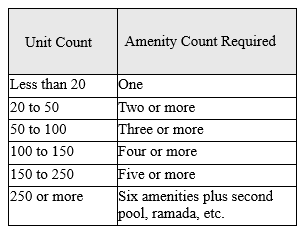
| 5. Each development shall provide amenities in accordance with the following schedule: | X | X | |||
 | |||||
|
6. Amenity options include but shall not be limited to:
a. Swimming pool, a portion of which shall be a minimum 60-foot length, with cool deck perimeter and ramada. b. Jacuzzi area with ramada. c. Ramada with bbq and seating areas. d. Tot lot. e. Volleyball court. f. Concrete multi-use court. g. Tennis courts, pickleball and/or racquetball courts. h. Weight room. i. Dog park. j. Putting green. k. Walking path. | |||||
|
7. Location:
a. Any multi-person activated outdoor amenities shall not be located closer than 100 feet from any existing neighboring residential property. | |||||
|
8. Excluded areas: The following shall not be counted towards common open space:
a. Driveways or parking spaces. b. Required front, side, and rear yard setback areas. c. Non-functional landscaped areas such as street frontage landscaping, building foundation landscaping, and landscaping within the parking lot. | |||||
|
9. Open space reductions:
a. The Zoning Administrator may reduce or waive the open space requirements if: i. The subject site is located within the Infill Incentive District, Middle Housing Overlay District, or within ¼ mile (travel path) of publicly accessible park or public recreation facility. | |||||
| 10. Private open space shall be provided for each unit. Such spaces shall have an unencumbered area that is a minimum of 65 square feet with a minimum width of 8 feet and a minimum depth of 5 feet and shall be entirely covered as required in subsection 3, building architecture. | X | X | X | X | X |
| 11. View fencing shall be provided along arterial and collector streets in areas where private yards do not abut those streets, except for non-gated subdivisions, which may provide view fencing or leave the aforementioned areas open with no wall or fence. View fencing may include a combination of masonry and view fencing providing that at least the top 60% of the fencing is view fencing | X | X | X | ||
| 12. If a gate is provided to the main entrance of a single-family subdivision or a multi-family complex, the gates shall not be located further towards the street than the closest building wall and shall not be made of a solid or opaque material. | X | X | X | ||
| 13. Parking garages fronting a street shall be placed next to each other on adjacent lots in order to maximize on-street parking, where applicable. | X | X | |||
| 14. For corner lots, parking garages shall be located on the interior lot side (not the street corner side). | X | X | |||
|
15. Garages fronting onto an internal driveway or street shall be setback:
a. 3—5 feet from said driveway or street, or b. A minimum of 20 feet from said driveway or street | X | X | X | X | X |
| 16. A one-car garage or shade structure is required to be 10 ft by 20 ft of unencumbered space. A two-car garage or shade structure is required to be 20 ft by 20 ft of unencumbered space. Parking requirements are regulated by section 35-1804. | X | X | X | X | X |
| 17. The required covered parking spaces shall be located adjacent to units, and the guest parking spaces shall be evenly dispersed throughout the development. | X | X | |||
| 18. Provide screening or other accommodation for trash containers, recycling bins, household tools and equipment. | X | X | X |
(3) Building architecture:
(a) Building architecture design standards applicable for single-family lots, single-family subdivisions, lots with a single duplex, triplex, or fourplex, and multi-family (five (5) units and up) shall be as indicated in the following table with a "X."
| Building Architecture Design Standards |
Single-Family
|
Single-Family
with 8 or More Lots |
Duplex, Triplex,
and Four-Plex |
Multi-Family
(5—20 Units) |
Multi-Family
(20 and Up) |
|---|---|---|---|---|---|
| PRIMARY ENTRY DESIGN | |||||
|
1. The primary entrance shall be designed to include one of the following:
a. Porch (a roof covered area attached to and projecting a minimum of six (6) feet from the front exterior wall of the structure covering the entrance and an extended area along the front for seating). b. Portico (a column supported roof over the entrance of the home that extends a minimum of 5 feet from the exterior wall to provide shelter from the elements). c. Awning (a roof covering that is not supported by columns and that is attached to and projects a minimum of 4 feet from the exterior wall and is located over the entrance to provide shelter from the elements. awnings shall be metal, roof tiles, shingles, or other hard non-flexible materials. d. Recess (a front door that is recessed a minimum of 4 feet from the exterior wall plane on which the door is located to create a covered landing area.) | X | X | X | X | X |
| 2. Orient front doors toward the fronting street or a common courtyard that is shared with other dwelling units. The use of distinctive architectural elements and materials to denote prominent entrances is required. | X | X | X | X | X |
| 3. Building orientation: Design the primary facade of the buildings with varied setbacks for a minimum of 5 feet in depth to create an interesting and attractive street edge while maintaining the required building setback. | X | X | X | ||
| GARAGE PLACEMENT & ORIENTATION | |||||
| 4. Garages shall use colors and materials used on the primary building façade to blend the garage with the frontage of the dwelling. | X | X | X | X | X |
| 5. When oriented as a side entry garage, a minimum of 25% of the surface area of the side of the garage facing the street shall include windows and architectural detailing to match the detailing on the primary portion of the structure and appear as a livable portion of the dwelling unit. | X | X | X | ||
| MASSING & SCALE | |||||
| 6. If the front elevation is longer than 30 feet, incorporate a minimum of 2 feet deep by 10 feet wide offset for each 30 feet of building wall length and extend to the full height of the building. Building entrances and front porches may count towards meeting this requirement. | X | X | X | ||
| 7. Horizontal off sets: Breaks in massing of at least 2 feet in depth shall be provided for a minimum of 25% of a single building elevation through the use of varying setbacks, building entries, building offset, or modulation of building facades. | X | X | |||
| 8. Vertical variation: Change in rooflines of at least 2 feet in height shall be provided for a minimum of 25% of a single building elevation through change in height and form. | |||||
| 9. The Zoning Administrator may accept minor departures from the horizontal off set and vertical variation requirements for the rear elevations of a building that are not visible from public rights-of-way and adjoining residential, commercial, or open spaces. | |||||
| 10. Where the side façade at the end of a building is oriented to a street, driveway, or common Open space area, massing and level of detailing of the side façade shall be consistent with the front façade. articulation of the side façade may include windows, doors, and porches. | X | X | |||
| 11. Side elevations shall provide a minimum of one horizontal plane break of at least 2 feet in depth. | X | X | X | ||
| 12. Provide single-story or combination one- and two-story homes on all corner lots, with the two-story portion encompassing a maximum 75% of the building footprint and oriented furthest away from the street side yard. | X | X | X | ||
|
13. For lots greater than 50 feet wide: No more than three detached two-story single-family
homes shall be located next to each other along arterial and collector streets, except
when:
a. Rear yard setbacks are staggered a minimum depth of 10 feet every 150 feet or less, or b. Two-story homes have a single-story component that comprises at least 25% of the length of the building footprint and the two-story component is oriented furthest away from the arterial or collector street and which no more than three are located next to each other without staggering the rear yard setback a minimum of 10 feet or locating a two-story home that does not have a one-story component. | X | ||||
|
14. Structures that are two stories or more shall comply with a minimum of two of
the following strategies to reduce massing and diminish a box-on-box appearance:
a. Include a single-story element on the rear or front elevation that is at least 25% of the length of the building footprint. b. At least 3 sides of the structure provide a minimum of one vertical break stepping back a minimum depth of 3 feet for at least 25% of the length of each side. c. Provide multiple roofs at different heights, or parapet heights varying a minimum of 2 feet. d. Provide at least 3 of the following features that break up the box-on-box effect: i. Covered rear patios (minimum 4 feet in depth) extending from the exterior wall of the structures. ii. Covered porches (minimum 6 feet in depth) shall run at least 50% of the front of the structure for homes that are 40 feet or wider. for homes 39 feet wide or less, the covered porch (minimum 6 feet in depth) shall run at least 30% of the front of the structure. iii. Bay windows iv. Cantilevers v. Projecting balconies (minimum 4 feet in depth) vi. Dormers vii. Awnings (minimum 4 feet in depth) | X | X | X | ||
| ROOFLINES | |||||
| 15. Variation of roof forms shall be used on buildings over 50 feet in length along the street frontage and accomplished through the use of differences in roof height (minimum 2 feet) and/or form. | X | X | X | ||
| 16. Varied roof form shall be used as appropriate to the architectural style, including but not limited to the following: Hipped roofs, shed roofs, gabled roofs, varying pitches, roof dormers, and flat roofs. | X | X | X | X | X |
| 17. Rooflines shall be designed with changes in ridgeline direction and configuration to ensure variation in rooflines between structures. | X | X | X | X | X |
| 18. No more than two identical side-by-side roof slopes should be constructed along arterial or collector streets or public open space. | X | X | |||
| ARCHITECTURAL DIVERSITY & ARTICULATION | |||||
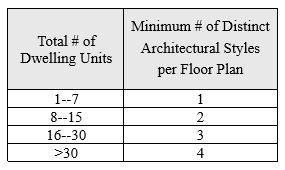
| 19. New developments with 4 or more contiguous single-family detached lots shall offer multiple distinctly different architectural styles as follows: | X | X | |||
 | |||||
|
Each architectural style shall feature at least four (4) distinctive features on each
elevation, such as but not limited to:
a. Roof form and materials b. Masonry veneer (covering a minimum 20% of the elevation) c. Exterior materials d. Window and column detailing e. Arches f. Ornamental ironwork g. Eave details | |||||
|
20. A multi-family development must have at least one clearly defined architectural
style, and each architectural style shall feature at least four distinctive features
on each elevation, such as but not limited to:
a. Roof form and materials b. Masonry veneer (covering a minimum 20% of the elevation) c. Exterior materials d. Column detailing e. Arches f. Ornamental ironwork g. Eave details | X | X | X | ||
|
21. A minimum of three different materials and at least five of the following architectural
elements shall be provided on each building elevation:
i. Covered porch ii. Bay windows iii. Cantilevers iv. Projecting balconies v. Dormers vi. Awnings vii. Trims around doors and windows that match the architectural style viii. Window mullions and muntins ix. Window shutters x. Accent materials (e.g., decorative tile, decorative metal accents) xi. Decorative brackets under roof eaves, projecting balconies, or other xii. Decorative downspouts | X | X | |||
| 22. Duplexes, triplexes, fourplexes shall be designed to appear as separate units by the use of clearly identified entries. | X | X | |||
| 23. All primary entrances into residential buildings or individual units shall provide weather protection by having an overhead roof feature extending a minimum of four feet from the building façade and four feet in width. | X | X | X | X | X |
| 24. The first floor shall provide pedestrian scaled elements by using two or more architectural features on the front elevations (e.g. arches, awnings, fenestration, patios, columns, cornices, moldings, and trellises) that are not used in the same pattern on the upper stories. | X | X | |||
| 25. The same elevation shall not be built side-by-side or directly across the street from one another as defined by 60% or more of lot width. | X | X | X | ||
| MATERIALS & COLORS | |||||
| 26. All exterior materials shall be durable to withstand the elements such as but not limited to brick, masonry, stone, masonry veneers, concrete, composite wood products and stucco. | X | X | X | X | X |
| 27. A unified palette (color, texture, sheen) of materials shall be used on all sides of buildings. Every building shall include no less than three colors appearing on the building exterior. | X | X | X | X | X |
| 28. Natural materials such as stone, river rock, and slate, which are intended to be seen in their natural state shall not be painted. | X | X | X | X | X |
| 29. Roofing materials shall consist of the following: Dimensional composite shingles, ceramic tile, clay tile, concrete tile, and standing seam metal. Wood shingles are prohibited. | X | X | X | X | X |
| 30. Untreated wood is not permitted. | X | X | X | X | X |
| 31. When a material wraps around a corner it shall be terminated by an architectural element such as an offset, column, intersecting wall, or fence. | X | X | X | X | X |
| 32. Balcony design shall match the building in terms of style, color, and materials. | X | X | X | X | X |
(Ord. No. 5142, § 2(Exh. A), 11-13-25)
35-1904. - Commercial design standards.
(1) Applicability:
(a) The following objective design standards shall be applied to all new commercial uses, developed individually or as part of a larger commercial center.
(b) These standards are intended to provide a clear set of architectural and site design requirements for new commercial development. These standards provide clear and quantifiable direction to ensure that future development maintains the unique character and high quality of design within the City of Chandler, while ensuring building form and scale are appropriate to the site.
(2) Site layout:
(a) Height, building setback, and lot coverage shall be regulated by the zoning district in which the property is located in. These regulations can be found in the City of Chandler Land Use and Zoning Code at the following links:
Height and area regulations for lots located in Planned Area Development (PAD) zoning districts are established by the ordinance that adopted the PAD, which can be found in the development's zoning file. Zoning files are kept at the City of Chandler's Development Services Department.
When commercial projects are adjacent to a rear or side yard of single-family residential development, including those instances when separated by an alley, the following separation must be maintained on the site: Commerical buildings shall be no closer than twenty-five (25) feet, plus one (1) additional foot for each foot of height of the commercial building, from the residential property line.
(b) Stand-alone building PAD sites:
1. Applicability: For the purpose of this section, stand-alone building PAD sites are uses that stand apart from, and hence are not perceivable as, part of the main building complex. Stand-alone PAD sites may be developed as single freestanding uses, such as a restaurant or bank, or a cluster of uses sharing common architectural detail and materials, open spaces, and shaded areas and pedestrian connections. Freestanding building adjacent to the main complex structures will not be considered stand-alone building PAD sites if the freestanding building is not separated from the larger complex by vehicular movement, improved vehicular surfaces, or retention area.
2. Number: The number of PAD sites permissible in a shopping center shall be limited to one per arterial street frontage, with corner PAD sites to count as one of the frontage allowances. Multi-user PAD sites are permitted only when the uses are integrated and clustered within a common open space with seating areas and pedestrian walks, share common architectural details and materials (e.g., color, texture) portrayed by the main complex, and not separated by vehicular movement. More than two (2) freestanding PAD sites may be approved through the preliminary development plan (PDP) process.
Notwithstanding the foregoing, the Zoning Administrator may approve more than two (2) free-standing PAD sites per development administratively, upon determining that all of the following apply:
a. The PAD will enhance the quality of the overall development or revitalize an existing commercial center;
b. An additional PAD will make use of an area that is currently underutilized;
c. There is sufficient area on the site to accommodate safe and adequate on-site traffic circulation and the site has been designed to prevent drive-through queuing from backing onto main driveways or public streets;
d. No more than one high-turnover user per street frontage;
e. The PAD(s) and the overall commercial center in which it is located comply with Article XVIII parking and loading regulations;
f. The architectural design (i.e. building form and materials) of the PAD is compatible with and superior to existing buildings in the same center through the following but not limited to:
i. Increased levels of architectural quality;
ii. Greater material diversity;
iii. Enhanced usable space and/or pedestrian connection;
iv. Activation of street frontage;
v. Higher levels of landscape design;
vi. Creative design solutions for back-of-house functions.
3. Location: Any high-turnover uses (fast food, convenience stores, service stations, etc.) must be integrated within larger planned commercial and office centers. However, on sites where the contiguous area is generally insufficient to allow a larger planned center, relief may be considered through the provisions of the Planned Area Development (PAD) process, subject to approval by City Council.
4. Construction: Any stand-alone PAD site building(s) twelve thousand (12,000) square feet or greater in building area, located within any commercial site that is ten (10) acres or greater in size, shall be allowed to be constructed prior to the balance of the commercial center. Any PAD site buildings twenty-five thousand (25,000) square feet or less in building area, located within any commercial site that is less than ten (10) acres in size, shall be constructed concurrently or subsequently with at least twelve thousand (12,000) square feet of additional building area in the commercial center.
(c) Drive throughs and pick-up windows:
1. One drive-up or drive through user per street frontage is permissible as long as the drive-up does not conflict with parking maneuvering areas, main-stream vehicular movement, or in itself create an unsafe traffic situation.
2. All queuing lanes for fast food and similar high-turnover uses shall be a minimum of fourteen (14) feet in width.
3. Establishments with queuing lanes that offer on-site ordering shall meet all of the following requirements:
a. Provide at least one queuing lane meeting both of the following queuing length requirements:
i. Minimum one hundred fifty (150) feet in length measured from the drive-up window to the start of the lane;
ii. Minimum of one hundred twenty (120) feet from the start of the lane to the menu board.
b. Any additional queuing lanes shall not be counted towards the minimum queuing requirement for on-site ordering.
c. Any additional queuing lanes dedicated solely for picking up pre-ordered items and which do not have a menu board shall provide a minimum of sixty (60) feet in length measured from the pickup window to start of the lane. This queuing length standard is not intended for such uses as drug stores, banks, dry cleaners, etc.
4. Drive through lane entry and exit shall be separated from vehicular parking areas, through curbing, landscaping, etc.
5. At each intersection of drive through lanes and sidewalks, a crosswalk with textured, decorative paving and pedestrian crossing signs shall be provided. Additionally, one of the following safety measures shall be provided:
a. Crosswalk with raised speed table;
b. Speed bump prior to pedestrian crosswalk.
6. All drive through facilities, including drive through lanes and queuing areas shall be adequately screened from street view by building orientation, or by a landscaped berm and retaining wall measuring four (4) feet from grade of the driving lane, and situated so as not to disrupt safe traffic flow.
7. Drive through speaker(s) shall not face property zoned for single-family residential uses.
8. Menu boards shall be screened from street view by building orientation or by a minimum 4-foot solid masonry wall.
(d) Pedestrian connectivity:
1. An on-site walkway shall connect the main entry of each building or each primary entry to a public sidewalk on each street frontage of the site, and to any transit stop adjacent to the site.
2. A system of pedestrian walkways shall connect all buildings on a site to each other, to on-site automobile and bicycle parking areas, and to any on-site recreational or open space areas or pedestrian amenities.
3. Textured paving treatments shall be provided at all on-site pedestrian crosswalks, and driveway entrances for a minimum of thirty (30) feet in length on-site.
4. Bus bay locations, where applicable, shall be integrated with pedestrian walkways that provide direct access to the property.
5. Perimeter sidewalks shall be provided in one of the following manners:
a. Detached and separated from the curb by landscaping barrier;
b. Attached to the curb;
c. Entirely or partially meandering and detached and separated from the curb by landscaping barrier.
6. Perimeter sidewalks shall connect to existing perimeter sidewalks on abutting properties.
7. Perimeter sidewalks shall be not less than six (6) feet in width except that, in locations anticipating heavier than normal pedestrian traffic, the zoning administrator may require these to be eight (8) feet in width.
(3) Building architecture:
(a) Massing and articulation:
1. Horizontal off sets:
i. Buildings less than two thousand (2,000) square feet shall incorporate breaks in massing having a depth of at least six (6) inches for a minimum of twenty-five percent (25%) of each building elevation through the use of varying setbacks, building entries, exterior wall plane offset, or modulation of building facades.
ii. Buildings greater than two thousand (2,000) square feet shall incorporate breaks in massing having a depth of at least two (2) feet for a minimum of twenty-five percent (25%) of each building elevation through the use of varying setbacks, building entries, building offset, or modulation of building facades.
2. Vertical variation: Change in rooflines of at least two (2) feet in height shall be provided for a minimum of twenty-five percent (25%) of each building elevation through change in height and form.
3. The Zoning Administrator may accept minor departures from the horizontal off set and vertical variation requirements for the rear elevations of a building that are not visible from public rights-of-way or adjoining residential, commercial, or open spaces.
(b) Architectural consistency:
1. Building architecture shall promote consistent architectural character and detail on all sides of the structure, including the continued use of building materials on each side.
2. If a subject site is located within a larger existing center or development, then the subject site shall be architecturally integrated with the larger center or development. To be considered architecturally integrated, the proposal shall provide the following at minimum:
i. The predominant building color(s) (excluding accent colors) used on the proposed building shall match the predominant building color(s) found in the larger center.
ii. The predominant building materials used on the proposed building shall feature at least two (2) prominent building materials found in the larger center.
iii. The predominant roof form and roof materials on the proposed building shall use the same predominant roof form and roof materials found in the center.
3. Building features that are used for advertising or to promote a recognizable corporate image (corporate stylized architecture) shall be limited to a maximum of one accent color or material and shall meet one of the following:
i. When the color or material is not found within the approved color palate for the larger center, then the color or material shall be limited to ten percent (10%) of a single building elevation.
ii. When the color or material is found within the approved color palate for the larger center, then the color or material shall be limited twenty percent (20%) of a single building elevation. additional colors or materials may be considered if they are prominent building colors found within the approved color palate for the center.
(c) Building materials and facade details:
1. Building materials shall be of high quality and durable. they include, but are not limited to:
i. Brick
ii. Stone (natural or faux)
iii. Integral color, sand blasted or stain textured masonry
iv. Split-faced masonry units
v. Tilt-up concrete panels
vi. Stucco/EIFS
vii. Architectural pre-finished metal
viii. Concrete and clay tile roofs
ix. Treated or engineered wood product
2. At least three (3) materials shall be used in addition to glazing and accent features (e.g., fence panels, tile accents, trellises) unless dictated by an architectural style that prescribes a particular building material as the dominant feature (e.g., pueblo, santa fe style, etc.) as follows:
i. A predominant material (maximum sixty-five percent (65%)) and two (2) additional materials (minimum ten percent (10%) each) shall be provided on each building facade
3. Solid covered canopies shall be provided at all pedestrian building entries at a minimum depth of four (4) feet.
4. Where existing flush curbing is utilized, a combination of decorative bollards and landscape planters shall be provided with no more than six (6) consecutive bollards.
(d) Screening:
1. Any commercial development using outside storage area for equipment, vehicles, or materials shall screen such area from view with a 6-foot masonry or concrete wall excluding approved gated openings.
2. Dismantling, servicing, repairing, etc., of vehicles and/or equipment shall be within completely enclosed buildings or within an area enclosed by a solid concrete, masonry, or similar material wall except for openings for ingress and egress which shall be furnished with solid gates.
3. Service bays shall meet all of the following screening requirements:
i. Screening from adjacent properties zoned for residential uses shall meet the following requirements:
1) Bay doors located within one hundred (100) feet of an adjacent residential property line shall be oriented away from the adjacent use.
2) Bay doors located between one hundred (100) feet and six hundred (600) feet of an adjacent residential property line and oriented such that the bay doors would be visible from the adjacent use shall be screened with an intervening building or an 8-foot-tall screen wall. The 8-foot-tall screen wall shall not be located in the required building setback.
ii. Screening from adjacent streets shall be accomplished through the use of intervening building such that the bay doors are not visible from the street(s). Sites that are unable to screen service bays using an intervening building shall use at minimum one of the following methods:
1) Preferred method: Orient the building such that the bay doors are perpendicular to the abutting street. For corner lots, the bay doors shall be oriented perpendicular to the street with the highest functional street classification (i.e. arterial, collector, etc.) identified in the general plan. in the event that the street classifications are equivalent, the orientation creating the smallest noise impact on adjacent residential development shall be used.
2) Bay doors facing the street shall be setback at least two hundred (200) feet.
3) Bay doors less than two hundred (200) feet from an adjacent street and less than perpendicular to a street shall provide a solid 6-foot masonry screen wall. The 6-foot-tall screen wall shall not be located in the required building setback.
4. Provide long-term storage of shopping carts either within the tenant space or adjacent to it, behind a decorative screen wall exceeding the height of the carts. Shopping cart storage shall not encroach into accessible pathways.
(e) Gas stations:
1. Design of gas canopies shall be integrated with adjacent building architecture through the use of similar materials, colors, and roof forms.
2. Gas canopy lights shall be flush with the bottom of canopy.
3. Gas canopy bottom edge shall be a maximum of fifteen (15) feet six (6) inches above finish grade, unless canopy is integrated into convenience store building.
4. All venting and mechanical equipment shall be screened from arterial streets and public view, this includes gas vent stacks. Gas vents shall be integrated into the canopy or mounted directly adjacent to the convenience store and shall not be a separate structure. The canopy shall incorporate alternative materials (such as louvers or mesh screening) to allow for sufficient ventilation while fully screening any gas vents or mechanical equipment.
5. No outside vending is permitted, including ice machines.
(f) Interface with single-family residential area: When commercial projects are next to or across an alley from a rear or side yard of single-family residential development:
1. Second-story window balconies and other openings are allowed only when demonstrated to and approved by the zoning administrator that back yards of adjacent residences will not be visible from such balconies or openings by persons sitting or standing in the commercial buildings.
(4) Locational criteria and site development standards for large single use retail development:
(a) Locational criteria: Large single use retail, as defined in section 35-200 of this Code, shall only be permitted on property zoned as Planned Area Development (PAD) for such use, in accordance with the requirements and provisions of Chapter 35, Article XVII of this Code, and further subject to all of the following location criteria. Any proposal to expand an existing retail use, which subsequently brings the total building coverage of that use to one hundred fifty thousand (150,000) square feet or more, shall also require conformance with all of the following standards, for the entire site development. Council may approve departure from these standards upon finding that such departure is warranted, based upon consideration of mitigating circumstances, design innovation, or other meritorious feature(s), as provided for in Chapter 35, Article XVII of this Code.
1. Any parcel proposed for a large single use retail development shall be adjacent to a freeway interchange, or shall front along two (2) major arterials forming an intersection designated by the Chandler General Plan as "commercial node," or as "regional major commercial development," or other successor designation specified in the general plan, or in an area plan approved by the Mayor and City Council, that expressly provides for such large single use retail development.
2. A minimum distance of one thousand five hundred (1,500) feet, as measured on a straight line, shall be required from the nearest property line of any parcel currently zoned for low density single-family residential use, to the nearest exterior wall of the large single use retail building.
a. For purposes of this measurement, the phrase "low density single-family residential use" shall mean a subdivision of land, as defined in section 35-200 of this Code, located within the City jurisdiction, with a net overall density in the range of zero to four and one-half dwelling units/acre. For purposes of this measurement, neither the AG-1 (agriculture) nor the MH-1 (mobile home) zoning district shall be considered as a low density single-family zoning designation.
b. The one thousand five hundred (1,500) foot distance may be reduced or waived altogether by Council if based upon a finding that other mitigating circumstances already exist on, or adjacent to, the site proposed for large single use retail development. Such mitigating circumstances may involve existing non-single-family land uses or zoning designations, or other physical barriers such as a major arterial right-of-way, freeway right-of-way, railroad or canal right-of-way, which Council may find achieves an effective separation and buffer from the land use impacts of the large single use retail development.
c. The one thousand five hundred (1,500) foot distance may be reduced, or waived altogether, by Council if based upon a finding that the large single use retail development proposal demonstrates a combination of superior architectural or site design techniques, such as, without limitation, i) attaching other accessory retail shop space and storefronts to displace at least a portion of what would otherwise be a lengthy exterior front wall plane of the large single use retail building; ii) extensive greenbelts not less than one hundred (100) feet in width that feature mature landscaping, architectural theme walls, and terraces that cause the finished grade of the large single use retail building to be at least six (6) feet lower than the finished lot grade of the nearest low density single-family residential use; iii) relocation of loading docks and overhead bay doors to another side of the building which does not face any adjacent residential use, and which in turn causes elimination of any rear service drive or other means of access to the rear of the building other than pedestrian doors; iv) completely separating the large single use retail building with smaller scale buildings accommodating less intensive land use(s), which provides an effective transition to any adjoining residential use.
The requirements of this subsection 35-1904(4)(a)2. shall not apply if the developer of such low density single-family residential use was required by condition of zoning as approved by the Chandler City Council to give full and adequate disclosure that said residential subdivision was within one thousand five hundred (1,500) feet to another site currently designated for regional commercial use, as shown on the Chandler General Plan, wherein such designation may permit large single use retail development.
3. An application requesting zoning approval for a large single use retail component may also request zoning for a single-family use as a component of a mixed use project only when each of the following conditions are met:
a. The large single use retail parcel shall be expressly identified for such use as part of a mixed use Planned Area Development (PAD) zoning application, wherein such application as approved by City Council also depicts the single-family residential parcel(s), and any transitional land use parcels and buffers adjoining the large single use retail parcel.
b. Full and adequate disclosure of such large single use retail location shall be given by the developer or homebuilder of the single-family residential use within one thousand five hundred (1,500) feet, to any prospective homebuyer in the manner specified as a condition of City Council approval, for the Planned Area Development (PAD) zoning application.
c. Preliminary development plan approval for the large single use retail parcel, in the manner set forth in section 35-1706 of this Code, shall be required either prior to, or concurrent with, preliminary development plan approval for one or more single-family residential parcels within said mixed use development proposal.
d. The required Planned Area Development (PAD) zoning application, wherein such mixed uses are identified, shall also demonstrate sufficient buffer separations using such elements as street right-of-way, stormwater retention area(s), landscaping techniques, and masonry walls, in combination to achieve complete separation. In no event shall any parcel proposed for large single use retail, share a property line with any parcel proposed for low density single-family use.
4. Any parcel proposed for large single use retail development shall be a minimum distance of one thousand three hundred (1,300) feet from any site currently zoned, or built, as a public or private elementary school, middle school, junior high, or high school.
a. In no event shall any development site containing a large single use retail parcel gain vehicular access from a local street, collector street, or private drive, that also provides vehicular access or frontage to a public or private elementary school, middle school, junior high, or high school.
b. The minimum distances required by this subsection 35-1904(3)(a)4., between the large single use retail building and any given school, shall be the shortest straight line measurement from the school property line to the nearest exterior wall of the large single use retail building.
The requirements of this subsection 35-1904(4)(a)4. shall not apply to any elementary school, middle school, junior high, or high school located on property zoned for uses other than low density single-family residential use.
Notwithstanding conformance with all of the above locational criteria, City Council may deny an application for the Planned Area Development (PAD) zoning designation, in accordance with the provisions set forth in section 35-1706(4) of this Code.
(b) Site development standards: In addition to the site development and landscaping standards set forth in Article XIX of this Code, large single use retail shall also be subject to conformance with the following additional standards. Council may approve departure from these standards upon finding that such departure is warranted, based upon design innovation or other meritorious feature(s) as provided for in Chapter 35, Article XVII of this Code:
1. Maximum total site coverage of all buildings shall not exceed twenty-four percent (24%) of the net site area.
2. Minimum front, side, and rear setbacks for all large single use retail building(s) and parking, as otherwise specified in section 35-1902 of this Code, shall be increased at the rate of two (2) additional feet for each ten thousand (10,000) square feet of building coverage over one hundred fifty thousand (150,000) square feet. Such setbacks from any public street shall be measured from the future right-of-way line, wherein such right-of-way width is determined in accordance with the circulation element of the Chandler General Plan.
3. The architecture of the large single use retail building, together with any PAD building(s) or in-line shops, shall demonstrate visual interest on all exterior sides through the use of such techniques, without limitation, as wall plane changes, color and material changes, pop-outs, reveal lines, scoring, varied roof lines and slopes, recessed features, articulated customer entrances, canopies, colonnades, and other elements, all of which effectively integrate the building mass with its surroundings, and bring proportion to its horizontal and vertical dimensions.
4. Entry drives shall be aligned with any point of access to an arterial street that provides full turning movements, as approved by the City Transportation Engineer. Said entry drive(s) shall be defined as a boulevard, thereby separating entry/exiting movements from parking space search maneuvers.
5. Sidewalks not less than six (6) feet in width shall be provided within the site development, providing direct pedestrian access from the arterial sidewalks to primary customer entry doors. Such on-site sidewalks shall be separate and distinct by use of landscaping, color, and material changes. In addition, a minimum ten (10) foot wide sidewalk shall be provided parallel to the front elevation of the large single use retail building for its entire length, and separate from any parking space overhang, driving aisle or landscaping as required in section 35-1906 of this Code.
6. Any outdoor display areas for merchandise shall be enclosed by fence walls integrated with the architecture, color, and materials of the primary building, and may include wrought iron for visibility. Such fence wall enclosures shall be a minimum four (4) feet or greater in height.
7. Any areas used for shopping cart containment as may be provided adjacent to the building, shall be fully enclosed and screened by a minimum four (4) foot high masonry wall, with berming and landscaping in the quantities set forth in section 35-1906 of this Code.
8. Outdoor storage of merchandise or other miscellaneous material, including containment in metal bins, shall not displace any portion of the site development intended for parking, access, landscaping, or loading, and shall be screened in the manner specified in section 35-1904(3)(d)1. and 35-1905(3)(e)1v. of this Code.
9. A traffic study shall be submitted for approval by the City Transportation Engineer, in conjunction with the preliminary development plan submittal requirements set forth in section 35-1706 of this Code. Recommended measures and improvements to mitigate traffic impacts shall be the responsibility of the project developer.
10. A photometric plan shall be submitted for approval by the Zoning Administrator, in conjunction with the preliminary development plan requirements set forth in section 35-1706 of this Code. Said plan shall demonstrate an illumination level in the range of 1.5 to 2.0 footcandles, for approval by the Chief of Police or designee. Such submittal shall include catalogue cuts of all lighting fixtures with shields to ensure down lighting only, concealed point sources of light, and prevent overspill onto adjoining properties.
11. Overnight parking of recreational vehicles anywhere within the site development shall be prohibited.
(Ord. No. 5142, § 2(Exh. A), 11-13-25)
35-1905. - Industrial design standards.
(1) Applicability:
(a) The following objective design standards shall be applied to all new industrial uses, developed individually or as part of a larger industrial project.
(b) These standards are intended to provide a clear set of architectural and site design requirements for new industrial development. these standards provide clear and quantifiable direction to ensure that future development maintains the unique character and high quality of design within the City of Chandler, while ensuring building form and scale are appropriate to the site.
(2) Site layout:
(a) Height, building setback, and lot coverage shall be regulated by the zoning district in which the property is located in. These regulations can be found in the City of Chandler Land Use and Zoning Code at the following links:
Height and area regulations for lots located in Planned Area Development (PAD) zoning districts are established by the ordinance that adopted the PAD, which can be found in the development's zoning file. Zoning files are kept at the City of Chandler's Development Services Department.
When industrial projects are next to or across an alley from a rear or side yard of single-family residential development: Industrial buildings shall be no closer than twenty-five (25) feet, plus one additional foot for each foot of height of the industrial building, from the residential property line.
(b) Building orientation:
1. The building front shall be oriented to a public roadway or an internal primary drive for multi-building developments.
2. The office, showroom or other publicly accessible portions of the building shall be located or oriented in the building so as to be highly visible from a public roadway or the public realm.
3. A building located on a corner site shall be oriented to address both street frontages, and shall have enhanced landscaping and architectural design features such as street-facing windows and doors.
4. Warehouses shall be located to the side or rear of the building to minimize the visual impacts of warehousing/distribution activities, vehicle maneuvering areas, and back-of-house functions from the pedestrian and visitor experience.
(c) Vehicular access and connectivity:
1. Public/visitor areas shall be separated from truck delivery and maneuvering areas. On multi-building projects, the primary driveway for the public and/or visitors shall provide the following:
a. Variety of materials (e.g., texturized paving, colored pavement)
b. Enhanced landscape palate compared to the balance of the site
(d) Pedestrian connectivity:
1. An on-site walkway shall connect the main entry of each building or each primary entry to a public sidewalk on each street frontage of the site, and to any transit stop adjacent to the site.
2. A system of pedestrian walkways shall connect all buildings on a site to each other, to on-site automobile and bicycle parking areas, and to any on-site recreational or open-space areas or pedestrian amenities.
3. Textured paving treatments shall be provided at all on-site pedestrian crosswalks, and driveway entrances for a minimum of thirty (30) feet in length on-site.
4. Bus bay locations, where applicable, shall be integrated with pedestrian walkways that provide direct access to the property.
5. Perimeter sidewalks shall be provided in one of the following manners:
a. Detached and separated from the curb by landscaping barrier;
b. Attached to the curb;
c. Entirely or partially meandering and detached and separated from the curb by landscaping barrier.
6. Perimeter sidewalks shall connect to existing perimeter sidewalks on abutting properties.
7. Perimeter sidewalks shall be not less than six (6) feet in width except that, in locations with anticipated heavier-than-normal pedestrian traffic, the zoning administrator may require these to be eight (8) feet in width.
8. Multi-building projects with three (3) or more buildings shall provide a minimum of two (2) functional outdoor amenities and/or communal areas for employees. Such amenities shall be located near building entrances or other focal points within the development where they will be convenient and comfortable for users. Outdoor amenities and communal area include, but are not limited to:
a. Active recreational spaces such as sport courts, putting greens, etc. Active recreational spaces shall be located no closer than one hundred (100) feet to the property line of any property zoned for residential uses;
b. Outdoor seating areas shaded by trees and/or structures such as trellises, pergolas, and canopies.
(3) Building architecture:
(a) Massing and articulation:
1. Horizontal off sets: Breaks in massing of at least two (2) feet in depth shall be provided for a minimum of twenty-five percent (25%) of a single building elevation through the use of varying setbacks, building entries, building face off set, or modulation of building facades.
2. Vertical variation: Change in rooflines of at least two (2) feet in height shall be provided for a minimum of twenty-five percent (25%) of a single building elevation through change in height and form.
3. The Zoning Administrator may accept minor departures from the horizontal off set and vertical variation requirements for the rear elevations of a building that are not visible from public rights-of-way and adjoining residential, commercial, or open spaces.
(b) Architectural consistency:
1. Building architecture shall promote consistent architectural character and detail on all sides of the structure, including the continued use of building materials on each side.
2. If a subject site is located within a larger existing center or development, then the subject site shall be architecturally integrated with the larger center or development. To be considered architecturally integrated, the proposal shall provide the following at minimum:
a. The predominant building color(s) (excluding accent colors) used on the proposed building shall match the predominant building color(s) found in the larger center.
b. The predominant building materials used on the proposed building shall feature at least two (2) prominent building materials found in the larger center.
c. The predominant roof form and roof materials on the proposed building shall use the same predominant roof form and roof materials found in the center.
3. Building features that are used for advertising or national image (corporate stylized architecture) shall be limited to a maximum of one accent color or material and shall meet one of the following:
a. When the color or material is not found within the approved color palate for the larger center, then the color or material shall be limited to ten percent (10%) of a single building elevation.
b. When the color or material is found within the approved color palate for the larger center, then the color or material shall be limited twenty percent (20%) of a single building elevation. Additional colors or materials may be considered if they are prominent building colors found within the approved color palate for the center.
(c) Building materials:
1. Building materials shall be of high quality and durable. they include, but are not limited to:
a. Brick
b. Stone (natural or faux)
c. Integral color, sand blasted or stain textured masonry
d. Split-faced masonry units
e. Tilt-up concrete panels
f. Stucco/EIFS
g. Architectural pre-finished metal
2. A generous amount of glazing shall be incorporated into the design of the buildings. Glazing shall be provided at the following percentages for each individual building elevation:
a. Front elevations and other elevations that directly face a public roadway, freeway, or internal primary drive: Minimum 20%
b. Side elevations that are visible from a public roadway, freeway, or an internal drive but not directly facing the roadway or drive: Minimum 10%
c. Rear elevations that are visible from the public roadway, freeway or internal drive: Minimum 5%
3. At least three (3) facade materials shall be used in addition to glazing and accent features (e.g., fence panels, tile accents, trellises) as follows:
a. Front elevation and other elevations that directly face a public roadway: A predominant material (maximum sixty percent (60%)) and two (2) additional materials (minimum forty percent (40%) combined)
b. Side elevation: A predominant material (maximum 80%) and two (2) additional materials (minimum twenty percent (20%) combined)
(d) Facade details:
1. Building entrances:
a. Each principal building shall have clearly defined, highly visible primary entrances for occupants and patrons. Every primary entrance shall have a special emphasis when compared to the other portions of the building. This shall be accomplished by providing the three below enhanced design elements near the entrances:
1. Increased use and height of glazing, encompassing a minimum of seventy-five percent (75%) of the height of the building;
2. Raised parapets with a minimum increase in height of two (2) feet;
3. Canopies or porticos.
b. In addition to the above required design elements, a minimum of two (2) additional enhanced design elements shall be provided near the entrances, including but not limited to:
1. Recesses/projections
2. Peaked roof forms
3. Arches
4. Integral planters or wing walls
5. Enhanced pedestrian surfaces
c. When a building entrance is located at the corner of a building, the design elements incorporated into the entry shall wrap around the corner of the building. Design elements on each side of the corner entry shall span the same length of the building.
d. Building entries shall be oriented toward the predominant public view, usually the street frontage. This allows the public to more easily determine where the front entrance is located and provides a more attractive street frontage.
e. Large buildings which front multiple streets shall provide multiple entrances.
2. Solid covered canopies shall be provided at all pedestrian building entries at a minimum depth of four (4) feet.
(e) Screening:
1. Any industrial development using outside storage area for equipment, vehicles or materials shall screen such area from view with a minimum six (6) foot masonry or concrete wall excluding approved gated openings.
2. Dismantling, servicing, repairing, etc., of vehicles and/or equipment shall be within completely enclosed buildings or within an area enclosed by a solid concrete, masonry, or similar material wall except for openings for ingress and egress which shall be furnished with solid gates.
3. Service bays shall meet all of the following screening requirements:
a. Screening from adjacent properties zoned for residential uses shall meet the following requirements:
1. Bay doors located within one hundred (100) feet of an adjacent residential property line shall be oriented away from the adjacent use.
2. Bay doors located between one hundred (100) feet and six hundred (600) feet of an adjacent residential property line and oriented such that the bay doors would be visible from the adjacent use shall be screened with an intervening building or an eight (8) foot tall screen wall. The eight (8) foot tall screen wall shall not be located in the required building setback.
b. Screening from adjacent streets shall be accomplished through the use of intervening building such that the bay doors are not visible from the street(s). Sites that are unable to screen service bays using an intervening building shall use at minimum one of the following methods:
1. Preferred method: Orient the building such that the bay doors are perpendicular to the abutting street. For corner lots, the bay doors shall be oriented perpendicular to the street with the highest functional street classification (i.e. arterial, collector, etc.) identified in the general plan. In the event that the street classifications are equivalent, the orientation creating the smallest noise impact on adjacent residential development shall be used.
2. Bay doors facing the street shall be setback at least two hundred (200) feet.
3. Bay doors less than two hundred (200) feet from an adjacent street and less than perpendicular to a street shall provide a solid six (6) foot masonry screen wall. The six (6) foot tall screen wall shall not be located in the required building setback.
c. All stairways to upper levels shall be located within the building.
d. Screen walls exceeding eighty (80) feet in length that are visible from street view, open space, or properties zoned for commercial or residential uses shall be broken up through the use of pilasters, and/or offsets in the alignment of the wall or fence.
e. Truck courts shall be fully screened from street view, open space, and any surrounding properties zoned for commercial or residential uses through the use of at least one of the following methods:
1. Use of intervening buildings such that the entirety of the truck courts are not visible;
2. Use of solid eight (8) foot tall masonry or concrete screen wall(s) and opaque gate(s).
f. When security fencing is required, it shall be provided as view fencing. View fencing may include a combination of masonry and view fencing, provided that at least the top sixty percent (60%) of the fencing is view fencing.
g. The use of concertina wire or barbed wire is prohibited unless not visible from public view.
(f) Interface with single-family area: When industrial projects are next to or across an alley from a rear or side yard of single-family residential development:
1. Second-story window balconies and other openings are allowed only when demonstrated to and approved by the Zoning Administrator that back yards of adjacent residences will not be visible from such balconies or openings by persons sitting or standing in the commercial buildings.
(Ord. No. 5142, § 2(Exh. A), 11-13-25)
35-1906. - Landscaping.
(1) Purpose: The purpose of this section is to provide minimum landscape development standards which will promote the general welfare of Chandler residents through the provision of an outdoor environment which will:
(a) Create aesthetically pleasing views and vistas along public streets.
(b) Complement and enhance the functional and aesthetic design of new building and site development projects.
(c) Provide visual screening of parking, service and storage areas.
(d) Mitigate the adverse impacts of higher intensity land uses upon lower intensity uses through the provision of needed "landscape buffers."
(e) Promote water conservation by restricting the use of turf and ornamental water features and requiring the use of low-water-use plant materials.
(f) Promote climate modifications for enhancement of pedestrian environments at street frontages, parking lots and building facades.
(g) Provide maximum shade on ground surfaces to reduce the "urban heat island effect."
(2) Applicability: These landscape standards shall apply to all new developments, except for single-family, duplex, triplex, and fourplex dwellings, which require the approval of a site development plan or subdivision plat by the City of Chandler.
(3) Definitions:
(a) Director: The Development and Community Services Director or his/her designated representative.
(b) Landscaping: Shall include all living plants such as trees, shrubs, vines, vegetative ground cover, organic or inorganic materials, earthen berms, walls, walkways, plazas, courtyards, lighting, benches, trash containers, sculptures and other site furnishings creating an attractive environment.
(c) Landscape plan: A graphic representation of the development of a site which illustrates the nature, design and location of all landscaping elements and materials.
(d) Interior open space: That open space encompassed by line extensions of the exterior walls of one (1) or more buildings constructed on a common building site.
(e) Non-functional turfgrass:
• Any narrow strips of grass especially areas with any single dimension of ten (10) feet or less.
• Grass areas exceeding a 4:1, or twenty-five percent (25%), slope.
• Grass areas that are not accessible by paved pathways and/or are restricted by physical barriers that prohibit accessibility.
• Grass areas installed closer than ten (10) feet to a street and/or in front entryways to residential neighborhoods or subdivisions where other recreational amenities do not exist.
• Grass areas that are dedicated to drainage conveyances, storm basins, erosion control, or operational discharge and are not historically utilized for active programmed recreational purposes.
• Any grass area not historically used for recreational purposes and are primarily aesthetic or ornamental.
(f) Salvaged/harvested water: Collected stormwater for landscape use.
(4) Landscape design plan: All landscape plans shall be drawn at a minimum scale of one (1) inch equals thirty (30) feet (maximum sheet size thirty-inch by forty-two-inch) and contain the following information:
(a) Building footprints and roof overhangs, walkways, parking surfaces and vehicular overhang lines, property lines, right-of-way lines, easement lines and sight angle clearance lines.
(b) Calculations of the square footage and percent of total site of all site elements, including building footprints, parking, and landscape area. Landscape area shall also be further subdivided into subcategories of turf, shrubs/ground cover, and inorganic materials.
(c) The location of existing and proposed plant materials.
(d) Plant schedule, including botanical and common names, planting size, number of plants, and on-center spacing of massed shrubs and ground cover plants on each landscape sheet.
(e) Plant graphic symbol legend or key on each landscape sheet. (Items (d) and (e) may be combined.)
(f) Planting details, specifications and required guaranty.
(g) Proposed treatment (type and depth) of all added inorganic ground surface materials.
(h) Inorganic materials schedule including type of material (i.e. decomposed granite, river rock, screened rock, etc.) and quantities.
(i) Irrigation plan showing location of controller, existing or proposed meters, backflow preventor, water lines, heads, and materials schedule on each sheet.
(j) Irrigation details and pressure loss calculations.
(5) Landscape design guidelines: Landscaping shall be designed, installed and maintained in general accordance with the following guidelines:
(a) Xeriscape principles: Landscape developments shall be designed, installed and maintained in accordance with the following seven (7) basic principles of xeriscape.
1. Planning and design: Use a water conservation design. Implement a "mini-oasis" concept. Water-using plants and turf should be concentrated in small areas near buildings where they may be enjoyed at the pedestrian level.
2. Limited turf areas: Limit the use of turf to small areas where it will be actively used and efficiently watered.
3. Efficient irrigation: Utilize the most efficient irrigation system for the area being served. Drip individual plants rather than flood larger areas. Group plantings together with common water requirements to be watered on the same control zone.
4. Soil improvements: Add soil amendments (improvements) within planted areas to increase the water-holding capacity of the soil and improve the health and vigor of plants.
5. Mulching: Cover final soil surfaces with organic or inorganic mulches to insulate soil temperature extremes and conserve moisture.
6. Lower-water-demand plants: Utilize only those plants listed on an officially approved low-water-use plant list.
7. Appropriate maintenance: Maintain irrigation systems so they operate at peak efficiency. Lessen water demand by keeping weed growth down and by thinning unwanted wood from trees rather than cropping them.
(b) Unity and continuity: Landscape unity and continuity may be significantly enhanced through the selection of a dominant tree and shrub species. Such dominance shall be established by making the selected species clearly in the majority (sixty (60) percent plus).
Note: Plant palettes, except for turf areas in excess of the limitations established by these landscape standards, partially implemented through the construction of one (1) or more phases of a previously approved master planned project shall be continued throughout the development of that project.
(c) Plant massing: The massing of trees and shrubs into groups containing three (3) or more plants is required unless standards elsewhere within these regulations only require a single element, e.g. single trees within parking lot planter islands. Planting of single-shrub specimens, unless used to repeat an element already established within a massed planting within the same visual area, is prohibited. Shrub and ground cover spacing within massed beds shall be spaced in accordance with the spacing standards contained within appendix C [to this section].
(d) Plant associations: The grouping of plant species commonly found together in natural associations or of common environmental requirements (soil type, water, sun exposure, temperature limitations, etc.) is required.
(e) Plant spacing: In order to foster a more natural look, an uneven spacing of plants; unless such plants are being used to create a massed shrub or ground cover bed, is required. Unless dense massing is needed for screening or other specific design purposes, shrub spacing should be sufficient to allow plants to reach their natural mature size and form.
(f) Consistency with adopted streetscape standards: Street frontage landscaping shall be consistent with previously adopted specific streetscape standards (i.e., Ray Road Streetscape Standards).
(6) Standards: All new developments and modifications to existing developments shall be landscaped in accordance with the following minimum standards.
(a) Plant material:
1. Low-water-use plants required: Plant material species (trees, shrubs, ground cover, vines, etc.) shall be limited to those which are included within the latest amended edition of the "Low-Water-Using Plant List" approved by the Director of the Phoenix Active Management Area of the Arizona Department of Water Resources (appendix A).
2. Arizona Nursery Association-Tree specifications: All trees shall comply with the latest amended edition of the "Arizona Nursery Association — Recommended Tree Specifications" (appendix D).
3. Minimum planting size: Unless specified elsewhere, all plant material shall be of the following minimum sizes:
*Date palm or fan palm trees in excess of fifteen (15) feet in trunk height may qualify as a required thirty-six-inch box or forty-eight-inch box planting size.
(b) Landscape area requirements: All portions of a development site not utilized for building development, service areas, paved or improved storage areas, parking driveways, etc., shall be landscaped. Minimum areas of landscaping are as follows:
1. Front yard/street right-of-way areas: All front yard areas and street right-of-way areas located between developed on-site improvements and the back of existing or future public sidewalks or street curbs, except needed access driveways, shall be fully landscaped.
All street frontage landscaping located adjacent to driveway exits and street intersections shall be designed, installed and maintained in accordance with the height, location and sight visibility requirements of the City of Chandler Standard Details (detail C-246, C-247, and C-248).
2. Parking lot area: A minimum of ten (10) percent of the interior surface area of all parking lots shall be landscaped. Planter islands, uniformly distributed throughout the interior parking area, a minimum of nine (9) feet in width (measured from outside face of curb to outside face of curb) and protected by raised curbs. Diamond planters shall be installed in commercial and office development and uniformly distributed between planter islands. Such planters shall be a minimum of five (5) feet square in size, oriented in a diagonal fashion, and shall occur at the following minimum frequencies:
Note: Planters, as required above, may not meet the ten (10) percent planting requirement. The deficiency shall be made up by increasing the size of the planter islands and/or increasing the width of perimeter landscape areas created by building and parking setback requirements.
3. Landscape buffers/perimeter landscape strips: A landscape strip a minimum of ten (10) feet in width shall be provided along all site boundary lines.
4. Building structures: Foundation planting shall be provided at walkways adjacent to buildings and planters up to building edge, where appropriate.
(c) Landscape improvement requirements: the following minimum landscape improvements are required within the following several different landscape areas:
1. Single- and multi-family residential developments:
a. Common open space/retention basins: A minimum of one (1) tree and six (6) shrubs per one thousand (1,000) square feet of open space plus such additional vegetative ground cover, including turf subject to the limitations established within subsection (6)(e) of these standards, needed to cover a minimum of fifty (50) percent of the total landscaped area with shrubs and ground cover.
b. Arterial and collector street rights-of-way: Arterial and collector street rights-of-way adjacent to and within single- and multi-family residential developments shall be landscaped at a rate of one (1) tree and six (6) shrubs per thirty (30) lineal feet plus such additional shrubs and vegetative ground cover, excluding turf which is prohibited within street rights-of-way (unless reclaimed water is utilized), necessary to cover a minimum of fifty (50) percent of the total landscaped area with shrubs and ground cover.
2. Commercial/office/institutional developments: One (1) tree and six (6) shrubs per one thousand (1,000) square feet of open space plus such additional ground cover, including turf subject to the limitations established within subsection (6)(e) of these standards, that upon maturity a minimum of fifty (50) percent of all interior "nonhardscape" open space surfaces shall be covered with shrubs and ground cover.
3. Industrial developments: One (1) tree and six (6) shrubs per one thousand (1,000) square feet of interior open space plus such additional vegetative ground cover, including turf subject to the limitations established within subsection (6)(e) of these standards, that upon maturity a minimum of fifty (50) percent of all interior open space surfaces shall be covered with shrubs and ground cover.
4. Parking areas: Single-row planter islands (nine (9) by nineteen (19) feet) shall contain a minimum of one (1) single-trunk tree and five (5) shrubs. Doublerow planter islands (nine (9) by thirty-eight (38) feet) shall contain a minimum of two (2) single-trunk trees and ten (10) shrubs. Planter island larger than those described above shall contain one (1) additional shrub per each additional twenty-five (25) square feet of area. Trees shall have a minimum clear canopy distance of seven (7) feet and achieve a minimum mature canopy width of twenty (20) feet. Diamond planters (five (5) feet square and oriented diagonally) shall contain a minimum of one (1) single-trunk tree. Angled parking shall include diamond planters (five (5) feet by seven (7) feet and oriented diagonally) and shall contain a minimum of one (1) single-trunk tree.
5. Front yard/street right-of-way areas:
a. Twenty-foot setback areas: Landscaping shall be provided at a minimum rate of one (1) tree and six (6) shrubs per thirty (30) lineal feet of frontage plus sufficient ground cover, to provide a combined shrub and ground cover coverage of half of the total landscaped area.
b. Intersection setback areas (section 35-1902(3)(a)2.). Landscaping shall be provided at a minimum rate of one (1) tree and six (6) shrubs per eight hundred (800) square feet plus sufficient ground cover plantings to provide a combined shrub and ground cover coverage of half of the total landscaped area.
6. Landscape buffer areas/dissimilar land uses:
a. A six-foot masonry wall reflecting the design, material and/or color of the primary structures within the project, excluding approved gated openings; and
b. Evergreen trees a minimum of seven (7) feet in height; twelve (12) feet in height if abutting existing or planned residential development, planted at a maximum spacing of twenty (20) feet on center and shrubs planted at a rate of four (4) per twenty (20) lineal feet.
7. Other perimeter landscape strips: All other perimeter landscape strips shall be landscaped at a rate of one (1) tree and six (6) shrubs per thirty (30) lineal feet.
8. Parking lot screening: When parking areas abut a front yard or road frontage landscaped area, such parking area shall be screened with a decorative masonry wall(s) or earth berm(s) ranging between thirty (30) and forty-two (42) inches in height. Horizontal and vertical variation in the design of screening wall is required whenever linear alignments exceed eighty (80) feet.
Tree, shrub and ground cover planting shall be as required in paragraph 5., "Front yard/street right-of-way areas," listed above.
9. Front yard/setback grading: Front yard areas shall be graded in a manner which creates natural and pleasing ground forms in accordance with the following guidelines:
a. A maximum of fifty (50) percent of the front yard setback area (that area which is behind the street frontage) may be used for stormwater retention.
b. Soil excavation to create needed retention basins shall, within the slope limitations established below, be used to create complimentary earth mounds elsewhere within the same front yard/setback area. Height of earth berms shall be measured from adjacent street curb elevation.
c. Earth mounds, natural and pleasing in size and shape, with a maximum slope ratio of 4 to 1 (horizontal/vertical) shall be located and designed to minimize street views into retention basins.
d. Rain and/or irrigation water run-off from landscaped surfaces onto paved surfaces is prohibited.
e. Stormwater retention is prohibited against retaining walls when adjacent to a street/right-of-way. Retention basins shall be designed to appear natural and pleasing, avoiding rectangular shapes or straight side slopes. Retention basins may be allowed to immediately adjoin retaining walls where they are located along side or rear property lines, only if they are not visible from any street frontage.
10. Protection of landscaped areas: Landscaped areas adjacent to vehicular drives or parking areas shall be protected by a six-inch vertical curb. Areas surfaced with different materials (i.e. lawn and decomposed granite) shall be separated by masonry, wood or steel headers. Steel headers shall not be used to edge turf areas within residential or recreational projects and developments.
11. Finished grade surfaces: All landscape areas shall be graded so that finished grade surfaces of all nonliving materials (i.e. decomposed granite, crushed rock, mulch, etc.) are one and one-half (1½) inches below concrete or other paved surfaces.
12. Irrigation systems: All landscaping shall be serviced with a permanent underground automated irrigation system designed per current industry standards.
(d) [Reserved.]
(e) Limitations on use of turf: Use of turf shall be limited to the following:
*Landscape extensions of residential lots are excepted from the turf limitations. Turf is prohibited in all rights-of-way.
**Non-functional turfgrass shall be prohibited.
(f) Limitations on use of decorative water/water features: Shall be allowed only within small-scale pedestrian/oriented places. Water feature design which reduces evaporation, e.g. cascading rather than vertical sprays, is required. Entrance water features placed to be seen and enjoyed primarily from moving vehicles are prohibited.
(g) Model home complexes: Model home complexes shall be landscaped in accordance with xeriscape landscape principles and shall meet the following minimum requirements:
1. Plant materials: Plant materials shall be limited to those contained within the "Low-Water-Use Plant List" referred to in these standards (app. A).
2. Turf and water surfaces/features: Combined turf* and water surfaces of all water features, except for swimming pools which shall be exempt from these calculations, shall not occupy more than twenty (20) percent of the landscapable area within each lot in the model home complex. All water intensive landscaped areas shall be located immediately adjacent to the model homes.
*Does not apply to turf which has been officially recognized by the Director of the Phoenix Active Management Area of the Arizona Department of Water Resources and included on the latest amended edition of the "Low Water Using Plant List."
(h) Landscape maintenance: All installed landscaping shall be maintained (watering, fertilizing, weeding, mowing, trash pickup, and pruning) by the landowner or the lessor in accordance with the following:
1. Sites shall be kept clean and attractive at all times. Weeds and trash shall not be allowed to accumulate on the site.
2. Living plant material shall receive sufficient water and fertilization to maintain health and vigor and shall, to the maximum extent possible, be allowed to attain its natural size and shape.
3. Pruning shall be used to maintain plant health and vigor while enhancing its form and structure. Cropping of trees, unless necessary to protect traffic safety or overhead power lines is prohibited. All pruning shall be in accordance with the adopted pruning standards of the Western Chapter of the International Society of Arboriculture (see appendix B).
4. All dead or obviously unhealthy plant materials shall be replaced with material equal to that which was originally specified on the approved landscape plan.
(i) Landscape guaranty: The owner shall, prior to building permit approval, provide evidence that all plant materials are guaranteed for a minimum period of sixty (60) days from the date of final approval by the City. Terms of the guarantee shall also specify that any plant materials which are not approved by the City prior to October 1 of the calendar year in which they are installed shall be further guaranteed until May 20 of the following calendar year. Trees, shrubs, vines, ground cover, and turf which have to be replaced under terms of the guarantee shall be guaranteed for an additional 60 days from the date of replacement.
All plant materials requiring replacement under the conditions of the contractor's guarantee shall be replaced within ten (10) working days from the date of written notification from the owner or the City of Chandler.
(j) Miscellaneous provisions:
1. Restrictions on tree and shrub placement: Trees measured from trunk center shall be placed a minimum of six (6) feet from sidewalks, public accessways, or rear of fire hydrants. Shrubs as measured from their mature perimeter shall be located a minimum of five (5) feet from the rear of a fire hydrant. In no case shall any material other than ground cover be placed between the street or roadway and fifteen (15) feet either side of a fire hydrant.
2. Spacing of massed shrubs/ground cover plantings: The spacing of all massed shrubs and living ground cover plant materials shall be in accordance with appendix C, Recommended Spacing of Massed Shrubs and Ground Covers.
3. Paving against building and screening walls prohibited: Paving of sidewalk, access driveways and parking surfaces adjacent to building or screen walls, unless part of a screened service area, is prohibited.
4. Plastic under ground cover areas prohibited: Use of plastic under ground cover materials is prohibited.
5. Inorganic ground cover: Inorganic ground covers (decomposed granite, crushed stone, etc.) shall be of a natural color harmonious with other site and architectural materials and shall be installed to a minimum depth of two (2) inches.
6. Plant cover/dust control: All portions of a development site (including future building PAD sites) not occupied by buildings, structures, paved improvements, and required landscape areas shall be temporarily landscaped with plant materials in accordance with these standards or treated with an appropriate inorganic ground cover and maintained in a weed-free condition.
7. Cacti and succulents: Cacti and succulents, while being low-water users, shall be limited to a maximum of fifty (50) percent of the required shrub material.
8. Energy conservation: The development shall incorporate those energy conservation measures that can only be provided at the time of land development or initial construction, such as:
A) Shading of south and west sides of building by overhangs and/or trees.
B) Provision of shade trees on the south and west side of streets.
(7) The following documents, on file with the City Clerk, are hereby adopted by reference and made a part if hereof as if set forth at length herein: Phoenix Active Management Area (AMA) Fifth Management Plan and Arizona Department of Water Resources - Phoenix AMA Low Water Use Plant List.
(Ord. No. 2119, § 2.4, 2-22-90; Ord. No. 2276, § 1, 6-25-92; Ord. No. 2961, §§ 1—4, 4-22-99; Ord. No. 3063, § 3, 11-18-99; Ord. No. 3262, § 1, 5-10-01; Ord. No. 4567, § IV, 10-20-14; Ord. No. 4931, § 2(Exh.), 8-13-20; Ord. No. 5142, § 2(Exh. A), 11-13-25)
35-1906.1. - Rights-of-way landscape.
Except as provided in Section 35-1906, public or private rights-of-way located in the City of Chandler shall only be planted with plants listed on the low-water-use plant list as approved by the City Zoning Administrator. Exceptions to the approved plant list through use of various water-conserving techniques shall be subject to review and approval by the Arizona Department of Water Resources, City Engineer, and Planning Director.
It is in the best interests of the City to promote water conservation techniques within rights-of-way, thereby encouraging innovative landscape design through low-water-use plant material. Location of said landscape materials shall conform to standards outlined in the Zoning Code, Section 35-1906, including but not limited to size, ratio of plantings to street frontage, and percentage of coverage. It is not the intent of the water conservation program to promote installation of turf or other high-water-use plant materials located within rights-of-way.
(Ord. No. 2961, § 5, 4-22-99; Ord. No. 3063, § 3, 11-18-99; Ord. No. 5142, § 2(Exh. A), 11-13-25)
35-1907. - Site development compliance for certificate of occupancy.
All on-site improvements, including but not limited to:
(a) Landscape/irrigation;
(b) Outdoor lighting for buildings and parking areas;
(c) Landscape and paving area walkways;
(d) Parking areas paved and striped, and covered parking structures completed;
(e) Six-inch vertical concrete or precast curb in place where required;
(f) Complete cleanup of trash and construction materials;
shall be completed and accepted prior to issuance of a certificate of occupancy, except in cases where the Zoning Administrator finds circumstances such as prohibitions of weather or other acts of God have prevented compliance with this requirement, whereupon the Zoning Administrator may extend compliance for a maximum period of thirty (30) days. Noncompliance with such extension shall result in automatic revocation of the certificate of occupancy. These improvements may be installed in phases, provided that no certificate of occupancy shall be issued for any phase prior to completion and acceptance of the required on-site improvements for that particular phase. In addition, all sign permits shall be obtained prior to occupancy, in accordance with applicable code requirements.
Compliance with this requirement shall be recorded in written form and released through the Zoning Administrator to the Building Code Enforcement Manager.
(Ord. No. 3063, § 3, 11-18-99; Ord. No. 5142, § 2(Exh. A), 11-13-25)

