
Chandler City Zoning Code
ARTICLE XXII
ADDITIONAL HEIGHT AND AREA REGULATIONS
35-2200.- Purpose.
The purpose of these regulations is to supplement and/or clarify district regulations appearing elsewhere in this Code.
(Ord. No. 3063, § 3, 11-18-99)
35-2201. - Height exceptions.
(1) The height regulations in this Code shall not apply to barns, silos, church spires, belfries, chimneys, cooling towers, elevator bulkheads, fire towers, monuments, stacks, radio or television aerials (except satellite antennae), ornamental towers or necessary mechanical appurtenances, or similar structures, water tanks provided they do not exceed one hundred (100) feet in height from ground level and do not occupy a horizontal area in excess of twenty-five (25) percent of the roof area of the building on which it is attached.
(2) No building or structure shall be constructed within the clear zone for any existing airstrip or runway. Additionally, no building or structure shall exceed a height in the approach zone of an airstrip or runway which would result in a hazard as determined by the Federal Aviation Agency standards.
(Ord. No. 1506, 8-11-85; Ord. No. 3063, § 3, 11-18-99)
35-2202. - Accessory buildings.
The following standards shall apply to all accessory buildings except for accessory dwelling units.
(1) Accessory buildings such as but not limited to guest quarters, garages, and workshops shall be located behind the front wall plane of the home and in the side yard or in the rear yard of the primary residence and shall not occupy more than thirty (30) percent of the rear area.
(2) Accessory buildings shall meet the minimum side and rear yard setbacks for the district in which it is located. Any accessory buildings within a Planned Area Development (PAD) zoning designation shall be subject to the applicable provisions of the adopted preliminary development plan.
(3) Accessory buildings shall not exceed fifteen (15) feet in height.
(4) No carport or garage entered from an alley shall be located closer than ten (10) feet to a rear lot line.
(5) No accessory building shall be constructed prior to the construction of a principal building.
(6) Guest quarters are permitted subject to the following:
(a) Guest quarters shall utilize the same utility services provided to the principal building (i.e. separate utility meters directly serving the guest quarters shall not be permitted).
(b) No ovens, ranges, or built-in cooking facilities shall be permitted.
(7) A maximum of one accessory building (e.g. guest quarters, garage, workshop) is permitted on a lot.
(8) The exterior design of any accessory building shall be commensurate with the exterior design of the primary residence and consistent in materials, colors and architectural style or shall comply with the following standards:
(a) Exterior wall cladding constructed of stucco or exterior insulation and finish system (EIFS).
(b) Concrete tile roof with a 4:12 slope.
(c) Additional accent material may be added if the materials are consistent with the architectural style of the primary residence.
(Ord. No. 1421, § V, 1-10-85; Ord. No. 1937, § 2, 3-10-88; Ord. No. 3063, § 3, 11-18-99; Ord. No. 4931, § 2(Exh.), 8-13-20; Ord. No. 5075, § 2(Exh.), 2-22-24; Ord. No. 5113, § 2(Exh.), 12-9-24)
35-2202.1. - Open-air ramadas.
(1) Open-air ramadas are permitted within the side yard or rear yard of the property.
(2) The maximum height shall not exceed ten (10) feet as measured to the top of roof or lattice.
(3) More than one ramada is permitted on the property subject to the provisions of this section. The total square footage of all ramadas shall not occupy more than thirty (30) percent of the rear area and shall be counted toward the zoning district's maximum lot coverage.
(4) Ramadas shall not be located closer than five (5) feet to the side and rear property lines as measured from the edge of the roof or cover. If an alley, or common open space public or private open space, other than a street, adjoins the rear yard along one (1) or more of the property lines, the five (5) foot setback from that property line to such ramada may be eliminated.
(5) Ramadas shall be open on all sides except one, which may have a solid wall up to a maximum of seven (7) feet in height, excluding chimneys.
(Ord. No. 4931, § 2(Exh.), 8-13-20; Ord. No. 5075, § 2(Exh.), 2-22-24)
35-2202.2. - Accessory dwelling units.
(1) Accessory dwelling units are permitted on any lot or parcel where a single-family dwelling is the principal use, subject to the following:
(a) A maximum of one attached and one detached accessory dwelling unit shall be permitted. An accessory dwelling unit shall not exceed seventy-five (75) percent of the gross floor area of the existing single-family dwelling or one thousand (1,000) square feet, whichever is less. For the purposes of this subsection, gross floor area means the interior habitable area of the single-family dwelling.
(b) One additional detached accessory dwelling unit shall be permitted on a lot or parcel that is one acre or more in size if at least one accessory dwelling unit on the lot or parcel is a restricted-affordable dwelling unit. For purposes of this section, a restricted-affordable dwelling unit means a dwelling unit that may only be rented to households earning eighty (80) percent or less of area median income, which limitation has been established through a recorded deed restriction or development agreement giving the City the authority to enforce the limitation.
(c) An accessory dwelling unit shall comply with all limitations on building height, intensity of lot use, and front yard setbacks for the zoning district in which it is located; except rear and side yard setbacks shall be no less than five (5) feet.
(d) Any uninhabitable space (e.g., a garage) attached to an accessory dwelling unit shall comply with the minimum side and rear yard setbacks for the district in which it is located.
(e) Accessory dwelling units shall be served by the same water, sewer, and electric-utility providers and meters as the primary residence.
(f) The exterior design of an accessory dwelling unit must comply with the following standards:
1. Exterior wall cladding constructed of stucco or exterior insulation and finish system (EIFS).
2. Concrete tile roof with a 4:12 slope.
3. Additional accent material may be added if the materials are consistent with the architectural style of the primary residence.
Alternatively, at the election of the property owner, the exterior design may be commensurate with the exterior design of the primary residence and consistent in materials, colors and architectural style.
(g) An accessory dwelling unit shall have a separate and independent entrance from the primary residence.
(h) A lot or parcel containing an accessory dwelling unit shall not be subdivided or split into two or more lots or parcels unless:
1. Each lot or parcel complies with minimum lot size requirement of the zoning district in which it is located;
2. Separate utility connections are provided to each dwelling unit;
3. Legal ingress and egress is provided to each lot; and
4. All lots and dwelling units comply with all City Code requirements.
(Ord. No. 5113, § 2(Exh.), 12-9-24)
35-2203. - Storage sheds.
(1) Storage shed limited to one (1) per lot; provided, however, that such shed shall be located in the side or rear yard of the property, cannot be served by any utility (electricity, gas or water) and all drainage therefrom must flow back onto the owner's property.
(2) A masonry or concrete block wall may serve as the wall or walls of said structure as long as the height of said fence is equal to or greater than the maximum height of the storage shed.
(3) Storage sheds not exceeding seven (7) feet in building height shall not be subject to rear and side yard setback requirements.
(4) Storage sheds may exceed seven (7) feet in building height provided at no point shall any portion of the storage shed exceed a line sloping inward and upward toward the center of the lot at a ratio of two (2) additional feet of setback for each additional one (1) foot of building height up to a maximum of nine (9) feet in building height from the side and rear property lines.
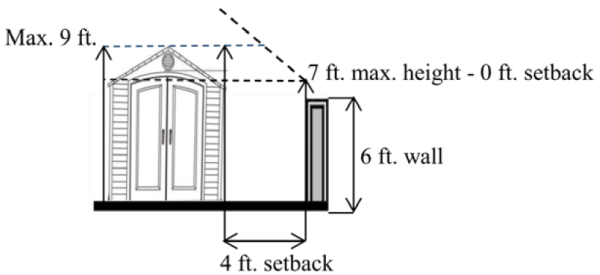
(5) Storage sheds shall not exceed one hundred twenty (120) square feet in area.
(Ord. No. 1421, § V, 1-10-85; Ord. No. 3063, § 3, 11-18-99; Ord. No. 4931, § 2(Exh.), 8-13-20)
35-2204. - General.
(1) Every dwelling shall be located and maintained on a lot as defined by this Code [in section 35-200].
(2) No space of land required to meet width, yard, area, intensity, parking or other regulations of this Code for a lot or building may be sold or leased to another building or lot.
(3) No lot shall be subdivided in such a manner that will result in a lot containing more dwelling units than permitted by the regulations of the district in which it is located.
(4) For lots occupied by two (2) or more related principal buildings, used for institutional or residential purposes, there shall be an open space between buildings whose major exterior walls are parallel or within forty-five (45) degrees of being parallel to one (1) another, equal to the height of the taller building. Minor projections such as patio or balcony walls shall be allowed to intrude two (2) feet into this separation for each additional foot of building separation.
(5) In all zoning districts, no obstruction to view exceeding two (2) feet in height shall be erected, constructed, parked, planted or maintained, on any corner lot within a triangular area formed by the property lines and a line connecting points thirty (30) feet from the intersection of the right-of-way lines. One (1) tree pruned high enough to permit unobstructed vision to motorists and/or one (1) pedestal-type identification sign may be permitted.
(6) The space for any required yard area shall be open and unobstructed except for ordinary projections for windows, belt courses, cornices, eaves and other architectural features provided such features shall not project more than twenty-four (24) inches into the required yard area and further provided in no case shall such projection be closer than three (3) feet to a property line.
(7) Where two (2) or more lots are used as one (1) building site and where a principal building crosses lot lines, the entire area shall be considered as one (1) lot and the front lot line shall be as originally platted.
(8) The following development standards for walls and fences within any residential or nonresidential zoning district shall not apply to any lot, parcel, subdivision or other development for which the construction of fencing has either begun or been completed prior to the effective date of these requirements:
(a) No fence or wall shall be constructed in the front yard of a lot in a residential district exceeding a height of three (3) feet, and such fence or wall located in the rear and/or side yard(s) shall not exceed a height of seven (7) feet; except open wire fence shall be permitted in front yards of schools, public and quasi-public buildings when needed for the safety or restraint of the occupants thereof.
1. No fence along the street side or alley frontage of any new residential lot, parcel or subdivision shall feature wood as its primary structural building element; except that total fencing shall be permitted for agrarian subdivisions and uses.
2. Fences along interior property lines or within yards not visible from any street or alley may feature total wood construction.
(b) No fence or wall shall be constructed within the front yard of any nonresidential lot, parcel or subdivision exceeding a height of three (3) feet; and such fence or wall located in the side or rear yard(s) shall not exceed a height of eight (8) feet, except that:
1. A wrought-iron fence or a combination three-foot masonry wall topped by wrought iron or other similar fencing, either of which not to exceed a height of six (6) feet to achieve security for those uses featuring display of merchandise or equipment, may be permitted along the street property line or within the front yard setback. Chain-link fencing for this purpose shall be prohibited.
2. Any wall or fence exceeding six (6) feet in height shall not feature fence block unless sufficiently reinforced to avoid toppling. The means of reinforcement shall be subject to approval by the City of Chandler Building Division.
Wood fencing within any nonresidential zoning district shall be prohibited except for fences constructed inside the property boundaries and not visible from any street, alley or adjoining property.
(c) New developments shall require a minimum six (6) foot tall perimeter fence or wall when adjacent to residential properties. The minimum height required for the fence or wall shall be measured from the highest point of grade within five (5) feet of the proposed fence.
(d) Double fences or walls shall be prohibited unless waived by the Zoning Administrator.
(Ord. No. 1421, § VI, 1-10-85; Ord. No. 1735, § 2, 1-22-87; Ord. No. 3063, § 3, 11-18-99; Ord. No. 4567, § V, 10-20-14; Ord. No. 5075, § 2(Exh.), 2-22-24)
35-2205. - Swimming pools.
(1) Swimming pools shall not occupy any front yard.
(2) All pools shall be enclosed by a masonry or concrete wall or decorative fencing (such as wrought iron) at least six (6) nominal feet but not to exceed seven (7) feet in height. A horizontal combination of masonry and wrought iron may be permitted with a concrete curb of maximum four (4) inches height to prevent erosion. This curb shall be three (3) inches under the ground and one (1) inch above the grade, as shown in graphic A.
All exterior and interior barriers shall conform with the adopted International Swimming Pool and Spa Code as amended by the City of Chandler.
(3) Wood fencing may be used only to replace an existing wood fence, in all other cases wood fencing is prohibited.
(4) The exterior fence enclosure for swimming pools, as required by this section, need not necessarily be located on the side or rear property lines. In the case where the interior barrier, as required under section 7-6.1(c) of the City Code, also serves as the exterior barrier, said barrier shall be six (6) feet in height, in addition to complying with all the applicable barrier standards as set forth in section 7-6.1(c). Said barrier shall also preclude exterior access.
(5) In the case where the rear yard of a single-family property abuts the edge of a lake within any one (1) of the several approved lake communities or subdivisions within the City of Chandler; and where no public access is permitted or allowed along the lakeshore; and where side yard fences extend to and beyond the water's edge a minimum of eighteen (18) inches; no rear yard fence will be required between the lakeshore and the swimming pool.
(6) In any zoning district, if the fence or gate material is of such construction or design that there are openings in the enclosure, such openings shall be of such size that a spherical object four (4) inches in diameter cannot pass through the openings, as shown in graphic A.
(Ord. No. 1421, § VII, 1-10-85; Ord. No. 1630, § 2, 6-12-86; Ord. No. 1713, § 1, 10-9-86; Ord. No. 2838, § 1, 5-28-98; Ord. No. 3063, § 3, 11-18-99; Ord. No. 5075, § 2(Exh.), 2-22-24)
Editor's note— Graphic A, referenced above, is not set out herein, but is on file and available for inspection in the Office of the City Clerk and the Zoning Administrator.
35-2206. - Compliance with transportation plan.
(1) All required building setback regulations shall apply to the future right-of-way line as indicated on the transportation plan and required by other pertinent City Codes.
(2) No building permit shall be issued for a building or use of land until required rights-of-way have been dedicated as required by other pertinent City Codes.
(Ord. No. 3063, § 3, 11-18-99)
35-2207. - Lot area and dimensions.
(1) Any lot of record, legally created, which currently does not conform with the lot area for the zoning district in which it is located may be used for any use permitted in its current that zoning district provided other applicable regulations of the Zoning Code are complied with.
(2) No lot shall be reduced in any manner below the lot area requirements of the Zoning Code for the zoning district in which it is located, or if a lot is already less than the minimums so required, such lot area or dimension shall not be further reduced.
(3) No lot shall be reduced or diminished so as to cause the yards, lot coverage or other open spaces to be less than that required by the Zoning Code, or to decrease the lot area per dwelling unit except in conformity with this Code.
(Ord. No. 3063, § 3, 11-18-99)
35-2208. - Satellite dish antennas.
(1) Single-family zoning districts:
(a) Ground-mounted dish antennas greater than one (1) meter in diameter shall be located within rear yards, with a minimum ten-foot setback from any rear property line.
(b) Roof-mounted dish antennas shall not exceed one (1) meter in diameter.
(c) The maximum height for any ground-mounted dish antennas shall be ten (10) feet as measured from ground level to its highest point.
(d) Any ground-mounted dish antennas shall be screened by a minimum six-foot-high solid wall, fence or dense vegetation.
(2) Multi-family and commercial zoning districts:
(a) Ground-mounted dish antennas greater than one (1) meter in diameter shall be located within the side or rear yard, and shall be enclosed with a six-foot-high solid wall or fence.
(b) Roof-mounted dish antennas shall not exceed one (1) meter in diameter and.
(c) Any dish antenna exceeding ten (10) feet in height, as measured from ground level to its highest point, shall be subject to approval of a use permit.
(3) Industrial zoning districts:
(a) All dish antennas greater than one (1) meter in diameter shall be screened from street view.
(b) Any dish antenna greater than one (1) meter and not screened or exceeding twenty-five (25) feet in height, as measured from ground level to its highest point, shall be subject to approval of a use permit.
(Ord. No. 3063, § 3, 11-18-99; Ord. No. 1506, 7-11-85; Ord. No. 5075, § 2(Exh.), 2-22-24)
35-2209. - Wireless communication facilities.
(1) Definitions: In this section, unless the context otherwise requires, the following definitions shall apply:
Antenna: A device used in wireless telecommunications which transmits or receives radio or microwave signals. Antenna includes a dish antenna, panel antenna, or whip antenna. An antenna not specifically described herein shall be regulated in conformity with the type of antenna described herein which most closely resembles such antenna.
Directional or "panel" antenna: A device that receives and transmits signals in a directional pattern typically encompassing an arc of one hundred twenty (120) degrees.
Omni-directional or "whip" antenna: A device that receives and transmits signals in a three hundred sixty-degree pattern, and which is up to fifteen (15) feet in height and up to four (4) inches in diameter.
Parabolic or "dish" antenna: A bowl-shaped device that receives and transmits signals in a specific directional pattern.
Equipment building: An unstaffed structure attached to or made part of a wireless communication facility and used to house equipment needed to operate and maintain a wireless communication facility.
Industrial, commercial or residential zoning districts: As used in this section 35-2209, an industrial, commercial or residential zoning district also includes an area within a PAD zoning district which is designated for industrial, commercial or residential use, respectively. Residential zoning districts also includes AG-1 zoning districts.
Support structure: A component of a wireless communication facility, which is often a tower or other structure of sufficient verticality, used to support one (1) or more antennas at needed height for effective operation of the facility.
Tower: Any structure that is designed and constructed primarily for the purpose of supporting one (1) or more antennae in the operation of a wireless communication facility. A tower may include, without limitation, such types as a lattice tower or a monopole.
Wireless communication facility: A facility used exclusively for the transmission and reception of radio or microwave signals used for commercial communications. A wireless communication facility is generally composed of the following components: At least one (1) antenna; a support structure, which may be a tower or which may be a structure (such as, without limitation, a building or a light pole) constructed primarily for purposes other than supporting an antenna; and, in some cases, an equipment building.
(2) Permitted use: A wireless communication facility is a permitted use, and shall not require a use permit, in any zoning district, provided that the following requirements are complied with in their entirety:
(a) Compliance with general standards. The site plan, architectural design and building materials for the wireless communication facility shall be in accordance with Article XIX, Site Development Plan, and this Article XXII, Section 35-2209(6).
(b) Compliance with specific district requirements. A wireless communication facility located within an industrial zoning district shall comply with the requirements stated in paragraph (3) below. A wireless communication facility located within a commercial or residential zoning district shall comply with the requirements stated in paragraph (4) below.
(3) Industrial zoning district requirements. A wireless communication facility located in an industrial zoning district shall comply with the following:
(a) Tower-supported facilities. A wireless communication facility may use a tower as the support structure for its antenna provided that:
1. The height of the facility shall not exceed one hundred (100) feet in total height, including tower, antenna and attachments, as measured from finished grade of the site.
2. The location of such facility shall meet all applicable setback requirements for the zoning district, except that where such a wireless communication facility is located on property that is adjacent to any property that either contains a residence, is zoned for residential use, or is designated for residential use in an adopted area plan, then, in addition to any other applicable setback requirements, the facility shall be set back from such adjacent property a distance equal to two (2) feet for every one (1) foot in total height of the facility, including tower, any antenna and other attachments.
(b) Use of an existing support structure. A wireless communication facility that is established by the installation of an antenna on a support structure other than a tower (such as, without limitation, a building, sign, light pole, water tower, church steeple, or other freestanding structure) that has been erected and in continuous use for its originally intended purpose for at least two (2) years is not required to have its antenna architecturally compatible, visually unobtrusive, and designed to be an integral part of the support structure, except as indicated below:
1. Roof-top installation. Where the antenna is installed on the roof-top of a building and either (i) the antenna can be seen from street view or (ii) the building is adjacent to property that contains existing residences, is zoned for residential use, or is designated residential in an adopted area plan, then the following restrictions shall apply:
a. Antenna type. Only one (1) type of antenna (i.e., panel, whip or dish) shall be installed on any single side of a building.
b. Height. The height of an antenna above the roof-top shall be restricted as follows:
i. Six (6) feet measured to the top of a panel antenna above the roof proper of the existing building at the point of attachment.
ii. Fifteen (15) feet measured to the tip of a whip antenna above the roof proper of the existing building at the point of attachment.
iii. Six (6) feet measured to the top of a parabolic dish above the roof proper of the existing building at the point of attachment.
c. Number. The total number of roof-top antennas shall be as follows:
i. No more than four (4) panel antennas.
ii. No more than three (3) whip antennas.
iii. No more than one (1) parabolic antennas.
2. Other installations: Where the antenna is installed on a structure other than the roof-top of a building (such as, without limitation, another portion of a building, or on a sign, light pole, water tower, or other freestanding structure) and either (i) the antenna can be seen from street view or (ii) the structure is adjacent to property that contains existing residences, is zoned for residential use, or is designated residential in an adopted area plan, then the antenna shall be architecturally compatible, visually unobtrusive, and designed to be an integral part of the support structure.
(4) Commercial and residential zoning district requirements. A wireless communication facility located in a commercial or residential zoning district shall comply with the following:
(a) A wireless communication facility in a commercial or residential zoning district shall not use a tower for its support structure except as indicated in paragraph (5) below.
(b) A wireless communication facility that is established by the installation of an antenna on an existing support structure other than a tower (such as, without limitation, a building, sign, light pole, water tower, church steeple, or other freestanding structure) is required to have its antenna architecturally compatible, visually unobtrusive, and designed to be an integral part of the support structure.
(5) Replacement of an existing pole with a tower support. For any commercial or residential zoning district, where a wireless communication facility is established by the replacement of a pole, (such as, without limitation, any light pole, electric powerline pole, telephone pole or ballfield light pole, but expressly excluding any monopole) that has been erected and in continuous use for its originally intended purpose for at least two (2) years with a monopole that, in addition to providing the support structure for an antenna, also serves the function otherwise provided by the replaced pole, then the facility is permitted by right provided that the height of the facility, including tower, antenna and attachments, is not more than twenty-five (25) feet greater than the height of the original pole structure that was replaced, and does not exceed seventy (70) feet in total height, as measured from grade of the site.
(a) Co-location exception. Where the tower supports the co-location of two (2) or more service providers, the maximum height of the facility shall not exceed eighty-five (85) feet in total height.
(b) Ballfield light poles. Notwithstanding any other requirement in this paragraph (5), where the replacement is of a ballfield light pole:
1. The location of such facility shall meet all applicable setback requirements for the zoning district, except that where such a wireless communication facility is located on property that is adjacent to any property that either contains a residence, is zoned for residential use, or is designated for residential use in an adopted area plan, then, in addition to any other applicable setback requirements, the facility shall be set back from such adjacent property at a minimum distance of three hundred (300) feet as well as co-located on the furthest existing light pole away from said property. If the distance cannot be met, a use permit is required.
a. An existing structure located within a distance of three hundred (300) feet cannot be expanded or moved closer to a residence, or property residentially zoned or designated without a use permit.
2. The tower shall be of substantially the same diameter as the pole being replaced;
3. The total height of the facility shall not exceed seventy (70) feet or the same height as the pole being replaced, whichever is greater; and
4. No more than two (2) ballfield light poles serving a single ballfield may be used as wireless communication facilities.
(6) Site plan, design, use, and location regulations: The following criteria apply to all wireless communication facilities permitted as a matter or right:
(a) Color. The color of all towers shall be painted a shade of light gray, or a color that is more compatible with the surrounding architecture or environment so as to make the tower as visually unobtrusive as possible. Painted towers are not required in industrial districts.
(b) Screening and landscaping: Mechanical equipment associated with wireless communication facilities must be screened, and landscaping provided in accordance with Article XIX, Site Development Plan. For purposes of this Section 35-2209, the provisions of Article XIX, Site Development Plan, shall apply to any zoning district where a wireless communication facility is sought to be located.
(c) Interference: Any new antenna or any other related communication equipment shall not interfere with existing communications.
(d) Parking: The site must provide at least one (1) parking space designed to City Standards which may be incorporated as part of the maneuvering areas and access drives. This requirement can be waived by the Zoning Administrator when hard surfaced parking already exists, or when the Zoning Administrator concludes that the goals of the City are better served thereby.
(e) Separation: No wireless communication tower that is readily visible from off-site shall be installed closer than one-quarter (¼) mile from another readily visible, uncamouflaged, unscreened, or unintegrated wireless communication facility unless it is an antenna installed on an existing structure in accordance with the applicable requirements of section 35-2209.
(f) Foundation design: The foundation of a wireless communication tower shall be built to handle multiple service providers.
(g) Antenna design: A streamline, flush-mounted antenna shall be used in all zoning districts except an industrial zoning district.
(h) Notification: If a wireless communication facility is to be located within the boundaries of, or within one hundred (100) feet of, a homeowners' or a property management association, the facility owner must notify the association that an application to build a wireless communication facility has been filed with the City. The facility owner must provide written certification to the City that the homeowners' or a property management association(s) was notified prior to any building permit being issued.
(7) Use permit approval: A wireless communication facility that is not permitted by right may operate only upon first obtaining a use permit.
(a) Application and inventory of existing facility sites: Application procedures shall be the same as provided under section 35-305(1) of Article III of this Zoning Code, except that in addition, an applicant for a use permit for a wireless communication facility shall provide:
1. An inventory of its existing facilities that are either within the jurisdiction of the City of Chandler, or within one-quarter (¼) mile of the border thereof, including specific information about the location, height, and design of each tower; and
2. An inventory of all existing vertical towers or structures that are equal to or higher than the height of any proposed tower within one (1) square mile of the proposed location regardless of jurisdiction. Evidence and justification must be provided by the applicant to the Zoning Administrator to demonstrate that sufficient efforts were made to locate the antenna on all such towers and structures within a one-mile radius of proposed location. No new tower shall be permitted unless the applicant demonstrates to the reasonable satisfaction of the governing authority that no existing tower or structure can accommodate the applicant's proposed antenna.
(b) Review procedures: Procedures for review of the application for a use permit for a wireless communication facility shall be the same as for any type of use permit allowed under section 35-305(1) of the Zoning Code, except that the following shall apply:
1. No more than ninety (90) days shall elapse between filing of the application for such permit and a determination by the City Council to grant or deny the permit, unless such delay is caused by the applicant; and
2. A decision to deny an application for such permit shall be stated in writing, shall be based on substantial evidence justifying the denial, and shall be supported by a written record.
(c) Review factors: The review and approval of an application for a use permit for a wireless communication facility shall include examination of those factors indicated in section 35-305(1)(b) and (c), but in no event shall there be any consideration of the environmental effects of radio frequency emissions.
(8) Removal of abandoned antennas and towers: Any wireless communication facility that is not operated for a continuous period of twelve (12) months shall be considered abandoned, and the owner of such facility shall remove the same, including any tower, antennae, attachments and equipment building, within ninety (90) days of receipt of notice from the City notifying the owner of such abandonment. If there are two (2) or more service providers using a single tower, then the abandonment period shall not begin until all such service providers have ceased using the tower.
(Ord. No. 2713, § 1, 7-7-97; Ord. No. 3063, § 3, 11-18-99; Ord. No. 3415, § 1, 4-10-03; Ord. No. 4216, 5-13-10; Ord. No. 4216, 5-13-10)
35-2210. - Solar energy systems.
(1) Definitions:
Ancillary solar energy system: A solar energy system that is intended to meet all or part of a property's on-site energy requirements.
Free-standing solar energy system: A ground mounted solar energy system containing a support structure that is designed solely for the purpose of supporting the system's equipment. A solar energy system designed to shade sitting areas, recreational activities, parking spaces, walkways, or designed to be utilized for uses other than a solar energy system shall be considered an accessory building and shall be excluded from this definition.
Solar energy system: An energy conversion system, including appurtenances, which converts solar energy to a usable form of energy.
Utility scale solar energy system: A solar energy system that generates energy primarily intended for off-site consumption.
(2) Property located in an agricultural, single-family, or multi-family zoning district, and property located in an area of a PAD zoning district where agricultural, single-family or multi-family uses are allowed:
a. Ancillary solar energy systems are permitted on the property as an accessory use to the principal use of the property.
b. An ancillary solar energy system shall be placed such that concentrated solar radiation or glare shall not be directed onto nearby properties or roadways.
c. A free-standing ancillary solar energy system shall:
1. Not be located in the front yard.
2. Not be subject to rear and side yard setback requirements and shall not constitute an increase to lot coverage if said system does not exceed the height of the surrounding perimeter wall and is not visible from any public street or from an adjoining property. A solar energy system that exceeds the height of the surrounding perimeter wall or is visible from a public street or an adjoining property shall be subject to the height and area regulations for the underlying zoning district and additional height and area regulations for accessory buildings set forth in Section 35-2202.
3. Not be considered an accessory building for the purpose of calculating the number of accessory buildings permitted by the underlying zoning district.
4. Comply with life safety requirements determined by all applicable building and fire codes.
d. Utility scale solar energy systems shall be subject to approval of a use permit.
(3) Property located in a commercial or industrial zoning district, and property located in an area of a PAD zoning districts where commercial and/or industrial uses are allowed:
a. Ancillary solar energy systems are permitted on the property as an accessory use to the principal use of the property.
b. An ancillary solar energy system shall be placed such that concentrated solar radiation or glare shall not be directed onto nearby properties or roadways.
c. An ancillary solar energy system that is mounted on the roof of or otherwise attached to a commercial building shall be subject to the height and area regulations for the underlying zoning district. Said solar energy systems shall not be required to be concealed and/or screened from view as set forth in Section 35-1902(5)(c) except said solar energy system shall be screened so that it is not visible from the ground floor of any dwelling unit located within six hundred (600) feet of said solar energy system as measured from the nearest exterior wall of the building to the nearest property line of any residential development.
d. Free-standing ancillary solar energy systems shall:
1. Not be required to be concealed and/or screened from street view or from a non-residential zoned property.
2. Not be subject to front, rear and side yard setback requirements if said system is not visible from the ground floor of any dwelling unit. A solar energy system that is located on property that is next to or across an alley from a residential development and that exceeds the height of the surrounding perimeter wall shall be no closer than twenty-five (25) feet, plus one (1) additional foot for each foot of height of said solar energy system, as measured from the nearest property line of any residential development to the nearest point of the solar energy system.
3. Not constitute an increase in lot coverage.
4. Comply with life safety requirements. Determined by all applicable building and fire codes.
e. Utility scale solar energy systems shall be subject to approval of a use permit.
(4) Utility scale solar energy system requirements. Utility scale solar energy systems in any zoning district shall comply with the following:
a. No portion of a utility scale solar energy system shall be visible from the ground floor of any dwelling unit. Said solar energy system shall not be considered to be in violation if subsequent to approval and installation of said solar energy systems, a dwelling unit(s) is constructed in a manner or location where said solar energy system is visible from the ground floor of said dwelling unit(s). Said solar energy system shall not be required to be concealed and/or screened from street view or from a non-residential zoned property.
b. All landscaping shall be maintained and kept in a weed free manner at all times as set forth in Section 35-1903.6.h
c. The property shall be kept in a trash and debris free manner at all times.
d. Solar energy systems shall be placed such that concentrated solar radiation or glare shall not be directed onto nearby properties or roadways.
e. The property shall be kept under regular surveillance by personnel working on-site or, in the absence of on-site personnel, by a security camera system.
f. The solar energy system shall not be subject to lot coverage limits.
g. The solar energy system shall comply with all life safety requirements including setbacks as determined by all applicable building and fire codes.
h. All buildings and structures other than the utility scale solar energy system and appurtenances shall comply with setbacks required by C-3 Regional Commercial District and additional requirements for commercial buildings when adjacent to residential development as set forth in Section 35-1902.8(a).
(Ord. No. 4302, § 1, 6-23-11)
35-2211. - Residential care homes.
(1) Purpose. Residential care homes are permitted in all single family districts subject to the requirements provided herein. The purpose of these regulations is to permit persons with disabilities to reside in single family residential neighborhoods in compliance with the Fair Housing Act, while preserving the residential character of the neighborhood.
(2) Registration. Residential care homes shall submit a completed zoning clearance application and required supplemental materials to the Planning Division on a form established by the Zoning Administrator. For residential care homes that are licensed by the state, county or other governmental authority, tentative zoning clearance may be issued upon verifying the application complies with the standards below. Said residential care homes shall be considered to be registered with the City at the time they receive tentative zoning clearance and shall submit to the City a copy of the license issued by the state, county or other governmental authority within ninety (90) days, or said registration shall be withdrawn. For residential care homes that are not licensed by the state, county or other governmental authority, zoning clearance may be issued in place of tentative zoning clearance at which time the residential care home shall be considered to be registered with the City. In all cases, registration for residential care homes shall terminate when the residential care home use ceases.
(3) Standards. Residential care homes shall be subject to the continued, full and complete compliance with the following standards:
1. Capacity. The number of residents, excluding staff, shall not exceed five (5).
2. Location. Residential care homes shall be separated a minimum of one thousand two hundred (1,200) feet from other registered residential care homes and group homes, except no separation is required when said facilities are separated by a freeway, arterial street, canal, or railroad. For the purposes of this subsection, all separation distances shall be measured from the property lines.
3. Signage. The residential care home shall have no identification from a public street by signage, graphics, display, or other visual means, except for signage otherwise permitted under Chapter 39, section 39-9 of the Chandler Sign Code.
4. Code compliance. The residential care home shall be in compliance with all applicable City codes, including building codes, fire safety regulations, zoning and subdivision codes.
5. Parking. Any parking for the residential care home shall be on site and comply with requirements set forth in Article XVII Parking and Loading Regulations.
6. Maintenance. The exterior of the dwelling and yards shall be kept in a condition that is consistent with the neighborhood pursuant to Chapter 30, Neighborhood Preservation, of the City Code.
7. Exclusive use. All administrative activities, including staffing, counseling, and other visitations, shall serve only the residents of the group home.
(4) Reasonable accommodation waiver. As a reasonable accommodation for persons with a disability, strict compliance with the standards set out in Section 35-2211(3) for residential care homes may be waived by the Zoning Administrator in accordance with the requirements stated herein. A request for such a reasonable accommodation waiver must be in writing and filed with the Zoning Administrator. In all cases, the Zoning Administrator, or his/her designee, shall make findings of fact in support of his/her determination and shall render his/her decision in writing. The Zoning Administrator may meet with and interview the person making the request in order to ascertain or clarify information sufficiently to make the required findings. To grant a reasonable accommodation waiver, the Zoning Administrator shall find affirmatively all of the following:
1. The request will be in compliance with all applicable building and fire codes.
2. The request will not create a substantial detriment injurious to neighboring properties by creating traffic impacts, parking impacts, impacts on water or sewer system, or other similar adverse impacts.
Profitability or financial hardship of the owner/service provider of a facility shall not be considered by the Zoning Administrator in determining to grant a reasonable accommodation waiver. An appeal of the decision of the Zoning Administrator may be made regarding reasonable accommodation to the Board of Adjustment pursuant to Article XXV of this chapter.
(Ord. No. 4513, § III, 11-8-13)
35-2212. - Group homes.
(1) Purpose. Group homes are permitted in all single family districts subject to the requirements provided herein. The purpose of these regulations is to permit a group of unrelated persons who are not living together as a single housekeeping unit to reside in single family residential neighborhoods while preserving the residential character of the neighborhood.
(2) Registration. Group homes shall submit a completed zoning clearance application and required supplemental materials to the Planning Division on a form established by the Zoning Administrator. For group homes that are licensed by the state, county or other governmental authority, tentative zoning clearance may be issued upon verifying the application complies with the standards below. Said group homes shall be considered to be registered with the City at the time they receive tentative zoning clearance and shall submit to the City a copy of the license issued by the state, county or other governmental authority within ninety (90) days, or said registration shall be withdrawn. For group homes that are not licensed by the state, county or other governmental authority, zoning clearance may be issued in place of tentative zoning clearance at which time the group home shall be considered to be registered with the City. In all cases, registration for group homes shall terminate when the group home use ceases.
(3) Standards. Group homes shall be subject to the continued, full and complete compliance with the following standards:
1. Capacity. The number of residents, excluding staff, shall not exceed five (5).
2. Location. Group homes shall be separated a minimum of one thousand two hundred (1,200) feet from other registered group homes and residential care homes, except no separation is required when said facilities are separated by a freeway, arterial street, canal, or railroad. For the purposes of this subsection, all separation distances shall be measured from the property lines.
3. Signage. The group home shall have no identification from a public street by signage, graphics, display, or other visual means, except for signage otherwise permitted under Chapter 39, section 39-9 of the Chandler Sign Code.
4. Code compliance. The group home shall be in compliance with all applicable City codes, including building codes, fire safety regulations, zoning and subdivision codes.
5. Parking. Any parking for the group home shall be on site and comply with requirements set forth in Article XVII Parking and Loading Regulations.
6. Maintenance. The exterior of the dwelling and yards shall be kept in a condition that is consistent with the neighborhood pursuant to Chapter 30, Neighborhood Preservation, of the City Code.
7. Exclusive use. All administrative activities, including staffing, counseling, and other visitations, shall serve only the residents of the group home.
(Ord. No. 4513, § III, 11-8-13)
35-2213. - Medical marijuana facility, medical marijuana cultivation site, and infusion food establishment.
The operation of a medical marijuana facility, a medical marijuana cultivation site, or an infusion food establishment shall only be allowed in accordance with the provisions, procedures and standards set forth in this Section.
1. Eligible Zoning Districts.
A. The operation of a medical marijuana facility is allowed only in a C-2 or C-3 District or in that portion of a PAD District where C-2 and/or C-3 uses are allowed and only upon obtaining a zoning clearance for such use, or in an I-1 or I-2 District or in a portion of a PAD District where I-1 and/or I-2 uses are allowed and only upon obtaining a use permit as required by section 35-2100 Table of Permitted Uses for Nonresidential Districts, in accordance with section 35-2213 of this Code.
B. The operation of a medical marijuana cultivation site or an infusion food establishment is allowed only in an I-1 or I-2 District or in that portion of a PAD District where I-1 or I-2 uses are allowed and only upon obtaining a zoning clearance for such use.
2(A). Zoning clearance application. In accordance with section 35-2100—Table of Permitted Uses for Nonresidential Districts, medical marijuana facilities, medical marijuana cultivation sites and infusion food establishments shall submit a completed zoning clearance application with supplemental materials as required by the Planning Division. The application shall contain the following information:
1) The location of the premises at which the medical marijuana facility, the medical marijuana cultivation site, or infusion food establishment will be operated.
2) The identity of the medical marijuana dispensary that will operate the medical marijuana facility or the medical marijuana cultivation site, and, for an infusion food establishment, the identity of the operator of the establishment.
3) If the premises identified in the application is not owned by the medical marijuana dispensary making application for the zoning clearance, a written statement signed by the property owner authorizing the applicant to apply for the zoning clearance for the premises and consenting to the use being requested in the application.
4) A site plan for the property on which the premises is located showing lot dimensions with front, sides and rear setbacks, and, where applicable, its location within the larger development in which the property may be situated.
5) An accurate, to-scale, floor plan clearly showing the configuration of the premises and stating the total floor space of the premises or portion thereof to be used for the purpose for which the zoning clearance is requested. In addition to any other information, the floor plan shall specifically identify and provide as applicable: (i) the location of the enclosed, locked facility in which cultivation or storage of medical marijuana will take place; (ii) the total floor space for the enclosed, locked facility; (iii) the location within the premises where infusion will take place; (iv) all entrances and exits to and from the premises, indicating which such entrances are secured and which, if any, are not secured; (v) the location of any windows from which a member of the public can view activities occurring inside the premises; (vi) any additional security measures or devices to be installed in or upon the premises, including without limitation any on-site alarm system or security lighting; and (vii) additional protections, if any, against medical marijuana diversion and theft.
6) Other pertinent information as needed to determine compliance with the provisions of this Section (35-2213) as required by the Planning Division.
2(B). Zoning clearance approval criteria. The Zoning Administrator may approve a zoning clearance application to operate a medical marijuana facility, a medical marijuana cultivation site, or an infusion food establishment upon finding that the request complies with the following criteria:
1) The request is in conformance with the General Plan and its policies.
2) The request is in full conformance with the provisions of this Section (35-2213).
3) The request is in full compliance with Chapter 29 Building Regulations of the City Code, all development standards and other land use regulations stated in the Zoning Code or any other ordinance or code adopted by the City of Chandler.
4) The request will not be detrimental to persons residing or working in the vicinity, to adjacent property, to the neighborhood or to the public welfare in general.
5) The medical marijuana facility, a medical marijuana cultivation site, or an infusion food establishment:
I) Is located in a permanent building and is not located in a temporary structure, trailer, cargo container, motor vehicle, or other similar non-permanent enclosure.
II) Is not larger than five thousand (5,000) gross square feet for a medical marijuana facility; five thousand (5,000) gross square feet for a medical marijuana cultivation site; and five thousand (5,000) gross square feet for an infusion food establishment.
III) Does not have or operate drive-through facilities or take-out windows.
IV) Will not emit dust, fumes, vapors or odors into the environment.
V) Is operated only by a medical marijuana dispensary, dual license, or, in the case of an infusion food establishment, a person or entity authorized by State law to infuse edible food products, who does:
A. Comply with all registration and recordkeeping required by the City of Chandler, Maricopa County and Arizona Law.
B. Obtain, maintain and display a valid City of Chandler business registration or license as may be required by City Code.
C. Prohibit consumption of medical marijuana on the premises.
D. Not permit outdoor seating anywhere on the premises. Where the premises is located within a larger commercial or industrial development having walkways or other common area containing already existing outdoor seating required as a condition of the zoning for the development, then no new outdoor seating shall be located immediately adjacent to the premises.
E. Allow annual fire inspections pursuant to the City of Chandler Code.
F. Have operating hours not earlier than 7:00 a.m. and not later than 10:00 p.m. for a medical marijuana facility.
6) Separation requirements. A medical marijuana facility or a medical marijuana cultivation site shall be located a minimum distance from the uses set forth in Table 2213.2(B)(6) Separation Requirements. Measurements shall be made in a straight line in any direction from the closest exterior wall of the medical marijuana facility or medical marijuana cultivation site to the nearest property line of any parcel containing uses identified in the table. No separation is required when a medical marijuana facility or a medical marijuana cultivation site is separated from another such facility or site by a freeway. The separation requirements set forth in Table 2213.2(B)(6) shall not be reduced through a variance, Planned Area Development (PAD), or any other manner.
2(C). Issuance of zoning clearance.
1) Approval of such a zoning clearance application shall not be construed as any endorsement by the City of the use or operation for which the zoning clearance has been requested by the applicant. The review time for said zoning clearance application shall conform to the time frames adopted by the City as required by Arizona Revised Statutes which are posted on the City's website.
2) A zoning clearance issued under this section (35-2213) shall be deemed void and to have automatically expired if the permitted use is not commenced by the zoning clearance holder or substantial construction has not taken place within nine (9) months after the date of approval.
2(D). Nontransferability of zoning clearance. A zoning clearance issued under this section (35-2213) is not transferable to any other location or premises, nor is it valid for any other use or business associated with a medical marijuana dispensary that is not specifically identified in the zoning clearance.
2(E). Zoning clearance denial and appeal process.
1) The Zoning Administrator, upon finding that the information presented in a zoning clearance application for a medical marijuana facility, medical marijuana cultivation site, or an infusion food establishment does not comply with the requirements set forth in this section (35-2213) shall issue a notice of denial that specifies the grounds therefore.
2) The applicant may appeal the Zoning Administrator's decision to deny the issuance of a zoning clearance to the Board of Adjustment pursuant to the appeal procedures provided under section 35-2503 of this Zoning Code.
2(F). Revocation or suspension of zoning clearance.
1) The Zoning Administrator may suspend or revoke a zoning clearance upon finding:
I) Material noncompliance with the requirements prescribed in this Section (35-2213); and/or
II) Operation of the permitted use in such a manner as to cause a substantial detrimental impact on neighboring persons or property.
2) To suspend or revoke a zoning clearance, the Zoning Administrator shall deliver or mail by certified mail to the address indicated on the zoning clearance and, if different from application address, the address of the property subject to the zoning clearance, a written notice that the zoning clearance is suspended or revoked and which states the grounds therefore.
3) Upon written request received by the Zoning Administrator within ten (10) days of the date of the notice by the zoning clearance holder, or any person whose use of the subject property will be adversely affected by the suspension or revocation, the matter will be referred to the Board of Adjustment on an appeal pursuant to the appeal procedures provided under section 35-2503 of this Zoning Code. If an appeal is not received within ten (10) days of the notice, the suspension or revocation shall take effect on the eleventh day after the date of notice.
4) The decision of the Board of Adjustment may be appealed as provided in section 35-2503 of this Zoning Code.
3(A). Use permit application. In accordance with section 35-2100—Table of Permitted Uses for Nonresidential Districts, the application procedures for a use permit to operate a medical marijuana facility at a specified premises shall be the same as the application procedures stated in section 35-305(1)(A) for general use permits, except that in addition to any other required submittals, an applicant shall provide:
1) The location of the premises at which the medical marijuana facility will be operated.
2) The identity of the medical marijuana dispensary that will operate the medical marijuana facility.
3) If the premises identified in the application is not owned by the medical marijuana dispensary making the application for the use permit, a written statement signed by the property owner authorizing the applicant to apply for the use permit for the premises and consenting to the use being requested in the application.
4) A site plan for the property on which the premises is located showing lot dimensions with front, side, and rear yard setbacks, and, where applicable, its location within the larger development in which the property may be situated.
5) An accurate to-scale floor plan clearly showing the configuration of the premises and stating the total floor space of the premises or portion thereof to be used for the purpose for which the use permit is required. In addition to any other information, the floor plan shall specifically identify and provide as applicable: (i) the location of the enclosed locked facility in which storage of medical marijuana will take place; (ii) the total floor space for the enclosed, locked facility; (iii) all entrances and exits to and from the premises, indicating which such entrances are secured and which, if any, are not secured; (iv) the location of any windows from which a member of the public can view activities occurring inside the premises; (v) any additional security measures or devices to be installed in or upon the premises, including without limitation any on-site alarm system or security lighting; and (vi) additional protections, if any, against medical marijuana diversion and theft.
3(B). Use permit review. The review and approval of an application for a use permit to operate a medical marijuana facility shall consider all relevant land use factors, including those stated in section 35-305(1)(B) for general use permits, as well as the use permit criteria and location requirements stated in sections 35-2213.3(D) and 35-2213.3(E).
3(C). Use permit approval. An application for a use permit under subsection 3(F) may be approved or denied by the City Council based upon the findings set forth in section 35-305(1)(B). Approval of such a use permit application shall not be construed as any endorsement by the City of the use or operation for which the use permit has been requested by the applicant.
3(D). Use permit criteria. The premises in or upon which a medical marijuana facility is operated shall:
1) Be located in a permanent building and shall not be located in a temporary structure, trailer, cargo container, motor vehicle, or other similar non-permanent enclosure.
2) Not be larger than two thousand five hundred (2,500) gross square feet or twenty-five percent (25%) of the gross building square-footage, whichever is less, for a medical marijuana facility.
3) Be operated only by a medical marijuana dispensary which must:
I) Comply with all registration and recordkeeping required by the City of Chandler, Maricopa County, and Arizona law.
II) Obtain, maintain, and display a valid City of Chandler business registration or license as may be required by City Code.
III) Not have or operate drive through facilities or take out windows.
IV) Not emit dust, fumes, vapors, or odors into the environment.
V) Prohibit consumption of medical marijuana on the premises.
VI) Not permit outdoor seating anywhere on the premises. Where the premises is located within a larger commercial or industrial development having walkways or other common area containing already existing outdoor seating required as a condition of the zoning for the development, then no new outdoor seating shall be located immediately adjacent to the premises.
VII) Allow annual fire inspections pursuant to the City of Chandler Code.
VIII) Have operating hours not earlier than 7:00 a.m. and not later than 10:00 p.m.
3(E). Separation requirement. A medical marijuana facility shall be located a minimum distance from the uses set forth in Table 2213.2(B)(6).
3(F). Issuance of use permit.
1. A use permit issued under this subsection shall be valid for any period of time as approved by Council, except as provided in paragraph 3(F)(2) below.
2. A use permit issued under this subsection 3(F) shall be deemed void and to have automatically expired if the permitted use is not commenced by the permit holder or substantial construction has not taken place within nine (9) months after the date of City Council approval.
3. The validity of a use permit under this subsection 3(F) is further conditioned upon the permit holder and the permitted premises being at all times in compliance with applicable City building codes, development standards and other land use regulations stated in the Zoning Code or any other ordinance or code adopted by the City of Chandler.
3(G). Nontransferability of use permit. A use permit issued under this subsection is not transferable to any other location or premises, nor is it valid for any other use or business associated with a medical marijuana dispensary that is not specifically identified in the use permit.
3(H). Use permit renewal:
1. A use permit under subsection 3(F) may be renewed by filing an application for renewal on a form provided by the Zoning Administrator. The application for renewal shall be received by the Zoning Administrator not less than seventy (70) days before the expiration of the permit. When the application for renewal is received less than seventy (70) days before the expiration date, the expiration of the use permit shall not be delayed, postponed or otherwise affected.
2. An application for renewal shall be considered following the same procedures as an original application. The application for renewal may be denied for any reason that an original application may be denied or revoked.
3. A medical marijuana facility lawfully operating is not rendered in violation of the distance requirements set forth in Table 2213.2(B)(6) if, subsequent to the initial granting of the use permit under subsection 3(F), any of the uses identified in Table 2213.2(B)(6) are constructed or located within the required separation area. This provision applies only to the renewal of a valid use permit and does not apply when an application for a use permit is submitted after a use permit has expired or has been revoked.
(Ord. No. 4764, § IV, 8-10-17; Ord. No. 4855, § 1, 1-10-19; Ord. No. 5044, § 2(Exh.), 2-9-23; Ord. No. 5127, § 1, 7-14-25)
35-2214. - Data centers.
(1) Data centers are not permitted to operate in the City of Chandler unless explicitly approved as part of a Planned Area Development zoning district. Data centers that are ancillary to another primary use are permitted if they a) occupy no more than ten (10) percent of the building footprint, b) are used to serve the enterprise functions of the on-site property owner and are not used to lease data storage and processing services to third parties, and c) are not housed in a separate stand-alone structure on the parcel.
(2) Before a data center is constructed within a Planned Area Development zoning district, the property owner proposing to build a data center must comply with the following:
a. The data center operator or property owner must notify residents within a half-mile radius of the parcel, including any affiliated homeowners' association operating within the half-mile radius, that the property owner intends to build and operate a data center on the property. The notice required in this section must be mailed to all postal addresses and homeowners' association addresses contained within a half-mile radius extending from the property line where the proposed data center will be built.
b. The data center operator must schedule and attend two (2) neighborhood meetings with residents to describe the project and the proposed sound-mitigation aspects of the project design. Notice of the neighborhood meetings must be mailed to all residents and homeowners associations within a half-mile radius of the parcel. A representative of the developer or owner with decision-making authority on the design of the data center must attend the neighborhood meetings. The data center operator or property owner must also post a sign on the subject property, at least fifteen (15) days before each neighborhood meeting, in accordance with design standards specified in Section 35-2601.1. The sign must be located along an arterial street or other high-visibility location as reasonably determined by the Zoning Administrator. The content of the sign shall (i) be consistent with the City's generally applicable sign guidelines for posting signs for notification of neighborhood meetings, (ii) include the applicant name and contact information, a brief description of the data center project, and the date, time, and location of the neighborhood meeting, and (iii) must be reviewed and approved by the Zoning Administrator before installation. The applicant must remove the sign at the conclusion of the citizen review process.
(3) Upon request by City staff after issuance of a certificate of occupancy and commencement of the operation of the data center, the operator of a data center must provide an on-site neighborhood liaison between the hours of 8:00 a.m. and 10:00 p.m. MST each day to respond to complaints about noise emanating from the data center.
(4) Before the first neighborhood meeting is held, the property owner proposing to build a data center must conduct a sound study performed by a third-party acoustic engineer to document baseline sound levels in the area of the proposed data center, including noise levels measured at the property line of the nearest property to the data center property that is planned or zoned for residential land uses, or other noise sensitive use as reasonably determined by the Zoning Administrator. The property owner must provide a copy of the results of the study to the City before the first neighborhood meeting.
(5) The data center must be designed and built to incorporate sound mitigation methods sufficient to prevent the sound levels emanating from the data center (as determined by a third-party acoustic engineer) from exceeding the ambient noise levels that were observed in the baseline study. Design specifications for such sound mitigation must be provided to the City before building permit approval.
(6) Upon issuance of a certificate of occupancy or certificate of completion, whichever occurs first, the data center operator must conduct a noise study performed by a third-party acoustical engineer to document noise levels emanating from the data center measured at the property line of the nearest property to the data center property that is planned or zoned for residential land uses, or other noise sensitive use as reasonably determined by the Zoning Administrator during peak operation of the data center mechanical equipment. The data center operator must also conduct an additional noise study, as measured at the property line of the nearest property to the data center property that is planned or zoned for residential land uses, or other noise sensitive use as reasonably determined by the Zoning Administrator, annually during peak operation of the data center mechanical equipment for five (5) years after completion of the initial post-construction noise study. The data center operator must provide the results of the noise study to the City within thirty (30) days of the anniversary of the date on which the certificate of occupancy or certificate of completion was issued by the City.
(7) If the data center operator intends to use backup power generators on the parcel, the operator must maintain a public website announcing the times when the generators will be in operation. Any routine operation of the backup generators, including for testing purposes, must be announced on the website at least twenty-four (24) hours in advance. The operator shall also notify the City of Chandler Communications and Public Affairs Department at least twenty-four (24) hours in advance of a test. Unless the generators are supplying backup electrical supply during a power outage, backup generators may operate between the hours of 9:00 a.m. and 5:00 p.m., Monday through Friday, excluding holidays. Upon request by City staff, the data center operator must provide the address of the website where the notices required by this section are published.
(Ord. No. 5033, § 2, 12-8-22)
35-2215. - Home occupation.
Home occupations are permitted within a residence provided that in addition to all of the use limitations applicable in the zoning district in which the residence is located, home occupations shall comply with the following:
(1) Permitted uses shall be those that are clearly incidental to and subordinate to the use of the property for dwelling purposes and do not change the residential character thereof. Such uses may include but are not limited to: Photography, personal services, therapy, consulting, law office, real estate, insurance, professional office, professional design services, musical instrument lessons, swim lessons, and small-scale E-commerce. The following uses shall be prohibited except if approved through a use permit application pursuant to Section 35-305: Medical, dental, restaurant, veterinary, kennel, dog grooming, motor vehicle services, massage establishments, and other uses that are more likely to alter the residential character of the neighborhood or negatively impact surrounding residential properties pursuant to Section 35-2215.6;
(2) The primary business operator shall be a member of the family residing therein;
(3) Business activities shall be conducted within the principal dwelling unit or a permitted accessory structure, or a residential backyard pool in the case of swim lessons; business activities may take place in a garage so long as no permanent modifications are made to the garage thus maintaining the ability to park vehicles;
(4) Employee and customer visits shall be limited to the hours of 8:00 a.m. to 7:00 p.m. One employee and one customer appointment, each consisting of no more than one vehicle may occur at a time;
(5) There shall be no signs, no exterior display, no exterior storage of materials, and no other indication of the home business or variation from the residential character of the principal dwelling unit;
(6) No home occupation shall be permitted that is noxious, offensive, or hazardous by reason of vehicular traffic, generation or emission of noise, vibration, smoke, dust, or other particulate matter, odorous matter, heat, humidity, glare, refuse, radiation or other objectionable emissions;
(7) Activity associated with the home occupation shall not generate vehicular or pedestrian traffic that alters the neighborhood character. All business-related vehicles shall park on-site to the greatest extent possible;
(8) External modifications to the residence intended solely for the home occupation, including construction features, equipment, or machinery that are not customary in residential areas shall be prohibited.
(Ord. No. 5075, § 2(Exh.), 2-22-24)

