
Cheney City Zoning Code
CHAPTER 21
17 - CRITICAL AREA LIMITED RESIDENTIAL CALR ZONE
21.17.010 - Established.
There is established the Critical Area Limited Residential (CALR) Zone and the standards and regulations by which certain land uses may be permitted therein.
(Ord. No. U-59, § 9, 2008)
21.17.020 - Declaration of purpose.
The purpose of the CALR zone is to provide limited single-family and multifamily residential use, at a density of four units per acre. The CALR zone allows multifamily use, by means of townhouses or similar multifamily design options incorporating zero lot line standards, clustering options to safeguard the public's interest in the preservation and conservation of natural areas, planned unit development design options offering flexibility for critical area protection or other development alternatives set forth in section 21.17.050(4). Specific natural areas have been classified as ecologically sensitive and hazardous and efforts to protect these areas and their functions and values are essential while also allowing for reasonable use of public and private property.
(Ord. No. W-22, § 36, 4-22-2014; Ord. No. U-97, § 104, 1-27-2009; Ord. No. U-59, § 10, 2008)
21.17.030 - Permitted uses.
A.
Types of uses. For the purposes of this chapter, there are four types of uses:
1.
A permitted (P) use is one that is permitted outright in the zone, subject to all of the applicable provisions of this title.
2.
A limited (L) use is permitted outright in the zone providing it is in compliance with special requirements, exceptions or restrictions.
3.
A conditional use (C) is a permitted use subject to review and conditions through the process set forth in CMC Chapter 21.58 AND CMC Title 23 CMC, governing Conditional Uses and Decision-Making Procedures, respectively.
4.
A prohibited use (N) is not permitted in the zoning district under any circumstances.
B.
Use table. A list of permitted, limited, conditional, and prohibited uses in the critical area limited residential district is presented in Table 21.17.030-1.
1 Residential Care Homes, state or federally approved, with six or fewer residents and any required on-site residential staff permitted by right; all larger group living uses prohibited.
2 Subject to the provisions of CMC Chapter 21.59, Home Occupations.
3 Zero Lot lines are permitted, subject to the provisions of CMC 21.17.060(F) , Development Standards.
4 Subject to the provisions of CMC Chapter 21.67, Accessory Dwelling Units.
5 Subject to the provisions of CMC Chapter 21.44, Bulk and Size Requirements in a Residential Zone.
6 Multifamily is permitted with a maximum of up to four units per cluster still meeting the overall density of four units to the acre.
7 Manufactured homes are permitted provided that they meet the requirements outlines in CMC 21.17.060(E).
8 Family day care homes for no more than 12 children are permitted as a limited use when licensed by the state. Child care centers (13 or more children) are not permitted.
9 Except bus shelters which are permitted by right.
10 One and two bedroom bed-and-breakfast facilities are permitted outright. All other commercial lodging is prohibited.
11 Limited commercial, with structures less than 5,000 square feet in size. Structures must be setback at least 200 feet from any roadway. Commercial uses must be related to the recreational needs adjacent to the commercial structure. Structures should incorporate a northwest or rustic architectural look and feel.
12 Recreational Vehicle Park subject to CMC 21.17.060(I).
13 Subject to provisions in CMC Chapter 21.50, Wireless Communication Facilities.
(Ord. No. W-22, § 37, 4-22-2014; Ord. No. U-97, § 105, 1-27-2009; Ord. No. U-59, § 11, 2008)
21.17.040 - General provisions.
The provisions of this chapter shall apply to all lands, all land uses, and development activity, and all structures and facilities, both private and public, in the CALR zone.
1.
No person, company, agency, or applicant shall alter a critical area or buffer except as provided in chapter 21.70 of the Cheney Municipal Code.
2.
All site plans shall identify environmental or natural features including wetlands, wildlife habitat protection areas, educational or recreational trails and frequently flooded areas that are within 50 feet of any lot line.
3.
No natural vegetation shall be removed nor shall the slope of the land surface be altered in any designated critical area buffer without first informing and gaining approval of the planning commission.
4.
Environmentally sensitive and critical areas must be preserved in accordance with Chapter 21.70 of the city's zoning ordinance entitled "Conservation of Critical Areas." Alternatives to development that protect private property rights such as: agricultural buffers, agricultural use notices, conservation easements, cluster development, conditional rezoning, incentive zoning, mixed use development, overlay zones, or phased zoning are encouraged.
(Ord. No. W-22, § 39, 4-22-2014; Ord. No. U-59, § 13, 2008)
Editor's note— Ord. No. W-22, § 38, adopted April 22, 2014, repealed in its entirety § 21.17.040, which pertained to conditional uses and derived from Ord. No. U-97, § 106, adopted Jan. 27, 2009 and Ord. No. U-59, § 12, adopted in 2008. Subsequently, the same ordinance, § 39, renumbered § 21.17.050, "General provisions," as § 21.17.040, as set out herein.
21.17.050 - Density.
A.
The maximum density is four dwelling units per acre.
B.
Maximum and minimum lot area. The maximum and minimum lot area for the CALR Districts is contained in Table 21.17.050-1.
C.
Maximum and minimum lot sizes. The maximum and minimum lot sizes for the low-density residential districts are contained in Table 21.17.050-2.
D.
Exceptions. The following exceptions are permitted to in regards to the density provisions for the CALR zoning district contained in Table 21.17.050-1:
1.
Nonresidential uses are exempted from the lot size and density requirements in this zone.
E.
Net densities are calculated by averaging lots sizes over an entire development, after subtracting out the wetlands. Individual lots may vary in size provided they do not exceed the maximum lot area identified in Table 21.17.050-1.
(Ord. No. W-55, § 4, 3-10-2015; Ord. No. W-22, § 40, 4-22-2014; Ord. No. U-97, § 107, 1-27-2009; Ord. No. U-59, § 14, 2008)
Editor's note— Ord. No. W-22, § 40, adopted April 22, 2014, amended § 21.17.060, "Density" and in so doing, renumbered § 21.17.060 as 21.17.050, as set out herein.
21.17.060 - Development standards.
A.
Purpose. Housing types are limited in the single-dwelling zones to maintain the overall image and character of the Cheney's CALR neighborhoods; however, the regulations allow options to increase housing variety and opportunities, and to promote affordable housing.
B.
Standards. Development standards in the CALR districts is contained in Table 21.17.060-1. These apply to all primary dwellings and accessory buildings on the site.
C.
Lot setbacks.
1.
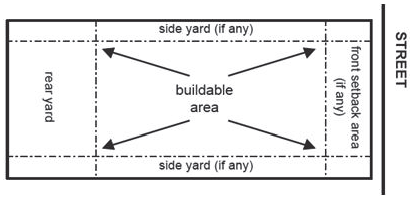
Setbacks. The zoning code requires that certain portions of a lot be set aside for front, rear and side yards. In general, no portion of a house (except covered front porches, chimneys, and bay windows) may extend up to 50 percent into these required yards. Eaves may project 30 inches into the required setback. Accessory structures and ADU's may be placed in the side or rear yards (such as garages, sheds, decks, porches or arbors) as along as adequate space is available, and certain criterion are met per CMC 21.44.
2.
Calculation. Yards are measured from the property line to the wall of the structure.
D.
Duplexes. Are allowed in locations where their appearance and impact will be compatible with the surrounding neighborhood. In this context, duplexes should be designed similar in nature to single dwelling unit houses and shall feature a visible entry and windows facing the street.
E.
Garages. The intent is to deemphasize garages and driveways as major visual elements along the street, while ensuring that the living area of the residence is more prominent than the garage. Attached residential garages shall be subordinate to the dwelling.
F.
Manufactured homes. Manufactured homes are permitted on individual lots in the CALR zone in accordance with the placement standards (including foundations) as set forth in this section and other provisions which apply to conventionally built dwellings (i.e. including appropriate building code requirements). The following development standards apply:
1.
The home must be at least 24 feet by 36 feet.
2.
The home must be placed on a permanent foundation.
3.
The home must have a roof of no less than 3:12 pitch.
4.
The home must have roof and siding materials that are similar in appearance to a site-built residence.
5.
The home must be new.
G.
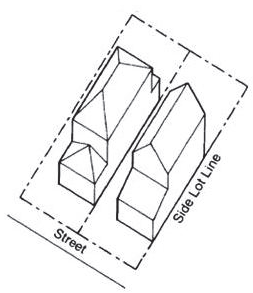
Zero lot lines. A zero lot line development is where houses in a development on a common street frontage are shifted to one side of their lot. This provides for greater usable yard space on each lot.
1.
Where allowed. Zero lot line developments are allowed for single-family structures in the CALR zone. Zero lot line developments are allowed by right on a minimum of four lots grouped together.
2.
Setbacks. The side building setback on one side of the house may be reduced to zero. This reduction does not apply to the side building setback adjacent to a street. All other setback requirements apply.
3.
Privacy wall. In order to maintain privacy, no doors, windows, air conditioning units, or any other types of openings in the walls along a zero lot line structure are allowed except for windows that do not allow for visibility into the side yard of the adjacent lot.
4.
Restrictions. Restrictions which assure the minimum distance between houses, and any required easements, must be recorded on the deeds of the applicable lots. Proof of such recording must be submitted as part of the building permit application.
5.
Maintenance. An easement between the two property owners to allow for maintenance or repair of the house is required when the eaves or side wall of the house are closer than three feet to the adjacent property line.
H.
Fences.
1.
Fences must be set back four feet from the edge of the roadway. Fences over four feet in height must be set back 15 feet from the back of curb parallel to the front property line and seven and one-half feet from the back of curb parallel to the side property line.
2.
Fences shall be no higher than eight feet.
3.
The structural support side of the fence shall face towards the interior of the builder's property only on the front and street side yards.
4.
Fences and hedges must conform to the clear view triangle standards of chapter 21.46.
I.
Recreational vehicle parks.
1.
There shall be no more than one per lot and it shall not be placed on a single site for more than 180 days in any 12-month period.
J.
Nonresidential. The base zone development standards are designed for residential buildings. Generally, different development standards are needed for nonresidential uses which may be allowed in the CALR. The intent of nonresidential standards is to maintain compatibility, and limit potential negative impacts on surrounding residential areas.
1.
Uses. As indicated in Table 21.17.030-1, nonresidential uses that locate within the CALR zone shall comply with the following development standards:
2.
Specific standards.
a.
Mechanical equipment. Mechanical equipment located on the ground, such as heating or cooling equipment, pumps, or generators shall be screened from the street and any abutting residential zones by fences, or vegetation.
b.
Garbage and recycling collection areas. All exterior garbage cans, garbage collection areas, and recycling collection areas must be screened from the street (not located within the front yard setback area) and any adjacent properties.
c.
Exterior storage. Exterior storage of materials or equipment shall not be visible from the public right-of-way.
d.
Temporary structures. Temporary structures are permitted if they are connected to the primary use and function of the site or campus. Temporary structures shall not be located in the front yard or street side yard setbacks.
(Ord. No. W-22, § 41, 4-22-2014)
21.17.070 - Off-street parking.
See chapter 21.40 for off-street parking standards.
(Ord. No. U-97, § 108, 1-27-2009; Ord. No. U-59, § 15, 2008)
21.17.080 - Landscaping and buffering.
See chapter 21.42 for landscaping and buffering standards.
(Ord. No. U-97, § 109(21.17.080), 1-27-2009)
21.17.090 - Signs.
See chapter 21.54 for sign standards.
(Ord. No. U-97, § 110(21.17.090), 1-27-2009)
21.17.100 - General use provisions.
See chapter 21.48 for general use provision standards.
(Ord. No. U-97, § 111(21.17.100), 1-27-2009)

