
Cheney City Zoning Code
CHAPTER 21
40 - OFF-STREET PARKING
21.40.010 - Purpose.
These regulations are intended to achieve the following:
1.
To provide accessible, attractive, secure, properly lighted, and well-maintained and screened off-street parking facilities.
2.
To reduce traffic congestion and hazards.
3.
To protect neighborhoods from the effects of vehicular noise and traffic generated by adjacent nonresidential land use districts.
4.
To assure the maneuverability of emergency vehicles.
5.
To provide appropriately designed parking facilities in proportion to the needs generated by varying types of land use.
(Ord. No. W-22, § 81, 4-22-2014)
21.40.020 - Minimum required parking.
The following off-street adjacent parking requirements are established for the following uses:
1.
Parking table. Minimum required parking is presented in Table 21.40.020-1.
2.
Joint use parking. Joint use of required parking spaces may occur where two or more uses on the same or separate sites are able to share the same parking spaces because their parking demands occur at different times. Joint use of required parking spaces is allowed if the following documentation is submitted in writing as part of a building permit application or project review:
a.
The names and addresses of the uses and of the owners or tenants that are sharing the parking;
b.
The location and number of parking spaces that are being shared;
c.
An analysis showing that the peak parking times of the uses occur at different times and that the parking area will be large enough for the anticipated demands of both uses; and
d.
A legal instrument such as an easement or deed restriction that guarantees access to the parking for both uses.
3.
Mixed uses. Where more than one use is contained in a lot, the required off-street parking spaces shall be equal to 90 percent of the sum of the off-street parking spaces required for each of the uses.
4.
Downtown parking. Commercial, industrial, and public uses located in the area zoned C-1 shall be exempt from the number of off-street parking spaces required by this section.
5.
Required parking spaces may be used only for parking. No permanent or temporary storage of materials or sales displays are permitted in required off-street parking spaces.
6.
Private property. Vehicles parked on private property shall be parked on impervious surfaces; parking in landscaped areas is not permitted except for brief periods of time to allow for loading or unloading or for construction or maintenance activities. See CMC 11.48.100.
7.
Bicycle parking. One vehicle parking space may be substituted for every three bicycle parking spaces provided. Up to ten percent of the require vehicle parking may be substituted by bicycle parking, not in conjunction with the mixed-use reductions in CMC 21.40.020(3).
8.
Multifamily residential (R-3 and R-3H Zone). Unless provided otherwise, each bedroom shall be provided with an off-street parking space. Required parking may be located in the required front yard setback area.
(Ord. No. Y-63, § 3, 5-28-2024; Ord. No. Y-21, § 12, 10-11-2022; Ord. No. X-72, § 2, 11-12-2019; Ord. No. X-31, § 7, 7-10-2018; Ord. No. X-13, § 3, 10-10-2017; Ord. No. W-22, § 82, 4-22-2014; Ord. No. U-97, § 204, 1-27-2009; Ord. No. U-59, § 46, 2008; Ord. No. T-55, § 1, 2004; Ord. No. S-79, § 1, 2002; Ord. No. R-81, § 4, 1999; Ord. No. R-40, §§ 30—32, 1998; Ord. No. Q-42, §§ 1—3, 1995; Ord. No. P-42, § 5, 1992; Ord. No. N-90, § 1(part), 1986)
Editor's note— Ord. No. W-22, § 82, adopted April 22, 2014, amended § 21.40.010 and in so doing renumbered § 21.40.010 as § 21.40.020, as set out herein.
21.40.030 - Regulations mandatory but not retroactive.
A.
These off-street parking regulations apply to every building hereafter erected, enlarged, relocated or remodeled to accommodate a change in use.
B.
These regulations shall not apply to uses existing at time of passage of the ordinance codified in this title except that existing required parking shall not be reduced.
C.
Required parking provided under these regulations shall not hereafter be reduced.
(Ord. No. W-22, § 83, 4-22-2014; Ord. No. N-90, § 1(part), 1986)
Editor's note— Ord. No. W-22, § 83, adopted April 22, 2014, amended § 21.40.020 and in so doing renumbered § 21.40.020 as § 21.40.030, as set out herein.
21.40.040 - Parking design requirements.
Off-street parking spaces required by this chapter shall be constructed and maintained in accordance with the following design requirements:
1.
Size and location of parking spaces. Each non-compact off-street parking space shall be 180 square feet in size.
2.
Compact spaces. Up to 25 percent of all required stalls may be compact stalls. Compact spaces shall be clearly marked.
3.
Each space shall be provided with adequate all-weather ingress and egress. Snow removal from parking spaces and driveways or alleys used for access to parking areas shall be provided by the property owner.
4.
Surface of parking area. Parking areas including driveways or alleys used for access to parking areas shall be paved with an impervious surface approved by the public works director.
5.
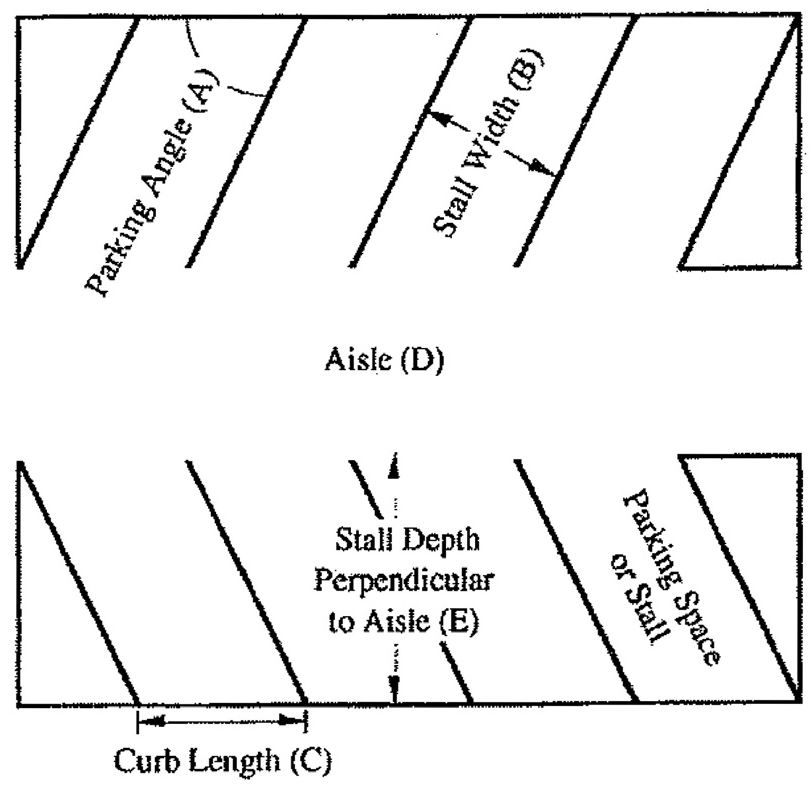
Vehicle spaces. All required and non-required parking spaces provided must meet the space and aisle dimensions of Table 21.40.040-1.
6.
Wheel stops. All parking spaces located along the outer boundary of any parking area shall be equipped with wheel stops to prevent vehicles from protruding over the property line; however, public right-of-way may continue to be used for off-street parking with the approval of the public works director when wheel stops are placed so that vehicles are prevented from protruding over the sidewalk. Wheel stops shall also be installed wherever necessary to protect parking area landscaping and screening.
7.
Drainage. All off-street parking spaces shall be graded and drained so that all surface water is collected and disposed of in a manner approved by the director of the public works department.
8.
Marking of pavement. In required off-street parking spaces all parking spaces shall be clearly delineated with pavement markings. All special parking spaces for the handicapped, compact cars, recreational vehicles and other large vehicles shall be clearly marked.
9.
Lighting. Lighting which may be provided in parking areas shall be deflected so as not to be a nuisance or safety hazard.
10.
Required off-street parking spaces are not allowed within the front yard setback for single-family and two-family uses.
11.
Connections. The pedestrian system must be connected to site and adjacent streets and nearby transit stops. The pedestrian system must also connect public open space or parks, commercial, office and institutional developments when existing development does not preclude such connection. Development patterns must not preclude eventual site-to-site connections, even if an adjacent site is not planned for development at the time of the applicant's development.
12.
Perimeter landscaping. Any off-street parking area, other than for a single-family or duplex dwelling, shall be effectively screened by a sight-obscuring evergreen planting on each side which adjoins property situated in a residential zone, the premises of any school or like institution, or a public or private street. Screening along a common property line shall be six feet high. Landscape screening shall be capable of attaining a height of six feet within two years of planting. Screening along all public or private streets shall be a minimum of three feet high.
13.
Interior landscaping. Interior landscaping must be provided for sites containing more than 25 parking spaces. At least ten percent of the parking and maneuvering areas, not including driveway areas, must be landscaped.
a.
Tree required. At least one tree must be provided for every 12 parking stalls. Existing trees may be used to meet this standard. Broadleaf trees must be at least two caliper inches at the time of plantings; or conifer trees must be at least five feet tall at the time of planting. Trees must be dispersed throughout the parking area to provide shade for the parking area. Some trees may be grouped, but the groups must be dispersed.
b.
Shrubs required. At least one shrub must be provided for every 40 square feet of required landscaped area. Shrubs must be at least the one-gallon container size.
c.
Ground cover required. All of the landscaped areas that is not planted with trees and shrubs must be planted in ground cover plants, which may include grasses. Paths made of paving stones, flagstones, bricks, pavement, or similar materials may provide access across landscaped areas, but the surface area of impermeable materials does not count toward the required landscaped area.
(Ord. No. X-13, § 4, 10-10-2017; Ord. No. W-22, § 84, 4-22-2014; Ord. No. U-97, § 205, 1-27-2009; Ord. No. U-59, § 48, 2008; Ord. No. O-71, § 3, 1990; Ord. No. O-17, § 1, 1987; Ord. No. N-90, § 1(part), 1986)
21.40.050 - Bicycle parking design standards.
A.
Standards for all bicycle parking. While bicycle parking is not required, any bicycle parking implemented under this section must meet the following standards:
1.
Bicycle parking must be provided at the ground level, and may be provided in floor, or wall racks that must hold bicycles securely by the means of the frame. Bicycles may be tipped vertically for storage, but not hung above the ground. If the bicycle parking is placed in the public right-of-way, it shall not obstruct pedestrian walkways and shall meet all of the requirements outlined in obtainment of the street use permit.
B.
Bicycle parking signing. Entry and directional signs shall be provided by the property owner if bicycle parking facilities are not directly visible and obvious from the public right-of-way. The signs shall be used to properly direct bicyclists from the public right-of-way to the bicycle parking facilities.
C.
Bicycle rack maintenance. The property owner of a site shall have a continuing obligation to properly maintain any bicycle parking facilities on their property. The City of Cheney will maintain any bicycle parking facilities that are in the public right-of-way.
D.
Parking in mixed-use projects. Bicycle parking for multiple uses may be clustered in one or several locations, and shall meet all other requirements for bicycle parking. For buildings with multiple entrances, bicycle racks should be distributed proportionately at and visible from the various public entrances. Bicycle parking lockers should be located adjacent to an employee entrance.
(Ord. No. W-22, § 85, 4-22-2014)
21.40.060 - Time extensions.
An occupancy permit may be issued and installation of paved parking improvements may be delayed for a period not to exceed six months when such installation is impracticable by reason of inclement weather. To receive approval for the delay, the applicant must furnish the City of Cheney with a performance bond or other security satisfactory to the city.
(Ord. No. W-22, § 86, 4-22-2014; Ord. No. U-97, § 206(21.40.050), 1-27-2009)
Editor's note— Ord. No. W-22, § 86, adopted April 22, 2014, renumbered § 21.40.050 as § 21.40.060, as set out herein.

