
Cheney City Zoning Code
CHAPTER 21
24 - HIGH DENSITY RESIDENTIAL R-3 & R-3H ZONES6
Editor's note— Ordinance No. W-55, § 7, adopted March 10, 2015, renamed chapter 21.24 from "Multi-Family Residential (R-3) Zone" to "High Density Residential (R-3 & R-3H) Zones."
21.24.010 - Established.
A.
There is established the R-3 Multi-Family Residential Zone and the standards and regulations by which certain land uses may be permitted therein.
B.
There is established the R-3H High-Density Multi-Family Zone and the standards and regulations by which certain land uses may be permitted therein.
(Ord. No. W-22, § 49, 4-22-2014; Ord. No. U-97, § 124, 1-27-2009; Ord. No. N-90, § 1(part), 1986)
21.24.020 - Declaration of purpose.
A.
The purpose of the R-3 zone is to provide for the location of multi-dwelling structures at a medium density of approximately 21 dwelling units per acre.
B.
The purpose of the R-3H zone is to provide for the location of multi-dwelling structures at a high density of approximately 32 dwelling units per acre.
(Ord. No. W-55, § 8, 3-10-2015; Ord. No. W-22, § 50, 4-22-2014; Ord. No. U-97, § 125, 1-27-2009; Ord. No. P-42, § 2, 1992; Ord. No. N-90, § 1(part), 1986)
21.24.030 - Permitted uses.
A.
Types of uses. For the purposes of this chapter, there are four kinds of uses:
1.
A permitted (P) use is one that is permitted outright in the zone, subject to all of the applicable provisions of this title.
2.
A limited (L) use is permitted outright in the zone providing it is in compliance with special requirements, exceptions or restrictions.
3.
A conditional use (C) is a permitted use subject to review and conditions through the process set forth in Chapters 21.58 CMC and Title 23 CMC, governing Conditional Uses and Decision-Making Procedures, respectively.
4.
A prohibited use (N) is not permitted in a zoning district under any circumstances.
B.
Use table. A list of permitted, limited, conditional, and prohibited uses in the R-3 and R-3H Districts is presented in Table 21.24.030-1.
(Ord. No. Y-38, § 1, 2-14-2023; Ord. No. Y-21, § 9, 10-11-2022; Ord. No. X-32, § 1, 7-10-2018; Ord. No. W-22, § 51, 4-22-2014; Ord. No. U-97, § 126, 1-27-2009; Ord. No. U-59, § 35, 2008; Ord. No. P-55, § 5, 1992; Ord. No. P-42, § 3, 1992; Ord. No. N-90, § 1(part), 1986)
21.24.040 - Density.
A.
Maximum density is based on the zone and size of the site. The following formula is used to determine the maximum number of units allowed on the site:
1.
Square footage of site ("Density" definition in 21.08), less any required areas set aside for Critical Areas, rights-of-way (road) and tracts of land dedicated for stormwater facilities;
2.
Square footage is converted to acres and then multiplied by the maximum density defined in 21.24.020;
3.
Equals maximum number of units allowed. If this formula results in a decimal fraction, the resulting maximum number of units allowed, is to be rounded following the rounding requirements described in 21.10.020.
4.
Example: 90,000 SF parcel.
90,000 SF/43,560 SF (SF/acre) = 2.06 acres. 2.06 acres x 21 units/acre = 43.26 or 43 units would be permitted.
(Ord. No. Y-21, § 10, 10-11-2022; Ord. No. Y-12, § 1, 8-10-2021; Ord. No. W-22, § 53, 4-22-2014)
Editor's note— Ord. No. W-22, § 52, adopted April 22-2014, repealed in its entirety § 21.24.040, which pertained to conditional uses and derived from Ord. No. U-97, § 127, adopted Jan. 27, 2009; Ord. No. U-59, § 36, adopted in 2008; Ord. No. S-46, § 2, adopted in 2001; Ord. No. R-40, §§ 20, 21, adopted in 1988; Ord. No. P-42, § 4, adopted in 1992; and Ord. No. N-90, § 1(part), adopted in 1986. Subsequently, said ordinance, § 53, reenacted § 21.24.040, as set our herein.
21.24.050 - Development standards.
A.
Purpose. A range of higher density housing types are allowed in the in the higher-density dwelling zones to maintain the overall image and character of Cheney's higher-density dwelling neighborhoods; however, the regulations allow options to increase housing variety and opportunities, while promoting affordable housing.
B.
Compliance required. All developments must comply with:
1.
All of the applicable development standards contained in the underlying zoning district, except where the applicant has obtained a variance(s), CMC Chapters 21.62.
2.
All other applicable standards and requirements contained in this title.
C.
Standards. Development standards in the R-3 and R-3H Districts are contained in Table 21.24.050-2. These apply to all primary dwellings and accessory buildings on the site.
D.
Lot setbacks.
1.
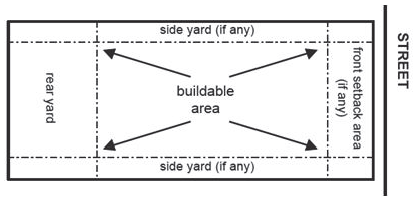
Setbacks. The zoning code requires that certain portions of a lot be set aside for front, rear and side yards. In general, no portion of a house (except covered front porches, chimneys, and bay windows) may extend up to 50 percent into these required yards. Eaves may project 30 inches into the required setback. Accessory structures and ADU's may be placed in the side or rear yards (such as garages, sheds, decks, porches or arbors) as along as adequate space is available, and certain criterion are met per CMC 21.44.
2.
Calculation. Yards are measured from the property line to the wall of the structure.
E.
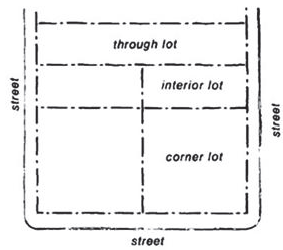
Through lots. Through lots are lots that have frontage on two streets, but not on a corner. Through lots are allowed only where the primary front lot line is on a local service street. The minimum front lot line and minimum width standards apply to one frontage of the through lot.
F.
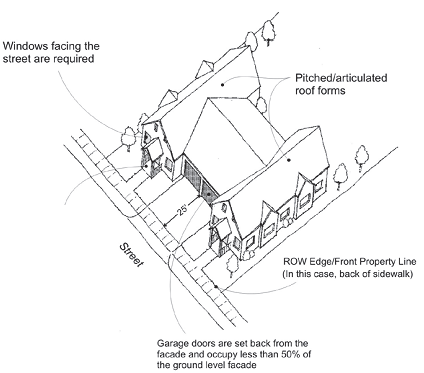
Garages (single-family and duplex). The intent is to deemphasize garages and driveways as major visual elements along the street, while ensuring that the living area of the residence is more prominent than the garage. Attached residential garages shall be subordinate to the dwelling.
1.
The principal facade of the dwelling is emphasized through the use of architectural features such as, but not limited to, porches, architectural details, height, or orientation, so that the non-garage portion of the residence is visually dominant;
2.
Garages should not occupy more than 50 percent of the building facade as seen from the front property line.
G.
Driveways.
1.
No more than one driveway per dwelling unit;
2.
Driveways for individual lots 50 feet or wider may be up to 20 feet in width at the throat of the driveway;
3.
Driveways for individual lots less than 50 feet wide would be up to 15 feet in width at the throat of the driveway; and
4.
Lots less than 35' wide shall be accessed off of an alley.
H.
Single-dwelling structures (detached).
1.
Orientation. If the single-family residence is situated on a corner lot, the structure shall be addressed off of the street that the main pedestrian entrance faces.
I.
Single-dwelling structures (attached or townhouse).
1.
Building articulation. Repetition of units can be minimized by using the following standards:
a.
Reversed elevation of two out of four buildings;
b.
Different building elevations for external units by changing roof line, articulation, windows or modulation patterns; and
c.
Adding a different dwelling design or different scales.
2.
Setback variation. If a townhouse development is proposed, no more than two abutting townhouses or townhouse groupings within the townhouse project site shall have a common front building setback. Variations in the setback of front building faces shall be at least 2', for the run of the units. Height variations shall also be incorporated, if feasible, in the townhouse design.
J.
Duplexes. By definition, duplexes are two units that share a common roof and a common wall for at least 50 percent of the maximum depth of the building, and prohibit the separation of the two units by a breezeway, carport, or other open building element; instead of a shared common wall, the two units can share a common floor and ceiling.
1.
Design standards. Specifically, duplexes shall emulate the look of a single family structure. Duplexes shall use modulated roof forms to help break up the massing of buildings and distinguish individual units. Duplexes on corner lots may be exceptions, where it is often advantageous for a duplex to appear as one home (but with entries on opposite streets).
K.
Manufactured homes. Manufactured homes are permitted on individual lots in the R-3 zone and shall be in accordance with the placement standards (including foundations) as set forth in this section and other provisions which apply to conventionally built dwellings (i.e. including appropriate building code requirements). The following development standards apply:
1.
The home must be at least 24 feet by 36 feet.
2.
The home must be placed on a permanent foundation.
3.
The home must have a roof of no less than 3:12 pitch.
4.
The home must have roof and siding materials that are similar in appearance to a site-built residence.
5.
The home must be new.
6.
Articulation. Include some building articulation through the incorporation of any of the following:
a.
Change in vertical wall plane (2-foot minimum);
b.
Change in horizontal wall plane (2-foot minimum);
c.
Varying roof lines (by emphasizing dormers, , chimneys, stepped roofs, and gables);
d.
Repeating distinctive window patterns;
e.
Projecting or recessed architectural elements including windows and doors;
L.
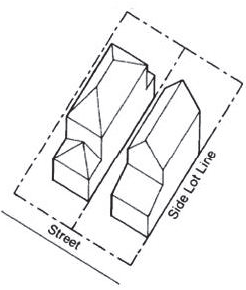
Zero lot lines. A zero (side yard) lot line development is where houses in a development on a common street frontage are shifted to one side of their lot. This provides for greater usable yard space on each lot.
1.
Where allowed. Zero lot line developments are allowed for single-family structures in the R-3 and R-3H zones. Zero lot line developments are allowed by right on a minimum of four lots grouped together.
2.
Setbacks. The side building setback on one side of the house may be reduced to zero. This reduction does not apply to the side building setback adjacent to a street. All other setback requirements apply.
3.
Privacy wall. In order to maintain privacy, no doors, windows, air conditioning units, or any other types of openings in the walls along a zero lot line structure are allowed except for windows that do not allow for visibility into the side yard of the adjacent lot.
4.
Restrictions. Restrictions which assure the minimum distance between houses, and any required easements, must be recorded on the deeds of the applicable lots. Proof of such recording must be submitted as part of the building permit application.
5.
Maintenance. An easement between the two property owners to allow for maintenance or repair of the house is required when the eaves or side wall of the house are closer than three feet to the adjacent property line.
M.
Multi-family dwelling units.
1.
Use regulations. The use regulations are intended to create and maintain higher density residential neighborhoods. At the same time, they allow for other nonresidential uses but not to such an extent as to sacrifice the overall residential neighborhood image and character.
2.
Site design. To soften new, more intensive development projects, the preservation of major existing trees within the interior and perimeter of the site is required.
3.
Screening surface parking. To provide a transition between higher density residential, and lower density residential development.
a.
Where surface parking lots are adjacent to single-dwelling districts, there shall be a planting strip an average of 10 feet in width (but no less than 8 feet), containing a full screen landscape. Paths are allowed as part of the landscaping strip.
4.
Reducing the visual impact of a large development. To regulate multifamily development so that it is compatible with the surrounding context of the community.
a.
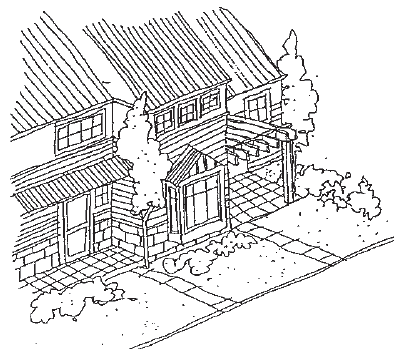
Articulation. The maximum building length without articulation/modulation is 30 feet. Articulation shall be achieved through the incorporation of any three of the following:
1.
Change in vertical wall plane (2-foot minimum);
2.
Change in horizontal wall plane (2-foot minimum);
3.
Varying roof lines (by emphasizing dormers, chimneys, stepped roofs, and gables);
4.
Repeating distinctive window patterns;
5.
Projecting or recessed architectural elements including windows and doors.
5.
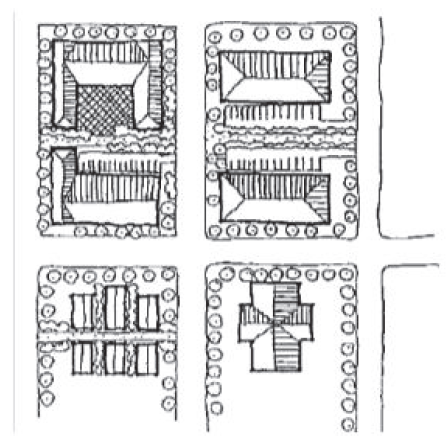
Pedestrian connections and open space. To provide residents of the development pedestrian access throughout the site and to common open spaces within the development.
a.
Development projects over five acres in size shall be divided into smaller sub-areas by alleys, lanes, courtyards, passageways, and landscape areas that separate and organize the configuration of buildings.
6.
Parking concealed. To minimize the visual impact of garages and driveways.
a.
Garages shall be arranged so that they do not front upon either the public street or the principal access lane through the development. Garages may be accessed from courtyards, secondary lanes, or alleys.
N.
Fences.
1.
Fences must be set back four feet from the edge of the roadway. Fences over four feet in height must be set back 15 feet from the back of curb parallel to the front property line and seven and one-half feet from the back of curb parallel to the side property line.
2.
Fences shall be no higher than eight feet.
3.
The structural support side of the fence shall face towards the interior of the builder's property only on the front and street side yards.
4.
Fences and hedges must conform to the clear view triangle standards of chapter 21.46.
O.
Nonresidential. The base zone development standards are designed for residential buildings. Generally, different development standards are needed for nonresidential uses which may be allowed in the R-3 and R-3H zone. The intent of nonresidential standards is to maintain compatibility, and limit potential negative impacts on surrounding residential areas.
1.
Uses. As indicated in Table 21.24.050-3, nonresidential uses that locate within the R-3 and R-3H zone shall comply with the following development standards:
2.
Specific standards.
a.
Mechanical equipment. Mechanical equipment located on the ground, such as heating or cooling equipment, pumps, or generators shall be screened from the street and any abutting residential zones by fences, vegetation, or other appropriate screening.
b.
Garbage and recycling collection areas. All exterior garbage cans, garbage collection areas, and recycling collection areas must be screened from the street (not located within the front yard setback area) and any adjacent properties.
c.
Exterior storage. Exterior storage of materials or equipment shall not be visible from the public right-of-way.
d.
Temporary structures. Temporary structures are permitted if they are connected to the primary use and function of the site or campus. Temporary structures shall not be located in the front yard or street side yard setbacks.
(Ord. No. X-13, § 2, 10-10-2017; Ord. No. W-55, § 9, 3-10-2015; Ord. No. W-22, § 55, 4-22-2014)
Editor's note— Ord. No. W-22, § 54, adopted April 22-2014, repealed in its entirety § 21.24.050, which pertained to bulk and size and derived from Ord. No. U-97, § 128, adopted Jan. 27, 2009 and Ord. No. N-90, § 1(part), adopted in 1986. Subsequently, said ordinance, § 55, reenacted § 21.24.050, as set our herein.
21.24.060 - Off-street parking.
See chapter 21.40 for off-street parking standards.
(Ord. No. U-97, § 129, 1-27-2009; Ord. No. N-90, § 1(part), 1986)
21.24.063 - Landscaping and buffering.
See chapter 21.42 for landscaping and buffering standards.
(Ord. No. U-97, § 130(21.24.063), 1-27-2009)
21.24.067 - Signs.
See chapter 21.54 for sign standards.
(Ord. No. U-97, § 131(21.24.067), 1-27-2009)
21.24.070 - General use provisions.
See chapter 21.48 for general use provision standards.
(Ord. No. U-97, § 132, 1-27-2009; Ord. No. T-36, § 5, 2003)

