
Cherokee County Unincorporated
City Zoning Code
City Zoning Code
ARTICLE 5
- GENERAL PROVISIONS2
Editor's note—Ord. No. 2021-O-008, § 1, adopted March 16, 2021, amended Article 5 in its entirety to read as set out herein. Former Article 5, §§ 5.1—5.13 pertained to similar subject matter and derived from Ord. No. 95-0-10, § 1, adopted Aug. 8, 1995; Ord. No. 96-08, § 3, adopted April 9, 1996; Ord. No. 98-O-14, §§ 2, 3, adopted Aug. 28, 1998; Ord. No. 2000-O-7, adopted Aug. 22, 2000; Ord. No. 2002-Z-006, §§ 1—3, adopted Aug. 20, 2002; Ord. No. 2007-Z-001, adopted July 17, 2007; Ord. No. 2007-Z-002, adopted Aug. 7, 2007; Ord. No. 2008-A-002, § 1, adopted Sept. 15, 2008; Ord. No. 2008-Z-003, adopted Dec. 16, 2008; and Ord. No. 2019-O-012, § 1, adopted Aug. 6, 2019.
5.1 - Interpretation.
5.1-1 In their interpretation and application, the provisions of the zoning ordinance shall be held to be the minimum requirements for the promotion of the public health, safety, morals and welfare, including those purposes, intents, objectives or similar language as set out in various articles of the ordinance.
5.1-2 Where the conditions imposed by any provision of this zoning code upon the use of land or buildings or upon the bulk of buildings are either more restrictive or less restrictive than comparable conditions imposed by any other provisions of this code or of any other law, Ordinance, resolution, rule or regulation of any land, the regulations which are more restrictive (or which impose higher standards or requirements) shall govern.
(Ord. No. 2021-O-008, § 1, 3-16-21)
5.2 - Scope of regulations.
Except as otherwise provided in article 14, "non-conforming uses", all buildings erected hereafter, all uses of land or buildings established hereafter, all structural alteration or relocation of existing buildings occurring hereafter, and all enlargements of or additions to existing uses occurring hereafter shall be subject to all regulations of this ordinance which are applicable to the zoning districts in which such buildings, uses or land shall be located.
(Ord. No. 2021-O-008, , § 1, 3-16-21)
5.3 - Building permits.
Building permits are required for all structures erected, converted, enlarged, restructured, moved or structurally altered and the provisions for said building permit shall be separately set out in the Building Code of Cherokee County. However, where a building permit for a building or structure has been issued in accordance with law prior to the effective date of the ordinance, and provided that construction is begun within one year of such effective date and diligently pursued to completion, said building or structure may be completed in accordance with the approved plans on the basis of which the building permit has been issued, and further may upon completion be occupied under a certificate of occupancy by the use for which originally designated - subject thereafter to the provisions of section 14.2; permit procedure.
(Ord. No. 2021-O-008, , § 1, 3-16-21)
5.4 - Access to public street.
5.4-1
Minimum access required.
A.
Every lot or parcel of land shall have a minimum frontage of 50 feet adjoining a public or private street, that meets Cherokee County Standards, unless a lesser frontage is permitted herein, or have access over a recorded 20 feet wide easement to a public or private street, which meets Cherokee County Standards, unless a lesser width was duly established and recorded prior to the effective date of this ordinance, or where such lot or parcel is a part of a neighborhood plan as outlined in article 8, section 8.4 of this ordinance. The county engineer, or designee, shall determine if a private street meets Cherokee County Standards. All lots shall maintain a width of no less than 30 feet.
B.
No easement of access will be allowed to intersect another easement of access unless at the point of intersection the total width of easements is equal to 20 feet multiplied by the number of lots or parcels served. The total width is required from the point of intersection to a public street.
C.
Access easements shall not be stacked. Where two or more contiguous properties are each served by separate exclusive access easements of 20 feet in width, said easements shall not be "stacked" on top of another. Driveways shall not be combined, but each providing distinct entrances and spaced adequately to meet stopping sight distance requirements.
D.
Each access easement shall be open to travel by automobile.
E.
An easement for the purpose of providing access may not be extended to serve more than one parcel; except as otherwise provided herein.
5.4-2
Shared access easement.
A.
A 60-foot-wide shared access easement to a public or private street shall be permitted to serve a minor subdivision, as defined herein and by the Development Rules and Regulations of Cherokee County; except as otherwise provided herein.
B.
A subdivision, using a shared access easement shall be required to submit construction plans as a common plan of development regardless of the number of lots.
(Ord. No. 2021-O-008, , § 1, 3-16-21; Ord. No. 2023-O-014, § 1, 11-21-23)
5.5 - Subdivision and plat approval.
5.5-1
Authority, applicability and general provisions.
A.
Authority and delegation. These regulations are adopted pursuant to powers vested in counties by the State of Georgia Constitution and pursuant to state administrative rules for the adoption and implementation of Comprehensive Plans and the protection of vital areas of the State.
1.
Delegation of powers to director. The director of planning and zoning, or designee, is vested with the authority to review, approve, conditionally approve or disapprove final plats of subdivisions not requiring the installation of public infrastructure, lot combination plats, or lot line adjustments.
The director of planning and zoning, or designee, shall also be authorized to review and approve all subdivisions and re-subdivisions for conformity to the requirements of this Code, and to make reports and recommendations to the board of commissioners on subdivisions and re-subdivisions, and to administer, interpret, and enforce the provisions of this chapter.
2.
Delegation of powers to county engineer. The county engineer, or designee, is vested with the authority to require and approve land development improvements and to require improvement guarantees for public improvements as specified in this ordinance, and as further required by the Cherokee County Development Regulations, adopted by the Cherokee County Board of Commissioners.
B.
Applicability. The subdivision regulations of Cherokee County shall apply to all real property within unincorporated Cherokee County, but specifically excluding the subdivision of property as outlined in, "Exemptions From Plat Approval."
C.
Effect of prior subdivision regulations. At the subdivider's request, a plat that received preliminary approval under prior subdivision requirements may be processed through the final plat process under such requirements.
D.
Land is one tract until subdivided. Until property proposed for subdivision has received final plat approval and been properly recorded, the land involving the subdivision shall be considered as one tract, or as otherwise legally recorded.
E.
All land subdivisions to comply. No plat of land subdivision shall be entitled to be recorded in the office of the clerk of the Superior Court of Cherokee County, and it shall be unlawful to record such a plat of land subdivision, unless and until it shall have been approved in accordance with the requirements of this ordinance. (State Law Reference O.C.G.A. 15-6-67 (d))
F.
Subdivision required. Notwithstanding any other provisions contained herein to the contrary, except as approved by the board of commissioners in accordance with the authority provided in this ordinance, no more than on dwelling is permitted on one lot and subdivision is required in accordance with respective zoning district standards to comply with this requirement. Multi-family dwellings are exempt from this requirement except for townhome dwellings projects constructed in the RM Zoning Districts or condominiums intended for sale fee simple.
5.5-2
Types of subdivision. Division of a tract or parcel of land. Any division of a tract or parcel of land into two or more lots, building sites, or other divisions, for the purpose, whether immediate or future, of sale or building development is considered a subdivision. The term subdivision includes all development of land involving a new street or a change in existing streets, includes re-subdivision, and, where appropriate to the context, relates to the process of subdividing or the land area subdivided.
A.
Minor subdivision. It is the intent of the board of commissioners to provide for minor subdivisions, whereby an original tract of land may be divided into not more than ten individual tracts of land provided all tracts of land within the subdivision have appropriate frontage, access, and otherwise comply with these and other county regulations. The following types of minor subdivisions are indicated as follows:
a.
Lot split.
i.
A minor subdivision of a tract or parcel of land into two parcels.
ii.
Each parcel shall have a minimum of 50 feet of frontage on a public or private road or have access to a public street by a 20-foot access and utility easement or private street that meets all Cherokee County Standards by a 20-foot access and utility easement.
iii.
Where an access and utility easement crosses a property, the building setbacks for said property shall be measured from the edge of easement, or property line if in the AG Zoning District.
b.
Minor plat.
i.
A subdivision of one parcel into three, not more than seven parcels.
ii.
Each parcel shall have a minimum of 50 feet of frontage on a public or private street or have access to a public or private street by a 20-foot access and utility easement that meets all Cherokee County Standards.
iii.
Where an access and utility easement crosses a property, the building setbacks for said property shall be measured from the edge of easement, or property line if in the AG Zoning District.
c.
Rural subdivision.
i.
A subdivision of one parcel into three, not more than ten parcels using common access.
ii.
A rural subdivision is a common plan of development. "Common development" means a contiguous area where multiple, separate, and distinct construction activities will be taking place at different times on different schedules under one plan of development.
iii.
Each parcel shall have a minimum of 50 feet of frontage on a public or private road or have access to a public or private road by way of a shared 60-foot access and utility easement.
a.
The shared easement is considered a private street for purposes of this ordinance and shall be named with each parcel having access to said street being addressed from the street.
b.
The easement/private street shall be named.
c.
A private street maintenance agreement is required with the recording of the final plat in accordance with section 5.5-10.1(g).
iv.
Property lines of the parcels within the rural subdivision may run to the centerline of the easement/private street.
v.
Each lot within a rural subdivision shall contain a minimum lot size of 60,000 square feet or the minimum lot size required by the zoning district of the property subject to subdivision, whichever is greater. The minimum lot size shall remain unencumbered by the shared 60-foot access and utility easement, unless located in the AG Zoning District.
vi.
Building setbacks shall be measured from the edge of the shared access easement/private street or from the property line if in the AG Zoning District.
vii.
The front lot line shall be established where the shared easement provides access to the lot.
viii.
The subdivision shall be named on the recorded plat.
ix.
Covenants, conditions, and restrictions (CC&Rs) shall be recorded concurrent with the approved subdivision plat and shall:
a.
Provide for the maintenance of the private street/shared easement; and
b.
A provision subjecting the CC&Rs to the Property Owner's Association Statute (O.C.G.A. § 44-3-220 et seq.); and
c.
Include certificates found under section 5.5-10.1(h).
d.
Rural subdivisions shall be exempt from article 27 tree preservation and replacement ordinance.
B.
Chain subdivisions prohibited. It is the intent of the board of commissioners to prohibit the practice of "chain" subdivisions where a land owner subdivides a parcel of land by way of consecutive and/or contiguous minor subdivisions which collectively total seven or more lots instead of filing for a rural subdivision or major subdivision. It is further intended to prohibit minor subdivision development adjacent to each other within a two-year time period, where part of an original tract of land is now owned by another person or entity and was transferred or sold to another owner with the intent to circumvent the rural or major subdivision process.
a.
Parcels created by a minor subdivision, and the parent parcel(s) from which the minor subdivision is created, shall not be further divided for a period of two years, unless such land is submitted as a rural subdivision or major subdivision pursuant to this article.
C.
Major subdivision.
a.
A division of one parcel of land into 11 or more lots.
b.
Common plan of development. A major subdivision is a common plan of development.
c.
Construction plans required. A major subdivision requires the submittal, review and approval of a construction plan for any and all grading, infrastructure improvements associated with the subdivision.
d.
Major subdivision plat criteria:
The following criteria shall be utilized by the county in determining whether a submitted major subdivision plat is acceptable:
i.
Whether the proposed development is in compliance with all pertinent sections of the Cherokee County Zoning Ordinance, the Cherokee County Development Regulations, and other local and state regulations.
ii.
Whether the proposed development is in compliance with all conditions of zoning affixed to the subject property by resolution of the board of commissioners; all terms and conditions of any development agreement entered into between the applicant and the board of commissioners; all conditions of relief or appeal as may have been granted by resolution of the zoning board of appeals; or any other decree or agreement between the applicant and the board of commissioners.
iii.
Whether the proposed development is in compliance with all other Cherokee County ordinances, codes and regulations, where applicable, including but not limited to the Tree Preservation Ordinance, Soil Erosion and Sedimentation Ordinance, Stormwater Management Ordinance, Flood Damage Prevention Ordinance, the Tributary Protection Act, and the Public Sewer System Ordinance.
iv.
Whether provision has been made for a water supply system that is compliant with pertinent county ordinances and regulations and is otherwise sufficient in terms of quantity, dependability, and quality to provide an appropriate supply of water for the type of development proposed.
v.
If a public sewage system is proposed, whether adequate provision has been made for such a system under pertinent county ordinances and regulations and, if other methods of sewage disposal are proposed including septic, that such systems comply with all pertinent federal, state, and local laws and regulations.
vi.
If the tendered plat reveals areas deemed by the director or county engineer or their designee to be unsuitable for development due to the likelihood of flooding or improper drainage, or due to rock formations, topography, utility easements, or other characteristics rendering the proposed development harmful to the safety, health, and general welfare of the citizens of the county or whether the proposed development makes accommodations for such characteristics such that the health, safety and welfare of the county is not unduly impacted.
vii.
Whether proposed roads provide safe, convenient, and functional system for vehicular, pedestrian, and bicycle circulation and are otherwise consistent with the Cherokee County Comprehensive Land Use Plan and Cherokee County Comprehensive Transportation Plan.
e.
General Agricultural District (AG) major subdivisions. Notwithstanding any other provisions contained in this ordinance to the contrary, a major subdivision project in the AG zoning district may include the following features:
i.
Access to a public or private road by way of a shared 60-foot access easement/private street. Where a subdivision lot has frontage on the easement, the property line may extend to the centerline of the private street within the easement.
ii.
The front lot line shall be established where the shared easement provides access to the lot.
iii.
Building setbacks may be measured from the edge of the shared access easement/private street or property line.
iv.
Proposed modifications to curb type and lane width standards may be approved by the county engineer, or designee and fire marshal or designee to provide design flexibility.
D.
County reservation. Cherokee County reserves the right to require any person seeking to subdivide land within the unincorporated areas of Cherokee County to submit a Subdivision Plat for review and approval where the director of planning and zoning or county engineer find that such plan review is necessary to conform to state laws and regulations.
5.5-3
Plans required prior to construction. No person shall commence construction of any improvements on any lot prior to approval of construction plans for said improvements as required by this ordinance, the Cherokee County Zoning Ordinance and by Cherokee County Development Regulations.
5.5-4
Building and other permits. No building permit or certificate of occupancy shall be issued for a building, structure, or use, nor shall any excavation, grading, or land disturbance applications be approved, on any parcel of land regulated by this Ordinance that has not been approved in accordance with the provisions of this Ordinance except as specifically exempted.
5.5-5
Public streets and lands. No land dedicated as a public street or for other public purpose shall be accepted as a public street or for other public land unless such improvements are constructed in accordance with the specifications of this ordinance and the Cherokee County Development Regulations, and said land and/or improvements are formally approved and accepted as public improvements by the board of commissioners in accordance with procedures established in this ordinance.
5.5-6
Appeals. Any person aggrieved by an interpretation or decision of the director of planning and zoning, county engineer, or other official responsible for the administration of this.
5.5-7
Exemptions from plat approval. The following types of land subdivisions, transfers, and sales are specifically exempted from the plat approval requirements of this ordinance; provided, however, that such exemptions shall not apply to land development requirements and improvement requirements of the Cherokee County Development Regulations.
a.
The creation and sale of cemetery plots.
b.
The sale of lots consistent with previously approved and recorded plats or deeds.
c.
The creation of leaseholds for space within a multiple-occupancy building or the division of property into leaseholds for commercial, industrial, or institutional use.
d.
The creation of leaseholds for the agricultural use of property where the use does not involve the construction of a building to be used as a residence or for other purposes not directly related to agricultural use of the land or crops or livestock raised thereon.
e.
Any division of land to heirs through a judicial estate proceeding, or any division of land pursuant to a judicial partition, or any division of land occurring from the foreclosure of a deed of trust; provided, however, that such exemption shall not require the county to issue permits if the resulting lots or parcels fail to meet any applicable regulations of the local jurisdiction concerning lot size, lot width, and other dimensional requirements.
5.5-7.1
Lot combinations.
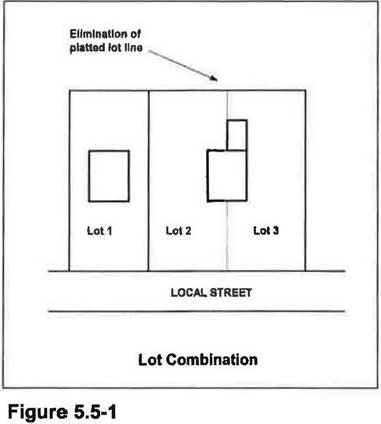
An existing lot line forming the boundary between two conforming platted lots located within the same subdivision or a lot line between lots or parcels that have merged to form one building lot may be removed or eliminated through a final plat revision process which conforms to the requirements of this ordinance. In the case where no final plat applies to the subject lots or parcels, a boundary survey and plat depicting all lots involved in the lot combination shall be required to be approved by the Director and recorded as a final plat. Such combination plat shall be titled with the same name as that of the original subdivision, if applicable, and shall indicate thereon that the re-plat is for the purpose of removing the lot lines between specific lots. See Figure 5.5-1.
5.5-7.2
Boundary line adjustments.
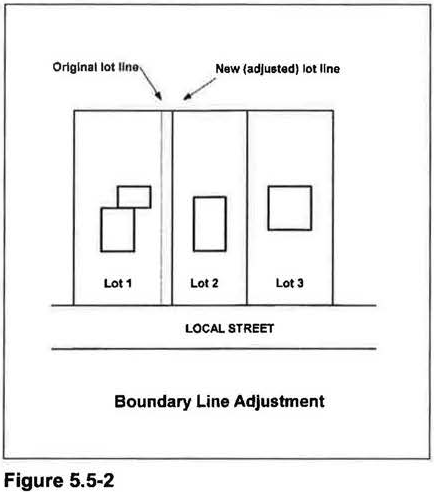
One or more existing lot lines forming boundaries between conforming platted lots located within the same subdivision, or one or more lot lines between abutting lots or parcels may be adjusted through a final plat revision process that requires the approval of the director and recording of a plat meeting the specifications of a final plat. In the case no final plat applies to the subject lots or parcels, a boundary survey and plat of the entire lots involved in the boundary line adjustment shall be required to be approved by the director and recorded. Such plat showing said boundary line adjustment shall be titled with the same name as that of the original subdivision and shall include thereon that the re-plat is for the purpose of adjusting the lot lines between specific lots. See Figure 5.5-2.
5.5-8
Construction plans.
a.
Application. The construction plan approval process is administrative. Applications for construction plan approval shall be made in accordance with requirements shown in Table 5.1 and Table 5.2.
b.
Construction plan decision criteria. The only basis upon which the director of planning and zoning and/or the county engineer may deny a construction plan is the failure of the application to meet the requirements of this ordinance or any other applicable federal, state, or local regulations.
c.
Certificate of approval. All copies of the construction plans shall be noted by inscription on the plat noting such approval by the director of planning and zoning and the county engineer. Construction plan approval shall expire and be null and void after a period of one year, unless activity toward improvements on the land has been initiated, or unless the director and/or the county engineer approves an extension of time.
5.5-9
Final plat.
a.
When required. All subdivisions and dedications shall require final plat approval. The final plat approval process is administrative. Applications shall be made in accordance with requirements shown in Table 5.1
b.
Criteria for approval. The director may grant final plat approval if the following conditions, as applicable, are met.
i.
The County has previously approved a preliminary plat of the proposed subdivision, if required.
ii.
Where new improvements are involved in the subdivision, construction plans have been approved, and all improvements have been installed and inspected by the county engineer, and subdivision improvement guarantees as required by this ordinance have been submitted.
iii.
The final plat meets all applicable requirements of this ordinance.
iv.
A complete final plat application has been submitted, including all supporting materials required by this chapter for final plats.
v.
All county regulations and requirements pertinent to land development have been met
c.
The director shall consider final plats and applications that meet the above referenced conditions a ministerial action of approval. Denial of a final plat shall be permitted only upon specific findings that one or more of the above-referenced conditions have not been met.
d.
Approval certificate. Upon approval of the final plat, a certificate, stamped directly on the plat, shall state:
"Pursuant to the Land Subdivision Regulations of Cherokee County, Georgia, and all requirements of approval having been fulfilled, this final plat was given preliminary approval on ___________, 20_______, and final approval by the Director of Planning and Zoning and County Engineer and it is entitled to recordation in the Clerk's Office, Cherokee County Superior Court."
e.
Additional plat certificates. In addition to information required by Table 5.2 to be supplied on a final plat, each final plat shall contain the following certificates
f.
Surveyor's certificate. A certificate by a surveyor directly on the final plat as follows:
"It is hereby certified that this plat is true and correct and was prepared from an actual survey of the property by me or persons under my supervision; that all monuments shown hereon actually exist or are marked as "future," and that their location, size, type and material are correctly shown; and that all engineering requirements of the Zoning Ordinance of Cherokee County, Georgia, have been fully complied with.
By:___________ Registered Georgia Land Surveyor No.:_______"
g.
Owner's certificate. A certificate by the owner directly on the final plat, signed in an appropriate manner as follows:
"The owner of the land shown on this plat and whose name is subscribed hereto, in person or through a duly authorized agent, certifies that this plat was made from an actual survey, and that all State, City and County taxes or other assessments now due on this land have been paid. Said owner donates and dedicates to the public for use forever the street right-of-way as shown on this plat.
___________
Owner
Signed, sealed and delivered in the presence of:
___________
Witness
___________
Notary Public"
h.
Health department approval certificate.
"This final plat has been approved by the Cherokee County Health Department as being consistent with applicable state and local environmental health requirements.
___________
Director, Cherokee County Health Department"
i.
Effect of recorded plat. All building setbacks, buffers, or other development standards required by this Ordinance and/or other County, State or Federal regulations, which have been delineated and documented on a recorded plat, shall be upheld as the minimum requirements for any permits issued for development upon the area of land encompassed within such plat. Where the building setbacks, buffers, or other development standards on a recorded plat are different than current standards, the recorded plat shall be enforced unless otherwise approved by the Director of Planning and Zoning, County Engineer, or by the Zoning Board of Appeals pursuant to authority granted elsewhere in this Ordinance or the Code of Ordinances, Cherokee County, Georgia.
5.5-10
Dedications of streets and public lands.
5.5-10.1
Private streets.
a.
Private streets in a major subdivision. Private streets may, upon application, be permitted by the board of commissioners within major subdivisions, subject to the requirements of this section. Applications for approval of private streets shall be considered by the board of commissioners concurrent with or prior to preliminary plat approval. Following a recommendation of the County Engineer, based on the criteria in 5.5-10.1(b), to authorize private streets in a major subdivision, the board of commissioners shall consider the application and may impose conditions on the approval of private streets to ensure various public purposes and to mitigate potential problems with private streets. No final plat involving a private street shall be approved unless said final plat conforms to the requirements of this section.
With the approval of private streets, maintenance of all infrastructure within the street right-of-way, including but not limited to curb and gutter, sidewalks, street lighting, landscaping, and drainage facilities shall become private in perpetuity. The maintenance of a street and accompanying infrastructure will no longer be the responsibility of Cherokee County upon privatization approval by the board of commissioners.
b.
Criteria for private streets consideration. In making a determination with respect to proposed private streets in a major subdivision, the Board of Commissions may consider the following criteria:
1.
Whether the approval of the streets as private would limit future connectivity to nearby and adjacent parcels, limit critical access, or increase traffic congestion;
2.
Whether approval of the streets as private would foreclose the opportunity to complete strategic roadway connections in the future to benefit the transportation network in the immediate area or beyond;
3.
Whether the major subdivision has a sufficient number of units to support the long-term maintenance of the private infrastructure, including the roadway;
4.
Whether the major subdivision is likely to petition the county in the future to accept the private roadway and accompanying private infrastructure as public due to the maintenance burden; and
5.
Whether approving the streets as private will be a detriment to the public health, safety, or welfare in the major subdivision or immediate community.
c.
Construction plans required. It shall be unlawful for any person, firm, or corporation to construct a new private street or alter an existing private street or to cause the same to be done without first obtaining approval of construction plans from the county engineer and a development permit issued in accordance with the requirements of this ordinance.
d.
Standards. All private streets shall be constructed to all standards for public streets as required by this ordinance, applicable construction specifications of the Development Regulations of Cherokee County, and as approved by the county engineer.
e.
Street names and signs. Private streets shall be named, subject to the approval of the county. The subdivider of land involving a private street shall install street signs with content containing the street name and the designation "private," as approved by the County Engineer. The sign signifying the private street may be required by the county to be a different color than that of street signs provided for public streets, in order to distinguish maintenance responsibilities in the field.
f.
Easements. Easements for private streets shall be designated on final plats as general-purpose public access and utility easements, along with the name of said private street. Said easement shall at minimum be of the same width as that required for the right-of-way of a public street by the county for the type of public street (local, collector, etc.) most closely resembling the proposed private street. Easements for private streets shall not be included in any calculation of minimum lot size or density limitations established by Cherokee County Zoning regulations. In the cases of private streets, the general-purpose public access and utility easement for the private street shall either;
i.
Be shown in a manner on the final plat such that each lot fronting the private street extends to the centerline of the private street. No lot shall be permitted to be divided by the general purpose public access and utility easement required and established for a private street; or
ii.
Shall be drawn as its own discrete parcel to be dedicated to a private homeowners association (i.e., not shown to be a part of any lot).
iii.
Where the lot fronting the private street extends to the centerline of the private street, the front building setback for said lot shall be measured from the nearest edge of the easement and not the property line forming the centerline of the private street.
g.
Maintenance. The county shall not maintain, repair, resurface, rebuild, or otherwise improve streets, signs, drainage improvements or any other appurtenances within general purpose public access and utility easements established for private streets. A private maintenance covenant recorded with the Clerk of the Superior Court of Cherokee County shall be required for any private street and other improvements within general-purpose public access and utility easements established for private streets. The covenant shall set out the distribution of expenses, remedies for non-compliance with the terms of the agreement, rights to the use of easements, and other pertinent considerations. The covenant shall specifically include the following terms.
i.
The covenant shall establish minimum annual assessments in an amount adequate to defray costs of ordinary maintenance and procedures for approval of additional needed assessments. The covenant shall also specify that the funds from such assessments will be held by a homeowners or property owners association.
ii.
The covenant shall include a periodic maintenance schedule.
iii.
The covenant for maintenance shall be enforceable by any property owner served by the private street.
iv.
The covenant shall establish a formula for assessing maintenance and repair costs equitably to property owners served by the private street.
v.
The covenant shall run with the land.
vi.
The board of commissioners may, at its discretion, as a condition of approving private streets, require a performance bond and/or maintenance bond be submitted by the subdivider and held by a homeowners or property owners association, or the board may require that the subdivider pay an amount of money as recommended by the county engineer into an escrow account or other suitable account for the maintenance and repair of private streets and stormwater management improvements, to be drawn from by the homeowners or property owners association as maintenance and repair needs may arise.
h.
Specifications for final plats involving private streets. The county engineer shall not approve for recording any final plat involving a private street unless and until it shall contain the following on the face of the plat:
i.
Deed book and page reference to the recorded covenant required by this section;
ii.
"WARNING, Cherokee County has no responsibility to build, improve, maintain, or otherwise service the private streets, drainage improvements, and other appurtenances contained within the general public purpose access and utility easement or easements for private streets shown on this plat.";
iii.
"Grant of Easement. The general-purpose public access and utility easement(s) shown on this plat for private street(s) is hereby granted and said grant of rights shall be liberally construed to provide all necessary authority to the County, and to public or private utility companies serving the subdivision, for the installation and maintenance of utilities, including, but not limited to, electric lines, gas lines, telephone lines, water lines, sewer lines, cable television lines, and fiber optic cables, together with the right to trim interfering trees and brush, together with a perpetual right of ingress and egress for installation, maintenance, and replacement of such lines.
___________
Signature of Property Owner"; and,
i.
Requirement for purchaser's acknowledgement of private responsibilities. Prior to the sale or as a condition of the closing of a real estate transaction involving any lot served by a private street in the county, the subdivider or seller of said lot shall obtain a notarized purchaser's acknowledgement of private street construction and drainage maintenance responsibilities as set forth below. A copy of the purchaser's acknowledgement shall be retained by the purchaser and shall be required to be submitted as a condition of a building permit for a principal building on said lot:
"Purchaser's Acknowledgement of Private Street and Drainage Maintenance Responsibility
(I)/(We) have read the Declaration of Covenant which pertains to the lot that is the subject of this real estate transaction ___________ (insert address or attach legal description). (I)/(We) understand that the Declaration of Covenant applies to the lot that (I am)/(we are) purchasing and requires (me)/(us) to provide a specified percentage or amount of the financing for the construction and maintenance of any private street and drainage facilities serving the lot which (I am)/(we are) purchasing, and that owners of other lots as depicted on this plat may sue for and recover those costs which this covenant requires (me)/(us) to pay, plus their damages resulting from (my)/(our) refusal to contribute, plus reasonable attorney's fees. (I)/(We) further understand that Cherokee County has no obligation to assist with the maintenance and improvement of the private street, drainage facilities, and other appurtenances within the general-purpose public access and utility easement for the private road serving the lot in question. (I)/(We) understand that a copy of this purchaser's acknowledgement shall be required as a condition of the issuance of a building permit for a principal building on the lot (I am)/(we are) purchasing.
___________
Purchaser
___________
Purchaser
5.5-10.2
Subdivision improvement guarantees.
In order to protect the county and prospective purchasers of and residents in a subdivision, the sub-divider/developer shall provide to the county financial security to guarantee the installation of public improvements. The sub-divider's or developer's financial guarantee may be any of the following:
a.
An escrow of funds with the county;
b.
An escrow with a bank or savings and loan association upon which the county can draw;
c.
An irrevocable letter of commitment or credit upon which the County can draw;
d.
A performance bond for the benefit of the county upon which the county can collect, or a certificate of deposit with assignment letter; and
e.
Any other form of guarantee approved by the board of commissioners that will satisfy the objectives of this section. The guarantee shall be in an amount to secure the full costs, as determined by the county, of constructing or installing the improvements and utilities required.
5.5-11
Supplemental subdivision provisions. Notwithstanding other provisions of this ordinance, subdivisions shall be governed by the following:
5.5-11.1
Flag lots.
a.
Intent. Flag lots, as defined in this ordinance, are strongly discouraged. However, subdivisions designed with one or more flag lots may be approved where conditions of hardship make standard design or frontage impossible or impractical due to the configuration of the lot to be subdivided.
b.
Denial if reasonable alternative exists. The director and/or county engineer shall have due cause to deny any plat that proposes any flag lot, when a reasonable alternative to such lot pattern is available.
c.
Panhandle (flagpole) length restriction. If permitted, no flag lot shall be allowed to be platted that has a "panhandle" portion (i.e., portion that does not meet the required lot width) that is more than 400 feet in length.
d.
Width of pole. At no point may the staff or "pole" portion of a flag lot be less than 30 feet in width.
5.5-11.2
Public streets required. Access to every lot in a subdivision shall be provided over a public street or private street as defined herein. Construction of a privately maintained road requires prior approval by the board and must be constructed to current county standards. All streets and other features in the Major Transportation Plan of Cherokee County, Georgia, shall be platted by the subdivider in the locations and to the dimensions indicated in the Major Transportation Plan adopted by the board of commissioners. This provision shall not apply to shared driveways as defined herein.
5.5-11.3
Minimum access standards. No building permit shall be issued for any lot that does not meet the minimum access standards of this section, except as otherwise specifically permitted, until such time as there exists a road or street meeting all county standards. Except as otherwise noted herein, all lots and tracts hereafter created must front a minimum of 50 feet on a county approved public road. Cul-de-sac lots must front a minimum of 35 feet on a county approved public road. The panhandle section of approved flag lots must have at least 30 feet on a county approved public road. Landlocked lots may access a county approved public road via a minimum 20 foot easement, if said easement is duly recorded and made a part of the property deed. The location and dimensions of each such access easement shall be shown upon the subdivision plat and shall only be used for a maximum of one parcel, whether previously platted or newly created under the terms of this article. In instances where a subdivision contains such a lot that does not abut a public road, the final plat of the subdivision shall also contain the following owner's certificate:
"I, the undersigned owner hereby dedicate the access easement shown on this plat to the common use of the owner, or owners, of the lot within this subdivision. It is further acknowledged that the access way and any improvements within such access easement shall not be accepted by Cherokee County, Georgia, but shall remain privately owned and maintained.
Owner
Signed, sealed and delivered in the presence of:
Witness
Notary Public"
5.5-11.4
Plats straddling jurisdictional boundaries. Whenever access to the subdivision is required across land within the jurisdictional boundaries of another local government, the planning director may request assurance from the local government authority that access is legally established, and from the local government engineer that the access road is adequately improved, or that a guarantee has been duly executed and is sufficient in amount to assure the construction of the access road. In general, lot lines should be laid out so as not to cross jurisdictional boundary lines.
5.5-11.5
Additional rights-of-way. Subdivisions that adjoin existing streets shall dedicate additional right-of-way to meet the minimum street width requirements specified by the County's Major Transportation Plan, and the entire right-of-way shall be provided where any part of the subdivision is on both sides of the street; provided that when the subdivision is located on one side of an existing street, one-half of the required right-of-way, measured from the center line of the existing roadway, shall be provided.
5.5-11.6
Street alignment, intersections and jogs. Streets shall be aligned to join with planned or existing streets. Under normal conditions, streets shall be laid out so as to intersect as nearly as possible at right angles. Street jogs with center-line offsets of less than 150 feet shall not be permitted.
5.5-11.7
Continuation of existing streets and connections. Existing streets shall be continued as the same or greater width, but in no case less than the required width. The county engineer may require a development provide one or more future connections to adjoining subdivisions or un-subdivided tracts.
5.5-11.8
Street plans for future phases of the tract. Where the plat proposed to be subdivided includes only part of the tract owned or intended for development by the subdivider, a tentative plan of a future street system for the portion not slated for immediate subdivision consideration shall be prepared and submitted by the subdivider.
5.5-11.9
Enforcement, violations, and penalties. The director of planning and zoning shall enforce the provisions of this chapter. The director is authorized to issue stop-work orders and issue citations for violations of this chapter. If it is discovered that a plat was recorded but was not eligible for recording under the provisions of this chapter, then in such an event the director shall cause to be filed a notice of revocation of approval of said plat in the clerk's office, Cherokee County Superior Court, with cross reference noted on the plat to the filed revocation, in a form to be approved by the County attorney. In addition to remedies associated with violations to this Code, the director may institute proceedings to obtain injunction, abatement, or any other appropriate action or actions, to prevent, enjoin, or abate such unlawful action.
5.5-12
Legacy Lot.
5.5-12.1
Intent:
It is the intent of the board of commissioners to provide owners of property who wish to subdivide their property, except where the division of land would create a nonconforming parcel, the opportunity, upon petition to and acceptance of the board of commissioners, to present said subdivision at a public hearing. A non-conforming parcel of land is one which has less area of land than the minimum lot size required by the zoning district assigned the property. Lack of access or inadequate access shall not make a parcel non-conforming.
5.5-12.2
Purpose:
The purpose of legacy lots is to permit a division of land to facilitate a familial gift or a transfer of land between family members. The presence of family members living nearby adds to the community by providing affordable housing, child and elder care, and transportation to those family members who cannot drive themselves, all of which fosters stable family environments.
5.5-12.3
Legacy lot requirements.
A subdivision created under the terms and conditions of this procedure shall be known as a legacy lot, and shall only be considered where the following criteria are found to exist:
a.
Zoning of property in the immediate vicinity, the land use policies set forth in the Comprehensive Plan and existing pattern of development of nearby property does not suggest or support a request for a zoning change, and
b.
The division of land is not a part of a larger common plan of development; and
c.
The purpose for the division of land is exclusively for gifting to an heir or relative a parcel of land, upon which the recipient intends on constructing a single family dwelling unit, and residing within said structure; and
d.
The division of land creates no more than one non-conforming parcel.
(Ord. No. 2021-O-008, , § 1, 3-16-21; Ord. No. 2022-O-006, Exh. A, 2-15-22; Ord. No. 2022-O-007, Exh. A, 2-15-22; Ord. No. 2023-O-014, § 1, 11-21-23)
5.6 - Accessory uses and structures.
No accessory building or use shall be constructed upon a lot until construction of the principal building has commenced, except in the case of a barn in the AG district. The following requirements shall not apply to accessory uses and structures in the TND district.
Accessory structure - A structure detached from a principal building on the same lot and incidental and subordinate to the principal building.
Barn - A building primarily used for the quartering or training of livestock kept on the premises, the storage of agricultural products produced on the premises, the storage and maintenance of farm equipment, and/or the storage of supplies used for the agricultural operations and maintenance of the premises. Animal quarters, as defined in article 4 of the zoning ordinance, shall be considered a barn. A barn in AG shall be exempt from sections 5.6(A), (B), (C), and (D). A barn shall be located no less than 75 feet from any property line.
Guest quarters - Living area included in an accessory structure for temporary living only. Guest quarters shall not contain complete provisions for eating and cooking. For the purposes of this section, complete provisions for eating and cooking shall include a kitchen sink, a stove/cook top, microwave and refrigerator. Only one structure containing guest quarters shall be constructed concurrently with or after the construction of a principal, residential structure.
Lot coverage - The cumulative square foot measurement of the principal building footprint, any accessory buildings' footprints and accessory uses.
A.
Location on lot. No accessory structure(s) shall be located closer to the front lot line of property than the primary structure, except when located on property of at least two acres. When located closer to the front lot line than the primary structure, accessory structures shall meet the front building setback(s) of the property, shall not obstruct the viewpoint of the primary structure from the front lot line, shall be wholly enclosed, and shall meet the requirements of section 5.6D of this article. The viewpoint shall be measured as the widest part of the primary structure horizontal to the front lot line. See figure 5.6 (A) 1 - Accessory Structures on 2 Acre Property.
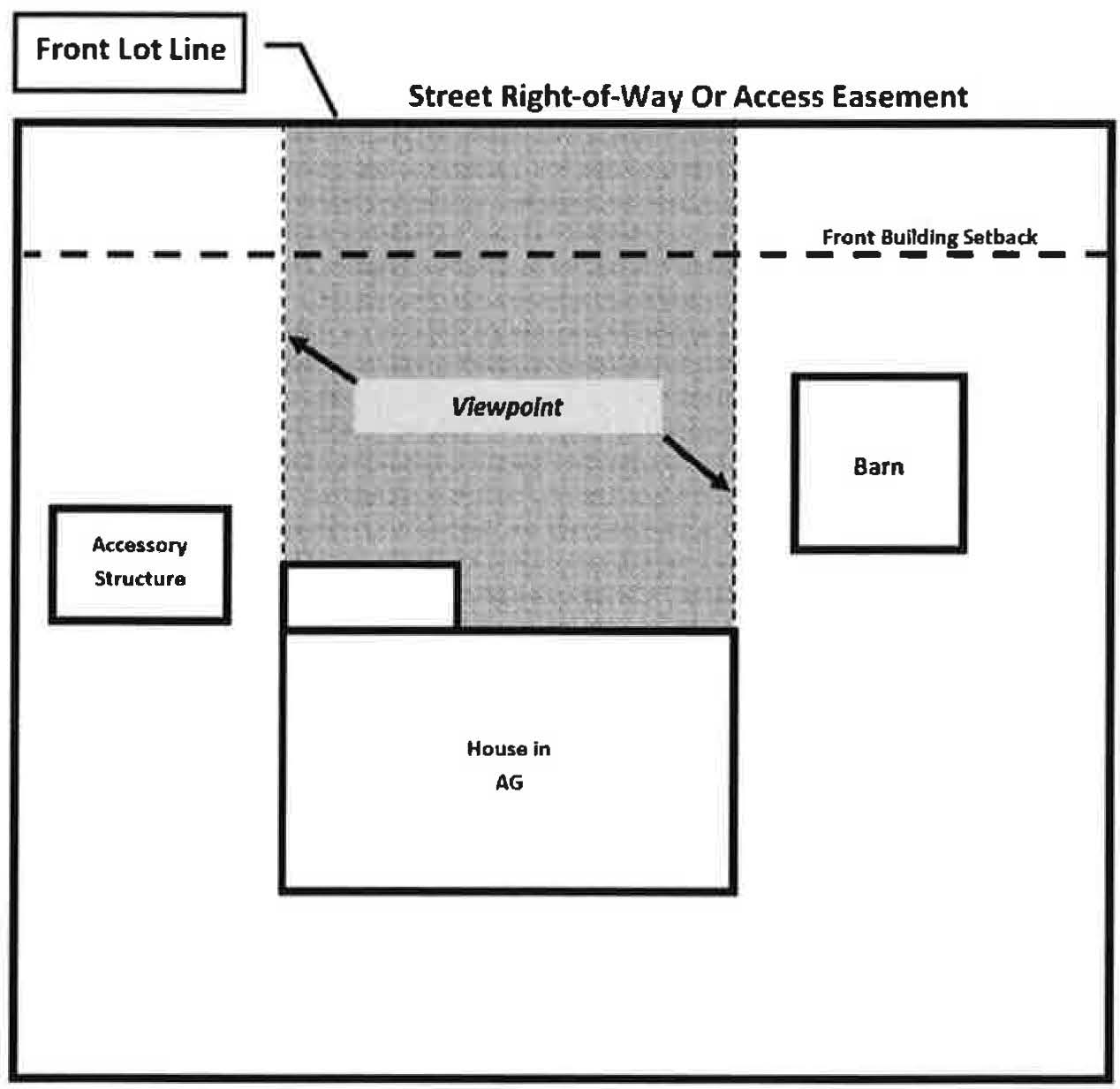
Figure 5.6(A) 1 - Accessory Structures on 2 Acre Property
Where an accessory building is structurally attached to the principal building by a roofed or enclosed breezeway, passageway or similar means, it shall be considered attached. Where an accessory structure is attached to the principal structure, it shall comply with the yard requirements of the principal building.
On a corner lot, no accessory building or use shall be located closer to any street right-of-way line than the principal building setback.
Accessory uses and structures shall be located on the same lot or parcel as the principal use or structure. No accessory building or use shall be located closer than ten feet to a side or rear lot line. A two foot overhang for eves or gutters will be permitted within this ten foot setback. Where the primary side and rear building setbacks based on the zoning district or recorded plat for a lot are less than the ten-foot minimum requirement, the less restrictive standard shall apply.
B.
Number and size. No accessory use, or structure, or combination of, shall exceed the number allowed as shown in Table 5.4. Accessory structures and shall be included in the total lot coverage by zoning district allowed per Table 7.1A: Minimum District Development Standards. Structures of less than 200 square feet shall not be included in determining the allowable lot coverage. The gross square footage of an accessory structure shall be limited to 50 percent of the gross square footage of the principal structure.
C.
Height. No accessory building shall exceed 25 feet in height or the height of the primary structure, whichever is lower.
D.
Design. Any accessory structure that has a gross square footage of 400 square feet or more or is located closer to the front lot line than the primary structure, shall be constructed of exterior materials that are complimentary to and compatible with the principal structure on the property. Compatible materials may include cementitious siding, masonry siding, wood siding, or as permitted by the planning and zoning director or their designee. The following shall be exempt from these design requirements, unless determined otherwise by the planning and zoning director or their designee:
a.
Accessory structures on properties of five acres or more that are at least 50 feet from the side and rear property lines and are located further from the front lot line than the primary structure.
b.
Accessory structures that are unenclosed (i.e. carports, pavilions) and are located further from the front lot line than the primary structure.
E.
Structure limitations. Accessory structures shall not be used as dwelling units or for lodging purposes except as otherwise provided herein. (See Guest Quarters)
F.
Incidental uses. The following accessory uses and structures which are incidental to a residential use are permitted in their respective residential and AG districts.
5.6-1
A children's playhouse, private greenhouse.
5.6-2
A swimming pool for private use. Pools shall be fenced with a sturdy material of chain link or of material and colors compatible with the main dwelling; that prevents entry that is continuous around the pool except for gate openings; that is a minimum of five feet in height; that has latches out of reach of children or at least five feet off the ground; and locked to exclude all persons unless a responsible person is at the pool.
5.6-3
A garage, shed or building for domestic storage.
5.6-4
Reserved.
5.6-5
Signs (other than advertising sign) as permitted and regulated in each district incorporated in this ordinance.
5.6-6
Public utility communication, electric, gas, water and sewer lines, their supports, and incidental equipment.
5.6-7
Carports.
5.6-8
A satellite disk or dish, subject to the same restrictions and requirements as sheds and storage buildings.
5.6-9
Animal quarters for domestic animals, not including livestock; kennels.
5.6-10
Mini-warehouse facilities may establish one resident-manager of the facility.
NOTE: This chart applies to accessory structures only. Homes, pools and tennis courts are excluded.
(Ord. No. 2021-O-008, , § 1, 3-16-21; Ord. No. 2021-O-010, § 2, 7-20-21; Ord. No. 2023-O-008, 8-1-23)
5.7 - Fences.
A.
Vision clearance at intersections. In all zoning districts, no fence, wall, structure, shrubbery or other obstruction to vision between the heights of three feet and 15 feet, except utility poles, light or street sign standards or tree trunks shall be permitted within 25 feet of the intersection of the right-of-way lines or streets, roads, highways or railroads as long as the same also complies with State Law.
B.
Location and height. No fence or free-standing wall other than a retaining wall shall be more than eight feet in height or be constructed in a public right-of-way or future street right-of-way as defined by the Cherokee County Roadway Functional Classification map. If a fence is adjacent to a public road right-of-way and within the required setback in a residential district such fence shall not exceed six feet in height and meet the requirements in Section 5.7. It is recommended that fences be installed a minimum of six inches off the property line.
(Ord. No. 2021-O-008, , § 1, 3-16-21; Ord. No. 2021-O-010, § 2, 7-20-21)
Editor's note— Ord. No. 2021-O-010, adopted July 20, 2021, changed the title of § 5.7 from "vision clearance at intersections" to "fences".
5.8 - Approvals for developments along interstates, state highways and county roads.
For all businesses and industrial developments fronting on a state, interstate highway and county road, no building permit shall be issued until the approval of the Georgia Department of Transportation or the county engineer has been obtained by the applicant on entrances and exits, curb radii, drainage and other matters that are the appropriate concern of the department.
(Ord. No. 2021-O-008, , § 1, 3-16-21)
5.9 - Use occupancy and erection.
No building or structure or land shall hereafter be used or occupied and no building or structure or part thereof shall be erected, constructed, reconstructed, moved or altered except in conformity with the regulations of this ordinance.
5.9-1
Public buildings and use. Buildings erected and owned by any government or other public agency shall be permitted in any zoning district.
5.9-2
Street setback requirement. No building or structure shall hereafter be erected closer than 75 feet from the right-of-way of any existing two lane arterial; or 65 feet from the right-of-way of any existing two lane collector street; or 50 feet from the right-of-way of any existing four lane interstate or arterial.
(Ord. No. 2021-O-008, , § 1, 3-16-21)
5.10 - Classification of streets.
For the purposes of this ordinance, all the streets, roads and highways in Cherokee County area classified as local streets, major or minor collector streets, arterial and interstates. The classification of each street in Cherokee County is shown on the Cherokee Road Classification Map which is on file in the office of the Cherokee County Planning and Zoning Department.
(Ord. No. 2021-O-008, , § 1, 3-16-21)
5.11 - Connecting access among adjoining businesses.
Except as provided in this article, the site plan of each business property shall include a minimum of 20 foot width roadway which shall connect to adjoining business property. The road is not required to be paved unless and until the adjoining property is developed. The zoning administrator is authorized to grant an exception to this requirement upon presentation of an engineering feasibility study presented to and satisfactory to the county engineer that due to location, isolation, uniqueness of land or topography; a connecting access is not feasible or is not warranted. Such an exception shall be made a part of the public record with the findings of the administrator set out and the engineering study attached.
(Ord. No. 2021-O-008, , § 1, 3-16-21)
5.12 - Requirements of the Cherokee County Development Standards, the Cherokee County Soil Sedimentation and Control Ordinance and the Cherokee County Flood Plain Regulation Ordinance.
The Cherokee County Development Standards, also known as regulations, and as may be amended; the Cherokee County Soil Sedimentation and Control Ordinance, and as may be amended; and the Cherokee County Flood Plain Regulation Ordinance, and as may be amended; are incorporated herein and are made part of this Ordinance for all purposes, including but not limited to interpretation enforcement and penalties. As between two conflicting revisions, the Zoning Ordinance shall control.
(Ord. No. 2021-O-008, , § 1, 3-16-21)
5.13 - Mailbox supports.
(a)
Mailbox supports. The use of massive mailbox supports that, when struck, could damage vehicles and cause serious injury to vehicle occupants are prohibited. Heavy metal posts, concrete posts, brick bases, and miscellaneous items such as farm equipment or supports filled with concrete are also prohibited.
(b)
Encroachment on public rights-of-way. No building, structure (including prohibited mailbox supports as described in section A), service area or required off-street parking and loading facilities, except driveways, shall be permitted to encroach on public rights-of-way.
(c)
Pre-existing structures. All structures pre-existing the ordinance are exempt from these sections.
(Ord. No. 2021-O-008, , § 1, 3-16-21)

