
Clarksville City Zoning Code
CHAPTER 2
RULES OF INTERPRETATION AND DEFINITIONS
2.1 - RULES OF INTERPREATION
General. All provisions, terms, phrases, and expressions contained in this Ordinance shall be construed in order that the true intent and meaning of the Clarksville City Council may be fully carried out. When a specific subsection of these regulations gives a different meaning than the general definition provided in this chapter, the specific subsection's meaning and application of the term shall control.
Headings, Illustrations, and Text. In the event of a conflict or inconsistency between the text of this Ordinance and any heading, caption, figure, illustration, table, or map, the text shall control. Graphics and other illustrations are provided for informational purposes only and should not be relied upon as a complete and accurate description of all applicable regulations or requirements.
Lists and Examples. Unless otherwise specifically indicated, lists of items or examples that use terms such as "for example", "including", and "as such", or similar language are intended to provide examples and are not exhaustive lists of all possibilities.
Computation of Time. The time in which an act is to be done shall be computed by excluding the first day and including the last day. If a deadline or required date of action falls on a Saturday, Sunday, or holiday observed by the city, the deadline or required date of action shall be the next day that is not a Saturday, Sunday or holiday observed by the city.
1.
"Day" means a calendar day unless working day is specified.
2.
"Week" means seven (7) calendar days.
3.
"Month" means a calendar month.
4.
"Year" means a calendar year, unless otherwise indicated.
Delegation of Authority. Any act authorized by this Ordinance to be carried out by a specific official of the City may be carried out by a professional-level designee of such official.
Technical and Non-Technical Terms. Words and phrases shall be construed according to the common and approved usage of the language, but technical words and phrases that may have acquired a peculiar and appropriate meaning in law shall be construed and understood according to such meaning.
Public Officials and Agencies. All public officials, bodies, and agencies to which references are made are those of the City of Clarksville, unless otherwise indicated.
Mandatory and Discretionary Terms. The words "shall", "must", and "will" are mandatory in nature, establishing an obligation or duty to comply with the particular provision. The words "may" and "should" are permissive in nature.
Conjunctions. Unless the context clearly suggests the contrary, conjunctions shall be interpreted as follows:
1.
"And" indicates that all connected items, conditions, provisions or events apply.
2.
"Or" indicates that one (1) or more of the connected items, conditions, provisions or events apply.
3.
"Either or" indicates that the connected items, conditions, provisions or events shall apply singularly but not in combination.
Tenses, Plurals, and Gender. Words used in the present tense include the future tense. Words used in the singular number include the plural number and the plural number includes the singular number, unless the context of the particular usage clearly indicates otherwise. Words used in the masculine gender include the feminine gender and vice versa.
Fractions. When any requirement of this Ordinance results in a fraction of a dwelling unit or other measurement, that fraction if less than 0.5 shall be rounded down to the nearest whole number, and if equal to or greater than 0.5 shall be rounded up to the nearest whole number.
2.2 - DEFINITIONS
For the purpose of Chapters 1 through 11 of this Ordinance, certain terms used herein are herewith defined. When not inconsistent with the context, words used in the present tense include the future; words used in the singular include the plural; the word "person" includes a firm, partnership, or corporation as well as an individual; the word "lot" includes the word "plot," "parcel," or "site"; the word "building" includes the word "structure"; and the term "shall" is always mandatory and not directory; and the word "may" is permissive. The word "used" or "occupied" as applied to any land or building shall be construed to include the words "intended, arranged, or designed to be used or occupied."
Access way: A paved area intended to provide ingress and egress of vehicular traffic from a public right-of-way to an off street parking area.
Accessory building: A building or structure the use of which is subordinate or incidental to that of the main building, structure, or use. Where an accessory building is an integral part of, or is joined to the main building, such accessory building shall be considered to be part of the main building.
Accessory use: A use customarily incidental, appropriate, and subordinate to the principal use of land or building and devoted exclusively to the main use of the premises.
Accessory structure: Shall represent a subordinate structure to the principal structure and shall not be used for human habitation with the exception of Guest Houses where permitted.
Acid Manufacture: An industrial facility or business that produces acid and/or acid based products by a designed process or as a byproduct of another industrial or manufacturing process. Addition: (To an existing building) means any walled and roofed expansion to the perimeter of a building in which the addition is connected by a common load bearing wall other than a fire wall. Any walled and roofed addition which is connected by a fire wall or is separated by independent perimeter load-bearing walls is new construction.
Adhesive and Sealants Manufacture: An industrial facility or business that produces natural and/or synthetic adhesives and/or sealants.
Adult-oriented business establishment: An establishment defined in Section 5-1200 of the City Code and the provisions of Section 5-1200, as adopted on September 7, 2000, and as may be amended from time to time thereafter, are adopted and incorporated by reference herein.
Agricultural Arenas: Structures intended primarily or exclusively for support of an agricultural function.
Agricultural Retail: A use primarily engaged in the sale or rental of farm tools and implements, feed, grain, tack, animal care products, and farm supplies. This definition excludes the sale of large implements, such as tractors and combines, but includes food sales and farm machinery repair services that are accessory to the principle use. This also includes the sale of products grown on site.
Agricultural Uses (Customary): This includes the growing of crops in the open, dairying, grazing, the raising and maintenance of poultry and other livestock, horticulture, viticulture, floriculture, apiculture, forests, and timber. Commercial and Industrial feed lots, the raising of fur-bearing animals, riding academy, livery or boarding stables, or dog kennels are not considered to be customary agricultural uses.
Agriculture use, accessory: Those structures or equipment which are normally required in the operation of agricultural uses.
Aircraft Parts Manufacture: An industrial facility or business that produces aircraft component parts, excluding manufacturing of liquid lubricants, fuels, etc.
Airplane Manufacture: An industrial facility or business that assembles components to produce airplanes.
Airports: Any area of land or water designed and set aside for the landing and takeoff of aircraft, including all necessary facilities for the housing and maintenance of aircraft.
Airports, private: Any airport licensed by the State of Tennessee as a private airport, used primarily by the airport licensee, but available for use by others upon specific invitation of the licensee.
Airport elevation: Five hundred fifty (550) feet above mean sea level.
Airport hazard: Any structure, tree or use of land which obstructs the airspace required for or is otherwise hazardous to the flight of aircraft in landing or taking off at the airport.
Alcohol distillery: Large scale production of alcoholic beverages in quantities exceeding one thousand (1,000) barrels per month, with one (1) barrel holding fifty-five (55) gallons, and may include as an accessory use tours, a taproom/tasting room, restaurant, or retail space for the consumption of alcohol made on-site and purchase of distillery related merchandise.
Alcohol distillery, micro: Small scale distillery limited to producing alcoholic beverages in quantities not to exceed one thousand (1,000) barrels per month, with one (1) barrel holding fifty-five (55) gallons, and may include as an accessory use tours, a taproom/tasting room, or retail space for the consumption of alcohol made on-site and purchase of distillery related merchandise. Food trucks may be permitted on-site to serve patrons of the distillery.
Alley: A public or private right-of-way that is primarily designed to serve as secondary access to the abutting property.
Alterations: Any change, addition, or removal affecting the structural or supporting members of a building such as bearing walls, columns, beams, girders, and joists.
Amateur Radio Antenna: A freestanding or building mounted structure, including any base, tower or pole, antenna, and appurtenances, intended for airway communication.
Ambulance Service (Private): A privately owned facility for the dispatch, storage, and maintenance of emergency medical care vehicles.
Amenity: Means a natural or created feature that enhances the aesthetic quality, visual appeal, or makes more attractive or satisfying a particular property, place, or areas.
Animal Shelter: A facility used to house or contain stray, homeless, abandoned, rescued or unwanted animals.
Animal Slaughtering and Processing: A facility for the slaughtering and processing of animals and the refining of their byproducts.
Antique Shop/Dealer: A place offering antiques for sale. An antique, for purposes of this chapter, shall be a work of art, piece of furniture, decorative object, or the like, of or belonging to the past.
Apartment: A dwelling unit, including living, cooking and sanitary facilities, in a multiple dwelling. A building, or portion thereof, used or designed as a residence for three (3) or more households living independently of each other, not transient in nature.
Apparel Shop: Retail stores where clothing is sold, such as department stores, dry goods and shoe stores, and dress, hosiery, and millinery shops.
Appeal: Means a request for a review of any provision of this section or a request for a variance.
Appliance Store: See Furniture and Appliance Store.
Aquarium: An establishment where aquatic collections of living organisms are kept and exhibited.
Area of shallow flooding: Means a designated AO or AH zone on a community's flood insurance rate map (FIRM) with one percent (1%) or greater annual chance of flooding to an average depth of one (1) to three (3) feet where a clearly defined channel does not exist, where the path of flooding is unpredictable and where velocity flow may be evident. Such flooding is characterized by ponding or sheet flow.
Area of special flood-related erosion hazard: Is the land within a community which is most likely to be subject to severe flood-related erosion losses. The area may be designated as zone E on the flood hazard boundary map (FHBM). After the detailed evaluation of the special flood-related erosion hazard area in preparation for publication of the FIRM, zone E may be further refined.
Area of special flood hazard: Is the land in the floodplain within a community subject to a one percent (1%) or greater chance of flooding in any given year. The area may be designated as zone A on the FHBM. After detailed ratemaking has been completed in preparation for publication of the FIRM, zone A usually is refined into zones A, AO, AH, A1-30, AE or A99.
Arena: A large open or enclosed space used for games or major events, and partly or completely surrounded by tiers of seats for spectators.
Art Gallery: An establishment engaged in the sale, loan, or display of art books, paintings, sculpture, or other works of art. This does not include libraries, museums, or non-commercial art galleries.
Asphalt Paving/Mixing Manufacture: An industrial facility used for the production of asphalt. The manufacturing process involves the combination of a number of aggregates, sand, and filler, in correct portions, heated and coated with a binder, usually bitumen. The finish product is also referred to as blacktop. Including administrative and/or management facilities, the stock piling of bulk materials required for the process, and storage of and the maintenance of the required equipment for operation.
Assembly Hall/Civic Hall: A building or portion of a building in which facilities are provided for civic, educational, political, religious, or social purposes.
Assisted Living Facility: A special combination of housing, supportive services, personalized assistance, and health care designed to respond to the individual needs of those who need help with activities of daily living. A facility with a central or private kitchen, dining, recreational, and other facilities, with separate bedrooms or living quarters, where the emphasis remains residential.
ATM (Automated Teller Machine): An automated device that performs banking or financial functions at a location remote from the controlling financial institution.
Auction House (No Livestock): A building, area, or areas within a building used for the public sale of goods, wares, merchandise, motor-vehicle, or equipment to the highest bidder.
Authorized agent or owner: Anyone who has written authority to speak for or make presentations on behalf of the owner of any property. An authorized agent shall be responsible for any information or data which he presents to the city.
Automobile Assembly: An industrial facility or business that assembles components to produce new automobiles.
Automobile Parking (Commercial): A publicly or privately owned short-term, parking facility for commuters.
Automobile Parts Manufacture: An industrial facility or business that produces automobile component parts, excluding manufacturing of liquid lubricants, fuels, etc.
Automobile Parts Sales (No Outside Storage or Display): The use of any land area for the display and sale of new or used parts for automobiles, panel trucks or vans, trailers, or recreation vehicles. All display and storage of materials shall be within a completely enclosed building.
Automobile Parts Sales (With Outside Storage): The use of any land area for the display and sale of new or used parts for automobiles, panel trucks or vans, trailers, or recreation vehicles.
Automobile Rentals: Rental of automobiles and light trucks and vans, including incidental parking and servicing of vehicles for rent or lease.
Automobile Repair Service, major: An establishment primarily engaged in the repair or maintenance of motor vehicles, trailers, and similar large mechanical equipment, including paint, body and fender, and major engine and engine part overhaul, provided it is conducted within and completely enclosed building.
Automobile Repair Service, minor: An establishment primarily engaged in the repair or maintenance of motor vehicles, trailers, and similar mechanical equipment including brake, muffler, upholstery work, tire repair and change, lubrication, tune ups, and transmission work, provided it is conducted within a completely enclosed building.
Automobile Sales: The use of any building or portion thereof, or other premises or portion thereof, for the display, sale, rental, or lease of new motor vehicles, or used motor vehicles, and any warranty repair work and other repair service conducted as an accessory use and within a completely enclosed building.
Awning Manufacture (Cloth, Metal, and Wood): An industrial facility or business that produces awnings or components for awnings.
Bakery: An establishment primarily engaged in the sale of baked products for consumption on/off site. The products may be prepared either on or off site. Such use may include incidental food service. A bakery shall be considered a general retail use.
Banner: Any sign of lightweight fabric, plastic, or similar material capable of being attached to a building or structure. National, state, or municipal flags or the official flag of any institution or business shall not be considered banners.
Bar or Nightclub: A commercial establishment dispensing alcoholic beverages for consumption on the premises and in which dancing and musical entertainment is permitted.
Barber: Any establishment or place of business within which the practice of barbering is engaged in or carried on by one (1) or more barbers.
Barge Port: A facility for the docking, loading or unloading of barges or boats that transport freight.
Base flood: Means the flood having a one percent (1%) chance of being equaled or exceeded in any given year.
Basement: A story partly or wholly underground. For purposes of height measurement a basement shall be counted as a story when one-half (½) of its height is above the average ground elevation or when subdivided and used for commercial activities or dwelling purposes.
Beauty Shop: Any establishment where cosmetology services are provided including hair care, nail care, and skin care on a regular basis for compensation.
Bed and breakfast establishment: A residence that provides one (1) to five (5) rooms for paying guests on an overnight basis for periods not to exceed fourteen (14) days with one (1) daily meal being available on the premises. A bed and breakfast establishment is allowable only in a building originally constructed as a single-family residence.
Billboard: See "Off-premise advertising sign."
Block: All property fronting upon one (1) side of a street between intersecting and/or intercepting streets, or between a street and a right-of-way, waterway, dead-end of a street, or city boundary. An intercepting street shall determine only the boundary of the block on the side of the street it intercepts.
Block face: The buildings fronting along one (1) side of a street between the two (2) nearest intersecting streets; or where a street deadends, along one (1) side of a street between the nearest intersecting street and the end of the deadend street.
Boat Dealers: A marine retail sales and service use in which boats are rented or sold.
Boat Repair and Service: An establishment primarily engaged in the repair or maintenance of boats, boat trailers, or mechanical equipment, provided that all servicing of boats is conducted within a completely enclosed building. Storage shall be limited to watercraft or accessories being serviced only.
Board: Clarksville Board of Zoning Appeals.
Boardinghouse: A residence or portion thereof which is used to accommodate, for compensation, boarders or roomers. Rest homes or homes for the aged shall be included in this definition.
Bond: Money or a form of monetary security issued to the City of Clarksville by an owner to insure that the required site work will be performed completely and correctly within a certain time frame. This bond shall be in the form of a cashier's check, letter of credit from a banking institution, certificate of deposit, or performance bond from an insurance company.
Bowling Alley: An establishment that devotes more than fifty percent (50%) of its gross floor area to bowling lanes, equipment, and playing area.
Breakaway wall: Means a wall that is not part of the structural support of the building and is intended through its design and construction to collapse under specific lateral loading forces, without causing damage to the elevated portion of the building or supporting foundation system.
Brewery: Large-scale production of beer and/or malt beverages in quantities exceeding twenty-five thousand (25,000) barrels annually, with one (1) barrel holding thirty-one (31) gallons, and may include as an accessory use tours, a taproom/tasting room, restaurant, or retail space for the consumption of beer and/or malt beverages made on-site and purchase of brewery related merchandise.
Brewery, micro: Also referred to as a micro-brewery. A small-scale production of beer and/or malt beverages in quantities not to exceed twenty-five thousand (25,000) barrels annually, with one (1) barrel holding thirty-one (31) gallons, and may include as an accessory use tours, a taproom/tasting room, or retail space for the consumption of beer and/or malt beverages made on-site and purchase of brewery related merchandise.
Brewpub: Eating or drinking establishment that includes an accessory use for the production of beer and/or malt beverages not to exceed twenty-five thousand (25,000) barrels annually. On-site consumption of products and beverages produced on- or off-site are approved.
Building: For purposes of this section, means any structure built for support, shelter, or enclosure for any occupancy or storage. (See "structure")
Building Area: That portion of a lot occupied by the main building, including porches, carports, and other structures attached to the main building.
Building Contractor Supply: A facility that provides retail and/or wholesale sales of building materials, construction supplies, plumbing/electrical materials, and other similar items.
Building Height: The vertical distance measured from the average elevation of the proposed finished grade at the front of the building to the highest point of the roof for flat roofs, to the deck line for mansard roofs, and to the mean height between eaves and ridge for gable, hip, and gambrel roofs.
Building, main or principal: A building in which is conducted or intended to be conducted the main or principal use of the lot on which the building is located.
Building Official: The person within the Building and Codes Department, which is determined by the City of Clarksville to have authority for enforcement of this Ordinance.
Building Permit: Means the permit required under this Ordinance.
Building Setback Line: A line on private property, established by this zoning ordinance, to prohibit the location of buildings or structures between that line and street right-of-way line and/or property line.
Bus or Truck Service: Any building, structure, improvements, or land used for the repair and maintenance of buses, trucks, trailers, or similar vehicles including but not limited to body, fender, muffler, or upholstery work, oil change and lubrication, painting, tire service and sales.
Bus Station: Any premises for the storage or parking of motor driven buses and the loading and unloading of passengers.
Business Office (Excluding Medical): Any lawful commercial endeavor to engage in the purchase, sale, lease, or exchange of goods, and/or the provision of services.
Business School: University-level institution that confers degrees in Business Administration. It teaches topics such as accounting, finance, information systems, marketing, organizational behavior, strategy, human resource management, and quantitative methods.
Cabinet and Countertop Manufacture: An industrial facility or business that produces and/or assembles components to construct cabinets and/or countertops.
Cabinet and Countertop Sales (Retail): Establishments engaged in selling cabinetry and/or countertops to ultimate customers or consumers.
Cafe: An informal restaurant primarily offering coffee, tea, and other beverages, and where light refreshments and limited menu meals may also be sold.
Caliper: A standard trunk diameter measurement for nursery grown trees taken six (6) inches above the ground for up to and including four (4) inch caliper size, and twelve (12) inches above the ground for larger sizes.
Camera, Photographic Supply, Film Developing (Retail): Establishments engaged in selling cameras, camera equipment, photographic supplies, and the process of film development to ultimate customers or consumers.
Camping Trailer or Camper Trailer: is a portable unit permanently mounted on wheels and designed to be towed by another vehicle and set up at a destination to provide temporary living quarters for recreational, camping, or travel use. The term "fifth wheel" may also be used to describe a camping trailer.
Candy, Cigars, and Tobacco (Retail): Establishments engaged in selling candy, cigars, or tobacco products to ultimate customers or consumers.
Car Wash: The use of a site for washing and cleaning of passenger vehicles, recreational vehicles, or other light duty equipment.
Caretaker Residence: A single-family dwelling unit accessory to an agricultural, professional, commercial, or industrial use for occupancy by the owner/caretaker.
Carnival: A traveling or transportable group or aggregation of rides, shows, games, or concessions or any combination thereof.
Carpet and Upholstery Cleaning: An establishment engaged in the cleaning of residential, commercial, or industrial carpeting and/or upholstery.
Catering Services: An establishment that serves and provides food to be consumed off premises for public or private entertainment.
Cellular Phone Sales and Service: Establishments engaged in selling cellular phones, accessories, and/or cellular phone service products to ultimate customers or consumers.
Cement Manufacture: An industrial facility used for the production of cement. The manufacturing process involves the combination of materials, usually aggregates introduced to extreme heat to remove moisture, then crushed to produce a very fine dust like substance used to bind other aggregate materials. Including administrative and/or management facilities, the stock piling of bulk materials required for the process, and storage of and the maintenance of the required equipment for operation.
Cemetery: Land used or dedicated to the burial of the dead, including crematoriums, mausoleums, necessary sales, and maintenance facilities. Mortuaries shall be included when operated within the boundary of such cemetery.
Ceramic Products Manufacture: An industrial facility or business that processes inorganic, non-metallic solid materials through a process that includes the introduction of high heat and subsequent cooling to produce products, including, but not limited to pottery, tile, semiconductors, etc.
Certificate of compliance: Approval by the zoning administrator that a use, building or structure complies with the provisions of this Zoning Ordinance.
Check Cashing: A person or business that for compensation engages, in whole or in part, in the business of cashing checks, warrants, drafts, money orders, or other commercial paper serving the same purpose.
Chemical Manufacture: An industrial facility or business that manufactures or processes materials and/or chemicals to create a chemical, biological transformation, and/or separation of materials.
Child care facility: A child care facility is a facility other than a family day care home which provides non-medical care to children under eighteen (18) years in age in need of personal services supervision or assistance on less than a twenty-four-hour basis. Child care facility does not include family day care homes.
Civic Hall: See Assembly Hall.
Clinic: See "medical facility."
Clothing Manufacture: An industrial facility or business that assembles textiles, usually on a large scale, to produce clothing.
Club, private: An organization catering exclusively to members or their guests, or premises and buildings for recreational entertainment or athletic purposes which are not conducted primarily for financial profit.
Coffee Shop: An informal restaurant primarily offering coffee, tea, and other beverages, and where light refreshments and limited menu meals may also be sold.
College or University: A post-secondary institution for higher learning that grants associate or bachelor degrees and may also have research facilities and/or professional schools that grant master and doctoral degrees. This may also include community colleges that grant associate or bachelor degrees or certificates of completion in business or technical fields.
Commercial Amusement (Indoor): A facility wholly enclosed in a building that offers entertainment or games of skill to the general public for a fee. This includes but is not limited to such facilities such as laser tag, billiard parlors, arcades or similar use(s).
Commercial Amusement (Outdoor): A facility that offers entertainment and/or games of skill to the general public for a fee wherein any portion of the activity takes place outdoors and including, but not limited to, a golf driving range, archery range, miniature golf course, batting cages, go-cart tracks, amusement parks, and other similar types of uses.
Commercial Stable: See Riding Academy.
Communication Studio: Establishments primarily engaged in the provision of broadcasting and other information relay services accomplished through the use of electronic and telephonic mechanisms. Typical uses include television studios, telecommunication service centers, telegraph service offices, or film and sound recording facilities.
Communication Tower: A tower, pole, or similar structure that supports a telecommunications antenna operated for commercial purpose above ground in a fixed location, freestanding, guyed, or on a building or other structures.
Concrete Mixing and Batching Plant: An industrial facility used for the production of concrete. The manufacturing process involves the combination of a number of aggregates, sand, water, fly ash and cement in correct portions, and mixed to produce concrete. Including administrative and/or management facilities, the stock piling of bulk materials required for the process, and storage of the maintenance of and the required equipment for operation.
Consignment Store: A retail establishment engaged in selling used merchandise, such as clothing, furniture, books, shoes, or household appliances, on consignment.
Construction Contractor with Storage Yard: An unenclosed portion of the lot or parcel upon which a construction contractor maintains its principal office or a permanent business office. Designation of the lot or parcel as a contractor's storage yard would allow this area to be used to store and maintain construction equipment and other materials customarily used in the trade carried on by the construction contractor.
Construction Landfill: Land used or dedicated to building materials and other wastes associated with construction projects, including, but not limited to such materials as wood, concrete, drywall, masonry, roofing, siding, structural metal, wire, insulation, plastics, styrofoam, twine, baling and strapping materials, cans, buckets, packaging materials, and containers.
Convenience Center: A lot or part thereof used primarily for the disposal of solid waste into temporary storage and compacted to reduce its volume where it is then transported to a sanitary landfill. Typical uses include temporary storage of glass, plastic, paper products, and other recyclable materials.
Convenience Store: A facility associated with the sale of gasoline products that also offers for sale prepackaged food items and tangible consumer goods, primarily for self-service by the consumer.
Convent: A housing facility where the residents are limited to members of a specific religious order.
Convention Center: A commercial facility used for assemblies or meetings of the members or representatives of groups, including exhibition space. This term does not include banquet halls, clubs, lodges, or other meeting facilities of private or nonprofit groups that are primarily used by group members.
Corner Lot: A lot abutting upon two (2) or more public roads, permanent easements or travel easements at their intersection.
Correctional Facility: A facility for the detention, confinement, treatment or rehabilitation of persons arrested or convicted for the violation of civil or criminal law. Such facilities include an adult detention center, juvenile delinquency center, jail, and prison.
Council: The City Council of Clarksville, Tennessee.
Country club: A chartered, nonprofit membership club, catering primarily to its membership, providing one (1) or more of the following recreational and social activities: Golf, swimming, riding, outdoor recreation, clubhouse, locker room, pro shop, boating.
Crematory: An establishment containing properly installed, certified apparatus intended for use in the act of cremation.
Critical root zone (CRZ): A circular region measured outward from a tree trunk representing the essential area of the roots that must be maintained in order for the tree's survival. The critical root zone is one (1) foot of radial distance for every inch of tree DBH, with a minimum of eight (8) feet.
Cultural Center: A use providing for display, performance, or enjoyment of heritage, history, or the arts. This use includes but is not limited to: museums, arts performance venues, or interpretive sites, but does not include commercially-operated theatres.
Custom Manufacturing: An industrial facility or business primarily engaged in the on-site production of goods by hand manufacturing, within enclosed structures, involving the use of hand tools, or the use of mechanical equipment.
Dairy Products Manufacture: An industrial facility or business that produces food products derived from the processing of milk.
DBH: Diameter-at-breast-height is the tree trunk diameter measured in inches at a height of four and one-half (4½) feet above the ground.
Deciduous: Those plants that annually lose their foliage.
Demolition Landfill: Land used or dedicated to materials found in demolished buildings, roads, and other structures, including, but not limited to concrete, drywall, asphalt, wood, masonry, composition roofing, roofing, siding, structural metal, wire, insulation.
Detention Area: Area used for temporary storage and controlled release of stored storm water.
Development: Means any man-made change to improved or unimproved real estate, including, but not limited to buildings or other structures, mining, dredging, filling, grading, paving, excavation or drilling operations, or storage of equipment or materials.
Development Directory Sign: A freestanding sign identifying a shopping center, strip center/plaza, office park, commercial subdivision, or similar mixed use or commercial development, and listing individual businesses or tenants within the platted development. Each individual business or tenant must be located on a lot within the subdivision development in which the sign easement is recorded.
Development Permit: Means any written approval or decision by the local authority under its land development regulations that gives authorization to undertake some category of development, including, but not limited to a building permit, grading permit, subdivision plat, variance, appeal, planned unit development and site plan.
Director of Planning: The director, or acting director, of the Clarksville-Montgomery County Regional Planning Commission and parties designated by the director, or acting director, of the Clarksville-Montgomery County Regional Planning Commission to act on their behalf.
District or Zoning District: Any section, sections, or divisions of the City of Clarksville for which the regulations governing the use of land and the use, density, bulk, height, and coverage of buildings and other structures are uniform.
Dormitory: A building containing sleeping quarters (rooms) for either transient or permanent occupancy generally associated with institutional activities.
Drip Line: A vertical line extending from the outermost edge of the tree canopy or shrub branch to the ground.
Drive-in Commercial Uses: Any retail commercial use providing considerable off-street parking and catering primarily to vehicular trade such as drive-in restaurants, drive-in theaters, and similar uses.
Drive-Through Window Services: A building opening, including windows, doors, or mechanical devices, through which occupants of a motor vehicle receive or obtain a product or service.
Driveway: An access-way to an off-street parking facility.
Driving Range: An area equipped with distance markers, clubs, balls, and tees for practicing golf drives and putting, and which may include a snack-bar and pro-shop.
Drug Store: An establishment engaged in the retail sale of prescription drugs, nonprescription medicines, cosmetics, and related supplies.
Dry-Cleaning: See Laundromat/Dry-Cleaning.
Dwelling: A building or portion thereof used for residential occupancy.
Dwelling, Attached: A dwelling with two (2) or more party walls, or one (1) party wall in the case of a dwelling at the end of a group of attached dwellings.
Dwelling, Semidetached: Two (2) dwellings with a single party wall common to both.
Dwelling, Single-family: A detached building so designed and arranged to provide sleeping, cooking, and kitchen accommodations and toilet facilities for occupancy by one (1) family only, together with such domestic help as is necessary to service and maintain the premises and their occupants.
Dwelling, Two- and Three-Family: A building so designed and arranged to provide sleeping, cooking, and kitchen accommodations and toilet facilities for occupancy of two (2) or three (3) families, respectively.
Dwelling Unit: One (1) or more rooms and a single kitchen designed as a unit for occupancy by one (1) family only, for cooking, living, and sleeping purposes.
Electroplating Establishment: An establishment that allows the process of using electrical current to reduce cations of a desired material from a solution and coat a conductive object with a thin layer of the material, such as a metal. Electroplating is primarily used for depositing a layer of material to bestow a desired property (e.g., abrasion and wear resistance, corrosion protection, lubricity, aesthetic qualities, etc.) to a surface that otherwise lacks that property. Another application uses electroplating to build up thickness on undersized parts.
Emergency Services: Publicly owned safety and emergency services, such as, but not limited to, fire stations, police stations, and emergency medical and ambulance service.
Emergency Shelter: A structure designated by local officials as a place of safe refuge during a storm or other state of emergency.
Enameling and Painting Establishment: An establishment that uses the process of enameling or painting to change the outward characteristics of a surface.
Engraving Plant: A facility where engraving is the primary use. Engraving is the practice of incising a design onto a hard, usually flat surface, by cutting grooves into it.
Evergreen: Those plants that retain their foliage throughout the year.
Evergreen Screen: Plants that retain their foliage year round that are planted to provide a dense vegetative screen for purposes of visual mitigation between zoning districts or incompatible uses or structures.
Exception: Means a waiver from the provisions of this section which relieves the applicant from the requirements of a rule, regulation, order or other determination made or issued pursuant to this section.
Existing Construction: Any structure for which the "start of construction" commenced before the effective date of this Ordinance.
Existing Manufactured Home Park or Subdivision: Means a manufactured home park or subdivision for which the construction of facilities for servicing the lots on which the manufactured homes are to be affixed (including, at a minimum, the installation of utilities, the construction of streets, and either final site grading or the pouring of concrete pads) is completed before the effective date of this Ordinance.
Existing Structures: See "Existing Construction".
Expansion to an Existing Manufactured Home Park or Subdivision: Means the preparation of additional sites by the construction of facilities for servicing the lots on which the manufactured homes are to be affixed (including the installation of utilities, the construction of streets, and either final site grading or the pouring of concrete pads).
Exterminating Company: An establishment where the primary focus is the extermination of common pests. Facility may include areas for the storage of pesticides, application equipment, vehicles, and accessories. All storage of chemicals must be contained in a completely enclosed building.
Fairgrounds: An area of land use, including, but not limited to: agricultural related buildings, animal shows and judging, carnivals, circuses, community meeting or recreational buildings and uses, concerts, food booths and stands, games, motorized contests of speed, rides, rodeos, sales and auctions, storage and theaters.
Family: One (1) or more persons related by blood, marriage, or adoption, or a group of not more than five (5) persons unrelated by blood, marriage or adoption, occupying the premises and living as a single nonprofit housekeeping unit as distinguished from a group occupying a boarding or lodging house or similar dwelling for group use. A family shall be deemed to include domestic servants employed by the family.
Family Day Care Home: A home which regularly provides care, protection, and supervision of six (6) or fewer children, including children who reside at the home, in the providers' own home, for periods of less than twenty-four (24) hours a day, while the parents or guardians are away.
Farm/Garden Machinery and Equipment Sales and Repair: A facility that provides retail sales and service of machinery and equipment of items associated with an agricultural use.
Farm Worker Dwelling: Any living quarters, dwelling, boarding house, bunkhouse, or other housing accommodations, maintained exclusively for the occupancy of farm employees and their families in connection with any farm work or place where farm work is being performed.
Feed/Seed Store: An establishment engaged in retail sale of supplies directly related to the day-to-day activities of agricultural production.
Festival (Temporary): An event including the sale of ethnic specialty, regional, and gourmet foods, arts and crafts and live musical entertainment in an outdoor setting.
Financial Institution: An establishment where the principal businesses is the receipt, disbursement or exchange of funds and currencies, such as: banks, savings and loans, or credit unions.
Fish Farm: An area of land complete with an artificial pond(s) or natural pond(s) in which fish are reared and sold to consumers.
Flea Market: See Open Air Market.
Flood or flooding: Means a general and temporary condition of partial or complete inundation of normally dry land areas from:
• The overflow of inland or tidal waters;
• The unusual and rapid accumulation or runoff of surface waters from any source.
Flood Elevation Determination: Means a determination by the administrator of the water surface elevations of the base flood, that is, the flood level that has a one percent (1%) or greater chance of occurrence in any given year.
Flood Elevation Study: Means an examination, evaluation and determination of flood hazards and, if appropriate, corresponding water surface elevations, or an examination, evaluation and determination of mudslide (i.e., mudflow) and/or flood-related erosion hazards.
Flood Hazard Boundary Map (FHBM): Means an official map of a community, issued by the Federal Emergency Management Agency, where the boundaries of the flood related erosion areas having special hazards have been designated as zone A, M, and/or E.
Flood Insurance Rate Map (FIRM): Means an official map of a community, on which the Federal Emergency Management Agency has delineated both the areas of special flood hazard and the risk premium zones applicable to the community.
Flood Insurance Study: Is the official report provided by the Federal Emergency.
Flood Prone Area: Means any land area susceptible to being inundated by water from any source (see definition of "flooding").
Flood Protection System: Means those physical structural works for which funds have been authorized, appropriated, and expended and which have been constructed specifically to modify flooding in order to reduce the extent of the area within a community subject to a "special flood hazard" and the extent of the depths of associated flooding. Such a system typically includes hurricane tidal barriers, dams, reservoirs, levees or dikes. These specialized flood modifying works are those constructed in conformance with sound engineering standards.
Floodplain: Means the relatively flat or lowland area adjoining a river, stream, watercourse, lake, or other body of standing water which has been or may be covered temporarily by floodwater. Unless otherwise stated, the floodplain is defined as the 100-year floodplain having a one percent (1%) chance of being equaled or exceeded in any given year.
Floodplain Management: Means the operation of an overall program of corrective and preventive measures for reducing flood damage, including, but not limited to emergency preparedness plans, flood control works and floodplain management regulations.
Flood proofing: Means any combination of structural and nonstructural additions, changes, or adjustments to structures which reduce or eliminate flood damage to real estate or improved real property, water and sanitary facilities, structures and their contents.
Flood-Related Erosion: Means the collapse or subsidence of land along the shore of a lake or other body of water as a result of undermining caused by waves or currents of water exceeding anticipated cyclical levels or suddenly caused by an unusually high water level in a natural body of water, accompanied by a severe storm, or by an unanticipated force of nature, such as a flash flood or an abnormal tidal surge, or by some similarly unusual and unforeseeable event which results in flooding.
Flood-Related Erosion Area or Flood-Related Erosion Prone Area: Means a land area adjoining the shore of a lake or other body of water, which due to the composition of the shoreline or bank and high water levels or wind-driven currents, is likely to suffer flood-related erosion damage.
Flood-Related Erosion Area Management: Means the operation of an overall program of corrective and preventive measures for reducing flood-related erosion damage, including, but not limited to emergency preparedness plans, flood-related erosion control works and floodplain management regulations.
Floodway: Means the channel of a river or other watercourse and the adjacent land areas that must be reserved in order to discharge the base flood without cumulatively increasing the water surface elevation more than one (1) foot.
Floor: Means the top surface of an enclosed area in a building (including basement), i.e., top of slab in concrete slab construction or top of wood flooring in wood frame construction. The term does not include the floor of a garage used solely for parking vehicles.
Floor Area: The sum of the gross floor area for each of the several stories under roof, measured from the interior limits of walls of a building or structure.
Flour and Grain Mills: Any building or area of land dedicated to the grinding of grains and corn for the purpose of producing flour.
Florist: Retail business whose principal activity is the selling of plants and/or flowers which are not grown on the site and conducting business within an enclosed area.
Food Processing (excluding meat): Manufacturing establishments producing or processing foods for human consumption and certain related products, including:
• Bakery products, sugar and confectionery products (except facilities that produce goods only for on-site sales with no wider distribution);
• Dairy products processing;
• Fats and oil products (not including rendering plants);
• Fruit and vegetable canning, preserving, and related processing;
• Grain mill products and by-products.
Footwear Manufacture: An industrial facility or business, usually on a large scale, that produces new garments that are to be worn on the feet.
Foundry: An establishment for producing castings in molten metal.
Fraternal Organizations: A group of people formally organized for a common interest, usually cultural, religious, or entertainment, with regular meetings and formal written membership requirements.
Fraternity or Sorority House: A building housing the members of a fraternity or sorority group living together under a cooperative arrangement as distinguished from a boarding or lodging house.
Freestanding sign: Any sign supported by structures or supports that are placed on, or anchored in, the ground and that are independent from any building or other structure.
Freight Transportation Terminal: A facility for freight pick-up or distribution; may include intermodal distribution facilities for rail or shipping transport.
Frontage: All property on one (1) side of a street between two (2) intersecting streets (crossing or terminating) measured along the line of the street, or if the street has a dead end, then all of the property abutting the dead end and/or turnaround of the street.
Fuel/Petroleum Distribution: A facility for the storage of fuels or other volatile products and for their distribution to retail sales facilities or other bulk purchasers, regardless of ownership.
Funeral Home and Mortuary: A building or part thereof used for human funeral services. Such building shall be used for the preparation of the deceased for burial and display of the deceased. Other uses may include the storage of caskets, funeral urns, and other related funeral supplies, the storage of funeral vehicles, facilities for cremation and funeral chapel.
Functionally Dependent Use: Means a use which cannot perform its intended purpose unless it is located or carried out in close proximity to water. The term includes only docking facilities, port facilities that are necessary for the loading and unloading of cargo or passengers, and ship building and ship repair facilities, but does not include long-term storage or related manufacturing facilities.
Furniture and Appliance Store: A retail establishment where the primary purpose is the sale of furniture and appliances, large or small, where the general public is considered to be the end consumer.
Furniture Manufacture: An industrial facility or business, usually on a large scale, that produces furniture, including, but not limited to, tables, chairs, sofas, beds, or other similar items.
Garage/Carport, Private: An accessory building or part of a main building for which the principal use is storage of privately owned vehicles.
Garage, Public or Repair: A building in which the principal operation involves a garage used for the storage, repair, servicing, or equipping of vehicles for profit.
Gasoline or Service Station: Any building, structure, or land used primarily for the dispensing or sale of fuels, oils, accessories, or minor maintenance and repair services but not including painting and major repairs.
Gift or Card Shop: A retail store that sells a wide variety of relatively small and inexpensive items.
Golf Course: A tract of land with a least nine (9) holes for playing a game of golf and improved with tees, greens, fairways, and hazards. A golf course may include a clubhouse, restrooms, driving range, putt course, and shelters as accessory uses.
Governmental Operations: A building or structure owned, operated, or occupied by governmental agency to provide a governmental service to the public.
Grade, Finished: The completed surfaces of lawns, walks, and roads brought to grades as shown on plans or designs relating thereto.
Grading Permit: Means a permit issued to authorize excavation or fill to be performed under the provisions of the storm water management ordinance.
Grain Mill: See Flour and Grain Mill.
Greenway: A linear park, alternative transportation route, or open space conservation area that provides passive recreational opportunities, pedestrian and/or bicycle paths, and/or the conservation of open spaces or natural areas, as indicated in a greenway plan.
Grocery Store/Supermarket: Stores where most of the floor area is devoted to the sale of food products for home preparation and consumption, which typically also offer other home care and personal care products, and which are substantially larger and carry a broader range of merchandise than convenience stores.
Ground cover: A prostrate plant growing less than two (2) feet in height at maturity that is grown for ornamental purposes. Ground covers are used as an alternative to grasses. On slopes, ground covers control erosion while eliminating the maintenance of mowing.
Group Home/Safe House: A dwelling unit or part thereof in which personal and financial services may be offered as well. Not to include assisted living, nursing homes and homeless shelters.
Guest House: An accessory area for the purpose of housing family members and guests of the occupants of the principal building, and which is never rented or offered for rent.
Gun Ranges (indoor): Any building where there are facilities which cater to the use of firearms.
Hazardous or Noxious Uses: All uses which involve the storage, sale, manufacture, processing or handling of materials or activities which are highly flammable, explosive, noxious, toxic, or inherently dangerous to humans, animals, land, crops, or property.
Health Club: A facility where members or nonmembers use equipment or space for the purpose of physical exercise.
Health Department: The Clarksville-Montgomery County Health Department.
Health Officer: The director of a city, county, or district health department having jurisdiction over the community in an area, or his duly authorized representative.
Heavy Equipment Sales: The use of any building or portion thereof, or other premises or portion thereof, for the display, sale, rental, or lease of new or used movable or transportable vehicle or other apparatus commonly used in commercial, industrial, or other construction enterprises, such as but not limited to trucks, trailers, bulldozers, cranes, backhoes, rollers, loaders, lifts, having a gross weight of two and one-half (2.5) tons or more, including any warranty repair work and other repair service conducted as an accessory use and within a completely enclosed building.
Heliport: An area designed to be used for the landing or takeoff of helicopters including operations facilities, such as maintenance, loading and unloading, storage, fueling, or terminal facilities.
Helistop: A helicopter landing area for boarding and discharging the occupants of the craft. Maintenance or fueling is not permitted.
Historical Monuments and/or Structures: Any structure or building existing contemporaneously with and commonly associated with an outstanding event or period of history, and any structure or building in which the relics and/or mementos of such event or period are housed and preserved.
Historic Structure: Means any structure that is:
• Listed individually in the National Register of Historic Places (a listing maintained by the department of interior) or preliminary determined by the Secretary of the Interior as meeting the requirements for individual listing on the National Register;
• Certified or preliminarily determined by the Secretary of the Interior as contributing to the historical significance of a registered historic district or a district preliminarily determined by the Secretary to qualify as a registered historic district;
• Individually listed on a state inventory of historic places in states with historic preservation programs which have been approved by the Secretary of the Interior; or
• Individually listed on a local inventory of historic places in communities with historic preservation programs that have been certified either:
• By an approved state program as determined by the Secretary of the Interior, or
• Directly by the Secretary of the Interior in states without approved programs.
Hobby Shop: An accessory use where the activity or interest pursued is for pleasure or relaxation and not as a main occupation and shall not be a commercial operation.
Home Improvement Sales: A facility engaged in the retail sale of various basic hardware lines, such as tools, building materials, builder's hardware, paint and glass, housewares and household appliances, garden supplies, nursery products and cutlery.
Home Occupation: See Subsection 5.2.7. An occupation carried on in a dwelling unit by the resident thereof; provided that the use is limited in extent and incidental and secondary to the use of the dwelling unit for residential purposes and does not change the character thereof.
Homeless Shelter: A facility providing temporary housing to indigent, needy, homeless, or transient persons, and may also provide ancillary services such as counseling, religious instruction, vocational training, etc.
Hospital: See Medical Facilities.
Hotel: An establishment providing, for a fee, sleeping accommodations and customary lodging services, including maid service, the furnishing and upkeep of furniture and bed linens, and telephone and desk service. Related ancillary uses may include, but shall not be limited to, conference and meeting rooms, kitchen facilities, restaurants, bar, and recreation facilities.
House Trailer: See "mobile home."
House Trailer Park: See "mobile home park."
Infill Development: The process of developing vacant or under-used parcel(s) within existing urban areas that are in an area that is already largely developed.
Ironworks Manufacturing (Ornamental): An industrial facility or business that fabricates iron or other similar metals to produce ornate fixtures, including, but not limited to fences, guardrails, art, etc.
Island: A raised planting area, in road and parking area design, usually curbed, and placed to guide traffic, separate lanes, limit paving (impervious surface), preserve existing vegetation and increase aesthetic quality.
Institution: A building or activity operated by either a profit or nonprofit corporation or establishment for public use.
Jewelry Store: A retail establishment that specializes in the sale of jewelry.
Junkyard: A lot, land, or structure, or part thereof, used primarily for the collecting storage, and sale of waste paper, rags, scrap metal, or discarded material; or for the collecting, dismantling, storage, and salvaging of machinery or vehicles not in running condition, or for the sale of parts thereof.
Kennel, Breeding: An establishment where animals are kept for the purpose of breeding for compensation.
Kennel, Boarding: An establishment where pet animals are boarded for compensation.
Landing Strip: An airstrip restricted, except for aircraft emergencies, to use by the owner and, on an infrequent and occasional basis, by invited guests.
Landscape Ordinance: The sections of the zoning ordinance, which regulate landscape design, landscaping, and landscape installation and maintenance.
Landscape Plan: The preparation of graphic and written criteria, specifications, and detailed plans to arrange and modify the effects of natural features with plantings, ground and water forms, circulation, walks and other landscaping features to comply with the provisions of this Ordinance.
Landscape Strip: An area required by this section which is reserved for the installation and/or maintenance of plant materials.
Landscaping: The process or product of site development including grading, installation of plant materials, and seeding of turf or ground cover. Includes any combination of living plants, such as trees, shrubs, vines, ground covers or grass; natural features such as rock, stone, bark chips or shavings; and structural features, including, but not limited to, fountains, reflecting pools, outdoor art work, screen walls, fences and benches.
Laundromat/Dry-Cleaning: A business that provides washing, drying, dry cleaning clothing and/or ironing machines for hire to be used by customers.
Laundry and Cleaning Plants: An industrial facility or business, usually on a large scale, that washes and/or cleans clothing, linens, or other textiles through the use of water, soaps, chemicals, and/or other processes.
Leasing/Sales Office: An establishment whose primary purpose is the sale or lease of real estate.
Levee: Means a man-made structure, usually an earthen embankment, designed and constructed in accordance with sound engineering practices to contain, control, or divert the flow of water so as to provide protection from temporary flooding.
Levee System: Means a flood protection system which consists of a levee, or levees, and associated structures, such as closure and drainage devices, which are constructed and operated in accordance with sound engineering practices.
Liquor Sales: Any business selling general alcoholic beverages, for off-premises consumption. Liquor store does not include a business selling only beer and/or wine for off-premises consumption.
Livestock: Animals raised for food or other products, or kept for use, especially farm animals such as meat and dairy cattle, pigs, and poultry.
Loading areas: An area which contains trash collection areas of dumpster type refuse containers, outdoor loading and unloading spaces, recycling bins, docks, outdoor shipping and receiving areas, outdoor bulk storage of materials or parts thereof, or outdoor repair areas of any service stations, safety equipment, inspection stations or dealers.
Lot: A parcel of land occupied or intended to be occupied by a building and its accessory buildings or by a dwelling or group of dwellings and their accessory buildings, together with such open spaces as are required under the provisions of Chapters 1 through 11 of this Ordinance. See Picture 2.1 below:
• Lot, Corner: A lot abutting upon two (2) or more streets at their intersection.
• Lot, Double Frontage, or Through Lot: A lot which is an interior lot extending from one (1) street to another and abutting a street on two (2) ends.
• Lot, Flag: A lot/tract/parcel meeting the minimum frontage requirements and where access to a public or private right-of-way is provided by means of a long, narrow strip of property between abutting lots/tracts/parcels and where the building site is generally located to the rear of other lots/tracts/parcels fronting along the same right-of-way.
• Lot, Interior: A lot other than a corner lot fronting on a single right-of-way or easement.
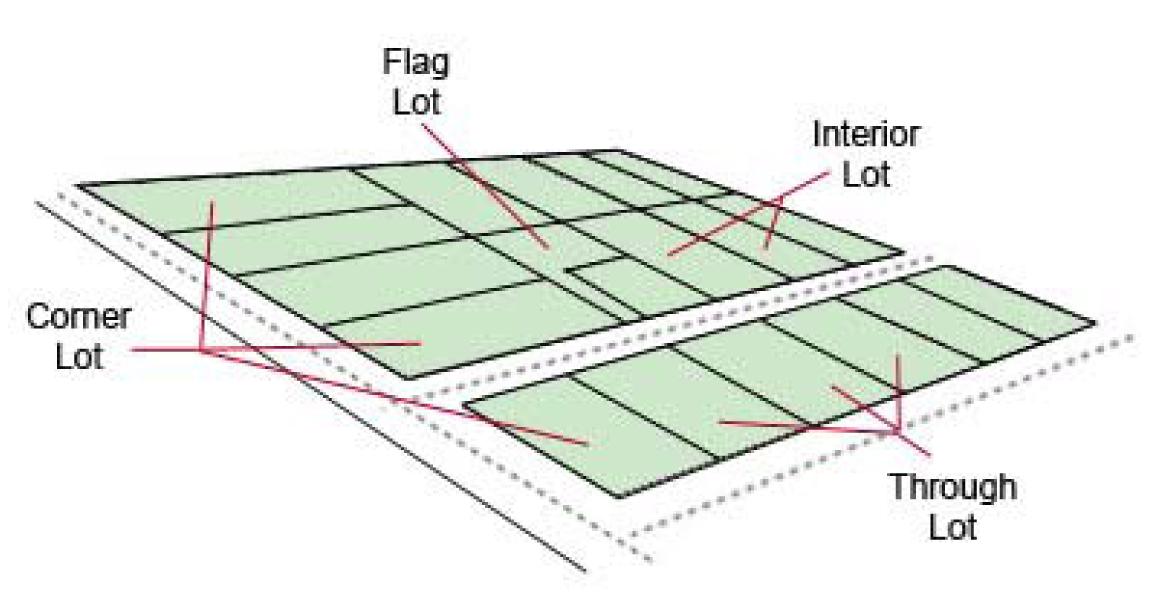
Picture 2.1 Types of Lots
Lot Coverage: That portion of the area of a lot, tract or parcel of land which is covered by principal and accessory structures.
Lot of Record: A lot, tract or parcel legally existing as of the date on which this Ordinance was adopted, which may not meet the applicable area, frontage, width, or depth requirements established by this Ordinance and/or previous Ordinances.
Lot Lines: The lines bounding a lot as defined herein:
• Lot Line, Front: The line separating the lot, tract or parcel from any public street, dedicated private easement or travel easement.
• Lot Line, Rear: The lot boundary opposite and most distant from the front lot line. In the case of a pointed or irregular lot, it shall be an imaginary line parallel to and farthest from the front lot line, not less than ten (10) feet long and wholly within the lot.
• Lot Line, Side: Any lot line other than a front or rear lot line as defined herein.
Lot Width: The width of a lot measured at the building setback line in a manor generally perpendicular with the side lot lines.
Low Profile Sign: Are signs which do not exceed three and one-half (3½) feet in height. These signs may be placed up to the front property line, provided they are placed outside any street right-of-way and so as to not obstruct vision for moving traffic.
Lowest Floor: The lowest floor of the lowest enclosed area (including basement). An unfinished or flood resistant enclosure, usable solely for parking of vehicles, building access or storage in an area other than a basement area is not considered a building's lowest floor; provided, that such enclosure is not built so as to render the structure in violation of the applicable non-elevation design requirements of this section.
Lumber Mill: Manufacturing, processing, and sales involving the milling of forest products to produce rough and finished lumber and other wood materials for use in other manufacturing, craft, or construction processes.
Machine Shop: Shops where lathes, presses, grinders, shapers, and other wood- and metal-working machines are used such as blacksmith, tinsmith, welding, and sheet metal shops; plumbing, heating, and electrical repair shops; and overhaul shops.
Manufactured Home Sales: The selling of factory-built, single-family structure, that is transportable in one (1) or more sections, is built on a permanent chassis, and is used as a place of human habitation.
Map: Means the flood hazard boundary map (FHBM), flood boundary and floodway map (FBFM) or the flood insurance rate map (FIRM) for a community issued by the agency.
Marble Working and Finishing: An industrial facility or business, usually on a large scale, that processes, sculpts, and/or polishes marble or other stones capable of taking a high polish for a specified use.
Marina: A use involved in the operation of a marina including structures and activities normally integral to the operation of a marina, such as docking and/or the securing of watercraft, servicing, fueling, pumping-out, chartering, launching, and dry-storage of boats and boating equipment.
Meat/Fish Market: A retail establishment where the primary purpose is the sale to an end consumer of meat, poultry, and fish products.
Meat/Poultry Processing Plant: A building where live animals are killed and processed; and/or a building where meat, poultry, or eggs are cooked, smoked, or otherwise processed or packed but does not include a butcher shop or rendering plant.
Medical Appliance Sales: A retail establishment where the primary purpose is the sale to an end consumer of medical appliances and accessories to them.
Medical Facilities:
• Convalescent, rest or nursing home: A health facility where persons are housed and furnished with meals and continuing nursing care.
• Dental clinic, medical clinic, or mental health clinic: A facility for examination and treatment of human out-patients where patients are not kept overnight except under emergency conditions.
• Dental office or doctor's office: Same as "dental or medical clinic."
• Hospital: A public or proprietary facility providing, on an inpatient or outpatient basis, medical diagnosis, treatment, or other care of human ailments, not including clinics as herein defined.
• Sanitarium or Sanatorium: An institution providing health facilities for inpatient medical treatment and recuperation.
Medical Helistop: See Helistop.
Medical Lab: An establishment that includes uses such as but not limited to medical research facilities, processing and testing of fluid samples, x-ray and ultrasound, etc.
Medical Office: Those uses concerned with the diagnosis, treatment, and care of human beings.
Medical Waste Facility: A facility used to process medical waste.
Micro Brewery: See Brewery.
Mineral Extraction: The extraction of minerals, including solids, liquids, and gases. The term also includes quarrying; well operation; milling, such as crushing, screening, washing and flotation; and other preparation customarily done at the extraction site or as a part of the extractive activity.
Mini-Warehouse: See Self-Service Storage (Mini).
Mobile Home: A portable or movable single wide manufactured home designed and constructed to permit long-term occupancy for dwelling purposes that is permanently mounted on a single chassis with or without a permanent foundation.
Mobile Home Park: Any area, tract, site, or plot of land under single ownership, whereupon mobile home spaces are located and maintained and shall include all accessory buildings used or intended to be used in connection with the operation of a mobile home park.
Mobile Home Space: A plot of ground within a mobile home park or subdivision designed for the accommodation of one (1) mobile home.
Mobile Home Subdivision: A mobile home subdivision is a subdivision intended for individual ownership of lots and designed for residential use of mobile homes exclusively.
Mobile Storage Unit: An establishment where the primary use is the delivery and pick up of mobile storage units. These can be picked up and delivered to another location or stored on-site and delivered at another time.
Monastery: A housing facility where the residents are limited to members of a specific religious order.
Mortuary: See Funeral Home.
Motel: A building or series of buildings in which lodging is offered for compensation, and which is distinguished from a hotel primarily by reason of providing direct independent access to, and adjoining parking for, each rental unit.
Motor Home is a vehicular unit designed to provide temporary living quarters for recreational, camping or travel use, built on or permanently attached to a self-propelled motor vehicle chassis or on a chassis cab or van that is an integral part of the completed vehicle.
Moving and Storage Company: An establishment whose primary purpose is the moving of end consumers from one (1) location to another. Short term storage on-site can be provided as long as all storage is contained within a fully enclosed building. Storage and servicing of vehicles used in the moving process will also be included with this use.
Multi-Family: A dwelling or group of dwellings on one (1) lot, containing separate living units for three (3) or more families, having separate or joint entrances, and including apartments, row houses, and condominiums.
Multi-Media Production: Space in an outdoor or indoor area, building, part of a building, structure, or a defined area, that is used primarily for the creation of film, television, music video, multi-media, or other related activities.
New Construction: Any structure for which the "start of construction" commenced on or after the effective date of this Ordinance. The term also includes any subsequent improvements to such structure.
New Manufactured Home Park or Subdivision: A manufactured home park or subdivision for which the construction of facilities for servicing the lots on which the manufactured homes are to be affixed (including at a minimum, the installation of utilities, the construction of streets, and either final site grading or the pouring of concrete pads) is completed on or after the effective date of this Ordinance.
Nightclub: See Bar or Nightclub.
Nonconforming Use: The use of any building, structure, or land which was lawful at the time of the passage of the provisions of Chapters 1 through 11 of this Ordinance, or amendment thereto, but which is not now in conformance with the provisions of this Ordinance.
Nonprecision Instrument Runway: A runway other than an instrument runway.
Nursery: The retail handling of any article, substance, or commodity related to the planting, maintenance, or harvesting of garden plants, shrubs, trees, packaged fertilizers, soils, chemicals, or other nursery goods and related products in small quantities to the consumer.
Nursing Home: A use providing bed care and inpatient services for persons requiring regular medical attention but excluding a facility providing surgical or emergency medical services.
Office Equipment Sales: A retail establishment whose primary focus is the sale of office equipment, furniture, and accessories to end consumers.
Off-Premise Advertising Sign: A sign that is used to advertise or inform by directing attention to a cause, event, campaign, business, profession, commodity, product, service, or entertainment which is conducted, sold, distributed, or offered elsewhere than upon the same premise as the off-premise sign, or which directs attention to any brand name or trade name product which may be incidentally available on the same premises as the off-premise sign; provided, however, that no sign containing a noncommercial message shall be deemed an off-premises advertising sign. Excluding Development Directory Signs.
On-Premises Low Profile Sign: See Low Profile Sign.
Open-Air Market: An outdoor commercial activity, not including shopping centers, individual retail operations, yard sales or garage sales, that is open to the general public and composed of three (3) or more semi-enclosed or outdoor stalls, rooms, stands, booths, tables or spaces used for the purpose of display and sale, exchange, or barter of merchandise and is further defined as an occasional or periodic market held in an open area or structure where goods are offered for sale to the general public by individual sellers from open or semi-open facilities or temporary structures. This definition does not apply to sales associated with events or festivals as listed under Chapter 5, section 5-1102 of the Clarksville City Code or to events held on property owned by a governmental entity.
Open Space: Any parcel or area of land or water essentially unimproved and set aside, dedicated, designated, or reserved for private use or enjoyment or for the use and enjoyment of owners, occupants, and their guests of land adjoining or neighboring such open space.
Optical Goods Manufacture: An industrial facility or business, usually on a large scale, that produces products associated with optics, including, but not limited to, eye glass lenses, telescopes, etc.
Orphanage: An institution for the housing and care of orphans.
Outpatient Clinic: A facility for examining and treating patients with medical problems on an outpatient basis, including ambulatory care or similar medical services that generally require a stay of less than twenty-four (24) hours.
Owner: Any individual, corporation, partnership or entity, which owns property that is subject to the provisions of this section and any individual, corporation, partnership or entity which succeeds to such ownership. The obligations of an owner under this section, including perpetual maintenance in accordance with an approved landscape plan, are binding on any successor owner.
Paper Products and Box Manufacture: An industrial facility or business, that produces paper and/or paperboard, from both raw and recycled materials, and their conversion into products, including, but not limited to paper bags, boxes, envelopes, wallpaper, etc.
Park: Any public or private land available for recreational, educational, cultural, or aesthetic use.
Park and Ride Lot: Parking lots of structures designed to encourage transfer from private automobile to mass-transit or to encourage carpooling for purposes of commuting.
Parking Lot: An off-street facility including parking spaces along with adequate provisions for drives and aisles for maneuvering and providing access, and for entrance and exit, all laid out in a way to accommodate the parking of automobiles.
Parking Lot Island: An area of ground within the boundary of any parking lot, which has curbing adjacent to all paved areas. Parking lot islands are used for traffic control and as planting areas to screen and shade parking lots to minimize the detrimental environmental impacts of large, paved areas.
Parking Space: An off-street space available for the parking of one (1) motor vehicle, exclusive of passageways and driveways, and having direct access to a street or alley.
Parsonage: The permanent place of residence of the pastor or minister of a church.
Pawn Shop(s): An establishment that engages, in whole or in part, in the business of loaning money on the security of pledges of personal property, or deposits or conditional sales of personal property, or the purchase or sale of personal property.
Perimeter Lot: The exterior lots of the proposed development which adjoin the perimeter boundary of the subject tract or adjacent to the landscape buffer or the open space.
Personal Care Services: Assistance with meals, dressing, movement, bathing, or other personal needs or maintenance, or general supervision of the physical and mental well-being of a person who is incapable of maintaining a private, independent residence, or who is incapable of managing his person, whether or not a guardian has been appointed for such person.
Pet Cemetery: A parcel of land, buildings, and/or structures used for the interring of animal remains.
Pet Shops: A retail sales establishment primarily involved in the sale of domestic animals, such as dogs, cats, fish, birds, and reptiles, excluding exotic animals and farm animals such as horses, goats, sheep, and poultry.
Pharmacy: Any place where prescription drugs are dispensed.
Photography Studio: A workspace that provides space to take, develop, print and duplicate photographs.
Plants: A combination of vegetation in a designed, specific application which meets the purpose of this Ordinance. Vegetation may include: trees, shrubs, groundcovers, vines and grasses. For purposes of this section, it does not include flowers or weeds.
Planting Area: The area prepared for the purpose of accommodating the planting of plants.
Planting Yard: A planting area around the perimeter of a property separating the access way and vehicular use area from adjoining property and/or public right-of-way. Its purpose is to enhance the visual appearance of the site and to provide screening of the vehicular use area and certain other activities from the public right-of-way and abutting property.
Planning Commission: The Clarksville-Montgomery County Regional Planning Commission of Clarksville and Montgomery County.
Plastic Products (Molding, Casting, and Shaping): An industrial facility that produces products created from plastics.
Playground: A recreation area with play apparatus.
Playhouse: A freestanding structure, exclusively for the use of children.
Power Plant: Any plant facilities and equipment for the purposes of producing, generating, transmitting, delivering, or furnishing electricity for the production of power.
Precision Instrument Runway: A runway equipped or to be equipped with a precision electronic navigation aid or other air navigation facilities suitable to permit the landing of aircraft by an instrument approach under restricted visibility conditions.
Principal Use: The specific primary purpose for which land or a building is used.
Print/Copy Shop(s): A facility for the custom reproduction of written or graphic materials on a custom order basis for individuals or businesses. Typical processes include, but are not limited to, photocopying, blueprint, and facsimile sending and receiving, and including offset printing.
Printing and Publishing Plant: A commercial printing operation involving a process that is considered printing, imprinting, reproducing, or duplicating images and using printing methods including, but not limited to offset printing, lithography, web offset, flexographic, and screen process printing.
Processing Facility (Recyclables): A processing facility is a building or enclosed space used for the collection and processing of recyclable materials. Processing means the preparation of materials for efficient shipment, or to an end user's specifications. Any facility that is larger than a large collection facility is included in this category.
Professional Office (Excluding Medical): An establishment where work is provided to others, predominately on the premises of the office, by someone trained and engaged in such work for a career; e.g., doctors, lawyers, accountants.
Public Street: For the purpose of this section, any public street or dedicated roadway easement.
Public Use: Any facility or use owned, operated, or maintained by a federal, state, or local governmental entity.
Public Utility: Any person, firm, corporation, municipal department, or board duly authorized to furnish and furnishing, to the public, under regulations, electricity, gas, steam, telephone, telegraph, transportation, drainage, water, or sewer.
Racetrack: A facility used primarily for the sport of automobile racing. A racetrack may include seating, concession areas, suites, and parking facilities.
Railroad Station: A facility, either light or heavy rail, for the boarding of passengers and related ticketing sales and offices.
Railroad Yard: An area of land, a portion of which is covered by a system of tracks that provides for the making up of trains by one (1) or more railroads or private industry concerns. Necessary functions of a rail yard include but are not limited to the classifying, switching, storing, assembling, distributing, consolidating, moving, repairing, weighing, or transferring of cars, trains, engines, locomotives, and rolling stock.
Recreational Campground: A campground with two (2) or more camping unit sites, accessible by vehicular traffic and provided with one (1) or more service buildings. These sites may have individual water, sewer, and electrical connections.
Recreational Center: A public or private center where the main purpose is to provide amusement generally associated with athletic functions in an indoor environment.
Recreational Facility, Private: Means a recreational facility for use solely by the residents and guests of a particular development and operated by a nonprofit organization.
Recreational Vehicles Park: A lot or parcel of land occupied or intended for occupancy by recreational vehicles or tents for travel, recreational, or vacation usage for short periods of stay.
Recycling Collection Facility: A center for the acceptance by donation, redemption, or purchase of recyclable materials from the public. Such a facility shall not use power processing equipment.
Recycling/Collection Facilities (Small): An establishment that exists only in conjunction with an existing principal facility. Small recycling sites shall not occupy more than one thousand (1,000) square feet of the parcel in which they are placed, and the collection containers shall not occupy more than two hundred (200) square feet. There shall be only one (1) collection facility per parcel.
Recycling/Collection Facilities (Large): Large collection facilities are not required to operate in conjunction with an existing principal facility, and it may have a permanent building. The facility shall not occupy more than twenty thousand (20,000) square feet of the parcel of land in which it is placed; the containers shall not occupy more than one thousand (1,000) square feet of the facility.
Regulatory floodway: Means the channel of a river or other watercourse and the adjacent land areas that must be reserved in order to discharge the base flood without cumulatively increasing the water surface elevation more than a designated height.
Religious Institution: A church or place of worship or religious assembly with related facilities such as the following in any combination: rectory or convent, private school, meeting hall, offices for administration of the institution, licensed child or adult daycare, playground, or cemetery; to include charitable work.
Repair Services: Establishments primarily engaged in the provision of repair services to individuals and households, rather than businesses, but excluding automotive and equipment repair use types. Typical uses include appliance repair shops, shoe repair, watch or jewelry repair shops, or repair of musical instruments.
Research and Development Facility: Research, development, and testing laboratories that do not involve the mass manufacture, fabrication, processing, or sale of products. Such uses shall not violate any odor, dust, smoke, gas, noise, radiation, vibration, or similar pollution standard as specified herein.
Reservoir: A pond, lake, basin, or other space, either natural or created in whole or in part by engineered walls or structures, which is used for storage, regulation, and control of water for recreation, power, flood control, or drinking.
Residence for Handicapped (eight (8) or more): A multiple dwelling, which is entirely accessible to physically handicapped persons, limited to persons who have a physical, sensory, or mental impairment which substantially limits one (1) or more major life activities.
Restaurant/Fast Food: Restaurants where most customers order and are served their food at a counter or in a motor vehicle in packages prepared to leave the premises, or able to be taken to a table or counter to be consumed.
Restaurant/Full-Service: An establishment where food and/or beverages are prepared, served, and consumed, and whose principal method of operation includes one (1) or both of the following characteristics:
• Customers are normally provided with an individual menu and served their food and beverages by a restaurant employee at the same table or counter where the items are consumed;
• A cafeteria-type operation where food and beverages generally are consumed within the restaurant building.
Retail: The selling of goods, wares, or merchandise directly to the ultimate consumer or persons without a resale license.
Retention area: The prevention of storm runoff from direct discharge into receiving waters. Examples include systems which discharge through percolation, ex filtration, filtered bleed-down and evaporation processes.
Riding Academy: An establishment where horses are boarded and cared for, and where instruction in riding, jumping, and showing is offered, and where horses may be hired for riding.
Riverine: Means relating to, formed by, or resembling a river (including tributaries), stream, brook, etc.
Road: That portion of a public thoroughfare or right-of-way intended for use by motor vehicles.
Road or Street Right-of-Way Line: That line surveyed or approved by the appropriate government authority as the outer boundary of a road or street. Such line is identical to or contiguous with any property line abutting a road or street.
Roadside Stand, Agricultural: A farm structure used or intended to be used for the sale of only seasonal farm products.
Rock Quarries (Sand, Gravel, and Earth Excavations): A lot or land or part thereof used for the purpose of extracting stone, sand or gravel for sale and exclusive of the process of grading a lot preparatory to the construction of a building for which application for a building permit has been made.
Rooming Houses: A dwelling other than a hotel, motel, or apartment house where lodging for three (3) or more persons not of the immediate family is provided for compensation and by prearrangement for definite time periods.
Runway: The paved surface of an airport landing strip.
Safe House: See Group Home/Safe House.
Sales Office: See Leasing/Sales Office.
Salvage Yard: See Junk Yard.
Sanitary Landfill: The burial of nonhazardous and non-medical farm, residential, institutional, commercial, or industrial waste.
Satellite Dish: A dish-like antenna used to link communications sites together by wireless transmission of voice or data.
School, (to include Elementary, Middle and High): An institution for the teaching of children or adults including primary and secondary schools and similar facilities.
School, Private: An institution of learning, including colleges and universities, that is not tax supported.
School, Public: An institution of learning that is supported from the public tax system.
Seamstress/Dressmaker/Tailor Shop(s): A business, usually small in size that sews, alters, and/or creates garments.
Seed Store: See Feed/Seed Store.
Self-Service Storage (Mini): A building or group of buildings divided into separate compartments used to meet the temporary storage needs of small businesses, apartment dwellers, and other residential uses; and may include refrigerated facilities.
Setback: The minimum distance by which any building or structure must be separated from a street right-of-way, easement, or property line. See Picture 2.2 below.
• Setback, Front: The minimum allowable distance from the street right-of-way or easement line.
• Setback, Rear: The minimum allowable distance from the rear property line.
• Setback, Side: The minimum allowable distance from the side property line.
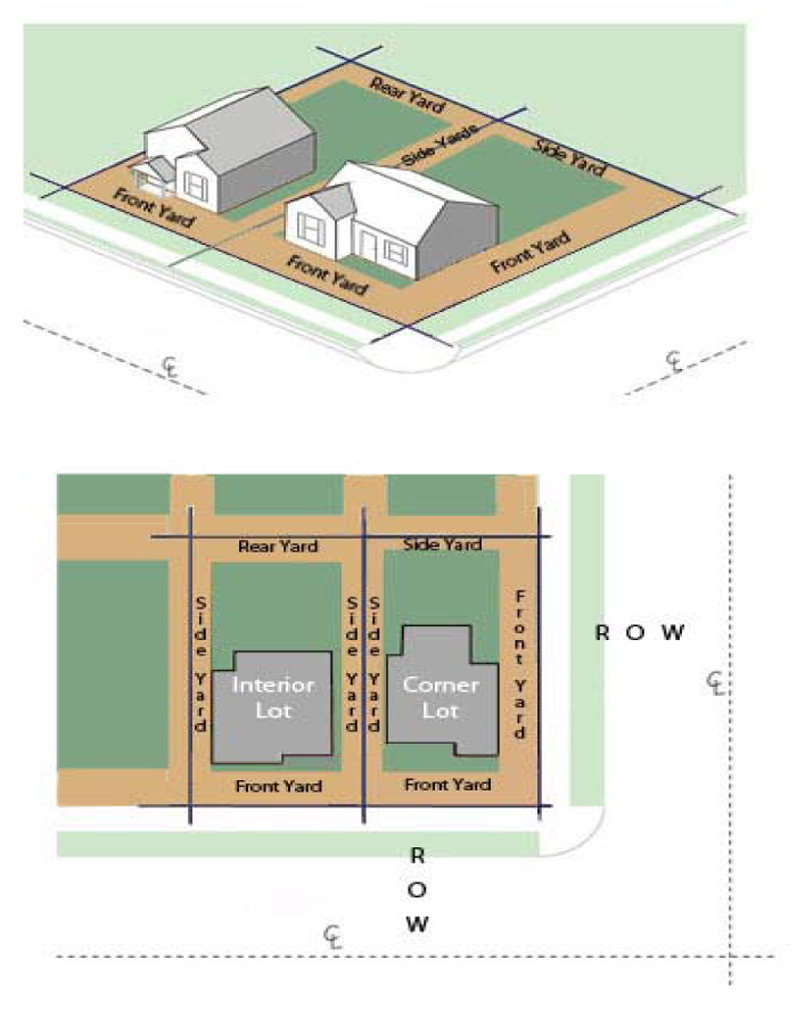
Picture 2.2 Setback Illustrations
Sewer Pump Station: A facility where the primary purpose is the pumping of sewage further along the sewer system; may be an accessory to a structure or standalone feature.
Sheet Metal Shop: An industrial facility or business involved in the process of working with metals to create individual parts or assemblies.
Shoe Repair: A business, usually small in size, that repairs footwear.
Shoe Store: Retail business whose principal activity is the selling of footwear and conducting business within an enclosed area.
Shopping Center: A group of commercial establishments, planned and developed with off-street parking provided on the property.
Shrub, Large: An upright plant growing ten (10) feet to twenty (20) feet in height at maturity planted for ornamental or screening purposes.
Shrub, Medium: A plant growing five (5) feet to nine (9) feet in height at maturity planted for ornamental or screening purposes.
Shrub, Small: A plant growing to less than five (5) feet in height at maturity planted for ornamental or screening purposes.
Sight Triangle: Area at the intersection of the road right-of-way and an access point to property where driver visibility must be maintained as required in this section. (See subsection (m) of this section for further explanations).
Sign: Any structure which displays or includes any letter, word, model, banner, flag, streamer/pennant, insignia, or representation used as, or which is in the nature of announcement, direction or advertisement. The word "sign" includes billboards or any other type of advertising device, but does not include the flag, pennant, or insignia of any nation, state, city, or other political unit, school, or religion.
Sign, Height: (Refer to Chapter 8.)
Sign, Sidewalk: A sign with two (2) faces that are adjoined at the top and displayed at an angle, or of similar design, which is not permanently anchored or secured.
Skating Rink: An establishment that provides facilities for participant skating.
Solar Panel: A photovoltaic module or photovoltaic panel, used to collect light energy from the sun.
Sorority House: See "Fraternity."
Soup Kitchen: A food service use that provides free meals for consumption on site.
Special hazard area: Means an area having special flood, mudslide (i.e., mudflow) and/or flood-related erosion hazards and shown on an FHBM or FIRM as zone A, AO, A1-30, AE, A99, or AH.
Stadium: A large building with tiers of seats for spectators at sporting or other recreational events.
Start of Construction: Includes substantial improvement, and means the date the building permit was issued, provided the actual start of construction, repair, reconstruction, rehabilitation, addition, placement, or other improvement was within one hundred eighty (180) days of the permit date.
State Coordinating Agency: (Tennessee Department of Economic and Community Development, Local Planning Assistance Office) means the agency of the state government, or other office designated by the governor of the state or by state statute at the request of the administrator to assist in the implementation of the National Flood Insurance Program in that state.
Stock Yard: Services involving the temporary keeping of livestock for slaughter, market, or shipping. Typical uses include stockyards and animal sales in auction yards.
Stone Cutting or Crushing: A lot or land or part thereof used for the purpose of cutting or crushing stone including on-site storage of materials associated with the process.
Stone Monument Sales: Establishments primarily engaged in buying or selling monuments and tombstones.
Storage (of Cement, Sand, and Gravel): On-site storage of any soil, sand, gravel, clay, or mud, in a concentrated state.
Storage of Used Lumber and Building Materials: Storage of lumber and used building materials.
Storage Shed (Residential): A use or structure subordinate to the principal use of a lot, or of a principal building on the same lot, and serving a purpose clearly incidental to a permitted principal use of the lot or of the building and which accessory use or structure is compatible with the principal permitted uses or structures authorized under zoning regulations applicable to the property.
Storm Shelter: A shelter in or adjacent to a house, used for protection from severe weather.
Story: That portion of a building included between the surface of any floor and the surface of the next floor above it, or if there is no floor above it, then the space between the floor and the ceiling next above it.
Story Half: A space under a sloping roof which has the line of intersection of roof decking and wall face not more than three (3) feet above the top floor level, and in which space not more than two-thirds (⅔) of the floor area is finished for use. A half-story containing independent apartments or living quarters shall be counted as a full story.
Streamer/Pennant: Any lightweight plastic, fabric, or other material, whether or not containing a message of any kind, suspended from a rope, wire, or string, usually in a series, designed to move in the wind.
Street: A thoroughfare which affords a principal means of access to abutting property and which has been accepted by the city as a public street.
Strip Center/Plaza: An arrangement of stores, restaurants, service outlets, or offices under one (1) or many ownerships or management providing shared off-street parking, vehicular use areas and public access.
Structure: An artificial combination of materials built, erected, attached, or maintained upon the realty by its own weight or otherwise; also including platforms, radio or television towers, swimming pools, and display signs of any height.
Studios (Art, Dance, Music, Health, Massage, Reducing): A workshop for an artist, musician, or employee to perform tasks.
Substantial Damage: Means damage of any origin sustained by a structure whereby the cost of restoring the structure to its before damaged condition would equal or exceed fifty percent (50%) of the market value of the structure before the damage occurred.
Substantial Improvement: Means any reconstruction, rehabilitation, addition or other improvement of a structure, the cost of which equals or exceeds fifty percent (50%) of the market value of the structure before the "start of construction" of the improvement. This term includes structures which have incurred "substantial damage", regardless of the actual repair work performed. The term does not, however, include either:
• Any project for improvement of a structure to correct existing violations of state or local health, sanitary, or safety code specifications which have been identified by the local code enforcement official and which are the minimum necessary to assure safe living conditions; or
• Any alteration of a "historic structure" provided that the alteration will not preclude the structure's continued designation as a "historic structure".
Substantially Improved Existing Manufactured Home Parks or Subdivisions: Is where the repair, reconstruction, rehabilitation or improvement of the streets, utilities and pads equals or exceeds fifty percent (50%) of the value of the streets, utilities and pads before the repair, reconstruction or improvement commenced.
Swimming Pool: A structure, whether above or below grade level, designed to hold water and to be used for recreational purposes.
Swimming Pool/Bath House, family: A swimming pool used and intended to be used solely by the owner, operator, or lessee thereof and his family and by guests invited to use it without payment of any fee or consideration. An accessory building to the principle use to be used coinciding with the presence of a pool.
Tobacco Processing or Treatment: A facility that receives freshly harvested and/or cured tobacco and processes it through varying phases of production including, but not limited to its preparation for consumption and/or distribution.
Taproom/tasting room: An accessory use to the production facilities of a winery, distillery (large and micro), brewery, or micro-brewery that allows for the purchase, sampling, and on-site consumption of beer and other alcoholic beverages made on-site.
Tattoo Parlor: Any room or space where tattooing is performed for compensation. Tattooing means a placement in human tissue of any indelible design, letter, scroll, figure, symbol, or other mark placed with the aid of needles or other instruments; or any design, letter, scroll, figure, or symbol done by scarring upon or under the skin.
Taxicab Business: A service that offers transportation in passenger automobiles and vans to persons including those who are handicapped in return for remuneration. The business may include facilities for servicing and repairing the taxicabs or vans.
Taxidermy: The business of preparing, stuffing, and mounting the skins of animals.
Temporary Building: Structures that are needed or are in place for only short periods of time.
Temporary Signs: Any sign not permanently attached to the ground or other permanent structure, or a sign designed to be transported, including, but not limited to, signs designed to be transported by means of wheels; signs converted to A- or T-frames; menu and sandwich board signs; balloons used as signs; umbrellas used for advertising; and signs attached to or painted on vehicles parked and visible from the public right-of-way, unless said vehicle is used in the normal day-to-day operations of the business or unless the vehicle displays a noncommercial message.
Temporary Uses: Uses that are needed or are in place for only short periods of time.
Tent: Any temporary structure or enclosure, the roof of which or one-half (½) or more of the sides are constructed of silk, cotton, canvas, fabric, or a similar pliable material.
Theater, Drive-in: An open lot or part thereof, with its appurtenant facilities, devoted primarily to the showing of moving pictures on a paid admission basis, to patrons seated in automobiles.
Theater, Indoor: A building or part of a building devoted to showing motion pictures, or for dramatic, dance, musical, or other live performances.
Tire Recapping: A place where the principle purpose is the retreading or recapping of tires.
Tobacco Processing or Treatment: A building where the treatment or process of tobacco is performed to convert the tobacco into a marketable product.
Tourist home: A dwelling in which overnight accommodations are offered or provided for transient guests for compensation.
Tow-in Lots: A lot to which any motorized vehicle is towed and stored for a specified storage fee, and no substantial work is performed on such vehicle.
Townhouses: A one-family dwelling unit, with a private entrance, which is part of a structure whose dwelling units are attached horizontally in a linear arrangement, and having a totally exposed front and rear wall to be used for access, light, and ventilation, not transient in nature.
Trailer Coach, House or Home: See "mobile home."
Transient: Any visitor or person who owns, rents, or uses a lodging or dwelling unit, or portion thereof, for less than thirty (30) days and whose permanent address for legal purposes is not the lodging or dwelling unit occupied by the visitor.
Travel Easement: The right granted by the owner of land to another party, by deed, or prescription, to allow access across one (1) parcel of land to another.
Travel Lanes: That part of the roadway provided for the movement of vehicles, exclusive of shoulders and auxiliary lands.
Tree, Ornamental or Understory: A small to medium tree, growing fifteen (15) feet to forty (40) feet at maturity often used for aesthetic purposes such as colorful flowers, interesting bark, or fall foliage. Understory trees must be used for planting under or near overhead utility lines.
Tree Preservation Plan: A plan to preserve existing trees on a site for the purpose of receiving tree credits.
Tree Protection Zone: The area around a tree corresponding to the drip line or ten (10) feet, whichever is greater, in all directions from the trunk.
Tree, Shade or Canopy: A large tree growing to over forty (40) feet in height at maturity, usually deciduous, planted to provide canopy cover shade.
Truck Service: See Bus or Truck Service.
University: See College.
Upholstery Cleaning: See Carpet and Upholstery Cleaning.
Use: A use is the purpose for which land or building and structures thereon are designed, arranged, or intended to be used, occupied, or maintained.
Usable Road Frontage: The portion of the lot, tract or parcel of land that abuts a public right-of-way, dedicated permanent easement or travel easement from which vehicular access shall be obtained.
Utility Substations: Any aboveground structure, except an antenna or utility pole and associated appurtenances, which a provider constructs, erects, or places on a site, and is attached or affixed to something having a permanent location on or under the ground which is used to provide its services to customers.
Variance: A modification of the strict application of the provisions of Chapters 1 through 11 of this Title where owing to special conditions a literal enforcement will result in unnecessary hardship, as determined by the T.C.A. Section 13-7-207 in accord with procedures specified herein.
Vehicular Use Areas: All areas subject to vehicular traffic including access ways, driveways, loading areas, service areas, bicycle lanes and parking stalls for all types of vehicles. This definition does not include covered parking structures or underground parking lots.
Vendor or Open-Air Market Vendor: All persons or other forms of business entities of every type and character operating among collections of other open-air market vendors for sales to the public of new and used merchandise in collected marketing centers for sales from stalls, booths, tables, benches and other similar displays or marketing configurations and arrangements.
Veterinary Clinic: A place where animals or pets are given medical or surgical treatment and are cared for during the time of such treatment.
Vines: A woody plant that has a spreading pattern of growth. Vines may be used on the ground, on walls and on trellises.
Violation: Means the failure of a structure or other development to be fully compliant with the provisions of this Ordinance.
Vocational School: A school established to provide for the teaching of industrial, clerical, managerial, or artistic skills.
Warehouse: A use where goods are received and/or stored for delivery to the ultimate customer at remote locations.
Wash out area: Area where construction machinery may have concrete, or other material that may be harmful to trees, washed out or off the equipment. This area should be away from and not drain toward any existing trees.
Waste Transfer Station: A place or facility where non-hazardous waste materials are taken from a collection vehicle, temporarily stored or stockpiled, and ultimately placed in a transportation unit for movement to another facility.
Waste Water Treatment Plant: A facility which operates a sewerage system and sewage treatment facilities that collect, treat, and dispose of human waste.
Water Pump Station: A structure for supplying water from a common source or sources.
Water Tank: A structure for the storing of water for use within the water supply system.
Water Taxi Station: Primary support and ancillary facilities for water-borne transportation (e.g. commuter ferries, water taxis, hovercraft) or short term excursions (e.g. charter boats, mini-cruises, sight-seeing, gambling, dining, and entertainment on the water) including, but not limited to: passenger terminals and berthing areas, storage, employee or passenger parking, administrative functions, ship servicing area, layover berths fueling stations, and other boat or passenger services.
Water Treatment Plant: Systems or structures designed to collect, treat, or distribute potable water, and includes water wells, treatment plants, reservoirs, and distribution mains. To also include facilities within the system that can alter the physical, chemical, or bacteriological quality of the water.
Welding Shop: An industrial facility or business involved in fabrication or sculptural process of joining metals or thermoplastics by heating the materials, molten fillers, or other process to bond the materials together.
Wholesale Distribution: The display, storage, and sale of goods to other firms for resale, as well as activities involving significant movement and storage of products or equipment.
Windmill: A machine for harnessing the energy of the wind using sails mounted on a rotating shaft.
Winery: An agricultural processing plant used for the commercial purpose of processing grapes, other fruit products, or vegetables to produce wine or similar spirits. Processing includes wholesale sales, crushing, fermenting, blending, aging, storage, bottling, administrative office functions for the winery and warehousing. Retail sales and tasting facilities of wine and related promotional items may be permitted as part of the winery operations.
Work Shop: A facility used by an individual to perform a specified task.
Wrecker Services: A business involved in towing or transporting wrecked and/or disabled vehicles from one (1) location to another. Vehicles may be stored on-site for a specified storage fee, and no substantial work is performed on such vehicles.
Yard: A ground area unoccupied and unobstructed by any portion of a structure from the ground upward, except where otherwise specifically provided in Chapters 1 through 11 of this Ordinance.
Yard, Front: An open area extending across the full width of the lot between the front lot line and the nearest line of the main buildings, other than for a permitted accessory.
Yard, Rear: An open area extending across the full width of the lot between the rear lot line and the nearest line of the main building.
Yard, Side: An open area between the side of the lot and the nearest line of the principal building and extending from the front yard to the rear, or in the absence of either of such yards, to the front or rear lot line, as the case may be. On a corner lot, the side yard adjacent to any street shall be considered a front yard.
Zoning Board: See "Board of Zoning Appeals."
Zoo: An area, building, or structures which contain wild animals on exhibition for viewing by the public.
(Ord. No. 82-2019-20, 7-2-2020; Ord. No. 16-2021-22, 10-7-2021; Ord. No. 137-2021-22; 7-7-2022; Ord. No. 20-2022-23, 9-1-2022; Ord. No. 147-2022-23, 7-6-2023)

