
Clayton City Zoning Code
CHAPTER 17
36 - GENERAL REGULATIONS
Sections:
17.36.010 - Division and Consolidation of Lots.
A.
Except as otherwise provided in this section, a person shall not divide any lot or parcel of land and shall not convey any lot or parcel or any part of it if the division or conveyance so reduces the area, width, or setbacks of the lot or parcel or creates a lot or parcel with an area, width, setbacks so small that it does not conform to this title.
B.
No land providing the required area, width, or setbacks for a dwelling unit shall be considered as providing the required lot area, width, or setbacks for any other dwelling unit.
C.
Any lot or parcel of land of less width or area than the minima established in this title may be occupied by a single family dwelling and its accessory buildings if:
1.
The owners of the lot or parcel do not own enough adjoining property to make the lot or parcel of proper width and area; and
2.
The front, side, and rear setback requirements of this title are met; and
3.
The lot has been legally created and is separately recorded in the Contra Costa County Recorder's Office.
(Ord. 52, 1968; Ord. 325, 1996; Ord. 375, 2004)
17.36.020 - Building Height Restrictions.
The limits of heights of structures or buildings established in this title for any district in which the structures or buildings would otherwise be permitted shall not apply to chimneys, fire towers, water towers, cupolas, spires, belfries, monuments, flagpoles, utility poles, water tanks, and necessary mechanical appurtenances attached to buildings. Windmills, wind chargers, and other wind-harnessing structures and buildings are permitted by right in the Agricultural (A) District or with a Use Permit on lots in any zone except within the Town Center Specific Plan area that are greater than forty thousand (40,000) square feet in area. In all cases, parapets or fire walls on buildings or structures otherwise conforming to the regulations established in this title may be constructed a maximum of three (3) feet in height.
If any of the structures and buildings listed in the Section are proposed for construction in a manner that, in the judgement of the Community Development Director, may not comply with the intent of this section or may not comply with Standards of Review listed in Section 17.44.040, the Director shall require the structure or building to be subject to a Planning Commission Site Plan Review Permit review and approval.
(Ord. 52, 1968; Ord. 424, 2009)
17.36.030 - Obstructions in Setbacks.
Every part of a setback shall be open and unobstructed to the sky, except that fire escapes, open stairways, chimneys, and the ordinary projections of sills, belt-courses, cornices, eaves and ornamental features which do not obstruct the light and ventilation of any adjoining parcel of land shall not constitute obstructions nor violate required setback regulations.
(Ord. 52, 1968; Ord. 375, 2004)
17.36.040 - Side Setbacks on Residential Lots Established Before Effective Date of Zoning.
Notwithstanding any other provisions of this title, side setbacks shall be permitted in any residential district according to the following table for any lot or parcel of land which was established by records in the office of the recorder of Contra Costa County before February 16, 1968, for the area or district in which the lot or parcel of land is situated:
(Ord. 52, 1968; Ord. 375, 2004)
17.36.050 - Accessory Uses in Rear Setbacks.
An accessory building or accessory use may occupy not more than thirty percent (30%) of a rear setback.
(Ord. 52, 1968; Ord. 375, 2004)
17.36.055 - Accessory Buildings and Structures.
A.
Accessory buildings and structures may be located on any portion of a lot wherein a main building is permitted.
B.
No accessory building or structure shall be erected on a vacant lot unless approved by a use permit.
C.
An accessory building or structure shall not exceed sixteen (16) feet in height.
D.
Accessory buildings shall conform to the requirements of the respective zoning district, except as modified by the following standards.
1.
Interior Side Setback and Rear Setback. If an accessory building is at least twelve (12) feet from the main building (and all other accessory buildings) and at least sixty-five (65) feet from the front lot line, the interior side setback and rear setback for accessory structures are reduced to five (5) feet. These reduced setbacks must be clear of all structural protrusions, including roof overhangs.
2.
Minimum Passageway. An accessory building must be fully separated from the main building (and any other accessory buildings) by a passageway at least five (5) feet in width which is clear of all structural protrusions, including roof overhangs. The Planning Commission may determine that a wider passageway is appropriate as part of the site plan review process.
3.
Minimum Attachment. If an accessory building is attached to the main building (or any other accessory buildings), the accessory building shall be structurally part of and have a common roof or wall with the main building (or respective accessory building).
4.
Small Accessory Building. A small accessory building (e.g., storage shed) is exempt from the above interior side and rear setback, minimum passageway, and minimum attachment requirements if the small accessory building complies with all of the following:
a.
The floor area does not exceed one hundred twenty (120) square feet;
b.
The height (including any foundation) does not exceed eight (8) feet six (6) inches;
c.
It is located at least ten (10) feet behind the nearest front corner of the main building; and
d.
It is substantially concealed from public view by a legally-constructed solid fence or structure with a minimum height of six (6) feet.
E.
Accessory structures shall conform to the requirements of the respective zoning district, except as modified by the following standard:
1.
Interior Side Setback and Rear Setback. The interior side setback and rear setback for an accessory structure are reduced to five (5) feet. These reduced setbacks must be clear of all structural protrusions, including overhangs).
(Ord. 375, 2004; Ord. No. 406, 2007; Ord. 434, 2011)
17.36.057 - Cargo Storage Containers.
Prefabricated sea/land cargo storage containers are prohibited in all districts, except on City-owned property or when authorized by a temporary storage permit issued in accordance with Section 17.76.030.
(Ord. 375, 2004)
17.36.060 - Regulations for the Keeping of Horses.
A land use permit to allow the keeping of horses on parcels situated within zoning districts other than R-40-H and agricultural, and having a minimum lot area of forty thousand (40,000) square feet, adjoining a horse trail, may be applied for in accordance with the applicable procedures of Chapter 17.60, and shall be subject to the following further regulations and conditions:
A.
All proposed and existing improvements on the subject parcel will be set forth on a site plan drawn to scale filed with the application. In addition, a landscaping and irrigation plan shall be submitted with the application showing the type, size and location of trees, plant materials, and means of irrigation, particularly in the area of boundary setbacks. Furthermore, a drainage plan for the proposed horse corral or paddock shall be submitted with the application.
B.
Any permit issued pursuant to this section shall belong to and run with the land, shall be governed by Chapter 17.64, and may be revoked under this provision of Section 17.64.050. The land use permit, if revoked, could be recovered when the parcel to which it applies changes tenancy and ownership. The Planning Director shall cause a memorandum of permit issuance to be recorded with the county recorder immediately upon issuance of a permit under this section, which shall describe the land covered by the permit and make reference to the regulations of this section.
C.
Any permit issued pursuant to this section will be for a maximum number of horses based upon the following criteria: A minimum of ten thousand (10,000) square feet of open, unimproved land area shall be set aside for the use of up to two (2) horses. For each additional horse, twenty thousand (20,000) square feet more of lot area shall be required, with five thousand (5,000) square feet thereof being open, unimproved land area available for horse use with such five thousand (5,000) square feet to be contiguous with and used in connection with the minimum ten thousand (10,000) square feet of open, unimproved land area.
D.
Only horses owned by or leased to residents of the subject parcel will be allowed to be domiciled on the parcel under the permit.
E.
No horses shall be maintained upon the parcel until the main dwelling constructed or to be constructed thereon is occupied by the applicant.
F.
Each holder of a permit issued pursuant to this section shall comply with the following regulations:
1.
Adequate dust, fly and odor control shall be maintained at all times. Riding rings, areas, or similar structures must have an effective mechanical irrigation system capable of controlling dust within the entire riding area. Permitting a strong pervasive odor or horse manure or urine to exist which is offensive to the senses of the surrounding residents, thereby interfering with the comfortable enjoyment of their property, for a period of twenty-four (24) hours after a warning by the Code Enforcement Officer, shall be cause for said officer to issue an infraction notice.
2.
All applicable requirements of the Contra Costa County health department, building inspection department, mosquito abatement district, and state humane laws shall be complied with.
3.
Rodent control shall be maintained.
4.
During dry weather, and if the soil is dry, wet manure and bedding may be spread thinly to dry in a manner not conducive to fly-breeding. All horse stalls and small corral areas shall receive daily maintenance in regards to disposing of wet manure and bedding.
5.
All areas that are subject to irrigation shall be kept free of manure.
6.
For dust control, during periods of dry weather, riding or exercising horses on the lot will be prohibited unless irrigated riding areas are used.
7.
Ungelded male horses shall not be permitted to be domiciled or temporarily maintained on the premises. Foals or mares shall be permitted to remain with their dams until six (6) months of age.
8.
The permit holder shall comply with any additional conditions the Planning Commission shall deem necessary.
G.
All improvements constructed upon the applicant's property pursuant to a permit issued under this section shall conform to the following provisions:
1.
As close as circumstances will allow, all accessory structures shall be aesthetically compatible with the main structure on the lot. Accessory structures shall be limited to a maximum of sixteen (16) feet in height. Plans for proposed barns or stables should reflect adequate drainage and ventilation (see U.C. Davis Extension Barn Specifications).
2.
Setbacks of any barn, stable or shelter for horses shall be determined by the Planning Commission but the minimum setback shall be not less than one hundred (100) feet from the front property line and shall be not less than fifty (50) feet from any side or rear property line. Fences shall be constructed to enclose the entire area used for horse keeping, shall be in good repair at all times, and shall be built or materials sufficiently strong to retain horses. Fenced pasture, paddocks, or other enclosed equestrian areas shall be as determined by the Planning Commission, but in no event shall they be located nearer than ten (10) feet to any property line or any public right-of-way. The setback on a property line adjacent to any horse trail can be less than ten (10) feet if a six-foot masonry wall, chain link or solid wooden fence is erected along the trail easement.
H.
Any violation of this section is an infraction and shall be punishable as provided in California Government Code § 36900(b).
(Ord. 168, 1977; Ord. 325, 1996)
17.36.070 - Regulations for the Keeping of Agricultural Animals.
The keeping of not more than two (2) agricultural animals within zoning districts other than R-40-H and Agricultural is allowed subject to a Use Permit obtained from the Planning Commission. The keeping of agricultural animals is limited to not more than eighteen (18) months, the applicant being a minor and a bona fide member of a 4-H Club or similar club, and the applicant having the permission of the property owner and supervision of the leader of such 4-H or similar club. The Planning Commission may restrict the species and sex of the animal and impose such other conditions to insure neighborhood compatibility.
(Ord. 325, 1996)
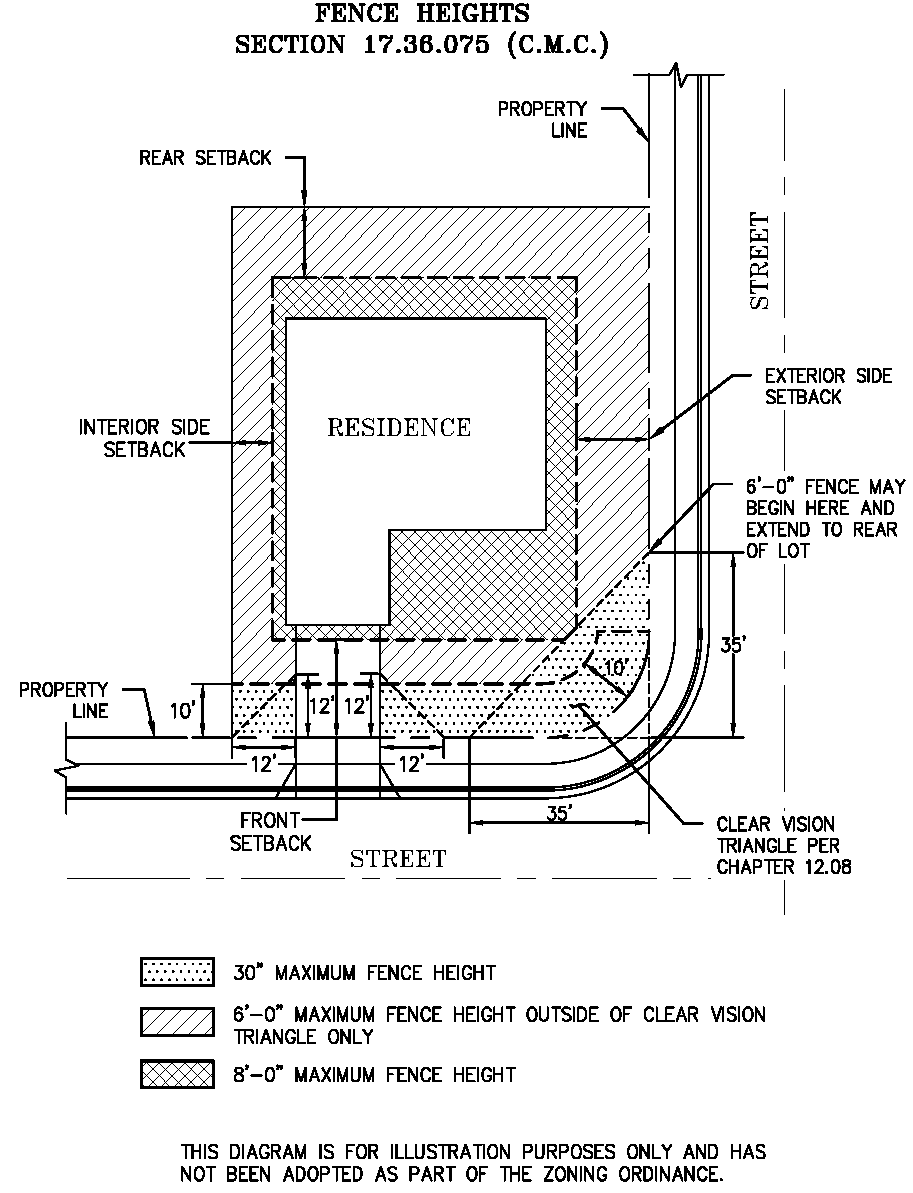
17.36.075 - Fencing Standards.
Fencing shall conform to the following standards:
A.
Front Setbacks. Fences shall not exceed a maximum height of thirty (30) inches within ten (10) feet of the front property line and a maximum height of six (6) feet in the remaining portion of the front setback.
B.
Interior Side Setbacks and Rear Setbacks. Fences shall not exceed a maximum height of six (6) feet on the interior side and rear property lines or anywhere within the interior side and rear setbacks.
C.
Exterior Side Setbacks. Fences shall not exceed a maximum height of six (6) feet and may be placed within the required exterior side setback or at the public right-of-way line.
D.
Corner Lots. Fences on corner lots shall conform with the restrictions on sight obstructions at intersections provided in Chapter 12.08.
E.
Driveways. Fences shall not exceed a maximum height of thirty (30) inches on either side of a driveway within the triangular areas formed by the edge of the driveway, the property line, and a line joining points on each of these twelve (12) feet from their intersection.
F.
Main Building Area. Fences shall not exceed a maximum height of eight (8) feet within an area in which a main building is permitted.
G.
Measurement. The height of fences shall be the average height of an eight-foot length of fence, measured from the lower of either the lowest adjacent ground level or the top of the footing of any retaining walls located within three (3) feet.
H.
Safety Fences. Safety fences and railings required by the Uniform Building Code are excluded from the height standards of this section.
I.
Barbed Wire. Barbed wire or other sharp materials shall not be used as a fencing material except on lands where agricultural grazing is actively conducted or where a use permit has been approved by the Planning Commission.
J.
Hazardous Locations. In no case shall any fence be located so as to cause a hazard to the movement of vehicles or pedestrians.
K.
Height Exceptions. The Director may issue an administrative use permit to allow a fence up to seven (7) feet in height in a rear setback or side setback of a lot in residential district. The Director may impose such conditions as the Director deems appropriate to mitigate any visual or other adverse impacts of the fence, including, but not limited to, requirements with respect to the height, design, and materials of the fence and landscape screening. Applications for an administrative use permit under this subsection shall be filed with the Director on such form as the Director prescribes, and shall be accompanied by a processing fee in such amount as established from time to time by resolution of the City Council. Prior to granting the administrative use permit, the applicant shall demonstrate and the Director shall find that:
1.
The issuance of such a permit is reasonably necessary by reason of unusual or special circumstances or conditions relating to the property, for the preservation of valuable property rights or the full use and enjoyment of the property;
2.
The fence will not create a safety hazard to pedestrians or vehicular traffic;
3.
The fence will not unreasonably interfere with access by police, fire, and emergency service personnel;
4.
The appearance of the fence is compatible with the scale, mass, design, and appearance of other existing buildings and structures in the neighborhood;
5.
The orientation and location of the fence is in proper relation to the physical characteristics of the property and neighborhood;
6.
The applicant has obtained the written consent of the adjacent property owner, unless the fence is adjacent to public right-of-way, in which case written consent is not necessary; and
7.
The fence will be of sound construction.
The Director may refer a request for administrative use permit for fence height exception to the Planning Commission if, in the Director's judgment, one (1) or more of the findings in this subsection K cannot be made. The Planning Commission shall review the request in accordance with the permit procedures specified in Section 17.64.110 of this title. The decision of the Planning Commission can be appealed in accordance with Chapter 17.68 of this title.
(Ord. 178, 1978; Ord. 197, 1979; Ord. 375, 2004; Ord. 480, § 2, 2017; Ord 483, 2018; Ord. 501, Exh. A, 1-16-2024)
17.36.076 - Fenced Recreational Enclosures.
A.
Any recreational uses such as tennis and paddle ball which require fencing higher than permitted by Section 17.36.075 shall be subject to the issuance of a land use permit. A maximum twelve (12) foot high fence enclosure for recreational uses may be permitted by a land use permit.
B.
The Planning Commission shall consider all appropriate City ordinances with reference to the precise location of the enclosure on the property, the type of fencing, the drainage system, grading, and impact of the enclosure on the adjoining properties and neighborhood.
C.
The Planning Commission may grant the land use permit if it finds that:
1.
The higher fence will not extend into the front setback and will not have less than ten (10) foot setback from any other property line;
2.
The proposed use, enclosure and appurtenant structures will not adversely affect the neighborhood properties by blocking the view or constituting a nuisance;
3.
The granting of the permit meets the criteria for issuance of a land use permit.
(Ord. 178, 1978; Ord. 375, 2004)
17.36.078 - Standards for Manufactured Homes.
A.
Manufactured Homes including Mobile homes on a Permanent Foundation System. Mobile homes eligible to be placed on individual lots where single-family residential units are allowed are those constructed after September 15, 1971, with an insignia of approval from the California Department of Housing and Community Development or constructed after July 1, 1976, with an insignia of approval from the U.S. Department of Housing and Urban Development, and which have not been altered in violation of applicable codes. Mobile homes placed on a permanent foundation system on individual lots where single-family residential units are allowed shall be subject to all applicable provisions of this Title 17, including those provisions that would otherwise be applicable to single-family stick-built residential units. These eligible manufactured homes shall have a minimum width of twenty (20) feet, and shall comply with the following standards:
1.
Siding and roofing materials shall be compatible with the surrounding conventional single-family residential development.
2.
Covered parking and storage buildings associated with a manufactured home shall have matching architectural treatments.
3.
Eaves shall be extended to provide appropriate solar screening, shadowing interest, depth articulation, and to be compatible with the surrounding conventional single-family residential development.
4.
Exterior fascia shall extend down and be secured to the required permanent foundation system in a manner visually similar to a stick-built home.
5.
Overall exterior appearance shall blend architecturally with the design character of surrounding conventional single-family residential development.
6.
All walkways, driveways, flatwork, hardscaping, and landscaping located on the property of a manufactured home shall be of a quality design that is compatible with surrounding conventional single-family residential development and have a natural visual flow that is balanced with the design of the home.
7.
Skirting is prohibited.
B.
Mobile homes Having No Permanent Foundation System. A mobile home retaining an axle having no permanent foundation system shall be placed in a mobile home park.
C.
Manufactured homes and mobile homes on a permanent foundation are prohibited from being located on real property that is listed in the California Register of Historic Places (pursuant to Government Code § 65852.3(b).
(Ord. 425, 2009)
17.36.079 - Housing Element Opportunity Sites.
Pursuant to Government Code section 65583.2(c), a non-vacant site that has been identified as a housing opportunity site in the City's prior housing element and a vacant site that has been included in two or more consecutive housing element planning periods shall be an allowed residential use by right for housing developments where at least twenty percent of the units are affordable to lower income households. Pursuant to Government Code section 65583.2(i), the development shall comply with all objective development standards, and a proposed subdivision of the property shall be subject to all applicable laws. If applicable, such projects shall be subject to design review.
(Ord. 502, § 3, 2026)
17.36.080 - Prohibited Uses and Activities.
The following uses and activities in all zoning districts:
A.
Any use or activity which is prohibited by local, regional, state, or federal law unless expressly and affirmatively authorized by this code.
B.
Outdoor cannabis cultivation, except personal cannabis cultivation as provided in Section 17.95.020.
C.
Commercial cannabis uses, as described in Section 17.95.030.
D.
Reserved.
E.
Reserved.
F.
Other uses or activities as may be determined by the Planning Commission to be of the same general character as those specifically prohibited.
(Ord. 448, 2013; Ord. 461, 2016; Ord. 479, § 3, 2017; Ord. No.492B, § 3, 12-7-2021)
17.36.082 - Emergency Shelters Standards.
Emergency shelters are only permitted in the Public Facilities (PF) zoning district subject to the development standards of the zone. In accordance with the authority granted to cities under State law (SB-2; 2007), emergency shelters must also meet the following objective development and management standards:
A.
An emergency shelter building shall be located a minimum distance of at least three hundred (300) feet from any residential use building or public or private K-12 school.
B.
An emergency shelter shall be located a minimum distance of at least three hundred (300) feet from another emergency shelter.
C.
The maximum number of beds or persons permitted to be served nightly by the facility shall not exceed ten (10).
D.
The maximum length of stay by an individual shall not exceed one hundred and eighty (180) consecutive days in a consecutive 12-month period.
E.
Off-street parking shall be provided in the ratio of one space for every three (3) beds, plus one parking space for each staff member on the largest shift. Provisions for bicycle parking shall also be made.
F.
An on-site interior client intake and waiting area shall be provided that is at least two hundred (200) square feet in area. A client intake and waiting area less than two hundred (200) square feet in size may be considered if it can be demonstrated the size of the intake and waiting area is sufficient to accommodate the demand.
G.
On-site parking lot lighting and security lighting shall be provided in accordance with City standards.
H.
Laundry and Refuse areas. The plan shall include provisions for indoor laundry facilities and an exterior enclosed refuse area.
I.
An operational plan shall be provided prior to the issuance of a Certificate of Occupancy or commencement of use, for the review and approval of the Community Development Director. At a minimum the plan shall contain provisions addressing the following:
1.
Security and Safety. The plan shall include provisions of 24-hour on-site management/security, facility rules, and procedures for maintaining a safe environment within and outside the shelter and addresses loitering.
2.
Prohibited activities. The plan shall include provisions that clearly discourage and prohibit the consumption or use of alcohol, narcotics, illegal drugs, etc. and prohibits all smoking (including but not limited to tobacco, marijuana, etc.).
3.
Management of outdoor areas. The plan shall describe procedures for admittance and discharge of clients, and describe measures aimed at minimizing the congregation of clients outside the shelter when not accepting clients.
4.
Staff training. The plan shall describe the staffing required for the shelter and outline required training programs that provide staff with the knowledge and skills to assist clients in obtaining permanent shelter.
5.
Referral services. The plan shall include provisions of a kiosk providing information on other programs available to clients for obtaining permanent shelter, mental and health counseling, job placement, educational, legal, and other supportive services.
6.
Transportation services. The plan shall include provisions for public and/or private transportation services to assist clients.
(Ord. 449, 2013)
17.36.084 - Mobile Vendor—Permits and Regulations.
The purpose of these regulations is to promote the health, safety, convenience, prosperity, and general welfare by requiring that mobile food vendors and mobile retail vendors provide the community and customers with a minimum level of cleanliness, quality, safety, security and comply with all applicable licensing and permitting requirements of the City of Clayton and Contra Costa County.
A.
Use Permit Required. In order to conduct a mobile vendor business operation within the City of Clayton all mobile vendors, including mobile food vendors and mobile retail vendors, shall be required to obtain Use Permit approval from the Planning Commission, in accordance with the Use Permit processing provisions of Chapter 17.60. All mobile vendors applying for individual Use Permits shall also be required to comply with the following applicable Subsection C. Minimum Use Permit Submittal Requirements, Standards and Conditions. Notwithstanding the foregoing, a mobile vendor exclusively operating in the right-of-way in compliance with all terms and conditions of this chapter and other applicable law shall be granted a Use Permit.
B.
Exceptions. The exception to the Use Permit requirement shall only apply when either a mobile food vendor and/or mobile retail vendor applies and receives administrative approval of a Temporary Use Permit or is part of a special event that applies and receives administrative approval of a Temporary Use Permit, in accordance with the Temporary Use Permit processing provisions of Chapter 17.70. All mobile vendors applying for individual Temporary Use Permits shall also be required to comply with the following applicable Subsection C. Minimum Use Permit Submittal Requirements, Standards and Conditions.
C.
Minimum Use Permit Submittal Requirements, Standards and Conditions.
1.
Any business or person(s) desiring to conduct in a mobile vendor operation, as defined by Chapter 17.04 of this code, shall submit a completed Use Permit application, including a written description of their mobile vending operation, applicable plans and information as deemed necessary, and pay a Use Permit processing fee as established from time to time by City Council resolution.
2.
The mobile vending operation or activity as proposed by the applicant shall comply with all applicable laws, including, but not limited to, the applicable building, fire, health, safety and zoning, regulations under state law, county codes and this code.
3.
If applicable, provide a copy of the vehicle's current registration and of the vehicle insurance policy, and maintain current validity of the documentation with the City during the full term of the Use Permit.
4.
Provide at least two (2) photographs (showing different exterior views) of each vehicle, pushcart, trailer, wagon, portable stand or temporary location.
5.
Each mobile vendor business operation must supply a Live Scan background check of each individual person working for said business in the City of Clayton to the Clayton Police Department and a California identification card to prove that he or she is the person in the background check.
6.
Prior to commencement of business operations all mobile food vendors shall provide the city with a copy of their approved Contra Costa County Mobile Food Facility Application/Permit.
7.
Prior to commencement of business operations each mobile vendor business operation shall obtain a city Business License and display it prominently at all times when conducting business in the city.
8.
For mobile food vendors shall provide to and maintain with the City a list of all food items that will be offered for sale. Nonfood items are not allowed for sale from mobile food vendors.
9.
For mobile retail vendors shall provide to and maintain with the City a list of all goods, items and merchandise that will be offered for sale. Food items are not allowed for sale from mobile retail vendors.
10.
Permitted hours of operation for mobile vendors, operating in a public right-of-way are from dawn to 9:00 pm. Permitted hours of operation for mobile vendors in all residential zoning districts locations are from dawn to dusk, unless otherwise restricted or allowed under an approved Use Permit or Temporary Use Permit.
11.
Mobile vendors shall not operate within one hundred (100) feet of any street intersection controlled by a crosswalk, traffic light, or stop sign.
12.
Mobile vendors shall not operate within five hundred (500) feet of another mobile vendor.
13.
Mobile vendors shall not stop in one location for more than three (3) hours, except in residential zoning districts in which case mobile vendors shall not stop for more than ninety (90) minutes in one location. Mobile vendors shall not return to the same location on the same calendar day.
14.
No mobile vendor shall locate within three hundred (300) feet if the property line of a school between 7:00 a.m. and 4:00 p.m. on days when school is in service or during a school event.
15.
No mobile vendor shall locate, park or stop in a location on or along an arterial street or on a public or private street, sidewalk, parking lot, easement or right-of-way that prohibits parking or stopping of vehicles or conflicts with other signed or designated restrictions.
16.
No mobile vendor shall interfere with access, driveways, aisles, or circulation, and shall not operate in a place where the operation will create a traffic hazard.
17.
No mobile vendor shall locate on a sidewalk, trail or any area that may impede foot traffic or interfere with pedestrian movement or create a pedestrian hazard.
18.
Vending from a vehicle, wagon, pushcart or trailer is prohibited on the exposed street and/or traffic side of the vehicle, wagon, pushcart or trailer.
19.
Portable tables, chairs, shade structures and signs are prohibited.
20.
Mobile vendors shall provide waste containers and take away all waste generated or associated with their activity, and properly and legally dispose of said waste.
21.
No mobile vendor shall use live or amplified music or sound, unless otherwise allowed under an approved but Use Permit or Temporary Use Permit for an ice cream truck.
22.
Mobile vendors shall comply with all applicable fire protection and safety requirement prescribed by the Contra Costa County Fire Protection District.
23.
Additional Use Permit conditions of approval may be imposed and/or required based on the specifics of each individual request.
(Ord. 458, 2015)
17.36.086 - Standards for Parolee Homes.
Parolee homes are only permitted with a conditional use permit on land designated Multifamily Low Density (MLD), Multifamily Medium Density (MMD) or Multifamily High Density (MHD) on the General Plan Land Use Map and in either a Planned Development (PD) zoning district or in a Multiple Family Residential zoning district (M-R, M-R-M, or M-R-H), subject to the development standards of the zone. Parolee homes must also meet the following objective development standards:
A.
Location Requirements.
1.
A parolee home shall be located a minimum distance of at least one thousand (1,000) feet from any public or private school (preschool through 12 th grade), licensed daycare, library, public park, hospital, group home, business licensed for on- or off-sale of alcoholic beverages, youth center, emergency shelter, supportive or transitional housing when measured from the exterior building walls of the parolee home to the property line of the sensitive use.
2.
A parolee home shall be located a minimum distance of one thousand (1,000) feet from any other parolee home.
B.
The application process for a discretionary use permit for a parolee home shall include the following additional information:
1.
Client profile (the subgroup of the population of the facility is intended to serve such as a single men, families, etc.);
2.
Maximum number of occupants and hours of facility operation;
3.
Term of client stay;
4.
Support services to be provided on-site and projected staffing levels; and
5.
Rules of conduct and/or management plan.
C.
Multifamily housing projects with twenty-five (25) units or less shall be limited to one parolee home unit. Multifamily housing projects with more than twenty-five (25) units shall be limited to two (2) parolee home units. For purposes of this subsection, "multifamily housing project" means a building designed or used for more than two (2) dwelling units sharing common walls on one lot, including apartments and condominiums, but not including attached single-family homes or townhomes.
D.
On-site staff supervision shall be required during all hours of the parolee home operation and the supervision shall not be provided by an active parolee.
E.
Any change in operating conditions that were approved in the conditional use permit shall require the immediate submittal of an application to modify the conditional use permit.
F.
Notice Requirement. In addition to any other requirements of Chapter 17.64, notice of any public hearing regarding a parolee home shall be mailed or delivered to all property owners within one thousand (1,000) feet of the proposed parolee home, as measured from the subject property lines, at least ten (10) days prior to the hearing. Notice of any public hearing shall also be published at least one time in a local newspaper and posted on the city website at least ten (10) days prior to the hearing.
(Ord. 483, § 7, 2018)

