
Clayton City Zoning Code
CHAPTER 17
37 - OFF-STREET PARKING AND LOADING REGULATIONS
Sections:
17.37.010 - Purpose.
The purpose of the off-street parking and loading regulations are to:
A.
Ensure that off-street parking and loading facilities, where appropriate are provided for new land uses and for major alterations of existing uses in proportion to the need for such facilities created by each use and change.
B.
Establish parking standards for land uses consistent with need and with the feasibility of providing parking on specific sites throughout the city, including the more urban character of the Town Center.
C.
Promote compatibility among adjacent land uses and enhance the appearance of the City through appropriate design and aesthetic standards related to parking.
D.
Promote the development of retail and restaurant uses in the Town Center and encourage the public use of privately-owned off-street parking spaces during time periods when on-site businesses are not operating.
E.
Provide businesses with options for satisfying their off-street parking requirements.
F.
Ensure that off-street parking and loading facilities are designed in a manner that will ensure efficiency, protect the public safety, and, where appropriate, insulate surrounding land uses from adverse impacts.
17.37.020 - General Requirements.
A.
When Required.
1.
Residential Uses. Required off-street parking facilities for residential uses shall be provided at the time of construction of on-site building(s) and/or addition(s), which individually or cumulatively have a floor area of five hundred (500) square feet or greater. The approving body may waive this requirement upon approval of written findings that adequate off-street parking is provided on-site and the project would not adversely impact on-street parking and traffic circulation in the vicinity of the project.
2.
Non-Residential Uses. Required off-street parking facilities for non-residential uses shall be provided at the time when any of the following activities would increase the required number of off-street parking spaces by ten percent (10%) or more: construction of a building, alteration of a building, expansion of an existing use, or use change of a site. A change in occupancy is not considered a change in use unless the new occupancy is in a different use classification than the former occupancy (e.g., retail vs. office). For existing buildings as of June 26, 2007 with a history of various retail, office, and/or restaurant uses, where a proposed change will result in expansion of retail and/or restaurant use which would otherwise require additional or reconfigured off-street parking spaces, the Director may reduce or waive such requirement, upon balancing the need for increased parking and the benefits to the City through enhanced retail or restaurant opportunities upon an express written finding by the Director that the purposes of this chapter are being advanced.
B.
Uniform Application. Provisions of this chapter shall apply uniformly throughout the city according to the specific land usage and shall be without regard to zoning district classification, except as noted in this chapter.
C.
Non-Conforming Parking or Loading. No existing use of a building or land shall be required to conform to this chapter solely because of the lack of off-street parking or loading facilities required by this chapter; provided, that facilities being used for off-street parking and loading to meet the requirements of this chapter as of June 26, 2007 shall not be reduced, except to achieve compliance with state or federal requirements regarding parking for disabled persons.
D.
Common Parking Facilities. Off-street parking facilities for any use shall not be considered as providing parking spaces for any other use except in accordance with the on-site parking provisions of subsection 1. below, the off-site parking provisions of subsection 2 below, or the reciprocal parking facility provisions of Section 17.37.060. No use shall be allowed if the number of required parking spaces is diminished unless substitute off-street parking facilities are provided.
1.
On-Site Parking. Parking required to serve a residential use shall be on the same site as the residence served. Parking required to serve a non-residential use may be on the same site as the use served. If more than one use is located on a site, the number of off-street parking spaces to be provided shall be equal to the sum of the requirements prescribed for each use, including fractions. This requirement applies to multiple uses under separate ownership on a site as well as multiple uses under the same ownership on a site. If multiple properties are involved, a written agreement between the property owners, subject to the requirements of subsection 17.37.020.F., shall be provided to the city.
2.
Off-Site Parking. Parking required to serve a non-residential use may be on a different parcel under the same or different ownership as the use served; provided, that the parking shall be within three hundred (300) feet of the use served, as measured from the near corner of the off-street parking facility to the main public entrance of the use served via the shortest pedestrian route. If multiple properties are involved, a written agreement between the property owners, subject to the requirements of subsection 17.37.020.F., shall be provided to the city.
E.
Common Loading Facilities. The off-street loading facilities requirements of this chapter may be satisfied by the permanent allocation of the prescribed number of loading spaces for each use in a common loading facility; provided, that the total number of loading spaces shall not be less than the sum of the individual requirements, including fractions. If the gross floor area of individual uses on the same site is less than that for which a loading space would be required by Section 17.37.030, but the aggregate gross floor area of all uses is greater than the minimum for which a loading space would be required, the aggregate gross floor area shall be used in determining the required number of loading spaces. No use shall be continued if the number of required loading spaces is diminished unless substitute off-street loading facilities are provided prior to the change. If multiple properties are involved, a written agreement between the property owners, subject to the requirements of subsection 17.37.020.F., shall be provided to the city.
F.
Written Agreement. Off-street parking or loading facilities involving multiple properties shall be memorialized by a written agreement between the property owners which is satisfactory to the City Attorney. The agreement must include provisions between the property owner(s) for access to and use of the respective parking or loading facilities and a provision that the agreement will be recorded in the county recorder's office. The agreement shall be for the duration of the use requiring the parking or loading, provided, that the Director may waive the restriction upon an express written finding that substitute parking or loading facilities meeting the requirements of this chapter are provided. The Director shall require a new written agreement if the substitute parking or loading facilities are located on a property which is separate from the use.
G.
Computation of Spaces Required. When the calculation of the required number of parking, loading, or bicycle spaces results in a fractional number, a fraction of one-half or more shall be adjusted to the next higher whole number of spaces, and a fraction of less than one-half shall be disregarded.
H.
Use of Parking Facilities.
1.
A parking space may not be used for any purpose other than for the temporary parking of a vehicle, which is licensed for operation on public highways.
2.
Overnight parking of vehicles in excess of twenty-one (21) feet in length or seven (7) feet in height or trailers is prohibited in non-residential districts, unless specifically permitted by other provisions of this Code.
I.
Administrative Relief. Subject to the following requirements, administrative relief from the terms of this chapter may be granted for matters regarding dimensions and square footage, as well as design standards for parking spaces, loading spaces, and parking lots.
1.
The Director makes express written findings that the requirements of this chapter are impractical as applied to the project; and
2.
Measures are incorporated into the project and the Director expressly finds in writing that the measures advance the purposes of this chapter; and
3.
The City Attorney reviews and approves the Director's action as complying with all applicable laws.
17.37.030 - Parking and Loading Space Requirements.
A.
Parking and Loading Space Schedules. Off-street parking spaces shall be provided in accordance with Schedule 17.37.030.A. Off-street loading spaces shall be provided for non-residential uses in accordance with Schedule 17.37.030.B or as required by the Planning Commission. References to spaces per square foot are to be computed on the basis of gross floor area unless otherwise specified, and shall include allocations of shared restroom, halls and lobby area, and mechanical equipment or maintenance areas, but shall exclude area for vertical circulation (e.g., stairs, elevators).
B.
Parking Schedule with Public Parking Easement. In lieu of the parking space requirements provided in Schedule 17.37.030.A, the number of off-street parking spaces required for projects meeting all of the criteria listed in subsections 1—3 below shall be in accordance with Schedule 17.37.030.C.
1.
The parcel is located within the planning area of the Town Center Specific Plan (as amended).
2.
The project involves new construction and/or addition(s) of retail, restaurant, service, or office uses.
3.
The City Council accepts an offer of a public parking easement from the property owner. The public parking easement allows the general public to park in the off-street parking facility when any business establishment operating on the property is not open for business.
C.
Waiver Period. In order to encourage development of retail, restaurant, office, and personal service uses in the Town Center before June 30, 2030, a waiver period extending through June 30, 2030 is established during which the number of off-street parking and loading spaces required for projects meeting all of the criteria listed in subsections 1—4 below is reduced in accordance with Schedule 17.37.030.D.
1.
The parcel is located within the planning area of the Town Center Specific Plan (as amended).
2.
The parcel is located within the planning area of the Town Center Specific Plan (as amended).
3.
A building permit (if required) for the project has been issued within two (2) years of project approval. Construction and a final building permit inspection are completed within one (1) year of the issuance of the building permit. These time periods may be extended once up to six (6) months by the Planning Commission upon a showing of good cause.
4.
City Council approval is granted for any individual project in which the requirement for more than seventy-five (75) parking spaces is waived.
D.
Monitoring of Spaces During Waiver Period. The Director shall monitor the amount of retail, restaurant, office, and personal service development within the planning area of the Town Center Specific Plan (as amended) during the waiver period. The Director shall determine the number of parking spaces which would have been required in accordance with Schedule 17.37.030A. Upon determining that new retail, restaurant, office, and personal service development has occurred or has been proposed, or other reductions in parking space requirements have been granted for which the aggregate number exceeds two hundred (200) reduced spaces, a report shall be presented to the Planning Commission. The Planning Commission shall review the report and make any appropriate recommendations for consideration by the City Council. This report shall include an assessment of the existing parking conditions in the planning area of the Town Center Specific Plan with respect to the availability of public parking, patterns of utilization, and parking needs of future commercial development in Town Center.
E.
Director Determination. Where the proposed use classification is not specified herein, the Director shall determine the probable use and the number of parking and loading spaces required. In order to make this determination, the Director may require the submission of survey or other data from the applicant or have data collected at the applicant's expense.
(Ord. 408, 2007; Ord. 410, 2007)
* Parcel Area is that shown on the Assessor's Maps of the Contra Costa County Assessor's Office as of January 1, 2007 (termed "Original Parcels"). Development projects located on parcels created by any subsequent division of the Original Parcels must comply with the requirements applicable to the parcel areas of the Original Parcels.
(Ord. 488, § 2, 2019; Ord 499, 2023; Ord. 501, Exh. A, 1-16-2024)
17.37.040 - Bicycle Parking.
Bicycle parking spaces shall be provided as required by this section. Bicycle parking shall be in addition to the automobile parking spaces.
A.
Number of Spaces Required.
1.
Commercial and Public/Quasi-Public Use Classifications: One plus ten percent (10%) of the requirement for automobile parking spaces, or as required by the Planning Commission.
2.
The bicycle parking requirements may be reduced or waived by the approving body pursuant to the approval of a site plan review permit or development plan permit upon the finding that:
a.
The configuration of the parking lot, and/or the location of the building preclude a feasible location for bicycle parking; or
b.
That the pedestrian circulation would be significantly disrupted by the addition of required bicycle parking; or
c.
The provision of bicycle parking spaces can be provided collectively in an off-site location that is within close proximity, not to exceed a walking distance of two hundred (200) feet. A written agreement exists between the property owner(s) conforming with the requirements of subsection 17.37.020.F.
B.
Bicycle Parking Design Requirements. For each bicycle parking space required, a stationary object shall be provided to which a user can secure both wheels and the frame of a bicycle with a six-foot cable and lock. The stationary object may be either a freestanding bicycle rack or a wall-mounted bracket. Bicycle parking shall be provided in a manner which does not interfere with pedestrian or vehicular circulation, yet is located in such a manner which encourages the use of bicycles by being convenient to the entry to the building or facility. Such parking may be located on the public right-of-way subject to issuance of an encroachment permit.
17.37.050 - Accessible Parking Spaces.
All parking facilities shall comply with state requirements regarding parking for disabled persons, as per Chapters 11A and 11B of the California Building Code.
17.37.060 - Reciprocal Parking Facilities.
A reciprocal parking facility is a common off-street parking facility shared by two (2) or more uses which have peak demands for parking which do not overlap in time. The total number of off-street parking spaces required for a project or use using a reciprocal parking facility may be reduced upon the granting of a use permit in accordance with the provisions of Chapter 17.60 and confirmation of all of the following findings:
A.
The spaces to be provided will be available as long as the uses requiring the spaces are in operation;
B.
The peak hours of parking demand from all uses do not coincide and the number of spaces to be provided is adequate to accommodate the peak demand for parking at all times;
C.
The adequacy of the quantity and efficiency of parking provided will equal or exceed the level that can be expected if collective parking is not provided; and
D.
A written agreement exists between the property owner(s) and the City which is satisfactory to the City Attorney and includes:
1.
A provision that there will be no substantial alteration in the uses that will create a greater demand for parking;
2.
A provision which allows for access to and use of the reciprocal parking facilities by the employees and customers of the subject uses;
3.
A provision that the City may require parking facilities in addition to those originally approved upon a finding by the Planning Commission that adequate parking to serve the use(s) has not been provided;
4.
A provision that the agreement will be recorded in the county recorder's office upon issuance of the use permit;
5.
No use shall be continued if the number of required parking spaces is diminished unless substitute parking facilities are provided prior to the change.
An applicant for a use permit for a reciprocal parking facility may be required to submit survey data substantiating a request for reduced parking requirements. Alternatively the Director may have survey data collected at the applicant's expense. A use permit for a reciprocal parking facility shall describe the limits of any area subject to the reduced parking requirements and the reduction applicable to each use.
17.37.070 - In-Lieu Parking Fees.
At the discretion of the City, all or a portion of the required off-street parking requirements for a commercial use within the planning area of the Town Center Specific Plan (as amended) may be met by payment of in-lieu parking fees to the City in an amount determined in accordance with then existing law. In-lieu parking fees shall be as established by resolution of the City Council and may be amended from time to time. Any in-lieu parking fees due to the City shall be paid prior to issuance of a land use entitlement or a building permit, whichever occurs later. In-lieu parking fees collected by the City shall be used for the provision and maintenance of public parking spaces in the Town Center.
17.37.080 - Parking Space Design Standards.
A.
Parking Space Dimensions. Required parking spaces shall have the following minimum dimensions:
B.
Standard and Compact Spaces. For residential uses, all required resident spaces and at least ninety percent (90%) of the required guest spaces shall be standard spaces. For non-residential uses, at least ninety percent (90%) of the required spaces shall be standard spaces. Compact spaces shall be clearly marked. The approving body may allow a smaller percentage of standard spaces upon a determination that special circumstances applicable to the subject property due to its size, shape, topography, location or surroundings preclude the owner from providing at least ninety percent (90%) standard spaces.
C.
Garages. A new garage or alteration to an existing garage serving a single-family dwelling shall conform to the following minimum dimensions:
1.
Single-car garage: ten (10) feet by twenty (20) feet (nine-foot wide door opening).
2.
Double-car garage: twenty (20) feet by twenty (20) feet (16-foot wide door opening).
No interior door shall open into a garage space unless the door will fully open without encroaching into the above specified areas. A pre-existing garage that does not meet these dimensional requirements is not deemed a non-conforming use solely because of this non-conformity.
D.
Spaces Adjacent to Obstructions. Each parking space bordered on the side by a wall, column, or other obstruction higher than one-half feet shall be increased by two (2) feet on each obstructed side. Columns shall not encroach into parking spaces, nor shall they be located within two (2) feet of an aisle when adjacent to a parking space. If a column is located adjacent to the first three (3) feet of a parking space or is between two (2) and four (4) feet from the aisle end of a parking space, the additional two (2) foot width is not required.
E.
Vertical clearance. Vertical clearance for parking spaces shall be seven (7) feet, and the front five (5) feet of a parking space serving a residential use may be reduced to four and one-half (4.5) feet.
F.
Wheel stops. All spaces shall have curbs or permanently-anchored wheel stops three (3) feet from a fence, wall, or walkway. When a parking space abuts a landscaped planter less than six (6) inches high, the front two (2) feet of the required length for a parking space may extend into the planter. This standard is not applicable to single-family dwellings.
G.
Cross Slopes. No parking space shall have a cross slope greater than four (4) percent.
17.37.090 - Parking Lot Design Standards.
A.
Location. No portion of a parking lot or parking space shall be located in a required setback, with the following exceptions.
1.
Single-Family Dwellings. Parking spaces on paved driveways up to twenty-seven (27) feet in width or circular driveways with a second curb cut may be located in the setbacks of a parcel occupied by a single-family dwelling, provided that at least seventy-five (75) percent of the balance of the front and exterior side setback is landscaped.
2.
Duplexes and Multiple-Family Dwellings. Parking spaces may be located in interior side or rear setbacks of a parcel occupied by a duplex or multiple-family dwelling.
3.
Driveways. Driveways may be located in a setback.
B.
Parking Angle and Aisle Dimensions. Dimensions of required off-street parking spaces and aisles shall be as listed below. The minimum aisle width may be reduced, subject to review by the City Engineer. The aisle width exceptions shall only be allowed where the decrease will not create a hazardous traffic condition, and where the reduction is necessary to provide for additional parking where existing parking does not meet current standards.
C.
Parking Lot Circulation.
1.
All spaces in a parking lot shall be accessible without re-entering a public right-of-way unless it is physically impossible to provide for such access. No backing into streets is permitted except for a detached single-family dwelling or a duplex dwelling where each unit is served by an individual driveway.
2.
Each day care center or private school located in a residential district, shall include a drop-off area that may be adjacent to a primary access or aisle.
D.
Driveways.
1.
Location. Driveways shall be designed and located in such a manner as to ensure proper visibility to on-street traffic. A new driveway serving a single-family dwelling shall not be placed on an arterial street unless other alternatives are not available.
2.
Visibility. Visibility at driveway entrances shall be clear of any obstacles such as signs, landscaping and structures. (See Chapter 17.36 for fencing standards at driveways.)
3.
Joint Use of Driveways. For non-residential uses, joint use of driveways with adjacent properties may be required to reduce the total number of driveways along streets, enhance pedestrian travel, minimize loss of on-street parking, improve the flow of traffic, and lower the accident potential.
4.
Driveway Widths.
Driveways to any parking area shall have the following minimum widths, plus a minimum of one foot additional clearance on each side of a vertical obstruction exceeding one-half foot in height.
The City Engineer or Fire Protection District may require driveways in excess of the above widths where unusual traffic, grade, or site conditions prevail. The City Engineer also may approve narrower driveways to accommodate pre-existing conditions and allow for adaptive reuse of older buildings.
5.
Curb Returns. The City Engineer may require driveways to be constructed with full curb returns and handicapped ramps as opposed to a simple curb depression.
E.
Parking Space Access. Parking spaces must be designed and maintained in a manner that an automobile may enter every space with no backup movements and exit the space with one continuous backup movement. In order to provide an adequate area for backup maneuvers at the end of a parking lot with four (4) or more parking spaces, an aisle or driveway providing access to the end parking space shall extend at least three (3) feet beyond the required width of the parking space, or the aisle or driveway shall have a minimum width of thirty (30) feet.
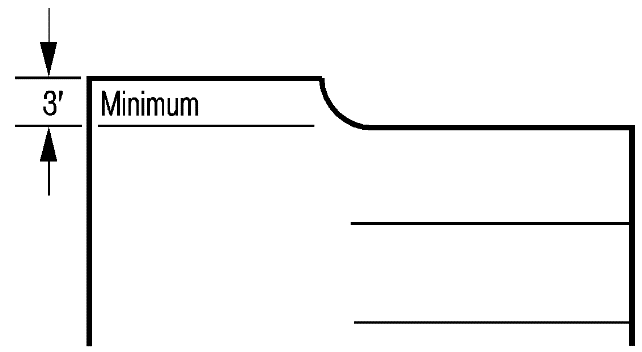
Parking Space Access
(This diagram is for illustration purposes only and
has not been adopted as part of the Zoning Ordinance.)
F.
Screening. A parking lot or carport with five (5) or more required spaces shall comply with the requirements of subsections 1 and 2 below. The Director may require a higher fence and a landscaped berm, where the off-street parking facility would have an adverse impact on an adjacent use due to a high turnover of spaces or noise due to the location of service vehicle access and loading space(s).
1.
The parking facility shall be screened from an adjoining residential district by a solid wood fence or masonry wall six (6) feet in height (or seven (7) feet in height, as allowed by the fencing regulations in Section 17.36.075), except that the height of a fence or wall adjoining a front setback in a residential district shall not exceed thirty (30) inches within ten (10) feet of the front property line.
2.
If the parking facility abuts a street separating the parking facility from a residential district, the parking facility shall be screened from the residential district by a fence or landscaped berm (not steeper than a 4:1 slope) not less than thirty-six (36) inches in height above the parking surface. The interior slope of the berm may be eliminated by use of a retaining wall on the parking facility side of the berm.
G.
Lighting. Outdoor parking lot lighting shall not employ a light source higher than ten (10) feet in residential districts or fifteen (15) feet in non-residential districts; shall create no cone of direct illumination greater than sixty (60) degrees from a light source higher than six (6) feet, and shall not directly shine onto an adjacent street or property. Illumination at ground level shall not exceed three (3) foot-candles in a non-residential district or 0.5 foot-candles in a residential district. Additional illumination for safety purposes may be required by the approving body.
H.
Landscaping. New or reconfigured parking lots with more than five (5) spaces must provide planting areas in accordance with the following standards. This standard is not applicable to single-family dwellings.
1.
Perimeter planting areas along public right-of-ways and interior property lines must be provided. At least one tree (minimum twenty-four (24) inch box) must be provided per one hundred fifty (150) square feet of perimeter planting area.
2.
Internal planting areas equal to at least ten percent (10%) of the total parking lot must be provided in parking lots greater than six thousand (6,000) square feet.
3.
Planting areas must have a minimum area of twenty-five (25) square feet and a minimum width of five (5) feet, exclusive of curbs.
4.
The end of each row of parking spaces must be separated from driveways and aisles by a planting area, sidewalk, or other means.
5.
A minimum of one tree (minimum twenty-four (24) inch box) for every three (3) parking spaces must be distributed evenly throughout the parking lot. Trees provided pursuant to subsection 1, above shall be credited toward this standard.
6.
Planting areas located adjacent to parking spaces, aisles, driveways, or loading areas must be protected with concrete curbs or wheel stops. Alternative treatments may be considered, subject to the approval of the approving body.
7.
Permanent and automatic irrigation systems must be provided for all planted areas.
8.
The property owner must enter into a written landscaping and maintenance agreement with the City, in a form satisfactory to the City Attorney.
9.
Innovative landscape designs may be substituted for the above standards, subject to the approval of the approving body.
I.
Drainage. Surface water shall be discharged to natural or engineered off-site drainage facilities and may not drain off or across public or private sidewalks, pedestrian walkways, or areas not designed as drainage facilities. Stormwater drainage and treatment facilities shall be provided in accordance with the stormwater management requirements of Chapter 13.12 and all applicable federal and state laws.
J.
Paving. Driveways, aisles, and parking spaces shall be paved with concrete or asphaltic concrete, subject to the approval of the City Engineer, so as to provide a durable and dust-free surface. Driveways and parking spaces serving single-family dwellings may also be paved with water-pervious surfacing material, subject to the approval of the City Engineer.
K.
Striping, Signs, Marking, and Curb Painting. All parking and loading spaces shall be striped. Double-striping of parking spaces is encouraged and may be required by the City Engineer based upon site conditions such as "high turnover" spaces or restricted maneuvering space. Driveways and aisles shall be marked and maintained with directional arrows and striping to expedite traffic movements. Any area not intended for parking shall be signed as such, or in areas where a curb exists, the curb may be painted red in lieu of signs. All striping, signs, markings, and curb painting shall be in conformance with applicable City standards. All striping and markings shall be applied with a minimum of two (2) coats of material. It shall be the responsibility of the property owner to ensure that all striping, signs, markings, and curb paintings are maintained in a legible condition. The striping, sign, marking, and curb painting standards are not applicable to single family or duplex dwellings, unless necessary for safety purposes as determined by the City Engineer. This standard is not applicable to single-family dwellings.
L.
Sales or Storage. A parking lot may not be used for automobile sales, storage, repair work, dismantling, or outdoor open sales displays, except as authorized by a temporary use permit issued in accordance with Chapter 17.70.
M.
Reserved Spaces Prohibited. Parking spaces shall not be reserved for tenants or customers of individual businesses. Notwithstanding this provision, parking spaces may be reserved for tenants in residential uses.
17.37.100 - Loading Space Design Standards.
Required off-street loading spaces shall be on the site of the use served or on an adjoining site. Required loading spaces must have adequate driveways and shall at all times have access to a public street. Required loading spaces shall be accessible without backing a truck across a public right-of-way line unless the approval body determines that provision of turnaround space is infeasible and approves alternative access. An occupied loading space shall not prevent access to a required off-street parking space. A loading space shall not be located in a required front or exterior side setback.
Except in the Town Center, a loading space visible from a street shall be screened by a building or solid fence at least six (6) feet in height.
(Ord. 408, 2007)

