
Clinton Village City Zoning Code
ARTICLE X
- SIGNAGE REGULATIONS2
Editor's note— Ord. No. 2014-6, § 1, 2, adopted Sept. 16, 2014, repealed Art. X., §§ 50-971—50-982, and enacted a new article as set out herein. Former Art. X pertained to similar subject matter and derived from Ord. of 4-3-2006, § 17.509 and Ord. No. 2009-06, adopted July 7, 2009.
Sec. 50-971.- Purpose.
The purpose of this article is to establish regulations for signs for all properties within the village. This article regulates the location, type, size and height of signs located in the village. This article is also designed to promote the implementation of the comprehensive plan of the village, particularly in regard to the implementation of the desired overall character of the community and its constituent zoning districts.
(Ord. No. 2014-6, §§ 1, 2, 9-16-2014)
Sec. 50-972. - Sign permits.
(a)
Exceptions. The following types of signs are permitted in all zoning districts without a sign permit. Such signs shall not count as part of the maximum permitted sign area as regulated by tables 50-10 and 50-11.
(1)
Address numerals and nameplates, altogether not exceeding two square feet in area, for each residential, commercial or industrial building.
(2)
Legal notices.
(3)
Signs established by, or by order of, any governmental agency, such as traffic control, parking restrictions, information and notices, except as regulated under section 50-977 (c), "Incidental and Directional Signs."
(4)
Memorial signs, tablets, names of buildings and date of erection when cut into any masonry surface or when constructed of metal and affixed flat against a structure.
(5)
On-premises directional signs that include no advertising, according to the definition and use regulations contained in this article.
(6)
Window signs placed inside commercial buildings and not covering more than 25 percent of the interior window area. No equipment, furniture or other items, including signage, shall cause more than 25 percent of any window area to be visually obstructed.
(7)
Temporary signs, including community information signs, which conform to the requirements of this article.
(8)
Temporary signs or banners when authorized by the village board and/or plan commission.
(9)
Political and campaign signs, provided that such signs, along with permitted temporary signs under section 50-978 not exceed a total area of 32 square feet.
(b)
Permit required. No person shall erect, alter or relocate within the village any sign without first obtaining a sign permit, unless specifically exempted by this chapter.
(c)
Procedure.
(1)
Sign permit only. Each person seeking a sign permit shall complete a village sign permit application and shall file the application with the village clerk, together with an application fee, as determined by the village board. A completed application shall include plans and specifications showing sign placement, dimensions, materials and required details of construction, including weight and anchorage. Immediately after filing, the clerk shall refer the application to the zoning administrator and/or building inspector, who shall, at the earliest practicable time and within ten days after receipt, either issue a permit for the sign or deliver to the applicant written notification that the application has been denied stating the reasons for denial.
(2)
Sign permit with site plan review. When signage is reviewed as part of a site plan review process under Article IV of this chapter, then a sign permit application and fee shall be filed as specified in (c) (1) above.
(Ord. No. 2014-6, §§ 1, 2, 9-16-2014)
Sec. 50-973. - Definitions.
The following words, terms, and phrases, when used in this article, shall have the meanings ascribed to them in this section, except where the context clearly indicates a different meaning:
Abandoned sign means a sign that no longer correctly directs or exhorts any person or advertises a business, lessor, owner, product, activity conducted or product available on the premises where the sign is displayed.
Area of copy means the entire area within a single, continuous perimeter that encloses the extreme limits of an advertising message, announcement or decoration of a sign.
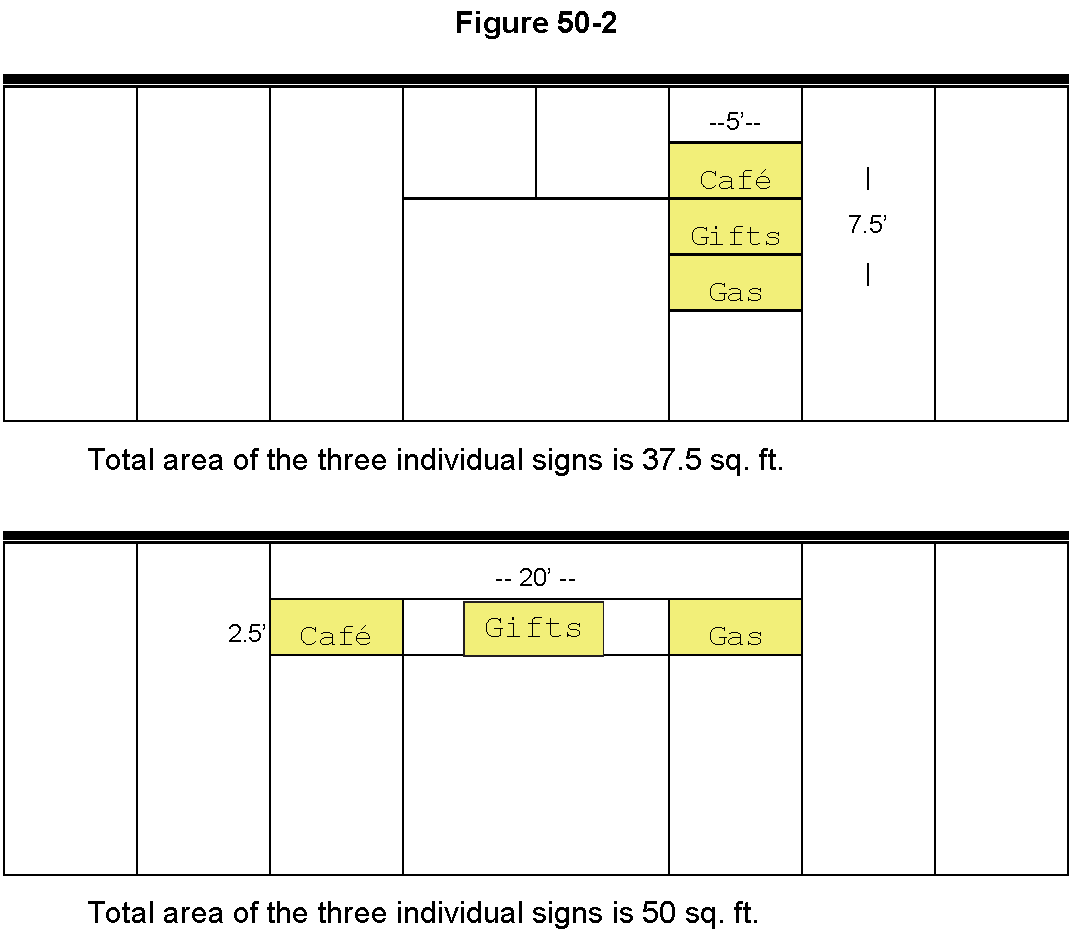
Area of sign means the area of the largest single face of the sign within a perimeter which forms the outside shape, but excluding the necessary supports or uprights on which the signs may be placed. The area of a sign consisting of more than one section or module shall be the total area of all sections or modules. Any irregular shaped sign area shall be computed using the actual sign face surface. In the case of wall signs, the area of copy will be used. In the case of a three-dimensional sign or iconic display, the area shall be computed by means of the smallest cube or box that the sign or iconic display would fit into, together with any material or color forming an integral part of the display. The supporting structure or bracing of a sign shall not be counted as a part of the display.
Building frontage means the linear width of the exterior portion of the structure housing the principal uses and facing a street. Circulatory and access drives or parking areas are not considered streets for the purposes of this article.
Bulletin means a sign that accommodates changeable symbols and/or wording and that displays information on activities and events on the premises or in the community.
Business sign means a sign that directs attention to a business, commodity, service or entertainment conducted, sold, offered or manufactured upon the premises where the sign is located.
Canopy, marquee, or awning sign means any sign attached to or constructed in or on a canopy, marquee, or awning and which does not extend horizontally beyond the edges of such canopy or marquee. Such a sign shall be counted as a projecting sign.
Community information sign means a sign that is limited to the display of information that would be customarily and culturally of general interest to the residents of the village regarding scheduled public events and public activities. Advertising of a project or a private or restricted activity for individual profit shall be prohibited. The area of such a sign shall not be included in determining the maximum regulated area of signage on the subject property.
Directional sign, off-premises, means a sign that indicates only the name of, direction toward and/or distance to an activity.
Directional sign, on-premises, means a sign that provides direction or orientation for pedestrian or vehicular traffic.
Freestanding sign means a self-supporting sign resting on or supported by poles, standards or any other type of base on the ground. The term "freestanding sign" includes monument signs, pylon signs, V-shaped signs, and freestanding iconic displays.
Ground level means the average elevation of the ground upon which the sign supports are placed. When the sign supports rest upon a berm or other area elevated above the surrounding ground, the average elevation of the base of such berm or other area shall be considered to be the ground level.
Iconic display means a two- or three-dimensional structure containing a visual representation of the product(s) or service(s) offered on the premises.
Identification sign means a sign that is limited to displaying the name, address and contact information of a building, institution or person and information regarding activities or events on the premises.
Incidental sign means a sign that provides supplementary information related to the premises on which it is located.
Mobile or portable sign means a sign mounted on a frame or chassis, designed to be easily relocated, including vehicles and/or trailers whose principal commercial use is for signage.
Monument sign means a freestanding sign whose lowermost edge is located within one foot of ground level.
Movable signage board means a self-supporting sign displayed during business hours.
Multi-tenant building means a nonresidential building having a common entrance for two or more tenants, whether a freestanding building or under the same roof as a shopping center.
Multi-tenant development means a nonresidential development site having two or more tenants, whether the buildings on the site are attached or detached.
Off-premise advertising sign means a sign that directs attention to a business, commodity, service or entertainment conducted, sold or offered elsewhere than upon the premises where the sign is located. Off-premise advertising signs include billboards.
Political or campaign sign means a sign announcing candidates seeking political office and/or political issues and data pertinent thereto.
Projecting sign means a sign, other than a wall sign, which is attached to and projects from a structure or building face a distance of more than 18 inches. The term "projecting sign" includes canopy, marquee, awning, and related signs; and, iconic displays projecting from the building face.
Pylon sign means a freestanding sign erected upon one or more pylons or posts.
Sign means any object, device, display, structure or part thereof which is used to advertise, identify, display, direct or attract attention to an object, person, institution, organization, business, product, service, event, noncommercial message, or location by any means, including words, letters, figures, designs, symbols, fixtures, colors, illumination or projected images. Signs do not include the flag or emblem of any nation, organization of nations, state, city, religious, fraternal or civic organization, merchandise or pictures or models of products or services incorporated in a window display, or works of art which in no way identify a product. Traffic control and other public agency signs located within a right-of-way are not included within this definition and are not regulated by the provisions of this chapter.
Street frontage means the distance along which the property line of a lot adjoins a street.
Temporary sign means a sign or advertising display intended to be displayed for a limited period of time. The term "temporary sign" includes retailers' signs temporarily displayed for the purpose of informing the public of a "sale" or special offer and community information signs as defined above. If a sign display area is permanent but the message displayed is subject to periodic changes, the sign shall not be considered temporary. A mobile or portable sign shall not be considered a temporary sign or used for such a purpose.
V-shaped sign means a sign containing two faces of equal size, positioned at an interior angle subtending less than 121 degrees at the point of juncture of the individual faces.
Wall sign means a sign mounted upon and parallel to a building facade or other vertical building surface, projecting outward from such surface no more than 18 inches.
Wayfinding sign means an off-premise directional sign, coordinated by the village or an organization approved by the village, as part of a wayfinding signage program designed to provide direction to civic, commercial, or cultural destinations.
(Ord. No. 2014-6, §§ 1, 2, 9-16-2014)
Sec. 50-974. - Sign prohibitions and limitations, all districts.
(a)
No sign shall use any word, phrase, symbol, shape, form or character in such a manner as to interfere with moving traffic, nor shall any sign incorporate any signage, designs, colors or patterns characteristic of street or traffic control signs or signals.
(b)
No fluttering, undulating, swinging, rotating or otherwise moving signs, pennants or other commercial decorations shall be permitted except for time and/or temperature signs, and except for on-premise scrolling messages, traveling at a rate of at least 16 light columns per second and no faster than 32 columns per second.
(c)
Except for time and/or temperature signs, no illuminated flashing or changeable message signs shall be permitted, unless each message remains in a fixed position for at least six seconds, and the change in message is accomplished in one second or less.
(d)
All illuminated signs shall comply with the state electrical code.
(e)
No mobile or portable signs shall be permitted.
(f)
Except as authorized by this article, off-premises directional signs shall be permitted within public rights-of-way only if designed to convey information relating to the general interest to the residents of the village regarding public institutions and/or scheduled public events or activities for governmentally owned public institutions, schools, and churches.
(g)
No billboards or other off-premise advertising signs shall be permitted within the village limits, except as authorized by the statutes of the state.
(h)
No inflatable signs shall be permitted.
(i)
No commercial advertising message shall be placed on any fence owned by the village.
(Ord. No. 2014-6, §§ 1, 2, 9-16-2014)
Sec. 50-975. - Sign location requirements.
(a)
No sign shall be erected or maintained at any location where, by reason of its position, wording, illumination, size, shape or color it may obstruct, impair, obscure, interfere with the view of or be confused with, any authorized traffic control sign, signal or device, or be erected contrary to any provision of this Code.
(b)
No sign shall be located within a required buffer yard or within a permanently protected green space area, according to the definitions of these terms in Section 50-11.
(c)
No sign shall be mounted on a building roof or extend above the roof, if attached to a building.
(d)
No sign, temporary or otherwise, shall be affixed to a tree or utility pole or situated within a public right-of-way, except as authorized by this article or as authorized by the village public works director.
(e)
Community information signs shall not be placed more than 30 days preceding and shall be removed within 72 hours after the public event or activity has closed.
(f)
Wayfinding signs may be authorized by the village board in the context of a wayfinding signage program coordinated by the village or by an organization approved by the village board.
(Ord. No. 2014-6, §§ 1, 2, 9-16-2014)
Sec. 50-976. - Sign provisions, residential districts.
(a)
In all residential zoning districts signs shall be subject to the following regulations:
(1)
For each residential lot containing one or two dwelling units, one wall identification sign, not to exceed two square feet in area, is permitted for each dwelling unit. The identification sign may include one or more of the following: name, address and/or home occupation description.
(2)
For each multifamily or institutional residential lot containing three or more dwelling units, one wall and one freestanding identification sign per street frontage are permitted, according to the following schedule:
(3)
For each subdivision development, one monument identification sign, up to 32 square feet in area and not exceeding a height of eight feet, is permitted per subdivision entrance, for no more than two entrances. Alternatively, permanent subdivision identification signs may also be permitted if included in an approved site plan. Detailed plans of proposed signs must be submitted, along with a sign permit application and fee, at the time of subdivision review.
(4)
For any permitted or conditional principal use other than those specified above, the following identification signs are permitted: one wall identification sign and one freestanding identification sign per street frontage. Each sign shall not exceed an area of 40 square feet; or, one square foot for every five linear feet of street frontage up to a maximum of 60 square feet. The maximum height for each freestanding sign shall be eight feet.
(5)
Each permitted freestanding sign shall not encroach on or overhanging a public right-of-way or pedestrian or vehicular circulation area or violate visibility standards/vision triangle, section 50-493.
(6)
Directional signs, on the premises to which they refer, may be wall or freestanding signs. One such sign is permitted for each entrance/exit and for each parking area. Each directional sign shall not exceed six square feet in area and the maximum height of a permitted freestanding identification sign for such premises.
(7)
Temporary signs, including rummage or garage sale signs, are permitted as specified in this article.
(Ord. No. 2014-6, §§ 1, 2, 9-16-2014)
Sec. 50-977. - Sign provisions, nonresidential districts.
(a)
Wall signs and projecting signs.
(1)
Wall and projecting sign standards.
(2)
Canopy, marquee, awning, and related signs. Projecting signs include canopy, marquee, and awning signs, which shall be calculated towards the maximum allowance for projecting signs. Canopy, marquee, and awning signs are permitted to project over the sidewalk in the C-1 District up to b the width of the sidewalk or four feet, whichever is more, with a minimum clearance above-grade of eight feet. Otherwise, no projection over a public right-of-way or pedestrian or vehicle circulation area is permitted.
Under canopy and suspended signs may be used, with a maximum of one such sign per business and a maximum of one square foot per sign. Such signs shall count toward the maximum area for projecting signage.
(3)
Iconic displays. An iconic display projecting from the face of a building shall count toward the projecting sign allowance for that building.
(b)
Freestanding signs.
(1)
Freestanding sign standards
(2)
Freestanding sign setback and placement. A freestanding sign shall be located so that no part of the sign shall project beyond the lot line or violate visibility standards/vision triangle, section 50-493, or otherwise impede visibility of vehicular or pedestrian traffic. A freestanding iconic display shall count toward the freestanding sign allowance for a site.
(3)
Freestanding sign structure and appearance.The base or supports of a freestanding sign shall be securely anchored to a concrete base or footing. The base or footing and related supporting structure of a freestanding sign, including bolts, flanges, brackets, etc., shall be concealed by the sign's exterior, masonry covering, earth and permanent ground cover, or through the use of evergreen shrubs.
(c)
Incidental and directional signs.
(1)
Incidental signs may be used to display credit cards accepted, required price posting, official notices required by law or trade affiliations, warning, "No Trespassing," and menu boards. Incidental signs for service station pumps/charging stations may also display products or services available on-site. Incidental signs shall be affixed to a building wall or to a freestanding sign. Incidental signs attached to service station pumps or charging stations shall not project from the station pump/station surface, nor extend horizontally or vertically past the pump/station edges. Sign area for all incidental signs shall be calculated independently of the requirements above and shall not exceed 25 percent of the maximum permitted area.
(2)
Directional signs, on the premises to which they refer, may be wall or freestanding signs, subject to the following standards:
(d)
Movable signage boards, commercial districts.
(1)
Placement.
a.
C-1 central commercial district. One movable signage board per business may be placed on the sidewalk, not more than 10 feet away from the business entrance, and leaving a passage area on the sidewalk that is at least six feet wide.
b.
Commercial districts other than C-1. One movable signage board per business may be placed on the same lot as the business is located, outside of the public right-of-way, excluding portions of the lot used for pedestrian and vehicular access and parking.
(2)
Each movable signage board shall have a maximum area of eight square feet, maximum height of four feet, and, in the C-1 Central Commercial District, a maximum width of 30 percent of the sidewalk width.
(3)
Each movable signage board shall be maintained in good condition; removed at dusk if not illuminated or, if illuminated, at the close of business each day and be replaced or removed when the appearance of the sign deteriorates through damage, weathering, or other causes.
(4)
Movable signage boards may be illuminated, however no extension cords or other exterior electrical connections are permitted.
(e)
Multi-tenant sign plan. A sign plan may be submitted for a nonresidential property having more than one tenant, as long as the maximum areas for each sign type, as set forth in "a" through "c" above are not exceeded, and, as long as the maximum number of freestanding signs as set forth in "b" and "c" above is not exceeded.
(Ord. No. 2014-6, §§ 1, 2, 9-16-2014)
Sec. 50-978. - Temporary signs.
(a)
Only one temporary sign may be displayed on a lot at any one time. Except as provided in subsection (b) of this section, a temporary sign may be displayed upon any one lot for a maximum of 30 days within any 12-month period. No more than two different temporary signs may be displayed upon any one lot in any 12-month period.
(b)
Subsection (a) of this section shall not apply to the following:
(1)
For each lot, one for sale or for rent sign, not more than 12 square feet in area, may be displayed while the lot is actually exposed for sale or rent.
(2)
For construction on or development of a lot, one sign not more than 32 square feet in area may be displayed, indicating the name of the contractors, engineers or architect, or products being used in the construction of a building, but only during the time that construction or development is actively under way.
(3)
For an event of limited duration and of public interest, such as a neighborhood garage sale or church fair, one sign not more than 32 square feet in area may be displayed, located upon the site of the event. Such sign shall not be erected more than 30 days before the event and shall be removed within 72 hours after the event has closed.
(4)
Temporary signs displaying noncommercial messages may be displayed not more than 60 days per year without obtaining a permit. The total area of all such signs on a lot shall not exceed 32 square feet.
(5)
For each real estate subdivision that has been approved in accordance with chapter 44, a maximum of two temporary development project identification signs are permitted to be located within the subdivision. Each such sign shall be not more than 32 square feet in area. One additional, similar sign shall be permitted for each 100 lots or portion thereof in excess of the first 100 lots in the subdivision. These signs shall be permitted to remain within the subdivision until the time when building permits have been issued for 80 percent or more of the lots in the subdivision.
(Ord. No. 2014-6, §§ 1, 2, 9-16-2014)
Sec. 50-979. - Construction and maintenance of signs and sign structures.
All signs regulated by this article shall be kept in a state of proper maintenance.
(1)
Proper maintenance shall require the absence of loose materials, including peeling paint, paper or other material, excessive rust, excessive vibration or shaking, and shall require the preservation of the original structural integrity of the sign, its frame and other supports, its mounting and all components thereof.
(2)
The repainting, changing of parts and preventive maintenance of signs which initially conform to the requirements of this article, which result in no substantial change in the appearance of the sign from that originally approved, shall not be deemed alterations requiring a sign permit.
(3)
The owner and lessee of a sign, and the owner, lessee and manager of the property on which the same is located, shall keep grass, weeds and other growth on the property trimmed at a reasonable level, and shall remove any accumulated rubbish and debris from such property.
(4)
Any signs and sign structures which may be or may hereafter become rotted, unsafe or are otherwise not properly maintained, shall be repaired or removed by the permittee, the owner of the sign, or the owner of the property upon which the sign is located upon notice of the zoning administrator.
(5)
All signs shall be constructed and mounted so as to withstand a wind pressure of 30 pounds per square foot.
(6)
The owner and lessee of a sign found to be in violation of the provisions of this article and the owner, lessee and manager of the property on which the sign is located shall be subject to all applicable violations, penalties and enforcement provisions of this article and other applicable parts of this Code.
(Ord. No. 2014-6, §§ 1, 2, 9-16-2014)
Sec. 50-980. - Nonconforming and abandoned signs and sign structures.
(a)
Signs existing as of the effective date of the ordinance from which this chapter is derived which do not conform to its provisions shall be nonconforming signs. Nonconforming signs may be maintained subject to the provisions regarding their removal, as set forth in this article. No nonconforming sign shall be altered or moved to a new location unless brought into compliance with the requirements of this article.
(b)
Nonconforming signs located on the premises of a nonconforming use or building may be continued, but no increase with respect to the number of such signs, or the area, height or illumination of any such individual sign shall be allowed. Any modification of signage upon such premises resulting in an increase in the total area of signage shall require the complete removal of all nonconforming signs with any new or replacement signs to conform to the requirements of this article. Nonconforming signs located on premises of a nonconforming use shall be completely removed when the principal structure located on the premises undergoes a change of use.
(c)
Nonconforming signs located on the premises of a conforming use or building may be continued, but no increase with respect to the area, height or illumination of any such individual sign shall be allowed. Overall signage on such premises may be modified; provided that any additional or replacement signs shall, individually, comply with the requirements of this article, and any existing nonconformity in regard to total area of signage existing on the premises, as compared with the total area permitted by this article, shall not be increased thereby. Nonconforming signs located on the premises of a conforming use shall be completely removed when the principal structure located on the premises undergoes a change of use.
(d)
Signs associated with a business shall be removed within 60 days after the business ceases operations.
(Ord. No. 2014-6, §§ 1, 2, 9-16-2014)
Sec. 50-981. - Alteration of signs.
For the purposes of this article, "alteration" of a sign is considered to be any change to the exterior appearance of any part of the sign, its frame, its supporting structure or its lighting, including any change to the message (except for bulletin, canopy and marquee signs), symbols, color, material, height, or location of the sign or any other alteration as determined by the zoning administrator. Alteration of a sign does not include maintaining the existing appearance of the sign [see section 50-979 (2)] or replacing the sign face or the supporting structure with identical materials, colors and messages, nor changing the message of a bulletin, canopy or marquee sign.
(Ord. No. 2014-6, §§ 1, 2, 9-16-2014)
Sec. 50-982. - Permit fee.
The fee for a sign permit shall be as established in appendix A to this Code.
(Ord. No. 2014-6, §§ 1, 2, 9-16-2014)

