
Clovis City Zoning Code
CHAPTER 17
65 - REVIEW AND APPROVAL PROCEDURES
17.65.010 - Common provisions.
A.
Applicability. The common provisions of this section apply to all the procedures in this chapter unless otherwise expressly stated.
B.
Review and Decision-making Authority (Summary Table). Table 65-1 provides a summary of the review and approval procedures of this chapter. In the event of conflict between this summary table and the detailed procedures contained elsewhere in this chapter, the detailed procedures govern.
TABLE 65-1: REVIEW AND DECISION-MAKING
AUTHORITY SUMMARY TABLE
Table 65-1 Notes:
[1] Unless alternative site plan review procedure/decision-maker is established by city commission at time of development plan approval (see 17.65.100.C).
C.
Applications and Fees.
1.
Owner-initiated Applications. Whenever the provisions of this UDO allow the filing of an application by the owner of the subject property, that application must be filed by all record title owners of the real properties that are the subject of the application or the property owners' authorized agent. If an owner resides out-of-state, that owner must designate an in-state individual or firm for notice and service of process.
2.
Pre-application Meetings.
a.
Purpose. Pre-application meetings provide an early opportunity for staff and applicants to discuss the procedures, standards and regulations required for development approval under this UDO.
b.
Applicability. Pre-application meetings are required whenever the provisions of this UDO expressly state that they are required. They are encouraged in all cases.
c.
Scheduling. Pre-application meetings must be scheduled with the director of building safety.
d.
Guidelines. The director of building safety is authorized to establish guidelines for pre-application meetings, including information that should be provided and any available alternatives to face-to-face meetings, such as telephone conversations and email correspondence.
e.
Effect. Neither the applicant nor the city is bound by any statements or determinations made during the pre-application meeting.
3.
Form of Application. Applications required under this UDO must be submitted in a form and in such numbers as required by the official responsible for accepting the application. Applications must include materials and information to assist authorized review and decision-making bodies in their consideration of the application, including at least the following:
a.
A list of the names and addresses of all owners of record of the property that is the subject of the application;
b.
A signed statement granting city staff right of reasonable access to view, enter and inspect the property, uses or buildings on the site for compliance with this UDO; and
c.
Maps, plats, surveys, dimensioned site plans, engineering documents, environmental reports, traffic studies, and other materials and information, as required by this UDO or application checklists established by the official responsible for accepting the application. Application forms and submittal requirements must be made available to the public.
4.
Application Filing Fees and Notification Costs. All applications must be accompanied by the application fee that has been established by the city commission and by an amount to cover the costs of required public hearing notices.
5.
Application Completeness, Accuracy and Sufficiency.
a.
An application will be considered complete and ready for processing only if it is submitted in the required number and form, includes all required information and is accompanied by the required application filing and notification fees.
b.
The official responsible for accepting the application must determine whether an application is complete within five business days of application filing.
c.
If an application is determined to be incomplete, the official responsible for accepting the application must provide notice to the applicant along with an explanation of the application's deficiencies. Notice of an incomplete application may be provided by personal service, electronic mail or first-class mail.
d.
No further processing of incomplete applications will occur and incomplete applications will be pulled from the processing cycle. When the deficiencies are corrected, the application will be placed in the first available processing cycle. If the deficiencies are not corrected by the applicant within sixty days, the application will be deemed to have been withdrawn.
e.
Applications deemed complete will be in the processing cycle and will be reviewed by staff and other review and decision-making bodies in accordance with applicable review and approval procedures of this UDO.
f.
The official responsible for accepting the application may require that applications or plans be revised before being placed on an agenda for possible action if the official determines that:
(1)
The application or plan contains one or more significant inaccuracies or omissions that hinder timely or competent evaluation of the plan's/application's compliance with UDO requirements or other regulations;
(2)
The application contains multiple minor inaccuracies or omissions that hinder timely or competent evaluation of the plan's/application's compliance with UDO requirements or other regulations; or
(3)
The decision-making body does not have legal authority to approve the application.
D.
Application Processing Cycles. The director of building safety and other officials responsible for accepting applications, after consulting with review and decision-making bodies, is authorized to promulgate reasonable cycles and timelines for processing applications, including deadlines for receipt of complete applications.
E.
Neighbor Communications.
1.
Neighbor communications are encouraged by the planning and zoning commission and city commission to help:
a.
Educate applicants and neighbors about one another's interests;
b.
Resolve issues in a manner that respects those interests; and
c.
Identify unresolved issues before initiation of formal public hearings.
2.
Applicants are encouraged to submit a summary of their neighbor communication activities at or before the first required public hearing. The recommended content of such summaries is as follows:
a.
Efforts to notify neighbors about the proposal (how and when notification occurred, and who was notified);
b.
How information about the proposal was shared with neighbors (mailings, work-shops, meetings, open houses, flyers, door-to-door handouts, etc.);
c.
Who was involved in the discussions;
d.
Suggestions and concerns raised by neighbors; and
e.
What specific changes (if any) were considered and/or made because of the neighbor communications.
F.
Public Hearing Notice.
1.
Newspaper Notice. Whenever the procedures of this chapter require that newspaper notice be provided, the notice must be published in a newspaper of general circulation within the city of Clovis.
2.
Mailed Notice.
a.
Whenever the procedures of this chapter require that notices be mailed, the notices must be sent by United States Postal Service. Regular First Class mail is allowed except when provisions of this ordinance or of state law expressly require another form of delivery.
b.
Addresses must be based on property ownership information from the county clerk's office. When required notices have been properly addressed and deposited in the U.S. mail, alleged failure of a party to receive the mailed notice does not constitute grounds to invalidate any action taken.
3.
Posted Notice.
a.
Except as expressly stated in 17.65.010.F.3.b, when the procedures of this chapter require that posted notice be provided, at least one notice sign must be posted on each public street frontage abutting the subject property in locations plainly visible to passers-by. If the subject application includes an area with more than two hundred feet of street frontage on a single street, at least one sign must be posted for each two hundred feet of street frontage or fraction thereof on that street. If the subject property does not have frontage on a public street, signs must be placed on the nearest street right-of-way with an attached notation indicating generally the direction and distance to the subject property.
b.
When the city initiates a zoning map amendment to ensure consistency with its comprehensive plan or to implement land use and zoning policies, the director of building safety is authorized to designate the number and location of posted notice signs. The locations must be within the area proposed for rezoning, be plainly visible to passers-by and provide reasonable posted notice.
c.
Applicants are responsible for providing posted notice and for providing the director of building safety with a signed affidavit and photographs evidencing compliance at least ten calendar days before the public hearing. The applicant must remove all notice signs within five days of a final decision on the matter.
4.
Content of Notice. All required public hearing notices must:
a.
Indicate the date, time and place of the public hearing that is the subject of the notice;
b.
Describe any property involved in the application by map, street address or by legal description;
c.
Describe the action sought in the application or proposal;
d.
Identify who will conduct the hearing; and
e.
Indicate where additional information on the matter may be obtained.
5.
Constructive Notice.
a.
Minor defects in required notices will not be deemed to impair the notice or invalidate proceedings pursuant to the notice. Minor defects in notice are limited to errors in a legal description or typographical or grammatical errors that do not impede communication of the notice to affected parties. If questions arise at the hearing regarding the adequacy of notice, the hearing body must make a formal finding about whether there was substantial compliance with the notice requirements of this UDO.
b.
When the records of the city document the publication, mailing, and posting of notices as required by this chapter, required notice of the public hearing will be presumed to have been given.
6.
Courtesy Notice.
a.
In addition to otherwise required notices of public hearings, the director of building safety must endeavor to provide one or more of the following forms of additional courtesy notice of public hearings required under this UDO:
(1)
Mailing notices to registered neighborhood and resident organizations whose boundaries include or are abutting the subject property;
(2)
Posting notices in city hall or in other government buildings; or
(3)
Publishing notice on the city website.
b.
Failure to provide any form of courtesy notice that is not required under this UDO or any defect in courtesy notice that is provided does not invalidate impair, or otherwise affect any application, public hearing or decision rendered in respect to the matter under consideration.
G.
Hearing Procedures.
1.
At required public hearings, interested persons must be permitted to submit information and comments, verbally or in writing. The hearing body is authorized to establish reasonable rules and regulations governing the conduct of hearings and the presentation of information and comments.
2.
Once commenced, a public hearing may be continued by the hearing body. No re-notification is required if the continuance is set for specified date and time and that date and time is announced at the time of the continuance.
3.
If a public hearing is continued or postponed for an indefinite period from the date of the originally scheduled public hearing, new public hearing notice must be given before the rescheduled public hearing. If the applicant requests and is granted a continuance or postponement requiring renotification, the applicant must pay any costs of renotification.
H.
Action by Review Bodies and Decision-making Bodies.
1.
In acting under the procedures of this chapter, review and decision-making bodies must act by simple majority vote of a quorum, unless otherwise expressly stated.
2.
Review and decision-making bodies may take any action that is consistent with:
a.
The regulations of this UDO;
b.
Any rules or by-laws that apply to the review or decision-making body; and
c.
The notice that was given.
3.
In acting on zoning map amendments, review and decision-making bodies are expressly authorized to recommend and approve a less intensive zoning district classification than the zoning district that was described in required public notices (see "less intensive zoning district" in 17.90.150).
4.
Review and decision-making bodies are authorized to continue a public hearing or defer action to receive additional information or further deliberate.
I.
Conditions of Approval. When the procedures of this chapter authorize approval with conditions, review bodies, including staff, are authorized to recommend conditions and decision-making bodies are authorized to approve the subject application with conditions. Any conditions recommended or approved must relate to a situation likely to be created or aggravated by the proposed use or development and must be roughly proportional to the impacts of the use or development.
J.
Decision-making Criteria; Burden of Proof or Persuasion. Applications must address relevant review and decision-making criteria. In all cases, the burden is on the applicant to show that an application or proposal complies with all applicable review or approval criteria.
K.
Required Time-frames for Action. Any time limit specified in this UDO for any decision or action on behalf of a review or decision-making body may be extended if the applicant agrees to an extension. Unless otherwise expressly stated, if a review or decision-making body does not render a decision or act within the time required under this UDO and the applicant has not agreed to an extension of that time limit, the application is deemed denied.
(Ord. No. 2122-2019, § 3, 6-20-19).
17.65.020 - Unified Development Ordinance text amendments.
A.
Authority to File. Amendments to the text of this UDO may be initiated only by the city commission, planning and zoning commission or director of building safety.
FIGURE 65-1: UNIFIED DEVELOPMENT ORDINANCE TEXT
AMENDMENT PROCESS (GENERALLY)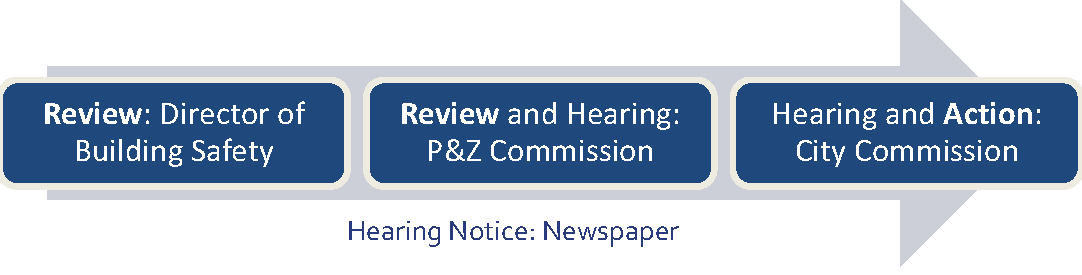
B.
Review and Recommendation—Director of Building Safety. The director of building safety must prepare a report and recommendation on the proposed UDO text amendment. The report must be transmitted to the planning and zoning commission before its public hearing on the proposed amendment.
C.
Notice of Hearing. Notice of the planning and zoning commission's required public hearing on a UDO text amendment must be published in the newspaper at least fifteen days before the scheduled public hearing (see 17.65.010.F for additional information on newspaper notices).
D.
Hearing and Recommendation—Planning and Zoning Commission. The planning and zoning commission must hold a public hearing on the proposed UDO text amendment. Following the close of the public hearing, the planning and zoning commission must act to recommend that the proposed text amendment be approved, approved with modifications, or denied and transmit its report and recommendations to the city commission. If the planning and zoning commission arrives at a tie vote, the application must be forwarded to the city commission with the notation of the tie vote.
E.
Final Action—City Commission. Following receipt of the planning and zoning commission's report and recommendation, the city commission must hold a public hearing and act to approve the proposed UDO text amendment, approve the proposed text amendment with modifications or deny the proposed text amendment. The city commission is also authorized to remand the proposed text amendment back to the planning and zoning commission for further consideration.
F.
Review and Approval Criteria. In making recommendations and decisions about UDO text amendments, review and decision-making bodies must consider all relevant factors, including at least the following:
1.
Whether the proposed text amendment is in conformity with the policy and intent of the comprehensive plan; and
2.
Whether the proposed UDO text amendment corrects an error or inconsistency or is necessary or desirable to meet the challenge of a changed or changing condition.
(Ord. No. 2122-2019, § 3, 6-20-19).
17.65.030 - Zoning map amendments (rezonings).
A.
Authority to File. Amendments to the zoning map may be initiated only by the city commission, the planning and zoning commission, the owner of the real property that is the subject of the proposed zoning map amendment or by the subject property owner's authorized agent.
FIGURE 65-2: ZONING MAP AMENDMENT PROCESS (GENERALLY)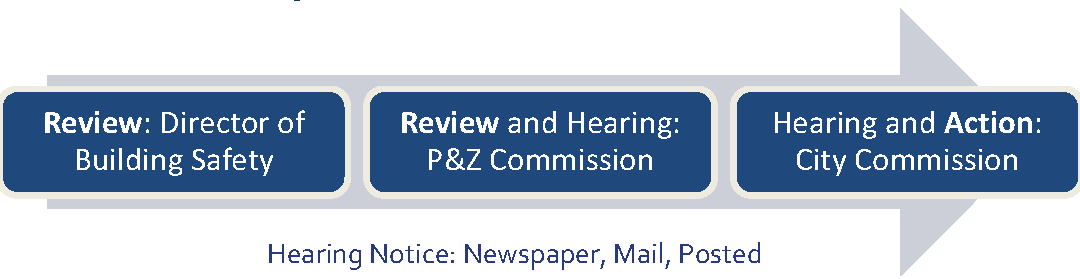
B.
Application Filing. Property owner-initiated applications for zoning map amendments must be filed with the director of building safety. Property owners have the option of filing applications for zoning map amendments with or without a development plan. If the applicant elects to submit a development plan concurrently with a zoning map amendment application, the development plan procedures of 17.65.090 govern review and approval of the development plan.
C.
Review and Recommendation—Director of Building Safety. Following receipt of a complete zoning map amendment application or initiation of zoning map amendment by the planning and zoning commission or the city commission, the director of building safety must prepare a report and recommendation on the proposed zoning map amendment. The report must be transmitted to the planning and zoning commission before its public hearing on the proposed amendment.
D.
Notice of Hearing. Notice of the planning and zoning commission's required public hearing on a zoning map amendment must be provided as follows (see 17.65.010.F for additional information on required newspaper, mail and posted notices):
1.
Newspaper Notice. Notice must be published in the newspaper at least fifteen days before the scheduled public hearing.
2.
Mailed Notice. Notice must be mailed to all owners of property included within the area that is the subject of the proposed zoning map amendment and all owners of property within one hundred feet of the subject property at least ten days before the scheduled public hearing. Whenever a zoning map amendment is proposed for an area of one block or less, notice of the public hearing must be sent by certified mail, return receipt requested. Whenever a zoning map amendment is proposed for an area of more than one block, notice of the public hearing must be sent by first class mail. If a zoning map amendment notice sent by first class mail is returned undelivered, the zoning authority must attempt to discover the owner's most recent address and remit the notice by certified mail, return receipt requested, to that address.
3.
Posted Notice. Notice (signs) must be posted at least ten days before the scheduled public hearing.
E.
Hearing and Recommendation—Planning and Zoning Commission.
1.
Following receipt of a complete application for a zoning map amendment or initiation of a zoning map amendment by the planning and zoning commission or city commission, the planning and zoning commission must hold a public hearing on the proposed amendment. Following the close of the public hearing, the planning and zoning commission must act to recommend that the proposed amendment be approved, approved with modifications, or denied.
2.
All proposed zoning map amendments must be transmitted to the city commission within fifteen days of the date of planning and zoning commission action.
3.
If the planning and zoning commission arrives at a tie vote, the application must be forwarded to the city commission with the notation of the tie vote.
F.
Final Action—City Commission.
1.
Following receipt of the planning and zoning commission's recommendation, the city commission must hold a public hearing on the application and act to approve the proposed zoning map amendment, approve the proposed amendment with modifications, including approval of a less intensive zoning district, or deny the proposed amendment. The city commission is also authorized to remand the proposed zoning map amendment back to the planning and zoning commission for further consideration.
2.
Zoning map amendments may be approved by a simple majority vote of a quorum, except as stated in 17.65.030.G.
G.
Protest Petitions.
1.
Pursuant to NMSA 1978, § 3-21-6, if a valid protest petition is filed against any proposed zoning map amendment, passage of the zoning map amendment requires a favorable vote of three-fourths of the members of the entire city commission.
2.
A protest petition will be deemed valid if it is signed and acknowledged by the owners of twenty percent or more of the area of the lots included in proposed zoning map amendment area or by the owners of twenty percent or more of the area of the lots within one hundred feet of the area included in the proposed zoning map amendment, not counting public rights-of-way.
3.
A written protest petition opposing a zoning map amendment must be submitted to the director of building safety at least twenty-four hours before the start of the meeting at which the city commission vote is to vote on the matter.
H.
Review and Approval Criteria. In making recommendations and decisions on zoning map amendments, review and decision-making bodies must consider all relevant factors, including at least the following:
1.
Whether the proposed zoning map amendment is consistent with the policy and intent of comprehensive plan; and
2.
Whether the proposed zoning map amendment corrects an error or inconsistency or is necessary or desirable to meet the challenge of a changed or changing condition.
(Ord. No. 2122-2019, § 3, 6-20-19).
17.65.040 - Subdivisions generally.
Unless otherwise expressly stated in this chapter, all proposed divisions of land into two or more parts or that otherwise meet the definition of a subdivision under New Mexico law require review and approval of a preliminary plat and final plat in accordance with 17.65.070 and 17.65.080, respectively.
(Ord. No. 2122-2019, § 3, 6-20-19).
17.65.050 - Short-form subdivision plats.
A.
Applicability. The short-form subdivision plat procedures of this section may be used only for the following:
1.
Street vacations;
2.
Easement vacations; and
3.
Revisions to valid, approved preliminary plats involving no increase in density and no changes in land use, arterial or collector streets, public park or other public land.
B.
Neighbor Communications.
1.
Before filing an application for short-form subdivision plat approval, the applicant must either:
a.
Contact all owners of real property located within one hundred feet of the subject property, excluding public right-of-way, to obtain their comments and signatures on a city-issued response form; or
b.
Request that the city deliver written notices to such property owners.
2.
The notice letter and response form must state that property owners may appear in person at scheduled meetings or submit written opinions and comments at or before the scheduled meetings.
C.
Application Filing. Compete applications for short-form subdivision plat approval must be filed with the director of building safety. The application must be accompanied by a plat meeting all the requirements of a final plat and bearing the seal of a New Mexico-registered professional surveyor. Applications must be filed at least fifteen days before the planning and zoning commission's scheduled meeting to review the application.
D.
Agency Review. At least twelve days before the planning and zoning commission's scheduled meeting to review the application, the director of building safety is authorized to distribute the application and plat to review agencies and request that comments on the proposed plat application, if any, be provided to the director of building safety by a specified date. If comments are not provided within that time-frame, review and approval bodies will act as if the review agencies have no comments.
E.
Review and Recommendation—Director of Building Safety.
1.
The director of building safety must review the short-form plat to determine if it complies with all applicable regulations. If the short-form plat is proposed to revise a valid, approved preliminary plat, the review must also assess whether the short-form plat is in conformity to the approved preliminary plat and adjacent subdivisions.
2.
Based on review of the short-form plat, the director of building safety must prepare a report and recommend that the minor subdivision be approved or disapproved.
3.
The staff report must be made available to the applicant at least eight days before the planning and zoning commission meeting. If the staff report requests changes or clarifications, the applicant must submit a revised plat or plan, other information, or a response, to staff at least five days before the planning and zoning commission meeting.
4.
If all application procedures have been properly followed, the staff must submit the application to the planning and zoning commission for their consideration. The agenda of the planning and zoning commission meeting must be made available to the news media and the public no later than three days before the meeting.
F.
Action by Planning and Zoning Commission and City Commission.
1.
The planning and zoning commission at a regularly scheduled meeting must review the short-form plat, reports and recommendations from city staff and review agencies, and comments from adjacent property owners and the applicant. It must then make a recommendation and forward the recommendations to the city commission.
2.
If the planning and zoning commission recommends approval of the short-form plat, the plat will be deemed to be in conformity with the regulations of this ordinance and the city comprehensive plan and referred to city commission for its consideration. If the city commission approves the plat, the plat is deemed to be in conformity with the regulations of this ordinance and the city comprehensive plan.
3.
If the planning and zoning commission postpones action on the short-form plat, the plat must be reconsidered by the planning and zoning commission at its next regularly scheduled meeting. Upon reconsideration, the planning and zoning commission may approve, disapprove or grant conditional approval. If the city commission postpones the plat, the plat must be forwarded to the city commission for consideration at a regularly scheduled meeting, provided all provisions as specifically outlined by the city commission have been complied with by the applicant.
4.
If the planning and zoning commission recommends disapproval of the plat, the plat is deemed not be in conformity with the regulations of this ordinance and the city comprehensive plan. The planning and zoning commission must send its recommendation to the city commission. If the city commission elects to disapprove the plat, the plat is deemed not to be in conformity with the regulations of this ordinance and the city comprehensive plan. Whenever a plat has been denied by the city commission, then the planning and zoning commission may not reconsider that plat for a period of one year from the city commission's action of disapproval, unless, in the opinion of the city, the plat is modified to overcome the stated objections, then the planning and zoning commission and the city commission may consider the plat within the one-year limitation.
5.
The planning and zoning commission and the city commission may approve short-form plats subject to specified conditions.
G.
Notification. The applicant must be notified by the city by letter of the action taken by the planning and zoning commission and by the city commission. The letter must describe any changes or recommendations of the planning and zoning commission or city commission.
H.
Signatures. Upon approval of the short-form plat by the city commission, the signatures of the mayor, chairperson of the planning and zoning commission, director of the department of public works and fire chief must be affixed to the document.
I.
Recording Fee. The applicant must pay recording fees as set by the county clerk and recorder.
J.
Changes. Changes, erasures, modifications, or revisions are not permitted after approval of the plat has been given by the city commission and signed by proper officials. No plat may be recorded before completion of all requirements and conditions.
K.
Recording. The city, after all signatures have been obtained, recording fees submitted is responsible for recording the approved short-form plat.
(Ord. No. 2122-2019, § 3, 6-20-19).
17.65.060 - Replats and lot line adjustments.
The resubdivision of platted tracts (replats) are considered to be a subdivision and must comply with all applicable subdivision plat review and approval procedures, except that the adjustment of lot lines in tracts of less than one acre for the purpose of increasing or reducing the size of such contiguous lots, but not less than the minimum lot area regulations of this title do not require the filing of a plat if a certificate of survey setting forth the legal description of the lot line adjustments resulting from the resubdivision is filed with the planning and zoning commission, the county clerk and the county clerk. Such filing is considered as a rededication of the described lots in all respects. Any increase or decrease in the number of lots within the tract does constitute a subdivision and must comply with all applicable subdivision plat review and approval procedures.
(Ord. No. 2122-2019, § 3, 6-20-19).
17.65.070 - Preliminary subdivision plats.
A.
Applicability. Except as otherwise expressly stated in this chapter, preliminary subdivision plat approval is the first step of the required subdivision process.
B.
Neighbor Communications.
1.
Before filing an application for preliminary subdivision plat approval, the applicant must either:
a.
Contact all owners of real property located within one hundred feet of the subject property, excluding public right-of-way, to obtain their comments and signatures on a city-issued response form; or
b.
Request that the city deliver written notices to such property owners.
2.
The notice letter and response form must state that property owners may appear in person at scheduled meetings or submit written opinions and comments at or before the scheduled meetings.
C.
Application Filing. Compete applications for preliminary subdivision plat approval must be filed with the director of building safety. The application must be accompanied by a plat meeting all the requirements of a final plat and bearing the seal of a New Mexico-registered professional surveyor. Applications must be filed at least twenty-five days before the planning and zoning commission's scheduled meeting to review the application.
D.
Agency Review. At least twenty-three days before the planning and zoning commission's scheduled meeting to review the application, the director of building safety is authorized to distribute the application and plat to review agencies and request that comments on the proposed plat application, if any, be provided to the director of building safety by a specified date. If comments are not provided within that time-frame, review and approval bodies will act as if the review agencies have no comments.
E.
Review and Recommendation—Director of Building Safety.
1.
The director of building safety must review the preliminary plat to determine if It complies with all applicable regulations. If the preliminary plat is proposed to revise a valid, approved preliminary plat, the review must also assess whether the preliminary plat is in conformity to the approved preliminary plat and adjacent subdivisions.
2.
Based on review of the preliminary plat, the director of building safety must prepare a report and recommend that the minor subdivision be approved or disapproved.
3.
The staff report must be made available to the applicant at least eight days before the planning and zoning commission meeting. If the staff report requests changes or clarifications, the applicant must submit a revised plat or plan, other information, or a response, to staff at least five days before the planning and zoning commission meeting.
4.
If all application procedures have been properly followed, the staff must submit the application to the planning and zoning commission for their consideration. The agenda of the planning and zoning commission meeting must be made available to the news media and the public no later than three days before the meeting.
F.
Action by Planning and Zoning Commission and City Commission.
1.
The planning and zoning commission at a regularly scheduled meeting must review the preliminary plat, reports and recommendations from city staff and review agencies, and comments from adjacent property owners and the applicant. It must then make a recommendation and forward the recommendations to the city commission.
2.
If the planning and zoning commission recommends approval of the short-form plat, the plat will be deemed to be in conformity with the regulations of this title and the city comprehensive plan and referred to city commission for its consideration. If the city commission approves the plat, the plat is deemed to be in conformity with the regulations of this title and the city comprehensive plan.
3.
If the planning and zoning commission postpones action on the short-form plat, the plat must be reconsidered by the planning and zoning commission at its next regularly scheduled meeting. Upon reconsideration the planning and zoning commission may approve, disapprove or grant conditional approval. If the city commission postpones the plat, the plat must be forwarded to the city commission for consideration at a regularly scheduled meeting, provided all provisions as specifically outlined by the city commission have been complied with by the applicant.
4.
If the planning and zoning commission recommends disapproval of the plat, the plat is deemed not be in conformity with the regulations of this title and the city comprehensive plan. The planning and zoning commission must send its recommendation to the city commission. If the city commission elects to disapprove the plat, the plat is deemed not to be in conformity with the regulations of this title and the city comprehensive plan. Whenever a plat has been denied by the city commission, then the planning and zoning commission may not reconsider that plat for a period of one year from the city commission's action of disapproval, unless, in the opinion of the city, the plat is modified to overcome the stated objections, then the planning and zoning commission and the city commission may consider the plat within the one-year limitation.
5.
The planning and zoning commission and the city commission may approve preliminary plats subject to specified conditions.
G.
Notification. The applicant must be notified by the city by letter of the action taken by the planning and zoning commission and by the city commission. The letter must describe any changes or recommendations of the planning and zoning commission or city commission.
H.
Effect of Preliminary Plat Approval.
1.
Approval of the preliminary plat does not constitute approval of the subdivision by the planning and zoning commission or by the city commission but merely recognizes the general acceptability of the proposed subdivision design.
2.
Once a preliminary plat is approved, the applicant is authorized to submit detailed plans and specifications for the proposed subdivision and for all public improvements to be constructed. The applicant is also authorized to file a final plat in accordance with the procedures of 17.65.080.
3.
Approved preliminary plats are valid for five years from the date of approval, unless the applicant is granted an extension of time, then a resubmittal fee will be required. If a final plat for a part of the subdivision has not been approved and recorded as required by the provisions of these regulations within such five-year period or any extension granted, the preliminary plat must be resubmitted to the planning and zoning commission and the city commission and processed as new preliminary subdivision plat application.
(Ord. No. 2122-2019, § 3, 6-20-19).
17.65.080 - Final subdivision plats.
A.
Application Filing. Compete applications for final subdivision plat approval must be filed with the director of building safety before the date that any applicable preliminary plat approval lapses (see 17.65.070.H). The application must be accompanied by a plat that conforms to the approved preliminary plat and that meets all the requirements of a final plat.
1.
Two copies of the final drainage report and three copies of the final construction drawings must be submitted at least eight days before the city staff meeting.
2.
The original of the final plat, the required number of copies and improvement agreement must be submitted to the city.
3.
If any land is to be maintained by a homeowners' association or by special conditions imposed within the subdivision, the proposed covenants must be submitted.
4.
The final plat must exactly correspond to the approved preliminary plat relating to drainage, utility services, public streets and alleys, and other infrastructure or easements.
5.
Minor deviations on lot dimensions may be made so long as there is no change to the fundamental character of the subdivision as contained in the preliminary plat.
6.
If the planning and zoning commission or the city commission imposed conditions on the preliminary plat, the final plat must comply with all of the imposed conditions.
B.
Agency Review. Within two days of receipt of a complete final plat application, the director of building safety must distribute the application and plat to review agencies and request that written notifications of their findings on the proposed plat application, if any, be provided to the director of building safety by a specified date. If notification is not received by the city within the timeframe specified by the director, it will be assumed that the plat and other submission material are acceptable.
C.
Action by the City.
1.
The director of building safety must review the final plat to determine if it complies with this title and all other applicable regulations.
2.
If deficiencies in the final plat are discovered, the director of building safety must notify the applicant of such deficiencies within five days of receipt of the application.
3.
If deficiencies are not discovered, the director of building safety is authorized to approve the final plat.
4.
If there are any deviations from or modifications to the approved preliminary plat, other than those expressly allowed by this title, the final plat must be forwarded to the planning and zoning commission for review.
D.
Signatures. Upon final approval of the final plat by the city, the signatures of the mayor, the chairperson of the planning and zoning commission, the director of the department of public works and the fire chief must be affixed to the document.
E.
Recording Fee. The applicant must pay recording fees as set by the county clerk and recorder.
F.
Changes. Changes, erasures, modifications, or revisions are not permitted on the final plat after signatures have been affixed. No plat will be recorded before completion of all requirements and conditions.
G.
Recording. The city, after all signatures have been obtained, recording fees submitted, and improvement guarantees furnished is responsible for recording the approved final plat.
(Ord. No. 2122-2019, § 3, 6-20-19).
17.65.090 - Development plans.
A.
Purpose. Development plans are required with some property owner-initiated rezonings and are optional with other property owner-initiated rezonings. Their purpose is to depict a property owner's generalized plan for the type, amount and character of development proposed on the subject property. By providing greater certainty about development proposals, development plans provide review and decision-making bodies with additional information on which to base rezoning decisions.
B.
Applicability.
1.
Mandatory. Development plans are required (mandatory) for planned unit development (PUD) zoning map amendments. They are also required for major amendments to existing planned unit developments (PUDs).
2.
Optional. Property owners may elect to submit a development plan with any zoning map amendment application. In acting on optional development plans, the planning and zoning commission is authorized to recommend and the city commission is authorized to approve use and development limitations that are at least as restrictive or are more restrictive than the base zoning regulations. Optional development plans may not be used to obtain relief from otherwise applicable UDO regulations.
FIGURE 65-3: DEVELOPMENT PLAN PROCESS (GENERALLY)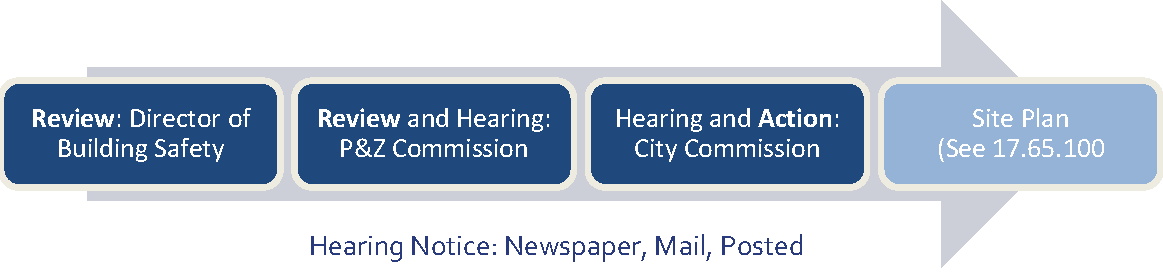
C.
Application Filing. Complete applications for development plan approval must be filed with the director of building safety concurrently with a zoning map amendment application.
D.
Review and Recommendation—Director of Building Safety. Following receipt of a complete application, including the required development plan, the director of building safety must prepare a report and recommendation. The report must evaluate the proposed development plan considering all applicable standards and approval criteria. The report must also include a description of any development plan modifications or conditions of approval that would help ensure the development plan complies with applicable standards and approval criteria. The director of building safety's report must be transmitted to the planning and zoning commission before the required public hearing.
E.
Notice of Hearing. Notice of the planning and zoning commission's required public hearing must be provided as follows (see 17.65.010.F for additional information on required newspaper, mail and posted notices).
1.
Newspaper Notice. Notice must be published in the newspaper at least fifteen days before the scheduled public hearing.
2.
Mailed Notice. Notice must be mailed to the owner of the subject property and all owners of property within one hundred feet of the subject property at least ten days before the scheduled public hearing.
3.
Posted Notice. Notice (signs) must be posted at least ten days before the scheduled public hearing.
F.
Hearing and Recommendation—Planning and Zoning Commission.
1.
Within sixty days of the date of filing of a complete application for development plan approval, the planning and zoning commission must hold a public hearing to consider the proposed development plan. Following the close of the public hearing, the planning and zoning commission must act to recommend that the proposed development plan be approved, approved with modifications, or denied.
2.
A development plan application recommended for approval or approval with modifications must be transmitted, with the report and recommendation of the planning and zoning commission, to the city commission within thirty days of the date of planning and zoning commission action.
3.
If the planning and zoning commission arrives at a tie vote, the application must be forwarded to the city commission with a notation of the tie vote.
G.
Final Action—City Commission.
1.
Following receipt of the planning and zoning commission's recommendation, the city commission must hold a public hearing on the development plan and act to approve the proposed development plan, approve the proposed development plan with modifications or deny the proposed development plan. The city commission is also authorized to remand the proposed development plan back to the planning and zoning commission for further consideration.
2.
In acting on mandatory development plans, the city commission is granted final decision-making authority on any conditional use, variance or other zoning authorization that would otherwise require approval by the planning and zoning commission. This "concurrent" approval authority is intended to avoid redundant and conflicting reviews. Concurrent approval authority does not extend to optional development plans.
3.
Development plans may be approved by a simple majority vote of a quorum, except that any accompanying zoning map amendment may require a super-majority vote, as stated in 17.65.030.G.
H.
Requirement for Filing of Site Plan.
1.
Unless a longer period or a phasing plan is approved at the time of approval of a mandatory development plan, a complete application for site plan approval must be filed within two years of the date of mandatory development plan approval. If an application for site plan approval is not filed within the time required, no further site plans may be approved for the project until the subject property owner has filed the original or amended development plan for re-review and reconsideration by the planning and zoning commission and city commission. Such re-review and reconsideration must follow the mandatory development plan review procedures of this UDO. Following re-review and reconsideration, the planning and zoning commission is authorized to recommend and the city commission is authorized to approve any of the following actions based on surrounding land use patterns and other relevant information presented at the time of reconsideration by the planning and zoning commission and city commission:
a.
An extension of time for filing a site plan;
b.
An amendment to the approved mandatory development plan; or
c.
Rezoning to another zoning district in accordance with the zoning map amendment procedures of 17.65.030.
2.
The site plan filing deadline established in 17.65.090.H.1 does not apply to optional development plans.
I.
Amendments to Approved Development Plans.
1.
Minor Amendments.
a.
The planning and zoning commission is authorized to approve amendments to approved development plans as minor amendments if the planning and zoning commission determines that substantial compliance is maintained with the approved development plan. The following is a non-exhaustive list of changes that may be considered as minor amendments:
(1)
Any deviation expressly authorized at the time of development plan approval;
(2)
The relocation or addition of customary accessory uses and structures;
(3)
Adjustment of internal development area boundaries, provided the allocation of land to uses and the relationship of uses within the project are not substantially altered;
(4)
Limitation or elimination of previously approved uses, provided the character of the development is not substantially altered;
(5)
Modification of the internal circulation system that would not increase points of access from adjacent streets, change access to another street or increase projected traffic volumes;
(6)
Lot splits that modify a recorded plat and that have been reviewed and approved, as required by the subdivision regulations;
(7)
Modifications to approved signage, provided the size, location, number and type of signs is not substantially altered;
(8)
Modification to approved screening and landscaping plans, provided the modification is not a substantial deviation from the original approved plan;
(9)
Changes reducing the number of permitted dwelling units, the amount of nonresidential floor area or the area covered by buildings or paved areas; and
(10)
Reductions in off-street parking or loading by more than ten percent or one space, whichever results in a greater reduction.
b.
In those cases when the city commission has expressly imposed a condition more restrictive than recommended by the planning and zoning commission, any amendment of that city commission-imposed condition must be reviewed and approved by the city commission.
c.
Notice of the planning and zoning commission's public hearing on a development plan minor amendment request must be provided at least fifteen days in advance of the hearing by mailing written notice to all owners of property within a one hundred-foot radius of the exterior boundary of the subject property. Notice (signs) must also be posted on the subject property at least ten days before the scheduled public hearing.
d.
If the planning and zoning commission determines that the proposed development plan amendment, if approved, will result in a significant departure from the approved development plan or otherwise significantly change the character of the subject area or that the cumulative effect of a number of minor amendments substantially alters the approved development plan, then the amendment must be deemed a major amendment to the development plan and processed as a new development plan following the development plan approval procedure of 17.65.090, including all requirements for fees, notices and hearings.
2.
Appeal of Development Plan Minor Amendment Decisions. An appeal from any development plan minor amendment decision by the planning and zoning commission may be taken by any person aggrieved, or any taxpayer or any officer, department, board or bureau of the city. Appeals are made to the city commission by filing notice of appeal with the director of building safety within ten days of the date of the decision being appealed. The appeal must specify the grounds of the appeal. Upon filing of the notice of appeal, the planning and zoning commission must transmit to the city commission, the original or certified copies of all the papers constituting the record in the case, together with the decision of the planning and zoning commission. The city commission must notify the applicant and all interested parties, as recorded in the minutes of planning and zoning commission, of the appeal hearing location, date and time.
3.
Major Amendments. Any amendment to an approved development plan that is not authorized as a minor amendment must be processed as a new development plan following the development plan approval procedure of 17.65.090, including all requirements for fees, notices and hearings.
(Ord. No. 2122-2019, § 3, 6-20-19).
17.65.100 - Site plans.
A.
Applicability. Site plan approval is required before the issuance of any permits for development or construction on any property included within the boundaries of any approved development plan and whenever a provision of this UDO expressly states that site plan approval is required.
B.
Application Filing. Complete applications for site plan approval must be filed with the director of building safety. At a minimum, the application must include a site plan, landscape plan and sign plan.
C.
Review and Action by Director of Building Safety; Appeals.
1.
Unless otherwise required by the city commission as a condition of approval of a development plan, the director of building safety is authorized to review and act on site plans. The director of building safety must approve the site plan if it complies (as applicable) with an approved development plan, all conditions of development plan approval and all applicable regulations of this UDO. If the submitted site plan does not comply with an approved development plan, any conditions imposed on that plan or applicable regulations of this UDO, the director of building safety must disapprove the site plan and advise the landowner in writing of the specific reasons for disapproval.
2.
If the director of building safety does not approve the site plan, the landowner may either: (1) resubmit the site plan to correct the plan's inconsistencies and deficiencies, or (2) within sixty days of the date of notice of disapproval, appeal the decision of the director of building safety by filing a notice of appeal with the director of building safety. If such an appeal is filed, the site plan must be reviewed by the planning and zoning commission following the hearing and notice requirements that apply to minor amendments of approved development plans (see 17.65.090.I.1.c). The planning and zoning commission's decision may be appealed following the procedures of 17.65.090.I.2.
D.
Effect of Approval. Approval of a site plan must occur before any building permits are issued. Site plan approval, in and of itself, does not constitute effective dedication of rights-of-way or any other public improvements, nor will the site plan be the equivalent of or an acceptable alternative to the final platting of land prior to the issuance of building permits.
(Ord. No. 2122-2019, § 3, 6-20-19).
17.65.110 - Conditional uses.
A.
Authorized Conditional Uses. Only those conditional uses expressly authorized in this UDO may be approved as conditional uses.
B.
Authority to File. Applications for conditional use approval may be filed only by the owner of the subject property or by the property owner's authorized agent.
FIGURE 65-4: CONDITIONAL USE PROCESS (GENERALLY)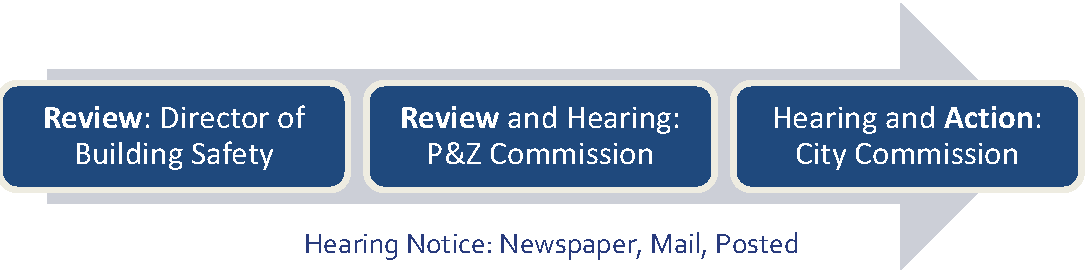
C.
Application Filing. Complete applications for conditional use approval must be filed with the director of building safety.
D.
Review and Recommendation—Director of Building Safety. Following receipt of a complete application, the director of building safety must prepare a report on the proposed conditional use. The report must be transmitted to the planning and zoning commission before the required public hearing.
E.
Notice of Hearing. Notice of the planning and zoning commission's required public hearing on a conditional use application must be provided as follows (see 17.65.010.F for additional information on required newspaper, mail and posted notices).
1.
Newspaper Notice. Notice must be published in the newspaper at least fifteen days before the scheduled public hearing.
2.
Mailed Notice. Notice must be mailed to the owner of the subject property and all owners of property within one hundred feet of the subject property at least ten days before the scheduled public hearing.
3.
Posted Notice. Notice (signs) must be posted at least ten days before the scheduled public hearing.
F.
Hearing and Recommendation—Planning and Zoning Commission.
1.
Following receipt of a complete application for conditional use approval, the planning and zoning commission must hold a public hearing on the conditional use application. Following the close of the public hearing, the planning and zoning commission must act to recommend that the proposed conditional use be approved, approved with conditions or denied.
2.
The planning and zoning commission's recommendation of the conditional use application must be transmitted to the city commission within fifteen days of the date of planning and zoning commission action.
3.
If the planning and zoning commission arrives at a tie vote, the application must be forwarded to the city commission with the notation of the tie vote.
G.
Final Action—City Commission.
1.
Following receipt of the planning and zoning commission's recommendation, the city commission must hold a public hearing on the conditional use application and act to approve the proposed conditional use, approve the proposed conditional use with conditions, or deny the proposed conditional use. The city commission is also authorized to remand the proposed conditional use application back to the planning and zoning commission for further consideration.
2.
Conditional uses may be approved by a simple majority vote of a quorum.
3.
In approving a conditional use, the planning and zoning commission is authorized to recommend and the city commission is authorized to impose such conditions and restrictions as determined to be necessary to ensure compliance with the standards of 17.65.110.H, to reduce or minimize the effect of the conditional use upon other properties in the area, and to better carry out the general purpose and intent of this UDO.
H.
Approval Criteria. In making recommendations and decisions on conditional use applications, review and decision-making bodies must consider all relevant factors, including at least the following:
1.
That the proposed use or activity is expressly authorized as a conditional use;
2.
That the proposed use will not be detrimental to the health, safety, or general welfare of persons residing or working in the vicinity;
3.
That approval of the conditional use will not impede the normal and orderly development and improvement of surrounding property for uses permitted in the district;
4.
That the proposed conditional use will be served by adequate utilities, access roads, parking, drainage and other important and necessary facilities, infrastructure and community services; and
5.
That the proposed special use complies with all applicable regulations of this UDO except as expressly approved in accordance with the procedures of this UDO.
I.
Lapse of Approval.
1.
An approved conditional use will lapse and become void one year after it is approved unless a building permit has been issued and the project has commenced and is diligently pursued to completion. If no building permit is required, the use, improvement or activity that is the subject of the conditional use must be in place within the one-year period.
2.
The city commission may extend the expiration period by up to one year at the time of approval of the conditional use or any time before expiration of the approval. Requests for extensions after the conditional use is approved must be processed in accordance with the conditional use procedures, including applicable fees, notices and public hearings.
J.
Transferability. Approved conditional uses run with the land and are not affected by changes of tenancy, ownership, or management.
K.
Amendments.
1.
Amendments to approved conditional uses must be processed as new conditional use applications, including all requirements for fees, notices and public hearings, provided that the director of building safety is authorized to approve the following:
a.
Any structures or uses authorized to be approved by the director of building safety at the time of conditional use approval; and
b.
The addition or relocation of customary accessory uses and structures.
2.
Applications for amendments to approved conditional uses must be filed in a form established by the director of building safety.
(Ord. No. 2122-2019, § 3, 6-20-19).
17.65.120 - UDO interpretations.
A.
Purpose and Applicability.
1.
Day-to-day responsibility for administering and interpreting the provisions of this UDO, including the zoning map, rests with the director of building safety, whose decisions may be appealed to the planning and zoning commission, in accordance with the procedures of 17.65.150.
2.
Occasionally, the UDO may not sufficiently address an issue that arises in administering or interpreting the UDO. In those cases, the director of building safety may elect to issue, or a citizen may file an application for, a written UDO interpretation to guide future decision-making. The procedures of this section govern the issuance of such interpretations. The procedures also govern interpretations of the terms of approved development plans and site plans, such as those associated with PUDs.
B.
Authority. The director of building safety is authorized to issue written interpretations pursuant to this section or to delegate that authority to the director of building safety or the director of building safety, based on which office has primary responsibility under this UDO for administering the provisions in question. The director of building safety is also authorized to refer the matter to the planning and zoning commission for an interpretation or for guidance in making an interpretation.
C.
Application. A complete application for a written interpretation request may be submitted to the director of building safety.
D.
Action. Within thirty days of receipt of a complete application, the director of building safety must: (1) review and evaluate the interpretation request considering the provisions that are the subject of the interpretation request and any other relevant documents, (2) consult with affected staff, and (3) prepare a written interpretation.
E.
Form. The interpretation must be provided to the applicant in writing and filed in the official record of interpretations.
F.
Official Record. The director of building safety must maintain an official record of written interpretations. The record of interpretations must be available for public inspection in the office of the director of building safety during normal business hours.
G.
Appeal of decision. Appeals of written interpretations issued pursuant to this section may be taken to the planning and zoning commission in accordance with the appeal procedures of 17.65.150.
(Ord. No. 2122-2019, § 3, 6-20-19).
17.65.130 - Administrative adjustments.
A.
Intent. Administrative adjustments are intended to provide a streamlined approval procedure for minor (de minimis) modifications of selected UDO regulations. Administrative adjustments are further intended to:
1.
Allow development and construction that is in keeping with the general purpose and intent of UDO regulations and the established character of the area in which the development or construction is located;
2.
Provide flexibility that will help promote rehabilitation and reuse of existing buildings when such flexibility will not adversely affect nearby properties or neighborhood character; and
3.
Provide flexibility for new construction when such flexibility is in keeping with the general purpose and intent of UDO regulations and will not adversely affect nearby properties or surrounding neighborhood character.
B.
Authorized Administrative Adjustments.
1.
Administrative adjustments may be granted only as expressly identified in this section.
a.
The director of building safety is authorized to approve an administrative adjustment reducing minimum lot width requirements by up to twenty percent.
b.
The director of building safety is authorized to grant an administrative adjustment reducing minimum required street setbacks by up to five feet.
c.
The director of building safety is authorized to grant an administrative adjustment reducing minimum required side and rear setbacks in any R district by up to twenty percent.
d.
The director of building safety is authorized to approve an administrative adjustment reducing minimum off-street parking requirements by up to one space or twenty percent, whichever is greater.
2.
The administrative adjustment procedures may not be used to vary, modify or otherwise override a condition of approval or requirement imposed by an authorized decision-making body.
C.
Authority to File. Administrative adjustment applications may be filed by the owner of the subject property or by the property owner's authorized agent.
D.
Application Filing. Complete applications for administrative adjustments must be filed with the director of building safety.
E.
Notice of Filing/Intent to Approve. The applicant is responsible for delivering written notice of application filing to all owners of property abutting the subject lot. The written notice must describe the nature of the requested administrative adjustment. It must also indicate the date on which the director of building safety will act on the application and that the application will be available for review and comment until that date. Any interested party may submit written comments concerning the application to the director of building safety.
F.
Action by Director of Building Safety.
1.
The director of building safety must review each application for an administrative adjustment and act to approve the application, approve the application with conditions, deny the application or refer the application to the planning and zoning commission for consideration as a variance.
2.
The director of building safety may not take final action to approve or deny an administrative adjustment application until at least five business days after the date of delivery of the required notices.
3.
The director of building safety decision to approve or deny an administrative adjustment must be based on the approval criteria and standards of 17.65.130.G and accompanied by written findings of fact.
4.
At least once per calendar year, the director of building safety must provide to the planning and zoning commission a list of all administrative adjustment decisions.
G.
Standards and Review Criteria. Administrative adjustments may be approved only when the director of building safety determines that the following general approval criteria and any specific criteria associated with the authorized administrative adjustment have been met:
1.
The requested administrative adjustment is consistent with all relevant purpose and intent statements of this UDO and with the general purpose and intent of the comprehensive plan;
2.
The requested administrative adjustment will not have a substantial or undue adverse effect upon adjacent property, the character of the area or the public health, safety and general welfare; and
3.
Any adverse impacts resulting from the administrative adjustment will be mitigated to the maximum extent feasible.
H.
Conditions of Approval. In granting an administrative adjustment, the director of building safety is authorized to impose conditions upon the subject property that are necessary to reduce or minimize any potentially adverse impacts on other property in the surrounding area, and to carry out the stated purpose and intent of this UDO.
I.
Lapse of Approval. An approved administrative adjustment will lapse and become void one year after it is granted by the director of building safety, unless a building permit for the work or improvements authorized has been issued and the project has commenced and is diligently pursued to completion. If no building permit is required, the improvement that is the subject of the administrative adjustment must be in place within the one-year period.
J.
Transferability. Approved administrative adjustments run with the land and are not affected by changes of tenancy, ownership, or management.
K.
Amendments. A request for changes in the specific nature of an approved administrative adjustment or changes to any conditions attached to an approved administrative adjustment must be processed as a new administrative adjustment application, including all requirements for fees and notices.
L.
Appeals. The applicant or any interested party may appeal the administrative adjustment decision of the director of building safety in accordance with the variance procedures of 17.65.150.
(Ord. No. 2122-2019, § 3, 6-20-19).
17.65.140 - Variances.
A.
Intent. A variance is a grant of relief to a property owner from strict compliance with the regulations of this UDO. The intent of a variance is not to simply remove an inconvenience or financial burden that may result from compliance with applicable zoning requirements. Variances are intended to help alleviate an unnecessary hardship or practical difficulty that would be caused by strict enforcement of the subject UDO requirements. They are intended to provide relief when the requirements of this UDO render property very difficult or impossible to put to reasonable use because of some unique or special characteristics of the property itself.
FIGURE 65-5: VARIANCE PROCESS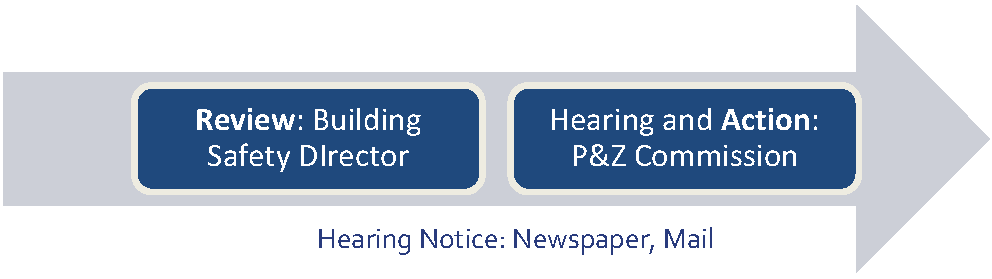
B.
Authorized Variances. The planning and zoning commission is authorized to grant a variance to any regulation in this UDO in accordance with the variance procedures of this section, except that the variance procedures may not be used to do any of the following:
1.
Allow a principal or an accessory use in a zoning district that is not otherwise allowed in that zoning district (i.e., "use variances" are prohibited);
2.
Allow an accessory use on a lot that is not occupied by the principal use that such accessory use serves;
3.
Waive, modify or amend any definition or use classification;
4.
Waive, modify or otherwise vary any of the review and approval procedures of this UDO;
5.
Waive, modify or otherwise vary any of the subdivision design and improvement regulations of Chapter 17.25;
6.
Waive, vary, modify or otherwise override a condition of approval or requirement imposed by an authorized decision-making body or the state or federal government; or
7.
Waive, vary or modify applicable residential density regulations, provided that this provision is not intended to prohibit variances to minimum lot area or width requirements that apply to lots occupied by a single dwelling unit.
C.
Authority to File. Variance applications may be filed only by the owner of the subject property or by the property owner's authorized agent.
D.
Application Filing. Complete applications for variances must be filed with the director of building safety.
E.
Review and Report—Director of Building Safety. Following receipt of a complete application, the director of building safety must prepare a report on the requested variance. The report must be transmitted to the planning and zoning commission before the required public hearing.
F.
Notice of Hearing. Notice of the planning and zoning commission's required public hearing on a variance application must be provided as follows (see 17.65.010.F for additional information on required newspaper and mail notices).
1.
Newspaper Notice. Notice must be published in the newspaper at least fifteen days before the scheduled public hearing.
2.
Mailed Notice. Notice must be mailed to the owner of the subject property and all owners of property within one hundred feet of the subject property at least ten days before the scheduled public hearing.
G.
Hearing and Final Decision—Planning and Zoning Commission.
1.
Following receipt of a complete variance application, the planning and zoning commission must hold a public hearing to consider the requested variance. Following the close of the public hearing, the planning and zoning commission must act to approve the requested variance, approve the variance with modifications and/or conditions, or deny the variance request based on the standards and review criteria of 17.65.140.H.
2.
In approving a variance, the planning and zoning commission is authorized to impose such conditions and restrictions as the board determines to be necessary to ensure compliance with the standards of 17.65.140.H, to reduce or minimize the effect of the variance upon other properties in the area, and to better carry out the general purpose and intent of this UDO.
H.
Standards and Review Criteria.
1.
No variance may be approved unless the planning and zoning commission determines that the following facts, favorable to the property owner, have been established:
a.
That the physical surroundings, shape, or topographical conditions of the subject property would result in unnecessary hardships or practical difficulties for the property owner, as distinguished from a mere inconvenience, if the strict letter of the regulations were carried out;
b.
That literal enforcement of the subject UDO provision is not necessary to achieve the provision's intended purpose;
c.
That the conditions leading to the need of the requested variance are unique to the subject property and not applicable, generally, to other property within the same zoning classification;
d.
That the alleged practical difficulty or unnecessary hardship was not created or self-imposed by the current property owner;
e.
That the variance to be granted is the minimum variance that will afford relief;
f.
That the variance to be granted will not alter the essential character of the neighborhood in which the subject property is located, nor substantially or permanently impair use or development of adjacent property; and
g.
That the variance to be granted will not cause substantial detriment to the public good or impair the purposes, spirit, and intent of this UDO or the comprehensive plan.
I.
Lapse of Approval.
1.
An approved variance will lapse and become void one year after it is granted by the planning and zoning commission, unless a building permit for the work or improvements authorized has been issued and the project has commenced and is diligently pursued to completion. If no building permit is required, the improvement that is the subject of the variance must be in place within the one-year period.
2.
The planning and zoning commission may extend the expiration period by up to one year at the time of approval of the variance or any time before expiration of the approval. Requests for extensions after the variance is approved must be processed in accordance with the variance procedures, including applicable fees, notices and public hearings.
J.
Transferability. Approved variances run with the land and are not affected by changes of tenancy, ownership, or management.
K.
Amendments. A request for changes in the specific nature of the approved variance or changes to any conditions attached to an approved variance must be processed as a new variance application, including all requirements for fees, notices and public hearings.
L.
Appeals. Planning and zoning commission decisions on variances may be appealed to district court in accordance with 17.70.060.
(Ord. No. 2122-2019, § 3, 6-20-19).
17.65.150 - Appeals of administrative decisions.
A.
Authority. Unless otherwise expressly stated in this UDO, the planning and zoning commission is authorized to hear and decide all other appeals where it is alleged there has been an error in any order, requirement, decision or determination made by the director of building safety or any other administrative official in the administration, interpretation or enforcement of this UDO.
FIGURE 65-6: APPEALS OF ADMINISTRATIVE DECISIONS
(GENERALLY)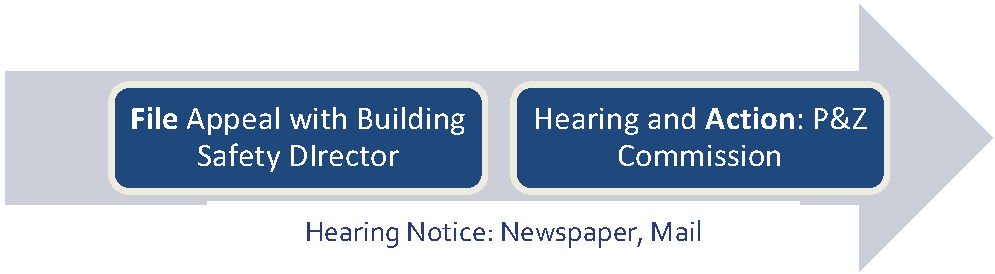
B.
Right to Appeal. Appeals of administrative decisions may be filed by any person aggrieved by the director of building safety's or other administrative official's decision or action. The planning and zoning commission is authorized to make determinations about whether individuals filing appeals are "aggrieved" by the decision or action.
C.
Application Filing.
1.
Complete applications for appeals of administrative decisions must be filed with the director of building safety and the administrative official who made the decision being appealed.
2.
Appeals of administrative decisions must be filed within ten days of the date of the decision being appealed.
D.
Effect of Filing. The filing of a complete notice of appeal stays all proceedings in furtherance of the action appealed, unless the director of building safety or the administrative official who made the decision being appealed certifies to the planning and zoning commission, after the appeal is filed, that, because of facts stated in the certification, a stay would cause immediate peril to life or property, in which case the proceedings will not be stayed unless by a restraining order, which may be granted by the planning and zoning commission or by a court of record based on due cause shown.
E.
Record of Decision. Upon receipt of a complete application of appeal, the director of building safety or other administrative official whose decision is being appealed must transmit to the planning and zoning commission all papers constituting the record related to decision being appealed.
F.
Notice of Hearing. Notice of the planning and zoning commission's required public hearing must be provided as follows (see 17.65.010.F for additional information on required newspaper and mail notices).
1.
Newspaper Notice. Notice must be published in the newspaper at least fifteen days before the scheduled public hearing.
2.
Mailed Notice. When an appeal affects a specific property, notice must be mailed to the owner of the subject property and all owners of property within one hundred feet of the subject property at least ten days before the scheduled public hearing.
G.
Hearing and Final Decision.
1.
The planning and zoning commission must hold a public hearing on the appeal.
2.
Following the close of the public hearing, the planning and zoning commission must make its findings and act on the appeal.
3.
In exercising the appeal power, the planning and zoning commission has all the powers of the administrative official from whom the appeal is taken. The planning and zoning commission may affirm, reverse, or modify the decision being appealed.
4.
In acting on the appeal, the planning and zoning commission must grant to the official's decision a presumption of correctness, placing the burden of persuasion of error on the appellant.
H.
Review Criteria. The decision being appealed may be reversed or wholly or partly modified only if the planning and zoning commission finds that the director of building safety, the director of building safety or other administrative official erred.
I.
Appeals. Planning and zoning commission decisions may be appealed to district court in accordance with 17.70.060.
(Ord. No. 2122-2019, § 3, 6-20-19).
17.65.160 - Reasonable accommodation.
A.
Purpose. For the purposes of this title, "reasonable accommodation" means providing an individual with a disability or developers of housing for individuals with a disability, flexibility in the application of zoning regulations (including the modification or waiver of certain requirements), when it is necessary to eliminate barriers to housing opportunities. The purpose of this section is to provide a procedure to request reasonable accommodation for persons with disabilities seeking equal access to housing under the Americans with Disabilities Act and the Federal Fair Housing Amendments in the application of this UDO.
B.
Application Filing.
a.
Applications for reasonable accommodation must be filed with the director of building safety.
b.
The application must include a detailed explanation of why the modification is reasonably necessary to make the specific housing available to a person with a disability, including information establishing that the applicant is disabled under applicable laws, as well as other information required by the director of building safety to make the determination. If the project for which the reasonable accommodation request is being made also requires an additional zoning approval, then the applicant must file the request concurrently with the application for such approval.
C.
Review and Approval. The director of building safety, in consultation with the city attorney, is authorized to consider and act on requests for reasonable accommodation. The director of building safety must issue a written decision in which the request is approved, approved subject to conditions, or denied. In making the decision, the following factors must be considered:
1.
Special need created by the disability;
2.
Potential benefit that can be accomplished by the requested modification;
3.
Need for the requested modification, including alternatives that may provide an equivalent level of benefit;
4.
Physical attributes of and any proposed changes to the subject property and structures;
5.
Potential impact on surrounding uses;
6.
Whether the requested modification would constitute a fundamental alteration of the zoning regulations, policies or procedures of the city;
7.
Whether the requested modification would impose an undue financial or administrative burden on the city; and
8.
Any other factor that may have a bearing on the request.
D.
Notice of Decision. The written decision of the director of building safety must be mailed to the applicant and to all owners of record of all properties abutting the property that is the subject of the reasonable accommodation request. All written decisions must give notice of the right to appeal a decision of the director of building safety in accordance with 17.65.150. The decision of the director of building safety constitutes the final decision of the city, unless appealed. Only the aggrieved applicant and abutting property owners who received notice of the written reasonable accommodation determination have a right to appeal the decision.
E.
Transfer. Approved requests for reasonable accommodation are granted to an individual and do not run with the land unless the director of building safety determines that the modification is physically integrated into the structure and cannot easily be removed or altered to comply with this UDO or the accommodation is to be used by another individual with a disability.
F.
Conditions and Guarantees. Before issuance of any permits relative to an approved reasonable accommodation request, the director of building safety is authorized to require the applicant to record a covenant acknowledging and agreeing to comply with the terms and conditions imposed.
(Ord. No. 2122-2019, § 3, 6-20-19).
17.65.170 - Beneficial use determination.
A.
Intent and Applicability.
1.
The procedures of this section are intended to provide a means of providing relief when the city commission determines that substantial economic hardship has arisen from the application of this unified development ordinance to private property located within the city of Clovis.
2.
The procedures of this section are further intended to allow objective and fair review of claims by private property owners that any such application of the city's zoning and development regulations requires appropriate relief, while at the same time preserving the ability of the city to lawfully regulate real property and fulfill its other duties and obligations to the citizens of Clovis.
3.
The provisions and procedures of this section must be followed to conclusion before seeking relief from the courts based upon a claim against the city that alleges denial of economically beneficial use of land.
B.
Application.
1.
General. After final action on an application is rendered by the decision-making body and all available appeals to other city bodies are exhausted, the subject property owner may file a beneficial use determination application with the director of building safety seeking relief from the regulations of this UDO on the basis that the city's action on the application has created a substantial economic hardship or resulted in an unconstitutional taking of private property.
2.
Timing. No later than thirty days after the date of final action by an authorized decision-making body, the applicant must file a notice of intent to file a beneficial use determination application in writing with the director of building safety. Within sixty days of the filing of a notice of intent, the applicant must file a complete beneficial use determination application with the director of building safety.
3.
Affected Property Interest. The beneficial use determination application must provide information sufficient for the city attorney to determine that the petitioner possesses a protectable interest in property under the Constitution of New Mexico and the Fifth Amendment to the United States Constitution.
4.
Supplemental Information. The nature of beneficial use determination procedure requires detailed financial information from a property owner that is not required for other applications. The following supplemental information must accompany all applications for a beneficial use determination. This information will not be made available for public inspection without the consent of the applicant:
a.
Price paid and other terms of sale for the subject property, the date of purchase, and the name of the party from whom purchased, including the relationship, if any, between the petitioner and the party from whom the property was acquired;
b.
Nature of the protectable interest claimed to be affected, such as, but not limited to, fee simple ownership or leasehold interest;
c.
Terms (including sale price) of any previous purchase or sale of a full or partial interest in the subject property by the current owner, applicant, or developer prior to the date of application;
d.
Complete copies of all appraisals of the property prepared for any purpose, including financing, offering for sale, or ad valorem taxation, in the three years before the date of application;
e.
The assessed value of and ad valorem taxes on the property for the three years before the date of application, including copies of the assessment notices;
f.
All information, including copies of the complete loan documents, concerning current mortgages or other loans secured by the property, including name of the mortgagee or lender, current interest rate, remaining loan balance and term of the loan and other significant provisions, including the right of purchasers to assume the loan;
g.
Complete copies of all listings of the property for sale or rent, price asked and offers received, if any, during the period of ownership or interest in the property;
h.
Complete copies of all studies commissioned by the petitioner or agents of the petitioner within the previous three years concerning feasibility of development or utilization of the property;
i.
For income-producing property, itemized income and expense statements from the property for the three years before application, including state and federal income tax returns;
j.
All available evidence and documentation of improvements, investments, or expenditures for professional and other services related to the property made during the three years before application;
k.
Information from a title policy or other source showing all recorded liens or encumbrances affecting the property; and
l.
All available information about use(s) of the property during the three years before application.
C.
Substantial Economic Hardship Standard. For purposes of this section, a "substantial economic hardship" is defined as a denial of all reasonable economic use of the property. Upon a finding that the regulations of this UDO have resulted in a denial of all reasonable economic use of the property or resulted in an unconstitutional taking of private property, the city may provide the petitioner with appropriate relief from the zoning or other land development regulations, as stated in this section.
D.
Review and Report—Director of Building Safety. Following receipt of a complete application, the director of building safety must prepare a report on the beneficial use determination. The report must be transmitted to the city commission before the required public hearing.
E.
Notice of Hearing. Notice of the city commission's required public hearing on a beneficial use determination application must be provided as follows (see 17.65.010.F for additional information on required newspaper and mail notices).
1.
Newspaper Notice. Notice must be published in the newspaper at least fifteen days before the scheduled public hearing.
2.
Mailed Notice. Notice must be mailed to the owner of the subject property and all owners of property within one hundred feet of the subject property at least ten days before the scheduled public hearing.
F.
Hearing and Final Decision—City Commission.
1.
Following receipt of a complete application, the city commission must hold a public hearing to consider the beneficial use determination request. Following the close of the public hearing, the city commission must act to grant or deny appropriate relief. Because takings law is constantly changing in both substance and interpretation, the city commission should be guided by advice from the city attorney regarding interpretations of appropriate considerations in its deliberations and what the measure of relief to be provided, if any, should be.
2.
Any relief to be provided a claimant must be limited to the minimum necessary to provide a reasonable, beneficial use of the subject property and may be in the form of alternative uses, additional development intensity or other such non-monetary, regulatory relief as is deemed appropriate by the city commission.
3.
Any relief granted will be presumed abandoned and expire if not utilized for its proper purpose within two years from the date it was granted.
4.
Any unexpired relief granted runs with the land and is not affected by changes of tenancy, ownership, or management.
(Ord. No. 2122-2019, § 3, 6-20-19).

