
Clovis City Zoning Code
CHAPTER 17
10 - RESIDENTIAL DISTRICTS
17.10.010 - Districts.
A.
List. The residential zoning districts are listed in Table 10-1. When this UDO refers to "residential" zoning districts or "R" districts, it is referring to these districts.
TABLE 10-1: RESIDENTIAL (R) ZONING DISTRICTS
B.
Purposes. Residential zoning districts are primarily intended to create, maintain and promote a variety of housing opportunities for individual households and to maintain and promote the desired physical character of existing and developing neighborhoods. While the districts primarily accommodate residential uses, some nonresidential uses are also allowed. The various R districts are primarily differentiated on the basis of allowed building types, density and lot and building regulations.
(Ord. No. 2122-2019, § 3, 6-20-19).
17.10.020 - Use regulations.
Principal uses are allowed in R districts in accordance with 17.30.010 (Table 30-1).
(Ord. No. 2122-2019, § 3, 6-20-19).
17.10.030 - Lot and building regulations.
A.
General.
1.
This section establishes basic lot and building regulations for all development in R districts. The regulations vary based on the zoning classification, building type and development type (conventional vs. cluster). These lot and building regulations are not to be interpreted as a guarantee that allowed densities and development yields can be achieved on every lot. Other factors, such as off-street parking requirements, central water and wastewater service availability, and other factors may work to further limit development potential on some sites.
2.
Two different development options (conventional and cluster) are offered in RS districts as a way of promoting a wide variety of neighborhood and lifestyle choices and to promote conservation of natural resources, including agricultural lands. The conventional and cluster development options, where allowed, may be used at the property owner's election.
B.
Table of Regulations for Conventional Development. "Conventional development" is any building or development that is not part of an approved cluster development. All conventional residential development and all nonresidential development in R districts must comply with the conventional lot and building regulations of Table 10-2, except as otherwise expressly stated in this UDO. General exceptions to these regulations and rules for measuring compliance can be found in Chapter 17.85. Additional regulations governing accessory uses and structures can be found in 17.30.030.
TABLE 10-2: LOT AND BUILDING REGULATIONS FOR
CONVENTIONAL DEVELOPMENT IN R DISTRICTS
C.
Table Notes.
[1]
No interior side setback is required for interior units in townhouse developments. Side setback applies to end units (see Figure 10-1).
FIGURE 10-1: SIDE SETBACKS FOR TOWNHOUSES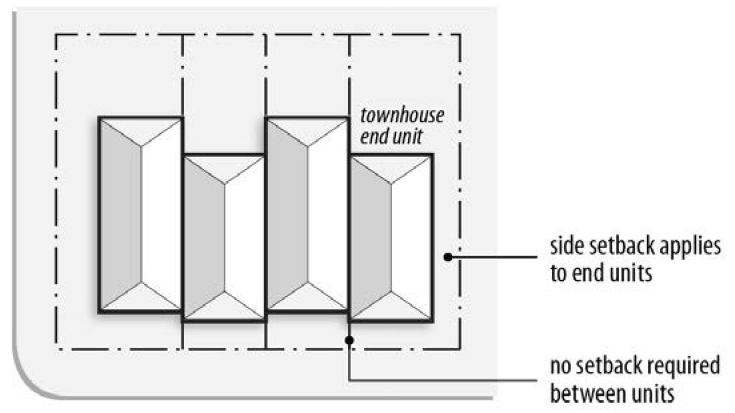
[2]
Minimum interior side setback is ten feet for apartment buildings and buildings occupied by nonresidential principal uses (e.g., schools, churches, fire stations).
[3]
Minimum rear setback is twenty-five feet for apartment buildings and buildings occupied by nonresidential principal uses (e.g., schools, churches, fire stations).
D.
Table of Regulations for Cluster Development.
1.
The cluster development option allows smaller lots and other flexible lot and building regulations in exchange for the provision of common open space that is not typically provided in a conventional development. Cluster residential development designs allow more compact and less costly networks of roads and utilities. They can also help reduce stormwater runoff and non-point source pollutant loading rates and can be used to preserve an area's semi-rural character.
2.
The cluster development option is allowed for residential development in RS districts only. All cluster residential development in RS districts must comply with the lot and building regulations of Table 10-3, except as otherwise expressly stated in this UDO. General exceptions to these regulations and rules for measuring compliance can be found in Chapter 17.85. Additional regulations governing accessory uses and structures can be found in 17.30.030. Additional cluster development regulations are included in 17.35.040.
TABLE 10-3: LOT AND BUILDING REGULATIONS FOR
RESIDENTIAL CLUSTER DEVELOPMENT IN R DISTRICTS
(Ord. No. 2122-2019, § 3, 6-20-19).
17.10.040 - Other relevant regulations.
Uses and structures in residential zoning districts may be subject to other regulations and standards, including the following:
A.
Accessory Uses and Structures. See 17.30.030.
B.
Parking. See Chapter 17.40.
C.
Stormwater Management. See 17.35.030.F.
D.
Detention/Retention. See 17.35.030.G.
E.
Signs. See Chapter 17.45.
F.
Landscaping and Screening. See Chapter 17.50.
G.
Outdoor Lighting. See 17.50.010.
H.
Nonconformities. See Chapter 17.75.
(Ord. No. 2122-2019, § 3, 6-20-19).

