
Coalinga City Zoning Code
CHAPTER 1
- INTRODUCTION
Article 2. - Definitions
Abandoned. A use that has ceased or a structure that has been vacated for a time period as specified in this title. Abandonment does not include temporary or short-term interruptions to a use or occupancy of a structure during periods of remodeling, maintaining, or otherwise improving or rearranging a facility.
Accessory building. See building, accessory.
Accessory dwelling unit or ADU. An attached or detached residential dwelling unit that provides complete independent living facilities for one or more persons and is located on a lot with a proposed or existing primary residence. An ADU must include permanent provisions for living, sleeping, eating, cooking, and sanitation on the same parcel that the single family or multifamily dwelling is or will be situated. An ADU may be an efficiency unit or a manufactured home, as defined. Accessory structure. A permitted structure that is accessory and incidental to a dwelling located on the same lot. .
Accessory use. See use, accessory.
Acre, gross. A measure of total land area of a lot or site, including areas to be dedicated for public rights-of-way, streets, schools, or other dedications.
Acre, net. A measure of land area of a lot or site remaining after dedication of all areas for public rights-of-way, streets, schools, or other dedications.
Adjacent. Contiguous, having a common border, boundary, or lot line. Lots or parcels of land that touch at corners only shall not be deemed adjacent. Includes properties directly across an alley.
Adjoining. See "adjacent".
Adult-oriented business. An establishment or concern that, as a regular and substantial course of conduct, offers, sells or distributes adult-oriented merchandise, or that offers to its patrons materials, products, merchandise, services, entertainment or performances that have sexual arousal, sexual gratification, and/or sexual stimulation as their dominant theme, or are characterized by an emphasis on specified sexual activities or specified anatomical areas and are not customarily open to the general public because they exclude minors by virtue of their age. This classification does not include any establishment offering professional services conducted, operated, or supervised by medical practitioners, physical therapists, nurses, chiropractors, psychologists, social workers, marriage and family counselors, osteopaths, and persons holding licenses or certificates under applicable State law or accreditation from recognized programs when performing functions pursuant to the respective license or certificate. Includes sexually oriented businesses. See Section 9-5.102, Adult-Oriented Businesses.
Affordable housing. Residential units for rent or sale which are intended for or restricted to households of very low, low and moderate income as defined by Sections 50079.5, 50093 and 50105 of the Health and Safety Code.
Agriculture. The art, science or practice of cultivating the ground, harvesting the crops, rearing and management of livestock, tillage, husbandry, farming, horticulture, and forestry.
Aggrieved person. Any person who, in person or through a representative, appeared at a City public hearing in conjunction with a decision or action appealed or who, by other appropriate means prior to a hearing, informed the local government of the nature of his or her concerns or who, for good cause, was unable to do either.
Aircraft sales, services and storage. Uses related to the rental, sales, manufacturing, maintenance, repair and storage of aircraft.
Alley. A public or private vehicular way typically providing a secondary means of access to adjoining property, and not meant to provide a through traffic route, the longitudinal boundaries of which are defined by property lines or easements.
Alteration. Any change, addition or modification that changes the exterior architectural appearance or materials of a structure or object. Alteration includes changes in exterior surfaces, changes in materials, additions, remodels, demolitions, and relocation of buildings or structures, but excludes ordinary maintenance and repairs. See also "structural alterations" for modifications to any of the supporting members of a structure.
Americans with Disabilities Act (ADA). United States Public Law 101-336, 104 Stat. 327 (July 26, 1990), codified at 42 U.S.C. Section 12101 et seq.
Ancillary. Accompanying, auxiliary.
Animal keeping. The raising of animals as an accessory use to a primary residential use. See Chapter 5, Article 1.104, Animal Keeping.
Animal raising. The raising, grazing, or feeding of animals for animal products, animal increase, or value increase, and dairying as an accessory use on farms with dairy cattle. It includes the raising of livestock, poultry and fish.
Animal-related terms.
Animal husbandry. The care and breeding of domestic farm animals such as cattle, hogs, sheep and horses.
Household pet. Any domesticated animal customarily permitted and kept in a dwelling and kept only for the company or pleasure provided to the occupants of the dwelling, such as a dog, cat, bird, rodent (including a rabbit), fish, reptile or turtle, to the extent allowed by California law.
Kennels. Facilities for keeping, boarding, training, breeding or maintaining for commercial purposes, four (4) or more dogs, cats, or other household pets not owned by the kennel owner or operator. This classification excludes pet shops and animal hospitals that provide twenty-four (24) hour accommodation of animals receiving medical or grooming services.
Livestock. Any domestic animals such as cattle, horses, donkeys, mules, burros, sheep, hogs, or goats. Includes fish.
Pet stores. Retail sales of animals and/or services, including grooming, for animals on a commercial basis. This classification excludes dog walking and similar pet care services not carried out at a fixed location, and excludes pet supply stores that do not sell animals or provide on-site animal services.
Veterinary services. Medical care for small animals on a commercial basis. This classification allows twenty-four (24) hour accommodation of animals receiving medical or grooming services but does not include kennels.
Apartment. A multiple residence with three (3) or more units, in which residential units are rented for a month or longer. See also residence, multiple.
Area, gross. The horizontal area within the boundaries of a lot or site including any area for future streets, parks, and other dedications.
Artists' studios. Work space for artists and artisans, including individuals practicing one of the fine arts or performing arts, or skilled in an applied art or craft. Incidental retail sales of items produced on the premises is required.
Assembly plant. A plant with an arrangement of machines, tools and workers assembled in a particular sequence along a direct line or route.
Authority. The appropriate person, official, or body designated to hear, grant, deny, modify, condition, revoke permits required by the Coalinga Zoning Ordinance.
Automobile/vehicle sales and services.
Automobile/vehicle rentals. Rental of automobiles, including storage and incidental maintenance.
Automobile/vehicle sales and leasing. Sales or leasing of automobiles, boats, motorcycles, trucks, and motor homes, including storage and incidental maintenance.
Automobile/vehicle repair, major. Repair of automobiles, trucks, motorcycles, motor homes, boats and recreational vehicles, including the sale, installation, and servicing of related equipment and parts, generally on an overnight basis. This classification includes auto repair shops, body and fender shops, transmission shops, wheel and brake shops, auto glass services, and tire sales and installation, but excludes vehicle dismantling or salvaging and tire retreading or recapping.
Automobile/vehicle service and repair, minor. The service and repair of automobiles, light-duty trucks, boats, and motorcycles, including the sale, installation, and servicing of related equipment and parts. This classification includes quick-service oil, tune-up and brake and muffler shops where repairs are made or service provided in enclosed bays and no vehicles are stored overnight. This classification excludes establishments providing engine repair, body and fender work, vehicle painting, or towing. It also excludes repair of heavy trucks or construction vehicles.
Automobile/vehicle washing. Washing, waxing, or cleaning of automobiles or similar light vehicles, including self-serve washing facilities.
Large vehicle and equipment sales, service and rental. Sales, servicing, rental, fueling, and washing of large trucks, trailers, tractors, and other equipment used for construction, agricultural, or landscape gardening activities. Includes large vehicle operation training facilities. Sales of new or used automobiles or trucks are excluded from this classification.
Service station. Establishments primarily engaged in retailing automotive fuels or retailing these fuels in combination with activities, such as providing repair services; selling automotive oils, replacement parts, and accessories; and/or providing food services.
Towing and impound. Establishments primarily engaged in towing light or heavy motor vehicles, both local and long distance. These establishments may provide incidental services, such as vehicle storage and emergency road repair services. (For automobile/dismantling, see salvage yards)
Balcony. A platform that projects from the wall of a building thirty (30) inches or more above grade.
Bakery. A shop where baked goods are made and/or sold.
Banks and financial institutions.
Banks and credit unions. Financial institutions providing retail banking services. This classification includes only those institutions engaged in the on-site circulation of money, including credit unions, but excluding check-cashing businesses.
Check cashing businesses. Establishments that, for compensation, engage in the business of cashing checks, warrants, drafts, money orders, or other commercial paper serving the same purpose. This classification also includes the business of deferred deposits, whereby the check casher refrains from depositing a personal check written by a customer until a specific date pursuant to a written agreement as provided in Civil Code 1789.31. Check Cashing Businesses do not include state or federally chartered banks, savings associations, credit unions, or industrial loan companies. They also do not include retail sellers engaged primarily in the business of selling consumer goods, such as consumables to retail buyers, that cash checks or issue money order incidental to their main purpose or business.
Bar. See eating, drinking and smoking establishments.
Base district. A zoning district that includes use, height, bulk, space, and development standards for the regulation of development in a particular area.
Bed and breakfast. A residence or commercial building with six (6) or fewer rooms, serving meals to registered guests for accommodation of travelers staying fewer than thirty (30) days.
Bedroom. Any room located within a dwelling unit that is used primarily for sleeping purposes by its residents and that contains at least seventy (70) square feet of floor area.
Rooms designated as a "den", "library", "study", "loft" or other extra room that satisfies this definition and is not a kitchen, living room, or bath will be considered a bedroom.
Bicycle parking, long-term. Bicycle parking that is designed to serve employees, students, residents, commuters, and others who generally stay at a site for four (4) hours or longer.
Bicycle parking, short-term. Bicycle parking that is designed to serve shoppers, customers, messengers, guests, and other visitors to a site who generally stay for a period of less than four (4) hours.
Block. All property fronting upon one side of a street, between intersecting and intercepting streets, or between a street and a railroad right-of-way, waterway, dead-end street or unsubdivided land.
Blockface. All property between two (2) intersections that fronts upon a street or is adjacent to a public right-of-way.
Boardinghouse. A residence where lodging or meals are provided to persons renting rooms for a month or longer.
Building. Any structure enclosed by a roof and by walls on three (3) or more sides, and having a fixed location upon the ground.
Building footprint. See footprint.
Building front. That portion of the main building which affords public entry. In the case of a building with more than one public entry, the entrance with the assigned address shall be considered the main public entry.
Building height. See height.
Building materials and services. Retailing, wholesaling, or rental of building supplies or equipment. This classification includes lumber yards, tool and equipment sales or rental establishments, and includes establishments devoted principally to taxable retail sales to individuals for their own use. This definition does not include contractors' yards and hardware stores less than 10,000 square feet in floor area (see retail sales).
Building, accessory. A subordinate building, the use of which is incidental to that of the main building on the same lot.
Building, main. The building in which the principal use on a lot is conducted.
Building Official. The Building Official is the City Manager or his or her designee. The Building Official is under general administrative direction, to manage and coordinate the activities of the building and inspection functions of the City; to assume responsibility for implementing City activities related to setting and ensuring compliance with building standards including plan check, inspection and zoning matters. Work may be conducted by the Building Official or his or her division staff.
Business. A commercial use involving the purchase, sale or other transaction involving the handling or disposition of any article, service, substance or commodity for livelihood or profit; or the management of offices, structures and premises; or the maintenance and use of recreational or amusement enterprises; or the maintenance and use of offices and facilities by professions and trades rendering service.
Business office. A building or part of a building in which one or more persons are employed primarily in the administration, management, or conducting of a business, sometimes incidental to other business activities.
Business services. Establishments that primarily provide goods and services to other businesses on a fee or contract basis, including printing and copying, blueprint services, computer services, data processing, accounting and bookkeeping, advertising and mailing, equipment rental and leasing, office security, custodial services, photo finishing, and model building, but excluding vehicle rentals, bulk items, or print shops.
Café. See eating and drinking establishments.
California Environmental Quality Act (CEQA). State law, pursuant to California Public Resources Code Section 21000 et. seq. or any successor statute, that requires public agencies to document and consider the environmental effects of a proposed action before a decision.
Card room. An establishment where legal gambling is conducted.
Caretaker. A person, living on-site, who is the owner, manager or any employee with responsibility for security, care of people, animals, equipment or other conditions on the property.
Caretaker residence. A living unit provided for an on-site caretaker.
Carport. An accessory structure that is roofed but permanently open on at least two (2) sides and maintained for the storage of motor vehicles.
Car wash. An establishment with mechanical facilities for washing motor vehicles including self service operations.
Cemetery. Establishments primarily engaged in operating sites or structures reserved for the interment of human or animal remains, including mausoleums, burial places, and memorial gardens.
Cinema/theaters. Facilities for indoor display of films, motion pictures, or dramatic, musical, or live performances. This classification may include incidental food and beverage services to patrons.
Large-scale. This classification includes large outdoor facilities such as amusement and theme parks, casinos, sports stadiums and arenas, racetracks, amphitheaters, drive-in theaters, driving ranges, golf courses, and facilities with more than 10,000 square feet in building area, including fitness centers, gymnasiums, handball, racquetball, or large tennis club facilities; ice or roller skating rinks; swimming or wave pools; miniature golf courses; bowling alleys; archery or indoor shooting ranges; riding stables; campgrounds; or stables. This classification may include restaurants, snack bars, and other incidental food and beverage services to patrons.
Small-scale. This classification includes small, generally indoor facilities that occupy less than 10,000 square feet of building area, such as billiard parlors, card rooms, health clubs, dance halls, small tennis club facilities, poolrooms, and amusement arcades. This classification may include restaurants, snack bars, and other incidental food and beverage services to patrons.
City. The City of Coalinga, California.
City Council. The City Council of the City of Coalinga.
City Engineer. The City Engineer of the City of Coalinga.
Clubs and lodges. Meeting, recreational, or social facilities of a private or nonprofit organization or association primarily for use by members or guests. This classification includes union halls and social clubs.
Cocktail lounge. A bar or area serving primarily alcoholic beverages, within a restaurant.
Code Enforcement Officer. A Code Enforcement Officer is defined under Section 2-4.113 of the City of Coalinga Municipal Code.
Coffee shop. See eating and drinking establishment.
Colleges and trade schools, public or private. Institutions of higher education providing curricula of a general, religious or professional nature, typically granting recognized degrees, including conference centers and academic retreats associated with such institutions. This classification includes business and computer schools, management training, technical and trade schools, but excludes personal instructional services such as music lessons.
Commercial entertainment and recreation. Provision of participant or spectator entertainment to the general public.
Commercial vehicle. Any vehicle currently registered as such with the state Department of Motor Vehicles or equivalent out-of-state or federal agency and is used primarily in the conduct of a business as opposed to private family or individual use. See Section 4-4.801 to 4-4.807 of the City of Coalinga Municipal Code.
Community center. Any noncommercial facility established primarily for the benefit and service of the population of the community in which it is located. Examples include youth centers and senior centers.
Community Development Director. The Community Development Director is the City Manager or his or her designee. The Community Development Director is under general administrative direction, to plan, direct, manage, and oversee the planning functions of the City; to assume responsibility for the enforcement of zoning, subdivision, and land use laws, ordinances, and regulations in accordance with the general plan; to provide consultation on planning issues to the City Council, Planning Commission, and other boards and advisory committees; and to do related work as required. Work may be conducted by the Community Development Director and his or her department staff.
Concession or Incentive. A regulatory incentive or concession as defined in Government Code Section 65915(k) that may include, but not be limited to, the reduction of site development standards or a modification of zoning code requirements, approval of mixed-use zoning in conjunction with the housing development, or any other regulatory incentive which would result in identifiable cost avoidance or reductions, that are offered in addition to a density bonus.
Condominium. An estate in real property consisting of an undivided interest in common in a portion of a parcel of real property, together with a separate interest in space in a residential or commercial building, such as an apartment or an office building. A condominium may include in addition a separate interest in other portions of such real property. Condominium, also refers to townhouses, cooperative housing, and similar residential developments.
Compatible. That which is harmonious with and will not adversely affect surrounding buildings and/or uses.
Condition of use. A development standard determined to be necessary to permit the harmonious classification of a use as listed in a district and therefore a prerequisite to place, or for application to place, such use as classified.
Conditionally permitted. Permitted subject to approval of a Conditional Use Permit or Site Plan Review.
Construction. Construction, erection, enlargement, alteration, conversion or movement of any building, structures, or land together with any scientific surveys associated therewith.
Construction and material yards. Storage of construction materials or equipment on a site other than a construction site.
Conversion. A change of a residential dwelling, including a mobile home lot in a mobile home park, as defined in Section 18214 of the Health and Safety Code, or a residential hotel, as defined in paragraph (1) of subdivision (b) of Section 50519 of the Health and Safety Code, to a condominium, cooperative, or similar form of ownership; or a change of a residential dwelling, including a mobile home lot in a mobile home park, or a residential hotel to a nonresidential use.
County. The County of Fresno, California.
Courtyard. An open, unoccupied space, unobstructed to the sky, other than a yard, on the same lot with a building or group of buildings and which is bounded on three (3) or more sides by such building or buildings.
Crop cultivation. The cultivation of tree, vine, field, forage, and other plant crops intended to provide food or fibers. The classification excludes wholesale or retail nurseries, vineyards and ancillary wineries and distilleries. This classification includes the indoor cultivation of cannabis.
Cultural institutions. Public or non-profit institutions engaged primarily in the display or preservation of objects of interest in the arts or sciences that are open to the public on a regular basis. This classification includes performing arts centers for theater, dance, and events; buildings of an educational, charitable or philanthropic nature; libraries; museums; historical sites; aquariums; art galleries; and zoos and botanical gardens.
Day care centers. Establishments providing non-medical care for persons on a less than 24-hour basis other than family day care home. This classification includes nursery schools, preschools, and day care facilities for children or adults, and any other day care facility licensed by the State of California.
Day care, commercial. A facility that regularly provides care, protection, and supervision for any number of persons as a principal business use of the site.
Day care, institutional. A facility that regularly provides care, protection, and supervision for any number of persons, and is operated in conjunction with and on the same site as a public or private school, church or other institutional use which is permitted and established in the district.
Family day care home. A home that regularly provides care, protection, and supervision for fourteen (14) or fewer children, in the provider's own home, for periods of less than twenty-four (24) hours per day, while the parents or guardians are away, and is either a large family day care home or a small family day care home as follows.
Family day care: small. A facility or home that for compensation regularly provides care, protection and supervision for six (6) or fewer children, not necessarily related to the caregiver in the caregiver's own home for periods of less than twenty-four (24) hours per day, while the parents or guardians are absent. Children under the age of ten (10) years who reside at the home shall be included when counting the number of children taken care of in the house (Health and Safety Code Section 1596.78(c)). See Section 9-5.110, Family Day Care Homes.
Family day care: large. A facility or home that for compensation regularly provides care, protection and supervision for up to twelve (12) children, not necessarily related to the caregiver in the caregiver's own home for periods of less than twenty-four (24) hours per day, while the parents or guardians are absent. Children under the age of ten (10) years who reside at the home shall be included when counting the number of children taken care of in the house (Health and Safety Code Section 1596.78(b)). See Section 9-5.110, Family Day Care Homes.
Deck. A platform, either freestanding or attached to a building, that is supported by pillars or posts. See also balcony.
Delicatessen. A shop that sells and/or serves cooked or prepared foods ready for eating.
Demolition. The intentional destruction and removal of any structure or portion thereof, including a residential dwelling, including a mobile home, as defined in Section 18008 of the Health and Safety Code, or a mobile home lot in a mobile home park, as defined in paragraph (1) of subdivision (b) of Section 50519 of the Health and Safety Code, which has not been declared to be a public nuisance under Division 13 (commencing with Section 17000) of the Health and Safety Code or any local ordinance enacted pursuant to those provisions.
Density. The number of dwelling units per unit of land area.
Density bonus. A density increase of up to those percentages specified in the State Density Bonus Law above the otherwise maximum residential density under the applicable zoning designation on the date the application is deemed complete.
Density bonus units. A residential unit granted pursuant to the provisions of this section that exceed the maximum residential density for the development site.
Development. Any manmade change to improved or unimproved real estate, including but not limited to the division of a parcel of land into two (2) or more parcels; the construction, reconstruction, conversion, structural alteration, relocation, or enlargement of any structure; any mining, excavation, landfill or land disturbance; and any use or extension of the use of land.
Development agreement. A contract duly executed and legally binding between the City of Coalinga and a developer(s) that delineates the terms and conditions agreed upon by two (2) or more parties.
Developmentally disabled rehabilitation facility. See residential care facility.
Disabled-inoperative vehicle. Any vehicle unable to run under its own power, unlicensed, or determined to be unsafe to operate. See Sections 5-1.01 to 5-1.15 of the City of Coalinga Municipal Code.
District. See zoning district.
Double frontage lot. See lot, through.
Drive-through facilities. Facilities designed to enable persons to receive a service or purchase or consume goods while remaining within a motor vehicle, typically associated with banks, eating, and drinking establishments, pharmacies, and other commercial uses.
Driveway. A vehicular access within private property leading from a public or private street to the principal structure, residence, garage, carport or parking area See Chapter 4, Article 3, Off Street Parking and Loading for requirements.
U-shaped driveways. A driveway type characterized by having a separate entrance and exit and a curved drive path and generally loops to form a "u" shape.
Dry cleaning establishments.
Drycleaning agency. For drop off and pick up only, no laundry or drycleaning equipment on premises.
Retail drycleaner. Dry cleaning establishment where the dry cleaning and laundry equipment is permitted on the premises and such services are performed on articles brought in directly from the customer to the establishment. This includes delivery of the articles to the retail customer where the drycleaning establishment directly processes such articles for such customer.
Wholesale drycleaning. A drycleaning establishment that has equipment on the premises, but on a much larger scale. This classification is for the establishments that process articles for several customers and do not have customer pickup.
Dwelling unit. A room or suite of rooms including one and only one kitchen, and designed or occupied as separate living quarters for one family. Dwellings include transitional and supportive housing. See also family.
Easement. A portion of land created by grant or agreement for specific purpose; an easement is the right, privilege or interest which one party has in the land of another.
Eating and drinking establishments. Businesses primarily engaged in serving prepared food and beverages for consumption on or off the premises.
Bars/night clubs/lounges. Businesses serving beverages for consumption on the premises as a primary use and including on-sale service of alcohol including beer, wine, and mixed drinks. This classification includes establishments that provide dancing or entertainment.
Coffee shops/cafés. Establishments that serve nonalcoholic beverages, such as coffee, tea, juices or sodas for consumption on or near the premises, or a specialty snack, such as ice cream, frozen yogurt, cookies or popcorn.
Restaurants. Establishments where meals are served to customers. This classification includes full-service restaurants with table service as well as establishments providing limited table service, such as fast-food restaurants, carryout sandwich shops, limited service pizza parlors and delivery shops, and delicatessen restaurants. This classification excludes establishments that provide dancing or entertainment (see bars/night clubs/lounges).
Effective date. The date on which a permit or other approval becomes enforceable or otherwise takes effective, rather than the date it was signed or circulated.
Efficiency unit. A unit that has the same meaning as defined in the California Building Code, California Code of Regulations, Title 24, Section 1207.4, which meets the following standards:
a.
The unit has a single living room of not less than 220 square feet of floor area for two (2) or fewer occupants and an additional 100 square feet of floor area for each additional occupant of the unit.
b.
The unit has a separate closet.
c.
The unit has a kitchen sink, cooking appliance and refrigeration facilities, each having a clear working space of not less than thirty (30) inches in front, and lighting and ventilation conforming to the California Building Standards Code.
d.
The unit has a separate bathroom containing a water closet, lavatory, and bathtub or shower.
Electric vehicles. The following definitions shall define terms related to electric vehicles:
Automatic Load Management Systems (ALMS). A control system which allows multiple EV chargers or EV-Ready electric vehicle outlets to share a circuit or panel and automatically reduce power at each charger, providing the opportunity to reduce electrical infrastructure costs and/or provide demand response capability. ALMS systems must be designed to deliver at least 1.4kW per charger to each EV Capable, EV Ready, or EVCS space served by ALMS. The connected amperage on-site shall not be lower than the required connected amperage per Part 11, 2019 California Green Building Code for the relevant building types.
Electric vehicle capable space. A parking space linked to a listed electrical panel with sufficient capacity to provide at least 208/240 volts and 40 amperes to the parking space. Raceways linking the electrical panel and parking space only need to be installed in spaces that will be inaccessible in the future, either trenched underground or where penetrations to walls, floors, or other partitions would otherwise be required for future installation of branch circuits. Raceways must be at least one inch in diameter and may be sized for multiple circuits as allowed by the California Electrical Code. The panel circuit directory shall identify the overcurrent protective device space(s) reserved for EV charging as "EV CAPABLE." Construction documents shall indicate future completion of raceway from the panel to the parking space, via the installed inaccessible raceways.
Electric Vehicle Charging Station (EVCS). A parking space that includes installation of electric vehicle supply equipment (EVSE) with a minimum capacity of 30 amperes connected to a Level 2 EV Ready Space. EVCS installation may be used to satisfy a Level 2 EV Ready Space requirement.
Level 1 EV Ready Space. A parking space served by a complete electric circuit with a minimum of 120-volt, 20-ampere capacity including electrical panel capacity, overprotection device, a minimum 1"-diameter raceway that may include multiple circuits as allowed by the California Electrical Code, wiring, and either a receptacle labelled "Electric Vehicle Outlet" with at least a ½" font adjacent to the parking space or EVSE.
Level 2 EV Ready Space. A parking space served by a complete electric circuit with 208-240-volt, 40-ampere capacity including electrical panel capacity, overprotection device, a minimum 1"-diameter raceway that may include multiple circuits as allowed by the California Electrical Code, wiring, and either a receptacle labelled "Electric Vehicle Outlet" with at least a ½" font adjacent to the parking space or EVSE with a minimum output of thirty (30) amperes.
Level 3 EV Ready Space. A parking space served by a complete electric circuit with a minimum 400-volt capacity including electrical panel capacity, overprotection device, a minimum 1- diameter raceway that may include multiple circuits as allowed by the California Electrical Code, wiring, and a receptacle labelled "Electric Vehicle Outlet" with at least a ½" font adjacent to the parking space or 400-volt EVSE.
Emergency. A sudden unexpected occurrence demanding immediate action to prevent or mitigate loss or damage to life, health, property or essential public services.
Emergency shelters. Housing with minimal supportive services intended for use by homeless persons that is limited to occupancy of six (6) months or less. No individual or household may be denied emergency shelter because of an inability to pay (Health and Safety Code Section 50801(e)). Jurisdictions are required to identify applicable zoning districts and implement standards relating to emergency shelters in compliance with Government Code Section 65583. Emergency shelters shall also include other interim interventions, including but not limited to, low barrier navigation centers, bridge housing, and respite or recuperative care. See Section 9-5.109, Emergency Shelters.
Employee and Farmworker housing serving six (6) or fewer persons. As set forth in California Health and Safety Code Section 17008, including temporary mobile homes and any attached or detached dwelling unit used to house farm or agricultural workers and their family members. Employee housing for six (6) or fewer persons is treated as a single-family structure and residential use as described in California Health and Safety Code Sections 17021.5.
Employee and Farmworker housing serving group quarters. As set forth in California Health and Safety Code Section 17008, including temporary mobile homes, and any attached or detached dwelling unit used to house farm or agricultural workers and their family members. Employee housing consisting of no more than thirty-six (36) beds in group quarters (or twelve (12) units or less) designed for use by a single family or household is treated as agricultural use as described in California Health and Safety Code 17021.6.
Environmental Impact Report (EIR). An Environmental Impact Report as required under the California Environmental Quality Act, Public Resources Code Section 21000 et. seq.
Facade. The exterior wall of a building exposed to public view or that wall viewed by persons not within the building. The portion of any exterior elevation of a building extending vertically from the grade to the top of a parapet wall or eave, and horizontally across the entire width of the building elevation.
Family. One or more individuals occupying a dwelling unit with common access to, and common use of, living and eating areas and facilities for the preparation and storage of food within the dwelling unit.
Farmers' market. A building, structure or site used to sell fruit and vegetables to the general public, typically on a weekly or occasional basis.
Fence. An artificially-constructed barrier of any material or combination of materials erected to enclose or screen an area of land. An open fence is one that is composed of at least fifty (50) percent open spaces and no more than fifty (50) percent solid materials. This includes wrought iron style or tubular steel fences. Solid fences are those that obstruct the view of objects on either side and may be made of masonry, wood, or other materials.
Feasible. Capable of being accomplished in a successful manner within a reasonable period of time, taking into account economic, environmental, social and technological factors.
Feed yard. A tract of land, structure, pen or corral, wherein cattle, horses, sheep, goats and swine are maintained for the purpose of fattening for final shipment to market.
Financial institution. A bank, trust company, finance company, mortgage company, investment company or similar institution.
Firearms. Includes rifles, shotguns, revolvers, pistols, or any other device designed to be used as a weapon from which a projectile is expelled by the force of any explosion or other form of combustion. The frame, body and/or receiver also constitute firearms. (Certain provisions in the Penal Code also consider firearms to include rockets, rocket propelled projectile launcher, or similar devices containing explosive or incendiary material. See California Penal Code Sections 12001, 12025, and 12031.)
Flea market. A building or open space area where individual sellers offer goods, new and used for sale to the public.
Floor area. The total floor area in a building (including basements, mezzanines, interior balconies, and upper stories or levels in a multistory building) unless otherwise stipulated; e.g., "ground" floor area.
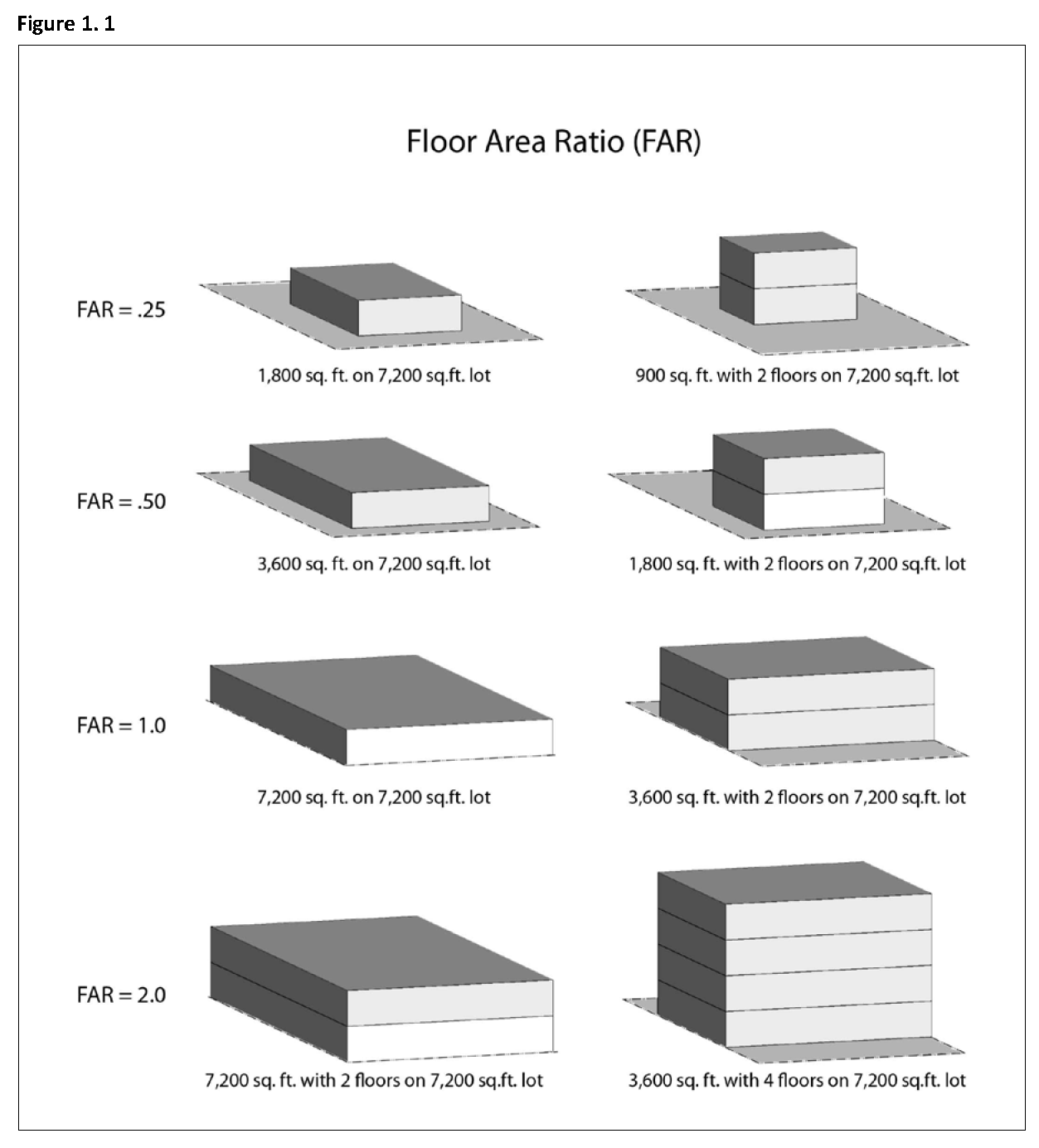
Floor area ratio (FAR). The ratio of the total floor area of all buildings on a lot to the lot area.
Food and beverage retail sales. Retail sales of food and beverages for off-site preparation and consumption. Typical uses include food markets, convenient markets, groceries, liquor stores, and retail bakeries.
Food processing plant. A facility that combines, processes, packages, and ships food from an enclosed or primarily enclosed warehouse.
Foot-candle. See lighting terms.
Footprint. The horizontal area, as seen in plan view, of a building or structure, measured from the outside of exterior walls and supporting columns, and excluding eaves.
Foster group home. A household in which orphaned or delinquent children are placed typically by a social-service agency. See group home.
Freight/truck terminals and warehouses. Facilities for local or worldwide freight, courier, local messenger, and postal services by truck or rail.
Frontage, street (frontage, lot). That portion of a lot or parcel of land that borders a public street. "Street frontage" shall be measured along the common lot line separating said lot or parcel of land from the public street, highway, or parkway.
Funeral parlors and mortuaries. An establishment primarily engaged in the provision of services involving the care, preparation, or disposition of the human dead and conducting memorial services. Typical uses include a crematory, columbarium, mausoleum, or mortuary.
Garage. A building or portion of a building that is enclosed and roofed and designed for the storage of motor vehicles.
Garage sale. Sale of secondhand items on private premises occupied for residential purposes. Includes yard sale, rummage sale, patio sale, estate sale, or any other sale offering personal property and similarly conducted on property occupied for residential purposes.
Gas station. A retail establishment at which vehicles are fueled.
General Plan. The general plan of the City of Coalinga, including all of its elements.
Glare. The effect produced by a light source within the visual field that is sufficiently brighter than the level to which the eyes are adapted, such as to cause annoyance, discomfort or loss of visual performance and ability.
Golf courses and country clubs. Golf courses, and accessory facilities and uses including: clubhouses with bar and restaurant, locker and shower facilities; driving ranges; shops for on-site sales of golfing equipment; and golf cart storage and sales facilities. Please refer to Section 9-5.111, Golf Courses and Country Clubs.
Government offices. Administrative, clerical, or public contact offices of a government agency, including postal facilities, together with incidental storage and maintenance of vehicles. This classification excludes corporation yards, equipment service centers, and similar facilities that primarily provide maintenance and repair services and storage facilities for vehicles and equipment (See utilities, major).
Grocery store. A business primarily for the selling of food products.
Gross leasable area. The total floor area for which a tenant pays rent and that is designed for the tenant's occupancy and exclusive use, including any basements and mezzanines.
Ground floor. The first floor of a building other than a cellar or basement.
Group home. Shared living quarters without separate kitchen or bathroom facilities for each room or unit, offered for rent for permanent or semi-transient residents on a weekly or longer basis. This classification includes rooming and boarding houses, correctional facilities, dormitories, foster group homes, and private residential clubs but excludes hotels and motels, and residential care facilities. All facilities that require State licensing are required to obtain the respective State licenses prior to the start of operations. Individual zoning districts have additional regulations. See Chapter 2.
Group quarters. See group home.
Group residential. See group home.
Guest house. Detached living quarters of a permanent type of construction and without kitchen or cooking facilities, for the use of which no compensation in any form is received or paid.
Guest room. A room for the overnight accommodation of travelers for which compensation is received.
Handicraft/custom manufacturing. Manufacture of crafts, art, sculpture, stained glass, jewelry, apparel, and similar items using hand tools and small mechanical devices.
Hazardous materials. Any material, including any substance, waste, or combination thereof, which because of its quantity, concentration, or physical, chemical, or infectious characteristics may cause, or significantly
contribute to, a substantial present or potential hazard to human health, safety, property, or the environment when improperly treated, stored, transported, disposed of, or otherwise managed.
Hazardous waste management facility. A facility that stores, treats, or disposes of refuse designated as hazardous waste(s) by the Hazardous Waste Control Law (Health and Safety Code, Division 20, Chapter 6.5). Hazardous waste management facilities must be permitted or granted authorization to operate from the California Department of Toxic Substances Control.
Health club. A facility that includes, but is not limited to: game courts, exercise equipment, locker rooms, a pool and a sauna.
Heat. Thermal energy of a radioactive, conductive, or convective nature.
Hedge. A row of closely planted shrubs or low growing trees forming a fence or boundary.
Height. The vertical distance from the highest point of any structure to the ground level directly below. See also Section 9-4.205, Heights and Height Exceptions.
Highway. A major through street for vehicular travel. "Highway" includes street, connecting regional destinations.
Home business. See home occupations.
Home occupations. Any occupation conducted by a resident, entirely within a dwelling, where the use is clearly incidental and secondary to the residential use of the structure, and does not change the residential character of the neighborhood. See Section 9-5.113, Home Occupations.
Hospitals and clinics. State-licensed facilities providing medical, surgical, psychiatric, or emergency medical services to sick or injured persons. This classification includes facilities for inpatient or outpatient treatment, including substance-abuse programs as well as training, research, and administrative services for patients and employees. This classification excludes veterinaries and animal hospitals (see animal care, sales, and services) and medical marijuana dispensaries.
Hotels and motels, establishments offering lodging to transient patrons. These establishments may provide additional services, such as conference and meeting rooms, restaurants, bars, or recreation facilities available to guests or to the general public. This classification includes motor lodges, motels, hostels, extended-stay hotels, and tourist courts, but does not include rooming houses, boarding houses, or private residential clubs.
Household. A group of persons, which can include the members of a family, living together in a single dwelling unit, with common access to, and common use of, all living and eating areas and all areas and facilities for the preparation and storage of food within the dwelling unit. Housing development. A development project for five (5) or more residential units, including mixed-use developments, that meets the requirements of Government Code section 65915(i).
Housekeeping unit. See household.
Illegal use. Any use of land or building that does not have the currently required permits and was originally constructed and/or established without permits required for the use at the time it was brought into existence.
Impact fee. A fee that has the same meaning as the term "fee" is defined in Government Code section 66000(b), except that it also includes fees specified in Government Code section 66477. "Impact fee" does not include any connection fee or capacity charge. Industry, general. Manufacturing of products from extracted or raw materials or recycled or secondary materials, or bulk storage and handling of such products and materials. This classification includes operations such as biomass energy conversion; food and beverage processing; textile mills; production apparel manufacturing; photographic processing plants; leather and allied product manufacturing; wood product manufacturing; paper manufacturing; chemical manufacturing; plastics and rubber products manufacturing; nonmetallic mineral product manufacturing; primary metal manufacturing; fabricated metal product manufacturing; recycling materials processing facilities in which post-consumer materials are sorted, condensed, baled, or transformed; and automotive, ship, aircraft, and heavy equipment manufacturing.
Industry, limited. Establishments engaged in light industrial activities taking place primarily within enclosed buildings and producing minimal impacts on nearby properties. This classification includes operations such as manufacturing finished parts or products primarily from previously prepared materials; commercial laundries and dry cleaning plants; mobile home manufacturing; monument works; printing, engraving and publishing; computer and electronic product manufacturing; furniture and related product manufacturing; and industrial services. This classification includes the cultivation, processing, extraction, manufacturing, testing, distribution, and transportation of cannabis and cannabis products.
In-lieu fees. A cash payment required as a substitute for a dedication and/or improvement of land by an owner or developer of property.
Instructional services. Establishments that offer specialized programs in personal growth and development such as music, vocal, fitness and dancing instruction.
Intensity of use. The impacts a particular use or the use in combination with other uses has on its surroundings or on its demand for services and natural resources. Measures of intensity include but are not limited to requirements for water, gas, electricity, or public services; number of automobile trips generated by a use; parking demand; number of employees on a site; hours of operation; the amount of noise, light or glare generated; the number of persons attracted to the site, or, in eating establishments, the number of seats.
Intermediate care facility. See residential care facility.
Intersection, street. The area common to two (2) or more intersecting streets.
Junior accessory dwelling unit or JADU A dwelling unit that is no more than 500 square feet in size and contained entirely within the walls of a proposed or existing single-family residence, or other approved structure as specified in Government Code section 65852.2(e). A JADU must include the following features:
a.
Exterior access separate from the main entrance to the proposed or existing primary dwelling or other structure.
b.
An efficiency kitchen, which includes a cooking facility with appliances and a food preparation counter and storage cabinets that are of reasonable size in relation to the size of the JADU.
c.
A JADU may include separate sanitation facilities or may share sanitation facilities with the existing structure. Junkyard. A lot used for the sale or storage of junk, including scrap metals, salvage or other materials, or for the dismantling or wrecking of automobiles or other vehicles or machinery, whether for sale or storage.
Kitchen. Any room or space within a building intended to be used for the cooking or preparation of food.
Landscaping. The planting, configuration and maintenance of trees, ground cover, shrubbery and other plant material, decorative natural and structural features (walls, fences, hedges, trellises, fountains, sculptures), earth patterning and bedding materials, and other similar site improvements that serve an aesthetic or functional purpose.
Landscaping terms.
Automatic controller. A mechanical or solid state timer, capable of operating valve stations to set the days and length of time of a water application.
Backflow prevention device. A safety device used to prevent pollution or contamination of the water supply due to the reverse flow of water from the irrigation system.
Anti-drain or check valve. A valve located under a sprinkler head or other location in the irrigation system to hold water in the system and prevent drainage from sprinkler heads when the system is off.
Controller. An automatic timing device used to remotely control valves to set an irrigation schedule.
Emitter. A drip irrigation fitting emission device that delivers water slowly from the system to the soil.
Hydrozone. A portion of the landscaped area having plants with similar water needs.
Irrigation efficiency. The measurement of the amount of water beneficially used divided by the amount of water applied. Irrigation efficiency is derived from measurements and estimates of irrigation system characteristics and management practices.
Operating pressure. The pressure at which an irrigation system is designed by the manufacturer to operate.
Overspray. The water which is delivered beyond the landscaped area and causes overland flow during irrigation events onto non-targeted areas such as, pavements, walks and structures.
Runoff. Water which is not absorbed by the soil or landscape to which it is applied and flows from the landscape area.
Library. A building containing books and other media for public use.
Light fleet-based services. Passenger transportation services, local delivery services, medical transport, and other businesses that rely on fleets of three (3) or more vehicles with rated capacities less than 10,000 lbs. This classification includes parking, dispatching, and offices for taxicab and limousine operations, ambulance services, non-emergency medical transport, local messenger and document delivery services, home cleaning services, and similar businesses. This classification does not include towing operations (See automobile/vehicle sales and service, towing and impound) or taxi or delivery services with two (2) or fewer fleet vehicles on-site (See business services).
Liquor. Alcoholic beverages including but not limited to: all types of beer, wine, and distilled spirits or fruit juices containing at least one-half (½) of one percent or more of alcohol by volume.
Lighting Terms.
Foot-candle. A quantitative unit of measure for luminance. One foot-candle is equal to the amount of light generated by one candle shining on one square foot surface located one foot away. Equal to one lumen uniformly distributed over an area of one square foot.
Light fixture. The assembly that holds a lamp and may include an assembly housing, a mounting bracket or pole socket, a lamp holder, a ballast, a reflector or mirrors, and a refractor or lens.
Light fixture cutoff. Light fixtures are classified as full cutoff, cutoff, semi-cutoff, or non-cutoff according to the most recent adopted criteria of the Illuminating Engineering Society of North America (IESNA). The four (4) IESNA classifications are defined as follows (IESNA 2000):
Full cutoff. The luminous intensity (in candelas) at or above an angle of ninety (90) degrees above nadir is zero (0), and the luminous intensity (in candelas) at or above a vertical angle of eighty (80) degrees above nadir does not numerically exceed ten (10) percent of the luminous flux (in lumens) of the lamp or lamps in the luminaire.
Cutoff. The luminous intensity (in candelas) at or above an angle of ninety (90) degrees above nadir does not numerically exceed two and one-half (2.5) percent of the luminous flux (in lumens) of the lamp or lamps in the luminary, and the luminous intensity (in candelas) at or above a vertical angle of eighty (80) degrees above nadir does not numerically exceed ten (10) percent of the luminous flux (in lumens) of the lamp or lamps in the luminary.
Semi-cutoff. The luminous intensity (in candelas) at or above an angle of ninety (90) degrees above nadir does not numerically exceed five (5) percent of the luminous flux (in lumens) of the lamp or lamps in the luminary, and the luminous intensity (in candelas) at or above a vertical angle of eighty (80) degrees above nadir does not numerically exceed twenty (20) percent of the luminous flux (in lumens) of the lamp or lamps in the luminary.
Non-cutoff. There is no candela limitation in the zone above maximum candela.
Shielded fixture. Outdoor light fixtures shielded or constructed so that light rays emitted by the lamp are projected below the horizontal plane passing through the lowest point on the fixture from which light is emitted.
Live/work unit. A building specifically designed to accommodate both a residence and the business activity of the resident in a single ownership or rental unit.
Living area. An interior habitable area of a dwelling unit, including basements and attics, does not include a garage or any accessory structure.
Lodge. A facility used by an association of persons, whether incorporated or not, united by some common interest, meeting periodically for cooperation or conviviality. See also club.
Long-term parking. A situation in which a vehicle is not normally moved during the period of an employee's work shift, as opposed to customer or visitor parking.
Lot. A parcel, tract, or area of land whose boundaries have been established by a legal instrument such as a recorded deed or a recorded map. A lot constitutes a legal entity for purposes of transfer of title, except public easements or rights-of-way.
Lot area. The total area circumscribed by the boundaries of a lot, excluding any street rights-of-way.
Lot coverage. The portion of a lot that is covered by structures, including principal and accessory buildings, garages, carports, and roofed porches, but not including unenclosed and unroofed decks, landings, patios, or balconies. See also Section 9-4.102, Determining Lot Area and Coverage.
Lot depth. The average distance between the front and rear lot lines, measured at a right angle to the front lot line. See also Section 9-4.104, Measuring Lot Width and Depth.
Lot frontage. See frontage, street.
Lot line. A property line separating adjoining properties or a property from an adjoining right-of-way.
Lot line types.
Front lot line. The lot line that is immediately next to a street or public right-of-way. For corner lots, the shortest side fronting a public street is considered the front lot line regardless of which street is used for vehicle or pedestrian access, or street address.
Interior lot line. Any lot line that is not adjacent to a street.
Rear lot line. The lot line that is opposite and most distant from the front lot line. Where no lot line is within forty-five (45) degrees of being parallel to the front lot line, a line ten (10) feet in length within the lot, parallel to and at the maximum possible distance from the front lot line, will be deemed the rear lot line for the purpose of establishing the minimum rear yard.
Side lot line. Any lot line that is not a front or rear lot line.
Street side lot line. A side lot line of a corner lot that is adjacent to a street.
Lot types.
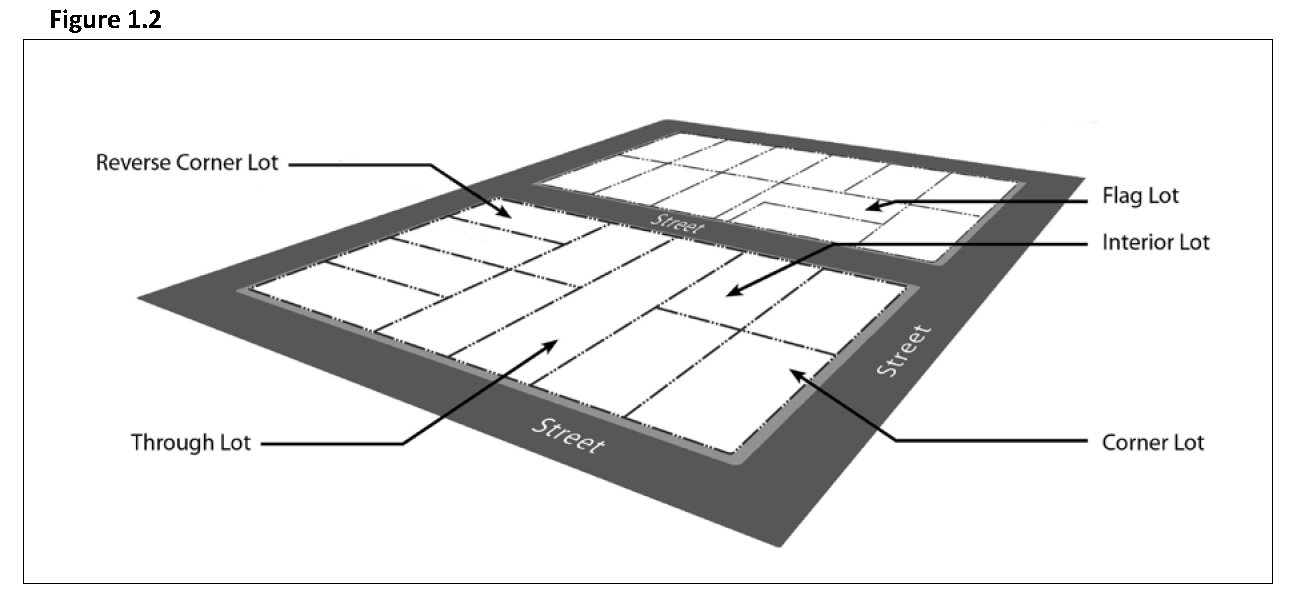
Lot, corner. A lot or parcel situated at the intersection of two (2) or more streets that have an angle intersection measured within said lot or parcel of not more than 135 degrees.
Lot, reverse corner. A corner lot, the rear of which abuts the side of another lot, and its side lot line being substantially a continuation of the front lot line of the lot directly to its rear.
Lot, flag. A lot which has as its primary legal access from the highway through a narrow strip of land not suited for the typical subdivision development standards.
Lot, interior. A lot or parcel of land other than a corner or flag lot.
Lot, through. An interior lot having frontage on two (2) parallel or approximately parallel streets.
Lot width. The distance between the side lot lines, measured at a right angle to the lot depth at the midpoint of the lot depth line. See also Section 9-4.104, Measuring Lot Width and Depth.
Lounge. See eating, drinking and smoking establishments.
Low-Barrier Navigation Centers. A housing-first, low-barrier, service-enriched shelter focused on moving people into permanent housing that provides temporary living facilities while case managers connect individuals experiencing homelessness to income, public benefits, health services, shelter, and housing. Low-Income Household. A household whose income does not exceed the low-income limits applicable to Los Angeles County, as published and periodically updated by the State Department of Housing and Community Development pursuant to Health and Safety Code Section 50079.5.
Maintenance and repair of structures. The repair or replacement of nonbearing walls, fixtures, wiring, roof or plumbing that restores the character, scope, size or design of a structure to its previously existing, authorized, and undamaged condition.
Maintenance and repair services. The on-site maintenance or repair of office machines, household appliances, furniture, and similar items. This classification excludes maintenance and repair of vehicles or boats (see automotive sales and services) and personal apparel (See personal services).
Manufactured home. A structure constructed on or after June 15, 1976 in compliance with state standards in effect at the time of construction, is transportable in one or more sections, is built on a permanent chassis and designed to be used as a single-family dwelling with or without a foundation system when connected to the required utilities, and includes the plumbing, heating, air conditioning, and electrical systems. "Manufactured home" includes any structure that meets all the requirements of this paragraph and with respect to which the manufacturer voluntarily files a certification and complies with the standards established under the National Manufactured Housing Construction and Safety Act of 1974. (42 U.S.C. 5401, et seq.)
Maximum Residential Density. The maximum number of residential units permitted by the City's General Plan Land Use Element, applicable to the subject property at the time an application for the construction of a housing development is deemed complete by the City, excluding the additional density bonus units permitted by this section. If a range of density is permitted by the Land Use Element, maximum residential density shall mean the maximum allowable density within the range of density.
Modular home. See manufactured home.
Moderate income household. A household whose income does not exceed the moderate-income limits applicable to Los Angeles County, as published and periodically updated by the State Department of Housing and Community Development pursuant to Health and Safety Code Section 50093.
Manufacturing plant. A facility used for making, preparing, treating or finishing goods or substances.
Medical clinic. A building where two (2) or more members of the medical profession including but not limited to: dentists, chiropractors, osteopaths, and physicians who provide diagnosis and treatment to the general public without overnight accommodations.
Medical office. A building used by medical professionals including but not limited to: dentists, chiropractors, osteopaths, and physicians.
Medical marijuana dispensary. See Title 5, Chapter 15 of the Coalinga Municipal Code.
Mini market. A store selling a small variety of grocery and sundry items, including drinks and prepared food, primarily for convenience shopping.
Mini storage facility. A facility for the storage of personal or business property of customers.
Mobile food truck. A licensed, motorized vehicle or mobile food unit licensed by the Department of California Department of Motor Vehicles, designed, and equipped to prepare, or serve, and sell food, and temporarily stored in a location where food items are sold to the general public. (The mobile food truck shall be licensed in accordance with the rules and regulations of any local, County, State and Federal agency having jurisdiction over the mobile food truck or products sold therein).
Mobile home. A structure constructed prior to June 15, 1976 in compliance with state standards in effect at the time of construction, is transportable in one or more sections, is built on a permanent chassis and designed to be used as a single-family dwelling with or without a foundation system when connected to the required utilities, and includes the plumbing, heating, air conditioning, and electrical systems. "Mobile home" does not include a commercial modular, as defined in Section 18001.8, factory-built housing, as defined in Section 19971, a manufactured home, as defined in Section 18007, a multifamily manufactured home, as defined in Section 18008.7, or a recreational vehicle, as defined in Section 18010 of the Health and Safety Code.
Mobile home parks. Mobile housing in a planned development with common area amenities. Spaces for mobile homes may be rented, leased or owned through a subdivision, cooperative, condominium or other form of resident ownership.
Mobile vendor. Any person that sells, or causes or allows another, whether as an employee or as an independent contractor leasing or renting equipment, to sell any food, drinks or merchandise on any street, or alley, by means of automobile, truck or any other registered vehicle or vessel. Mobile vendors are different than mobile food trucks as mobile vendors are not permitted to vend on private or public property. See mobile food trucks for regulations on private and public property. This does not include vendors vending from a public sidewalk (see sidewalk vendors Section 9-5.130). Mobile vendors must obtain a business license from the City of Coalinga prior to the start of business operations. Mobile vendor shall not mean any person operating under a concession agreement or other agreement with the city as a party to the agreement. A mobile vendor is different from a peddler, who visits private residences to sell goods, as defined and regulated in Title 5, Chapter 9 of the Coalinga Municipal Code.
Mobile vendor vehicle. An automobile, truck or any other registered vehicle or vessel used by mobile vendors to sell their food, drinks or merchandise. Mobile vendor vehicle shall not include delivery vehicles used to transport food or drink from a store having a valid food permit to a customer's home or a vehicle transporting food or drink from a wholesale establishment to a retail outlet.
Motel or hotel. A building containing guest rooms for the accommodation of travelers staying less than thirty (30) days.
Multi-generational dwelling unit. A dwelling unit that does not include a kitchen is contained entirely within the walls of a proposed or existing single-family residence where access is not restricted between areas of the residence.
Multiple-family residential. Two (2) or more dwelling units on a lot. Types of multiple family dwellings include duplexes, garden apartments, senior housing developments, and multi-story apartment buildings.
Night club. See eating, drinking and smoking establishments.
Noise terms.
Ambient noise level. The composite of noise from all sources excluding an alleged offensive noise. In this context, the ambient noise level represents the normal or existing level of environmental noise at a given location for a specified time of day or night.
Decibel. A unit for measuring the amplitude of a sound, equal to twenty (20) times the logarithm to the base ten (10) of the ratio of the pressure of the sound measured to the reference pressure, which is twenty (20) micropascals.
Mobile noise source. Any noise source other than a fixed noise source.
Noise. Any sound that annoys or disturbs humans or which causes or tends to cause an adverse psychological or physiological effect on humans.
Noise level reduction (NLR). The difference in decibels of noise level from the outside of a building to the interior of a building, generally resulting from various construction methods and the materials used in walls, windows, ceilings, doors, and vents of a building.
Nonconforming lot, sign, structure, or use. A lot, sign, structure, or use that was lawfully established before the effective date of the Zoning Ordinance or any amendment thereto, but does not conform to the present regulations or requirements of the Zoning Ordinance. A nonconforming building or use is deemed illegal if it did not lawfully exist on the effective date of applicable sections of the Zoning Ordinance.
Nonconforming zoning condition. A physical improvement on a property that does not conform with current zoning standards, but was a lawful improvement that did conform to the zoning standards in place at the time of the improvement. Nuisance. Anything which is injurious to health, or is indecent or offensive to the senses, or an obstruction to the free use and enjoyment of property, or a violation of this Zoning Ordinance.
Nurseries and garden centers. Establishments primarily engaged in retailing nursery and garden products—such as trees, shrubs, plants, seeds, bulbs, and sod— that are predominantly grown elsewhere. These establishments may sell a limited amount of a product they grow themselves. Fertilizer and soil products are stored and sold in packaged form only. This classification includes wholesale and retail nurseries offering plants for sale.
Nursing Home. See residential care facility.
Occupancy, change in. A discontinuance of an existing use and the substitution of a use of a different kind or class.
Office. A business establishment for rendering of service or administration, but excluding retail sales.
General offices. Offices of firms or organizations providing professional, executive, management, administrative or design services, such as accounting, architectural, computer software design, engineering, graphic design, interior design, investment, and legal offices, excluding banks, and savings and loan associations (see banks and financial institutions). This classification also includes offices where medical and dental services are provided by physicians, dentists, chiropractors, optometrists, and similar medical professionals, including medical/dental laboratories within medical office buildings but excluding clinics or independent research laboratory facilities and hospitals (see hospitals and clinics) and medical marijuana dispensaries.
Walk-in office. Offices of firms or organizations providing services to the public that rely on pedestrian activity and constant visits by clients, including real estate offices, landlord-tenant services, credit counseling, and financial tax services.
On-site loading facilities. A site or portion of a site devoted to the loading or unloading of motor vehicles or trailers, including loading berths, aisles, access drives, and landscaped areas.
On-Site. Located on the lot that is the subject of discussion.
Open space types.
Private open space. Open areas for outdoor living and recreation that are adjacent and directly accessible to a single dwelling unit, reserved for the exclusive use of residents of the dwelling unit and their guests.
Common open space. Areas for outdoor living and recreation that are intended for the use of residents and guests of more than one dwelling unit.
Usable open space. Outdoor areas that provide for outdoor living and/or recreation for the use of residents.
Opposite. Across from or across the street from.
Outdoor storage. The keeping, in an unroofed area, of any goods, junk, material, merchandise, or vehicles in the same place for more than twenty-four (24) hours, except for the keeping of building materials reasonable required for construction work on the premises pursuant to a valid and current building permit issued by the City.
Outdoor seating area. An area on public space, street, plaza, or on private commercial property not within a building, for dining, drinking, resting or socializing.
Owner. Any person owning property, as shown on the last County equalized assessment roll for property taxes or the lessee, tenant or other person having control or possession of the property.
Park. A publically owned open space providing a wide range of facilities and activities. Larger parks serve the entire city, whereas smaller parks tend to serve nearby neighborhoods.
Park and recreation facilities, public. Parks, playgrounds, fairgrounds, recreation facilities, trails, wildlife preserves, and related open spaces, all of which are noncommercial. This classification also includes playing fields, courts, gymnasiums, swimming pools, picnic facilities, tennis courts, botanical gardens, as well as related food concessions or community centers within the facilities.
Parking facility. An area used for the temporary parking or storage of motor vehicles which has adequate access to streets by means of driveways, aisles or maneuvering areas; a parking garage. See Chapter 4, Article 3, Off Street Parking and Loading.
Parking, public or private. Surface lots and structures for use of occupants, employees, or patrons on the subject site or offering parking to the public for a fee when such use is not incidental to another activity.
Parking space. A usable space on a lot for the parking of one motor vehicle.
Passageway. A pathway that is unobstructed clear to the sky and extends from a street to one entrance of the accessory dwelling unit
Pay telephone. A public telephone which requires a pre-payment to use. Often located in public and sheltered by a privacy hood.
Pawn shop. A shop that lends money in exchange for personal property.
Permit. Any Zoning Certificate, Conditional Use Permit, Temporary Use Permit, Building Permit, license, certificate, approval, or other entitlement for development and/or use of property as required by any public agency.
Permanent provisions for cooking. A separate kitchen as defined herein.
Permanent provisions for sanitation and sanitation facilities. A separate bathroom containing a water closet, lavatory, and bathtub or shower.
Permitted use. Any use allowed in a Zoning District without a requirement for approval of a Conditional Use Permit, but subject to any restrictions applicable to that Zoning District.
Person. Any individual, firm, association, organization, partnership, business trust, company, or corporation.
Personal services. Provision of recurrently needed services of a personal nature. This classification includes barber and beauty shops, massage parlors, tattoo parlors, seamstresses, tailors, dry cleaning agents (excluding large-scale bulk cleaning plants), laundromats, shoe repair shops, self-service laundries, photocopying and photo finishing services, and travel agencies.
Personal storage facility. A facility offering the rental service of rooms, lockers, and/or containers to individuals or organizations for the storage of goods.
Persons with disabilities. Persons who have a medical, physical, or mental condition, disorder or disability as defined in California Government Code Section 12926, that limits one or more major life activities.
Place of worship. See "religious facilities".
Plan line. An officially adopted line denoting the future location of the edge of a right-of-way.
Planned development. An application for development that allows for a diversification of development standards, buildings, structures and open space that promotes unified planning and development with a higher standard of amenities, and subject to the provisions of Chapter 3, Article 5, Planned Development District.
Pre-existing. In existence prior to the effective date of this Zoning Ordinance or its applicable section.
Preservation of natural resources. Preservation of plant and animal life; ecological and scientific study; flood control channels, spreading grounds and settling basins; rivers, streams, lakes and watershed.
Prison. A facility that is designed and built for the incarceration of persons convicted of criminal offenses.
Professional office. A building used primarily for conducting the affairs of non-medical professionals.
Project. Any proposal for a new or changed use or for new construction, alteration, or enlargement of any structure, that is subject to the provisions of this title. This term also refers to any action that qualifies as a "project" as defined by the California Environmental Quality Act.
Proposed dwelling. A dwelling that is the subject of a permit application and that meets the requirements for permitting.
Public safety facilities. Facilities providing public-safety and emergency services, including police and fire protection and emergency medical services, with incidental storage, and maintenance facilities.
Public transit. A location, including, but not limited to, a bus stop or train station, where the public may access buses, trains, subways, and other forms of transportation that charge set fares, run on fixed routes, and are available to the public.
Public Works Director. The public works director is the city manager or his or her designee, responsible for the operation and maintenance of the City of Coalinga's public works and utilities.
Qualified applicant. The property owner, the owner's agent, or any person, corporation, partnership or other legal entity that has a legal or equitable title to land that is the subject of a development proposal or is the holder of an option or contract to purchase such land or otherwise has an enforceable proprietary interest in such land.
Reasonable accommodation. This refers to the Housing Element statute under California Government Code 65583(c)(3) to remove constraints and provide reasonable accommodations for housing designed for, intended for occupancy by, or with supportive services for, persons with disabilities.
Recreational vehicle. Any travel trailer or other vehicular portable structure without permanent foundation, designed to be towed, hauled, driven, and used as a temporary occupancy for travel or recreational use, including, but not limited to travel trailers (including those which telescope or fold down), chassis-mounted campers, tent trailers, slide-in campers, converted buses and converted vans, and self-propelled motorhomes. See Section 7-6.102 of the City of Coalinga Municipal Code.
Recycling facility. A facility for receiving, temporarily storing, transferring and/or processing materials for recycling, reuse, or final disposal. A certified recycling facility or certified processor means a recycling facility certified by the California Beverage Container Recycling and Litter Reduction Act. A recycling facility does not include storage containers or processing activity located on the premises of a residential, commercial or manufacturing use and used solely for the recycling of material generated by that residential property, business or manufacturer. This use type does not include waste transfer facilities that operate as materials recovery, recycling, and solid waste transfer operations and are classified as utilities.
Reverse vending machine. An automated mechanical device that accepts, sorts and processes recyclable materials and issues a cash refund or a redeemable credit slip.
Recycling collection facility. An incidental use that serves as a neighborhood drop off point for the temporary storage of recyclable materials but where the processing and sorting of such items is not conducted on-site.
Recycling processing facility. Facilities that receive, sort, store and/or process recyclable materials.
Unattended collection boxes. Any unattended container, receptacle or similar device that is located on any lot within the city that is used for soliciting and collecting donations of clothing and other salvageable personal property by a non-profit entity with tax exempt status. This term does not include recycle bins for the collection of recyclable material and facilities identified as reverse vending machines, small or large recycling facilities, or any unattended donation box located within a building.
Recreation areas. Parks, playgrounds and related buildings; pedestrian, equestrian and bike and other trails.
Redevelopment agency. See City of Coalinga Successor Agency.
Religious facilities. A facility for religious worship and incidental religious education and offices, including churches, temples, and other facilities used primarily for religious services or activities. This classification excludes residential homes, and private schools for primary or secondary education (which also may be available for temporary use by the general public or civic, cultural, or educational organizations).
Rescission. The City's unilateral unmaking of an approval for a legally sufficient reason, such as applicant's material breach of a condition.
Residence. A building or portion thereof designed and used exclusively for long-term residential occupancy, including single houses, duplexes, triplexes, live-work studios, apartments, and condominiums, but not including hotels, motels, or boardinghouses.
Residence, single family. A building containing not more than one kitchen, designed for household; a detached house.
Residence, duplex. A building containing not more than two (2) kitchens designed and/or used to house two (2) independent households, each with a private entrance.
Residence, triplex. A building containing not more than three (3) kitchens designed and/or used to house three (3) independent households, each with a private entrance.
Residence, multiple. A building or portion thereof, used and designed as a residence for four (4) or more independent households, with each unit containing its own kitchen and accessed separately from the other units, although a common hallway may be used for access within the building.
Residential Care Facility (Licensed). Any family home, group care facility, or similar facility, licensed by the state, that is maintained and operated to provide twenty-four (24) hour nonmedical care of persons in need of personal services, supervision, or assistance essential for sustaining the activities of daily life or for the protection of the individual. A Large Licensed Residential Care Facility serves seven (7) or more clients, while a Small Licensed Residential Care Facility serves six (6) or fewer clients.
Residential Care Facility (Unlicensed). Any family home, group home, group care facility, or similar facility, not required to be licensed by the state and operated as a single housekeeping unit, maintained and operated to provide twenty-four (24) hour nonmedical care of persons in need of personal services, supervision, or assistance essential for sustaining the activities of daily life or for the protection of the individual State law requires that such facilities for six (6) or fewer persons to be permitted by right in districts where single-family dwelling units are permitted. Living accommodations are shared living quarters with or without separate kitchen or bathroom facilities for each room or unit.
This classification includes facilities for intermediate health care, developmentally disabled care, care of chronically ill individuals, care of the elderly, and the care of persons in need of personal services, therapy, supervised drug detoxification treatment or assistance essential for sustaining the activities of daily living or for the protection of the individual with only limited medical care not involving a physician residing on the premises, and with no surgery or other similar activities such as are customarily provided in hospitals. Such uses shall include facilities defined by Health and Safety Code Section 1267.8 and any premises licensed as a "long-term health care facility," as that term is defined in Welfare and Institutions Code Section 1418. These facilities can be operated for profit as well as by public or not-for-profit institutions, including hospices, nursing homes, skilled nursing facilities, and convalescent facilities.
This category excludes transitional housing, foster family homes, community service facilities, and any facilities supervised by or under contract with the State Department of Corrections.
Residential rehabilitation facility. See group home and residential care facility.
Rest home. See residential care facilities.
Retail sales. The retail sale or rental of merchandise not specifically listed under another use classification. This classification includes department stores, clothing stores, furniture stores, pet supply stores, small hardware stores, auction houses, and businesses retailing the following goods: books, newspapers, toys, hobby materials, handcrafted items, jewelry, cameras, photographic supplies and services (including portraiture and retail photo processing), medical supplies and equipment, pharmacies, electronic equipment, records, sporting goods (firearms are not permitted), tobacco products, kitchen utensils, hardware, appliances, antiques, art galleries, art supplies and services, paint and wallpaper, carpeting and floor covering, office supplies, bicycles, video rental, and new automotive parts and accessories (excluding vehicle service and installation). Retail sales may be combined with other services such as office machine, computer, electronics, and similar small-item repairs. This classification includes secondhand stores. This classification excludes medical marijuana dispensaries. All local, County, State and Federal permits must be obtained prior to the start of business operations.
Retail sales, cannabis. The retail sale and delivery of cannabis or cannabis products to both adult-use and medicinal cannabis customers. A retailer shall have a licensed premises which is a physical location from which commercial cannabis activities are conducted. This definition includes microbusinesses and consumption lounges and cafes.
Right-of-way. A strip of land acquired by reservation, dedication, covered under prescription or condemnation, and intended to be occupied or occupied by a road, railroad, electric transmission lines, oil or gas pipeline, water line, sanitary storm sewer or other similar use.
Salvaging and wrecking. Storage and dismantling of vehicles and equipment for sale of parts, as well as their collection, storage, exchange or sale of goods including, but not limited to, any used building materials, used containers or steel drums, used tires, and similar or related articles or property.
Schools, public or private. Facilities for primary or secondary education, including public schools, charter schools, and private institutions having curricula comparable to that required in the public schools of the State of California.
Screening. Screening refers to a wall, fence, hedge, informal planting, or berm, provided for the purpose of buffering a building or activity from neighboring areas or from the street.
Senior housing unit. Residential units limited to occupants fifty-five (55) years of age or more (as defined by Civil Code 51.3).
Second dwelling unit. A secondary residence constructed on a lot or parcel of land containing an existing, primary single-family residence. The second dwelling unit may be either attached to or detached from the existing residence, and provides complete and independent living facilities, including permanent provisions for living, sleeping, eating, cooking and sanitation. See Section 9-5.121, Second Dwelling Units.
Service station. Establishments primarily engaged in retailing automotive fuels or retailing these fuels in combination with activities, such as, but not limited to, providing repair services; selling automotive oils, replacement parts, and accessories; providing food services; and ancillary services such as automotive vehicle washing.
Setback. The area between a property line and a building or structure, which must be kept clear or open. See also Section 9-4.101, Measuring Distances, and Measuring Setbacks. For permitted projections into required setbacks, see Section 9-4.201, Building Projections into Yards. See also yard.
Setback line. A line established by this title to govern the placement of buildings or structures with respect to lot lines, streets or alleys.
Shared housing building. A residential or mixed-use structure, with five (5) or more shared housing units and one or more common kitchens and dining areas designed for permanent residence of more than thirty (30) days by its tenants. The kitchens and dining areas within the shared housing building shall be able to adequately accommodate all residents. If a local ordinance further restricts the attributes of a shared housing building beyond the requirements established in this section, the local definition shall apply to the extent that it does not conflict with the requirements of this section. A shared housing building may include other dwelling units that are not shared housing units, provided that those dwelling units do not occupy more than twenty-five (25) percent of the floor area of the shared housing building. A shared housing building may include 100 percent shared housing units.
Sidewalk. A paved, surfaced, or leveled area, paralleling a building and usually separated from the street, used as a pedestrian walkway.
Sidewalk vendor. A person who sells food or merchandise from a pushcart, stand, display, pedal-driven cart, wagon, showcase, rack, or other non-motorized conveyance, or from one's person, upon a public sidewalk or other pedestrian path.
Sidewalk vendor, roaming. A sidewalk vendor who moves from place to place and stops only to complete a transaction.
Sidewalk vendor, stationary. A sidewalk vendor who vends from a fixed location.
Single-family dwelling. A dwelling unit designed for occupancy by one household, and located on a separate lot from any other unit (except accessory living quarters, where permitted). This classification includes individual manufactured housing units installed on a foundation system pursuant to Section 18551 of the California Health and Safety Code. See Section 9-5.114, Manufactured Homes.
Detached. A single-family dwelling unit that is not attached to any other dwelling unit.
Attached. A single-family dwelling unit, located singly on a lot, but attached through common vertical walls to one or more dwellings on abutting lots. An attached single-family dwelling unit is sometimes referred to as a townhome.
Single housekeeping unit. One or more individuals occupying a dwelling unit with common access to, and common use of, living and eating areas and facilities for the preparation and storage of food within the dwelling unit
Single room occupancy. A residential facility with six (6) or more guest rooms without kitchen facilities in individual rooms, or kitchen facilities for the exclusive use of guests or renters, and which are also the primary residences of the guests or renters. This use type is distinct from a hotel or motel, which is a commercial use.
Sign. Every sign, display board, poster, picture, wall graphic, graphic decorative display, map, banner, pennant, balloon, insignia, emblem or other device, with or without lettering, which is intended to advertise or attract the attention of the public, including but not limited to clocks, barber poles and similar devices. Publicly visible signs and graphics that are less than one-half (½) square foot in area, or so small as to be unreadable or unrecognizable by persons with normal eyesight from a distance of more than twenty (20) feet, shall not be considered signs so long as they do not collectively exceed ten (10) square feet in area on a given property.
Sign, election. Any sign that is designed, used or intended to induce voters to either pass or defeat a measure appearing on the ballot of any election, or to either elect or defeat a candidate for nomination or election to any public office in any election.
Sign, feather. Any sign in the shape of a feather, including feather and teardrop flags, beachwings, swooper signs, and blade signs, whether freestanding or mounted to any surface.
Sign, freestanding. Any sign erected on one or more poles or posts or similar uprights which is not a part of any building or structure, other than a structure supporting the sign.
Sign, projecting. Any sign, other than a wall sign, which is suspended from or supported by a building or wall and which projects outward there from; also any sign suspended under a marquee, awning, porch, walkway covering, or similar covering structure adjacent to a building.
Sign, roof. Any sign erected upon or over the roof or parapet of any building, including the roof of any porch, walkway covering, or similar covering structure, and supported by or connected to the roof or parapet.
Sign, temporary. A sign consisting of any material and intended to be displayed for a short period of time, in no event to exceed thirty (30) days.
Sign twirler. Also known as sign spinner, sign walker, sign waver, or human billboard. A person who applies an advertisement on his or her person, including holding, wearing, or applying a sign in any form on the human body. This also includes spinning, dancing, and wearing costumes with the sign, in order to attract attention.
Sign, wall. Any sign applied to or mounted on the wall or vertical surface of a building or structure, or to the vertical surface of a marquee, awning, porch, walkway covering, or similar covering structure adjacent to a building or structure, in an essentially flat position, with the face of the sign parallel to the plane of the wall or vertical surface, including window signs.
Sign, window. Any sign, other than a temporary sign, which is painted on, attached to, or placed or hung adjacent to, either the inside or the outside of a door or window; it does not apply to or include any display of merchandise, products or materials appurtenant to the business conducted on the premises which is not attached or placed adjacent to a window, or to any noncommercial display or exhibit designed to be seen through a window.
Site. A lot, or group of contiguous lots, that is proposed for development in accordance with the provisions of this title and is in a single ownership or under unified control.
Smoke shops. An establishment selling smoking, and/or traditional or electronic tobacco paraphernalia or products where twenty-five (25) percent or more of the total floor or shelf area is devoted to selling tobacco products. Limited sales of tobacco products that commonly occur within convenience stores or service stations are not included in this definition. Smoking shall be prohibited within all smoke shops, unless the establishment has been formally permitted to operate as a tobacco bar under applicable state and local laws.
Smoking establishments.
Tobacco bars. Any business establishment which in whole or in part is dedicated to or includes as part of the business, the smoking of tobacco or other substances. This classification includes cigar lounges, hookah bars/cafés, tobacco cafés/bars, and smoking parlors, but does not include medical marijuana dispensaries.
Solar farms, or solar photovoltaic power plants. Includes utility-scale solar energy projects selling power to a utility, with ground-mounted photovoltaic panels, and has a capacity of two (2) megawatts or more.
Solar power generating equipment and facilities. Includes solar panels, or solar generating photovoltaic panels at a size and scale suitable for commercial, industrial, and residential buildings. Solar farms, or solar photovoltaic power plants, include utility-scale solar energy projects selling power to a utility, with ground-mounted photovoltaic panels, and has a capacity of one megawatt or more.
Specialty food store. A retail store specializing in a specific type or class of foods such as a candy store, gourmet food store or a meat market.
Specialty retail store. A retail store specializing in a specific type of merchandise such as imported jewelry or clothing.
Specific plan. A plan for a defined area that is consistent with the General Plan and with the provisions of the California Government Code, Section 65450 et seq.
State. The State of California.
Story. That portion of a building included between the upper surface of any floor and the upper surface of the floor next above, except that the topmost story shall be that portion of a building included between the upper surface of the topmost floor and the roof above.
Street. A public or private thoroughfare which affords the principal means of access to adjacent property, including avenue, place, way, drive, lane, boulevard, road, and any other thoroughfare except an alley or street as defined in this section.
Street line. The boundary between a street right-of-way and property.
Structural alteration. Any change of the supporting members of a building, such as bearing walls, columns, beams or girders, floor joists, ceiling joists, roof rafters, or structural connectors.
Structure.
Accessory structure. A subordinate structure, the use of which is incidental to that of the main structure on the same lot.
Permanent structure. Anything constructed or erected which requires a fixed location on the ground, or is attached to a building or other structure having fixed location on the ground.
Primary structure (main structure). A structure housing the principal use of a site or functioning as the principal use.
Temporary structure. A structure without any foundation or footings and which is intended to be removed when the designated time period, activity, or use for which the temporary structure was erected has ceased.
Successor agency. Beginning on June 29, 2011, the City of Coalinga acts as the successor agency to the Redevelopment Agency of the City of Coalinga, pursuant to the provisions of Health and Safety Code section 34177, et seq.
Supportive Housing. See transitional and supportive housing.
Swap meet. Any indoor or outdoor place, in an approved location, or for an approved activity where new or used goods or secondhand personal property is offered for sale or exchange to the general public by individual licensed vendors, usually in compartmentalized spaces. The term swap meet is interchangeable with and applicable to: flea markets, auctions, open air markets, farmers' markets, or other similarly named or labeled activities; but the term does not include supermarket or department store retail operations. See Section 9-5.124, Swap Meets.
Swimming pool. A pool, pond, lake, or open tank or basin capable of containing water to a depth greater than one and one-half (1.5) feet at any point, and for the specific purpose of swimming in.
Tandem parking. Two (2) or more automobiles are parked on a driveway or in any other location on a lot, lined up behind one another.
Telecommunication facilities. Please also see Section 9-5.125, Telecommunications Facilities.
Antenna and transmission towers. Broadcasting and other communication services accomplished through electronic or telephonic mechanisms, as well as structures designed to support one or more reception/transmission systems. Examples of transmission towers include, but shall not be limited to, radio towers, television towers, telephone exchange/microwave relay towers, and cellular telephone transmission/personal communications systems towers. Examples of antennas include any system of wires, poles, rods, reflecting discs, or similar devices used for the transmission or receiving of electromagnetic radio frequency waves.
Amateur radio antenna. Any antenna used to receive or transmit radio signals on the amateur radio bandwidth, as designated by federal regulations.
Camouflage. To disguise a wireless facility by incorporating it into the architectural design of a building or structure or by utilizing design and siting techniques that disguise the wireless facility as a structure or object other than a wireless facility, which is either already present in the area or blends in with the existing environment. Examples of camouflage techniques include, but are not limited to, trees, clock towers, bell steeples, light poles and flag poles. The use of mono-pines shall not be considered appropriate camouflage unless integrated into the surrounding landscape with the use of live trees, new or existing structures or other design features.
Co-location. The location of two (2) or more wireless communication facilities on a single support structure or otherwise sharing a common location. For the purposes of this title, co-location shall also include the location of wireless communication facilities with other facilities such as water tanks, light standards, and other utility facilities and structures.
Communication tower. Any structure that is used to transmit or receive electromagnetic radio frequency waves or that supports such a device.
Facilities within buildings. Includes radio, television, or recording studios; telephone switching centers, and call centers; excludes antennae and transmission towers.
Ground-mounted. A facility that is fully or partially supported by a platform, framework, pole, or other structural system that is affixed to or placed directly on or in the ground.
Monopole. A facility that consists of a single pole structure erected on the ground to support wireless communication antennas and connecting appurtenances.
Wireless telecommunication facility. A facility containing communication towers and/or antennas and any related equipment for the purpose of transmitting or receiving electromagnetic radio frequency waves.
Temporary uses. The following terms are related to Section 9-5.126, Temporary Uses.
Garage sales. The sale or offering for sale to the general public of over five (5) items of personal property on a portion of a lot in a Residential Zoning District, whether inside or outside any building.
Model homes. A dwelling built in a subdivision development to allow potential home buyers to view a sample finished product before other homes in the development are completed.
Outdoor sales, temporary and seasonal. The sale or offering for sale to the general public of merchandise outside of a permanent structure on property owned or leased by the person, firm, or corporation. These sales are of a limited duration and conducted on an occasional basis, and are secondary or incidental to the principal permitted use or structure existing on the property.
Theater. A building or part of a building which is used for the commercial showing of films or presentation of live entertainment.
Thrift shop. A shop operated by a charitable organization which sells donated used merchandise.
Tobacco bars. See smoking establishments.
Townhouse. See condominium.
Trailer court. See mobile home park.
Transient. When used to define living accommodations, describes such accommodations when customarily used or furnished for a period of forty-eight (48) hours or less but in no event longer than thirty (30) days.
Transitional and supportive housing. Transitional housing and supportive housing are permitted as a residential use and only subject to those restrictions that apply to other residential dwellings of the same type in the same zone, per Government Code Section 65583(a)(5).
Transitional housing. Buildings configured as rental housing developments and operating under program requirements that require the termination of assistance and recirculating of the assisted unit to another eligible program recipient at a predetermined future point in time that shall be no less than six (6) months from the beginning of the assistance.
Supportive housing. Housing with no limit on length of stay, occupied by the target population and linked to an onsite or offsite services that assists the supportive housing resident in retaining the housing, improving his or her health status, and maximizing his or her ability to live, and when possible, work in the community.
Target population. Persons with low incomes who have one or more disabilities, including mental illness, HIV or AIDS, substance abuse, or other chronic health condition, or individuals eligible for services provided pursuant to the Lanterman Developmental Disabilities Services Act (Division 4.5 (commencing with Section 4500) of the Welfare and Institutions Code) and may include, among other populations, adults, emancipated minors, families with children, elderly persons, young adults aging out of the foster care system, individuals exiting from institutional settings, veterans, and homeless people. (Government Code Section 65582(g))
Transportation passenger terminals. Facilities for passenger transportation operations. This classification includes rail stations, bus terminals, and scenic and sightseeing facilities, but does not include airports or heliports.
Truck stop. Any building, premises or land in which or upon which a business, service, or industry involving the maintenance, servicing, storage or repair of commercial vehicles is conducted or rendered including the dispensing of fuel, and the sale of accessories or equipment for trucks and similar commercial vehicles. A truck stop also may include overnight accommodations and restaurants primarily for the use of truck drivers.
Truck terminal. A facility used for the maintenance and short-term storage of trucks, or the loading and exchange of cargo.
Unit. See dwelling unit.
Use. The purpose for which a site or structure is arranged, designed, intended, constructed, erected, moved, altered, or enlarged for which either a site or a structure is or may be occupied or maintained.
Use, accessory. A use that is customarily associated with, and is incidental and subordinate to, the principal use and located on the same lot as the principal use.
Use, primary. A primary or dominant use established, or proposed to be established, on a lot.
Use, nonconforming. See nonconforming use.
Utilities. Sewer, gas, electrical, and water systems located and constructed for the purpose of supporting development. Includes major utilities such as plants, stations and facilities for power generation, transfer, materials recovery, treatment of solid waste and wastewater. Also includes minor utilities such as electrical distribution lines, underground water and sewer lines.
Utilities, major. Generating plants, electric substations, solid waste collection, including transfer stations and materials recovery (recycling processing) facilities, solid waste treatment and disposal, water or wastewater treatment plants, and similar facilities of public agencies or public utilities.
Utilities, minor. Facilities necessary to support established uses involving only minor structures, such as electrical distribution lines, and underground water and sewer lines.
Variance. Permission to depart from the requirements of this title. See Chapter 6, Article 7, Variances.
Variety store. A retail establishment that sells various household items.
Vehicle. A device by which any person or property may be propelled, moved or drawn upon a street, except a device moved by human power or used exclusively upon stationary rails or tracks.
Vehicle storage. Parking or placing any motor vehicle for a period in excess of three (3) consecutive days, or six (6) days in any calendar year.
Veterinary hospital or clinic. A completely enclosed building designed, arranged and intended to be used for the medical treatment and care incidental thereto of animals.
Vibration. A periodic motion of the particles of an elastic body or medium in alternately opposite directions from the position of equilibrium.
Visible. Capable of being seen (whether or not legible) by a person of normal height and visual acuity walking or driving on a public road.
Visitor accommodations. An establishment offering lodging to travelers. See hotels and motels.
Very low-income household. A household whose income does not exceed the very low-income limits applicable to Los Angeles County, as published and periodically updated by the State Department of Housing and Community Development pursuant to Health and Safety Code Section 50105.
Weekday. Any day, Monday through Friday, that is not a federal, state, or local holiday.
Wall. A structural device forming a physical barrier or restraining soil, and supported by a continuous foundation. This definition includes both exterior and interior walls.
Warehousing and storage. Storage and distribution facilities without sales to the public on-site or direct public access.
Chemical, mineral, and explosives storage. Storage of hazardous materials including but not limited to: bottled gas, chemicals, minerals and ores, petroleum or petroleum-based fuels, fireworks, and explosives.
Indoor warehousing and storage. The storage of general merchandise or refrigerated goods within enclosed buildings. Establishments in this classification provide facilities to store commercial goods, but do not sell the goods they handle. They may provide a range of services related to the distribution of goods, including labeling, breaking bulk, inventory control and management, order entry and fulfillment, price marking and ticketing, and transportation arrangement. However, they always provide warehousing or storage in addition to any logistics services.
Outdoor storage. Storage of vehicles or commercial goods in open lots as a primary use.
Personal storage. Facilities offering storage for individual use, including mini-warehouses and mini-storage.
Wholesaling and distribution. Indoor storage and sale of goods to other firms for resale; storage of goods for transfer to retail outlets of the same firm; or storage and sale of materials and supplies used in production or operation, including janitorial and restaurant supplies. Wholesalers are primarily engaged in business-to-business sales, but may sell to individual consumers through mail or internet orders. They normally operate from a warehouse or office.
Wireless communication tower. A communication tower used for the transmission of digitized wireless transmissions.
Yard. An open space on a lot that is unoccupied and unobstructed from the ground upward, except as otherwise permitted in this title.
Yard, front. A yard extending across the entire front of the lot between the side lot lines and measured from the front line of the lot to the nearest permitted line of the building; provided however, that if any official plan line has been established for the street upon which the lot faces, the front yard measurements shall be taken from such official plan line to the nearest permitted line of the building.
Yard, rear. A yard extending across the full width of the lot and measured between the rear lot and the nearest line of the main building.
Yard, side. A yard between the side line of the lot and the nearest line of the building and extending from the front line of the lot to the rear yard. A street side yard shares a property line with a street right-of-way.
Zoning Administrator. The Community Development Director of the City of Coalinga, or his or her designee.
Zoning District. A specifically delineated area or district in the city within which regulations and requirements uniformly govern the use, placement, spacing, and size of land and buildings.
(Ord. No. 776, § 1(Exh. A), eff. 9-5-2014; Ord. No. 797, § 3, eff. 12-3-2016; Ord. No. 802, § 1, eff. 4-14-2018; Ord. No. 804, § 4, eff. 2-3-2018; Ord. No. 827, §§ 3, 4, eff. 5-4-2019; Ord. No. 840, § 2, eff. 8-15-2020; Ord. No. 850, § 3, eff. 3-17-2022; Ord. No. 852, § 2, eff. 2-2-2023; Ord. No. 860, § 2, eff. 6-1-2023; Ord. No. 866, § 1, eff. 5-2-2024; Ord. No. 868, § 1, eff. 9-19-2024; Ord. No. 874, § 1, eff. 10-16-2025)
Sec. 9-1.101. - Objectives of the zoning ordinance.
(a)
This Zoning Ordinance has been adopted to protect and promote the public health, safety and general welfare of the community and to implement policies contained in the Coalinga General Plan and any Specific Plans adopted pursuant to the General Plan. More specifically, the Zoning Ordinance is intended to:
(1)
Provide a precise guide to the physical development of the City in accord with the goals and policies expressed in the General Plan.
(2)
Promote the economic stability of existing land uses that are consistent with the development policies of the General Plan and protect them from intrusions by inharmonious or harmful land uses.
(3)
Ensure the provision of adequate open space for light, air and fire safety.
(4)
Reduce the risk of injury or exposure to hazards for people and property.
(5)
Permit the development of office, commercial, industrial, and related land uses that are consistent with the General Plan in order to strengthen the City's economic base.
(6)
Require the provision of adequate off-street parking facilities.
(7)
Improve the design and aesthetic quality of new construction.
(8)
Provide for the gradual elimination of land uses and structures that are inconsistent with the policies of the General Plan and which may adversely affect other property or uses.
(9)
Establish a consistent, thorough and timely public review process to ensure conformity with the provisions of this title.
(10)
Promote a positive business climate by establishing consistent and logical land use regulations and requirements, permitting existing and prospective business establishments to understand such requirements.
(11)
Provide protection from excessive, unnecessary and unreasonable noise for all residents from any and all sources within the community.
(12)
Control the adverse effect of noise on the community.
(13)
Promote the construction of housing within Coalinga that is affordable to all economic segments of the population, including households of low and very low incomes.
(14)
Encourage affordable housing construction throughout the community, rather than concentrated within specific areas or neighborhoods.
(15)
Protect the visual character of the city and the health and safety of its residents.
(16)
Encourage the use of renewable energy in private and public buildings, for housing, commercial or business uses.
(17)
Set sustainable planning and building standards to achieve a greater quality of life for citizens, become less reliant on fossil fuels, and to reduce sources of pollution.
(Ord. No. 776, § 1(Exh. A), eff. 9-5-2014)
Sec. 9-1.102. - Guiding principles.
(a)
The General Plan is guided by the following principles:
(1)
Protect city center. Protect and enhance the Downtown as the City's commercial, civic, cultural and recreational center while acknowledging its historical qualities.
(2)
Encourage job growth. Encourage the expansion of existing businesses and actively seek to attract industries and businesses that create jobs and generate revenue for the City.
(3)
Support redevelopment. Support new residential and commercial infill development on vacant land within the established City core and encourage re-use or redevelopment of underutilized parcels.
(4)
Maintain city control. Maintain City control of land within, and adjacent to, the City's Sphere of Influence (SOI) through long range planning efforts to expand the SOI and oppose urban scale development outside the City limits.
(5)
Support educational, medical and airport facilities. Encourage, support and expand high quality educational, medical and airport facilities needed to meet the needs of the City's expanding resident and tourist population.
(6)
Provide housing type diversity. Provide a diversity of housing types and lot sizes within the City to enable citizens from a wide range of economic levels and age groups to live within its boundaries.
(7)
Accommodate growth. Provide an adequate land supply within the Sphere of Influence to accommodate a build-out population of 19,103 by the year 2020.
(8)
Protect future urbanization areas. Identify Future Urban Areas outside the SOI that are anticipated for urbanization beyond the 2020 time frame of the current General Plan.
(9)
Promote smart growth objectives. Establish sustainable development guidelines that encourage compact neighborhood design which offers a mix of uses within close proximity.
(b)
Sustainability. The Zoning Ordinance is also in line with the 12 Smart Growth Principles of the San Joaquin Valley Blueprint, a regional planning process to promote integrated planning for land use, infrastructure, and the environment. The Blueprint is a joint initiative of the San Joaquin Valley Council of Governments, representing the region's eight (8) Counties including Fresno County, the San Joaquin Valley Air Pollution Control District, and the Great Valley Center.
(1)
Create a range of housing opportunities and choices;
(2)
Create walkable neighborhoods;
(3)
Encourage community and stakeholder collaboration;
(4)
Foster distinctive, attractive communities with a strong sense of place;
(5)
Make development decisions predictable, fair, and cost-effective;
(6)
Mix land uses;
(7)
Preserve open space, farmland, natural beauty, and critical environmental areas;
(8)
Provide a variety of transportation choices;
(9)
Strengthen and direct development towards existing communities;
(10)
Take advantage of compact building design;
(11)
Enhance the economic vitality of the region; and
(12)
Support actions that encourage environmental resource management.
(Ord. No. 776, § 1(Exh. A), eff. 9-5-2014)
Sec. 9-1.103. - Nature of the zoning ordinance.
The Zoning Ordinance consists of a separate Zoning Map designating certain Zoning Districts on real property and a set of regulations known as the Zoning Ordinance. The Zoning Ordinance establishes regulations, requirements and standards including but not limited to: controlling the uses of land, the density of population, the uses and locations of structures, the height and bulk of structures, open spaces surrounding buildings, the areas and dimensions of lot areas and building sites, the location, size, and illumination of signs, and requiring the provision of usable open space, screening and landscaping, off-street parking and loading facilities.
(Ord. No. 776, § 1(Exh. A), eff. 9-5-2014)
Sec. 9-1.104. - Interpretation.
(a)
In the interpretation and application, the provisions of this title shall be held to be minimum requirements. No provision of this title is intended to abrogate, repeal, annul, impair or interfere with any existing ordinance of the City of Coalinga, except as is specifically repealed herein, provided that where this ordinance imposes a greater restriction on the use of land or structures or the height or bulk of structures, or requires greater open space about structures, or greater dimensions, than is imposed or required by an existing ordinance, this title shall control.
(b)
All words in the present tense shall include the future tense. All words in the singular number shall include the plural number, and all words used in the plural number shall include the singular number, unless the natural construction of the wording indicates otherwise.
(c)
The word "shall" is mandatory.
(d)
The word "City" shall mean the City of Coalinga, Fresno County, California. The words "City Council" shall mean the City Council of the City of Coalinga. The words "Planning Commission" shall mean the Planning Commission duly appointed by the City Council. The words "City Clerk" shall mean the City Clerk of the City of Coalinga, the word "Community Development Director" shall mean the Community Development Director of the City of Coalinga. "City staff" shall mean Community Development Department staff unless otherwise specified.
(e)
If a particular land use is not listed as either a permitted or conditional use in the land use table for any of the Zoning Districts listed in this title, it is to be considered a use that is not allowed in that district, unless it is determined to be allowed under the provisions of Chapter 6, Article 3, Determination of Unspecified Uses.
(f)
The Community Development Director shall have the authority to interpret the meaning of the Zoning Ordinance in the event of uncertainty, pursuant to Section 9-6.102, Interpretation by Community Development Director.
(g)
This title is not intended to abrogate, annul, impair, interfere with any deed restriction, covenant, easement, or other agreement between parties, provided that where this title imposes a greater restriction on the use of land or structures or the height or bulk of structures, or requires greater open spaces about structures or greater dimensions of sites than is imposed or required by deed restriction, covenant, easement or other agreement, this title shall control.
(Ord. No. 776, § 1(Exh. A), eff. 9-5-2014)
Sec. 9-1.105. - Zoning districts.
(a)
Zoning Districts enable the implementation of the goals and policies of the General Plan by dedicating land to particular uses and regulating the construction and use of buildings and structures, consistent with the General Plan.
(b)
Overlay Districts are designed to complement Zoning Districts when necessary to address specific uses and orient development to better fulfill the goals of the General Plan, notably to address historic and environmental preservation, economic development, as well as safety and welfare of the population.
(c)
The following Zoning Districts are hereby established:
(Ord. No. 776, § 1(Exh. A), eff. 9-5-2014)
Sec. 9-1.106. - District boundaries.
(a)
Wherever any uncertainty exists as to the boundary of a district as shown on the Zoning Map, the following regulations shall control:
(1)
Where a boundary line is indicated as following a street, alley, or watercourse, it shall be construed as following the centerline thereof.
(2)
Where a boundary line follows or coincides approximately with a lot line or a property ownership line, it shall be construed as following the lot line or property ownership line.
(3)
Where a boundary line is not indicated as following a street or alley and does not follow or coincide approximately with a lot line or property ownership line, the boundary line shall be determined by the use of the scale designated on the Zoning Map.
(4)
Where further uncertainty exists, the Planning Commission, upon written application or on its own motion, shall determine the location of the boundary line in question, giving due consideration to the location indicated on the Zoning Map and the objectives of the Zoning Ordinance set forth in the district regulations.
(Ord. No. 776, § 1(Exh. A), eff. 9-5-2014)
Sec. 9-1.107. - Conformity required.
(a)
No site or structure shall be used or designated for use for any purpose or in any manner other than in conformity with the regulations for the district in which the site or structure is located.
(b)
No structure shall be erected and no existing structure or use shall be moved, altered, or enlarged except in conformity with the regulations for the district in which the structure or use is located.
(c)
No yard space provided in compliance with the regulations for the district in which it is located shall be deemed to provide a yard space for any other structure, and no yard or usable open space on one site shall be deemed to provide a yard or usable open space for a structure on any other site.
(d)
No yard, court, or usable open space shall be used, encroached upon, or reduced in any manner except in conformity with the regulations for the district in which the yard, court, or open space is located, unless a variance is obtained pursuant to Chapter 6, Article 7, Variances.
(e)
No lot held in one ownership at the time of the adoption of this title or at any time thereafter shall be reduced in any manner below the minimum area, frontage, width, or depth prescribed for the Zoning District in which the lot is located, unless a Variance is obtained pursuant to Chapter 6, Article 7, Variances.
(Ord. No. 776, § 1(Exh. A), eff. 9-5-2014)
Sec. 9-1.108. - Compliance with CEQA and California Planning and Zoning Laws.
The administration of this title is subject to the requirements of the planning and zoning laws of the State of California and the California Environmental Quality Act, including applicable regulations found in the California Code of Regulations, and procedures established by resolution of the City Council.
(Ord. No. 776, § 1(Exh. A), eff. 9-5-2014)

