
Coalinga City Zoning Code
CHAPTER 4
- ADDITIONAL USE AND DEVELOPMENT REGULATIONS
Sec. 9-4.101. - Measuring distances.
Distances are measured in straight lines between two (2) objects or points, typically in feet and inches.
(Ord. No. 776, § 1(Exh. A), eff. 9-5-2014)
Sec. 9-4.102. - Determining lot area and coverage.
Lot Area is the total area circumscribed by the boundaries of a lot, excluding any street rights-of-way.
Lot Coverage is the portion of the lot covered by structures measured from exterior wall to exterior wall or posts, and is typically expressed as a percentage or ratio of the entire lot area. Structures include principal and accessory buildings, garages, carports, and roofed porches, but do not include uncovered patios, paved areas and swimming pools.
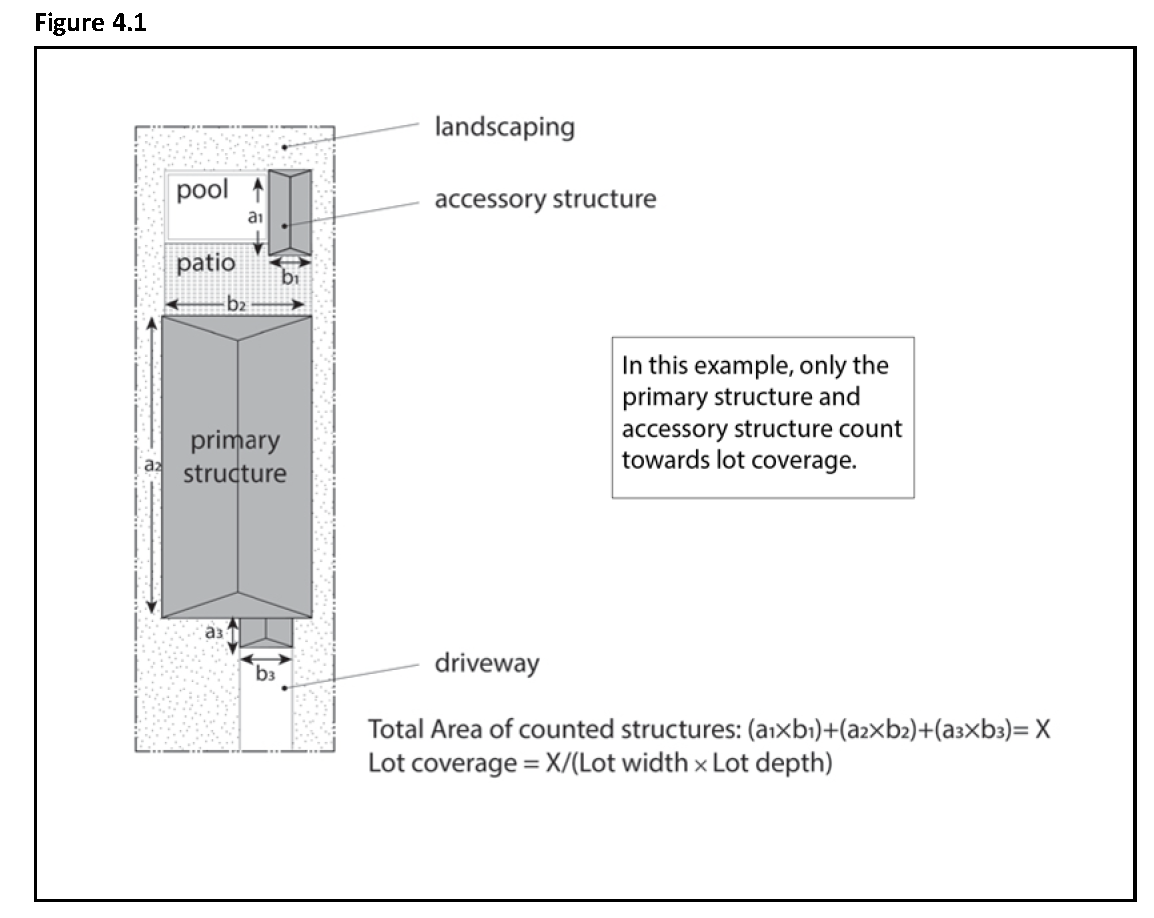
(Ord. No. 776, § 1(Exh. A), eff. 9-5-2014)
Sec. 9-4.103. - Measuring setbacks.
The setback is the perpendicular distance from the property line to the closest point of the exterior wall or posts of the building. The building envelope indicates the limits to which a building can be built on the property based on the required setbacks.
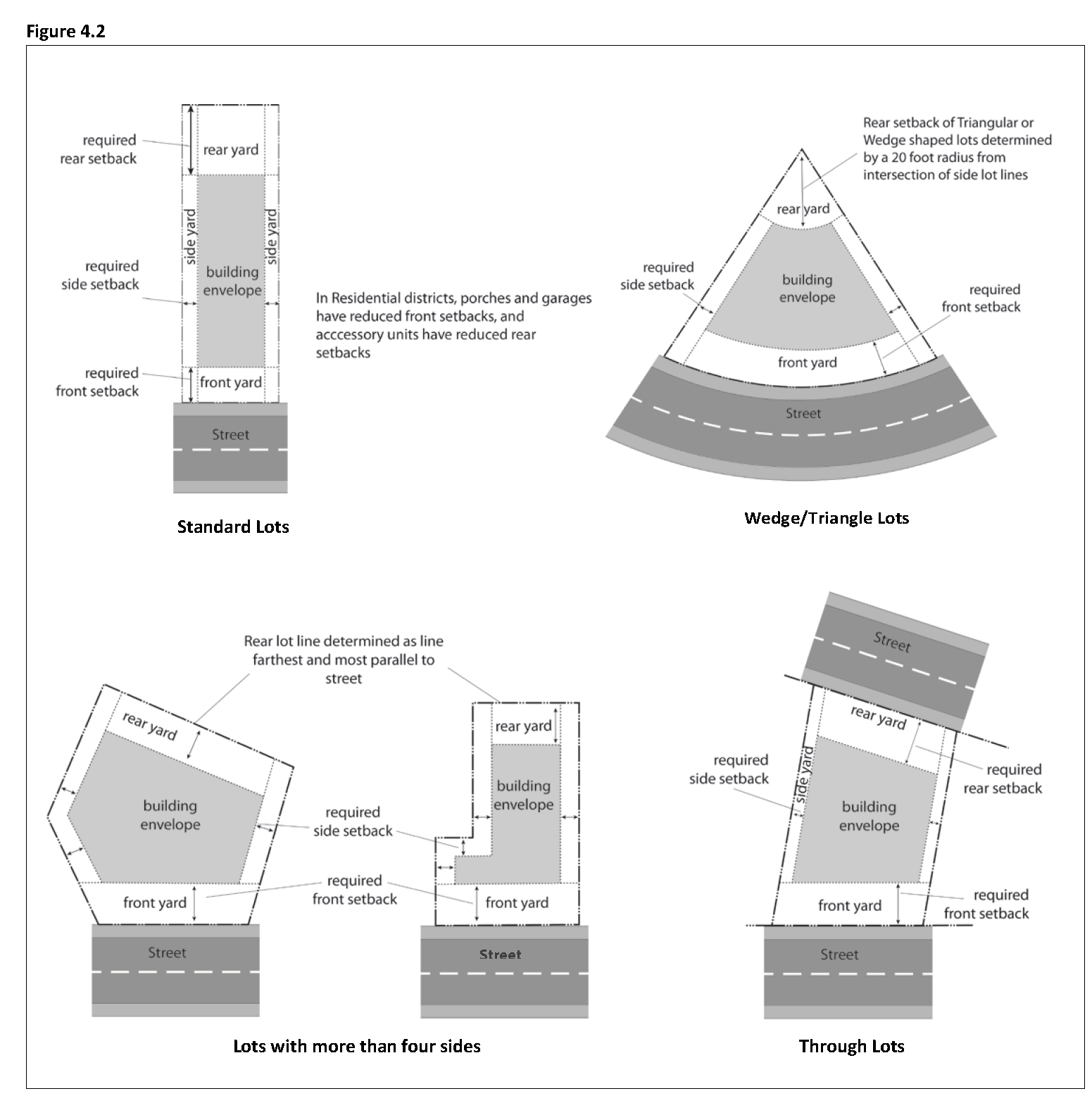
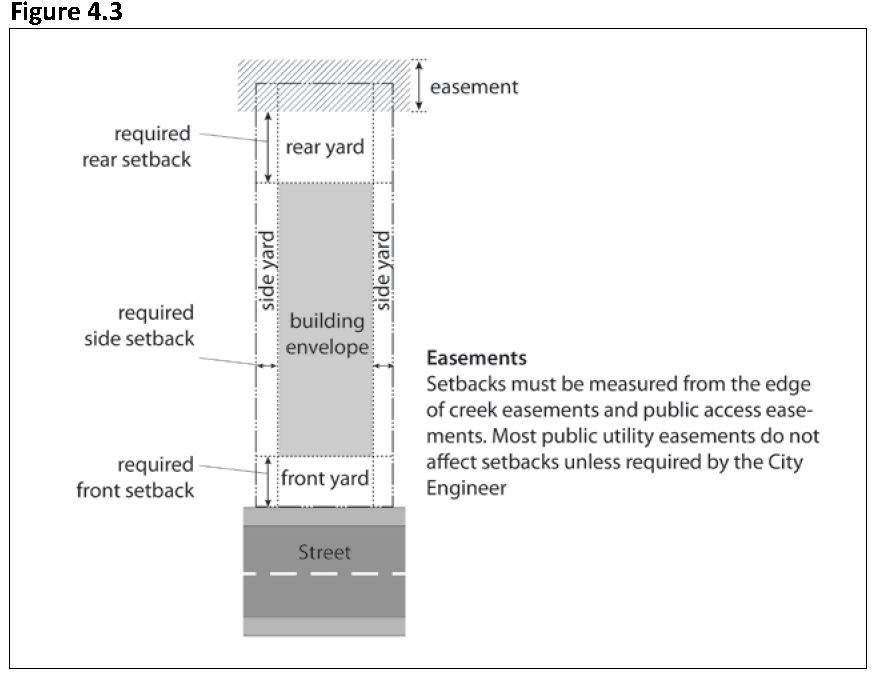
(Ord. No. 776, § 1(Exh. A), eff. 9-5-2014)
Sec. 9-4.104. - Measuring lot width and depth.
(a)
Every lot shall have a minimum width and depth of not less than that specified in the district in which such lot is located. Existing lots that do not meet the minimum requirements are considered non-conforming lots.
(b)
The depth of a lot is the horizontal distance between the front and rear lot lines, measured in the mean direction of the side lot lines.
(c)
The width of a lot is the horizontal distance between the side lot lines, measured at right angles to the lot depth at a point midway between the front and rear lot lines.
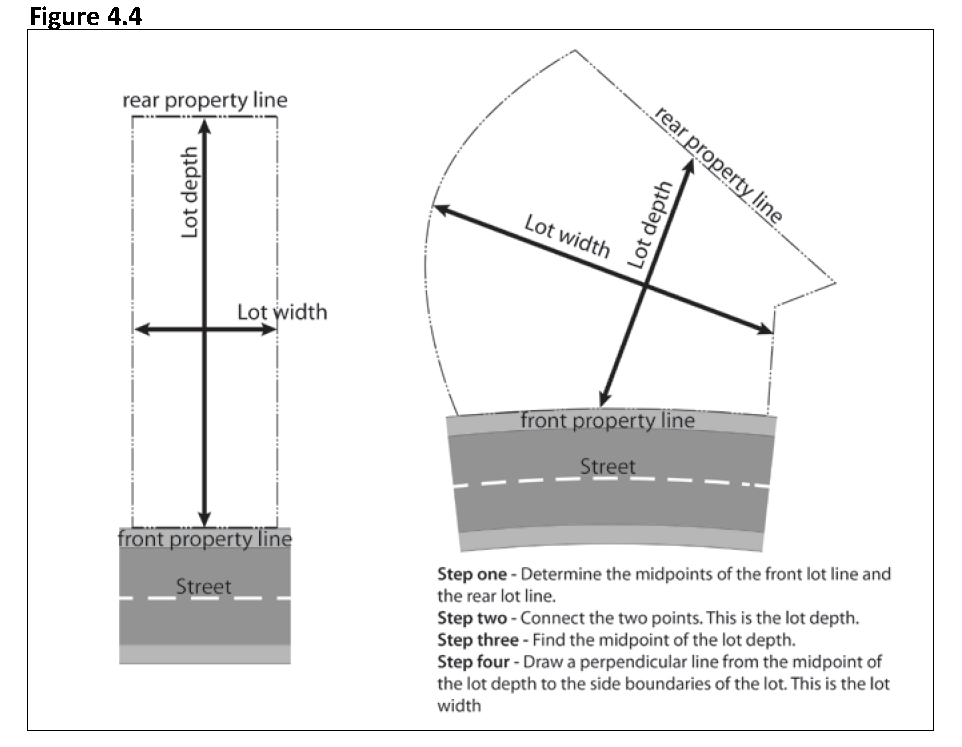
(Ord. No. 776, § 1(Exh. A), eff. 9-5-2014)
Sec. 9-4.105. - Measuring height.
(a)
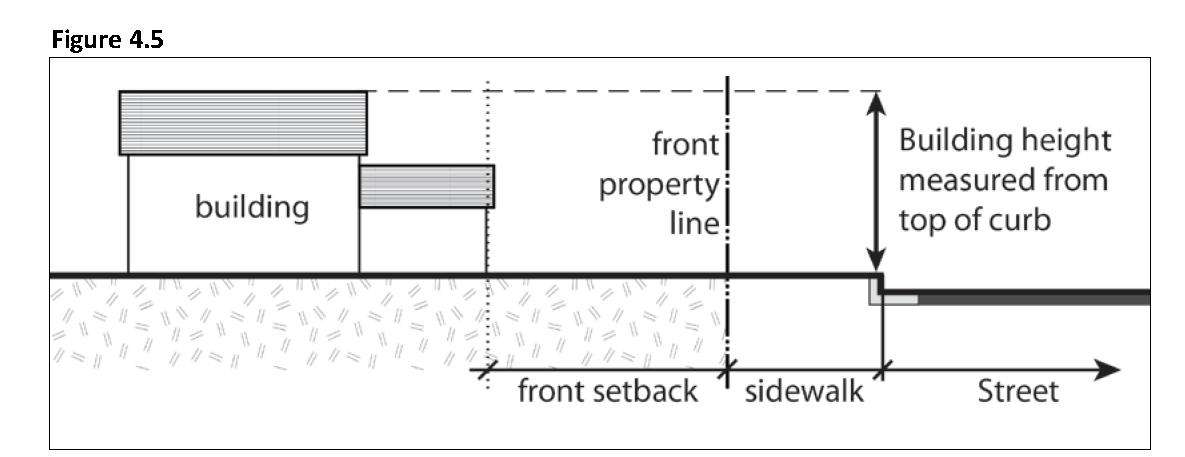
The height of a structure on a property shall be measured from the top of the curb, or from the existing grade at the front property line when no sidewalk and curb are in place, to the highest point of the structure, exclusive of chimneys, ventilators, and any mechanical equipment.
(b)
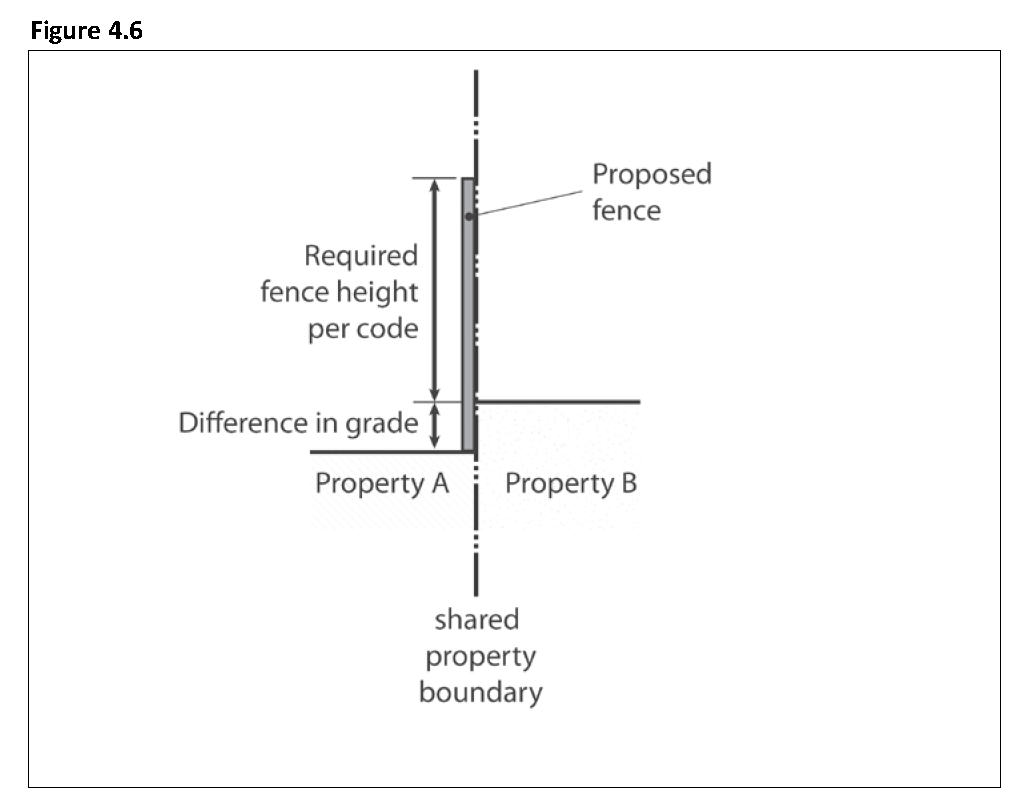
The height of a proposed fence shall be measured from the subject property line. If two (2) properties that share a property boundary have different grades, the height of the fence shall be measured from the higher grade.
(Ord. No. 776, § 1(Exh. A), eff. 9-5-2014)
Sec. 9-4.201. - Building projections into yards.
(a)
Building and architectural projections may extend into required yards, subject to the following standards:
(1)
Building projections. Building projections include fire escapes, uncovered and covered decks, porches, unenclosed and open stairways and stair landings without roofs, and balconies.
(2)
Architectural projections. Any projection which is not intended for occupancy, and which extends beyond the face of an exterior wall of a building. Projections can include: Cornices, canopies, eaves, sills, buttresses or similar architectural features, chimneys, fireplaces, cantilevered bay windows, and planting boxes.
(3)
Maximum projection allowed. Notwithstanding any other provisions of this Section, no projection may extend closer than three (3) feet to an interior lot line or into a public utility easement.
(4)
Ramps and similar structures for accessibility. Up to the entire yard where it is the only feasible location to provide a reasonable accommodation consistent with the Americans with Disabilities Act.
(Ord. No. 776, § 1(Exh. A), eff. 9-5-2014)
Sec. 9-4.202. - Development on substandard lots.
A legally created lot having a width or area less than required for the underlying Zoning District in which it is located may be occupied by a permitted or conditional use if it has a width of twenty-five (25) feet or more and an area of 2,500 square feet or more, provided that on the effective date of regulations that made it substandard, it was in single ownership separate from any abutting lot. No substandard lot shall be further reduced in area or width, and a substandard lot shall be subject to the same yard setback, and density requirements as a standard lot except as otherwise provided. A maximum of one dwelling unit may be located on a substandard lot that meets the requirement of this section.
(Ord. No. 776, § 1(Exh. A), eff. 9-5-2014)
Sec. 9-4.203. - Fences and freestanding walls.
(a)
Maximum height.
(1)
Front, side and rear yards. Fences, walls and hedges shall be no more than three (3) feet tall within the front yard setback, and between five (5) to six (6) feet tall within the side and rear yard setbacks in any Zoning District, unless otherwise prescribed by the zoning regulations for specific circumstances. Fences in residential districts are permitted to be up to four (4) feet tall within the front yard setback if the face of the fence is an open design, as defined in Chapter 1, Article 2, Definitions, of this title. Please see Sections 9-2.203(b) and 9-2.303(b), for transitional standards between Residential Districts and Commercial or Manufacturing Districts.
(2)
Sound walls, acoustical barriers, or noise berms. A Site Plan Review application shall be made per the provisions of Chapter 6, Article 4, Site Plan Review, for any proposed sound wall, acoustical barrier, or noise berm. The Community Development Director may recommend approval to the Planning Commission of a sound wall to be located along the exterior boundary of the required side or rear yard, adjacent to a major arterial, highway, or source of loud noise. Additional review may also be required by other City Departments. The height of the sound wall shall be determined by a noise report for the purposes of noise mitigation.
(3)
Retaining walls. Any embankment to be retained that is over four (4) feet in height shall be stepped, such that the visible portion of each individual retaining wall at each step is a maximum of three (3) feet in height. The distance between individual retaining walls shall be a minimum of six (6) feet.
(4)
Decorative features. One (1) entry gateway, trellis, or other entry structure is permitted in the required front or street-facing side yard of each lot, provided that the maximum height or width of the structure does not exceed ten (10) feet. Such decorative feature shall not have any solid obstruction that exceeds two (2) feet in length or diameter, between the height of three (3) and ten (10) feet.
(5)
Swimming pools. For safety reasons, swimming pools shall be entirely enclosed by buildings, fences, or walls not less than five (5) feet, nor more than six (6) feet in height, equipped with self-latching gates or doors, the latching device being located not less than four (4) feet above the ground. All fencing shall be in place and approved by the City before water is run into the pool.
(6)
Tennis courts and game areas. Fences or structures over six (6) feet in height to enclose tennis courts or other game areas located within the rear one-half (½) of the lot shall be composed of wire mesh capable of admitting at least ninety (90) percent light as measured on a reputable light meter. Such fences shall only be permitted in the required side or rear yards and are subject to the review and approval of the Community Development Director.
(b)
Design and materials.
(1)
Fence materials. Fence materials may include: Wood, wrought iron, wire mesh, steel mesh, chain link, stake and other similar materials. The use of barbed wire and razor wire is only permitted within the CG, CS, MBH and MBL Zoning Designations and shall not be visible from adjacent residential zoning districts. Approval of the adjoining property owner shall be required if razor or barbed wire is constructed on an interior property line.
(2)
Wall materials. Wall materials shall include: wood, concrete, concrete block, or any other similar materials that are solids and are so assembled as to form a solid barrier.
(3)
Materials not permitted. Barbed wire or razor wire located on or visible from any residential or mixed-use zoning designation, aluminum, fiberglass, metal siding and plywood shall not be used as fencing materials. The Community Development Director may grant the use of such material (except razor wire or barbed wire) based on the need for the type of fence, design compatibility of the fence, and approval of the adjoining property owner if on an interior property line. Nonconforming status shall not be provided for fences constructed of these materials.
(4)
Maintenance. All fences and walls shall be maintained so as not to create a public health, safety, welfare, aesthetic, or visibility problem.
(c)
Sight distance requirements.
(1)
In order to maintain adequate sight distances at all intersecting streets, highways, and driveways intersecting a street or alley, and alleys intersecting a street, the maximum height of fences may be reduced near intersections. Please see Section 9-4.214, Visibility at Driveways and Intersections (Sight Distance).
(d)
Additional requirements.
(1)
The Planning Commission or City Council may require additional walls if the use of a particular site requires a Conditional Use Permit, or there is a danger or hazard involved.
(Ord. No. 776, § 1(Exh. A), eff. 9-5-2014; Ord. No. 824, §§ 1, 2, 1-5-2019)
Sec. 9-4.204. - Landscaping.
(a)
Landscaping required. A minimum of fifty (50) percent of the front yard in Residential Districts must remain pervious, and shall be planted or landscaped with trees, shrubs, groundcover, or may be treated with ornamental gravel, crushed rock or similar landscape material.
(b)
Maintenance. Property owners shall maintain landscaped areas in a neat and weed-free fashion and may be required by the Community Development Director to provide a permanent underground irrigation system equipped with an automatic irrigation timer or controller. Property owners shall trim trees to avoid entanglement in power lines and other utility lines above ground.
(c)
Plant species. Property owners shall use native and compatible non-native plant species to fulfill landscaping requirements. Drought-resistant species are highly encouraged.
(d)
Hedges. Hedges in front, side or rear yards are subject to height restrictions for fences and freestanding walls. See Section 9-4.203, Fences and Freestanding Walls, for more details.
(e)
Water efficient landscaping. The model Water Efficient Landscaping Ordinance, as published by the California Department of Water Resources, pursuant to California Water Conservation in Landscaping Act (Government Code § 65591, et seq.), was adopted in full, by reference, and effective in the City of Coalinga commencing on January 1, 2010. A copy of the Water Efficient Landscaping Ordinance is retained on file in the Office of the City Manager, the Community Development Department, and the Office of the Coalinga City Clerk at all times. Landscaping plans must be consistent with the adopted Water Efficient Landscaping Ordinance.
(f)
Parking lots. Please see Section 9-4.305(a)(5), Landscaping, for requirements on landscaping in parking lots.
(Ord. No. 776, § 1(Exh. A), eff. 9-5-2014)
Sec. 9-4.205. - Heights and height exceptions.
(a)
Maximum height of structures. The height of structures shall not exceed the standards established by the applicable Zoning District of this title.
(1)
Increased height limit for projections. Chimneys not over six (6) feet in width, cupolas, flagpoles, monuments, telecommunication towers, church steeples, and other appurtenances that cover no more than twenty (20) percent of the top floor roof area to which they are accessory, may exceed maximum permitted height standards by eight (8) feet. Rooftop mechanical equipment, including heating, ventilation and air conditioning (HVAC) equipment, water towers, and elevator shafts, shall be screened from view to the top of the equipment with colors and materials matching or compatible to the corresponding building walls. Exceptions may be granted with the approval of a conditional use permit.
(Ord. No. 776, § 1(Exh. A), eff. 9-5-2014)
Sec. 9-4.206. - Lighting and illumination.
(a)
All lighting proposed in the City of Coalinga shall be consistent with these standards. All lighting plans required by the Community Development Director for permit approval shall include the following standards.
(b)
Multiple-Family Residential illumination. Aisles, passageways, and pedestrian recesses related to and within the building complex shall be illuminated with an intensity of at least one-fourth (0.25) foot-candles at the ground level during the hours of darkness. Lighting devices shall be protected by weather and vandal-resistant covers.
(c)
Pedestrian oriented lighting. In the Downtown Overlay District, exterior lighting shall be provided for a secure nighttime pedestrian environment by reinforcing entrances, public sidewalks and open areas with a safe level of illumination with an intensity of at least one-fourth (0.25) foot-candles at the ground level during the hours of darkness. The Community Development Director or his or her designee may require additional lighting for bars, nightclubs, and lounges or other entertainment venues in order to provide a safe level of illumination.
(d)
Maximum height. On site and street lighting fixtures shall not exceed the maximum heights specified in Table 4.1 below.
(e)
Shielding. All lighting fixtures shall be shielded so as not to produce obtrusive glare onto the public right-of-way or adjoining properties. All luminaries shall meet the most recently adopted criteria of the Illuminating Engineering Society of North America (IESNA) for "Cut Off" or "Full Cut Off" luminaries.
(f)
Filtering. Filtering means any outdoor light fixture which has a glass, acrylic or translucent enclosure of the light source, and is required to avoid light sources that produce obtrusive glare. Metal halide fixtures and fluorescent lamp types shall be filtered. Quartz glass does not meet the filtering requirement.
(g)
Control of artificial light.
(1)
Purpose. This section is intended to minimize outdoor artificial light that may have a detrimental effect on the environment, astronomical research, amateur astronomy, and enjoyment of the night sky. These provisions are also intended to reduce the unnecessary illumination of adjacent properties and the use of energy.
(2)
Applicability. Outdoor light fixtures installed after the effective date of this Ordinance and maintained upon private property within non-residential districts shall comply with the requirements of this section.
(3)
Exemptions. The following types of lighting fixtures are exempt from the requirements of this section:
a.
Prior installation. All light fixtures installed prior to the effective date of this Ordinance, unless fifty (50) percent or more of the light fixtures on the premises are replaced.
b.
Fossil fuels. All light fixtures producing light directly by the combustion of fossil fuels.
c.
Low lumens. All light fixtures with an initial total lamp sources lumens of 4,050 or less.
d.
Construction and emergency lighting. All construction or emergency lighting fixtures, provided they are temporary and are discontinued immediately upon completion of the construction work or abatement of the emergency.
(4)
Prohibitions and requirements for protection and shielding.
a.
Recreational facility. No public or private outdoor recreational facility shall be illuminated after 11:00 p.m., except to conclude any recreational or sporting event or other activity conducted at a ball park, outdoor amphitheater, area, or similar facility in progress prior to 11:00 p.m.
b.
Outdoor building and landscaping. The unshielded outdoor illumination of any building or landscaping is prohibited, except with incandescent fixtures with lamps of 100 watts or less.
Outdoor signs. Lighting fixtures used to illuminate an outdoor sign shall be mounted on the sign structure and shall be shielded according to Table 4.2 below. All illuminated outdoor advertising signs shall be equipped with an automatic time controller that prevents the operation of the lighting fixtures between 11:00 p.m. and sunrise. 1
(h)
Alternate materials and methods of installation. Design, material, or method of installation not specifically prescribed by this section may be approved by the Community Development Director provided the proposed design, material, or method complies with the intent of these provisions.
(Ord. No. 776, § 1(Exh. A), eff. 9-5-2014)
Sec. 9-4.207. - Outdoor seating.
(a)
Eating and drinking establishments with outdoor seating areas shall be located, developed, and operated in compliance with the following standards:
(1)
Location. Outdoor seating areas may be allowed on any public sidewalk, provided a minimum of five (5) feet of public sidewalk remains unobstructed for pedestrian or vehicle uses. The review and approval of outdoor seating areas shall be subject to the provisions of Chapter 6, Article 4, Site Plan Review.
(2)
Barriers. The use of barriers around the outdoor seating area may be permitted, provided they are in a manner acceptable to the City and the design is approved by the Community Development Director.
(3)
Alcoholic beverages. All establishments that intend to serve alcoholic beverages in outdoor seating areas shall first seek the necessary permits and approvals, in compliance with Section 9-5.103, Alcoholic Beverage Sales, and any other applicable Municipal Code sections.
(4)
Hours of operation. The hours of operation for an outdoor seating area shall be limited to the hours of operation of the associated eating and drinking establishment.
(5)
Refuse storage area. No structure or enclosure to accommodate the storage of trash or garbage shall be erected or placed on, adjacent to, or separate from an outdoor seating area on the public sidewalk or right-of-way. Refuse areas shall be screened with a solid masonry wall at least six (6) feet in height and shall be accessible for refuse pick-up.
(6)
Conditional use permit. A Conditional Use Permit is required when the outdoor seating area is located immediately abutting the property line of a residential district, and contains more than five (5) tables or seating for more than fifteen (15) customers.
(Ord. No. 776, § 1(Exh. A), eff. 9-5-2014)
Sec. 9-4.208. - Outdoor storage.
(a)
Outdoor storage of goods, materials, machines, equipment, and vehicles or parts outside of a building for more than seventy-two (72) hours shall conform to the standards of this section. The regulations of this section do not apply to temporary storage of construction materials reasonably required for construction work on the premises pursuant to a valid building permit. Outdoor parking areas for operable vehicles at automobile dealerships and vehicle rental facilities are exempt from the regulations of this section.
(b)
Storage areas shall be proposed indoors wherever feasible. Where infeasible, outdoor storage may be permitted on a property consistent with the requirements below.
(1)
Permitted locations. Table 4.3 states the districts where outdoor storage is permitted and prohibited.
(2)
Screening of outdoor storage.
a.
Outdoor storage areas shall be screened so as not to be visible from any public street; Residential district; or publicly accessible open space area, parking area, access driveway, or similar thoroughfare.
b.
Screening walls and fences shall be architecturally compatible with the main structure on the site and shall not have barbed wire or razor wire unless located in a CG, CS, MBH and MBL zoning designations and not visible from adjacent residential zoning districts.
c.
No screening wall or fence shall be located within a required landscape planter along the street frontage.
d.
Screening walls and fences shall be at least six (6) feet in height. If located on a lot line or in a required yard, they shall not exceed maximum fence heights in required yards; in other areas, they shall not exceed fifteen (15) feet in height. No stored goods may exceed the height of the screening wall or fence.
(3)
Surfacing.
a.
Outdoor storage areas shall be paved or covered with gravel. This requirement does not apply to outdoor storage associated with a permitted agricultural use.
b.
A waiver or exception may be granted to allow outdoor storage of nonhazardous materials on other surfacing only if the following findings can be made:
1.
The proposed surfacing is appropriate to the type of product displayed; and
2.
The proposed surfacing will conform to all applicable federal and state air and water quality standards.
(Ord. No. 776, § 1(Exh. A), eff. 9-5-2014; Ord. No. 824, § 3, 1-5-2019)
Sec. 9-4.209. - Screening.
(a)
Screening of mechanical equipment. All mechanical and electrical equipment shall be screened from view to the highest point of the mechanical equipment, or incorporated into the design of buildings, so as not to be visible from the street or adjacent residential districts. Such equipment includes, but is not limited to, all roof-mounted equipment, utility meters, equipment boxes, backflow preventions, irrigation control valves, electrical transformers and pull boxes. Solar power generating equipment and solar water heaters shall be exempt from screening requirements. Screening devices shall be consistent with the exterior colors and materials of the buildings to which they are attached. Telecommunication devices and antennas are regulated per Section 9-5.125, Telecommunication Facilities, of this title.
(b)
Roof access ladders and fire sprinkler risers. Roof access ladders and fire sprinkler risers shall be located internally.
(c)
Parking areas. Parking areas shall be screened from view from public streets and adjacent properties according to the following standards.
(1)
Height. Screening of parking lots from adjacent public streets shall be at three (3) feet in height. Screening along interior lot lines that abut residential districts shall be six (6) feet in height, except within the required front setback of Residential Zoning Districts, where screening shall be three (3) feet in height.
(2)
Materials. Screening may consist of one or any combination of the methods listed below.
a.
Walls. Low-profile walls consisting of decorative concrete, stone, or masonry materials.
b.
Fences. An open fence of wrought iron or similar material, combined with plantings. Chain-link and vinyl fencing is not allowed in Residential Districts.
c.
Planting. Plant materials consisting of compact evergreen plants that form a hedge. Such plant materials shall achieve a minimum height of two (2) feet within eighteen (18) months after initial installation.
d.
Berms. Berms planted with grass, ground cover, or other low-growing plant materials.
(Ord. No. 776, § 1(Exh. A), eff. 9-5-2014)
Sec. 9-4.210. - Street dedication and construction of public improvements.
(a)
Public improvements shall be provided in compliance with the following standards to any property or lot where public improvements were never constructed or installed to City standards, or where such public improvements for whatever cause have deteriorated to a condition that they no longer adequately serve their intended purpose.
(1)
Right-of-way dedication. Dedicate street right-of-way necessary to obtain the ultimate right-of-way width as required by the City Engineer or by ordinance or resolution of the City Council.
(2)
Curb, gutter, and sidewalk. Construct new, and/or repair existing curb, gutter, sidewalk and handicap ramp as required by the City Engineer. If, due to existing topographic or related conditions, the City Engineer determines that it would be in the best interests of the City and its inhabitants to construct said curb, gutter and sidewalk at a later date, the applicant shall deposit to the City a cash amount equal to the City Engineer's estimate of construction cost, or execute an agreement as provided by Section 7-2.02 of the Municipal Code.
(3)
Street and alley paveout. Construct street, and, if applicable, alley paveout, from the gutter lip in the case of streets, and from the property line in the case of alleys, to the existing pavement in accordance with City standards. In cases where the street or alley is not paved, the construction required of the applicant shall not exceed fifty (50) percent of the width of the street or alley. If, due to existing topographic or related conditions, the City Engineer determines that it would be in the best interests of the City and its inhabitants to construct said street or alley paveout at a later date, the applicant shall deposit to the City a cash amount equal to the City Engineer's estimate of construction cost, or execute an agreement as provided by Section 7-2.02 of the Municipal Code. Single-family dwellings or duplexes shall not be required to pay for any paveout costs that are over two (2) feet from the gutter lip or property line.
(4)
Utility structures. Relocate existing utility structures, when required, to an area satisfactory to the City Engineer.
(5)
Street trees. Provide for the installation of roadway trees as required by the Community Development Director in accordance with City standards pertaining to the type, size, spacing and placement of such trees; to the maintenance or extension of street tree themes when applicable; and, to the time of installation when it is determined it would be in the best interest of the City to postpone the placement of trees required pursuant to this section.
(6)
Required public improvements as part of a development. When required by the City, the following improvements shall be installed with a proposed development.
a.
Fire hydrants. Fire hydrants to meet City standards for type, size and spacing in accordance with the requirements of the Fire Department, and to the satisfaction of the City Engineer. In lieu of installation, if otherwise required pursuant to the provisions of this Section, the City may require payment of a prorated fire hydrant fee in an amount set by resolution of the City Council to acknowledge the area of benefit served by same.
b.
Streetlights. Streetlights as required by the City Engineer at intersections, cul-de-sac, crosswalks, and curves, to meet City standards for type, illumination and spacing. In lieu of installation, if otherwise required pursuant to the provisions of this Section, the City may require payment of a prorated streetlight fee in an amount set by resolution of the City Council to acknowledge the area of benefit served by same.
c.
Drainage facilities. Drainage facilities as required by the City Engineer.
d.
Undergrounding. All utility lines, including electrical, telephone, cable television, and other distribution lines, providing direct service to a development site shall be installed underground within the site. If not possible, the burden of proof shall be on the applicant to demonstrate why undergrounding is economically or technically infeasible.
(Ord. No. 776, § 1(Exh. A), eff. 9-5-2014)
Sec. 9-4.211. - Trash and refuse collection areas.
(a)
Solid waste and recycling-container enclosures are required for new dwelling groups consisting of four (4) or more dwelling units and for all office, commercial, and industrial developments. All enclosures shall comply with the California Fire Code and shall meet the following requirements unless it is demonstrated that they are infeasible as determined by the Community Development Director.
(1)
Location.
a.
The solid waste, recycling and green waste storage area shall not be located within any required front yard, any required parking and landscaped areas, or any other area required by this Ordinance to be constructed or maintained unencumbered according to fire and other applicable building and public safety codes.
b.
Solid waste, recycling and green waste storage areas shall be consolidated to minimize the number of collection sites and located so as to reasonably equalize the distance from the building spaces they serve. There shall be a minimum of one solid waste and recycling enclosure per fifty (50) units.
c.
Solid waste, recycling and green waste storage areas shall be accessible to haulers. Storage areas shall be located so that the trucks and equipment used by the City of Coalinga or its contracted solid waste and recycling collector(s) have sufficient maneuvering areas and, if feasible, so that the collection equipment can avoid backing. Project applicants are responsible for procuring current equipment size and turning radius from the City of Coalinga or its contracted solid waste and recycling collector(s).
(2)
Materials, construction, and design.
a.
Minimum height of screening. Solid waste, recycling and green waste storage areas located outside or on the exterior of any building shall be screened with a solid enclosure of between six (6) to seven (7) feet in height.
b.
Enclosure material. Enclosure material shall be solid masonry or concrete tilt-up with decorated exterior surface finish compatible and consistent to the main structure(s).
c.
Gate material. Gate material shall be decorative, solid, heavy-gauge metal or a heavy-gauge metal frame with a covering of a view-obscuring material. If not visible from a public street, public parking area, or residential area, the enclosure gates may be constructed of chain link with wood or plastic inserts.
d.
Access to enclosure from residential projects. Each solid waste, recycling and green waste storage enclosure serving a residential project shall be designed to allow walk-in access without having to open the main enclosure gate.
e.
Enclosure pad. Pads shall be a minimum of four-inch thick concrete.
f.
Protection for enclosures. Concrete curbs or equivalent shall protect enclosures from adjacent vehicle parking and travel ways.
g.
Landscape screening. The perimeter of the recycling and trash enclosure, except for areas used for access, shall be planted, with drought resistant landscaping, including a combination of shrubs and/or climbing evergreen vines.
h.
Clear zone. The area in front of and surrounding all enclosure types shall be kept clear of obstructions, and shall be painted, striped, and marked "No Parking."
(b)
New single-family homes and development proposals shall include a designated paved or concrete pad for each property for trash, recycling, and green waste storage containers. Site plans must show how the containers will be rolled out for collection at the curb. The designated pad must be screened from view and shall not be permitted within required setbacks.
(Ord. No. 776, § 1(Exh. A), eff. 9-5-2014)
Sec. 9-4.212. - Truck docks, loading, and service areas.
(a)
Minimum distance from Residential Districts. Truck docks, loading, and service areas are not permitted within fifty (50) feet of an R district boundary.
(b)
Screening. Truck docks, loading, and service areas located in any district shall be screened from any adjacent residential districts or uses. In all districts except Industrial districts, these facilities shall be located at the interior side of buildings or on the rear of the site and be screened so as not to be visible from public streets.
(c)
When adjacent to a Residential district, all delivery and operation hours shall be limited to daytime hours from 7:00 a.m. to 7:00 p.m.
(Ord. No. 776, § 1(Exh. A), eff. 9-5-2014)
Sec. 9-4.213. - Underground utilities.
All utility lines, including electrical, telephone, cable television, and other distribution lines, providing direct service to a development site shall be installed underground within the site. If not possible, the burden of proof shall be on the applicant to demonstrate why undergrounding is economically or technically infeasible.
(Ord. No. 776, § 1(Exh. A), eff. 9-5-2014)
Sec. 9-4.214. - Visibility at driveways and intersections (sight distance).
(a)
Visibility at driveways and intersections shall be maintained in accordance with the following standards. The City Engineer may require extended or reduced sight distance lengths where special conditions exist or will be created, as necessary to maintain adequate visibility.
(1)
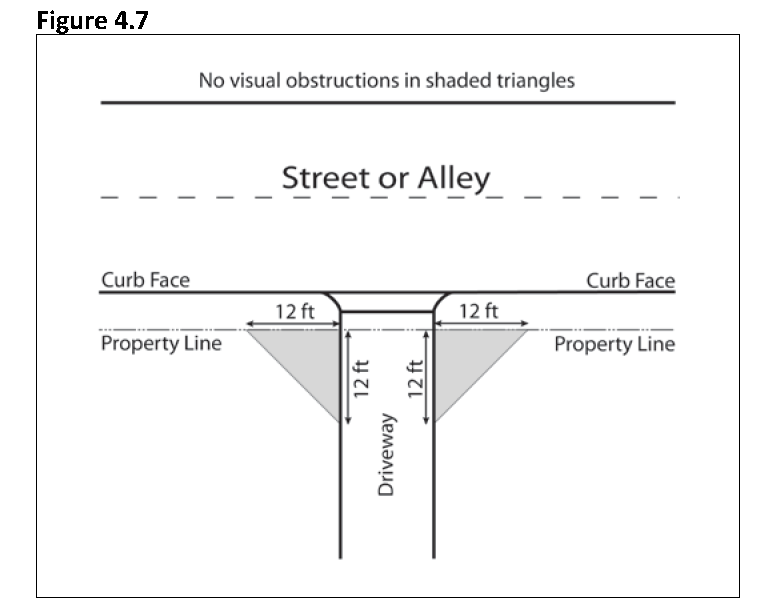
Driveways. Visibility at a driveway crossing a street or alley property line shall not be blocked above a maximum height of three (3) feet by vegetation, for a depth of twelve (12) feet as viewed from the property line on either side of the driveway at a distance of twelve (12) feet. Street trees shall be pruned to allow at least eight (8) feet of clear viewing space above the established grade from top of curb, so as not to obstruct clear view by motor vehicle drivers are permitted.
(2)
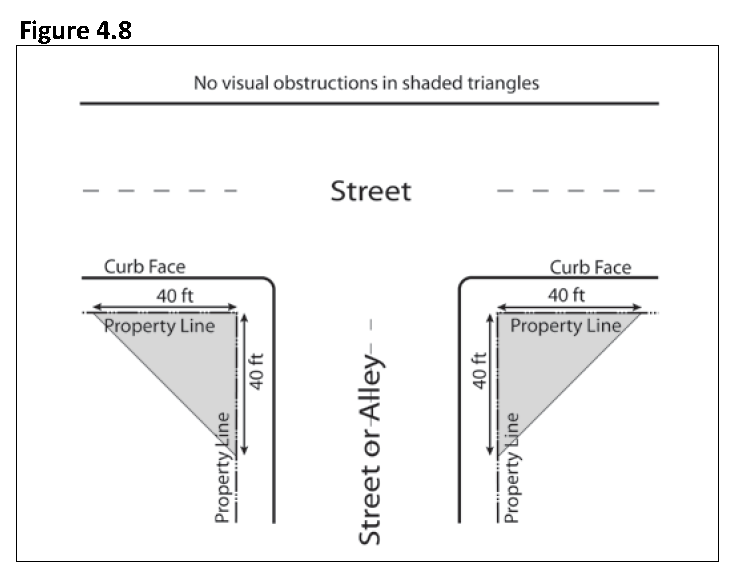
Corner lots. Visibility requirements for a corner lot at the intersection of two (2) streets or a street and an alley shall be the same as that for driveways, except that the depth required shall be forty (40) feet as viewed from the property lines.
(Ord. No. 776, § 1(Exh. A), eff. 9-5-2014)
Sec. 9-4.301. - Purpose.
(a)
The specific purposes of the on-site parking and loading regulations are to:
(1)
Ensure that parking uses are provided for new land uses and major alterations to existing uses to meet the parking needs created by such uses;
(2)
Establish standards and regulations for the developer, owner, or operator of any specific use occurring outdoors or within an existing, newly constructed, or relocated building to provide well-designed, on-site parking areas; and
(3)
Ensure that on-site parking and loading areas are designed and located to protect the public safety; minimize congestion and conflict points on travel aisles and public streets; and where appropriate, buffer surrounding land uses from their impact.
(Ord. No. 776, § 1(Exh. A), eff. 9-5-2014)
Sec. 9-4.302. - Applicability.
(a)
No parking area, parking space, or loading space which is provided for the purpose of complying with the provisions of this chapter shall hereafter be relinquished or reduced in any manner below the requirements of this chapter unless equivalent facilities are provided elsewhere, the location of which is approved by the Commission. If such parking area is established by a conditional use permit, equivalent facilities shall be subject to approval by the Planning Commission.
(b)
Parking required. Each building and land use, including a change or expansion of a building or land use, shall provide parking areas in compliance with this section. No building shall be occupied and no land use shall be commenced until the improvements required by this section are approved by the Community Development Director and completed prior to commencement of use.
(c)
Number of parking spaces.
(1)
Each site shall be provided the minimum number of parking spaces required by Table 4.4, except where the parking requirement is reduced or otherwise changed in compliance with subsection (3) of this section.
(2)
On-street parking along the frontage lines of the site shall be counted toward fulfilling the parking requirements.
(3)
Where Table 4.4 establishes a parking requirement based upon square feet (for example: "1 space/300 sq. ft."), the term "square feet" means the gross square footage of floor area.
(4)
Where Table 4.4 establishes a parking requirement based upon the number of units (for example: "1 space per unit"), the term "unit" means per dwelling unit.
(5)
If the calculation of required parking or loading spaces results in the requirement of a fractional space, such fraction, if one-half (½) or greater, shall be considered one additional space; if the fraction is less than one-half (½), it shall result in no additional spaces.
TABLE 4.4: REQUIRED ON-SITE PARKING SPACES
(Ord. No. 776, § 1(Exh. A), eff. 9-5-2014; Ord. No. 874, § 1, eff. 10-16-2025)
Sec. 9-4.303. - Reduction of parking requirements.
(a)
The number of parking spaces required by Table 4.4 may be reduced, and the type or location of parking spaces required may be modified as follows.
(1)
Shared on-site parking. Where two (2) or more uses on the same site have distinct and differing peak parking usage periods, (e.g. a theater and a bank), a reduction in the required number of parking spaces may be allowed by the Planning Commission. Approval shall also require a recorded covenant running with the land, recorded by the owner of the parking lot, guaranteeing that the required parking will be maintained exclusively for the use or activity served for the duration of the use or activity.
(2)
Waiver of parking. The Planning Commission may reduce or waive the number of parking spaces required based on quantitative information provided by the applicant that documents the need for fewer spaces, such as a Parking Study.
(3)
Waiver of parking—non-peak-hour uses. The Planning Commission may waive the parking requirements of this section for land uses that are determined by the Planning Commission to operate exclusively when their peak parking demand occurs after the peak period parking demand for the area, and adequate on-street or public parking is available.
(4)
Off-site parking. A project that is not located within a parking assessment district may locate required parking away from the site of the proposed use.
a.
Location of parking. Off-site parking shall be located within a 1,250 foot walking distance of the site. (This distance corresponds to a five (5) minute walk.) Where approved by the Planning Commission, off-site parking may be located at a more remote site.
b.
Evaluation of proposal. In considering a request for off-site parking at a distance of greater than 1,250 feet, the Planning Commission shall consider whether adequate provisions, such as shuttle service, have been provided to bring drivers from the parking to the site.
c.
Guarantee of continued availability. Required parking spaces that are off-site shall be committed by a recordable covenant, lease, or other agreement, acceptable to the City Attorney. The parties to the covenant, lease, or agreement shall include the owners, and if applicable, the lessees of the off-site parking spaces and the owners, and if applicable, the lessees of the subject site, with covenants reflecting the conditions of approval and the approved offsite parking plan.
d.
Loss of off-site spaces.
(b)
Notification to the city. The owner or operator of a business that uses approved off-site spaces to satisfy the parking requirements of this Section shall immediately notify the Community Development Director of any change of ownership or use of the property for which the spaces are required, and of any termination or default of the agreement between the parties.
(c)
Effect of termination of agreement. Upon notification that a lease for required offsite parking has terminated, the Community Development Director shall determine a reasonable time in which substitute parking is provided to the satisfaction of the Community Development Director, or the size or capacity of the use is reduced in proportion to the parking spaces lost.
(1)
Valet parking. Off-site valet parking may be authorized through Conditional Use Permit approval.
(Ord. No. 776, § 1(Exh. A), eff. 9-5-2014)
Sec. 9-4.304. - Disabled/handicapped parking requirements.
Parking spaces for the disabled shall be provided in compliance with the Uniform Building Code (UBC), the Federal Accessibility Guidelines, and/or California Code of Regulations Title 24, as applicable. These spaces shall count toward fulfilling the parking requirements of this Code.
(Ord. No. 776, § 1(Exh. A), eff. 9-5-2014)
Sec. 9-4.305. - Parking design and development standards.
(a)
Required parking areas shall be designed and constructed as follows. The standards of this section may be modified by the Planning Commission where it determines that alternative parking designs and standards will more appropriately relate to the operating characteristics of the proposed development or new land use, while being equally effective in providing parking areas that are safe, convenient, use land efficiently, and are aesthetically attractive.
(1)
Access to Parking.
a.
Parking, including parking garages, shall be accessed from an alley or secondary frontage when possible. The opening of a parking lot or garage on a frontage shall not exceed two (2) lanes in width.
b.
Pedestrian entrances to all parking lots and parking garages shall be directly from a frontage line. Only underground parking garages may be entered directly from a building.
c.
Parking areas for nonresidential uses shall maintain a minimum unobstructed clearance height of fourteen (14) feet above areas accessible to vehicles.
(2)
Access to adjacent sites. Applicants are encouraged to provide off-street vehicle access to parking areas on adjacent properties to provide for convenience, safety, and efficient circulation. Shared pedestrian access between adjacent properties is also strongly encouraged.
(3)
Parking space and lot dimensions. Parking lots and stalls shall be designed with the following minimum dimensions.
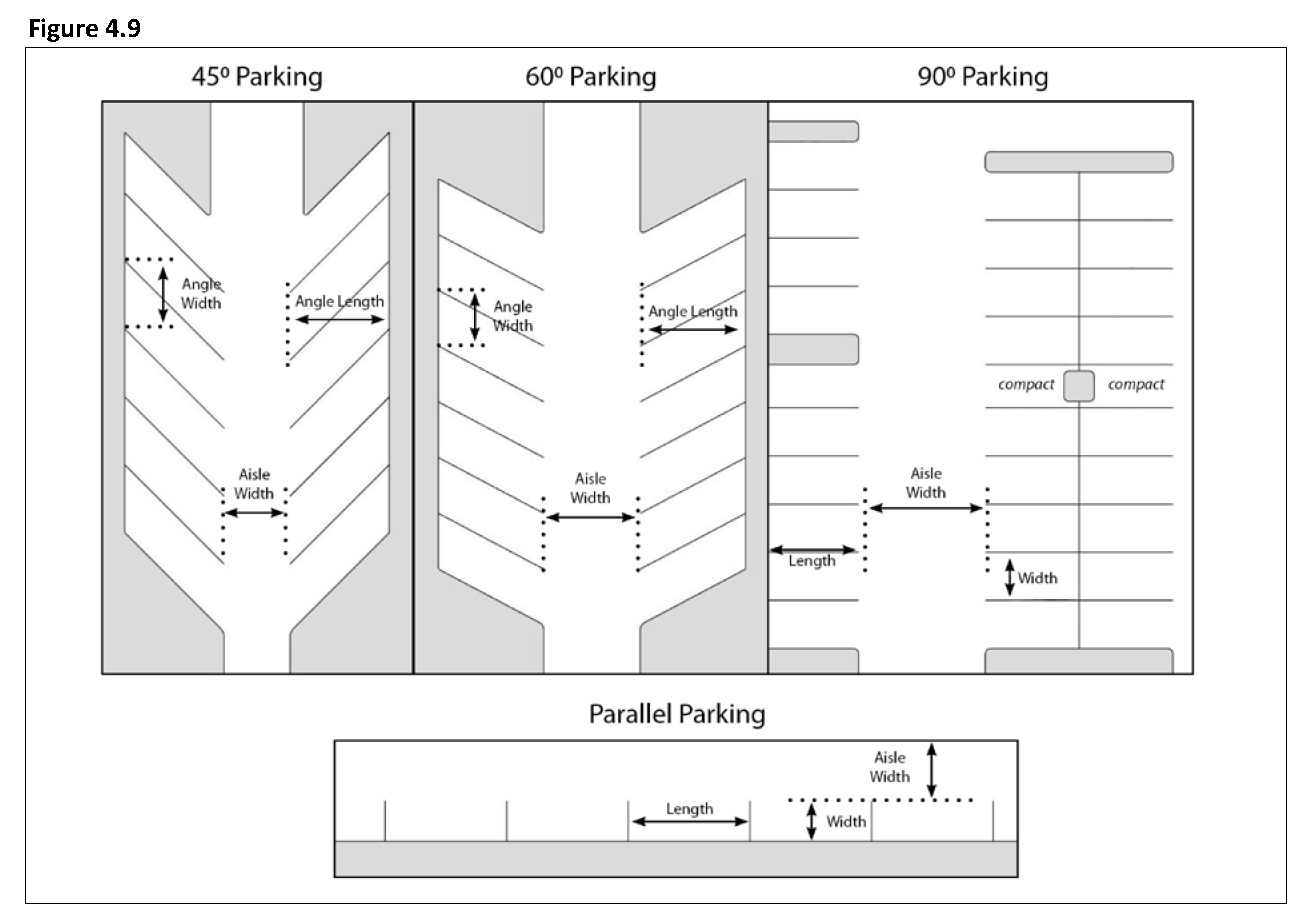
a.
Oversized parking. Where the nature of the land use may reasonably anticipate the need to accommodate oversized vehicles, the Planning Commission may require at least ten (10) percent of required parking spaces to be oversized. Oversized spaces shall be at least one foot larger than standard parking spaces in each dimension.
b.
Compact parking. All parking spaces shall at a minimum comply with the standards outlined in Table 4.5. There are no provisions for compact parking spaces.
(4)
Pedestrian connections. Pedestrian ways five (5) feet or more in width may be required in conjunction with the requirements of Section 9-4.305(a)(5), Landscaping, of this article:
a.
To connect all on-site automobile and bicycle parking areas to all on-site buildings, open space areas, or pedestrian amenities.
b.
Primary pedestrian routes and access points shall be clearly differentiated from driveways, parking aisles, and parking and loading spaces through the use of elevation changes, a different paving material, or another method. Where a required walkway is parallel and adjacent to an auto travel lane, it shall be raised or separated from the auto travel lane by a raised curb at least four (4) inches high, bollards, or other physical barrier.
(5)
Landscaping. Parking areas located in a Commercial, Mixed Use or Industrial district, shall be landscaped in compliance with the following requirements:
a.
Proportion required to be landscaped. A minimum of ten (10) percent of a parking lot shall be landscaped. A vehicle accommodation area shall include the area of a lot used by vehicles for access, circulation, parking, loading and unloading areas; it does not include space provided for display purposes or enclosed vehicle storage areas.
b.
Landscaping between streets and parking areas. A landscaped planter with a minimum width of five (5) feet shall be provided adjacent to any public or private street wherever parking or circulation is generally located adjacent to such rights-of-way. The planter area shall be credited towards the minimum landscaped area required for the site as set forth in the above provision.
c.
Shade trees. A minimum of one shade tree for every ten (10) parking spaces shall be provided, which shall achieve fifty (50) percent canopy coverage of paved area at maturity. The shade trees shall be located so as to provide visual relief to long rows of parked vehicles, and to provide shade to pedestrian connections. Canopy-type trees should be used to provide a relatively consistent tree cover that will shade vehicles and pavement. Shade trees shall also be provided at appropriate intervals between perimeter parking spaces. The shade tree species shall be selected from a master tree list maintained by the City.
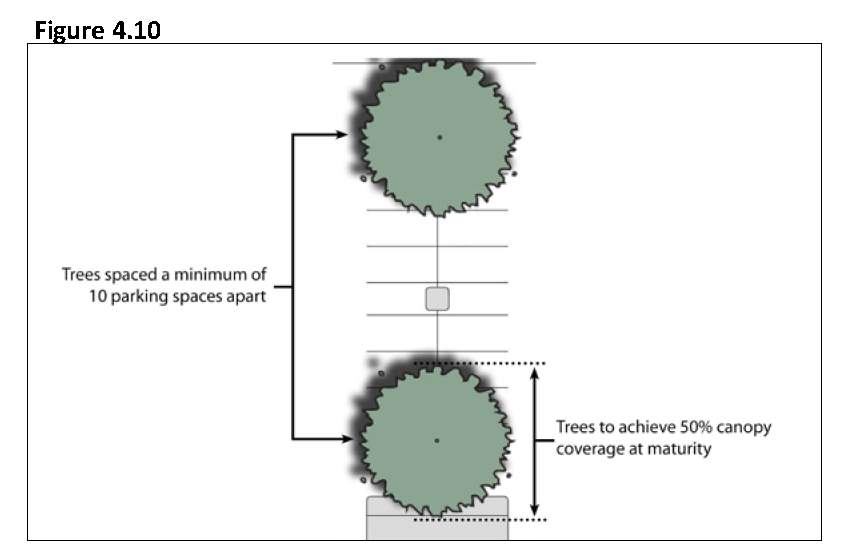
d.
Site design. Landscaped areas are to be distributed throughout the entire vehicle parking and circulation area as evenly as possible and as required by the Community Development Director. In larger parking areas (two or more maneuvering aisles) interior landscaping shall be provided to additionally screen parking areas and to visually separate the parking area into smaller spaces.
e.
Vision triangle. A vision triangle shall be reserved at all driveways as a public safety feature. Within this area, no vegetation shall exceed a height of three (3) feet, except for trees that are pruned and maintained so as not to block the visibility of vehicles entering and exiting sites. The design and extent of the vision triangle shall be approved by the Community Development Director.
f.
Curbs and bumpers. Where parking areas abut or overhang landscaped planters, the landscaping shall be protected by a continuous concrete curb not less than six (6) inches high, or an alternative material approved by the Community Development Director.
g.
Irrigation. Irrigation shall be provided for landscaped areas in accordance with Section 6-4B.01 of the Municipal Code.
h.
Soil type. Structural soil, rather than individual tree pits, shall be used wherever possible to encourage root growth, attain shade coverage, and prevent pavement failure.
(6)
Lighting. Parking lot lighting shall comply with the following requirements.
a.
Outdoor light fixtures shall be limited to a maximum height of fifteen (15) feet or the height of the nearest building, whichever is less.
b.
Lighting shall be energy-efficient, and shielded or recessed so that:
1.
The light source (i.e. bulb or lamp) is not visible from off the site; and
2.
Glare and reflections are confined to the maximum extent feasible within the boundaries of the site.
3.
Each light fixture shall be directed downward and away from adjoining properties and public rights-of-way.
c.
No lighting on private property shall produce an illumination level greater than one footcandle on any property within a Residential Zoning District except on the site of the light source.
d.
No permanently installed lighting shall blink, flash, or be of unusually high intensity or brightness, as determined by the Community Development Director.
(7)
Striping and identification.
a.
Vehicle spaces. Parking spaces shall provide understandable markings to indicate where drivers should park. Subtle markings, such as contrasting colors in paving stones, are encouraged.
b.
Restriping. The restriping of any parking space or lot shall be reviewed by the Community Development Director.
(8)
Surfacing.
a.
Parking spaces and maneuvering areas shall be provided with all-weather surfaces consistent with City standards and as approved by the review authority.
b.
The City desires to reduce stormwater run-off and water pollution, and to allow for the replenishment of groundwater. For parking areas, the goal is to reduce the amount of run-off generating surface area. Therefore, permeable surfaces for parking and maneuvering areas are allowed. Acceptable permeable surfaces include:
1.
Pervious concrete;
2.
Pervious pavers;
3.
Gravel, bark or grass when reinforced to be adequately load-bearing.
(Ord. No. 776, § 1(Exh. A), eff. 9-5-2014)
Sec. 9-4.306. - Electric and hybrid vehicle parking.
(a)
Background. Consistent with Cal. Gov't Code § 65850.7 and § 65850.71 and as amended, the Building Official shall implement an expedited, streamlined permitting process for electric vehicle charging stations and adopt a checklist of all requirements which electric vehicle charging stations shall comply with in order to be eligible for expedited review. The expedited, streamlined permitting process and checklist may refer to the recommendations contained in the most current version of the "Plug-In Electric Vehicle Infrastructure Permitting Checklist" of the "Zero-Emission Vehicles in California: Community Readiness Guidebook" as published by the Governor's Office of Planning and Research.
(b)
City documents. The City's adopted checklist, application form, and any associated documents required for application approval shall be published on the City's website.
(c)
Electric vehicle charging station requirements. Electric vehicle charging stations shall meet the following requirements:
(1)
Electric vehicle charging station equipment shall meet the requirements of the Cal. Electrical Code, the Society of Automotive Engineers, the National Electrical Manufacturers Association, and accredited testing laboratories such as Underwriters Laboratories, and rules of the Public Utilities Commission or a municipal electric utility company regarding safety and reliability.
(2)
Installation of electric vehicle charging stations and associated wiring, bonding disconnecting means, and overcurrent protective devices shall meet the requirements of Cal. Electrical Code Art. 625 and all applicable provisions of the Cal. Electrical Code.
(3)
Installation of electric vehicle charging stations shall be incorporated into the load calculations of all new or existing electrical services and shall meet the requirements of the Cal. Electrical Code. Electric vehicle charging equipment shall be considered a continuous load.
(4)
Installation of electric vehicle charging stations and associated wiring, bonding disconnecting means, and overcurrent protective devices shall meet the requirements of Cal. Electrical Code Art. 625 and all applicable provisions of the Cal. Electrical Code.
(5)
Installation of electric vehicle charging stations shall be incorporated into the load calculations of all new or existing electrical services and shall meet the requirements of the Cal. Electrical Code. Electric vehicle charging equipment shall be considered a continuous load.
(d)
Applicant verification. Prior to submitting an application for processing, the applicant shall verify that the installation of an electric vehicle charging station will not have specific, adverse impact to public health and safety and building occupants. Verification by the applicant includes, but is not limited to: Electrical system capacity and loads; electrical system wiring, bonding and overcurrent protection; building infrastructure affected by charging station equipment and associated conduits; areas of charging station equipment and vehicle parking.
(e)
Electronic submittal. Consistent with Government Code Section 65850.7, the Building Official shall allow for electronic submittal of permit applications covered by this Ordinance and associated supporting documentations. In accepting such permit applications, the Building Official shall also accept electronic signatures on all forms, applications, and other documentation in lieu of a wet signature by any applicant.
(f)
Administrative review process. The Building Official shall implement an administrative review process to expedite approval of electric vehicle charging stations. Review of a complete permit application shall be limited to the Building Official's review of whether it meets all health and safety requirements of Local, State and Federal law. Local law requirements shall be limited to those standards and regulations necessary to ensure there is no specific, adverse impact on public health or safety by the proposed installation.
(g)
Application approval. A permit application that satisfies the information requirements in the City's adopted checklist shall be deemed complete and be promptly processed. Upon confirmation by the Building Official that the permit application and supporting documents meets the requirements of the City adopted checklist and is consistent with all applicable laws and health and safety standards, the Building Official shall, consistent with Government Code Section 65850.7 and 65850.71, approve the application and issue all necessary permits. Such approval does not authorize an applicant to energize or utilize the electric vehicle charging station until approval is granted by the City. If the Building Official determines that the permit application is incomplete, he or she shall issue a written correction notice to the applicant, detailing all deficiencies in the application and any additional information required to be eligible for expedited permit issuance.
(h)
Adverse impact. It is the intent of this section to encourage the installation of electric vehicle charging stations by removing obstacles to permitting for charging stations so long as the action does not supersede the Building Official's authority to address higher priority life-safety situations. If the Building Official makes a finding based on substantial evidence that the electric vehicle charging station could have a specific adverse impact upon the public health or safety, as defined in this chapter, the City may require the applicant to apply for a use permit.
(i)
Technical review. In the technical review of a charging station, consistent with Government Code Section 65850.7 and 65850.71, the Building Official shall not condition the approval for any electric vehicle charging station permit on the approval of such a system by an association, as that term is defined by Civil Code Section 4080.
(j)
General electric vehicle parking: all vehicles.
(1)
All electric vehicle parking spaces required under this section, including electric vehicle charging stations, shall be counted toward the off-street parking required by Chapter 154.258 of this chapter and the accessible parking spaces, including electric vehicle charging spaces, shall be as required by the current California Building Code.
(2)
Vehicle parking spaces required under this section, including electric vehicle charging stations, shall be clearly marked with both signage and pavement stencils, except that in private garages associated with single-family, townhome, and accessory dwelling unit uses.
(3)
Parking spaces required under this section, including electric vehicle charging stations, shall meet the dimensional standards of Section 25-45.4 Parking Lot Design Standards and Location Criteria of this chapter. Electric vehicle charging equipment shall not reduce the size of the parking space.
(k)
Electric vehicle (EV) parking requirements for residential land uses.
(1)
For one- and two-family dwellings and townhouses with attached private garages, each new dwelling unit, install two Level 2 EV Ready Spaces. For dwelling units with only one parking space, install one Level 2 EV Ready Space.
(2)
New accessory dwelling units constructed on the lot are required to include the installation of two Level 2 EV Ready Spaces. For accessory dwelling units with only one parking space, install one Level 2 EV Ready Space.
(3)
For multifamily buildings with less than or equal to twenty (20) dwelling units, one parking space per dwelling unit with parking shall be provided with a Level 2 EV Ready Space.
(4)
When more than twenty (20) multifamily dwelling units are constructed, seventy-five (75) percent of the dwelling units with parking spaces shall be provided with at least one Level 2 EV Ready Space spaces capable of supporting future Electric Vehicle Supply Equipment (EVSE). Calculations for the required minimum number of Level 2 EV Ready spaces shall be rounded up to the nearest whole number. In addition, each remaining dwelling unit with parking space(s) shall be provided with at least a Level 2 EV Capable Circuit.
(5)
Exceptions.
a.
Accessory dwelling units without additional parking facilities are not required to comply with Section 25-45.4(o).
b.
Spaces accessible only by automated mechanical car parking systems are excepted from providing EV charging infrastructure.
(l)
Electric vehicle parking requirements for nonresidential land uses.
(1)
Office buildings. In buildings designated primarily for office use, when ten (10) or more parking spaces are constructed, twenty (20) percent of the available parking spaces on site shall be equipped with a Level 2 Electric Vehicle Charging Station (EVCS). An additional thirty (30) percent shall be at least Level 2 EV Capable. Calculations for the required minimum number of spaces equipped with Level 2 EVCS, Level 2 EV Ready spaces and EV Capable spaces shall all be rounded up to the nearest whole number.
(2)
Service stations. New and remodeled service stations shall be equipped with one Level 3 EVCS per every three fueling pumps. Calculations for the required minimum number of spaces equipped with Level 3 EVCS shall all be rounded up to the nearest whole number.
(3)
Other nonresidential buildings. In nonresidential buildings that are not designated primarily for office or gas station use, such as hotel, retail, industrial, or public and institutional uses, when ten (10) or more parking spaces are constructed, fifteen (15) of the available parking spaces on site shall be equipped with Level 2 EVCS. Calculations for the required minimum number of spaces equipped with Level 2 EVCS, Level 2 EV Ready spaces and EV Capable spaces shall all be rounded up to the nearest whole number.
(4)
Exceptions.
a.
Institutional uses. At the discretion of the zoning administrator, modified EV parking requirements may be permitted for institutional uses on a case-by-case basis if compelling reasons exist for reduced or modified EV parking, depending on the circumstances for the particular use.
(m)
Electric vehicle parking requirements for mixed use developments. Electric vehicle parking requirements for mixed use developments shall comply with the applicable residential and nonresidential requirements specified above in accordance with the square footage and number of parking spaces by land use type.
(n)
Technical requirements. Raceways for electric vehicle charging spaces are required to be installed at the time of construction and shall be installed prior to occupancy/operation in accordance with the California Electrical Code. Construction plans and specifications shall include, but are not limited to, the following:
(1)
Type and location of the EVSE:
a.
The raceway(s) shall originate at a service panel, or a subpanel(s) serving the area and shall terminate near the proposed location of the charging equipment and into listed suitable cabinet(s), box(es), enclosure(s) or equivalent.
b.
Electrical calculations shall substantiate the design of the electrical system, to include the rating of equipment and any on-site distribution transformers and have sufficient capacity to simultaneously charge all required EVCS at its full rated amperage.
c.
The service panel or subpanel(s) shall have sufficient capacity to accommodate the required number of dedicated branch circuit(s) for the future installation of the EVSE.
d.
Electric vehicle charging stations shall be equipped with electrical outlets, and may also be equipped with card readers, controls, connector devices and other equipment as necessary for use. Electric cords shall not cross a pathway. All such equipment shall comply with the Building Regulations in Title 24, including all applicable provisions of the California Green Building Standards Code pertaining to electric vehicle charging.
(Ord. No. 776, § 1(Exh. A), eff. 9-5-2014; Ord. No. 866, § 2, eff. 5-2-2024)
Sec. 9-4.307. - Alternative modes of transportation.
(a)
Bicycle parking and facilities.
(1)
Lockable bicycle parking shall be provided for commercial, industrial, and public facility projects with buildings greater than 5,000 square feet in size and for multi-family residential projects of four (4) or more units.
(2)
Bicycle parking shall be provided at ten (10) percent of required automobile spaces. For public facilities, bicycle parking shall be provided at twenty-five (25) percent of required automobile spaces.
(3)
Bicycle racks and lockers shall be located in highly visible locations with adequate lighting. Bicycle racks shall be designed such that bicycles may be secured in two (2) places.
(4)
All developments with 20,000 square feet of gross area or more are required to include bicycle showers and lockers for employees, at a minimum of two (2) showers for the first 20,000 square feet of gross floor area, and one additional shower for every additional 10,000 square feet of gross floor area. The showers shall be designated male and female and shall be ADA compliant. Each shower shall include a toilet or be located within a restroom facility. Employee lockers shall be within fifty (50) feet of the provided showers.
(b)
All commercial, industrial and public facility projects of over 1,000 square feet are required to provide incentives to encourage their employees to use alternative modes of transportation, including but not limited to walking, cycling, and taking transit.
(Ord. No. 776, § 1(Exh. A), eff. 9-5-2014)
Sec. 9-4.308. - On-site loading.
(a)
Loading spaces required. A building, or part thereof, having a floor area of 10,000 square feet or more that is to be occupied by a manufacturing plant, storage facility, warehouse facility, retail store, wholesale store, market, hotel, hospital, mortuary, laundry, dry-cleaning establishment, or other use similarly requiring the receipt or distribution by vehicles or trucks of material or merchandise shall provide at least one on-site loading space, plus one additional loading space for each additional 40,000 square feet of floor area. Such onsite loading space shall be maintained during the existence of the building or use that it is required to serve.
(1)
Reduction in number of loading spaces required. The loading space requirement may be waived upon a finding that the applicant has satisfactorily demonstrated that due to the nature of the proposed use, such loading space will not be needed.
(2)
Additional loading spaces required. The required number of loading spaces may be increased to ensure that trucks will not be loaded, unloaded, or stored on public streets. Such requirement shall be based on the anticipated frequency of truck pickups and deliveries and of the truck storage requirements of the use for which the on-site loading spaces are required.
(3)
Minimum size. Each on-site loading space required by this chapter shall not be less than twelve (12) feet wide, thirty (30) feet long, and fifteen (15) feet high, exclusive of driveways for ingress and egress and maneuvering areas.
(4)
Driveways for ingress and egress and maneuvering areas. Each on-site loading space required by this chapter shall be provided with driveways for ingress and egress and maneuvering space of the same type and meeting the same criteria required for on-site parking spaces. Truck-maneuvering areas shall not encroach into required parking areas, travelways, or street rights-of-way.
(Ord. No. 776, § 1(Exh. A), eff. 9-5-2014)
Sec. 9-4.309. - Driveways.
(a)
The following standards apply to driveways in all development districts unless otherwise specified. Exceptions to the following standards and requirements may be requested and are subject to decision by the Planning Commission and the City Engineer.
(1)
Width. All driveways are limited to a combined maximum width of thirty-five (35) feet or forty-five (45) percent of the width of the parcel's frontage, whichever is less unless authorized by the City Engineer.
(2)
Visibility. Driveway view triangles shall be subject to the visibility standards provided in Section 9-4.214 of this chapter.
(3)
Residential districts. Driveways within Residential districts are subject to the following standards:
a.
Properties are limited to one (1) driveway per parcel unless an encroachment permit has been obtained from the Public Works Department for a second driveway and all of the following standards have been met:
b.
No more than fifty (50) percent of the entire front yard area may be paved regardless of purpose. (i.e. driveways, walkways, etc.)
c.
Space must be provided behind the building setback for parking. No parking in the front yard.
d.
No more than fifty (50) percent of lot frontage of any parcel shall be devoted to driveways.
e.
A minimum twenty (20) foot clear distance per lot frontage is required for on-street parking.
f.
Handicap ramps are not permitted driveway approaches.
g.
A secondary driveway for RV's may be allowed on corner lots with the approval of an encroachment permit from the Engineering Division.
h.
Second Driveways must be located at a minimum of two (2) feet from any property line.
i.
Driveways must be a minimum width of fifteen (15) feet, including flares, and a maximum width of thirty (30) feet.
j.
Driveways shall conform to all City standards.
k.
Cul-de-sac and knuckles are permitted subject to review and approval by the City Engineer and subject to all other standards related to second driveways.
(4)
U-shaped driveways. U-shaped driveways, or driveways with more than one connector to a street, alley, roadway, or other public right-of-way, shall be subject to the following standards:
a.
U-shaped driveways are permitted only within Residential districts.
b.
U-shaped driveways are restricted to parcels with a width of at least one hundred (100) feet along the parcel's frontage.
c.
The combined width of all entrances/exits of U-Driveways shall not exceed thirty-five (35) linear feet.
d.
All U-shaped driveways must include a twenty-five (25) foot separation between each entrance/exit along the parcel's frontage, measured from the outside of the driveway flare.
(5)
Through-lots. All standards and provisions of this section shall apply to driveways on through-lots, unless transitional standards within Chapter 2 of this title permit otherwise.
(Ord. No. 776, § 1(Exh. A), eff. 9-5-2014; Ord. No. 825, § 1, eff. 2-2-2019; Ord. No. 826, § 1, 3-9-2019)
Sec. 9-4.401. - Purpose.
(a)
The specific purposes of this article are to:
(1)
Establish permissible limits and permit objective measurement of nuisances, hazards, and objectionable conditions;
(2)
Ensure that all uses will provide necessary control measures to protect the community from nuisances, hazards, and objectionable conditions; and
(3)
Protect any industry from arbitrary exclusion.
(Ord. No. 776, § 1(Exh. A), eff. 9-5-2014)
Sec. 9-4.402. - Applicability.
The requirements in this chapter apply to all land uses in all Zoning Districts, unless otherwise specified.
(Ord. No. 776, § 1(Exh. A), eff. 9-5-2014)
Sec. 9-4.403. - General standard.
Land or buildings shall not be used or occupied in a manner creating any dangerous, injurious, or noxious fire, explosive or other hazard; noise, vibration, smoke, dust, odor, or form of air pollution; heat, cold, dampness, electrical or other disturbance; glare, refuse, or wastes; or other substances, conditions or elements which would substantially adversely affect the surrounding area.
(Ord. No. 776, § 1(Exh. A), eff. 9-5-2014)
Sec. 9-4.404. - Location of measurement for determining compliance.
Measurements necessary for determining compliance with the standards of this chapter shall be taken at the lot line of the establishment or use that is the source of a potentially objectionable condition, hazard, or nuisance.
(Ord. No. 776, § 1(Exh. A), eff. 9-5-2014)
Sec. 9-4.405. - Noise.
(a)
Noise or acoustic study. A noise or acoustic study shall be required for any proposed project which could create or be subject to noise exposure above the acceptable levels prescribed in the Safety, Air Quality and Noise Element of the General Plan.
(b)
Noise attenuation measures. Noise attenuation measures necessary to reduce noise impacts to acceptable levels to the extent feasible may be required to be incorporated into a project in accordance with the following:
(1)
All new residential development shall achieve interior noise level reductions through sound insulation and other measures to meet the General Plan land use compatibility standards by acoustical design and construction of the structure and building elements.
(2)
New dwelling units exposed to an exterior DNL above sixty-five (65) decibels shall incorporate the following noise reduction measures:
a.
All facades shall be constructed with substantial weight and insulation;
b.
Sound-rated windows providing noise reduction performance similar to that of the façade shall be included for all exterior entries;
c.
Acoustic baffling of vents is required for chimneys, fans, and gable ends; and
d.
Installation of a mechanical ventilation system affording comfort under closed window conditions.
(3)
Sound walls or other attenuation measures designed to reduce noise by a minimum of ten (10) dB in residential areas adjacent to State highways when additional lanes are added or when new residential development or sensitive receptors would be exposed to noise above sixty-five (65) decibels. Please also see Section 9-4.203, Fences and Freestanding Walls.
(4)
Other measures identified in an acoustic study conducted for the proposed project as necessary to reduce noise levels to "normally acceptable" levels.
(Ord. No. 776, § 1(Exh. A), eff. 9-5-2014)
Sec. 9-4.406. - Vibration.
No vibration shall be produced that is discernible without the aid of instruments by a reasonable person at the lot lines of the site. Vibrations from temporary construction, demolition, and vehicles that enter and leave the subject parcel (e.g., construction equipment, trains, and trucks.) are exempt from this standard.
(Ord. No. 776, § 1(Exh. A), eff. 9-5-2014)
Sec. 9-4.407. - Lighting and glare.
(a)
Activities, processes, and uses shall be operated in compliance with the following provisions:
(1)
Lighting. All security and site lighting shall be shielded to avoid "spill over" nuisance lighting to the existing adjacent uses. Lights shall be placed to deflect light away from adjacent properties and public streets, and to prevent adverse interference with the normal operation or enjoyment of surrounding properties. Direct or sky-reflected glare from floodlights shall not be directed into any other property or street. Except for public street lights, no light or combination of lights, or activity shall cast light on a public street exceeding one foot-candle as measured from the centerline of the street. No light, combination of lights, or activity shall cast light onto a residentially zoned property, or any property containing residential uses, exceeding one-half footcandle.
(2)
Glare. No use shall be operated such that significant, direct glare, incidental to the operation of the use is visible beyond the boundaries of the lot where the use is located.
(Ord. No. 776, § 1(Exh. A), eff. 9-5-2014)
Sec. 9-4.408. - Maintenance.
(a)
Property Owners shall have the following obligations for their property:
(1)
General maintenance. Sites and facilities shall be maintained free of refuse, debris, or other accumulated matter and shall be kept in good repair at all times.
(2)
Walls. Walls shall be maintained in good repair, including painting, if required, and shall be kept free of graffiti, litter, or advertising. Where hedges are used as screening, trimming or pruning shall be employed as necessary to maintain the maximum allowed height.
(3)
Signs. Every sign displayed within the city, including signs exempt from review, shall be maintained in good physical condition. All defective or broken parts shall be replaced. Exposed surfaces shall be kept clean, in good repair, free from graffiti, and painted where paint is required. The Community Development Director may order the repair or removal of any sign determined by the City to be unsafe, defective, damaged, or substantially deteriorated.
(4)
Landscaping. All planting and other landscape elements shall be permanently maintained in good growing condition. Such maintenance shall include, where appropriate, pruning, mowing, weeding, cleaning, fertilizing, and regular watering. Wherever necessary, plantings shall be replaced with other plant materials to insure continued compliance with applicable landscaping requirements.
(5)
Trees. Trees shall be maintained by property owners to be free from physical damage or injury arising from lack of water, chemical damage, accidents, vandalism, insects and disease. Any tree showing significant damage shall be replaced with another tree.
(b)
The maintenance provisions of this chapter are in addition to those described in Section 7-6.101 of the Municipal Code.
(Ord. No. 776, § 1(Exh. A), eff. 9-5-2014)
Sec. 9-4.409. - Odors.
No use, process, or activity shall produce objectionable odors that are perceptible without instruments by a reasonable person at the lot lines of a site.
(Ord. No. 776, § 1(Exh. A), eff. 9-5-2014)
Sec. 9-4.410. - Heat and humidity.
Uses, activities, and processes shall not produce any emissions of heat or humidity that cause distress, physical discomfort, or injury to a reasonable person, or interfere with ability to perform work tasks or conduct other customary activities. In no case shall heat emitted by a use cause a temperature increase in excess of five (5) degrees Fahrenheit on another property.
(Ord. No. 776, § 1(Exh. A), eff. 9-5-2014)
Sec. 9-4.411. - Air contaminants.
(a)
General operations. Uses, activities, and processes shall not operate in a manner that emit excessive dust, fumes, smoke, or particulate matter.
(b)
Compliance. Sources of air pollution shall comply with rules identified by the Environmental Protection Agency (Code of Federal Regulations, Title 40), the California Air Resources Board, and the San Joaquin Valley Air Pollution Control District (SJVAPCD).
(c)
San Joaquin Valley Air Pollution Control District (SJVAPCD) permit. Operators of activities, processes, or uses that require "approval to operate" from the SJVAPCD, shall file a copy of the permit with the Community Development Department within thirty (30) days of permit approval.
(Ord. No. 776, § 1(Exh. A), eff. 9-5-2014)
Sec. 9-4.412. - Liquid or solid wastes.
(a)
Discharges to water or sewers. Liquids and solids of any kind shall not be discharged, whether directly or indirectly, into a public or private body of water, sewage system, watercourse, or into the ground, except in compliance with applicable regulations of the California Regional Water Quality Control Board. Storm runoff shall not drain directly across sidewalks in any areas other than over driveway approaches.
(b)
Solid wastes. Solid wastes shall be handled and stored so as to prevent nuisances, health, safety and fire hazards, and to facilitate recycling. There shall be no accumulation outdoors of solid wastes conducive to the breeding of rodents or insects, unless stored in closed containers.
(Ord. No. 776, § 1(Exh. A), eff. 9-5-2014)
Sec. 9-4.413. - Fire and explosive hazards.
All activities, processes and uses involving the use of, or storage of, flammable and explosive materials shall be provided with adequate safety devices against the hazard of fire and explosion. Fire fighting and fire suppression equipment and devices standard in industry shall be approved by the Fire Department. All incineration is prohibited with the exception of those substances such as, but not limited to, chemicals, insecticides, hospital materials and waste products, required by law to be disposed of by burning, and those instances wherein the Fire Department deems it a practical necessity.
(Ord. No. 776, § 1(Exh. A), eff. 9-5-2014)
Sec. 9-4.414. - Hazardous and extremely hazardous materials.
The use, handling, storage and transportation of hazardous and extremely hazardous materials shall comply with the provisions of the California Hazardous Materials Regulations and the California Fire and Building Code, as well as the laws and regulations of the California Department of Toxic Substances Control and the County Environmental Health Agency. Activities, processes, and uses shall not generate or emit any fissionable or radioactive materials into the atmosphere, a sewage system or onto the ground.
(Ord. No. 776, § 1(Exh. A), eff. 9-5-2014)
Sec. 9-4.415. - Electromagnetic interference.
No use, activity or process shall cause electromagnetic interference with normal radio and television reception in any Residential district, or with the function of other electronic equipment beyond the lot line of the site in which it is situated. All uses, activities and processes shall comply with applicable Federal Communications Commission regulations.
(Ord. No. 776, § 1(Exh. A), eff. 9-5-2014)
Sec. 9-4.416. - Radioactivity.
All handling, storage, transportation, and use of radioactive materials shall comply with the provisions of the California Code of Regulations, Title 17, and any other applicable laws.
(Ord. No. 776, § 1(Exh. A), eff. 9-5-2014)
Sec. 9-4.417. - Water and wastewater service priority for affordable housing development.
(a)
Purpose. The purpose of this section is to establish conformance with California Government Code Section 65589.7 by providing procedures for prioritizing water and wastewater service needs for proposed developments that include housing units affordable to lower-income households. In accordance with the provisions of California Government Code Section 65589.7, the City of Coalinga shall establish procedures and give priority for water and wastewater service to qualified affordable housing projects.
(b)
Procedure.
(1)
In any given year at the time any water or wastewater equivalency units' allocation are authorized by the City Council, priority on the residential building permit waiting list shall be given for developments which provide a minimum of fifty (50) percent of housing which will be guaranteed to be affordable to persons and families with moderate, low-, and very low-incomes; provided that all of the following are met:
a.
Developments which provide one hundred (100) percent affordable housing shall have priority over projects which provide fifty (50) percent affordable housing. The remaining permits shall be allocated in accordance with the existing waiting list;
b.
Developments which provide a minimum of fifty (50) percent of affordable housing including a minimum of twenty-five (25) percent affordable to low- and very low-income families shall have a priority over projects which do not provide units for low and very low-income families; and
c.
Not more than fifty (50) percent of the building permits allocated each year by the City Council shall be so prioritized over existing residences.
(2)
An applicant desiring low-income housing priority shall submit to the Public Works Department all of the following:
a.
A written request for such priority, listing the applicant/owner, the address and legal description of the project property; and
b.
Written deed restrictions and agreements as approved by the City Attorney, restricting the sale and occupancy of the affordable units in the project to moderate-, low- or very low-income persons for a period of at least thirty (30) years after completion of the housing project.
(3)
Upon receipt of this information and agreements, the applicant's property will be placed on a separate low-income housing waiting list for either single-family or multiple-family projects in the order in which the requests are received by the City to be eligible for priority in the following year's water or wastewater services allocation.
(4)
If a project is scheduled to receive water or wastewater services but fails to meet the requirements for deed restrictions and agreements as required in this section, the project shall be removed from the priority list and shall be returned to its original position on the long-term building allocation waiting list.
(5)
The City may contract with a nonprofit housing agency to provide for the administration of deed restrictions, agreements, and other procedures to ensure the effectiveness of this program to provide long-term low-income housing. The applicant/developer shall pay the necessary fees as determined by the City.
(Ord. No. 874, § 1, eff. 10-16-2025)
Sec. 9-4.501. - Purpose.
(a)
The purpose of this chapter is to establish regulations to ensure the orderly display of signs as a city-wide information system, consistent with State and federal law. These regulations recognize the desire and need of each individual, business, firm or corporation to identify its place of residence, business or service, and realizing that the indiscriminate erection, location, illumination, coloring, size, and lack of proper maintenance of signs and advertising structures, constitutes a significant contributing factor detrimental to the wellbeing and continuing activity of a city's people and economy. Specifically, these regulations are intended to:
(1)
Attract and direct persons to various activities and locations for the purpose of providing for maximum public convenience and enhancement of economic value;
(2)
Assure that all signs and advertising structures are designed, erected and maintained in a manner to enhance, rather than detract from, the ultimate design and appearance of the affected street or neighborhood, and do not impair the view of nearby or adjacent signs;
(3)
Prohibit the installation and maintenance of signs or advertising structures that unduly distract motorists' attention from driving, and which detract from attention to traffic movement and to signs and signals promoting traffic safety;
(4)
Prevent the installation and maintenance of signs or advertising structures that individually or collectively have an injurious effect on the morale of the people and the economic well-being of the City;
(5)
Assure that size and location of signs and advertising structures do not constitute an obstacle to effective fire protection and fire fighting techniques; nor constitute a direct or potential danger to vehicular or pedestrian traffic, especially in the event of structural failure during the period of inclement weather and earthquakes or in the event of impaired vision due to improper size or location; and
(6)
Otherwise protect the public health, safety, morale, and promote the public welfare.
(Ord. No. 776, § 1(Exh. A), eff. 9-5-2014)
Sec. 9-4.502. - Applicability.
The requirements and development standards in this chapter apply to all signs in all Zoning Districts, unless otherwise specified.
(Ord. No. 776, § 1(Exh. A), eff. 9-5-2014)
Sec. 9-4.503. - Design principles.
(a)
Architectural compatibility. A sign (including its supporting structure, if any) shall be designed as an integral design element of a building's architecture and architecturally compatible, including color and scale, with any building to which the sign is to be attached, and with surrounding structures. Signs that cover an entire window, architectural features, obliterates parts of upper floors of buildings, or is detrimental to visual order, are not be permitted.
(b)
Consistency with area character. A sign shall be consistent with distinct area or district characteristics and incorporate common design elements such as sign materials or themes. Where a sign is located within thirty (30) feet of a residential-zoned property, the sign shall be designed and located so it has little or no impact on adjacent residential neighborhoods.
(c)
Legibility. The proportion of the elements of the sign's message, including logos, letters, icons and other graphic images, shall be selected based on the anticipated distance and travel speed of the viewer. Colors chosen for the sign text and/or graphics shall have sufficient contrast with the sign background in order to be easily read during both day and night hours.
(d)
Finish. Signs shall have finished edges with a clean, smooth, consistent surface. Lettering on the sign is to be of complementary size, proportion and font and either carved, routed, painted or applied.
(e)
Visibility. A sign shall be conspicuous and readily distinguishable from its surroundings.
(f)
Address. The address of the location shall be visible at all times and shall be incorporated in a sign where appropriate.
(Ord. No. 776, § 1(Exh. A), eff. 9-5-2014)
Sec. 9-4.504. - Signs exempt from review.
(a)
The following signs are exempt from the permit requirements of this chapter, and they do not count toward the total sign area limit for a site, provided that they conform to the specified standards:
(1)
Civic signs. Memorial and/or historical signs or tablets, names of buildings or date of building construction, when constructed of bronze or other incombustible materials or cut into any masonry surface and installed by a civic organization recognized by the City Council.
(2)
Change of business signs. A temporary attachment or covering of wood, plastic, fabric or canvas over a permanent sign indicating a change of ownership or activity may be displayed no longer than thirty (30) days following the change of ownership or activity for which the sign is intended, or up to ninety (90) days following issuance of a building permit. The temporary sign shall be no larger than the previously permitted permanent sign.
(3)
Construction signs. One sign, with a maximum sign area of thirty-two (32) square feet, per street frontage on real property where construction, structural alteration or repair is to take place, or is taking place, which contains information regarding the purpose for which the building is intended and the individuals connected with the project, including names of architects, engineers, contractors, developers, finances and tenants. Construction signs shall be removed upon final building inspection.
(4)
Equipment signs. Signs, not more than four (4) square feet in area, incorporated into displays, machinery or equipment by a manufacturer, distributor or vendor and identifying or advertising only the product or service dispensed by the machine or equipment, such as signs customarily fixed to automated teller machines (ATMs), gasoline pumps, vending machines, menu boards, electrical cabinets, and umbrellas.
(5)
Flags. Flags and insignia of any government.
(6)
Holiday and seasonal decoration. Any decoration used to commemorate federal holidays, religious holidays and festivals, seasons of the year, or significant events occurring in the City of Coalinga. No permit is required for such decoration that is displayed up to a month before the event and up to ten (10) days after the event has occurred or concluded.
(7)
Information signs. Non-advertising displays stating hours of operation, opened or closed, and commemorating legal holidays do not require a permit, as long as they do not exceed a total of four (4) square feet in area.
(8)
Name plates. Name plates and occupational signs denoting only the name and occupation of any occupant in a commercial building or public institutional building, and not exceeding two (2) square feet in area.
(9)
Official government signs, plaques, and legal notices. Official notices issued by a court, public body or office and posted in the performance of a public duty; notices posted by a utility or other quasi-public agent in the performance of a public duty or by any person given due legal notice; historical markers erected by a governmental body; or other signs required or authorized by law.
(10)
Off-site real estate directional signs. One off-site sign not to exceed twenty (20) square feet, providing direction to real estate available for sale or lease, only with permission from the property owners of the site where the sign is placed is required.
(11)
Panel signsfor public, charitable, or religious institutions, provided said panel signs are located on the property to which such panels pertain, and do not exceed sixteen (16) square feet in total area per face nor more than ten (10) feet in height measured from the curb, and further provided said panels are located in such a manner as not to constitute a hazard to vehicular or pedestrian traffic. These include changeable copy signs. Electronic panel boards that comply with the signage requirements of the zone in which they are located, and do not include animation, characters, flashing, or similar rapid movements, and which are programmed to change messages no more frequently than once every three (3) seconds shall be permitted.
(12)
Parking and directional signs. On-site parking and directional signs for public or private developments, denoting the entrance, exit, direction of traffic flow, and towing information not exceeding four (4) square feet in area per face, provided such signs are not prohibited or further regulated by other sections of this or any other ordinance of the City.
(13)
Real estate signs. Not more than one real estate sign with a maximum size of six (6) square feet and a maximum height of six (6) feet in Residential district and a maximum size of twelve (12) square feet and maximum height of eight (8) feet measured from the curb in all other districts, advertising property for sale, rent or lease, shall be allowed per street frontage of a parcel. Real estate signboards may be allowed at street corners one day before and on the day of an open house event, as long as a five (5) foot wide path of travel on the sidewalk is maintained.
(14)
Residential identification signs. Identification signs on single-family and multi-family homes, boarding or rooming houses or similar residential uses, not exceeding six (6) square feet in area, and that state the building or unit number.
(15)
Security signs. Signage outside a building indicating the presence of security systems are exempt from review, provided such signage is no more than two (2) square feet in size.
(16)
Sponsorship signs. One sponsorship sign noting businesses, which sponsor and contribute to the sports activities upon public premises, not to exceed thirty-six (36) square feet in area per site, shall be permitted for a period not to exceed ninety (90) days preceding the event. Such sign shall be removed within fifteen (15) days after the event.
(17)
Warning signs. Non-advertising warning signs or no trespassing signs on private property posted no closer than twenty-five (25) feet apart nor exceeding two (2) square feet in area per sign. Only the minimum required number of such Federal or State-mandated signs may be posted.
(18)
Non-commercial signage. Commercial signage is defined as any sign likely to be engaged in commerce and where the intended audience is commercial or actual or potential consumers, and where the content of the message is commercial in character. Non-commercial speech is allowed in any zoning district, and without review by the City, with the following restrictions:
a.
A maximum size of thirty-two (32) square feet per sign;
b.
Signs may not be placed on City owned property, within any City right-of-way, or on utility poles.
(Ord. No. 776, § 1(Exh. A), eff. 9-5-2014; Ord. No. 812, § 2, eff. 6-21-2018)
Sec. 9-4.505. - Prohibited signs.
(a)
The following types of signs and devices are specifically prohibited:
(1)
Animated, flashing or moving signs. Signs that incorporate, in any manner, flashing, moving, rotating, pulsating or intermittent lighting, with the exception of changeable copy message center display signs, are prohibited, except as allowed elsewhere in this chapter. Any sign that, because of brilliant lighting, interferes with the enjoyment of surrounding residential property or interferes with traffic, vehicular or pedestrian, is prohibited.
(2)
Balloons, banners, feather signs, flags, streamers, pennants and wind dancers. Balloons, banners, feather signs, flags, pennants, valances, wind dancers, or any other advertising display or sign constructed of cloth, canvas, light fabric, paper, cardboard, wallboard or other light materials, are prohibited, except awnings or as allowed for Automobile/Vehicle Sales and Leasing establishments, under a Master Sign Program or in Section 9-4.510, Temporary Signs. American flags are exempt from this section.
(3)
Billboards and off-site signs. Any sign directing attention to a business, service, or product that is not conducted, sold, produced, or offered by any use on the same lot as the sign, or identifies by brand name a product which does not constitute one of the principal items for sale on the premises, are prohibited, unless otherwise provided by the California Outdoor Advertising Act (Business and Professions Code Sections 5200 - 5486. For a parcel that does not have public or right-of-way frontage, the property owner of such parcel may negotiate with the owner of an adjacent or nearby property that has right-of-way visibility, for one sign to be erected on the latter property that advertises the availability or business of the former property without public or right-of-way frontage. The maximum sign area allowed on the latter property must remain consistent with the maximum allowed in Table 4.6.
(4)
Fence signs. Signs attached or painted on fences or freestanding walls that are not part of a building are prohibited, except for residential identification and warning signs measuring no more than two (2) square feet per property, and the minimum number of required Federal or State-mandated warning signs.
(5)
Portable signs. Signs not permanently attached to, mounted upon or affixed to a building, structure or the ground, are prohibited, except as otherwise provided in this article.
(6)
Posters. Posters of a temporary nature that are tacked, painted, pasted or otherwise placed or affixed and made visible from a public way, on the walls of buildings, on barns, sheds, trees, fences, utility poles or other structures, sidewalks or patios, are prohibited, except as otherwise provided in this article.
(7)
Roof signs. Signs erected or painted upon, over or above the roof of a building or structure, or any sign affixed to the wall of a building so that it projects above the eave line of a roof, are prohibited except as allowed in this article.
(8)
Other signs. Signs that exhibit characteristics compromising general health, safety, and welfare or presenting visual and auditory nuisances as determined by the Community Development Director. Signs with the following characteristics and features are prohibited:
a.
Emissions. Signs that produce noise in excess of forty (40) decibels are prohibited, excluding voice units at drive-through facilities, and signs that emit odor or visible smoke, vapor or particles.
b.
Obscenities. Signs that depict, describe or relate to "specified anatomical areas" or "specified sexual activities" as defined in Section 9-5.102(b), Adult Oriented Businesses, are prohibited.
c.
Obstructions to exits. Signs erected, constructed or maintained so as to obstruct any fire fighting equipment, fire escape, required exit or door opening intended as a means of egress, are not allowed, unless approved by the Fire Marshal.
d.
Obstructions to driver visibility. Signs in corner clips and lines of sight, in accordance with the provisions of Section 9-4.214, Visibility at Driveways and Intersections, are prohibited.
e.
Obstructions to ventilation. Signs that interfere with any opening required for ventilation are prohibited.
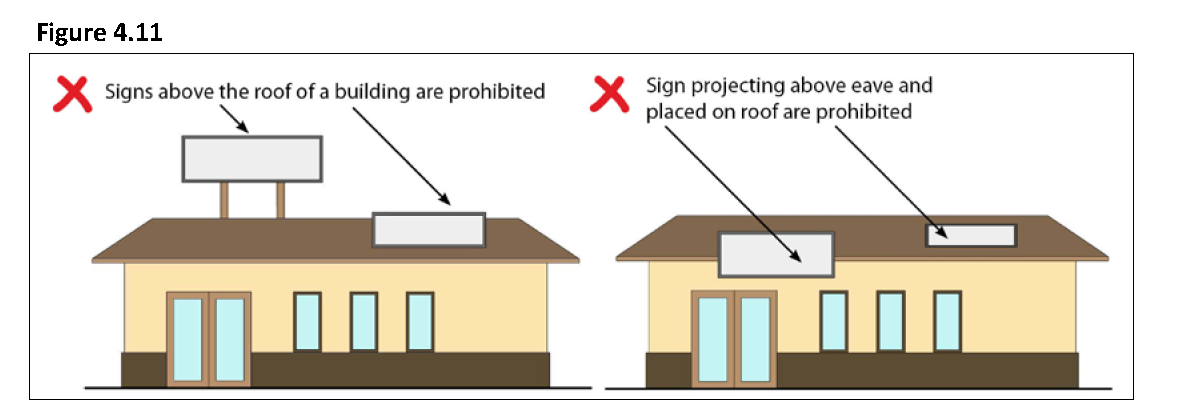
(9)
Signs creating traffic hazards. Signs that simulate in color, size or design any traffic control sign, signal or device, or that make use of words, symbols or characters in a manner that interferes with, misleads or confuses pedestrian or vehicular traffic, are prohibited. No sign, light or advertising structure shall be located in such a manner as to constitute a hazard to pedestrian or vehicular traffic, or in such a manner as to obstruct free and clear vision, at any location where, by reason of the position, shape, color or movement may interfere with, obstruct the view of, or be confused with any authorized traffic sign, signal or device. The Planning Commission shall have the determining authority whether a traffic hazard is created by a proposed sign.
(10)
Sign twirlers. Persons who apply an advertisement on his or her person, including holding, wearing, or applying a sign in any form on the human body, located within fifty (50) feet of any right-of-way, including persons spinning, dancing, and wearing costumes with signs, in order to attract attention, are prohibited. Sign twirlers are also known as sign spinners, sign walkers, sign wavers, or human billboards.
(11)
Vehicle displays. Vehicles with signs that cover more than five (5) percent of the vehicle surface area and parked in a conspicuous location, with the primary purpose of on-site or off-site advertising, are prohibited. This section does not apply to vehicles with signs advertising the vehicle for sale in locations where the sale of vehicles is permitted. All vehicles and bicycles utilized to tow signage and/or billboards for the sole purpose of advertising are not allowed. Vehicles used primarily for business operations such as delivery and shuttle services may display advertising on the vehicle related to the subject business.
(Ord. No. 776, § 1(Exh. A), eff. 9-5-2014)
Sec. 9-4.506. - General standards.
(a)
This section establishes general physical standards and requirements. More detailed standards applicable to specific sign types (e.g. wall signs, awning signs) are in Section 9-4.509, Standards for Specific Types of Signs. In addition to these general standards, all signs shall conform to the specifications of the Sign Code, Section 8-6.01 of the Municipal Code.
(1)
Maximum number of signs. Any tenant that has only one building frontage shall be allowed a maximum of two (2) signs. At least one wall sign shall be permitted on any wall of a building which faces a public area, such as a street, mall plaza, or parking lot, or upon a private parking lot when such lot is built to the standards set forth in the Zoning Ordinance, clearly identifying the business name with minimal additional information. Window signage is not included under the maximum number of signs.
(2)
Maximum allowable sign area. All signs shall conform to the maximum area requirements specified in Table 4.6 and Section 9-4.509 of this article, unless a different limit is approved under a Master Sign Program or by the City Council. Window signage is not included under the maximum allowable sign area, but must meet the standards under Section 9-4.509(e) of this article.
(3)
Measuring sign area. Sign area includes the entire face of a framed sign, but does not include the supporting structure. Individual letters attached to a building shall be measured by the area enclosed by drawing continuous line to form the smallest square or rectangle completely surrounding all words, emblems, logos, and surfaces of the sign.
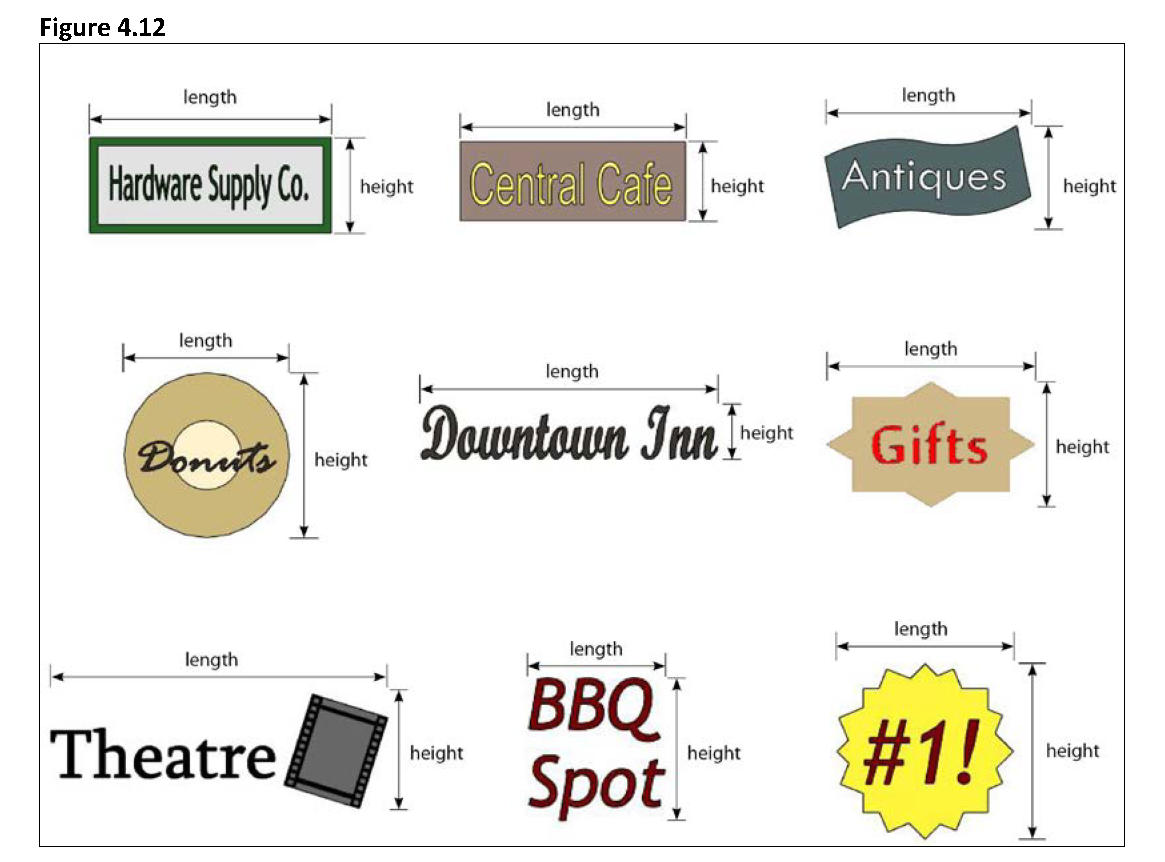
a.
Double-faced signs. For double-faced signs with less than eighteen (18) inches between faces, and less than a forty-five (45) degree interior angle between faces, only one side shall be counted as the total area. Where the faces are not equal in size, the larger sign face shall be used as the basis for calculating sign area.
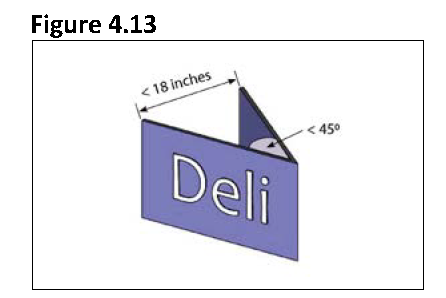
b.
Multi-faced signs. The sign area of signs with three (3) or more sign faces, or signs with two (2) sign faces with a distance eighteen (18) inches or more apart or that have an interior angle greater than forty-five (45) degrees, shall be calculated as the sum of all the sign faces.
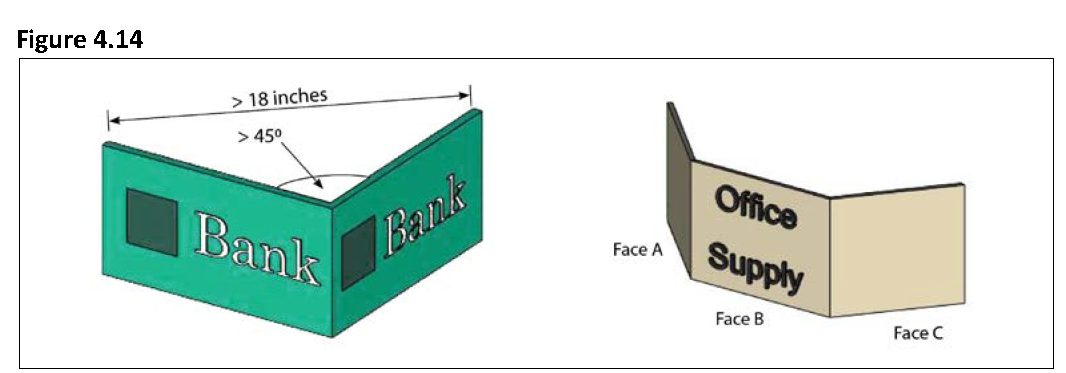
c.
Three-dimensional signs. Signs that consist of, or have attached to them, one or more three-dimensional objects (i.e. balls, cubes, clusters of objects, sculpture, or statue-like trademarks), shall have a sign area of the sum of two (2) adjacent sides or sign faces.
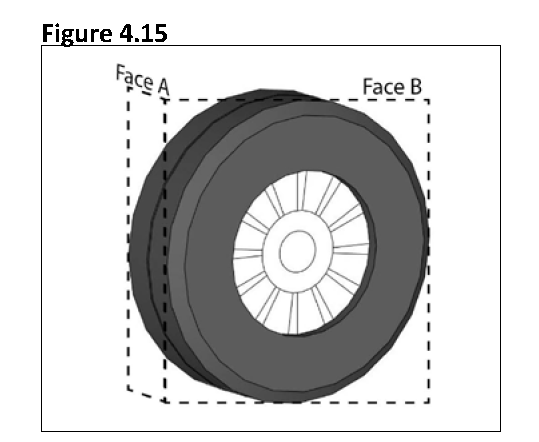
(4)
Abandoned signs. Any sign, including its supporting structure, which no longer identifies the current occupant after a lapse of thirty (30) days, shall be deemed an abandoned sign and shall be removed by the owner of the property on which it is located. When a wall sign is removed, the wall behind the sign shall be repaired and painted to match the rest of the building wall. Any signs not removed or made blank within this time shall be removed pursuant to the removal procedures set forth in this chapter.
(5)
Building frontage. Building frontage refers to the external length of a building that is visible from the public right-of-way, and typically runs parallel to such right-of-way. A building's frontage is considered continuous if projections or recesses in a building wall do not exceed ten (10) feet in any direction.
a.
If two (2) or more businesses exist in a building, the building frontage of each business is determined by measuring up to the center of demising walls.
b.
If a non-residential building has additional building frontages along additional public rights-of-way, one additional sign may be permitted per additional building frontage, up to the maximum sign area allowed per Table 4.6.
c.
The maximum number of signs permitted shall be increased to one additional sign per building frontage.
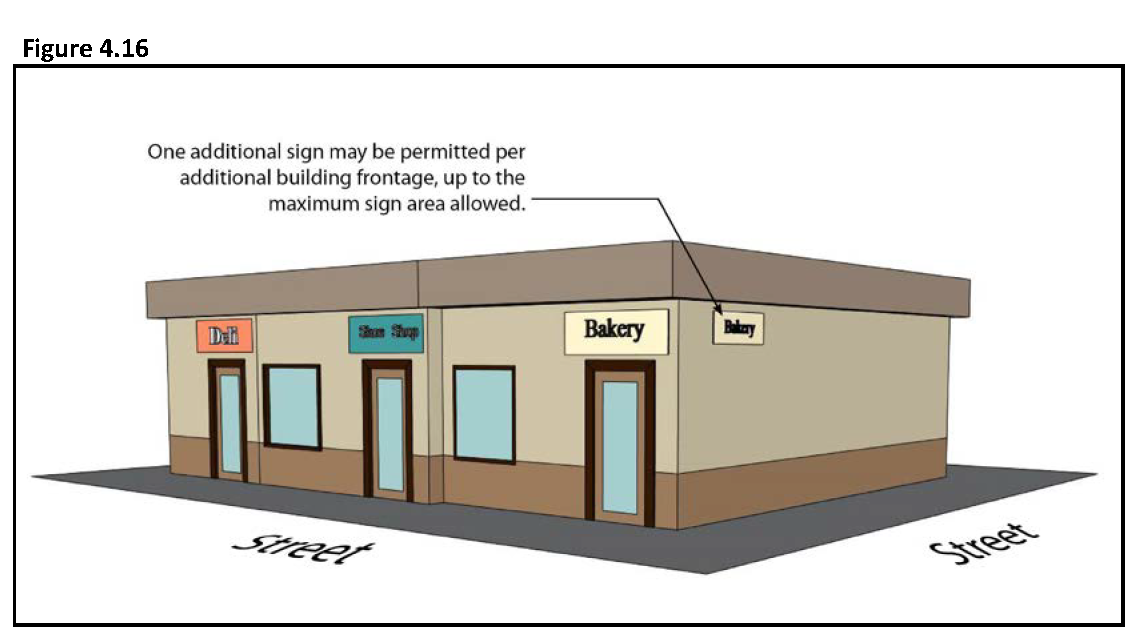
(6)
Changeable copy. Changeable copy shall cover no more than forty (40) percent of the total sign area for manually changeable signs. For electronic message center signs with copy that can be changed or altered by electric, electro-mechanical, electronic, or any other artificial energy means, the changeable portion of the sign shall cover no more than twenty-five (25) percent of the total sign area. The following uses are exempt from this restriction: religious institutions and buildings, cinemas, government or civic signs, gas price signs at gas stations, indoor theaters, schools, and colleges.
(7)
Clearance from utilities. Signs and their supporting structures shall maintain clearance from and not interfere with electrical conductors, communications equipment or lines, surface and underground facilities and conduits for water, sewage, gas, electricity and communications equipment or lines. Signs shall not be placed in public utility easements unless express written permission from the affected public utility is obtained.
(8)
Construction and maintenance.
a.
Unless exempt, signs and supporting structures shall be installed in accordance with the California Building Code.
b.
All signs, together with all supporting structures, shall be maintained in the following manner:
1.
Signs shall be kept free of rust, dirt and chipped, cracked or peeling paint.
2.
All hanging, dangling, torn or frayed parts of signs shall be promptly repaired, and graffiti and unauthorized attachments shall be removed.
3.
Failed, damaged, or blinking illumination shall be promptly replaced.
4.
Sign areas shall be kept free and clear of all noxious substances, rubbish and weeds.
5.
Discolored or faded panels on plastic faces shall be restored to their original condition and color.
(9)
Encroachment into public street or sidewalk. Any sign projecting over a public street or sidewalk requires an encroachment agreement approved by the City Engineer. Projecting signs and pole signs are allowed a maximum encroachment of twelve (12) inches over a public sidewalk.
(10)
Illumination. Channel letters and neon signs are allowed. However, bare bulbs are prohibited. On signs with external illumination, lights shall be provided with proper reflectors to concentrate the illumination on the area of the sign to prevent glare on the street or adjacent properties. All sign illumination shall adhere to the performance standards for lighting and glare in Chapter 4, Article 4, Performance Standards.
(11)
Materials. Paper, cardboard and any other materials subject to rapid deterioration, as determined by the Community Development Director, shall be limited to signs displayed for no more than thirty (30) days.
(12)
Substitution of sign message. The owner of a permitted sign may substitute a noncommercial message for a commercial message or a commercial message for a noncommercial message.
(Ord. No. 776, § 1(Exh. A), eff. 9-5-2014)
Sec. 9-4.507. - Sign standards for residential districts.
(a)
The following signs are permitted in Residential districts:
(1)
Nameplate no larger than two (2) square feet identifying the owner, occupant, address or approved home occupation.
(2)
One identification sign no larger than twenty-four (24) square feet identifying a multi-family complex or institutional use.
(3)
Permanent subdivision signs no larger than twenty-four (24) square feet at subdivision entrances.
(4)
Temporary construction signs, banners and flags no larger than thirty-two (32) square feet, but only during periods of construction and initial property sales.
(b)
The following signs are not permitted in Residential districts:
(1)
Marquee and Pole signs are not permitted in all Residential districts.
(Ord. No. 776, § 1(Exh. A), eff. 9-5-2014)
Sec. 9-4.508. - Sign standards for non-residential districts.
Signage in non-residential districts shall comply with the standards in Table 4.6. The maximum sign area allowed refers to the aggregate area of all types of signage on the applicable business or property. All properties in non-residential districts shall be allowed a minimum sign area of twenty (20) square feet.
(Ord. No. 776, § 1(Exh. A), eff. 9-5-2014)
Sec. 9-4.509. - Standards for specific types of signs.
(a)
Awning and canopy signs. Signs painted on awnings, canopies, arcades, or similar attachments or structures are allowed. The sign area for awning and canopy signs is calculated as the area within a single continuous enclosure around only the copy area of the lettering or logo of the sign. Awning and canopy signs are also subject to the specific Zoning District standards and the following standards:
(1)
Maximum sign area per awning or canopy sign:
a.
MX district and Downtown District Overlay: twenty-four (24) square feet.
b.
CG, CR, CS, and MB districts: sixty (60) square feet.
(2)
Sign clearance: Minimum of eight (8) feet clearance for the entire awning or canopy, measured from the curb.
(3)
Height limit: Twenty-five (25) feet measured from the curb.
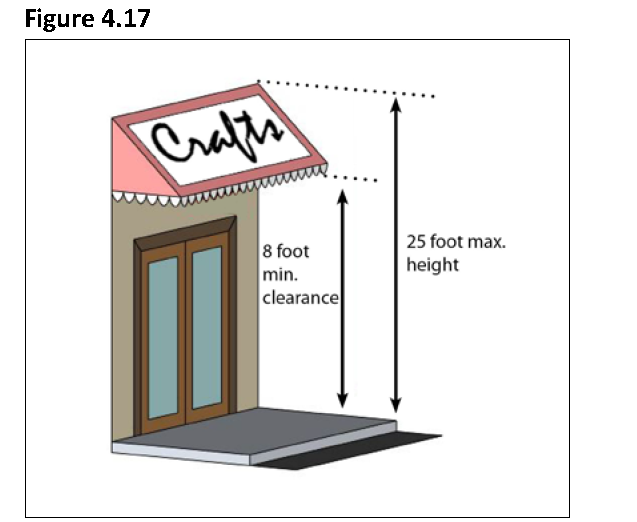
(b)
Marquee signs. A sign permanently affixed to a marquee is allowed in conjunction with theaters, museums, galleries, and similar uses. Marquee signs are considered separate from wall signs. Removable copy may be changed on the face of permitted marquee signs without securing a permit. Marquee signs are subject to the specific Zoning District standards and the following standards:
(1)
Maximum Number of Signs: One marquee sign per site.
(2)
Maximum Sign Area Per Sign: One and one-half (1.5) square feet per linear foot of building frontage, subject to the maximum sign area allowed per Table 4.6.
(3)
Sign Clearance: Minimum of eight (8) feet, measured from the curb.
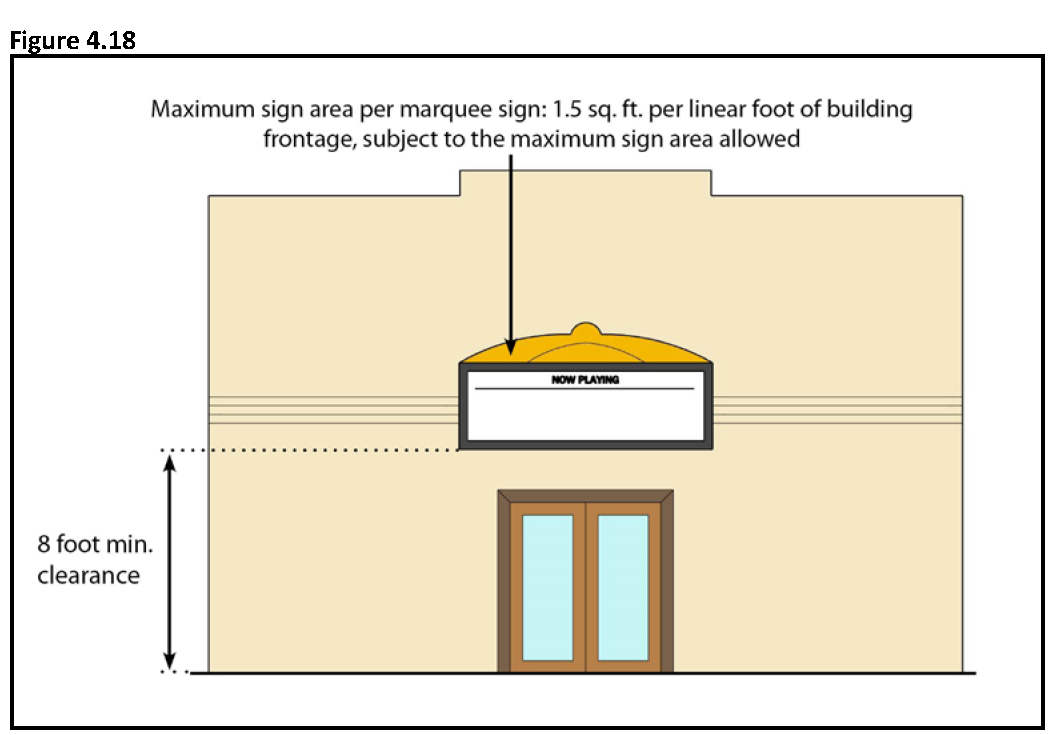
(c)
Projecting Signs (also known as Blade Signs). Signs under canopies or covers in conjunction with pedestrian walkways, or signs projecting from the building wall are allowed, subject to the specific Zoning District standards and the following standards:
(1)
Maximum Number of Signs: One projecting sign per building or tenant space frontage plus one rear façade sign.
(2)
Maximum Sign Area Per Sign: Sixteen (16) square feet; except the maximum sign area per sign is eight (8) square feet when the sign is located under a canopy or awning.
(3)
Sign Clearance: Minimum of eight (8) feet.
(4)
Height: A projecting sign shall be erected in such a manner as not to create a traffic hazard to vehicles or pedestrians. Projecting signs shall not extend higher than twenty (20) feet measured from the curb, or above an eave or roof, whichever is lower.
(5)
Projection: A projecting sign cannot extend more than three (3) feet from the building to which it is attached.
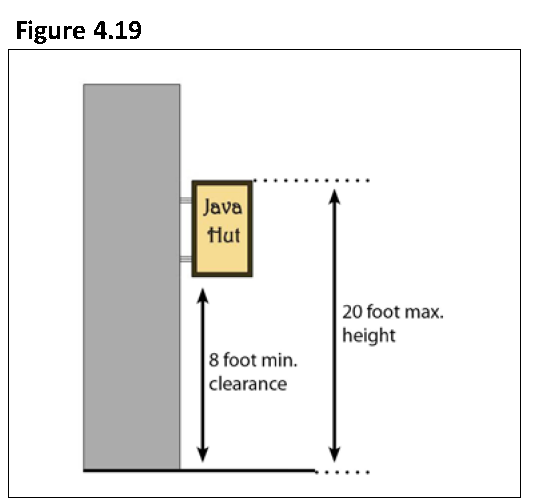
(d)
Wall signs. Wall signs include any sign attached to, erected against or painted upon the wall of a building or structure, the face of which is in a single plane parallel to the plane of the wall. Wall signs also include signs on affixed to any type of roof. No wall sign may cover wholly or partially any required wall opening. Wall signs are also subject to the specific Zoning District standards and the following standards:
(1)
Maximum Number of Signs: One wall sign per building or tenant space frontage plus one rear façade sign.
(2)
Maximum Sign Area Per Sign: 100 square feet or fifteen (15) percent of the building façade, whichever is less.
(3)
Height: Wall signs shall not be mounted or placed higher than the second story and shall not extend higher than the building wall upon which they are attached.
(4)
Length: Wall signs shall not occupy more than seventy-five (75) percent of the length of the wall or tenant space to which the sign is attached.
(5)
Projection: Wall signs cannot extend more than twelve (12) inches beyond the face of the wall to which they are attached.
(6)
Design: Wall signs shall be oriented to achieve balance composition and harmony with other architectural elements of a building facade.
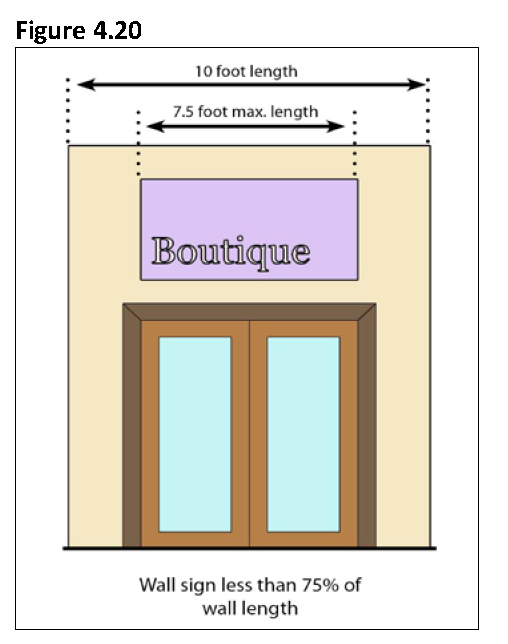
(e)
Window Signs. Window signs painted or otherwise adhered directly onto a window are subject to the specific Zoning District standards and the following standards:
(1)
Coverage: Window signs shall cover no more than fifty (50) percent of the total glass window area along each building frontage.
(2)
Height: Window signs shall not be mounted or placed on windows higher than the second story.
(3)
Contents: Window signs include text indicating hours of operation, address information, advertisements for any purpose, and environmental graphics.
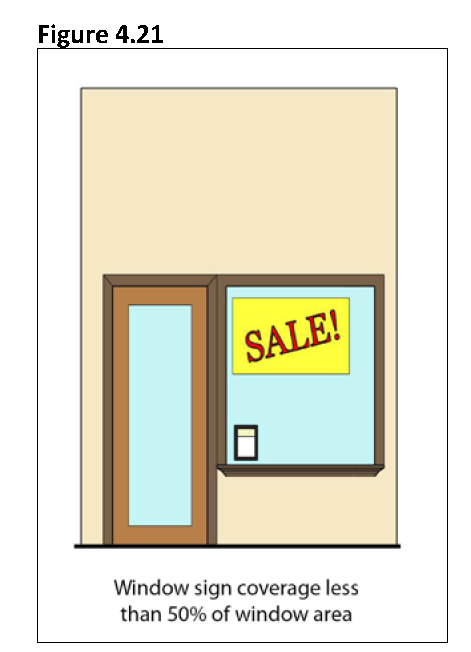
(f)
Monument and panel signs. Freestanding signs erected on the ground, or on a monument base designed as an architectural unit, are allowed subject to the specific Zoning District standards and the following standards:
(1)
Maximum number of signs: One monument sign or panel sign per site. Drive-through facilities are allowed up to two (2) illuminated menu boards not exceeding twenty-four (24) square feet in area and six (6) feet in height, Menu boards shall not count towards the number of signs allowed per Section 9-4.506(a)(1) of this article.
(2)
Maximum sign area per sign: Sixty (60) square feet.
(3)
Height: A maximum of six (6) feet and six (6) inches measured from the curb for both monument and panel signs. Panel signs showing business names on a property with multiple businesses shall be a maximum of twelve (12) feet measured from the curb.
(4)
Setbacks: Monument signs shall be set back a minimum of five (5) feet from the property line.
(5)
Landscaping: Landscaping is highly encouraged for panel signs and is required for monument signs. All monument signs with surrounding landscaping at the base shall require automatic irrigation equivalent to two (2) times the area of the sign copy.
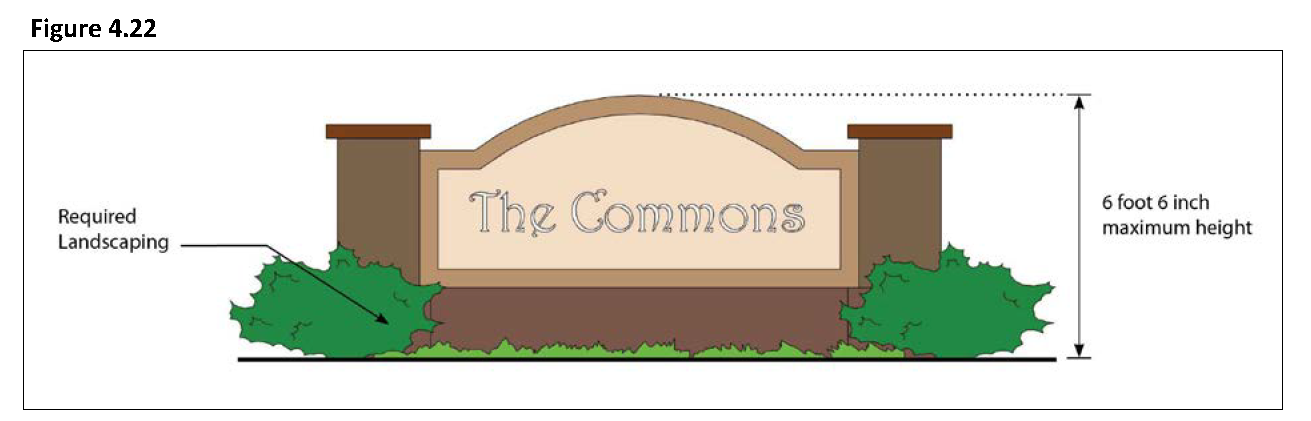
(g)
Pole signs. Pole signs are allowed subject to the specific Zoning District standards and the following standards, whichever is more restrictive:
(1)
Maximum number of signs: One pole sign per site.
(2)
Maximum sign area per sign: Sixty (60) square feet, inclusive of all businesses advertised.
(3)
Architectural treatment: Pole signs shall be architecturally compatible in style, finish and color with the adjacent building or development. Structural supports, poles, angle bars, iron pipes, I-beams or similar structural members shall be architecturally encased with finished metal cladding, stucco, or similar material, subject to approval by the Community Development Director as to proportion and architectural compatibility.
(4)
Landscaping. Pole signs shall be placed within a landscaped planter with at least twenty-eight (28) square feet of planting area. As a condition of any permit for a pole sign, additional landscaping of the property may be required where needed to better integrate sign appearance with the site through scale and softening effects.
(5)
Height. A maximum of twenty (20) feet, with a minimum clearance of fourteen (14) feet over parking lots and driveways, and eight (8) feet over pedestrian walkways.
(6)
Projection. Pole signs shall not project beyond the property line.
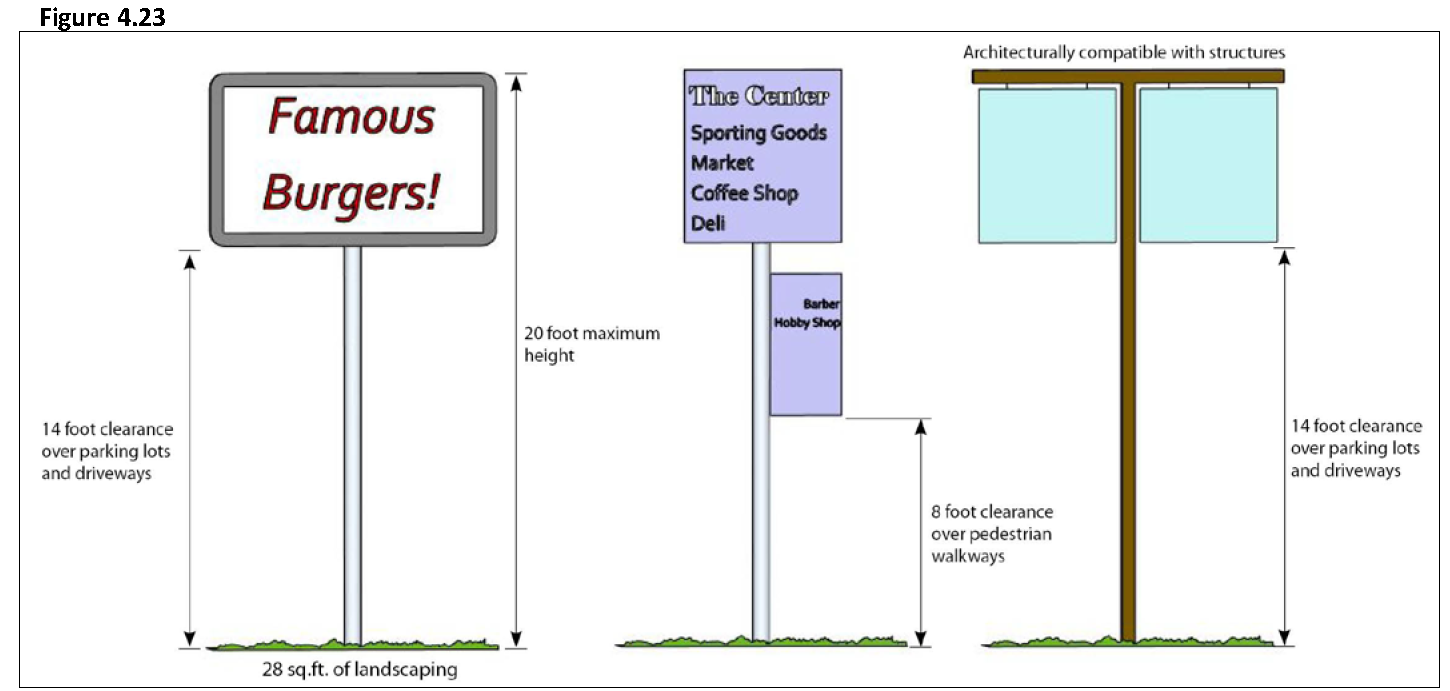
(i)
Other sign types.
(1)
Center identification signs. Center identification signs are permitted in the R, CG, CR, CS, and MB districts, subject to the following limitations:
a.
Identifiable area. The facility being used shall fulfill the definition of an identifiable area.
b.
Area not counted. The area of this sign shall not count towards the permissible sign area of the individual lot.
c.
Non-Residential Districts. The maximum sign area in the CG, CR, CS, and MB districts may be no more than one foot for each linear foot of street frontage in Commercial districts, but in no case shall the total sign area exceed two hundred (200) square feet. If more than one entrance to the lot exists, the maximum sign area permitted may be divided among the number of entryways and signs requested.
d.
Residential Districts and Subdivisions. For subdivisions and other single-family area entry signs, the maximum sign area permitted is twenty (20) square feet per entryway. Signs shall be mounted on a fence, wall or other similar entry feature.
e.
Sign base. The sign base is to be located within a planter box or planting area, the design and location of which is to be approved by the Community Development Director.
(2)
A-Frame/sandwich board signs. Temporary, portable A-frame or sandwich board signs are permitted in the CG, CR, and MX Zoning Districts, subject to the following limitations:
a.
Area not counted. The area of the sign shall not count towards the permissible sign area of the individual lot.
b.
Maximum number of signs. One A-frame/sandwich board sign per tenant space.
c.
Maximum sign area. The total sign area may be no more than twelve (12) square feet, with a maximum of six (6) square feet per side.
d.
Location. Such sign may encroach into the right-of-way up to two (2) feet from the property line as long as once the sign is in place, there remains a six (6) foot wide walkable area.
e.
Removal. Such sign is to be removed during non-operational hours.
(3)
Gas station signs.
a.
Fuel pump signs. Signs which advertise the prices, gasoline or fuel types, and terms of sale are exempt from regulation if permanently affixed to, and below the highest point or surface of the motor vehicle pump.
b.
Fuel price sign. The portion of any sign structure devoted exclusively to display of motor vehicle fuel price information required or permitted by Division 5, Chapter 14, Article 12 of the California Business and Professions Code (Section 13530, et seq.).
c.
No person shall sell at retail any motor vehicle fuel unless there are at all times displayed on the premises so as to be read by passing motorists, such signs advertising the prices and types of gasoline, and the terms of sales thereof, as may be required by state law.
d.
It is unlawful for any person to display any motor vehicle fuel price sign other than the minimum number of such signs specifically required to comply with state law.
e.
Fuel price sign standards. Motor vehicle fuel price signs shall not exceed thirty (30) square feet in area and ten (10) feet in width. Such signs may be arranged in two (2) sections, so long as such sections are permanently affixed to the same structure no more than ten (10) feet from each other, provided that their total area does not exceed thirty (30) square feet, and provided that the total width of such sections does not exceed ten (10) feet. The highest part of any motor vehicle fuel price sign shall extend no more than ten (10) feet in height, measured from curb grade. Both sides of such signs may be used for display of required fuel price information. Repetitive information shall not be permitted on any single side of a fuel price sign. The maximum area and height limits contained herein may be exceeded only to the extent necessary to comply with state law.
f.
The area of motor vehicle fuel price signs shall not be included in calculating the maximum area allowed for business identification signs. However, if fuel prices and business identification are combined on a ground sign structure, the following setback regulations shall apply in lieu of other setback provisions.
g.
No person shall erect, maintain, alter, relocate, change or otherwise modify any motor vehicle fuel price sign, except to substitute different words and/or numbers thereon, or to add or delete signs denoting different services or products, when required or permitted to do so by state law, unless a sign approval first has been issued by the director of community development. Any fuel price sign modification which itself does not require a separate sign approval shall comply in all material respects with the terms of any existing sign approval or land use approval governing the sign.
(4)
Nothing contained herein shall be construed so as to repeal or amend otherwise applicable regulations imposed by this code concerning the number, placement, location, design, materials or other characteristics of signs, to the extent that such regulations are consistent with state law.
(5)
Violations of the terms of this section or the terms of state law, shall be punishable as provided in Business and Professions Code Section 13531.
(Ord. No. 776, § 1(Exh. A), eff. 9-5-2014)
Sec. 9-4.510. - Temporary signs.
(a)
The following types of temporary signs are permitted without a permit in accordance with the following standards.
(1)
Inflatable signs, balloons, banners, feather signs, flags, pennants, streamers and wind dancers. Inflatable signs, balloons, banners, feather signs, flags, pennants, streamers and wind dancers are permitted only for specific events and standards stated below:
a.
Seven (7) days before business openings, change of ownership, and special business promotions and sales, and one day after the event has concluded. Temporary signage for such events shall be allowed for only a total of ninety (90) aggregate days out of a calendar year.
b.
Ten (10) days before and five (5) days after a federally recognized holiday.
c.
Thirty (30) days before and five (5) days after any recognized community-wide civic events, as determined by the City Council.
d.
A combination of up to three (3) types of said signs may be used during the event. No inflatable signs, balloons, banners, feather signs, flags, pennants, streamers, or any other advertising devices may be mounted on or above roofs or extend above a parapet wall or ridge line of a structure.
(b)
Subdivision signs. Signs advertising a subdivision being developed in the City are subject to the following requirements:
(1)
On-site signs. One sign per street frontage with a maximum of two (2) temporary real estate subdivision signs may be permitted on the subdivision site in accordance with the following:
a.
Maximum sign area. The maximum sign area may be no more than 100 square feet.
b.
Height. A maximum of ten (10) feet measured from the curb.
c.
Duration. Subdivision signs shall be removed twenty-four (24) months from the date the permit for same is issued, or when the last lot of the subdivision has been sold for the first time, whichever comes first.
d.
Letter of agreement. A Letter of Agreement from the property owners giving the City right of entry to remove signs in the event the above stipulations are not complied with shall be submitted to the Community Development Director prior to the issuance of a Sign Permit. If at any time the property on which the signs are located is sold, the signs shall be removed or a new Letter of Agreement shall be submitted from the buyer to permit the sign to remain and granting the City right to enter the property and remove the sign.
(2)
Off-site signs. Up to three (3) off-site directional real estate subdivision signs directing traffic to open houses and subdivisions involved in real estate sales may be permitted in any zone, provided that:
a.
Maximum sign area. The maximum sign area may be no more than thirty-two (32) square feet.
b.
Height. A maximum of twelve (12) feet measured from the curb.
c.
Duration. Said signs and advertising structures shall be removed twenty-four (24) months from the date the permit for same is issued, or when the subdivision is completely sold out, whichever comes first.
d.
Consent of landowner. A completed application form, including a notarized affidavit signed by each property owner of each site.
e.
Location. No more than one temporary off-site directional sign shall be allowed per site.
(Ord. No. 776, § 1(Exh. A), eff. 9-5-2014; Ord. No. 812, § 1, eff. 6-21-2018)
Sec. 9-4.511. - Permit requirements and review process.
(a)
Authority. The Planning Commission shall review and approve any Master Sign Program. The Community Development Director, or his or her designee, shall review and approve all other signs as specified in this article. If there is a conflict with local, State and Federal regulations, the more restrictive regulations shall govern.
(b)
Applicability. Except for certain signs exempted in compliance with Section 9-4.504, Signs Exempt from Review, no sign shall be erected, re-erected, constructed or altered (including change of copy or face change) unless approval has been issued by the Community Development Director or Planning Commission, and a Building Permit issued by the Community Development Department.
(c)
Applications for filing, processing and review.
(1)
Applicant. Sign owners or their designees shall apply for either Major or Minor Sign Permits, and Building Permits if required.
a.
Major Sign Permits are required only for Master Sign Programs.
b.
Minor Sign Permits are required for all other sign applications. One sign permit shall include the review of up to three (3) new signs or modifications of existing signs per business.
c.
Major and Minor Sign Permits are typically submitted and processed separately from other applications. However, if complete application materials are submitted for Sign Permits concurrently with another application, such as a Site Plan Review or Conditional Use Permit, the Major or Minor Sign Permits shall be reviewed concurrently with those applications and the Sign Permit fee shall be waived.
(2)
Filing and filing fee. Application for sign permits shall utilize forms furnished by the Community Development Department and accompanied by the required fee and required drawings as listed on the forms, to adequately show the location, construction and design, colors, materials, lighting, electrical elements, and advertising copy, of the sign, in accordance with applicable requirements of this article.
(3)
Compliance with standards.
a.
Upon acceptance of a sign application, the Community Development Director, shall review the application request for compliance with the locational and operational standards identified in this chapter, as well as the Design Principles laid out in Section 9-4.503 of this article, and with any standards established in a Master Sign Program pursuant to Section 9-4.512, Master Sign Program.
b.
The Community Development Director shall make a decision on Minor Sign Permit applications. The decision letter shall clearly state any conditions of approval or reasons for disapproval and applicable appeal provisions. For Major Sign Permits, the Community Development Director shall make a recommendation to the Planning Commission for their decision at a public hearing.
c.
All signs erected in the City, including their electrical wiring and components, are subject to inspection by the Chief Building Official to ensure compliance with City laws and ordinances, and the provisions of this chapter.
(4)
Appeals. Decisions by the Community Development Director may be appealed subject to the provisions of Chapter 6, Code Administration.
(Ord. No. 776, § 1(Exh. A), eff. 9-5-2014)
Sec. 9-4.512. - Master sign program.
(a)
Purpose. The purpose of a Master Sign Program is to provide a method for an applicant to integrate the design and placement of signs within a project with the overall development design to achieve a more unified appearance.
(b)
Applicability. A Master Sign Program may be processed for any development. However, a Master Sign Program is required whenever any of the following circumstances exists:
(1)
New commercial or industrial developments of three (3) or more separate tenants that share either the same parcel or structure and use common access and parking facilities (e.g., shopping centers, malls, office complexes and industrial parks);
(2)
New multi-family residential developments of twenty (20) or more units; or
(3)
Whenever five (5) or more signs are proposed for a building or site with one or two (2) tenants.
(c)
Application. Master Sign Program applications shall contain all written and graphic information needed to fully describe the proposed sign program, including the proposed location and dimension of each sign, as well as proposed color schemes, font types, materials, methods of attachment or support, and methods of illumination. A Master Sign Program application shall also include calculation of total allowed sign area, and total proposed sign area, for the site.
(d)
Allowable modifications. A Master Sign Program shall adhere to the standards of this chapter, and may provide additional design principles and standards to unify the visual appearance of a development.
(e)
Review authority. All Master Sign Programs are subject to review and approval of the Planning Commission for the project with which the signs are associated. See Section 9-4.511 for application procedures.
(f)
Required findings. In order to approve a Master Sign Program, the decision making body shall find that all of the following are met, in addition to other applicable regulations in this section:
(1)
The proposed signs are compatible in style and character with any building to which the signs are to be attached, any surrounding structures and any adjoining signage on the site;
(2)
Future tenants will be provided with adequate opportunities to construct, erect or maintain a sign for identification; and
(3)
Directional signage and building addressing is adequate for pedestrian and vehicular circulation and emergency vehicle access.
(g)
Lessees to be informed of master sign program. Lessees within developments subject to the requirements of an approved Master Sign Program shall be made aware of the Master Sign Program in their lease.
(h)
Revisions to master sign programs. Revisions to an approved Master Sign Program shall be approved by the Community Development Director.
(Ord. No. 776, § 1(Exh. A), eff. 9-5-2014)
Sec. 9-4.513. - Nonconforming signs.
(a)
A legal nonconforming sign is a sign that was lawfully in existence and in use within the City before the effective date of this section, but does not conform to the provisions of this section.
(b)
All legal nonconforming signs are permitted to remain unless they are subject to a permit condition or development agreement providing for their removal after a fixed period of time.
(c)
Any changes to legal nonconforming signs or their structures in terms of location, orientation, size, or height other than routine maintenance and repair or change of sign copy shall require that all signs and their structures on the property, business, and/or development be brought into conformance with this chapter.
(d)
A legal nonconforming sign loses its legal nonconforming status when the activity, product, business, service, or other use which was previously being advertised, has ceased or vacated the premises for three hundred sixty (360) days or more.
(e)
Any nonconforming sign that loses its legal nonconforming status shall be brought into compliance with this chapter or shall be removed by the property owner within ninety (90) days of losing its legal nonconforming status.
(Ord. No. 776, § 1(Exh. A), eff. 9-5-2014)
Sec. 9-4.514. - Abatement and removal of illegal signs.
(a)
Authority to abate. The City has the authority to abate illegal and abandoned signs. Abatement of identified illegal or abandoned signs shall commence within eight (8) months of the adoption of this chapter and shall be ongoing thereafter.
(b)
Illegal signs in the public right-of-way. Illegal signs posted in the public right-of-way or upon public property may be removed by the Community Development Director or officer without notice or hearing. Signs shall be retained by the City for a period of not less than thirty (30) days if identifiable. Thereafter, any unclaimed signs may be discarded.
(c)
Recovery of costs. When the City is required to remove illegal or abandoned signs in compliance with this chapter, the reasonable cost of the removal may be assessed against the owner of the sign(s).
(d)
Sign removal.
(1)
Any sign, including its supporting structure, which no longer identifies the current occupant or products currently sold, or which otherwise fails to serve its original purpose, or is not maintained in a safe, presentable, and good condition, including the replacement of defective parts, painting, repainting, and cleaning, shall be removed by the owner of the property within thirty (30) calendar days after written notice to do so from the Community Development Department.
(2)
Any sign which the Community Development Department establishes as unsafe or unsecure shall be corrected or removed, together with all supporting structures, by the owner of the property upon which the sign is located within thirty (30) days after written notice by the Community Development Department. Such notice shall state the location of the sign, the nature of the violation, and/or the manner in which the sign constitutes a public nuisance. The notice also shall require the removal or other abatement of the sign before the date specified in the notice. Further, the notice shall state that failure to comply may result in the removal of the sign by the City and that the cost of such removal may be imposed on the owner of the property. The notice shall also include instructions for the filing of an appeal of the determination of the Community Development Director that the sign is in violation of this chapter or constitutes a public nuisance. Such notice shall be served by posting on the property on which the sign is located and by registered or certified mail delivery, postage prepaid to the owner of the property, and, if known, the owner of the sign.
(3)
After the periods specified in paragraphs (1) and (2) above, the Community Development Department may cause such sign to be removed, and the cost of such removal shall become a lien against the property.
(4)
If a hazardous condition exists, the condition shall be corrected forthwith upon notice by the Community Development Department.
(5)
If an appeal is received prior to the date specified in the notice, abatement proceedings shall be suspended, and any deadlines shall be suspended, pending the outcome of such appeal.
(Ord. No. 776, § 1(Exh. A), eff. 9-5-2014)

