
Coalinga City Zoning Code
CHAPTER 6
- CODE ADMINISTRATION
Article 7. - Variances and Minor Exceptions[2]
Editor's note—Ord. No. 806, § 1, adopted September 21, 2017, effective October 21, 2017, renamed Article 7 from Variances as Variances and Minor Exceptions.
Article 13. - Density Bonus[3]
Editor's note—Ord. No. 874, § 1, adopted Oct. 16, 2025, amended Article 13 in its entirety to read as herein set out. Former Article 13, §§ 9-6.1301—9-6.1304, pertained to similar subject matter, and derived from Ord. No. 853, § 4, effective October 20, 2022.
Sec. 9-6.101.- Applicability.
All regulations in this title which pertain to the Zoning Districts established in Chapter 2 are subject to the general provisions, conditions and exceptions contained in this chapter.
(Ord. No. 776, § 1(Exh. A), eff. 9-5-2014)
Sec. 9-6.102. - Interpretation by community development director.
Whenever there is a question regarding the interpretation of the provisions of this title or their application to any specific case or situation, the Community Development Director shall interpret the intent of this title by written decision, and such interpretation thereafter shall be followed in applying the provisions, subject to appeal to the Planning Commission by any interested person.
(Ord. No. 776, § 1(Exh. A), eff. 9-5-2014)
Sec. 9-6.103. - Permits required.
No person shall commence or continue the alteration or construction of a building or land improvement on vacant property, or commence a use or activity on any site, until the appropriate permit has been issued by the Community Development Director, Planning Commission, or City Council, per the provisions of this title (see below), and the appropriate permits from the Community Development Department and any other applicable City Departments have been secured. All conditions of approval in the planning and building permits must be adhered to and maintained for the applicable permit durations. Whenever the use of a building or land shall change from an existing use that was approved through an existing permit, a new permit shall be secured through the Community Development Department.
(Ord. No. 776, § 1(Exh. A), eff. 9-5-2014)
Sec. 9-6.104. - Compliance with CEQA and California environmental and planning laws.
The administration of this ordinance is subject to the requirements of the planning and zoning laws of the State of California, the California Environmental Quality Act, applicable State of California rules and regulations, and procedures established by resolution of the City Council.
(Ord. No. 776, § 1(Exh. A), eff. 9-5-2014)
Sec. 9-6.105. - Authority for acting on applications.
Table 6.1 provides a summary of the persons or bodies with appropriate authority for recommendations, referrals, and approvals, for planning applications.
Table 6.1: PERMIT APPROVAL MATRIX
(Ord. No. 776, § 1(Exh. A), eff. 9-5-2014)
Sec. 9-6.106. - Application forms and fees.
(a)
Applicants. The following persons may file applications:
(1)
The owner of the subject property; and
(2)
An agent representing the owner, duly authorized to do so in writing by the owner. A person with a duly executed written contract or exclusive option to purchase the subject property or a lessee in possession of the subject property may also make an application, with written authorization by the property owner.
(b)
Application forms and supporting materials.
(1)
The Community Development Department shall prepare, issue, and update application forms that specify the information required from applicants for different types of project approvals, subject to the provisions of this Zoning Ordinance, and as required by the California Permit Streamlining Act. The forms shall be made available at the planning counter and on the City's website.
(2)
The Community Development Director may require the submission of supporting materials as part of the application, including but not limited to: statements, plans, drawings, renderings, material samples, photographs, documentation of property ownership, and other items as necessary to describe existing conditions, the proposed project, and to determine the level of environmental review required pursuant to the California Environmental Quality Act (CEQA).
(3)
All materials submitted become the property of the City. Submission materials will be made available to the public for inspection in accordance with the Public Records Act Government Code 6250 et. seq. Some or all of the submitted materials may be appended as attachments to public hearing staff reports, which will be made available on the City's website.
(c)
Indemnification and cost recovery agreement. applicants shall submit an executed indemnification agreement which indemnifies and holds the City harmless from any action in connection with the project being reviewed, and commits to cost recovery relating to an appeal as well as all court costs relating to legal challenges. Costs associated with implementing mitigation monitoring shall be included in the agreement. Failure or refusal by the applicant(s) to enter into an Indemnification and Cost Recovery Agreement will constitute an abandonment of the application and application approval. All rights accrued to the applicant(s) to proceed under the City's action in such regard shall be immediately revoked, and the City will be entitled to seek all remedies available to it under law, including but not limited to breach of contract and enforcement of any code violations.
(d)
Application filing fees. A schedule of application filing fees, as approved by Council resolution, shall be made available to the public. Per the fee schedule, either the entire application fee or a deposit shall be paid by the Applicant to the City at the time of application, for staff resources required to review and process the application, and for the costs of publicly noticing the project. There are no application fees for City-initiated projects.
(e)
Reduced application filing fees. To encourage the development of affordable and special needs housing, and also to reduce the burden on lower income homeowners, qualifying projects shall receive a forty (40) percent reduction from all required Planning fees, and a forty (40) percent reduction from all required Building Permit fees. Such projects include:
(1)
Housing developments with at least five (5) percent low and/or moderate income housing units;
(2)
Housing developments with senior housing units;
(3)
Emergency shelters;
(4)
Transitional and supportive housing projects;
(5)
Single-Room Occupancy facilities;
(6)
Group home or residential care facility for the disabled, developmentally disabled, or elderly;
(7)
Housing projects with child care facilities;
(8)
Farmworker housing;
(9)
Student dormitories or housing;
(10)
New or modifications to single-family homes where homeowners are in the extremely low, very low, and low income categories, as demonstrated through tax returns from the most recent tax year.
(f)
Development impact fees. Depending on the scope of the project, the City may charge development impact fees, as approved by the City Council, to pay for all or a portion of the costs of additional public services to the proposed development, including but not limited to water and sewer infrastructure, police and fire services, and school district impact fees.
(g)
Appeal fee. The appellant shall pay the appropriate appeal fee as established per resolution.
(Ord. No. 776, § 1(Exh. A), eff. 9-5-2014)
Sec. 9-6.107. - Combined development applications.
(a)
Simultaneous review. Certain development proposals may require multiple discretionary approvals. The simultaneous review of several permits as part of the entitlement process is intended to expedite workflow, reduce the time and cost of processing applications, and assure comprehensive consideration of such projects.
(b)
Procedure and appropriate authority. Any application for development, which under the terms of the municipal code, requires more than one discretionary approval, or for which an applicant seeks more than one discretionary approval, shall be processed as a single combined application. If any one application requires City Council approval, the Planning Commission shall be the recommending body to the City Council for all approvals within the combined application, and shall make its recommendation following a public hearing. The City Council shall be the approving body for all approvals within the combined application, and shall not act without the prior review and recommendation of the Planning Commission.
(Ord. No. 776, § 1(Exh. A), eff. 9-5-2014)
Sec. 9-6.108. - Application procedure.
See Figure 6.1 below.
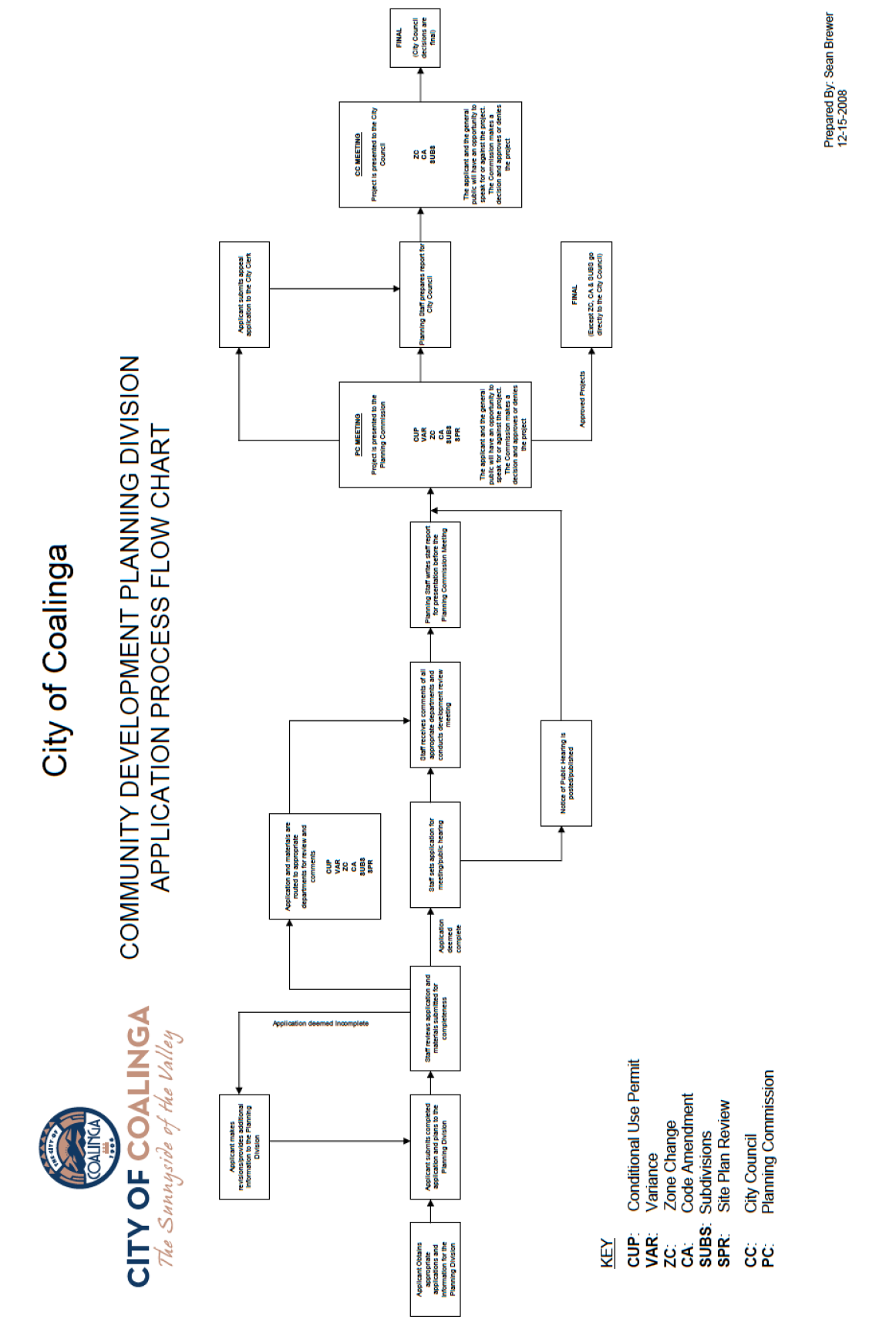
(Ord. No. 776, § 1(Exh. A), eff. 9-5-2014)
Sec. 9-6.109. - Pre-application review.
A pre-application review is encouraged, but not required, for applicants to discuss preliminary proposals with the Community Development Director. Pre-applications enable applicants to gather early feedback from The Community Development Director. They reduce the risk of filing an incomplete application, and can avoid unnecessary costs and additional time spent during the application process. A pre-application shall never constitute or be considered as a pre-approval.
(Ord. No. 776, § 1(Exh. A), eff. 9-5-2014)
Sec. 9-6.110. - Application Review.
(a)
Completeness of application. The Community Development Director shall first determine within thirty (30) days of the date of application, whether the application is complete, the Community Development Director will provide written notification to the applicant listing the outstanding information necessary to complete the application. The City will not process incomplete applications. If elements are missing, the applicant shall provide the City with the missing elements within the required time, or will have to file another application and pay the required fees for this new application. When an application is deemed to be complete, the Community Development Director will route the application to all appropriate departments for review and comment, and schedule the project for internal review, as well as the next available public hearing date by the appropriate decision-making body.
(b)
Changes to the application. Based on the feedback provided by the Community Development Director, the applicant may make modifications to the application. Any changes or supplemental information shall be submitted two (2) weeks before the scheduled hearing date. Otherwise, the project may be scheduled for a later hearing date to accommodate proposed changes. The project may require additional review by the Community Development Director and other City departments, and therefore be rescheduled for a later public hearing.
(Ord. No. 776, § 1(Exh. A), eff. 9-5-2014)
Sec. 9-6.111. - Public notification.
(a)
Whenever a public notice is required for a project, notification shall be provided in compliance with the requirements of State law and as follows:
(1)
When mailed notice is required. At least ten (10) days before the date of the public hearing, the Community Development Director shall provide notice by First Class mail delivery to:
a.
The applicant, the owner, and any occupant of the subject property;
b.
All property owners of record within a 300-foot radius of the subject property, as shown on the latest available assessment role; and
c.
Any person or group who has filed a written request for notice regarding the specific application with the Community Development Director, or City Clerk or his/her designee.
(2)
When newspaper notice is required. At least ten (10) days before the date of the public hearing, the Community Development Director shall provide notice by at least one publication in a newspaper of general circulation, or by posting the notice at three (3) public locations within the City.
(3)
Contents of notice. The notice shall contain the following information:
a.
General description of the proposed project or action, and the location of the subject property;
b.
The names of the applicant and the owner of the property that is the subject of the application;
c.
The date, time, location, and purpose of the public hearing;
d.
The identity of the hearing body;
e.
A statement that any interested person or authorized agent may appear and be heard; and
f.
The location at which the complete application and project file may be viewed by the public;
g.
A statement describing where and how to submit written comments.
(4)
Failure to notify individual properties or failure to receive notice. The validity of the proceedings shall not be affected by the failure of any property owner, resident or neighborhood or organization to receive notice of a public hearing.
(Ord. No. 776, § 1(Exh. A), eff. 9-5-2014)
Sec. 9-6.112. - Public hearings.
(a)
Public hearings shall be held consistent with State law and as follows:
(1)
The Community Development Director shall present to the Planning Commission or City Council a written report prepared by the administrative staff, in connection with any application requiring Planning Commission or City Council approval.
(2)
The Planning Commission or City Council shall conduct at least one public hearing on any application brought to its attention by the Community Development Director. Notice of the hearing shall be given by the Community Development Director at least ten (10) calendar days prior to the day of the hearing.
(3)
The notice of public hearing shall include the date, time, and place of the public hearing, the identity of the hearing body, a general explanation of the matter to be considered, and a general explanation, in text or by diagram, of the location of the real property that is the subject of the hearing.
(4)
Continuance of public hearings. The Planning Commission or City Council, for any reason when it deems such action necessary or desirable, may continue any hearing to a certain date, time, and place, and the public announcement of such date, time, and place of a hearing to be continued, for all purposes, shall be sufficient notice to all persons.
(Ord. No. 776, § 1(Exh. A), eff. 9-5-2014)
Sec. 9-6.113. - Approvals, approvals with conditions, and denials.
(a)
Scope of approvals. An approved permit allows only the uses and activities proposed in the application, and excludes other uses and activities. The approved use and construction are subject to, and shall comply with, all applicable municipal ordinances and laws and regulations of other governmental agencies.
(b)
Conditions of approval. Any approval may be subject to conditions of approval determined by the decision-making body, which shall be maintained for the duration of the permit. Typical conditions of approval may include but are not limited to the following:
(1)
All mitigation measures resulting from environmental analysis are automatically included as conditions of approval and shall be monitored for compliance;
(2)
In the event that archaeological remains are encountered during grading, work shall be halted temporarily and a qualified archaeologist shall be consulted for evaluation of the artifacts and to recommend future action. The local Native American community shall also be notified and consulted in the event any archaeological remains are uncovered;
(3)
Construction hours, as specified by the Community Development Director;
(4)
Construction activities shall comply with applicable Municipal Code and Zoning Ordinance sections, including Chapter 4, Article 4, Performance Standards;
(5)
Plans submitted for Building Permit shall be in substantial conformance with plans approved by Planning;
(6)
Disposal of hazardous materials as part of construction and operations shall be in compliance with applicable Federal and State regulations;
(7)
Payment of development impact fees is required at the time of filing of Building Permits;
(8)
The applicants/developers shall defend, indemnify, and hold harmless the City or any of its boards, commissions, agents, officers, and employees from any claim, action, or proceeding against the City, its boards, commissions, agents, officers, or employees to attack, set aside, void, or annul the approval of the project when such claim or action is brought within the time period provided for in applicable State and/or local statutes. The City shall promptly notify the applicants/developers of any such claim, action, or proceeding. The City shall coordinate in the defense. Nothing contained in this condition shall prohibit the City from participating in a defense of any claim, action, or proceeding if the City bears its own attorney's fees and costs, and the City defends the action in good faith.
(9)
Applicants shall obtain all necessary stormwater permits from the California Regional Water Quality Control Board, Central Valley Region.
(10)
Upon issuance of a building permit by the City, all existing uses at the subjection location are terminated.
(11)
All other required local, County, State, or Federal permits shall be obtained prior to the start of operations.
(c)
Actions voiding approval. If the construction of a building or structure, or the use established in the building or structure is contrary to the project approval, therefore violating any provision of the Zoning Ordinance, or would require additional permits, then the original approval shall be deemed null and void.
(d)
Periodic review or monitoring of conditions. All approvals may be subject to periodic review to determine compliance with the permit and its conditions of approval. If a condition of approval specifies that activities or uses allowed under the permit are subject to periodic reporting, monitoring or assessments, it shall be the responsibility of the permit holder, property owner, or successor property owners to comply with such conditions.
(Ord. No. 776, § 1(Exh. A), eff. 9-5-2014)
Sec. 9-6.114. - Effective dates, expiration, extensions, modifications, and revocation of approvals.
(a)
Effective date of approval. A final decision on an application by the Community Development Director or his or her designee, the Planning Commission, or the City Council, will not become effective until the expiration of the appeal period following the date of action. No building permit or business license shall be issued until the appeal period is over, and no appeal has been filed, or an appeal has been given a final determination.
(b)
Expiration of approval. The decision-making body may specify the time within which the proposed use must be undertaken and actively and continuously pursued. The decision-making body may also specify a period of time for the approval, as is found to be consistent with the purposes of the use and necessary to safeguard public health, safety, and welfare. If no time period is specified, any permit granted under this Zoning Ordinance may be declared lapsed and of no further force and effect if not exercised within one year of its issuance. Any expired permit requires a reapplication with the full required fee.
(c)
Extension of approval. The Community Development Director may approve a one-year extension of a permit originally granted by the Community Development Director, Planning Commission or City Council, upon receipt of a written application with the required fee, before the permit expires. The extension may be granted if there has been no substantial change to the originally approved project, and all required findings required for the original permit can be made, as stated in the relevant Articles of this chapter. At the end of the one-year extension period, a new permit shall be required.
(d)
Modifications of approvals. The Community Development Director may approve requested minor modifications to approved plans and conditions of approval that are consistent with the original findings and conditions of approval, and would not intensify any potentially detrimental effects of the project. All other requested changes to approved plans and conditions of approval shall be treated as a new application.
(e)
Revocation of approvals. Any permit granted may be revoked or modified if any of the terms or conditions of approval are violated, or if any law or City Ordinance is violated in connection. The City Council and Planning Commission, by their own action, or following a recommendation from the Community Development Director, may initiate revocation or modification proceedings. A public hearing shall be held pursuant to Section 9-6.111, Public Notification, and Section 9-6.112, Public Hearings, of this chapter. The permit may be revoked by the decision-making body if it makes any of the following findings:
(1)
The approval was obtained by means of fraud or misrepresentation of a material fact;
(2)
The use in question has ceased to exist or has been suspended for one year or more;
(3)
There is or has been a violation of, or failure to, observe the terms or conditions of the permit or variance, or the use has been conducted in violation of the provisions of this Ordinance, law or regulation; or
(4)
The use to which the permit or variance applies is a nuisance, or has been conducted in a manner detrimental to the public health, safety and welfare.
(Ord. No. 776, § 1(Exh. A), eff. 9-5-2014)
Sec. 9-6.115. - Appeals.
(a)
Rights of appeal. Appeals may be filed by the applicant, property owner, or by any other person aggrieved by the decision of the Community Development Director or Planning Commission, subject to the provisions of this Ordinance. A decision by the Community Development Director may be appealed to the Planning Commission. A decision by the Planning Commission may be appealed to the City Council. City Council decisions are final.
(b)
Time limits and procedures. Unless otherwise specified in this Zoning Ordinance or by State or Federal law, all appeals must be filed with the appropriate appeal fee with the City Clerk and Deputy City Clerk within ten (10) calendar days of the date of action, and the decision-making body that the decision is appealed to shall hear such an appeal within ten (10) to forty (40) days of filing.
(c)
Required elements. The appeal shall show the name, organization, and address of the appellant, the name of the project concerned by the appeal, the decision they are appealing, and the reason for appeal.
(d)
Notice of consideration. The City Manager or his or her designee shall give notice to the project proponent and the appellant within ten (10) days of the filing of the appeal, of when the appeal will be considered by the appropriate decision-making body.
(e)
Standards of review. The decision-making body shall use the same standards and criteria required for the original decision to review the appeal. The decision-making body may adopt the same decision and findings that were originally approved, or make a decision based on different findings.
(Ord. No. 776, § 1(Exh. A), eff. 9-5-2014)
Sec. 9-6.116. - Development agreements.
(a)
Objectives. The objectives of a development agreement are to strengthen the public planning process, encourage private participation in comprehensive planning, reduce the economic costs of development caused by the lack of certainty in the approval of development projects, and promote the construction of public improvements by the private sector, by providing for provisions in a development agreement. The applicant may receive reimbursement over time for the financing of such public improvements. This policy is established pursuant to Government Code section 65865. The provisions of Government Code section 65864-65864 are incorporated herein by reference.
(b)
Requirements. To enter into a development agreement, the City shall find that:
(1)
A person has a legal or equitable interest in real property for the development of such property; and
(2)
The development project is consistent with the General Plan and any applicable specific plan.
(3)
A development agreement should clearly outline the benefits provided to the city from entering into the development agreement. Such benefits may include, but are not limited to:
a.
Construction of public facilities beyond those required as a condition of approval;
b.
Covenants to operate and maintain the private project at higher levels than would otherwise be required;
c.
Proposals to achieve general plan goals not directly associated with the private project;
d.
Other proposals which, in the judgment of the Planning Commission and City Council, provide public benefits sufficient to justify a development agreement.
(4)
A development agreement should include requirements for construction and maintenance of onsite and off-site improvements or payment of fees in lieu of such dedications or improvements.
(c)
Application and processing. If the City and the applicant agree to enter into a development agreement, the applicant shall make an application for a development agreement per the requirements for a Zoning Ordinance Map Amendment. The City Manager shall negotiate the specific components and provisions of the draft development agreement on behalf of the City. A filing fee shall be established by City Council resolution. In absence of such a resolution, the fee shall be the same as that for a Zoning Ordinance Map Amendment. No project approval shall be effective prior to a development agreement being approved by the City Council. A development agreement may be processed concurrently with other associated discretionary permits.
(d)
Notice and hearing. Upon the application to enter into a development agreement, the Community Development Department shall initiate and notice the public hearing, pursuant to Section 9-6.111, Public Notification, and Section 9-6.112, Public Hearings, of this chapter.
(e)
Findings. The following standard findings must be made for each development agreement. Specific findings may also be required by the decision-making body on a case-by-case basis.
(1)
The proposed development agreement would not be detrimental to the public interest, health, safety, convenience, or welfare of the City.
(2)
The proposed development agreement is consistent and compatible with the goals, policies, and actions of the General Plan, and the other applicable provisions of the Zoning Ordinance.
(3)
If applicable, the site is physically suitable (including, but not limited to access, provision of utilities, compatibility with adjoining land uses, and absence of physical constraints) for the requested zoning designations and anticipated land uses/developments.
(4)
The proposed development will not adversely affect the orderly development of property or the preservation of property values.
(5)
The proposed development agreement has been processed in accordance with the applicable provisions of the California Government Code and the California Environmental Quality Act.
(f)
Nature of agreement. Development agreements may be used in any zoning district authorized by this Zoning Ordinance. The approval of a development agreement shall be a legislative act, subject to referendum. The provisions of the approved development agreement shall also become part of the conditions of approval of a permit, enforceable by the City.
(Ord. No. 776, § 1(Exh. A), eff. 9-5-2014)
Sec. 9-6.201.- Purpose.
The specific purpose of this section is to permit continuation of uses and continued occupancy and maintenance of structures that were legally established but do not comply with all of the standards and requirements of this Ordinance in a manner that does not impair public health, safety, and general welfare.
(Ord. No. 776, § 1(Exh. A), eff. 9-5-2014)
Sec. 9-6.202. - Applicability.
These provisions apply to structures, land and uses that have become nonconforming by operation of this Ordinance and that remain in a nonconforming status by application of this chapter, as well as structures, land, and uses that hereafter become nonconforming due to annexation to the City or amendments to the zoning map or development Ordinance text.
(Ord. No. 776, § 1(Exh. A), eff. 9-5-2014)
Sec. 9-6.203. - Establishment of legal nonconforming uses and structures.
(a)
Nonconformity. A nonconformity may result from any inconsistency with the requirements of this Ordinance, including but not limited to location, density, height, yard, usable open space, buffering, or performance standards or the lack of a Conditional Use Permit, variance, or other required authorization. A use or structure shall not be deemed nonconforming solely because it does not conform with the parking dimension standards, loading, planting area, or screening regulations of the district in which it is located or does not conform to the standards for the following building features: garage door location; garage door width; chimney height; cornices, eaves, and other ornamental features that exceed maximum projections into required yards; or bay windows and balconies above the first floor that exceed maximum projections into required yards.
(b)
Nonconforming Uses and Structures—Right to Continue. Any use or structure that was legally established prior to the effective date of this Ordinance or of any subsequent rezoning or amendment shall be deemed to be in compliance with this Ordinance and may be continued and maintained indefinitely if it has remained in continuous existence. The right to continue a nonconforming use or structure shall run with the land. However, no substitution, expansion, or other change in use and no alteration or other change in structures is permitted, except as otherwise provided in this section.
(c)
Burden of Proof. It is the responsibility of the property owner to produce documentation to demonstrate that the use or structure in question is legal nonconforming, and has remained in continuous existence.
(Ord. No. 776, § 1(Exh. A), eff. 9-5-2014)
Sec. 9-6.204. - Continuation and maintenance of nonconforming structures.
(a)
Legal nonconforming structures may be continued and maintained in compliance with the requirements of this chapter unless deemed to be a public nuisance because of health or safety conditions.
(b)
Maintenance and Nonstructural repairs. Maintenance, non-structural repairs and non-structural interior alterations are permitted to a nonconforming structure or to a structure occupied by a nonconforming use, so long as the changes and improvements do not enlarge or extend the structure.
(c)
Structural repairs. Structural repairs that do not enlarge or extend the structure, including modification or repair of bearing walls, columns, beams or girders, may be undertaken only when the Building Official determines that such modification or repair is immediately necessary to protect public health and safety, occupants of the nonconforming structure, or occupants of adjacent property and when the cost of such work does not exceed fifty (50) percent of the higher of the assessed value of the nonconforming structure as determined by the Fresno County Assessor or an appraisal performed by a certified appraiser for the applicant. If an applicant chooses not to submit an appraisal, the Fresno County Assessor's determination shall be used.
(Ord. No. 776, § 1(Exh. A), eff. 9-5-2014)
Sec. 9-6.205. - Amortization of nonconforming uses.
(a)
Low-impact and high-impact nonconforming uses.
(1)
"Low-impact nonconforming use" means any use that is a nonconforming residential use in any zone.
(2)
"High-impact nonconforming use" means any use that is a nonconforming high-impact commercial business in any zone or any use that is a nonconforming industrial use in any zone. Nonconforming use, as defined below, means a lawful existing use that does not conform to the City's current land use ordinances, either because it was established prior to the enactment of City ordinances governing the use, or because the use conformed at the time it was established but applicable City ordinances have since changed.
(b)
Nonconforming uses not subject to amortization. Low-impact nonconforming uses and nonconforming uses that can be made conforming within six (6) months, where the owner also enters into an agreement with the City to bring the use into conformance within six (6) months shall not be subject to amortization and discontinuance.
(c)
Notice to property owners. The Community Development Director shall provide notice to a property owner of a nonconforming use. Such notice shall include the following:
(1)
A statement that the City has determined that the subject property contains at least one nonconforming use that is subject to discontinuance through amortization.
(2)
The findings from the Community Development Director's evaluation.
(3)
A copy of this section.
(4)
The date of the first evidentiary hearing before the Planning Commission to determine the schedule of amortization and discontinuance. Such a hearing shall be scheduled no less than sixty (60) days after the mailing of the notice.
(d)
Amortization plan. For all properties with identified nonconforming uses, the City shall require the discontinuance of such uses under a plan whereby the full value of any use-dependent structures and facilities are amortized within a definite and reasonable period of time. A separate hearing shall be conducted for each nonconforming use to determine the appropriate amortization schedule.
(1)
The approved amortization schedule shall be adopted by ordinance and shall commence upon the effective date of the ordinance.
(2)
The hearings conducted under this section shall be limited to the determination of the following:
a.
Whether the use is exempt from amortization and discontinuance under sub-section 2 of this section.
b.
The duration of a reasonable amortization period and all terms associated therewith.
(e)
Compliance agreement. The City Council may, by ordinance, execute a compliance agreement with the owner of any property found to contain a high-impact nonconforming use. Such an agreement shall include a schedule for the property owner to bring the property into conformance through discontinuance of all nonconforming uses in a certain amount of time or by other means acceptable to the City. Such an agreement shall alleviate the City's obligation to schedule a hearing to determine an amortization period pursuant to Section 9-6.205(d) above, or alternatively, shall supersede the established amortization period for the subject property.
(f)
Evaluation criteria. The City's review authorities shall consider the following criteria, at a minimum, in determining a reasonable length of time for the amortization period:
(1)
Nature of the use, its operations, and structures.
(2)
Character of the land and land uses in the surrounding area.
(3)
Location of the use in relation to surrounding uses.
(4)
Value of the land and its improvements.
(5)
Length of time the use has been in existence and the length of time the use has been nonconforming.
(6)
Amount of capital investment in the structures or improvements on the property at the time the use became nonconforming.
(7)
Amount of investment realized to date and the amount remaining, if any, to be recovered during the amortization period.
(8)
Existence or nonexistence of lease obligations.
(9)
Removal costs that are directly attributable to the establishment of a discontinuance date.
(10)
Other costs and expenses that are directly attributable to the establishment of a discontinuance date.
(11)
Burden on the property owner resulting from discontinuance of the use.
(12)
Benefit to the public resulting from discontinuance of the use.
(Ord. No. 776, § 1(Exh. A), eff. 9-5-2014)
Sec. 9-6.206. - Alterations and enlargements to nonconforming structures.
(a)
Nonconforming structures may be enlarged, extended, structurally altered or repaired as long as the use of the property is conforming, and subject to the following provisions.
(b)
Nonconforming single-family dwellings. A single-family dwelling that is nonconforming with respect to one or more required setbacks may be enlarged or altered, subject to the following standards:
(1)
Interior side and rear setbacks. Additions or enlargements that maintain a nonconforming interior side or rear yard setback are permitted as long as the addition does not:
a.
Further reduce any nonconforming side or rear setback;
b.
Create any new encroachment into any other required setback;
c.
Increase the existing height of the portion of the structure that is within the required setback;
d.
Result in a violation of applicable standards for building coverage, parking, or useable open space; or
e.
Result in a violation of any standard of the Building Code.
(2)
Front setbacks. Additions or enlargements that vertically or horizontally extend a nonconforming front yard setback may be approved based on a finding that the proposed addition will maintain the average setback of development on the same block front within 200 feet of the lot.
(3)
Height. Additions or enlargements that horizontally extend a nonconforming side or rear setback of any portion of a structure that is nonconforming with respect to height may be approved based on findings that the proposed alteration will not:
a.
Reduce the solar access available to surrounding properties by ten (10) percent or more;
b.
Reduce the privacy of surrounding properties; or
c.
Create a structure that is incompatible with the character of surrounding development due to its bulk or form.
(c)
Nonconforming parking.
(1)
Nonresidential structures. A nonresidential structure that is nonconforming because it does not satisfy the parking requirements of this Ordinance may not be expanded unless the parking spaces that are required for the expansion are provided in accordance with applicable provisions of Chapter 4, Article 3, Off-Street Parking and Loading.
(2)
Residential structures. A residential structure that is nonconforming because two (2) spaces have not been previously required by this Ordinance may be altered or expanded with only one covered space, provided that such alterations or expansions of an individual dwelling shall not cumulatively exceed twenty-five (25) percent of the habitable floor area at the time of the first expansion or alteration.
(3)
Exception. No residence may be constructed or expanded by more than 1,000 square feet of additional habitable area without providing parking in accordance with the applicable provisions of Chapter 4, Article 3, Off-Street Parking and Loading.
(d)
Nonconforming lot coverage. A structure that is nonconforming because it exceeds the maximum allowable lot coverage may be expanded in floor area only if the expansion does not increase the lot coverage.
(Ord. No. 776, § 1(Exh. A), eff. 9-5-2014)
Sec. 9-6.207. - Changes and substitutions of nonconforming uses.
(a)
No legal nonconforming use shall be expanded or changed in operation without the approval of a Conditional Use Permit as provided for in this chapter. This requirement shall not apply to a change of ownership, tenancy, or management where the new use is in the same classification as the previous use, as defined within each Zoning District in Chapter 2, and the use is not expanded.
(b)
Change from nonconforming use to other nonconforming use. The City Council may allow the expansion of a Class I use, substitution of a Class II nonconforming use with a Class I nonconforming use, or substitution of a Class I nonconforming use with another Class I nonconforming use, subject to approval of a Conditional Use Permit and the requirements of this chapter.
(1)
Class I. Class I nonconforming uses are designated by the City Council following a public hearing and based on findings that:
a.
The existing nonconforming use was legally established;
b.
The proposed expansion or substitution of the nonconforming use would not be detrimental to public health, safety, or welfare;
c.
The proposed expansion or substitution would not be inconsistent with the General Plan and would not preclude or interfere with implementation of any applicable adopted City plan;
d.
The proposed use will not depress the value of nearby properties; and
e.
No useful purpose would be served by strict application of the provisions or requirements of this Ordinance with which the use or structure does not conform.
(2)
Class II. Class II nonconforming uses include any legally established nonresidential use that involves the following:
a.
Storage, use, or generation of hazardous materials, processes, products, or wastes;
b.
Activity that may be detrimental to public health and safety because of the potential to create dust, glare, heat, noise, noxious gases, odor, smoke, vibration;
c.
Conditions that would be incompatible with surrounding uses; or
d.
Any nonconforming adult oriented business.
(c)
Change from nonconforming to permitted use. Any nonconforming use may be changed to a use that is allowed by right in the zoning district in which it is located and complies with all applicable standards for such use.
(d)
Conditional use permit to legalize use. Any use that is nonconforming solely by reason of the absence of a Conditional Use Permit may be changed to a conforming use by obtaining the required permit.
(1)
Within a structure that conforms to the Zoning Ordinance. A Class I nonconforming use in a structure that conforms to this Ordinance and to the requirements of the Building Code may expand the floor area that it occupies, subject to Conditional Use Permit approval provided that no structural alteration is proposed or made for the purpose of the expansion.
a.
A nonconforming use may not be expanded to occupy all or a part of another structure or another lot that it did not occupy on the effective date of this Ordinance.
b.
The expansion of the nonconforming use shall not exceed fifty (50) percent of the area that the nonconforming use legally occupies at the time of application.
(2)
Within a structure that does not conform to the Zoning Ordinance. A Class I nonconforming use in a structure that does not conform to the requirements of this Ordinance may expand its occupancy and building floor area subject to the requirements above.
(3)
Within a structure that does not conform to the Building Code. Any nonconforming use in a structure that does not conform to the Building Code may not expand the area it occupies. A Class I nonconforming use may expand the area it occupies subject to Conditional Use Permit approval after the structure is brought into conformance with all applicable Building Code requirements.
(4)
City Council review. The City Council shall hold a public hearing, pursuant to the procedures established in Section 9-6.111, Public Notification, and Section 9-6.112, Public Hearings, of this chapter, on each application for a change or substitution of use. In addition to any other findings that may be required, the City Council shall find that:
a.
The proposed new use will be more compatible with the purposes of the district and surrounding uses than the nonconforming use it replaces;
b.
The proposed new use will not be detrimental to the health, safety, peace, comfort or general welfare of persons residing or working in the surrounding area or be detrimental or injurious to property and improvements of adjacent properties, the surrounding area, or the neighborhood because of noise, traffic generation, odors, dust, glare, vibrations, or other effects; and
c.
The proposed new use will comply with all applicable standards or there are special circumstances peculiar to the property and its relation to surrounding uses or to the district itself that would justify modification to applicable standards.
(5)
Standards for City Council determination. In making its findings and conclusions pursuant to above, the City Council shall consider the following factors:
a.
Noise;
b.
Traffic generation;
c.
Hours of operation;
d.
Noxious or annoying emissions of odor, smoke, waste water or other matters;
e.
Proximity of the use to conforming uses;
f.
Extent and severity of nonconformity;
g.
Effect of the nonconforming use on surrounding conforming uses;
h.
Character of the surrounding neighborhood, including the number and proportion of nonconforming uses;
i.
Access to the nonconforming use;
j.
Maintenance of the nonconforming use; and
k.
Any other factors the City Council deems relevant given the purposes of this chapter.
(6)
Conditions. When making its decision on an application for a change or substitution of use, the City Council may establish conditions that are necessary to accomplish the purposes of this chapter, including, but not limited to:
a.
Required improvement of, or modifications to existing improvements on, the property;
b.
Limitations on hours of operations;
c.
Limitations on the nature of operations; and
d.
A specified term of years for which the continued nonconforming use shall be allowed.
(7)
Revocation of approved changes of nonconforming use. The City Council may initiate a review of a changed or substituted nonconforming uses upon its own motion, or following a recommendation from the Community Development Director, in accordance with Chapter 6, Article 1, Administrative Procedures, and the following standards and procedures.
(8)
Initiation of revocation procedure. Initiation of City Council review of a nonconforming use approved pursuant to this section shall first require a report from the Community Development Director based upon the Community Development Directors' independent investigation and determination, recommending action by the City Council.
(9)
City Council review and decision. The City Council shall hold a public hearing, pursuant to the procedures established in Chapter 6, Article 1. Upon the conclusion of the public hearing, the City Council shall determine whether the nonconforming status shall be revoked and the use discontinued or allowed to continue subject to conditions. In making its determination the City Council shall base its decision on the same considerations it used when approving the Conditional Use Permit to allow a change or substitution of a nonconforming use and the standards above.
(e)
Change from nonconforming use to other nonconforming use. The City Council may allow the expansion of a Class I use, substitution of a Class II nonconforming use with a Class I nonconforming use, or substitution of a Class I nonconforming use with another Class I nonconforming use, subject to approval of a Conditional Use Permit and the requirements of this chapter.
(1)
Class I. Class I nonconforming uses are designated by the City Council following a public hearing and based on findings that:
a.
The existing nonconforming use was legally established;
b.
The proposed expansion or substitution of the nonconforming use would not be detrimental to public health, safety, or welfare;
c.
The proposed expansion or substitution would not be inconsistent with the General Plan and would not preclude or interfere with implementation of any applicable adopted City plan;
d.
The proposed use will not depress the value of nearby properties; and
e.
No useful purpose would be served by strict application of the provisions or requirements of this Ordinance with which the use or structure does not conform.
(2)
Class II. Class II nonconforming uses include any legally established nonresidential use that involves the following:
a.
Storage, use, or generation of hazardous materials, processes, products, or wastes;
b.
Activity that may be detrimental to public health and safety because of the potential to create dust, glare, heat, noise, noxious gases, odor, smoke, vibration;
c.
Conditions that would be incompatible with surrounding uses; or
d.
Any nonconforming Adult Oriented Business.
(Ord. No. 776, § 1(Exh. A), eff. 9-5-2014)
Sec. 9-6.208. - Restoration of damaged nonconforming structures.
(a)
Restoration when damage is less than seventy-five (75) percent of value.
(1)
If a nonconforming structure or a structure containing a nonconforming use is destroyed by fire or other calamity, to the extent of seventy-five (75) percent or less of the replacement cost, as determined by the Building Official, the structure may be restored and the nonconforming use may be resumed, provided that a building permit for restoration is issued within six (6) months and restoration work is diligently pursued to completion.
(b)
Restoration when damage exceeds seventy-five (75) percent of value.
(1)
If any nonconforming structure or a structure containing a nonconforming use is destroyed by fire, explosion or other casualty or involuntary destruction to an extent of seventy-five (75) percent or greater of the replacement cost, as determined by the Building Official, then the structure may be restored and used only in compliance with the applicable regulations for the district where it is located, except as provided below.
(2)
Exceptions for residential structures. Any nonconforming residential use may be reconstructed, restored, or rebuilt up to the size and number of dwelling units prior to the damage and the nonconforming use, if any, may be resumed unless the City finds that:
a.
The reconstruction, restoration, or rebuilding will be detrimental or injurious to the health, safety, or general welfare of persons residing or working in the neighborhood, or will be detrimental or injurious to property and improvements in the neighborhood.
b.
The existing nonconforming use of the building or structure can be more appropriately moved to a zoning district in which the use is permitted, or that there no longer exists a district in which the existing nonconforming use is permitted.
c.
Any reconstruction, restoration, or rebuilding undertaken pursuant to this section shall conform to all applicable Building Code requirements.
d.
A building permit shall be obtained within two (2) years after the date of the damage or destruction.
(Ord. No. 776, § 1(Exh. A), eff. 9-5-2014)
Sec. 9-6.209. - Correction of nonconforming site features.
Prior to occupancy of a site or structure that is nonconforming due to lack of one of the following: screening of mechanical equipment; required walls or fences to screen parking; required paving for driveways; or required landscaping; a schedule for elimination or reduction of at least fifty (50) percent of the square footage of nonconformities over a period not exceeding five (5) years shall be submitted. Priority may be given to elimination of nonconformities that have a significant adverse impact on surrounding properties, and shall not require a commitment to remove nonconformities that have a minor impact and would be costly to eliminate due to the configuration of the site and the location of existing structures.
(Ord. No. 776, § 1(Exh. A), eff. 9-5-2014)
Sec. 9-6.210. - Abandonment of nonconforming uses.
(a)
No nonconforming use may be resumed, reestablished, reopened or replaced by any other nonconforming use after it has been abandoned or vacated for a period of one (1) year, except as provided for in this section. The nonconforming use of a legally established structure may be reestablished if the City Council approves a Conditional Use Permit after making all the following findings in addition to any other required findings:
(1)
The structure cannot be used for any conforming use because of its original design or because of legal structural changes made for a previous nonconforming use;
(2)
The structure can be reasonably expected to remain in active use for a period of twenty (20) years without requiring repairs or maintenance in excess of fifty (50) percent of the replacement cost of the structure, as defined in this chapter, within any five (5) year period; and
(3)
The continuation of the use or structure will not be incompatible with or detrimental to surrounding conforming uses.
(b)
As a condition of approving the resumption of such nonconforming use, the City Council may impose a time limit on its duration if necessary, in order to make the required findings.
(Ord. No. 776, § 1(Exh. A), eff. 9-5-2014; Ord. No. 831, § 2, eff. 9-15-2019)
Sec. 9-6.301.- Purpose and initiation.
In order to ensure that the Zoning Ordinance will permit all similar uses in each district, the Community Development Director shall recommend to the Planning Commission whether a use not specifically listed as a permitted or conditionally permitted use in a zoning district shall be deemed a permitted use or a conditional use in one or more districts on the basis of similarity to uses specifically listed.
(Ord. No. 776, § 1(Exh. A), eff. 9-5-2014)
Sec. 9-6.302. - Application.
Application for determination that a specific use should be included as a permitted or a conditional use in a zoning district shall be made in writing to the Community Development Director, and shall be accompanied by a detailed description of the proposed use, site location, site plan and such other information as may be required by the Community Development Director.
(Ord. No. 776, § 1(Exh. A), eff. 9-5-2014)
Sec. 9-6.303. - Investigation.
The Community Development Department shall make or have made such investigations as it deems necessary to compare the nature and characteristics of the proposed use with those specifically listed in this ordinance, and make a determination of its classification.
(Ord. No. 776, § 1(Exh. A), eff. 9-5-2014)
Sec. 9-6.304. - Determination.
The Planning Commission shall determine the settlement of an unspecified use at a public hearing, and shall base its decision on findings supporting the conclusions.
(Ord. No. 776, § 1(Exh. A), eff. 9-5-2014)
Sec. 9-6.305. - Findings.
(a)
In classifying an unlisted use, the Planning Commission, and the City Council in case of an appeal, shall first make a finding that all of the following conditions exist:
(1)
That investigations have disclosed that the subject use and its operation are compatible with the uses permitted in the district wherein such use is proposed to be located;
(2)
That the subject use is similar to one or more uses permitted in the district within which such use is proposed to be located;
(3)
That the subject use will not cause significant reduction to the values of the property in the neighborhood or district within which such use is proposed to be located; and
(4)
That the subject use will be so designed, located, and operated that the public health, safety, and general welfare will be protected.
(Ord. No. 776, § 1(Exh. A), eff. 9-5-2014)
Sec. 9-6.306. - Effective date of determination.
Within ten (10) days following the date of a decision of the Planning Commission on a request for a determination of use, a written summary of the decision shall be transmitted to the City Council. A decision shall become effective thirty (30) days following the date on which the determination was made or on the day following the next meeting of the Planning Commission, whichever is later, unless an appeal has been taken to the City Council within those thirty (30) days, or unless the City Council shall elect to review the decision of the Planning Commission. Appeals shall be handled as specified in Section 9-6.115 of this chapter.
(Ord. No. 776, § 1(Exh. A), eff. 9-5-2014)
Sec. 9-6.401.- Purpose.
The purpose of the site plan review is to enable the Community Development Director or the Planning Commission to make findings that a proposed development is in conformity with the intent and provisions of this title, and to guide the Building Official in the issuance of permits.
(Ord. No. 776, § 1(Exh. A), eff. 9-5-2014)
Sec. 9-6.402. - Applicability.
(a)
Site plan review is required for all commercial, industrial, institutional, and residential development projects. All such projects shall conform to the requirements of this chapter.
(b)
Projects exempt from Site Plan review. These projects have been determined to be exempt from Site Plan review:
(1)
Any interior remodels that do not require a building permit;
(2)
Any interior remodels that do not result in a change in fifty (50) percent or more of the nature of the occupancy or use, or cause any greater impact on traffic, utilities or required services, as determined by the Community Development Director; and
(3)
Repair and maintenance of structures or parking areas that does not result in the enlargement or alteration of such structures from their existing state, or a change in infrastructure, easements, and existing drainage patterns.
(c)
Administrative Site Plan review. The Community Development Director may grant administrative site plan approval for the following types of projects:
(1)
Any modifications to existing single-family homes that require a building permit;
(2)
Any additions or alterations to residential and non-residential buildings that add or affect no more than fifty (50) percent of the existing building floor area, or up to 2,000 square feet, whichever limit is lower;
(3)
Construction or modification of accessory buildings, on a property with an existing primary building;
(4)
Construction of any new residential developments of up to two units;
(5)
Projects involving a change or intensification of land use, when the new use is permitted in the underlying Zoning District, depending on the scope of these projects;
(6)
Minor revisions to approved projects that would not result in additional or revised conditions of approval;
(7)
Infill development projects of no more than 4,000 square feet of total gross floor area, and that meet the Class 32 Categorical Exemption for infill development projects as described in the CEQA Guidelines, may qualify for Administrative Site Plan Review.
(d)
Site Plan review by the Planning Commission. All projects that do not fall under the exempt projects and projects qualifying for Administrative Site Plan Review, will require site plan approval from the Planning Commission. Construction of any new non-residential developments will require site plan review by the Planning Commission.
(Ord. No. 776, § 1(Exh. A), eff. 9-5-2014)
Sec. 9-6.403. - Site plan application and review.
(a)
Contents. The applicant shall submit twelve (12) prints of the site plan at a standard architectural or engineering scale to the Community Development Director and shall indicate clearly the following information:
(1)
Lot dimensions;
(2)
All existing and proposed buildings and structures: location, elevations, color scheme, size, height, and proposed use;
(3)
Yards and space between buildings;
(4)
Walls and fences: location, height and materials;
(5)
Off-street parking: location, number of spaces and dimensions of parking area, and internal circulation patterns;
(6)
Access: pedestrian and vehicular service, points of ingress and egress and internal circulation;
(7)
Signs: location, size and height;
(8)
Loading: location, dimensions, number of spaces and internal circulation;
(9)
Lighting: location, general nature and holding devices;
(10)
Street dedications and improvements, as provided in Section 9-4.210, Street Dedication and Construction of Public Improvements;
(11)
The location and type of landscaping;
(12)
Finish materials including floor dimensions or footprints;
(13)
Such other data as may be required to permit the Community Development Director to make the required findings.
(Ord. No. 776, § 1(Exh. A), eff. 9-5-2014)
Sec. 9-6.404. - Findings for approval.
(a)
The Community Development Director, Planning Commission or City Council, as part of the approval of a Site Plan shall consider the following findings to approve a Site Plan; additional conditions may be required.
(1)
The proposed construction/alterations are in substantial conformance with the General Plan, zoning ordinance, and any applicable plans adopted by the city.
(2)
The proposed construction/alterations conform to the requirements of the applicable Zoning Districts.
(3)
The proposed construction/alteration conforms to all applicable design standards and guidelines, as adopted by the City Council.
(4)
The construction/alteration will not have significant adverse effects on the public health, safety and welfare.
(Ord. No. 776, § 1(Exh. A), eff. 9-5-2014)
Sec. 9-6.405. - Approval or disapproval.
(a)
Within thirty (30) days after the Community Development Director determines that an Administrative Site Plan Review application is complete, the Community Development Director shall approve, with conditions deemed necessary to protect the public health, safety and welfare, or disapprove the site plan according to the findings in (3) of this section.
(b)
Within thirty (30) days after the Community Development Director determines that a Site Plan Review application that requires a Planning Commission hearing is complete, the Community Development Director shall schedule the project for the next available Planning Commission public hearing, and provide notice for the public hearing.
(c)
In approving the proposed site plan, the Community Development Director or the decision-making body shall find that:
(1)
All provisions of this title are complied with;
(2)
The following are so arranged that traffic congestion is avoided and pedestrian and vehicular safety and welfare are protected, and there will be no adverse effect on surrounding property including but not limited to:
a.
Facilities and improvements;
b.
Vehicular ingress, egress and internal circulation;
c.
Setbacks;
d.
Height of buildings;
e.
Location of services;
f.
Fences and/or walls;
g.
Landscaping.
(3)
Proposed lighting is so arranged as to direct the light away from adjoining properties;
(4)
Proposed signs will not by size, location, color or lighting interfere with traffic or limit visibility;
(5)
Proposed development has adequate fire and police protection;
(6)
Proposed development can be adequately served by city sewer and water;
(7)
Drainage from the property can be properly handled;
(8)
Proposed development generally consistent with the Zoning Ordinance, the General Plan, and any other applicable plans.
(d)
As part of the approval, the Community Development Director or decision-making body may incorporate conditions of approval, including but not limited to those stated in Section 9-6.113(b) of this chapter.
(Ord. No. 776, § 1(Exh. A), eff. 9-5-2014)
Sec. 9-6.406. - Appeal.
The applicant or any aggrieved person may appeal in writing, setting forth his reason for the appeal. The appeal shall be filed with the City Clerk and Deputy City Clerk within ten (10) calendar days of the Community Development Director's decision. The appeal shall be placed on the agenda of the next regular Planning Commission meeting after the appeal is filed. The Planning Commission shall review the site plan and shall approve, approve with conditions, or disapprove based on the findings listed in Section 9-6.102 of this article.
(Ord. No. 776, § 1(Exh. A), eff. 9-5-2014)
Sec. 9-6.407. - Distribution.
The approved site plan, with any shown or attached conditions, shall be dated and signed by the Community Development Director. One copy of the site plan and conditions shall be mailed to the applicant.
(Ord. No. 776, § 1(Exh. A), eff. 9-5-2014)
Sec. 9-6.408. - Revisions.
Revisions by the applicant to an approved site plan shall be made pursuant to the procedure set forth in this section.
(Ord. No. 776, § 1(Exh. A), eff. 9-5-2014)
Sec. 9-6.409. - Expiration of site plan approval.
(a)
An approved site plan becomes void in the event that less than fifty (50) percent of the site, or an approved phased development, has not occurred within twelve (12) months after the approval of the site plan. If over fifty (50) percent of one or more increments of a phased development has been developed after twelve (12) months, the expiration date of the site plan shall be extended for the remaining phases, except that the final phase shall be fully developed within five (5) years.
(b)
A project shall be considered indivisible unless the Community Development Director approves a request by the applicant that the project be developed in phases or the Community Development Director requires phased development. Such determination shall be based on the finding that upon construction of the required on-site and off-site improvements serving each phase, it can function independently of later phases.
(c)
An occupancy permit for a building, structure or use as shown upon an approved site plan shall not be issued until all proposed buildings, structures and other stated improvements in an indivisible project or phase of a divisible project are completed, or the Community Development Director authorizes its issuance upon making a finding that all on-site and off-site conditions relating to the building, structure or use have been or will be met.
(Ord. No. 776, § 1(Exh. A), eff. 9-5-2014)
Sec. 9-6.410. - Building permits.
The applicant shall ensure that site plan approval is coordinated with the approval of concurrent building permits.
(Ord. No. 776, § 1(Exh. A), eff. 9-5-2014)
Sec. 9-6.501.- Purpose.
This chapter describes the process and general requirements applicable to those uses for which a Conditional Use Permit is required. These uses require special consideration to ensure that they can be designed, located, and operated in a manner that will not interfere with the use and enjoyment of surrounding properties. The process for review of Conditional Use Permit applications is designed to evaluate possible adverse impacts and to minimize them where possible through the imposition of specific conditions.
(Ord. No. 776, § 1(Exh. A), eff. 9-5-2014)
Sec. 9-6.502. - Applicability.
Conditional Use Permit approval is required for uses or developments specifically identified in the Base Districts and Overlay Districts of this title or any other section of this title which requires a Conditional Use Permit.
(Ord. No. 776, § 1(Exh. A), eff. 9-5-2014)
Sec. 9-6.503. - Procedures.
(a)
Application. Written applications for Conditional Use Permits shall be filed with the Community Development Director in accordance with Chapter 6, Article 1.110, Application Review.
(b)
Public hearing. After determining that an application is complete, a public hearing will be scheduled before the Planning Commission. Notice shall be provided in compliance with the requirements in Section 9-6.111, Public Notification, of this chapter.
(Ord. No. 776, § 1(Exh. A), eff. 9-5-2014)
Sec. 9-6.504. - Required findings.
(a)
A Conditional Use Permit shall only be granted if the Planning Commission determines that the project as submitted or as modified conforms to all of the following criteria. If the Planning Commission determines that it is not possible to make all of the required findings, the application shall be denied. The specific basis for denial shall be established for the record. Extension applications for Conditional Use Permits shall be reviewed administratively in accordance with these findings.
(1)
General Plan consistency. Approval of the proposed project will advance the goals and objectives of and is consistent with the policies of the General Plan and any other applicable plan that the City has adopted;
(2)
Neighborhood compatibility. The location, size, design, bulk, coverage, density, traffic generation and operating characteristics of the proposed project are consistent with the purposes of the district where it is located, and will not have an adverse effect on the neighborhood and surrounding properties;
(3)
Asset for the neighborhood. The nature, use and architectural/design features of the proposed development make it attractive, functional and convenient. The proposed development enhances the successful operation of the surrounding area in its basic community functions, or provides an essential service to the community or region.
(Ord. No. 776, § 1(Exh. A), eff. 9-5-2014)
Sec. 9-6.505. - Fees.
All applicants shall pay all applicable fees.
(Ord. No. 776, § 1(Exh. A), eff. 9-5-2014)
Sec. 9-6.506. - Conditions of approval.
(a)
In approving a Conditional Use Permit, the Planning Commission may impose conditions reasonably related to the application and deemed necessary to:
(1)
Ensure that the proposal conforms in all significant respects with the General Plan and with any other applicable plans or policies that the City has adopted;
(2)
Achieve the general purposes of this title or the specific purpose of the zoning district in which the project is located;
(3)
Protect the public health, safety, and general welfare;
(4)
Ensure operation and maintenance of the use in a manner compatible with existing and potential uses in the surrounding area;
(5)
Achieve the findings for a Conditional Use Permit listed in (d) above; or
(6)
Mitigate any potentially significant impacts identified as a result of review conducted in compliance with the requirements of the California Environmental Quality Act.
(b)
The Planning Commission may approve a Conditional Use Permit for a specific length of time, such as five (5) years or ten (10) years.
(Ord. No. 776, § 1(Exh. A), eff. 9-5-2014)
Sec. 9-6.507. - Decision; expiration, extensions, modifications and revocations.
(a)
Decision. The decision of the Planning Commission shall be final, unless appealed to the City Council as provided in Section 9-6.115, Appeals, of this chapter. The City Clerk shall cause a copy of its resolution to be mailed to the applicant within ten (10) days from the date of adoption.
(b)
Expiration, extension, modifications, and revocations. Conditional Use Permits are immediately effective. If a time limit for development is established, the Conditional Use Permit will be considered void unless extended or modified per Section 9-6.114, Effective Dates, Expiration, Extensions, Modifications, and Revocation of Appeals, of this chapter.
(c)
Abandonment. If a property or a portion of a property that received a Conditional Use Permit is abandoned or vacated for more than six (6) months, a new Conditional Use Permit shall be required for the same conditional use to be reinstated,
(Ord. No. 776, § 1(Exh. A), eff. 9-5-2014)
Sec. 9-6.601.- Purpose.
This chapter establishes a process for review and approval of certain uses that are intended to be of limited duration of time and will not permanently alter the character or physical facilities of the site where they occur.
(Ord. No. 776, § 1(Exh. A), eff. 9-5-2014)
Sec. 9-6.602. - Applicability.
Temporary Use Permit approval is required for temporary uses as described in Section 9-5.126, Temporary Uses. The Community Development Director may refer an application for a Temporary Use Permit to the Planning Commission if the he or she finds that the temporary use may have significant and detrimental impacts to surrounding land that warrant Planning Commission review.
(Ord. No. 776, § 1(Exh. A), eff. 9-5-2014)
Sec. 9-6.603. - Procedures.
(a)
Application. Any person may apply to the Community Development Director for approval of a temporary use not less than forty-five (45) days before the use is intended to begin in accordance with the provisions in Article 1, Administrative Procedures, of this chapter.
(b)
Determination. Within ten (10) days of accepting an application for a Temporary Use Permit as complete, the Community Development Director shall render a written decision.
(Ord. No. 776, § 1(Exh. A), eff. 9-5-2014)
Sec. 9-6.604. - Required findings.
(a)
The Community Development Director may approve an application for a Temporary Use Permit to allow a temporary use for a period of time, only upon making all of the following findings:
(1)
The proposed use conforms to the allowed temporary uses in each Zoning District, as described in Chapter 2 of this title.
(2)
The proposed use will not unreasonably affect adjacent properties, their owners and occupants, or the surrounding neighborhood, and will not in any other way constitute a nuisance or be detrimental to the health, safety peace, comfort, or general welfare of persons residing or working in the area of such use or to the general welfare of the City;
(3)
The proposed temporary use or event is in full compliance with requirements of other agencies and has obtained all necessary permits, including but not limited to project review, permits and inspection reports from the:
a.
Health Department;
b.
Police Department;
c.
Fire Department;
d.
Public Works Department; and
e.
Department of Alcoholic Beverage Control of the State of California ("ABC").
(4)
The proposed use will not unreasonably interfere with pedestrian or vehicular traffic or circulation in the area surrounding the proposed use, and will not create a demand for additional parking that cannot be safely and efficiently accommodated by existing parking areas; and
(5)
Appropriate controls are in place that will ensure the premises will be kept clean, sanitary, and free of litter.
(Ord. No. 776, § 1(Exh. A), eff. 9-5-2014)
Sec. 9-6.605. - Conditions of approval.
(a)
In approving a Temporary Use Permit, the Community Development Director may impose any conditions reasonably related to the application and deemed necessary to achieve the findings for a Temporary Use Permit listed in Section (604) above. These conditions may include, but are not limited to:
(1)
Dates of permit validity;
(2)
Hours of operation;
(3)
Limits on additional lighting;
(4)
Provision of adequate parking;
(5)
Debris and trash removal on the final day of sales or event;
(6)
Additional review and plot plan required by the Fire Department, if a tent in excess of 200 square feet or a canopy in excess of 400 square feet is to be utilized during the sales period or event, or if the number of persons anticipated to attend the event exceeds 500;
(7)
No alcohol sales or consumption to be permitted unless a license has been first approved by the Police Department.
(Ord. No. 776, § 1(Exh. A), eff. 9-5-2014)
Sec. 9-6.701.- Purpose.
This article is intended to provide a mechanism for relief from the strict application of this title where strict application will deprive the property owner of privileges enjoyed by similar properties because of the subject property's unique and special conditions. Variances may be granted with respect to dimensional and performance standards, but variances from the use regulations of this title are not allowed.
(Ord. No. 776, § 1(Exh. A), eff. 9-5-2014)
Sec. 9-6.702. - Procedures.
(a)
Application. Applications for variances shall be filed in accordance with Article 1, Administrative Procedures, of this chapter. In addition to any other application requirements, the application for a variance shall include data or other evidence demonstrating that:
(1)
There are special circumstances or conditions applicable to the property, including size, shape, topography, location or surroundings, therefore the strict application of this title deprives such property of privileges enjoyed by other property in the vicinity and under identical zoning classification;
(2)
The proposed use or activity on the property is expressly permitted by the Zoning regulation governing the property, and does not require a conditional use permit, per California Government Code Section 65906.
(b)
Public notice and hearing. All applications for variances shall require public notice and a hearing before the City Council pursuant to Section 9-6.111, Public Notification, and Section 9-6.112. Public Hearing, of this chapter.
(Ord. No. 776, § 1(Exh. A), eff. 9-5-2014)
Sec. 9-6.703. - Required findings.
(a)
A variance shall only be granted if the Planning Commission determines that the project as submitted or as modified conforms to all of the following criteria. If the Planning Commission determines that it is not possible to make all of the required findings, the application shall be denied. The specific basis for denial shall be established for the record. Applications for variances shall be reviewed administratively in accordance with these findings.
(1)
There are special circumstances applicable to the property, including its size, shape, topography, location, or surroundings, whereby the strict application of this title will deprive such property of privileges enjoyed by other property of the same classification in the same zoning district;
(2)
Such special circumstances were not by the owner or applicants;
(3)
The variance does not constitute a grant of special privileges inconsistent with the limitations upon other properties in the vicinity and zone in which such property is located; and
(b)
If the City Council denies an application, it shall state the reasons for that determination.
(Ord. No. 776, § 1(Exh. A), eff. 9-5-2014)
Sec. 9-6.704. - Use variances prohibited.
The City Council shall not approve any changes in the uses permitted in any zoning classification or zoning district or approve any modification of the requirements of this title that would have the effect of allowing the establishment of a use not otherwise permitted. This restriction shall not affect the authority otherwise to grant variances pursuant to this chapter.
(Ord. No. 776, § 1(Exh. A), eff. 9-5-2014)
Sec. 9-6.705. - Conditions of approval.
(a)
In approving a variance, the City Council may impose reasonable conditions necessary to ensure that the variance shall not constitute a grant of special privileges inconsistent with the limitations upon other properties in the vicinity and zone in which the subject property is located including conditions to:
(1)
Ensure that the proposal conforms in all significant respects with the General Plan and with any other applicable plans or policies adopted by the City Council;
(2)
Achieve the general purposes of this title or the specific purposes of the Zoning District in which the site is located;
(3)
Protect the public health, safety, and general welfare;
(4)
Ensure operation and maintenance of the use in a manner compatible with existing and potential uses in the surrounding area; or
(5)
Mitigate any potentially significant impacts identified as a result of review conducted in compliance with the requirements of the California Environmental Quality Act.
(Ord. No. 776, § 1(Exh. A), eff. 9-5-2014)
Sec. 9-6.706. - Decision; expiration and extensions; modifications.
(a)
Decision. The decision of the City Council shall be final. The City Clerk shall cause a copy of its resolution to be mailed to the applicant within ten (10) days from the date of adoption.
(b)
Expiration and extension. Variances are effective and may only be extended or modified as provided for in Article 1, Administrative Procedures, of this chapter.
(Ord. No. 776, § 1(Exh. A), eff. 9-5-2014)
Sec. 9-6.707. - Minor exceptions.
(a)
Purpose. This section is intended to provide a means of granting relief from the requirements of these planning regulations for minor exceptions from dimensional and design standards when strict application would preclude an effective design solution improving livability, operational efficiency, or appearance, and fulfilling the basic intent of the applicable regulation.
(b)
Applicability. When it is in the public interest, the Community Development Director may grant a minor exception up to a maximum of fifteen (15) percent governing the measurable design/site considerations or other situations.
(1)
Distance between structures.
(2)
Projections.
(3)
Lot dimensions.
(4)
Setbacks. A decrease of the maximum required setback areas (e.g., front, rear, and side) for structures.
(5)
Sign regulations (other than prohibited signs).
(6)
On-site parking, loading and landscaping.
(7)
Structure heights.
(8)
Code enforcement. A reduction in development standards, if doing so will help the City abate a public nuisance as part of a code enforcement hearing or process.
(9)
None conforming adjustments.
(c)
Findings. The following findings shall be met before the Community Development Director approves a minor exception:
(1)
Would not exceed fifteen (15) percent of the prescribed measurable standards.
(2)
No more than two (2) exceptions shall be allowed on any lot.
(3)
Would not adversely affect any development or persons upon abutting property, with adversely affect to mean to impact in a substantial, negative manner the economic value, habitability, or enjoyment of properties.
(4)
Would not result in a hazard to pedestrian and/or vehicular traffic.
(5)
Would be reasonably necessary to the sound development of such property, or would result in better environmental quality of development of such property than without such exception.
(d)
Conditions. In approving a minor exception, the applicable review authority may impose conditions deemed reasonable and necessary to ensure that the approval would be in compliance with the required findings as well as protect the public health and safety.
(e)
Variance requirement. Any modification request which exceeds the prescribed limitations outlined in this section shall require the filing of a variance application in accordance with Section 7-6.702.
(f)
Report to the planning commission. No later than January 31st, the Community Development Director shall report to the planning commission a summary of the minor adjustments approved during the proceeding calendar year.
(Ord. No. 806, § 2, eff. 10-21-2017)
Sec. 9-6.801.- Purpose.
(a)
This section establishes procedures for conducting environmental review to meet the requirements of the California Environmental Quality Act (CEQA) and the National Environmental Policy Act (NEPA). These provisions are also intended to insure that the City of Coalinga's decision-makers and the public are informed about the potentially significant environmental effects of proposed activities.
(b)
CEQA applies to projects that require discretionary approval by a government agency. Projects subject to CEQA are defined as activities initiated by a public agency or private entity, which must receive public agency approval, and which may cause either a direct physical change in the environment, or a reasonably foreseeable indirect change in the environment. Examples of such private activities include subdivisions, rezonings, and use permits.
(c)
Environmental review is integrated with the discretionary review provisions that this chapter establishes, to promote the incorporation of environmental review into the planning and review of projects. These procedures apply to all projects sponsored or assisted by the City and to all private projects requiring any discretionary approvals from the City. In the event of a conflict between these environmental review regulations and applicable federal or state regulations or guidelines, the applicable federal or state regulations shall prevail.
(d)
CEQA is an independent technical review of the project for environmental impacts and the applicant shall not apply undue influence or pressure on the CEQA process. Per California Public Resources Code 15020, each Public Agency is responsible for complying with CEQA and these guidelines, and shall not rely on comments from other Public Agencies or private citizens as a substitute for work CEQA requires the lead agency to accomplish.
(Ord. No. 776, § 1(Exh. A), eff. 9-5-2014)
Sec. 9-6.802. - Procedure.
(a)
Filing of forms. applicants shall prepare and file an Initial Environmental Assessment form together with the submittal of project applications.
(b)
Preliminary review. Within thirty (30) days after receiving an application, the Community Development Director shall conduct a preliminary environmental review based on the filed Initial Environmental Assessment and other existing information about the subject site. The Community Development Director will identify issues to decide which level of environmental review is appropriate for the project, and may require the applicant to submit additional information.
(c)
Levels of environmental review and determination of environmental significance. A determination of the appropriate level of environmental review shall be made by the Community Development Director, in compliance with the most current CEQA regulations and guidelines. These levels include:
(1)
Exempt projects. Project types that do not require environmental review, or projects determined to receive a Categorical Exemption. Typical exemptions include the replacement or reconstruction of existing structures, historical resource restoration, and infill development, as defined by the CEQA Guidelines.
(2)
Initial study (IS). Projects that have potential impacts that need to be analyzed. An Initial Study that concludes that there are no significant impacts will result in a Negative Declaration (ND). An Initial Study that concludes that there are significant impacts, but can be mitigated to a less-than-significant level, will result in a Mitigated Negative Declaration (MND). When the IS finds that an MND is required, implementation of all mitigation measures found to be necessary in the MND will be required conditions to obtain a permit approval from the City.
(3)
Environmental impact report (EIR). Projects that have significant potential impacts will be analyzed through an EIR. A project may not be approved as submitted if feasible project alternatives are found to be able to reduce the significant environmental effects of the proposed project.
(d)
Necessary CEQA analysis for project approval. A project/permit application shall not be complete if it does not include the applicable CEQA analysis, and/or does not follow the applicable CEQA process.
(e)
Early public consultation, also called "scoping." Per California Public Resources Code 15083, prior to completing a Draft EIR, the lead agency may consult with any person or organization it believes will be concerned with the environmental effects of the project to solve potential problems before they arise in a more serious form later in the review process. Scoping has been found to help agencies identify potential major issues and effects, and avoid costly redundant analysis later on in the process. Scoping has also been found to be an effective way to resolve the concerns of affected agencies and interested persons. Scoping is necessary when preparing an EIR/EIS jointly with a federal agency.
(f)
Public notice of environmental determination. The Community Development Director will provide the appropriate public notices of the proposed environmental determination in a newspaper of general circulation, at City Hall, and with the County Clerk. A Negative Declaration or Mitigated Negative Declaration requires a Notice of Intent and Notice of Determination. An EIR requires a Notice of Preparation, Notice of Availability, and Notice of Determination.
(g)
Public review period and notification of agencies. CEQA law requires a public review period of the draft environmental review document. Environmental documents subject to State agency review or which are of statewide, regional, or area-wide significance must be distributed through the State Clearinghouse per CEQA Guidelines, to notify State permitting agencies of the review period and giving them the opportunity to respond.
(h)
Lead agency/deciding authority. As lead agency, the City will be responsible for deciding of the applicable CEQA process, based on the results of the initial analysis and findings of the Initial Study.
(Ord. No. 776, § 1(Exh. A), eff. 9-5-2014)
Sec. 9-6.803. - Mitigation monitoring and reporting program.
(a)
Program contents. For projects approved with a Mitigated Negative Declaration or in conjunction with certification of a Final EIR, the City shall approve a Mitigation Monitoring and Reporting Program (MMRP).
(b)
Enforcement. Failure to comply with the conditions and requirements of an approved MMRP shall be considered a violation of the conditions of approval of a project. Such violations shall be subject to enforcement. See Article 12, Enforcement, of this chapter.
(c)
Modification of mitigation program not permitted following adoption. Unless specifically authorized or required by the conditions of project approval, neither CEQA nor this chapter authorize the City to modify or add mitigation measures if the monitoring program shows that the mitigation measures have not achieved the desired results.
(Ord. No. 776, § 1(Exh. A), eff. 9-5-2014)
Sec. 9-6.804. - Preparation of environmental documents by consultants.
The City may contract with qualified consultants for the preparation of the appropriate environmental documents, including technical studies. The Community Development Director, or his or her designee, shall negotiate and prepare an agreement for the retention of environmental consultants for each environmental study. The applicant shall be responsible for the full cost of the environmental services.
(Ord. No. 776, § 1(Exh. A), eff. 9-5-2014)
Sec. 9-6.901.- Purpose.
(a)
The General Plan, Land Use Map and Zoning Ordinance may be amended according to the provisions of State law, when there are compelling reasons to do so. This may be due to changes in conditions or circumstances unforeseen at the time of adoption or the last amendment, including changes in State or federal law, or issues and opportunities that were previously unanticipated. The General Plan amendment process is not intended to relieve particular hardships or confer special privileges or rights upon any person, but only to make adjustments necessary in light of changed conditions or changes in public policy.
(b)
A mandatory element of the General Plan may be amended a maximum of four (4) times during any calendar year. However, more than one change can be made at one time and will be considered a single amendment. Amendments for affordable housing projects are exempt from this restriction per Government Code 65358(c).
(c)
The Zoning Map and the Zoning Ordinance text may be substantially amended in two (2) ways, in accord with the procedure prescribed in this article:
(1)
Reclassification of the zoning applicable to a specific property, designating a change from one district to another district, commonly called "rezoning",
(2)
Changes in the permitted uses or regulations on property within particular zones or citywide, commonly called "text amendments".
(Ord. No. 776, § 1(Exh. A), eff. 9-5-2014)
Sec. 9-6.902. - Procedure.
(a)
Prior to legislative approval, the City shall refer a proposal to substantially amend its General Plan to the following agencies:
(1)
Any City or County within or abutting the area covered by the proposal;
(2)
Any special district that may be significantly affected by the proposed action as determined by the Community Development Director;
(3)
Any elementary, high school, or unified school district within the area covered by the proposed action;
(4)
The local agency formation commission;
(5)
Any area-wide planning agency whose operations may be significantly affected by the proposed action;
(6)
Any federal agency if lands within its jurisdiction may be significantly affected by the proposed action;
(7)
The San Joaquin Valley Air Pollution Control District;
(8)
Any other agency that the Community Development Director deems appropriate.
(b)
Notice of Public Hearing and Public Hearing are required when zoning amendments change property from one zone to another, or impose or delete certain regulations listed in Government Code section 65850. Any other amendment to this title may be adopted as other ordinances are adopted as per Government Code section 65853, although special provision is made for notice and hearing on interim ordinances, such as urgency measures (California Government Code Section 65858).
(Ord. No. 776, § 1(Exh. A), eff. 9-5-2014)
Sec. 9-6.903. - Initiation of amendments.
(a)
Amendments to this title may be initiated by an application of the owner of affected property, or by his agent. Upon its own initiative, either the City Council or the Planning Commission may, by motion, initiate proceedings for such amendment.
(b)
The Community Development Director may allow for a General Plan amendment to be processed simultaneously with Zoning Ordinance amendments or other discretionary permits.
(Ord. No. 776, § 1(Exh. A), eff. 9-5-2014)
Sec. 9-6.904. - Application by property owner.
(a)
An application for a General Plan amendment or an amendment to change district boundaries may be made by the owner of record of property for which a change is sought, or by his agent when authorized in writing by the owner, or by a purchaser or lessee of said property when acting pursuant to a written contract with the owner. Application shall be made to the Planning Commission on a form prescribed by the Planning Commission and shall contain:
(b)
A description and map showing the boundaries of existing and requested districts, and identifying the property for which a change of district is requested;
(c)
A written statement setting forth the reasons for the application and all facts relied upon by the applicant in support; and
(d)
Such additional information as the planning director may deem pertinent to the application. The application shall be accompanied by a fee in an amount fixed by resolution of the City Council.
(Ord. No. 776, § 1(Exh. A), eff. 9-5-2014)
Sec. 9-6.905. - Public hearing by planning commission.
Upon receipt of an application for a change in district boundaries pursuant to Section D, Application by Property Owner, of this article, or upon the initiation of an amendment to this title upon motion of the City Council or the Planning Commission, the Planning Commission shall set a date for a public hearing thereon. Notice of the time and place of the hearing, including a general explanation of the amendment to be considered shall be given in the manner specified in Section 9-6.111, Public Notification, of this chapter.
(Ord. No. 776, § 1(Exh. A), eff. 9-5-2014)
Sec. 9-6.906. - Contents of notice of public hearing.
(a)
The notice of public hearing given shall be consistent with State law and consistent with Section 9-6.111, Public Notification, and Section 9-6.112, Public Hearings, of this chapter, and shall contain the following:
(1)
In the case of a proposed amendment changing district boundaries, the street address of the affected property, if known, or the location of the property if the street address is not known, and the existing and proposed districts applicable to the property;
(2)
The time, place and purpose of the hearing;
(3)
A brief description, the content of which shall be in the sole discretion of the city, of the change in district boundaries or in zoning regulations proposed;
(4)
Reference to the application or motion on file for particulars;
(5)
A statement that any interested person may appear and be heard.
(Ord. No. 776, § 1(Exh. A), eff. 9-5-2014)
Sec. 9-6.907. - Action by planning commission.
(a)
After the public hearing, the Planning Commission shall render its decision in the form of a written recommendation to the City Council. The recommendation shall include:
(1)
The reasons for the recommendation;
(2)
The relationship of the proposed amendment to the General Plan and to applicable specific plans;
(3)
The findings and determinations of the Planning Commission with respect to the proposed amendment.
(Ord. No. 776, § 1(Exh. A), eff. 9-5-2014)
Sec. 9-6.908. - Public hearing by city council.
Upon receipt of the recommendation of the Planning Commission concerning the proposed amendment, the City Council shall hold a public hearing thereon. Notice of the time and place of the hearing shall be given in the time and manner provided for the giving of notice of public hearing by the Planning Commission, in accordance with State law and consistent with Section 9-6.111, Public Notification, and Section 9-6.112, Public Hearings, of this chapter.
(Ord. No. 776, § 1(Exh. A), eff. 9-5-2014)
Sec. 9-6.909. - Action by city council.
After consideration of the recommendation of the Planning Commission and the completion of the public hearing, the City Council may approve, modify or disapprove the proposed amendment; provided that any modification of the proposed amendment by the City Council not previously considered by the Planning Commission during its public hearing on the matter, shall first be referred to the Planning Commission for report and recommendation. The Planning Commission is not required to hold a public hearing on the modification.
(Ord. No. 776, § 1(Exh. A), eff. 9-5-2014)
Sec. 9-6.910. - Required findings.
(a)
The following standard findings must be made for each General Plan amendment. Specific findings may also be required by the decision-making body on a case-by-case basis.
(1)
The potential effects of the proposed General Plan amendment have been evaluated and have been determined not to be detrimental to the public health, safety, or welfare of the City.
(2)
The proposed General Plan amendment is internally consistent and compatible with the goals, policies, and actions of the General Plan.
(3)
If applicable, the site is physically suitable (including, but not limited to access, provision of utilities, compatibility with adjoining land uses, and absence of physical constraints) for the requested zoning designations and anticipated land uses/developments.
(4)
The proposed General Plan amendment has been processed in accordance with the applicable provisions of the California Government Code and the California Environmental Quality Act.
(b)
The following standard findings must be made for each Zoning Ordinance amendment. Specific findings may also be required by the decision-making body on a case-by-case basis.
(1)
The proposed Zoning Ordinance amendment would not be detrimental to the public interest, health, safety, convenience, or welfare of the City.
(2)
The proposed Zoning Ordinance amendment is consistent and compatible with the goals, policies, and actions of the General Plan, and the other applicable provisions of the Zoning Ordinance.
(3)
If applicable, the site is physically suitable (including, but not limited to access, provision of utilities, compatibility with adjoining land uses, and absence of physical constraints) for the requested zoning designations and anticipated land uses/developments.
(4)
The proposed Zoning Ordinance amendment has been processed in accordance with the applicable provisions of the California Government Code and the California Environmental Quality Act.
(Ord. No. 776, § 1(Exh. A), eff. 9-5-2014)
Sec. 9-6.911. - Resubmittal of application.
When an application for a change of district boundaries has been submitted by a property owner and subsequently has been denied, no new application by a property owner for a similar change or intent shall be filed or considered within one year of the date of closing of the hearing on the application before the Planning Commission. This provision does not prevent the initiation of proceedings by either the Planning Commission or the City Council.
(Ord. No. 776, § 1(Exh. A), eff. 9-5-2014)
Sec. 9-6.912. - Notification of county assessor.
Within (thirty) 30 days after the final adoption of an ordinance changing the Zoning of any property from one Zoning District to another, the City Council shall notify the Fresno County Assessor of such action.
(Ord. No. 776, § 1(Exh. A), eff. 9-5-2014)
Sec. 9-6.1001.- Purpose and requirements.
To ensure that each new or expanded use of a structure or site and each new structure or alteration of an existing structure complies with all applicable provisions of this title, as well as to ensure that any conditions which may have been placed on a particular use or structure by the Planning Commission or City Council have been fulfilled prior to occupancy of that use or structure, the Community Development Director shall advise the Building Official prior to issuance of an occupancy permit under the most current California Building Code and the provisions of the Coalinga Municipal Code.
(Ord. No. 776, § 1(Exh. A), eff. 9-5-2014)
Sec. 9-6.1002. - Issuance of certificate of occupancy.
The Building Official shall not issue a Certificate of Occupancy for a structure until all provisions of this Zoning Ordinance and any applicable conditions of approval have been fulfilled.
(Ord. No. 776, § 1(Exh. A), eff. 9-5-2014)
Sec. 9-6.1101.- Purpose.
The purpose of this chapter is to establish a clear procedure for requesting reasonable accommodation for persons with disabilities seeking equal access to housing under the Federal Fair Housing Act and the California Fair Employment and Housing Act (the Acts) in the application of zoning and building laws and other land use regulations, policies, and procedures.
(Ord. No. 776, § 1(Exh. A), eff. 9-5-2014)
Sec. 9-6.1102. - Applicability.
(a)
Reasonable accommodation in the land use and zoning context means providing individuals with disabilities or developers of housing for people with disabilities, flexibility in the application of land use and zoning and building regulations, policies, practices and procedures, or even waiving certain requirements, when it is necessary to eliminate barriers to housing opportunities.
(b)
An individual with a disability is someone who has a physical or mental impairment that limits one or more major life activities; anyone who is regarded as having such impairment; or anyone with a record of such impairment.
(c)
A request for reasonable accommodation may be made by any individual with a disability, his or her representative, or a developer or provider of housing for individuals with disabilities, when the application of a land use, zoning or building regulation, policy, practice or procedure acts as a barrier to fair housing opportunities.
(Ord. No. 776, § 1(Exh. A), eff. 9-5-2014)
Sec. 9-6.1103. - Procedures.
(a)
Notice to the public of availability of accommodation process. Notice of the availability of reasonable accommodation shall be prominently displayed at the public information counter in the Community Development Department, advising the public of the availability of the procedure for eligible individuals. Forms for requesting reasonable accommodation shall also be available to the public in the City's Community Development Department.
(b)
Requesting reasonable accommodation.
(1)
In order to make housing available to an individual with a disability, any eligible person may request a reasonable accommodation in land use, zoning and building regulations, policies, practices and procedures.
(2)
Requests for reasonable accommodation shall be in writing and provide the following information:
a.
Name and address of the individual(s) requesting reasonable accommodation;
b.
Name and address of the property owner(s);
c.
Address of the property for which accommodation is requested;
d.
Description of the requested accommodation and the regulation(s), policy or procedure for which accommodation is sought; and
e.
Reason that the requested accommodation may be necessary for the individual(s) with the disability to use and enjoy the dwelling.
(3)
Any information identified by an applicant as confidential shall be retained in a manner so as to respect the privacy rights of the applicant and shall not be made available for public inspection.
(4)
A request for reasonable accommodation in regulations, policies, practices and procedures may be filed at any time that the accommodation may be necessary to ensure equal access to housing. A reasonable accommodation does not affect an individual's obligations to comply with other applicable regulations not at issue in the requested accommodation.
(5)
If an individual needs assistance in making the request for reasonable accommodation, the City will provide assistance to ensure that the process is accessible.
(c)
Reviewing authority.
(1)
Requests for reasonable accommodation shall be reviewed by the "reviewing authority."
(2)
The reviewing authority shall issue a written decision on a request for reasonable accommodation within thirty (30) days of the date of the application and may either grant, grant with modifications, or deny a request for reasonable accommodation.
(3)
If necessary to reach a determination on the request for reasonable accommodation, the reviewing authority may request further information from the applicant consistent with fair housing laws, specifying in detail the information that is required. In the event that a request for additional information is made, the thirty (30) day period to issue a decision is stayed until the applicant responds to the request.
(d)
Required findings. The written decision to grant, grant with modifications, or deny a request for reasonable accommodation shall be consistent with fair housing laws and based on the following findings:
(1)
The housing, which is the subject of the request for reasonable accommodation, will be used by an individual with disabilities protected under fair housing laws;
(2)
The requested accommodation is necessary to make housing available to an individual with disabilities protected under the fair housing laws;
(3)
The requested accommodation would not impose an undue financial or administrative burden on the City, as defined under the Acts, and;
(4)
The requested accommodation would not require a fundamental alteration in the nature of the City's land use and zoning or building laws, policies, and/or procedures, as defined under the Acts.
(e)
Written decision on the request for reasonable accommodation.
(1)
The written decision on the request for reasonable accommodation shall explain in detail the basis of the decision, including the reviewing authority's findings as set forth in Section 9-6.1103(d), Required Findings. All written decisions shall give notice of the applicant's right to appeal and to request reasonable accommodation in the appeals process as set forth below. The notice of decision shall be sent to the applicant by certified mail.
(2)
The written decision of the reviewing authority shall be final unless an applicant appeals it to the City's Planning Commission.
(3)
If the reviewing authority fails to render a written decision on the request for reasonable accommodation within the thirty (30) day time period.
(4)
While a request for reasonable accommodation is pending, all laws and regulations otherwise applicable to the property that is the subject of the request shall remain in full force and effect.
(f)
Appeals.
(1)
Within thirty (30) days of the date of the reviewing authority's written decision, an applicant may appeal an adverse decision. Appeals from the adverse decision shall be made in writing.
(2)
If an individual needs assistance in filing an appeal on an adverse decision, the City will provide assistance to ensure that the appeals process is accessible.
(3)
All appeals shall contain a statement of the grounds for the appeal. Any information identified by an applicant as confidential shall be retained in a manner so as to respect the privacy rights of the applicant and shall not be made available for public inspection.
(4)
Nothing in this procedure shall preclude an aggrieved individual from seeking any other state or federal remedy available.
(Ord. No. 776, § 1(Exh. A), eff. 9-5-2014)
Sec. 9-6.1201.- Enforcement duty.
The Community Development Director and all Department officials and public employees of the City vested with the duty or authority to issue permits shall do so in conformity with the provisions of this title, and any such permit, certificate, license or other entitlement issued in conflict with this title, intentionally or otherwise, is null and void. It shall be the duty of the Community Development Director and the Building Official to enforce the provisions of this title pertaining to the erection, construction, reconstruction, moving, conversion, alteration or addition to any building or structure, and to the use of any land, building or premises.
(Ord. No. 776, § 1(Exh. A), eff. 9-5-2014)
Sec. 9-6.1202. - Declaration of nuisance.
Any building or structure set up, erected, constructed, altered, enlarged, converted, moved or maintained contrary to the provisions of this title, and any use of land, building or premises established, conducted, operated or maintained contrary to this title is unlawful and a public nuisance. The City Attorney, upon the written request of the Community Development Director or upon direction from the City Council, is authorized and directed to commence legal action or proceedings for the abatement, removal and enjoinment of such structure or use, as well as associated fines.
(Ord. No. 776, § 1(Exh. A), eff. 9-5-2014)
Sec. 9-6.1203. - Violations and penalties.
(a)
Any person, whether as principal, agent, employee or otherwise, violating or causing the violation of any provisions of this title, is guilty of an infraction. Persons guilty of such infractions shall be served a notice specifying the violation and the corresponding penalty. The fine for the first conviction shall be a minimum of one hundred dollars ($100.00). The fine for a second conviction of the same Municipal Code section within one year shall be a minimum of two hundred dollars ($200.00). For each additional conviction of the same Municipal Code section within one year, the minimum fine shall be three hundred dollars ($300.00). Also see Sections 1-2.01 to 1-2.08 of the Coalinga Municipal Code.
(b)
The Community Development Director may suspend the privilege or permit issued to a person, organization, or group, that has violated the provisions of this title, or terms and conditions of any permit issued pursuant to this title, via a formal letter. The privilege or permit may be suspended until the violation has been rectified, and the corresponding penalty has been paid. Any appeals may be filed according to the provisions of Section 9-6.115, Appeals, of this chapter.
(c)
In additional to remedies (a) and (b) above, any violation of any regulation under this title is subject to a civil penalty. The enforcement of those civil penalties shall be governed by the civil administrative procedures as set forth in Article 12 of the Coalinga Municipal Code. The schedule of parking penalties for violations, late payment penalties, administrative fees, and other related charges for violations under this title shall be established by resolution duly adopted by the Coalinga City Council.
(Ord. No. 776, § 1(Exh. A), eff. 9-5-2014; Ord. No. 855, eff. 8-18-2022)
Sec. 9-6.1301.- Purpose.
The purpose of this chapter is to encourage the production of very low-, low-, and moderate-income housing units, senior citizens housing units, provisions of daycare facilities, student housing units, and donations of land in accordance with Government Code Sections 65915 through 65918, as may be amended from time to time ("State Density Bonus Law"). It is the intent of this chapter to facilitate the development of affordable housing and to implement the goals, objectives, and policies of the housing element of the City's General Plan. A copy of the current State Density Bonus Law shall be kept on file with the Community Development Department.
(Ord. No. 874, § 1, eff. 10-16-2025)
Sec. 9-6.1302. - Eligibility.
In order to be eligible for a density bonus and other incentives or concessions as provided by this chapter, a proposed housing development shall comply with the following requirements and shall satisfy all other applicable provisions of this Development Code.
(a)
Resident requirements. A housing development proposed to qualify for a density bonus shall be designed and constructed so that it includes at least any one of the following:
(1)
Ten (10) percent of the total number of proposed units are for lower-income households, as defined in Health and Safety Code Section 50079.5;
(2)
Five (5) percent of the total number of proposed units are for very low-income households, as defined in Health and Safety Code Section 50105;
(3)
The project is a senior citizen housing development as defined in Civil Code Sections 51.3 and 51.12, or is a mobile home park that limits residency based on age requirements for housing for older persons in compliance with Civil Code Sections 798.76 and 799.5;
(4)
Ten (10) percent of the total dwelling units in a common interest development as defined in Civil Code Section 4100 are for persons and families of moderate income, as defined in Health and Safety Code Section 50093; provided, that all units in the development are offered to the public for purchase;
(5)
Twenty (20) percent of the total number of proposed units for lower income students in a student housing development that meets the requirements, as defined by Government Code Section 65915.
(6)
Ten (10) percent of the total units of a housing development for transitional foster youth, as defined in Education Code Section 66025.9; disabled veterans, as defined in Government Code Vento Homeless Assistance Act (42 U.S.C. Sec. 11301 et seq.). These units are all subject to a recorded affordability restriction of fifty-five (55) years and an affordability level of very low-income units.
(8)
Twenty (20) percent of the total units in a student housing development are for low-income students and meet the requirements as set forth in Government Code Section 65915(b)(1)(F).
(9)
One hundred (100) percent of the total units, exclusive of a manager's unit or units, are for lower income households, as defined by Health and Safety Code Section 50079.5, except that up to twenty (20) percent of the total units in the development may be for moderate-income households, as defined in Health and Safety Code Section 50053.
(b)
Applicant selection of basis for bonus. For purposes of calculating the amount of the density bonus in compliance with Section 9-6.1304 (Allowed density bonuses), the applicant who requests a density bonus shall elect whether the bonus shall be awarded on the basis of subsection (a)(1), (2), (3), or (4), (5), (6), (7), (8), or (9) of this section.
(c)
Bonus units shall not qualify as a project. A density bonus granted in compliance with Section 9-6.1304 (Allowed density bonuses) shall not be included when determining the number of housing units that is equal to the percentages required by subsection (a) of this section.
(d)
Minimum project size to qualify for density bonus. The density bonus provided by this chapter shall be available only to a housing development of five (5) or more dwelling units.
(e)
Condominium conversion projects. A condominium conversion project for which a density bonus is requested shall comply with the eligibility and other requirements in Government Code Section 65915.5. (f) Housing Development with Childcare Facility. Housing Development with Childcare Facility that qualifies for a density bonus and includes a childcare facility in compliance with the requirements of the State Density Bonus Law, then the applicant shall be entitled to either an additional density bonus or an additional incentive as set forth in the State Density Bonus Law.
(Ord. No. 874, § 1, eff. 10-16-2025)
Sec. 9-6.1303. - Allowed density bonuses.
The Director shall determine the amount of a density bonus allowed in a housing development in compliance with this section. For the purposes of this chapter, "density bonus" means a density increase over the otherwise maximum allowable residential density under the applicable Land Use Plan designation and zoning district as of the date of preliminary or final application by the applicant to the City.
(a)
Density bonus. A housing development that complies with the eligibility requirements shall be entitled to density bonuses as follows, unless a lesser percentage is proposed by the applicant:
(1)
Bonus for units for lower-income households. Ten (10) percent of the total units of the housing development, including shared housing building development, for rental or sale to low-income households as follows in Table 1;
(2)
Bonus for units for very low-income households. Five (5) percent of the total units of the housing development, including shared housing building development, for rental or sale to very low-income households as follows in Table 1;
(3)
Bonus for senior citizen development. A housing development that is eligible for a bonus in compliance with (3) (senior citizen development or mobile home park) shall be entitled to a density bonus of twenty (20) percent;
(4)
Bonus for moderate-income units in common interest development: For sale projects only, ten (10) percent of the total units of the housing development are allocated to be for-sale units for moderate-income households and are available to all members of the public, as follows in Table 1.
Table 1: Density Bonus Standards for Developments of 5 or more units.
(5)
Bonus for transitional foster youth, disabled veterans, or homeless persons development. A housing development that is eligible for a bonus in compliance with (5) (transitional foster youth, disabled veterans, or homeless persons) shall be entitled to a density bonus of twenty (20) percent.
(6)
Bonus for lower income students in a student housing development. A housing development that is eligible for a bonus in compliance with (6) (lower income students in student housing) shall be entitled to a density bonus of thirty-five (35) percent.
(7)
Bonus for units for lower-income and moderate-income households. A housing development that is eligible for a bonus in compliance with (7) (lower-income and moderate-income households) shall be entitled to a density bonus of eighty (80) percent of the number of units of lower income households. If the housing development is located within one-half mile of a major transit stop, there shall be no maximum controls on density.
a.
A housing development that receives a waiver from maximum controls on density shall not be eligible for, and shall not receive, a waiver or reduction of any other development standards, other than a height increase of up to three (3) additional stories, or thirty-three (33) feet, as expressly provided in Section 9.26.040(C)(4).
(8)
Density bonus for land donation. When an applicant for a tentative map, parcel map, or other residential development approval donates land to the City in compliance with this subsection, the applicant shall be entitled to a density bonus for the entire development, as follows; provided, that nothing in this subsection shall be construed to affect the authority of the City to require a developer to donate land as a condition of development.
a.
Basic bonus. The applicant shall be entitled to a fifteen (15) percent increase above the otherwise maximum allowable residential density under the applicable Land Use Plan designation and zoning district for the entire development, and an additional increase as follows:
b.
Increased bonus. The increase identified in the table above shall be in addition to any increase in density required by subsections (A)(1) through (7) of this section up to a maximum combined mandated density increase of thirty-five (35) percent if an applicant seeks both the increase required in compliance with this subsection (A)(8), as well as the bonuses provided by subsections (A)(1) through (7) of this section.
c.
Eligibility for increased bonus. An applicant shall be eligible for the increased density bonus provided by this subsection if all of the following conditions are met:
1.
The applicant donates and transfers the land no later than the date of approval of the final map, parcel map, or residential development application.
2.
The developable acreage and zoning classification of the land being transferred are sufficient to permit construction of units affordable to very low-income households in an amount not less than ten (10) percent of the number of residential units of the proposed development.
3.
The transferred land is at least one acre in size, or of sufficient size to permit development of at least forty (40) units; has the appropriate Land Use Plan designation; is appropriately zoned for development as affordable housing; and is or will be served by adequate public facilities and infrastructure. The land shall have appropriate zoning and development standards to make the development of the affordable units feasible.
4.
No later than the date of approval of the final map, parcel map, or of the residential development, the transferred land shall have all of the permits and approvals, other than building permits, necessary for the development of the very low-income housing units on the transferred land, except that the City may subject the proposed development to subsequent design review to the extent authorized by Government Code Section 65583.2(i) if the design is not reviewed by the City before the time of transfer.
5.
The transferred land and the affordable units shall be subject to a deed restriction ensuring continued affordability of the unit(s), which shall be recorded on the property at the time of dedication.
6.
The land is transferred to the City or to a housing developer approved by the City. The City may require the applicant to identify and transfer the land to the approved housing developer.
7.
The transferred land shall be within the boundary of the proposed development or, if the City agrees, within one-quarter mile of the boundary of the proposed development.
(9)
Replacement and/or demolition requirements and provisions. An applicant shall be ineligible for a density bonus or any other incentives or concessions if the housing development is proposed on any property that includes a parcel or parcels on which rental dwelling units are (1) located if the dwelling units have been vacated or demolished in the five-year period preceding the application, have been subject to a recorded covenant, ordinance, or law that restricts rents to levels affordable to persons and families of low- or very low-income; (2) subject to any other form of rent or price control per State law; or, (3) occupied by low- or very low-income households, unless the proposed housing development replaces those units, and either of the following applies:
a.
The proposed housing development, inclusive of the units replaced pursuant to this section, contains affordable units at the percentages set forth in section 9-6.1303: or
b.
Each unit in the development, exclusive of a manager's unit or units, is affordable to, and occupied by, either a low- or very low-income household.
(Ord. No. 874, § 1, eff. 10-16-2025)
Sec. 9-6.1304. - Additional density bonus.
(a)
In addition to the density bonus provisions set forth in section 9-6.1304, the City shall allow projects to obtain a total 100 percent density bonus by providing the initial percentage of affordable units to secure an initial fifty (50) percent density bonus and then a secondary percentage of affordable units in order to obtain an additional density bonus of up to fifty (50) percent. Where the housing development is seeking an additional bonus, the housing development shall be eligible for the additional density bonus allowances as provided in Government Code Section 65915(v)(2) in accordance with the provisions of Government Code Section 65915(v)(1) if reasonable documentation is provided demonstrating that the housing development is eligible for the additional density bonus under that subsection.
(b)
The City shall grant an additional density bonus for rental or for-sale housing development that meets the requirements of subsection 9-6.1303(a) as calculated in Table 2.
Table 2: Additional Density Bonus
(Ord. No. 874, § 1, eff. 10-16-2025)
Sec. 9-6.1305. - Incentives or concessions, waivers and deductions, and reduced parking ratios.
(a)
Applicant request and City approval.
(1)
An applicant for a density bonus in compliance with this chapter may submit to the City a proposal for the specific incentives or concessions that the applicant requests in compliance with this section and may request a meeting with the City Manager or designee. The applicant may file a request either before filing a final application for City approval of a proposed project or concurrently with a final application for project approval. A preliminary application submitted shall include any incentives, concessions, waivers, or parking reductions requested pursuant to this section.
(2)
The City Manager or designee shall grant an incentive or concession request that complies with this section unless the City Manager or designee makes either of the following findings in writing, based upon substantial evidence:
a.
The incentive or concession is not required to provide for affordable housing costs or for rents for the targeted units to be set (Unit cost requirements); or
b.
The incentive or concession would have a specific adverse impact upon public health and safety or the physical environment, or on any real property listed in the California Register of Historical Resources and for which there is no feasible method to satisfactorily mitigate or avoid the specific adverse impact without rendering the development unaffordable to low- and moderate-income households.
(b)
Waiver of standards preventing the use of bonuses, incentives, or concessions. An applicant may submit to the City a proposal for the waiver or reduction of development and zoning standards that would otherwise inhibit the utilization of a density bonus on a specific site, including minimum parcel size, side setbacks, and placement of public works improvements. The applicant shall show that a waiver or modification of development standards is necessary to make the housing units economically feasible.
(c)
Number of incentives. The applicant shall receive the following number of incentives or concessions:
(1)
One incentive or concession. One incentive or concession for a project that includes at least ten (10) percent of the total units for lower-income households, at least five (5) percent for very low-income households, or at least ten (10) percent for persons and families of moderate income in a common interest development.
(2)
Two (2) incentives or concessions. Two (2) incentives or concessions for a project that includes at least twenty (17) percent of the total units for lower-income households, at least ten (10) percent for very low-income households, or at least twenty (20) percent for persons and families of moderate income in a common interest development.
(3)
Three (3) incentives or concessions. Three (3) incentives or concessions for a project that includes at least twenty-four (24) percent of the total units for lower-income households, at least fifteen (15) percent for very low-income households, or at least thirty (30) percent for persons and families of moderate income in a common interest development.
(4)
Four (4) incentives or concessions. Four (4) incentives or concessions for a project that includes at least sixteen (16) percent for very low-income households, or at least forty-five (45) percent for moderate-income households, persons, and families of moderate income in a common interest development.
(5)
Five (5) incentives or concessions. Five (5) incentives or concessions for projects where one hundred (100) percent of the total units, exclusive of a manager's unit or units, are for lower-income households except that up to twenty (20) percent of the total units in the development may be for moderate-income households. If the project is located within one-half mile of a major transit stop, the applicant shall also receive a height increase of up to three (3) additional stories, or thirty-three (33) feet.
(6)
One incentive or concession. One incentive or concession for projects that include at least twenty (20) percent of the total units for lower income students in a student housing development.
(e)
Type of incentives. For the purposes of this chapter, concession or incentive means any of the following:
(1)
A reduction in the site development standards of this Development Code (e.g., site coverage limitations, setbacks, reduced parcel sizes, and/or parking requirements (Parking requirements in density bonus projects), or a modification of architectural design requirements that exceed the minimum building standards approved by the California Building Standards Commission in compliance with Health and Safety Code, that would otherwise be required, that results in identifiable, financially sufficient, and actual cost reductions. The applicant shall provide a brief explanation of the waiver or reduction requested and evidence that the development standard for which the waiver or reduction is requested will have the effect of physically precluding the construction of the project with the density bonus incentives requested;
(2)
Approval of mixed-use land uses not otherwise allowed by this Development Code in conjunction with the housing development, if nonresidential land uses will reduce the cost of the housing development, and the nonresidential land uses are compatible with the housing project 8 and the existing or planned development in the area where the project will be located;
(3)
Other regulatory incentives proposed by the applicant or the City that will result in identifiable, financially sufficient, and actual cost reductions; and/or
(4)
In its sole and absolute discretion, a direct financial contribution granted by the Council, including writing down land costs, subsidizing the cost of construction, or participating in the cost of infrastructure.
(e)
Reduced Parking ratios. An eligible project shall be entitled to the parking ratio incentives as set forth in Government Code Section 65915(p).(f)Effect of incentive or concession. The granting of a concession or incentive shall not be interpreted, in and of itself, to require a General Plan amendment, Zoning Map amendment, or other discretionary approval.
(f)
Requests for waivers or reductions. If the applicant is requesting a waiver or reduction of any development standards, the applicant shall provide a brief explanation of the waiver or reduction requested and evidence that the development standard for which the waiver or reduction is requested will have the effect of physically precluding the construction of the project with the density bonus incentives requested.
(g)
Request for parking reduction. If a housing development is eligible for a density bonus pursuant to State Density Bonus Law, the applicant may request an on-site vehicular parking ratio specified in Government Code Section 65915(p). An applicant may request this parking reduction in addition to the incentives and waivers permitted by Government Code Sections 65915(p)(2) and 65915(p)(3). The application shall include a table showing parking ratios required by the Coalinga Municipal Code, parking proposed under State Density Bonus Law, Government Code Section 65915(p) (or other statute) under which the project qualifies for the parking reduction, and reasonable documentation that the project is eligible for the requested parking reduction.
(h)
Exceptions. Notwithstanding the provisions of this chapter, nothing in this section shall be interpreted to require the City to:
(1)
Grant a density bonus, incentive, or concession, or waive or reduce development standards, if the bonus, incentive, concession, waiver, or reduction would have a specific adverse impact, as defined in Government Code Section 65589.5(d)(2), upon health, safety, or the physical environment, and for which there is no feasible method to satisfactorily mitigate or avoid the specific adverse impact.
(2)
Grant a density bonus, incentive, or concession, or waive or reduce development standards, if the bonus, incentive, concession, waiver, or reduction would have an adverse impact on any real property that is listed in the California Register of Historical Resources.
(Ord. No. 874, § 1, eff. 10-16-2025)
Sec. 9-6.1306. - Density bonus agreement.
(a)
Agreement required. An applicant requesting a density bonus shall agree to enter into a density bonus agreement (referred to as the "agreement") with the City in the City's standard form of agreement.
(b)
The agreement shall establish specific compliance standards and remedies available to the City upon failure by the applicant to comply with State Density Bonus Law, this section or the affordable housing agreement. The agreement shall be recorded at the applicant's cost as a restriction running with the land on the parcel or parcels on which the target units will be constructed.
(c)
The terms of a draft density bonus agreement (the "agreement") shall be reviewed, revised as appropriate, and approved by the Director and the City Attorney.
(d)
Agreement provisions.
(1)
Project information. The agreement shall include at least the following information about the project:
a.
The total number of units approved for the housing development, including the number of designated dwelling units;
b.
A description of the household income group to be accommodated by the housing development, and the standards and methodology for determining the corresponding affordable rent or affordable sales price and housing cost consistent with HUD guidelines;
c.
The marketing plan for the affordable units;
d.
The location, unit sizes (square feet), and number of bedrooms of the designated dwelling units;
e.
Tenure of the use restrictions for designated dwelling units of the time periods required (Continued availability);
f.
A schedule for completion and occupancy of the designated dwelling units;
g.
A description of the additional incentives and concessions being provided by the City;
h.
A description of the remedies for breach of the agreement by the owners, developers, and/or successors-in-interest of the project; and
i.
Other provisions to ensure successful implementation and compliance with this chapter.
(2)
Minimum requirements. The agreement shall provide, at minimum, that:
a.
The developer shall give the City the continuing right-of-first-refusal to lease or purchase any or all of the designated dwelling units at the appraised value;
b.
The deeds to the designated dwelling units shall contain a covenant stating that the developer or successors-in-interest shall not assign, lease, rent, sell, sublet, or otherwise transfer any interests for designated units without the written approval of the City;
c.
When providing the written approval, the City shall confirm that the price (rent or sale) of the designated dwelling unit is consistent with the limits established for low and very low-income households, as published by HUD;
d.
The City shall have the authority to enter into other agreements with the developer, or purchasers of the designated dwelling units, to ensure that the required dwelling units are continuously occupied by eligible households;
e.
Applicable deed restrictions, in a form satisfactory to the City Attorney, shall contain provisions for the enforcement of owner or developer compliance. Any default or failure to comply may result in foreclosure, specific performance, or withdrawal of the certificate of occupancy;
f.
In any action taken to enforce compliance with the deed restrictions, the City Attorney shall, if compliance is ordered by a court of competent jurisdiction, take all action that may be allowed by law to recover all of the City's costs of action including legal services; and
g.
Compliance with the agreement will be monitored and enforced in compliance with the measures included in the agreement.
(3)
Senior Housing Developments Only.
a.
The applicant shall enter into a restrictive covenant with the City in a form approved by the Director and the City Attorney, to be executed by the City Manager, to require that the housing development be operated as "housing for older persons" consistent with state and federal fair housing laws and as set forth in Government Code Sections 65915(c)(1)(A) and (c)(2).
b.
The executed agreement shall be recorded against the housing development prior to final or parcel map approval, or, where a map is not being processed, prior to issuance of building permits for the housing development. The agreement shall be binding on all future owners and successors in interest.
(Ord. No. 874, § 1, eff. 10-16-2025)
Sec. 9-6.1307. - Development and design standards.
(a)
Affordable units shall be constructed concurrently with market rate units and shall be integrated into the project. Subsequent building permits and final inspections or certificates of occupancy shall be issued concurrently for the market rate units and for any affordable units that qualified the project for a density bonus, incentive, waiver, or reduction so that the affordable units comprise the required percentage of total units.
(b)
Affordable units shall be of equal design and quality as the market rate units. Exteriors, including architecture and elevations, and floor plans of the affordable units shall be similar to the market rate units. Interior finishes and amenities may differ from those provided in the market rate units, but neither the workmanship nor the products may be of substandard or inferior quality as determined by the Building Official.
(c)
To comply with fair housing laws, the number of bedrooms in the affordable units shall be proportional with the mix of market rate units. In mixed-income buildings, the occupants of the affordable units shall have the same access to the common entrances and areas, parking, and amenities of the project as the occupants of the market rate housing units, and the affordable units shall be located throughout the building and not isolated on one floor or to an area on a specific floor.
(d)
Parking standards shall be modified as allowable under Government Code Section 65915(p) and anything beyond those standards shall be considered a request for an incentive.
(Ord. No. 874, § 1, eff. 10-16-2025)
Sec. 9-6.1308. - Interpretation.
If any portion of this section conflicts with State Density Bonus Law or other applicable State law, State law shall supersede this section. Any ambiguities in this section shall be interpreted to be consistent with State Density Bonus Law. Statutory references in this section include successor provisions.
(Ord. No. 874, § 1, eff. 10-16-2025)

