
Colleyville City Zoning Code
CHAPTER 3
- LAND USE
Sec 3.1 - Purpose of this chapter.
The zoning regulations and districts herein established have been made in accordance with a comprehensive plan for the purpose of promoting health, safety, morals and general welfare of the City of Colleyville. They have been designed to lessen congestion in the streets; to secure safety from fire, panic and other dangers; to provide adequate light and air; to prevent the overcrowding of land; to avoid undue concentration of population; to facilitate the adequate provision of transportation, water, sewage, schools, parks and other public facilities. The zoning districts have been created with reasonable consideration, among other things, of the character of the district and its peculiar suitability for the particular uses and with a view of conserving the value of buildings and encouraging the most appropriate use of land throughout the community.
Sec 3.2 - Authorization for adoption of this chapter.
The regulations contained in this Chapter have been adopted under the authority of Chapter 211, Municipal Zoning Authority of the Texas Local Government Code, which authorizes a municipality to divide a municipality into districts and, within each district, regulate the erection, construction, reconstruction, alteration, repair, or use of buildings, other structures, or land. This Chapter is also adopted under the authority of the Home Rule Charter of the City of Colleyville, which authorizes the City Council to exercise all powers granted to municipalities by the Constitution or the laws of the State of Texas.
Sec 3.3 - Variances and appeals.
Any person seeking approval of a development as required by this Land Development Code may request a variance from a requirement contained in this Chapter, or appeal a decision of an Administrative Official by submitting a request using the procedures described in Chapter 1, General Provisions of this Land Development Code.
Sec 3.4 - Definitions.
Definitions applicable to this Chapter may be found in Chapter 2, Definitions of this Land Development Code.
Sec 3.5 - Establishment of districts.
A.
Official Zoning Map. The City is hereby divided into zones, or districts, as shown on the Official Zoning Map which, together with all explanatory matter thereon, is hereby adopted by reference and declared to be a part of this Chapter. The Official Zoning Map shall be identified by the signature of the Mayor, attested by the City Secretary, and bearing the seal of the City under the following words: "This is to certify that this is the Official Zoning Map referred to in Ordinance No. O-77-248 of the City of Colleyville, Texas," together with the date of adoption of this Chapter.
1.
The Official Zoning Map shall be made current from time to time to reflect the changes and amendments, if any, that are approved by the City Council. Any such notations to bring said map current shall include, but not be limited to, the following: Ordinance number of zoning change, date of minutes of passage of said ordinance, boundary of zoning change, zoning classification declared by changing ordinance, and the initial of the City Secretary amending the map. Any unauthorized change of whatever kind to the Official Zoning Map by any person shall be and the same is prohibited.
2.
The Official Zoning Map is not intended to control the procedural prerequisites applicable and the ordinances should be looked to as the authoritative source for all zoning. The Official Zoning Map shall be located and displayed in the Colleyville City Hall.
B.
Replacement of Official Zoning Map. In the event that the Official Zoning Map becomes damaged, destroyed, lost, or difficult to interpret because of the nature or number of changes and additions, the City Council may by resolution adopt a new Official Zoning Map which shall supersede the prior Official Zoning Map. The new Official Zoning Map may correct drafting or other errors or omissions in the prior Official Zoning Map and bring the Official Zoning Map up-to-date to reflect any and all amendments or changes in the same.
C.
Rules for Interpretation of District Boundaries. Where uncertainty exists as to the boundaries of districts as shown on the Official Zoning Map, the following rules shall apply:
1.
Boundaries indicated as approximately following the centerlines of streets, highways, or alleys shall be construed to follow such centerlines.
2.
Boundaries indicated as approximately following platted lot lines shall be construed as following such lot lines.
3.
Boundaries indicated as approximately following City Limits shall be construed as following City Limits.
4.
Boundaries indicated as following railroad lines shall be construed to be midway between the main tracks.
5.
Boundaries indicated as following shore lines shall be construed to follow such shore lines, and in the event of change in the shore line shall be construed as moving with the actual shore line; boundaries indicated as approximately following the centerlines of streams, drainage courses, creeks, canals, lakes, or other bodies of water shall be construed to follow such centerlines.
6.
Boundaries indicated as parallel to, or extensions of, features indicated in paragraphs 1 through 5 above shall be so construed. Distances not specifically indicated on the Official Zoning Map shall be determined by the scale of the map.
7.
Where physical or cultural features existing on the ground are at variance with those shown on the Official Zoning Map or in other circumstances not covered by paragraphs 1 through 6 above, the City Council shall interpret the district boundaries.
8.
Where a district boundary line divides a lot which was in single ownership at the time of passage of the original zoning ordinance, the City Council may permit, as a special exception, the extension of the regulations for either portion of the lot not to exceed fifty (50) feet beyond the district line into the remaining portion of the lot to either side of said district line.
Sec 3.6 - Application of district regulations; classification of new and unlisted uses; and platting of property not properly zoned.
A.
Application. The regulations set by this Chapter within each district shall be minimum regulations and shall apply uniformly to each class or kind of structure or land and particularly except as hereinafter provided:
1.
No building, structure, or land shall hereafter be used or occupied, and no building or structure or part thereof shall hereafter be erected, constructed, re-constructed, moved, or structurally altered unless in conformity with all of the regulations herein specified for the district in which it is located.
2.
No building or other structure shall hereafter be erected or altered:
a.
To exceed the height;
b.
To accommodate or house a greater number of families;
c.
To occupy a greater percentage of lot area;
d.
To have narrower or smaller rear yards, front yards, side yards, or other open spaces than herein required; or in any other manner contrary to the provisions of this Chapter.
3.
No part of a yard, other open space, or off-street parking or loading space required about or in connection with any building for the purpose of complying with this Chapter shall be included as part of a yard, open space, or off-street parking or loading space similarly required for any other building except as specified in the "Off-Street Parking Requirements." of this Chapter.
4.
No yard or lot existing at the time of passage of this Chapter shall be reduced in dimension or area below the minimum requirements set forth herein. Yards or lots created after the effective date of the original zoning ordinance shall meet at least the minimum requirements established by this Chapter.
5.
In every dwelling unit the density of occupancy shall not exceed 1.5 persons per room.
6.
All territory which hereafter is annexed to the City shall automatically be considered to be in the AG - Agricultural District, unless otherwise classified by the City Council after public hearing and upon recommendation from the Planning and Zoning Commission.
(b)
Classification of New and Unlisted Uses. It is recognized that new types of land may develop and forms of land use not anticipated herein may seek to locate in the City. In order to provide for such changes and contingencies, a determination as to the appropriate classification of any new or unlisted form of land and use shall be made as follows:
1.
The Administrative Official shall refer the question concerning any new or unlisted use to the Planning and Zoning Commission requesting an interpretation as to the proper zoning classification into which such use should be placed. The use interpretation question shall be determined as to the nature of the use and whether it involves dwelling activity, sales, processing, type of product, storage and the amount and nature thereof, (i.e., enclosed or open storage), anticipated employment, transportation requirements, the general degree of noise, odor, fumes, dust, toxic material and vibration likely to be generated, if any, and the general requirements for public utilities such as water and sanitary sewer.
2.
The Planning and Zoning Commission shall consider the nature and described performance of the proposed use and its compatibility with the uses permitted in the various zoning districts, and determine the zoning district or districts within which such use should be permitted.
3.
The Planning and Zoning Commission shall transmit its findings and recommendations to the City Council as to the classification proposed for any new or unlisted use. The City Council shall approve the recommendation of the Planning and Zoning Commission, or make such other determination concerning the classification of such use as appropriate, based upon its findings of fact, and amend this Chapter to reflect said findings and decisions.
C.
Platting of Property not Properly Zoned. No plat of any residential or nonresidential subdivision within the City, or that which is being annexed to the City, shall be approved unless and until the area covered by the proposed plat is or shall be zoned to the proper zoning classification by the City Council, upon recommendation from the Planning and Zoning Commission. A public hearing by the Planning and Zoning Commission on a proposed annexation, zoning classification, and plat approval, or any combination thereof, may be held simultaneously.
Sec 3.7 - Nonconforming uses, lots and buildings.
A.
Intent. Within the districts established by this Chapter, or amendments that may later be adopted, there exist lots and uses of land, buildings and structures, uses of land and buildings in combination, and characteristics of use which were lawful before the original zoning ordinance was passed or amended, but which would be prohibited, regulated, or restricted under the terms of this Chapter or future amendment. It is the intent of this Chapter to permit these non-conformities to continue until they are removed, but not to encourage their survival. It is further the intent of this Chapter that such nonconformities shall not be enlarged upon, expanded or extended, nor be used as ground for adding other buildings and structures or uses prohibited elsewhere in the same district.
Nonconforming uses are declared by this Chapter to be incompatible with permitted uses in the districts involved. A nonconforming use of a building or structure, a nonconforming use of land, or a nonconforming use of buildings and land in combination shall not be extended or enlarged after passage of this Chapter by attachment on a building or premises or by the addition of other uses of a nature which would be prohibited generally in the district involved.
To avoid undue hardship, nothing in this Chapter shall be deemed to require a change in the plans, construction, or designated use of any building on which actual construction was lawfully begun prior to the effective date of adoption or amendment of this Chapter and upon which actual building construction has been carried on diligently. Actual construction is hereby defined to include the placing of construction materials in permanent position and fastened in a permanent manner. Where excavation or demolition or removal of an existing building has been substantially begun preparatory to rebuilding, such excavation or demolition or removal shall be deemed to be actual construction, provided that work shall be carried on diligently.
B.
Non-conforming Lots of Record. In any zoning district in which single-family dwellings or commercial buildings are permitted, a single-family dwelling or commercial building and customary accessory buildings may be erected on any single lot of record at the effective date of adoption or amendment of this Chapter, notwithstanding limitations imposed by other provisions of this Chapter; provided, that such lot must be in separate ownership, not of continuous frontage with other lots in the same ownership, and must conform with the district regulations governing minimum lot size and yard dimensions for the district in which such lot is located. Variance of district regulations governing minimum lot size or minimum yard dimensions shall be obtained only through action of the City Council per Chapter 1, Section 1.13.D and Sections 1.16.E. Exception: Notwithstanding the foregoing, the City Manager (or their designee) may administratively approve a variance to a regulation governing lot dimensions (i.e., lot area, lot width, and lot depth) without City Council approval where the variance will not modify the existing lot dimensions by more than ten (10) percent.
C.
Nonconforming Uses of Land (or Land with Minor Building Only). Where at the time of passage of this Chapter lawful use of land exists which would not be permitted by the regulations imposed by this Chapter, and where such use involves no individual structure with a replacement cost exceeding one thousand dollars ($1,000.00), the use may be continued so long as it remains otherwise lawful, provided:
1.
No such nonconforming use shall be enlarged or increased, nor extended to occupy a greater area of land than was occupied at the effective date of adoption or amendment of the original zoning ordinance;
2.
No such nonconforming use shall be moved in whole or in part to any portion of the same lot or parcel other than that occupied by such use at the effective date of adoption of amendment of the original zoning ordinance;
3.
If any such nonconforming use of land ceases for any reason for a period of more than ninety (90) consecutive days, any subsequent use of such land shall conform to the regulations specified by this Chapter for the district in which such land is located;
4.
No additional building not conforming to the requirements of this Chapter shall be erected in connection with such nonconforming use of land.
D.
Nonconforming Buildings. Where a lawful building exists at the effective date of adoption or amendment of this Chapter that could not be built under the terms of this Chapter by reason of restrictions on area, lot coverage, height, yards, its location on the lot, or other requirements concerning the building, such building may be continued so long as it remains otherwise lawful, subject to the following provisions:
1.
No such nonconforming building may be enlarged or altered in a way which increases its nonconformity, but any building or portion thereof may be altered to decrease its nonconformity or to comply with City building codes.
2.
Should such nonconforming building or non-conforming portion of a building be destroyed by any means to an extent of more than fifty (50) percent of its replacement cost at time of destruction; it shall not be reconstructed except in conformity with the provisions of this Chapter, or when approved by the City Council per Section 1.13.C, after public hearing thereon, when the Council's findings, having due regard for the property rights of persons affected, were considered in the light of public welfare and the character of the area surrounding the nonconforming building and the conservation and protection of property.
3.
Should such building be moved for any reason any distance whatever, it shall thereafter conform to the regulations of the district in which it is located after it is moved.
E.
Nonconforming Uses of Buildings or of Buildings and Premises in Combination. If lawful use involving individual buildings with a replacement cost of one thousand dollars ($1,000.00) or more, or of buildings and premises in combination, exist at the effective date of adoption or amendment of this Chapter that would not be allowed in a particular district under the terms of this Chapter, the lawful use may be continued so long as it remains otherwise lawful, subject to the following provisions:
1.
No existing building devoted to a use not permitted by this Chapter in the district in which it is located shall be enlarged, extended, constructed, reconstructed, moved, or structurally altered except in changing the use of the building to a use permitted in the district in which it is located, or to comply with City building codes.
2.
Any nonconforming use may be extended throughout any parts of a building which were manifestly arranged or designed for such use at the time of adoption or amendment of this Chapter, but no such use shall be extended to occupy any land outside such building.
3.
If no structural alterations are made, except as required by the City's building codes, any non-conforming use of a building, or building and premises, may, as a waiver, be changed to another nonconforming use provided that the City Council, either by general rule or by making findings in the specific case, shall find that the proposed use is equally appropriate or more appropriate to the district than the existing nonconforming use. In permitting such change, the City Council may require appropriate conditions and safeguards in accord with the provisions of this Chapter.
4.
Any building, or building and land in combination, in or on which a nonconforming use is superseded by a permitted use, shall thereafter conform to the regulations for the district, and the nonconforming use may not thereafter be resumed.
5.
When a nonconforming use of a building, or building and premises in combination, is discontinued or abandoned for six (6) consecutive months or for eighteen (18) months during any three-year period (except when government action impedes access to the premises), the building, or building and premises in combination, shall not thereafter be used except in conformity with the regulations of the district in which it is located.
6.
Where nonconforming use status applies to a building and premises in combination, removal or destruction of the building shall eliminate the nonconforming status and any new construction shall be in accordance with the zoning regulations applicable to the district. Destruction for the purpose of this subsection is defined as damage to an extent of more than fifty (50) percent of the replacement cost at time of destruction.
F.
Repairs and Maintenance. On any nonconforming building or portion of a building containing a non-conforming use, work may be done in any period of twelve (12) consecutive months on ordinary repairs, or on repair or replacement of non-bearing walls, fixtures, wiring, or plumbing, to an extent not exceeding ten (10) percent of the current replacement cost of the nonconforming building or nonconforming portion of the building as the case may be, provided that the cubic content existing when it became nonconforming shall not be increased.
If a nonconforming building or portion of a building containing a nonconforming use becomes physically unsafe or unlawful due to lack of repairs and maintenance, and is declared by any duly authorized City official to be unsafe or unlawful by reason of physical condition, it shall not thereafter be restored, repaired, or rebuilt except in conformity with the regulations of the district in which it is located.
Nothing in this Chapter shall be deemed to prevent the strengthening or restoring to a safe condition of any building or part thereof declared to be unsafe by any official charged with protecting the public safety, upon order of such official.
G.
Changing Nonconforming Uses.
1.
Any nonconforming use may be changed to a conforming use and once such change is made, the use shall not thereafter be changed back to a nonconforming use.
2.
The City Council, per Section 1.13.C, may grant a change of use from one nonconforming use to another nonconforming use provided such change is to a use permitted in a zoning district where the original nonconforming use would be permitted or such change is to a use permitted in a more restrictive classification. However, such change of use and occupancy shall not tend to prolong the life of a nonconforming use. Upon review of the facts in accordance with the procedures for the City Council, contained in Chapter 1, General Provisions of this Land Development Code, the City Council may establish a specific period of time for the return of the occupancy to a conforming use.
3.
The City Council, per Section 1.13.C, may approve the remodeling or enlargement of a non-conforming use when such an enlargement would not tend to prolong the life of the non-conforming use. Upon review of the facts, the City Council may establish a specific period of time for the return of the occupancy to a conforming use in accordance with the procedures of the City Council contained in Chapter 1, General Provisions of this Land Development Code.
(Ord. No. O-00-1261, 12-12-00; Ord. No. O-19-2088, § 1(exh. A), 8-20-19; Ord. No. O-22-2213, § 1(exh. A), 8-16-22)
Sec 3.8 - AG Agricultural District.
A.
Agricultural District. The regulations set forth in this Section, or as set forth elsewhere in this Chapter when referred to in this Section, are the regulations of the AG Agricultural District.
B.
Purpose and Intent. The purpose of the AG Agricultural District is to provide for compatible land, building and structure uses primarily oriented to agricultural farming and ranching, and extremely low density residential purposes. The district's locational characteristics are usually confined to the outer fringe of developed urbanized areas and/or along, unprotected flood-prone areas. The district also serves as:
1.
A transitional land use element pending future, more intensive urbanization;
2.
Open space for the protection and enhancement of scenic areas, vistas, and recreational uses; and
3.
Where unusual or problematic soils, topographic conditions, or sensitive ecological features are present that would normally not be conducive or appropriate to more intensive forms and patterns of urbanization.
The primary intent of this district is a land use designated to aid in the protection of certain lands suitable for producing and supplying food and related agricultural farm and ranch products from more intense urbanization until such time as warranted by demand and supportive community facilities and services.
C.
Use Regulations. Land, buildings and structures may be used only for the purposes allowed in this Chapter.
D.
Permitted Principal Uses. The permitted principal uses allowed in this district as are designated in Section 3.24.C, Schedule of Permitted Principal Uses.
E.
Permitted Accessory Uses.- Subject to the provisions of Section 3.28, Supplementary District Regulations, accessory buildings, structures and uses customarily incidental to the "Permitted Principal Uses" are allowed, including, but not limited to, the following:
1.
Buildings, structures and uses accessory to permitted farming and ranching operations;
2.
Private residential garages, carports and related storage buildings and greenhouses accessory to permitted residential uses.
3.
Private swimming pools, wading pools, and game courts (lighted or unlighted), provided that: if lighted, the lighting shall be so directed and shielded so as not to shine directly on any adjacent residential property: and further provided that any such pool or game court is for the private use of the site occupants and their guests, and not operated as a business. Pool(s) may be located in a required side or rear yard but not forward of the primary dwelling, and shall not be located closer than five (5) feet to any side or rear property line.
4.
Accessory dwellings, provided the gross habitable square feet of floor area complies with regulations found in Section 3.27 of this chapter. Such quarters may be housed within the principal residential dwelling, above a residential garage, or be part of an accessory building on the same premises, and shall comply with minimum standards for light, health, safety, and occupancy in conformance with other applicable City codes and ordinances.
5.
Lanais, gazebos, garden and patio shelters, and children's play-houses, provided the privacy enjoyed by adjacent residential dwellings is not impaired.
6.
Noncommercial radio and television receiving antennae and noncommercial radio transmitting antennae limited in height to sixty (60) feet (measured from the ground line in front of the dwelling or use facing a public street), and further provided no electrical, radio or television signal interference is created which would adversely affect such audio or visual signals to nearby dwellings and other permitted uses.
7.
Required off-street parking and loading spaces.
8.
Home occupation uses as defined in Chapter 2, Definitions of this Land Development Code.
9.
Parking and storage of private boats(s), camper trailer(s), or other recreational vehicle(s), in conformance with the regulations for "Parking, Storage or Use of Major Recreational Equipment and Vehicles."
10.
Signs, in conformance with Chapter 7, Sign Regulations of this Land Development Code and other applicable City codes and ordinances.
11.
Supplemental single-family dwelling for a farm employee and family when located on the same premises as the principal agricultural use, provided:
a.
Such dwelling shall be used exclusively for the housing of a single-family employed full time on the premises in the conduct of operation or management of the principal agricultural use;
b.
Such dwelling is under the same ownership as that of the agricultural use and is on the same land as the owner's principal place of residency;
c.
The land area devoted to such dwelling conforms with the minimum requirements established in Section 3.24, Schedule of District Regulations for single-family dwellings in an "RE" District, as if it were on a separate recorded lot; and
d.
The total land area under common ownership comprising the agriculture use and related owner's and employee's residence is not less than twenty (20) acres.
F.
Prohibited Uses. Any use not expressly authorized and permitted herein is expressly prohibited in this district, unless otherwise allowed in conformance with the provisions for "Classification of New and Unlisted Uses."
G.
Density; Area; Yard; Height; and Lot Coverage Requirement. The requirements regulating the maximum permissible residential density, minimum lot size, minimum yard sizes, (front, side and rear), maximum building height (stories and feet), and maximum percent of lot coverage by buildings, as pertains to this district, shall conform with the provisions of Section 3.24, Schedule of District Regulations and other applicable provisions of Section 3.28, Supplementary District Regulations.
H.
Off Street Parking and Loading Requirements. Off-street parking and loading requirements pertaining to uses allowed in this district shall conform to the "Off-Street Parking Requirements" and "Off-Street Loading Requirements" contained elsewhere in this Land Development Code.
I.
Land Plan and Supporting Documents Required. Any application for a change in zoning district boundaries on the official zoning map affecting this district shall be accompanied by a land plan and supporting document therefor, in conformance with the provisions of Chapter 1, General Provisions of this Land Development Code.
Sec 3.9 - RE Single-Family "Estate" Residential District.
A.
RE Single-Family Estate Residential District. The regulations set forth in this Section, or as set forth elsewhere in this Chapter when referred to in this section, are the regulations of the RE Single-Family Residential Estate District.
B.
Purpose and Intent. The purpose and intent of the RE Single-Family Estate Residential District is to provide for compatible land, building, and structural uses primarily oriented to low density residential estate purposes, select agricultural uses, open space uses, and selected community facility uses. The locational characteristic of this district is generally confined to the outer fringe of the more intensely urbanized and developed areas and/or along unprotected flood prone areas. The district further serves as a transitional element between limited residential development and intense agricultural activities and of higher density urbanized areas of the city. Low density detached single-family residential dwellings and estate development, along with the afore-described uses, comprise the principal elements of the district.
C.
Use Regulations. Land, buildings and structures may be used only for the purposes allowed in this Section.
D.
Permitted Principal Uses. The permitted principal uses allowed in this district are as designated in Section 3.24, Schedule of Permitted Principal Uses.
E.
Permitted Accessory Uses. Subject to the provisions of Section 3.28, Supplementary District Regulations, accessory buildings, structures, and uses customarily incidental to the "Permitted Principal Uses" are allowed, including, but not limited to, the following:
1.
Buildings, structures, and uses accessory to permitted farming and ranching operations.
2.
Private swimming pools, wading pools, and game courts (lighted or unlighted), provided that: if lighted, the lighting shall be so directed and shielded so as not to shine directly on any adjacent residential property; and further provided that any such pool or game court is for the private use of the site occupants and their guests, and not operated as a business. Such pool(s) may be located in a required side or rear yard, but not forward of the primary dwelling on the lot, and shall not be located closer than five (5) feet to any side or rear property line.
3.
Private residential garages, carports, and related storage buildings and greenhouses accessory to permitted residential uses.
4.
Accessory dwellings, provided the gross habitable square feet of floor area complies with regulations found in Section 3.27 of this chapter. Such quarters may be housed within the principal residential dwelling, above a residential garage, or be part of an accessory building on the same premises, and shall comply with minimum standards for light, health, safety, and occupancy in conformance with other applicable City codes and ordinances.
5.
Lanais, gazebos, garden and patio shelters, and children's play-houses, provided the privacy enjoyed by adjacent residential dwellings is not impaired.
6.
Noncommercial radio and television receiving antennae and noncommercial radio transmitting antennae limited in height to sixty (60) feet (measured from the ground line in front of the dwelling or use facing a public street), and further provided no electrical, radio or television signal interference is created which would adversely affect such audio or visual signals to nearby dwellings and other permitted uses.
7.
Required off-street parking and loading spaces.
8.
Home occupation uses as defined in Chapter 2, Definitions of this Land Development Code
9.
Parking and storage of private boat(s), camper trailer(s) or other recreational vehicle(s), in conformance with the regulations for "Parking, Storage or Use of Major Recreational Equipment and Vehicles."
10.
Signs, in conformance with Chapter 7, Sign Regulations of this Land Development Code.
11.
Private domestic greenhouses.
12.
Private stables for the keeping of grazing animals, provided:
a.
Significant ground accumulations of manure shall be collected and properly disposed of so as not to create offensive odors, fly breeding, or in any way become a health hazard or nuisance to humans or animals;
b.
Fences for pens, corrals or similar enclosures shall be of sufficient height and strength to properly retain the grazing animal(s) on the premises; and
c.
The minimum space area of the lot upon which such grazing animal(s) may be kept, including pens, corrals, and stables, shall not be less than 15,000 square feet per each grazing animal over five hundred (500) pounds and not less than five thousand (5,000) square feet for any other grazing animal.
F.
Prohibited Uses. Any use not expressly authorized and permitted herein is expressly prohibited in this district, unless otherwise allowed in conformance with the provisions for the "Classification of New and Unlisted Uses."
G.
Density; Area; Yard; Height; and Lot Coverage Requirements. The requirements regulating the maximum permissible residential density, minimum lot size, minimum yard sizes (front, side and rear), maximum building height (stories and feet), and maximum percent of lot coverage by buildings, as pertains to this district, shall conform with the provisions of Section 3.24, Schedule of District Regulations and other applicable provisions of Section 3.28, Supplementary District Regulations.
H.
Off-street Parking and Loading Requirements. Off-street parking and loading requirements pertaining to uses allowed in this district shall conform to the provisions of the "Off-Street Parking Requirements," and the "Off-Street Loading Requirements."
I.
Land Plan and Supporting Documents Required. Any application for a change in zoning district boundaries on the Official Zoning Map affecting this district shall be accompanied by a land plan and supporting document therefore, in conformance with the provisions of Chapter 1, General Provisions of this Land Development Code.
Sec 3.10 - R-40 Single-Family Residential District.
A.
R-40 Single-Family Residential District. The regulations set forth in this Section, or as set forth elsewhere in this Chapter when referred to in this section, are the regulations of the R-40 Single-Family Residential District.
B.
Purpose and Intent. The purpose and intent of the R-40 Single-Family Residential District is to provide for compatible land, building and structure uses primarily oriented to low density residential purposes, open space uses, and select community facility uses. The locational characteristics of this district are not confined to any specific or general area; however, they are most appropriate on the outer fringe of the more intensively urbanized parts of the community, and/or along protected flood prone areas. Land uses in this district are normally connected to an approved public or private sewage collection and treatment system, rather than individual septic tanks and subsurface drainage fields. Low density detached single family residential dwellings and development, along with the afore-described uses, comprise the principal elements of the district.
C.
Use Regulation. Land, buildings and structures may be used only for the purposes allowed in this Section.
D.
Permitted Principal Uses. The permitted principal uses allowed in this district are as designated in Section 3.24, Schedule of Permitted Principal Uses.
E.
Permitted Accessory Uses. Subject to the provisions of Section 3.28, Supplementary District Regulations, accessory buildings, structures, and uses customarily incidental to the "Permitted Principal Uses" are allowed, including, but not limited to, the following:
1.
Private residential garages, carports and related storage buildings and greenhouses accessory to permitted residential uses.
2.
Private swimming pools, wading pools, and game courts (lighted or unlighted), provided that: if lighted, the lighting shall be so directed and shielded so as not to shine directly on any adjacent residential property; and further provided that any such pool or game court is for the private use of the site occupants and their guests, and not operated as a business. Such pool(s) may be located in a required side or rear yard, but not forward of the primary dwelling on the lot, and shall not be located closer than five (5) feet to any side or rear property line.
3.
Lanais, gazebos, garden and patio shelters, and children's play-houses, provided the privacy enjoyed by adjacent residential dwellings is not impaired.
4.
Noncommercial radio and television receiving antennae and noncommercial radio transmitting antennae limited in height to sixty (60) feet (measured from the ground line in front of the dwelling or use facing a public street), and further provided no electrical, radio or television signal interference is created which would adversely affect such audio or visual signals to nearby dwellings and other permitted uses.
5.
Required off-street parking and loading spaces.
6.
Home occupation uses as defined in Chapter 2, Definitions of this Land Development Code.
7.
Parking and storage of private boat(s), camper trailer(s), or other recreational vehicle(s), in conformance with the regulations for the "Parking, Storage or Use of Major Recreational Equipment and Vehicles."
8.
Signs, in conformance with Chapter 7, Sign Regulations of this Land Development Code
9.
Private domestic greenhouses.
10.
Private stables for the keeping of grazing animals, provided:
a.
Significant ground accumulations of manure shall be collected and properly disposed of so as not to create offensive odors, fly breeding, or in any way become a health hazard or nuisance to humans or animals;
b.
Fences for pens, corrals or similar enclosures shall be of sufficient height and strength to properly retain the grazing animal(s) on the premises; and
c.
The minimum space area of the lot upon which such grazing animal(s) may be kept, including pens, corrals, and stables, shall not be less than 15,000 square feet per each grazing animal over five hundred (500) pounds and not less than five thousand (5,000) square feet for any other grazing animal.
F.
Prohibited Uses. Any use not expressly authorized and permitted herein is expressly prohibited in this district, unless otherwise allowed in conformance with the provisions of the regulation for the "Classification of New and Unlisted Uses."
G.
Density; Area; Yard; Height; and Lot Coverage Requirements. The requirements regulating the maximum permissible residential density, minimum lot size, minimum yard sizes (front, side and rear), maximum building height (stories and feet), and maximum percent of lot coverage by buildings, as pertains to this district, shall conform with the provisions of Section 3.24, Schedule of District Regulations and other applicable provisions of Section 3.28, Supplementary District Regulations.
H.
Off-street Parking and Loading Requirements. Off-street parking and loading requirements pertaining to uses allowed in this district shall conform to the provisions for "Off-Street Parking Requirements," and "Off-Street Loading Requirements."
I.
Land Plan and Supporting Documents Required. Any application for a change in zoning district boundaries on the Official Zoning Map affecting this district shall be accompanied by a land plan and supporting document therefore, in conformance with the provisions of Chapter 1, General Provisions of this Land Development Code.
Sec 3.11 - R-30 Single-Family Residential District.
A.
R-30 Single-Family Residential District. The regulations set forth in this Section, or as set forth elsewhere in this Chapter when referred to in this Section, are the regulations of the R-30 Single-Family Residential District.
B.
Purpose and Intent. The purpose and intent of the R-30 Single-Family Residential District is to provide for compatible land, building, and structural uses primarily oriented to low density residential purposes, open space uses, and selected community facility uses. The locational characteristics of this district are generally found in the inner urbanized developed areas of the City. Land uses in this district are normally connected to an approved public or private sewage collection and treatment system, rather than individual septic tanks and subsurface drainage fields. Moderately low density detached single-family residential dwellings and development, along with the afore-described uses, comprise the principal elements of the district.
C.
Use Regulation. Land, buildings and structures may be used only for the purposes allowed in this Section.
D.
Permitted Principal Uses. The permitted principal uses allowed in this district are as designated in Section 3.24, Schedule of Permitted Principal Uses.
E.
Permitted Accessory Uses. Subject to the provisions of Section 3.28, Supplementary District Regulations, accessory buildings, structures, and uses customarily incidental to the "Permitted Principal Uses" are allowed, including, but not limited to, the following:
1.
Private residential garages, carports and related storage buildings and greenhouses accessory to permitted residential uses.
2.
Private swimming pools, wading pools, and game courts (lighted or unlighted), provided that: if lighted, the lighting shall be so directed and shielded so as not to shine directly on any adjacent residential property; and further provided that any such pool or game court is for the private use of the site occupants and their guests, and not operated as a business. Such pool(s) may be located in a required side or rear yard, but not forward of the primary dwelling on the lot, and shall not be located closer than five (5) feet to any side or rear property line.
3.
Lanais, gazebos, garden and patio shelters, and children's play-houses, provided the privacy enjoyed by adjacent residential dwellings is not impaired.
4.
Noncommercial radio and television receiving antennae and noncommercial radio transmitting antennae limited in height to sixty (60) feet (measured from the ground line in front of the dwelling or use facing a public street), and further provided no electrical, radio or television signal interference is created which would adversely affect such audio or visual signals to nearby dwellings and other permitted uses.
5.
Required off-street parking and loading spaces.
6.
Home occupation uses as defined in Chapter 2, Definitions of this Land Development Code.
7.
Parking and storage of private boats(s), camper trailer(s), or other recreational vehicle(s), in conformance with the regulations for the "Parking, Storage or Use of Major Recreational Equipment and Vehicles."
8.
Signs, in conformance with these regulations and other applicable City codes and ordinances.
9.
Private domestic greenhouses.
F.
Prohibited Uses. Any use not expressly authorized and permitted herein is expressly prohibited in this district, unless otherwise allowed in conformance with the provisions for the "Classification of New and Unlisted Uses."
G.
Density; Area; Yard; Height; and Lot Coverage Requirement. The requirements regulating the maximum permissible residential density, minimum lot size, minimum yard sizes, (front, side and rear), maximum building height (stories and feet), and maximum percent of lot coverage by buildings, as pertains to this district, shall conform with the provisions of Section 3.24, "Schedule of District Regulations" and other applicable provisions of Section 3.28, "Supplementary District Regulations."
H.
Off-street Parking and Loading Requirements. Off-street parking and loading requirements pertaining to uses allowed in this district shall conform to the provisions of the "Off-Street Parking Requirements" and "Off-Street Loading Requirements."
I.
Land Plan and Supporting Documents Required. Any application for a change in zoning district boundaries on the "Official Zoning Map" affecting this district shall be accompanied by a land plan and supporting document therefore, in conformance with the provisions of Chapter 1, General Provisions of this Land Development Code regarding "Petition for Zoning District Change: Land Plan and Supporting Documents Required."
Sec 3.12 - R-20 Single-Family Residential District.
A.
R-20 Single-Family Residential District. The regulations set forth in this Section, or as set forth elsewhere in this Chapter when referred to in this Section, are the regulations of the R-20 Single-Family Residential District.
B.
Purpose and Intent. The purpose and intent of the R-20 Single-Family Residential District is to provide for compatible land, building, and structural uses primarily oriented to medium-low density residential purposes, open space uses, and selected community facility uses. The locational characteristics of this district are generally found in the inner urbanized developed areas of the city, adjacent to shopping facilities. Land uses in this district are normally connected to an approved public or private sewage collection and treatment system, rather than individual septic tanks and sub-surface drainage fields. Moderately low density detached single-family residential dwellings as exist in the inner area of the city comprise the principal elements of the district. It is further the intent to use this district and its regulations to accommodate and recognize the existence of small lot conventional single-family development, which presently exists in the city.
C.
Use Regulations. Land, buildings and structures may be used only for the purposes allowed in this Section.
D.
Permitted Principal Uses. The permitted principal uses allowed in this district are as designated in Section 3.24, Schedule of Permitted Principal Uses.
E.
Permitted Accessory Uses. Subject to the provisions of Section 3.28, Supplementary District Regulations, accessory buildings, structures, and uses customarily incidental to the "permitted principal uses" are allowed, including, but not limited to, the following:
1.
Private residential garages, carports and related storage buildings and greenhouses accessory to permitted residential uses.
2.
Private swimming pools, wading pools, and game courts (lighted or unlighted), provided that: If lighted, the lighting shall be so directed and shielded so as not to shine directly on any adjacent residential property; and further provided that any such pool or game court is for the private use of the site occupants and their guests, and not operated as a business. Such pool(s) may be located in a required side or rear yard, but not forward of the primary dwelling on the lot, and shall not be located closer than five (5) feet to any side or rear property line.
3.
Lanais, gazebos, garden and patio shelters, and children's play-houses, provided the privacy enjoyed by adjacent residential dwellings is not impaired.
4.
Noncommercial radio and television receiving antennae and noncommercial radio transmitting antennae limited in height to sixty (60) feet (measured from the ground line in front of the dwelling or use facing a public street), and further provided no electrical, radio or television signal interference is created which would adversely affect such audio or visual signals to nearby dwellings and other permitted uses.
5.
Required off-street parking and loading spaces.
6.
Home occupation uses as defined in Chapter 2, Definitions of this Land Development Code.
7.
Parking and storage of private boat(s), camper trailer(s), or other recreational vehicle(s), in conformance with the regulations for "Parking, Storage or Use of Major Recreational Equipment and Vehicles."
8.
Signs, in conformance with Chapter 7, Sign Regulations of this Land Development Code.
9.
Private domestic greenhouses.
F.
R-10 Single-Family Residential District Historic Designation. All lots within the City of Colleyville with the R-10 designation shall conform to the standards of the R-20 zoning district.
G.
Prohibited Uses. Any use not expressly authorized and permitted herein is expressly prohibited in this district, unless otherwise allowed in conformance with the provisions for the "Classification of New and Unlisted Uses."
H.
Density; Area; Yard; Height; and Lot Coverage Requirements. The requirements regulating the maximum permissible residential density, minimum lot size, minimum yard sizes (front, side and rear), maximum building height (stories and feet), and maximum percent of lot coverage by buildings, as pertains to this district, shall conform with the provisions of Section 3.24, "Schedule of District Regulations" and other applicable provisions of Section 3.28, "Supplementary District Regulations."
I.
Off-street Parking and Loading Requirements. Off-street parking and loading requirements pertaining to uses allowed in this district shall conform to the provisions for "Off-Street Parking Requirements," and "Off-Street Loading Requirements."
J.
Land Plan and Supporting Documents Required. Any application for a change in zoning district boundaries on the Official Zoning Map affecting this district shall be accompanied by a land plan and supporting document therefore, in conformance with the provisions contained in Chapter 1, General Provisions of this Land Development Code.
Sec 3.13 - R-15 Single-Family Residential District.
A.
R-15 Single-Family Residential District. The regulations set forth in this Section, or as set forth elsewhere in this Chapter when referred to in this Section, are the regulations of the R-15 Single-Family Residential District.
B.
Purpose and Intent. The purpose and intent of the R-15 Single-Family Residential District is to provide for compatible land, building, and structural uses primarily oriented to medium-low density residential purposes, open space uses, and selected community facility uses. The locational characteristics of this district are generally found in the inner urbanized developed core of the city and/or adjacent to shopping facilities. Land uses in this district are normally connected to an approved public or private sewage collection and treatment system, rather than individual septic tanks and sub-surface drainage fields. Medium low density detached single-family residential buildings as exist in the inner core area of the city on typically small lots, along with the afore-described uses, comprise the principal elements of the district. It is further the intent to use this district and its regulations to accommodate and recognize the existence of small lot conventional single-family development, which presently exists in the city, but not to create new-zoned areas for such conventional small lots.
C.
Use Regulations. Land, buildings and structures may be used only for the purposes allowed in this Section.
D.
Permitted Principal Uses. The permitted principal uses allowed in this district are as designated in Section 3.24, Schedule of Permitted Principal Uses.
E.
Permitted Accessory Uses. Subject to the provisions of Section 2.28, Supplementary District Regulations, accessory buildings, structures, and uses customarily incidental to the "permitted principal uses" are allowed, including, but not limited to, the following:
1.
Private residential garages, carports and related storage buildings and greenhouses accessory to permitted residential uses.
2.
Private swimming pools, wading pools, and game courts (lighted or unlighted), provided that: If lighted, the lighting shall be so directed and shielded so as not to shine directly on any adjacent residential property; and further provided that any such pool or game court is for the private use of the site occupants and their guests, and not operated as a business. Such pool(s) may be located in a required side or rear yard, but not forward of the primary dwelling on the lot, and shall not be located closer than five (5) feet to any side or rear property line.
3.
Lanais, gazebos, garden and patio shelters, and children's play-houses, provided the privacy enjoyed by adjacent residential dwellings is not impaired.
4.
Noncommercial radio and television receiving antennae and noncommercial radio transmitting antennae limited in height to sixty (60) feet (measured from the ground line in front of the dwelling or use facing a public street), and further provided no electrical, radio or television signal interference is created which would adversely affect such audio or visual signals to nearby dwellings and other permitted uses.
5.
Required off-street parking and loading spaces.
6.
Home occupation uses, as defined in Chapter 2, Definitions of this Land Development Code.
7.
Parking and storage of private boat(s), camper trailer(s), or other recreational vehicle(s), in conformance with the regulations for the "Parking, Storage or Use of Major Recreational Equipment and Vehicles."
8.
Signs, in conformance with Chapter 7, Sign Regulations of this Land Development Code.
9.
Private domestic greenhouses.
F.
Prohibited Uses. Any use not expressly authorized and permitted herein is expressly prohibited in this district, unless otherwise allowed in conformance with the regulations for the "Classification of New and Unlisted Uses."
G.
Density; Area; Yard; Height; and Lot Coverage Requirements. The requirements regulating the maximum permissible residential density, minimum lot size, minimum yard sizes (front, side and rear), maximum building height (stories and feet), and maximum percent of lot coverage by buildings, as pertains to this district, shall conform with the provisions of Section 3.24, "Schedule of District Regulations" and other applicable provisions of Section 3.28, "Supplementary District Regulations."
H.
Off-street Parking and Loading Requirements. Off-street parking and loading requirements pertaining to uses allowed in this district shall conform to the provisions for "Off-Street Parking Requirements," and "Off-Street Loading Requirements."
I.
Land Plan and Supporting Documents Required. Any application for a change in zoning district boundaries on the Official Zoning Map affecting this district shall be accompanied by a land plan and supporting document therefore, in conformance with the provisions of Chapter 1, General Provisions of this Land Development Code.
Sec 3.14 - RD Two-Family Residential District.
A.
RD Two-Family Residential District. The regulations set forth in this Section, or as set forth elsewhere in this Chapter when referred to in this Section, are the regulations of the RD Two-Family Residential District.
B.
Purpose and Intent. The purpose and intent of the RD - Two-Family Residential District is to provide for compatible land, building, and structure uses primarily oriented to medium-low density two-family residential purposes, open space usage, and selected community facility uses. The locational characteristics of this district are generally, but not always, found in the inner urbanized developed core of the city around shopping centers and neighborhood service facilities, plus as a transitional element between low density, single-family districts and higher density multiple family districts. Land uses in this district are normally connected to an approved public or private sewage collection and treatment system, rather than individual septic tanks and sub-surface drainage fields. Dwellings containing two-family dwelling units, plus the afore-described uses, comprise the principal elements of the district.
C.
Use Regulations. Land, buildings and structures may be used only for the purposes allowed in this Section.
D.
Permitted Principal Uses. The permitted principal uses allowed in this district are as designated in Section 3.24, Schedule of Permitted Principal Uses.
E.
Permitted Accessory Uses. Subject to the provisions of Section 3.28, Supplementary District Regulations, accessory buildings, structures, and uses customarily incidental to the "permitted principal uses" are allowed, including, but not limited to, the following:
1.
Private residential garages, carports and related storage buildings and greenhouses accessory to permitted residential uses.
2.
Private swimming pools, wading pools, and game courts (lighted or unlighted), provided that: If lighted, the lighting shall be so directed and shielded so as not to shine directly on any adjacent residential property; and further provided that any such pool or game court is for the private use of the site occupants and their guests, and not operated as a business. Such pool(s) may be located in a required side or rear yard, but not forward of the primary dwelling on the lot, and shall not be located closer than five (5) feet to any side or rear property line.
3.
Lanais, gazebos, garden and patio shelters, and children's play-houses, provided the privacy enjoyed by adjacent residential dwellings is not impaired.
4.
Noncommercial radio and television receiving antennae and noncommercial radio transmitting antennae limited in height to sixty (60) feet (measured from the ground line in front of the dwelling or use facing a public street), and further provided no electrical, radio or television signal interference is created which would adversely affect such audio or visual signals to nearby dwellings and other permitted uses.
5.
Required off-street parking and loading spaces.
6.
Home occupation uses, as defined in Chapter 2, Definitions of this Land Development Code.
7.
Parking and storage of private boat(s), camper trailer(s), or other recreational vehicle(s), in conformance with the requirements for "Parking, Storage or Use of Major Recreational Equipment and Vehicles."
8.
Signs, in conformance with Chapter 7, Sign Regulations of this Land Development Code.
9.
Private domestic greenhouses.
F.
Single-Family Residential Uses. When a property with RD zoning is developed with a single-family residential use, the property shall conform to the standards of the R-20 - Single-Family Residential zoning district.
G.
Prohibited Uses. Any use not expressly authorized and permitted herein is expressly prohibited in this district, unless otherwise allowed in conformance with the provisions for the "Classification of New and Unlisted Uses."
H.
Density; Area; Yard; Height; and Lot Coverage Requirements. The requirements regulating the maximum permissible residential density, minimum lot size, minimum yard sizes (front, side and rear), maximum building height (stories and feet), and maximum percent of lot coverage by buildings, as pertains to this district, shall conform with the provisions of Sec. 3.24, "Schedule of District Regulations" and other applicable provisions of Sec. 3.28, "Supplementary District Regulations."
I.
Off-street Parking and Loading Requirements. Off-street parking and loading requirements pertaining to uses allowed in this district shall conform to the provisions for the "Off-Street Parking Requirements," and "Off-Street Loading Requirements."
J.
Land Plan and Supporting Documents Required. Any application for a change in zoning district boundaries on the Official Zoning Map affecting this district shall be accompanied by a land plan and supporting document therefore, in conformance with the provisions of Chapter 1, General Provisions of this Land Development Code.
Sec 3.15 - RMF Multi-Family Residential District.
A.
RMF Multi-Family Residential District. The regulations set forth in this Section, or as set forth elsewhere in this Chapter when referred to in this Section, are the regulations of the RMF Multi-Family Residential District.
B.
Purpose and Intent. The purpose and intent of the RMF Multi-Family Residential District is to provide for compatible land, building, and structure uses primarily oriented to medium density multifamily residential purposes, open space uses, select community facility uses, and under special conditions, single-family uses. The locational characteristics of this district are generally, but not always, found in the inner urbanized developed core of the city around shopping centers and neighborhood service facilities, near employment centers, at the intersections of major and secondary thoroughfare streets, and as a transitional element between lower density and more intense nonresidential land uses. Land uses in this district are normally connected to an approved public or private sewage collection and treatment system, rather than individual septic tanks and sub-surface drainage fields. Garden apartment buildings and condominiums, and low-density townhouses, plus the afore-described uses, comprise the principal elements of the district.
C.
Use Regulations.- Land, buildings and structures may be used only for the purposes allowed in this Section.
D.
Permitted Principal Uses. The permitted principal uses allowed in this district are as designated in Sec. 3.24, Schedule of Permitted Principal Uses.
E.
Permitted Accessory Uses. Subject to the provisions of Sec. 3.28, Supplementary District Regulations, accessory buildings, structures, and uses customarily incidental to the "permitted principal uses" are allowed, including, but not limited to, the following:
1.
Private residential garages, carports and related storage buildings and greenhouses accessory to permitted residential uses.
2.
Private swimming pools, wading pools, and game courts (lighted or unlighted), provided that: If lighted, the lighting shall be so directed and shielded so as not to shine directly on any adjacent residential property; and further provided that any such pool or game court is for the private use of the site occupants and their guests, and not operated as a business. Such pool(s) may be located in a required side or rear yard, but not forward of the primary dwelling on the lot, and shall not be located closer than five (5) feet to any side or rear property line.
3.
Lanais, gazebos, garden and patio shelters, and children's play-houses, provided the privacy enjoyed by adjacent residential dwellings is not impaired.
4.
Noncommercial radio and television receiving antennae and noncommercial radio transmitting antennae limited in height to (60) feet (measured from the ground line in front of the dwelling or use facing a public street), and further provided no electrical, radio or television signal interference is created which would adversely affect such audio or visual signals to nearby dwellings and other permitted uses.
5.
Required off-street parking and loading spaces.
6.
Parking and storage of private boat(s), camper trailer(s), or other recreational vehicle(s), in conformance with the regulations for "Parking, Storage or Use of Major Recreational Equipment and Vehicles."
7.
Signs, in conformance with Chapter 7, Sign Regulations of this Land Development Code.
8.
Private domestic greenhouses.
9.
Outdoor storage areas or storage buildings for boats, trailers, and other recreational equipment, automobiles, or household effects - for the exclusive use of the site occupants, provided these accessory uses are screened in general conformity with the requirements for "Fences, Free Standing Walls, and Screening Materials."
10.
An office area not containing more than two (2) percent of the gross floor area of the main building in a multifamily development used exclusively for administration purposes for said development only.
11.
Coin-operated vending machines in a principal or accessory building for newspapers, candy, tobacco, soft drinks, ice and similar services for use by the site occupants and guests of permitted uses in this district.
12.
Social and recreation buildings for use by the site occupants and guests of permitted uses in this district.
13.
Group dining quarters within a principal building.
F.
Single-Family Residential Uses. When a property with MF zoning is developed with a single-family residential use, the property shall conform to the standards of the R-20 Single-Family Residential zoning district.
G.
Prohibited Uses. Any use not expressly authorized and permitted herein is expressly prohibited in this district, unless otherwise allowed in conformance with the provisions for the "Classification of New and Unlisted Uses."
H.
Density; Area; Yard; Height; and Lot Coverage Requirements. The requirements regulating the maximum permissible residential density, minimum lot size, minimum yard sizes (front, side and rear), maximum building height (stories and feet), and maximum percent of lot coverage by buildings, as pertains to this district, shall conform with the provisions of Sec. 3.24, "Schedule of District Regulations" and other applicable provisions of Sec. 3.28, "Supplementary District Regulations."
I.
Off-street Parking and Loading Requirements. Off-street parking and loading requirements pertaining to uses allowed in this district shall conform to the provisions of the "Off-Street Parking Requirements," and "Off-Street Loading Requirements."
J.
Site Plan and Supporting Documents Required. Any application for a change in zoning district boundaries on the Official Zoning Map affecting this district, or for a "Special Use Permit" to be issued in this district, shall be accompanied by a site plan and supporting document therefore, unless otherwise waived by the City Planning and Zoning Commission or Zoning Board of Adjustment, in conformance with the provisions of Chapter 1, General Provisions of this Land Development Code.
K.
Open Space Required. Unless waived by the Planning and Zoning Commission, the RMF Multi-Family Residential District shall conform to the Open Space Requirements as set forth in the provision for "Open Space Requirements," "Maximum Residential Density Permitted; and Density Increase Bonuses," and "Guarantee of Common Open Space."
Sec 3.16 - MH Mobile Home Residential District.
A.
MH Mobile Home Residential District. The regulations set forth in this Section, or as set forth elsewhere in this Chapter when referred to in this Section, are the regulations of the MH Mobile Home Residential District.
B.
Purpose and Intent. The purpose and intent of the MH Mobile Home Residential District is to provide for the orderly, safe, and healthful development of mobile home parks and mobile home subdivisions. Since mobile homes are recognized as a special form of housing, the intent of this district is to provide appropriate standards as to compatible land uses, density, minimum mobile home park or subdivision size, and other relevant requirements pertaining to the design, construction, alterations, and extensions of mobile home parks and mobile home subdivisions. Land uses in this district are normally connected to an approved public or private sewage collection and treatment system, rather than individual septic tanks and sub-surface drainage fields.
C.
Use Regulation. Every mobile home park or mobile home subdivision hereafter constructed, enlarged, altered, extended, or created shall comply with all regulations set forth under this Section.
D.
Permitted Principal Uses. The permitted principal uses allowed in this district are as designated in Sec. 3.24, Schedule of Permitted Principal Uses.
E.
Permitted Accessory Uses. Subject to the provisions of Sec. 3.28, Supplementary District Regulations, accessory buildings, structures, and uses customarily incidental to the "permitted principal uses" are allowed, including, but not limited to, the following:
1.
Private residential garages, carports and related storage buildings and greenhouses accessory to permitted residential uses.
2.
Private swimming pools, wading pools, and game courts (lighted or unlighted), provided that: If lighted, the lighting shall be so directed and shielded so as not to shine directly on any adjacent residential property; and further provided that any such pool or game court is for the private use of the site occupants and their guests, and not operated as a business. Such pool(s) may be located in a required side or rear yard, but not forward of the primary dwelling on the lot, and shall not be located closer than five (5) feet to any side or rear property line.
3.
Lanais, gazebos, garden and patio shelters, and children's play-houses, provided the privacy enjoyed by adjacent residential dwellings is not impaired.
4.
Noncommercial radio and television receiving antennae and noncommercial radio transmitting antennae limited in height to sixty (60) feet (measured from the ground line in front of the dwelling or use facing a public street), and further provided no electrical, radio or television signal interference is created which would adversely affect such audio or visual signals to nearby dwellings and other permitted uses.
5.
Required off-street parking and loading spaces.
6.
Home occupation uses, as defined by Chapter 2, Definitions of this Land Development Code.
7.
Parking and storage of private boat(s), camper trailer(s), or other recreational vehicle(s), in conformance with the requirements for the "Parking, Storage or Use of Major Recreational Equipment and Vehicles."
8.
Signs, in conformance with Chapter 7, Sign Regulations of this Land Development Code.
9.
Private domestic greenhouses.
10.
Pool cabanas, laundry buildings, restroom/shower buildings, park office building, and other similar uses accessory to a Mobile Home Park or Mobile Home Subdivision.
F.
Prohibited Uses. Any use not expressly authorized and permitted herein is expressly prohibited in this district, unless otherwise allowed in conformance with the provisions for the "Classification of New and Unlisted Uses."
G.
Density; Area; Yard; Height; and Lot Coverage Requirements. The requirements regulating the maximum permissible residential density, minimum lot size, minimum yard sizes (front, side and rear), maximum building height (stories and feet), and maximum percent of lot coverage by buildings, as pertains to this district, shall conform with the provisions of Sec. 3.24, "Schedule of District Regulations" and other applicable provisions of Sec. 3.28, "Supplementary District Regulations."
H.
Off-street Parking and Loading Requirements. Off-street parking and loading requirements pertaining to uses allowed in this district shall conform to the provisions for the "Off-Street Parking Requirements," and "Off-Street Loading Requirements."
I.
Site Plan and Supporting Documents Required. Any application for a change in zoning district boundaries on the Official Zoning Map affecting this district, or for a "Special Use Permit" to be issued in this district, shall be accompanied by a site plan and supporting document therefor, unless otherwise waived by the Planning and Zoning Commission or Zoning Board of Adjustment, in conformance with the provisions of Chapter 1, General Provisions of this Land Development Code.
Sec 3.17 - CPO Professional Office Commercial District.
A.
Purpose. This district is designed to be compatible adjacent to or near residential areas so as to provide office services needed by homeowners on a usual basis. The lot size maximum is small to encourage small-scale developments. Hours of operation do not permit businesses to be open at night.
B.
Permitted Uses.
1.
See Table 3.24.B, Schedule of Permitted Principle Uses.
C.
Special Uses.
1.
See Table 3.24.B, Schedule of Permitted Principle Uses.
D.
Site Requirements.
Minimum lot size: 7,200 square feet.
Maximum lot size: 1 acre.
Minimum lot width at front setback line: 100 feet.
Minimum lot depth: 120 feet.
Maximum lot coverage: 40 percent.
Minimum setbacks:
Front: 40 feet.
Side abutting residential: 25 feet.
Side abutting nonresidential: 15 feet.
Rear abutting residential: 25 feet.
Rear abutting nonresidential: 10 feet.
Maximum Building height in stories: 2 stories.
Maximum building height in feet: 35 feet.
Maximum building height adj. to residential district: see Sec. 3.24
E.
Supplementary Requirements.
General:
Outdoor storage is not permitted.
Uses adjacent to single-family uses.
Must be screened as per Sec. 3.26.
May be operated in daytime only.
Landscaping Plans:
Required as per Chapter 4.
Commercial Building Design Standards:
As required per Chapter 6.
Off-Street Parking:
As required by Sec. 3.29.
Site Plans:
Plans must be submitted in accordance with Sec. 3.31.
Sec 3.18 - CN Neighborhood Commercial District.
A.
Purpose. This district is designed to be compatible adjacent to or near residential areas and to provide goods needed by homeowners on a usual basis. The lot size maximum is small to encourage small-scale developments, and hours of operation do not permit businesses to be open at night.
B.
Permitted Uses.
1.
See Table 3.24.B, Schedule of Permitted Principle Uses.
C.
Special Uses.
1.
See Table 3.24.B, Schedule of Permitted Principle Uses.
D.
Site Requirements.
General Requirements:
Minimum lot size: 10,000 square feet.
Maximum lot size: 1 acre.
Minimum lot width at front setback line: 100 feet.
Minimum lot depth: 120 feet.
Maximum lot coverage: 40 percent.
Primary Use and Structure:
Minimum setbacks:
Front: 40 feet.
Side abutting residential: 25 feet.
Side abutting nonresidential: 15 feet.
Rear abutting residential: 25 feet.
Rear abutting nonresidential: 10 feet.
Maximum Building height in stories: 2 stories.
Maximum building height in feet: 35 feet.
Maximum building height adjacent to residential district: see Sec. 3024.
Accessory Use and Structure:
Permitted per Sections 3.24 and 3.27.
E.
Supplementary Requirements.
General:
Outdoor storage is not permitted.
Uses adjacent to single-family uses must be screened as per Sec. 3.24.
May be operated in daytime only.
Landscaping Plans:
Required per Chapter 4
Commercial Building Design Standards:
As required per Chapter 6.
Off-Street Parking:
As required by Sec. 3.29.
Site Plans:
Plans must be submitted in accordance with Sec. 3.31.
Sec 3.19 - CC-1 Village Retail District.
A.
Purpose. This district is oriented to general commercial retail goods and services as well as some office, entertainment and community facility uses. While the district is designed to encourage "clustering" stores, the site requirements allow for a smaller scale than a shopping center type development. It is likely that Village Retail centers will be built without a major anchor store and be located near but not at major street intersections.
B.
Permitted Uses.
1.
See Table 3.24.B, Schedule of Permitted Principle Uses.
C.
Special Uses.
1.
See Table 3.24.B - Schedule of Permitted Principle Uses.
D.
Site Requirements.
General Requirements:
Minimum lot size: 15,000 square feet.
Maximum lot size: 5 acres.
Minimum lot width at front setback line: 150 feet.
Minimum lot depth: 120 feet.
Maximum lot coverage: 50 percent.
Primary Use and Structure:
Minimum setbacks:
Front: 40 feet.
Side abutting residential: 25 feet.
Side abutting nonresidential: 15 feet.
Rear abutting residential: 25 feet.
Rear abutting nonresidential: 10 feet.
Maximum Building height in stories: 2 stories.
Maximum building height in feet: 35 feet.
Maximum building height adjacent to residential district: See Section 3.24.A. and B.
Accessory Use and Structure:
Permitted per Sections 3.24 and 3.27.
E.
Supplementary Requirements.
General:
Outdoor storage is not permitted.
Uses adjacent to single-family uses.
Must be screened as per Section 3.24.
May be operated 24 hours/day.
Landscaping Plans: Required as per Chapter 4.
Commercial Building Design Standards:
As required per Chapter 6.
Off-Street Parking:
As required by Section 3.29.
Site Plans:
Plans must be submitted in accordance with Sec. 3.31.
Sec 3.20 - CC-2 Shopping Center District.
A.
Purpose. This district is oriented to general commercial goods and services as well as office, entertainment and community facility uses. By nature, shopping center tracts are large-scale usually accommodating a large anchor store and several smaller stores. These tracts are generally located at major street intersections.
B.
Permitted Uses.
1.
See Table 3.24.B, Schedule of Permitted Principle Uses.
C.
Special Uses.
1.
See Table 3.24.B, Schedule of Permitted Principle Uses.
D.
Site Requirements.
General Requirements:
Minimum lot size: 20,000 square feet.
Maximum lot size: None.
Minimum lot width at front setback line: 150 feet.
Minimum lot depth: 120 feet.
Maximum lot coverage: 60 percent.
Primary Use and Structure:
Minimum setbacks:
Front: 40 feet.*
*see Section 3.23(D) for special "urban Village" front yard setback.
Side abutting residential: 25 feet.
Side abutting nonresidential: 15 feet.
Rear abutting residential: 25 feet.
Rear abutting nonresidential: 10 feet.
Maximum Building height in stories: 2 stories.
Maximum building height in feet: 35 feet.
Maximum building height in PUD: 4 stories.
Maximum building height adjacent to residential district: see Sec. 3.24 (A&B).
Accessory Use and Structure:
Permitted per Sections 3.24 and 3.27.
E.
Supplementary Requirements.
General:
Outdoor storage is not permitted.
Uses adjacent to single-family uses.
Must be screened as per Sec. 3.24.
May be operated 24 hours/day.
Landscaping Plans:
Required as per Chapter 4.
Commercial Building Design Standards:
As required per Chapter 6.
Off-Street Parking:
As required by Sec. 3.29.
Site Plans:
Plans must be submitted in accordance with Sec. 3.31.
Sec 3.21 - CC-3 Highway Commercial District.
A.
Purpose. This district would permit uses that do not fit within the retail or manufacturing categories. Service and retail uses associated with outdoor storage, noise, especially auto repair and service and others would be permitted. The minimum lot size is less than the Shopping Center District to allow for more flexibility of uses. It is anticipated that most of these districts would not be located near residential districts.
B.
Permitted Uses.
1.
See Table 3.24.B, Schedule of Permitted Principle Uses.
C.
Special Uses.
1.
See Table 3.24.B, Schedule of Permitted Principle Uses.
D.
Site Requirements.
General Requirements:
Minimum lot size: 10,000 square feet.
Maximum lot size: None.
Minimum lot width at front setback line: 150 feet.
Minimum lot depth: 120 feet.
Maximum lot coverage: 70 percent.
Primary Use and Structure:
Minimum setbacks:
Front: 40 feet.
Side abutting residential: 25 feet.
Side abutting nonresidential: 15 feet.
Rear abutting residential: 25 feet.
Rear abutting nonresidential 10 feet.
Maximum Building height in stories: 2 stories.
Maximum building height in feet: 35 feet.
Maximum building height adjacent to residential district: see Sec. 3.24.A., and B.
Accessory Use and Structure:
Permitted as per Sections 3.24 and 3.27.
E.
Supplementary Requirements.
General: Off-Street Parking:
Outdoor storage is permitted.
Uses adjacent to single-family uses.
Must be screened as per Sec. 3.24.
May be operated 24 hours/day.
Landscaping Plans:
Required as per Chapter 4.
Commercial Building Design Standards:
As required per Chapter 6.
Off-Street Parking: ;b2;As required by Sec. 3.29.
Site Plans:
Plans must be submitted in accordance with Sec. 3.31.
Sec 3.22 - ML Light Manufacturing District.
A.
Purpose. This district would permit uses that involve the fabrication of products or have outdoor storage, noise, odors or other objectionable aspects that would not be compatible in retail or service areas. This district is limited to those uses that are not retail in nature or in some cases those that need outdoor space.
B.
Permitted Uses.
1.
See Table 3.24.B, Schedule of Permitted Principle Uses.
C.
Special Uses.
1.
See Table 3.24.B, Schedule of Permitted Principle Uses.
D.
Site Requirements.
General Requirements:
Minimum lot size: 10,000 square feet.
Maximum lot size: None.
Minimum lot width at front setback line: 100 feet.
Minimum lot depth: 120 feet.
Maximum lot coverage: 60 percent.
Primary Use and Structure:
Minimum setbacks:
Front: 40 feet.
Side abutting residential: 25 feet.
Side abutting nonresidential: 15 feet.
Rear abutting residential: 25 feet.
Rear abutting nonresidential 10 feet.
Maximum Building height in stories: 2 stories.
Maximum building height in feet: 35 feet.
Maximum building height adjacent to residential district: See Sec. 3.24.A., and B.
Accessory Use and Structure:
Permitted per Sections 3.24 and 3.27.
E.
Supplementary Requirements.
General:
Outdoor storage is permitted.
Uses adjacent to single-family uses must be screened as per Sec. 3.24.
May be operated 24 hours/day.
Landscaping Plans:
Required as per Chapter 4.
Commercial Building Design Standards:
As required by Section 3.29.
Off-Street Parking:
As required per Chapter 6.
Site Plans:
Plans must be submitted in accordance with Sec. 3.31.
Sec 3.23 - PUD Planned Unit Developments.
A.
Purpose. The purpose of a Planned Unit Development (PUD) is to provide for greater flexibility and discretion in the approval of residential, nonresidential and mixed use developments by encouraging creative, efficient and aesthetically desirable residential and commercial projects that are superior to what could be accomplished in other zoning districts through the use of increased open spaces, greenbelts, or by providing enhanced amenities or features within the development that will be of special benefit to the property owners or to the community.
B.
Ordinance Required and Effect on Official Zoning Map. Every Planned Unit Development approved under the provisions of this section shall be considered an amendment to the Land Development Code and Official Zoning Map of the City of Colleyville, Texas. In approving any request for a Planned Unit Development district, the City Council shall, upon recommendation of the Planning and Zoning Commission, incorporate in the approving ordinance reference the approved site plan, supporting documents and include other conditions or restrictions imposed on the project by the Commission, including those of the Council. The approval and adoption of the amending ordinance by the City Council shall result in the appropriate change to the "Official Zoning Map."
C.
General Development Standards. The standards and requirements set forth in the Land Development Code shall be applicable to every Planned Unit Development, except where a new or different standard or requirement has been set forth in the ordinance establishing the PUD district. Such standards or requirements may be in addition to or in lieu of a development standard contained in the Land Development Code. The ordinance creating the Planned Unit Development may establish these requirements specifically in the ordinance or by reference to another zoning district.
D.
Classification of Planned Unit Developments. The approving ordinance establishing a Planned Unit Development shall include one of the following classifications, which shall also be shown on the Official Zoning Map using the applicable letter symbol.
E.
Permitted Uses. The uses permitted in a Planned Unit Development shall be enumerated in the approving ordinance with land use descriptions consistent with the Table of Permitted Uses, contained elsewhere in this Land Development Code. A Planned Unit Development may allow a combination of land uses, a specific use, or a class of generic uses, such as single family residential, office, retail, commercial or educational facilities, or a reference to another zoning district.
F.
Prohibited Uses. Uses not expressly permitted in the ordinance approving the Planned Unit Development shall be prohibited.
G.
Maximum Residential Density. The maximum residential density permitted in a PUD-R district, or in a PUD-C district where residential uses are proposed, shall not exceed 1.8 dwelling units per net acre. For the purpose of this regulation, the density calculation shall include all residential areas of the project. This calculation shall exclude all proposed nonresidential acreage and street rights-of-way from the net acreage.
H.
Open Space Requirements. All requests for approval of a Planned Unit Development shall include provisions for open space areas in conformance with the following:
1.
Residential Areas. For all residential uses, common open space land, comprising not less than twenty (20) percent of the gross residential project area, shall be provided for the primary use of the occupants of the residential units.
2.
Nonresidential Areas. For all nonresidential uses, open space land, comprising not less than twenty (20) percent of the nonresidential area, shall be provided. Said open space area may be the same area as the landscaped area required elsewhere in this Land Development Code.
3.
Definition of Common Open Space. For the purpose of this section, common open space is defined as follows:
a.
Common Open Space may include:
i.
Land area of the development used for aesthetic, leisure and recreational purposes, that is accessible to and permanently reserved for the common use and enjoyment of the occupants of the development,
ii.
Golf courses, parks, and public open space areas adjacent to the development, which are readily accessible,
iii.
Low-impact passive uses include conservation of open land in its natural state (for example, woodland, fallow field, or meadow), neighborhood squares, common areas, picnic areas, community gardens, walking trails, bikeways, other kinds of pathways, and similar low-impact passive recreational uses, or
iv.
Active recreation uses including recreational playing fields, playgrounds, tennis courts, neighborhood pools, and clubhouse structures.
b.
Common Open Space shall not include:
i.
Land areas reserved for the exclusive use and benefit of an individual owner or tenant,
ii.
Public or private street right-of-way, parkways, alleys, driveways, parking or loading areas,
iii.
Religious institutions or private school sites, or
iv.
Street medians or islands.
4.
Open Space Design Requirements.
a.
An application for a Planned Unit Development that includes a common open space area shall include a written description or a plan of amenities, such as landscaped areas, trees and shrubs, sidewalks and trails, benches, pavilions, and play areas, to be included in the open space areas.
b.
The maximum amount of common open space used for storm water detention or retention purposes shall not exceed twenty-five (25) percent of the common open space area. If the open space area contains a retention pond, the pond shall include at least one (1) aeration device, such as a fountain, waterfall or underwater device.
c.
Common open space areas adjacent to street rights-of-way shall be a minimum depth of twenty-five (25) feet and shall be landscaped to include the retention or planting of one (1) three-inch caliper tree per each fifty (50) feet of street frontage, which may be clustered or distributed within the open space area.
5.
Guarantee of Common Open Space. In order to guarantee the preservation and maintenance of the common open space, one of the following methods shall be required:
a.
Public Open Space. Common open space may be conveyed to the City or other public agency, provided the public agency accepts the conveyance and agrees to maintain the common open space and any buildings, structures or other improvements.
b.
Private Open Space. Common open space may be conveyed to a homeowner's association or property owner's association, provided the declaration of covenants and restrictions that govern the association include, but is not limited to, the following:
i.
The establishment of the association is made before any lot in the development is sold or any building occupied,
ii.
Membership in the association is mandatory for each building or property owner and any successive owner and give the association the power to compel contributions from residents of the development to cover their proportionate shares of the costs associated with the maintenance and upkeep of the common open space areas,
iii.
Ownership and maintenance of the common open space is guaranteed by a restrictive covenant, which is permanent, running with the land for the benefit of the occupants of the development and state that the association is totally responsible for the maintenance of the common open space and any improvements,
iv.
Submittal of a draft copy of the proposed covenants at the time of preliminary platting, which will ensure the guarantees stated in this section and provides for restricting the use of common spaces for the designated purposes, and
v.
The plat contains a note stating that the common open space shall be maintained by the homeowners' association.
I.
Special Submittal and Exhibit Requirements. To facilitate the review and public hearing process, all applications for a Planned Unit Development shall include the following documents and exhibits:
1.
Application. These forms are furnished by the Administrative Official.
2.
Application Fee. No application shall be processed or scheduled for public hearing until the application fee has been paid.
3.
Statement of Planning Objectives. The developer shall provide a written statement of planning objectives which describes the nature and character of the proposed development, any proposed development standards, and the rationale behind the assumptions and choices made by the applicant, including use and ownership of any open spaces, etc.
4.
Legal Description. A written metes and bounds description of the total site area proposed for the Planned Unit Development.
5.
Development Schedule. A development schedule indicating the target dates for the start and completion of the project, including any key dates of phasing of the project. The development schedule, if adopted and approved by the City Council, shall be incorporated into the approving ordinance, which shall be adhered to by the owner, developer and his successors in interest.
If upon review by the Administrative Official, the owner or owners of property fail to meet the approved schedule, the Planning and Zoning Commission or City Council may initiate proceedings under Chapter 1, General Provisions of this Land Development Code regarding "Amendments, Frequency of Petition and Site Plan Requirements: Zoning and Special Use Permits," to amend the Planned Development District by removing all or part of the Planned Development District from the Official Zoning Map and placing the area involved in another appropriate zoning district. Upon the recommendation of the Planning and Zoning Commission and for good cause shown by the owner and developer, the City Council may also extend the development schedule or adopt such new development schedule as may be indicated by the facts and conditions of the case.
6.
Site Plan. The Site Plan, which may be conceptual and general in nature, but in sufficient detail appropriate for the type of development being proposed and shall at a minimum include the following items, where applicable:
a.
Proposed layout, indicating the approximate size and dimensions of all residential and nonresidential lots.
b.
Proposed land uses and building locations.
c.
General elevation drawings of all nonresidential structures indicating building height.
d.
Landscaping, lighting, fencing and screening of common areas.
e.
General locations of existing tree clusters.
f.
Location and construction type of perimeter fencing.
h.
Design of ingress and egress with description of any special pavement treatments.
i.
Calculations and location of off-street parking and loading facilities.
j.
Location and type of all commercial signage and lighting, including pole heights, for parking lots and common areas.
k.
Location and description of subdivision signs and landscaping at entrance areas.
l.
Street names on all proposed streets.
Exception: A Planned Unit Development application may be submitted and approved without a Site Plan, if the approving ordinance contains sufficient written detail to establish all site criteria.
7.
Drainage Analysis. The applicant shall submit a Preliminary Drainage Analysis to determine the need for drainage facilities. The Preliminary Drainage Analysis shall be prepared in accordance with drainage analysis requirements contained in Chapter 14, Engineering Design Standards of the Land Development Code.
J.
Optional Preliminary Plat Submittal. To expedite a development proposal, a developer may submit a separate application for a Preliminary Plat, which meets all of the requirements specified in Chapter 8 of this Land Development Code for a Preliminary Plat submittal, and which may be processed and reviewed concurrently with a PUD application, provided that no Preliminary Plat application shall be approved prior to the approval of the PUD application. The developer shall request a waiver of the 30-day time limit for Preliminary Plat approval where such applications run concurrently with a PUD application.
K.
Approval Process.
1.
Application. An application for a Planned Unit Development shall be submitted and processed using the same requirements used for submittal of a rezoning request, which shall be reviewed and considered in accordance with the procedures specified in Chapter One of this Land Development Code.
2.
Conditions Related to Approval. In establishing a Planned Unit Development, each application shall be evaluated by the Planning and Zoning Commission and City Council as to its probable effect on the adjacent property and the community. The Planned Unit Development may be approved or denied as the findings indicate appropriate. The Planning and Zoning Commission may recommend, and the City Council may approve safeguards or conditions of approval to reduce the effect on adjacent or surrounding properties, which may include any or all of the following site conditions:
a.
Accessory buildings.
b.
Building and structure heights.
c.
Drainage.
d.
Exterior construction materials.
e.
Exterior lighting.
f.
Fire protection measures.
g.
Hours of operation.
h.
Land uses.
i.
Landscaping and open space.
j.
Lot coverage, density and setbacks.
k.
Lot sizes and dimensions.
l.
Outside storage and display.
m.
Pedestrian circulation.
n.
Public street access.
o.
Refuse and waste storage.
p.
Screening or buffer areas.
q.
Signs.
r.
Vehicle traffic, circulation, and parking lots.
s.
Other conditions deemed appropriate.
t.
Project phasing and development schedule.
3.
Modification of a PUD requirement. The Planning and Zoning Commission may recommend, and the City Council may approve, a proposal for a Planned Unit Development that includes a provision which modifies any requirement contained in these Planned Unit Development regulations.
4.
Amending a Planned Unit Development. Changes to a Planned Unit Development or to its approved Site Plan shall be processed in the same manner as the original request. However, the administrator of this Code may approve minor modifications in an approved Concept Plan, provided the modifications:
a.
Do not alter the basic physical relationship of the property to adjacent property;
b.
Do not change the permitted land uses;
c.
Do not increase the maximum density, floor area, height; or,
d.
Do not reduce the minimum yards or setbacks.
L.
Effect of this Section on Existing Planned Unit Developments. Previously approved PUD amending ordinances to the City's preceding zoning ordinance and Land Development Code, including accompanying plans and supporting documents, shall remain in full force and effect with respect to this Chapter and shall not be made to comply with the provisions of this Chapter. Where a prior ordinance fails to provide specific information regarding minimum lot sizes, lot width, lot depth, setbacks, building heights and maximum lot coverage, the requirements contained in Sec. 3.24.G shall prevail.
(Ord. No. O-05-1529, 6-21-2005.
Sec 3.24 - Schedule of Permitted Uses.
A.
General Requirement and Symbols Used. Land and buildings may be used in accordance with Table 3.24.C, Schedule of Permitted Principal Uses and the additional requirements of this section. The following symbols are used in Table 3.24.C, Schedule of Permitted Principal Uses:
1.
Permitted Uses. A "P" in a cell indicates that the use is allowed by right as the principal use in the applicable zoning district in accordance with Table 3.24.C, Schedule of Permitted Principal Uses.
2.
Specific Uses. An "S" in a cell indicates that the use may be allowed with the approval by the City Council of a Special Use Permit following the applicable review and approval procedures.
3.
Prohibited Uses. An empty cell indicates that the land use is prohibited in the applicable zoning district, unless otherwise allowed with the approval by the City Council of an ordinance establishing a Planned Unit Development District, or authorized by a Special Use Permit, or in conformance with the provisions contained in Sec. 3.6.B, Classification of New and Unlisted Uses.
C.
Special Land Use Standards. The following Special Land Use: Standards, which are referenced in the Special Land Use Standards column of Table 3.24.B, Schedule of Permitted Principal Uses, refer to additional standards and requirements that are applicable to the listed land use.
1.
Bed and Breakfast. a Certificate of Occupancy (C.O.) is required prior to occupancy of the premises as a bed and breakfast. The C.O. shall be obtained after an inspection has determined that the structure is in compliance with all applicable current codes and ordinances of the City of Colleyville and the following additional conditions:
a.
The structure is structurally sound.
b.
There are no clear and present dangers as to fire and fire safety.
c.
The plumbing is in compliance with the currently adopted code requirements for the zoning district in which it is located.
d.
The electrical system is in compliance with the currently adopted Electrical Code for the zoning district in which it is located.
e.
Smoke detectors shall be placed in each individual bedroom which is offered for public use and smoke detectors shall also be placed in any hallway adjacent thereto.
f.
Signs, not exceeding one and one-half (1½) square feet, shall indicate only the address and the establishment name.
g.
Off-street parking shall be located behind the front building line of the structure and shall be screened from public view, and shall be provided in the following manner: One space per bedroom offered for temporary rental in addition to that required for the zoning district in which it is located.
h.
The total rental bedroom area of the structure shall not exceed twenty-five (25) percent of the total floor area of the dwelling.
Also, in order to continue operation:
i.
Annual inspections shall be required for each bed and breakfast facility to ensure ongoing compliance with the requirements of this Section.
ii.
Food service shall comply with all provisions of the City Code.
iii.
The structure shall comply with all current City Codes, including, but not limited to Building Codes, Plumbing Codes, Electrical Codes, Fire and Safety Codes, and others as may from time to time be adopted.
ix.
The length of stay for any guest is limited to fifteen (15) consecutive days.
2.
Telecommunication Towers. Construction shall be of monopole design only; and
a.
The distance between the base of the tower and any Agricultural (Ag) or residential district or use shall be not less than two (2) times the height of the tower; and
b.
The site plan shall meet all other commercial development requirements of the City such as site plan review, landscaping, setbacks; and
c.
A minimum of one paved parking space shall be provided at the site of the structure.
3.
Veterinarian Clinic with indoor kennels. A facility containing indoor kennels shall be subject to the following conditions:
a.
The entire business must be conducted within a soundproofed building. Noise and odors created by activities within the building shall not be discernible beyond the property line.
b.
No animals shall be kept outside the building.
4.
Medical and veterinary clinics. Outpatient services only.
5.
Archery and firearm ranges. An SUP required in every zoning district, except CN and CC, for sales activity over 9 months per year.
6.
Home Occupation Uses.
a.
No person other than members of the family residing on the premises shall be engaged in such occupation.
b.
The use of the dwelling unit or accessory building for the home occupation shall be clearly incidental and subordinate to its use for residential purposes by its occupants, and not more than twenty-five (25) percent of the floor area of the dwelling unit shall be used in the conduct of the home occupation.
c.
There shall be no change in the outside appearance of the building or premises, or other visible evidence of the conduct of such home occupation other than one sign, not exceeding one (1) square foot in area, non-illuminated, and mounted flat against the wall of the principal building.
d.
No traffic shall be generated by such home occupation in greater volumes than would normally be expected in a residential neighborhood, and any need for parking generated by the conduct of such home occupation shall be met off the street on a driveway or other hard surface all weather area.
e.
No equipment or process shall be used in such home occupation which creates noise, vibration, glare, fumes, odors, or electrical interference detectable to the normal senses of any adjacent or nearby site occupant. In the case of electrical interference, no equipment or process shall be used which creates visual or audible interference in any radio or television receivers off the premises, or causes fluctuations in line voltage off the premises.
f.
Home occupation uses and activities shall be limited to the following: seamstress; accounting; bookkeeping and tax services; notary public; insurance and real estate; small-scale production of cosmetics and household sundries; private educational, music and dance tutoring; arts, crafts and home hobby shops; garage, yard and patio sales of short temporary duration; mail order brokerage; and other similar activities —- but excluding medical and law offices, auto repair, beauty shops, pet grooming services, kennels and other such activities.
g.
If a home occupation is deemed to become a nuisance as described in "e" above, the Administrative Official may halt the use of the home occupation.
7.
Emergency Clinics. Outpatient services only.
8.
Livestock Raising and Breeding. A Special Use Permit is required for swine farming.
9.
Alcoholic Beverage and Package Store Sales. A Special Use Permit is required for the sale of alcoholic beverages. A package store shall require the approval of a separate Special Use Permit. Any existing Special Use Permit for the sale of alcoholic beverages for off-premise consumption shall only be for beer and/or wine as specified in the approving ordinance and shall not be considered as approval for a package store as defined in Chapter 2. Also refer to Chapter 6 of the Code of Ordinances for additional regulations regarding alcoholic beverage sales.
10.
Vehicle Repair. Vehicle repair, including the repair of other motorized vehicles, are permitted in accordance with the Schedule of Permitted Uses, subject to the following conditions.
a.
All repairs and servicing shall be conducted within an enclosed building.
b.
A business that conducts vehicle repair and is located on property adjacent to a residential use shall provide an eight-foot tall solid screen along the property line adjacent to the residential use.
c.
Except for wrecked vehicles, no more than two vehicles per bay or repair/inspection station that have been accepted for repair or servicing shall be parked/stored outside after regular business hours.
d.
Wrecked or dismantled vehicles waiting for repair shall not be visible from the street or other residential property and shall be stored in an enclosed building or within a completely enclosed area behind an eight-foot tall solid masonry screening fence.
11.
Accessory Dwelling. A secondary dwelling for use by family members or domestic servants employed on the premises provided the gross habitable square feet of floor area complies with regulations found in Sec. 3.27 of this chapter. Such quarters may be housed within the principal residential dwelling, above a residential garage, or be part of an accessory building on the same premises, and shall comply with minimum standards for light, health, safety, and occupancy in conformance with other applicable City codes and ordinances.
12.
Grocery Stores. A special use permit is required for the use of gasoline pumps in conjunction with a grocery store.
13.
Billiard Parlor. Compliance with Chapter 10 of the Code of Ordinances is required for a Billiard Parlor.
14.
Wind Driven Generators. No wind driven generator shall be constructed without approval of a special use permit per Section 3.24 of the Land Development Code.
a.
All wind driven generator towers shall be of a monopole design. All wiring shall be buried underground by means of a conduit system.
b.
A wind driven generator may be considered on lots measuring a minimum of 1.5 acres.
c.
The maximum height of a wind driven generator shall be no greater than 50 feet, measured from the existing ground level to the highest point of the blades.
d.
All wind energy structures, including tower and rotor, shall stand independent of any building or structure and shall have a minimum setback from any property line, right-of-way, power line, or other improvement of 1.5 times the height of the wind energy structure. It shall also be located entirely in the rear yard and shall not be located in any required setback.
e.
The maximum noise level shall not exceed 50 dB(a), measured from the property line, adjacent to any residentially zoned property, and 60 dB(a) adjacent to all other zoning districts.
f.
A wind tower and generator shall not be artificially lighted unless such lighting is required by the Federal Aviation Administration.
g.
The wind tower must either (a) have a locked anti-climb device installed on the tower; or (b) be completely enclosed by a locked, protective fence at least 6 feet in height.
h.
No signage or advertisements shall be allowed on the wind tower.
i.
A maximum of one wind energy system, including the tower, shall be permitted per lot.
j.
A wind driven generator, found to be non-productive or unused, for a period exceeding 180 days, shall be immediately removed from the premise and the site returned to its prior condition, at the expense of the property owner.
15.
Portable Storage Structures. A portable storage structure is any container, storage unit, shed-like container or other portable structure, other than an accessory building as defined in Chapter 2 of the Land Development Code, complying with all building codes and Land Development Code requirements, that can or is used for the storage of personal property of any kind and which is located for such purposes outside an enclosed building.
The use of portable storage structures is allowed under the following conditions:
a.
Seven-Day Provision: Portable storage structures placed on private property for a period of not more than seven (7) days are hereby exempt from these regulations provided the view of any vehicular traffic is not impeded in any way. A permit shall be required per the provisions of sub-section "b". However, there shall be no fee required for structures that are placed for seven (7) or fewer days.
b.
A temporary use permit for a portable storage structure shall be obtained from the Community Development Department prior to placement for any portable storage structure.
c.
There shall be no more than one (1) portable storage structure per property.
d.
The portable storage structure shall be no larger than ten (10) feet wide, twenty (20) feet long and ten (10) feet high.
e.
Notwithstanding the requirements of sub-sections "k" and "l" below, a portable storage structure shall not remain at a property in any zoning district in excess of thirty (30) consecutive days, and shall not be placed at any one property in a zoning district in excess of thirty (30) days in any calendar year.
f.
The portable storage structure shall be set back a minimum of five (5) feet from all property lines.
g.
The portable storage structure shall be set back a minimum of five (5) feet from the nearest wall of a building.
h.
Where a side facing garage or a garage that is located behind the principal structure exists, the portable storage structure shall be located behind the front line of the principal structure.
i.
The portable storage structure shall be placed on an asphalt or concrete surface. A gravel surface is permitted if the portable storage structure is located behind the principal structure.
j.
The portable storage structure shall not be placed upon any street or within any rights-of-way. Exception: Portable storage structures located in mixed-use, townhome, multifamily, or similar residential developments may locate within existing, striped on-street parking spaces provided there are no public safety or vehicular traffic issues caused by the location of the structure.
k.
Portable storage structures associated with construction of a new principal building at a site where a new building permit has been issued are permitted for the duration of construction and shall be removed from the site within fourteen (14) days of the end of construction. Portable storage structures associated with new construction are exempt from the aforementioned conditions.
l.
Portable storage structures associated with any construction that is not part of the construction of a new principal building, and only in conjunction with the issuance of a building permit, may be placed for a maximum period of 180 days or upon completion of construction, whichever occurs first. The fee assessment for a portable storage structure associated with this sub-section shall be as follows:
0 to 30 days: Standard fee.
30 to 60 days: Double the standard fee.
60 to 90 days: Three times the standard fee.
90 to 120 days: Four times the standard fee.
120 to 180 days: Six times the standard fee.
m.
Any waivers to the conditions of this section shall be considered by Special Use Permit (SUP) in accordance with Sec. 3.25 Special Use Permit of the Land Development Code.
16.
Massage Therapy. Any building, room, place, or establishment with a Massage Therapy use shall comply with the following regulations, unless the City Council in approving a Special Use Permit for a Massage Therapy use has imposed other requirements necessary in the particular case to protect the public interests:
a)
Shall be located not less than 300 feet from another Massage Therapy establishment.
b)
Approval of an application to locate a Massage Therapy establishment shall be deemed a temporary permit. Said permit shall be in effect as long as the current tenant, at the time the approval was granted, operates within the location and may operate in perpetuity until such time as a new Certificate of Occupancy (C/O) is required. A new C/O is required for a change in the existing occupancy classification or use or occupant or business name or business owner.
Legal-nonconforming Uses or Buildings: Massage therapy businesses legally in existence after the effective adoption date of the applicable amended provisions for massage therapy may operate in perpetuity until such time as a new Certificate of Occupancy (C/O) is required. A new C/O is required for a change in the existing occupancy classification or use or occupant or business name or business owner. Before issuance of a new Certificate of Occupancy, a Special Use Permit must be approved.
17.
Heliports and Airports and Commercial Drone Delivery Hub. No heliport, airport or commercial drone delivery hub shall be constructed, operated, or maintained without the approval of a Special Use Permit (SUP) per Section 3.24 of the Land Development Code. Commercial drone delivery shall be defined as the use of drones or similar devices weighing less than one hundred (100) pounds on takeoff, including everything that is on board or otherwise attached to the drone, to enable the receipt, storage, and distribution of packages by air. A Drone hub will be defined as a designated area over which an unmanned aircraft initiates take-off. The drone hub includes both the launch pads, and any required safety area, and may include areas for the outdoor storage of goods, materials, containers, trailers, or other equipment.
a.
A heliport, airport, or commercial drone delivery hub shall comply with the following regulations, unless the City Council in approving the Special Use Permit for a heliport, airport, or commercial drone delivery hub has imposed other requirements necessary in the particular case to protect the public interests.
i.
The heliport, airport, or commercial drone delivery hub must be designated on an approved site plan.
ii.
It shall be unlawful to take-off or land any helicopter on a repetitive basis at other than an approved heliport approved by the City Council pursuant to a Special Use Permit. This article and this section do not require compliance for landings and take-offs on a non-regular and infrequent basis that are otherwise lawful under federal law and regulations, such as, but not limited to: showing of real estate, personal landings and takeoffs in order to handle personal transactions and other similar uses, special events, or emergency use.
iii.
No helicopter which has not been rated or licensed by the FAA or its successors, shall be flown from, taken-off from or landed at or upon any heliport or helistop in the city.
iv.
No person shall navigate any aircraft over land upon or fly the same from or service, maintain or repair any aircraft or conduct any aircraft operations on or from heliports or helistops, airports, and commercial drone delivery hubs within the city limits, otherwise than in conformity with the requirements of the federal air regulations, as established by the FAA or its successors.
v.
No person shall knowingly operate any aircraft above the city or give any exhibition of flying or otherwise, while such aircraft is in a defective condition, when the same is likely to cause any accident or injury to person or property, nor shall any person operate an aircraft over the city at any time, unless such person is fully capable of handling and controlling the aircraft so operated, nor shall any person operate any aircraft while under the influence of any drug or intoxicant of any nature so as to incapacitate such person from operating any such aircraft.
vi.
When adjacent to residential properties, no drone hub shall be located within one hundred fifty (150) feet of residential properties.
vii.
The heliport, airport or commercial drone delivery hub must not be placed:
1.
Within any required setbacks;
2.
Within any required landscape edge;
3.
Within fire lanes, easements, maneuvering aisles, customer pick-up lanes, or required loading zones and parking spaces; or
4.
So as to obstruct visibility or interfere with pedestrian or vehicle circulation.
viii.
Accessory buildings used to store goods, materials, or containers related to commercial drone delivery must adhere to the accessory building guidelines as per the requirements of Section 3.27.
ix.
Aesthetic improvements around any commercial drone delivery hub location shall be provided to complement the development.
b.
Parking and Loading Regulations:
i.
Parking is not required for a heliport, airport, or commercial drone delivery hub use.
ii.
The City Council may decrease the amount of required parking for a site up to ten (10) percent to accommodate the drone staging area for a commercial drone delivery hub with approval of a site plan if minimum parking requirements are not met with the approval of a drone use. The parking reduction is revoked if the commercial drone delivery hub use is removed.
18.
Electric Vehicle (EV) Charging Station. A permit from the Building Inspections Department is required for the construction, replacement, or installation of an EV charging station in non-residential districts, or for the installation of electrical equipment for the purposes of charging an electric or hybrid vehicle in a residential dwelling.
a.
An EV charging station in a non-residential district shall comply with the following regulations, unless the City Council in approving a Special Use Permit for an EV charging station has imposed other requirements necessary in the particular case to protect the public interests.
i.
EV charging stations must be in addition to required parking spaces.
ii.
All signage associated with the charging stations must be approved as part of the Special Use Permit.
iii.
No off-premises signage, through installation of changeable copy screens or devices, are permitted within, on, adjacent to, or associated with an EV charging station.
iv.
EV charging stations may not be located immediately adjacent to public rights-of-way, and must be located internal to a property.
v.
All charging stations must be setback a minimum of 25 feet from adjacent property lines when immediately adjacent to a residential use or district.
vi.
EV supply equipment, including feeders and distribution equipment, shall be placed and operated from underground electric sources and not from electric poles. Transformers, switch gears, and other required electrical components shall be pad mounted.
vii.
Every application and permit for an EV charging station must include a utility will-serve letter from the local electric delivery company detailing their ability to serve the site.
viii.
Emergency power shut-off and parking structure prohibition requirements shall be regulated by the building and fire codes adopted by the City. In any case where there is conflict between ordinance and code, the most restrictive requirements shall apply.
D.
Temporary Buildings and Uses.
1.
Temporary Use Permit. The Building Official may approve a permit for a temporary use specified in this Section for limited periods of time, provided evidence is furnished by the applicant that adequate measures are taken to satisfy public safety concerns and related site criteria concerns. All temporary uses shall be subject to the regulations contained in this Section. The building official may recommend a temporary use permit application be considered by the City Council where it has been determined by the building official that the proposed temporary use may have significant public interests. A temporary use permit, as herein prescribed, shall not be required for neighborhood block parties held in conjunction with the annual National Night Out neighborhood celebration or for events approved by a municipal department where said event is conducted on municipally owned property.
a.
Revocation: The Building Official may revoke a temporary use permit if determined that:
i.
The applicant has misrepresented any material fact on the application, or supporting materials.
ii.
The temporary use fails or ceases to comply with applicable standards or criteria for issuance of a permit.
iii.
The operation of the temporary use violates any statute, law, ordinance or regulation.
iv.
The operation of the temporary use constitutes a nuisance or poses a real or potential threat to the health, safety or general welfare of the public.
2.
Permit Conditions. The Building Official is hereby authorized to prescribe reasonable conditions upon a temporary use permit to protect the public health, safety, and general welfare of the community, with particular attention to areas adjacent to or in the vicinity of the permitted temporary use. Such conditions may include specific performance standards, noise mitigation measures, lighting restrictions, limitation on hours of operation, odor control measures, off-street parking requirements, traffic restrictions, or other standards designed to minimize adverse impacts on surrounding properties. In the event that a sponsor is dissatisfied with the Building Official's decision, the sponsor may appeal the decision to the City Council.
3.
Construction Offices and Sales Offices. The Building Official may approve a permit for a temporary building for use as a construction office or a sales office for new home or lot sales in any zoning district during the construction phase of a permanent building or new subdivision, provided such temporary buildings comply with the following requirements:
a.
No temporary used as a construction office or a sales office shall encroach within five (5) feet of a property line or encroach within the visibility triangle required in Section 3.26 of this Land Development Code.
b.
A temporary building used as a construction office during the construction of a permanent building shall be removed within ten (10) days after the issuance of the certificate of occupancy of the permanent building, weather permitting.
c.
A temporary building used as a real estate sales office shall be removed within ten (10) days after ninety (90) percent of the lots within the subdivision have been sold.
d.
A temporary construction office or real estate sales office shall sit on a blocked foundation acceptable to the Building Official. No temporary construction office or real estate sales office shall be used that rests only on the wheels.
e.
A model home may be used as a temporary real estate sales office and shall be exempt from paragraphs a, b, c, and d above.
4.
Special Events. Outdoor events of public interest which are anticipated to attract less than 500 persons in attendance at any one time for a period of eight consecutive hours or more, such as business activities, carnivals, circuses, and similar temporary events or special fund-raising events. Events sponsored by the City or a school shall be exempt from the requirements of this section. Special Events shall comply with the following:
a.
Application and site plan for a Special Event shall be submitted at least ten (10) business days in advance of the proposed event.
b.
Events located in parking lots which cause the loss of existing parking spaces shall require the submittal of written approval from the owner.
c.
A Special Event shall not extend greater than any time period over three (3) consecutive days.
d.
There shall be no more than four (4) special events allowed per location per calendar year. There shall be at least thirty (30) calendar days between events before another permit can be obtained for the location.
5.
Tents. A temporary use or special event which includes the use of a tent shall require a separate permit in accordance with the standards contained in the Colleyville Fire Code.
6.
Temporary Asphalt or Concrete Batch Plant. The Building Official shall approve a permit for a temporary asphalt or concrete batch plant to provide construction materials for the site on which the temporary batch plant is located during the construction phase of a permanent building, new residential subdivision or other project as authorized by the city manager, provided such temporary use comply with the following requirements:
a.
The temporary batch plant shall receive an approved air quality permit from the State of Texas, and evidence must be presented at the time of application for the temporary use permit.
b.
The temporary batch plant shall follow all State of Texas storm water run-off requirements. A copy of any required State documents must be on the site of the temporary batch plant at all times.
c.
A location map, drawn to scale, shall be provided and indicate the following: The location of the batch plant on the subject property along with a defined plant boundary, the location of all related equipment including, but not limited to, batching equipment and containers, storage areas, hazardous materials storage if applicable. Another drawing, drawn to scale, shall be provided showing the closest habitable residences, schools and religious institutions. The minimum distances shall be 300 feet measured in a direct line from the boundary of the temporary batch plant, as indicated on the application, to the property boundary of the protected use.
d.
The material delivery route shall be provided indicating routes for raw material delivery with details on the type and numbers of trucks per day. Said route shall require final approval by the City Manager or his/her designee.
e.
The hours of operation shall follow the construction hours of operation as required in the Colleyville Code of Ordinances.
f.
A letter of permission shall be provided by the property owner stating that the temporary batch plant will be used to provide concrete/asphalt for the same site where it is located and no other project(s). The letter must also state that the site will be left in good or better condition.
g.
The application must state the amount of time that the temporary batch plant will be in operation. The permit duration shall not exceed 30 days from the date of issuance. The Administrative Official may extend the permit for an additional 30 days with good cause. Only one permit may be issued for a given parcel of property within a 12-month period.
[h.
Reserved.]
i.
The Public Works Director shall determine if additional materials testing is required and may determine the testing personnel required. Any cost of testing shall be paid by the applicant.
j.
The batch plant shall not be used as a batching facility for any other site other than the site on which it is located and no concrete, asphalt and/or any raw materials may be sold from said plant.
k.
Any appeal or waiver from the requirements of this section shall require final approval by the City Council.
E.
Outdoor Storage; Screening and Hours of Operations.
F.
District Regulation Notes.
1.
To achieve the "urban village" design, front yards may be varied to as little as 10' from the front property line if required parking is setback not less than forty (40) feet from the front property line.
2.
Where abutting a lot zoned or used for residential purposes (RE through MH) there shall be a twenty-five-foot side yard.
3.
Side or rear yards not required where no windows or other openings for light or entry face the yard, and not adjacent to single family.
4.
Where abutting a lot zoned or used for residential purposes (RE through MH) there shall be a twenty-five-foot rear yard.
G.
Schedule of district regulations.
MAXIMUM RESIDENTIAL DENSITY; MINIMUM LOT SIZE REQUIREMENTS; MINIMUM YARD REQUIREMENTS; MAXIMUM BUILDING HEIGHT; MAXIMUM LOT COVERAGE; OUTDOOR STORAGE; SCREENING; AND HOURS OF OPERATION
(See District Regulations Notes following Section 3.24.F for explanation of letters in charts)
* All regulations may vary when above districts are used as a base district for a PUD.
(Ord. No. O-04-1467, 12-24-04; Ord. No. O-19-2088, § 1(exh. A), 8-20-19; Ord. No. O-20-2132, § 1(exh. A), 8-18-20; Ord. No. O-20-2110, § 1(exh. A), 2-18-20; Ord. No. O-21-2183, § 1(exh. A, 12-21-21; Ord. No. O-21-2184, § 1(exh. A), 12-21-21; Ord. No. O-24-2285, § 2(exh. A), 6-18-24; Ord. No. O-24-2286, § 2(exh. A), 6-18-24)
Sec 3.25 - Special use permit.
The purpose of a Special Use Permit is to allow a use not normally allowed in a zoning district, which could be of benefit in a particular case to the general welfare, provided adequate development standards, and special requirements are imposed to protect surrounding uses or to preserve the character of the neighborhood. Upon proper application and payment of the applicable fee, the City Council, after public hearing and proper notice to all parties affected and after recommendation from the Planning and Zoning Commission, may authorize a Special Use Permit for a use not allowed by right in Sec. 3.24 "Schedule of Permitted Principal Uses" in accordance with the following criteria.
1.
Procedures. Every Special Use Permit application shall be reviewed and considered using the same procedures for reviewing and considering a rezoning application as specified in Chapter 1, General Provisions of this Land Development Code.
2.
Site Plan. The applicant must submit a site plan in the form and manner specified by the Administrative Official, showing the details of the proposed use and its relationship to surrounding properties.
3.
Additional Information. The City Council and the Planning and Zoning Commission, in considering and determining its recommendation to the City Council on any request for a Special Use Permit, may require from the applicant plans, information, operating data and expert evaluation concerning the location and function and characteristics of any building, structure or use proposed.
4.
Conditions of Approval. The City Council may impose such safeguards, requirements and conditions as it deems are necessary to properly protect any surrounding property, surrounding use, or neighborhood character and to insure the appropriate conduct of the special permitted use, including, without limitation, imposing development standards, requiring public facility improvements and means of ingress and egress of public streets, establishing conditions of operation, establishing time limits, establishing location, arrangement and construction of any uses or structures, adopting regulations to protect the general welfare and adjacent property from excessive noise, vibration, dust, dirt, smoke, fumes, gas, odor, explosion, glare, offensive view of other undesirable or hazardous conditions. All conditions imposed by the City Council shall be complied with prior to the issuance of a Certificate of Occupancy.
5.
Revocation Upon Failure to Develop. A special use permit approved by the Council shall become null and void one year from the date of approval by the City Council unless a building permit or certificate of occupancy, whichever is applicable, has been obtained on the property within said one-year period. The City Council may in its adopting ordinance, shorten or lengthen the time in which a building permit or certificate of occupancy must be issued in order to preserve the special use permit. Any Special Use Permit in existence upon the passage of this ordinance shall become null and void one year after the passage of this ordinance, unless a building permit or certificate of occupancy, whichever is applicable, has been issued within said year.
Exception: The ordinance authorizing a Special Use Permit may provide for an alternate expiration period.
6.
Termination and Abandonment of Use. In the event the building, premises or land uses authorized by a Special Use Permit are terminated or abandoned for a period of six (6) months or longer, the use of the same shall thereafter conform to the regulations applicable to the zoning district, unless a new and separate Special Use Permit is approved for continuation of the use.
7.
Modification. No building or premises authorized by a Special Use Permit may be enlarged, modified, structurally altered, or otherwise significantly changed unless an amendment to the Special Use Permit is approved by the City Council using the procedures specified in Chapter 1, General Provisions of this Land Development Code.
8.
Violation. It shall be unlawful for property owner or tenant to violate any terms or conditions of the ordinance approving the Special Use Permit.
(Ord. No. O-02-1331, 2-19-2020)
Sec 3.26 - Fences, free-standing walls, and screening materials.
A.
Scope.
1.
This section is to regulate fences, free standing walls and other screening material in a manner so as to promote safety, preserve property values, promote the general welfare of the City of Colleyville, and to enhance the aesthetic quality of the community.
2.
No fence, screen, freestanding wall or other visual barrier shall be constructed or placed in such a manner as would endanger the health or safety of the general public.
3.
For administrative purposes, all references to fences or walls shall be interpreted to apply to free standing structures.
B.
Fence or Wall Placement. The actual location of a fence or wall on a site is assumed to be to on the property or common property line and encroachments onto adjacent property are not expressly authorized by the Administrative Official or their representatives.
C.
Maintenance.
1.
All fences erected as provided for in this section shall be maintained in good condition.
2.
A fence shall not lean more than one inch out of vertical for each foot of height as measured from the top of the fence.
3.
The owner shall replace broken, damaged, removed or missing parts of a fence within ten (10) days of the day the owner received notice from the Administrative Official with the same material, or material with comparable composition, color, size, shape and quality of the original fence to which the repair is being made. No permit is required for repairs as defined in this ordinance. The Administrative Official may, upon written notice from the owner that unusual circumstances prevent the timely repair of a fence, extend the replacement time as required. The Administrative Official shall not extend the replacement time longer than reasonably necessary. The owner requesting a replacement time extension shall provide the Administrative Official a written scope and schedule detailing materials and estimated time period of the completed replacement for approval.
4.
A fence shall be maintained in sound structural condition as a whole or completely removed, including post(s).
5.
Property owners shall maintain fences, including those existing prior to the adoption of this Ordinance, at all times in a state of good repair, safe and secure condition, with all braces, bolts, nails, supporting frame and fastenings free from deterioration, termite infestation, rot, rust or loosening, and able to withstand at all times the wind pressure for which they were designed.
6.
Property owners shall regularly paint fence supports, gates, structural members and exterior surfaces that are covered with paint to prevent rusting, peeling or blistering surfaces.
7.
Existing fences that were constructed prior to the adoption of this Ordinance that were constructed with materials not currently permitted by this Ordinance may be maintained as long as no part of the fence is or becomes unsafe, dilapidated, or a public nuisance. If the Administrative Official determines the fence is unsafe, dilapidated, or a public nuisance the fence must be repaired with materials approved by this Ordinance or be removed.
8.
The construction of a fence or wall on the property line shall not preclude the property owner's responsibility to maintain and keep the area between the fence and an adjacent fence on a neighboring property, the property line to the back of curb or edge of the pavement or center of alley, free and clear of debris and high weeds.
D.
General Requirements/Prohibitions for all Fences and Fee-standing Walls.
1.
Screening Required in Residential Districts:
a.
Nonresidential uses in a residential district shall be suitably screened from view of any adjacent residential lot or dwelling use along the side and rear property lines of such nonresidential use with a decorative masonry wall of not less than eight (8) feet in height. Off-street loading areas of any nonresidential use shall be adequately screened from view of any residential dwelling or lot or of any other adjacent public or semi-public land use with a decorative masonry wall of not less than (8) feet in height or a landscaped berm.
b.
Where a multifamily or mobile home use abuts a one- or two-family district, or where a mobile home use abuts a one, two or multifamily use or district, the side and rear property lines of said multifamily or mobile home use or district shall be suitably screened from view of any adjacent dissimilar residential dwelling or lot with a decorative masonry wall of not less than eight (8) feet in height or a landscaped berm.
c.
Nothing in this section shall restrict the fencing of tennis courts with traditional fencing material to a maximum of twelve (12) feet.
2.
Screening Required in Nonresidential Districts:
a.
Where a nonresidential use abuts a residential lot, use or district, the side and rear property lines abutting said residential lot, use or district shall be suitably screened, with a decorative masonry wall, by the nonresidential use so as to obscure the view from the residential lot, use or district to the nonresidential use to a height not less than eight (8) feet.
b.
Where a district boundary separating a residential district from a nonresidential district is along a street, and an automobile parking lot or parking area is located in the front yard of the nonresidential use, then said parking lot or parking area facing the residential lot, use or district shall be suitably screened to a height of not less than three and one-half (3½) feet.
c.
In all districts where open storage is permitted and the screening thereof is required, then such screening shall be provided around the exposed perimeter thereof of not less than six (6) feet in height and shall be composed of decorative masonry material.
d.
Off-street loading areas shall be adequately screened from view of any residential dwelling lot or of any other adjacent residential land use with a decorative masonry wall of not less than eight feet in height or a landscaped berm.
e.
All roof mounted mechanical equipment and parapet wall structural supports shall be screened from view.
f.
All required screening between residential and commercial, institutional, multifamily and mobile home uses shall be maintained in good condition by the property owner of the commercial, institutional, multifamily and mobile home use.
3.
Screening Requirements for Waste, Garbage, Compacting and Recycling Containers: The following regulations shall apply to all multifamily, mixed-use, institutional and commercial uses where large containers are utilized for the storage or compacting of waste, garbage or recycling materials for any properties where the building permit for the primary structure was issued on or after April 17, 2013:
a.
All containers shall be fully enclosed by a decorative masonry wall.
b.
Masonry materials shall match the masonry materials of the exterior wall of the primary structure on the property where the container is located.
c.
The height of the screening wall shall be a minimum of six feet, or one foot above the height of the container/compactor, whichever is greater, and shall not exceed 10 feet in height.
d.
The gate shall be composed of solid metal and shall be of a color that matches or compliments the masonry wall.
e.
The gate shall remain closed at all times. Exception: gates for recycling bins that are accessible to the public may remain open provided all recycling material is completely stored within the container.
f.
Where possible, gates shall be oriented away from the view of any roadway traffic.
g.
All enclosures and containers shall be located behind the principal structure and meet all required building setbacks.
h.
All enclosures and containers shall be located a minimum of 20 feet from any properties zoned or used for non-multifamily residential purposes.
i.
Unless subject to a different requirement as part of an SUP or PUD ordinance, for properties where the building permit for the primary structure was issued before April 17, 2013, the required enclosure and gate may be composed of wood or masonry materials to a minimum height of six feet and the gate must remain closed at all times. Otherwise, said properties shall be exempt from the other provisions of this section. However, loss of any legal-nonconforming status for any property and/or building as described in Sec. 3.7 in the Land Development Code shall require full compliance with this section.
j.
The City shall have the right to remove any container in an enclosure that has been non-compliant with this sub-section for more than 30 days.
4.
Obstruction Prohibited: No fence, screen, free standing wall or other visual barrier shall be so located or placed that it obstructs the vision of a motor vehicle driver approaching any street, alley or drive intersection. A visual barrier shall be deemed to be any fence, wall, hedge, shrubbery, etc., higher than thirty (30) inches above ground level at the property line, except single trees having single trunks, which are pruned to a height of seven (7) feet above ground level. See Exhibit "3-1".
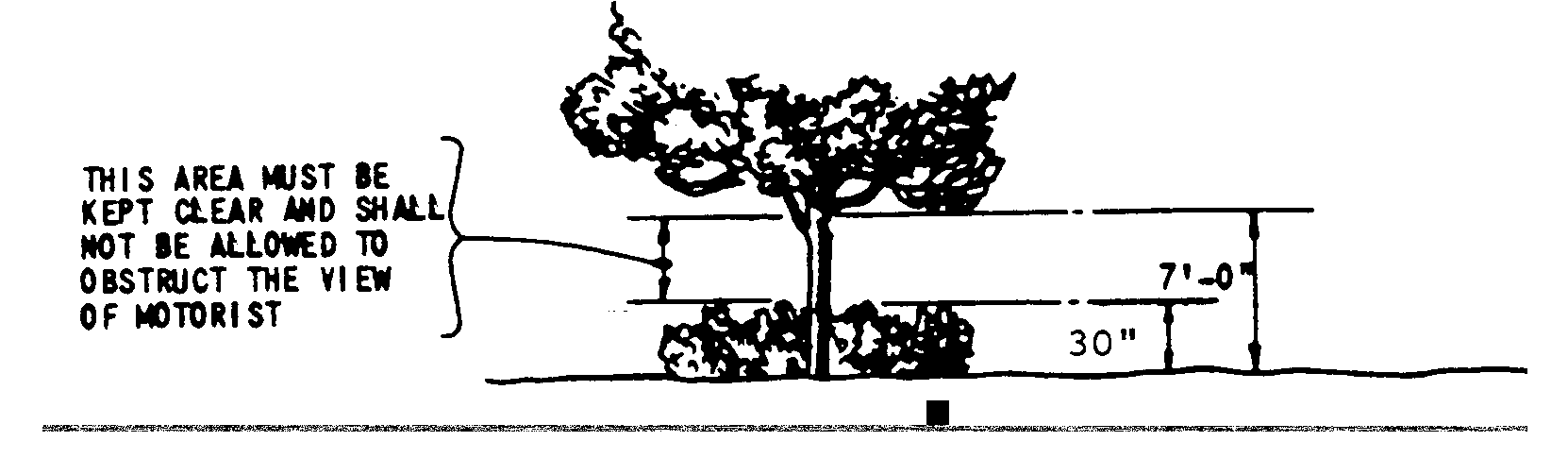
Exhibit 3-1: Obstructions Prohibited
5.
Twenty-Five-Foot Visibility Triangle Required: No fence, screen, wall or visual barrier shall be located or placed where it obstructs the vision of motor vehicle drivers approaching any street intersection. At all street intersections, clear vision shall be maintained across the lot for a distance of twenty-five (25) feet back from the property corner along both streets. See Exhibit "3-2".
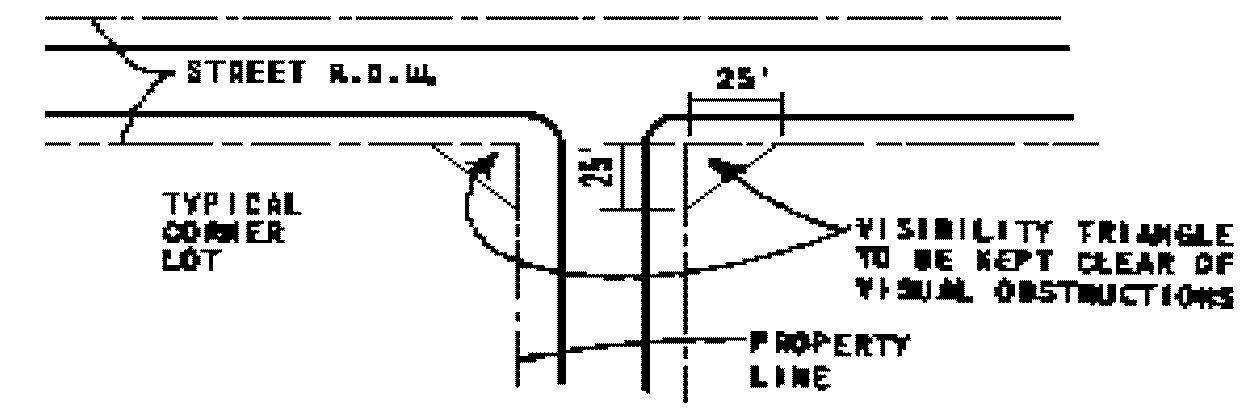
Exhibit 3-2: Visibility Triangle
6.
Barbed Wire Prohibited: Fences constructed of barbed wire and walls topped with broken glass or surfaced with any like material shall be prohibited except as provided below.
Barbed wire fences used in conjunction with permitted agricultural, livestock, and related activities, or in industrial districts are permitted without restrictions.
Barbed wire strands may be placed on the top of security fences in nonresidential districts for the purpose of security from theft, entry and hazard such as around public utility substations and uses of a similar nature, provided the top strand is not higher than eight (8) feet nor the bottom strand lower than six (6) feet from the adjacent grade line.
7.
Electrical Fences: Electrical fences and fence charging devices (Underwriters Laboratory approved) shall be plainly marked at a minimum of twenty-five-foot intervals as to the nature thereof.
8.
Eight (8) Foot Maximum Height: No fence in a residential district shall exceed eight (8) feet in height above ground level at the fence line.
9.
Property Owners' Responsibility: The construction of a fence or wall on the property line shall not preclude the property owner's responsibility to maintain and keep the area defined between the extension of the property lines to the back of curb or edge of pavement free and clear of debris and high weeds. See Exhibit "3-3".
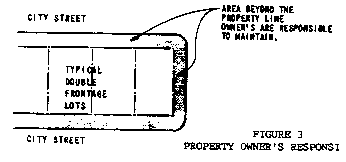
Exhibit 3-3: Property Owner's Responsibility
10.
Public Property: No fence, guy wire, brace or any post of such fence shall be constructed upon or cause to protrude over property that the City or the general public has dominion and control over, owns or has an easement over, under, around or through, except upon drainage and utility easements which are permitted to be fenced.
11.
Floodway Permit Required: The construction of a fence or wall in a floodway as shown on the most recent revision of the "Floodway - Flood Boundary and Floodway Map" prepared by the Federal Emergency Management Agency (FEMA) shall require a development permit as currently required in the City's drainage policies.
12.
Swimming Pools: All swimming pools shall be fenced. A solid or chain link type fence or a barrier at least four (4) feet in height shall completely enclose every swimming pool to be constructed. There shall be no openings, holes, or gaps bigger than four-inch spaces and no openings whatsoever on horizontal picket type fences. All gates allowing access to the pool area shall be self-closing with self-latching devices located in the upper quarter of the gate. All entrances to the swimming pool area must be able to be secured by a combination or key locking device. A dwelling house, accessory building, or apartment building may be used as part of such enclosure provided that all entrances to the swimming pool are equipped with gates as described herein. All fences should conform to local governmental codes and restrictions.
13.
Pre-Formed Concrete: Pre-formed concrete is a permitted masonry material provided the texture adequately mimics the intended style match, be it wood, brick, stone, etc. Pre-formed concrete fences shall be maintained in good condition including any painted fences. The building official shall approve the final finished surface and reserves the right to deny a fence permit application if the surface does not adhere to these regulations.
14.
General Construction Requirements for Wood Fences:
a.
For commercial properties, all vertical posts on fences over four (4) feet in height shall be galvanized steel with a minimum two (2) and three-eighths (⅜") inch diameter, a minimum fifteen (15) gauge thickness, and set in a concrete footing. Picket fences, split rail fences, ranch style or agricultural fences, or other types of decorative fences approved by the Building Official or his/her designee shall be permitted to use wood posts.
b.
Concrete footings shall be a minimum of eight (8) inches in diameter.
c.
For fences less than seven (7) feet in height, posts shall be spaced at a maximum of eight (8) feet on center, set in a concrete footing of no less than twenty-four (24) inches deep.
d.
For fences that are seven (7) feet or greater in height, posts shall be spaced at a maximum of six (6) feet on center, set in a concrete footing of no less than thirty-six (36) inches deep.
e.
Fence posts attached to or supported by other structures, including retaining walls, shall be provided with foundation and anchorage to prevent movement of structure or retaining wall.
f.
All materials shall be securely fastened, vertical boards to horizontal stringers, stringers to vertical posts, top rail, to ensure an ongoing attractive appearance and safe condition, free from rot, rust, vandalism and other sources of decay.
g.
The bottom of the fence shall be designed to prevent ground to wood contact. This can be achieved through the use of a concrete strip poured between the fence supports or by raising the pickets to provide a minimum of two inches between the bottom of the pickets and the ground. Fences located within drainage easements must be approved by the Public Works Director per the requirements of Section 8.170 of the Land Development Code and shall be built such that required drainage and storm water run-off is not impeded.
h.
All wood material shall be stained, pressure treated, painted, or adequately sealed to prevent decay.
15.
Perimeter Subdivision Fences: A fence along the perimeter of a subdivision is allowed under the following conditions:
a.
No setback shall be required from any street right-of-way line; however, a minimum two-foot setback shall be required from any public sidewalk.
b.
No perimeter subdivision fence shall encroach into the required twenty-five-foot visibility triangle as defined above.
c.
The perimeter subdivision fence shall have a maximum height of eight (8) feet, to include any element associated with the fence.
d.
Materials along Street Frontage: The perimeter subdivision fence shall be decorative in nature and constructed of stone, brick, wrought-iron, or a combination of these materials for any portion along a perimeter street. The use of wood and composite materials shall be prohibited along the street frontage.
16.
Sealed Plans Required for Masonry Walls, Columns and Fences: For all masonry walls, columns and fences authorized by this Section, required plans and specifications shall be prepared and sealed by a State of Texas registered engineer and shall consider the site's soil characteristics, wind loadings, and other environmental considerations. All field inspections and verifications for a new masonry wall, fence, and column must be approved by the design professional mentioned above or the professional's representative. Said inspection approval must be submitted to the Building Official in writing prior to the City's final inspection.
E.
Fence and Freestanding Wall Setback Requirements.
1.
Front Yards: No fence or free standing wall greater than thirty (30) inches in height and no greater than twenty-five (25) percent opaque construction shall be located beyond the front façade of the primary residential structure.
a.
The primary fencing material shall be of wrought iron, pre-formed concrete, poured in place concrete, concrete masonry unit (CMU), brick, approved wood rail construction, a combination thereof or other similar material approved by the City Building Official. All poured in place concrete and CMU shall contain an architectural finish.
b.
On a corner lot, a house shall be deemed to face on that street on which it has its least dimension unless otherwise determined by the Building Official.
c.
Vehicle Gate setback: Any vehicle gate shall be set back a sufficient distance from the property line to allow vehicle queuing space in order to maintain safety and to prevent backup along the street pavement. Sufficient distance shall be determined by the Building Official.
d.
Exceptions to front yard requirement: Lots containing a minimum of 40,000 square feet, and subdivisions, shall be allowed to construct a perimeter fence within the front yard setback. Said fencing shall be no greater than eight (8) feet in height and shall have no greater than twenty-five (25) percent opaque construction within the front yard. Allowed construction materials shall be the same as paragraph "1.a" above. This exception shall not apply to properties zoned as a PUD district.
2.
Corner Side Yards: Except where allowed elsewhere in this chapter, no fence or free standing wall greater than thirty (30) inches in height and no greater than twenty-five (25) percent opaque construction shall extend into the required street side yard. A fence that is greater than thirty (30) inches in height and no greater than twenty-five (25) percent opaque construction may extend into the required street yard and be located not less than ten (10) feet from the side property lines. The regulations of 1.a through 1.d above shall apply.
A decorative wall or fence (which is defined as any wall or fence not greater than thirty inches in height and not greater than twenty-five percent opaque construction) within a required street side yard shall not be placed less than three feet (3') from the side property line, and shall not be subject to the provisions of the preceding paragraph.
3.
Adjacent to Undeveloped Property: Except for perimeter subdivision fencing meeting the requirements above, no fence or wall greater than thirty (30) inches in height that is greater than twenty-five (25) percent opaque construction, shall be located less than fifteen (15) feet from the side property line adjacent to the street which leads into undeveloped property. See Exhibit "3-4".
4.
Rear Fence and Free Standing Wall Setbacks: Fences and walls meeting all of the construction requirements of paragraph "1.a" above and other adopted standards may be erected on the rear property line except; however, lots whose rear property line abuts a public street on which one of the immediate adjacent lots maintains its required front yard, then no fence nor wall greater than thirty (30) inches in height shall be located within fifteen (15) feet of the subject lots rear property line. See Exhibit "3-4".
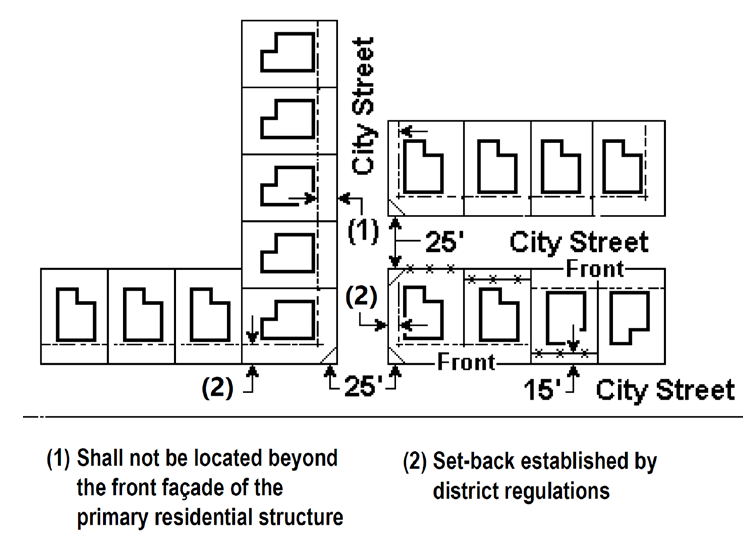
Exhibit 3-4: Typical 15'-0" solid Fence Setbacks
5.
Twenty-five Percent Opaque Construction: The intent of this provision in Subsection E is to discourage barriers that resemble a compound or fortress and the calculation shall be as follows: Every eight (8) linear feet of fencing shall be at least 75% open to view from the street or public way. The 25% opaque construction shall be calculated based on the area of each eight (8) foot linear segment of the barrier.
6.
Non-Conforming Fences/Walls: Where a fence (to include a wall) exists at the effective date of adoption or amendment of this Section that could not be built under the terms of this Section, such fence may remain so long as it remains otherwise lawful, subject to the following provisions:
a.
No such non-conforming fence may be enlarged or altered in a way which increases its nonconformity.
b.
Should a non-conforming fence or non-conforming portion of a fence be repaired, removed, or destroyed by any means to an extent of more than fifty (50) percent, it shall not be reconstructed except in conformity with the provisions of this Section, or as modified by a Special Use Permit approved by the City Council per this Section.
c.
Should such fence be moved for any reason any distance whatever, it shall thereafter conform to the regulations of this Section after it is moved.
7.
Special Use Permit Provision: Any request for a building permit for a fence/wall which does not meet the criteria in this Section shall only be authorized after approval of a Special Use Permit by the City Council using the procedures contained elsewhere in this Land Development Code.
F.
Administration.
1.
Fence Permit Required: It shall be unlawful for any individual, partnership, company or corporation to erect or have erected a fence or any part of a fence of permanent construction in the city limits without first obtaining a fence permit from the Community Development Department.
2.
Application for Permit: Any individual, partnership, company or corporation making application for a fence permit must sign an application for same showing the following information:
a.
Applicants name, address, and in addition, if the applicant represents a company or corporation, the name and address of the supervisor or foreman of said company or corporation and the name of its president.
b.
Name and owner of the property.
c.
Local address where fence is proposed to be erected.
d.
Materials and type of fence construction.
e.
Height of fence.
f.
Applicant shall provide engineering plans and specifications for those types of fences where such engineering is deemed appropriate by the Building Official. The engineering plans shall be reviewed and approved by the Building Official prior to issuance of a fence permit.
g.
Survey showing lot on which the fence is proposed to be erected and the location of adjoining or adjacent lots showing existing structures and fences. The proposed fence shall be delineated by a dark heavy line. In AG zoning districts a scaled plot plan can be submitted in lieu of a survey.
(Ord. No. O-19-2089, § 1(exh. A), 9-20-19; Ord. No. O-24-2275, § 2(exh. A), 3-19-24)
Sec 3.27 - Accessory buildings and residential carport regulations.
The following regulations shall govern the location, size and use of accessory buildings:
A.
Accessory Buildings Located in Residential Zoning Districts.
1.
Permit Required.
a.
A building permit shall be required for any accessory building which exceeds one hundred and twenty (120) square feet. However, all accessory buildings containing 120 square feet or less shall comply with the height and setback requirements of this Section. An accessory building shall only be allowed as an incidental structure to a principle building unless the accessory building is located in the Agricultural District.
b.
For the purpose of this Section, the term accessory building shall include detached residential garages, pool houses, accessory dwellings, gazebos, cabanas, or other shade structures. Exception: structures for specific use as playground assemblies and/or playhouses shall be exempt provided that minimum five (5) feet setbacks from property lines are maintained.
2.
Maximum Size and Number of Buildings.
a.
The maximum number of accessory buildings allowed per lot shall be three (3) buildings. In addition, the combined square footage of all accessory buildings shall not exceed four percent (4%) of the aggregate area of the lot. Exemption: Lots containing a minimum of 80,000 square feet shall be exempt from the requirement for the maximum number of accessory buildings.
b.
Accessory dwellings allowed by the Land Development Code shall be limited in size to be no more than the most restrictive of the following:
1.
Fifty percent (50%) of the primary structure;
2.
The maximum allowed square footage for accessory buildings on the lot; or
3.
No more than twelve hundred (1,200) square feet
c.
For the purpose of this Section, the size of an accessory building shall be the square footage of each floor, mezzanine, covered porch, or shade structure.
d.
An application to exceed the total square footage authorized above may be approved as a Special Use Permit (SUP).
e.
An existing accessory building may be remodeled or expanded provided the combined square footage of all accessory buildings does not exceed the maximum square footage allowed. However, a legally existing accessory building which exceeds the maximum square footage allowed may be remodeled or replaced with a new accessory building, but not expanded or increased in height.
f.
There shall be no physical connection between accessory buildings and a minimum separation of three (3) feet between accessory buildings.
3.
Setbacks.
a.
No accessory building shall be allowed, erected, or located forward of the front façade of the primary dwelling. Exemption: Lots containing a minimum of 80,000 square feet shall be exempt from this requirement.
b.
No accessory building shall be erected in any required yard, as defined in Chapter 2 - Definitions, except as set forth herein.
c.
Attached accessory buildings - Accessory buildings erected ten (10) feet or closer to the principal building shall be considered attached, and shall comply with the setback lines established for the applicable zoning district. For the purpose of this regulation, the distance between buildings shall be measured between the nearest wall surfaces. Exception: Open structures (open on at least 2 ¾ sides), such as patio covers, shall be allowed to extend into the required rear yard setback a maximum of 10 feet.
d.
Detached accessory buildings - A detached accessory building shall comply with the setback lines established for the applicable zoning district, unless the accessory building is located totally behind the rear of the principal building, then it shall not be placed closer than five (5) feet to any side or rear lot line.
4.
Maximum Height. No accessory building shall penetrate a vertical height envelope defined as being a point five feet from a side or rear lot line and extending vertically 8 feet to a point, then extending at a 45° angle to the allowed height of the zoning district. For clarification, structures shall be measured at grade and shall not exceed the maximum height of the zoning district.
5.
Permitted Uses. The use of an accessory building shall be consistent with the permitted uses of the applicable zoning district. No accessory building shall be used for dwelling purposes (the act of occupying a structure - with or without a kitchen) other than for an accessory dwelling, where permitted by the district regulations or Special Use Permit. No accessory building or accessory dwelling shall be rented.
6.
Special Use Permit Provision. Any request for a building permit for an accessory building which does not meet the criteria in this Section shall only be authorized after approval of a Special Use Permit by the City Council using the procedures contained elsewhere in this Land Development Code.
B.
For Accessory Buildings Located in Non-residential Zoning Districts.
1.
Approval by Special Use Permit Only: In accordance with the Special Use Permit procedures contained in this Chapter of these zoning regulations, no accessory building located in non-residential zoning districts shall be built in the City of Colleyville without approval by the City Council for a Special Use Permit to construct an accessory building in a non-residential zoning district.
2.
Commercial accessory buildings approved as a result of an SUP to be located within non-residential districts are subject to the following conditions:
a.
Must meet same setbacks as the primary structure.
b.
Must be located to the rear of the primary building and not visible from adjacent roadways.
c.
The use of the accessory building must be ancillary to the primary use.
d.
Exterior walls and features shall be of the same materials as used with the primary structure.
e.
Located in such a manner as to not impede, impair or endanger vehicular traffic on the property.
C.
Residential Carport Regulations. Carports located in zoning districts which permit single-family residential dwellings shall comply with the regulations contained in this section.
1.
Approval by Special Use Permit Only. In accordance with the Special Use Permit procedures contained in this Chapter of these zoning regulations, no carport shall be built in the City of Colleyville without approval by the City Council for a Special Use Permit to construct a carport in a zoning district that permits single family residential dwellings.
2.
Carport Standards. A carport shall comply with the following regulations, unless the City Council in approving a Special Use Permit for a carport has imposed other requirements necessary in the particular case to protect the public interests.
a.
Size. A carport shall not exceed 480 square feet in area. The longest dimension on a carport shall not exceed 24 feet.
b.
Height. A carport shall not exceed a maximum height of 15 feet. The height shall be measured from the finished grade to the highest point of the roof.
c.
Setbacks.
i.
A carport located within ten (10) feet of the principal building shall comply with the front, side and rear yard setbacks of the zoning district. The distance shall be measured between the two closest points of the carport and principal building.
ii.
A carport located 10 feet or more from a principal building may extend into a required side yard, provided all of the following conditions are satisfied:
(1)
Every part of such carport is unenclosed except for necessary structural supports;
(2)
No part of the carport is less than five (5) feet from a side or rear lot line, and
(3)
The carport is located completely within the rear yard area as defined in these zoning regulations.
d.
Maximum Number Per Lot. One.
e.
Paving and Street Access. The parking area of a carport shall be paved not less than nine feet (9') by eighteen feet (18') and provide access to a public street right-of-way. Said access shall be a minimum of nine feet (9') in width and paved. All paved surfaces shall be either concrete, asphalt or pave-stone.
f.
Design Criteria.
i.
Roof Carports shall have a pitched roof of at least 2:12. Flat roofs shall be prohibited.
ii.
Posts Posts shall be clad or finished of brick, stone, cedar or decorative metal, such as metal lattice. For purpose of this requirement, decorative metal shall consist of twenty-five (25) percent opaque surfaces. The dimension of each post as viewed from each primary elevation shall not be less than eight inches (8") or more than forty-eight inches (48"). Any carport with two or more elevations that exceed the 48-inch criteria shall be considered an accessory building and be regulated as such. Cedar posts shall be wrapped using masonry stone or brick from the base to at least 50% of the post height. The exposed portion of the cedar post shall be a minimum of 8 inches.
g.
Adequacy of Plans and Specifications. The applicant requesting a Special Use Permit to construct a carport shall submit plans and specifications of the proposed carport for review. Said plans and specifications shall contain sufficient information to allow the City Council to determine that the proposed carport complies with these regulations and the City Council may require additional information when necessary to clarify the applicant's request. At a minimum, the drawings shall contain a plot plan, elevation views and a description of the construction materials.
(Ord. No. O-00-1223, 7-18-00; Ord. No. O-20-2110, § 1(exh. A), 2-18-20; Ord. No. O-21-2184, § 1(exh. A), 12-21-21)
Sec 3.28 - Supplementary district regulations.
A.
All required building lines shall adhere to the minimum yard requirement of the applicable zoning district for the property per Section 3.24.6 - Schedule of District Regulations regardless of any setbacks shown on a plat unless a documented plat waiver has been approved.
B.
Erection of More Than One Principal Building on a Lot. In any district other than Agricultural zoning, no more than one (1) building housing a permitted or permissible principal use may be erected on a single lot.
C.
Buildings Constructed Across Lot Lines. No building may be constructed across existing platted lot lines unless a replat is filed and approved in accordance with applicable regulations of the city.
D.
Exceptions to Height Regulations.
1.
Schools, public buildings, and institutions may be erected to a height exceeding the maximum height in any district in which they are permitted, provided front and rear yards are increased in depth and side yards increased in width one (1) foot for each foot of height that the building exceeds the height regulations of the district in which it is located.
2.
The height regulations prescribed elsewhere in this Chapter shall not apply (except as may be applicable to paragraph d. hereof) to grain elevators, television and radio towers, church spires, belfries, cupolas, antennas, water tanks, ventilators, chimneys, ornamental towers, monuments, conveyors, fuel storage tanks, asphalt and concrete batch plant equipment not intended for human occupancy.
3.
Limitations on number of stories shall not apply to buildings used exclusively for manufacturing or storage purposes provided such buildings do not exceed the height in feet permitted in the district in which they are located.
4.
The permitted height of any occupied building shall be further restricted to the capability of the local firefighting equipment to adequately handle any such building height.
5.
In CC and ML zoning districts, the City Council may vary the maximum height of a building if the City Council finds that the location and/or configuration of the building is such that it will conform to the surrounding area and provide adequate light and air under the circumstances. For each foot of proposed height over the standard, there shall be a foot increase in the front and rear yards or as approved by the council. The request for a variance shall be accompanied by a site plan of the property and an architectural drawing of the proposed building.
E.
Projections of Buildings, Structures and Appurtenances into Required Yards.
1.
Open or lattice enclosed fire escapes may project into a required yard not to exceed fifteen (15) feet. The ordinary projections of chimneys and pilasters shall be permitted by the City's Building Official when placed so as not to obstruct light and ventilation.
2.
Terraces, balconies, decks, and ornamental features above the floor level of the ground (first) story may project into a required side yard, provided these projections be at least five (5) feet from any adjacent side lot line.
3.
Fountains and other decorative features may project into the required front yard but shall not include structures used for occupancy such as guard shacks, shade structures, etc.
4.
A porte-cochere or canopy may project into a required side yard, provided every part of such porte-cochere or canopy is unenclosed except for necessary structural supports, and not less than five (5) feet from any side lot line.
5.
Every part of a required yard shall be open to the sky, unobstructed by a building, except for the ordinary projections of sills, belt courses, cornices, and ornamental features not exceeding twelve (12) inches, or as otherwise excepted in paragraph a. through d. above. Roof eaves may project into required side yards provided the projections be at least five (5) feet from any adjacent side lot line.
6.
Gasoline filling station pumps and pump islands may be located or project into a required yard provided they are not less than twenty-five (25) feet distant from any street, highway or alley right-of-way line, and not less than fifty (50) feet distant from any residential property line.
F.
Minimum Width of Enclosed or Partially Enclosed Open Space. Where an open space is more than fifty (50) percent surrounded by a building, the minimum width of the open space shall be at least twenty (20) feet for one-story and one and a half-story buildings, thirty (30) feet for two-story buildings, and forty (40) feet for three or more story buildings.
G.
Buildings and Structures to Have Access. Every building or structure hereafter erected or moved shall be on a lot adjacent to a public street, or with access to an approved private street, and all structures shall be so located on lots as to provide safe and convenient access for servicing, fire protection, and required off-street parking.
H.
Parking; Storage or Use of Major Recreational Equipment and Vehicles.
1.
No major recreational equipment or recreational vehicles shall be parked or stored for more than seventy-two (72) hours on a public street, alley, or other public right-of-way or parkway.
2.
No major recreational equipment or recreational vehicles shall be parked or stored on any lot in a residential district except in a carport or enclosed building, or in a required side or rear yard on an all-weather (durable, dust-free) hard surface driveway. Provided, however, that such equipment may be parked anywhere on residential premises not to exceed seventy-two (72) hours during loading or unloading.
Exemption: An all-weather (durable, dust-free) hard surface driveway is not required for such equipment on lots 40,000 sq. ft. in size or greater.
3.
Corner street side yards shall be considered a front yard. No major recreational equipment or recreational vehicles shall be parked within the required setback.
4.
No such equipment shall be used for living, sleeping, or housekeeping purposes when parked or stored on a residential lot per above, except for the temporary housing of guests for not more than fourteen (14) days during any sixty (60) day period.
5.
For purposes of these regulations, major recreational equipment is defined as including travel trailers, pick-up campers or coaches (designed to be mounted on automotive vehicles), motorized dwellings, tent trailers, boats and boat trailers, snowmobiles, trailers, dune buggies, airplanes or aircraft and other equipment designated for recreational use, and cases or boxes used for transporting recreational equipment, whether occupied by such equipment or not. Vehicles used primarily as the family car for a daily transportation to and from work are excluded from this definition.
6.
For purposes of these regulations, a recreational vehicle is defined as any vehicle used or so constructed as to permit it being used as conveyance upon the public streets and highways, and licensable as such, and which is constructed in such a manner that will permit occupancy as a dwelling or sleeping place for one or more persons, including also a self-propelled vehicle having a body designed as living quarters.
I.
Parking and Storage of Vehicles in General.
1.
On-Street Parking: Commercial vehicles with a manufactured capacity rated of over one ton are prohibited from being parking on any public street, alley, parkway, boulevard, or public place in all zoning districts, except the ML (Light Manufacturing) district for a period not to exceed twenty-four (24) hours during loading or unloading. In the ML district, on-street parking is prohibited along all major thoroughfares, including expressways, arterials, and collector streets.
2.
Off-Street Parking: Commercial vehicles of over one (1) ton manufactured capacity (truck tractor, road tractors and special mobile equipment) are permitted only in the ML (Light Manufacturing), RE (Single-Family "Estate" Residential), or AG (Agricultural) zoning districts. They are prohibited from being parked or stored on any lot in all other zoning districts. Exemption: Such vehicles shall be allowed on any lot greater than 40,000 sq. ft. provided they are located behind the front yard setback.
All other commercial vehicles may be permitted on a residentially zoned lot, provided said parking space shall be in an enclosed garage, under a carport, or on an all-weather hard surface driveway located in a side or rear yard. Exemption: An all-weather (durable, dust-free) hard surface driveway is not required for such equipment on lots 40,000 sq. ft. in size or greater.
3.
Off-street vehicle parking spaces shall not be located within ten (10) feet of existing proposed major thoroughfare street right-of-way lines in any commercial or industrial district. Such off-street parking spaces shall consist of a paved surface, i.e., concrete, HMAC, brick or paving stone approved by the city building official. All ten (10) foot buffer areas shall be landscaped and maintained to enhance esthetic qualities.
4.
No vehicle shall be used for living, sleeping, or housekeeping purposes when parked or stored on public property.
5.
To avoid the unsightly appearance of junked and abandoned vehicles in residential districts, no vehicles may be parked or stored on a residential premises where visible to any adjacent right-of-way or residential use, unless a current state vehicle inspection sticker is displayed thereon or the vehicle is behind a solid fence or solid vegetative screening at least 6 feet in height. Such vehicles are those that cannot be immediately or readily started or moved under their own power, and including vehicles without current licenses and vehicles with wheels or other major components removed or broken.
J.
Reserved.
K.
Reserved.
L.
Rear Yard Adjustments. Rear yard requirements as established in Sec. 3.24 - Schedule of District Regulations may be adjusted in the following case:
1.
Where a lot abuts an alley, one-half the alley width may be considered as part of the required rear yard.
M.
Lot Area Per Family Adjustments. Lot area per family (dwelling unit) requirements as established in Section 3.24, Schedule of District Regulations shall be adjusted in the following cases:
1.
Where a lot of record or a lot in a subdivision which the Planning and Zoning Commission and City Council have officially approved and agreed to accept at the time of the effective date of this Chapter has less area or width than herein required, in the district in which it is located, said lot may nonetheless be used for a residential or nonresidential use, whichever is applicable, in the district in which it is located.
(Ord. No. O-00-1241, 10-3-00; Ord. No. O-19-2088, § 1(exh. A), 8-20-19; Ord. No. O-21-2157, § 1(exh. A), 3-23-21; Ord. No. O-24-2284, § 2(exh. A), 6-18-24)
Sec 3.29 - Parking requirements.
A.
Purpose. The purpose of this section is to require off-street parking and loading facilities proportional to the need created by each use. Where the minimum number of required parking spaces cannot be calculated in accordance with the parking group schedule, the Building Official shall be authorized to determine the minimum number of required parking spaces using acceptable industry comparables.
B.
General Provision. In all zoning districts, there shall be provided in connection with the appropriate permitted use, off-street parking spaces in accordance with the provision of this section, unless a different parking standard has been set forth as a condition of a Special Use Permit or Planned Unit Development for a specific site. Existing facilities being used for off-street parking shall not be reduced in capacity to less than the minimum number of spaces prescribed, or altered in design or function to less than the minimum standards prescribed herein.
C.
Location of Parking. All required parking spaces shall be provided on the same lot or tract occupied by the use being served, except that where an increase in the number of spaces is required by a change or enlargement of a nonresidential use, the additional required parking spaces may be located off-premises in accordance with the shared parking requirements contained in this section, unless a different parking standard has been set forth as a condition of a Special Use Permit or Planned Unit Development for a specific site. Required parking spaces for a residential use shall be provided on the lot or tract occupied by the use being served.
D.
Parking Space Locations Prohibited. No off-street parking space shall be located, either in whole or in part, within any fire lane, driveway, driving lane, or maneuvering area. Furthermore, no required off-street parking space shall be located, either in whole or in part, in a public street, sidewalk, parkway, alley or other public right-of-way.
E.
Parking Space Dimensions. No required off-street parking space shall be less than nine (9) feet in width by eighteen (18) feet in length.
F.
Mixed Use Parking. The parking requirements for a lot or building containing a mixture of uses shall be the sum of the requirements for each type of use. No parking space provided for one type of use or building shall be included in the calculation of the parking requirements for any other use or building. For multi-tenant developments containing greater than 30,000 square feet of floor area, the sum of the total number of required parking spaces may be reduced by ten (10) percent.
G.
Shared Parking. Where an increase in the number of off-street parking spaces is required by a change or enlargement of use, the additional required spaces may be located on another property that is located on or adjacent to the site as defined by contiguous lot lines of a use not normally open and used or operated during the same hours, provided, that the following conditions are satisfied:
1.
The parking spaces are located within three-hundred feet from an entrance to the building or use being served, measured along the shortest available pedestrian route with public access.
2.
A copy of the written agreement, executed by the parties concerned, is furnished to the Building Official, assuring their retention for such purposes.
H.
Building Renovations. When an existing building or use is enlarged, structurally altered, or remodeled to the extent of increasing or changing the use by more than ten (10) percent, but less than fifty (50) percent, of the existing square footage, additional off-street parking shall be provided for the incremental increase in accordance with the off-street parking regulations set forth herein. When an existing building or use is enlarged, structurally altered, or remodeled to the extent of increasing or changing the use by fifty (50) percent of more of the existing square footage, the off-street parking requirements for the entire building shall be comply with the parking regulations set forth herein.
I.
Supplemental Parking Space Requirements.
1.
Parking regulations are based on the gross floor area (GFA) of the building.
2.
In determining the required number of parking spaces, fractional spaces shall be rounded to the nearest whole space. Parking spaces located in buildings used for repair garages or car washes, and spaces in drive-through lanes shall not be counted as meeting the required minimum number of parking spaces.
3.
Wooden poles shall not be used for parking lot or site lighting for a nonresidential use.
4.
Except for single-family dwelling units, parking spaces shall be arranged so that vehicles shall not be required to back out of the parking spaces directly into a street.
5.
A reduction may be authorized after approval of a Special Use Permit by the City Council when associated with new development or a significant change in use of an existing building or site. A parking analysis report justifying the reduction shall be provided as part of a request for parking reduction.
J.
Parking Group Schedule. The minimum number of off-street parking spaces to be provided in connection with the permitted use listed in Table 3-310, Schedule of Permitted Principal Uses, shall be in accordance with the following Table 3.29 - Parking Group Schedule.
Sec 3.29.1 - Parking space construction standards.
A.
Dimensions. No parking space shall be less than nine (9) feet in width by eighteen (18) feet in length. The design and dimensions of off-street parking areas shall be in accordance with the following Table 3.29.1, Table of Parking Space Dimensions.
(1) Aisle width shall comply with the requirements of the fire code when the aisle serves as a fire lane
B.
Surfacing (New Structures). All parking spaces, aisles and maneuvering areas shall be constructed of an all-weather surface composed of concrete, asphalt, brick or paving stone. Such paving shall meet the minimum construction standards contained in the Colleyville Building Code. Such all-weather surface shall be provided for all parking spaces, whether enclosed or unenclosed, and shall be connected by an all-weather surface driveway to a street or alley. Rock, gravel and dirt parking surfaces are prohibited.
C.
Striping. For all nonresidential uses and multi-tenant residential uses, parking spaces shall be striped or otherwise clearly designated on the parking facility surface, as determined by the Building Official.
D.
Curbs, Wheel Stops and Islands. Parking spaces abutting on adjoining property lines or street right-of-way lines shall be provided with wheel guards or bumper guards so located that no part of a normally parked vehicle will extend beyond the property line.
Sec 3.30 - Off-street loading requirements.
A.
Purpose and Intent. The purpose and intent of these regulations are to secure safety from fire, panic and other dangers; to lessen congestion in the streets and alleys; to facilitate the adequate provision of transportation and circulation; to conserve the value of building and land uses; and to encourage the most appropriate use of land. To this end, in all zoned districts where applicable, there shall be provided at the time any use is established or expanded, or any building is erected or structurally altered (except as otherwise provided elsewhere in this section) minimum off-street loading in conformance with the requirements established herein.
B.
Location of Loading Spaces. Off-street loading spaces shall be provided and maintained for all retail, commercial and industrial uses and structures for receiving and loading merchandise, supplies, and materials within a building or on the lot or tract adjacent thereto. Such spaces shall be marked with painted outline and may be adjacent to a public alley or private service drive or may consist of a truck berth within a building or structure, however no portion of the off-street loading space shall be located within or extend into any public street, highway or alley right-of-way.
C.
Computation of Off-street Loading Space Sizes. At least one-half of the required number of off-street loading spaces or truck berths shall have a minimum dimension of ten (10) feet by fifty (50) feet each and the remaining required spaces or berths shall have a minimum dimension of ten (10) feet by twenty-five (25) feet each - exclusive of turnaround and maneuvering space.
D.
Type of Parking Surface Required for Loading Space. All surface areas upon which vehicles and trucks are parked during unloading operations shall consist of a paved surface, i.e., concrete, HMAC, brick, paving stone, approved by the city building official.
E.
Rules for the Computation of Off-street Loading Spaces.
1.
No building, structure or part thereof used for nonresidential purposes on any "CN" or "CC" district shall hereafter be enlarged or extended unless off-street loading space is provided in accordance with the provisions of this section.
2.
No building, structure or part thereof used for nonresidential purposes in any "ML" district shall hereafter be enlarged or extended to provide a gross floor area of 25,000 square feet or more unless off-street parking is provided in accordance with the provisions of this section.
F.
Number of Off-street Spaces Required. The minimum number of off-street loading spaces required shall be in conformance with the following schedules:
1.
Retail, Service (except personal service), Commercial and Industrial Uses:
2.
Office Buildings, Hotels/Motels, Restaurants and Similar Establishments:
(Ord. No. O-00-1261, 12-19-00)
Sec 3.31 - Duties of administrative official.
A.
Administration and Enforcement. An Administrative Official designated by the City Manager shall administer and enforce this Chapter. Said person may be provided with the assistance of such other persons as the City Manager may direct.
If the Administrative Official finds that any of the provisions of this Chapter are being violated, the Administrative Official or their representative shall notify in writing the person responsible for such violations, indicating the nature of the violation and ordering the action necessary to correct it. The Administrative Official or their representative shall order discontinuance of illegal use of land, buildings, or structures, removal of illegal buildings or structures or of illegal additions, alterations, or structural changes; discontinuance of any illegal work being done, or shall take any other action authorized by this Chapter to ensure compliance with or to prevent violation of its provisions.
B.
Building Permits Required. No building or other structure shall be erected, moved, added to, or structurally altered without a permit therefore where applicable, and issued by the Administrative Official. No building permit shall be issued by the Administrative Official except in conformity with the provisions of this Chapter, unless he receives a written order from the City Council or Zoning Board of Adjustment in the form of an administrative review, special exception, or variance as provided by this Chapter. No building permit shall be issued unless the property has been platted of record, except that a building permit may be issued for unplatted property meeting all of the following five criteria:
1.
The parcel is a "lot of record" as defined herein; and
2.
Right-of-way and easements sufficient for Master Plan roads or drainage/utility facilities exist; and
3.
The parcel adjoins an approved public street; and
4.
The parcel contains a principal residential use in a residential structure; and
5.
The requested construction permit(s) and all construction permits issued for the parcel within the past three years allow improvements whose combined value does not exceed 50% of the appraised value of the parcel as shown in the current parcel record of the Tarrant County Appraisal District.
C.
Site Plan Approval Required. Where the property is zoned CPO, CN, CC, ML, SU, PUD-C, or PUD-I, a site plan shall be submitted for review and approval to the Administrative Official prior to the issuance of a building permit. The site plan referred to herein shall contain the following:
1.
The boundary lines and dimensions of the property, existing subdivision lots, available utilities, easements, roadways, sidewalks, fire lanes, and public rights-of-way.
2.
Topography of the property proposed for development in contours of not less than two (2) feet, together with any proposed grade elevations, if different from existing elevations. If the natural contour of the land is to be altered or changed in any location on the property more than four (4) feet then the site plan must provide detailed information on the proposed grading plan. This information shall include the correlation of the proposed grading plan to the surrounding properties and the use of surrounding properties, and shall include information indicating the drainage and line of sight effect the proposed grading plan will have on the surrounding properties.
3.
The 100-year floodplain, water courses, wetlands, drainage areas, and other significant features including, but not limited to, rock outcroppings and tree groupings.
4.
The location and use of all existing and proposed buildings or structures, including all refuse storage areas, and the minimum distance between buildings. Where building complexes are proposed, a site plan showing the location of each building and the minimum distance between buildings, and between buildings and the property line, street or curb line and/or alley shall be submitted.
5.
Total number of off-street parking and loading spaces in accordance with Section 29, Off-Street Parking Requirements, and Section 30, Off-Street Loading Requirements of this Chapter.
6.
All points of vehicular ingress and egress and circulation within the property. Any special traffic regulation facilities, proposed or required, to assure the safe function of the circulation plan shall also be shown.
7.
Setbacks, lot coverage, and when relevant, the relationships of the setbacks provided and the height of any existing or proposed building or structure.
8.
The location, size, and arrangement of all outdoor signs, exterior auditory speakers and lighting.
9.
A landscape plan prepared in accordance with the requirements of Chapter 4, Landscaping and Buffering of this Land Development Code.
10.
The location and height of fences or, screen plantings and the type of building materials or plantings to be used for fencing or screening in accordance with the requirements of Section 26, Fences, Free Standing Walls, and Screening Materials of this Chapter.
11.
Note a soil erosion control plan for the period during which construction will be taking place.
12.
Where multiple types of land uses are proposed, a land use plan delineating the specific areas to be devoted to various uses shall be required.
13.
Vicinity map, north point, scale, name of the development, name of the owner, name of the planner, total acreage of the project, street address or common description of the property.
14.
Current land uses and zoning district of the property and current land uses and zoning districts of the contiguous properties and buildings on the exterior of the site and within twenty-five (25) feet of all property lines.
15.
The location and size of existing and proposed surface and subsurface drainage facilities.
16.
A description of the type of land use that is proposed for the site including its Standard Industrial Classification (SIC) Code if there are any chemicals or toxic materials involved.
The Administrative Official may allow all of the foregoing to be contained within a single drawing if in the opinion of the Administrative official the drawing can be properly evaluated.
D.
Construction and Use to be Provided in Applications, Plans, Permits and Certificate of Occupancy. Building permits or certificates of occupancy issued on the basis of plans and applications approved by the Administrative Official authorize only the use, arrangement, and construction set forth in such approved plans and applications, and no other use, arrangement, or construction. Use, arrangement, or construction at variance with that authorized shall be deemed violation of this Chapter, and punishable as provided by Chapter 1, General Provisions of this Land Development Code.
Sec 3.32 - Comprehensive zoning ordinance—Zoning map.
This Chapter when read together with the official Zoning Map of the City of Colleyville, Texas, shall constitute the comprehensive zoning ordinance for the City of Colleyville, Texas.
The Zoning Map, as submitted with Ordinance 0-70-15, revised and updated in 1976, a copy of which is on file in the City Secretary's office shall remain the official Zoning Map of the City of Colleyville, until a new map is established in accordance with the provisions contained in this Chapter.
Sec 3.33 - Amendments to this chapter.
Editor's note— Beginning with Supp. No. 20, this table is no longer being maintained. See Land Development Code Comparative Table at the end of this Appendix.

