
Colleyville City Zoning Code
CHAPTER 7
- SIGN REGULATIONS
Sec 7.100 - Purpose of this chapter.
The purpose of this Chapter is to establish a comprehensive and balanced system of street graphics to facilitate an easy and pleasant communication between people and their environment and to avoid the visual clutter that is potentially harmful to traffic and pedestrian safety, property values, business opportunities, and community appearance. It is the intent of this Chapter to establish standards which regulate the design, construction, location, height, size and maintenance of signs and sign structures by authorizing the use of street graphics which are:
A.
Compatible with their surroundings;
B.
Appropriate to the activity that displays them;
C.
Expressive of the identity of individual activities and the community as a whole;
D.
Consistent within the corridors of the city;
E.
Legible in the circumstances in which they are seen; and
F.
Protective of property values.
Sec 7.105 - Authorization for adoption of this chapter.
The regulations contained in this Chapter have been adopted under the authority of the following:
A.
Chapter 51, General Powers of Municipalities of the Texas Local Government Code, which authorize a municipality to adopt ordinances, rules, or police regulation that is for the good government, peace, or for the trade and commerce of the municipality.
B.
The Home Rule Charter of the City of Colleyville, which authorize the City Council to exercise all powers granted to municipalities by the Constitution or the laws of the State of Texas.
Sec 7.110 - Variances and appeals.
Any person seeking approval of a sign or sign structure inconsistent with this Chapter, may request a variance from, or appeal a decision of an administrative official to the Sign Board of Appeals using the procedures described in Chapter 1, General Provisions of this Land Development Code.
Sec 7.115 - Definitions.
The definitions for this Chapter are found in Chapter 2, Definitions of this Land Development Code.
Sec 7.120 - Responsibility for compliance.
The permittee, owner, agent, person or persons having the beneficial use of the property, the owner of the land or structure on which the sign is located, and the person in charge of erecting the sign are all subject to the provisions of this Chapter.
Sec 7.125 - Violations and penalties.
Any person, firm or corporation violating any provision of this Chapter shall be guilty of a misdemeanor and shall be subject to the penalty provision contained in Chapter 1, General Provisions of this Land Development Code.
Sec 7.130 - General conditions applicable to all signs.
The following general conditions shall be applicable to all signs, except where a provision contained elsewhere in this Chapter specifies a different requirement.
A.
Compliance Required. No person, firm or corporation shall erect a new sign, or alter an existing sign, or sign structure, unless said sign conforms to the provisions of this Chapter.
B.
Sign Area. No sign shall exceed the maximum area provided for in this Chapter. The sign area permitted in this Chapter shall apply to the maximum size of a single sign face, except where a provision allows an alternate method for calculating sign area. When the two faces of a sign are separated by an angle of twenty (20) degrees or more, the maximum sign area shall be the total of all non-parallel sign faces.
C.
On-Premises Requirement. All signs shall be located on the same premises where the product or merchandise being advertised is located, except where a specific provision in this Chapter provides for off-premises advertising.
D.
Maximum Height. No sign shall exceed the maximum height provided for in this Chapter. In determining the maximum height of a sign, no sign shall be located on a mound where the surrounding grade has been altered by more than eighteen (18") inches for purposes of artificially increasing the overall height of a sign above that allowed by the height regulations in this Chapter.
E.
Wind Pressure and Dead Load Requirements. All permanent signs shall be designed and constructed to withstand a wind pressure of not less than 35 pounds per square foot of area.
F.
Sign Contractor Registration. It shall be unlawful for any person, firm or corporation to engage in the business of erecting permanent signs in the city unless such person, firm or corporation is the holder of a valid registration with the City to perform such work. In extending the rights and privileges of such registration, the City of Colleyville makes no statement of the technical competency of those registered, and no manner of license is proffered.
G.
Engineering Requirements and Construction Standards. The construction of all signs shall comply with the structural requirements of the City of Colleyville Building Code. Where required by the administrative official, the construction plans shall be signed and sealed by a professional engineer registered in the State of Texas. Any electrical installations shall comply with the City of Colleyville Electrical Code. No unfinished metal shall be allowed on the exterior surface of a sign or sign support.
H.
Signs in Right-of-Way Prohibited. No sign shall be erected in, extend into or over, a public right-of-way, except where a provision in this Chapter allows such location, or with the approval by the City Council of a Right-of-Way Encroachment Agreement.
I.
Interference with Safety Provisions. No sign shall be erected in such a manner that any portion of its surface or supports will interfere with the free ingress or egress of any fire escape, exit, standpipe, or window, or obstruct any required ventilator or door stairway.
J.
Illumination. Illumination of a sign shall only be allowed where a provision contained in this Chapter allows illumination for a specific sign classification or construction type. No sign located in a residential zoning district shall be illuminated, except where illumination is provided by a provision in this Chapter. Such sign illumination shall not produce glare or direct illumination across the property lines of the premises. For electronic message signs, the maximum brightness shall not exceed 7,000 nits or its equivalent when measured from the sign's face at its maximum brightness during daylight hours and shall not exceed 1,000 nits or its equivalent when measured from the sign's face at its maximum brightness at night.
K.
Loss of Required Parking. No sign shall be constructed within the limits of a parking area that results in a reduction in the number of required parking spaces.
L.
Signs in Planned Unit Developments and property with a Special Use Permit. All signs shall comply with the regulations in this Chapter, unless an ordinance for a Planned Unit Development (PUD) or a Special Use Permit (SUP) contains a provision that authorizes a variation from the regulations in this Chapter.
Sec 7.135 - Permits, fees and inspections.
A.
Permit Required. It shall be unlawful for any person to erect a new sign, relocate, enlarge or replace an existing sign, or sign face, regulated by this Chapter without first obtaining a permit from the Building Permit Office, except where an exemption is provided for in this Chapter. No permit shall be issued unless the proposed sign complies with the requirements of this Chapter.
B.
Permit Fee. Where a permit is required by this Chapter, no application for a sign permit shall be approved which is not accompanied by a permit fee in accordance with the applicable fee schedule. Said fee schedule shall be established by separate ordinance by the City Council. The administrative official shall not issue a sign permit to any person who has previously failed or refused to pay any fees or costs assessed against him under the provisions of this Chapter until such fees are paid.
C.
Application for Sign Permit. Application for a sign permit shall be made in writing upon forms furnished by the administrative official. Such application shall contain sufficient information as determined by the administrative official, including plans of the proposed sign, whereby the administrative official may determine that the proposed sign is in conformance with the requirements of this Chapter.
D.
Permit Expiration. No sign permit shall be valid for more than 180 days from the date of issuance of the permit, except where a specific time period is provided elsewhere in this Chapter.
E.
Temporary Sign Permit. Where required by this Chapter, a sign permit for a temporary sign shall be valid only for the period specified by the administrative official. A temporary sign which has not been removed on or before the last day authorized by the sign permit shall be deemed a violation of this Chapter.
F.
Permit Revocable. The administrative official may suspend or revoke any sign permit issued in error or on the basis of incorrect or false information supplied, or whenever such permit was issued in violation of any provision of this Chapter. Any sign constructed that is the subject of a revoked permit shall be removed by the person in control of the sign or premises upon which the sign is located within ten (10) days of written notice of revocation. Notice of revocation shall be deemed to have been received when deposited in the mail, addressed to the owner of the premises, the owner of the sign, and/or the tenant for whose benefit the sign is erected as listed on the permit application.
G.
Inspections. All signs shall be subject to inspection by the administrative official. The building official shall establish inspection procedures and provide copies of such procedures upon request.
H.
Investigation Fees. Whenever any work for which a permit is required by this Chapter has been commenced without first obtaining said permit, a special investigation shall be made before a permit may be issued for such work. An investigation fee, in addition to the permit fee, shall be collected, whether or not a permit is then or subsequently issued. The investigation fee shall be equal to the amount of the permit fee.
Sec 7.140 - Signs exempt from these regulations.
The following signs or forms of advertising shall be exempt from the regulations contained in this Chapter:
A.
Any sign erected by or under the authority of the City of Colleyville on property owned by the City of Colleyville.
B.
Street identification signs, public notices, and warning signs installed by any City, County, State or Federal agency.
C.
Residential nameplates or subdivision identification plaques attached to a perimeter screening wall not exceeding two (2) square feet in area.
D.
Historical markers placed by a city, county, state or national historical preservation organization.
E.
Official vehicle inspection station signs, holiday lights and decorations, or works of art.
F.
Signs located on-premises or inside a building and which are not displayed so as to be legible from a public street, including, but not limited to, such signs as credit card decals, hours of operation signs, emergency contact information, barber poles, etc.
G.
On-site traffic control signs on commercial properties, such as Stop, Yield, and similar traffic control signs containing no commercial message.
H.
"No Parking" or "Towing" signs authorized by City Ordinance.
I.
"No Dumping Allowed" signs posted to deter illegal dumping.
J.
Underground utility warning signs not exceeding one (1) square foot in size and similar safety signs.
K.
Signs on railway property, which references the operation of such railway.
L.
Security Warning, Neighborhood Watch or Crime Watch signs under two (2) square feet.
M.
Flags, emblems and insignia of any governmental body.
N.
Corporate flags displayed on a freestanding pole, which do not exceed 35 feet in height. The flag shall not exceed 32 square feet in area. The flagpole shall be setback a minimum of 20 feet from the front property line and 8 feet from the side property line.
O.
Drive-through menu boards not located in front of the building.
P.
Scoreboards, including the identification of donors.
Sec 7.145 - Permanent freestanding signs—General conditions.
A.
Permits. A permit shall be required prior to construction of any permanent freestanding sign, except where an exemption is provided for in these regulations. A permit shall not be required for the sole purpose of removal and replacement of an interchangeable panel for a sign structure designed for such purpose.
B.
Certificate of Occupancy Required. No permit for a permanent freestanding sign shall be approved, except where a business exists with a valid Certificate of Occupancy or where a Certificate of Occupancy has been submitted for the premises on which the sign is to be located.
C.
Construction Standards. The construction of all permanent freestanding signs shall comply with the structural requirements of the Colleyville building code. No permanent wood signs shall be allowed.
D.
Illumination. A permanent freestanding sign may be illuminated. All electrical facilities shall require separate electrical permits and shall be installed in accordance with the City of Colleyville electrical code. Lighting shall be installed so as to avoid any glare or reflection onto adjacent property or create a traffic hazard on a public street. For electronic message signs, the maximum brightness shall not exceed 7,000 nits or its equivalent when measured from the sign's face at its maximum brightness during daylight hours and shall not exceed 1,000 nits or its equivalent when measured from the sign's face at its maximum brightness at night. When determined necessary by the administrative official, illuminated signs shall be shielded to minimize glare on residentially zoned property.
E.
Pedestrian Clearance. No permanent freestanding sign may project over a pedestrian walkway, unless there is a minimum of eight (8') feet of clearance provided from the bottom of the sign to the grade below the sign.
F.
Public Right-of-Way. No permanent freestanding sign shall project over or into a public right-of-way, except where a provision in this Chapter provides for a sign within a right-of-way or with the approval by the City Council of a Right-of-Way Encroachment and Joint Use Agreement. A sign may encroach over or into a public access easement that is located on private property provided a minimum of eight (8') feet of clearance is provided over a walkway and a minimum of fourteen (14') feet of clearance is provided over a driving area.
G.
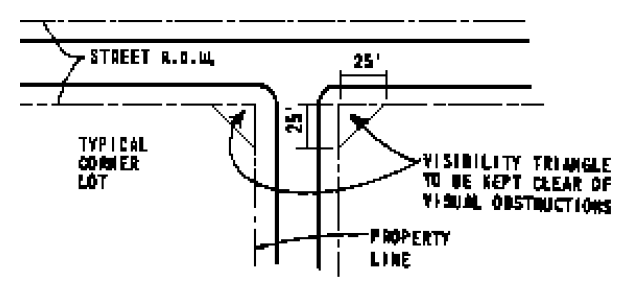
Street Intersection Visibility Triangles. No sign shall be located or placed where it obstructs the vision of motor vehicle drivers approaching any street intersection. At all street intersections, clear vision shall be maintained across the lot for a distance of twenty-five (25') feet back from the property corner along both streets. Within this triangle, vision shall be clear at elevations between thirty inches (30") and nine feet (9') above the average curb grade.
H.
Attachments to Freestanding Sign. No guys, braces, attachments, banners, flags, balloons, or other similar devices shall be attached to any permanent freestanding sign.
Sec 7.150 - Permanent freestanding signs—Sign classifications and regulations.
No permanent freestanding sign shall be constructed or displayed unless said sign is in conformance with the sign classifications and standards contained in this Section.
A.
General Business Signs. The purpose of a general business sign is to identify the name of a business, profession, service, product or activity conducted, sold or offered on the premises where the sign is located. A general business sign may provide advertising for a single or multi-tenant occupancy. All general business signs shall be subject to the following additional regulations:
1.
Construction Design: All general business signs shall be designed and constructed as a monument sign as defined in this Land Development Code.
2.
Districts Permitted: A general business sign shall be allowed only in zoning districts in accordance with Table 7-1.
3.
Maximum Number: One general business sign shall be allowed for each 250 feet of street frontage, or portion thereof, for each lot. Where a building encompasses more than one lot, each lot shall qualify for a general business sign. If the site is a corner lot, each frontage shall be allowed additional signs using the same formula described in this paragraph. The sign(s) shall be located adjacent to and within the qualifying street frontage. Additional signs are not permitted by adding different street frontages to total more than 250 feet.
4.
Specifications: The maximum area, height, spacing and setbacks of a general business sign shall conform to the specifications contained in Table 7-2, except where provided as follows:
a.
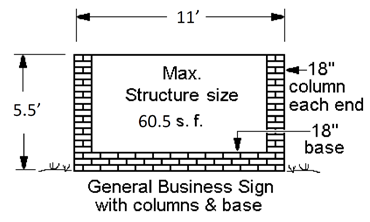
Maximum Area: Sixty and one-half square feet (60.5 s.f.), overall structure size.
b.
Base and Column Requirements: At a minimum, a general business sign shall be constructed to include a base and columns as described below. Said base and columns shall be included in the calculation for determining the overall structure size for compliance with these regulations.
i.
Base: A general business sign shall be constructed with a base that extends the entire length of the face of the sign structure. Said base shall be a minimum of eighteen inches (18") in height and shall be constructed of brick, stone, or of a material similar to that of the primary building on the lot.
ii.
Columns: A general business sign shall be constructed with columns constructed on each end of the face of the sign structure. Said columns shall be a minimum of eighteen inches (18") in width as viewed from the front and side elevations and shall extend the entire height of the face of the sign structure. Said columns shall be constructed of brick, stone, or of a material similar to that of the primary building on the lot.
iii.
Sign Face Offset Requirement: The vertical plane of the advertising image area shall be internally offset (recessed) a minimum of two inches (2") from the vertical plane of the base and columns required above.
c.
Maximum Height: Five and one-half feet (5½').
d.
Minimum Setback: Eight feet (8') from an abutting street right-of-way and, if applicable, a minimum of twelve feet (12') from the edge of pavement. Thirty feet (30') from any side or rear property line adjacent to another property.
e.
Minimum Thickness: The advertising image area of a general business sign shall not be less than four and one-half inches (4½") between vertical face planes.
5.
Changeable Reader Board and Electronic Message Signs: A general business sign may include a changeable reader board or electronic message area, provided the combined gross surface area does not exceed the maximum allowable message area and provided that no more than fifty (50) percent of the maximum allowable message area may be used as a changeable reader board or electronic message area. A permit is not required to change the message on a changeable reader board or electronic message sign. Except for scrolling reader boards, all electronic message areas shall be allowed to change messages at a minimum of every thirty (30) seconds.
6.
Spacing: Where a lot qualifies for an additional general business sign, a general business sign shall be a minimum of one hundred (100') feet from another general business sign situated on the same lot.
7.
Two Frontage Lots: A lot that abuts two (2) or more street frontages shall be allowed a general business sign for each street frontage, provided minimum spacing requirements are in compliance.
B.
Institutional Signs. These regulations provide for on-premises and off-premises institutional signs to assist the public with the location of these types of uses.
1.
On-Premises Institutional Sign: The purpose of an on-premises institutional sign is to identify schools, churches, hospitals or similar public or quasi-public institutions. One on-premises institutional sign per street frontage shall be allowed on the premises where the institution is located and in accordance with Table 7-1. All on-premises institutional signs shall be constructed as a monument sign as defined in this Land Development Code. The maximum area, height, spacing, and setbacks of an on-premises institutional sign shall conform to the specifications contained in Table 7-2.
a.
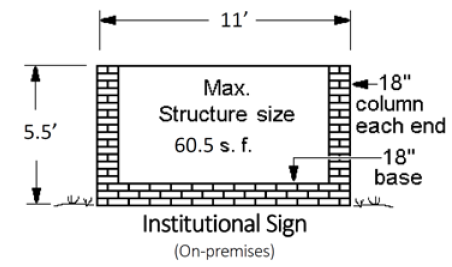
Maximum Area: Sixty and one-half square feet (60.5 s.f.), overall structure size.
b.
Base and Column Requirements: At a minimum, a general business sign shall be constructed to include a base and columns as described below. Said base and columns shall be included in the calculation for determining the overall structure size for compliance with these regulations.
i.
Base: A general business sign shall be constructed with a base that extends the entire length of the face of the sign structure. Said base shall be a minimum of eighteen inches (18") in height and shall be constructed of brick, stone, or of a material similar to that of the primary building on the lot.
ii.
Columns: A general business sign shall be constructed with columns constructed on each end of the face of the sign structure. Said columns shall be a minimum of eighteen inches (18") in width as viewed from the front and side elevations and shall extend the entire height of the face of the sign structure. Said columns shall be constructed of brick, stone, or of a material similar to that of the primary building on the lot.
iii.
Sign Face Offset Requirement: The vertical plane of the advertising image area shall be internally offset (recessed) a minimum of two inches (2") from the vertical plane of the base and columns required above.
c.
Minimum Setback: Eight feet (8') from an abutting street right-of-way and, if applicable, a minimum of twelve feet (12') from the edge of pavement. Thirty feet (30') from any side or rear property line adjacent to another property.
d.
Minimum Thickness: No on-premises institutional sign shall be less than four and one-half inches (4½") between vertical face planes.
e.
Changeable Reader Board and Electric Message Signs: An on-premises institutional sign may include a changeable reader board electronic message area, provided the combined gross surface area does not exceed the maximum allowable sign area and provided that no more than fifty (50) percent of the maximum allowable sign area may be used as a changeable reader board or electronic message area. A permit is not required to change the message on a changeable reader board or electronic message sign. Except for scrolling reader boards, all electronic message areas shall be allowed to change messages at a minimum of every thirty (30) seconds.
C.
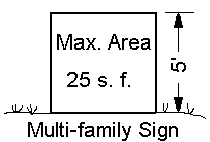
Multi-family Signs. The purpose of a multi-family sign is to identify the name of a multi-family residential development. All multi-family signs shall be constructed as a monument sign as defined in this Land Development Code and be constructed using the same standards as a General Business Sign, except for maximum area and height, which are established in this paragraph. One multi-family sign per street frontage shall be allowed in zoning districts in accordance with Table 7-1. The maximum area, height, spacing, setbacks of a multi-family sign shall conform to the specifications contained in Table 7-2 and the following additional requirements.
1.
Base and Column Requirements: At a minimum, a general business sign shall be constructed to include a base and columns as described below. Said base and columns shall be included in the calculation for determining the overall structure size for compliance with these regulations.
i.
Base: A general business sign shall be constructed with a base that extends the entire length of the face of the sign structure. Said base shall be a minimum of eighteen inches (18") in height and shall be constructed of brick, stone, or of a material similar to that of the primary building on the lot.
ii.
Columns: A general business sign shall be constructed with columns constructed on each end of the face of the sign structure. Said columns shall be a minimum of eighteen inches (18") in width as viewed from the front and side elevations and shall extend the entire height of the face of the sign structure. Said columns shall be constructed of brick, stone, or of a material similar to that of the primary building on the lot.
iii.
Sign Face Offset Requirement: The vertical plane of the advertising image area shall be internally offset (recessed) a minimum of two inches (2") from the vertical plane of the base and columns required above.
2.
Minimum Setback: Eight feet (8') from an abutting street right-of-way and, if applicable, a minimum of twelve feet (12') from the edge of pavement. Thirty feet (30') from any side or rear property line adjacent to another property.
3.
Minimum Thickness: No multi-family sign shall be less than four and one-half inches (4½) between vertical face planes.
D.
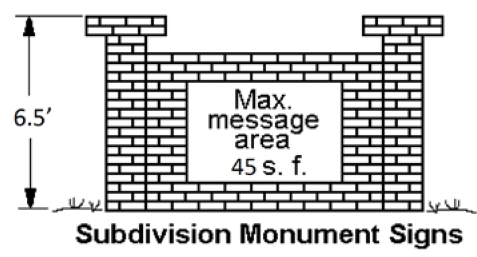
Subdivision Monument Signs. The regulations for subdivision monument signs are intended to allow residential developments to have large grand-entrance structures at the main entrances to a subdivision. All subdivision monument sign structures shall be constructed to avoid the creation of a sight visibility obstruction for vehicular traffic entering and exiting the subdivision. No more than two subdivision monument signs shall be allowed per subdivision entrance. No subdivision monument sign structure shall exceed six and one-half (6.5') feet in height and the message area shall not exceed forty-five (45) square feet. Subdivision monument signs shall be allowed in accordance with Table 7-1. Subdivision monument signs shall not be located within a public right-of-way, except with the approval by the City Council of a Right-of-Way Joint Use Agreement. The maximum area, height, spacing and setbacks of a subdivision monument sign shall conform to the specifications contained in Table 7-2.
E.
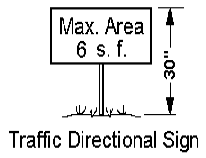
Traffic Directional Signs. The purpose of a traffic directional sign is to guide vehicular traffic into or out of an institutional use or commercial business by identifying a public entrance and exit for vehicular traffic. No more than two traffic directional signs per entrance or exit shall be allowed in accordance with Table 7-1, provided additional traffic directional signs shall be allowed when located behind the building set-back line. The maximum area and height of a traffic directional sign shall conform to the specifications contained in Table 7-2. No permit shall be required for a traffic directional sign, provided all such signs shall comply with the regulations contained in this section.
F.
Directory Signs. The purpose of a directory sign is to provide a listing of the occupants within a major multi-tenant shopping center and direct to the buildings in the development. All directory signs shall be constructed as a monument sign as defined in this Land Development Code. Directory signs shall be allowed in accordance with Table 7-1 and only for retail shopping centers that contain more than four (4) tenants and contain a minimum of 250,000 square feet of gross floor area. One (1) directory sign shall be permitted per street entrance with no more than 4 such signs permitted total per retail shopping center. The maximum area, height, spacing, and setbacks of a directory sign shall conform to the specifications contained in Table 7-2.
Sec 7.155 - Special purpose sign districts and regulations.
The following special purpose sign districts are hereby created to provide additional signage provisions that due to special circumstances are not applicable to all locations within the city.
A.
Freeway Overlay Zone. The area situated within 250 feet from the right-of-way line of State Highway 121 shall be defined as the Freeway Overlay Zone for the purpose of this sign regulation.
1.
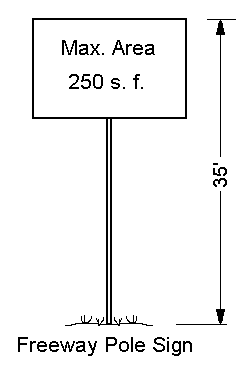
Freeway Pole Signs: The purpose of a freeway pole sign is to identify the name of a business, profession, service, product or activity conducted, sold or offered on the premises where the sign is located for businesses located adjacent to State Highway 121. Freeway pole signs shall be subject to the following regulations.
a.
Permit: A permit shall be required for a Freeway Pole sign upon the review and approval of the City Council.
b.
Districts Permitted: A freeway pole sign shall be allowed in zoning districts in accordance with Table 7-1, but only for when the sign is situated within the freeway overlay zone.
c.
Maximum Number: No more than one freeway pole sign and one general business sign shall be allowed for each lot.
d.
Specifications: The maximum area, height, spacing and setback of a freeway pole sign shall conform to the specifications contained in Table 7-2.
B.
Major Multi-Tenant Shopping Center Sign Areas. A Special Purpose Sign District for a Major Multi-Tenant Shopping Center may be approved by the City Council provided the following minimum requirements are met. A Major Multi-Tenant Shopping Center shall include retail shopping centers that contain more than four (4) tenants and contain a minimum of 100,000 square feet of gross floor area for the purpose of this sign regulation.
1.
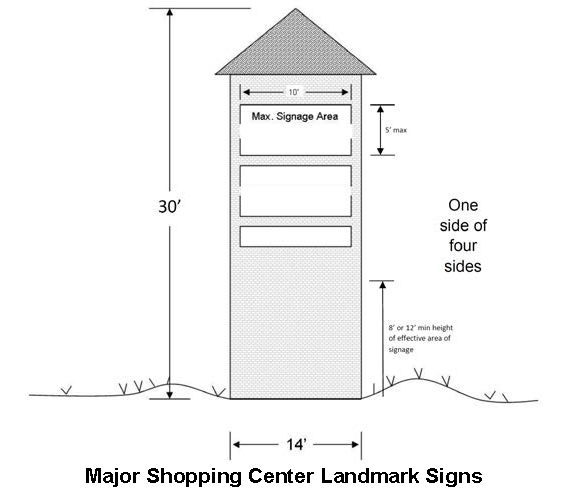
Major Shopping Center Landmark Signs: The purpose of a major shopping center landmark sign is to identify a major shopping center and the name of a business, profession, service, product or activity conducted, sold or offered within the major shopping center. A landmark sign shall mean a freestanding four-sided sign that provides an effective area for multi-tenant advertisement and shall only be permitted within a major multi-tenant shopping center area as defined above.
a.
Permit: A permit shall be required for a landmark sign upon the review and approval of the City Council.
b.
Specifications: All landmark signs shall comply with the following minimum requirements:
i.
Maximum Height: Thirty feet (30').
ii.
Maximum Base Dimensions: Fourteen feet (14') by fourteen feet (14').
iii.
Maximum Effective Area of Signage: Five feet (5') in height and ten feet (10') width.
iv.
Minimum Height of Effective Area of Signage: Twelve feet (12') for center identification; Eight feet (8') for other business/tenant identification.
v.
Architectural Features: Landmark signs shall be architecturally compatible to the principle building(s) on the property or overall architectural theme of a development. Decorative roof and wall design features, such as parapets, ridges, and eaves, etc. shall be incorporated into the design to provide visual interest. A flat roof line with no articulation is not permitted unless deemed by the Administrative Official to be compatible with the architecture of the development.
vi.
Signage: Signage for each tenant shall be uniform in size, color and method of construction.
Sec 7.160 - Permanent freestanding signs—Allowable districts.
No permit for a permanent freestanding sign shall be issued nor shall a permanent freestanding sign be constructed or displayed unless said sign is situated in a district authorized by Table 7-1 below:
Notes for Table 7-1:
(1)
Permitted where the PUD ordinance allows commercial uses
(2)
Permitted only in the Freeway Overlay Zone with approval of an SUP
(3)
Permitted where the PUD ordinance allows multi-family uses
(4)
Permitted for Institutional uses in the applicable districts
(5)
Permitted for retail shopping centers containing a minimum of 250,000 square feet of gross floor area.
Legend:
P = Sign permitted in this district
(#) = Sign permitted in this district per special footnote
Sec 7.165 - Permanent freestanding signs—Area, height and setback requirements.
No permit for a permanent freestanding sign shall be issued nor shall a permanent freestanding sign be constructed or displayed that exceeds the maximum area, height and minimum setback requirements contained in Table 7-2 below:
Notes for Table 7-2:
(1)
Any street frontage shall be considered a front property line
(2)
Maximum structure size.
(3)
Only permitted within 250 feet of Hwy. 121 right-of-way.
(4)
Signs on a street island must be designed to permit appropriate driver visibility - joint use agreement required.
(5)
Spacing requirements for Freestanding Signs are not applicable to Traffic Directional Signs.
(6)
100 feet between signs when signs are located on the same lot.
Sec 7.170 - Permanent attached signs—General conditions.
A.
Permit. A permit shall be required prior to construction of any permanent attached sign, except where an exemption is specifically provided for in these regulations.
B.
Certificate of Occupancy Required. No permit for a permanent attached sign shall be approved, except where a business exists with a valid certificate of occupancy or where a certificate of occupancy has been submitted for the premises on which the sign is to be located.
C.
Construction Standards. The construction of all permanent attached signs shall comply with the structural requirements of the Colleyville building code.
D.
Illumination. A permanent attached sign may be illuminated, however, illuminated attached signs on rear building facades are prohibited. All electrical facilities shall require separate electrical permits and shall be installed in accordance with the City of Colleyville electrical code. Lighting shall be installed so as to avoid any glare or reflection onto adjacent property, or create a traffic hazard on a public street. When determined necessary by the administrative official, illuminated signs shall be shielded to minimize glare on residentially zoned property.
E.
Pedestrian Clearance. No permanent attached sign may project over a pedestrian walkway, unless there is a minimum of eight (8') feet of clearance provided from the bottom of the sign to the grade below the sign.
F.
Public Right-of-Way. No permanent attached sign shall project over or into a public right-of-way, except where a provision in this Chapter provides for a sign within a right-of-way or with the approval by the City Council of a Right-of-Way Encroachment and Joint Use Agreement. A sign may encroach over or into a public access easement located on private property, provided a minimum of eight (8') feet of clearance is provided over a walkway and a minimum of fourteen (14') feet of clearance is provided over a driving area.
Sec 7.175 - Permanent attached signs—Classification and regulations.
No permit for a permanent attached sign shall be issued nor shall a permanent attached sign be constructed or displayed unless said sign is in compliance with the sign classifications and standards contained in this Section and is situated in a district authorized by Table 7-3.
A.
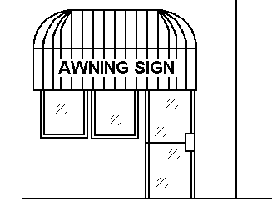
Awning Signs. The purpose of an awning sign is to provide an advertising message on the face of an awning. An awning may extend across the entire width of a building or tenant space. An awning may extend above the apparent roof line of the building, provided the awning extends across seventy-five (75%) percent of the entire width of the building façade to which it is attached. An awning shall not exceed six (6') feet in height. Awnings shall only be allowed of a single color of a neutral tone (black, gray, white, tan, etc.), opaque, and of a high-quality material.
The sign area on an awning shall not exceed 20% of the area of the awning and shall extend for no more than 50% of the length of the awning or ten feet (10'), whichever is more restrictive. A permit shall be required for an awning sign. Awning signs may be illuminated.
B.
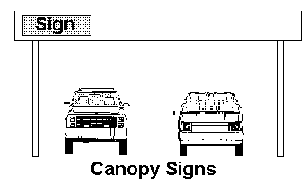
Canopy Signs. A canopy sign shall be no greater in size than 20% of the face of the canopy of which it is a part or to which it is attached and shall not extend beyond the face of the canopy either vertically or horizontally. An illuminated strip may be incorporated into the canopy.
C.
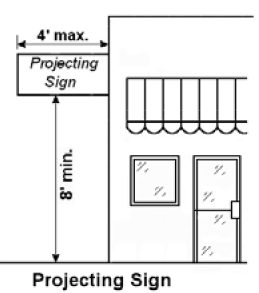
Projecting Signs. The purpose of a projecting sign is to identify the name of a business, profession, service, product or activity conducted, sold or offered on the premises where the sign is located by providing an advertising message that is perpendicular to the wall of the building to which it is attached. A projecting sign shall be allowed in zoning districts in accordance with Table 7-3 and shall comply with the following additional regulations:
1.
Number of Signs: One (1) projecting sign shall be allowed for each single tenant building or for each tenant in a multi-occupancy structure. However, no tenant storefront shall have a projecting sign in combination with a wall sign on the same building elevation.
2.
Maximum Area: A projecting sign shall not exceed twenty (20) square feet. The plane of the message area shall not exceed eighteen (18") inches from the plane of the message area on the opposite side of the sign.
3.
Horizontal Projection: A projecting sign shall not project more than four (4') feet from any wall facing and shall not be closer than two (2') feet from a curb line. A projecting sign shall not extend above the apparent roof line of the building.
4.
Clearance: Every projecting sign shall be a minimum of eight (8') feet above the grade over a walking area or fourteen (14') feet over a vehicular maneuvering area. Projection signs shall not project over any property line or right-of-way line.
5.
Illumination: A projecting sign may be illuminated but shall not be internally illuminated.
D.
Wall Signs. A wall sign shall only be allowed over the premises on which it advertises and may be illuminated; provided, illuminated wall signs on rear building facades are prohibited. Illumination shall allow for a solid color, no changing colors allowed. Wall signs shall comply with the following additional regulations:
1.
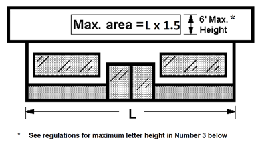
Maximum Area: The total area of all wall signs on a single tenant building or occupancy space of a multi-tenant building shall not exceed the product of one and one-half (1½) times the lineal width of the wall on which such signs are located. For purpose of this regulation, on multi-tenant buildings, the width of each lease space shall be used to calculate each sign width.
2.
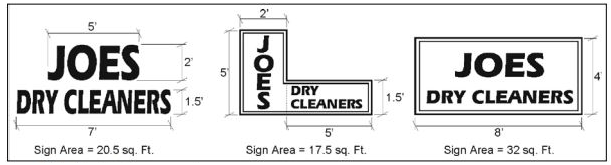
Sign Area Measurement: The measurement of sign area to determine compliance with the maximum sign area requirements shall be calculated by enclosing the extreme limits of all framing, emblem, logo, representation, writing, or other display within a single continuous perimeter composed of squares or rectangles with no more than eight lines (see exhibit below).
3.
Maximum Letter/Logo Height: Ratio of letter height based on sign area and/or distance to front property line:
<50 s.f. or <50 ft. from front property line = 24" max. letter/logo height
50 s.f. to 100 s.f. or 50 ft. to 100 ft. from front property line = 48" max.
>100 s.f. or >100 f.t. from front property line = 72" max.
4.
Maximum Sign Height: Six feet (6'), provided that no wall sign shall extend above the wall to which it is attached.
5.
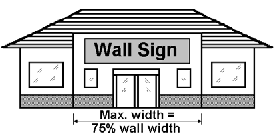
Maximum Width: Seventy-five percent (75%) of the width of the wall area to which it is attached. When more than one wall sign is used, the combination of the sign widths, when placed side by side, shall not exceed seventy-five (75%) of the width of the wall to which they are attached.
6.
Horizontal Projection: No wall sign shall project from the vertical plane of the wall more than eighteen inches (18").
E.
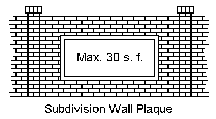
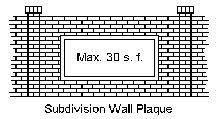
Subdivision Wall Signs or Plaques. Subdivision wall signs or plaques shall not exceed thirty (30) square feet in area. Subdivision wall signs or plaques are limited to two per subdivision entryway and may be illuminated. A subdivision wall sign or plaque shall be attached to a fence or screening wall. For purposes of this regulation, the size of the graphic and sign text shall be used to measure sign size.
Sec 7.180 - Permanent attached signs—Allowable districts.
No permit for a permanent attached sign shall be issued nor shall a permanent attached sign be constructed or displayed unless said sign is situated in a district authorized by Table 7-3 below:
Notes for Table 7-3:
(1)
Permitted where the PUD ordinance allows commercial uses
Legend:
P = Sign permitted in this district
(#) = Sign permitted in this district per special footnote
Sec 7.185 - Temporary signs—General conditions.
A.
Permit. A permit approved by the administrative official prior to the construction or display of some classifications of temporary signs is required to determine compliance with these regulations and to establish the beginning and ending display periods.
B.
Certificate of Occupancy Required. No temporary sign shall be constructed or erected, except where a business exists with a valid certificate of occupancy or where a certificate of occupancy has been submitted for the premises on which the sign is to be located, unless a provision in this Section allows a sign to be displayed off-premises.
C.
Illumination. No temporary sign may be illuminated, except where a regulation provides for illumination. Lighting, where allowed, shall be installed so as to avoid any glare or reflection onto adjacent property, or create a traffic hazard on a public street. When determined necessary by the administrative official, illuminated signs shall be shielded to minimize glare on residentially zoned property.
Sec 7.190 - Temporary business signs—Classifications and number allowed.
No permit for a temporary sign shall be issued nor shall a temporary sign be constructed or displayed unless said sign is in compliance with the sign classifications and standards contained in this Section and is situated in a district authorized by Table 7-3. Where a provision exempts certain classifications of temporary signs from the permit requirement, said temporary signs shall comply with all other provisions for temporary signs.
A.
Agricultural Signs. The purpose of an agricultural sign is to identify the temporary seasonal sales of produce, crops, animals or poultry that are produced or raised on the farm or ranch on which the sign is placed. An agricultural sign may be displayed in zoning districts in accordance with Table 7-4. One agricultural sign shall be allowed per lot, parcel or tract of land, provided the property contains a minimum of one (1) acre. The maximum gross surface area of the sign shall be eight (8) square feet. Agricultural signs shall have a maximum height of four (4') feet.
B.
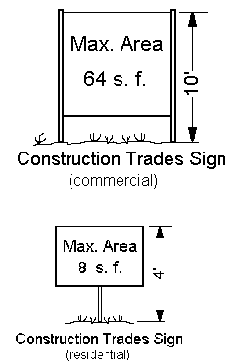
Construction Trades Signs. The purpose of a construction trades sign is to denote the architect, engineer, financial institution or building trades contractor involved in a construction project. Construction trades signs shall be regulated as either commercial or residential, which shall be allowed in accordance with Table 7-4. The maximum area, height, spacing and setbacks of a Construction Trades Sign shall conform to the specifications contained in Table 7-5. Construction trades signs shall not be erected until a building permit has been submitted for building construction and shall be removed up on completion of the construction project or occupancy of the structure, whichever is applicable. Construction trades signs shall not be illuminated. No permit or fee shall be required for a construction trades sign.
C.
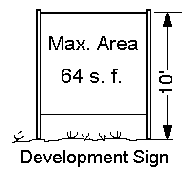
Development Signs. The purpose of a development sign is to advertise a proposed residential subdivision or commercial project. A development sign shall be allowed in accordance with Table 7-4. A development sign shall not be illuminated. The maximum area, height, spacing and setbacks of a development sign shall conform to the specifications contained in Table 7-5. A permit shall be required for a development sign. A development sign shall be removed when the project is 90% complete or within three years from start of construction, whichever is less. For the purpose of this provision, a subdivision shall be deemed 90% complete when 90% of the lots within the subdivision are sold.
D.
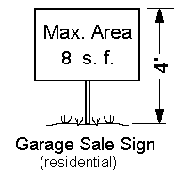
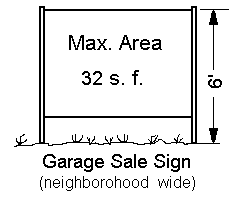
Garage Sale Signs. The purpose of a garage sale sign is to announce the sale of household possessions. Garage sale signs shall be allowed in any zoning district in accordance with Table 7-4. The maximum area, height, spacing and setbacks of a garage sale sign shall conform to the specifications contained in Table 7-5 and shall comply with the following additional regulations:
1.
Duration: A garage sale sign shall not be posted more than twenty-four (24) hours prior to the beginning of the sale and shall be removed within twenty-four (24) hours following the end of the sale.
2.
Illumination: A garage sale sign shall not be illuminated.
3.
Permit: No permit or fee shall be required for any garage sale sign.
4.
Single-family residential on-premises: One garage sale sign per street frontage shall allowed, but only on the premises where the garage sale is being conducted and where there is an existing residential use.
5.
Neighborhood-wide garage sales: Two garage sale signs per subdivision entrance shall be allowed for a neighborhood-wide garage sale sponsored by a homeowner's association (HOA). The garage sale sign may be off-premises from where the actual garage sale is conducted, but the sign shall be located on property, including a street right-of-way, that is within the limits of the homeowner's association. The HOA must be registered with the Colleyville Code Enforcement Department.
F.
Home Occupation Signs. (Refer to Chapter 3 of the Land Development Code regarding Home Occupations).
G.
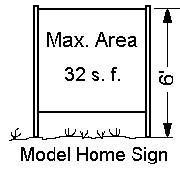
Model Home Signs. The purpose of a model home sign is to provide advertising of a typical completed residential dwelling. A model home sign shall be allowed in any residential zoning district in accordance with Table 7-4, provided the sign and the model home are located in the subdivision being developed. Model home signs are limited to one per premises. A model home sign permit may not exceed a period of 24 months, provided if the model home is sold prior to the expiration of the 24-month period, the sign shall be removed when the sale is completed. The maximum area, height, spacing and setbacks of a Model Home sign shall conform to the specifications contained in Table 7-5.
H.
Political Signs. A political sign that complies with this section shall be allowed in any zoning district and shall not require a permit or permit fee required by this chapter.
1.
Definitions. Whenever used in this section, the following terms shall have the meanings set forth below:
a.
City means the City of Colleyville, Texas.
b.
Political sign means a sign comprised of any board, poster, placard, banner, flag, or other medium, including its structure and component parts, which advertises any candidates or measure, or is designed to influence the action of a voter in connection with any candidate or measure on the ballot at any national, state, or local election.
c.
Polling location means any public property designated as a polling location for any national, state, or local election in accordance with the Texas Election Code, including public property designated as an early voting location.
d.
Private property means any privately owned property used for non-governmental purposes. For the purposes of this section, the term "private property" does not include real property subject to a public right-of-way, easement, or other encumbrance that allows a municipality, including the City, to use the property for a public purpose.
e.
Public property means any publicly owned property, including, without limitation, all City-owned real property, parks, streets, buildings, facilities, and public rights-of-way.
2.
Political Signs on Public Property. Political signs are not permitted to be placed or located on public property owned by the City, except as follows:
a.
Political signs may be temporarily placed on public property designated as a polling location for early voting beginning 12:01 a.m. on the day prior to the first day of early voting and shall be removed by 10:00 a.m. the day following the official election day.
b.
Political signs may be temporarily placed on public property designated as a polling location that is not an early voting location beginning at 6:00 p.m. the day before the official election day and shall be removed by 10:00 a.m. the day following the official election day.
c.
Political signs placed on public property in conformance with this section shall not:
(1)
Be placed or located within one hundred (100) feet of the entrance to a polling location or any other area where electioneering is prohibited by the Texas Election Code.
(2)
Be secured by or attached to any utility, light, or traffic signal pole.
(3)
Be placed or located in such a manner as to encroach upon or interfere with the public's use of any public street, parking lot, sidewalk, or right-of-way.
(4)
Be placed or located in such a manner as to obstruct the view of, or conflict with any traffic or pedestrian sign, signal or device.
(5)
Be placed or located in such a manner that it will, or reasonably may be expected to obstruct the view of pedestrian or vehicular traffic, including such traffic within any public or private parking lot.
(6)
Be illuminated.
(7)
Encroach upon any public or private tree roots, irrigation lines, utilities, or any other underground vegetation or structure.
(8)
Encroach upon or extend over any public or private sidewalk, street, or walkway.
(9)
Be placed or located within twenty (20) feet of an identical sign.
(10)
Be attached to a metal stake, not exceeding nine-gauge diameter, driven into the ground so as to reasonably secure the sign to such property.
(11)
Exceed four (4) square feet in area.
(12)
Be placed or located upon any parking lot within the polling location, including, without limitation, any median, island, or interior landscaped area located within the parking lot.
(13)
Be placed or located within any public property designated as a public park.
d.
Temporary canopies, tents, and flags may be temporarily placed on public property designated as a polling location during the same times as political signs and subject to the regulations set forth in this Subsection 2, subject to the following additional requirements:
(1)
Canopies, tents, and flags shall only be placed in areas expressly designated by the City for the temporary placement of the same.
(2)
No canopy or tent may occupy a space greater than ten (10) feet by twelve (12) feet in size.
(3)
Flags shall not exceed fifteen (15) square feet in area and no flag pole or other structure upon which a flag is attached shall exceed twenty (20) feet in height above ground level.
(4)
There shall be a minimum distance of twenty (20) feet between canopies, tents, and/or flags displaying a political sign for the same candidate or measure.
3.
Political Signs on Private Property. A political sign situated on private real property shall not exceed thirty-two (32) square feet, not exceed eight (8) feet in height, and shall not be erected more than sixty (60) days prior to the official election day and shall be removed within seven (7) days after election day. For purposes of this section, "private real property" does not include real property subject to a public right-of-way, easement, or other encumbrance that allows governmental entity to use the property for a public purpose.
I.
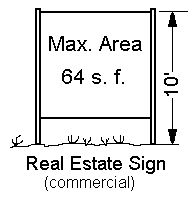
Real Estate Signs (Commercial). The purpose of a commercial real estate sign is to advertise the sale, rental or lease of the premises on which said sign is located. A commercial real estate sign shall be allowed in accordance with Table 7-4. A commercial real estate sign shall not be illuminated. The maximum area and height of a commercial real estate sign shall conform to the requirements contained in Table 7-5. Commercial real estate signs shall be removed within seven (7) days following the completion of the sale, rental or lease of the premises. No permit or permit fee shall be required for a commercial real estate sign.
J.
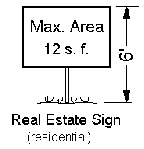
Real Estate Signs (Residential). The purpose of a residential real estate sign is to advertise the sale, rental or lease of the premises on which said sign is located. A residential real estate sign shall not be illuminated. A residential real estate sign shall be allowed in a residential district in accordance with Table 7-4. The maximum area and height of a residential real estate sign shall conform to the requirements contained in Table 7-5. All signs shall be removed within seven (7) days following the completion of the sale, rental or lease of the premises. No permit of permit fee shall be required for a residential real estate sign.
K.
Temporary Business Signs. The purpose of a temporary business sign is to provide advertising for specific periods of time to identify the name of a business, profession, service, product or activity conducted, sold or offered on the premises where the sign is located.
1.
Requirements: Temporary business signs shall conform to the following additional regulations:
a.
Maximum number: One per business occupancy holding a valid certificate of occupancy.
b.
Illumination: None allowed.
c.
Permit Requirements: A temporary business sign permit shall not be valid for more than 30 consecutive days and there shall be a thirty (30) day non-display period between permits. No more than three temporary business sign permits shall be issued per calendar year per business occupancy.
d.
Permit Fee: A permit fee shall be charged for a temporary business sign. The permit fee shall be established by City Council.
e.
Districts Allowed: Temporary business signs shall be allowed in zoning districts in accordance with Table 7-4.
2.
Types of Temporary Business Signs: A business tenant may choose any one of the following types of sign structures:
a.
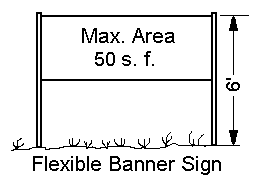
Flexible Banner Signs: Banners shall be kept in good repair and remain firmly anchored or secured to the face of the building or may be suspended below the apparent lower edge of an overhanging covered walkway, provided the banner is firmly secured to the columns supporting the building. A flexible banner sign may not be freestanding. A flexible banner sign shall not exceed fifty (50) square feet nor exceed six (6) feet in height.
b.
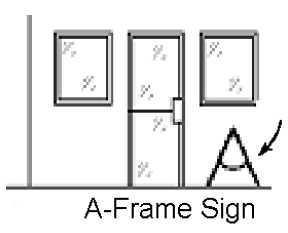
A-Frame Signs: The purpose of an A-frame sign is to provide temporary advertising during business hours of a commercial occupancy.
(1)
[Maximum height and area:] Maximum height and area shall conform to the following table:
(2)
Time duration: Only displayed during business hours.
(3)
Placement: Only allowed on private property, but may be located on a public sidewalk, provided a width of four feet (4) shall remain free from intrusion.
c.
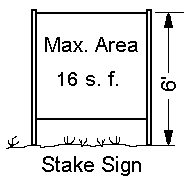
Stake Signs: A stake sign shall not exceed sixteen (16) square feet, nor exceed six (6) feet in height.
L.
Weekend Builder/Real Estate Open House Signs. The purpose of Weekend Builder/Real Estate Open House Signs is to assist the general public by providing direction to available residential properties in Colleyville. Signs that advertise developments located outside the corporate limits of Colleyville shall be prohibited.
1.
Open House Sign Definition: A means of advertising and marketing a property that is for sale. A period of time during which a builder, developer, or real estate agency markets the home by inviting buyers in for a public viewing to see the interior without making an appointment.
2.
Weekend builder/real estate open house signs may be placed on private property or in the public right-of-way with the approval of the adjacent property owner, provided the advertiser has a valid annual permit required by these regulations. Signs placed within the public right-of-way shall be situated not more than five (5) feet from the right-of-way line and shall be no closer than three (3) feet from the edge of the sign to the edge of the street pavement. No weekend builder/real estate open house sign shall block vehicular visibility. Approval of an annual permit does not grant unlimited access or use of the public right-of-way, therefore, it shall be the responsibility of the builder, owner, or real estate agency to secure permission of the property owner for placement of the signs on private property or in the adjacent street right-of-way.
Open house signs shall not be posted within visibility triangles. No sign shall be located or placed where it obstructs the vision of motor vehicle drivers approaching any street intersection. At all street intersections, clear vision shall be maintained across the lot for a distance of twenty-five (25') feet back from the property corner along both streets. Within this triangle, vision shall be clear at elevations between thirty inches (30") and nine feet (9') above the average curb grade.
3.
A builder, developer, or real estate agency must be registered with the City of Colleyville to qualify and participate as a weekend advertiser or for open house signs. An annual permit is required for each builder, developer or real estate agency, which shall expire on December 31 each year. The permit fee shall be established by separate ordinance approved by the City Council.
Note: For purpose of this regulation a real estate agency shall be defined as the real estate broker or owner holding a franchised agency.
4.
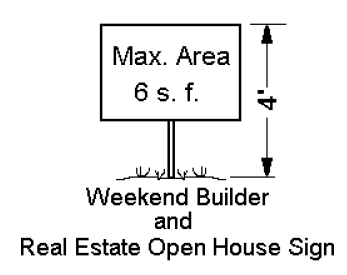
A weekend builder/real estate open house sign shall not exceed six (6) square feet in area and four (4) in height. No sign shall be placed on trees, utility poles, traffic control signs or within a street median or encroach over a sidewalk.
5.
Maximum number of Weekend Builder Signs: The maximum number of signs displayed at any one time for a weekend builder shall not exceed twenty (20) signs for any subdivision.
6.
Maximum number of Real Estate Open House Signs: The maximum number of signs displayed at any one time for a real estate agency shall not exceed twenty (20) signs, provided no more than two (2) signs shall be displayed within the right-of-way for any single residential property. One (1) on-site open house sign shall be located on the premises of the open house for property identification. The sign shall be in accordance with the open house sign maximum effective area specifications. The house shall be open for a public viewing to see the interior without making an appointment for the entire period during which open house signs advertise the property. Real estate open house signs shall be limited to directing traffic to an open house.
All open house signs shall include the open house address, open house date(s), and open house public viewing time(s). Open house viewing times shall refer to the availability of the public to view the interior of a home without making an appointment. The information shall be located on the advertising surface of the sign and shall not be attached to the pole of the sign.
7.
Weekend builder signs may be exhibited from 12:00 noon on Friday till 12:00 noon on the following Monday. Open house signs may be exhibited only between the hours of 12:00 midnight Friday to 12:00 midnight on the following Sunday. A holiday falling on a Friday or a Monday will be considered as part of the weekend.
M.
Window Signs. Window signs may be placed so as not to obscure more than 25% of any individual window pane.
N.
Temporary Construction Entrance Signs. The administrative official is hereby authorized to approve temporary signs to direct traffic to the entrance of a commercial business when the driveway that provides access to the business or the street immediately abutting the business is under construction.
O.
Allowance for Signs Adjacent to Roadways Under Construction. Businesses adjacent to a major public roadway construction project scheduled for six months or more duration shall be eligible for prolonged temporary signage when roadway construction activities are commencing immediately adjacent to the business. The following conditions shall apply:
1.
Shall comply with Section 7.190.K Temporary Business Signs.
2.
The Permit Requirements (Section 7.190.K.1.c) shall not apply for the duration of the construction of the roadway.
(Ord. No. O-23-2236, § 1(Exh. A), 3-21-23)
Sec 7.195 - Temporary signs—Permitted districts.
No temporary sign shall be displayed unless said sign is situated in a district authorized by Table 7-4.
Notes for Table 7-4:
(1)
Permitted where the PUD ordinance allows commercial uses.
(2)
Permitted where the PUD ordinance allows residential uses.
(3)
Property must contain a residential use.
(4)
Where an Institutional use occupies the premises.
Legend:
P = Sign permitted in this district
(#) = Sign permitted in this district per footnote
Sec 7.200 - Temporary signs—Area and setback requirements.
All temporary signs shall be constructed in accordance with the requirements listed in Table 7-5:
Sec 7.205 - Temporary community special event signs.
The purpose of this regulation is to provide temporary advertising for certain community special events sponsored by public and quasi-public agencies, churches and other religious institutions located within the corporate limits of the City of Colleyville. Signs shall be allowed in accordance with the following:
A.
Qualifying Entities. The following public and semi-public agencies, churches and other religious institutions located within the corporate limits of the City of Colleyville shall be permitted to have community special event signs in accordance with the provisions of this section.
1.
City of Colleyville: Signs advertising an event conducted and sponsored by the City of Colleyville may be placed on any private property or in the public right-of-way adjacent to the private property with the approval of the adjacent property owner. Signs placed within the public right-of-way shall be situated not more than five (5) feet from the right-of-way line and shall not block vehicular visibility.
2.
Public and Semi-Public Schools, Colleyville Chamber of Commerce, Churches and Other Religious Institutions, and Non-Profit Civic Organizations: For the purpose of this section, a non-profit civic organization shall be a not-for-profit community organization that has as its primary objective charitable fundraising, community betterment or youth sports promotion and participation. Signs advertising an event conducted and sponsored by any of the above may be placed on any private property with the approval of the adjacent property owner. Sign dimensions shall be consistent with the provisions of Section "B(1) and (2)" below. Directional signs may be placed no sooner than 24 hours prior to the event and shall be removed no later than 24 hours after the conclusion of the event.
B.
Types and Maximum Area of Signs Allowed. The following types of community special event signs shall be allowed, provided the sign does not exceed the maximum area and height established below.
1.
Flexible Banner Signs: Banners shall only be allowed on the premises where the event is located. Banners shall be kept in good repair and remain firmly anchored or secured to the face of the building or may be suspended below the apparent lower edge of an overhanging covered walkway, provided the banner is firmly secured to the columns supporting the building. A flexible banner sign may be freestanding. A flexible banner sign shall not exceed fifty (50) square feet nor exceed six (6) feet in height.
2.
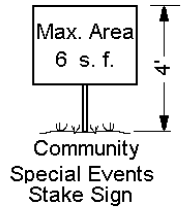
Stake Signs: Signs shall not exceed six (6) square feet in area nor exceed four (4) feet in height.
C.
Time Duration. Signs for City of Colleyville sponsored events may be erected for any length of time. All other signs allowed under this section may be erected 21 days prior to the activity and shall be removed not later than the first business day after the event.
D.
Pole Banner Signs.
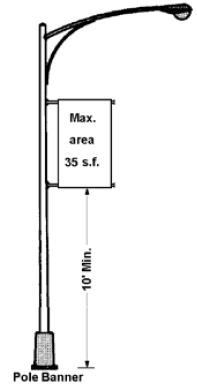
1.
Pole Banners: The purpose of a pole banner sign is to provide advertising for a community event. Pole banners may be erected on utility and other designated poles within the public right-of-way subject to the following restrictions:
a.
Permit: A permit is required from the building permit office and may only be issued to a non-profit organization for the purpose of advertising a function or event to which the general public is invited in Colleyville. Applications shall be considered on a first-come, first-served basis.
b.
Permit Duration: No permit shall be approved for a period exceeding twenty-one (21) consecutive days. The pole banners shall be removed on the first business day after the last day of the event.
c.
Commercial Message: A pole banner may only advertise the name, date, phone number and website of the community event. Any commercial message of a sponsor is limited to twenty-five percent (25%) of the sign area.
d.
Maximum area and height: Thirty-five (35) square feet in area per pole and thirty-five feet (35') from the ground, provided the banner maintains a minimum of ten feet (10') of clearance between the bottom of the pole banner and the ground.
e.
Location: Pole banners may be installed only on poles identified by the City that include the appropriate hardware for such installation.
E.
Permit. Other than events sponsored by the City of Colleyville or non-profit, community based organization listed on the City's website, a temporary sign permit shall be obtained prior to the placement of any signs allowed by this section.
Sec 7.210 - Special advertising provisions.
A.
Grand Openings. The purpose of the grand opening signage provision is to allow the administrative official to issue a permit to a new business or to a business that has substantially remodeled, as defined herein, for the purpose of obtaining special advertisement signage for a temporary period. The following regulations apply to grand opening signage permits:
1.
Eligibility: Upon issuance of a certificate of occupancy and within one year thereafter, a business shall be allowed to receive a grand opening sign permit when one of the following conditions applies:
a.
When a certificate of occupancy has been issued to the new business, or
b.
When a certificate of occupancy has been issued to an existing business which has substantially remodeled and the cost of the renovation exceeds sixty (60) percent of the current value of the building or lease-space, excluding the value of the land, according to the most recently approved tax roll.
2.
Allowable Signs: Signs may include a combination of pennants, tethered or inflatable balloons, and one (1) temporary business sign. Non-traditional balloons/inflatables shall not be allowed. The height and area of such signs shall be limited to the applicable regulations for the sign classification. A temporary business sign may be placed off-premises with the permission of the property owner during the period of the grand opening sign permit. The permit holder shall be the responsible party for compliance with the grand opening sign permit regulations.
3.
Permit: A permit shall be required for a business to utilize the grand opening signage provisions. No permit fee shall be required for a grand opening sign permit. The use of a grand opening sign permit shall have no effect on the number of subsequent temporary sign permits that may be authorized for a business occupancy.
4.
Duration: A grand opening sign permit shall be valid for a period not to exceed thirty (30) consecutive calendar days.
B.
Major Shopping Center Overlay Zone. The purpose of a major shopping center overlay zone is to reduce the overall number of signs situated along a public street by providing shared advertising privileges within a major development and by providing off-premises advertising alternatives for businesses located on lots which do not have frontage along a major public transportation thoroughfare. Developments which satisfy the criteria contained in this Section shall qualify for the sign provisions contained in this Section.
1.
General Qualification Criteria: A commercial development which has a single or multi-occupancy building containing a minimum of one hundred thousand (100,000) square feet of floor area and situated on a single platted lot or on two or more contiguous platted lots shall qualify as a major shopping center. In addition to those lots which satisfy the general qualification criteria described in this paragraph, any adjacent or non-adjacent lots platted within the development that are platted under the same subdivision name shall also be eligible for the sign provisions contained in this Section.
2.
Shared and Off-Premises Signage Privileges: A lot located within the limits of a major shopping center overlay zone may contain a sign that advertises a single or multi-tenant business occupancy located on another lot within the same major shopping center overlay zone, provided that the sign structure complies with the regulations applicable to the classification of sign constructed.
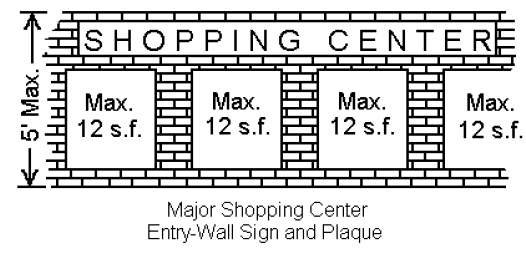
3.
Major Shopping Center Entry-Wall Signs and Plaques: The purpose of a major shopping center entry-wall sign and plaque is to identify a major shopping center and the name of a business, profession, service, product or activity conducted, sold or offered within the major shopping center. Two sign structures shall be allowed per vehicular entrance and may be illuminated. The maximum height of the entry-wall structure shall not exceed five (5) feet. The maximum area of a sign plaque shall not exceed twelve (12) square feet. There shall be a minimum of three (3) feet spacing between sign plaques.
4.
Permit: A permit shall be required for a Major Shopping Center Entry Wall Sign upon the review and approval of the City Council.
5.
Permit: A permit shall be required for a major shopping center entry-wall sign.
Sec 7.215 - Prohibited signs.
The signs described in this Section shall be prohibited within the corporate limits of the City of Colleyville.
A.
Off-Premises Signs. Off premises signs, including billboards, are prohibited in the City of Colleyville, except where specifically allowed by these regulations.
B.
Obscene Signs. It shall be unlawful for any person to display upon any sign any obscene, indecent or immoral matter.
C.
Portable Signs. No person shall erect or allow to be displayed on the premises owned or controlled by him a portable sign. Portable signs shall include windsail style signs, flags, pennants, etc., with or without lettering. No person shall attach any sign to a trailer, or similar mobile structure, where the primary use of such structure is to provide a base for such sign or to constitute the sign itself. A temporary business sign allowed by the regulations in this chapter may be constructed on skids where there is no opportunity for the sign supports to be installed in the ground.
D.
Roof Sign. Signs mounted on roofs or above a parapet are not permitted.
E.
Painting, Marking, Attaching, Materials to Streets, Sidewalks, etc. No person shall attach any sign, whether consisting of paper, plastic, or paint, or stencil or write any name, number (except house numbers), or otherwise mark on any sidewalk, curb, gutter, street, whether public or private, utility pole, public building, fence or structure except as allowed by the sign code.
F.
Attaching Signs to Fences or Utility Poles. No person shall attach a sign to a fence or a utility pole, except a small sign identifying the name of the fence company not discernable from the street.
G.
Animated and Flashing Signs. No person shall erect or allow to be displayed upon premises owned or controlled any animated, moving or flashing sign.
H.
Balloons and Inflatable Advertising. No person shall erect or allow to be displayed as a sign, any balloon, flag, pennant or other floating or inflatable advertising device anchored to the ground or to any other structure, except as allowed by a grand opening sign permit.
I.
Non-Combustible Material. Any sign with either direct or indirect illumination which is attached to the sign shall be constructed of non-combustible materials. Such signs shall be supported by non-combustible supports.
J.
Simulation of Traffic Control Signs. No sign shall obstruct the free and clear vision at any location, where as a result of the position, size, movement, shape, color, fashion, manner or intensity of illumination or any other characteristics, such sign may interfere with vehicular or pedestrian traffic. Nor shall any person erect or allow to be displayed upon premises owned or controlled by him any sign in such a manner as to interfere with, obstruct the view of or be confused with, any authorized traffic sign, signal, or device, including, without limitation, signs making use of the words "stop," "go," "look," "slow," "danger," or any other similar word, phrase, symbol or character, or employ any red, yellow, orange, green or other colored lamp or light in such a manner as to cause confusion or otherwise interfere with vehicular or pedestrian traffic.
K.
Non-Defined Signs. No person shall erect or allow to be displayed upon premises owned or controlled by him any sign that is not specifically allowed by this Chapter.
Sec 7.220 - Sign maintenance.
No person shall allow a sign located on a premises owned by him, or which he has control of, to display or contain any of the following defects or conditions:
A.
Where the elements of the surface or background can be seen as viewed from the intended viewing distance to have portions of the finished material flaked, broken off, missing or otherwise not in harmony or consistency with the rest of the surface; or
B.
Where the structural supports or frame members are visibly bent, broken, dented, deteriorated or torn; or
C.
Where a panel is visibly cracked or in the case of wood and other similar products, splintered in such a way as to constitute unsightly or harmful conditions; or
D.
The sign, or its elements are twisted leaning or at angles other than those at which it was originally erected; or
E.
Where the message or wording can no longer be clearly read by a person with normal eyesight under normal viewing conditions; or
F.
Where the sign or its elements are not in compliance with the requirements of any building, electrical, sign or other type of code construction standards adopted by the City of Colleyville.
Sec 7.225 - Enforcement.
A.
Authority. The administrative official is hereby authorized and directed to enforce all the provisions of this Chapter.
B.
Right of Entry. Whenever necessary to make an inspection to enforce any of the provisions of this Chapter, the administrative official or his authorized representative may enter such building or premises at all reasonable times to inspect the same or to perform any duty imposed upon the administrative official by this Chapter, provided that if such building or premises is occupied, he shall first present proper credentials and request entry; and if such building or premises is unoccupied, he shall first make a reasonable effort to located the owner or other persons having charge or control of the building or premises and request entry. If such entry is refused, the administrative official or his authorized representative shall have recourse to every remedy provided by law to secure entry.
C.
Removal of Certain Signs Upon Notice. When a sign is constructed or erected in violation of these regulations, the property owner and/or tenant shall be given notice to remove said sign or alter said sign so as to comply with the regulations contained in this Chapter. Notice shall require compliance with these regulations within not more than ten (10) days from the date notice is served. Notice may be hand delivered or deposited in the United States mail, addressed to the property owner at the address shown on the most current tax roll of the City, or the tenant as shown on the utility billing records of the City. If the owner cannot be found, or if the notice is refused, or if the notice is returned by the United States Postal Service, then the owner may be notified by posting notice on or near the front door of each building on the premises where the violation exists at least ten (10) days prior to further action or by posting notice on a placard attached to a stake driven into the ground on the premises where the violation exists at least ten (10) days prior to further action.
EXCEPTION: Illegal Temporary Signs. The administrative official is hereby authorized to remove without notice any illegal temporary signs placed on public property or within a right-of-away. Such signs shall be impounded and may be destroyed by the City.
D.
Dilapidated or Deteriorated Signs. Upon determination by the administrative official that a sign is in a dilapidated or deteriorated condition or declared unsafe, dangerous or poses a threat to the safety of the general public, the administrative official shall give notice of said determination to the owner of the property on which the sign is erected. Said notice shall specify a time period of not more than ten (10) days in which said dilapidated or deteriorated condition must be corrected.
1.
Failure by the owner of the property to correct the dilapidated or deteriorated sign or remove the same within the time provided in the notice shall constitute a violation of this Chapter.
2.
When a property owner, agent, or tenant fails to abate a sign declared to be unsafe and dangerous within the time period allowed, the administrative official is hereby authorized to contract for such work to abate the unsafe or dangerous condition and charge the property owner for the costs of such abatement. If the actual charges to the City are not paid within thirty (30) days, the City shall file a lien against the property.
3.
A sign which has been substantially destroyed or dismantled for any purpose other than maintenance operations or for changing letters, symbols or other matters on the sign. The sign shall be deemed to be substantially destroyed or dismantled if the cost of repairing the sign is more than 60% of the cost of erecting a new sign of the same type at the same location.
Sec 7.230 - Nonconforming signs.
A sign which does not conform to the regulations prescribed in this Chapter and existed lawfully on the date of adoption of this Chapter, or amendment hereto, shall be declared a nonconforming sign and may exist in its present form. A nonconforming sign may be maintained, but shall not be altered, or moved unless a permit be issued pursuant to the provisions of this Chapter. The right to continue a nonconforming sign shall cease and such shall be removed whenever:
A.
A sign is altered, moved or relocated without a permit pursuant to the provisions of this Chapter.
Exception: A sign face of a nonconforming sign may be replaced, provided no alterations to the sign structure are made.
B.
A sign is destroyed and the cost to repair exceeds 60% of the replacement cost on the date of the damage.
C.
A sign leans such that an angle between the sign and the ground is 75 degrees or less.
Sec 7.235 - Amendments to this chapter.
Editor's note— Beginning with Supp. No. 20, this table is no longer being maintained. See Land Development Code Comparative Table at the end of this Appendix.

