
Coloma Charter Township
City Zoning Code
City Zoning Code
ARTICLE I
- IN GENERAL
Sec. 40-1.- Definitions.
The following words and phrases, when used in this chapter, shall have the meanings respectively ascribed to them in this section, except where the context otherwise requires:
Accessory building/structure means a structure on the same lot with, and of a nature customarily incidental and subordinate, to the principal structure. Accessory buildings shall be considered as attached to a principal building when the distance between the two buildings is less than 20 feet and the area connecting the principal building to the accessory building shares a common roof structure that blends with the design of the principal building and is constructed with the same or equivalent roofing materials as the accessory building or the principal building. This connection may be in the form of a covered breezeway, covered porch or common wall. The breezeway or porch shall have entrances to the accessory building and the residence that meet the current Michigan Residential Code. Shipping containers, railroad box cars, semi-trailers, residential trailers, motor homes, etc., that were built for that specific purpose cannot be considered accessory structures in any district except the industrial districts. In those districts only shipping containers and semi-trailers can be used.
Accessory use. See Uses.
Accessory use of structure means a use or structure on the same lot with, and of a nature customarily incidental and subordinate to, the principal use or structure.
Alteration means that condition of construction whereby a structure is significantly changed in appearance or use.
Animals.
Domestic or customary household pets means animals, not of an exotic nature or usually meant for commercial purposes, which are owned primarily for the enjoyment and recreation of the owner. Domestic or customary household pets include small animals, including fish or fowl permitted in the house or yard and kept for company or pleasure; examples include domestic dogs, domestic cats, rabbits, domestic tropical birds, and domestic rodents.
Exotic pets means animals which are typically not recognized as domestic pets or animals usually meant for commercial purposes, and any poisonous or non-domesticated animal. Examples may include rattlesnakes, poisonous spiders or insects, large wild cats, wolves, elephants, etc.
Fur bearing means small animals generally recognized as commercially suitable for raising for their fur.
Livestock means any four-legged animal generally recognized as commercially suitable for agricultural production, such as horses, cows, pigs, sheep, goats, etc. The term "livestock," as used in this chapter, includes cattle, hogs, sheep, goats, horses, other four-legged animals, except for domestic pets and poultry of all kinds.
Poultry means any fowl or bird commercially suitable for agricultural production such as chickens, ducks, geese, ostriches, emus, etc.
Antenna means any structure and addition to a structure primarily designed to be used for transmitting or receiving an electromagnetic signal or wave.
Appurtenant building. See Structures.
Area(lot). See Lot.
Average setback. See Setback.
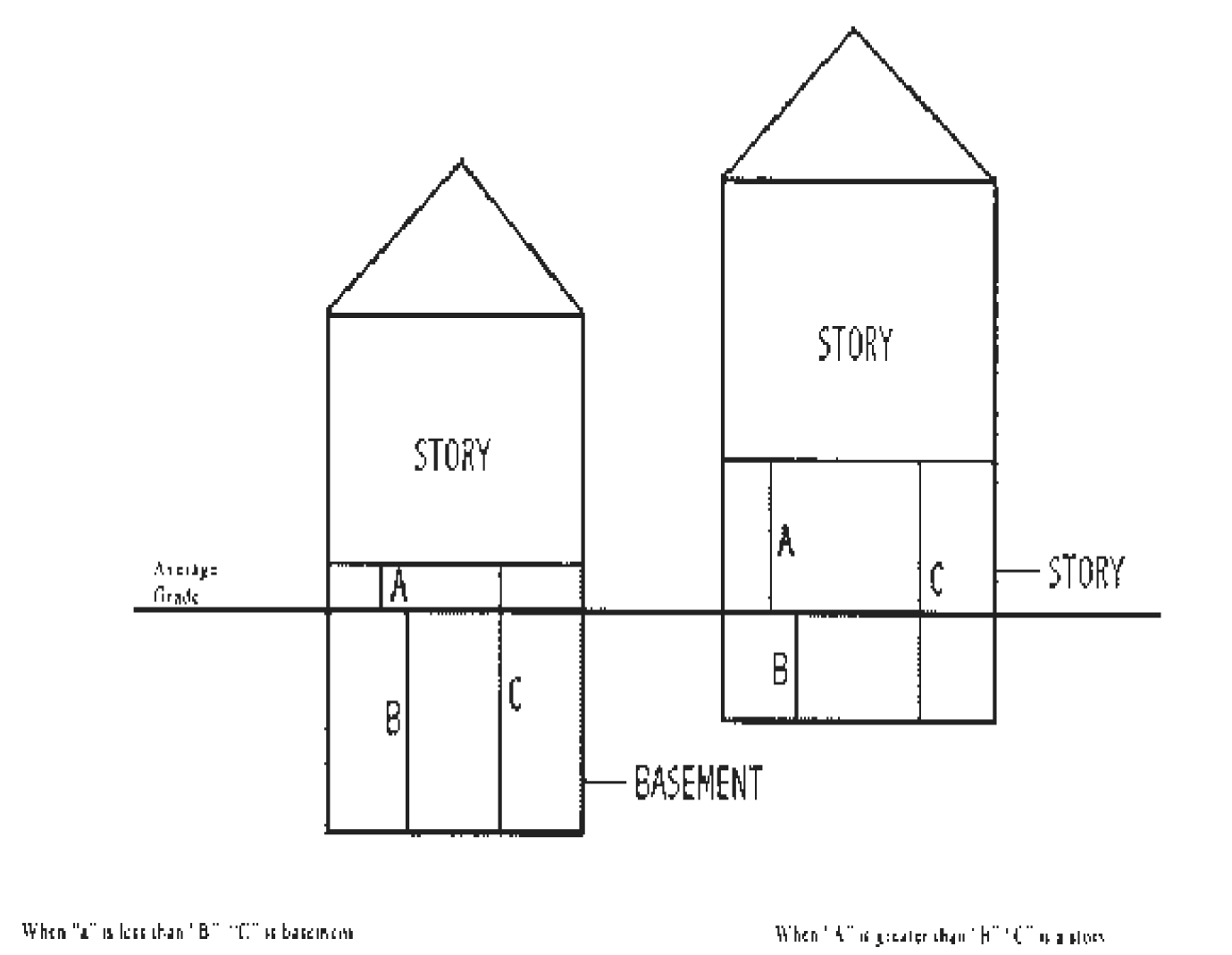
Basement means that portion of a building which is partly or wholly below grade but so located that the vertical distance from the average grade to the floor is greater than the vertical distance from the average grade to the ceiling. A basement shall not be counted as a story.
Belfry means a tower or steeple in which one or more bells are hung, typically constructed as part of a church structure.
Boat livery means a commercial enterprise engaged in the renting to the public of any watercraft.
Building. See Structure.
Buildable area means the portion of a lot remaining after required yards have been provided.
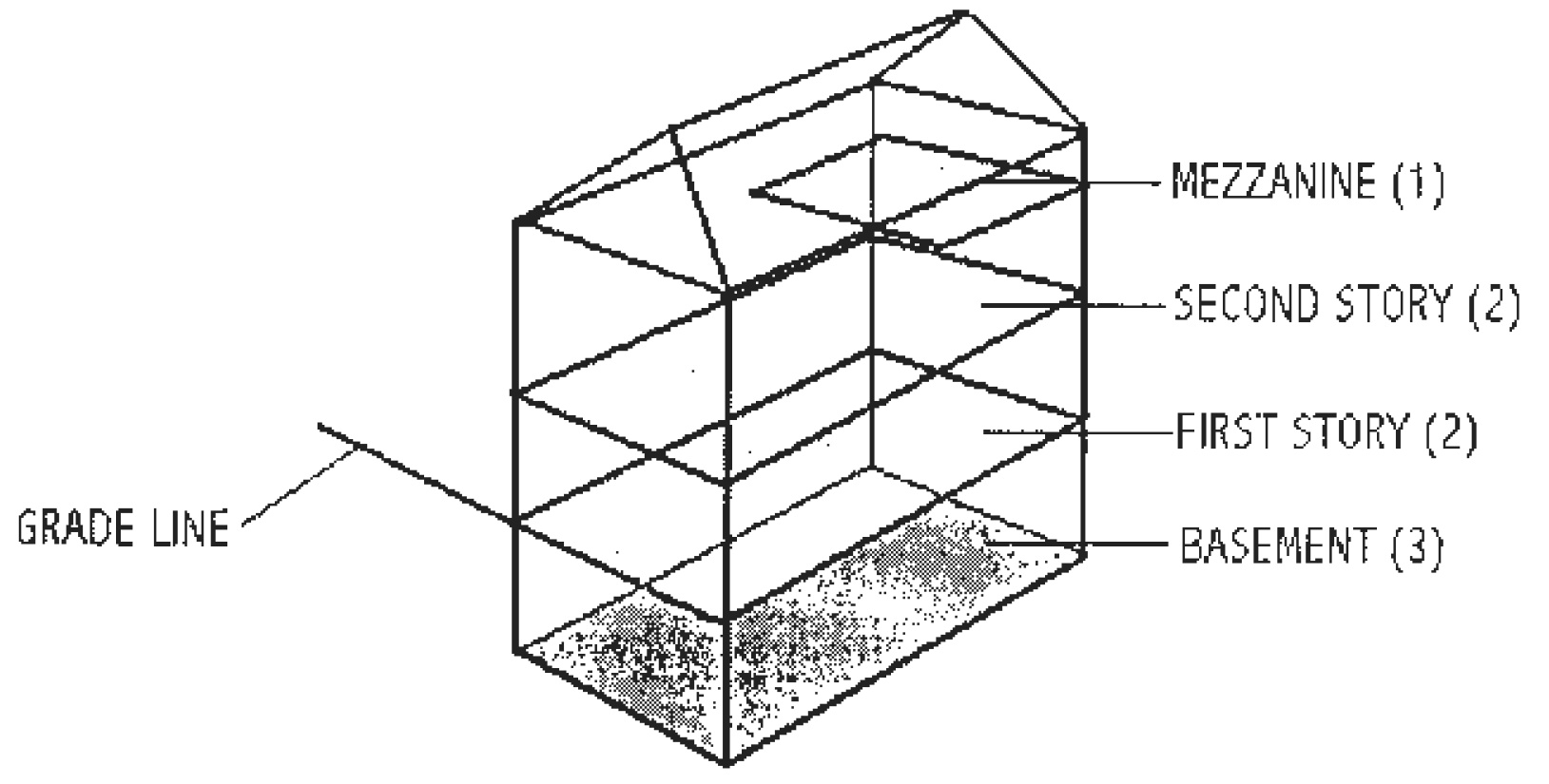
Building height means the vertical distance measured from the established grade to the highest point of the roof's surface for flat roofs; to the deck line of mansard roofs; and to the average height between eaves and ridge for gable, hip, and gambrel roofs. Where a building is located on sloping terrain, height may be measured from the average ground level of the grade at the building wall.
Bulk means the size and setback of buildings and structures, and the location of same in respect to one another, and included the following:
(1)
Size and height of buildings;
(2)
Location of exterior walls at all levels in relation to lot lines, streets, or to other buildings;
(3)
Floor area ratio;
(4)
All open space allocated to buildings; and
(5)
Amount of lot area and lot width provided per dwelling unit.
Carport means an open-sided structure for sheltering motor vehicles.
Commercial means that condition of a structure or use which is intended as a profit-making enterprise or use.
Commercial farming. See Farming.
Communication tower means all structures and accessory facilities relating to the use of the radio frequency spectrum for the purpose of transmitting or receiving radio signals. This may include, but shall not be limited to, radio towers, television towers, antennas, telephone devices and exchanges, microwave relay facilities, telephone transmission equipment buildings and private and commercial mobile radio facilities. The following are not included within the term "communication tower": citizen band radio facilities; short-wave receiving facilities; radio and television broadcast reception facilities; federally licensed amateur (ham) radio facilities; satellite dishes, and government facilities which are subject to state or federal law or regulations which pre-empt municipal regulatory authority.
Communication tower, co-location, means the location of two or more wireless communication providers of wireless communication antennas on a common structure, tower, or building in an effort to reduce the overall number of structures required to support wireless communication antennas within the community.
Condominium shall describe that form of ownership as defined in state law. The term "condominium" may also refer to a single unit of a condominium development and a townhouse.
Conformance means that condition which meets the current requirements of this chapter.
Construct(ion) means the act of adding to building or structure which requires a building permit or the act of building a new improvement on a vacant parcel or site, including the building of an accessory structure.
Cupola means a domed roof or ceiling, usually a small extension of the structure surmounting the roof of a principal structure.
Customary household pets. See Animals.
Deck, ground level, means a platform designed for human occupancy made of wood or other material, the top surface which is no higher than 12 inches above the average ground level.
Domestic pet. See Animals.
Drive-in restaurant or refreshment stand means any place or premises used for sale, dispensing, or serving of food, refreshments, or beverages in automobiles, including those establishments where customers may serve themselves and may eat or drink the food, refreshments, or beverages on the premises.
Dwelling means any building or portion thereof designed or used exclusively for a residence or sleeping place or one or more persons.
Dwelling, mobile home, means a structure, transportable in one or more sections, which is built on a chassis and designed to be used as a dwelling with or without permanent foundation, when connected to the required utilities, and includes the plumbing, heating, air-conditioning, and electrical systems contained in the structure. The term "mobile home" does not include a recreational vehicle.
Dwelling, multiple-family, means a building containing three or more dwelling units designed for residential use and conforming in all other respects to the standards set forth in division 4 of article II.
Dwelling, sectional home, means dwelling made up of two or more modular units, factory fabricated and transported to the homesite where they are put on a foundation and joined to make a single house.
Dwelling,single-family, means a building having accommodations for, and occupied exclusively by, one-family.
Dwelling, two-family, means a building containing not more than two separate dwelling units designed for residential use and conforming in all other respects to the standards set forth in division 3 of article II.
Dwelling unit means one room or rooms connected together, constituting a separate, independent housekeeping establishment for one-family occupancy and physically separated from any other rooms or dwelling units which may be in the same structure, and containing independent sleeping facilities, cooking facilities, and sanitary facilities.
Erect means to construct. See Construct.
Essential services means the erection, construction, alteration, or maintenance by public utilities or municipal departments or commissions of underground, surface, or overhead gas, electrical, steam, or water transmission or distribution systems, collection, communication, supply, or disposal systems, including mains, drains, sewers, pipes, conduits, wires, cables, fire alarm boxes, police call boxes, traffic signals, hydrants, towers, poles, and other similar equipment, and accessories in connection therewith, but not including buildings reasonably necessary for the furnishing of adequate service by such public utilities or municipal departments or commissions or for the public health or safety or general welfare.
Existing means that state or condition of being which predates the effective date of the ordinance from which this chapter is derived.
Family means "traditional family" or "functional family" as defined below:
Traditional family means an individual or group of two or more persons related by blood, marriage or adoption, together with foster children and domestic household employees of the principal occupants, with not more than one additional unrelated person, who are domiciled together as a single domestic housekeeping unit in a dwelling.
Functional family means a collective number of individuals domiciled together in one dwelling whose relationship is of permanent and distinct domestic character, with a demonstrable and recognizable bond characteristic of a cohesive unit, and who in fact are cooking and living as a single, non-profit housekeeping unit.
Farming, commercial, means agricultural production intended for profit including the production of plants and animals useful to humans, including forages and sod crops; grains, feed crops, and field crops; dairy and dairy products; poultry and poultry products; livestock, including breeding and grazing of cattle, swine, captive cervidae, and other similar animals; berries; herbs; flowers; seeds; grasses; nursery stock; fruits; vegetables; Christmas trees; and other similar uses and activities. The term "commercial farming" includes land use in federal acreage set-aside programs or a federal conservation reserve program but not the use management and harvesting of a wood lot.
FEMA means the Federal Emergency Management Agency.
Fence means a barrier erected, assembled, or planted for the purpose of confining within, impeding or controlling entrance, marking boundaries, decoration or screening all or part a of a plot of land.
Fence, maintenance free, means a manmade fence that requires no painting or staining. Such fences include, but are not limited to, unpainted sealed treated wood, insect and rot resistant woods, vinyl, plastic, natural split rail, aluminum and vinyl coated materials. A cyclone (chain link) fence shall not be deemed to be a maintenance free fence unless it is coated with brown, black or dark green vinyl or comparable covering, including the fence posts and gates. A fence consisting of living plant material (e.g., a hedge) shall not be deemed a maintenance free fence. (See also Fence.)
Fence, opaqueness of, means the amount of solid material in the fence that does not allow light to pass through, obstructs sight, causes concealment, or creates obscurity.
Filling station.
(1)
The term "filling station" means buildings and premises where gasoline, oil, grease, batteries, tires, and automobile accessories may be supplied and dispensed at retail, and where other incidental services may be rendered and sales made.
(2)
Uses permissible at a filling station do not include major mechanical and body work, straightening body parts, painting, welding, storage of automobiles not in operating condition, or other work involving noise, glare, fumes, smoke, or other characteristics to an extent greater than normally found in filling stations. A filling station is not a repair garage or a body shop.
Floodplain district means the floodplain overlay district and shall be the designated regulatory floodplain.
Floor area means that, for the purpose of computing the minimum allowable floor area in a residential dwelling unit, the sum of the horizontal areas of each story of a building shall be measured from the exterior faces of the exterior walls. The floor area measurement is exclusive of areas of basements, unfinished attics, attached garages, or space used for off-street parking, breezeways, and enclosed and unenclosed porches, elevators or stair bulkheads, common hall areas, and accessory structures.
Frontage, road. See Road frontage.
Fully improved. See Improvement.
General development plan means a plan approved through due process of law by the planning commission providing guide for the future land use and development of the township. The term "general development plan" may be referred to as the master plan, policy plan, land use plan, or another similar name.
Garage (private) means a portion of a building or a detached accessory structure used for parking motor vehicles, including, but not limited to, automobiles, trucks, recreational vehicles, boats, etc., and general storage. All sides and opening of the garage must be enclosed. All garages must have a concrete floor. A garage must have a door with a measurement of at least seven feet tall and eight feet wide.
Grade (adjacent ground level) means the lowest point of elevation of the finished surface of the ground, pavement, or sidewalk within a measurement of five feet of the structure.
Habitable means that portion which is intended for human occupancy or may be used by humans in a structure or dwelling.
Height means that point from the grade to the highest point of a story, as defined in this chapter.
Home occupation, major.
(1)
The term "home occupation, major" means an occupation, profession, activity, or use that is clearly a customary, incidental, and secondary use of a permitted, accessory or appurtenant structure of a residential dwelling unit or of a farm and which does not alter the exterior of the property or adversely affect the general residential or agricultural use or character of the neighborhood. Major home occupations are evidenced by an increased amount of customer traffic, delivery or other vendor traffic, or other commercial activity which is not normally intended as a permitted use of the property, but which by their low level of activity or use do not adversely affect others.
(2)
Examples of major home occupations or businesses include the sales of any goods or the provision of services and include, but not limited, to sales of health products and vitamins, cookware, novelty items (typically made by the resident of the home occupation), barber and beauty shops, massage and physical therapy centers, doctors and dentist offices, offices of lawyers and similar professions, and other similar business. In such cases, these major home occupations, when allowed as special uses approved by the township board, shall be permitted unless and until the character of the use or the character of the neighborhood changes in such a manner and to such an extent that the use is no longer compatible. In that event, appropriate conditions may be placed on the business operation to assure compatibility of the business operations with neighborhood residential needs.
Home occupation, minor.
(1)
The term "home occupation, minor" means an occupation, profession, activity, or use that is clearly a customary, incidental, and secondary use of a residential dwelling unit and which does not alter the exterior of the property or affect the residential character of the neighborhood.
(2)
Minor home occupations are characterized as computer and telephone-based businesses where there is no or limited customer or client traffic into the home occupation. Examples of minor home occupations include, but are not limited to, real estate agent, insurance sales agents, consultants, financial planner, stockbrokers, etc.
Household pets. See Animals.
Human occupancy means a condition whereby a structure is intended to be lived in or inhabited by human beings, whether on a permanent or temporary basis.
Improvement means to alter or change a use or structure from one of lesser importance to one of greater importance.
Fully improved means that condition of non-vacant land evidenced and generally recognized by being its highest and best use.
Partially improved means that condition of non-vacant land evidenced and generally recognized by being less than its highest and best use.
Unimproved land means that condition of land evidenced in general by being vacant with no structures.
Incidental use means a use which is dependent on or pertains to the principal or main use, and which may be considered an integral part of the primary use.
Kennel means any lot, premises, or portion thereof on which more than four dogs over six months of age are kept, or on which dogs are cared for or boarded for compensation or kept for sale.
Lands means any legally described parcel of land.
Livestock. See Animals.
Loading space, off-street, means space logically and conveniently located for bulk pickups and deliveries, scaled to delivery vehicles expected to be used and accessible to such vehicles when required off-street parking spaces are filled. Required off-street loading space is not to be included as off-street parking space in computation of required off-street parking space.
Lot means, for the purposes of this chapter, a parcel of land of at least sufficient size, exclusive of areas under water, to meet minimum zoning requirements for use, coverage, and area, and to provide such yards and other open spaces as are herein required. The term "lot" includes the words plot and parcel. Such lot shall have frontage on a recorded public or private street. In no case of division or combination shall any new or residual lot or parcel be created which does not meet the minimum requirements of this chapter. In the situation of two adjacent and abutting nonconforming lots under single ownership and where, in combination both lots exceed the minimum lot size requirements of the zoning district in which the lot is located, both lots shall be considered a lot under the terms of this chapter.
Lot, zoning, means one or more lots or parcels of sufficient dimension and area to meet the minimum requirements of this chapter.
Lot coverage means the area of a zoning lot occupied by the principal building or buildings and accessory buildings.
Lot frontage means the portion nearest the street except for lots in the waterfront overlay district abutting the water, where the front side is abutting the waters' edge. For the purpose of determining yard requirements on corner lots and through lots, all sides of a lot adjacent to streets shall be considered frontage, and yards shall be provided as indicated under the definition of the term "Yards" in this section.
Lot line means the property boundary line of any lot held in single or separate ownership, except that where any portion of the lot extends to the abutting street or alley; the lot line shall be deemed to the street or alley line.
Lot of record.
(1)
The term "lot of record" means a lot which is part of a subdivision or condominium recorded in the office of the county register of deeds, or a lot or parcel described by metes and bounds, the description of which has been so recorded, or any lot created but not recorded by a land division which has received approval pursuant to the township land division chapter as of the date of the adoption of the ordinance from which this chapter is derived.
(2)
Every single-family, two-family, and multiple-family dwelling structure shall be located upon a lot of record as defined in this chapter, and no more than one such structure or unit shall be erected upon such lot of record.
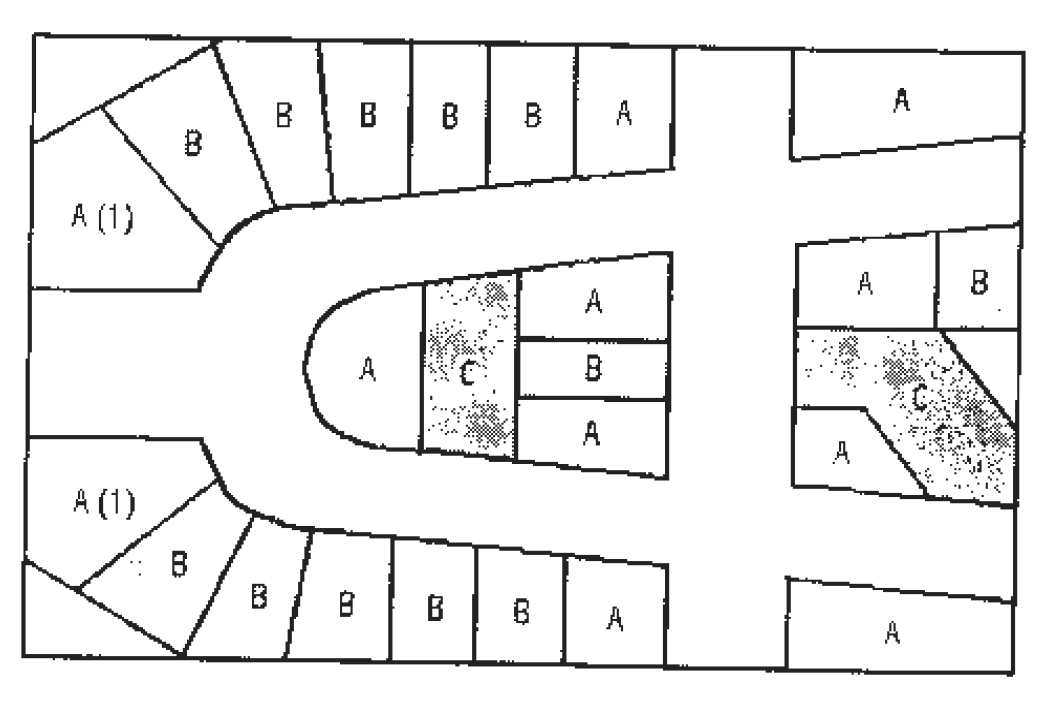
Lot types. See diagram. In the diagram:
Lot Type A, a corner lot, is defined as a lot at the intersection of two or more streets. A lot abutting on a curved street shall be considered a corner lot if straight lines drawn from the foremost points of the side lot lines to the foremost point of the lot meet on an interior angle of less than 135 degrees. See lots marked A(1) in the diagram.
Lot Type B, an interior lot, is defined as a lot other than a comer lot with only one frontage on a street.
Lot Type C, a through lot, is defined as a lot other than a corner lot with frontage on more than one street. Through lots abutting two streets may be referred to as double-frontage lots, when the address of the property is assigned to a through lot, the portion of the property that has the street address becomes the front yard of the property. The yard bordering the other street becomes the rear or back yard of the property.
Lot width means the horizontal distance between side lot lines, measured at the required front setback line.
Master deed means that legal document as defined under the Condominium Act, MCL 559.101 et seq.
MDEQ means the state department of environmental quality.
Mezzanine means an intermediate floor in any story occupying space not to exceed one-half of the floor area of such story.
Mobile home means a structure, transportable in one or more sections, which is built on a chassis and designed to be used as a dwelling with or without permanent foundation, when connected to the required utilities, and includes the plumbing, heating, and electrical systems contained in the structure. The term "mobile home" does not include a recreational vehicle.
Mobile home park means any parcel or tract of land licensed and regulated under provisions of the Mobile Home Commission Act, MCL 125.2301 et seq., under the control of any person, upon which three or more occupied mobile homes are harbored on a continual or non-recreational basis, or which is offered to the public for that purpose, regardless of whether a charge is made therefore, together with any building, structure, enclosure, street, equipment, or facility used or intended for use incidental to the harboring or occupancy of mobile homes.
Modular home means a premanufactured dwelling, consisting of an assembly of materials or products intended to comprise all or part of such dwelling and which is assembled at a site other than its use locations, except for incorporation with similar units at the use location for the formation of a single structure, and which meets all requirements of the Stille-DeRossett-Hale Single State Construction Code Act, MCL 125.1501 et seq., and which is certified and identified in accordance with MCL 125.1519 (premanufactured units). A modular home shall not exceed 20 feet in width.
Move means a condition of construction evidenced by a physical movement from one place to another of a structure or portion of a structure.
Nonconformance means that condition which does not meet the requirements of this chapter. See Conformance.
Open space means land which is vacant and not used for commercial agricultural production. The term "open space" may include parks, common areas in subdivisions or condominiums, or other similar types of land.
Outdoor sale means a sale of products or merchandise which is not held in a structure.
Ownership (held in one ownership) means that condition of equitable title or interest in more than one adjoining but separate and distinctly identifiable parcel or lot whereby ownership of one adjoining parcel or lot is held by one or more persons or other legal entities in the same proportions as another adjoining parcel or lot.
Park means an area of land which is used by the general public for entertainment or recreation. The term "park" may be privately or publicly owned.
Parking lot, off-street, means, for the purposes of this chapter, a space adequate for parking an automobile with room for opening doors on both sides, together with properly related access to a public street or alley and maneuvering room.
Partially improved. See Improvement.
Person means any individual, firm, partnership, limited liability corporation or corporation
Pets. See Animals.
Pools means artificial structures holding water meant for human recreation and enjoyment. The term "pools" includes generally recognized commercial in-ground, aboveground pools and hot tubs and spas. Pools may be publicly or privately owned.
Police firearms training facility means structures and all grounds, ranges, fields, platforms, berms and other equipment, facilities and property used or intended to be used for the training of police officers in the safe and proper use of firearms, including handguns, rifles, shotguns and similar tactical weapons.
Private road or street. See Road.
Principal, use. See Use.
Public road or street. See Road.
Public utility means any person, firm, corporation, municipal department or board duly authorized to furnish and furnishing under state or municipal regulations to the public: electricity, gas, steam, communications, telegraph, transportation or water. Communication towers, as defined elsewhere in this chapter, is specifically excluded from the definition of the term "public utility."
Reconstruct means that condition of construction evidenced by the replacement or renovation of similar construction members of a structure.
Recreational vehicle means a vehicle primarily designed and used as temporary living quarters for recreational, camping, or travel purposes, including a vehicle having its own motor power or a vehicle mounted on or drawn by another vehicle.
Remove means that condition of construction evidenced by the complete elimination parts or the whole of a structure.
Retaining wall means a support wall no greater than four feet in height measured from the bottom of the footing to the top of the wall used to maintain the existing topography of the land and/or prevent soil erosion.
Restaurant means a building in which food is prepared and sold for consumption within the building, as opposed to a drive-in restaurant establishment where food may be taken outside of the building for consumption either on or off the premises.
Retail means the sale of goods or services directly to the consumer.
Road means an open paved or unpaved way or passage affording passage for people and vehicles.
Private road means any road that is not a "public road" as that term is defined in this section.
Public road means:
(1)
Any road regularly established in pursuance of existing laws;
(2)
All roads that shall have been used as public road for ten years or more regardless of whether a record or other proof exists that they were ever established as public roads; and
(3)
All roads that have been laid out though not recorded and that have been used eight years or more.
Road frontage means that dimension of a lot or parcel of property which adjoins a public or private road.
Roadside stand means a structure used or intended to be used solely by the householder, owner, or tenant of the parcel on which such structure is located for the sale of fresh agricultural products.
Setback means the distance as measured in a straight line from the nearest point of an existing or proposed structure to the nearest side, rear, or front lot or parcel line.
Setback line, existing, means an imaginary line, drawn parallel with the existing structure. That imaginary line is drawn so it passes through two points of the structure that are closest to the front, side, or rear lot or parcel line.
Setback line, occupied, means an imaginary line drawn parallel with the occupied portions of an existing dwelling. That imaginary line is drawn so it passes through two points of the occupied portion of the dwelling that are the closest to the front and side, or rear lot or parallel lines.
Setback line, required, means an imaginary line drawn parallel with the side, front, or rear lot or parcel line, a measured distance from the side, front, and rear lot parcel lines. The distance measured is determined by the zoning of each of lot or parcel, according to the requirements of that zoning district.
Shed, storage building, means any accessory use structure not intended for human habitation constructed, erected or installed on a zoning lot without a permanent or concrete floor foundation, which is exempted from the building permit requirement under the Stille-DeRossett-Hale Single State Construction Code Act, MCL 125.1501 et seq. (i.e., an open or enclosed structure or building containing no more than 120 square feet of floor area).
Shoreline means the junction of the water with land normally defined as the ordinary high-water mark or the elevation defined by applicable legal determination (e.g., Paw Lake legal water level 621.8 feet above datum).
Sign means the use of words, numerals, figures, designs, trademarks by which anything is made known or attracts attention to the subject matter, and the term "sign" includes any outdoor advertising of any kind, including its structure and component parts.
Sign, billboard, means a ground sign consisting of a panel for the display of advertisements. Billboard ground signs may only be located along I-94 Highway.
Sign, canopy, means an on-premises sign attached to or part of a canopy. A canopy is a covering that serves as a roof to shelter an area from the weather.
Sign, directional, means signs giving directional assistance for the convenience of the public when the direction of travel changes to a business or event within the township.
Sign, display surface, means the area made available to the sign structure for the purpose of displaying the advertising message.
Sign, electric sign, means any sign containing electrical wiring for any purpose inside or outside and connected to the sign of structure.
Sign, electronic message board, means a sign, or portion of a sign, that displays an electronic image or video, which may or may not include text. Such signs include any sign, or portion of a sign, that uses changing lights to form a sign message or uses electronic means to change the sign message. Electronic message boards include, but are not limited to, signs also known as electronic reader boards, electronic message center signs, tri-panel message systems, and commercial electronic-variable message signs (CEVMS). Electronic message signs are not considered flashing signs.
Sign, closed face, means a sign having a projected area exposed to the wind loads consisting of 50 percent or more of the gross area as determined by the overall dimensions.
Sign, combination, means a sign which combines the characteristics of two or more signs.
Sign, ground, means a sign which is supported by one or more poles, uprights, or braces anchored permanently into the ground or affixed to a permanent foundation, which are not part of a building.
Sign, marquee, means a sign attached to a marquee, canopy or any covered projection of a building.
Sign, mobile, means a sign or display for commercial, industrial, service, institutional or entertainment purposes that is designed and manufactured to be self-supporting, can be readily moved from place to place and does not need to be permanently affixed to the ground or a foundation.
Sign, number and surface area.
(1)
For the purpose of determining number of signs, a sign shall be considered to be a single-display surface or display device containing elements organized, related, and composed to form a unit. Where matter is displayed in a random manner without organized relationship of elements, or where there is a reasonable doubt about the relationship of elements, each element shall be considered to be a single sign.
(2)
The surface area of a sign shall be computed as including the entire area within a regular geometric form, or combination of regular geometric forms, comprising all of the display area of the sign and including all of the elements of the matter displayed. Frame and structural members not bearing advertising matter shall not be included in computation of surface area.
Sign, on-premises, means a sign relating in its subject matter to the premises on which it is located, or to products, accommodations, services, or activities offered or conducted on the premises.
Sign, off-premises, means a sign other than an on-site sign.
Sign, open face, means a sign in which at least 50 percent of its area is uncovered or open to the transmission of wind.
Sign, plaza, means a group of permanent or temporary signs consolidated on a single display advertising businesses or events within the township.
Sign, portable, means any sign which is designed for temporary use and intended to be moved evidenced by wheels, skid plates or other by any other means. For the terms of this chapter, any portable sign is a temporary sign.
Sign, projecting, means a sign other than a wall sign suspended from or supported by a building or structure and projecting therefrom.
Sign, projecting encroaching, means a projecting sign that extends beyond the building line or over public property.
Sign, roof, means a sign which is erected, constructed or maintained on or above the roof of a building.
Sign, structure, means the supporting uprights, braces and framework of the sign.
Sign, temporary, means a sign, advertising banner, display advertising flags, or other advertising display constructed of cloth, paper, canvas, fabrics or other light, temporary material, with or without a frame intended to display for a limited period of time.
Sign, wall, means any sign attached to or placed flat against the wall or surface of any building.
Special land use. See Use.
Stable means a structure or use of a structure for the housing of animals.
Storage building. See Shed.
Story means that part of a building included between the surface of one floor and the surface of the next floor, or if no floor above, then the ceiling next above. A story, thus defined, shall not be counted as a story when more than 50 percent by cubic content is below the average height level of the adjoining ground.
Story, half, means an uppermost story lying under a sloping roof, the usable floor area of which does not exceed 75 percent of the floor area of the story immediately below it and is not used or designed or arranged or intended to be used in whole or in part as an independent housekeeping unit or dwelling.
Street means a thoroughfare for vehicular traffic generally includes everything found within the right-of way.
Street line means the right-of-way line of a street or easement for ingress and egress.
Structure means anything constructed or erected with a fixed location on the ground or attached to something having a fixed location on the ground. Among other things, structures include buildings, mobile homes, walls, billboards, and poster panels. Fences and retaining walls shall not be deemed to be structures for purposes of the chapter.
Subdivision, mobile home means a subdivision as defined by the Land Division Act, MCL 560.101 et seq., which has been expressly established for the sole purpose of selling lots on which mobile homes may be used and occupied for residential purposes, and which has been established in full compliance with all applicable provisions of the cited act and of all other applicable state, county, and township regulations.
Survey, "as built," means a drawing or survey certified by a licensed surveyor or engineer verifying the actual construction of a structure or placement of structures or other features on a property.
Trailer, coach, ortravel trailer ormotor home means a vehicular, portable structure built on a chassis, designed to be used as a temporary dwelling for travel and recreational purposes, having a body width not exceeding 102 inches in width.
Unimproved. See Improvement.
Usable means (for the purpose of computing parking space) that area used for, or intended to be used for, the sale of merchandise or services, or for use to serve patrons, clients, or customers, and all that area devoted to employee workspace. Such floor area which is used or intended to be used principally for the storage or processing of merchandise, hallways, elevators or stair bulkheads, or for utilities or sanitary facilities, shall be excluded from this computation of usable floor area. Measurement of usable floor area shall be the sum of the horizontal areas of the several floors of the building, measured from the exterior faces of the exterior walls.
Uses.
Accessory use means that use of a property which is clearly incidental and subordinate to the primary use of the property.
Principal use means that use of a property which is the most important and primary use of the property.
Special land use means a use that would not be appropriate generally or without restriction throughout the zoning district but which, if controlled as to number, area, location, or relation to the neighborhood, would promote the public health, safety, welfare, morals, order, comfort, convenience, appearance, prosperity, or general welfare. Such land use may be permitted in such zoning district as special land use if specific provision for such special land use is made in this chapter.
Variance means a relaxation of the terms of this chapter where such variance will not be contrary to the public interest and where, owing to conditions peculiar to the property and not the result of the actions of the applicant, a literal enforcement of the chapter would result in unnecessary and undue hardship. As used in this chapter, a variance is authorized only for height, area, and size of structure or size of yards and open spaces; establishment or expansion of a use otherwise prohibited shall not be allowed by variance, nor shall a variance be granted because of the presence of nonconformities in the zoning district or uses in an adjoining zoning district.
Waterfront frontage means the distance of the shoreline measured between the side lot lines.
Waterfront overlay district description means all waterfront properties in township on Paw Lake, Little Paw Paw Lake, and the channels around the three islands in Paw Paw Lake. The waterfront overlay district also includes any and all properties that are so designated on the zoning map of the township.
Waterfront property description means one parcel of either individual or enjoined lots or parcels located in the WA Overlay Zoning District. A waterfront property is considered to end at the border of the property where it abuts or is in part bordered by a road or thoroughfare (usually referred to as the rear of a waterfront property). If one parcel of property is divided or separated by a road or thoroughfare, only the section of the property that has a shoreline on one or more sides of the property will be considered as waterfront property for proposes of this chapter. The other non-waterfront parcel, section, portion or part of the property will be required to adhere to the applicable ordinance requirements of the zoning district in which it is located and will not be subject to the 45-degree waterfront view requirement or the 45-degree waterfront view protection.
Wetlands means land designated by the MDEQ, including the wetland land areas only and not water.
Wholesale means the sale of goods or services to others who will sell directly to the consumer.
Yard.
Yard, front, means the area from the front lot or parcel line to the front setback line for the property with existing structures.
Yard, rear, means an area from the rear lot or parcel line to the rear setback line for property with existing structures.
Yard, side, means the area from the side setback line to the side lot or parcel line, between the front and rear setback lines for property with existing structures.
Yard front, waterfront district, means a yard adjoining a public body of water.
ZBA means the zoning board of appeals.
(Ord. No. 90, § 34.02, 12-24-2016; Ord. of 9-5-2024)
Sec. 40-2. - Comprehensive review of chapter.
The planning commission shall from time to time, at intervals of not more than three years, examine the provisions of this chapter and the locations of district boundary lines and shall submit a report to the township board recommending changes and amendments, if any, which are desirable in the interest of public health, safety, and general welfare.
(Ord. No. 90, § 35.01, 12-24-2016)
Sec. 40-3. - Regulations declared to be minimum requirements.
(a)
The regulations set by this chapter shall be minimum regulations and shall apply uniformly to all structures and lands within each district.
(b)
In their interpretation and application, the provisions of this chapter shall be held to be minimum requirements, adopted for the promotion of the public health, safety, morals, or general welfare. Wherever the requirements of this chapter are at variance with the requirements of any other lawfully adopted rules, regulations, or ordinances, the most restrictive or the one imposing the higher standards shall govern.
(Ord. No. 90, § 5.01, 12-24-2016)
Sec. 40-4. - Use of land or structures must comply with district regulations.
No building, structure, or land shall hereafter be used or occupied, and no building or structure or part thereof shall hereafter be erected, constructed, reconstructed, moved, or structurally altered, except in conformity with all of the regulations herein specified for the district in which it is located. No building or other structure shall hereafter be erected or altered:
(1)
To exceed the height or bulk limitation contained herein;
(2)
To accommodate or house a greater number of families than allowed herein;
(3)
To occupy a greater percentage of lot area;
(4)
To have narrower or smaller rear yards, front yards, side yards, or other open spaces than herein required; or
(5)
In any other manner contrary to the provisions of this chapter.
(Ord. No. 90, § 5.02, 12-24-2016)
Sec. 40-5. - Cumulative counting of yard, open space, parking/loading space prohibited.
No part of a yard, or other open space, or off-street parking or loading space required about or in connection with any building for the purpose of complying with this chapter, shall be included as part of a yard, open space, or off-street parking or loading space similarly required for any other building.
(Ord. No. 90, § 5.03, 12-24-2016)
Sec. 40-6. - Reduction of yards below minimum requirements prohibited.
No yard or lot existing at the time of passage of this chapter shall be reduced in dimension or area below the minimum requirements set forth herein.
(Ord. No. 90, § 5.04, 12-24-2016)
Sec. 40-7. - Essential services exemption.
Essential services shall be permitted as authorized and regulated by law and other ordinances of the township, it being the intention hereof to exempt such essential services from the application of this chapter. Essential services shall include municipal utility systems, telephone, television, cable-tv systems and the like but not communication towers or electric power generation stations elsewhere regulated.
(Ord. No. 90, § 5.05, 12-24-2016)
Sec. 40-8. - PUD approval required for site condominiums.
Any parcel of land currently recorded using a metes and bounds description proposed as a site condominium projects to be recorded pursuant to the Condominium Act, MCL 559.101 et seq., containing two or more units or lots shall apply for township zoning approval as a planned unit development pursuant to the provisions of article XI.
(Ord. No. 90, § 5.06, 12-24-2016)

