
Commerce City City Zoning Code
ARTICLE VIII
- Sign Regulations
Sec. 21-8100. - Purpose.
This article is adopted to safeguard the health, safety, convenience, order and welfare of all residents of the city. The city recognizes that signs may act as a visual means of communication between the public and businesses and those businesses have an expectation of using signs to identify and advertise themselves. The purpose of this article is to recognize the commercial communications requirements of the business community; encourage the innovative use of design; to promote both renovation and proper maintenance; to allow for special circumstances; and to guarantee equal treatment through accurate record keeping and uniform enforcement. It is further the purpose of this article to provide a balanced and fair legal framework for the design, construction, and placement of signs in order to:
(1)
Manage exterior signs by providing an orderly but balanced system of signs which contributes to the protection and the promotion of the health, safety, and welfare of the traveling public and the citizens of the city.
(2)
Promote the efficient communication of information and ensure that persons exposed to signs are not overwhelmed by the number of messages presented.
(3)
Promote the safety of persons and property by ensuring that signs do not create a hazard by confusing or distracting motorists or impairing drivers' ability to see pedestrians, obstacles or other vehicles, or to read traffic signs.
(4)
Promote visual harmony and a respect for the environmental character of the city by reducing and preventing sign clutter.
(5)
Ensure that signs are attractive and compatible with their surroundings, and prevent the construction of signs that are a nuisance to occupants of adjacent and contiguous property due to brightness, reflectivity, bulk, or height;
(6)
Enhance the economy and the city's businesses and industries by promoting reasonable, orderly, and effective signs which assist in wayfinding and achieve better communication with the public.
(7)
Protect, encourage, and support local tourist-related businesses for the general economic well-being of the city and the state.
(8)
Preserve and enhance the value of private property by assuring the compatibility of signage with surrounding land uses.
(Ord. No. 2432, § 2(Exh. A), 12-19-2022)
Sec. 21-8110. - Intent.
It is the intent of this article to provide for the proper control of signs in a manner consistent with the First Amendment guarantee of free speech. It is not the intent of this article to regulate signs based on the content of their messages. Rather, this article advances important, substantial, and compelling governmental interests. In achieving the goals, it is the intent of the city that:
(1)
The incidental restriction on the freedom of speech that may result from the regulation of signs hereunder is no greater than is essential to the furtherance of the important, substantial, and compelling interests that are advanced by this article. Certain types of speech are not constitutionally protected due to the harm they cause to the individual or the community.
(2)
The city has an important and substantial interest in preventing sign clutter (which is the proliferation of signs of increasing size and dimensions as a result of competition among property owners for the attention of passing motorists and pedestrians), because sign clutter:
(a)
Creates visual distraction and obstructs views, potentially creating a public safety hazard for motorists, bicyclists, and pedestrians;
(b)
May involve physical obstructions of streets or sidewalks, creating public safety hazards;
(c)
Degrades the aesthetic and essential historic character of the city, making the city a less attractive place for tourism, commerce, and private investment; and
(d)
Dilutes or obscures messages displayed along the city's streets through the proliferation of distracting structures and competing messages.
(3)
The city has a substantial and/or compelling interest in preventing traffic accidents.
(4)
The city has a substantial and/or compelling interest in preventing negative impacts associated with temporary signs. Temporary signs may be degraded, damaged, moved, or destroyed by wind, rain, snow, ice, and sun, and after such degradation, damage, movement, or destruction, such signs harm the safety and aesthetics of the city and its streets if they are not removed.
(Ord. No. 2432, § 2(Exh. A), 12-19-2022)
Sec. 21-8120. - Applicability.
(1)
Generally. This article governs the erection, remodeling, enlarging, moving, alteration, operation, and maintenance of all signs within all zone districts in the city. It also provides penalties for violations of this article.
(2)
Public signs exempt. Public signs that are erected or displayed by the city, county, state, school district, recreation district (excluding special districts), shall be exempt from the provisions of this article.
(3)
Relationship to planned development. To the extent the provisions of a duly approved planned development conflict with the provisions of this article, the planned development approval shall control.
(4)
Relationship to Other Regulations.
(a)
Nothing contained in this article shall be deemed a waiver or variance of the provisions of any other provisions of the land development code as applicable to signs.
(b)
The city recognizes other regulations pertaining to signage (i.e., State of Colorado, Department of Highways, "Rules and Regulations Pertaining to Outdoor Advertising," effective January 1, 1984, and as may be amended).
(c)
The content of signs related to marijuana businesses is restricted by state laws and regulations, and both the advertising and sale of marijuana are prohibited by federal law. The city has no authority to supersede state or federal marijuana laws.
(d)
Where any provision of this article covers the same subject matter as other city, state or federal regulations, the more restrictive regulation shall apply.
(Ord. No. 2432, § 2(Exh. A), 12-19-2022)
Sec. 21-8130. - Nonconforming Signs.
Signs that were legally established prior to the adoption or relevant amendment of this article [alternative: insert effective date of adopting ordinance], but which now no longer comply with this article as a result of subsequent regulation are nonconforming and are permitted to remain, subject to the requirements of section 21-5510 (Nonconforming Structures).
(Ord. No. 2432, § 2(Exh. A), 12-19-2022)
Sec. 21-8140. - Prohibited Signs.
The following types of signs are prohibited in all zoning districts. No exceptions shall be allowed and no variances may be granted to the limitations of this section.
(1)
All signs not expressly permitted under this article or exempt from a permit under section 21-8210.
(2)
Any moving sign, including pennants, shark fins, and streamers, other than as explicitly permitted by this article.
(3)
Any sign displaying flashing or intermittent lights, or lights of varying intensity, except those portions of an electronic changeable copy sign with intermittent lights due to the change of copy, and temporary holiday displays.
(4)
Any sign with direct or indirect lighting that causes direct glare into or upon any lot or tract with a residential use that is adjacent to the lot or tract where the sign is located.
(5)
Any sign that is an imitation of, copy of, or that is likely to be confused with any official government sign.
(6)
Except as specifically provided otherwise in this article, any sign that obstructs any window, door, fire escape, stairway, ladder, or opening intended to provide light, air, ventilation, ingress, or egress for any building as required by law.
(7)
Any sign not permanently affixed to a permanent, rigid structure, unless explicitly authorized by this article.
(8)
Any portable sign or similar objects/sign, except as authorized by this article or other ordinances of the city and then only accordance with the provisions thereof.
(9)
Any balloons, inflatable devices, or similar types of objects, unless specifically authorized by section 21-8520.
(10)
Search lights.
(11)
Except as specifically authorized by this article, signs attached to vehicles or movable storage containers that are parked or stored on property as a mechanism for displaying the message in the sign.
(12)
Wheeled advertising devices, except for permanent signs on licensed, operable vehicles used daily for service and/or delivery purposes.
(13)
Signs displayed on the surface of a street, parking lot, roof or sidewalk.
(14)
Off premise signs, as defined at section 21-11200.
(Ord. No. 2432, § 2(Exh. A), 12-19-2022)
Sec. 21-8150. - Enforcement.
(1)
It is unlawful to, construct, move or change the use of any sign or cause the same to be done contrary to or in violation of the provisions of this article.
(2)
Signs that are unauthorized or which have fallen into disrepair are deemed to be a nuisance. By way of example and not limitation, the following signs shall constitute a nuisance:
(a)
Signs that neither meet the requirements set forth in this article nor qualify as a legal nonconformity;
(b)
Signs erected, or in the process of being erected, without a valid permit;
(c)
Signs that are in disrepair or unsafe, as determined by the city; or
(d)
Signs that advertise defunct businesses or unavailable products or services.
(3)
The aforementioned signs are unlawful and the city may restrain, prevent, abate and enjoin such signs through any remedy available to it by law, including without limitation the enforcement alternatives outlined in article X of the Code.
(Ord. No. 2432, § 2(Exh. A), 12-19-2022)
Sec. 21-8200. - Sign Permit Required.
(1)
Required. Except as provided in this article, no person shall erect, move, re-erect, construct, alter, enlarge, or permit the erection of any sign without first obtaining a sign permit under this division 2. A separate sign permit shall be required for each sign.
(a)
For purposes of this article, the term alter means changing the size, shape or height of a sign, changing the construction material of a sign, or adding lighting to a sign.
(b)
Copy changes shall not constitute an alteration of the sign and shall not require a permit.
(c)
Signs may be removed for maintenance and replaced on the same support, without obtaining a new permit.
(2)
Applications. Applications for sign permits shall be made in writing upon forms furnished by the director and, unless specifically waived by the director, shall include all information and material required by that form.
(3)
Current Violations. No sign permit shall be issued for the benefit of any property where any sign is currently displayed in violation of this land development code, except to replace the illegal sign with a legal sign.
(4)
Deviations Prohibited. It shall be unlawful to change, modify, alter, or otherwise deviate from the terms or conditions of a sign permit without prior approval of the city.
(5)
Term of Permit; Expiration. If construction of a sign is not completed within six months of permit issuance, the permit shall expire and a new permit shall be required.
(6)
Authority to Revoke. The director may revoke any sign permit which was issued by mistake, as the result of incorrect information, or which results in a violation of any ordinance or regulation. It shall be unlawful for any person to continue to erect, move, construct, alter, enlarge, repair or display any sign after receiving notice of the revocation of the applicable sign permit.
(7)
Fee Nonrefundable. When any permit has been revoked under the terms of this section, permit fees shall not be refunded.
(8)
Signs in Right-of-Way. Signs may only be placed in or over a public right-of-way with the approval of the city via a revocable permit upon the prior approval of the city engineer in addition to the permit under division 2. Any sign located within a public right-of-way shall not be located over any existing or future utilities and may be removed by the city if necessary for reconstruction, repair or maintenance of a street, sidewalk, the utilities therein, or to protect the health, safety, and welfare of the citizens of the city. The city shall have no liability for replacement or repair of any such sign when removed.
(9)
Construction and Maintenance. Other than signs erected on single family residential property, no person other than a contractor licensed with the city shall obtain a sign permit or install any sign for which a permit is required under this land development code.
(10)
Building Permit-When Required. In addition to the required sign permit, a building permit may be required for signs incorporating structural elements or attached to buildings as governed by the city's adopted construction codes. Electrical permits are also required for signs that are illuminated or other signs with electrical components.
(11)
Inspection. In addition to any required building permit inspection, the city may inspect sign construction and installation, at its option, at any time to confirm compliance with the land development code.
(Ord. No. 2432, § 2(Exh. A), 12-19-2022)
Sec. 21-8210. - Exemptions from Required Sign Permit.
(1)
General Exemption Requirements. Due to their small size, limited time duration, limited aesthetic impact and/or strong community interest in identifying land uses, locations and historic structures, the sign types listed at subsection (2) of this section may be erected without a sign permit or building permit so long as they meet:
(a)
The construction and safety standards of the city;
(b)
The general sign standards contained in division 3; and
(c)
The standards specific to the type of sign erected contained in divisions 4 and 5.
(2)
Exempt Sign Types.
(a)
Public signs that are erected or displayed by the city, county, state, school district, recreation district (excluding special districts), are exempt from all of the provisions of this article, as set forth in section 21-8120.
(b)
Historical signs. No permit is required for historical commemorative plaques, memorials, or tablets that are:
(i)
Associated with a building or feature for which a national, state, or city historic designation has been granted; and
(ii)
Built into a building or mounted flat against the wall of a building or erected in a location designated by the city as having historical significance.
(c)
Yard signs as defined in article XI of the land development code and subject to the standards in section 21-8560.
(d)
Address and building identification signs. Signs that identify a particular parcel of land or individual building for purposes of address and building name provided that such signs:
(i)
Are attached to the building identified or, where no building is involved, are placed as determined by the development review process; and
(ii)
Are limited to two per building or vacant parcel.
(e)
Temporary window signs, as defined in article XI of the land development code and subject to the standards in section 21-8550
(f)
Fabric Signs as defined in article XI of the land development code and subject to the standards in section 21-8510.
(g)
Road Hazard Signs. Signs erected in conjunction with construction for the purpose of alerting drivers to potential hazards or safety concerns.
(h)
Interior Signs. Signs located within any structure that is not visible from adjacent properties or from the public streets.
(i)
Signs on Public Sports Fields. Signs intended to be viewed internally from public sports fields.
(j)
Holiday Displays. Temporary holiday decorations or light strings.
(k)
Nameplates. Nameplates that are not more than two square feet in area, fastened directly to the building, and do not project more than six inches beyond the property line.
(l)
Utility Signs. Signs placed by or at the direction of a public utility showing the location of underground facilities.
(m)
Vehicle Signs. Signs displayed on motor vehicles which are being operated or stored in the normal course of a business, provided that the primary purpose of such vehicles is not for the display of signs and provided that they are parked or stored in areas appropriate to their use as vehicles. In addition:
(i)
Signs on vehicles shall not project beyond the surface of the vehicle in a manner which creates a hazard to pedestrians, cyclists or other vehicles.
(ii)
It shall be unlawful to place or store a vehicle with a sign on it in such manner as to increase the permitted sign area or number of signs either on-site or off-site for a non-residential use.
(n)
Handheld signs. Signs carried by a person. Handheld signs shall not exceed twenty (20) square feet in area. No person shall place, maintain or otherwise utilize a handheld sign in a manner which obstructs or makes hazardous the free passage of pedestrians and motor vehicles on any street, sidewalk or public-right-of way.
(o)
Incidental Signs. Incidental signs which do not exceed three square feet in area.
(p)
Flags and Flagpoles. Freestanding flagpoles and the flags flown upon such flagpoles shall comply with the standards set forth in this section.
(i)
Flag size and pole height. The size of flags and the height of all flagpoles shall conform to the following table.
Table VIII-1. Flag and Flagpole Requirements
(ii)
No flag shall, when fully unfurled, extend over the property boundary onto any adjoining property or public right-of-way;
(iii)
No flag or flagpole shall be erected or maintained so as to allow a flag at rest to reach a height less than nine feet above the ground; and
(iv)
The location of all flagpoles shall meet the setback requirements for accessory structures set forth in article V of this land development code.
(v)
Non-residential lots may contain up to three flagpoles for the purpose of flying flags.
(vi)
A residential lot may contain no more than one flagpole for the purpose of flying a flag.
(vii)
The installation of a flagpole shall require a building permit to construct.
(Ord. No. 2432, § 2(Exh. A), 12-19-2022)
Sec. 21-8220. - Comprehensive Sign Program.
Shopping centers and multi-use or multi-building business, commercial, or industrial developments or redevelopments shall employ a comprehensive sign program. A permit for all signs within the proposed program shall be applied for and processed pursuant to section 21-8200. A comprehensive sign program includes the following elements:
(1)
Architectural and Visual Compatibility. There shall be architectural harmony and unity of signs within the center. Sign type, color, scheme, size, shape, and illumination within the center shall be coordinated and compatible with the site's architectural character.
(2)
Informational Signage. Within each development, information signage and way-finding systems shall be of a unified graphical system. They shall be placed in consistent locations near site entries, key points on the internal automobile and pedestrian circulation system, building entries, seating areas, and sidewalk intersections.
(3)
Illumination. Illumination shall be shielded so there is no glare in the public right-of-way and adjacent properties and directed so light does not stray above the light source horizontally. Illumination shall be steady and even over the entire sign face. All lighting elements shall be in compliance with Section 21-8320.
(4)
Materials. Materials and textures of signs shall be compatible with the architectural character of the site and building. Supporting sign structures of monument signs shall match the primary finish and colors of the associated building(s).
(5)
Placement. Attached signs shall not overlap or cover features of the building such as cornices, eaves, window and doorframes, columns and other decorative elements.
(6)
Views. Freestanding signs shall not be placed where they obscure important architectural features such as entrances, display windows, or decorative elements when viewed from the public right-of-way.
(7)
Monument Signs. Monument signs identifying retail, business centers, or office/industrial/technical parks or centers shall contain the name, address, and logo or trademarks of the office park or center. Such signs may include the name of not more than 12 of the tenants therein, with said names to be integrated into the overall design of the sign with the name of the center occupying at least 20 percent of the sign area.
(8)
Availability of Administrative Variance. It is the intent of this section to allow and encourage multi-building and multi-business developments to design a sign program which serves the overall development more effectively than individual, uncoordinated signs. In reviewing a comprehensive sign program under this section, the director has authority to also consider an administrative variance for relevant elements of the proposed comprehensive sign program to achieve these goals.
(Ord. No. 2432, § 2(Exh. A), 12-19-2022)
Sec. 21-8230. - Minor Modifications.
In some instances, signs on a property may not meet all of the standards established in this article, but still accomplishes the purposes of the land development code. In such cases, the developer may file a written application requesting a minor modification. This option allows the Director to approve the variations outlined in paragraph (1) of this section if such variances are deemed appropriate.
(1)
Variations Allowed.
(a)
Sign area. The sign area for individual signs may be increased up to 20 percent, or up to 25 percent when applied for in connection with a comprehensive sign program that combines otherwise multiple signs.
(b)
Height. The height of individual signs may be increased by not more than 20 percent, or up to 25 percent when applied for in connection with a comprehensive sign program that combines otherwise multiple signs.
(c)
Setback. The setback may be reduced by no more than 20 percent, or up to 25 percent when applied for in connection with a comprehensive sign program that combines otherwise multiple signs.
(d)
Number and Location. The director may vary the maximum number of wall signs allowed or the approved wall areas for purposes of sign location, provided the maximum sign area for all wall signs shall not exceed the total area for all wall signs allowed for a single-use or multiple-use building development, as applicable.
(e)
Historical and Architecturally Unique Signs. The director may also approve a minor modification for signs which have specific and historical value or which have specific and unique architectural features.
(2)
Application. The applicant must submit a written request for a minor modification describing the plan proposed (the "plan"). The request should be submitted in conjunction with a development application, whenever possible. However, it may be submitted as a separate application. The request shall include the following information, unless waived by the director:
(a)
Sign style, type, location, size (area), and height of all signs;
(b)
Materials and colors for signs, raceways, cabinets, bases, etc.; and
(c)
Sign illumination devices.
(3)
Review. The director shall review the application. If the Director finds that the application complies with the purposes of this article and the approval criteria contained in paragraph (4) of this section, the minor modification may be approved.
(4)
Approval Criteria. Only plans that meet the criteria outlined in this paragraph may be approved.
(a)
The development for which the minor modification is requested meets all other applicable city regulations, including but not limited to required parking, landscaping, and setback standards;
(b)
The plan complies with all applicable provisions of this article, except those that may be varied by this section;
(c)
The plan is consistent with the purposes of this sign code and will not adversely impact surrounding properties or neighborhoods;
(d)
The plan is a creative alternative design and the sign colors, materials, design, size, height, illumination, and number of signs are compatible with the principal buildings or structures on site; and
(e)
The proposed sign(s) will not negatively affect the visual character of the area, cause future variance requests, or contribute to degradation of the visual environment through sign proliferation.
(5)
Conditions on Approval. The director may impose any conditions deemed reasonably necessary to ensure continued compliance with the approval criteria.
(6)
Lapse Upon Redevelopment. Minor modifications shall automatically lapse upon redevelopment of the property with no right of assignment unless the scope of redevelopment is limited and the director agrees that the plan can remain in effect.
(Ord. No. 2432, § 2(Exh. A), 12-19-2022)
Sec. 21-8300. - Sign Measurement.
(1)
Size.
(a)
Can, cabinet, or frame measurement. The area of any sign contained within a can, cabinet, or frame shall be determined by calculating the total area of the sign including the can, cabinet, or frame.
Figure VIII-1. Measurement of Sign Can, Cabinet or Frame
(b)
Individual letter and logo measurement. The area of any sign displaying individual letters, logos or other such message components on a background (façade, wall, divisional wall, awning, or canopy) shall be measured by encompassing all such individual message components in a rectangle or square, or series of attached rectangles or squares.
Figure VIII-2. Individual Letter Measurement
(c)
Awning and canopy sign measurement. The allowed signage of an awning and canopy sign shall not exceed 50 percent of the background area of the awning or canopy.
Figure VIII-3. Awning and Canopy Sign
Measurement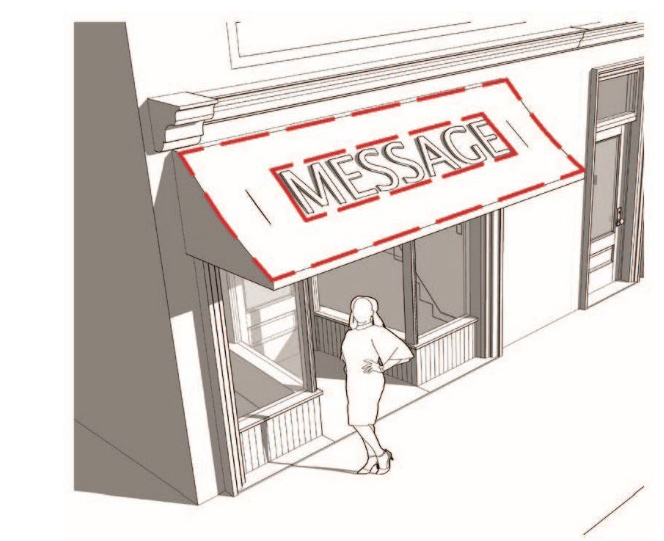
(d)
Multiple sign faces. Where a sign has two or more display faces, the area of all faces shall be included in determining the area of the sign.
(e)
Bracing. The structure or bracing of a sign shall not be included in calculating the sign area unless such structure or bracing is made part of the message or face of the sign.
(f)
Illumination. Neon bands or other outdoor building illumination, which do not identify or convey information, shall not be included in calculating the area of a sign.
(g)
Architectural treatments. Architectural treatments that aid in integrating the signage with the building design are encouraged, but any such treatment shall not be created for the purpose of visually enlarging the size of the sign. In the event any architectural treatments are an effective part of the sign, the total area of the sign for all purposes under this article shall be calculated to include such treatments.
(2)
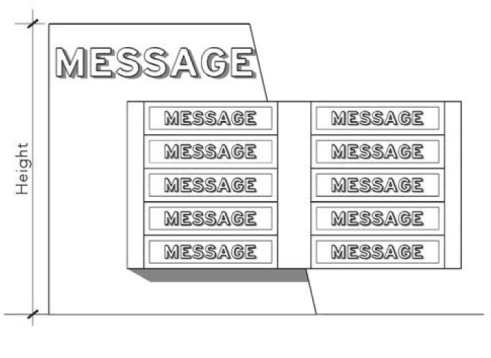
Height. The height of any sign shall be determined by the distance between the topmost portion of the sign structure and the ground elevation at the base of the sign. The grade shall not be artificially changed solely to affect the sign height measurement.
Figure VIII-4. Measurement of Sign Height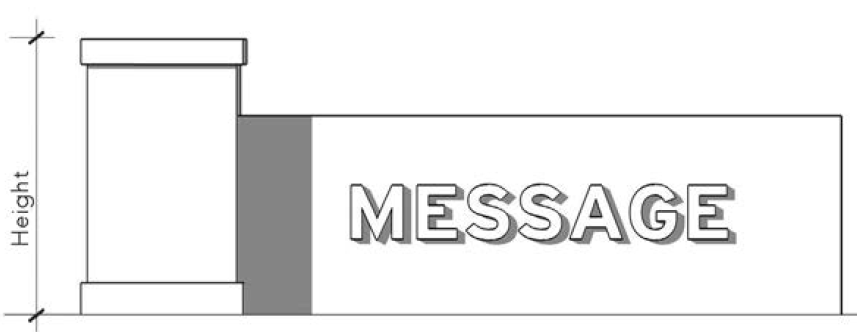
(3)
Clearance. Clearance is measured as the shortest distance between the bottom of a sign and the grade below.
Figure VIII-5. Measurement of Sign Clearance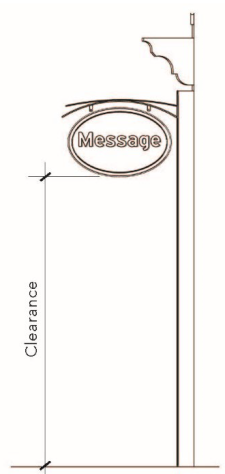
(4)
Projection. Projection is measured as the distance from the face of the building to which a sign is mounted to the furthest point on the sign away from the wall. A sign attached to a building shall not project above the top of that building.
Figure VIII-6. Measurement of Sign
Projection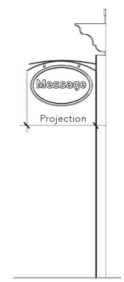
(Ord. No. 2432, § 2(Exh. A), 12-19-2022)
Sec. 21-8310. - Sign Design.
(1)
In general, signs shall have mutually unifying elements which may include uniformity in materials, color, size, height, letter style, sign type, shape, lighting, location on buildings, and design motif.
(2)
Materials and textures of signs shall be compatible with the architectural character of the site and building.
(a)
Supporting sign structures of freestanding signs shall match the primary finish and colors of the associated building(s).
(b)
The supporting members of a sign shall appear to be free of any extra bracing angle iron, guy wires, cables, etc. The supports shall appear to be an architectural and integral part of the building and/or sign.
(3)
Architectural treatments that aid in integrating the signage with the building design are encouraged, but any such treatment shall not be created for the purpose of visually enlarging the size of the sign.
(a)
Architectural features that are integral to the design of a building or provide an artistic accent shall be exempt from sign regulations if they do not contain a commercial message and comply with building height limits and setback requirements applicable to the property on which they are located.
(b)
If more than 25 percent of any wall structure of any nonresidential building or any accessory structure to a nonresidential use is painted, finished, or surfaced in a distinctive color scheme that includes some or all of the same colors, shapes, symbols, images, patterns, or textures used on any sign identifying an owner, tenant, or user of the building, and the city determines that such wall surface serves as a sign for an owner, tenant, or user of the building, such wall area shall be counted as wall signage and shall be subject to the limitations on wall signage area in division 4 of this article.
(4)
Where possible, monument signs shall integrate tenant signs into a single sign structure.
(5)
The electronic message area portion of a monument or wall sign shall be integrated into the design of the sign. Such electronic message portions of a sign shall not be an add-on feature but rather must be fully integrated into the sign design. The entire sign must be compatible with the site design and/or building architecture.
(6)
Wayfinding and directional signage systems shall be of a unified graphical system. Such signage shall be placed in consistent locations near site entries, key points on the internal automobile and pedestrian circulation system, building entries, seating areas, and sidewalk intersections.
(Ord. No. 2432, § 2(Exh. A), 12-19-2022)
Sec. 21-8320. - Sign Illumination.
(1)
Illuminated signs shall be shielded so there is no glare in the public right-of-way and adjacent properties, and directed so light does not stray above the light source horizontally. Illumination shall be steady and even over the entire sign face. All lighting elements shall be kept in working condition.
(2)
No sign shall contain light strings.
(Ord. No. 2432, § 2(Exh. A), 12-19-2022)
Sec. 21-8330. - Electronic Message Centers.
(1)
General.
(a)
A maximum of one monument or wall sign with electronic message copy per property or development shall be permitted. Electronic message centers are not permitted on any other sign type.
(b)
The electronic message area portion of the sign shall not make up more than fifty percent (50%) of the sign face. If areas of the support base which are above grade utilize permanent, dimensional letters or symbols, these areas shall be counted as signage.
(c)
Existing signage proposed for conversion to the use of an electronic message center shall conform to the sign standards in this subsection prior to issuance of a sign permit.
(d)
Non-conforming signs shall not be eligible for conversion to an electronic message center.
(2)
Lighting.
(a)
The electronic message center shall have automatic dimmer software or solar sensors to control brightness for nighttime viewing. The intensity of the light source shall not produce glare, the effect of which constitutes a traffic hazard or is otherwise detrimental to the public health, safety or welfare.
(b)
Applications for sign permits containing an electronic message center shall include the manufacturer's specifications and nit (candela per square meter) rating. The director may place a maximum nit (candela per square meter) on the sign permit approval.
i.
In no instance shall an electronic message center be approved with a maximum nit (candela per square meter) of more than six hundred (600) between sunset and sunrise as measured from the sign's face.
ii.
Between sunrise and sunset, the maximum shall not exceed five thousand (5,000) nits (candelas per square meter) or three-tenths (.3) foot-candles over the ambient light, whichever is lower, as measured from the sign's face.
iii.
In some instances, especially in sensitive areas (i.e., proximity to residential, parks, open space or other similar uses), the director may place a maximum nit (candela per square meter) less than the maximums described herein on the sign permit approval.
(c)
Documentation shall be provided from the sign manufacturer which verifies compliance with auto dimming and brightness requirements.
(3)
Transition method. The electronic message center shall be limited to static messages, changed only through either dissolve or fade transitions, which may otherwise not have movement, or the appearance or optical illusion of movement, of any part of the sign structure, design, or pictorial segment of the sign, including the movement of any illumination or the flashing, scintillating or varying of light intensity.
(4)
Transition duration. The transition duration between messages shall not exceed one second.
(5)
Message hold time. The message hold time shall be a minimum of seven seconds.
(Ord. No. 2432, § 2(Exh. A), 12-19-2022)
Sec. 21-8340. - Sign Installation.
(1)
All permanent signs and all components thereof, including sign structures and sign faces, shall be installed in compliance with the adopted building and electrical codes of the city.
(a)
All permanent signs shall be installed by a city-licensed contractor.
(b)
Materials for construction of signs and sign structures shall be of the quality and grade as specified for buildings in the adopted building code.
(c)
All electrical work for the construction and/or operation of a sign shall be performed in accordance with the electrical code and shall be subject to inspection by the city for compliance therewith.
(d)
Every electric sign shall have affixed thereon an approved Underwriters' Laboratories label, or all wiring of such sign as approved by the state electrical inspector, and all wiring connected to such sign shall comply with all provisions of the applicable regulations of the city relating to electrical installations.
(e)
Signs shall be located in such a way as to maintain horizontal and vertical clearance of all overhead electrical conductors in accordance with adopted electrical code specifications, depending on voltages concerned. However, in no case shall a sign be installed closer than forty-eight inches horizontally or vertically from any conductor or public utility guy wire, or as recommended by the local public utility company.
(2)
No sign or sign structure shall be installed that impedes pedestrian or vehicular movement, or be erected in such a location as to cause visual obstruction or interference with motor vehicle traffic or traffic-control devices, or obstruct clear vision in any direction from any street intersection or driveway.
(3)
No sign or sign structure shall be installed that obstructs access to or impedes operation of any fire escape, downspout, window, door, stairway, ladder or opening intended to provide light, air, ingress or egress for any building or structure as may be required by law. If possible, signs should not be placed in locations that obscure architectural features such as pilasters, arches, windows, cornices, etc.
(4)
No sign or sign structure shall be installed which is structurally unsafe.
(5)
Except for ornamental mountings, no visible guy wires, structural cables, or turnbuckles shall be allowed.
(6)
Except for flags, window signs and temporary signs conforming to the requirements of these regulations, all signs shall be permanently attached to the ground, a building, or another structure by direct attachment to a rigid wall, frame, or structure.
(7)
No person may, for the purpose of increasing or enhancing the visibility of any sign, damage, destroy, or remove any trees or shrubs located within the right-of-way, unless the work is done pursuant to written authorization of the city or unless the removal of landscaping has been provided in compliance with the other sections of this land development code.
(Ord. No. 2432, § 2(Exh. A), 12-19-2022)
Sec. 21-8350. - Sign Maintenance.
(1)
All signs and all parts and components thereof, shall be maintained in a safe condition in compliance with all adopted building and electrical codes, and in conformance with these regulations.
(a)
All signs, including sign structures and sign faces, shall be maintained in good repair at all times and shall not constitute a hazard to safety, health or public welfare by reason of inadequate maintenance or deterioration. For the purposes of this section, good repair shall mean that there are no loose, broken, torn or severely weathered portions of the sign structure or sign face.
(b)
The owner of a sign shall be required to keep signs and supporting hardware structurally safe, clean, free of visible defects, including graffiti, and functioning properly at all times. Exposed surfaces shall be kept clean, neatly painted, and free from rust and corrosion. Defective parts shall be replaced. Repairs to signs shall be equal to or better in quality of materials and design than the original sign.
(c)
All electronic message centers shall be equipped with a malfunction display and the ability to automatically shut off if a malfunction occurs. An electronic message center under repair shall be shut off.
(2)
All signs or any part of a sign which is broken or damaged or which is not reasonably maintained such as to present a nuisance, hazard or potential hazard, including any required landscaping, shall be repaired or removed by the sign owner such that the sign no longer is a nuisance or endangers public health and/or safety. If the sign owner fails or refuses to repair or remove the unsafe sign as herein required, the sign shall be deemed a nuisance and the city may abate the same as provided in chapter 6 of this code, as the same may be amended.
(3)
The replacing or repairing of a sign or sign structure which has been damaged to an extent exceeding fifty percent of the appraised replacement cost (as determined by the building official) shall be considered as maintenance only when such sign conforms to all of the applicable provisions of these regulations and when the damage has been caused by an act of God or violent accident, provided however, if the sign is nonconforming under Sec. 21-8130, the sign must be brought into conformance.
(4)
No person may, for the purpose of increasing or enhancing the visibility of any sign, damage, destroy, or remove any trees or shrubs located within the right-of-way, unless the work is done pursuant to written authorization of the city or unless the removal of landscaping has been performed in compliance with the other sections of this land development code.
(Ord. No. 2432, § 2(Exh. A), 12-19-2022)
Sec. 21-8360. - Sign Alteration and Removal.
(1)
Any alteration to an existing sign, other than for a change of copy or for maintenance, shall require a new sign permit pursuant to section 21-8200. Alterations shall include, without limitation:
(a)
Changing the size of the sign;
(b)
Changing the shape of the sign;
(c)
Changing the material of which the sign is constructed;
(d)
Changing or adding lighting to the sign;
(e)
Changing the location of the sign; or
(f)
Changing the height of the sign.
(2)
Existing nonconforming signs may be altered in any way that does not change the materials, light source, size, height, background, shape or location of the sign without bringing the entire sign into conformance, provided that the cost of the alteration is less than sixty percent of the sign's replacement cost, or in the case of nonconforming signs located in the floodplain, fifty percent of the replacement cost. See, section 21-5510.
(3)
Any abandoned or illegal sign, which is not removed from the premises by the owner, user, or property owner within the time frames prescribed shall be subject to removal in accordance with the provisions and procedures detailed in this section. Any such sign shall be considered a violation of the provisions of these regulations and be subject to the penalties set forth in sections 1-3003 through 1-3005 of the Municipal Code.
(a)
An abandoned permanent sign shall be removed by the owner, user, or property owner within 30 days from time the purpose has passed or no longer applies.
(b)
An abandoned temporary sign shall be removed by the owner, user, or property owner within three days from time the purpose has passed or no longer applies.
(c)
When building-mounted and painted wall signs are removed, the face of the structure shall be treated to conform to surrounding building conditions. Such removal shall not leave any evidence of the sign's existence.
(d)
Any illegal sign shall be removed from the premises upon which it is located within 30 days from the notice of violation, and shall not remain on the premises until and unless a sign permit is issued.
(e)
In the director's discretion, an historical sign may be permitted to remain in place when no longer in use or otherwise subject to removal under this section. If this exemption is granted, the director may also impose conditions upon this exemption to ensure public safety.
(4)
Upon failure of the owner, user, or property owner to comply within the specified time requirements set out in this section, the director is hereby authorized to cause such abandoned or illegal sign to be removed and any expense attendant thereto shall be paid by the owner, agent, or person having the beneficial use of the building, structure, or premises upon which the sign is located.
(a)
Such removal shall be performed by the city as permitted by law under the municipal code.
(b)
The city attorney is hereby authorized, in accordance with the law, to file a notice of lien in the office of the county clerk to foreclose this lien and to sue the owner of the real estate of sign permittee, or their agents, in a civil action to recover the money due for the foregoing service, plus all its costs as hereinafter more fully described, together with reasonable attorney's fees to be fixed by the court.
(c)
Any such judgement shall be enforced in accordance with law. Included in the expenses recoverable by the city shall be the costs of filing the notice of lien foreclosing such lien and all litigation costs, together with all office and legal expenses incurred in connection with collection of the amount due hereunder.
(d)
In lieu of filing and enforcing a lien, the city may certify its costs of removal and enforcement with the county treasurer under CRS 31-20-105 & 106 for collection in the same manner as real property taxes.
(e)
A failure to remove any abandoned or illegal sign and subsequent failure by the director to duly notice the owner, user, or property owner of the provisions of this section shall not be deemed to constitute a waiver of any violations of these regulations, nor to be given any special status.
(f)
If, through administrative neglect or inaction, an owner, user, or property owner is not notified of the requirements of this section within the time frames specified, but is later so notified, such owner, user, or property owner shall take action to either correct the abandonment or illegality or shall cause the sign to be removed within 20 days of such notification.
(g)
Any sign removed by the city, in accordance with this section, shall become the property of the city and may be disposed of in any manner deemed appropriate by the city.
(Ord. No. 2432, § 2(Exh. A), 12-19-2022)
Sec. 21-8400. - Permitted Permanent Sign Types.
(1)
Permanent signs include the following types:
(a)
Awning Signs. Refer to Sec. 21-8405.
(b)
Canopy Signs (Pedestrian and Vehicular). Refer to Sec. 21-8410.
(c)
Directional Signs. Refer to Sec. 21-8415.
(d)
Display Signs. Refer to Sec. 21-8420.
(e)
Freestanding Signs. Refer to Sec. 21-8425.
(f)
Kiosks. Refer to Sec. 21-8430.
(g)
Marquee Signs. Refer to Sec. 21-8435.
(h)
Projecting Signs. Refer to Sec. 21-8440.
(i)
Wall Signs. Refer to Sec. 21-8445.
(j)
Window Signs. Refer to Sec. 21-8450.
Figure VIII-7. Permanent Sign Types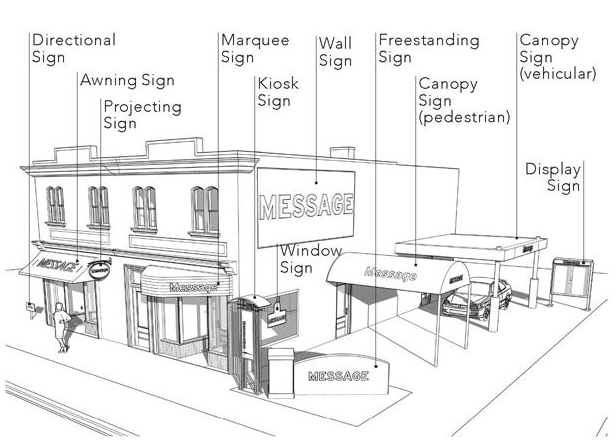
(2)
All permanent signs shall meet the City's sight triangle visibility requirements.
(3)
Owner consent. No sign permit shall be issued for any permanent sign on private property without written consent of the property owner or the owner's authorized agent.
(Ord. No. 2432, § 2(Exh. A), 12-19-2022)
Sec. 21-8405. - Awning Signs.
(1)
General standards. The following standards apply to all awning signs:
(a)
These regulations do not authorize the installation of awnings with or without signs without obtaining any necessary building permits in compliance with the city's applicable building and zoning codes.
(b)
The principal function of any awning with a sign must be to provide shelter for a window, a door, or an outdoor seating area.
(c)
Awnings that contain signs shall be designed to be compatible with the storefront in scale, proportion, material, and color.
(d)
No awnings with signs shall extend above the roof line of any building, or the first story, whichever is less.
(e)
No sign mounted to an awning shall project beyond, above or below the face of the awning.
Figure VIII-8. Awning Sign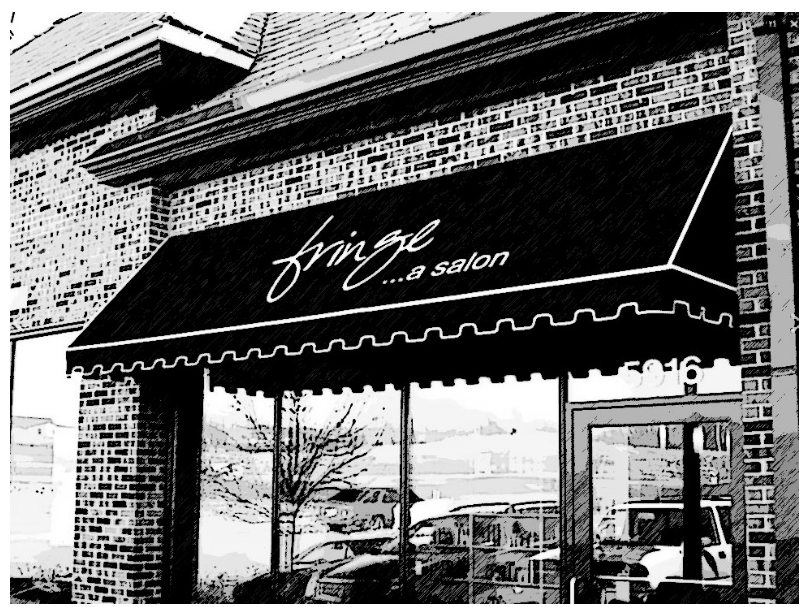
(2)
Use standards. In addition to the general standards in subsection (1) above, awning signs are subject to the use standards in Table VIII-2 below.
Table VIII-2. Awning Signs - Use Standards
(Ord. No. 2432, § 2(Exh. A), 12-19-2022)
Sec. 21-8410. - Canopy Signs.
(1)
General standards. The following standards apply to canopy signs:
(a)
These regulations do not authorize the installation of canopies with or without signs without obtaining any necessary building permits in compliance with the city's applicable building and zoning codes.
(b)
Canopies that contain signs shall be designed to be compatible with the storefront in scale, proportion, material, and color.
(c)
No sign mounted to a pedestrian canopy shall project beyond or below the face of the canopy. Signs mounted to the top of a pedestrian canopy shall be designed such that:
i.
They are comprised of channel letters or other three-dimensional forms;
ii.
The mounting hardware and supporting structures of the sign are concealed from view;
iii.
The sign does not extend more than two (2) feet above the top of the canopy, or extend above the nearest roofline, whichever is less.
(d)
No sign mounted to a vehicular canopy shall project beyond, above or below the face of the canopy.
i.
Canopy signs shall be located on the canopy fascia and shall be limited to one message on each side of the canopy that is visible from a public or private street.
ii.
Canopy messages shall have a vertical dimension no greater than 75 percent of the vertical dimension of the canopy fascia.
Figure VIII-9 a. Pedestrian Canopy Sign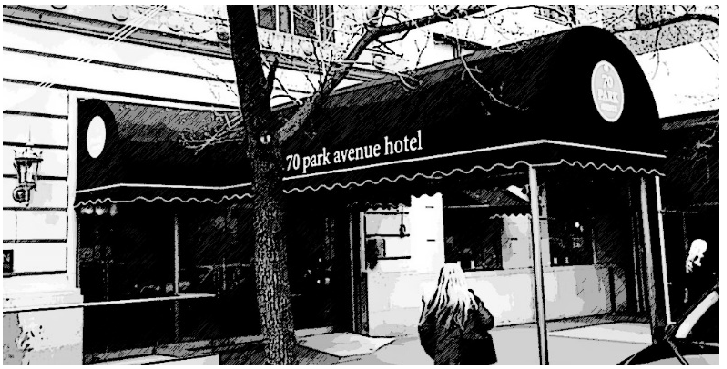
Figure VIII-9 b. Vehicular Canopy Sign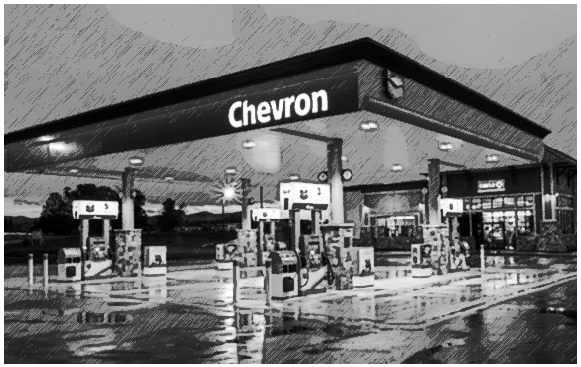
Table VIII-3 a. Pedestrian Canopy Signs - Use Standards
(2)
Use standards—Vehicular canopy signs. In addition to the general standards in subsection (1) above, vehicular canopy signs are subject to the use standards in Table VIII-3b below.
Table VIII-3 b. Vehicular Canopy Signs - Use Standards
(Ord. No. 2432, § 2(Exh. A), 12-19-2022)
Sec. 21-8415. - Directional Signs.
(1)
General standards. The following standards apply to all directional signs:
(a)
Directional signage systems shall be of a unified graphical system. Such signage shall be placed in consistent locations near site entries, key points on the internal automobile and pedestrian circulation system, building entries, seating areas, and sidewalk intersections.
(b)
Directional signage may exceed the maximum height standards when used on a vehicular clearance structure.
Figure VIII-10.
Directional Sign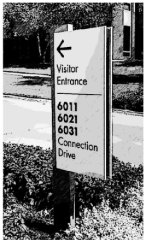
(2)
Use standards. In addition to the general standards in subsection (1) above, directional signs are subject to the use standards in Table VIII-4 below.
Table VIII-4. Directional Signs - Use Standards
(Ord. No. 2432, § 2(Exh. A), 12-19-2022)
Sec. 21-8420. - Display Signs.
(1)
General standards. The following standards apply to display signs:
(a)
Display signs may be wall mounted or may orient to occupants in a vehicle.
i.
Wall mounted displays signs must be placed no more than ten feet from the front entrance of the building or tenant, as applicable.
ii.
Display signs oriented to occupants in a vehicle may be permitted only if a drive-thru is expressly authorized.
(b)
Display signs oriented to occupants in a vehicle may include electronic message centers, subject to Sec. 21-8330. In addition, a display sign oriented to a drive-thru may be an electronic message center that contains up to 100% of the sign area if the display changes no more than three (3) times in a 24-hour period.
(c)
All display signs shall be appropriate in scale, proportion, material, and color to the character and architectural detail of the building and site.
Figure VIII-11 a. Display Sign — Wall Mounted
Figure VIII-11 b. Display Sign —
Vehicle-Oriented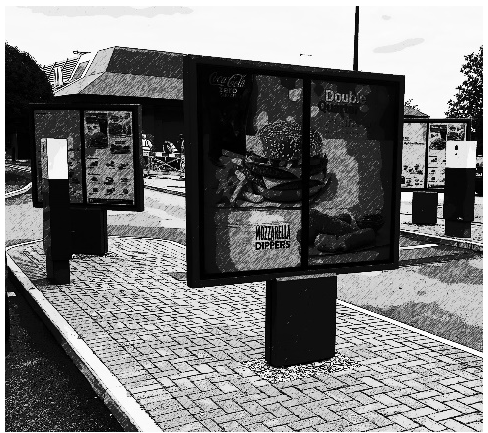
Table VIII-5 a. Wall-Mounted Display Signs - Use Standards
(2)
Use standards—Vehicle-oriented display signs. In addition to the general standards in subsection (1) above, vehicle-oriented display signs are subject to the use standards in Table VIII-5b below.
Table VIII-5 b. Vehicle-Oriented Display Signs - Use Standards
(Ord. No. 2432, § 2(Exh. A), 12-19-2022)
Sec. 21-8425. - Freestanding Signs.
(1)
General standards. The following standards apply to freestanding signs:
(a)
Only freestanding monument signs are permitted. Freestanding pole signs are prohibited.
(b)
Supporting structures for monument signs must be at least two-thirds the dimension of the width and thickness of the sign it supports.
(c)
For properties of ten acres or more, monument signs over 8 feet in height shall be placed no less than 175 feet from all residential district boundaries or any residential development.
(d)
All solar-powered monument signs are eligible for a 20% sign area bonus.
(e)
For properties with frontage on either I-76 or I-270, the allowable monument sign area and height may be increased by an additional 25%.
(f)
To the maximum extent feasible, a monument sign should be located in a planted landscaped area, which is of a shape, design, and size that will provide a compatible setting for the sign. The planted landscaped area shall be maintained by the property owner and can be counted as part of the landscape area.
(g)
All freestanding signs shall be appropriate in scale, proportion, material, and color to the character and architectural detail of the building and site.
Figure VIII-12 a. Freestanding Sign — Residential Subdivision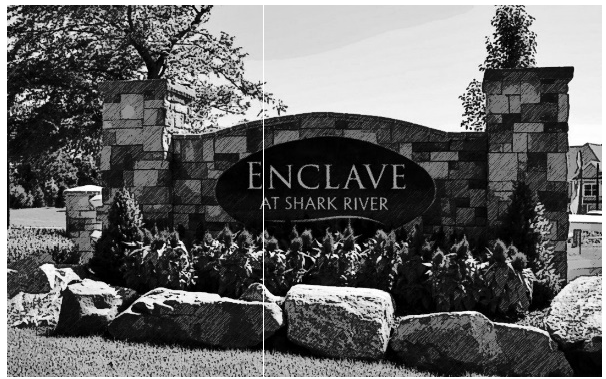
Figure VIII-12 b. Freestanding Sign — Commercial Multi-Tenant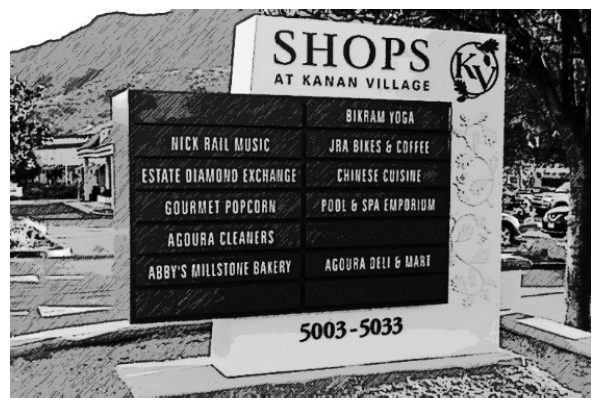
Figure VIII-12 c. Freestanding Sign — Institutional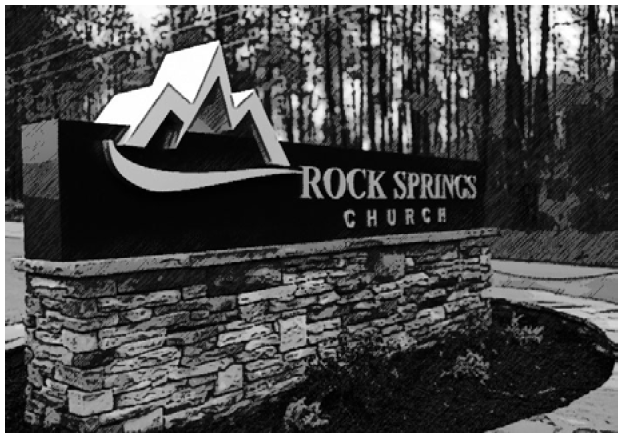
(2)
Residential use standards. In addition to the general standards in subsection (1) above, freestanding signs associated with residential uses are subject to the standards in Table VIII-6 a. below.
Table VIII-6 a. Freestanding Signs - Residential Use Standards
(3)
Commercial and industrial use standards. In addition to the general standards in subsection (1) above, freestanding signs associated with any commercial or industrial site are subject to the standards in Table VIII-6 b. below.
Table VIII-6 b. Freestanding Signs - Commercial/Industrial Use Standards
(4)
Institutional use standards. In addition to the general standards in subsection (1) above, freestanding signs associated with institutional uses are subject to the standards in Table VIII-6 c. below.
Table VIII-6 c. Freestanding Signs - Institutional Use Standards
(Ord. No. 2432, § 2(Exh. A), 12-19-2022)
Sec. 21-8430. - Kiosks.
(1)
General standards. The following standards apply to all kiosks:
(a)
These regulations do not authorize the installation of kiosks with or without signs without obtaining any necessary building permits in compliance with the city's applicable building and zoning codes.
(b)
Kiosks that contain signs shall be designed to be compatible with the storefront in scale, proportion, material, and color.
Figure VIII-13. Kiosk Sign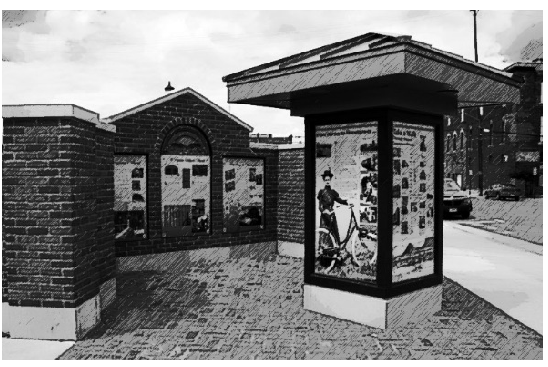
(2)
Use standards. In addition to the general standards in subsection (1) above, kiosks are subject to the use standards in Table VIII-7 below.
Table VIII-7. Kiosks - Use Standards
(Ord. No. 2432, § 2(Exh. A), 12-19-2022)
Sec. 21-8435. - Marquee Signs.
(1)
General standards. The following standards apply to all marquee signs:
(a)
These regulations do not authorize the installation of marquees with or without signs without obtaining any necessary building permits in compliance with the city's applicable building and zoning codes.
(b)
Marquees that contain signs shall be designed to be compatible with the storefront in scale, proportion, material, and color.
Figure VIII-14. Marquee Sign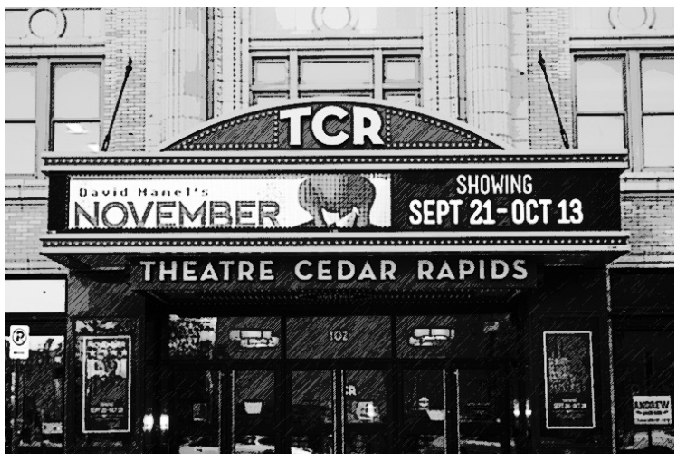
(2)
Use standards. In addition to the general standards in subsection (1) above, marquee signs are subject to the use standards in Table VIII-8 below.
Table VIII-8. Marquee Signs - Use Standards
(Ord. No. 2432, § 2(Exh. A), 12-19-2022)
Sec. 21-8440. - Projecting Signs.
(1)
General standards. The following standards apply to projecting signs:
(a)
Projecting signs shall be placed near a building entrance or an access point to a walkway.
(b)
Projecting signs shall be spaced a minimum of ten (10) feet apart on multi-tenant buildings, unless there is less than ten (10) feet separating tenant entrances.
(c)
Projecting signs over public right-of-way shall also require a right-of-way permit.
Figure VIII-15.
Projecting Signs
(2)
Use standards. In addition to the general standards in subsection (1) above, projecting signs are subject to the use standards in Table VIII-9 below.
Table VIII-9. Projecting Signs - Use Standards
(Ord. No. 2432, § 2(Exh. A), 12-19-2022)
Sec. 21-8445. - Wall Signs.
(1)
General standards. The following standards apply to all wall signs:
(a)
Combinations of cabinet and individual letter wall signs shall not be permitted, except that a cabinet-style logo not exceeding 9 square feet may be added to individual letter wall signs.
(b)
The total length of any individual wall sign shall not exceed 75 percent of the length of the frontage of the establishment, store front, or tenant space on which the sign is placed.
(c)
The total allowable square footage of wall signage for an individual use containing over 20,000 square feet of gross floor area may be divided into a primary sign and not more than 2 secondary signs with each secondary sign not to exceed more than 60 square feet in area.
(d)
For individual uses on property that is greater than 15 acres in size and has a total building area of at least 90,000 square feet, the allowable wall sign square footage may be increased by an additional 25%.
(e)
For multi-tenant buildings, wall signs must be located on the portion of the building in which the business being advertised is located. Tenants that do not have a primary access to the exterior of the building are not permitted individual wall signs.
(f)
Wall signs may not be located on the rear of buildings which abut a residential zone district or property.
Figure VIII-16 a. Wall Sign -
Individual Letter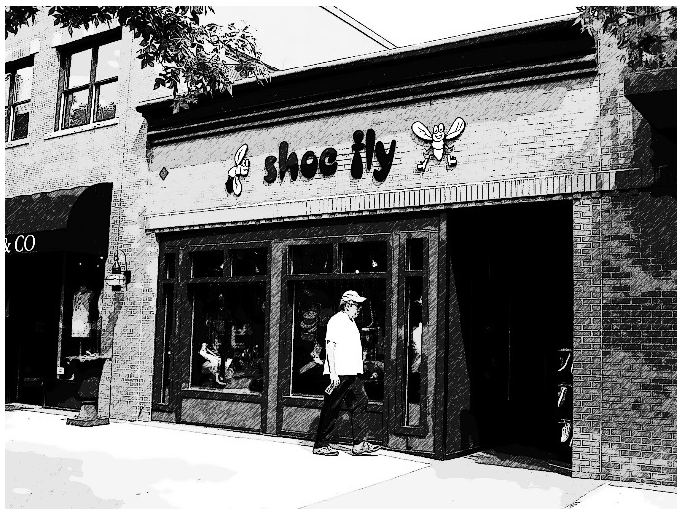
Figure VIII-16 b. Wall Sign - Cabinet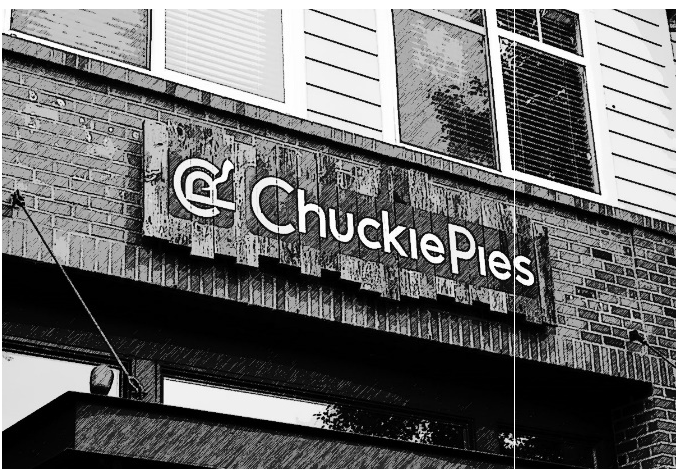
(2)
Residential use standards. In addition to the general standards in subsection (1) above, wall signs associated with residential uses are subject to the standards in Table VIII-10 a. below.
Table VIII-10 a. Wall Signs - Residential Use Standards
(3)
Commercial and industrial use standards. In addition to the general standards in subsection (1) above, wall signs associated with any commercial or industrial site are subject to the standards in Table VIII-10 b. below.
Table VIII-10 b. Wall Signs - Commercial/Industrial/Mixed-Use Use Standards
(4)
Institutional use standards. In addition to the general standards in subsection (1) above, wall signs associated with institutional uses are subject to the standards in Table VIII-10 c. below.
Table VIII-10 c. Wall Signs - Institutional Use Standards
(Ord. No. 2432, § 2(Exh. A), 12-19-2022)
Sec. 21-8450. - Window Signs.
(1)
General standards. The following standards apply to permanent window signs:
(a)
Permanent window signs shall be located only in those windows of the unit or space occupied by a business.
(b)
Permanent window signs shall not be displayed in windows above the ground floor level.
(c)
Permanent window signs shall not be animated.
(d)
When determining the maximum permitted number and the maximum permitted area of permanent signs, temporary window signs shall not be taken into account unless otherwise specified or regulated in this land development code. However, in no case shall a permanent, temporary, or combination of such window signs cover more than 25 percent of any individual window area.
Figure VIII-17. Window Signs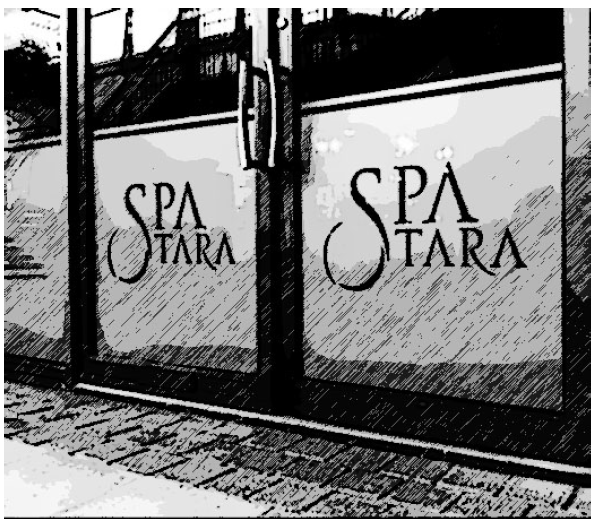
(2)
Use standards. In addition to the general standards in subsection (1) above, permanent window signs are also subject to the use standards in Table VIII-11 below.
Table VIII-11. Window Signs - Use Standards
(Ord. No. 2432, § 2(Exh. A), 12-19-2022)
Sec. 21-8500. - Permitted Temporary Sign Types.
(1)
Temporary signs include the following types:
(a)
Fabric Signs (Wall Banner, Shark Fin and Utility Post). Refer to Sec. 21-8510.
(b)
Inflatable Signs. Refer to Sec. 21-8520.
(c)
Sandwich Board Signs. Refer to Sec. 21-8530.
(d)
Site Signs. Refer to Sec. 21-8540.
(e)
Window Signs. Refer to Sec. 21-8550.
(f)
Yard Signs. Refer to Sec. 21-8560.
Figure VIII-18. Temporary Sign Types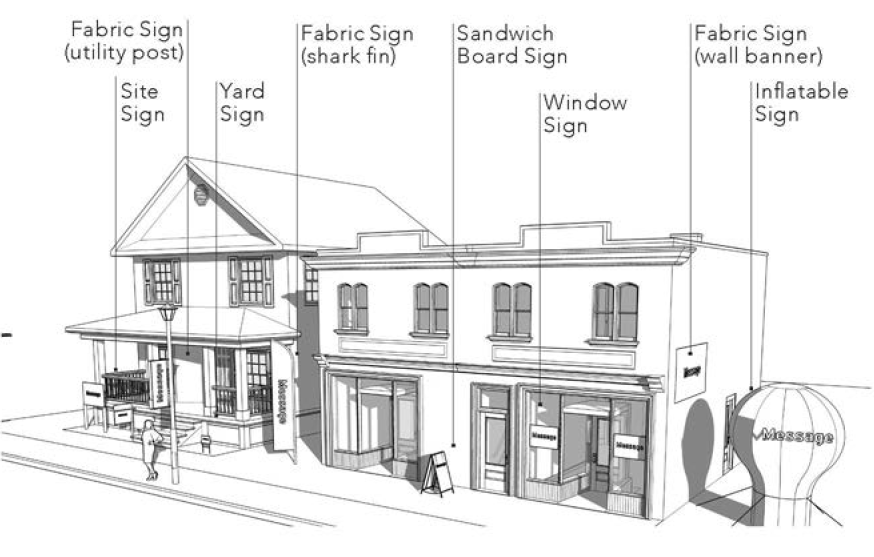
(2)
The purpose of temporary signs is to display messages for a temporary duration. Temporary signs shall not be used to circumvent the regulations that apply to permanent signs or to add permanent signage to a property in addition to that which is allowed by these regulations.
(3)
Unless otherwise stated in this division, any permit for a temporary sign shall be valid for a period of not more than 12 consecutive calendar months.
(4)
In general, a temporary sign shall be removed as of the date that:
(a)
It becomes an abandoned sign;
(b)
It falls into disrepair; or
(c)
The expiration of the number of days in the tables listed for each temporary sign type.
(Ord. No. 2432, § 2(Exh. A), 12-19-2022)
Sec. 21-8510. - Fabric Signs (Banners).
(1)
General standards. The following standards apply to all fabric signs:
(a)
Wall-mounted banners shall be attached flat against a building. Wall-mounted banners shall not disrupt the architectural composition of the building façade, overlap or otherwise cover features of the building such as cornices, eaves, window and doorframes, columns and other decorative elements.
(b)
Ground-mounted banners shall not be placed where they obscure important architectural features such as entrances, display windows, or decorative elements when viewed from the public right-of-way.
(c)
Shark fin fabric signs are not permitted except as a temporary site sign, subject to the following standards:
i.
For residential developments:
a.
A maximum of 6 shark fin signs are permitted per lot.
b.
Shark fin signs are only permitted during an active initial sales/rental period.
ii.
For non-residential developments:
a.
A maximum of 2 shark fin signs are permitted per street frontage.
b.
Shark fin signs are only permitted until the first certificate of occupancy is issued for the development.
iii.
For all developments:
a.
A sign permit is required for any shark fin sign.
b.
All shark fin signs must be the same color and theme.
c.
The maximum height shall not exceed 8 feet.
d.
The maximum sign area shall not exceed 20 square feet.
e.
The minimum setback shall be 10 feet from a public right-of-way.
f.
Shark fins may not be illuminated.
Figure VIII-19. Fabric Signs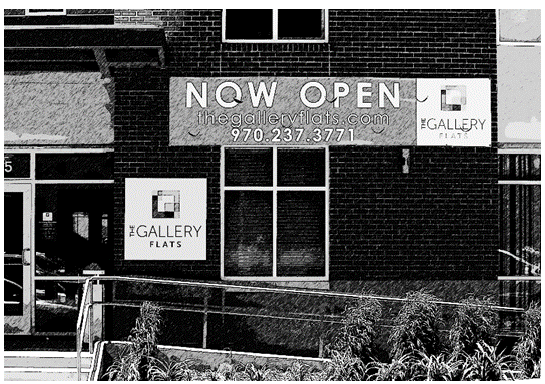
(2)
Use standards. Fabric signs (except shark fins) are also subject to the use standards in Table VIII-11 [12] below.
Table VIII-12. Fabric Signs - Use Standards
(Ord. No. 2432, § 2(Exh. A), 12-19-2022)
Sec. 21-8520. - Inflatable Signs.
(1)
General standards. The following standards apply to all inflatable signs:
(a)
Any inflatable device must be tethered or anchored so as to prevent dislocation, entanglement or encroachment onto adjacent properties or public streets, or undue hazard to motorists or pedestrians.
(b)
Any inflatable device or balloon not tethered to a roof, shall not displayed more than 20 feet from grade level or exceed 3 feet in diameter.
(c)
All inflatable devices and balloons shall be removed at the expiration of the applicable permit period.
Figure VIII-20. Inflatable Signs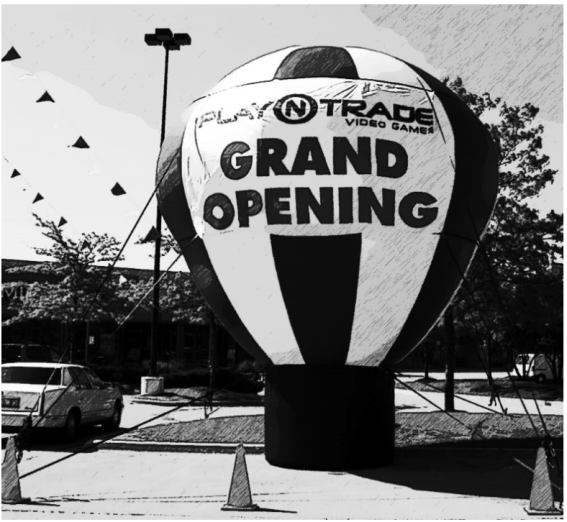
(2)
Use standards. Inflatable signs are also subject to the use standards in Table VIII-12 [13] below.
Table VIII-13. Inflatable Signs - Use Standards
(Ord. No. 2432, § 2(Exh. A), 12-19-2022)
Sec. 21-8530. - Sandwich Board Signs.
(1)
General standards. The following standards apply to all sandwich board signs:
(a)
A sandwich board shall be constructed of materials that present a finished appearance. Roughcut plywood is not allowed. The sign lettering shall be professionally painted or applied; a "yard sales" or "graffiti" look with hand-painted or paint-stenciled letters shall not be allowed.
(b)
A sandwich board sign shall not obstruct pedestrian or vehicular circulation. Any sandwich board sign that is deemed unsafe for pedestrians or motorists may be removed by the city.
(c)
A sandwich board sign shall be placed only on the property of the business displaying such sign, or on the adjacent sidewalk, and shall be removed each day at close of business.
(d)
A sandwich board sign shall be anchored to the ground or weighted sufficiently to prevent movement by wind.
(e)
A sandwich board sign shall not contain moving parts or have attached to them any balloons, streamers, pennants, or similar adornment. Attaching a sandwich board sign to a structure, pole, object, other sign, etc., by means of chains, cords, rope, wire, cable, etc., is prohibited.
(f)
A sandwich board sign placed in violation of this section may result in immediate removal of the sign, and the business's temporary sign permit privileges denied for the remainder of that year.
Figure VIII-21. Sandwich Board Signs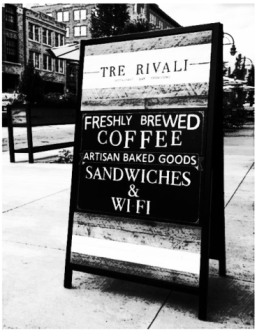
(2)
Use standards. Sandwich board signs are also subject to the use standards in Table VIII-13 [14] below.
Table VIII-14. Sandwich Board Signs - Use Standards
(Ord. No. 2432, § 2(Exh. A), 12-19-2022)
Sec. 21-8540. - Site Signs.
(1)
General standards. The following standards apply to all site signs:
(a)
Site signs are intended for vacant land parcels or lots under construction, and are not permitted on parcels with existing or built-out residential or non-residential uses.
Figure VIII-22. Site Signs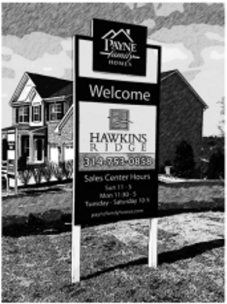
(2)
Use standards. Site signs are also subject to the use standards in Table VIII-14 [15] below.
Table VIII-15. Site Signs - Use Standards
(Ord. No. 2432, § 2(Exh. A), 12-19-2022)
Sec. 21-8550. - Window Signs.
(1)
General standards. The following standards apply to temporary window signs:
(a)
Temporary window signs shall be located only in those windows of the unit or space occupied by a business.
(b)
Temporary window signs shall not be displayed in windows above the ground floor level.
(c)
All neon signs connected to an electrical outlet located inside a building are considered temporary window signs for the purposes of this land development code.
(d)
Temporary window signs shall not be animated.
(e)
When determining the maximum permitted number and the maximum permitted area of permanent signs, temporary window signs shall not be taken into account unless otherwise specified or regulated in this land development code. However, in no case shall a permanent, temporary, or combination of such window signs cover more than 35 percent of any individual window area.
Figure VIII-23. Window Signs
(2)
Use standards. Temporary window signs are also subject to the use standards in Table VIII-15 [16] below.
Table VIII-16. Window Signs - Use Standards
(Ord. No. 2432, § 2(Exh. A), 12-19-2022)
Sec. 21-8560. - Yard Signs.
(1)
General standards. The following standards apply to all yard signs:
a.
Yard signs shall not be erected or placed in parks, alleys or in a street or other public right-of way or place.
Figure VIII-24. Yard Signs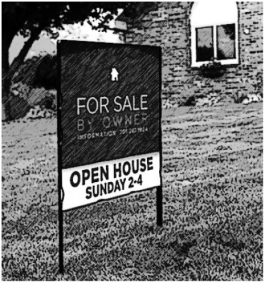
(2)
Use standards. Yard signs are also subject to the use standards in Table VIII-16 [17] below.
Table VIII-17. Yard Signs—Use Standards
(Ord. No. 2432, § 2(Exh. A), 12-19-2022)

