
Commerce City City Zoning Code
ARTICLE VII
- Development and Design Standards
Sec. 21-7100.- Land Unsuitable for Development.
The following areas are considered unsuitable for development. In appropriate circumstances, the City may require such lands to be preserved as open space.
(1)
Unique and/or fragile areas, including wetlands;
(2)
Areas within the 100-year floodplain;
(3)
Steep slopes in excess of 25 percent, as measured over a 20-foot horizontal interval, and other unstable ground;
(4)
Buffer zones at least 75 feet wide along all US Geological Survey (USGS) perennial and intermittent streams;
(5)
Habitats for or populations of endangered or threatened wildlife, as identified on federal or state lists;
(6)
Historically significant structures and sites, as listed on federal, state, city, or county lists of historic places;
(7)
Archaeological sites, cemeteries, and burial grounds; and
(8)
Any land that, in the opinion of the city, consists of areas with adverse topography, adverse soils, subsidence of the earth surface, high water table, periodic flooding, lack of water, or other natural or man made hazards to life.
Sec. 21-7110. - Protected Land and Habitat.
The following shall be preserved to the maximum extent feasible, as determined by the city:
(1)
Existing healthy, native forests of at least one contiguous acre;
(2)
Individual, existing healthy trees greater than eight inches caliper;
(3)
Other significant natural features and scenic view sheds such as ridge lines, peaks, and rock outcroppings, particularly those that can be seen from public roads; and
(4)
Agricultural lands that are identified in the comprehensive plan.
Sec. 21-7300.- Single-Family Home Construction.
Prior to receiving a certificate of occupancy for new single-family dwelling construction, a sidewalk shall be constructed along the property frontage in conformance with the ECSS, unless a bond or cash deposit acceptable to the city has been secured or other arrangements have been made through a developer's agreement. Sidewalk construction is required when existing sidewalks are present within 600 feet along the same street frontage abutting the subject lot, unless waived by the city.
Sec. 21-7310. - General Design Standards.
All developments, except single-family dwellings, shall provide pedestrian access and circulation in accordance with the standards set forth in this section.
(1)
Required Connections. Pedestrian ways shall connect:
(a)
All primary building entrances within the development to one another;
(i)
For commercial, industrial, mixed use, public, and institutional buildings, the primary entrance is the main public entrance to the building. In the event no public entrance exists, accessible connections shall be provided to each employee entrance.
(ii)
For residential buildings, the primary entrance is the front door (i.e., the door oriented towards the street) or, for multi-family buildings in which each unit does not have its own exterior entrance, the primary entrance may be a lobby, courtyard, or breezeway that serves as a common entrance for more than one dwelling and be accessible.
(b)
All parking areas, storage areas, recreational facilities, common areas (as applicable), and adjacent development to the building's entrances and exits;
(c)
All future phases of development, adjacent trails, public parks and open space areas whenever possible; and
(d)
Connect or stub to adjacent streets and private property, in accordance with all city engineering standards.
(2)
Convenient. Pedestrian ways shall be reasonably direct. For purposes of this section, reasonably direct means the route does not deviate unnecessarily from a straight line or involve a significant amount of out-of-direction travel for likely users.
(3)
Safe. Pedestrian ways shall be kept free of hazards and should be lighted in conformance with division 7 (Lighting).
(4)
Accessible. All pedestrian ways shall comply with the Americans with Disability Act (ADA) and the Accessibility Guidelines created in conjunction with the ADA. Except for sidewalks, switchback paths shall be required where grades exceed ADA and city standards and accessible alternate routes such as ramps and/or lifts shall be provided.
(5)
Compliance. All pedestrian ways shall be in accordance with the city's parks and recreation master plans.
Sec. 21-7320. - Walkway Standards.
(1)
Detached Sidewalks.
(a)
Local Streets. Detached sidewalks along local streets shall be a minimum of 4.5 feet wide, and tree lawns shall be a minimum of 5.5 feet wide.
(b)
Collector Streets. Detached sidewalks along collector streets shall be a minimum of five feet in width, and tree lawns shall be a minimum of six feet wide.
(c)
Arterial Streets. Detached sidewalks along arterial streets shall be a minimum of either 6 or 12 feet in width, depending upon the side of the street upon which they are located. Tree lawns shall be a minimum of 5.5 feet in width. The width of the sidewalk along collector and arterial streets may be increased due to the volume of sidewalk use.
(2)
Attached Sidewalks. Attached sidewalks are disfavored and shall only be permitted under the following conditions:
(a)
Residential Areas. Attached sidewalks shall be permitted when severe limitations, such as inadequate setbacks leading to safety hazards or topographic constraints such as steep slopes, make detached sidewalks impossible.
(b)
Entries to High-Use Sites. Attached sidewalks may be permitted at major entries or congregation areas in commercial, school, religious institutions, recreation centers, or similar high-use sites. In those cases, the sidewalks shall be a minimum of six feet in width along local streets; a minimum of eight feet in width along collectors; and a minimum of ten feet in width along arterials.
(c)
Bridges. Attached sidewalks may be permitted across bridges.
(3)
Sidewalks at Intersections. Sidewalks may be constructed adjacent to the curb at intersections and must meet the federal requirements for handicap accessibility and ramps.
(4)
Walkways in Parking Lots. There shall be internal pedestrian walkways within parking lots or drive areas to provide safe pedestrian access from parking to a store entrance. These walkways shall be clearly defined by no less than two of the following ways:
(a)
Six-inch vertical curb;
(b)
Trellis;
(c)
Special railing;
(d)
Bollards;
(e)
Special paving;
(f)
Low seat wall or other architectural features;
(g)
Pedestrian-scale lighting.
(5)
Vehicle/Walkway Separation. Walkways that are parallel or adjacent to a driveway or street (public or private) shall be raised 6 inches and curbed, or separated from the driveway/street by a 5.5-foot minimum landscaped strip. Special designs may be permitted if this 5.5-foot separation cannot be achieved.
(6)
Housing/Walkway Separation. Pedestrian walkways shall be separated a minimum of five feet from all residential living areas on the ground floor, except at building entrances. Separation is measured from the walkway edge to the closest dwelling unit. The separation area shall be landscaped in conformance with the provisions of division 5 (Landscaping). No walkway/building separation is required for commercial, industrial, public, or institutional uses.
(7)
Walkway Surface. Walkway surfaces shall be concrete, asphalt, brick/masonry pavers, or other durable surface that makes a smooth surface texture, and shall conform to ADA requirements.
(8)
Exceptions. The city may determine, based upon facts in the application and other public records, that a walkway is impractical due to physical or topographical conditions (e.g., freeways, railroads, extremely steep slopes, sensitive lands, and similar physical constraints); building or other existing development on adjacent properties that physically prevent a connection now or in the future, considering the potential for redevelopment; and sites where the provisions of recorded leases, easements, covenants, restrictions, or other agreements recorded as of the effective date of this section prohibit the walkway connection.
E. - MULTI-FAMILY DEVELOPMENT GUIDELINES AND STANDARDS
In addition to the standards set forth in this article, the following guidelines and standards are applicable to multi-family development.
Sec. 21-7200. - Applicability.
All development within the city shall provide vehicular access as detailed in this division.
Sec. 21-7201. - Approval of Access Required.
No development may be approved until the applicant has established that all vehicular access has been approved by the appropriate agency. All accesses shall be constructed as approved.
(1)
Agency Approval.
(a)
City Streets. Access to city streets shall be approved or denied by the city engineer, based on city standards and, where applicable, any pertinent access management agreements between the Colorado Department of Transportation (CDOT) and the city.
(b)
State Highways. Access to all state highways shall be approved or denied by CDOT and the city, based upon CDOT's adopted standards.
(2)
Conditions of Approval. Any approving agency may require the closing, consolidation, or relocation of existing curb cuts or other vehicle access points, recording of reciprocal access easements (i.e., for shared driveways and cross access routes), development of a frontage or rear street, installation of traffic control devices, and/or other mitigation measures as a condition of approving a proposed access, to ensure the safe and efficient operation of the street and highway system.
(3)
Traffic Impact Analysis. The city may require the submission of a transportation impact analysis conducted in accordance with the Engineering Construction Standards and Specification (ECSS). This analysis, the cost of which shall be borne by the applicant, shall clearly illustrate the on- and off-site traffic impacts that will be created by the proposed development, and shall also indicate how these impacts will be mitigated.
Sec. 21-7202. - Access Options.
When vehicular access is required for development (e.g., for off-street parking, delivery, service, drive-through facilities, etc.), access shall be provided by one of the following methods as determined by the city engineer, unless one method is specifically required by this land development code.
(1)
Lowest Classified Street. Access shall generally be taken from an alley (either an existing, proposed or potential alley), mid-block lane, or the lowest functionally classified street possible. If a property has the ability to take access to a lower functionally classified roadway, direct access to a higher functionally classified roadway is not permitted unless required by the applicable fire district for fire and life safety reasons. This requirement applies to all properties, all zones, and all uses (e.g., alleys are considered a lower classification than local streets).
(2)
Shared Access. Access to a public street may be taken from a shared private street or driveway straddling a shared property line. If such access is approved, a cross-access easement covering the private street or driveway shall be recorded at the county, and a copy shall be provided to the city to assure access to the closest street for all users of the shared access.
(3)
Cross Access. Access to a public street may require users of a development to cross an adjoining property. In such event, an easement allowing such use shall be required and shall be recorded at the county, and a copy shall be provided to the city to assure permanent access to the street system.
(4)
Arterial and Collector Streets. As a last resort, the city may permit access from an arterial or collector street adjacent to the development parcel. As a condition of approving such access, the owner/developer shall be required to close, consolidate, or relocate one or more existing access points to the arterial or collector when adequate alternative access becomes available. Direct access to an arterial or collector street shall be limited to right turns only, unless the access is shared and/or the applicant submits a traffic impact analysis, acceptable to the city, demonstrating that full access will operate effectively, not cause a traffic safety concern, and provide a benefit to the operations of the arterial or collector roadway system. This determination shall be made by the city engineer based upon the following considerations:
(a)
The access, based upon a 20-year evaluation, will provide an immediate and long-term benefit to the arterial or collector; and
(b)
The benefits exceed any mitigation of impacts related to the development regarding safety and operations.
Sec. 21-7203. - New Lots Fronting Arterial and Collector Streets.
New lots created through the subdivision process that front arterial or collector streets shall provide access as indicated below:
(1)
Residential Lots. The developer shall provide alley access to individual lots fronting onto arterial or collector streets unless, due to physical or topographical constraints, the city engineer determines that an alley is impractical. If an alley is impractical, the city may permit double frontage lots or allow the subdivision to be separated from the arterial streets by a service or frontage road. The frontage road shall be separated from the arterial street by at least 30 feet and planted with landscaping material suitable for a sound barrier. In no event shall an alley servicing residential lots be permitted to access an arterial street.
(2)
Nonresidential Lots. All nonresidential lots shall provide other access alternatives to the individual lots that abut the arterial or collector street. An alley may be developed wherever practical. Double frontage lots of adequate depth to accommodate the permitted nonresidential use may be permitted. When a lot has frontage onto two or more streets, access shall be provided first from the street with the lowest classification. The creation of double frontage lots does not relieve the property owner from their responsibilities to maintain the sidewalk and tree lawn on the non-access side.
Sec. 21-7204. - Numbers and Spacing.
The number and spacing of all accesses shall be determined by the city engineer based upon the ECSS. The city engineer may deviate from the ECSS as reasonably necessary to protect the function, safety, and operation of the street or nearby intersections/interchanges for all users.
Sec. 21-7205. - Driveways.
(1)
Width. The width of driveway openings (or curb cuts) shall be:
(a)
Single-Family Residential.
(i)
Non-shared driveways. For buildings with two or less garage spaces, no curb cut shall be less than 12 feet wide or more than 20 feet wide. For buildings with more than two garage spaces, no curb cut shall be less than 12 feet wide or more than 30 feet wide. Although wider driveways may be necessary to accommodate approved paved recreational vehicle pads, curb cuts shall not be wider than the standards provided herein.
(ii)
Shared driveways. No curb cut shall be less than 20 nor more than 24 feet in width.
(b)
Multi-Family Developments. No curb cut nor driveway shall be less than 24 feet wide. No curb cut shall be more than 36 feet wide unless the city engineer determines that a wider curb cut is required based on the number of trips generated or the need for turning lanes. The exact width of the curb cut shall be determined by the city engineer.
(c)
Other Uses. Access widths for all other uses shall be based on 12 feet of width for every travel lane.
(2)
Total Coverage. Except as may be necessary to comply with (1) above, driveways and other impervious surfaces shall not comprise more than the percentage of the front yard specified in the table below. Parking may be provided in the rear or side yards, and access may be provided through alleys where the front yard is insufficient to accommodate a driveway.
Table VII-1. Front Yard Side-on-Street Maximum Paving
(3)
Materials. In order to reduce run-off and increase stormwater travel times, alternative materials for driveway surfaces, such as pervious pavers, are permitted in any residential zoning district.
(4)
Construction. Driveways of single-family dwellings are regulated as follows:
(a)
Construction standards:
(i)
Driveways shall be composed of a minimum four-inch thick concrete slab-on-grade and shall comply with the minimum properties of a carport or garage slab as specified in the Commerce City Residential Code. Where a driveway is greater than 300 feet, the building official may approve alternate materials provided such materials have similar weathering and load-bearing properties to the reinforced concrete specified herein.
(ii)
The slab shall be reinforced with #3 reinforcing steel (⅜-inch diameter) at 24 inches on center or sheets of welded wire fabric (WWF) with an equivalent area of steel. Rolled WWF shall not be permitted. Reinforcing steel or WWF shall be located in the mid-depth of the slab.
(iii)
The driveway slab shall be constructed on a minimum six-inch thick subbase compacted to ninety-five percent (95%) standard proctor at optimum moisture.
(iv)
Expansion and control joints shall be installed in accordance to the Engineering Construction Standards and Specifications (ECSS).
(b)
Repair or Replacement of Existing Driveways.
(i)
Except as set forth below, driveways existing prior to June 10, 2023, may be repaired or replaced with substantially the same material and to the same standards existing at the time of original construction.
(ii)
Any driveway predating the adoption of this section and comprised of gravel, dirt, or rock, when replaced or repaired shall conform to the requirements of this section 4.
(5)
Driveway Aprons. Driveway aprons shall be installed between the street and private drive. Driveway apron design and location shall conform to the ECSS and the Americans with Disability Act (ADA) standards for sidewalks and walkways. Driveway aprons serving industrial uses and heavy commercial uses may be as wide as 50 feet.
(6)
Visibility. Driveways shall be designed and located to provide a vehicle in the driveway with an unobstructed view of the roadway in compliance with the ECSS.
(7)
Loading Area Design. The design of driveways and on-site maneuvering and loading areas for commercial and industrial developments shall include the anticipated storage length for entering and exiting vehicles, in order to prevent vehicles from backing into the flow of traffic on the public street or causing unsafe conflicts with on-site circulation. In addition, all loading areas shall comply with section 21-7243 (Loading Requirements).
(8)
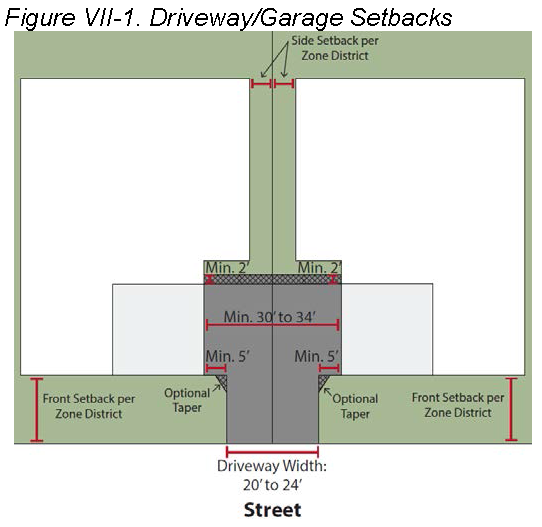
Shared Driveway—Additional Standards and Recommendations.
(a)
A concept and/or site plan depicting how the driveway will sit on the affected properties shall be submitted in conjunction with the building permit. The plan must demonstrate compliance with the setback requirements outlined in this section.
(b)
Based on the width of the driveway at the intersection of the right-of-way, the setback between garage doors for the adjacent properties shall be:
Table VII-2. Setback Between Garage Doors for Adjacent Properties (based on driveway width)
(c)
The driveway shall extend a minimum of 2 feet beyond the garage door along the rear of the driveway.
(d)
A taper for the driveway is recommended and may be beneficial.
(9)
Exceptions. Exceptions to the requirements of this section may be approved by reasonable discretion of the city engineer unless specified otherwise within this section, if the following criteria are met.
(a)
Physical conditions upon the affected property make it impossible or impracticable to require strict compliance with the requirements of this section; or
(b)
The driveway in question is used so infrequently that the expense of strict compliance with this section would be prohibitive; or
(c)
Other conditions exist which would make the requirement of strict compliance with this section an unreasonable hardship upon persons affected thereby.
(Ord. No. 2073, January 2016; Ord. No. 2158, December 2018; Ord. No. 2514, § 2(Exh. A), 8-14-2023)
Sec. 21-7206. - Fire and Emergency Access.
All developments shall contain adequate access for fire protection and other emergency service vehicles.
(1)
Maneuverability. Public and private streets, alleys, parking lots, and other vehicular access roads that may be needed for fire and emergency service access shall be constructed to ensure emergency vehicle maneuverability as follows:
(a)
Arterial and collector streets shall contain at least 20 feet of unobstructed width;
(b)
Local streets, both public and private, shall contain at least 16 feet of unobstructed width;
(c)
Driveways, private streets, aisles, turn-around areas, and ramps shall have a minimum vertical clearance of 13 feet 6 inches for their entire length and width;
(d)
Streets, parking lots, alleys, or other vehicular access to buildings that are 3 stories or greater, as measured from any side of the building, shall include at least 20 feet of unobstructed width; and
(e)
Cul-de-sacs and alternative turnarounds. Cul-de-sacs shall have a minimum turn around of 100 feet in diameter. The minimum turning radius for fire access shall be 25 feet inside and 50 feet outside.
(2)
Other Standards. All projects shall provide fire access in accordance with the standards of the applicable fire district.
Sec. 21-7207. - Sight-Distance Areas.
Sight distance areas are established to ensure that obstructions do not infringe on the sight lines needed by motorists, pedestrians, bicyclists, and other approaching potential conflict points at intersections. These sight-distance areas are regulated under the ECSS.
Sec. 21-7220. - Traffic Calming.
The city may require traffic calming devices along collectors and local streets, where the city reasonably believes that traffic speeds could become excessive or where extra precautions are needed. Traffic mitigation devices required by the city may include, but are not limited to, the following:
(1)
Neighborhood signs and landscaping on an island.
(2)
Roundabouts at intersections.
(3)
Raised crosswalks.
(4)
Neckdowns at intersections.
(5)
Turn prohibitors/neckdowns.
(6)
Raised intersections.
(7)
Speed tables.
(8)
Chicanes.
(9)
Cross pans.
(10)
Painted crosswalks and intersections (including mid-block crossings).
Sec. 21-7221. - Transit Facility Standards.
(1)
Development that is located along a potential or planned transit route, as reflected in local or regional transit plans, should include a transit center or transit stop, unless the city determines that adequate transit facilities already exist. All transit facilities must comply with the standards outlined in this section.
(a)
Facilities shall include, at a minimum, sidewalk connections, concrete waiting areas, and a bench.
(b)
Transit centers and some transit stops, as determined by the city, shall have bus pullouts.
(c)
Shelters shall be provided at stops where numerous users are likely to wait.
(d)
Sidewalks shall be provided from the building(s) to the transit facility with minimal crosswalks and deviations. Crosswalk pavement markings and curb cuts shall be constructed where sidewalks cross parking lots and streets.
(2)
Plans for the transit facility shall be shown on the development plan and will be considered an important element during the review process. Transit facilities shall be constructed at the same time as development construction or, if the city determines such construction is impractical at that time, funds for the construction of the transit facilities shall be placed in escrow.
Sec. 21-7230. - Applicability.
(1)
New Uses. These parking and loading requirements shall apply to all new uses and structures.
(2)
Existing Uses.
(a)
Change in Use.
(i)
In general, when a use that exists on the effective date of this land development code is changed, the person changing the use shall provide the parking required for the new use.
(ii)
Exception. When a new use does not require more parking than the existing use, the new use may be established, even if such establishment will result in a deficiency in the required number of parking spaces, provided that the deficiency is no greater than the deficiency associated with the existing use.
(b)
Change in Intensity. When the intensity of any use is increased through the addition of dwelling units, gross floor area, seating capacity, additional employees, or other units of measurement related to required parking spaces, the person responsible for increasing the intensity of the use shall provide the parking required for the intensity of the use.
(3)
Nonconforming Parking Locations and Designs. Parking spaces that were legally in use on the effective date of this land development code but which do not satisfy the locational or design requirements contained herein, may continue to be used until such time the use associated with the nonconforming parking space(s) is changed in such a manner as would trigger compliance under paragraph (2) of this section.
Sec. 21-7231. - Plans Required.
All development applications or proposed changes in use shall include a site plan at an appropriate scale that clearly shows proposed site improvements relating to parking as required by this article. All plans shall show the location, arrangement, and dimensions of off-street parking area(s), parking spaces, parking lanes, aisles/driveways, loading areas, points of ingress and egress, walls, landscaping, and barriers. Sidewalks, pedestrian ways, bicycle facilities and their access also shall be shown. The access or driveway locations, width and spacing, as well as sight lines and distances, the arrangement of spaces, stall dimensions, surfacing, striping, and lighting, shall be shown and in full compliance with adopted city standards.
Sec. 21-7232. - General Provisions.
(1)
Parking and Loading Spaces to be Permanent. Required parking and loading spaces/aisles shall be permanently available.
(2)
Signs and Striping. All parking areas except those designed to serve single-family residential uses shall delineate each space by single or double stripes on each side of the space. Parking lot signs and striping shall be continuously maintained so as to be clearly visible. The city engineer shall regulate the placement of all signs and striping within parking areas.
(3)
Maintenance. Parking spaces, driveways, maneuvering aisles, turnaround areas, and landscaping areas shall be kept free of dust, graffiti, and litter and shall be continually maintained in satisfactory condition so as to be safe and free of any hazard, nuisance, or other unsafe condition.
(4)
Fire Lanes. Parking is prohibited in fire lanes designated by the applicable fire district.
(5)
Right-of-Way Prohibition. No required off-street parking space or maneuvering space shall be located within any public right-of-way unless approved by the city engineer.
(6)
Compliance with City Standards. All parking and loading facilities shall comply with the city building code and any other applicable city code or regulation.
(7)
Lighting. Lighting shall comply with division 7 (Lighting Standards).
(8)
Accessibility. All parking spaces shall be accessible at all times from a street, alley, aisle, or driveway intended to serve such off-street parking.
(9)
Landscaping Required. Refer to division 5 (Landscaping) for landscaping requirements in parking areas including landscaped islands, access drives, pedestrian refuge areas, and the beginning and ends of parking aisles.
(10)
Tandem Parking Spaces. Tandem parking spaces are permitted for single-family and multi-family residences.
(11)
Front Yard Parking. Parking any vehicle in the front yard of a single-family residence is prohibited unless the vehicle is parked on an approved parking space with an improved surface of hot-mix asphalt, cast-in-place concrete, or other surface material approved by the city.
(12)
Handicapped Accessible Parking. A portion of the total number of required parking spaces shall be specifically designated, located, and reserved for use by persons with disabilities. The owner/applicant shall ensure that all handicapped accessible parking is in compliance with the American with Disabilities Act (ADA).
(13)
Garage and Carport Conversion. Conversion of a garage or carport for a single-family residence shall be prohibited unless an equivalent space is provided in compliance with the requirements of table VII-3 (Parking Standards).
(14)
Location of Required Parking.
(a)
Residential Uses. Except as specifically provided otherwise, all required off-street parking spaces shall be located on the same lot as the principal use.
(b)
Nonresidential Uses. Parking shall be located on the same lot as the uses served, unless otherwise provided for within this land development code.
(c)
The location of required off-street parking spaces shall not interfere with normal traffic flow or with the operation of queuing and vehicle backup areas.
(15)
Phasing of Parking. Required off-street parking areas may be phased along with proposed phased development shown on the development plan as approved by the city. Areas required for parking, but not immediately improved, shall be reserved for such future parking. Undeveloped future parking areas shall be reseeded with a grass mix, acceptable to the city, until said area is fully developed into a parking surface. The area shall be reseeded at the same time as the initial phase of development.
Sec. 21-7233. - Off-Street Parking Requirements.
(1)
Minimum Parking. The following table VII-3 establishes the minimum number of off-street parking spaces required for each listed use.
(2)
Maximum Parking. With the exception of single-family residential uses, parking shall not exceed 150 percent of the amount of parking prescribed by table VII-3.
(Ord. No. 1854, April 2011)
Table VII-3. Off-Street Parking Requirements
(Ord. No. 1854, April 2011; Ord. No. 2078, April 2016)
Sec. 21-7234. - Bicycle Parking Requirements.
(1)
Spaces Required. Unless otherwise specified during the development review process, bicycle parking shall be provided as detailed in following table. For any use not contained in the following table, except those uses specifically exempted from this section in paragraph 2, a minimum of two bicycle parking spaces per use shall be required.
Table VII-4. Bicycle Requirements
(2)
Exceptions. This section shall not apply to the following uses: single-family residential, home occupations, street vendors or temporary sales operations, auto service stations (not including convenience stores), automotive and truck repair and service, mortuaries, motels, mini-storage facilities, car wash facilities, and any other development with fewer than 10 vehicle parking spaces.
Sec. 21-7235. - Loading Requirements.
In all zone districts, every building that has a gross floor area of 10,000 square feet that is erected or structurally altered and is or will be occupied by manufacturing, storage, warehouse, goods display, retail store, wholesale store, market, hotel, hospital, mortuary, laundry, dry cleaning, or other uses similarly requiring the receipt or distribution by vehicles of material or merchandise, shall provide and maintain on the same lot with such building off-street loading spaces in accordance with the following:
Table VII-5. Off-Street Loading Space Requirements
Sec. 21-7236. - Stacking Requirements.
Drive-thru/drive-in facilities shall provide stacking spaces as follows:
Table VII-6. Stacking Requirements
Variations from these minimums may be allowed based on a traffic impact analysis submitted for review and approval by the city engineer. The cost of any such analysis shall be borne by the applicant. If a particular use that requires stacking is not included in the above table, the city engineer shall determine the minimum number of stacking spaces required based on location, facility brand, operating procedures, and other similar types of uses.
Sec. 21-7237. - Computing Parking and Loading Requirements.
(1)
Fractions. All partial space requirements for the total number of parking spaces required shall be rounded down to the next lowest whole number of usable parking spaces.
(2)
Multiple Uses. Lots containing more than one use shall provide parking and loading in an amount equal to the total of the requirements for all uses.
(3)
Fixed and Non-fixed Seating. Where fixed seating is provided in the form of benches, pews, or bleachers, a seat shall be defined as 24 inches of continuous bench space for the purpose of calculating the number of required parking spaces.
(4)
Floor Area. Unless otherwise noted, all square footage-based parking and loading standards shall be computed on the basis of gross floor area.
(5)
Employees. For the purpose of computing parking requirements based on the number of employees, calculations shall be for the largest number of persons working on any single shift, including owners and managers.
(6)
Company-Owned Vehicles. The number of parking spaces required by the city does not include spaces needed for the parking of company-owned vehicles. Parking spaces to accommodate company-owned vehicles shall be in excess of the requirements for a particular land use.
(7)
Garages and Carports. Space within a carport or garage may be used to satisfy residential off-street parking requirements.
(8)
Shopping Cart Storage. Required shopping cart storage areas shall not be used to satisfy off-street parking requirements.
(9)
Electric Vehicle (EV) Charging Stations. Parking spaces that are dedicated for use as electric vehicle charging stations shall not count toward the maximum parking space requirement.
(10)
Unknown or Speculative Uses. Where new buildings are proposed but the owner or developer does not wish to designate the type of use that will occupy the building, the most intensive use possible, recognizing the use limitations of the zoning on the property, shall determine the parking requirements.
(11)
Unlisted Uses. Upon receiving a development application for a use not specifically listed in this subsection, the director may apply the parking requirements specified for the listed use that is deemed most similar to the use proposed in the application or require a parking study, the costs of which shall be borne by the applicant.
(Ord. No. 2078; April 2016; Ord. No. 2158, December 2018)
Sec. 21-7238. - Minor Modifications Related to Off-Street Parking Requirements.
Adjustments to parking requirements may be made by the director as provided in this section. The applicant must apply for the minor modification in accordance with the procedure outlined in section 21-3215 (Minor Modifications) and may be required to submit a parking study prepared by a qualified traffic engineer to justify the requested adjustment(s). The cost of such parking study shall be borne by the applicant.
(1)
Shared Parking Program. Where two or more nonresidential uses are separate and distinct but share a common or interconnected parking facility, the director may reduce the number of required parking spaces by up to 25 percent if the following criteria are satisfied.
(a)
The uses have substantially different peak traffic usage periods (e.g., a theater and a bank) or share customers (e.g., a barber shop and a tailor);
(b)
The most remote space is located within 300 feet of the use it is intended to serve as measured along the most direct pedestrian path; and
(c)
A reciprocal parking and access easement agreement, that shall run with the life of the development, is recorded with the county assessor.
(2)
Incentive Programs.
(a)
Programs:
(i)
Office buildings. The director may reduce the amount of required parking spaces up to 20 percent when an office building contains more than 20,000 square feet of floor area.
(ii)
Mixed Use Parking Reduction. The director may reduce the amount of required parking spaces up to 25 percent when the development is part of a project that includes, as part of the development plan, both residential and nonresidential uses
(iii)
Core Centers. The director may reduce the amount of required parking spaces up to 50 percent for development that occurs within any area identified as an activity center in the comprehensive plan or within a quarter mile of a multi-model transportation station;
(b)
Approval Criteria. The director may approve the reduction of required parking spaces as provided in paragraph 2(a) of this section if the following criteria are satisfied:
(i)
The reduction is appropriate in light of the reasonably anticipated automobile usage by residents, businesses, and visitors to the development, including the proposed mix of uses;
(ii)
The reduction will not be detrimental to the health, safety, convenience, or general welfare of persons residing in or working in the vicinity;
(iii)
The reduction achieves a minimization of conflict of vehicular and pedestrian movements;
(iv)
Transportation modes, other than the automobile, are sufficient; and
(v)
There are adequate public and private parking facilities in the vicinity.
(c)
Incentive programs may not be combined. If a reduction has been granted based upon one incentive program, the development shall not receive a reduction based upon any other incentive program.
(3)
Hardship Reductions. The director may reduce or waive up to 20 percent of the parking requirements, or a minimum of 1 space, for a new development, change in use, or expansion of structure, when the following approval criteria are met:
(a)
With the exception of housing for the elderly or disabled, the structure housing the use was designed and intended for nonresidential use; and
(b)
The owner or developer substantiates that the provision of additional parking would entail severe hardship; and
(c)
Expected automobile ownership or use patterns of employees, tenants, or other users varies from what is typical in the community or typical for the use; or
(d)
The nature of operational aspects of the use warrants unique parking arrangements; or
(e)
Sufficient evidence is provided demonstrating how the unique circumstances of the proposed use(s) do not generate the traffic and/or parking demand met by normal code.
(4)
Increases in Parking. The director may approve an increase in parking of up to 200 percent of the required parking if the increased number of spaces will provide a greater service to prospective users and a greater benefit to the community, while minimizing any aesthetic and visual impacts of the additional paving areas on surrounding areas.
(Ord. No. 1854; April 2011; Ord. No. 2078; April 2016; Ord. No. 2207, May 2019)
Sec. 21-7239. - Parking Requirement Variances.
Any adjustment to the parking requirements imposed by this land development code that are above and beyond the administrative adjustments allowed under section 21-3215 shall require a variance by the board of adjustment in compliance with the standards set forth in this section and section 21-3222 (Variances).
(1)
Considerations. In determining whether to grant a variance, the board of adjustment may consider the following factors:
(a)
The parking demand and trip generation characteristics for all of the uses for which the variance is requested;
(b)
The extent to which the parking spaces provided will be shared, remote, or accessory; and
(c)
The availability of alternative means of transportation, including car pooling, ridesharing, etc., that will provide levels of service such that the use of private passenger vehicles will be significantly reduced.
(2)
Approval Criteria. The board of adjustment may grant a variance to authorize an adjustment in the number of off-street parking spaces only if it finds, in addition to the findings required by section 21-3222 (Variances), that:
(a)
The parking demand generated by the use does not equate to the number of off-street parking spaces required;
(b)
The variance would not create a traffic hazard or increase traffic congestion on adjacent and nearby streets; and
(c)
There is adequate room on the site to accommodate the required parking needed for future changes in occupancy.
(3)
Limitation of Board Authority. The board of adjustment shall not have the authority to grant a variance changing the number of parking spaces specifically required by a PUD or a conditional use permit.
Sec. 21-7240. - Use of Required Off-Street Parking Areas.
(1)
General Standard. Off-street parking spaces shall be provided for the use of residents, customers, patrons, and employees. Except in conjunction with a valid temporary use permit, parking spaces shall not be used for the storage, sale, or display of goods or materials, including shopping cart storage corrals or for the sale, repair, or servicing of vehicles, nor shall parking areas be used by commercial vehicles conducting business.
(2)
Recreational Vehicles. Parking and storage of recreational vehicles, including but not limited to boats and campers, shall be subject to the following conditions. These conditions are in addition to those general parking requirements stated above. Recreational vehicles:
(a)
Shall be maintained in a clean, well-kept state;
(b)
Shall not be permanently connected to utility lines;
(c)
Shall not be used for the storage of goods, materials, or equipment other than those items that pertain to the use of the vehicle;
(d)
Shall be parked outside of required front yard and street side yard setbacks to the maximum extent possible;
(e)
Shall comply with all city approved regulations or codes; and
(f)
Except as expressly permitted by this land development code, shall not be used as living or sleeping quarters by any person.
In addition to the foregoing, areas within multi-family off-street parking lots that are intended to be used for the parking of tenants' recreational vehicles, such as boats and campers, shall be shown on the development plan for the project.
(3)
Commercial Vehicles. No commercial motor vehicle shall be parked on any lot devoted to a residential use, except for a vehicle less than six ton gross weight used by a person domiciled on such lot and used to drive to and from work.
(Ord. No. 2020, February 2015)
Sec. 21-7241. - Stacking Space Design Standards.
All stacking spaces shall comply with the following standards:
(1)
Dimensions. A stacking space shall be a minimum of 10 feet wide and 20 feet long.
(2)
Calculating Requirements. The space at a drive-in or drive-through window, menu board, order station, designated drop-off zone, or service bay is considered a stacking space.
(3)
Use. An area reserved for stacking spaces may not double as a circulation driveway, maneuvering area, or off-street parking space.
(4)
Location. Stacking spaces may be located anywhere on the building site, provided that traffic impacts on and off site are minimized and the location does not create negative impacts on adjacent properties due to noise, light or other factors.
(5)
Bypass Lane. A bypass lane with a minimum width of 12 feet shall be provided if a one-way traffic flow is used in the parking lot. The bypass lane shall be clearly designated and distinct from the stacking area.
Sec. 21-7242. - Parking Area Design Standards.
(1)
Space and Aisle Dimensions. Space and aisle dimensions shall be provided in accordance with this section. Except for parallel parking spaces, width shall be measured from the centerline of one stripe to the centerline of the other stripe.
(a)
Automobiles. The following table establishes the minimum parking space and aisle dimensions required for automobile parking:
Table VII-7. Minimum Parking Space/Aisle Dimension Requirements—Automobiles
(b)
Tractor-Trailers. For uses that cater to the parking of semi-tractor trailers, designated off-street parking spaces shall be required for each such vehicle on any parcel. The use of regular automobile parking spaces, or automobile circulation aisles for tractor-trailer parking, is prohibited. Where an off-street parking space will be used primarily by tractor-trailers, the following parking area dimensions will apply:
Table VII-8. Minimum Off-Street Parking Space Requirements—Tractor-Trailers
(c)
Additional Requirements. In addition to the dimensions above, the city may require special design provisions based upon the overall site layout and parking area design. No backing maneuvers shall be allowed in the public right-of-way.
(d)
Freeway Oriented Uses. Uses that are intended to serve the motoring public (e.g., lodging facilities, service stations, truck stops, mini-marts, restaurants, and similar freeway-oriented uses) and are located within 500 feet of a freeway right-of-way or 500 feet from the right-of-way of a road intersecting the freeway shall provide designated spaces for the parking of commercial trucks with trailers, large recreational vehicles, and vehicles pulling trailers.
(i)
Pull-through parking and circulation. Pull-through parking that allows vehicles to exit parking spaces in a forward direction shall be provided in accordance with the following table. On-premises circulation shall provide for exiting of the site to the public right-of-way in a forward direction.
Table VII-9. Pull-Through Parking Requirements—Tractor Trailers
(ii)
Modification of requirements. The director shall have the authority to modify these requirements for uses and locations that do not require the parking of large vehicles and vehicles pulling trailers.
(iii)
These spaces shall be clearly marked for recreational vehicles, large vehicles, or vehicles with trailers only.
(iv)
A minimum clearing height of 14 feet shall be provided.
(2)
Layout. All off-street parking spaces, other than those designed solely for a single dwelling unit and not sharing a common parking area, shall comply with the following requirements:
(a)
Each off-street parking space shall open directly onto an aisle or driveway that is not a public street or a public alley.
(b)
Parking lots shall have clearly defined circulation routes for both automobile and pedestrian traffic. Sidewalks and circulation routes across parking and drive aisles are discouraged.
(c)
Aisles, sidewalks, and driveways shall not be used for parking vehicles.
(d)
Parking spaces shall be designed to permit entry and exit without moving any other vehicle.
(e)
Parking areas that require that vehicles be backed onto a public street from a parking or loading facility as a means of egress (head-in parking) shall be prohibited, except for parking areas serving single-family and duplex uses.
(f)
No parking space shall be located so as to block access by emergency vehicles.
(g)
One-way dead-end parking lots shall be prohibited except where appropriate turnaround areas are provided.
(h)
Parking lots setback.
(i)
Location. Parking lots shall be set back from the sidewalk and the side and rear-yard lot lines to allow room for screening, street trees, separated walks, and bicycle ways, signs, and other amenities. Parking lot setbacks shall be measured from the back of the required sidewalk of the roadway as follows:
Table VII-10. Parking Lot Location—Back of Required Sidewalk/Bike Path
(ii)
Commercial parking. In a single-building commercial center adjacent to a collector or local street, no parking shall be permitted between the building and the street. In a multiple-building commercial center adjacent to a collector or local street, no parking shall be permitted between the building nearest the street and the street. In a single-building commercial center adjacent to an arterial, one double row of parking shall be permitted between the building and the street. In multiple-building commercial centers adjacent to an arterial, off-street parking is allowed in the front, side, and rear. Whenever possible, concentrated areas of parking in commercial centers shall be beside or behind the buildings.
(iii)
A landing or sidewalk shall be provided at each facility entrance, which permits ingress and egress of the building in a safe and convenient fashion. Ingress and egress of a building directly from a parking space or driveway or aisle shall not be permitted.
(iv)
Curb returns may not extend beyond the prolongation of the property line.
(v)
The city may require the installation of traffic signs in addition to directional arrows to ensure the safe and efficient flow of vehicles in a parking facility.
(3)
Surfacing. All required off-street parking, driveways, turnarounds, and access drives of parking areas shall be surfaced with hot-mix asphalt, concrete, or other surface material approved by the city engineer so as to provide a durable and dust free surface, and shall be so graded and drained as to dispose of all stormwater accumulation within the area. Durable nonpaving material (e.g., grass-crete, eco-stone) or porous pavement is encouraged to reduce stormwater runoff, protect water quality, and protect air quality. Gravel shall not be allowed. Paving thickness shall be in compliance with the ECSS. At a minimum, outdoor storage areas shall be paved with recycled asphalt or other road base.
(4)
Stormwater Management. When an impervious surface is used, all driveways, parking areas, aisles and turnarounds shall have on-site collection or infiltration of stormwater to eliminate sheet flow of such waters onto public rights-of-way and abutting property. Stormwater facilities shall be constructed in conformance with the city's storm drainage design and technical criteria manual.
(5)
Curbs. All open off-street parking areas, drives, and storage lots, except parking lots and garages accessory to a single family detached or attached dwelling, shall provide a six-inch concrete curb around the entire perimeter. Alternative barrier designs may be approved by the city.
Sec. 21-7243. - Loading Area Design and Use Standards.
All required loading areas must comply with the following standards:
(1)
Dimensions. Loading spaces, open or enclosed, shall be 12 feet in width and 60 feet in length, with a minimum vertical clearance of 14 feet.
(2)
Surfacing. All open off-street loading spaces shall be surfaced with asphalt or concrete and shall be constructed to provide for adequate drainage, as approved by the city engineer.
(3)
Use. Required off-street loading spaces and associated aisles and maneuvering areas shall be used for vehicle loading and unloading only. No sales, storage, display of merchandise (including automobiles), repair work, or dismantling shall be permitted in such areas, and in no event shall areas that provide direct access to off-street loading areas, such as the areas in front of loading docks and overhead doors, be used to satisfy off-street parking standards.
(4)
Layout.
(a)
No off-street truck loading space or maneuvering area shall be located within 25 feet of the right-of-way of a public street or within 10 feet of any other property line. Any loading dock or door shall be set back far enough from the right-of-way so that no portion of the right-of-way is occupied by trucks or other vehicles while loading or unloading and maneuvering. Maneuvering areas shall be designed to permit vehicle access to a loading space in a single movement.
(b)
The location of the loading area shall not interfere with the free circulation of vehicles in the off-street parking area. Where loading areas are directly adjacent to or integrated with an off-street parking lot, the city engineer may require installation of physical barriers or other means of separating loading areas from parking areas and pedestrian traffic.
(c)
No loading space shall be located so as to block access by emergency vehicles.
(d)
Screening. All off-street loading areas shall be screened in accordance with the landscape and buffer standards found in division 5 (Landscaping).
(e)
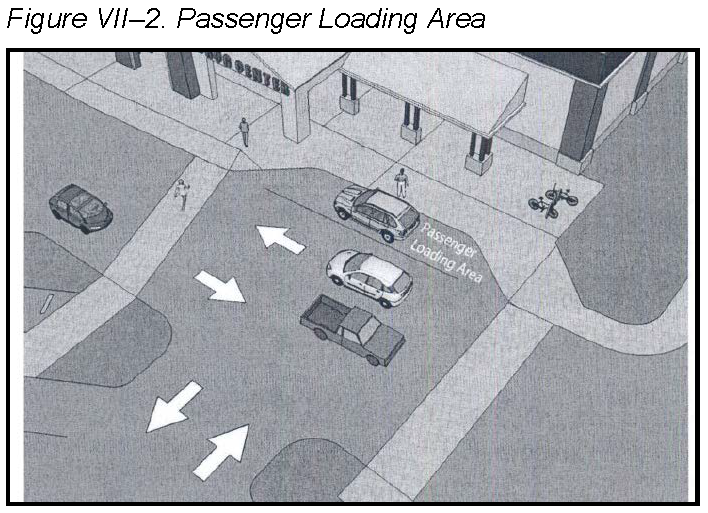
For commercial, civic, or institutional uses, passenger loading areas may be allowed on private lots outside of the normal circulation flow of traffic.
Sec. 21-7244. - Bicycle Parking Design Standards.
Required bicycle parking shall comply with the following standards:
(1)
Bicycle parking facilities shall be anchored to prevent easy removal.
(2)
The location of bicycle parking facilities shall be at least as convenient to the main entrance of the primary use as the most convenient automobile parking.
(3)
Bicycle parking facilities shall be located in a manner that does not impede pedestrian or vehicular circulation.
(4)
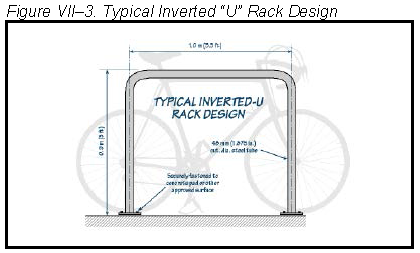
Bicycle rack design shall be of an inverted "U" design or other approved design by the city.
(5)
The ground surface surrounding and underneath the bicycle parking facility shall be surfaced in a manner to prevent mud and dust.
(6)
Each bicycle parking space shall be equipped with no less than two points of contact for a standard bicycle frame.
(7)
The bicycle parking facility shall be coated in a material that will not damage the bicycle's painted surfaces.
(8)
Fixed objects that are intended to serve as bicycle parking facilities, but due to design or other issues are not easily identified as bicycle parking facilities, shall be labeled as available for bicycles.
(9)
Trees, fences, light poles, branches, or other outdoor furnishings shall not be used as designated bicycle parking facilities.
Sec. 21-7400. - Design Criteria.
All private parks and open space lands required by the city shall meet the following standards:
(1)
Connected. To the maximum extent feasible, private parks and open space shall be organized to create integrated systems that connect with each other and with the following types of lands located within or adjacent to the development:
(a)
Public parks lands;
(b)
Dedicated school sites;
(c)
Other dedicated open spaces;
(d)
Portions of a regional trail and open space system;
(e)
Neighborhood shopping and activity centers; and
(f)
Adjacent employment centers.
(2)
Compact and Contiguous. Private parks and open space land shall be compact and contiguous unless the land is a continuation of a planned or existing greenbelt, trail, or other linear open space, or unless specific topographic features require a different configuration. In addition, it shall be designed to be a centralized location within the development.
(3)
Accessible. Private parks and open space shall be reasonably accessible to all of the residents of the development and to the general public at large. The city may restrict access if access would degrade, destroy, or adversely interfere with sensitive environmental or natural areas, cultural resources, or active agricultural operations.
(4)
Fences on Perimeter. Only open-style fences with a maximum height of 42 inches and uniform throughout the development shall be allowed on the perimeter of private parks and open space.
Sec. 21-7401. - Required Features.
Private parks and open space lands, other than open space lands preserved as natural features or areas, shall include trees, planting beds, courtyards, recreation or play areas. In addition, properties less than one acre in size shall provide not less than one active and one passive feature listed in the following table. Properties that are one acre or more in size shall provide not less than two passive and two active features. All features shall be constructed in accordance with applicable city standards. Other features not listed below may be approved by the director of parks and recreation.
Table VII-11. Active/Passive Features for Parks
Sec. 21-7402. - Maintenance.
(1)
The owner(s) of the property shall be responsible for maintenance of private parks and open space lands and the features and facilities located thereon, unless the city has agreed, in writing, to assume maintenance responsibilities.
(2)
A homeowner's association may be established for the purpose of providing the required maintenance. Homeowner's association agreements (including articles of incorporation, by-laws, and covenants) shall guarantee continuing maintenance of the applicable private park and/or open space.
Sec. 21-7410. - Applicability.
Neighborhood features lend a sense of place to a new community, thereby encouraging people to connect with their physical surroundings and interact with their neighbors. As a result, neighborhood features shall be required as a part of the platting process, with all residential developments containing 100 acres or 250 dwelling units, which ever is smaller, or as a part of the PUD Permit. Neighborhood features can be credited toward the required private open space requirement.
Sec. 21-7411. - Neighborhood Features.
The following list contains land uses and facilities that constitute neighborhood features. At its discretion, the city may accept as a neighborhood feature a land use or facility that is not listed below, provided such alternative serves the same focal point purpose and intent of the features listed below.
(1)
A developed park, provided such park contains a range of improvements such as multiple-use turf areas, parking areas, restrooms, playgrounds, walking paths, plazas, pavilions, picnic tables, benches, or other similar features for various age groups to enjoy, and is accessible to the public through connections to planned and existing trails adjacent to the development.
(2)
Outdoor amphitheaters or other assembly areas.
(3)
A private recreation facility, swimming pool, or community center.
(4)
Public revegetated, habitable, mature open space, greenbelts, or nature center.
(5)
A historic home, school, or farm used as a community center, museum, or education facility.
(6)
A pond, lake, or other sizable water feature.
(7)
Dog park.
Sec. 21-7412. - Location and Access.
Neighborhood features shall be located in an area and in such a manner as to be reasonably accessible to all of the residents of the development and to the general public at large, if allowed by the homeowners' association.
Sec. 21-7420. - General Trail Standards.
(1)
Alignment. Trails shall be aligned so as to preserve significant vegetation and topographic features to the maximum extent feasible.
(2)
Use and Maintenance. Trails dedicated as public rights-of-way shall be subject to all use and maintenance restrictions as deemed appropriate.
(3)
Structure Setback. All structures shall be setback a minimum of five feet from all trails and all trail property lines or easements.
(4)
Materials. Trails shall be constructed of materials approved by the city.
Sec. 21-7421. - Regional Trails.
Any person developing lands that have a trail alignment designated on the city's Prairieways Action Plan (trail plan) may be required by the City to construct the trail in compliance with the general standards set forth in this division, in addition to the standards contained in this section. Furthermore, the person developing the land shall dedicate the trail as a public right-of-way, or at the option of the city, grant an easement to the public for access over the trail.
(1)
Accessible. All regional trails shall be accessible to all pedestrians in conformance with the ADA.
(2)
Location. Such trails shall be in the alignment shown on the trail plan, unless an alternate alignment is deemed acceptable and approved by the city through the development review process.
(3)
Width. Regional trails shall have a minimum public right-of-way or public access easement width of 20 feet and a minimum constructed trail width of 12 feet, unless an alternate width is deemed acceptable and approved by the city through the development review process.
(4)
Standard and Schedule. Regional trails shall be constructed as depicted on the trail plan and as a part of the land development process, unless an alternate construction standard and construction phasing schedule is deemed acceptable and approved by the city through the development review process.
Sec. 21-7422. - Connector Trails.
(1)
Required Trails.
(a)
Any person developing land that is adjacent to an existing or planned regional trail may be required to dedicate, at the option of the city, either public right-of-way or grant a public easement for the construction of at least one connector trail for the purpose of providing connections to the regional trail from areas within the development. The exact number of required connector trails shall be determined by the city as part of the development review process.
(b)
Applicants shall also provide pedestrian connections for pedestrians and bicycles at or near mid-block where the block length exceeds the maximum block length required by article VI.
(c)
Pedestrian connections shall also be provided where cul-de-sacs or dead-end streets are permitted, to connect the ends of the streets together to other streets and/or to other developments.
(2)
Width. Connector trails shall have a minimum right-of-way width of ten feet and a minimum constructed width of six feet.
Sec. 21-7500. - Applicability.
These landscaping standards shall apply to all new development within the municipal boundaries of the city and natural area buffer zones. For purposes of this section, new development refers to the development of any lot, including the construction on any previously developed properties of building additions, additional structures, additional parking facilities or lots, vehicle drive areas or any other impervious surface.
Sec. 21-7501. - Landscape Upgrade.
(1)
Lawfully established landscaping conditions on developed sites which existed prior to the adoption of this land development code may be continued until such time as a change in gross floor area is requested, or when a change of use is proposed. Upon such increase or change, the existing landscaping shall be upgraded as provided in the Landscaping Upgrade table below if such landscaping does not already meet the requirements herein. For the purposes of this section, a change of use shall be deemed to occur when any of the following occurs as a result of changes proposed to an existing use or structure:
(a)
A new review process is required under the provisions of this land development code;
(b)
There is an alteration or change in square footage in the structure and/or use;
(c)
There is an alteration or change to the parking area requirements that results in expansion, excavation and/or resurfacing of the parking area; or
(d)
There is a substantial change proposed in drainage, circulation, landscaping, noise, or lighting at the site.
Table VII-12. Landscape Upgrades
*For the purposes of this table, outdoor display shall be treated as GFA.
(2)
The amount of landscaping necessary to satisfy the percentage of upgrade shall be calculated by first determining the total amount of landscaping required under the full provisions of this land development code. The upgrade percentage shall then be applied to the total to determine the extent of the required upgrade.
(3)
The landscaping upgrades required in the table above shall be accomplished in the following order of priority unless otherwise determined by the city:
(a)
Landscaping around the perimeter of the site adjacent to public rights-of-way.
(b)
Landscaping in required buffer areas.
(c)
Landscaping within the parking areas; then
(d)
Other landscaping interior to the site.
(4)
Exceptions. Single-family residences are required to upgrade the landscape area by 100 percent of base standard for any addition over 200 square feet.
Sec. 21-7502. - Landscape Standards Cumulative.
The landscape standards set forth in this division shall be cumulative in nature. As an example, the landscape plan of a parking lot that is located next to an arterial street must meet the parking lot landscape requirements in addition to the landscape requirements established for lots adjoining streets.
Sec. 21-7503. - Landscape Plans Required.
Landscape plans are required for the following development applications and are subject to the review procedures for the type of development application involved: conditional use permit, development plan, PUD permit, use-by-permit, variance, height exception, and zoning or rezoning.
Sec. 21-7504. - Approved Landscape Plan Compliance.
The landscaping, as planted, shall comply with the approved landscape plan. Amendments to an approved landscape plan must be approved in writing by the city.
Sec. 21-7505. - Guidelines for Approval.
The following guiding principles shall be made a part of any landscape plan submitted to the city:
(1)
Reinforces and extends any existing patterns of outdoor spaces and vegetation where practicable;
(2)
Supports functional purposes such as spatial definition, visual screening, creation of privacy, management of microclimate or drainage;
(3)
Enhances the appearance of the development and neighborhood;
(4)
Protects significant trees, natural systems and habitat;
(5)
Enhances the pedestrian environment;
(6)
Identifies all landscape areas and all landscaping elements within each landscape area;
(7)
Contains plants that are well suited for healthy growth along the Colorado front range;
(8)
Supports water efficiencies by using plants from the City's approved plant list and appropriate irrigation techniques, as outlined in Sec. 21-7512; and
(9)
Meets or exceeds the standards of this land development code and the requirements contained in the city's approved plant list and landscaping specifications document.
(Ord. No. 2579, § 2(Exh. A), 8-19-2024)
Sec. 21-7510. - Landscape Areas.
(1)
Definition. Landscape areas shall include all areas on a site that are not covered by buildings, structures, paving or impervious surface, except outdoor space that is located in an agricultural zone district and maintained in active agricultural use or single-family residential properties. For single-family residential properties, the landscape area is limited to the front yard and any side yard on a street, park, or other open space.
(2)
Elements Permitted in Landscape Areas. Landscape areas may include the following elements:
(a)
Turf grass. High-use areas should be planted with irrigated turf grass, non-irrigated, shortgrass prairie grasses, native grasses, or other adapted grasses affiliated with Xeric landscaping, may be established in all other areas.
(b)
Planting beds. Shrub and ground cover planting beds shall be separated from turf grass with edging, curbing, or stone borders and shall have open surface areas covered with mulch.
(c)
Detention and Retention Ponds. Detention and retention ponds may be used as long as they are physically, functionally, and visually integrated into landscape uses through the use of topography, building and parking lot placement, plantings, permanent water features, recreational or open space amenities, or other methods. Slopes shall not exceed a 4:1 ratio or be flatter than 2 percent.
(d)
Drainage Zones. Areas that are irrigated by runoff water and that may support wetlands and native species adapted to riparian conditions. All drainage conveyance, detention, and retention areas should be landscaped using xeric plant material to reduce irrigation water use and encourage habitat development.
(e)
Hardscape. Landscape areas also may include, by way of example but not by way of limitation, the following areas: plazas, basketball courts, pools, tennis courts, playgrounds, or similar recreational areas or uses. Vehicle drive or parking areas shall not be considered hardscape.
(f)
Tree lawns. Tree lawns landscaped in connection with development in accordance with the standards contained in this land development code. Tree lawns may contain xeric plant material in accordance with the approved plant list.
(g)
Low Impact Development. Landscape areas are encouraged to follow low impact development principles.
(3)
Elements Required in Residential Landscape Areas. Residential developments shall install landscaping elements as follows:
Table VII-13. Residential Development Landscape Requirements
*If lot is on a corner, double the required number of trees and shrubs.
**For lots greater than 24,000 square feet in size, double the required number of trees and shrubs in front and side yard.
(4)
Elements Required in Mobile Home Parks. The following elements are required in addition to any other zone district requirements found in section 21-4320 (Mobile Home Park District). A mobile home park shall provide a permanent and maintained landscaped area at least 25 feet in width around those portions of the park perimeter (exterior property lines) that border public rights-of-way. A six-foot solid wall or opaque fence may be provided in the said landscaped area. The wall or fence shall be setback a distance not less than 25 feet from the exterior property lines that border public rights-of-way. The area between the wall or fence and the exterior property lines shall be landscaped with a mixture of evergreen and deciduous plantings. The mobile home park perimeters that do not border rights-of-way shall meet residential buffer zone requirements as provided in the Landscape Regulations. Additional landscaping may be required based on the specific layout of the park. Each mobile home lot shall be provided with at least one tree. The property owner shall be responsible for the installation and continual maintenance of the required landscaping.
(5)
Elements Required in Nonresidential Landscape Areas. Nonresidential developments shall install landscaping elements as follows:
Table VII-14. Nonresidential Development Landscape Requirements
(6)
Elements Required in Mixed Use Developments. All developments 1 acre or greater in size shall be required to dedicate 15 percent of the lot to landscaping including, without limitation, landscape buffers, seating areas, natural walking paths separate from sidewalks, and so on.
(7)
Optimal Landscape Concepts and Approval. In reviewing the required landscape plan, the city shall have the authority to approve the optimum placement and interrelationship of required landscape plan elements such as trees, vegetation, turf, irrigation, screening, buffering and fencing, based on the following criteria:
(a)
Protecting existing trees, natural areas and features;
(b)
Enhancing visual continuity within and between neighborhoods;
(c)
Providing tree canopy cover;
(d)
Creating visual interest year-round;
(e)
Complementing the architecture of a development;
(f)
Providing screening of areas of low visual interest or visually intrusive site elements;
(g)
Establishing an urban context within mixed-use developments;
(h)
Providing privacy to residents and users;
(i)
Conserving water;
(j)
Avoiding reliance on excessive maintenance;
(k)
Promoting compatibility and buffering between and among dissimilar land uses; and
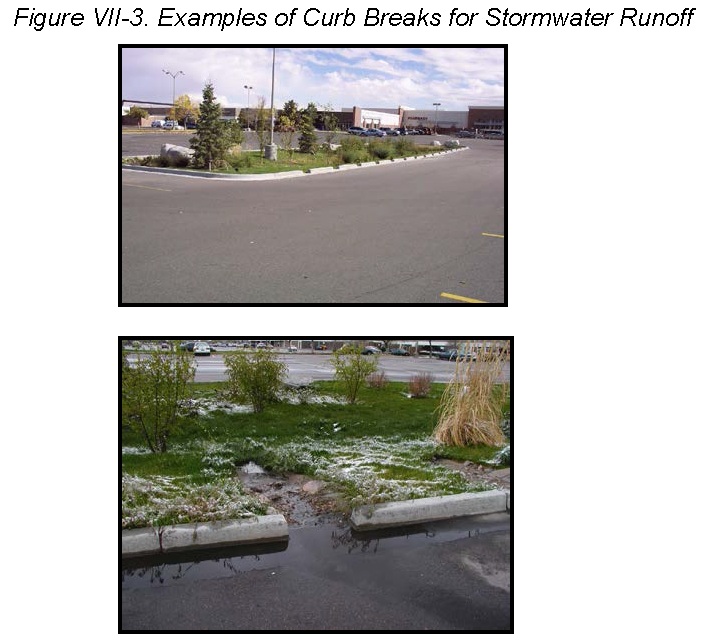
(l)
Utilizing curb breaks to capture runoff water as shown below:
(Ord. No. 2579, § 2(Exh. A), 8-19-2024)
Sec. 21-7511. - Water Conservation Requirement.
All landscaping plans shall be designed to incorporate water conservation materials and techniques. Xeriscape landscaping is encouraged but does not include or allow artificial turf or plants, mulched (including gravel) beds or areas without landscape plant material, paving of areas not required for walkways, plazas or parking lots, bare ground, weed covered or infested surfaces, or any landscaping that does not comply with the standards of this section. Smart-water conservation landscaping principles include the following techniques:
(1)
Grouping plants with similar water requirements together on the same irrigation zones;
(2)
Limiting high-irrigation turf and plantings to appropriate high-use areas with high visibility and functional needs;
(3)
Use of low-water demanding plants and turf where practicable;
(4)
Use of efficient irrigation systems;
(5)
Incorporation of soil improvements;
(6)
Use of mulches; and
(7)
Provision of regular and attentive maintenance.
Sec. 21-7512. - Irrigation Required.
All landscape areas shall include adequate, permanent, automatic irrigation of all plant material, except certified xeric landscaping that does not require permanent irrigation for survival once established. In such case, the landscape plan must provide for temporary irrigation to ensure the proper establishment of the xeric elements.
If the landscape plan contains at least 51% xeric materials, the following shall apply:
(1)
Automatic irrigation zones shall be retrofitted to water the remaining grass adequately and irrigate the new landscape efficiently;
(2)
Drip irrigation is preferred. If overhead sprays are used, high-efficiency nozzles shall be required. Hand water and semi-automatic irrigation is permissible; and
(3)
Trees shall have dedicated irrigation.
(Ord. No. 2579, § 2(Exh. A), 8-19-2024)
Sec. 21-7513. - General Landscape Materials, Maintenance, and Replacement Standards.
(1)
Topsoil. To the maximum extent feasible, topsoil that is removed during construction activity shall be conserved for later use on areas requiring re-vegetation and landscaping.
(2)
Soil Amendments. The soil in areas that have been compacted or disturbed during construction or other activities shall be thoroughly loosened. Organic soil amendments shall also be thoroughly incorporated into the soil at a rate of a minimum of five cubic yards per one thousand square feet of landscape area and be tilled to a depth of at least six inches. Soil amendments shall be required in xeric landscaping areas that are cleared and set to hold plant material, the use of glyphosates and neonicotinoids is prohibited.
(3)
Plant Materials. Plant materials should be selected from the city's approved plant list and landscaping specifications. Prohibited species referenced in these specifications are not allowed in the city.
(4)
Plant Quality. All plants shall be A-Grade or No. 1 Grade, free of any defects, and shall be of normal health, height, leaf density, and spread appropriate to the species as defined by American Association of Nurserymen Standards.
(5)
Plant Size. The caliper of deciduous trees shall be measured six inches above the base. Plant material sizes shall meet the following requirements of table VII-15:
Table VII-15. Minimum Plant Size Requirements
(6)
Grading. Prior to the installation of the required landscaping and irrigation, all proposed landscape areas shall be graded to allow for proper site drainage.
(7)
Installation. All landscaping shall be installed according to sound horticultural practices in a manner designed to encourage quick establishment and healthy growth. All landscaping in each phase shall either be installed or the installation shall be secured with a letter of credit, escrow or performance bond for 125 percent of the value of the landscaping prior to the issuance of a certificate of occupancy for any building in such phase.
(8)
Maintenance. Trees and vegetation, irrigation systems, fences, walls and other landscape elements shall be considered as elements of the project in the same manner as parking, building materials and other site details. The applicant, landowner or successors in interest shall be jointly and severally responsible for the regular maintenance of all landscaping elements in good condition. All landscaping shall be maintained free from disease, pests, weeds and litter, and all landscape structures such as fences and walls shall be repaired and replaced periodically to maintain a structurally sound condition.
(9)
Replacement. Any landscape element that dies or is otherwise removed shall be promptly replaced based on the requirements of this land development code.
(Ord. No. 2579, § 2(Exh. A), 8-19-2024)
Sec. 21-7514. - Tree Standards.
(1)
Identification. All existing street trees that are located on city rights-of-way abutting the development shall be accurately identified by species, size, location and condition on required landscape plans, and shall be preserved and protected in accordance with the standards below.
(2)
Tree Planting. All developments shall establish tree lawns and canopies along all city streets, in and around parking lots, and in all landscape treatment areas in order to establish at least a partial urban tree canopy. Trees within a tree lawn shall be of a species denoted in the approved plant list as being appropriate for public rights-of-way. These trees may also be combined or interspersed with other landscape areas in remaining portions of the development to accommodate views and functions such as active recreation and storm drainage. A root barrier is required along all concrete sidewalks, curbs, and the portions of driveways that are within public rights-of-ways.
(3)
Tree Grates. Where trees are planted in paved areas, such as patios, pedestrian plazas, or sidewalks, a protective tree grate shall be provided.
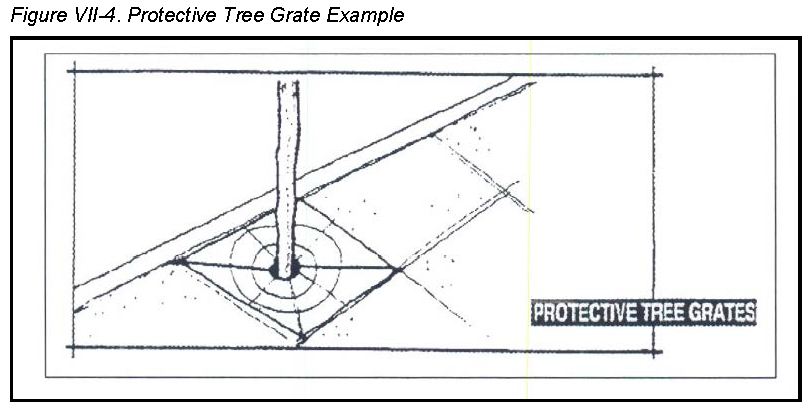
(4)
Significant Trees. Existing significant trees (greater than eight inches in caliper) shall be preserved to the maximum extent feasible and may help satisfy the landscaping requirements set forth above. Such trees shall be considered "protected" trees within the meaning of this section, subject to the exceptions contained in subsection (c) below. Streets, buildings, and lot layouts shall be designed to minimize the disturbance to significant existing trees. All required landscape plans shall accurately identify the locations, species, size, and condition of all significant trees, each labeled showing the applicant's intent to either remove, transplant, or protect.
(a)
Replacement. A significant tree that is removed shall be replaced with trees sufficient to mitigate the loss of value of the removed significant tree. The applicant shall select a qualified landscape appraiser to determine such loss based upon an appraisal of the tree to be removed by using the most recent published methods established by the Council of Tree and Landscape Appraisers. Replacement trees shall be planted on the development site and shall meet the following minimum size requirements:
Table VII-16. Replacement Tree Minimum Size Requirements
(b)
Protection. The following tree protection specifications should be followed to the maximum extent feasible for all projects with protected existing trees:
(i)
Within the drip line of any protected existing tree, there shall be no cut or fill over a four-inch depth unless a qualified arborist or forester has evaluated and approved the disturbance.
(ii)
Prior to and during construction, barriers shall be erected around all protected existing trees with such barriers to be of orange fencing a minimum of four feet in height, secured with metal T-posts, no closer than six feet from the trunk or ½ of the drip line, whichever is greater. There shall be no storage or movement of equipment, material, debris or fill within the fenced tree protection zone.
(iii)
Large property areas containing protected trees and separated from construction or land clearing areas, road rights-of-way and utility easements may be ribboned off, rather than erecting protective fencing around each tree as required in subsection (b)(ii) above. This may be accomplished by placing metal t-post stakes a maximum of 50 feet apart and tying ribbon or rope from stake-to-stake along the outside perimeters of such areas being cleared.
(iv)
During the construction stage of development, the applicant shall prevent the cleaning of equipment or material or the storage and disposal of waste material such as paints, oils, solvents, asphalt, concrete, motor oil or any other material harmful to the life of a tree within the drip line of any protected tree or group of trees.
(v)
No damaging attachment, wires, signs or permits may be fastened to any protected tree.
(vi)
The installation of utilities, irrigation lines, or any underground fixture requiring excavation deeper than 6 inches shall be accomplished by boring under the root system of protected existing trees at a minimum depth of 24 inches. The auger distance is established from the face of the tree (outer bark) and is scaled from tree diameter at breast height, as described in the chart below.
Table VII-17. Auger Distance for Excavation
(c)
Exceptions. Trees that meet one or more of the following removal criteria shall be exempt from the requirements contained in this subsection (4):
(i)
Dead, diseased, or naturally fallen trees, or trees found to be a threat to public health, safety or welfare;
(ii)
Trees that are determined by the city to substantially obstruct clear visibility at driveways and intersections; or
(iii)
Tree species that constitute a nuisance to the public such as cotton-bearing cottonwood, Siberian or Chinese elm, Russian olive and female box-elder. Native cotton-bearing cottonwood trees and female box-elder trees, when located in a natural area buffer zone, are not nuisance tree species.
(Ord. No. 2579, § 2(Exh. A), 8-19-2024)
Sec. 21-7515. - Prohibited Practices and Elements.
(1)
Monoculture. The extensive use of a single species of trees or shrubs shall be limited as outlined in the table below to minimize the potential for disease or pests to strike a particular species resulting in significant same-species loss:
Table VII-18. Monoculture Restrictions
(2)
Undesirable Design. The use of undersized landscape materials or landscape in an unnatural spaced design is highly discouraged, unless specifically addressed in this land development code.
(3)
Fruit trees are prohibited in tree lawns, rights-of-way, medians, and landscape islands.
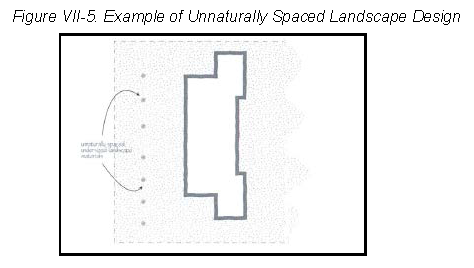
(4)
Artificial Turf. Partial or entirely synthetic material designed and manufactured to simulate living turf grass shall be prohibited, with the exception of public or private recreation fields.
(Ord. No. 1887, July 2012; Ord. No. 2579, § 2(Exh. A), 8-19-2024)
Sec. 21-7516. - Buffering Between Incompatible Uses and Activities.
(1)
Buffer Zones. Buffer zones are required on properties in the MHP, R-3, R-4, C-1, C-2, C-3, MU-1, I-1, I-2, and I-3 districts when they adjoin properties in certain zoning districts as set forth in the table below. The second table specifies the requirements for each buffer zone type listed in the first table.
Table VII-19. Buffer Requirements by Zoning District or Use
(a)
For purposes of this section, an adjacent zoning district or land use, as described above, includes all zoning districts or land uses on properties abutting the subject property. Where the property shares a boundary with more than one zone district, the width of the most intense buffer shall be required along that particular property line.
(b)
When agricultural districts are considered for buffer requirements, the future land use designation in the Comprehensive Plan shall be used to determine buffer requirements, unless otherwise specified herein.
(c)
Trees and shrubs planted as part of the buffer requirement cannot be used to meet any other landscaping requirement in this land development code.
(d)
The existence of access ways or driveways within a buffer zone will not reduce the minimum requirements for trees and shrubs.
(e)
Evergreen trees are required for buffer zone Types B and C, while either deciduous or evergreen trees may be used in buffer zone Type A.
(f)
All areas of the buffer zones outside of trees, shrubs, and/or flowerbeds shall be covered with a city-approved mulch.
(g)
The buffer zone requirements of this section apply whether or not the property in the adjacent zoning district as set forth in the first table is developed.
(h)
For reasons of conflicting uses, unfavorable topography, or other unique or extraordinary circumstances, the director may increase or decrease landscape plantings in any required buffer zone if any increase or decrease is found to be necessary to reasonably achieve the intent of this section.
(2)
Types of Buffering.
(a)
In situations where the city determines that the arrangement of uses or design of buildings does not adequately mitigate conflicts reasonably anticipated to exist between dissimilar uses or building designs, one or more of the following landscape buffering techniques shall be used to mitigate the conflicts.
(i)
Separation and Screening with Plant Material. Planting groups of evergreen trees, canopy shade trees, ornamental trees, or shrubs;
(ii)
Integration with Plantings. Incorporating trees, vines, planters, or other plantings into the architectural theme of buildings and their outdoor spaces to subdue differences in architecture and bulk and avoid harsh edges;
(iii)
Establishing Privacy. Establishing vertical landscape elements to screen views into or between windows and defined outdoor spaces where privacy is important, such as where larger buildings are proposed next to side or rear yards of smaller buildings;
(iv)
Visual Integration of Fences or Walls. Providing plant material in conjunction with a screen panel, arbor, garden wall, privacy fence or security fence to avoid the visual effect created by unattractive screening or security fences;
(v)
Landform shaping: Utilizing berming or other grade changes to alter views, subdue sound, change the sense of proximity and channel pedestrian movement.
(b)
Buffers may be interrupted for necessary pedestrian access, and in some cases for vehicular movement.
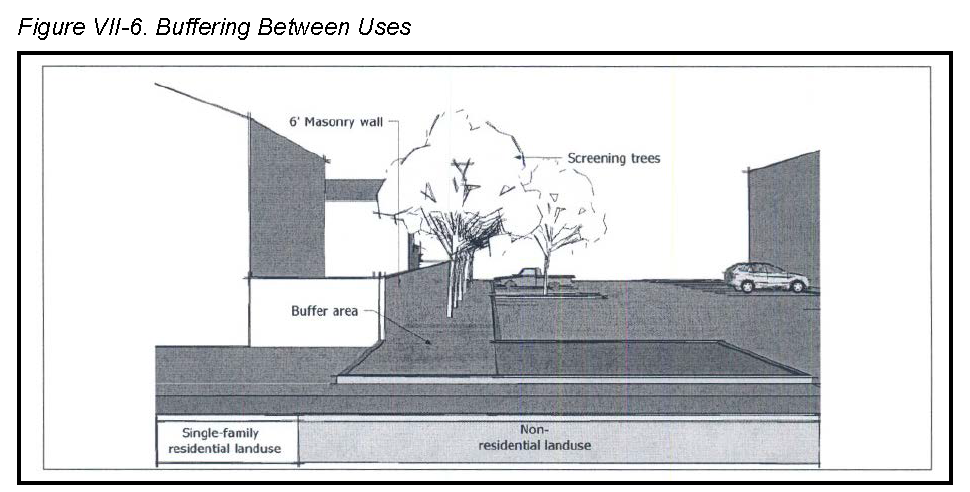
Sec. 21-7517. - Screening.
(1)
Screening Areas of Low Visual Interest. Areas of low visual interest or visually intrusive site elements (such as trash collection, open storage, service areas, drive-aisles, drive-up/drive-through lanes, and utility equipment) shall be screened from off-site view. Such screening shall be established on all sides of such elements except where an opening is required for access.
(2)
Methods. Required screening shall be provided in the form of new or existing plantings, walls, fences, screen panels, topographic changes, buildings, horizontal separation, or a combination of these techniques.
Sec. 21-7518. - Utilities.
Landscape and utility plans shall be coordinated. This section sets forth minimum dimension requirements for the most common tree/utility separations. Exceptions to these requirements may be approved by the director where utilities are not located in their standard designated locations. Tree/utility separations shall not be used as a means of avoiding the planting of required street trees.
(1)
Forty feet between shade trees and streetlights. Fifteen feet between ornamental trees and streetlights (see figure VII-7).
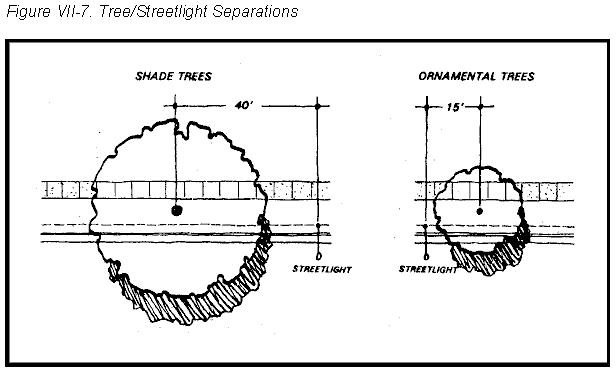
(2)
Ten feet between trees and water or sewer mains.
(3)
Six feet between trees and water or sewer service lines.
(4)
Four feet between trees and gas lines.
(5)
Street trees planted within the utility easement may conflict with utilities. Additional conduit may be required to protect underground electric lines.
Sec. 21-7519. - Visual Clearance or Sight-Distance Triangle.
Except as specifically provided below, a visual clearance triangle free of any structures or landscape elements over 24 inches in height, shall be maintained at street intersections and driveways in conformance with the standards contained in the ECSS.
(1)
Fences shall not exceed 42 inches in height and shall be of an open design.
(2)
Deciduous trees may be permitted to encroach into the clearance triangle provided that the lowest branch of any such tree shall be at least six feet from grade.
(3)
Street trees shall be placed a minimum of eight feet from the corners of alleys and driveways and ten feet from intersections.
Sec. 21-7520. - Revegetation Required.
When the development causes any disturbance within any natural area buffer zone, the developer shall restore the land to its original condition, or as close thereto as possible, as determined by the city.
Sec. 21-7530. - Detention/Retention Areas.
The landscaping of detention and retention ponds shall be in accordance with the City's Storm Drainage Design and Technical Criteria Manual.
(Ord. No. 2579, § 2(Exh. A), 8-19-2024)
Sec. 21-7531. - Landscaping on Slopes.
(1)
Slope banks 5 feet or greater in vertical height with slopes between 1.5:1 and 2:1 shall, at a minimum, be irrigated and landscaped with an appropriate groundcover for erosion control.
(2)
Slope banks five feet or greater in vertical height with slopes greater than or equal to 3:1 shall, at a minimum, be irrigated and landscaped with appropriate groundcover for erosion control and to soften their appearance as follows:
(a)
One 15-gallon or larger tree per each 600 square feet of slope area;
(b)
One gallon or larger shrub for each 100 square feet of slope area; and
(c)
Appropriate groundcover.
(3)
Slope banks in excess of 8 feet in vertical height with slopes greater or equal to 2:1 shall also provide one 5-gallon or larger tree per each 1,000 square feet of slope area in addition to the requirements of this section.
(4)
All trees and shrubs should be planted in staggered clusters to soften and vary the slope plane. Slope planting required by this section shall include a permanent irrigation system to be installed by the developer prior to occupancy.
Sec. 21-7532. - Urban Hardscapes.
In certain situations and contexts, a more urban landscape may be proposed to meet the intent of this land development code. For developments that strive to achieve an urban context through the use of setbacks, site planning, architecture, etc. the following alternative landscape treatments exist: trees in tree grates, flower pots or hanging baskets, movable planters, sculptures, canopies, trellises, brick pavers, tile walkways, murals, or water features are identified as acceptable landscape (hardscape) features and recognized as acceptable substitutes to existing landscaping standards.
Sec. 21-7540. - Perimeter Landscaping.
(1)
Except for single-family residential development, the perimeter of parking areas shall be landscaped with at least 1 tree and 5 shrubs for every 30 linear feet along a street, right-of-way, or abutting another property. Additionally, unless a wider landscape buffer is required by Table VII-19, Buffer Requirements by Zoning District or Use, where a parking area abuts a parking area on an adjoining property or a collector street, a landscape buffer at least 10 feet deep is required; where a parking area abuts a local street, a landscape buffer at least 5 feet deep is required; and where a parking area abuts an arterial street, a landscape buffer at least 15 feet deep is required. Perimeter parking area landscaping may be included with other buffer requirements, as applicable.
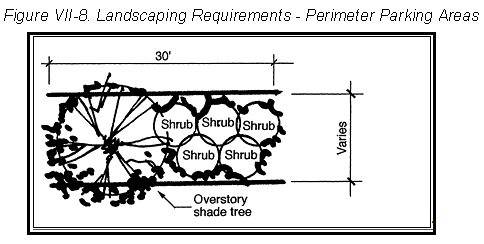
(2)
Trees may be spaced irregularly in informal groupings or be uniformly spaced, as consistent with larger overall planting patterns and organization.
(Ord. No. 1785, June 2010)
Sec. 21-7541. - Interior Landscaping.
Parking lots that have interior rows of parking spaces shall comply with the provisions of this section.
(1)
Landscaping Requirements.
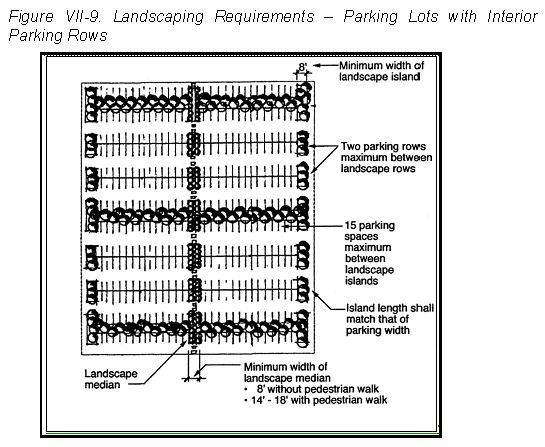
(a)
Visibility. To avoid landscape material blocking driver sight distance at driveway-street intersections, no plant material greater than 24 inches in height shall be located within 15 feet of a curb cut.
(b)
Maximized Area of Shading. Landscaped islands shall be evenly distributed to the maximum extent feasible.
(c)
Landscaped Islands. In addition to any pedestrian refuge areas, each landscaped island shall include 1 or more canopy shade trees, be of length greater than 8 feet in its smallest dimension, include at least 80 square feet of ground area per tree to allow for root aeration, and have vertical concrete curbs. In addition:
(i)
Landscape islands shall have at least one tree per single parking row and two trees per double parking row. Shade trees shall comprise at least 75 percent of the trees within the landscape islands.
(ii)
Landscape islands shall contain either mulch with at least six shrubs per single parking row and twelve shrubs per double parking row, or an alternative design consisting of shrubs, flowers, or other xeric plant material. All plant materials shall be from the approved plant list.
(iii)
There shall be no more than 15 continuous parking spaces between landscape islands.
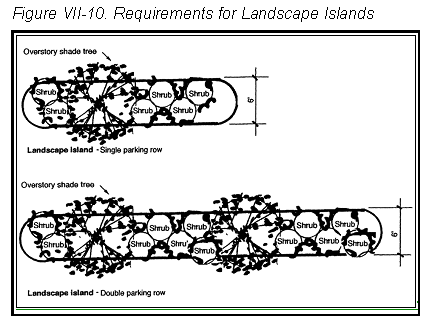
(d)
Landscape Medians. Interior rows of parking spaces in parking areas shall be divided by landscape medians parallel to the parking rows, so that there are no more than six consecutive rows of parking spaces not adjacent to a landscape median. See figure VII-9. Additionally:
(i)
Landscape medians shall have minimum dimensions of 8 feet without a pedestrian walk, or 14 to 18 feet, depending on the design, with a pedestrian walk by the length of the row of parking spaces.
(ii)
Landscape medians shall have at least one overstory/shade tree and 5 shrubs for every 30 linear feet along the length of the median. Overstory/shade trees shall comprise at least 75 percent of the trees within the landscape medians.
(iii)
Landscape medians shall contain mulch, native grasses, or xeric plant material from the approved plant list.
(iv)
A minimum of one concrete pedestrian walk, six to eight feet wide, depending on the location and design and determined by the city, shall be provided along the length of the landscape median closest to the building entrance. The walk shall connect to perimeter pedestrian walks, whenever possible, and include raised or striped crosswalks.
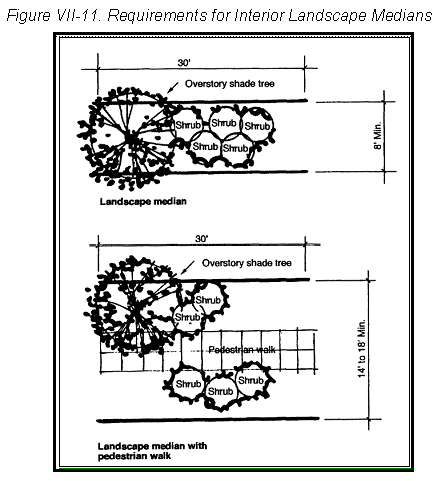
(2)
Walkways and Driveways. Connecting walkways through parking lots shall have 1 canopy shade tree per 30 lineal feet of such walkway planted in landscape areas within 5 feet of such walkway. Driveways through or to parking lots shall have 1 canopy shade tree per 30 lineal feet of and along each side of such driveway, in landscape areas within 5 feet of such driveway.
(3)
Parking Bays. Parking bays shall extend no more than 15 parking spaces without an intervening tree, landscape island, or landscape peninsula.
(Ord. No. 2579, § 2(Exh. A), 8-19-2024)
Sec. 21-7542. - Parking Lot Screening.
Parking lots with six or more spaces shall be screened from abutting uses and from the street. Screening from residential uses shall consist of a fence or wall 3 feet in height in combination with plant material and of sufficient opacity to block at least 75 percent of light from vehicle headlights. Screening from the street and all nonresidential uses shall consist of a wall, fence, planter, earthen berm, plant material, or a combination of such elements, each of which shall have a minimum height of 36 inches. Such screening shall extend a minimum of 70 percent of the length of the street frontage of the parking lot and also 70 percent of the length of any boundary of the parking lot that abuts any nonresidential use. Openings in the required screening shall be permitted for such features as access ways or drainage ways. Plant material used for the required screening shall achieve required opacity in its winter seasonal condition within three years of construction of the vehicular use area to be screened.
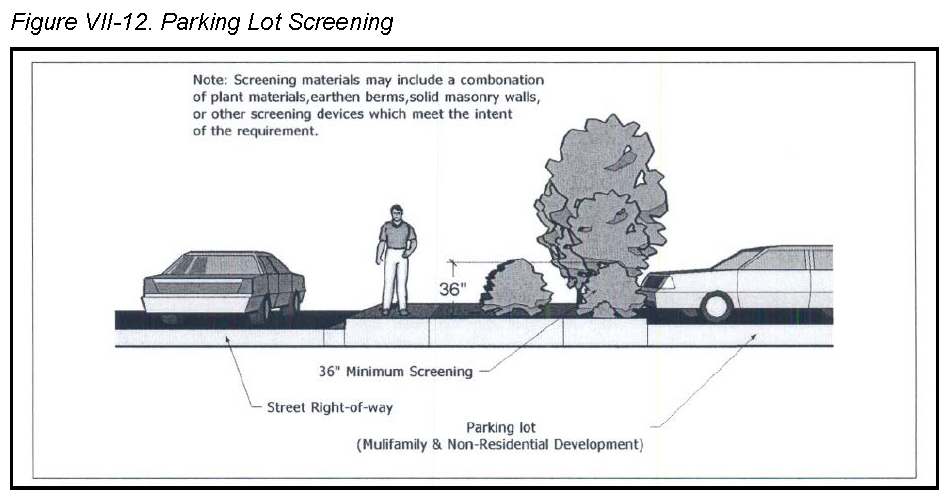
Sec. 21-7550. - Requirements for Landscaping in or Near Rights-of-Way.
(1)
Tree lawns shall be maintained by the owner of the property adjacent to the tree lawn.
(2)
Wherever the sidewalk is separated from the street by a tree lawn, canopy shade trees shall be planted at 30- to 40-foot intervals (spacing) in the center of all such tree-lawn areas.
(3)
In cases where the sidewalk meanders, grouping or clustering of trees may be allowed provided that the total number of trees are achieved.
(4)
Wherever the sidewalk is attached to the street, canopy shade trees shall be established in an area ranging from 3 to 7 feet behind the sidewalk at 30- to 40-foot spacing.
(5)
Wherever the sidewalk is attached to the street and is 10 feet or more in width, or extends from the curb to the property line, canopy shade trees shall be established in planting cutout areas of at least 16 square feet at 30- to 40-foot spacing.
(6)
Ornamental trees shall be planted in substitution of the canopy shade trees where overhead lines and fixtures prevent normal growth and maturity.
(7)
The tree lawn planting design shall consist of turf grass or xeric plant material and shall include an irrigation system appropriate for the planting design. Tree lawn planting designs in industrial areas may propose planting designs other than turf grass.
(8)
Trees must be planted in the center of the planting strip measured from the front of the sidewalk and back of the curb.
(9)
No street tree shall be planted closer to the street than two and a half feet from the back of the sidewalk. No tree planting shall be permitted where the distance between a curb and a detached sidewalk is less than five feet.
(10)
Larger maturing trees should be placed 40 feet apart and smaller maturing trees may be placed 30 feet apart. The director may require wider spacing if necessary for development of the tree or for safe use of the street or sidewalk. When space is limited or to achieve certain design effect, closer spacing may be considered.
(11)
No tree shall be planted closer than eight feet from any driveway or alley nor shall a tree be planted in such a manner than its eventual growth cannot be reasonably controlled so as to avoid interference with or obstruction to any improvements installed for public benefit.
(Ord. No. 2579, § 2(Exh. A), 8-19-2024)
Sec. 21-7551. - Northern Range Streetscapes.
The city has adopted corridor plans that provide design standards and guidelines for specified streetscapes within the city. These corridor plans shall be used in conjunction with this land development code. In the event of a conflict or inconsistency between these documents, the city shall determine which document controls. The corridor plans include:
(1)
East 96th Avenue
(2)
East 104th Avenue
(3)
East 120th Avenue
(4)
Highway 2
(5)
High Plains Parkway
(6)
Tower Road
Sec. 21-7552. - Right-of-Way that also is a State or Federal Highway.
This section is intended to provide as close to the full arterial landscaping requirement as allowed or recommended by the Colorado Department of Transportation (CDOT).
(1)
If curb and gutter is to be installed within the right-of-way with the development, full arterial right-of-way landscaping standards shall apply.
(2)
If curb and gutter is to be installed in the future, but not as part of this development as determined by the city, the applicant shall identify the clear zone on all plans and provide information on the plan as required under a final landscape plan to identify which portions of the full arterial standards will be installed with the development and for which portions the developer will pay cash in lieu.
(3)
If curb and gutter shall not be installed in the future as determined by the Public Works Department, the applicant shall provide information on the plan as required under a final landscape plan to identify the clear zone as defined and regulated by CDOT. Outside the clear zone, the applicant shall be required to install trees and shrubs in the quantities required per this code. The applicant will provide irrigated turf in the right-of-way outside the clear zone. The applicant shall also seed the right-of-way clear zone, using a suitable grass seed mixture and temporary irrigation until final acceptance by the city.
(4)
If full arterial landscaping is not to be installed in conjunction with the development or redevelopment public improvement construction, it shall be completed by the city at a later time. In the event of such deferment, the applicant shall seed the right-of-way, or any portion thereof, to ensure a viable grass stand using a suitable grass seed mixture and temporary irrigation and establish and maintain all such areas until final acceptance by the city. The applicant shall deposit with the city the dollar value of the required landscaping and other public improvements for future construction.
Sec. 21-7560. - Alternative Compliance.
Upon request by an applicant, the city may approve an alternative landscape plan that may be substituted in whole or in part for a landscape plan meeting the standards of this article.
(1)
Procedure. Alternative landscape plans shall be prepared and submitted in accordance with submittal requirements for landscape plans. Each plan shall clearly identify and discuss the modifications and alternatives proposed and the ways in which the plan will better accomplish the purposes of this article than would a plan which complies with the standards of this article.
(2)
Approval Criteria. To approve an alternative plan, the decision maker must first find that the proposed alternative plan accomplishes the purposes of this division equally well or better than would a plan which complies with the standards of this division.
(3)
Review Considerations. In reviewing the proposed alternative plan for purposes of determining whether it accomplishes the purposes of this Section as required above, the decision maker shall take into account whether the alternative preserves and incorporates existing vegetation in excess of minimum standards, protects natural areas and features, maximizes tree canopy cover, enhances neighborhood continuity and connectivity, fosters non-vehicular access, or demonstrates innovative design and use of plant materials and other landscape elements.
Sec. 21-7561. - Variances.
An administrative variance not to exceed 50 percent of any requirement contained in this article may be granted by the director in accordance with the provisions of in section 21-3215 (Minor Modifications). If a variance exceeding 50 percent is sought, a variance from the board of adjustment must be obtained in accordance with section 21-3222 (Variances).
(Ord. No. 2158, December 2018)
Sec. 21-7600. - Guidelines for Development.
All new principal buildings should strive to meet the following goals.
(1)
Environmentally Friendly. The city encourages sustainable development and green building practices to help balance growth with protection of our region's valuable natural resources. Green building, or sustainable building, is defined by the city as design, construction, and operation practices that significantly reduce resource consumption and environmental impacts through:
(a)
Sustainable site planning;
(b)
Energy efficiency;
(c)
Water conservation;
(d)
Waste minimization;
(e)
Pollution prevention;
(f)
Using resource-efficient materials;
(g)
Providing enhanced indoor environmental quality for occupants.
(2)
Low Impact. Low-impact development (LID) is an approach to land development that focuses on how stormwater runoff enters a site, is stored on-site, and leaves a site. Land development that incorporates LID practices minimizes impervious surface, protects and enhances native vegetation and soils, and manages stormwater at its source. The city encourages LID and can provide a number of tools to make it easier to use an LID approach.
(3)
Outdoor Dining. Colorado's mild climate allows individuals to enjoy outdoor areas throughout the year. To maximize the opportunities to enjoy the climate, owners of eating establishments are encouraged to provide outdoor dining areas for their patrons.
(4)
Solar. The city encourages all developments to create site designs that are oriented to provide the maximum advantage of sunlight.
(5)
Crime Prevention. New development site planning is encouraged to integrate the principles of Crime Prevention through Environmental Design (CPTED) to the maximum extent feasible. Applicants are encouraged to consult with the city's police and planning departments regarding implementation of CPTED principles to developments. These principles include the following:
(a)
Territoriality. Space within the development and along the edges should be well defined and delineated to create a sense of ownership, such that intruders and strangers stand out. This may be accomplished through the use of pavement treatments, landscaping, art, signage, screening, fencing, and similar techniques.
(b)
Natural Surveillance. Create an environment where it is possible for people engaged in their normal behavior to observe the spaces around them. Maximize a space's visibility through thoughtful design of building orientation, window placement, entrances and exits, landscaping of trees and shrubs, and other physical obstructions. Utilize nighttime illumination of parking lots, walkways, entrances, stairwells, and related areas that promote an environment in which natural surveillance is possible.
(c)
Access Control. Plan and implement access control to restrict criminal intrusion, especially in areas where criminal activity cannot be easily observed. Access control may include, but is not limited to, use of fences, walls, landscaping, and lighting to prevent or discourage public access to or from dark or unmonitored areas. In addition, sidewalks, pavement, lighting, and landscaped areas should be used to guide the public to and from primary development entrances and exits.
(d)
Activity Support. Create activity support by placing new or existing activities in an area so that individuals engaged in a particular activity become part of the natural surveillance of other areas. For example, picnic areas may be located next to tot lots, not away from such areas, to assist in observation of children at play.
(e)
Maintenance. Maintain landscaping, lighting fixtures, and other features to facilitate the principles of CPTED, territorial reinforcement, natural surveillance, graffiti control, and access control.
(6)
Universal Design. Wherever possible, primary structures for residential use are strongly encouraged to incorporate elements of "universal design," such that the structure may be accessible to persons of all ages and abilities for the life of the structure. For example, dwelling units may be designed with at least one no-step entrance, wider interior doorways and hallways, wall reinforcement in bathrooms, and accessible environmental controls and light switches.
Sec. 21-7601. - General Standards.
All new principal buildings shall meet the following standards, unless more specific building standards are set forth elsewhere in this land development code.
(1)
Visual Interest. All buildings shall create visual interest in ways that are compatible with the architectural character of the surrounding area through the use of similar elements such as rooflines, materials, colors, fenestration. In addition, all sides of a building shall have architectural visual interest (three hundred sixty-degree architecture). This standard shall apply to all new buildings that are part of an existing development, including development in a PUD Zone district.
(2)
Texture and Relief. All buildings shall create texture and relief in facades; shall avoid large, flat, unbroken wall planes; and shall take advantage of the sun to bring out changes in plane, material, and detail through light and shadow.
(3)
Façade Detail. Facades of buildings that face a street shall incorporate detailing through the use of reveals, belt courses, cornices, expression of structure or architectural bays, recessed windows or doors, material or material module changes, color and/or texture differences, or strongly expressed mullions.
(4)
Public Entries. Primary public entries of buildings shall be emphasized through the use of differing colors or materials, arches, arcades, or other architectural treatments.
(5)
Materials. All primary buildings shall use materials that are durable, economically maintained, and of a quality that will retain their appearance over time.
(6)
Colors. Large wall areas should be subdued in color and not reflective. Bright colors shall be used sparingly and limited to accenting a building, and shall not be used to act as signs or create sign buildings. Deeper, richer shades of colors are preferred. Monotonous color palettes are strongly discouraged. To ensure that there is consistency, color and material palettes must be submitted and reviewed as part of the development review process.
(7)
Scale. Development throughout the city should apply architectural principles that emphasize human scale and walkable environments. Buildings within mixed-use developments shall have some scale, size, and proportional differences that contribute toward a unified and attractive neighborhood.
(8)
Mass. Buildings should be similar to or complementary in mass and height to neighboring buildings, including side and rear elevations. This ensures continuity of scale, especially pedestrian scale, throughout the development.
(9)
Roof Materials. Roofs constructed of clay or concrete tiles, slate, Masonite, or heavy-duty hail-resistant dimensional composition are preferred. Roofs of single-family detached, single-family attached, and multi-family buildings may be constructed of conventional asphalt (three-tab).
(10)
Land Use Compatibility. Different land uses shall be designed to assimilate into the neighborhood through integrated architectural design styles and characteristics, similar or compatible colors, building materials, scale, form, and site design. Compatibility also shall include resolving issues relative to lighting, noise, traffic, and other factors that may make land uses incompatible. Solutions to these problems may include, but are not limited to: limiting hours of operation, installing lighting with reflectors to direct lights away from adjacent land uses, limiting the placement of noise-generating activities, designing truck and traffic circulation patterns that lessen the impact on the neighborhood, and providing greater separation from adjacent land uses, landscaping, and/or fencing.
(11)
Phasing of Improvements. If a development is to be built in phases, each phase shall include an appropriate share of the proposed streets and circulation system, landscaping and outdoor spaces, screening, and other site and architectural amenities of the entire project. The extent of these improvements shall be determined for each phase of a specific project at the time of project development approval, and may not be based solely upon a proportional or equal share of the entire site. Requirements for a phased project may also include off-site improvements.
Sec. 21-7602. - Screening Areas of Low-Visual Interest.
(1)
Loading Docks. Loading docks and other service functions shall be incorporated into the overall design theme of the building and the landscape so that the architectural design is continuous and uninterrupted by equipment. These areas shall be located and screened so that the visual and acoustical impacts of these functions are fully contained and out of view from adjacent properties and public streets. Loading docks should not be placed adjacent to residential areas or visible from the public right-of-way.
(2)
Mechanical Equipment. For all primary structures except single-family residential uses, rooftop, wall mounted and ground mounted mechanical equipment and appurtenances shall be screened from all sides. Screening enclosures shall use at least one of the predominant materials used in the facades of the primary structure and one of the predominant colors used in the primary structure. All air conditioning compressors shall be completely screened. All rooftop and wall vents and flues that extend above the top of the nearest parapet shall be painted to match the roof. Multi-family residential air-conditioner units shall be screened to the maximum extent feasible. Any rooftop equipment generating off-site noise also shall be baffled or otherwise attenuated to direct unavoidable noise upward.
(3)
Trash Receptacles. For all primary structures except single-family residential uses, all trash receptacles shall be enclosed with a screening wall or fence that is a minimum of six feet in height on all sides and designed with a gate facing away from streets or adjacent land uses. All screening materials shall be well maintained at all times.
(4)
Miscellaneous Utility Equipment. Utility meters, electric transformers, and similar equipment shall be placed in locations that are not exposed to view from the street, or they should be fully, opaquely screened or painted to match surrounding building surfaces.
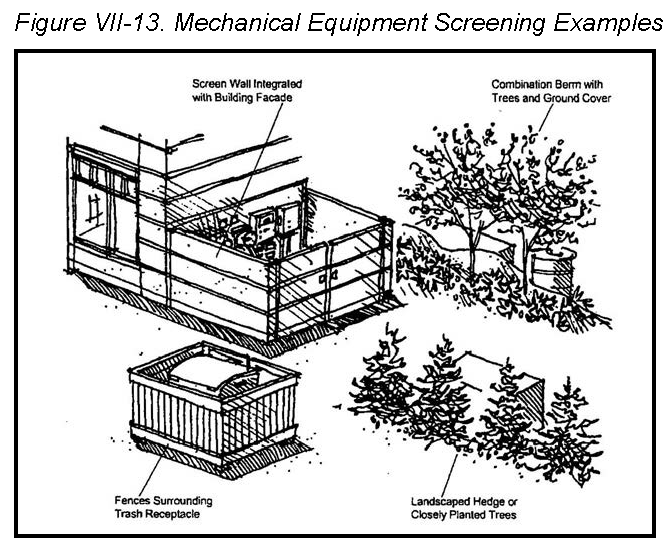
(Ord. No. 2158, December 2018)
Sec. 21-7603. - Building Height.
In order to encourage creativity and diversity of architecture and site design within the context of harmonious neighborhood planning, buildings over 35 feet in height developed next to single-family residential property shall meet the following criteria and requirements:
(1)
Light and Shadow. Buildings over 35 feet in height shall be designed so they do not adversely impact the natural and artificial light on adjacent property. Adverse impacts include, but are not limited to, casting shadows on adjacent property that preclude the functional use of solar energy; creating glare, or contributing to the accumulation of ice and snow on adjacent property. Techniques to reduce the shadow impacts of buildings may include, but are not limited to, repositioning a structure on a lot, increasing setbacks, reducing building mass, utilizing building step-backs, or redesigning the shape of the building.
(2)
Privacy. Buildings greater than 35 feet in height shall be designed to avoid infringing on the privacy of adjacent property, including parks. Techniques to ensure privacy include, but are not limited to: landscaping, increased setbacks, changing the building orientation, utilizing building step-backs, and/or providing fencing.
(3)
Neighborhood Scale. Buildings greater than 35 feet in height shall be compatible with the scale of the neighborhood in terms of mass, relative height, and relationship to human scale. The transition between any building over 35 feet and the abutting neighborhood structures shall not be abrupt, but shall transition from a lower to a higher height, such as utilizing a building step-back technique.
Sec. 21-7610. - Purpose.
The purpose of this section is to ensure that the physical appearance and functional characteristics of proposed single-family residential buildings in a development provide an attractive, safe, compatible, and long-lasting design, and that their design qualities encourage and strengthen the sense of community and neighborhood pride.
Sec. 21-7611. - Factory-Built Homes.
No factory-built home may be altered before being placed on a permanent foundation and all factory-built homes must be certified pursuant to the National Manufactured Housing and Construction and Safety Standards Act of 1974, as amended. No variance is permitted.
Sec. 21-7612. - Building Materials.
(1)
Permitted Materials. Materials that either resemble or are the natural materials of brick, stone, slate, stucco, wood, or textured block are permitted. Alternative materials may be used with the approval of the director where the use of alternative materials promotes design innovation.
(2)
Exterior Changes. Exterior material changes should occur at changes in the plane of the building, not at the outside corners.
(3)
Materials for Additions. Any addition to an existing residential building shall utilize the same color, style, and materials as the original structure.
Sec. 21-7620. - Purpose and Applicability.
The purpose of this section is to provide for a uniform set of standards for the review of single-family detached and attached dwellings proposed for construction on developments of less than eight acres in the city. These standards are designed to assure that new single-family dwellings are planned and developed with the scale and character of the surrounding neighborhood and provide for some aesthetic variation. The regulations contained herein are designed to protect and promote the public health, welfare, and safety of the citizens.
Sec. 21-7621. - General Requirements.
All single-family dwellings shall conform to all applicable requirements of this land development code, as well as applicable requirements of the zone district and city adopted building code requirements in effect at the time of issuance of each building permit for such dwelling.
Sec. 21-7622. - Development Standards.
The following standards apply to single-family dwellings built in developments which are less than eight acres in size. The standards contained in paragraphs (1) through (4) may be waived or varied by the board of adjustments; the standards contained in paragraphs (5) through (11) shall strictly apply and cannot be waived or varied by the board of adjustment.
(1)
Placement. Each new dwelling shall be placed on a subdivision lot, and shall meet the minimum lot, setback, landscape/open space, and parking requirements of the underlying zone district.
(2)
Materials. The exterior materials of a proposed new single-family dwelling unit(s) shall have a minimum of 50 percent gross masonry including stone, as defined by the building code, on the front side of the exterior of the structure and a minimum of 50 percent masonry on the front and street side of the exterior of structures when located on corner lots. The side exterior of the structure not facing a street shall have a minimum of a 3-foot masonry wrap. Exterior masonry materials shall exclude EIFS and concrete block structures.
(3)
Garages. All development shall include a garage, either attached or detached, as part of the new construction or placement.
(a)
The garage shall be constructed prior to the issuance of a certificate of occupancy or certificate of completion.
(b)
The garage shall be no less than 400 square feet in floor area per residence and shall conform to article V division 4 (Accessory Uses and Accessory Structures) of this land development code and all building code requirements as adopted by the city.
(c)
Upon request by a builder, the director may approve a development plan that provides less than 400 square feet of garage floor area per residence, if all of the following criteria are satisfied:
(i)
The builder is a nonprofit, 501(c)(3) corporation.
(ii)
The development includes at least 200 square feet of enclosed garage space per residence.
(iii)
The development plan provides at least 360 square feet of paved, off-street, on-site parking for each residence.
(iv)
The development plan includes a storage shed of at least 100 square feet for each residence. Storage sheds may be placed in the rear-yard only.
(v)
Applicant demonstrates that at least 50 percent of the existing single-family homes on the block (measured from public street to public street, including both sides of the street) have less than a standard, enclosed two-vehicle garage.
The placement of the parking and storage shed(s) must comply with the underlying zone district setback requirements without requiring a variance. Any garage floor area less than 200 square feet shall require a variance from the board of adjustment.
(d)
For any single-family detached residential structure with a nonshared side-loaded garage that is accessed from a public street, the minimum garage door setback shall be 15 feet measured from the garage door face to the side lot line.
(4)
Offset. All single-family attached dwelling structures shall have a minimum of a two-foot offset between dwelling units.
(5)
Floor Area. The minimum floor area of new single-family detached dwellings shall be 1,080 square feet (not including basement) for single-story buildings and 1,600 square feet (not including basement) for two-story buildings. Single-family attached dwellings shall be a minimum of 2,160 square feet for both dwellings combined.
(6)
Siding. Exterior siding of all dwellings shall be made of nonreflective materials and may include: brick, stone, or other masonry materials defined by the city's adopted building code (excluding concrete block); wood; stucco; or other exterior material allowed by the city's adopted building code or approved by the director of the department of community development. Siding may include a combination of the materials listed in this paragraph.
(7)
Roofing. All single-family dwellings shall have a pitched roof with a minimum 4-inch vertical rise for each 12 inches of horizontal run and have a minimum 16-inch eave and rake on each side, unless the structure embodies architectural styles of a historical or unique contemporary nature. For example, a Santa Fe style has a flat roof without any overhang. The roof shall be covered with a nonreflective material and must conform to local snow load requirements.
(8)
Construction. All single-family dwellings shall be placed on a permanent poured footing with a foundation wall that is constructed on the perimeter of the dwelling or a slab-on-grade foundation that complies with the city's building code and shall be constructed so that the finished floor elevations of the residential structure are compatible with the elevations of adjacent dwelling units meaning that new development shall locate living areas and front doors at grade level within 30 inches.
(9)
Utility Connections. All dwellings must be approved for permanent connection to all required utilities. All utility meters not sited underground shall be enclosed in a meter housing affixed to the exterior of the structure.
(10)
Inspections. Prior to move in, all dwellings transported to the site shall be certified by a licensed professional engineer, or professional inspection agency approved by the city building official, as being structurally sound and meeting the construction, health, and safety standards imposed by all building codes adopted by the city. If factory built, the applicant shall submit certification by the appropriate certifying agency.
(11)
Building Front. At a minimum, each single-family dwelling shall have on the front side of the structure 1 door entrance into the living area of the structure and 2 windows, with a total of at least 20 square feet facing the public right-of-way. When located on a corner lot, the single-family dwelling shall face the street frontage most dominated by residentially used structures, or as designated by the director.
(Ord. No. 1810, June 2010; Ord. No. 2073, January 2016; Ord. No. 2158, December 2018)
Sec. 21-7630. - Purpose and Applicability.
The following standards are intended to promote variety and visual interest in the residential and planned unit development zone districts predominately characterized by mass-production residential building development.
All residential development of eight or more acres shall comply with the standards contained in this division. These standards are common to a broad range of uses and densities. They shall apply to single-family, multi-family, and mixed-use projects within the city unless specifically excepted.
Sec. 21-7631. - Housing Composition.
(1)
Mixed Housing Required. All new residential subdivisions and new home builders wishing to construct model homes in existing subdivisions shall provide the amount of housing types, housing series, and housing models as set forth in the table below.
Table VII-20. Mixed Housing Requirements
(2)
Table Elements.
(a)
Housing types: single-family attached; stacked triplexes and quadplexes; manor homes; townhouses and condos; apartments; live-work units; and single-family detached dwellings.
(b)
Housing series variations:
(i)
Single-family attached, townhouses, condos, and live-work units:
a.
Front loaded.
b.
Alley loaded.
(ii)
Stacked tri- and quadplexes:
a.
Three dwelling units per building.
b.
Four dwelling units per building.
(iii)
Manor homes and apartments—variations of at least 30 percent in building length or footprint.
(iv)
Single-family detached homes.
a.
Front loaded.
b.
Alley loaded.
c.
Lot size under 6,000 square feet.
d.
Lot size 6,000 to under 12,000 square feet.
e.
Lot size 12,000 to under 40,000 square feet.
f.
Lot size 40,000 square feet or more.
(3)
Housing Models.
(a)
Each housing model shall provide and exhibit at least three features that clearly and obviously distinguish them from other housing models. These features can include any of the following:
(i)
Building mass. Building mass is considered to be the outline of the structure. This is determined by the height, width, and depth of the structure.
(ii)
Building form. Building form is considered to be the style of the home, including ranch, tri-level or two-story structures.
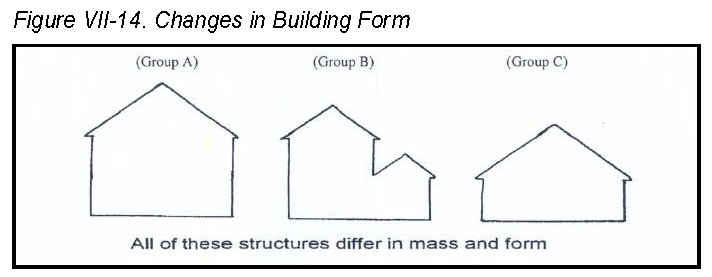
(iii)
Roof type. Roof types consist of mansard, hip (full or clip), flat, gambrel, gable, and front-to-back (shed style). Differentiation may also be achieved through the use of roof dormers, gables, and hips. Flat or A-frame roofs should be avoided unless appropriate to the architectural style.
(iv)
Windows and doors. The vertical or horizontal variation in the placement of at least two windows and/or doors on the front façade elevation or window shapes that are substantially different.
(v)
Materials. The use of different materials on the front façade elevation (brick vs. stone).
(vi)
Garages. Substantial variation in the location and/or proportion of garages and garage doors, such as alley-loaded garages, side-loaded garages, etc. (2-car garage vs. 3-car garage of the same elevation do not meet the intent).
(vii)
Porches. Variation in the location, width, and proportion of front porches.
(b)
Other distinct and substantial architectural design variations approved by the director. The sole use of minor cosmetic changes such as different paint color, reversing or creating mirrored images of the exterior architectural elevations, shutters, decorative brackets, or using different brick or stone color shall not meet the intent of this section.
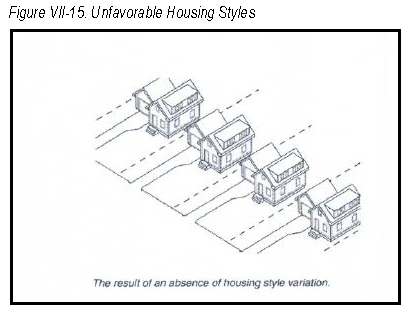
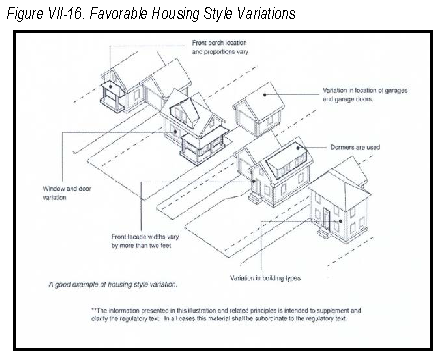
(c)
Housing model locations.
(i)
The same housing model with the identical street elevation design (or nearly identical) shall not be placed directly adjacent to one another or directly across the street from one another. "Across the street" is defined as lots that overlap each other when the side lot lines are extended across the street to the opposite lot. The same housing model used at the end of one block shall not be repeated on the first lot of the neighboring block.
(ii)
Identical or nearly identical floor plans mean that the layout, size, and function of the rooms are essentially the same. Identical or nearly identical street elevation design means little or no variation in the articulation of the façade, height or width or the façade, placement of the primary entrances, porches, number and placement of windows, and other major architectural features. It does not mean similar colors, materials, or small details.
(4)
Tracking. Upon request, the builder will provide the city with a plat sheet tracking document that maintains a record of home model variety for every development parcel. When required, the builder will demonstrate compliance with this section prior to issuance of a building permit.
(Ord. No. 1887, July 2012)
Sec. 21-7632. - Building Orientation.
(1)
Doorways. Each residence shall have at least one primary pedestrian access (doorway) into the dwelling located on the elevation of the dwelling facing the front lot line of the property, and clearly visible from the street or public area adjacent to the front lot line. On corner lots, the primary doorway may be located facing any adjacent street. An exception shall be made for alley-loaded single-family detached units that do not have street frontage but do front onto a park or park-like common open area. In such case where the dwelling unit does not have street frontage, one primary doorway shall be oriented toward a pedestrian walk in the park that connects to a street.
(2)
Building to Building Orientation. Unless prohibited by terrain or other site constraints, the orientation of new lots shall repeat the predominant relationship of buildings to building and buildings to street along the same block face or the facing block face.
Sec. 21-7633. - Architectural Detail.
(1)
Roof Overhang. No roof overhang or soffit shall be less than 12 inches, as measured from the finished side of the siding or premium material of the structure to the inside of the fascia board, unless the structure embodies architectural styles of an historical nature. For example, a Santa Fe style which has a flat roof without any overhang, or a Tudor-style which has a roof pitch of 10-vertical inch rise over a 12-horizontal inch run (10/12) or greater. Requests for such an exemption shall be presented to the city prior to the issuance of a building permit, and documentation may be required.
(2)
Housing Facades—General. The appearance of housing units shall be diverse, yet also exhibit design continuity.
(a)
Each of the facades of a house shall have a minimum of two differentiated planes to relieve flat, monotonous facades.
(i)
Differentiation may include incorporation of a feature such as a bay window, entry, porch, overhang, or chimney.
(ii)
All differentiation shall be a minimum of 12 inches.
(3)
Housing Facades Facing Public Areas. Each side or rear facade of a single-family dwelling which faces a street, park, open space or golf course shall include at least two of the following:
(a)
A change in the vertical or horizontal wall plane within 20 feet above grade;
(b)
A change in the color or material of the wall;
(c)
An increased masonry return;
(d)
A bay window, porch or balcony;
(e)
Structured transition from public to private areas using built elements such as arbors, low walls, trellis work, and/or similar elements integrated with plantings;
(f)
Detailing the wall with reveals, belt courses, cornices, projections or other devices; or
(g)
Shuttered windows or glazed doors to overlook the street, park, open space or golf course.
Sec. 21-7634. - Garages.
(1)
Preferred Design. At least 50 percent of the dwellings within a subdivision must be flush or recessed behind the front facade of the dwelling, be attached and be accessed from the side or rear, or be detached and recessed from the dwelling and placed in the side or rear yard. The front facade includes the enclosed living portion of the house. They shall be located according to one or more of the following:
(a)
Attached and recessed from the front facade of the building by a minimum of three feet, with access from the front;
(b)
Attached and in the side or rear yard, with access by either an alley or a driveway from the side. The garage shall be a minimum of three feet behind the front facade;
(c)
Detached with front, side, or rear access. The garage shall be a minimum of three feet behind the front facade;
(d)
Attached and flush with the front facade, provided that a covered porch extends at least six feet forward from the front facade of the house and is a minimum of 10 feet in width; or
(e)
Flush with the front facade and side-loaded with a driveway to the front.
(2)
Limited Design. No more than 50 percent of the dwelling units within a subdivision, shall have garage door openings provided in any of the following ways:
(a)
Extending from the front facade of the living unit not more than 10 feet, but with an architectural design element such as a bay/box window; covered porch at least six feet in depth across the front facade of the living unit; or a defined outdoor space (such as a patio or courtyard surrounded by a masonry wall or fence no more than 42 inches in height) that is designed to include the entire front yard space between the front facade of the living unit and the front facade of the garage, developed to extend outward to be at least flush with the garage door opening;
(b)
Extending from the front facade not more than 10 feet, but with living space directly above the garage. Such living space shall cover a minimum 50 percent of that portion of the garage in front of the front facade of the living unit;
(c)
Extending from the front facade not more than 10 feet, but with a complimentary adjoining living space or porch covering five feet of the 10-foot extension, limited to one-car garage door openings; or
(d)
Extending from the front facade the width of the garage with the garage door on the side of the garage with side yard or front yard access. All models containing split car garage designs will be categorized in this option.
(3)
Garage Doors Perpendicular to the Street.
(a)
Garages that are adjacent to the street but that have side-facing garage doors (perpendicular to the street) shall have architectural details, masonry, and/or windows that mimic the features of the living portion of the dwelling on the side of the garage facing the street.
(b)
For all single-family detached residential structures with a nonshared side-loaded garage that is accessed from a public street, the minimum garage door setback shall be 15 feet measured from the garage door face to the side lot line
(4)
Front Façade of Buildings.
(a)
Garage door openings for homes on lots of 50 feet to 70 feet in width shall not comprise more than 50 percent of the front-yard building facade. Three or more car garages may comprise up to 60 percent of the front-yard building façade.
(b)
Garage door openings for homes on lots of more than 70 feet in width shall not comprise more than 50 percent of the front-yard building facade.
(c)
Garage door openings for homes on lots of less than 50 feet in width shall be handled on a case-by-case basis when elevations and site plans are reviewed. Architectural treatments shall be used to soften the effects of the garage door openings.
(5)
Multi-Car Garages. The third or fourth car garage door opening shall be recessed a minimum of 3 feet from the 2-car garage door opening façade or shall not have the same orientation as the first 2 garage doors.
(Ord. No. 2073, January 2016)
Sec. 21-7635. - Alternative Compliance.
An applicant wishing to propose a site specific plan or model that does not strictly comply with the standards for this division, but which the applicant believes the intent of the standards are met, may seek to use alternative compliance under this section.
(1)
Pre-application Meeting and Application. The applicant shall request and attend a pre-application conference prior to submitting the site plan and elevations for the building permit, to determine the preliminary response from the city. If the preliminary response is favorable, an application may be submitted. The application shall include the site plan and elevation, and sufficient explanation and justification, in both written and graphic form, for the alternative compliance requested.
(2)
The director may approve the application if:
(a)
The proposed alternative achieves the goals and policies of the city's comprehensive plan to the same or better degree than the subject standard;
(b)
The proposed design substantially meets the intent of this section to line streets with active living spaces; creates an attractive appearance along the streetscape; reduces the dominance of automobiles, parking, and garages; and provides variety and visual interest to the exterior design of residential buildings; and
(c)
One of the following criteria are met:
(i)
The proposed alternative results in benefits to the community that are equivalent to, or better than, compliance with the subject design standard; or
(ii)
The configuration of the lot, or other existing physical conditions of the lot, make the application of these standards impractical.
(3)
No Precedence. Alternative compliance shall apply only to the specific site, lot, or model elevation for which it is requested and shall not establish a precedent for assured approval of other requests.
Sec. 21-7636. - Design Criteria—New PUD Residential Development.
In the PUD zone document for new PUD residential development, the following preferred design criteria shall be considered by the applicant:
(1)
Mix of building types within each development to include apartment buildings, townhomes, single-family detached, single-family attached, and accessory dwelling uses oriented toward the street.
(2)
Mix of residential housing prices to permit a mix of income levels within the same development.
(3)
Mix of densities within each development accommodating a variety of lot sizes within the same development.
(4)
Residential building setbacks.
(a)
Front setbacks from arterial streets. The minimum front setback for multi-family buildings from any arterial street right-of-way or transportation easement shall be 30 feet.
(b)
Front setbacks from non-arterial streets. The minimum front setback for multi-family buildings from any collector, commercial or local street-right-of-way or transportation easement shall be 10 feet. The minimum front setback for single-family detached and single-family attached units shall be 10 feet for any portion of the building including porches, architectural features, and any outdoor spaces such as patios from any collector, commercial or local street right-of-way, or transportation easement. The front setbacks for garages shall be 20 feet measured from the right-of-way, with a maximum 30-foot setback for the living area of the building from the right-of-way for all but large-lot, single-family buildings. Accessory buildings are not allowed in front setbacks.
(c)
Side and rear setbacks from arterial streets. For all residential buildings, the minimum side and rear setbacks from any arterial street right-of-way or transportation easement shall be 25 feet. Side and rear setbacks for accessory buildings shall be 15 feet.
(d)
Side and rear yard setbacks from non-arterial streets and property lines. The minimum side and rear setbacks for single-family detached buildings shall be 5 feet for a side yard and 20 feet for a rear yard from any collector, commercial, or local street right-of-way, transportation easement, or other property lines. The minimum side and rear setbacks for single-family attached and multi-family buildings shall be 20 feet from any collector, commercial or local street right-of-way, transportation easement or property line. Side and rear setbacks for accessory buildings shall be 5 feet from any collector, commercial or local street right-of-way, transportation easement or property line.
Sec. 21-7640. - Applicability.
All new construction multi-family residential dwelling developments, as well as any addition to existing multi-family residential buildings, shall be governed by the multi-family development guidelines and standards.
(Ord. No. 2020, February 2015)
Sec. 21-7641. - Building Orientation.
(1)
Adjacent to Public Streets. Every front façade with a primary entrance to a dwelling unit(s) shall face the adjacent public street to the maximum extent possible. Every building containing three or more dwelling units shall have at least one building entry or doorway facing each adjacent public street.
(2)
Interior Property Lines. Along interior property lines, multi-family structures should be oriented in a more perpendicular direction to adjacent lower-density residential uses or zoning districts, or adjacent commercial or industrial uses or zoning districts. When parallel orientation is necessary, building setback from the adjacent use or district boundary should be increased by at least 50 percent.
(3)
Observation onto Public Areas. Primary structures should be located and designed so that residents can easily observe the common open spaces, circulation paths and access points into the development.
(4)
Courtyards. A multi-family building may be oriented to a common use courtyard. When an inner courtyard is proposed, the courtyard providing access to double-row dwelling groups should be a minimum of a 1:1 ratio with the building height or a minimum of 20 feet in width, if the building is lower than 20 feet in height.
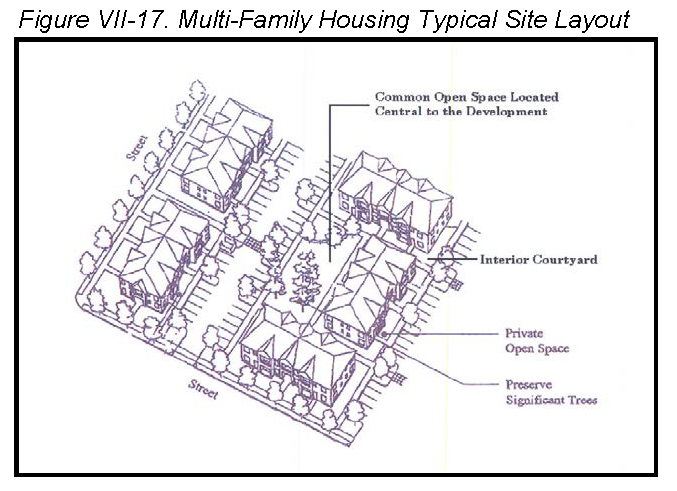
(Ord. No. 2020, February 2015)
Sec. 21-7642. - Parking Location and Layout.
In addition to the general parking design standards set forth in section 21-7633 above, the following guidelines and standards exist:
(1)
Garage and Parking Guidelines.
(a)
Number of Garages. At least 50 percent of required off-street parking should be provided in garages (which may be underground), rather than surface lots. Assisted living facilities and nursing homes are exempt from this guideline.
(b)
Garage and Parking Placement. Where surface lots or detached garages are used, they shall be located behind or between buildings, rather than adjacent to public streets.
(c)
Guest Parking. Developments shall be designed to have guest parking in a location convenient to the building that the parking is intended to serve. Through access drives may be designed to permit on-street parallel parking for guests, provided the design meets city standards.
(2)
Garage and Parking Standards. For attached garages, the door openings shall be:
(a)
Recessed behind the front facade of the building;
(b)
Flush with the building, or protruding but with a second floor that covers most of the garage; or
(c)
Alley loaded.
Sec. 21-7643. - Building Height, Massing, and Form.
(1)
Context. New building design shall respect the context of adjacent residential and nonresidential neighborhoods, including the height, scale, mass, form and character of surrounding development.
(2)
Mass and Form.
(a)
Building design should incorporate visually heavier and more massive elements at the building base, and lighter elements above the base.
(b)
All buildings shall be designed to provide complex massing configurations with a variety of different wall planes and roof planes.
(c)
The façades of town homes shall be articulated to differentiate individual units.
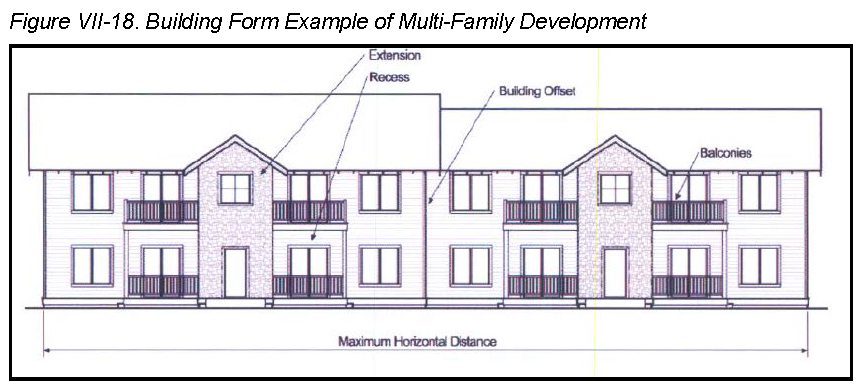
(3)
Architectural Detail.
(a)
All sides of a multi-family building shall display a similar level of quality and architectural interest.
(b)
All facades of a multi-family residential building shall have a minimum of two differentiated planes to relieve flat, monotonous facades. Facades that exceed 65 feet in length shall have a minimum of three differentiated planes. All differentiation shall be a minimum of 12 inches.
(c)
In addition to the differentiation required by paragraph (3)(b), every façade facing a public right-of-way shall include two (2) of the following features:
(i)
A pedestrian entry;
(ii)
A change in vertical or horizontal wall plane not otherwise required by this section;
(iii)
A change in color or material of the wall;
(iv)
A bay window or balcony;
(v)
Detailing the wall with reveals, belt courses, cornices, projections, or other devices;
(vi)
Shuttered windows;
(vii)
Changes in parapet height.
(4)
Entrances.
(a)
Pedestrian entry to the site from the fronting street should be emphasized through landscaping, special paving, gateways, arbors, and/or other similar features.
(b)
Long, linear, and/or hidden stairways or corridors should be avoided.
(c)
Covered entrances should be provided as protection from bad weather and as a transition from indoor to outdoor.
(Ord. No. 2020, February 2015)
Sec. 21-7650. - Purpose and Applicability.
Purpose. These standards are intended to promote the design of an environment that is built to a human scale, to encourage attractive street fronts that accommodate pedestrians in a safe and pleasant manner, and to allow for vehicular movement. These standards are designed to promote a concentrated development pattern that encourages pedestrian use and provides a community environment not dominated by vehicles. Two or more story commercial uses are encouraged and can be used for a wide variety of uses including commercial, office, or residential.
All new commercial, public/institutional, and mixed-use development applications shall comply with the applicable standards contained herein. In addition, any new additions to existing commercial, public, institutional or mixed uses shall comply with these standards.
Sec. 21-7651. - General Layout.
(1)
New construction should be built parallel to lot lines to reflect the traditional orientation of nonresidential structures. To the maximum extent feasible, structures shall not be oriented at an angle to lot lines. Multi-lot or multi-building developments shall be designed as unified projects with a sense of place.
(2)
New land divisions shall have a block length consistent with the block length standards established in article VI.
Sec. 21-7652. - Circulation.
(1)
The number of external entrances shall be consistent with existing or anticipated design of external streets.
(2)
A sense of entry or arrival shall be created at primary entryways into the development. Building placement landscaping, gates, entry monuments, specialty lighting and other design elements can be used to create this design effect.
(3)
Circulation patterns within parking areas shall be defined by curbs and landscaped islands.
(4)
Streets should create view corridors that frame public plaza areas, public buildings, parks, and natural features.
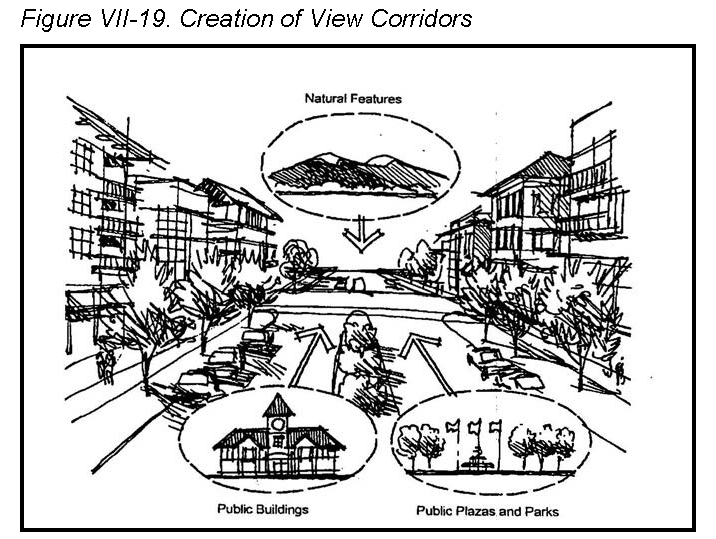
Sec. 21-7653. - Gateways and Prominent Intersections.
(1)
Corner Buildings. Buildings located at the corner of gateways or prominent intersections should be designed to emphasize the gateway or intersection location. This may include major architectural expression in the façade roof form and/or massing, such as:
(a)
Larger bulk;
(b)
Tower forms;
(c)
Peaked roofs; and
(d)
Over-sized windows.
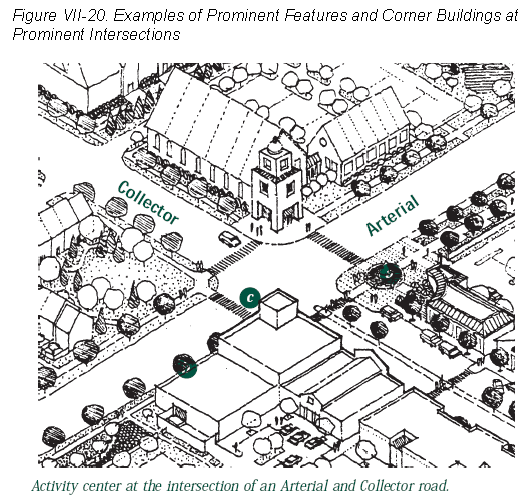
Sec. 21-7654. - Building Elements.
(1)
Building Orientation.
(a)
The main entrance of a building should face a pedestrian plaza or space and shall have a direct pedestrian connection to the street, so that pedestrians are not required to walk through parking lots.
(b)
Fronts of buildings shall be parallel or perpendicular to the edge of a pedestrian area to create a sense of enclosure.
(c)
New developments and buildings should be situated as close to the street to the maximum extent feasible. Parking should be reserved for the sides or rear of the buildings.
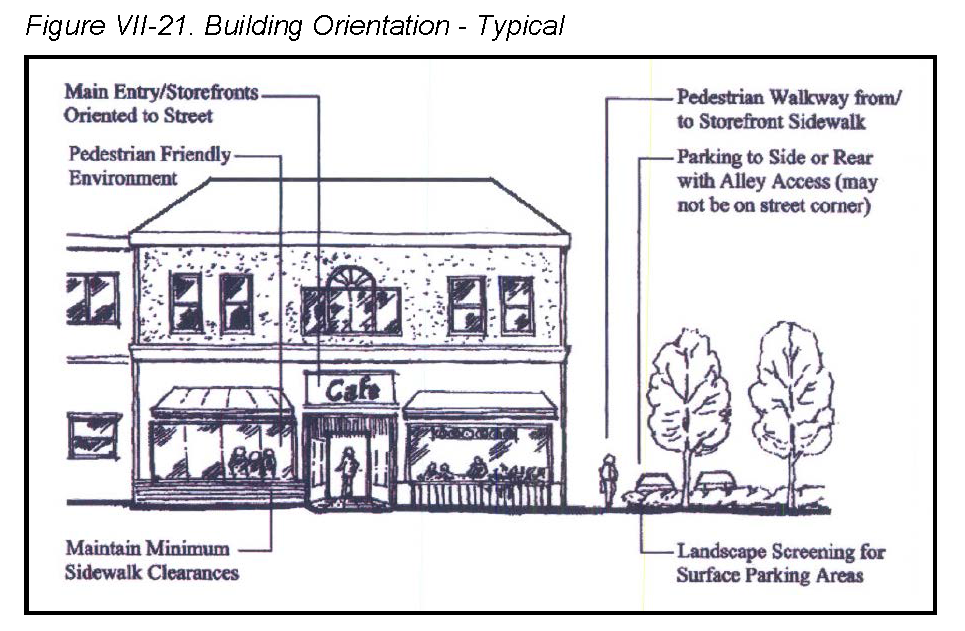
(2)
Relationship of Buildings to Streets and Walks.
(a)
Building setbacks along the street. In a single-building development, the building shall be located no more than 20 feet from the front property line. In a single-building development on a corner lot, the building shall be located no more than 20 feet from either adjacent street property line. In multiple-building developments, at least one building's front or side facade shall be located no more than 20 feet from the right-of-way of the adjoining street. Any building adjacent to a public or private street and adjacent to a sidewalk, plaza, or other public space, shall provide an entry to the building from that sidewalk, plaza, or public space.
(b)
Exceptions. The building setbacks above shall not be required in sections of the development where plazas, courtyards, gardens, parks, or other public spaces integral to the development are provided adjacent to a street where these amenities have urban improvements such as paving, benches, landscaping, and other amenities that create an attractive public use area. In a single-building development on a corner lot, this setback exception shall apply to only one of the adjacent streets, not both.
(Ord. No. 2020, February 2015)
Sec. 21-7655. - Architectural Design.
(1)
Four-Sided Design.
(a)
Buildings shall be aesthetically pleasing from all views and shall include such features as articulated entries, bay windows, or other features. They shall have consistency in terms of materials, colors, and design and shall have a finished appearance. Three hundred sixty degree architecture is required with massing, setbacks, and character that creates a pleasant streetscape and does not overly dominate streets or people.
(b)
Façades fronting service or parking areas at the ground level need not have windows, but shall include architectural interest rather than a blank appearance.
(2)
Variation in Massing. A single, large, dominant building mass shall be avoided. Horizontal masses shall not exceed a height/width ratio of one to three without substantial variation in massing that includes a change in height and projecting or recessed elements. Changes in mass shall be related to entrances or the integral structure.
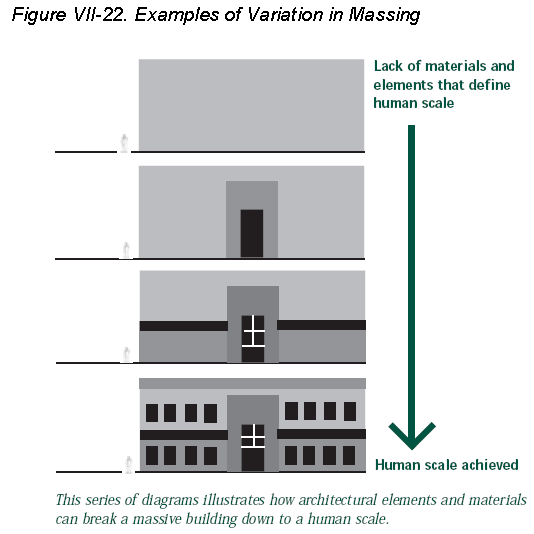
(3)
Character and Image.
(a)
Site-Specific Design. In the case of a multiple-building development, each individual building, including free-standing buildings located on pad sites, shall include predominant characteristics shared by all buildings in the development, so that the development forms a cohesive place within the zone district or community. These shall include the use of similar architectural elements including rooflines, materials, colors, fenestration, and other architectural details.
(b)
New primary structures that express a standardized corporate identity may be required to be modified to meet the architectural standards included in this code and to ensure consistent and similar facades and building designs in developments. Changes to prototypical franchise styles to meet these standards may include, but not be limited to, modifications to roofs, windows, doors, building mass, materials, colors, and placement of architectural features and details. Franchise architectural styles found to meet these standards will not require any modifications.
(4)
Building Entryways. Each building of any size, whether free-standing or part of a shopping center, shall have a highly visible customer entrance featuring a combination of at least two of the following elements:
(a)
Roof overhangs, raised cornice parapets or peaked roof forms;
(b)
Recessed or projecting wall sections;
(c)
Arcades or arches;
(d)
Outdoor patios;
(e)
Water features;
(f)
Display windows;
(g)
Architectural details such as tile work and moldings integrated into the building structure; or
(h)
Integral planters or wing walls that incorporate landscaped areas and/or seating areas.
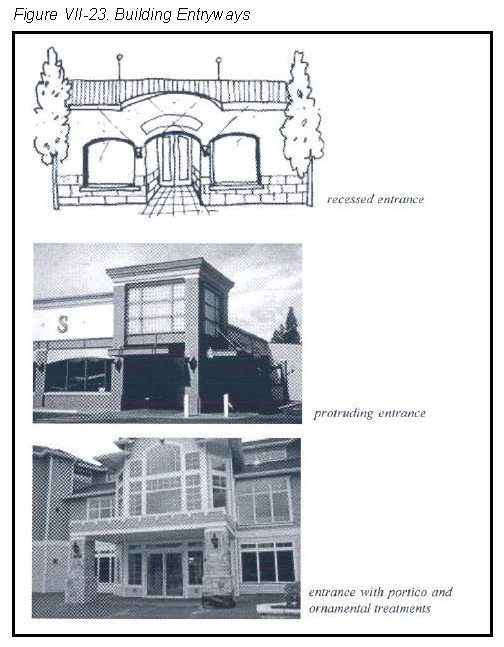
(5)
Windows.
(a)
Facades of all structures shall incorporate transparent features (windows and doors) over the surface area of street fronting facades.
(b)
In cases where a building has more than two facades fronting a street, the transparency requirement shall only be required on two facades based on pedestrian traffic and vehicular visibility.
(c)
Windows may be required to be recessed into the building wall to create shadow.
(6)
Facade Treatment.
(a)
Primary structures having single walls or portions of walls exceeding 65 feet in length shall have architectural treatment wherever they face adjacent streets or adjacent residential areas. At least three of the following elements shall be incorporated into these walls. For walls not fronting adjacent streets or residential uses, a minimum of two of the following elements shall be incorporated.
(i)
Concrete or masonry plinth at the base of the wall;
(ii)
Recesses and reveals at least 12 inches in depth;
(iii)
Windows and fenestration;
(iv)
Arcades and pergolas;
(v)
Towers;
(vi)
Gable projections;
(vii)
Horizontal/vertical breaks;
(viii)
Belt courses of a different texture and color;
(ix)
Projecting cornice;
(x)
Projecting metal canopy;
(xi)
Decorative tile work;
(xii)
Trellis containing planting;
(xiii)
Artwork; or
(xiv)
Other similar techniques approved by the city.
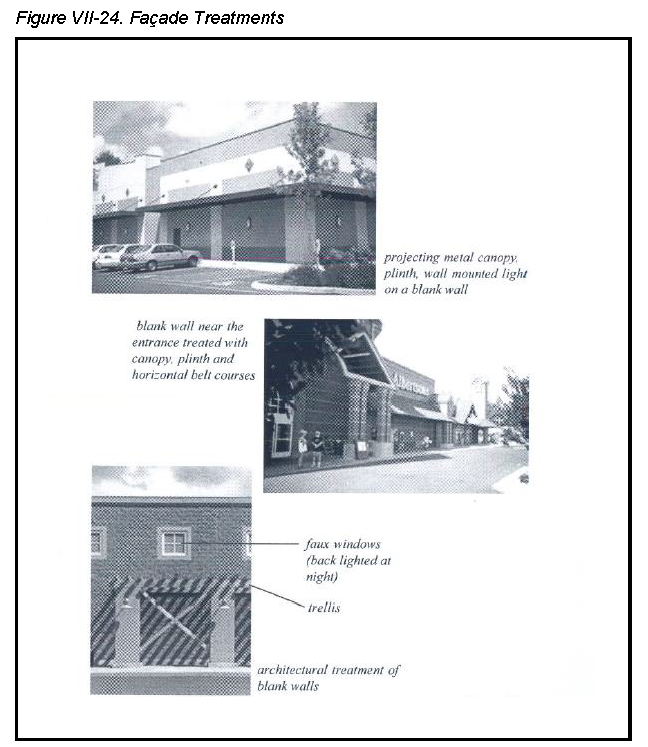
(b)
Facades shall have:
(i)
A distinct base at the ground level, using articulation and materials such as, but not limited to:
a.
Integrally textured materials such as stone or other masonry;
b.
Thicker walls, ledges, or sills;
c.
Integrally colored and patterned materials such as smooth-finished stone or tile;
d.
Lighter or darker colored materials, mullions, or panels; or
e.
Planters.
(ii)
A recognizable body or middle section that constitutes a minimum of 50 percent of total building height.
(iii)
A clearly identified top or cap that shall be treated with a distinct outline with elements such as:
a.
Cornice treatments, other than just colored "stripes" or "bands," with integrally textured materials such as stone or other masonry, or differently colored materials;
b.
Sloping roof with overhangs and brackets;
c.
Stepped parapets.
(iv)
There shall be horizontal elements that separate each of the three sections.
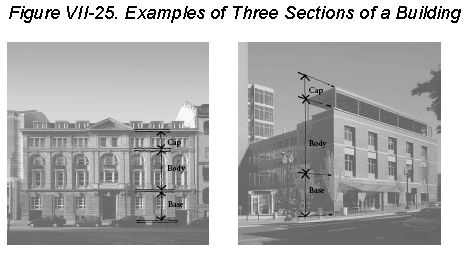
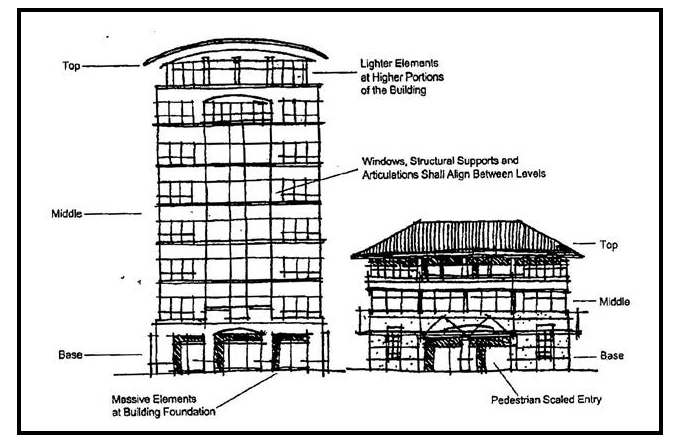
(7)
Materials.
(a)
The predominant exterior building materials shall be materials that are characteristic of Colorado including, but not limited to, brick, sandstone or other native stone, stucco, tilt-up concrete, and glass. The director may approve other high-quality materials.
(b)
Architectural metal and concrete masonry units (CMU) may be used as an accent, but should not constitute more than 25 percent of any façade. Further, such metal siding shall be a standing seam type or equivalent quality, not a "corrugated" type. Architectural metals, such as bronze, brass, copper, and wrought iron, may be used and may exceed the 25 percent area limit.
(8)
Colors. Brick, concrete, and stone have their own inherent color and should be left in their natural state to weather over time. Paint can be used to complement and accent other exterior building materials.
(9)
Roofs.
(a)
Roofs shall be designed to reduce the apparent exterior mass of a building, add visual interest and be appropriate to the architectural style of the building. Variations within one architectural style are highly encouraged. Visible roof lines and roofs that project over the exterior wall of a building enough to case a shadow on the ground are highly encouraged. Architectural methods shall be used to conceal flat roof tops, unless specifically required by the architectural style (contemporary). Overhanging eaves, sloped roofs, articulated parapet walls, and multiple-roof elements are highly encouraged. Mansard-style roofs are discouraged.
(b)
Metal roofs may be allowed if compatible with the overall architectural design of the building. In no case may a roof material be reflective or cause glare, as determined by the building official.
(c)
On all structures exceeding two stories in height, roofs shall internally drain, and external scuppers and wall drains shall be prohibited.
Sec. 21-7656. - Large-Scale Buildings and Developments.
(1)
Applicability. Individual buildings with more than 50,000 square feet of enclosed ground-floor space (for multi-tenant buildings, the sum of all tenant spaces within the same building shell shall comprise the total square footage) and multiple-building developments with a combined enclosed ground-floor space more than 100,000 square feet (e.g., shopping centers, public/institutional campuses, and similar developments) shall comply with the standards in this section.
(2)
Human-Scale Design. All large-scale buildings and developments shall provide human-scale design by conforming to all of the following standards:
(a)
Incorporate changes in building direction (i.e., articulation) and divide large masses into varying heights and sizes, as shown below. Such changes may include building offsets, projections, changes in elevation or horizontal direction, sheltering roofs, terraces, a distinct pattern of division of surface materials, windows, screening trees, small-scale lighting (e.g., wall-mounted lighting or up-lighting), and similar features.
(b)
The frontage of buildings shall be divided into architecturally distinct sections no more then 65 feet in width. Each section should be taller than it is wide. Windows and storefront glazing should be divided to be either square or vertical in proportion so that each section is taller than it is wide.
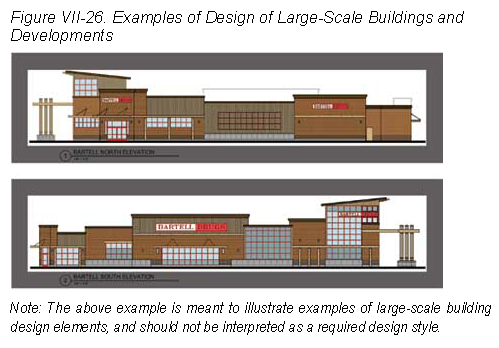
(c)
Any large-scale building or development that utilizes shopping carts shall provide, at a minimum, 25 feet of linear pedestrian sidewalk or pedestrian plaza from the front door to the nearest automobile drive lane.
(d)
Any large-scale building or development that utilizes shopping carts shall provide shopping cart corrals that match and coordinate with the design of the building.
(e)
Street amenities. Large-scale buildings and developments shall have pedestrian and street amenities that create an attractive complex that encourages pedestrians, bikers, and other users to enjoy the area. Street amenities may include, but are not limited to: pedestrian lighting, bike racks, pedestrian plazas, seating areas, and outdoors dining areas. The quantity and design of these elements shall be determined specifically for each place.
Sec. 21-7657. - Design Criteria—New PUD Commercial Development.
In the PUD zone document for commercial development, the following preferred design criteria is advised and shall be considered:
(1)
Neighborhood commercial uses are encouraged to be located within ¼-mile walking distance of residential uses.
(2)
Commercial development should be incorporated with mass transit.
(3)
Retail developments in commercial areas could include additional floors of residential and/or office uses.
(4)
An architectural character distinguished through specific building materials, architectural features, and building orientation should be incorporated into all developments.
Sec. 21-7658. - Design Criteria—New PUD Open Space, Parks, Plazas, and Civic Buildings.
In the PUD zone document for open space, parks, plazas, and civic buildings, the following preferred design criteria are advised and shall be considered:
(1)
Major creeks, riparian habitat, slopes, and other sensitive environmental features shall be conserved as open space amenities and incorporated into the design of neighborhoods.
(2)
Parks and plazas should be the focal point for each neighborhood. They should be located next to public streets, commercial areas, and residential areas. Parks should not be formed from residual areas, used as buffers to surrounding developments, or used to separate buildings from streets.
(3)
Civic services, such as community buildings, government offices, recreation centers, post offices, libraries, and daycare, should be placed in central locations at highly visible focal points. Where feasible, they should be close to the transit stop.
Sec. 21-7660. - Applicability.
(1)
New Construction. All new construction of buildings and structures shall comply with the standards contained in this division.
(2)
Improvements to Existing Structures and Sites.
(a)
These guidelines and standards shall apply to existing buildings only when a proposed building expansion exceeds 25 percent of the existing floor area measured on a cumulative basis starting from the date of the adoption of this land development code. For example, if an owner increases the gross floor area by 5 percent each year, for 5 years beginning on the date of adoption of this Land development code, the provisions of this land development code shall apply when the gross floor area has increased by 25 percent in the fifth year.
(b)
It is intended that a building expansion subject to these guidelines and standards be reasonably integrated with the existing structure or site condition consistent with these guidelines and standards.
(c)
These guidelines and standards shall not be construed to necessitate improvements to existing buildings or site conditions beyond those necessary to integrate the proposed improvement with existing conditions in a manner consistent with these guidelines and standards.
Sec. 21-7661. - Building Orientation.
(1)
Single Building. If the proposed development consists of only one building, such building shall be oriented towards the primary abutting street.
(2)
Multiple Buildings. Where multiple buildings are proposed on a development parcel, buildings shall be oriented to allow views into the project and shall preserve high-quality views through the project (e.g., views of the mountains). If the proposed development consists of more than one building, all primary and pad site buildings shall be arranged and grouped so that their primary orientation complements adjacent, existing development and:
(a)
Frames and encloses a pedestrian and/or vehicle access corridor within the development site; or
(b)
Frames and encloses on at least three sides parking areas, public spaces, or other site amenities.
(3)
Entrances. All primary structures shall have a clearly defined main pedestrian or employee entrance oriented towards a public street, which should feature at least two of the following elements:
(a)
Canopies or porticos;
(b)
Overhangs;
(c)
Recesses or projections;
(d)
Arcades;
(e)
Arches;
(f)
Peaked roof forms;
(g)
Outdoor patios;
(h)
Display windows;
(i)
Architectural tile work or moldings integrated into the building design; or
(j)
Integrated planters or wing walls that incorporate landscaped areas or seating areas.
(4)
Parking. To the maximum extent feasible, parking shall be provided at the rear or sides of the building.
(5)
Non-public Functions. Building functions that do not directly serve the public should not be placed directly along the street.
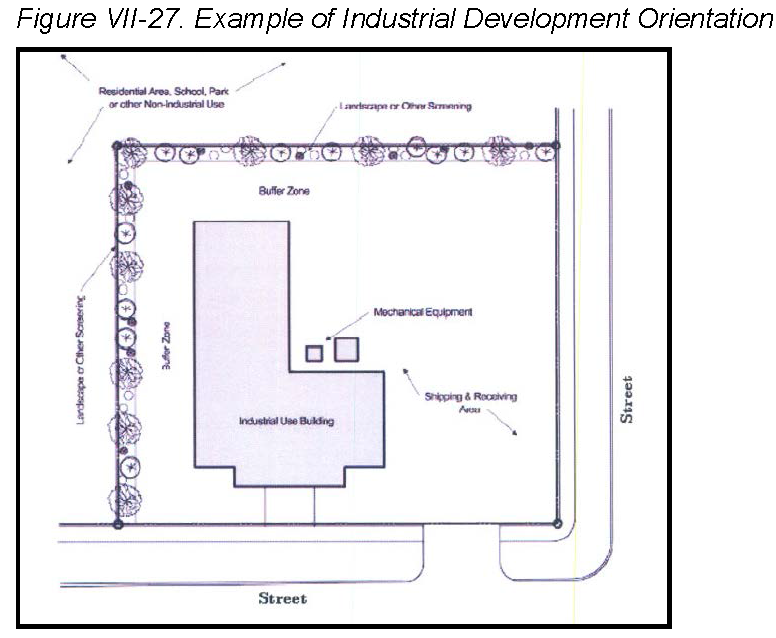
Sec. 21-7662. - Building Massing and Form.
(1)
Structures shall be sited to avoid a wall effect along public rights-of-way and along adjacent property lines. This can be achieved by varying the building setbacks and clustering buildings.
(2)
The design of all buildings should employ textured surfaces, projections, recesses, shadow lines, color, window patterns, overhangs, reveals, changes in parapet heights, and similar architectural features to avoid monolithic shapes and surfaces.
(3)
If any building is on a lot or tract with frontage on a public park or open space, or is adjacent to a property zoned or used for residential use, it shall have equally detailed facade as the front of building, constructed of equally high quality materials on the facade facing such park, open space, or residential use.
(4)
All primary structures with flat roofs shall include a parapet or fascia around all sides of the building.
Sec. 21-7663. - Materials.
(1)
All front facades of primary structures, all facades that face a public right-of-way, and all side wall facades within 15 feet of the front façade shall contain a minimum of 50% glass, masonry, concrete, or stucco. Acceptable materials include synthetic stucco, block, pre-stressed concrete, precise concrete panels, brick, poured-in-place, tilt-up concrete components, glass and stone.
(2)
Walls other than the front façade of a primary building may be clad with architectural metals, but not within 15 feet of the front façade of the building. Metal siding includes any form of metal exterior finish material, including corrugated or standing seam metal siding. The director may permit metals such as bronze, brass, copper, and wrought iron to be located along the front façade if a determination is made that such materials are equal to or superior to the primary building materials.
(3)
Facade building materials shall not create excessive glare when viewed from any public street or from any residential area.
(4)
All sloping roof areas with a pitch of 3:12 or greater, and visible from any public or private right-of-way, shall be surfaced with attractive and durable materials. Metallic surfaces for roofs are acceptable.
(5)
Pole Construction.
(a)
Eaves and rakes on structures that are pole construction shall be a minimum of 12 inches.
(b)
All facades of structures that are pole construction and are visible from a public or private right-of-way, public space, or residence shall be covered in a minimum of 25% masonry veneer, stucco veneer, or other material as approved by the Director.
(c)
All facades of structures that are pole construction and are visible from a public or private right-of-way, public space, or a residence shall have a minimum of 2 windows that are 20 square feet each and each window shall have shutter treatments.
(d)
Structures that are made of pole construction shall have a minimum of 2 paint colors that are complimentary to one another.
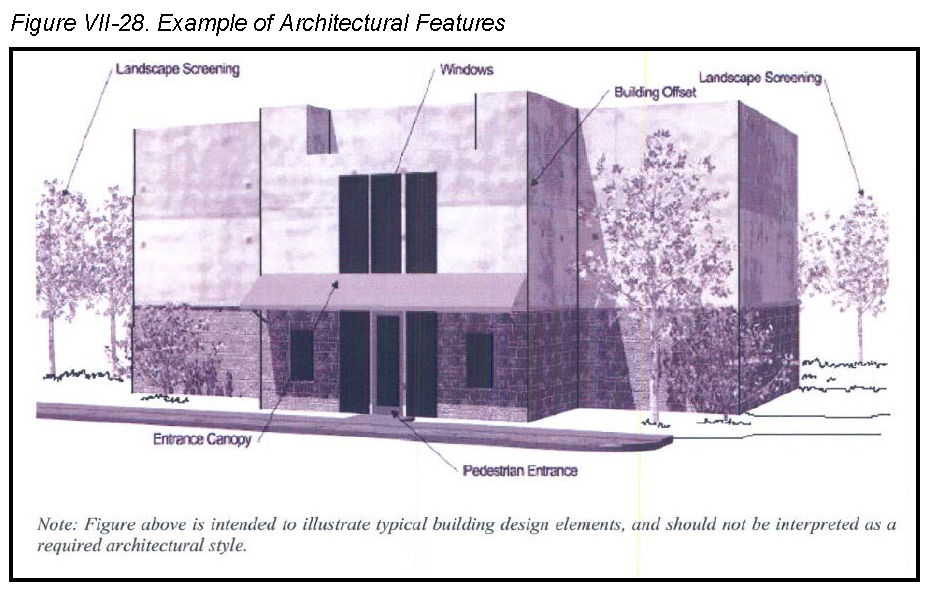
(Ord. No. 1887, July 2012)
Sec. 21-7664. - Screening.
(1)
Outdoor Storage. Outdoor storage and parking areas for vehicles in excess of 15,000 gross vehicle weight (GVW) must be located behind the front yard as defined by the outer wall of the building along a public street.
(2)
Tanks and Equipment. All exterior tanks, piping, and equipment, that cannot be housed in a structure or adequately screened by landscaping or fencing, must be painted in a camouflaging earth tone color, or other complimentary development color, and screened to the fullest extent possible.
Sec. 21-7665. - Design Criteria—New PUD Industrial Development.
In the PUD zone document for industrial development, the following preferred design criteria are advised and shall be considered:
(1)
Outdoor storage should be located behind the building on no more than 50 percent of the lot and be screened from view of the public right-of-way and adjacent properties.
(2)
The front and side setback areas adjacent to the public right-of-way should only be used for landscape area, primary employee/customer parking, and driveways and should not be enclosed with fencing.
(3)
Access to industrial lots should be limited to one access point per street frontage. Where possible the curb cut should be combined with the curb cut on an adjacent property.
Sec. 21-7700. - Scope.
(1)
Applicability. Except as specified in paragraph 2 of this section, all exterior lighting systems that are designed, constructed, erected, or otherwise placed into operation in any zone district, except for single-family residential, on or after the date of adoption of this land development code shall comply with the city's lighting standards. In addition, any alterations, rehabilitations, relocation, or renovation to existing lighting systems that are commenced after the date of adoption shall comply with the standards.
(2)
Exceptions.
(a)
Previously-approved designs. The city's lighting standards shall not apply to lighting systems that were approved by the city prior to the adoption of this land development code and are not yet constructed, as long as the approval of the lighting system occurred no more than 180 days prior to the adoption of the code. If the approval of the lighting system occurred more than 180 days before the adoption of the land development code and the lighting has not yet been installed, a new lighting system that complies with the city's lighting standards must be submitted for city approval.
(b)
Lighting used to control and regulate the flow of pedestrian and motor vehicle movement on public rights-of-way.
(c)
Temporary lighting for construction, provided such lighting is discontinued daily, immediately upon completion of the construction work for the day. With director approval, this lighting may be allowed to remain in operation after the conclusion of daily construction operations when safety is a concern.
(d)
Lighting used as decoration for any national, state, local, or religious holiday provided that the lighting is of temporary nature and energized for no more than 90 nights per consecutive 12-month period.
(e)
Lighting required by and regulated by the Federal Aviation Administration for the purpose of air traffic control, navigation, or warning.
(f)
Civic monuments as approved by the director.
(g)
Lighting approved by the director as a part of an organized event permit.
(h)
All city-owned or operated facilities.
Sec. 21-7701. - Plan Required.
When outdoor lighting is governed by this land development code, an outdoor lighting plan shall be submitted in conjunction with the applicable development review application. All plans shall include the following:
(1)
The location and mounting height above grade of light fixtures including building mounted fixtures.
(2)
The location of all buildings, parking, drives, walkways, and if applicable, any outdoor retail or storage areas on the lot or parcel.
(3)
The quantity and type of lamp to be used in each fixture along with the lumen output of the lamp.
(4)
Photometric Plan with an initial horizontal luminance (maintenance factor = 1.0) calculated at grade using a grid of points no more than 10 feet apart and covering the entire site (excluding buildings) and extending a minimum of 10 feet beyond the lot or parcel boundary line. The maximum, average, and minimum luminance values for each specific use area (e.g., parking area, pedestrian area, etc.) shall be highlighted. The director may waive the requirements for a photometric plan for small lighting systems.
Sec. 21-7702. - General Standards.
(1)
Shielding. Except as otherwise exempted in this land development code, all outdoor lighting shall be constructed with full shielding. Where the light source from an outdoor light fixture is visible beyond the property line shielding shall be required to reduce glare so that the light source is not visible from within any residential dwelling unit. Outdoor lighting for single-family and duplex residential uses shall be located and/or shielded in a manner to ensure that the intensity and direction of exterior and security lighting does not constitute a nuisance to abutting residential dwellings.
(2)
Energy Efficient. All new outdoor lighting fixtures shall be energy efficient with a rated average bulb life of not less than 10,000 hours.
(3)
Automatic Timers and Hours of Illumination. Automatic timing devices shall be installed on all new outdoor light fixtures with off-hours (exterior lights turned off) between the hours of 11 p.m. and 6 a.m. However, outdoor lights may remain on during business hours of operation for security purposes (e.g., to illuminate walkways, roadways, equipment yards, and parking lots). Outdoor lights also may remain on to illuminate flags representing a country, state, or other civic entity.
(4)
Level of Illumination. During hours of darkness, the minimum and average maintained foot-candles of light shall be consistent with the provisions listed below. A point-by-point photometric plan listed above shall be required in conjunction with the development review application and prior to issuance of a building permit to ensure compliance with these provisions.
(a)
Parking lots, driveways, trash enclosures/areas, public phones, and group mailboxes shall be illuminated with a minimum maintained one foot-candle of light and average not to exceed four foot-candles of light.
(b)
Pedestrian walkways shall be illuminated with a minimum maintained one-half foot candle of light and an average not to exceed two foot-candles of light.
(c)
Exterior doors of nonresidential structures shall be illuminated during the hours of darkness with a minimum maintained one foot-candle of light, measured within a five-foot radius on each side of the door at ground level.
(d)
Maximum lighting level uniformity (maximum to minimum) for residential parking lots shall be 15:1 and for nonresidential 10:1.
(e)
In no case shall exterior lighting add more than one foot-candle to illumination levels at any point off-site.
(5)
Maximum Height.
(a)
The maximum height of freestanding outdoor light fixtures for development abutting single-family residential property shall be 25 feet. Otherwise, the maximum height for freestanding outdoor light fixtures shall be 30 feet.
(b)
Light poles or tree mounted structures shall be between 12 and 14 feet high.
(c)
Bollard type light fixtures shall be between three and four feet high.
Sec. 21-7703. - Photometric Studies.
In the discretion of the city, or in the event there is any disagreement between the city and an applicant as to whether the proposed lighting meets any lighting standard, the city may require a photometric study of the proposed lighting at the applicant's expense.
Sec. 21-7704. - Pedestrian Lighting.
(1)
Required Lighting. Pedestrian paths leading to primary building entries that are used by residents, employees, or the public after daylight hours shall be lighted if:
(a)
They are longer than 30 feet; or
(b)
They include steps or ramps.
Pedestrian lighting should also be provided along commercial and mixed-use street, open space paths, special parkways or streets, and open space areas designed for gatherings or events.
(2)
Placement. Where pedestrian lights are used, they shall be placed:
(a)
At least 3 feet away from the face of the curb;
(b)
At least 5 feet from the point where a curb transitions into a driveway, curb cut, or alley;
(c)
At least 20 feet from the extended flow line of the nearest intersection;
(d)
To provide a relatively uniform level of lighting and to avoid extreme contrasts between levels of lighting; and
(e)
So as to prevent glare onto adjacent properties.
(3)
Types. Pedestrian lighting shall have consistent fixtures, source colors, and illumination levels. Low, glare controlled light fixtures mounted on building or landscape walls, bollards, or low ground-mounted landscape lights are preferred. Where light poles are used, fixtures shall have metal halide sources unless an alterative light type is approved during the development review process. Where the light source is directly visible, the luminaries should incorporate elements to reduce glare, such as translucent, obscure, or refracting lenses; low-wattage light sources; or shielding devices. The use of solar-powered lighting is encouraged.
Sec. 21-7705. - Building, Service, and Loading Area Lighting.
(1)
Canopy Lighting. All canopy lighting shall use recessed luminaire fixtures as defined by the Illumination Engineering Society, and shall not use highly reflective material on the underside. In addition, no lighting shall protrude downward beyond the ceiling of the canopy.
(2)
Service Areas. Service area lighting fixtures shall be designed and located so that the light source cannot be seen from adjacent streets or areas with residential uses. Wall mounted light fixtures shall use cutoff devices to contain direct lighting to the service area and shall have a concealed light source.
Sec. 21-7706. - Outdoor Sports Field/Outdoor Performance Area Lighting.
(1)
Height. The mounting height of outdoor sports field and outdoor performance area lighting fixtures shall be reviewed and approved on a case-by-case basis by the city.
(2)
Hours of Illumination. Outdoor sports field/outdoor performances areas may continue operating the lighting system for as long as reasonably necessary to conduct all functions essential to proper care and maintenance of the facility.
Sec. 21-7707. - Architectural/Landscaping Lighting.
Outdoor light fixtures used to illuminate architectural and landscape features shall use a narrow cone of light for the purpose of confining the light to the object.
Sec. 21-7708. - Sign Lighting.
The artificial illumination of signs, both from an internal or external source, shall be designed to eliminate negative impacts on surrounding rights-of-way and properties, and shall comply with article VIII (Signs).
Sec. 21-7709. - Prohibited Lighting.
Except as specifically authorized by the city, the following shall be prohibited:
(1)
Any light that could be construed as a traffic control device except as authorized by the state, federal, or city government or any light that imitates or causes visual interference with a traffic signal or other necessary safety or emergency light.
(2)
Searchlights and rotating beacons.
(3)
Any blinking, flashing, or changing intensity lighting except as a part of a temporary holiday display.
(4)
Aerial lasers.
(5)
Any light source exceeding 60,000 lumens or with an intensity in any direction of 60,000 candelas or more.
(6)
Illumination of entire buildings. Building illumination shall be limited to security lighting and lighting of architectural features authorized by the City in conjunction with the required development permits.
(7)
Roof mounted lights except for security purposes with motion detection and full shielding, so that the glare of the light source is not visible from any public right-of-way.
Sec. 21-7710. - Existing Lighting Systems.
All existing lighting systems legally installed and operative before the date of adoption shall be considered legal nonconforming systems. Nonconforming lighting may be continued, but the lighting shall not be changed to any other nonconforming lighting, structurally altered, altered in any way that increases its degree of nonconformance, or expanded or extended in scope.
Sec. 21-7720. - Utilities to be Placed Underground.
(1)
Standards. All new utility lines, including without limitation electrical, communication, cable lines, shall be placed underground in accordance with the following standards:
(a)
Utility lines within, bordering, or directly identifiable as needed to serve, newly developed areas shall be installed underground.
(b)
Where existing utility lines are underground, all new utility lines shall also be installed underground.
(c)
When existing aboveground utility distribution lines are moved, the lines must be re-installed underground, and all utility lines supported by the existing utility poles shall be installed underground up to the property line, and the poles shall be removed.
(d)
All new service laterals shall be installed underground regardless of whether the distribution system is under or aboveground.
(e)
All new increases in customer capacity brought on by the property owner or upgrades to existing electrical boxes shall require the undergrounding of service laterals or utility lines.
(f)
The replacement, modification of, and or addition to existing aboveground utility lines will be allowed when reasonably required to maintain or service laterals that may have been damaged unless multiple pole replacement is required or to allow for increases in customer capacity from the local utility provider.
(g)
Appurtenances may be placed aboveground where the city determines it is appropriate to serve the systems they support. This includes all appurtenances reasonably necessary to connect underground utility lines to existing or permitted aboveground utility lines. Aboveground appurtenances shall be located away from parks, playground, and schools when possible. The property owner or developer, in conjunction with the utility provider, shall provide to the city a utilities plan describing the general location and landscaping treatment of aboveground appurtenances necessary to serve any new development. The utilities plan shall be submitted and approved by the city prior to the approval of the subdivision plats associated with said development.
(h)
Every effort shall be made by the utilities provider to coordinate the cooperative use of trenches and such other installation features as can be shared for installing underground utilities.
(2)
Waivers. When requested by the utility provider, the director may waive the requirement to place utilities underground where physical obstruction or unforeseen circumstances preclude placing utilities underground. Any waiver will require an agreement executed by the installing entity and the city setting forth the terms and conditions for those actions departing the requirements of this section. Economic hardship is not a criteria for allowing this waiver.
Sec. 21-7721. - Exceptions to Underground Requirement.
(1)
Temporary aboveground utility lines and service laterals required during construction. Such lines shall be removed when construction is completed or when service to the temporary facility is no longer required. In no case shall the temporary lines remain in place for more than one year without express authorization from the city.
(2)
All services necessary for additional street lighting, where aboveground utilities are in place and in use.
(3)
Electrical Transmission Lines. Electrical transmission lines with a rated voltage of 26 kilovolts or greater and used to distribute electricity to the utility provider substations.
(4)
Existing Single-Family Residential. Increases in customer capacity for existing single-family attached and detached homes which result from additions, remodels, new detached garages, service relocation, or other typical improvements by the property owner shall not require undergrounding of service laterals or utility lines. New residential construction, including scrape-off and rebuild, is not exempt.
(5)
Damage to Existing Aboveground Lines. In situations where the existing service has been damaged due not to the fault of the property owner, undergrounding of service laterals or utility lines shall not be required.
(Ord. No. 1887, July 2012; Ord. No. 2158, December 2018)
Sec. 21-7722. - Existing Aboveground Utility Lines and Appurtenances Not Affected.
It shall not be necessary to remove or replace existing aboveground utility lines and appurtenances in operation at the time of enactment of this land development code until relocation of distribution lines is necessary in order to permit the city to construct public improvements, or the construction of new development requires a change in electrical distribution lines.
Sec. 21-7723. - Hazards and Unnecessary Interference Prohibited.
All wires, boxes, conduits, cable television wiring, coaxial lines, other property and utility lines and appurtenances of owners and operators shall be located, constructed, installed, and maintained so as not to create a danger to the public or unnecessarily interfere with traffic lines of sight, maintenance of drainage ditches and public rights-of-way, with existing egress and ingress to abutting private property, or with the usual and customary trade, traffic and travel upon the streets and public places of the city.
Sec. 21-7730. - Fence and Wall Styles.
(1)
Open Style Fencing. Open style fences shall not be designed to completely conceal the interior portion of the lot. An acceptable design for open style fencing shall include open rail, split rail, separated picket, chain link, wrought iron, or similar design approved by the city. With the exception of alternating picket fences, the minimum spacing between pickets shall be two inches. Wire material may be attached to the interior property side of the fence to provide for security and pet containment.
(2)
Screen Style Fence. Screen fences shall provide an opaque surface designed to conceal the interior portion of a property from an adjacent property and the public right-of-way. Screen fencing is not allowed on a lot without a principal structure.
(3)
Combinations. A fence which combines the elements of both open and screen style fences may be permitted where a solid masonry base shall have a maximum height of two feet and decorative open-style material built on top of that base. Such fencing shall be classified as open style.
(4)
Electric Fences. Electrified fences are permitted in agricultural zoned districts for agricultural and security purposes and in industrial districts for security purposes. For purposes of this section, an electric fence shall not include electric systems that use an electrified buried cable, so long as no part of the electrified cable protrudes above the surface of the ground. Except as specifically provided herein, electric fences shall comply with the standards contained in section 21-7732 of this land development code as well as the following standards.
(a)
Agricultural Zone District Requirement. No electric fence used for the containment of livestock shall have more than two (2) electric strands. Electric fences that are installed for the purpose of securing farm equipment shall be permitted provided that they comply with each of the elements outlined in paragraph b of this section relating to electric fences installed in industrial zone districts and further provided that they do not enclose any structure used as a primary residence.
(b)
Industrial Zone District Requirements.
(i)
A perimeter nonelectric fence must surround the exterior of an electric fence. Except for gates, the perimeter fence shall be located not less than six (6) inches from the electric fence. At gates, the perimeter fence shall be located not less than three (3) inches from the electric fence. Perimeter fences shall be regulated by table VII-21.
(ii)
Warning signs, notifying the public of the existence of the electric fence, shall be posted in a conspicuous manner on the property and at intervals of not less than 25 feet on any property line that abuts either a residential or public zone district and not less than 50 feet on any property line abutting any other zone district. Warning signs shall be written in English and Spanish and shall include a diagram illustrating the fence is electrified.
(iii)
A key box with an entry key shall be installed at one or more locations, as determined by the fire department.
(iv)
No electric fence shall be installed or operated with a power source other than a storage battery not exceeding 12 volts direct current. Notwithstanding the foregoing, a backup system to maintain security in case of battery failure shall be permitted provided such system will not result in higher voltage being delivered upon contact with the fence.
(v)
It shall be unlawful to place an electric fence along any property line adjacent to a residential or public zone district or use unless:
a.
The electric fence and the perimeter fence required by paragraph (i) above are set back a minimum of 20 feet from the property line and an additional perimeter fence is erected on the property line; or
b.
A solid style fence or wall is constructed as the perimeter fence
(vi)
The maximum height for an electric fence in each of the categories contained in table VII-21 shall be no more than 2 feet higher than the perimeter fence.
(5)
Barbed Wire and Razor Wire. Razor wire and fencing with sharp projection tips are prohibited in all zone districts. Barbed wire fencing shall be prohibited in all zone districts with the following exceptions:
(a)
Fences in industrial zone districts may be topped with up to three strands of barbed wire, provided that the wire is installed at least six feet above grade;
(b)
Barbed wire may be used as a fencing material in agricultural zone districts; and
(c)
Barbed wire is allowed on rural properties being used for agricultural purposes, but not zoned for such, as determined by the director.
(Ord. No. 2061, August 2015; Ord. No. 2158, December 2018)
Sec. 21-7731. - General Standards.
(1)
Finished Side. The finished side (side without exposed rails) of any fence fronting on a public right-of-way must face the public right-of-way.
(2)
Transitions. When fences or walls of differing heights are connected on the same property or across property lines there shall be an area of transition between fence heights that shall be approved by the department.
(3)
Sight-Distance. No fence or wall shall be placed in any location or at any height that unreasonably obstructs the vision of any person exiting a property. The exact amount of unobstructed visibility shall be determined by topography of the site, the traffic speed limit on the street, and the proximity of the driveway to the fence.
(4)
Materials. Fence materials shall consist of wood, brick, stone, masonry, stucco over concrete block, vinyl, wrought iron, aluminum, fiberglass, composite or chain link materials to be approved by the city. Decorative materials, including but not limited to tile or glass block, may be incorporated into the design of permitted fences or walls. Sheet plastic, sheet metal, and plywood fencing shall not be allowed. Corrugated metal shall only be allowed in industrial zone districts. Chain link fencing with inserts, slats and/or attached fabric screening material are prohibited. All fences shall be constructed of materials of commercial fencing quality.
(5)
Maintenance. All fences and walls, including those in existence on the effective date of this section, shall be maintained in good condition so as to meet the intent for which they were installed. Without limiting the foregoing standard, all fences shall be kept in an upright and sturdy condition, free from the appearance of deterioration and graffiti, and painted or stained as needed.
(6)
Openings, Gates, and Driveway Length. Gates installed as part of the fence must be hinged to open into private property and are prohibited from encroaching into the public right-of-way and public property. Gates located to secure access from a driveway or drive aisle into private property must be set back as provided in table VII-21.
(7)
Maximum Length. Unless otherwise stated in this section, the maximum continuous length of any wall or fence (regardless of any articulation or changes in the fence plane) shall be 1,500 feet along an arterial street and 1,000 feet along a collector or local street.
(8)
Minimum Articulation. Fences constructed for screening purposes along the public right-of-way, if greater in length than 200 continuous linear feet, shall include an architectural feature such as a masonry column or pillar every 75 feet. A masonry column must be placed at all corners or turning points. With the exception of single-family residential front yards, a masonry column or pillar may exceed the height of the fence by 1 foot. If a column or pillar is not used, then each 24-foot fence section or fence panel shall be staggered or offset a minimum of 4 inches, or include a vertical support element that is exposed to the public right-of-way subject to the approval of the city.
(9)
Height Measurement. The height of a fence or wall shall be the distance from the top of the fence or wall to the highest finished grade of the lot directly under the fence or wall. When a fence is erected on top of a retaining wall, the height of the fence shall be measured from the top of the retaining wall.
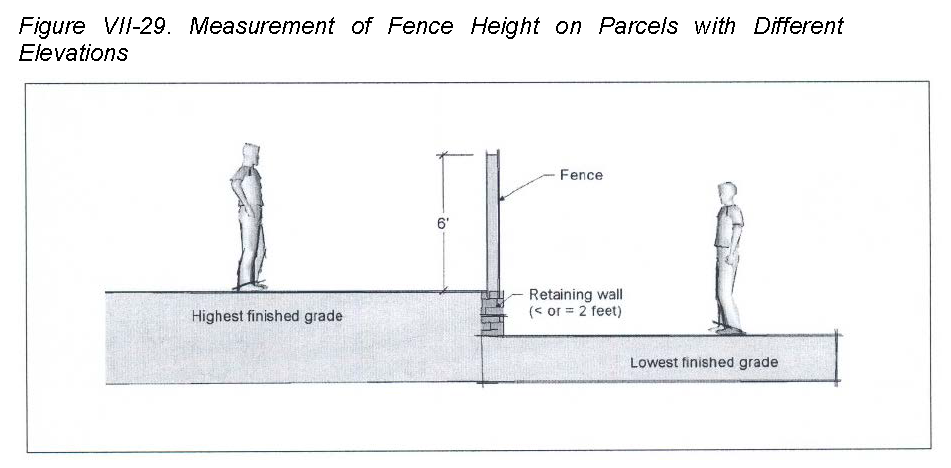
(10)
Easements. Fences may be permitted within city easements. However, the city shall not be responsible for the repair or replacement of fences that must be removed to access such easements.
Sec. 21-7732. - Fence and Wall Requirements by Land Use.
(1)
Table. All fences shall comply with the following standards related to land use.
Table VII-21. Fence and Wall Standards
(2)
Exceptions.
(a)
When a property sides onto an arterial, state, or federal highway, a solid fence up to a maximum six feet in height may be allowed in residential districts subject to the setbacks listed above.
(b)
When an interior lot backs onto another public right-of-way, a solid fence up to a maximum 6 feet in height may be allowed in residential districts subject to the setbacks listed above.
(c)
Tennis Courts, baseball field, or similar outdoor recreational use may consist of a fence with a maximum height of 12 feet, provided that the fence is open style and is not located in any required setback. These recreational use fences may not be used for any standard property line fencing mentioned above. In addition, mesh netting is allowed for these outdoor recreational use fences.
(d)
Any gates located along interior lot lines or along alleys do not have to meet the required gate setback.
(e)
Fencing over 42 inches in height for individual mobile home lots or spaces is prohibited. Perimeter fencing around an entire mobile home park or district is allowed utilizing the public/institutional fence standards.
(f)
Vacant lots may have only a chain-link, wrought iron, or similar open-style fence of equal transparency to prevent illegal dumping. The maximum allowed height for such a fence is 6 feet, and the front setback shall be equal to the minimum front setback for a principal structure in that zone district. Barbed wire, razor wire, and electric fences are prohibited.
(Ord. No. 2158, December 2018)
Sec. 21-7733. - Temporary Fences.
Temporary fencing for construction sites and for organized events may be allowed in conjunction with the criteria set forth in article V.
Sec. 21-7734. - Residential Subdivision Perimeter Fences and Walls.
(1)
Standards. Where perimeter fencing or walls are installed around a subdivision or development, they shall comply with the following standards when located adjacent to public right-of-way:
(a)
A minimum eight-foot buffer shall be provided between the back of a sidewalk and a fence or wall. Landscaping, including trees, shall be incorporated within the buffer to soften the appearance of the wall or fence.
(b)
No more than 75 percent of any street frontage shall be occupied by the fence or wall.
(c)
The required 25 percent openings in the fence or wall frontage shall serve to visually link intersecting streets, view corridors into and out of the development, pedestrian entryways, and parks or open space. Fences or walls that have a surface area that is not more than 50 percent opaque, hedges and screens composed of living plant material, or any land use with a wall or fence lower than 42 inches, may count toward the 25 percent requirement.
(2)
Materials. Any perimeter subdivision fence located along a limited-access highway shall be constructed of masonry, stone, block, stucco, or related material. Cedar or wooden fencing is prohibited. Other materials may be approved by the director.
Sec. 21-7735. - Retaining Walls.
All retaining walls shall meet the following requirements:
(1)
Maximum Height. The maximum height of any retaining wall that is not attached to a primary structure and not necessary to compensate for a change in grade on the site shall not exceed four feet. The maximum height of any retaining wall that is attached to a primary structure and necessary to compensate for a change in grade (with no artificial fill) shall not exceed six feet. A series of low retaining walls (instead of one taller retaining wall) shall be used whenever possible. Where multiple retaining walls are used, minimum horizontal spacing shall be at least four feet.
(2)
Railing Required. Where the construction of a retaining wall results in a downward vertical drop of more than 30 inches within 4 horizontal feet of a sidewalk, walkway, or other public circulation area, a railing at least 42 inches high shall be placed along the top edge of the retaining wall to prevent pedestrians from falling over the edge of the retaining wall.
(3)
Materials. Dry-stacked native stone, pre-cast masonry block materials, cast in place concrete, or masonry block walls with stone, brick, or stucco facing should be used for retaining walls. Treated timber walls and railroad tie walls shall not be used for retaining walls, except on single-family detached and single-family attached residential properties. Tires are prohibited from being used as a retaining wall in all zone districts.
Sec. 21-7736. - Courtyard Walls.
(1)
Description. Solid or semi-transparent walls architecturally integrated with the primary structure which are used to create an enclosed or partially enclosed outdoor living space that is open to the sky.
(2)
Materials. Courtyard walls shall utilize similar or complementary materials as the connecting principal structure. Where the principal structure includes masonry, the wall shall incorporate matching masonry materials into the design of the wall. Other acceptable materials include wood, brick, stone, masonry, stucco, decorative metal panels, tile, glass block, composite or fiberglass materials that mimic the appearance of natural wood or stone, or other materials as approved by the city. Any gate or door may be of a complementary material to the rest of the wall, and shall be of an open/semi-transparent design.
(3)
Finished Sides. The courtyard wall shall present a finished appearance on the interior and exterior sides of the wall as well as on the top. This may include a cap of the same or a complementary material as the rest of the wall. Walls designed to be filled as planters are also acceptable.
(4)
Setbacks. All courtyard walls shall comply with the principal structure setbacks for the underlying zone district. The space in front and side yards along a public right-of-way between the courtyard wall and the street shall be landscaped in accordance with section 21-7510.
(5)
Height.
(a)
Front and side yards along a public right-of-way or open space. The maximum allowed height is 4 feet. Walls with an undulating design may be up to 5 feet at the highest point with an overall average height of 4 feet. Columns may exceed the wall height by up to 1 foot, inclusive of any caps or decorative features. An archway or entry feature may be up to 8 feet at the highest point and shall not exceed 5 feet in horizontal width. A maximum of one (1) archway or entryway feature is allowed in the front yard.
(b)
Side and rear yards. The maximum allowed height is 8 feet for all components of the wall, including columns, archways, and any decorative features.
(Ord. No. 2188, December 2018)

