
Commerce City City Zoning Code
ARTICLE III
- Development Review
Sec. 21-3200. - Required Review.
Applications shall be reviewed in accordance with the processes and standards set forth in this Code. Table III-2, Development Review Table, establishes the review steps required for specific forms of site development.
Table III-2. Development Review Table
(Ord. No. 1891, August 2012; Ord. No. 2183, November 2018; Ord. No. 2266, § 4(Exh. C), 2-15-2021; Ord. No. 2516, § 2b(Exh. B), 8-14-2023)
Sec. 21-3300. - Discretion and Conflicts.
Annexation is a discretionary, legislative act. Accordingly, the city shall never be compelled to annex, unless otherwise required by state law, even if all annexation requirements have been satisfied. The city's annexation requirements, set forth in this land development code, are intended to supplement the provisions of the state statutes and are in no way to be construed as being in conflict therewith.
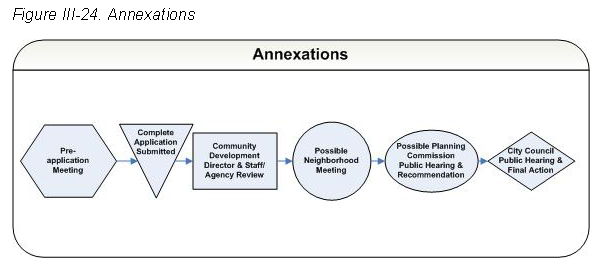
Sec. 21-3310. - Review.
(1)
Pre-application Meeting. It is strongly recommended that an applicant meet with the city prior to submission of an application for annexation to identify procedures, processes, and relevant information regarding the proposed annexation.
(2)
Director Review and Referral.
(a)
The director, and the DRT or the planning commission as deemed appropriate by the director, shall conduct an analysis of existing land uses on the subject property to ascertain zoning and potential nonconformities. The director shall assess whether the petition for annexation substantially complies with state law and this land development code and shall prepare a draft resolution for the city council so that the city council may make a determination of compliance as required by state law.
(b)
The director shall report to the city council his assessment of whether the petition for annexation substantially complies with state law. Such report shall be provided to the city council prior to the date on which the annexation ordinance is introduced on first reading and shall include a summary of any recommendations from the DRT or the planning commission.
Sec. 21-3320. - Annexation Agreements.
(1)
Annexation Agreement Required. Except for unilateral annexations or annexations upon election, an annexation agreement shall be required before an annexation is approved. The annexation agreement shall identify the mutual understanding of the commitments and responsibilities of the city and the property owner(s) related to the subject property and annexation.
(2)
Director to Coordinate Annexation Agreement Negotiations. The director coordinates all annexation agreement negotiations. The director, in consultation with the Development Review Team, prepares the agreement in a form approved by the city attorney and presents such to the applicant. The applicant may either sign the agreement or present an alternative agreement to the director for consideration. The director may seek input from the Development Review Team and direction from city council in the negotiation of any annexation agreement.
(3)
Timing and Finalization of Annexation Agreements. An annexation agreement acceptable to the city and the property owner(s) shall be fully-executed by all property owner(s) and returned to the city at least ten days prior to the city council meeting at which the first reading of the annexation ordinance will be considered. No annexation ordinance shall proceed to first reading until an annexation agreement has been executed and received by the city in accordance with this section.
(4)
Authority to Execute. The city manager shall have the authority to execute all annexation agreements, subject to ratification by the city council in the annexation ordinance.
(5)
Annexation Agreement to be Recorded. Upon annexation, such agreement shall be recorded to provide notice to future purchasers of said property. All recording costs shall be borne by the applicant.
(Ord. No. 2411, § 2(a)(Exh. A), 9-19-2022)
Sec. 21-3330. - Other Districts.
It is the applicant's responsibility to apply for inclusion in or exclusion from any applicable district(s) such as special districts and improvements districts.
Sec. 21-3340. - Annexation Approval Criteria.
The annexation application may be approved if:
(1)
The annexation is in compliance with the Municipal Annexation Act of 1965, as amended, the Constitution of the State of Colorado, and this land development code;
(2)
The annexation is consistent with the comprehensive plan and all other adopted city plans and policies;
(3)
The best interests of the city would be served by annexation of such property;
(4)
The property is within the Municipal Service Area (MSA) of the Commerce City Growth Boundary as stated in the comprehensive plan. No property outside of the MSA or Growth Boundary shall be considered for annexation unless the city council finds that, consistent with the comprehensive plan, the best interests of the city would be served by annexation of such property and provided a land use plan for the area proposed to be annexed is submitted together with the annexation application;
(5)
The property is capable of being integrated into the city in compliance with all applicable provisions of this land development code;
(6)
At the time any development of the area proposed to be annexed is completed, there is a reasonable likelihood that capacity will exist to adequately serve residents or users of such area with all necessary utilities, municipal services and facilities;
(7)
The annexation boundaries are configured such that the annexation will not limit the city's ability to integrate surrounding land into the city or cause variances or exceptions to be granted if the adjacent land is annexed or developed;
(8)
The proposed annexation is in compliance with all pertinent intergovernmental agreements to which the City is a party; and
(9)
Unless otherwise agreed to by the city, any preexisting vested property rights have been waived in writing as a condition of such annexation.
(Ord. No. 2411, § 2(b)(Exh. A), 9-19-2022)
Sec. 21-3350. - Zoning of Newly Annexed Land.
(1)
Generally. Zoning of newly-annexed land or land in the process of annexation shall be considered an initial zoning and should represent good planning principles and be consistent with the goals and land use designations of the comprehensive plan.
(2)
Criteria for Zoning. After passage on first reading of an ordinance annexing property to the city, the subject property shall be given the zoning classification:
(a)
Most compatible with the city's comprehensive plan designation of the property;
(b)
Most comparable to the county zoning classification existing on the subject property at the time of acceptance by the city of the annexation petition for the subject property; or
(c)
Most comparable to the present use(s) of the property.
(3)
Land Use Approvals. In the event it is determined by the city or the applicant that development approvals for the land to be annexed should be obtained concurrently with the annexation application and initiation of zoning, the applicant may initiate the development approval process required elsewhere in this land development code for such development approval along with the annexation process and the city council may consider the proposed development application, including any concept plan, development plan, and any applicable comprehensive plan amendment(s) when the annexation ordinance is considered under first reading.
(4)
Sequence of Events. Neither an ordinance proposing zoning of land to be annexed or proposing development approvals for the land to be annexed shall be finally adopted by the city council prior to the date of final adoption of the annexation ordinance.
Sec. 21-3360. - Annexed Land in the Floodplain.
Upon annexation, any portion of the area to be annexed situated within the 100-year floodplain for First Creek, Second Creek, Third Creek, Beebe Draw, Box Elder Creek, and any other floodplain designated by the city shall be dedicated to the city unless otherwise provided.
Sec. 21-3370. - Annexed Areas Added to Wards.
In the absence of change of ward boundaries by amendment to the municipal code, those areas annexed to the city shall become a part of the ward to which the annexed area is most contiguous.
Sec. 21-3380. - Right-of-Way Dedications.
Upon annexation, any portion of the annexed area that is depicted on the city's transportation plan as an arterial roadway shall be dedicated to the city, unless otherwise provided.
Sec. 21-3100. - Review Period.
(1)
Extensions. Any time period set forth in this land development code for the review of and/or final action on an application may be extended by the city if it determines that the projected size, complexity, anticipated impacts or other factors associated with the proposed development clearly support such extension of time.
(2)
Delay. Failure of the city to take action on an application within a time-frame established by this land development code, regardless of whether an extension was granted, shall not constitute an approval, or a recommendation for approval, of any application.
Sec. 21-3105. - Director Referrals.
The director may refer to the planning commission for review and to city council for a decision any application to which the director is assigned responsibility as the decision maker under the terms of this article. In such event, written notice of the referral shall be sent to the applicant and the matter shall be set for planning commission and city council consideration as soon as practical, but in no event shall the city be required to hold a special meeting nor deviate from standard policies for placing matters upon the planning commission's and city council's agendas. The city council's decision shall be based upon the relevant approval criteria.
Sec. 21-3110. - Neighborhood Meetings.
(1)
Purpose. Neighborhood meetings are intended to inform neighboring property owners of the details of a proposed development, how the developer intends to meet the standards contained in this Code, and to receive feedback on the proposal early in the review process.
(2)
Applicability. The City may require a neighborhood meeting when it appears that an application may have significant neighborhood impacts, including without limitation, impacts related to: traffic; provision of public services such as safety, schools, or parks; compatibility of building design or scale; or operational compatibility such as hours of operation, noise, dust, or glare. A minimum of one neighborhood meeting shall be required for all oil and gas permit applications.
(3)
Number of Meetings. When required, there shall be at least one neighborhood meeting held. Such meeting shall be held prior to submittal of a formal application; prior to any administrative action on the application; or a minimum of 21 days prior to the first public hearing on the application. The Director may require additional neighborhood meetings due to the proposed development's mix of uses, density, complexity, potential for impacts, or the need of off-site public improvements created by the development.
(4)
Attendance Required. If a neighborhood meeting is required, the applicant or applicant's representative shall attend and conduct the meeting.
(5)
Scheduling and Location. The applicant shall be responsible for scheduling the neighborhood meeting at a time when a department staff member can attend, shall coordinate the neighborhood meeting, and shall retain an independent facilitator if needed. All neighborhood meetings shall be convened at a place in the vicinity of the proposed development.
(Ord. No. 2266, § 3(Exh. B), 2-15-2021)
Sec. 21-3115. - Public Hearings.
If required, a public hearing shall be held only after notice is given in accordance with section 21-3180. A hearing may be continued if the projected size, complexity, anticipated impacts, volume of testimony or evidence to consider, lack of necessary information, or other factors associated with the proposed development clearly support such extension of time. A hearing for which proper notice was given may be continued to a later date without again complying with the notice requirements of this land development code, provided that the continued hearing is set for a date within 90 days of the original hearing and the date and time of such hearing is announced at the time of continuance.
Sec. 21-3120. - Burden of Proof.
The burden of demonstrating that the applicable approval criteria have been met shall be on the applicant.
Sec. 21-3125. - Decisions.
(1)
Limitation. The city may not recommend or approve a greater density of development, a more intensive use, a greater variance, or a more intensive zoning classification than what was indicated in the public notice; however, a lower density of development, a lesser variance, or a less intensive use may be recommended or approved.
(2)
Conditional Approvals Permitted. The city shall be authorized to impose any conditions on an approval that it deems necessary to carry out the general purpose and intent of this land development code or the comprehensive plan including, without limitation, requiring the applicant to submit to and pay for ongoing compliance oversight. However, any condition that requires an applicant to dedicate land or pay money to a public entity in an amount that is not calculated according to a formula applicable to a broad class of applicants shall be roughly proportional both in nature and extent to the anticipated impacts of the proposed development, as shown through an individualized determination of impacts.
(3)
Written Decisions Required. All non-administrative decisions shall be based on written findings of fact related to the relevant standards or criteria set forth in this land development code.
(4)
Majority Vote Required. Except as specifically provided for otherwise in this land development code, a decision on an application that is before a decision making body shall be made by a majority of the members of such body present and voting at the hearing or meeting.
(Ord. No. 1785, June 2010)
Sec. 21-3130. - Approvals.
(1)
Limitation. An approval shall only authorize the development described in the approved application. Any development that occurs beyond what is described in the application is prohibited and shall be deemed a violation of this land development code and subject to the enforcement provisions set forth in article X.
(2)
Lapse. An approval shall lapse if the applicant fails to take necessary action on the approval within the time-frame set forth in table III-2. Unless specifically provided otherwise, the time frames established in table III-2 may be extended by the original decision maker under the following conditions:
(a)
An extension request is filed on the form established by the director, with all required exhibits and fees, prior to the applicable lapse-of-approval deadline; and
(i)
This land development code does not expressly prohibit the requested extension.
(b)
If a request to extend the time frame is denied, the requesting party may appeal the denial to the person or body who would have heard an appeal of the original approval (the one being extended).
Sec. 21-3135. - Applications After Denial.
If an application is denied, the same or substantially similar request shall not be heard by the city for a period of one year from the date of denial unless the denial explicitly states that an earlier re-application will be considered. Notwithstanding the foregoing, an applicant may submit a revised application that adequately addresses all of the stated reasons for denial at any time. Such revised application shall be treated as a new application for purposes of review and scheduling.
Sec. 21-3140. - Building Permit Acceptance.
No application for a building permit for properties undergoing any required review will be accepted by the city until the review is complete unless acceptance is specifically authorized by the director.
Sec. 21-3145. - Development Agreements.
Where a development agreement is required by the city, the city attorney shall be authorized to negotiate such agreement on behalf of the city. Once approved by the city, the city may require that the agreement be recorded in the county clerk and recorder's office and may further require that the developer pay the recording costs.
Sec. 21-3150. - Authority to File Application.
Unless specifically provided otherwise, an application for review or approval under this land development code shall be filed by the owner of the property on which the development will occur or the owner's duly authorized agent. In those instances where the application need not be filed by the property owner, the property owner's express authorization for the filing shall be required.
Sec. 21-3155. - Pre-Application Meeting.
(1)
Purpose. The purpose of the pre-application meeting is to inform the applicant of development procedures, submittal requirements, standards, alternatives, and other pertinent matters before the applicant finalizes the development proposal.
(2)
Applicability. Unless specifically provided otherwise, pre-application meetings are voluntary and conducted at the request of an applicant.
(3)
Scheduling. Applicants shall be responsible for scheduling pre-application meetings with city staff when they are desired.
(4)
Non-Binding. Any opinions expressed during pre-application meetings are informational only and do not represent a commitment on behalf of the city regarding the acceptability or approval of the development proposal. Materials submitted for review at a pre-application meeting shall not constitute an application for development for purposes of C.R.S. § 24-68-101 et. seq.
Sec. 21-3160. - Forms, Materials, and Fees.
(1)
Forms and Filing. Applications shall be filed with the department on forms approved by the director and shall be accompanied by all required fees and any materials deemed necessary by the director to carry out the provisions of this land development code or applicable law, including without limitation the submission of performance bonds. In some circumstances, the city manager, the board of adjustment, the planning commission, and/or the city council may require information or material in addition to that requested by the director, including technical studies and/or a payment to the city to fund the cost of a technical study. The additional information may be required at the time of application or at any time during the review and approval process. No application will be considered complete until all fees have been paid and all requested information has been provided to the city.
(2)
Fees. Fees shall be established by resolution of the city council. Application fees shall be nonrefundable, absent an express provision to the contrary in the application form or this land development code.
(3)
Fee Waiver. The city may waive application fees, in whole or in part, for governmental or quasi-governmental applicants. In addition, the city may, on its own initiative or upon the written request of an applicant, waive application fees, in whole or in part, in the following situations:
(a)
The application involves the repair or reconstruction of property destroyed or damaged in a national, state, or locally declared disaster;
(b)
The application is for a project that provides extraordinary charitable, civic, educational, or other similar benefits to the community;
(c)
There is a prevailing public interest in waiving, modifying, or refunding the application fees; or
(d)
In residential developments:
(i)
The application is for housing that will help meet the city's unmet affordable housing targets;
(ii)
The application is for housing that will be owned by, and remain affordable for at least five years to, households earning 60 percent or less of the Adams County median family income adjusted for household size ("low income"); or
(iii)
The applicant qualifies as low income and the application concerns property that he or she owns and that serves as his or her primary residence.
(iv)
A request for a fee waiver must be submitted with the application. The standard fee must be paid at the time of application and will be returned to the applicant only if the city determines that a waiver is appropriate. The decision maker responsible for approving or denying the underlying application shall consider and approve or deny the request for a waiver in conjunction with the decision on the underlying application.
(4)
Incomplete Applications. No application shall be considered which is not complete in every detail. Incomplete applications may be returned to the applicant for completion or correction without any further action. The city shall not be responsible for the failure of a permit to be issued or an approval granted due to incomplete or defective applications.
(Ord. No. 1785, June 2010)
Sec. 21-3165. - Simultaneous and Combined Processing.
(1)
Request and Approval. At the election of the applicant and with the concurrence of the city, applications for different types of development approvals may be processed simultaneously to expedite the review and processing time for a project. In addition, at the election of the applicant and with the concurrence of the city, an application for a use by permit may be processed in conjunction with any application that requires approval by the city council and which is submitted by the same applicant and reasonably related to the use by permit application. In such case, both applications shall be heard by the planning commission and city council. The combination or simultaneous processing of applications shall have no effect on application fees.
(2)
Review Period. When two or more applications are processed simultaneously or in conjunction with one another and have different time frames for review and/or approval, the longest time frame shall apply to all applications.
(Ord. No. 1785, June 2010)
Sec. 21-3170. - Inactive Applications.
In the event that an applicant, having been notified that additional information or corrected materials are required, fails to submit such information or materials within 60 days of the request, or an applicant fails to attend any scheduled meeting or public hearing, the director may notify the applicant that the application is considered inactive and unless corrective action is taken within 30 days, the application shall be considered withdrawn.
Sec. 21-3175. - Withdrawal of an Application.
Except for inactive applications, only the applicant or property owner may withdraw an application. After an application is withdrawn, no further action on the application shall take place. To re-initiate review, the applicant shall resubmit the application, which in all respects shall be treated as a new application for purposes of review, scheduling, and fees.
Sec. 21-3180. - Required Notice.
Notice shall be provided in accordance with the following table:
Table III-1. Notice Requirement
1 Placards and mailed notification shall not be required when an amendment to the official zoning map is initiated by the city and affects multiple owners.
2 When a plat is initiated by the city and affects city-owned land, no notice shall be required.
3 Mailed notice shall be a minimum of 2,500 feet from the affected parcel(s).
(Ord. No. 1891, August 2012)
Sec. 21-3185. - Notice Types.
(1)
Mail. Unless modified by the director, mailed notice shall be sent to all the owners of property adjacent to or within 300 feet of the property that is the subject of the application. Notice shall be mailed at least seven days prior to the public hearing or, where no hearing is required, administrative action. When adjacent property is owned by a subdivision or condominium association, notification may be sent to the management company or board of such association and to the owners of the individual units. The city shall be responsible for mailing the notice unless it specifically delegates this responsibility to the applicant in writing. If delegated, the city may require the applicant to submit evidence to document compliance with the requirements of this section.
(2)
Placards. The city, or the applicant if designated by the director, shall place signs on the property which is the subject of the application at least seven days prior to the public hearing or action. The director shall designate the number and location of the signs based upon the complexity of the project, the geographic reach of potential adverse impacts, the extent of neighborhood compatibility issues, and similar factors. In no event shall the number of signs posted be fewer than one.
(a)
The applicant shall ensure signs remain in place during the period leading up to the hearing or administrative action and shall check the posted signs each day. Missing or damaged signs shall be replaced by the applicant within 48 hours of discovery or by the close of the next business day, whichever period is longer. When requested by the city, the applicant shall sign a statement affirming that the above-stated procedures were followed. Failure to comply with the required posting procedure or failure to file the posting compliance log with the city upon request may result in the public hearing being rescheduled. Any delays resulting from the rescheduling shall not prejudice the city regarding the city's compliance with required times to act as set forth in this land development code.
(b)
Applicants shall remove all signs no later than one week after the public hearing or action.
(3)
Publication. Notice shall be placed in a newspaper of general circulation in the city at least six days prior to any public hearing or action by the planning commission or board of adjustment, and at least seven days prior to any public hearing or action by the city council.
Sec. 21-3190. - Notice Content.
All notice required by table III-1 shall indicate the time and place of the public hearing or action, describe the property involved, the nature of the application, and indicate where additional information may be obtained.
Sec. 21-3195. - Sufficiency of Notice.
Failure of a person to receive mailed notice shall have no affect on any subsequent hearing or action. Similarly, minor defects in any type of notice shall not invalidate the notice or any proceedings related to the notice provided a bona fide attempt has been made to comply with applicable notice requirements. In all cases, however, the requirements for the timing of the notice and for specifying the time, date, and place of a hearing and the location of the subject property shall be strictly construed. If questions arise at a public hearing regarding the adequacy of notice, a formal finding regarding whether there was substantial compliance with the notice requirements of this land development code shall be made before proceeding with the hearing.
Sec. 21-3210. - Building and Sign Permits.
(1)
Description. A building permit, including a foundation-only permit or foundation-only extension request, allows the permit holder to undertake construction of a project; a sign permit allows a person to install and/or display a sign.
(2)
Requirement. No person shall erect, construct, enlarge, alter, repair, improve, remove, convert, move, or demolish any building or structure without obtaining a building permit. No person shall erect or display a sign without obtaining a sign permit.
(3)
Review. The building official reviews building and sign permit applications and is authorized to approve, approve with conditions, or deny the applications based on the approval criteria outlined below.
(4)
Approval Criteria. Permits may be issued if:
a.
The proposed development is consistent with any previously approved subdivision plat, development permit, zoning, site plan, or other land use approval;
b.
The proposed development complies with all applicable city standards and codes, unless a minor modification or a variance has been granted;
c.
There is no evidence to suggest that the development violates any federal, state, or local requirements;
d.
All development fees have been paid in full; and
e.
A surety has been secured for a foundation-only permit or extension request securing the full cost of removal and remediation of the property in the event further required approvals are not granted.
(5)
Foundation-Only Permits and Foundation-Only Permit Extension Requests.
a.
Eligibility. When the relevant approval criteria have been met, the building official is authorized to issue a building permit for construction of the foundation, in whole or in part, of a building or structure ("Foundation-Only Permit"), with accompanying construction documents sufficient to allow the building official to determine compliance with relevant Codes, criteria, standards and specifications, only where:
i.
The foundation is not for a single family detached or single family attached structure or building; and
ii.
A grading permit or early grading permit has been obtained from Public Works; and
iii.
The building or structure, or group of the same, is commercial or multi-family residential and will equal or exceed 250,000 square feet of total building square footage; or
iv.
The building or structure, or group of the same, is within an Urban Renewal Area; or
v.
The building or structure will be multi-family residential with affordable housing available for persons at 80 percent Area Median Income (AMI) or below.
b.
Approval Criteria. The building official may approve, deny, or approve with conditions, a Foundation-Only Permit according to the Approval Criteria above.
c.
Effect of concurrently pending applications. Consideration of a Foundation-Only Permit may proceed where a complete and pending application for a plat, development plan, or PUD Development Permit application is in the review process. No Foundation-Only Permit shall issue, however, where the proposed use of the building or structure is not a use-by-right pursuant to existing zoning.
d.
Liability. The applicant, developer, and property owner shall proceed under any Foundation-Only Permit or Foundation-Only Permit Extension Request(s) (as described below) issued pursuant to this subsection at their own risk and without assurance or representation that a building permit for the entire building or structure, development plan, or PUD development permit will be approved or a plat will be approved. Before issuing a Foundation-Only Permit or Foundation-Only Permit Extension Request under this subsection, the applicant, developer, and property owner must execute an assumption of risk and a release of all rights and claims of any type whatsoever, including any claim of vested rights, against the City relating to the Foundation-Only Permit or Foundation-Only Permit Extension Request, and any related approval, and indemnifying the City from any related claim for damages, and in a form acceptable to the City.
e.
Foundation-Only Permit Extension Request above foundations. Where a Foundation-Only Permit has been issued, the building official shall approve, deny, or approve with conditions, the Foundation-Only Permit Extension Request in writing to allow the applicant to continue with vertical construction above the foundation under the following conditions:
i.
A building permit application, including a complete set of construction documents, has been submitted for the entire building;
ii.
After the first-round review of the construction documents by the building official, no deficiencies or code violations have been identified in the proposed elements to be constructed and included in the Foundation-Only Permit Extension Request;
iii.
All special inspection reports, if applicable, have been approved with no outstanding code violations; and
iv.
A written Foundation-Only Permit Extension Request is made directly to the building official.
(6)
Appeal. The denial of a building or sign permit based upon any standard contained in this land development code may be appealed to the board of adjustment. The denial of a building or sign permit for any other reason may be appealed to the building board of appeals.
(7)
Lapse. If the work described in a permit is not commenced within six months, or substantially completed within two years of the date the permit was issued, the permit shall automatically lapse and be null and void.
(8)
Certificate of Occupancy. No land or building may be changed in use, nor may any new structure, building, or land be occupied or used, unless a certificate of occupancy or completion has been issued by the city. As long as the proposed use, or the structure intended to be occupied, complies with the provisions of this land development code and all other laws and regulations of the city, a certificate of occupancy or completion shall be issued.
(9)
Application Inactivity. In the event that an applicant, having been notified that additional information or corrected materials are required, fails to submit such information or materials within the time specified in the building code or the residential code, as applicable, the application shall be deemed inactive and shall be considered withdrawn.
(Ord. No. 1887, July 2012; Ord. No. 2515, § 2(Exh. A), 8-14-2023)
Sec. 21-3211. - Concept Plans.
(1)
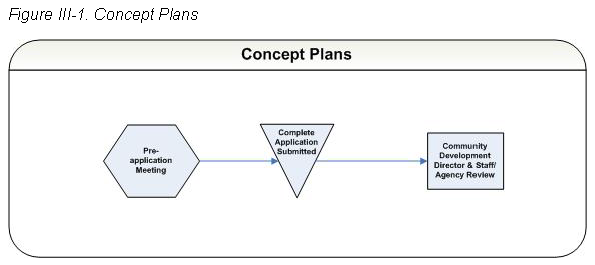
Description. A concept plan is a generalized land use/site plan for an area proposed to be developed within a non-PUD zone district. It is an optional step that allows early, informal evaluation of a proposed development before substantial expenses have been incurred. A concept plan provides city staff and the applicant an opportunity to determine the development's conformance with the comprehensive plan and the requirements of this land development code, and assists the applicant in the preparation of a development plan.
(2)
Review. The director and the DRT review concept plans. The director may provide comment letters to applicants based upon such reviews. Any comments contained in the letter are informational only and shall not represent a commitment on behalf of the city regarding the acceptability of the plan.
Sec. 21-3212. - Development Plans.
(1)
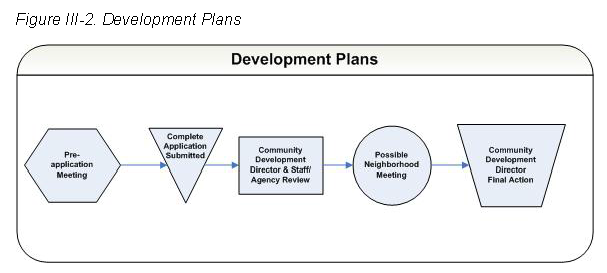
Description. A development plan provides the final details for site design, including landscaping, architecture, civil engineering, and public improvements. The review of such plan is intended to ensure compliance with this land development code.
(2)
Requirement. Unless specifically allowed by the director, no building permit shall be issued, and therefore no development, excavation, site preparation, or construction activity, including tree/vegetation removal or grading, shall occur on any property until a development plan has been approved in accordance with this section.
(3)
Exceptions. The following development types do not require a development plan, unless specified by the director:
(a)
Development of single-family dwelling units on individual lots;
(b)
Development within an approved PUD zone district (PUD zone districts shall follow the PUD development permit process); and
(c)
The following civic and institutional uses:
(i)
Forest or range land;
(ii)
Government lands, parks, and buildings; and
(iii)
Minor public utilities, as determined by the city.
(4)
Review. The director and the DRT review development plans. The director is authorized to approve, approve with conditions, or deny development plans based on the criteria below.
(5)
Approval Criteria. A development plan may be approved if it:
(a)
Complies with city standards;
(b)
Is consistent with any previously approved subdivision plat, rezoning concept plan, or other plans or land use approvals;
(c)
Provides adequate mitigation for any significant adverse impacts resulting from the use; and
(d)
Creates a positive precedent for the future cumulative development of the immediate area.
Sec. 21-3213. - Floodplain Development Permits.
(1)
Requirement. No person shall commence any construction, development, or storage of materials within the floodplain overlay district unless a floodplain development permit has been obtained from the city.
(2)
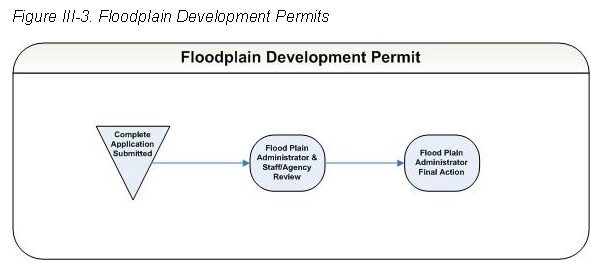
Review. The floodplain administrator reviews applications for floodplain development permits to determine the specific flood hazard at the site and evaluate the suitability of the proposed use in relation to the flood hazard and is authorized to approve, approve with conditions, or deny the application based on the approval criteria below.
(3)
Approval Criteria. A floodplain development permit may be approved if the floodplain administrator finds:
(a)
The applicant has obtained all necessary federal, state, and local permits.
(b)
If alteration or relocation of any watercourse is involved, the applicant has notified all adjacent communities and the Colorado Water Conservation Board of the alteration or relocation and has submitted evidence of such notification to the Federal Emergency Management Agency. The floodplain administrator must also find that the flood-carrying capacity within the altered or relocated portion of the watercourse is not diminished.
(c)
The danger that materials may be swept onto other lands or cause the injury to others is minimal;
(d)
The susceptibility of the proposed facility and its contents to flood damage and the effect of such damage on the individual owner and adjacent upstream and downstream property owners is minimal;
(e)
The proposed use is compatible with existing and anticipated development as set forth in, or reasonably inferred from, the comprehensive plan;
(f)
The safety of access to the property in times of flood for ordinary and emergency vehicles is adequate;
(g)
The costs of providing governmental services during and after flood conditions including maintenance and repair of streets and bridges, and public utilities and facilities such as sewer, gas, electrical and water systems is not excessive;
(h)
The expected heights, velocity, duration, rate of rise and sediment transport of the flood waters and the effects of wave action, if applicable, expected at the site is minimized; and
(i)
Alternative locations for the proposed use that are not subject to flooding or erosion damage do not exist.
(j)
The proposed use minimizes disturbing the natural topography of the floodplain, and promotes passive flood mitigation strategies and preserves native wildlife habitat and recreational opportunities to the maximum extent feasible given the benefits of the proposed development.
(4)
Conditional Approval. The floodplain administrator shall be authorized to impose conditions necessary to ensure compliance with this code including, without limitation, the following:
(a)
Modification of waste disposal and water supply facilities to minimize or eliminate infiltration of flood waters;
(b)
Limitations on periods of use and operations;
(c)
Imposition of operational controls, sureties, and deed restrictions;
(d)
Location and placement of structures and buildings on a site in order to minimize obstructions to flood waters; and
(e)
Adequate flood proofing measures. The floodplain administrator may require that the applicant submit a plan or document certified by a registered professional engineer or architect testifying that the flood proofing measures are consistent with the regulatory flood elevation and associated flood factors for the particular area.
(5)
Lapse. If the work described in any floodplain permit is not commenced within six months, or substantially completed within two years of the date the permit was issued, the permit shall automatically lapse and be null and void.
(Ord. No. 2158, December 2018)
Sec. 21-3214. - Grading Permits.
(1)
Requirement. Except as provided in paragraph (2) of this section, no person shall modify the elevation or grade of any property by depositing or removing any materials without first obtaining a grading permit.
(2)
Exceptions. A grading permit shall not be required for:
(a)
Any emergency activity that is immediately necessary for the protection of life, property, or natural resources;
(b)
Existing nursery and agricultural operations conducted as a permitted main or accessory use;
(c)
Stockpiling and handling of earth material associated with commercial open pit mining operations licensed under the authority of the Colorado Division of Minerals and Geology.
(3)
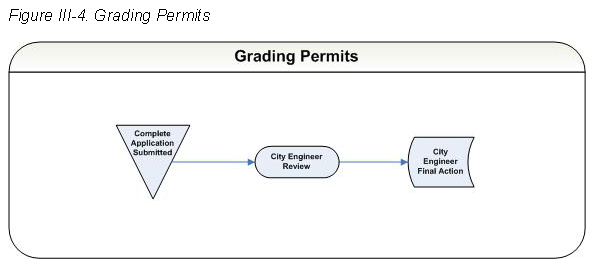
Review. The city engineer reviews applications for grading permits and is authorized to approve, approve with conditions, or deny such applications based on the approval criteria below.
(4)
Approval Criteria. A grading permit may be approved if the city engineer finds that:
(a)
The applicable state permit has been obtained;
(b)
The grading activities and plans comply with the city's engineering and construction standards and specifications (ECSS);
(c)
Erosion and sediment control plans have been submitted and implemented by the applicant and approved by the city engineer;
(d)
A drainage report, if applicable, has been approved by the city engineer; and
(e)
If required by the city engineer, the applicant has provided a re-seeding, erosion, and sediment control bond.
(5)
Conditions for Approval. By accepting a grading permit, the applicant agrees to comply with the following requirements, in addition to any others which may be imposed by the city:
(a)
The grading activities shall be undertaken in such a manner as to preserve and enhance the city's aesthetic character;
(b)
At least 70 percent of the land must be re-vegetated within 12 months of the date of completion of grading or clearing activities;
(c)
The grading activities shall be performed in accordance with all applicable laws, rules, and regulations pertaining to air, water, and noise pollution;
(d)
The owner shall schedule construction activities to minimize the total amount of soil exposed, including stockpiles, at any given time in order to reduce the period of accelerated soil erosion; and
(e)
The area of land disturbance must not be exposed for more than 60 consecutive days without temporary or permanent stabilization, unless the city engineer approves a time extension.
(6)
Stop Work Orders. If the site is not in compliance with the approved erosion and sediment control plan or the city's requirements for erosion and sediment control, the city shall have the authority to issue a stop work order within 24 hours of notification to the owner or developer of noncompliance.
Sec. 21-3215. - Minor Modifications.
(1)
Description. The following deviations from the city's general standards or approved PUD zone documents are considered minor modifications:
(a)
Up to 20 percent of any minimum or maximum standard;
(b)
An additional one foot of fence height;
(c)
Up to 50 percent of the minimum fence setback;
(d)
A screen fence instead of an open style fence;
(e)
A reduction to the Floor Area Ratio requirement; or
(f)
Up to 50 percent of the minimum required landscaping.
The modification of any design standard set forth in article VII shall not be considered a minor modification and shall be governed by the sections in article VII that discuss alternative compliance.
(2)
Prohibited Modifications. In no circumstance shall the director approve a minor modification that is not listed specifically above, or that results in any of the following:
(a)
An increase in permitted maximum development density or intensity;
(b)
A change in permitted uses or mix of uses;
(c)
An increase in building height over 10 percent; or
(d)
A decrease in the amount of required common or dedicated open space.
(3)
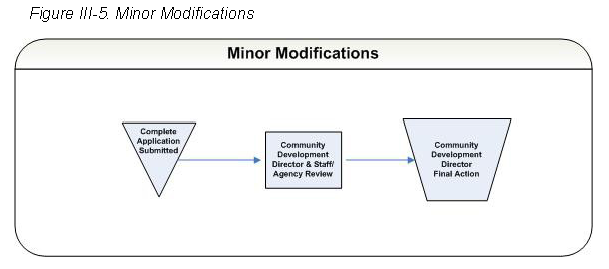
Review. The director reviews minor modification applications and is authorized to approve, approve with conditions, or deny the applications based on the approval criteria outlined below.
(4)
Approval Criteria. A minor modification may be approved if the director finds that:
(a)
The modification is necessary to satisfy the federal requirements for reasonable accommodation of housing for protected groups under the Federal Fair Housing Amendments Act; or
(b)
All of the following have been met:
(i)
The requested modification is consistent with the comprehensive plan and the stated purpose of this land development code;
(ii)
As applicable, the requested modification is consistent with the final plan or plat;
(iii)
The requested modification will have no significant adverse impact on the health, safety, or general welfare of surrounding property owners or the general public;
(iv)
Any adverse impacts resulting from the modification will be mitigated to the maximum extent feasible;
(v)
That no additional dwelling units would result from approval of such minor modification; and
(vi)
The requested modification is either:
a.
Of a technical nature and is required to compensate for some practical difficulty or unusual aspect of the site or the proposed development that is not shared by landowners in general; or
b.
An alternative or innovative practice that reasonably achieves the objective of the existing standard sought to be modified.
(c)
A minor modification to a Floor Area Ratio requirement may be approved if the director finds that the criteria above have been met and all of the following have been met:
(i)
The reduction in Floor Area Ratio will not result in the property being used solely for outdoor storage.
(ii)
The proposed development exceeds the city's minimum landscape standards in one of the following ways:
a.
The buffer area for incompatible land uses found in table VII-18 has been increased by 50%;
b.
The living plant material coverage required in table VII-13 is equal to 100% of the landscape square footage area;
c.
The number of trees and shrubs required by table VII-13 has been increased by 25%; or the proposed development demonstrates an architectural design quality that exceeds the LDC's minimum architectural design standards.
d.
The overall landscape square footage area has been increased by 10% (excluding right-of-way landscaping and parking lot perimeter landscaping).
(iii)
The proposed development demonstrates an architectural design quality that exceeds the LDC's minimum architectural design standards.
(iv)
The subject property is not located within one-half mile of the following, as they are identified in the Comprehensive Plan:
a.
Transit Station (excluding traditional bus stops);
b.
Redevelopment Focus Area;
c.
Employment Campus/Business Center;
d.
Regional Commercial Center; or
e.
Activity Center.
(v)
If the subject property is visible from an arterial street, a state or U.S. highway, or a limited access expressway as identified by the Transportation Plan, a masonry wall or similar high quality wall and additional landscaping has been incorporated to screen any outdoor storage from view.
(vi)
In cases where the applicant requests that the Floor Area Ratio be reduced to zero:
a.
The property must be 5 acres or more in size; and
b.
The project implements the goals and objectives of the city's economic development plan.
(5)
Documentation of Approval.
(a)
Pending Applications. Approved modifications shall be noted by the director on the relevant pending development application.
(b)
Approved Plans/Plats. Minor modifications to any approved development plan, final PUD development permit, or final plat shall be noted on a revised plan/plat, which shall be plainly marked as amended and submitted by the applicant to the director. The director shall note the terms of the approved modification directly on the amended plan/plat and affix his signature and the date of approval. As applicable, such amended plan/plat shall be recorded.
(Ord. No. 1938, January 2013; Ord. No. 2158, December 2018)
Sec. 21-3216. - Reserved.
Editor's note— Ord. No. 2266, § 5, adopted February 15, 2021, repealed § 21-3216, which pertained to oil and gas permits, and derived from Ord. No. 1891, adopted August 2012; and Ord. No. 2183, adopted November 2018. For similar provisions see § 21-3235.
Sec. 21-3217. - Temporary Use Permits.
(1)
Description. Temporary uses are uses of land which are short in duration, such as a mobile office or construction trailer for homebuilders, the temporary display of merchandise for sale, and organized events. table V-4 in article V establishes the temporary uses that require a temporary use permit.
(2)
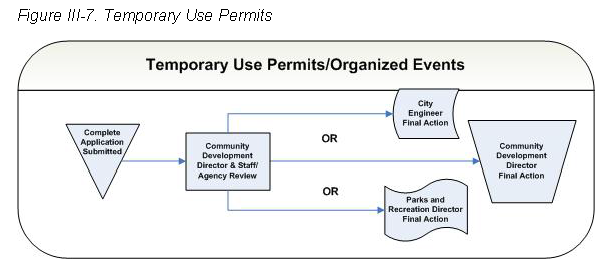
Review. Except as described in paragraphs (a), (b), and (c), the director, and the DRT, if the director deems appropriate, will review applications for temporary use permits. The director is authorized to approve, approve with conditions, or deny the application based upon the approval criteria listed below. A decision on a temporary use permit shall be issued no later than 30 days from the date a completed application is received by the city.
(a)
Temporary use permits for organized events that are proposed to be held in any public park shall be reviewed by the director in charge of the city's parks. The director in charge of parks is authorized to approve, approve with conditions, or deny the application based upon the approval criteria listed below.
(b)
Temporary use permits for organized events that are proposed to be held in whole or in part within any public street shall be reviewed by the city engineer. The city engineer is authorized to approve, approve with conditions, or deny the application based upon the approval criteria listed below.
(c)
Temporary use permits for organized events that are proposed to occur within both a public park and a street shall be reviewed by the city engineer or the director of parks, depending on the primary locale of the event. Such person is authorized to approve, approve with conditions, or deny the application based upon the approval criteria listed below.
(3)
Approval Criteria. A temporary use permit may be approved if:
(a)
The use complies with the general purposes, goals, objectives, policies, and standards of the comprehensive plan, this land development code, or any other plan, program, or ordinance adopted by the city;
(b)
The use will not result in a substantial or undue adverse effect on adjacent property, the character of the neighborhood, traffic conditions, parking, or public improvements;
(c)
The characteristics of the site are suitable for the proposed use considering size, shape, location, topography, existence of improvements and natural features;
(d)
The use will be adequately served by and will not impose an undue burden on any of the improvements, facilities, and services of the city or its residents. Where any such improvements, facilities, utilities or services are not available or are not adequate to service the proposed use in the proposed location, the applicant shall, as a part of the application and as a condition of approval of the temporary use permit, be responsible for establishing an ability, a willingness, and a binding commitment to provide such improvements, facilities, utilities, and services in sufficient time to serve the proposed use;
(e)
The director finds that, based upon their history, the applicant, owner, and users are likely to comply with the conditions of the permit and the city's municipal and land development codes;
(f)
No permanent alterations to the site are proposed or are reasonably expected to result from the use/event; and
(g)
There is no evidence to suggest that the use violates any federal, state or local law, regulation, or requirement.
(4)
Permit Period. The dates a temporary use may be operated are specified on the permit. It shall be unlawful for any person to operate a temporary use, or to allow a temporary use to be operated on a property, outside the dates and times provided on the temporary use permit.
Sec. 21-3219. - Early Grading Permits.
(1)
Description. If an applicant for development desires to proceed with overall grading of the property prior to final approval of the applicable Development Plan or Plat by the City, and/or prior to final Construction Document approval(s), an applicant may apply for an Early Grading Permit. An Early Grading Permit allows for clearing, grubbing and grading only. No infrastructure or building construction is allowed with an Early Grading Permit. A final grading permit will be required prior to infrastructure or building construction.
(2)
Requirement. Early Grading Permits are optional and not required.
(3)
Review. The city engineer reviews applications for grading permits and is authorized to approve, approve with conditions, or deny such applications based on the approval criteria below.
(4)
Approval Criteria. The City Engineer, may, to the extent provided for in this Section, authorize the issuance of an Early Grading Permit prior to final approval of a Development Plan, PUD Development Permit, or Subdivision, if the following requirements are satisfied:
a.
A Stormwater Management Plan, inclusive of an Erosion and Sediment Control Plan has been submitted and complies with the city's engineering and construction standards and specifications (ECSS) and storm drainage design and technical criteria manual.
b.
The subject property is not part of any active public hearing application (Zoning, Conditional Use Permit, Variance, etc.).
c.
A preliminary drainage report, if applicable, has been approved by the City Engineer
d.
No application for an early grading permit for properties undergoing any required review will be accepted by the city until the Final Subdivision review is complete unless acceptance is specifically authorized by the Community Development and Public Works directors.
e.
The subject property is not located in any floodplain.
f.
A grading surety, in a form acceptable to the City has been provided to and accepted by the City in accordance with the City's laws and regulations.
g.
No waivers or alternative standards/requirements or variances related to grading requirements are being requested or are necessary in conjunction with the Final Subdivision application.
h.
Applicable State stormwater permit has been acquired; and
i.
To the maximum extent feasible the applicant shall adhere to Sec. 21-7110. - Protected Land and Habitat.
(5)
Conditions for Approval. By accepting a grading permit, the applicant agrees to comply with the following requirements, in addition to any others which may be imposed by the city:
a.
The developer/owner understands that in the case of early grading all grading is done at their own risk. The issuance of this permit is no guarantee that the final site plan will be approved. Before issuing an early grading permit under this subsection, the applicant, developer, and property owner must execute an assumption of risk letter and a release of all rights and claims of any type whatsoever, including any claim of vested rights, against the city relating to the early grading permit, and any related approval, and indemnifying the city from any related claim for damages, and in a form acceptable to the city. An executed waiver and consent form by which the applicant, developer, and property owner acknowledges and agrees to the above is required.
b.
Approval of an early grading permit shall not create a vested right or interest.
c.
An early grading permit does not constitute approval of roadway design, construction documents, foundation plans, or building site pad grading. At no time will impervious areas or utilities be installed at the site as part of the early grading permit.
d.
The grading activities shall be performed in accordance with all applicable laws, rules, and regulations pertaining to air, water, and noise pollution;
e.
The owner shall schedule construction activities to minimize the total amount of soil exposed, including stockpiles, at any given time in order to reduce the period of accelerated soil erosion; and
f.
The area of land disturbance must not be exposed for more than 60 consecutive days without temporary or permanent stabilization.
(6)
Stop Work Orders. If the site is not in compliance with the approved erosion and sediment control plan, the city's requirements for erosion and sediment control, or the above conditions, the city shall have the authority to issue a stop work order within 24 hours of notification to the owner or developer of non-compliance.
(7)
Lapse. If the work described in any early grading permit is not commenced within six months, the permit shall automatically lapse and be null and void.
(Ord. No. 2516, § 2a(Exh. A), 8-14-2023)
Sec. 21-3220. - Height Exceptions.
(1)
Description. Height Exceptions are used to address situations where the height standards of this land development code inflict practical difficulties on the primary operations on a property that arise due to state or federal regulatory changes, technological advancements, or similar circumstances that require structures directly associated with the primary operation to surpass the zone district's maximum allowable height. Fences, signs, and secondary uses (such as outdoor storage) are not eligible for Height Exceptions.
(2)
Requirement. Except for the specific situations outlined below, no structure or building shall exceed the height limitations provided in this land development code without first obtaining a height exception.
(a)
Structures that exceed the approved height limit on the effective date of this land development code. Any such structure shall not be considered a nonconforming structure due to its height only;
(b)
Development according to the terms and conditions of a final PUD permit or final subdivision plat that was approved prior to the effective date of this land development code and that has not lapsed in any way. Any structure exceeding the maximum height permitted in a zoning district, but which is developed in accordance with such approved final plan or plat, shall not be considered a nonconforming structure due to its height only;
(c)
Development consistent with the intent, terms, and recommendations of an applicable comprehensive plan, or other special plan adopted by the city, when such plan specifically recommends and anticipates development of structures exceeding the maximum allowed height permitted in a zoning district, but which is developed in accordance with such approved comprehensive plan or other sub-area plan, shall not be considered a nonconforming structure due to its height only.
(3)
Review.
(a)
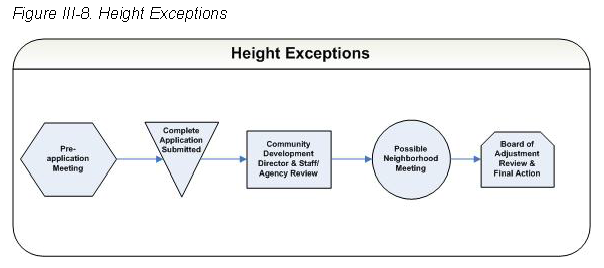
The director and the DRT review height exception applications, and the director provides a report to the board of adjustment regarding an application's acceptability in light of the approval criteria listed below.
(b)
Applications are considered by the board of adjustment at a public hearing. After the hearing, the board of adjustment is authorized to approve, approve with conditions, or deny the application based on the approval criteria listed below.
(4)
Approval Criteria. An application for a height exception may be approved if:
(a)
The requested structure height is required in order to reasonably comply with state or federal regulatory changes or needed to overcome technological limitations; or
(b)
All of the following criteria are met:
(i)
The structure and development, if applicable, complies with all other standards not specifically waived by the city;
(ii)
The exception would have minimal effect upon adjacent properties with respect to solar access, visual access, and rights of privacy, light, and air;
(iii)
The exception will not interfere with the city's ability to provide public services to the site at the level currently enjoyed by the area, or at adequate levels per existing city policies and regulations;
(iv)
There is no evidence to suggest that the exception would interfere with or complicate emergency services or otherwise impair public safety; and
(c)
One of the following criteria is met:
(i)
The exception provides a demonstrated benefit to the city; or
(ii)
The architecture and character of the proposed building or structure that will exceed the height standards are compatible with existing development on surrounding or adjacent parcels.
(5)
Lapse. A height exception shall lapse unless a building permit is issued and construction is substantially completed within three years from the date of approval, unless another time frame is listed as an element of the approval of a related application (such as a conditional use permit). Amendments to a related development plan shall not affect the lapse period unless otherwise provided.
(Ord. No. 1887, July 2012; Ord. No. 2068, January 2016; Ord. No. 2185, December 2018)
Sec. 21-3221. - Uses-by-Permit.
(1)
Description. Uses-by-permit are used to address land uses which, due to their nature, character, or other circumstances, make the predetermination of permissibility by right, or the detailing of the specific standards, regulations or conditions necessary or appropriate to such uses impractical, but which may be appropriate subject to certain conditions and requirements. A use-by-permit allows a specific use on a specific property by a specific applicant; it does not run with the land. Accordingly, if the permit holder sells the property, a new owner must apply for and obtain a use-by-permit to lawfully operate the use.
(2)
Review.
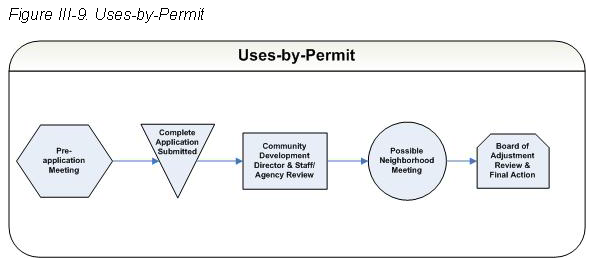
(a)
The director and DRT review use-by-permit applications and the director provides a report to the board of adjustment regarding the application's acceptability in light of the approval criteria listed below.
Applications shall be considered by the board of adjustment at a public hearing. After the public hearing, the BOA is authorized to approve, approve with conditions, or deny the application, based on the approval criteria below.
(3)
Approval Criteria. A use-by-permit application may be approved if:
(a)
All of the following criteria are met:
(i)
The use at the proposed location will not result in a substantial or undue adverse effect on adjacent property, the character of the neighborhood, traffic conditions, parking, public improvements, either as they presently exist or as they may exist in the future as a result of the implementation of provisions and policies of the comprehensive plan, this land development code, or any other plan, program, or ordinance adopted by the city. Such compatibility may be expressed in appearance, architectural scale and features, site design, and the control of any adverse impacts, including noise, dust, odor, lighting, traffic, safety, and impact on property values of the surrounding area;
(ii)
The characteristics of the site are suitable for the use considering size, shape, location, topography, existence of improvements and natural features; and
(iii)
The use at the proposed location will be adequately served by and will not impose an undue burden on any of the improvements, facilities, and services of the city, special districts, or its residents. Where any such improvements, facilities, utilities or services are not available or adequate to service the use in the proposed location, the applicant shall, as a part of the application and as a condition of approval of the use-by-permit, be responsible for establishing an ability, a willingness, and a binding commitment to provide such improvements, facilities, utilities and services in sufficient time to serve the proposed use; and
(b)
One of the following criteria is met:
(i)
The use is in harmony with the general purposes, goals, objectives, and standards of the comprehensive plan or any other plan or program adopted by the city; or
(ii)
There is a proven community need for the use at the proposed location, given existing and proposed uses of a similar nature in the area and of the need to provide or maintain a proper mix of uses both within the city and the immediate area of the proposed use.
(4)
Lapse/Abandonment. If construction of a structure is required, a use-by-permit shall lapse unless a building permit has been issued and construction diligently pursued within two years of approval or at such alternative time specified in the approval. In the event no new structure is required to operate the use, then the use-by-permit shall lapse if the use is not commenced within 180 days of the approval. In addition, a use-by-permit shall automatically lapse and have no further effect if the use is discontinued for 180 consecutive days.
(Ord. No. 1887, July 2012)
Sec. 21-3222. - Variances.
(1)
Description. Variances are used to address circumstances where the bulk standards of this land development code inflict unnecessary hardship and practical difficulties on a landowner that are not shared generally by other properties in the same zone district and vicinity. Variances, other than those from floodplain regulations, are governed by the process outlined in this section. Variances from the floodplain regulations shall follow the procedures and criteria set forth in section 21-3213 (Floodplain Development Permits).
(2)
Use Variances Prohibited. The board of adjustment shall not grant a variance to allow a use that is not permitted or that is expressly or impliedly prohibited by the terms of this land development code.
Review.
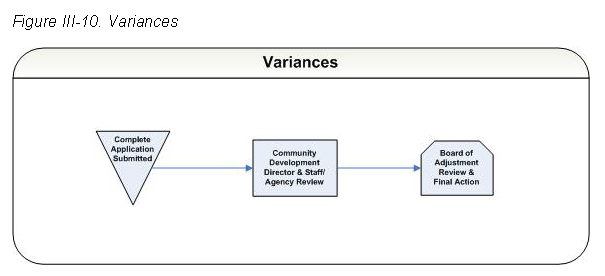
(a)
The director and DRT, if deemed appropriate, review variance applications and the director provides a report to the board of adjustment analyzing the appropriateness of approving a variance based upon the approval criteria listed below.
(b)
Applications shall be considered by the board of adjustment at a public hearing. After the hearing, the BOA is authorized to approve, approve with conditions, or deny the proposed variance based on the approval criteria listed below.
(3)
Approval Criteria. A variance may be approved if:
(a)
All of the following criteria are met:
(i)
The physical character of the property, including dimensions, topography or other extraordinary situation or condition of the property, create a situation where the strict enforcement of the standards in this land development code will deprive the property of privileges generally enjoyed by property of the same classification in the same zoning district (hardship);
(ii)
The hardship is not self-imposed;
(iii)
The variance will not be of substantial detriment to adjacent property; and
(b)
One of the following criteria is met:
(i)
The variance granted is the minimum needed for the reasonable use of the land, building, or structure; or
(ii)
The character of the district will not be changed by the granting of the variance.
(4)
Subdivision Restrictions. No variance shall be granted reducing the size of lots contained in an existing or proposed subdivision if it will result in an increase in the number of lots beyond the number permitted for the total subdivision pursuant to applicable zoning district regulations.
(5)
Existing Nonconformities Not Grounds for Variances. The existence of nonconforming uses of neighboring lands, structures, or buildings in the same zoning district, or permitted or nonconforming use of lands, structures, or buildings in other zoning districts, shall not be considered grounds for the issuance of a variance.
(6)
Lapse. A variance shall lapse and have no further effect unless construction has been completed within one year from the date the variance is granted unless an alternative time period is specified in the variance approval.
(Ord. No. 1887, July 2012)
Sec. 21-3230. - Conditional Use Permits.
(1)
Description. A conditional use permit process allows for special consideration of certain specified uses that may or may not be compatible with an area, depending on the specifics of the particular project.
(2)
Review.
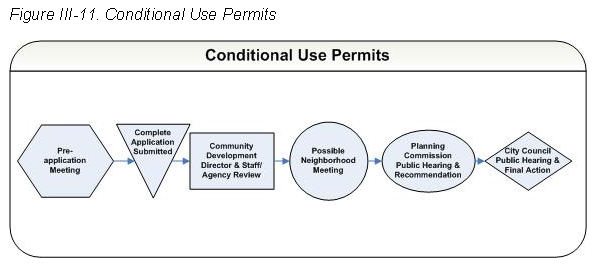
(a)
The director and the DRT review applications for conditional use permits. The director provides a report to the planning commission regarding the acceptability of the application based upon the approval criteria listed below.
Applications for conditional use permits are considered by the planning commission at a public hearing. After the close of the public hearing, the planning commission will make a recommendation to the city council that the application be approved, approved with conditions, or denied.
After receiving the recommendation of the planning commission, the city council considers the application at a public hearing. After the hearing, the city council is authorized to approve, approve with conditions, or deny the application based on the approval criteria below.
(3)
Approval Criteria. A conditional use permit may be granted if:
(a)
All of the following criteria are met:
(i)
The proposed use will not result in a substantial or undue adverse effect on adjacent property, the character of the neighborhood, traffic conditions, parking, public improvements, either as they presently exist or as they may exist in the future as a result of the implementation of provisions and policies of the comprehensive plan, this land development code, or any other plan, program or ordinance adopted by the city;
(ii)
Any adverse effect has been or will be mitigated to the maximum extent feasible, including but not limited to sufficient landscaping and screening to ensure harmony for adjoining uses;
(iii)
The characteristics of the site are suitable for the proposed use considering size, shape, location, topography, existence of improvements and natural features;
(iv)
The proposed use will be adequately served by and will not impose an undue burden on any of the existing improvements, facilities, and services of the city or its residents. Where any such improvements, facilities, utilities or services are not available or are not adequate to service the proposed use in the proposed location, the applicant shall, as a part of the application and as a condition of approval, be responsible for establishing an ability, a willingness, and a binding commitment to provide such improvements, facilities, utilities and services in sufficient time to serve the proposed use;
(v)
The applicant has provided adequate assurances of continuing maintenance;
(vi)
There is no evidence to suggest that the use violates any federal, state, or local requirements; and
(b)
One of the following criteria is met:
(i)
There is a community need for the use at the proposed location, given existing and proposed uses of a similar nature in the area and of the need to provide and maintain a proper mix of uses both within the city and the immediate area of the proposed use; or
(ii)
The use complies with the general purposes, goals, objectives, policies, and standards of the comprehensive plan and all other plans or programs adopted by the city.
(4)
Lapse. If the conditional use is not commenced within the lapse period contained in table III-2 or, if after it is commenced, it is abandoned or discontinued for a period of 180 days or more, then the conditional use permit shall automatically lapse and be null and void.
(5)
Transferability. A conditional use permit is not attached to and does not run with the property for which it is granted. Any change in tenancy, ownership, or management shall require the issuance of a new conditional use permit or modification to an existing approved permit.
(6)
Recording. The city may record a conditional use permit in the Adams County Clerk and Recorder's Office. The city may require the applicant to pay for all recording fees.
(Ord. No. 1887, July 2012)
Sec. 21-3231. - Model and Elevation Reviews.
(1)
Requirement. No builder shall build the same model or the same elevation within a model on multiple lots unless the city has approved such model or elevation in accordance with the provisions of this section. In addition, the director shall have the authority to require the review of any elevation for any residential or nonresidential development, regardless of the number intended to be used by the developer/builder, if the director determines that the proposed elevation does not meet the approval criteria below.
(2)
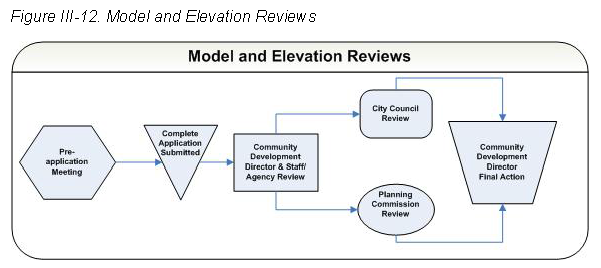
Review. The director and, if requested by the director, the DRT, planning commission, or city council, will review the proposed model(s) and/or elevation(s). When requested, the planning commission or city council may review the application during a study session to provide feedback. The director is authorized to approve, approve with conditions, or deny the application based upon the approval criteria listed below.
(3)
Approval Criteria. A proposed model or elevation may be approved if it:
(a)
Complies with all applicable city standards;
(b)
Is consistent with any previously approved subdivision plat, rezoning concept plan, or other precedent plan or land use approval;
(c)
Is in harmony and compatible with adjacent development in the area; and
(d)
Creates a positive precedent for the future cumulative development of the immediate area.
(4)
Lapse. Failure of an applicant to apply for a building permit and commence construction within the applicable lapse period shall automatically render the approval null and void.
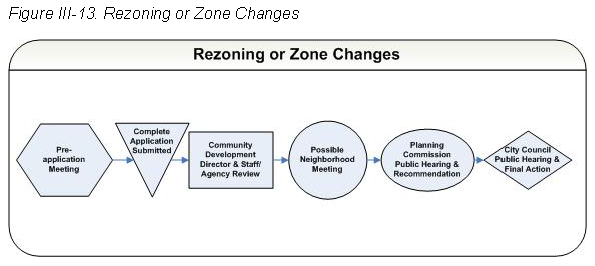
Sec. 21-3232. - Rezoning or Zone Changes.
(1)
Description. A rezoning or zone change is any change in the city's official zoning map. A zone change includes zoning amendments, zoning condition review, and zoning condition amendments. For the purposes of this section, both rezoning and zone changes will be referred to collectively as "zone changes." Applications for zone changes, other than those resulting from the PUD process, which is governed by section 21-3251 below, shall be reviewed in accordance with this section. A zone change should not be used when a minor modification, variance, or conditional use can achieve the same result.
(2)
Initiation. A zone change may be initiated by the city or by the holder of any interest in the property that is the subject of the zone change request.
(3)
Development Plan Required. Unless initiated by the city or determined unnecessary by the director, every application for zone change shall be accompanied by a development plan, except for the following:
(a)
A request to rezone to an R-1 or R-2 zoning district; or
(b)
A request to rezone to an AG district used only for residential activities and accessory agricultural uses.
(4)
Review.
(a)
The director and DRT will review applications for zone changes and the director will provide a report to the planning commission analyzing the application in light of the approval criteria listed below.
(b)
Applications for zone changes are considered by the planning commission at a public hearing. After the public hearing, the planning commission will make a recommendation to city council based on the approval criteria below.
(c)
After receiving the recommendation of the planning commission, the city council will consider the application at a public hearing. After the hearing, the city council is authorized to approve, approve with conditions, or deny the application based on the approval criteria below.
(5)
Approval Criteria. An application may be approved if:
(a)
The zone change corrects a technical mistake on the part of the city in classifying a parcel within a specific zoning district; or
(b)
The zone change meets all of the following:
(i)
The proposed zone district and allowed uses are consistent with the policies and goals of the comprehensive plan, any applicable adopted area plan, or community plan of the city;
(ii)
The proposed zone district and allowed uses are compatible with proposed development, surrounding land uses and the natural environment;
(iii)
The proposed zone district will have, or future development can provide, efficient and adequate provision of public services, including but not limited to, water, sewerage, streets, and drainage;
(iv)
The proposed zone district will have, or future development can provide, efficient and adequate provision of public uses including but not limited to, parks, schools, and open space;
(v)
There is a community need for the zoning district in the proposed location, given need to provide or maintain a proper mix of uses both within the city and the immediate area of the proposed use; and
(vi)
The area for which zone change is requested has changed or is changing to such a degree that it is in the public interest to allow a new use or density.
(6)
Adoption by Ordinance. A zone change affects the official zoning map and shall be approved in the form of an ordinance.
Sec. 21-3233. - Vacation of Rights-of-Way.
(1)
Description. A vacation is used to eliminate public rights-of-way or utility easements that are no longer needed for public improvements. The vacation of easements and inactive rights-of-way may be accomplished through the approval of a plat which shows the vacation or by ordinance. Active rights-of-way must be vacated by ordinance. This section shall apply to all requests to vacate all rights, interests, or title of the city in and to any right-of-way, access easements, or other public easements located within the corporate limits of the city.
(2)
Review.
(a)
Active rights-of-way and easements.
(i)
The director and DRT review vacation applications and the director creates a report analyzing the acceptability of the application in light of the approval criteria outlined below.
(ii)
Vacation applications are reviewed by the planning commission during a public hearing. After the hearing, the planning commission will make a recommendation to the city council based on the approval criteria below.
(iii)
After receiving the director's report and the planning commission's recommendation, the city council will consider the application at a public hearing. After the hearing, the city council is authorized to approve, approve with conditions or deny the application. The city council may approve the vacation in whole or part (i.e., vacate only a portion of the area under consideration).
(b)
All other vacation requests. The director reviews and has the authority to approve, approve with conditions or deny vacation applications that do not involve active rights-of-way and easements. The director may approve the vacation in whole or in part.
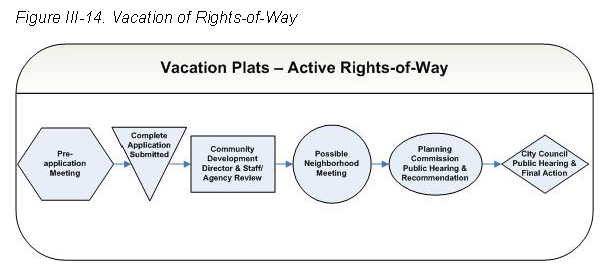
(3)
Approval Criteria. A vacation application may be approved if:
(a)
City-initiated vacations.
(i)
The vacation serves the interest of the city by removing maintenance or liability risks; and
(ii)
The property interest being vacated is no longer necessary for city operations.
(b)
All other vacations.
(i)
The vacation is consistent with the comprehensive plan and any other applicable city-approved plan;
(ii)
The land to be vacated is no longer necessary for the public use and convenience;
(iii)
The vacation will not create any landlocked properties;
(iv)
The vacation will not render access to any parcel unreasonable or economically prohibitive;
(v)
The vacation will not reduce the quality of public services to any parcel of land; and
(vi)
A separate plat to replat the vacated area into a larger, usable piece of land has been submitted.
(4)
Zoning. Notwithstanding any provision in this section to the contrary, the zoning on any property vacated by the city shall be changed without further action as of the effective date of the vacation to that zoning of the property to which ownership of the vacated property attaches as a result of such vacation by the city.
(5)
Title. Title to the lands included within a street right-of-way or so much thereof as may be vacated shall vest in accordance with the provisions of state law unless specifically provided for in the vacating ordinance or plat. Title in all other lands shall vest in accordance with the document affecting the vacation.
(6)
Recording. The city will record all relevant vacation documents, including any vacation resolution, with the Adams County Clerk and Recorder's Office and the city may require the applicant to pay all recording costs.
(Ord. No. 1785, June 2010)
Sec. 21-3234. - Vested Property Rights/Site Specific Development Plans.
(1)
Description. Pursuant to state law, approval of a site specific development plan, as that term is defined in article XI of this land development code, creates a vested property right. The effective date of the approval of the site specific development plan, the duration of the vested property right, and the effect such vested property right has relative to future ordinances adopted by the city are governed by state law.
(2)
Review.
(a)
The director and DRT review site specific development applications and the director will create a report analyzing the acceptability of the application in light of the approval criteria outlined below.
(b)
Site specific development applications are reviewed by the planning commission during a public hearing. After the hearing, the planning commission will make a recommendation to the city council based on the approval criteria below.
(c)
After receiving the director's report and the planning commission's recommendation, the city council will consider the application at a public hearing. After the hearing, the city council is authorized to approve, approve with conditions or deny the application based upon the approval criteria below.
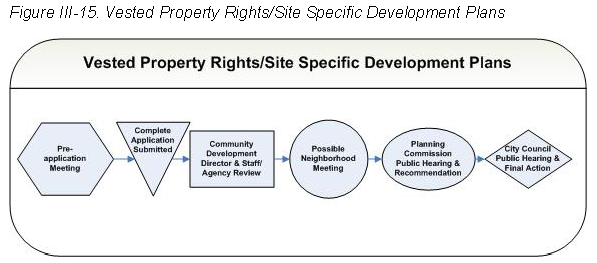
(3)
Approval Criteria. The approval criteria for site specific development plans shall be the same as the underlying application. For example, a PUD development permit shall be approved in accordance with section 21-3252; a final subdivision plat in accordance with section 21-3241; and a development plan in accordance with section 21-3212. In addition, however, in order to approve a site specific development plan, the city must find that the grant of vested rights is reasonable given the proposed development's benefits to the surroundings properties, surrounding community, or the city in general.
(4)
Vested Property Right Notice. Upon approval of a site specific development plan, the city shall publish notice of such approval in compliance with state law.
(5)
Plat or Plan Language Required. Each site specific development plan shall contain the following language: "Approval of this plan or plat creates a vested property right with all privileges and subject to all conditions provided by state statute. The effective date is [insert date]."
(6)
Waiver. A landowner may waive a vested property right by separate agreement, which shall be recorded in Adams County. Unless otherwise agreed to by the city, any landowner requesting annexation to the city shall waive, in writing, any pre-existing vested property rights as a condition of such annexation.
(7)
Other Provisions Unaffected. Approval of a site specific development plan shall not constitute an exemption from or waiver of any other provisions of this land development code pertaining to annexation, development, and use or property.
Sec. 21-3235. - Oil and Gas Permits.
1.
Description. An Oil and Gas Permit allows the permit holder to undertake construction of an oil and gas project. The review of such permit is intended to ensure compliance with this land development code. Oil and Gas Permits shall encompass, as part of its authorization, the right of the Operator, its agents, employees, subcontractors, independent contractors, or any other person to perform that work reasonably necessary to conduct the activities authorized by the Oil and Gas Permit, subject to all other applicable City permits, regulations requirements, and state and federal laws and regulations.
2.
Requirement. No building permit shall be issued, and no development, excavation, site preparation, or construction activity, including tree/vegetation removal or grading, shall occur on any property in connection with a Well Site until an Oil and Gas Permit has been approved in accordance with this section.
3.
Public Notification Process. The City shall follow the public notification procedures outlined in Article III and all costs of property owner notification shall be borne by the Operator.
4.
Public Comment Procedures. During the Public Notification process, members of the public will have the opportunity to file written comments with the City. The deadline for providing these comments shall be contained in the public notification of the process as outlined in the public notification section. The comments received can be used by the Director to inform a recommendation based on the relevance to the Approval Criteria and accuracy of the comments. Any written objection or request must be directly related to the proposed Oil and Gas Permit.
5.
Initial Assessment Process and Site Eligibility Determination.
a.
Mandatory meeting. Prior to submittal of any individual Oil and Gas Permit application, all potential Operators shall conduct a minimum of one meeting with City staff. The Operator shall provide to the City sufficient information and facts, in writing and prior to the meeting, to allow the City to make a determination as to whether or not the sites proposed by the applicant meet the criteria defined herein. Full participation and cooperation in the Initial Assessment Process and site eligibility determination, followed by the issuance of an Eligibility Letter, shall be a prerequisite to the submission of an application for an Oil and Gas Permit.
b.
Site Eligibility. Before submitting any application for an Oil and Gas Permit, the Operator shall obtain a determination on the eligibility of all proposed locations. Locations not deemed eligible pursuant to this subsection shall not be included in any application or permitted as Well Sites.
1.
Limited exemption. Proposed locations shall automatically be deemed eligible for the submission of an application and exempt from the requirement of an alternative location analysis if the site meets all of the following criteria:
1.
Is located more than 2,000' from the following:
1.
Any existing residential use, platted residential use, or property zoned for residential use, not including properties zoned Agricultural over 10 acres in size;
2.
Any facility classified as a High Occupancy Building Unit, as defined by the COGCC;
3.
Any Public Park or Public Recreation facility, not including trails or City designated open space;
4.
Outdoor venues, playgrounds, permanent sports fields, amphitheaters, or other similar places of outdoor public assembly; and
5.
Senior living or assisted living facilities;
2.
Is located more than 1,000' from the following:
1.
Public Water Supply Wells; and
2.
Reservoirs;
3.
Is outside of FEMA 100 Year Floodplain boundary, any surface water features, areas defined as land unsuitable for development in section 21-7100; and
4.
Meets at least one of the following criteria;
1.
Is currently zoned I-2, I-3, or PUD with a use category of "general industrial;" or identifies Oil and Gas resource extraction (i.e. subsurface extraction) as an allowed use; or
2.
Has a future land use designation of Industrial / Distribution, General Industrial, or DIA Technology.
Measurements shall be taken from the edge of the proposed Production Site to the parcel boundary. The edge of the proposed Production Site shall be defined as the maximum extent of the facility during the production phase.
2.
Alternative Site Location Analysis. If the site is not deemed eligible pursuant to the limited exception, the applicant shall prepare and submit an alternative site location analysis including, at a minimum, the following information:
1.
All drilling and spacing units proposed by the applicant within the City and within 1 mile of the City's municipal boundaries;
2.
One or more maps identifying Disproportionately Impacted Communities, as defined by the COGCC, within 1 mile of all drilling and spacing units proposed by the applicant;
3.
The location of all features listed in section 21-3235(5)(b)(i) within 1 mile of all drilling and spacing units proposed by the applicant;
4.
A minimum of three potential sites that can reasonably access the mineral resources within the proposed drilling and spacing unit(s), including the following information for each site:
1.
General narrative description of each site;
2.
The applicant's basis for proposing each site;
3.
A summary of the off-site impacts that may be associated with each site;
4.
Any factors listed in section 21-3235(5)(b)(i) that the particular site does not meet;
5.
Proposed truck traffic routes and access roads for each site;
6.
Any executed surface agreements between the operator and any landowners within 1 mile of all drilling and spacing units proposed by the applicant; and
7.
Any information pertinent to the applicable review criteria that will assist the City in evaluating the sites.
5.
In the event significant site constraints limit the reasonable submission of at least three sites, the applicant may propose in writing what specific circumstances prohibit other sites to be considered. The Director may waive the requirement of up to two (2) additional sites, based on the applicant's submission.
3.
Review Criteria. The Director may determine that a site identified in the alternative site location analysis is eligible to submit an application, based on the following:
1.
A proposed site's conformance with the City's adopted Comprehensive Plan, and any other applicable adopted plans;
2.
The absence of any significant impacts the proposed site location may have on adjacent properties;
3.
Adequate surface acreage and suitable topography for safe and efficient operations;
4.
The ability to access targeted minerals with technology available at the time of development;
5.
The ability to reasonably implement the protections contained in the BMP Document from the proposed location;
6.
The ability to consolidate facilities with other planned drilling and spacing units proposed within the City's municipal boundaries;
7.
The ability to reconfigure proposed drilling and spacing unit applications to provide more suitable surface use locations;
8.
The existence of a surface use agreement between any landowner and a potential operator shall not be a factor of consideration in the city's review of an alternative location analysis; and
9.
Any other relevant considerations impacting public health, welfare, safety, and the environment.
4.
Disposition. The Director shall provide the applicant a written assessment ("Eligibility Letter") indicating which, if any, of the proposed locations qualify as eligible sites or whether the proposed location is automatically deemed eligible. The Eligibility Letter shall not be construed as an Oil and Gas Permit or an authorization to conduct any Oil and Gas Operations.
c.
Notwithstanding the eligibility of a site, an application for an Oil and Gas Permit shall not be accepted if the proposed location is not currently zoned for Oil and Gas Operations unless a complete zoning application is concurrently submitted, or is currently pending, that would allow Oil and Gas Operations at the proposed location if approved.
d.
Confidentiality. To the extent permitted by law, information submitted to the City by an applicant in support of the Initial Assessment Process and site eligibility determination may be deemed confidential by the applicant provided that the public release of such information has the potential to negatively impact the applicant's business activities, including the applicant's negotiating position with surface use owners. If the applicant designates any information as confidential, the information may not be released by the City unless required by law. The applicant shall be solely responsible for the protection of its information and shall indemnify the City for any attorneys' fees and costs, and any award thereof, incurred in the defense of the applicant's assertion of confidentiality.
e.
Materials submitted for review as part of the Initial Assessment Process and site eligibility determination shall not constitute an application for development for purposes of C.R.S. §24-68-101, et. seq. Any opinions expressed during the Initial Assessment Process and site eligibility determination are informational only and do not represent a commitment on behalf of the city regarding the acceptability or approval of the development proposal, except the eligibility of a site for application.
6.
Extraction Agreement. No Extraction Agreement shall be approved by the City before the closure of the public comment period on any pending, related Oil and Gas Permit application to put forward site-specific conditions necessary to protect health, safety, and general welfare. The Extraction Agreement will not be finalized until after the public comment period has closed.
7.
Review.
a.
The applicant shall obtain an eligibility letter, through the initial assessment process described in 21-3235(5).
b.
The Director and DRT review applications for Oil and Gas Permits. The Director provides a report to the Planning Commission regarding the acceptability of the application based upon the approval criteria listed in 21-3235(8).
c.
The Planning Commission will hold a public hearing on the application and make a recommendation to the City Council based on the approval criteria below.
d.
The City Council will consider the application, the director's report, the Planning Commission's recommendation, and any other testimony at a public hearing and after the hearing, shall approve, approve with conditions, or deny the application, based on the approval criteria below.
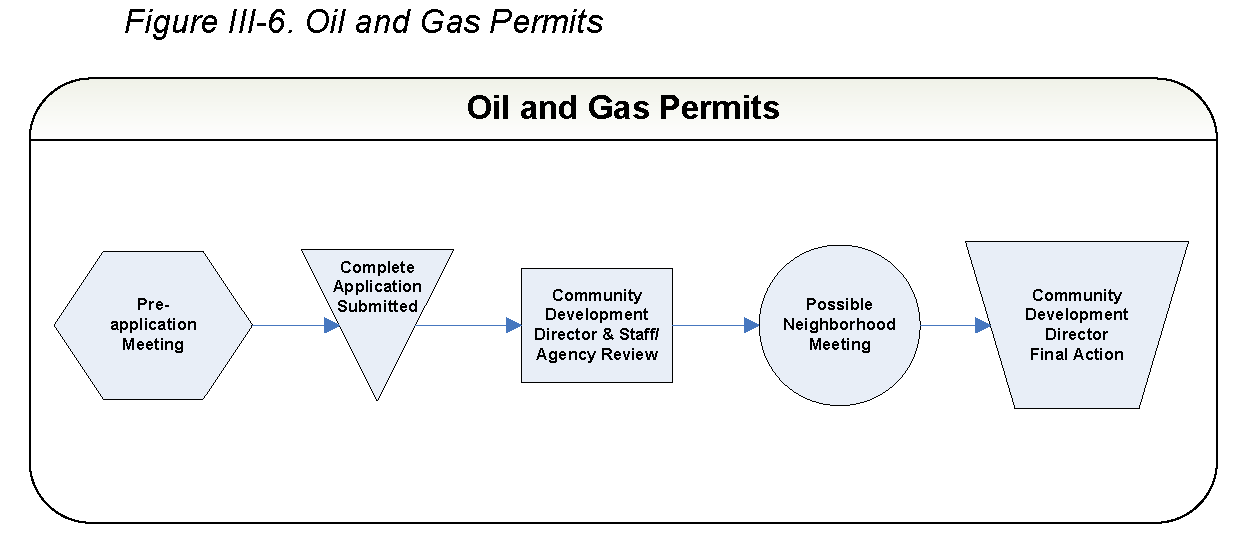
8.
Approval Criteria. An Oil and Gas Permit may be approved if all of the following criteria are met:
a.
The Operator has submitted the appropriate and complete application form and submitted the required fees (except those payable upon the issuance of a permit) to the City;
b.
The proposed location has been deemed eligible pursuant to section 21-3235(5);
c.
The proposed operation conforms with any Regional Operator Agreement and any site-specific Extraction Agreement between the operator and the city;
d.
The characteristics of the site are suitable for the proposed facility considering size, shape, location, topography, existence of improvements and natural features;
e.
The proposed operations and facility will not result in substantial or undue adverse impacts or effects (during any phase of operation or during any reasonably foreseeable potential operational, environmental, or meteorological condition) on public health, safety, welfare, or the environment; adjacent property; occupied structures within 2,500' of the proposed facility; the character of the neighborhood; and traffic conditions;
f.
The proposed facility will be adequately served by and will not impose an undue burden on existing public and private improvements, facilities, and services of the city or its residents, either as such improvements, facilities, and services presently exist or as they may exist in the future as a result of the implementation of provisions and policies of the comprehensive plan, this land development code, or any other plan, program or ordinance adopted by the City. Where any improvements, facilities, utilities or services are not available or are not adequate to service the proposed use in the proposed location, the applicant shall, as a condition of approval, be required to provide such improvements, facilities, utilities and services in sufficient time to serve the proposed use;
g.
Any adverse impacts, effects, and burdens have been or will be mitigated to the maximum extent feasible;
h.
The Operator has entered into a site-specific Extraction Agreement, approved by the Director, if required by the City to establish site-specific protections and public improvements not addressed in the BMP Document, this code, or state law or regulation but necessitated by the proposed operation to address matters of public health, welfare, safety, and the environment;
i.
The proposed facility is consistent with any applicable zoning ordinance, subdivision plat, and other plans or land use approvals applicable to the site;
j.
The proposed facility complies with all regulations and standards of the BMP Document adopted by the City Council, as such may be amended;
k.
The proposed operation will meet the requirements for Subsurface Extraction as set forth in Section 21-5266 and will not violate any other applicable City, state, or federal standards or laws.
9.
General Terms of Approval. The following General Terms and Conditions shall apply to any Oil and Gas Permit.
a.
The granting of an Oil and Gas Permit shall not relieve the Operator from complying with all applicable regulatory requirements of the City, the state of Colorado, or the United States.
b.
The Oil and Gas Permit and existing use site plan required by this Code is in addition to any permit that may be required by any other provision of this Code, or by any other governmental agency.
c.
The Operator shall obtain and maintain a general business license from the City prior to commencing operations and conform to applicable provisions of the Commerce City Revised Municipal Code related to licensing.
d.
The Operator shall obtain building permits prior to the construction of any above-ground structures to the extent required by the City building and fire codes.
e.
By accepting an Oil and Gas Permit, the Operator expressly stipulates and agrees to be bound by and comply with the provisions of this Code.
10.
Permit Period; Lapse; Forfeiture.
a.
The term of the Oil and Gas Permit shall be for three (3) years except as otherwise stated herein. Upon issuance of final approval from the State permitting the commencement of Operations on the Site that is the subject of the City's permit, the term of the Oil and Gas Permit shall automatically become coterminous with the COGCC issued permit approving an oil and gas location assessment (Form 2A) unless the Oil and Gas Permit otherwise expired, lapsed, revoked, forfeited, abandoned, or otherwise terminated.
b.
The Oil and Gas Permit shall expire upon abandonment and reclamation of the permitted Operation, unless otherwise expired, lapsed, revoked, forfeited, abandoned, or otherwise terminated.
c.
Time for Drilling and Forfeiture.
1.
Upon issuance of an Oil and Gas Permit, and notwithstanding any other provision in this Code, the total number of wells approved in the Oil and Gas Permit must be drilled and completed within three (3) years of permit approval. Failure to do so shall constitute the forfeiture of the authorization and right to drill any undrilled wells. Authority to drill forfeited wells can only be obtained upon the issuance of a new Oil and Gas Permit.
2.
At least six months prior to forfeiture, an Operator may seek one-time relief from forfeiture if, upon formal application to the Director, the Director finds by clear and convincing evidence that (1) no additional adverse health, safety, general welfare, or environmental impacts would occur, and (2) the surface use conditions and surrounding land uses that are either existing or planned have not changed to such a degree that current approval criteria could no longer be met. In such case, the Director's authority to grant such an extension of the drilling and completion deadline shall be limited to (1) one extension, and (2) no longer than one year. Any other extensions to avoid forfeiture beyond the extension described above shall require the approval of City Council and shall be based on these same criteria. All application extensions shall require the written consent of the surface owner.
d.
If construction of a structure is required, an Oil and Gas Permit shall lapse unless a City building permit has been issued and construction diligently pursued within two (2) years of approval or at such alternative time specified in the approval. In the event no new structure is required for the operation, the Oil and Gas Permit shall lapse if the Operation is not commenced within 180 days of the issuance of either a state permit or city permit, whichever occurs later. In addition, an Oil and Gas Permit shall automatically lapse and have no further effect if the use is discontinued for 180-consecutive days.
11.
Permit Exceptions.
a.
Operations not in conformance with this Code as of July 7, 2012, or that are in existence and are located within territory that is thereafter annexed to the City, may continue without the issuance of an Oil and Gas Permit until the Operation is expanded, new wells are drilled, or a permit is issued by the COGCC that allows further or additional Operations or modifications to existing Operations. The right to operate any non-conforming Operations terminates if the use thereof is discontinued for six (6) months or more.
b.
Any renovation, replacement or repair of nonconforming Oil and Gas Facilities shall be allowed without an Oil and Gas Permit, provided such work does not increase the degree of nonconformity. The replacement or addition of individual conforming tanks, treaters, or separators shall not require the remaining equipment or systems at an Oil and Gas Facility to conform to the development standards in this Section.
12.
Best Management Practices Document.
a.
The City Council may adopt additional standards, protections, and specifications through a series of Best Management Practices ("BMP Document"), adopted by the City Council by ordinance, that shall apply to all Oil and Gas Operations within the City. All Oil and Gas Permit holders shall at all times comply with the BMP Document, applicable at the time of permit approval.
b.
The Director shall be responsible for the administration and enforcement of the BMP Document. The BMP Document shall be enforceable in the same manner as the provisions of this code.
c.
On an annual basis, or as may be otherwise necessary from time to time, and in response to, without limitation, new federal and state laws and regulations, scientific studies, or emerging technologies or changes in industry standards or practices, the Director shall recommend modifications to the BMP Document to be reviewed by City Council and amended in a manner consistent with the City Charter for the adoption of ordinances and shall be effective as provided by the City Charter.
13.
Regional Operator Agreement.
a.
The Director may negotiate and execute, consistent with the provisions of the Commerce City Charter and the Commerce City Revised Municipal Code, a Regional Operator Agreement to establish terms and conditions for the protection of the public health, safety, and welfare and the environment with any Operator who has submitted an application for an Oil and Gas permit under this Code or an application for a permit issued under the authority of the Colorado Oil and Gas Conservation Commission regarding oil and gas operations in the city.
b.
A Regional Operator Agreement may include, among other things, best management practices applicable to all current and proposed Operations of the Operator within the City.
c.
A Regional Operator Agreement shall not waive or exempt the Operator from any applicable law, regulation, or standard, including any requirement of the Commerce City Revised Municipal Code, unless such variance is specifically authorized by law, regulation, or standard in question.
d.
No Regional Operator Agreement shall grant or be deemed to grant vested rights to any Operator or authorize any activity regulated by the city except pursuant to applicable permitting requirements.
e.
A Regional Operator Agreement shall be in addition to, and shall not replace, the requirement of a site-specific Extraction Agreement required for each Oil and Gas Permit.
f.
The Director may seek input from the City Council regarding the negotiation and terms of any Regional Operator Agreement.
g.
No Regional Operator Agreement may be finalized and executed before the draft agreement has been made available to the public for inspection and written comment for a period of no less than twenty-one (21) days. Following such period of public comment, the Director may incorporate modifications to such draft without the requirement of further public comment unless requested by the Operator, the Director, or the City Council.
14.
Assignment of Permits. An Oil and Gas Permit may be assigned to another Operator only with the written consent of the Director. The Director may consent to an assignment of a permit only if:
a.
The new Operator can and will comply with all requirements, terms and conditions of the Code, the Oil and Gas Permit and any Regional Operator Agreement and all applicable state, local and federal laws, rules and regulations;
b.
The new Operator demonstrates adequate insurance and posts financial assurances required of the previous Operator;
c.
The new Operator will remedy any on-site noncompliance with any applicable local or state regulations and permits, as a condition of the assignment;
d.
The Oil and Gas Permit was approved more than 90 days before the assignment.
If an Operator files a petition for assignment, the director shall prepare a report for the City Council that demonstrates the proposed transfer's compliance with the approval criteria stated in 21-3235(14)(a-d), and the director's final determination on the assignability of such permit.
(Ord. No. 2266, § 6(Exh. D), 2-15-2021)
Sec. 21-3240. - Sketch Plats.
(1)
Description. A sketch plat is a generalized land use plan for, and layout of, an area proposed to be included within a subdivision. This is an optional step for small subdivisions, but a required step for any subdivision plat greater than 20 lots. This process provides an early, informal evaluation of a proposed subdivision before substantial expenses have been incurred. A sketch plat provides the city staff and the applicant an opportunity to determine the development's conformance with the comprehensive plan and the requirements of this land development code and assists the applicant in the preparation of a final plat.
(2)
Review. The director and DRT review sketch plats, and the director may provide comment letters to applicants based upon such reviews. Any comments contained in the letter are informational only and shall not represent a commitment on behalf of the city regarding the acceptability of the plat.
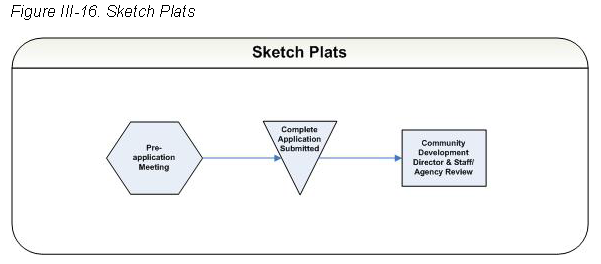
Sec. 21-3241. - Final Plats.
(1)
Description. A final plat provides a permanent and accurate record of the exact size and location of the lots, blocks, streets, drainage areas, easements, and other parcels of land within a subdivision. When filed with the county clerk and recorder, a final plat, becomes the legal instrument whereby the location and boundaries of separate land parcels within the subdivision are identified.
(2)
Review.
(a)
Except where public hearings are required pursuant to paragraph 4, the director and DRT review applications for final plats and the director is authorized to approve, approve with conditions, or deny such applications based upon the approval criteria outlined below (for purposes of this section, this process shall be referred to as an administrative approval). In the event the director denies the application, the applicant may request that the plat be reviewed through the public hearing process.
(b)
When public hearings are required by paragraph 4 or when the applicant requests a public hearing in response to the director's denial as outlined in paragraph (a), the review process shall be as follows:
(i)
The director and DRT will review the application and the director will provide a report to the planning commission.
(ii)
The planning commission will hold a public hearing on the application and make a recommendation to the city council based on the approval criteria below.
(iii)
The city council will consider the application and the planning commission's recommendation at a public hearing and after the hearing, shall approve, approve with conditions, or deny the proposed plat, based on the approval criteria below.
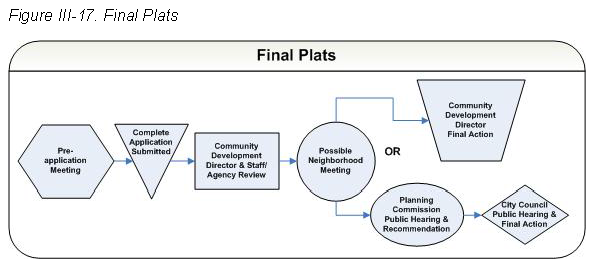
(3)
Approval Criteria. A final plat may be approved if the decision maker finds that:
(a)
The subdivision is consistent with any approved rezoning, concept plan or PUD Zone Document;
(b)
The subdivision is consistent with and implements the intent of the specific zoning district in which it is located;
(c)
There is no evidence to suggest that the subdivision violates any state, federal, or local laws, regulations, or requirements;
(d)
The general layout of lots, roads, driveways, utilities, drainage facilities, and other services within the proposed subdivision is designed in a way that minimizes the amount of land disturbance, maximizes the amount of open space in the development, preserves existing trees/vegetation and riparian areas, and otherwise accomplishes the purposes and intent of this land development code;
(e)
The subdivision complies with all applicable city standards and does not unnecessarily create lots or patterns of lots that make compliance with such standards difficult or infeasible;
(f)
The subdivision:
(i)
Will not result in a substantial or undue adverse effect on adjacent properties, traffic conditions, parking, public improvements, either as they presently exist or as they may in the future exist as a result of the implementation of provisions and policies of the comprehensive plan, this land development code, or any other plan, program or ordinance adopted by the city; or
(ii)
Any adverse effect has been or will be mitigated to the maximum extent feasible;
(g)
Adequate and sufficient public safety, transportation, utility facilities and services, recreation facilities, parks, and schools are available to serve the subject property, while maintaining sufficient levels of service to existing development;
(h)
A development agreement between the city and the applicant has been executed and addresses the construction of all required public improvements; and
(i)
As applicable, the proposed phasing plan for development of the subdivision is rational in terms of available infrastructure capacity.
(4)
Public Hearings Required. Public hearings before the planning commission and the city council shall be required if:
(a)
The applicant or any property owner within 300 feet of the property submits a written request to the director by the date scheduled for department approval. This written objection request must be directly related to the proposed subdivision. General objections regarding existing land use, zoning, or issues unrelated to the subdivision will not be considered valid objections for purposes of this provision;
(b)
If any public entity or utility affected by the proposed subdivision claims it is negatively impacted by the proposed subdivision and submits written request to the director by the date scheduled for department approval;
(c)
The director determines that the final plat should be reviewed through a public hearing process; or
(d)
The city council requests that the final plat be reviewed through a public hearing process if such request is made before the date scheduled for department approval.
(5)
Recording. Once approved, or in the case of a conditional approval, all conditions have been met, the final plat shall be signed by the city. The director and city engineer will sign the plat in the case of an administrative approval. The mayor and city clerk will sign when the final plat is approved by city council. The city will record the signed, final plat. The applicant may be required to pay all recording fees.
(6)
Dedications and Restrictive Covenants. Absent any specific language in the plat to the contrary, the execution of the final plat in accordance with paragraph (5) above shall constitute conveyance to the city of fee title to all public dedications of land depicted in the plat. No restrictive covenant shall appear on a plat unless approved by the city.
(7)
Lapse. If the approved plat is not executed by the applicant within 60 days of the date of approval of the plat, or within any longer period approved in advance in writing by the director due to unique circumstances, the plat shall be null and void and automatically lapse.
(8)
Multiple Filings. If the applicant plans to develop a property in stages, the property may be divided into separate final plats or filings. Each final plat for a filing requires a separate application and review.
(Ord. No. 2078, April 2016)
Sec. 21-3242. - Plat Corrections and Revisions.
(1)
Description. Occasionally errors are discovered on a recorded plat or minor revisions are necessary which do not affect the character of the subdivision. This section establishes reasonable standards and procedures to correct such errors or allow minor revisions in order to protect the interests of affected property owners. Minor errors and revisions include but are not limited to the following:
(a)
Typographical and spelling errors or transpositions;
(b)
Incorrect seals;
(c)
Incorrect dates;
(d)
Monumentation incorrectly noted, drawn, or missing;
(e)
Incorrect or missing bearings and/or dimensions on the drawing;
(f)
Missing or incorrectly displayed arrows or symbols;
(g)
Street name changes or corrections;
(h)
Revisions to utility easements upon approval of all affected utility companies;
(i)
Additions to or deletions from the legal description or dedicatory language that are not typographical in nature; and
(j)
Incorrect certificates or signatures.
(2)
Review. The director will review the application with the city's engineering and attorney offices, as applicable, and is authorized to approve, approve with conditions, or deny the application based on the approval criteria below.
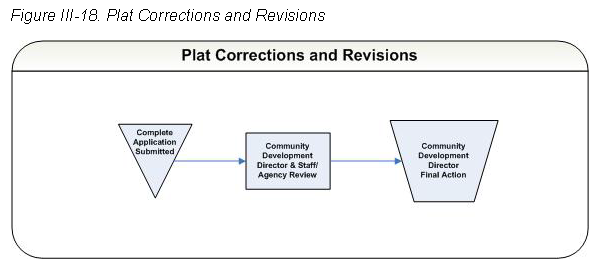
(3)
Approval Criteria. An application to revise or correct a plat may be approved if:
(a)
The correction or revision will not increase the number of lots or parcels or create new lots or parcels;
(b)
The correction or revision will not affect a recorded easement (unless the easement holder has approved the proposed correction or revision);
(c)
Street locations will not be changed;
(d)
The correction or revision will not create any nonconformities, or increase the degree of nonconformity of any existing structure or use; and
(e)
The correction or revision will not result in a violation of any applicable city standard.
(4)
Recording. The city will record the corrected or revised plat with the county. The city may require the applicant to pay all associated recording fees.
Sec. 21-3243. - Consolidation Plats.
(1)
Description. Consolidation plats are used to consolidate two or more lots or parcels.
(2)
Review.
(a)
Except where public hearings are required pursuant to paragraph (4), the director and DRT review applications for consolidation plats and the director is authorized to approve, approve with conditions, or deny such applications based upon the approval criteria outlined below (for purposes of this section, this process shall be referred to as an administrative approval). In the event the director denies the application, the applicant may request that the plat be reviewed through the public hearing process.
(b)
When public hearings are required by paragraph (4) or when the applicant requests a public hearing in response to the director's denial as outlined in paragraph (a), the review process shall be as follows:
(i)
The director and DRT will review the application and the director will provide a report to the planning commission.
(ii)
The planning commission will hold a public hearing on the application and make a recommendation to the city council based on the approval criteria below.
(iii)
The city council will consider the application and the planning commission's recommendation at a public hearing and after the hearing, shall approve, approve with conditions, or deny the proposed plat based on the approval criteria below.
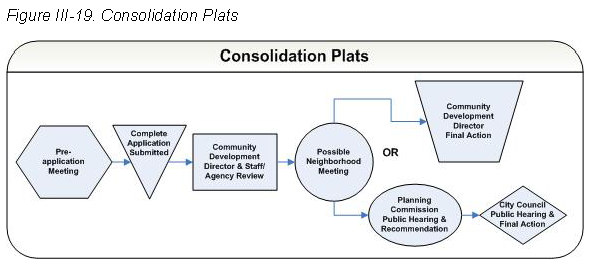
(3)
Approval Criteria. A consolidation plat may be approved if:
(a)
The subdivision is consistent with any approved rezoning, concept plan or PUD Zone Document;
(b)
The subdivision is consistent with and implements the intent of the specific zoning district in which it is located;
(c)
There is no evidence to suggest that the subdivision violates any state, federal, or local laws, regulations, or requirements;
(d)
The general layout of lots, roads, driveways, utilities, drainage facilities, and other services within the proposed subdivision is designed in a way that minimizes the amount of land disturbance, maximizes the amount of open space in the development, preserves existing trees/vegetation and riparian areas, and otherwise accomplishes the purposes and intent of this land development code;
(e)
The subdivision complies with all applicable city standards and does not unnecessarily create lots or patterns of lots that make compliance with such standards difficult or infeasible;
(f)
The subdivision:
(i)
Will not result in a substantial or undue adverse effect on adjacent properties, traffic conditions, parking, public improvements, either as they presently exist or as they may in the future exist as a result of the implementation of provisions and policies of the comprehensive plan, this land development code, or any other plan, program or ordinance adopted by the city; or
(ii)
Any adverse effect has been or will be mitigated to the maximum extent feasible.
(g)
Adequate and sufficient public safety, transportation, utility facilities and services, recreation facilities, parks, and schools are available to serve the subject property, while maintaining sufficient levels of service to existing development;
(h)
A development agreement between the city and the applicant has been executed and addresses the construction of all required public improvements shown on the consolidation plat documents; and
(i)
As applicable, the proposed phasing plan for development of the subdivision is rational in terms of available infrastructure capacity.
(4)
Public Hearings Required. Public hearings before the planning commission and the city council shall be required if:
(a)
The applicant or any property owner within 300 feet of the property submits a written request to the director by the date scheduled for department approval. This written objection request must be directly related to the proposed subdivision. General objections regarding existing land use, zoning, or issues unrelated to the subdivision will not be considered valid objections for purposes of this provision;
(b)
If any public entity or utility affected by the proposed subdivision claims it is negatively impacted by the proposed subdivision and submits written request to the director by the date scheduled for department approval;
(c)
The director determines that the consolidation plat should be reviewed through a public hearing process; or
(d)
The city council requests that the consolidation plat be reviewed through a public hearing process if such request is made before the date scheduled for department approval.
(5)
Recording. Once approved, or in the case of a conditional approval when all conditions have been met, the consolidation plat shall be signed by the city. The director and city engineer will sign the plat in the case of an administrative approval. The mayor and city clerk will sign when the consolidation plat is approved by city council. The city will record the signed, consolidation plat. The applicant may be required to pay all recording fees.
(6)
Dedications and Restrictive Covenants. Execution of the consolidation plat in accordance with paragraph (5) above shall constitute the city's acceptance of any public dedication. No restrictive covenant shall appear on a plat unless approved by the city.
(7)
Lapse. If the approved plat is not executed by the applicant within 60 days of the date of approval, or within any longer period approved in advance in writing by the director due to unique circumstances, the plat shall automatically lapse and be null and void.
Sec. 21-3244. - Lot Line and Terminology Adjustments.
(1)
Description. The lot lines or terminology of previously recorded documents may only be adjusted in accordance with this section.
(2)
Review. The director and the DRT, as deemed appropriate by the director, will review applications for lot line or terminology adjustments ("adjustments"). The director is authorized to approve, approve with conditions, or deny such applications based on the criteria below.
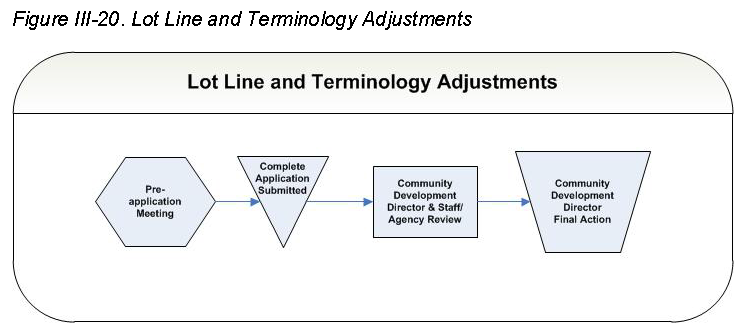
(3)
Approval Criteria. The director may approve a lot line adjustment if:
(a)
The adjustment does not increase the number of lots or parcels or create new lots or parcels;
(b)
The adjustment does not affect a recorded easement without the prior approval of the easement holder;
(c)
Street locations will not be changed;
(d)
The adjustment will not create any nonconformities, or increase the degree of nonconformity of any existing structure or use; and
(e)
The adjustment complies with all other applicable city standards.
(4)
Acceptance of Dedications. When an adjustment involves a street, easement, or other public use dedication, the director's approval of the application shall constitute the city's acceptance of any such dedication.
(5)
Recording. The city will record each approved adjustment. The applicant may be required to pay all recording fees.
(6)
Lapse. If the approved plat is not executed by the applicant within 60 days of the date of approval, or within any longer period approved in advance in writing by the director due to unique circumstances, the plat shall automatically lapse and be null and void.
(Ord. No. 2020, February 2015)
Sec. 21-3250. - PUD Concept Schematics.
(1)
Description. A PUD concept schematic is a generalized land use/site plan for an area proposed to be included within a PUD district. It is the first step in the PUD process and it allows early, informal evaluation of a proposed PUD zoning district before substantial expenses have been incurred. The PUD Concept Schematic provides the city staff and the applicant an opportunity to determine the development's conformance with the comprehensive plan and the requirements of this land development code, and assists the applicant in the preparation of a PUD zone document. The director may waive the requirement to file a PUD concept schematic.
(2)
Review. The director and DRT will review the PUD concept schematic and the director may provide a comment letter to the applicant based upon such review. In addition, if requested by the director, the planning commission may review the concept schematic and provide further comment. Any comments provided to the applicant are informational only and shall not represent a commitment on behalf of the city regarding the acceptability of the schematic.
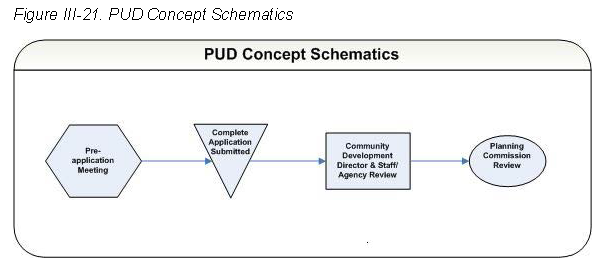
Sec. 21-3251. - PUD Zone Documents.
(1)
Description. A PUD zone document establishes entitlements for property including allowable land use and bulk standards. A PUD zone document covers all of the land area to be included in the PUD, or an identified phase of a PUD, and identifies the type and total amount of development to occur within the PUD (dwelling units and nonresidential floor area), as well as the proposed plan for pedestrian and vehicular circulation within and leading to the PUD. An applicant may submit a sketch or final (when applicable) plat or a PUD permit application for simultaneous processing with a PUD zone document.
(a)
Optional Design Guidelines. While design guidelines are not required, they may be submitted for staff review and input, at the applicant's option, for a fee.
(2)
Review.
(a)
The director and the DRT will review PUD zone documents and provide a report to the planning commission regarding the document's acceptability in light of the approval criteria listed below.
(b)
The planning commission shall hold a public hearing on the application and, after the public hearing has been held, make a recommendation to the city council based on the approval criteria found below.
(c)
After receiving the recommendation of the planning commission, the city council shall consider the application at a public hearing. After such hearing, the city council shall approve, approve with conditions, or deny the proposed PUD zone document, based on the review criteria below.
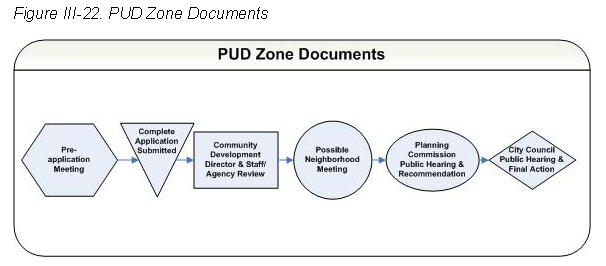
(3)
Approval Criteria. A PUD zone document may be approved only if:
(a)
The PUD zone document is consistent with the policies and goals of the comprehensive plan, any applicable adopted area plan, or community plan of the city, or reflects conditions that have changed since the adoption of the comprehensive plan;
(b)
The PUD zone document is consistent with any previously reviewed PUD concept schematic;
(c)
The PUD:
(i)
Addresses a unique situation, confers a substantial benefit to the city, or incorporates creative site design such that it achieves the purposes set out in section 21-4370 (PUD Zone District) and represents an improvement in quality over what could have been accomplished through strict applications of the otherwise applicable district or development standards. This may include but is not limited to improvements in open space; environmental protection; tree/vegetation preservation; efficient provision of streets, roads, and other utilities and services; unique architecture or design, or increased choice of living and housing environments; or
(ii)
The PUD is required to avoid completely prohibiting a legal, permitted business use within the city;
(d)
The PUD complies with all applicable city standards not otherwise modified or waived by the city;
(e)
The PUD is integrated and connected with adjacent development through street connections, sidewalks, trails, and similar features;
(f)
To the maximum extent feasible, the proposal mitigates any potential significant adverse impacts on adjacent properties or on the general community;
(g)
Sufficient public safety, transportation, and utility facilities and services are available to serve the subject property, while maintaining sufficient levels of service to existing development;
(h)
As applicable, the proposed phasing plan for development of the PUD is rational in terms of available infrastructure, capacity, and financing; and
(i)
The same development could not be accomplished through the use of other techniques, such as height exceptions, variances, or minor modifications.
(4)
Approval by Ordinance. Because approval of a PUD zone document creates a new zone district in the city which requires an amendment to the city's official zoning map, all approvals shall be in the form of ordinances.
(5)
Amendment.
(a)
Modifications to an approved PUD zone document, other than the minor modifications allowed pursuant to section 21-3215 (Minor Modifications), require the submission of a new PUD zone document amendment application, which will follow the same process as the approved PUD zone document.
(b)
Unless restricted by the terms of a development agreement or other entitlement granting vested property rights, any property owner within the PUD district or the City may initiate an amendment to a PUD zone document or PUD zone district.
(c)
A PUD district, or portions thereof, may be rezoned to another non-PUD zone district or districts in accordance with the procedures and standards for zone changes set forth in this Code. Unless restricted by the terms of a development agreement or other entitlement granting vested property rights, any property owner within the PUD district or the City may initiate an application to rezone a PUD district.
(Ord. No. 2020, February 2015; Ord. No. 2078, April 2016)
Sec. 21-3252. - PUD Development Permits.
(1)
Description. A PUD development permit represents the last stage of review required prior to the issuance of building permits or other permits for improvements or land uses within a PUD zone district. The construction, modification, or alteration of any building or structure and all specific land uses within the PUD shall be governed by the PUD development permit. A PUD development permit is only issued when all details of the proposed PUD development (or a portion of that development) have been finalized and have been reviewed for consistency with the terms of the approved PUD zone document and all design and development standards in this land development code that have not been waived or modified by the terms of the approved PUD zone document.
(2)
Review. The director and DRT review applications for PUD development permits. The director is authorized to approve, approve with conditions, or deny the application based on the approval criteria below.
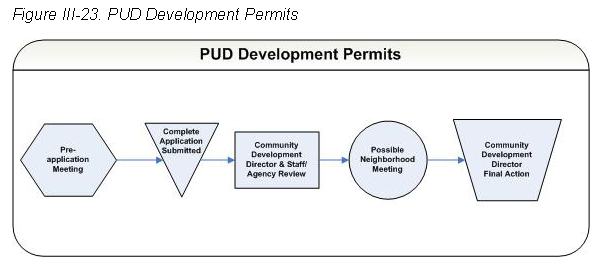
(3)
Approval Criteria. An application for a PUD development permit may be approved if it:
(a)
Complies with city standards;
(b)
Is consistent with any previously approved PUD zone document, rezoning concept plan, or other plans or land use approvals;
(c)
Provides adequate mitigation for any significant adverse impacts resulting from the use;
(d)
Creates a positive precedent for the future cumulative development of the immediate area;
(e)
Provides utilities, drainage, and other necessary facilities in accordance with the final PUD permit; and
(f)
If the proposed PUD permit includes mixed-use areas, then:
(i)
The elements of the PUD development plan, such as streets, structures, parking areas, pedestrian walkways, courtyards, plazas, landscaping, service areas, open spaces, bicycle movement provisions, screening, lighting, and maintenance and storage facilities are arranged and designed to further the purpose and intent of section 21-4370 (PUD Zone District);
(ii)
Design and location of ingress and egress minimize traffic congestion on public and private streets; and
(iii)
The residential design will provide a positive effect on the environment of the citizens who will occupy the residences.
(4)
Lapse. A PUD development permit shall lapse and be of no further force and effect if a building permit application for the development, or for a phase of the development identified in the approved PUD development permit, has not been submitted within the time-frame set forth in the PUD development permit or, if no time-frame was specified, within two years of the date of approval.
(5)
Control of PUDs Following Construction. After a PUD has been approved, the use of the land and the construction, modification, or alteration of any building or structures within the PUD shall be governed by the approved PUD development permit. Modification to an approved PUD development permit, other than minor modifications allowed pursuant to section 21-3215 (Minor Modifications), requires the submission of a new PUD application.
(6)
Design Guidelines. If a PUD zone document references design guidelines for the PUD, no PUD permit shall be approved until the design guidelines are finalized and on file with the city.
(Ord. No. 2020, February 2015)
Sec. 21-3400. - Modifications.
Minor modifications to an approved final subdivision plat, PUD Permit, or development plan may be authorized by the Director as set forth in section 21-3215 (Minor Modifications).
Sec. 21-3405. - Amendments.
(1)
Description. Any change to an approved plat, plan, or permit that does not qualify as a minor modification, including all changes in use and density, shall be considered an amendment.
(2)
Review and Approval Criteria. Amendments shall be treated as a new application subject to the applicable procedures and approval criteria set forth in this land development code. Except that amendments may be approved only upon a showing that they are required by changes in conditions that have occurred since the original final plat, plan, or permit was approved, by changes in development policies of the City, or by other conditions that were unforeseen at the time of the original final plan, plat, or permit approval. This showing is in addition to the regular approval criteria of the applicable application.
Sec. 21-3410. - Revocations.
The city may revoke any approved plat, plan, or permit if the applicant for such plat, plan, or permit fails to comply with the plat, plan, or permit as approved or with any of the conditions that were imposed by the city in conjunction with the approval. In such cases, the city will notify the applicant of the proposed revocation and the body or staff member who approved the plat, plan, or permit or who imposed the conditions will hear and decide whether the plat, plan, or permit should be revoked.
(Ord. No. 2158, December 2018)
Sec. 21-3415. - Right to Appeal.
An appeal may be filed with the city in conjunction with a final decision issued by the director, the building official, the floodplain administrator, or any other city administrator related to an application filed pursuant to this article. Such appeal must be filed by the applicant, the property owner of the subject property, or a person otherwise permitted to appeal by state law (collectively referred to as parties in interest) and shall be subject to the procedures outlined below.
Sec. 21-3420. - Related Developmental Approvals Stayed.
Upon the filing of an appeal, no related development approvals or permits shall be issued for the subject property unless the official whose decision is being appealed certifies that such a stay will cause immediate peril to life or property. If such a certification is made, development approvals and permits may be issued for the subject property, unless a "stop work order" is issued by the city, or a restraining order is issued by a court.
Sec. 21-3425. - Appeal Forums.
(1)
The Board of Adjustment. All appeals from administrative decisions related to temporary use permits, minor modifications, grading permits, and floodplain development permits, as well as appeals from the building official's denial of a building or sign permit if the denial is based upon a standard contained in this land development code shall be heard by the board of adjustment.
(2)
Building Board of Appeals. An appeal from the building official's denial of a building or sign permit based upon some ground other than a standard contained in this land development code shall be heard by the building board of appeals.
(3)
Planning Commission and City Council. All appeals from the decision of the director, other than those outlined in paragraphs (1), (2), and (4), shall be reviewed by the planning commission and the city council.
(4)
District Court. Appeals from decisions of the board of adjustment or the city council, or of the director regarding Oil and Gas Permits under section 21-3216, shall be appealed in accordance with Rule 106 of the Colorado Rules of Civil Procedure.
Appeals shall be filed with the director no later than ten days after the date of the initial decision. Upon receipt of an appeal, the director will forward the documents constituting the record of the action to the appropriate appellate body.
(Ord. No. 2183, November 2018)
Sec. 21-3435. - Standard of Review.
Except for appeals filed under Rule 106 of the Colorado Rules of Civil Procedure, the appellate body shall review the application de novo. The board of adjustment and the city council shall approve, approve with conditions or deny the application based upon the relevant approval criteria. The planning commission recommends action on the application based upon the relevant approval criteria.
Sec. 21-3440. - Time of Review.
(1)
Appeals to the Board of Adjustment and the Building Board of Appeals. Appeals will be considered within 60 days of the date the appeal is filed.
(2)
Appeals to the Planning Commission and City Council. The planning commission will consider an appeal within 45 days of the date the appeal is filed and will submit a recommendation to the city council. The city council will consider the application and the planning commission's recommendation within 45 days of the date it receives the planning commission's recommendation.
Sec. 21-3445. - Procedures on Appeal.
The appellate bodies are authorized to adopt all rules of procedure they deem appropriate for proper administration of appellate matters.
Sec. 21-3450. - Decisions.
(1)
The city may reverse, affirm, or modify in whole or in part the order, requirement, decision, or determination.
(2)
Written notice of the decision normally will be sent to the appellant and all other parties who have made a written request for notification within ten days of the decision. The decision of the appellate body shall be deemed the final decision of the city on the application.

