
Commerce City City Zoning Code
ARTICLE V
- Uses and Accessory Structures
Sec. 21-5100. - Purpose.
This article outlines the uses, both temporary and permanent, that are permitted within the city. Not all uses are permitted in every zone district and therefore, any person using property within the city should refer to this article to determine whether the use is permitted on their property and the standards applicable to that use. This article also details the accessory structures that may be erected and the standards that apply to such structures.
Sec. 21-5110. - Use and Accessory Structures Restricted.
No land shall be used and no accessory structure shall be erected, structurally altered, relocated, or used except for in compliance with this land development code.
Sec. 21-5120. - Performance Standards.
Uses permitted under this land development code may be undertaken and maintained only in conformance with the following standards. An applicant for a proposed use may be required to submit evidence that a use complies with these standards, including a report prepared by an expert. Such expert shall be fully qualified to give the required information and shall be acceptable to the director. The cost of the expert's services shall be borne by the applicant.
(1)
Vibration. Uses that generate vibrations in violation of this section shall be cushioned or isolated to prevent generation of vibrations. Uses shall be operated in compliance with the following provisions:
(a)
Uses shall not generate ground vibration that is perceptible without instruments by the average person at any point along or beyond the property line of the parcel containing the activities;
(b)
Uses shall not generate vibrations that cause discomfort or annoyance to reasonable persons of normal sensitivity or which endangers the comfort, repose, health or peace of residents whose property abuts the property line of the parcel; and
(c)
Uses shall not generate ground vibration that interferes with the operation of equipment and facilities of adjoining parcels.
(d)
Vibrations from temporary construction/demolition and vehicles that leave the subject parcel (e.g., trucks, trains, and aircraft) are exempt from the provisions of this section.
(2)
Noise. Uses and activities shall be conducted so that any noise generated on the property will not violate the noise regulations contained in the municipal code.
(3)
Air Pollution. Activities in all zone districts shall conform to applicable federal, state, and local air pollution standards. The applicant may be required to provide proper documentation justifying that all operations will be in compliance with federal, state and local air pollution standards.
(4)
Odor.
(a)
Uses shall not result in the creation of odors of such intensity and character either on or off property as to be detrimental to the health and welfare of the public or that interferes unreasonably with the comfort of neighboring property owners. Without limiting the foregoing, odorous emissions shall comply with applicable provisions of the federal, state, and local requirements.
(b)
Agricultural operations conducted in compliance with this land development code shall be exempt from this paragraph, unless the odor created constitutes a health hazard.
(5)
Dust. No dust or particulate matter shall be emitted that is detectable by a reasonable person without instruments. Nonresidential exhaust air ducts shall be located or directed away from abutting residentially zoned properties.
(6)
Electromagnetic Radiation. It shall be unlawful to operate, or cause to be operated, any planned or intentional source of electromagnetic radiation for such purposes as communications, experimentation, entertainment, broadcasting, heating, navigation, therapy, vehicle velocity measurement, weather survey, aircraft detection, topographical survey, personal pleasure, or any other use directly or indirectly associated with these purposes except in compliance with the Federal Communications Commission (FCC) regulations, or in the case of governmental agencies and governmental-owned plants, the regulations of the interdepartmental radio advisory committee. Any application for a proposed use or activity emitting electromagnetic radiation shall include an expert report that demonstrates conformance with the applicable regulations of the FCC, or interdepartmental radio advisory committee, as applicable.
(7)
Hazardous Materials. All activities and all storage of hazardous materials shall comply with all federal and state regulations as well as any applicable safety, fire and building codes adopted by the city for the use and storage of the hazardous materials involved. Adequate precautions shall be taken to protect against negative off-site impacts of a hazardous materials release, using the best available technology.
(8)
Glare and Heat. No direct or sky-reflected glare, whether from lights or from high temperature mechanical or chemical processes such as combustion or welding, shall be permitted to unreasonably interfere with the use and enjoyment of adjacent properties. These regulations shall not apply to signs or floodlighting or parking areas otherwise permitted by this land development code. There shall be no emission or transmission of heat or heated air so as to be discernible at the lot line.
(9)
Materials and Waste Handling.
(a)
No person shall cause or permit any materials to be handled, transported, or stored in a manner that allows particulate matter to become airborne or liquid matter to drain onto or into the ground.
(b)
All materials or wastes that might cause fumes or dust, or that constitute a fire hazard or may be edible by or otherwise be attractive to rodents or insects, shall be stored outdoors only in enclosed, permeable trash containers that are screened in accordance with this code.
(c)
Toxic and hazardous materials and chemicals shall be stored, secured, and maintained so that there is no contamination of ground, air, or water sources at or adjacent to the site.
(d)
Notwithstanding anything contained herein, all treatment, storage, disposal, or transportation of hazardous waste shall be in conformance with all federal and state statutes, codes, and regulations.
(e)
Provisions shall be made so that all lubrication and fuel substances shall be prevented from leaking or draining onto the property.
(f)
Nonradioactive liquid or solid wastes. There shall be no discharge at any point into any public or private sewage disposal system or stream, or into the ground, of any liquid or solid materials except in accordance with the regulations of the Tri-County Health Department and South Adams County Water and Sanitation District.
Sec. 21-5130. - Nuisances and Hazards.
The city may require a use or structure that has become hazardous, harmful, noxious, offensive, or that constitutes a nuisance to the surrounding neighborhood to be corrected or improved by any measure that is consistent with reasonable technological and economic practicality.
B. - SUPPLEMENTAL REGULATIONS FOR PARTICULAR USES
The following sections establish special regulations for land uses that may affect adjacent properties, the neighborhood, or community, even if the site planning and development standards of the applicable zoning district are satisfied. The regulations contained in these sections are intended to mitigate potential problems and hazards, and to ensure consistency with the comprehensive plan.
Sec. 21-5400. - Accessory Uses and Accessory Structures Table.
The Accessory Uses and Accessory Structures Table (table V-3 below) establishes the districts in which a particular use or structure may be allowed as accessory to the principal use or structure. An "R" indicates the accessory use or structure is allowed in the district as a use-by-right. A "P" means the accessory use or structure is allowed as a use-by-permit. Finally, a blank cell means that the accessory use or structure is prohibited in that district.
Table V-3. Accessory Uses and Accessory Structures Table
(Ord. No. 1854, April 2011; Ord. No. 1887, July 2012; Ord. No. 2648, § 2(Exh. A), 12-16-2024)
Sec. 21-5410. - Unlisted Uses and Structures.
In the event that a proposed use or structure is not specifically listed in table V-3, the director may determine that such use or structure is allowable and may impose any restriction deemed reasonably necessary to ensure that the intent and purpose of this land development code are not negatively impacted.
Sec. 21-5420. - Standards.
(1)
Incidental to Principal Use. The accessory use or structure shall be clearly incidental and customarily found in connection with the principal use. No accessory use or structure is permitted on a lot or parcel without a principal use or structure.
(2)
Commercial Use Restricted. No accessory structure on a residentially zoned property shall be used for any commercial purpose other than a Short-Term Rental located in a permitted Accessory Dwelling Unit.
(3)
Lot Restriction. The accessory uses or structures shall be conducted and/or located on the same lot and within the same zone district as the principal use.
(4)
Unity of Ownership. There shall be unity of ownership and unity of user between the principal use and accessory use.
(5)
Time of Establishment. No accessory use shall be conducted and no accessory structure shall be erected on a lot until after all required permits and approval of the principal use or activity has been obtained.
(6)
Nonconforming Use. No new accessory structures shall be permitted on a lot with a legal nonconforming use.
(7)
Accessory Living Space Restricted. Except as expressly allowed, no accessory structure shall be used to provide any type of living area normally associated with a dwelling unit, including without limitation, spaces devoted to sleeping, permanent dining or cooking areas, and greater than a half bathroom.
(8)
Motor Vehicles and Trailers. The use of any motor vehicle, trailer, mini-mobile storage container, or shipping container as a structure in which, out of which, or from which any goods are sold or stored, any services performed, or other businesses conducted, shall be prohibited in all zoning districts except for:
(a)
The sale of goods or merchandise at a city-approved or sponsored event;
(b)
The use of a motor vehicle, trailer, or shipping or storage container in connection with an approved recycling operation;
(c)
The use of a trailer or shipping or storage container in conjunction with construction authorized by a valid building, grading, or construction permit; or
(d)
The use of a trailer, shipping, or storage container for the temporary loading and unloading of goods, provided that no individual trailer or container is in place longer than 72 hours.
(9)
Mobile Homes and Recreational Vehicles. No mobile home or recreational vehicle (RV) shall be used for accessory uses.
(10)
Sight Distance. No accessory structure or use shall be located within a sight-distance triangle.
(Ord. No. 1854, April 2011; Ord. No. 1887, July 2012; Ord. No. 2648, § 2(Exh. A), 12-16-2024)
Sec. 21-5430. - Location of Accessory Structures.
(1)
City Easements. No accessory structure shall be located within any platted or recorded easement of the city's, except as expressly agreed to in writing by the city. The applicant shall be responsible for correctly identifying easements and their ownership on the site plan provided with the building permit for the accessory structure.
(2)
Easements Not Belonging to the City. The applicant and property owner shall be responsible for any accessory structures placed within an easement.
(Ord. No. 1887, July 2012)
Sec. 21-5440. - Number of Accessory Structures.
Except when a PUD Zone Document specifically regulates the number of accessory structures permitted within the PUD, the number of accessory structures shall comply with the provisions of this section unless a variance is granted by the board of adjustment. Trash enclosures, flagpoles, satellite dishes, clotheslines, and driveways shall not count toward the maximum number of accessory structures permitted by this section. Except as specifically provided otherwise below, all other detached accessory structures listed in table V-6 shall count towards the maximum number of accessory structures permitted by this section.
(1)
Principal Single-Family Detached or Single-Family Attached (Duplex) Use. No more than three accessory structures shall be permitted on a single lot.
(2)
Principal Multi-Family Use. For multi-family residential housing other than townhouses, no more than three accessory structures shall be permitted on a single lot. For townhouse developments where outdoor space for each unit has been legally subdivided, no more than two accessory structures shall be permitted on a single lot. For townhouse developments where outdoor space for each unit has not been subdivided into separate legal lots, each unit shall be permitted to place one shed on its individual outdoor space. Attached and detached garages and attached carports shall not count towards this maximum.
(3)
Principal Commercial Use. No more than two accessory structures shall be permitted on a single lot. Within that limitation, not more than one shed and/or one detached garage shall be placed on a single lot.
(4)
Principal Industrial Use. No more than three accessory structures shall be permitted on a single lot.
(5)
Principal Agricultural Use. No more than five accessory structures shall be permitted on a single lot.
(6)
Public Zone District. There is no maximum number of accessory structures allowed in any lot zoned Public.
(7)
All Other Principal Uses. No more than one accessory structure shall be permitted on a single lot.
(Ord. No. 2020, February 2015)
Sec. 21-5450. - Bulk Standards for Accessory Structures and Uses Table.
All accessory structures and uses shall be subject to the specific regulations set forth in the Bulk Standards for Accessory Structures and Uses table (table V-4). Such specific regulations shall be in addition to the regulations that apply to principal uses and structures in each district. In cases of any conflict between the standards of table V-4 and other requirements of this land development code, the standards contained in table V-4 shall control.
Table V-4. Summary Table of Bulk Standards and Additional Regulations for Accessory Structures
(Ord. No. 1887, July 2012; Ord. No. 2020, February 2015; Ord. No. 2158, December 2018)
Sec. 21-5500. - General Provisions.
(1)
A nonconformity existing at the time of the adoption of this land development code, or created by the adoption of this land development code, may continue in the same manner as it existed on the effective date of this land development code, except as otherwise provided herein.
(2)
The owner of property shall bear the burden of establishing the existence of any claimed legal nonconformity.
(3)
Changes of tenancy, ownership or management of an existing nonconformity shall be permitted, and in such cases the nonconformity shall continue to be subject to the standards of this land development code.
(4)
Repairs and normal maintenance required to keep any nonconformity in a safe condition shall be permitted.
(5)
No use that is accessory to a principal nonconforming use shall continue after the principal nonconforming use ceases to exist.
(6)
No existing use or structure shall be deemed nonconforming solely because of the lack of off-street parking required by this land development code.
Sec. 21-5510. - Nonconforming Structures.
(1)
Alterations and Expansions. Except as noted below, a nonconforming structure shall not be altered or expanded unless such alteration or expansion complies with the provisions of this land development code. Expansions of the structure that comply with the applicable dimensional standards shall be permitted and shall not require a variance.
This prohibition shall not apply to any lot zoned R-3 as of January 1, 2015 that contains a maximum of one single-family detached dwelling provided that no other nonconformity exists on the property.
(a)
General Standards. A nonconforming structure shall not be altered or expanded unless such alteration or expansion complies with the provisions of this land development code. Expansions of the structure that comply with the applicable dimensional standards shall be permitted and shall not require a variance.
(b)
Structures Located in the Floodplain. In addition to the general standards, if a nonconforming structure located within the floodplain undergoes any alteration, expansion, or addition the value of which equals or exceeds 50 percent of the structure's replacement value, the entire structure must be brought into compliance with the requirements of this land development code.
(2)
Restoration.
(a)
Structures Located Outside the Floodplain. A nonconforming structure that is destroyed or damaged to the extent of more than 60 percent of its replacement value shall not be restored except in compliance with the requirements of this land development code. All such restoration work shall be commenced within 180 days, in accordance with the building permit issued by the city and all applicable city codes.
(b)
Structures Located in the Floodplain. A nonconforming structure that is destroyed or damaged to the extent of more than 50 percent of its replacement value shall not be restored except in compliance with the requirements of this land development code. All such restoration work shall be commenced within 180 days, in accordance with the building permit issued by the city and all applicable city codes.
(3)
Relocation. No person shall move a nonconforming structure to another parcel unless the structure and its location on the new parcel comply with the requirements of the zoning district in which it is relocated.
(4)
Reversion Prohibited. If a nonconforming structure becomes conforming, it shall not be changed back to a nonconforming structure.
(Ord. No. 1992, March 2014; Ord. No. 2020, February 2015)
Sec. 21-5520. - Nonconforming Use of Land.
(1)
Expansion. A nonconforming use of land shall not be enlarged, expanded, extended, increased nor moved to occupy an area of land which was not occupied before the adoption of this land development code.
(2)
Abandonment. If a nonconforming use is discontinued for a period of 180 days or more, any future use of the land shall conform to the standards of the district in which it is located.
(3)
Additional Uses. No additional conforming uses are allowed until all nonconforming uses are removed or terminated.
Sec. 21-5530. - Nonconforming Use of Structures.
(1)
Expansion. A nonconforming use of a structure shall not be enlarged, expanded, extended, increased, or moved to occupy an area of the structure that was not occupied before the adoption of this land development code.
(2)
Accessory Uses and Structures Restricted. No additional accessory use, building, or structure shall be established on the site of a nonconforming use.
(3)
Change in Use. A nonconforming use may be changed to a different nonconforming use only if the board of adjustment determines that the new use will result in a lesser degree of nonconformity than the current use and approves the change. After any such change, the use may not revert to the original nonconforming use nor may it be changed to any other use except in compliance with the terms of this section.
(4)
Abandonment. If a nonconforming use is discontinued for a period of 180 days or more, any future use of the structure shall conform to the standards of the district in which it is located.
(5)
Restoration. If a conforming structure containing a nonconforming use is damaged to the extent of more than 60 percent of its replacement value, all future use of the rebuilt or restored structure shall be a conforming use.
(6)
Alteration and Repair. If a structure containing a nonconforming use is repaired or altered at a cost that exceeds 60 percent of its value, all future use of the structure shall be a conforming use.
Sec. 21-5540. - Nonconforming Lots.
(1)
Use and Construction. A nonconforming lot may be used for any purpose permitted in the zoning district in which it is located, as long as all bulk standards of that district are met. Structures may be permitted on a nonconforming lot provided the lot does not have continuous frontage with other lots under the same ownership. This provision shall apply even though such lot fails to meet the requirements of the zoning district in which it is located for area, or width, or frontage, provided however, that the requirements of the zoning district for minimum setback dimensions shall be met unless a variance to said requirements has been granted by the board of adjustment.
(2)
Enlargements Allowed. Structures located on nonconforming lots may be enlarged, expanded, or extended, provided that such action does not increase nonconformities with applicable setbacks, or cause a new area of nonconformity.
Sec. 21-5550. - Removal of Hazards.
Any nonconforming structure or use that is deemed by the building official to be a detriment to the public health, safety, or general welfare shall be ordered to be removed or discontinued within such time period as the building official may deem reasonable. Upon a failure to comply with the building official's order, the city may take such steps as are necessary to remove such structure, or discontinue such use, and assess the cost thereof against the property owner.
Sec. 21-5600. - Review and Approval.
All telecommunications facilities shall be reviewed and approved by the city prior to installation.
(1)
Section 6409(a) Facilities. All 6409(a) facility applications shall be reviewed and approved in compliance with the federal rules in effect at the time the application is received.
(2)
Other Facilities. Administrative Applications for telecommunication facilities that do not involve 6409(a) facilities shall be governed by the following:
(a)
Approval Criteria. An application may be approved if the decision maker finds that:
(i)
The facility complies with all city standards;
(ii)
The facility is suitable for the site, considering the size of the facility and lot, the location of the lot and the facility within the lot, the topography and natural features on the lot, and existing structures or improvements on the lot;
(iii)
There will be adequate mitigation of the visual impacts to the site on which the facility is located and the surrounding area to ensure harmony with adjacent uses and public rights-of-way;
(iv)
The facility creates a positive precedent for future telecommunications facilities and collocations.
(b)
Federal Aviation Administration (FAA) Review. Any telecommunication facility that exceeds 200 feet in height or are located within 20,000 feet of a major airport (commercial and military aircraft facility) and 10,000 feet of a general aviation airport (serving smaller aircraft) shall be reviewed by the FAA.
(c)
Removal Assurance. Prior to erecting or installing any new monopole, the owner or operator shall post with the city a bond, or some other form of financial assurance deemed suitable to the city, to cover the cost of removal of the facility if abandoned, or deemed abandoned, pursuant to the terms of this code.
Sec. 21-5601. - Operating Standards.
All telecommunication facilities shall comply with the standards outlined in this section.
(1)
Signage. Wireless telecommunication facilities shall not display signs or advertising devices other than certification, warning, or other required seals or signs. This requirement does not preclude the mounting of telecommunication facilities on existing or new signs which signs are or will be installed in compliance with the standards contained in this land development code.
(2)
Co-Location Requirements. No telecommunications facility owner or operator shall unfairly exclude a telecommunication competitor from using the same facility or location. Upon request by the city, the owner or operator shall provide evidence as to why co-location is not possible. If a telecommunications competitor attempts to co-locate a facility on an existing or approved telecommunications facility or location, and the parties cannot reach an agreement, the city may require a third party study, at the expense of either or both parties, to determine the feasibility of co-location.
(3)
Abandonment.
(a)
All permits or approvals for telecommunication facilities shall expire immediately upon cessation of use by the provider. Upon request of the City, all providers must furnish to the city proof of continued use of the telecommunications facility. Proof shall consist of a copy of the FCC license and a letter from the cellular provider indicating that the facility is still in use. All providers must furnish to the city notice of discontinuation of use by furnishing a copy of any notices reflecting discontinued use as sent to the FCC or other federal regulatory agency having jurisdiction over the operation of the facility. In addition, commercial mobile radio service facilities not used for a continuous period of 6 months shall be deemed abandoned and shall be removed no later than 90 days after being deemed abandoned.
(b)
All leases for the location of commercial mobile radio service facilities must provide that the provider shall have full access to the leasehold space for the purpose of removing the facility. In addition, in the event that the provider and/or the landlord shall fail to remove the facility within the 90-day time period provided herein, then the city shall have access to the leasehold space of the abandoned facility for the purpose of removal. All costs incurred by the city in connection with the removal of the facility shall be recoverable, at the option of the city, against the bond posted by the owner or operator, or alternatively, all costs incurred may be assessed as a lien against the property on which the facility is located, and the city may record said lien, and the lien shall be enforceable and may be collected in the same manner as a tax lien by the county treasurer and any funds recovered thereby shall be remitted to the city, provided, however, that prior to the city's removal of the abandoned facility the city shall have first given notice to the provider and the landowner, by regular and certified mail, of its intent to remove the facility, not less than 30 days prior to the city's removal of any abandoned facility.
Sec. 21-5602. - Telecommunication Facility Location Requirements.
Telecommunication facilities shall be allowed as detailed in table V-5, entitled Use Schedule for Telecommunication Facilities. An "R" indicates that the facility is allowed with an administrative approval by the director. A "P" indicates that the facility is allowed as a use-by-permit. If the cell is blank, the facility is prohibited. Vacant properties shall default to the future land use shown in the comprehensive plan and mixed use properties shall default to the predominant land use (multi-family or commercial).
Table V-5. Use Schedule for Telecommunication Facilities
*Excludes 6409(a) facilities
(Ord. No. 2186, December 2018)
Sec. 21-5603. - Monopole Standards.
All new nonconcealed monopoles shall comply with the following standards:
(1)
Setback. Monopoles shall be located in the side or rear yards of developed properties, and shall meet the required principal structure setbacks of the underlying zone district. The monopole shall not reduce the required parking, landscaping, and/or open space requirements for the principal use.
(2)
Height Limitations. Monopoles in industrial zoned districts shall not exceed 70 feet in height. Those in commercial zone districts shall not exceed 50 feet in height. The height of monopoles in all other zone districts shall be governed by the building height standards set forth in this code for the applicable zone district.
(3)
Distance Requirements.
(a)
No portion of a monopole, including accessory equipment, shall be located within 100 feet of a property zoned and/or developed for single-family residential purposes. In the event that the height of a monopole exceeds 100 feet through a variance granted in compliance with this land development code, the monopole and all accessory equipment shall be set back from the aforementioned residential lands by a distance equal to the height of the monopole.
(b)
To the maximum extent feasible, monopoles shall be located at least 2,000 feet from any existing freestanding telecommunications facility. It shall be the applicant's burden to establish a lack of feasibility.
(c)
To the maximum extent feasible, monopoles shall not be located within 2,000 feet of the existing public service transmission line, which begins at Colorado State Highway 85, travels east, south of East 104th Avenue, moves north by northeast east of Picadilly Road, and concludes at Hayesmount Road. It shall be the applicant's burden to establish a lack of feasibility.
(4)
General Screening. Existing land forms, vegetation, and structures shall be used to aid in screening the monopole from view or blending in with the surrounding built and natural environment.
(5)
Screening Wall.
(a)
When a monopole is located on an industrial zoned property and is visible from any public right-of-way, public or private open space, or nonindustrial zoned property, the base of the monopole and associated accessory equipment shall be enclosed with a screening wall or fence compatible with the character of the property on which it is located and the surrounding area.
(b)
When a monopole is located on a property that is not zoned industrial, the base of the monopole and any associated accessory equipment shall be enclosed with a screening wall or fence compatible with the character of the property on which it is located and the surrounding area.
(c)
If a screening wall or fence is required, landscaping shall be installed on the outside of the fence to soften the appearance of the cell site. The landscaping shall consist of a minimum of one tree and three shrubs for every ten linear feet of publicly-visible enclosure perimeter, with a minimum of two trees per side. The first two trees per side shall be evergreen; the remaining landscaping should be an approximate 50 percent mix of evergreen and deciduous species to promote year-round visual interest.
(6)
Co-Location. To the maximum extent feasible, monopoles shall be designed for a minimum of two users. It shall be the applicant's burden to establish a lack of feasibility.
(7)
Design. Monopoles and any associated antennas shall be of a color which generally matches the building, surroundings or background and minimizes their visibility, unless a different color is required by the FCC or FAA. Muted colors, earth tones and subdued colors shall be used wherever possible.
(8)
Antenna Type. In some circumstances, the city may require canister-type antenna instead of the traditional array antenna, if the city determines that the proposed location would be negatively impacted by the array antenna.
(9)
Accessory Equipment. Telecommunication accessory equipment, such as buildings, shelters, cabinets, and other components, shall be grouped as closely together as technically possible. The total footprint coverage area shall not exceed 400 square feet per provider, and shall not reduce the requirements for parking and/or landscaping area for other principal uses on the parcel. No structure shall exceed 15 feet in height, and shall be compatible with the design, materials, and colors of structures on the same and/or adjacent parcels.
Sec. 21-5604. - Telecommunication Facilities on Existing Buildings or Structures.
All non-6409(a) telecommunication facilities that are mounted on an existing building or structure shall comply with the following standards:
(1)
Screening. The telecommunication facility shall be adequately screened in accordance with the rooftop mechanical and utility equipment screening standards found in this land development code.
(2)
Design. A wall-mounted telecommunication facility shall be flush-mounted and shall match the building or structure in design, color, and materials.
(3)
Accessory Equipment. Accessory equipment for a wall-mounted telecommunication facility that is located on the roof shall be adequately screened in accordance with the rooftop mechanical and utility equipment screening standards found in this land development code. If the accessory equipment is located on the ground, the accessory equipment shall adhere to the following requirements:
(a)
The accessory equipment shall be located as close to the building or structure as possible.
(b)
The accessory equipment footprint shall not exceed 400 square feet, and shall not be more than 15 feet in height.
(c)
The accessory equipment shall be enclosed in a screening or concealing wall or fence to match the building or structure in color, design, and materials, and shall not reduce the landscaping or parking requirement for the use of the subject property.
(d)
All accessory equipment structures shall be landscaped from public view and all rights-of-way along the outside of the required screening enclosure. Such landscaping shall consist of a minimum of one tree and three shrubs for every ten linear feet of publicly-visible enclosure perimeter, with a minimum of two trees per side. The first two trees per side shall be evergreen; the remaining landscaping should be an approximate 50 percent mix of evergreen and deciduous species to promote year-round visual interest.
Sec. 21-5605. - Concealed Telecommunication Facilities.
Concealed telecommunications facilities that meet the following standards may be placed as such in accordance with table V-5 and shall not be required to comply with the standards contained in sections 21-5603 and 21-5604.
(1)
Dimensions. The dimensions of a concealed facility must reasonably approximate the dimensions of the object as which it is being disguised.
(2)
Design and Location. The design and location of a concealed facility must be compatible with the property on which it is located as well as the surrounding area.
(3)
Height and Setback. A concealed telecommunication facility shall comply with the bulk standards of the object as which it is being disguised and shall not reduce the required parking, landscaping, and/or open space requirements for the principal use.
(4)
Distance from Residential. Concealed monopoles shall not be located within 100 feet of a property zoned and/or developed for single-family residential purposes.
(5)
Co-Location. To the maximum extent feasible, concealed facilities shall be designed to accommodate a minimum of two users to reduce the overall number of sites required in the city.
(6)
Accessory Equipment. All accessory equipment shall be designed so as to not defeat the purpose of the concealment of the telecommunication facility itself through the use of screening, landscaping, or other technique.
Sec. 21-5606. - Telecommunication Facilities Located on Existing Pole Structures.
All new telecommunications facilities, including small cell, micro cell, and distributed antenna systems (DAS), installed on existing utility poles, light poles, signs, electric distribution facilities, and similar types of structures, excluding monopoles, whether on private property or in the public right-of-way, shall comply with the following standards:
(1)
Location and Distance Requirements. In single-family residential zone districts, equipment shall only be located on existing poles within the right-of-way or within a utility easement. Such equipment must be located a minimum of 25 feet from any single-family residential home.
(2)
Mounting. Equipment shall be mounted as flush to the pole as is technically feasible.
(3)
Color. Equipment mounted on a pole shall be painted to match the color of the pole on which it is located.
(4)
Ground Equipment. Any equipment located on the ground shall be screened from public view in accordance with the screening standards found in this land development code.
(5)
Pole Replacement. Poles may be replaced in order to structurally accommodate the addition of a telecommunications facility. The new pole shall meet any applicable previous approvals, conditions, and current requirements for those structures. Unless otherwise agreed to by the Director or their designee upon clear and convincing evidence, poles must have a primary functional component such as a light, and shall not be installed for the sole purpose of placing telecommunications equipment.
(a)
If the facility is proposed in an area with an existing or adopted theme, streetscape design, or lighting plan, the replacement pole shall adhere to the design theme for the area in which it is proposed to be placed.
(b)
New wood poles shall be prohibited.
(c)
Replacement poles shall comply with section 21-7720 (Utilities to be Placed Underground).
(6)
Authorization to Attach. Where the Telecommunication Facility owner is not the owner of the supporting existing pole structure, the Telecommunication Facility Owner must provide authorization from the existing pole owner to attach the proposed equipment.
(7)
Right-of-Way Usage and Licensing Agreement. If located in the public right-of-way, the proposed Telecommunication Facility operator shall sign a licensing agreement with the City for use of the right-of-way prior to approval of any necessary permits.
(Ord. No. 2068, January 2016; Ord. No. 2186, December 2018)
Sec. 21-5607. - Telecommunication Facilities Located on New Pole Structures on Public Rights-of-Way.
All Telecommunication Facilities, including small cell, micro cell, and distributed antenna systems (DAS), installed on new pole structures and other similar types of structures deployed for the purpose of supporting a Telecommunication Facility in the public right-of-way shall comply with all applicable standards of section 21-5606 in addition to the following standards:
(1)
Location and Distance. All new pole structures deployed in the public right-of-way for the purpose of supporting a Telecommunication Facility shall be separated from any existing or proposed pole structure supporting a Telecommunication Facility by no less than 300 feet. If located in an Activity Center as identified in the Comprehensive Plan or an urban renewal area, Telecommunication Facilities may be located closer than 300 feet, as determined by the director.
(2)
Color and Design. The new pole structure shall be compatible with the colors and aesthetic design of the other towers or poles in the right-of-way in the immediate vicinity. For example, new pole structures near traffic signals at an intersection should match the color and decorative base cover design of the traffic signals. Similarly, if new pole structures are lights in the public right-of-way, the color and design of the new pole structures should be the same, or substantially the same, as that of the existing light poles in the area.
(a)
If the facility is proposed in an area with an existing or adopted theme, streetscape design, or lighting plan, the replacement pole shall adhere to the design theme for the area in which it is proposed to be placed.
(b)
New wood poles shall be prohibited.
(c)
Utilities serving the pole shall comply with section 21-7720 (Utilities to be Placed Underground).
(3)
Height. The height of the new pole structure shall not be more than ten (10) feet higher (as measured at the base of the pole from the ground to the top of the pole) than any existing utility or traffic signal pole structure within 500 feet of the new pole structure. Additionally, no such new pole structure shall exceed the building height standards set forth in this code for the applicable zone district. Where a height exception is sought in accordance with section 21-3220, it shall conform with all such height exception requirements and be no greater than ten (10) feet higher than the applicable zone district including those being attached to an existing pole structure.
(4)
Other Approvals. The siting and construction of the new pole structure shall comply with all other applicable City requirements, including but not limited to, compliance with city standards for distances and the granting of a right-of-way permit.
(5)
Right-of-Way Usage and Licensing Agreement. Prior to approval of any necessary permits, the proposed Telecommunication Facility operator shall sign a licensing agreement with the City for use of the right-of-way.
(Ord. No. 2186, December 2018)
Sec. 21-5200. - Land Use Table.
The principal uses allowed in each of the city's zoning districts are established in the Land Use Table (table V-1). An "R" indicates that the use is allowed as a use-by-right in the district. A "P" means that the use will only be allowed if a use-by-permit is obtained. A "C" means that the use will only be permitted if a conditional use permit is obtained. If the cell is blank, the use is prohibited in that district. Some uses are subject to standards, limitations and conditions which are in addition to the general development standards of this article. Where the right column in table V-1 includes a section number, the provisions in the referenced section apply to the use in addition to the other applicable sections of this land development code. However, the information contained in the right hand column of the table is included only to aid users and is not intended to be an exhaustive or complete list of all applicable regulations. NAICS code numbers are included on this table to assist the city in classifying proposed uses. They are for reference only and shall not be binding in any classification decision.
Table V-1. Land Use Table
*In accordance with section 21-5254.
**In accordance with section 21-5268.
(Ord. No. 1785, June 2010; Ord. No. 1854, April 2011; Ord. No. 1887, July 2012; Ord. No. 1897, July 2012; Ord. No. 1891, August 2012; Ord. No. 1956, June 2013; Ord. No. 2020, February 2015; Ord. No. 2048, June 2015; Ord. No. 2068, January 2016; Ord. No. 2078, April 2016; Ord. No. 2189, December 2018; Ord. No. 2190, December 2018; Ord. No. 2191, December 2018; Ord. No. 2194, December 2018; Ord. No. 2203, July 2019; Ord. No. 2266, § 7(Exh. E), 2-15-2021; Ord. No. 2420, § 2(a)(Exh. B), 9-19-2022; Ord. No. 2452, § 2(c)(Exh. E), 12-5-2022; Ord. No. 2540, § 2(Exh. A), 9-18-2023; Ord. No. 2656, § 2(Exh. A), 2-3-2025)
Sec. 21-5205. - Unclassified Uses.
(1)
General Prohibition. Any specific use not listed in the use table above shall be prohibited unless the city determines, consistent with the provisions of paragraph (2) of this section that the use falls into one of the listed use classifications.
(2)
Review and Interpretation. In the event that a proposed use is not specifically listed in the use table, an applicant may seek a written interpretation from the director that the use falls into one of the listed classifications allowed in the applicable zoning district. The director shall base this determination on the following considerations:
(a)
Whether the proposed use is similar in terms of hours of operation, traffic impacts, environmental impacts, and the potential for adverse impacts on surrounding properties;
(b)
Whether the proposed use is typically housed in buildings or structures similar and compatible to those used to house allowed uses in the zoning district; and
(c)
Whether the proposed use is consistent with the purpose and intent of the particular zoning district.
(3)
Appeal. A determination by the director that the proposed use does not fall into a permitted use classification may be appealed pursuant to the procedures outlined in article III of this land development code. Unless the director's decision is overturned on appeal, the proposed use shall be prohibited until this article is amended to indicate that such use is an allowed or special use permit in one or more zoning districts.
Sec. 21-5210. - Limitation.
Unless expressly authorized by the city or the terms of this land development code, no property shall be used for more than one category of use (i.e., industrial, residential, commercial, or public/institutional).
Sec. 21-5212. - Above-Ground Storage Tanks.
(1)
All tanks shall meet the applicable building and fire code requirements.
(2)
No tank used for the storage of liquids shall exceed 12,000-gallons capacity unless the city has issued a conditional use permit specifically allowing the use of such tank.
(3)
No more than 48,000 gallons of capacity shall be permitted on any single property parcel without a conditional use permit. No conditional use permit allowing a property to store more than 48,000 gallons shall be granted unless the property is at least 3 acres in size and is zoned I-3.
(4)
No more than 10,000 cubic feet of capacity for the storage of flammable gases shall be permitted on any single property without a conditional use permit.
(5)
Tanks for the storage of liquid materials shall be located in side or rear yards.
(6)
The refueling of motorized vehicles from above ground storage tanks is permitted only to the extent such activity is authorized by the fire and building codes adopted by the city.
(Ord. No. 1854, April 2011)
Sec. 21-5214. - Alcohol Sales.
(1)
Special Location Restrictions.
(a)
Proximity to Residential. Unless a conditional use permit is obtained, no business whose operations require both a liquor license and a Class 1 entertainment establishment license shall be operated or maintained within 2,000 feet of any residential zone district or any legally authorized residence, whether located in or outside of the city. For purposes of this section, distance shall be measured from the nearest point of the licensed establishment to the nearest point of the residential zone district or legally authorized residence.
(b)
Pre-Existing Use. Any of the aforementioned establishments licensed to sell alcoholic beverages and in operation on February 2, 2004 shall be exempt from the provisions of this section. Such pre-existing uses shall be considered legal nonconforming uses and shall be governed by section 21-5520 (Nonconforming Use).
(2)
Micro-winery. A micro-winery shall conduct at least two of the following four activities on-site: crushing, fermentation, bulk aging/storing, or bottling.
(3)
Brewpub. Not more than 30 percent of the gross floor area of a brewpub shall be used for the production of beer.
(4)
Tasting Room.
(a)
Food Sales. The sale of food in any tasting room is prohibited. The incidental provision of food, without compensation, is allowed.
(b)
Room Orientation. A tasting room shall be oriented toward the public façade. The public façade of the building shall be established by the building's address. Within a shopping center, a tasting room shall be oriented toward the common space that provides public access to the building.
(Ord. No. 1916, September 2012; Ord. No. 2020, February 2015; Ord. No. 2127, July 2017)
Sec. 21-5216. - Amateur Radio Facilities.
(1)
Purpose and Intent. The purpose of this section is to establish guidelines for the siting of amateur radio communications towers, antennas, and associated equipment to accommodate amateur radio operations in a way that minimizes the visual impact of such facilities through design and siting.
(2)
Application. Any person wishing to locate an amateur radio facility or any related apparatus within the city, shall submit an application containing:
(a)
A to-scale site plan that shows the zoning of subject property and immediately adjacent properties within 300 feet of the proposed site, all the structures on the property, the location of the amateur radio facility or related facility with setbacks shown, and the elevation of the amateur radio facility or related facility with maximum height illustrated;
(b)
If required by the director, a landscape plan detailing the amount and type of screening used to buffer the facilities from public view;
(c)
A report including a description of the tower, with technical reasons for its design, availability of suitable existing structures for antenna mounting, and a statement of the required height;
(d)
If required by the director, a photo simulation depicting a location from which the facility may be viewed;
(e)
Evidence of ability to obtain a bond, letter of credit, or other financial security as required by the director to ensure removal of the facility;
(f)
A written narrative describing the purpose and need of the amateur radio facility; and
(g)
Any additional information as required by the director.
(3)
Operating Standards.
(a)
Roof mounted facilities shall not increase the height of the structure by more than 20 feet.
(b)
Antennas shall be setback at a ratio of 1:1 from all property lines.
(c)
Neither guy wires nor their foundation shall be located within 5 feet of any property line.
(d)
Only one facility shall be permitted on any legally subdivided parcel or lot.
(e)
An amateur radio facility and any accessory equipment shall, to the maximum extent feasible, use materials, colors, textures, screening, and landscaping that will blend the amateur radio facility to the surrounding natural setting and built environment.
(f)
When installed on a structure other than a tower, the antenna and supporting electrical and mechanical equipment shall be of a neutral color so as to make the antenna and related equipment as visually unobtrusive as possible.
(g)
No antenna or support structure may be located so as to extend, move or swing beyond the plane of the property boundary at any time.
(i)
Crank-up antennas are encouraged to provide enhanced radio capability with minimized neighborhood impact. The crank-up tower shall be kept in its lowest extension whenever it is not being used.
(ii)
Antenna or support structures attached to roofs, chimneys, and other structures shall be screened to the greatest extent possible as determined by the city.
(iii)
No commercial uses shall be allowed to co-locate on any amateur radio facility or related facility. However, amateur radio facilities shall be allowed to co-locate on properly permitted commercial telecommunications facilities.
(iv)
Facilities shall be located in the rear yard of property in which it is located or on the rear ⅓ of the principal structure.
(v)
Amateur radio facilities shall not be used for commercial purposes.
Sec. 21-5218. - Automobile and Truck Wash Facilities.
(1)
General Standards. All automobile and truck wash facilities including automotive detail facilities shall comply with the following standards:
(a)
No wash facility shall be located within 200 feet of the intersection of two arterial streets.
(b)
The wash facility, including all appurtenant structures, shall be set back a minimum of 20 feet from any adjacent street. The entire 20-foot setback must be landscaped to provide a buffer from adjacent streets.
(c)
No wash facility shall be located on a corner lot.
(d)
Drying, vacuuming, and detailing areas may not be placed closer than 25 feet from a residential property line.
(e)
If the proposed use is adjacent to a residential use, a 20-foot landscape buffer will be required.
(2)
Open Bay Wash Facilities. In addition to the standards contained in paragraph (1) of this section, all open bay wash facilities shall comply with the following:
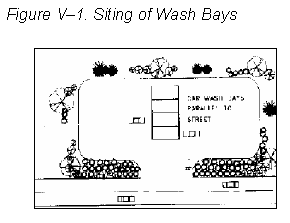
(a)
Wash bays shall be sited parallel to the adjacent street as shown in figure V-1.
(b)
No new wash facility may be located within one-half mile of any other existing wash facility having two or more car wash bays.
(3)
Enclosed Wash Facility. In addition to the standards contained in paragraph (1) of this section, all enclosed wash facilities shall comply with the following:
(a)
All wash bays shall have bay doors. No bay door shall face the adjacent street.
(b)
The facility shall be self-contained and no services, including without limitation drying, polishing, or vacuuming, shall be performed outdoors.
Sec. 21-5220. - Bail Bond Businesses.
(1)
Location.
(a)
No bail bond business shall be located within 100 feet of the property line of any lot, tract, or parcel of land within the city which is zoned for residential use, or zoned AG and used for residential purposes.
(b)
No bail bonds business shall be located within 600 feet of the property line of any school or public park.
(2)
Measuring Distance. For the purpose of this section, the distance shall be measured in a straight line, without regard to intervening structures, objects or city limits, from the closest exterior wall of the structure in which the bail bonds business is located to the property line of the zone district, school, or park.
Sec. 21-5222. - Borrow Pits.
The following provisions apply to borrow pits:
(1)
The applicant shall be responsible for securing all other permits or approvals required by any other governmental agency that may have jurisdiction over the proposed use.
(2)
It shall be unlawful for any person, firm, or corporation to process, crush, blast, or similarly treat earth materials on any approved borrow pit site.
(3)
In addition to the standards specified in this section and this code, the proposed use shall be evaluated using the applicable standards that the state or federal government use to evaluate a permit request for the specific use. Additionally, all annual or other reports required by another governmental agency may be required to be simultaneously submitted to the city.
(4)
Exempted Activities. The following borrowing and hauling of earth material may be done without obtaining a conditional use permit from the city:
(a)
Minor projects that have cuts or fills each of which is less than five feet in vertical depth at its deepest point measured from the existing ground surface, which include all of the following:
(i)
Less than 50 cubic yards of earth material, or
(ii)
The removal of less than 10,000 square feet of vegetation.
(b)
Minimum excavation required in connection with a building or other structure authorized by a valid building permit.
(c)
Grading work being done pursuant to an approved grading plan in conjunction with an approved recorded plat or overlot grading plan being done on the same property.
(d)
Trenching incidental to the construction and installation of approved underground pipeline, septic tank, disposal lines, electrical or communication facilities, and drilling or excavation for approved wells or fence posts.
(e)
Grading or excavation in accordance with plans incorporated in an approved conditional use permit.
(f)
Maintenance and cleaning of ditches, lakes, ponds, and water storage reservoirs.
Sec. 21-5223. - Bulk Grain Transfer Facilities.
The following standards shall apply to all bulk grain transfer facilities:
(1)
Operations shall comply with all applicable rules and regulations of State of Colorado and Tri-County Health Department.
(2)
Rodent and pest control programs must be provided and maintained at all times. Upon request, the operator of a bulk grain transfer facility shall submit to the city a written vector control plan.
(3)
No storage of grain is allowed on the property, including in trucks, piles, containers, or within the conveyor system.
(Ord. No. 2190, December 2018)
Sec. 21-5224. - Child Care Facilities.
The following provisions apply to all child care facilities:
(1)
All child care facilities shall be licensed and operated in conformance with all applicable federal and state regulations.
(2)
An off-street vehicular loading area or driveway shall be provided for the purpose of loading and unloading children.
(Ord. No. 2158, December 2018)
Sec. 21-5225. - Commercial Indoor Self-Storage Facilities.
(1)
Zoning. Commercial indoor self-storage facilities in accordance with these use and design standards shall be allowed by right in the C-3, I-1, I-2, and I-3 zone districts. Commercial indoor self-storage facilities must meet the following requirements and standards.
(2)
Use Standards. These use standards shall apply to commercial indoor self-storage facilities located in the applicable and allowed zone districts:
(a)
Storage units shall only be used for the storage of goods and/or property.
(b)
Storage units shall not be used for activities of any kind, including but not limited to:
(i)
Residences, offices, workshops, studios, hobby, meetings, gathering spaces, or rehearsal areas;
(ii)
Manufacturing, fabrication, or processing of goods, service or repair of vehicles, engines, appliances, or other electrical equipment, or any other industrial activity;
(iii)
Conducting retail sales of any kind, including garage or estate sales or auctions or to conduct any other commercial activity;
(iv)
Storage of flammable, perishable, or hazardous materials or the keeping of animals.
(c)
Accessory retail uses such as general retail storefronts, or the sale of boxes or packing materials are encouraged and allowed only if they are otherwise permitted in the zone in which the facility is located, and meet all applicable use and development standards.
(d)
Outdoor storage is prohibited, including outdoor storage of boats, RVs, vehicles, and storage in outdoor storage pods, shipping containers, or similar.
(e)
A night watchman, resident caretaker, or 24-hour security guard, is allowed but not required.
(f)
Hours of operation shall be limited to the hours from 6:00 a.m. to 10:00 p.m. Business activities and tenant access to storage units shall not be permitted from 10:00 p.m. to 6:00 a.m.
(g)
All facilities shall be climate controlled, whereby both temperature and humidity are regulated.
(3)
Location Restriction. No new commercial indoor self-storage facility shall be located within 1,250 feet of any other existing commercial indoor self-storage or traditional mini-storage facility.
(4)
Design Standards. For commercial indoor self-storage facilities located in the C-3 zone district, the following standards shall apply in addition to the development standards generally required for all new commercial development in article VII regarding entrances, materials, landscaping, parking, etc.:
(a)
Commercial indoor self-storage facilities are permitted only within multi-story structures designed to emulate multi-family residential or office buildings. A minimum of 20 percent glass or other window openings are required per façade.
(b)
The site on which a commercial indoor self-storage facility is located shall not have frontage along an arterial street.
(c)
All individual storage units shall gain access only from the interior of the building. The primary facility loading bays, docks, or doors shall not be directly facing any adjacent residential property.
(d)
All fencing shall consist of wrought iron or similar types of decorative fencing materials. Chain link fences are prohibited.
(e)
Colors shall compliment the natural characteristics of the site and surrounding development, and shall not be used to attract attention to the facility (i.e., no red roofs, orange doors, brightly colored doors, etc.).
(Ord. No. 2203, May 2019)
Sec. 21-5226. - Community Gardens.
(1)
General Standards.
(a)
All community gardens shall have on-site irrigation.
(b)
The growing and/or cultivation of marijuana, for any purpose, is prohibited.
(c)
The keeping of animals is prohibited except for those animals allowed with a valid permit issues in accordance with Article V of Chapter IV of this Code and kept in accordance with the applicable provisions of the City's Code and state laws.
(d)
No community garden shall be permitted on any property on which a single-family dwelling, either attached or detached, exists.
(e)
Off-street parking, if any, shall include a dust-free surface approved by the city engineer.
(f)
Tools and equipment must be stored in sheds. Hoop houses and greenhouses shall not be used to store tools or equipment.
(g)
All compost materials shall be kept in an enclosure that limits the negative impacts to adjacent properties.
(2)
Sign Standards.
(a)
Identification signs shall be monument type and shall not exceed 20 square feet in area or 6 feet in height. Each community garden shall be limited to one identification sign per street frontage that is setback a minimum of 10 feet.
(b)
Each community garden shall be allowed one entrance sign per entrance that is intended to communicate garden information, rules, regulations, or policies. Entrance signs shall not exceed 15 square feet in area or 6 feet in height. Entrance signs shall be setback a minimum of 10 feet.
(c)
Signage to communicate and/or distinguish specific crops or garden orientation shall be limited to 3 square feet and shall not require a permit from the Planning Division.
(3)
Accessory Structures Limited. The following accessory structures may be located on property being used as a community garden: sheds, hoop houses, green houses, fences, compost enclosures, and vertical growing structures. All other accessory structures are prohibited.
(4)
Accessory Structure Standards. Unless a different standard is specified in this section, all accessory structures must comply with the general standards of this code.
(a)
No accessory structure shall exceed 15 feet in height.
(b)
No more than 3 sheds shall be permitted.
(c)
No more than a combined total of 3 hoop houses and/or green houses shall be permitted and the cumulative square footage of all such hoop houses and green houses shall not exceed ten (10) percent of the lot area.
(d)
Hoop houses, green houses, and sheds shall be set back ten (10) feet from the front property line, five (5) feet from the side and rear property lines, and ten (10) feet from any property line adjacent to a street.
(e)
No more than one (1) compost enclosure shall be permitted on any property that is one acre or less in size. No more than two (2) compost enclosures shall be permitted on any property that is more than one acre in size. Compost enclosures shall be set back ten (10) feet from all property lines and shall not exceed six feet in height. Compost enclosures may consist of multiple sections.
(5)
Fences.
(a)
Electric and barbed wire fences are prohibited.
(b)
To the maximum extent feasible, fences shall be compatible in appearance and placement with the fences in the area.
(c)
Height and style:
(i)
Along the right-of-way, fences shall be open style, as that term is used in section 21-7730, and shall not exceed 42 inches in height.
(ii)
Portions not along the right-of-way shall comply with the fence standards of the applicable underlying zone district.
(d)
Setbacks:
(i)
Residential. Fences along the right-of-way shall be set back a minimum of 30 inches from the property line. Fences that are not along the right-of-way shall comply with the general setback requirements for fences in residential zone districts.
(ii)
Nonresidential. Fences along the right-of-way shall be set back a minimum of 5 feet from the property line. Fences that are not along the right-of-way shall comply with the general setback requirements for fences in the applicable underlying zone districts.
(Ord. No. 1887, July 2012; Ord. No. 2577, § 2(Exh. A), 5-20-2024)
Sec. 21-5228. - Doggie Day Care Facilities.
(1)
Indoor Use. Except any outdoor play area, all services provided by a doggie day-care facility shall be conducted within a completely enclosed, soundproof building.
(2)
Design. All doggie day-care facilities shall be designed and constructed in a manner that minimizes any emission of odor offensive to persons owning, occupying or patronizing properties adjacent to such facilities.
(3)
Fencing. The premises or portion of the premises upon which the outdoor play area is located shall be enclosed with a fence constructed to a height and of materials sufficient to be reasonably certain of confining the animals placed therein.
(4)
Noise. Structures and fences shall be constructed of such materials and be of sufficient quality to minimize the possibility of animals creating a nuisance by barking or otherwise creating noise loud enough to disturb neighbors.
Sec. 21-5230. - Drive-Thru, Drive-In, and Drive-Up Uses.
(1)
Stacking. Sufficient stacking areas for vehicles shall be provided. Refer to section 21-7236 (Stacking Requirements).
(2)
Aisle Width. All aisles shall be a minimum of 12 feet wide.
(3)
Pedestrian Walkways Restricted. Pedestrian walkways shall only intersect drive-thru, drive-in, or drive-up aisles when there is no other reasonable alternative. In such event, walkways shall have clear visibility and shall be identified by special raised or patterned paving or other treatment.
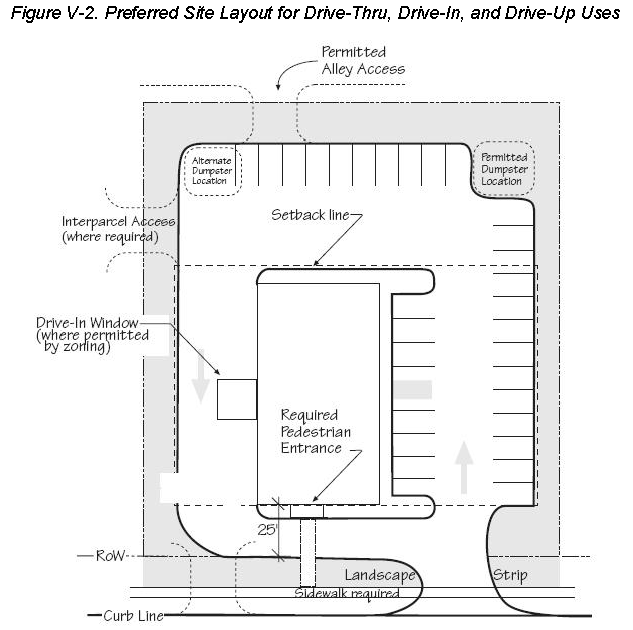
(4)
Screening. Landscaping, screen walls, berms, placement of the drive aisle, or other site design techniques shall be used to screen cars waiting in the drive-thru, drive-in, or drive-up aisles from the public right-of-way and shall be used to minimize the visual impact of drive-thru, drive-in, or drive-up aisles, menu boards, and directional signs. The entire drive-thru area must be landscaped or bermed with a minimum 36-inch high berm or wall to screen the drive-up facility from view from adjacent streets. Where a 36-inch high berm or wall may not be practical and landscaping can accomplish the desired intent, the berm may be reduced or deleted. Sight-distance triangles shall be maintained.
(5)
Alcoholic Beverages. No alcoholic beverages may be sold at drive-up or drive-through windows.
(6)
Architecture. Drive-thru, drive-in, or drive-up uses within an integrated shopping center shall have an architectural style consistent with the theme established in the center. The architecture of any drive-thru, drive-in, or drive-up use shall be compatible with and have minimal adverse impact on the use of surrounding properties.
(7)
Access. No drive-thru, drive-in, or drive-up aisle shall exit directly onto, or gain direct access from a public right-of-way, except when approved by the city engineer.
Sec. 21-5232. - Educational Facilities.
(1)
Setback. All structures and buildings shall be set back at least 50 feet from side lot lines and 100 feet from front property lines. If loading and parking space provided is not in front of the building, the front setback area shall be landscaped and used for no other purpose.
(2)
Drainage and Access. All educational facilities shall comply with the drainage and access standards of the city.
Sec. 21-5234. - Electric Substations and Gas Regulator Stations.
For each electric substation and gas regulator stations where transformers or piping are exposed, the following requirements apply:
(1)
Screening. A wall or fence, a minimum of six feet in height, shall enclose the area. In certain locations, this wall or fence may be required to be a screened type of fence with columns.
(2)
Setback Minimums.
(a)
Front: 30 feet.
(b)
Side: 25 feet.
(c)
Rear: 25 feet.
Sec. 21-5235. - Fuel Sales.
(1)
General Standards. All businesses where fuel sales occur shall comply with the following standards:
(a)
No more than two may be located within 660 feet of an arterial/arterial intersection;
(b)
Street access shall conform to the requirements imposed by the engineering division; and
(c)
Vehicle access and circulation shall be designed so that the impacts to adjacent residential uses or properties from the movement of vehicles or the lights from vehicles are minimized.
(2)
Pump Islands.
(a)
A maximum of 2 pump islands shall be permitted on a 12,000-square foot lot. One pump island may be added for each additional 2,000 square feet of lot area, provided that the total number of pump islands shall not exceed 4 per lot.
(b)
The addition of 1 pump island may be administratively approved if the director finds:
(i)
The on-site circulation will not be negatively impacted;
(ii)
The off-site circulation will not be negatively impacted;
(iii)
Access to the property will not be negatively impacted;
(iv)
Appropriate screening and/or landscaping will mitigate the visibility of the pump island; and
(v)
The total area for fuel pumps is not increased.
(3)
Building and Equipment Setbacks and Buffers.
(a)
The principal building and any accessory structures, except for fuel pumps, pump islands, detached canopies, and similar equipment, shall be set back a minimum of 15 feet from any street right-of-way and a minimum of 20 feet from all property lines abutting a residential zoning district.
(b)
When the facility abuts a residential district, use, or property, a minimum 20-foot wide landscape buffer shall be provided along the shared boundary in accordance with section 21-7516 (Landscaping Buffers).
(c)
Fuel pumps, pump islands, detached canopies, and similar equipment shall be set back a minimum of 40 feet from all street rights-of-way and from all property lines abutting a residential zoning district.
(d)
Compressed air and vacuum connections shall be setback from public rights-of-way a minimum distance equal to the minimum landscape buffer. They shall be set back from any residential zoned property a minimum of 40 feet.
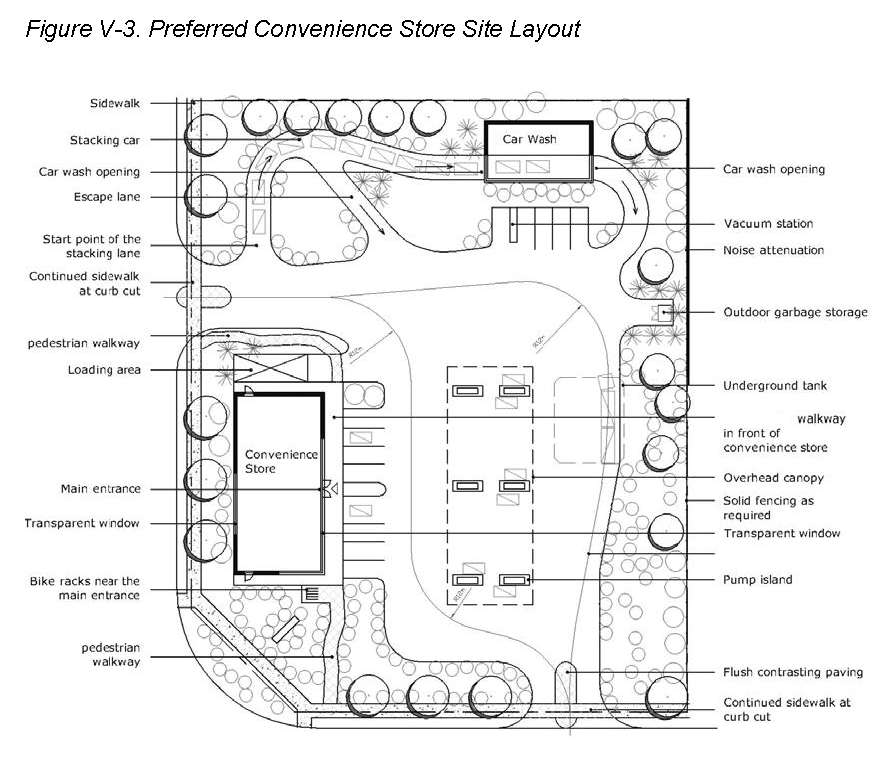
(4)
Supplemental Development and Design Standards. In addition to any other development or design standard set forth in article VII (Design Standards), the following standards shall apply:
(a)
Any fuel pump canopy or accessory structures shall utilize the same architectural treatment as the primary or principal building. The material used on the underside of the canopy shall not be highly reflective.
(b)
A maximum of 25 percent of each canopy fascia area visible from any public street may be internally illuminated, and no portion of any fascia may be externally illuminated. Each side of a fuel pump canopy shall be considered a separate fascia area.
(c)
Where the use abuts or is across the street from a residential zoning district, sight lighting or other lights illuminating the fuel pumps or other areas of the site shall be extinguished at the close of business.
(5)
Accessory Car Wash Bays. A fully-enclosed, single-bay car wash is allowed as an accessory use, subject to the following development and design standards:
(a)
To the maximum extent possible, the entrance to the car wash bay shall be sited so as not to be visible from the lot's primary street frontage;
(b)
The car wash bay shall be limited in size to a single vehicle;
(c)
The car wash bay shall be located outside of the 20-foot landscape buffer required by paragraph (3)(b) of this section;
(d)
In addition to any other off-street parking requirements or vehicles stacking requirements, the car wash shall have its own stacking requirements, found in section 21-7236 (Stacking Requirements);
(e)
Where the use abuts a residential zoning district, the hours of operation for the car wash shall be limited to between 7:00 a.m. and 9:00 p.m.
(Ord. No. 1854, April 2011; Ord. No. 1887, July 2012)
Sec. 21-5236. - Greenhouses/Nurseries, Including Retail Sales of Related Products.
(1)
Agricultural District. Off-site delivery of plant materials and the use and storage of all vehicles and equipment necessary for those activities are permitted.
(2)
Display and Storage. Merchandise, landscaping materials, and equipment shall be displayed or stored within an enclosed building or in an area of the property that has been fenced or landscaped to conceal the area from any public right-of-way. Neither storage nor display shall occur within 25 feet of public right-of-way or occupy required off-street parking spaces.
(3)
Vehicle Maintenance. Any repair or servicing of vehicles or equipment used in the operation of the business shall occur within an enclosed building. Repair and servicing shall be limited to normal maintenance and shall not include body repair or modification.
(4)
Growing Areas. Areas for the growing of plants and nursery stock may be permitted in greenhouses or in open areas as designated by the applicant.
(5)
Outdoor Storage. Outdoor storage shall meet all requirements for outdoor storage established for the underlying zoning district. The type and location of any materials to be stored on any site shall be determined at the time of development plan approval. Any materials approved for outdoor storage shall not cause a hazard or nuisance to the health, safety, or welfare of humans or animals.
Sec. 21-5238. - Group Homes.
(1)
General Standards. For purposes of this land development code, group homes are classified as type A and type B. Each type is defined in article XI. Both types of group homes must comply with the following:
(a)
Group homes shall be licensed and operated in conformance with all applicable governmental regulations. If a license is pending, the city may issue a permit but such permit shall not take effect until the applicable license is obtained.
(b)
The proposed group home shall not adversely affect the residential character and quality of life in the particular neighborhood. However, no application for a proposed group home shall be denied solely on the basis of neighborhood opposition, where no valid and substantive evidence has been offered to show that the proposed facility would have such adverse effect.
(c)
No group home shall be located closer than 750 feet from another group home.
(d)
No group home shall provide housing to any individual whose tenancy would constitute a direct threat to the health or safety of any other individual or would result in substantial physical danger to the property of others.
(e)
No group home shall provide housing to more than one person required to register as a sex offender pursuant to state law.
(2)
Type B Group Homes. In addition to the foregoing general standards, the following provisions apply to all type B group homes:
(a)
A conditional use permit may be granted for the term of the group home's license, or for such shorter period as the city deems appropriate under the circumstances of the individual case.
(b)
At the expiration of its term, a conditional use permit shall automatically renew under the same conditions, including duration, as the original permit, unless the city or the group home's licensing agency has received written complaints concerning its operation. If any such complaint has been received, the application for renewal must be heard by the planning commission and city council under the same requirements for a new conditional use application.
(c)
Where the use is discontinued for a period of 180 days, the use shall be considered to be abandoned and may be reinstated only after obtaining a new conditional use approval.
(3)
Reasonable Accommodations.
(a)
The Federal Fair Housing Act requires that local governments be prepared to make reasonable accommodations in order to permit housing for certain protected groups to occur in residential areas. In response to a written application identifying the type of housing being provided and the portions of the Fair Housing Act that require that reasonable accommodations be made for such housing, the director is authorized to take any of the following actions in order to provide reasonable accommodations without the need of a rezoning or variance process:
(i)
Modify any spacing, building setback, height, lot coverage by no more than 20 percent;
(ii)
Modify the limits on the number of nonrelated occupants allowed in the principal building by no more than 20 percent;
(iii)
Reduce the 750-foot spacing requirement; or
(iv)
Reduce any off-street parking requirement by one space.
(b)
The director may approve a type of reasonable accommodation different from that requested by the applicant if the director concludes that a different form of accommodation would satisfy the requirements of the Fair Housing Act with fewer impacts on adjacent areas. The decision of the director shall be accompanied by written findings of fact as to the applicability of the Fair Housing Act, the need for reasonable accommodations, and the authority for any reasonable accommodations approved. Requests for types of accommodation that are not listed above may only be approved through a conditional use or rezoning process.
Sec. 21-5239. - Hazardous Materials.
In addition to the performance standards in section 21-5120, those uses that store, manufacture, or utilize quantities of hazardous or toxic materials so as to require an H occupancy under the building and/or fire codes shall be allowed only in the I-3 zone district upon approval of a Conditional Use Permit.
(Ord. No. 2191, December 2018)
Sec. 21-5239.5. - Healing Centers.
(1)
Hours of Operation. Healing Centers may only be open between the hours of 8:00 a.m. and 8:00 p.m. daily.
(Ord. No. 2656, § 2(Exh. A), 2-3-2025)
Sec. 21-5240. - Home Occupations.
(1)
Licensure. A city business license shall be required for all home occupations.
(2)
Standards. Home occupations shall comply with the following standards:
(a)
Home occupations shall be clearly incidental and accessory to the use of the residence as a dwelling;
(b)
No more than eight patron visits per day shall be permitted and all visits shall occur between the hours of 7:00 a.m. and 7:00 p.m.;
(c)
Delivery to or pick-up from the premises, except postal and small parcel, is prohibited. No more than four small parcel deliveries shall be permitted each day;
(d)
No persons, other than residents of the household, shall be permitted to perform any work at the residence in conjunction with the home occupation; and
(e)
Signs associated with home occupations shall be regulated in section 21-8300 (Sign Schedule).
(3)
Prohibited Activities, Equipment, and Materials. The following uses and activities are prohibited as part of any home occupation:
(a)
Use of equipment or machinery that is not customarily incidental to domestic use (e.g., cement mixers, tractors, and paint booths);
(b)
Equipment, machinery, or processes that create noise, smoke, glare, fumes, odor, or vibration (e.g., assembly requiring power tools, carpentry) offensive to a reasonable person at the property line;
(c)
Uses that involve activities or use of equipment or materials on more than an intermittent basis so as to change the fire safety or occupancy classification of the premises (e.g., welding);
(d)
Activities that cause electromagnetic (e.g., radio, television, etc.) interference to surrounding properties;
(e)
Use or storage of chemicals or processes that are not customarily associated with domestic use; and
(f)
Repair of motor vehicles.
(4)
Exterior Evidence of Use Prohibited. To ensure that dwellings for which home occupation approvals have been issued remain compatible with surrounding residential use, the following regulations shall apply:
(a)
The home occupation shall be conducted entirely within the principal dwelling;
(b)
Incidental storage in a garage or any activities associated with the home occupation shall not displace any required parking in a currently usable garage;
(c)
The home shall not require any alteration not customarily associated with residential use. Home occupation activities shall not be visible from the public rights-of-way or neighboring properties;
(d)
Outdoor storage or storage in any accessory building or structure is prohibited;
(e)
No off-site sign shall be placed as to denote the location of the home occupation;
(f)
No home occupation shall produce quantities or types of refuse not customarily associated with a residential use;
(g)
The entrance to the space devoted to such use shall be from within the dwelling, unless otherwise required by state law or regulation; and
(h)
The use shall not change the character of the dwelling or create outside the dwelling any external evidence, either on the property or on the street, of the operation of the home occupation.
(5)
Firearms Sales.
(a)
No firearms, ammunition, or accessories shall be sold or offered for sale on the premises.
(b)
The exchange of firearms shall only be conducted at gun shows.
(c)
No firearm-related services shall be conducted on the premises.
(d)
No business shall keep more than 12 firearms for business purposes on the premises at any time.
(6)
Vehicles, Parking, and Traffic. No vehicle shall be allowed in conjunction with a home occupation that has been manufactured or altered to provide mobile services. Examples of vehicles that have been manufactured or altered to provide mobile services include, but are not limited to, ice cream trucks, catering trucks, or tow trucks. Parking needs and traffic volumes generated by the home occupation shall not exceed that typically generated by a residential use.
(Ord. No. 2020, February 2015)
Sec. 21-5241. - Impound Yard.
(1)
Fence and Screening Requirements. An impound yard must be completely enclosed by a screen style fence that is eight feet in height.
(2)
Vehicle Parts. Vehicle parts shall not be taken or sold from vehicles stored in an impound yard, nor shall any vehicle parts be stored within an impound yard.
(3)
Temporary Storage. Except as required by court order or requested by law enforcement conducting an official investigation, no vehicle may be stored in an impound yard in excess of 90 days.
(4)
Rows. Vehicles stored in an impound yard must be parked neatly in rows.
(Ord. No. 1785, June 2010)
Sec. 21-5242. - Kennels.
(1)
Health and Sanitation. All kennels shall be maintained in a clean and sanitary condition at all times in order to prevent health hazards, odors, and other nuisances. Kennels shall be operated in accordance with the following standards:
(a)
Excreta shall be removed from enclosures, pens, and runs as often as necessary to reduce disease hazards and odors and to prevent its accumulation from constituting a nuisance. At a minimum, daily removal of excreta is required. All premises shall be kept clean and in good repair, and all animal and food wastes shall be handled and disposed of in a sanitary manner.
(b)
Adequate shelter from the elements shall be provided. Adequate shelter includes, but is not limited to, proper ventilation, heating, cooling, and lighting.
(c)
Lavatory and washroom facilities sufficient for use by all kennel caretakers and employees shall be provided.
(d)
Drainage shall be constructed to protect adjacent bodies of water from pollution.
(e)
The premises shall be maintained so as to meet Tri-County District Health Department standards and not constitute a nuisance.
(f)
All kennels shall contain an isolation ward for animals which are sick or diseased, sufficiently removed so as not to endanger the health of other animals.
(2)
Licensure. All kennels shall be licensed and operated in conformance with all applicable governmental regulations.
(3)
Traffic. All kennel traffic shall be diverted from residential areas to the maximum extend feasible.
(4)
Dust. Adequate provision shall be made to prevent dust.
(5)
Structures, Space Requirements, and Setbacks.
(a)
All places where the animals are kept including structures, pens, yards, and runs shall be located a minimum distance of 100 feet or a distance equal to 1½ times the width of the parcel of land occupied by the shelter, whichever is the lesser of the two distances from any residence or primary structure located on parcels of land adjoining the parcel. New construction on adjoining parcels of land will not affect existing structures, pens, runs, yards, and other places where animals are kept.
(b)
Dog kennels shall be situated on not less than a five-acre parcel of land.
(c)
All shelters shall be of sufficient height and width to permit each animal or animals to stand up and turn around when fully grown. If cages are used, they shall be of sufficient height and width to permit each animal or animals to stand up and turn around when fully grown, but minimum cage sizes shall be as follows:
(i)
Small breeds and cats: 21 inches wide, 29 inches deep, and 24 inches high.
(ii)
Medium breeds: 29 inches wide, 32 inches deep, and 33 inches high.
(iii)
Large breeds: 29 inches wide, 45 inches deep, and 33 inches high.
(6)
Containment and Noise. Fencing and landscaping should be used to minimize noise, glare, and other nuisances. The portion of the premises upon which a kennel is located shall be enclosed with a fence constructed to a height and of materials sufficient to be reasonably certain of confining the animals placed therein, or the animals shall be restrained by other means consistent with the size, weight, and abilities of the animals restrained to be reasonably certain to prevent them from being able to escape and run at large. Animals running at large will be prevented. Structures and fences will be constructed of such materials and quality to minimize the possibility of animals creating a nuisance by barking or other noise loud enough to disturb neighbors.
(7)
Existing Kennels. Any kennel licensed and in operation as of the date of adoption of this land development code shall be exempt from provision (5) of this section. Such pre-existing uses shall be considered legal nonconforming uses and shall be governed by section 21-5520.
Sec. 21-5244. - Landfill Disposal Sites.
All disposal facilities shall obtain from the city a conditional use permit for a solid waste disposal facility. The land owner and the operator of the facility shall each be jointly and severally responsible for complying with the following requirements:
(1)
The operator of the facility shall demonstrate the nature of materials accepted at the facility.
(2)
The facility may be filled only with the knowledge and consent of the land owner for the primary purpose of leveling, raising, or otherwise preparing land for construction or other permitted land use that requires a leveled, raised, or prepared surface.
(3)
The filling operation, including compacting, leveling of all disposed material, covering with sufficient clean soil, and re-vegetating and/or commencing of road or building construction will be completed within 12 months of initial disposal activity unless extended for good cause by the city. The filling operation must be compatible with surface and subsurface uses and not cause any subsidence or other problems with surface and subsurface uses.
(4)
Any filling operation that qualifies as a disposal facility must satisfy all other federal, state and local regulations and requirements including those pertaining to solid waste disposal, floodplains and floodways, wetlands' preservation, soil quality protection, water quality protection, air quality protection, and dust and erosion control.
(5)
Only inert materials shall be placed in an inert material disposal facility.
(6)
No material shall be placed in ground water. All material shall be placed in a manner and location to not adversely affect ground water.
(7)
Financial assurance in a form acceptable to the city for closure and post-closure care is required of all disposal facilities.
(8)
An annual report shall be submitted by the facility to the city by May 1 of each year. The report shall state the amount of materials received at the facility, processed, disposed of on-site, and shipped off-site for the preceding calendar year.
(9)
The facility shall maintain all-weather access roads to those areas of active operation and as necessary to meet the fire control plan.
(10)
The facility shall collect litter in order to avoid a fire hazard or a nuisance and control the growth of vegetation to minimize potential fuel sources.
(11)
Adequate fencing, natural barriers or other security measures to preclude public entry shall extend around the entire perimeter of the facility and shall include a lockable gate or gates.
(12)
Prominent signs shall be posted in public view at the entrance to the facility with the name of the facility, the hours which the facility is open for public use, a listing of the wastes accepted at the facility, and a phone number for a 24-hour emergency contact. A copy of the conditional use permit shall be available for inspection at the site.
(13)
The facility shall immediately notify the city, Tri-County Health Department, the fire district having jurisdiction, and the Colorado Department of Public Health and Environment in the event of a fire or other emergency. Within two weeks of this notification, the facility shall submit a report on the emergency to each such entity. This report shall describe the origins of the emergency, the actions that have been taken, actions that are currently being taken or are planned, results or anticipated results of these actions, and an approximate date of resolution of the problems generated by the emergency.
Sec. 21-5246. - Livestock and Horses.
(1)
General Standards.
(a)
Allowed only on AG and Public zoned lots exceeding 12,000 square feet.
(b)
One horse/large animal allowed for the first 12,000 square feet of net lot area (lot area without a structure upon it); one additional horse/large animal for each additional 6,000 square feet of net lot area.
(c)
Additional regulations regarding number of animals allowed shall be made by the director, using the space requirements for horses as a guide.
Sec. 21-5248. - Lodging Establishments.
(1)
Size Requirements. Lodging establishments shall contain a minimum of 50 guest lodging rooms.
(2)
Length of Stay. The length of stay at any lodging establishment shall not exceed 30 days within any 90-day period, except that in the case of extended stay establishments the length of stay shall not exceed 180 consecutive days.
(3)
Kitchens Restricted. In-room kitchen facilities shall be allowed only in extended stay or lodging "suite" establishments.
(4)
Guest Services. Lodging establishments shall include typical guest services such as offices, food service, recreation or similar accommodation to support overnight-guests.
(Ord. No. 2452, § 2(a)(Exhs. A, B), 12-5-2022)
Sec. 21-5249. - Marijuana Businesses, Primary Caregivers, and Marijuana Activities.
(1)
Location Restrictions.
(a)
General Restrictions. No marijuana business shall be located within:
(i)
1,000 feet of any educational institution or school, either public or private; excluding institutions of post-secondary education;
(ii)
1,000 feet of any state licensed child care facility;
(iii)
1,000 feet of any alcohol or drug rehabilitation facility;
(iv)
1,000 feet of any group home;
(v)
1,000 feet of any halfway house or correctional facility;
(vi)
1,000 feet of any city-owned public park or city-owned recreation center provided, however, that for purposes of this section, the term park shall exclude any trail; or
(vii)
1,000 feet of any other marijuana business of any type.
(b)
Restriction Related to Residential Uses.
(i)
Marijuana stores shall not be located within 2000 feet of any property in the city that is zoned: mixed-use and has a residential entitlement, residential, or agricultural.
(ii)
All other marijuana businesses and primary caregivers shall not be located within 1,000 feet of any property in the city that is zoned: mixed-use and has a residential entitlement, residential, or agricultural.
(c)
No retail or medical marijuana store shall be located within 2,000 feet of any other retail or medical marijuana store.
(d)
Applicability. The location restrictions contained in this section shall be applicable at the time of initial licensing. For purposes of this section, an established and licensed marijuana business or primary caregiver may continue operations without being deemed to be in violation of this section if one of the above referenced uses locates within an applicable buffer zone. For purposes of this code, the business or caregiver shall be deemed to be a pre-existing use. The business or primary caregiver who continues to operate does so at its own risk, however, and shall be subject to the enforcement of any applicable non-city provisions relating to location.
(2)
Advertising, Signage, and Design.
(a)
Advertising Generally. In addition to this code, primary caregivers and all marijuana businesses, regardless of whether they are medical or retail in nature, shall comply with the provisions contained in Part 2 of Article 10 of Title 44 of the Colorado Revised Statutes, as amended.
(b)
Sign Approval Required. No permanent or temporary sign associated with a marijuana-related business may be installed or located within the city until review and approved by the city via a temporary or permanent sign permit.
(c)
Color Restrictions. Colors for both signage and the overall building that offer low reflectance in subtle, neutral, or natural tones are required over the use of high-intensity or reflective colors that draw attention to the business.
(3)
Prohibitions. The following activities are prohibited anywhere within the city:
(a)
Storage of marijuana or marijuana-related products off the site of the license premises without a valid off-site storage permit;
(b)
Marijuana hospitality and retail hospitality;
(c)
Marijuana membership clubs;
(d)
Marijuana businesses as home occupations;
(e)
Marijuana businesses within a mixed-use development that includes a residence; and
(f)
Marijuana vapor lounges.
(Ord. No. 1897, July 2012; Ord. No. 1948, April 2013; Ord. No. 2048, June 2015; Ord. No. 2540, § 2(Exh. A), 9-18-2023)
Sec. 21-5250. - Mini Storage and Warehouse.
(1)
Indoor Use. Unless allowed by zoning, all storage shall occur within an enclosed building or buildings.
(2)
Design Standards.
(a)
Architectural style shall be compatible with surrounding properties. A minimum of 4:12 pitched roofs are required.
(b)
Doors to individual units shall be located internal to the development.
(c)
Building exteriors shall not be corrugated metal or similar surface, but shall be of finished quality. Metal containers are prohibited.
(d)
Colors shall complement the natural characteristics of the site, and shall not be used to attract attention to the facility (i.e., no red roofs, orange doors, etc.).
(e)
All mini-storage facilities shall provide a minimum 24-foot wide drive aisle between all buildings and adjacent to all building walls with storage compartment access doors.
(f)
All site fencing along public right-of-way shall consist of wrought iron or similar types of decorative fencing materials. Chain link fences are prohibited.
(3)
Vehicles and Outdoor Storage. Rental trucks, trailers, and outdoor storage areas, if allowed, shall be completely screened by topographic features, landscaping, and fencing.
(4)
Hazardous Materials. Storage of hazardous materials shall be prohibited.
(5)
Resident Caretaker. A mini-storage facility shall have no less than one on-site manager/caretaker or more than one dwelling unit unless a use-by-permit has been issued by the city. Except where a use-by-permit has been issued, all mini-storage facilities shall have an on-site, resident manager/caretaker and shall provide such resident manager/caretaker with the following:
(a)
A dwelling unit which shall be incorporated into and occupy space on the premises of the mini-storage facility.
(b)
One off-street parking space for the exclusive use of the resident manager/caretaker.
(c)
A single landscaped private recreation area, with a minimum area of 750 square feet, shall be provided within the mini-storage facility for the exclusive use of the resident manager/caretaker.
(6)
Hours of Operation. Hours of public access to mini-storage units abutting one or more residential zoning districts shall be restricted to the period from 6:00 a.m. to 10:00 p.m.
Sec. 21-5251. - Office Flex.
Additional Regulations. Due to the heightened level of architecture and design for these uses, administrative architectural design standards will need to be approved by the Director prior to, or in conjunction with, approving any development plan.
Sec. 21-5252. - Outdoor Display.
Any outdoor display must be done in conjunction with the business being conducted on the premises and shall comply with the following regulations:
(1)
The items displayed outside shall be of the same type that are lawfully displayed and sold inside the building on the premises.
(2)
The aggregate display area shall not exceed 50 percent of the linear frontage of the store front.
(3)
Items shall not project more than 20 feet from the store front.
(4)
No item, or any portion thereof, shall be displayed on public property.
(5)
Items shall be displayed only during the hours that the business conducted inside the building on the premises is open for business.
(6)
No item shall be displayed in a manner that causes a safety hazard; obstructs the entrance to any building; interferes with, or impedes the flow of pedestrian or vehicle traffic; is unsightly or creates any other condition that is detrimental to the appearance of the premises or any surrounding property; or in any other manner is detrimental to the public health, safety, or welfare or causes a public nuisance.
Sec. 21-5254. - Outdoor Storage.
(1)
Business Related. All outdoor storage shall be incidental and directly related to the primary business being conducted on that property. Outdoor storage shall not be the primary use of any property and the leasing of space for outdoor storage is prohibited unless the outdoor storage is an accessory use to a business operated by a tenant who leases any building located on such property for the operation of the tenant's business or as permitted in paragraph (4) below.
(2)
Heating Fuels. Outdoor storage of heating fuels may be permitted in all zones, provided such storage is directly connected to heating devices for the purpose of providing fuel for heating the building of which such heating device is a part.
(3)
Surfacing. Outdoor storage shall be paved with recycled asphalt or other road base material in accordance with the ECSS (Engineering Construction Standards and Specifications).
(4)
Principal Structures. No outdoor storage shall occur on a lot that does not contain a building, unless said outdoor storage is used by an adjacent property owner or lessee and is directly related to such adjacent property owner's or lessee's business.
(5)
Agriculturally Zoned Lots. Outdoor storage, compliant with these regulations, shall be permitted only when the stored items relate directly to the principal agricultural use. Determination of which items are directly related to the principal use shall be made by the director.
(6)
Location. Outdoor storage shall be limited to the rear and side yards of the property. Required parking and landscape treatment areas can never be used for outdoor storage. No manure shall be stored within 100 feet of any property line.
(7)
Stacking and Screening Requirements. All outdoor storage areas shall be enclosed by a fence or wall adequate to conceal such areas from adjacent nonindustrial property and public right-of-way. Outdoor storage can be stacked to eight feet or the height of the screening fence, whichever is less. Large items over 8 feet in height such as truck trailers or concrete pipes shall be placed in a single layer and not stacked. Additional screening mitigation may be required depending on the topography and visibility of the site:
(a)
Exceptions.
(i)
Material piles such as construction aggregate and landscape materials may exceed the eight-foot maximum stacking limit in the I-2 and I-3 zone districts upon approval of a Conditional Use Permit. Flammable materials shall have a maximum allowed stacking limit of 25 feet in accordance with adopted fire codes. Nonflammable materials shall have a maximum stacking limit of 50 feet or the maximum height permitted for a principal structure in the underlying zone district, whichever is less.
(ii)
The storage of bundled lumber, pallets, shipping containers, or construction crane sections may exceed the eight-foot maximum stacking limit in the I-3 zone district only. These specific items may be stacked to a height of 20 feet, or higher than 20 feet upon approval of a Conditional Use Permit, if done in accordance with adopted fire codes. Any items stacked higher than the fence must be placed in such a manner that the items cannot fall and land on or outside of the fence.
(b)
Fences and Gates. Fences used for screening outdoor storage shall meet the standards in Article VII Division 7 Part C (Fence and Wall Standards) of this land development code and shall be erected in accordance with the building permit issued by the city. Gates must be opaque; however, a gate may be a different material than what would be allowed for the fence.
(8)
Site Plans. Site plans for outdoor storage shall be provided to the city, when required, and shall depict the following:
(a)
Exact location of proposed outdoor storage area;
(b)
Dimensions and locations of aisles and circulation paths in the outdoor storage area for general and emergency access;
(c)
Square feet of proposed outdoor storage area;
(d)
Location of the fence, including pedestrian and vehicular gates;
(e)
Height and type of fence proposed, including an elevation of the fence;
(f)
Description of the material proposed to be stored;
(g)
Height of the material and/or proposed stacking height of the material proposed to be stored; and
(h)
Description of the proposed surface on which material will be stored, and of the circulation and emergency access aisles.
(9)
Outdoor Storage in the I-1 Zoning District. In addition to the foregoing paragraphs, the following special provisions apply to outdoor storage in I-1 districts:
(a)
Limited availability. No outdoor storage shall be permitted unless the property is located in the following areas:
(i)
Rocky Mountain Industrial Park. The area located within the following boundaries: Bordered on the south by East 56th Avenue, on the east by Monaco Street, on the west by Holly Street, and on the north by a line constituting an extension of East 59th Avenue.
(ii)
Stapleton Industrial Park. The area located within the following boundaries: Bordered on the south by East 48th Avenue, on the east by Quebec Street, on the west by Ivy Street, and the north by Sand Creek.
(b)
The board of adjustment may not consider variances or exceptions to the location requirements stated above.
(c)
Review Criteria. Outdoor storage in the areas described in paragraph 9(a) may be permitted only if the director finds:
(i)
Outdoor storage at the proposed location shall not result in a substantial or undue adverse effect on adjacent property, the character of the neighborhood, traffic conditions, parking, public improvements, public sites or rights-of-way, or other matters affecting the public health, safety, or general welfare, either as they presently exist or as they may in the future be developed;
(ii)
The characteristics of the site are suitable for outdoor storage as a use-by-permit considering the size, shape, location, topography, and existence of improvements and natural features; and
(iii)
Sufficient landscaping and screening will be utilized to ensure harmony with adjacent uses and public rights-of-way.
(d)
The area of outdoor storage shall be limited based upon the characteristics of the site. Those relevant limiting characteristics include, but are not limited to the following:
(i)
Size of buildings;
(ii)
Type of material being stored;
(iii)
Vehicle circulation patterns;
(iv)
Loading docks;
(v)
Landscaping areas; and
(vi)
Emergency vehicle access.
(e)
Pre-Existing Use.
(i)
Any and all outdoor storage existing in the I-1 and I-1S zoning districts which have not been expressly permitted through this section or by a use-by-permit, whether or not said outdoor storage existed prior to the passage of this section is hereby declared to be illegal and in violation of this land development code.
(ii)
Previous conditional use approvals. Any I-1 zoned property that had previously obtained conditional use approval for outdoor storage within the Rocky Mountain Industrial Park shall continue to operate legally under that conditional use permit until such time as the business is sold, transferred, or ceases to operate. Any new owner, tenant, or lessee will be required to obtain approval for outdoor storage in compliance with this section.
(Ord. No. 1785, June 2010; Ord. No. 2020, February 2015; Ord. No. 2194, December 2018)
Sec. 21-5255. - Private Bus Stations.
(1)
General Standards.
(a)
Private bus stations shall provide an indoor waiting area for passengers.
(b)
All passengers shall be required to wait indoors.
(c)
All ticket purchasing must be conducted indoors.
(2)
Repair and Maintenance Facilities. Private bus stations may include facilities to perform equipment repair and/or maintenance. These facilities shall not exceed 15 percent of the total square footage of the principal building on the property and shall conform in all respects with section 21-5271 of this land development code.
(Ord. No. 2020, February 2015)
Sec. 21-5256. - Recycling Facilities/Material Resource Recovery Facilities.
(1)
Small Recycling Collection Areas. Small recycling collection areas located within multifamily developments, commercial, or industrial zoning districts shall comply with the following standards. The facility shall be no larger than 300 square feet and shall occupy no more than 5 parking spaces, excluding space that will be periodically needed for removal of materials or exchange of containers, and 1 parking space for an attendant, which shall be located outside the facility.
(a)
The facility shall be set back at least ten feet from any public right-of-way and shall be located so that pedestrian or vehicular circulation is not obstructed.
(b)
The facility shall accept only glass, aluminum, plastic containers, papers, and similar items.
(c)
The facility shall use no power-driven processing equipment, except for reverse-vending machines.
(d)
The facility shall use containers that are constructed and maintained with durable waterproof and rustproof material, covered when the site is not attended, and shall be of a capacity sufficient to accommodate materials collected within an allotted collection schedule.
(e)
All recyclable materials shall be stored in the unit and shall not be left outside of the unit when unattended.
(f)
The facility shall be maintained in a clean and sanitary manner, free of litter and any other undesirable materials.
(g)
With the exception of multi-family developments, facilities shall not be located within 150 feet, excluding right-of-way, of any residential zoning district or any parcel identified as residential in the comprehensive plan.
(h)
Containers shall be clearly marked to identify the type of material, which may be deposited. The facility shall be clearly marked to identify the name and telephone number of the facility operator and the hours of operation and display a notice stating that no material shall be left outside the recycling containers.
(i)
The facility shall be placed on asphalt or concrete and shall not impact any landscaping or landscaped areas.
(j)
The facility shall be completely screened by an opaque fence or wall.
(2)
Large Recycling Collection Area. A recycling collection facility which is larger than 300 square feet or on a separate parcel not accessory to a primary use and which has a permanent structure shall be subject to the following provisions:
(a)
The facility shall not be adjacent to a parcel zoned or planned for residential use on the comprehensive plan.
(b)
Structure setbacks shall comply with the standards of the zoning district in which the facility is located.
(c)
All exterior storage of materials shall be in sturdy, rust-proof containers that are covered, secured, and maintained in good condition, and of sufficient capacity to accommodate collected materials. Outdoor storage shall comply with all standards set forth in section 21-5254.
(d)
The site shall be clean, sanitary, and free of litter and any other undesirable materials and shall be cleaned regularly of loose debris. Containers shall be clearly marked to identify the type of material that may be deposited, and the facility shall display a notice stating that no material shall be left outside the recycling containers.
(e)
Space shall be provided on-site for a minimum of five vehicles to circulate and to deposit recyclable materials and for employees and commercial vehicle parking.
(f)
All containers provided for after-hours donation of recyclable materials shall be at least 100 feet from any residential use or zone district.
(g)
The facility shall be clearly marked with the name and phone number of the facility operator and the hours of operation. Identification, informational, and directional signs shall meet the sign standards of the zone district.
(h)
Light processing facilities are limited to bailing, briquetting, crushing, compacting, grinding, shredding, and sorting of source-separated recyclable materials and repairing of reusable materials.
(i)
The site shall be secured from unauthorized entry and removal of materials when attendants are not present.
(j)
Hazardous materials, dead animals, or yard waste shall not be considered recyclable material, except as otherwise provided in the municipal code.
(3)
Material Resource Recovery Facility (MRRF). The following additional provisions shall apply to any business classified as a material resource recovery facility by the city.
(a)
Type of resource materials. The facility shall only hand source separated household recyclable materials and incoming solid waste. A MRRF shall not be conducted as a garbage transfer station and shall not collect, process, or sort any raw or wet garbage. Any incoming waste not recycled or recovered shall be transported to an authorized landfill within 48 hours.
(b)
Sorting. Materials shall be sorted only within an entirely enclosed building. Delivery doors shall be located on building walls away from potential or existing noise sensitive land uses and away from public rights-of-way.
(c)
Outdoor Storage. Baled, palleted, or otherwise consolidated materials stored outdoors shall be stacked no higher than eight feet and placed no closer than 25 feet to any front property line or any property line adjacent to residentially used land. Outdoor storage shall be located out of view from public rights-of-way and completely screened by a solid fence or wall and shall only be allowed in zoning districts that permit outdoor storage.
(d)
Maintenance. The property owner shall undertake adequate measures to ensure that the site is free of wind blown debris at all times. The property owner shall be responsible for clean up of any wind blown debris on or off-site from incoming/outgoing vehicles or outdoor storage.
Sec. 21-5258. - Refuse Transfer Facility and/or Transfer Facility.
The following standards shall apply to all refuse transfer facilities:
(1)
The premises shall be kept in an orderly condition.
(2)
All garbage, trash, rubbish or debris shall be concealed from view from the public right-of-way
(3)
Signs shall be posted to identify the ingress and egress to the refuse or transfer facility.
(4)
All applicable rules and regulations of the state department of health and the tri-county district health department will be complied with.
(5)
Anti-litter signs shall be posted at the cost of the operator both at the facility and along assigned haul routes to and from the facility. The operator shall be responsible for any litter problems along the haul routes.
(6)
All fires shall immediately be reported to the fire department.
(7)
All transportation vehicles used for refuse collection and disposal shall be covered to prevent litter.
(8)
Two free community disposal days shall be provided to city residents annually.
(9)
Unrestricted access shall be provided to all inspection authorities.
(10)
Landscaping materials shall be installed and maintained. Landscaping plans shall be subject to approval by the city.
(11)
Methane detection and control devices shall be installed in all structures where and when deemed necessary by the building official, fire district, or Tri-County Health Department.
(12)
Rodent and pest control programs will be provided and maintained at all times. The operator of a refuse transfer facility shall submit to the city a written vector control plan.
(13)
Unless specifically authorized, no hazardous or toxic waste substances shall be accepted. All operational personnel shall be trained in the identification and handling of hazardous and toxic waste.
(14)
Any resource recovery, incineration or recycling shall be prohibited without first obtaining a conditional use permit from the city council.
(Ord. No. 1887; July 2012)
Sec. 21-5259. - Residential Uses.
No new residential use shall be established on any property that lies within an airport noise contour of 55 DNL (day-night noise level) or higher.
(Ord. No. 2078, April 2016)
Sec. 21-5260. - Scrap Tire Facilities.
The following shall apply to all scrap tire facilities:
(1)
All scrap tire disposal facilities shall obtain a conditional use permit. The landowner and the operator of the facility shall each be jointly and severally responsible for complying with the requirements under this ordinance. Scrap tire recycling facilities also shall need a conditional use permit pursuant to this land development code.
(2)
When applying for a conditional use permit, the operator of a scrap tire facility shall submit a plan for approval. The plan shall describe, in detail, the nature of the activity, the types and capacities of equipment that will be used, all methods of processing and storage, the means to be used to track inventory on a volume or weight basis, and the proposed method and procedures for closure.
(3)
Financial assurance in a form acceptable to the city for closure and post-closure care is required of all scrap tire facilities.
(4)
An annual report shall be submitted by the facility to the city by May 1 of each year. The report shall state the amount of scrap tires received at the facility, processed, disposed of on-site, and shipped off-site for the preceding calendar year.
(5)
The facility shall maintain all-weather access roads to those areas of active operation and as necessary to meet the fire control plan.
(6)
The operator shall be responsible for any litter problems on the property or in the adjacent right-of-way.
(7)
Adequate fencing, natural barriers or other security measures to preclude public entry shall extend around the entire perimeter of the facility and shall include a lockable gate or gates.
(8)
Prominent signs shall be posted in public view at the entrance to the facility with the name of the facility, the hours which the facility is open for public use, a listing of the wastes accepted at the facility, and a phone number for a 24-hour emergency contact.
(9)
The operator shall maintain a working telephone at the facility.
(10)
The operator of a scrap tire facility shall have a written vector control plan that shall be submitted to the city.
(11)
If pesticides are used in vector control efforts, they shall be used in accordance with the Pesticide Applicator's Act, C.R.S. § 35-10-101.
(12)
The operator shall submit a fire control plan to the city specifying the facility's fire lane locations and widths, the means that are assumed to be used to extinguish fires, and designation of a facility emergency coordinator. This plan shall be in accordance with local fire codes and the plan shall be written by a qualified professional and submitted to and approved by the local fire control authority.
(13)
The minimum standards to be allowed for tire pile storage will be as follows:
(a)
In no case shall piles of whole tires, tire bales, or tire shreds that are stored on open ground, as opposed to stored in open pits or cells, be larger than 50 feet in width and no higher than 8 feet above grade. An approved field measurement system must be employed to facilitate estimates of pile dimensions.
(b)
A minimum of 50 feet shall be maintained between piles of whole, shredded, or baled tires to allow access for fire fighting equipment.
(c)
A minimum distance of 50 feet of clear area is to be maintained from all property lines.
(14)
The facility shall immediately notify the city, Tri-County Health Department, the fire district having jurisdiction, and the Colorado Department of Public Health and Environment in the event of a fire or other emergency. Within two weeks of this notification, the facility shall submit a report on the emergency to the each such entity. This report shall describe the origins of the emergency, the actions that have been taken, actions that are currently being taken or are planned, results or anticipated results of these actions, and an approximate date of resolution of the problems generated by the emergency.
(15)
During all stages of operation, the facility shall have on site an attendant who is responsible for site activities.
(16)
Only scrap tires shall be placed in a scrap tire facility.
Sec. 21-5262. - Sexually Oriented Businesses.
(1)
Purpose. The standards set forth in this section are intended to promote the health, safety, and general welfare of city residents by establishing reasonable and uniform standards to prevent the deleterious location and concentration of sexually oriented businesses within the city. It is neither the intent nor the effect of this section to restrict or deny access by adults to sexually oriented entertainment or to deny access to the distributors and exhibitors of sexually oriented entertainment to their intended market.
(2)
Location. No sexually oriented business shall be located within 1,000 feet of the following:
(a)
The exterior boundary of any public zone district;
(b)
The exterior boundary of any residential zone district;
(c)
The exterior boundary of any existing or occupied mobile home;
(d)
The exterior boundary of any lot on which there is located a single-family or multifamily residence, whether located within or outside of the city;
(e)
Any church or religious institution;
(f)
Any educational institution or school, either public or private;
(g)
Any licensed child care facility;
(h)
Any public community center, park, fairground, or recreation center, or any publicly owned or maintained building open for use to the general public; or
(i)
Any other adult entertainment use whether such other adult entertainment use is located within or outside of the city.
(3)
Urban Renewal Projects. No sexually oriented business shall be located in any area designated as an urban renewal project pursuant to state law, whether such use is located within or outside of the city.
(4)
Advertisements. Advertisements, signs, displays, or other promotional material depicting adult entertainment uses shall not be shown or exhibited off the premises where the adult entertainment uses are conducted, in a manner visible to the public, from roadways, pedestrian sidewalks or walkways, or from other public areas.
(5)
Indoor Use. All sexually oriented businesses shall conduct business indoors, and all building openings, entries, and windows shall be located, covered, or screened in such a manner as to prevent a view into the interior; and for new construction, the building shall be constructed so as to prevent any possibility of viewing the interior.
(6)
Priority of Use. No sexually oriented business shall be found in violation of paragraph 2 above based upon a use or land reclassification that occurs after the city approves the sexually oriented business. An existing sexually oriented business shall be given priority over the proposed new use or land reclassification and shall be permitted to continue, so long as it is in compliance, as determined by the city, with all other applicable conditions of its zoning, and so long as it has any such current and validly issued licenses as may be required by this land development code, or by any other applicable statute or ordinance of the city.
Sec. 21-5263. - Short Term Rentals.
(1)
Where Permitted/Planned Unit Developments. Short-term rentals are allowed in any zone district identified in Table V-3, or in Planned Unit Development zone districts where single-family attached and single-family detached dwelling units are permitted by right.
(2)
Accessory use only. In zone districts, where permitted, short-term rentals shall be clearly incidental and subordinate to the principal use of a single-family detached or single-family attached dwelling unit on the lot on which the short-term rental is located. A short-term rental cannot be the primary use of the dwelling unit. The dwelling unit must otherwise be occupied and utilized as a residential dwelling unit for the majority of the year.
(3)
License Required. It is unlawful to operate any short-term rental in the city without first obtaining a short-term rental license that has been duly issued pursuant to Chapter 9—Business Licenses and Regulations of the Commerce City Revised Municipal Code.
(4)
Length of Stay. The length of stay at a short-term rental may not exceed 30 consecutive days for any guest(s).
(5)
Density Restriction. There may be no more than one (1) short-term rental within 500 feet of another licensed short-term rental in any residentially zoned district as measured in accordance with Section 21-11145 of this code.
(6)
Accessory Dwellings. On lots where there is both a single-family dwelling unit and accessory dwelling unit, short-term rentals are allowed in either dwelling unit; however, a short-term rental cannot be operated in the principal single-family dwelling unit by a person maintaining their primary residence in the accessory dwelling unit only. The principal single-family dwelling unit must be occupied as a long-term residence when not being utilized for a short-term rental per subsection (1) above.
(7)
Simultaneous short-term rentals prohibited. Short-term rentals shall not include simultaneous rental to more than one party under separate contracts. This limitation is intended to prevent more than one short-term rental contract from operating within the same dwelling unit at the same time, or within a dwelling unit and its associated accessory dwelling unit at the same time.
(8)
Food. No food shall be prepared for or served to guests of the short-term rental unit by the property owner or the owner's agents or contractors.
(9)
Maximum guests permitted. The maximum number of persons allowed to occupy a short-term rental shall not exceed two persons per bedroom, plus two persons.
(10)
Parking.
(a)
Location. Parking intended to serve a short-term rental shall be located on the same lot as the short-term rental.
(b)
Amount. No additional parking, other than what has been permitted and exists with the dwelling unit on the lot is required. If there is no legally established parking on the lot no more than two vehicles are permitted to park on the street that are associated with the short-term rental.
(11)
Allowed Signage. A short-term rental may not have any exterior signage.
(12)
HOA Rules and Covenants. Nothing in this division shall be interpreted as preventing a functional homeowners association from promulgating additional HOA rules and covenants to govern the operation of short-term rental units.
(Ord. No. 2648, § 2(Exh. A), 12-16-2024)
Sec. 21-5264. - Small Wind Energy Conversion System (Windmills).
It is the intent of this section to encourage the use of small wind energy conversion systems to provide an alternative source of energy. Decorative windmills not used for this purpose shall follow accessory structure criteria, where applicable.
(1)
Application Requirements. In addition to the regular requirements of a standard building permit application, the following must be submitted with the use-by-permit application:
A site plan clearly defining the location of the proposed small wind energy conversion system including any towers, setbacks, and height information. The site plan shall also show the location of all existing structures, above-ground utility lines and existing vegetation described by size and type.
(2)
A letter of certification from a registered structural engineer that verifies the structural integrity of the supporting tower for its ability to withstand structural and wind loads in compliance with the city's building code.
(3)
Design Standards.
(a)
Maximum height. The maximum height of a small wind energy conversion structure shall not exceed 50 feet in all residential and agricultural zoning districts and 75 feet in all other zoning districts.
(b)
Setback. A small wind energy conversion structure shall be located at least one times the height of the structure from all property lines and from any overhead utility lines. These wind energy conversion structures may be freestanding or co-located on buildings or other structures.
(c)
Noise and frequency emission. The sound levels of noise radiating from the small wind energy conversion system shall not at any time exceed 45 decibels measured from the nearest property line(s) to the structure, or fluctuate more than ten decibels in a full cycle of the windmill. Generators and alternators shall be rated for, or emit a level of radio-frequency energy emission which will not create electrical interference.
(d)
Number limitation. Small energy conversion systems shall be limited to one structure per parcel of land, or per five acres, whichever is less.
(4)
Electrical Power Limitation. The electrical power output of the small wind energy conversion system shall not exceed 100 kilowatts or 1½ times the kilowatt needs of the residence or business, whichever is less.
(5)
Safety. Prior to installation of the system, the applicant shall notify the utility company which has jurisdiction over the property where the proposed system is to be located to prevent unsafe interconnections with the utility company's power grid. The installation shall meet the interconnect requirements of utility company or as is required by the public utilities commission (PUC). The small wind energy conversion structure shall be located on the site such that it allows sufficient access for repair or servicing without trespassing on adjoining property. Unauthorized access to the system's tower shall be prevented. The small wind energy conversion system shall be maintained in a sound working order and sound structural condition.
(6)
Abandonment and Removal. Any system which is inoperable or abandoned for a period of not less than 180 days shall be disconnected from the public utility and dismantled and removed from the property within 30 days following notice from the building official.
Sec. 21-5266. - Subsurface Extraction.
(1)
Purpose. This Section is enacted pursuant to the home rule authority, land use authority, and the police powers of the City and to protect and promote health, safety, welfare, and the environment.
(2)
Applicability.
(a)
Subject to the provisions of this section, no Oil or Gas Operations ("Operations") shall be initiated in any manner within the City prior to issuance of an Oil and Gas Permit.
(b)
All Operations are subject to the requirements of this section, Section 21-3235, and other parts of this code directly addressing Operations. If such provisions directly conflict with any other generally applicable provisions of the Code, sections of this code directly addressing Operations shall supersede but such conflict shall not alleviate an Operator from obtaining any required permits or approvals.
(3)
Application Requirements. An application for an Oil and Gas Permit shall include the following:
(a)
City application form and applicable, non-refundable application fee and all other applicable fees, excluding those payable at the time of permit issuance, unless not otherwise due at the time of application;
(b)
An Eligibility Letter from the City confirming the site proposed in the application is a qualified as eligible;
(c)
Information sufficient to determine compliance with the BMP Document;
(d)
A legal description of the property to be used for the Operation;
(e)
Evidence of legal authority to use the proposed location for the proposed Operations;
(f)
List of all permits or approvals obtained or to be obtained from local, state, or federal agencies, including any exceptions or variances that are required;
(g)
Operator and applicant name(s), telephone number(s), address(es), and if possible, email address(es); if the Operator is a corporation, the state of incorporation, and if the Operator is a partnership, the names and addresses of the general partners;
(h)
Name of representative with supervisory authority over the proposed Operation and a twenty-four-hour phone number;
(i)
Location and description of all improvements, including water wells, and habitable structures, all utility easements and rights-of-way of record, and all existing irrigation and drainage ditches within 1500' of the proposed Operation;
(j)
Owner and address of each parcel of property within 2500' of the proposed Operation;
(k)
The location of existing sensitive wildlife habitats, natural areas, or open space within 1500' of the well site or Production Site, if any;
(l)
A Site Plan for the proposed Operation showing the location of all improvements and drilling equipment, including, but not limited to, the location of the proposed well(s) and other facilities, tanks, pipelines, compressors, separators, and storage tanks, including the number of the potential maximum number of wells to be drilled and associated drilling equipment;
(m)
A Water Plan describing the water sources to be used for the Operations and the proposed method of delivery;
(n)
A specific plan to satisfy insurance and financial assurance requirements under this section;
(o)
A notarized statement, under oath, signed by the Operator, or designated representative, that the information submitted with the application is, to the best knowledge and belief of the Operator or designated representative, true and correct;
(p)
A Schedule of Operations showing estimated project schedule that may vary for all phases, including "construction phase" (including pipeline construction), "drilling phase," "completion phase" (detailing activity-based components including flowback), and "production phase" (including estimated timelines for interim reclamation and landscaping);
(q)
An Electrification Plan identifying all sources of electricity that will be brought to or used at the Well Site during all phases, including drilling, completion and production;
(r)
A Noise Management Plan to manage noise at or below the levels indicated in the BMP Document. The plan must include a baseline noise study as well as noise modeling of equipment proposed for the site for drilling and completions;
(s)
A Traffic Control Plan showing public and private roads that traverse or provide access to the proposed operation and a plan showing the estimated number of vehicle trips per day for each type of vehicle, proposed haul routes to and from the site, and measures to mitigate adverse impacts to traffic patterns and safety caused by the proposed operation. The traffic control plan shall provide this information for each phase of Operations;
(t)
A Traffic Impact Study, prepared by a vendor selected by Operator from a City-approved list of vendors, which shall clearly identify and distinguish impacts to City roads and bridges related to Facility construction, Operations and ongoing new traffic generation. Traffic impact studies shall be prepared in accordance with City standards and requirements. The study shall include a traffic mitigation plan addressing transportation impacts that will typically include, but not be limited to, a plan for traffic control, the receipt of all necessary permits, ongoing roadway maintenance and improving or reconstructing City roads;
(u)
An Air Quality Mitigation Plan showing a modeling assessment of cumulative air quality impacts and a plan and schedule to maintain air quality, including a plan to minimize VOC emissions in compliance with the BMP Document;
(v)
A Dust Mitigation Plan to control dust and minimize visible dust emissions from roadways or from Operations;
(w)
An Emergency Response Plan as detailed in the BMP Document. In preparation of the Emergency Response Plan, Operator shall engage with emergency responders and prepare a plan that includes, without limitation, documentation of the communications and coordination with the City and nearby schools related to evacuation of the nearby schools and all persons residing within a one-half (½) mile radius from the edge of disturbance. The Emergency Response Plan must detail all criteria for persons to be notified in the event of an emergency and training for first responders;
(x)
A Will-Serve Letter from the applicable fire district(s), stating that the Operator has agreed to provide adequate emergency response equipment, any necessary training, or fee-in-lieu satisfactory to the district, to adequately respond to potential events that may result from Operations;
(y)
A Resource Mobilization/Cache Plan to ensure emergency responders have available the equipment necessary to respond to any emergency identified in the emergency response plan, which shall provide that the equipment be stationed in locations as to be readily available for any emergency for any oil and gas facility covered by the plan;
(z)
A Waste Management Plan that identifies the projected waste from the site and plans for disposal of such waste;
(aa)
A Hazardous Materials Management Plan that identifies all hazardous materials that will be brought on site, how they will be transported and used, and measures to prevent any release of those materials;
(bb)
A Temporary Sanitary Facilities Plan describing the sanitary facilities that will be provided for persons present at the Well Site;
(cc)
A Water Quality Monitoring Plan describing water quality monitoring practices as required by the BMP Document;
(dd)
A Spill Prevention, Control, and Countermeasure Plan describing spill prevention and mitigation practices as required by the BMP Document;
(ee)
A Stormwater Pollution Prevention and Erosion Control Plan to minimize impacts to surface waters from erosion, sediment, and other sources of non-point pollution. The stormwater control plan required by COGCC Rule 1002(f) may be provided to establish compliance with this provision;
(ff)
A Wetlands Protection Plan, if any part of a proposed Operation abuts or is adjacent to or may affect or impact a wetland, demonstrating that the Operations shall not cause degradation to wetlands within the City;
(gg)
A Visual Mitigation Plan demonstrating how the proposed Operation will blend into the surrounding landscape, including consideration of fencing materials, berming, and use of existing vegetation, and natural contours to the maximum extent practicable. The Visual Mitigation Plan shall require photographic simulations of the Oil and Gas Well Site that include proposed mitigation measures;
(hh)
A Landscaping Plan to supplement the Visual Mitigation Plan with the use of drought tolerant species that are native and less desirable to wildlife and suitable for the climate and soil conditions of the area. An irrigation plan may be required where buffering is accomplished with vegetation. Depending on access to water, the Landscaping Plan may be staged to accommodate surface development;
(ii)
An Interim Reclamation Plan, including a written description of the species, character and density of existing vegetation on the Well Site, a summary of the potential impacts to vegetation as a result of the proposed Operations, and proposed replanting and mitigation to address these impacts. The plan shall be consistent with the BMP Document. The plan shall include any COGCC-required interim reclamation procedures and shall include the means by which vegetation will be watered and maintained;
(jj)
An Existing Vegetation Analysis of the existing vegetation at the Well Site to establish a baseline for re-vegetation upon abandonment of the Facility or upon final reclamation of the Well Site;
(kk)
A Weed Control Plan to comply with City requirements for the control of noxious and other weeds. Well Sites shall be considered developed property for the purposes of the control of weeds;
(ll)
A Lighting Plan consistent with the requirements of this code and the BMP Document if there is to be lighting onsite during Operations;
(mm)
A Site Security Plan for each Well Site, including a requirement to review the plan annually and when requested by the City and to update the plan as needed or required by the City;
(nn)
A Risk Management Plan consistent with the BMP Document;
(oo)
A Wildlife Mitigation Plan for surface Operations that will be located within ½ mile of a sensitive wildlife habitat or open space; and
(pp)
Any other information that the City deems necessary for consideration of an Oil and Gas Permit application, which information may be requested after an application is submitted.
(4)
Third Party Technical Review. The City may require third-party consultants to participate on behalf of the City in the Initial Assessment Process, to review any submittals or applications to the City, attend meetings, and to advise on other processes deemed by the City to be appropriate and necessary. Reasonable costs associated with such reviews, including third-party consultant fees, shall be paid by the Operator. The Director may require the Operator to deposit funds with the City prior to the execution of such services based on a reasonable estimate provided to the Director from the independent expert or consultant until a final cost is determined. Fees shall be paid from the Operator's deposited funds. Funds not expended shall be refunded to the Operator at the conclusion of the review.
(5)
General Standards. All Operators and their agents, employees, licensees, and contractors shall:
(a)
Comply with all local, state, and federal laws and regulations;
(b)
Comply with the BMP Document and any Regional Operator Agreement or Extraction Agreement with the City.
(c)
Comply with all required plans submitted and approved by the City as part of the Oil and Gas Permit application and any conditions of approval placed on the permit by the City.
(6)
Setbacks and Floodplain Restriction.
(a)
No Oil and Gas Production Site may be located within 1000' of any of the following existing conditions:
(i)
Any residential use or platted residential property;
(ii)
Any Public Park or public recreation facility, not including trails or city designated open space;
(iii)
Outdoor venues, playgrounds, permanent sports fields, amphitheaters, or other similar place of outdoor public assembly;
(iv)
Senior living or assisted living facilities;
(v)
Public Water Supply Wells; and
(vi)
Reservoirs.
(b)
No Oil and Gas Production Site may be located within 1,500' of ten (10) or more existing residential or platted residential properties, or any building classified as a High Occupancy Building Unit, as defined by the COGCC;
(c)
No Oil and Gas Production Site may be located within 2,000' of a school facility or child care center as defined by the COGCC
(d)
No Oil and Gas Facilities may be located in the Floodplain.
(e)
Measurements shall be taken from the edge of the proposed Production Site to the parcel boundary. For agricultural properties over 10 acres in size with residential uses, the measurement shall be taken from the nearest edge of any occupied dwelling unit.
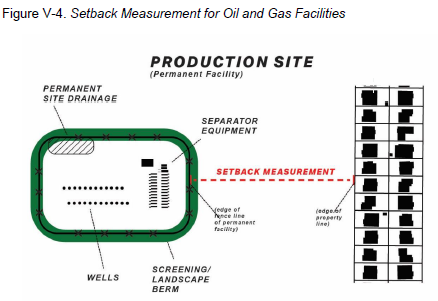
(7)
Site Development Standards. The following standards shall apply to all Well Sites, in addition to any requirements of the BMP Document and other generally applicable provisions of this code except to the extent of any direct conflict.
(a)
Visual Mitigation. Visual mitigation will be site specific. The Director may approve a Visual Mitigation Plan that is consistent with the BMP Document that allows the location to blend into the landscape, appear compatible with adjacent existing and reasonably anticipated land uses, or obfuscate the site. Staff may consider surface owner preferences. Oil and gas development near planned residential or commercial development may require a staged Visual Mitigation Plan.
(b)
Fencing. Above-ground Operations shall be fenced and gated as part of the Visual Mitigation Plan and Security Plan. Fencing shall be eight-foot (8') high, wrought iron fencing, Ameristar Impasse, Stronghold fencing, or an equivalent, or better, as approved in the Visual Mitigation Plan. Eight-foot (8') high masonry may be used as an alternate.
(c)
Landscaping.
(i)
Landscaping will be site specific. The Director may approve a Landscaping Plan that achieves one or more of the following objectives: to obfuscate the Well Site from public view; to blend the Well Site into the surrounding landscape; to reinforce or extend any existing pattern of natural vegetation; to improve Well Site security; or to create visual enhancement. The Landscaping Plan shall be coordinated with the City, depending on access to water, may be staged to accommodate surface development.
(ii)
All plant materials shall be maintained in a healthy growing condition at all times. The Operator is responsible for the regular weeding, mowing, fertilizing, pruning and other maintenance of all plant materials as needed. Adequate irrigation of plant materials (excluding existing vegetation) shall be provided by the Operator.
(d)
Lighting. To the maximum extent practicable, exterior lighting shall be downcast to reduce spill-over to adjacent properties and directed away from residential and sensitive wildlife areas or shielded from said areas to eliminate glare. All permanent lighting fixtures installed at the Operations shall comply with the lighting standards of this Code and the BMP Document.
(e)
Signs and Markers. The Operator shall mark each and every Oil and Gas Well as required in the BMP Document.
(8)
Environmental Standards.
(a)
Wildlife Mitigation.
(i)
General. When Operations will be located within or adjacent to a sensitive wildlife area or city designated open space, the Operator shall consult with the Colorado Parks and Wildlife to obtain recommendations for appropriate site-specific and cumulative impact mitigation procedures. The Operator shall implement such mitigation procedures as are recommended by the Colorado Parks and Wildlife after consultation with the City. When Operations are adjacent to or within a federal wildlife or natural area, the Operator shall consult with the relevant federal authority to satisfy any applicable federal rules or regulations relevant to Operations. In all such instances, the Operator shall file a mitigation plan with the City.
(ii)
Endangered Species. The Operator shall not engage in activities that Colorado Parks and Wildlife, or other relevant federal authorities, indicates would threaten endangered species.
(b)
General Waste Management.
(i)
The Operator shall at all times keep all aspects of an Operation, including roads and rights-of-way, safe and in good order and free and clear of noxious weeds, litter and debris.
(ii)
Disposal of any water or any equipment, litter, sewage, waste, trash, chemicals or debris shall be at an approved disposal site.
(c)
Sanitary Regulations.
(i)
The Operator shall provide proper health and sanitation facilities for its employees and subcontractors.
(ii)
The Operator shall fully comply with all applicable rules and regulations of the county and state health departments or other similar body.
(iii)
The Operator shall at all times provide at the Oil and Gas Well Site a sufficient supply of safe drinking water for its employees and shall give orders against the use of water known or believed to be unsafe.
(iv)
During extended construction and maintenance Operations, the Operator shall, at convenient places within the Oil and Gas Well Site, provide fly-proof outside toilets, which shall be maintained in a sanitary condition in compliance with the approved Temporary Sanitary Facilities Plan. Toilets shall not be permitted in any water reservoir area and shall not be permitted where they may pollute a water supply.
(d)
Drainage and Stormwater Management.
(i)
Drainage. Operations shall comply with all applicable state and local drainage requirements and standards.
(ii)
Stormwater Management. All stormwater management shall comply with state and local requirements and standards.
(9)
Nuisance Standards.
(a)
Odor/Dust Containment. Operations shall be conducted in such a manner that odors and dust do not constitute a nuisance or hazard to public health, safety, welfare or the environment. All Operations shall use the best available technologies that are technically and economically practicable to control odor and dust. If deemed necessary and reasonable, the City may require additional mitigation efforts at any point during Operations.
(b)
Noise Impacts.
(i)
Operations shall be conducted in such a manner that noise does not constitute a nuisance or hazard to public health, safety, welfare or the environment. All Operations shall use the best available technologies that are technically and economically practicable to control noise. If deemed necessary and reasonable, the City may require additional mitigation efforts at any point during Operations.
(ii)
The Operator shall comply with the stricter of COGCC noise rules, as may be amended from time to time, and the following maximum permissible noise levels in Residential/Rural-zoned areas:
1.
50 db(A) in the hours between 7:00 p.m. to 7:00 a.m. and 55 db(A) in the hours between 7:00 a.m. to 7:00 p.m. or 4 db(A) higher than the baseline ambient sound measured and;
2.
60 db(C) during all hours of the day or 4 db(C) higher than baseline ambient sound measured.
(iii)
The foregoing noise limits shall be enforced during all drilling, completion, and production operations but not during Well Site pad construction. During pad construction at the Well Sites, noise levels shall not exceed those produced by the construction of a typical residential or commercial development.
(iv)
Noise measurement protocols and points of compliance are as specified by COGCC rules.
(v)
Operators may be required to provide for additional noise mitigation as described in the BMP Document.
(10)
Traffic Standards.
(a)
If public road improvements are necessary to accommodate an Operation, and before work will be permitted within any City right-of-way, the Operator shall submit construction drawings to be prepared by a Colorado licensed civil engineer, in conformance with City standards, for review and approval by the City Engineer. Financial assurances shall be required when any Operation requires the construction or reconstruction of public or private roads.
(b)
Maintenance. If Operations or related activities cause any City roadway to become substandard, the City may require the Operator to provide ongoing repair and maintenance of the roadway at the Operator's cost. Such maintenance may include dust control measures and roadway improvements (e.g. graveling, shouldering, paving) as determined in the Traffic Impact Study.
(c)
Oil and Gas Well Site Access. Access to any property from a City street requires a City-issued Right-of-way permit. Right-of-way Permits are revocable upon issuance of a stop work order or if other Oil and Gas Permit violations occur. The permitting and construction of accesses shall comply with the City's Engineering Construction Standards and Specifications and design standards.
(d)
Private Access Roads. All private roads used to access or conduct Operations shall be constructed in compliance with the approved Stormwater Management Plan. The Operator shall comply with City standards regarding vehicle tracking and dust mitigation.
(e)
State Highway Access. Where a Site's access is directly to a state highway, the Operator must procure and maintain an approved State Highway Access Permit.
(f)
Access Roads.
(i)
Tank Battery Access Roads. Access roads to tank batteries shall be, at a minimum, a graded gravel roadway at least twenty feet (20') wide with a minimum unobstructed overhead clearance of seventeen feet (17') and a minimum thickness to be approved by the City Engineer.
(ii)
Wellhead Access Roads. Access roads to wellheads shall be, at a minimum, a graded gravel roadway at least twenty feet (20') wide with a minimum unobstructed overhead clearance of seventeen feet (17'), and a minimum thickness to be approved by the City Engineer.
(iii)
Pavement Standards. To protect public streets, sidewalks, and curbs and gutters, all tank battery and wellhead access roads that intersect a paved City street or alley shall be paved to standards determined by the City Engineer. The access location shall comply with all City requirements.
(g)
Haul Routes. Operators shall only use roadways for haul routes that are identified on a City-approved traffic control plan.
(h)
Oversize/Overweight Vehicles. Any oversize or overweight vehicle making use of any City street shall obtain an Oversized, Overweight and Longer Vehicle Combination Permit from the City's Department of Public Works prior to any such use.
(i)
Indemnification. No public improvements, such as curbs, gutters, pavement or sewer lines, street lights, traffic signals, sidewalks, storm drainage facilities, etc., shall be damaged by vehicles entering or leaving the location. In the event of damage, the Operator shall indemnify the City for any repair costs.
(11)
Prohibition. The following facilities are prohibited within the City:
(a)
Injection Wells for disposal of oil and gas Exploration and Production Wastes;
(b)
Gas Storage Wells;
(c)
Disposal pits;
(d)
Commercial disposal facilities;
(e)
Centralized Exploration and Production Waste management facilities; and
(f)
Subsurface disposal facilities.
(12)
Air Quality Standards and Monitoring.
(a)
The Air Quality Mitigation Plan must consider the cumulative impacts to existing air quality and all planned and existing oil and gas operations within one mile of the City. The Plan must describe how the Operator will eliminate, capture, or minimize all potentially harmful emissions, including Volatile Organic Compounds (VOC's) and BTEX through compliance with these provisions and the BMP Document.
(b)
Operator shall minimize dust associated with onsite activities and traffic on access roads pursuant to the terms as identified herein.
(c)
Operator shall comply with all applicable state and federal regulations including regulations promulgated by CDPHE, COGCC and US EPA.
(d)
Ambient Air Monitoring. Operator shall create and submit an air monitoring plan describing how the Operator will conduct baseline monitoring prior to construction of the well site. The plan shall also describe how the Operator will conduct continuous monitoring and collect periodic canister samples (or equivalent method) during the drilling, completion and production phases of development. Air pollutants monitored by canister samples shall include, but are not limited to, methane, VOCs, Hazardous Air Pollutants (HAPs), Oxides of Nitrogen (NOx), Particulate Matter (PM), and Fine Particulate Matter (PM 2.5). At Operator's cost, a third-party consultant approved by the City shall conduct baseline and ongoing air sampling and monitoring. Such sampling and monitoring shall comply with the following requirements:
i.
Baseline sampling shall be conducted within 500 feet of a proposed facility over a 90-day period. Baseline sampling shall track levels and changes in monitored air pollutant concentrations. Baseline sampling data shall be provided as part of the Oil and Gas permit submittal.
ii.
Continuous monitoring for hydrocarbons shall occur during the drilling and completions phase of oil and gas development. Each hydrocarbon monitor shall include a sampling device to automatically collect an air sample when the monitor levels reach a trigger level defined below in (iii). Monitors shall also include meteorological monitoring capabilities. Continuous monitoring may not cease until three years have passed from the date the last well drilled on the site has entered the production phase, unless any use defined in 21-5266(6a) is within 1,000' of the edge of the well site. In such instance, continuous monitoring shall be required until all wells are plugged and abandoned.
iii.
An increase in the detection of hydrocarbon greater than the ambient levels determined during baseline sampling plus the anticipated change based on Operator-provided impacts of modeled operations shall require the Operator to collect a further sample utilizing an 8-hour canister sample immediately after detection.
iv.
In the event a canister sample is triggered, the city shall be notified within one hour after the occurrence of such event. Depending on the circumstances, expedited lab analysis may be required.
v.
In response to a reportable safety event, as defined by COGCC Rule 602(c), a spill, release, or a reported and substantiated nuisance that occurs outside of drilling and completion Operations, the City may require additional air quality sampling or monitoring as deemed reasonably necessary by City. The Operator shall reimburse the City for all costs incurred by the City as a result.
(13)
Abandonment and Plugging.
(a)
The Operator shall comply with all COGCC rules in relation to abandonment and plugging.
(b)
For new Oil and Gas Facilities, the Operator shall be required to plug and abandon all existing vertical wells owned or controlled by the Operator within a proposed drilling and spacing unit (DSU) that target the same formation as any proposed horizontal wells.
(c)
Operators of wells that are to be plugged and abandoned shall notify both the City's Local Government Designee (LGD) and the applicable fire district not less than one week prior to commencing plugging operations.
(d)
Operators shall remove all Flowlines associated with a plugged and abandoned well. The city may grant an exception to allow a Flowline to be abandoned in place, where the removal of such Flowline would constitute a significant hazard to public health, welfare, safety, and the environment.
(e)
Operators shall provide copies of all COGCC plugging and abandonment reports to the City concurrent with filing the reports with the COGCC.
(f)
It shall be unlawful for any Operator or other person to reactivate a plugged or abandoned Oil and Gas Well unless a new Oil and Gas Permit has first been issued by the City. The recompleting or reworking of an Oil and Gas Well and relocation of accessory equipment or gathering and transmission lines will be permitted if all applicable State applications are obtained.
(14)
Fees. The fees identified in this subsection shall apply in addition to any other applicable fees. All fees shall be paid at the time an Oil and Gas Permit is issued.
(a)
Oil and Gas Transportation Impact Fee. The Operator shall pay an Oil and Gas Transportation Impact Fee, pursuant to Section 21-9260.
(b)
Inspection fees. The applicant shall provide reimbursement to the city for the full cost necessary to inspect any Well Site. Upon completion of an inspection, the applicant shall receive an invoice for the cost of such inspection.
(c)
Where reimbursement to the City or any other party is required by this section, such reimbursement shall be payable immediately upon invoice. The City may require a deposit to cover such costs.
(15)
Financial Assurances and Insurance.
(a)
Operator shall provide all necessary insurance as set forth in the BMP document.
(b)
Financial Assurance.
(i)
General Requirement. The Operator shall provide the City with financial assurance as provided in this section and regulations established by the City Manager pursuant to this section.
(ii)
Administrative Regulations. The City Manager shall establish administrative regulations for financial assurances consistent with this section. Such requirements shall include, at a minimum, standard language for each type of financial assurance; qualifications for issuing institutions; and procedures for the review, processing, acceptance, replacement, cancellation and termination, use, release, or aggregation of financial assurances and standby trusts to implement financial assurances. Such requirements shall be reviewed and updated by the City Manager as needed to meet the intent of this section.
(iii)
Minimum Requirements.
1.
Amount. The financial assurance shall be in the amount of ninety thousand dollars ($90,000.00), multiplied by the number of approved wells on the associated planned well site. The Financial Assurance (including any existing Financial Assurance) shall be adjusted for inflation on January 1, 2021, and on January 1 of each year thereafter. "Inflation" shall mean the annual percentage change in the United States department of labor, bureau of labor statistics, consumer price index for Denver-Aurora-Lakewood, all items, all urban consumers, or its successor index.
2.
Term. The financial assurance required by this section shall be provided to the City before the commencement of any work, including Well Pad construction, and shall remain shall be provided until all wells at the Well Site have been plugged and abandoned and the well site has been adequately reclaimed, as determined by the City, unless the financial assurance has been replaced pursuant to administrative regulations established by the City Manager.
3.
Type. The financial assurance must be in the form of a surety bond or irrevocable standby letter of credit, or approved combination thereof.
4.
Purpose. The Financial Assurance must guarantee, at a minimum, that the Operator will:
A.
Secure the wells, well sites, associated well site lands and infrastructure; plug and abandon all wells at the well site in compliance with State law, and reclaim the well site in compliance with State law;
B.
Perform all requirements of the Oil and Gas Permit and Extraction Agreement (and Regional Operator Agreement, if applicable) for the well site;
C.
Provide an alternate financial assurance and obtain the City's written approval of such alternate financial assurance upon the issuing institution's cancellation or failure to extend a financial assurance, as provided in this section; and
D.
Guarantee that, if the Director notifies the issuing institution that the Operator has failed to do any of the foregoing or the occurrence of any event providing for an authorized use as defined in this section, the issuing institution will pay the amount of the bond or letter of credit into a standby trust fund.
(iv)
State Bonding Requirements. The financial assurance required by this section shall not be a substitute for any bonding required by the state regulatory agencies for plugging and abandoning wells. The Operator shall comply with all state regulatory agencies' bonding requirements.
(v)
Financial Setback Notification. Operator shall notify the City of the existence of the occurrence of any of the following events within five (5) business days of their occurrence, provided notification by the Operator shall not be a condition to the City's use of any financial assurance: The Operator files for protection under the bankruptcy laws, makes an assignment for the benefit of creditors, appoints or suffers appointment of a receiver or trustee over its property, files a petition under any bankruptcy or insolvency act or has any such petition filed against it which is not discharged within ninety (90) days of the filing thereof;
(vi)
No Liability for Claim. The City shall not be liable to the Operator or any surety, guarantor, or financial institution for consequential damages arising from the City's exercise of its rights under this section, including without limitation a claim for impairment of bonding capacity.
(c)
Performance Security. To ensure compliance with mitigation and other requirements set forth in this section, the BMP Document, and any permit conditions, the Operator may be required to provide reasonable performance security to the City in a form acceptable to the City.
(d)
Cost Reimbursement. The Operator shall reimburse the City, the applicable fire district, and any other emergency service provider for any emergency response costs incurred by any of them in connection with the Operations.
(16)
Inspection by the City.
(a)
The City has the right to inspect all Well Sites, Operations, and Oil and Gas Facilities. No person shall refuse entry to, impede, obstruct, delay, or in any manner interfere with the inspection of Oil and Gas Facilities subject to an Oil and Gas Permit or the regulations of this section or section 21-3235 by any federal, state, county, or local inspector who is either permitted or required to inspect the premises. Entry and inspection shall be permitted to all areas of the Oil and Gas Facility as defined by this code. No inspector shall be required to be escorted or accompanied during an inspection.
(b)
Any attempt to refuse entry to, impede, obstruct, delay, or in any manner interfere with a lawful inspection, or to require that an inspector be escorted or accompanied during an inspection, shall constitute grounds for revocation of an Oil and Gas Permit in addition to any other penalties permitted by the code.
(c)
The Operator shall provide the telephone number of a contact person who may be reached 24 hours a day.
(17)
Modifications to Oil and Gas Bulk Standards. Applicants who wish to seek relief from any of the bulk standards defined within 21-5266(6a) or 21-6280(1) shall be reviewed by the planning commission and approved by the city council. A reduction may be approved if all of the following criteria are met:
a.
There is no deviation from the approval criteria of 21-3235(8);
b.
The proposed reduction is the minimum needed for the reasonable development of mineral resources at the proposed location;
c.
Through alternative site analysis, the applicant has demonstrated that no other reasonable locations exist to access the targeted minerals;
d.
The applicant has incorporated any necessary additional Best Management Practices beyond current requirements to mitigate additional impacts that may arise from the reduced setback distance; and
e.
Bulk standards are not modified by greater than 20 percent of the minimum value.
Modifications to other Oil and Gas standards contained within Articles III, V, and VI of the Land Development Code and the City's adopted Best Management Practices shall not be permitted.
(18)
Enforcement and Penalties.
(a)
Failure to Obtain Permits. Any Operator that fails to obtain an Oil and Gas Permit, or that fails to comply with requirements of this code, the Oil and Gas Permit, the BMP Document or any applicable Regional Operator Agreement or Extraction Agreement, may be enjoined by the City from engaging in Operations and may be subject to such other criminal or civil liability as may be prescribed by law.
(b)
Suspension of Oil and Gas Permit. If the City determines that the Operator has violated any term or condition of this Code, the Oil and Gas Permit, the BMP Document or any applicable Regional Operator Agreement or Extraction Agreement, or that one or more material changes to the Operations or Oil and Gas Facilities have been made without the express, written consent of the City, the Director may temporarily suspend the Oil and Gas Permit and order all Operations permitted by the City under the Oil and Gas Permit to cease upon written notification to the Operator. In such event, the Operations shall be safely ceased as soon as possible. This suspension shall be in addition to any other enforcement mechanism available to the City.
(c)
Revocation of Oil and Gas Permit. In the manner consistent with this code, revocation of an Oil and Gas Permit may be premised upon a violation of any term or condition of this Code, any term or condition of the Oil and Gas Permit, the BMP Document, or any applicable Regional Operator Agreement or Extraction Agreement, or if one or more material changes to the Operations or Oil and Gas Facilities have been made without the consent of the City.
(d)
COGCC Enforcement Orders.
(i)
Within five (5) business days of the receipt of a COGCC Enforcement Order for a violation occurring in the City, the Operator shall provide the Enforcement Order to the City.
(19)
No Permit Approval Pending Enforcement Action. No Oil and Gas Permit application or any proposed amendment to an Oil and Gas Permit application, shall be processed or approved with regard to a Well Site that is subject to an ongoing enforcement action by any federal, state, or local agency having jurisdiction over the property.
(20)
Other Oil and Gas Operations—Seismic Operations. An Oil and Gas Permit shall not be required for seismic surveys unless the drilling of a seismic (shot hole) core or other exploratory hole is involved or unless the seismic survey is located on City property. This section shall not operate to relieve any party from the obligation to obtain a Right-of-Way Permit. The Operator will provide the City with resulting data if collected within 1,000 feet of the surface and requested by the City due to potential impacts on City projects or municipal water supplies.
(21)
Strict Liability.
(a)
An Operator shall be strictly liable to the City and any emergency service provider for all costs of emergency response to any Well Sites. Such costs shall include, but not be limited to, those born by fire, police, and other first responders, regardless of jurisdiction, including any hazmat response and cleanup costs of any nature whatsoever. Absent the Operator's negligence, the Operator shall not be liable for such costs caused by a third party lacking privity with the Operator.
(b)
An Operator shall be strictly liable to the City and any emergency service provider for all damages to any and all City owned or operated property and infrastructure, incurred as a result of the Operator's Operations. Nothing in this subsection shall be construed to require Operator to pay an additional amount where such damages are anticipated and accounted for through the payment of generally applicable fees or impact fees.
(Ord. No. 1891, August 2012; Ord. No. 2183, November 2018; Ord. No. 2266, § 8(Exh. F), 2-15-2021)
Sec. 21-5268. - Transit Oriented Development Accessory Uses.
(1)
General Standards. Allowable accessory commercial uses within an R-3 zone district shall be:
(a)
Clearly incidental and accessory to the primary use of multi-family residential;
(b)
Located within 1500 feet of a commuter rail station property;
(c)
Limited to a maximum of 10,000 sf per building, or 10 percent of the total land area, whichever is greater, and be fully contained on the ground floor;
(d)
Located with frontage on the primary street; and
(e)
Have direct pedestrian access from primary street frontage.
(Ord. No. 2420, § 2(c)(Exh. B), 9-19-2022)
Sec. 21-5270. - Transportation Terminals and Truck Stops.
(1)
All new businesses and fellowship activities shall be contained within the primary structure. No detached garage, tent, trailer, vehicle, storage container, or accessory building shall be used to house any new, ongoing for-profit, nonprofit, charitable, or religious business or establishment. A temporary use, the duration of which shall not exceed one calendar week, may be allowed on the property, subject to all applicable standards and permitting requirements contained in this code. In no event shall more than one temporary use occur on the same property at the same time.
(2)
A conditional use permit shall be required for all new transportation terminals in the I-1 zoning district and all truck stops. All such uses legally operated as a use-by-right as of the effective date of this land development code shall be considered a legal conforming use only under the following provisions and exceptions:
(a)
Use of the property as a transportation terminal or truck stop was a use by right before the effective date of this code; and
(b)
The property was in use as a transportation terminal or truck stop on the effective date of this code.
(c)
Exceptions. Any building permit that increases the size of any covered structure, truck bay, or building larger than 200 square feet on the property will require the current use to obtain a conditional use permit, approved by city council, prior to approval of the above mentioned building permit.
(Ord. No. 1854, April 2011)
Sec. 21-5271. - Truck and/or Vehicle Repair.
(1)
General Standards: All truck and/or vehicle repair uses shall comply with the following standards:
(a)
Street access shall conform to the requirements imposed by the engineering division; and
(b)
Vehicle access and circulation shall be designed so that the impacts to adjacent residential uses or properties from the movement of vehicles or the lights from vehicles are minimized.
(2)
Equipment, Activity, and Materials.
(a)
All repair work, vehicle washing, installation of parts, hydraulic hoists, pits, and all lubrications, greasing, automobile detailing, or repairing equipment shall be entirely enclosed within a building. When any such building or portion of a building faces, abuts, or is adjacent to residentially zoned property, the closest, adjacent building wall or face shall consist of a solid wall with no window or door openings other than those required by applicable building codes.
(b)
All vehicle parts, dismantled vehicles and similar materials, and all discarded materials such as tires, cans, and drums, shall be stored within an enclosed building or meet the criteria for outdoor storage.
(c)
Inoperable Vehicles Prohibited. The storing or keeping of inoperable vehicles on the property is strictly prohibited.
(3)
Vehicle and Truck Storage. All vehicles awaiting repair shall be stored on site in approved parking spaces and under no circumstances shall such vehicles be stored outside in an unassembled condition, on an unapproved parking surface, or stored on or obstruct access to a public right-of-way.
(4)
Accessory Car Wash Bays. A fully-enclosed, single-bay car wash is allowed as an accessory use subject to the following development and design standards:
(a)
To the maximum extent possible, the entrance to the car wash bay shall be sited so as not to be visible from the lot's primary street frontage;
(b)
The car wash bay shall be limited in size to a single vehicle;
(c)
The car wash bay shall be located outside of the 20-foot landscape buffer required by paragraph (3)(b) of this section;
(d)
In addition to any other off-street parking requirements or vehicles stacking requirements, the car wash shall have its own stacking requirements, found in section 21-7236 (Stacking Requirements);
(e)
Where the use abuts a residential zoning district, the hours of operation for the car wash shall be limited to between 7:00 a.m. and 9:00 p.m.
(Ord. No. 2020, February 2015)
Editor's note— Section moved by Ord. 1854, April 2011.
Sec. 21-5272. - Vehicle Sales and Rentals.
All sales and rentals related to motorized vehicles shall comply with the provisions of this section.
(1)
Display of vehicles shall be on hot-mix asphalt or concrete and shall not impact existing landscaped areas or encroach into required landscape buffers.
(2)
No merchandise shall be placed for sale or display within any public rights-of-way, or landscaped areas.
(3)
Outdoor displays that pose a safety hazard to the general public shall be prohibited.
(4)
Outdoor displays of merchandise shall be located in areas that are accessible to and safe for pedestrian access.
(5)
Any business engaged in vehicle sales or rentals shall have a principal building consisting of a minimum of 500 square feet in size. The building shall be a permanent structure. Modular or portable buildings, or mobile homes, shall not be permitted.
(6)
Outdoor speakers and sound amplification systems shall not be permitted.
(7)
There shall be no use of elevated platforms for the display of vehicles.
Sec. 21-5300. - Temporary Uses and Structures Table.
The Summary of Allowed Temporary Uses and Structures Table (table V-2 below) sets forth the temporary uses and structures allowed in the various zoning districts of the city, an indication of whether those uses and structures require a permit, and provides a reference to some of the regulations that apply.
Table V-2. Summary of Allowed Temporary Uses and Structures
Sec. 21-5305. - Unlisted Uses and Structures.
Uses or structures not listed in table V-2 are prohibited.
Sec. 21-5310. - Permit Requirements.
No permit for a temporary use or structure shall be issued unless the applicant demonstrates:
(1)
The use will not negatively affect the availability of parking and that adequate on-site parking will be available to accommodate the proposed temporary use for the duration of the permit. See article VIII for parking requirements; and
(2)
All required fire lanes have been approved by the applicable fire district.
Sec. 21-5315. - Deposit.
A deposit in the form of a cashier's check may be required by the city to offset any costs incurred by the city in conjunction with a temporary use or temporary structure including, without limitation, sign removal, code enforcement, and clean-up. If required, the deposit, which may not exceed $2,000, shall be paid prior to any permit being issued. The city shall return any unused portion.
Sec. 21-5320. - Requirements for Initiating Use.
No temporary use shall be conducted or temporary structure erected and/or used except after:
(1)
A site plan containing sufficient information to show compliance with standards and requirements of this land development code is submitted to and approved by the city;
(2)
All permits required by applicable building, electrical, fire, plumbing, and mechanical codes are obtained; and
(3)
All licenses required for the operation of the temporary use are obtained.
Sec. 21-5325. - Standards.
(1)
No temporary use shall violate any applicable conditions of approval that apply to the principal use and zoning for the site.
(2)
A temporary use shall comply with all other standards and requirements of the zone district in which the temporary use is proposed. In the event that a PUD zoning district specifically regulates temporary uses, the PUD zoning shall control.
(3)
Temporary uses or structures shall not be conducted or located within existing vegetated buffers, designated setbacks, required parking areas, public rights-of-way, designated easements, or any areas that interfere with any sight distance triangle.
(4)
Temporary structures shall be constructed to promote safety and health. Materials which may be used on the exterior surface of any temporary stand or structure shall include, but are not limited to, freshly painted plywood or masonite, nonrusted galvanized steel sheathing, aluminum, fiberglass or polyfilm. Materials which shall not be used for the exterior surface include, but are not limited to, paper, cardboard, old unpainted lumber or masonite, and rusted metal sheathing.
(5)
Temporary structures and the property on which any temporary structure or use is permitted shall be maintained in good condition during the time of its use. Vegetation shall be regularly mowed. Trash and rubbish barrels/receptacles shall be provided and regularly removed from the site.
(6)
Only temporary signs erected in accordance with article VIII shall be permitted and such signs shall be removed at the conclusion of the use.
(7)
Upon conclusion of the temporary use, the site shall be cleaned, all evidence of the use(s) removed, re-vegetated, and left in a condition that minimizes adverse impacts to the site itself and to surrounding properties.
(8)
Temporary structures used in conjunction with temporary uses shall be removed not more than seven calendar days after the event is closed. Temporary stands, motor vehicles, and trailers shall be removed on the date of termination of the permit unless a specific date is approved in the application.
(9)
Except for temporary structures removed in compliance with paragraph 8 of this section, all set-up, clean-up, dismantling, and removal of the temporary use must be conducted during the permit period.
Sec. 21-5330. - Batch Plants.
(1)
Definition. The term batch plant refers to cement, concrete, and asphalt mixing areas conducted at construction sites.
(2)
Standards. In addition to the standards contained in section 21-5325, the following special provisions apply to all batch plants:
(a)
The hours of operation shall be limited to the hours specified on the approved permit.
(b)
The use shall be setback at least 300 feet from any residential structure.
(c)
Vehicle use areas, material storage areas, and structures shall be setback at least 100 feet from the property boundary.
(d)
The permit holder shall control dust, dirt, and any other debris from migrating from the site on to other property. Inability to effectively mitigate dust will result in revocation of the permit.
(e)
Due to the potential magnitude of the use, the city engineer may add additional standards regarding trucking routes and the size of loads to protect the general welfare of the public.
(3)
Permit Period. A temporary use permit for a batch plant shall be valid for six months. This period may be extended for one additional six-month period, for good cause shown, upon approval of a written request, submitted to the director 30 days prior to the expiration of the permit.
Sec. 21-5335. - Charitable Collection Devices.
(1)
Definition. The term "charitable collection device" means roll-off containers, semi-trailers, nonpermanent drop-off containers, or similar devices used for the collection of donated items.
(2)
Permit Period. A temporary use permit for charitable collection devices shall be valid for 60 days. This period may be extended for one additional 30-day period upon approval of a written request submitted to the director 7 days prior to the expiration of the permit. In no event, however, shall an extension be granted which would allow the temporary structure to remain on the site for more than 90 days.
(Ord. No. 1887, July 2012)
Sec. 21-5340. - Farmers' Markets.
(1)
Definition. The term "farmers' market" means the seasonal offering for sale of fresh agricultural products directly to the consumer in an open-air market.
(2)
Standards. In addition to the standards contained in section 21-5325 above, the following special provisions apply to all farmers' markets:
(a)
Goods may be sold or displayed from a motor vehicle or trailer.
(b)
The hours of operation shall be limited to the hours specified on the approved permit. All set-up and clean-up shall be completed within the hours of operation.
(3)
Permit Period. A temporary use permit for a farmers' market shall be valid from May 15 to October 31 (the summer season) and shall entitle the permit holder to conduct the market in either of the following manners, as specified in the permit:
(a)
Weekly. The market may be conducted not more than one day per week per permitted site; or
(b)
Monthly. The market may be held for up to three consecutive days at the same site, provided that no other farmers' market has been conducted by the permit holder at that site during the preceding 30-day period.
(c)
The director may extend the summer season based on seasonal conditions.
Sec. 21-5345. - Mobile Office Structures.
(1)
Defined. The term "mobile office structure" means a factory-fabricated, transportable building that is designed to arrive at a site ready for occupancy, except for minor unpacking, anchoring, and connection to utilities, and designed for removal to and installation at other sites.
(2)
Restricted Use. A mobile office structure may be placed on property for the following limited purposes:
(a)
Expansion space for an existing permitted principal use.
(b)
Temporary offices for construction and security personnel during the construction of a development.
(c)
Temporary quarters for a nonresidential use when the permanent building has been destroyed by fire or other physical catastrophe, provided that a building permit for the permanent facility is obtained within 90 days after approval of the temporary building. The director may approve a written request for an extension of an additional 90 days for good cause shown.
(d)
Temporary quarters for general office uses including, but not limited to, hiring and membership solicitation.
(3)
Standards. In addition to the standards listed in section 21-5325 the following special provisions apply to all temporary mobile structures:
(a)
Parking spaces shall be provided on the lot in a number sufficient to meet the requirements set forth for the use in article VII (Parking).
(b)
A mobile office structure shall not be used as any type of dwelling.
(c)
All mobile office structures shall have at least ten feet on all sides for clearance.
(d)
Temporary chain-link fencing up to six-feet high may be approved for a period of time not to exceed six months.
(e)
The number of temporary buildings shall be limited to one per application, in addition to those already allowed by this section.
(f)
Except as permitted in paragraph 2(c) of this section, no mobile office structure shall be placed on any property prior to the issuance of a building permit for a permanent facility.
(g)
If more than three mobile office structures are required, the applicant may request the board of adjustment to issue a use-by-permit to allow for additional temporary offices.
(4)
Permit Period. A temporary use permit for a mobile office structure shall be valid for six months or until a certificate of occupancy is issued, whichever occurs first. The 6-month period may be extended for one additional 6-month period, for good cause shown, upon approval of a written request, submitted to the director 30 days prior to the expiration of the permit.
(Ord. No. 2020, February 2015)
Sec. 21-5350. - Mobile Storage Containers.
(1)
Definition. The term "temporary mobile storage container" means a sealed, contained mini-mobile storage used for the purpose of temporary storage of goods and materials, excluding roll-off trash collection containers.
(2)
Standards. In addition to the standards contained in section 21-5325, storage containers shall generally be located in on-site parking areas or spaces.
(3)
Permit Period.
(a)
Nonresidential Properties. A temporary use permit for a mobile storage container issued in conjunction with an approved building permit for a permanent structure (e.g., remodel of structure requires temporary storage of contents) shall be valid for 30 days. This period may be extended for 1 additional 30-day period, upon approval of a written request, submitted to the director 15 days prior to the expiration of the permit. The permit may be extended only upon a finding that there will be no substantial adverse impact on surrounding property, public facilities and services, or the community at-large. Mobile storage containers sited beyond this time frame shall be classified as outdoor storage.
(b)
Residential Properties. A temporary use permit for a mobile storage container issued in conjunction with an approved building permit for a permanent structure (e.g., remodel of structure requires temporary storage of contents) or for estate settlement shall be valid for 30 days. No renewals will be allowed.
Sec. 21-5355. - Natural Disaster and Emergency Recovery/Clean-Up.
Occasionally, local, state, and federal emergencies require the implementation of temporary uses and structures. When determined by the government, temporary uses and structures needed as the result of a natural disaster or other health and safety emergencies are allowed for the duration of the recovery/clean-up effort. No temporary use permit or other review shall be required.
Sec. 21-5360. - Organized Events.
(1)
Definition. The term "organized event" means any organized activity, specifically including, but not limited to, a circus, carnival, fair, flea market, special celebration, or other temporary activity not identified above which reasonably may be expected to attract more than 50 persons at any one time, or which otherwise may reasonably be expected to increase the risk of:
(a)
Damage to public or private property, beyond normal wear and tear;
(b)
Injury to persons;
(c)
Public or private disturbances or nuisances;
(d)
Unsafe impediments or distractions to, or congestion of, vehicular or pedestrian travel;
(e)
Significant additional police, fire, trash removal, maintenance, or other public services demands; or
(f)
Other significant adverse effects upon the public health, safety, or welfare.
(2)
Exclusions. The term organized event shall not include any activity sponsored in whole or in part by the city or another political subdivision of the State of Colorado or any organized activities conducted at public sites or public facilities typically intended and used for such activities. Examples of such exempt activities include, but are not necessarily limited to: sporting events such as golf, soccer, softball, and baseball tournaments conducted on courses or fields intended and used for such activities; park shelter rental, wedding services conducted at reception halls or similar facilities; funeral services conducted at funeral homes or cemeteries; or religious services, wedding services, and funeral services conducted at places of worship. Furthermore, the term organized event shall not include activities occurring within or upon the grounds of a private residence, or upon the common areas of multi-family residential development.
(3)
Standards. Given the variety of circumstances which fall into this permit category, the director may impose, in addition to the standards contained in section 21-5325, any standard or requirement deemed reasonable to protect the health, safety, and welfare of the participants and the public.
(4)
Number of Permits. Any organized event that involves more than one activity or site, or which is held over a period of more than one day, need only obtain one permit, provided that the application specifies each activity, site, and dates.
(5)
Hours of Operation. The hours of operation of any organized event should be specified in the permit. In the event the hours of operation are not specified, the ending time for such event shall be 10:00 p.m.
(6)
Permit Period. A temporary use permit for an event may be approved for a period of up to 14 days at the discretion of the director. This period may be extended for 1 additional 14-day period for good cause shown, upon approval of a written request submitted to the director 7 days prior to the expiration of the permit. The permit may be extended only upon a finding that there will be no substantial adverse impacts on surrounding property, public facilities and services, or the community at-large.
(7)
Notification to Nearby Property Owners. Any person who intends to hold an event that meets three or more of the criteria listed in this paragraph shall make a reasonable attempt to notify every person who owns property within 660 feet of the proposed event. Notification shall be provided in a manner that is satisfactory to the city.
(a)
The event will occur on more than one calendar day;
(b)
Any part of the event will occur after 8:00 p.m. or before 8:00 a.m.;
(c)
Attendance at the event is reasonably anticipated to exceed 200 people;
(d)
Alcoholic beverages will be served during the event;
(e)
Live or amplified sound will occur during the event.
(Ord. No. 1854, April 2011)
Sec. 21-5365. - Outdoor Sales Event.
(1)
Definition. The term outdoor sales event means the outdoor sale of goods for a short-term event and includes tent and parking lot sales, hail damage repair, sidewalk sales, and similar uses, but specifically excludes residential garage or yard sales, roadside stands, flea markets, and farmers' markets.
(2)
Standards. In addition to the standards contained in section 21-5325, the following special provisions shall apply to all outdoor sales events:
(a)
Outdoor sales events shall be conducted only in commercial or industrial districts.
(b)
The site shall contain an area that is not actively used that would support the proposed temporary sale of goods without encroaching into or creating a negative impact on existing buffers, open space, landscaping, traffic movements, or parking space availability.
(c)
The display and/or sale of goods, products, and/or services shall not occur within 100 feet of a residential district.
(d)
Off-street parking shall be adequate to accommodate the parking needs for the proposed sale in conformance with article VII (Parking).
(e)
The hours of operation of the outdoor sales event shall be between sunrise and sunset, or the same as the hours of operation of the principal use, whichever is more restrictive.
(f)
The retail sales of bulk household goods, such as furniture, carpets, art work/paintings, or similar items, or the sale of prepared or processed food products shall not be permitted.
(g)
No more than three outdoor sales event permits may be issued to the same applicant for the same property in any calendar year.
(3)
Permit Period. A temporary use permit for an outdoor sales event shall be valid for the period of time determined by the director. In no event, however, shall the permit period exceed 14 days.
Sec. 21-5370. - Outdoor Seasonal Sales.
(1)
Definition. The term "outdoor seasonal sales" refers to tent and parking lot sales consisting of trees, shrubs, plants, and other seasonal garden supplies. In addition, lawn equipment, bicycles, and other similar playground equipment shall be regulated under this section. This section shall not apply to residential garage or yard sales, roadside stands, flea markets, or farmers' markets.
(2)
Permit Period.
(a)
Plant and garden centers. A temporary use permit for a plant and garden center shall be valid for a period of six months. No extensions shall be permitted.
(b)
Other outdoor seasonal sales. The permit period for all other outdoor seasonal sales shall be determined by the director based on community need. In no event however, shall such uses be permitted for more than six months and no extensions shall be permitted.
Sec. 21-5375. - Outdoor Seasonal Holiday Sales.
(1)
Definition. The term "outdoor holiday seasonal sale" means the use of a site for Christmas tree lots, pumpkin patches, and other similar holiday uses.
(2)
Standards. In addition to the standards contained in section 21-5325, the following special provisions shall apply to all outdoor holiday season sales:
(a)
The site shall contain an area that is not actively used that would support the proposed temporary sale of goods without encroaching into or creating a negative impact on existing buffers, open space, landscaping, traffic movements, or parking space availability.
(b)
The display or sale of goods, products, or services shall not occur within 100 feet of a residential lot.
(c)
Off-street parking shall be adequate to accommodate the proposed sale of goods in conformance with article VII (Parking).
(d)
The hours of operation of the outdoor holiday seasonal sales shall be between 7:30 a.m. and 10:00 p.m., or the same as the hours of operation of the principal use, whichever is more restrictive.
(e)
The parking of trailers for office or watchman purposes must be approved in writing by the Tri-County Health Department.
(3)
Permit Period.
(a)
Christmas tree lots. A temporary use permit for a Christmas tree lot shall be valid for the period from November 15 to January 4, including set-up and tear-down. No extensions shall be permitted.
(b)
Pumpkin sales. A temporary use permit for pumpkin sales shall be valid for the period from September 15 to November 5, including set-up and tear-down. No extensions shall be permitted.
(c)
Other outdoor holiday seasonal sales. The permit period for all other outdoor holiday seasonal sales shall be determined by the director based on community need. In no event, however, shall such uses be permitted for more than 60 days, and no extensions shall be permitted.
Sec. 21-5380. - Real Estate Sales Offices.
(1)
Definition. The term "temporary real estate sales office" means the use of an office or model home for the purpose of selling or leasing new homes incidental to a new development.
(2)
Standards. In addition to the standards contained in section 21-5325, the following special provisions shall apply to all temporary real estate sales offices:
(a)
The temporary real estate sales office shall be located on a permitted residential lot or within a multi-family development that was approved by the city as part of a residential development, or within an approved nonresidential development.
(b)
Parking spaces shall be provided in a number sufficient to meet the requirements set forth for offices in article VII. An accessible paved parking area for visitors shall be provided if the director determines on-street parking is not sufficient.
(c)
Open-style, trap-type fencing up to 42 inches high may be used for a temporary period of time, if approved by the director.
(d)
Upon expiration of the permit for a temporary real estate sales office, the structure shall be removed or converted into, or replaced with, a permanent residential use.
(3)
Permit Period. A temporary use permit for a temporary real estate sales office shall be valid for a period of up to 12 months. This period may be extended for additional 12-month periods, for good cause shown, upon approval of a written request, submitted to the director 30 days prior to the expiration of the permit.
Sec. 21-5385. - Roadside Produce Stands.
(1)
Definition. The term "roadside produce stand" means the use of property for the purpose of selling seasonal goods which were raised upon the premises.
(2)
Standards. In addition to the standards contained in section 21-5325, the following special provisions apply to all roadside produce stands:
(a)
No structure shall be situated, and no sale of goods shall occur, less than 50 feet from the public right-of-way.
(b)
The roadside produce stand shall be accessed via either a gravel, recycled asphalt, or paved parking lot.
(c)
The hours of operation shall be between the hours of 7:00 a.m. and 7:00 p.m.
(d)
Parking for the stand shall not block or be located within any right-of-way or public sidewalk. At least 3 off-street parking spaces shall be provided per 200 square feet of stand area.
(3)
Permit Period. A temporary use permit for a roadside produce stand shall be valid for a period of three months. This period may be extended for one additional 3-month period, for good cause shown, upon approval of a written request, submitted to the director 30 days prior to the expiration of the permit. In no event however, shall the temporary continue on the site for more than six months.

