
Commerce City City Zoning Code
ARTICLE XI
- Measurements and Definitions
Sec. 21-11100. - Rounding.
When calculations result in a fraction, the result shall be rounded in accordance with this section.
(1)
Minimum Requirements. When a regulation is expressed in terms of a minimum requirement, any fractional result will be rounded up to the next consecutive whole number. For example, if a minimum requirement for one street tree every 40 feet is applied to a 100-foot strip, the resulting fraction of 2.5 is rounded up to 3 required trees.
(2)
Maximum Requirements. When a regulation is expressed in terms of maximum limits, any fractional result lower than .49 will be rounded down to the next lower whole number. For example, if a maximum height for a building is 35 feet and the building actually measures 35 feet 5 inches, then the height is in compliance. If the height measured 35 feet 6 inches, then the height limit is not in compliance.
(3)
Residential Density. When calculating residential density, any fractional result shall be rounded up to the next consecutive whole number. For example, if a maximum limit of 15 dwelling units per acre (du/a) is applied to a 5.3-acre site, the resulting quantity of 79.5 is rounded up to 80 permitted dwelling units.
(4)
Setbacks. Setback distances are stated as absolute values and will in no case be rounded to the next whole number.
Sec. 21-11105. - Density.
(1)
Net Density. Net density shall be calculated by dividing the net acreage of a parcel by the minimum lot area required for each dwelling unit.
(2)
Gross Density. Gross density shall be calculated by dividing the gross acreage of a parcel by the minimum lot area required for each dwelling unit.
(3)
Maximum Density Not Guaranteed. The number of dwelling units allowed on a site is based on a presumption that all other applicable standards shall be met. The maximum density established for a zoning district is not a guarantee that such densities may be obtained, nor a valid justification for varying other dimensional or development standards.
Sec. 21-11110. - Lot Frontage (Lot Width).
Lot frontage or width refers to the distance between the side lot lines as measured along a straight line parallel to the front lot line (the lot line abutting the street on which the property has its principal access) or the chord thereof. The minimum lot frontage or width shall be measured between the side lot lines along a line that is parallel to the front lot line and located the minimum front setback distance from the front lot line.
Sec. 21-11115. - Street Frontage.
Street frontage means the distance between the side lot lines of a property as measured from the street lot line.
Sec. 21-11120. - Lot Depth.
Lot depth shall be measured using the methods outlined below. If more than one of these methods is used on a lot, the method which results in the greatest distance shall be utilized. However, in calculating the lot depth on a flag lot, the depth of the lot shall not include the length of the flagpole portion of the lot.
(1)
The distance from the mid-point of the front property line and the mid-point of the rear property line; or
(2)
When the rear property line is formed by two or more lines, the measurement shall be from the mid-point of a line formed by connecting the mid-points of the side-most rear property lines to the front property line.
(3)
Where no rear property line is apparent, the rear lot line shall be a line 10 feet in length within the lot, parallel to and at the maximum distance from the front property line.
(4)
When lot depth is unable to be determined using the prescribed methods, the director shall determine the most reasonable method of calculation.
Figure XI-1. Measuring Lot Depth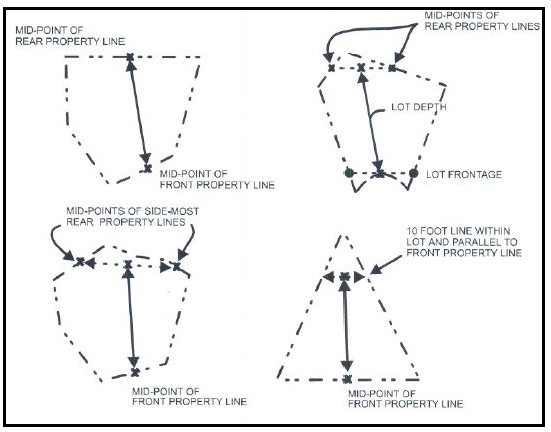
Sec. 21-11125. - Lot Coverage.
(1)
General Rule. Lot coverage is the percentage of the total lot area covered by buildings. It is calculated by dividing the square footage of building cover by the square footage of the lot.
(2)
Areas Excluded from Calculation. The following shall not be counted as part of the building area:
(a)
Areas covered by swimming pools and hot tubs;
(b)
Open decks less than 30 inches above grade; and
(c)
Storage sheds under 120 square feet in total area.
Sec. 21-11130. - Setback.
A setback is measured from the lot line to the closest projection of a building or structure along such line, at a right angle to the lot line. Setbacks shall be unobstructed from the ground to the sky except as otherwise specifically allowed in this land development code.
Sec. 21-11135. - Floor Area Ratio.
Floor Area Ratio (FAR) is the gross floor area of all buildings on a lot or parcel, divided by the lot area.
Sec. 21-11140. - Building Height.
(1)
Standard Methods of Measurement. Building height is the vertical distance between the point of measurement on the ground to the highest point of (1) coping of a flat roof; or (2) to the deck line of a mansard roof; or (3) to the average height of the highest gable of a pitched or hip roof. The point of measurement may be taken from the highest adjoining sidewalk or ground surface within a five-foot horizontal distance along the exterior wall of the building, when such sidewalk or ground surface is not more than ten feet above grade.
Figure XI-2. Height Measurements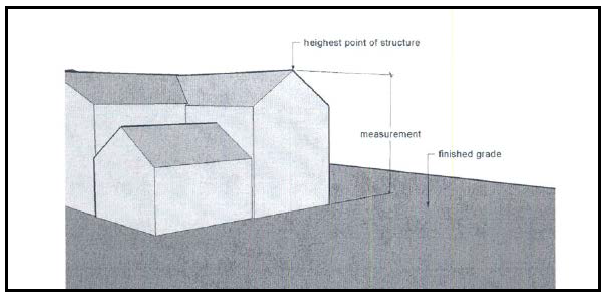
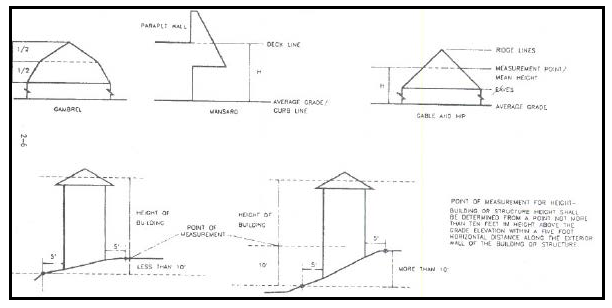
(2)
Sloped Sites. For sloped lots or buildings with varied floor elevations, the height of a building is measured as the vertical distance from the average level of the ground under the building to the allowed number of feet above and parallel to the finish grade. The average level of ground is determined by adding the elevations of the highest and lowest foundation points of the building and dividing by two (the mid-point of foundation).
Figure XI-3. Height Measurement on Sloped Sites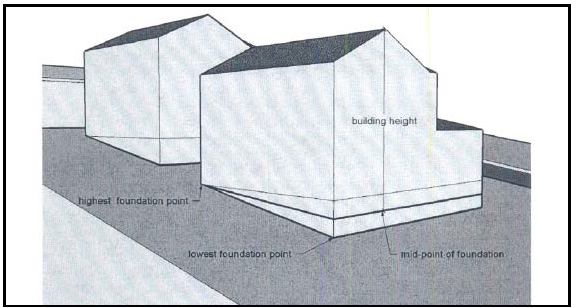
(3)
Exclusions from Measurement. Chimneys, cornices without windows, cupolas, domes not used for human occupancy, elevator penthouses, monuments, parapet walls, skylights, spires, steeples, theater scenery lofts, towers, ventilators, publicly-owned water tanks, and similar structures and necessary mechanical appurtenances covering not more than 25 percent of the roof area of the structure, may exceed the maximum permitted height in the district in which the site is located. In no case may the exclusions exceed 150 percent of the height of the principal building without a height exception granted by the board of adjustment.
Sec. 21-11145. - Distance or Spacing.
When a regulation requires a proposed use or activity to be located a specified distance from an existing use, zoning district boundary, or activity, such distance or spacing requirement shall be calculated by direct, straight-line measurement from the nearest property line of the property upon which an existing use, zoning boundary, or activity is located to the nearest property line of the property whereon the proposed use or activity is to be located. This measurement shall apply regardless of whether the use is located, or proposed to be located, within a structure housing a single use or multiple uses, except that the distance between automotive or truck wash facilities shall be measured along street frontage and not by a straight line distance between the two properties.
Sec. 21-11150. - Variation of Residential Dwelling Facades.
When the city requires that the facades of single-family homes be varied, the first and last units within that specified number may be the same. For example, a requirement to vary home facades every fourth unit shall require that the first, second, and third home facades be different, but shall permit the first and fourth home facades to be the same.
Sec. 21-11155. - Sign Measurement.
See Sec. 21-8300 Sign Measurement for sign size, sign height, sign clearance, and sign projection measurement standards.
(Ord. No. 2432, § 2(Exh. A), 12-19-2022)
Sec. 21-11200. - Definitions.
When used in this land development code, the following terms shall have the meanings ascribed to them herein, except where the context clearly indicates that a different meaning is intended or where the code contains a specific provision to the contrary:
Access Easement shall mean an interest in land which allows one or more persons to travel across another person's land.
Accessory Building or Structure shall mean a subordinate structure located on the same lot with the principal building, occupied by or devoted to an accessory use. Accessory structures include, but are not limited to, storage sheds, garages, covered porches, large satellite dishes, and telecommunication antennas.
Accessory Parking Structure shall mean a permanent one-story structure that is open on one or more sides and is used for the temporary parking or storage of operable vehicles in conjunction with the primary use of the property.
Accessory Use shall mean a use, located on the same lot, naturally and normally incidental to, subordinate to, and devoted exclusively to the principal use of the premises.
Active Rights-of-Way shall mean rights-of-way currently being utilized or improved.
Addition shall mean any activity that expands the enclosed footprint or increases the square footage of an existing structure.
Adjacent shall mean to physically touch or border upon, or to share a common property line or border. Adjacent shall include properties or uses that are separated by a street, sidewalk, or other publicly-dedicated right-of-way, canal, or railroad right-of-way.
Administrative Appeal is an appeal alleging an error in a final order, requirement, decision, or determination made by the director in the administration or enforcement of this land development code.
Adult shall mean a person 18 years of age or older.
Adverse Impact shall mean a negative consequence affecting the physical, social, or economic environment resulting from an action or project.
Agriculture or Farm shall mean the use of land for agricultural purposes, including farming, dairying, floriculture, horticulture, pasturage, viticulture, grazing, animal and poultry husbandry, and the necessary accessory uses for packing, treating, storing, and shipping of farm products.
Alley shall mean a service roadway that provides a means of access abutting properties and that is not intended for general traffic circulation.
Alter or Alteration shall mean any change or rearrangement in the supporting members of an existing building, such as bearing walls, columns, beams, girders, or interior partitions, as well as any change in doors, windows, means of ingress or egress, or any enlargement to or diminution of a building or structure, whether horizontally or vertically, or the moving of a building or structure from one location to another.
Annexation shall mean the incorporation of a land area into the city with a resulting change in the city boundaries.
Antenna shall mean any structure or device used to retransmit or receive electromagnetic waves for the provision of services including, but not limited to, cellular, paging, personal communication services, and microwave communications. Such structures and devices include, but are not limited to, directional antennas, such as panels, microwave and satellite dishes, and omnidirectional antennas, such as whips. Except where the context clearly indicates otherwise, this term shall not include broadcast antennas, antennas designed for amateur radio use, or satellite dishes designed for residential or household purposes.
Antenna, Dish shall mean dish (parabolic or cylindrical) antennas used for microwave and satellite transmission and reception for commercial purposes. This definition shall not apply to wireless cable satellite dish antennas or dish antennas less than one meter in diameter or measured diagonally.
Antenna, Panel shall mean an array of antennas, rectangular in shape, used to transmit and receive telecommunication signals.
Antenna, Whip shall mean a single antenna that is cylindrical in shape and omni-directional.
Apartment shall mean a dwelling unit, located in a building containing three or more such dwelling units, used exclusively for lease or rent as a residence.
Applicant shall mean any person who has filed an application pursuant to the provisions of this land development code.
Approved Plant List and Landscaping Specifications Document shall mean that document containing certain information and requirements pertaining to landscaping in the city.
Appurtenances shall mean transformers, switching boxes, gas regulator stations, terminal boxes, meter cabinets, pedestals, ducts, substations, system amplifiers, power supplies, optical nodes, pump stations, valves and valve housings, and other devices necessary to the function of underground electric, communications, cable television wiring, coaxial, fiber optic, water, sewer, natural gas, other utility lines, and street lighting circuits.
Architectural Appendage shall mean appendages such as fireplaces, roof overhangs, balconies, cornices, and bay or box windows that are attached to principal or accessory structures.
Architectural Features (for signage) shall mean finished elements of a building that define a structure's architectural style and physical uniqueness, including, but not limited to windows, doors, trim, and ornamental features.
Area of Shallow Flooding shall mean a designated AO, AH, or VO zone on a community's Flood Insurance Rate Map (FIRM) with a one percent or greater annual chance of flooding to an average depth of one to three feet where a clearly defined channel does not exist, where the path of flooding is unpredictable and where velocity flow may be evident. Such flooding is characterized by ponding or sheet flow.
Area of State Interest shall mean an area within which a county or municipality can designate, as enabled by C.R.S. § 24-65.1-101, certain activities and establish certain standards for the regulation thereof. Said activities may be regulated by permit and include natural hazard areas, key facilities (e.g., airports, highway interchanges, etc.), and mineral resource areas.
Arterial Street shall mean a public right-of-way used to carry high traffic volume typically for travel between areas within and outside the city. A right-of-way typically is 120 feet to 150 feet in width.
Artificial Turf shall mean a man-made substitute for organic turf, lawn, or sod that simulates the appearance of a well-maintained lawn.
Arts and/or Cultural Center shall mean a space providing for creation, display, performance, or enjoyment of heritage, history, or the arts. This use includes but is not limited to: museums, performance space, artist's studios, galleries, interpretive sites, independent theaters.
Artisan/Handcrafted Manufacturing shall mean the shared or individual use of hand-tools, mechanical tools and electronic tools for the manufacture of finished products or parts including design, processing, fabrication, assembly, treatment, and packaging of products; as well as the incidental storage, sales and distribution of such products. Typical artisan manufacturing uses include, but are not limited to: electronic goods, food and bakery products; non-alcoholic beverages; printmaking; household appliances; leather products; jewelry and clothing/apparel; metal work; furniture; glass or ceramic production; paper manufacturing.
Asphalt Mixing Plants shall mean an industrial establishment or plant where gravel or sand are combined with a mixture or bitumens to create a substance for paving, roofing, and waterproofing.
Assisted Living Facility shall mean a state-licensed group living facility regulated as a personal care boarding home, as defined in C.R.S § 25-27101. Such facilities do not offer diagnosed medical or psychological treatment under professional medical supervision, but may offer (1) physical therapy; (2) occasional medical or nursing care to address non-chronic and non-recurring conditions such as colds, flu, or household injuries; and (3) assistance with routine living activities not aimed at recovery from a specific diagnosed condition.
Athletic Field shall mean a wide stretch of open land used for outdoor games such as baseball, football, and soccer.
Auction shall mean a place where objects of art, furniture, or other goods are offered for sale to persons who bid on an object in competition with each other. For an auction to be classified as an indoor auction, all auction activities shall occur within an enclosed building, including storage and processing of items to be auctioned.
Auditorium or Stadium shall mean an open, partially enclosed, or fully enclosed facility used or intended to be used primarily for spectator sports, entertainment events, expositions and other public gatherings. Typical uses include convention and exhibition halls, sports arenas, and amphitheaters.
Automobile Sales and Rental shall mean a specific type of vehicle and equipment use or an establishment arranged, designed, or used for the display, sale, leasing, or rental of any new or used motor vehicle in operable condition.
Average Trip Length shall mean the average length in miles of trips on the Major Road System of the Northern Range and the Core City.
Awning shall mean a shelter projecting from and supported by the exterior wall of a building constructed of non-rigid materials on a supporting framework. An awning is distinguished from a marquee in that a marquee is covered with rigid material. An awning is distinguished from a canopy in that an awning is cantilevered, whereas a canopy is supported by posts or other devices beyond the building wall.
Bail Bonds Business shall mean a business whose primary purpose is to act as a surety to secure the presence of an accused person at a court proceeding in a criminal manner.
Bakery, Retail shall mean a structure, room, or place used for making, preparing, or baking, bread, biscuits, pastry, cakes, doughnuts, crullers, noodles, macaroni, spaghetti, or tortillas to be sold on-premises at retail and consumed on or off premises.
Bakery, Wholesale shall mean a structure, room, or place used for making, preparing, or baking, bread, biscuits, pastry, cakes, doughnuts, crullers, noodles, macaroni, spaghetti, or tortillas to be sold on or off-premises at wholesale and consumed off premises.
Banner shall mean a sign made of fabric or other non-rigid material with no enclosing framework.
Bar/Tavern shall mean an eating/drinking establishment providing or dispensing by the drink, for on-site consumption, fermented malt beverages, and/or malt, special malt, vinous or spirituous liquors, and in which the sale of food products such as sandwiches and light snacks is secondary (also known as a tavern). A bar/tavern may include provision of live entertainment and/or dancing; however, a bar/tavern shall not include any adult business use.
Base Flood shall mean a flood having a one percent chance of being equaled or exceeded in any given year (also known as the 100-year flood).
Basement shall mean an area below the first floor, having part, but no more than ½ of its height above-grade, and with a floor to ceiling height of not less than seven feet. This term shall not include garden level.
Bed and Breakfast Establishment shall mean an owner-occupied single-family dwelling where up to a maximum of five rooms may be rented for overnight lodging. The five lodging rooms may be in addition to bedrooms used by the resident family.
Berm shall mean in the context of landscaping or buffering requirements, a mound of earth typically used to shield, screen, and buffer undesirable views and to separate potentially incompatible land uses.
Best Management Practices (BMPs) shall mean physical, structural and/or managerial practices that, when used individually or in combination, prevent or reduce pollution or stormwater runoff. As they relate to Oil and Gas Operations, BMPs are practices that are designed to prevent or reduce impacts caused by Oil and Gas Operations to air, water, soil, or biological resources, and to minimize adverse impacts to public health, safety and welfare, including the environment and wildlife resources. BMPs are also known as stormwater control measures (SCMs).
Block shall mean a tract of land bounded by streets, or by a combination of streets and railroad rights-of-way, shorelines, or boundary lines of municipalities.
Boarding, Lodging, or Rooming House shall mean a group living facility where meals, lodging, or both, are provided for compensation for five or more persons, but not more than eight persons, not including members of the owner's or proprietor's immediate family who might be residing in the same building. The word compensation shall include compensation in money, services, or anything of value. A boarding, lodging, or rooming house shall not include more than one person required to register as a sex offender pursuant to C.R.S. § 18-3-412.5, as amended.
Borrow Pit shall mean any place or premises where dirt, soil, sand, gravel, or other material is removed below the grade of surrounding land, for any purpose other than that necessary and incidental to site grading or building construction.
Boundary Line shall mean every separation, natural or artificial, which marks the confines or line of division of two contiguous parcels of land.
Brewery shall mean an establishment where malt liquors are manufactured and production exceeds 60,000 barrels of malt liquor per year, but shall not mean a "brewpub" or "microbrewery."
Brewpub shall mean an establishment that, as an accessory use to on-site food sales, produces no more than 5,000 barrels of handcrafted beer per year for on-site consumption. Such accessory use may occupy up to 30% of the gross floor area of the establishment.
Buffering shall mean methods such as extra deep lots, increased setbacks, landscaping, fencing, or berming to separate properties or uses that may have potential adverse impacts upon one another.
Building shall mean any structure used or intended for supporting or sheltering any use or occupancy including persons, animals, chattels or property of any kind, and not including advertising sign boards or fences.
Building Elevation shall mean a projection of a building plane, including the roof, wall, and all architectural appendages.
Building Height see section 21-11140.
Building Official shall mean the official designated by the city as the official responsible for accepting, reviewing, approving, or rejecting plans and applications for building and occupancy permits, and for the interpretation and enforcement of codes and regulations related to such applications and permits.
Building Permit shall mean a written permit issued by the city that allows the permit holder to undertake construction of a project.
Building, Principal shall mean the building(s) housing the principal (primary or most important) uses permitted on the property upon which it is located.
Building Separation shall mean the horizontal distance from one building to another building located on the same or adjacent building site or lot, excluding architectural appendages.
Bulk Grain Transfer shall mean the direct transfer of grain from one truck or container to another via conveyor belt. No on-site storage of grain, either in piles or containers, shall occur.
Canopy shall mean a roof-like shelter projecting from a building wall and supported by posts or other devices beyond the building wall, typically constructed of non-rigid materials on a supporting framework. A canopy is distinguished from an awning in that an awning is cantilevered and supported by the building wall, whereas a canopy is supported away from the building wall.
Capacity shall mean, as used in the context of road impact fees, the maximum number of vehicles that have a reasonable expectation of passing over a given section of a road during a given time period, under prevailing traffic conditions, expressed in terms of vehicles per hour. Capacity is measured in this Chapter and the 2021 Road Impact Fee Study during the evening peak hour.
Carnival or Circus shall mean a temporary amusement center, bazaar, or fair, either involving use of special purpose equipment or conducted by professional operators, or both, and where activities include such things as rides, exhibitions, food services, sales, or small-scale games.
Carport shall mean a one-story structure that is attached to a dwelling unit and entirely open on one or more sides that is used by the legal occupant of the dwelling unit for parking or storing operable vehicles.
Car Wash means an establishment engaged in cleaning or detailing motor vehicles, whether self-service or automated.
Catering Service/Facility shall mean an establishment providing the processing, assembly and packaging of food into servings typically designed for consumption off-premises. These facilities may include commercial or on-site kitchens and may be used in an accessory manner for teaching, instructing, or other related indoor activities that utilize the onsite catering service
Cemetery shall mean land used or intended to be used for the burial of the dead and dedicated for cemetery purposes. A cemetery may include a funeral home, mortuary, or a columbarium, but shall not include a crematory.
Centerline shall mean a line painted or marked upon a roadway for the purpose of separating opposing traffic or, where not painted or marked, an imaginary line an equal distance between the opposite curb lines or lateral lines of a roadway.
Centralized Exploration and Production (E&P) Waste Management Facility shall mean a facility, other than a commercial disposal facility regulated by the Colorado Department of Public Health and Environment, that is either used exclusively by one owner or operator or is jointly used by more than one operator under an operating agreement for collection, treatment, temporary storage, and/or disposal produced water, drilling fluids, completion fluids, and any other E&P wastes as defined by the COGCC Rules. This definition includes oil-field naturally occurring radioactive materials (NORM) related storage, decontamination, treatment, or disposal. This definition excludes a facility that is permitted in accordance with COGCC Rules.
Certificate of Occupancy shall mean a certificate issued by the city after final inspection, when it is found that the building, structure, and/or development complies with all requirements and all provisions of the applicable city building code and approved plans.
Chain Link Fence shall mean a fence composed of wire mesh, typically forming woven squares approximately two inches in width.
Charter shall mean the City's Home Rule Charter.
Child shall mean a person less than 18 years of age.
Child Care Center shall mean a facility, by whatever name known, which is maintained for the whole or part of a day for the care of 7 or more children under the age of 18 years who are not related to the owner, operator, or manager thereof, whether such facility is operated with or without compensation for such care, and shall include facilities commonly known as day nurseries, nursery schools, preschools, play groups, day camps, summer camps, centers for developmentally disabled, and those facilities which give 24-hour care for dependent and neglected children; and shall include those facilities for children under the age of 6 years with stated educational purposes operated in conjunction with a public, private, parochial college or a private or parochial school, except that the term shall not apply to any kindergarten maintained in connection with a public, private, or parochial elementary school system of at least 6 grades.
Child Care Facility shall mean child care centers and day care homes, as defined herein.
Church (See Religious Institution)
Clean Water Act shall mean the Federal Water Pollution Control Act (33 U.S.C. § 1251, et seq.) and any subsequent amendments thereto.
Clearing shall mean any activity that removes vegetative surface cover.
Clock Tower shall mean a free-standing structure displaying the time on one or more sides of the structure.
COGCC shall mean the Colorado Oil and Gas Conservation Commission.
Collector Street shall mean a street which has the primary function of providing for the distribution of traffic within neighborhoods and which carries through traffic and provides access to abutting property. A collector street is also a through street.
Column/Pillar shall mean an architectural support of definite proportions, usually cylindrical in shape, with shaft, capital, and sometimes a base. May be free-standing or attached to a wall or fence.
Co-location shall mean the placement of two or more commercial mobile radio service facilities by different cellular service providers on the same monopole or existing building or other structure of the same parcel of property.
Colorado Discharge Permit System (CDPS) shall mean a permit issued by the state of Colorado that authorizes the discharge of pollutants to water of the state or United States, whether the permit is applicable on an individual, group, or general area-wide basis.
Combustible Liquid shall mean any liquid having a flash point at or above 140° F., and below 200° F., and shall be known as Class III liquids.
Commercial Disposal Well Facility shall mean a facility whose primary objective is disposal of Class II waste from a third party for financial profit.
Commercial Indoor Self-Storage Facility shall mean a nonresidential building, portion of building, or group of buildings with defined storage space or units rented to and accessible to the public for the storage of household and personal property. These facilities shall have all units contained within that building(s) and all units having an access door from an interior hallway. For purposes of this code, commercial indoor self-storage facility shall not mean the same use as mini-storage and warehouse.
Commercial Mobile Radio Service Facility or CMRS shall mean a low- power, micro-cell, microwave, or repeater transmission facility, including, but not limited to, freestanding towers, panels, or whip antennas, and accessory buildings and equipment, which are capable of protecting and enabling the operation of the telecommunication facility to receive, switch, or transmit wireless telecommunications.
Commercial Mobile Radio Service Facility, Building Wall shall mean a commercial mobile radio service facility that is supported entirely on the wall of a legally existing building or structure, as defined, which may include a cabinet or structure accessory to a commercial mobile radio service facility, which may be on the ground.
Commercial Mobile Radio Service Facility, Free-standing shall mean a commercial mobile radio service facility that consists of a stand-alone support structure, antennas, and accessory equipment.
Commercial Mobile Radio Service Facility, Roof Mounted shall mean a facility that is supported entirely on the roof of a legally existing building or structure, as defined, which may include a cabinet or structure accessory to a commercial mobile radio service facility, which may be located on the ground or on the roof.
Commercial Use shall mean an activity involving the sale of goods or services carried out for profit, including office, retail, service business, and other similar development.
Commodity shall mean goods, wares and merchandise of any kind, movables, and articles of trade or commerce. Commodity shall also mean things that are bought and sold.
Communication Long Distance Trunk (Feeder) Line shall mean a low- voltage wiring, cable conduit, coaxial conduit, or fiber optic line carrying voice communications and/or data and shall be classified by definition as a distribution line.
Community Center or Manager's Office (for signage) means a non- residential building in a mobile home park used for recreational, institutional or administrative purposes.
Community Garden shall mean a use in which land is managed by a public or nonprofit organization or group of individuals used to grow plants and harvest food or ornamental crops for donation or for use by those cultivating the land. Community gardens may be organized by the operating agency or group into individual areas for cultivation by one or more persons or may be farmed collectively by members of the group and may include common areas maintained and used by group members.
Compatible or Compatibility shall mean that the characteristics of different uses, activities, or designs allow them to be located near or adjacent to each other in harmony. Some elements affecting compatibility include height, scale, mass, and bulk of structures. Other characteristics include pedestrian or vehicular traffic, circulation, access and parking impacts. Other important characteristics that affect compatibility are color and texture of exterior finishes, landscaping, lighting, noise, odor, building materials, and building architecture. Compatibility does not mean the same as. Rather, compatibility refers to the sensitivity of development proposals in maintaining the character of existing development.
Completion shall mean, as it relates to Oil and Gas Operations, an oil well shall be considered completed when the first new oil is produced through well head equipment into lease tanks from the ultimate producing interval after the production string has been run. A Gas well shall be considered completed when the well is capable of producing gas through wellhead equipment from the ultimate producing zone after the production string has been run. A dry hole shall be considered completed when all provisions of plugging and abandonment are complied with as set out in the COGCC rules. Any well not previously defined as an Oil or Gas Well, shall be considered completed ninety (90) days after reaching total depth. If approved by the COGCC Director, a well that requires extensive testing shall be considered completed when the drilling rig is released or six months after reaching total depth, whichever is later.
Comprehensive Plan shall mean the master plan for the city, as adopted and amended by the city council, to provide long-range development policies for the city.
Comprehensive Plan Amendment, Minor shall mean minor text changes and corrections that do not impact the substantive portions of the Land Use Plan's mixture or balance and involve properties that are less than 8 acres in size. Any change mandated by initiatives or state law shall utilize the minor amendment process.
Compressed Gas shall mean any mixture of material having in the container either an absolute pressure exceeding 40 pounds per square inch at 70° F., or an absolute pressure exceeding 104 pounds per square inch at 130° F., or any liquid flammable material having a vapor pressure as defined in the city's fire code exceeding 40 pounds per square inch at 100° F.
Concealed Lighting shall mean an artificial light source intended to illuminate the face of a sign, which may be internally lighted or which is shielded from public view and surrounding properties from which the sign is visible.
Concrete Batching Plant shall mean an industrial establishment or plant where a material made from sand, pebbles, and/or crushed stone is held together by a mass of cement or mortar.
Conditional Use shall mean a use not otherwise provided for, but which may be permitted upon showing that such use fits with the city's comprehensive plan, is essential or desirable to the community, and will not have a significant adverse impact on surrounding uses or on the community at-large. Conditional uses are authorized by the city council after review by the planning commission.
Condominium shall mean a building, or group of buildings, in which dwelling units, offices, or floor area are designated for separate ownership, and the remainder of the structure, land area, and facilities are commonly owned by all the unit owners on a proportional, undivided basis.
Construction Office or Trailer shall mean a mobile trailer or any temporary structure used by a construction contractor as its office or headquarters during construction of a development or structure.
Contractor's Shop shall mean an establishment that provides a trade service including, but not limited to, plumbing, carpentry, glass/glazing, welding, sheet metal, electrical, and roofing services.
Convenience Store shall mean a general retail store that sells goods and services and that may include the sale of ready-to-eat food products (not generally intended for on-premises consumption), gasoline, groceries, sundries, and 3.2 beer.
Correctional Facility shall mean a facility providing housing and care for individuals confined for violations of law. Typical uses include jails, prisons, work release facilities, and juvenile detention centers.
Courier Services shall mean an establishment primarily engaged in the delivery of individually addressed letters, parcels, and packages that generally weigh less than 100 pounds.
Crematory shall mean a service establishment containing properly installed, certified apparatus intended for, or used for, the act of cremation.
Critical Facility shall mean a structure or related infrastructure, but not the land on which it is situated, as specified in Rule 6 of the State of Colorado, Department of Natural Resources, Colorado Water Conservation Board document entitled "Rules and Regulations for Regulatory Floodplains in Colorado," dated November 17, 2010 and as may be amended from time to time, that if flooded may result in significant hazards to public health and safety or interrupt essential services and operations for the community at any time before, during and after a flood. Generally, critical facilities are those that shelter essential services, hazardous materials, and at-risk populations. If it is unclear whether or not a facility falls within the context of Rule 6, the Floodplain Administrator shall have the sole authority to make such determination.
Crosswalk shall mean that portion of a roadway included within the prolongation or connection of the lateral lines of sidewalks at intersections or any portion of a roadway distinctly indicated for pedestrian crossing by lines or other marking on the surface.
C.R.S. shall mean the Colorado Revised Statutes, as may be amended from time to time.
Cul-de-sac shall mean a street having one end open to traffic and being terminated at the other end by a vehicular turnaround.
Curb Cut shall mean a street curb depression intended to provide vehicular ingress and egress to a property.
Day Care Center, Adult shall mean a facility, whether non-profit or for- profit, that provides care, protection, and supervision for 6 or more adults on a regular basis away from their primary residence for less than 24 hours per day.
Day Labor Facility shall mean any facility at which job seekers wait on site to be hired by the day or by short-term job by third parties. Job seekers generally must be present to obtain work, are often immediately transported to a job site, and typically return to the facility for payment. Related support services may be offered to job seekers while they wait on site.
Dead-End Street shall mean a street having no exit or turn-around within a right-of-way.
Decision-Making Body shall refer generally to the body or person with final approval authority for the application or permit in question.
Department shall mean the department of the city charged with the responsibility of interpreting and applying this land development code.
Designated Agent shall mean the designated representative of any oil and gas well operator.
Designated Outside Activity Areas shall mean a well-defined outside area (such as a playground, recreation area, outdoor theater, or other place of public assembly) that is occupied by 20 or more persons on at least 40 days in any 12-month period or by at least 500 or more people on at least 3 days in any 12-month period.
Developer shall mean any person who participates as owner, promoter, developer, or sales agent in the planning, platting, development, promotion, or sale of a subdivision or development.
Development shall mean any man-made change to improved or unimproved real estate including, but not limited to the construction, reconstruction, conversion, or enlargement of any structure; any change in use or platting of a property, building or structure; and any mining, dredging, filling, grading, paving, excavation, or drilling operation or storage of equipment or materials.
Development Agreement shall mean any contract(s) between a developer and the city in connection with any development approval, including without limitation rezoning, subdivision, or PUD approval. Development Agreements may include provisions clarifying the phasing of construction, the timing, location, and financing of infrastructure, reimbursement for oversized infrastructure, assurances that adequate public facilities (including roads, water, sewer, fire protection, and emergency medical services) will be available as they are needed to serve the development, and mitigation of anticipated impacts of the development on the general public.
Development Plan shall mean a plan, together with written materials, showing the character and layout of the lot or lots including the exact location, square footage, and dimensions of buildings, yards, courts, parking, fences, common open space and other features; the use of each building and area; the architectural elevations of buildings indicating height, materials, and color; detailed landscape plan; streets, curb cuts, and alleys; utilities, drainage, and other easements.
Development Review Team (DRT) shall mean representatives from the city and other officials, consultants, or agencies that review and make recommendations on land use applications.
Director shall mean the head of the department which is charged with the responsibility of interpreting and applying the terms of this land development code.
Distillery shall mean a facility that manufactures alcoholic beverages by the distillation of fermented agricultural products, and including but not limited to whiskey, rum, brandy, and gin, including all dilutions and mixtures thereof.
Distribution Center shall mean a facility for the receipt, transfer, storage, and dispatching of goods transported by truck. Unlike Transportation Terminals, these establishments commonly utilize a warehouse, sometimes specialized with refrigeration or air conditioning, and may include the accessory uses of order processing, package handling, cross-dock, storage or parking of trucks awaiting cargo, as well as facilities for the light servicing of trucks.
Distribution Line shall mean the communications, cable television wiring, coaxial, fiber optic, water, sewer, natural gas or other utility line connections, excepting electrical systems, between the provider's generation facility and the service lateral.
Dog Track shall mean an establishment where live dogs are raced or live broadcasts of dog races are televised. Typically, bets are placed and paid out within the establishment.
Doggie Day Care Center shall mean an establishment in which one or more persons regularly provide supervised care during daytime hours for periods of less than 24 hours a day for one or more dogs which they do not own.
Drainage Way shall mean any channel that conveys surface water runoff throughout the site.
Drive-Up Facility (also known as Drive-In or Drive-Through Facilities) shall mean an establishment that by design, physical facilities, service, or packaging procedures encourages or permits customers to receive services, obtain goods, or be entertained while remaining in their motor vehicles.
Driveway shall mean a paved or unpaved area used for the ingress and/or egress of vehicles, and allowing access from a street to a building or other structure or facility.
Driveway, Shared shall mean a single driveway serving two or more adjoining lots or uses.
DRT see Development Review Team.
Dry Cleaning Plant shall mean an industrial establishment for the purpose of cleaning garments and fabrics with any of a variety of non-aqueous agents.
Dwelling shall mean any building or portion thereof which is used exclusively for residential occupancy of one or more persons, but not including lodging establishments, clubs, hospitals, recreational vehicles, trailers, or other structures designed or used primarily for temporary occupancy. In no event shall any campground or vehicle be considered a dwelling for purposes of this land development code.
Dwelling, Accessory shall mean a second dwelling unit either within or added to an existing single-family detached dwelling, or in a separate accessory structure on the same lot as the main dwelling, for use as a complete, independent living facility with provision within the accessory dwelling for cooking, eating, sanitation, and sleeping.
Dwelling, Two-Story shall mean a home with two levels where the first floor is no lower than five feet below grade for not more than 50 percent of the perimeter of the home and the second level covers a minimum of 50 percent of the first floor.
Dwelling Unit shall mean one or more rooms connected together but structurally divided from all other rooms in the same structure and constituting a separate, independent housekeeping unit for permanent residential occupancy.
Easement shall mean an interest in land owned by another person, consisting in the right to use or control the land, or an area above or below it, for a specific limited purpose.
Eaves shall mean the projecting lower edges of a roof overhanging the wall of a building.
ECSS shall mean the Engineering Construction Standards and Specifications of the city.
Electrical Distribution Line shall mean an electrical line generally having a rated voltage of less than 26 kilovolts used to distribute electricity from the substation to the service lateral.
Electrical Transmission Line shall mean an electrical transmission line generally having a rated voltage of 26 kilovolts or greater and used to distribute electricity to utility provider substations.
Elevation shall mean a fully dimensioned drawing of the front, rear, and sides of a building showing features such as windows, doors, and relationship of grade to floor level.
Erosion and Sediment Control Plan shall mean a set of plans prepared by or under the direction of a licensed professional engineer indicating the specific measures and sequencing to be used to control sediment and erosion on a development site during and after construction.
Erosion Control shall mean any measure that prevents soil from wearing away.
Establishment shall mean a place of business, industry, retail, or professional office with its furnishings and staff.
Events Center shall mean a publicly or privately owned building devoted to assembly of people for social, professional, or recreational activities such as meetings, weddings, or conferences.
Existing Building or Improvement shall mean a building or improvement that exists or is under construction at the time the underlying property is initially zoned or rezoned.
Existing Traffic-Generating Development shall mean the most intense use of land within the twelve (12) months prior to the time of commencement of Traffic-Generating Development.
Exploration and Production Waste (E&P Waste) shall mean those wastes associated with operations to locate or remove oil, gas or its byproducts from the ground or to remove impurities from such substances and which are uniquely associated with and intrinsic to oil and gas exploration, development, or production operations. For natural gas, primary field operations include those production-related activities at or near the well head and at the gas plant (regardless of whether or not the gas plant is at or near the wellhead) but prior to transport of the natural gas from the gas plant to market. In addition, uniquely associated wastes derived from the production stream along the gas plant feeder pipelines are considered E&P wastes, even if a change of custody in the natural gas has occurred between the wellhead and the gas plant. In addition, wastes uniquely associated with the operations to recover natural gas from underground storage fields are considered to be E&P Wastes.
Explosives shall mean:
(i)
Substances determined to be Class A and Class B explosives as classified by the U.S. Department of Transportation;
(ii)
Nitrocarbonitrate substances (blasting agent) as classified by the U.S. Department of Transportation;
(iii)
Any material designated as an explosive by the state fire marshal; or
(iv)
Certain Class C explosives as designated by the U.S. Department of Transportation.
Extraction Agreement shall mean the agreement between the Operator and the City that is required by this Code.
Façade shall mean the exterior walls of a building.
Factory-Built Home shall mean any structure, designed for permanent residential use, which is wholly or in substantial part, made, fabricated, formed, or assembled in manufacturing facilities for installation or assembly and installation, on a building site. For the purposes of this Land Development Code, factory built home shall include mobile homes, manufactured homes, factory-built (modular) homes, and panelized (prefabricated) homes.
Family shall mean:
(i)
An individual or two or more persons related by blood, marriage, adoption, or legal custody, including those persons defined by the Internal Revenue Code who qualify as dependents of the occupants of the subject premises, living together in a dwelling unit; or
(ii)
A group of not more than three persons, not related by blood, marriage, or adoption, living together in a dwelling unit.
(iii)
Except that a family shall not include more than one individual who is required to register as a sex offender under the provisions of the C.R.S. Sec. 18-3-412.5, as amended, except if the members of the family are related by blood or marriage, or if such individuals have been placed by order of a state agency with jurisdiction.
Family Child Care Home shall mean a residence which is used by its owner or legal occupant for the purpose of providing care or training to 12 or fewer children who are under the age of 18 years and unrelated to the care provider. For the purposes of this land development code, operation of a day care home is considered to be an accessory use to a principal residential use.
Farmers' Market shall mean the seasonal offering for sale of fresh agricultural products directly to the consumer at an open-air market.
Fast Food Restaurant shall mean an eating/drinking establishment that may be either: (1) a free-standing operation; or (2) a non-free-standing operation incorporated into a building within which one or more other compatible and complimentary uses exist, and whose principal business is the sale of pre-prepared or rapidly prepared food to the customer in a ready-to-consume state for consumption either within the restaurant building or for carry-out with consumption off the premises, and whose design or principal method of operation includes two or more of the following characteristics:
(i)
The elimination, in whole or in part, of table service, thus requiring customers to place orders at a counter where the orders are filled;
(ii)
The food is usually served in edible containers or in paper, plastic, or other disposable containers;
(iii)
The facilities for on premises consumption of food are insufficient for the volume of food sold by the restaurant; or
(iv)
The restaurant provides a drive-up facility for placing and receiving food orders.
FCC shall mean the Federal Communications Commission.
Fence shall mean a free standing structure resting on or partially buried in the ground and rising above ground level used for confinement, screening, or partition purposes.
Final Plat shall mean a map and supporting materials of certain described land prepared in accordance with subdivision regulations as an instrument for recording real estate interests with the county clerk and recorder.
Financial Institutions shall mean establishments that provide retail banking services, mortgage lending, and similar financial services to individuals and businesses. This classification includes those institutions engaged in the on-site circulation of cash money and check-cashing facilities, but shall not include bail bond brokers. This classification also includes automated teller machines (ATM) located within a fully-enclosed space or building, or along an exterior building wall intended to serve walkup customers only.
Firewood Sales and Storage shall mean a commercial establishment or area for the purpose of firewood sales, splitting, and storage.
Flag shall mean any fabric containing distinctive colors, patterns, or symbols designed to be attached to a flagpole, similar to and including national and state flags.
Flagpole shall mean a pole, either building-mounted or freestanding, that is used for displaying a flag.
Flammable Liquid shall mean any liquid having a flash point below 140° F., and having a vapor pressure not exceeding 40 pounds per square inch (absolute) at 100° F. The provisions in this land development code shall also be applied to high flash point liquids that otherwise would be outside of its scope when they are so heated. Flammable liquid shall be divided into two classes of liquids as follows:
(i)
Class I liquids shall include those having flash points below 100° F., and may be subdivided as follows:
(ii)
Class I A: Flash points below 73° F., and having a boiling point below 100° F.;
(iii)
Class I B: Flash points below 73° F., and having a boiling point at or above 100° F.; or
(iv)
Class I C: Flash points at or above 73° F., and below 140° F.
(v)
Class II: Flash points at or above 100° F. When artificially heated to temperatures equal to or higher than their flash points, Class II shall be subject to the applicable requirements for Class I.
Flammable Material shall mean any material that will readily ignite from common sources of heat or material that will ignite at a temperature of 600° F. or less.
Flammable Solid shall mean a solid substance other than one classified as an explosive, which is liable to cause fires through friction, through absorption of moisture, through spontaneous chemical changes or as a result of retained heat from the manufacturing or processing.
Flashing (for signage) shall mean a pattern of changing light illumination where the sign illumination alternates suddenly between fully illuminated and fully non-illuminated for the purpose of drawing attention to the sign.
Flea Market shall mean an occasional or periodic market held in an open area or structure where groups of individual sellers offer goods for sale to the public.
Flood or Flooding shall mean a general and temporary condition of partial or complete inundation of normally dry land areas from:
(i)
The overflow of inland or tidal waters; or
(ii)
The unusual and rapid accumulation or runoff of surface waters from any source.
Flood Insurance Rate Map (FIRM) shall mean the official map on which the Federal Emergency Management Agency has delineated both the areas of special flood hazards and the risk premium zones applicable to the city.
Flood Insurance Study shall mean the official report provided by the Federal Emergency Management Agency. The report contains flood profiles, water surface elevation of the base flood, as well as the Flood Boundary-Floodway Map.
Floodplain or Flood-Prone Area shall mean any land area susceptible to being inundated by water from any source (see Flooding).
Floodplain Administrator shall mean the local administrative official who is responsible for administering and implementing the city's Flood Overlay District.
Floodplain Management shall mean the operation of an overall program of corrective and preventive measures for reducing flood damage, including but not limited to emergency preparedness plans, flood control works, and floodplain management regulations.
Floodplain Management Regulations shall mean zoning ordinances, subdivision regulations, building codes, health regulations, special purpose ordinances (such as a floodplain ordinance, grading ordinance and erosion control ordinance), and other applications of police power that provide standards for the purpose of flood damage prevention and reduction.
Floodplain Permit shall mean a permit issued by the city to allow any change in improved and unimproved real estate, including, but not limited to buildings or other structures, mining, dredging, filling, grading, paving, excavation or drilling operations or storage of equipment or materials located on property within a designated floodplain.
Flood Proofing shall mean any combination of structural and nonstructural additions, changes, or adjustments to structures that reduce or eliminate flood damage to real estate or improved real property, water and sanitary facilities, and structures and their contents.
Flood Profile shall mean a graph or longitudinal profile showing the relationship of the water surface elevation of a flood event to location along a stream or river.
Flood Protection Elevation shall mean an elevation 1 foot above the elevation of flood profile of the 100-year flood under existing channel and floodplain conditions.
Floodway (Regulatory Floodway) shall mean the channel of a river or other watercourse and the adjacent land areas that must be preserved in order to discharge the base flood without cumulatively increasing the water surface elevation more than one foot.
Floodway Fringe shall mean the area of the floodplain that lies outside of the floodway and could be completely obstructed without increasing the water surface elevation of the 100-year flood more than 1 foot at any point.
Flowlines shall mean, as it relates to Oil and Gas Operations, those segments of pipe from the wellhead downstream through the production facilities ending at: in the case of gas lines, the gas metering equipment; or in the case of oil lines the oil loading point or LACT unit; or in the case of water lines, the water loading point, the point of discharge to a pit, the injection wellhead, or the permitted surface water discharge point.
Footcandle shall mean a unit of measurement referring to an illumination incident to a single point. One footcandle is equal to one lumen uniformly distributed over an area of one-square foot.
Footprint shall mean the total area that is covered by a building's perimeter at ground level.
Foster Care Home shall mean a facility, as defined by C.R.S. § 26-6102(4.3), as amended, that is properly licensed by the state of Colorado, Adams County, or any of its designees as a foster care home. The age of a child placed in a foster care home may not exceed 18 years, or in the case of a child placed in foster care by court order prior to his or her 18th birthday, 21 years.
Frontage shall mean the side(s) of a lot adjacent to a street.
Frontage Road shall mean a roadway located between a controlled access street or highway and adjacent property and that provides access to the street or highway. For purposes of these regulations, all frontage roads shall bear the classification of collector streets. All regulations pertaining to collector streets shall apply to frontage roads. Under these regulations, frontage roads are not considered to be a part of the cross-section or right-of-way of major arterial streets or expressways.
Garage shall mean a building or the portion of a building designed and intended for the parking or temporary storage of motorized vehicles.
Gathering Line shall mean a pipeline and equipment described below that transports gas from a production facility (ordinarily commencing downstream of the final production separator at the inlet flange of the custody transfer meter) to a natural gas processing plant or transmission line or main. The term "gathering line" includes valves, metering equipment, communication equipment cathodic protection facilities, and pig launchers and receivers, but does not include dehydrators, treaters, tanks separators, or compressors located downstream of the final production facilities and upstream of the natural gas processing plants, transmission lines, or main lines.
Grade (adjacent ground elevation) shall mean the lowest point of elevation of the finished surface of the ground, paving, or sidewalk within the area between the building and the property line or when the property line is more than five feet from the building, between the building, and a line five feet from the building.
Grading shall mean excavation or fill of earth material, or any combination thereof, or any land disturbance.
Grading Permit shall mean a permit issued by the city for grading.
Grass, Native shall mean grasses that are indigenous to a specific region, country, or continent. Please reference the City's Approved Plant list for permitted species.
Green Completion shall mean those practices intended to reduce emissions from oil and gas production or completion operations, and from condensate vapors during cleanout and flowback operations prior to the well being placed on production and thereafter on any recompletions or reentries.
Greenhouse shall mean a structure whose roof and sides are made largely of glass or other transparent or translucent material and in which the temperature and humidity can be regulated for the cultivation of delicate or out-of-season plants.
Gross Floor Area shall mean the total area in square feet of all floors of a building measured from exterior walls.
Groundcover shall mean low-growing perennial and/or evergreen plants, other than turf-grass, which grow and spread in such a manner as to provide continuous plant coverage. Such plants are typically shorter than 18 inches, and may include herbs, ivies, ornamental grasses, perennials, spreading evergreens, succulents, vines, and wildflowers. Annuals, mulches, and stone are not considered groundcovers, nor are tree canopies.
Groundwater shall mean, as it relates to Oil and Gas Operations, subsurface waters in a zone of saturation.
Group Home shall mean a residence operated as a single use, licensed or operated by a governmental entity, where authorized supervisory personnel are present on the premises for the purpose of providing physical assistance and/or other supportive services to individuals needing special care or rehabilitation.
Group Home, Type A shall mean a group home serving no more than eight handicapped individuals. Type A group homes shall include, but are not limited to:
(i)
Group Home for Developmentally Disabled Persons shall mean a state-licensed group home exclusively for the care of person with developmental disabilities, as defined and regulated by the Colorado Department of Human Services, Division for Developmental Disabilities Services, and the Colorado Department of Public Health and Environment;
(ii)
Group Home for Elderly Persons shall mean a group home of persons 60 years of age or older who do not require medical attention associated with a residential health care facility. Group Homes for Elderly Persons shall be either: (1) licensed as a personal care boarding home or alternative care facility by the Colorado Department of Public Health and Environment; or (2) certified as an adult foster care facility by the Adams County Department of Social Services; or
(iii)
Group Home for Mentally III Persons shall mean a state-licensed group home exclusively for the care of persons with mental illness, as defined and regulated by the Colorado Department of Public Health and Environment.
Group Home, Type B shall mean a group home whose residents are not handicapped or protected under federal or state fair housing legislation. In addition, a Type B group home includes a Type A group home which houses more than eight residents, subject to the provision for reasonable accommodation set forth in section 21-5238.
Growing Season shall mean the period of time from May 15 to October 1.
Guard House shall mean a structure, located on a private road or on private property for the purpose of manually or electronically regulating and monitoring pedestrian and/or vehicular traffic into a development or neighborhood and promoting security within the development or neighborhood; provided however, a guardhouse shall include only those structures that are not designed or used for sleeping or living purposes.
Guest House shall mean an accessory dwelling attached or unattached to a principal dwelling, used to house guests of the occupants of the principal dwelling, and which shall not be rented or leased, or held in ownership by other than the owner of the principal dwelling.
Gun Club shall mean an establishment designed to provide target practice in the use of firearms under controlled conditions whether or not the use is conducted within an entirely enclosed soundproof building or outside of a building so that the public health and safety are protected. These establishments may also include the accessory sale of firearms, the sale of ammunition, the sale of associated equipment or supplies, and the sale of food to the patrons of the establishment.
Halfway House shall mean a building used as a detention or receiving facility for persons who are on probation or parole, or who are placed in the facility by reason of court order resulting from an offense committed or allegedly committed by the person.
Halo Lit (for signage) shall mean an illuminated reverse channel letter (open or translucent back) so light from the letter is directed against the surface behind the letter producing a halo lighting effect around the letter. Also referred to as silhouette lit or back lit.
Hazardous Materials shall mean those chemicals or substances, which are physical or health hazards as defined and classified in the fire and building codes adopted by the city. Hazardous materials categories include explosives and blasting agents, compressed gases, flammable and combustible liquids, flammable solids, organic peroxides, oxidizers, pyrophoric materials, unstable materials, water-reactive solids and liquids, cryogenic fluids, highly toxic and toxic materials, radioactive materials, corrosives, carcinogens, irritants, sensitizers, and other health hazards.
Hazardous Waste Disposal Site shall mean such site for disposal of hazardous waste as defined by the C.R.S. § 25-15-201 et seq.
Highest Adjacent Grade shall mean the highest natural elevation of the ground surface prior to construction next to the proposed walls of a structure.
High use area shall mean areas that provide the potential for recreation, play or high use foot traffic.
Historic Structure shall mean any structure that is:
(i)
Listed individually in the National Register of Historic Places (a listing maintained by the Department of Interior) or preliminarily determined by the Secretary of the Interior as meeting the requirements for individual listing on the National Register;
(ii)
Certified or preliminarily determined by the Secretary of the Interior as contributing to the historical significance of a registered historic district or a district preliminarily determined by the Secretary to qualify as a registered historic district;
(iii)
Individually listed on a state inventory of historic places in states with historic preservation programs which have been approved by the Secretary of Interior; or
(iv)
Individually listed on a local inventory or historic places in communities with historic preservation programs that have been certified either:
(v)
By an approved state program as determined by the Secretary of the Interior; or
(vi)
Directly by the Secretary of the Interior in states without approved programs.
Home Occupation shall mean a business, profession, occupation, or trade that is conducted for gain as an accessory use within a dwelling unit by a resident of the dwelling.
Hoop House shall mean an unheated greenhouse, most commonly constructed with arches of plastic or metal.
Hospital shall mean any building or portion thereof used for the accommodation and medical care of sick, injured or infirm persons including related facilities such as laboratories, out-patient facilities, training facilities, central service facilities and staff offices.
Hydrozone shall mean an area within the landscape defined by a grouping of plants requiring a similar amount of water to sustain health. Hydrozones are divided into four categories:
(i)
Very low hydrozones. Include plants that need supplemental water in their first full growing season, but little to none once established.
(ii)
Low hydrozones. Include plants that generally do not require more than three (3) gallons per square-foot of supplemental water each year. These may require additional water if in drought or during the first full growing season.
(iii)
Moderate hydrozones. Include plantings that generally require ten (10) gallons per square-foot of supplemental water each year.
(iv)
High hydrozones. Include plantings that generally require eighteen (18) gallons per square-foot of supplemental water each year.
Illegal Use shall mean any use, whether of a building or other structure, or of a tract of land, in which a violation of any provision of this land development code has been committed or shall exist.
Illumination, External shall mean lighting by means of a light source which is directed at a reflecting surface in such a way as to illuminate the sign from the front, or a light source which is primarily designed to illuminate the entire building facade upon which a sign is displayed. External illumination does not include lighting which is primarily used for purposes other than sign illumination; e.g., parking lot lights, or lights inside a building which may silhouette a window sign but which are primarily installed to serve as inside illumination.
Illumination, Internal shall mean lighting by means of a light source which is within a sign having a translucent background, silhouetting opaque letters or designs, or which is within letters or designs which are themselves made of a translucent material.
Impervious Surfaces shall mean those portions of a lot or parcel that are covered by principal and accessory buildings or structures, and by surfaces that prevent the passage or absorption of stormwater, such as paving and driveways.
Impound yard shall mean use of any property for the temporary outdoor storage of towed vehicles by a towing service operator that are to be claimed by the titleholder or their age.
Improvements shall mean streets, curbs, gutters, drainage facilities, sidewalks, pedestrian walks, water mains, sanitary and storm sewers, underground gas lines, underground and overhead utility lines, telecommunication lines and facilities, street trees, ornamental street lights, and such other items as may be designated by the city.
Inactive Well shall mean, as it relates to Oil and Gas Operations, any shutin well from which no production has been sold for a period of 12 consecutive months; any well which has been temporarily abandoned for a period of 6 consecutive months; or, any injection well which has not been utilized for a period of 12 consecutive months.
Incinerator, Solid Waste shall mean a specific type of waste/salvage use in which an engineered apparatus is used to burn waste substances and in which all the combustion factors, temperature, retention time, turbulence and combustion air, can be controlled.
Industrial Activity shall mean an activity subject to Industrial Permits as defined in 40 CFR, Section 122.26(b)() (14).
Infill or Redevelopment shall mean an area of platted or unplatted land that, together with all adjacent vacant land in private ownership, includes no more than 20 acres of land, and where the land along at least 75 percent of the boundaries of the proposed development (ignoring intervening streets) has been developed.
Inert Material Disposal Site shall mean any placement in an excavation or on top of the ground of dirt, gravel, rock, asphalt, slag, brick, concrete, cinders, and any other type of noncombustible materials in accordance with the regulations set forth in this land development code, except for any such placement of materials approved by the department of community development for use in conjunction with a change in elevation for development of the site. Inert Material is defined in C.R.S. § 25-15-101(14).
Injection Well shall mean any well as defined under 40 C.F.R. §144.5 B, 1992 Edition, (adopted by the U.S. Environmental Protection Agency) used for the exclusive purpose of injecting fluids or gas from the surface. The definition of an injection well does not include gas storage wells.
Inoperable Vehicle shall mean a vehicle which is not awaiting disposition instructions as a result of a collision and: does not display current license plates from any state registered to the vehicle; is visibly damage, wrecked, dismantled, in serious disrepair, deteriorating (rusting/rotting), or missing major components; or is being salvaged, parted out, prepared for crushing, shredding or scraping. Notwithstanding the foregoing, neither special interest vehicles nor vehicles undergoing reasonably active restoration shall be considered an inoperable vehicle
Irrigated shall mean irrigated planting areas, turf areas, and water features. Irrigated landscape areas include areas where water is provided from any artificial source, including but not limited to water provided by a water utility or a ground well, or by artificial diversion from a natural source other than on-site rainwater collection. Irrigated landscape areas do not include footprints of buildings or structures, sidewalks, streets, driveways, parking lots, decks, patios, gravel or stone walks, other pervious or non-pervious hardscapes, and other non-irrigated areas including those with existing native vegetation.
Irrigation, Temporary shall mean a limited period of one full growing season.
Junk shall mean any discarded or scrap lumber, metals, materials, furniture, fixtures, appliances, motor vehicle parts or tires; wrecked, abandoned, demolished, dismantled or non-operable machinery and trailers; goods that are so worn or deteriorated as to make them unusable in their existing condition for the purpose intended when first made or assembled; and goods that are extracted, disassembled or removed in parts and left in a condition not capable of use for the purpose intended when first made or assembled.
Junk Yard shall mean a building, structure or parcel of land or portion thereof, used for the collecting, dismantling, storage, salvaging, demolition or sale of junk as defined in this land development code.
Kennel shall mean any establishment or parcel of property upon which a person engages in the business of boarding, housing, breeding, training, trading, buying or selling dogs, cats, or any other domesticated animal. The term kennel shall not include pet stores, doggie day care centers, or any boarding facility operated by a veterinarian as part of a veterinary practice.
Kindergarten shall mean any facility providing an educational program for children only for the year preceding their entrance to the first grade, whether such facility is called a kindergarten, nursery school, preschool, or is called by any other name. The term shall not include any facility licensed as a foster family home under the provisions of this land development code.
Kiosk shall mean a freestanding structure upon which temporary information and/or posters, notices and announcements are posted.
Landfill shall mean a disposal site or facility employing an engineered method of disposing of solid waste, including demolition and construction debris. For purposes of this code, the term landfill shall also apply to any solid waste disposal site and facility or any type of hazardous waste disposal site and facility.
Landfill, Demolition and Construction Debris shall mean a disposal site for metal, plastic, glass, concrete, asphalt, brick, wood, dirt, and limited amounts of paper products if such paper is an integral part of materials uses for construction purposes.
Landscaping shall mean aesthetic improvements using natural and manmade materials. Landscaping areas may also include, by way of example but not by way of limitation, the following: Basketball courts, pools, tennis courts, playgrounds or similar recreational areas or uses.
Landscaping Materials shall mean, but not be limited to trees, shrubs, vines and plants of all descriptions (excluding weeds and other unkempt vegetation) and other materials and treatments such as stone, mulches, and other non-living landscape materials.
Letter of Map Revision Based on Fill (LOMR-F) shall mean FEMA's modification of the Special Flood Hazard Area (SFHA) shown on the Flood Insurance Rate Map (FIRM) based on the placement of fill outside the existing regulatory floodway.
Level of Service (LOS) shall mean a qualitative measure describing operational conditions, from "A" (best) to "F" (worst), within a traffic stream or at intersections, which is quantified for road segments by determination of a volume to capacity ratio (V/C), which is a measurement of the amount of capacity of a road which is being utilized by traffic.
Light String shall mean small electric lights on a wire, string, or cable used as decoration or to attract attention.
Light Trade and Technical Uses shall mean the fabrication, assembly, packaging, or repair, rental, or servicing of any commodity, the sale of which is permitted within the subject zoning district.
Liquor Store shall mean a state-licensed, retail establishment selling packaged alcoholic liquors (including beer, wine, and spirituous liquors) for consumption off-site. Liquor store does not include restaurants, taverns, or bars.
Limited Equipment Rentals shall mean the rental of equipment primarily intended for individual use and minor residential gardening and construction projects. This use category does not include the rental, storage, or maintenance of large construction equipment. Such vehicles are restricted to the broader use category of vehicle/equipment sales and rentals.
Livestock shall mean animals commonly regarded as farm animals, including but not limited to, cattle, horses, goats, llamas, ostriches, and sheep, but excluding pet animals such as rabbits, poultry, and domestic fowl.
Living Plant Material Coverage shall mean the covering of raw ground or bare dirt with living landscape materials at a growth size of 2/3 maturity, such as shrubs, groundcovers, perennials, vines and all plants of all descriptions (excluding weeds or other unkempt vegetation).
Local Government Designee (LGD) shall mean the office or person designated to receive, on behalf of the local government, copies of all documents required to be filed with the local government designee pursuant to these rules.
Local Street shall mean a street which has the primary function of providing access to abutting property and which does not normally carry through traffic.
Lodging Establishment shall mean a commercial establishment, building, buildings, or premises where guest lodging is offered for compensation.
Lodging, Extended Stay shall mean a lodging establishment offering suites with living, kitchen, and sleeping areas.
Logo shall mean an emblem, letter, character, picture, trademark or symbol used to represent any firm, organization, entity or product.
Lot shall mean a unit of subdivided land occupied or designed to be occupied by a primary use or building or a group of such buildings and accessory buildings.
Figure XI-4. Lot Types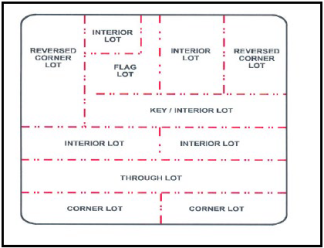
Lot Area shall mean the total horizontal, square footage area within the lot lines of a lot.
Lot, Corner shall mean a lot abutting upon two or more streets at their intersection or upon two parts of the same street and where, in either case, the interior angle formed by the intersection of street lines does not exceed 135 degrees.
Lot, Double Frontage shall mean a lot that runs through a block from street to street and which has two non-intersecting sides abutting on two or more streets. The required setbacks from each street shall comply with the zoning requirements of the respective district.
Lot, Flag shall mean a lot not meeting minimum frontage requirements and where the access to the public or private road is by a narrow private right-of-way or driveway, also known as a flagpole.
Lot Frontage see sections 21-11110 and 21-11115.
Lot, Interior shall mean a lot which is not a corner lot and has only one street frontage.
Lot Line see Property Line.
Lot Line Adjustment shall mean a change in lot or parcel boundaries that does not create additional lots or parcels.
Lot Pin shall mean a solid steel pin established to provide for the accurate location of platted property lines.
Lot of Record shall mean a lot that is part of an approved plat, the map of which has been recorded in the office of the Adams County Clerk and Recorder.
Lot, Reversed Corner shall mean a corner lot the side street of which is substantially a continuation of the front lot line of the first lot to its rear.
Lowest Floor shall mean the floor of the lowest enclosed area (including basement) in a structure. An unfinished or flood resistant enclosure, usable solely for parking or vehicles, building access or storage in an area other than a basement area is not considered a building's lowest floor; provided that such enclosure is not built so as to render the structure in violation of the applicable non-elevation design requirement of Section 60.3 of the National Flood insurance Program regulations.
Low Impact Development (LID) shall mean a comprehensive land planning and engineering design approach to managing stormwater runoff with the goal of mimicking the pre-development hydrologic regime. LID emphasizes conservation of natural features and use of engineered, onsite, small-scale hydrologic controls that infiltrate, filter, store, evaporate, and detain runoff close to its source. The term green infrastructure is used interchangeably with LID.
Machinery shall mean an assemblage of parts that transmit forces, motion, and energy one to another in a predetermined manner. This term shall also include a mechanically, or electronically operated device for performing a task.
Maintenance shall mean the routine recurring work required to keep a building, equipment, or commodity in such a condition that it may be continuously utilized at its original or designed capacity and efficiency for its intended purpose.
Major Road System shall mean all City-owned arterial roads in the Northern Range and Core City, which excludes interstates, state and federal highways, collector roads and local streets.
Mansard Roof shall mean a roof with at least two slopes on any side with the tower slope steeper than the upper one(s). The deck line is the top edge of the lower slope.
Manufacturing shall mean the process, assembly, fabrication, production, construction or other preparation of a raw material product or component part of a product to make, create or process towards or into a finished product. Products may be finished or semi-finished and are generally made for the wholesale market, for transfer to other plants, or to order for firms or consumers. Good are generally not displayed or sold on site, but if so, they are a subordinate part of sales.
Marijuana Business means any medical marijuana center, optional premises cultivation operation, medical marijuana-infused products manufacturer, retail marijuana store, retail marijuana cultivation facility, retail marijuana products manufacturer and retail marijuana testing facility.
Marijuana Membership Club shall mean an organization and its premises operating on a membership basis for the promotion of interests of the members including the smoking or other consumption of medical or retail marijuana or marijuana products.
Marquee shall mean a shelter projecting from and supported by the exterior wall of a building constructed of rigid materials on a supporting framework. A marquee is distinguished from an awning in that an awning is covered with non-rigid material. A marquee is distinguished from a canopy in that a marquee is cantilevered, whereas a canopy is supported by posts or other devices beyond the building wall.
Massage Therapy Facility shall mean a facility that is operated for the purpose of providing massages. This does not include any type of adult business.
Material Piles shall mean outdoor storage of loose materials in piles, e.g., construction aggregate piles (sand, gravel, crushed stone, recycled concrete or asphalt, etc.) and landscape material piles (topsoil, compost, mulch, etc.), in heights that exceed the limit allowed for regular outdoor storage. This definition specifically excludes scrap metal, salvage, garbage, debris, refuse, as well as any landfill approved by the city and the state of Colorado.
Material Recovery Resource Facility (MRRF) shall mean a facility used to collect, sort, and consolidate recyclable materials, including computers, paper, paperboard, glass, plastic, and aluminum, for use as raw material to produce new items at other locations, including interim facilities. This activity may include incidental storage, office, and maintenance facilities.
Maximum Extent Feasible shall mean that no feasible and prudent alternative exists, and that all possible efforts to comply with the regulation or minimize potential harm or adverse impacts have been undertaken. Economic considerations may be taken into account but shall not be the overriding factor in determining maximum extent feasible.
Mean Sea Level shall mean for purposes of the National Flood Insurance Program, the North American Vertical Datum (NAVD) of 1988 or other datum, to which base flood elevations shown on a community's Flood Insurance Rate Map are referenced.
Median shall mean that portion of a divided street or highway separating the traveled ways for traffic in opposite directions.
Medical Marijuana Business shall mean a medical marijuana center, optional premises cultivation operation, or medical marijuana-infused products manufacturer as defined in the Colorado Medical Marijuana Code.
Medical Marijuana Center shall have the meaning ascribed to it in state law.
Medical Marijuana Infused Product Manufacturer shall have the meaning ascribed to it by state law.
Message Hold Time (for signage) shall mean the time interval a static message must remain on the display before transitioning to another message.
Microbrewery shall mean an establishment where malt liquors are manufactured and packaged on or off premises, manufacturing more than 5,000 but less than 60,000 barrels of malt liquor on its licensed premises each calendar year.
Micro cell shall include "micro wireless facility" and shall be defined by C.R.S. 29-27-402(3.5) as currently exists and as may be amended from time to time.
Micro-winery shall mean a business that manufactures 5,000 to 10,000 cases of vinous liquors per year.
Mineral Estate Owner shall mean the owner or lessee of minerals located under a surface estate that are subject to an application for development.
Mining shall mean the development or extraction of a mineral from its natural occurrences on affected land. The term includes, but is not limited to: open mining and surface operation and the disposal of refuse from underground and in-situ mining. The term includes the following operations on affected lands: transportation concentration; milling; evaporation; and other processing. The term does not include: the exploration and extraction of natural petroleum in a liquid or gaseous state by means of wells or pipe or the extraction of geothermal resources.
Mini-Storage and Warehouse shall mean an establishment primarily offering individualized enclosed storage spaces for rent or lease to the general public, including self-storage and mini-storage facilities. This term excludes establishments where the primary use is outdoor vehicle storage.
Mixed-Use Development shall mean a single building containing more than one principal permitted land use or a single development of more than one building containing more than one principal permitted land use. In a mixed-use development, the different types of land uses are in close proximity, planned as a unified complementary whole, and functionally integrated to the use of vehicular and pedestrian access and parking areas.
Mobile Home shall mean any wheeled vehicle, exceeding 8 feet in width or 32 feet in length, including towing gear and bumpers, with or without motor power, built on a permanent chassis designed for residential occupancy, and containing complete electrical, plumbing, and sanitary facilities designed for installation in a permanent or semi-permanent manner without a permanent foundation that is capable of being drawn over public highways by a motor vehicle. Modular homes shall not be considered mobile homes. For the purpose of interpretation of this land development code, mobile home shall not include travel trailers, camping trailers, truck campers, and motor homes, as licensed and/or defined by the state of Colorado when used or designed to be used as a dwelling as provided in this definition.
Mobile Home Park shall mean a parcel of land which has been planned and approved for the placement of more than one mobile home, occupied for dwelling, sleeping, or storage purposes for transient and/or non-transient use and sometimes termed a trailer court, trailer camp, or trailer park.
Mobile Home Zoning District shall mean land within the corporate limits of the city that has been zoned for the use and operation of mobile homes and mobile home parks.
Model Home shall mean a dwelling representative of other dwellings offered for sale or lease, or to be built in an area of residential development within the city. A model home is used for the sole purpose of selling similar units within the same development and used for this purpose only until all developments are sold.
Modular Home shall mean a factory built home, other than a mobile home, which meets all of the following requirements: is designed only for erection or installation on a site-built permanent foundation; is not designed to be moved once so erected or installed; is designed and manufactured to comply with a nationally recognized model building code or an equivalent local code, or with a state or local modular building code recognized as generally equivalent to building codes for site-built housing. Such units shall provide all of the accommodations necessary to be a dwelling unit and shall be connected to all utilities in conformance with applicable regulations. The term modular home does not include a recreational vehicle.
Modular Non-Residential Unit shall mean a factory-built structure not built on-site, which is not designed for residential use or human habitation.
Monopole Tower shall mean a structure designed and constructed to support antenna or antennas for the purpose of providing telecommunications services and which consists solely of a stand-alone ground mounted support pole, pipe, or other solid structure. A monopole tower shall not include any tower supported or attached to guy or support wires. A monopole tower is not a lattice tower.
MS4 shall mean the municipal separate storm sewer system.
Mulch shall mean non-living matter, such as bark chips, chipped wood products, pole shavings, stone and any approved like-materials customarily used in landscape for the purpose of retaining soil-moisture, retarding weed growth, and stabilizing soils that are not artificially colored or uniformly sprayed with a tint.
Multi-Well Site shall mean, as it relates to Oil and Gas Operations, a common well pad from which multiple wells may be drilled to various bottomhole locations.
Museum shall mean a profit or non-profit, commercial or non-commercial establishment operated as a repository for a collection of nature, scientific, or literary curiosities, objects of interest, or works of art, not including the regular sale or distribution of the objects collected.
MUTCD shall mean the Manual of Uniform Traffic Control Devices.
NAICS shall mean the North American Industry Classification System as published by the U.S. Census Bureau.
Native Seed shall mean any live landscaping, including dryland grasses and vegetation, but not including weeds capable of growing in the local environment without supplementary watering once established.
Natural medicine shall have the meaning ascribed to it in Title 12, Article 170 of Colorado Revised Statutes.
Natural medicine cultivation facility shall have the meaning ascribed to it in Title 44, Article 50 of Colorado Revised Statutes.
Natural Medicine healing center shall have the meaning ascribed to [it] in Title 44, Article 50 of Colorado Revised Statutes.
Natural medicine manufacturer shall have the meaning ascribed to it in Title 44, Article 50 of Colorado Revised Statutes.
Natural medicine testing facility shall have the meaning ascribed to [it] in Title 44, Article 50 of Colorado Revised Statutes.
Non-Combustible shall mean a building construction material which, in the form in which it is used, is either one of the following:
(a)
Material of which no part will ignite and burn when subjected to fire; or
(b)
Material having a structural base of non-combustible material as defined in paragraph (a) above, with a surfacing material not over one-eighth inch thick, and a flame-spread rating of 50 or less.
Non-combustible does not apply to surface finish materials. Material required to be non-combustible for reduced clearances to flues, heating appliances, or other sources of high temperature shall refer to material conforming to paragraph (a) above. No material shall be classified as non-combustible which is subject to increase in combustibility or flame-spread rating beyond the limits herein established, through the effects of age, moisture, or other atmospheric conditions.
Nonconformity shall mean any use, sign, structure, building, or lot that was legally established prior to the effective date of this land development code or any subsequent amendment, but that fails by reason of such adoption, revision, or amendment, to conform to all the current requirements of this land development code.
Non-Site Related Improvements shall mean road capital improvements, excluding right-of-way dedications, for roads on the major road system in the Northern Range and Core City that are listed in the 2021 Road Impact Fee Study and that are not site-related improvements.
Non-Stormwater Discharge shall mean any discharge to the storm drain system that is not composed entirely of stormwater.
Nursery shall mean a retail establishment selling plants and garden supplies in which all merchandise other than plants is kept within an enclosed building or a fully screened enclosure, and fertilizer of any type is stored and sold in package form only. Stock in trade shall be comprised primarily of live plant material, with hardscape materials such as railroad ties, boulders, landscape gravel, and crushed rock limited to a relatively small percentage of sales.
Nursing Home shall mean a state-licensed group living facility regulated as a skilled nursing facility, as defined in C.R.S. § 26-4-103(11).
Obstruction shall mean any development, stockpile, refuse or matter in, along, across or projecting into any floodplain which might impede, retard or change the direction of a flow of water, either by itself or by catching or collecting debris carried by such floodwater.
Off-Street Loading shall mean a site or portion of a site that is not located in a dedicated public right-of-way devoted to the loading or unloading of motor vehicles or trailers, including loading berths, aisles, access drives, and landscaped areas.
Off-Street Parking shall mean an area, other than a street or alley, designed or used primarily for the temporary parking of vehicles.
Office shall mean establishments providing executive, management, administrative, or professional services, including medical or dental services, but not involving the sale of merchandise, except as incidental to a permitted use. Typical uses include real estate, insurance, property management, investment, employment, travel, advertising, law, doctor, dentist, out-patient medical laboratories, architecture, design, engineering, accounting, and similar offices.
Office Flex shall mean a type of development designed to be versatile, which may be used in combination with office (corporate headquarters), research and development, quasi-retail sales, wholesale operations, and including but not limited to craft manufacturing, warehouse, and distribution uses.
OGCC shall mean the Oil and Gas Conservation Commission.
Oil and Gas shall mean oil or gas, or both oil and gas.
Oil and Gas Facility shall mean equipment, buildings, structures, or improvements associated with or required for the operation of a well site, pipeline, or compressor facility. Facilities include, but are not limited to, Oil and Gas well facilities, Oil and Gas well sites, production facilities, production sites, treatment facilities, access roads, well pads, tank batteries, pits, flowlines, and gathering lines.
Oil and Gas Permit shall mean any permit issued by the City that allows an Operator to conduct Oil and Gas well operations
Oil and Gas Well shall mean a hole drilled into the earth for the purpose of exploring for or extracting oil, gas, or other hydrocarbon substances.
Oil and Gas Well Facility shall mean shall mean equipment or improvements used or installed at an Oil and Gas Well location for the exploration, production, withdrawal, gathering, treatment, or processing of oil or natural gas.
Oil and Gas Well Operations or Operation shall mean exploration for oil and gas, including the conduct of seismic operations and the drilling of test bores; the siting; drilling; deepening, completion recompletion, reworking, or abandonment of an oil and gas well or gas storage well; production operations related to any such well including the installation of flowlines and gathering systems; the generation, transportation, storage and treatment of oil and gas; any construction, site preparation, or reclamation activities associated with such operations; and any Oil and Gas well facility, Oil and Gas well site or location, production site or other facility, site or location upon or within which any of the foregoing are conducted, operated, installed, constructed, generated treated or located.
Oil and Gas Well Site shall mean a definable area where an Operator has disturbed or intends to disturb the land surface in order to locate an Oil and Gas well facility, and includes a "production site."
One-Hundred-Year Flood See Base Flood.
Operating Plan shall mean, as it relates to Oil and Gas Operations, a general description of a facility identifying purpose, use, typical staffing pattern, equipment description and location, access routes, seasonal or periodic considerations, routine hours of operating, source of services and infrastructure, and any other information related to regular functioning of that facility.
Operator shall mean, as it relates to Oil and Gas Operations, any person who exercises the right to control the conduct of oil and gas operations or applies for an Oil and Gas Permit.
Open Space shall mean any parcel or area of land or water essentially unimproved without any residential, commercial, or industrial uses and set aside, dedicated, or reserved for public or private use and enjoyment, including recreational, scenic, or environmental purposes. Open space may include agricultural uses and natural features located on a site, including, but not limited to:, meadows, forested areas, steep slopes, flood plains, hazard areas, unique geologic features, ridgelines, unique vegetation, and critical plant communities, stream corridors, wetlands, and riparian areas; wildlife habitat and migration corridors, areas containing threatened or endangered species, and archeological, historical, and cultural resources.
Optional Premises Cultivation Operation shall have the meaning ascribed to it by state law.
Ornamental Grass shall mean those types of grasses that grow in clumps and do not spread to form a continuous mat, as do turf-grasses. Bunch grasses and other, taller, more decorative types, may be considered ornamental grasses when grown as accents, in conjunction with other plants, in larger bed-plantings.
Ornamental Tree shall mean a tree, typically 15- to 20-feet tall at maturity, which is planted for its decorative value, perhaps in screening applications rather than for shading purposes. Ornamental trees are usually deciduous, but may include short-growing conifers such as upright junipers, pinion- and bristle-cone pines.
Outdoor Storage shall mean the placement of materials, merchandise, stock, supplies, shipping containers, mobile storage containers, machines, operable vehicles, equipment, manufacturing materials, or chattels of any nature that are not kept in a structure having at least four walls and a roof, for a continuous period of 24 hours or more. Outdoor storage shall not include:
(i)
Items for the general public such as new and used cars, recreational vehicles, boats, landscape stock or related materials, or rental automobiles where such items are permitted for sale in the district in which they are located;
(ii)
Outdoor parking of motor vehicles regularly used in connection with the operation of an establishment or parked for less than 48 hours for maintenance;
(iii)
The storage of wrecked or inoperable vehicles.
Overlay Zoning District shall mean a zoning district superimposed over the underlying zoning district which places further restrictions upon land uses. Developments within the overlay zoning district shall conform to the requirements of both zones.
Owner shall mean any person with fee title to the parcel of land or with a contract to obtain fee title to the parcel of land.
Parapet shall mean an extension of the main walls of a building above the roof level, often used to shield or screen roof top mechanical equipment and vents.
Parcel shall mean a plot of land of any size that may or may not be subdivided or improved.
Park, Public shall mean a public-owned parcel of land, with or without improvements, set apart for the recreation of the public.
Park, Private shall mean land within or related to a development, not individually owned or dedicated for public use but generally owned and maintained by a homeowner's association, that is designed and intended for the common use or enjoyment of the residents of the development and their guests, and may include such complementary structures and improvements as are necessary and appropriate. Private parks may include trail areas, gardens, scenic areas, buffer areas, pools, tennis courts, playgrounds, and clubhouses.
Parking Area shall mean a site or portion of a site devoted to the parking of motor vehicles including parking spaces, aisles, access drives, and landscaped areas.
Parking Garage shall mean a permanent structure that is enclosed on all four sides and consists of one or more levels and is primarily dedicated to providing temporary parking or storage of operable vehicles to the general public, regardless of whether or not there is a fee.
Parking Lot shall mean an area used for the purpose of temporary, daily, or overnight storage of vehicles, which is not located in a dedicated public right-of-way, a travel lane, a service drive, or any easement for public ingress or egress.
Parking, Shared shall mean joint use of a parking lot or area for more than one principal use.
Pawnshop shall mean a retail sales establishment where a pawnbroker regularly engages in or solicits business.
Pennant shall mean a triangular, square or rectangular shaped flag attached in a string-type manner.
Percent New Trips Factor means the percentage of peak hour trips that a proposed use will generate that constitutes new or additional trips added to the major road system in the Northern Range and Core City. Those trips that do not represent additional trip ends shall not be counted as new or additional trips. Pass-by trips and diverted-link trips do not constitute new trips.
Perimeter Control shall mean a barrier that prevents sediment from leaving a site by filtering sediment-laden runoff or diverting it to a sediment trap or basin.
Permitted Use shall mean a use allowed in a zoning district either as a Use-by-Right, a Use-by Permit, or as a Conditional Use.
Pit shall mean, as it relates to Oil and Gas Operations, a subsurface earthen excavation (lined or unlined), or open top tank, used for oil or gas exploration or production purposes for retaining or storing substances associated with the drilling or operation of oil and gas wells. Pits may include drilling pits, production pits, reserve pits and special purpose pits as defined in COGCC Rules.
Plane shall mean any vertical surface, or the projection to a vertical plane of an inclined or curved surface, or wall of a structure that when viewed in elevation, incorporates no overhangs, off-sets, projections, decks, ramadas, loggias, or similar architectural features that would produce shadow patterns or otherwise serve to visually blend the structure into its natural background. If a window or door projects or recedes a minimum of 12 inches, either may be considered as providing visual relief.
Planned Unit Development (PUD) shall mean a zone district designation for a tract of land controlled by one or more landowners, which is developed under a plan for either residential, commercial/retail, industrial, public, agricultural, open space or recreational uses, or a combination thereof.
Plat shall mean a map that defines the subdivision of land and commonly shows lots, blocks, streets, and other features relevant to the development of the property.
Plaza shall mean an open space that may be improved and landscaped, usually surrounded by streets or buildings.
Plugging and Abandonment shall mean, as it relates to Oil and Gas Operations, the cementing of a well, the removal of its associated production facilities, the removal or abandonment in-place of its flowline, and the remediation and reclamation of the well site.
Pole, for the purposes of telecommunications contexts, shall include "pole structure" and "tower" and shall be defined by C.R.S. 29-47-402(6.5) as currently exists and as may be amended from time to time.
Pole Construction shall mean a type of construction for a building that is typically used for the storage of equipment, materials, product, livestock, or crops and is usually constructed of wooden or metal support poles and beams which serve as the primary support for the roof and walls.
Pollutant shall mean and include, but not limited to, paints, varnishes, solvents; oil and other automotive, non-hazardous liquid, solid wastes, and yard wastes; refuse, rubbish, garbage, litter, or other discarded or abandoned objects; floatables; pesticides, herbicides and fertilizers; hazardous substances or wastes; sewage, fecal coliform and pathogens; dissolved and particulate metals; animal wastes; wastes and residues that result from construction of a building or structure; and noxious or offensive matter of any kind.
Porch shall mean a covered or uncovered entrance with vertical supporting members on a foundation, not including walls.
Premises shall mean any building, lot, parcel of land, or portion of land, whether improved or unimproved, including adjacent sidewalks and parking strips.
Primary Caregiver shall have the same meaning as that ascribed to it in C.R.S. § 25-1.5-106(2)(d.5).
Primary or Principal Entrance shall mean the place of ingress and egress used most frequently by the public.
Principal or Primary Use shall mean a use of property or a building that is the predominant or general use. This term shall also mean the use that would regularly encompass, at a minimum, 75 percent of the floor space of a building.
Private Bus Station shall mean any premise used for the loading and unloading of passengers on non-governmental motor driven buses. The premise may also include ticket purchasing facilities or the storage or parking of buses.
Private Road shall mean every road or driveway not owned by the city.
Processing shall mean subjecting to some special treatment, to prepare for the market, to convert into marketable form, to make usable, marketable, or the like.
Production shall mean the making of goods available for human wants.
Production Site shall mean, as it relates to Oil and Gas Operations, the surface area immediately surrounding proposed or existing production equipment, or other accessory equipment necessary for oil and gas production activities, exclusive of transmission and gathering pipelines.
Property Line shall mean the legally described boundary line that indicates the limits of a parcel, tract, lot, or block for the purpose of delineating ownership and setback requirements.
Property (or Home) Owners' Association shall mean a private, non-profit corporation or property owners for the purpose of owning, operating, and maintaining various common properties and facilities (except that as this definition relates to a condominium project, the property owners' association does not own the common property/facilities, it operates and maintains them on behalf of the condominium owners).
Public shall mean for the benefit of, or devoted to, the people as a whole or the community at large.
Public Building shall mean any building held, used, or controlled exclusively for public purposes by any governmental entity, without reference to the ownership of the building or of the realty upon which it is situated.
Public Hearing shall mean a meeting that is noticed in accordance with the terms of this land development code and at which the public is given an opportunity to speak.
Public Improvements shall mean rights-of-way, easements, access rights, and physical improvements that are accepted by the city in writing and that become the responsibility of the city for ownership, maintenance, and repair. Unless otherwise provided by this land development code, public improvements include by are not limited to the following: curb and gutter;, asphalt pavement, concrete pavement, streets of all types, alleys, survey monuments, pavement striping, sidewalks, pedestrian/bike paths and trails, landscaping, traffic signals, street lights, highways, greenways, medians, bridges, acceleration and deceleration lanes, culverts, storm drainage facilities including necessary structures, channels, and all other improvements, which upon acceptance by the city, are intended to be for the use of and enjoyment of the public.
Public Notice shall mean the advertisement in a newspaper, posting of the property, and/or the mailing of written notice.
Public Sewer and Water Facilities shall mean those sewer and water facilities of a municipality or special district authorized by Title 32 of the Colorado Revised Statutes.
Public Utility shall mean improvements, which include gas lines, water mains, sanitary storm sewerage, electrical cables and lines, telephone cables and lines, telecommunication facilities and lines, or other facilities of a similar nature.
PUD - see Planned Unit Development.
PUD Concept Schematic shall mean a generalized land use or site plan for an area proposed to be included within a PUD district.
PUD Permit shall mean the permit which contains a detailed plan for either all or a portion of a planned unit development which authorizes the applicant to apply for a building permit.
PUD Zone Document shall mean the PUD land use application which establishes entitlements for property including allowable land use and bulk standards.
Railroad Right-of-Way shall mean a strip of land with tracks and auxiliary facilities for track operation, but not including freight depots or stations, loading platforms, train sheds, warehouses, car or locomotive shops, or car yards.
Railroad Yard shall mean an area used for storage by an establishment engaged in rail services.
Reclamation shall mean, as it relates to Oil and Gas Operations, the process of returning or restoring the surface of disturbed land as nearly as practicable to its condition prior to the commencement of oil and gas operations or to landowner specifications.
Recreation or Amusement, Private shall mean any use or development providing amusement, pleasure, or sport, which is not operated or owned by a governmental entity and is operated or carried on primarily for financial gain.
Recreation or Amusement, Public shall mean any use or development providing amusement, pleasure, or sport, which is owned or operated by a governmental entity.
Recreational Vehicle shall mean a vehicle that is:
(i)
Built on a single chassis;
(ii)
Four hundred-square feet or less when measured at the largest horizontal projections;
(iii)
Designed to be self-propelled or permanently towable by a light duty truck; and
(iv)
Not designed primarily for use as a permanent dwelling but as temporary living quarters for recreational, camping, travel, or seasonal use.
Refuse Transfer Facilities shall mean any facility that accepts garbage, trash, rubbish, debris and other types of discarded or waste materials for the purposes of collection, temporary storage, or transfer to other locations for disposal.
Regional Drainage Improvements shall mean those improvements identified in the masterplans and reports identified in Section 3.2 of the City of Commerce City - Drainage Impact Fee Study, prepared by RESPEC dated April 15, 2022.
Religious Institution shall mean a use category comprised of structures or places in which worship, ceremonies, rituals, and education pertaining to a particular system of beliefs are held, together with its accessory buildings and uses (including buildings used for educational and recreational activities), operated, maintained, and controlled under the direction of a religious group. Accessory uses include school facilities, parking, caretaker's housing, pastor's housing, and group living facilities such as convents. Examples include churches, temples, synagogues, and mosques.
Remediation shall mean, as it relates to Oil and Gas Operations, the process of reducing the concentration of a contaminant or contaminants in water or soil to the extent necessary to ensure compliance with the concentration levels in COGCC Table 910-1 and other applicable ground water laws, standards and classifications.
Rental Services shall mean a retail establishment that rents to the general public merchandise, such as furniture, appliances, and similar goods that are housed inside a building.
Repair shall mean the non-routine process of restoring by replacing a part or putting together what is torn or broken. This term shall also mean the non-routine process of restoring to a sound and serviceable state through correction of a specific failure or unserviceable condition.
Repair and Normal Maintenance shall mean with regard to a nonconforming structure or portion or a structure containing a nonconforming use, work done during any 1-year period on ordinary repairs, or on repair and replacement of nonbearing walls, fixtures, wiring or plumbing to an extent not exceeding ten10 percent of the current replacement cost of the nonconforming structure, or portion of structure, and provided that the cubic content existing when it became nonconforming is not increased.
Replacement Mobile Home shall mean a mobile home unit entering any mobile home park within the city; and any mobile home that is moved to another space within the mobile home park.
Research, Development, Testing Laboratories shall mean research, development, and testing laboratories that do not involve the mass manufacture, fabrication, processing or sale of products. Such uses shall not violate any odor, dust, smoke, gas, noise, radiation, vibration, or similar pollution standards as specified herein.
Residential, Multi-Family shall mean a dwelling or dwellings, or portion thereof, designed for or occupied by three or more families living independently of each other. Multi-family dwelling includes townhouse dwellings, and condominium or apartment buildings in which the individual dwelling units are typically located one over the other.
Residential, Single-Family shall refer to single-family attached and single-family detached dwellings, collectively.
Residential, Single-Family Attached shall mean a dwelling containing two attached dwelling units, located side-by-side and totally separated from each other by an unpierced wall extending from ground to roof designed exclusively for occupancy by two families living independently of each other.
Residential, Single-Family Detached shall mean a detached (freestanding and surrounded on all sides by open areas or yards) dwelling designed exclusively for occupancy by one family.
Restaurant shall mean an establishment where the principal business is the sale of food and beverages in a ready-to-consume state where fermented malt beverages, malt, special malt, and vinous and spirituous liquors may be produced on the premises as an accessory use. See also Fast-Food Restaurant.
Retail Establishment shall mean establishments that sell, lease, or rent consumer, home, and business goods, but excluding merchandise/retail uses classified or defined more specifically in this land development code (e.g., convenience stores and restaurants). Typical uses include department stores, furniture stores, clothing stores, and establishments providing the following products or services: antiques, art, art supplies, bicycles, clothing, dry goods, electronic equipment, fabric, furniture, garden supplies, gifts, hardware, home improvements, household products, jewelry, pet food, pharmaceuticals, printed material, sporting goods, stationary, and videos; and new automotive parts and accessories (excluding service and installation).
Retail Marijuana Code means title 12, article 43.4 of the Colorado Revised Statutes, as amended from time to time, and any rules or regulations promulgated thereunder.
Retail Marijuana Cultivation Facility shall have the meaning ascribed to it by state law.
Retail Marijuana Product Manufacturer shall have the meaning ascribed to it by state law.
Retail Marijuana Store shall have the meaning ascribed to it by state law.
Retail Marijuana Testing Facility shall have the meaning ascribed to it by state law.
Retaining Wall shall mean a structure designed to resist the lateral displacement of soil or other materials in order to protect property and/or prevent erosion.
Right-of-Way shall mean land devoted to or over which people and goods have the right to pass or travel (e.g., roads, streets, pedestrian walkways, bicycle paths and alleys).
Road Capital Improvement shall mean include transportation planning of, preliminary engineering, engineering design studies, land surveys, alignment studies, engineering, permitting, and construction of all necessary features for any road construction project on an arterial road on the major road system, undertaken to accommodate traffic resulting from new traffic-generating land development activity. Road capital improvements shall include but not be limited to: (a) construction of new through lanes, (b) construction of new bridges, (c) construction of new drainage facilities in conjunction with new road construction, (d) purchase and installation of traffic signals, including new and upgraded signalization, (e) construction of curbs, gutters, sidewalks, medians and shoulders, (f) the construction of turn lanes at intersections, and (g) the widening of existing roads.
Road Impact Fee Study shall mean a study prepared for and on behalf of the city to determine road impacts generated by new development.
Roadside Stand shall mean a temporary structure used primarily to sell products produced on the property.
Roadway shall mean that portion of a street or highway improved, designed, or ordinarily used for vehicular travel, including the shoulder.
Roofline (for signage) shall mean the highest point on any building where an exterior wall encloses usable floor space, including floor area for housing mechanical equipment. The term "roofline" also includes the highest point on any parapet wall, providing such parapet wall extends around the entire perimeter of the building.
Salvage Yard shall mean a building, structure, parcel of land, or portion thereof, where two or more motor vehicles not in running condition, or parts thereof, are stored in the open and are not being restored to operation; or any land, building, or structure used for wrecking or storing of such motor vehicles or farm machinery, or parts thereof, stored in the open and not being restored to operating condition.
School, Commercial shall mean a structure or group of structures where instruction is given to pupils in arts, religion, crafts, philosophy, or trades, and is operated as a commercial enterprise.
Scrap Yard shall mean an establishment where materials are collected in bulk quantities for use as raw material to produce new items at other locations, or dismantled for wholesale use or direct sale to the public. This classification excludes collection of household recyclable materials and vehicle salvage.
Scrap Tire means a tire that is no longer used for its original purpose.
Screening shall mean a method of visually shielding or obscuring one abutting or nearby structure or use from another by fencing, walls, berms, or densely planted vegetation.
Sediment Control shall mean BMPs that prevent eroded sediment from leaving the site.
Seismic Operations shall mean, as it relates to Oil and Gas Operations, all activities associated with acquisition of seismic data including but not limited to surveying, shothole drilling, recording, shothole plugging and reclamation.
Semi-Trailers - see Trailer
Sensitive Area shall mean, as it relates to Oil and Gas Operations, an area vulnerable to potential significant adverse groundwater impacts, due to factors such as the presence of shallow groundwater or pathways for communication with deeper groundwater; proximity to surface water, including lakes, rivers, perennial or intermittent streams, creeks, irrigation canals, and wetlands.
Service Lateral shall mean the electrical, communications, cable television wiring, coaxial, or fiber optic or other utility line connections between the provider's distribution system and system termination at the point of consumer use.
Service Station shall mean any building, land area, or other premises used for the retail dispensing or sales of vehicular fuels; minor towing, servicing, and repair of automobiles and light trucks; and including as an accessory use the sale and installation of lubricants, tires, batteries, and similar vehicle accessories. Body and fender work, transmission work, engine overhaul work, or heavy truck or vehicle repair are excluded from this use. If a use that fits this definition also includes the sale of ready-to-eat food products (not intended for on-premises consumption), groceries and sundries, or 3.2 beer, such use shall be classified as a convenience store as provided above.
Setback shall mean the distance from a lot line to the closest projection of a building or structure along such line.
Figure XI-5. Setback Example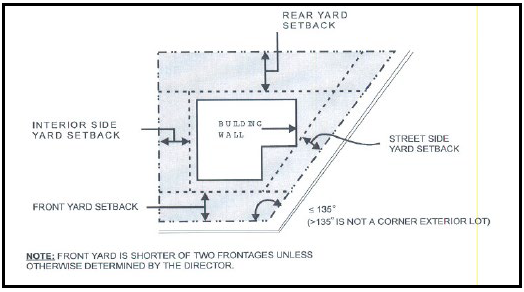
Shade Structure shall mean gazebos, arbors, or pergolas that are not attached to a principal structure but may be attached to an accessory structure. Shade structure shall not include carports.
Shade Tree shall mean a tree, over 15- to 20-feet tall at maturity, that is deciduous and planted for its wider canopy, higher bottom-branch scaffold and shading value, and does not include conifers or evergreens of any kind.
Short-Term Rental means the provision of lodging services within a single-family attached or detached dwelling unit, for compensation, to a person or persons for periods of less than 30 days, but excludes Bed and Breakfast Establishments and other Lodging Establishment uses. Short-term rental does not include rental of a dwelling unit for meetings such as luncheons, banquets, parties, weddings, fundraisers, or other similar gatherings for direct or indirect compensation.
Shrub shall mean a long-lived deciduous, evergreen, or coniferous woody plant, typically multi-stemmed and having a mature height of between 3 and 15 feet and does not include perennials.
Sidewalk shall mean that portion of a public right-of-way adjacent to lateral property lines intended for the use of pedestrians.
Sidetracking shall mean entering the same well head from the surface, but not necessarily following the same well bore, throughout its subsurface extent when deviation from such well bore is necessary to reach the objective depth because of an engineering problem.
Sight Triangle shall mean a triangular-shaped portion of land established at street intersections in which nothing is erected, placed, planted, or allowed to grow in such a manner as to limit or obstruct the sight distance of motorists entering or leaving the intersection.
Sign shall mean any advertising device, announcement, direction, or communication produced in whole or in part by the construction, erection, affixing or placing of a structure on any land or on any other structure, or produced by painting on or posting or placing any painted, lettered, pictured, figured or colored material on any building, structure or surface.
Sign Copy shall mean the words, message, logo, symbols, figures or images on a sign.
(i)
Copy area shall mean the area that encloses the words, message, logo, symbols, figures or images on a sign.
(ii)
Copy change shall mean replacement or alteration to any portion of a sign that includes copy. This includes any change that alters the script, size, color or arrangement of copy on a sign face, or replacement of a sign face. This does not include any change to manual changeable copy, such as menu boards.
Sign Height shall be the vertical distance from established grade at the base of the sign to the highest element or the uppermost point on the sign or sign structure.
Sign Program shall mean a design package that identifies a coordinated project theme of uniform design elements for all signs associated with a building, including color, lettering style, material, and placement.
Sign, Sandwich Board shall mean a non-wheeled movable advertising or business ground side constructed in such a manner as to form an "A" or a tent-like shape, hinged or not hinged at the top, with each angular face held at an appropriate distance by a supporting member.
Sign, Abandoned shall mean a sign, including sign face and supporting structure, which is unsafe, constitutes a hazard to safety or health by reason of inadequate maintenance, dilapidation or obsolescence and/or is not kept in good repair; or which contains no sign copy on all sign faces for a continuous period of three months. For purposes of this definition, an historic sign is not an abandoned sign.
Sign, Awning shall mean a sign painted or printed on, or otherwise permanently attached flat against the surface of an awning.
Sign, Cabinet shall mean a sign structure consisting of the frame and face(s), not including the internal components, embellishments or support structure.
Sign, Canopy shall mean a sign permanently affixed to a roofed shelter covering a sidewalk, walkway, driveway or other similar area which shelter may be wholly supported by a building or may be wholly or partially supported by columns, poles or braces extended from the ground.
Sign, Display shall mean a sign either 1) mounted on a building wall oriented to pedestrians, or 2) a freestanding sign oriented to occupants of a vehicle in a drive aisle.
Sign, Electronic Message Center shall mean a sign capable of displaying words, symbols, figures or images that can be electronically or mechanically changed by remote or automatic means.
Sign, Fabric shall mean any temporary sign, banner, pennant, valance or advertising display constructed of cloth, canvas, fabric or other light material, with or without frames, which is not permanently fixed to a supporting structure.
Sign Face shall mean the exterior surface of a sign (including non-structural trim) upon, against, or through which a message is displayed or illustrated, excluding the necessary supports or uprights on which such sign is placed.
Sign, Free-Standing shall mean any permanent single- or double-faced sign affixed to a freestanding supporting pole, or poles, or structure, imbedded in, and extending upward from the ground.
Sign, Handheld shall mean a temporary sign held, suspended or supported by an individual. Handheld signs do not include handheld signs utilized for traffic control or safety purposes. Also known as a human directional, sign spinner or sign twirler sign.
Sign, Illuminated shall mean a sign designed to give forth any artificial light or reflect such light from an artificial source.
Sign, Incidental shall mean a small sign affixed to a residential or non- residential building or structure, machine, equipment, fence, gate, wall, gasoline pump, public telephone, or utility cabinet.
Sign, Directional shall mean any sign that is designed and erected for the purpose of providing direction and/or orientation for pedestrian or vehicular traffic.
Sign, Inflatable shall mean a balloon, blimp or other inflated object used for attracting attention.
Sign, Kiosk shall mean a small structure, typically located within a pedestrian walkway or similar circulation area, and intended for use as a display space for posters, notices, exhibits, etc.
Sign, Marquee shall mean any sign made a part of a marquee and designed to have changeable copy.
Sign, Monument shall mean a permanent freestanding sign supported by, or integrated into, a base or pedestal at least two-thirds the dimension of the width and thickness of the sign it supports.
Sign, Off-Premise shall mean a sign advertising goods or services not provided on the property upon which the sign is located.
Sign, Permanent shall mean any sign constructed of durable materials and affixed, lettered, attached to or placed upon a fixed, non-movable, nonportable supporting structure.
Sign, Pole or Pylon shall mean a permanent sign supported by one or more poles or pylons.
Sign, Projecting shall mean a double-faced sign attached perpendicular to the wall of a building or structure which projects over private or public property.
Sign, Site shall mean a temporary freestanding sign constructed of vinyl, plastic, wood or metal and designed or intended to be displayed for a limited period of time on a site with an active listing for sale or for rent, or on properties with active building permits, e.g., a construction site.
Sign, Temporary shall mean any sign based upon its materials, location and/or means of construction, e.g., light fabric, cardboard, wallboard, plywood, paper other light materials, with or without a frame, intended or designed to be displayed for a limited period of time.
Sign, Traffic Control shall mean a sign erected in a public right-of way by an authorized governmental agency for the purposes of traffic regulation and safety.
Sign, Vehicle shall mean a sign that is printed, painted upon or attached to motor vehicles, including semi-truck trailers, used primarily for the delivery of products, passengers or services or for business purposes other than as a sign.
Sign, Wall shall mean any sign painted on or affixed to the wall of a building, or any sign consisting of cut-out letters or devices affixed to a wall with no background defined on the wall in such a manner that the wall forms the background surface of the sign.
Sign, Window shall mean any sign which is applied or attached to either the interior or exterior of a window and intended to be viewed from outside the building or structure.
Sign, Yard shall mean a temporary freestanding sign constructed of paper, vinyl, plastic, wood, metal or other comparable material, and designed or intended to be displayed for a limited period of time on a lot with one or more existing permanent structures.
Site Plan shall mean the proposed layout of a lot showing all elements of the site development as well as utility and drainage lines, and existing and proposed buildings, structures, trees, and vegetation.
Site Specific Development Plan shall mean any of the following applications, if designated by the applicant as a site specific development plan for the establishment of vested property rights according to C.R.S. § 24-68-103, when approved by the city. The site-specific development plan shall describe with reasonable certainty the type and intensity of use proposed for a specific parcel or parcels of property. Site specific development plans include the following:
(i)
Final plats;
(ii)
Development plans; or
(iii)
Final PUD development permits.
Small cell shall include "small cell facility" and shall be defined by C.R.S. 29-27-402(4) as currently exists and as may be amended from time to time.
Small Wind Energy Conversion System (Windmill) shall mean any mechanism, including blades, rotors, or other moving surfaces, designed for the purpose of converting wind energy into mechanical or electrical power. For purposes of this land development code, also included are towers, tower bases, guy wires, and any other structures necessary for installation of a small wind energy conversion system.
Solar Energy Collection System shall mean any mechanical device or structure used to collect, transfer, and/or store solar radiant energy generally including, but not limited to, the following: solar collectors, Trombe walls, greenhouses, or other devices, but not including south facing windows in which solar radiant energy does not reach an acceptable storage medium.
Solid Waste shall mean any garbage, refuse, or sludge from a waste treatment plant, water supply treatment plant, air pollution control facility, or other discarded material; including solid, liquid, semisolid, or contained gaseous material resulting from industrial operations, commercial operations, or community activities. Solid waste does not include any solid or dissolved materials in domestic sewage, or agricultural wastes, or solid or dissolved materials in irrigation return flows, or industrial discharges which are point sources subject to permits under the provisions of the Colorado Water Quality Control Act, Title 25, Article 8, C.R.S. or materials handled at facilities licensed pursuant to the provisions on Radiation Control Act in Title 25, Article 11, C.R.S. Solid Waste does not include: (1) materials handles at facilities licensed pursuant to the provisions on radiation control in Article 11 of Title 25, C.R.S.; (2) excluded scrap metal that is being recycled; or (3) shredded circuit boards that are being recycled.
Solid Waste Disposal shall mean the storage, treatment, utilization, processing, or final disposal of solid wastes.
Solid Waste Disposal Site shall mean the location at which the deposit and final treatment of solid wastes occur.
Special Flood Hazard Area shall mean that area designated on the flood insurance rate map as subject to a one percent or greater chance of flooding in any given year.
Stabilization shall mean the use of practices that prevent exposed soil from eroding.
Standard Zoning Districts shall mean the following zoning districts, and shall be collectively referred to as standard zoning districts.
(i)
AG
(ii)
R-1
(iii)
R-2
(iv)
R-3
(v)
R-4
(vi)
R-U
(vii)
C-1
(viii)
C-2
(ix)
C-3
(x)
MU-1
(xi)
I-1
(xii)
I-1S
(xiii)
I-2
(xiv)
I-3
(xv)
PUBLIC
(xvi)
MHP
Stone shall mean any rock material that may fall under further subclassification such as river rock, cobble, flagstone, boulders, and others contained in the Approved Plant List and Landscaping Specifications document. Any stone material used in landscape applications must be of at least ¾-inch diameter or cross-section. Squeegee and road-base are not acceptable materials within the definition of stone.
Storm Drainage System shall mean facilities by which stormwater is collected or conveyed including, but not limited to, any roads with drainage systems, municipal streets, gutters, curbs, inlets, piped storm drains, pumping facilities, retention and detention basins, natural and human-made or altered drainage channels, reservoirs, or other drainage structures.
Stormwater shall mean any runoff consisting entirely of water from any form of natural precipitation.
Stormwater Management Plan (SWMP) shall mean a document which described the best management practices and activities to be implemented by a person or business to identify sources of discharges to stormwater, stormwater conveyance systems and/or receiving waters to the maximum extent practicable.
Street shall mean a dedicated public or non-dedicated private thoroughfare that affords the principal means of access to abutting property.
Structure shall mean that which is built or constructed, an edifice or building of any kind, or any piece of work artificially built up or composed of parts joined together in some definite manner.
Subdivision shall mean the division by plat of a lot, tract, or parcel of land. The term shall also include and refer to any division of land subdivided or platted prior to the effective date of this land development code.
Substance Abuse Treatment Facility, Inpatient Residential shall mean structures and land used for the treatment of alcohol or other drug abuse where one or more patients are provided with care, meals, and lodging.
Substance Abuse Treatment Facility, Outpatient Clinic shall mean structures and land used for the treatment of alcohol or other drug abuse where neither meals nor lodging is provided.
Substantial Improvement shall mean any reconstruction, rehabilitation, addition, or other improvement of a structure, the cost of which equals or exceeds 50 percent of the market value of the structure before the start of construction of the improvement. This term includes structures which have incurred substantial damage, regardless of the actual repair work performed. The term does not, however, include either:
(i)
Any project for improvement of a structure to correct existing violations of state or local health, sanitary, or safety code specifications identified by the building official and that are the minimum necessary to assure safe living conditions; or
(ii)
Any alteration of a historic structure, provide that the alteration will not preclude the structure's continued designation as a historic structure.
Substation shall mean any facility designed to provide switching, voltage transformation, or voltage control required for the transmission of electricity at 115 kilovolts or more, and any addition thereto increasing the existing design capacity.
Subsurface Disposal Facility shall mean a facility or system for disposing of water or other oil field wastes into a subsurface reservoir or reservoirs.
Surety shall mean any form of security, including cash deposit, surety bond, property, or instrument of credit in an amount and form satisfactory to the director.
Survey Monument shall mean metal pin monuments located in the ground at all points on streets, alleys, or boundary lines where there is a change in direction or curvature.
Tank shall mean, as it relates to Oil and Gas Operations, a stationary vessel that is used to contain fluids, constructed of non-earthen materials (e.g., concrete, steel, plastic) that provide structural support.
Tasting Room shall mean an area devoted to the sampling, and sales thereof, of wine or beer produced on or off premises.
Telecommunication Facility shall mean any facility established for the purpose of providing wireless transmission of voice, data, images or other information including but not limited to cellular telephone service, personal communication service, and paging service for any reason other than communicating with employees of that particular business. A telecommunication facility can consist of one or more antennas and telecommunication accessory equipment.
Telecommunication Facility, Accessory Equipment shall mean equipment, including buildings and cabinets, used to protect and enable operation of radio switching equipment, back-up power and other devices, but not including antennas that are necessary for the operation of a telecommunication facility.
Telecommunication Facility, Concealed shall mean any monopole or building mounted telecommunications facility that blends into the surrounding environment in a visually unobtrusive manner through disguise as a non-telecommunications structure or architectural feature.
Temporary shall mean a period of time under one year, unless otherwise specified in this land development code.
Temporary Use shall mean a use established for a fixed period of time with the intent to discontinue such use upon the expiration of the time period.
Tire Store shall mean a business where the principal use is the sale or installation of new, used, or retread tires or tubes. Any land or structures with a primary or principal use of tire collection, reduction, or transfer shall not be considered a tire store.
Tower shall mean any structure that is designed and considered primarily for the purpose of supporting one or more antennas, including self supporting lattice towers, guy towers, or monopole towers. The term includes radio and television transmission towers, microwave towers, common carrier towers, cellular telephone towers, alternative tower structures, and the like.
Tower, Lattice shall mean a tower or structure designed and constructed primarily to support antenna or antennas and comprised of interconnected poles, pipes, bars, beams, strips, wires or cross-members. A lattice tower shall include any type or form of tower that incorporates guy or supporting wires. A lattice tower is not a monopole tower.
Towing services shall mean the business of transporting, towing, or recovering with a wrecker, tow truck, rollback or car carrier any vehicle not owned by the operator of the wrecker, tow truck, rollback or car carrier for which the operator directly or indirectly receives compensation or other personal gain.
Townhouse shall mean a specific type of multi-family dwelling in which individual dwelling units are attached by one or more party walls, with the habitable spaces of different dwelling units arranged on a side-by-side, rather than a stacked, configuration. For the purposes of this land development code, a single-family attached dwelling is not considered a townhouse.
Tractor Trailer shall mean the vehicle formed by combining a trailer and a truck-tractor.
Tract shall mean a unit of subdivided land not occupied or designed to be occupied by a primary building, such as open space or drainage.
Traffic-Generating Development shall mean any development that increases the volume of vehicular traffic generated in a prescribed area, which can be directly attributed to a particular development.
Trail shall mean a publicly or privately owned or maintained trail/path system open to the public, intended for non-motorized transportation such as walking, jogging or biking, including trailheads. Trailheads may include parking lots, drinking fountains, restrooms, picnic shelters, and related signage and monumentation.
Trailer (including semi-trailers) shall mean a non-motorized vehicle that is pulled by a motorized vehicle for the purpose of transporting equipment, commodities, or for similar purposes.
Transfer Facility shall mean a facility or site at which the exchange or deposit of material is made for ultimate transfer and disposal elsewhere.
Transition Duration (for signage) shall mean the time interval it takes the display to change from one complete static message to another complete static message.
Transition Method (for signage) shall mean a visual effect applied to a message to transition from one message to the next. Transition methods include:
i.
Dissolve—A frame effect accomplished by varying the light intensity or pattern, where the first frame gradually appears to dissipate and lose legibility simultaneously with the gradual appearance and legibility of the second frame.
ii.
Fade—A frame effect accomplished by varying the light intensity, where the first frame gradually reduces intensity to the point of not being legible (i.e. fading to black) and the subsequent frame gradually increases intensity to the point of legibility.
Transportation Terminals shall mean a facility for the receipt, transfer, short-term storage, and dispatching of goods transported by truck. Unlike Distribution Centers, these establishments commonly utilize a cross-dock facility and may also include the accessory uses of warehouse, storage or parking or trucks awaiting cargo, as well as facilities for the light servicing of trucks. Included in this definition would be express and other mail and package distribution facilities, including such facilities operated by the U.S. Postal Service, other than a traditional post office.
Treatment Facilities shall mean, as it relates to Oil and Gas Operations, any plant, equipment or other works used for the purposes of treating, separating or stabilizing any substance produced from a well.
Tree Lawn shall mean a landscaped strip of land located between the curb line, or lateral line of the roadway, and the front edge of a sidewalk.
Trip shall mean a one-way movement of vehicular travel from an origin (one trip end) to a destination (the other trip end).
Truck shall mean a motorized vehicle of greater than one-ton carrying capacity with two or more axles, including tractor-trailer combinations and buses; or any vehicle equipped with a body designed to carry property over the public highways and generally and commonly used for such transport of cargo rather than passengers. This term shall also include truck-tractors, trailers, semi-trailers when used in combination, but excludes two-axle, four-tired vehicles that may be classified as a truck for registration purposes, but which have operating characteristics similar to those of a passenger car.
Truck Repair shall mean the process or operation of repairing trucks, including major work on engines or transmissions.
Truck Stop shall mean any property on which a business involving the maintenance, servicing, storage or repair of commercial vehicles of greater than 15,000 gross vehicle weight (GVW) is conducted, including the dispensing of motor fuel or other petroleum products directly into motor vehicles; and the sale of accessories or equipment for such commercial vehicles. A truck stop may also include overnight accommodations and restaurant facilities.
Truck, Trailer Sales and Service shall mean an establishment or area for the purpose of trailer and truck sales, service, and repair.
Truck-Tractors shall mean a motorized vehicle with two or more axles that is used to pull a trailer for purposes of carrying property over the public highways and generally and commonly used for such transport of cargo rather than passengers. Truck-tractors may be operated in combination with, or separate from, a trailer.
Turf-Grass shall mean those types of grasses that do not grow in clumps but, rather, spread naturally to form a continuous sod mat. Such are the grasses customarily used in lawn applications, typically available commercially in sod form, being tolerant of foot traffic, and presenting a finished, maintained appearance with proper care.
Twinning shall mean the drilling of a well within a radius of 50 feet from an existing well bore when the well cannot be drilled to the objective depth or produced because of an engineering problem, such as a collapsed casing or formation damage.
Underlying Zone District shall mean a base zone district that is affected by an overlay district.
Unstable Materials shall mean materials, other than explosives, which in the pure state or as commercially-produced will vigorously polymerize, decompose, condense, or become self-reactive and undergo other violent chemical changes, including explosion, when exposed to heat, friction or shock, or in the absence of an inhibitor or in the presence of contaminants or in contact with non-compatible materials.
Use shall mean any purpose for which a building or other structure or a tract of land may be designed, arranged, intended, maintained, or occupied; or any activity, occupation, business, or operation carried on or intended to be carried on in a building or other structure or on a tract of land.
Use-By-Permit shall mean a use that does not qualify as a use-by-right on a particular piece of property but that the board of adjustment, in its discretion, approves or may approve in accordance with the terms of this land development code. Uses-by-permit are typically issued for uses that may have unique or widely varying operating characteristics, may have potential operational or other impacts on adjacent properties, or may have unusual site development demands.
Use-By-Right shall mean a use specifically permitted in a standard zoning district. As long as the use is carried on in the district in which it is characterized as a use-by-right, the use is not subject to discretionary review by the city and may be developed subject only to the conditions shown in the use table (section 21-5200) and a development plan review, if applicable.
Use Variance shall mean a variance authorizing the property to be used for a purpose prohibited by this land development code, as distinguished from a variance in lot area, yard size, building height, or other dimensional bulk requirements. Use variances are prohibited.
Utility Lines shall mean all electrical, communication, cable television wiring, coaxial, fiber optic, water, sewer, natural gas, or other such physical system connections.
Vacation shall mean the termination of or termination of interest in an easement, right-of-way, or public dedication of land.
Variance shall mean a deviation from specific standards contained in this land development code.
Vehicle/Equipment Sales and Rentals shall mean repair of automobiles, trucks, motorcycles, mobile homes, recreational vehicles, or boards, including the sale, installation, and servicing of related equipment and parts. This use includes auto repair shops, body and fender shops, wheel and brake shops, and tire sales and installation. This use excludes junk yards, vehicle dismantling or salvage, and tire retreading or recapping.
Vehicle Miles of Travel shall mean the combination of the number of vehicles traveling during a given time period and the distance in miles that they travel.
Vehicle Repair, Major shall mean the complete repair of automobiles, motorcycles, and light trucks that may include body repair, fender work, or engine repair. In no case shall major vehicle repair include repair of heavy equipment or trucks.
Vehicle Repair, Minor shall mean the limited repair of automobiles, motorcycles, and light trucks that may include tune-ups, brakes, mufflers, automobile glass replacement, and other minor repair customarily done in service stations, but in no case shall minor vehicle repair include auto/truck body and fender work or repair of heavy equipment or trucks.
Vehicle Storage shall mean the storage of parking tow-aways, impound yards, and storage lots for automobiles, trucks, buses, and recreational vehicles. Vehicle storage includes only the storage of operable vehicles.
Vertical Growing Structure shall mean a permanent structure used to encourage the vertical growing of plants. Traditional examples include arbors and trellis.
Vested Property Rights shall mean the right to undertake and complete the development and use of property under the terms and conditions of a site specific development plan.
Veterinarian Clinic or Office shall mean an establishment that provides medical treatment and care to animals, and which may include temporary or overnight boarding of animals that are recuperating from treatment.
Wastewater shall mean any water or other liquid, other than uncontaminated stormwater, discharged from a facility.
Watchman's Quarters, Night shall mean a dwelling unit located on the same premises as a principal use, which unit is occupied or intended for occupancy by a caretaker employee or owner of said establishment.
Water Bodies shall mean reservoirs, lakes, perennial or seasonally flowing rivers, streams, creeks, springs, irrigation ditches, aquifers, and wetlands.
Watercourse shall mean any body of water, including but not limited to lakes, ponds, rivers, streams, and bodies of water delineated by the city.
Water Surface Elevation shall mean the height, in relation to the North American Vertical Datum (NAVD) of 1988 (or other datum, where specified), of floods of various magnitudes and frequencies in the floodplains of coastal or riverine areas.
Waterway shall mean a channel that directs surface runoff to a watercourse or to the public storm drain.
Weed shall mean any herbaceous plant which, due to height, smell, appearance, or injurious nature, has a blighting influence.
Welding or Machine Shop shall mean a workshop where machines, machine parts, or other metal products are fabricated. Typical uses include machine shops, welding shops, and sheet metal shops.
Well shall mean, as it relates to Oil and Gas Operations, an Oil or Gas well for purposes of exploration and production.
Well Site shall mean, as it relates to Oil and Gas Operations, areas directly disturbed during the drilling and subsequent operation of, or affected by, production facilities directly associated with, any oil or gas well or injection well and its associated well pad.
Wetlands shall mean those areas that are inundated or saturated by surface or groundwater at a frequency and duration sufficient to support, and that under normal circumstances do support, a prevalence of vegetation typically adapted for life in saturated soil conditions. Wetlands generally include swamps, marshes, bogs, and similar areas.
Wholesale Establishments shall mean a use engaged in enclosed wholesale of manufactured products, supplies, and equipment, including accessory offices and showrooms. Products may be picked up on-site or delivered to the customer. Other accessory uses may include product repair, parking, minor fabrication services, and repackaging of goods.
Winery shall mean an establishment that manufactures vinous liquors which may include a restaurant or samples venue that sells the winery's products, including retail sales.
Xeriscape shall mean water conservation through creative landscape design that reduces water consumption, landscape maintenance and the use of fertilizers and pesticides. Principles associated with xeriscaping include appropriate planning and design, soil improvements, efficient irrigation, practical turf areas, appropriate plant selection, use of mulches and maintenance.
Xeric landscaping shall mean a diverse combination of low-water plants and materials that reduce or eliminate the need for supplemental water
Xeric plant material shall mean plants with low water requirements that handle periods of drought well. Xeric plant material does not include inorganic plant material such as mulches or rock.
Yard shall mean a space on the same lot or lots with a principal building, open, unoccupied and unobstructed by buildings or structures from the ground to the sky
Yard, Front shall mean a yard extending across the full width of a lot and between the front lot line and the nearest wall of any principal building on the lot.
Yard, Rear shall mean a yard extending across the full width of a lot and between the rear lot line and nearest wall of any principal building on the lot.
Yard, Side shall mean a yard extending between the front yard and the rear yard and between a side lot line and the nearest main wall of any principal building on the lot.
Yard Sale shall mean an infrequent sale of used goods and material occurring on a residential yard or in a residential garage. This term shall also include that which is known as a garage sale or estate sale.
Zoning District shall mean an area or areas within the limits of the city for which the regulations and requirements governing use, lot, and bulk of building and premises are uniform.
6409(a) Facility shall mean any telecommunication facility associated with an eligible facilities request for a modification of an existing wireless tower or base station that does not substantially change the physical dimensions of such tower or base station pursuant to section 6409(a) of the Spectrum Act, as that section is interpreted, applied, or revised in accordance with federal law.
(Ord. No. 1785, June 2010; Ord. No. 1854, April 2011; Ord. No. 1887, July 2012; Ord. No. 1897, July 2012; Ord. No. 1891, August 2012; Ord. No. 1948, April 2013; Ord. No. 1992, March 2014; Ord. No. 2020, February 2015; Ord. No. 2048, June 2015; Ord. No. 2068, January 2016; Ord. No. 2078, April 2016; Ord. No. 2158, December 2018; Ord. No. 2186, December 2018; Ord. No. 2190, December 2018; Ord. No. 2203, May 2019; Ord. No. 2266, § 10(Exh. H), 2-15-2021; Ord. No. 2420, § 2(c)(Exh. B), 9-19-2022; Ord. No. 2452, § 2(b)(Exh. C), 12-5-2022; Ord. No. 2432, § 2(Exh. A), 12-19-2022; Ord. No. 2390, § 2(Att.), 3-6-2023; Ord. No. 2540, § 2(Exh. A), 9-18-2023; Ord. No. 2579, § 3(Exh. C), 8-19-2024; Ord. No. 2648, § 2(Exh. A), 12-16-2024; Ord. No. 2656, § 2(Exh. A), 2-3-2025)

